


Product Monograph - Vitamin A Acid
INDICATIONS and CLINICAL USES
VITAMIN A ACID Gel is indicated for topical application in the treatment of acne vulgaris, primarily Grades I, II and III in which comedones, papules and pustules predominate.
CONTRAINDICATIONS
Use of the gel should be discontinued if hypersensitivity to any of the ingredients is noted.
WARNINGS
Use in Pregnancy
Topical VITAMIN A ACID should be used by women of childbearing years only after contraceptive counseling. It is recommended that topical VITAMIN A ACID not be used by pregnant women. There have been rare reports of birth defects among babies born to women exposed to topical tretinoin during pregnancy. However, there are no well controlled prospective studies of the use of topical tretinoin in pregnant women. A retrospective study of mothers exposed to topical tretinoin during the first trimester of pregnancy found no increase in the incidence of birth defects. Topical retinoid teratology studies in rats and rabbits have been inconclusive. As with all retinoids, tretinoin administered orally at high doses is teratogenic.
When applying VITAMIN, A ACID, care should be taken not to apply near the eyes, mouth, angles of the nose and mucous membranes. Topical use may cause severe local redness and peeling at the site of the application. If the degree of local irritation warrants, use the medication less frequently, discontinue use temporarily, or discontinue use completely, and consult your physician.
PRECAUTIONS
Concomitant topical medications and particularly other peeling agents should be used with caution. In case of a change of medications to VITAMIN A ACID, it would be advisable to wait until peeling from previous medications has subsided.
Because of an increased susceptibility to sunlight in patients with sunburn the use of VITAMIN A ACID is not advisable until the skin has fully recovered. Exposure to sunlight and sunlamps should be avoided or minimized during treatment with VITAMIN A ACID, because of heightened susceptibility to UV radiation as a result of the use of tretinoin.
Use of sunburn protectant products with a sun protection factor (SPF) of at least 15 and protective clothing over treated areas is recommended when exposure cannot be avoided.
ADVERSE REACTIONS
In certain very sensitive patients, the skin may get to be very erythematous, edematous, blistered or crusted. In such cases, application of VITAMIN A ACID should be discontinued until the skin has fully recovered; further application should be at a level that the individual can tolerate. Temporary hyper- or hypo-pigmentation can occur with repeated application of VITAMIN A ACID. Increased susceptibility to sunlight has been reported. All adverse reactions seem to be reversible when treatment is discontinued.
SYMPTOMS and TREATMENT of OVERDOSAGE
VITAMIN A ACID if used excessively may cause marked erythema, severe peeling of the skin, discomfort; on the other hand, excessive application may not bring more rapid or better results. Amount or frequency of application should be reduced if undesirable reactions occur.
Inadvertent oral ingestion of VITAMIN A ACID may lead to the same adverse effects as those associated with excessive oral intake of Vitamin A including teratogenesis in women of childbearing years. Therefore, in such cases, pregnancy testing should be carried out in women of childbearing years.
For management of a suspected drug overdose, contact your regional Poison Control Centre.
DOSAGE and ADMINISTRATION
VITAMIN A ACID should be applied daily, preferably before retiring where acne lesions are present, using enough of the non-oily gel to lightly cover the affected area. An exacerbation of the inflammatory lesions may take place during the early weeks of application. These result from the action of the VITAMIN A ACID on deep and previously unseen comedones and papules. Therapeutic results should be seen after 2 - 4 weeks of treatment. Results may take 6 - 8 weeks before reaching optimal degree. Once acne lesions have responded satisfactorily, improvement can be maintained with less frequent application.
In cases of severe erythema at an early stage of treatment, the frequency of application and amount may be reduced at the beginning of treatment and then increased progressively.
PHARMACEUTICAL INFORMATION
Drug Substance
Proper Name : Tretinoin
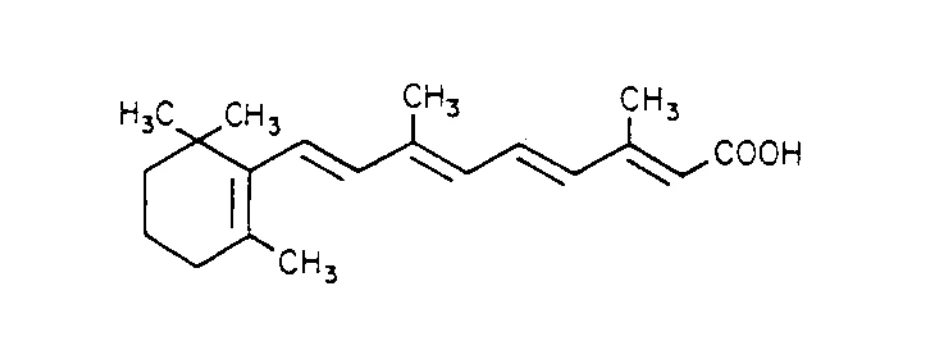
Molecular Formula: C20H28O2
Molecular Weight: 300.44 g/mol
Chemical Name: 3, 7-Dimethyl-9-(2,6,6-trimethyl-1-cyclohexen-1-yl)- 2,4,6,8 nonatetraenoic acid
Physicochemical Properties
Description: Tretinoin is a yellow to light orange crystalline powder. Tretinoin is also known as retinoic acid or as VITAMIN A ACID.
COMPOSITION
VITAMIN A ACID Gel contains either 0.01% w/w, 0.025% w/w or 0.05% w/w Tretinoin, USP.
Preservative: Methylparaben & Propylparaben
Non-Medicinal Ingredients: Alcohol 95%, Carboxyvinyl Polymer Carbopol 980, Isopropyl Alcohol, Propylene Glycol, Purified Water, Solulan 98, Tetrasodium Edetate Tetrahydrate and Trolamine.
STABILITY and STORAGE RECOMMENDATIONS
VITAMIN A ACID Gels should be stored at controlled room temperature (15-30°C).
DOSAGE FORM
VITAMIN A ACID GEL 0.01% w/w, 0.025% w/w and 0.05% w/w is supplied in tubes of 25 grams.
INFORMATION FOR THE PATIENT
WHAT YOU SHOULD EXPECT
Your doctor has recommended VITAMIN A ACID Gel for topical application in the treatment of acne.
VITAMIN A ACID is a highly effective medication, but it is important to recognize that it is not a quick cure. It is valuable to view the treatment as a 6-12-week program that will take time before the best results are seen.
Since VITAMIN A ACID works from beneath the skin surface, clearing usually takes from 6-12 weeks.
For most patients excellent results are achieved. During the early weeks, the primary objective is to allow your skin to slowly build up a tolerance to this medication as it is potentially irritating. Later your skin will adapt, and clearing will occur. Keeping a long-term perspective, following your doctor’s instruction, and maintaining your commitment over a 6-12-week time period will help you to get the most from your treatment program.
- If you are a female of childbearing years, you should use VITAMIN A ACID only after consulting your doctor and seeking his advice for contraceptive counseling. If you are pregnant, you should discontinue use of VITAMIN A ACID.
- Your doctor has given you VITAMIN A ACID for your use only. Do not allow anyone else to use it.
PLEASE REVIEW THE USAGE GUIDELINES.
- 1.
Getting Started
Before starting therapy with VITAMIN A ACID products, it is advisable to discontinue previous topical acne medications, unless otherwise specified by your doctor. It is also advisable to discontinue medicated or abrasive soaps and cleaners, soaps that have a strong drying effect and products with a high concentration of alcohol or astringents, such as shaving lotions during VITAMIN A ACID therapy.
- 2.
Application
The affected area should be washed with lukewarm water and patted dry. Wait at least 20 minutes before applying medication. Apply VITAMIN A ACID sparingly with the fingertips to the affected area once daily just prior to bedtime. Smooth in lightly with the fingertips and avoid “rubbing” into the skin. Care must be taken not to apply near the eyes, lips, nostrils or open sores, as these are most sensitive to irritation.
- 3.
Caution:
If medication is applied excessively, more rapid or better results will not be obtained, and marked redness, peeling or discomfort may occur. It is better to start out with a light application, building this up rather than vice versa. A light, even application will bring positive results over time.
- 4.
Sensitivity
As your skin may be more sensitive to the sun’s rays, wind and cold, avoid or minimize direct or prolonged exposure to the sun’s rays and use of sunlamps because VITAMIN A ACID heightens the susceptibility of your skin to the adverse effects of the sun. If exposure to sun’s rays is unavoidable, the use of sunburn protectant products with a sun protection factor (SPF) of at least 15 and protective clothing over treated areas is recommended.
- 5.
Considerations
Some redness, burning or peeling may occur during the first few weeks of use until your skin adapts to the medication. Your acne condition may also appear to worsen after a week or two as VITAMIN A ACID works to unseat previously unseen acne lesions. This is expected and indicates that the medication is working. Inform your doctor of these changes.
Should the redness, burning or peeling worsen or persist, reduce the frequency of application as advised by your doctor.
The use of the product should be discontinued if any unusual reaction occurs; keep your doctor informed.
After noticeable improvement occurs, VITAMIN A ACID can be used on a reduced schedule with your doctor’s approval, to prevent new acne blemishes from developing.
PHARMACOLOGY
Interest in oral Vitamin A in the treatment of acne stems from a paper by Straumfjord in which it was stated that the primary histologic changes seen in acne were not different in any important way from the follicular lesions attributed to Vitamin A deficiency. He used large doses of oral Vitamin A in the hope of reducing the primary pathological change seen in acne; i.e., the hyperkeratosis of the sebaceous follicles. Such a theory was supported by basic science investigation which showed:
reduction of keratinocytes in the human stratum corneum during oral
Vitamin A therapy
- suppression of keratinization by excessive Vitamin A in tissue culture
Such basic findings plus hair loss from oral high doses of Vitamin A had led to the view that Vitamin A is antikeratinizing or keratolytic.
Topical use of VITAMIN A ACID was suggested as a means of reducing systemic toxicity of Vitamin A. Kligman tried it successfully in the treatment of acne because of its great peeling action and also because of its keratolytic properties since follicular hyperkeratosis is considered to be an early stage of the condition.
There is considerable evidence to indicate that VITAMIN A ACID prevents the formation and appearance of comedones and unseats the comedones already present. Mill, Leyden and Kligman7,8 say of this action, and we quote:
“The action of the drug that best explains this effect is interference with the cohesiveness of horny cells. A comedone forms because the horny cells produced by the follicular epithelium do not desquamate as they normally do. Instead they stick tightly together to create an expanding impaction of horny material in the follicular canal. Tretinoin promotes dehiscence and the keratinized cells fall apart.”
“Other disorders centering about follicular hyperkeratosis in which tretinoin has been shown to be beneficial include pseudo-folliculitis of the beard, senile comedones, pomade acne, acne cosmetica, trichostasis spinulosa, nevus comedonicus, and Darier disease. In all, the key effect is sloughing of impacted horn by dehiscence of horny cells”.
Kaidbey and Kligman9 have found VITAMIN A ACID to be the most comedolytic and by far of five commonly used peeling agents including salicylic acid, sulfur-resorcinol, and benzoyl peroxide.
TOXICOLOGY
Acute toxicity studies of VITAMIN A ACID were carried out in the mouse and rat. The intraperitoneal LD50 was found to be 640 and 600 mg/kg in the mouse and rat respectively. When VITAMIN A ACID was administered orally it was found to be almost non-toxic; in the rat no mortality occurred with a maximal dose if 2000 mg/kg while in the mouse a dose of 5000 mg/kg produced only 20% mortality. (In both the mouse and rat, signs of acute intoxication included tip-toe gait, mild emprosthotonus, severe body tremors, intermittent tonic-clonic convulsions, marked central nervous system depression, lacrimation, ptosis and severe diarrhea).
A ninety-day study of the subacute toxicity of VITAMIN A ACID was carried out on the rabbit through the dermal route at dose levels of 2x, 10x and 20x the maximum human dose level of 0.01 mg/kg of body weight.
Animals receiving VITAMIN A ACID showed erythema and eschar formation, the severity of which increased with increasing dose levels of the topically applied material. Hemograms and blood biochemical parameters revealed no treatment related changes. There were no abnormalities in bone growth. A histopathological study of the treated skin showed acute inflammation of the upper dermis producing micro-abscesses and in some cases folliculitis which may have been responsible for atrophic changes and some destruction of hair follicles. In addition, changes to the epithelium were observed which included acanthosis, parakeratosis and basal hyperplasia. These results are explained by the well known keratolytic effects of VITAMIN A ACID.
The dermal absorption of VITAMIN A ACID was investigated in the rat and rabbit. Results showed that dermal absorption occurred in the rabbit and possibly in the rat.
Teratology
Tretinoin has been used as a standard compound for the experimental induction of malformations in various species. The mechanism of action has not been elucidated; there are indications that tretinoin and its analogues act directly on gene expression. It has been shown in vitro that tretinoin inhibits chondrogenic differentiation, reduces matrix synthesis and alters matrix composition.
A number of published reports have shown that Vitamin A ingested orally in large doses has teratogenic effects in animals. The same teratogenic activity has also been reported with VITAMIN A ACID. Since dermal absorption takes place, it became necessary to check the teratogenic activity of VITAMIN A ACID following topical application. Studies of the teratogenic effects of VITAMIN A ACID applied topically were carried out in the rat and the rabbit at doses equivalent up to 20x the maximum human dose. In these two species, no teratogenic effects were observed in the experimental groups which received topical application of VITAMIN A ACID.
Any comedogenic effect of a formulation topically applied for the treatment of acne vulgaris is likely to worsen the condition instead of curing or preventing it. It establishes a vicious circle: VITAMIN A ACID may hasten the resolution of papulo-pustules but any comedogenic ingredients in the formulation may insidiously promote the formation of new comedones from which inflammatory lesions spring. The comedogenicity of VITAMIN A ACID gel was tested in the rabbit. Results showed the non-oily gel to be non-comedogenic.
REFERENCES
- 1. STRAUMFJORD JV. Vitamin A: Its effects on acne. Northwest Med 1943; 42:210-225
- 2. HUNTER R, PINKUS H. The effects of oral Vitamin A on the number of keratin cells of human epidermis. J Invest Derm 1961; 37:459-460
- 3.
FELL HB, MELLANBY E. Metaplasia produced in cultures of chick ectoderms by high
Vitamin A. J Physiol 1953; 119:470-488
- 4.
Von BEER P. Untersuchungen uber die wirking der Vitamin A saure. Dermatologica
1962; 124:65-80
- 5.
Von STUTTGEN C. Zer lokalbehandling von keratosen mit Vitamin A saure. Dermatol
1962; 124:65-80
- 6.
KLIGMAN AM et al. Topical VITAMIN A ACID in acne vulgaris. Arch Dermatol 1969;
99:459-476
- 7.
MILLS OH, LEYDEN JJ, KLIGMAN AM. Tretinoin treatment of steroid acne. Arch
Dermatol 1973; 108:381-384
- 8. MILLS OH, KLIGMAN AM. Topically applied tretinoin in the treatment of trichostasis spinulosa. Arch Dermatol 1973; 108:378-380
- 9. KAIDBEY KH, KLIGMAN AM. Effectiveness of peeling agents on experimental open comedones. Curtis 1975; 16:53-56
- 10. CHIZ J, MacFARLAND NH. The acute oral and intraperitoneal toxicities of retinoic acid in the mouse and rat. Bio-Research Laboratories, Project 5914, Report No. 1, July 13, 1974.
- 11. LEVINSKY HV, DUSSAULT P, KAHN DS, MacFARLAND NH. A three-month study of the subacute toxicity of retinoic acid in the albino rabbit. Bio-Research Laboratories, Project 5914, Report No. 4, March 15, 1974.
- 12. LEVINSKY HV, DUSSAULT P, MacFARLAND NH. A study of the dermal absorption of retinoic acid in the rat and rabbit. Bio-Research Laboratories, Project 5914, Report No. 2, December 18, 1974.
- 13. LEVINSKY HV, MACFARLAND NH. A study of the teratological effects of retinoic acid in the rat. Bio-Research Laboratories, Project 5914, Report No. 3, January 22, 1974.
- 14. OWSTON E, PROCTER B, CHAPPEL CI. A study of the teratological effects of retinoic acid in the rabbit. Bio-Research Laboratories, Project 5914, Report No. 6, December 31, 1975.
- 15. Proctor BG, RONA G. A study of the potential comedogenicity of a proposed new acne medication. Bio-Research Laboratories, Project 5507, Report, August 4, 1976.
- 16.
PAPA CM. The cutaneous safety of topical tretinoin. Acta Dermatoverner (Stockholm)
1975; Suppl. 74.
- 17. ZIMMERMANN B. Effects of all-trans retinoic acid on chondrogenesis and endochondral mineralization in cartilage organoid culture. Teratology 1995; 51 (6):18A
- 18.
JICK SJ, TERRIS BZ, JICK H. First trimester topical tretinoin and congenital disorders.
Lancet 1993; 341:1181 - 82