


Product Monograph - Vivaxim
SUMMARY PRODUCT INFORMATION
Route of Administration
Intramuscular injection.
Dosage Form/Strength
Suspension for injection.
Each 1 mL dose is formulated to contain:
Active Ingredients
Salmonella typhi (Ty2 strain) purified Vi capsular polysaccharide – 25 µg Inactivated hepatitis A virus (HAV) (GBM strain) – 160 antigen units (U)
Clinically Relevant Non-medicinal Ingredients
Excipients: sodium chloride, disodium phosphate dihydrate, sodium dihydrogen phosphate dihydrate, aluminum hydroxide (expressed as aluminum), 2-phenoxyethanol, formaldehyde, polysorbate 80, Medium 199 Hanks.
Manufacturing process residuals: neomycin.
For a complete listing see DOSAGE FORMS, COMPOSITION AND PACKAGING.
DESCRIPTION
ViVAXIM® [Combined Purified Vi Polysaccharide Typhoid and Inactivated Hepatitis A Vaccine] is a combination vaccine consisting of purified Vi Polysaccharide Typhoid and Inactivated Hepatitis A supplied in a dual chamber syringe. The vaccine is mixed immediately before administration resulting in a cloudy whitish suspension.
This vaccine is a buffered solution (without phenol) of purified Salmonella typhi Vi capsular polysaccharide (Ty2 strain) and a suspension of purified and formaldehyde-inactivated HAV, obtained from GBM strain, cultured on MRC-5 human diploid cells. HAV is adsorbed onto aluminum.
INDICATIONS AND CLINICAL USE
ViVAXIM® is indicated for simultaneous active immunization against infection caused by S. typhi, the organism that causes typhoid fever, and HAV in persons 16 years of age or older. ViVAXIM® can be used for hepatitis A primary immunization or booster and for typhoid primary immunization or revaccination. (See DOSAGE AND ADMINISTRATION)
There is no contraindication to administering ViVAXIM® to someone who is already immune to hepatitis A. (1)
HAV vaccination is recommended in the following situations: (2)
- 1)
Pre-exposure immunization of persons at increased risk of infection or severe hepatitis A (HA).
- Travellers to HA endemic areas (including military personnel and humanitarian relief workers) or immigrants from HA endemic areas.
- Household or close contacts of children adopted from HA endemic countries
- Populations or communities at risk of HA outbreaks or in which HA is highly endemic
- Persons with lifestyle risks for infection, including those who use illicit drugs and men who have sex with men (MSM).
- Persons who have chronic liver disease from any cause, as they may be at risk of more severe disease if infection occurs.
- People with hemophilia A or B receiving plasma-derived products.
- Persons who handle non-human primates and workers involved in research who may be exposed to HA virus
- 2) Post-exposure immunization for household and close contacts of proven or suspected cases of hepatitis A.
Typhoid vaccination is recommended in the following situations: (3)
- 1) Travellers to endemic or epidemic areas or where sanitary conditions may be doubtful and where travellers may be exposed to potentially contaminated food and water, particularly when prolonged exposure is anticipated.
- 2) Travellers with reduced or absent gastric acid secretion.
- 3) People with ongoing household or intimate exposure to an S. typhi carrier.
- 4) Laboratory workers who frequently handle cultures of S. typhi.
The complete, current recommendations by NACI can be accessed at
www.phac-aspc.gc.ca/publicat/cig-gci/
Pediatrics
ViVAXIM® is not indicated for immunization of persons below the age of 16 years.
Geriatrics
ViVAXIM® is indicated for immunization of persons 16 years of age or older.
CONTRAINDICATIONS
Hypersensitivity
Known systemic hypersensitivity reaction to any component of ViVAXIM® or a life-threatening reaction after previous administration of the vaccine or a vaccine containing one or more of the same components are contraindications to vaccination. (4) (See SUMMARY PRODUCT INFORMATION.)
WARNINGS AND PRECAUTIONS
General
Before administration of ViVAXIM®, health-care providers should inform the recipient or the parent or guardian of the recipient of the benefits and risks of immunization, inquire about the recent health status of the recipient, review the recipient’s history concerning possible hypersensitivity to the vaccine or similar vaccine, previous immunization history, the presence of any contraindications to immunization and comply with any local requirements with respect to information to be provided to the recipient, parent or guardian before immunization.
Because of the incubation period of hepatitis A disease, infection may be present but not clinically apparent at the time of vaccination. It is not known whether ViVAXIM® will prevent hepatitis A in this case.
As with any vaccine, ViVAXIM® may not protect 100% of vaccinated individuals. Travellers should take all necessary precautions to avoid contaminated food and water. This is of particular concern when the vaccine is administered less than 2 weeks before departure, as optimum antibody protection may not yet be achieved.
The vaccine should be administered at least 14 days before risk of exposure to both typhoid fever and hepatitis A.
Syncope (fainting) can occur following, or even before, any vaccination as a psychogenic response to the needle injection. Procedures should be in place to prevent falling injury and manage syncopal reactions.
Administration Route-Related Precautions: Do not administer ViVAXIM® by intravascular injection; ensure that the needle does not penetrate a blood vessel.
Do not administer intradermally.
ViVAXIM® should not be administered into the buttocks.
Febrile or Acute Disease: Vaccination should be postponed in cases of an acute or febrile disease. (5) However, a disease with a low-grade fever should not usually be a reason to postpone vaccination.
Protection
ViVAXIM® does not provide protection against species of Salmonella other than Salmonella typhi or against other bacteria that cause enteric disease; it does not provide protection against infection caused by hepatitis B virus, hepatitis C virus, delta virus, hepatitis E virus or by other liver pathogens, other than HAV.
Hematologic
Because any intramuscular injection can cause an injection site hematoma in persons with any bleeding disorders, such as hemophilia or thrombocytopenia, or in persons on anticoagulant therapy, intramuscular injections with ViVAXIM® should not be administered to such persons unless the potential benefits outweigh the risk of administration. If the decision is made to administer any product by intramuscular injection to such persons, it should be given with caution, with steps taken to avoid the risk of hematoma formation following injection.
In exceptional circumstances (e.g., in patients with thrombocytopenia or in patients at risk of hemorrhage) the vaccine may be administered by the subcutaneous route, however, this may be associated with a higher risk of local reaction including injection site nodule. (4)
Immune
The possibility of allergic reactions in persons sensitive to components of the vaccine should be evaluated. Hypersensitivity reactions may occur following the use of ViVAXIM® even in persons with no prior history of hypersensitivity to the product components. (See DOSAGE FORMS, COMPOSITION AND PACKAGING.)
As with all other products, epinephrine hydrochloride solution (1:1,000) and other appropriate agents should be available for immediate use in case an anaphylactic or acute hypersensitivity reaction occurs. (4) Health-care providers should be familiar with current recommendations for the initial management of anaphylaxis in non-hospital settings, including proper airway management. (4) For instructions on recognition and treatment of anaphylactic reactions, see the current edition of the Canadian Immunization Guide or visit the Health Canada website.
Immunocompromised persons (whether from disease or treatment) may not obtain the expected immune response. If possible, consideration should be given to delaying vaccination until after the completion of any immunosuppressive treatment. (4) Nevertheless, vaccination of persons with chronic immunodeficiency such as HIV infection is recommended even if the antibody response might be limited.(4) (5)
Pregnant Women
Animal reproductive studies have not been conducted with ViVAXIM®.
Data on the use of this vaccine in pregnant women are limited. Therefore, the administration of the vaccine during pregnancy is not recommended. ViVAXIM® should be given to pregnant women only if clearly needed and following an assessment of the risks and benefits.
Nursing Women
It is not known whether this vaccine is excreted in human milk. Caution must be exercised when ViVAXIM® is administered to a nursing mother.
ADVERSE REACTIONS
Clinical Trial Adverse Drug Reactions
Because clinical trials are conducted under widely varying conditions, adverse reaction rates observed in the clinical trials of a vaccine cannot be directly compared to rates in the clinical trials of another vaccine and may not reflect rates observed in practice. The adverse reaction information from clinical trials does, however, provide a basis for identifying the adverse events that appear to be related to vaccine use and for approximating rates of those events.
In controlled clinical studies using ViVAXIM® the most commonly reported reactions were those occurring at the injection site.
In a clinical trial comparing ViVAXIM® with the two monovalent vaccines given simultaneously at separate sites, pain at the injection site was reported by 89.9% of subjects (4.5% severe) following administration of ViVAXIM® compared with 84.9% of subjects (5% severe) who received monovalent Vi polysaccharide typhoid vaccine and inactivated hepatitis A vaccine at separate injection sites. (6) (7) (8)
Table 1: Frequency (%) of Reactions Observed within 7 Days Following a Dose of ViVAXIM®
| Reactions | % of Vaccinees with a Reaction (N = 178) |
|---|---|
| Nervous System Disorders | |
| Headache | 15.2 |
| Dizziness | 1.1 |
| Gastrointestinal Disorders | |
| Nausea | 2.8 |
| Diarrhea | 2.8 |
| Skin and Subcutaneous Tissue Disorders | |
| Pruritus | 0.6 |
| Rash | 0.6 |
| Musculoskeletal, Connective Tissue and Bone Disorders | |
| Myalgia | 16.3 |
| Arthralgia | 0.6 |
| General Disorders and Administration Site Conditions | |
| Pain at the injection site | 89.9 |
| Induration/Oedema at the injection site | 28.1 |
| Asthenia | 16.9 |
| Erythema at the injection site | 10.1 |
| Fever | 4.5 |
| Malaise | 3.4 |
Post-Market Adverse Reactions
The following additional adverse events have been spontaneously reported during the post-marketing use of ViVAXIM®. Because these events are reported voluntarily from a population of uncertain size, it is not always possible to reliably estimate their frequency or establish a causal relationship to vaccine exposure. Decisions to include these events in labelling were based on one or more of the following factors: 1) severity of the event, 2) frequency of reporting, or 3) strength of causal connection to ViVAXIM®.
Immune System Disorders
anaphylactic/anaphylactoid reaction, including shock, serum sickness
Nervous System Disorders
vasovagal syncope
Gastrointestinal Disorders
vomiting, abdominal pain
Skin and Subcutaneous Tissue Disorders
urticaria
Investigation
transaminases increased (mild and reversible)
The following additional adverse reactions were not reported with ViVAXIM® but were reported respectively in association with TYPHIM Vi® [Salmonella typhi Vi capsular polysaccharide vaccine] or AVAXIM® [Hepatitis A Vaccine Inactivated]:
Respiratory, Thoracic and Mediastinal Disorders
asthma
General Disorders and Administration Site Condition
injection site nodule
Physicians, nurses and pharmacists should report any adverse occurrences temporally related to the administration of the product in accordance with local requirements and to the Global Pharmacovigilance Department, Sanofi Pasteur Limited, 1755 Steeles Avenue West, Toronto, ON, M2R 3T4, Canada. 1-888-621-1146 (phone) or 416-667-2435 (fax).
DRUG INTERACTIONS
Vaccine-Drug Interactions
Immunosuppressive treatments may interfere with the development of the expected immune response. (See WARNINGS AND PRECAUTIONS.)
Concomitant Vaccine Administration
ViVAXIM® may be administered simultaneously with immune globulin at separate sites with separate syringes. (4) Hepatitis A seroconversion rates are not modified, but hepatitis A antibody titres could be lower than after vaccination using the vaccine alone. (9)
As the vaccine is inactivated, concomitant administration of other vaccine(s) given at other injection sites is unlikely to interfere with immune responses.
Based on data obtained from the concomitant administration of the monovalent vaccines (Purified Vi Polysaccharide Typhoid Vaccine and Inactivated Hepatitis A Vaccine) with yellow fever vaccine, no interference with the immune response of any of these antigens would be expected when ViVAXIM® is administered concurrently at a different site with yellow fever vaccine. (10) No interaction with other medication is currently known.
Vaccines administered simultaneously must be given using separate syringes at separate sites.
ViVAXIM® should not be mixed in the same syringe with other parenterals.
DOSAGE AND ADMINISTRATION
Recommended Dose
ViVAXIM® should be administered as a single injection of 1 dose (1 mL) by the intramuscular route.
To provide long-term protection against infection caused by HAV, a booster injection of inactivated hepatitis A vaccine (such as AVAXIM®) should be given 6 to 36 months later. Alternatively, VIVAXIM® can be given as a booster vaccine at 36 months in those persons who require protection against typhoid fever.
ViVAXIM® may be used as a booster vaccine in persons who received ViVAXIM® 36 months earlier and who require a hepatitis A booster and protection against typhoid fever.
Administration
Inspect for extraneous particulate matter and/or discolouration before use. (See DESCRIPTION.) If these conditions exist, the product should not be administered.
The purified Vi polysaccharide typhoid vaccine is contained in the chamber of the syringe closest to the syringe tip and the inactivated hepatitis A vaccine in the chamber closest to the plunger.
The two vaccine components should only be mixed immediately before injection. The final volume to be injected is 1 mL.
Aseptic technique must be used. Use a separate sterile disposable unit for each individual patient to prevent disease transmission. Needles should not be recapped and should be disposed of according to biohazard waste guidelines.
Figure 1. Instructions for Use – Dual Chamber Syringe
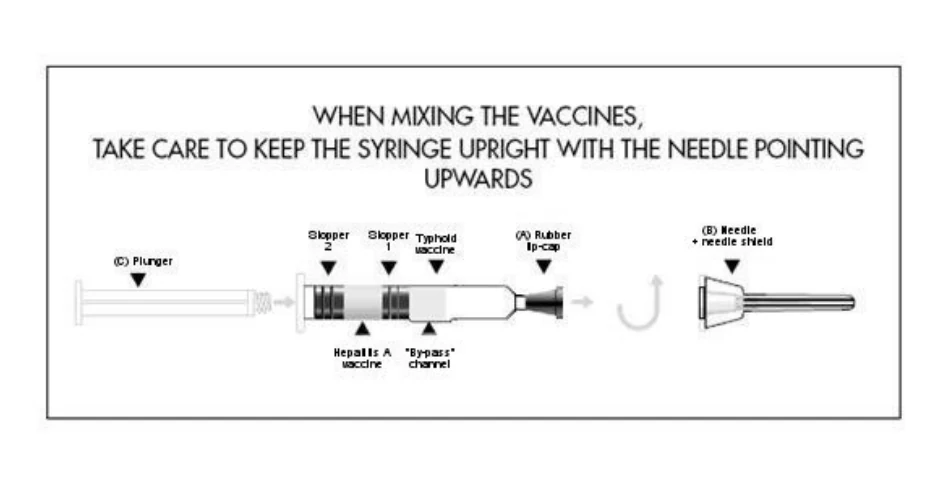
- 1. Remove the tip-cap (A).
- 2. Attach needle and needle shield (B) to the syringe.
- 3. Screw the plunger rod (C) into the plunger stopper (stopper 2).
- 4. Shake the syringe; then mix the vaccine components by slowly pushing the plunger, keeping the needle upwards. The vaccine in the lower chamber moves into the upper chamber by means of the by-pass channel.
- 5. Shake vigorously until a homogeneous cloudy, whitish suspension is achieved.
- 6. Holding the needle shield at the tip, remove by pulling upwards without twisting.
- 7. Proceed immediately with the injection. The stoppers may separate but ensure that stopper 2 does not reach the by-pass channel in order to avoid any leakage of liquid. Administer the vaccine intramuscularly (I.M.). The preferred site of injection is the deltoid muscle.
Give the patient a permanent personal immunization record. In addition, it is essential that the physician or nurse record the immunization history in the permanent medical record of each patient. This permanent office record should contain the name of the vaccine, date given, dose, manufacturer and lot number.
OVERDOSAGE
For management of a suspected drug overdose, contact your regional Poison Control Centre.
ACTION AND CLINICAL PHARMACOLOGY
HAV is a single serotype, ribonucleic acid (RNA) virus of the Picornaviridae family. HAV is transmitted via the fecal-oral route, which can occur from direct person-to-person contact, from contamination of the environment or objects, or through contaminated food or water. (2)
Salmonella typhi is the etiological agent of typhoid fever, an acute, febrile enteric disease transmitted by contaminated water and food. (3)
Mechanism of Action
TYPHIM Vi® confers significant protection against typhoid fever based on the production of measurable antibodies, predominantly of the IgG class. (11) AVAXIM® confers immunity against HAV infection by inducing the production of specific anti-HAV antibodies.
Pharmacodynamics
In 2 clinical studies involving 787 participants, after the primary vaccination, the seroprotection rate for HAV (% ≥20 mIU/mL) was 95.6% after 14 days (n = 153) and 99.7% after 28 days (n = 738). The seroprotection rate for Vi (% ≥1 µg/mL) was 89.3% after 14 days (n = 158) and 90.3% after 28 days (n = 707). (6)
Duration of Effect
Revaccination against typhoid fever should be carried out with a single dose of purified Vi polysaccharide typhoid vaccine (such as TYPHIM Vi® or ViVAXIM®) at an interval of not more than 3 years in subjects who remain at risk.
Data relative to long-term persistence of anti-HAV antibodies following vaccination with ViVAXIM® are not currently available. Published data suggest that anti-HAV antibodies persist beyond 10 years after the booster vaccination in healthy individuals. (12) (13) (14) (15) (16) According to the National Advisory Committee on Immunization (NACI), kinetic models of antibody decline suggest that protective levels of anti-HAV antibody will likely persist for at least 20 years. (16) (2)
STORAGE AND STABILITY
Store at 2° to 8°C (35° to 46°F). Do not freeze. Discard product if exposed to freezing. Do not use after expiration date.
The vaccine must be administered immediately after mixing.
DOSAGE FORMS, COMPOSITION AND PACKAGING
Dosage Forms
ViVAXIM® is supplied in a dual chamber syringe which contains 0.5 mL of purified Vi polysaccharide typhoid vaccine (clear colourless solution for injection) and 0.5 mL of inactivated hepatitis A vaccine (cloudy whitish suspension for injection) which are mixed immediately before administration resulting in a cloudy whitish suspension.
Composition
The dual chamber syringe contains 0.5 mL of purified Vi polysaccharide typhoid vaccine and 0.5 mL of inactivated hepatitis A vaccine.
Each single dose (1 mL) is formulated to contain:
First Chamber
Active Ingredient
Salmonella typhi (Ty2 strain) purified Vi capsular polysaccharide 25 µg
Other Ingredients
Phosphate buffer solution containing:
Sodium chloride 4.150 mg
Disodium phosphate dihydrate 0.065 mg
Sodium dihydrogen phosphate dihydrate 0.023 mg
Water for injection qs to 0.5 mL
Second Chamber
Active Ingredient
Inactivated hepatitis A Virus, GBM strain 160 antigen units†
Other Ingredients
2-phenoxyethanol 2.5 µL
Formaldehyde 12.5 µg
Aluminum hydroxide (expressed as aluminum) 0.3 mg
Medium 199 Hanks/water for injection‡ qs to 0.5 mL
Polysorbate 80 ≤750 µg
Manufacturing Process Residual: Neomycin is present in trace amounts.
† In the absence of an international standardized reference, the antigen content is expressed using an in-house reference.
‡ Medium 199 Hanks (without phenol red) is a mixture of amino acids, mineral salts, vitamins and other components supplemented with polysorbate 80.
ViVAXIM® is supplied in a pre-filled single dose, dual chamber syringe.
The syringes are made of Type 1 glass. The plunger stoppers and needle shield for the syringe do not contain latex (natural rubber).
ViVAXIM® is supplied in packages of:
1 x 1 mL (single dose) dual chamber syringe without attached needle.
Vaccine Information Service: 1-888-621-1146 or 416-667-2779. Business Hours: 7:30 a.m. to 7:30 p.m. Eastern Time, Monday to Friday.
Full product monograph available on request or visit us at www.sanofipasteur.ca
Product information as of September 2015.
Manufactured by:
Sanofi Pasteur SA
Lyon, France
Distributed by:
Sanofi Pasteur Limited
Toronto, Ontario, Canada
R4-0915 Canada
PART II: SCIENTIFIC INFORMATION
PHARMACEUTICAL INFORMATION
Drug Substance
Proper name: Combined Purified Vi Polysaccharide Typhoid and Inactivated Hepatitis A Vaccine
Product Characteristics
ViVAXIM® is a sterile, cloudy, whitish suspension of inactivated hepatitis A and Salmonella typhi.
The Vi antigen contained in TYPHIM Vi® vaccine is extracted from the bacterial capsule of Salmonella typhi strain Ty2. Each dose of purified Vi polysaccharide typhoid vaccine contains 25 µg.
AVAXIM®’s active ingredient is a purified and formaldehyde-inactivated HAV obtained from the GBM strain cultured on MRC-5 human diploid cells. Hepatitis A virus is adsorbed onto aluminum. Each dose (0.5 mL) of inactivated hepatitis A vaccine contains 160 antigen units (in the absence of an international standardized reference, the antigen content is expressed using an in-house reference).
CLINICAL TRIALS
Table 2: Summary of Demographics and Study Design of the Trials with ViVAXIM®
| Study # | Trial Design | Dosage, Route of Administration and Duration | Study Subjects | Age Range | Gender |
|---|---|---|---|---|---|
| AVi01398 (7) | Multicentre, open, randomised comparison study between HA/Vi vaccine and concomitant administration of hepatitis A and typhoid fever vaccines Follow-up at Year 1, 2 and 3. Revaccination with ViVAXIM® at Year 3. | 1 Dose, 1.0 mL I.M. of HA/Vi Vaccine or 1 Dose, 0,5 mL I.M. each of Hepatitis A and Typhoid Fever Vaccine | N = 360 | 16 – 65 Years | Males N = 144 Females N = 216 |
| AVi02398 (8) | Multicentre, double-blind, randomized comparison of three batches of hepatitis A and typhoid fever combined vaccine (HA/Vi) | 1 Dose, 1.0 mL I.M. of HA/Vi Vaccine | N = 610 | 16 – 59 Years | Males N = 276 Females N = 334 |
Immunogenicity
TYPHIM Vi® confers significant protection against typhoid fever based on the production of measurable antibodies, predominantly of the IgG class. (11)
AVAXIM® confers immunity against HAV infection by inducing the production of specific anti-hepatitis A virus antibodies.
In a clinical trial conducted in adults aged 16 - 65 years, 179 persons received ViVAXIM® and 181 received AVAXIM® in one arm and TYPHIM Vi® in the other arm. Equivalent seroconversion rates were seen, both at 14 and 28 days after vaccine administration. In another clinical trial conducted in adults aged 16 - 59 years, 610 persons received one dose of ViVAXIM®. Antibody responses are in Table 3 and Table 4. (6)
Table 3: Antibody Response to Vi 14 and 28 Days Post-Vaccination with ViVAXIM® (6)
| Anti-Vi titre (µg/mL) | Day 0 | Day 14 | Day 28 |
|---|---|---|---|
| N = 787 | N = 177 | N = 785 | |
| GMT (95% CI)* | 0.206 (0.196 - 0.217) | 2.98 (2.61 - 3.40) | 2.83 (2.67 - 3.01) |
| ≥1 µg/mL | N = 35 | N = 158 | N = 702 |
| % (95% CI) | 4.4 (3.1 - 6.1) | 89.3 (83.7 - 93.4) | 89.4 (87.1 - 91.5) |
| ≥4-fold rise | - | N = 153 | N = 707 |
| % (95% CI) | - | 86.4 (80.5 - 91.1) | 90.3 (88.0 - 92.3) |
* 95% CI: 95% confidence interval
Table 4: Antibody Response to HAV 14 and 28 Days Post-Vaccination with ViVAXIM® in Initially Anti-HAV Seronegative Subjects
| Anti-HAV titre (mIU/mL) | Day 0 | Day 14 | Day 28 |
|---|---|---|---|
| N = 743 | N = 160 | N = 740 | |
| GMT (95% CI)* | 6.14 (5.93 - 6.35) | 232 (188 - 285) | 858 (799 - 921) |
| ≥20 mIU/mL | N = 0 | N = 153 | N = 738 |
| % (95% CI) | 0.0 (0.0 - 0.5) | 95.6 (91.2 - 98.2) | 99.7 (99.0 - 100) |
* 95% CI: 95% confidence interval
To assess the persistence of antibody, individuals in the comparative trial were followed for 3 years. During the three-year follow-up period, antibody trends for both valences were similar in both groups as shown in Table 5 and Table 6. The anti-Vi titres and percentage of subjects seroconverted gradually declined over the three years in both groups. Regarding anti-HAV titres, whether the group had initially received ViVAXIM® or AVAXIM® and TYPHIM Vi® more than 99% of subjects were still seroconverted 3 years later. (6)
Table 5: Antibody Response to Vi
| ViVAXIM® | TYPHIM Vi® and AVAXIM® | |||||||||||||||||||||||
|---|---|---|---|---|---|---|---|---|---|---|---|---|---|---|---|---|---|---|---|---|---|---|---|---|
| Year 1 N = 139 | Year 2 N = 124 | Year 3 N = 112 | Year 1 N = 140 | Year 2 N = 117 | Year 3 N = 104 | |||||||||||||||||||
| Anti-Vi titre (µg/mL) | ||||||||||||||||||||||||
| GMT | 0.85 | 0.698 | 0.641 | 0.944 | 0.704 | 0.662 | ||||||||||||||||||
| 95% CI | 0.716 - 1.01 | 0.585 - 0.834 | 0.530 - 0.776 | 0.769 - 1.16 | 0.564 - 0.878 | 0.520 - 0.843 | ||||||||||||||||||
| ≥1 µg/mL | ||||||||||||||||||||||||
| % | 44.6 | 40.3 | 32.1 | 44.3 | 41 | 35.6 | ||||||||||||||||||
| 95% CI | 36.2 - 53.3 | 31.6 - 49.5 | 23.6 - 41.6 | 35.9 - 52.9 | 32.0 - 50.5 | 26.4 - 45.6 | ||||||||||||||||||
Table 6: Antibody Response to HAV
| ViVAXIM® | TYPHIM Vi® and AVAXIM® | ||||||||||||||||||
|---|---|---|---|---|---|---|---|---|---|---|---|---|---|---|---|---|---|---|---|
| Year 1 | Year 2 | Year 3 | Year 1 | Year 2 | Year 3 | ||||||||||||||
| Anti-Vi titre (µg/mL) | |||||||||||||||||||
| GMT | 548 | 419 | 425 | 321 | 257 | 258 | |||||||||||||
| 95% CI | 443 - 678 | 340 - 518 | 345 - 524 | 265 - 390 | 204 - 324 | 202 - 329 | |||||||||||||
| ≥20 mIU/mL | |||||||||||||||||||
| % | 99.3 | 98.4 | 99.1 | 99.3 | 98.3 | 99 | |||||||||||||
| 95% CI | 96.1 - 100 | 94.3 - 99.8 | 95.1 - 100 | 96.1 - 100 | 93.9 - 99.8 | 94.7 - 100 | |||||||||||||
Three years after the initial immunization, a sub-group of 102 individuals was re-immunized with ViVAXIM®. Complete serology results were available for 46 individuals who had initially received ViVAXIM® and 37 individuals who had initially received AVAXIM® and TYPHIM Vi® concomitantly at separate sites. Comparison of geometric mean titres (GMTs) 28 days after ViVAXIM® injection at year 3 indicated that, for both valences, the GMTs obtained for the ViVAXIM® group are non-inferior to the GMTs obtained for the group receiving AVAXIM® and TYPHIM Vi®. (6) (7)
Safety
In controlled clinical studies using ViVAXIM® the most commonly reported reactions were those occurring at the injection site.
In a clinical trial comparing ViVAXIM® with the two monovalent vaccines given simultaneously at separate sites, pain at the injection site was reported by 89.9% of subjects (4.5% severe) following administration of ViVAXIM® compared with 84.9% of subjects (5% severe) who received monovalent Vi polysaccharide typhoid vaccine and inactivated hepatitis A vaccine at separate injection sites. (6)
Vaccine Information Service: 1-888-621-1146 or 416-667-2779. Business Hours: 7:30 a.m. to 7:30 p.m. Eastern Time, Monday to Friday.
Full product monograph available on request or visit us at www.sanofipasteur.ca
Product information as of September 2015.
Manufactured by:
Sanofi Pasteur SA
Lyon, France
Distributed by:
Sanofi Pasteur Limited
Toronto, Ontario, Canada
R4-0915 Canada
REFERENCES
1 Zuckerman J, et al. Comparison of the safety and immunogenicity of two inactivated hepatitis A vaccines. Adv Therapy 1997;14(3):116-24.
2 National Advisory Committee on Immunization (NACI). Part 4 - Active Vaccines: Hepatitis A Vaccine. In: Canadian Immunization Guide. [Online]. 2012. Available from: URL:http://www.phac-aspc.gc.ca/publicat/cig-gci/p04-hepa-eng.php
3 National Advisory Committee on Immunization (NACI). Canadian Immunization Guide, Part 4 - Active Vaccines: Typhoid Vaccine [Online]. Ottawa: Public Health Agency of Canada; 2014. Available from: http://www.phac-aspc.gc.ca/publicat/cig-gci/p04-typh-eng.php
4 National Advisory Committee on Immunization (NACI). Vaccine safety and adverse events following immunization. Recommended immunization. In: Canadian Immunization Guide. 7th ed. Her Majesty the Queen in Right of Canada, represented by the Minister of Public Works and Government Services Canada. 2006. p. 80-4, 107-12, 117-30, 134-5.
5 CDC. General recommendations on immunization. Recommendations of the Advisory Committee on Immunization Practices (ACIP). MMWR 2006;55(RR-15):1-48.
6 Data on file at Sanofi Pasteur Limited.
7 Overbosch D, et al. Combined typhoid fever and hepatitis A vaccine: comparison of immunogenicity and safety to concomitant monovalent vaccine over 3 years. J Travel Med 2005;12:319-26.
8 Loebermann M, et al. A randomized, open-label study of the immunogenicity and reactogenicity of three lots of a combined typhoid fever/hepatitis A vaccine in healthy adults. Clin Ther 2004;26(7):1084-91.
9 Zanetti A, et al. Does immunoglobulin interfere with the immunogenicity to Pasteur Merieux inactivated hepatitis A vaccine? J Hepatol 1997;26:25-30.
10 Dumas R, et al. Safety and immunogenicity of a new inactivated hepatitis A vaccine in concurrent administration with a typhoid fever vaccine or a typhoid fever and yellow fever vaccine. Adv Therapy 1997;14(4):160-7.
11 Robbins JD, Robbins JB. Re-examination of the protective role of the capsular polysaccharide (Vi antigen) of Salmonella typhi. J Infect Dis 1984;150:436-49.
12 Van Herck K, et al. Mathematical models for assessment of long-term persistence of antibodies after vaccination with two inactivated hepatitis A vaccines. J Med Virol 2000;60:1-7.
13 Wiedermann G, et al. Inactivated hepatitis A vaccine: long-term antibody persistence. Vaccine 1997;15(6-7):612-15.
14 Van Herck K and Van Damme P. Inactivated hepatitis A vaccine-induced antibodies: follow-up and estimates of long-term persistence. J Med Virol 2001;63(1):1-7.
15 Van Damme P, et al. Inactivated hepatitis A vaccine: reactogenicity, immunogenicity, and long-term antibody persistence. J Med Virol 1994;44(4):446-51.
16 Van Damme P, et al. International Consensus Group on Hepatitis A Virus Immunity. Consensus Statement. Hepatitis A booster vaccination: is there a need? Lancet 2003;362(9389):1065-71.