


Product Monograph - Acetazolamide
RECENT MAJOR LABEL CHANGES
| 3 SERIOUS WARNINGS AND PRECAUTIONS BOX | 05/2025 |
|---|---|
| 7 WARNINGS AND PRECAUTIONS | 05/2025 |
TABLE OF CONTENTS
Sections or subsections that are not applicable at the time of authorization are not listed.
RECENT MAJOR LABEL CHANGES .......................................................................................... 2
TABLE OF CONTENTS ............................................................................................................ 2
PART I: HEALTH PROFESSIONAL INFORMATION .................................................................... 4
1 INDICATIONS ............................................................................................................. 4
1.1 Pediatrics ................................................................................................................ 4
1.2 Geriatrics ................................................................................................................ 4
2 CONTRAINDICATIONS ................................................................................................ 4
3 SERIOUS WARNINGS AND PRECAUTIONS BOX ........................................................... 4
4 DOSAGE AND ADMINISTRATION ................................................................................ 5
4.2 Recommended Dose and Dosage Adjustment ...................................................... 5
5 OVERDOSAGE ............................................................................................................ 5
6 DOSAGE FORMS, STRENGTHS, COMPOSITION AND PACKAGING ................................ 5
7 WARNINGS AND PRECAUTIONS ................................................................................. 5
General ............................................................................................................................... 5
Opthalmologic .................................................................................................................... 6
Respiratory ......................................................................................................................... 6
7.1 Special Populations ................................................................................................ 6
7.1.2 Breast-feeding .................................................................................................... 6
7.1.3 Pediatrics ............................................................................................................ 6
8 ADVERSE REACTIONS................................................................................................. 6
8.1 Adverse Reaction Overview ................................................................................... 6
8.5 Post-Market Adverse Reactions ............................................................................. 7
9 DRUG INTERACTIONS ................................................................................................ 7
9.2 Drug Interactions Overview ................................................................................... 7
9.4 Drug-Drug Interactions .......................................................................................... 7
9.5 Drug-Food Interactions .......................................................................................... 7
9.6 Drug-Herb Interactions .......................................................................................... 7
9.7 Drug-Laboratory Test Interactions......................................................................... 7
10 CLINICAL PHARMACOLOGY ........................................................................................ 7
11 STORAGE, STABILITY AND DISPOSAL .......................................................................... 7
12 SPECIAL HANDLING INSTRUCTIONS ............................................................................ 8
PART II: SCIENTIFIC INFORMATION ....................................................................................... 9
13 PHARMACEUTICAL INFORMATION ............................................................................ 9
14 CLINICAL TRIALS ........................................................................................................ 9
15 MICROBIOLOGY ........................................................................................................ 9
16 NON-CLINICAL TOXICOLOGY ...................................................................................... 9
PATIENT MEDICATION INFORMATION ................................................................................ 10
PART I: HEALTH PROFESSIONAL INFORMATION
1 INDICATIONS
ACETAZOLAMIDE (acetazolamide tablets) is indicated:
- To decrease ocular aqueous humor secretion in glaucoma (chronic, simple and secondary types).
- For use as an adjunct in the treatment of selected cases of epilepsy.
- To alkalinize the urine in selected cases of salicylate overdosage.
1.1 Pediatrics
Pediatrics: No data are available to Health Canada; therefore, Health Canada has not authorized an indication for pediatric use.
1.2 Geriatrics
Geriatrics: No data are available to Health Canada; therefore, Health Canada has not authorized an indication for geriatric use.
2 CONTRAINDICATIONS
ACETAZOLAMIDE is contraindicated for:
- depressed sodium and/or potassium blood levels
- in renal failure.
- adrenal gland failure.
- metabolic acidosis
- some cases of hepatic cirrhosis
- severe glaucoma due to peripheral anterior synechias or in hemorrhagic glaucoma
- long term use in chronic non-congestive angle closure glaucoma
3 SERIOUS WARNINGS AND PRECAUTIONS BOX
|
|---|
|
|---|
4 DOSAGE AND ADMINISTRATION
4.2 Recommended Dose and Dosage Adjustment
Chronic simple (open angle) glaucoma: 250 mg. 1 to 4 times daily. A complementary effect has been noted when acetazolamide was used with miotics or mydriatics as the case demanded.
Secondary glaucoma and preoperative treatment of some cases of acute congestive (closed angle) glaucoma: 250 mg every 4 hours.
Epilepsy: 8 to 30 mg/kg (375 to 1000 mg) daily in divided doses.
To alkalinize the urine: 250 mg every 4 to 6 hours.
Health Canada has not authorized an indication for pediatric use.
5 OVERDOSAGE
| For the most recent information in the management of a suspected drug overdose, contact your regional poison control centre or Health Canada’s toll-free number, 1-844 POISON-X (1-844-764-7669). |
|---|
6 DOSAGE FORMS, STRENGTHS, COMPOSITION AND PACKAGING
Table – Dosage Forms, Strengths, Composition and Packaging
ACETAZOLAMIDE (acetazolamide) 250 mg tablets: Each white, round, biconvex tablet, cross-scored on one side and engraved 250 on the other side contains acetazolamide 250 mg. Available in bottles of 100.
7 WARNINGS AND PRECAUTIONS
Please see 3 SERIOUS WARNINGS AND PRECAUTIONS BOX.
General
Increasing the dose does not increase, and may often decrease the diuresis, and may yet produce drowsiness and/ or paresthesia.
| Route of Administration | Dosage Form / Strength/Composition | Non-medicinal Ingredients |
| Oral | Tablet 250 mg | Colloidal silicon dioxide, Magnesium stearate, Microcrystalline cellulose. |
Opthalmologic
Acetazolamide, a sulfonamide, can cause an idiosyncratic reaction resulting in choroidal effusion associated with acute myopia, acute angle-closure glaucoma or a combination of both. Symptoms include acute onset of decreased visual acuity, blurred vision or ocular pain. These typically occur within hours to weeks of drug initiation. Discontinue acetazolamide as rapidly as possible. Obtain appropriate medical evaluation immediately and consider treatment of elevated intraocular pressure.
Respiratory
Severe cases of non-cardiogenic pulmonary edema have been reported after taking acetazolamide, also after a single dose see 8.1 Adverse Reaction Overview. Non-cardiogenic pulmonary edema typically developed within minutes to hours after acetazolamide intake. Symptoms included dyspnoea, hypoxia, and respiratory insufficiency. If non-cardiogenic pulmonary edema is suspected, acetazolamide should be withdrawn, and supportive treatment should be given. Acetazolamide should not be administered to patients who previously experienced non-cardiogenic pulmonary edema following acetazolamide intake.
7.1 Special Populations
7.1.2 Breast-feeding
It is unknown if acetazolamide is excreted in human milk. Precaution should be exercised because many drugs can be excreted in human milk.
7.1.3 Pediatrics
Pediatrics: No data are available to Health Canada; therefore, Health Canada has not authorized an indication for pediatric use.
8 ADVERSE REACTIONS
8.1 Adverse Reaction Overview
Metabolic acidosis and hypokalemia may occur during prolonged acetazolamide therapy.
Adverse reactions common to all sulfonamide derivatives including fever, rash (including Stevens Johnsons Syndrome, Erythema Multiforme, Toxic Epidermal Necrolysis and Acute Generalised Exanthematous Pustulosis), crystalluria, renal calculus, bone marrow depression, thrombocytopenic purpura, hemolytic anemia, leukopenia, pancytopenia, and agranulocytosis may occur. If such reactions occur, discontinue therapy and institute appropriate measures.
For acute respiratory distress syndrome and pulmonary edema, if rapidly progressive dyspnoea, hypoxaemia, or chest X-ray abnormalities such as diffuse infiltrative shadow in both lungs are observed, administration of this drug should be discontinued, and appropriate measures should be taken. The frequency of these adverse reactions are not known.
Untoward effects during short term therapy are said to be minimal. Those noted include paresthesias, some loss of appetite, polyuria and occasional instances of drowsiness and confusion. Other occasional adverse reactions include urticaria, melena, hematuria, glycosuria, hepatic insufficiency, flaccid paralysis and convulsions.
Transient myopia has been reported. This condition invariably subsided upon the diminution or discontinuation of the medication.
8.5 Post-Market Adverse Reactions
Eye disorders: choroidal effusion, acute myopia, acute angle-closure glaucoma (very rare).
9 DRUG INTERACTIONS
9.2 Drug Interactions Overview
Drug interactions have not been established.
9.4 Drug-Drug Interactions
Interactions with other drugs have not been established.
9.5 Drug-Food Interactions
Interactions with food have not been established.
9.6 Drug-Herb Interactions
Interactions with herbal products have not been established.
9.7 Drug-Laboratory Test Interactions
Interactions with laboratory tests have not been established.
10 CLINICAL PHARMACOLOGY
This information is not available for this drug product.
11 STORAGE, STABILITY AND DISPOSAL
Store at room temperature 15 - 30°C.
Keep out of reach and sight of children.
12 SPECIAL HANDLING INSTRUCTIONS
There are no special handling instructions.
PART II: SCIENTIFIC INFORMATION
13 PHARMACEUTICAL INFORMATION
Proper name: Acetazolamide
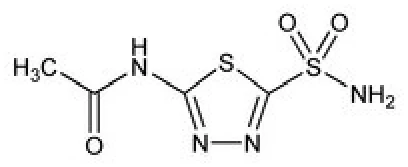
Chemical name: N-[5-(Aminosulfonyl)-1,3,4-thiadiazol-2-yl] acetamide
Molecular formula: C4H6N4O3S2
Molecular mass: 222.24 g/mol
Physicochemical properties: Crystals from water, mp 258-259 °C (effervescence). Weak acid. pKa 7.2. Sparingly sol in practically boiling water. Slightly sol in alcohol, acetone. Very slightly sol in water. Practically insol in carbon tetrachloride, chloroform, ether. Soly (mg/ml): polyethylene glycol-400 87.81; propylene glycol 7.44; ethanol 3.93; glycerin 3.65; water 0.72.
Structural formula:
Product Characteristics:
Each ACETAZOLAMIDE 250 mg tablet contains 250 mg acetazolamide with the following non-medicinal ingredients: colloidal silicon dioxide, magnesium stearate, microcrystalline cellulose.
14 CLINICAL TRIALS
This information is not available for this drug product.
15 MICROBIOLOGY
No microbiological information is required for this drug product.
16 NON-CLINICAL TOXICOLOGY
Studies on acetazolamide in mice and rats have consistently demonstrated embryocidal and teratogenic effects at doses in excess of 10 times the human dose. There is no evidence of these effects in humans; however, acetazolamide should not be used in pregnancy, unless the anticipated benefits outweigh these potential hazards and are not attainable in other ways. See 2 CONTRAIDICATIONS.