


Product Monograph - Dorzolamide (Jamp Pharma)
RECENT MAJOR LABEL CHANGES
DOSAGE AND ADMINISTRATION, 4.4 Administration | 08/2024 |
|---|
TABLE OF CONTENTS
Sections or subsections that are not applicable at the time of authorization are not listed.
TABLE OF CONTENTS ................................................................................................................... 2
PART I: HEALTH PROFESSIONAL INFORMATION ........................................................................... 4
1 INDICATIONS .................................................................................................................... 4
1.1 Pediatrics ..................................................................................................................... 4
1.2 Geriatrics ..................................................................................................................... 4
2 CONTRAINDICATIONS ...................................................................................................... 4
4 DOSAGE AND ADMINISTRATION ...................................................................................... 4
4.1 Dosing Considerations ................................................................................................. 4
4.2 Recommended Dose and Dosage Adjustment ............................................................ 5
4.4 Administration ............................................................................................................. 5
4.5 Missed Dose ................................................................................................................ 5
5 OVERDOSAGE ................................................................................................................... 5
6 DOSAGE FORMS, STRENGTHS, COMPOSITION AND PACKAGING ...................................... 5
7 WARNINGS AND PRECAUTIONS ....................................................................................... 6
7.1 Special Populations...................................................................................................... 8
7.1.1 Pregnant Women .................................................................................................... 8
7.1.2 Breast-feeding ......................................................................................................... 8
7.1.3 Pediatrics ................................................................................................................. 9
7.1.4 Geriatrics ................................................................................................................. 9
8 ADVERSE REACTIONS ....................................................................................................... 9
8.1 Adverse Reaction Overview ......................................................................................... 9
8.2 Clinical Trial Adverse Reactions ................................................................................... 9
8.5 Post-Market Adverse Reactions ................................................................................ 10
9 DRUG INTERACTIONS ..................................................................................................... 10
9.2 Drug Interactions Overview ....................................................................................... 10
9.4 Drug-Drug Interactions .............................................................................................. 10
9.5 Drug-Food Interactions .............................................................................................. 11
9.6 Drug-Herb Interactions .............................................................................................. 11
9.7 Drug-Laboratory Test Interactions ............................................................................. 11
10 CLINICAL PHARMACOLOGY ............................................................................................ 11
10.1 Mechanism of Action ................................................................................................. 11
10.3 Pharmacokinetics ...................................................................................................... 12
11 STORAGE, STABILITY AND DISPOSAL .............................................................................. 13
12 SPECIAL HANDLING INSTRUCTIONS ................................................................................ 13
PART II: SCIENTIFIC INFORMATION ............................................................................................ 14
13 PHARMACEUTICAL INFORMATION ................................................................................. 14
14 CLINICAL TRIALS ............................................................................................................. 15
14.1 Trial Design and Study Demographics ........................................................................ 15
14.2 Study Results .............................................................................................................. 17
15 MICROBIOLOGY ............................................................................................................. 19
16 NON-CLINICAL TOXICOLOGY .......................................................................................... 19
17 SUPPORTING PRODUCT MONOGRAPHS .......................................................................... 21
PATIENT MEDICATION INFORMATION ....................................................................................... 22
PART I: HEALTH PROFESSIONAL INFORMATION
1 INDICATIONS
Dorzolamide (dorzolamide hydrochloride) ophthalmic solution is indicated in the treatment of elevated intraocular pressure in patients with:
- ocular hypertension
- open-angle glaucoma
1.1 Pediatrics
Pediatrics (<18 years of age): Safety and effectiveness in children have not been established. No data are available to Health Canada; therefore, an indication for pediatric use has not been authorized.
1.2 Geriatrics
Geriatrics (>65 years of age): No overall differences in effectiveness or safety were observed between these patients and younger patients, but greater sensitivity of some older individuals cannot be ruled out (see 7.1.4 Geriatrics).
2 CONTRAINDICATIONS
Dorzolamide Hydrochloride Ophthalmic Solution is contraindicated in:
- Patients who are hypersensitive to this drug or to any ingredient in the formulation, including any non-medicinal ingredient, or component of the container. For a complete listing, see 6 DOSAGE FORMS, STRENGTHS, COMPOSITION AND PACKAGING.
- Patients with severe renal impairment (CrCl < 0.5 mL/s) as dorzolamide hydrochloride and its metabolite are excreted predominantly by the kidney. Dorzolamide has not been studied in these patients and is not recommended.
- Patients taking oral carbonic anhydrase inhibitors, as there is potential for an additive effect with the known systemic effects of carbonic anhydrase inhibition. The concomitant administration of dorzolamide hydrochloride and oral carbonic anhydrase inhibitors has not been studied and is not recommended.
4 DOSAGE AND ADMINISTRATION
4.1 Dosing Considerations
- When substituting Dorzolamide for another ophthalmic antiglaucoma agent, discontinue the other agent after proper dosing on one day, and start Dorzolamide on the next day.
- If more than one topical ophthalmic drug is being used, the drugs should be administered at least ten minutes apart.
4.2 Recommended Dose and Dosage Adjustment
Adults (>18 years of age): When used as monotherapy, the dose is one drop of Dorzolamide ophthalmic solution 2% in the affected eye(s) three times daily.
When used as adjunctive therapy with an ophthalmic beta-blocker, the dose is one drop of Dorzolamide in the affected eye(s) two times daily.
- Pediatrics (<18 years of age): Health Canada has not authorized an indication for pediatric use (see 1.1 Pediatrics).
4.4 Administration
If more than one topical ophthalmic drug is being used, the drugs should be administered at least ten minutes apart.
When using nasolacrimal occlusion or closing the eyelids for 2 minutes, the systemic absorption is reduced. This may result in a decrease in systemic side effects and an increase in local activity.
4.5 Missed Dose
If a dose is missed, it should be applied as soon as possible. However, if it is almost time for the next dose, the missed dose should be skipped and the next dose should be taken as usual.
5 OVERDOSAGE
No data are available in humans in regard to overdosage by accidental or deliberate ingestion. The most common signs and symptoms to be expected with overdosage of dorzolamide are electrolyte imbalance, development of an acidotic state, and possibly central nervous system effects (see 8 ADVERSE REACTIONS).
Treatment should be symptomatic and supportive. Serum electrolyte levels (particularly potassium) and blood pH levels should be monitored.
Significant lethality was observed in female rats and mice after single oral doses of dorzolamide hydrochloride of 11 369 mg/m2 or 1 927 mg/kg (24 000 times the maximum recommended human ophthalmic dose) and 3 960 mg/m2 or 1 320 mg/kg (16 000 times the maximum recommended human ophthalmic dose), respectively.
| For management of a suspected drug overdose, contact your regional poison control centre. |
|---|
6 DOSAGE FORMS, STRENGTHS, COMPOSITION AND PACKAGING
Table 1 – Dosage Forms, Strengths, Composition and Packaging
| Route of Administration | Dosage Form / Strength/Composition | Non-medicinal Ingredients |
|---|
| Ophthalmic | Solution, each mL contains 20 mg dorzolamide (22.26 mg of dorzolamide hydrochloride) | hydroxyethyl cellulose, mannitol, sodium citrate dihydrate, sodium hydroxide (to adjust pH) and water for injection. Benzalkonium chloride 0.0075% is added as a preservative. |
|---|
Dorzolamide Ophthalmic Solution is a sterile, clear, colourless, isotonic, buffered and slightly viscous solution, free of particles. Each mL of Dorzolamide 2% contains 20 mg dorzolamide (22.26 mg of dorzolamide hydrochloride).
Dorzolamide sterile ophthalmic solution is supplied in 5 ml white LDPE dispenser bottle. Dorzolamide 2%, equivalent to 20 mg dorzolamide (22.26 mg of dorzolamide hydrochloride) per mL; in 5 mL dispensers.
7 WARNINGS AND PRECAUTIONS
General
Dorzolamide hydrochloride is a sulfonamide and although administered topically, is absorbed systemically. Therefore, the same types of adverse reactions that are attributable to sulfonamides may occur with topical administration, including severe reactions such as Stevens-Johnson syndrome and toxic epidermal necrolysis. If signs of serious reactions or hypersensitivity occur, discontinue the use of this preparation.
The management of patients with acute angle-closure glaucoma requires therapeutic interventions in addition to ocular hypotensive agents. Dorzolamide hydrochloride has not been studied in patients with acute angle-closure glaucoma.
Carcinogenesis and Mutagenesis Carcinogenicity
In a two-year study of dorzolamide hydrochloride administered orally to male and female Sprague-Dawley rats, urinary bladder papillomas were seen in male rats in the highest dosage group of 20 mg/kg/day (250 times the maximum recommended human ophthalmic dose).
Papillomas were not seen in rats given oral doses equivalent to approximately twelve times the maximum recommended human ophthalmic dose. No treatment-related tumors were seen in a 21-month study in female and male mice given oral doses up to 75 mg/kg/day (~900 times the maximum recommended human ophthalmic dose).
The increased incidence of urinary bladder papillomas seen in the high-dose male rats is a class-effect of carbonic anhydrase inhibitors in rats and is secondary to increased urinary sodium, potassium, pH and crystals, all changes induced by carbonic anhydrase inhibitors.
Rats are particularly prone to developing papillomas in response to foreign bodies, compounds causing crystalluria and sodium salts of diverse compounds that are inert when given as calcium salts.
No changes in bladder urothelium were seen in dogs given oral dorzolamide for one year at 2 mg/kg/day or monkeys given oral dorzolamide for one month at 50 mg/kg/day (the urothelial changes in the bladder occurred with oral dosing in rats within one month). In addition, monkeys dosed topically to the eye with 0.4 mg/kg/day (~5 times the maximum recommended human ophthalmic dose) for one year had no urothelial changes in the bladder.
Mutagenicity
Dorzolamide hydrochloride was devoid of mutagenic potential when evaluated in the following 5 tests: (1) in vivo (mouse) in the cytogenetic assay at doses up to 500 mg/kg/day (6 250 times the maximum recommended human ophthalmic dose); (2) in vitro in the chromosomal aberration assay; (3) in the alkaline elution assay; (4) in the V-79 assay (doses up to 10 mcM); and (5) in the Ames test, in which the highest concentration of dorzolamide hydrochloride used, 10 000 mcg/plate, did not result in a two-fold or greater increase in revertants with tester strains of S. typhimurium and E. coli.
Please see 16 NON-CLINICAL TOXICOLOGY, Carcinogenicity and Mutagenicity.
Contamination
To minimize the contamination potential, patients should not touch the eye, the area around the eye, or any other surface with the tip of the container. It may become contaminated with bacteria. This can cause eye infections and could lead to serious damage of the eye including loss of vision. Keep the tip of the container away from contact with any surface.
Driving and Operating Machinery
Possible side effects such as visual disturbances may affect the ability to drive and use machines.
Hepatic/Biliary/Pancreatic
Hepatic Impairment
Dorzolamide hydrochloride has not been studied in patients with hepatic impairment and should therefore be used with caution in such patients.
Immune
Immunology and Hypersensitivity
In clinical studies, local ocular adverse effects, primarily conjunctivitis and eyelid reactions, were reported with chronic administration of dorzolamide hydrochloride ophthalmic solution. Some of these reactions had the clinical appearance and course of an allergic-type reaction that resolved upon discontinuation of drug therapy. If such reactions are observed, discontinuation of treatment with dorzolamide hydrochloride ophthalmic solution should be considered.
Monitoring and Laboratory Tests
Dorzolamide hydrochloride was not associated with clinically meaningful electrolyte disturbances.
Ophthalmologic
Corneal Edema
There is an increased risk of developing irreversible corneal edema in a subset of glaucoma patients with endothelial abnormalities including cellular density and/or morphology. In this group of patients evaluation of the cornea with particular attention to the corneal endothelium is recommended prior and during treatment with dorzolamide hydrochloride ophthalmic solution.
Corneal Edema and Irreversible Corneal Decompensation
Corneal edema and irreversible corneal decompensation has been reported in patients with pre-existing chronic corneal defects and/or a history of intraocular surgery while using dorzolamide. Dorzolamide hydrochloride ophthalmic solution should be used with caution in such patients.
Contact Lenses
Dorzolamide hydrochloride has not been studied in patients wearing contact lenses. The preservative in Dorzolamide Ophthalmic Solution, benzalkonium chloride, may be absorbed by soft contact lenses. Patients should be instructed to remove their lenses before application of the drops and not to re-insert the lenses earlier than 15 minutes after use.
Choroidal Detachment
Choroidal detachment has been reported with administration of aqueous suppressant therapy (e.g., dorzolamide) after filtration procedures.
Management of eyes with chronic or recurrent choroidal detachment should include stopping all forms of aqueous suppressant therapy and treating endogenous inflammation vigorously.
7.1 Special Populations
7.1.1 Pregnant Women
There are no adequate and well-controlled studies in pregnant women. Dorzolamide should be used during pregnancy only if the potential benefit justifies the potential risk to the fetus.
7.1.2 Breast-feeding
It is not known whether dorzolamide is excreted in human milk. Because many drugs are excreted in human milk and because of the potential for serious adverse reactions from dorzolamide hydrochloride in nursing infants, a decision should be made whether to discontinue nursing or to discontinue the drug, taking into account the importance of the drug to the mother.
In a study of dorzolamide hydrochloride in lactating rats, decreases in body weight gain of 5 to 7% in offspring at an oral dose of 7.5 mg/kg/day (94 times the maximum recommended human ophthalmic dose) were seen during lactation. A slight delay in postnatal development
(incisor eruption, vaginal canalization and eye openings), secondary to lower fetal body weight, was noted at 7.5 mg/kg/day (94 times the maximum recommended human ophthalmic dose).
7.1.3 Pediatrics
Pediatrics (<18 years of age): No data are available to Health Canada; therefore, Health Canada has not authorized an indication for pediatric use.
7.1.4 Geriatrics
Geriatrics (>65 years of age): Of the total number of patients in clinical studies of dorzolamide hydrochloride, 44% were 65 years of age and over, while 10% were 75 years of age and over. No overall differences in effectiveness or safety were observed between these patients and younger patients, but greater sensitivity of some older individuals to the product cannot be ruled out.
In a clinical study comparing dorzolamide hydrochloride ophthalmic solution, 48% of all patients were over the age of 65, while 12% were over 75 years of age. No statistical analysis was performed based upon age, but greater sensitivity of some older individuals to the product cannot be ruled out.
8 ADVERSE REACTIONS
8.1 Adverse Reaction Overview
In long-term studies of 1108 patients treated with dorzolamide hydrochloride as monotherapy or as adjunctive therapy with an ophthalmic beta-blocker, the most frequent cause of discontinuation (approximately 3%) from treatment with dorzolamide hydrochloride was drug-related ocular adverse effects, primarily conjunctivitis and eyelid reactions (see 7 WARNINGS AND PRECAUTIONS).
In clinical studies, the most common ocular complaints were burning and stinging, blurred vision, itching and tearing. Bitter taste was also frequently reported. If these local symptoms were considered clinically important by investigators they also appear as adverse experiences in the listing below.
For dorzolamide hydrochloride ophthalmic solution the most frequently reported ocular drug related adverse events were burning and stinging 38%, taste perversion 13%, conjunctival injection 5%, corneal erosion 4%, follicular conjunctivitis 3%, and blurred vision 3%.
8.2 Clinical Trial Adverse Reactions
Clinical trials are conducted under very specific conditions. Therefore, the adverse reaction rates observed in the clinical trials may not reflect the rates observed in practice and should not be compared to the rates in the clinical trials of another drug. Adverse reaction information from clinical trials may be useful in identifying and approximating rates of adverse drug reactions in real-world use.
Adverse experiences that were reported during clinical studies as drug-related (possibly, probably, or definitely) in 1-5% of patients on dorzolamide hydrochloride were in decreasing order of frequency:
Ocular:
Burning and stinging, conjunctivitis, eyelid inflammation, eye itching, eyelid irritation.
Systemic:
Headache, bitter taste, nausea, asthenia/fatigue.
Iridocyclitis and rash were each reported rarely. There was one report of urolithiasis.
8.5 Post-Market Adverse Reactions
The following adverse reactions have been reported in post-marketing experience:
Cardiac Disorders: Tachycardia
Hypersensitivity: Signs and symptoms of local reactions including palpebral reactions and systemic allergic reactions including angioedema, bronchospasm, urticaria and pruritus
Nervous System: Dizziness, paresthesia.
Ocular: Pain, redness, superficial punctate keratitis, transient myopia (which resolved upon discontinuation of therapy), eyelid crusting, choroidal detachment following filtration surgery, corneal edema in glaucoma patients with endothelial abnormalities including cellular density and/or morphology.
Skin/Mucous Membranes: Contact dermatitis, epistaxis, throat irritation, dry mouth, Stevens- Johnson syndrome, toxic epidermal necrolysis.
Urogenital: Urolithiasis
Vascular disorders: Hypertension
9 DRUG INTERACTIONS
9.2 Drug Interactions Overview
Specific drug interaction studies have not been performed with dorzolamide hydrochloride ophthalmic solution.
In clinical studies, dorzolamide hydrochloride was used concomitantly with the following medications without evidence of adverse interactions: timolol ophthalmic solution, betaxolol ophthalmic solution and systemic medications, including ACE-inhibitors, calcium channel blockers, diuretics, non- steroidal anti-inflammatory drugs including ASA, and hormones (e.g. estrogen, insulin, thyroxine).
9.4 Drug-Drug Interactions
The following drug interaction has been associated with the dorzolamide component of dorzolamide hydrochloride ophthalmic solution or with other sulfonamides:
Table 2 - Established or Potential Drug-Drug Interactions
| [Proper/Common name] | Source of Evidence | Effect | Clinical comment |
|---|---|---|---|
| High-dose salicylate therapy | CS | Acid-base Disturbances: Dorzolamide hydrochloride is a carbonic anhydrase inhibitor and although administered topically, is absorbed systemically. In clinical studies, dorzolamide hydrochloride was not associated with acid-base disturbances. However, these disturbances have been reported with oral carbonic anhydrase inhibitors and have, in some instances, resulted in drug interactions (e.g. toxicity associated with high-dose salicylate therapy). | The potential for such drug interactions (e.g. toxicity associated with high-dose salicylate therapy) should be considered in patients receiving dorzolamide hydrochloride. |
Legend: C = Case Study; CT = Clinical Trial; T = Theoretical
9.5 Drug-Food Interactions
Interactions with food have not been established.
9.6 Drug-Herb Interactions
Interactions with herbal products have not been established.
9.7 Drug-Laboratory Test Interactions
Interactions with laboratory tests have not been established.
10 CLINICAL PHARMACOLOGY
10.1 Mechanism of Action
Dorzolamide hydrochloride is a carbonic anhydrase inhibitor formulated for topical ophthalmic use.
Carbonic anhydrase (CA) is an enzyme found in many tissues of the body including the eye. It catalyzes the reversible reaction involving the hydration of carbon dioxide and the dehydration of carbonic acid. In humans, carbonic anhydrase exists as a number of isoenzymes, the most active being carbonic anhydrase II (CA-II) found primarily in red blood cells (RBCs) but also in other tissues. Inhibition of carbonic anhydrase in the ciliary processes of the eye decreases aqueous humor secretion, presumably by slowing the formation of bicarbonate ions with subsequent reduction in sodium and fluid transport. The result is a reduction in intraocular pressure (IOP).
Dorzolamide hydrochloride ophthalmic solution 2% contains dorzolamide hydrochloride, a potent inhibitor of human carbonic anhydrase II. Following topical ocular administration, dorzolamide hydrochloride reduces elevated intraocular pressure, whether or not associated with glaucoma. Elevated intraocular pressure is a major risk factor in the pathogenesis of optic nerve damage and glaucomatous visual field loss. Unlike miotics, dorzolamide hydrochloride reduces intraocular pressure without the common side effects of miotics such as night blindness, accommodative spasm and pupillary constriction. Unlike topical beta-blockers, dorzolamide hydrochloride has minimal or no effect on pulse rate or blood pressure.
Topically applied beta-adrenergic blocking agents also reduce IOP by decreasing aqueous humor secretion but by a different mechanism of action. Studies have shown that when dorzolamide hydrochloride is added to a topical beta-blocker, additional reduction in IOP is observed; this finding is consistent with the reported additive effects of beta-blockers and oral carbonic anhydrase inhibitors.
10.3 Pharmacokinetics
Absorption:
Unlike oral carbonic anhydrase inhibitors, topically-applied dorzolamide hydrochloride exerts its effects at substantially low doses and therefore with less systemic exposure.
When applied topically, dorzolamide reaches the systemic circulation.
Distribution:
To assess the potential for systemic carbonic anhydrase inhibition following topical administration, drug and metabolite concentrations in RBCs and plasma and carbonic anhydrase inhibition in RBCs were measured. Dorzolamide accumulates in RBCs during chronic dosing as a result of selective binding to CA-II while extremely low concentrations of free drug in plasma are maintained.
Metabolism:
The parent drug forms a single N-desethyl metabolite that inhibits CA-II less potently than the parent drug but also inhibits a less active isoenzyme (CA-I). The metabolite also accumulates in RBCs where it binds primarily to CA-I. Dorzolamide binds moderately to plasma proteins (approximately 33%).
Elimination:
Dorzolamide is excreted unchanged in the urine; the metabolite is also excreted in urine. After dosing ends, dorzolamide washes out of RBCs in a non-linear manner, resulting in a rapid decline of drug concentration initially, followed by a slower elimination phase with a half-life of about four months.
To simulate the maximum systemic exposure after long term topical ocular administration, dorzolamide was given orally to eight healthy subjects for up to 20 weeks. The oral dose of 4 mg/day closely approximates the maximum amount of dorzolamide delivered by topical ocular administration of dorzolamide hydrochloride 2% t.i.d. Dorzolamide and metabolite reached steady state by 4 and 13 weeks, respectively, and the following observations were noted:
- In plasma, concentrations of dorzolamide and metabolite were generally below the assay limit of quantitation (15nM) indicating almost no free drug or metabolite;
- In RBCs, dorzolamide concentrations approached the binding capacity of CA-II (20-25 mcM) and metabolite concentrations approached 12-15 mcM, well below the binding capacity of CA- I (125-155 mcM);
- In RBCs, inhibition of CA-II activity and total carbonic anhydrase activity was below the degree of inhibition anticipated to be necessary for a pharmacological effect on renal function and respiration.
11 STORAGE, STABILITY AND DISPOSAL
Store at 15° - 25°C in a tightly closed upright bottle. Protect from light.
Keep out of sight and reach of children. Discard 28 days after opening.
12 SPECIAL HANDLING INSTRUCTIONS
Keep the tip of the container away from the eye, area around the eye, or contact with any surface.
See 4.1 Dosing Considerations, 4.4 Administration, 7 WARNINGS AND PRECAUTIONS, Contamination and 7 WARNINGS AND PRECAUTIONS, Contact Lenses.
PART II: SCIENTIFIC INFORMATION
13 PHARMACEUTICAL INFORMATION
Drug Substance
Proper name: dorzolamide hydrochloride
Chemical name: (4S-trans)-4-(Ethylamino)-5,6-dihydro-6-methyl-4H-thieno[2,3-b] thiopyran-2- sulfonamide 7,7-dioxide monohydrochloride. Dorzolamide hydrochloride is optically active.
Molecular formula and molecular mass: C10H16N2O4S3.HCl
360.9 g/mol
Structural formula:
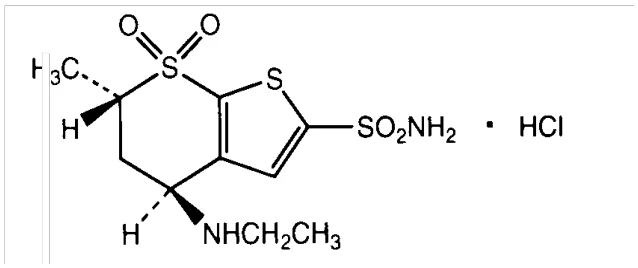
Physicochemical properties: Dorzolamide hydrochloride is a white or almost white crystalline powder, which is soluble in water and slightly soluble in methanol and soluble in pH 4.0, pH 7.0 and pH 9.2 buffers. It has a melting point of about 283- 285°C.
The specific rotation is -1.726° to -1.775°.
14 CLINICAL TRIALS
14.1 Trial Design and Study Demographics
Elevated Intraocular Pressure Therapy
Table 3 - Summary of patient demographics for clinical trials in the treatment of elevated intraocular pressure as monotherapy
| Study # | Study design | Dosage, route of administration and duration | Study subjects (n) | Mean age (Range) | Sex |
|---|---|---|---|---|---|
| Study 1 | Two-period, crossover, randomized, double-masked, multiple-dose study | 2% tid dorzolamide ophthalmic solution, 12 days | 18 | 57.3 (34 to 83) | 33% M; 67% F |
| Study 2 | Parallel, double- masked, randomized, active-controlled study | 2% tid dorzolamide vs 0.5% timolol bid vs 0.5% betaxolol bid, ophthalmic solutions, 1 year | 523 | 62.2 (17 to 85) | 46% M; 54% F |
| Study 3 | Parallel, double- masked, randomized, placebo- controlled, dose- response study with a double- masked, parallel extension. | 2% tid dorzolamide ophthalmic solution, 6 weeks plus 1 year open label. | 333 | 60.5 (23 to 81) | 48 % M; 52% F |
Table 4 - Summary of patient demographics for clinical trials in the treatment of elevated intraocular pressure as Adjunctive Therapy to Beta-Blockers
| Study # | Study design | Dosage, route of administration and duration | Study subjects (n) | Mean age (Range) | Sex |
|---|---|---|---|---|---|
| Study 4 | Parallel, randomized, double-masked, placebo controlled, multiclinic, multiple-dose study | 2% bid dorzolamide ophthalmic solution + 0.5% timolol bid ophthalmic solution, 7 days | 32 | 61.1 (28 to 86) | 53% M 47% F |
| Study 5 | Parallel, randomized, double-masked, placebo- controlled, active- controlled, multicenter, multidose study followed by an active-controlled extension | 0.5% timolol bid + 2% bid dorzolamide ophthalmic solution vs pilocarpine 2% qid, 6 months | 261 | 60.6 (29 to 81) | 50% M; 50% F |
Clinical trials of dorzolamide hydrochloride as a monotherapy were conducted in patients with glaucoma or ocular hypertension with a baseline intraocular pressure (IOP) >23 mmHg. Clinical trials of dorzolamide hydrochloride as an adjunctive therapy were conducted in patients with glaucoma or ocular hypertension with a baseline IOP ≥ 22 mmHg while receiving ophthalmic beta-blockers.
14.2 Study Results
Table 5 - Results of study 1 in the treatment of elevated intraocular pressure
| Primary Endpoints | Associated value and statistical significance for Drug at specific dosages | Associated value and statistical significance for Placebo |
|---|---|---|
| Mean Percent reductions in IOP | 21.4% morning trough (0 h), 21.8% 2 h post-dose, 18.0% 8 h post-dose 19.4% 12 h post-dose | 0.3% (P<0.01) 8.2% (p<0.01) 0.8% (p<0.01) 0.5% (p<0.01) |
In Study 1, patients were treated for a total of twelve days. Patients who received dorzolamide hydrochloride 2% t.i.d. for the last seven days of the study experienced reductions in IOP at morning trough (prior to first dose), at peak (two hours post-dose), at afternoon trough (eight hours post-dose) and at the end of the day (four hours after the afternoon dose).
Table 6 - Results of study 2 in the treatment of elevated intraocular pressure
| Primary Endpoints | Associated value and statistical significance for Drug at specific dosages | Associated value and statistical significance for Placebo or active control |
|---|---|---|
| Mean Percent reductions in IOP | 22.9% (2 h post-dose, month 12) 16.9% (8 h post-dose, month 12) | Betaxolol 0.5%: 20.8% (2 h, month 12) (p=NS) 15.1% (8 h, month 12); (p=NS) Timolol 0.5%: 25.3% (2 h, month 12) (p=NS) 20.4% (8 h, month 12) (p<0.05) |
In Study 2, a one-year controlled trial, dorzolamide hydrochloride 2% t.i.d. (N=313) was compared with betaxolol 0.5% (N=107) and timolol 0.5% (N=103) administered b.i.d. At the end of the trial, the mean percent reductions in IOP at peak did not differ significantly among treatment groups. At afternoon trough, the mean percent reduction in IOP for timolol was significantly greater (p < 0.05) than either dorzolamide hydrochloride or betaxolol, but no significant difference was observed between dorzolamide hydrochloride and betaxolol.
Table 7 - Results of study 3 in the treatment of elevated intraocular pressure
| Primary Endpoints | Associated value and statistical significance for Drug at specific dosages | Associated value and statistical significance for Placebo |
|---|---|---|
| Mean Percent reductions in IOP (6 weeks) | Morning Trough: 13.2%; Morning Peak: 16.3% (6 weeks) | Morning Trough: 5.6%, p<0.05 Morning Peak: 5.5%, p<0.05 |
| Mean Percent reductions in IOP (1 year) | Morning Trough: 14.6%; Morning Peak: 17.9% (1 year) | There is no placebo or comparator in the 1 year study |
In Study 3, a dose-response study (N=333), dorzolamide hydrochloride was compared with placebo during a six- week phase, followed by one year of treatment with dorzolamide hydrochloride. At six weeks, patients on dorzolamide hydrochloride 2% t.i.d. (N=86) had mean percent reductions in IOP at morning trough and peak which were significantly greater (p < 0.01) than those observed with placebo. During extension treatment (N=160) with dorzolamide hydrochloride 2% t.i.d. as monotherapy for up to one year, efficacy was consistent with the six week findings.
Table 8 - Results of study 4 in the treatment of elevated intraocular pressure
| Primary Endpoints | Associated value and statistical significance for Drug at specific dosages | Associated value and statistical significance for Placebo or active control |
|---|---|---|
| Mean Percent reductions in IOP | Timolol plus dorzolamide hydrochloride 16.8% (Morning Trough, 0 h) 21.0% (Morning Peak, 1 h post-dose) 13.2% (12 h post-dose) | Timolol plus placebo 3.4% (0h), p<0.01 4.5% (1 h), p<0.01 6.6 (12 h), p<0.01 |
In Study 4, a one-week placebo-controlled study (N=32), when patients (N=16) on timolol 0.5% b.i.d. had dorzolamide hydrochloride 2% b.i.d. added to their treatment regimen, they experienced additional mean percent reductions in IOP at morning trough, at peak (one hour post-dose), and at evening trough (twelve hours post-dose).
Table 9 - Results of study 5 in the treatment of elevated intraocular pressure
| Primary Endpoints | Associated value and statistical significance for Drug at specific dosages | Associated value and statistical significance for active control |
|---|---|---|
| Mean Percent reductions in IOP | 12.8% (h0, morning trough, 6 months) 10.9% (h2 morning peak, 6 months) | Pilocarpine 2% qid: 10.2% (h0, Morning Trough), p=NS 10.4% (h2, morning peak) p=NS |
In Study 5, a six-month dose-comparison study (N=261) in patients receiving timolol 0.5% b.i.d., the additive ocular hypotensive effect of dorzolamide hydrochloride 2% b.i.d. (N=89) was compared to that of pilocarpine 2% q.i.d (N=44). Both drugs showed comparable efficacy as adjunctive therapy over the six-month treatment period. Additional mean percent reductions in IOP at morning trough and peak (two hours post-dose) were observed at six months.
Finally, over the course Study 2, a subset of 59 patients receiving timolol or betaxolol required additional medication for IOP reduction. Dorzolamide hydrochloride 2% b.i.d. was added and at the end of the study these patients had experienced additional mean percent reductions at peak (two hours post-dose) of 14 to 19%, and eight hours post-dose of 13 to 14%.
15 MICROBIOLOGY
Dorzolamide contains the preservative benzalkonium chloride as an antimicrobial preservative.
16 NON-CLINICAL TOXICOLOGY
General Toxicology:
Acute Toxicity
The oral LD50 of the drug is 1 320 mg/kg (3 960 mg/m2) in mice and 1 927 mg/kg
(11 369 mg/m2) in female rats.
Chronic Toxicology
In repeated oral dose toxicity studies of dorzolamide hydrochloride in rodents, dogs and monkeys, the following effects were noted.
An increased incidence of urothelial hyperplasia was noted in rats and mice. This is a class- effect of carbonic anhydrase inhibitors (CAIs) specific to rodents and is secondary to increased urinary sodium, potassium, pH and crystals.
Another class effect of CAIs seen only in rodents was renal papillary cytoplasmic granularity associated with potassium depletion in the kidney. No-effect levels for these microscopic changes were not observed. However, these findings are rodent specific and not seen in monkeys at oral doses up to 50 mg/kg/day (625 times the maximum recommended human ophthalmic dose).
Metabolic acidosis and the related gastric mucous neck cell hyperplasia were seen in dogs and monkeys. In dogs, the gastric change was seen at a dose as low as 0.2 mg/kg/day in a one- month study, but disappeared with continued dosing and was absent at one year at a dose as high as 2 mg/kg/day. In monkeys in a one-month study, the gastric change was seen at a dose of 50 mg/kg/day orally, but no effects were seen at 10 mg/kg/day orally, or when
0.4 mg/kg/day (~5 times the maximum recommended human ophthalmic dose) was applied topically to the eye for one year.
Another high dose phenomenon observed in dogs and monkeys (doses ≥ 1.5 mg/kg/day and 50 mg/kg/day, respectively) in short term studies was decreased remodeling of bone, probably as a result of inhibition of carbonic anhydrase in osteoclasts. Longer term studies in dogs showed the change was transient.
Marginal nonprogressive decreases in some erythroid parameters were seen in dogs and monkeys at dorzolamide plasma levels of 50 ng/mL in dogs and 1660 ng/mL in monkeys. The plasma levels of dorzolamide in humans given the maximum recommended ophthalmic dose are generally ≤ 5 ng/mL.
Carcinogenicity:
In a two-year study of dorzolamide hydrochloride administered orally to male and female Sprague-Dawley rats, urinary bladder papillomas were seen in male rats in the highest dosage group of 20 mg/kg/day (250 times the maximum recommended human ophthalmic dose).
Papillomas were not seen in rats given oral doses equivalent to approximately twelve times the maximum recommended human ophthalmic dose. No treatment-related tumors were seen in a 21-month study in female and male mice given oral doses up to 75 mg/kg/day (~900 times the maximum recommended human ophthalmic dose).
The increased incidence of urinary bladder papillomas seen in the high-dose male rats is a class-effect of carbonic anhydrase inhibitors in rats and is secondary to increased urinary sodium, potassium, pH and crystals, all changes induced by carbonic anhydrase inhibitors.
Rats are particularly prone to developing papillomas in response to foreign bodies, compounds causing crystalluria and sodium salts of diverse compounds that are inert when given as calcium salts.
No changes in bladder urothelium were seen in dogs given oral dorzolamide for one year at 2 mg/kg/day or monkeys given oral dorzolamide for one month at 50 mg/kg/day (the urothelial changes in the bladder occurred with oral dosing in rats within one month). In addition, monkeys dosed topically to the eye with 0.4 mg/kg/day (~5 times the maximum recommended human ophthalmic dose) for one year had no urothelial changes in the bladder.
Genotoxicity
Dorzolamide hydrochloride was devoid of mutagenic potential when evaluated in the following 5 tests: (1) in vivo (mouse) in the cytogenetic assay at doses up to 500 mg/kg/day (6 250 times the maximum recommended human ophthalmic dose); (2) in vitro in the chromosomal aberration assay; (3) in the alkaline elution assay; (4) in the V-79 assay (doses up to 10 mcM); and (5) in the Ames test, in which the highest concentration of dorzolamide hydrochloride used, 10 000 mcg/plate, did not result in a two-fold or greater increase in revertants with tester strains of S. typhimurium and E. coli.
Reproductive and Developmental Toxicology:
In reproduction studies of dorzolamide hydrochloride in rats, there were no adverse effects on males or females at doses up to 188 or 94 times, respectively, the maximum recommended human ophthalmic dose.
There were no treatment-related fetal malformations in developmental toxicity studies with dorzolamide hydrochloride in rats at oral doses up to 10 mg/kg/day (125 times the maximum recommended human ophthalmic dose). Developmental toxicity studies with dorzolamide hydrochloride in rabbits at oral doses of ≥ 2.5 mg/kg/day (31 times the maximum recommended human ophthalmic dose) revealed malformations of the vertebral bodies.
These malformations occurred only at doses that caused metabolic acidosis with resultant decreased body weight gain in dams and decreased fetal weights. These malformations, seen only at maternotoxic doses, appear to be a class-effect related to a combination of electrolyte and acid-base changes: decreased venous HCO3-, decreased venous pH and decreased serum potassium. No treatment-related malformations were seen at 1.0 mg/kg/day (13 times the maximum recommended human ophthalmic dose). Acetazolamide, an oral carbonic anhydrase inhibitor, causes skeletal malformations in rats and rabbits by a similar mechanism.
In a study of dorzolamide hydrochloride in lactating rats, decreases in body weight gain of 5 to 7% in offspring at an oral dose of 7.5 mg/kg/day (94 times the maximum recommended human ophthalmic dose), were seen during lactation. A slight delay in postnatal development (incisor eruption, vaginal canalization and eye openings), secondary to lower fetal body weight, was noted at 7.5 mg/kg/day (94 times the maximum recommended human ophthalmic dose).
17 SUPPORTING PRODUCT MONOGRAPHS
- 1. PrTRUSOPT® (Dorzolamide Hydrochloride Ophthalmic Solution, 2% weight/volume), submission control 274767, Product Monograph, Elvium Life Sciences (Nov 28, 2023)