


Product Monograph - Adrenalin
Recent Major Label Changes
None at the time of most recent authorization.
Table of Contents
Certain sections or subsections that are not applicable at the time of the preparation of the most recent authorized product monograph are not listed.
Recent Major Label Changes .................................................................................................... 2
Table of Contents .................................................................................................................... 2
Part 1: Healthcare Professional Information ............................................................................ 4
- 1.
Indications ........................................................................................................................ 4
1.1. Pediatrics ................................................................................................................... 4
1.2. Geriatrics ................................................................................................................... 4
- 2. Contraindications ............................................................................................................. 4
- 4.
Dosage and Administration .............................................................................................. 5
4.1. Dosing Considerations ............................................................................................... 5
4.2. Recommended Dose and Dosage Adjustment .......................................................... 5
4.3. Reconstitution ........................................................................................................... 5
4.4. Administration ........................................................................................................... 6
4.5. Missed Dose .............................................................................................................. 6
- 5. Overdose .......................................................................................................................... 6
- 6. Dosage Forms, Strengths, Composition, and Packaging .................................................... 6
- 7.
Warnings and Precautions ................................................................................................ 7
General .................................................................................................................................. 7
Cardiovascular ....................................................................................................................... 7
Immune ................................................................................................................................. 7
Respiratory ............................................................................................................................ 7
7.1. Special Populations ................................................................................................... 7
7.1.1. Pregnancy .................................................................................................................. 7
7.1.2. Breastfeeding ............................................................................................................ 7
7.1.3. Pediatrics ................................................................................................................... 8
7.1.4. Geriatrics ................................................................................................................... 8
- 8.
Adverse Reactions ............................................................................................................ 8
8.1. Adverse Reaction Overview ....................................................................................... 8
- 9.
Drug Interactions .............................................................................................................. 8
9.4. Drug-Drug Interactions .............................................................................................. 8
9.5. Drug-Food Interactions.............................................................................................. 9
9.6. Drug-Herb Interactions .............................................................................................. 9
9.7. Drug-Laboratory Test Interactions ............................................................................ 9
- 10.
Clinical Pharmacology .................................................................................................... 10
10.1. Mechanism of Action ............................................................................................... 10
10.2. Pharmacodynamics ................................................................................................. 10
10.3. Pharmacokinetics .................................................................................................... 10
- 11. Storage, Stability, and Disposal ....................................................................................... 10
Part 2: Scientific Information ................................................................................................. 11
- 13. Pharmaceutical Information ........................................................................................... 11
- 14. Clinical Trials ................................................................................................................... 11
- 16. Non-Clinical Toxicology ................................................................................................... 11
Patient Medication Information ............................................................................................ 12
Part 1: Healthcare Professional Information
1. Indications
ADRENALIN® (Epinephrine Injection) is indicated:
- to relieve respiratory distress due to bronchospasm and bronchial asthmatic paroxysms;
- to restore cardiac rhythm in cardiac arrest due to various causes, cardiac resuscitation in cardiac arrest following anesthetic accidents, and in syncope due to complete heart block or carotid sinus hypersensitivity;
- to prolong the action of local and intraspinal anesthetics (see 2. Contraindications);
- in simple (open angle) glaucoma;
- to provide rapid relief of hypersensitivity reactions to drugs and other allergens;
- to treat mucosal congestion of hay fever, rhinitis, and acute sinusitis;
- for symptomatic relief of serum sickness, urticaria, angioneurotic edema;
- for relaxation of uterine musculature and to inhibit uterine contractions;
- as a hemostatic agent.
Epinephrine is not used in cardiac failure or in hemorrhagic traumatic, or cardiogenic shock (see 2. Contraindications).
1.1. Pediatrics
Pediatrics (< 18 years): Since the pediatric data for clinical trials is not available, the safety and efficacy of ADRENALIN in pediatric patients cannot be determined. However, based on the available dosing information for bronchial asthma, ADRENALIN can be used for pediatric patients. See 4.2. Recommended Dose and Dosage Adjustment.
1.2. Geriatrics
Geriatrics (> 65 years): Evidence from clinical studies and experience suggests that use in the geriatric population is associated with differences in safety or effectiveness. See 7.1.4. Geriatrics.
2. Contraindications
ADRENALIN® is contraindicated:
- in patients who are hypersensitive to this drug or to any ingredient in the formulation, including any non-medicinal ingredient, or component of the container. For a complete listing, see 6 Dosage Forms, Strengths, Composition, and Packaging.
- in patients with narrow angle (congestive) glaucoma, shock during general anesthesia with halogenated hydrocarbons or cyclopropane and in individuals with organic brain damage.
- with use of local anesthesia of certain areas, e.g., fingers, toes, because of the danger of vasoconstriction producing sloughing of tissue;
- during labour because it may delay the second stage;
- in cardiac dilatation and coronary insufficiency.
4. Dosage and Administration
4.1. Dosing Considerations
Subcutaneous is the preferred route of administration. If given intramuscularly, injection into the buttocks should be avoided.
4.2. Recommended Dose and Dosage Adjustment
Intramuscularly or subcutaneously – 0.2 to 1 mL. Start with small dose and increase if required.
For bronchial asthma and certain allergic manifestations, e.g., angioedema, urticaria, serum sickness, anaphylactic shock, use epinephrine subcutaneously. For bronchial asthma in pediatric patients, administer 0.01 mL/kg or 0.3 mL/m2 to a maximum of 0.5 mL subcutaneously, repeated every four hours if required.
For cardiac resuscitation – A dose of 0.5 mL diluted to 10 mL with sodium chloride injection can be administered intravenously or intracardially to restore myocardial contractility and stimulate the heart in cases of apparent death. External cardiac massage should follow intracardial administration to permit the drug to enter coronary circulation. The drug should be used secondarily to unsuccessful attempts with physical or electromechanical methods.
Intravenously 0.1 to 0.4 mL (0.1 to 0.4 mg) diluted with 3 to 10 parts of Water for Injection, injected slowly.
Intraspinal use – Usual dose is 0.2 to 0.4 mL added to anesthetic spinal fluid mixture (may prolong anesthetic action by limiting absorption). For use with local anesthetic – Epinephrine 1:100,000 (0.01 mg/mL) to 1:20,000 (0.05 mg/mL) is the usual concentration employed with local anesthetics.
Ophthalmologic use (for producing conjunctival decongestion, to control hemorrhage, produce mydriasis and reduce intraocular pressure) – use concentration of 1:10,000 (0.1 mg/mL) to 1:1,000 (1 mg/mL).
4.3. Reconstitution
Preparation for reconstitution:
Parenteral Products for Intramuscular (IM), Subcutaneous (SC) or Intravenous (IV) use:
Volume of ADRENALIN® solution (mL) | Total epinephrine dose (mg) | Volume of Water for Injection (mL) | Total Volume (mL) | Final Concentration (mg/mL) | |
|---|---|---|---|---|---|
| Min. | 0.1 | 0.1 | 0.3 – 1.0 | 0.4 – 1.1 | 0.09 - 0.25 |
| Max. | 0.4 | 0.4 | 1.2 – 4.0 | 1.6 – 4.4 | 0.09 - 0.25 |
Do not remove from carton until ready to use. Do not use if solution is pinkish or darker than slightly yellow or contains a precipitate. See 11 Storage, Stability, and Disposal.
4.4. Administration
For Intramuscular (IM), Subcutaneous (SC), Intravenous (IV), Intracardial, Intraspinal or Ophthalmologic use.
4.5. Missed Dose
Since ADRENALIN® is administered under medical supervision, the healthcare professional will determine the dosing requirement.
5. Overdose
Overdosage or inadvertent intravenous injection of epinephrine may cause cerebrovascular hemorrhage resulting from the sharp rise in blood pressure. See 7. Warnings and Precautions, General.
| For the most recent information in the management of a suspected drug overdose, contact your regional poison control centre or Health Canada’s toll-free number, 1-844 POISON-X (1-844-764-7669). |
|---|
- 6. Dosage Forms, Strengths, Composition, and Packaging
Table 1 – Dosage Forms, Strengths, and Composition
Description
Ampoule - Each 1 mL ampoule contains 1 mg epinephrine provided as a sterile single dose solution.
Each carton contains five single dose vials containing 1 mg/mL of ADRENALIN® (epinephrine injection). Supplied as 2 cartons for a total of 10 ampoules.
| Route of Administration | Dosage Form/ Strength/Composition | Non-Medicinal Ingredients |
Intramuscular (IM), Subcutaneous (SC), Intravenous (IV), Intracardial, Intraspinal or Ophthalmologic | Solution for Injection, 1 mg/mL; 30 mg/30 mL of Epinephrine as hydrochloride | Hydrochloric acid, sodium bisulfate or metabisulfite and sodium chloride. Vial: contains additional chlorobutanol and water for injection. |
Vial - Each vial of 30 mL contains 30 mg of epinephrine (1 mg/mL) provided as a sterile multidose solution in an amber glass vial. The vial stopper is made with latex-free rubber.
ADRENALIN® 30 mg/mL vial contains chlorobutanol as a preservative.
7. Warnings and Precautions
General
Overdosage or inadvertent intravenous injection of epinephrine may cause cerebrovascular hemorrhage resulting from the sharp rise in blood pressure. See 5. Overdose.
Cardiovascular
Fatalities may also result from pulmonary edema because of the peripheral constriction and cardiac stimulation produced. Rapidly acting vasodilators such as nitrates, or alpha blocking agents may counteract the marked pressor effects of epinephrine.
Use of epinephrine with excessive doses of digitalis, mercurial diuretics, or other drugs that sensitize the heart to arrhythmias is not recommended. Anginal pain may be induced when coronary insufficiency is present.
Immune
Epinephrine is the preferred treatment for serious allergic or other emergency situations even though this product contains sodium bisulfite, a sulfite that may in other products cause allergic-type reactions including anaphylactic symptoms or life-threatening or less severe asthmatic episodes in certain susceptible persons. The alternatives to using epinephrine in a life-threatening situation may not be satisfactory. The presence of a sulfite in this product should not deter administration of the drug for treatment of serious allergic or other emergency situations.
Respiratory
Patients with long-standing bronchial asthma and emphysema who have developed degenerative heart disease should be administered the drug with extreme caution.
7.1. Special Populations
7.1.1. Pregnancy
Administer with caution in pregnancy.
7.1.2. Breastfeeding
This information is not available for this drug product.
7.1.3. Pediatrics
Since the pediatric data for clinical trials is not available, the safety and efficacy of ADRENALIN in pediatric patients cannot be determined. However, based on the available dosing information for bronchial asthma, ADRENALIN can be used for pediatric patients. See 1.1. Pediatrics, 4.2. Recommended Dose and Dosage Adjustment.
7.1.4. Geriatrics
Administer with caution to elderly people. See 1.2. Geriatrics.
8. Adverse Reactions
8.1. Adverse Reaction Overview
Transient and minor side effects of anxiety, headache, fear and palpitations often occur with therapeutic doses, especially in hyperthyroid individuals. Repeated local injections can result in necrosis at sites of injection from vascular constriction. “Epinephrine-fastness” can occur with prolonged use.
9. Drug Interactions
9.4. Drug-Drug Interactions
The drugs listed in this table are based on either drug interaction case reports or studies, or potential interactions due to the expected magnitude and seriousness of the interaction (i.e., those identified as contraindicated).
Table 4 – Established or Potential Drug-Drug Interactions
| Non-proprietary name of the drug product | Source of evidence | Effect | Clinical comment |
| Tricyclic antidepressants and antihistamines, e.g., diphenhydramine, tripelennamine, d-chlorpheniramine; and sodium L-thyroxine. | T | The effects of epinephrine may be potentiated | Because TCAs inhibit norepinephrine reuptake which increase synaptic NE which leads exogenous epinephrine increase leading to the adrenergic response. Patients must tell dentists, anesthesiologists, emergency staff, and surgeons that they are taking TCAs or thyroxine because these drugs potentiate epinephrine’s cardiovascular effects, producing severe hypertension and arrhythmias. If local anesthesia is needed (e.g., dental procedures), physicians should recommend reducing or avoiding epinephrine in anesthetic solutions because TCAs can cause 2–4× increased pressor response, leading to dangerous BP elevation. Because TCAs enhance epinephrine’s vasopressor effect, physicians should monitor BP, heart rate, and ECG for signs of severe hypertension or arrhythmias. |
Legend: T = Theoretical
9.5. Drug-Food Interactions
Interactions with food have not been established.
9.6. Drug-Herb Interactions
Interactions with herbal products have not been established.
9.7. Drug-Laboratory Test Interactions
Interactions with laboratory tests have not been established.
10. Clinical Pharmacology
10.1. Mechanism of Action
Epinephrine is a sympathomimetic drug. It activates an adrenergic receptive mechanism on effector cells and imitates all actions of the sympathetic nervous system except those on the arteries of the face and sweat glands. Epinephrine acts on both alpha and beta receptors and is the most potent alpha receptor activator.
10.2. Pharmacodynamics
This information is not available for this drug product.
10.3. Pharmacokinetics
This information is not available for this drug product.
- 11. Storage, Stability, and Disposal
Store at room temperature between 15°C - 30°C. Protect from light and freezing. Do not remove from carton until ready to use. Do not use if solution is pinkish or darker than slightly yellow or contains a precipitate.
Part 2: Scientific Information
13. Pharmaceutical Information
Drug Substance
Non-proprietary name of the drug substance: Epinephrine
Chemical name: (–)-3,4-Dihydroxy-a- [(methylamino)methyl] benzylalcohol
Molecular formula and molecular mass: (Levorotatory isomer) C9H13NO3 and 183.20 g/mol
Structural formula:
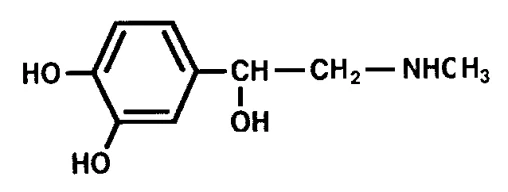
Physicochemical properties: Epinephrine is a white to practically white, odourless, microcrystalline powder or granules, gradually darkening on exposure to light and air. Soluble in aqueous solutions of mineral acids. Very slightly soluble in ethanol (96%) and methanol. Practically insoluble in acetone, chloroform, methylene chloride and in ether. Melting range according to Merck Index is ab. 215°C, with decomposition.
Pharmaceutical standard: USP
14. Clinical Trials
The clinical trial data on which the original indication was authorized is not available.
16. Non-Clinical Toxicology
The non-clinical toxicology data on which the original indication was authorized is not available.