


Product Monograph - Epinephrine Injection (Acala Pharmaceuticals Inc. (A Division of Fernbank Management Corporation))
PRECAUTIONS
Epinephrine Injection should be protected from exposure to light. Do not remove from carton until ready to use. Do not use if solution is pinkish or darker than slightly yellow or contains a precipitate.
Epinephrine is readily destroyed by alkalies and oxidizing agents. In the latter category are oxygen, chlorine, bromine, iodine, permanganates, chromates, nitrites and salts of easily reducible metals, especially iron.
The effects of epinephrine may be potentiated by tricyclic antidepressants; certain antihistamines, eg. diphenhydramine, tripelennamine, d-chlorpheniramine; and sodium L-thyroxine.
ADVERSE REACTIONS
Transient and minor side effects of anxiety, headache, fear and palpitations often occur with therapeutic doses, especially in hyperthyroid individuals. Repeated local injections can result in necrosis at sites of injection from vascular constriction. “Epinephrine-fastness” can occur with prolonged use.
DOSAGE AND ADMINISTRATION
Intramuscularly or subcutaneously – 0.2 to 1 mL. Start with small dose and increase if required.
Note: The subcutaneous is the preferred route of administration. If given intramuscularly, injection into the buttocks should be avoided.
For bronchial asthma and certain allergic manifestations, eg. angioedema, urticaria, serum sickness, anaphylactic shock, use epinephrine subcutaneously. For bronchial asthma in pediatric patients, administer 0.01 mL/kg or 0.3 mL/m2 to a maximum of 0.5 mL subcutaneously, repeated every four hours if required.
For cardiac resuscitation – A dose of 0.5 mL diluted to 10 mL with sodium chloride injection can be administered intravenously or intracardially to restore myocardial contractility and stimulate the heart in cases of apparent death. External cardiac massage should follow intracardial administration to permit the drug to enter coronary circulation. The drug should be used secondarily to unsuccessful attempts with physical or electromechanical methods.
Intravenously 0.1 to 0.4 mL diluted with 3 to 10 parts of Water for Injection, injected slowly.
Intraspinal use – Usual dose is 0.2 to 0.4 mL added to anesthetic spinal fluid mixture (may prolong anesthetic action by limiting absorption). For use with local anesthetic – Epinephrine 1:100,000 (0.01 mg/mL) to 1:20,000 (0.05 mg/mL) is the usual concentration employed with
REPORTING SIDE EFFECTS
You can report any suspected side effects associated with the use of health products to Health Canada by:
- Visiting the Web page on Adverse Reaction Reporting (http://www.hc-sc.gc.ca/dhp-mps/medeff/report-declaration/index-eng.php) for information on how to report online, by mail or by fax; or
- Calling toll-free at 1-866-234-2345.
NOTE: Contact your health professional if you need information about how to manage your side effects. The Canada Vigilance Program does not provide medical advice.
local anesthetics.
Ophthalmologic use (for producing conjunctival decongestion, to control hemorrhage, produce mydriasis and reduce intraocular pressure) – use concentration of 1:10,000 (0.1 mg/mL) to 1:1,000 (1 mg/mL).
Composition
Each mL of aqueous solution 1:1000 contains: epinephrine 1 mg dissolved in isotonic sodium chloride solution with hydrochloric acid as dissolution agent and pH adjuster. Nonmedicinal ingredients: hydrochloric acid, and sodium chloride. Supplied as 1 mL fill in 2 mL ampoule.
Stability and Storage Recommendations
Protect from light and freezing. Store at room temperature between 15 and 25°C.
AVAILABILITY OF DOSAGE FORMS
Epinephrine Injection:
Ampoules: Each 1 mL ampoule contains 1 mg epinephrine.
If you want more information about Epinephrine Injection:
- Talk to your healthcare professional
- Find the full product monograph that is prepared for healthcare professionals and includes this Patient Medication Information by visiting the Health Canada website (http://hc-sc.gc.ca/index-eng.php); or by e-mailing medinfo@acalapharma.com.
PHARMACEUTICAL INFORMATION
Drug Substance
Proper Name: Epinephrine
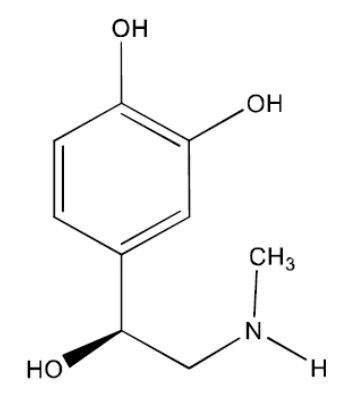
Chemical Name: (–)-3,4-Dihydroxy-α- [(methylamino)methyl] benzylalcohol
Empirical Formula: (Levorotatory isomer) C9H13NO3
Molecular Weight: 183.20
Structural Formula:
REFERENCES
- 1. Adrenaline* Chloride Injection (Epinephrine Injection U.S.P.), Solution, 1 mg/mL, Control No. 100467, Prescribing Information, Erfa Canada 2012 Inc. January 10, 2001.