


Patient Medication Information: uses, side effects, how to take - Amevive
ABOUT THIS MEDICATION
What the medication is used for:
Biologic medication used to treat psoriasis. Biologics are a
class of drugs engineered from proteins (in this case, human proteins) produced by living cells.
This medicine should be used only under the guidance and
supervision of a doctor.
You should not try to give the injection yourself until you
have received the proper training from a health care professional.
What it does:
Psoriasis is a skin disease that starts on the inside and appears on the outside as patches of raised red skin often covered by a flaky buildup (plaques). These plaques can be itchy and at times painful. Psoriasis is an immune disorder. The immune system is your body’s defense network against disease. In an immune system disorder, this defense system can actually cause harm to the body. Your immune system is made up of billions of cells, including cells known as T cells. In psoriasis, the T cells become overactive and cause skin cells to multiply 7 to 12 times faster than normal, leading to the appearance of plaques on the skin surface.
AMEVIVE works in two ways. First, AMEVIVE helps prevent T cells from becoming overactive. Second, AMEVIVE selectively lowers the number of overactive T cells in your body, without affecting other areas of the immune system. Because AMEVIVE lowers the number of overactive T cells, many patients continue to improve for months after the injections stop. In these cases, patients may experience treatment free periods. After stopping treatment patients do not experience rapid return or worsening of their disease.
When it should not be used:
People who have a known hypersensitivity to any ingredient in
the medicine.
What the medicinal ingredient is:
It is called alefacept, which is a combination of proteins that are found naturally in the body. It has been manufactured using a special process.
What the important nonmedicinal ingredients are: Citric acid monohydrate, glycine, sodium citrate dihydrate, sucrose. No preservatives.
For a full listing of nonmedicinal ingredients see Part 1 of the product monograph.
What dosage forms it comes in:
Dry powder for reconstitution. When it is mixed with the diluent (sterile Water for Injection), the strength is 15 mg/0.5 mL (cc*) solution for intramuscular injection.
*Note: mL and cc reflect the same amount of liquid. You will see cc marks on the syringe. DO NOT use the M marks that also appear on the syringe. Refer to the section on How to Prepare and Inject a Dose of AMEVIVE for more information.
WARNINGS AND PRECAUTIONS
NGBefore you start AMEVIVE and every two weeks during your treatment, your doctor will arrange for blood tests to be taken to measure the level of certain T cells in your immune system. Depending on the results of these tests, your doctor will decide whether you need to postpone or stop taking AMEVIVE. Every two weeks before your injection, your health care professional will tell you whether your T cell count is at an acceptable level before you take your injection. You should continue your treatment unless your health care professional tells you otherwise.
BEFORE you use AMEVIVE talk to your doctor or pharmacist if:
You have any current health conditions or in the past
(including cancer or infection)
- You are taking any other medicines or treatments, including any products you buy, such as over-the-counter medicines and herbal or home remedies
- You have taken AMEVIVE before and had an unusual or allergic reaction or if you have had an allergic reaction to any ingredient
You are pregnant or planning to become pregnant or are breast-feeding your baby
While you are receiving treatment with AMEVIVE, you need to tell your doctor about any infection that you may experience. If you have a severe infection, your doctor will advise you to stop taking AMEVIVE until your infection is gone.
INTERACTIONS WITH THIS MEDICATION
You may continue to use topical medications to treat your psoriasis such as topical steroids (low-potency) and emollients if your doctor has told you it is okay.
PROPER USE OF THIS MEDICATION
This medicine should be used only under the guidance and supervision of a doctor. Now that your doctor has decided to treat your psoriasis with AMEVIVE, the intramuscular injection can be given in your doctor’s office or you may choose to learn how to give the injection yourself. If you and your doctor decide to give the injection yourself, you will be given proper training by a health care professional, through the AMEVIVE Care Program™ or your doctor’s clinic, on how to prepare the drug for injection and in proper intramuscular injection technique. You should not try to give the injection yourself until you have received the training.
Usual dose:
The usual adult dose is 15 mg given once a week as an injection into the muscle. The standard treatment period is twelve, once-weekly injections followed by at least a twelve-week break from injections – a treatment free period.
Overdose:
If you receive more medicine at one time than you have been prescribed, you should contact your doctor.
Missed Dose:
If you forget to take a dose on the day it is scheduled, you should contact your doctor.
SIDE EFFECTS AND WHAT TO DO ABOUT THEM
As with most drugs, you may experience side effects when taking AMEVIVE. The most common side effects seen in clinical studies (experienced by more than 5% of patients) included headache, sore-throat, accidental injury, runny nose, infection, flu-like symptoms, itch, chills, feeling tired, pain, diarrhea, nausea, viral infection, dizziness and sinusitis. You may experience a reaction at the site of your injection. These reactions are generally mild and usually occurred on single occasions and included pain, inflammation, bleeding, swelling, non-specific reaction, lump or skin hypersensitivity.
Overall, the number of side effects experienced by patients in clinical studies was similar to placebo and was also similar in patients who took more than one course of AMEVIVE. This is not a complete list of side effects. Contact your health care professional if you experience any unexpected effects while taking AMEVIVE.
Infections: Because of the way AMEVIVE works, there may be a drop in the levels of certain types of blood cells that help to fight infections. You should inform your doctor as soon as possible if you develop an infection.
It is important to regularly tell your health care professional about how you are feeling and if you have developed any new symptoms while taking AMEVIVE.
HOW TO STORE IT
Check the expiry date on the vial of AMEVIVE and the diluent (Water for Injection). Do not use after the last day of the month stamped on either vial. You should store the dose administration pack in the refrigerator between 2°C to 8°C. If you do not have enough room in your refrigerator for the full administration dose pack, you can store the vial of diluent and the syringe, needles, bandage, alcohol pads, and gauze pads at room temperature.
However, the vial of AMEVIVE must be stored in the refrigerator. If you don’t have access to a refrigerator for a short time, you can keep the vial of AMEVIVE at room temperature for up to 48 hours only.
You may want to take one AMEVIVE administration dose pack out of the refrigerator 30 minutes before you plan to inject your dose to allow it to reach room temperature. This is because a room temperature solution is more comfortable to inject. Once you mix the vial containing AMEVIVE with the diluent, you should inject the solution right away. If necessary you can keep the solution in the AMEVIVE vial for up to 4 hours in the refrigerator between 2°C to 8°C. ANY AMEVIVE NOT USED IN 4 HOURS SHOULD BE THROWN AWAY.
See below for instructions on how to prepare the injection.
How to Prepare and Inject a Dose of AMEVIVE® (alefacept) Find a clean, flat work surface with good lighting and collect all the supplies you will need to give yourself or to receive an injection.
You will need the following supplies:
- vial of AMEVIVE
- vial of diluent (Water for Injection, USP)
- syringe
- two sterile needles
- alcohol wipes
- gauze pad
- adhesive bandage
- a puncture resistant container for disposal of used needles
Preparing the solution of AMEVIVE® (alefacept) It is important to keep your work area, your hands and your injection site clean to minimize the risk of infection. You should wash your hands prior to preparing the medication.
- 1. Check the expiration date on the vial of AMEVIVE and the vial of diluent. Do not use if the medication or diluent is expired.
- 2. Remove the coloured caps from the vial of AMEVIVE and
the vial of diluent. Do not remove the rubber stoppers or 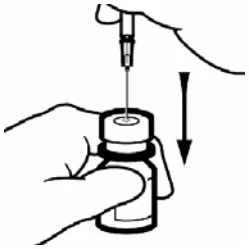
metal rings. Clean the rubber stopper on the top of each vial with an alcohol wipe. Do not touch the rubber stoppers with your hands after cleaning them.
- 3.
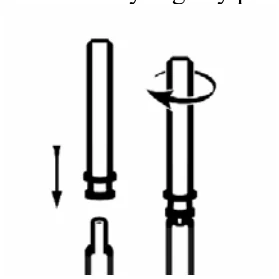
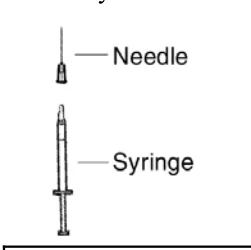
Remove the protective cover from the end of the syringe
barrel with a counterclockwise turn.
- 4.
Open the wrappers that contain the needles by peeling apart
the tabs and set the needles aside. Attach one of the needles to the syringe by pushing it on the syringe.
- 5.
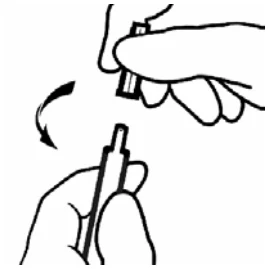
Hold the barrel of the syringe with one hand and pull the
needle cover off with the other hand. Do not twist the cover off. Do not touch the needle or let it touch any other surface.
- 6.
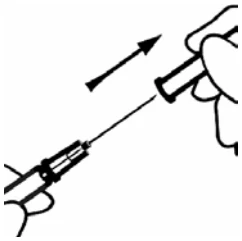
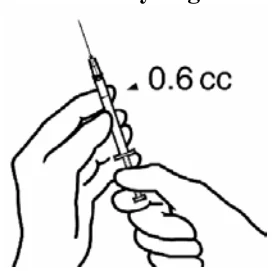
Pull back the syringe plunger to the 0.6 cc mark. The syringe
has cc marks and not mL marks. Note that cc and mL are the same volume. DO NOT use the M marks that also appear on the syringe.
- 7.
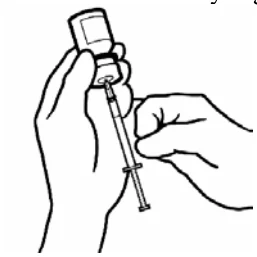
With the diluent vial on the flat work surface, firmly push the
needle down through the centre of the rubber stopper.
- 8. Inject the air in the syringe into the diluent vial by pushing down on the plunger until it cannot be pushed any further.
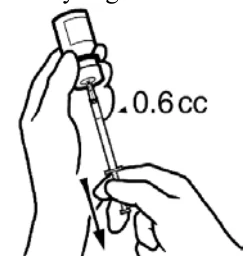
- 9. Keeping the needle in the vial, turn the diluent vial and syringe upside down.
- 10. While keeping the needle in the liquid, slowly pull back on the plunger to withdraw 0.6 cc (mL) of the liquid into the syringe.
- 11. Gently tap the syringe with your finger to make any air bubbles rise to the top. If bubbles are present, slowly press the plunger in (to push just the bubbles out through the needle). If you push diluent back in to the vial, slowly pull back on the plunger and withdraw the correct amount back into the syringe. Make sure there is still 0.6 cc (mL) of diluent in the syringe.
- 12. Slowly pull the needle out of the diluent vial.
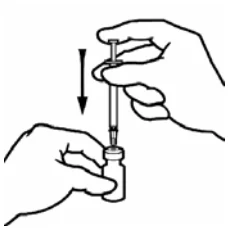
- 13. Carefully insert the needle through the centre of the rubber stopper of the vial of AMEVIVE. Note: if the needle is not pushed through the centre of the stopper, it may cause the stopper to fall into the vial. If the stopper falls into the vial, do not use.
- 14.
Slowly inject the diluent into the vial of AMEVIVE. DO
NOT aim the stream of diluent directly onto the AMEVIVE powder. Too direct or forceful a stream of diluent onto the powder may cause foaming, and make it difficult to withdraw AMEVIVE.
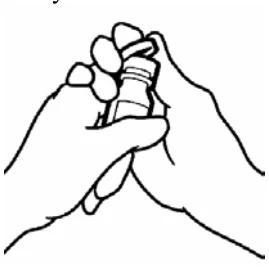
- 15. Remove the syringe and needle and gently swirl the vial until
the AMEVIVE is dissolved. DO NOT SHAKE. 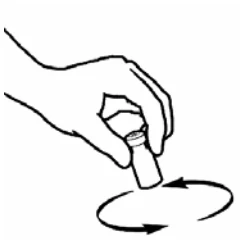
- 16.
Check to see that all of the AMEVIVE powder is dissolved.
This usually takes about two minutes. Check the solution in the vial of AMEVIVE to see if it is clear and is a colourless to slightly yellow solution. The vial should not have any particles. Do not use the vial if the solution is cloudy, if it has particles in it or if it is any other colour except slightly yellow.
- 17.
Remove the needle used for reconstitution from the syringe
and put the used needle in the puncture resistant container provided. Now attach the second supplied needle to the syringe. Hold the syringe barrel with one hand and pull the needle cover off with the other hand. Do not twist the cover off. Do not touch the needle or let it touch any other surface.
- 18.
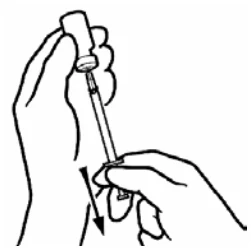
Insert the syringe with the new needle into the vial of
AMEVIVE and turn the vial and syringe upside down. Slowly pull back on the plunger to withdraw the total volume of AMEVIVE. Some foam or bubbles may remain in the vial.
- 19.
Check the contents of the syringe. It should be a clear and
colourless to slightly yellow solution. Do not use the syringe if the appearance is not normal. Get a new set of materials including the syringe and start again from step 1.
- 20.
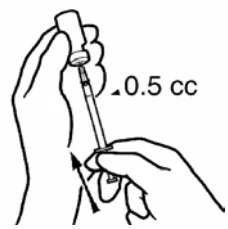
With the vial still upside down, tap the syringe gently with
your finger to make any air bubbles rise to the top. Press the plunger until the AMEVIVE is at the top of the syringe and the plunger reaches the 0.5 cc (mL) mark. Withdraw the needle and syringe from the vial. Do not touch the needle or allow it to touch any surface. Do not touch the syringe plunger as this could cause liquid to leak out.
Selecting an injection site
- 21.
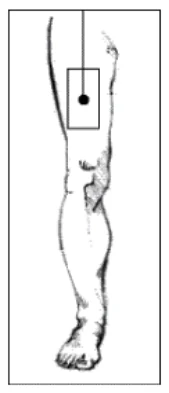
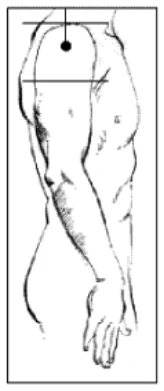
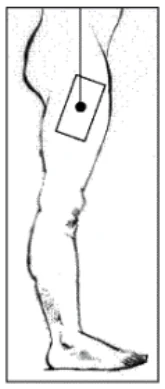
The best sites for an intramuscular injection are the thigh and
upper arm. You should use different injection sites each week. Make sure that the site you choose doesn’t have any skin irritations.
Injecting the AMEVIVE® (alefacept) dose
- 22. Use a new alcohol wipe to clean the skin at one of the recommended intramuscular injection sites.
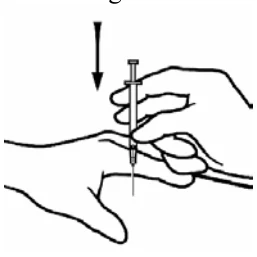
- 23.
With one hand, stretch the skin out around the injection site.
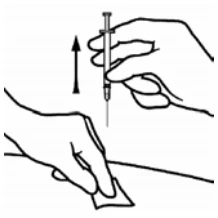
Hold the syringe like a pencil with the other hand, and using a quick motion insert the needle straight down at a 90° angle through the skin and into the muscle.
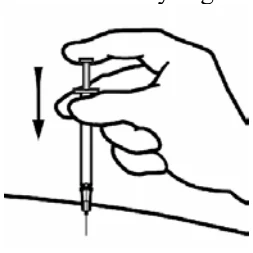
- 24. Once the needle is in, let go of the skin and use that hand to gently pull back slightly on the plunger. If you see blood come into the syringe, withdraw the needle from the injection site and put pressure on the site with a gauze pad. You will need to get a new set of materials and start the process again at Step 1.
- 25. If no blood came into the syringe, slowly push the plunger in until the syringe is empty.
- 26. Hold a gauze pad near the needle at the injection site and pull the needle straight out. Use the pad to apply pressure to the site for a few seconds or rub gently in a circular motion.
- 27. If there is bleeding at the site, wipe it off and, if necessary, apply an adhesive bandage.
Disposal of syringes and needles
The used needles should be put into the puncture resistant container. NEVER use a syringe or needle more than once. The diluent vial and the empty vial of AMEVIVE® (alefacept) and syringe should be put into the garbage. DO NOT RECYCLE. DO NOT throw used needles into the household garbage. Keep the puncture resistant container out of the reach of children. DO NOT recycle the container.
REPORTING SUSPECTED SIDE EFFECTS
To monitor drug safety, Health Canada collects information on serious and unexpected effects of drugs. If you suspect you have had a serious or unexpected reaction to this drug you may notify Health Canada by:
toll-free telephone: 866-234-2345
toll-free fax 866-678-6789
By email: cadrmp@hc-sc.gc.ca
By regular mail:
National AR Centre
Marketed Health Products Safety and Effectiveness Information Division
Marketed Health Products Directorate
Tunney’s Pasture, AL 0701C
Ottawa ON K1A 0K9
NOTE: Before contacting Health Canada, you should contact your physician or pharmacist.
MORE INFORMATION
Patients taking AMEVIVE® (alefacept) have access to the
AMEVIVE Care Program®. This program provides access to a registered nurse 24 hours per day, 7 days a week. The program offers a variety of product support services and a number of training and administration options, including:
Self-injection after training by an AMEVIVE Registered
Nurse
- Self-injection after training in your physician’s clinic
- Nurse administered injections in your physician’s clinic
- Nurse administered injections at home or other location
Information about psoriasis and AMEVIVE is available upon request from Astellas Pharma Canada Inc. at 1-877-AMEVIVE (263-8483).