


Product Monograph - Anandron
ACTION AND CLINICAL PHARMACOLOGY
Nilutamide is a pure, nonsteroidal antiandrogen which blocks androgens binding at receptor target cells. Nilutamide is specific and does not bind to any other steroidal receptors; therefore, it does not have any other hormonal or antihormonal activity.
Nilutamide demonstrates potent antiandrogenic effects by inhibiting androgen uptake and/or inhibiting nuclear binding of androgen in target tissues. In adult male rats, ventral prostate and seminal vesicle weights were markedly reduced by daily administration of nilutamide.
Androgen-sensitive prostatic carcinoma cells respond to treatment that counteracts the effect of androgen and/or removes the source of androgen e.g. castration. Combined with castration, nilutamide exerts a total peripheral antiandrogenic activity by antagonizing the action of androgens of adrenal origin which otherwise may maintain the proliferation of prostatic cancer cells.
Nilutamide also inhibits the consequences of the initial rise of testosterone plasma levels observed after treatment with LH-RH agonists.
Clinical studies with ANANDRON (nilutamide) have demonstrated improvement in metastatic bone pain, diminished consumption of analgesics, regression of the cancer together with reduced rate of objective progression and higher survival actuarial rate of patients with metastatic prostate cancer.
Nilutamide is rapidly and completely absorbed as indicated by the low level of fecal radioactivity measured after administration of radiolabelled nilutamide. Unchanged nilutamide represents the major active compound. In patients, nilutamide has a long half-life of 56 hours (range from 23 to 87 hours). Nilutamide is 84% bound to plasma proteins. The plasma concentrations are dose-related and steady-state levels are reached approximately 2 weeks after initiation of treatment. No evidence of accumulation has been demonstrated.
Nilutamide is mainly excreted in the urine as metabolites. Using radiolabelled nilutamide, unchanged drug accounts for only 3% of recovered urinary radioactivity. Fecal excretion accounts for 1.4 to 7% of the total administered dose after 4-5 days. The major metabolic pathway is by reduction of the nitro group and the amino derivative of nilutamide represents the
major metabolite. Among the metabolites of nilutamide only the hydroxymethylnitro derivative shows some androgen receptor binding affinity.
INDICATIONS AND CLINICAL USE
ANANDRON (nilutamide) is indicated in the treatment of metastatic prostatic carcinoma (Stage D2) in conjunction with surgical castration.
CONTRAINDICATIONS
ANANDRON (nilutamide) is contraindicated in:
- patients with known hypersensitivity to the drug, or to any constituents of the drug product
- patients with severe hepatic dysfunction
- patients with severe respiratory insufficiency
- women and children.
WARNINGS
The hepatic and respiratory state of the patient should be evaluated and the necessity to report any respiratory symptoms as soon as they appear should be emphasized.
Cases of interstitial lung disease such as pneumonitis and pulmonary fibrosis have been reported with the use of ANANDRON (nilutamide). Some cases of pulmonary fibrosis were fatal. Baseline imaging (eg. chest X-ray) should be performed prior to therapy. Baseline pulmonary function tests may be considered (see CONTRAINDICATIONS, Monitoring and Laboratory Tests, and PRECAUTIONS). In the event of dyspnea or worsening of pre-existing dyspnea, treatment with ANANDRON should be discontinued and appropriate medical treatment should be initiated. If interstitial lung disease is diagnosed, ANANDRON must be discontinued to reduce the risk of progression to pulmonary fibrosis; corticosteroid treatment may be considered.
Cases of hepatic dysfunction have been reported with the use of ANANDRON. If clinical symptoms give rise to a suspicion of liver dysfunction, transaminases should be measured. If an increase in serum transaminases above three times the upper limit of normal laboratory range is shown, treatment must be interrupted.
Antiandrogen Withdrawal Syndrome
In some patients with metastatic prostate cancer, antiandrogens (steroidal or non-steroidal), may promote, rather than inhibit, the growth of prostate cancer. A decrease in PSA and/or clinical improvement following the discontinuation of antiandrogens have been reported. It is recommended that patients prescribed an antiandrogen, who have PSA progression, should have the antiandrogen discontinued immediately and be monitored for 6 to 8 weeks for a withdrawal response prior to any decision to proceed with other prostate cancer therapy.
Cardiovascular
There may be a relationship between combined androgen blockade and cardiovascular risk in men with prostate cancer on the basis of the demonstrated adverse impact of androgen deprivation on traditional cardiovascular risk factors, including serum lipoproteins, insulin sensitivity, and obesity (see REFERENCES section). Reports of events related to cardiovascular ischemia including myocardial infarction and cardiovascular-related deaths have been received in patients treated with combined androgen blockade.
Physicians should consider whether the benefits of combined androgen blockade outweigh the potential cardiovascular risk. Assessment of cardiovascular risk and management according to local clinical practice and guidelines should be considered (see “Monitoring and Laboratory Test” below).
Effect on QT/QTc interval
Combined androgen blockade has the potential to prolong QT/QTc interval on ECG. Physicians should consider whether the benefits of combined androgen blockade outweigh the potential risk in patients with electrolyte abnormalities, or congestive heart failure and in patients taking Class IA (e.g. quinidine, procainamide), Class III (e.g. amiodarone, sotalol, dofetilide, ibutilide, dronedarone), or Class IC (e.g. flecainide, propafenone) antiarrhythmic medications. (See PRECAUTIONS, Drug-Drug interactions)
ANANDRON should not be administered to patients with congenital long QT syndrome and should be discontinued in patients that develop QT prolongation during treatment.
Endocrine and Metabolism
A reduction in glucose tolerance and an increased risk in developing diabetes have been reported in men treated with combined androgen blockade. Patients treated with combined androgen blockade should undergo periodic monitoring of blood glucose. Diabetic patients may require more frequent monitoring when receiving ADT.
Hematologic
Anemia is a known physiologic consequence of testosterone suppression. Assessment of anemia risk and management according to local clinical practice and guidelines should be considered.
Musculoskeletal
Changes in bone density:
Decreased bone mineral density can be anticipated with long term use of an antiandrogen. Combined androgen blockade is associated with increased risks of osteoporosis and skeletal bone fractures. The risk of skeletal bone fracture increases with the duration of combined androgen blockade. Assessment of osteoporosis risk and management according to clinical practice and guidelines should be considered.
In patients with significant risk factors for decreased bone mineral content and/or bone mass such as chronic alcohol and/or tobacco use, presumed or strong family history of osteoporosis or chronic use of drugs that can reduce bone mass such as anticonvulsants or corticosteroids, ANANDRON may pose an additional risk. In these patients, risk versus benefit must be weighed carefully before therapy with ANANDRON is instituted.
Monitoring and Laboratory Tests
Baseline risk factors of cardiovascular diseases should be assessed. Patients should be monitored periodically for risk factors, signs and symptoms of cardiovascular diseases. Evaluation for QT prolongation should be undertaken for patients at risk by baseline ECG recording and frequently during treatment in patients also taking medicinal products known to prolong the QTc interval or to induce torsades de pointes. In addition, as electrolyte abnormalities may prolong the QT interval, baseline measurements of serum electrolytes, including potassium, calcium, and magnesium levels, are recommended (See WARNINGS, Cardiovascular and PRECAUTIONS, Drug-Drug Interactions).
Monitoring of the hepatic function is also recommended.
Blood glucose levels and/or glycosylated hemoglobin (HbA1c) should be checked periodically in patients treated with androgen deprivation therapy and more frequently in diabetic patients (see Endocrine and Metabolism).
The effects of nilutamide on bone mineral density may be monitored by bone scans.
Baseline imaging (e.g. chest X-ray) and monitoring of pulmonary function is recommended (see CONTRAINIDICATIONS, WARNINGS and PRECAUTIONS).
PRECAUTIONS
Information for Patients
Patients should be informed that they should not interrupt their dosing or stop taking
ANANDRON (nilutamide) without consulting their physician(s).
Where patients are participating in activities such as driving automobile or operating machinery, attention should be drawn to possible visual disturbances mainly due to an increase in adaptation time when passing from a well lit area to a more dimly lit area. These disturbances, should they occur, can decrease even if treatment is continued and can be ameliorated with the use of sunglasses.
Patients should be informed about signs / symptoms suggestive of liver dysfunction (e.g. right upper quadrant tenderness, dark urine, persistent anorexia, nausea, vomiting, jaundice, pruritus or unexplained flu-like symptoms) and be advised to contact their physician should these occur.
Patients administered nilutamide should be warned against consuming alcohol because of a possible disulfiram-like reaction.
Patients should be instructed to report any new or worsening shortness of breath. If symptoms occur, ANANDRON should be discontinued and appropriate medical treatment initiated.
Use in Specific Patient Populations
In an uncontrolled pilot study conducted in a Japanese population, interstitial pneumonitis was reported and was considered possibly or probably related to nilutamide in 6 out of 47 patients (12.8%). This incidence figure is higher than the incidence of interstitial pneumonitis available from the international database of placebo-controlled trials in orchiectomized patients (1.1%; see ADVERSE REACTIONS section). In concurrent pharmacokinetics/metabolism investigations in Japanese vs. Caucasian patients, no differences in the results could account for the higher incidence of this event in this race. The incidence rate of raised transaminases in the Japanese study was 19%. Special care should be observed when treating Asian patients.
DRUG-DRUG INTERACTIONS
Nilutamide, apparently through an effect on certain oxidative microsomal enzymes, may reduce the hepatic metabolism of warfarin-type anticoagulants, phenytoin, propranolol, chlordiazepoxide, lidocaine, diazepam and theophylline, thereby delaying elimination and increasing blood levels of these drugs. Benzodiazepines that are not oxidized by the hepatic system do not exhibit this effect.
Dosage of the drugs mentioned above, and other similarly metabolized drugs, may require adjustment when starting or stopping concomitantly administered nilutamide to maintain safe optimum therapeutic blood levels.
In case of associated treatment with warfarin-type anticoagulants, close monitoring of prothrombin time is recommended and adjustment of the anticoagulant dose may be necessary.
Alcohol intolerance (disulfiram-like reaction) may occur if alcohol is consumed during treatment with nilutamide.
Since combined androgen blockade may prolong the QTc interval, the concomitant use of ANANDRON with medicinal products known to prolong the QTc interval or medicinal products able to induce torsades de pointes should be carefully evaluated. Such medicinal products include but are not limited to the examples that follow: Class IA (e.g. quinidine, disopyramide), Class III (e.g. amiodarone, sotalol, dofetilide, ibutilide, dronedarone), or Class IC (e.g. flecainide, propafenone) antiarrhythmic medicinal products, antipsychotics (e.g. chlorpromazine), antidepressants (e.g. amitriptyline, nortriptyline), opioids (e.g. methadone), macrolide antibiotics and analogues (e.g. erythromycin, clarithromycin, azithromycin), quinolone antibiotics (e.g. moxifloxacin), antimalarials (e.g. quinine), azole antifungals, 5-hydroxytryptamine (5-HT3) receptor antagonists (e.g. ondansetron), and beta-2 adrenoceptor agonists (e.g. salbutamol).
In case of ANANDRON treatment in combination with such medicinal products, the QT interval should be closely monitored.
ADVERSE REACTIONS
CLINICAL TRIALS
Adverse Drug Reactions
The following table lists the possibly or probably drug-related adverse events (adverse reactions) most frequently reported during placebo-controlled clinical trials of ANANDRON (nilutamide) in conjunction with surgical castration. Hot flushes, decreased libido, impotence and body hair loss are known to occur with surgical castration.
| Percentage of patients | ||||||||
| Nilutamide | Placebo | |||||||
| Adverse reaction | (N= 560) | (N= 558) | ||||||
Hot Flushes Impaired Adaptation to Darkness Nausea Alcohol Intolerance Dizziness Chromatopsia SGPT Increased Abnormal Vision SGOT Increased Photophobia Hyperglycemia Impotence Dyspnea Gynecomastia Impaired Light Adaptation Interstitial Lung Disease Eye Disorder Libido Decreased Sweating Increased Vomiting Anorexia Blurred vision Hepatitis Hypertension Anemia Asthenia Gastrointestinal Pain Lung Disorder Malaise | 13.8 10.5 4.3 4.1 2.9 2.5 2.0 1.8 1.4 1.4 1.3 1.3 1.1 1.1 1.1 1.1 0.9 0.9 0.9 0.9 0.7 0.7 0.7 0.7 0.5 0.5 0.5 0.5 0.5 | 9.7 0.7 1.1 0.2 0.5 0 0.7 0.5 0.4 0 1.6 0.5 0.2 1.3 0 0 0.4 0 0.5 0 0 0 0 0.2 0.2 0.4 0.2 0 0 | ||||||
Adverse Events Irrespective of Relationship with Nilutamide
Other adverse events reported overall in clinical trials (of which most occurred with similar frequencies in patients receiving placebo), others known to commonly occur in elderly patients or expected in patients with metastatic prostate cancer included:
Cardiovascular system: Cerebrovascular accident (1.4%), heart failure (1.0%).
Rare cases of tachycardia.
Digestive system: Constipation (2.6%), gastrointestinal disorder (2.0%). Rare cases of diarrhea.
Metabolic and nutritional system: Peripheral edema (1.5%).
Nervous system: Headache (2.6%), depression (1.1%), insomnia (1.1%).
Rare cases of drowsiness and anxiety. Skin and appendages: Pruritus (1.1%). Rare cases of maculopapular rash and hirsutism.
Special senses: Rare cases of dazzle and dry mouth. Urogenital system: Urinary tract infection (1.3%).
No causal relationship of these experiences with drug treatment has been established.
Post-Marketing Surveillance
The adverse events which have been spontaneously reported worldwide further to marketing of
ANANDRON and which are considered possibly or probably related to the drug (adverse reactions) include the following: interstitial lung disease (including interstitial pneumonitis and pulmonary fibrosis, which may be fatal), hepatocellular or mixed liver injury, fulminant hepatitis, and unspecified vision disorders. Isolated cases of angina pectoris, anxiety dyspnea palpitation, cold extremities, dizziness headache, gynecomastia, maculopapular rash, QT prolongation, urticaria, vomiting and weight increase have been reported.
Aplastic anemia (including one fatality) has been reported rarely in patients treated with
ANANDRON but no specific relationship to the drug product has been ascertained.
SYMPTOMS AND TREATMENT OF OVERDOSAGE
At the dose of 900 mg (3 to 6 times the recommended daily dose), ANANDRON (nilutamide) caused malaise, dizziness, nausea and vomiting which disappeared upon discontinuation of treatment.
The effects of ingestion of a very high dose of ANANDRON have been described in one case report. A 79 year old man was admitted 2 hours after the ingestion of 13 g of nilutamide (170 mg/kg or 43 times the therapeutic dose). He had been receiving nilutamide 300 mg/day for two weeks. On admission, he underwent gastric lavage immediately, followed by administration of a 20 g oral dose of activated charcoal. Clinical and biological parameters were monitored. There were no changes in the biological parameters as compared to the pre-treatment values either early post ingestion or upon control on day 4, 9 and 30. The clinical manifestations were limited to moderate vomiting and diarrhea during the first 12 hours post ingestion and the patient recovered. Plasma and serum concentrations were measured. The initial level reached 6 times the usual therapeutic range of 4.4-8.5 mg/L. Levels 3.5 times greater than the normal range were measured 72 hours post-ingestion.
The ingested dose (170 mg/kg) is close to the lethal dose in animals, the oral LD50 being 215 mg/kg (180-240) in mice and 195 mg/kg (160-230) in rats. However, the extent of absorption was probably limited by early therapeutic intervention. The lethal dose in man has not been established.
DOSAGE AND ADMINISTRATION
Treatment with ANANDRON (nilutamide) should be initiated immediately after surgical castration.
| Initial dosage: | 300 mg once daily for the first month of treatment. | |
| Maintenance dosage: | Maintenance treatment may be started earlier should intolerance occur. 150 mg once daily. | |
ANANDRON should be taken before breakfast, until more information is available.
Discontinuation of ANANDRON should be considered once objective evidence of disease progression is noted.
PHARMACEUTICAL INFORMATION
DRUG SUBSTANCE
Trade Name ANANDRON®
Proper Name nilutamide
Chemical Name 5,5-Dimethyl-3-(α, α, α - trifluoro-4-nitro-m-tolyl) hydantoin
Structural Formula
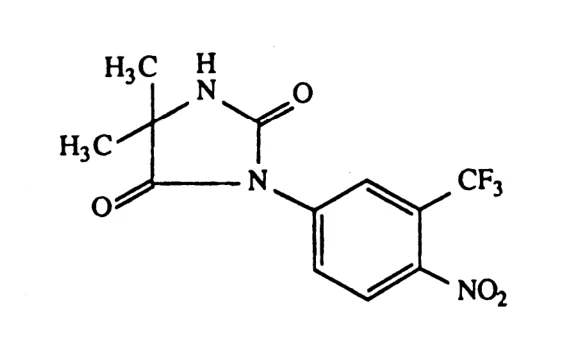
Molecular Formula C12H10F3N3O4
Molecular Weight 317.25
Description White to off-white powder. It is soluble in ethyl acetate, acetone, chloroform, ethyl alcohol, dichloromethane and methanol. It is very slightly soluble in water (< 0.1% w/v) at 25oC. It melts between 153oC and 156oC.
Composition ANANDRON tablets contain 50 mg nilutamide as active drug substance.
Non-medicinal ingredients are: lactose, corn starch, sodium docusate, talc, povidone and magnesium stearate.
STABILITY AND STORAGE RECOMMENDATIONS
Store between 15 and 30°C. Protect from light, heat and humidity.
AVAILABILITY OF DOSAGE FORMS
ANANDRON (nilutamide) 50 mg tablets are white, cylindrical, biconvex tablets, debossed with “168” over “A” on one side and with the Roussel logo on the other side.
They are packaged in boxes of 90 (3 x 30 blister-packed) tablets.