


Product Monograph - Apo-Ofloxacin
RECENT MAJOR LABEL CHANGES
None at the time of the most recent authorization.
TABLE OF CONTENTS
Sections or subsections that are not applicable at the time of authorization are not listed.
RECENT MAJOR LABEL CHANGES ................................................................................................ 2
TABLE OF CONTENTS ................................................................................................................... 2
PART I: HEALTH PROFESSIONAL INFORMATION ......................................................................... 4
1 INDICATIONS ...................................................................................................................... 4
1.1 Pediatrics ................................................................................................................... 4
1.2 Geriatrics ................................................................................................................... 4
2 CONTRAINDICATIONS ......................................................................................................... 4
4 DOSAGE AND ADMINISTRATION ........................................................................................ 4
4.1 Dosing Considerations ............................................................................................... 4
4.2 Recommended Dose and Dosage Adjustment .......................................................... 5
4.4 Administration ........................................................................................................... 5
4.5 Missed Dose .............................................................................................................. 5
5 OVERDOSAGE ..................................................................................................................... 5
6 DOSAGE FORMS, STRENGTHS, COMPOSITION AND PACKAGING ...................................... 6
7 WARNINGS AND PRECAUTIONS ......................................................................................... 6
7.1 Special Populations .................................................................................................... 7
7.1.1 Pregnant Women ...................................................................................................... 7
7.1.2 Breast-feeding ........................................................................................................... 7
7.1.3 Pediatrics ................................................................................................................... 8
7.1.4 Geriatrics ................................................................................................................... 8
8 ADVERSE REACTIONS .......................................................................................................... 8
8.1 Adverse Reaction Overview ....................................................................................... 8
8.5 Post-Market Adverse Reactions ................................................................................ 8
9 DRUG INTERACTIONS ......................................................................................................... 9
9.2 Drug Interactions Overview ....................................................................................... 9
9.3 Drug-Behavioural Interactions ................................................................................... 9
9.4 Drug-Drug Interactions .............................................................................................. 9
9.5 Drug-Food Interactions .............................................................................................. 9
9.6 Drug-Herb Interactions .............................................................................................. 9
9.7 Drug-Laboratory Test Interactions ............................................................................. 9
10 CLINICAL PHARMACOLOGY ................................................................................................ 9
10.1 Mechanism of Action ................................................................................................. 9
10.2 Pharmacodynamics ................................................................................................... 9
10.3 Pharmacokinetics .................................................................................................... 10
11 STORAGE, STABILITY AND DISPOSAL................................................................................ 11
12 SPECIAL HANDLING INSTRUCTIONS ................................................................................. 11
PART II: SCIENTIFIC INFORMATION ........................................................................................... 12
13 PHARMACEUTICAL INFORMATION .................................................................................. 12
14 CLINICAL TRIALS ................................................................................................................ 12
14.1 Clinical Trials by Indication ...................................................................................... 12
15 MICROBIOLOGY ................................................................................................................ 13
16 NON-CLINICAL TOXICOLOGY ............................................................................................ 15
17 SUPPORTING PRODUCT MONOGRAPHS .......................................................................... 17
PATIENT MEDICATION INFORMATION ..................................................................................... 18
PART I: HEALTH PROFESSIONAL INFORMATION
1 INDICATIONS
APO-OFLOXACIN (Ofloxacin Ophthalmic Solution), is indicated for the treatment of conjunctivitis when caused by susceptible strains of the following bacteria:
Gram Positive Bacteria
- Staphylococcus aureus
- Staphylococcus epidermidis
- Streptococcus pneumoniae
Gram Negative Bacteria
- Haemophilus influenza
To reduce the development of drug-resistant bacteria and maintain the effectiveness of APO-OFLOXACIN, and other antibacterial drugs, APO-OFLOXACIN should be used only to treat infections that are proven or strongly suspected to be caused by susceptible bacteria.
1.1 Pediatrics
Pediatrics (< 18 years of age): Based on the data submitted and reviewed by Health Canada, the safety and efficacy of ofloxacin ophthalmic solution in pediatric patients has not been established. Therefore, Health Canada has not authorized an indication for pediatric use. See 7.1.3 Pediatrics.
1.2 Geriatrics
Geriatrics (> 65 years of age): No comparative data are available to Health Canada; therefore, Health Canada has not authorized an indication for geriatric use.
2 CONTRAINDICATIONS
APO-OFLOXACIN is contraindicated in patients who are hypersensitive to this drug or to any ingredient in the formulation, including any non-medicinal ingredient, or component of the container. For a complete listing, see 6 DOSAGE FORMS, STRENGTHS, COMPOSITION AND PACKAGING. A history of hypersensitivity to other quinolones also contraindicates use of ofloxacin.
4 DOSAGE AND ADMINISTRATION
4.1 Dosing Considerations
Prolonged use of APO-OFLOXACIN may result in overgrowth of nonsusceptible organisms, including fungi. Whenever clinical judgment dictates, the patient should be examined with the aid of magnification, such as slit lamp biomicroscopy and, where appropriate, fluorescein staining. If the infection is not improved within 7 days, cultures should be obtained to guide further treatment. If such infections occur, discontinue use and institute alternative therapy.
4.2 Recommended Dose and Dosage Adjustment
One to two drops every two to four hours for the first two days, and then four times daily in the affected eye(s) for 8 days.
Health Canada has not authorized an indication for pediatric use.
4.4 Administration
Patients should be instructed to avoid allowing the tip of the dispensing container to contact the eye or surrounding structures to avoid eye injury and contamination of the eye drops.
The preservative in APO-OFLOXACIN, benzalkonium chloride, may be absorbed by and cause discoloration of soft contact lenses. APO-OFLOXACIN should not be administered while wearing soft contact lenses. Contact lenses should be removed prior to instillation of APO-OFLOXACIN and may be reinserted 15 minutes following its administration.
4.5 Missed Dose
Patients should be instructed to instill the drops as soon as they remember, and then to return to their regular routine.
5 OVERDOSAGE
In the event of accidental ingestion of 10 mL of APO-OFLOXACIN, 30 mg of ofloxacin would be ingested. Although this amount may not be clinically significant in terms of overdosage, there could be an increased potential for systemic reactions.
A topical overdosage of APO-OFLOXACIN is considered a remote possibility. Discontinue medication if heavy or protracted use is suspected. In the event of a topical overdose, flush the eye with a topical ocular irrigant.
| For management of a suspected drug overdose, including accidental ingestion, contact your regional poison control centre. |
|---|
6 DOSAGE FORMS, STRENGTHS, COMPOSITION AND PACKAGING
Table 1 – Dosage Forms, Strengths, Composition and Packaging
| Route of Administration | Dosage Form / Strength/Composition | Non-medicinal Ingredients |
|---|---|---|
| Ophthalmic | Solution, 0.3% w/v | Benzalkonium chloride 0.005% w/v (as preservative); hydrochloric acid and/or sodium hydroxide to adjust the pH; sodium chloride and water for injection. |
APO-OFLOXACIN is available for topical ophthalmic administration as a 0.3% w/v sterile solution, and is supplied in bottles containing 5 mL (partially filled into an 11 mL bottle) and 10 mL.
7 WARNINGS AND PRECAUTIONS
General
APO-OFLOXACIN is not for injection into the eye.
Contact of the tip of the dispensing container with the eye or surrounding structures may lead to eye injury and contamination of eye drops.
The use of ofloxacin with other products may lead to drug interactions. For established or potential drug interactions. See 9 DRUG INTERACTIONS.
Driving and Operating Machinery
As with any ocular medication, if transient blurred vision occurs at instillation, the patient should wait until the vision clears before driving or using machinery.
Immune
Hypersensitivity
Use APO-OFLOXACIN with caution in patients who have exhibited sensitivities to other quinolone antibacterial agents. Only a few patients had a history of hypersensitivity reactions. Serious anaphylactic reactions may require immediate emergency treatment with epinephrine. Oxygen, intravenous steroids and airway management, including intubation, should be administered as clinically indicated. APO-OFLOXACIN should be discontinued if an allergic reaction occurs.
Hypersensitivity reactions including angioedema, dyspnea, anaphylactic reaction/shock, oropharyngeal swelling, Stevens-Johnson syndrome, tongue swollen and toxic epidermal necrolysis have been reported with ofloxacin ophthalmic solution. See 8.5 Post-Market Adverse Reactions.
In patients receiving systemic quinolone therapy, serious and occasionally fatal hypersensitivity (anaphylactic) reactions, some following the first dose, have been reported. Some reactions were accompanied by cardiovascular collapse, loss of consciousness, tingling, angioedema (including laryngeal, pharyngeal or facial edema), airway obstruction, dyspnea, urticaria, and itching.
Musculoskeletal
Tendon inflammation and rupture may occur with systemic fluoroquinolone therapy including ofloxacin, particularly in elderly patients and in those treated concurrently with corticosteroids. Treatment with APO-OFLOXACIN should be discontinued at the first sign of tendon inflammation.
The systemic administration of quinolones has led to lesions or erosions of the cartilage in weight-bearing joints and other signs of arthropathy in immature animals of various species. Ofloxacin, administered systemically at 10 mg/kg/day in young dogs (equivalent to 150 times the maximum recommended daily adult ophthalmic dose), has been associated with these types of effects.
Ophthalmologic
Corneal precipitates, and corneal perforation in patients with pre-existing corneal epithelial defect/corneal ulcer, have been reported during treatment with topical ophthalmic ofloxacin. However, a causal relationship has not been established.
Sensitivity/Resistance
Prescribing APO-OFLOXACIN in the absence of a proven or strongly suspected bacterial infection is unlikely to provide benefit to the patient and risks the development of drug-resistant bacteria. See 4.1 Dosing Considerations.
7.1 Special Populations
7.1.1 Pregnant Women
There have been no adequate and well-controlled studies performed in pregnant women. Since systemic quinolones have been shown to cause arthropathy in immature animals, APO-OFLOXACIN should be used during pregnancy only if the potential benefit justifies the potential risk to the fetus.
7.1.2 Breast-feeding
Because ofloxacin taken systemically is excreted in breast milk, and there is potential for harm to nursing infants, a decision should be made whether to temporarily discontinue nursing during therapy or not to administer the drug, taking into account the importance of the drug to the mother.
7.1.3 Pediatrics
Pediatrics (< 18 years of age): No data are available to Health Canada; therefore, Health Canada has not authorized an indication for pediatric use.
7.1.4 Geriatrics
Geriatrics (> 65 years of age): No comparative data are available with topical ofloxacin therapy in this age category versus other age groups.
8 ADVERSE REACTIONS
8.1 Adverse Reaction Overview
Since a small amount of ofloxacin is systemically absorbed after topical administration, adverse reactions reported with systemic use could possibly occur.
Ophthalmic Use of Ofloxacin:
The most frequently reported drug-related adverse reaction was transient ocular burning or discomfort. Other reported reactions were ocular irritation, redness, stinging, itching, photophobia, tearing and dryness. One report of dizziness, one report of headache and one spontaneous report of toxic epidermal necrolysis have also been received.
Systemic Effects of Ofloxacin:
As with all topical ophthalmic drugs, the potential exists for systemic effects. Ofloxacin used systemically has rarely been associated with serious side effects. Serious reactions reported for systemic dosing of ofloxacin include convulsions and increased intracranial pressure. For the oral dosage form of ofloxacin, gastrointestinal symptoms, mainly nausea/vomiting, pain/discomfort, diarrhea and anorexia, were reported most frequently, followed by central nervous system events (such as dizziness and headaches) and dermatological or hypersensitivity reactions. Additional effects seen with systemic dosing of ofloxacin and other fluoroquinolones are QT prolongation, exacerbation of myasthenia gravis symptoms, tendinitis and tendon rupture. Photophobia was reported rarely in clinical trials with systemic ofloxacin and phototoxicity has been reported with other drugs in this class.
8.5 Post-Market Adverse Reactions
The following adverse reactions have been identified during post marketing use of ofloxacin ophthalmic solution in clinical practice. Because they are reported voluntarily from a population of unknown size, estimates of frequency cannot be made.
Eye disorders: Conjunctivitis, dry eye, eye edema, eye pain, foreign body sensation in eyes, hypersensitivity (including eye pruritus, eyelids pruritus), keratitis, lacrimation increased, ocular hyperemia, periorbital edema (including eyelid edema), photophobia, vision blurred.
Gastrointestinal disorders: Nausea
Immune system disorders: Hypersensitivity (including angioedema, dyspnea, anaphylactic reaction/shock, oropharyngeal swelling, facial edema, Stevens-Johnson syndrome, tongue swollen, and toxic epidermal necrolysis).
Nervous system disorders: Dizziness
9 DRUG INTERACTIONS
9.2 Drug Interactions Overview
Specific drug interaction studies have not been conducted with ofloxacin ophthalmic solution.
9.3 Drug-Behavioural Interactions
No formal drug-behavioural interaction studies were conducted with ofloxacin ophthalmic solution.
9.4 Drug-Drug Interactions
No formal drug-drug interaction studies were conducted with ofloxacin ophthalmic solution
9.5 Drug-Food Interactions
Interactions with food have not been established.
9.6 Drug-Herb Interactions
Interactions with herbal products have not been established.
9.7 Drug-Laboratory Test Interactions
Interactions with laboratory tests have not been established.
10 CLINICAL PHARMACOLOGY
10.1 Mechanism of Action
The primary mechanism of action of ofloxacin appears to be the specific inhibition of DNA gyrase (topoisomerase II). This enzyme is responsible for the negative supercoiling of bacterial DNA and consequently for its topological configuration, governing functions such as RNA transcription, protein synthesis, DNA replication and repair functions.
10.2 Pharmacodynamics
The general pharmacological activities of ofloxacin have been studied in several mammalian species. At the maximum therapeutic dose levels, no effects on the central nervous system, cardiovascular and respiratory system, autonomic response or smooth and skeletal muscle were observed. These results are consistent with the infrequent occurrence of serious adverse effects with systemic clinical use of ofloxacin. Any pharmacological effects observed were frequently associated with doses at least 1000 times the anticipated maximal daily ocular dose.
10.3 Pharmacokinetics
Human
Systemic Pharmacokinetics:
Absorption
In systemic pharmacokinetic studies following oral dosing, ofloxacin was rapidly absorbed into the blood stream, with peak serum concentrations (Cmax) increasing in a dose-related manner. There was no significant increase in peak serum ofloxacin concentration following multiple oral administrations.
Following administration of 0.3% ofloxacin topically 4 times daily to the eyes of 30 normal healthy adults, mean serum plateau levels of 0.97 ng/mL after the first dose (day 1) and 1.66 ng/mL after the 41st dose (day 11) were achieved. The maximum serum level from multiple topical dosing (1.9 ng/mL) was approximately 2000-fold less than the maximum serum level achieved from treatment with a single 300 mg oral dose (4620 ng/mL). Time to reach 90% of the plateau serum concentration was 0.9 hours after the initial dose on Day 1 compared with 0.5 hours on Day 11, indicating a change in the rate of systemic absorption from ophthalmic dosing.
Metabolism and Elimination
The metabolism of ofloxacin was studied in five healthy adult male volunteers receiving a single oral dose of a 600 mg mixture of ofloxacin and deuterium-labeled ofloxacin. Ofloxacin and its metabolites were identified, confirmed and quantified using thin layer chromatography, UV spectrophotometry, high pressure liquid chromatography, fluorometry and other methods. Urinary concentration of ofloxacin increased to a maximum of 686.6 mcg/mL at 2 to 4 hours after dosing and was maintained above 273.9 mcg/mL 4 to 24 hours after dosing.
Cumulative urinary excretion of ofloxacin was 79.5% at 48 hours after dosing. Urinary concentrations of desmethyl ofloxacin were 10.4 and 6.6 mcg/mL at 2 to 4 and 12 to 24 hours after dosing, concentrations of ofloxacin N-oxide were 7.8 and 2.7 mcg/mL at 2 to 4 and 12 to 24 hours after dosing. Urinary concentrations of these metabolites were less than 2.5% of the excreted concentration of ofloxacin at each time interval.
The results of this study indicate that ofloxacin exists mainly as parent drug in vivo, and is excreted mainly unchanged in the urine in humans.
Ocular Pharmacokinetics:
Absorption
Administering 0.3% ofloxacin topically 4 times daily to the eyes of 30 normal healthy adults resulted in tear ofloxacin concentrations ranging from 1.2 to 22 mcg/g (mean 9.2 mcg/g) four hours after the first dose on the eleventh day of treatment. The mean tear concentration varied between 5.7 and 31 mcg/g during the time period between 5 and 40 minutes after instillation of the second dose on day 11.
11 STORAGE, STABILITY AND DISPOSAL
APO-OFLOXACIN is sterile in the unopened package, and is stable for 18 months (5 mL fill size) or 24 months (10 mL fill size) when stored at room temperature of 15°C to 30°C. Discard 28 days after opening.
Keep out of reach and sight of children
12 SPECIAL HANDLING INSTRUCTIONS
There are no special handling instructions.
PART II: SCIENTIFIC INFORMATION
13 PHARMACEUTICAL INFORMATION
Drug Substance
Proper name: Ofloxacin USP
Chemical name: 1) 7H-Pyrido[1,2,3-de]-1,4-benzoxazine-6-carboxylic acid,
9-fluoro-2,3-dihydro-3-methyl-10-(4-methyl-1-piperazinyl)-
7-oxo-,(±)-.
- 2) (±)-9-Fluoro-2,3-dihydro-3-methyl-10-(4-methyl-1-piperazinyl)-7- oxo-7H-pyrido[1,2,3-de]-1,4-benzoxazine-6-carboxylic acid. CAS-82419-36-1
Molecular formula and molecular mass: C18H20FN3O4 and 361.37 g/mol
Structural formula:
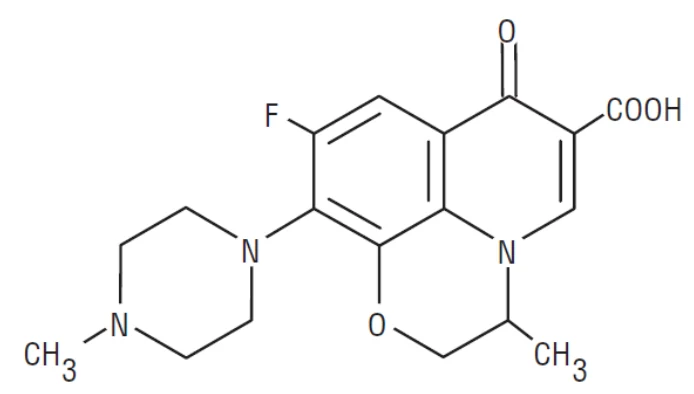
Physicochemical properties: A pale yellow or bright yellow, crystalline powder. Melting point of 260°C to 270°C (with decomposition). Slightly soluble in water, soluble in glacial acetic acid, slightly soluble to soluble in methylene chloride, slightly soluble in methanol.
14 CLINICAL TRIALS
14.1 Clinical Trials by Indication
No clinical trial information is available for this product.
15 MICROBIOLOGY
Ofloxacin has in vitro activity against both gram-positive and gram-negative organisms. The primary mechanism of action of ofloxacin appears to be the specific inhibition of DNA gyrase (topoisomerase II). This enzyme is responsible for the negative supercoiling of bacterial DNA and consequently for its topological configuration, governing functions such as RNA transcription, protein synthesis, DNA replication and repair functions.
In a four-site study using a modified tube-dilution procedure, the in vitro activity of ofloxacin was evaluated against 419 ocular bacterial isolates of 55 species, in media supplemented with Ca++ and Mg++. Table 2 includes MIC values for five major ocular pathogens.
Table 2 - In Vitro Antibacterial Activity of Ofloxacin Against Five Major Ocular Pathogens in Studies Conducted in the USA
| Minimum Inhibitory Concentration Range (mcg/mL) | |||||||
| ORGANISMS (Number) | MINIMUM | MAXIMUM | MIC90 | ||||
| Staphylococcus aureus (79)1 | 0.125 | 4 | 0.5 | ||||
| Staphylococcus epidermidis (68) | 0.125 | 16 | 0.5 | ||||
| Pseudomonas aeruginosa (68) | 0.25 | 8 | 4 | ||||
| Streptococcus pneumoniae (21) | 0.125 | 2 | 2 | ||||
| Haemophilus influenzae (18) | 0.25 | 4 | 4 | ||||
| 1Number of isolates in parentheses. | |||||||
In Vitro Study of Ocular Isolates from Japanese Clinical Studies: An in vitro evaluation of the activity (MIC) of ofloxacin was conducted using a broth dilution technique, with 2,678 organisms cultured from the infected eyes of subjects enrolled in three clinical trials conducted in the clinics of public hospitals in Japan. The minimum concentrations necessary to inhibit 90% of the strains (MIC90) was 3.13 mcg/mL or less for all species tested except various Pseudomonas species and for Streptococcus sanguis isolates. MIC90 values for ocular isolates are listed in Table 3.
Table 3 - Ocular Isolates from Japanese Clinical Studies (Ofloxacin MIC90 Values)
| Bacterial species | N | MIC90 (mcg/mL) |
| Acinetobacter var. anitratum | 44 | 0.39 |
| Acinetobacter var. lwoffii | 33 | 0.39 |
| Bacterial species | N | MIC90 (mcg/mL) |
| Alcaligenes denitrificans | 10 | 1.56 |
| Alcaligenes faecalis | 24 | 0.78 |
| Bacillus species | 111 | 0.20 |
| Corynebacterium species | 379 | 3.13 |
| Enterobacter species (3: cloacae, aerogenes and agglomerans) | 44 | 0.20 |
| Escherichia coli | 8 | 0.10 |
| Flavobacterium species | 22 | 3.13 |
| Haemophilus aegyptius | 59 | 0.20 |
| Haemophilus influenzae | 44 | 0.20 |
| Klebsiella species (3: oxytoca, pneumoniae and ozaenae) | 21 | 0.10 |
| Micrococcus species | 73 | 1.56 |
| Moraxella species | 25 | 0.20 |
| Propionibacterium acnes | 66 | 1.56 |
| Proteus species (5: including mirabilis, vulgaris and morganii) | 30 | 0.20 |
| Pseudomonas acidovorans | 21 | 1.56 |
| Pseudomonas aeruginosa | 11 | 1.56 |
| Pseudomonas alcaligenes | 32 | 3.13 |
| Pseudomonas cepacia | 75 | 1.56 |
| Pseudomonas fluorescens | 44 | 0.78 |
| Pseudomonas maltophilia | 36 | 3.13 |
| Pseudomonas paucimobilis | 31 | 0.39 |
| Pseudomonas putida | 29 | 0.78 |
| Pseudomonas species (6: including vescularis and diminuta) | 16 | 50.5 |
| Pseudomonas stutzeri | 20 | 0.78 |
| Serratia marcescens | 46 | 0.39 |
| Bacterial species | N | MIC90 (mcg/mL) |
| Staphylococcus aureus | 335 | 0.39 |
| Staphylococcus epidermidis | 735 | 0.39 |
| Streptococcus beta-hemolytic | 17 | 1.56 |
| Streptococcus faecalis (Enterococcus faecalis) | 14 | 1.56 |
| Streptococcus pneumoniae | 101 | 3.13 |
| Streptococcus sanguis | 96 | 6.25 |
| Streptococcus species (inc. pyogenes) | 35 | 3.13 |
Ofloxacin is bactericidal (3 log reduction in 1 to 2 hours) at 1 to 4 times the MIC.
Susceptibility Testing: Laboratory results from standard single disc susceptibility tests with a 5 mcg ofloxacin disc should be interpreted according to the following criteria:
| Zone Diameter (mm) | Interpretation |
≥ 16 13 - 15 ≤ 12 | Susceptible Moderately susceptible Resistant |
Bacterial Resistance: The development of resistance to ofloxacin appears to be related to modification of bacterial DNA gyrase or to permeability changes in the bacterial outer cell membrane. Resistance to ofloxacin in vitro usually develops slowly (multiple-step mutation). Plasmid-mediated resistance or enzymatic inactivation have not been reported. Cross resistance among the fluoroquinolones has been observed, but development of clinically significant cross resistance to nonquinolone drugs appears to be uncommon.
16 NON-CLINICAL TOXICOLOGY
General Toxicology: Ofloxacin was administered in repeated doses in rats, dogs and monkeys for periods of up to 52 weeks. The most notable effect seen in these studies was the effect of ofloxacin on articular cartilage in immature animals. Several special studies of the effects of ofloxacin on articular cartilage were conducted. Orally administered ofloxacin had no effect on articular cartilage in mature rats and dogs. However, in immature animals, daily treatment for 7 days with ofloxacin at 300 mg/kg (but not at 100 mg/kg) in rats and at 10 mg/kg (but not at 5 mg/kg) in dogs produced arthropathic effects.
Studies were conducted to elucidate the mechanism of action, onset, recovery and effects of age and dosage on arthropathy associated with ofloxacin and other quinolones. The studies indicate that toxicity to weight-bearing joints is dose-related at oral dosages far higher than topical ophthalmic dosages and that toxic effects are seen only in growing animals. Damage to joints was partially repairable, although some damage appeared to be permanent. Damage such as erosion of the cartilage occurs in weight-bearing joints where "bubbles" (inconsistencies in growth) have developed in the cartilage.
Carcinogenicity: Because ophthalmic ofloxacin solution is not intended for chronic use, specific carcinogenicity studies were not carried out. Chronic ophthalmic toxicity studies showed no evidence of carcinogenic potential.
Genotoxicity: Predictive tests included: Ames test, REC-Assay, micronucleus test, sister chromatid exchange in cultured Chinese hamster cells and in human peripheral blood lymphocytes, unscheduled DNA repair synthesis test, dominant lethal assay, and in vitro and in vivo cytogenetic tests.
Extensive tests for mutagenicity showed no mutagenic potential. Mutagenicity tests were conducted with ofloxacin by a number of techniques, both in vitro and in vivo. Dose-related damage to the DNA of Bacillus subtilis was seen in tests using the REC assay technique. The damage to B. subtilis DNA is consistent with the mechanism of action of the drug in bacteria and is not predictive of mutagenic potential in eukaryotic cells. No evidence of significant mutagenic effects was seen in other tests in a variety of eukaryotic somatic or germ cells.
Human blood samples were examined after oral dosing with 200 mg/day of ofloxacin for 1 to 10 weeks (equivalent to 50 times the maximum recommended daily ophthalmic dose). No chromosome-damaging effect was seen in the peripheral blood leukocytes.
Reproductive and Developmental Toxicology: The effects of ofloxacin on fertility, reproduction and fetal toxicity were studied in rats and rabbits. No adverse effects on fertility and general reproductive performance were seen in male or female rats from administration of ofloxacin in dosages of 10 mg/kg/day to 360 mg/kg/day, beginning well before mating and continuing through the seventh day of gestation in females.
Ofloxacin has not been shown to be teratogenic at doses as high as 810 mg/kg/day (equivalent to 13500 times the maximum recommended daily ophthalmic dose) and 160 mg/kg/day (equivalent to 2600 times the daily ophthalmic dose) when administered to pregnant rats and rabbits, respectively. Additional studies in rats with doses up to 360 mg/kg/day during late gestation showed no adverse effect on late fetal development, labor, delivery, lactation, neonatal viability, or growth of the newborn. Doses of 810 mg/kg/day and 160 mg/kg/day resulted in decreased fetal body weight and increased fetal mortality in rats and rabbits, respectively. Minor fetal skeletal variations were reported in rats receiving doses of 810 mg/kg/day.
Special Toxicity Studies
Ocular Toxicity: Ocular toxicity studies were conducted in rabbits and monkeys with ofloxacin ophthalmic solutions. Results indicate that ofloxacin ophthalmic solutions are not toxic to the eyes under the conditions tested, including dosing up to 16 times per day. No local or systemic toxicity was observed as a result of ocular administration of ofloxacin for up to six months in rabbits or monkeys.
Other Special Toxicity Studies: No evidence of ototoxicity, antigenicity or skin sensitization was seen in guinea pigs. Studies in rabbits revealed no evidence of nephrotoxicity.
Special Studies of Tissue Distribution and Accumulation: Special studies of tissue distribution and accumulation, with special reference to the eye tissues, were conducted due to the tendency of ofloxacin to bind to the pigment melanin, which is present in some ocular structures. Studies with the topical solution showed definite binding to melanin which decreased slowly after withdrawal of the drug. In vitro studies with bovine melanin showed the affinity of ofloxacin for melanin to be greater than that of timolol and pilocarpine, but less than that of chloroquine and befunolol. The binding was reversible. A four-week study in pigmented rats revealed no evidence of ocular toxicity after daily oral doses of 100 mg/kg/day. Results of this study were consistent with the lack of ocular toxicity seen in multi-dose ocular and systemic toxicity studies in dogs and monkeys.
17 SUPPORTING PRODUCT MONOGRAPHS
- 1. OCUFLOX® (Ofloxacin Ophthalmic Solution, 0.3% w/v), submission control 266079, Product Monograph, AbbVie Corporation. (August 15, 2022)