


Product Monograph - Apo-Vardenafil
SUMMARY PRODUCT INFORMATION
Table 1: Summary Product Information
Route of Administration | Dosage Form / Strength | All Nonmedicinal Ingredients |
| oral | Tablets / 5 mg, 10 mg, 20 mg of vardenafil, as vardenafil hydrochloride | colloidal silicon dioxide, magnesium stearate, mannitol, polyethylene glycol, polyvinyl alcohol, talc, titanium dioxide, red ferric oxide, and yellow iron oxide. |
INDICATIONS AND CLINICAL USE
APO-VARDENAFIL (vardenafil tablets) is indicated for:
- Treatment of erectile dysfunction (difficulties or the inability to achieve or maintain penile erection sufficient for satisfactory sexual performance).
Special Populations
Pregnant and Nursing Women: APO-VARDENAFIL is not indicated for use in women. There are no trials of vardenafil tablets in pregnant women.
Pediatrics (< 18 years of age): APO-VARDENAFIL is not indicated for use in individuals less than 18 years old.
Geriatrics (≥ 65 years of age): A starting dose of 5 mg APO-VARDENAFIL should be considered in patients 65 years and older. On average, elderly males (65 years and over) had a 52% higher vardenafil AUC than younger males (18-45 years); however, this difference was not statistically significant. (See ACTION AND CLINICAL PHARMACOLOGY and DETAILED PHARMACOLOGY.)
CONTRAINDICATIONS
- Patients who are hypersensitive to this drug or to any ingredient in the formulation or component of the container. For a complete listing, see the DOSAGE FORMS, COMPOSITION AND PACKAGING section of the product monograph.
Consistent with the effects of PDE5 inhibition on the nitric oxide/cyclic guanosine
monophosphate pathway, PDE5 inhibitors may potentiate the hypotensive effects of nitrates, and therefore co-administration of APO-VARDENAFIL (vardenafil tablets) with nitrates and nitric oxide donors is contraindicated.
In a patient prescribed APO-VARDENAFIL (vardenafil tablets), where nitrate administration is deemed medically necessary in a life-threatening situation, at least 24 hours should have elapsed after the last dose of APO-VARDENAFIL (vardenafil tablets) before nitrate administration is considered. In such circumstances, nitrates should only be administered under close medical supervision with appropriate hemodynamic monitoring.
- Concomitant use of APO-VARDENAFIL (vardenafil tablets) with medicinal products containing cobicistat, HIV protease inhibitors such as indinavir, ritonavir, saquinavir, or atazanavir, and combinations of these, ketoconazole, or itraconazole is contraindicated, as they are potent inhibitors of CYP3A4 (see WARNINGS AND PRECAUTIONS and DOSAGE AND ADMINISTRATION).
- APO-VARDENAFIL (vardenafil tablets) is contraindicated in patients with erectile dysfunction with a previous episode of non-arteritic anterior ischaemic optic neuropathy (NAION) (see WARNINGS AND PRECAUTIONS).
- The co-administration of PDE5 inhibitors, including APO-VARDENAFIL, with guanylate cyclase stimulators, such as riociguat, is contraindicated as it may lead to potentially life-threatening episodes of symptomatic hypotension or syncope (see DRUG INTERACTIONS).
WARNINGS AND PRECAUTIONS
General
The evaluation of erectile dysfunction should include a determination of potential underlying causes, a medical assessment and the identification of appropriate treatment.
Before prescribing APO-VARDENAFIL (vardenafil tablets), it is important to note the following:
- Vardenafil tablets have not been administered to patients with bleeding disorders or significant active peptic ulceration. Therefore APO-VARDENAFIL should be administered to these patients after careful benefit-risk assessment. In humans, vardenafil tablets have no effect on bleeding time alone or with acetylsalicyclic acid. In vitro studies with human platelets indicate that vardenafil tablets does not inhibit platelet aggregation induced by a variety of platelet agonists. A small, concentration-dependent, enhancement of the anti-aggregation effects of a nitric oxide donor, nitroprusside, was observed with supra-therapeutic concentrations of vardenafil in the presence of platelet agonists. The bleeding time in rats with a combination of heparin and vardenafil was not different from that observed with heparin alone. However, this interaction has not been studied in humans.
Treatment for erectile dysfunction should generally be used with caution in patients with anatomical deformation of the penis (such as angulation, cavernosal fibrosis or Peyronie's disease)
or in patients who have conditions that may predispose them to priapism (such as sickle cell anemia, multiple myeloma, or leukemia).
Vardenafil tablets have not been studied in patients with CNS disease (other than spinal cord injury), hypoactive sexual desire, or in patients who have undergone pelvic surgery (except nerve sparing prostatectomy), pelvic trauma, or radiotherapy.
Postmarketing reports of sudden loss of vision have occurred rarely, in temporal association with the use of PDE5 inhibitors. It is not clear whether these are related directly to the use of PDE5 inhibitors or to other factors. There may be an increased risk to patients who have already experienced Non-arteritic Anterior Ischemic Optic Neuropathy (NAION).
Cardiovascular
Physicians should consider the cardiovascular status of their patients, since there is a degree of cardiac risk associated with sexual activity. In men for whom sexual activity is not recommended because of their underlying cardiovascular status, including uncontrolled hypertension (with BP > 140/90 mmHg), any treatment for erectile dysfunction, including APO-VARDENAFIL, generally should not be used. Physicians are advised to consult the recommendations of the Princeton Consensus Panel (DeBusk et al. Am J Cardiol 2000; 86:175-81). The following groups of patients with cardiovascular disease were not included in clinical trials:
- patients with a myocardial infarction or stroke within the last 6 months,
- patients with unstable angina pectoris or acute myocardial ischemia,
patients with uncontrolled arrhythmias, hypotension (<90/50 mmHg), uncontrolled hypertension
(>170/110 mmHg),
- patients with symptomatic postural hypotension in the last six months.
APO-VARDENAFIL has vasodilator properties which may result in mild and transient decreases in blood pressure. Patients with left ventricular outflow obstruction, eg, aortic stenosis and idiopathic hypertrophic subaortic stenosis, can be sensitive to the action of vasodilators, including Type 5 phosphodiesterase inhibitors.
Patients should be stable on alpha-blocker therapy before prescribing APO-VARDENAFIL. Patients receiving alpha-blocker therapy should be initiated at the lowest dose of 5 mg APO-VARDENAFIL.
Congenital and Acquired QT Prolongation
In a study of the effect of vardenafil tablets on the QT interval in 59 healthy males, therapeutic (10 mg) and supratherapeutic (80 mg) doses of vardenafil tablets produced minimal increases in QTc interval. (See ACTION AND CLINICAL PHARMACOLOGY, and DETAILED PHARMACOLOGY.) In a postmarketing study evaluating the effect of combining vardenafil tablets with another drug of comparable QT effect (400 mg gatifloxacin), it was shown that the drug combination produced an additive QT effect when compared with either drug alone. (See DRUG INTERACTIONS, ACTION AND CLINICAL PHARMACOLOGY, and DETAILED PHARMACOLOGY.) These observations should be considered in clinical decisions when
prescribing APO-VARDENAFIL to patients with known history of QT prolongation or patients who are taking medications known to prolong the QT interval. Patients with congenital QT prolongation (long QT syndrome) and those taking Class IA (eg, quinidine, procainamide) or Class III (eg, amiodarone, sotalol) antiarrhythmic medications should avoid using APO-VARDENAFIL.
Hepatic
No dose adjustment is required in patients with mild hepatic impairment. (See WARNINGS AND PRECAUTIONS, ACTION AND CLINICAL PHARMACOLOGY, and DETAILED PHARMACOLOGY.)
In patients with mild hepatic impairment (Child-Pugh A), following a 10 mg dose of vardenafil tablets, the vardenafil AUC was increased 17% and the maximum concentration (Cmax) was increased 22%, compared to healthy male volunteers. In patients with moderate impairment (Child-Pugh B), following a 10 mg dose of vardenafil tablets, the vardenafil AUC was increased 160% and Cmax was increased 133%, compared to healthy male volunteers.
In patients with moderate hepatic impairment, a 5 mg starting dose of APO-VARDENAFIL is recommended, which may subsequently be increased to a maximum dose of 10 mg, based on tolerability and efficacy. (See WARNINGS AND PRECAUTIONS, DOSAGE AND ADMINISTRATION, and ACTION AND CLINICAL PHARMACOLOGY.)
There are no controlled clinical data on the efficacy and safety of vardenafil tablets in severe hepatic impairment; its use is therefore not recommended until further information is available.
Ophthalmologic
There are no controlled clinical data on the efficacy and safety of vardenafil tablets in known hereditary degenerative retinal disorders such as retinitis pigmentosa; its use is therefore not recommended until further information is available.
Physicians should advise patients to stop use of all phosphodiesterase type 5 (PDE5) inhibitors, including APO-VARDENAFIL and seek medical attention in the event of sudden loss of vision in one or both eyes. Such an event may be a sign of nonarteritic anterior ischemic optic neuropathy (NAION), a rare condition and a cause of decreased vision, including permanent loss of vision, that has been reported rarely post-marketing in temporal association with the use of all PDE5 inhibitors. Based on published literature, the annual incidence of NAION is 2.5 to 11.8 cases per 100,000 in males aged ≥50. An observational case-crossover study evaluated the risk of NAION when PDE5 inhibitor use, as a class, occurred immediately before NAION onset (within 5 half-lives), compared to PDE5 inhibitor use in a prior time period. The results suggest an approximate 2-fold increase in the risk of NAION, with a risk estimate of 2.15 (95% CI 1.06, 4.34). A similar study reported a consistent result, with a risk estimate of 2.27 (95% CI 0.99, 5.20). Other risk factors for NAION, such as the presence of “crowded” optic disc, may have contributed to the occurrence of NAION in these studies.
Neither the rare post-marketing reports, nor the association of PDE5 inhibitor use and NAION in the observational studies, substantiate a causal relationship between PDE5 inhibitor use and NAION (see ADVERSE REACTIONS).
Physicians should consider whether their patients with underlying NAION risk factors could be adversely affected by use of PDE5 inhibitors. Individuals who have already experienced NAION are at increased risk of NAION recurrence. Therefore, PDE5 inhibitors, including APO-VARDENAFIL, should be used with caution in these patients and only when the anticipated benefits outweigh the risks.
Individuals with “crowded” optic disc are also considered at greater risk for NAION compared to the general population, however, evidence is insufficient to support screening of prospective users of PDE5 inhibitors, including APO-VARDENAFIL, for this uncommon condition.
Otologic
Sudden decrease or loss of hearing has been reported in a few postmarketing and clinical trial cases with the use of PDE5 inhibitors, including vardenafil tablets. These events, which may be accompanied by tinnitus and dizziness, have been reported in temporal association to the intake of PDE5 inhibitors, including vardenafil tablets. In some of the cases, medical conditions and other factors were reported that may have also played a role in the otologic adverse events. In many cases, medical follow-up information was limited. It is not possible to determine whether these events are related directly to the use of PDE5 inhibitors or to other factors (see ADVERSE REACTIONS, Post-Market Adverse Drug Reactions and PART III: CONSUMER INFORMATION). Physicians should advise patients to stop taking APO-VARDENAFIL and seek prompt medical attention in case of sudden decrease or loss of hearing.
Renal
No dose adjustment is required in patients with renal impairment. In patients with mild, moderate, or severe renal impairment, the pharmacokinetics of vardenafil tablets were similar to that of control groups with normal renal function. Vardenafil tablets pharmacokinetics have not been evaluated in patients requiring dialysis.
There are no controlled clinical data on the efficacy and safety of vardenafil tablets in end stage renal disease requiring dialysis; its use is therefore not recommended until further information is available.
Sexual Function/Reproduction
Prolonged erection greater than 4 hours and priapism (painful erections greater than 6 hours in duration) have been reported infrequently with the use of PDE5 inhibitors, including vardenafil tablets. The incidence of priapism may increase when PDE5 inhibitors are used in combination with intrapenile injections containing vasoactive agents, or other drugs with a known risk of priapism. In the event of an erection that persists longer than 4 hours, the patient should seek immediate medical assistance. If priapism is not treated immediately, penile tissue damage and permanent loss of potency could result. (See TREATMENT OF PRIAPISM.)
The safety and efficacy of combinations of vardenafil tablets with other agents for the treatment of erectile dysfunction have not been studied. Therefore, the use of such combinations is not recommended.
Information for Patients
Physicians should discuss with patients the contraindications of APO-VARDENAFIL with regular and/or intermittent use of organic nitrates. Patients should be advised that concomitant use of APO-VARDENAFIL and nitrates could cause a sudden drop in blood pressure, dizziness, syncope, heart attack, or stroke.
Physicians should advise patients to stop taking PDE5 inhibitors, including APO-VARDENAFIL, and seek prompt medical attention in the event of sudden decrease or loss of hearing. These events, which may be accompanied by tinnitus and dizziness, have been reported in temporal association to the intake of PDE5 inhibitors, including vardenafil tablets. It is not possible to determine whether these events are related directly to the use of PDE5 inhibitors or to other factors. (See ADVERSE REACTIONS.)
Physicians should consider the potential cardiac risk of sexual activity in patients with pre-existing cardiovascular disease. Patients who experience symptoms upon initiation of sexual activity should be advised to refrain from further sexual activity and should report the episode to their physician.
Physicians should discuss with patients the appropriate use of APO-VARDENAFIL and its potential benefits. The patient should be told that sexual stimulation is necessary for an erection if APO-VARDENAFIL is consumed. Patients should be told that APO-VARDENAFIL should be taken approximately 25 to 60 minutes before sexual activity and no more than the recommended dose should be taken. They should be advised to contact their physician for dose adjustment if they are not satisfied with the quality of their erection or if they have an undesirable effect. Patients should be counselled about the importance of notifying their physicians about other medications they have been prescribed, including APO-VARDENAFIL. Physicians should counsel patients that the concomitant use of PDE5 inhibitors, including APO-VARDENAFIL with alpha-blockers may lead to symptomatic hypotension in some patients. PDE5 inhibitor therapy should only be initiated if the patient is stable on his alpha-blocker therapy. Patients should be advised that vardenafil may be administered at any time with tamsulosin. With other alpha-blockers, a time separation of dosing should be considered when vardenafil is prescribed concomitantly. In those patients already taking an optimized dose of vardenafil, alpha-blocker therapy should be initiated at the lowest dose. A stepwise increase in alpha-blocker dose may be associated with further lowering of blood pressure in patients taking a PDE5 inhibitor, including vardenafil. Patients should be advised that after stable concomitant therapy is established, vardenafil may be titrated as needed and tolerated. (See DOSAGE AND ADMINISTRATION.)
Physicians should inform patients that erectile disturbances including prolonged erections greater than 4 hours and priapism have been reported with PDE5 inhibitors, including vardenafil tablets. Patients who experience erections lasting 4 hours or more should be instructed to seek immediate medical assistance. If priapism is not treated immediately, penile tissue damage and permanent loss of potency may result. The incidence of priapism may increase when PDE5 inhibitors, including APO-VARDENAFIL, are used in combination with intra-penile injections containing vasoactive agents (eg, CAVERJECT™).
APO-VARDENAFIL should be used with caution in patients who have conditions that might predispose them to priapism (such as sickle cell anemia, multiple myeloma, or leukemia), or in
patients with anatomical deformation of the penis (such as angulation, cavernosal fibrosis or Peyronie’s disease).
Non-arteritic Anterior Ischemic Optic Neuropathy (NAION) has been reported rarely in post-marketing surveillance with PDE5 inhibitors, including vardenafil.
Physicians should discuss with their patients the increased risk of NAION before prescribing APO-VARDENAFIL. If an individual experiences reduction or loss of vision in one or both eyes after the use of APO-VARDENAFIL, he should immediately report the episode to his physician.
The use of APO-VARDENAFIL offers no protection against sexually transmitted diseases. Counselling of patients about the protective measures necessary to guard against sexually transmitted diseases, including Human Immunodeficiency Virus (HIV), should be considered.
ADVERSE REACTIONS
Adverse Drug Reaction Overview
Vardenafil tablets were administered to over 7800 patients (ages 18-89 years) during clinical trials worldwide. Over 625 patients were treated for 6 months and 557 were treated for at least one year. In placebo-controlled clinical trials, the discontinuation rate due to adverse events was low for vardenafil tablets (3.5% compared to 1.2% for placebo). The most common reasons for discontinuation in the vardenafil tablets-treated patients were headache (0.9%) and flushing (0.5%). Adverse events with vardenafil tablets were generally transient, mild to moderate in nature, and decreased with continued dosing.
Clinical Trial Adverse Drug Reactions
Because clinical trials are conducted under very specific conditions, the adverse reaction rates observed in the clinical trials may not reflect the rates observed in practice and should not be compared to the rates in the clinical trials of another drug. Adverse drug reaction information from clinical trials is useful for identifying drug-related adverse events and for approximating rates.
When vardenafil tablets were taken as recommended, the following adverse events in Table 2 were reported in placebo-controlled clinical trials:
Table 2: Adverse Events Reported by ≥1% of Patients Treated with Vardenafil Tablets and More Frequent on Drug than Placebo in All Placebo-controlled Trials of 5 mg, 10 mg, and 20 mg Vardenafil Tablets
Vardenafil Tablets N= 3293 (%) | Placebo N= 1861 (%) | |
Gastrointestinal Disorders Dyspepsia Nausea | 2.5 1.2 | <0.1 0.3 |
Nervous System Dizziness Headache | 1.6 10.4 | 0.3 2.0 |
| Respiratory, Thoracic and Mediastinal Nasal congestion, (including edema mucosal, rhinitis, rhinorhea) | 4 | 0.3 |
Vascular Flushing (including hot flush, feeling hot, erythema) | 11.3 | 0.8 |
Less Common Clinical Trial Adverse Drug Reactions (<1%)
The following additional adverse events where a causal relationship is uncertain (but plausible) occurred in <1% of patients receiving vardenafil tablets in all clinical trials:
Body as a Whole: abdominal pain (including abdominal pain upper), asthenia, back pain, chest pain, face edema, hypersensitivity, influenza (including influenza like illness), laryngeal edema, neck pain, photosensitivity reaction.
Cardiovascular: angina pectoris, hypertension, hypotension, myocardial ischemia, palpitations, postural hypotension, syncope, tachycardia (including heart rate increased).
Gastrointestinal including related Investigations: abnormal liver function tests (including hepatic enzyme increased, alanine aminotransferase increased, aspartate aminotransferase increased), diarrhea, dry mouth, dysphagia, esophagitis (including reflux esophagitis), gastritis, gastroesophageal reflux disease, GGTP increased, increased creatinine kinase, nausea, vomiting.
Musculoskeletal: arthralgia, muscle rigidity, myalgia.
Nervous: anxiety, burning sensation, dizziness, feeling abnormal, hypesthesia, insomnia, paresthesia, somnolence, vertigo, seizure, transient global amnesia.
Respiratory, Thoracic and Mediastinal: dyspnea, epistaxis, sinus congestion (including sinus pain).
Skin and Appendages: hyperhidrosis, pruritus, rash, sweating.
Special Senses: chromatopsia (including cyanopsia), conjunctivitis (including eye redness), eye pain (including eye irritation, abnormal sensation in eye), intraocular pressure increased, lacrimation increased, photophobia, sudden decrease or loss of hearing, tinnitus, vision blurred, visual disturbance (including visual brightness).
Urogenital: ejaculation disorder (including premature ejaculation), priapism (including prolonged or painful erections).
Post-Market Adverse Drug Reactions
Myocardial infarction (MI) has been reported in temporal association with the use of vardenafil tablets and sexual activity, but it is not possible to determine whether MI is related directly to vardenafil, to sexual activity, to the patient's underlying cardiovascular disease, or to a combination of these factors.
From post-marketing experience with drugs of this class, the following serious adverse events have been reported in temporal association with the use of the PDE5 inhibitors: abnormal accommodation, abnormal vision, amnesia, anxiety, cardiovascular hemorrhage, cerebrovascular hemorrhage, decreased vision, hematemesis, hematuria, intraocular hemorrhage, pulmonary hemorrhage, seizure, sudden cardiac death, temporary vision loss, and ventricular arrhythmia.
Cases of sudden decrease or loss of hearing have been reported in temporal association with the use of PDE5 inhibitors including vardenafil tablets. In some cases, medical conditions and other factors were reported that may have also played a role in the otologic adverse events. In many cases, medical follow-up information was limited. It is not possible to determine whether these reported events are related directly to the use of vardenafil tablets, to the patient’s underlying risk factors for hearing loss, a combination of these factors, or to other factors. (See WARNINGS AND PRECAUTIONS, ADVERSE REACTIONS, and PART III: CONSUMER INFORMATION.)
Special senses: nonarteritic anterior ischemic optic neuropathy, retinal vein occlusion, visual field defect.
Non-arteritic Anterior Ischemic Optic Neuropathy (NAION) has been reported rarely in post-marketing surveillance with PDE5 inhibitors, including vardenafil. Two observational case-crossover studies evaluated the risk of NAION after PDE5 inhibitor use, as a class. The results suggest an approximate 2-fold increase in the risk of NAION. However, a causal relationship between PDE5 inhibitor use and NAION has not been substantiated (see WARNINGS AND PRECAUTIONS).
DRUG INTERACTIONS
Serious Drug Interactions
Consistent with the effects of PDE5 inhibition on the nitric oxide/cyclic guanosine monophosphate pathway, PDE5 inhibitors may potentiate the hypotensive effects of nitrates, and therefore co-administration of APO-VARDENAFIL (vardenafil tablets) with nitrates and nitric oxide donors is contraindicated.
In a patient prescribed APO-VARDENAFIL (vardenafil tablets), where nitrate administration is deemed medically necessary in a life-threatening situation, at least 24 hours should have elapsed after the last dose of APO-VARDENAFIL (vardenafil tablets) before nitrate administration is considered. In such circumstances, nitrates should only be administered under close medical supervision with appropriate hemodynamic monitoring.
Concomitant use of APO-VARDENAFIL (vardenafil tablets) with medicinal products containing cobicistat, HIV protease inhibitors such as indinavir, ritonavir, saquinavir, or
atazanavir, and combinations of these, ketoconazole, or itraconazole is contraindicated, as they are potent inhibitors of CYP3A4 (see WARNINGS AND PRECAUTIONS and DOSAGE AND ADMINISTRATION).
- The co-administration of PDE5 inhibitors, including APO-VARDENAFIL, with guanylate cyclase stimulators, such as riociguat, is contraindicated as it may lead to potentially life-threatening episodes of symptomatic hypotension or syncope (see DRUG INTERACTIONS).
Overview
CYP3A4 Inhibitors: Vardenafil is metabolized predominantly by hepatic enzymes via cytochrome P450 (CYP) isoform 3A4, with some contribution from CYP3A5 and CYP2C isoforms. Therefore, inhibitors of these enzymes may reduce vardenafil clearance. Concomitant use of vardenafil tablets with medicinal products containing cobicistat, HIV protease inhibitors such as indinavir, ritonavir, saquinavir, or atazanavir, and combinations of these, ketoconazole, and itraconazole is contraindicated, as they are potent inhibitors of CYP3A4. (See CONTRAINDICATIONS and DOSAGE AND ADMINISTRATION.)
Antihypertensive Agents: The potential for vardenafil tablets to augment the hypotensive effects of antihypertensive agents was examined in a clinical pharmacology study and in placebo-controlled clinical trials.
Vardenafil tablets (20 mg), when co-administered with slow-release nifedipine (30 mg or 60 mg once daily to hypertensive patients), did not affect the relative AUC or Cmax of nifedipine, a drug that is metabolized via CYP3A4. Vardenafil tablets (20 mg) produced mean additional blood pressure reductions of 5.9 mmHg and 5.2 mmHg for supine systolic and diastolic blood pressure, respectively, compared to placebo.
In the placebo-controlled studies of 5, 10, and 20 mg vardenafil tablets, a total of 41% of patients on placebo and 42% of patients on vardenafil tablets received at least one antihypertensive medication during their treatment with study medication. Major classes of antihypertensive agents were represented, including: calcium channel blockers (N=353), ACE inhibitors (N=650), beta-blockers (N=346), angiotensin receptor blockers (N=188), and diuretics (N=312). Analysis of these data showed no difference in adverse events, cardiovascular adverse events or discontinuations due to adverse events, in patients taking vardenafil tablets with or without antihypertensive medications.
Riociguat: Animal models showed an additive systemic blood pressure lowering effect when sildenafil or vardenafil was combined with riociguat. Increasing the dose of sildenafil or vardenafil resulted in a greater than proportional decrease in systemic blood pressure in some cases. In an exploratory study, single doses of riociguat administered to patients with pulmonary arterial hypertension (PAH) treated with sildenafil showed additive hemodynamic effects. A higher rate of discontinuation, predominately due to hypotension, was observed in PAH patients treated with a combination of sildenafil and riociguat compared to those treated with sildenafil alone.
Concomitant use of APO-VARDENAFIL with riociguat, a stimulator of sGC, is contraindicated (see CONTRAINDICATIONS).
Alcohol: The pharmacokinetics of vardenafil tablets were not influenced by alcohol, and the pharmacokinetics of alcohol were not influenced by co-administration with vardenafil tablets. No additive effects on blood pressure, heart rate, or bleeding time are seen when vardenafil tablets (20 mg) are administered with alcohol compared to placebo plus alcohol.
Androgens, Pertinent Anti-androgens: Vardenafil has not been studied in patients using androgen replacement therapy or anti-androgens.
P-gp Substrate: In vitro data suggest that effects of vardenafil on P-gp subsrates more sensitive than digoxin, such as dabigatran, cannot be excluded.
Drug-Drug Interactions
Table 3: Established or Potential Drug-Drug Interactions
| Proper Name | Ref | Effect | Clinical Comment |
| Nitrates and nitric oxide donors | CT | Potentiates blood pressure lowering effects of sublingual nitrates taken 1 and 4 hours after a 20 mg dose of vardenafil tablets in healthy middle-aged subjects. These effects were not observed when 20 mg vardenafil tablets were taken 24 hours before the NTG. | Potentiation of the hypotensive effects of nitrates for patients with ischemic heart disease have not been evaluated, and concomitant use of nitrates with APO-VARDENAFIL is contraindicated. (See CONTRAINDICATIONS.) |
| Potent CYP3A4 Inhibitors | CT/T | May decrease vardenafil clearance. | Concomitant use of APO-VARDENAFIL with medicinal products containing cobicistat, HIV protease inhibitors such as indinavir, ritonavir, saquinavir, or atazanavir, and combinations of these, ketoconazole, and itraconazole is contraindicated, as they are potent inhibitors of CYP3A4. (See CONTRAINDICATIONS and DOSAGE AND ADMINISTRATION.) |
| Dabigatran etexilate | T | Comparison of digoxin and dabigatran as clinical probe substrates for P-gp showed that dabigatran is a more sensitive substrate for P-gp. | In vitro data suggest that effects of vardenafil on P-gp substrates more sensitive than digoxin, such as dabigatran, cannot be excluded. |
Table 3: Established or Potential Drug-Drug Interactions
| Proper Name | Ref | Effect | Clinical Comment |
| Erythromycin | CT | 4-fold increase in vardenafil AUC and a 3-fold increase in Cmax when 500 mg t.i.d. erythromycin was co- administered with vardenafil (5 mg) to healthy volunteers. | A dose not exceeding 5 mg APO-VARDENAFIL should be prescribed when used in combination with erythromycin. (See DOSAGE AND ADMINISTRATION.) |
| Clarithromycin | T | Expected to be similar to that for erythromycin. | A dose not exceeding 5 mg APO-VARDENAFIL should be prescribed when used in combination with clarithromycin. (See DOSAGE AND ADMINISTRATION.) |
| Gatifloxacin | CT | An increase in QTcF (Fridericia) was observed when 10 mg vardenafil and 400 mg gatifloxacin were co- administered. The combined effect on QTcF appears to be small (Point Estimate of 4 msec with a 90% Confidence Interval of 1-6 msec) and additive when compared to either drug alone. | The clinical impact of these QT changes is unknown. Patients with congenital QT prolongation (long QT syndrome) and those taking Class IA (eg, quinidine, procainamide) or Class III (eg, amiodarone, sotalol) antiarrhythmic medications should avoid using APO-VARDENAFIL. (See DETAILED PHARMACOLOGY.) |
| Cimetidine | CT | No effect on AUC and Cmax of vardenafil 20 mg when co- administered with 400 mg b.i.d. cimetidine in healthy male volunteers. | Cimetidine, a non-specific CYP3A4 inhibitor, has no interaction with vardenafil. |
Alpha-adrenergic Receptor- blocking Agents | CT | Consistent with the vasodilatory effects of alpha-blockers and vardenafil, the concomitant use of vardenafil with alpha-blockers may lead to symptomatic hypotension in some patients. | Concomitant treatment should only be initiated if the patient is stable on his alpha-blocker therapy. In these patients, APO- VARDENAFIL should be initiated at the lowest recommended starting dose of 5 mg. Vardenafil may be administered at any time with tamsulosin; with other alpha-adrenergic blocking agents a time separation of dosing should be considered. In those patients already taking an optimized dose |
Table 3: Established or Potential Drug-Drug Interactions
| Proper Name | Ref | Effect | Clinical Comment |
of vardenafil, alpha-blocker therapy should be initiated at the lowest dose. A stepwise increase in alpha-blocker dose may be associated with further lowering of blood pressure in patients taking a PDE5 inhibitor, including vardenafil. Patients should be advised that after stable concomitant therapy is established, vardenafil may be titrated as needed and tolerated. (See DETAILED PHARMACOLOGY, DOSAGE AND ADMINISTRATION) | |||
| Warfarin | CT | Warfarin, which is metabolized by CYP2C9, did not alter the plasma levels of vardenafil when co- administered. No effect on pharmacokinetic or pharmacodynamic activity of warfarin (25 mg) when co-administered with vardenafil tablets (20 mg). | No clinically relevant interactions. |
| Glyburide | CT | The AUC and Cmax of glyburide was not altered, by co-administration of vardenafil tablets (20 mg). No evidence that vardenafil tablets pharmacokinetics were altered by co-administration of 3.5 mg o.d. glyburide, which is metabolized by CYP3A4. | No clinically relevant interactions. |
| Digoxin | CT | Digoxin (0.375 mg o.d.) did not alter the plasma levels of vardenafil tablets when taken in combination. The steady-state pharmacokinetics of digoxin was not altered by the co-administration of vardenafil tablets (20 mg). | No clinically relevant interactions. |
Antacids (magnesium hydroxide/ aluminum | CT | A single dose of magnesium hydroxide/ aluminum hydroxide did not affect the AUC or the Cmax of vardenafil. | No clinically relevant interactions. |
Table 3: Established or Potential Drug-Drug Interactions
| Proper Name | Ref | Effect | Clinical Comment |
| hydroxide) | |||
| H2 Antagonists Ranitidine | CT | The AUC and Cmax of vardenafil tablets was not affected by co-administration of ranitidine (150 mg b.i.d.). | No clinically relevant interactions. |
| Acetylsalicylic Acid (ASA) | CT | Vardenafil tablets (10 and 20 mg) did not potentiate the increase in bleeding time caused by acetylsalicylic acid (two 81 mg tablets o.d.). | No clinically relevant interactions. |
| Nifedipine | CT | Vardenafil tablets (20 mg), when co-administered with slow-release nifedipine (30 mg or 60 mg once daily to hypertensive patients), did not affect the relative AUC or Cmax of nifedipine, a drug that is metabolized via CYP3A4. Vardenafil tablets (20 mg) produced mean additional blood pressure reductions of 5.9 mmHg and 5.2 mmHg for supine systolic and diastolic blood pressure, respectively, compared to placebo. | No clinically relevant interactions. |
Legend: C=Case Study; CT=Clinical Trial; T=Theoretical
Drug-Food Interactions
Grapefruit juice, a weak inhibitor of CYP3A4 gut wall metabolism, may give rise to modest increases in plasma levels of vardenafil tablets. The combination should be avoided. A high-fat meal may delay tmax by one hour. (See ACTION AND CLINICAL PHARMACOLOGY.)
Drug-Herb Interactions
Interactions with herbal products have not been established.
Drug-Laboratory Interactions
Interactions with laboratory tests have not been established.
DOSAGE AND ADMINISTRATION
Dosing Considerations
APO-VARDENAFIL (vardenafil tablets) can be taken with or without food. APO-VARDENAFIL is not affected by moderate amounts of alcohol (0.5 g/kg body weight; approximately 3.4 fluid ounces of 40% alcohol in a 70 kg person). Sexual stimulation is required to achieve an erection.
Recommended Dose and Dosage Adjustment
The recommended starting dose of APO-VARDENAFIL is 10 mg, taken orally 25 to 60 minutes before sexual activity. Sexual activity can be initiated as soon as 15 minutes and as long as 8 to 10 hours after taking APO-VARDENAFIL. The dose may be increased to a maximum recommended dose of 20 mg or decreased to 5 mg based on efficacy and tolerability. (See CLINICAL TRIALS.) In patients with more severe erectile dysfunction (eg, diabetics) a more rapid titration may be appropriate. The recommended dose frequency is a maximum of once per day (as desired).
Geriatrics: A starting dose of 5 mg APO-VARDENAFIL should be considered in patients 65 years or older. (See WARNINGS AND PRECAUTIONS, ACTION AND CLINICAL PHARMACOLOGY, and DETAILED PHARMACOLOGY.)
Hepatic Insufficiency: No dose adjustment for patients with mild hepatic impairment is required. Vardenafil clearance is reduced in patients with moderate hepatic impairment. In patients with moderate hepatic impairment, a 5 mg starting dose of APO-VARDENAFIL is recommended, which may subsequently be increased to a maximum dose of 10 mg, based on tolerability and efficacy. (See WARNINGS AND PRECAUTIONS, ACTION AND CLINICAL PHARMACOLOGY, and DETAILED PHARMACOLOGY.) Vardenafil has not been evaluated in patients with severe hepatic impairment (Child-Pugh C).
Renal Insufficiency: No dose adjustment is required for patients with mild, moderate, or severe renal impairment. Vardenafil has not been evaluated in patients on dialysis.
OVERDOSAGE
For management of a suspected drug overdose, contact your regional Poison Control Centre.
Vardenafil tablets in single doses up to 80 mg per day was tolerated in healthy male volunteers without producing serious adverse side effects. A 40 mg once daily dose of vardenafil tablets demonstrated mild adverse events while 40 mg twice daily resulted in cases of severe back pain. No muscle or neurological toxicity was identified.
In cases of overdose, standard supportive measures should be taken as required. Renal dialysis is not expected to accelerate clearance because APO-VARDENAFIL is highly bound to plasma proteins and is not significantly eliminated in the urine. For management of a suspected overdose please contact your regional Poison Control Centre.
TREATMENT OF PRIAPISM
Health professionals should warn patients that there have been rare reports of prolonged erections greater than 4 hours and priapism (painful erections greater than 6 hours in duration) for this class of
compounds. In the event that an erection persists longer than 4 hours, the patient should seek immediate medical assistance. If priapism is not treated immediately, penile tissue damage and permanent loss of potency may result.
Detumescence Protocols
- 1.
Aspirate 40 to 60 mL blood from either left or right corpora using a vacutainer and holder for drawing blood. Patient will often detumesce while blood is being aspirated. Apply ice for 20 minutes post aspiration if erection persists. If the first procedure is unsuccessful, try Procedure
2.
- 2. Put patient in supine position. Dilute 10 mg phenylephrine into 20 mL distilled water for injection (0.05%). With an insulin syringe, inject 0.1 to 0.2 mL (50 to 100 mcg) into the corpora every 2 to 5 minutes until the detumescence occurs. The occasional patient may experience transient bradycardia and hypertension when given phenylephrine injections; therefore, monitor the patient's blood pressure and pulse every 10 minutes. Patients at risk include those with cardiac arrhythmias and diabetes. Refer to the prescribing information for phenylephrine before use. Do not give phenylephrine to patients on monoamine oxidase (MAO) inhibitors. When phenylephrine is used within the first 12 hours of erection, the majority of patients will respond. If Procedure 2 is unsuccessful, try Procedure 3.
- 3. If the above measures fail to detumesce the patient, a urologist should be consulted as soon as possible, especially if the erection has been present for many hours. If priapism is not treated immediately, penile tissue damage and / or permanent loss of potency may result.
ACTION AND CLINICAL PHARMACOLOGY
Mechanism of Action
Vardenafil tablets are a highly selective cyclic GMP-specific phosphodiesterase type 5 (PDE5) inhibitor used for the treatment of male erectile dysfunction/difficulties.
Penile erection is a hemodynamic process initiated by the relaxation of smooth muscle in the corpus cavernosum and its associated arterioles. During sexual stimulation, nitric oxide is released from nerve endings and endothelial cells in the corpus cavernosum. Nitric oxide activates the soluble enzyme guanylate cyclase, resulting in increased synthesis of cyclic guanosine monophosphate (cGMP) in the corpus cavernosum smooth muscle cells. The cGMP in turn triggers smooth muscle relaxation, allowing increased blood flow into the penis and resulting in an erection. The tissue concentration of cGMP is regulated by both the rates of synthesis and degradation via phosphodiesterases (PDEs). The most prominent PDE in the human corpus cavernosum is the cGMP-specific phosphodiesterase type 5 (PDE5); by inhibiting PDE5, the enzyme responsible for cGMP degradation in the corpus cavernosum, vardenafil potently enhances the effect of endogenous nitric oxide, locally released in the corpus cavernosum upon sexual stimulation.
Studies on purified enzyme preparations have shown that vardenafil is a potent and selective inhibitor of human PDE5 with an IC50 (concentration that inhibits 50% of enzyme activity) of 0.7 nM. The inhibitory effect of vardenafil is more potent on PDE5 than on other known phosphodiesterases (>15-fold relative to PDE6 [found in the retina], >130-fold relative to PDE1 [found in the brain, heart, and
vascular system], >300-fold relative to PDE11 [found in the testes, penile vasculature, vascular smooth muscle, skeletal muscle, prostate, pituitary], and >1,000-fold relative to PDE2, 3, 4, 7, 8, 9, and 10). In vitro, vardenafil causes an elevation of cGMP in the isolated human corpus cavernosum, resulting in muscle relaxation. In the conscious rabbit, vardenafil causes a penile erection that is dependent upon endogenous nitric oxide synthesis and is potentiated by nitric oxide donors.
Pharmacodynamics
Studies of Vardenafil Tablets on Erectile Response: In patients with erectile dysfunction, erections considered sufficient for penetration (greater than or equal to 60% rigidity as measured by RIGISCAN® device [RigiScan Ambulatory Rigidity and Tumescence Monitor, Dacomed Corp., Minneapolis, USA]) occurred in 64% of men on 20 mg vardenafil tablets as early as 15 minutes post dosing compared to 52% of men on placebo. The overall erectile response of these subjects treated with vardenafil tablets became statistically significant compared to placebo at 25 minutes post dosing. In two separate double-blind, placebo-controlled crossover RIGISCAN ® trials of men with erectile dysfunction of at least 6 months duration, 10 mg and 20 mg vardenafil tablets significantly improved erections initiated by visual sexual stimulation. Objective measurements of rigidity at the base and tip of the penis (by RIGISCAN ®) during visual sexual stimulation showed significantly better results at all doses and time points with vardenafil tablets than with placebo. The mean duration of an erection, in response to visual sexual stimulation, sufficient for penetration was 54 and 67 minutes at the base and 39 and 45 minutes at the tip of the penis for the 10 mg and 20 mg doses of vardenafil tablets respectively, compared to 31 minutes at the base and 17 minutes at the tip for placebo.
The earliest elapsed time from dosing to attainment of an erection perceived to be sufficient for penetration and resulting in successful completion of intercourse was evaluated in a randomized, double-blind parallel group study in men with ED. The percentage of men reporting successful completion of intercourse after dosing with 10 mg or 20 mg vardenafil was greater than with placebo (p < 0.025) at all times ≥ 10 minutes and ≥ 11 minutes, respectively.
The amount of time from dosing (flexible dose) to attainment of an erection perceived to be sufficient for penetration and resulting in successful intercourse was evaluated in a randomized, double-blind, parallel group study in men with ED. The percentage of men reporting successful completion of intercourse 8 to 10 hours after dosing was greater with vardenafil compared to placebo (p < 0.001).
Studies of Vardenafil Tablets on Blood Pressure and Heart Rate: In a clinical pharmacology study of patients with erectile dysfunction, single doses of 20 mg vardenafil tablets caused a mean maximum decrease in supine blood pressure of 7 mmHg systolic and 8 mmHg diastolic (compared to placebo), accompanied by a mean maximum increase of heart rate of 4 beats per minute. The maximum decrease in blood pressure occurred between 1 and 4 hours after dosing. Following multiple dosing for 31 days, blood pressure responses were observed on Day 31 that were similar to those observed on Day 1. PDE5 inhibitors, including vardenafil tablets, may add to the blood pressure lowering effects of antihypertensive agents. (See DRUG INTERACTIONS.)
Larger effects were recorded among subjects receiving concomitant nitrates. (See CONTRAINDICATIONS and DETAILED PHARMACOLOGY.)
Studies of Vardenafil Tablets on Cardiac Parameters: PDE5 inhibitors, including vardenafil tablets, have been shown to increase the QT interval. In a study of the effect of vardenafil on the QT interval in 59 healthy males, therapeutic and supratherapeutic doses of vardenafil and another member of the PDE5 inhibitor class produced minimal increases in the QTc interval. This effect on the QT interval is consistent with that observed with other members of the PDE5 inhibitor class. In a post-marketing study evaluating the effect of combining vardenafil tablets with another drug of comparable QT effect (400 mg gatifloxacin), it was shown that the drug combination produced an additive QT effect when compared with either drug alone. (See WARNINGS AND PRECAUTIONS, DRUG INTERACTIONS, and DETAILED PHARMACOLOGY.)
Studies of Vardenafil Tablets on Exercise Performance in Patients with Coronary Artery Disease (CAD): In two independent trials that assessed 10 mg (N=41) and 20 mg (N=39) vardenafil tablets respectively, vardenafil tablets did not alter the total treadmill exercise time compared to placebo. The patient population included men aged 40 to 80 years with stable exercise-induced angina documented by at least one of the following: 1) prior history of MI, CABG, PTCA, or stenting (not within 6 months); 2) positive coronary angiogram showing at least 60% narrowing of the diameter of at least one major coronary artery; or 3) a positive stress echocardiogram or stress nuclear perfusion. The results of the 20 mg study are shown in Table 4.
Table 4: Effect of 20 mg Vardenafil Tablets on Exercise Treadmill Completion Times (Mean in Seconds ± S.D.)
| Parameter | 20 mg Vardenafil Tablets (Mean in Seconds) | Placebo (Mean in Seconds) |
| Total Treadmill Exercise Time | 414 ± 114 (N=36) | 411 ± 124 (N=36) |
| Total Time to Develop Symptoms of Angina Pectoris (first awareness) | 354 ± 137 (N=36) | 347 ± 143 (N=36) |
| Total Time to ST-Segment depression (1 mm or greater change from baseline) | 364 ±101 (N=35) | 366 ± 105 (N=36) |
Studies of Vardenafil Tablets on Vision: Single oral doses of phosphodiesterase inhibitors have demonstrated transient dose-related impairment of colour discrimination (blue/green) using the Farnsworth-Munsell 100-hue test and reductions in electroretinogram (ERG) b-wave amplitudes, with peak effects near the time of peak plasma levels. These findings are consistent with the inhibition of PDE6 in rods and cones, which is involved in phototransduction in the retina. The findings were most evident one hour after administration, diminishing but still present 6 hours after administration. In a single dose study in 25 normal males, 40 mg vardenafil tablets, twice the maximum daily recommended dose, did not alter visual acuity, intraocular pressure, fundoscopic and slit lamp findings. (See DETAILED PHARMACOLOGY.)
Studies of Vardenafil Tablets on Sperm Characteristics: In healthy male volunteers, there was no effect on sperm motility, morphology, or a variety of other parameters relevant to male reproductive function 1.5 hours after single 20 mg oral doses of vardenafil tablets were administered.
In a 6-month placebo-controlled study conducted with healthy males or males with erectile dysfunction, aged 25 to 64 years, daily treatment with 20 mg vardenafil had no effect on sperm concentration, count, motility, or morphology. In addition, vardenafil had no effect on serum levels of testosterone, luteinizing hormone, or follicle-stimulating hormone. The effect of vardenafil on human fertility was not directly evaluated in this study. Although daily treatment with vardenafil 20 mg for six months in this study did not demonstrate significant effects on sperm characteristics, the effect of longer duration of treatment with vardenafil on sperm characteristics is unknown.
Pharmacokinetics
Table 5: Summary of Vardenafil Pharmacokinetic Parameters in Healthy Male Volunteers
| Cmax | t½ (h) | AUC 0-∞ | Clearance | Volume of distribution | |
| Single 20 mg dose (mean) | 15-17 mcg*L/h | 4-5 h | 70 mcg*h/L | 56 L/h | 208 L |
Vardenafil tablets are rapidly absorbed after oral administration, with a mean absolute bioavailability of about 15%. Its pharmacokinetics approximate dose-proportionality over the recommended dose range (5 mg, 10 mg, and 20 mg). Vardenafil is eliminated predominantly by hepatic metabolism. The elimination half-life is approximately 4 to 5 hours. Mean vardenafil plasma concentrations measured over 24 hours after the administration of a single oral dose of 20 mg vardenafil to healthy male volunteers are shown in Figure 1.
Figure 1: Mean Plasma Concentration Curve for 20 mg Vardenafil after Oral Administration time [h] 0 2 4 6 8 10 12 14 16 18 20 22 24
C plasma [mcg/L]
0
5
10
15
20
Absorption: Vardenafil is rapidly absorbed, with maximum observed plasma concentrations detected as early as 15 minutes post administration. In the fasted state, maximum plasma concentrations are achieved between 30 to 120 minutes (median 60 minutes) 90% of the time after oral dosing of vardenafil.
When vardenafil tablets are taken with a typical meal comprised of 30% fat, the rate and extent of absorption of vardenafil are unchanged compared to administration under fasting conditions. Consumption of a high-fat meal caused a reduction in Cmax of 18-50% without change in AUC (Area Under the Curve); tmax was delayed by one hour.
Absorption levels are unchanged with a moderate amount of alcohol.
Distribution: The mean steady-state volume of distribution (Vss) for vardenafil is 208 L, indicating extensive tissue distribution. Vardenafil and its major metabolite, M-1, are highly bound to plasma proteins (about 95% for parent drug and M-1). This protein binding is reversible and independent of total drug concentrations.
Ninety minutes after administration of a single dose of 20 mg vardenafil tablets, less than 0.0002% of the administered dose is detected in the semen. The concentrations of vardenafil and its primary metabolite in the ejaculate 1.5 hours post dose were 49% and 71%, respectively, of the concentrations in plasma at the same time point.
Metabolism: Vardenafil is eliminated predominantly by hepatic metabolism via cytochrome P450 (CYP) 3A4, with some contribution from the CYP3A5 and CYP2C isoforms. The major circulating metabolite, M-1, results from desethylation at the piperazine moiety of vardenafil. M-1 is subject to further metabolism. The plasma concentration of M-1 is approximately 26% of the parent compound. This metabolite shows a phosphodiesterase selectivity profile similar to that of vardenafil and an in vitro inhibitory potency for PDE5 of 28% compared to vardenafil. Therefore, M-1 accounts for approximately 7% of the total pharmacologic activity.
Excretion: The total body clearance of vardenafil is 56 L/h and the terminal half-life is approximately 4 to 5 hours. After oral administration, vardenafil is excreted as metabolites predominantly in the feces (approximately 91-95% of administered oral dose) and to a lesser extent in the urine (approximately 2-6% of administered oral dose).
Special Populations and Conditions
Pediatrics (< 18 years of age): Vardenafil has not been evaluated in individuals less than 18 years old.
Geriatrics (≥ 65 years of age): A starting dose of 5 mg APO-VARDENAFIL should be considered in patients 65 years and older. On average, elderly males (65 years and over) had a 52% higher vardenafil AUC and a 34% higher maximum concentration (Cmax) than younger males (18-45 years); however, this difference was not statistically significant. (See WARNINGS AND PRECAUTIONS, DOSAGE AND ADMINISTRATION, and DETAILED PHARMACOLOGY.)
Hepatic Insufficiency: No dose adjustment is required in patients with mild hepatic impairment. In patients with mild hepatic impairment (Child-Pugh A), the vardenafil AUC was increased 17% and the Cmax was increased 22%, compared to healthy male volunteers, following a 10 mg vardenafil dose. In patients with moderate impairment (Child-Pugh B), the vardenafil AUC was increased 160% and Cmax was increased 133%, compared to healthy male volunteers, following a 10 mg vardenafil dose.
In patients with moderate hepatic impairment, a 5 mg starting dose of APO-VARDENAFIL is recommended, which may subsequently be increased to a maximum dose of 10 mg, based on tolerability and efficacy. (See WARNINGS AND PRECAUTIONS, DOSAGE AND ADMINISTRATION, and DETAILED PHARMACOLOGY.) Vardenafil has not been evaluated in patients with severe hepatic impairment (Child-Pugh C).
Renal Insufficiency: No dose adjustment is required in patients with renal impairment. In patients with mild (creatine clearance (CLcr ≥ 50-80 mL/min), moderate (CLcr > 30-50 mL/min), or severe (CLcr ≤ 30 mL/min) renal impairment, the pharmacokinetics of vardenafil were similar to that of a control group with normal renal function. Vardenafil pharmacokinetics have not been evaluated in patients requiring dialysis.
STORAGE AND STABILITY
Store at room temperature 15°C to 30ºC. Do not freeze.
DOSAGE FORMS, COMPOSITION AND PACKAGING
APO-VARDENAFIL (vardenafil tablets) is available as orange coloured, round shaped, biconvex film-coated tablets, engraved with ‘APO’ on one side and ‘V 5’, ‘V 10’, and ‘V 20’ on other side equivalent to 5 mg, 10 mg, and 20 mg of vardenafil, respectively.
Table 6: Availability of APO-VARDENAFIL
| Package | Strength | ||
| Blister package of 4 | 5 mg | 10 mg | 20 mg |
| Blister package of 100 (10x10) | 5 mg | 10 mg | 20 mg |
| Bottles of 30 | - | - | 20 mg |
Composition: APO-VARDENAFIL tablets contain vardenafil hydrochloride equivalent to 5 mg, 10 mg, or 20 mg of vardenafil per tablet for oral administration. The tablets also contain the following non-medicinal ingredients: colloidal silicon dioxide, magnesium stearate, mannitol, polyethylene glycol, polyvinyl alcohol, talc, titanium dioxide, red ferric oxide, and yellow iron oxide. 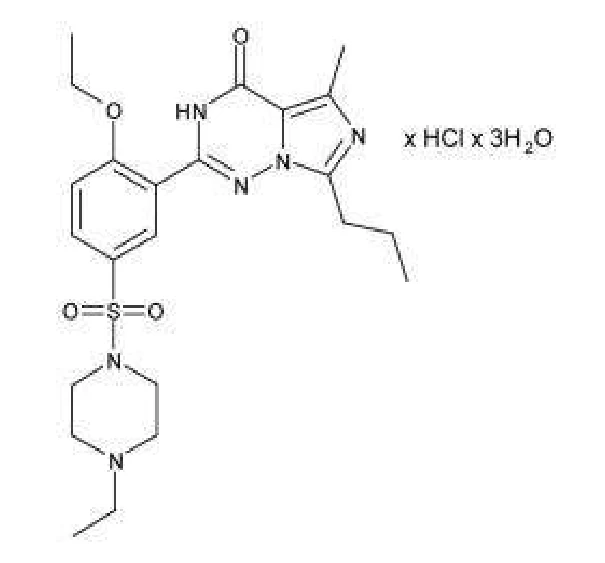
PART II: SCIENTIFIC INFORMATION
PHARMACEUTICAL INFORMATION
Drug Substance
Proper name: Vardenafil hydrochloride trihydrate
Chemical name:
piperazine, 1-[[3-(1,4-dihydro-5-methyl-4-oxo-7-propylimidazo[5,1-f][1,2,4]triazin-2-yl)-4-ethoxyphenyl]sulfonyl]-4-ethyl-, hydrochloride
Molecular formula:
C23H32N6O4S • HCl • 3 H2O
Structural formula:
Relative Molecular Mass:
579.1g/mol
Partition coefficient
n-octanol/water: 1.87
Physicochemical properties:
Vardenafil hydrochloride is a white or slightly brown or yellow powder
Solubility:
Slightly soluble in water, freely soluble in anhydrous ethanol, practically insoluble in heptane.
CLINICAL TRIALS
Comparative Bioavailability Studies
A randomized, single-dose, blinded, standard 2-way crossover comparative bioavailability study was conducted under fasting conditionson healthy male volunteers from 21-42 years of age (N=27). The rate and extent of absorption of vardenafil was measured and compared following a single oral dose (1 x 20 mg tablet) of APO-VARDENAFIL (Vardenafil Hydrochloride) 20 mg Tablets (Apotex Inc.) and LEVITRA® (Vardenafil Hydrochloride) 20 mg Tablets (Bayer Inc.). The results from measured data in 26 subjects are summarized in the following tables.
SUMMARY TABLE OF THE COMPARATIVE BIOAVAILABILITY DATA: APO-
VARDENAFIL
Vardenafil (1x 20 mg) From Measured Data Geometric Mean Arithmetic Mean (CV%) | ||||
| Parameter | Test* | Reference† | Ratio of Geometric Means (%) | 90% Confidence Interval (%) |
| AUCT (ng•h/mL) | 127.296 140.176 (43.5) | 126.286 139.818 (41.0) | 100.80 | 93.50 - 108.67 |
| AUCI (ng•h/mL) | 131.675 145.323 (43.9) | 130.980 145.346 (41.5) | 100.53 | 93.17 - 108.47 |
| Cmax (ng/mL) | 41.775 45.397 (38.9) | 41.901 46.096 (40.4) | 99.70 | 89.91 - 110.56 |
| Tmax§ (h) | 0.91 (54.1) | 0.85 (45.2) | ||
| T1/2§ (h) | 6.60 (31.6) | 6.79 (25.8) | ||
* APO-VARDENAFIL (Vardenafil Hydrochloride) 20 mg Tablets (Apotex Inc.). † LEVITRA® (Vardenafil Hydrochloride) 20 mg Tablets (Bayer Inc., Canada) was purchased in Canada. § Expressed as arithmetic means (CV%) only. | ||||
Vardenafil tablets demonstrated clinically meaningful and statistically significant improvement of erectile function compared to placebo in all major efficacy trials including studies in special populations (men with diabetes, men with radical prostatectomy, men with spinal cord injury).
Study Demographics and Trial Design
Vardenafil tablets were evaluated primarily at doses of 5 mg, 10 mg, and 20 mg in four major placebo-controlled, multicenter trials for men with erectile dysfunction. Two trials were conducted in the general population, and two trials were conducted in special populations (diabetes mellitus and post-prostatectomy patients). Across all trials, vardenafil tablets were taken as needed by over 3690 men, aged 18 to 89 years, with erectile dysfunction. Many of the men participating in the trial had other medical conditions. Of the 3690 men, over 1450 were treated with vardenafil tablets for 6 months or longer.
Of the total of 3402 patients treated in Phase III clinical trials with vardenafil tablets, 748 (22%) were 65 years and older.
Patients were required to have a history of erectile dysfunction (defined as a consistent change in the quality of erection that adversely affected the patient's satisfaction with sexual intercourse) of at least 6 months. More than half of the patients reported ED of more than 2 years in duration. Patients had a clinical diagnosis of ED, as assessed by the clinical investigator. See WARNINGS AND PRECAUTIONS, for patients with specific cardiovascular disease who were not included in the clinical trials. In addition, patients with significant renal and hepatic insufficiency and retinitis pigmentosa were excluded from the pivotal studies. Patients on certain medications such as androgens, anti-androgens, and trazodone were excluded from the clinical trials. In the pivotal clinical trials, patients were instructed to take no more than one dose of vardenafil tablets per day without restriction to intake of food.
The efficacy of vardenafil tablets were assessed by patient diaries completed shortly after dosing and by questionnaires completed in the doctor's office. Several assessment tools were used to evaluate the effect of vardenafil tablets on erectile function, including the International Index of Erectile Function (IIEF), Sexual Encounter Profile (SEP) and Global Assessment Question (GAQ). The primary endpoints of these studies included the Erectile Function Domain of the IIEF, and SEP Questions 2 and 3 (SEP 2, SEP 3).
The IIEF is a recall questionnaire that was administered at the end of a treatment-free baseline period and subsequently at follow-up visits after randomization. The severity categories used in the studies of vardenafil tablets were assigned based on an aggregated modification of the Cappelleri scale, ie, no ED (26-30), mild ED (17-25), moderate ED (11-16), and severe ED (1-10). (See REFERENCES.)
The Sexual Encounter Profile (SEP) is a diary in which patients recorded each sexual attempt made through a study. SEP 2 asked, "Were you able to insert your penis into your partner's vagina?" SEP 3 asked, "Did your erection last long enough for you to have successful intercourse?"
The secondary outcome measures assessed the patient's satisfaction with sexual intercourse and his satisfaction with his overall sex life/relationship. The measures included the GAQ and SEP 4 and 5. The GAQ asked, "Has the treatment you have been taking during the last four weeks improved your
erections?" SEP 4 asked, "Were you satisfied with the hardness of your erection?" SEP 5 asked "Were you satisfied overall with this sexual experience?"
Supportive evidence was generated in RIGISCAN ® studies. (See ACTION AND CLINICAL PHARMACOLOGY: Pharmacodynamics.)
Vardenafil tablets were also evaluated in a randomized, double-blind, placebo-controlled, multicentre trial in subjects with ED solely secondary to traumatic spinal cord injury. 396 men (197 – vardenafil and 199 – placebo), with a mean age of 40 (18-80), were valid for Intent-to-Treat analysis in this 12-week flexible-dose (5 mg, 10 mg, 20 mg vardenafil) trial.
Efficacy of Vardenafil Tablets in the Erectile Dysfunction Population
Table 7: Trials
| Study No. | Trial Design | Dosage, Route of Administration and Duration | Study Subjects (N=Patients Valid for Intent-to-treat Analysis) | Mean Age (Range)a in yrs | Gender |
| 100249 | Randomized, double-blind, placebo-controlled, multicentre, fixed-dose trial (North America) | 5 mg, 10 mg, 20 mg vardenafil tablet and placebo, oral, as needed, no more than once daily, for 6 months | Placebo: N=177 5 mg: N=190 10 mg: N=196 20 mg: N=186 | 57 (20-83) | Males |
| 10128 | Randomized, double-blind, placebo-controlled, multicentre, fixed dose trial (Europe) | 5 mg, 10 mg, 20 mg vardenafil tablet and placebo, oral, as needed, no more than once daily, for 3 months | Placebo: N=160 5 mg: N=156 10 mg: N=157 20 mg: N=163 Sildenafil 50 mg: N=162 | 55 (21-81) | Males |
| 100250 (diabetes mellitus) | Prospective, randomized, double-blind, placebo-controlled, multicentre, fixed dose trial | 10 mg, 20 mg vardenafil tablet and placebo, oral, as needed, no more than once daily, for 3 months | Placebo: N=140 10 mg: N=149 20 mg: N=141 | 57 (33-81) | Males |
| 100285 (post-prostatectomy) | Prospective, randomized, double-blind, placebo-controlled, multicentre, fixed dose trial | 10 mg, 20 mg vardenafil tablet and placebo, oral, as needed, no more than once daily, for 3 months | Placebo: N=137 10 mg: N=139 20 mg: N=147 | 60 (44-77) | Males |
Table 7: Trials
| Study No. | Trial Design | Dosage, Route of Administration and Duration | Study Subjects (N=Patients Valid for Intent-to-treat Analysis) | Mean Age (Range)a in yrs | Gender |
| 10473 (spinal cord injury) | Randomized, double-blind, placebo-controlled, multicentre, parallel-group, flexible dose trial | Starting dose of 10 mg vardenafil tablet and placebo, subjects could be up (20 mg) or down (5 mg) titrated at 4 weeks and up or down titrated again at 8 weeks, oral, for 12 weeks. | Placebo: N=199 5 mg, 10 mg, 20 mg Vardenafil: N=197 | 40 (18-80) | Males |
100493 (duration of action) | Randomized, double-blind, placebo-controlled, multicentre, parallel-group, flexible dose trial | Starting dose of 10 mg vardenafil tablet and placebo, subjects could be up (20 mg) or down (5 mg) titrated after 2 weeks for the following 4 weeks, and up or down titrated at 6 weeks. | Placebo: N=159 Vardenafil: N=177 | 56 (28-79) | Males |
a based on patients valid for safety analysis
Study Results
Table 8: Results of Study 100249 in the General Erectile Dysfunction Population
| Primary Endpoints | Associated value and statistical significance for vardenafil tablets at 5 mg, 10 mg and 20 mg | Associated value for Placebo |
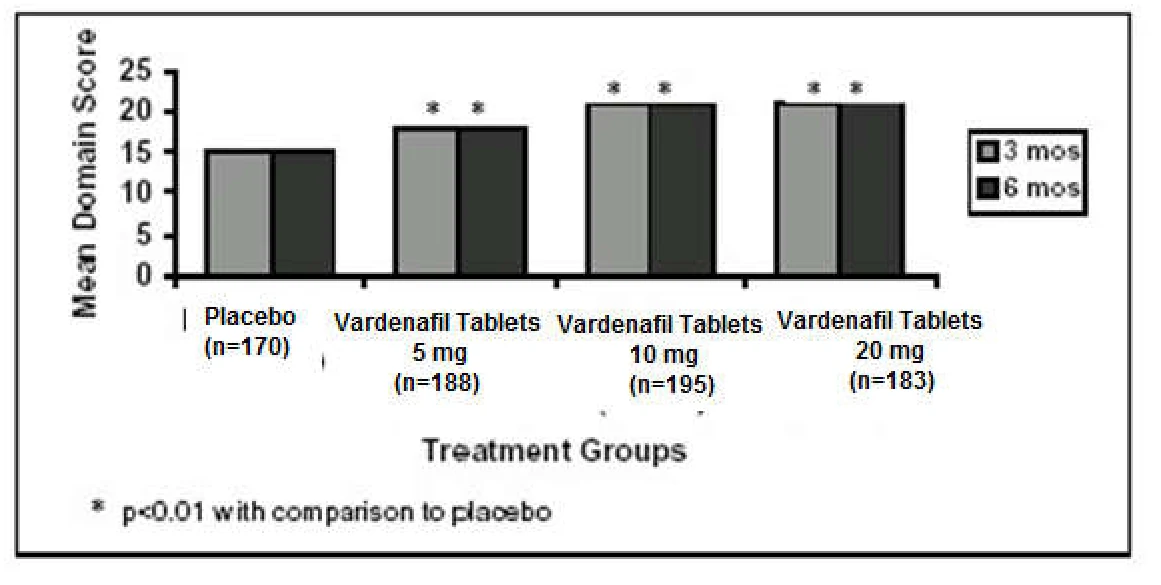
| Erectile Domain Mean Score | 5 mg: 17.5a,b (p <0.0001) 10 mg: 22 a,b (p <0.0001) 20 mg: 22 a,b (p <0.0001) | Placebo: 15a,b |
SEP 2 (Successful Penetration) (%) | 5 mg: 65%a, 66%b (p <0.0001) 10 mg: 75%a, 76%b (p <0.0001) 20 mg: 80%a, 81%b (p <0.0001) | Placebo: 52%a,b |
SEP 3 (Successful Intercourse) (%) | 5 mg: 52%a, 52%b (p <0.0001) 10 mg: 65%a,b (p <0.0001) 20 mg: 65%a, 67%b (p <0.0001) | Placebo: 32%a, 33%b |
GAQ (Improved Erections) (%) | 5 mg: 65%b (p <0.0001) 10 mg: 80%b (p <0.0001) 20 mg: 85%b (p <0.0001) | Placebo: 28%b |
a At 3 months
b At 6 months
Erectile Function Domain
Two pivotal trials were conducted in ED patients, a six-month trial in North America and a three-month study in Europe. In the efficacy trials conducted in the general ED population, vardenafil tablets showed clinically meaningful and statistically significant improvement in the Erectile Function (EF) Domain score compared to placebo. Mean baseline EF Domain score in these trials was 11.8. An EF Domain score of ≤ 10 reflects severe disease, 11-16 moderate, 17-21 mild to moderate, 22-25 mild, and 26-30 normal erectile function. The EF Domain scores, in response to treatment, as seen in the pivotal six month study are presented in Figure 2.
Figure 2: Erectile Function Domain Score
SEP 2 (Successful Penetration)
In the 6-month study, vardenafil tablets significantly improved the rates of achieving an erection sufficient for penetration (SEP 2) with 5 mg, 10 mg, and 20 mg compared to placebo. (See Figure 3.) The 3 month study confirmed these results at all time points.
Figure 3: Improvements in Rates of Successful Penetration (SEP 2)a
3 mos
6 mos
Treatment Groups
Mean per patient success rate; *p < 0.0001 vs placebo, valid for ITT; overall success as defined by percentage of successful attempts at penetration from first dose to last dose over the treatment period. a SEP 2: Were you able to insert your penis into your partner’s vagina?
SEP 3 (Successful Intercourse)
Vardenafil tablets demonstrated a clinically meaningful and statistically significant increase in the overall rate of maintenance of erection to successful intercourse (SEP 3) with 5 mg, 10 mg and 20 mg responses at 51%, 65% and 65% respectively compared to 32% response in the placebo group at 3 months in the 6-month pivotal trial. This efficacy was seen at all time points up to 6 months, suggesting that vardenafil's effect is maintained over time. The 3-month pivotal trial also showed comparable efficacy. (See Figure 4.)
Figure 4: Improvements in Rates of Maintenance of Erection to Successful Intercourse (SEP 3)a
3 mos 6 mos
* p < 0.0001 vs. placebo
a SEP 3: Did your erection last long enough for you to have successful intercourse?
GAQ (Improved Erections)
80 % %
75
%
65
52 %
81 % 76 %
%
66
52 %
% 0
20 %
40 %
60 %
80 %
100 %
Placebo
(n=171)
Vardenafil tablets 5 mg
(n=189)
Vardenafil tablets 10 mg
(n=194)
Vardenafil tablets 20 mg
(n=182) *
*
*
*
* *
% 65 65 %
51 %
%
32
67 % 65 %
52 %
33 %
% 0
20 %
40 %
60 %
80 %
100 %
Placebo
(n=172)
Vardenafil tablets 5 mg
(n=188)
Vardenafil tablets 10 mg
(n=194)
Vardenafil tablets 20 mg
(n=182) *
*
*
*
* *
Vardenafil tablets improved erections in 65%, 80%, and 85% of the patients on 5 mg, 10 mg, and 20 mg respectively, at 6 months compared to 28% on placebo in 507 patients in the 6-month randomized, double-blind, fixed-dose trial. (See Figure 5.)
Figure 5: Percentage of Improved Erections (GAQ)a
(n=91) (n=128) (n=148) (n=140)
Treatment Groups
*p<0.0001 vs placebo; valid for intent to treat (ITT) population; patients completing 6 months. a GAQ: Has the treatment you have been taking during the last 4 weeks improved your erections?
Patient Confidence and Sexual Satisfaction
The IIEF also measures patients' confidence that they can attain and keep an erection sufficient for sexual intercourse (IIEF Question 15). Vardenafil tablets statistically significantly improved patient confidence.
Vardenafil tablets also improved sexual function domain scores for Intercourse Satisfaction, Orgasmic Function, and Overall Satisfaction as compared to placebo in the major efficacy trials in the general ED population, as assessed by the IIEF Questionnaire. (See Table 9.)
Table 9: Summary of IIEF Domain Scores in Vardenafil Tablets 6-Month Trial
| IIEF Domain | Maximum Domain Scores | Vardenafil Tablets 20 mg | Mean Scores, Untreated Men without ED | |
| Mean Value at Baseline | Mean Value at Endpoint | |||
| Intercourse Satisfaction | 15 | 6.8 | 9.8 | 10.6 |
| Orgasmic Function | 10 | 7 | 6.7 | 8.8 |
| Overall Satisfaction | 10 | 4.5 | 7 | 8.6 |
85 % %
80
65 %
28 %
0 % 10 % 20 %
% 30
40 % 50 %
% 60
70 % 80 % 90 %
Placebo Vardenafil tablets 5 mg Vardenafil tablets 10 mg Vardenafil tablets 20 mg
*
* *
Patients on vardenafil tablets also reported a greater satisfaction with the quality of their erection. Eighteen, 38, 52 and 59% of patients reported satisfaction with the hardness of their erection on placebo, 5 mg, 10 mg, and 20 mg vardenafil tablets, respectively.
Reliability
The ability of vardenafil tablets to provide reliable efficacy over time was examined in this study. The results show that for "successful penetration (SEP 2)" the first attempt success rate → subsequent success rates up to 12 weeks were 74% → 91% and 46% → 77% for 20 mg vardenafil tablets and placebo, respectively. Similarly, for "successful intercourse (SEP 3)" the first attempt success rate → subsequent success rates up to 12 weeks were 61% → 85% and 29% → 57% for 20 mg vardenafil and placebo, respectively.
The efficacy of vardenafil tablets with regard to EF Domain and SEP 3 responses was maintained in patients treated for one year with 10 or 20 mg doses. The incidence of successful intercourse, which was approximately 15% at baseline, increased markedly for both dosing groups beginning with the first post baseline assessment at Week 4. At the end of the one year treatment period, the incidence of successful intercourse was 82% in the 10 mg vardenafil tablets group and 86% in the 20 mg vardenafil tablets group. The efficacy of vardenafil tablets were maintained in patients treated for one year with 10 or 20 mg doses.
Trials in Patients Non-responsive to Sildenafil
Men who had a history of failure to respond to sildenafil were included in the 3-month pivotal trial. Marked differences were seen in patients with a history of failure to respond to sildenafil. Despite the fact that a proportion of these patients derived benefit from repeated treatment with sildenafil, the improvements in erectile function, penetration and maintenance of erection were greater with vardenafil. This suggests that a proportion of patients who fail to respond to sildenafil would improve if given vardenafil tablets.
Patients completing this trial, after a 30-day drug-free period, were subsequently administered 10 mg vardenafil tablets for 4 weeks, and then offered an optional titration regimen of vardenafil tablets. Seventy percent of patients elected to receive 20 mg vardenafil tablets and this dose was associated with a mean increase of erectile function domain score of 4.1 compared to an increase of 0.2 points in patients who continued treatment with 10 mg vardenafil tablets.
Flexible-dose Trials in General Erectile Dysfunction Population
In another study with flexible vardenafil tablets dosing, 367 men in the broad population were offered to titrate up or down from the initial 10 mg vardenafil tablets dose over a 3-month treatment period. For those preferring a 20 mg dose (72% of men), a mean increase in erectile function domain score of 4.6 points was seen (baseline: 18.0 ± 7.0; endpoint: 22.6 ± 6.2), compared to an increase in 0.6 points in the placebo group (baseline: 13.0 ± 5.8; endpoint: 13.6 ± 6.8). The rate of discontinuation due to adverse events was similar to placebo.
Efficacy of Vardenafil Tablets in Diabetes Mellitus Patients
In patients with Type 1 or Type 2 diabetes mellitus, vardenafil tablets demonstrated clinically meaningful and statistically significant improvement in erectile function in a 3-month prospective
fixed dose, double-blind, placebo-controlled trial. Significant improvements were shown in the EF Domain score (the rates of obtaining an erection sufficient for penetration and successful intercourse), and hardness compared to placebo for the test doses of 10 mg and 20 mg vardenafil tablets at all time points during three months of treatment. (See Table 10.)
Table 10: Summary of Efficacy Variables in Vardenafil Tablets Diabetes Mellitus Trials
| Efficacy Variable | Placebo (N=138) | Vardenafil Tablets 10 mg (N=145) | Vardenafil Tablets 20 mg (N=139) | |||
| Endpoint | Change | Endpoint | Change | Endpoint | Change | |
| IIEF, LS Mean | ||||||
| Erectile Function Domain Score | 12.6 | 1.4 | 17.1 | 6.1* | 19 | 6.6* |
| Overall Satisfaction Domain Score | 4.8 | 0.4 | 6.3 | 1.9* | 6.8 | 2.0* |
Intercourse Satisfaction Domain Score | 6.6 | 0.6 | 8.4 | 2.4* | 9.2 | 2.8* |
| SEP Diary, % ‘Yes’ Response | ||||||
| Question 2 (Vaginal Penetration) | 36 | 3 | 61 | 30* | 64 | 23* |
| Question 3 (Successful Intercourse) | 23 | 12 | 49.2 | 40* | 54.2 | 39* |
* p =0.0001
Analysis of the efficacy data showed that the degree of glycemic control did not affect the response to vardenafil, as shown in Table 11.
Table 11: EF Domain Scores (With Change from Baseline) and GAQ of Patients in Study 100250 in the Different Subgroups of Glycemic Control at Week 12 (LOCF, ITT Population)
| EF Domain | GAQ (%) | |||||
| Placebo | Vardenafil Tablets 10 mg | Vardenafil Tablets 20 mg | Placebo | Vardenafil Tablets 10 mg | Vardenafil Tablets 20 mg | |
| HbA1c #7%: Optimal | 11.4 (0.0) | 20.4 (9.3) | 21.6 (7.9) | 10.3 | 67.6 | 67.7 |
| HbA1c 7%-#8.4%: Sub-optimal | 11.4 (1.1) | 14.4 (3.6) | 18.9 (6.8) | 15.6 | 45.6 | 67.4 |
| HbA1c 8.4%-#12%: Inadequate | 12.3 (1.2) | 15.6 (4.8) | 19.0 (8.1) | 16.9 | 51.1 | 70.4 |
In this population, which is typically more resistant to therapy, response rates for improvement of erection were 57% with 10 mg, and 72% with 20 mg vardenafil tablets compared to 13% with placebo for patients who completed three months of the trial as measured by GAQ. (See Figure 6.) Patients in the active treatment group continued on blinded active therapy of vardenafil tablets for a total of 6 months. These patients demonstrated response rates of 61% and 73% for 10 mg and 20 mg vardenafil tablets, respectively, again suggesting that vardenafil's effect is maintained over time.
Figure 6: Percentage of Patients Reporting an Improvement in Erections in the Diabetes Trial at 3 Months
Treatment Groups * p < 0.0001 vs placebo; valid for ITT population; patients completing 3 months
Efficacy of Vardenafil Tablets in Post-prostatectomy Patients
In a 3-month prospective multicenter, fixed-dose, double-blind, placebo-controlled trial in post-prostatectomy patients, vardenafil tablets demonstrated significant improvements in erectile function. EF Domain score (the rates of obtaining an erection sufficient for penetration and successful intercourse) and hardness were significantly improved compared to placebo for the tested doses of 10 mg and 20 mg vardenafil tablets at all time points.
Table 12: Summary of Efficacy Variables in Vardenafil Tablets Post-prostatectomy Trial
| Efficacy Variable | Placebo (N=140) | Vardenafil Tablets 10 mg (N=140) | Vardenafil Tablets 20 mg (N=147) | |||
| Endpoint | Change | Endpoint | Change | Endpoint | Change | |
| IIEF, Mean | ||||||
| Erectile Function Domain Score | 9.2 | 0.1 | 15.3 | 6.0* | 15.3 | 6.1* |
| Overall Satisfaction Domain Score | 4.9 | 0.1 | 6.4 | 1.9* | 6.2 | 1.7* |
| Intercourse Satisfaction | 5.2 | 0.1 | 7.7 | 2.3* | 7.2 | 2.28 |
72 %
%
57
% 13
0 % 20 % 40 % 60 % 80 %
Placebo (n=122)
Vardenafil Tablets10 mg
(n=131)
Vardenafil Tablets 20 mg
(n=127)
*
*
| Domain Score | ||||||
| SEP Diary, % ‘Yes’ Response | ||||||
| Question 2 (Vaginal Penetration) | 21.8 | 6.6 | 46.6 | 25.6* | 47.5 | 29.2* |
| Question 3 (Successful Intercourse) | 9.9 | 3.3 | 37.2 | 30.6* | 34.2 | 27.2* |
* p=0.001
Improved erectile function response rates as based on GAQ was 59% on 10 mg, and 65% on 20 mg vardenafil compared to 13% on placebo at 3 months. In the subgroup of patients with bilateral nerve-sparing prostatectomy (N=236), the response rate to the GAQ in patients who completed 3 months of treatment was 60% for 10 mg, and 71% for 20 mg vardenafil tablets, compared to 12% for placebo. The Depression Domain of the Duke Health Profile was significantly improved in the 20 mg vardenafil tablets treatment arm compared to placebo. In patients with depressive symptoms, as measured by a score of 16 or higher on the Center for Epidemiologic Studies-Depression Scale (CES-D), 20 mg vardenafil tablets were associated with improvement in reported depressive symptoms.
Figure 7 shows the effect of placebo and 20 mg vardenafil tablets on Erectile Function Domain Score and SEP 3 by severity of ED at baseline in post-prostatectomy patients.
Figure 7: EF Domain Scores of IIEF (A) and Percent Successful Intercourse (B) According to Baseline Severity in Prostatectomy Patientsa
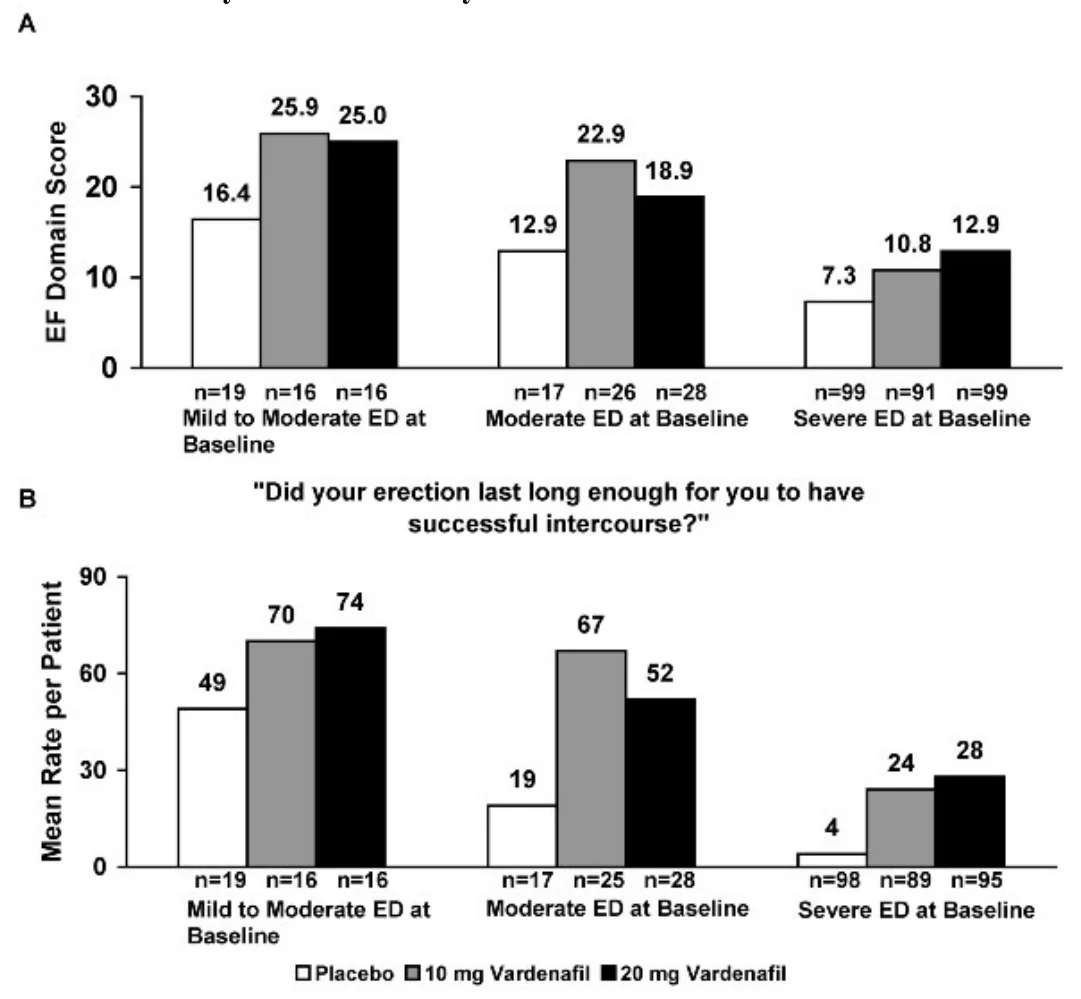
a Values are %
Efficacy of Vardenafil Tablets in Patients with Spinal Cord Injury
In a flexible-dose clinical trial in patients with Spinal Cord Injury, vardenafil significantly improved the erectile function domain score, the ability to obtain and maintain an erection long enough for successful intercourse and penile rigidity compared to placebo. The number of patients who returned to a normal IIEF domain score (≥26) after 12 weeks of treatment were 52% on vardenafil compared to 9% on placebo. The response rates for the ability to obtain and maintain an erection were 76% and 59% on vardenafil compared to 41% and 22% on placebo for patients who completed three months treatment. Both measurements were clinically and statistically significant (p<0.001).
In this population, response rates for improvement of erection were 83% with vardenafil tablets compared to 26% with placebo for patients who completed three months of the trial as measured by GAQ (See Figure 8).
Figure 8: Percentage of Patients Reporting an Improvement in Erections in the Spinal Cord Injury Trial
Efficacy of Vardenafil Tablets 8±2 Hours After Flexible Dosing
Flexible dose vardenafil, when dosed at 8±2 hours prior to sexual intercourse, demonstrated clinically and statistically superior efficacy (SEP3, SEP2, GAQ, IIEF-EF domain scores) compared with placebo in subjects with ED of broad etiology. Patients treated with vardenafil had clinically meaningful (≥18%) and statistically significant (p<0.001) improvements in their ability to maintain an erection to successful intercourse and achieve an erection sufficient for insertion compared with those receiving placebo at all treatment-week intervals examined over the course of the study. These improvements occurred within the first two weeks and were sustained through the 10 weeks of therapy. Over Weeks 2 to 10, success rates of SEP3 and SEP2 were 69% and 81% for vardenafil tablets-treated subjects compared with 34% and 51% for placebo-treated subjects.
Success rates of SEP3 and SEP2 were examined by time study medication was taken to start of sexual activity (see Figure 9).
Figure 9: Overall mean success rates of SEP3 and SEP2 at hourly intervals 6-10 hours postdose
17
25 26 26 72
82 83 80
0
20
40
60
80
100
n=189 n=193
Weeks 0-4 n=164 n=175
Weeks 4-8 n=184 n=174
Weeks 8-12 n=198 n=196
LOCF
Placebo Vardenafil
*
* * * * p<0.0001
Mean success rates of SEP2 and SEP3 were higher for vardenafil-treated subjects compared with placebo treated subjects from 6 to 10 hours after intake of study medicine and for all attempts at penetration from 0-24 hours after intake of study medicine.
Clinical Conclusions
Vardenafil tablets were effective in a broad range of patients with erectile dysfunction. Vardenafil tablets were efficacious in patients regardless of etiology (organic, psychogenic, and mixed), duration of erectile dysfunction, age, and alcohol or tobacco use. Vardenafil tablets were efficacious 8±2 hours after dosing. Vardenafil tablets were effective in patients with a history of hyperlipidemia, hypertension, obesity, diabetes mellitus (with HbA1c ≤ 12%), prostatectomy, and in patients with ED
secondary to a traumatic spinal cord injury. Vardenafil tablets demonstrated significant improvement in the percent of patients whose EF returned to normal (EF domain score ≥ 26) compared to placebo. Response to treatment may differ depending upon severity of disease. (See
CONTRAINDICATIONS and WARNINGS AND PRECAUTIONS.)
DETAILED PHARMACOLOGY
Pharmacodynamics
Studies of Vardenafil Tablets on Erectile Response: In patients with erectile dysfunction, erections considered sufficient for penetration (greater than or equal to 60% rigidity as measured by RIGISCAN ® device [RigiScan Ambulatory Rigidity and Tumescence Monitor, Dacomed Corp., Minneapolis, USA]) occurred in 64% of men on 20 mg vardenafil tablets as early as 15 minutes post dosing compared to 52% of men on placebo. The overall erectile response of these subjects treated with vardenafil tablets became statistically significant compared to placebo at 25 minutes post dosing. In two separate double-blind, placebo-controlled crossover RIGISCAN ® trials of men with erectile dysfunction of at least 6 months duration, 10 mg and 20 mg vardenafil tablets significantly improved erections initiated by visual sexual stimulation. Objective measurements of rigidity at the base and tip of the penis (by RIGISCAN ®) during visual sexual stimulation showed significantly better results at all doses and time points with vardenafil tablets than with placebo. The mean duration of an erection, in response to visual sexual stimulation, sufficient for penetration was 54 and 67 minutes at the base and 39 and 45 minutes at the tip of the penis for the 10 mg and 20 mg doses of vardenafil tablets respectively, compared to 31 minutes at the base and 17 minutes at the tip for placebo.
The earliest elapsed time from dosing to attainment of an erection perceived to be sufficient for penetration and resulting in successful completion of intercourse was evaluated in a randomized, double-blind parallel group study in men with ED. The percentage of men reporting successful completion of intercourse after dosing with 10 mg or 20 mg vardenafil was greater than with placebo (p < 0.025) at all times ≥ 10 minutes and ≥ 11 minutes, respectively.
The amount of time from dosing (flexible dose) to attainment of an erection perceived to be sufficient for penetration and resulting in successful intercourse was evaluated in a randomized, double-blind, parallel group study in men with ED. The percentage of men reporting successful completion of intercourse 8 to 10 hours from dosing was greater with vardenafil compared to placebo (p < 0.001).
Studies of Vardenafil Tablets on Blood Pressure and Heart Rate: In a clinical pharmacology study of patients with erectile dysfunction, single doses of 20 mg vardenafil tablets caused a mean maximum decrease in supine blood pressure of 7 mmHg systolic and 8 mmHg diastolic (compared to placebo), accompanied by a mean maximum increase of heart rate of 4 beats per minute. The maximum decrease in blood pressure occurred between 1 and 4 hours after dosing. Following multiple dosing for 31 days, blood pressure responses were observed on Day 31 that were similar to those observed on Day 1. PDE5 inhibitors, including vardenafil tablets, may add to the blood pressure lowering effects of antihypertensive agents. (See ACTION AND CLINICAL PHARMACOLOGY and DRUG INTERACTIONS.)
A study was conducted in which the blood pressure and heart rate response to 0.4 mg nitroglycerin (NTG) sublingually was evaluated in 18 healthy subjects following pretreatment with 20 mg
vardenafil tablets at various times before NTG administration. 20 mg vardenafil tablets caused an additional time-related reduction in blood pressure and increase in heart rate in association with NTG administration. The blood pressure effects were observed when 20 mg vardenafil tablets were dosed 1 or 4 hours before NTG and the heart rate effects were observed when 20 mg vardenafil tablets were dosed 1, 4, or 8 hours before NTG. Additional blood pressure and heart rate changes were not detected when 20 mg vardenafil tablets were dosed 24 hours before NTG (see Figure 10).
Figure 10: Placebo-subtracted Point Estimates (With 90% CI) of Mean Maximal Blood Pressure and Heart Rate Effects of Pre-dosing with 20 mg Vardenafil Tablets at 24, 8, 4, and 1 Hour Before 0.4 mg NTG Sublingually
Systolic BP Diastolic BP Heart Rate (mmHg) (mmHg) (bpm)
24h 8h 4h 1h 24h 8h 4h 1h
Timing of Vardenafil Treatment Pre-NTG
Because the disease state of patients requiring nitrate therapy is anticipated to increase the likelihood of hypotension, the use of APO-VARDENAFIL by patients on nitrate therapy or on nitric oxide donors is contraindicated. (See CONTRAINDICATIONS.)
Studies of Vardenafil Tablets on Cardiac Parameters: The effect of 10 mg and 80 mg vardenafil on QT interval was evaluated in a single-dose, double-blind, randomized, placebo- and active-controlled (moxifloxacin 400 mg) crossover study in 59 healthy males aged 45 to 60 years. This study also included another drug in the same class in approximately equipotent therapeutic doses (sildenafil 50 mg and 400 mg). The QT interval was measured at one hour post dose because this time point approximates the average time of peak vardenafil concentration. The 80 mg dose of vardenafil (four times the highest recommended dose) was chosen because this dose yields plasma concentrations covering those observed upon co-administration of a low dose of vardenafil (5 mg) and 600 mg BID of ritonavir. Of the CYP3A4 inhibitors that have been studied, ritonavir causes the most significant drug-drug interaction with vardenafil. The table below summarizes the effect on mean uncorrected QT and mean corrected QT interval (QTc) with different methods of correction (Fridericia and a linear individual correction method) at one hour post dose. No single correction method is known to be more valid than the other.
h 24 h 8 h 4 h 1
-20
-15
-10
-5
0
5
10
M
ea
n
m
axi
m
al
ch
an
ge
-4 -2 0 2 4 6 8 10 12 14 16
-12 -10 -8 -6 -4 -2 0 2 4
M
ea
n
m
axi
m
al
ch
an
ge
M
ea
n
m
axi
m
al
ch
an
ge
Table 13: Mean QT and QTc Changes in msec (90% CI) from Baseline Relative to Placebo at 1 Hour Post dose with Different Methodologies to Correct for the Effect of Heart Rate
| Drug/Dose | Heart Rate (bpm) | QT Uncorrected (msec) | Fridericia QT Correction (msec) | Individual QT Correction (msec) |
| Vardenafil 10 mg | 5 (4, 6) | -2 (-4, 0) | 8 (6, 9) | 4 (3, 6) |
| Vardenafil 80 mg | 6 (5, 7) | -2 (-4, 0) | 10 (8, 11) | 6 (4, 7) |
| Moxifloxacin 400 mg | 2 (1, 3) | 3 (1, 5) | 8 (6, 9) | 7 (5, 8) |
| Sildenafil 50 mg | 4 (3, 5) | -2 (-4, 0) | 6 (5, 8) | 4 (2, 5) |
| Sildenafil 400 mg | 5 (4, 6) | -1 (-3, 1) | 9 (8, 11) | 5 (4, 7) |
Moxifloxacin produced the expected 5 to 10 msec prolongation, indicating that the study had the required sensitivity. Therapeutic and supratherapeutic doses of vardenafil and sildenafil produced similar decreases in uncorrected QT but increases in QTc interval. This study, however, was not designed to make direct statistical comparisons between the drugs or the dose levels. The actual clinical impact of these changes is unknown.
In a separate post-marketing study of 44 healthy volunteers, single doses of 10 mg vardenafil tablets resulted in a placebo-subtracted mean change from baseline of QTcF (Fridericia) correction of 5 msec (90% CI: 2,8). Single doses of gatifloxacin 400 mg resulted in a placebo-subtracted mean change from baseline QTcF of 4 msec (90% CI: 1,7). When vardenafil tablets 10 mg and gatifloxacin 400 mg were co-administered, the mean QTcF change from baseline was additive when compared to either drug alone and produced a mean QTcF change of 9 msec from baseline (90% CI: 6,11). The clinical impact of these QT changes is unknown. (See WARNINGS AND PRECAUTIONS, Congenital and Acquired QT Prolongation.)
Studies of Vardenafil Tablets on Exercise Performance in Patients with Coronary Artery Disease (CAD): In two independent trials that assessed 10 mg (N=41) and 20 mg (N=39) vardenafil tablets respectively, vardenafil tablets did not alter the total treadmill exercise time compared to placebo. The patient population included men aged 40 to 80 years with stable exercise-induced angina documented by at least one of the following: 1) prior history of MI, CABG, PTCA, or stenting (not within 6 months); 2) positive coronary angiogram showing at least 60% narrowing of the diameter of at least one major coronary artery; or 3) a positive stress echocardiogram or stress nuclear perfusion. The results of the 20 mg study are shown in Table 14.
Table 14: Effect of 20 mg Vardenafil Tablets on Exercise Treadmill Completion Times (Mean in Seconds ± S.D.)
| Parameter | 20 mg Vardenafil Tablets (Mean in Seconds) | Placebo (Mean in Seconds) |
| Total Treadmill Exercise Time | 414 ± 114 (N=36) | 411 ±124 (N=36) |
| Total Time to Develop Symptoms of Angina Pectoris (first awareness) | 354 ± 137 (N=36) | 347 ± 143 (N=36) |
| Total Time to ST-Segment depression (1 mm or greater change from baseline) | 364 ±101 (N=35) | 366 ± 105 (N=36) |
Studies of Vardenafil Tablets on Vision: Single oral doses of phosphodiesterase inhibitors have demonstrated transient dose-related impairment of colour discrimination (blue/green) using the Farnsworth-Munsell 100-hue test and reductions in electroretinogram (ERG) b-wave amplitudes, with peak effects near the time of peak plasma levels. These findings are consistent with the inhibition of PDE6 in rods and cones, which is involved in phototransduction in the retina. The findings were most evident one hour after administration, diminishing but still present 6 hours after administration. In a single dose study in 25 normal males, 40 mg vardenafil tablets, twice the maximum daily recommended dose, did not alter visual acuity, intraocular pressure, fundoscopic and slit lamp findings. (See ACTION AND CLINICAL PHARMACOLOGY.)
In another double-blind placebo-controlled clinical trial, at least 15 doses of vardenafil tablets 20 mg were administered over 8 weeks versus placebo. Statistically but not clinically significant changes in ERG flicker amplitude response and oscillatory potential amplitude were apparent when comparing vardenafil tablets to placebo-treated subjects. The FM-100 test did not detect any difference between vardenafil tablets and placebo-treated subjects. A suprathreshold dose of sildenafil (200 mg) resulted in statistically significant decreases in amplitude of the rod response, cone response, flicker response, and oscillatory potential as measured by percent change from baseline averaged over both eyes in recordings obtained 2 hours after dosing. The maximum response was not significantly affected.
Alpha-blockers: Since alpha-blocker monotherapy can cause marked lowering of blood pressure, especially postural hypotension and syncope, interaction studies were conducted with vardenafil in patients with benign prostatic hyperplasia (BPH) on stable tamsulosin or terazosin therapy, as well as in normotensive volunteers after short-term alpha blockade.
In two interaction studies with healthy normotensive volunteers, after forced titration of the alpha-blockers tamsulosin or terazosin to high doses over 14 days or less, hypotension (in some cases symptomatic) was reported in a significant number of subjects after co-administration of vardenafil tablets. Among subjects treated with terazosin, hypotension (standing systolic blood pressure below 85 mmHg) was observed more frequently when vardenafil tablets and terazosin were given to achieve simultaneous Cmax than when the dosing was administered to separate Cmax by 6 hours. Because these studies were conducted using healthy volunteers after forced titration of the alpha-blocker to high doses (subjects were not stable on alpha-blocker therapy), these studies may have limited clinical relevance.
Interaction studies were conducted with vardenafil tablets in patients with benign prostatic hyperplasia (BPH) on stable tamsulosin or terazosin therapy. When vardenafil tablets were given at doses of 5, 10 or 20 mg on a background of stable therapy with tamsulosin, there was no clinically relevant additional reduction in mean maximal blood pressure. When vardenafil tablets 5 mg were dosed simultaneously with tamsulosin 0.4 mg, 2 of 21 patients experienced a standing systolic blood pressure below 85 mmHg. When vardenafil tablets 5 mg were given with a six-hour dose separation from tamsulosin, 2 of 21 patients experienced a standing systolic blood pressure below 85 mmHg. In a subsequent study in patients with BPH, when vardenafil 10 mg and 20 mg was dosed simultaneously with tamsulosin 0.4 or 0.8 mg there were no cases of standing systolic blood pressure below 85 mmHg. When vardenafil tablets 5 mg were given simultaneously with terazosin 5 or 10 mg, one of 21 patients experienced symptomatic postural hypotension. Hypotension was not observed when vardenafil tablets 5 mg and terazosin administration was separated by 6 hours. This should be considered when deciding about a time separation of dosing.
Concomitant treatment should be initiated only if the patient is stable on his alpha blocker therapy. In those patients who are stable on alpha-blocker therapy, APO-VARDENAFIL should be initiated at the lowest recommended starting dose of 5 mg.
APO-VARDENAFIL may be administered at any time with tamsulosin. When other alpha-blockers such as terazosin are co-administered with APO-VARDENAFIL, a time separation of several hours should be considered.
Pharmacokinetics
Vardenafil tablets are rapidly absorbed after oral administration, with a mean absolute bioavailability of about 15%. Its pharmacokinetics approximate dose-proportionality over the recommended dose range (5 mg, 10 mg, and 20 mg). Vardenafil is eliminated predominantly by hepatic metabolism. The elimination half-life is approximately 4 to 5 hours. Mean vardenafil plasma concentrations measured over 24 hours after the administration of a single oral dose of 20 mg vardenafil to healthy male volunteers are shown in Figure 11.
Figure 11: Mean Plasma Concentration Curve for 20 mg Vardenafil after Oral Administration time [h]
Absorption: Vardenafil is rapidly absorbed, with maximum observed plasma concentrations detected as early as 15 minutes post administration. In the fasted state, maximum plasma concentrations are
0 2 4 6 8 10 12 14 16 18 20 22 24
C plasma [mcg/L]
0
5
10
15
20
achieved between 30 to 120 minutes (median 60 minutes) 90% of the time after oral dosing of vardenafil.
When vardenafil tablets are taken with a typical meal comprised of 30% fat, the rate and extent of absorption of vardenafil are unchanged compared to administration under fasting conditions. Consumption of a high-fat meal caused a reduction in Cmax of 18 to 50% without change in AUC; tmax was delayed by one hour.
Absorption levels are unchanged with a moderate amount of alcohol.
Distribution: The mean steady-state volume of distribution (Vss) for vardenafil is 208 L, indicating extensive tissue distribution. Vardenafil and its major metabolite, M-1, are highly bound to plasma proteins (about 95% for parent drug and M-1). This protein binding is reversible and independent of total drug concentrations.
Ninety minutes after administration of a single dose of 20 mg vardenafil tablets, less than 0.0002% of the administered dose is detected in the semen. The concentrations of vardenafil and its primary metabolite in the ejaculate 1.5 hours post dose were 49% and 71%, respectively, of the concentrations in plasma at the same time point. (See ACTION AND CLINICAL PHARMACOLOGY.)
Metabolism: Vardenafil is eliminated predominantly by hepatic metabolism via cytochrome P450 (CYP) 3A4, with some contribution from the CYP3A5 and CYP2C isoforms. The major circulating metabolite, M-1, results from desethylation at the piperazine moiety of vardenafil. M-1 is subject to further metabolism. The plasma concentration of M-1 is approximately 26% of the parent compound. This metabolite shows a phosphodiesterase selectivity profile similar to that of vardenafil and an in vitro inhibitory potency for PDE5 of 28% compared to vardenafil. Therefore, M-1 accounts for approximately 7% of the total pharmacologic activity.
Excretion: The total body clearance of vardenafil is 56 L/h and the terminal half-life is approximately 4 to 5 hours. After oral administration, vardenafil is excreted as metabolites predominantly in the feces (approximately 91 to 95% of administered oral dose) and to a lesser extent in the urine (approximately 2 to 6% of administered oral dose).
Special Populations and Conditions
Pediatrics (< 18 years of age): Vardenafil has not been evaluated in individuals less than 18 years old.
Geriatrics (≥65 years of age): A starting dose of 5 mg APO-VARDENAFIL should be considered in patients 65 years and older. (See DOSAGE AND ADMINISTRATION.)
On average, elderly males (65 years and over) had a 52% higher vardenafil AUC (Area Under the Curve) and a 34% higher maximum concentration (Cmax) than younger males (18 to 45 years). This difference was not statistically significant.
Hepatic Insufficiency: No dose adjustment is required in patients with mild hepatic impairment. In patients with mild hepatic impairment (Child-Pugh A), the AUC was increased 17% and the Cmax was increased 22%, compared to healthy male volunteers, following a 10 mg vardenafil dose. In patients
with moderate impairment (Child-Pugh B), the AUC was increased 160% and Cmax was increased 133%, compared to healthy male volunteers, following a 10 mg vardenafil dose. In patients with moderate hepatic impairment, a 5 mg starting dose of APO-VARDENAFIL is recommended, which may subsequently be increased to a maximum dose of 10 mg, based on tolerability and efficacy. (See DOSAGE AND ADMINISTRATION.) Vardenafil has not been evaluated in patients with severe hepatic impairment.
Renal Insufficiency: No dose adjustment is required in patients with renal impairment. In patients with mild (creatine clearance (CLcr ≥ 50 to 80 mL/min), moderate (CLcr > 30 to 50 mL/min), or severe (CLcr ≤30 mL/min) renal impairment, the pharmacokinetics of vardenafil were similar to that of a control group with normal renal function. Vardenafil pharmacokinetics have not been evaluated in patients requiring dialysis.
MICROBIOLOGY
Not applicable.
TOXICOLOGY
Vardenafil has been evaluated in a comprehensive series of toxicological studies, including in vitro and in vivo genetic toxicology assays, single-dose studies in mice and rats using both oral and intravenous routes of administration, repeated-dose studies in mice, rats, and dogs, reproductive and developmental studies in rats and rabbits, and life-time carcinogenicity studies in rats and mice.
Vardenafil was moderately toxic in mice and toxic in rats after oral and I.V. administration of single doses. The clinical signs observed were compatible with effects on the cardiovascular system. (See Table 16.) No adverse effects were observed in mice treated with up to 37 mg/kg (males) or 51 mg/kg (females) for 14 weeks, and no adverse effects were observed in rats treated for six months with up to 3 mg/kg (females) or 15 mg/kg (males), respectively. After 24-month daily treatment the no adverse effect level was established at 15 mg/kg (male rat) and 10 mg/kg (female rat), respectively. The no observed adverse effect level (NOAEL) for vardenafil in a study of dogs treated for 12 months was 3 mg/kg/day. (See Table 17.)
Vardenafil was administered to rats and mice for 24 months. These studies provide evidence that vardenafil is not carcinogenic. (See Table 18.) The systemic exposure achieved at the top dose was about 350-fold (rat) and 25-fold (mice) the exposure in humans at the maximum recommended therapeutic dose. No indication of genotoxicity or mutagenicity was found in a comprehensive battery of three in vitro assays and one in vivo assay. (See Table 19.)
Vardenafil did not impair either male or female fertility or early embryonic development as evidenced in a Segment I study in rats and Segment II studies in rats and rabbits (Table 20). Developmental toxicity (Segment II) studies in rats and rabbits did not reveal a specific primary teratogenic potential, although at high doses resulting in approximately 800 times the clinical exposure, maternal mortality accompanied by effects on intrauterine development were found. The NOAEL in the rat Segment III study was 8 mg/kg/day for maternal toxicity, and 1 mg/kg/day in the offspring, but the findings of
developmental delay in the offspring do not raise specific concern in the context of the intended application of the drug in adult males. Vardenafil is secreted into the milk of lactating rats at concentrations approximately 10-fold greater than found in maternal plasma. As expected for a PDE5 inhibitor, repeated dose toxicity studies in rats and dogs revealed cardiovascular effects as the prominent toxicological findings, which can essentially be related to the vasodilatory properties of PDE5 inhibitors including vardenafil. Other toxicological findings in the pancreas, exocrine glands, and the thyroid in repeated dose studies were confined to the rat (did not occur in dog and mouse). The effects observed in the rat have been described for other phosphodiesterase inhibitors. The key findings in long-term toxicity studies with the corresponding doses and exposure parameters at the lowest observed effect level (LOEL) in chronic studies are given in Table 15.
Table 15: Key Toxicological Findings (Lowest Effect Level) in Experimental Animals with Vardenafil and Respective Multiples of Human Exposure at the Maximum Recommended Therapeutic Dose
| Species/ Duration | Finding | Dose (mg/kg) | Multiples of Systemic Exposure Compared to Clinical | |
| Cmax (mcg/L) | AUC(mcg*h/L) | |||
| Rat, 6 months | Heart (females only): myocardial fibrosis; Mortality (1 of 20) | 75 (female) | 564 | 640 |
| Rat, 6 months | Thyroid (females only): colloidal alterations | 75 (female) | 564 | 640 |
| Rat, 6 months | Exocrine glands: parotid gland: diffuse acinar hypertrophy; females only: diffuse acinar hypertrophy (submandibular gland) | 75 (male) | 265 | 218 |
| 75 (female) | 564 | 640 | ||
| Rat, 6 months | Pancreas: diffuse acinar hypertrophy | 75 (male) | 265 | 218 |
| 75 (female) | 564 | 640 | ||
| Rat, 6 months | Pancreas (males only): focal acinar atrophy | 15 (male) | 73 | 25 |
| Rat, 6 months | Adrenal cortex: small vesicular vaculation (zona granulosa) | 15 (male) | 73 | 25 |
| 3 (female) | 35 | 19 | ||
| Rat, 2 years | Thyroid: follicular cell hypertrophy | 75 (male) | 390 | 362 |
| 25 (female) | 239 | 229 | ||
| Rat, 2 years | Adrenal cortex: small vesicular vaculation, diffuse hypertrophy (zona granulosa) | 75 (male) | 390 | 362 |
| 25 (female) | 239 | 229 | ||
| Rat, 2 years | exocrine glands: diffuse acinar hypertrophy (parotid and submandibular glands) | 15 (male) | 318 | 71 |
| 25 (female) | 239 | 229 | ||
| Dog, 1 year | Heart: peri-arterial edema | 30 (male) | 264 | 277 |
Table 15: Key Toxicological Findings (Lowest Effect Level) in Experimental Animals with Vardenafil and Respective Multiples of Human Exposure at the Maximum Recommended Therapeutic Dose
| Species/ Duration | Finding | Dose (mg/kg) | Multiples of Systemic Exposure Compared to Clinical | |
| Cmax (mcg/L) | AUC(mcg*h/L) | |||
| 30 (female) | 235 | 212 | ||
| Dog, 1 year | decreased blood pressure, increased heart rate | 10 (male) | 101 | 71 |
| 10 (female) | 83 | 64 | ||
| Human PK data at the proposed maximum recommended therapeutic dose (20 mg/day) for comparison: | ||||
| Human (steady state) | 0.4 (male) | 1 | 1 | |
Table 16: Results of Single-Dose Acute Toxicity Studies
| Species | Route | Dose mg/kg/day | No. of Animals/ Dose | Duration | Findings |
| Single Dose Oral Toxicity in Mice and Rats | |||||
Hsk WIN:NMR mice Hsd Cpb: WU Rats | Oral (gavage) | Mouse Rat | 5/sex | 1 day | LD50 for male and female mice was 1000 mg/kg. LD50 for male rats was 250 mg/kg and for female rats 190 mg/kg. Necropsies did not reveal any test article related changes. The following signs of toxicity were seen in mice: decreased motility, staggering gait, abdominal position, tremor, tonic-clonic convulsions, laboured breathing, narrowed palpebral fissure. Rats showed the following signs of intoxication: decreased motility, staggering gait, lateral position, abdominal position, hunched posture, laboured breathing, narrowed palpebral fissure, chromodacryorrhea. |
| Single Dose Intravenous Toxicity in Mice and Rats | |||||
Hsk WIN:NMR mice Hsd Cpb: WU Rats | I.V. | Mouse Rat | 5/sex | 1 day | LD50 for male and female mice was 123 mg/kg. LD50 for male and female rats was 81 mg/kg. There were no test article related signs at the necropsies. The following symptoms were observed in mice: decreased motility and/or increased |
Table 16: Results of Single-Dose Acute Toxicity Studies
| Species | Route | Dose mg/kg/day | No. of Animals/ Dose | Duration | Findings |
motility, staggering gait, abdominal position, tremor, tonic-clonic convulsions, laboured breathing, narrowed palpebral fissure. The corresponding findings in rats were: decreased motility, vocalization, staggering gait, abdominal position, tremor, tonic-clonic convulsions, laboured breathing, gasping, narrowed palpebral fissure. |
Table 17: Results of Long-Term Repeated Dose Toxicity Studies with Vardenafil
Species, Strain, Number/Sex/ Dose | Dose (mg/kg BW/day) Route Duration of Treatment | Findings (at mg/kg/day) | NOAEL (mg/kg/Day) |
| Mouse (CD-1) 5 | 0, 40, 200, 1000 ppm PO (drinking water) equivalent to 0, 6.7, 36.6, 150.7 mg/kg (males); 0, 10.1, 51.0, 203.1 mg/kg (females) 14 weeks | Reduced water intake (females, 1000 ppm) increased urea (males, 1000 ppm); increased liver, heart, and spleen weight (males, 1000 ppm) without histopathological correlation. | 37 (males) 51 (females) |
| Rat Wistar HsdCpd:WU 10 | 0, 6, 25, 100 PO (gavage) 4 weeks | Flushing (all doses); increased N- and O-demethylase activity with liver weight increase (100); thyroid follicular hypertrophy (100); slight myocardial fibrosis (females 100). | 25 |
| Rat (Wistar HsdCpd:WU) 10 (main) 10 (recovery | 0, 1, 5, 25, 125 PO (gavage) 14 weeks 0, 125 PO (gavage) 14 weeks followed by 4 weeks recovery | Increased mortality with myocardial necrosis (females, 125); reversible increase in water consumption (125). Reversible increase in WBC (125) increased N- and O-demethylase activity with liver weight increase (males 25; females 125); induction of mono-oxygenases and/or epoxide hydrolase (125); transient increase in T3 (females 5; males 25); reversible thyroid follicular hypertrophy (females, 125); reversible acinar hypertrophy in parotid and submandibular glands (25); acinar hypertrophy in exocrine pancreas without progression (25); non-reversible slight increase in kidney weight (females, 25) reversible increase in urine volume (females, 125). | 25 |
Rat (Wistar | 0, 3, 15, 75 PO (gavage) | Increased mortality with myocardial necrosis (mainly in females, 75); thyroid colloidal alterations | 15 (males) 3 (females) |
Table 17: Results of Long-Term Repeated Dose Toxicity Studies with Vardenafil
Species, Strain, Number/Sex/ Dose | Dose (mg/kg BW/day) Route Duration of Treatment | Findings (at mg/kg/day) | NOAEL (mg/kg/Day) |
| HsdCpd:WU) 10 | 6 months | (females, 75); reversible acinar hypertrophy in parotid and submandibular glands (75); acinar hypertrophy in exocrine pancreas (75); focal acinar atrophy with interstitial fibrosis (males, 75); small vesicular vacuolation in the zone glomerulosa cells of the adrenal cortex (males, 15; females, 3); basophilic tubuli in kidneys (females, 75); increased relative kidney weight (males, 75; females, 15); increased relative heart weight (15); increased relative kidney weights (males, 15); increased relative adrenal weight (75); decreased plasma glucose and cholesterol; increased inorganic phosphate in plasma (females, 75); decreased ASAT and ALAT (males, 75); increased urine volume (75). | |
| Rat (Wistar HsdCpd:WU) 50 | Males: 0, 3, 15, 75 PO (gavage) Females: 0, 3, 10, 25 PO (gavage) 24 months | Increased water consumption (males, 75; females, 25); increased liver weight (males, 75; females, 25); acinar hypertrophy of parotic and submandibular glands (males, 15, 75; females, 25); diffuse hypertrophy and vacuolation of adrenal gland zona glomerulosa (males, 75; females, 25); thyroid follicular cell hypertrophy (males, 75); ovarian tubulostromal hyperplasia (females, 25); increased urine volume (males, 75; females, 25). | 15 (males) 10 (females) |
| Dog (Beagle) 4 | 0, 3, 10, 30 PO (gavage) 4 weeks | Slightly increased liver microsomal enzyme activity (EROD) (30); flushing, decreased blood pressure; increased heart rate (10); subepicardial and pericardial edema (10); mild myocardial necrosis and fibrosis (30). Compared to control animals, decreased mean testis weight in vardenafil treated animals (LOEL: 3 mg/kg). | 3 |
| Dog (Beagle) 3 | 0, 1, 5, 12.5 intranasal 4 weeks | Adaptive local effects in the nasal cavity subsequent to vasodilating properties (12.5). Lower mean testis weight in control animals compared to vardenafil treated with no relationship to dose not considered to be treatment-related. All testes of all males (including control) were immature. | 12.5 |
| Dog (Beagle) 4 (main) | 0, 1, 3, 10, 30 PO (gavage) 13 weeks | Decreased blood pressure, increased heart rate (10); increased incidence of mushy feces (10,30); reddened eyes and gums (10); slightly impaired body weight development (males, 30); increased N-demethylase activity (30). | 3 |
| 2 (recovery) | 0,30 PO (gavage) 13 weeks followed by 4 | Slightly increased heart and liver weight (males, 10); minimal to moderate periarteritis and/or |
Table 17: Results of Long-Term Repeated Dose Toxicity Studies with Vardenafil
Species, Strain, Number/Sex/ Dose | Dose (mg/kg BW/day) Route Duration of Treatment | Findings (at mg/kg/day) | NOAEL (mg/kg/Day) |
| weeks recovery | arteritis of cardiac blood vessels (30). | ||
| Dog (Beagle) 4 | 0, 3, 10, 30 PO (gavage) 12 months | Decreased blood pressure, increased heart rate (10); increased incidence of mushy feces and mucosal redness (10); increased relative adrenal weight (females, 30); heart: peri-arterial edema (30). | 3 |
Table 18: Results of Carcinogenicity Studies with Vardenafil
Species, Strain Number/Sex/ Dose | Dose (mg/kg BW/day) Duration of Treatment | Results | NOAEL (mg/kg/day) |
Rat (Wistar HsdCpd:WU) 50 | Males: 0, 3, 15, 75 PO (gavage) 2 years Females: 0, 3, 10, 25 PO (gavage) 2 years | No statistically significant positive linear trend in tumour incidence rates for either sex. The incidence of uterine adenocarcinomas in vardenafil treated groups did not exceed that of control animals [incidence: 12 - 6 - 7 - 12 (control - low - mid - high dose)]. See Table 17 for non-neoplastic findings. | 75 (males) 25 (females) |
| Mouse (CD-1) 50 | 0, 40, 200,1000 ppm PO (drinking water) equivalent to 0, 7.0, 31.9, 150.5 mg/kg in males; equivalent to 0, 8.5, 42.1, 193.4 mg/kg in females 2 years | No statistically significant positive linear trend in tumour incidence rates for either sex. | 151 (males) 193 (females) |
Table 19: Results of Mutagenicity/Genotoxicity Studies with Vardenafil
| Study Type | Species or Cell Type | Dose Levels | Results |
| in vitro bacterial mutagenicity | S. typhimurium TA 1535, TA 1537, TA 100, TA 98, TA 102 | 0, 16, 50, 158, 500, 1581, 5000 mcg/plate | Negative |
| in vitro mammalian cell mutagenicity | Chinese Hamster Ovary V79/HGPRT | 0, 2, 3.9, 7.8, 15.6, 31.3, 62.5, 125, 250, 500 mcg/mL | Negative |
in vitro clastogenicity | Chinese Hamster Ovary V79 | 0, 50, 100, 200, 400, 600 mcg/uL | Negative |
in vivo clastogenicity | Bone marrow erythroblasts of NMRI mice | 0, 75, 150, 300 mg/kg BW | Negative |
Table 20: Summary of Reproduction and Developmental Toxicity Studies with Vardenafil
| Study Type | Species, Strain, Number/ Sex/ Dose | Doses (mg/kg/day) Route Duration of Treatment | Important Findings (at mg/kg/day) | No-adverse-effect-level (NOAEL) (mg/kg/Day) |
| Segment I Fertility | Rat (Wistar HsdCpb:WU) 24/sex/dose | 0, 6, 25, 100 PO (gavage) Males: 4 weeks prior to and during mating Females: 2 weeks prior to and during mating through Gestation Day 7 | Decreased body weight, increased water intake (25); salivation, decreased food consumption, (100); systemic tolerability (25). No findings with regard to fertility and early embryonic development. | 100 (fertility) |
Segment II Embryo- fetal development | Rat (Wistar HsdCpb:WU) 24 females | 0, 3, 18, 100 PO (gavage) Gestation days 6-17 | Maternal toxicity: increased mortality and other clinical signs of maternal toxicity, myocardial fibrosis (100). Embryo/fetal development: reduced placental and fetal weights, skeletal malformations (100) secondary to maternal toxicity. | 18 18; 100 (specific teratogenic effects) |
Segment II Embryo- fetal development | Rabbit (Himalayan CHBB:HM) 20 females | 0,3,18,90 PO (gavage) Gestation days 6-20 | decrease of food intake, amount of feces and urine (light yellow discolouration) (18);weight loss in one animal (90) | 18 |
| Embryo/fetal development: decreased gestation rate, marginally retarded ossification (90) | 18 | |||
Segment III Pre- and post-natal development | Rat (Wistar HsdCpb:WU) 25 females | 0,1,8,60 PO day 6 p.c. to 21 p.p. | F0: body weight loss (60); myocardial fibrosis (60) F1: decreased body weight, increased perinatal mortality (60); delay of physical development (8). | F0: 8 F1: 1 |
REFERENCES
- 1.
Auerbach SM, Gittelman M, Mazu A, Cihon F, Sundaresan P, White WB. Simultaneous administration of vardenafil and tamsulosin does not induce clinically significant hypotension in patients with benign prostatic hyperplasia. Urology 2004;64(5):998-1003; discussion 1003-
4.
- 2. Ballard SA, Gingell CJ, Tang K, Turner LA, Price ME, Naylor AM. Effects of sildenafil on the relaxation of human corpus cavernosum tissue in vitro and on the activities of cyclic nucleotide phosphodiesterase isozymes. J Urol 1998;159(6):2164-71.
- 3.
Beavo JA. Cyclic nucleotide phosphodiesterases: functional implications of multiple isoforms.
Physiol Rev 1995;75(4):725-48.
- 4. Bischoff E. Vardenafil: a potent and selective inhibitor of phosphodiesterase Type 5 increases cyclic GMP in rabbit corpus cavernosum. Int J Impot Res 2000;12(Suppl 3):65.
- 5. Bischoff E, Niewoehner U, Haning H, Es Sayed M, Schenke T, Schlemmer KH. The oral efficacy of vardenafil hydrochloride for inducing penile erection in a conscious rabbit model. J Urol 2001;165(4):1316-8.
- 6. Bivalacqua TJ, Champion HC, Hellstrom WJ, Kadowitz PJ. Pharmacotherapy for erectile dysfunction. Trends Pharmacol Sci 2000;21(12):484-9.
- 7. Brock G, Nehra A, Lipshultz LI, Gleave M, Seger M, Padma-Nathan H. Influence of vardenafil on erectile dysfunction (ED) and depressive symptoms post radical prostatectomy [abstract]. Int J Impot Res 2002;14(Suppl 3):97.
- 8. Brock G, Nehra A, Lipshultz LI, Karlin GS, Gleave M, Seger M, et al. Safety and efficacy of vardenafil for the treatment of men with erectile dysfunction after radical retropubic prostatectomy. J Urol 2003;170(4 Pt 1):1278-83.
- 9. Cappelleri JC, Rosen RC, Smith MD, Mishra A, Osterloh IH. Diagnostic evaluation of the erectile function domain of the International Index of Erectile Function. Urology 1999;54(2):346-51.
- 10. DeBusk R, Drory Y, Goldstein I, Jackson G, Kaul S, Kimmel SE, et al. Management of sexual dysfunction in patients with cardiovascular disease: recommendations of The Princeton Consensus Panel. Am J Cardiol 2000;86(2):175-81.
- 11.
Donatucci C, Pommerville P, Niederberger C, Thibonnier M, Segerson T, McVary K, et al.
Vardenafil improved patient satisfaction with erection hardness, orgasmic function, and sexual experience in men with erectile dysfunction [abstract]. J Urol 2003;169:246.
- 12.
Giuliano F, Rubio-Aurioles E, Kennelly M, Montorsi F, Kim ED, Finkbeiner AE, et al.
Efficacy and safety of vardenafil in men with erectile dysfunction caused by spinal cord injury. Neurology 2006;66:210-6.
- 13. Goldstein I, Young JM, Fischer J, Bangerter K, Segerson T, Taylor T. Vardenafil, a new phosphodiesterase type 5 inhibitor, in the treatment of erectile dysfunction in men with diabetes: a multicenter double-blind placebo-controlled fixed-dose study. Diabetes Care 2003;26(3):777-83.
- 14. Hatzichristou D, Montorsi F, Porst H, Buvat J, Taylor T, Bandel T. A flexible dose regimen of vardenafil for erectile dysfunction: a placebo-controlled trial [abstract]. Eur Urol 2003(Suppl 2):176.
- 15. Hellstrom WJ, Gittelman M, Karlin G, Segerson T, Thibonnier M, Taylor T, et al. Vardenafil for treatment of men with erectile dysfunction: efficacy and safety in a randomized, double-blind, placebo-controlled trial. J Androl 2002;23(6):763-71.
- 16. Kloner RA. Cardiovascular effects of the 3 phosphodiesterase-5 inhibitors approved for the treatment of erectile dysfunction. Circulation 2004; 110(19):3149-55.
- 17.
Kloner RA. Pharmacology and drug interaction effects of the phosphodiesterase 5 inhibitors:
focus on alpha-blocker interactions. Am J Cardiol 2005;96(12B):42M-46M.
- 18. Kloner RA, Mohan P, Segerson T. Cardiovascular safety of vardenafil in patients receiving anti-hypertensive medications; a post-hoc analysis of five placebo-controlled clinical trials [abstract]. J Am Coll Cardiol 2003;41:276A, 177A.
- 19. Klotz T, Sachse R, Heidrich A, Jockenhovel F, Rohde G, Wensing G, et al. Vardenafil increases penile rigidity and tumescence in erectile dysfunction patients: a RigiScan and pharmacokinetic study. World J Urol 2001;19(1):32-9.
- 20.
Levine LA. Diagnosis and treatment of erectile dysfunction. Am J Med 2000;109 Suppl
9A:3S-12S; discussion 29S-30S.
- 21.
Lincoln TM. Cyclic GMP and mechanisms of vasodilation. Pharmacol Ther 1989;41(3):479-
502.
- 22. Lue TF. Erectile dysfunction. N Engl J Med 2000;342(24):1802-13.
- 23.
Montorsi F, Padma-Nathan H, Buvat J, Schwaibold H, Beneke M, Ulbrich E, et al. Earliest time to onset of action leading to successful intercourse with vardenafil determined in an at-home setting: a randomized, double-blind, placebo-controlled trial. J Sex Med 2004;1(2):168-
78.
- 24.
NIH Consensus Development Panel on Impotence. NIH Consensus Conference. Impotence.
JAMA 1993;270(1):83-90.
- 25.
Padma-Nathan H, Giuliano F. Oral drug therapy for erectile dysfunction. Urol Clin North Am
2001;28(2):321-34.
- 26. Padma-Nathan H, Kaufman J, Taylor T. Earliest time of onset of erections with vardenafil determined in an at-home setting [abstract]. J Androl 2003;24(2nd Annual Meeting Suppl):48.
- 27. Porst H, Rosen R, Padma-Nathan H, Goldstein I, Giuliano F, Ulbrich E, et al. The efficacy and tolerability of vardenafil, a new, oral, selective phosphodiesterase type 5 inhibitor, in patients with erectile dysfunction: the first at-home clinical trial. Int J Impot Res 2001;13(4):192-9.
- 28. Porst H, Sharlip ID, Hatzichristou D, et al. Extended duration of vardenafil when taken 8 hours before intercourse: a randomized double-blind, placebo-controlled study. Eur Urol 2006; 50(5): 1086-94.
- 29. Rosen RC, Bennett A, Ferguson D, Hirsch M, Padma-Nathan H, Wyllie M. Standards for clinical trials in erectile dysfunction: research designs and outcomes assessment. In: Jardin A, Wagner G, Khoury S, Giuliano F, Padma-Nathan H, Rosen RC, editor. [Erectile Dysfunction: Proceedings of the 1st International Consultation on Erectile Dysfunction held in Paris July 1-3 1999]. 2000; Plymouth, UK: Health Publication Ltd.; 2000. p. 647-77.
- 30. Saenz de Tejada I. Potentiation of the NO-mediated relaxation of human trabecular penile smooth muscle by the PDE5 inhibitor. Eur Urol 2001;39:S5.
- 31. Saenz de Tejada I, Angulo J, Cuevas P, Fernandez A, Moncada I, Allona A, et al. The phosphodiesterase inhibitory selectivity and the in vitro and in vivo potency of the new PDE5 inhibitor vardenafil. Int J Impot Res 2001;13(5):282-90.
- 32. Saenz de Tejada I, Glina S, Becher E, Ulbrich E, the Vardenafil Study Group. Long-term efficacy and safety of vardenafil: a 12-month double-blind study [abstract]. Int J Impot Res 2002;14(Suppl 3):35.
- 33. Thadani U, Chrysant S, Mazzu A, Group TVS. The effect of vardenafil, a selective PDE5 inhibitor, on ischemic threshold, exercise tolerance, and circulatory responses during treadmill exercise in men with stable angina pectoris [abstract]. J Am Coll Cardiol 2003;41:336A.
- 34. Thadani U, Smith W, Nash S, Bittar N, Glasser S, Narayan P, et al. The effect of vardenafil, a potent and highly selective phosphodiesterase-5 inhibitor for the treatment of erectile dysfunction, on the cardiovascular response to exercise in patients with coronary artery disease. J Am Coll Cardiol 2002;40(11):2006-12.
- 35. Valiquette L, Hellstrom WJG, Gittelman M, Barkin J, Thibonnier M. Vardenafil provides reliable efficacy over time in men with erectile dysfunction [abstract]. Int J Impot Res 2002;14(Suppl 3):88.
- 36.
Product Monograph – PrLEVITRA® tablets, 5 mg, 10 mg, 20 mg, Bayer Inc. Date of Revision:
February 25, 2020, control number: 234111).