


Product Monograph - Bijuva
RECENT MAJOR LABEL CHANGES
| 7 WARNINGS AND PRECAUTIONS, Carcinogenesis and Mutagenesis | 10/2024 |
|---|
TABLE OF CONTENTS
Sections or subsections that are not applicable at the time of authorization are not listed.
RECENT MAJOR LABEL CHANGES ............................................................................................ 2
TABLE OF CONTENTS .............................................................................................................. 2
PART I: HEALTH PROFESSIONAL INFORMATION ...................................................................... 4
1 INDICATIONS ............................................................................................................... 4
1.1 Pediatrics ................................................................................................................ 4
1.2 Geriatrics ................................................................................................................ 4
2 CONTRAINDICATIONS ................................................................................................. 4
3 SERIOUS WARNINGS AND PRECAUTIONS BOX ............................................................ 5
4 DOSAGE AND ADMINISTRATION ................................................................................. 5
4.1 Dosing Considerations ............................................................................................ 5
4.2 Recommended Dose and Dosage Adjustment ....................................................... 5
4.4 Administration ........................................................................................................ 6
4.5 Missed Dose ........................................................................................................... 6
5 OVERDOSAGE .............................................................................................................. 6
6 DOSAGE FORMS, STRENGTHS, COMPOSITION AND PACKAGING ................................. 6
7 WARNINGS AND PRECAUTIONS .................................................................................. 7
7.1 Special Populations............................................................................................... 13
7.1.1 Pregnant Women ........................................................................................... 13
7.1.2 Breast-feeding ................................................................................................ 13
7.1.3 Pediatrics ........................................................................................................ 13
7.1.4 Geriatrics ........................................................................................................ 13
8 ADVERSE REACTIONS ................................................................................................ 13
8.1 Adverse Reaction Overview .................................................................................. 13
8.2 Clinical Trial Adverse Reactions ............................................................................ 14
8.3 Less Common Clinical Trial Adverse Reactions ..................................................... 15
8.4 Abnormal Laboratory Findings: Hematologic, Clinical Chemistry and Other
Quantitative Data ........................................................................................................... 17
8.5 Post-Market Adverse Reactions ........................................................................... 17
9 DRUG INTERACTIONS ................................................................................................ 17
9.2 Drug Interactions Overview .................................................................................. 17
9.3 Drug-Behavioural Interactions .............................................................................. 18
9.4 Drug-Drug Interactions ......................................................................................... 18
9.5 Drug-Food Interactions ......................................................................................... 18
9.6 Drug-Herb Interactions ......................................................................................... 18
9.7 Drug-Laboratory Test Interactions ........................................................................ 18
10 CLINICAL PHARMACOLOGY ....................................................................................... 19
10.1 Mechanism of Action ...................................................................................... 19
10.2 Pharmacodynamics ........................................................................................ 19
10.3 Pharmacokinetics ........................................................................................... 20
11 STORAGE, STABILITY AND DISPOSAL ......................................................................... 22
PART II: SCIENTIFIC INFORMATION ....................................................................................... 23
13 PHARMACEUTICAL INFORMATION ............................................................................ 23
14 CLINICAL TRIALS ........................................................................................................ 24
14.1 Clinical Trials by Indication ............................................................................. 24
15 MICROBIOLOGY ........................................................................................................ 29
16 NON-CLINICAL TOXICOLOGY ..................................................................................... 29
PATIENT MEDICATION INFORMATION .................................................................................. 31
PART I: HEALTH PROFESSIONAL INFORMATION
1 INDICATIONS
BIJUVA (estradiol and progesterone capsule) is indicated for:
- Treatment of moderate to severe vasomotor symptoms associated with menopause in women with an intact uterus.
BIJUVA is recommended for use only in patients with an intact uterus since the regimen includes a progestogen whose role is to assist in the prevention of endometrial hyperplasia.
1.1 Pediatrics
Pediatrics (<18 years of age): BIJUVA is not indicated for pediatric use.
1.2 Geriatrics
Geriatrics (>65 years of age): BIJUVA has not been studied in women over 65 years old; therefore, BIJUVA is not recommended in women over 65 years of age.
2 CONTRAINDICATIONS
BIJUVA is contraindicated in:
- Patients who are hypersensitive to this drug or to any ingredient in the formulation, including any non-medicinal ingredient, or component of the container. For a complete listing, see 6 DOSAGE FORMS, STRENGTHS, COMPOSITION AND PACKAGING.
- Patients with liver dysfunction or disease as long as liver function tests have failed to return to normal
- Patients with known, suspected, or personal history of estrogen-dependent or progestogen-dependent malignant neoplasia (e.g., breast cancer or endometrial cancer)
- Patients with endometrial hyperplasia
- Patients with undiagnosed abnormal genital bleeding
- Patients with known or suspected pregnancy
- Patients who are breastfeeding
- Patients with active or past history of arterial thromboembolic disease (e.g., stroke, myocardial infarction, coronary heart disease)
- Patients with classical migraine
- Patients with active or past history of confirmed venous thromboembolism (such as deep vein thrombosis or pulmonary embolism) or active thrombophlebitis
- Partial or complete loss of vision due to ophthalmic vascular disease
3 SERIOUS WARNINGS AND PRECAUTIONS BOX
Serious Warnings and Precautions
The Women’s Health Initiative (WHI) trial examined the health benefits and risks of oral combined estrogen plus progestin therapy (N = 16 608) and oral estrogen-alone therapy (N = 10 739) in postmenopausal women aged 50 to 79 years (Writing Group for the Women’s Health Initiative Investigators, JAMA. 2002; The Women’s Health Initiative Steering Committee, JAMA. 2004; Chlebowski et al., JAMA. 2003). The estrogen plus progestin arm of the WHI trial (mean age 63.3 years) indicated an increased risk of myocardial infarction (MI), stroke, invasive breast cancer, pulmonary emboli and deep vein thrombosis in postmenopausal women receiving treatment with combined conjugated equine estrogens (CEE, 0.625 mg/day) and medroxyprogesterone acetate (MPA, 2.5 mg/day) for 5.2 years compared to those receiving placebo (Writing Group for the Women’s Health Initiative Investigators, JAMA. 2002). The estrogen-alone arm of the WHI trial (mean age 63.6 years) indicated an increased risk of stroke and deep vein thrombosis in hysterectomized women treated with CEE-alone (0.625 mg/day) for 6.8 years compared to those receiving placebo (The Women’s Health Initiative Steering Committee, JAMA. 2004). Therefore, the following should be given serious consideration at the time of prescribing:
|
|---|
4 DOSAGE AND ADMINISTRATION
4.1 Dosing Considerations
- BIJUVA is a continuous combined Hormone Replacement Therapy (HRT) intended for use in women with an intact uterus.
- BIJUVA should be used at the lowest effective dose and for a duration consistent with treatment goals and the benefits and risks for the individual woman. Postmenopausal women should be re-evaluated periodically as clinically appropriate to determine if treatment is still necessary.
4.2 Recommended Dose and Dosage Adjustment
- Take a single BIJUVA (estradiol and progesterone) capsule, orally each evening with food.
- BIJUVA has not been studied in women over 65 years old; therefore, BIJUVA is not recommended in women over 65 years of age.
- BIJUVA is not indicated for pediatric use.
4.4 Administration
BIJUVA is administered orally.
4.5 Missed Dose
BIJUVA should be taken as soon as possible after missing a dose. However, the missed dose should be skipped if it is almost time to take the next dose. Patients should be advised not to double the dose. Forgetting a dose may increase the likelihood of breakthrough bleeding and spotting.
5 OVERDOSAGE
Symptoms of Overdose
Numerous reports of ingestion of large doses of estrogen products and estrogen-containing oral contraceptives by young children have not revealed acute serious ill effects. Overdosage with estrogen may cause nausea, breast discomfort, fluid retention, bloating or vaginal bleeding in women.
Progestogen overdosage has been characterized by depressed mood, tiredness, acne, and hirsutism.
Treatment of Overdose
In the event of a possible overdose, the patient should be observed closely and symptomatic treatment should be given.
| For management of a suspected drug overdose, contact your regional poison control centre. |
|---|
6 DOSAGE FORMS, STRENGTHS, COMPOSITION AND PACKAGING
Table 1 – Dosage Forms, Strengths, Composition and Packaging
BIJUVA 0.5 mg estradiol/100 mg progesterone (micronized): oval shaped opaque softgel capsules, light pink on one side and dark pink on the other side, printed with “5C1” in white ink.
BIJUVA 1 mg estradiol/100 mg progesterone (micronized): oval shaped opaque softgel capsules, light pink on one side and dark pink on the other side, printed with “1C1” in white ink.
Both strengths of BIJUVA capsules are provided in a blister package of 30 capsules or in samples of 5 capsules.
| Route of Administration | Dosage Form / Strength/Composition | Non-medicinal Ingredients |
| Oral | Softgel Capsule
| FD&C Red #40, gelatin, glycerin, hydrolyzed gelatin, lauryl polyoxyl-32 glycerides, lecithin, medium chain mono and di-glycerides, medium chain triglycerides, pharmaceutical ink, purified water, and titanium dioxide |
7 WARNINGS AND PRECAUTIONS
Please see 3 SERIOUS WARNINGS AND PRECAUTIONS BOX.
Carcinogenesis and Mutagenesis
Breast Cancer
Safety Clinical Trial: In a one-year trial, among 1,835 women who received a combination of estradiol plus progesterone or placebo, six new cases of breast cancer were diagnosed. Two (2) cases in the 1 mg estradiol/100 mg progesterone treatment arm [N = 415], 2 cases in the 0.5 mg estradiol/100 mg progesterone treatment arm [N = 424], 1 case in the 0.5 mg estradiol/50 mg progesterone treatment arm [N = 421], and 1 case in the 0.25 mg estradiol/50 mg progesterone treatment arm [N = 424]). No new cases of breast cancer were diagnosed in the placebo group [N = 151].
WHI Studies: In the estrogen plus progestin arm of the WHI trial, among 10 000 women over a one-year period, there were:
- 8 more cases of invasive breast cancer (38 on combined Hormone Replacement Therapy [HRT] versus 30 on placebo) (Writing Group for the Women’s Health Initiative Investigators, JAMA. 2002).
The WHI study also reported that the invasive breast cancers diagnosed in the estrogen plus progestin group were similar in histology but were larger (mean (SD) 1.7 cm (1.1) vs 1.5 cm (0.9), respectively; P = 0.04) and were at a more advanced stage compared with those diagnosed in the placebo group. The percentage of women with abnormal mammograms (recommendations for short-interval follow-up, a suspicious abnormality, or highly suggestive of malignancy) was significantly higher in the estrogen plus progestin group versus the placebo group. This difference appeared at year one and persisted in each year thereafter (Chlebowski et al., JAMA. 2003).
In the estrogen-alone arm of the WHI trial, there was no statistically significant difference in the rate of invasive breast cancer in hysterectomized women treated with conjugated equine estrogens versus women treated with placebo (The Women’s Health Initiative Steering Committee, JAMA. 2004).
Extension of the WHI trials also demonstrated an increased breast cancer risk associated with estrogen plus progestin therapy.
Epidemiological data/meta-analysis: Available epidemiological data indicate that the use of combined estrogen plus progestin by postmenopausal women is associated with an increased risk of invasive breast cancer. A large meta-analysis of prospective cohort studies based on 108, 647 postmenopausal women who developed breast cancer at mean age of 65 years old, also reported an increased risk of developing breast cancer in women treated with estrogen plus progestin therapy or estrogen alone therapy. Not only the risk of breast cancer increases with the duration of use, but also the risk could last up to >10 years after discontinuation of treatment. Observational studies also suggest that the risk of breast cancer was greater, and became apparent earlier, with estrogen plus progestin therapy as compared to estrogen-alone therapy. These studies have not generally found significant variation in the risk of breast cancer among different estrogen plus progestin combinations, doses, or routes of administration.
It is recommended that estrogens with or without progestins not be given to women with existing breast cancer or those with a previous history of the disease (see 2 CONTRAINDICATIONS).
There is a need for caution in prescribing estrogens with or without progestins for women with known risk factors associated with the development of breast cancer, such as strong family history of breast cancer (first degree relative) or who present a breast condition with an increased risk (abnormal mammograms and/or atypical hyperplasia at breast biopsy). Other known risk factors for the development of breast cancer such as nulliparity, obesity, early menarche, late age at first full term pregnancy and at menopause should also be evaluated.
It is recommended that women undergo mammography prior to the start of Hormone Replacement Therapy (HRT) treatment and at regular intervals during treatment, as deemed appropriate by the treating physician and according to the perceived risks for each patient.
Estrogen-progestogen combined treatment may increase the density of breast tissue, potentially adversely affecting the capability of mammography to detect breast cancer.
The overall benefits and possible risks of HRT should be fully considered and discussed with patients. It is important that the modest increased risk of being diagnosed with breast cancer after 4 years of treatment with combined estrogen plus progestin HRT (as reported in the results of the WHI trial) be discussed with the patient and weighed against its known benefits.
Instructions for regular self-examination of the breasts should be included in this counselling.
Endometrial Hyperplasia and Endometrial Carcinoma
The use of unopposed estrogen by women with intact uteri increases the risk of endometrial hyperplasia and endometrial carcinoma. Estrogen should be prescribed with an appropriate dosage of a progestin in women with intact uteri in order to prevent endometrial hyperplasia/carcinoma.
Endometrial hyperplasia (a possible precursor of endometrial cancer) has been reported to occur at a rate of approximately 1 percent or less with BIJUVA capsules, 1 mg/100 mg and 0.5 mg/100 mg.
All women taking estrogen/progestin combination should undergo clinical surveillance for endometrial abnormalities. Adequate diagnostic measures, including endometrial sampling, should be performed in all cases of undiagnosed persistent or recurring abnormal genital bleeding.
Ovarian Cancer
Some recent epidemiologic studies have found that the use of hormone replacement therapy (estrogen-alone and estrogen plus progestin therapies), in particular for five or more years, has been associated with an increased risk of ovarian cancer.
Cardiovascular
The results of the Heart and Estrogen/progestin Replacement Studies (HERS and HERS II) and the Women’s Health Initiative (WHI) trial indicate that the use of estrogen plus progestin is associated with an increased risk of coronary heart disease (CHD) in postmenopausal women (Writing Group for the Women’s Health Initiative Investigators, JAMA. 2002; Hulley et al., JAMA. 1998; Grady et al., JAMA. 2002). The results of the WHI trial indicate that the use of estrogen-alone and estrogen plus progestin is associated with an increased risk of stroke in postmenopausal women (Writing Group for the Women’s Health Initiative Investigators, JAMA. 2002; The Women’s Health Initiative Steering Committee, JAMA. 2004).
WHI Trial Findings
In the combined estrogen plus progestin arm of the WHI trial (Writing Group for the Women’s Health Initiative Investigators, JAMA. 2002), among 10 000 women over a one-year period, there were:
- 8 more cases of stroke (29 on combined HRT versus 21 on placebo)
- 7 more cases of CHD (37 on combined HRT versus 30 on placebo)
In the estrogen-alone arm of the WHI trial of women with prior hysterectomy (The Women’s Health Initiative Steering Committee, JAMA. 2004), among 10 000 women over a one-year period, there were/was:
- 12 more cases of stroke (44 on estrogen-alone therapy versus 32 on placebo)
- no statistically significant difference in the rate of CHD.
HERS and HERS II Findings
In the Heart and Estrogen/progestin Replacement Study (HERS) of postmenopausal women with documented heart disease (N = 2 763, average age 66.7 years), a randomized placebo-controlled clinical trial of secondary prevention of coronary heart disease (CHD), treatment with 0.625 mg/day oral conjugated equine estrogen (CEE) plus 2.5 mg medroxyprogesterone acetate (MPA) demonstrated no cardiovascular benefit. Specifically, during an average follow-up of 4.1 years, treatment with CEE plus MPA did not reduce the overall rate of CHD events in postmenopausal women with established coronary heart disease. There were more CHD events in the hormone-treated group than in the placebo group in year 1, but not during the subsequent years (Hulley et al., JAMA. 1998).
From the original HERS trial, 2 321 women consented to participate in an open label extension of HERS, known as HERS II. Average follow-up in HERS II was an additional 2.7 years, for a total of 6.8 years overall. After 6.8 years, hormone therapy did not reduce the risk of cardiovascular events in women with CHD (Grady et al., JAMA. 2002).
Blood Pressure
Women using HRT sometimes experience increased blood pressure. Blood pressure should be monitored with HRT use. Elevation of blood pressure in previously normotensive or hypertensive patients should be investigated and HRT may have to be discontinued.
Ear/Nose/Throat
Otosclerosis
Estrogens should be used with caution in patients with otosclerosis.
Endocrine and Metabolism
Glucose and Lipid Metabolism
A worsening of glucose tolerance and lipid metabolism has been observed in a significant percentage of peri- and postmenopausal patients. Therefore, diabetic patients or those with a predisposition to diabetes should be observed closely to detect any alterations in carbohydrate or lipid metabolism, especially in triglyceride blood levels.
Women with familial hyperlipidemias need special surveillance. Lipid-lowering measures are recommended additionally, before treatment is started. BIJUVA may increase serum triglyceride levels (see 8 ADVERSE REACTIONS). Women with pre-existing hypertriglyceridemia should be followed closely during hormone replacement therapy. HRT in these women may be associated with a further increase in triglyceride levels bearing the risk of pancreatitis. In a 1-year clinical trial, 2 cases of acute pancreatitis were reported; 1 each in the 1 mg estradiol/100 mg progesterone [N = 415] and 0.5 mg estradiol/50 mg progesterone [N = 421] treatment arms (see 8 ADVERSE REACTIONS). BUJUVA has not been studied in women with triglyceride levels >300 mg/dL (>3.4 mmol/L).
Heme Metabolism
Women with porphyria need special surveillance.
Calcium and Phosphorus Metabolism
Because the prolonged use of estrogens with or without progestins influences the metabolism of calcium and phosphorus, estrogens with or without progestins should be used with caution in patients with metabolic and malignant bone diseases associated with hypercalcemia and in patients with renal insufficiency.
Hypothyroidism
Patients who require thyroid hormone replacement therapy and who are also taking estrogen should have their thyroid function monitored regularly to assure that thyroid hormone levels remain in an acceptable range (see 9.7 Drug-Laboratory Test Interactions).
Genitourinary
Vaginal Bleeding
Abnormal vaginal bleeding, due to its prolongation, irregularity or heaviness, occurring during therapy should prompt diagnostic measures like hysteroscopy, endometrial biopsy, or curettage to rule out the possibility of uterine malignancy and the treatment should be re-evaluated.
Uterine Leiomyomata
Pre-existing uterine leiomyoma may increase in size during estrogen use. Growth, pain, or tenderness of uterine leiomyoma requires discontinuation of medication and appropriate investigation.
Endometriosis
Symptoms and physical findings associated with a previous diagnosis of endometriosis may reappear or become aggravated with estrogen use.
Hematologic
Venous Thromboembolism
Available epidemiological data indicate that use of estrogen with or without progestin by postmenopausal women is associated with an increased risk of developing venous thromboembolism (VTE).
In the estrogen plus progestin arm of the WHI trial, among 10 000 women on combined HRT over a one-year period, there were 18 more cases of venous thromboembolism, including 8 more cases of pulmonary embolism (Writing Group for the Women’s Health Initiative Investigators, JAMA. 2002).
In the estrogen-alone arm of the WHI trial, among 10 000 women on estrogen therapy over a one-year period, there were 7 more cases of venous thromboembolism, although there was no statistically significant difference in the rate of pulmonary embolism (The Women’s Health Initiative Steering Committee, JAMA. 2004).
In a one-year trial, among 1,835 women who received a combination of estradiol plus progesterone or placebo, one case of deep vein thrombosis was diagnosed in the 0.5 mg estradiol/50 mg progesterone treatment group.
Generally recognized risk factors for VTE include a personal history, a family history (the occurrence of VTE in a direct relative at a relatively early age may indicate genetic predisposition), severe obesity (body mass index >30 kg/m2), and systemic lupus erythematosus. The risk of VTE also increases with age and smoking.
The risk of VTE may be temporarily increased with prolonged immobilization, major surgery, or trauma. In women on HRT, attention should be given to prophylactic measures to prevent VTE following surgery. Also, patients with varicose veins should be closely supervised. The physician should be alert to the earliest manifestations of thrombotic disorders (thrombophlebitis, retinal thrombosis, cerebral embolism and pulmonary embolism). If these occur or are suspected, hormone therapy should be discontinued immediately, given the risks of long-term disability or fatality.
If feasible, estrogens with or without progestins should be discontinued at least 4 weeks before major surgery which may be associated with an increased risk of thromboembolism, or during periods of prolonged immobilization.
Hepatic/Biliary/Pancreatic
Gallbladder Diseases
A 2- to 4-fold increase in the risk of gallbladder disease requiring surgery in women receiving postmenopausal estrogens has been reported.
Hepatic hemangioma
Particular caution is indicated in women with hepatic hemangiomas as estrogens may cause an exacerbation of this condition.
Jaundice
Caution is advised in patients with a history of liver and/or biliary disorders. If cholestatic jaundice develops during treatment, the treatment should be discontinued, and appropriate investigations carried out.
Liver Function Tests
Liver function tests should be done periodically in subjects who are suspected of having hepatic disease. For information on endocrine and liver function tests, see the section under 7 WARNINGS AND PRECAUTIONS, Monitoring and Laboratory Tests
Immune
Angioedema
Estrogen may induce or exacerbate symptoms of angioedema, in particular in women with hereditary angioedema.
Systemic Lupus Erythematosus
Particular caution is indicated in women with systemic lupus erythematosus, as HRT may cause an exacerbation of this condition.
Monitoring and Laboratory Tests
Before BIJUVA is administered, the patient should have a complete physical examination, including a blood pressure determination. Breasts and pelvic organs should be appropriately examined and a Papanicolaou smear should be performed. Endometrial biopsy should be done when indicated. Baseline tests should include mammography, measurement of blood glucose, calcium, triglycerides and cholesterol, and liver function tests.
The first follow-up examination should be done within 3 to 6 months after initiation of treatment to assess response to treatment. Thereafter, examinations should be made at intervals of at least once a year. Appropriate investigations should be arranged at regular intervals as determined by the physician.
The importance of regular self-examination of the breasts should be discussed with the patient.
Neurologic
Cerebrovascular Insufficiency
Patients who develop visual disturbances, classical migraine, transient aphasia, paralysis, or loss of consciousness should discontinue medication.
Patients with a previous history of classical migraine and who develop a recurrence or worsening of migraine symptoms should be re-evaluated.
Dementia
Available epidemiological data indicate that the use of combined estrogen plus progestin in women aged 65 and over may increase the risk of developing probable dementia.
The Women’s Health Initiative Memory Study (WHIMS), a clinical sub-study of the WHI, was designed to assess whether postmenopausal hormone replacement therapy (estrogen plus progestin or estrogen-alone) reduces the risk of dementia in women aged 65 (age range 65-79 years) and over and free of dementia at baseline (Shumaker et al., JAMA. 2003; Shumaker et al., JAMA. 2004).
In the estrogen plus progestin arm of the WHIMS (N = 4 532), women with an intact uterus were treated with daily 0.625 mg conjugated equine estrogens (CEE) plus 2.5 mg medroxyprogesterone acetate (MPA) or placebo for an average of 4.05 years. The results, when extrapolated to 10 000 women treated over a one-year period showed:
- 23 more cases of probable dementia (45 on combined HRT versus 22 on placebo) (Shumaker et al., JAMA. 2003).
In the estrogen-alone arm of the WHIMS (N = 2 947), women with prior hysterectomy were treated with daily 0.625 mg CEE or placebo for an average of 5.21 years. The results, when extrapolated to 10 000 women treated over a one-year period showed:
- 12 more cases of probable dementia (37 on estrogen-alone versus 25 on placebo), although this difference did not reach statistical significance (Shumaker et al., JAMA. 2004).
When data from the estrogen plus progestin arm of the WHIMS and the estrogen-alone arm of the WHIMS were combined, as per the original WHIMS protocol, in 10 000 women over a one-year period, there were:
- 18 more cases of probable dementia (41 on estrogen plus progestin or estrogen-alone versus 23 on placebo) (Shumaker et al., JAMA. 2004).
Epilepsy
Particular caution is indicated in women with epilepsy, as estrogens with or without progestins may cause an exacerbation of this condition.
Renal
Fluid Retention
Estrogens with or without progestins may cause fluid retention. Therefore, particular caution is indicated in cardiac or renal dysfunction or asthma. If, in any of the above-mentioned conditions, a worsening of the underlying disease is diagnosed or suspected during treatment, the benefits and risks of treatment should be reassessed based on the individual case.
7.1 Special Populations
7.1.1 Pregnant Women
BIJUVA must not be used by women who are or may be pregnant (see 2 CONTRAINDICATIONS). If pregnancy occurs during medication with BIJUVA, treatment must be discontinued immediately.
7.1.2 Breast-feeding
BIJUVA must not be used by women who are lactating and breast-feeding (see 2 CONTRAINDICATIONS).
7.1.3 Pediatrics
Pediatrics (<18 years of age): BIJUVA is not indicated for pediatric use.
7.1.4 Geriatrics
Geriatrics (>65 years of age): BIJUVA has not been studied in women over 65 years old; therefore, BIJUVA is not recommended in women over 65 years of age. The use of combined estrogen plus progestin in women aged 65 and over may increase the risk of developing probable dementia (see 7 WARNINGS AND PRECAUTIONS, Neurologic).
8 ADVERSE REACTIONS
8.1 Adverse Reaction Overview
See 7 WARNINGS AND PRECAUTIONS regarding potential induction of malignant neoplasms and adverse effects similar to those of oral contraceptives.
The following adverse reactions have been reported with estrogen/progestin combinations in general:
Blood and Lymphatic System Disorders: Altered coagulation tests (see 9 DRUG INTERACTIONS, 9.7 Drug-Laboratory Test Interactions).
Cardiac Disorders: Palpitations; increase in blood pressure (see 7 WARNINGS AND PRECAUTIONS); coronary thrombosis.
Endocrine disorders: Increased blood sugar levels; decreased glucose tolerance.
Eye disorders: Intolerance to contact lenses; neuro-ocular lesions (e.g., retinal thrombosis, optic neuritis); steepening of the corneal curvature; visual disturbances.
Gastrointestinal disorders: Abdominal discomfort (cramps, pressure, pain, bloating); nausea; vomiting.
General disorders and administration site conditions: Anorexia; changes in appetite; changes in body weight; fatigue; change in libido.
Hepatobiliary disorders: Asymptomatic impaired liver function; cholestatic jaundice; gallbladder disorder.
Musculoskeletal and connective tissue disorders: Musculoskeletal pain including leg pain not related to thromboembolic disease (usually transient, lasting 3-6 weeks) may occur.
Nervous system disorders: Aggravation of migraine episodes; dizziness; headaches; neuritis.
Psychiatric disorders: Irritability; mental depression; nervousness.
Renal and urinary disorders: Cystitis; dysuria; edema; sodium retention.
Reproductive system and breast disorders: Breakthrough bleeding; breast swelling, tenderness; changes in cervical erosion and amount of cervical secretion; change in menstrual flow; dysmenorrhea; dyspareunia; endometrial hyperplasia; pre-menstrual-like syndrome; reactivation of endometriosis; spotting; vaginal itching/discharge.
Skin and subcutaneous tissue disorders: Chloasma or melasma, which may persist when drug is discontinued; erythema multiforme; erythema nodosum; hemorrhagic eruption; hirsutism and acne; itching; loss of scalp hair.
Vascular disorders: Isolated cases of thromboembolic disorders; thrombophlebitis.
8.2 Clinical Trial Adverse Reactions
Clinical trials are conducted under very specific conditions. The adverse reaction rates observed in the clinical trials; therefore, may not reflect the rates observed in practice and should not be compared to the rates in the clinical trials of another drug. Adverse reaction information from clinical trials may be useful in identifying and approximating rates of adverse drug reactions in real-world use.
The safety of BIJUVA (estradiol and progesterone) was assessed in a 1-year, randomized, double-blind, placebo-controlled pivotal clinical trial that included 1,835 postmenopausal women. In this study, 151 women received placebo, 415 women received 1 mg E2/100 mg P; 424 women received 0.5 mg E2/100 mg P; 421 women received 0.5 mg E2/50 mg P and 424 women received 0.25 mg E2/50 mg P. Most women (~70%) in the active treatment groups were treated for ≥ 326 days.
Overall, the most common TEAE (regardless of causality) across combined active treatment groups was headache (8.5%), followed by nasopharyngitis (7.5%), breast tenderness (5.9%), upper respiratory tract infection (5.8%), nausea (4.8%), back pain (3.7%), abdominal pain (3.6%), sinusitis (3.6%), and dizziness (3.0%); all common TEAEs occurred more frequently in the active treatments group as compared to placebo.
Table 2 shows the Treatment Emergent Adverse Events (TEAE) reported in the pivotal study at a frequency of ≥ 1%, and related to treatment, in women receiving BIJUVA administered at a dose of 1 mg estradiol/100 mg progesterone and 0.5 mg estradiol/100 mg progesterone at a frequency higher than for the control group. Adverse events were categorized using the Medical Dictionary for Regulatory Activities (MedDRA).
Table 2 – Treatment-Emergent Adverse Reactions Reported at a Frequency of ≥ 1%, Treatment Related and Numerically More Common in Women Receiving BIJUVA at a dose of 1 mg Estradiol/100 mg Progesterone or 0.5 mg Estradiol/100 mg Progesterone
System Organ Class MedDRA Preferred Term | BIJUVA 1 mg E2/ 100 mg P N = 415 N (%) | BIJUVA 0.5 mg E2/ 100 mg P N = 424 N (%) | PLACEBO N = 151 N (%) |
| GASTROINTESTINAL DISORDERS | |||
| Nausea | 9 (2.2) | 15 (3.5) | 1 (0.7) |
System Organ Class MedDRA Preferred Term | BIJUVA 1 mg E2/ 100 mg P N = 415 N (%) | BIJUVA 0.5 mg E2/ 100 mg P N = 424 N (%) | PLACEBO N = 151 N (%) |
| Abdominal pain | 9 (2.2) | 6 (1.4) | 1 (0.7) |
| Abdominal distension | 9 (2.2) | 3 (0.7) | 0 (0.0) |
| Abdominal pain upper | 4 (1.0) | 3 (0.7) | 1 (0.7) |
| Abdominal pain lower | 4 (1.0) | 1 (0.2) | 1 (0.7) |
| GENERAL DISORDERS AND ADMINISTRATION SITE CONDITIONS | |||
| Fatigue | 6 (1.4) | 3 (0.7) | 1 (0.7) |
| INFECTIONS AND INFESTATIONS | |||
| Vulvovaginal mycotic infection | 4 (1.0) | 6 (1.4) | 3 (2.0) |
| INVESTIGATIONS | |||
| Weight increased | 7 (1.7) | 6 (1.4) | 2 (1.3) |
| MUSCULOSKELETAL AND CONNECTIVE TISSUE DISORDERS | |||
| Back pain | 5 (1.2) | 1 (0.2) | 0 (0.0) |
| NERVOUS SYSTEM DISORDERS | |||
| Headache | 14 (3.4) | 17 (4.0) | 1 (0.7) |
| Dizziness | 10 (2.4) | 7 (1.7) | 0 (0.0) |
| PSYCHIATRIC DISORDERS | |||
| Irritability | 4 (1.0) | 3 (0.7) | 2 (1.3) |
| REPRODUCTIVE SYSTEM AND BREAST DISORDERS | |||
| Breast tenderness | 43 (10.4) | 17 (4.0) | 1 (0.7) |
| Pelvic pain | 13 (3.1) | 12 (2.8) | 0 (0.0) |
| Vaginal haemorrhage | 14 (3.4) | 10 (2.4) | 0 (0.0) |
| Vaginal discharge | 14 (3.4) | 8 (1.9) | 1 (0.7) |
| Breast pain | 8 (1.9) | 2 (0.5) | 0 (0.0) |
| Uterine spasm | 7 (1.7) | 4 (0.9) | 0 (0.0) |
| SKIN AND SUBCUTANEOUS TISSUE DISORDERS | |||
| Alopecia | 6 (1.4) | 6 (1.4) | 0 (0.0) |
| Acne | 6 (1.4) | 4 (0.9) | 0 (0.0) |
8.3 Less Common Clinical Trial Adverse Reactions
The following adverse events were reported in the pivotal clinical trial as related to treatment and in at least 1 patient. Adverse drug reactions are presented by MedDRA System Organ Class in order by preferred term.
Blood and lymphatic system disorders: Anemia, leukopenia, neutropenia.
Cardiac disorders: Atrioventricular block first degree, palpitations, stress cardiomyopathy, unstable angina.
Ear and Labyrinth disorders: Ear swelling, vertigo.
Endocrine disorders: Hirsutism.
Eye disorders: Dry eye, vision blurred, visual impairment, vitreous floaters.
Gastrointestinal disorders: Abdominal discomfort, abdominal tenderness, constipation, diarrhea, dry mouth, dysgeusia, dyspepsia, faecal incontinence, flatulence, gastrointestinal pain, gastroesophageal reflux disease, oral discomfort, pancreatitis acute, vomiting.
General Disorders and Administration Site Conditions: Asthenia, axillary pain, chest discomfort, chest pain, chills, general oedema, malaise, night sweats, oedema peripheral.
Hepatobiliary disorders: Cholelithiasis.
Immune system disorders: Hypersensitivity.
Infections and Infestations: Bacterial vaginosis, erysipelas, folliculitis, furuncle, gastroenteritis, otitis media acute, skin candida, vaginal infection, urinary tract infection, vulvovaginal candidiasis.
Injury, Poisoning and Procedural Complications: Overdose, procedural pain.
Investigations: Activated partial thromboplastin time prolonged, alanine aminotransferase increased, antithrombin III decreased, antithrombin III increased, aspartate aminotransferase increased, biopsy endometrium abnormal, blood alkaline phosphatase increased, blood cholesterol increased, blood creatinine increased, blood fibrinogen decreased, blood fibrinogen increased, blood glucose increased, blood pressure abnormal, blood pressure increased, blood pressure diastolic increased, blood pressure systolic increased, blood triglycerides increased, hepatic enzyme increased, International normalized ration increased, lipids increased, liver function test abnormal, low density lipoprotein increased, protein C decreased, protein C increased, protein S decreased, protein S increased, protein urine present, prothrombin time prolonged, smear cervix abnormal, weight decreased.
Metabolism and Nutrition disorders: Decreased appetite, fluid retention, hyperlipidaemia, hyperphagia, hypertriglyceridaemia, hyperuricaemia, increased appetite.
Musculoskeletal and Connective Tissue Disorders: Arthralgia, arthritis, chest wall mass, fibromyalgia, joint swelling, limb discomfort, muscle spasms, myalgia, muscle twitching, pain in extremity, pain in jaw.
Neoplasm benign, malignant and unspecified: Adnexa uteri cyst, breast cancer female, invasive ductal breast carcinoma.
Nervous System Disorders: Aura, depressed level of consciousness, disturbance in attention, dysarthria, formication, hypoaesthesia, lethargy, memory impairment, migraine, migraine with aura, neuropathy peripheral, paraesthesia, parosmia, sciatica, somnolence, syncope, tension headache.
Psychiatric Disorders: Abnormal dreams, agitation, anxiety, anxiety disorder, depressed mood, depression, emotional distress, insomnia, libido increased, mood swings, sleep disorder, tearfulness.
Renal and urinary disorders: Polyuria, urine odour abnormal.
Reproductive System and Breast Disorders: Adnexa uteri pain, atrophic vulvovaginitis, benign breast neoplasm, breast calcifications, breast discharge, breast discomfort, breast enlargement , breast swelling, breast mass, breast cyst, cervical dysplasia, cervical polyp, cervix haemorrhage uterine, coital bleeding, dysmenorrhea, endometrial hypertrophy, fibrocystic breast disease, hot flush, metrorrhagia, nipple disorder, nipple exudate bloody, nipple pain, ovarian cyst, postmenopausal haemorrhage, uterine haemorrhage, uterine leiomyoma, uterine polyp, vulvovaginal pain, vulvovaginal pruritus.
Skin and Subcutaneous Tissue Disorders: acne cystic, dermal cyst, dry skin, erythema, hyperhidrosis, oedema mouth, onychoclasis, pruritus, pruritus generalized, rash, rash pruritic, skin hyperpigmentation, skin hypertrophy, skin warm, telangiectasia, urticaria.
Vascular disorders: Deep vein thrombosis, hypertension, thrombophlebitis superficial.
If adverse symptoms persist, the prescription of HRT should be re-considered.
8.4 Abnormal Laboratory Findings: Hematologic, Clinical Chemistry and Other Quantitative Data
The following adverse reactions that were potentially clinically significant were observed in the pivotal clinical trial: increase in triglyceride and AST/ALT laboratory values.
8.5 Post-Market Adverse Reactions
The following adverse reaction have been identified during post-approval use of BIJUVA. Because these reactions are reported voluntarily from a population of uncertain size, it is not always possible to reliably estimate their frequency or establish a causal relationship to drug exposure.
General Disorders and Administration Site Conditions: feeling abnormal
9 DRUG INTERACTIONS
9.2 Drug Interactions Overview
Estrogens may diminish the effectiveness of anticoagulants, antidiabetic and antihypertensive agents. Preparations inducing liver enzymes (e.g., barbiturates, hydantoins, carbamazepine, meprobamate, phenylbutazone, or rifampicin) may interfere with the activity of orally administered estrogens.
In vitro and in vivo studies have shown that estrogens are metabolized partially by cytochrome P450 3A4 (CYP 3A4). Therefore, inducers or inhibitors of CYP 3A4 may affect estrogen drug metabolism. Inducers of CYP 3A4 such as St. John’s Wort (Hypericum perforatum) preparations, anticonvulsants (e.g., phenobarbital, phenytoin, oxcarbazepine, topiramate) and anti-infectives (e.g., rifampin, rifabutin) may reduce plasma concentrations of estrogens, possibly resulting in a decrease in therapeutic effects and/or changes in uterine bleeding profile.
Strong and moderate CYP3A4 inhibitors such as azole antifungals (e.g., ketoconazole, fluconazole, itraconazole), verapamil, macrolides (e.g., erythromycin, clarithromycin), diltiazem and grapefruit juice, can increase plasma concentrations of the estrogen or the progestogen or both, possibly resulting in side effects.
When co-administered with sex hormones, many anti-HIV protease inhibitors (e.g., nelfinavir, ritonavir, ritonavir-boosted protease inhibitors), HCV protease inhibitors (e.g., boceprevir, telaprevir) and non-nucleoside reverse transcriptase inhibitors (e.g., nevirapine, efavirenz) can increase or decrease plasma concentrations of estrogen or progestogen or both. These changes may alter the safety and effectiveness of BIJUVA. Healthcare professionals should refer to the label of the individual anti-HIV/HCV protease inhibitor or non-nucleoside reverse transcriptase inhibitor for further drug-drug interaction information.
One in vitro study has shown cytochrome P450 1A2 (CYP 1A2) to be partially involved in the metabolism of 17β-estradiol through hydroxylation. The clinical significance of CYP 1A2 metabolism is unknown.
9.3 Drug-Behavioural Interactions
The effect of lifestyle choices (e.g., smoking) on the use of BIJUVA has not been established.
Interaction with alcohol
Acute alcohol ingestion during use of HRT may lead to elevations of circulating estradiol levels.
9.4 Drug-Drug Interactions
No drug-drug interaction studies have been conducted with BIJUVA.
9.5 Drug-Food Interactions
The exposure of BJUVA can be affected by food intake (see 10.3 Food Effect). BIJUVA should be taken with food (see 4 DOSAGE AND ADMINISTRATION).
Inhibitors of CYP 3A4 such as grapefruit juice may increase plasma concentrations of estrogens and may result in side effects.
9.6 Drug-Herb Interactions
It was found that some herbal products (e.g., St. John’s wort) which are available as over the counter (OTC) products might interfere with steroid metabolism and therefore alter the efficacy and safety of estrogen/progestin products.
Physicians and other healthcare professionals should be made aware of the other non-prescription products concomitantly used by the patient, including herbal and natural products obtained from the widely spread health stores.
9.7 Drug-Laboratory Test Interactions
The results of certain endocrine and liver function tests may be affected by estrogen-containing products:
- increased prothrombin time and partial thromboplastin time; increased levels of fibrinogen and fibrinogen activity; increased coagulation factors VII, VIII, IX, X; decreased antithrombin III; increased norepinephrine-induced platelet aggregability;
- increased thyroxine-binding globulin (TBG), leading to increased circulating total thyroid hormone (T4) as measured by column or radioimmunoassay; free T3 resin uptake is decreased, reflecting the elevated TBG; free T4 concentration is unaltered
- other binding proteins may be elevated in serum, e.g., corticosteroid binding globulin (CBG), sex hormone-binding globulin (SHBG), leading to increased circulating corticosteroids and sex steroids, respectively; free or biologically active hormone concentrations are unchanged (see 10 CLINICAL PHARMACOLOGY)
- impaired glucose tolerance
- reduced serum folate concentration
- increased serum triglyceride and phospholipid concentration
The following laboratory results may be altered by the use of progesterone: levels of gonadotropin, plasma progesterone, and urinary pregnanediol.
In clinical trials with BIJUVA, there have been no known effects on fibrinogen, antithrombin III, or protein C system (protein C/S).
The results of the above laboratory tests should not be considered reliable unless therapy has been discontinued for two to four weeks. The pathologist should be informed that the patient is receiving estrogen/progestogen therapy when relevant specimens are submitted.
10 CLINICAL PHARMACOLOGY
10.1 Mechanism of Action
Endogenous estrogens are largely responsible for the development and maintenance of the female reproductive system and secondary sexual characteristics. Although circulating estrogens exist in a dynamic equilibrium of metabolic interconversions, estradiol-17β (E2) is the principal intracellular human estrogen and is substantially more potent than its metabolites, estrone and estriol, at the receptor level.
Estrogens act through binding to nuclear receptors in estrogen-responsive tissues. To date, two estrogen receptors have been identified. These vary in proportion from tissue to tissue. The production of estradiol by the ovaries is under the control of pituitary gonadotropins, follicle stimulating hormone (FSH) and luteinizing hormone (LH). Circulating estrogens modulate LH and FSH, through a negative feedback mechanism. In menopausal women, the depletion of ovarian follicles leads to lower plasma estradiol and elevated plasma FSH and LH.
The addition of progesterone opposes the development of endometrial hyperplasia thought to be caused by estrogens.
10.2 Pharmacodynamics
No specific pharmacodynamic studies were conducted with BIJUVA.
Clinical Pharmacology of Estrogens
The primary source of estrogen in normally cycling adult women is the ovarian follicle, which secretes 70 to 500 mcg of estradiol daily, depending on the phase of the menstrual cycle. After menopause, most endogenous estrogen is produced by conversion of androstenedione, secreted by the adrenal cortex, to estrone by peripheral tissues. Thus, estrone and the sulphate conjugated form, estrone sulphate, are the most abundant circulating estrogens in postmenopausal women.
Loss of ovarian estradiol-17β production after menopause can result in instability of thermoregulation, causing hot flushes associated with sleep disturbance and excessive sweating. Estrogen replacement therapy has been used to reduce the number and intensity of hot flushes associated with menopause.
Clinical Pharmacology of Progestogens
Endogenous progesterone is secreted by the ovary, placenta, and adrenal gland. In the presence of adequate estrogen, progesterone transforms a proliferative endometrium into a secretory endometrium.
Progesterone enhances cellular differentiation and generally opposes the actions of estrogens by decreasing estrogen receptor levels, increasing local metabolism of estrogens to less active metabolites, or inducing gene products that blunt cellular responses to estrogen. Progesterone exerts its effects in target cells by binding to specific progesterone receptors that interact with progesterone response elements in target genes. Progesterone receptors have been identified in the female reproductive tract, breast, pituitary, hypothalamus, and central nervous system.
The use of unopposed estrogen therapy has been associated with an increased risk of endometrial hyperplasia, a possible precursor of endometrial adenocarcinoma. The addition of a progestogen, in adequate doses and appropriate duration, to an estrogen replacement regimen reduces the incidence of endometrial hyperplasia, and the attendant risk of carcinoma in women with an intact uterus.
10.3 Pharmacokinetics
Absorption
The oral absorption of both estradiol and progesterone is subject to first pass metabolism. After multiple doses of BIJUVA 1 mg estradiol/100 mg progesterone or 0.5 mg estradiol/100 mg progesterone, the tmax (the time at which the maximum concentration is attained) for estradiol is approximately 5 hours and approximately 3 hours for progesterone (Table 3, below). Steady state for both estradiol and progesterone components of BIJUVA, as well as estradiol’s main metabolite, estrone, is achieved within 7 days.
Table 3 – Mean (SD) Steady-State Pharmacokinetic Parameters after Administration of Capsules Containing 1 mg Estradiol/100 mg Progesterone or 0.5 mg Estradiol/100 mg Progesterone in Healthy Postmenopausal Women (Baseline Adjusted, at Day 7)
| Dosage Strength (estradiol/progesterone) | BIJUVA 1 mg/100 mg Mean (SD) | BIJUVA 0.5 mg/100 mg Mean (SD) | ||||||
|---|---|---|---|---|---|---|---|---|
| Estradiol | N | N | ||||||
| AUCτ (pg·h/mL) | 20 | 772.4 (384.1) | 17 | 386.8 (356.6) | ||||
| Cmax (pg/mL) | 20 | 42.27 (18.60) | 17 | 23.95 (16.86) | ||||
| Cavg (pg/mL) | 19 | 33.99 (14.53) | 17 | 16.64 (14.50) | ||||
| tmax (h) | 19 | 4.93 (4.97) | 17 | 5.90 (4.44) | ||||
| t½ (h)* | 19 | 26.47 (14.61) | 11 | 28.01 (9.99)a | ||||
| Estrone | N | N | ||||||
| AUCτ (pg·h/mL) | 20 | 4594 (2138) | 17 | 1981 (976.0) | ||||
| Cmax (pg/mL) | 20 | 238.5 (100.4) | 17 | 108.0 (48.58) | ||||
| Cavg (pg/mL) | 20 | 192.1 (89.43) | 17 | 82.81 (40.80) | ||||
| tmax (h) | 20 | 5.45 (3.47) | 17 | 8.48 (4.87) | ||||
| t½ (h)* | 19 | 22.37 (7.64) | 17 | 20.46 (5.61) | ||||
| Progesterone | N | N | ||||||
| AUCτ (ng·h/mL) | 20 | 18.05 (15.58) | 17 | 12.19 (11.01) | ||||
| Cmax (ng/mL) | 20 | 11.31 (23.10) | 17 | 4.40 (5.72) | ||||
| Cavg (ng/mL) | 20 | 0.76 (0.65) | 17 | 0.55 (0.45) | ||||
| Dosage Strength (estradiol/progesterone) | BIJUVA 1 mg/100 mg Mean (SD) | BIJUVA 0.5 mg/100 mg Mean (SD) | ||||
|---|---|---|---|---|---|---|
| tmax (h) | 20 | 2.64 (1.51) | 17 | 2.89 (2.29) | ||
| t½ (h) | 18 | 9.98 (2.57) | 13 | 8.77 (2.78) | ||
* Effective t½. Calculated as 24•ln(2)/ ln(accumulation ratio/(accumulation ratio-1)) for subjects with accumulation ratio>1.
a Results exclude Subjects 01-833 and 01-836 with accumulation ratios of 371.7 and 43.86, respectively, and effective t½ of 6174 hours and 721.3 hours, respectively. With Subjects 01-833and 01-836 included, the mean accumulation ratio is 26.04 and the mean effective t½ is 554.1 hours.
AUC0-τ = area under the concentration vs time curve within the dosing interval at steady-state, Cavg = average concentration at steady-state, Cmax = maximum concentration, SD = standard deviation, tmax = time to maximum concentration, t½ = half-life
Food Effect
Concomitant food ingestion increased the AUC and Cmax of the progesterone component of BIJUVA relative to a fasting state when administered at a dose of 100 mg. In a study where BIJUVA was administered to postmenopausal women at a dose of 1 mg estradiol/100 mg progesterone within 30 minutes of starting a high-fat meal, the Cmax and AUC of progesterone were 162% and 79% higher, respectively, relative to the fasting state. Concomitant food ingestion had no effect on the AUC of the estradiol component of BIJUVA but decreased Cmax by approximately 54% and delayed Tmax to 12 hours.
Distribution
Estradiol
The distribution of exogenous estrogens is similar to that of endogenous estrogens. Estrogens are widely distributed in the body and are generally found in higher concentrations in the sex hormone target organs. Estradiol circulates in the blood bound to SHBG (37%) and to albumin (61%), while only approximately 1% to 2% is unbound.
Progesterone
Progesterone is approximately 96% to 99% bound to serum proteins, primarily to serum albumin (50% to 54%) and transcortin (43% to 48%).
Metabolism
Estradiol
Exogenous estrogens are metabolized in the same manner as endogenous estrogens. Circulating estrogens exist in a dynamic equilibrium of metabolic interconversions. These transformations take place mainly in the liver. Estradiol is converted reversibly to estrone, and both can be converted to estriol, the major urinary metabolite. Estrogens also undergo enterohepatic recirculation via sulfate and glucuronide conjugation in the liver, biliary secretion of conjugates into the intestine, and hydrolysis in the gut followed by reabsorption. In postmenopausal women, a significant portion of the circulating estrogens exist as sulfate conjugates, especially estrone sulfate, which serves as a circulating reservoir for the formation of more active estrogens.
Progesterone
Progesterone is metabolized primarily by the liver largely to pregnanediols and pregnanolones. Pregnanediols and pregnanolones are conjugated in the liver to glucuronide and sulfate metabolites. Progesterone metabolites, which are excreted in the bile, may be deconjugated and may be further metabolized in the intestine via reduction, dehydroxylation, and epimerization.
Elimination
Following repeat dosing with BIJUVA (estradiol and progesterone) capsules, 1 mg/100 mg, the half-life of estradiol was approximately 26 hours. The half-life of progesterone, following repeat dosing was approximately 10 hours (Table 3).
Estradiol
Estradiol, estrone, and estriol are excreted in the urine along with glucuronide and sulfate conjugates.
Progesterone
The glucuronide and sulfate conjugates of pregnanediol and pregnanolone are excreted in the bile and urine. Progesterone metabolites are eliminated mainly by the kidneys. Progesterone metabolites which are excreted in the bile may undergo enterohepatic recycling or may be excreted in the feces.
Special Populations and Conditions
- Pediatrics: No pharmacokinetic study for BIJUVA has been conducted in a pediatric population. BIJUVA is not indicated in the pediatric population.
- Geriatrics: BIJUVA has not been studied in women over 65 years old; therefore, BIJUVA is not recommended in women over 65 years of age.
- Pregnancy and Breast-feeding: BIJUVA is contraindicated in women who are pregnant or breast-feeding (See 2 CONTRAINDICATIONS).
- Ethnic Origin: No studies were done to determine the effect of race on the pharmacokinetics of BIJUVA.
- Hepatic Insufficiency: BIJUVA is contraindicated in women with liver dysfunction or disease as long as liver function tests have failed to return to normal (See 2 CONTRAINDICATIONS and 7 WARNINGS AND PRECAUTIONS).
- Renal Insufficiency: BIJUVA is to be used with caution in women with renal dysfunction (See 7 WARNINGS AND PRECAUTIONS).
- Obesity: No studies were done to determine the effect of body weight on the pharmacokinetics of BIJUVA.
11 STORAGE, STABILITY AND DISPOSAL
Store BIJUVA at room temperature (15 to 25°C). Protect from light. Keep out of sight and reach of children.
PART II: SCIENTIFIC INFORMATION
13 PHARMACEUTICAL INFORMATION
Drug Substance
Estradiol
Proper name: Estradiol hemihydrate
Chemical name: Estra-1,3,5(10)-triene-3, 17β-diol, hemihydrate
Molecular formula: C18H24O2, 1/2 H2O
Molecular mass: 281, 39 g/mol
Structural formula:
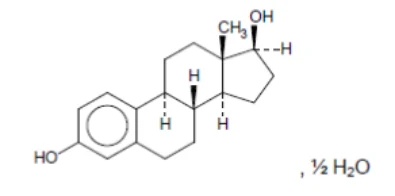
Physicochemical properties: White or almost white, crystalline powder, or colorless crystals; practically insoluble in water, soluble in acetone and in ethyl alcohol (96%); slightly soluble in ether and methylene chloride. Melting range between 173°C and 179°C.
Drug Substance
Progesterone (micronized)
Proper name: Progesterone
Chemical name: Pregn-4-ene-3,20-dione
Molecular formula and molecular mass: C21H30O2, 314.47
Structural formula:
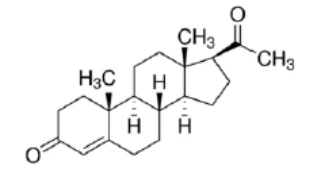
Physicochemical properties: White or almost white, crystalline powder, or colorless crystals; practically insoluble in water, freely soluble in ethanol, sparingly soluble in acetone and fatty oils. Melting range between 126°C and 131°C.
14 CLINICAL TRIALS
14.1 Clinical Trials by Indication
Treatment of Vasomotor Symptoms
Table 4 - Summary of patient demographics for clinical trials in Vasomotor symptoms and Endometrial hyperplasia
| Study # | Study Design | Dosage, route of administration and duration | Study subjects (n) | Mean age (Range) | Sex |
|---|---|---|---|---|---|
| TXC12-05 | Phase 3, randomized, double-blind, placebo-controlled multicenter study | BIJUVA 1 mg E2/100 mg P BIJUVA 0.5 mg E2/100 mg P Placebo Once Daily Oral 52 weeks (12 weeks for VMS sub-study) | VMS Sub-study: 766 enrolled 726 analyzed BIJUVA 1 mg E2/100 mg P 141 subjects BIJUVA 0.5 mg E2/100 mg P 149 subjects Placebo 135 subjects Safety Population: 1835 enrolled 1275 completed BIJUVA 1 mg E2/100 mg P 415 subjects BIJUVA 0.5 mg E2/100 mg P 424 subjects Placebo 151 subjects | VMS Sub-study: 54.6 (40 - 65) BIJUVA 1 mg E2/100 mg P: 54.7 years (40 - 65) BIJUVA 0.5 mg E2/100 mg P: 54.9 years (45 - 65) Placebo 54.3 years (45 - 65) Safety Population: 54.6 years (40 - 66) BIJUVA 1 mg E2/100 mg P: 54.7 years (40 - 65) BIJUVA 0.5 mg E2/100 mg P: 54.5 years (43 - 66) Placebo 54.5 years (45 – 65) | Female |
The efficacy and safety of BIJUVA (estradiol and progesterone) capsules on moderate to severe vasomotor symptoms (hot flushes) due to menopause were examined in a 12-week randomized, double-blind, placebo-controlled sub-study (VMS sub-study) within Study TXC12-05, which is a single 52-week safety study. Efficacy was assessed at Weeks 4 and 12 in a sub-study of women who reported ≥ 7 moderate to severe hot flushes per day, or ≥ 50 per week (VMS sub-study). All other eligible subjects not meeting the VMS sub-study hot flush requirements were randomized into the non-Sub-study (Safety study) portion of the trial. A total of 726 postmenopausal women were randomized to multiple dose combinations of estradiol (E2) and progesterone (P), and placebo. These women were 40 to 65 years of age (mean 54.6 years) and had at least 50 moderate to severe vasomotor symptoms per week at baseline (Table 4).
In the sub-study evaluating effects on moderate to severe vasomotor symptoms, 141 subjects received BIJUVA 1 mg estradiol/100 mg progesterone, 149 subjects received BIJUVA 0.5 mg estradiol/100 mg progesterone and 135 subjects received placebo and comprised the primary efficacy population. The mean number of years since last menstrual period was 5.9 years, with 718 (98.9%) women undergoing natural menopause while 8 (1.1%) women reported prior bilateral oophorectomy. The primary efficacy population consisted of women who self-identified their race as: White (67%), Black/African American (31%), and “Other” (2.1%).
The evaluated co-primary efficacy endpoints included: 1) mean weekly reduction in frequency of moderate to severe vasomotor symptoms with BIJUVA compared to placebo at Weeks 4 and 12 and 2) mean weekly reduction in severity of moderate to severe vasomotor symptoms with BIJUVA compared to placebo at Weeks 4 and 12. Menopause Specific Quality of Life (MENQOL) was evaluated as a secondary endpoint. The MENQOL questionnaire is self-administered and assesses changes in quality of life over a one-month period. It is composed of 29 questions distributed across four domains: vasomotor, psychosocial, physical, and sexual. Each domain score ranged from 1 to 8. The MENQOL was administered at Randomization, Week 12, Month 6, and Month 12 or Early Termination.
Study Results
Overall, BIJUVA 1 mg estradiol/100 mg progesterone and 0.5 mg estradiol/100 mg progesterone statistically significant reduced both the frequency and severity of moderate to severe vasomotor symptoms from baseline compared with placebo at Weeks 4 and 12. The change from baseline in the frequency and severity of vasomotor symptoms observed and the difference from placebo are shown in Table 5 and Table 6 , respectively. The mean reduction in frequency and severity of weekly moderate and severe vasomotor symptoms from Week 1 through Week 12 for the MITT-VMS population are shown in
Figure 1 and Figure 2, respectively.
Mean decreases from baseline in the MENQOL scores (vasomotor domain and total score) were significantly greater in the BIJUVA 1 mg estradiol/100 mg progesterone and 0.5 mg estradiol/100 mg progesterone treatment groups compared to placebo at Week 12, Month 6, and Month 12 (p<0.05).
Table 5 – Mean Weekly Change from Baseline and LS Mean Change from Placebo in the Frequency of Moderate to Severe Vasomotor Symptoms
BIJUVA 1 mg E2/100 mg P (N = 141) | BIJUVA 0.5 mg E2/100 mg P (N = 149) | Placebo (N = 135) | |
|---|---|---|---|
| Week 4 | N = 134 | N = 144 | N = 126 |
| Baseline | 72.1 (27.80) | 72.3 (28.06) | 72.3 (23.44) |
| Mean (SD) change from baseline | -40.6 (30.59) | -35.1 (29.14) | -26.4 (27.05) |
| LS Mean (SE) change from placebo | -12.81 (3.30) | -8.07 (3.25) | --- |
| MMRM p-value | < 0.001 | 0.013 | --- |
| Week 12 | N = 124 | N = 129 | N = 115 |
| Baseline | 72.2 (25.04) | 72.8 (28.96) | 72.2 (22.66) |
| Mean (SD) change from baseline | -55.1 (31.36) | -53.7 (31.93) | -40.2 (29.79) |
| LS Mean (SE) change from placebo | -16.58 (3.44) | -15.07 (3.39) | --- |
| MMRM p-value | <0.001 | <0.001 | --- |
Definitions: SD – standard deviation; SE – standard error; LS – least square; MMRM – mixed model repeated measures
Figure 1 – Mean Reduction in Frequency of Weekly Moderate to Severe Vasomotor Symptoms from Week 1 Through Week 12 (MITT-VMS Population)
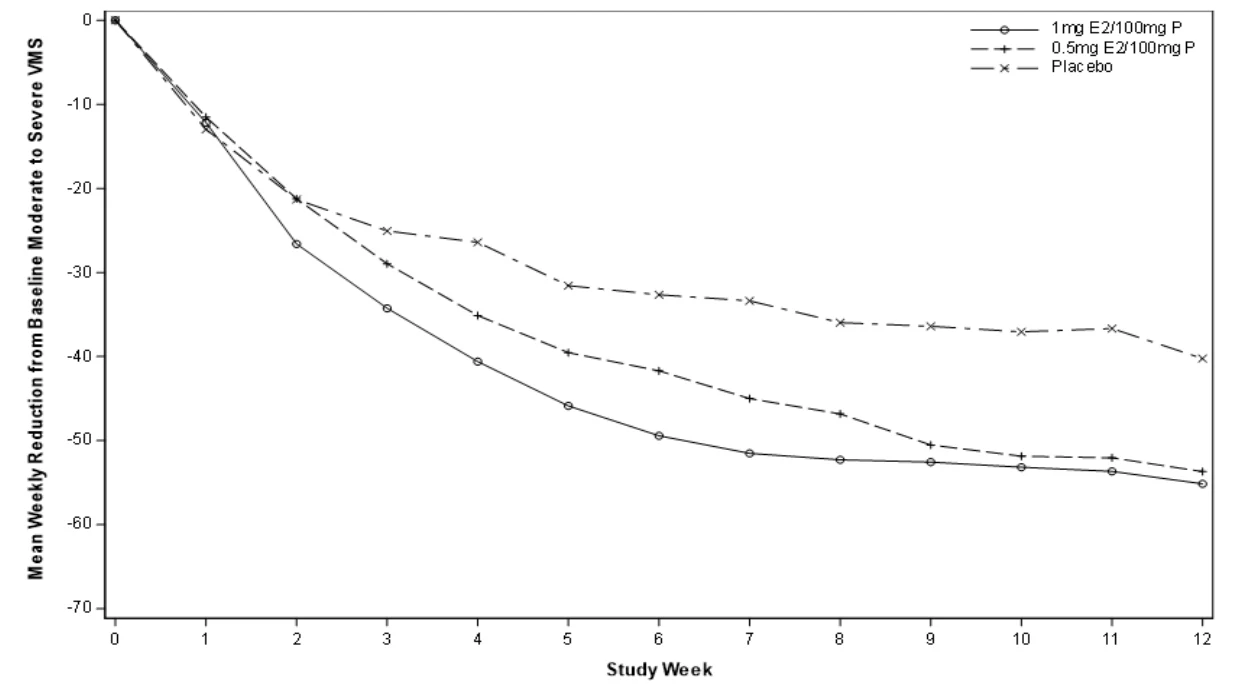
Definitions: MITT-VMS – modified intent to treat – vasomotor symptoms; E2 – 17β-estradiol; P – progesterone
Table 6 – Mean Weekly Change from Baseline and LS Mean Change from Placebo in the Severity of Moderate to Severe Vasomotor Symptoms
BIJUVA 1 mg E2/100 mg P (N = 141) | BIJUVA 0.5 mg E2/100 mg P (N = 149) | Placebo (N = 135) | |
|---|---|---|---|
| Week 4 | N = 134 | N = 144 | N = 126 |
| Baseline | 2.54 (0.325) | 2.51 (0.248) | 2.52 (0.249) |
| Mean (SD) change from baseline | -0.48 (0.547) | -0.51 (0.563) | -0.34 (0.386) |
| LS Mean (SE) change from placebo | -0.13 (0.061) | -0.17 (0.060) | --- |
| MMRM p-value | 0.031 | 0.005 | --- |
| Week 12 | N = 124 | N = 129 | N = 115 |
| Baseline | 2.55 (0.235) | 2.51 (0.248) | 2.52 (0.245) |
| Mean (SD) change from baseline | -1.12 (0.963) | -0.90 (0.783) | -0.56 (0.603) |
| LS Mean (SE) change from placebo | -0.57 (0.100) | -0.39 (0.099) | --- |
| MMRM p-value | <0.001 | <0.001 | --- |
Definitions: SD – standard deviation; SE – standard error; LS – least square; MMRM – mixed model repeated measures
Figure 2 – Mean Reduction in Severity of Weekly Moderate to Severe Vasomotor Symptoms from Week 1 Through Week 12 (MITT-VMS Population)
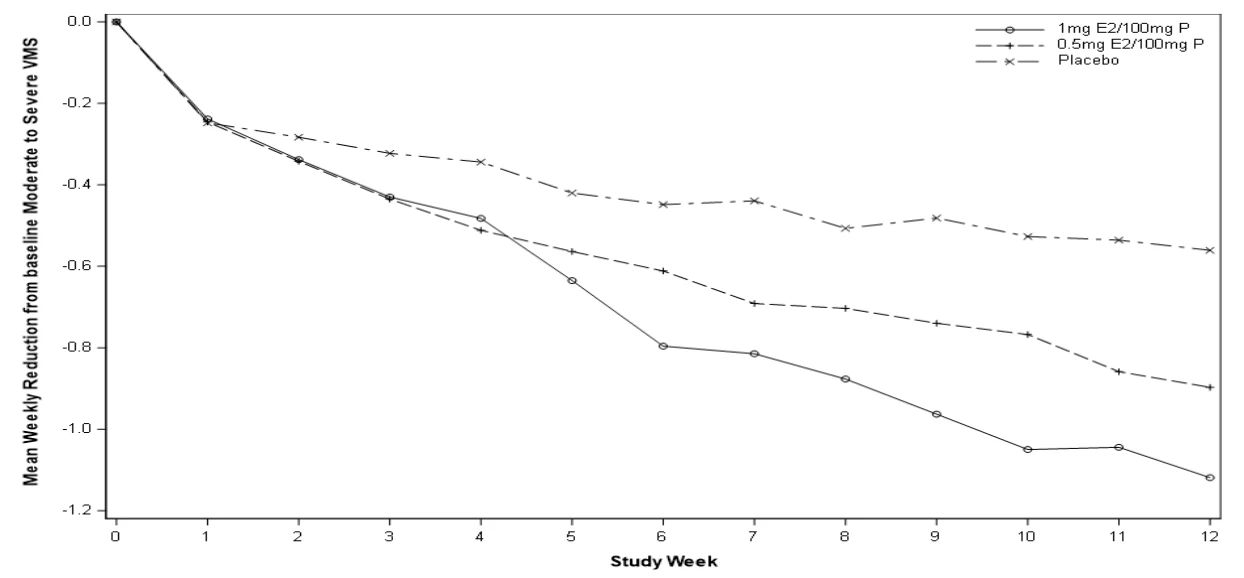
Definitions: MITT-VMS – modified intent to treat – vasomotor symptoms; E2 – 17β-estradiol; P – progesterone
In a subgroup analysis, treatment with BIJUVA (estradiol and progesterone) capsules, 1 mg/100 mg and 0.5 mg/100 mg, did not demonstrate statistically significant reductions in frequency and severity of moderate to severe vasomotor symptoms compared to placebo in women who self-identified as Black/African Americans. The effectiveness of BIJUVA in Black/African Americans to reduce moderate to severe vasomotor symptoms has not been established.
Effects on Endometrium
Effects of BIJUVA (estradiol and progesterone) capsules, 1 mg/100 mg and 0.5/100 mg, on endometrial hyperplasia and endometrial malignancy were assessed in the 52-week safety trial. The Endometrial Safety population included women who had taken at least one dose of BIJUVA capsules and had baseline and post-baseline endometrial biopsies. During the trial, endometrial biopsy assessments revealed 1 case of endometrial hyperplasia in women who received BIJUVA (estradiol and progesterone) capsules, 1 mg/100 mg, and 1 case of endometrial hyperplasia in women who received 0.5 mg/100 mg (see Table 7 ). No cases of hyperplasia were observed in women who received placebo. No cases of endometrial cancer were observed in the 52-week safety trial.
Table 7 – Incidence of Endometrial Hyperplasia After up to 12 Months of Treatment
BIJUVA 1 mg E2/100 mg P (N = 281) | BIJUVA 0.5 mg E2/100 mg P (N = 303) | Placebo (N = 92) | |
|---|---|---|---|
| Hyperplasia incidence rate % (n/N) | 0.36% (1/281) | 0.33% (1/303) | 0.00% (0/92) |
| One-sided upper 95% confidence limit | 1.97% | 1.83% | 3.93% |
Effects on Uterine Bleeding or Spotting
Uterine bleeding or spotting was evaluated in the 52-week safety study by daily diary. At 52 weeks, cumulative amenorrhea was reported by 56.1% of women who received BIJUVA 1 mg estradiol/100 mg progesterone; 67.6% who received 0.5 mg estradiol/100 mg progesterone and 78.9% who received placebo.
15 MICROBIOLOGY
No microbiological information is required for this drug product.
16 NON-CLINICAL TOXICOLOGY
Nonclinical toxicity studies to determine the potential of BIJUVA (estradiol and progesterone) capsules to cause carcinogenicity or mutagenicity have not been performed. The effect of BIJUVA on fertility has not been evaluated in animals.
Carcinogenicity: Carcinogenicity of 17β-estradiol and progesterone are well-established in the literature.
Long-term continuous administration of natural and synthetic estrogens in certain animal species increases the frequency of carcinomas of the breast, uterus, cervix, vagina, testis, and liver.
For 17β-estradiol, long-term studies in mice demonstrate that oral administration of 0.00188, 0.015, 0.15 and 0.75 mg/kg/day in mice can increased the incidences of mammary, uterine, cervical and ovarian tubular tumours. In rats administered 10-12 mg/animal by subcutaneous pellet, there was an increased incidence of mammary and pituitary tumours.
Subcutaneous implantation of progesterone pellets in mice resulted in increases in ovarian granulosa cell tumors and endometrial sarcomas, metaplasia in the endocervical mucosa, squamous cell carcinomas of the cervicovaginal region and hyperplastic nodules of the mammary gland. The findings of tumors in the reproductive tissues of rodents are consistent with that observed with other progestational compounds.
Genotoxicity: Genotoxicity of 17β-estradiol and progesterone are well-established in the literature.
The clastogenic potential of 17 β-estradiol was evident from the chromosome aberrations and sister chromatid exchanges induced with and without metabolic activation in cultured human lymphocytes and from the increased frequencies of micronuclei formation and sister chromatid exchanges in mice. However, 17 β-estradiol is not considered to be mutagenic as a negative response was observed in the in vitro Ames bacterial reverse mutation assay.
Progesterone was negative in vitro for point mutations in the Ames test, in E. coli bacteria, and in the mouse lymphoma forward mutation assay.
Progesterone did not cause mitotic disturbances or chromosome aberrations in Chinese hamster fibroblast cells in culture and did not cause an increase in unscheduled DNA synthesis in hepatocytes from male Fischer 344 rats in culture.
Progesterone was negative in assays for chromosome damage using human female leukocytes, or by the sister chromatid exchange (SCE) assay in human female peripheral blood lymphocytes (HPBL) or in human fibroblast cells.
Chromosome changes were observed in Chinese hamsters receiving SC injections of progesterone for up to four weeks, and in the testes of male mongrel dogs injected IM every other day for six weeks. Since the doses in these studies would have produced blood levels of progesterone in the endogenous range, the toxicological significance of the results is unclear.
Reproductive and Developmental Toxicology: Reproductive toxicity of 17β-estradiol and progesterone are well-established in the literature.
17 β-estradiol administered in the feed to female Crl:CD BR rats at doses equal to 0, 0.003, 0.173, 0.691, or 4.12 mg/kg/day and to males at doses equal to 0, 0.003, 0.139, 0.527, or 3.16 mg/kg/day resulted in a decreased in the number of matings and no pregnancies at the two highest doses. For the three groups with pregnancies (0, 0.003, 0.173 mg/kg/day), there was no difference in gestation length, however, gestation body weight gain, food consumption, and mean number of implants were affected. Mean number of live births was significantly decreased in the 0.173 mg/kg/day group compared to control.
Parental administration of 17 β-estradiol did not affect the anogenital distance in male or female pups. For the onset of sexual maturity, preputial separation in male pups in the 0.17 mg/kg/day group was significantly delayed. In female pups, a decrease in time (advancement) for the vaginal opening was noted in both the 0.003 and 0.173 mg/kg/day dosed groups. The F1 generation was not mated.
In white rabbits, intramuscular estradiol administration at 15 or 30 mcg/animal for 3-6 consecutive days at different times during gestation resulted in 67 and 78% aborted or totally resorbed litters and 4% and 17% of litters with dead fetuses, respectively.
Administration of progesterone by SC injection to pregnant mice resulted in a decrease in sexual behavior in male offspring with no changes to internal or external genitalia, and an increase in aggressive behavior in female offspring. No abnormalities of internal or external genitalia were observed in the offspring of rats treated with progesterone by SC injection.
No adverse effect on egg development was observed following oral (gavage) administration of progesterone to rabbits three days before or after mating. SC dosing of pregnant rabbits also had no adverse effect on egg development, while SC dosing two days prior to mating induced complete degeneration of eggs. Single SC injection to rabbits before mating did not impair fertility but led to embryonic death by day 4 of gestation.
Administration of progesterone by IM injection to pregnant rhesus monkeys did not cause any adverse effects on pregnancy or on the incidence of anomalies in the offspring.