


Product Monograph - Biktarvy
RECENT MAJOR LABEL CHANGES
| 1 Indications | 06/2025 |
|---|---|
| 7 Warnings and Precautions, 7.1 Special Populations, 7.1.1 Pregnant Women | 01/2025 |
| 7 Warnings and Precautions, 7.1 Special Populations, 7.1.2 Breast-feeding Women | 01/2025 |
TABLE OF CONTENTS
Sections or subsections that are not applicable at the time of authorization are not listed.
RECENT MAJOR LABEL CHANGES…………………………………………………………………2
TABLE OF CONTENTS…………………………………………………………………………………2
PART I: HEALTH PROFESSIONAL INFORMATION............................................................... 4
1 INDICATIONS.............................................................................................................. 4
1.1 Pediatrics ........................................................................................................... 4
1.2 Geriatrics............................................................................................................ 4
2 CONTRAINDICATIONS ............................................................................................... 4
3 SERIOUS WARNINGS AND PRECAUTIONS BOX...................................................... 5
4 DOSAGE AND ADMINISTRATION .............................................................................. 5
4.1 Dosing Considerations ........................................................................................ 5
4.2 Recommended Dose and Dosage Adjustment .................................................... 5
4.3 Administration..................................................................................................... 6
4.4 Missed Dose....................................................................................................... 6
5 OVERDOSAGE ........................................................................................................... 6
6 DOSAGE FORMS, STRENGTHS, COMPOSITION AND PACKAGING ........................ 7
7 WARNINGS AND PRECAUTIONS .............................................................................. 8
7.1 Special Populations ............................................................................................ 9
7.1.1 Pregnant Women ............................................................................................ 9
7.1.2 Breast-feeding ............................................................................................... 10
7.1.3 Pediatrics ...................................................................................................... 10
7.1.4 Geriatrics ...................................................................................................... 11
7.1.5 Patients Co-infected with HIV and HBV.......................................................... 11
8 ADVERSE REACTIONS ............................................................................................ 11
8.1 Adverse Reaction Overview .............................................................................. 11
8.2 Clinical Trial Adverse Reactions ........................................................................ 11
8.2.1 Clinical Trial Adverse Reactions – Pediatrics.................................................. 15
8.3 Less Common Clinical Trial Adverse Reactions................................................. 15
8.4 Abnormal Laboratory Findings: Hematologic, Clinical Chemistry and Other Quantitative Data ....................................................................................................... 15
8.5 Post-Market Adverse Reactions ........................................................................ 17
9 DRUG INTERACTIONS ............................................................................................. 18
9.1 Serious Drug Interactions.................................................................................. 18
9.2 Drug Interactions Overview ............................................................................... 18
9.3 Drug-Behavioural Interactions ........................................................................... 19
9.4 Drug-Drug Interactions...................................................................................... 19
9.5 Drug-Food Interactions ..................................................................................... 26
9.6 Drug-Herb Interactions...................................................................................... 26
9.7 Drug-Laboratory Test Interactions ..................................................................... 26
10 CLINICAL PHARMACOLOGY ................................................................................... 26
10.1 Mechanism of Action ..................................................................................... 26
10.2 Pharmacodynamics ....................................................................................... 27
10.3 Pharmacokinetics .......................................................................................... 28
11 STORAGE, STABILITY AND DISPOSAL .................................................................. 33
12 SPECIAL HANDLING INSTRUCTIONS ..................................................................... 33
PART II: SCIENTIFIC INFORMATION .................................................................................. 34
13 PHARMACEUTICAL INFORMATION ........................................................................ 34
14 CLINICAL TRIALS .................................................................................................... 36
14.1 Clinical Trials by Indications........................................................................... 36
HIV-1 With No Known Substitution Associated with Resistance to Bictegravir or Tenofovir.................................................................................................................... 36
15 MICROBIOLOGY....................................................................................................... 49
16 NON-CLINICAL TOXICOLOGY ................................................................................. 52
17 SUPPORTING PRODUCT MONOGRAPHS ............................................................... 52
PATIENT MEDICATION INFORMATION .............................................................................. 54
PART I: HEALTH PROFESSIONAL INFORMATION
1 INDICATIONS
BIKTARVY (bictegravir/emtricitabine/tenofovir alafenamide) is indicated as a complete regimen for the treatment of human immunodeficiency virus-1 (HIV-1) infection in adults and pediatric patients weighing ≥ 25 kg with no known substitution associated with resistance to bictegravir or tenofovir.
1.1 Pediatrics
Pediatrics (weighing ≥ 25 kg): The safety and efficacy in pediatric patients weighing ≥ 25 kg are based on data from an open-label clinical study (see 8 ADVERSE REACTIONS and 14 CLINICAL TRIALS).
Safety and efficacy of BIKTARVY in children weighing < 25 kg have not been established.
1.2 Geriatrics
Geriatrics (≥ 65 years of age): No differences in safety or efficacy have been observed between elderly patients and adult patients < 65 years of age (see 8 ADVERSE REACTIONS and 14 CLINICAL TRIALS).
2 CONTRAINDICATIONS
BIKTARVY is contraindicated in patients who are hypersensitive to bictegravir (BIC), emtricitabine (FTC), tenofovir alafenamide (TAF) or to any ingredient in the formulation or component of the container. For a complete listing, see 6 DOSAGE FORMS, STRENGTHS, COMPOSITION AND PACKAGING.
Coadministration of BIKTARVY is contraindicated with:
- dofetilide* due to the potential for increased dofetilide plasma concentrations and associated serious and/or life-threatening events (see 9 DRUG INTERACTIONS).
- rifampin due to decreased BIC plasma concentrations, which may result in the loss of therapeutic effect and development of resistance to BIKTARVY (see 9 DRUG INTERACTIONS).
St. John’s wort due to the effect of St. John’s wort on the BIC component of BIKTARVY. This may result in loss of therapeutic effect and development of resistance (see 9 DRUG INTERACTIONS).
*Product not marketed in Canada
3 SERIOUS WARNINGS AND PRECAUTIONS BOX
4 DOSAGE AND ADMINISTRATION
4.1 Dosing Considerations
BIKTARVY is a three-drug fixed dose combination product containing 50 mg of BIC, 200 mg of FTC, and 25 mg of TAF.
Testing
Prior to or when initiating BIKTARVY, test for hepatitis B virus infection.
Prior to or when initiating BIKTARVY, and during treatment with BIKTARVY, assess serum creatinine, estimated glomerular filtration rate (eGFR), urine glucose, and urine protein in all patients as clinically appropriate. In patients with chronic kidney disease, also assess serum phosphorus.
4.2 Recommended Dose and Dosage Adjustment
Adults and Pediatric Patients weighing ≥ 25 kg
The recommended dose of BIKTARVY is one tablet taken orally once daily with or without food.
Pediatrics (weighing < 25 kg)
BIKTARVY is not indicated for use in pediatric patients weighing < 25 kg
Geriatrics (≥ 65 years of age)
No dose adjustment of BIKTARVY is required for elderly patients. No differences in safety or efficacy have been observed between elderly patients and those < 65 years of age.
Renal Impairment
No dose adjustment of BIKTARVY is required in adult patients with eGFR ≥ 30 mL/minute or in adult patients with end stage renal disease (ESRD; eGFR < 15 mL/minute) who are receiving chronic hemodialysis. On days of hemodialysis, administer the daily dose of BIKTARVY after completion of hemodialysis treatment. BIKTARVY is not recommended in patients with eGFR ≥ 15 and < 30 mL per minute, or < 15 mL/minute who are not receiving chronic hemodialysis, as the safety of BIKTARVY has not been established in these populations.
Serious Warnings and Precautions
- Post-treatment Exacerbation of Hepatitis B
Severe acute exacerbations of hepatitis B have been reported in patients who are coinfected with HIV-1 and HBV and have discontinued products containing FTC and/or tenofovir disoproxil fumarate (TDF), and may occur with discontinuation of BIKTARVY. Hepatic function should be monitored closely with both clinical and laboratory follow-up for at least several months in patients who are coinfected with HIV-1 and HBV and discontinue BIKTARVY. If appropriate, anti-hepatitis B therapy may be warranted (see 7 WARNINGS AND PRECAUTIONS, 7.1 Special Populations).
No data are available to make dose recommendations in pediatric patients with renal impairment.
Hepatic Impairment
BIKTARVY is not recommended in patients with severe hepatic impairment (Child-Pugh Class C) because it has not been studied in these patients. No dose adjustment of BIKTARVY is required in patients with mild (Child-Pugh Class A) or moderate (Child-Pugh Class B) hepatic impairment (see 10 CLINICAL PHARMACOLOGY, Pharmacokinetics, Special Populations and Conditions).
4.3 Administration
The recommended dose of BIKTARVY is one tablet taken orally once daily with or without food in adults and pediatric patients weighing ≥ 25 kg.
4.4 Missed Dose
If a patient misses a dose of BIKTARVY within 18 hours of the time it is usually taken, the patient should take BIKTARVY as soon as possible, and then take the next dose of BIKTARVY at the regularly scheduled time. If a patient misses a dose of BIKTARVY by more than 18 hours, the patient should not take the missed dose and simply resume the usual dosing schedule.
5 OVERDOSAGE
No data are available on overdose of BIKTARVY in patients. If overdose occurs, the patient must be monitored for evidence of toxicity. Treatment of overdose with BIKTARVY consists of general supportive measures including monitoring of vital signs as well as observation of the clinical status of the patient.
There is no specific antidote for overdose with BIKTARVY. As BIC is highly bound to plasma proteins, it is unlikely that it will be significantly removed by hemodialysis or peritoneal dialysis. FTC can be removed by hemodialysis, which removes approximately 30% of the FTC dose over a 3 hour dialysis period starting within 1.5 hours of FTC dosing. It is not known whether FTC can be removed by peritoneal dialysis.
Tenofovir is efficiently removed by hemodialysis with an extraction coefficient of approximately 54%.
| For the most recent information in the management of a suspected drug overdose, contact your regional poison control centre or Health Canada’s toll-free number, 1-844 POISON-X (1-844-764-7669). |
|---|
6 DOSAGE FORMS, STRENGTHS, COMPOSITION AND PACKAGING
Table 1 Dosage Forms, Strengths, Composition and Packaging
BIKTARVY tablets are purplish brown, capsule-shaped, film-coated, and debossed with “GSI” on one side and “9883” on the other side.
BIKTARVY tablets are packaged in white, high density polyethylene (HDPE) bottles and enclosed with a polypropylene continuous thread child resistant cap, lined with an induction activated aluminum foil liner. Each bottle contains 7 or 30 tablets, silica gel desiccant, and polyester coil.
BIKTARVY tablets are also packaged in blister packaging which consists of a clear laminated blister film sealed to an aluminum lidding material. Each individual blister cavity contains a tablet and a die-cut desiccant film (Activ-Film™), which is heat staked to the lidding material. Each blister card is fitted between 2 paperboard cards, which are sealed together. There are 4 blister cards containing 7 tablets and 1 card containing 2 tablets placed inside a paperboard carton for a total of 30 tablets per pack.
| Route of Administration | Dosage Form / Strength / Composition | Non-medicinal Ingredients |
| Oral | Each tablet contains 50 mg of BIC (equivalent to 52.5 mg of bictegravir sodium), 200 mg of FTC, and 25 mg of TAF (equivalent to 28.0 mg of tenofovir alafenamide hemifumarate). | Croscarmellose Sodium, Iron Oxide Black, Iron Oxide Red, Magnesium Stearate, Microcrystalline Cellulose, Polyethylene Glycol, Polyvinyl Alcohol, Talc, Titanium-Dioxide |
7 WARNINGS AND PRECAUTIONS
Please see the 3 SERIOUS WARNINGS AND PRECAUTIONS BOX.
General
BIKTARVY should not be coadministered with any other antiretroviral products including products containing BIC, FTC, or TAF (COMPLERA®, DESCOVY®, EMTRIVA®, GENVOYA®, ODEFSEY®, Symtuza™, STRIBILD®, TRUVADA®, VEMLIDY®); or with products containing lamivudine or tenofovir disoproxil fumarate (3TC®, Combivir®, COMPLERA, Delstrigo®, Dovato®, Heptovir®, Kivexa®, STRIBILD, Triumeq®, Trizivir®, TRUVADA, VIREAD®). BIKTARVY should not be administered with adefovir dipivoxil (HEPSERA®).
The safety and efficacy of BIKTARVY have not been established in patients who have failed treatment with an antiretroviral therapy regimen and are currently not virologically suppressed.
Driving and Operating Machinery
No studies on the effects of BIKTARVY on the ability to drive and use machines have been performed.
Endocrine and Metabolism
Serum Lipids and Blood Glucose
Serum lipid and blood glucose levels may increase during antiretroviral therapy (ART). Disease control and life style changes may also be contributing factors. Consideration should be given to the measurement of serum lipids and blood glucose. Lipid disorders and blood glucose elevations should be managed as clinically appropriate.
Hepatic/Biliary/Pancreatic
Lactic acidosis and severe hepatomegaly with steatosis
Lactic acidosis and severe hepatomegaly with steatosis, including fatal cases, have been reported with the use of antiretroviral nucleoside analogs, including FTC, a component of BIKTARVY, and TDF, another prodrug of tenofovir, alone or in combination with other antiretrovirals. Treatment with BIKTARVY should be suspended in any patient who develops clinical or laboratory findings suggestive of lactic acidosis or pronounced hepatotoxicity (which may include hepatomegaly and steatosis even in the absence of marked transaminase elevations).
Hepatic Impairment
Patients with chronic hepatitis B or C and treated with antiretroviral therapy are at increased risk for severe hepatic adverse events (see 7 WARNINGS AND PRECAUTIONS, 7.1 Special Populations).
Immune
Immune Reconstitution Inflammatory Syndrome
Immune reconstitution inflammatory syndrome has been reported in patients treated with combination antiretroviral therapy, including FTC, a component of BIKTARVY. During the initial phase of combination antiretroviral treatment, patients whose immune system responds may develop an inflammatory response to indolent or residual opportunistic infections [such as Mycobacterium avium infection, cytomegalovirus, Pneumocystis jirovecii pneumonia (PCP), or tuberculosis], which may necessitate further evaluation and treatment.
Autoimmune disorders (such as Graves’ disease, polymyositis, Guillain-Barré syndrome, and autoimmune hepatitis) have also been reported to occur in the setting of immune reconstitution; however, the reported time to onset is more variable, and can occur many months after initiation of treatment.
Renal
Renal impairment
Renal impairment, including cases of acute renal failure and Fanconi syndrome (renal tubular injury with severe hypophosphatemia), has been reported with the use of tenofovir prodrugs in both animal toxicology studies and human trials. In clinical trials with BIKTARVY, there have been no cases of Fanconi syndrome or proximal renal tubulopathy (PRT).
Patients taking tenofovir prodrugs who have impaired renal function and those taking nephrotoxic agents including non-steroidal anti-inflammatory drugs are at increased risk of developing renal-related adverse reactions.
BIKTARVY is not recommended in patients with eGFR ≥ 15 and < 30 mL/min, or in patients with eGFR < 15 mL/min who are not receiving chronic hemodialysis.
7.1 Special Populations
7.1.1 Pregnant Women
BIKTARVY was evaluated in an open-label clinical study of 33 virologically suppressed (HIV-1 RNA < 50 copies/mL) pregnant adults with HIV-1. Participants were administered BIKTARVY (containing 50 mg of BIC, 200 mg of FTC, and 25 mg of TAF) once daily from the second or third trimester through postpartum. Exposures of BIC, FTC, and TAF were lower during pregnancy as compared to postpartum; these decreases are not considered to be clinically relevant based on exposure-response relationships; however, specific dosage adjustments for coadministered oral medications or supplements containing polyvalent cations are recommended in pregnant patients (see 9.4 Drug-Drug Interactions and 10.3 Pharmacokinetics, Special Populations and Conditions). All 32 adult participants who completed the study maintained viral suppression during pregnancy, at delivery, and through Week 18 postpartum. The median (Q1, Q3) CD4+ cell count at baseline was 558 (409, 720) cells/μL, and the median (Q1, Q3) change in CD4+ cell count from baseline to Week 12 postpartum was 159 (27, 296) cells/μL. All 29 neonate participants had negative/nondetectable HIV-1 PCR results at 4 to 8 weeks post-birth. There were no new safety findings compared to the known safety profile of BIKTARVY in HIV-1 infected adults.
BIKTARVY was only studied in pregnant individuals who were virologically suppressed; therefore, viral load should be monitored closely following established treatment guidelines.
BIKTARVY may be used during pregnancy if the potential benefits outweigh the potential risks to the fetus.
Bictegravir
Embryo-fetal development toxicity studies of BIC conducted in pregnant rats and rabbits revealed no evidence of adverse developmental effects at maternal exposures that were approximately 36 and 0.6 times, respectively, the human exposure at the recommended human dose. In rabbits, abortions and decreased fetal body weight were noted at maternally toxic exposures that were approximately 1.4 times the human exposure at the recommended human dose.
Emtricitabine
Reproductive studies were conducted in rats, mice, and rabbits. Animal studies (performed at 60- to 120-fold human exposure) did not indicate harmful effects of FTC with respect to fertility, pregnancy, fetal parameters, parturition or postnatal development.
Tenofovir Alafenamide
Embryonic fetal development studies performed in rats and rabbits revealed no evidence of impaired fertility or harm to the fetus. The embryo-fetal NOAELs in rats and rabbits occurred at TAF exposures approximately 2 and 78 times higher than, respectively, the exposure in humans at the recommended daily dose of BIKTARVY. TAF is rapidly converted to tenofovir; the observed tenofovir exposure in rats and rabbits were 55 and 86 times higher, respectively, than human tenofovir exposures at the recommended human dose.
Antiretroviral Pregnancy Registry: To monitor maternal-fetal outcomes of pregnant women exposed to ART (antiretroviral therapy), including BIKTARVY, an Antiretroviral Pregnancy Registry has been established. Healthcare providers are encouraged to register patients:
http://www.apregistry.com Telephone: (800) 258-4263 Fax: (800) 800-1052
7.1.2 Breast-feeding
Data from the published literature report the presence of BIC, FTC, TAF, and tenofovir in human milk. There are no data on the effects of BIC on the breastfed child. Data from the published literature have not reported adverse effects of FTC or TAF on a breastfed child. There are no data on the effects of BIC, FTC or TAF on milk production.
Women with HIV-1 should be counselled on the risks of breastfeeding. Potential risks of breastfeeding include: (1) HIV-1 transmission to HIV-1–negative infants; (2) developing viral resistance in HIV-1–positive infants; and (3) adverse reactions in a breastfed infant similar to those seen in adults.
7.1.3 Pediatrics
Safety and effectiveness of BIKTARVY in pediatric patients weighing < 25 kg have not been established.
7.1.4 Geriatrics
Clinical studies included 111 patients aged 65 years and over who received BIKTARVY. No differences in safety or efficacy have been observed between elderly patients and those less than 65 years of age.
7.1.5 Patients Co-infected with HIV and HBV
- BIKTARVY, test for hepatitis B virus infection (see 4 DOSAGE AND ADMINISTRATION).
Severe acute exacerbations of hepatitis B have been reported in patients who are coinfected with HIV-1 and HBV and have discontinued products containing FTC and/or TDF, and may occur with discontinuation of BIKTARVY. Therefore, patients co-infected with HIV-1 and HBV who discontinue BIKTARVY should be closely monitored with both clinical and laboratory follow-up for at least several months after stopping treatment. If appropriate, anti-hepatitis B therapy may be warranted, especially in HBV co-infected patients with advanced liver disease or cirrhosis since post-treatment exacerbation of hepatitis may lead to hepatic decompensation.
8 ADVERSE REACTIONS
8.1 Adverse Reaction Overview
The following adverse drug reactions are discussed in other sections of the labeling:
- Severe Acute Exacerbations of Hepatitis B (See 3 SERIOUS WARNINGS AND PRECAUTIONS BOX)
- Immune Reconstitution Inflammatory Syndrome (See 7 WARNINGS AND PRECAUTIONS)
- Lactic Acidosis/Severe Hepatomegaly with Steatosis (See 7 WARNINGS AND PRECAUTIONS)
8.2 Clinical Trial Adverse Reactions
Clinical trials are conducted under very specific conditions. The adverse reaction rates observed in the clinical trials; therefore, may not reflect the rates observed in practice and should not be compared to the rates in the clinical trials of another drug. Adverse reaction information from clinical trials may be useful in identifying and approximating rates of adverse drug reactions in real-world use.
Clinical Trials in Treatment-Naïve Adults
The primary safety assessment of BIKTARVY was based on Weeks 48, 96, and 144 pooled data from 1274 participants in two randomized, double-blind, active-controlled trials, Study 1489 and Study 1490, in antiretroviral treatment-naïve HIV-1 infected adult participants. A total of 634 participants received one tablet of BIKTARVY once daily (See 14 CLINICAL TRIALS).
The most common adverse reactions (all Grades) reported in at least 5% of participants in the BIKTARVY group in Study 1489 were diarrhea, nausea, and headache. No adverse reactions were reported in at least 5% in the BIKTARVY group in Study 1490. The proportion of participants who discontinued treatment with BIKTARVY, abacavir [ABC]/DTG/lamivudine [3TC]), or DTG + FTC/TAF, due to adverse events, regardless of severity, was 0.9%, 1.6%, and 1.8% through Week 144, respectively. Table 2 and Table 3 display the frequency of adverse reactions (all Grades) greater than or equal to 2% in the BIKTARVY group in Study 1489 and Study 1490, respectively. The safety profile of BIKTARVY was consistent through Week 144 in both studies.
Table 2 Adverse Reactionsa (All Grades) Reported in ≥ 2% of HIV-1 Infected Treatment-Naïve Adults Receiving BIKTARVY in Study 1489 (Week 48 and 144 analysis)
| Week 48 | Week 144 | |||||||||
| Adverse Reactions | BIKTARVY N=314 (%) | ABC/DTG/3TC N=315 (%) | BIKTARVY N=314 (%) | ABC/DTG/3TC N=315 (%) | ||||||
GASTROINTESTINAL DISORDERS Diarrhea Nausea | 6 5 | 4 17 | 6 6 | 4 18 | ||||||
GENERAL DISORDERS AND ADMINISTRATION SITE CONDITIONS Fatigue | 3 | 3 | 3 | 3 | ||||||
NERVOUS SYSTEM DISORDERS Headache Dizziness | 5 2 | 5 3 | 5 2 | 5 3 | ||||||
PSYCHIATRIC DISORDERS Insomnia Abnormal dreams | 2 3 | 3 3 | 2 3 | 3 3 | ||||||
- a. Frequencies of adverse reactions are based on all adverse events attributed to study drugs by the investigator. No adverse reactions of Grade 2 or higher occurred in ≥1% of participants treated with BIKTARVY in Study 1489.
Table 3 Adverse Reactionsa (All Grades) Reported in ≥ 2% of HIV-1 Infected Treatment-Naïve Adults Receiving BIKTARVY in Study 1490 (Week 48 and 144 analysis)
| Week 48 | Week 144 |
Adverse Reactions
BIKTARVY N=320 (%) | DTG + FTC/TAF N=325 (%) | BIKTARVY N=320 (%) | DTG + FTC/TAF N=325 (%) | |
GASTROINTESTINAL DISORDERS Diarrhea Nausea | 3 3 | 3 5 | 3 3 | 3 5 |
GENERAL DISORDERS AND ADMINISTRATION SITE CONDITIONS Fatigue | 2 | 2 | 2 | 2 |
NERVOUS SYSTEM DISORDERS Headache Dizziness | 4 2 | 3 1 | 4 2 | 3 1 |
PSYCHIATRIC DISORDERS Insomnia | 2 | <1 | 2 | <1 |
- a. Frequencies of adverse reactions are based on all adverse events attributed to study drugs by the investigator. No adverse reactions of Grade 2 or higher occurred in ≥1% of participants treated with BIKTARVY in Study 1490.
After Week 144, all participants in Study 1489 and Study 1490, including those who received comparator regimens during the double-blind phase, were given the option to receive BIKTARVY in an open-label extension (OLE). A total of 1025 participants participated in the OLE phase, of which 444, originally randomized to BIKTARVY, received BIKTARVY for a total of 240 weeks. No new adverse reactions to BIKTARVY were identified in the optional OLE phase. Adverse events that led to discontinuation of study drugs during the OLE phase were reported for 0.8%, 0.8% and 0 participants for the pooled BIKTARVY, ABC/DTG/3TC to BIKTARVY, and DTG+F/TAF to BIKTARVY treatment groups, respectively.
Clinical Trials in Virologically Suppressed Adults
The safety of BIKTARVY in virologically suppressed adults was based on Week 48 data from 282 participants in a randomized, double-blind, active-controlled trial (Study 1844) in which virologically suppressed participants were switched from either DTG + ABC/3TC or ABC/DTG/3TC to BIKTARVY; Week 48 data from 290 participants in an open-label, active-controlled trial in which virologically suppressed participants were switched from a regimen containing atazanavir (ATV) (given with cobicistat or ritonavir) or darunavir (DRV) (given with cobicistat or ritonavir) plus either FTC/TDF or ABC/3TC, to BIKTARVY (Study 1878); and Week 48 data from a randomized, double-blind active-controlled trial in which 284 virologically-suppressed participants were switched from DTG plus either FTC/TAF or FTC/TDF, to BIKTARVY (Study GS-US-380-4030 [Study 4030]). Overall, the safety profile in virologically suppressed adult participants in Studies 1844, 1878, and 4030 was similar to that in treatment-naïve participants.
Clinical Trials in Adults with Renal Impairment
The safety of FTC + TAF (components of BIKTARVY) was evaluated in a single arm, open-label clinical trial (GS-US-292-1825 [Study 1825]), in which 55 virologically-suppressed HIV-1 infected participants with ESRD (eGFR by Cockcroft-Gault method < 15 mL/min) on chronic hemodialysis received FTC+TAF in combination with elvitegravir (EVG) + cobicistat (COBI) as a fixed-dose combination tablet for 96 weeks. In an extension phase of Study 1825, 10 participants switched to BIKTARVY for 48 weeks. The safety profile of FTC + TAF in participants with ESRD on chronic hemodialysis was similar to that in participants with normal renal function, and no additional adverse reactions were identified in participants administered BIKTARVY in this study.
Clinical Trials in Geriatrics (≥ 65 years of age)
The safety of switching from a stable antiretroviral regimen to BIKTARVY was evaluated in an open-label, single arm trial of virologically suppressed HIV-1 infected adults aged 65 years and over (N=86), Study GS-US-380-4449 (Study 4449). No additional adverse drug reactions were identified through Week 48 in virologically suppressed participants aged ≥ 65 years administered BIKTARVY in this study.
Adverse Reactions from Clinical Trials of the Components of BIKTARVY
For information on the safety profiles of FTC or TAF, consult the Product Monographs for EMTRIVA®, VEMLIDY® or DESCOVY®.
8.2.1 Clinical Trial Adverse Reactions – Pediatrics
The safety of BIKTARVY was evaluated in 50 HIV-1 infected virologically suppressed participants between the ages of 12 to < 18 years (weighing ≥ 35 kg) through Week 48 and in 50 virologically suppressed participants between the ages of 6 to < 12 years (weighing ≥ 25 kg) through Week 24 in an open label clinical study, GS-US-380-1474 (Study 1474). In Study 1474, the safety profile of BIKTARVY was similar to that in adults. Adverse reactions were reported in 10% of pediatric participants. No Grade 3 or 4 adverse reactions were reported. One participant (1%) had Grade 2 adverse reactions of insomnia and anxiety that led to discontinuation of BIKTARVY. The other adverse reactions that occurred in single participants were similar to those seen in adults.
8.3 Less Common Clinical Trial Adverse Reactions
Additional adverse reactions (all Grades) occurring in less than 2% of participants administered BIKTARVY in Studies 1489 and 1490, or 4030:
Gastrointestinal disorders: abdominal pain, constipation, dyspepsia, flatulence, vomiting
Psychiatric Disorders: depression
Skin and subcutaneous tissue disorders: rash
Suicidal ideation or suicide attempt (in participants with a pre-existing history of depression or psychiatric illness) occurred in < 1% of participants administered BIKTARVY.
The majority of adverse reactions were Grade 1.
8.4 Abnormal Laboratory Findings: Hematologic, Clinical Chemistry and Other Quantitative Data
Clinical Trial Findings
The frequency of laboratory abnormalities (Grades 3–4) occurring in at least 2% of participants receiving BIKTARVY in Studies 1489 and 1490 are presented in Table 4 and Table 5, respectively.
Table 4 Laboratory Abnormalities (Grades 3–4) Reported in ≥ 2% of Participants Receiving BIKTARVY in Study 1489 (Week 48 and 144 analysis)
| Week 48 | Week 144 | |||||||||
| Laboratory Parameter Abnormalitya | BIKTARVY N=314 (%) | ABC/DTG/3TC N=315 (%) | BIKTARVY N=314 (%) | ABC/DTG/3TC N=315 (%) | ||||||
| Amylase (>2.0 x ULN) | 2 | 2 | 3 | 4 | ||||||
| ALT (>5.0 x ULN) | 1 | 1 | 2 | 2 | ||||||
| AST (>5.0 × ULN) | 2 | 1 | 5 | 3 | ||||||
| Creatine Kinase (≥10.0 × ULN) | 4 | 3 | 8 | 8 | ||||||
| Neutrophils (<750 mm3) | 2 | 3 | 3 | 4 | ||||||
| LDL-cholesterol (fasted) (>190 mg/dL) | 2 | 3 | 4 | 5 | ||||||
ULN = Upper limit of normal
a. Frequencies are based on treatment-emergent laboratory abnormalities.
Table 5 Laboratory Abnormalities (Grades 3–4) Reported in ≥ 2% of Participants Receiving BIKTARVY in Study 1490 (Week 48 and 144 analysis)
| Week 48 | Week 144 | |||||||||
| Laboratory Parameter Abnormalitya | BIKTARVY N=320 (%) | DTG + FTC/TAF N=325 (%) | BIKTARVY N=320 (%) | DTG + FTC/TAF N=325 (%) | ||||||
| Amylase (>2.0 x ULN) | 2 | 2 | 3 | 4 | ||||||
| ALT (>5.0 x ULN) | 2 | 1 | 3 | 1 | ||||||
| AST (>5.0 × ULN) | 1 | 3 | 2 | 3 | ||||||
| Creatine Kinase (≥10.0 × ULN) | 4 | 2 | 6 | 4 | ||||||
| Neutrophils (<750 mm3) | 2 | 1 | 3 | 2 | ||||||
| LDL-cholesterol (fasted) (>190 mg/dL) | 3 | 4 | 4 | 6 | ||||||
ULN = Upper limit of normal
a. Frequencies are based on treatment-emergent laboratory abnormalities.
Changes in Serum Creatinine: Bictegravir has been shown to increase serum creatinine due to inhibition of tubular secretion of creatinine without affecting renal glomerular function (see 10 CLINICAL PHARMACOLOGY). Increases in serum creatinine occurred by Week 4 of treatment and remained stable through Week 144. In Studies 1489 and 1490, median (Q1, Q3) serum creatinine increased by 0.11 (0.03, 0.19) mg per dL, 0.11 (0.04, 0.19) mg per dL, and 0.12 (0.06, 0.21) mg per dL from baseline to Week 144 in the BIKTARVY, ABC/DTG/3TC, and DTG+FTC/TAF groups, respectively. There were no discontinuations due to renal adverse events through Week 144 in participants administered BIKTARVY in clinical studies.
Changes in Bilirubin: In Studies 1489 and 1490, total bilirubin increases were observed in 17% of participants administered BIKTARVY through Week 144. Increases were primarily Grade 1 (12%) and Grade 2 (4%) (≥1.0 to 2.5 x ULN) and were not associated with hepatic adverse reactions or other liver related laboratory abnormalities. Five participants administered
BIKTARVY (1%) had Grade 3 bilirubin increases that were not considered related to study drug. There were no discontinuations due to hepatic adverse events through Week 144 in BIKTARVY clinical studies.
8.5 Post-Market Adverse Reactions
In addition to the adverse reaction reports from clinical trials, the following possible adverse reactions have been identified during post-approval use of BIKTARVY or products containing FTC or TAF. Because these events have been reported voluntarily from a population of unknown size, estimates of frequency cannot be made. These events have been considered possible adverse reactions due to a combination of their seriousness, frequency of reporting or potential causal relationship with treatment. No additional adverse reactions have been identified during post-approval use of other components of BIKTARVY.
BIKTARVY (BIC/FTC/TAF)
Skin and subcutaneous tissue disorders: Stevens-Johnson syndrome/toxic epidermal necrolysis
Investigations: Weight increased
Emtricitabine
The following adverse experiences have been reported in post-marketing experience without regard to causality; some events represent a single report.
| Blood and lymphatic system disorders: | Thrombocytopenia |
| Gastrointestinal disorders: | Pancreatitis |
| General disorders and administrative site conditions: | Pyrexia |
| Metabolism and nutrition disorders: | Lactic acidosis |
Tenofovir Alafenamide
Skin and subcutaneous tissue disorders: Angioedema, urticaria
9 DRUG INTERACTIONS
9.1 Serious Drug Interactions
9.2 Drug Interactions Overview
The drug interactions described in Table 6 are based on studies conducted with BIKTARVY, or the components of BIKTARVY (BIC, FTC, or TAF) as individual components and/or in combination, or are potential drug interactions that may occur with BIKTARVY. The table is not comprehensive.
Potential for BIKTARVY to Affect Other Drugs
Bictegravir inhibits organic cation transporter 2 (OCT2) and multidrug and toxin extrusion transporter 1 (MATE1) in vitro. Coadministration of BIKTARVY with the OCT2 and MATE1 substrate metformin did not result in a clinically significant increase in metformin exposure. BIKTARVY may be coadministered with substrates of OCT2 and MATE1 except dofetilide*, which is contraindicated due to the potential for increased dofetilide plasma concentrations and associated serious and/or life-threatening events (see 2 CONTRAINDICATIONS). *Product not marketed in Canada
Bictegravir is not an inhibitor or inducer of CYP3A in vivo.
Emtricitabine
In vitro and clinical pharmacokinetic drug-drug interaction studies have shown that the potential for CYP-mediated interactions involving FTC with other medicinal products is low.
FTC is primarily excreted by the kidneys by a combination of glomerular filtration and active tubular secretion. No drug-drug interactions due to competition for renal excretion have been observed; however, coadministration of FTC with drugs that are eliminated by active tubular secretion may increase concentrations of FTC, and/or the coadministered drug.
Drugs that decrease renal function may increase concentrations of FTC.
Serious Drug Interactions
Coadministration of BIKTARVY is contraindicated with:
- Dofetilide* due to the potential for increased dofetilide plasma concentrations and associated serious and/or life-threatening events (see 9.4 Drug-Drug Interactions)
- Rifampin due to decreased bictegravir plasma concentrations, which may result in the loss of therapeutic effect and development of resistance of BIKTARVY (see 9.4 Drug-Drug Interactions)
- St. John’s wort due to the effect of St. John’s wort on the bictegravir component of BIKTARVY which may result in loss of therapeutic effect and development of resistance (see 9.4 Drug-Drug Interactions).
*Product not marketed in Canada
Tenofovir Alafenamide
TAF is a substrate of P-gp and BCRP. Drugs that strongly affect P-gp and BCRP activity may lead to changes in TAF absorption.
TAF is not an inhibitor or inducer of CYP3A in vivo.
Potential for Other Drugs to Affect One or More Components of BIKTARVY
Bictegravir, a component of BIKTARVY, is a substrate of CYP3A and UGT1A1. Coadministration of BIC and drugs that potently induce both CYP3A and UGT1A1 may significantly decrease plasma concentrations of BIC, which may result in loss of therapeutic effect of BIKTARVY and development of resistance. Coadministration of BIC with drugs that potently inhibit both CYP3A and UGT1A1 may significantly increase plasma concentrations of BIC.
TAF, a component of BIKTARVY, is a substrate of P-gp and BCRP. Drugs that strongly affect P-gp and BCRP activity may lead to changes in TAF absorption (see Table 6). Drugs that induce P-gp activity are expected to decrease the absorption of TAF, resulting in decreased plasma concentration of TAF, which may lead to loss of therapeutic effect of BIKTARVY and development of resistance. Coadministration of BIKTARVY with other drugs that inhibit P-gp and BCRP may increase the absorption and plasma concentration of TAF (see Table 9).
9.3 Drug-Behavioural Interactions
Interactions of BIKTARVY with individual behavioural risks have not been established.
9.4 Drug-Drug Interactions
Drug-drug interaction studies were conducted with BIKTARVY or various combinations of the components of BIKTARVY (BIC, FTC or TAF).
BIKTARVY should not be coadministered with atazanavir due to a potential drug interaction. As BIKTARVY is a complete regimen, comprehensive information regarding drug-drug interactions with other antiretrovirals agents is not provided.
Drug interaction information for BIKTARVY with potential concomitant drugs is summarized in Table 6. The drug interactions described are based on studies conducted with either BIKTARVY, the components of BIKTARVY (BIC, FTC, and TAF) as individual agents, or are predicted drug interactions that may occur with BIKTARVY. For contraindicated drugs, see 2 CONTRAINDICATIONS. For magnitude of interaction, see Drug Interaction Studies.
The table is not all-inclusive.
Table 6 Established or Potentiala Drug-Drug Interactions
| Concomitant Drug Class: Drug Name | Effect on Concentrationb | Clinical Comment |
|---|---|---|
Anticonvulsants: carbamazepinec oxcarbazepine phenobarbital phenytoin | ↓ BIC ↓ TAF | Coadministration of carbamazepine, oxcarbazepine, phenobarbital, or phenytoin may decrease BIC and TAF plasma concentrations, which may result in loss of therapeutic effect and development of resistance. Therefore, it is not recommended. Alternative anticonvulsants should be considered. |
Antimycobacterials: rifabutinc rifampinc,d rifapentine | ↓ BIC ↓ TAF | Coadministration of rifabutin, rifampin, or rifapentine may decrease BIC and TAF plasma concentrations, which may result in loss of therapeutic effect and development of resistance. Coadministration of BIKTARVY with rifampin is contraindicated due to the effect of rifampin on the BIC component of BIKTARVY (see 2 CONTRAINDICATIONS). Coadministration of BIKTARVY with rifabutin or rifapentine is not recommended. |
HIV-1 Antiviral Agent: atazanavirc,e | ↑ BIC | Coadministration of BIKTARVY with atazanavir is not recommended. |
Herbal Products: St. John’s wort (Hypericum perforatum) | ↓ BIC ↓ TAF | Coadministration of BIKTARVY with St. John’s wort is contraindicated. |
Oral medications or supplements containing polyvalent cations (e.g. Mg, Al, Ca, Fe): Calcium or iron supplementsc Cation-containing antacids or laxativesc Sucralfate Buffered medications | ↓ BIC | For non-pregnant individuals: Administer BIKTARVY at least 2 hours before or 2 hours after taking oral medications or supplements containing polyvalent cations. Alternatively, BIKTARVY and oral medications or supplements containing polyvalent cations can be taken together with food. Administration of BIKTARVY simultaneously with oral medications or supplements containing aluminum, magnesium or iron under fasting conditions is not recommended. For pregnant individuals: Oral medications or supplements containing Aluminum or Magnesium: Administer BIKTARVY at least 2 hours before or 6 hours after taking oral medications or supplements containing aluminum or magnesium, regardless of food intake. |
Oral medications or supplements containing Calcium or Iron: BIKTARVY and oral medications or supplements containing calcium or iron can be taken together with food. Administer BIKTARVY under fasting conditions at least 2 hours before or 6 hours after taking oral medications or supplements containing calcium or iron. |
a. Table is not all inclusive
b. ↑ = increase, ↓ = decrease
c. Drug-drug interaction study was conducted.
d. Potent inducer of both CYP3A and UGT1A1.
e. Potent inhibitor of both CYP3A and UGT1A1.
Drug Interaction Studies
Drug-drug interaction studies were conducted with BIKTARVY or various combinations of BIKTARVY components (BIC, FTC or TAF).
The effects of coadministered drugs on the exposure of BIC are shown in Table 7 . The effects of coadministered drugs on the exposure of TAF are shown in Table 8. The effects of BIC and /or TAF on the exposure of coadministered drugs are shown in Table 9.
Drugs without Clinically Significant Interactions with BIKTARVY
Based on drug interaction studies conducted with BIKTARVY or the components of BIKTARVY, no clinically significant drug interactions have been either observed or are expected when BIKTARVY is combined with the following drugs: amlodipine, atorvastatin, buprenorphine, drospirenone, ethinyl estradiol, famciclovir, famotidine, fluticasone, itraconazole, ketoconazole, ledipasvir/sofosbuvir, metformin, methadone, midazolam, naloxone, norbuprenorphine, norgestimate, omeprazole, sertraline, sofosbuvir, sofosbuvir/velpatasvir, and sofosbuvir/velpatasvir/voxilaprevir.
Table 7 Drug Interactions: Changes in Pharmacokinetic Parameters for Bictegravir in the Presence of the Coadministered Druga
| Coadministered Drug | Dose of Coadministered Drug (mg) | Bictegravir (mg) | N | Mean % Change of Bictegravir Pharmacokinetic Parameters (90% CI)b | |||||||||||||
| Cmax | AUC | Cmin | |||||||||||||||
| Atazanavirc (fed) | 300+150 cobicistat once daily | 75 single dose | 15 | ↔ | ↑ 306% (↑276%, ↑337%) | NA | |||||||||||
| Atazanavird (fed) | 400 once daily | 75 single dose | 15 | ↔ | ↑ 315% (↑281%, ↑351%) | NA | |||||||||||
| Darunavire (fed) | 800+150 cobicistat once daily | 75 once daily | 13 | ↑ 52% (↑40%, ↑64%) | ↑ 74% (↑62%, ↑87%) | ↑ 111% (↑95%, ↑129%) | |||||||||||
Ledipasvir/ Sofosbuvir (fed) | 90/400 once daily | 75 once daily | 30 | ↔ | ↔ | ↔ | |||||||||||
| Rifabutin (fasted) | 300 once daily | 75 once daily | 13 | ↓ 20% (↓33%, ↓3%) | ↓ 38% (↓47%, ↓28%) | ↓ 56% (↓63%, ↓48%) | |||||||||||
| Rifampin (fed) | 600 once daily | 75 single dose | 15 | ↓ 28% (↓33%, ↓22%) | ↓ 75% (↓78%, ↓73%) | NA | |||||||||||
| Sofosbuvir/ velpatasvir/ voxilaprevir (fed) | 400/100/100+100 voxilaprevirf once daily | 50 once daily | 30 | ↔ | ↔ | ↔ | |||||||||||
Voriconazolee (fasted) | 300 twice daily | 75 single dose | 15 | ↔ | ↑ 61% (↑41%, ↑84%) | NA | |||||||||||
| Oral Medications or Oral Supplements Containing Polyvalent Cations | |||||||||||||||||
Maximum strength antacid (simultaneous administration, fasted) | 20 mLg single dose (oral) | 50 single dose | 14 | ↓ 80% (↓84%, ↓76%) | ↓ 79% (↓82%, ↓74%) | NA | |||||||||||
Maximum strength antacid (2 h after BIKTARVY fasted) | 20 mLg single dose (oral) | 50 single dose | 13 | ↔ | ↔ | NA | |||||||||||
Maximum strength antacid (2 h before BIKTARVY fasted) | 20 mLg single dose (oral) | 50 single dose | 13 | ↓ 58% (↓67%, ↓48%) | ↓ 52% (↓62%, ↓41%) | NA | |||||||||||
Maximum strength antacid (simultaneous administration, fedh) | 20 mLg single dose (oral) | 50 single dose | 14 | ↓ 49% (↓57%, ↓38%) | ↓ 47% (↓56%, ↓36%) | NA | |||||||||||
| Coadministered Drug | Dose of Coadministered Drug (mg) | Bictegravir (mg) | N | Mean % Change of Bictegravir Pharmacokinetic Parameters (90% CI)b | ||||||||
| Cmax | AUC | Cmin | ||||||||||
| Calcium carbonate (simultaneous administration, fasted) | 1200 single dose | 50 single dose | 14 | ↓ 42% (↓49%, ↓33%) | ↓ 33% (↓43%, ↓22%) | NA | ||||||
| Calcium carbonate (simultaneous administration, fedh) | 1200 single dose | 50 single dose | 14 | ↔ | ↔ | NA | ||||||
| Ferrous fumarate (simultaneous administration, fasted) | 324 single dose | 50 single dose | 14 | ↓ 71% (↓74%, ↓67%) | ↓ 63% (↓67%, ↓58%) | NA | ||||||
| Ferrous fumarate (simultaneous administration, fedh) | 324 single dose | 50 single dose | 14 | ↓ 25% (↓35%, ↓13%) | ↔ | NA | ||||||
NA = Not Available / Not Applicable; 90% CIs of the GLSM ratio were within (↔), extended above (↑), or extended below (↓) the predetermined No Effect Boundaries.
a. All interaction studies conducted in healthy participants.
b. All No Effect Boundaries are 70% -143%.
c. Evaluated as a potent inhibitor of CYP3A, UGT1A1, and an inhibitor of P-gp.
d. Evaluated as a potent inhibitor of CYP3A and UGT1A1.
e. Evaluated as a potent inhibitor of CYP3A.
f. Study conducted with additional voxilaprevir 100 mg to achieve voxilaprevir exposures expected in HCV -infected patients.
g. Maximum strength antacid contained 80 mg aluminum hydroxide, 80 mg magnesium hydroxide, and 8 mg simethicone, per mL.
h. Reference treatment administered under fasted conditions.
Table 8 Drug Interactions: Changes in Pharmacokinetic Parameters for Tenofovir Alafenamide in the Presence of the Coadministered Druga
| Coadministered Drug | Dose of Coadministered Drug (mg) | Tenofovir Alafenamide (mg) | N | Mean % Change of Tenofovir Alafenamide Pharmacokinetic Parameters (90% CI)b | ||
| Cmax | AUC | Cmin | ||||
| Carbamazepine | 300 twice daily | 25 single dosec | 22 | ↓57% (↓64%, ↓49%) | ↓54% (↓60%, ↓46%) | NA |
| Ledipasvir/sofosbuvir | 90/400 once daily | 25 once daily | 30 | ↔ | ↔ | NA |
| Sofosbuvir/ velpastasvir/ voxilaprevir | 400/100/100+100 voxilaprevird once daily | 25 once daily | 30 | ↑28% (↑9%, ↑51%) | ↑57% (↑44%, ↑71%) | NA |
NA= Not Available / Not Applicable; 90% CIs of the GLSM ratio were within (↔), extended above (↑), or extended below (↓) the predetermined No Effect Boundaries
a. All interaction studies conducted in healthy participants.
b. All No Effect Boundaries are 70% -143% unless otherwise specified.
c. Study conducted with DESCOVY (FTC/TAF).
d. Study conducted with additional voxilaprevir 100 mg to achieve voxilaprevir exposures expected in HCV-infected patients.
Table 9 Drug Interactions: Changes in Pharmacokinetic Parameters for Coadministered Drug in the Presence of the Individual Components of BIKTARVY a
| Coadministered Drug | Dose of Coadministered Drug (mg) | Bictegravi r (mg) | Tenofovir Alafenamide (mg) | N | Mean % Change of Coadministered Drug Pharmacokinetic Parameters (90% CI)b | ||||||||
| Cmax | AUC | Cmin | |||||||||||
| Ledipasvir | 90/400 once daily | 75 once daily | 25 once daily | 30 | ↔ | ↔ | ↔ | ||||||
| Sofosbuvir | ↔ | ↔ | NA | ||||||||||
| GS-331007c | ↔ | ↔ | ↔ | ||||||||||
| Metformin | 500 twice daily | 50 once daily | 25 once daily | 30 | ↔ | ↑39% (↑31% , ↑48%) | ↑36% (↑21%, ↑53%) | ||||||
| Midazolam | 2 single dose | 50 once daily | 25 once daily | 14 | ↔ | ↔ | NA | ||||||
| Norelgestromin | norgestimate 0.180/0.215/0.25 0 once daily / ethinyl estradiol 0.025 once daily | 75 once daily | - | 15 | ↔ | ↔ | ↔ | ||||||
| Norgestrel | ↔ | ↔ | ↔ | ||||||||||
| Ethinyl estradiol | ↔ | ↔ | ↔ | ||||||||||
| Norelgestromin | norgestimate 0.180/0.215/0.25 0 once daily / ethinyl estradiol 0.025 once daily | - | 25 once dailyd | 14 | ↔ | ↔ | ↔ | ||||||
| Norgestrel | ↔ | ↔ | ↔ | ||||||||||
| Ethinyl estradiol | ↔ | ↔ | ↔ | ||||||||||
| Sertraline | 50 single dose | - | 10 once dailye | 19 | ↔ | ↔ | NA | ||||||
| Sofosbuvir | 400//100/100 + 100f once daily | 50 once daily | 25 once daily | 30 | ↔ | ↔ | NA | ||||||
| GS-331007c | ↔ | ↔ | ↔ | ||||||||||
| Velpatasvir | ↔ | ↔ | ↔ | ||||||||||
| Voxilaprevir | ↔ | ↔ | ↔ | ||||||||||
NA = Not Available / Not Applicable; 90% CIs of the GLSM ratio were within (↔), extended above (↑), or extended below (↓) the predetermined No Effect Boundaries
- a. All interaction studies conducted in healthy participants.
- b. All No Effect Boundaries are 70% -143% unless otherwise specified.
- c. The predominant circulating nucleoside metabolite of sofosbuvir.
- d. Study conducted with DESCOVY (FTC/TAF).
- e. Study conducted with GENVOYA (EVG/COBI/FTC/TAF).
- f. Study conducted with additional voxilaprevir 100 mg to achieve voxilaprevir exposures expected in HCV-infected patients.
9.5 Drug-Food Interactions
The effect of food on the components of the BIKTARVY was evaluated with a high (~800 calories, 50% from fat) or moderate fat (600 calories, 27% from fat) meal relative to fasted conditions.
Relative to fasting conditions, the administration of BIKTARVY with a moderate or high fat meal resulted in a 24% increase in BIC exposure. The alterations in mean systemic exposures of BIC were not clinically significant.
Relative to fasting conditions, the exposure to FTC was similar following administration of BIKTARVY with a moderate or high fat meal.
Relative to fasting conditions, the administration of BIKTARVY with a moderate or high fat meal resulted in a 48% and 63% increase in TAF exposures, respectively. The alterations in mean systemic exposures of TAF were not clinically significant.
BIKTARVY may be administered without regard to food.
9.6 Drug-Herb Interactions
Coadministration of St. John’s wort may significantly decrease BIC and TAF plasma concentrations, which may result in loss of therapeutic effect and development of resistance.
Coadministration of BIKTARVY with St. John’s wort is contraindicated.
9.7 Drug-Laboratory Test Interactions
Interactions of BIKTARVY with laboratory tests have not been established.
10 CLINICAL PHARMACOLOGY
10.1 Mechanism of Action
BIKTARVY is a fixed-dose combination, single tablet regimen of the antiviral drugs BIC, FTC and TAF.
Bictegravir
Bictegravir is an integrase strand transfer inhibitor (INSTI) that binds to the integrase active site and blocks the strand transfer step of retroviral deoxyribonucleic acid (DNA) integration which is essential for the HIV replication cycle.
Bictegravir has activity that is specific to human immunodeficiency virus (HIV-1 and HIV-2).
Emtricitabine
FTC is a nucleoside analogue of 2’-deoxycytidine. FTC is phosphorylated by cellular enzymes to form FTC triphosphate. FTC triphosphate inhibits HIV replication through incorporation into viral DNA by the HIV reverse transcriptase, which results in DNA chain-termination.
FTC has activity that is specific to human immunodeficiency virus (HIV-1 and HIV-2) and hepatitis B virus.
FTC triphosphate is a weak inhibitor of mammalian DNA polymerases that include mitochondrial DNA polymerase γ and there was no evidence of toxicity to mitochondria in vitro and in vivo.
Tenofovir Alafenamide
TAF is a phosphonamidate prodrug of tenofovir (2’-deoxyadenosine monophosphate analogue). TAF is permeable into cells and due to increased plasma stability and intracellular activation through hydrolysis by cathepsin A, TAF is more efficient than TDF in loading tenofovir into peripheral blood mononuclear cells (PBMCs) (including lymphocytes and other HIV target cells) and macrophages. Intracellular tenofovir is subsequently phosphorylated to the pharmacologically active metabolite tenofovir diphosphate. Tenofovir diphosphate inhibits HIV replication through incorporation into viral DNA by the HIV reverse transcriptase, which results in DNA chain-termination.
Tenofovir has activity that is specific to human immunodeficiency virus (HIV-1 and HIV-2) and hepatitis B virus. In vitro studies have shown that both FTC and tenofovir can be fully phosphorylated when combined in cells. Tenofovir diphosphate is a weak inhibitor of mammalian DNA polymerases that include mitochondrial DNA polymerase γ and there is no evidence of mitochondrial toxicity in vitro based on several assays including mitochondrial DNA analyses.
10.2 Pharmacodynamics
Effects on Electrocardiogram
Bictegravir
In a thorough QT/QTc study in 48 healthy participants, BIC at supratherapeutic doses of 1.5 and 6 times the recommended therapeutic dose did not affect the QT/QTc interval and did not prolong the PR interval.
Tenofovir Alafenamide
In a thorough QT/QTc study in 48 healthy participants, TAF at the therapeutic dose or at a supratherapeutic dose approximately 5 times the recommended therapeutic dose did not affect the QT/QTc interval and did not prolong the PR interval.
Emtricitabine
The effect of FTC on the QT interval is not known.
Effects on Serum Creatinine
The effect of BIC on renal function was evaluated in a randomized, blinded, parallel, placebo-controlled trial in 40 healthy participants who received BIC 75 mg (n=20) or placebo (n=20) once daily with food for 14 days. Mean change from baseline in serum creatinine in the BIC group was 0.1 mg per dL on Days 7 and 14. BIC did not have a significant effect on the estimated glomerular filtration rate or on the actual glomerular filtration rate (determined by the clearance of probe drug, iohexol) compared with placebo.
10.3 Pharmacokinetics
The pharmacokinetic (PK) properties of the components of BIKTARVY are provided in Table 10. The multiple dose PK parameters of the components of BIKTARVY are provided in Table 11.
Table 10 Pharmacokinetic Properties of the Components of BIKTARVY
| Bictegravir | Emtricitabine | Tenofovir Alafenamide | ||||||||||||||||
| Absorption | ||||||||||||||||||
| Tmax (h)a | 2.0-4.0 | 1.5-2.0 | 0.5-2.0 | |||||||||||||||
| Effect of high fat meal (relative to fasting)b | AUC ratio = 1.24 (1.16, 1.33) Cmax Ratio = 1.13 (1.06, 1.20) | AUC Ratio = 0.96 (0.93, 0.99) Cmax Ratio = 0.86 (0.78, 0.93) | AUC Ratio = 1.63 (1.43, 1.85) Cmax Ratio= 0.92 (0.73, 1.14) | |||||||||||||||
| Distribution | ||||||||||||||||||
| % Bound to human plasma proteins | >99 | <4 | ~80 | |||||||||||||||
| Source of protein binding data | In vitro | In vitro | Ex vivo | |||||||||||||||
| Blood-to-plasma ratio | 0.64 | 0.6 | 1.0 | |||||||||||||||
| Metabolism | ||||||||||||||||||
| Metabolism | CYP3A UGT1A1 | Not significantly metabolized | Cathepsin Ac (PBMCs) CES1 (hepatocytes) | |||||||||||||||
| Elimination | ||||||||||||||||||
| Major route of elimination | Metabolism | Glomerular filtration and active tubular secretion | Metabolism | |||||||||||||||
| t1/2 (h)d | 17.3 | 10 | 0.51d | |||||||||||||||
| % Of dose excreted in urined | 35 | 70 | <1 | |||||||||||||||
| % Of dose excreted in fecese | 60.3 | 13.7 | 31.7 | |||||||||||||||
PBMCs = peripheral blood mononuclear cells; CES1 = carboxylesterase 1
a. Values reflect administration of BIKTARVY with or without food.
b. Values refer to geometric mean ratio [High-fat meal/fasting] in PK parameters and (90% confidence interval). High-calorie/high-fat meal = ~800 kcal, 50% fat.
c. In vivo, TAF is hydrolyzed within cells to form tenofovir (major metabolite), which is phosphorylated to the active metabolite, tenofovir diphosphate. In vitro studies have shown that TAF is metabolized to tenofovir by cathepsin A in PBMCs and macrophages; and by CES1 in hepatocytes.
d. t1/2 values refer to median terminal plasma half-life. Note that the pharmacologically active metabolite of TAF, tenofovir diphosphate, has a half-life of 150-180 hours within PBMCs.
e. Dosing in mass balance studies: BIC (single dose administration of [14C] BIC); FTC (single dose administration of [14C] FTC after multiple dosing of FTC for ten days); TAF (single dose administration of [14C] TAF).
Table 11 Multiple Dose PK Parameters of BIC, FTC, and TAF Following Oral Administration With or Without Food in HIV-Infected Adults
| Parameter | Bictegravira Mean (CV%) | Emtricitabineb Mean (CV%) | Tenofovir Alafenamidec Mean (CV%) |
|---|---|---|---|
Cmax (μg per mL) | 6.15 (22.9) | 2.13 (34.7) | 0.121 (15.4) |
AUCtau (μg•h per mL) | 102 (26.9) | 12.3 (29.2) | 0.142 (17.3) |
Ctrough (μg per mL) | 2.61 (35.2) | 0.096 (37.4) | NA |
CV = Coefficient of Variation; NA = Not Applicable
a. From Population PK analysis in Studies 1489, 1490, 1844, and 1878; N=1193.
b. From Intensive PK analysis in Studies 1489, 1490, 1844, and 1878; N=77.
c. From Population PK analysis in Studies 1489 and 1490; N=486.
Linearity/Non-linearity
Bictegravir
The multiple dose pharmacokinetics of BIC are dose proportional over the dose range of 25 to 100 mg.
Emtricitabine
The multiple dose pharmacokinetics of FTC are dose proportional over the dose range of 25 to 200 mg.
Tenofovir Alafenamide
TAF exposures are dose proportional over the dose range of 8 mg to 125 mg.
Special Populations and Conditions
- Pediatrics: Mean BIC Ctrough was lower in 50 pediatric participants aged 12 to < 18 years (≥ 35 kg) who received BIKTARVY in Study 1474 relative to adults following administration of BIKTARVY, but was not considered clinically significant based on exposure-response relationships; exposures of FTC and TAF in these pediatric participants were similar to those in adults (Table 12).
Table 12 Multiple Dose PK Parameters of BIC, FTC, and TAF Following Oral Administration of BIKTARVY in HIV-Infected Pediatric Participants Aged 12 to < 18 years and Weighing ≥ 35 kg (Adolescents)
| Parameter | Bictegravira Mean (CV%) | Emtricitabineb Mean (CV%) | Tenofovir Alafenamidea Mean (CV%) |
|---|---|---|---|
Cmax (μg per mL) | 6.24 (27.1) | 2.69 (34.0) | 0.133 (70.2) |
AUCtau (μg•h per mL) | 89.1 (31.0) | 13.6 (21.7) | 0.196 (50.3) |
Ctrough (μg per mL) | 1.78 (44.4) | 0.064 (25.0) | NA |
CV=Coefficient of Variation; NA=Not Applicable
a. From Population PK analysis of Cohort 1 of Study 1474 (n=50 for BIC; n=49 for TAF).
b. From Intensive PK analysis of Cohort 1 of Study 1474 (n=24).
Mean BIC Cmax, and exposures of FTC and TAF (AUCtau and Cmax) achieved in 50 pediatric participants between the ages of 6 to < 12 years and weighing ≥ 25 kg who received BIKTARVY in Study 1474 were higher than exposures in adults; however, the increase was not considered clinically significant as the safety profiles were similar in adult and pediatric participants (Table 13).
Table 13 Multiple Dose PK Parameters of BIC, FTC, and TAF Following Oral Administration of BIKTARVY in HIV-Infected Pediatric Participants Aged 6 to < 12 years and Weighing ≥ 25 kg (Children)
| Parameter | Bictegravira Mean (CV%) | Emtricitabineb Mean (CV%) | Tenofovir Alafenamidea Mean (CV%) |
|---|---|---|---|
Cmax (μg per mL) | 9.46 (24.3) | 3.89 (31.0) | 0.205 (44.6) |
AUCtau (μg•h per mL) | 128 (27.8) | 17.6 (36.9) | 0.278 (40.3) |
Ctrough (μg per mL) | 2.36 (39.0) | 0.227 (323) | NA |
CV=Coefficient of Variation; NA=Not Applicable
a. From Population PK analysis of Cohort 2 of Study 1474 (n=50 for BIC; n=47 for TAF).
b. From Intensive PK analysis of Cohort 2 of Study 1474 (n=25 except n=24 for Ctrough).
- Pregnancy and Breastfeeding: Plasma exposures of BIC, FTC, and TAF were lower during pregnancy as compared to postpartum, whereas exposures during postpartum period were generally higher than in non-pregnant adults (Table 14). Exposures were generally similar between the second and third trimesters of pregnancy; exposures were also generally similar between Weeks 6 and 12 postpartum. Based on exposure-response relationships for BIC, FTC, and TAF, the exposure changes during pregnancy are not considered to be clinically relevant (Table 7); however, specific dosage adjustments for coadministered oral medications or supplements containing polyvalent cations are recommended in pregnant patients (see 7.1.1 Pregnant Women and 9.4 Drug-Drug Interactions).
Table 14 Steady-state PK Parameters of BIC, FTC, and TAF Following Oral Administration of BIKTARVY in HIV-Infected Virologically Suppressed Pregnant Women in the Third Trimester and Week 12 Postpartum Compared to Historical Data in Non-Pregnant Adults with HIV-1
Parameter Mean (%CV) | Third Trimester (N=30) | Week 12 Postpartum (N=32) | Non-Pregnant Adults with HIV-1 | |||||
|---|---|---|---|---|---|---|---|---|
| Bictegravir | ||||||||
Cmax (µg per mL) | 5.37 (25.9) | 11.0 (24.9) | 6.15 (22.9)b | |||||
AUCtau (µg•h per mL) | 60.2 (29.1) | 148 (28.5) | 102 (26.9)b | |||||
Unbound AUCtaua (µg•h per mL) | 0.219 (33.9) | 0.374 (32.2) | NA | |||||
Ctrough (µg per mL) | 1.07 (41.7) | 3.64 (34.1) | 2.61 (35.2)b | |||||
| Emtricitabine | ||||||||
Cmax (µg per mL) | 2.59 (26.5) | 3.36 (26.9) | 2.13 (34.7)c | |||||
AUCtau (µg•h per mL) | 10.4 (20.3) | 15.3 (21.9) | 12.3 (29.2)c | |||||
Ctrough (µg per mL) | 0.05 (27.2) | 0.08 (33.7) | 0.096 (37.4)c | |||||
| Tenofovir Alafenamide | ||||||||
Cmax (µg per mL) | 0.27 (42.1) | 0.49 (52.5) | 0.121 (15.4)d | |||||
AUCtau (µg•h per mL) | 0.21 (45.0) | 0.30 (31.8) | 0.142 (17.3)d | |||||
Unbound AUCtaua (µg•h per mL) | 0.016 (28.4) | 0.017 (23.4) | NA | |||||
CV = Coefficient of Variation; NA = Not Available
a. Calculated by correcting the individual AUCtau estimates by the %unbound fraction.
b. From Population PK analysis in Studies 1489, 1490, 1844, and 1878; N = 1193.
c. From Intensive PK analysis in Studies 1489, 1490, 1844, and 1878; N = 77.
d. From Population PK analysis in Studies 1489 and 1490; N = 486.
- Geriatrics: The pharmacokinetics of BIC, FTC, and TAF have not been fully evaluated in the elderly (65 years of age and older). Population pharmacokinetics analysis of HIV-infected participants in Phase 3 trials of BIKTARVY showed that age did not have a clinically relevant effect on exposures of BIC and TAF up to 74 years of age.
- Sex: Based on population pharmacokinetic analyses, no dosage adjustment for BIKTARVY is recommended based on gender.
- Ethnic origin: Based on population pharmacokinetic analyses, no dosage adjustment for BIKTARVY is recommended based on race.
Hepatic Insufficiency:
Bictegravir
Clinically relevant changes in the pharmacokinetics of BIC were not observed in participants with moderate (Child-Pugh Class B) hepatic impairment.
Emtricitabine
The pharmacokinetics of FTC have not been studied in participants with hepatic impairment; however, FTC is not significantly metabolized by liver enzymes; therefore, the impact of liver impairment should be limited.
Tenofovir Alafenamide
Clinically relevant changes in the pharmacokinetics of TAF or its metabolite tenofovir were not observed in participants with mild, moderate, or severe (Child-Pugh Class A, B and C) hepatic impairment; no TAF dose adjustment is required in participants with hepatic impairment.
Renal Insufficiency:
Severe Renal Impairment (eGFR ≥ 15 and < 30 mL/minute)
No clinically relevant differences in BIC, TAF, or tenofovir pharmacokinetics were observed between healthy participants and participants with severe renal impairment (eGFR ≥ 15 and < 30 mL/minute) in Phase 1 studies. In a separate Phase 1 study of FTC alone, FTC exposures were increased in participants with severe renal impairment. The safety of BIKTARVY has not been established in patients with eGFR ≥ 15 mL and < 30 mL/min.
End Stage Renal Disease (eGFR < 15 mL/minute)
Exposures of FTC and tenofovir in 12 participants with ESRD (eGFR < 15 mL/minute) on chronic hemodialysis who received FTC+TAF in combination with EVG+COBI as a fixed-dose combination tablet in Study 1825 were significantly higher than in participants with normal renal function. However, the safety profile of FTC+TAF in participants with ESRD on chronic hemodialysis who received FTC+TAF in combination with EVG+COBI was similar to that in participants with normal renal function. No clinically relevant differences in TAF pharmacokinetics were observed in participants with ESRD as compared to those with normal renal function.
In the extension phase of Study 1825, a lower BIC Ctrough was observed in participants with ESRD who received BIKTARVY compared to participants with normal renal function, but this difference was not considered clinically relevant.
There are no pharmacokinetic data on BIC, FTC or TAF in patients with creatinine clearance < 15 mL/minute not on chronic hemodialysis.
Hepatitis B and/or Hepatitis C Virus Coinfection
Pharmacokinetics of BIC, FTC, and TAF have not been fully evaluated in patients coinfected with hepatitis B and/or C virus.
11 STORAGE, STABILITY AND DISPOSAL
Bottle
Dispense only in original container. Keep the bottle tightly closed. Do not use if seal over bottle opening is broken or missing. Store below 30°C.
Blister Pack
Dispense only in original container. Do not use if the foil over the blister or the seal around the blister card is broken. Store BIKTARVY between 15-30 °C (59-86 °F).
12 SPECIAL HANDLING INSTRUCTIONS
There are no special handling instructions.
PART II: SCIENTIFIC INFORMATION
13 PHARMACEUTICAL INFORMATION
BIKTARVY (BIC, FTC, and TAF) is a fixed dose combination, single tablet regimen containing BIC, FTC, and TAF for oral administration.
Each tablet contains 50 mg of BIC (equivalent to 52.5 mg of bictegravir sodium), 200 mg of FTC, and 25 mg of TAF (equivalent to 28.0 mg of tenofovir alafenamide fumarate) and the following inactive ingredients: croscarmellose sodium, magnesium stearate, and microcrystalline cellulose. The tablets are film-coated with a coating material containing iron oxide black, iron oxide red, polyethylene glycol, polyvinyl alcohol, talc, and titanium dioxide.
Bictegravir
Drug Substance
Common Name: bictegravir sodium (USAN)
Chemical Name: Sodium (2R,5S,13aR )-7,9-dioxo-10-[(2,4,6-trifluorobenzyl)carbamoyl]-2,3,4,5,7,9,13,13a-octahydro-2,5-methanopyrido[1',2':4,5]pyrazino[2,1-b][1,3]oxazepin-8-olate
Empirical formula: C21H17F3N3NaO5
C21H18F3N3O5 (bictegravir free acid)
Molecular Weight: 471.4
449.4 (bictegravir free acid)
Structural formula:
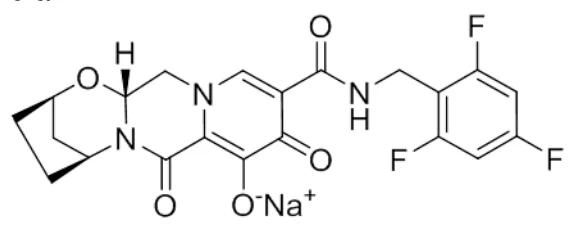
Physicochemical Properties:
Description: Bictegravir sodium is an off-white to yellow solid.
Solubility: The solubility is approximately 0.1 mg per mL in water at 20°C. The partition coefficient (log P) is 1.45 and the pKa is 8.6.
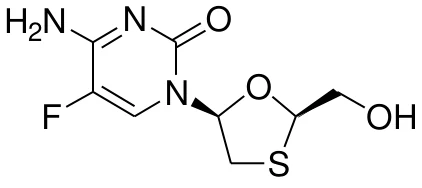
Emtricitabine
Drug Substance
Common Name: emtricitabine (USAN)
Chemical Name: 5-fluoro-1-(2R,5S)-[2-(hydroxymethyl)-1,3-oxathiolan-5-yl]cytosine
Empirical Formula: C8H10FN3O3S
Molecular Weight: 247.24
Structural Formula:
Physicochemical Properties:
Description: FTC is a white to off-white crystalline powder.
Solubility: The solubility is approximately 112 mg/mL in water at 25 °C. The partition coefficient (log P) is −0.43 and the pKa is 2.65.
Tenofovir alafenamide
Drug Substance
Common Name: Tenofovir alafenamide hemifumarate Tenofovir alafenamide fumarate (USAN)
Chemical Name: Propan-2-yl N-[(S)-({[(2R)-1-(6-amino-9H-purin-9-yl)propan-2-yl]-oxy}methyl)(phenoxy)phosphoryl]-l-alaninate, (2E)-but-2-enedioate (2:1)
Empirical Formula: C21H29O5N6P•1/2(C4H4O4)
C21H29O5N6P (tenofovir alafenamide free base)
Molecular Weight: 534.5
476.5 (tenofovir alafenamide free base)
Structural Formula:
Physicochemical Properties:
Description: TAF hemifumarate is a white to off-white or tan powder.
Solubility: The solubility of TAF hemifumarate in water, pH 8.0 (50 mM phosphate buffer) at 20 °C is 4.86 mg/mL. The partition coefficient (log P) is 1.6 and the pKa is 3.96.
14 CLINICAL TRIALS
The efficacy and safety of BIKTARVY were evaluated in the studies summarized in Table 15.
14.1 Clinical Trials by Indications
HIV-1 With No Known Substitution Associated with Resistance to Bictegravir or Tenofovir
Table 15 Trials Conducted with BIKTARVY in Participants with HIV-1 Infection
| Trial | Population | Study Arms (N) | Timepoint (Week) |
|---|---|---|---|
| Study 1489a | Treatment-naïve adults | BIKTARVY (314) ABC/DTG/3TC (315) | 144 + 96 (OLE)b |
| Study 1490a | BIKTARVY (320) DTG + FTC/TAF (325) | 144 + 96 (OLE)b | |
| Study 1844a | Virologically-suppressedd adults | BIKTARVY (282) ABC/DTG/3TC (281) | 48 |
| Study 1878c | BIKTARVY (290) ATV or DRV (with cobicistat or ritonavir) plus either FTC/TDF or ABC/3TC (287) | 48 | |
| Study 4030a | BIKTARVY (284 [47 with M184V/I at baseline]) DTG plus FTC/TAF (281 [34 with M184V/I at baseline]) | 48 | |
Study 1474e Cohort 1 | Virologically-suppressedd adolescents (Cohort 1: 12 to < 18 years of age; weight ≥ 35 kg | BIKTARVY (50) | 48 |
Study 1474e Cohort 2 | Virologically-suppressedd children (Cohort 2: 6 to < 12 years of age; weight ≥ 25 kg | BIKTARVY (50) | 24 |
| Study 1825 | Virologically suppressedd adults with ESRDf receiving chronic hemodialysis | FTC+TAF in combination with EVG and COBI as a fixed-dose combination (55). In an extension phase of Study 1825, 10 virologically suppressed participants switched to BIKTARVY. | 48g |
| Study 4449 | Virologically suppressedd adults aged 65 years and over | BIKTARVY (86) | 48 |
OLE = open-label extension
a. Randomized, double blind, active controlled trial.
b. 144-week double-blind active controlled phase followed by an extension phase in which 1025 participants from Studies 1489 and 1490 were given the option to switch to open- label BIKTARVY for 96 weeks.
c. Randomized, open label, active controlled trial.
d. HIV-1 RNA less than 50 copies per mL.
e. Open label trial
f. End stage renal disease (eGFR of less than 15 mL per minute by Cockcroft-Gault method).
g. Participants received FTC+TAF in combination with elvitegravir and cobicistat for 96 weeks, followed by an extension phase in which 10 participants received BIKTARVY for 48 weeks.
Treatment-Naïve HIV-1 Infected Adults
The efficacy and safety of BIKTARVY in HIV-1 infected, treatment-naïve adults are based on 48-week data from two randomized, double-blind, active-controlled studies, GS-US- 380-1489 (N=629) and GS-US-380-1490 (N=645). The efficacy and safety of BIKTARVY is also supported by data from participants who received open-label BIKTARVY (N=1025) after Week 144 in an optional extension phase of Studies 1489 and 1490, for an additional 96 weeks, up to Week 240 (end of study).
In Study 1489, participants were randomized in a 1:1 ratio to receive either BIKTARVY (N=314) or ABC/DTG/3TC (600/50/300 mg) (N=315) once daily. In Study 1490, participants were randomized in a 1:1 ratio to receive either BIKTARVY (N=320) or DTG + FTC/TAF (50+200/25 mg) (N=325) once daily.
In Study 1489, the mean age was 34 years (range 18–71), 90% were male, 57% were White, 36% were Black, and 3% were Asian. 22% of participants identified as Hispanic or Latino. The mean baseline plasma HIV-1 RNA was 4.4 log10 copies/mL (range 1.3-6.5). The mean baseline CD4+ cell count was 464 cells per mm3 (range 0-1424) and 11% had CD4+ cell counts less than 200 cells per mm3. 16% of participants had baseline viral loads greater than 100,000 copies per mL.
In Study 1489, 0.6% of participants had HIV/HCV coinfection at baseline. In Study 1490, the mean age was 37 years (range 18-77), 88% were male, 59% were White, 31% were Black, and 3% were Asian. 25% of participants identified as Hispanic or Latino. The mean baseline plasma HIV-1 RNA was 4.4 log10 copies/mL (range 2.3-6.6). The mean baseline CD4+ cell count was 456 cells per mm3 (range 2-1636), and 12% had CD4+ cell counts less than 200 cells per mm3. 19% of participants had baseline viral loads greater than 100,000 copies per mL. In Study 1490, 2% of participants had HIV/HBV coinfection and 2% had HIV/HCV coinfection at baseline.
In both studies, participants were stratified by baseline HIV-1 RNA (less than or equal to 100,000 copies/mL, greater than 100,000 copies per mL to less than or equal to 400,000 copies per mL, or greater than 400,000 copies/mL), by CD4 count (less than 50 cells/μL, 50-199 cells/μL, or greater than or equal to 200 cells/μL), and by region (US or ex-US).
For demographic and baseline characteristics for Study 1489 and 1490, see Table 16.
Table 16 Demographic and Baseline Characteristics of Treatment-Naïve Participants in Studies 1489 and 1490
| Study 1489 | Study 1490 | |||||||||||||||||||||||||||
BIKTARVY N = 314 n (%) | ABC/DTG/3TC N = 315 n (%) | Total N = 629 n (%) | BIKTARVY N=320 n (%) | DTG + F/TAF N=325 n (%) | Total N=645 n (%) | |||||||||||||||||||||||
| Demographic characteristics | ||||||||||||||||||||||||||||
| Median age, years (range) | 31 (18-71) | 32 (18-68) | 32 (18-71) | 33 (18-71) | 34 (18-77) | 34 (18-77) | ||||||||||||||||||||||
| Sex | ||||||||||||||||||||||||||||
| Male | 285 (91) | 282 (90) | 567 (90) | 280 (88) | 288 (89) | 568 (88) | ||||||||||||||||||||||
| Female | 29 (9) | 33 (10) | 62 (10) | 40 (13) | 37 (11) | 77 (12) | ||||||||||||||||||||||
| Race | ||||||||||||||||||||||||||||
| American Indian or Alaska Native | 2 (0.6) | 4 (1) | 6 (1) | 1 (0.3) | 1 (0.3) | 2 (0.3) | ||||||||||||||||||||||
| Asian | 6 (2) | 10 (3) | 16 (3) | 7 (2) | 10 (3) | 17 (3) | ||||||||||||||||||||||
| 114 (37) | 112 (36) | 226 (36) | 97 (30) | 100 (31) | 197 (31) | |||||||||||||||||||||||
| Native Hawaiian or Pacific Islander | 1 (0.3) | 2 (0.6) | 3 (0.5) | 1 (0.3) | 0 | 1 (0.2) | ||||||||||||||||||||||
| White | 180 (58) | 179 (57) | 359 (57) | 183 (57) | 195 (60) | 378 (59) | ||||||||||||||||||||||
| Other | 9 (3) | 8 (3) | 17 (3) | 31 (10) | 19 (6) | 50 (8) | ||||||||||||||||||||||
| Not Permitteda | 2 | 0 | 2 | - | - | - | ||||||||||||||||||||||
| Baseline disease characteristics | ||||||||||||||||||||||||||||
| Median baseline HIV-1 RNA log10 copies/mL (range) | 4.42 (2.23-6.52) | 4.51 (1.28-6.19) | 4.47 (1.28-6.52) | 4.43 (2.29-6.58) | 4.45 (2.76-6.15) | 4.44 (2.29-6.58) | ||||||||||||||||||||||
| Participants with viral load ≤ 100,000 copies/mL | 261 (83) | 265 (84) | 526 (84) | 254 (79) | 271 (83) | 525 (81) | ||||||||||||||||||||||
| Participants with viral load > 100,000 copies/mL | 53 (17) | 50 (16) | 103 (16) | 66 (21) | 54 (17) | 120 (19) | ||||||||||||||||||||||
| Participants with CD4+ cell counts < 200 cells/mm3 | 36 (11) | 32 (10) | 68 (11) | 44 (14) | 34 (10) | 78 (12) | ||||||||||||||||||||||
| HIV disease status | ||||||||||||||||||||||||||||
| Asymptomatic | 286 (91) | 286 (91) | 572 (91) | 286 (89) | 288 (89) | 574 (89) | ||||||||||||||||||||||
| Study 1489 | Study 1490 | ||||||||||||||||||||||||
BIKTARVY N = 314 n (%) | ABC/DTG/3TC N = 315 n (%) | Total N = 629 n (%) | BIKTARVY N=320 n (%) | DTG + F/TAF N=325 n (%) | Total N=645 n (%) | ||||||||||||||||||||
| Symptomatic HIV infection | 16 (5) | 14 (4) | 30 (5) | 10 (3) | 11 (3) | 21 (3) | |||||||||||||||||||
| AIDS | 12 (4) | 15 (5) | 27 (4) | 24 (8) | 26 (8) | 50 (8) | |||||||||||||||||||
| eGFRCG (mL/min), median (Q1, Q3) | 125.9 (107.7, 146.3) | 123.0 (107.0, 144.3) | 124.8 (107.6, 145.2) | 120.4 (100.8, 141.8) | 120.6 (102.8, 145.1) | 120.6 (102.1, 143.3) | |||||||||||||||||||
| HIV/HBV Coinfection Statusb | |||||||||||||||||||||||||
| Yes | 0 | 0 | 0 | 8 (3) | 6 (2) | 14 (2) | |||||||||||||||||||
| No | 313 (100) | 312 (100) | 625 (100) | 310 (97) | 318 (98) | 628 (98) | |||||||||||||||||||
| Missing | 1 | 3 | 4 | 2 | 1 | 3 | |||||||||||||||||||
| HIV/HCV Coinfection Statusb | |||||||||||||||||||||||||
| Yes | 0 | 4 (1) | 4 (0.6) | 5 (2) | 5 (2) | 10 (2) | |||||||||||||||||||
| No | 313 (100) | 311 (99) | 624 (99) | 315 (98) | 320 (98) | 635 (98) | |||||||||||||||||||
| Missing | 1 | 0 | 1 | - | - | - | |||||||||||||||||||
- a.
Not Permitted = Local regulators did not allow collection of race or ethnicity information.
For race and ethnicity, participants who reported "Not Permitted" were excluded from the percentage and p-value calculation.
- b. HIV/HBV and HIV/HCV coinfection status were missing when test was not done at screening.
Treatment outcomes of Studies 1489 and 1490 through 48 and 144 weeks are presented in Table 17.
Table 17 Virologic Outcomes of Randomized Treatment in Studies 1489 and 1490 at Weeks 48a and 144b in Treatment-Naïve Participants
| Week 48 | Week 144 | ||||||||||||||||||||||||||
|---|---|---|---|---|---|---|---|---|---|---|---|---|---|---|---|---|---|---|---|---|---|---|---|---|---|---|---|
| Study 1489 | Study 1490 | Study 1489 | Study 1490 | ||||||||||||||||||||||||
| BIKTARVY (N=314) | ABC/DTG/ 3TC (N=315) | BIKTARVY (N=320) | DTG + FTC/TAF (N=325) | BIKTARVY (N=314) | ABC/DTG/ 3TC (N=315) | BIKTARVY (N=320) | DTG + FTC/TAF (N=325) | ||||||||||||||||||||
| HIV-1 RNA < 50 copies/mL | 92% | 93% | 89% | 93% | 82% | 84% | 82% | 84% | |||||||||||||||||||
| Treatment Difference (95% CI) BIKTARVY vs. Comparator | -0.6% (-4.8% to 3.6%) | -3.5% (-7.9% to 1.0%) | −2.6% (−8.5% to 3.4%) | −1.9% (−7.8% to 3.9%) | |||||||||||||||||||||||
| HIV-1 RNA ≥ 50 copies/mLc | 1% | 3% | 4% | 1% | <1% | 3% | 5% | 3% | |||||||||||||||||||
| No Virologic Data at Week 48 or Week 144 Window | 7% | 4% | 6% | 6% | 18% | 13% | 13% | 13% | |||||||||||||||||||
| Discontinued Study Drug Due to AE or Deathd | 0 | 1% | 1% | 1% | <1% | 2% | 3% | 3% | |||||||||||||||||||
| Discontinued Study Drug Due to Other Reasons and Last Available HIV-1 RNA <50 copies/mLe | 5% | 3% | 3% | 4% | 16% | 11% | 11% | 9% | |||||||||||||||||||
| Missing Data During Window but on Study Drug | 2% | <1% | 2% | 1% | 1% | <1% | 0 | 1% | |||||||||||||||||||
a Week 48 window was between Day 295 and 378 (inclusive).
b. Week 144 window was between Day 967 and 1050 (inclusive).
c. Includes participants who had ≥ 50 copies/mL in the Week 48 window; participants who discontinued early due to lack or loss of efficacy; participants who discontinued for reasons other than an adverse event (AE), death or lack or loss of efficacy and at the time of discontinuation had a viral value of ≥ 50 copies/mL.
d. Includes participants who discontinued due to AE or death at any time point from Day 1 through the time window if this resulted in no virologic data on treatment during the specified window.
e. Includes participants who discontinued for reasons other than an AE, death, or lack or loss of efficacy, e.g., withdrew consent, loss to follow-up, etc
BIKTARVY was noninferior in achieving HIV-1 RNA less than 50 copies per mL at Weeks 48, 96 and 144 when compared to ABC/DTG/3TC and to DTG+FTC/TAF, respectively. In Study 1489, 88% of participants who received BIKTARVY versus 90% of participants who received ABC/DTG/3TC, had HIV RNA <50 copies/mL at Week 96. At Week 96, 1% of participants who received BIKTARVY had HIV-1 RNA ≥50 copies/mL versus 2% in those who received ABC/DTG/3TC. The percentage of participants with no virologic data at the Week 96 window was 12% and 8% for those who received BIKTARVY and ABC/DTG/3TC, respectively. In Study 1490, 84% of participants who received BIKTARVY versus 87% of participants who received DTG+FTC/TAF, had HIV RNA <50 copies/mL at Week 96. At Week 96, 4% of participants who received BIKTARVY had HIV-1 RNA ≥50 copies/mL versus 3% in those who received DTG+FTC/TAF. The percentage of participants with no virologic data at the Week 96 window was 12% and 11% for those who received BIKTARVY and DTG+FTC/TAF, respectively. Treatment outcomes between treatment groups were similar across subgroups by age, sex, race, baseline viral load, and baseline CD4+ cell count up to Week 144 in both studies.
In Study 1489, the mean increase from baseline in CD4+ was 233 and 229 cells per mm3, at Week 48, 287 and 288 cells per mm3 at Week 96, and 299 and 317 cells per mm3 at Week 144, in the BIKTARVY and ABC/DTG/3TC groups, respectively. In Study 1490, the mean increase from baseline in CD4+ count was 180 and 201 cells per mm3 at Week 48, 237 and 281 cells per mm3 at Week 96, and 278 and 289 cells per mm3 at Week 144, in the BIKTARVY and DTG+FTC/TAF groups, respectively.
The final analysis of the pooled data from the OLE phase showed continuation of viral suppression and increases in CD4 cell counts. At Week 240 (OL Week 96), 98% (208/213) and 99.5% (218/219) of participants who remained on BIKTARVY in Studies 1489 and 1490, respectively, had HIV-1 RNA < 50 copies/mL based on missing = excluded analysis to impute missing values. Based on missing = failure analysis to impute missing values, 66% (208/314) and 68% (218/320) of participants who remained on BIKTARVY in Studies 1489 and 1490, respectively, had HIV-1 RNA < 50 copies/mL.
HIV-1 Virologically-Suppressed Adults Who Switched to BIKTARVY
In Study 1844, the efficacy and safety of switching from a regimen of DTG + ABC/3TC or ABC/DTG/3TC to BIKTARVY were evaluated in a randomized, double-blind study of virologically-suppressed (HIV-1 RNA less than 50 copies per mL) HIV-1 infected adults (N=563). Participants must have been stably suppressed (HIV-1 RNA less than 50 copies per mL) on their baseline regimen for at least 3 months prior to study entry. Participants were randomized in a 1:1 ratio to either switch to BIKTARVY at baseline (N=282), or stay on their baseline antiretroviral regimen as the FDC of ABC/DTG/3TC (N=281). Participants had a mean age of 45 years (range 20–71), 89% were male, 73% were White, and 22% were Black. 17% of participants identified as Hispanic/Latino. The mean baseline CD4+ cell count was 723 cells per mm3 (range 124–2444). At baseline, one participant had HIV/HCV coinfection.
In Study 1878, the efficacy and safety of switching from either ABC/3TC or FTC/TDF (200/300 mg) plus ATV or DRV (given with either cobicistat or ritonavir) to BIKTARVY were evaluated in a randomized, open-label study of virologically-suppressed HIV-1 infected adults (N=577). Participants must have been stably suppressed on their baseline regimen for at least 6 months and must not have been previously treated with any INSTI. Participants were randomized in a 1:1 ratio to either switch to BIKTARVY (N=290) or stay on their baseline antiretroviral regimen
(N=287). Participants had a mean age of 46 years (range 20–79), 83% were male, 66% were White, and 26% were Black. 19% of participants identified as Hispanic/Latino. The mean baseline CD4+ cell count was 663 cells per mm3 (range 62–2582). Participants were stratified by prior treatment regimen (ie, TDF-containing regimen vs non-TDF containing regimen). At screening, 15% of participants were receiving ABC/3TC plus ATV or DRV (given with either cobicistat or ritonavir) and 85% of participants were receiving FTC/TDF plus ATV or DRV (given with either cobicistat or ritonavir). At baseline, 2% of participants had HIV/HBV coinfection and 2% had HIV/HCV coinfection.
For demographic and baseline characteristics for Studies 1844 and 1878, see Error! Reference source not found..
In Study 4030, the efficacy and safety of switching from a regimen of DTG plus either FTC/TAF or FTC/TDF to BIKTARVY were evaluated in a randomized, double-blind study of virologically suppressed HIV-1 infected adults. Participants must have been stably suppressed (HIV-1 RNA less than 50 copies per mL) on their baseline regimen for at least 6 months (if documented or suspected NRTI resistance), or at least 3 months (if no documented or suspected NRTI resistance) prior to trial entry. Participants were randomized to switch to BIKTARVY (N=284) or to continue on DTG+FTC/TAF (N=281). Participants had a mean age of 50 years (range 20-79), 85.8% were male, 71.3% were White, and 23% were Black. 19.7% of participants identified as Hispanic/Latino. The mean baseline CD4+ cell count was 686 cells per mm3 (range 18 -1889). At baseline, 35 participants had symptomatic HIV infection, and 63 had AIDS. The number of participants with HIV/HBV coinfection and HIV/HCV coinfection were 20 and 6, respectively. Of the participants receiving BIKTARVY, 47 had HIV-1 with the FTC-associated M184V/I resistance mutation at baseline. The primary endpoint was the proportion of participants with HIV-1 RNA ≥ 50 copies/mL at Week 48.
Table 18 Demographic and Baseline Characteristics of Virologically Suppressed Participants in Studies 1844 and 1878
| Study 1844 | Study 1878 | ||||||||||||||||||||||||||
BIKTARVY N = 282 n (%) | ABC/DTG/3TC N = 281 n (%) | Total N = 563 n (%) | BIKTARVY N=290 n (%) | SBR N=287 n (%) | Total N=577 n (%) | ||||||||||||||||||||||
| Demographic characteristics | |||||||||||||||||||||||||||
| Median age, years (range) | 47 (21-71) | 45 (20-70) | 46 (20-71) | 48 (20-74) | 47 (21-79) | 48 (20-79) | |||||||||||||||||||||
| Sex | |||||||||||||||||||||||||||
| Male | 247 (88) | 252 (90) | 499 (89) | 243 (84) | 234 (82) | 477 (83) | |||||||||||||||||||||
| Female | 35 (12) | 29 (10) | 64 (11) | 47 (16) | 53 (18) | 100 (17) | |||||||||||||||||||||
| Race | |||||||||||||||||||||||||||
| American Indian or Alaska Native | 2 (0.7) | 2 (0.7) | 4 (0.7) | 3 (1) | 3 (1) | 6 (1) | |||||||||||||||||||||
| Asian | 9 (3) | 9 (3) | 18 (3) | 6 (2) | 10 (3) | 16 (3) | |||||||||||||||||||||
| 59 (21) | 62 (22) | 121 (22) | 79 (27) | 72 (25) | 151 (26) | ||||||||||||||||||||||
| Native Hawaiian or Pacific Islander | 3 (1) | 0 | 3 (0.5) | 0 | 0 | 0 | |||||||||||||||||||||
| White | 206 (73) | 202 (73) | 408 (73) | 188 (65) | 190 (66) | 378 (66) | |||||||||||||||||||||
| Other | 3 (1) | 3 (1) | 6 (1) | 14 (5) | 12 (4) | 26 (5) | |||||||||||||||||||||
| Not Permitteda | 0 | 3 | 3 | - | - | - | |||||||||||||||||||||
| Baseline disease characteristics | |||||||||||||||||||||||||||
| Participants with CD4+ cell counts < 200 cells/mm3 | 6 (2) | 4 (1) | 10 (2) | 4 (1) | 8 (3) | 12 (2) | |||||||||||||||||||||
| CD4 cell count (cells/mm3), median (range) | 732 (124-2444) | 661 (125-1570) | 695 (124-2444) | 617 (147-2582) | 626 (62-1684) | 624 (62-2582) | |||||||||||||||||||||
| HIV disease status | |||||||||||||||||||||||||||
| Asymptomatic | 243 (86) | 245 (87) | 488 (87) | 240 (83) | 234 (82) | 474 (82) | |||||||||||||||||||||
| Symptomatic HIV infection | 9 (3) | 9 (3) | 18 (3) | 16 (6) | 20 (7) | 36 (6) | |||||||||||||||||||||
| AIDS | 30 (11) | 27 (10) | 57 (10) | 34 (12) | 33 (11) | 67 (12) | |||||||||||||||||||||
| Study 1844 | Study 1878 | |||||||||||||||||||||||
BIKTARVY N = 282 n (%) | ABC/DTG/3TC N = 281 n (%) | Total N = 563 n (%) | BIKTARVY N=290 n (%) | SBR N=287 n (%) | Total N=577 n (%) | |||||||||||||||||||
| eGFRCG (mL/min), median (Q1, Q3) | 100.5 (84.5, 119.0) | 100.7 (84.9, 122.4) | 100.7 (84.6, 120.1) | 106.7 (87.0, 124.2) | 104.9 (87.1, 125.3) | 105.6 (87.1, 124.8) | ||||||||||||||||||
| HIV/HBV Coinfection Statusb | ||||||||||||||||||||||||
| Yes | 0 | 0 | 0 | 8 (3) | 6 (2) | 14 (2) | ||||||||||||||||||
| No | 282 (100) | 281 (100) | 563 (100) | 278 (97) | 280 (98) | 558 (98) | ||||||||||||||||||
| Missing | - | - | - | 4 | 1 | 5 | ||||||||||||||||||
| HIV/HCV Coinfection Statusb | ||||||||||||||||||||||||
| Yes | 0 | 1 (0.4) | 1 (0.2) | 5 (2) | 5 (2) | 10 (2) | ||||||||||||||||||
| No | 282 (100) | 280 (100) | 562 (100) | 283 (98) | 282 (98) | 565 (98) | ||||||||||||||||||
| Missing | - | - | - | 2 | 0 | 2 | ||||||||||||||||||
- a.
Not Permitted = Local regulators did not allow collection of race or ethnicity information.
For race and ethnicity, participants who reported "Not Permitted" were excluded from the percentage and p-value calculation.
- b. HIV/HBV and HIV/HCV coinfection status were missing when test was not done at screening.
Treatment outcomes of Studies 1844 and 1878 through Week 48 are presented in Table 19.
Table 19 Virologic Outcomes of Studies 1844 and 1878 at Week 48a in Virologically-Suppressed Participants who Switched to BIKTARVY
| Study 1844 | Study 1878 | ||||||||||
|---|---|---|---|---|---|---|---|---|---|---|---|
| BIKTARVY (N=282) | ABC/DTG/3TC (N=281) | BIKTARVY (N=290) | ATV- or DRV-based regimen (N=287) | ||||||||
| HIV-1 RNA ≥ 50 copies/mLb | 1% | <1% | 2% | 2% | |||||||
Treatment Difference (95% CI) | 0.7% (-1.0% to 2.8%) | 0.0% (-2.5% to 2.5%) | |||||||||
| HIV-1 RNA < 50 copies/mL | 94% | 95% | 92% | 89% | |||||||
Treatment Difference (95% CI) | -1.4% (-5.5% to 2.6%) | 3.2% (-1.6% to 8.2%) | |||||||||
| Study 1844 | Study 1878 | ||||||||||
|---|---|---|---|---|---|---|---|---|---|---|---|
| BIKTARVY (N=282) | ABC/DTG/3TC (N=281) | BIKTARVY (N=290) | ATV- or DRV-based regimen (N=287) | ||||||||
| No Virologic Data at Week 48 Window | 5% | 5% | 6% | 9% | |||||||
| Discontinued Study Drug Due to AE or Death and Last Available HIV-1 RNA < 50 copies/mL | 2% | 1% | 1% | 1% | |||||||
| Discontinued Study Drug Due to Other Reasons and Last Available HIV-1 RNA < 50 copies/mLc | 2% | 3% | 3% | 7% | |||||||
| Missing Data During Window but on Study Drug | 2% | 1% | 2% | 2% | |||||||
a. Week 48 window was between Day 295 and 378 (inclusive).
b. Includes participants who had ≥ 50 copies/mL in the Week 48 window; participants who discontinued early due to lack or loss of efficacy; participants who discontinued for reasons other than lack or loss of efficacy and at the time of discontinuation had a viral value of ≥ 50 copies/mL.
c. Includes participants who discontinued for reasons other than an AE, death, or lack or loss of efficacy, e.g., withdrew consent, loss to follow-up, etc.
In Study 1844, at Week 48, switching to BIKTARVY was noninferior to remaining on ABC/DTG/3TC with respect to the percentage of participants with HIV-1 RNA ≥ 50 copies/mL and the percentage of participants who maintained HIV-1 RNA < 50 copies/mL. Treatment outcomes between treatment groups were similar across subgroups by age, sex, race, and region. The mean change from baseline in CD4+ count at Week 48 was -31 cells/mm3 in participants who switched to BIKTARVY and 4 cells/mm3 in participants who stayed on their baseline antiretroviral regimen as the FDC ABC/DTG/3TC.
In Study 1878, at Week 48, switching to BIKTARVY was noninferior to remaining on an ATV- or DRV-based regimen with respect to the percentage of participants with HIV-1 RNA ≥ 50 copies/mL and the percentage of participants who maintained HIV-1 RNA < 50 copies/mL. Treatment outcomes between treatment groups were similar across subgroups by age, sex, race, and region. The mean change from baseline in CD4+ count at Week 48 was 25 cells/mm3 in participants who switched to BIKTARVY and 0 cells/mm3 in participants who stayed on their baseline regimen.
In Study 4030, at Week 48, switching to BIKTARVY was noninferior to maintaining DTG+FTC/TAF; the proportion of participants with HIV-1 RNA ≥50 copies/mL was 0.4% (1/284) in the BIKTARVY group and 1.1% (3/281) in the DTG+F/TAF group (difference -0.7% [95%CI: -2.8%, 1.0%]). In the BIKTARVY group, 93.3% (265/284) remained suppressed (HIV <50 copies/mL) and 6.3% (18/284) did not have virologic data at Week 48 due to study drug discontinuation. Treatment outcomes between treatment groups were similar across subgroups by age, sex, race, region, study drug adherence, and baseline resistance, including preexisting M184V/I. Preexisting M184V or I at baseline had no impact on virologic response to BIKTARVY at Week 48. Eighty-nine percent (42/47) of participants with M184V/I remained suppressed
(HIV-1 RNA < 50 copies/mL) and 11% (5/47 participants) did not have virologic data at Week 48 due to discontinuation.
Bone Mineral Density:
In Study 1489, bone mineral density (BMD) change from baseline to Week 144 was assessed by dual-energy X-ray absorptiometry (DXA). In participants who had both baseline and Week 144 hip and lumbar spine BMD measurements (n=236 and 243 in the BIKTARVY group and n=240 and 244 in the ABC/DTG/3TC group, for hip and lumbar spine, respectively), mean percentage changes in BMD were similar in the BIKTARVY group compared to the ABC/DTG/3TC group for hip (−1.0% vs. −1.3%) and lumbar spine (−0.4% vs. 0.04%). These results were consistent in the OLE phase; among participants initially randomized to BIKTARVY, the mean percentage change in hip and lumbar spine BMD from baseline to Week 240 were -0.3% (n=197) and -0.2% (n=201), respectively.
In Study 1844, BMD change from baseline to Week 48 was assessed by DXA. In participants who had both baseline and Week 48 hip and lumbar spine BMD measurements (N=229 and 233 in the BIKTARVY group and N=242 and 244 in the ABC/DTG/3TC group, for hip and lumbar spine, respectively), mean percentage increases in BMD were similar in the BIKTARVY group compared to the ABC/DTG/3TC group for hip (0.2% vs. 0.3%) and lumbar spine (0.7% vs.0.4%).
Effects on Renal Parameters
No participants receiving BIKTARVY in the Phase 3 studies developed proximal tubulopathy (including Fanconi Syndrome) or discontinued study drugs due to a renal and urinary disorder or associated investigation AE.
Pediatric Participants
In Study 1474, an open-label, single arm trial the efficacy, safety, and pharmacokinetics of BIKTARVY in HIV-1 infected pediatric participants were evaluated in virologically-suppressed adolescents between the ages of 12 to less than 18 years weighing at least 35 kg (N=50) and in virologically-suppressed children between the ages of 6 to less than 12 years weighing at least 25 kg (N=50). Demographics and baseline characteristics for participants in the 2 study cohorts (Cohort 1: virologically suppressed adolescents [12 to < 18 years; ≥ 35 kg]; Cohort 2: virologically suppressed children [6 to < 12 years; ≥ 25 kg]) are presented in Table 20.
Table 20 Demographic and Baseline Characteristics of Virologically Suppressed Pediatric Participants in Study 1474 (Cohort 1 and Cohort 2)
| Study 1474 | ||||||||||||||
|---|---|---|---|---|---|---|---|---|---|---|---|---|---|---|
Cohort 1 12 to < 18 years of age (N=50) | Cohort 2 6 to < 12 years of age (N=50) | |||||||||||||
| Demographic characteristics | ||||||||||||||
| Median age, years (range) | 15 (12-17) | 10 (6-11) | ||||||||||||
| Sex | ||||||||||||||
| Male | 18 | 23 | ||||||||||||
| Female | 32 | 27 | ||||||||||||
| Race | ||||||||||||||
| Asian | 13 | 11 | ||||||||||||
| 32 | 36 | |||||||||||||
| Baseline BMI (kg/m2), median (Q1, Q3) | 19.1 (17.8, 22.4) | 16.7 (15.6, 18.7) | ||||||||||||
| Baseline disease characteristics | ||||||||||||||
| HIV-1 RNA Category (copies/mL) | ||||||||||||||
| < 50 | 50 | 50 | ||||||||||||
| ≥ 50 | 0 | 0 | ||||||||||||
| CD4 cell count (cells/μL), median (Q1, Q3) | 750 (586, 926) | 898 (707, 1121) | ||||||||||||
| eGFR by Schwartz formula (mL/min/1.73 m2), median (Q1, Q3) | 145.0 (134.0, 170.0) | 153.5 (144.0, 173.0) | ||||||||||||
Cohort 1: Virologically suppressed adolescents (12 to < 18 years; ≥ 35 kg):
After switching to BIKTARVY, 98% (49/50) of participants in Cohort 1 remained suppressed (HIV-1 RNA < 50 copies/mL) at Week 48. The mean change from baseline in CD4+ cell count at Week 48 was -22 cells/mm3. Two of 50 participants met the criteria for inclusion in the resistance analysis population through Week 48. No emergent resistance to BIKTARVY was detected through Week 48.
Cohort 2: Virologically suppressed children (6 to < 12 years; ≥ 25 kg):
After switching to BIKTARVY, 100% (50/50) of participants in Cohort 2 remained suppressed (HIV-1 RNA < 50 copies/mL) at Week 24. The mean change from baseline in CD4+ cell count at Week 24 was -24 cells/mm3. No participant qualified for resistance analysis through Week 24.
HIV-1 Infected Adults with Renal Impairment
In Study 1825, an open-label single arm study, the efficacy, safety, and pharmacokinetics of FTC and TAF (components of BIKTARVY) were evaluated in virologically suppressed adults with ESRD (eGFR of less than 15 mL/min) on chronic hemodialysis treated with FTC + TAF in combination with EVG and COBI as a fixed-dose combination tablet for 96 weeks (N = 55). In an extension phase of Study 1825, 10 virologically suppressed participants switched to BIKTARVY and all participants remained virologically suppressed (HIV-1 RNA < 50 copies/mL) for 48 weeks.
HIV-infected Adults over 65 years of age
In Study 4449, the efficacy and safety of switching from a stable antiretroviral regimen to BIKTARVY were evaluated in an open-label, single arm study of virologically suppressed (HIV-1 RNA less than 50 copies per mL) HIV-1 infected adults aged 65 years and over (N = 86). Participants treated with BIKTARVY had a mean age of 70 years (range: 65 to 80). No participants had HIV RNA > 50 copies/mL at Weeks 24 and 48. Ninety-eight percent (84/86) and 91% (78/86) of participants remained suppressed (HIV-1 RNA < 50 copies/mL) at Week 24 and Week 48, respectively. Two and 8 participants did not have virologic data due to discontinuation or missing data at the Week 24 and Week 48 timepoints, respectively.
15 MICROBIOLOGY
Antiviral Activity in Cell Culture
The triple combination of BIC, FTC, and TAF demonstrated synergistic antiviral activity in cell culture.
Bictegravir: The antiviral activity of BIC against laboratory and clinical isolates of HIV-1 was assessed in lymphoblastoid cell lines, PBMCs, primary monocyte/macrophage cells, and CD4+ T-lymphocytes. The EC50 values for BIC were in the range of <0.05 to 6.6 nM. The protein-adjusted EC95 of BIC was 361 nM (0.162 micrograms per mL) for wild type HIV-1 virus. Bictegravir displayed antiviral activity in cell culture against HIV-1 groups (M, N, O), including subtypes A, B, C, D, E, F and G (EC50 values ranged from <0.05 and 1.71 nM), and activity against HIV-2 (EC50 = 1.1 nM).
In a study of BIC with representatives from the major classes of approved anti-HIV agents (NRTIs [nucleoside reverse transcriptase inhibitors], NNRTIs [non-nucleoside reverse transcriptase inhibitors], INSTIs, and PIs [protease inhibitors]), additive to synergistic antiviral effects were observed. No antagonism was observed for these combinations.
Emtricitabine: The antiviral activity of FTC against laboratory and clinical isolates of HIV-1 was assessed in T lymphoblastoid cell lines, the MAGI-CCR5 cell line, and primary peripheral blood mononuclear cells. The EC50 values for FTC were in the range of 0.0013–0.64 μM.
FTC displayed antiviral activity in cell culture against HIV-1 clades A, B, C, D, E, F, and G (EC50 values ranged from 0.007–0.075 μM) and showed strain specific activity against HIV-2 (EC50 values ranged from 0.007–1.5 μM).
In two-drug combination studies of FTC with NRTIs, NNRTIs, protease inhibitors (PIs), and INSTIs, additive to synergistic effects were observed. No antagonism was observed for these combinations.
Tenofovir Alafenamide: The antiviral activity of TAF against laboratory and clinical isolates of HIV-1 subtype B was assessed in lymphoblastoid cell lines, PBMCs, primary
monocyte/macrophage cells and CD4-T lymphocytes. The EC50 values for TAF ranged from 2.0 to 14.7 nM.
TAF displayed antiviral activity in cell culture against all HIV-1 groups (M, N, O), including sub-types A, B, C, D, E, F, and G (EC50 values ranged from 0.10 to 12.0 nM) and strain specific activity against HIV-2 (EC50 values ranged from 0.91 to 2.63 nM).
In a study of TAF with a broad panel of representatives from the major classes of approved anti-HIV agents (NRTIs, NNRTIs, INSTIs, and PIs), additive to synergistic effects were observed. No antagonism was observed for these combinations.
Resistance
In Cell Culture
Bictegravir: HIV-1 isolates with reduced susceptibility to BIC have been selected in cell culture. In one selection, amino acid substitutions M50I and R263K emerged and phenotypic susceptibility to BIC was reduced 1.3-, 2.2-, and 2.9-fold for M50I, R263K, and M50I+R263K, respectively. In a second selection, amino acid substitutions T66I and S153F emerged and phenotypic susceptibility to BIC was shifted 0.4-, 1.9-, and 0.5-fold for T66I, S153F, and T66I+S153F, respectively.
Emtricitabine: HIV-1 isolates with reduced susceptibility to FTC were selected in cell culture. Reduced susceptibility to FTC was associated with M184V or I substitutions in HIV-1 RT.
Tenofovir Alafenamide: HIV-1 isolates with reduced susceptibility to TAF have been selected in cell culture. HIV-1 isolates selected by TAF expressed a K65R substitution in HIV-1 RT; in addition, a K70E mutation in HIV-1 RT has been transiently observed. HIV-1 isolates with the K65R mutation have low level reduced susceptibility to abacavir, FTC, tenofovir, and lamivudine. In vitro drug resistance selection studies with TAF have shown no development of resistance increases above 2.5-fold after 6 months in culture.
In Clinical Trials
In Treatment-Naïve Participants:
No participants receiving BIKTARVY had HIV-1 with treatment emergent genotypic or phenotypic resistance to BIC, FTC, or TAF in the final resistance analysis population (n=11 with data and HIV-1 RNA ≥ 200 copies/mL at the time of confirmed virologic failure or early study drug discontinuation) in a pooled analysis of antiretroviral-naïve participants through Week 144 of the double-blind phase (n=634) or through the additional 96 weeks of the OL extension phase (through Week 240) (n=1025) of Studies 1489 and 1490.
In Virologically Suppressed Participants:
No participants receiving BIKTARVY had HIV-1 with treatment emergent genotypic or phenotypic resistance to BIC, FTC, or TAF in the resistance analysis population (n=2 with HIV-1 RNA ≥ 200 copies/mL at the time of confirmed virologic failure, Week 48, or early study drug discontinuation) of 282 virologically-suppressed participants who switched from DTG + ABC/3TC or ABC/DTG/3TC to BIKTARVY (Study 1844).
No participants receiving BIKTARVY had HIV-1 with treatment emergent genotypic or phenotypic resistance to BIC, FTC, or TAF in the resistance analysis population (n=1 with HIV-1
RNA ≥ 200 copies/mL at the time of confirmed virologic failure, Week 48, or early study drug discontinuation) of 290 virologically-suppressed participants who switched from regimens of ATV or DRV (given with cobicistat or ritonavir), plus either FTC/TDF or ABC/3TC, to BIKTARVY (Study 1878).
No participant receiving BIKTARVY had HIV-1 with treatment-emergent genotypic or phenotypic resistance to BIC, FTC, or TAF through the end of the blinded treatment phase of 284 virologically-suppressed participants who switched from DTG plus either FTC/TAF or FTC/TDF, to BIKTARVY (Study 4030).
Cross-Resistance
Bictegravir:
Integrase Strand Transfer Inhibitor-resistant Mutant HIV-1 Strains: Cross-resistance has been observed among INSTIs. The susceptibility of BIC was tested against 64 clinical isolates expressing known INSTI resistance-associated substitutions listed by IAS-USA (20 with single substitutions and 44 with 2 or more substitutions). Isolates with a single INSTI-resistance substitution including E92Q, T97A, Y143C/R, Q148R, and N155H showed less than 2-fold reduced susceptibility to BIC. All isolates (n=14) with more than 2.5-fold reduced susceptibility to BIC (above the biological cutoff for BIC) contained G140A/C/S and Q148H/R/K substitutions; the majority (64.3%, 9/14) had a complex INSTI resistance pattern with an additional INSTI-resistance substitution L74M, T97A, or E138A/K. Of those evaluated isolates containing G140A/C/S and Q148H/R/K substitutions in the absence of additional INSTI-resistance substitutions, 38.5% (5/13) showed more than 2.5-fold reduction. In addition, site-directed mutant viruses with G118R (DTG and raltegravir treatment-emergent substitution) and G118R+T97A had 3.4- and 2.8-fold reduced susceptibility to BIC, respectively.
Reverse Transcriptase Inhibitor- and Protease Inhibitor-resistant Strains: BIC demonstrated equivalent antiviral activity against 5 NNRTI-resistant, 3 NRTI-resistant, and 4 PI-resistant HIV-1 mutant clones compared with the wild-type strain.
Emtricitabine:
FTC-resistant viruses with the M184V or I substitution were cross-resistant to lamivudine, but retained sensitivity to didanosine, stavudine, tenofovir, and zidovudine.
Viruses harboring substitutions conferring reduced susceptibility to stavudine and zidovudine-thymidine analog substitutions – TAMS (M41L, D67N, K70R, L210W, T215Y/F, K219Q/E) or didanosine (L74V) remained sensitive to FTC. HIV-1 containing the K103N substitution or other substitutions associated with resistance to NNRTIs was susceptible to FTC.
Tenofovir Alafenamide:
Tenofovir resistance substitutions K65R and K70E result in reduced susceptibility to abacavir, didanosine, FTC, lamivudine, and tenofovir, but retain sensitivity to zidovudine.
Multinucleoside resistant HIV-1 with a T69S double insertion mutation or with a Q151M substitution complex including K65R, showed reduced susceptibility to TAF in cell culture.
16 NON-CLINICAL TOXICOLOGY
General Toxicology:
Tenofovir Alafenamide
Nonclinical studies in rats and dogs revealed bone and kidney as the primary target organs of toxicity.
Carcinogenicity:
Bictegravir
Bictegravir was not carcinogenic in a 6-month rasH2 transgenic mouse study at doses of up to 100 and 300 mg/kg/day in males and females [approximately 15 and 23 times the exposure in humans at the recommended human dose], respectively, or in a 2-year rat study at doses of up to 300 mg/kg/day [approximately 31 times the exposure in humans at the recommended human dose].
Emtricitabine
Long-term carcinogenicity studies of FTC in rats and mice did not show any carcinogenicity potential.
Tenofovir Alafenamide
Because there is a lower tenofovir exposure in rats and mice after TAF administration compared to TDF, carcinogenicity studies were conducted only with TDF. Long-term oral carcinogenicity studies of TDF in mice and rats were carried out at exposures up to approximately 10 times (mice) and 4 times (rats) those observed in humans at the 300 mg therapeutic dose of TDF for HIV-1 infection. At the high dose in female mice, liver adenomas were increased at tenofovir exposures 10 times (300 mg TDF) and 151 times (BIKTARVY) that in humans. In rats, the study was negative for carcinogenic findings at exposures up to 4 times that observed in humans at the therapeutic dose.
Genotoxicity:
Bictegravir
Bictegravir was not mutagenic or clastogenic in conventional genotoxicity assays.
Emtricitabine
FTC was not mutagenic or clastogenic in conventional genotoxicity assays.
Tenofovir Alafenamide
TAF was not mutagenic or clastogenic in conventional genotoxicity assays.
17 SUPPORTING PRODUCT MONOGRAPHS
GENVOYA (elvitegravir 150 mg/cobicistat 150 mg/emtricitabine 200 mg/tenofovir alafenamide 10 mg) tablets, Control No. 195789, Product Monograph, Gilead Sciences Canada, Inc. May 24, 2017.
VEMLIDY (tenofovir alafenamide 25 mg) tablets, Control No. 193066, Product Monograph, Gilead Sciences Canada, Inc. May 17, 2017.