


Product Monograph - Calquence (Astrazeneca Canada, Tablet)
Recent Major Label Changes
| 1 Indications | 2026-10 |
|---|---|
| 4 Dosage and Administration, 4.2 Recommended Dose and Dosage Adjustment | 2026-10 |
| 7 Warnings and Precautions | 2026-10 |
| 7 Warnings and Precautions, 7.1.4 Geriatrics | 2025-09 |
Table of Contents
Certain sections or subsections that are not applicable at the time of the preparation of the most recent authorized product monograph are not listed.
Recent Major Label Changes ..................................................................................................... 3
Table of Contents ........................................................................................................................ 3
Part 1: Healthcare Professional Information ............................................................................ 6
- 1.
Indications ............................................................................................................................ 6
1.1. Pediatrics .................................................................................................................. 6
1.2. Geriatrics .................................................................................................................. 6
- 2. Contraindications ................................................................................................................ 6
- 3. Serious Warnings and Precautions Box ........................................................................... 7
- 4.
Dosage and Administration ................................................................................................ 7
4.1. Dosing Considerations ............................................................................................. 7
4.2. Recommended Dose and Dosage Adjustment ........................................................ 7
4.4. Administration ......................................................................................................... 13
4.5. Missed Dose ........................................................................................................... 14
- 5. Overdose ............................................................................................................................ 14
- 6. Dosage Forms, Strengths, Composition and Packaging ............................................... 14
- 7.
Warnings and Precautions ............................................................................................... 14
Carcinogenesis and Genotoxicity ........................................................................................ 14
Cardiovascular ..................................................................................................................... 15
Driving and Operating Machinery ........................................................................................ 15
Hematologic ......................................................................................................................... 15
Hemorrhage ......................................................................................................................... 15
Hepatic ............................................................................................................................... 16
Immune ............................................................................................................................... 16
Monitoring and Laboratory Tests ......................................................................................... 17
7.1. Special Populations ................................................................................................ 17
7.1.1 Pregnancy ........................................................................................................... 17
7.1.2 Breastfeeding ...................................................................................................... 17
7.1.3 Pediatrics ............................................................................................................. 17
7.1.4 Geriatrics ............................................................................................................. 17
- 8.
Adverse Reactions ............................................................................................................ 17
8.1. Adverse Reaction Overview ................................................................................... 17
8.2. Clinical Trial Adverse Reactions ............................................................................. 18
8.3. Less Common Clinical Trial Adverse Reactions .................................................... 27
8.4. Abnormal Laboratory Findings: Hematologic, Clinical Chemistry and Other Quantitative Data ................................................................................................................. 29
- 9.
Drug Interactions ............................................................................................................... 32
9.1. Serious Drug Interactions ....................................................................................... 32
9.2. Drug Interactions Overview .................................................................................... 32
9.4. Drug-Drug Interactions ........................................................................................... 33
9.5. Drug-Food Interactions ........................................................................................... 34
9.6. Drug-Herb Interactions ........................................................................................... 34
9.7. Drug-Laboratory Test Interactions .......................................................................... 34
- 10.
Clinical Pharmacology ...................................................................................................... 34
10.1. Mechanism of Action .............................................................................................. 34
10.2. Pharmacodynamics ................................................................................................ 35
10.3. Pharmacokinetics ................................................................................................... 35
- 11. Storage, Stability, and Disposal ....................................................................................... 37
Part 2: Scientific Information ................................................................................................... 38
- 13. Pharmaceutical Information ............................................................................................. 38
- 14.
Clinical Trials ..................................................................................................................... 39
14.1. Clinical Trials by Indication ..................................................................................... 39
Previously Untreated Chronic Lymphocytic Leukemia (CLL) – Fixed Duration Therapy (AMPLIFY) ........................................................................................................................... 39
Previously Untreated CLL (ELEVATE-TN) .......................................................................... 43
Previously Treated CLL (ASCEND) ..................................................................................... 47
Previously Untreated Mantle Cell Lymphoma (MCL) (ECHO) ............................................. 50
Previously Treated MCL (ACE-LY-004) ............................................................................... 53
14.2. Comparative Bioavailability Studies ....................................................................... 54
- 15. Microbiology ...................................................................................................................... 55
- 16. Non-Clinical Toxicology .................................................................................................... 55
- 17. Supporting Product Monographs .................................................................................... 56
Patient Medication Information ............................................................................................... 57
Part 1: Healthcare Professional Information
1. Indications
Chronic Lymphocytic Leukemia (CLL)
CALQUENCE® (acalabrutinib tablets) is indicated:
- in combination with venetoclax for the treatment of patients with previously untreated CLL.
in combination with venetoclax and obinutuzumab for the treatment of patients with previously untreated CLL.
- Marketing authorization with conditions was based on the primary efficacy endpoint of progression-free survival (PFS) (see 14 Clinical Trials). Continued approval for this indication may be contingent upon verification and description of clinical benefit in subsequent analyses.
- in combination with obinutuzumab or as monotherapy for the treatment of patients with previously untreated CLL.
- as monotherapy for the treatment of patients with CLL who have received at least one prior therapy.
Mantle Cell Lymphoma (MCL)
CALQUENCE is indicated:
- in combination with bendamustine and rituximab for the treatment of adult patients with previously untreated MCL who are ineligible for autologous stem cell transplant.
- as monotherapy for the treatment of patients with MCL who have received at least one prior therapy.
1.1. Pediatrics
Pediatrics (<18 years of age): No data are available to Health Canada; therefore, Health Canada has not authorized an indication for pediatric use.
1.2. Geriatrics
Geriatrics (≥65 years of age): No clinically relevant differences in safety or efficacy were observed between patients ≥65 years and those younger than 65 years. See 7.1 Special Populations.
2. Contraindications
CALQUENCE (acalabrutinib) is contraindicated in patients who are hypersensitive to acalabrutinib or to any ingredient in the formulation, including any non-medicinal ingredient, or component of the container. For a complete listing, see 6 Dosage Forms, Strengths, Composition and Packaging.
3. Serious Warnings and Precautions Box
|
|---|
4. Dosage and Administration
4.1. Dosing Considerations
- Avoid concomitant use with strong CYP3A4 inhibitors (see 9 Drug Interactions).
- Avoid concomitant use with strong CYP3A4 inducers (see 9 Drug Interactions).
- Consider the benefit-risk of withholding CALQUENCE for at least 3 days pre-and post-surgery.
4.2. Recommended Dose and Dosage Adjustment
The recommended dose of CALQUENCE for patients with CLL or MCL is 100 mg (1 tablet) twice daily.
CALQUENCE doses should be separated by approximately 12 hours.
CLL
In patients with previously untreated CLL, CALQUENCE can be used in combination with venetoclax or in combination with venetoclax and obinutuzumab for a fixed duration of treatment. Start CALQUENCE at Cycle 1 (each cycle is 28 days) for a total of 14 cycles. Start venetoclax at Cycle 3 as per the dose ramp-up schedule (see Table 1). Administer venetoclax for a total of 12 cycles. If CALQUENCE is given in combination with venetoclax and obinutuzumab, start obinutuzumab at Cycle 2 with 100 mg on Day 1 followed by 900 mg which may be administered on Day 1 or Day 2, and 1000 mg on Day 8 and Day 15. For Cycles 3 to 7, administer obinutuzumab 1000 mg on Day 1. Administer obinutuzumab for a total of 6 cycles. For details of the combination regimen, see 14 Clinical Trials.
Table 1 Venetoclax dose ramp-up schedule
| Cycle - Week | Venetoclax daily dose |
|---|---|
| Cycle 3 - Week 1 | 20 mg |
| Cycle 3 - Week 2 | 50 mg |
| Cycle 3 - Week 3 | 100 mg |
| Cycle 3 - Week 4 | 200 mg |
| Cycle 4 - Week 1 | 400 mg |
| Subsequent dosing up to and including Cycle 14 | 400 mg |
In patients with previously untreated CLL, CALQUENCE can be used as monotherapy or in combination with obinutuzumab. Treatment with CALQUENCE should continue until disease progression or unacceptable toxicity. Start CALQUENCE at cycle 1 (each cycle is 28 days).
Start obinutuzumab at cycle 2 for a total of 6 cycles. Consult the obinutuzumab Product Monograph for recommended dosing information. For details of the combination regimen, see 14 Clinical Trials.
In patients with CLL who have received at least one prior therapy, CALQUENCE is used as monotherapy until disease progression or unacceptable toxicity.
MCL
In patients with previously untreated MCL, CALQUENCE is used in combination with bendamustine and rituximab. Start CALQUENCE at cycle 1 (each cycle is 28 days). Start bendamustine and rituximab at cycle 1 for 6 cycles. Bendamustine (90 mg/m2) is administered intravenously over 30 minutes on Days 1 and 2 of each cycle. Rituximab (375 mg/m2) is administered intravenously on Day 1 of each cycle. For patients achieving a response, treatment with rituximab (375 mg/m2) continues for a maximum of an additional 12 doses every other cycle. Treatment with CALQUENCE should continue until disease progression or unacceptable toxicity. For details of the combination regimen, see 14 Clinical Trials.
In patients with MCL who have received at least one prior therapy, CALQUENCE is used as monotherapy until disease progression or unacceptable toxicity.
Dosage Adjustment
Recommended dose modifications of CALQUENCE for Grade ≥3 adverse reactions in patients receiving CALQUENCE monotherapy or in combination with obinutuzumab are provided in Table 2.
Table 2 Recommended Dose Adjustments for Adverse Reactions in patients receiving CALQUENCE monotherapy or CALQUENCE in combination with obinutuzumab
| Adverse Reactiona | Adverse Reaction Occurrence | Dose Modification (Starting dose = 100 mg twice daily) |
Grade ≥3 non-hematologic toxicities, or Grade 3 thrombocytopenia with significant bleeding, or Grade 4 thrombocytopenia, or Grade 4 neutropenia lasting longer than 7 days | First and second | Interrupt CALQUENCE Once toxicity has resolved to Grade 1 or baseline level, CALQUENCE therapy may be resumed at 100 mg twice daily |
| Third | Interrupt CALQUENCE Once toxicity has resolved to Grade 1 or baseline level, CALQUENCE therapy may be resumed at a reduced dose of 100 mg once daily | |
| Fourth | Discontinue CALQUENCE |
a Adverse reactions graded by the National Cancer Institute Common Terminology Criteria for Adverse
Events (NCI CTCAE) version 4.03.
Recommended dose modification of CALQUENCE for Grade ≥ 3 adverse reactions in patients receiving CALQUENCE in combination with venetoclax with or without obinutuzumab are listed in Table 3.
Table 3 Recommended dose modifications for adverse reactions in patients receiving CALQUENCE in combination with venetoclax with or without obinutuzumab
| Adverse Reactiona | Adverse Reaction Occurrence | Dose Modification |
|---|---|---|
| Grade 3 or 4 neutropenia with or without fever and/or infection; Grade 4 neutropenia lasting more than 7 days | First occurrence | Interrupt CALQUENCE and/or venetoclax.b Once toxicity resolves to Grade ≤1 or baseline, restart CALQUENCE and/or venetoclax at same dose. |
| Second occurrence | Interrupt CALQUENCE and/or venetoclax.b Once toxicity resolves to Grade ≤1 or baseline, restart CALQUENCE at same dose and venetoclax at one lower dose levelc. | |
| Subsequent occurrence | Interrupt CALQUENCE and/or venetoclax until toxicity resolves to Grade ≤1 or baseline.b Clinical judgment of the treating physician should guide the management plan of each patient based on the individual benefit/risk assessment for treatment with CALQUENCE in combination with venetoclax. | |
| Grade 3 or 4 thrombocytopenia and/or bleedingd | First occurrence | Interrupt CALQUENCE and/or venetoclax, and delay obinutuzumab (if clinically indicated). When bleeding resolves and thrombocytopenia is Grade ≤1 or baseline without transfusion support for 5 consecutive days, restart CALQUENCE and/or venetoclax at same dose. Continue obinutuzumab as per schedule (if applicable). |
| Second occurrence | Interrupt CALQUENCE and venetoclax, delay obinutuzumab (if clinically indicated) until resolution of bleeding and thrombocytopenia resolves to Grade ≤1 or baseline. Restart CALQUENCE at same dose and/or restart venetoclax at one lower | |
| dose levelc. Continue obinutuzumab as per schedule (if applicable). | ||
| Subsequent occurrences of severe thrombocytopenia | Interrupt CALQUENCE and venetoclax, delay obinutuzumab (if clinically indicated) until resolution of bleeding and thrombocytopenia resolves to Grade ≤1 or baseline. Restart CALQUENCE at a reduced frequency of 100 mg once daily and/or venetoclax at one lower dose levelc. Continue obinutuzumab as per schedule (if applicable). For recurrent severe thrombocytopenia in spite of dose reduction and/or symptomatic bleeding, the clinical judgment of the treating physician should guide the management plan. | |
| Grade 3 or 4 tumour lysis syndrome (TLS), first episode and subsequent episodes | First and subsequent episodes | If a patient experiences blood chemistry changes suggestive of TLS, the following day’s venetoclax and CALQUENCE dose should be withheld. If resolved within 24-48 hours of last dose, treatment can be resumed at the same dose. Obinutuzumab should be delayed until TLS resolves (if applicable). For events of clinical TLS or blood chemistry changes requiring more than 48 hours to resolve, venetoclax should be resumed at one lower dose levelc. When resuming treatment after interruption due to TLS, monitor for TLS and provide prophylaxis. |
| Grade 3 other non-hematologic eventse | First occurrence | Interrupt CALQUENCE and/or venetoclax and delay obinutuzumab (if applicable) until toxicity resolves to Grade ≤1. Restart CALQUENCE and/or venetoclax at same dose. |
| Second occurrence | Interrupt CALQUENCE and/or venetoclax and delay obinutuzumab (if applicable) until toxicity resolves to Grade ≤1. Clinical judgment of the treating physician should guide the management plan of | |
| each patient based on the individual benefit/risk assessment for treatment with CALQUENCE in combination with venetoclax and obinutuzumab (if applicable). | ||
| Grade 4 other non-hematologic eventse | First occurrence | Interrupt CALQUENCE and/or venetoclax and delay obinutuzumab (if applicable) until toxicity resolves to Grade ≤1. Restart CALQUENCE at a reduced frequency of 100 mg once daily and/or venetoclax at one lower dose levelc. |
| Second occurrence | Interrupt CALQUENCE and/or venetoclax and delay obinutuzumab (if applicable) until toxicity resolves to Grade ≤1. Clinical judgment of the treating physician should guide the management plan of each patient based on the individual benefit/risk assessment for treatment with CALQUENCE in combination with venetoclax and obinutuzumab (if applicable). | |
a Adverse reactions graded by the National Cancer Institute Common Terminology Criteria for Adverse Events (NCI CTCAE) version 5.0.
b Growth factor may be used at physician discretion.
c See table 1 for details on venetoclax dose reduction.
d Platelets may be used at physician discretion.
e Certain treatment-emergent non-hematologic adverse events (e.g., venous thromboembolic events) may be managed and become clinically stable following medical intervention but may not improve to Grade ≤1 according to the NCI CTCAE definitions. In such cases, if a patient is clinically stable, resumption of CALQUENCE, venetoclax and obinutuzumab (if applicable) may be possible based on clinical judgement of the treating physician.
Recommended dose modifications of CALQUENCE and bendamustine for Grade ≥3 adverse reactions in patients receiving CALQUENCE in combination with bendamustine and rituximab are listed in Table 4.
Table 4 Recommended dose modifications for adverse reactions in patients receiving CALQUENCE in combination with bendamustine and rituximab
| Adverse reactiona | Bendamustine dose modificationb | CALQUENCE dose modification |
|---|---|---|
| Adverse reactiona | Bendamustine dose modificationb | CALQUENCE dose modification |
| Neutropenia | If Grade 3 or Grade 4 neutropenia: Interrupt bendamustine. Once toxicity has resolved to Grade ≤2 or baseline level, bendamustine may be | If Grade 4 neutropeniac lasting longer than 7 days then interrupt CALQUENCE. Once toxicity has resolved to Grade ≤2 or baseline level, CALQUENCE may be resumed at starting dose (1st adverse reaction |
resumed at 70 mg/m2. Discontinue bendamustine if additional dose reduction is required. | occurrence) or at a reduced frequency of 100 mg once daily (2nd and 3rd adverse reaction occurrence). Discontinue CALQUENCE at 4th adverse reaction occurrence. | |
| Thrombocytopenia | If Grade 3 or Grade 4 thrombocytopenia: Interrupt bendamustine. Once toxicity has resolved to Grade 2 or baseline level, bendamustine may be resumed at 70 mg/m2. Discontinue bendamustine if additional dose reduction is required. | If Grade 3 thrombocytopeniad with significant bleeding or Grade 4e then interrupt CALQUENCE. Once toxicity has resolved to Grade ≤2 or baseline level, CALQUENCE may be resumed at starting dose (1st adverse reaction occurrence) or at a reduced frequency of 100 mg once daily (2nd occurrence). Discontinue CALQUENCE at 3rd adverse reaction occurrence. |
Other hematologic: Grade 4f or unmanageable Grade 3 toxicity | Interrupt bendamustine. Once toxicity has resolved to Grade ≤2 or baseline level, bendamustine may be resumed at 70 mg/m2. Discontinue bendamustine if additional dose reduction is required. | Interrupt CALQUENCE. Once toxicity has resolved to Grade ≤2 or baseline level, CALQUENCE may be resumed at starting dose (1st adverse reaction occurrence) or at a reduced frequency of 100 mg once daily (2nd and 3rd adverse reaction occurrence). Discontinue CALQUENCE at 4th adverse reaction occurrence. |
| Non-hematologic toxicities: ≥Grade 3 | Interrupt bendamustine. Once toxicity has resolved to Grade 1 or baseline level, bendamustine may be resumed at 70 mg/m2. Discontinue bendamustine if additional dose reduction is required. | Interrupt CALQUENCE. Once toxicity has resolved to Grade 2 or baseline, CALQUENCE may be resumed at starting dose (1st adverse reaction occurrence) or at a reduced frequency of 100 mg once daily (2nd adverse reaction occurrence). Discontinue CALQUENCE at 3rd adverse reaction occurrence. |
a Adverse reactions graded by the National Cancer Institute Common Terminology Criteria for Adverse Events (NCI CTCAE) version 4.03.
b For any toxicities not listed in this table refer to the bendamustine Product Monograph.
c defined as absolute neutrophil count less than 0.5 x 10⁹/L.
d defined as a platelet count between 25 to 50 x 109/L.
e defined as platelet count less than 25 x 109/L.
f Grade 4 lymphopenia is an expected outcome for treatment with bendamustine and rituximab. Dose modification due to lymphopenia is expected only if considered clinically important, e.g. associated recurrent infections.
Recommended dose modifications of CALQUENCE for use with CYP3A inhibitors is provided in Table 5.
Table 5 Use with CYP3A inhibitors
| Co-administered Drug | Recommended CALQUENCE Use | ||
| CYP3A Inhibitors | Strong CYP3A inhibitors | Avoid concomitant use. If these inhibitors will be used short-term (such as anti-infectives for up to seven days), interrupt CALQUENCE. | |
| Moderate CYP3A inhibitors | 100 mg once daily. Patients should be monitored for adverse reactions. | ||
| Mild CYP3A inhibitors | No dose adjustment. Patients should be monitored for adverse reactions. | ||
Special Populations
Pediatrics (<18 years of age): Health Canada has not authorized an indication for pediatric use.
Geriatrics (≥65 years of age): No dose adjustment is necessary based on age (see 10 Clinical Pharmacology).
Renal Impairment: No dose adjustment is recommended in patients with mild to moderate renal impairment (eGFR ≥30 mL/min/1.73m2 as estimated by MDRD (modification of diet in renal disease equation)).
The pharmacokinetics and safety of CALQUENCE in patients with severe renal impairment (eGFR <30 mL/min/1.73m2) or end-stage renal disease have not been studied (see 10 Clinical Pharmacology).
Hepatic Impairment: No dose adjustment is recommended in patients with mild or moderate hepatic impairment (Child-Pugh A, Child-Pugh B, or total bilirubin between 1.5-3 times the upper limit of normal [ULN] regardless of aspartate aminotransferase [AST] levels).
Avoid the administration of CALQUENCE in patients with severe hepatic impairment (Child-Pugh C or total bilirubin >3 times ULN regardless of AST levels) (see 10 Clinical Pharmacology).
4.4. Administration
CALQUENCE should be swallowed whole with water at approximately the same time each day. CALQUENCE can be taken with or without food. The tablet should not be chewed, crushed, dissolved, or divided.
4.5. Missed Dose
If a patient misses a dose of CALQUENCE by more than 3 hours, instruct the patient to take the next dose at its regularly scheduled time. Extra tablets of CALQUENCE should not be taken to make up for a missed dose.
5. Overdose
There is no specific treatment for CALQUENCE overdose and symptoms of overdose have not been established. In the event of an overdose, patients must be closely monitored for signs or symptoms of adverse reactions and appropriate symptomatic treatment instituted.
| For the most recent information in the management of a suspected drug overdose, contact your regional poison control centre or Health Canada’s toll-free number, 1-844 POISON-X (1-844-764-7669). |
|---|
6. Dosage Forms, Strengths, Composition and Packaging
Table 6 Dosage Forms, Strengths, and Composition
Description
CALQUENCE (acalabrutinib) 100 mg tablet is an orange, 7.5 x 13 mm, oval, biconvex tablet, debossed with ‘ACA 100’ on one side and plain on the reverse.
Packaging
CALQUENCE 100 mg tablets are provided in white high-density polyethylene (HDPE) plastic bottles, containing desiccant, with a child-resistant closure containing 60 tablets.
CALQUENCE (acalabrutinib tablets) is also available as 100 mg acalabrutinib capsules. Do not substitute CALQUENCE tablets with CALQUENCE capsules without prior consideration of the CALQUENCE capsules Product Monograph, Dosage and Administration section regarding drug interactions with gastric acid reducing agents.
7. Warnings and Precautions
See 3 Serious Warnings and Precautions Box.
Carcinogenesis and Genotoxicity
Second Primary Malignancies
Second primary malignancies, including skin and other solid tumours, have been reported more frequently in patients treated with CALQUENCE than in patients treated in the control arms of clinical trials. The most frequent second primary malignancy was non-melanoma skin cancer,
| Route of Administration | Dosage Form / Strength/Composition | Non-medicinal Ingredients |
| Oral | 100 mg acalabrutinib (as acalabrutinib maleate) tablet | Copovidone, hypromellose, iron oxide red (E172), iron oxide yellow (E172), Low-substituted hydroxypropyl cellulose, mannitol, macrogol 3350, microcrystalline cellulose, purified water, sodium stearyl fumarate, titanium dioxide and triglycerides (medium-chain). |
reported in 8.4% of patients followed by other solid tumors (7.4%) (including melanoma, lung cancer, gastrointestinal cancers and genitourinary cancers) and hematologic malignancies (0.7%). Monitor patients for the development of second cancers and advise protection from the sun.
Cardiovascular
Patients with severe cardiovascular disease were excluded from CALQUENCE clinical studies.
Atrial Fibrillation
In clinical studies of patients with hematologic malignancies who were treated with CALQUENCE (N=2,339), events of atrial fibrillation or atrial flutter were reported in 6% of patients, including Grade 3 or 4 events in 2.1% of patients. The risk of these events may be increased in patients with risk factors, such as pre-existing cardiovascular disease, hypertension, previous history of atrial fibrillation, and infection/pneumonia. Monitor all patients for symptoms of cardiac arrhythmia (e.g., palpitations, light-headedness, syncope, chest discomfort, or dyspnea) and manage appropriately.
Driving and Operating Machinery
CALQUENCE has no or negligible influence on the ability to drive and use machines. However, during treatment with CALQUENCE in clinical trials, fatigue and dizziness have been reported. Patients who experience these symptoms should observe caution when driving or operating a vehicle or potentially dangerous machinery.
Hematologic
Cytopenias
Grade 3 or higher cytopenias including absolute neutrophil count decreased (35%), absolute lymphocyte count decreased (22%), platelets decreased (11%) and hemoglobin decreased (9%), occurred in patients with hematologic malignancies treated with CALQUENCE (see 8 Adverse Reactions). Monitor complete blood counts regularly during CALQUENCE treatment (see 7 Warnings and Precautions, Monitoring and Laboratory Tests). Interrupt treatment, reduce the dose, or discontinue treatment as necessary (see 4.2 Recommended Dose and Dosage Adjustment, Dosage Adjustment).
Hemorrhage
Serious hemorrhagic events, including fatal events, have been reported in patients with hematologic malignancies (N=2,339) treated with CALQUENCE in clinical trials.
Major hemorrhagic events (serious or Grade 3 or higher bleeding events or any central nervous system bleeding events) occurred in 4.5% of patients. Overall, bleeding events including bruising and petechiae of any grade, occurred in 40% of patients with hematological malignancies.
The mechanism for the bleeding events is not well understood.
Patients receiving antithrombotic agents concomitantly with CALQUENCE may be at increased risk of hemorrhage. Patients were excluded from CALQUENCE clinical trials if they required warfarin or other vitamin K antagonists, or if they had a recent history of stroke or intracranial hemorrhage. In clinical trials, major hemorrhagic events were reported in 2.9% of patients taking CALQUENCE with other antithrombotic agents, and in 5.2% of patients taking CALQUENCE without any concomitant antithrombotic agents.
Consider the risks and benefits of antithrombotic agents when co-administered with CALQUENCE (see 9.4 Drug-Drug Interactions). Monitor all patients for signs of bleeding.
Consider the benefit-risk of withholding CALQUENCE for at least 3 days pre- and post-surgery.
Hepatic
Hepatotoxicity, including severe, life-threatening, and potentially fatal cases of drug-induced liver injury (DILI), has occurred in patients treated with Bruton tyrosine kinase inhibitors, including CALQUENCE.
Evaluate bilirubin and transaminases at baseline and throughout treatment with CALQUENCE. For patients who develop abnormal liver tests after CALQUENCE, monitor more frequently for liver test abnormalities and clinical signs and symptoms of hepatic toxicity. If DILI is suspected, withhold CALQUENCE. Upon confirmation of DILI, discontinue CALQUENCE.
Immune
Infections
Serious and fatal infections (bacterial, viral or fungal) have occurred in patients with hematologic malignancies treated with CALQUENCE. The most frequently reported Grade 3 or higher infection was pneumonia.
Monitor patients for signs and symptoms of infection and treat promptly.
Serious and/or fatal COVID-19 infection has occurred, particularly when CALQUENCE is used in combination with venetoclax and obinutuzumab. Appropriate monitoring and prophylaxis, as indicated, together with careful patient selection taking into account the risk of infection, are essential to optimise the benefit-risk profile of CALQUENCE.
Opportunistic infections
Cases of progressive multifocal leukoencephalopathy (PML), including fatal events, have been reported in patients treated with CALQUENCE in clinical trials. Patients should be monitored for symptoms (chills, weakness, confusion), and appropriate therapy should be instituted as indicated.
Infections due to hepatitis B virus (HBV) reactivation have been reported in patients treated with CALQUENCE in clinical trials. Patients should be monitored for signs and symptoms (jaundice, abdominal pain, weakness, fatigue, nausea, and vomiting), and appropriate therapy should be instituted as indicated.
Cases of herpes zoster have occurred in patients treated with CALQUENCE. Consider prophylaxis in patients who are at increased risk for herpes zoster infection. Monitor patients taking CALQUENCE for signs and symptoms of herpes zoster and treat as medically appropriate.
Other opportunistic infections, including aspergillosis, fungal pneumonia, and Pneumocystis Jiroveci Pneumonia have also been reported. Consider prophylaxis in patients who are at increased risk for opportunistic infections.
Monitoring and Laboratory Tests
- Monitor complete blood counts as per routine clinical practice.
- Monitor for symptoms (e.g., palpitations, dizziness, syncope, chest pain, dyspnoea) of atrial fibrillation and atrial flutter and obtain an electrocardiogram (ECG) as appropriate.
- Monitor patients for secondary cancers, including appearance of skin cancers.
- Monitor patients for signs and symptoms of infection and treat as medically appropriate.
- Monitor patients for signs of bleeding.
- Monitor for liver test abnormalities and clinical signs and symptoms of hepatic toxicity.
7.1. Special Populations
7.1.1 Pregnancy
CALQUENCE should not be used during pregnancy and women of childbearing potential should be advised to avoid becoming pregnant while receiving CALQUENCE. There are insufficient clinical data on CALQUENCE use in pregnant women to inform a drug-associated risk of major birth defects and miscarriage. Based on findings from animal studies, there may be a risk to the fetus from exposure to acalabrutinib during pregnancy. Administration of acalabrutinib to pregnant rabbits at exposures 4 times the human exposure at the recommended dose was associated with reduced fetal growth (see 16 Non-Clinical Toxicology). Dystocia was observed in a rat study involving dosing animals from implantation throughout gestation, parturition and lactation at exposures >2.3 times the human AUC at the recommended dose (see 16 Non-Clinical Toxicology).
7.1.2 Breastfeeding
It is not known whether acalabrutinib is excreted in human milk. There are no data on the effect of acalabrutinib on the breast-fed infant or on milk production. Acalabrutinib and its active metabolite were present in the milk of lactating rats. A risk to the suckling child cannot be excluded. Breast-feeding mothers are advised not to breast-feed during treatment with CALQUENCE and for 2 weeks after receiving the last dose.
7.1.3 Pediatrics
Pediatrics (<18 years of age): The safety and efficacy of CALQUENCE in children and adolescents aged less than 18 years have not been established; therefore, Health Canada has not authorized an indication for pediatric use.
7.1.4 Geriatrics
Geriatrics (≥65 years of age): No dose adjustment is necessary based on age (see 10 Clinical Pharmacology). Of the 2,339 patients in clinical trials of CALQUENCE, 62.3% were 65 years of age or older, and 18.9% were 75 years of age or older. No clinically relevant differences in safety or efficacy were observed between patients ≥65 years and those younger than 65 years.
8. Adverse Reactions
8.1. Adverse Reaction Overview
The overall safety profile of CALQUENCE is based on pooled data from patients with hematologic malignancies receiving CALQUENCE (N=2,339) as monotherapy or in combination with other agents. The median duration of CALQUENCE exposure was 26.2 months.
The most common (≥10%) adverse reactions of any grade reported in this pooled safety population of patients receiving CALQUENCE were infection, diarrhea, headache, leukopenia, neutropenia, musculoskeletal pain, bruising, nausea, fatigue, rash, arthralgia, second primary malignancies, anemia, constipation, hemorrhage/hematoma, vomiting, abdominal pain, thrombocytopenia, and dizziness.
The most frequently reported (≥2%) serious adverse reactions in patients receiving CALQUENCE were pneumonia (6.8%), COVID-19 pneumonia (5.5%), COVID-19 (4.2%), pyrexia (2.6%), and anemia (2.2%).
Dose reductions and interruptions due to adverse reactions in patients receiving CALQUENCE were reported in 6.8% and 55% of patients, respectively. The most frequently reported adverse reaction leading to dose reduction (≥1%) was neutropenia (1.1%). The most frequently reported adverse reactions leading to dose interruption (≥1%) were neutropenia (12.8%), COVID-19 (6.4%), pneumonia (4.6%), diarrhea (3.8%), thrombocytopenia (2.9%), neutrophil count decreased (2.9%), COVID-19 pneumonia (2.7%), pyrexia (2.5%), vomiting (2.4%), nausea (2.1%), anemia (1.8%), upper respiratory tract infection (1.7%), ALT increased (1.6%), herpes zoster (1.5%), AST increased (1.3%), headache (1.2%), febrile neutropenia (1.2%), urinary tract infection (1.1%), respiratory tract infection (1.1%), rash (1.1%), fatigue (1.0%) and platelet count decreased (1.0%).
Discontinuation due to adverse reactions were reported in 18.8% of the patients. The most frequent adverse reactions leading to treatment discontinuation (≥1%) were COVID-19 (1.6%) and COVID-19 pneumonia (1.6%). The median dose intensity was 98.3%.
Lymphocytosis
Upon initiation of CALQUENCE, a temporary increase in lymphocyte counts (defined as absolute lymphocyte count [ALC] increased ≥50% from baseline and a post baseline assessment ≥5 x 10⁹/L) has occurred in 47% (N=1,100/2,339) of patients. The median time to onset of lymphocytosis was 1.1 weeks and the median duration of lymphocytosis was 6.1 weeks.
8.2. Clinical Trial Adverse Reactions
Clinical trials are conducted under very specific conditions. Therefore, the frequencies of adverse reactions observed in the clinical trials may not reflect frequencies observed in clinical practice and should not be compared to frequencies reported in clinical trials of another drug.
Previously Untreated Chronic Lymphocytic Leukemia (CLL) – AMPLIFY
The safety of CALQUENCE in patients with previously untreated CLL has been studied in a 3-arm, randomized, multi-centre, open-label Phase 3 trial (AMPLIFY). CALQUENCE plus venetoclax, CALQUENCE plus venetoclax and obinutuzumab, or Investigator’s choice of chemoimmunotherapy, either FCR (fludarabine plus cyclophosphamide plus rituximab) or BR (bendamustine plus rituximab) were administered to 867 patients with previously untreated CLL (see 14 Clinical Trials).
In the CALQUENCE plus venetoclax arm, adverse events led to dose reduction of CALQUENCE in 5.8% of patients, and discontinuation of CALQUENCE in 7.6% of the patients. The median dose intensity was 99.5% for CALQUENCE in patients receiving CALQUENCE in combination with venetoclax.
In the CALQUENCE plus venetoclax and obinutuzumab arm, adverse events led to dose reduction of CALQUENCE in 6.3% of patients, and discontinuation of CALQUENCE in 13.7% of the patients. The median dose intensity was 98.1% for CALQUENCE in patients receiving CALQUENCE in combination with venetoclax and obinutuzumab.
The adverse reactions described in Table 7 reflect exposure to CALQUENCE in the CALQUENCE plus venetoclax and CALQUENCE plus venetoclax and obinutuzumab arms with a median duration of exposure of 12.9 months in each arm in patients with previously untreated CLL. The tabulated adverse reactions were reported in ≥5% of patients in either CALQUENCE-containing treatment arm.
Table 7 Adverse Reactions in ≥5% (All Grades) of Patients with Chronic Lymphocytic Leukemia (CLL) in the AMPLIFY Trial
System Organ Class Preferred term | CALQUENCE + venetoclax (N=291) | CALQUENCE + venetoclax + obinutuzumab (N=284) | Investigator’s choice of fludarabine + cyclophosphamide + rituximab or bendamustine + rituximab (N=259) | |||
System Organ Class Preferred term | CALQUENCE + venetoclax (N=291) | CALQUENCE + venetoclax + obinutuzumab (N=284) | Investigator’s choice of fludarabine + cyclophosphamide + rituximab or bendamustine + rituximab (N=259) | |||
| All Gradesa (%) | Grade ≥3 (%) | All Gradesa (%) | Grade ≥3 (%) | All Gradesa (%) | Grade ≥3 (%) | |
| All Gradesa (%) | Grade ≥3 (%) | All Gradesa (%) | Grade ≥3 (%) | All Gradesa (%) | Grade ≥3 (%) | |
| Blood and lymphatic system disorders | ||||||
| Leukopeniab | 37 | 33 | 52 | 48 | 54 | 46 |
| Neutropeniab | 37 | 32 | 50 | 46 | 51 | 43 |
| Anemiab | 7 | 4 | 5 | 2 | 10 | 7 |
| Thrombocytopeniab | 6 | 2 | 12 | 9 | 15 | 11 |
| Gastrointestinal disorders | ||||||
| Diarrhea | 33 | 2 | 36 | 1 | 11 | 0.4 |
| Nausea | 15 | 0 | 22 | 0.7 | 36 | 0 |
| Constipation | 7 | 0.3 | 8 | 0 | 12 | 0.4 |
| Abdominal painb | 8 | 1 | 8 | 0.7 | 4 | 0.8 |
| Vomiting | 5 | 0 | 7 | 0 | 12 | 0 |
| General disorders and administration site conditions | ||||||
| Fatigue | 15 | 0.3 | 14 | 0 | 14 | 0.8 |
| Infections and Infestations | ||||||
| Infectionb | 51 | 12 | 54 | 24 | 32 | 10 |
| COVID-19 | 19 | 3 | 20 | 7 | 2 | 2 |
| Upper respiratory tract infectionb | 14 | 0.3 | 11 | 0 | 8 | 0 |
| Pneumonia | 4 | 1 | 5 | 4 | 3 | 2 |
| COVID-19 pneumonia | 7 | 5 | 12 | 12 | 3 | 3 |
| Musculoskeletal and connective tissue disorders | ||||||
| Arthralgia | 13 | 1 | 11 | 0.4 | 3 | 0 |
| Musculoskeletal painb | 24 | 0.7 | 22 | 1 | 13 | 0.8 |
| Neoplasms benign, malignant and unspecified | ||||||
| Second Primary Malignancy (SPM)b | 5 | 2 | 4 | 2 | 0.8 | 0 |
| SPM excluding non-melanoma skin | 3 | 2 | 2 | 1 | 0.4 | 0 |
| Non-melanoma skin malignancy | 3 | 0 | 2 | 0.4 | 0.4 | 0 |
| Nervous system disorders | ||||||
| Headache | 35 | 1 | 28 | 0.4 | 8 | 0.4 |
| Dizziness | 5 | 0 | 7 | 0 | 3 | 0 |
| Skin and subcutaneous tissue disorders | ||||||
| Bruisingb | 21 | 0 | 22 | 0 | 2 | 0 |
| Rashb | 12 | 0.3 | 16 | 1 | 13 | 0.8 |
| Vascular disorders | ||||||
| Hemorrhage/ Hematomab | 9 | 1 | 8 | 1 | 2 | 0 |
a Per National Cancer Institute Common Terminology Criteria for Adverse Events (NCI CTCAE) version 5.0.
b Includes multiple ADR terms:
Leukopenia: includes leukopenia, leukocyte count decreased and other related terms.
Neutropenia: includes neutropenia, febrile neutropenia, neutrophil count decreased and other related terms.
Anemia: includes anemia, hemoglobin decreased and other related terms.
Thrombocytopenia: includes thrombocytopenia, platelet count decreased and other related terms.
Abdominal pain: includes all terms containing 'abdominal pain'.
Infection: includes any adverse reactions containing infection.
Upper respiratory tract infection: includes all terms containing ‘upper respiratory tract infection’, ‘nasopharyngitis’, ‘rhinitis’, ‘laryngitis’, ‘tonsillitis’, ‘sinusitis’, ‘rhinovirus infection’, ‘human rhinovirus test positive’; and excludes rhinitis allergic, allergic sinusitis, reflux laryngitis and epiglottitis.
Musculoskeletal pain: includes back pain, bone pain, musculoskeletal chest pain, musculoskeletal pain, musculoskeletal discomfort, myalgia, neck pain, pain in extremity and spinal pain.
Second Primary Malignancy: includes terms related to malignant neoplasms including cutaneous neoplasms.
Bruising: includes all terms containing 'bruise', 'contusion', 'petechia', or 'ecchymosis'.
Rash: includes all terms containing 'rash'.
Hemorrhage/hematoma: includes all terms containing 'hemorrhage' or 'hematoma'.
Previously Untreated Chronic Lymphocytic Leukemia (CLL) – ELEVATE-TN
The safety of CALQUENCE in patients with previously untreated CLL has been studied in a 3-arm, randomized, multi-centre, open-label Phase 3 trial (ELEVATE-TN). CALQUENCE plus obinutuzumab, CALQUENCE monotherapy, or obinutuzumab plus chlorambucil were administered to 526 patients with previously untreated CLL (see 14 Clinical Trials).
In the CALQUENCE plus obinutuzumab arm, adverse events led to regimen discontinuation in 11% of patients, and dose reduction of CALQUENCE in 7% of patients. In the CALQUENCE monotherapy arm, adverse events led to discontinuation in 10% and dose reduction in 4% of patients.
The adverse reactions described in Table 8 reflect exposure to CALQUENCE in the CALQUENCE plus obinutuzumab and CALQUENCE monotherapy arms with a median duration of exposure of 27.7 months in patients with previously untreated CLL. The median duration of exposure in the obinutuzumab plus chlorambucil arm was 5.6 months. The tabulated adverse reactions were reported in ≥5% of patients in either CALQUENCE-containing treatment arm, and are considered at least possibly related to study drug.
Table 8 Adverse Reactions in ≥5% (All Grades) of Patients with Chronic Lymphocytic Leukemia (CLL) in the ELEVATE-TN Trial
| System organ class/ preferred terma | Acalabrutinib plus Obinutuzumab N=178 | Acalabrutinib Monotherapy N=179 | Obinutuzumab plus Chlorambucil N=169 | |||
|---|---|---|---|---|---|---|
| System organ class/ preferred terma | Acalabrutinib plus Obinutuzumab N=178 | Acalabrutinib Monotherapy N=179 | Obinutuzumab plus Chlorambucil N=169 | |||
| All Gradesb (%) | Grade ≥3 (%) | All Grades (%) | Grade ≥3 (%) | All Grades (%) | Grade ≥3 (%) | |
| All Gradesb (%) | Grade ≥3 (%) | All Grades (%) | Grade ≥3 (%) | All Grades (%) | Grade ≥3 (%) | |
| Blood and lymphatic system disordersc | ||||||
| Neutropeniac | 33 | 32 | 12 | 11 | 49 | 46 |
| Thrombocytopeniac | 15 | 9 | 10 | 3 | 15 | 13 |
| Anemiac | 13 | 6 | 16 | 7 | 12 | 7 |
| Gastrointestinal disorders | ||||||
| Diarrhea | 39 | 5 | 35 | 1 | 21 | 2 |
| Nausea | 20 | 0 | 22 | 0 | 31 | 0 |
| Constipation | 14 | 0 | 11 | 0 | 10 | 1 |
| Vomiting | 14 | 1 | 12 | 1 | 11 | 1 |
| Abdominal painc | 12 | 2 | 10 | 0 | 9 | 0 |
| General disorders and administration site conditions | ||||||
| Fatigue | 28 | 2 | 18 | 1 | 17 | 1 |
| Pyrexia | 13 | 0 | 7 | 1 | 21 | 1 |
| Edema peripheral | 12 | 1 | 9 | 1 | 7 | 0 |
| Asthenia | 10 | 1 | 5 | 0 | 6 | 1 |
| Infections and Infestations | ||||||
| Infectionc | 69 | 21 | 65 | 14 | 44 | 8 |
| Upper respiratory tract infection | 21 | 2 | 18 | 0 | 8 | 1 |
| Lower respiratory tract infection (including pneumonia)c | 15 | 7 | 10 | 2 | 5 | 0 |
| Urinary tract infection | 12 | 1 | 12 | 2 | 5 | 0 |
| Musculoskeletal and connective tissue disorders | ||||||
| Musculoskeletal painc | 37 | 2 | 32 | 1 | 16 | 2 |
| Arthralgia | 22 | 1 | 16 | 1 | 5 | 1 |
| Neoplasms benign, malignant and unspecified | ||||||
| Second Primary Malignancy (SPM)c | 11 | 4 | 8 | 1 | 4 | 2 |
| SPM excluding non-melanoma skin | 6 | 3 | 3 | 1 | 2 | 1 |
| Non-Melanoma Skin Malignancy | 5 | 1 | 6 | 0 | 2 | 1 |
| Nervous system disorders | ||||||
| Headache | 40 | 1 | 37 | 1 | 12 | 0 |
| Dizziness | 18 | 0 | 12 | 0 | 6 | 0 |
| Skin and subcutaneous tissue disorders | ||||||
| Bruisingc | 34 | 0 | 26 | 0 | 5 | 0 |
| Rashc | 22 | 2 | 19 | 1 | 7 | 1 |
| Vascular disorders | ||||||
| Hemorrhage/Hematomac | 13 | 1 | 9 | 1 | 4 | 0 |
a Based on MedDRA version 21.1.
b Per National Cancer Institute Common Terminology Criteria for Adverse Events (NCI CTCAE) version 4.03.
c Includes multiple ADR terms:
Neutropenia: includes neutropenia, neutrophil count decreased.
Thrombocytopenia: includes thrombocytopenia, platelet count decreased.
Anemia: includes anemia, red blood cell decreased.
Abdominal pain: includes abdominal pain, abdominal pain upper, and abdominal pain lower.
Musculoskeletal pain: includes back pain, musculoskeletal chest pain, musculoskeletal pain, musculoskeletal discomfort, neck pain, pain in extremity, myalgia, spinal pain, bone pain.
Infection: includes any adverse reactions involving infection.
Lower respiratory infection: includes lower respiratory tract infection, pneumonia.
Second Primary Malignancy: includes any adverse reactions involving malignancy.
Bruising: includes bruise, contusion, and ecchymosis.
Rash: includes rash, dermatitis, and other related terms.
Hemorrhage/Hematoma: includes hemorrhage, hematoma, hemoptysis, hematuria, menorrhagia, hemarthrosis and epistaxis.
Tumour Lysis Syndrome
Tumour lysis syndrome (TLS) was reported in 3 (2%) patients treated with CALQUENCE plus obinutuzumab. No patients experienced TLS in the CALQUENCE monotherapy arm.
Previously Treated Chronic Lymphocytic Leukemia (CLL) – ASCEND
The safety of CALQUENCE in patients with previously treated CLL has been studied in a randomized, multi-centre, open-label, Phase 3 trial (ASCEND) in 307 patients with relapsed or refractory CLL. Patients were treated with CALQUENCE monotherapy or investigator’s choice of either idelalisib plus rituximab or bendamustine plus rituximab (see 14 Clinical Trials).
In the CALQUENCE arm, adverse events led to discontinuation in 10% and dose reduction in 4% of patients.
The adverse reactions described in Table 9 reflect exposure to CALQUENCE with a median duration of 15.7 months, exposure to idelalisib with a median duration of 11.5 months, exposure to rituximab with a median duration of 5.5 months, and exposure to bendamustine with a median duration of 5.6 months in patients with relapsed or refractory CLL. The tabulated adverse reactions were reported in ≥5% of patients in the CALQUENCE arm, and are considered at least possibly related to study drug.
Table 9 Adverse Reactions in ≥5% (All Grades) of Patients with Chronic Lymphocytic Leukemia (CLL) in the ASCEND Trial
| System organ class/ preferred terma | Acalabrutinib N=154 | Idelalisib plus Rituximab N=118 | Bendamustine plus Rituximab N=35 | |||
|---|---|---|---|---|---|---|
| System organ class/ preferred terma | Acalabrutinib N=154 | Idelalisib plus Rituximab N=118 | Bendamustine plus Rituximab N=35 | |||
| All Gradesb (%) | Grade ≥3 (%) | All Grades (%) | Grade ≥3 (%) | All Grades (%) | Grade ≥3 (%) | |
| All Gradesb (%) | Grade ≥3 (%) | All Grades (%) | Grade ≥3 (%) | All Grades (%) | Grade ≥3 (%) | |
| Blood and lymphatic system disordersc | ||||||
| Neutropeniac | 21 | 18 | 51 | 47 | 37 | 34 |
| Thrombocytopeniac | 14 | 5 | 17 | 8 | 17 | 3 |
| Anemiac | 15 | 12 | 9 | 7 | 11 | 9 |
| Cardiac disorders | ||||||
| Atrial Fibrillation/Flutterc | 5 | 1 | 3 | 1 | 3 | 3 |
| Gastrointestinal disorders | ||||||
| Diarrhea | 18 | 1 | 47 | 24 | 14 | 0 |
| Nausea | 7 | 0 | 13 | 1 | 20 | 0 |
| Constipation | 7 | 0 | 8 | 0 | 14 | 6 |
| Abdominal painc | 8 | 0 | 9 | 1 | 3 | 0 |
| General disorders and administration site conditions | ||||||
| Pyrexia | 12 | 1 | 18 | 7 | 17 | 3 |
| Fatigue | 10 | 1 | 9 | 0 | 23 | 3 |
| Asthenia | 5 | 1 | 4 | 1 | 9 | 3 |
| Infections and Infestations | ||||||
| Infectionc | 57 | 15 | 65 | 28 | 49 | 11 |
| Upper respiratory tract infection | 14 | 2 | 14 | 3 | 11 | 3 |
| Lower respiratory tract infection (including pneumonia)c | 12 | 5 | 13 | 10 | 6 | 3 |
| Musculoskeletal and connective tissue disorders | ||||||
| Musculoskeletal Painc | 15 | 1 | 15 | 2 | 3 | 0 |
| Arthralgia | 8 | 1 | 6 | 0 | 3 | 0 |
| Neoplasms benign, malignant and unspecified | ||||||
| Second Primary Malignancy (SPM)c | 12 | 4 | 3 | 0 | 3 | 3 |
| SPM excluding non-melanoma skin | 7 | 3 | 3 | 0 | 3 | 3 |
| Non-Melanoma Skin Malignancy | 7 | 1 | 1 | 0 | 0 | 0 |
| Nervous system disorders | ||||||
| Headache | 22 | 1 | 6 | 0 | 0 | 0 |
| Dizziness | 6 | 0 | 3 | 0 | 0 | 0 |
| Skin and subcutaneous tissue disorders | ||||||
| Bruisingc | 12 | 0 | 3 | 0 | 0 | 0 |
| Rashc | 7 | 0 | 16 | 3 | 9 | 0 |
| Vascular disorders | ||||||
| Hemorrhage/Hematomac | 13 | 1 | 4 | 1 | 6 | 3 |
a Based on MedDRA version 21.1.
b Per National Cancer Institute Common Terminology Criteria for Adverse Events (NCI CTCAE) version 4.03.
c Includes multiple ADR terms:
Neutropenia: Includes Neutropenia, Neutrophil count decreased
Anemia: Includes anemia, red blood cell decreased,
Thrombocytopenia: Includes Thrombocytopenia, Platelet count decreased
Abdominal pain: Includes abdominal pain, abdominal pain upper, and abdominal pain lower.
Musculoskeletal pain: Includes back pain, musculoskeletal chest pain, musculoskeletal pain, musculoskeletal discomfort, pain in extremity, myalgia, spinal pain and bone pain
Infection: Includes any adverse reactions involving infection
Lower respiratory tract infection: Includes lower respiratory tract infection, Pneumonia
Second primary malignancy: Includes any adverse reactions involving malignancy
Bruising: Includes bruise, contusion, and ecchymosis
Rash: Includes rash, dermatitis, and other related terms
Hemorrhage/Hematoma: Includes hemorrhage, hematoma, Hemoptysis, Hematuria, Menorrhagia, hemarthrosis, and epistaxis
Tumour Lysis Syndrome
TLS was reported in 1 patient treated with CALQUENCE and 1 patient treated with idelalisib plus rituximab, with an incidence of 1% in both arms. The one patient experiencing TLS treated with CALQUENCE had Grade 3 TLS and bulky disease.
Previously untreated mantle cell lymphoma (MCL) – ECHO
The safety of CALQUENCE in patients with previously untreated MCL has been studied in a randomized, multi-centre, double blind, placebo-controlled Phase 3 trial (ECHO) in 598 patients. Patients were treated with CALQUENCE in combination with bendamustine plus rituximab or placebo in combination with bendamustine plus rituximab (see 14 Clinical Trials). The median duration of CALQUENCE exposure in patients treated with CALQUENCE in combination with bendamustine and rituximab was 28.6 months. The median duration of exposure to placebo in combination with bendamustine and rituximab was 24.6 months.
Table 10 Adverse reactions in ≥5% (All Grades) of patients with MCL in ECHO
| System organ class/ preferred terma | Acalabrutinib + Bendamustine and Rituximab (N=297) | Placebo + Bendamustine and Rituximab (N=297) | ||
All Gradesb (%) | Grade ≥3 (%) | All Gradesb (%) | Grade ≥3 (%) | |
| Blood and lymphatic system disorders | ||||
| Leukopeniac | 59 | 53 | 61 | 55 |
| Neutropeniac | 55 | 50 | 56 | 47 |
| Anemiac | 24 | 9 | 21 | 10 |
| Thrombocytopeniac | 23 | 10 | 21 | 8 |
| Cardiac disorders | ||||
| Atrial Fibrillation/Flutterc | 7 | 4 | 4 | 2 |
| Nervous system disorders | ||||
| Headache | 30 | 1 | 14 | 1 |
| Dizziness | 15 | 1 | 15 | 0.3 |
| Gastrointestinal disorders | ||||
| Nausea | 43 | 1 | 38 | 1 |
| Diarrhea | 37 | 3 | 28 | 2 |
| Vomiting | 26 | 1 | 14 | 1 |
| Constipation | 25 | 1 | 25 | 0.3 |
| Abdominal painc | 12 | 2 | 13 | 1 |
| General disorders and administration site conditions | ||||
| Fatigue | 29 | 3 | 24 | 4 |
| Asthenia | 10 | 1 | 10 | 1 |
| Infections and Infestations | ||||
| Infectionc | 78 | 40 | 71 | 34 |
| COVID-19 | 31 | 9 | 21 | 7 |
| Upper respiratory tract infectionc | 30 | 1 | 29 | 1 |
| Pneumonia | 16 | 9 | 13 | 6 |
| COVID-19 pneumonia | 16 | 13 | 12 | 10 |
| Herpes zoster | 10 | 1 | 5 | 0.7 |
| Musculoskeletal and connective tissue disorders | ||||
| Arthralgia | 18 | 1 | 17 | 1 |
| Musculoskeletal Painc | 34 | 4 | 24 | 1 |
| Neoplasms benign, malignant and unspecified | ||||
| Second Primary Malignancyc | 18 | 7 | 15 | 7 |
| SPM excluding non-melanoma skinc | 10 | 5 | 11 | 7 |
| Non-Melanoma Skin Malignancyc | 11 | 2 | 7 | 2 |
| Skin and subcutaneous tissue disorders | ||||
| Bruisingc | 14 | 0.3 | 8 | 0 |
| Rashc | 39 | 10 | 26 | 2 |
| Vascular disorders | ||||
| Hemorrhage/Hematomac | 16 | 1 | 8 | 2 |
a Based on MedDRA version 26.1
b Per National Cancer Institute Common Terminology Criteria for Adverse Events (NCI CTCAE) version 4.03.
c Includes multiple ADR term:
Leukopenia: includes leukopenia, leukocyte count decreased and other related terms
Neutropenia: includes neutropenia, febrile neutropenia, neutrophil count decreased and other related terms.
Anemia: includes anemia, hemoglobin decreased and other related terms.
Thrombocytopenia: includes thrombocytopenia, platelet count decreased and other related terms.
Atrial fibrillation/ flutter: includes atrial fibrillation and atrial flutter.
Abdominal pain: includes all terms containing 'abdominal pain'.
Infection: includes any adverse reactions containing infection.
Upper respiratory tract infection: includes all terms containing ‘upper respiratory tract infection’, ‘nasopharyngitis’, ‘rhinitis’, ‘laryngitis’, ‘tonsillitis’, ‘sinusitis’, ‘rhinovirus infection’, ‘human rhinovirus test positive’; includes pharyngitis, pharyngitis streptococcal, and pharyngitis bacterial; and excludes rhinitis allergic, allergic sinusitis, reflux laryngitis and epiglottitis.
Musculoskeletal pain: includes back pain, bone pain, musculoskeletal chest pain, musculoskeletal pain, musculoskeletal discomfort, myalgia, neck pain, pain in extremity and spinal pain.
Second Primary Malignancy: includes terms related to malignant neoplasms including cutaneous neoplasms.
SPM excluding non-melanoma skin: includes terms related to malignant neoplasms excluding non-melanoma cutaneous neoplasms.
Non-melanoma skin malignancy: includes malignant cutaneous neoplasms excluding melanoma.
Bruising: includes all terms containing 'bruise', 'contusion', 'petechia', or 'ecchymosis'.
Rash: includes all terms containing 'rash'.
Hemorrhage/hematoma: includes all terms containing 'hemorrhage' or 'hematoma'.
Previously treated Mantle Cell Lymphoma (MCL) – ACE-LY-004
The safety of CALQUENCE in patients with MCL has been studied in 124 patients at a dose of 100 mg twice daily in a single-arm Phase 2 trial (ACE-LY-004). The median dose intensity was 99%.
The frequencies of treatment-emergent adverse events reported (regardless of causality) in the ACE-LY-004 study have been included in Table 11. The median duration of CALQUENCE treatment in patients with MCL (ACE-LY-004) was 17.3 months.
Table 11 Treatment-Emergent Adverse Events reported at ≥10% incidence (frequencies reported regardless of causality) in ACE-LY-004 Study (100 mg twice daily)
| System organ class/ preferred terma | Acalabrutinib (N=124) | |
|---|---|---|
| System organ class/ preferred terma | Acalabrutinib (N=124) | |
All CTCAEb Grades (%) | CTCAE Grade ≥3c (%) | |
All CTCAEb Grades (%) | CTCAE Grade ≥3c (%) | |
| Blood and lymphatic system disorders | ||
| Anemia | 13 | 10 |
| Neutropenia | 10 | 10 |
| Gastrointestinal disorders | ||
| Diarrhea | 36 | 3 |
| Nausea | 19 | 2 |
| Constipation | 15 | 0 |
| Vomiting | 15 | 2 |
| Abdominal paind | 15 | 2 |
| General disorders and administration site conditions | ||
| Asthenia | 17 | 2 |
| Fatigue | 28 | 2 |
| Pyrexia | 16 | 0 |
| Infections and infestations | ||
| Sinusitis | 12 | 0 |
| Upper respiratory tract infection | 10 | 0 |
| Musculoskeletal and connective tissue disorders | ||
| Myalgia | 21 | 2 |
| Nervous system disorders | ||
| Headache | 38 | 2 |
| Dizziness | 12 | 0 |
| Respiratory, thoracic and mediastinal disorders | ||
| Cough | 22 | 0 |
| Dyspnoea | 10 | 2 |
| Skin and subcutaneous tissue disorders | ||
| Bruisingd | 21 | 0 |
| Rashd | 19 | 2 |
a Based on MedDRA version 20.1. b Adverse reactions graded by the National Cancer Institute Common Terminology Criteria for Adverse Events (NCI CTCAE) version 4.03. c All events were Grade 3, except one Grade 4 intracranial hemorrhage and one Grade 5 intracranial hematoma. d AEs based on grouping of individual preferred terms (PTs): Abdominal pain: Any PT containing ‘abdominal pain’ Bruising: Any PT containing ‘bruise’, ‘contusion’, ‘petechiae’, or ‘ecchymosis’ Rash: Any PT containing ‘rash’ | ||
Contusion, a common finding in B cell malignancies, was reported at a lower rate in the ACE-LY-004 population (13%) than in the overall safety analysis (N=2,339) population (17%), while myalgia was reported at a higher rate in the ACE-LY-004 population (21%) than in the overall safety analysis (10%) population. Overall, the most commonly reported AEs were consistent between the ACE-LY-004 and overall safety analysis populations.
8.3. Less Common Clinical Trial Adverse Reactions
Chronic Lymphocytic Leukemia (CLL)
The following less common clinical trial adverse reactions were reported in the AMPLIFY study in ≥1 but <5% of patients with previously untreated CLL treated with CALQUENCE:
Cardiac disorders: atrial fibrillation/flutter*
General disorders and administration site conditions: asthenia
Metabolism and nutrition disorders: tumour lysis syndrome
Respiratory, thoracic and mediastinal disorders: epistaxis
*AEs based on grouping of individual preferred terms: including ‘atrial fibrillation’ and ‘atrial flutter’.
The following less common clinical trial adverse reactions were reported in patients with previously untreated CLL (ELEVATE-TN study), or in patients with previously treated CLL (ASCEND study), at a frequency of ≥1 but <5% in either study, and are considered at least possibly related to study drug.
Blood and lymphatic system disorders: lymphocytosis, febrile neutropenia
Endocrine and metabolism: tumour lysis syndrome
Mantle Cell Lymphoma (MCL)
The following treatment-emergent adverse events (regardless of causality) have been reported in the ACE-LY-004 study (100 mg twice daily) in ≥5 - <10% of patients.
Eye disorders: lacrimation increased, vision blurred
Gastrointestinal disorders: stomatitis
General disorders and administration site conditions: peripheral oedema
Infections and infestations: bronchitis, nasopharyngitis, pneumonia
Injury, poisoning and procedural complications: fall
Metabolism and nutrition disorders: decreased appetite
Musculoskeletal and connective tissue disorders: arthralgia, back pain, muscle spasms, musculoskeletal pain, pain in extremity
Nervous system disorders: paraesthesia, memory impairment
Psychiatric disorders: insomnia
Respiratory, thoracic and mediastinal disorders: epistaxis
Skin and subcutaneous tissue disorders: erythema
Vascular disorders: hemorrhage/hematoma*, hypotension
*AEs based on grouping of individual preferred terms: any preferred term containing ‘hemorrhage’ or ‘hematoma’
The following less common clinical trial adverse reactions were reported in patients with previously untreated MCL (ECHO study) in ≥1 - <5% of patients.
Metabolism and nutrition disorders: tumour lysis syndrome
Respiratory, thoracic and mediastinal disorders: epistaxis
8.4. Abnormal Laboratory Findings: Hematologic, Clinical Chemistry and Other Quantitative Data
Clinical Trial Findings
Previously Untreated CLL:
Table 12 Treatment-Emergent Hematological Laboratory Abnormalities for Patients receiving CALQUENCE in combination with venetoclax with or without obinutuzumab in AMPLIFY
| Laboratory Abnormalitiesa,b | CALQUENCE + venetoclax | CALQUENCE + venetoclax + obinutuzumab | Investigator’s choice of fludarabine + cyclophosphamide + rituximab or bendamustine + rituximab | |||||||||
All Grades (%) | Grade ≥3a (%) | All Grades (%) | Grade ≥3a (%) | All Grades (%) | Grade ≥3a (%) | |||||||
| Absolute neutrophil count decreased | 78.3 | 38.3 | 82.4 | 54.2 | 80.2 | 52.7 | ||||||
| Hemoglobin decreased | 34.8 | 6.6 | 46.1 | 3.9 | 55.8 | 8.1 | ||||||
| Leukocytes decreased | 77.6 | 21.4 | 87.3 | 25.7 | 87.2 | 46.5 | ||||||
| Platelets decreased | 42.9 | 5.2 | 54.9 | 13.7 | 58.5 | 15.1 | ||||||
a Per National Cancer Institute Common Terminology Criteria for Adverse Events (NCI CTCAE) version 5.0.
b Percentages are based on the number of patients per treatment group with a baseline value and at least one post-baseline value on treatment for each specific lab test.
Table 13 Treatment-Emergent Chemistry Laboratory Abnormalities for Patients receiving CALQUENCE in combination with venetoclax with or without obinutuzumab in AMPLIFY
| Laboratory Abnormalitiesa,b | CALQUENCE + venetoclax | CALQUENCE + venetoclax + obinutuzumab | Investigator’s choice of fludarabine + cyclophosphamide + rituximab or bendamustine + rituximab | ||||||||||
All Grades (%) | Grade ≥3 (%) | All Grades (%) | Grade ≥3 (%) | All Grades (%) | Grade ≥3 (%) | ||||||||
| ALT increased | 24.9 | 2.8 | 32.6 | 2.5 | 25.6 | 0.4 | |||||||
| AST increased | 21.8 | 1.4 | 23.0 | 1.1 | 26.4 | 1.2 | |||||||
| Bilirubin increased | 12.8 | 0.3 | 7.8 | 0.4 | 8.6 | 0 | |||||||
| Uric acid increased | 24.9 | 24.9 | 23.3 | 23.3 | 23.3 | 23.3 | |||||||
a Per National Cancer Institute Common Terminology Criteria for Adverse Events (NCI CTCAE) version 5.0.
b Percentages are based on the number of patients per treatment group with a baseline value and at least one post-baseline value on treatment for each specific lab test.
Table 14 Hematologic Laboratory Abnormalities in ≥20% of Patients with Chronic Lymphocytic Leukemia (CLL) in the ELEVATE-TN Trial
| Laboratory Abnormalitiesa | CALQUENCE plus Obinutuzumab N=178 | CALQUENCE Monotherapy N=179 | Obinutuzumab plus Chlorambucil N=169 | ||||||||||
|---|---|---|---|---|---|---|---|---|---|---|---|---|---|
| All Grades (%) | Grade ≥3 (%) | All Grades (%) | Grade ≥3 (%) | All Grades (%) | Grade ≥3 (%) | ||||||||
| Absolute Neutrophil Count decreased | 53 | 35 | 24 | 13 | 76 | 47 | |||||||
| Hemoglobin decreased | 48 | 8 | 44 | 6 | 49 | 11 | |||||||
| Platelets decreased | 48 | 12 | 28 | 3 | 60 | 15 | |||||||
a Per National Cancer Institute Common Terminology Criteria for Adverse Events (NCI CTCAE) version 4.03 based on laboratory measurements.
Table 15 Chemistry Laboratory Abnormalities (≥15% Any Grade), New or Worsening from Baseline in Patients Receiving CALQUENCE (ELEVATE-TN)
| Laboratory Abnormalities a,b | CALQUENCE plus Obinutuzumab N=178 | CALQUENCE Monotherapy N=179 | Obinutuzumab plus Chlorambucil N=169 | |||
|---|---|---|---|---|---|---|
| All Grades (%) | Grade ≥3 (%) | All Grades (%) | Grade ≥3 (%) | All Grades (%) | Grade ≥3 (%) | |
| ALT increase | 30 | 7 | 20 | 1 | 36 | 6 |
| AST increase | 38 | 5 | 17 | 1 | 60 | 8 |
| Bilirubin increase | 13 | 1 | 15 | 1 | 11 | 1 |
| Uric acid increase | 29 | 29 | 22 | 22 | 37 | 37 |
a Per National Cancer Institute Common Terminology Criteria for Adverse Events (NCI CTCAE) version 4.03.
b Excludes electrolytes.
Increases in creatinine of 1.5 to 3 times the upper limit of normal (ULN) occurred in 3.9% and 2.8% of patients in the CALQUENCE combination arm and monotherapy arm, respectively.
Previously Treated CLL:
Table 16 Hematologic Laboratory Abnormalitiesa in ≥20% of Patients with CLL in the ASCEND Trial
Hematologic Laboratory Abnormalities | CALQUENCE N=154 | Idelalisib plus Rituximab N=118 | Bendamustine plus Rituximab N=35 | |||
|---|---|---|---|---|---|---|
| All Grades (%) | Grade ≥3 (%) | All Grades (%) | Grade ≥3 (%) | All Grades (%) | Grade ≥3 (%) | |
| Absolute Lymphocyte Count increased | 26 | 20 | 22 | 17 | 3 | 3 |
| Absolute Neutrophil Count decreased | 47 | 25 | 79 | 51 | 80 | 40 |
| Hemoglobin decreased | 46 | 13 | 42 | 4 | 54 | 11 |
| Platelets decreased | 25 | 4 | 36 | 11 | 51 | 6 |
a Per National Cancer Institute Common Terminology Criteria for Adverse Events (NCI CTCAE) version 4.03 based on laboratory measurements and adverse reactions.
Table 17 Chemistry Laboratory Abnormalities (≥10% Any Grade), New or Worsening from Baseline in Patients Receiving CALQUENCE (ASCEND)
| Laboratory Abnormalities a,b | CALQUENCE N=154 | Idelalisib plus Rituximab N=118 | Bendamustine plus Rituximab N=35 | |||
|---|---|---|---|---|---|---|
| All Grades (%) | Grade ≥3 (%) | All Grades (%) | Grade ≥3 (%) | All Grades (%) | Grade ≥3 (%) | |
| ALT increase | 15 | 2 | 59 | 23 | 26 | 3 |
| AST increase | 13 | 1 | 48 | 13 | 31 | 3 |
| Bilirubin increase | 13 | 1 | 16 | 2 | 26 | 11 |
| Uric acid increase | 15 | 15 | 11 | 11 | 23 | 23 |
a Per National Cancer Institute Common Terminology Criteria for Adverse Events (NCI CTCAE) version 4.03.
b Excludes electrolytes.
Increases in creatinine of 1.5 to 3 times the ULN occurred in 1.3% of patients.
Previously Untreated Mantle Cell Lymphoma:
Table 18 Hematological Laboratory Abnormalities for Patients Receiving CALQUENCE in Combination with Bendamustine and Rituximab (BR) in ECHO Trial
| Hematological Laboratory Abnormalities | CALQUENCE + BR N=297 | Placebo + BR N=297 | |||||||
All Grades (%) | Grade ≥3a (%) | All Grades (%) | Grade ≥3a (%) | ||||||
| Absolute lymphocyte count decreased | 98 | 87 | 97 | 89 | |||||
| Absolute neutrophil count decreased | 76 | 56 | 77 | 51 | |||||
| Hemoglobin decreased | 80 | 11 | 65 | 11 | |||||
| Leukocyte decreased | 88 | 49 | 90 | 46 | |||||
| Platelets decreased | 69 | 18 | 60 | 16 | |||||
a Per National Cancer Institute Common Terminology Criteria for Adverse Events (NCI CTCAE) version 4.03.
Table 19 Chemistry Laboratory Abnormalities for Patients Receiving CALQUENCE in Combination with Bendamustine and Rituximab (BR) in ECHO Trial
| Laboratory Abnormalities | CALQUENCE + BR N=297 | Placebo + BR N=297 | |||||||
All Grades (%) | Grade ≥3a (%) | All Grades (%) | Grade ≥3a (%) | ||||||
| Albumin decrease | 38 | 3 | 33 | 1 | |||||
| ALT increase | 44 | 7 | 41 | 2 | |||||
| AST increase | 53 | 5 | 50 | 3 | |||||
| Bilirubin increase | 19 | 2 | 12 | 2 | |||||
| Creatinine increase | 41 | 3 | 33 | 2 | |||||
| Phosphate decrease | 36 | 4 | 29 | 5 | |||||
| Potassium decrease | 29 | 7 | 23 | 6 | |||||
| Potassium increase | 40 | 2 | 38 | 3 | |||||
| Uric acid increase | 45 | 45 | 40 | 40 | |||||
a Per National Cancer Institute Common Terminology Criteria for Adverse Events (NCI CTCAE) version 4.03.
Previously Treated Mantle Cell Lymphoma:
Table 20 Treatment-Emergent Hematological Laboratory Abnormalities in ACE-LY-004 Study (N=124)
Hematological Adverse Reactiona | All Grades (%) | Grade ≥3 (%) |
|---|---|---|
| Absolute neutrophil count decreased | 36 | 13 |
| Hemoglobin decreased | 42 | 6 |
| Platelets decreased | 44 | 11 |
a Per National Cancer Institute Common Terminology Criteria for Adverse Events (NCI CTCAE) version 4.03.
9. Drug Interactions
9.1. Serious Drug Interactions
|
|---|
9.2. Drug Interactions Overview
Co-administration of CALQUENCE with strong CYP3A inhibitors may increase acalabrutinib plasma concentrations. Consider alternative therapies that do not have strong inhibition of CYP3A activity in order to prevent an increased risk of toxicity with CALQUENCE.
Co-administration of CALQUENCE with strong CYP3A inducers decreases acalabrutinib plasma concentrations. Consider alternative therapies that do not strongly induce CYP3A activity in order to prevent a reduction of CALQUENCE activity.
Acalabrutinib may increase exposure to co-administered BCRP substrates (e.g. methotrexate)
by inhibition of intestinal BCRP.
9.4. Drug-Drug Interactions
The drugs listed below are based on either drug interaction case reports or studies, or potential interactions due to the expected magnitude and seriousness of the interaction (i.e., those identified as contraindicated).
Table 21 Established or Potential Drug-Drug Interactions
| Non-proprietary names of the drug products | Source of evidence | Effect | Clinical comment |
| CYP3A inhibitors (e.g. itraconazole, erythromycin, fluconazole, diltiazem) | CT, T | Co-administration with a strong CYP3A inhibitor (200 mg itraconazole once daily for 5 days) increased acalabrutinib Cmax and AUC by 3.7-fold and 5.1-fold, respectively, in healthy subjects (N=17). PBPK simulations with acalabrutinib and moderate CYP3A inhibitors (erythromycin, fluconazole, diltiazem) showed that co-administration increased acalabrutinib Cmax, and AUC by 2 to almost 3-fold. | Consider alternative therapies that do not strongly inhibit CYP3A activity. Alternatively, if the strong CYP3A inhibitors (e.g. ketoconazole, conivaptan, clarithromycin, indinavir, itraconazole, ritonavir, telaprevir, posaconazole, voriconazole) will be used short-term, interrupt CALQUENCE. When CALQUENCE is co-administered with moderate CYP3A inhibitors, reduce the acalabrutinib dose to 100 mg once daily. |
| CYP3A Inducers (e.g. phenytoin, rifampin, carbamazepine) | CT | Co-administration of a strong CYP3A inducer (600 mg rifampin once daily for 9 days) decreased acalabrutinib Cmax and AUC by 68% and 77%, respectively, in healthy subjects (N=24). | Strong inducers of CYP3A activity (e.g. phenytoin, rifampin, carbamazepine) should be avoided during treatment with CALQUENCE. |
| Antithrombotic agents | T | Use of CALQUENCE in patients receiving antithrombotic agents may increase the risk of bleeding. | Consider the risks and benefits of antithrombotic agents when co-administered with CALQUENCE (see 7 Warnings and Precautions, Hemorrhage). |
Legend: C = Case Study; CT = Clinical Trial; PBPK = Physiologically based pharmacokinetic modelling; T = Theoretical
Clinical Studies
Effect of Gastric Acid Reducing Medications on acalabrutinib
No clinically significant differences in acalabrutinib (given as acalabrutinib maleate) pharmacokinetics were observed when used concomitantly with rabeprazole, a proton pump inhibitor. Acalabrutinib tablet can be co-administered with gastric acid reducing agents (proton pump inhibitors, H2-receptor antagonists, antacids).
In Vitro Studies
Effects of acalabrutinib and its active metabolite, ACP-5862, on CYP3A Substrates
CYP3A Substrates
Based on in vitro data and PBPK modelling, no interaction with CYP substrates is expected at the clinically relevant concentration (see 10 Clinical Pharmacology).
Effects of acalabrutinib and ACP-5862 on Drug Transport Systems
BCRP Substrates
Based on in vitro data, clinically relevant drug-drug interactions with BCRP substrates via inhibition of intestinal BCRP transport activity cannot be discounted (see 10 Clinical Pharmacology).
MATE1 substrates
ACP-5862, may increase exposure to co-administered MATE1 substrates (e.g., metformin) by inhibition of MATE1 (see 10 Clinical Pharmacology).
9.5. Drug-Food Interactions
CALQUENCE tablets may be administered with or without food.
9.6. Drug-Herb Interactions
Avoid St. John’s wort which may unpredictably decrease acalabrutinib plasma concentrations.
9.7. Drug-Laboratory Test Interactions
Interactions with laboratory tests have not been established.
10. Clinical Pharmacology
10.1. Mechanism of Action
Acalabrutinib is a potent, highly selective small-molecule inhibitor of Bruton’s tyrosine kinase (BTK), with minimal off-target kinase activity. Bruton’s tyrosine kinase is a signalling molecule of the B-cell antigen receptor (BCR) and cytokine receptor pathways. In B-cells, BTK signalling results in B-cell survival and proliferation, and is required for cellular adhesion, trafficking, and chemotaxis. Acalabrutinib was selected to exhibit high potency against BTK and few interactions with other kinases.
Acalabrutinib and its active metabolite, ACP-5862, form a covalent bond with a cysteine residue in the BTK active site, leading to irreversible inactivation of BTK (IC50 ≤ 5 nM) with minimal off-target interactions. In a screen of >380 mammalian wild-type kinases, the only additional kinase interactions at clinically relevant concentrations of acalabrutinib and ACP-5862 were with non-receptor tyrosine kinase (BMX) and erb-b2 receptor tyrosine kinase 4 (ERBB4), with 3- to 4-fold less potency than with BTK.
In nonclinical studies, acalabrutinib inhibited BTK-mediated activation of downstream signalling proteins CD86 and CD69, inhibited malignant B-cell proliferation and tumour growth in mouse xenograft models, and had minimal activity on other immune cells (T cells and NK cells).
Acalabrutinib redistributes CLL cells from the lymph nodes into the peripheral blood. Additionally, acalabrutinib increases mitochondrial BCL-2 dependence of CLL cells in vivo, rendering CLL cells more susceptible to apoptosis induced by venetoclax, a BCL-2 inhibitor. In preclinical models, combination treatment of acalabrutinib and venetoclax may provide complementary activity.
10.2. Pharmacodynamics
In patients with B-cell malignancies dosed with 100 mg CALQUENCE twice daily, median steady state BTK occupancy of ≥95% in peripheral blood was maintained over 12 hours, resulting in inactivation of BTK throughout the recommended dosing interval.
Cardiac Electrophysiology
In a randomized, double-blind, double-dummy, placebo- and positive-controlled, 4-way crossover ECG assessment study, single dose administration of acalabrutinib 100 mg and 400 mg (4X maximum recommended single dose) was not demonstrated to have a clinically meaningful effect on the QTcF interval, the QRS duration, or the PR interval in healthy subjects (N=44).
10.3. Pharmacokinetics
Table 22 Pharmacokinetic Parameters of acalabrutinib and its active metabolite, ACP-5862, following administration of CALQUENCE 100mg twice daily
Cmax (ng/mL)a | Tmax (h)b | t½ (h)a | AUC24h (ng•h/mL)a | CL/F (L/h)a | Vd/F (L)a | |
|---|---|---|---|---|---|---|
| acalabrutinib | 563 (29%) | 0.5 (0.2, 3.0) | 1.4 (50%) | 1843 (38%) | 71 (35%) | 101 (52%) |
| ACP-5862* | 451 (52%) | 0.75 (0.5, 4.0) | 6.6 (32%) | 3947 (43%) | 13 (42%) | 67 (32%) |
a geometric mean (percentage coefficient of variation) is shown.
b median (range) is shown.
The pharmacokinetics (PK) of acalabrutinib and its active metabolite, ACP-5862, were studied in healthy subjects and patients with B-cell malignancies. Acalabrutinib exhibits dose-proportionality, and both acalabrutinib and ACP-5862 exhibit almost linear PK across a dose range of 75 to 250 mg. Population PK modeling suggests that the PK of acalabrutinib and ACP-5862 does not differ significantly in patients with different B-cell malignancies. At the recommended dose of 100 mg twice daily in patients with B-cell malignancies (including, MCL and CLL), the geometric mean (% coefficient of variation [CV]) daily area under the plasma concentration over time curve (AUC24h) and maximum plasma concentration (Cmax) for acalabrutinib were 1843 (38%) ng•h/mL and 563 (29%) ng/mL, respectively, and for ACP-5862 were 3947 (43%) ng•h/mL and 451 (52%) ng/mL, respectively.
CALQUENCE tablets and CALQUENCE capsules have been demonstrated to be bioequivalent and have equivalent oral bioavailability except when administered concomitantly with proton pump inhibitors and other acid reducing agents.
Absorption The absolute bioavailability of acalabrutinib was 25%. The median [min, max] time to peak acalabrutinib plasma concentrations (Tmax) was 0.5 [0.2, 3.0] hours, and 0.75 [0.5, 4.0] hours for ACP-5862. In healthy subjects, administration of CALQUENCE (1 x 100 mg tablet) with a high-fat, high-calorie meal (approximately 918 calories, 59 grams carbohydrate, 59 grams fat, and 39 grams protein) did not affect the mean AUC as compared to dosing under fasted conditions, although Cmax was decreased by 54% and Tmax was delayed by 1-2 hours. CALQUENCE tablets may be administered with or without food. CALQUENCE is available as a capsule or tablet formulation with equivalent oral bioavailability except when administered concomitantly with proton pump inhibitors or acid reducing agents.
Distribution Reversible binding of acalabrutinib to human plasma protein was 97.5% and for ACP-5862 was 98.6%. The in vitro mean blood-to-plasma ratio was 0.8 for acalabrutinib and 0.7 for ACP-5862. The geometric mean (%CV) apparent steady state volume of distribution (Vss/F) was 101 (52%) L for acalabrutinib and 67 (32%) L for ACP-5862.
Metabolism In vitro, acalabrutinib is predominantly metabolized by CYP3A enzymes, and to a minor extent by glutathione conjugation and amide hydrolysis. ACP-5862 was identified as the major metabolite in plasma with a geometric mean exposure (AUC) that was approximately 2- to 3-fold higher than the exposure of acalabrutinib. ACP-5862 is approximately 50% less potent than acalabrutinib with regard to BTK inhibition.
In vitro, acalabrutinib is a weak inhibitor of CYP3A4/5, CYP2C8 and CYP2C9, but does not inhibit CYP1A2, CYP2B6, CYP2C19, CYP2D6, UGT1A1, and UGT2B7. ACP-5862 is a weak inhibitor of CYP2C8, CYP2C9 and CYP2C19, but does not inhibit CYP1A2, CYP2B6, CYP2D6, CYP3A4/5, UGT1A1, and UGT2B7 in vitro. Acalabrutinib is a weak inducer of CYP1A2, CYP2B6 and CYP3A4 mRNA; ACP-5862 weakly induces CYP3A4.
In vitro, acalabrutinib and its active metabolite, ACP-5862, are substrates of P-glycoprotein (P-gp) and breast cancer resistance protein (BCRP). Acalabrutinib is not a substrate of renal uptake transporters OAT1, OAT3, and OCT2, or hepatic transporters OATP1B1 and OATP1B3, in vitro. ACP-5862 is not a substrate of OATP1B1 or OATP1B3.
Acalabrutinib and ACP-5862 do not inhibit P-gp, OAT1, OAT3, OCT2, OATP1B1, and OATP1B3, and MATE2-K at clinically relevant concentrations.
Acalabrutinib may inhibit intestinal BCRP transport activity, while ACP-5862 may inhibit MATE1 at clinically relevant concentrations (see 9 Drug Interactions).
Elimination The geometric mean (%CV) terminal elimination half-life (t1/2) was 1.4 (50%) hours for acalabrutinib and 6.6 (32%) hours for ACP-5862.
The geometric mean (%CV) apparent oral clearance (CL/F) was 71 (35%) L/hr for acalabrutinib and 13 (42%) L/hr for ACP-5862, with similar PK between patients and healthy subjects based on population PK analysis.
Following administration of a single 100 mg radiolabelled [14C]-acalabrutinib dose in healthy subjects, 84% of the dose was recovered in the feces and 12% of the dose was recovered in the urine, with less than 2% of the dose excreted as unchanged acalabrutinib in urine and feces.
Special populations and conditions
Based on population PK analysis, age, sex, race (Caucasian, Black or African American), and body weight did not have clinically meaningful effects on the PK of acalabrutinib and its active metabolite, ACP-5862.
- Pediatrics No pharmacokinetic studies were performed with acalabrutinib in patients under 18 years of age.
- Geriatrics Based on population pharmacokinetic analysis, age (42 to 90 years) did not have a clinically meaningful effect on the PK of acalabrutinib.
- Hepatic Insufficiency Acalabrutinib is metabolized in the liver. In dedicated hepatic impairment studies, compared to subjects with normal liver function (N=6), acalabrutinib exposure (AUC) was increased by 1.9-fold, 1.5-fold and 5.3-fold in subjects with mild (N=6) (Child-Pugh A), moderate (N=6) (Child-Pugh B), and severe (N=8) (Child-Pugh C) hepatic impairment, respectively. Based on a population PK analysis, no clinically relevant difference was observed between subjects with mild (N=79) or moderate (N=6) hepatic impairment (total bilirubin between 1.5 to 3 times ULN and any AST) relative to subjects with normal (N=651) hepatic function (total bilirubin and AST within ULN).
- Renal Insufficiency Acalabrutinib undergoes minimal renal elimination. A PK study in patients with renal impairment has not been conducted. Based on population PK analysis, no clinically relevant PK difference was observed in 433 patients with mild renal impairment (eGFR between 60 and 89 mL/min/1.73m2 as estimated by MDRD), 110 patients with moderate renal impairment (eGFR between 30 and 59 mL/min/1.73m2) relative to 204 patients with normal renal function (eGFR greater than or equal to 90 mL/min/1.73m2). The pharmacokinetics of acalabrutinib has not been characterized in patients with severe renal impairment (eGFR less than 29 mL/min/1.73m2) or renal impairment requiring dialysis. Patients with creatinine levels greater than 2.5 times the institutional ULN were not included in the clinical trials (see 4 Dosage and Administration).
- Storage, Stability, and Disposal
Store CALQUENCE at room temperature, between 15°C-30°C, in original bottle.
Any unused medicinal product or waste material should be disposed of in accordance with local requirements.
Part 2: Scientific Information
13. Pharmaceutical Information
Drug Substance
Non-proprietary name of the drug substance: Acalabrutinib maleate
Chemical name: 4-{8-Amino-3-[(2S)-1-(but-2-ynoyl)pyrrolidin-2-yl]imidazo[1,5-a]pyrazin-1-yl}-N-(pyridin-2-yl)benzamide (2Z)-2-butenedioic acid hydrate (1:1:1)
Molecular formula and molecular mass: C26H23N7O2.C4H4O4.H2O , 599.59 (acalabrutinib free base is 465.51)
Structural formula:
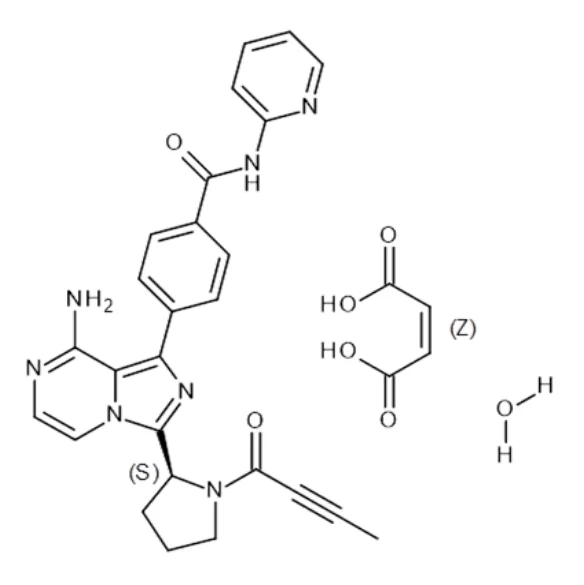
Physicochemical properties: Acalabrutinib maleate (as acalabrutinib maleate monohydrate) is a white to pale brown powder with pH-dependent solubility. It is freely soluble in water at pH values below 3 and practically insoluble at pH values above 6.
14. Clinical Trials
14.1. Clinical Trials by Indication
Previously Untreated Chronic Lymphocytic Leukemia (CLL) – Fixed Duration Therapy (AMPLIFY)
Table 23 Summary of patient demographics for clinical trial in patients with previously untreated CLL – fixed duration treatment
| Study # | Trial design | Dosage, route of administration and duration | Study subjects (n) | Mean age (Range) | Sex |
AMPLIFY (ACE-CL-311) | Randomized (1:1:1), open-label, Phase 3 Study | Arm A: CALQUENCE plus venetoclaxa Arm B: CALQUENCE plus venetoclax and obinutuzumabb Arm C: Investigator’s choice of chemoimmunotherapy:
| 291 286 290 Total: N=867 | 60 (26-86) | M: 64.5% F: 35.5% |
a CALQUENCE 100 mg was administered twice daily starting on Cycle 1 Day 1 for a total of 14 cycles, or until disease progression or unacceptable toxicity. On Cycle 3 Day 1 patients started the venetoclax 5-week dose ramp-up schedule, starting at 20 mg and increasing weekly to 50 mg, 100 mg, 200 mg and finally 400 mg once daily. Venetoclax was administered for a total of 12 cycles. Each cycle was 28 days.
b CALQUENCE 100 mg was administered twice daily starting on Cycle 1 Day 1 for a total of 14 cycles, or until disease progression or unacceptable toxicity. On Cycle 3 Day 1 patients started the venetoclax 5-week dose ramp-up schedule, starting at 20 mg and increasing weekly to 50 mg, 100 mg, 200 mg and finally 400 mg once daily. Venetoclax was administered for a total of 12 cycles. Obinutuzumab 1000 mg was administered on Days 1 and 2 (100 mg on Day 1, followed by 900 mg which may be administered on Day 1 or 2), 8 and 15 of Cycle 2 followed by 1000 mg on Day 1 of Cycles 3-7. Each cycle was 28 days.
c Fludarabine (25 mg/m2) and cyclophosphamide (250 mg/m2) were administered on Days 1-3 up to a maximum of 6 cycles. Rituximab was administered at a dose of 375 mg/m2 on Day 1 Cycle 1 and 500 mg/m2 on Day 1 of Cycles 2-6. Each cycle was 28 days.
d Bendamustine 90 mg/m2 was administered on Days 1 and 2 up to maximum of 6 cycles. Rituximab was administered at a dose of 375 mg/m2 on Day 1 Cycle 1 and 500 mg/m2 on Day 1 of Cycles 2-6. Each cycle was 28 days.
The safety and efficacy of CALQUENCE in combination with venetoclax with or without obinutuzumab in previously untreated CLL was evaluated in a randomised, multi-centre, open-label Phase 3 study (AMPLIFY) of 867 patients. Patients were randomized 1:1:1 to receive CALQUENCE plus venetoclax, CALQUENCE plus venetoclax and obinutuzumab, or Investigator’s choice of chemoimmunotherapy, either FCR (fludarabine plus cyclophosphamide plus rituximab) or BR (bendamustine plus rituximab).
Patients were stratified by age (>65 years or ≤65 years), IGHV mutational status (mutated versus unmutated), Rai stage (high risk [≥3] versus non-high risk [<3]) and geographic region (North America versus Europe versus other).
AMPLIFY included patients previously untreated for CLL without del(17p) or TP53 mutation that were 18 years of age and older. The trial allowed patients to receive antithrombotic agents other than warfarin or equivalent vitamin K antagonists. The study enrolled patients during the COVID-19 pandemic (March 2020 – May 2023).
The demographics and baseline disease characteristics, including complex karyotypes and unmutated IGHV, were well balanced between the study arms (see Table 24).
Table 24 Summary of patient demographics and disease baseline characteristics for patients with previously untreated CLL – fixed duration treatment (AMPLIFY)
AV N=291 | AVO N=286 | FCR/BR N=290 | |
|---|---|---|---|
| Age, years; median (range) | 61 (31-84) | 61 (29-81) | 61 (26-86) |
| Male; % | 61.2 | 69.2 | 63.1 |
| Caucasian; % | 91.1 | 86.7 | 86.9 |
| ECOG performance status 0-1; % | 90.0 | 95.1 | 90.3 |
| Median time from diagnosis to randomization (months) | 28.5 | 26.1 | 29.6 |
| Bulky disease with nodes ≥5 cm; % | 38.8 | 35.0 | 42.8 |
| Cytogenetics/FISH Category; % | |||
| 11q deletion | 17.5 | 19.6 | 15.9 |
| Complex karyotype (≥3 abnormalities) | 15.5 | 16.1 | 14.5 |
| Unmutated IGHV; % | 57.4 | 59.1 | 59.3 |
| Rai stage; % | |||
| 0 | 1.0 | 0.3 | 1.4 |
| I | 16.2 | 21.3 | 21.4 |
| II | 35.7 | 37.8 | 33.4 |
| III | 23.7 | 17.8 | 20.3 |
| IV | 23.4 | 22.7 | 23.4 |
AV = acalabrutinib plus venetoclax; AVO = acalabrutinib plus venetoclax and obinutuzumab; BR = bendamustine plus rituximab; FCR = fludarabine plus cyclophosphamide and rituximab
The primary endpoint was IRC-assessed PFS of AV arm versus investigator’s choice of chemoimmunotherapy (FCR/BR) arm as assessed by IWCLL 2018 criteria. Additional efficacy endpoints included IRC-assessed PFS of AVO arm versus FCR/BR arm and OS in both AV arm versus FCR/BR arm and AVO arm versus FCR/BR arm.
With a median follow-up of 41.3 months, IRC-assessed PFS indicated a 35% statistically significant reduction in risk of disease progression or death in patients treated with AV compared to FCR/BR.
At the time of primary analysis, the OS HR was 0.33 [95% CI (0.18, 0.56)] for the AV arm compared to the FCR/BR arm, with a total of 60 death events (10% maturity): 18 (6.2%) in AV arm and 42 (14.5%) in FCR/BR arm.
With a median follow-up of 42.0 months, IRC-assessed PFS indicated a 58% statistically significant reduction in risk of disease progression or death in patients treated with AVO compared to FCR/BR.
At the time of primary analysis, the OS HR was 0.76 [95% CI (0.49, 1.18)] for the AVO arm compared to the FCR/BR arm, with a total of 79 death events (14% maturity): 37 (12.9%) in AVO arm and 42 (14.5%) in FCR/BR arm.
Efficacy results are presented in Table 25. The Kaplan-Meier curve for IRC-PFS is shown in Figure 1 and the Kaplan-Meier curves for OS is shown in Figure 2.
Table 25 Efficacy results from the AMPLIFY Trial in Patients with Previously Untreated CLL (ITT population) – fixed duration treatment
AV N=291 | AVO N=286 | FCR/BRb N=290 | |||||||||||
|---|---|---|---|---|---|---|---|---|---|---|---|---|---|
| Progression-free survivala | |||||||||||||
| Number of events (%) | 89 (30.6) | 56 (19.6) | 95 (32.8) | ||||||||||
| PD, n (%) | 77 (26.5) | 23 (8.0) | 66 (22.8) | ||||||||||
| Death events (%) | 12 (4.1) | 33 (11.5) | 29 (10.0) | ||||||||||
| Median (95% CI), months | NC (51.1, NC) | NC (NC, NC) | 47.6 (43.3, NC) | ||||||||||
| HRc (95% CI) | 0.65 (0.49, 0.87) | 0.42 (0.30, 0.59) | - | ||||||||||
| p-value | 0.0038 | ˂0.0001 | - | ||||||||||
| PFS rate | |||||||||||||
| 12 months estimate (95% CI), % | 94.8 (91.5, 96.8) | 91.5 (87.6, 94.2) | 88.3 (83.6, 91.7) | ||||||||||
| 24 months estimate (95% CI), % | 87.6 (83.1, 90.9) | 87.1 (82.6, 90.5) | 79.0 (73.2, 83.6) | ||||||||||
| 36 months estimate (95% CI), % | 76.5 (71.0, 81.1) | 83.1 (78.1, 87.1) | 66.5 (59.8, 72.3) | ||||||||||
| Overall Survival | |||||||||||||
| Death events (%) | 18 (6.2) | 37 (12.9) | 42 (14.5) | ||||||||||
| HRc (95% CI) | 0.33 (0.18, 0.56) | 0.76 (0.49, 1.18) | - | ||||||||||
| OS rate | |||||||||||||
| 12 months estimate (95% CI), % | 97.2 (94.5, 98.6) | 93.0 (89.3, 95.4) | 91.9 (87.8, 94.6) | ||||||||||
| 24 months estimate (95% CI), % | 95.5 (92.4, 97.4) | 89.1 (84.9, 92.2) | 88.3 (83.7, 91.7) | ||||||||||
| 36 months estimate (95% CI), % | 94.1 (90.7, 96.3) | 87.7 (83.2, 91.0) | 85.9 (81.0, 89.6) | ||||||||||
AV = acalabrutinib plus venetoclax; AVO = acalabrutinib plus venetoclax and obinutuzumab; BR = bendamustine plus rituximab; FCR = fludarabine plus cyclophosphamide and rituximab; NC = Not calculable; HR = Hazard Ratio; PD = progressive disease
a Per IRC assessment.
b Approximately 50% of patients were planned to be treated with FCR and 50% treated with BR per investigator’s choice.
c Based on stratified Cox-Proportional-Hazards model. Stratified by randomization stratification factors: age (>65 years or ≤65 years), IGHV mutational status (mutated versus unmutated), Rai stage (high risk [≥3] versus non-high risk) and geographic region (North America and Western Europe versus other).
Figure 1 Kaplan-Meier Curve of IRC-Assessed Progression-Free Survival in Patients with Previously Untreated CLL (AMPLIFY) (ITT Population) – fixed duration treatment
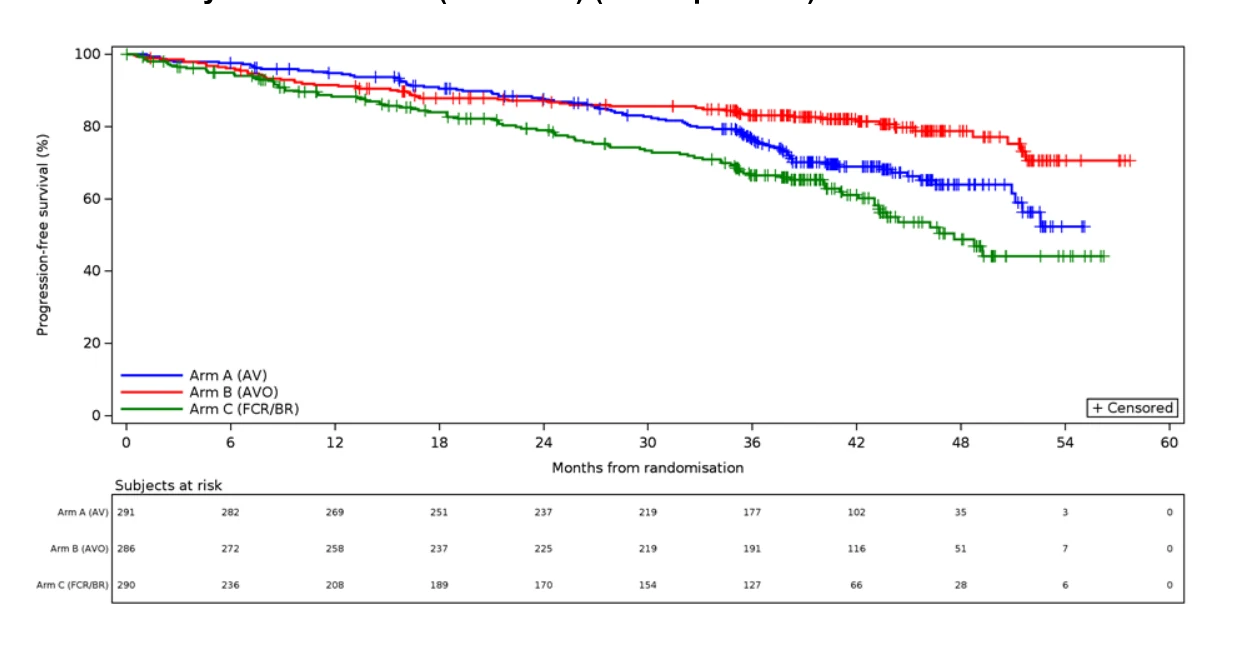
The benefit of CALQUENCE in combination with venetoclax versus the FCR/BR arm on PFS risk reduction was consistent across all clinically relevant subgroups, including higher risk CLL patients (unmutated IGHV) with a PFS HR of 0.69 [95% CI (0.48, 0.97)].
The benefit of CALQUENCE in combination with venetoclax and obinutuzumab versus the FCR/BR arm on PFS risk reduction was consistent across all clinically relevant subgroups, including higher risk CLL patients (unmutated IGHV) with a PFS HR of 0.35 [95% CI (0.23, 0.53)].
Figure 2 Kaplan-Meier Curve of Overall Survival in Patients with Previously Untreated CLL (AMPLIFY) (ITT Population) – fixed duration treatment
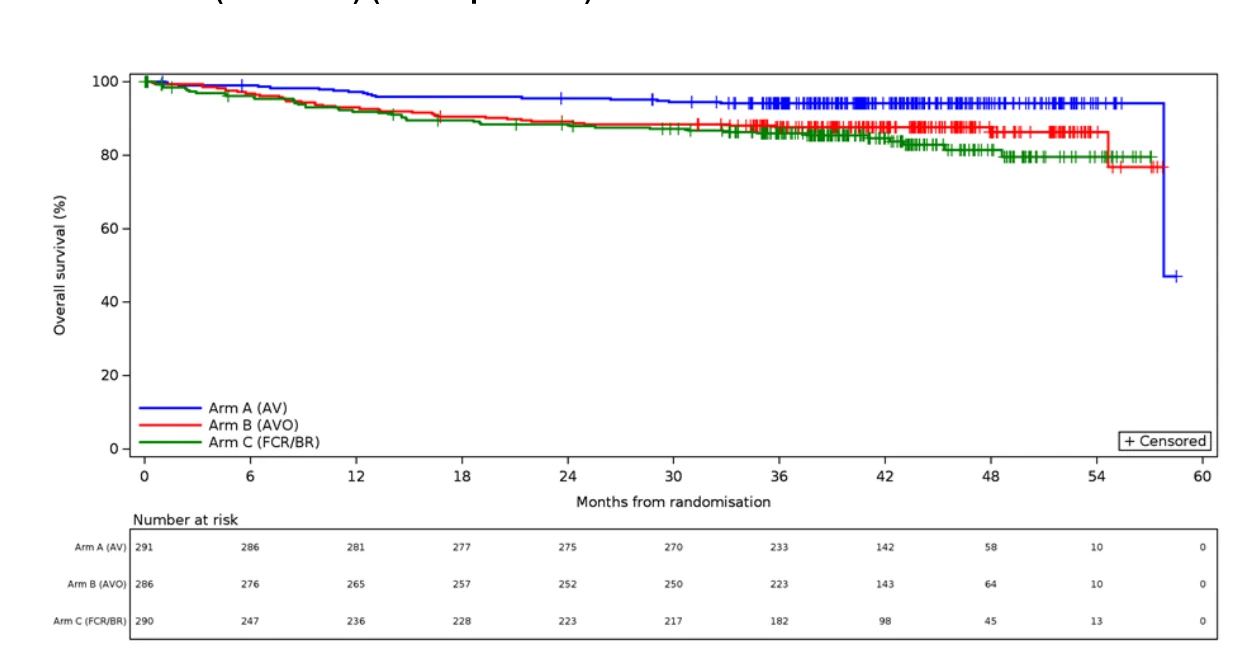
Previously Untreated CLL (ELEVATE-TN)
Table 26 Summary of patient demographics for clinical trials in patients with previously untreated CLL
| Study # | Trial design | Dosage, route of administration and duration | Study subjects (n) | Mean age (Range) | Sex |
ELEVATE-TN (ACE-CL-007) | Randomized (1:1:1), open-label, Phase 3 Study | Arm A: obinutuzumab + chlorambucila Arm B: CALQUENCE 100 mg orally twice daily + obinutuzumabb, Arm C: CALQUENCE monotherapy, 100 mg orally twice dailyc | 177 179 179 Total: N=535 | 70 (41-91) | M: 61% F: 39% |
a Obinutuzumab and chlorambucil were administered for a maximum of 6 treatment cycles. Obinutuzumab 1000 mg was administered on Days 1 and 2 (100 mg on Day 1 and 900 mg on
Day 2), 8 and 15 of Cycle 1 followed by 1000 mg on Day 1 of Cycles 2 up to 6. Chlorambucil 0.5 mg/kg was administered on Days 1 and 15 of Cycles 1 up to 6. Each cycle was 28 days.
b CALQUENCE 100 mg was administered twice daily starting on Cycle 1 Day 1 until disease progression or unacceptable toxicity. Obinutuzumab was administered starting on Cycle 2 Day 1 for a maximum of 6 treatment cycles. Obinutuzumab 1000 mg was administered on Days 1 and 2 (100 mg on Day 1 and 900 mg on Day 2), 8 and 15 of Cycle 2 followed by 1000 mg on Day 1 of Cycles 3 up to 7. Each cycle was 28 days.
c CALQUENCE monotherapy: CALQUENCE 100 mg was administered twice daily until disease progression or unacceptable toxicity.
The safety and efficacy of CALQUENCE in patients with previously untreated CLL were evaluated in a randomized, multi-centre, open-label Phase 3 study (ELEVATE-TN) of 535 patients. Patients were randomized to receive either CALQUENCE plus obinutuzumab, CALQUENCE monotherapy, or obinutuzumab plus chlorambucil.
Patients 65 years of age or older or between 18 and 65 years of age with coexisting medical conditions were included in ELEVATE-TN. The trial also allowed patients to receive antithrombotic agents other than warfarin or equivalent vitamin K antagonists. Key inclusion criteria included confirmed diagnosis of CD20+ CLL and active disease that met ≥1 of the International Workshop on Chronic Lymphocytic Leukemia (IWCLL) 2008 criteria for requiring treatment. Key exclusion criteria included prior systemic treatment of CLL, known central nervous system (CNS) lymphoma or leukemia, and known prolymphocytic leukemia or Richter’s syndrome.
Patients were stratified by 17p deletion mutation status (presence versus absence), ECOG performance status (0 or 1 versus 2) and geographic region (North America and Western Europe versus Other). At baseline, the majority of patients (84%) were ≥65 years old, 94% of patients had an ECOG score of 0 or 1, 32% presented with lymph nodes ≥5 cm, 47% had Rai stage III or IV disease, 9% had 17p deletion, 11% had TP53 mutation, 63% of patients had an unmutated IGHV, and 18% had 11q deletion. The median time from initial CLL diagnosis to randomization was 27.6 months. Baseline demographic and disease characteristics were similar between treatment arms.
The primary endpoint was progression-free survival (PFS) as assessed by an Independent Review Committee (IRC) in the CALQUENCE + obinutuzumab arm compared with the obinutuzumab + chlorambucil arm. PFS was defined as the time from the date of randomization to the date of first IRC-assessed disease progression or death due to any cause. The assessment of progressive disease was per IWCLL 2008 criteria with incorporation of the clarification for treatment-related lymphocytosis. Secondary endpoints included PFS as assessed by IRC in the CALQUENCE monotherapy arm compared with the obinutuzumab + chlorambucil arm, and ORR as assessed by IRC per IWCLL 2008 criteria.
With a median follow-up of 28.3 months in the ELEVATE-TN trial, PFS by IRC indicated a 90% statistically significant reduction in the risk of a PFS event for previously untreated CLL patients in the CALQUENCE plus obinutuzumab arm compared to obinutuzumab plus chlorambucil arm (HR=0.10 [95% CI: 0.06–0.17]; p<0.0001). At the time of analysis, median overall survival was not reached in any arm, with fewer than 10% of patients experiencing an event.
Efficacy results are presented in Table 27. The Kaplan-Meier curves for PFS are shown in Figure 3.
Table 27 Results from the ELEVATE-TN Trial in Patients with Previously Untreated CLL (Intention to Treat Population)
| Efficacy Parameter | CALQUENCE plus Obinutuzumab N=179 | CALQUENCE Monotherapy N=179 | Obinutuzumab plus Chlorambucil N=177 |
|---|---|---|---|
| Progression-Free Survival (PFS)a | |||
| Number of events, n (%) | 14 (7.8%) | 26 (14.5%) | 93 (52.5%) |
| Disease progression, n (%) | 9 (5%) | 20 (11.2%) | 82 (46.3%) |
| Death events, n (%) | 5 (2.8%) | 6 (3.4%) | 11 (6.2%) |
| Median (95% CI), months | NR | NR (34.2, NR) | 22.6 (20.2, 27.6) |
| HRb (95% CI) | 0.10 (0.06, 0.17)c | 0.20 (0.13, 0.30)d | -- |
| p-value | p<0.0001 | p<0.0001 | -- |
| Overall Response Rate (ORR)e,f | |||
n (%) (95% CI) | 168 (93.9%) (89.3, 96.5) | 153 (85.5%) (79.6, 89.9) | 139 (78.5%) (71.9, 83.9) |
| p-value | <0.0001 | 0.0763 | -- |
| CR, n(%)g | 24 (13.4%) | 1 (0.6%) | 8 (4.5%) |
| PR, n(%)h | 144 (80.4%) | 152 (84.9%) | 131 (74%) |
CI=Confidence Interval; CR=Complete Response; CRi=Complete Response with incomplete marrow recovery; HR=Hazard Ratio; NR=Not Reached; ORR=Overall Response Rate; PR=Partial Response; nPR=nodular Partial Response.
a Independent Review Committee (IRC) assessment per International Workshop on Chronic Lymphocytic Leukemia (IWCLL) 2008 criteria with incorporation of the clarification for treatment-related lymphocytosis.
b Based on stratified Cox-Proportional Hazards model.
c CALQUENCE + obinutuzumab compared to obinutuzumab + chlorambucil.
d CALQUENCE monotherapy compared to obinutuzumab + chlorambucil.
e ORR: (CR + CRi + nPR + PR).
f Per IRC assessment.
g Includes 1 patient in the CALQUENCE + obinuzumab arm with CRi.
h PR = PR + nPR; 1 patient with nPR in the CALQUENCE + obinutuzumab arm, 2 patients with nPR in the CALQUENCE monotherapy arm, and 3 patients with nPR in the obinutuzumab + chlorambucil arm.
Figure 3 Kaplan-Meier Curve of IRC-Assessed Progression-Free Survival in Patients with Previously Untreated CLL (ELEVATE-TN) (ITT Population)
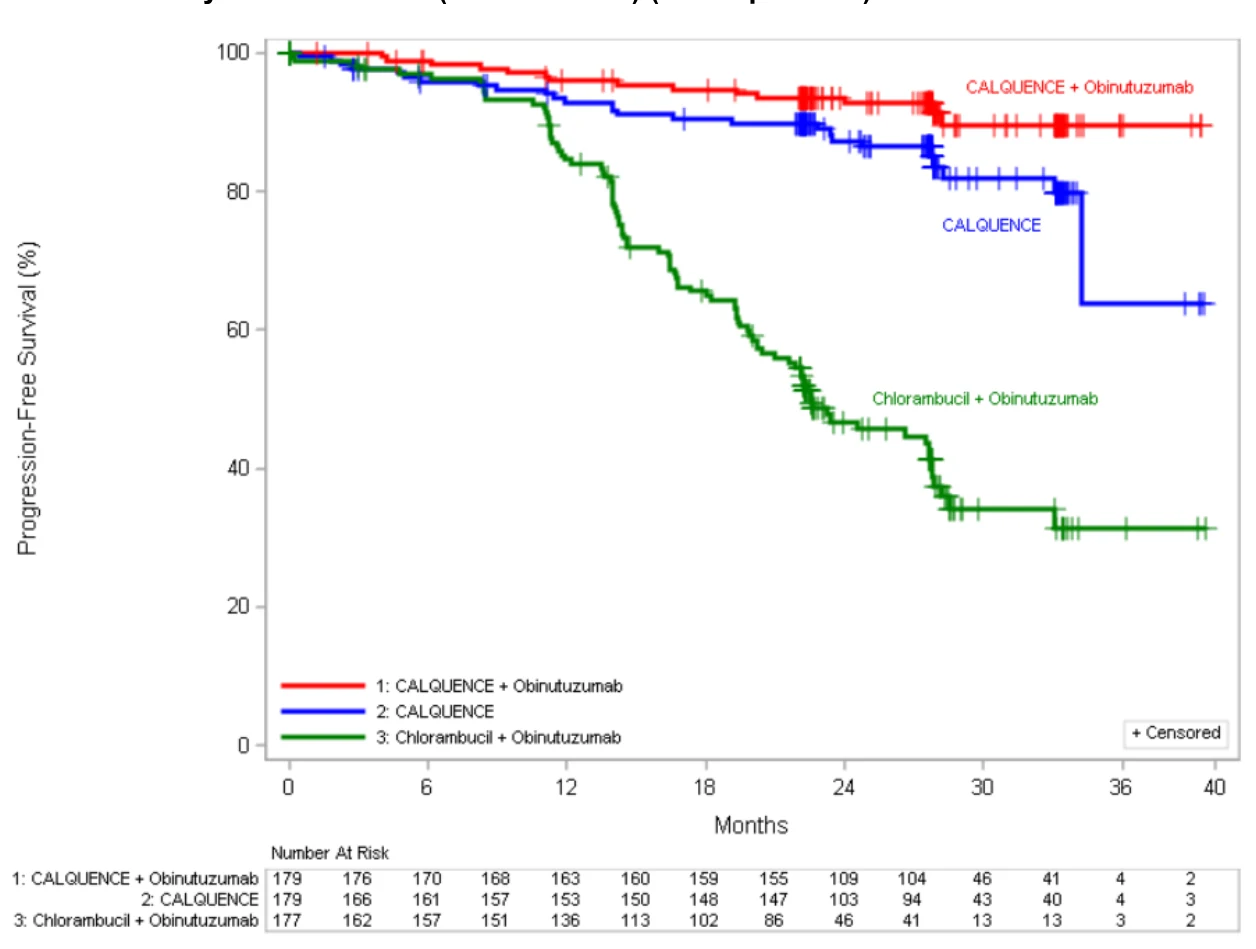
The PFS benefit for CALQUENCE with or without obinutuzumab was consistent in the following subgroups: <65 and ≥65 years of age, patients with and without 17p deletion, patients with and without TP53 mutation, patients with and without 11q deletion, patients with unmutated IGHV, patients with and without advanced disease (Rai stage 0-II and stage III-IV), and patients with and without bulky lymphadenopathy (<5cm and ≥5cm).
Previously Treated CLL (ASCEND)
Table 28 Summary of patient demographics for clinical trials in patients with CLL who have received at least one prior therapy
| Study # | Trial design | Dosage, route of administration and duration | Study subjects (n) | Mean age (Range) | Sex |
ASCEND (ACE-CL-309) | Randomized (1:1), open-label, Phase 3 Study | Arm A: CALQUENCE 100 mg orally twice dailya Arm B (Investigator’s Choice): -Idelalisib + rituximab (IR)b or -Bendamustine + rituximab (BR)c | 155 155 Total N=310 | 67 (32-90) | M: 67% F: 33% |
a CALQUENCE 100 mg approximately every 12 hours until disease progression or unacceptable toxicity.
b Idelalisib plus a rituximab product (IR): Idelalisib 150 mg orally approximately every 12 hours until disease progression or unacceptable toxicity, in combination with 8 infusions of a rituximab product (375 mg/m2 intravenously on Day 1 of Cycle 1, followed by 500 mg/m2 every 2 weeks for 4 doses and then every 4 weeks for 3 doses), with a 28-day cycle length.
c Bendamustine plus a rituximab product (BR): Bendamustine 70 mg/m2 intravenously (Day 1 and 2 of each 28-day cycle), in combination with a rituximab product (375 mg/m2 intravenously on Day 1 of Cycle 1, then 500 mg/m2 on Day 1 of subsequent cycles), for up to 6 cycles.
The safety and efficacy of CALQUENCE in patients with relapsed or refractory CLL were evaluated in a randomized, multi-centre, open-label Phase 3 study (ASCEND) of 310 patients who received at least one prior therapy. Patients were randomized to receive CALQUENCE monotherapy or investigator’s choice of either idelalisib plus rituximab (IR) or bendamustine plus rituximab (BR).
Key inclusion criteria included diagnosis of CD20+ CLL, ≥1 prior systemic therapy for CLL, active disease that met ≥1 of the IWCLL 2008 criteria for requiring treatment. The trial allowed patients to receive antithrombotic agents other than warfarin or equivalent vitamin K antagonists. The trial excluded patients with known CNS lymphoma or leukemia, transformed disease, prolymphocytic leukemia, or previous treatment with a Bruton’s Tyrosine Kinase inhibitor, venetoclax, or a phosphoinositide-3 kinase inhibitor.
Patients were stratified by 17p deletion mutation status (presence versus absence), ECOG performance status (0 or 1 versus 2) and number of prior therapies (1 to 3 versus ≥4). The median time from diagnosis to randomization was 79 months. At baseline, about two-thirds (63%) of patients were ≥65 years of age, 87% had an ECOG score of 0 or 1, 49% had tumour bulk ≥5cm, 42% had Rai stage III or IV disease, 16% had 17p deletion, 24% had TP53 mutation, 78% had an unmutated IGHV, and 27% had an 11q deletion. The CALQUENCE arm had a median of 1 prior therapy (range 1-8), with 47% having at least 2 prior therapies. The investigator’s choice arm had a median of 2 prior therapies (range 1-10), with 57% having at least 2 prior therapies.
In the CALQUENCE arm, the median treatment duration was 15.7 months, with 86% of patients treated for at least 1 year. In the control arm (IR/BR), the median treatment duration was 11.5 months for idelalisib, 5.6 months for bendamustine and 5.5 months for rituximab.
The primary endpoint was PFS as assessed by IRC. PFS was defined as the time from the date of randomization to the date of first IRC-assessed disease progression or death due to any cause. The assessment of progressive disease was per the IWCLL 2008 criteria with incorporation of the clarification for treatment-related lymphocytosis. IRC-assessed ORR per IWCLL 2008 criteria was a secondary endpoint.
At a median follow-up of 16.1 months in the ASCEND trial which enrolled patients with CLL who had received at least one prior therapy, PFS as assessed by IRC indicated a 69% statistically significant reduction in the risk of a PFS event for patients who received CALQUENCE compared to patients who received the investigator’s choice of therapy (HR=0.31 [95% CI: 0.20-0.49], p<0.0001). At the time of analysis, overall survival had not been reached in any arm. Efficacy results are presented in Table 29. The Kaplan-Meier curve for PFS is shown in Figure 4. The difference in overall response rate between the two arms did not reach statistical significance.
Table 29 Results from the ASCEND Trial in Patients with Previously Treated CLL (ITT population)
CALQUENCE monotherapy N=155 | Investigator’s choice of idelalisib + rituximab or bendamustine + rituximab N=155 | ||||||||||||||
|---|---|---|---|---|---|---|---|---|---|---|---|---|---|---|---|
| Progression-Free Survival (PFS)a | |||||||||||||||
| Number of events (%) | 27 (17.4) | 68 (43.9) | |||||||||||||
| Disease Progression, n (%) | 19 (12.3) | 59 (38.1) | |||||||||||||
| Death events (%) | 8 (5.2) | 9 (5.8) | |||||||||||||
| Median (95% CI), monthsb | NR | 16.5 (14.0, 17.1) | |||||||||||||
| HRc (95% CI) | 0.31 (0.20, 0.49) | ||||||||||||||
| P-value | <0.0001 | ||||||||||||||
| Overall Response Rate (ORR)d,e | |||||||||||||||
n (%) (95% CI) | 126 (81.3) (74.4, 86.6) | 117 (75.5) (68.1, 81.6) | |||||||||||||
| ORR Difference, % (95% CI) | 5.8 (-3.3, 14.9) | -- | |||||||||||||
| P-value | 0.2248 | -- | |||||||||||||
| CR, n(%) | 0 | 2 (1.3%) | |||||||||||||
| PR, n(%) | 126 (81.3%) | 115 (74.2%) | |||||||||||||
CI=Confidence Interval; CR=Complete Response; CRi=Complete Response with incomplete blood count recovery; HR=hazard ratio; nPR=nodular Partial Response; NR=not reached; PR=partial response a Independent Review Committee (IRC) assessment per International Workshop on Chronic Lymphocytic Leukemia (IWCLL) 2008 criteria with incorporation of the clarification for treatment-related lymphocytosis.
b Kaplan-Meier estimate.
c Based on stratified Cox-Proportional-Hazards model.
d Per IRC assessment.
e ORR: (CR + CRi + nPR + PR); there were no patients with CRi or nPR.
Figure 4 Kaplan-Meier Curve of IRC-Assessed PFS in Patients with CLL Who Have Received At Least One Prior Therapy (ASCEND) (ITT Population)
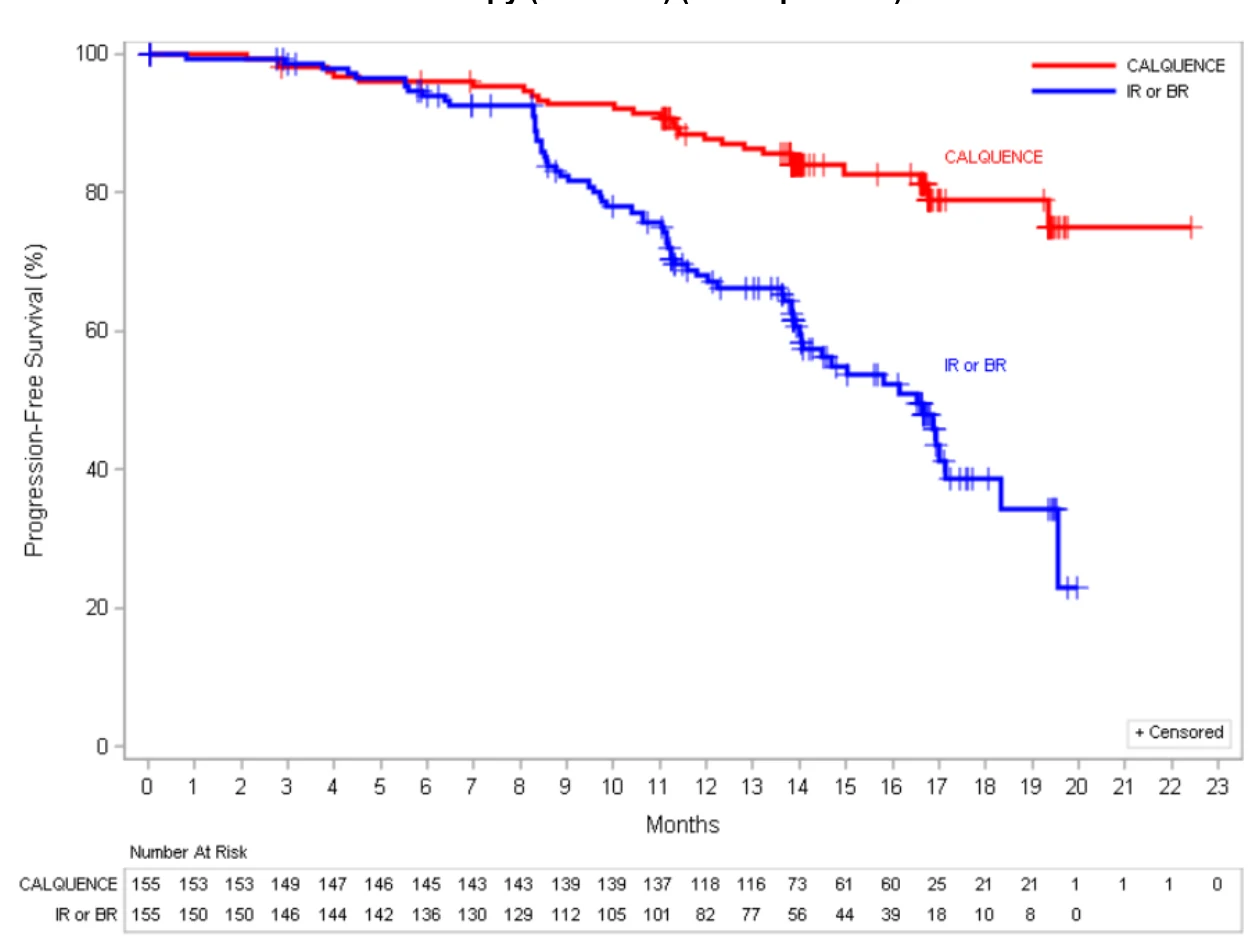
The PFS benefit of CALQUENCE was consistent in the following subgroups: <65 and ≥65 years of age, patients with and without 17p deletion, patients with and without 11q deletion, patients with or without TP53 mutation, patients with mutated and unmutated IGHV, patients with and without advanced disease (Rai stage 0-II and stage III-IV), and patients with and without bulky lymphadenopathy (<5cm and ≥5cm).
Previously Untreated Mantle Cell Lymphoma (MCL) (ECHO)
Table 30 Summary of patient demographics for clinical trial in patients with previously untreated MCL
| Study # | Study Design | Dosage, route of administration and duration a,b,c | Study subjects (n) | Mean age (Range) | Sex |
|---|---|---|---|---|---|
ECHO (ACE-LY-308) | Randomized, double blind, placebo controlled, multicenter Phase 3 study | CALQUENCE 100 mg orally twice daily plus bendamustine and rituximab Placebo plus bendamustine and rituximab | 299 299 Total: N=598 | 71 (65-86) | M: 71% F: 29% |
a CALQUENCE or placebo was administered twice daily from Day 1 of Cycle 1, continuously, until disease progression or unacceptable toxicity.
b Bendamustine, 90 mg/m2, was intravenously administered over 30 minutes on Days 1 and 2 of each of six 28-day cycles; and rituximab, 375 mg/m2, was intravenously administered on Day 1 of each cycle of six 28-day cycles. CALQUENCE or placebo in combination with bendamustine plus rituximab was administered for a maximum of 6 treatment cycles.
c After the first 6 cycles, patients achieving a response (PR or CR) received rituximab maintenance at 375 mg/m2 on Day 1 of every other cycle starting the Cycle 8 for maximum of 12 additional doses up to Cycle 30. Patients randomised to placebo + BR arm, who had confirmed progressive disease were eligible to cross over to CALQUENCE monotherapy at 100 mg twice daily dose until their second disease progression or unacceptable toxicity.
The safety and efficacy of CALQUENCE in patients with previously untreated MCL were evaluated in ECHO, a randomised, double-blind, placebo controlled, multicentre Phase 3 study. ECHO included 598 patients 65 years of age and older with confirmed MCL that was previously untreated. Patients were randomized 1:1 to receive CALQUENCE in combination with bendamustine and rituximab, or placebo in combination with bendamustine and rituximab.
Key exclusion criteria included history of CNS lymphoma or leptomeningeal disease, significant cardiovascular disease, or patients for whom the goal of therapy is tumour debulking before stem cell transplant. Patient randomisation was stratified by geographic region (North America versus Western Europe versus Other) and simplified MIPI (Mantle Cell Lymphoma International Prognostic Index) score (0-3 [low] versus 4-5 [intermediate] versus 6-11 [high]). The study enrolled patients during the COVID-19 pandemic.
The demographics and baseline disease characteristics, including bulky disease (≥5 cm), high-risk score by simplified MIPI, advanced disease (bone marrow involvement or extranodal disease and blastoid or pleomorphic histology), were well balanced between study arms (see Table 31).
Table 31 Patient Demographics and Baseline Disease Characteristics, ECHO (Full Analysis Set)
CALQUENCE + bendamustine and rituximab N=299 | Placebo + bendamustine and rituximab N=299 | |
|---|---|---|
| Age, median (range), y | 71 (65–85) | 71 (65–86) |
| ≥75 y, n (%) | 84 (28.1) | 77 (25.8) |
| Male, n (%) | 214 (71.6) | 209 (69.9) |
| ECOG PS, n (%) | ||
| 1 | 129 (43.1) | 132 (44.1) |
| 2 | 12 (4.0) | 23 (7.7) |
| Tumor bulk ≥5 cm, n (%) | 112 (37.5) | 113 (37.8) |
| Ann Arbor Stage IV disease, n (%) | 251 (83.9) | 263 (88) |
| Extranodal disease, n (%) | 264 (88.3) | 277 (92.6) |
| Bone marrow involvement, n (%) | 211 (70.6) | 218 (72.9) |
| Blastoid/pleomorphic histology, n (%) | 41 (13.7) | 38 (12.7) |
| Simplified MIPI score, n (%) | ||
| Low risk [0-3] | 99 (33.1) | 101 (33.8) |
| Intermediate risk [4-5] | 128 (42.8) | 125 (41.8) |
| High risk [6-11] | 72 (24.1) | 73 (24.4) |
| Ki-67 ≥30%, n (%) | 139 (46.5) | 147 (49.2) |
The primary endpoint was progression-free survival (PFS) as assessed by an Independent Review Committee (IRC) per Lugano Classification for NHL in patients with previously untreated MCL. Additional efficacy endpoints were Investigator-assessed (INV) PFS, INV- and IRC-assessed overall response rate (ORR), IRC- and INV-assessed duration of response (DOR) and overall survival (OS).
With a median follow-up of 46.1 months in the CALQUENCE + BR arm and 44.4 months in the Placebo + BR arm, IRC-assessed PFS demonstrated 27% statistically significant reduction in risk of disease progression or death in patients treated with CALQUENCE + BR compared to Placebo + BR. Within the placebo arm, 88 (29.4%) patients received at least one subsequent anti-MCL therapy of which 76 (86.4%) received a BTKi as subsequent treatment.
At the time of PFS analysis, median OS had not been reached in any arm with a total of 203 deaths: 97 (32.4%) in the CALQUENCE + BR arm, 106 (35.5%) in the Placebo + BR arm suggesting no detriment for patients in the CALQUENCE + BR arm [HR=0.86, 95% CI 0.65,1.13]. Efficacy results are presented in Table 32. The Kaplan-Meier curves for PFS are shown in Figure 5.
Table 32 Efficacy Results in Patients with previously untreated MCL in ECHO
CALQUENCE + BR N=299 | Placebo + BR N=299 | ||||||||||
|---|---|---|---|---|---|---|---|---|---|---|---|
CALQUENCE + BR N=299 | Placebo + BR N=299 | ||||||||||
| PFSa | |||||||||||
| Median (95% CI) | 66.4 (55.1, NE) | 49.6 (36.0, 64.1) | |||||||||
| HR (95% CI) (stratified)b | 0.73 (0.57, 0.94) | ||||||||||
| p-valuec | 0.0160 | ||||||||||
| ORRa | |||||||||||
| ORR (CR + PR), n (%) | 272 (91.0) | 263 (88.0) | |||||||||
| 95% CI | 87.3, 93.8 | 83.9, 91.3 | |||||||||
| CR, n (%) | 199 (66.6) | 160 (53.5) | |||||||||
| PR, n (%) | 73 (24.4) | 103 (34.4) | |||||||||
| ORR difference (vs PBR arm) | 3.0% | ||||||||||
| p-value | 0.2196 | ||||||||||
| DORa | |||||||||||
| Median (95% CI), months | 63.5 (52.5, NE) | 53.8 (37.6, 66.1) | |||||||||
HR = hazard ratio, CR = complete response, PBR = placebo plus bendamustine + rituximab, PR = partial response, NE = not evaluable
a IRC-assessed.
b Stratified by randomization stratification factors: Geographic Regions (North American, Western Europe, Other) and simplified MIPI Score (Low risk [0 to 3], Intermediate risk [4 to 5], High Risk [6 to 11]) as collected via IXRS. Estimated based on stratified Cox Proportional Hazards model for hazard ratio (95% CI).
c Estimated based on stratified log-rank test for p-value.
Figure 5 Kaplan-Meier Curve of IRC-Assessed PFS in patients with previously untreated MCL (ECHO)
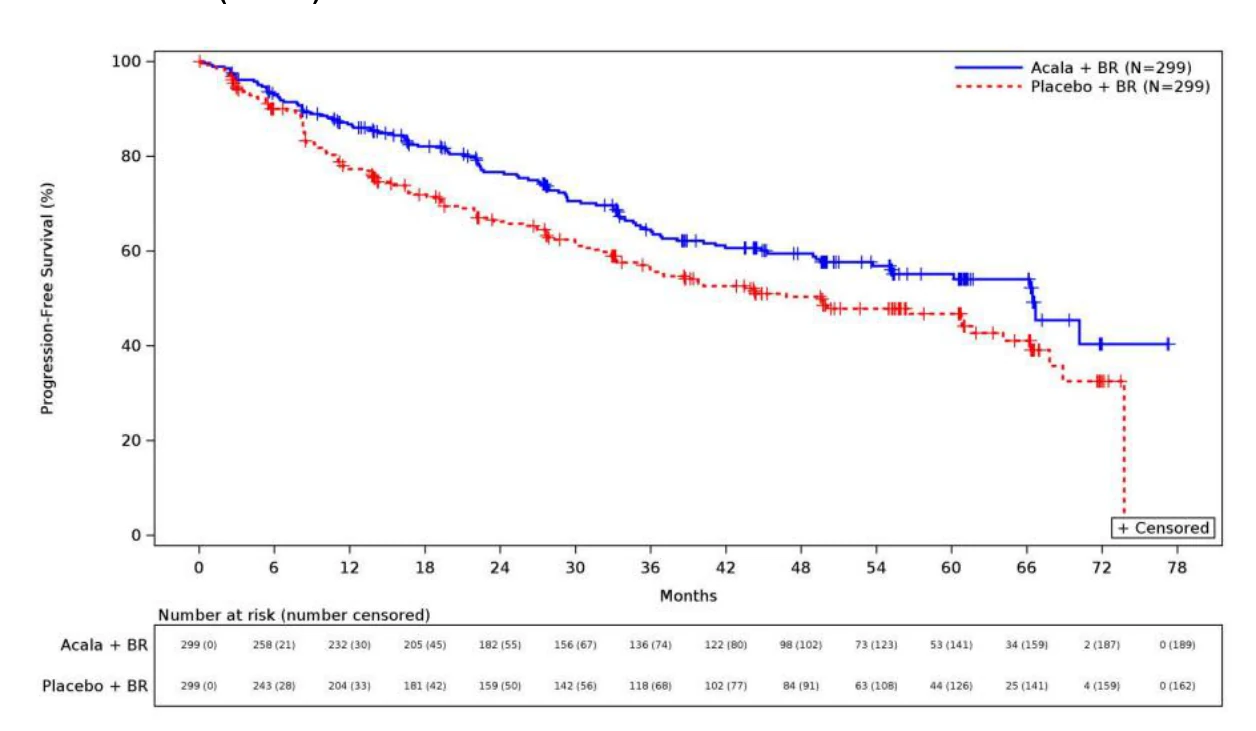
Previously Treated MCL (ACE-LY-004)
Table 33 Summary of patient demographics for clinical trial in patients with MCL who have received at least one prior therapy
| Study # | Trial design | Dosage, route of administration and duration | Study subjects (n) | Mean age (Range) | Sex |
| ACE-LY-004 | Open-label, multi-centre, single-arm Phase 2 Study | CALQUENCE 100 mg orally twice daily until disease progression or unacceptable toxicity | 124 | 68 (range 42 to 90) years | M: 80% F: 20% |
The safety and efficacy of CALQUENCE in patients with MCL were evaluated in an open-label, multi-centre, single-arm Phase 2 study (ACE-LY-004) of 124 previously treated patients.
In Study ACE-LY-004, the median age was 68 (range 42 to 90) years, 80% were male and 74% were Caucasian. At baseline, 93% of patients had an ECOG performance status of 0 or 1. The median time since diagnosis was 46 months and the median number of prior treatments was 2 (range 1 to 5), including 18% with prior stem cell transplant. The majority of patients (95%) had previously received rituximab as a single agent or part of a regimen. Common prior regimens included CHOP-based regimen (52%), cytarabine (34%), bendamustine and rituximab-based regimens (22%), and Hyper-CVAD (21%). At baseline, 24% and 76% of patients had refractory and relapsed disease, respectively, and 37% of patients had at least one tumour with a longest diameter ≥5 cm, 73% had extra nodal involvement including 51% with bone marrow involvement. The Simplified MCL International Prognostic Index (MIPI) score (which includes age, ECOG score, and baseline lactate dehydrogenase and white cell count) was intermediate in 44% and high in 17% of patients, and 75% of patients had Ann Arbor Stage IV disease.
Patients were to receive CALQUENCE 100 mg orally twice daily until disease progression or unacceptable toxicity. The median duration of treatment was 17.3 months and the median dose intensity was 98.7%. The median duration of follow-up was 26.3 months.
The trial did not include patients who received prior treatment with BTK inhibitors.
The primary endpoint was investigator-assessed overall response rate (ORR) per the Lugano classification for non-Hodgkin’s lymphoma (NHL). Duration of Response (DoR) was an additional outcome measure.
The efficacy analysis for patients with MCL who have received at least one prior therapy was conducted at a median follow-up of 26.3 months, and the results are summarized below and presented in Table 34. At time of analysis, 39.5% of patients remained on study. The ORR was 80.6% with a median time to documented response of 1.9 months and a median DoR of 25.7 months.
Table 34 Efficacy Results of Study ACE-LY-004 (N=124) in Patients with Mantle Cell Lymphoma Who Have Received At Least One Prior Therapy
| Efficacy Parameter | Investigator Assesseda n (%) (95% CIb) |
| Overall Response Rate (ORR)c | |
| Overall Response Rate | 100 (80.6%) (72.6, 87.2) |
| Complete Response | 53 (42.7%) (33.9, 51.9) |
| Partial Response | 47 (37.9%) (29.3, 47.1) |
| Stable Disease | 11 (8.9%) (4.5, 15.3) |
| Progressive Disease | 10 (8.1%) (3.9, 14.3) |
| Duration of Response (DoR) | |
| Median (months) | 25.7 (17.5, NE) |
CI=Confidence Interval; NE=Not Estimable
a Per Lugano classification for non-Hodgkin’s lymphoma.
b 95% exact binomial confidence interval.
c Non-Evaluable: 3 patients were non-evaluable due to inadequate post-baseline disease assessment.
14.2. Comparative Bioavailability Studies
A randomized, multi-centre, open-label, single dose, two-way, cross-over, comparative bioavailability study of CALQUENCE 100 mg tablets and CALQUENCE 100 mg capsules was conducted in 66 healthy, adult male subjects under fasting conditions. Comparative bioavailability data from 63 subjects that were included in the statistical analysis are presented in the following table.
Table 35 Summary Table of Comparative Bioavailability Data
Acalabrutinib (1 x 100 mg) Geometric Mean Arithmetic Mean (CV %) | ||||
|---|---|---|---|---|
| Parameter | Test1 | Reference2 | % Ratio of Geometric Means | 90% Confidence Interval |
AUCT (ng·h/mL) | 563.9 599.5 (2.81) | 566.8 605.8 (2.71) | 98.8 | 93.6 – 104.2 |
AUCI (ng·h/mL) | 567.8 603.7 (2.80) | 572.2 610.6 (2.73) | 98.6 | 93.4 – 104.0 |
Cmax (ng/mL) | 537.2 581.6 (2.52) | 535.7 606.8 (2.16) | 100.4 | 90.8 – 111.0 |
Tmax3 (h) | 0.52 (0.23 – 2.97) | 0.58 (0.47 – 3.98) | ||
T½4 (h) | 1.64 (1.39) | 2.24 (0.79) | ||
1 CALQUENCE (acalabrutinib as acalabrutinib maleate) tablets, 100 mg (AstraZeneca Canada Inc.).
2 CALQUENCE (acalabrutinib as acalabrutinib base) capsules, 100 mg (AstraZeneca Canada Inc.).
3 Expressed as the median (range) only.
4 Expressed as the arithmetic mean (CV %) only.
15. Microbiology
No microbiological information is required for this drug product.
16. Non-Clinical Toxicology
General toxicology
Daily oral administration of acalabrutinib for up to 6 months duration in rats and 9 months in dogs, was tolerated at exposure levels that exceed human therapeutic exposures at the recommended dose (2.5-fold in rats, 8.2-fold in dogs, based on AUC).
Kidney, liver and heart were identified as the target organs of toxicities in rats and dogs. In rats, liver and kidney findings were observed at exposures 4.2 times the total clinical exposures. More severe toxicities including cardiac findings were observed in both species at exposures ≥6.8 times the total clinical exposure. Reversibility was demonstrated for liver and kidney findings in both species. Reversibility for the heart findings could not be assessed as these findings were only observed at doses above the maximum tolerated dose (MTD).
Toxicology species were exposed to relevant metabolites of acalabrutinib, including the active metabolite ACP-5862.
Genotoxicity
Acalabrutinib was not mutagenic in a bacterial reverse mutation assay, in an in vitro chromosome aberration assay, or in an in vivo mouse bone marrow micronucleus assay.
Carcinogenicity
Carcinogenicity studies have not been conducted with acalabrutinib.
Reproductive and developmental toxicology
No effects on fertility were observed in male or female rats at exposures 10 or 9 times the human AUC exposure at the recommended dose, respectively.
In a combined fertility and embryofetal development study in female rats, acalabrutinib was administered orally at doses up to 200 mg/kg/day starting 14 days prior to mating through gestational day [GD] 17. No effects on embryofetal development and survival were observed. The AUC at 200 mg/kg/day in pregnant rats was approximately 9 times the AUC in patients at the recommended dose of 100 mg twice daily. The presence of acalabrutinib and its active metabolite were confirmed in fetal rat plasma.
In an embryofetal study in pregnant rabbits, acalabrutinib was administered orally at doses up to 200 mg/kg/day during the period of organogenesis (from GD 6-18). Acalabrutinib produced no maternal toxicity and no evidence of teratogenicity or fetal development, growth, or survival at doses of 50 mg/kg/day (approximately equivalent to the human AUC exposure at the recommended dose). Decreased fetal body weight and delayed ossification were observed at exposure levels that produced maternal toxicity (doses ≥100 mg/kg/day), which were 2.4 times greater than the human exposure levels at the recommended dose.
In a rat reproductive study involving dosing animals from implantation throughout gestation, parturition and lactation, dystocia (prolonged /difficult labor) was observed at exposures >2.3-times the clinical exposure at 100 mg twice daily.
17. Supporting Product Monographs
- 1. CALQUENCE® (capsules, 100 mg), submission control number 231228, Product Monograph, AstraZeneca Canada Inc. (2019-11-28)