


Product Monograph - Cibinqo
Recent Major Label Changes
| 7 Warnings and Precautions, Endocrine and Metabolism | 2026-02 |
|---|---|
| 7 Warnings and Precautions, Hematologic | 2026-02 |
| 7 Warnings and Precautions, Vaccination | 2026-02 |
| 7 Warnings and Precautions, Infections | 2026-02 |
| 7 Warnings and Precautions, Viral reactivation | 2026-02 |
Table of Contents
Certain sections (as indicated in section 2.1. of the PM Guidance) or subsections that are not applicable at the time of the preparation of the most recent authorized product monograph are not listed.
Recent Major Label Changes ................................................................................................... 2
Table of Contents ................................................................................................................... 2
Part 1: Healthcare Professional Information ........................................................................... 5
- 1.
Indications ....................................................................................................................... 5
1.1. Pediatrics .................................................................................................................. 5
1.2. Geriatrics .................................................................................................................. 5
- 2. Contraindications ............................................................................................................ 5
- 3. Serious Warnings and Precautions Box ............................................................................ 6
- 4.
Dosage and Administration ............................................................................................. 6
4.1. Dosing Considerations .............................................................................................. 6
4.2. Recommended Dose and Dosage Adjustment ......................................................... 7
4.4. Administration .......................................................................................................... 8
4.5. Missed Dose ............................................................................................................. 8
- 5. Overdose ......................................................................................................................... 9
- 6. Dosage Forms, Strengths, Composition, and Packaging ................................................... 9
- 7.
Warnings and Precautions ............................................................................................... 9
Carcinogenesis and Genotoxicity .......................................................................................... 9
Cardiovascular .................................................................................................................... 10
Driving and Operating Machinery ....................................................................................... 11
Endocrine and Metabolism ................................................................................................. 11
Hematologic ....................................................................................................................... 11
Hepatic/Biliary/Pancreatic .................................................................................................. 11
Immune .............................................................................................................................. 11
Monitoring and Laboratory Tests ....................................................................................... 13
Reproductive Health ........................................................................................................... 13
7.1. Special Populations ................................................................................................ 13
7.1.1. Pregnancy ...................................................................................................... 13
7.1.2. Breastfeeding ................................................................................................ 14
7.1.3. Pediatrics ....................................................................................................... 14
7.1.4. Geriatrics ....................................................................................................... 14
- 8.
Adverse Reactions ......................................................................................................... 15
8.1. Adverse Reaction Overview .................................................................................... 15
8.2. Clinical Trial Adverse Reactions .............................................................................. 15
8.2.1. Clinical Trial Adverse Reactions – Pediatrics .................................................. 18
8.3. Less Common Clinical Trial Adverse Reactions ....................................................... 18
8.4. Abnormal Laboratory Findings: Hematologic, Clinical Chemistry, and Other Quantitative Data ............................................................................................................... 18
8.5. Post-Market Adverse Reactions ............................................................................. 19
- 9.
Drug Interactions ........................................................................................................... 19
9.2. Drug Interactions Overview .................................................................................... 19
9.3. Drug-Behaviour Interactions .................................................................................. 19
9.4. Drug-Drug Interactions ........................................................................................... 19
9.5. Drug-Food Interactions........................................................................................... 21
9.6. Drug-Herb Interactions ........................................................................................... 21
9.7. Drug-Laboratory Test Interactions ......................................................................... 21
- 10.
Clinical Pharmacology ................................................................................................... 21
10.1. Mechanism of Action .............................................................................................. 21
10.2. Pharmacodynamics ................................................................................................ 22
10.3. Pharmacokinetics ................................................................................................... 22
- 11. Storage, Stability, and Disposal ...................................................................................... 24
- 12. Special Handling Instructions ......................................................................................... 24
Part 2: Scientific Information ................................................................................................ 25
- 13. Pharmaceutical Information .......................................................................................... 25
- 14.
Clinical Trials .................................................................................................................. 25
14.1. Clinical Trials by Indication ..................................................................................... 25
- 16. Non-Clinical Toxicology .................................................................................................. 36
Patient Medication Information ........................................................................................... 38
Part 1: Healthcare Professional Information
1. Indications
CIBINQO (abrocitinib) is indicated for:
- the treatment of patients 12 years and older with refractory moderate to severe atopic dermatitis, including the relief of pruritus, who have had an inadequate response to other systemic drugs (e.g. steroid or biologic), or for whom these treatments are not advisable.
CIBINQO can be used with or without medicated topical therapies for atopic dermatitis.
Limitations of Use: Use of CIBINQO in combination with other JAK inhibitors, biologic immunomodulators, or potent immunosuppressants such as methotrexate and cyclosporine has not been studied and is not recommended (see 7 Warnings and Precautions, Immune).
1.1. Pediatrics
Pediatrics (12-17 years of age): Based on the data submitted and reviewed by Health Canada, the safety and efficacy of CIBINQO in pediatric patients 12-17 years of age has been established for treatment of moderate to severe atopic dermatitis.
Pediatrics under 12 years of age: The safety and efficacy of CIBINQO in pediatric patients under 12 years of age have not yet been established. Therefore, Health Canada has not authorized an indication for pediatric use in pediatric patients under 12 years of age.
1.2. Geriatrics
Geriatrics ≥65 years of age: Caution should be used when treating geriatric patients with CIBINQO. There are limited data in patients 75 years of age and older. Clinical study results indicated that elderly patients were at increased risk for specific serious adverse events. (see 4.2 Recommended Dose and Dosage Adjustment, and 7.1.4 Geriatrics).
2. Contraindications
CIBINQO is contraindicated in patients who are hypersensitive to this drug or to any ingredient in the formulation, including any non-medicinal ingredient, or component of the container. For a complete listing, see 6 Dosage Forms, Strengths, Composition and Packaging.
3. Serious Warnings and Precautions Box
SERIOUS INFECTIONS
Patients treated with CIBINQO may be at increased risk for developing serious bacterial, fungal, viral and opportunistic infections that may lead to hospitalization or death; more frequently reported serious infections were predominately viral. [see 7 Warnings and Precautions, 8 Adverse Reactions]. If a serious infection develops, interrupt CIBINQO until the infection is controlled. The risks and benefits of treatment with CIBINQO should be carefully considered prior to initiating therapy in patients with chronic or recurrent infection. Patients should be closely monitored for the development of signs and symptoms of infection during and after treatment with CIBINQO, including the possible development of tuberculosis in patients who tested negative for latent tuberculosis infection prior to initiating therapy [see 7 Warnings and Precautions].
MALIGNANCIES
Lymphoma and other malignancies have been observed in patients treated with Janus kinase inhibitors used to treat inflammatory conditions. Malignancies were more frequently observed in Rheumatoid Arthritis (RA) patients in a clinical trial with another JAK inhibitor, when compared to the use of TNF inhibitors. [see 7 Warnings and Precautions].
THROMBOSIS
Thrombosis, including deep venous thrombosis, pulmonary embolism, and arterial thrombosis have occurred in patients treated with Janus kinase inhibitors used to treat inflammatory conditions. Many of these adverse events were serious and some resulted in death. Consider the risks and benefits prior to treating patients who may be at increased risk. In a clinical trial in RA patients 50 years of age and older, a higher rate of all-cause mortality and thrombosis occurred in patients treated with another JAK inhibitor compared to those treated with TNF inhibitors. Patients with symptoms of thrombosis should be promptly evaluated and treated appropriately [see 7 Warnings and Precautions].
MAJOR ADVERSE CARDIOVASCULAR EVENTS (MACE)
MACE, including non-fatal myocardial infarction, were observed more frequently in RA patients 50 years of age and older in a clinical trial with a different JAK inhibitor compared to TNF inhibitors [see 7 Warnings and Precautions].
4. Dosage and Administration
4.1. Dosing Considerations
CIBINQO should be taken orally once daily with or without food at approximately the same time each day.
In patients who experience nausea while taking CIBINQO, taking with food may improve nausea.
Treatment with CIBINQO should not be initiated in patients with a platelet count less than 150 × 103/mm3, an absolute lymphocyte count (ALC) less than 0.5 × 10³/mm3, an absolute neutrophil count (ANC) less than 1 × 10³/mm3 or who have a hemoglobin value less than 8 g/dL. See 7 Warnings and Precautions for additional information on evaluations recommended prior to treatment initiation.
4.2. Recommended Dose and Dosage Adjustment
The recommended starting dose of CIBINQO is 100 mg or 200 mg orally once daily for adolescents and adults under 65 years of age, based on individual goal of therapy and potential risk for adverse reactions. A starting dose of 100 mg once daily is recommended for patients at higher risk of adverse events such as venous thromboembolism (VTE), major adverse cardiovascular event (MACE) and malignancy. If the patient does not respond adequately to 100 mg once daily, the dose can be increased to 200 mg once daily.
A dose of 200 mg once daily may be appropriate for patients who are not at higher risk of VTE, MACE, malignancy, or other potentially serious adverse effects (see 7 Warnings and Precautions), or for patients with an inadequate response to 100 mg once daily. Upon disease control, dose should be decreased to 100 mg once daily. If disease control is not maintained after dose reduction, re-treatment with 200 mg once daily can be considered. Exceeding a daily dosage of 200 mg is not recommended.
The lowest effective dose for maintenance should be considered. Discontinuation of treatment should be considered in patients who show no evidence of therapeutic benefit.
CIBINQO can be used with or without medicated topical therapies for atopic dermatitis.
Elderly population
The recommended starting dose for patients ≥65 years of age is 100 mg. Some side effects that were more common in elderly patients in clinical trials, including herpes zoster, lymphopenia, and thrombocytopenia, occurred more frequently at the 200 mg daily dosage (see 8.2 Clinical Trial Adverse Reactions).
Pediatric population
For pediatric patients 12 to < 18 years of age, the starting recommended dose of CIBINQO is 100 mg or 200 mg once daily. Dosage adjustment should be considered based on individual goal of therapy and potential risk for adverse reactions.
The safety and efficacy of CIBINQO in pediatric patients under 12 years of age have not yet been established. No data are available.
Renal Impairment No dose adjustment is required in patients with mild renal impairment, i.e., estimated glomerular filtration rate (eGFR) of 60 to <90 mL/min. In patients with moderate (eGFR 30 to <60 mL/min) or severe (eGFR <30 mL/min) renal impairment, the recommended dose of CIBINQO is to be reduced by 50% as shown in Table 1.
The use of CIBINQO has not been studied in patients with end-stage renal disease (ESRD) on renal replacement therapy.
| Table 1. Dose Adjustments for Renal Impairment | ||||||||||
|---|---|---|---|---|---|---|---|---|---|---|
| Renal Impairment Stage | Estimated Glomerular Filtration rate (eGFR) | Dose Adjustment | ||||||||
Indicated Dose 100 mg Once Daily | Indicated Dose 200 mg Once Daily | |||||||||
| Mild | 60 to <90 mL/min | None | None | |||||||
| Moderate | 30 to <60 mL/min | CIBINQO 50 mg once daily | CIBINQO 100 mg once daily | |||||||
| Severe | <30 mL/min | CIBINQO 50 mg once daily | CIBINQO 100 mg once daily | |||||||
Hepatic Impairment
No dose adjustment is required in patients with mild (Child Pugh A) or moderate (Child Pugh B) hepatic impairment. The safety of CIBINQO following daily dosing has not been studied in patients with hepatic impairment.
CIBINQO has not been studied in patients with severe hepatic impairment (Child Pugh C).
Concomitant use of CYP2C19 and CYP2C9 inhibitors
The dosage of CIBINQO should be reduced in half when co-administered with strong CYP2C19 and moderate CYP2C9 inhibitors (see 9.4 Drug-Drug Interactions).
Concomitant use of CYP2C19 and CYP2C9 inducers
Co-administration of CIBINQO with CYP2C19/2C9 inducers is not recommended (see 9.4 Drug-Drug Interactions).
4.4. Administration
CIBINQO should be taken orally once daily with or without food at approximately the same time each day.
Swallow CIBINQO tablets whole and intact with water. Do not crush, split, or chew CIBINQO tablets.
In patients who experience nausea while taking CIBINQO, taking with food may improve nausea.
4.5. Missed Dose
If a dose is missed, patients should be advised to take the dose as soon as possible unless it is less than 12 hours before the next dose, in which case the patient should not take the missed dose. Thereafter, resume dosing at the regular scheduled time.
Dose interruption
If a patient develops a serious infection, sepsis or opportunistic infection, interruption of treatment with CIBINQO until the infection is controlled should be considered (see Section 7 Warnings and Precautions).
Interruption of dosing may be needed for management of laboratory abnormalities as described in Table 3.
5. Overdose
There is no experience with overdose of CIBINQO. There is no specific antidote for overdose with CIBINQO. In case of an overdose, it is recommended that the patient be monitored for signs and symptoms of adverse reactions. Treatment should be symptomatic and supportive.
Pharmacokinetic data up to and including a single dose of 800 mg in healthy volunteers indicate that more than 90% of the administered dose is expected to be eliminated within 48 hours.
For the most recent information in the management of a suspected drug overdose, contact your regional poison control centre or Health Canada’s toll-free number, 1-844 POISON-X (1-844-764-7669).
- 6. Dosage Forms, Strengths, Composition, and Packaging
Table 2 – Dosage Forms, Strengths, and Composition
CIBINQO is packaged in bottles. Each bottle contains 30 tablets.
- Cibinqo 50 mg film-coated tablets: Pink, oval tablet, debossed with “PFE” on one side and “ABR 50” on the other.
- Cibinqo 100 mg film-coated tablets: Pink, round tablet, debossed with “PFE” on one side and “ABR 100” on the other.
- Cibinqo 200 mg film-coated tablets: Pink, oval tablet debossed with “PFE” on one side and “ABR 200” on the other.
7. Warnings and Precautions
Please see the 3 Serious Warnings and Precautions Box at the beginning of Part I: Health Professional Information.
Carcinogenesis and Genotoxicity
Malignancies, including lymphomas, have occurred in patients receiving JAK inhibitors used to treat other inflammatory conditions. In a large, randomized, active-controlled, post-marketing safety study
| Route of Administration | Dosage Form / Strength/Composition | Non-medicinal Ingredients |
| Oral | Tablet 50 mg, 100 mg, 200 mg / abrocitinib | Dibasic calcium phosphate anhydrous, Hypromellose, Iron oxide, Lactose monohydrate, Magnesium stearate, Microcrystalline cellulose, Sodium starch glycolate, Macrogol/PEG, Titanium dioxide and Triacetin |
of tofacitinib (another JAK inhibitor) in RA patients 50 years and older with at least one additional cardiovascular risk factor, a higher rate of malignancies, particularly lung cancer, lymphoma and non-melanoma skin cancer (NMSC)) was observed in patients treated with tofacitinib compared to those treated with TNF blockers. CIBINQO is not approved for use in RA.
In patients 65 years of age and older, patients who are long-term current or long-term past smokers, or with other malignancy risk factors (e.g., current malignancy or history of malignancy), abrocitinib should be used with caution.
Non-melanoma skin cancer
NMSCs have been reported in patients receiving abrocitinib. Periodic skin examination is recommended for all patients, particularly those who are at increased risk for skin cancer.
Cardiovascular
Venous thromboembolism (VTE)
Events of deep venous thrombosis (DVT) and pulmonary embolism (PE) have been reported in patients receiving Janus kinase (JAK) inhibitors, including CIBINQO.
In a large, randomized, active-controlled postmarketing safety study of tofacitinib (another JAK inhibitor) in RA patients 50 years of age and older with at least one cardiovascular risk factor, a dose-dependent higher rates of VTE including DVT, and PE were observed with tofacitinib compared to those treated with TNF blockers.
CIBINQO should be used with caution in patients at risk for DVT/PE. Risk factors that should be considered in determining the patient's risk for DVT/PE include age ≥65 years, long-term smoking, current malignancy (excluding non-melanoma skin cancer [NMSC]), a medical history of DVT/PE, prothrombotic disorder, use of combined hormonal contraceptives or hormone replacement therapy, patients undergoing major surgery, or prolonged immobilization. Patients should be re-evaluated periodically during abrocitinib treatment to assess for changes in VTE risk.
Promptly evaluate patients with signs and symptoms of VTE and discontinue abrocitinib in patients with suspected VTE, regardless of dose.
Major Adverse Cardiovascular Events (MACE)
Major adverse cardiovascular events were reported in clinical studies of CIBINQO for atopic dermatitis.
In a large, randomized, active-controlled, post-marketing safety study of tofacitinib (another JAK inhibitor) in RA patients 50 years of age and older with at least one cardiovascular risk factor, a higher rate of MACE defined as cardiovascular death, non-fatal myocardial infarction, and non-fatal stroke was observed with tofacitinib compared to those treated with TNF blockers. CIBINQO is not approved for use in RA. Patients who are current or past smokers are at additional increased risk.
Consider the benefits and risks for the individual patient prior to initiating or continuing therapy with CIBINQO. Therefore, in patients 65 years of age and older, patients who are long-term current or long-term past smokers, and patients with a history of atherosclerotic cardiovascular disease or other cardiovascular risk factors, abrocitinib should be used with caution. Patients should be informed about the symptoms of serious cardiovascular events and the steps to take if they occur. Discontinue CIBINQO in patients that have experienced a myocardial infarction or stroke.
Driving and Operating Machinery
Dizziness has been reported in patients receiving CIBINQO, which could influence the ability to drive or operate machines [see 8 Adverse Reactions]. Due caution should be exercised when driving or operating a vehicle or potentially dangerous machinery. Patients experiencing dizziness should be advised not to drive or operate machines until symptoms abate.
Endocrine and Metabolism
Lipids
In patients with a high burden of cardiovascular risk factors, including hyperlipidemia, the risks and benefits of abrocitinib compared to that of other available therapies for atopic dermatitis should be considered. Dose-dependent increase in blood lipid parameters were reported in patients treated with CIBINQO. Lipid parameters should be assessed approximately 4 weeks following initiation of CIBINQO therapy and thereafter according to their risk for cardiovascular disease (see Table 3). The effect of these lipid parameter elevations on cardiovascular morbidity and mortality has not been determined. Patients with abnormal lipid parameters should be further monitored and managed according to clinical guidelines, due to the known cardiovascular risks associated with hyperlipidemia. If abrocitinib is chosen, interventions to manage lipid concentrations should be implemented according to clinical guidelines.
Hematologic
Hematologic abnormalities
Confirmed ALC <0.5 × 10³/mm3 and platelet count <50 × 103/mm3 were observed in less than 0.5% of patients in clinical studies. Treatment with CIBINQO should not be initiated in patients with a platelet count <150 × 103/mm3, an ALC <0.5 × 10³/mm3, an ANC <1 × 10³/mm3 or who have a hemoglobin value <8 g/dL. Complete blood count should be monitored 4 weeks after initiation of therapy with CIBINQO and thereafter according to routine patient management (See Table 3).
Hepatic/Biliary/Pancreatic
CIBINQO is not recommended for use in patients with severe hepatic impairment (see 4.2 Recommended Dose and Dosage Adjustment, and 10.3 Pharmacokinetics, Special Populations and Conditions).
Immune
CIBINQO should not be used concomitantly with other potent immunosuppressants. Concomitant use of CIBINQO with other potent immunosuppressants (such as methotrexate and cyclosporine) or other JAK inhibitors has not been evaluated in clinical studies. There is a risk of additive immunosuppression when CIBINQO is co-administered with potent immunosuppressant drugs.
Vaccination
No data are available on the response to vaccination in patients receiving Cibinqo. Use of live, attenuated vaccines should be avoided during or immediately prior to treatment. Prior to initiating CIBINQO, it is recommended that patients be brought up to date with all immunizations, including prophylactic herpes zoster vaccinations, in agreement with current immunization guidelines.
Infections
Serious infections have been reported in patients receiving CIBINQO. The most frequent serious infections in clinical studies were herpes simplex, herpes zoster, and pneumonia. The risks and benefits of treatment with CIBINQO should be carefully considered for patients:
- with chronic or recurrent infection
- who have been exposed to TB
- with a history of a serious or an opportunistic infection
- who have resided or travelled in areas of endemic TB or endemic mycoses; or
- with underlying conditions that may predispose them to infection.
Patients should be closely monitored for the development of signs and symptoms of infection during and after treatment with CIBINQO. A patient who develops a new infection during treatment with CIBINQO should undergo prompt and complete diagnostic testing and appropriate antimicrobial therapy should be initiated. The patient should be closely monitored and CIBINQO therapy should be interrupted if the patient is not responding to standard therapy.
Tuberculosis
Tuberculosis was observed in clinical studies with abrocitinib. Patients should be screened for tuberculosis (TB) before starting CIBINQO therapy and consider yearly screening for patients in highly endemic areas for TB. CIBINQO should not be given to patients with active TB. For patients with a new diagnosis of latent TB or prior untreated latent TB, preventive therapy for latent TB should be started prior to initiation of CIBINQO.
Viral reactivation
Viral reactivation, including herpes virus reactivation (e.g., herpes zoster, herpes simplex), was reported in clinical studies. The rate of herpes zoster infections was higher in patients who were treated with 200 mg, 65 years of age and older, with a medical history of herpes zoster, with a confirmed ALC <1 × 10³/mm3 prior to the event and patients with severe atopic dermatitis at baseline (see 8 ADVERSE REACTIONS). If a patient develops herpes zoster, temporary interruption of treatment may be considered until the episode resolves.
Screening for viral hepatitis should be performed in accordance with clinical guidelines before starting therapy and during therapy with CIBINQO. Patients with evidence of active hepatitis B or hepatitis C (positive hepatitis C PCR) infection were excluded from clinical studies. Patients who were hepatitis B surface antigen negative, hepatitis B core antibody positive, and hepatitis B surface antibody positive had testing for hepatitis B virus (HBV) DNA. Patients who had HBV DNA above the lower limit of quantification (LLQ) were excluded. Patients who had HBV DNA negative or below LLQ could initiate treatment with CIBINQO; such patients had HBV DNA monitored. If HBV DNA is detected, a liver specialist should be consulted.
Monitoring and Laboratory Tests
| Table 3. Laboratory monitoring guidance | ||
|---|---|---|
| Laboratory measure | Monitoring guidance | Action |
Complete blood count including Platelet Count, Absolute Lymphocyte Count (ALC), Absolute Neutrophil Count (ANC), and Hemoglobin (Hb) | Before treatment initiation, 4 weeks after initiation and thereafter according to routine patient management. | Platelets: Treatment should be discontinued if platelet counts are < 50 × 103/mm3. |
| ALC: Treatment should be interrupted if ALC is < 0.5 × 10³/mm3 and may be restarted once ALC returns above this value. Treatment should be discontinued if confirmed. | ||
| ANC: Treatment should be interrupted if ANC is < 1 × 10³/mm3 and may be restarted once ANC returns above this value. | ||
| Hb: Treatment should be interrupted if Hb < 8 g/dL and may be restarted once Hb returns above this value. | ||
| Lipid parameters | Before treatment initiation, 4 weeks after initiation and thereafter according to clinical guidelines for hyperlipidemia. | Patients should be monitored according to clinical guidelines for hyperlipidemia. |
Reproductive Health
Fertility
Based on findings in rats, oral administration of CIBINQO may impair female fertility. Impaired fertility in female rats was reversible 1 month after cessation of abrocitinib oral administration (see 16 Non-Clinical Toxicology, Reproductive and developmental toxicity).
7.1. Special Populations
7.1.1. Pregnancy
Women of childbearing potential:
Women of reproductive potential should be advised to use effective contraception during treatment with CIBINQO and for at least 1 month after the last dose. Consider pregnancy planning and prevention for females of reproductive potential.
Pregnancy:
The limited human data on use of CIBINQO in pregnant women are not sufficient to evaluate a drug-associated risk for major birth defects or miscarriage. In animal embryo-fetal development studies, oral administration of CIBINQO to pregnant rats during organogenesis resulted in fetotoxicity at exposures equal to approximately 17 times the unbound human AUC at the maximum recommended clinical dose of 200 mg once daily. No fetal malformations were observed. CIBINQO increased the incidence of skeletal variations at equal to or greater than 11 times the unbound human AUC at the maximum recommended clinical dose of 200 mg once daily (see 16 Non-Clinical Toxicology, Reproductive and developmental toxicity).
In a pre- and postnatal development study in pregnant rats, CIBINQO oral administration during gestation and through lactation resulted in lower postnatal survival, lower offspring body weights and/or dystocia with prolonged parturition at exposures equal to or greater than approximately 11 times the unbound human AUC at the maximum recommended clinical dose of 200 mg once daily (see 16 Non-Clinical Toxicology, Reproductive and developmental toxicity). CIBINQO should not be used during pregnancy unless clearly necessary.
7.1.2. Breastfeeding
There are no data on the presence of CIBINQO in human milk, the effects on the breast-fed infant, or the effects on milk production. CIBINQO was secreted in milk of lactating rats. Women should not breast-feed while treated with CIBINQO. A risk to newborns and infants cannot be excluded and CIBINQO should not be used during breast-feeding.
7.1.3. Pediatrics
Pediatrics (12-17 years of age):
Based on the data submitted and reviewed by Health Canada, the safety and efficacy of CIBINQO in pediatric patients 12-17 years of age has been established for treatment of moderate to severe atopic dermatitis.
Of the 3848 patients with atopic dermatitis exposed to CIBINQO, a total of 635 adolescents (12 to less than 18 years of age) were enrolled in CIBINQO studies. The safety profile observed in adolescents in atopic dermatitis clinical studies was similar to that of the adult population. There were no adolescent patients who developed platelet counts <75 × 103/mm3 or ALC <0.5 × 10³/mm3.
Pediatrics under 12 years of age:
The safety and efficacy of CIBINQO in pediatric patients under 12 years of age have not yet been established. Therefore, Health Canada has not authorized an indication for pediatric use in pediatric patients under 12 years of age.
7.1.4. Geriatrics
A total of 176 patients 65 years of age and older were treated with abrocitinib in clinical studies in atopic dermatitis. The safety profile observed in elderly patients was generally similar to that of the adult population overall with the following exceptions: a higher proportion of patients 65 years of age and older discontinued from clinical studies and were more likely to have serious adverse events compared to younger patients. Among all patients exposed to CIBINQO, including the long-term extension study, confirmed ALC <0.5 × 10³/mm3 occurred only in patients 65 years of age and older. A higher proportion of patients 65 years of age and older had platelet counts <75 × 103/mm3. The incidence rate of herpes zoster in patients 65 years of age and older treated with CIBINQO (7.40 per 100 patient-years) was higher than that of patients 18 to less than 65 years of age (3.44 per 100 patient-years) and less than that of patients younger than 18 years of age (2.12 per 100 patient-years). There are limited data in patients above 75 years of age. (see 10 Clinical Pharmacology, Special Populations and Conditions)
Use in patients 65 years of age and older
Considering the increased risk of MACE, malignancies, serious infections, and all-cause mortality in patients 65 years of age and older, as observed in a large randomized study of tofacitinib (another JAK inhibitor), abrocitinib should be used with caution in these patients.
For more information on the CIBINQO Education Program (Prescriber Brochure and Patient Card), please visit the CIBINQO website (www.cibinqo.ca).
8. Adverse Reactions
8.1. Adverse Reaction Overview
The most commonly reported dose-related adverse reactions (ARs) occurring in ≥2% of patients treated with CIBINQO in placebo-controlled studies were nausea (15.1%), headache (7.9%), acne (4.8%), herpes simplex (4.2%), vomiting (3.5%), dizziness (3.4%), blood creatine phosphokinase increased (3.1%), and abdominal pain upper (2.2%). The most frequent serious adverse reactions were infections.
8.2. Clinical Trial Adverse Reactions
Clinical trials are conducted under very specific conditions. Therefore, the frequencies of adverse reactions observed in the clinical trials may not reflect frequencies observed in clinical practice and should not be compared to frequencies reported in clinical trials of another drug.
A total of 3848 patients were treated with Cibinqo in clinical studies in atopic dermatitis; among them 3050 patients (representing 5166 patient-years of exposure) were integrated for safety analysis, 2013 patients with at least 48 weeks of exposure.
Five placebo-controlled studies were integrated (703 patients on 100 mg once daily, 648 patients on 200 mg once daily and 438 patients on placebo) to evaluate the safety of CIBINQO in comparison to placebo for up to 16 weeks. Table 4 presents dose-related ADRs from these studies by Preferred term (PT) for CIBINQO listed by decreasing medical seriousness.
| Table 4. Adverse Reactions Reported in ≥1% of Patients with CIBINQO up to 16 weeks | ||||||||||
| Number (%a) of Patients | ||||||||||
Placebo N = 438 | CIBINQO 100 mg N = 703 | CIBINQO 200 mg N = 684 | ||||||||
| Nasopharyngitis | 36 (8.2) | 83 (11.8) | 59 (8.6) | |||||||
| Nausea | 8 (1.8) | 44 (6.3) | 103 (15.1) | |||||||
| Vomiting | 3 (0.7) | 13 (1.8) | 24 (3.5) | |||||||
| Diarrhoea | 10 (2.3) | 12 (1.7) | 17 (2.5) | |||||||
| Abdominal pain | 4 (0.9) | 4 (0.6) | 7 (1.0) | |||||||
| Abdominal pain upper | 0 | 4 (0.6) | 15 (2.2)) | |||||||
| Abdominal discomfort | 1 (0.2) | 3 (0.4) | 7 (1.0) | |||||||
| Pharyngitis | 4 (0.9) | 11 (1.6) | 7 (1.0) | |||||||
| Upper respiratory tract infection | 29 (6.6) | 49 (7.0) | 40 (5.8) | |||||||
| Oral Herpes | 3 (0.7) | 10 (1.4) | 8 (1.2) | |||||||
| Herpes simplex* | 3 (0.7) | 10 (1.4) | 18 (2.6) | |||||||
| Headache | 19 (4.3) | 41 (5.8) | 54 (7.9) | |||||||
| Dizziness | 4 (0.9) | 11 (1.6) | 23 (3.4) | |||||||
| Cough | 7 (1.6) | 12 (1.7) | 9 (1.3) | |||||||
| Acne | 1 (0.2) | 13 (1.8) | 33 (4.8) | |||||||
| Blood CPK increased | 5 (1.1) | 18 (2.6) | 21 (3.1) | |||||||
| Arthralgia | 3 (0.7) | 1 (0.1) | 8 (1.2) | |||||||
| Urinary tract infection | 5 (1.1) | 10 (1.4) | 13 (1.9) | |||||||
| Fatigue | 3 (0.7) | 12 (1.7) | 8 (1.2) | |||||||
| Impetigo | 2 (0.5) | 9 (1.3) | 3 (0.4) | |||||||
| Oropharyngeal pain | 2 (0.5) | 9 (1.3) | 6 (0.9) | |||||||
| Influenza | 1 (0.2) | 11 (1.6) | 8 (1.2) | |||||||
| Gastroenteritis | 3 (0.7) | 9 (1.3) | 10 (1.5) | |||||||
| Herpes zoster | 0 (0.0) | 3 (0.4) | 7 (1.0) | |||||||
| Thrombocytopenia | 0 (0.0) | 0 (0.0) | 10 (1.5) | |||||||
a Study size adjusted percentages * Herpes simplex includes oral herpes, ophthalmic herpes simplex, genital herpes, and herpes dermatitis. | ||||||||||
Overall Infections:
In placebo-controlled studies, for up to 16 weeks, overall infections have been reported in 27.4% of patients treated with placebo and in 34.9% and 34.8% of patients treated with CIBINQO 100 mg and 200 mg, respectively. Most infections were mild or moderate.
Serious Infections:
In placebo-controlled studies, for up to 16 weeks, the rate of serious infections was 1.81 per 100 patient-years in patients treated with placebo, 3.32 per 100 patient-years in patients treated with 100 mg, and 1.12 per 100 patient-years in patients treated with 200 mg. Among all patients treated in clinical studies with consistent dosing regimens of either Cibinqo 100 mg or 200 mg, including the long-term extension study, the rate of serious infections was 2.20 per 100 patient-years in the Cibinqo 100 mg group and 2.48 per 100 patient-years in the Cibinqo 200 mg group. The most commonly reported serious infections were herpes simplex, herpes zoster and pneumonia.
Opportunistic Infections:
Most opportunistic infections were non-serious cases of multidermatomal cutaneous herpes zoster. Among all patients treated in clinical studies with consistent dosing regimens of either Cibinqo 100 mg or 200 mg, including the long-term extension study, the rate of opportunistic infections was 0.70 per 100 patient-years in the Cibinqo 100 mg group and 0.96 per 100 patient-years in the Cibinqo 200 mg group. Most cases of opportunistic herpes zoster were mild or moderate.
Venous Thromboembolism:
Among all patients treated in clinical studies with consistent dosing regimen of either Cibinqo 100 mg or 200 mg, including the long-term extension study, the rate of PE was 0.05 per 100 patient-years in the Cibinqo 100 mg group and 0.21 per 100 patient-years in the Cibinqo 200 mg group. The rate of DVT was 0.05 per 100 patient-years in the Cibinqo 100 mg group and 0.06 per 100 patient-years in the Cibinqo 200 mg group.
Thrombocytopenia:
In placebo-controlled studies, for up to 16 weeks, treatment with Cibinqo was associated with a dose-related decrease in platelet count. Maximum effects on platelets were observed within 4 weeks, after which the platelet count returned towards baseline despite continued therapy. Confirmed platelet counts of <50 × 103/mm3 were reported in 0.1% of patients exposed to Cibinqo 200 mg, 0 patients treated with Cibinqo 100 mg or placebo. Among all patients treated in clinical studies with consistent dosing regimens of either Cibinqo 100 mg or 200 mg, including the long-term extension study, the rate of confirmed platelet counts of <50 × 103/mm3 was 0.15 per 100 patient-years for 200 mg and 0 per 100 patient-years for 100 mg, most occurring at Week 4. Patients 65 years of age and older had a higher rate of platelet counts <75 × 103/mm3. There were no adolescent patients who developed platelet counts <75 × 103/mm3.
Lymphopenia:
In placebo-controlled studies, for up to 16 weeks, confirmed ALC <0.5 × 10³/mm3 occurred in 2 patients (0.3%) treated with Cibinqo 200 mg and 0 patients treated with Cibinqo 100 mg or placebo. Both cases occurred in the first 4 weeks of exposure. Among all patients treated in clinical studies with consistent dosing regimens of either Cibinqo 100 mg or 200 mg, including the long-term extension, the rate of confirmed ALC <0.5 × 10³/mm3 was 0.34 per 100 patient-years for 200 mg and 0.05 per 100 patient-years for 100 mg, the highest rate was observed in patients 65 years of age and older (see Section 4.4). There were no adolescent patients who developed an ALC <0.5 × 10³/mm3.
Nausea:
Nausea was most frequent in the first week of CIBINQO therapy and generally resolved with continued therapy. The median duration of nausea was 15 days. Most of the cases were mild to moderate in severity.
Pediatric population:
A total of 635 adolescents (12 to less than 18 years of age) were treated with abrocitinib in clinical studies in atopic dermatitis representing 1326.1 patient-years of exposure. The safety profile observed in adolescents in atopic dermatitis clinical studies was similar to that of the adult population.
8.2.1. Clinical Trial Adverse Reactions – Pediatrics
In the All Exposure Pool (which included subjects from 5 clinical studies plus a long-term extension study), adolescent subjects were more likely to have any Adverse Event (AE) relative to the 18 - <65-year-old subgroup. The results of an additional study conducted in adolescents using a combination therapy of CIBINQO with medicated topical treatments were consistent with this finding. There was no clustering of AEs driving the difference and, as such, the overall AE profile was similar.
In the All Exposure Pool, there were no meaningful differences in the proportions of adolescent subjects having serious infection relative to the other age groups. The IR for all herpes zoster infections was lowest in the adolescent subgroup relative to the other age groups. No adolescent subject had hematology laboratory values meeting pre-specified discontinuation criteria. In the Primary Pool, a similar proportion of adolescent subjects in the placebo and abrocitinib groups had shifts above 130 mg/dL in LDL.
8.3. Less Common Clinical Trial Adverse Reactions
Blood and lymphatic system disorders: Thrombocytopenia, Lymphopenia
Metabolism and nutrition disorders: Hyperlipidemia (dyslipidemia and hypercholesterolemia)
Vascular disorders: Venous thromboembolism (includes pulmonary embolism and deep vein thrombosis)
8.4. Abnormal Laboratory Findings: Hematologic, Clinical Chemistry, and Other Quantitative Data
Clinical Trial Findings
Lipid Elevations:
In placebo-controlled studies, for up to 16 weeks, there was a dose-related percent increase in low-density lipoprotein cholesterol (LDL-c), total cholesterol, and high-density lipoprotein cholesterol (HDL-c) relative to placebo at Week 4 which remained elevated through the final visit in the treatment period. The median % change in LDL-c at Week 4 was 9.1%, 4.9% and - 2.8% in patients exposed to 200 mg, 100 mg and placebo, respectively. The median % change in HDL-c at Week 4 was 20.0%, 12.1%, and 0% in patients exposed to 200 mg, 100 mg and placebo, respectively. Events related to hyperlipidemia occurred in 0.4% of patients exposed to Cibinqo 100 mg, 0.6% of patients exposed to 200 mg, and 0% of patients exposed to placebo.
Creatine Phosphokinase Elevations (CPK):
In placebo-controlled studies, for up to 16 weeks, events of blood CPK increased were reported in 1.8% of patients treated with placebo, 1.8% and 3.8% of patients treated with 100 mg and 200 mg of CIBINQO, respectively. Most elevations were transient, and none led to discontinuation. In the clinical studies, there were no reported events of rhabdomyolysis.
8.5. Post-Market Adverse Reactions
Not applicable.
9. Drug Interactions
9.2. Drug Interactions Overview
When recommended dose is 100 mg or 200 mg CIBINQO dose should be reduced by half to 50 mg or 100 mg once daily respectively in patients receiving strong inhibitors of cytochrome P450 (CYP) 2C19 (e.g., fluconazole, fluvoxamine, fluoxetine) and in patients receiving one or more concomitant medicinal products that result in both moderate inhibition of CYP2C9 (e.g., amiodarone, fluconazole) as well as strong inhibition of CYP2C19. The use of CIBINQO is not recommended concomitantly with strong inducers of CYP enzymes (e.g., rifampin).
9.3. Drug-Behaviour Interactions
The interaction of CIBINQO with individual behavioural risks (e.g. cigarette smoking, cannabis use, and/or alcohol consumption) has not been studied.
9.4. Drug-Drug Interactions
The drugs listed in table 5 are based on either drug interaction case reports or studies, or potential interactions due to the expected magnitude and seriousness of the interaction (i.e., those identified as contraindicated).
Potential for Other Drugs to Affect Pharmacokinetics of Abrocitinib:
Abrocitinib is metabolized predominantly by CYP2C19 and CYP2C9 enzymes, and to a lesser extent by CYP3A4 and CYP2B6 enzymes and its active metabolites are renally excreted and are substrates of the organic anion transporter 3 (OAT3). Therefore, exposures of abrocitinib and/or its active metabolites may be affected by medicinal products that strongly inhibit or induce CYP2C19 or CYP2C9 or inhibit the OAT3 transporter. Dose adjustments, as appropriate, based on these results are outlined below.
Table 5 - Established or Potential Drug-Drug Interactions
| <Proper/Common name> | Source of Evidence | Effect | Clinical comment |
Fluvoxamine Fluconazole | CT | When CIBINQO 100 mg was administered concomitantly with fluvoxamine (a strong CYP2C19 and moderate CYP3A inhibitor) or fluconazole (a strong CYP2C19, moderate CYP2C9 and CYP3A inhibitor), the extent of exposure of abrocitinib active moiety increased by 91% and 155%, respectively, compared with administration alone. | Caution should be exercised when administering CIBINQO with dual strong CYP2C19/ and moderate CYP2C9 inhibitors, or strong CYP2C19 inhibitors alone. Dosage reduction of CIBINQO is recommended [see 4.2 Recommended Dose and Dosage Adjustment, 10 ACTION AND CLINICAL PHARMACOLOGY] |
| Rifampin | CT | Administration of CIBINQO 200 mg after multiple dosing with rifampin, a strong inducer of CYP enzymes, resulted in reduction of abrocitinib active moiety exposures by approximately 56%. | Coadministration of CIBINQO with strong or moderate CYP2C19/CYP2C9 inducers is not recommended [see 10 ACTION AND CLINICAL PHARMACOLOGY] |
| Probenecid | CT | When CIBINQO 200 mg was administered concomitantly with probenecid, an OAT3 inhibitor, abrocitinib active moiety exposures increased by approximately 66%. | This is not clinically significant, and a dose adjustment is not needed. |
Legend: C = Case Study; CT = Clinical Trial; T = Theoretical
Potential for Abrocitinib to Affect Pharmacokinetics of Other Drugs:
In vitro, abrocitinib or its metabolites were not significant inhibitors or inducers of CYP enzymes (CYP2C8, CYP2C9 and CYP2D6) or of uridine diphosphate glucuronyltransferases (UGTs) (UGT1A1, UGT1A4, UGT1A6, UGT1A9, and UGT2B7). Abrocitinib and its metabolites M1, M2 and M4 at unbound steady-state plasma Cmax of 1.3, 0.36, 0.35 and 0.95 μM, respectively, at the maximum clinical dose of 200 mg once daily, are not inhibitors of organic anion transporter (OAT)3, organic cation transporter (OCT)1, multidrug and toxin compound extrusion protein (MATE)1/2K and breast cancer resistance protein (BCRP), organic anion transporting polypeptide (OATP) 1B1/1B3, bile salt export pump (BSEP), OAT1 or OCT2.
No clinically significant effects of CIBINQO were observed in drug interaction studies with oral contraceptives (e.g., ethinyl estradiol/levonorgestrel), or with substrates of BCRP and OAT3 (e.g., rosuvastatin), MATE1/2K (e.g., metformin) CYP3A4 (e.g., midazolam) CYP1A2 (e.g., caffeine) and CYP2B6 (e.g., efavirenz).
In vitro, abrocitinib is an inhibitor of P-glycoprotein (P-gp). Coadministration of dabigatran etexilate (a P-gp substrate), with a single dose of CIBINQO 200 mg increased dabigatran AUCinf and Cmax by approximately 53% and 40%, respectively, compared with administration alone. Caution should be exercised for concomitant use of abrocitinib with dabigatran. The effect of abrocitinib on the pharmacokinetics of other P-gp substrates has not been evaluated. Caution should be exercised as the levels of P-gp substrates with a narrow therapeutic index, such as digoxin, may increase.
In vitro, abrocitinib is an inhibitor of CYP2C19 enzyme. Coadministration of abrocitinib 200 mg once daily with omeprazole 10 mg single dose increased the AUCinf and Cmax of omeprazole by approximately 189% and 134%, respectively, indicating that abrocitinib is a moderate inhibitor of CYP2C19 enzyme. Caution should be exercised when using abrocitinib concomitantly with narrow therapeutic index medicines that are primarily metabolized by CYP2C19 enzyme (e.g., S-mephenytoin, clopidogrel).
9.5. Drug-Food Interactions
CIBINQO was administered without regard to food.
9.6. Drug-Herb Interactions
Interactions with herbal products have not been evaluated.
9.7. Drug-Laboratory Test Interactions
Interactions with laboratory tests have not been evaluated.
10. Clinical Pharmacology
10.1. Mechanism of Action
Abrocitinib is a highly selective Janus kinase (JAK)1 inhibitor. JAKs are intracellular enzymes which transmit signals arising from cytokine or growth factor-receptor interactions on the cellular membrane to influence cellular processes of hematopoiesis and immune cell function. Within signaling pathways, JAKs phosphorylate and activate Signal Transducers and Activators of Transcription (STATs) which modulate intracellular activity including gene expression. Abrocitinib modulates the signaling pathway at the point of JAK1, preventing the phosphorylation and activation of STATs.
Abrocitinib reversibly and selectively inhibits JAK1 by blocking the adenosine triphosphate (ATP) binding site. In a cell-free isolated enzyme assay, abrocitinib has biochemical selectivity for JAK1 over the other 3 JAK isoforms JAK2 (28-fold), JAK3 (>340-fold) and tyrosine kinase (TYK) 2 (43-fold), and even higher selectivity over the broader kinome. In cellular settings, where JAK enzymes transmit signals in pairs (i.e., JAK1/JAK2, JAK1/JAK3, JAK1/TYK2, JAK2/JAK2, JAK2/TYK2), abrocitinib preferentially inhibits cytokine-induced STAT phosphorylation mediated by receptors utilizing JAK1 relative to receptors utilizing JAK2 only or JAK2/TYK2 pairs. The relevance of inhibition of specific JAK enzymes to therapeutic effectiveness is not currently known. Both the parent compound and the active metabolites (M1 and M2) inhibit cytokine signaling with similar levels of selectivity.
10.2. Pharmacodynamics
Treatment with CIBINQO was associated with dose-dependent reduction in serum markers of inflammation, including high sensitivity C-reactive protein (hsCRP), interleukin-31 (IL-31) and thymus and activation-regulated chemokine (TARC). These changes returned to near baseline within 4 weeks of drug discontinuation.
10.3. Pharmacokinetics
Table 6 - Summary of Abrocitinib and its Active Metabolites Pharmacokinetic Parameters after Single Oral Administration* of Abrocitinib in Healthy Participants**
| Cmax (ng/mL)a | Tmax (h)b | t½ (h)c | AUC0-∞ (ng·h/mL)a | CL/F (L/h)a | Vz/F (L)a | ||||||||
|---|---|---|---|---|---|---|---|---|---|---|---|---|---|
| 100 mg | |||||||||||||
| Abrocitinib | 420.2 | 1 | 4.3 | 1578 | 63.41 | 323.3 | |||||||
| M1 | 49.0 | 1 | 4.3 | 565.6 | N/A | N/A | |||||||
| M2 | 95.8 | 1 | 2.9 | 532.9 | N/A | N/A | |||||||
| 200 mg | |||||||||||||
| Abrocitinib | 756.5 | 1 | 5.9 | 3902 | 51.24 | 375.2 | |||||||
| M1 | 210.2 | 1 | 4.2 | 998.5 | N/A | N/A | |||||||
| M2 | 162.1 | 2 | 3.9 | 1197 | N/A | N/A | |||||||
* Steady-state Cmax of the unbound active moiety (abrocitinib + M1 + M2) was approximately 1.37-fold higher relative to the single-dose.
** Cmax and AUC values of abrocitinib in AD patients are ~30% higher at steady-state relative to healthy volunteers, based on population PK analysis.
a Geometric mean
b Median
c Arithmetic mean
(M1 and M2 metabolites)
Absorption
Abrocitinib is well-absorbed with over 91% extent of oral absorption and absolute oral bioavailability of approximately 60%. The oral absorption of abrocitinib is rapid and peak plasma concentrations and reached within 1 hour. Steady-state plasma concentrations of abrocitinib are achieved within 48 hours after once daily administration. Both Cmax and AUC of abrocitinib increased dose proportionally over the recommended daily dosage range. Coadministration of CIBINQO with a high-fat meal had no clinically relevant effect on abrocitinib exposures (AUC and Cmax increased by approximately 26% and 29%, respectively, and Tmax was prolonged by 2 hours). In clinical studies, CIBINQO was administered without regard to food.
Distribution:
After intravenous administration, the volume of distribution of CIBINQO is about 100 L. Approximately 64%, 37% and 29% of circulating abrocitinib and its active metabolites M1 and M2, respectively, are bound to plasma proteins. Abrocitinib and its active metabolites bind predominantly to albumin.
Abrocitinib and its active metabolites distribute equally between red blood cells and plasma.
Metabolism:
The metabolism of abrocitinib is mediated by multiple CYP enzymes, CYP2C19 (~53%), CYP2C9 (~30%), CYP3A4 (~11%) and CYP2B6 (~6%). In a human radiolabeled study, abrocitinib was the most prevalent circulating species, with 3 polar mono-hydroxylated metabolites identified as M1 (3-hydroxypropyl), M2 (2-hydroxypropyl), and M4 (pyrrolidinone pyrimidine). Of the 3 metabolites in circulation, M1 and M2 have similar JAK inhibitory profiles as abrocitinib, while M4 was pharmacologically inactive. The pharmacologic activity of CIBINQO is attributable to the unbound exposures of parent molecule (~60%) as well as M1 (~10%) and M2 (~30%) in systemic circulation. The sum of unbound exposures of abrocitinib, M1 and M2, each expressed in molar units and adjusted for relative potencies, is referred to as the abrocitinib active moiety.
Elimination
The elimination half-life of abrocitinib is about 5 hours. CIBINQO is eliminated primarily by metabolic clearance mechanisms, with less than 1% of the dose excreted in urine as unchanged drug. The metabolites of abrocitinib, M1, M2 and M4 are excreted predominantly in urine, and are substrates of OAT3 transporter.
Special Populations and Conditions
Pediatrics Adolescents (12 to less than 18 years of age):
Based on population pharmacokinetic analysis, there was no clinically significant difference in mean CIBINQO steady-state exposure in adolescent patients compared to adults at their typical body weights.
Pediatric (under 12 years of age):
The pharmacokinetics of CIBINQO in pediatric patients under 12 years of age have not yet been established.
- Geriatrics After considering hepatic or renal impairment effects related to increasing age in the elderly, age ≥65 years does not have a clinically significant effect on exposures of abrocitinib or active moiety.
- Sex Body weight, gender, CYP2C19/2C9 genotype, race, and age did not have a clinically meaningful effect on CIBINQO exposure.
Pregnancy and Breast-feeding Women of reproductive potential should be advised to use effective contraception during treatment and for 1 month following the final dose of CIBINQO. The limited human data on use of CIBINQO in pregnant women are not sufficient to evaluate a drug-associated risk for major birth defects or miscarriage.
In a pre- and postnatal development study in pregnant rats, CIBINQO oral administration during gestation and through lactation resulted in lower postnatal survival and lower offspring body weights at exposures equal to or greater than approximately 11 times the unbound human AUC the maximum recommended clinical dose of 200 mg once. CIBINQO should not be used during pregnancy unless clearly necessary.
Hepatic Insufficiency Patients with mild (Child Pugh A) and moderate (Child Pugh B) hepatic impairment had approximately 4% decrease and 15% increase in active moiety AUCinf,
- respectively, compared to patients with normal hepatic function. These changes are not clinically significant, and no dose adjustment is required in patients with mild or moderate hepatic impairment. In clinical studies, CIBINQO was not evaluated in patients with severe (Child Pugh C) hepatic impairment, or in patients screened positive for active hepatitis B or hepatitis C.
Renal Insufficiency In a renal impairment study, patients with severe (eGFR <30 mL/min) and moderate (eGFR 30 to <60 mL/min) renal impairment had approximately 191% and 110% increase in active moiety AUCinf, respectively, compared to patients with normal renal function (eGFR ≥90 mL/min). Pharmacokinetics of abrocitinib have not been determined in patients with mild renal impairment, however, based on the results observed in other groups, an increase of up to 70% in active moiety exposure is expected in patients with mild renal impairment (eGFR 60 to <90 mL/min). The increase of up to 70% is not clinically meaningful as the efficacy and safety of abrocitinib in atopic dermatitis patients with mild renal impairment (n=756) was comparable to the overall population in Phase 2 and 3 clinical studies. Based on these results, a clinically significant increase in abrocitinib active moiety is not expected in patients with mild renal impairment (creatinine clearance 60 to <90 mL/min). The eGFR in individual patients was estimated using Modification of Diet in Renal Disease (MDRD) formula.
CIBINQO has not been studied in patients with ESRD on renal replacement therapy. In Phase 3 clinical studies, CIBINQO was not evaluated in patients with atopic dermatitis with baseline creatinine clearance values less than 40 mL/min.
- Storage, Stability, and Disposal
Store CIBINQO at room temperature, 15°C - 30°C in original package.
12. Special Handling Instructions
Any unused medicinal product or waste material should be disposed of in accordance with local requirements.
Part 2: Scientific Information
13. Pharmaceutical Information
Drug Substance
Non-proprietary name of the drug substance: abrocitinib
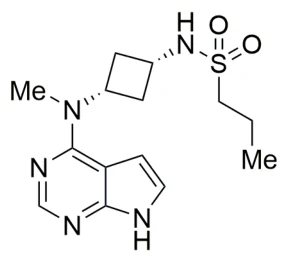
Chemical name: N-((1s,3s)-3-(methyl(7H-pyrrolo[2,3-d]pyrimidin-4-yl)amino)cyclobutyl)propane-1- sulfonamide
Molecular formula and molecular mass: C14H21N5O2S and 323.42 Daltons
Structural formula:
Physicochemical properties:
Appearance: Abrocitinib is a white to pale-colored powder.
Aqueous Solubility: The solubility of abrocitinib in water is 0.04 mg/mL at 25ºC. When pH values are less than 4.0, the compound demonstrates the characteristics of a high solubility compound, dissolving rapidly. At pH values greater than 4.0, the compound demonstrates the characteristics of a low solubility compound and thus dissolves more slowly.
Polymorphism: Only one crystalline anhydrous form (Form 1) of abrocitinib has been identified.
14. Clinical Trials
14.1. Clinical Trials by Indication
Table 7 - Summary of patient demographics for clinical trials in Atopic Dermatitis
| Study # | Trial design | Dosage, route of administration and duration | Study subjects (n) | Mean age (Range) (years) And Gender | Efficacy endpoints |
| Study # | Trial design | Dosage, route of administration and duration | Study subjects (n) | Mean age (Range) (years) And Gender | Efficacy endpoints |
| Study # | Trial design | Dosage, route of administration and duration | Study subjects (n) | Mean age (Range) (years) And Gender | Efficacy endpoints |
| Study # | Trial design | Dosage, route of administration and duration | Study subjects (n) | Mean age (Range) (years) And Gender | Efficacy endpoints |
MONO-1 B7451012 | Phase 3 randomized, double-blind, placebo-controlled, parallel group, multi-center study. | Abrocitinib 100 mg QD Abrocitinib 200 mg QD Placebo. Treatment duration was 12 weeks (randomized period). | Randomized: 387 100 mg: 156 200 mg: 154 Placebo: 77 | Mean age: 29 years (Range: 12 - 65 years) Female: 43.2% Male: 56.8% | Co-primary
Key secondary
|
MONO-2 B7451013 | Phase 3 randomized, double-blind, placebo-controlled, parallel group, multi-center study. | Abrocitinib: 100 mg QD Abrocitinib 200 mg QD Placebo Treatment duration was 12 weeks (randomized period). | Randomized: 391 (randomized 2:2:1) 100 mg: 158 200 mg: 155 Placebo: 78 | Mean age: 35.1 (Range: 12 - 65 years) Female: 41.4% Male: 58.5% | |
| REGIMEN B7451014 | Phase 3 randomized withdrawal, double-blind, placebo-controlled, multi-center study. | 12-weeks of 200 mg QD open label. Responders were then randomized to 200 mg QD, 100 mg QD or matching placebo up to 52 weeks. | Randomized: 798 (controlled phase) (randomized 1:1:1) 100 mg: 265 200 mg: 266 Placebo: 267 | Female and Male Mean age: (Range: 12 years and Older) | Primary Endpoint: Loss of response requiring rescue treatment was compared among groups during the blinded treatment period. Loss of response was defined as a loss of at least 50% of the EASI response at Week 12 and an IGA score of 2 or higher. Key Secondary Endpoint: Loss of response based on an IGA score of 2 or higher. |
| EXTEND B7451015 | Phase 3 multi-center, LTE study in subjects at least 12 years of age with moderate-to- s evere atopic dermatitis. | Subjects previously randomized to abrocitinib 200 mg or 100 mg QD in the qualifying Phase 3 study will be allocated to the same dose. | Planned: 3000 | Female and Male Mean age: (Range: 12 years and Older) | Primary Long-term safety (Incidence of clinical abnormalities and change from baseline in clinical laboratory values, ECG measurements, and vital signs.) |
| COMPARE B7451029 | Abrocitinib: 200 mg or 100 mg QD taken orally. Dupilumab: 300 mg administered subcutaneously every other week (with a loading dose of 600 mg at baseline). Matching placebo will be administered accordingly. The total treatment period is 20 weeks. | Total randomized: 838 (randomized 2:2:2:1) Abrocitinib 200 mg: 226 Abrocitinib 100 mg: 238 Dupilumab 300 mg: 243 Placebo: 131 | Mean age; 37.7 (Range: 18 years and Older) 93.5% ≥65 years of age 6.5% Female: 51.1% Male: 48.9% | Co-primary
Key secondary
| |
| TEEN B7451036 | Phase 3, randomized, double-blind, placebo-controlled, multi-center study investigating the efficacy and safety of abrocitinib co-administered with background medicated topical therapy in adolescent participants 12 to <18 years of age with moderate-to-severe atopic dermatitis | Abrocitinib 100 mg QD Abrocitinib 200 mg QD Placebo Treatment duration = 12 weeks | Randomized: 297 (randomized 1:1:1) 100 mg: 95 200 mg: 96 Placebo: 96 | Mean age: 14.9 (Range: 12 to <18 years of age) Female: 49.1% Male: 50.1% | Primary Endpoints: Response based on the IGA score of clear (0) or almost clear (1) (on a 5-point scale) and a reduction from baseline of ≤2 points at Week 12 Response based on the EASI-75 response at Week 12 Key Secondary Endpoints: Response based on at least 4 points improvement in the PP-NRS from baseline at Weeks 2, 4, and 12; Change from baseline in PSAAD total score at Week 12. |
Abbreviations: ABR=abrocitinib; CI=confidence interval; EASI=Eczema Area and Severity Index; LSM=least squares mean; IGA=Investigator Global Assessment; LTE = long term extension, N=number of patients randomized; PP-NRS=Peak Pruritus Numerical Rating Scale; PSAAD=Pruritus and Symptoms Assessment for Atopic Dermatitis
a. IGA responders were patients with IGA score of clear (0) or almost clear (1) (on a 5-point scale) and a reduction from baseline of ≥2 points at week 12.
b. EASI-75 responders were patients with ≥75% improvement in EASI, from baseline at week 12.
c. PP-NRS4 responders were patients with ≥4-point improvement in PP-NRS from baseline.
The efficacy and safety of CIBINQO as monotherapy and in combination with background medicated topical therapies were evaluated in 3 pivotal randomized, double-blind, placebo-controlled studies [MONO-1, MONO-2, and COMPARE] in 1616 patients 12 years of age and older with moderate-to-severe atopic dermatitis as defined by Investigator’s Global Assessment (IGA) score ≥3, Eczema Area and Severity Index (EASI) score ≥16, body surface area (BSA) involvement ≥10%, and Peak Pruritus Numerical Rating Scale (PP-NRS) ≥4 at the baseline visit prior to randomization.
Patients in these studies were those who had inadequate response to previous topical medication, or were patients for whom topical treatments were medically inadvisable, or who had received systemic therapies, including dupilumab. In each of the pivotal studies, over 40% of patients had prior exposure to systemic therapy. In MONO-1 and MONO-2, 6% of the patients had received dupilumab, whereas prior use of dupilumab was not allowed in COMPARE.
Eligible patients from qualifying parent studies were able to enroll in the long-term extension study EXTEND, e.g., if they completed the full treatment period of the any of the pivotal qualifying parent studies.
MONO-1, MONO-2, and COMPARE assessed the co-primary endpoints of IGA and EASI-75 responses at Week 12. Key secondary endpoints in MONO-1 and MONO-2 included improvement of ≥4 points in the severity of PP-NRS (PP-NRS4) at Week 12 and change from baseline to Week 12 for the Pruritus and Symptoms Assessment for Atopic Dermatitis (PSAAD). The PSAAD is an 11-item, self-reported instrument using a 24-hour recall period, designed to assess the severity of key symptoms and signs of atopic dermatitis including itching, pain, dryness, flaking, cracking, bumps, redness, discoloration, bleeding, fluid, and swelling. Key secondary endpoints in COMPARE were PP-NRS4 at Week 2 in addition to IGA response and EASI-75 at Week 16. The designs of the pivotal and long-term extension studies are summarized in Table 7.
Study Results
Treatment with CIBINQO 100 mg or 200 mg once daily as monotherapy or in combination with background medicated topical therapy resulted in improvement in objective signs of atopic dermatitis and patient-reported pruritus.
Baseline characteristics
In the placebo-controlled studies (MONO-1, MONO-2, COMPARE) and the open label induction, randomized withdrawal study (REGIMEN) across all treatment groups 41.4% to 51.1% were female, 59.3% to 77.8% were Caucasian, 15.0% to 33.0% were Asian and 4.1% to 8.3% were Black, and the mean age was 32.1 to 37.7 years. In these studies, 32.2% to 40.8% had a baseline IGA of 4 (severe atopic dermatitis), and 41.4% to 59.5% of patients had received prior systemic treatment for atopic dermatitis. The baseline mean EASI score ranged from 28.5 to 30.9, the baseline PP-NRS ranged from 7.0 to 7.3 and the baseline Dermatology Life Quality Index (DLQI) ranged from 14.4 to 16.0.
Monotherapy Studies:
In both pivotal monotherapy studies (MONO-1, MONO-2), the proportion of patients who achieved IGA and/or EASI-75 response was significantly higher in patients who received CIBINQO 100 mg or 200 mg once daily compared with placebo at Week 12 (see Table 8). Higher proportion of patients also achieved EASI-90 with CIBINQO 100 mg or 200 mg once daily compared with placebo at Week 12 (18.6% and 38.6% vs. 5.3% in MONO-1; 23.9% and 37.7% vs. 3.9% in MONO-2).
A significantly higher proportion of patients who achieved PP-NRS4 (defined as an improvement of ≥4 points in the severity of PP-NRS) with CIBINQO 100 mg or 200 mg once daily compared with placebo was observed as soon as Week 2 and persisting through Week 12 (see Table 8). Higher proportions of patients achieved PP-NRS4 with CIBINQO 100 mg or 200 mg once daily compared with placebo by Day 6 and Day 3 (2 days after the first dose), respectively. Higher proportion of patients also achieved
PP-NRS (0 or 1) with CIBINQO 100 mg or 200 mg once daily compared with placebo at Week 12 (21.1% and 35.4% vs. 3.2% in MONO-1; 21.3% and 32.4% vs. 5.5% in MONO-2).
| Table 8. Efficacy Results of CIBINQO Monotherapy at Week 12 | |||||||||||
| MONO-1 | MONO-2 | ||||||||||
| ABR | Placebo N=77 | ABR | Placebo N=78 | ||||||||
200 mg QD N=154 | 100 mg QD N=156 | 200 mg QD N=155 | 100 mg QD N=158 | ||||||||
% Responders (95% CI) | |||||||||||
| IGA 0 or 1a | 43.8g (35.9, 51.7) | 23.7e (17.0, 30.4) | 7.9 (1.8, 14.0) | 38.1g (30.4, 45.7) | 28.4f (21.3, 35.5) | 9.1 (2.7, 15.5) | |||||
| EASI-75b | 62.7g (55.1, 70.4) | 39.7g (32.1, 47.4) | 11.8 (4.6, 19.1) | 61.0g (53.3, 68.7) | 44.5g (36.7, 52.3) | 10.4 (3.6, 17.2) | |||||
| PP-NRS4c,d | 57.2g (48.8, 65.6) | 37.7f (29.2, 46.3) | 15.3 (6.6, 24.0) | 55.3g (47.2, 63.5) | 45.2g (37.1, 53.3) | 11.5 (4.1, 19.0) | |||||
Change from baseline (95% CI) | |||||||||||
LSM PSAAD | -3.2g (-3.6, -2.8) | -2.2e (-2.6, -1.9) | -1.1 (-1.7, -0.6) | -3.0g (-3.3, -2.7) | -2.4g (-2.8, -2.1) | -0.8 (-1.3, -0.3) | |||||
Abbreviations: ABR=abrocitinib; CI=confidence interval; EASI=Eczema Area and Severity Index; LSM=least squares mean; IGA=Investigator Global Assessment; N=number of patients randomized; PP-NRS=Peak Pruritus Numerical Rating Scale; PSAAD=Pruritus and Symptoms Assessment for Atopic Dermatitis; QD=once daily. a. IGA responders were patients with IGA score of clear (0) or almost clear (1) (on a 5-point scale) and a reduction from baseline of ³2 points. b. EASI-75 responders were patients with ≥75% improvement in EASI, from baseline. c. The proportion of PP-NRS4 responders was also significantly higher with CIBINQO 200 mg and 100 mg once daily than placebo at Week 2 and Week 4 in both MONO-1 and MONO-2. d. PP-NRS4 responders were patients with ≥4-point improvement in PP-NRS from baseline. e. Multiplicity-controlled p <0.01 versus placebo. f. Multiplicity-controlled p < 0.001 versus placebo. g. Multiplicity-controlled p < 0.0001 versus placebo. | |||||||||||
Treatment effects in subgroups (e.g., weight, age, sex, race, and prior systemic immunosuppressant treatment) in MONO-1 and MONO-2 were consistent with the results in the overall study population.
Combination Therapy Study:
In the pivotal combination therapy study (COMPARE), the proportion of patients who achieved IGA or EASI-75 response was significantly higher in patients who received CIBINQO 100 mg or 200 mg once daily compared with placebo at Week 12 (see Table 89). Higher proportion of patients also achieved EASI-90 with CIBINQO 100 mg or 200 mg once daily compared with placebo at Week 16 (38.0% and 48.9% vs. 11.3%).
The proportions of patients achieving PP-NRS4 with CIBINQO 100 mg and 200 mg once daily were significantly higher than placebo by Day 9 and Day 4, respectively, and remained significantly higher than placebo with both CIBINQO doses at Week 2 (Figure 1). Higher proportion of patients also achieved PP-NRS (0 or 1) with CIBINQO 100 mg or 200 mg once daily compared with placebo at Week 16 (24.7% and 32.0% vs. 11.7%).
Abrocitinib 200 mg QD had more rapid onset of relief of pruritus than dupilumab. The proportion of patients achieving PP-NRS4 with CIBINQO 200 mg once daily was significantly higher than dupilumab as early as Day 4 and remained significantly higher than dupilumab at Week 2. The proportion of patients achieving PP-NRS4 was similar between CIBINQO 100 mg once daily and dupilumab at Week 2.
Table 9. Efficacy Results of CIBINQO with Concomitant Topical Therapy
| Week 2 | Week 12 | Week 16 | ||||||||||||||||||||||||||||
|---|---|---|---|---|---|---|---|---|---|---|---|---|---|---|---|---|---|---|---|---|---|---|---|---|---|---|---|---|---|---|
| ABR | PBO N=131 | DUP N=243 | ABR | PBO N=131 | DUP N=243 | ABR | PBO N=131 | DUP N=243 | ||||||||||||||||||||||
200 mg N=226 | 100 mg N=238 | 200 mg N=226 | 100 mg N=238 | 200 mg N=226 | 100 mg N=238 | |||||||||||||||||||||||||
| % Responders | ||||||||||||||||||||||||||||||
| IGA 0 or 1a | 18.4 | 15.2 | 6.3 | 4.7 | 48.4e | 36.6e | 14.0 | 36.5 | 47.5e | 34.8e | 12.9 | 38.8 | ||||||||||||||||||
| EASI-75b | 30.0 | 25.4 | 10.9 | 14.0 | 70.3e | 58.7e | 27.1 | 58.1 | 71.0e | 60.3e | 30.6 | 65.5 | ||||||||||||||||||
| PP-NRS4c | 49.1e,f | 31.8d | 13.8 | 26.4 | 63.1 | 47.5 | 28.9 | 54.5 | 62.8 | 47.0 | 28.7 | 57.1 | ||||||||||||||||||
Abbreviations: ABR=abrocitinib; DUP=dupilumab; EASI=Eczema Area and Severity Index; N=number of patients randomized; PBO=placebo; PP-NRS=Peak pruritus numerical rating scale a. IGA responders were patients with IGA score of clear (0) or almost clear (1) (on a 5-point scale) and a reduction from baseline of ≥ 2 points. b. EASI-75 responders were patients with ≥75 improvement in EASI, respectively, from baseline. c. PP-NRS4 responders were patients with ≥ 4-point improvement in PP-NRS from baseline. d. Multiplicity-controlled p < 0.001 vs. placebo e. Multiplicity-controlled p < 0.0001 vs. placebo f. Multiplicity-controlled p < 0.0001 vs. dupilumab. Statistical comparison between either abrocitinib dose and dupilumab was only performed on the proportion of patients achieving PP-NRS4 at Week 2. | ||||||||||||||||||||||||||||||
Figure 1. Proportion of patients who achieved PP-NRS4 over time in MONO-1, MONO-2 and COMPARE
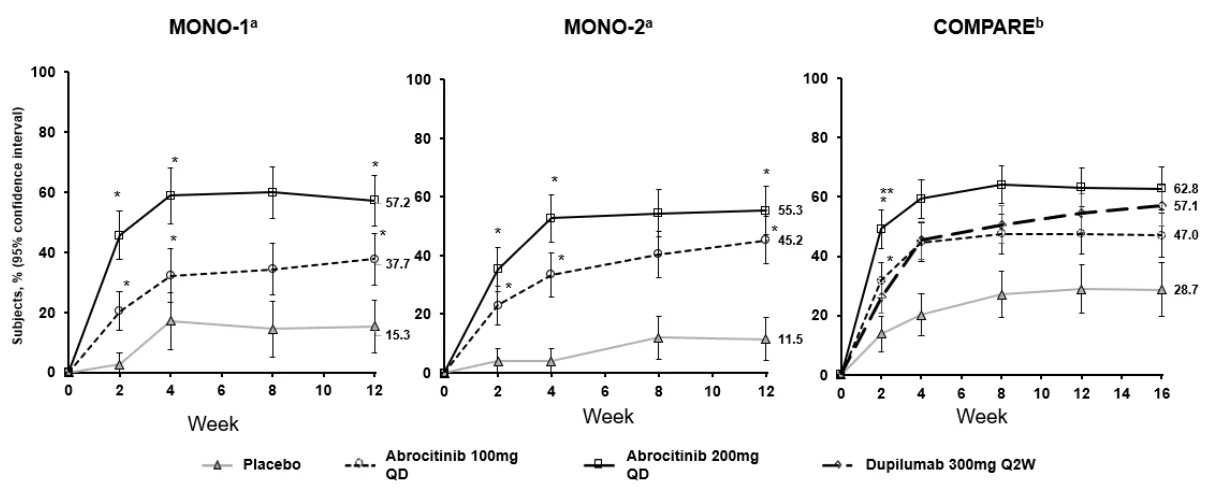
Abbreviations: PP-NRS=Peak Pruritus Numerical Rating Scale; QD=once daily.
PP-NRS4 responders were patients with ≥ 4-point improvement in PP-NRS from baseline.
a. Abrocitinib used as monotherapy.
b. Abrocitinib used in combination with medicated topical therapy.
* Statistically significant with adjustment for multiplicity versus placebo.
** Statistically significant with adjustment for multiplicity versus dupilumab.
Treatment effects in subgroups (e.g., weight, age, sex, race, and prior systemic immunosuppressant treatment) in COMPARE were consistent with the results in the overall study population.
Early onset of treatment effect, prior to the time-points selected for formal efficacy assessments, was observed for both doses of abrocitinib for the proportion of subjects who achieved IGA response, EASI-75, or PP-NRS4 response in all studies, and for change in PSAAD from baseline in the monotherapy studies.
Abrocitinib 200 mg QD had more rapid onset of relief of pruritus than dupilumab. Starting at Day 2 through Week 16, abrocitinib 200 mg QD had higher PP-NRS4 responder proportion than dupilumab, whereas abrocitinib 100 mg was similar to dupilumab over time.
The totality of data demonstrates that both abrocitinib doses relieved the signs and symptoms of moderate-to-severe AD, including skin clearance, itch relief and improvement of quality of life, either as monotherapy or in combination with background medicated topical therapy in adults and adolescents.
Switch from Dupilumab to Abrocitinib:
Patients who received dupilumab and subsequently enrolled in EXTEND were randomized to either CIBINQO 100 mg or 200 mg once daily upon entering EXTEND. Among responders to dupilumab in COMPARE, the majority did not show evidence of a loss of response 12 weeks after switching to CIBINQO. Some non-responders to dupilumab in COMPARE also demonstrated an IGA and EASI-75 response after switching to CIBINQO, though response rates relative to a comparator were not determined.
Long-term Efficacy:
The majority of patients who achieved a response at Week 12 of a qualifying study and entered EXTEND did not show evidence of a loss of the treatment response at Week 48 [60% and 70% for IGA (0 or 1) response, 79% and 87% for EASI-75, and 62% and 83% for PP-NRS4 with 100 mg once daily and 200 mg once daily, respectively].
Secondary endpoints on quality of life PRO:
There was improvement in different indexes of symptoms and quality of life in adults and adolescents with AD, consistent with the changes observed in the main efficacy parameters.
Treatment with either dose of CIBINQO as monotherapy resulted in improved patient-reported outcomes at 12 weeks compared with placebo. A larger proportion of the CIBINQO groups had clinically meaningful reductions in Dermatology Life Quality Index (DLQI) total scores (defined as a 4-point improvement) from baseline to Week 12 compared with placebo. Both CIBINQO 100 mg and 200 mg groups also had a larger proportion of patients who reported “no effect” of their disease on their quality of life (as measured by a DLQI score of 0 or 1).
Improved patient-reported atopic dermatitis symptoms and sleep disruption as measured by the Pruritus and Symptoms Assessment for Atopic Dermatitis (PSAAD), Patient Oriented Eczema Measure (POEM), Night Time Itch Scale (NTIS), and SCORing Atopic Dermatitis (SCORAD) sleep loss subscale were observed in both groups. In addition, anxiety and depression symptoms as measured by the Hospital Anxiety and Depression Scale (HADS) total score were reduced in the CIBINQO 100 mg and 200 mg groups compared with placebo at 12 weeks.
In COMPARE, a larger proportion both of the CIBINQO 100 mg and 200 mg groups had clinically meaningful reductions in DLQI total scores (defined as a 4-point improvement) from baseline to Week 12 compared with placebo. CIBINQO groups also had a larger proportion of patients who reported “no effect” of their disease on their quality of life (as measured by a DLQI score of 0 or 1).
Both CIBINQO 100 mg and 200 mg improved patient-reported atopic dermatitis symptoms and sleep disruption as measured by the POEM and SCORAD sleep loss subscale, respectively. In addition, anxiety and depression symptoms as measured by the HADS total score were reduced in both the CIBINQO 100 mg and 200 mg groups compared with placebo at 12 weeks.
Open label induction, randomized withdrawal study (REGIMEN):
A total of 1,233 patients received open label Cibinqo at a dosage of 200 mg/day. Seven-hundred ninety-eight (798) induction responders were randomized to 200 mg or 100 mg of medicinal product or placebo.
Continuous treatment (200 mg continuous) and induction-maintenance treatment (200 mg for 12 weeks followed by 100 mg) prevented flare with 81.1% and 57.4% probability, respectively, versus 19.1% among patients who withdrew treatment (randomized to placebo) after 12 weeks of induction. Three-hundred fifty-one (351) patients including 16.2% of 200 mg, 39.2% of 100 mg and 76.4% of placebo patients received rescue medication of 200 mg Cibinqo in combination with topical therapy.
Figure 2. Time to protocol-defined flare
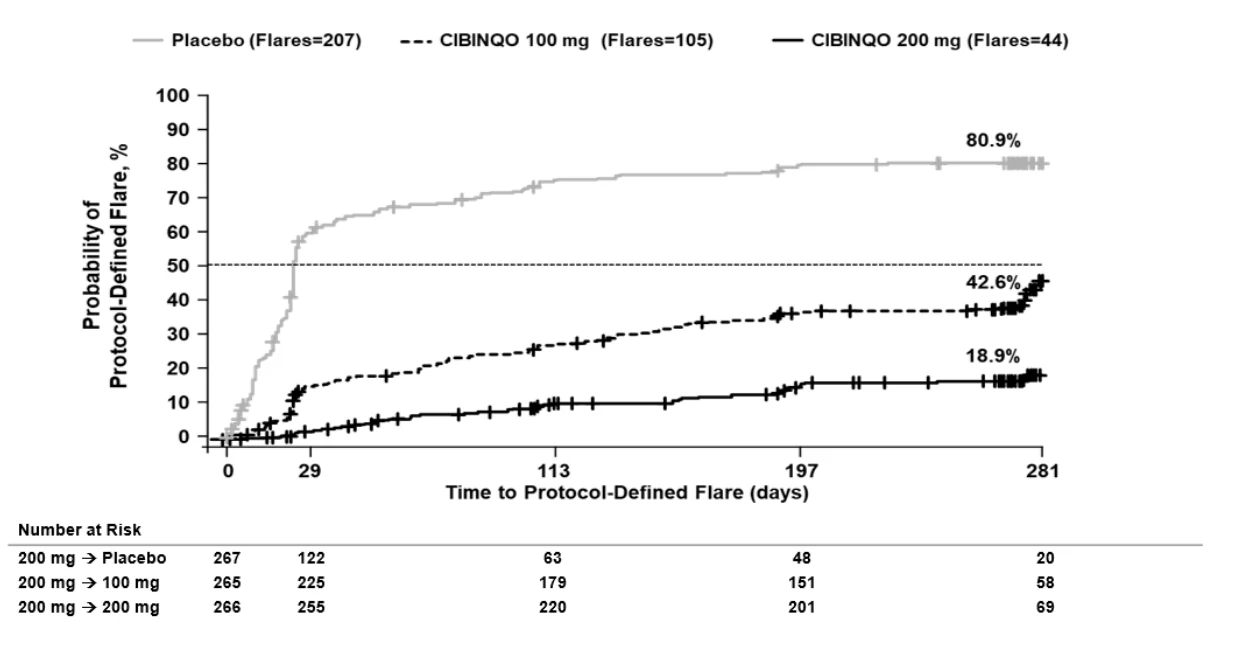
Cibinqo used in monotherapy
Protocol-defined flare=A loss of at least 50% of the EASI response at Week 12 and an IGA score of 2 or higher.
Multiplicity-controlled p <0.0001 200 mg versus placebo; 100 mg versus placebo; 200 mg versus 100 mg.
Pediatric data results
Data from the Phase 3 monotherapy studies indicate that the treatment with both abrocitinib doses resulted in clinically meaningful efficacy in adults and adolescents, with demonstration of dose-dependent increase in treatment effect. The efficacy and safety were also evaluated in open label induction, randomised withdrawal study (REGIMEN) which included 246 patients who were 12 to less than 18 years of age. In these studies, the results in the adolescent subgroup were consistent with the results in the overall study population.
In adolescents, abrocitinib 100 mg QD and 200 mg QD achieved higher IGA responder proportions than placebo at Week 12 in both Phase 3 monotherapy studies. The treatment effect (IGA responder proportion corrected for placebo) was clinically meaningful for both abrocitinib doses (13.5% and 22.5% for 100 mg QD and 200 mg QD, respectively).
In adolescents, abrocitinib 100 mg QD and 200 mg QD achieved higher EASI-75 responder proportions than placebo at Week 12 in both Phase 3 monotherapy studies. The 95% confidence intervals for placebo-corrected responder proportions for both doses of abrocitinib excluded zero in the monotherapy pool, suggesting true treatment effects. The treatment effect was clinically meaningful for both abrocitinib doses (35.4% and 47.6% for 100 mg QD and 200 mg QD, respectively, in the monotherapy pool), with evidence of dose-dependency.
The efficacy and safety of Cibinqo in combination with background medicated topical therapy was evaluated in the Phase 3 randomised, double-blind, placebo-controlled study TEEN. The study included 285 patients who were 12 to less than 18 years of age with moderate-to-severe atopic dermatitis as defined by IGA score ≥3, EASI score ≥16, BSA involvement ≥10%, and PP-NRS4 at the baseline visit prior to randomisation. Patients who had a prior inadequate response or who had received systemic therapy, were eligible for inclusion.
Baseline characteristics
In TEEN, across all treatment groups 49.1% were female, 56.1% were Caucasian, 33.0% were Asian and 6.0% were Black patients. The median age was 15 years and the proportion of patients with severe atopic dermatitis (IGA of 4) was 38.6%.
Table 10. Adolescent efficacy results of Cibinqo in TEEN
| TEENd | ||||||
|---|---|---|---|---|---|---|
| CBQ | PBO N=96 | |||||
200 mg QD N=94 | 100 mg QD N=95 | |||||
IGA 0 or 1a % responders (95% CI) | 46.2e (36.1, 56.4) | 41.6e (31.3, 51.8) | 24.5 (15.8, 33.2) | |||
EASI-75b % responders (95% CI) | 72.0e (62.9, 81.2) | 68.5e (58.9, 78.2) | 41.5 (31.5, 51.4) | |||
PP-NRS4c % responders (95% CI) | 55.4e (44.1, 66.7) | 52.6 (41.4, 63.9) | 29.8 (20.0, 39.5) | |||
Abbreviations: CBQ=Cibinqo; CI=confidence interval; EASI=Eczema Area and Severity Index; IGA=Investigator Global Assessment; N=number of patients who received at least one dose of study treatment; PBO=placebo; PP-NRS=Peak Pruritus Numerical Rating Scale; QD=once daily.
a. IGA responders were patients with IGA score of clear (0) or almost clear (1) (on a 5-point scale) and a reduction from baseline of ≥2 points.
b. EASI-75 responders were patients with ≥75% improvement in EASI from baseline.
c. PP-NRS4 responders were patients with ≥4-point improvement in PP-NRS from baseline.
d. Cibinqo used in combination with medicated topical therapy.
e. Statistically significant with adjustment for multiplicity versus placebo.
Comparative Bioavailability Studies
This Phase 1 randomized, open-label, single-dose, crossover study in healthy participants was to estimate the rBA of single 200 mg doses of the commercial tablet formulation of PF-04965842 and a variant formulation with a slower dissolution rate, compared to the Phase 3 tablet formulation. The effect of food on the BA of the commercial tablet formulation was also evaluated.
16. Non-Clinical Toxicology
General toxicology
Rats (Wistar Han or Sprague Dawley) and cynomolgus monkeys were chosen as the nonclinical test systems for general toxicology studies because all the nonclinical studies of the marketed JAK1/3 inhibitor, tofacitinib (Xeljanz), were conducted in these species, and they have shown sensitivity to the pharmacological inhibition of JAK.
Genotoxicity
CIBINQO is not mutagenic in the bacterial mutagenicity assay (Ames assay). Although CIBINQO is aneugenic in the in vitro TK6 micronucleus assay, CIBINQO is not aneugenic or clastogenic based on the results of the in vivo rat bone marrow micronucleus assay.
Carcinogenicity
No evidence of tumorigenicity was observed in Tg.rasH2 mice administered CIBINQO for 6 months at oral doses up to 75 mg/kg/day and 60 mg/kg/day in female and male mice, respectively. In the 2-year oral carcinogenicity study, CIBINQO resulted in a statistically higher incidence of benign thymomas in female rats at exposures greater than or equal to 2.8 times the unbound human AUC at the MRHD of 200 mg. No evidence of CIBINQO -related tumorigenicity was observed following oral CIBINQO administration in female rats at exposures equal to 0.6 times the unbound human AUC at the MRHD of 200 mg, or in male rats at exposures equal to 14 times the unbound human AUC at the MRHD of 200 mg.
Reproductive and developmental toxicology
CIBINQO had no effects on rat male fertility or spermatogenesis at doses up to 70 mg/kg/ day at exposures equal to 26 times the unbound human AUC at the MRHD of 200 mg. CIBINQO resulted in effects on rat female fertility (lower fertility index, corpora lutea, and implantation sites) at exposures equal to 29 times the unbound human AUC at the MRHD of 200 mg and higher post implantation loss in rats at exposures greater than or equal to 11 times the unbound human AUC at the MRHD of 200 mg. The effects on female fertility in rats reversed 1 month after cessation of CIBINQO administration. No effects on female fertility were noted at exposures equal to 2 times the unbound human AUC at the MRHD of 200 mg.
No fetal malformations were observed in embryo-fetal development studies in rats or rabbits. In an embryo-fetal development study in pregnant rabbits, oral administration of CIBINQO during gestation Days 7 to 19 had no effects on embryo-fetal survival or fetal morphological development at exposures equal to 4 times the unbound human AUC at the MRHD of 200 mg. CIBINQO resulted in an increased incidence of delayed ossification of the forelimb phalanges at exposures equal to 4 times the unbound human AUC at the MRHD of 200 mg.
In an embryo-fetal development study in pregnant rats, oral administration of CIBINQO during gestation Days 6 to 17 resulted in increased embryo-fetal lethality at exposures equal to 17 times the unbound human AUC at the MRHD of 200 mg. No embryo-fetal lethality was observed in pregnant rats orally dosed with CIBINQO during organogenesis at exposures equal to 11 times the unbound human AUC at the MRHD of 200 mg. CIBINQO resulted in increased incidences of skeletal variations of short 13th ribs at exposures greater than or equal to 11 times the unbound human AUC at the MRHD of 200 mg and reduced ventral processes, thickened ribs, and unossified metatarsals at exposures equal to 17 times the unbound human AUC at the MRHD of 200 mg. No skeletal variations were noted in rats at exposures equal to 2.4 times the unbound human AUC at the MRHD of 200 mg.
In a rat pre- and postnatal development study in pregnant rats, oral administration of CIBINQO during gestation Day 6 through lactation Day 21 resulted in dystocia with prolonged parturition and lower offspring body weights at exposures greater than or equal to 11 times the unbound human AUC at the MRHD of 200 mg and lower postnatal survival at exposures equal to 17 times the unbound human AUC at the MRHD of 200 mg. No maternal or developmental toxicity was observed in either dams or offspring at exposures equal to 2.4 times the unbound human AUC at the MRHD of 200 mg.
Juvenile toxicity
Administration of abrocitinib to juvenile rats beginning on postnatal Day 21 and older (comparable to a 2-year-old human and older) was not associated with microscopic or macroscopic bone findings. Administration of abrocitinib to juvenile rats beginning on postnatal Day 10 (comparable to a 3-month old human infant) resulted in adverse macroscopic and microscopic bone findings including malrotated paws, fractures, and/or femoral head abnormalities.