


Product Monograph - Anzupgo
1. Indications
ANZUPGO (delgocitinib cream) is indicated for the treatment of moderate to severe chronic hand eczema (CHE) in adults for whom topical corticosteroids are inadequate or are not advisable.
1.1. Pediatrics
Pediatrics (< 18 years): No data are available to Health Canada; therefore, Health Canada has not authorized an indication for pediatric use.
1.2. Geriatrics
Geriatrics (≥ 65 years): Evidence from clinical studies suggests there are no clinically relevant differences in safety and efficacy between geriatric patients and adult patients less than 65 years of age.
2. Contraindications
ANZUPGO is contraindicated in patients who are hypersensitive to this drug or to any ingredient in the formulation, including any non-medicinal ingredient, or component of the container. For a complete listing, see 6 Dosage Forms, Strengths, Composition, and Packaging.
4. Dosage and Administration
4.1. Dosing Considerations
- Health Canada has not authorized an indication for pediatric use, as no data are available in patients < 18 years of age [see 1.1 Indications, Pediatrics].
4.2. Recommended Dose and Dosage Adjustment
- The recommended dose is a thin layer of ANZUPGO applied twice daily, approximately 12 hours apart, to the affected skin of the hands and wrists until the skin is clear or almost clear.
- ANZUPGO should be discontinued when signs and symptoms of CHE resolve.
- In the event of recurrence of the signs and symptoms of CHE (flares), twice daily treatment of the affected areas should be re-initiated as needed.
- If signs and symptoms of CHE do not improve within 12 weeks of treatment, continued therapy should be re-evaluated by a healthcare professional.
Geriatric patients (≥ 65 years)
No dose adjustment is required for geriatric patients.
Hepatic and renal impairment
No dose adjustment is required in patients with hepatic or renal impairment due to the low systemic exposure of topically applied delgocitinib to the hands and wrists [see 10.3 Pharmacokinetics].
4.4. Administration
ANZUPGO is for topical use only. It is not for ophthalmic, oral or intravaginal use. Contact with eyes, mouth, or other mucous membranes should be avoided. If contact with mucous membranes occurs, rinse thoroughly with water.
A thin layer of ANZUPGO should be applied, approximately 12 hours apart, to clean and dry skin of the affected areas of the hands and wrists.
Patients should avoid applying other topical products within 2 hours before and after application of ANZUPGO. Co-application with emollients within 2 hours before and after application of delgocitinib has not been studied.
Patients should be advised to not use more than one 60 g tube per month.
If someone else applies the cream to the patient, they should be instructed to wash their hands after application.
4.5. Missed Dose
If an application is missed, ANZUPGO should be applied as soon as possible. Thereafter, applications should be resumed at the regular scheduled time.
5. Overdose
There are no data from clinical trials regarding overdose with ANZUPGO. No systemic signs of overdose are expected following topical application of ANZUPGO to the hands and wrists due to the low systemic absorption of delgocitinib. If too much cream has been applied, the excess should be wiped off.
| For the most recent information in the management of a suspected drug overdose, contact your regional poison control centre or Health Canada’s toll-free number, 1-844 POISON-X (1-844-764-7669). |
|---|
- 6. Dosage Forms, Strengths, Composition, and Packaging
Table 1-1: Dosage Forms, Strengths, and Composition
| Route of Administration | Dosage Form/ Strength/Composition | Non-medicinal Ingredients |
| Topical | Cream; 20 mg/g | Benzyl alcohol, butylhydroxyanisole, cetostearyl alcohol, citric acid monohydrate, disodium edetate, hydrochloric acid, liquid paraffin, macrogol cetostearyl ether, purified water. |
Description
ANZUPGO is a white to slightly brown cream. Each gram of cream contains 20 mg of delgocitinib.
ANZUPGO is supplied in 5 g and 15 g (sample sizes) and 60 g laminate tubes. The laminate tubes are comprised of an inner layer of low-density polyethylene fitted with a polypropylene cap.
7. Warnings and Precautions
General
ANZUPGO is not for ophthalmic, oral, or intravaginal use.
Use of ANZUPGO in combination with other treatments for CHE, such as alitretinoin, has not been studied. Use of ANZUPGO in combination with other JAK inhibitors, immunomodulators or potent immunosuppressants has not been studied, and therefore, should be used with caution.
Carcinogenesis and Genotoxicity
Non-melanoma skin cancer
Non-melanoma skin cancer (NMSC), including basal cell carcinoma and squamous cell carcinoma, has been reported in patients treated with topical JAK inhibitors. A skin examination prior to initiation and periodically during treatment of the application site should be considered for patients with a history of skin cancer, or who have risk factors for skin cancer.
Reproductive Health
- Fertility
No human data on the effect of delgocitinib on fertility are available.
Based on findings in female rats, oral administration of delgocitinib resulted in reduced fertility at exposures considered sufficiently in excess of the human exposure with topical administration to affected areas of the hands and/or wrists [see 16 Non-Clinical Toxicology].
Animal studies did not indicate effects with respect to fertility in males.
7.1. Special Populations
7.1.1. Pregnancy
The limited data from the use of ANZUPGO in pregnant women is insufficient to evaluate a drug-associated risk of major birth defects, miscarriage, or other adverse maternal or fetal outcomes.
When administered orally in animals, studies have shown reproductive toxicity at exposures considered sufficiently in excess of the human exposure with topical administration to affected areas of the hands and/or wrists [see 16 Non-Clinical Toxicology].
As a precautionary measure, it is preferable to avoid the use of ANZUPGO during pregnancy.
7.1.2. Breastfeeding
It is unknown whether delgocitinib is excreted in human milk. ANZUPGO should only be used during breast feeding if the benefit justifies the potential risk to the newborn/infant.
After oral administration, delgocitinib was present in the milk of lactating rats [see 16 Non-Clinical Toxicology].
If ANZUPGO is used during breast-feeding, care should be taken to avoid direct contact with the nipple or surrounding area after applying ANZUPGO cream to the hands and/or wrists.
7.1.3. Pediatrics
Pediatrics (<18 years of age): No data are available to Health Canada; therefore, Health Canada has not authorized an indication for pediatric use [see 1.1 Indications, Pediatrics].
7.1.4. Geriatrics
Evidence from clinical studies suggests there are no clinically relevant differences in safety and efficacy between geriatric patients and adult patients less than 65 years of age.
8. Adverse Reactions
8.1. Adverse Reaction Overview
The most common adverse reactions reported in Phase 3 clinical studies in adult patients with moderate or severe CHE were application site reactions (1.1%).
8.2. Clinical Trial Adverse Reactions
Clinical trials are conducted under very specific conditions. Therefore, the frequencies of adverse reactions observed in the clinical trials may not reflect frequencies observed in clinical practice and should not be compared to frequencies reported in clinical trials of another drug.
The safety data described below is based on a pool of two vehicle-controlled clinical studies in 959 patients with CHE, of which 638 were treated with ANZUPGO. Patients applied ANZUPGO to affected areas of the hands and wrists twice daily for up to 16 weeks. A total of 466 patients continued with an additional 36 weeks of as-needed treatment with ANZUPGO in an open-label, long-term extension study.
Table 1-2: Adverse Reactions Reported in ≥1% of Patients in CHE Trials through Week 16
| Adverse Reaction | ANZUPGO N=638 | Vehicle N=321 | ||||
|---|---|---|---|---|---|---|
| n | % | n | % | |||
| General disorders and administration site conditions | ||||||
| Application site reactions* | 7 | 1.1 | 9 | 2.8 | ||
* Includes: application site pain, application site paraesthesia, application site pruritus, and application site erythema.
N=number of subjects; n=number of subjects with events; %=proportion of subjects
The long-term safety of as-needed treatment with ANZUPGO through Week 52 was consistent with the safety profile observed up to Week 16.
8.2.1. Clinical Trial Adverse Reactions – Pediatrics
Not applicable. No data are available to Health Canada; therefore, Health Canada has not authorized an indication for pediatric use.
8.4. Abnormal Laboratory Findings: Hematologic, Clinical Chemistry, and Other Quantitative Data
Clinical Trial Findings
No clinically meaningful trends in hematologic, chemistry parameters or vital signs were observed in clinical trials.
8.5. Post-Market Adverse Reactions
Not applicable, as post-market adverse reactions have yet to be reported.
9. Drug Interactions
9.2. Drug Interactions Overview
No drug interaction studies have been performed with topical or oral delgocitinib.
Given the limited metabolism of delgocitinib, application to a limited body surface area (hands and wrists), and low systemic exposure of topically applied delgocitinib, there is a low potential for interaction with systemic medications.
ANZUPGO has not been evaluated in combination with other topical medications and co-application on the same skin area is not recommended.
9.3. Drug-Behaviour Interactions
Drug-behavioural interactions have not been evaluated.
9.4. Drug-Drug Interactions
Interactions with other drugs have not been established.
9.5. Drug-Food Interactions
Interactions with food have not been evaluated.
9.6. Drug-Herb Interactions
Interactions with herbal products have not been evaluated.
9.7. Drug-Laboratory Test Interactions
Interactions with laboratory tests have not been evaluated.
10. Clinical Pharmacology
10.1. Mechanism of Action
Delgocitinib is a pan Janus kinase (JAK) inhibitor that targets the activity of all four members of the JAK family of enzymes consisting of JAK1, JAK2, JAK3, and tyrosine kinase 2 (TYK2) in a concentration dependent manner. Upon activation by cytokines, JAK signaling involves activation of signal transducers and activators of transcription (STATs). Activated STATs, in turn, activate the expression of cytokine-responsive genes to induce specific biological responses in target cells. Inhibition of JAK activity with delgocitinib prevents the activation of STATs.
In in vitro studies in human cells, inhibition of the JAK-STAT pathway by delgocitinib attenuated the signaling of several pro-inflammatory cytokines (including interleukin (IL)-2, IL-4, IL-6, IL-13, IL-21, IL-23, Granulocyte-Macrophage-Colony-Stimulating Factor (GM-CSF), and Interferon (IFN)-α) downregulating the immune and inflammatory responses in cells of relevance to CHE pathology.
10.2. Pharmacodynamics
Cardiac Electrophysiology
In a thorough QT study in healthy subjects, there was no indication of a QTc prolonging effect of orally administered delgocitinib at single doses up to 12 mg (approximately 200 times the human exposure following topical application, based on Cmax). Therefore, ANZUPGO is not expected to effect cardiac repolarization under conditions of clinical use.
Dermal Safety Studies
Clinical studies in healthy subjects demonstrated that ANZUPGO did not cause phototoxic skin reactions or photoallergic skin reactions.
10.3. Pharmacokinetics
The pharmacokinetics of delgocitinib was investigated in 15 adult subjects with moderate (n=13) or severe (n=2) CHE that were administered ANZUPGO twice daily for 8 days (Table 1-3).
Table 1-3: Mean SD Pharmacokinetic Parameters for Systemic Concentrations of delgocitinib in Moderate and Severe CHE
*Cmax (ng/mL) (N=15) | *AUC0-12 (ng*h/mL) (N=15) | Tmax (h) (N=15) | *t½ (h) (N=6) |
| 0.46 (1.74) | 3.7 (1.74) | 6.4 (4.36) | 20.3 (1.3) |
Cmax=maximum observed concentration (0-12 hours post dose) at Day 8
AUC0-12=area under the concentration-time curve (0-12 hours post dose) at Day 8
Tmax=time to reach maximum observed concentration at Day 8
t1/2=terminal elimination half-life
* Geometric mean (Geometric standard deviation)
Absorption
The pharmacokinetics of delgocitinib cream were evaluated in a study involving 15 adult patients 22 to 69 years of age with moderate (n=13) to severe (n=2) CHE. Patients applied delgocitinib 20 mg/g cream to the affected areas of the hands and wrists twice a day for 8 days. Subjects applied a mean 0.87 g (range 0.3 g to 1.9 g) per application, twice a day.
The geometric mean (geometric standard deviation) maximum plasma concentration (Cmax) and area under the concentration-curve from time 0 to 12 hours (AUC0-12) on Day 8 was 0.46 (1.74) ng/mL and 3.7 (1.74) ng*h/mL, respectively (Table 1-3). Steady state was reached by Day 8. The systemic exposure (AUC and Cmax) between Day 1 and Day 8 were similar.
Following twice daily application of delgocitinib 20 mg/g cream in a Phase 3, 16 week clinical trial (DELTA 2), the geometric mean plasma concentration observed 2-6 hours after application at Day 113 was 48% lower than that at Day 8 (0.11 ng/mL and 0.21 ng/mL, respectively).
The relative bioavailability of delgocitinib following topical application of ANZUPGO is approximately 0.6% compared to administration via oral tablets.
Distribution
Based on an in vitro study, plasma protein binding of delgocitinib is 22 to 29%.
Metabolism
As delgocitinib does not undergo extensive metabolism, the main plasma component is unchanged delgocitinib. Following oral administration, four metabolites (formed via oxidation and glucuronide conjugation) were detected, each at <2% of the average unchanged delgocitinib plasma concentrations. The limited metabolism of delgocitinib occurs primarily though CYP3A4/5 and to a lesser extent by CYP1A1, CYP2C19, and CYP2D6.
Based on in vitro data, delgocitinib is a substrate of P-glycoprotein (P-gp) and a weak substrate of human organic cation transporter 2 (OCT2) and organic anion transporter 3 (OAT3). Delgocitinib inhibited OAT1 and OAT3. However, at clinically relevant concentrations from topical administration, delgocitinib is not expected to inhibit or induce cytochrome P450 enzymes or inhibit transporter systems such as organic anion transporters (OAT), organic anion transporting proteins (OATP), organic cation transporters (OCT), P-gp, breast cancer resistance protein (BCRP), or multi-antimicrobial extrusion protein (MATE).
Elimination
Delgocitinib is primarily eliminated by renal excretion as approximately 70% to 80% of the total dose after oral administration was found unchanged in the urine.
Following repeated topical application of delgocitinib cream, the average half-life of delgocitinib was estimated to be 20.3 hours.
Special populations and conditions
- Pediatrics: The pharmacokinetics of delgocitinib in pediatric patients has not been studied.
- Geriatrics: No dose adjustment is required for patients aged ≥ 65 years [see 4.2 Recommended Dose and Dosage Adjustment]. Age ≥ 65 years does not have a clinically significant effect on exposures of delgocitinib.
- Hepatic Insufficiency: No formal studies of delgocitinib cream in patients with hepatic impairment have been conducted. Due to the low systemic exposure of topically applied delgocitinib to the hands and wrists and limited metabolism of delgocitinib, changes in hepatic function are unlikely to have any effect on the elimination of delgocitinib. Therefore, no dose adjustments are needed in patients with hepatic impairment [see 4.2 Recommended Dose and Dosage Adjustment].
- Renal Insufficiency: Pharmacokinetic parameters of delgocitinib were analyzed in 96 patients with mild or moderate renal impairment (eGFR 30 to 89 mL/min/1.73 m2) in DELTA 2. There were no clinically relevant differences in the pharmacokinetics observed in patients with mild or moderate renal impairment compared to the overall study population. Due to the low systemic exposure of topically applied delgocitinib to the hands and wrists, changes in renal function are unlikely to be of clinical importance. Therefore, no dose adjustments are needed in patients with renal impairment [see 4.2 Recommended Dose and Dosage Adjustment].
- Storage, Stability, and Disposal
Store below 30°C. Do not freeze.
| 15 g and 60 g tubes | Use within 12 months of first opening the tube and not past the expiry date. |
|---|---|
| 5 g tube | Use within 1 week of first opening the tube and not past the expiry date. |
Keep out of reach and sight of children.
Disposal
Any unused medicinal product or waste material should be disposed of in accordance with local requirements.
Part 2: Scientific Information
13. Pharmaceutical Information
Drug Substance
Non-proprietary name: Delgocitinib
Chemical name: 3-[(3S,4R)-3-Methyl-6-(7H-pyrrolo[2,3-d]pyrimidin-4-yl)-1,6- diazaspiro[3.4]octan-1-yl]-3-oxopropanenitrile
Molecular formula: C16 H18 N6 O
Molecular mass: 310.35 g/mol
Structural formula:
Physicochemical properties:
Appearance: Delgocitinib is a white to almost white powder.
Polymorphism: Delgocitinib exists in different polymorphic forms. Five anhydrous crystal forms (6, 12, 15, 18 and 27) and one monohydrate crystal form (16) have been identified. The five anhydrous crystal forms have been assessed to be very similar in terms of solubility, hygroscopicity and stability.
Solubility: There are no observed differences in solubility between the different anhydrous forms (6, 12, 15, 18 and 27) which are slightly soluble in ethyl acetate, ethanol, methanol, and isopropanol; sparingly soluble in acetone; insoluble in n-hexane; and freely soluble in DMSO. At aqueous pH solutions of 3.2, 5.0 and 7.5 the anhydrous forms are freely soluble, sparingly soluble, and slightly soluble, respectively, and are controlled solely by the solubility of the monohydrate form 16.
14. Clinical Trials
14.1. Clinical Trials by Indication
Chronic Hand Eczema
The safety and efficacy of ANZUPGO were evaluated in two pivotal randomized, double-blind, vehicle-controlled studies of similar design (DELTA 1 and DELTA 2). CHE was defined as hand eczema that has persisted for more than 3 months or returned twice or more within the previous 12 months. The studies included 960 patients 18 years of age and older with moderate to severe CHE as defined by an Investigator’s Global Assessment for chronic hand eczema (IGA-CHE) score of 3 (moderate) or 4 (severe) and required a Hand Eczema Symptom Diary (HESD) itch score of ≥ 4 points at baseline. Eligible patients had a previous inadequate response to topical corticosteroids or were those in which topical corticosteroids are not advisable (e.g. due to important side effects or safety risks).
Patients in DELTA 1 and DELTA 2 applied either ANZUPGO cream (20 mg/g delgocitinib) or vehicle cream twice daily to affected areas on the hands and wrists for 16 weeks.
Table 2-1: Summary of patient demographics for clinical trials in moderate to severe Chronic Hand Eczema (CHE)
| Study # | Study design | Dosage, route of administration and duration | Study subjects (n) | Mean age (Range) | Sex |
| DELTA 1 | Phase 3, randomized, double-blind, vehicle-controlled, parallel-group, multi-site, efficacy and safety | 20 mg/g delgocitinib cream, topical, twice-daily for 16 weeks | 325 | 44.3 years (19-87) | Male: 123 Female: 202 |
| Vehicle cream, topical, twice-daily for 16 weeks | 162 | 42.9 years (20-73) | Male: 58 Female: 104 | ||
| DELTA 2 | Phase 3, randomized, double-blind, vehicle-controlled, parallel-group, multi-site, efficacy and safety | 20 mg/g delgocitinib cream, topical, twice-daily for 16 weeks | 314 | 45.3 years (18-83) | Male: 110 Female: 204 |
| Vehicle cream, topical, twice-daily for 16 weeks | 159 | 42.6 years (18-86) | Male: 51 Female: 108 | ||
| DELTA 3 | Phase 3, open-label, multi-site, long-term extension | 20 mg/g delgocitinib cream, topical, twice-daily, as needed, for 36 weeks | 801 | 45.0 years (18-86) | Male: 289 Female: 512 |
The primary endpoint was the proportion of patients achieving IGA-CHE treatment success (IGA-CHE TS), defined as an IGA-CHE score of 0 (clear) or 1 (almost clear: barely perceptible erythema only) with at least a 2-step improvement from baseline to Week 16. The IGA-CHE instrument rates the severity of the subject’s global disease and is based on a 5-point scoring scale (0 = clear, 1 = almost clear, 2 = mild disease, 3 = moderate disease and 4 = severe disease).
Table 2-2: Investigator’s Global Assessment for chronic hand eczema (IGA-CHE)
| IGA-CHE severity | IGA-CHE score | Sign and intensity |
|---|---|---|
| Clear | 0 | No signs of erythema, scaling, hyperkeratosis/lichenification, vesiculation, edema or fissures |
| Almost clear | 1 | Barely perceptible erythema No signs of scaling, hyperkeratosis/lichenification, vesiculation, edema or fissures |
| Mild | 2 | At least one:
and at least one:
|
| Moderate | 3 | At least one:
and at least one:
|
| Severe | 4 | At least one:
and at least one:
|
Additional secondary efficacy outcomes included the Hand Eczema Severity Index (HECSI) and the HESD at various timepoints. The HECSI rates the severity of six clinical signs (erythema, infiltration/papulation, vesicles, fissures, scaling, and edema) and the extent of the lesions on each of the five hand regions (fingertips, fingers, palm of hands, back of hands, and wrists). The HESD is a daily 6-item patient-reported outcome (PRO) instrument designed to assess the worst severity of signs and symptoms of CHE (itch, pain, cracking, redness, dryness, and flaking) using an 11-point numeric rating scale.
Across all treatment groups in DELTA 1 and DELTA 2, the mean age was 44.1 years, 7.6% of patients were 65 years of age or older, 64% were female, 90% were White, 3.5% were Asian, and 0.7% were Black. The frequency of CHE by main subtype was 36% atopic hand eczema, 21% hyperkeratotic eczema, 20% irritant contact dermatitis, 14% allergic contact dermatitis, 9% vesicular hand eczema (pompholyx), and 0.1% contact urticaria/protein contact dermatitis. Overall, 72% of patients had a baseline IGA-CHE score of 3 (moderate CHE) and 28% of patients had a baseline IGA-CHE score of 4 (severe CHE). The mean baseline Dermatology Life Quality Index (DLQI) score was 12.5, HECSI score was 71.6, and HESD score was 7.1. The mean HESD itch and pain scores were 7.1 and 6.7, respectively.
Patients who completed either DELTA 1 or DELTA 2 were eligible to enroll in a 36-week open-label extension study (DELTA 3). In DELTA 3, the long-term safety and efficacy of as-needed ANZUPGO treatment was evaluated in 801 patients. Patients started application of ANZUPGO twice daily to affected areas whenever the IGA-CHE score was ≥ 2 (mild or worse) and stopped treatment when an IGA-CHE score of 0 or 1 (clear or almost clear) was achieved. Patients entering DELTA 3 with an IGA-CHE score of 0 or 1 remained off treatment until loss of response (IGA-CHE score ≥ 2).
Study Results
DELTA 1 and DELTA 2
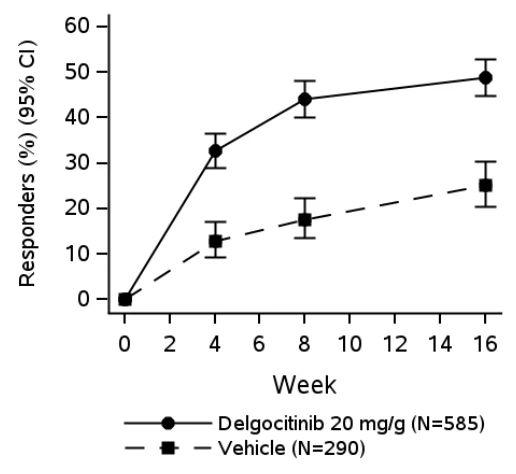
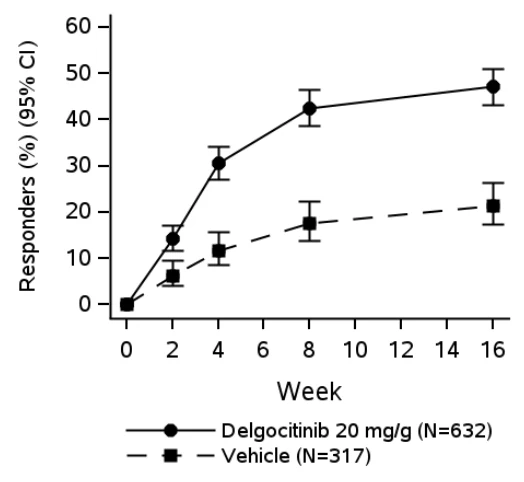
In DELTA 1 and DELTA 2, a statistically significantly greater proportion of patients randomized to ANZUPGO achieved the primary endpoint of IGA-CHE TS compared to vehicle at Week 16. The results for the primary and selected multiplicity-controlled secondary endpoints are presented in Table 2-3. Figure 1 shows the proportion of patients who achieved HESD itch ≥ 4-point improvement and HESD pain ≥ 4-point improvement over time in DELTA 1 and DELTA 2.
Table 2-3: Efficacy results of ANZUPGO at week 16 in DELTA 1 and DELTA 2
| DELTA 1 | DELTA 2 | |||||||||
|---|---|---|---|---|---|---|---|---|---|---|
ANZUPGO (N=325) | Vehicle (N=162) | ANZUPGO (N=313) | Vehicle (N=159) | |||||||
| IGA-CHE TS, % respondersa | 19.7# | 9.9 | 29.1§ | 6.9 | ||||||
| HECSI-90, % respondersa, b | 29.5§ | 12.3 | 31.0§ | 8.8 | ||||||
| HECSI-75, % respondersa, c | 49.2§ | 23.5 | 49.5§ | 18.2 | ||||||
| HESD itch ≥ 4-point improvement, % respondersa, d | 47.1§ (152/323) | 23.0 (37/161) | 47.2§ (146/309) | 19.9 (31/156) | ||||||
| HESD pain ≥ 4-point improvement, % respondersa, d | 49.1§ (143/291) | 27.5 (41/149) | 48.6§ (143/294) | 22.7 (32/141) | ||||||
| HESD ≥ 4-point improvement, % respondersa, d | 47.2§ (146/309) | 24.4 (38/156) | 44.5§ (137/308) | 20.9 (32/153) | ||||||
#p<0.01, §p<0.001
All p-values were statistically significant versus vehicle with adjustment for multiplicity.
Abbreviations: TS=treatment success; N=number of patients in the full analysis set (all patients randomized and dosed)
- a. Patients who received rescue treatment, or permanently discontinued treatment, or with missing data were considered non-responders.
- b. HECSI-90 responders were patients with ≥ 90% improvement in HECSI from baseline.
- c. HECSI-75 responders were patients with ≥ 75% improvement in HECSI from baseline.
- d. Based on the number of patients whose baseline value was ≥ 4 (scale from 0-10).
In both DELTA 1 and DELTA 2, a statistically significantly greater proportion of patients treated with ANZUPGO achieved IGA-CHE TS and a ≥ 4-point improvement in HESD as early as Week 4 compared to vehicle. A statistically significantly greater proportion of patients treated with ANZUPGO achieved HECSI-75 at Week 8 compared to vehicle.
Figure 1: Proportion of patients who achieved HESD itch ≥ 4-point improvement and HESD pain ≥ 4-point improvement over time – pooled data from DELTA 1 and DELTA 2
HESD itch ≥ 4-point improvementa
HESD pain ≥ 4-point improvementa
CI = Confidence Interval
a. Based on the number of patients whose baseline value was ≥ 4 (scale from 0-10).
Additional quality of life/patient-reported outcomes
In both DELTA 1 and DELTA 2, patients treated with ANZUPGO showed a statistically significant improvement [p < 0.001 with adjustment for multiplicity] from baseline compared to vehicle at Week 16 for the quality of life / patient reported outcomes Hand Eczema Impact Scale (HEIS) and the Dermatology Life Quality Index (DLQI).
Hand Eczema Impact Scale (HEIS):
The HEIS is a 9-item instrument designed to assess the patient’s perceived impact of CHE on their daily activities (proximal daily activity limitations [use of soaps/cleaning products, housework involving hands getting wet, washing themselves], embarrassment, frustration, sleep, work, and physical functioning [ability to hold or grip objects] over the past 7 days). The 9 items are scored using a 5-point scale (0 = ‘not at all’, 1 = ‘a little’, 2 = ‘moderately’, 3 = ‘a lot’, 4 = ‘extremely’) and the HEIS score is the average of the 9 items. Improvements versus vehicle were observed and the HEIS least squares mean change from baseline in DELTA 1 was -1.46 for ANZUPGO vs -0.82 for vehicle, and for DELTA 2 was -1.45 for ANZUPGO vs -0.64 for vehicle.
Dermatology Life Quality Index (DLQI):
For patients who had a baseline DLQI value ≥ 4, a larger proportion of patients treated with ANZUPGO had a ≥ 4-point improvement in DLQI. The proportion of responders in DELTA 1 was 74.4% for ANZUPGO vs 50.0% for vehicle, and for DELTA 2 was 72.2% for ANZUPGO vs 45.8% for vehicle.
Extension study (DELTA 3)
Patients who completed either DELTA 1 or DELTA 2 were eligible to enroll in a 36-week open-label extension study (DELTA 3). The proportions of patients achieving IGA-CHE 0 or 1, HECSI-75, HECSI-90, HESD itch ≥ 4-point improvement, and HESD pain ≥ 4-point improvement after the initial 16-week treatment period of ANZUPGO were maintained through Week 52 with as-needed treatment.
Of the patients randomized to ANZUPGO in the pivotal studies who achieved IGA-CHE TS at Week 16, the median duration of response while off treatment was 4 weeks with 28% maintaining response for at least 8 weeks. The median time to regain an IGA-CHE score of 0 or 1 following re-initiation of treatment was 8 weeks.
16. Non-Clinical Toxicology
General Toxicology: Non-clinical data reveal no special hazard for humans based on conventional studies of safety pharmacology, genotoxicity, phototoxicity, local tolerability, skin sensitization, and juvenile toxicity.
Target organs such as peripheral blood, bone marrow and lymphoid tissues, in repeat dose oral toxicity studies, were associated with the pharmacological activity of delgocitinib. These effects had safety margins that were considered sufficiently in excess of the maximum human exposure.
Safety margins were calculated based on the clinical AUC with 20 mg/g delgocitinib cream applied topically to affected areas of the hand and/or wrists twice daily (see 10.3 Pharmacokinetics).
Carcinogenicity: In a 2-year dermal carcinogenicity study in mice, no local or systemic drug-related neoplastic findings were observed at strengths up to 50 mg/g delgocitinib ointment (exposures up to approximately 600 times the human exposure).
Findings from a 2-year oral carcinogenicity study in rats included pancreatic acinar adenomas and subcutaneous lipoma (males only), thymoma (females only), and Leydig cell tumour at exposures approximately 160, 580, and 1800 times the human exposure, respectively. The clinical relevance of tumour findings in rats is low given the tumour types in a single species and single sex, the exposures at which the tumours occurred, and the negative findings in the 2-year dermal carcinogenicity study in mice.
Reproductive and Developmental Toxicology:
Fertility and early embryonic development
Orally administered delgocitinib did not result in effects on fertility at any dose level evaluated in male rats (exposures approximately 1700 times the human exposure). In female rats, orally administered delgocitinib resulted in effects on female fertility (lower fertility index, fewer corpora lutea, and fewer implantations) at exposures approximately 5800 times the human exposure. Post-implantation losses and a decrease in the number of live embryos were observed at exposures approximately 432 and 1000 times the human exposure, respectively.
Embryo-fetal development
Orally administered delgocitinib did not result in adverse effects to the fetus in rats or rabbits at exposures approximately 120 and 194 times the human exposure, respectively. Teratogenic effects were not observed at any dose studied in rats or rabbits (exposures approximately 1400 and 992 times the human exposure, respectively).
In rats, decreases in fetal weight and increases in post-implantation loss were observed at 512 and 1400 times the human exposure, respectively. Increased incidence of skeletal variations such as wavy ribs, asymmetry of sternebra, splitting of the sternebra, splitting of the thoracic vertebral body and 7 lumbar vertebrae were observed at 512 times the human exposure.
In rabbits, an increase in post-implantation loss, a reduced number of live fetuses, and a tendency toward a decrease in fetal weights were observed at exposures approximately 992 times the human exposure.
Pre-and postnatal development
Orally administered delgocitinib in rats resulted in prolonged parturition and decreased fetal viability and reduced pup weights during the early postnatal period at exposures approximately 1800 times the human exposure. There was no effect on behavioral and learning assessments, sexual maturation, or reproductive performance of the offspring at any dose studied.
Following oral administration to lactating rats, delgocitinib was secreted in milk at concentrations approximately 3-fold those in serum.