


Product Monograph - Cortisone Acetate
INDICATIONS AND CLINICAL USE
Corticosteroids are indicated in the management of disorders responsive to adrenocortical hormone therapy such as:
Endocrine disorders
Primary or secondary adrenocortical insufficiency (hydrocortisone or cortisone is the first choice; synthetic analogs may be used in conjunction with mineralocorticoids where applicable; in infancy, mineralocorticoid supplementation is of particular importance); congenital adrenal hyperplasia; nonsuppurative thyroiditis; hypercalcemia associated with cancer.
Rheumatic disorders
As adjunctive therapy for short-term administration (to support the patient in an acute episode or exacerbation) in psoriatic arthritis, rheumatoid arthritis (selected cases may require low-dose maintenance therapy), ankylosing spondylitis, acute and subacute bursitis, acute gouty arthritis.
Collagen diseases
During an exacerbation or as maintenance therapy in selected cases of systemic lupus erythematosus or acute rheumatic carditis.
Dermatologic diseases
Pemphigus, bullous dermatitis herpetiformis, severe erythema multiforme (Steven-Johnson Syndrome), exfoliative dermatitis, mycosis fungoides, severe psoriasis.
Allergic states
Control of severe or incapacitating allergic conditions intractable to adequate trials of conventional treatment: seasonal or perennial allergic rhinitis, bronchial asthma, contact dermatitis, atopic dermatitis, serum sickness, angio-edema and urticaria.
Ophthalmic diseases
Severe acute and chronic allergic and inflammatory processes involving the eye and its adnexa such as allergic conjunctivitis, keratitis, allergic corneal marginal ulcers, herpes zoster ophthalmicus (but not herpes simplex), iritis and iridocyclitis, chorioretinitis, anterior segment inflammation, diffuse posterior uveitis and choroiditis, optic neuritis, sympathetic ophthalmia.
Respiratory diseases
Symptomatic sarcoidosis, Loeffler's syndrome not manageable by other means, berylliosis, fulminating or disseminated pulmonary tuberculosis when concurrently accompanied by appropriate antituberculous chemotherapy, pulmonary emphysema where bronchospasm or bronchial edema plays a significant role, diffuse interstitial pulmonary fibrosis (Hamman-Rich syndrome).
Hematological disorders
Idiopathic and secondary thrombocytopenia in adults, acquired (autoimmune) hemolytic anemia, erythroblastopenia (RBC anemia), congenital (erythroid) hypoplastic anemia.
Neoplastic diseases
For palliative management of leukemias and lymphomas in adults and acute leukemia of childhood.
Edematous states
To induce a diuresis or remission of proteinuria in the nephrotic syndrome, without uremia, of the idiopathic type or that due to lupus erythematosus. In conjunction with diuretic agents, to induce a diuresis in cirrhosis of the liver with refractory ascites and/or congestive heart failure.
Gastrointestinal diseases
To support the patient over an acute period of the disease including ulcerative colitis, regional enteritis, intractable sprue.
Miscellaneous
Tuberculous meningitis with subarachnoid block or impending block when concurrently accompanied by appropriate antituberculous chemotherapy, systemic dermatomyositis (polymyositis), dental postoperative inflammatory reactions.
CONTRAINDICATIONS
Tuberculosis, whether active or healed, is usually an absolute contraindication to steroid therapy. However, cortisone may be a life-saving measure to control the acute toxicity of overwhelming infection. It must be accompanied by specific antituberculosis therapy. Should other infections exist, cortisone may be employed if the condition indicating its use is sufficiently severe. Appropriate antibiotic therapy must be given as well, usually in substantially larger doses than customary.
Ocular herpes simplex and acute psychoses also are usually absolute contraindications to steroid therapy.
Relative contraindications are diverticulitis; fresh intestinal anastomosis; active or latent peptic ulcer; renal insufficiency; hypertension; thromboembolic tendencies; osteoporosis; diabetes mellitus; psychotic tendencies; acute or chronic infections including fungus and viral diseases; especially chickenpox and vaccinia; myasthenia gravis; and diminished cardiac reserve or congestive heart failure other than that due to acute rheumatic carditis.
Pregnancy is a relative contraindication to corticosteroid therapy, particularly during the first trimester, because fetal abnormalities have been observed in experimental animals. If it is necessary to give corticosteroids during pregnancy, the newborn infant should be watched closely for signs of hypoadrenalism and appropriate therapy should be instituted if such signs are present.
When any of these conditions exist, the risks of corticosteroid therapy must be weighed against the possible benefits.
Intrasynovial and soft tissue injections should not be made into infected areas.
PRECAUTIONS
Cortisone should be given only with full cognizance of the characteristic activity of, and the varied responses to adrenocortical hormones.
Average and large doses can cause elevation of blood pressure, salt and water retention, and increased potassium and calcium excretion. Dietary salt restriction and potassium supplementation may be necessary.
Salt and water retention is frequently followed by spontaneous diuresis on continued administration of cortisone. In some instances, however, salt and water retention may be pronounced and occasionally may develop suddenly. Rarely, congestive heart failure, peripheral or pulmonary edema, ascites, or increased arterial pressure may develop if therapy is continued despite signs of fluid retention.
Hypokalemia can be detected early in the course of treatment by paying careful attention to the patient's symptoms and, if necessary, by doing an electrocardiogram, and by determining the CO2 combining power, and blood potassium and chloride levels. It may possibly be avoided by a low sodium, high potassium diet.
If any changes indicating metabolic alkalosis are noted, cortisone should be reduced or stopped, and potassium chloride administered. Diuretics may provoke a further dangerous loss of potassium.
Potassium salts must be avoided or undertaken with great caution in the presence of renal impairment or cardiac decompensation.
Although hypokalemia is a relatively uncommon complication, it may occur quite suddenly. For this reason, if electrocardiography is not feasible, the prophylactic administration of 2 to 4 g daily of potassium chloride is advisable with larger maintenance doses, e.g., 80 mg per day.
Important
It is of importance to keep in mind that the tissues may be low in potassium even when blood potassium levels appear to be adequate.
Since spontaneous remission of some diseases, such as rheumatoid arthritis, may occur during pregnancy, every effort should be made to avoid hormone treatment in pregnancy.
Corticosteroids may mask the signs of infection and enhance dissemination of the infecting organism. All patients receiving these substances should be watched for evidence of intercurrent infection. Should infection occur, vigorous, appropriate anti-infective therapy should be initiated. Abrupt cessation of steroids should be avoided if possible because of the danger of superimposing adrenocortical insufficiency on the infectious process.
Prolonged hormone therapy usually causes a reduction in the activity and size of the adrenal cortex. Relative adrenocortical insufficiency upon discontinuation of therapy may be avoided by gradual reduction of dosage. A potentially critical degree of insufficiency may persist asymptomatically, however, for some time even after gradual discontinuation. Therefore, if a patient is subjected to significant stress, such as surgery, trauma, or serious illness, while being treated or within 1 year (occasionally up to 2 years) after treatment has been terminated, hormone therapy should be augmented or reinstituted and continued for the duration of the stress and immediately following it. Since mineralocorticoid secretion may be impaired, salt and/or desoxycorticosterone may be required conjunctively. It is preferable to use a soluble hormone preparation during immediate preoperative and postoperative periods.
Corticosteroid therapy may cause hyperacidity or peptic ulcer. Therefore, an ulcer regimen including an antacid is recommended as a prophylactic measure during prolonged therapy. Since appearance of peptic ulcer may be asymptomatic until perforation or hemorrhage occurs, X-rays should be taken when treatment is prolonged or when there is gastric distress, and when changes are noted an ulcer regimen is recommended.
Cortisone, like other glucocorticoids, may aggravate diabetes mellitus so that higher insulin dosage may become necessary, or it may precipitate manifestations of latent diabetes mellitus.
When systemic adrenocorticosteroid preparations are used in the presence of glaucoma, intraocular pressure should be measured frequently, and optic nerve heads and visual fields observed.
Continued supervision of the patient after cessation of corticosteroids is essential, since there may be a sudden reappearance of severe manifestations of the disease for which the patient was treated.
Steroids may increase or decrease motility and number of spermatozoa in some patients. Diphenylhydantoin may enhance the rate of metabolism and clearance of corticosteroids, and this may increase steroid dosage requirements.
ADVERSE EFFECT
Fluid and electrolyte disturbances: sodium retention; fluid retention; congestive heart failure in susceptible patients; potassium loss; hypokalemic alkalosis; hypertension.
Musculoskeletal: muscle weakness; steroid myopathy; loss of muscle mass; osteoporosis; vertebral compression fractures; aseptic necrosis of femoral and humeral heads; pathologic fractures of long bones.
Gastrointestinal: peptic ulcer with possible perforation and hemorrhage; pancreatitis; abdominal distention; ulcerative esophagitis.
Dermatologic: impaired wound healing; thin fragile skin; petechiae and ecchymoses; facial erythema; increased sweating; may suppress reactions to skin tests.
Neurological: convulsions; increased intracranial pressure with papilledema (pseudo-tumor cerebri) usually after treatment; vertigo; headache.
Endocrine: menstrual irregularities; development of Cushingoid state; suppression of growth in children; secondary adrenocortical and pituitary unresponsiveness, particularly in times of stress, as in trauma, surgery or illness; decreased carbohydrate tolerance; manifestations of latent diabetes mellitus; increased requirements for insulin or oral hypoglycemic agents in diabetes.
Ophthalmic: posterior subcapsular cataracts; increased intraocular pressure; glaucoma, exophthalmus.
Metabolic: negative nitrogen balance due to protein catabolism.
Others: hypersensitivity, thromboembolism.
DOSAGE AND ADMINISTRATION
In chronic, nonfatal diseases (e.g., rheumatoid arthritis, chronic bronchial asthma, ulcerative colitis, sprue), it is recommended that therapy be initiated with a low dose of 25 mg to 50 mg per day which is gradually increased to the smallest amount that gives the desired degree of symptomatic relief. When adequate suppression of symptoms is achieved, dosage should be maintained at the minimum amount capable of providing sufficient relief without excessive hormonal effects. This amount may be as low as 25 mg per day.
In acute, nonfatal diseases (e.g., severe seasonal asthma, self-limiting ocular and dermatologic disorders), dosage ranges between 75 mg and 150 mg per day. In some patients higher doses are necessary. Since these conditions are self-limiting in their course, prolonged maintenance therapy is not necessary.
In chronic potentially fatal diseases (e.g., disseminated lupus erythematosus, pemphigus, sarcoidosis, nephrotic syndrome), the recommended initial dosage ranges from 75 mg to 150 mg per day. In some patients, higher doses are necessary. As soon as adequate relief is obtained, reduce dosage gradually to the minimum effective level.
When the disease is acute and life-threatening (e.g., acute rheumatic fever, crisis of disseminated lupus erythematosus, severe allergic reactions), the initial dosage is between 125 mg and 300 mg a day, administered in at least 4 divided doses. This dosage may have to be increased in some patients to establish control. As soon as control is attained, reduce dosage to minimum effective level. When extremely rapid onset of action is desired, one of the soluble adrenocortical hormone preparations may be administered intravenously for the first 2 or 3 doses. In severe allergic reactions, epinephrine is the first drug of choice. Cortisone is useful either concurrently or as supplementary therapy.
In dental surgical conditions, 25 mg to 50 mg 3 times daily, starting several hours before operation and continuing for no longer than 2 or 3 days postoperatively may give protection from the inflammatory reaction incidental to oral surgery procedures.
In chronic adrenocortical insufficiency (e.g., Addison's disease, postadrenalectomy), 10 to 25 mg per day or occasionally more, with 4 to 6 g of sodium chloride or 1 to 3 mg of desoxycorticosterone acetate. When immediate support is mandatory, one of the soluble adrenocortical hormone preparations, which may be effective within minutes after parenteral administration can be lifesaving.
In crises, intercurrent infections, surgical procedures, or other significantly stressful conditions, 100 to 300 mg or more daily until unusual stress no longer exists, and normal food intake is restored. In these conditions, oral administration is preferable to intramuscular.
PHARMACEUTICAL INFORMATION
Drug Substance: Cortisone Acetate
Chemical Name: (1) Pregn-4-ene-3,11,20-trione,21-(acetyloxy)-17-hydroxy-;
(2) 17,21-Dihydroxypregn-4-ene-3, -11,20-trione 21-acetate
Structural Formula:
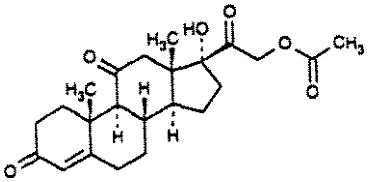
Molecular Formula: C23H30O6
Molecular Weight: 402.49 g/mol
Description: Cortisone is a natural product of the adrenal cortex.
Cortisone acetate is a synthetic adrenocortical steroid with basic glucocorticoid actions and effects. It occurs as a white or practically white,
odorless crystalline powder insoluble in water and
slightly soluble at 20˚ in 300 parts of alcohol and in
4 parts of chloroform. Soluble in ether, in acetone
and in methylalcohol. Melting point is about 240˚ C with decomposition.
Composition: Cortisone Acetate - ICN tablets contain:
Cortisone Acetate, USP
Non-medicinal Ingredients: Corn starch, Croscarmellose Sodium NF, Lactose NF,
Magnesium Stearate NF, and Talc USP
AVAILABILITY OF DOSAGE FORM
Each white, round biconvex Cortisone Acetate - ICN tablet scored on one side and embossed "ICN C23" on the other side, contains 25 mg of cortisone acetate, USP. Bottles of 100.