


Patient Medication Information: uses, side effects, how to take - Desmopressin Spray
What is DESMOPRESSIN SPRAY used for?
DESMOPRESSIN SPRAY is used in children (3 months to 12 years of age) and adults (18 years of age and older) to:
- manage central diabetes Insipidus (water diabetes). Diabetes insipidus is a condition in which your body does have enough of the hormone that signals your kidneys to make less urine (pee). This causes your body to retain water.
- control frequent urination and extreme thirst following:
Serious Warnings and Precautions
Hyponatremia (Low levels of sodium in the blood):
|
|---|
- head trauma and;
- surgery in the pituitary gland
How does DESMOPRESSIN SPRAY work?
DESMOPRESSIN SPRAY contains desmopressin. Desmopressin is very similar to a natural antidiuretic hormone made in the body. Desmopressin is believed to reduce the amount of urine the body produces. This reduces symptoms such as thirst and frequent urination.
What are the ingredients in DESMOPRESSIN SPRAY?
Medicinal ingredients: Desmopressin acetate
Non-medicinal ingredients: Benzalkonium chloride 0.01% as a preservative, citric acid, sodium chloride, sodium phosphate dibasic and purified water.
DESMOPRESSIN SPRAY comes in the following dosage forms:
spray solution: 10 mcg/spray
Do not use DESMOPRESSIN SPRAY if you or your child:
- are allergic to desmopressin acetate or any of the other ingredients in DESMOPRESSIN SPRAY.
- have bleeding disorders such as Type IIB von Willebrand’s or platelet-type (pseudo) von Willebrand’s disease.
- drink an excess amount of fluid .
- have heart problems or other conditions requiring treatment with diuretics (water pills).
- have kidney problems or failure.
- have low levels of sodium in the blood.
- experience bedwetting.
- have a condition called Syndrome of inappropriate ADH secretion (SIADH). SIADH is when too body produces and releases too much of the antidiuretic hormone.
To help avoid side effects and ensure proper use, talk to your healthcare professional before you take DESMOPRESSIN SPRAY. Talk about any health conditions or problems you may have, including if you:
- are dehydrated.
- have swelling or scarring inside the lining inside your nose.
- have bladder problems.
- are experiencing a rise in pressure around your brain (intracranial pressure).
are breast-feeding.
- are pregnant or think you might be pregnant.
- have hyponatremia (low blood sodium level).
- have heart problems.
- have liver disease.
- have kidney problems.
- have bleeding problems.
- have fever.
- have cystic fibrosis.
Other warnings you should know about:
New illnesses Your healthcare professional may stop or adjust treatment if new illnesses develop. Fluid and/or electrolyte problems may develop. Speak to your healthcare professional if you develop infections, fever, stomach flu or diarrhea.
Breathing problems: DESMOPRESSIN SPRAY may cause narrowing of the airways.
Check-ups and testing: Your healthcare professional will monitor your condition by testing your blood and urine.
Tell your healthcare professional about all the medicines you take, including any drugs, vitamins, minerals, natural supplements or alternative medicines.
The following may interact with DESMOPRESSIN SPRAY:
- Tricyclic antidepressants (amitriptyline, nortriptyline).
- Serotonin reuptake inhibitors used to treat depression (paroxetine or Paxil®, sertraline or Zoloft®, fluvoxamine or Luvox®, citalopram or Celexa®, venlafaxine or Effexor® XR, and risperidone or Risperdal®).
- Nonsteroidal anti-inflammatory drugs used to reduce fever, pain and inflammation (etodolac or Ultradol®, ibuprofen or Advil® or Motrin®, naproxen or Naprosyn®; celecoxib or Celebrex®).
- Chlorpromazine - used to treat mental disorders.
- Carbamazepine - used to treat nerve pain or epilepsy.
- Diuretics (water pills) - used to treat high blood pressure.
- Loperamide or Imodium® - used to decrease the frequency of diarrhea.
- Clofibrate - used to control high cholesterol.
- Chlorpropamide - used to treat diabetes.
- Demeclocyclin - used to treat bacterial infections.
- Lithium - used to treat manic depression like Bipolar.
- Norepinephrine.
How to take DESMOPRESSIN SPRAY:
- Take DESMOPRESSIN SPRAY exactly as directed by the healthcare professional.
- The healthcare professional will assemble the spray pump. If the spray pump that you have received has not been assembled, please contact the healthcare professional.
- Administering DESMOPRESSIN SPRAY in children should occur under adult supervision. This is to ensure the child takes the correct dosage. DESMOPRESSIN SPRAY should only be used in children who require a dose of 10 mcg
- DESMOPRESSIN SPRAY does NOT work like other nasal sprays. It is NOT supposed to be sniffed like cold or allergy sprays. If it is sniffed up the nose, it will not work. The spray ONLY works when it is absorbed inside the nose.
- Gently blow the nose before using DESMOPRESSIN SPRAY. If the nose is blocked because of a cold or allergies, DESMOPRESSIN SPRAY may not work as well.
Using Your DESMOPRESSIN SPRAY:
- 1. Do NOT shake the bottle.
- 2. Remove protective cap.
- 3. The spray pump must be primed before using it for the first time. To prime pump, press down on the pump 4 times.
- 4. Once primed, the spray pump delivers 10 micrograms of medication each time it is pressed. To remove the correct dose, tilt bottle so that dip tube inside the bottle withdraws from the deepest portion of the medication.
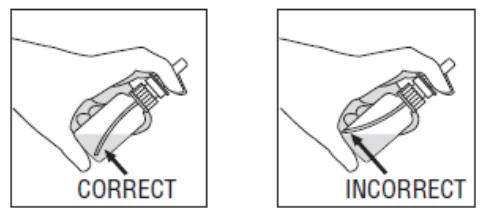
- 5. To administer one dose (10 micrograms), place the spray nozzle in nostril and press the spray pump once. If a higher dose has been prescribed, spray half the dose in each nostril. The spray pump cannot be used for doses less than 10 micrograms (one dose) or doses other than multiples of 10 micrograms.
- 6.
Replace the protective cap on bottle after use. The pump will stay primed for up to one week. If the product has not been used for a period of one week,
- re-prime the pump by pressing once.
Using DESMOPRESSIN SPRAY for your child:
- 1. Do NOT shake the bottle.
- 2. Remove protective cap.
- 3. The spray pump must be primed before using it for the first time. To prime pump, press down on the pump 4 times.
- 4. Once primed, the spray pump delivers 10 micrograms of medication each time it is pressed. To remove the correct dose, tilt bottle so that dip tube inside the bottle withdraws from the deepest portion of the medication.
- 5. Always keep the bottle upright so the tube stays in the liquid and no air gets inside the tube. If an air bubble forms, the right amount of spray will not come out.
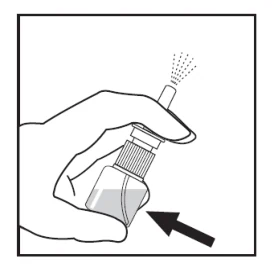
- 6. Tilt the child’s head back a little bit and insert the nozzle into one nostril. Ask the child to take a deep breath in and hold his/her breath only while you spray DESMOPRESSIN SPRAY into the nostril. For each spray, press down firmly on the white collar using your index and middle fingers. Support the base of the bottle with your thumb.
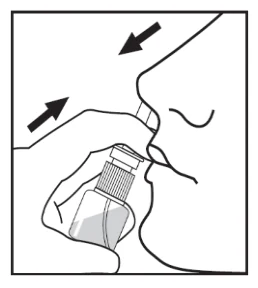
- 7. Remove the nozzle from the child’s nostril.
- 8. Have your child place one finger on the outside of the nostril you just sprayed.
- 9. Slowly count to 10 out loud. As you count, the child should hold the nostril closed so the spray will not drip out.
- 10. When you reach 10, the child can release the finger and breathe normally.
- 11.
Replace the protective cap on bottle after use. The pump will stay primed for up to one week. If the product has not been used for a period of one week, re-prime the
- pump by pressing once.
Usual dose:
Children (3 months to 12 years):
5 to 30 mcg daily given as a single dose or divided into two or three doses.
Adults:
10 to 40 mcg daily given as a single evening dose or divided into two or three doses.
Overdose:
| If you think you or your child or a person you are caring for, have taken too much DESMOPRESSIN SPRAY, contact a healthcare professional, hospital emergency department, or regional poison control centre immediately, even if there are no symptoms. |
Missed Dose:
If you miss a dose of DESMOPRESSIN SPRAY, take the missed dose as soon as possible. Then go back to your regular dosing schedule. However, if it is almost time for your next dose, skip the missed dose and go back to your regular dosing schedule. Do NOT double dose.
What are possible side effects from using DESMOPRESSIN SPRAY?
These are not all the possible side effects you may have when taking DESMOPRESSIN SPRAY. If you experience any side effects not listed here, tell your healthcare professional.
- aftertaste in the mouth
- anorexia (obsession with thinness generally sought through self- starvation)
- constipation
- cramps or discomfort
- dehydration
- diarrhea
- dizziness
- drowsiness
- facial flushing
- feeling cold
- headache
- high body temperature
- increased appetite (excessive desire for food)
- mild abdominal pain
- muscle cramps
- nausea
- pink eye or red eye
- rash, itchiness, and hives
- stuffy nose, nasal irritation, nose bleeds
- swelling in the face and hands
- wheezing
Serious side effects and what to do about them
| Symptom / effect | Talk to your healthcare professional | Stop taking drug and get immediate medical help | |
|---|---|---|---|
| Only if severe | In all cases | ||
| RARE | |||
| Water retention: headache, nausea, vomiting, weight increase, discomfort, muscle cramps, confusion, convulsions and coma | √ | ||
| Allergic skin reactions: itching, skin rashes | √ | ||
| Severe allergic reaction: itching, skin rashes, swelling of the face, lips or throat, difficulty in breathing, wheeziness, chest tightness or coughing | √ | ||
| Emotional problems in children: uncontrollable laughing or crying, nightmare, nervousness and aggression | √ | ||
| High blood pressure: shortness of breath, fatigue, dizziness or fainting, chest pain or pressure, swelling in your ankles and legs, bluish colour to your lips and | √ | ||
Serious side effects and what to do about them
| Symptom / effect | Talk to your healthcare professional | Stop taking drug and get immediate medical help |
|---|
| Only if severe | In all cases | ||
|---|---|---|---|
| skin, racing pulse or heart palpitations | |||
| Shortness of breath | √ | ||
| Chest pain | √ | ||
If you have a troublesome symptom or side effect that is not listed here or becomes bad enough to interfere with your daily activities, tell your healthcare professional.
Reporting Side Effects
You can report any suspected side effects associated with the use of health products to Health Canada by:
NOTE: Contact your health professional if you need information about how to manage your side effects. The Canada Vigilance Program does not provide medical advice. |
Storage:
DESMOPRESSIN SPRAY should be stored at room temperature, 15ºC to 30ºC.
Protect from light. Do not freeze.
Keep out of reach and sight of children.
IMPORTANT: Once assembled with pump, always keep the bottle upright and store in an upright position.
If you want more information about DESMOPRESSIN SPRAY:
- Talk to your healthcare professional
Find the full product monograph that is prepared for healthcare professionals and includes this Patient Medication Information by visiting the Health Canada website: (https://www.canada.ca/en/health-canada/services/drugs-health-products/drug-
- products/drug-product-database.html; the manufacturer’s website (https://www.aapharma.ca/en/), or by calling 1-877-998-9097.