


Product Monograph - Dopamine Hydrochloride and 5% Dextrose Injection USP
ACTION AND CLINICAL PHARMACOLOGY
Dopamine, a sympathomimetic amine vasopressor, is the naturally occurring immediate precursor of norepinephrine.
Dopamine exerts positive chronotropic and inotropic effects on the heart resulting in increased heart rate and cardiac contractility. This is accomplished directly by exerting an agonist action on cardiac beta-adrenoceptors and indirectly by causing the release of norepinephrine from tissue storage sites. Dopamine differs from other endogenous catecholamines in increasing renal and mesenteric blood flow by an action on dopamine receptors.
Hemodynamic effect varies with dosage. At infusion rates of 1 to 10 :g/kg/min, cardiac output and renal and mesenteric blood flow are increased without affecting heart rate or blood pressure. Infusion rates of 10 to 20 :g/kg/min stimulate alpha-adrenergic receptors to produce generalized vasoconstriction which raises arterial blood pressure. At doses above 20 :g/kg/min, vasoconstriction may predominate resulting in decreased renal blood flow and urine secretion.
Pharmacokinetics and Metabolism
Dopamine is metabolized in the liver, kidney, and plasma by MAO and catecho-O-methyltransferase to the inactive compounds homovanillic acid (HVA) and 3,4-dihydroxyphenylacetic acid. About 25% of the dose is taken up into specialized neurosecretory vesicles (the adrenergic nerve terminals), where it is hydroxylated to form norepinephrine.
It has been reported that about 80% of the drug is excreted in the urine within 24 hours, primarily as HVA and its sulfate and glucuronide conjugates and as 3,4-dihydroxyphenylacetic acid. A very small portion is excreted unchanged.
The half-life (t½) of dopamine is approximately 2 to 3 minutes.
INDICATIONS AND CLINICAL USES
Dopamine Hydrochloride and Dextrose Injection is indicated for the correction of hemodynamic imbalances present in the shock syndrome due to myocardial infarction, trauma, endotoxic septicemia, open heart surgery, renal failure, and chronic cardiac decompensation as in congestive failure.
Where appropriate, restoration of blood volume with a suitable plasma expander or whole blood should be instituted or completed prior to administration.
Patients most likely to respond adequately to an infusion of Dopamine Hydrochloride and Dextrose Injection are those in whom physiological parameters, such as urine flow, myocardial function, and blood pressure, have not undergone profound deterioration. The shorter the time interval between onset of signs and symptoms and initiation of therapy with volume correction and dopamine hydrochloride, the better the prognosis.
Poor Perfusion of Vital Organs
Urine flow appears to be one of the better diagnostic signs by which adequacy of vital organ perfusion can be monitored. Nevertheless, the physician should also observe the patient for signs of reversal of mental confusion or coma. Loss of pallor, increase in toe temperature, and/or adequacy of nail bed capillary filling may also be used as indices of adequate dosage. Clinical studies have shown that prognosis is more favourable when dopamine hydrochloride is administered before urine flow has diminished to levels approximating 0.3 mL/min. Nevertheless, in a number of oliguric or anuric patients, administration of dopamine hydrochloride have resulted in an increase in urine flow which in some cases reached normal levels. Dopamine hydrochloride may also cause an increase in urine flow in patients whose output is within normal limits and thus may be of value in reducing the degree of pre-existing fluid accumulation. It should be noted that at doses above those optimal for the individual patient, urine flow may decrease, necessitating reduction of dosage. Concurrent administration of dopamine hydrochloride and diuretic agents may produce an additive or potentiating effect.
Low Cardiac Output
Increased cardiac output is related to dopamine's direct inotropic effect on the myocardium. Increased cardiac output at low or moderate doses appears to be related to a favourable prognosis. Increase in cardiac output has been associated with either static or decreased systemic vascular resistance (SVR). Static or decreased SVR associated with low or moderate increments in cardiac output is believed to be a reflection of differential effects on specific vascular beds with increased resistance in peripheral beds (i.e., femoral) and concomitant decreases in mesenteric and renal vascular beds. Redistribution of blood flow parallels these changes so that an increase in cardiac output is accompanied by an increase in mesenteric and renal blood flow. In many instances, the renal fraction of the total cardiac output has been found to increase.
Increase in cardiac output produced by dopamine hydrochloride usually is not associated with substantial decreases in systemic vascular resistance.
Hypotension
Hypotension due to inadequate cardiac output can be managed by administration of low to moderate doses of dopamine hydrochloride which have little effect on SVR. At high therapeutic doses, dopamine's alpha-adrenergic activity becomes more prominent and thus may correct hypotension due to diminished SVR. As in the case of other circulatory decompensation states, prognosis is better in patients whose blood pressure and urine flow have not undergone profound deterioration. Therefore, it is suggested that the physician administer Dopamine Hydrochloride and Dextrose Injection as soon as a definite trend toward decreased systolic and diastolic pressures becomes evident.
CONTRAINDICATIONS
Dopamine Hydrochloride and Dextrose Injection should not be used in patients with pheochromocytoma.
Dopamine in dextrose solutions without electrolytes (dilution vehicle) should not be administered simultaneously with blood through the same infusion set because of the possibility that pseudoagglutination of red cells may occur.
Dopamine Hydrochloride and Dextrose Injection should not be administered in the presence of uncorrected tachyarrhythmias or ventricular fibrillation.
WARNINGS
Do not add any alkalinizing substance, since dopamine hydrochloride is inactivated in alkaline solution.
Patients who have been treated with monoamine oxidase (MAO) inhibitors prior to the administration of dopamine hydrochloride will require substantially reduced dosage. (See PRECAUTIONS - Drug Interactions)
Dopamine hydrochloride should be used with extreme caution in patients inhaling cyclopropane or halogenated hydrocarbon anesthetics.(See PRECAUTIONS - Drug Interactions)
Sulfites Sensitivity
Dopamine Hydrochloride and Dextrose Injection contains sodium metabisulfite, a sulfite that may cause allergic-type reactions including anaphylactic symptoms and life-threatening or less severe asthmatic episodes in certain susceptible people. The overall prevalence of sulfite sensitivity in the general population is unknown, and probably low. Sulfite sensitivity is seen more frequently in asthmatic than in nonasthmatic people.
PRECAUTIONS
General
Solutions containing dextrose should be used with caution in patients with known subclinical or overt diabetis mellitus.
Fluid and Electrolyte Balance
Excess administration of potassium-free solutions may result in significant hypokalemia. The intravenous administration of these solutions can cause fluid and/or solute overloading resulting in dilution of serum electrolyte concentrations, overhydration, congested states or pulmonary edema.
Monitoring
Electrocardiogram, heart rate, blood pressure, urine flow, and cardiac output should be closely monitored when possible during infusion of Dopamine Hydrochloride and Dextrose Injection. In addition, pulmonary wedge pressure monitoring may be considered.
Hypovolemia
Prior to treatment with Dopamine Hydrochloride and Dextrose Injection, hypovolemia should fully be corrected, if possible, with either whole blood or plasma as indicated.
Decreased Pulse Pressure
If a disproportionate rise in the diastolic pressure (i.e., marked decrease in the pulse pressure) or a decrease in urine flow is observed in patients receiving dopamine hydrochloride, the infusion rate should be decreased and the patient observed carefully for further evidence of predominant vasoconstrictor activity, unless such an effect is desired.
Hypotension
At lower infusion rates, if hypotension occurs, the infusion rate should be rapidly increased until adequate blood pressure is obtained. If hypotension persists, dopamine hydrochloride should be discontinued and a more potent vasoconstrictor agent such as norepinephrine should be administered.
Extravasation
The infusion site should be frequently checked for free flow since several cases of necrosis and sloughing of surrounding tissue due to extravasation have been reported. Dopamine Hydrochloride and Dextrose Injection should be infused into a large vein whenever possible to prevent the possibility of extravasation into tissue adjacent to the infusion site. Large veins of the antecubital fossa are preferred to veins of the dorsum of the hand or ankle. Administration into an umbelical arterial catheter is not recommended. Less suitable infusion sites should be used only if the patient's condition requires immediate attention. The physician should switch to more suitable sites as rapidly as possible.
Peripheral Vasoconstriction and Ischemia
Several cases of severe vasoconstriction leading to vascular stasis and gangrene of the extremities have been reported after dopamine administration. Patients with pre-existing vascular disease such as cold injury, atherosclerosis, Raynaud's disease, Buerger's disease, arterial embolism and diabetic endarteritis seem to be particularly prone to severe peripheral vasoconstriction. Patients should be closely monitored for any changes in color or temperatures of the skin in the extremities. If a change in skin color or temperature occurs which is thought to be the result of compromised circulation to the extremities, the benefits of continued infusion of Dopamine Hydrochloride and Dextrose Injection should be weighed against the risk of possible necrosis. As noted below, phentolamine should be available on a standby basis as an antidote for peripheral vasoconstriction.
IMPORTANT: Treatment for Peripheral Ischemia Secondary to Extravasation
No clinical experience exists in which phentolamine has been administered as an antidote for peripheral ischemia due to dopamine. However, the following is suggested based on experience with other catecholamines. To prevent sloughing and necrosis in ischemic areas, the area should be infiltrated as soon as possible with 10 mL to 15 mL of 0.9% sodium chloride injection containing from 5 mg to 10 mg of phentolamine, an alpha-adrenergic blocking agent. A syringe with a fine hypodermic needle should be used, and the solution liberally infiltrated throughout the ischemic area. Sympathetic blockage with phentolamine causes immediate and conspicuous local hyperemic changes if the area is infiltrated within 12 hours. Therefore, phentolamine should be given as soon as possible after the extravasation is noted.
Laboratory Test Interferences
Infusion of dopamine suppresses pituitary secretion of thyroid stimulating hormone, growth hormone, and prolactin.
Weaning
When discontinuing the infusion, it may be necessary to gradually decrease the dose of dopamine hydrochloride while expanding blood volume with intravenous fluid, since sudden cessation may result in marked hypotension.
Hypoxia, Hypercapnia, Acidosis
These conditions, which may also reduce the effectiveness and/or increase the incidence of adverse effects of dopamine, must be identified and corrected prior to, or concurrently with, administration of dopamine hydrochloride.
Cardiovascular Effects
Dopamine hydrochloride, particularly when infused in high doses, may facilitate disturbances in impulse formation such as ectopic beats, tachycardia, sinus bradycardia and sinus arrhythmia. With the occurrence of these symptoms, dopamine hydrochloride should be used with extreme caution and, if necessary, the dosage should be reduced or, if warranted, the infusion should be stopped.
Pulmonary Vasoconstriction
The administration of dopamine hydrochloride in patients with primary pulmonary hypertension can cause pulmonary vasoconstriction which may be detrimental to these patients.
Usage in Pregnancy
Animal studies have revealed no evidence of teratogenic effects from dopamine hydrochloride. The drug may be used in pregnant women when, in the judgment of the physician, the expected benefits outweigh the potential for risk to the fetus.
Labor and Delivery
In obstetrics, if dopamine is used to correct hypotension due to inadequate cardiac output or added to a local anesthetic solution the interaction with some oxytocic drugs (e.g., vasopressin, ergotamine, ergonovine, methylergonovine) may cause severe persistent hypertension and may even cause rupture of a cerebral blood vessel to occur during the postpartum period.
Usage in Nursing Mothers
It is not known if dopamine hydrochloride is excreted in human milk.
Usage in Children
The safety and efficacy of this drug in children has not been established. Dopamine hydrochloride has been used in a limited number of pediatric patients, but such use has been inadequate to fully define proper dosage and limitations for use.
Drug Interactions:
Cyclopropane or Halogenated Hydrocarbon Anesthetics - Cyclopropane halogenated hydrocarbon anesthetics sensitize the myocardium to the action of certain intravenously administered catecholamines. Dopamine hydrochloride should thus be used with extreme caution in patients inhaling cyclopropane or halogenated hydrocarbon anesthetics.
MAO Inhibitors - Patients who have been treated with monoamine oxidase (MAO) prior to the administration of dopamine hydrochloride will require substantially reduced dosage. Dopamine is metabolized by MAO, and inhibition of this enzyme prolongs and potentiates the effect of Dopamine Hydrochloride in Dextrose Injection. The starting dose of dopamine hydrochloride in such patients should be reduced to at least one-tenth (1/10) of the usual dose.
Diuretic Agents - When low-dose dopamine hydrochloride injection is administered concurrently with diuretics, extra caution should be taken because it may produce an additive or potentiating effect on urine flow.
Tricyclic Antidepressants -Tricyclic antidepressants may potentiate the cardiovascular effects of adrenergic agents.
Alpha and Beta-Adrenergic Blocking Agents - Cardiac effects of dopamine are antagonized by beta-adrenergic blocking agents. The peripheral vasoconstriction caused by high doses of dopamine hydrochloride is antagonized by alpha-adrenergic blocking agents. Dopamine-induced renal and mesenteric vasodilation is not antagonized by either alpha-or beta-adrenergic blocking agents.
Haloperidol - Haloperidol and haloperidol-like drugs are dopamine receptor antagonists and can suppress renal and mesenteric vasodilation induced with low dose dopamine hydrochloride infusion.
Oxytocic Drugs - The concomitant use of vasopressors, vasoconstriction agents (such as ergonavine) and some oxytocic drugs may result in severe hypertension (See PRECAUTIONS –Labor and Delivery)
Phenytoin - Administration of intravenous phenytoin to patients receiving intravenous dopamine to support their blood pressure resulted in hypotension. It is recommended that phenytoin infusion be used extremely cautiously, if at all, in patients who required dopamine for blood pressure support.
ADVERSE REACTIONS
The most serious adverse reactions produced by dopamine are ventricular arrhythmias.
The following adverse reactions have been observed, but there are not enough data to support an estimate of their frequency.
Cardiovascular System Ventricular arrhythmia (at very high doses), ectopic beats, tachycardia, anginal pain, palpitation, cardiac conduction abnormalities, widened QRS complex, bradycardia, hypotension, hypertension, vasoconstriction;
Endocrine System Dopamine infusion even at low doses (2.5 :g/kg/min) was found to decrease serum concentration of prolactin in critically ill patients. This was considered undesirable because of the immunomodulary role of prolactin in the endocrine response to stress;
Respiratory System Dyspnea; bronchospasm;
Gastrointestinal System Nausea, vomiting;
Metabolic/Nutritional System Azotemia;
Central Nervous System Headache, anxiety;
Dermatological System Piloerection;
Other Extravasation
Sloughing and necrosis of surrounding tissue has been reported due to extravasation when dopamine hydrochloride was infused into small veins.
Peripheral Vasoconstriction
Peripheral ischemic changes leading to vascular stasis and gangrene have been reported. Patients with pre-existing vascular disease may be particularly sensitive to the vasoconstrictive effects of dopamine (See PRECAUTIONS).
SYMPTOMS AND TREATMENT OF OVERDOSAGE
In the case of accidental overdosage, as made evident by excessive blood pressure elevation, reduce the rate of administration or temporarily discontinue dopamine hydrochloride until the patient's condition stabilizes. Since dopamine hydrochloride's duration of action is quite short, no additional remedial measures are usually necessary. If these measures fail to stabilize the patient's condition, use of the short-acting alpha-adrenergic blocking agent, (e.g., phentolamine), should be considered.
DOSAGE AND ADMINISTRATION
Dopamine Hydrochloride and Dextrose Injection is a premixed ready-to-use solution: NO FURTHER DILUTION IS RECOMMENDED, NO OTHER DRUG SHOULD BE ADDED TO THIS SOLUTION.
Dopamine hydrochloride must not be added to sodium bicarbonate or other alkaline intravenous solutions since the drug is inactivated in alkaline solutions.
Rate of Administration
Dopamine Hydrochloride and Dextrose Injection is administered intravenously through a suitable intravenous catheter or needle. An intravenous drip chamber or other suitable metering device is essential for controlling the rate of flow in drops per minute. The dosage for each patient must be individually titrated to the desired hemodynamic and/or renal response. In titrating to the desired increase in systolic blood pressure, the optimum dosage rate for renal response may be exceeded, thus necessitating a reduction in rate after the hemodynamic condition is stabilized.
Administration at rates greater than 50 :g/kg/minute have been used in advanced circulatory decompensation states. If unnecessary fluid expansion is of concern, use of a more concentrated drug solution may be preferred over increasing the flow rate of a less concentrated solution. Suggested Regimen
- 1. When appropriate, increase blood volume with whole blood or plasma until central venous pressure is 10 to 15 cm H20 or pulmonary venous pressure is 14 to 18 mm Hg.
- 2.
Begin administration of the solution at doses of 2 to 5 :g/kg/min in patients who are likely to respond to modest increments of heart force and renal perfusion.
In more seriously ill patients, begin administration of the solution at doses of 5 :g/kg/min and increase gradually using 5 to 10 :g/kg/min increments up to 20 to 50 :g/kg/min as needed. If doses in excess of 50 :g/kg/min are required, it is suggested that urine output be checked frequently.
Should urine flow begin to decrease in the absence of hypotension, reduction in dosage should be considered. Multiclinic trials have shown that more than 50% of the patients were satisfactorily maintained on doses of dopamine hydrochloride less than 20 :g/kg/min. In patients who do not respond to these doses with adequate arterial pressures or urine flow, additional increments of dopamine hydrochloride may be employed in an effort to produce an appropriate arterial pressure and central perfusion.
- 3. Treatment of all patients requires constant evaluation of therapy in terms of the blood volume, augmentation of myocardial contractility, urine flow, cardiac output, blood pressure, and distribution of peripheral perfusion. Dosage of dopamine hydrochloride should be adjusted according to the patient's response, with particular attention to diminution of established urine flow rate, increasing tachycardia or development of new dysrhythmia, which are reasons to consider decreasing or temporarily suspending the dosage.
- 4. As with all potent intravenously administered drugs, care should be taken to control the rate of administration so as to avoid inadvertent administration of a bolus of drug.
PHARMACEUTICAL INFORMATION
Composition
Dopamine Hydrochloride and Dextrose Injection is a sterile, non-pyrogenic solution in a single-dose flexible (polyester) container. Each mL contains: dopamine hydrochloride 800 :g, 1600 :g or 3200 :g, dextrose monohydrate 50 mg, sodium metabisulfite 0.5 mg as a stabilizer, and hydrochloric acid (may contain sodium hydroxide) for pH adjustment. The pH is approx. 3.8 (2.5 to 4.5) and the osmolarity is approx. 261 mOsm/L (800 :g/mL), 269 mOsm/L (1600 :g/mL), 286 mOsm/L (3200 :g/mL).
Stability and storage recommendations:
Store at room temperature (25°C). Protect from light, freezing and extreme heat.
Instructions for Use
Premixes
Dopamine Hydrochloride and Dextrose Injection, as well as other dextrose solutions without electrolytes, should not be administered simultaneously with blood through the same infusion set, because of the possibility that pseudoagglutination of red cells may occur.
Parenteral drugs should be visually inspected for particulate matter and discoloration prior to administration, whenever solution and container permit; do not use the solution if it is darker than slightly yellow or discolored in any other way.
Warnings:
DO NOT USE in series connections.
DO NOT administer unless solution is clear and container undamaged. Discard unused portion.
DOSAGE FORM AND AVAILABILITY
Dopamine Hydrochloride and Dextrose Injection USP is supplied in flexible (polyester) containers as follows:
- 800 :g/mL in 250 mL (200 mg/250 mL), list 7808
- 1600 :g/mL in 250 mL (400 mg/250 mL), and in 500 mL (800 mg/500 mL), list 7809. - 3200 :g/mL in 250 mL (800 mg/250 mL), list 7810.
Chemistry
Drug substance
Structural Formula: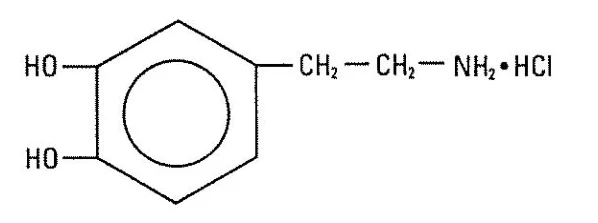
Proper name: Dopamine hydrochloride
Chemical name:
3,4-dihydroxyphenethylamine hydrochloride or 3-hydroxytyramine hydrochloride, or (3,4-dihydroxyphenyl)-$-aminoethane hydrochloride
Molecular formula: C8H11NO2.HCl Molecular weight: 189.64
Description
Dopamine hydrochloride is a white odorless, crystalline powder, soluble in water and alcohol, with a melting point of 240°C to 248°C (with decomposition); it is sensitive to light, alkalies, iron salts and oxidizing agents.
PHARMACOLOGY
In anesthetized dogs, dopamine possesses about 1/60th the pressor activity of norepinephrine and 1/28th the pressor activity of epinephrine.
At low to moderate doses of dopamine (1 to 25 :g/kg/min), the increase in systolic pressure in dogs is due primarily to increased myocardial contractile force resulting in an improvement in stroke volume and cardiac output.
At dosages exceeding 50 :g/kg/min, pressure and peripheral resistance are simultaneously elevated.
In anesthetized dogs, urine flow was increased in a dose-related manner when dopamine was infused at a rate of 5 to 20 :g/kg/min. At higher doses, the incremental increase was lower in magnitude.
Single intrarenal injections of high doses of dopamine in dogs (24 and 48 :g) produced a biphasic renal response characterized by a brief initial decrease in RBF due to vasoconstriction, followed by a more sustained increase in RBF. At higher doses the constrictor component was more prominent, and, in fact, RBF was reduced below control levels.
The reduction in RBF, GFR and urine flow caused by high doses of dopamine was completely inhibited by the alpha-adrenergic blocking agent, phentolamine, and partially inhibited by the beta-adrenergic blocking agent, propranolol. Neither alpha nor beta blockers, however, were capable of modifying the renal vasodilator component of action of dopamine.
Both mesenteric and celiac vasodilation can be produced by dopamine in the anesthetized dog and cat. As in the renal vascular bed, adrenergic blocking agents were incapable of inhibiting this vasodilation.
TOXICOLOGY
Acute Toxicity
Mice
Groups of ICR mice were given intravenous injection of dopamine hydrochloride from 125 mg to 261 mg/kg.
The first symptoms of toxicity were observed at the lowest dose; they included: decreased activity, ataxia, jerks, clonic convulsions, dyspnea, blood from nose and mouth. They lasted at least one hour after treatment, and deaths occurred within 3 to 8 minutes.
Rat
Groups of Sprague-Dawley rats were administered dopamine hydrochloride, under same conditions as above, with doses ranging from 20 to 69 mg/kg. Same signs and symptoms of toxicity were observed as in mice, with the exception that they lasted longer (several hours) and deaths occurred within 10 to 30 minutes.
The following table summarizes the results of such studies:
| SPECIES | NUMBER | SEX | ROUTE | LD50 (mg/kg) |
mice mice rats rats | 10 10 10 10 | M F M F | i.v. i.v. i.v. i.v. | 129.4 181.1 28.6 25.6 |
Dopamine hydrochloride is more toxic to rats than to mice. It is slightly more toxic to male mice than to female mice.
In a reported study, at doses ranging from 0.635 mg/kg to 159 mg/kg of dopamine hydrochloride i.v., LD50's were determined to be 109 mg/kg in male rats and 104 mg/kg in female rats.
Dog
In 14 mongrel dogs given single intravenous injections from 1.0 mg/kg to 126.0 mg/kg, first symptoms of toxicity were observed at the lowest test dose. Both dogs treated with 100 mg/kg and both dogs treated with 126 mg/kg died. Signs of toxicity were:
- general: hypersalivation, tachycardia, vomiting, pyrexia, mydriasis, superficial breathing, constipation, EKG changes.
- at low doses: mild sedation and restlessness.
- at high doses: ataxia, piloerection, abdominal and lateral position, tonic-clonic convulsions followed by death. Post-mortem findings were: pulmonary edema, full atria, hyperemic parenchymatous organs.
Sub-acute Toxicity
Rat
In male and female Sprague-Dawley rats, subjected to daily i.v. injections of dopamine hydrochloride for six weeks at doses of 0, 3, 10, and 30 mg/kg/day (the last dose increased after three weeks to 60 mg/kg/day), catalepsy-like conditions associated with decreased spontaneous mobility, exophthalmos, mydriasis and slight hypopnea, appeared following the injection of dopamine.
Mortality was 0%, 5% and 42.5% (35% at 30 mg/kg/day and 47% at 60 mg/kg/day) in the three treatment groups, respectively. Death was attributed to acute circulatory failure evidenced by post-mortem findings of full atria, pulmonary edema, and hyperemia of the pulmonary vessels, liver and kidneys.
Blood-clotting time in males and uric acid in both sexes significantly decreased at the highest dose level.
At the end of the trial, the body weight of the surviving animals decreased significantly from control group values in females at all dose levels, and in males in the two higher dosage groups.
Dog
Male and female beagles were given daily i.v. injections of dopamine hydrochloride for six weeks at doses of 0, 1.0, 9.0 and 27.0 mg/kg/day (this last dose increased after three weeks to 40.5 mg/kg/day).
Signs of toxicity were: restlessness, increased salivation, increased respiratory rate, ruffled and bristled hair, and short-lasting mydriasis. Vomiting was also observed in animals in the two high dosage groups, and catalepsy-like behaviour was seen in dogs receiving the highest dose. The higher the dose of dopamine, the shorter the onset, the greater the intensity and the longer the duration of the effects but these reactions diminished gradually.
There were statistically significant decreases in hemoglobin, hematocrit values and heart muscle glycogen content in animals in the highest dose group. Statistically significant EKG changes observed were decreased heart rate, decreased PQ interval and increased QT interval in all dosage groups five minutes after the last dopamine administration.
REFERENCES
- 1. Crexcells C, Bourassa MG, Biron P. Effects of dopamine on myocardial metabolism in patients with ischemic heart disease. Cardiovas Res 1973; 7:438-445.
- 2.
Goldberg LI. Cardiovascular and renal actions of dopamine: potential clinical applications.
Pharm Rev 1972; 24:1-29.
- 3.
Goldberg L. Dopamine - clinical uses of an endogenous catecholamine. N Eng J Med 1974;
291: 707-710.
- 4.
Graf VE, Leuschner F. Zur toxizität, subakute toxizität and teratologie. Arzneim-Forsch/Drug
Res 1978; 28:2208-2218.
- 5. Holloway EL, Polumbo RA, Harrison DC. Acute circulatory effects of dopamine in patients with pulmonary hypertension. Brit Heart J 1975; 37:482-485.
- 6. Holzer J, Karliner JS, O'Rourke RA, Pitt W, Ross J. Effectiveness of dopamine in patients with cardiogenic shock. Am J Cardiol 1973; 32:79-84.
- 7. Karliner JS. Dopamine for cardiogenic shock. JAMA 1973; 226:1217-1218.
- 8. MacCannell KL, McNay JL, Mayer NB, Goldberg LI. Dopamine in the treatment of hypotension and shock. N Eng J Med 1966; 275:1389-1398.
- 9. Rosenblum R, Tai AR, Lawson D. Dopamine in man: cardiorenal hemodynamics in normotensive patients with heart disease. J Pharmacol and Exp Ther 1972; 183:256-263.
- 10.
Rosenblum, R. Physiologic basis for the therapeutic use of catecholamines. Am Heart J 1974;
87:527-530.
- 11.
SYMPATHOMIMETIC AGENTS: Dopamine. In: USP-DI - Drug Information for the Health Care
Professional. 16th Edition, Rockville: United States Pharmacopeial Convention, Inc, 1996: 2741-8.
- 12.
SYMPATHOMIMETIC AGENTS: Dopamine Hydrochloride. In: AHFS Drug Information. 38th
Edition, Bestheda: American Society of Pharmacists, 1996: 869-872.
- 13.
VASOPRESSORS USED IN SHOCK - Dopamine Hydrochloride. In: Drug Facts and
Comparisons. St-Louis: Facts and Comparisons, Inc., 1994: 153-c.