


Patient Medication Information: uses, side effects, how to take - Fml
What is FML used for?
- FML is used in adults to treat inflammation of the eye.
How does FML work?
FML is an eye drop which contains the medicinal ingredient fluorometholone. Fluorometholone belongs to a group of medicines called corticosteroids. It decreases the body’s immune response. This reduces inflammation and pain in the eye.
What are the ingredients in FML?
Medicinal ingredient: fluorometholone
Non-medicinal ingredients: benzalkonium chloride 0.0046% w/v (as preservative), edetate disodium, polysorbate 80, polyvinyl alcohol, purified water, sodium chloride, sodium phosphate dibasic heptahydrate, sodium phosphate monobasic monohydrate, and sodium hydroxide to adjust pH.
FML comes in the following dosage forms:
Ophthalmic suspension, 0.1% w/v
Do not use FML if:
- you are allergic (hypersensitive) to fluorometholone, benzalkonium chloride, other corticosteroids, or any of the other ingredients in FML (see What are the ingredients in FML?)
- you have (or think you have) an infection of the eye, including a bacterial infection, a viral infection (such as herpes, vaccinia, or chickenpox), or a fungal infection
- you have tuberculosis of the eye
To help avoid side effects and ensure proper use, talk to your healthcare professional before you take FML. Talk about any health conditions or problems you may have, including if you:
- have or have ever had glaucoma (increased pressure in the eye)
are pregnant or planning to become pregnant
- are breastfeeding or plan to breastfeed. You should not use FML unless your healthcare professional has told you to.
- have a history of any other eye condition
Other warnings you should know about:
Slow wound healing
FML may slow healing after surgery or if you have a wound. Talk to your healthcare professional right away if you develop further symptoms such as: eye redness, itching, tearing, discharge, feeling something in your eye, seeing floating spots or sensitivity to light.
Use with contact lenses
The preservative in FML (benzalkonium chloride) may be absorbed by and discolour soft contact lenses. You should remove your contact lenses before you put FML in your eye(s) and kept them out for 15 minutes after.
Driving and using machines
Your vision may become blurred for a short time after using FML. You should not drive or use machines until your vision is clear again.
Monitoring by your healthcare professional
Corticosteroids, like FML, can increase your risk of developing cataracts (clouding of the lens of your eye), glaucoma (increased eye pressure) and central serous chorioretinopathy (blurred vision). Your risk increases if you use it for more than 10 days. Your healthcare professional will monitor the health of your eye(s) closely while you are using FML.
Tell your healthcare professional about all the medicines you take, including any drugs, vitamins, minerals, natural supplements or alternative medicines.
The following may interact with FML:
- medicines used to treat HIV infection such as; ritonavir, cobicistat
- antibiotics used to treat bacterial infections such as; clarithromycin, erythromycin
- antifungals used to treat fungal infections such as; ketoconazole, itraconazole, voriconazole, fluconazole
- aprepitant, a medicine used to treat nausea and vomiting
- medicine used to treat high blood pressure and other heart problems such as; diltiazem, verapamil
- other topical corticosteroid medicines or topical nonsteroidal anti-inflammatory drugs (NSAIDs)
How to take FML:
- Use FML exactly how your healthcare professional tells you to. If you are not sure, talk to your healthcare professional.
- Do not stop taking FML or change your dose without talking to your healthcare professional.
- To help prevent infections, do not let the tip of the bottle touch your eye, eyelid or anything else.
- The bottle should be used by only one person, to prevent the spread of infection.
- If your symptoms do not improve, or get worse, after using FML for two days, talk to your healthcare professional.
Follow the steps below to help you use FML properly:
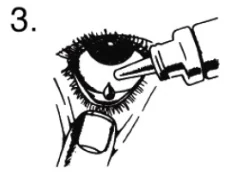
- Shake the bottle before use. Wash your hands. Tilt your head back and look at the ceiling. (See Illustration 1)
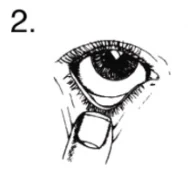
- Gently pull the lower eyelid down until there is a small pocket (conjunctival sac). (See Illustration 2)
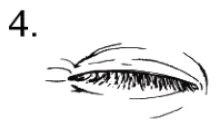
- Turn the bottle upside down and squeeze it to release one or two drops into each eye that needs treatment. (See Illustration 3)
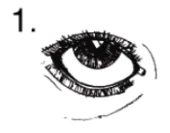
- Let go of the lower lid, and close your eye for 30 seconds. (See Illustration 4)
- If a drop misses your eye, try again.
- Close the cap immediately after use.
- Wipe the excess liquid from your face.
- Wash your hands to remove any medication.
Usual adult dose:
Apply 1-2 drops into the conjunctival sac (the space between your lower eyelid and eye- see Illustration 2) two to four times daily.
Overdose:
| If you think you, or a person you are caring for, have taken too much FML, contact a healthcare professional, hospital emergency department, or regional poison control centre immediately, even if there are no symptoms. |
|---|
If you accidentally use too many drops, flush your eye with water or normal saline solution.
Missed Dose:
If you forget to use FML at your normal time, use it as soon as you remember. Then go back your usual dosing schedule. Don’t try to catch up on missed drops by applying more than one dose at a time.
What are possible side effects from using FML?
These are not all the possible side effects you may have when taking FML. If you experience any side effects not listed here, tell your healthcare professional.
Side effects may include:
- eye irritation
- redness
- blurred vision
- itching
- tearing
- taste disorder
- rash
Serious side effects and what to do about them
| Symptom / effect | Talk to your healthcare professional | Stop taking drug and get immediate medical help | |
|---|---|---|---|
| Only if severe | In all cases | ||
| Allergic reaction: difficulty swallowing or breathing, wheezing, drop in blood pressure, feeling sick to your stomach and throwing up, hives or rash, swelling of the face, lips, tongue or throat | ✓ | ||
Eye problems:
| ✓ | ||
Serious side effects and what to do about them
| Symptom / effect | Talk to your healthcare professional | Stop taking drug and get immediate medical help | |
|---|---|---|---|
| Only if severe | In all cases | ||
| New eye infection: eye redness, eye swelling, eye crusting, weeping eyes, eye discharge, feeling like there is something in your eye | ✓ | ||
| Perforation (tear) in the eye: tearing, eye pain, worsening of vision or loss of vision, double vision | ✓ | ||
If you have a troublesome symptom or side effect that is not listed here or becomes bad enough to interfere with your daily activities, tell your healthcare professional.
Reporting Side Effects
You can report any suspected side effects associated with the use of health products to Health Canada by:
NOTE: Contact your health professional if you need information about how to manage your side effects. The Canada Vigilance Program does not provide medical advice. |
Storage:
FML should be stored in an upright position between 15°C - 25°C. Protect from freezing. Keep the bottle tightly closed when you are not using it.
Discard any unused product 1 month after first opening.
Keep out of reach and sight of children.
If you want more information about FML:
- Talk to your healthcare professional
- Find the full product monograph that is prepared for healthcare professionals and includes this Patient Medication Information by visiting the Health Canada website: (https://www.canada.ca/en/health-canada/services/drugs-health-products/drug-products/drug-product-database.html); the manufacturer’s website (www.abbvie.ca), or by calling 1-888-704-8271.
Last Revised: JUL 31, 2024
© 2024 AbbVie. All rights reserved.
FML and its design are trademarks of AbbVie Corporation.