


Product Monograph - Fml
RECENT MAJOR LABEL CHANGES
| 7 WARNINGS AND PRECAUTIONS, Class Effects | 07/2024 |
|---|
TABLE OF CONTENTS
Sections or subsections that are not applicable at the time of authorization are not listed.
RECENT MAJOR LABEL CHANGES ............................................................................................ 2
TABLE OF CONTENTS .............................................................................................................. 2
PART I: HEALTH PROFESSIONAL INFORMATION ...................................................................... 4
1 INDICATIONS ............................................................................................................... 4
1.1 Pediatrics (<18 years of age) ................................................................................... 4
1.2 Geriatrics (>65 years of age) ................................................................................... 4
2 CONTRAINDICATIONS ................................................................................................. 4
4 DOSAGE AND ADMINISTRATION ................................................................................. 4
4.1 Dosing Considerations ............................................................................................ 4
4.2 Recommended Dose and Dosage Adjustment ....................................................... 4
4.4 Administration ........................................................................................................ 5
4.5 Missed Dose ........................................................................................................... 5
5 OVERDOSAGE .............................................................................................................. 5
6 DOSAGE FORMS, STRENGTHS, COMPOSITION AND PACKAGING ................................. 5
7 WARNINGS AND PRECAUTIONS .................................................................................. 6
7.1 Special Populations................................................................................................. 7
7.1.1 Pregnant Women ............................................................................................. 7
7.1.2 Breast-feeding .................................................................................................. 7
7.1.3 Pediatrics .......................................................................................................... 7
7.1.4 Geriatrics .......................................................................................................... 8
8 ADVERSE REACTIONS .................................................................................................. 8
8.1 Adverse Reaction Overview .................................................................................... 8
8.2 Clinical Trial Adverse Reactions .............................................................................. 8
8.5 Post-Market Adverse Reactions ............................................................................. 8
9 DRUG INTERACTIONS .................................................................................................. 8
9.2 Drug Interactions Overview .................................................................................... 8
9.3 Drug-Behavioural Interactions ................................................................................ 9
9.4 Drug-Drug Interactions ........................................................................................... 9
9.5 Drug-Food Interactions ........................................................................................... 9
9.6 Drug-Herb Interactions ........................................................................................... 9
9.7 Drug-Laboratory Test Interactions .......................................................................... 9
10 CLINICAL PHARMACOLOGY ......................................................................................... 9
10.1 Mechanism of Action ........................................................................................ 9
10.2 Pharmacodynamics .......................................................................................... 9
10.3 Pharmacokinetics ............................................................................................. 9
11 STORAGE, STABILITY AND DISPOSAL ......................................................................... 10
12 SPECIAL HANDLING INSTRUCTIONS ........................................................................... 10
PART II: SCIENTIFIC INFORMATION ....................................................................................... 11
13 PHARMACEUTICAL INFORMATION ............................................................................ 11
14 CLINICAL TRIALS ........................................................................................................ 11
14.1 Clinical Trials by Indication ............................................................................. 11
15 MICROBIOLOGY ........................................................................................................ 11
16 NON-CLINICAL TOXICOLOGY ..................................................................................... 11
PATIENT MEDICATION INFORMATION .................................................................................. 13
PART I: HEALTH PROFESSIONAL INFORMATION
1 INDICATIONS
FML® (fluorometholone) is indicated for:
- the treatment of steroid-responsive inflammation of the palpebral and bulbar conjunctiva, cornea, and anterior segment of the globe.
1.1 Pediatrics (<18 years of age)
No data are available to Health Canada; therefore, Health Canada has not authorized an indication for pediatric use.
1.2 Geriatrics (>65 years of age)
No data are available to Health Canada; therefore, Health Canada has not authorized an indication for geriatric use.
2 CONTRAINDICATIONS
FML is contraindicated in patients who are hypersensitive to this drug or to any ingredient in the formulation, including any non-medicinal ingredient, or component of the container. For a complete listing, see 6 DOSAGE FORMS, STRENGTHS, COMPOSITION AND PACKAGING.
FML is contraindicated in:
- Superficial (or epithelial) herpes simplex keratitis (dendritic keratitis), vaccinia, varicella, and other viral diseases of the cornea and conjunctiva.
- Fungal diseases of ocular structures
- Mycobacterial infections of the eye (e.g., Tuberculosis of the eye)
- Acute untreated infections of the eye
- Patients who are hypersensitive to other corticosteroids.
4 DOSAGE AND ADMINISTRATION
4.1 Dosing Considerations
- The dosing of FML may be reduced, but care should be taken not to discontinue therapy prematurely. If FML is used for longer than 10 days (see 7 WARNINGS AND PRECAUTIONS), withdrawal of treatment should be carried out by gradually decreasing the frequency of applications.
4.2 Recommended Dose and Dosage Adjustment
- FML is for topical ophthalmic use only. Shake fluorometholone ophthalmic suspension well before use.
- Instill 1 to 2 drops into the conjunctival sac two to four times daily. During the initial 24 to 48 hours, the dosage may be safely increased to 2 drops every 4 hours. Care should be taken not to discontinue therapy prematurely.
- If signs and symptoms fail to improve after two days, the patient should be re-evaluated.
Health Canada has not authorized an indication for pediatric use.
Health Canada has not authorized an indication for geriatric use.
4.4 Administration
To prevent eye injury or contamination, care should be taken to avoid touching the bottle to the eye, the eyelids or to any other surface. The use of the bottle by more than one person may spread infection.
4.5 Missed Dose
If the patient forgets to apply eye drops at their normal time, instruct the patient to apply them as soon as they remember. Instruct the patient to then return to their original schedule.
Instruct the patient not to catch up on missed drops by applying more than one dose at a time.
5 OVERDOSAGE
There is no known treatment of overdosage. If accidental overdosage occurs in the eye, flush the eye with water or normal saline. Discontinue medication when heavy or protracted use is suspected.
| For management of a suspected drug overdose, contact your regional poison control centre. |
|---|
6 DOSAGE FORMS, STRENGTHS, COMPOSITION AND PACKAGING
Table 1 – Dosage Forms, Strengths, Composition and Packaging
FML is available as a sterile topical ophthalmic suspension in an opaque low density polyethylene (LDPE) bottles with dropper tips and high impact polystyrene (HIPS) caps in the following sizes: 5 mL and 10 mL.
| Route of Administration | Dosage Form / Strength/Composition | Non-medicinal Ingredients |
| ophthalmic | suspension, 0.1% w/v each mL contains 1 mg of fluorometholone | benzalkonium chloride 0.0046% w/v as the preservative, polyvinyl alcohol, edetate disodium, sodium chloride, sodium phosphate monobasic monohydrate, sodium phosphate dibasic heptahydrate, polysorbate 80, sodium hydroxide to adjust pH, and purified water. |
7 WARNINGS AND PRECAUTIONS
General
Use of topical corticosteroids may cause increased intraocular pressure (IOP) in certain individuals. Prolonged use of FML (beyond 10 days) may result in glaucoma in susceptible individuals, with damage to the optic nerve, defects in visual acuity and fields of vision. It is necessary that the IOP be checked frequently in patients with a history of glaucoma.
Use of corticosteroids may prolong the course and may exacerbate the severity of many viral eye infections (including herpes simplex). Use of corticosteroids in the treatment of patients with a history of herpes simplex requires great caution; frequent slit lamp microscopy is recommended.
Prolonged use may result in posterior subcapsular cataract formation, and may also suppress the host immune response, and thus increase the hazard of secondary ocular infections.
Visual disturbance may be reported with systemic and topical corticosteroid use. If a patient presents with symptoms such as blurred vision or other visual disturbances, consider evaluating for possible causes which may include cataract, glaucoma or rare diseases such as central serous chorioretinopathy (CSCR) which have been reported after use of systemic and topical corticosteroids.
Topical ophthalmic corticosteroids may slow corneal wound healing. In those diseases causing thinning of the cornea or sclera, perforation has been known to occur with use of topical steroids.
Concomitant use of topical non-steroidal anti-inflammatory drugs (NSAIDs) and topical steroids may increase the potential for healing problems.
Although the systemic exposure is expected to be low with topical ophthalmic corticosteroid administration, co-treatment with CYP3A inhibitors may increase the risk of systemic corticosteroid-related side-effects.
Acute untreated infections of the eye may be masked or activity enhanced by the presence of steroid medication.
Class Effects: Systemic hypercorticoidism, including Cushing Syndrome, may occur after prolonged or intensive use of topical steroids. In these cases, treatment should be discontinued gradually.
Carcinogenesis and Mutagenesis
No studies have been conducted in animals or in humans to evaluate the potential of these effects with fluorometholone.
Driving and Operating Machinery
As with any ocular medication, if transient blurred vision occurs at instillation, the patient should wait until the vision clears before driving or using machinery.
Monitoring and Laboratory Tests
Ophthalmologic examinations, especially tonometry and slit-lamp examination, are required at periodic intervals for patients on FML therapy for more than several weeks. Chronic therapy with corticosteroids may cause posterior subcapsular cataracts, increased IOP and glaucoma, and may also enhance the establishment of ocular infections. Other tests may be warranted in some patients depending on condition.
Ophthalmologic
The initial prescription and renewal of FML should be made only after appropriate ophthalmologic examination (including but not limited to IOP assessment and slit lamp biomicroscopy). If signs and symptoms fail to improve after two days, the patient should be re-evaluated.
Given the risks of serious adverse outcomes, FML should not be used beyond 10 days, unless absolutely necessary, and only under strict ophthalmologic monitoring, including but not limited to tonometry and slit-lamp examination. Prolonged use of topical steroids increases the risk of raised IOP, glaucoma, and subcapsular cataract formation.
As fungal infections of the cornea are particularly prone to develop coincidentally with long-term steroid applications, fungus invasion must be suspected in any persistent corneal ulceration where a steroid has been used or is in use. Fungal cultures should be taken when appropriate.
- Use with Contact Lenses:
The preservative in FML, benzalkonium chloride, may be absorbed by soft contact lenses and cause their discoloration. Patients wearing soft contact lenses should be instructed to remove contact lenses prior to administration of the suspension and wait at least 15 minutes after instilling FML before reinserting soft contact lenses.
Reproductive Health: Female and Male Potential
- Fertility
No studies have been conducted in animals or in humans to evaluate the potential of these effects with fluorometholone.
7.1 Special Populations
7.1.1 Pregnant Women
FML should not be used during pregnancy, unless the potential benefits to the mother clearly outweigh the risks to the fetus. Safety of the use of topical steroids in humans during pregnancy has not been established. Fluorometholone has been shown to be embryocidal, fetotoxic, and teratogenic in pregnant rabbits when administered by ocular instillation. See 16 NON-CLINICAL TOXICOLOGY section.
7.1.2 Breast-feeding
It is unknown if FML suspension is excreted in human milk. Systemically administered corticosteroids appear in human milk and could suppress growth, interfere with endogenous corticosteroid production, or cause other untoward effects. Because of the potential for serious adverse reactions in nursing infants from fluorometholone, FML is not recommended in nursing women, unless the benefit to the mother clearly outweighs the risks to the nursing infant.
7.1.3 Pediatrics
Pediatrics (<18 years): No data are available to Health Canada; therefore, Health Canada has not authorized an indication for pediatric use.
7.1.4 Geriatrics
Geriatrics: No data are available to Health Canada; therefore, Health Canada has not authorized an indication for geriatric use.
8 ADVERSE REACTIONS
8.1 Adverse Reaction Overview
Ocular adverse reactions associated with ophthalmic steroids may include elevated IOP, which may be associated with optic nerve damage, loss of visual acuity and field of vison defects, posterior subcapsular cataract formation, secondary ocular infection, delayed wound healing (including perforation of the globe where there is thinning of the cornea or sclera).
Eye disorders: posterior subcapsular cataract formation, secondary ocular infection from pathogens liberated from ocular tissues, and perforations of the globe.
8.2 Clinical Trial Adverse Reactions
Clinical trials are conducted under very specific conditions. Therefore, the adverse reaction rates observed in the clinical trials, may not reflect the rates observed in practice and should not be compared to the rates in the clinical trials of another drug. Adverse reaction information from clinical trials may be useful in identifying and approximating rates of adverse drug reactions in real-world use.
8.5 Post-Market Adverse Reactions
The following adverse reactions have been identified during post marketing use of FML in clinical practice. Because they are reported voluntarily from a population of unknown size, estimates of frequency cannot be made.
Eye disorders: eye irritation, conjunctival/ocular hyperemia, visual disturbance, foreign body sensation, eyelid edema, blurred vision, eye discharge, eye pruritis, lacrimation increased, eye edema/eye swelling, mydriasis, ulcerative keratitis, ocular infection (including bacterial, fungal, and viral infections), visual field defect, punctate keratitis, eyelid ptosis.
Cases of corneal calcification have been reported very rarely in association with the phosphate component of FML in some patients with significantly damaged corneas.
Immune system disorders: hypersensitivity and allergic reactions
Gastrointestinal Disorders: dysgeusia
Skin and subcutaneous tissue disorders: rash
9 DRUG INTERACTIONS
9.2 Drug Interactions Overview
Specific drug interaction studies have not been performed with fluorometholone acetate. Concomitant use of topical nonsteroidal anti-inflammatory drugs (NSAIDs) and topical steroids may further delay wound healing (see WARNINGS AND PRECAUTIONS, General).
Co-treatment with CYP3A inhibitors may increase systemic exposure resulting in increased risk of systematic side-effects. The combination should be avoided unless the benefit outweighs the increased risk of systemic corticosteroid side-effects, in which case patients should be monitored for systemic corticosteroid side-effects.
9.3 Drug-Behavioural Interactions
Interactions with behaviour have not been established.
9.4 Drug-Drug Interactions
Interactions with other drugs have not been established.
9.5 Drug-Food Interactions
Interactions with food have not been established.
9.6 Drug-Herb Interactions
Interactions with herbal products have not been established.
9.7 Drug-Laboratory Test Interactions
Interactions with laboratory tests have not been established.
10 CLINICAL PHARMACOLOGY
10.1 Mechanism of Action
FML is a glucocorticoid that inhibits both the early inflammatory activities such as edema, fibrin deposition, capillary dilatation, and migration of phagocytes as well as the later manifestations such as capillary proliferation, fibroblast proliferation, collagen deposition and cicatrization.
These drugs are believed to block the progression of inflammation by increasing the resistance of cells to cytotoxic breakdown products in the inflammatory zone. There is evidence to indicate that glucocorticoids inhibit inflammation and its spread by stabilizing membranes, especially those of the lysosomes.
In comparison with hydrocortisone, fluorometholone was found two to three times as effective in tests of catabolic effects in monkeys. It was, however, 131 times as effective in anti-inflammatory effect (using rat granuloma pouch techniques) and approximately 40 times as effective in a variety of other test models. Fluorometholone and prednisolone were evaluated for anti-inflammatory potency in a system employing the eyes of albino rabbits. The results of the study showed fluorometholone to be forty (40) times as effective as hydrocortisone in comparison to prednisolone which was found to be two (2) times as effective as hydrocortisone. These results are in accord with published data on topical anti-¬inflammatory corticosteroids. In a study on adult female rabbits, fluorometholone was found qualitatively to penetrate the intact eye into the aqueous humor. These results are in accord with published data on dexamethasone and prednisolone.
10.2 Pharmacodynamics
Not available at the time of initial authorization.
10.3 Pharmacokinetics
Not available at the time of initial authorization.
11 STORAGE, STABILITY AND DISPOSAL
Keep out of sight and reach of children.
Store in an upright position at 15°C to 25°C. Protect from freezing. Keep bottle tightly closed when not in use.
Discard any unused product 1 month after first opening.
The product should be discarded after the expiration date. Any unused product or waste material should be disposed of in accordance with local requirements.
12 SPECIAL HANDLING INSTRUCTIONS
Patients should be advised to avoid touching the tip of the vial to the eye or any surface, as this may contaminate the suspension.
PART II: SCIENTIFIC INFORMATION
13 PHARMACEUTICAL INFORMATION
Drug Substance
Proper name: Fluorometholone
Chemical name: 9-Fluoro-llß, 17-dihydroxy-6α-methylpregna-l, 4-diene-3, 20-dione.
Molecular formula and molecular mass: C22H29FO4 376.47
Structural formula:
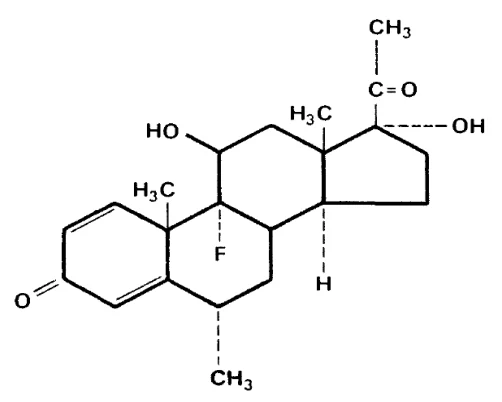
Physicochemical properties: Fluorometholone is an odorless, white to slightly yellow-white powder with a melting point of about 280°C with some decomposition. It has a characteristic ultraviolet absorption maximum in methanol at 239 millimicrons.
14 CLINICAL TRIALS
14.1 Clinical Trials by Indication
The clinical trial data on which the original indication was authorized is not available.
15 MICROBIOLOGY
No microbiological information is required for this drug product.
16 NON-CLINICAL TOXICOLOGY
General Toxicology: The recommended maximum human dosage of 0.1% fluorometholone (2 drops 4 times per day per 50 kg of body weight) is capable of causing systemic effects in animals when administered orally. Dosages of twenty and thirty times human equivalent dosages were administered to dogs and rats during both 90-day oral subacute toxicity studies. Systemic effects typical of glucocorticoids were noted, such as decreases in body weight gain, leukopenia, heterophilia, lymphocytopenia and liver malfunction. This was an unexpected finding as considerable data were available to Allergan Pharmaceuticals concerning subacute oral administration to humans that indicated no effect with three times the human dosage when administered orally (2.5 mg per day vs.
0.8 mg for maximum ophthalmic exposure). The male rats were less affected at the thirty times human equivalent dosage than the low-dosage females. By the 60th day of treatment, the eyes in all the female rats in the 0.16 mg/kg/day dosage level unexpectedly appeared partially buphthalmic and nebulous, lacking the pink color which results from the capillary bed.
The oral administration of a drug is bound to result in a greater systemic absorption than an ophthalmic application; however, the degree of difference is not known.
Draize eye irritation studies have been successfully completed using 0.1% and 0.25% fluorometholone. Nine albino rabbits were utilized to test the toxicity of both 0.1% and 0.25% fluorometholone formulation on the eye mucosa. In addition to the routine observations during the twenty day instillation period, each rabbit was observed for a seven day post instillation period for possible delayed changes or lesions. Two percent fluorescein was instilled to determine if there was any corneal damage resulting from the treatment. One animal was sacrificed on the last day of the observation period and subjected to a histological examination.
Upon examination, there were no histological differences observed between the treated and the control eyes. Thus, both concentrations (0.1% and 0.25%) were found to be free from any irritating effects.
Due to the maximum human dosage (3 drops 4 times per day) administered to young 2 kg rabbits for a twenty day period, it was not surprising that some of the animals did suffer from symptoms of glucocorticoid excess and eventually died from treatment.
A Draize eye irritation test has been successfully completed with FML-NEO (0.1% fluorometholone-0.5% neomycin sulfate) Liquifilm Ophthalmic Suspension, a similar formulation in that fluorometholone is a component of the combination product.
Nine albino rabbits were utilized to test the toxicity of fluorometholone-neomycin sulfate formulation on the eye mucosa. In addition to the routine observations for possible delayed ocular changes or lesions during the 90-day instillation period, the animals were sacrificed on the last day of the observation period and subjected to a histological examination. Upon examination, there were no histological differences between the treated and the control eyes.
During the fifth week of study it was noted that the animals in the higher dose level (10 times and 20 times human dose) unexpectedly appeared to have protruded eyes, a buphthalmos-like condition, which persisted throughout the remainder of the study.
Systemic effects typical of glucocorticoids were noted, such as decreases in body weight gain, leukopenia, heterophilia, lymphocytopenia and liver malfunction.
Carcinogenicity: No studies have been conducted to evaluate the carcinogenicity of fluorometholone.
Genotoxicity: No studies have been conducted to evaluate the mutagenicity of fluorometholone.
Reproductive and Developmental Toxicology: When Fluorometholone was applied ocularly daily to rabbits on days 6-18 of gestation, dose-related fetal loss and fetal abnormalities including cleft palate, deformed rib cage, anomalous limbs and neural abnormalities such as encephalocele, craniorachischisis, and spina bifida were observed.