


Product Monograph - Flarex
SUMMARY PRODUCT INFORMATION
Route of Administration | Dosage Form / Strength | Clinically Relevant Nonmedicinal Ingredients |
Topical ophthalmic | Ophthalmic suspension/ fluorometholone acetate 0.1% w/v | Benzalkonium chloride as preservative. For a complete listing see Dosage Forms, Composition and Packaging section. |
INDICATIONS AND CLINICAL USE
FLAREX® (fluorometholone acetate ophthalmic suspension) is indicated for the treatment of allergic and other steroid-responsive inflammatory conditions of the palpebral and bulbar conjunctiva, cornea and anterior segment of the eye.
Geriatrics (> 65 years of age):
FLAREX is not recommended for use in the elderly as the safety and efficacy of FLAREX has not been established in this population.
Pediatrics (< 18 years of age):
FLAREX is not recommended for use in children or adolescents as the safety and efficacy of FLAREX has not been established in this population.
CONTRAINDICATIONS
FLAREX is contraindicated in patients with:
- Hypersensivity to fluorometholone or to any ingredient in the formulation or component of the container. For a complete listing, see the DOSAGE FORMS, COMPOSITION AND PACKAGING section of the product monograph.
- Hypersensitivity to corticosteroids.
- Acute superficial herpes simplex keratitis, vaccinia, varicella, and most viral diseases of the cornea and conjunctiva.
- Mycobacterial infections, including tuberculosis of the eye.
- Fungal diseases of the eye.
- Acute untreated infections of the eye that like other diseases caused by microorganisms, may be masked or enhanced by the presence of the steroid.
WARNINGS AND PRECAUTIONS
General
Not for injection.
The initial prescription and renewal of FLAREX should be made only after appropriate ophthalmologic examination (including but not limited to intraocular pressure assessment and slit lamp biomicroscopy). If signs and symptoms fail to improve after two days, the patient should be re-evaluated. FLAREX should not be used beyond 10 days, unless absolutely necessary, and only under ophthalmologic monitoring.
Acute infections of the eye may be masked or exacerbated by the presence of steroid medications. Prolonged use may increase the risk of secondary ocular infections from pathogens due to suppression of the host response.
Fungal infections of the cornea are particularly prone to develop coincidentally with long-term local steroid application; fungus invasion must be considered in any persistent corneal ulceration where a steroid has been or is in use. FLAREX therapy should be discontinued if fungal infection occurs.
In disease due to microorganisms, the infection may be masked, enhanced or activated by corticosteroids. Whenever there is a possibility of infection, supplemental therapy with suitable antibiotic agents should be considered.
Patients should be advised to inform their physicians of any prior use of corticosteroids. If sensitivity or other untoward reactions occur, the patient should be advised to discontinue the medication.
Endocrine and Metabolism
Systemic corticosteroid side-effects may occur after intensive or long-term continuous ophthalmic corticosteroid therapy in predisposed patients, including children and patients treated with CYP3A4 inhibitors (e.g. ritonavir and cobicistat).
Ophthalmologic
Use of topical ophthalmic corticosteroids may cause increased intraocular pressure (IOP). It is necessary that IOP be checked frequently, particularly in patients with a history or family history of glaucoma. Prolonged use may result in glaucoma, damaged to the optic nerve, defects in visual acuity and visual field, and/or posterior subcapsular cataract formation.
The risk of corticosteroid-induced elevation of IOP and/or cataract formation is increased in predisposed patients (e.g. diabetes).
Topical ophthalmic corticosteroids may slow corneal wound healing. In those diseases causing
thinning of the cornea or sclera, perforation has been known to occur with the chronic use of topical steroids. Topical nonsteroidal anti-inflammatory drugs (NSAIDs) are also known to slow or delay healing; therefore, concomitant use of topical NSAIDs and topical steroids may increase the potential for healing problems.
The wearing of contact lenses is discouraged during treatment of an ocular inflammation. If patients do wear contact lenses during treatment, FLAREX should not be used while the patient is wearing soft contact lenses. FLAREX contains benzalkonium chloride, which is known to discolour soft contact lenses. Patients must be instructed to remove their contact lenses prior to application of FLAREX and wait at least 15 minutes before re-insertion.
Temporary blurred vision or other visual disturbances may affect the ability to drive or use machines. If blurred vision occurs at instillation, the patient must wait until the vision clears before driving or using machinery.
Special Populations
Pregnant Women: FLAREX is not recommended for use in pregnant women. The safety of FLAREX during pregnancy has not been evaluated in adequate and well controlled clinical studies in humans. Animal studies have shown that fluorometholone can be embryocidal, fetotoxic, and teratogenic in rabbits when administered by ocular instillation (see TOXICOLOGY).
Nursing Women: It is unknown whether FLAREX is excreted in human milk. Caution is advised if FLAREX is administered to a nursing woman.
Geriatrics (> 65 years of age):
FLAREX is not recommended for use in the elderly.
Pediatrics (< 18 years of age):
FLAREX is not recommended for use in children or adolescents.
ADVERSE REACTIONS
Adverse Drug Reaction Overview
Glaucoma with optic nerve damage, visual acuity and field defects, cataract formation, and secondary ocular infection following suppression of host response may occur. Extended ophthalmic use of corticosteroid drugs may cause increased intraocular pressure in certain individuals and in those diseases causing thinning of the cornea, perforation has been known to occur. Rarely, filtering blebs have been reported when topical steroids have been used following cataract surgery. Occasionally stinging or burning may occur.
Post-Market Adverse Drug Reactions
Eye disorders: Intraocular pressure increased, eye pain, eye irritation, ocular discomfort, foreign body sensation in eyes, vision blurred, ocular hyperemia, lacrimation increased; Others: dysgeusia.
DRUG INTERACTIONS
Overview
Specific drug interaction studies have not been performed with fluorometholone acetate. Concomitant use of topical nonsteroidal anti-inflammatory drugs (NSAIDs) and topical steroids may further delay wound healing (see WARNINGS AND PRECAUTIONS, Ophthalmologic).
Co-treatment with CYP3A4 inhibitors, including ritonavir and cobicistat, may increase systemic exposure resulting in increased risk of systematic side-effects. The combination should be avoided unless the benefit outweighs the increased risk of systemic corticosteroid side-effects, in which case patients should be monitored for systemic corticosteroid side-effects.
DOSAGE AND ADMINISTRATION
Recommended Dose and Dosage Adjustment
Adults: One to two drops instilled in the conjunctival sac of the affected eye(s) two to four times daily. During the initial 24 to 48 hours, the dosage may be safely increased to two drops every two hours. Care should be taken not to discontinue therapy prematurely. If signs and symptoms fail to improve after 2 days, the patient should be re-evaluated.
Missed Dose
If a dose is missed, the missed dose should be administered as soon as possible. Treatment should then be continued with the next dose as planned.
Administration
Patients should be instructed to shake the bottle well before each use and not to touch the dropper tip to their eye, eyelid, or any other surface to avoid potentially harmful contamination of the dropper tip and medicine.
After cap is removed, if the tamper evident snap collar is loose, instruct patients to remove it before using the product.
OVERDOSAGE
Overdosage in the use of topical ophthalmic corticosteroids is a remote possibility. Discontinue medications when heavy or protracted use is suspected.
For management of a suspected drug overdose, contact your regional Poison Control Centre.
ACTION AND CLINICAL PHARMACOLOGY
Corticosteroids suppress the inflammatory response (i.e., edema, fibrin deposition, capillary
dilation, leukocyte migration, capillary proliferation, deposition of collage, and scar formation) to chemical, immunological, or mechanical irritants. Corticosteroids may cause a rise in intraocular pressure in susceptible individuals. They are absorbed into aqueous humour, cornea, iris, choroid, ciliary body and retina. Systemic absorption occurs but may be significant only at higher doses than recommended.
STORAGE AND STABILITY
Protect from freezing. Store upright at room temperature. Keep out of the reach and sight of children.
DOSAGE FORMS, COMPOSITION AND PACKAGING
FLAREX is a sterile, suspension containing the following:
Medicinal ingredient: fluorometholone acetate 0.1% w/v
Preservative: benzalkonium chloride 0.01% w/v
Non-medicinal ingredients: sodium chloride, monobasic sodium phosphate, edetate disodium, hydroxyethyl cellulose, tyloxapol, sodium hydroxide and/or hydrochloric acid (to adjust pH) and purified water.
FLAREX is available in 5 mL DROP-TAINER® dispensers.
Tamper evidence is provided by a closure with an extended skirt that locks to the bottle finish on application and breaks away from the closure on opening.
PART II: SCIENTIFIC INFORMATION
PHARMACEUTICAL INFORMATION
Drug Substance
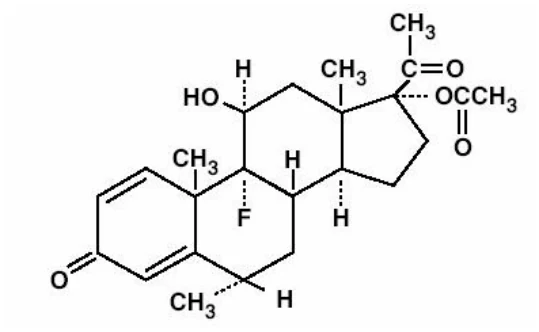
Proper name: fluorometholone acetate
Chemical name: 9-fluoro-11β,-17-dihydroxy -6α-methylpregna-1,4-diene-3,20-dione,
17-acetate.
Molecular formula and molecular mass: C24H31FO5; 418.5
Structural formula:
Physicochemical properties:
Description: white to creamy white powder
Solubility: freely soluble in chloroform and acetate; soluble in ethanol;
very slightly soluble in water Melting Point: approximately 230oC
Specific Rotation: + 28o in chloroform
CLINICAL TRIALS
The efficacy of corticosteroids for the treatment of inflammatory conditions in the eye is well established. Various steroids, such as dexamethasone alcohol or phosphate, prednisolone acetate or phosphate, and fluorometholone alcohol are marketed for this purpose. The anti-inflammatory effects of the steroids reduce the severity of the signs and symptoms of ocular inflammation and may avert permanent structural changes, which can affect vision.
The intrinsic anti-inflammatory activity of the corticosteroid and its ability to penetrate the cornea, which is the primary route of absorption of topically applied drugs into the aqueous humour, determine not only its efficacy but also the propensity of the compound to provoke side effects. Some physiochemical properties of the steroid esters may vary from those of the parent alcohols. Properties, such as solubility and partitioning between aqueous and nonaqueous
solvents may affect the bioavailability of molecules in the eye.
Double masked randomized studies have shown that FLAREX® was significantly (p = 0.03) more effective than fluorometholone alcohol and equally effective as prednisolone acetate in the treatment of external ocular inflammation of non-microbial origin. All three steroids were essentially equally effective in the treatment of anterior uveal inflammation The elevation of intraocular pressure (IOP) with prolonged use is perhaps the most serious effect of topical ophthalmic use of corticosteroids. The liability of provoking this effect varies among the currently marketed drugs, with the available evidence indicating that fluorometholone alcohol has less propensity to raise IOP in susceptible individuals compared to other steroids, such as dexamethasone, prednisolone, and their derivatives.
Fluorometholone acetate is the 17-acetate ester of fluorometholone. It is probably that this compound is hydrolysed in vivo to regenerate fluorometholone alcohol. This, fluorometholone acetate should share the same low propensity for raising IOP as fluorometholone. In healthy volunteers dosed with two drops of FLAREX four times a day for 15 days, IOP was elevated in only 3 of the 20 individuals. In a double masked crossover study with dexamethasone phosphate 0.1%, FLAREX demonstrated a significantly lower propensity to raise IOP.
DETAILED PHARMACOLOGY
Animal Studies
Past experience demonstrates that one may alter, by derivatization, the bioavailability and consequently, the potency and efficacy of topical ocular steroids. It is known that ocular tissues contain enzymes capable of hydrolysing esters, especially acetate esters of steroids. The acetate group may confer a change in the lipophilicity of the steroid, which in turn may alter its rate of passage through the cornea. It is believed that the acetate group is removed from the molecule through hydrolysis by the ocular enzymes.
To determine whether or not the 17-acetate ester of fluorometholone retains adequate anti-inflammatory activity in the eye, its efficacy in comparison to other steroids was studied using an immunogenic uveitis model in albino rabbits. Fluorometholone acetate exhibited anti-inflammatory efficacy in each of six uveitis experiments. In this series of experiements, fluorometholone acetate and fluorometholone alcohol (both at 0.1%) were equally potent anti-inflammatory agents. As these studies were not designed to give a complete dose response comparison, it cannot be concluded that the two compounds are precisely equivalent The effect of 0.1% fluorometholone acetate ophthalmic suspension has been studied in the rabbit using a keratitis model in which the invasion of the cornea by polymorphonuclear leukocytes was measured. Hourly topical administration of the drug suspension produced an average reduction of 46.8% in the polymorphonuclear leukocytes invading the corneal stroma. According to a similar experimental protocol, 0.1% fluorometholone alcohol ophthalmic suspension was shown to produce a mean decreased of 30.8% in corneal inflammatory activity as measured by leukocyte invasion. Thus, fluorometholone acetate appears to have a greater efficacy, as compared to fluorometholone alcohol, for reducing the number of leukocytes invading the cornea following an inflammatory stimulus.
TOXICOLOGY
Fluorometholone ophthalmic suspension 0.1% has been marketed over the last decade in the United States, Canada and other countries as an ophthalmic corticosteroid. Animal toxicity studies of fluorometholone, including acute intraperitoneal LD50s in mice and rats, subacute oral toxicity in rats and dogs, and subacute topical ocular toxicity in rabbits, have demonstrated the safety of this drug for human use.
Toxicology studies conducted with fluorometholone acetate are summarized in the following table:
Table 1: Summary of Toxicology Studies Conducted with Fluorometholone Acetate
| Test | Dosage (mg/kg) | Drug Related Findings LD50 (mg/kg) |
| Acute Toxicity | ||
| Mouse: i.p. | 750, 1000, 1500, 2000 | 1890.7 (female) > 2000 (male) |
| Rat: i.p. | 62.5, 125, 200, 500, 750, 1000 | > 1000 |
| Rabbit: ocular irritation | 1.8 mg/eye over 6 hours | Minimal to moderate conjunctival congestion; minimal conjunctival swelling and discharge |
| Long Term Toxicity | ||
| Mouse: 30 day | 18 (p.o.) | Suppression of weight gain |
| Rat: 30 day | 18 (p.o.) | Suppression of weight gain |
| Dog: 30 day | 9 (p.o.) | Moderate fatty changes in liver |
| Dog: 5 day | 3 (p.o.) | Increased glycogen deposition in liver; decreased adrenal weights |
| Rabbit: 5 day ocular irritation | 0.5 mg/eye/day | Minimal conjunctival congestion |
| Rabbit: 45 day ocular irritation | 0.5 mg/eye/day for 38 days | Minimal to moderate conjunctival congestion; systemic steroid toxicity; 50% mortality rate at day 39 |
| Rabbit: 30 day ocular irritation | 0.8 mg/eye/day for 2 days; 0.5 mg/eye/day for 29 days | Minimal to moderate conjunctival congestion; transient ocular discharge; transient diarrhea, loose stools and nasal discharge; suppression of weight gain |
In reproduction studies, fluorometholone alcohol has been reported to be teratogenic and embryocidal when applied to both eyes of rabbits on days 6 to 18 of gestation, with dose-related fetal loss and fetal abnormalities, such as encephalocele, craniorachischisis, and spina bifida. Cortisone, hydrocortisone, and dexamethasone administered ocularly have also been reported to cause fetal anomalies in animal studies.
No studies have been conducted to evaluate the carcinogenicity or mutagenicity of fluorometholone.
REFERENCES
- 1. Fairbairn WD, Thorson JC. Fluorometholone. Arch Ophthalmol 1971; 86: 138-141.
- 2. Kupferman A, Berrospi AR, Leibowitz HM. Fluorometholone acetate: a new ophthalmic derivative of fluorometholone. Arch Ophthalmol 1982; 100: 640-641.
- 3. Kupferman A, Leibowitz HM. Therapeutic effectiveness of fluorometholone in inflammatory keratitis. Arch Ophthalmol 1975; 93: 1011-1014.
- 4. Kupferman A, Leibowitz HM. Penetration of fluorometholone into the cornea and aqueous humor. Arch Ophthalmol 1975; 93: 425-427.
- 5. Mindel JS, Tavitian HO et al. Comparative ocular pressure elevation by medrysone, fluorometholone, and dexamethasone phosphate. Arch Ophthal 1980; 98: 1577-1578.
- 6. Stewart RH, Kimbrough RL. Intraocular pressure response to topically administered fluorometholone. Arch Ophthalmol 1979; 97: 2139-2140.