


Product Monograph - Pred Forte
RECENT MAJOR LABEL CHANGES
| None at the time of the most recent authorization. |
|---|
TABLE OF CONTENTS
Sections or subsections that are not applicable at the time of authorization are not listed.
TABLE OF CONTENTS .............................................................................................................. 2
PART I: HEALTH PROFESSIONAL INFORMATION ..................................................................... 4
1 INDICATIONS .............................................................................................................. 4
1.1 Pediatrics .......................................................................................................... 4
1.2 Geriatrics........................................................................................................... 4
2 CONTRAINDICATIONS ................................................................................................. 4
4 DOSAGE AND ADMINISTRATION................................................................................. 4
4.2 Recommended Dose and Dosage Adjustment..................................................... 4
4.4 Administration................................................................................................... 4
4.5 Missed Dose ...................................................................................................... 4
5 OVERDOSAGE ............................................................................................................. 4
6 DOSAGE FORMS, STRENGTHS, COMPOSITION AND PACKAGING ................................. 5
7 WARNINGS AND PRECAUTIONS .................................................................................. 5
7.1 Special Populations ............................................................................................ 7
7.1.1 Pregnant Women ......................................................................................... 7
7.1.2 Breast-feeding.............................................................................................. 7
7.1.3 Pediatrics ..................................................................................................... 7
7.1.4 Geriatrics ..................................................................................................... 7
8 ADVERSE REACTIONS .................................................................................................. 7
8.1 Adverse Reaction Overview................................................................................ 7
8.2 Clinical Trial Adverse Reactions .......................................................................... 7
8.3 Less Common Clinical Trial Adverse Reactions .................................................... 7
8.4 Abnormal Laboratory Findings: Hematologic, Clinical Chemistry and Other Quantitative Data ........................................................................................................ 7
8.5 Post-Market Adverse Reactions.......................................................................... 7
9 DRUG INTERACTIONS.................................................................................................. 8
9.2 Drug Interactions Overview................................................................................ 8
9.3 Drug-Behavioural Interactions............................................................................ 8
9.4 Drug-Drug Interactions ...................................................................................... 8
9.5 Drug-Food Interactions ...................................................................................... 8
9.6 Drug-Herb Interactions ...................................................................................... 8
9.7 Drug-Laboratory Test Interactions ...................................................................... 8
10 CLINICAL PHARMACOLOGY ......................................................................................... 8
10.1 Mechanism of Action.................................................................................... 8
10.2 Pharmacodynamics ...................................................................................... 9
10.3 Pharmacokinetics ......................................................................................... 9
11 STORAGE, STABILITY AND DISPOSAL ........................................................................... 9
12 SPECIAL HANDLING INSTRUCTIONS............................................................................. 9
PART II: SCIENTIFIC INFORMATION ...................................................................................... 10
13 PHARMACEUTICAL INFORMATION............................................................................ 10
14 CLINICAL TRIALS........................................................................................................ 10
14.1 Clinical Trials by Indication.......................................................................... 10
15 MICROBIOLOGY ........................................................................................................ 10
16 NON-CLINICAL TOXICOLOGY ..................................................................................... 10
PATIENT MEDICATION INFORMATION ................................................................................. 11
PART I: HEALTH PROFESSIONAL INFORMATION
1 INDICATIONS
PRED FORTE® (prednisolone acetate) is indicated for:
- the treatment of steroid‐responsive inflammation of the palpebral and bulbar conjunctiva, cornea and anterior segment of the globe.
1.1 Pediatrics
Pediatrics (< 18 years of age): No data are available to Health Canada; therefore, Health Canada has not authorized an indication for pediatric use.
1.2 Geriatrics
No overall differences in safety or effectiveness have been observed in elderly patients
2 CONTRAINDICATIONS
PRED FORTE is contraindicated in patients who are hypersensitive to this drug or to any ingredient in the formulation, including any non-medicinal ingredient, or component of the container. For a complete listing, see 6 DOSAGE FORMS, STRENGTHS, COMPOSITION AND PACKAGING.
PRED FORTE is contraindicated in patients with:
- Most viral diseases of the cornea and conjunctiva, including superficial (or epithelial) herpes simplex keratitis (dendritic keratitis), vaccinia and varicella.
- Mycobacterial ocular infections, including tuberculosis of the eye.
- Fungal diseases of ocular structures.
Acute purulent untreated infections of the eye, which like other diseases caused by
microorganisms may be masked or enhanced by the presence of steroid.
4 DOSAGE AND ADMINISTRATION
4.2 Recommended Dose and Dosage Adjustment
- Shake well before using. Apply 1 to 2 drops into the conjunctival sac two to four times daily. During the initial 24 to 48 hours, the dosing frequency may be safely increased if necessary. Care should be taken not to discontinue therapy prematurely.
- PRED FORTE should not be used for more than 10 days. See Potential Effects of Prolonged Use.
Health Canada has not authorized an indication for pediatric use.
4.4 Administration
The bottle must not be used if the tamper‐proof seal on the bottle neck is broken before the first use.
4.5 Missed Dose
Patients should be instructed to instill the drops as soon as they remember, and then to return to their regular routine.
5 OVERDOSAGE
An ocular overdose of PRED FORTE can be flushed from the eye(s) with lukewarm water. Patients should be instructed not to apply any more PRED FORTE until it is time for their next scheduled dose.
Due to the low quantity of medicinal ingredient in a bottle of PRED FORTE, no additional toxic effects are expected with an acute ocular overdose of this product or in the event of accidental ingestion of the contents of one bottle.
| For management of a suspected drug overdose, contact your regional poison control centre. |
|---|
6 DOSAGE FORMS, STRENGTHS, COMPOSITION AND PACKAGING
Table 1 – Dosage Forms, Strengths, Composition and Packaging
| Route of Administration | Dosage Form / Strength/Composition | Non-medicinal Ingredients |
| Ophthalmic | suspension, 1% w/v | benzalkonium chloride 0.004% w/v, boric acid, edetate disodium, hydroxypropyl methylcellulose, polysorbate 80, purified water, sodium bisulphite, sodium chloride, sodium citrate dihydrate |
PRED FORTE is supplied sterile in low density, opaque, polyethylene bottle with polyethylene controlled delivery dropper plug and cap, containing 5 and 10 mL.
7 WARNINGS AND PRECAUTIONS
General
PRED FORTE contains sodium bisulphite, a sulphite that may cause allergic‐type reactions including anaphylactic symptoms and life‐threatening or less severe asthmatic episodes in certain susceptible people. The overall prevalence of sulphite sensitivity in the general population is unknown and probably low. Sulphite sensitivity is seen more frequently in asthmatic than in nonasthmatic people.
Driving and Operating Machinery
Upon instillation, patients may experience transient blurred vision which may impair the ability to drive or use machinery. If affected, patients should not drive or use machinery until their vision has cleared.
Ophthalmologic
Use with Contact Lenses:
The preservative in PRED FORTE, benzalkonium chloride, may be absorbed by and cause discoloration of soft contact lenses. Patients wearing soft contact lenses should be instructed to remove contact lenses prior to administration of the solution and wait at least 15 minutes after instilling PRED FORTE before reinserting soft contact lenses.
Potential for Eye Injury or Contamination:
To prevent eye injury or contamination, care should be taken to avoid touching the bottle tip to the eye or to any other surface. The use of the bottle by more than one person may spread infection. Bottle should be tightly closed when not in use.
Visual Disturbance:
Visual disturbance may be reported with systemic and topical corticosteroid use. If a patient presents with symptoms such as blurred vision or other visual disturbances, consider evaluating for possible causes which may include cataract, glaucoma or rare diseases such as central serous chorioretinopathy (CSCR) which have been reported after use of systemic and topical corticosteroids.
Potential Effects of Prolonged Use:
Prolonged use of ophthalmic corticosteroids may increase intraocular pressure in susceptible individuals, resulting in glaucoma, with damage to the optic nerve, defects in the visual acuity and fields of vision. Steroids should be used with caution in the presence of glaucoma; intraocular pressure be checked frequently.
Prolonged use may result in posterior subcapsular cataract formation.
The possibility of adrenal suppression should be considered with prolonged, frequent, use of high dose ophthalmic steroids.
Eye drops containing corticosteroids should not be used for more than 10 days except under strict ophthalmic supervision with regular checks for intraocular pressure.
Corneal and Scleral Thinning:
Use of ophthalmic corticosteroids in the presence of thin corneal or scleral tissue may lead to perforation.
Masking Acute Purulent Infections:
Acute untreated infection of the eye may be masked, or activity enhanced by the presence of steroid medication.
Secondary Ocular Infections:
Prolonged use may also suppress the host immune response and thus increase the hazard of secondary ocular infections.
As fungal infections of the cornea have been reported are particularly prone to develop coincidentally with long‐term local steroid applications, fungal invasion may be suspected in any persistent corneal ulceration where a steroid has been used or is in use. Fungal cultures should be taken when appropriate.
Use of intraocular steroids may prolong the course and may exacerbate the severity of many viral infections of the eye (including herpes simples). Use of a corticosteroid medication in the treatment of patients with a history of herpes simplex requires great caution; frequent mandatory slit lamp microscopy is recommended.
Delayed Healing and Bleb Formation:
The use of steroids after cataract surgery may delay healing and increase the incidence of bleb formation.
7.1 Special Populations
7.1.1 Pregnant Women
While it is unlikely that ophthalmic administration of prednisolone acetate will result in significant systemic exposures to the drug, administration of corticosteroids to pregnant animals has been associated with abnormalities of fetal development. The safety of intensive or protracted use of ophthalmic steroids during pregnancy has not been established. Therefore, this product should be used with caution during pregnancy only if the potential benefit outweighs the potential risk to the fetus.
7.1.2 Breast-feeding
It is not known whether ophthalmic administration of corticosteroids could result in sufficient systemic absorption to produce detectable quantities in breast milk. Therefore, caution should be exercised when PRED FORTE is administered to nursing women.
7.1.3 Pediatrics
Pediatrics (<18 years of age): No data are available to Health Canada; therefore, Health Canada has not authorized an indication for pediatric use.
7.1.4 Geriatrics
No overall differences in safety or effectiveness have been observed in elderly patients.
8 ADVERSE REACTIONS
8.1 Adverse Reaction Overview
Increased intraocular pressure, with optic nerve damage and defects in the visual fields.
Also posterior subcapsular cataract formation, secondary ocular infections from fungi or viruses liberated from ocular tissues, perforation of the globe when used in conditions where there is thinning of the cornea or sclera, and delayed wound healing.
Systemic side effects may occur with extensive use of steroids.
8.2 Clinical Trial Adverse Reactions
The data on which the product was originally approved is not available.
8.3 Less Common Clinical Trial Adverse Reactions
The data on which the product was originally approved is not available.
8.4 Abnormal Laboratory Findings: Hematologic, Clinical Chemistry and Other Quantitative Data
Clinical Trial Findings
The data on which the product was originally approved is not available.
8.5 Post-Market Adverse Reactions
The following adverse reactions have been identified during post approval use of PRED FORTE.
Because these reactions are reported voluntarily from a population of uncertain size, it is not always possible to reliably estimate their frequency or establish a causal relationship to drug exposure.
Eye disorders: Cataract subcapsular, Eye irritation, Eye Pain, Eye penetration (scleral or corneal perforation), Eyelid ptosis, Foreign body sensation, Intraocular pressure increased, Mydriasis, Ocular hyperemia, Ocular infection (including bacterial, fungal, and viral infections), Vision blurred/Visual disturbance
Gastrointestinal disorders: Dysgeusia
Immune system disorders: Hypersensitivity, Urticaria
Nervous system disorders: Headache
Skin and subcutaneous tissue disorders: Pruritus, Rash
9 DRUG INTERACTIONS
9.2 Drug Interactions Overview
The data on which the product was originally approved is not available.
9.3 Drug-Behavioural Interactions
The data on which the product was originally approved is not available.
9.4 Drug-Drug Interactions
Interactions with other drugs have not been established.
Although the systemic exposure is expected to be low with ophthalmic corticosteroid administration, co‐treatment with CYP3A inhibitors such as HIV drugs, clarithromycin, erythromycin, ketoconazole, itraconazole, voriconazole, fluconazole, aprepitant, diltiazem and verapamil, may increase the risk of systemic corticosteroid‐related side‐effects.
9.5 Drug-Food Interactions
Interactions with food have not been established.
9.6 Drug-Herb Interactions
Interactions with herbal products have not been established.
9.7 Drug-Laboratory Test Interactions
Interactions with laboratory texts have not been established.
10 CLINICAL PHARMACOLOGY
10.1 Mechanism of Action
PRED FORTE is a glucocorticoid that, on the basis of weight, has 3 to 5 times the anti‐inflammatory potency of hydrocortisone. Glucocorticoids inhibit the edema, fibrin deposition, capillary dilatation and phagocytic migration of the acute inflammatory response as well as capillary proliferation, deposition of collagen and scar formation.
10.2 Pharmacodynamics
The data on which the product was originally approved is not available.
10.3 Pharmacokinetics
The data on which the product was originally approved is not available.
11 STORAGE, STABILITY AND DISPOSAL
PRED FORTE should be stored at 15 to 25°C. Protect from freezing. Store in an upright position.
Keep out of reach and sight of children.
12 SPECIAL HANDLING INSTRUCTIONS
Not applicable.
PART II: SCIENTIFIC INFORMATION
13 PHARMACEUTICAL INFORMATION
Drug Substance
Proper name: prednisolone acetate ophthalmic suspension, USP
Chemical name: 11ß,17α, 21-trihydroxypregna-1,4-diene-3,20-dione 21-acetate
Molecular formula and molecular mass: C23H30O6 and 402.48 g/mol
Structural formula:
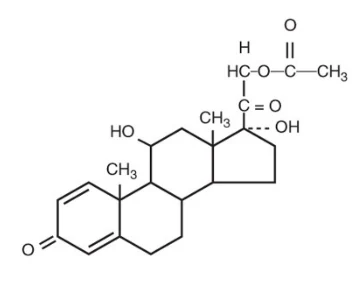
Physicochemical properties: White to practically white crystalline powder.
14 CLINICAL TRIALS
14.1 Clinical Trials by Indication
The data on which the product was originally approved is not available.
15 MICROBIOLOGY
No microbiological information is required for this drug product.
16 NON-CLINICAL TOXICOLOGY
General Toxicology: Following a single 30-µL ocular topical dose of 1% prednisolone acetate suspension into rabbit eyes, prednisolone acetate was rapidly absorbed into aqueous humor, vitreous humor, and plasma, with peak aqueous humor concentrations (Cmax) occurring within 1 hour. In aqueous humor and vitreous humor, prednisolone acetate was extensively converted into prednisolone and in plasma to prednisolone and prednisone. The prednisolone concentrations in vitreous humor were much lower than those in aqueous humor. There was minimal absorption into the contralateral (undosed) eye following administration of 1% prednisolone acetate suspension.
In rabbit eyes, no toxic effects were observed after application of approximately 6 mg prednisolone acetate per day over 20 days as a 1% suspension. Also, no toxic effects were observed after a single oral administration of 500 mg/kg in rats.
No long-term animal studies have been performed to evaluate carcinogenic or mutagenic potential or whether PRED FORTE affects fertility in males or females.