


Patient Medication Information: uses, side effects, how to take - Fondaparinux Sodium Injection
What is Fondaparinux Sodium Injection used for?
Fondaparinux Sodium Injection helps prevent clots from forming in the blood vessels of the legs or lungs in patients undergoing:
- knee, hip replacement or hip fracture surgeries. Fondaparinux Sodium Injection can be used for up to one month after these types of surgeries.
- abdominal surgery.
- Fondaparinux Sodium Injection is used to treat blood clots in a deep vein of the legs and in the blood vessels of the lungs.
- Fondaparinux Sodium Injection is used to manage severe chest pain, a specific type of heart attack (non ST segment myocardial infarction) and a severe heart attack.
It is not known if Fondaparinux Sodium Injection is safe and effective in children under the age of 17.
Due to the risk of bleeding, Fondaparinux Sodium Injection will be used with caution in patients who 65 years of age and older.
How does Fondaparinux Sodium Injection work?
Fondaparinux Sodium Injection is synthetic and it blocks a specific clotting factor. It helps to prevent the development of unwanted blood clots (thrombosis) in blood vessels.
What are the ingredients in Fondaparinux Sodium Injection?
Medicinal ingredients: Fondaparinux sodium
Non-medicinal ingredients: Isotonic solution of sodium chloride and water for injection. Also contains, sodium hydroxide or hydrochloric acid for pH adjustment (pH 5. 5-8).
Fondaparinux Sodium Injection comes in the following dosage form:
Fondaparinux Sodium Injection is a solution for injection. It is supplied in sterile, single use pre-filled syringes in packages of 10. Fondaparinux Sodium Injection comes in the following strengths:
- 2.5 mg / 0.5 mL;
- 5 mg / 0.4 mL;
- 7.5 mg / 0.6 mL;
- 10 mg / 0.8 mL.
Do not use Fondaparinux Sodium Injection if:
- You are allergic to fondaparinux sodium or to any of the non-medicinal ingredients in Fondaparinux Sodium Injection.
- You have an abnormally low number of platelets in your blood (thrombocytopenia) and a positive lab result for a specific test. Your healthcare professional will tell you if this applies to you;
- You are bleeding excessively;
- You have a bacterial infection in your heart.
To help avoid side effects and ensure proper use, talk to your healthcare professional before you use Fondaparinux Sodium Injection. Talk about any health conditions or problems you may have, including if:
- You have an allergy to latex;
- You are bleeding excessively;
You are at risk of uncontrolled bleeding because you:
- are 65 years of age or older;
- weigh less than 50 kg;
- have a stomach ulcer;
- have a bleeding disorder;
- had recent bleeding in your brain;
- had recent brain, spinal column or eye surgery;
- have kidney or liver disease.
You are taking other medications that may increase your risk of bleeding, such as:
- nonsteroidal anti-inflammatory drugs (NSAIDS)
- platelet inhibitors
You are pregnant or planning to become pregnant or are breast-feeding. It is not known if Fondaparinux Sodium Injection may cause harm to your fetus or nursing baby.
Other warnings you should know about:
- Don’t stop using Fondaparinux Sodium Injection until your healthcare professional tells you to. Contact your healthcare professional immediately if you feel you need to stop taking Fondaparinux Sodium Injection (e.g. if you have developed bleeding).
- Like other blood thinners, Fondaparinux Sodium Injection may result in serious or life-threatening bleeding from any site, including internal organs.
- You should only use Fondaparinux Sodium Injection as an injection under your skin (subcutaneous). It is not safe to inject Fondaparinux Sodium Injection into your muscle (intramuscular).
- The timing of the first Fondaparinux Sodium Injection is very specific, depending on the condition you have. Your healthcare professional will make sure they give you the first dose at the right time to help prevent bleeding. Always follow your healthcare professionals’ instructions for how to use Fondaparinux Sodium Injection.
- Your healthcare professional will monitor you if the number of platelets in your blood decreases (thrombocytopenia) while you are taking Fondaparinux Sodium Injection.
- Your healthcare professional will monitor your kidney function if you’ve had abdominal, knee, hip replacement or hip fracture surgeries.
- Fondaparinux Sodium Injection is not recommended if you have severe kidney problems.
Give yourself time after injecting Fondaparinux Sodium Injection to see how you feel before driving a vehicle or using machinery
Tell your healthcare professional about all the medicines you take, including any drugs, vitamins, minerals, natural supplements or alternative medicines.
How to use Fondaparinux Sodium Injection:
- Always use Fondaparinux Sodium Injection as directed by your healthcare professional. Check with healthcare professional if you are unsure.
- Don’t stop using Fondaparinux Sodium Injection until your healthcare professional tells you to. Contact your healthcare professional if you feel you need to stop taking Fondaparinux Sodium Injection.
- Fondaparinux Sodium Injection is given by injection under the skin (subcutaneously) into a skin fold of the lower stomach area. Do not inject Fondaparinux Sodium Injection into muscle (intramuscularly). The next section includes a step-by-step ‘Instructions for use’ guide.
While you are in the hospital, a healthcare professional will give your first injection. You may need to continue your injections of Fondaparinux Sodium Injection after you return home.
The different parts of Fondaparinux Sodium Injection safety syringe are:
- 1. Rigid needle shield
- 2. Plunger
- 3. Finger-grip
- 4. Security sleeve
| Syringe BEFORE USE | Syringe AFTER USE |
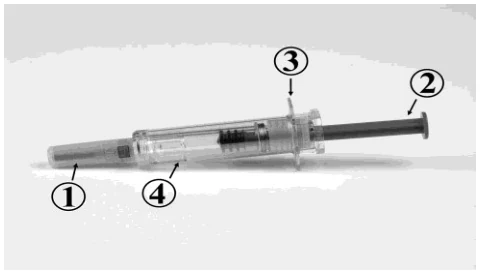
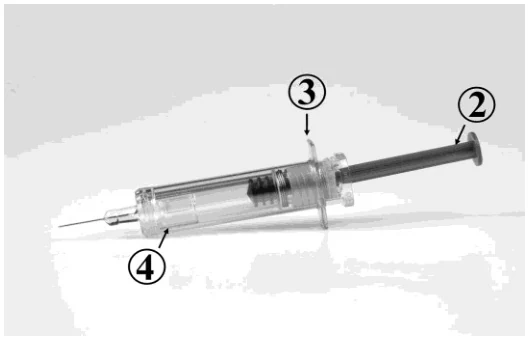 | 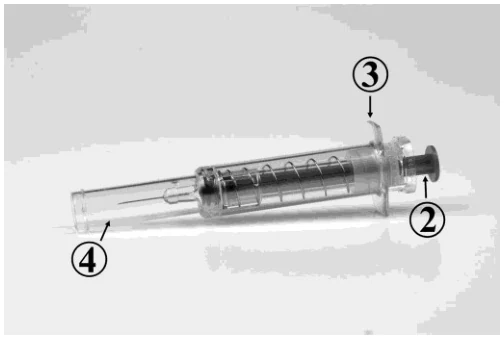 |
Instructions for self-injection of Fondaparinux Sodium Injection:
- I.Before Injecting:
- Inspect the solution in the syringe. Do not use if the solution is hazy, has particles in it, is discolored or is leaking.

- 2.
Wash your hands thoroughly with soap and water.
Towel dry.
- 3. Sit or lie down in a comfortable position. Choose a spot in the lower stomach area, at least 5 cm from your belly button (Figure 1), for your injection. If you can’t inject in the stomach area, consult your healthcare professional for instructions.
- 4.
Do not press on the plunger prior to injection.
Figure 1
- II.When ready to inject:
- 1.
Clean the injection area with an alcohol swab.
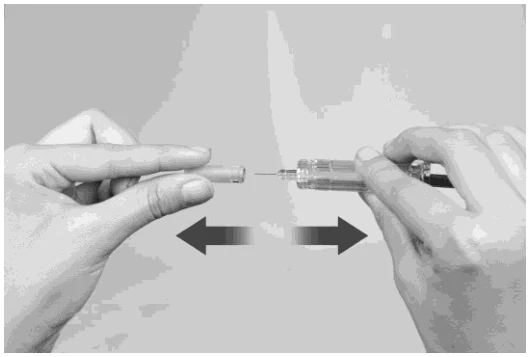
- 2. Hold the body of the syringe firmly in one hand.
- 3. Remove the needle shield by pulling it straight off the syringe (Figure 2). Discard the rigid needle shield.
- 4.
Important:
- i. Do not touch the needle or let it come in contact with any surface before the injection.
- ii. The presence of a small air bubble in the syringe is normal.
iii. Do not try to remove this air bubble before making the injection in order to be sure that you do not lose any product.
Figure 2
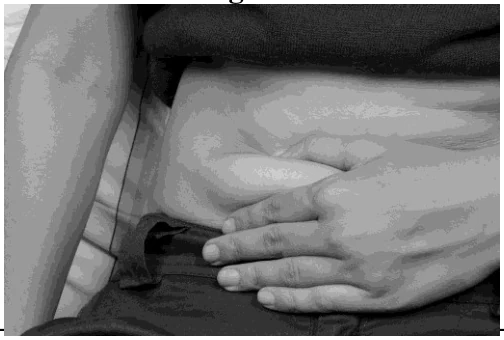
- 5. Gently pinch the skin that has been cleaned to make a fold. Hold the fold between the thumb and the forefinger during the entire injection (Figure 3).
- 6.
Alternate the left and right side of the stomach at each injection.
Figure 3
- 7.
With the other hand, hold the syringe firmly by the finger grip. Insert the full length of the needle directly up and down (at an angle of 90°) into the skin fold (Figure 4).
Figure 4
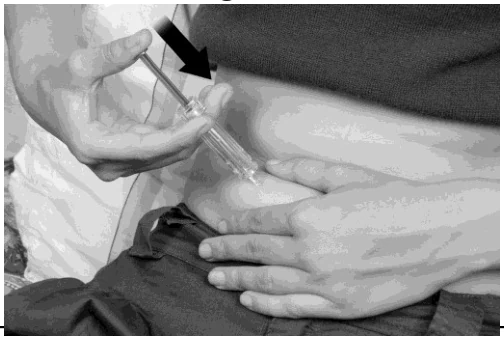
- 8. Inject ALL of the contents of the syringe by pressing down on the plunger as far as it goes (Figure 5).
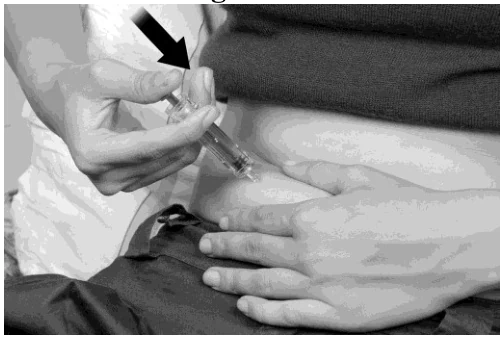
- 9. Remove the syringe from the injection site keeping your finger on the plunger (Figure 6).
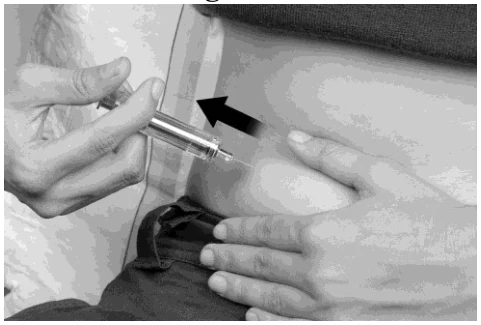
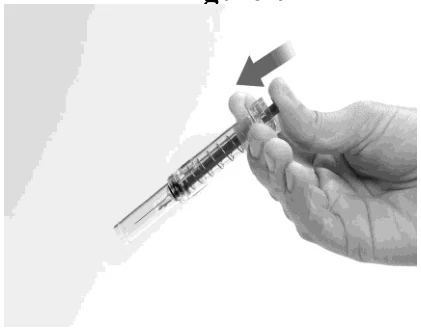
- 10. Orient the needle away from you and others, and activate the safety shield by firmly pushing the plunger. The protective sleeve will automatically cover the needle and an audible “click” will be heard to confirm shield activation.
- 11.
Discard the used syringe into a sharps container as your nurse or doctor has instructed you.
Figure 5
Figure 6
Figure 7
Follow the instructions given to you by your nurse or doctor about the right way to throw away used syringes and needles. There may be laws about the right way to dispose of used syringes, needles, and disposal containers.
NOTE:
- The safety system can only be activated once the syringe has been emptied.
- Activation of the safety system must be done only after removing the needle from the patient’s skin.
- Do not replace the needle shield after injection.
- The safety system should not be sterilized.
- Activation of the safety system may cause minimal splatter of fluid. For optimal safety activate the system while orienting it downwards away from yourself and others.
Usual dose:
For prevention of blood clots following orthopedic or abdominal surgery:
- The usual dose of Fondaparinux Sodium Injection is 2.5 mg once a day.
For treatment of blood clots:
- The usual dose of Fondaparinux Sodium Injection is 5 mg (body weight less than 50 kg), 7.5 mg (body weight 50-100 kg) or 10 mg (body weight greater than 100 kg) once daily.
In the management of heart attacks or severe angina:
- The usual dose of Fondaparinux Sodium Injection is 2.5 mg once daily. Your first dose may be given by intravenous injection, depending on your condition.
Overdose:
If you think you, or a person you are caring for, have injected too much Fondaparinux Sodium Injection, contact a healthcare professional, hospital emergency department, or regional poison control centre immediately, even if there are no symptoms.
Missed Dose:
NEVER inject a double dose to make up for forgotten individual doses. If you are not sure what to do, ask your doctor or pharmacist before you take any action.
What are possible side effects from using Fondaparinux Sodium Injection?
These are not all the possible side effects you may feel when taking Fondaparinux Sodium Injection. If you experience any side effects not listed here, contact your healthcare professional.
As Fondaparinux Sodium Injection acts on the blood clotting system, many of the side effects are related to signs of bruising or bleeding. Although rare, some patients had major bleeding that lead to death.
Fondaparinux Sodium Injection may also cause some side effects which can only be diagnosed by your health care provider and may require blood tests. Examples include:
- decrease or increase in the number of platelets (blood cells necessary for blood clotting)
- abnormal blood clotting (coagulation disorder)
- bleeding around the brain or internal organs.
Common side effect that may occur: insomnia (trouble sleeping). An uncommon side effect that may occur: headache
Rare side effects that may occur:
- anxiety
- confusion
- dizziness
- coughing
- indigestion
- stomach pain
- constipation
- diarrhea
- skin reactions at injection site (mild irritation, pain, bruising and redness)
- tiredness
- flushing
- drowsiness
- vertigo (feeling of spinning)
- shortness of breath
Serious side effects and what to do about them
| Symptom / effect | Talk to your healthcare professional | Stop taking drug and get immediate medical help | |
| Only if severe | In all cases | ||
Very Common A low number of red blood cells which can cause tiredness, weakness, shortness of breath and feeling generally unwell | X | ||
Bleeding from various sites (i.e., from an operation site, bruising, blood in urine and stool, an existing stomach ulcer, nosebleed, etc.) | X | ||
Bruises that are joining together | X | ||
Urinary tract infection (pain or burning sensation during urination, frequent urge to urinate) | X | ||
Common Liver problems (symptoms include nausea, vomiting, loss of appetite, yellowing of the skin or eyes, dark urine and unusual tiredness) | X | ||
Syncope (loss of consciousness) | X | ||
| Edema (swelling) | X | ||
Rare Wound infection at site of surgery (oozing of fluid, swelling around the wound) | X | ||
Allergic reactions such as rash or itching, swelling (usually of the face, lips, tongue or throat) which may cause difficulty breathing or swallowing or collapse | X | ||
Reduction of potassium in the blood (hypokalemia) which can cause muscular weakness and cramping | X | ||
Low blood pressure (if measured) which can result in light- headedness, dizziness or fainting | X | ||
Common Syncope (loss of consciousness) | X | ||
| Chest pain | X | ||
| Leg pain | X |
If you have a troublesome symptom or side effect that is not listed here or becomes bad enough to interfere with your daily activities, talk to your healthcare professional.
Reporting Side Effects
You can report any suspected adverse reactions associated with the use of health products to Health Canada by:
- Visiting the Web page on Adverse Reaction Reporting https://www.canada.ca/en/health- canada/services/drugs-health-products/medeffect-canada/adverse-reaction-reporting.html) for information on how to report online, by mail or by fax; or
- Calling toll-free at 1-866-234-2345.
NOTE: Contact your health professional if you need information about how to manage your side effects. The Canada Vigilance Program does not provide medical advice.
Storage:
Fondaparinux Sodium Injection should be stored at 15 °C – 30 °C. Do not freeze.
Do not use Fondaparinux Sodium Injection under the following conditions:
- after the expiry date stated on the label and carton;
- if you notice that particulate matter or discoloration is present in the solution;
- if you notice that the syringe is damaged;
- if you have opened a syringe and do not intend to use it straight away.
Any unused syringe should be disposed of in a safe manner. Keep out of the reach and sight of children.
If you want more information about Fondaparinux Sodium Injection:
- Talk to your healthcare professional
- Find the full Product Monograph that is prepared for healthcare professionals and includes this Patient Medication Information by visiting the Health Canada website (https://www.canada.ca/en/health-canada/services/drugs-health-products/drug-products/drug-product-database.html); the manufacturer’s website www.drreddys.com, or by calling 1-855-845-1739.
Manufactured By:
Dr. Reddy’s Laboratories Ltd.
Bachupally – 500 090 India
Imported and Distributed By:
Dr. Reddy’s Laboratories Canada Inc.
Mississauga, ON L4W 4Y1 Canada