


Patient Medication Information: uses, side effects, how to take - Fragmin (Pfizer Canada, 10000 Unit)
What is Fragmin used for?
Fragmin is used to prevent blood clotting (coagulation) when surgery is performed, to treat the acute formation of blood clots in deep veins, to treat symptomatic blood clots to prevent recurrence of the clots in patients with cancer, to treat unstable coronary artery disease, to prevent clotting in those at risk when mobility is restricted during acute illness, and to prevent clotting in blood dialysis and filtration equipment in connection with acute kidney failure or chronic kidney disease.
How does Fragmin work?
Fragmin is a type of medicine called low molecular weight heparin. Fragmin can help keep the blood from forming clots or keep a clot from getting larger. Fragmin works by making thrombin inactive in the body. Thrombin is an ingredient which contributes to blood clotting.
What are the ingredients in Fragmin?
Medicinal ingredients: Dalteparin sodium
Non-medicinal ingredients:
Multi-dose vial: Benzyl alcohol, hydrochloric acid /sodium hydroxide (for pH adjustment) and water for injection.
- Prefilled syringe with safety needle device: Hydrochloric acid /sodium hydroxide (for pH adjustment), sodium chloride, (2500 IU/0.2 mL and 3500 IU/0.28 mL only) and water for injection.
The rubber needle shield may contain latex.
Serious Warnings and Precautions
|
Fragmin comes in the following dosage forms:
Solution
- 25 000 IU (anti-factor Xa)/mL 3.8 mL, Multi-dose Vial
Prefilled syringe with safety needle device
- 2 500 IU (anti-factor Xa)/0.2 mL
- 3 500 IU (anti-factor Xa)/0.28 mL
- 5 000 IU (anti-factor Xa)/0.2 mL
- 7 500 IU (anti-factor Xa)/0.3 mL
- 10 000 IU (anti-factor Xa)/0.4 mL
- 12 500 IU (anti-factor Xa)/0.5 mL
- 15 000 IU (anti-factor Xa)/0.6 mL
- 16 500 IU (anti-factor Xa)/0.66 mL
- 18 000 IU (anti-factor Xa)/0.72 mL
Do not use Fragmin if:
It is necessary that you advise your healthcare professional of any serious medical problems you have had or currently have, as these conditions could affect the action of Fragmin.
Because benzyl alcohol may cross the placenta, Fragmin 25 000 IU 3.8 mL Multi-dose vials which are preserved with benzyl alcohol should not be used in pregnant women. Benzyl alcohol preparations should be used with caution in pediatric patients.
If you have had or currently suffer from any of the conditions listed below, it is necessary that you inform your healthcare professional before starting treatment:
- Allergy to Fragmin or any of its ingredients or container (including benzyl alcohol when using the 25,000 IU multi-dose vial) or to other low molecular weight heparins and/or heparin or pork products
- Bleeding due to acute gastroduodenal ulcer (stomach or intestinal bleed/ulcer)
- A history of cerebral hemorrhage (bleeding in or against the brain)
- A severe blood clotting disorder (hemorrhagic diathesis)
- A history of confirmed or suspected low platelet count (thrombocytopenia) due to heparin, or a positive antiplatelet antibody test in the presence of Fragmin or other heparin or low molecular weight heparin products
- Bacterial infection of the heart (septic endocarditis)
- Severe uncontrolled high blood pressure
- Disorders of the retina of the eye due to diabetes or bleeding
- Injuries to and/or operations on the central nervous system, eyes, ears
- Any other diseases that could involve an increased risk of bleeding. Spinal or epidural anesthesia should not be used while receiving repeated high doses of Fragmin.
To help avoid side effects and ensure proper use, talk to your healthcare professional before you take Fragmin. Talk about any health conditions or problems you may have, including if you:
- Have artificial heart valves
- Have heart disease, including angina and recent heart attack.
- Are taking any medications [such as acetylsalicylic acid (ASA, aspirin), other drugs to reduce blood clotting such as warfarin or non-steroidal anti-inflammatory drugs (NSAIDS, drugs used to treat painful and/or inflammatory conditions of muscles or joints)], including those that you buy without a prescription
- Have bleeding disorders (such as hemophilia)
- Have low platelets (thrombocytopenia) or platelet defects
- Have liver or kidney problems
- Have diabetes, metabolic acidosis, increased potassium, or taking potassium sparing drugs, due to the risk for high levels of potassium
- Are allergic to latex (natural rubber)
- Are at higher risk of bleeding (including elderly patients, patients with kidney problems or who are underweight or overweight or children)
- Are pregnant or breast feeding.
Other warnings you should know about:
It is necessary that you follow the instructions of your healthcare professional carefully. Give yourself the injections prescribed for the entire time period specified by your healthcare professional.
Do not take any drugs other than those prescribed by your healthcare professional while you are taking Fragmin.
If you need to consult with another doctor or see your dentist, be absolutely sure to tell them that you are being treated with Fragmin.
Fragmin should not be administered intramuscularly.
Tell your healthcare professional about all the medicines you take, including any drugs, vitamins, minerals, natural supplements or alternative medicines.
Certain medications may intensify the anticoagulant effect (e.g., blood thinning effect) of Fragmin.
The following may interact with Fragmin:
- Acetylsalicylic acid (ASA)
- Other drugs to reduce blood clotting such as warfarin or non-steroidal anti-inflammatory drugs (NSAIDS; drugs used to treat painful and/or inflammatory conditions of muscles or joints), including those that you buy without a prescription
- Platelet inhibitors
- Thrombolytic agents
- Dextran
How to take Fragmin:
Fragmin is obtained by prescription only. You must use Fragmin as instructed by your healthcare professional. Fragmin is administered as an injection underneath the surface of the skin (subcutaneous).
Fragmin should be inspected visually for clarity, particulate matter, precipitation, discolouration, and leakage prior to administration whenever solution and container permit. Do not use product if mixture (solution) shows haziness, particulate matter, discolouration or leakage.
In Hospital
General Surgery
Your healthcare professional will give you your first injection of Fragmin subcutaneously 1-2 hours before the operation to prevent problems with blood clotting. After the operation, you will receive a subcutaneous injection each morning until you become mobile, in general 5-7 days or longer.
General Surgery Associated With Other Risk Factors
Your healthcare professional will give you your first injection of Fragmin subcutaneously the evening before the operation to prevent blood-clotting problems. After the operation, you will receive a subcutaneous injection that night and an injection each successive night thereafter until you become mobile.
As an alternative, your healthcare professional may divide the initial dose and give you your first subcutaneous injection of Fragmin 1-2 hours before your operation followed by another injection no sooner than 4 hours after your operation, but at least 8 hours after your previous injection. Each day thereafter, you will receive an injection until you become mobile.
Elective Hip Surgery
Your healthcare professional will give you your first injection of Fragmin subcutaneously the evening before the operation to prevent blood clotting problems. After the operation, you will receive a subcutaneous injection that night and an injection each successive night thereafter until you become mobile.
As an alternative, your healthcare professional may give you a subcutaneous injection of Fragmin 1-2 hours before the operation. Regardless of whether or not you get an injection before your operation, you will then get an injection no sooner than 4-8 hours after your operation. Each day thereafter, you will receive an injection until you become mobile.
Treatment of Acute Deep Vein Thrombosis
Your healthcare professional will give you a subcutaneous injection once or twice a day for approximately 5 days. Alternatively, you may receive your dose of Fragmin by intravenous injection.
Extended Treatment of Symptomatic Venous Thromboembolism (VTE) to Prevent Recurrence of VTE in Patients with Cancer
Your healthcare professional will give you a subcutaneous injection once a day for up to 6 months.
Unstable Coronary Artery Disease (Unstable Angina and Non-Q-Wave Myocardial Infarction)
Your healthcare professional will give you a subcutaneous injection twice a day (once about every 12 hours) for up to 6 days.
Medical Patients with Restricted Mobility
Your healthcare professional will give you a subcutaneous injection once a day for up to 14 days.
At Home
It may be necessary for you to continue your treatment with Fragmin at home.
BEFORE YOUR RELEASE FROM THE HOSPITAL, YOUR HEALTHCARE PROFESSIONAL WILL SHOW YOU HOW TO GIVE YOURSELF THE Fragmin INJECTIONS. IT IS VERY IMPORTANT THAT YOU FOLLOW THE INSTRUCTIONS EXACTLY. IF THERE IS ANYTHING YOU DON’T UNDERSTAND OR WOULD LIKE CLARIFIED, MAKE SURE TO ASK YOUR HEALTHCARE PROFESSIONAL FOR MORE INFORMATION SO THAT WHEN YOU GO HOME, YOU ARE COMFORTABLE SELF-ADMINISTERING Fragmin.
Please note that there are many different types of syringes that you can use with the multi-dose vial. The instructions in this package insert describe and illustrate injecting Fragmin using the prefilled syringe with safety needle device. The syringe with a passive safety needle device illustrated in this package insert is not the type of syringe that you should use to extract Fragmin from the multi-dose vial.
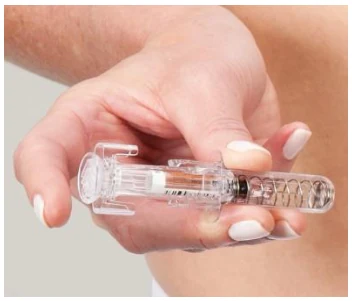
Fragmin is available in ready to use, prefilled syringe with safety needle device.
PREFILLED SYRINGE WITH SAFETY DEVICE
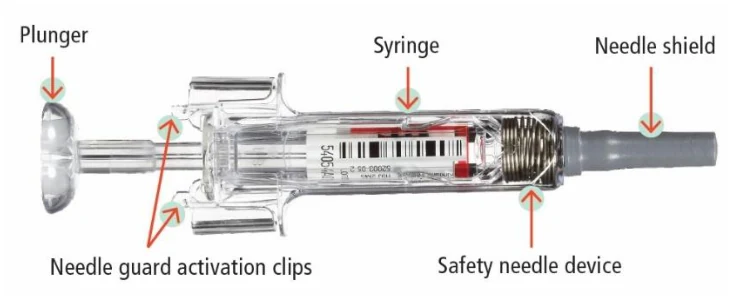
Each syringe contains the required amount of Fragmin for one injection. Avoid pressing on the syringe plunger so as not to lose any of the syringe content.
INSTRUCTIONS FOR INJECTION AT HOME
IMPORTANT: REMOVAL OF INDIVIDUAL SYRINGE FROM BLISTER PACKAGING
DO NOT attempt to remove the syringe from the blister packaging with your fingers. Follow directions for correct handling technique as shown below when removing the prefilled syringe with safety needle device from the packaging, otherwise, the needle’s safety mechanism may be triggered, making the syringe unusable.
Please proceed as follows:
- 1. Peel off paper backing completely from the blister packaging.
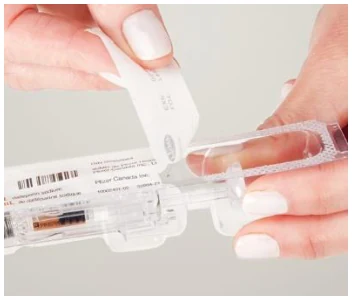
- 2. Rotate the packaging so that the open side is facing downward between 3 to 5 cm above a flat surface, such as a table.
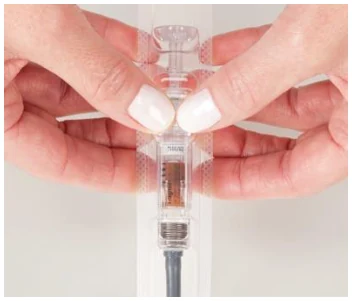
- 3. In order to release the syringe, pull the sides in the middle of the blister packaging apart to widen the blister cavity. This should cause the syringe to fall out of the blister.
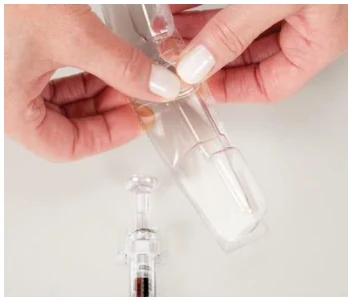
- 4. Pick up the syringe by the body.
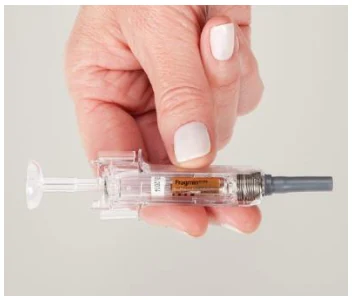
DO NOT touch the needle guard activation clips at any time during use. This may trigger the needle's safety mechanism causing the needle to retract (pull back) before your injection is given. This will make the syringe unusable.
Proper subcutaneous (under the skin) injection of Fragmin is essential to help prevent pain and bruising at the injection site.
The preferred site of injection is the lower abdomen. However, Fragmin may also be injected into the side of the thigh, provided care is taken not to inject into the muscle tissue. Select a different site on the abdomen or thigh for each subsequent injection.

Prior to injection, wash your hands and cleanse the selected site for injection with an alcohol swab.


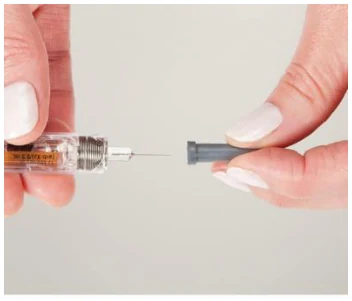
Remove the needle shield. Please note that a firm pull is needed to remove the needle shield. To ensure delivery of the full dose, do not remove any small air bubbles from the prefilled syringe before injection.
The needle must be inserted into a skin fold created with your thumb and forefinger. This fold of skin must be maintained throughout the injection.
Using your dominant hand, hold the syringe like a pencil between your thumb and middle finger. insert the needle into the skin fold vertically, as far as it will go. Once the needle has been inserted, the needle should not be moved.
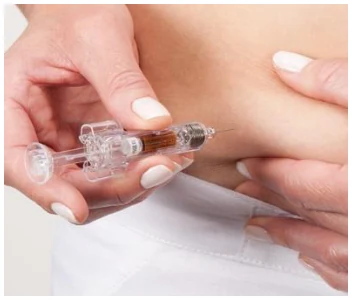
If you are self-injecting, press on the plunger using the forefinger. If you are injecting someone else, use the thumb to press on the plunger until the entire dose has been given.
The needle guard will not be activated unless the entire dose has been administered and you remove downward pressure on the plunger. When you have injected all the content of the syringe, remove the needle.
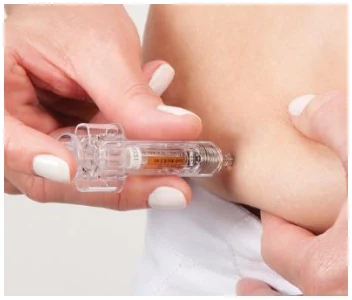
Then, let go of the plunger and allow the syringe to move up inside the device until the entire needle is guarded.
Press a cotton swab on the injection site for 5-10 seconds or longer. Do not rub the injection site.

Dispose of the used syringe/needle guard assembly in approved containers in a safe manner and ensure that it is kept out of the reach of children.
Usual dose:
Your healthcare professional will determine the correct dose of Fragmin for you and how often it must be given. It will depend on the condition which is being treated in addition to other factors.
Overdose:
Accidental overdosage of Fragmin can result in very heavy bleeding.
| If you think you, or a person you are caring for, have taken too much Fragmin, contact a healthcare professional, hospital emergency department, or regional poison control centre immediately, even if there are no symptoms. |
|---|
Your healthcare professional will arrange to have you admitted to the hospital for observation and treatment if necessary.
Missed Dose:
If you miss a dose, tell your healthcare professional. Do not take two doses at the next dosage time.
What are possible side effects from using Fragmin?
These are not all the possible side effects you may have when taking Fragmin. If you experience any side effects not listed here, tell your healthcare professional.
| Serious side effects and what to do about them | |||
|---|---|---|---|
| Serious side effects and what to do about them | |||
| Symptom / effect | Talk to your healthcare professional | Stop taking drug and get immediate medical help | |
| Symptom / effect | Talk to your healthcare professional | Stop taking drug and get immediate medical help | |
| Only if severe | In all cases | ||
| Only if severe | In all cases | ||
| COMMON | |||
| Purplish or reddish discolouration or pain, and bruising around the injection site | √ | √ (if severe) | |
| Easy bruising or bruising without apparent cause | √ | ||
| nosebleed | √ | ||
| UNCOMMON | |||
| Bleeding gums while brushing teeth | √ | ||
| Bleeding at the injection site and/or from surgical site | √ | ||
| Allergic reactions | √ | ||
| Bleeding inside the abdomen | √ | ||
| Bleeding from the mouth | √ | ||
| Bleeding from the anus | √ | ||
| Vaginal bleeding | √ | ||
| Blood in the urine | √ | ||
| RARE | |||
| Strokes (bleeding inside the brain) | √ | ||
If you have a troublesome symptom or side effect that is not listed here or becomes bad enough to interfere with your daily activities, tell your healthcare professional.
Reporting Side Effects
You can report any suspected side effects associated with the use of health products to Health Canada by:
NOTE: Contact your healthcare professional if you need information about how to manage your side effects. The Canada Vigilance Program does not provide medical advice. |
Storage:
Store your prefilled syringes at room temperature (15-30oC).
Keep out of reach and sight of children.
If you want more information about Fragmin:
- Talk to your healthcare professional
- Find the full product monograph that is prepared for healthcare professionals and includes this Patient Medication Information by visiting the Health Canada website: (https://www.canada.ca/en/health-canada/services/drugs-health-products/drug-products/drug-product-database.html); the manufacturer’s website www.pfizer.ca or by calling 1-800-463-6001