


Patient Medication Information: uses, side effects, how to take - Haegarda
What is HAEGARDA used for?
HAEGARDA is an injectable medicine used to prevent swelling and/or painful attacks in adults and adolescents with Hereditary Angioedema (HAE). HAEGARDA should not be used to treat an acute HAE attack. In the event of an acute attack, seek medical attention.
How does HAEGARDA work?
HAE is caused by the deficiency, absence or defective production of C1 esterase inhibitor (C1-INH), an important protein in regulating multiple chemical reactions in the body. C1-INH is involved in keeping the immune and blood clotting systems healthy. C1-INH is also important in controlling inflammation in the body. When C1-INH levels are low or when the protein doesn’t work properly, blood vessels and capillaries in the body can become leaky and allow fluid to build up in the surrounding areas. This leakage and fluid build-up leads to the swelling and pain experienced during an HAE attack. HAEGARDA contains human C1-INH that replaces the missing or defective C1-INH made by the body.
What are the ingredients in HAEGARDA?
Medicinal ingredients:
- C1 Esterase Inhibitor (Human)
Non-medicinal ingredients:
- Glycine
- Sodium chloride
- Sodium citrate
HAEGARDA comes in the following dosage forms:
HAEGARDA is supplied as a white lyophilized powder in the following two formats:
- 2000 IU: which contains 2000 IU of C1-INH per injection vial accompanied with 4 mL diluent (Sterile Water for Injection) for reconstitution. After reconstitution, the concentration is 500 IU/mL.
- 3000 IU: which contains 3000 IU of C1-INH per injection vial accompanied with 5.6 mL diluent (Sterile Water for Injection) for reconstitution. After reconstitution, the concentration is 500 IU/mL.
The product package includes:
- 1 vial with HAEGARDA powder
- 1 vial of diluent (Sterile Water for Injection)
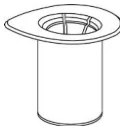
- 1 Mix2Vial® transfer device for reconstitution
- 1 inner carton
The inner carton contains:
- 1 syringe (10 mL) for withdrawal
- 1 SC infusion set
- 1 hypodermic needle
The components used in the packaging for HAEGARDA are latex-free.
Do not use HAEGARDA if:
- You have experienced life threatening immediate hypersensitivity reactions, including anaphylaxis, to the product.
To help avoid side effects and ensure proper use, talk to your healthcare professional before you take HAEGARDA. Talk about any health conditions or problems you may have, including if you:
Are pregnant or planning to become pregnant. The effect of HAEGARDA on your unborn baby is not known.
- Are breastfeeding or plan to breastfeed. It is not known if HAEGARDA passes into your breast milk or if it can affect your baby.
- Have a history of blood clotting problems. Blood clots have occurred in patients receiving HAEGARDA. Very high doses of C1-INH could increase the risk of blood clots. Tell your healthcare professional if you have a history of heart or blood vessel disease, stroke, blood clots, or have thick blood, an indwelling catheter/access device in one of your veins, or have been immobile for some time. These factors may increase your risk of having a blood clot after using HAEGARDA. Also, tell your healthcare professional what drugs you are using, as some drugs, such as birth control pills or certain androgens, may increase your risk of developing a blood clot.
Other warnings you should know about:
Products made from human plasma may contain infectious agents such as viruses and, theoretically, the agent responsible for the Creutzfeldt-Jakob disease (CJD).
Appropriate vaccination (hepatitis A and B) should be generally considered for subjects in regular/repeated receipt of human plasma-derived products.
Tell your healthcare professional about all the medicines you take, including any drugs, vitamins, minerals, natural supplements or alternative medicines.
The following may interact with HAEGARDA:
No formal drug interaction studies have been conducted with HAEGARDA. To date, no relevant interactions are known.
How to take HAEGARDA:
Home Treatment/Self-administration
You should prepare the prescribed dose of HAEGARDA for self administration as directed by your healthcare professional.
- Do not attempt to self administer unless you have been taught how by your healthcare professional.
- See the following step by step instructions for reconstitution and administering HAEGARDA. The steps listed below are general guidelines for using HAEGARDA. If you are unsure of the steps, please contact your healthcare professional before using.
- Your healthcare professional will prescribe the dose that you should administer, which is based on your body weight.
- Talk to your healthcare professional before traveling to make sure you have an adequate supply of HAEGARDA.
- Use a new needle for each HAEGARDA injection.
Reconstitution and Administration
HAEGARDA is intended for self-administration by subcutaneous injection only. The patient or caregiver should be trained on how to administer HAEGARDA as needed.
General Instructions
- The reconstituted solution for HAEGARDA should be colourless and clear to slightly opalescent.
- Reconstitution is generally achieved within 5 minutes but may take as long as 10 minutes.
- After filtering/withdrawal (see below) reconstituted product should be inspected visually for particulate matter and discoloration prior to administration. Do not use solutions that have particles or deposits in them.
- Reconstitution and withdrawal must be carried out using aseptic techniques.
- In the absence of compatibility studies HAEGARDA must not be mixed with other medicinal products and diluents.
- Any unused medicinal product or waste material should be disposed of in accordance with local requirements.
- The suggested infusion site for the injection of HAEGARDA is the abdominal area, however other subcutaneous injection areas can be used. In the clinical trials, HAEGARDA was injected into a single site each administration and subsequent injection sites were rotated.
- The reconstituted preparation should be administered by subcutaneous injection at a rate tolerated by the patient.
- If the reconstituted product is not administered immediately, storage shall not exceed 8 hours at room temperature. The reconstituted product should only be stored in the vial.
Follow the steps below and use aseptic technique to reconstitute and administer HAEGARDA:
Use the Mix2Vial® filter transfer set, syringe and either the SC infusion set or the hypodermic needle provided with HAEGARDA (see section DOSAGE FORMS, STRENGTHS, COMPOSITION AND PACKAGING).
HAEGARDA 2000 IU should be reconstituted with the provided 4 mL of Sterile Water for Injection (Diluent).
HAEGARDA 3000 IU should be reconstituted with the provided 5.6 mL of Sterile Water for Injection (Diluent).
Step 1: Assemble supplies
| |
Step 2: Clean surface
| |
Step 3: Wash hands
| |
| Reconstitution: | |
Step 4: Clean Stoppers Remove the flip caps from both vials (HAEGARDA and diluent). Wipe rubber stoppers with an antiseptic wipe and allow the rubber stopper to dry. | |
| Step 5: Open the Mix2Vial® package by peeling off the lid. Do not remove the Mix2Vial® from the blister package! | |
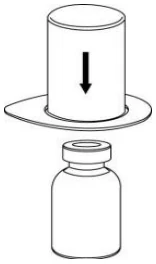
| Step 6: Place the diluent vial on an even, clean surface and hold the vial tight. Take the Mix2Vial® together with the blister package and push the spike of the blue adapter end straight down through the diluent vial stopper. | |
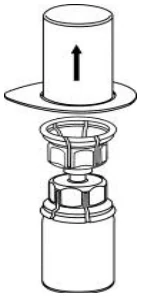
| Step 7: Carefully remove the blister package from the Mix2Vial® set by holding at the rim, and pulling vertically upwards. Make sure that you only pull away the blister package and not the Mix2Vial® set. | |
| Step 8: Place the HAEGARDA vial on an even and firm surface. Invert the diluent vial with the Mix2Vial® set attached and push the spike of the transparent adapter end straight down through the HAEGARDA vial stopper. The diluent will automatically flow into the HAEGARDA vial. | |
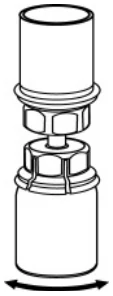
| Step 9: With the diluent and HAEGARDA vial still attached to the Mix2Vial® transfer set, gently swirl the HAEGARDA vial to ensure that the powder is fully dissolved. (Generally, within 5 minutes but may take as long as 10 minutes.) Do not shake the vial. | |
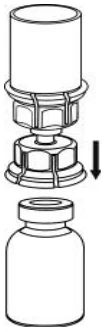
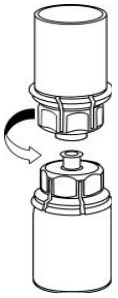
| Step 10: With one hand grasp the HAEGARDA-side of the Mix2Vial® set and with the other hand grasp the diluent-side and unscrew the set carefully counter-clockwise into two pieces. Discard the diluent vial with the blue Mix2Vial® adapter attached. | |
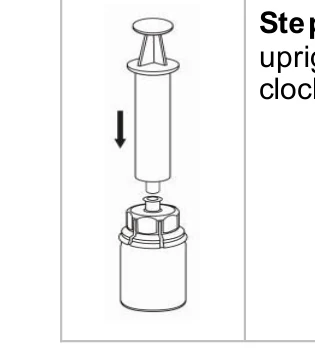
| Step 11: Draw air into an empty, sterile syringe. While the HAEGARDA vial is upright, connect the syringe to the Mix2Vial®'s Luer Lock fitting by screwing clockwise. Inject air into the HAEGARDA vial. |
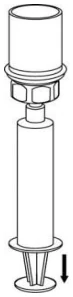
| Step 12: While keeping the syringe plunger pressed, turn the system upside down and draw the solution into the syringe by pulling the plunger back slowly. | ||
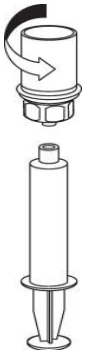
| Step 13: Now that the solution has been transferred into the syringe, firmly hold on to the barrel of the syringe (keeping the syringe plunger facing down) and disconnect the transparent Mix2Vial® adapter from the syringe by unscrewing counter- clockwise. The reconstituted solution should be colorless, clear and free from visible particles. Do not use if particulate matter or discoloration is observed. | ||
| Administration: | ||
Step 14: Prepare injection site
| 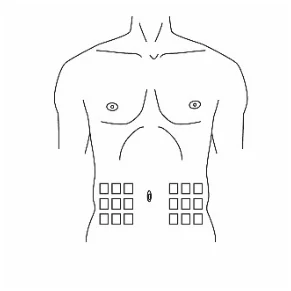 Figure 1 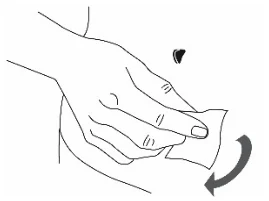 Figure 2 | |
Step 15: Injection in the abdominal area or other subcutaneous injection area As instructed by your healthcare provider:
| 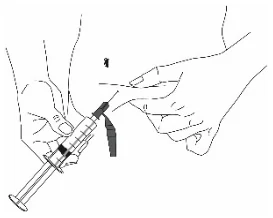 Figure 3 | |
Injection with Hypodermic Needle:
| ||
Injection by SC Infusion Set:
| 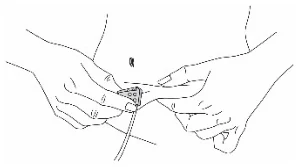 Figure 4 | |
Step 16: Clean up
| ||
Step 17: Record treatment Record the lot number from the HAEGARDA vial label in your treatment diary or log book with the date and time of infusion every time you use HAEGARDA. | ||
Usual dose:
The recommended usual dose is 60 IU per kg of body weight twice weekly (every 3 or 4 days) administered after reconstitution by subcutaneous injection at a rate tolerated by the patient. HAEGARDA is administered subcutaneously in the abdominal area or other subcutaneous injection sites.
The maximum tolerated dose used in patients in clinical studies was 10,000 IU, corresponding to a volume of 20 mL, twice weekly by subcutaneous injection.
Overdose:
No cases of overdose have been reported.
| If you think you, or a person you are caring for, have taken too much HAEGARDA, contact a healthcare professional, hospital emergency department, or regional poison control centre immediately, even if there are no symptoms. |
Missed Dose:
Proceed with your next dose immediately and continue at regular intervals as advised by your healthcare professional. Do not take a double dose to make up for a forgotten dose.
What are possible side effects from using HAEGARDA?
These are not all the possible side effects you may have when taking HAEGARDA. If you experience any side effects not listed here, tell your healthcare professional.
Allergic reactions may occur with HAEGARDA. Talk to your healthcare professional right away if you have any of the following symptoms after using HAEGARDA:
- Wheezing
- Difficulty breathing
- Chest tightness
- Turning blue (look at lips and gums)
- Fast heartbeat
- Swelling of the face
- Rash or hives
Signs of a blood clot include:
- Pain and/or swelling of an arm or leg with warmth over the affected area
- Discoloration of an arm or leg
- Unexplained shortness of breath
- Chest pain or discomfort that worsens on deep breathing
- Unexplained rapid pulse
- Numbness or weakness on one side of the body
The most common side effects with HAEGARDA are injection site reactions (pain, redness, swelling), hypersensitivity (itching and rash), nasopharyngitis (runny or stuffy nose, sneezing, watery eyes) and dizziness.
If you have a troublesome symptom or side effect that is not listed here or becomes bad enough to interfere with your daily activities, tell your healthcare professional.
Reporting Side Effects
You can report any suspected side effects associated with the use of health products to Health Canada by:
NOTE: Contact your health professional if you need information about how to manage your side effects. The Canada Vigilance Program does not provide medical advice. |
We recommend that CSL Behring Canada, Inc. be copied when reporting suspected side effects, at the following address:
AdverseReporting@CSLBehring.com
Storage:
Keep the non-reconstituted HAEGARDA in its original carton to protect from light until ready to use. The shelf life of HAEGARDA is 36 months. When stored in the refrigerator or at room temperature (at +2°C to +30°C), HAEGARDA is stable for the period indicated by the expiration date on its label. Do not freeze.
Storage after reconstitution: If the reconstituted product is not administered immediately, storage shall not exceed 8 hours at room temperature. The reconstituted product should only be stored in the vial. Do not freeze the reconstituted solution.
Keep out of reach and sight of children.
If you want more information about HAEGARDA:
- Talk to your healthcare professional
- Find the full product monograph that is prepared for healthcare professionals and includes this Patient Medication Information by visiting the Health Canada website (https://www.canada.ca/en/health-canada/services/drugs-health-products/drug-products/drug-product-database.html); the manufacturer’s website (www.cslbehring.ca), or by calling 1-866-773-7721.