


Patient Medication Information: uses, side effects, how to take - Berinert 500
What BERINERT is used for:
BERINERT is used for the treatment of acute facial, abdominal and laryngeal hereditary angioedema (HAE) attacks of moderate and severe intensity in pediatric and adult patients.
How BERINERT works:
BERINERT is a concentrate of C1-INH and its administration during a swelling episode or prior to a surgery has been shown to alleviate or prevent the swelling by increasing the levels of functional C1-INH in the body.
The ingredients in BERINERT are:
Medicinal ingredients:
- Concentrate of the naturally occurring C1 esterase inhibitor found in human blood
Non-medicinal ingredients:
- Glycine
- Sodium chloride
- Sodium citrate
For a full listing of nonmedicinal ingredients see Part I of the Product Monograph.
BERINERT comes in the following dosage forms:
The BERINERT 500 package contains one single-use vial containing 500 IU of lyophilized human C1 esterase inhibitor (C1-INH), one 10 mL vial of Sterile Water for Injection (Diluent), one Mix2Vial® filter transfer set and an inner carton. The inner carton contains one syringe and one infusion set.
The BERINERT 1500 package contains one single-use vial containing 1500 IU of lyophilized human C1 esterase inhibitor (C1-INH), one 3 mL vial of Sterile Water for Injection (Diluent), one Mix2Vial® filter transfer set and an inner carton. The inner carton contains one syringe and one infusion set.
Serious Warnings and Precautions
- Products made from human plasma may contain infectious agents such as viruses and the agent responsible for the variant Creutzfeldt-Jakob disease (vCJD).
The components used in the packaging for BERINERT are latex-free.
Do not use BERINERT if:
- You had previous severe allergic or body reactions to C1-INH products used to treat HAE or any components of BERINERT.
To help avoid side effects and ensure proper use, talk to your healthcare professional before you take BERINERT. Talk about any health conditions or problems you may have, including if you:
- Have any special heart conditions;
- Have experienced severe allergic reactions or other reactions with products used to treat your HAE condition or if you have experienced allergic reactions to this drug or its ingredients or components of the container;
Are pregnant or if you are breastfeeding.
Other warnings you should know about:
Thromboembolic events have been reported with the use of BERINERT at the recommended dose following treatment of HAE attacks.
The development of thrombosis has been reported in association with BERINERT when used (off-label) and at higher than labeled doses (greater than 90 IU/kg body weight) in newborns and young children with congenital heart anomalies during or after cardiac surgery under extracorporeal circulation.
Tell your healthcare professional about all the medicines you take, including any drugs, vitamins, minerals, natural supplements or alternative medicines.
The following may interact with BERINERT:
To date, no relevant interactions are known.
How to take BERINERT:
- Do not attempt to self-administer unless you have been taught how by your healthcare provider.
- See the step-by-step instructions for administrating BERINERT provided in this consumer information (Instructions for administration section). You should always follow the specific instructions given by your healthcare provider. The steps listed below are general guidelines for using BERINERT. If you are unsure of the steps, please call your healthcare provider.
- Follow the instructions from your healthcare provider if swelling is not controlled after using BERINERT.
- Your healthcare provider will prescribe the dose that you should take.
- When traveling bring an adequate supply of BERINERT for treatment.
At the first signs of an acute attack you should immediately administer your prescribed dose of BERINERT.
If you are unable to start your self-administration of BERINERT please proceed to the Emergency or other designated place provided by your healthcare provider in order to get assistance with the administration of your product.
It is recommended that BERINERT 500 be administered by slow intravenous injection at a rate of 4 mL/minute. It is recommended that BERINERT 1500 be administered as a slow intravenous injection.
BERINERT should not be mixed with other medicinal products and should be administered by a separate infusion line.
| Follow the steps below and use aseptic technique to administer BERINERT. | |||||
|---|---|---|---|---|---|
| A | PREPARATION: | ||||
Prepare the vials/Mix2Vial® and infusion supplies: Ensure that the diluent and BERINERT vials are at room temperature. Prepare syringes, infusion sets and other supplies for the infusion. | |||||
| B | RECONSTITUTION: follow these steps to reconstitute BERINERT | ||||
| 1 | Clean Stoppers
| Diluent Vial 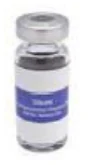 BERINERT Vial 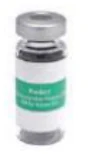 | |||
| 2 | Open the Mix2Vial® package by peeling away the lid. To maintain sterility, leave the Mix2Vial®set in its clear outer package. | 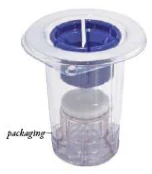 | |||
| 3 | Prepare Diluent Vial:
| 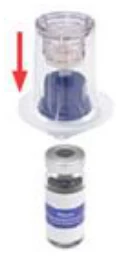 | |||
| 4 | Remove the Mix2Vial® packaging: While holding the diluent vial, carefully remove the outer package from the Mix2Vial® set. Make sure to pull off only the package, not the Mix2Vial® set. | 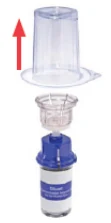 | |||
| 5 | Transfer Diluent into BERINERT Vial:
| 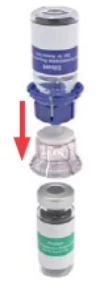 | |||
| 6 | Dissolve BERINERT: With the diluent and BERINERT vial still attached to the Mix2Vial® set, gently swirl the BERINERT vial to ensure the product is fully dissolved (note: BERINERT 1500 may take longer than BERINERT 500 to dissolve). Do not shake the vial. | 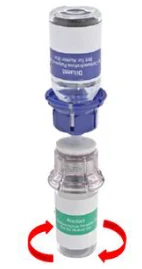 | |||
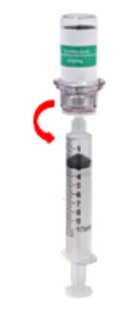
| 7 | Unscrew empty diluent (Blue) vial: With one hand, grip the clear end of the Mix2Vial® set and with the other hand grip the blue end of the Mix2Vial® set and unscrew the set into 2 pieces. | 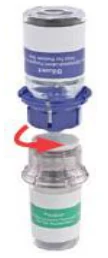 | |||
| 8 | Load the syringe:
| Fig. A Fig. B 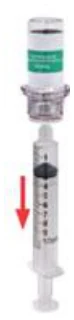 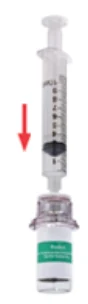 | |||
| 9 | Prepare administration set equipped with microbore tubing:
| ||||
| C | SELF-ADMINISTRATION: | ||||
| Your healthcare provider will teach you how to safely administer BERINERT. It is important that BERINERT is injected directly into a visible vein. Do not inject into surrounding tissues or into an artery. Once you learn how to self-administer, follow the instructions provided below. | |||||
| 1 | Assemble supplies:
| ||||
| 2 | Clean surface:
| ||||
| 3 | Prepare the infusion site:
| ||||
| 4 | Infusion as instructed by your healthcare provider:
| ||||
| 5 | Clean up:
| ||||
| 6 | Record treatment:
| ||||
Do not refrigerate after reconstitution. To ensure product sterility, reconstitute and administer BERINERT using aseptic techniques. BERINERT contains no preservatives, the reconstituted product should be administered immediately. Do not freeze the BERINERT solution.
 |
The reconstituted solution for BERINERT 500 should be colorless and clear. The reconstituted solution for BERINERT 1500 should be colorless, clear to slightly opalescent. Inspect BERINERT visually for particulate matter and discoloration prior to administration. Do not use if the solution is cloudy or contains particulates.
Usual dose:
The dose of BERINERT for the treatment of acute abdominal, facial, or laryngeal attacks of hereditary angioedema (HAE) of moderate to severe intensity is 20 IU/kg body weight administered by intravenous injection.
Overdose:
The development of thrombosis has been reported in association with BERINERT when used (off label) and at higher than labeled doses (greater than 90 IU/kg body weight) in newborns and young children with congenital heart anomalies during or after cardiac surgery under extracorporeal circulation.
| If you think that you or a person you are caring for have taken too much BERINERT, contact your healthcare professional, hospital emergency department, regional poison control centre or Health Canada's toll-free number, 1-844 POISON-X (1-844-764-7669) immediately, even if there are no signs or symptoms. |
|---|
Missed Dose:
Not applicable.
Possible side effects from using BERINERT:
These are not all the possible side effects you may have when taking BERINERT. If you experience any side effects not listed here, tell your healthcare professional.
Serious side effects and what to do about them
| Serious side effects and what to do about them | |||
|---|---|---|---|
| Symptom / effect | Talk to your healthcare professional | Stop taking drug and get immediate medical help | |
| Symptom / effect | Talk to your healthcare professional | Stop taking drug and get immediate medical help | |
| Only if severe | In all cases | ||
| Only if severe | In all cases | ||
| VERY COMMON - COMMON | |||
| Abdominal distention | √ | ||
| Abdominal pain† | √ | ||
| Back pain | √ | ||
| Diarrhea† | √ | ||
| Dysgeusia | √ | ||
| Edema peripheral | √ | ||
| HAE | √ | ||
| Headache | √ | ||
| Muscle spasms | √ | ||
| Nausea† | √ | ||
| Pain | √ | ||
| Upper respiratory tract infection | √ | ||
| Vomiting | √ | ||
| UNCOMMON - RARE | |||
| Abdominal pain upper | √ | ||
| Anxiety | √ | ||
| Biliary colic | √ | ||
| Blood pressure increased | √ | ||
| Body temperature increase | √ | ||
| Bronchitis | √ | ||
| Cough | √ | ||
| Cystitis | √ | ||
| Dysphagia | √ | ||
| Ear pain | √ | ||
| Eructation | √ | ||
| Face edema | √ | ||
| Haematuria | √ | ||
| Haemorrhoidal haemorrhage | √ | ||
| Influenza | √ | ||
| Joint swelling | √ | ||
| Lip swelling | √ | ||
| Nasopharyngitis | √ | ||
| Pharyngolaryngeal pain | √ | ||
| Puncture site reaction | √ | ||
| Pyrexia | √ | ||
| Renal pain | √ | ||
| Retching | √ | ||
| Rhinorrhoea | √ | ||
| Tendonitis | √ | ||
| Throat irritation | √ | ||
| Toothache | √ | ||
| VERY RARE | |||
| Allergic-anaphylactic reactions | √ | ||
* Reported in a key clinical study, related or not related to BERINERT
† Symptoms were considered to be related to the underlying disease. Any increase in intensity or new occurrence of these symptoms after study medication administration was considered to be an AE.
Note: The most serious adverse reaction reported with BERINERT in key clinical study is an increase in the severity of pain associated with HAE. The most serious adverse reaction reported from postmarketing experience is an allergic-anaphylactic reaction.
If you have a troublesome symptom or side effect that is not listed here or becomes bad enough to interfere with your daily activities, tell your healthcare professional.
Reporting Side Effects
You can report any suspected side effects associated with the use of health products to Health Canada by:
NOTE: Contact your health professional if you need information about how to manage your side effects. The Canada Vigilance Program does not provide medical advice. |
We recommend that CSL Behring Canada, Inc. be copied when reporting suspected side effects, at the following address:
AdverseReporting@cslbehring.com
Storage:
Store BERINERT in the refrigerator or at room temperature (at +2°C to +30°C). Do not use the product after the expiration date.
Keep BERINERT in its original carton until ready to use. Do not freeze. Protect from light.
Keep out of reach and sight of children.
If you want more information about BERINERT:
- Talk to your healthcare professional
- Find the full product monograph that is prepared for healthcare professionals and includes this Patient Medication Information by visiting the Health Canada website: (https://www.canada.ca/en/health-canada/services/drugs-health-products/drug-products/drug-product-database.html); the manufacturer’s website (www.cslbehring.ca), or by calling 1-866-773-7721.