


Product Monograph - Herceptin SC
Recent Major Label Changes
None at time of the most recent authorization.
Table of Contents
Certain sections or subsections that are not applicable at the time of the preparation of the most recent authorized product monograph are not listed.
Recent Major Label Changes ....................................................................................................2
Table of Contents.....................................................................................................................2
Part 1: Healthcare Professional Information.............................................................................5
- 1.
Indications ....................................................................................................................... 5
1.1. Pediatrics ............................................................................................................... 5
1.2. Geriatrics ............................................................................................................... 5
- 2. Contraindications ............................................................................................................. 5
- 3. Serious Warnings and Precautions Box............................................................................. 6
- 4.
Dosage and Administration .............................................................................................. 6
4.1. Dosing Considerations ............................................................................................ 6
4.2. Recommended Dose and Dosage Adjustment ......................................................... 7
4.3. Reconstitution........................................................................................................ 9
4.4. Administration ....................................................................................................... 9
4.5. Missed Dose..........................................................................................................10
- 5. Overdose ....................................................................................................................... 10
- 6. Dosage Forms, Strengths, Composition, and Packaging .................................................. 10
- 7.
Warnings and Precautions.............................................................................................. 11
General ...........................................................................................................................11
Cardiovascular.................................................................................................................11
Driving and Operating Machinery.....................................................................................20
Hematologic ....................................................................................................................20
Immune ..........................................................................................................................20
Reproductive Health ........................................................................................................23
Respiratory......................................................................................................................23
7.1. Special Populations ...............................................................................................23
7.1.1. Pregnancy ....................................................................................................23
7.1.2. Breastfeeding...............................................................................................24
7.1.3. Pediatrics .....................................................................................................24
7.1.4. Geriatrics .....................................................................................................24
- 8.
Adverse Reactions.......................................................................................................... 25
8.1. Adverse Reaction Overview ...................................................................................25
8.2. Clinical Trial Adverse Reactions..............................................................................28
8.3. Less Common Clinical Trial Adverse Reactions........................................................69
8.4. Abnormal Laboratory Findings: Hematologic, Clinical Chemistry, and Other Quantitative Data ............................................................................................................75
8.5. Post-Market Adverse Reactions .............................................................................75
- 9.
Drug Interactions ........................................................................................................... 76
9.2. Drug Interactions Overview ...................................................................................76
9.3. Drug-Behaviour Interactions ..................................................................................77
9.4. Drug-Drug Interactions ..........................................................................................77
9.5. Drug-Food Interactions..........................................................................................77
9.6. Drug-Herb Interactions ..........................................................................................77
9.7. Drug-Laboratory Test Interactions .........................................................................77
- 10.
Clinical Pharmacology .................................................................................................... 77
10.1. Mechanism of Action .......................................................................................77
10.2. Pharmacodynamics ..........................................................................................80
10.3. Pharmacokinetics.............................................................................................80
10.4. Immunogenicity ...............................................................................................82
- 11. Storage, Stability, and Disposal ...................................................................................... 82
- 12. Special Handling Instructions ......................................................................................... 83
Part 2: Scientific Information ................................................................................................. 84
- 13. Pharmaceutical Information........................................................................................... 84
- 14.
Clinical Trials .................................................................................................................. 85
14.1. Clinical Trials by Indication ...............................................................................85
Subcutaneous Formulation – BO22227 (HannaH) .............................................................85
Early Breast Cancer (EBC).................................................................................................86
Metastatic Breast Cancer (MBC) ......................................................................................98
- 15. Microbiology.................................................................................................................. 99
- 16. Non-Clinical Toxicology ................................................................................................ 100
Patient Medication Information........................................................................................... 113
Part 1: Healthcare Professional Information
Information as set forth in this label only applies to HERCEPTIN SC.
1. Indications
Early Breast Cancer (EBC)
HERCEPTIN SC (trastuzumab injection) is indicated for the treatment of patients with early stage breast cancer with ECOG 0-1 status, whose tumours overexpress HER2,
- following surgery and after chemotherapy
- following adjuvant chemotherapy consisting of doxorubicin and cyclophosphamide, in combination with paclitaxel or docetaxel
- in combination with adjuvant chemotherapy consisting of docetaxel and carboplatin.
For detailed information on the inclusion criteria for the clinical trials of HERCEPTIN in EBC according to the TNM (Tumour, Node, Metastasis) classification system, see 14 Clinical Trials.
Based on the analysis of the HERA trial, the benefit of the adjuvant treatment with HERCEPTIN for low risk patients not given adjuvant chemotherapy are unknown.
The comparative efficacy and safety between different chemotherapy regimens (i.e. concurrent versus sequential, anthracycline containing versus non-anthracycline containing) was not studied.
Metastatic Breast Cancer (MBC)
HERCEPTIN SC (trastuzumab injection) is indicated for the treatment of patients with MBC whose tumours overexpress HER2.
The benefits of treatment with HERCEPTIN in patients who do not overexpress HER2 (HER2 overexpression 0 as defined by HercepTest® kit) or who exhibit lower-level overexpression (HER2 overexpression 1+ as defined by HercepTest® kit, and the subgroup of patients with HER2 overexpression 2+ as defined by HercepTest® kit that corresponds to 1+ scoring by the investigative clinical trial assay), are unclear (see 4 Dosage and Administration, 4.1 Dosing Considerations, Selection of Patients / Diagnostic Tests).
1.1. Pediatrics
Pediatrics (< 18 years of age): The safety and effectiveness of HERCEPTIN in pediatric patients have not been established; therefore, Health Canada has not authorized an indication for pediatric use.
1.2. Geriatrics
Geriatrics (> 65 years of age): The reported clinical experience is not adequate to determine whether older patients respond differently to HERCEPTIN treatment than younger patients (see 7 Warnings and Precautions, 7.1 Special Populations, 7.1.4 Geriatrics).
2. Contraindications
HERCEPTIN (trastuzumab) is contraindicated in patients who are hypersensitive to this drug, Chinese Hamster Ovary (CHO) cell proteins or to any ingredient in the formulation, including any non-
- medicinal ingredient, or component of the container. For a complete listing, see 6 Dosage Forms, Strengths, Composition, and Packaging.
3. Serious Warnings and Precautions Box
There is a risk of medication errors between HERCEPTIN (trastuzumab) and trastuzumab emtansine or trastuzumab deruxtecan. In order to minimize this risk, check the vial labels to ensure that the drug being prepared and administered is HERCEPTIN (trastuzumab) and not trastuzumab emtansine or trastuzumab deruxtecan. HERCEPTIN should be prescribed using both the trade name and non-proprietary name (see 4 Dosage and Administration, 4.1 Dosing Considerations).
Cardiotoxicity
HERCEPTIN (trastuzumab) can result in the development of ventricular dysfunction and congestive heart failure. In the adjuvant treatment setting, the incidence of cardiac dysfunction was higher in patients who received HERCEPTIN plus chemotherapy versus chemotherapy alone. An increase in the incidence of symptomatic and asymptomatic cardiac events was observed when HERCEPTIN was administered after anthracycline-containing chemotherapy compared to administration with a non-anthracycline regimen of docetaxel and carboplatin. The incidence was more marked when HERCEPTIN was administered concurrently with a taxane than when administered sequentially to a taxane. In the metastatic setting, the incidence and severity of cardiac dysfunction was particularly high in patients who received HERCEPTIN concurrently with anthracyclines and cyclophosphamide (see 7 Warnings and Precautions, Cardiovascular).
Evaluate left ventricular function in all patients prior to and during treatment with HERCEPTIN (see 7 Warnings and Precautions, Cardiovascular).
Infusion Reactions (intravenous formulation); Pulmonary Toxicity
HERCEPTIN administration can result in serious infusion reactions and pulmonary toxicity. Fatal infusion reactions have been reported. In most cases, symptoms occurred during or within 24 hours of administration of HERCEPTIN. HERCEPTIN infusion should be interrupted for patients experiencing dyspnea or clinically significant hypotension. Patients should be monitored until signs and symptoms completely resolve. Discontinue HERCEPTIN for infusion reactions manifesting as anaphylaxis, angioedema, interstitial pneumonitis, or acute respiratory distress syndrome (see 7 Warnings and Precautions).
Embryo-Fetal Toxicity
Exposure to HERCEPTIN during pregnancy can result in impairment of fetal renal growth and/or renal function impairment resulting in oligohydramnios and oligohydramnios sequence manifesting as pulmonary hypoplasia, skeletal abnormalities, intrauterine growth retardation and neonatal death (see 7 Warnings and Precautions, 7.1 Special Populations, 7.1.1 Pregnancy).
4. Dosage and Administration
4.1. Dosing Considerations
- It is important to check the product labels to ensure that the correct formulation (HERCEPTIN or HERCEPTIN SC) is being administered to the patient as prescribed.
- HERCEPTIN SC is not to be used for intravenous administration and must be administered as a subcutaneous injection only.
- HERCEPTIN SC should be administered in a hospital setting by health care professionals only.
- HERCEPTIN SC is not intended for self-administration.
- Please refer to the separate HERCEPTIN Product Monograph for full instructions on dosing and administration of the intravenous formulation.
- There is a risk of medication errors between HERCEPTIN (trastuzumab) and trastuzumab emtansine or trastuzumab deruxtecan. In order to prevent medication errors, it is important to check the vial labels to ensure that the drug being prepared and administered is HERCEPTIN (trastuzumab) and not trastuzumab emtansine or trastuzumab deruxtecan. Ensure that the recommended HERCEPTIN (trastuzumab) dose is administered (see 4.2 Recommended Dose and Dosage Adjustment).
- HERCEPTIN should be prescribed using both the trade name and non-proprietary name. Do not substitute HERCEPTIN for or with trastuzumab emtansine or trastuzumab deruxtecan.
Selection of Patients / Diagnostic Tests
Early Breast Cancer (EBC) / Metastatic Breast Cancer (MBC)
HERCEPTIN should only be used in patients whose tumours overexpress HER2 as determined by immunohistochemistry. CICH or FISH testing for HER2 status also may be used, provided that the testing is done in experienced laboratories that have validated the test.
To ensure accurate and reproducible results, the protocol described in the package insert of an appropriate diagnostic test needs to be strictly followed. However, based on the current scientific knowledge, no standard test can be recommended at this time. There is no standard method of staining and no standard for the type of antibodies used. The grading for overexpression is subjective, and the signal may fade with time on stored slides.
The test method for HER2 overexpression used to determine eligibility of patients for inclusion in the MBC clinical trials employed immunohistochemical staining for HER2 of fixed material from tissue biopsy using the murine monoclonal antibodies CB11 and 4D5. Patients classified as staining 2+ or 3+ were included, while those staining 0 or 1+ were excluded. Greater than 70% of patients enrolled exhibited 3+ overexpression. The data suggest that beneficial effects were greater among those patients with higher levels of overexpression of HER2.
In the studies, an investigative clinical trial assay was employed which utilized a 0 to 3+ scale. The degree of HER2 overexpression indicated by different test methods may not correlate with that used as the eligibility criterion for inclusion in the clinical trials. For example, the HercepTest® kit (registered Trademark of Genentech, Inc.) also utilizes a scale of 0 to 3+. A reading of 3+ with HercepTest® is likely to correspond to that of a 2+ or 3+ with the investigative clinical trial assay. A 2+ reading with the HercepTest® would likely incorporate a significant number of patients who were scored as 1+ by the investigative clinical trial assay. These patients (1+) would not have met the inclusion criteria. Test methods having increased sensitivity, relative to the investigative clinical trial assay, may alter the benefit-to-risk ratio compared to that seen in the clinical trials. In deciding which patients should receive HERCEPTIN, the risk of cardiac dysfunction (see 7 Warnings and Precautions) must be weighed against the potential benefits of treatment, especially for those not in the high range of HER2 overexpression.
For inclusion criteria in terms of HER2 expression in clinical trials in EBC see 14 Clinical Trials.
4.2. Recommended Dose and Dosage Adjustment
The recommended fixed dose of HERCEPTIN SC is 600 mg every three weeks irrespective of the patient’s body weight. No loading dose is required. The dose should be administered over 2-5 minutes.
The injection site should be alternated between the left and right thigh. New injections should be given at least 1 inch/2.5 cm from the previous site on healthy skin and never into areas where the skin is red, bruised, tender, or hard. During the treatment course with HERCEPTIN SC, other medications for SC administration should preferably be injected at different sites.
Duration of Treatment
Patients with MBC should be treated with HERCEPTIN until progression of disease. Patients with EBC should be treated for 1 year or until disease recurrence or unacceptable cardiac toxicity, whichever occurs first (see 7 Warnings and Precautions, Cardiovascular). Extending treatment in EBC beyond one year is not recommended (see 14 Clinical Trials, Early Breast Cancer (EBC), HERA).
Dose Reduction
No reductions in the dose of HERCEPTIN were made during clinical trials. Patients may continue therapy with HERCEPTIN during periods of reversible, chemotherapy-induced myelosuppression, but they should be monitored carefully for complications of neutropenia during this time. The specific instructions to reduce or hold the dose of chemotherapy should be followed.
Table 1 depicts the criteria for permanent discontinuation of HERCEPTIN for cardiac dysfunction in pivotal studies for HERCEPTIN in adjuvant breast cancer.
| Table 1 Criteria for Permanent Discontinuation for Cardiac Dysfunction in Pivotal Studies for HERCEPTIN in Adjuvant Breast Cancer | ||
|---|---|---|
| STUDY | If Symptomatic CHF | If Held for Asymptomatic LVEF Decrease (per algorithm used in each study protocol) |
| HERA | required | required if HERCEPTIN held for 2 consecutive cycles |
| NSABP B-31, NCCTG N9831 and BCIRG-006 | required | required if HERCEPTIN held for 2 consecutive cycles, or for 3 intermittent cycles; investigator may choose to discontinue permanently sooner |
Dose Holding
Monitoring of Cardiac Function (also see 7 Warnings and Precautions, Cardiovascular, Cardiotoxicity)
| Table 2 Recommendations for Continuation or Withdrawal of HERCEPTIN Therapy in Asymptomatic Patients Based on Serial Measurements of Left Ventricular Ejection Fraction (LVEF)a (Adapted from the Canadian Consensus Guidelines*) | ||||
|---|---|---|---|---|
| Table 2 Recommendations for Continuation or Withdrawal of HERCEPTIN Therapy in Asymptomatic Patients Based on Serial Measurements of Left Ventricular Ejection Fraction (LVEF)a (Adapted from the Canadian Consensus Guidelines*) | ||||
| Relationship of LVEF to LLN | Asymptomatic decrease in LVEF from baseline | |||
| Relationship of LVEF to LLN | Asymptomatic decrease in LVEF from baseline | |||
| ≤ 10 percentage points | 10–15 percentage points | ≥ 15 percentage points | ||
| ≤ 10 percentage points | 10–15 percentage points | ≥ 15 percentage points | ||
| Within radiology facility’s normal limits | Continue HERCEPTIN | Continue HERCEPTIN | Hold HERCEPTIN and repeat MUGA or ECHO after 4 weeks | |
| 1–5 percentage points below LLN | Continue HERCEPTINb | Hold HERCEPTIN and repeat MUGA or ECHO after 4 weeks b,c | Hold HERCEPTIN and repeat MUGA or ECHO after 4 weeks c,d | |
| ≥6 percentage points below LLN | Continue HERCEPTIN and repeat MUGA or ECHO after 4 weeksd | Hold HERCEPTIN and repeat MUGA or ECHO after 4 weeks c,d | Hold HERCEPTIN and repeat MUGA or ECHO after 4 weeks c,c | |
a Based on NSABP B-31 trial protocol. Modified to include recommendations for cardiology consultation or treatment of cardiac dysfunction (or both) when appropriate, as indicated in the subsequent footnotes.
b Consider cardiac assessment and initiation of angiotensin converting-enzyme inhibitor therapy.
c After two holds, consider permanent discontinuation of HERCEPTIN.
d Initiate angiotensin converting-enzyme inhibitor therapy and refer to cardiologist. LLN = lower limit of normal; MUGA = multiple-gated acquisition scan; ECHO = echocardiography.
*Source: Mackey JR, Clemons M, Côté MA, et al. Cardiac management during adjuvant trastuzumab therapy: recommendations of the Canadian Trastuzumab Working Group. Curr Oncol. 2008 Jan;15(1):24-35.
For the frequency of cardiac monitoring, see 7 Warnings and Precautions, Cardiovascular, Cardiotoxicity.
4.3. Reconstitution
Parenteral Products:
HERCEPTIN SC (600 mg/5 mL single-dose vial) is a ready to use solution for injection which does not need to be diluted.
4.4. Administration
Use appropriate aseptic technique.
HERCEPTIN should be inspected visually to ensure there is no particulate matter or discolouration prior to administration.
HERCEPTIN SC is for single-use only.
Once transferred from the vial to the syringe, the medicine should be used immediately, from a microbiological point of view, since the medicine does not contain any antimicrobial-preservative. If not used immediately, preparation should take place in controlled and validated aseptic conditions. Once transferred from the vial to the syringe, the medicinal product is physically and chemically stable for 48 hours at 2-8°C and for 6 hours (cumulative time in the vial and the syringe) at ambient temperature (do not store above 30°C) in diffused daylight (see 11 Storage, Stability, and Disposal).
After transfer of the solution to the syringe, it is recommended to replace the transfer needle by a syringe closing cap to avoid drying of the solution in the needle and not compromise the quality of the medicinal product. The hypodermic injection needle must be attached to the syringe immediately prior to administration followed by volume adjustment to 5 mL.
No incompatibilities between HERCEPTIN SC and polypropylene syringes have been observed.
4.5. Missed Dose
If one dose of HERCEPTIN SC is missed, it is recommended to administer the next 600 mg dose (i.e. the missed dose) as soon as possible. The interval between subsequent HERCEPTIN SC doses should not be less than three weeks.
5. Overdose
There is limited experience with overdosage in human clinical trials. Single doses of up to 960 mg of HERCEPTIN SC have been administered to 2 patients from Study BO22227 with no reported untoward effect. Patients who experience overdose or medication errors should be closely monitored.
Ensure that the recommended HERCEPTIN (trastuzumab) dose and NOT trastuzumab emtansine or trastuzumab deruxtecan dose is administered. For information on the risk of trastuzumab emtansine or trastuzumab deruxtecan overdose due to medication errors, see their respective Product Monographs.
For the most recent information in the management of a suspected drug overdose, contact your regional poison control centre or Health Canada’s toll-free number, 1-844 POISON-X (1-844-764-7669).
- 6. Dosage Forms, Strengths, Composition, and Packaging
To help ensure the traceability of biologic products, healthcare professionals should record both the brand name and the non-proprietary (active ingredient) name as well as other product-specific identifiers such as the Drug Identification Number (DIN) and the batch/lot number of the product supplied.
Table 3 – Dosage Forms, Strengths, and Composition
| Route of Administration | Dosage Form/ Strength/Composition | Non-Medicinal Ingredients |
| Subcutaneous | Solution for injection / 600 mg/5 mL vial | L-histidine, L-histidine hydrochloride monohydrate, L-methionine, Polysorbate 20, Recombinant human hyaluronidase PH20 (rHuPH20), α,α-trehalose dehydrate, Water for injection. Recombinant human hyaluronidase PH20 (rHuPH20): an enzyme used to increase the dispersion and absorption of co-administered trastuzumab. |
Description
HERCEPTIN SC is a colourless to yellowish, clear to opalescent solution for injection. Each single-dose vial contains 600 mg of trastuzumab.
In addition to the active ingredient trastuzumab, each vial contains the following non-medicinal ingredients: Recombinant human hyaluronidase PH20 (rHuPH20), L-histidine, L-histidine hydrochloride monohydrate, α,α-trehalose dehydrate, L-methionine, Polysorbate 20, Water for injection.
HERCEPTIN SC contains recombinant human hyaluronidase PH20 (rHuPH20), an enzyme used to increase the dispersion and absorption of trastuzumab when administered subcutaneously.
HERCEPTIN SC is supplied as a fixed dose vial containing 600 mg/5 mL (in a 6 mL vial).
Each carton contains one single dose vial.
7. Warnings and Precautions
See 3 Serious Warnings and Precautions Box.
General
Therapy with HERCEPTIN should only be initiated under supervision of a physician experienced in the treatment of cancer patients.
In order to improve traceability of biological medicinal products, the trade name and the batch number of the administered product should be clearly recorded (or stated) in the patient file.
Early Breast Cancer (EBC)
The safety of the various combination chemotherapy regimens prior to HERCEPTIN therapy was not separately analyzed in the HERA trial. The data provided in the Product Monograph reflects the safety and efficacy of HERCEPTIN for the recommended 1 year treatment duration.
Cardiovascular
Cardiotoxicity: Administration of HERCEPTIN can result in the development of ventricular dysfunction and congestive heart failure. In the adjuvant treatment setting, the incidence of cardiac dysfunction was higher in patients who received HERCEPTIN plus chemotherapy versus chemotherapy alone. In patients with EBC, an increase in the incidence of symptomatic and asymptomatic cardiac events was observed when HERCEPTIN was administered after anthracycline-containing chemotherapy compared to administration with a non-anthracycline regimen of docetaxel and carboplatin. The incidence was more marked when HERCEPTIN was administered concurrently with a taxane than when administered sequentially to a taxane. In the metastatic setting, the incidence and severity of cardiac dysfunction were particularly high in patients who received HERCEPTIN concurrently with anthracyclines and cyclophosphamide. The incidence of cardiac adverse events was also higher in patients with previous exposure to anthracyclines based on post-marketing data.
Because the half-life of trastuzumab, using a population pharmacokinetic method, is approximately 28.5 days (95% CI, 25.5 - 32.8 days), trastuzumab may persist in the circulation for approximately 24 weeks (range: 22-28 weeks) after stopping treatment with HERCEPTIN. Since the use of an anthracycline during this period could possibly be associated with an increased risk of cardiac dysfunction, a thorough assessment of the risks versus the potential benefits is recommended in addition to careful cardiac monitoring. If possible, physicians should avoid anthracycline based therapy while trastuzumab persists in the circulation.
Patients who receive HERCEPTIN either as a component of adjuvant treatment or as a treatment for metastatic HER2 positive breast cancer may experience signs and symptoms of cardiac dysfunction such as dyspnea, increased cough, paroxysmal nocturnal dyspnea, peripheral edema, S3 gallop, or reduced ejection fraction. Cardiac dysfunction associated with therapy with HERCEPTIN may be severe and has been associated with disabling cardiac failure, death, and mural thrombosis leading to stroke.
Left ventricular function should be evaluated in all patients prior to and during treatment with HERCEPTIN. If LVEF drops 10 ejection points from baseline and/or to below 50%, HERCEPTIN should be withheld and a repeat LVEF assessment performed within approximately 3 weeks. If LVEF has not improved, or declined further, discontinuation of HERCEPTIN should be strongly considered, unless the benefits for the individual patient are deemed to outweigh the risks. The scientific basis of cardiac dysfunction has been incompletely investigated in pre-clinical studies.
Extreme caution should be exercised in treating patients with pre-existing cardiac dysfunction, and in EBC, in those patients with an LVEF of 55% or less. Candidates for treatment with HERCEPTIN as part of adjuvant treatment for operable breast cancer or for MBC, especially those with prior anthracycline and cyclophosphamide (AC) exposure, should undergo thorough baseline cardiac assessment including history and physical exam, electrocardiogram (ECG) and either 2D echocardiogram or multiple gated acquisition (MUGA) scan. A careful risk-benefit assessment should be made before deciding to treat with HERCEPTIN. Cardiac assessments, as performed at baseline, should be repeated every 3 months during treatment and every 6 months following discontinuation of treatment until 24 months from the last administration of HERCEPTIN. In patients with EBC who receive anthracycline containing chemotherapy further monitoring is recommended, and should occur yearly up to 5 years from the last administration of HERCEPTIN, or longer if a continued decrease of LVEF is observed. Monitoring may help to identify patients who develop cardiac dysfunction. Patients who develop asymptomatic cardiac dysfunction may benefit from more frequent monitoring (e.g. every 6-8 weeks). If patients have a continued decrease in left ventricular function, but remain asymptomatic, the physician should consider discontinuing therapy if no clinical benefit of therapy with HERCEPTIN has been seen.
If symptomatic cardiac failure develops during therapy with HERCEPTIN, it should be treated with the standard medications for this purpose. Discontinuation of HERCEPTIN should be strongly considered in patients who develop clinically significant congestive heart failure. In the MBC clinical trials, approximately two-thirds of patients with cardiac dysfunction were treated for cardiac symptoms, most patients responded to appropriate medical therapy (which may include one or more of the following: diuretics, angiotensin-converting enzyme inhibitors, β-blockers, angiotensin II receptor blockers, or cardiac glycosides) often including discontinuation of HERCEPTIN. The safety of continuation or resumption of HERCEPTIN in patients who have previously experienced cardiac toxicity has not been prospectively studied.
Early Breast Cancer (EBC)
HERCEPTIN and anthracyclines should not be given concurrently in the adjuvant treatment setting.
Risk factors for a cardiac event identified in four large adjuvant studies included advanced age (> 50 years), low level of baseline and declining LVEF (< 55%), low LVEF prior to or following the initiation of paclitaxel treatment, HERCEPTIN treatment, and prior or concurrent use of anti-hypertensive medications. In patients receiving HERCEPTIN after completion of adjuvant chemotherapy the risk of cardiac dysfunction was associated with a higher cumulative dose of anthracycline given prior to initiation of HERCEPTIN and a high body mass index (BMI > 25 kg/m2).
In EBC, the following patients were excluded from the HERA, JA (NSABP B-31 and NCCTG N9831) and BCIRG006 trials there are no data about the benefit risk balance, and therefore treatment cannot be recommended in such patients:
- history of myocardial infarction (MI),
- angina pectoris requiring medication,
- history of or present CHF (NYHA II –IV),
- other cardiomyopathy,
- cardiac arrhythmia requiring medication,
- clinically significant cardiac valvular disease,
- poorly controlled hypertension (hypertension controlled by standard medication eligible) and
- clinically significant pericardial effusion.
The safety of continuation or resumption of HERCEPTIN in patients who have previously experienced cardiac toxicity has not been prospectively studied. According to the narrative reports of cardiac events, about half of the events had resolved completely by the time of the interim analysis. Please see Table 5a / Table 5b below.
For patients with EBC, cardiac assessments, as performed at baseline, should be repeated every 3 months during treatment and every 6 months following discontinuation of treatment until 24 months from the last administration of HERCEPTIN. In patients who receive anthracycline containing chemotherapy further monitoring is recommended, and should occur yearly up to 5 years from the last administration of HERCEPTIN, or longer if a continued decrease of LVEF is observed.
A high index of clinical suspicion is warranted for discontinuing treatment in the setting of cardiopulmonary symptoms. Close monitoring of cardiac function should be carried out for all patients and adequate treatment for CHF should be administered regardless of the discontinuation of HERCEPTIN therapy. Please see Table 2 in 4 Dosage and Administration, 4.2 Recommended Dose and Dosage Adjustment, Dose Holding, Monitoring of Cardiac Function, for information on continuation and discontinuation of HERCEPTIN based on interval LVEF assessments.
HERA
In the HERA trial, cardiac monitoring (electrocardiogram [ECG], left ventricular ejection fraction [LVEF], signs/symptoms and cardiac questionnaire) was performed at baseline and regularly throughout the study. The assessment schedule for cardiac monitoring was at months 3 and 6 and then every 6 months until month 36 (3 years from the date of therapy) and in month 60 (5 years from the date of therapy). In addition, LVEF was measured at 48 months (4 years from the date of therapy) and followed up every 12 months from year 6 to year 10.
When HERCEPTIN was administered after completion of adjuvant chemotherapy, NYHA class III-IV heart failure was observed in 0.6% of patients in the one-year arm after a median follow-up of 12 months.
Table 4a Absolute Numbers and Rates of Cardiac Endpoints in HERA (Median follow-up of 12 months)
| HERA study | Observation n (%) N=1708 | HERCEPTIN n (%) N=1678 |
|---|---|---|
| Primary cardiac endpoint | 1 (0.1%) | 10 (0.6%) |
| Secondary cardiac endpoint | 9 (0.5%) | 51 (3.0%) |
| Total “cardiac endpoints” | 10 (0.6%) | 61 (3.6%) |
Table 4b Absolute Numbers and Rates of Cardiac Endpoints in Hera (Median follow-up of 8 years)
| HERA study | Observation n (%) N=1744 | HERCEPTIN 1 year arm n (%) N=1682 |
|---|---|---|
| Primary cardiac endpoint | 2 (0.1%) | 14 (0.8%) |
| Events after 1 year | 0 (0.0%) | 1 (0.1%) |
| Secondary cardiac endpoint | 15 (0.9%) | 78 (4.6%) (69 – excluding patients with primary endpoint) |
| Events after 1 year | 7 (0.4%) | 14 (0.8%) (13 – excluding patients with primary endpoint) |
| Total “cardiac endpoints” | 17 (1.0%) | 83 (4.9%) |
Table 5a Median Time to Return to Baseline LVEF/ Stabilizations of LVEF in the HERA Trial (Median follow-up of 8 years) - Primary Cardiac Endpoint
| HERA study | Primary Cardiac Endpoint | |||||
|---|---|---|---|---|---|---|
Observation (n = 2) | HERCEPTIN 1-year (n=14) | |||||
| Return to baseline LVEF | 0 | 11 (79%) | ||||
| Median time to return to baseline LVEF | - | 218 d | ||||
| Stabilization of LVEF | 0 | 5 (36%) | ||||
Table 5b Median Time to Return to Baseline LVEF/ Stabilizations of LVEF in the HERA Trial (Median follow-up of 8 years) - Secondary Cardiac Endpoint
| HERA study | Secondary Cardiac Endpoint (excluding patients with primary cardiac endpoint) | ||||||
|---|---|---|---|---|---|---|---|
Observation (n = 15) | HERCEPTIN 1-year (n=69) | ||||||
| Return to baseline LVEF | 10 (67%) | 60 (87%) | |||||
| Median time to return to baseline LVEF | 189 d | 240 d | |||||
| Stabilization of LVEF | 4 (27%) | 18 (26%) | |||||
A significant drop in left ventricular ejection fraction (LVEF) is defined as an absolute decrease of 10 EF points or more from baseline and to below 50%, measured by MUGA scan or echocardiogram.
A primary cardiac endpoint was defined as the occurrence at any time after randomization but prior to any new therapy for recurrent disease of symptomatic congestive heart failure of NYHA class III or IV, confirmed by a cardiologist and a significant drop in LVEF, or cardiac death.
A secondary cardiac endpoint was defined as asymptomatic (NYHA class I) or mildly symptomatic (NYHA class II) cardiac dysfunction with a significant LVEF drop. In addition events which did not meet the above criteria for a secondary cardiac endpoint but which in the opinion of the Cardiac Advisory Board should be classed as secondary cardiac endpoints were included.
After a median follow-up of 3.6 years the incidences of severe CHF, symptomatic CHF and at least one significant LVEF decrease (an absolute decline of at least 10% from baseline LVEF and to less than 50%) after 1 year of HERCEPTIN therapy was 0.8%, 1.9% and 9.8%, respectively.
After a median follow-up of 8 years the incidence of severe CHF (NYHA III & IV) in the HERCEPTIN 1 year treatment arm was 0.8%, and the rate of mild symptomatic and asymptomatic left ventricular dysfunction was 4.6%. At least one LVEF assessment was missing for 20.8% of patients in the observation only arm and 32.0% of patients in the HERCEPTIN 1-year arm. During the follow-up until month 60, at least one LVEF assessment was missed for 18.0% of patients in the observation only arm and 17.9% of patients in the HERCEPTIN 1-year arm.
Reversibility of severe CHF (defined as a sequence of at least two consecutive LVEF values ≥50% after the event) was evident for 71.4% of HERCEPTIN-treated patients. Reversibility of mild symptomatic and asymptomatic left ventricular dysfunction was demonstrated for 79.5% of patients. Approximately 17% (14/83) of cardiac endpoints occurred after completion of HERCEPTIN in the HERCEPTIN one-year arm.
Joint Analysis: NSABP B-31 and NCCTG N9831
Cardiac dysfunction adverse events were defined in both B-31 and N9831 as symptomatic cardiac events and asymptomatic LVEF events. Symptomatic cardiac events were reviewed and confirmed by the cardiac committee of each study and included the occurrence of symptomatic congestive heart failure with objective findings and confirmation by imaging, deaths due to cardiac causes (CHF, MI, or documented primary arrhythmia) and probable cardiac deaths (sudden death without documented etiology). Asymptomatic LVEF events were defined as absolute drop in LVEF ≥10% to < 55% or an absolute drop in LVEF of ≥5% to below the institution’s lower limit of normal (LLN). In study B-31, 15.5% of patients discontinued HERCEPTIN due to asymptomatic LVEF decrease (12.2%), CHF (2.2%) or Cardiac diagnosis other than CHF (1.1%) in the HERCEPTIN + chemotherapy arm; no patients in the chemotherapy alone arm discontinued treatment for these reasons. In all analyses the rate of cardiac dysfunction was higher in patients in the HERCEPTIN + chemotherapy arm compared with those in the chemotherapy alone arm. From the paclitaxel baseline to the six month, nine month and eighteen month assessment, the average change in LVEF was more pronounced in the HERCEPTIN + chemotherapy arm (-4.2%, -5.1% and -3.1% in the HERCEPTIN + chemotherapy alone arm, respectively versus -0.5%, -0.4% and -0.9% in the chemotherapy alone arm, respectively).
Table 6 Joint Analysis: (NSABP B-31 and NCCTG N9831) The Incidence and Type of Cardiac Events (Median Duration of More Than 8 Years** Safety Follow up) | ||||||||||||||
|---|---|---|---|---|---|---|---|---|---|---|---|---|---|---|
| B31 | N9831 | B-31+N9831 | ||||||||||||
| AC→T (n = 889) | AC→T + H (n = 1031) | AC→T (n = 766) | AC→T + H (n = 969) | AC→T (n = 1655) | AC→T+H (n = 2000) | |||||||||
| Symptomatic CHF (non-death) | 11 (1.2%) | 38 (3.7%) | 5 (0.7%) | 24 (2.5%) | 16 (1.0%) a | 62 (3.1%) b | ||||||||
| Cardiac death | 2 (0.2%) c | 1 (0.1%) | 3 (0.4%) | 1 (0.1%) | 5 (0.3%) c | 2 (0.1%) | ||||||||
| Death due to CHF, MI, or primary arrhythmia | 0 (0.0%) | 0 (0.0%) | 2 (0.3%) | 1 (0.1%) | 2 (0.1%) | 1 (0.1%) | ||||||||
| Sudden death without documented etiology | 2 (0.2%) | 1 (0.1%) | 1 (0.1%) | 0 (0.0%) | 3 (0.2%) | 1 (0.1%) | ||||||||
| Any cardiac or asymptomatic LVEF events | 270 (30.4%) | 401 (38.9%) | 209 (27.3%) | 367 (37.9%) | 479 (28.9%) | 768 (38.4%) | ||||||||
| Drop in LVEF of 10 points compared with baseline to below 55* | 236 (26.5%) | 376 (36.5%) | 184 (24.0%) | 340 (35.1%) | 420 (25.4%) | 716 (35.8%) | ||||||||
| Drop in LVEF of 5 points compared with baseline to below the lower limit of normal* | 161 (18.1%) | 267 (25.9%) | 127 (16.6%) | 238 (24.6%) | 288 (17.4%) | 505 (25.3%) | ||||||||
A = doxorubicin; C = cyclophosphamide; CHF = congestive heart failure; H = HERCEPTIN; LVEF = left ventricular ejection fraction; MI = myocardial infarction; T = paclitaxel.
*Asymptomatic LVEF per protocol events at any time after AC initiation: 1. Drop in LVEF of 10 points compared with AC baseline LVEF to below 55. or 2. Drop in LVEF of 5 points compared with AC baseline LVEF to below the lower limit of normal.
** In the joint analysis safety population, the median duration of follow-up was 8.1 years for the AC→T + H group and 8.5 years for the AC→T group
a 16 AC→T patients had adjudicated and confirmed symptomatic CHF out of the 62 possible CHF patients reviewed by the study committees.
b 62 AC→T + H patients had adjudicated and confirmed symptomatic CHF out of the 135 possible CHF patients reviewed by the study committees.
c A patient received AC→T in study B-31; not included here and had “emphysema” listed on autopsy.
At 3 years, the cardiac event rate in patients receiving AC→TH (doxorubicin plus cyclophosphamide followed by paclitaxel + trastuzumab) was estimated at 3.2%, compared with 0.9% in AC→T treated patients. Between 5 and 7 years of follow-up, an additional patient in each treatment group experienced a cardiac event; the cardiac event rate at 9 years follow-up in patients receiving AC→TH was estimated at 3.2%, compared with 1.0% in AC→T treated patients.
Table 7 summarizes the follow-up information for 84 patients (52 from study B-31 and 32 from study N9831) for whom symptomatic CHF was adjudicated and confirmed by the study committee.
| Table 7 Joint Analysis (NSABP B-31 and NCCTG N9831) Follow-Up of Symptomatic CHF Events (Median Duration of More Than 8 Years* Safety Follow up) (Patients from the Joint Safety Population with Symptomatic CHF Confirmed by Study Committee) | |||||||||||||||||||||||
|---|---|---|---|---|---|---|---|---|---|---|---|---|---|---|---|---|---|---|---|---|---|---|---|
| B-31 | N9831 | Joint Analysis | |||||||||||||||||||||
| AC→T (n = 11) | AC→T + H (n = 38) | AC→T (n = 5) | AC→T + H (n = 24) | AC→T (n = 16) | AC→T + H (n = 62) | ||||||||||||||||||
| Months from onset to first overall recovery | |||||||||||||||||||||||
| N | 4 | 22 | 0 | 9 | 4 | 31 | |||||||||||||||||
| Mean (SD) | 10.1 (2.2) | 21.5 (11.1) | NA | 10.5 (8.6) | 10.1 (2.2) | 18.3 (11.5) | |||||||||||||||||
| Median | 10.2 | 16.9 | NA | 6.6 | 10.2 | 14.5 | |||||||||||||||||
| Range | 8–12 | 9–50 | NA | 3–31 | 8–12 | 3–50 | |||||||||||||||||
| Current overall recovery status | |||||||||||||||||||||||
| Recovery (LVEF ≥ 50% and no symptoms) | 3 (27.3%) | 8 (21.1%) | (0.0%) | 7 (29.2%) | 3 (18.8%) | 15 (24.2%) | |||||||||||||||||
| No recovery (LVEF < 50% or symptoms) | 2 (18.2%) | 7 (18.4%) | 3 (60.0%) | 6 (25.0%) | 5 (31.3%) | 13 (21.0%) | |||||||||||||||||
| Unknown | 6 (54.5%) | 23 (60.5%) | 2 (40.0%) | 11 (45.8%) | 8 (50.0%) | 34 (54.8%) | |||||||||||||||||
A = doxorubicin; C = cyclophosphamide; H = HERCEPTIN; LVEF = left ventricular ejection fraction; SD = standard deviation; T = paclitaxel; * = In the joint analysis safety population, the median duration of follow-up was 8.1 years for the AC→T + H group and 8.5 years for the AC→T group. | |||||||||||||||||||||||
Following initiation of paclitaxel therapy, 344 patients treated with AC→TH (18.5%) experienced an LVEF percentage decrease of ≥ 10 points from paclitaxel baseline to < 50 points, compared with 82 patients treated with AC→T (7.0%) at a median follow-up of 8.1 years for the AC→TH group. The per patient incidence of new onset cardiac dysfunction, after initiation of paclitaxel therapy, as determined by LVEF, remained unchanged compared to the analysis performed at a median follow up of 2.0 years in the AC→TH group.
An independent clinical review was performed on 62 patients with symptomatic congestive heart failure in the HERCEPTIN + chemotherapy arm to assess treatment and resolution status. Most patients were treated with oral medications commonly used to manage congestive heart failure. Complete or partial LVEF recovery was documented in 56 patients (90.3%), with complete recovery in 17 of these patients (27.4%) and partial recovery in 39 of these patients (62.9%), compared to 6 patients (9.7%) experiencing no recovery. This analysis also showed evidence of reversibility of left ventricular dysfunction in 64.5% of patients who experienced a symptomatic CHF in the AC→TH group being asymptomatic at the latest follow up.
Risk factors for a cardiac event included HERCEPTIN treatment, increased age, prior or current use of anti-hypertensive medications and low LVEF prior to or following the initiation of paclitaxel treatment. In the HERCEPTIN + chemotherapy arm, the risk of a cardiac event increased with the number of these risk factors present. In study B-31, there was no association between the incidence of cardiac events and either radiation to the left side of the chest or smoking.
BCIRG006
In study BCIRG006, cardiac events were defined as congestive heart failure (CHF; grade 3 or 4 cardiac left ventricular function [CLVF], per the NCI-CTC, v 2.0), grade 3 or 4 cardiac arrhythmia, grade 3 or 4 cardiac ischemia/infarction, cardiac death and serious adverse events with cardiac etiology not pre-defined as a cardiac event in the protocol but assessed as being a significant cardiac event by the Independent Cardiac Review Panel (ICRP). Asymptomatic LVEF events were defined as an absolute decline in LVEF value of >15 % from baseline to a value that was below the institution’s lower limit of normal (LLN). [Note: asymptomatic LVEF events defined in HERA as: a drop in LVEF of at least 10 EF points from baseline and to below 50%, and in the JA as: absolute drop in LVEF ≥10% to < 55% or an absolute drop in LVEF of ≥5% to below the institution’s LLN.]
Table 8 summarizes symptomatic cardiac events reported at any time during the study.
| Table 8 Symptomatic Cardiac Events per the Independent Cardiac Review Panel (ICRP) Occurring at Any Time during the Study (Safety Population) 5 Year Follow Up | |||||||||
| Event Type | AC→T (n = 1041) | AC→TH (n = 1077) | TCH (n = 1056) | ||||||
| CHF (Grade 3/4 CLVF) | 6 (0.6%) | 20 (1.9%) | 4 (0.4%) | ||||||
| Grade 3/4 cardiac ischemia/infarction | 0 | 3 (0.3%) | 2 (0.2%) | ||||||
| Grade 3/4 arrhythmia | 6 (0.6%) | 3 (0.3%) | 6 (0.6%) | ||||||
| Cardiac death | 0 | 0 | 0 | ||||||
| Any symptomatic cardiac event | 10 (1.0%) | 25 (2.3%) | 12 (1.1%) | ||||||
| AC→T = doxorubicin plus cyclophosphamide, followed by docetaxel; AC→TH = doxorubicin plus cyclophosphamide, followed by docetaxel plus HERCEPTIN; CHF = congestive heart failure; CLVF = cardiac left ventricular function; TCH = docetaxel, carboplatin, and HERCEPTIN. | |||||||||
At 5.5 years, the rates of symptomatic cardiac or LVEF events were 1.0%, 2.3%, and 1.1% in the AC→T (doxorubicin plus cyclophosphamide, followed by docetaxel), AC→TH (doxorubicin plus cyclophosphamide, followed by docetaxel plus trastuzumab), and TCH (docetaxel, carboplatin and trastuzumab) treatment arms, respectively. For symptomatic CHF (Grade 3 - 4), the 5-year rates were 0.6%, 1.9%, and 0.4% in the AC→T, AC→TH, and TCH treatment arms, respectively. The overall risk of developing symptomatic cardiac events was similar for patients in AC→T and TCH arms. There was an increased risk of developing a symptomatic cardiac event for patients in the AC→TH arm, where the cumulative rate of symptomatic cardiac or LVEF events was 2.3% compared to approximately 1% in the two comparator arms (AC→T and TCH, respectively).
In BCIRG006 study, 155 patients treated with AC→TH (14.4%) experienced an LVEF decrease of ≥ 10% from baseline to < 50%, compared with 79 (7.6%) patients treated with AC→T and 63 (6.0%) patients treated with TCH.
Table 9 presents the incidence of symptomatic and asymptomatic LVEF events.
| Table 9 Asymptomatic and Symptomatic LVEF Declines by Baseline Events, Using the Same Assessment Method as Baseline (Safety Population) 5 Year Follow Up | |||
| Event Type | AC→T (n = 1041) | AC→TH (n = 1077) | TCH (n = 1056) |
| Absolute decline of > 15% from baseline and to a value below the LLN | 50 (4.8%) | 111 (10.3%) | 42 (4.0%) |
| Absolute decline of > 10% from baseline and to a value < 50% | 71 (6.8%) | 137 (12.7%) | 50 (4.7%) |
| Symptomatic and/or asymptomatic decline of > 15%, below the LLN | 56 (5.4%) | 128 (11.9%) | 57 (5.4%) |
| AC-T = doxorubicin plus cyclophosphamide, followed by docetaxel; AC-TH = doxorubicin plus cyclophosphamide, followed by docetaxel plus HERCEPTIN; ANC = absolute neutrophil count; LLN = lower limit of normal; TCH = docetaxel, carboplatin, and HERCEPTIN. | |||
Metastatic Breast Cancer (MBC)
HERCEPTIN and anthracyclines should not be given concurrently in the MBC setting.
In particular, moderate to severe cardiac dysfunction has been observed in MBC patients treated with HERCEPTIN in combination with an anthracycline (doxorubicin or epirubicin) and cyclophosphamide (see 8 Adverse Reactions). The clinical status of patients in the trials who developed congestive heart failure were classified for severity using the New York Heart Association classification system (I-IVi where IV is the most severe level of cardiac failure). (See Table 10).
| Table 10 Incidence and Severity of Cardiac Dysfunction in Metastatic Breast Cancer Patients | ||||||||||||||||
| HERCEPTIN + Anthracycline + cyclophosphamideb | Anthracycline + cyclophosphamideb | HERCEPTIN + Paclitaxelb | Paclitaxelb | HERCEPTINa Alone | ||||||||||||
| (n=143) | (n= 135) | (n= 91) | (n= 95) | (n= 338) | ||||||||||||
| Any Cardiac Dysfunction | 27% | 7% | 12% | 1% | 4% | |||||||||||
| Class III-IV | 16% | 3% | 2% | 1% | 3% | |||||||||||
a Single agent studies H0551g, H0649g and H0650g.
b Randomized Phase III study comparing chemotherapy plus HERCEPTIN to chemotherapy alone, where chemotherapy is either anthracycline/cyclophosphamide or paclitaxel.
In a subsequent trial with prospective monitoring of cardiac function, the incidence of symptomatic heart i New York Heart Association Functional Classification
Class I: Patients with cardiac disease but without resulting limitations of physical activity. Ordinary physical activity does not cause undue fatigue, palpitation, dyspnea or anginal pain.
Class II: Patients with cardiac disease resulting in slight limitation of physical activity. They are comfortable at rest. Ordinary physical activity results in fatigue, palpitation, dyspnea or anginal pain.
Class III: Patients with cardiac disease resulting in marked limitation of physical activity. They are comfortable at rest. Less than ordinary physical activity causes fatigue, palpitation, dyspnea or anginal pain.
Class IV: Patients with cardiac disease resulting in inability to carry on any physical activity without discomfort. Symptoms of cardiac insufficiency or of the anginal syndrome may be present even at rest. If any physical activity is undertaken, discomfort is increased.
failure was 2.2% in patients receiving HERCEPTIN and docetaxel, compared with 0% in patients receiving docetaxel alone. In the MBC trials, the probability of cardiac dysfunction was highest in patients who received HERCEPTIN concurrently with anthracyclines. The MBC data suggest that advanced age may increase the probability of cardiac dysfunction.
Pre-existing cardiac disease or prior cardiotoxic therapy (e.g., anthracycline or radiation therapy) to the chest may decrease the ability to tolerate therapy with HERCEPTIN; however, the data is not adequate to evaluate correlation between cardiac dysfunction observed with HERCEPTIN and these factors in patients with HER2 positive MBC.
Driving and Operating Machinery
HERCEPTIN has a minor influence on the ability to drive and use machines. Dizziness and somnolence may occur during treatment with HERCEPTIN. Patients experiencing infusion-related symptoms should be advised not to drive or use machines until symptoms resolve completely.
Hematologic
Exacerbation of Chemotherapy-Induced Neutropenia: In randomized, controlled clinical trials in both adjuvant and MBC designed to assess the impact of the addition of HERCEPTIN on chemotherapy, the per-patient incidences of moderate to severe neutropenia and of febrile neutropenia were higher in patients receiving HERCEPTIN in combination with myelosuppressive chemotherapy compared with those receiving chemotherapy alone.
Using NCI-CTC criteria, in the adjuvant HERA trial, 0.4% of patients treated with HERCEPTIN experienced a shift of 3 or 4 grades from baseline, compared with 0.6% in the observation arm.
In the adjuvant studies, NSABP B-31 and NCCTG N9831, there were 6 deaths due to septicemia or severe neutropenia. Five deaths occurred on the chemotherapy alone arm: 2 patients died of pneumonia with febrile neutropenia and 3 patients died of septicemia. One death occurred on the HERCEPTIN + chemotherapy arm and the patient died of infection/neutropenic fever with lung infiltrates. All except 2 septicemia deaths occurred during protocol treatment period.
In the post-marketing setting in MBC, deaths due to sepsis in patients with severe neutropenia have been reported in patients receiving HERCEPTIN and myelosuppressive chemotherapy, although in controlled MBC clinical trials (pre- and post-marketing), the incidence of septic death was not significantly increased.
The pathophysiologic basis for exacerbation of neutropenia has not been determined; the effect of HERCEPTIN on the pharmacokinetics of chemotherapeutic agents has not been fully evaluated. If neutropenia occurs, the appropriate management should be instituted as per local practice/guidelines and the labelled instructions for chemotherapy agents should be followed with regard to dose interruption or dose reduction (see 4 Dosage and Administration, 4.2 Recommended Dose and Dosage Adjustment, Dose Modification).
Immune
Hypersensitivity Reactions Including Anaphylaxis, Infusion-Associated Reactions, Administration-Related Reactions, and Pulmonary Events
Administration of HERCEPTIN (intravenous formulation) can result in severe hypersensitivity reactions (including anaphylaxis), infusion reactions and pulmonary events. In rare cases, these reactions have been fatal. See discussion below.
There are no data regarding the most appropriate method of identification of patients who may safely be retreated with HERCEPTIN after experiencing a severe reaction. HERCEPTIN has been readministered to some patients who fully recovered from a previous severe reaction. Prior to readministration of HERCEPTIN the majority of these patients were prophylactically treated with pre-medications including antihistamines and/or corticosteroids. While some of these patients tolerated retreatment, others had severe reactions again despite the use of prophylactic pre-medications.
Hypersensitivity Reactions Including Anaphylaxis (intravenous formulation): Severe hypersensitivity reactions have been infrequently reported in patients treated with HERCEPTIN. Signs and symptoms include anaphylaxis, urticaria, bronchospasm, angioedema, and/or hypotension. In some cases, the reactions have been fatal. The onset of symptoms generally occurred during an infusion, but there have also been reports of symptom onset after the completion of an infusion. Reactions were most commonly reported in association with the initial infusion. In HERA 1 observation and 10 HERCEPTIN treated patients experienced hypersensitivity. Eight out of the 10 events were considered related to HERCEPTIN treatment. The incidence of allergic reactions in the Joint Analysis (chemotherapy alone versus HERCEPTIN + chemotherapy: 3.6% versus 3.1% in study B-31 and 1.1% versus 0.3% in study N9831) was comparable between the two treatment arms in both studies. In study BCIRG006, the incidence of allergic reactions according to the NCI-CTC v 2.0 classification was 9.4%, 12.3% and 14.9% in AC→T, AC→TH and TCH arms, respectively.
Infusional administration of HERCEPTIN should be interrupted in all patients with severe hypersensitivity reactions. In the event of a hypersensitivity reaction, appropriate medical therapy should be administered, which may include epinephrine, corticosteroids, diphenhydramine, bronchodilators, and oxygen. Patients should be evaluated and carefully monitored until complete resolution of signs and symptoms.
Infusion-Related Reactions (IRRs) (intravenous formulation): IRRs are known to occur with HERCEPTIN. Pre-medication may be used to reduce risk of occurrence of IRRs.
Serious IRRs to infusions of HERCEPTIN including dyspnea, hypotension, hypertension, wheezing, bronchospasm, tachycardia, reduced oxygen saturation and respiratory distress, supraventricular tachyarrhythmia and urticaria have been reported (see 8 Adverse Reactions). Patients should be observed for IRRs. Interruption of an IV infusion may help control such symptoms and the infusion may be resumed when symptoms abate. These symptoms can be treated with an analgesic/antipyretic such as meperidine or paracetamol, or an antihistamine such as diphenhydramine. Serious reactions have been treated successfully with supportive therapy such as oxygen, beta-agonists and corticosteroids (see 8 Adverse Reactions). The appropriate management of patients with uncontrolled hypertension or history of hypertension should be considered prior to infusion with HERCEPTIN.
These severe reactions were usually associated with the first infusion of HERCEPTIN and generally occurred during or immediately following the infusion. For some patients, symptoms later worsened and led to further pulmonary complications. Initial improvement followed by clinical deterioration and delayed reactions with rapid clinical deterioration have also been reported. Fatalities have occurred within hours and up to one week following infusion. On very rare occasions, patients have experienced the onset of infusion symptoms or pulmonary symptoms more than six hours after the start of the infusion of HERCEPTIN. Patients should be warned of the possibility of such a late onset and should be instructed to contact their physician if those symptoms occur. In rare cases, these reactions are associated with a clinical course culminating in a fatal outcome. Patients who are experiencing dyspnea at rest due to complications of advanced malignancy and comorbidities may be at increased risk of a fatal infusion reaction. Therefore, these patients should be treated with extreme caution and the risk versus benefit be considered for each patient.
Administration-related reactions (ARRs) (subcutaneous formulation): ARRs are known to occur with HERCEPTIN SC. Pre-medication may be used to reduce risk of occurrence of ARRs. Although serious ARRs, including dyspnea, hypotension, wheezing, bronchospasm, tachycardia, reduced oxygen saturation and respiratory distress, were not reported in the clinical trial with HERCEPTIN SC, caution should be exercised as these have been associated with the intravenous formulation. They can be treated with an analgesic/antipyretic such as meperidine or paracetamol, or an antihistamine such as diphenhydramine. Cutaneous reactions occurred more often with HERCEPTIN SC compared with HERCEPTIN; the majority of the reactions observed in clinical trials were mild or moderate.
Pulmonary Events: Severe pulmonary events leading to death have been reported with the use of HERCEPTIN in the adjuvant breast cancer clinical studies and the post-marketing MBC setting. These events may occur as part of an infusion-related reaction or with a delayed onset (See Infusion-Related Reactions subsection of 7 Warnings and Precautions), and were reported to occur at varying latencies, from within 24 hours to over 30 days, since the start of treatment with HERCEPTIN. Cases of interstitial lung disease (which often present with dyspnea) including lung infiltrates, pneumonitis, pleural effusion, respiratory distress, acute pulmonary edema, respiratory insufficiency, acute respiratory distress syndrome, and pneumonia have been reported. Risk factors associated with interstitial lung disease include prior or concomitant therapy with other anti-neoplastic therapies known to be associated with it such as taxanes, gemcitabine, vinorelbine and radiation therapy. Patients with dyspnea at rest due to complications of advanced malignancy and co-morbidities may be at increased risk of pulmonary events. Therefore, these patients should not be treated with HERCEPTIN.
Other severe events reported rarely in the post-marketing MBC setting include pneumonitis and pulmonary fibrosis. All of the confirmed cases of pulmonary fibrosis received to date are characterized by one or more significant confounding factors including pre-existing lung disease and prior/concomitant chemotherapy such as cyclophosphamide. However, a causal relationship between HERCEPTIN and pulmonary fibrosis cannot be excluded.
Immunogenicity:
Anti-Drug Antibody Formation
Samples for assessment of anti-drug antibodies (previously referred to as human anti-human antibodies [HAHA]) were not collected in studies of adjuvant breast cancer. Of 903 MBC patients receiving HERCEPTIN (intravenous formulation) evaluated for anti-drug antibodies, 0.% (1 patient) tested positive, with no allergic manifestations.
In the neoadjuvant-adjuvant EBC treatment setting, 14.9 % (44/295) of patients receiving HERCEPTIN SC and 8.1% (24/296) of patients receiving HERCEPTIN (intravenous formulation) developed antibodies against trastuzumab (regardless of antibody presence at baseline). Neutralizing anti-trastuzumab antibodies were detected in post-baseline samples in 4 of 44 HERCEPTIN SC patients and in 2 of 24 HERCEPTIN (intravenous formulation) patients. The incidence of anti-rHuPH20 antibodies was 20.0% (59/295) of patients receiving HERCEPTIN SC. Neutralizing anti-rHuPH20 antibodies were not detected in any post-baseline samples in these 59 HERCEPTIN SC patients.
The clinical relevance of these antibodies is not known.
Reproductive Health
Women of childbearing potential should be advised to use effective contraception during treatment with HERCEPTIN and for at least 7 months after treatment has concluded (see 10 Clinical Pharmacology, 10.3 Pharmacokinetics).
Fertility
There are no adequate and well-controlled studies in pregnant women and it is not known whether HERCEPTIN can affect reproductive capacity. Animal reproduction studies revealed no evidence of impaired fertility or harm to the fetus (see 16 Non-Clinical Toxicology, Reproductive and Developmental Toxicity).
Respiratory
Refer to Pulmonary Events subsection of 7 Warnings and Precautions.
Thrombosis/Embolism
Thrombosis/embolism has been observed in patients who receive HERCEPTIN + chemotherapy in both the adjuvant and metastatic treatment setting, and in rare cases, has been fatal (see 8 Adverse Reactions).
7.1. Special Populations
7.1.1. Pregnancy
Reproduction studies have been conducted in cynomolgus monkeys at doses up to 25 times the weekly human maintenance dose of 2 mg/kg HERCEPTIN and have revealed no evidence of impaired fertility or harm to the fetus (see 16 Non-Clinical Toxicology, Reproductive and developmental toxicity). However, when assessing the risk of reproductive toxicity in humans, it is important to consider the significance of the rodent form of the HER2 receptor in normal embryonic development and the embryonic death in mutant mice lacking this receptor. Placental transfer of HERCEPTIN during the early (days 20-50 of gestation) and late (days 120-150 of gestation) fetal development period was observed.
HERCEPTIN can cause fetal harm when administered to a pregnant woman. In the post-marketing setting, cases of impairment of fetal renal growth and/or renal function impairment, intrauterine growth retardation and skeletal abnormalities in association with oligohydramnios during the second and third trimesters, some associated with fatal pulmonary hypoplasia of the fetus, have been reported in pregnant women receiving HERCEPTIN. Also, the causal role of trastuzumab cannot be excluded nor confirmed in two cases of interventricular septal defects reported in infants exposed to HERCEPTIN in utero. In one of these two cases, spontaneous closure of the defect occurred nine months postpartum. No follow up information regarding closure of the defect was available in the second case. HER 2 is known to be expressed in many embryonic tissues. Women of childbearing potential should be advised to use effective contraception during treatment with HERCEPTIN and for at least 7 months after treatment has concluded. Women who become pregnant should be advised of the possibility of harm to the fetus. If a pregnant woman is treated with HERCEPTIN, close monitoring by a multidisciplinary team is desirable.
Women using HERCEPTIN during pregnancy should be monitored for oligohydramnios. If oligohydramnios occurs, fetal testing should be done that is appropriate for gestational age and consistent with community standards of care. Additional intravenous (IV) hydration has been helpful when oligohydramnios has occurred following administration of other chemotherapy agents; however, the effects of additional IV hydration with HERCEPTIN treatment are not known.
There are no adequate and well-controlled studies in pregnant women and it is not known whether HERCEPTIN can affect reproductive capacity. Animal reproduction studies revealed no evidence of impaired fertility or harm to the fetus. Because animal reproduction studies are not always predictive of human response, HERCEPTIN should not be used during pregnancy unless the potential benefit for the mother outweighs the potential risk to the fetus.
7.1.2. Breastfeeding
A study conducted in cynomolgus monkeys at doses 25 times the weekly human maintenance dose of 2 mg/kg HERCEPTIN from days 120 to 150 of pregnancy demonstrated that trastuzumab is secreted in the milk postpartum. The exposure to trastuzumab in utero and the presence of trastuzumab in the serum of infant monkeys was not associated with any adverse effects on their growth or development from birth to 1 month of age. It is not known whether HERCEPTIN is excreted in human milk. As human IgG is excreted in human milk, and the potential for absorption and harm to the infant is unknown, a decision should be made whether to discontinue nursing, or discontinue drug, taking into account the elimination half-life of trastuzumab and the importance of the drug to the mother.
7.1.3. Pediatrics
Pediatrics (< 18 years of age): The safety and effectiveness of HERCEPTIN in pediatric patients have not been established.
7.1.4. Geriatrics
Geriatrics (> 65 years of age): HERCEPTIN (Intravenous Formulation) has been administered in clinical studies to 386 patients who were 65 years of age or over (253 in the adjuvant treatment and 133 in MBC treatment settings). The risk of cardiac dysfunction was increased in geriatric patients as compared to younger patients in both those receiving treatment for metastatic disease and those receiving adjuvant therapy in studies NSABP B-31 and NCCTG N9831, and BCIRG006. Age ≥ 60 years was associated with increased risk of shorter time to first symptomatic cardiac event in study BCIRG-006 (based on 35 cardiac events in 2066 patients) (for the definition of cardiac events in each study see 7 Warnings and Precautions, Cardiovascular, Cardiotoxicity, Early Breast Cancer). Limitations in data collection and differences in study design of the 4 studies of HERCEPTIN in adjuvant treatment of breast cancer preclude a determination of whether the toxicity profile of HERCEPTIN in older patients is different from younger patients. The reported clinical experience is not adequate to determine whether the efficacy improvements (as measured by ORR, TTP, OS, and DFS) of HERCEPTIN treatment in older patients differ from those observed in patients <65 years of age, for either treatment of metastatic disease or adjuvant treatment of EBC.
The risk of hematologic toxicities (leukopenia and thrombocytopenia) may be increased in geriatric patients.
Data suggest that the disposition of HERCEPTIN is not altered based on age (see 10 Clinical Pharmacology, 10.3 Pharmacokinetics). In clinical studies, elderly patients did not receive reduced doses of HERCEPTIN.
8. Adverse Reactions
8.1. Adverse Reaction Overview
Subcutaneous Formulation
In the BO22227 trial in EBC, the safety profile of trastuzumab was evaluated in 298 and 297 patients treated with HERCEPTIN (intravenous formulation) and HERCEPTIN SC (subcutaneously formulation), respectively.
HERCEPTIN or HERCEPTIN SC was administered concurrently with neoadjuvant chemotherapy (docetaxel followed by FEC (5-Fluorouracil, epirubicin, cyclophosphamide).
At a median follow-up of 40 months, patients that received HERCEPTIN SC experienced more adverse events (any grade) than patients that received HERCEPTIN (Total Adverse Events: HERCEPTIN 3097 and HERCEPTIN SC 3225). The proportion of patients experiencing any grade adverse events were similar between the two treatment arms (HERCEPTIN 94.6%; HERCEPTIN SC 97.6%).
The rates of Infusion-related reactions/Administration-Related Reactions (IRRs/ARRs) were 37.2% in the HERCEPTIN arm and 47.8% in the HERCEPTIN SC arm with erythema and cough being the main contributors to the difference observed. Severe (grade 3) IRRs/ARRs were 2.0% and 1.7% in the HERCEPTIN and HERCEPTIN SC arms, respectively, during the treatment phase. There were no grade 4 or 5 IRRs/ARRs.
The incidence of severe (Grade ≥3) events was 53.0% in the HERCEPTIN arm and 53.2% in the HERCEPTIN SC arm. The most commonly reported severe (Grade ≥3) events were severe neutropenia (HERCEPTIN 33.2%; HERCEPTIN SC 29.3%), leukopenia (HERCEPTIN 6.0%; HERCEPTIN SC 4.0%) and febrile neutropenia (HERCEPTIN 4.4%; HERCEPTIN SC 5.7%). Serious adverse events (SAEs) were experienced in 14.4% of patients in the HERCEPTIN arm and 21.9% in the HERCEPTIN SC arm with the most frequently reported SAE (>1% and <10%) being febrile neutropenia (HERCEPTIN 3.7% and HERCEPTIN SC 4.4%) and neutropenia (HERCEPTIN 2.7% and HERCEPTIN SC 2.4%). The overall incidence of SAEs of Infections and Infestations was HERCEPTIN 4.4% and HERCEPTIN SC 8.1%.
The incidence of congestive cardiac failure/cardiac failure was 0.3 % in the HERCEPTIN arm and 0.7% in the HERCEPTIN SC arm. Seven deaths related to adverse events were reported in the study (4 in the HERCEPTIN SC arm and 3 in the HERCEPTIN IV arm). Two of the deaths reported in the HERCEPTIN SC arm were due to cardiac-related AEs or suggestive of cardiac AEs (myocardial infarction and sudden death). No deaths due to cardiac-related AEs were reported in the HERCEPTIN arm during the study. In an exploratory analysis, patients with lower body weights (<59 kg, the lowest body weight quartile) the fixed dose used in the HERCEPTIN SC arm was not associated with an increased risk of cardiac events or a significant drop in LVEF. Caution however is required in the interpretation of the data given the limited data that was used for the exploratory analysis.
Switching Treatment from HERCEPTIN to HERCEPTIN SC and Vice Versa
Study MO22982 investigated switching from HERCEPTIN to HERCEPTIN SC, and vice versa, in patients with HER2 positive EBC. In this trial with an open-label cross-over design, 239 patients were randomized to one of two different trastuzumab treatment sequences and treated with at least one dose of HERCEPTIN or HERCEPTIN SC (HERCEPTIN (Cycles 1-4) → HERCEPTIN SC (Cycles 5-8) [n=118], or HERCEPTIN SC (Cycles 1-4) → HERCEPTIN (Cycles 5-8) [n=121]). Patients were either naïve to HERCEPTIN treatment (20.3%) or pre-exposed to HERCEPTIN (79.7%) as part of ongoing adjuvant treatment for HER2 positive EBC.
Overall, irrespective of the treatment sequence, 205/239 (85.8%) patients reported at least 1 AE.
For the overall study duration, the most common adverse reactions of any grade (individual preferred terms occurring in ≥10% of patients) were asthenia, arthralgia, headache, hot flush and injection site pain. The most common Grade 3 adverse reaction (individual preferred term occurring in >1% of patients) was hypertension. No Grade 4 or Grade 5 AEs were reported. Adverse reactions that led to study drug discontinuation (>1 patient) were left ventricular dysfunction, cardiac failure congestive and injection site pain.
Pre-switch rates (Cycles 1-4) for SAEs, Grade 3 AEs and treatment discontinuations due to AEs were low (<5%) and were similar to post-switch rates (Cycles 5-8). Caution, however, is required for the interpretation of the rates of adverse events occurring post-switch (Cycles 5-8) due to the possibility of carryover of events from the pre-switch treatment (Cycles 1-4).
Overall, for the entire study period, SAEs were reported for 7/239 (2.9%) patients. Overall, cardiac AEs were reported in 22/239 (9.2%) patients; left ventricular dysfunction (3.8%), cardiac failure congestive (1.7%), ejection fraction decreased (1.3%) and palpitations (1.3%) were the most frequent cardiac AEs. The overall frequency of cardiac AEs (Cycles 1-8) was 7.4% in the HERCEPTIN SC → HERCEPTIN treatment arm (9/121 patients) and 4.2% in the HERCEPTIN → HERCEPTIN SC arm (5/118 patients).
The incidence of ARRs was 26.8% (64/239 patients). During SC treatment, 35/237 (14.8%) patients reported 49 ARRs, compared with 20/237 (8.4%) patients reporting 25 ARRs during IV administration. ARRs were reported more frequently in the HERCEPTIN SC → HERCEPTIN treatment arm (29/121 [24.0%] patients) compared to the HERCEPTIN → HERCEPTIN SC arm (18/118 [15.3%] patients) (Cycles 1-8). The most commonly reported ARRs (≥2% of patients) of any grade were erythema, rash, cough and dyspnea. Overall, 7/239 (2.9%) patients reported 7 ARRs that were considered Grade 3 in severity. These included erythema, pruritus, dyspnea, generalized erythema, generalized pruritus, and rash pruritic. The remainder of ARRs were Grades 1 (70 ARRs reported in 46/239 [19.2%] patients) or 2 (23 ARRs reported in 17/239 [7.1%] patients).
Adverse events of Grade 3 or higher (Cardiac, Injection site reactions (ISR), ARR) which originated from the SC period and continued into the IV period were: erythema and pruritus generalized observed in one patient each (0.4%).
HERCEPTIN SC Safety and Tolerability in EBC Patients
Study MO28048 was a non-randomized, open-label study investigating the safety and tolerability of HERCEPTIN SC as adjuvant therapy in HER2 positive EBC patients (N=1867 patients, including 20 patients receiving neoadjuvant therapy).
A total of 88.6% patients included in the safety population reported 15756 AEs during the treatment period. Three patients were excluded from the safety population because they did not receive a single dose of HERCEPTIN SC.
The most common adverse reactions of any grade (individual preferred terms occurring in ≥10% of patients) reported during the treatment period were: diarrhea, fatigue, arthralgia, nausea, myalgia, headache, asthenia, pyrexia, pain in extremity and cough. The most common Grade ≥3 adverse reactions (individual preferred terms occurring in >1% of patients) were neutropenia, febrile neutropenia, leukopenia, anaemia, hypertension, diarrhea and alopecia. Adverse reactions that led to study drug discontinuation (≥0.5% of patients) were ejection fraction decreased and left ventricular dysfunction.
During the treatment period, 13.0% of patients reported 316 SAEs. The most frequently reported SAEs were febrile neutropenia (2.1%), neutropenia (0.5%), neutropenic sepsis (0.5%) and pyrexia (0.6%).
In the MO28048 study, 17.3% of patients reported a cardiac AE during the treatment period. Decreased ejection fraction (reported in 4.5% of the patients) was the most frequently reported individual cardiac AE. Congestive cardiac failure (PT cardiac failure congestive) was reported in 0.5% of patients, and 0.2% of patients reported PT cardiac failure during the treatment period. One additional patient was reported to have congestive cardiac failure during the follow-up period. There were 6% of patients who had an LVEF <50% with a decrease of ≥10 points in LVEF from baseline.
An exploratory analysis indicated that treatment of lower body weight patients with HERCEPTIN SC fixed dose was not associated with an increased rate of AEs or SAEs (including cardiac AEs) as compared to the higher body weight patients. Interpretation of the results should be made with caution due to the exploratory nature of the analysis.
The incidence of ARRs was 38.6% during treatment, the majority of which were Grade 1-2 ARRs. The events were mainly skin and subcutaneous tissue disorders and respiratory, thoracic, and mediastinal disorders. The incidence of Grade ≥3 ARRs was 1.4%. The most frequently reported Grade ≥3 ARRs reported in >0.1% of patients were dyspnea (0.3%), cough (0.2%), erythema (0.2%), rash (0.2%), and drug hypersensitivity (0.2%).
Intravenous Formulation
Information in this section reports data from a separate Product Monograph for HERCEPTIN.
Early Breast Cancer (EBC)
HERA
(adjuvant sequential: use of HERCEPTIN following surgery and after chemotherapy)
Please see 7 Warnings and Precautions, Cardiovascular, Cardiotoxicity, Early Breast Cancer – Table 4a / Table 4b and Table 5a / Table 5b for a description of the absolute numbers and rates of cardiac endpoints in HERA as well as the median time to return to baseline LVEF/ stabilizations of LVEF in the HERA trial.
In HERA, after a median follow-up of 12 months, 1 observation and 10 HERCEPTIN treated patients experienced hypersensitivity. Eight out of the 10 events were considered related to HERCEPTIN treatment.
In total, in the HERCEPTIN 1 year arm, 124 patients (7%) withdrew from HERCEPTIN treatment due to adverse events, and 2 patients (<1%) withdrew from the post-treatment follow-up phase due to adverse events, based on the withdrawal criteria in the HERA study protocol.
Please see Table 5a and Table 5b in 7 Warnings and Precautions, Cardiovascular, Cardiotoxicity, Early Breast Cancer for information on the median time to return to baseline LVEF and stabilizations of LVEF after 8 years of median follow up in the HERA trial.
Joint Analysis –NSABP Study B-31 and NCCTG Study N9831
(adjuvant concurrent: use of HERCEPTIN in combination with paclitaxel)
Cardiac failure/dysfunction, pulmonary events, and exacerbation of chemotherapy-induced neutropenia were the most serious adverse reactions in the two randomized, controlled adjuvant breast cancer studies (NSABP study B-31 and NCCTG study N9831, see 14 Clinical Trials). Please refer to 7 Warnings and Precautions section for detailed description of these reactions and Table 6 for a description of the incidence and type of cardiac events seen in the Joint Analysis.
The toxicity profile of HERCEPTIN in all four adjuvant trials (HERA, NSABP Study B-31, NCCTG Study N9831 and BCIRG-006) appears to be similar. Cardiac dysfunction is the main concern with HERCEPTIN treatment (see 7 Warnings and Precautions).
Metastatic Breast Cancer (MBC)
In clinical trials conducted prior to marketing, a total of 958 patients received HERCEPTIN (trastuzumab) alone or in combination with chemotherapy. Data in Table 20 are based on the experience with the recommended dosing regimen for HERCEPTIN in the randomized controlled clinical trial in 234 patients who received HERCEPTIN in combination with chemotherapy and the open-label study of HERCEPTIN as a single agent in 213 patients with HER2-overexpressing MBC.
8.2. Clinical Trial Adverse Reactions
Clinical trials are conducted under very specific conditions. Therefore, the frequencies of adverse reactions observed in the clinical trials may not reflect frequencies observed in clinical practice and should not be compared to frequencies reported in clinical trials of another drug.
Subcutaneous Formulation
Table 11 Adverse Events Occurring in at Least 5% of Subjects in Either Treatment Arm in Study BO22227 (Safety Population)
| Body System / Adverse Event | HERCEPTIN N=298 | HERCEPTIN SC N=297 |
|---|---|---|
| Body System / Adverse Event | HERCEPTIN N=298 | HERCEPTIN SC N=297 |
| Body System / Adverse Event | HERCEPTIN N=298 | HERCEPTIN SC N=297 |
| No. (%) | No. (%) | |
| No. (%) | No. (%) | |
| No. (%) | No. (%) | |
| Blood and Lymphatic System Disorders | ||
| Neutropenia | 140 (47.0) | 132 (44.4) |
| Leukopenia | 46 (15.4) | 31 (10.4) |
| Anaemia | 40 (13.4) | 34 (11.4) |
| Febrile neutropenia | 13 (4.4) | 17 (5.7) |
| Gastrointestinal Disorders | ||
| Nausea | 147 (49.3) | 146 (49.2) |
| Diarrhea | 110 (36.9) | 101 (34.0) |
| Vomiting | 70 (23.5) | 69 (23.2) |
| Stomatitis | 51 (17.1) | 57 (19.2) |
| Constipation | 45 (15.1) | 43 (14.5) |
| Dyspepsia | 30 (10.1) | 33 (11.1) |
| Abdominal pain upper | 27 (9.1) | 21 (7.1) |
| Abdominal pain | 16 (5.4) | 22 (7.4) |
| General Disorders and Administration Site Conditions | ||
| Asthenia | 75 (25.2) | 75 (25.3) |
| Fatigue | 80 (26.8) | 70 (23.6) |
| Pyrexia | 35 (11.7) | 37 (12.5) |
| Mucosal inflammation | 39 (13.1) | 31 (10.4) |
| Oedema peripheral | 32 (10.7) | 26 (8.8) |
| Pain | 15 (5.0) | 12 (4.0) |
| Oedema | 15 (5.0) | 10 (3.4) |
| Injection site pain | - | 18 (6.1) |
| Infections and Infestations | ||
| Nasopharyngitis | 40 (13.4) | 24 (8.1) |
| Upper respiratory tract infection | 29 (9.7) | 30 (10.1) |
| Urinary tract infection | 23 (7.7) | 10 (3.4) |
| Pharyngitis | 10 (3.4) | 15 (5.1) |
| Injury, Poisoning and Procedural Complications | ||
| Radiation skin injury | 34 (11.4) | 41 (13.8) |
| Incision site pain | 24 (8.1) | 33 (11.1) |
| Procedural pain | 16 (5.4) | 18 (6.1) |
| Investigations | ||
| Alanine aminotransferase increased | 19 (6.4) | 16 (5.4) |
| Metabolism and Nutrition Disorders | ||
| Decreased appetite | 59 (19.8) | 58 (19.5) |
| Musculoskeletal and Connective Tissue Disorders | ||
| Myalgia | 54 (18.1) | 61 (20.5) |
| Arthralgia | 52 (17.4) | 48 (16.2) |
| Pain in extremity | 26 (8.7) | 30 (10.1) |
| Musculoskeletal pain | 29 (9.7) | 25 (8.4) |
| Back pain | 25 (8.4) | 27 (9.1) |
| Bone pain | 10 (3.4) | 20 (6.7) |
| Nervous System Disorders | ||
| Headache | 44 (14.8) | 50 (16.8) |
| Peripheral sensory neuropathy | 27 (9.1) | 33 (11.1) |
| Dizziness | 29 (9.7) | 29 (9.8) |
| Dysgeusia | 22 (7.4) | 24 (8.1) |
| Neuropathy peripheral | 18 (6.0) | 24 (8.1) |
| Psychiatric Disorders | ||
| Insomnia | 31 (10.4) | 26 (8.8) |
| Reproductive System and Breast Disorders | ||
| Amenorrhoea | 10 (3.4) | 15 (5.1) |
| Respiratory, Thoracic and Mediastinal Disorders | ||
| Cough | 24 (8.1) | 35 (11.8) |
| Dyspnoea | 22 (7.4) | 21 (7.1) |
| Oropharyngeal pain | 19 (6.4) | 19 (6.4) |
| Epistaxis | 18 (6.0) | 19 (6.4) |
| Skin and Subcutaneous Tissue Disorders | ||
| Alopecia | 188 (63.1) | 187 (63.0) |
| Rash | 44 (14.8) | 48 (16.2) |
| Nail disorder | 31 (10.4) | 29 (9.8) |
| Pruritus | 27 (9.1) | 26 (8.8) |
| Skin hyperpigmentation | 24 (8.1) | 20 (6.7) |
| Palmar-plantar erythrodysaesthesia syndrome | 18 (6.0) | 20 (6.7) |
| Dermatitis | 15 (5.0) | 14 (4.7) |
| Erythema | 8 (2.7) | 21 (7.1) |
| Vascular Disorders | ||
| Hot flush | 30 (10.1) | 30 (10.1) |
| Hypertension | 13 (4.4) | 24 (8.1) |
Switching Treatment from HERCEPTIN to HERCEPTIN SC and Vice Versa
A summary of adverse events that occurred at a rate of at least 5% in Study MO22982 (HERCEPTIN SC Cohort, 239 patients in safety population) during Cycles 1-4 and Cycles 5-8 is presented below.
Table 12 Summary of adverse events (≥5%) for assessment of switching formulations by SOC and PT
SOC PT | SC Vial/IV SC Vial (C1-4) N=121 (%) | SC Vial/IV IV (C5-8) N=119 (%) | IV/SC Vial IV (C1-4) N=118 (%) | IV/SC Vial SC Vial (C5-8) N=116 (%) | |
|---|---|---|---|---|---|
| GENERAL DISORDERS AND ADMINISTRATION SITE CONDITIONS | |||||
| Asthenia | 9 (7.4) | 6 (5.0) | 8 (6.8) | 6 (5.2) | |
| Injection Site Pain | 10 (8.3) | 0 | 0 | 10 (8.6) | |
| Fatigue | 7 (5.8) | 5 (4.2) | 3 (2.5) | 4 (3.4) | |
| Injection Site Erythema | 8 (6.6) | 0 | 0 | 6 (5.2) | |
| Injection Site Reaction | 9 (7.4) | 0 | 0 | 2 (1.7) | |
| Oedema Peripheral | 2 (1.7) | 2 (1.7) | 7 (5.9) | 0 | |
| MUSCULOSKELETAL AND CONNECTIVE TISSUE DISORDERS | |||||
| Arthralgia | 6 (5.0) | 5 (4.2) | 6 (5.1) | 8 (6.9) | |
| Pain In Extremity | 10 (8.3) | 3 (2.5) | 2 (1.7) | 4 (3.4) | |
| SKIN AND SUBCUTANEOUS TISSUE DISORDERS | |||||
| Erythema | 10 (8.3) | 2 (1.7) | 1 (0.8) | 5 (4.3) | |
| GASTROINTESTINAL DISORDERS | |||||
| Nausea | 8 (6.6) | 6 (5.0) | 2 (1.7) | 3 (2.6) | |
| Diarrhoea | 4 (3.3) | 7 (5.9) | 2 (1.7) | 4 (3.4) | |
| VASCULAR DISORDERS | |||||
| Hot Flush | 11 (9.1) | 8 (6.7) | 3 (2.5) | 3 (2.6) | |
| NERVOUS SYSTEM DISORDERS | |||||
| Headache | 9 (7.4) | 4 (3.4) | 6 (5.1) | 3 (2.6) | |
HERCEPTIN SC Safety and Tolerability in EBC Patients
A summary of adverse events that occurred at a rate of at least 1% in Study MO28048 (HERCEPTIN SC Cohort, N=1864 patients in safety population) is presented below.
Table 13 Common Adverse Reactions (≥1% Incidence) reported in Study MO28048, N=1864 patients), Safety Population
Body System Adverse Reactions a, b, c | HERCEPTIN SC 600 mg q3w/18 cycles n = 1864 | |
|---|---|---|
Body System Adverse Reactions a, b, c | HERCEPTIN SC 600 mg q3w/18 cycles n = 1864 | |
Body System Adverse Reactions a, b, c | HERCEPTIN SC 600 mg q3w/18 cycles n = 1864 | |
Body System Adverse Reactions a, b, c | HERCEPTIN SC 600 mg q3w/18 cycles n = 1864 | |
| All Grades % | Grades 3 to 5 % | |
| All Grades % | Grades 3 to 5 % | |
| All Grades % | Grades 3 to 5 % | |
| All Grades % | Grades 3 to 5 % | |
| GENERAL DISORDERS AND ADMINISTRATION SITE CONDITIONS | ||
| Fatigue b | 32.5 | 0.8 |
| Injection Site Reaction b | 19.5 | <0.1 |
| Edema b | 12.3 | 0.1 |
| Pyrexia b | 10.7 | 0.2 |
| Pain b | 7.6 | 0.2 |
| Mucosal Inflammation | 5.7 | 0.4 |
| Chills b | 4.9 | NA |
| Influenza Like Illness | 4.7 | <0.1 |
| Administration Site Reaction b | 1.4 | NA |
| MUSCULOSKELETAL AND CONNECTIVE TISSUE DISORDERS | ||
| Arthralgia b | 20.7 | 0.4 |
| Myalgia b | 16.8 | 0.3 |
| Pain in Extremity | 10.9 | 0.3 |
| Back Pain b | 7.5 | <0.1 |
| Pain b | 7.2 | 0.1 |
| Bone Pain b | 4.0 | 0.1 |
| Osteoporosis b | 3.9 | 0.2 |
| Muscle spasms b | 3.4 | 0.1 |
| Arthritis b | 2.9 | 0.4 |
| Joint disorder b | 2.4 | <0.1 |
| GASTROINTESTINAL DISORDERS | ||
| Diarrhea | 20.9 | 1.2 |
| Nausea | 15.0 | 0.6 |
| Abdominal Pain b | 9.8 | 0.3 |
| Constipation | 8.5 | 0.2 |
| Stomatitis b | 7.6 | 0.2 |
| Vomiting | 7.2 | 0.5 |
| Dyspepsia | 3.9 | <0.1 |
| Haemorrhoids | 1.7 | <0.1 |
| Dry Mouth | 1.6 | <0.1 |
| Gastrointestinal Haemorrhage b | 1.3 | <0.1 |
| Toothache | 1.3 | NA |
| Gastrooesophageal Reflux Disease | 1.2 | NA |
| Gastritis b | 1.0 | <0.1 |
| SKIN AND SUBCUTANEOUS TISSUE DISORDERS | ||
| Rash b | 17.2 | 0.4 |
| Nail Disorder b | 9.7 | <0.1 |
| Alopecia b | 8.9 | 0.6 |
| Erythema b | 8.6 | 0.2 |
| Pruritus b | 6.5 | NA |
| Dry Skin | 3.1 | NA |
| Palmar-Plantar Erythrodysaesthesia Syndrome | 2.3 | 0.2 |
| Skin Disorder b | 2.0 | 0.1 |
| Skin Discolouration b | 1.5 | NA |
| Hypersensitivity b | 1.2 | 0.1 |
| Pain b | 1.2 | NA |
| Eczema | 1.0 | <0.1 |
| Hyperhidrosis b | 1.0 | NA |
| Nail Discolouration | 1.0 | NA |
| INFECTIONS AND INFESTATIONS | ||
| Upper Respiratory Tract Infection b | 19.3 | 0.3 |
| Urinary Tract Infection b | 6.0 | 0.6 |
| Viral Infection b | 5.2 | NA |
| Fungal Infection b | 3.1 | 0.2 |
| Herpes Virus Infection b | 2.5 | 0.2 |
| Bronchitis | 2.1 | NA |
| Cystitis | 2.0 | NA |
| Conjunctivitis | 1.9 | NA |
| Lower Respiratory Tract Infection b | 1.8 | 0.2 |
| Cellulitis b | 1.7 | 0.3 |
| Gastroenteritis | 1.2 | 0.2 |
| Abscess b | 1.1 | 0.3 |
| Respiratory Tract Infection b | 1.1 | <0.1 |
| Skin Infection b | 1.1 | <0.1 |
| Pneumonia b | 1.0 | 0.3 |
| NERVOUS SYSTEM DISORDERS | ||
| Neuropathy Peripheral b | 14.4 | 0.4 |
| Headache b | 13.3 | 0.5 |
| Dizziness b | 6.4 | 0.1 |
| Paresthesia | 6.1 | 0.2 |
| Dysgeusia b | 4.2 | 0.1 |
| Sensory Disturbance b | 3.0 | NA |
| Lethargy | 1.5 | <0.1 |
| Syncope b | 1.4 | 0.5 |
| Neurotoxicity | 1.3 | <0.1 |
| Cognitive Disorder b | 1.2 | <0.1 |
| RESPIRATORY, THORACIC AND MEDIASTINAL DISORDERS | ||
| Cough b | 11.3 | 0.2 |
| Dyspnea b | 7.8 | 0.3 |
| Epistaxis | 5.8 | NA |
| Nasal Inflammation/Discomfort b | 5.7 | NA |
| Pain b | 3.3 | NA |
| Rhinitis Allergic b | 1.3 | NA |
| Asthma / Bronchospasm b | 1.0 | 0.1 |
| VASCULAR DISORDERS | ||
| Flushing b | 11.9 | 0.2 |
| Hypertension b | 8.5 | 2.4 |
| Lymphoedema | 4.5 | NA |
| Phlebitis /Thrombophlebitis b | 1.5 | <0.1 |
| Hypotension b | 1.3 | <0.1 |
| Thrombosis/Embolism b | 1.0 | 0.2 |
| INJURY, POISONING AND PROCEDURAL COMPLICATIONS | ||
| Fractures b | 1.8 | 0.6 |
| Infusion related reaction b | 1.6 | NA |
| Contusion | 1.4 | NA |
| Fall | 1.2 | 0.1 |
| Skin Wound b | 1.0 | <0.1 |
| BLOOD AND LYMPHATIC SYSTEM DISORDERS | ||
| Anemia b | 7.6 | 0.9 |
| Neutropenia | 5.9 | 4.1 |
| Leukopenia | 2.8 | 1.3 |
| Febrile Neutropenia b | 2.7 | 2.5 |
| Thrombocytopenia | 1.7 | 0.4 |
| CARDIAC DISORDERS | ||
| Arrhythmia b | 4.0 | 0.4 |
| Cardiac Valve Incompetence b | 3.6 | NA |
| Left Ventricular Dysfunction b | 2.5 | 0.3 |
| Palpitations | 2.4 | NA |
| Cardiac failure/cardiomyopathy b | 1.8 | 0.4 |
| PSYCHIATRIC DISORDERS | ||
| Insomnia b | 7.0 | 0.3 |
| Anxiety b | 3.5 | <0.1 |
| Depression b | 3.5 | 0.2 |
| Mood Disorder b | 1.3 | <0.1 |
| INVESTIGATIONS | ||
| Left Ventricular Dysfunction b | 4.7 | 0.3 |
| Liver Function Analyses Abnormal b | 2.4 | 0.3 |
| Weight Decreased | 1.1 | <0.1 |
| Weight Increased | 1.0 | NA |
| REPRODUCTIVE SYSTEM AND BREAST DISORDERS | ||
| Breast Discomfort b | 3.8 | 0.1 |
| Menstrual Disorder b | 2.0 | 0.1 |
| Vulvovaginal Discomfort b | 1.6 | <0.1 |
| Vaginal Discharge | 1.3 | NA |
| EYE DISORDERS | ||
| Lacrimation Increased | 3.9 | NA |
| Eye Irritation b | 3.2 | <0.1 |
| Visual Disturbance b | 1.9 | <0.1 |
| METABOLISM AND NUTRITION DISORDERS | ||
| Decreased Appetite | 4.7 | 0.2 |
| Dyslipidaemia b | 1.0 | NA |
| EAR AND LABYRINTH DISORDERS | ||
| Vertigo | 2.1 | NA |
| Tinnitus | 1.1 | NA |
| RENAL AND URINARY DISORDERS | ||
| Dysuria | 1.4 | NA |
| IMMUNE SYSTEM DISORDERS | ||
| Hypersensitivity b | 2.9 | 0.3 |
NA = no data listed in the statistical output
a Includes adverse reactions reported throughout study treatment and follow-up.
b Includes grouped preferred terms.
c Though it met the threshold of ≥ 1% incidence, the term “radiation therapy related events”, which includes pulmonary radiation injury, radiation esophagitis, radiation pericarditis, radiation associated pain, radiation dysphagia, radiation fibrosis, radiation injury, radiation neuropathy, radiation pneumonitis and radiation skin injury, was not included among the terms in the ADR table as it was not related to treatment with trastuzumab and hyaluronidase human. Similarly, the term “Other allergy” which includes allergy to chemicals, contrast media allergy, food allergy, house dust allergy, multiple allergies, seasonal allergy was not included among the terms in the ADR table as it was not related to treatment with trastuzumab and hyaluronidase human.
Intravenous Formulation
Information in this section reports data from a separate Product Monograph for HERCEPTIN.
Early Breast Cancer (EBC)
HERA
(adjuvant sequential: use of HERCEPTIN following surgery and after chemotherapy)
The HERA trial is a randomised, open label study in patients with HER2 positive EBC. Table 14 displays adverse events which were reported after 8 years of median follow up in ≥ 1% of patients, by study treatment.
| Table 14 Adverse Events Reported in ≥ 1% of HERA Study Patients, by Study Treatment Final Analysis After 8 years of Median Follow Up According to MedDRA v 15.0 Classification | ||||||||
| Table 14 Adverse Events Reported in ≥ 1% of HERA Study Patients, by Study Treatment Final Analysis After 8 years of Median Follow Up According to MedDRA v 15.0 Classification | ||||||||
| Table 14 Adverse Events Reported in ≥ 1% of HERA Study Patients, by Study Treatment Final Analysis After 8 years of Median Follow Up According to MedDRA v 15.0 Classification | ||||||||
| Table 14 Adverse Events Reported in ≥ 1% of HERA Study Patients, by Study Treatment Final Analysis After 8 years of Median Follow Up According to MedDRA v 15.0 Classification | ||||||||
| Table 14 Adverse Events Reported in ≥ 1% of HERA Study Patients, by Study Treatment Final Analysis After 8 years of Median Follow Up According to MedDRA v 15.0 Classification | ||||||||
| Adverse Event Term | Observation Only | HERCEPTIN 1 year | ||||||
| Adverse Event Term | Observation Only | HERCEPTIN 1 year | ||||||
| Adverse Event Term | Observation Only | HERCEPTIN 1 year | ||||||
| Adverse Event Term | Observation Only | HERCEPTIN 1 year | ||||||
| Adverse Event Term | Observation Only | HERCEPTIN 1 year | ||||||
| N = 1744 | N = 1682 | |||||||
| N = 1744 | N = 1682 | |||||||
| N = 1744 | N = 1682 | |||||||
| N = 1744 | N = 1682 | |||||||
| N = 1744 | N = 1682 | |||||||
| No. (%) | No. (%) | |||||||
| No. (%) | No. (%) | |||||||
| No. (%) | No. (%) | |||||||
| No. (%) | No. (%) | |||||||
| No. (%) | No. (%) | |||||||
| Blood and Lymphatic System Disorders | ||||||||
| Anemia | 4 (<1) | 15 (<1) | ||||||
| Cardiac Disorders | ||||||||
| Cardiac Failure Congestive | 19 (1) | 93 (6)* | ||||||
| Palpitations | 20 (1) | 73 (4) | ||||||
| Tachycardia | 5 (<1) | 25 (1) | ||||||
| Ear and Labyrinth Disorders | ||||||||
| Vertigo | 14 (<1) | 33 (2) | ||||||
| Tinnitus | 6 (<1) | 7 (<1) | ||||||
| Eye Disorders | ||||||||
| Conjunctivitis | 7 (<1) | 21 (1) | ||||||
| Vision blurred | 6 (<1) | 16 (<1) | ||||||
| Lacrimation Increased | 1 (<1) | 12 (<1) | ||||||
| Gastrointestinal Disorders | ||||||||
| Diarrhea | 23 (1) | 156 (9) | ||||||
| Nausea | 37 (2) | 134 (8) | ||||||
| Vomiting | 17 (<1) | 76 (5) | ||||||
| Constipation | 27 (2) | 55 (3) | ||||||
| Abdominal Pain | 25 (1) | 60 (4) | ||||||
| Abdominal Pain Upper | 30 (2) | 45 (3) | ||||||
| Dyspepsia | 14 (<1) | 42 (2) | ||||||
| Stomatitis | 1 (<1) | 33 (2) | ||||||
| Gastritis | 17 (<1) | 27 (2) | ||||||
| Hemorrhoids | 8 (<1) | 18 (1) | ||||||
| Mouth Ulceration | 2 (<1) | 13 (<1) | ||||||
| General Disorders and Administration Site Conditions | ||||||||
| Fatigue | 83 (5) | 198 (12) | ||||||
| Edema Peripheral | 64 (4) | 114 (7) | ||||||
| Pyrexia | 12 (<1) | 119 (7) | ||||||
| Asthenia | 42 (2) | 102 (6) | ||||||
| Chills | 1 (<1) | 101 (6) | ||||||
| Chest Pain | 36 (2) | 65 (4) | ||||||
| Influenza Like Illness | 7 (<1) | 51 (3) | ||||||
| Pain | 24 (1) | 23 (1) | ||||||
| Spinal Pain | 21 (1) | 21 (1) | ||||||
| Chest Discomfort | 6 (<1) | 27 (2) | ||||||
| Axillary Pain | 17 (<1) | 18 (1) | ||||||
| Edema | 10 (<1) | 23 (1) | ||||||
| Mucosal Inflammation | 1 (<1) | 18 (1) | ||||||
| Malaise | 1 (<1) | 18 (1) | ||||||
| Immune System Disorders | ||||||||
| Seasonal Allergy | 6 (<1) | 14 (<1) | ||||||
| Infections and Infestations# | ||||||||
| Nasopharyngitis | 65 (4) | 192 (11) | ||||||
| Influenza | 17 (<1) | 95 (6) | ||||||
| Upper Respiratory Tract Inflection | 31 (2) | 53 (3) | ||||||
| Urinary Tract Infection | 19 (1) | 54 (3) | ||||||
| Rhinitis | 11 (<1) | 44 (3) | ||||||
| Bronchitis | 25 (1) | 36 (2) | ||||||
| Cystitis | 15 (<1) | 28 (2) | ||||||
| Sinusitis | 7 (<1) | 36 (2) | ||||||
| Pharyngitis | 12 (<1) | 33 (2) | ||||||
| Herpes Zoster | 14 (<1) | 31 (2) | ||||||
| Lower Respiratory Tract Infection | 14 (<1) | 17 (1) | ||||||
| Gastroenteritis | 10 (<1) | 9 (<1) | ||||||
| Oral Herpes | 5 (<1) | 15 (<1) | ||||||
| Cellulitis | 6 (<1) | 14 (<1) | ||||||
| Vaginal Infection | 10 (<1) | 13 (<1) | ||||||
| Ear Infection | 6 (<1) | 9 (<1) | ||||||
| Localised Infection | - | 18 (1) | ||||||
| Injury, Poisoning and Procedural Complications | ||||||||
| Confusion | 12 (<1) | 13 (<1) | ||||||
| Investigations | ||||||||
| Ejection Fraction Decreased | 11 (<1) | 64 (4) | ||||||
| Weight Increased | 23 (1) | 42 (2) | ||||||
| Weight Decreased | 10 (<1) | 10 (<1) | ||||||
| Metabolism and Nutrition Disorders | ||||||||
| Decreased Appetite | 17 (<1) | 25 (1) | ||||||
| Hypercholesterolemia | 15 (<1) | 16 (<1) | ||||||
| Musculoskeletal and Connective Tissue Disorders | ||||||||
| Arthralgia | 148 (8) | 223 (13) | ||||||
| Back Pain | 105 (6) | 145 (9) | ||||||
| Pain in Extremity | 73 (4) | 94 (6) | ||||||
| Musculoskeletal Pain | 66 (4) | 75 (4) | ||||||
| Myalgia | 28 (2) | 86 (5) | ||||||
| Muscle Spasms | 13 (<1) | 68 (4) | ||||||
| Bone Pain | 31 (2) | 54 (3) | ||||||
| Musculoskeletal Chest Pain | 37 (2) | 43 (3) | ||||||
| Osteoporosis | 29 (2) | 30 (2) | ||||||
| Neck Pain | 18 (1) | 29 (2) | ||||||
| Osteoarthritis | 18 (1) | 28 (2) | ||||||
| Osteopenia | 12 (<1) | 19 (1) | ||||||
| Musculoskeletal Stiffness | 8 (<1) | 14 (<1) | ||||||
| Neoplasms Benign, Malignant and Unspecified (Incl Cysts And Polyps) | ||||||||
| Contralateral Breast Cancer | 10 (<1) | 23 (1) | ||||||
| Uterine Letomyoma | 7 (<1) | 9 (<1) | ||||||
| Nervous System Disorders | ||||||||
| Headache | 73 (4) | 199 (12) | ||||||
| Dizziness | 39 (2) | 80 (5) | ||||||
| Paraesthesia | 21 (1) | 42 (2) | ||||||
| Hypoaesthesia | 15 (<1) | 25 (1) | ||||||
| Lethargy | 8 (<1) | 20 (1) | ||||||
| Migraine | 3 (<1) | 15 (<1) | ||||||
| Peripheral Sensory Neuropathy | 6 (<1) | 14 (<1) | ||||||
| Pregnancy, Puerperium and Perinatal Conditions | ||||||||
| Pregnancy | 11 (<1) | 22 (1) | ||||||
| Psychiatric Disorders | ||||||||
| Depression | 59 (3) | 87 (5) | ||||||
| Insomnia | 49 (3) | 94 (6) | ||||||
| Anxiety | 32 (2) | 56 (3) | ||||||
| Sleep Disorder | 5 (<1) | 13 (<1) | ||||||
| Renal and Urinary Disorders | ||||||||
| Dysuria | 3 (<1) | 20 (1) | ||||||
| Reproductive System and Breast Disorders | ||||||||
| Breast Pain | 26 (1) | 36 (2) | ||||||
| Vaginal Haemorrhage | 20 (1) | 23 (1) | ||||||
| Vulvovaginal Dryness | 16 (<1) | 23 (1) | ||||||
| Breast Mass | 22 (1) | 17 (1) | ||||||
| Vaginal Discharge | 9 (<1) | 15 (<1) | ||||||
| Endometrial Hyperplasia | 13 (<1) | 17 (1) | ||||||
| Respiratory, Thoracic and Mediastinal Disorders | ||||||||
| Cough | 61 (3) | 116 (7) | ||||||
| Dyspnoea | 46 (3) | 81 (5) | ||||||
| Oropharnygeal Pain | 14 (<1) | 40 (2) | ||||||
| Epistaxis | 3 (<1) | 29 (2) | ||||||
| Dyspnoea Exertional | 16 (<1) | 32 (2) | ||||||
| Rhinorrhoea | 5 (<1) | 27 (2) | ||||||
| Nasal Dryness | 1 (<1) | 25 (1) | ||||||
| Asthma | 7 (<1) | 9 (<1) | ||||||
| Skin and Subcutaneous Tissue Disorders | ||||||||
| Rash | 25 (1) | 98 (6) | ||||||
| Onychoclasis | 2 (<1) | 53 (3) | ||||||
| Nail Disorder | 2 (<1) | 52 (3) | ||||||
| Pruritus | 14 (<1) | 58 (3) | ||||||
| Dry Skin | 4 (<1) | 22 (1) | ||||||
| Erythema | 8 (<1) | 39 (2) | ||||||
| Alopecia | 6 (<1) | 18 (1) | ||||||
| Scar Pain | 18 (1) | 21 (1) | ||||||
| Eczema | 9 (<1) | 19 (1) | ||||||
| Hyperhidrosis | 10 (<1) | 17 (1) | ||||||
| Urticaria | 4 (<1) | 13 (<1) | ||||||
| Acne | 3 (<1) | 17 (1) | ||||||
| Vascular Disorders | ||||||||
| Hot Flush | 129 (7) | 163 (10) | ||||||
| Hypertension | 61 (3) | 104 (6) | ||||||
| Lymphoedema | 69 (4) | 80 (5) | ||||||
| Flushing | 10 (<1) | 14 (<1) | ||||||
| Hypotension | 4 (<1) | 14 (<1) | ||||||
Multiple occurrences of the same adverse even in one individual counted only once.
*69 out of the total 93 Cardiac Failure Congestive events reported in the 1-year HERCEPTIN arm occurred within 365 days from randomization.
# Serious adverse reactions of cellulitis and erysipelas were also reported in the HERA study.
Joint Analysis –NSABP Study B-31 and NCCTG Study N9831
(adjuvant concurrent: use of HERCEPTIN in combination with paclitaxel)
Adverse events according to the National Cancer Institute - Common Terminology Criteria NCI-CTC v 2.0 classification occurring at a frequency of > 1% for NSABP-B31 and NCCTG N9831, are summarized in Table 15 and Table 16 respectively.
Table 15 Adverse Events of Any Grade with Incidence ≥ 1% in Study B-31 (Final Analysis after Median Follow-up of 8.1 years in the AC - T+H Group) According to NCI-CTC v 2.0 Classification | ||||||||||||||
|---|---|---|---|---|---|---|---|---|---|---|---|---|---|---|
Table 15 Adverse Events of Any Grade with Incidence ≥ 1% in Study B-31 (Final Analysis after Median Follow-up of 8.1 years in the AC - T+H Group) According to NCI-CTC v 2.0 Classification | ||||||||||||||
Table 15 Adverse Events of Any Grade with Incidence ≥ 1% in Study B-31 (Final Analysis after Median Follow-up of 8.1 years in the AC - T+H Group) According to NCI-CTC v 2.0 Classification | ||||||||||||||
Table 15 Adverse Events of Any Grade with Incidence ≥ 1% in Study B-31 (Final Analysis after Median Follow-up of 8.1 years in the AC - T+H Group) According to NCI-CTC v 2.0 Classification | ||||||||||||||
| Adverse Event Term a | AC - T (n = 885) | AC - T + H (n = 1030) | ||||||||||||
| Adverse Event Term a | AC - T (n = 885) | AC - T + H (n = 1030) | ||||||||||||
| Adverse Event Term a | AC - T (n = 885) | AC - T + H (n = 1030) | ||||||||||||
| Adverse Event Term a | AC - T (n = 885) | AC - T + H (n = 1030) | ||||||||||||
Any Grade | Grades 3–4 | Grade 5 | Any Grade | Grades 3–4 | Grade 5 | |||||||||
Any Grade | Grades 3–4 | Grade 5 | Any Grade | Grades 3–4 | Grade 5 | |||||||||
Any Grade | Grades 3–4 | Grade 5 | Any Grade | Grades 3–4 | Grade 5 | |||||||||
Any Grade | Grades 3–4 | Grade 5 | Any Grade | Grades 3–4 | Grade 5 | |||||||||
| Allergy/immunology | ||||||||||||||
| Allergic reaction* | 33 (3.7%) | 10 (1.1%) | (0.0%) | 35 (3.4%) | 12 (1.2%) | (0.0%) | ||||||||
| Allergic rhinitis | 11 (1.2%) | (0.0%) | (0.0%) | 29 (2.8%) | (0.0%) | (0.0%) | ||||||||
| Blood/bone marrow | ||||||||||||||
| Hemoglobin (HGB)* | 156 (17.6%) | 27 (3.1%) | (0.0%) | 209 (20.3%) | 33 (3.2%) | (0.0%) | ||||||||
| Leukocytes (total WBC) | 152 (17.2%) | 95 (10.7%) | (0.0%) | 201 (19.5%) | 103 (10.0%) | (0.0%) | ||||||||
| Lymphopenia | 43 (4.9%) | 27 (3.1%) | (0.0%) | 54 (5.2%) | 31 (3.0%) | (0.0%) | ||||||||
| Neutrophils/granulocytes | 112 (12.7%) | 88 (9.9%) | (0.0%) | 134 (13.0%) | 107 (10.4%) | (0.0%) | ||||||||
| Platelets | 22 (2.5%) | 11 (1.2%) | (0.0%) | 23 (2.2%) | 12 (1.2%) | (0.0%) | ||||||||
| Cardiovascular (general) | ||||||||||||||
| Cardiac-left ventricular function* | 47 (5.3%) | 7 (0.8%) | (0.0%) | 151 (14.7%) | 35 (3.4%) | (0.0%) | ||||||||
| Edema | 26 (2.9%) | 1 (0.1%) | (0.0%) | 50 (4.9%) | (0.0%) | (0.0%) | ||||||||
| Hypertension | 6 (0.7%) | 4 (0.5%) | (0.0%) | 25 (2.4%) | 17 (1.7%) | (0.0%) | ||||||||
| Thrombosis/embolism* | 24 (2.7%) | 23 (2.6%) | (0.0%) | 39 (3.8%) | 35 (3.4%) | (0.0%) | ||||||||
| Constitutional symptoms | ||||||||||||||
| Fatigue* | 323 (36.5%) | 54 (6.1%) | (0.0%) | 426 (41.4%) | 58 (5.6%) | (0.0%) | ||||||||
| Fever (in the absence of neutropenia)* | 21 (2.4%) | 2 (0.2%) | (0.0%) | 38 (3.7%) | 7 (0.7%) | (0.0%) | ||||||||
| Sweating (diaphoresis) | 10 (1.1%) | (0.0%) | (0.0%) | 19 (1.8%) | (0.0%) | (0.0%) | ||||||||
| Weight gain | 5 (0.6%) | 1 (0.1%) | (0.0%) | 14 (1.4%) | 3 (0.3%) | (0.0%) | ||||||||
| Dermatology/skin | ||||||||||||||
| Alopecia | 285 (32.2%) | 3 (0.3%) | (0.0%) | 354 (34.4%) | 2 (0.2%) | (0.0%) | ||||||||
| Nail changes | 10 (1.1%) | (0.0%) | (0.0%) | 30 (2.9%) | 1 (0.1%) | (0.0%) | ||||||||
| Pruritus | 18 (2.0%) | 1 (0.1%) | (0.0%) | 18 (1.7%) | 3 (0.3%) | (0.0%) | ||||||||
| Radiation dermatitis | 20 (2.3%) | 3 (0.3%) | (0.0%) | 31 (3.0%) | 10 (1.0%) | (0.0%) | ||||||||
| Rash/desquamation* | 88 (9.9%) | 12 (1.4%) | (0.0%) | 130 (12.6%) | 6 (0.6%) | (0.0%) | ||||||||
| Skin-other | 14 (1.6%) | 2 (0.2%) | (0.0%) | 25 (2.4%) | 2 (0.2%) | (0.0%) | ||||||||
| Wound-infectious | 7 (0.8%) | 4 (0.5%) | (0.0%) | 15 (1.5%) | 8 (0.8%) | (0.0%) | ||||||||
| Endocrine | ||||||||||||||
| Hot flashes/flushes | 157 (17.7%) | 2 (0.2%) | (0.0%) | 197 (19.1%) | (0.0%) | (0.0%) | ||||||||
| Gastrointestinal | ||||||||||||||
| Anorexia* | 71 (8.0%) | 12 (1.4%) | (0.0%) | 64 (6.2%) | 11 (1.1%) | (0.0%) | ||||||||
| Constipation* | 81 (9.2%) | 7 (0.8%) | (0.0%) | 123 (11.9%) | 5 (0.5%) | (0.0%) | ||||||||
| Dehydration | 22 (2.5%) | 7 (0.8%) | (0.0%) | 28 (2.7%) | 5 (0.5%) | (0.0%) | ||||||||
| Diarrhea without prior colostomy* | 83 (9.4%) | 23 (2.6%) | (0.0%) | 112 (10.9%) | 26 (2.5%) | (0.0%) | ||||||||
| Dyspepsia | 46 (5.2%) | 2 (0.2%) | (0.0%) | 51 (5.0%) | 2 (0.2%) | (0.0%) | ||||||||
| GI-other | 14 (1.6%) | 2 (0.2%) | (0.0%) | 24 (2.3%) | 4 (0.4%) | (0.0%) | ||||||||
| Nausea* | 309 (34.9%) | 70 (7.9%) | (0.0%) | 356 (34.6%) | 69 (6.7%) | (0.0%) | ||||||||
| Stomatitis/pharyngitis* | 151 (17.1%) | 6 (0.7%) | (0.0%) | 179 (17.4%) | 10 (1.0%) | (0.0%) | ||||||||
| Taste disturbance (dysgeusia) | 13 (1.5%) | (0.0%) | (0.0%) | 25 (2.4%) | (0.0%) | (0.0%) | ||||||||
| Vomiting* | 232 (26.2%) | 66 (7.5%) | (0.0%) | 247 (24.0%) | 64 (6.2%) | (0.0%) | ||||||||
| Hemorrhage | ||||||||||||||
| Vaginal bleeding | 4 (0.5%) | (0.0%) | (0.0%) | 18 (1.8%) | (0.0%) | (0.0%) | ||||||||
| Hepatic | ||||||||||||||
| SGOT (AST) (serum glutamic oxaloacetic transaminase)* | 18 (2.0%) | 6 (0.7%) | (0.0%) | 27 (2.6%) | 5 (0.5%) | (0.0%) | ||||||||
| SGPT (ALT) serum glutamic pyruvic transaminase * | 26 (2.9%) | 5 (0.6%) | (0.0%) | 33 (3.2%) | 5 (0.5%) | (0.0%) | ||||||||
| Infection/febrile neutropenia | ||||||||||||||
| Febrile neutropenia* | 42 (4.7%) | 42 (4.7%) | (0.0%) | 39 (3.8%) | 39 (3.8%) | (0.0%) | ||||||||
| Infection* | 246 (27.8%) | 124 (14.0%) | 3 (0.3%) | 341 (33.1%) | 140 (13.6%) | (0.0%) | ||||||||
| Lymphatics | ||||||||||||||
| Lymphatics | 9 (1.0%) | (0.0%) | (0.0%) | 25 (2.4%) | (0.0%) | (0.0%) | ||||||||
| Metabolic/laboratory | ||||||||||||||
| Hyperglycemia | 118 (13.3%) | 46 (5.2%) | (0.0%) | 139 (13.5%) | 49 (4.8%) | (0.0%) | ||||||||
| Hypoglycemia | 6 (0.7%) | 2 (0.2%) | (0.0%) | 12 (1.2%) | 6 (0.6%) | (0.0%) | ||||||||
| Musculoskeletal | ||||||||||||||
| Joint, muscle, bone-other | 11 (1.2%) | 2 (0.2%) | (0.0%) | 19 (1.8%) | 2 (0.2%) | (0.0%) | ||||||||
| Neurology | ||||||||||||||
| Ataxia (incoordination) | 1 (0.1%) | (0.0%) | (0.0%) | 11 (1.1%) | 2 (0.2%) | (0.0%) | ||||||||
| Dizziness/lightheadedness | 30 (3.4%) | 5 (0.6%) | (0.0%) | 36 (3.5%) | 6 (0.6%) | (0.0%) | ||||||||
| Insomnia | 35 (4.0%) | 2 (0.2%) | (0.0%) | 60 (5.8%) | 6 (0.6%) | (0.0%) | ||||||||
| Mood alteration-anxiety/agitation | 44 (5.0%) | 5 (0.6%) | (0.0%) | 46 (4.5%) | 9 (0.9%) | (0.0%) | ||||||||
| Mood alteration-depression | 56 (6.3%) | 10 (1.1%) | (0.0%) | 71 (6.9%) | 11 (1.1%) | (0.0%) | ||||||||
| Neuropathy-motor* | 45 (5.1%) | 17 (1.9%) | (0.0%) | 51 (5.0%) | 16 (1.6%) | (0.0%) | ||||||||
| Neuropathy-sensory* | 203 (22.9%) | 59 (6.7%) | (0.0%) | 235 (22.8%) | 43 (4.2%) | (0.0%) | ||||||||
| Syncope (fainting) | 8 (0.9%) | 8 (0.9%) | (0.0%) | 12 (1.2%) | 12 (1.2%) | (0.0%) | ||||||||
| Ocular/visual | ||||||||||||||
| Dry Eye | 13 (1.5%) | (0.0%) | (0.0%) | 9 (0.9%) | (0.0%) | (0.0%) | ||||||||
| Tearing (watery eyes) | 6 (0.7%) | (0.0%) | (0.0%) | 12 (1.2%) | (0.0%) | (0.0%) | ||||||||
| Vision-blurred vision | 11 (1.2%) | (0.0%) | (0.0%) | 22 (2.1%) | (0.0%) | (0.0%) | ||||||||
| Pain | ||||||||||||||
| Abdominal pain or cramping | 25 (2.8%) | 12 (1.4%) | (0.0%) | 24 (2.3%) | 6 (0.6%) | (0.0%) | ||||||||
| Arthralgia (joint pain)* | 273 (30.8%) | 57 (6.4%) | (0.0%) | 329 (31.9%) | 68 (6.6%) | (0.0%) | ||||||||
| Bone pain | 46 (5.2%) | 14 (1.6%) | (0.0%) | 60 (5.8%) | 11 (1.1%) | (0.0%) | ||||||||
| Chest pain | 14 (1.6%) | 4 (0.5%) | (0.0%) | 36 (3.5%) | 4 (0.4%) | (0.0%) | ||||||||
| Headache* | 80 (9.0%) | 20 (2.3%) | (0.0%) | 127 (12.3%) | 30 (2.9%) | (0.0%) | ||||||||
| Myalgia (muscle pain)* | 293 (33.1%) | 83 (9.4%) | (0.0%) | 362 (35.1%) | 65 (6.3%) | (0.0%) | ||||||||
| Neuropathic pain | 11 (1.2%) | 4 (0.5%) | (0.0%) | 20 (1.9%) | 6 (0.6%) | (0.0%) | ||||||||
| Pain-other | 50 (5.6%) | 10 (1.1%) | (0.0%) | 78 (7.6%) | 10 (1.0%) | (0.0%) | ||||||||
| Pulmonary | ||||||||||||||
| Cough | 9 (1.0%) | 1 (0.1%) | (0.0%) | 32 (3.0%) | 2 (0.2%) | (0.0%) | ||||||||
| Dyspnea (shortness of breath) | 63 (7.1%) | 21 (2.4%) | (0.0%) | 144 (14.0%) | 24 (2.3%) | (0.0%) | ||||||||
| Pulmonary-other | 7 (0.8%) | 3 (0.3%) | (0.0%) | 15 (1.5%) | 4 (0.4%) | (0.0%) | ||||||||
| Renal/genitourinary | ||||||||||||||
| Dysuria (painful urination) | 9 (1.0%) | 1 (0.1%) | (0.0%) | 11 (1.1%) | 1 (0.1%) | (0.0%) | ||||||||
| Urinary frequency/urgency | 7 (0.8%) | 3 (0.3%) | (0.0%) | 11 (1.1%) | 2 (0.2%) | (0.0%) | ||||||||
| Vaginitiis (not due to infection) | 10 (1.1%) | 1 (0.1%) | (0.0%) | 4 (0.4%) | 1 (0.1%) | (0.0%) | ||||||||
| Sexual/reproductive function | ||||||||||||||
| Irregular menses (change from baseline) | 35 (4.0%) | 27 (3.1%) | (0.0%) | 44 (4.3%) | 37 (3.6%) | (0.0%) | ||||||||
| Vaginal dryness | 12 (1.4%) | (0.0%) | (0.0%) | 26 (2.5%) | 1 (0.1%) | (0.0%) | ||||||||
a NCIC CTC terminology
A = doxorubicin; C = cyclophosphamide; GI = gastrointestinal; H = HERCEPTIN; T = paclitaxel; WBC = white blood cell.
Note: Only Grade 3–5 events, treatment-related Grade 2 events, Grade 2–5 cardiac left ventricular dysfunction, and Grade 2–5 dyspnea were collected during and 3 months following protocol treatment.
The term “febrile neutropenia” refers to febrile neutropenia with no evidence of infection; decreased neutrophils were not intended to be collected.
* Adverse event term is itemized on the Adverse Event CRF.
| Table 16 Adverse Events of Any Grade with Incidence ≥ 1% in Study N9831 (Final Analysis after Median Follow-up of 8.1 years in the AC - T+H Group) According to NCI-CTC v 2.0 Classification | ||||||||||||||
| Table 16 Adverse Events of Any Grade with Incidence ≥ 1% in Study N9831 (Final Analysis after Median Follow-up of 8.1 years in the AC - T+H Group) According to NCI-CTC v 2.0 Classification | ||||||||||||||
| Adverse Event Term a | AC - T (n = 766) | AC - T + H (n = 969) | ||||||||||||
| Adverse Event Term a | AC - T (n = 766) | AC - T + H (n = 969) | ||||||||||||
Any Grade | Grades 3–4 | Grade 5 | Any Grade | Grades 3–4 | Grade 5 | |||||||||
Any Grade | Grades 3–4 | Grade 5 | Any Grade | Grades 3–4 | Grade 5 | |||||||||
| Allergy/immunology | ||||||||||||||
| Allergic reaction* | 9 (1.2%) | 9 (1.2%) | (0.0%) | 3 (0.3%) | 3 (0.3%) | (0.0%) | ||||||||
| Blood/bone marrow | ||||||||||||||
| Leukocytes (total WBC)* | 59 (7.7%) | 58 (7.6%) | 1 (0.1%) | 82 (8.5%) | 82 (8.5%) | (0.0%) | ||||||||
| Neutrophils/granulocytes* | 209 (27.3%) | 208 (27.2%) | 1 (0.1%) | 286 (29.5%) | 286 (29.5%) | (0.0%) | ||||||||
| Cardiovascular (arrhythmia) | ||||||||||||||
| Palpitations | 12 (1.6%) | (0.0%) | (0.0%) | 15 (1.5%) | (0.0%) | (0.0%) | ||||||||
| Cardiovascular (general) | ||||||||||||||
| Cardiac-ischemia/infarction* | 9 (1.2%) | 7 (0.9%) | (0.0%) | 13 (1.3%) | 7 (0.7%) | (0.0%) | ||||||||
| Cardiac-left ventricular function* | 73 (9.5%) | 1 (0.1%) | (0.0%) | 219 (22.6%) | 21 (2.2%) | (0.0%) | ||||||||
| Edema | 8 (1.0%) | (0.0%) | (0.0%) | 15 (1.5%) | (0.0%) | (0.0%) | ||||||||
| Hypertension | 7 (0.9%) | 3 (0.4%) | (0.0%) | 12 (1.2%) | 6 (0.6%) | (0.0%) | ||||||||
| Thrombosis/embolism* | 22 (2.9%) | 20 (2.6%) | 2 (0.3%) | 18 (1.9%) | 18 (1.9%) | (0.0%) | ||||||||
| Constitutional symptoms | ||||||||||||||
| Fatigue* | 34 (4.4%) | 34 (4.4%) | (0.0%) | 41 (4.2%) | 41 (4.2%) | (0.0%) | ||||||||
| Dermatology/skin | ||||||||||||||
| Nail changes* | 50 (6.5%) | (0.0%) | (0.0%) | 116 (12.0%) | (0.0%) | (0.0%) | ||||||||
| Gastrointestinal | ||||||||||||||
| Diarrhea without prior colostomy* | 5 (0.7%) | 5 (0.7%) | (0.0%) | 33 (3.4%) | 33 (3.4%) | (0.0%) | ||||||||
| Nausea* | 40 (5.2%) | 40 (5.2%) | (0.0%) | 53 (5.5%) | 53 (5.5%) | (0.0%) | ||||||||
| Vomiting* | 39 (5.1%) | 39 (5.1%) | (0.0%) | 36 (3.7%) | 36 (3.7%) | (0.0%) | ||||||||
| Infection/febrile neutropenia | ||||||||||||||
| Febrile neutropenia* | 33 (4.3%) | 32 (4.2%) | 1 (0.1%) | 57 (5.9%) | 57 (5.9%) | (0.0%) | ||||||||
| Infection* | 38 (5.0%) | 38 (5.0%) | (0.0%) | 71 (7.3%) | 70 (7.2%) | 1 (0.1%) | ||||||||
| Metabolic/laboratory | ||||||||||||||
| Hyperglycemia | 14 (1.8%) | 14 (1.8%) | (0.0%) | 9 (0.9%) | 9 (0.9%) | (0.0%) | ||||||||
| Neurology | ||||||||||||||
| Neuropathy-motor* | 38 (5.0%) | 8 (1.0%) | (0.0%) | 42 (4.3%) | 13 (1.3%) | (0.0%) | ||||||||
| Neuropathy-sensory* | 132 (17.2%) | 29 (3.8%) | (0.0%) | 174 (18.0%) | 46 (4.7%) | (0.0%) | ||||||||
| Pain | ||||||||||||||
| Arthralgia (joint pain)* | 75 (9.8%) | 10 (1.3%) | (0.0%) | 133 (13.7%) | 18 (1.9%) | (0.0%) | ||||||||
| Chest pain | 5 (0.7%) | 1 (0.1%) | (0.0%) | 13 (1.3%) | 5 (0.5%) | (0.0%) | ||||||||
| Myalgia (muscle pain)* | 62 (8.1%) | 10 (1.3%) | (0.0%) | 110 (11.4%) | 10 (1.0%) | (0.0%) | ||||||||
| Pulmonary | ||||||||||||||
| Dyspnea (shortness of breath) | 3 (0.4%) | 3 (0.4%) | (0.0%) | 29 (3.0%) | 24 (2.5%) | (0.0%) | ||||||||
| Pneumonitis/Pulmonary infiltrates* | 8 (1.0%) | 7 (0.9%) | 1 (0.1%) | 10 (1.0%) | 9 (0.9%) | (0.0%) | ||||||||
a NCIC CTC terminology
A = doxorubicin; AE = adverse event; C = cyclophosphamide; H = HERCEPTIN; T = paclitaxel; WBC = white blood cell.
Note: Only treatment-related Grade 4 and 5 hematologic toxicities, Grade 3–5 non-hematologic toxicities,
Grade 1–5 cardiac toxicities, as well as Grade 2–5 arthralgia, myalgia, nail changes, neuropathy–motor, and neuropathy–sensory adverse events were collected during the treatment period. During the post-treatment follow-up period, only Grade 3–5 cardiac ischemia/infarction, thrombosis/embolism, pneumonitis/pulmonary infiltrates, and lymphatic events were collected.
*Adverse event term is itemized on the Adverse Event CRF.
BCIRG-006
(adjuvant concurrent: use of HERCEPTIN in combination with docetaxel)
Adverse events according to the National Cancer Institute - Common Terminology Criteria NCI-CTC v 2.0 classification occurring at a frequency of ≥ 1% for study BCIRG-006 are summarized in Table 17. For adverse events that could not be classified according to the NCI-CTC, the Coding Symbols for Thesaurus of Adverse Reaction Terms (COSTART) coding dictionary was used (see Table 18).
Table 17 Adverse Events of Any Grade with Incidence ≥ 1% in Study BCIRG-006 (5 Year Follow Up) According to NCI-CTC v 2.0 Classification | ||||||||||||||||||||
|---|---|---|---|---|---|---|---|---|---|---|---|---|---|---|---|---|---|---|---|---|
Table 17 Adverse Events of Any Grade with Incidence ≥ 1% in Study BCIRG-006 (5 Year Follow Up) According to NCI-CTC v 2.0 Classification | ||||||||||||||||||||
Table 17 Adverse Events of Any Grade with Incidence ≥ 1% in Study BCIRG-006 (5 Year Follow Up) According to NCI-CTC v 2.0 Classification | ||||||||||||||||||||
Table 17 Adverse Events of Any Grade with Incidence ≥ 1% in Study BCIRG-006 (5 Year Follow Up) According to NCI-CTC v 2.0 Classification | ||||||||||||||||||||
Table 17 Adverse Events of Any Grade with Incidence ≥ 1% in Study BCIRG-006 (5 Year Follow Up) According to NCI-CTC v 2.0 Classification | ||||||||||||||||||||
Table 17 Adverse Events of Any Grade with Incidence ≥ 1% in Study BCIRG-006 (5 Year Follow Up) According to NCI-CTC v 2.0 Classification | ||||||||||||||||||||
| Any Grade | Grade 3 or 4 | Any Grade | Grade 3 or 4 | Any Grade | Grade 3 or 4 | |||||||||||||||
| Any Grade | Grade 3 or 4 | Any Grade | Grade 3 or 4 | Any Grade | Grade 3 or 4 | |||||||||||||||
| Any Grade | Grade 3 or 4 | Any Grade | Grade 3 or 4 | Any Grade | Grade 3 or 4 | |||||||||||||||
| Any Grade | Grade 3 or 4 | Any Grade | Grade 3 or 4 | Any Grade | Grade 3 or 4 | |||||||||||||||
| Any Grade | Grade 3 or 4 | Any Grade | Grade 3 or 4 | Any Grade | Grade 3 or 4 | |||||||||||||||
| Any Grade | Grade 3 or 4 | Any Grade | Grade 3 or 4 | Any Grade | Grade 3 or 4 | |||||||||||||||
| NCI-CTC term | AC->T (n=1041) | AC->T (n=1041) | AC->TH (n=1077) | AC->TH (n=1077) | TCH (n=1056) | TCH (n=1056) | ||||||||||||||
| NCI-CTC term | AC->T (n=1041) | AC->T (n=1041) | AC->TH (n=1077) | AC->TH (n=1077) | TCH (n=1056) | TCH (n=1056) | ||||||||||||||
| NCI-CTC term | AC->T (n=1041) | AC->T (n=1041) | AC->TH (n=1077) | AC->TH (n=1077) | TCH (n=1056) | TCH (n=1056) | ||||||||||||||
| NCI-CTC term | AC->T (n=1041) | AC->T (n=1041) | AC->TH (n=1077) | AC->TH (n=1077) | TCH (n=1056) | TCH (n=1056) | ||||||||||||||
| NCI-CTC term | AC->T (n=1041) | AC->T (n=1041) | AC->TH (n=1077) | AC->TH (n=1077) | TCH (n=1056) | TCH (n=1056) | ||||||||||||||
| NCI-CTC term | AC->T (n=1041) | AC->T (n=1041) | AC->TH (n=1077) | AC->TH (n=1077) | TCH (n=1056) | TCH (n=1056) | ||||||||||||||
| Allergy/immunology | ||||||||||||||||||||
| Allergic reaction/ hypersensitivity (including drug fever) | 98 (9.4%) | 12 (1.2%) | 133 (12.3%) | 19 (1.8%) | 157 (14.9%) | 28 (2.7%) | ||||||||||||||
| Allergic rhinitis (including sneezing, nasal stuffiness, postnasal drip) | 83 (8.0%) | (0.0%) | 138 (12.8%) | (0.0%) | 97 (9.2%) | (0.0%) | ||||||||||||||
| Auditory/hearing | ||||||||||||||||||||
| Earache (otalgia) | 32 (3.1%) | (0.0%) | 30 (2.8%) | (0.0%) | 17 (1.6%) | (0.0%) | ||||||||||||||
| Inner ear/hearing | 26 (2.5%) | 1 (0.1%) | 33 (3.1%) | (0.0%) | 34 (3.2%) | 1 (0.1%) | ||||||||||||||
| Blood/bone marrow | ||||||||||||||||||||
| Neutrophils/granulocytes (ANC/AGC) | 23 (2.2%) | 21 (2.0%) | 34 (3.2%) | 24 (2.2%) | 20 (1.9%) | 19 (1.8%) | ||||||||||||||
| Cardiovascular (general) | ||||||||||||||||||||
| Cardiac left ventricular function | 30 (2.9%) | 6 (0.6%) | 81 (7.5%) | 22 (2.0%) | 27 (2.6%) | 1 (0.1%) | ||||||||||||||
| Edema | 30 (2.9%) | (0.0%) | 37 (3.4%) | (0.0%) | 33 (3.1%) | 1 (0.1%) | ||||||||||||||
| Hypertension | 37 (3.6%) | 12 (1.2%) | 52 (4.8%) | 23 (2.1%) | 61 (5.8%) | 33 (3.1%) | ||||||||||||||
| Hypotension | 20 (1.9%) | 1 (0.1%) | 31 (2.9%) | (0.0%) | 19 (1.8%) | 2 (0.2%) | ||||||||||||||
| Pericardial effusion/ pericarditis | 14 (1.3%) | (0.0%) | 19 (1.8%) | (0.0%) | 17 (1.6%) | 1 (0.1%) | ||||||||||||||
| Phlebitis (superficial) | 14 (1.3%) | (0.0%) | 22 (2.0%) | (0.0%) | 9 (0.9%) | (0.0%) | ||||||||||||||
| Thrombosis/embolism | 17 (1.6%) | 16 (1.5%) | 21 (1.9%) | 19 (1.8%) | 30 (2.8%) | 28 (2.7%) | ||||||||||||||
| Cardiovascular (arrhythmia) | ||||||||||||||||||||
| Palpitations | 73 (7.0%) | (0.0%) | 88 (8.2%) | (0.0%) | 96 (9.1%) | (0.0%) | ||||||||||||||
| Sinus tachycardia | 46 (4.4%) | 4 (0.4%) | 44 (4.1%) | 1 (0.1%) | 55 (5.2%) | (0.0%) | ||||||||||||||
| Supraventricular arrhythmias (SVT/atrial fibrillation/ flutter) | 11 (1.1%) | 5 (0.5%) | 8 (0.7%) | 4 (0.4%) | 10 (0.9%) | 5 (0.5%) | ||||||||||||||
| Constitutional symptoms | ||||||||||||||||||||
| Fatigue (lethargy, malaise, asthenia) | 858 (82.4%) | 70 (6.7%) | 905 (84.0%) | 80 (7.4%) | 879 (83.2%) | 76 (7.2%) | ||||||||||||||
| Fever (in the absence of neutropenia, where | 144 (13.8%) | 2 (0.2%) | 170 (15.8%) | 5 (0.5%) | 115 (10.9%) | 6 (0.6%) | ||||||||||||||
| neutropenia is defined as AGC < 1.0 x 10⁹/l) | ||||||||||||||||||||
| Rigors, chills | 53 (5.1%) | (0.0%) | 86 (8.0%) | (0.0%) | 75 (7.1%) | (0.0%) | ||||||||||||||
| Sweating (diaphoresis) | 68 (6.5%) | (0.0%) | 66 (6.1%) | (0.0%) | 72 (6.8%) | (0.0%) | ||||||||||||||
| Weight gain | 205 (19.7%) | 10 (1.0%) | 253 (23.5%) | 6 (0.6%) | 255 (24.1%) | 9 (0.9%) | ||||||||||||||
| Weight loss | 82 (7.9%) | 2 (0.2%) | 100 (9.3%) | 2 (0.2%) | 69 (6.5%) | 3 (0.3%) | ||||||||||||||
| Dermatology/skin | ||||||||||||||||||||
| Alopecia | 1025 (98.5%) | (0.0%) | 1060 (98.4%) | (0.0%) | 1016 (96.2%) | 2 (0.2%) | ||||||||||||||
| Bruising (in absence of grade 3 or 4 thrombocytopenia) | 17 (1.6%) | (0.0%) | 17 (1.6%) | (0.0%) | 25 (2.4%) | (0.0%) | ||||||||||||||
| Dry skin | 74 (7.1%) | (0.0%) | 96 (8.9%) | (0.0%) | 60 (5.7%) | (0.0%) | ||||||||||||||
| Flushing | 46 (4.4%) | (0.0%) | 56 (5.2%) | (0.0%) | 76 (7.2%) | (0.0%) | ||||||||||||||
| Hand-foot skin reaction | 85 (8.2%) | 20 (1.9%) | 77 (7.1%) | 15 (1.4%) | 30 (2.8%) | (0.0%) | ||||||||||||||
| Injection site reaction | 64 (6.1%) | 3 (0.3%) | 61 (5.7%) | 1 (0.1%) | 78 (7.4%) | 2 (0.2%) | ||||||||||||||
| Nail changes | 512 (49.2%) | (0.0%) | 472 (43.8%) | (0.0%) | 302 (28.6%) | (0.0%) | ||||||||||||||
| Pigmentation changes (e.g., vitiligo) | 65 (6.2%) | (0.0%) | 67 (6.2%) | (0.0%) | 48 (4.5%) | (0.0%) | ||||||||||||||
| Pruritus | 29 (2.8%) | (0.0%) | 34 (3.2%) | 1 (0.1%) | 51 (4.8%) | 1 (0.1%) | ||||||||||||||
| Radiation dermatitis | 187 (18.0%) | 5 (0.5%) | 192 (17.8%) | 9 (0.8%) | 242 (22.9%) | 8 (0.8%) | ||||||||||||||
| Rash/desquamation | 295 (28.3%) | 18 (1.7%) | 369 (34.3%) | 14 (1.3%) | 348 (33.0%) | 9 (0.9%) | ||||||||||||||
| Wound- infectious | 22 (2.1%) | 4 (0.4%) | 33 (3.1%) | 6 (0.6%) | 38 (3.6%) | 9 (0.9%) | ||||||||||||||
Wound Non-infectious | 6 (0.6%) | (0.0%) | 11 (1.0%) | (0.0%) | 17 (1.6%) | (0.0%) | ||||||||||||||
| Gastrointestinal | ||||||||||||||||||||
| Anorexia | 222 (21.3%) | 6 (0.6%) | 224 (20.8%) | 5 (0.5%) | 238 (22.5%) | 6 (0.6%) | ||||||||||||||
| Constipation | 396 (38.0%) | 8 (0.8%) | 389 (36.1%) | 15 (1.4%) | 351 (33.2%) | 6 (0.6%) | ||||||||||||||
| Dehydration | 30 | 5 | 39 | 4 | 42 | 5 | ||||||||||||||
| (2.9%) | (0.5%) | (3.6%) | (0.4%) | (4.0%) | (0.5%) | |||||||||||||||
| Diarrhea patients without colostomy: | 447 (42.9%) | 32 (3.1%) | 548 (50.9%) | 60 (5.6%) | 660 (62.5%) | 57 (5.4%) | ||||||||||||||
Dyspepsia/ heartburn | 205 (19.7%) | 5 (0.5%) | 262 (24.3%) | 3 (0.3%) | 254 (24.1%) | 5 (0.5%) | ||||||||||||||
| Dysphagia, esophagitis, odynophagia (painful swallowing) | 45 (4.3%) | 2 (0.2%) | 45 (4.2%) | (0.0%) | 37 (3.5%) | 1 (0.1%) | ||||||||||||||
| Flatulence | 19 (1.8%) | (0.0%) | 23 (2.1%) | (0.0%) | 20 (1.9%) | (0.0%) | ||||||||||||||
| Gastritis | 17 (1.6%) | (0.0%) | 35 (3.2%) | 1 (0.1%) | 22 (2.1%) | (0.0%) | ||||||||||||||
| Mouth dryness | 85 (8.2%) | (0.0%) | 54 (5.0%) | (0.0%) | 37 (3.5%) | (0.0%) | ||||||||||||||
| Mucositis | 22 (2.1%) | 1 (0.1%) | 26 (2.4%) | 2 (0.2%) | 21 (2.0%) | 1 (0.1%) | ||||||||||||||
| Nausea | 911 (87.5%) | 62 (6.0%) | 946 (87.8%) | 61 (5.7%) | 864 (81.8%) | 51 (4.8%) | ||||||||||||||
| Proctitis | 29 (2.8%) | (0.0%) | 34 (3.2%) | (0.0%) | 39 (3.7%) | (0.0%) | ||||||||||||||
| Salivary gland changes | 11 (1.1%) | (0.0%) | 9 (0.8%) | (0.0%) | 7 (0.7%) | (0.0%) | ||||||||||||||
| Sense of smell | 14 (1.3%) | (0.0%) | 18 (1.7%) | (0.0%) | 8 (0.8%) | (0.0%) | ||||||||||||||
| Stomatitis/pharyngitis (oral/pharyngeal mucositis) | 681 (65.4%) | 37 (3.6%) | 717 (66.6%) | 31 (2.9%) | 562 (53.2%) | 15 (1.4%) | ||||||||||||||
| Taste disturbance (dysgeusia) | 298 (28.6%) | (0.0%) | 304 (28.2%) | (0.0%) | 320 (30.3%) | (0.0%) | ||||||||||||||
| Vomiting | 577 (55.4%) | 65 (6.2%) | 616 (57.2%) | 72 (6.7%) | 434 (41.1%) | 37 (3.5%) | ||||||||||||||
| Hemorrhage | ||||||||||||||||||||
| Epistaxis | 63 (6.1%) | (0.0%) | 140 (13.0%) | (0.0%) | 170 (16.1%) | 4 (0.4%) | ||||||||||||||
| Rectal bleeding/hematochezia | 23 (2.2%) | (0.0%) | 36 (3.3%) | 1 (0.1%) | 28 (2.7%) | 1 (0.1%) | ||||||||||||||
| Vaginal bleeding | 34 (3.3%) | 2 (0.2%) | 24 (2.2%) | 2 (0.2%) | 24 (2.3%) | 1 (0.1%) | ||||||||||||||
| Endocrine | ||||||||||||||||||||
| Hot flashes/flushes | 356 (34.2%) | 1 (0.1%) | 379 (35.2%) | 2 (0.2%) | 349 (33.0%) | (0.0%) | ||||||||||||||
| Infection/febrile neutropenia | ||||||||||||||||||||
| Catheter-related infection | 18 | 7 | 30 | 14 (1.3%) | 26 | 8 | ||||||||||||||
| (1.7%) | (0.7%) | (2.8%) | (2.5%) | (0.8%) | ||||||||||||||||
| Febrile neutropenia (fever of unknown origin without clinically or microbiologically documented infection) (ANC < 1.0 x 10⁹/l, fever 38.5°c) | 97 (9.3%) | 96 (9.2%) | 117 (10.9%) | 117 (10.9%) | 100 (9.5%) | 100 (9.5%) | ||||||||||||||
| Infection (documented clinically or microbiologically) with grade 3 or 4 neutropenia | 119 (11.4%) | 116 (11.1%) | 131 (12.2%) | 129 (12.0%) | 118 (11.2%) | 118 (11.2%) | ||||||||||||||
| Infection with unknown ANC | 122 (11.7%) | 120 (11.5%) | 120 (11.1%) | 117 (10.9%) | 87 (8.2%) | 86 (8.1%) | ||||||||||||||
| Infection without neutropenia | 241 (23.2%) | 33 (3.2%) | 326 (30.3%) | 50 (4.6%) | 248 (23.5%) | 37 (3.5%) | ||||||||||||||
| Lymphatics | ||||||||||||||||||||
| Lymphatics | 68 (6.5%) | (0.0%) | 71 (6.6%) | 3 (0.3%) | 81 (7.7%) | 2 (0.2%) | ||||||||||||||
| Metabolic/laboratory | ||||||||||||||||||||
| Hyperglycemia | 80 (7.7%) | 18 (1.7%) | 81 (7.5%) | 12 (1.1%) | 79 (7.5%) | 20 (1.9%) | ||||||||||||||
| Hypokalemia | 17 (1.6%) | 2 (0.2%) | 22 (2.0%) | 4 (0.4%) | 24 (2.3%) | 6 (0.6%) | ||||||||||||||
| Hypomagnesemia | 5 (0.5%) | (0.0%) | (0.0%) | (0.0%) | 12 (1.1%) | 1 (0.1%) | ||||||||||||||
| Musculoskeletal | ||||||||||||||||||||
| Muscle weakness (not due to neuropathy) | 36 (3.5%) | 2 (0.2%) | 36 (3.3%) | 3 (0.3%) | 30 (2.8%) | (0.0%) | ||||||||||||||
| Neurology | ||||||||||||||||||||
| Cognitive disturbance/ learning problems | 10 (1.0%) | (0.0%) | 8 (0.7%) | (0.0%) | 3 (0.3%) | (0.0%) | ||||||||||||||
| Confusion | 10 (1.0%) | (0.0%) | 9 (0.8%) | 2 (0.2%) | 6 (0.6%) | (0.0%) | ||||||||||||||
| Dizziness/lightheadedness | 113 (10.9%) | 6 (0.6%) | 151 (14.0%) | 7 (0.6%) | 129 (12.2%) | 4 (0.4%) | ||||||||||||||
| Insomnia | 234 (22.5%) | 1 (0.1%) | 278 (25.8%) | 5 (0.5%) | 252 (23.9%) | 3 (0.3%) | ||||||||||||||
| Memory loss | 37 (3.6%) | (0.0%) | 34 (3.2%) | 1 (0.1%) | 31 (2.9%) | 1 (0.1%) | ||||||||||||||
| Mood alteration- anxiety agitation | 133 (12.8%) | 8 (0.8%) | 126 (11.7%) | 5 (0.5%) | 101 (9.6%) | 4 (0.4%) | ||||||||||||||
| Mood alteration- depression | 108 (10.4%) | 4 (0.4%) | 135 (12.5%) | 13 (1.2%) | 122 (11.6%) | 6 (0.6%) | ||||||||||||||
| Neuropathy-motor | 55 (5.3%) | 4 (0.4%) | 68 (6.3%) | 8 (0.7%) | 45 (4.3%) | 3 (0.3%) | ||||||||||||||
| Neuropathy-sensory | 511 (49.1%) | 25 (2.4%) | 542 (50.3%) | 25 (2.3%) | 384 (36.4%) | 8 (0.8%) | ||||||||||||||
| Syncope (fainting) | 20 (1.9%) | 20 (1.9%) | 20 (1.9%) | 20 (1.9%) | 19 (1.8%) | 19 (1.8%) | ||||||||||||||
| Vertigo | 16 (1.5%) | (0.0%) | 37 (3.4%) | 3 (0.3%) | 28 (2.7%) | 6 (0.6%) | ||||||||||||||
| Pain | ||||||||||||||||||||
| Abdominal pain or cramping | 184 (17.7%) | 7 (0.7%) | 215 (20.0%) | 8 (0.7%) | 237 (22.4%) | 8 (0.8%) | ||||||||||||||
| Arthralgia (joint pain) | 436 (41.9%) | 34 (3.3%) | 497 (46.1%) | 35 (3.2%) | 313 (29.6%) | 15 (1.4%) | ||||||||||||||
| Bone pain | 188 (18.1%) | 17 (1.6%) | 224 (20.8%) | 10 (0.9%) | 141 (13.4%) | 3 (0.3%) | ||||||||||||||
| Chest pain (non-cardiac and non-pleuritic) | 59 (5.7%) | 1 (0.1%) | 79 (7.3%) | 7 (0.6%) | 72 (6.8%) | 3 (0.3%) | ||||||||||||||
| Headache | 307 (29.5%) | 11 (1.1%) | 316 (29.3%) | 16 (1.5%) | 304 (28.8%) | 7 (0.7%) | ||||||||||||||
| Myalgia (muscle pain) | 551 (52.9%) | 54 (5.2%) | 600 (55.7%) | 57 (5.3%) | 412 (39.0%) | 19 (1.8%) | ||||||||||||||
| Neuropathic pain (e.g., jaw pain, neurologic pain, phantom limb pain, post-infectious neuralgia, or painful neuropathies) | 18 (1.7%) | 1 (0.1%) | 16 (1.5%) | 2 (0.2%) | 10 (0.9%) | 1 (0.1%) | ||||||||||||||
| Pulmonary | ||||||||||||||||||||
| Cough | 189 (18.2%) | 3 (0.3%) | 204 (18.9%) | 3 (0.3%) | 143 (13.5%) | (0.0%) | ||||||||||||||
| Dyspnea (shortness of breath) | 229 (22.0%) | 12 (1.2%) | 264 (24.5%) | 30 (2.8%) | 227 (21.5%) | 23 (2.2%) | ||||||||||||||
| Voice changes/stridor/larynx (e.g., hoarseness, loss of voice, laryngitis) | 10 (1.0%) | 1 (0.1%) | 12 (1.1%) | 1 (0.1%) | 11 (1.0%) | 1 (0.1%) | ||||||||||||||
| Ocular/visual | ||||||||||||||||||||
| Conjunctivitis | 94 (9.0%) | 5 (0.5%) | 112 (10.4%) | 1 (0.1%) | 43 (4.1%) | (0.0%) | ||||||||||||||
| Dry eye | 44 (4.2%) | (0.0%) | 53 (4.9%) | (0.0%) | 30 (2.8%) | (0.0%) | ||||||||||||||
| Tearing (watery eyes) | 213 (20.5%) | (0.0%) | 258 (24.0%) | 3 (0.3%) | 124 (11.7%) | (0.0%) | ||||||||||||||
| Vision- blurred vision | 35 (3.4%) | (0.0%) | 51 (4.7%) | 2 (0.2%) | 55 (5.2%) | (0.0%) | ||||||||||||||
| Renal/genitourinary | ||||||||||||||||||||
| Dysuria (painful urination) | 25 (2.4%) | (0.0%) | 48 (4.5%) | (0.0%) | 56 (5.3%) | 1 (0.1%) | ||||||||||||||
| Incontinence | 3 (0.3%) | (0.0%) | 10 (0.9%) | 1 (0.1%) | 15 (1.4%) | (0.0%) | ||||||||||||||
| Urinary frequency/urgency | 26 (2.5%) | (0.0%) | 34 (3.2%) | (0.0%) | 25 (2.4%) | (0.0%) | ||||||||||||||
| Vaginitis (not due to infection) | 17 (1.6%) | (0.0%) | 16 (1.5%) | (0.0%) | 14 (1.3%) | 1 (0.1%) | ||||||||||||||
| Sexual/reproductive function | ||||||||||||||||||||
| Irregular menses (change from baseline) | 372 (35.7%) | 283 (27.2%) | 349 (32.4%) | 262 (24.3%) | 383 (36.3%) | 283 (26.8%) | ||||||||||||||
| Libido | 6 (0.6%) | (0.0%) | 9 (0.8%) | (0.0%) | 11 (1.0%) | (0.0%) | ||||||||||||||
| Vaginal dryness | 33 (3.2%) | (0.0%) | 44 (4.1%) | (0.0%) | 49 (4.6%) | (0.0%) | ||||||||||||||
A=doxorubicin; C=cyclophosphamide; H=HERCEPTIN; T =docetaxel; C (in TCH)=carboplatin
Note: In the BCIRG-006 study, all grade hematological and non-hematological AEs, and cardiac AEs were collected, as well as laboratory data.
Table 18 Adverse Events of Any Grade with Incidence ≥ 1% in Study BCIRG-006 (5 Year Follow Up) According to COSTART Classification | |||||||||||||||
|---|---|---|---|---|---|---|---|---|---|---|---|---|---|---|---|
Table 18 Adverse Events of Any Grade with Incidence ≥ 1% in Study BCIRG-006 (5 Year Follow Up) According to COSTART Classification | |||||||||||||||
Table 18 Adverse Events of Any Grade with Incidence ≥ 1% in Study BCIRG-006 (5 Year Follow Up) According to COSTART Classification | |||||||||||||||
| Any Grade | Grade 3 or 4 | Any Grade | Grade 3 or 4 | Any Grade | Grade 3 or 4 | ||||||||||
| Any Grade | Grade 3 or 4 | Any Grade | Grade 3 or 4 | Any Grade | Grade 3 or 4 | ||||||||||
| Any Grade | Grade 3 or 4 | Any Grade | Grade 3 or 4 | Any Grade | Grade 3 or 4 | ||||||||||
| COSTART term | AC->T (n=1041) | AC->T (n=1041) | AC->TH (n=1077) | AC->TH (n=1077) | TCH (n=1056) | TCH (n=1056) | |||||||||
| COSTART term | AC->T (n=1041) | AC->T (n=1041) | AC->TH (n=1077) | AC->TH (n=1077) | TCH (n=1056) | TCH (n=1056) | |||||||||
| COSTART term | AC->T (n=1041) | AC->T (n=1041) | AC->TH (n=1077) | AC->TH (n=1077) | TCH (n=1056) | TCH (n=1056) | |||||||||
| Body as a whole | |||||||||||||||
| Accidental injury | 19 (1.8%) | 2 (0.2%) | 18 (1.7%) | 1 (0.1%) | 20 (1.9%) | 3 (0.3%) | |||||||||
| Back pain | 83 (8.0%) | 3 (0.3%) | 133 (12.3%) | 12 (1.1%) | 97 (9.2%) | 5 (0.5%) | |||||||||
| Chest pain | 13 (1.2%) | 1 (0.1%) | 14 (1.3%) | (0.0%) | 10 (0.9%) | 1 (0.1%) | |||||||||
| Cyst | 13 (1.2%) | 1 (0.1%) | 12 (1.1%) | 1 (0.1%) | 13 (1.2%) | 1 (0.1%) | |||||||||
| Face edema | 12 (1.2%) | (0.0%) | 16 (1.5%) | (0.0%) | 12 (1.1%) | (0.0%) | |||||||||
| Fever | 32 (3.1%) | 7 (0.7%) | 30 (2.8%) | 2 (0.2%) | 22 (2.1%) | 4 (0.4%) | |||||||||
| Flu syndrome | 33 (3.2%) | (0.0%) | 33 (3.1%) | (0.0%) | 29 (2.7%) | (0.0%) | |||||||||
| Injection site pain | 23 (2.2%) | (0.0%) | 39 (3.6%) | (0.0%) | 40 (3.8%) | 1 (0.1%) | |||||||||
| Neck pain | 14 (1.3%) | 1 (0.1%) | 13 (1.2%) | (0.0%) | 16 (1.5%) | (0.0%) | |||||||||
| Pain | 228 (21.9%) | 5 (0.5%) | 257 (23.9%) | 8 (0.7%) | 208 (19.7%) | 3 (0.3%) | |||||||||
| Cardiac adverse events (body as a whole) | |||||||||||||||
| Chest pain | 7 (0.7%) | (0.0%) | 16 (1.5%) | (0.0%) | 16 (1.5%) | (0.0%) | |||||||||
| Cardiac adverse events (cardiovascular system) | |||||||||||||||
| Cardiomegaly | 7 (0.7%) | (0.0%) | 18 (1.7%) | (0.0%) | 9 (0.9%) | (0.0%) | |||||||||
| Cardiovascular disorder | 16 (1.5%) | 1 (0.1%) | 25 (2.3%) | (0.0%) | 16 (1.5%) | 1 (0.1%) | |||||||||
| Hemorrhage | 19 (1.8%) | (0.0%) | 11 (1.0%) | 2 (0.2%) | 9 (0.9%) | 2 (0.2%) | |||||||||
| Tachycardia | 7 (0.7%) | (0.0%) | 18 (1.7%) | (0.0%) | 14 (1.3%) | 2 (0.2%) | |||||||||
| Digestive system | |||||||||||||||
| Anorexia | 14 (1.3%) | (0.0%) | 12 (1.1%) | (0.0%) | 16 (1.5%) | (0.0%) | |||||||||
| Dyspepsia | 7 (0.7%) | (0.0%) | 10 (0.9%) | (0.0%) | 17 (1.6%) | (0.0%) | |||||||||
| Esophagitis | 20 (1.9%) | 2 (0.2%) | 8 (0.7%) | (0.0%) | 12 (1.1%) | (0.0%) | |||||||||
| Flatulence | 16 (1.5%) | (0.0%) | 24 (2.2%) | (0.0%) | 22 (2.1%) | (0.0%) | |||||||||
| Gum hemorrhage | 1 (0.1%) | (0.0%) | 14 (1.3%) | (0.0%) | 5 (0.5%) | (0.0%) | |||||||||
| Rectal disorder | 17 (1.6%) | (0.0%) | 23 (2.1%) | 1 (0.1%) | 28 (2.7%) | 2 (0.2%) | |||||||||
| Hemic and lymphatic system | |||||||||||||||
| Lymphedema | 21 (2.0%) | (0.0%) | 23 (2.1%) | 1 (0.1%) | 28 (2.7%) | (0.0%) | |||||||||
| Metabolic and nutritional disorders | |||||||||||||||
| Edema | 4 (0.4%) | (0.0%) | 6 (0.6%) | (0.0%) | 13 (1.2%) | (0.0%) | |||||||||
| Peripheral edema | 349 (33.5%) | 4 (0.4%) | 395 (36.7%) | 4 (0.4%) | 346 (32.8%) | 2 (0.2%) | |||||||||
| Musculoskeletal system | |||||||||||||||
| Arthralgia | 19 (1.8%) | (0.0%) | 20 (1.9%) | (0.0%) | 24 (2.3%) | 1 (0.1%) | |||||||||
| Joint disorder | 9 (0.9%) | (0.0%) | 7 (0.6%) | 1 (0.1%) | 10 (0.9%) | 1 (0.1%) | |||||||||
| Osteoporosis | 6 (0.6%) | (0.0%) | 11 (1.0%) | 1 (0.1%) | 12 (1.1%) | 1 (0.1%) | |||||||||
| Nervous system | |||||||||||||||
| Hypertonia | 6 (0.6%) | (0.0%) | 11 (1.0%) | (0.0%) | 16 (1.5%) | (0.0%) | |||||||||
| Leg cramps | 8 (0.8%) | (0.0%) | 13 (1.2%) | (0.0%) | 7 (0.7%) | (0.0%) | |||||||||
| Neuropathy | 8 (0.8%) | 1 (0.1%) | 10 (0.9%) | (0.0%) | 9 (0.9%) | 2 (0.2%) | |||||||||
| Twitching | 7 (0.7%) | (0.0%) | 13 (1.2%) | (0.0%) | 26 (2.5%) | (0.0%) | |||||||||
| Respiratory system | |||||||||||||||
| Pharyngitis | 71 (6.8%) | (0.0%) | 83 (7.7%) | (0.0%) | 55 (5.2%) | 2 (0.2%) | |||||||||
| Rhinitis | 111 | 1 (0.1%) | 142 | 1 (0.1%) | 108 | (0.0%) | |||||||||
| (10.7%) | (13.2%) | (10.2%) | |||||||||||||
| Sinusitis | 18 (1.7%) | (0.0%) | 21 (1.9%) | 1 (0.1%) | 22 (2.1%) | 1 (0.1%) | |||||||||
| Skin and appendages | |||||||||||||||
| Acne | 11 (1.1%) | (0.0%) | 28 (2.6%) | (0.0%) | 33 (3.1%) | (0.0%) | |||||||||
| Herpes simplex | 20 (1.9%) | 1 (0.1%) | 27 (2.5%) | 4 (0.4%) | 19 (1.8%) | 1 (0.1%) | |||||||||
| Nail disorder | 11 (1.1%) | (0.0%) | 5 (0.5%) | (0.0%) | 3 (0.3%) | (0.0%) | |||||||||
| Pruritus | 10 (1.0%) | (0.0%) | 16 (1.5%) | 1 (0.1%) | 16 (1.5%) | (0.0%) | |||||||||
| Skin and appendages | |||||||||||||||
| Rash | 38 (3.7%) | 1 (0.1%) | 55 (5.1%) | (0.0%) | 42 (4.0%) | 1 (0.1%) | |||||||||
| Skin disorder | 6 (0.6%) | (0.0%) | 13 (1.2%) | (0.0%) | 11 (1.0%) | (0.0%) | |||||||||
| Special senses | |||||||||||||||
| Abnormal vision | 9 (0.9%) | (0.0%) | 14 (1.3%) | (0.0%) | 13 (1.2%) | (0.0%) | |||||||||
| Conjunctivitis | 17 (1.6%) | (0.0%) | 10 (0.9%) | (0.0%) | 2 (0.2%) | (0.0%) | |||||||||
| Eye pain | 16 (1.5%) | (0.0%) | 15 (1.4%) | (0.0%) | 16 (1.5%) | (0.0%) | |||||||||
| Urogenital system | |||||||||||||||
| Breast pain | 53 (5.1%) | (0.0%) | 57 (5.3%) | 1 (0.1%) | 61 (5.8%) | 2 (0.2%) | |||||||||
| Leukorrhea | 16 (1.5%) | (0.0%) | 26 (2.4%) | (0.0%) | 19 (1.8%) | (0.0%) | |||||||||
Metastatic Breast Cancer (MBC)
Table 19 Adverse Events Occurring in ≥ 1% of Patients in Study H0649g (up to First Disease Progression on Study) | |||
|---|---|---|---|
Table 19 Adverse Events Occurring in ≥ 1% of Patients in Study H0649g (up to First Disease Progression on Study) | |||
Table 19 Adverse Events Occurring in ≥ 1% of Patients in Study H0649g (up to First Disease Progression on Study) | |||
Table 19 Adverse Events Occurring in ≥ 1% of Patients in Study H0649g (up to First Disease Progression on Study) | |||
| Adverse event term | Single Agent (n=213) | ||
| Adverse event term | Single Agent (n=213) | ||
| Adverse event term | Single Agent (n=213) | ||
| Adverse event term | Single Agent (n=213) | ||
| Body as a whole | |||
| Abdomen enlarged | 3 (1.4%) | ||
| Abdominal pain | 47 (22.1%) | ||
| Accidental injury | 12 (5.6%) | ||
| Allergic reaction | 4 (1.9%) | ||
| Ascites | 9 (4.2%) | ||
| Asthenia | 100 (46.9%) | ||
| Back pain | 44 (20.7%) | ||
| Carcinoma | 9 (4.2%) | ||
| Cellulitis | 3 (1.4%) | ||
| Chest pain | 46 (21.6%) | ||
| Chills | 76 (35.7%) | ||
| Chills and fever | 7 (3.3%) | ||
| Face edema | 4 (1.9%) | ||
| Fever | 83 (39.0%) | ||
| Flu syndrome | 24 (11.3%) | ||
| Headache | 56 (26.3%) | ||
| Infection | 42 (19.7%) | ||
| Injection site inflammation | 3 (1.4%) | ||
| Injection site pain | 4 (1.9%) | ||
| Malaise | 7 (3.3%) | ||
| Moniliasis | 4 (1.9%) | ||
| Mucous membrane disorder | 4 (1.9%) | ||
| Neck pain | 11 (5.2%) | ||
| Neoplasm | 4 (1.9%) | ||
| Pain | 105 (49.3%) | ||
| Pelvic pain | 8 (3.8%) | ||
| Procedure | 4 (1.9%) | ||
| Sepsis | 3 (1.4%) | ||
| Cardiovascular | |||
| Cardiovascular disorder | 3 (1.4%) | ||
| Congestive heart failure | 4 (1.9%) | ||
| Heart arrest | 3 (1.4%) | ||
| Hemorrhage | 3 (1.4%) | ||
| Hypertension | 4 (1.9%) | ||
| Hypotension | 5 (2.3%) | ||
| Migraine | 4 (1.9%) | ||
| Palpitation | 4 (1.9%) | ||
| Tachycardia | 13 (6.1%) | ||
| Vascular disorder | 8 (3.8%) | ||
| Vasodilatation | 16 (7.5%) | ||
| Digestive | |||
| Anorexia | 28 (13.1%) | ||
| Constipation | 27 (12.7%) | ||
| Diarrhea | 57 (26.8%) | ||
| Dry mouth | 6 (2.8%) | ||
| Dyspepsia | 17 (8.0%) | ||
| Dysphagia | 5 (2.3%) | ||
| Flatulence | 10 (4.7%) | ||
| Gastroenteritis | 3 (1.4%) | ||
| Gastrointestinal disorder | 4 (1.9%) | ||
| Hepatic failure | 4 (1.9%) | ||
| Jaundice | 6 (2.8%) | ||
| Liver tenderness | 7 (3.3%) | ||
| Mouth ulceration | 4 (1.9%) | ||
| Nausea | 79 (37.1%) | ||
| Nausea and vomiting | 16 (7.5%) | ||
| Oral moniliasis | 4 (1.9%) | ||
| Rectal disorder | 4 (1.9%) | ||
| Stomatitis | 9 (4.2%) | ||
| Vomiting | 60 (28.2%) | ||
| Hemic and lymphatic | |||
| Anemia | 9 (4.2%) | ||
| Ecchymosis | 7 (3.3%) | ||
| Hypochromic anemia | 3 (1.4%) | ||
| Leukopenia | 7 (3.3%) | ||
| Lymphadenopathy | 3 (1.4%) | ||
| Lymphedema | 4 (1.9%) | ||
| Metabolic and nutritional disorders | |||
| Dehydration | 5 (2.3%) | ||
| Edema | 17 (8.0%) | ||
| Hypercalcemia | 3 (1.4%) | ||
| Hypokalemia | 8 (3.8%) | ||
| Hypomagnesemia | 3 (1.4%) | ||
| Peripheral edema | 21 (9.9%) | ||
| Serum glutamic pyruvic transaminase (SGPT) increased | 3 (1.4%) | ||
| Weight gain | 4 (1.9%) | ||
| Weight loss | 7 (3.3%) | ||
| Musculoskeletal | |||
| Arthralgia | 13 (6.1%) | ||
| Bone pain | 18 (8.5%) | ||
| Joint disorder | 3 (1.4%) | ||
| Leg cramps | 14 (6.6%) | ||
| Myalgia | 16 (7.5%) | ||
| Myasthenia | 6 (2.8%) | ||
| Nervous | |||
| Abnormal gait | 5 (2.3%) | ||
| Amnesia | 3 (1.4%) | ||
| Anxiety | 28 (13.1%) | ||
| Circumoral paresthesia | 3 (1.4%) | ||
| Confusion | 4 (1.9%) | ||
| Convulsion | 4 (1.9%) | ||
| Depression | 16 (7.5%) | ||
| Dizziness | 28 (13.1%) | ||
| Hypertonia | 9 (4.2%) | ||
| Insomnia | 35 (16.4%) | ||
| Nervousness | 6 (2.8%) | ||
| Neuropathy | 4 (1.9%) | ||
| Paralysis | 3 (1.4%) | ||
| Paresthesia | 19 (8.9%) | ||
| Peripheral neuritis | 4 (1.9%) | ||
| Somnolence | 15 (7.0%) | ||
| Speech disorder | 3 (1.4%) | ||
| Thinking abnormal | 3 (1.4%) | ||
| Tremor | 4 (1.9%) | ||
| Vertigo | 3 (1.4%) | ||
| Respiratory | |||
| Asthma | 13 (6.1%) | ||
| Bronchitis | 7 (3.3%) | ||
| Cough increased | 60 (28.2%) | ||
| Dyspnea | 49 (23.0%) | ||
| Epistaxis | 12 (5.6%) | ||
| Laryngitis | 3 (1.4%) | ||
| Lung disorder | 17 (8.0%) | ||
| Pharyngitis | 28 (13.1%) | ||
| Pleural effusion | 19 (8.9%) | ||
| Pneumonia | 3 (1.4%) | ||
| Pneumothorax | 4 (1.9%) | ||
| Rhinitis | 33 (15.5%) | ||
| Sinusitis | 25 (11.7%) | ||
| Voice alteration | 6 (2.8%) | ||
| Skin and appendages | |||
| Acne | 4 (1.9%) | ||
| Alopecia | 3 (1.4%) | ||
| Dry skin | 4 (1.9%) | ||
| Herpes simplex | 5 (2.3%) | ||
| Herpes zoster | 4 (1.9%) | ||
| Nail disorder | 4 (1.9%) | ||
| Pruritus | 24 (11.3%) | ||
| Rash | 30 (14.1%) | ||
| Skin benign neoplasm | 3 (1.4%) | ||
| Skin ulcer | 3 (1.4%) | ||
| Sweating | 8 (3.8%) | ||
| Urticarial | 4 (1.9%) | ||
| Special senses | |||
| Abnormal vision | 3 (1.4%) | ||
| Amblyopia | 9 (4.2%) | ||
| Conjunctivitis | 5 (2.3%) | ||
| Diplopia | 4 (1.9%) | ||
| Ear disorder | 5 (2.3%) | ||
| Ear pain | 5 (2.3%) | ||
| Taste perversion | 5 (2.3%) | ||
| Urogenital | |||
| Breast carcinoma | 11 (5.2%) | ||
| Breast pain | 15 (7.0%) | ||
| Dysuria | 8 (3.8%) | ||
| Hematuria | 3 (1.4%) | ||
| Urinary frequency | 7 (3.3%) | ||
| Urinary tract infection | 7 (3.3%) | ||
| Vaginitis | 4 (1.9%) | ||
Table 20 Adverse Events Occurring in ≥ 1% of Patients in Study H0648g (up to First Disease Progression on Study) | |||||||||||
|---|---|---|---|---|---|---|---|---|---|---|---|
Table 20 Adverse Events Occurring in ≥ 1% of Patients in Study H0648g (up to First Disease Progression on Study) | |||||||||||
Table 20 Adverse Events Occurring in ≥ 1% of Patients in Study H0648g (up to First Disease Progression on Study) | |||||||||||
Table 20 Adverse Events Occurring in ≥ 1% of Patients in Study H0648g (up to First Disease Progression on Study) | |||||||||||
Table 20 Adverse Events Occurring in ≥ 1% of Patients in Study H0648g (up to First Disease Progression on Study) | |||||||||||
Table 20 Adverse Events Occurring in ≥ 1% of Patients in Study H0648g (up to First Disease Progression on Study) | |||||||||||
Table 20 Adverse Events Occurring in ≥ 1% of Patients in Study H0648g (up to First Disease Progression on Study) | |||||||||||
Table 20 Adverse Events Occurring in ≥ 1% of Patients in Study H0648g (up to First Disease Progression on Study) | |||||||||||
Table 20 Adverse Events Occurring in ≥ 1% of Patients in Study H0648g (up to First Disease Progression on Study) | |||||||||||
Table 20 Adverse Events Occurring in ≥ 1% of Patients in Study H0648g (up to First Disease Progression on Study) | |||||||||||
Table 20 Adverse Events Occurring in ≥ 1% of Patients in Study H0648g (up to First Disease Progression on Study) | |||||||||||
| Adverse Event Term | HERCEPTIN + AC (N=143) | AC Alone (N=135) | HERCEPTIN + Paclitaxel (N=91) | Paclitaxel Alone (N=95) | |||||||
| Adverse Event Term | HERCEPTIN + AC (N=143) | AC Alone (N=135) | HERCEPTIN + Paclitaxel (N=91) | Paclitaxel Alone (N=95) | |||||||
| Adverse Event Term | HERCEPTIN + AC (N=143) | AC Alone (N=135) | HERCEPTIN + Paclitaxel (N=91) | Paclitaxel Alone (N=95) | |||||||
| Adverse Event Term | HERCEPTIN + AC (N=143) | AC Alone (N=135) | HERCEPTIN + Paclitaxel (N=91) | Paclitaxel Alone (N=95) | |||||||
| Adverse Event Term | HERCEPTIN + AC (N=143) | AC Alone (N=135) | HERCEPTIN + Paclitaxel (N=91) | Paclitaxel Alone (N=95) | |||||||
| Adverse Event Term | HERCEPTIN + AC (N=143) | AC Alone (N=135) | HERCEPTIN + Paclitaxel (N=91) | Paclitaxel Alone (N=95) | |||||||
| Adverse Event Term | HERCEPTIN + AC (N=143) | AC Alone (N=135) | HERCEPTIN + Paclitaxel (N=91) | Paclitaxel Alone (N=95) | |||||||
| Adverse Event Term | HERCEPTIN + AC (N=143) | AC Alone (N=135) | HERCEPTIN + Paclitaxel (N=91) | Paclitaxel Alone (N=95) | |||||||
| Adverse Event Term | HERCEPTIN + AC (N=143) | AC Alone (N=135) | HERCEPTIN + Paclitaxel (N=91) | Paclitaxel Alone (N=95) | |||||||
| Adverse Event Term | HERCEPTIN + AC (N=143) | AC Alone (N=135) | HERCEPTIN + Paclitaxel (N=91) | Paclitaxel Alone (N=95) | |||||||
| Adverse Event Term | HERCEPTIN + AC (N=143) | AC Alone (N=135) | HERCEPTIN + Paclitaxel (N=91) | Paclitaxel Alone (N=95) | |||||||
| Body as a whole | |||||||||||
| Abdomen enlarged | 2 (1.4%) | 1 (0.7%) | 1 (1.1%) | 1 (1.1%) | |||||||
| Abdominal pain | 33 (23.1%) | 25 (18.5%) | 31 (34.1%) | 21 (22.1%) | |||||||
| Abscess | 2 (1.4%) | 1 (0.7%) | (0.0%) | (0.0%) | |||||||
| Accidental injury | 13 (9.1%) | 6 (4.4%) | 12 (13.2%) | 3 (3.2%) | |||||||
| Allergic reaction | 6 (4.2%) | 3 (2.2%) | 7 (7.7%) | 2 (2.1%) | |||||||
| Anaphylactoid reaction | (0.0%) | (0.0%) | 1 (1.1%) | (0.0%) | |||||||
| Ascites | 3 (2.1%) | 6 (4.4%) | (0.0%) | 3 (3.2%) | |||||||
| Asthenia | 78 (54.5%) | 74 (54.8%) | 56 (61.5%) | 54 (56.8%) | |||||||
| Back pain | 39 (27.3%) | 21 (15.6%) | 33 (36.3%) | 29 (30.5%) | |||||||
| Carcinoma | 6 (4.2%) | 12 (8.9%) | 7 (7.7%) | 6 (6.3%) | |||||||
| Cellulitis | 2 (1.4%) | 3 (2.2%) | 3 (3.3%) | 5 (5.3%) | |||||||
| Chest pain | 29 ((20.3%) | 28 (20.7%) | 27 (29.7%) | 26 (27.4%) | |||||||
| Chest pain substernal | 3 (2.1%) | (0.0%) | (0.0%) | 1 (1.1%) | |||||||
| Chills | 50 (35.0%) | 15 (11.1%) | 38 (41.8%) | 4 (4.2%) | |||||||
| Chills and fever | 3 (2.1%) | 1 (0.7%) | 5 (5.5%) | 4 (4.2%) | |||||||
| Cyst | 2 (1.4%) | (0.0%) | 1 (1.1%) | (0.0%) | |||||||
| Face edema | 2 (1.4%) | (0.0%) | 4 (4.4%) | 6 (6.3%) | |||||||
| Facial pain | 1 (0.7%) | (0.0%) | 1 (1.1%) | (0.0%) | |||||||
| Fever | 80 (55.9%) | 45 (33.3%) | 43 (47.3%) | 22 (23.2%) | |||||||
| Flu syndrome | 17 (11.9%) | 8 (5.9%) | 11 (12.1%) | 5 (5.3%) | |||||||
| Headache | 63 (44.1%) | 42 (31.1%) | 33 (36.3%) | 27 (28.4%) | |||||||
| Hydrocephalus | (0.0%) | (0.0%) | (0.0%) | 1 (1.1%) | |||||||
| Hypothermia | (0.0%) | (0.0%) | 1 (1.1%) | (0.0%) | |||||||
| Immune system disorder | 1 (0.7%) | (0.0%) | (0.0%) | (0.0%) | |||||||
| Infection | 67 (46.9%) | 41 (30.4%) | 42 (46.2%) | 26 (27.4%) | |||||||
| Infection site edema | 3 (2.1%) | 1 (0.7%) | 2 (2.2%) | (0.0%) | |||||||
| Injection site hemorrhage | 1 (0.7%) | 1 (0.7%) | 1 (1.1%) | (0.0%) | |||||||
| Injection site hypersensitivity | 1 (0.7%) | (0.0%) | (0.0%) | 1 (1.1%) | |||||||
| Injection site inflammation | 12 (8.4%) | 3 (2.2%) | 3 (3.3%) | 2 (2.1%) | |||||||
| Injection site pain | 8 (5.6%) | 4 (3.0%) | 4 (4.4%) | 5 (5.3%) | |||||||
| Injection site reaction | 6 (4.2%) | 1 (0.7%) | 6 (6.6%) | 1 (1.1%) | |||||||
| Lab test abnormal | (0.0%) | (0.0%) | (0.0%) | 1 (1.1%) | |||||||
| Le syndrome | 1 (0.7%) | (0.0%) | (0.0%) | (0.0%) | |||||||
| Malaise | 4 (2.8%) | 7 (5.2%) | 3 (3.3%) | 4 (4.2%) | |||||||
| Moniliasis | 3 (2.1%) | 3 (2.2%) | 1 (1.1%) | 1 (1.1%) | |||||||
| Mucous membrane | 31 (21.7%) | 25 (18.5%) | 10 (11.0%) | 7 (7.4%) | |||||||
| disorder | |||||||||||
| Neck pain | 15 (10.5%) | 11 (8.1%) | 8 (8.8%) | 5 (5.3%) | |||||||
| Neck rigidity | 3 (2.1%) | (0.0%) | (0.0%) | 3 (3.2%) | |||||||
| Necrosis | 1 (0.7%) | (0.0%) | (0.0%) | (0.0%) | |||||||
| Neoplasm | 5 (3.5%) | 3 (2.2%) | 3 (3.3%) | 1 (1.1%) | |||||||
| Pain | 82 (57.3%) | 56 (41.5%) | 55 (60.4%) | 58 (61.1%) | |||||||
| Pelvic pain | 1 (0.7%) | 2 (1.5%) | 4 (4.4%) | 2 (2.1%) | |||||||
| Photosensitivity reaction | 2 (1.4%) | (0.0%) | (0.0%) | (0.0%) | |||||||
| Procedure | 11 (7.7%) | 5 (3.7%) | 5 (5.5%) | 2 (2.1%) | |||||||
| Radiation injury | (0.0%) | 2 (1.5%) | 1 (1.1%) | 2 (2.1%) | |||||||
| Reaction unevaluable | 14 (9.8%) | 9 (6.7%) | 4 (4.4%) | 2 (2.1%) | |||||||
| Sepsis | 10 (7.0%) | 9 (6.7%) | 4 (4.4%) | 1 (1.1%) | |||||||
| Sudden death | (0.0%) | 1 (0.7%) | (0.0%) | (0.0%) | |||||||
| Angina pectoris | 3 (2.14%) | (0.0%) | (0.0%) | (0.0%) | |||||||
| Arrhythmia | 1 (0.7%) | 2 (1.5%) | (0.0%) | 2 (2.1%) | |||||||
| Atrial fibrillation | (0.0%) | 1 (0.7%) | 1 (1.1%) | 2 (2.1%) | |||||||
| Atrial flutter | (0.0%) | 1 (0.7%) | (0.0%) | (0.0%) | |||||||
| Bradycardia | 1 ((0.7%) | 1 (0.7%) | (0.0%) | (0.0%) | |||||||
| Cardiomegaly | 2 (1.4%) | 1 (0.7%) | (0.0%) | (0.0%) | |||||||
| Cardiomyopathy | 10 (7.0%) | 2 (1.5%) | 1 (1.1%) | (0.0%) | |||||||
| Cardiovascular disorder | 3 (2.1%) | 7 (5.2%) | 3 (3.3%) | 1 (1.1%) | |||||||
| Cerebrovascular accident | 1 (0.7%) | 1 (0.7%) | (0.0%) | (0.0%) | |||||||
| Congestive heart failure | 17 (11.9%) | 2 (1.5%) | 2 (2.2%) | 1 (1.1%) | |||||||
| Deep thrombophlebitis | 4 (2.8%) | 1 (0.7%) | 1 (1.1%) | 1 (1.1%) | |||||||
| Electrocardiogram abnormal | 1 (0.7%) | (0.0%) | (0.0%) | (0.0%) | |||||||
| Endocarditis | (0.0%) | (0.0%) | (0.0%) | 1 (1.1%) | |||||||
| Heart arrest | (0.0%) | 1 (0.7%) | 1 (1.1%) | 2 (2.1%) | |||||||
| Heart failure | 1(0.7%) | 1 (0.7%) | 2 (2.2%) | (0.0%) | |||||||
| Hemorrhage | 2 (1.4%) | 1 (0.7%) | 3 (3.3%) | (0.0%) | |||||||
| Hypertension | 5 (3.5%) | 4 (3.0%) | 5 (5.5%) | 4 (4.2%) | |||||||
| Hypotension | 10 (7.0%) | 5 (3.7%) | 2 (2.2%) | 3 (3.2%) | |||||||
| Left heart failure | 14 (9.8%) | 7 (5.2%) | 5 (5.5%) | (0.0%) | |||||||
| Migraine | (0.0%) | 2 (1.5%) | 1 (1.1%) | 3 (3.2%) | |||||||
| Myocardial ischemia | (0.0%) | (0.0%) | 1 (1.1%) | (0.0%) | |||||||
| Pallor | 7 (4.9%) | 2 (1.5%) | 1 (1.1%) | 2 (2.1%) | |||||||
| Palpitation | 8 (5.6%) | 5 (3.7%) | 4 (4.4%) | 2 (2.1%) | |||||||
| Pericardial effusion | 1 (0.7%) | 1 (0.7%) | (0.0%) | (0.0%) | |||||||
| Peripheral vascular disorder | (0.0% | (0.0%) | 2 (2.2%) | 3 (3.2%) | |||||||
| Phlebitis | 3 (2.1%) | 1 (0.7%) | 1 (1.1%) | 1 (1.1%) | |||||||
| Postural hypotension | 4 (2.8%) | 2 (1.5%) | 1 (1.1%) | 1 (1.1%) | |||||||
| Pulmonary embolus | (0.0%) | (0.0%) | 1 (1.1%) | (0.0%) | |||||||
| Shock | (0.0%) | (0.0%) | (0.0%) | 1 (1.1%) | |||||||
| Sinus bradycardia | (0.0%) | 1 (0.7%) | (0.0%) | (0.0%) | |||||||
| Syncope | 4 (2.8%) | 3 (2.2%) | 4 (4.4%) | 3 (3.2%) | |||||||
| Tachycardia | 14 (9.8%) | 7 (5.2%) | 11 (12.1%) | 4 (4.2%) | |||||||
| Thrombophlebitis | 2 (1.4%) | 2 (1.5%) | (0.0%) | (0.0%) | |||||||
| Thrombosis | 3 (2.1%) | (0.0%) | 2 (2.2%) | (0.0%) | |||||||
| Varicose vein | (0.0%) | 1 (0.7%) | (0.0%) | (0.0%) | |||||||
| Vascular disorder | 9 (6.3%) | 7 (5.2%) | 2 (2.2%) | 2 (2.1%) | |||||||
| Vasodilatation | 25 (17.5%) | 22 (16.3%) | 20 (22.0%) | 19 (20.0%) | |||||||
| Ventricular fibrillation | (0.0%) | 1 (0.7%) | (0.0%) | (0.0%) | |||||||
| Ventricular tachycardia | 1 (0.7%) | (0.0%) | (0.0%) | (0.0%) | |||||||
| Digestive | |||||||||||
| Abnormal stools | 2 (1.4%) | 1 (0.7%) | 2 (2.2%) | (0.0%) | |||||||
| Anorexia | 44 (30.8%) | 35 (25.9%) | 22 (24.2%) | 15 (15.8%) | |||||||
| Cheilitis | 1 (0.7%) | 1 (0.7%) | 1 (1.1%) | (0.0%) | |||||||
| Cholelithiasis | 1 (0.7%) | (0.0%) | (0.0%) | (0.0%) | |||||||
| Cirrhosis of liver | (0.0%) | 1 (0.7%) | (0.0%) | (0.0%) | |||||||
| Colitis | 3 (2.1%) | (0.0%) | (0.0%) | 1 (1.1%) | |||||||
| Constipation | 51 (35.7%) | 38 (28.1%) | 23 (25.3%) | 26 (27.4%) | |||||||
| Diarrhea | 64 (44.8%) | 34 (25.2%) | 41 (45.1%) | 28 (29.5%) | |||||||
| Dry mouth | 9 (6.3%) | 12 (8.9%) | 7 (7.7%) | 5 (5.3%) | |||||||
| Dyspepsia | 32 (22.4%) | 27 (20.0%) | 16 (17.6%) | 15 (15.8%) | |||||||
| Dysphagia | 11 (7.7%) | 5 (3.7%) | 3 (3.3%) | 2 (2.1%) | |||||||
| Eructation | 2 (1.4%) | (0.0%) | (0.0%) | (0.0%) | |||||||
| Esophageal stenosis | 1 (0.7%) | (0.0%) | (0.0%) | (0.0%) | |||||||
| Esophageal ulcer | 1 (0.7%) | (0.0%) | (0.0%) | 1 (1.1%) | |||||||
| Esophagitis | 2 (1.4%) | 8 (5.9%) | (0.0%) | 2 (2.1%) | |||||||
| Fecal impaction | (0.0%) | 1 (0.7%) | (0.0%) | (0.0%) | |||||||
| Fecal incontinence | (0.0%) | 1 (0.7%) | 3 (3.3%) | (0.0%) | |||||||
| Flatulence | 5 (3.5%) | 8 (5.9%) | 1 (1.1%) | 5 (5.3%) | |||||||
| Gastritis | 3 (2.1%) | 4 (3.0%) | 3 (3.3%) | (0.0%) | |||||||
| Gastroenteritis | 2 (1.4%) | 5 (3.7%) | 2 (2.2%) | (0.0%) | |||||||
| Gastrointestinal carcinoma | (0.0%) | 1 (0.7%) | (0.0%) | (0.0%) | |||||||
| Gastrointestinal disorder | 7 (4.9%) | 5 (3.7%) | 5 (5.5%) | 2 (2.1%) | |||||||
| Gastrointestinal hemorrhage | 3 (2.1%) | 2 (1.5%) | 2 (2.2%) | 2 (2.1%) | |||||||
| Gingivitis | 4 (2.8%) | 2 (1.5%) | 2 (2.2%) | (0.0%) | |||||||
| Glossitis | 3 (2.1%) | 2 (1.5%) | (0.0%) | (0.0%) | |||||||
| Gum hemorrhage | 3 (2.1%) | (0.0%) | (0.0%) | (0.0%) | |||||||
| Hematemesis | 1 (0.7%) | 1 (0.7%) | 1 (1.1%) | 1 (1.1%) | |||||||
| Hepatic failure | (0.0%) | 1 (0.7%) | 1 (1.1%) | 3 (3.2%) | |||||||
| Hepatic neoplasia | (0.0%) | 1 (0.7%) | (0.0%) | (0.0%) | |||||||
| Hepatitis | 1 (0.7%) | (0.0%) | 1 (1.1%) | (0.0%) | |||||||
| Hepatomegaly | 2 (1.4%) | 1 (0.7%) | 3 (3.3%) | 1 (1.1%) | |||||||
| Hepatosplenomegal y | (0.0%) | 1 (0.7%) | (0.0%) | (0.0%) | |||||||
| Ileus | (0.0%) | (0.0%) | (0.0%) | 1 (1.1%) | |||||||
| Increased appetite | (0.0%) | (0.0%) | 2 (2.2%) | 1 (1.1%) | |||||||
| Increased salivation | 3 (2.1%) | (0.0%) | (0.0%) | (0.0%) | |||||||
| Intestinal obstruction | (0.0%) | 1 (0.7%) | (0.0%) | 1 (1.1%) | |||||||
| Jaundice | (0.0%) | 1 (0.7%) | 1 (1.1%) | 4 (4.2%) | |||||||
| Liver damage | (0.0%) | (0.0%) | (0.0%) | 1 (1.1%) | |||||||
| Liver function tests abnormal | 2 (1.4%) | (0.0%) | (0.0%) | 1 (1.1%) | |||||||
| Liver tenderness | 1 (0.7%) | 2 (1.5%) | 2 (2.2%) | 1 (1.1%) | |||||||
| Melena | (0.0%) | 1 (0.7%) | 1 (1.1%) | 1 (1.1%) | |||||||
| Mouth ulceration | 17 (11.9%) | 19 (14.1%) | 4 (4.4%) | 1 (1.1%) | |||||||
| Nausea | 109 (76.2%) | 107 (79.3%) | 46 (50.5%) | 46 (48.4%) | |||||||
| Nausea and vomiting | 26 (18.2%) | 12 (8.9%) | 13 (14.3%) | 11 (11.6%) | |||||||
| Oral moniliasis | 5 (3.5%) | 6 (4.4%) | 4 (4.4%) | 6 (6.3%) | |||||||
| Periodontal abscess | 1 (0.7%) | (0.0%) | 3 (3.3%) | (0.0%) | |||||||
| Pseudomembranous colitis | 1 (0.7%) | (0.0%) | (0.0%) | (0.0%) | |||||||
| Rectal disorder | 10 (7.0%) | 8 (5.9%) | 6 (6.6%) | (0.0%) | |||||||
| Rectal hemorrhage | 6 (4.2%) | 1 (0.7%) | 4 (4.4%) | 1 (1.1%) | |||||||
| Stomach ulcer | 1 (0.7%) | (0.0%) | 1 (1.1%) | (0.0%) | |||||||
| Stomatitis | 43 (30.1%) | 42 (31.1%) | 9 (9.9%) | 7 (7.4%) | |||||||
| Tenesmus | 4 (2.8%) | 1 (0.7%) | (0.0%) | (0.0%) | |||||||
| Thirst | 3 (2.1%) | 1 (0.7%) | (0.0%) | 1 (1.1%) | |||||||
| Tongue discoloration | 1 (0.7%) | (0.0%) | (0.0%) | (0.0% | |||||||
| Tongue disorder | 2 (1.4%) | 7 (5.2%) | 1 (1.1%) | (0.0%) | |||||||
| Tooth discoloration | (0.0%) | (0.0%) | 1 (1.1%) | (0.0%) | |||||||
| Tooth disorder | 2 (1.4%) | 1 (0.7%) | 1 (1.1%) | (0.0%) | |||||||
| Ulcerative stomatitis | 1 (0.7%) | 2 (1.5%) | (0.0%) | 2 (2.1%) | |||||||
| Vomiting | 76 (53.1%) | 66 (48.9%) | 34 (37.4%) | 27 (28.4%) | |||||||
| Endocrine | |||||||||||
| Cushings syndrome | 1 (0.7%) | 4 (3.0%) | (0.0%) | 1 (1.1%) | |||||||
| Diabetes mellitus | 1 (0.7%) | 1 (0.7%) | (0.0%) | (0.0%) | |||||||
| Goiter | 1 (0.7%) | (0.0%) | (0.0%) | (0.0%) | |||||||
| Hyperthyroidism | 1 (0.7%) | (0.0%) | (0.0%) | (0.0%) | |||||||
| Hypothyroidism | 3 (2.1%) | 1 (0.7%) | (0.0%) | (0.0%) | |||||||
| Thyroiditis | (0.0%) | 1 (0.7%) | (0.0%) | (0.0%) | |||||||
| Hemic and lymphatic | |||||||||||
| Acute leukemia | 1 (0.7%) | (0.0%) | (0.0%) | (0.0%) | |||||||
| Anemia | 50 (35.0%) | 34 (25.2%) | 13 (14.3%) | 9 (9.5%) | |||||||
| Bleeding time increased | (0.0%) | (0.0%) | 1 (1.1%) | (0.0%) | |||||||
| Coagulation disorder | (0.0%) | (0.0%) | 1 (1.1%) | 1 (1.1%) | |||||||
| Ecchymosis | 9 (6.3%) | 3 (2.2%) | 7 (7.7%) | 2 (2.1%) | |||||||
| Hemolytic anemia | (0.0%) | 1 (0.7%) | (0.0%) | (0.0%) | |||||||
| Hypochromic anemia | 8 (5.6%) | 1 (0.7%) | 2 (2.2%) | 2 (2.1%) | |||||||
| Leukocytosis | 1 (0.7%) | (0.0%) | (0.0%) | (0.0%) | |||||||
| Leukopenia | 74 (51.7%) | 45 (33.3%) | 22 (24.2%) | 16 (16.8%) | |||||||
| Lymphadenopathy | 6 (4.2%) | 4 (3.0%) | 2 (2.2%) | 1 (1.1%) | |||||||
| Lymphangitis | 1 (0.7%) | (0.0%) | (0.0%) | 1 (1.1%) | |||||||
| Lymphedema | 8 (5.6%) | 4 (3.0%) | 3 (3.3%) | 1 (1.1%) | |||||||
| Marrow depression | 1 (0.7%) | (0.0%) | (0.0%) | (0.0%) | |||||||
| Myeloid maturation arrest | 1 (0.7%) | (0.0%) | (0.0%) | (0.0%) | |||||||
| Pancytopenia | 5 (3.5%) | 3 (2.2%) | 2 (2.2%) | 1 (1.1%) | |||||||
| Petechia | 3 (2.1%) | 1 (0.7%) | 1 (1.1%) | (0.0%) | |||||||
| Purpura | (0.0%) | 1 (0.7%) | (0.0%) | (0.0%) | |||||||
| Thrombocythemia | 1 (0.7%) | (0.0%) | (0.0%) | (0.0%) | |||||||
| Thrombocytopenia | 16 (11.2%) | 12 (8.9%) | 3 (3.3%) | 3 (3.2%) | |||||||
| Thromboplastin increased | (0.0%) | (0.0%) | 1 (1.1%) | (0.0%) | |||||||
| Metabolic and nutritional disorders | |||||||||||
| Acidosis | (0.0%) | (0.0%) | (0.0%) | 1 (1.1%) | |||||||
| Alkaline phosphatase increased | 1 (0.7%) | (0.0%) | (0.0%) | 1 (1.1%) | |||||||
| Bilirubinemia | (0.0%) | 1 (0.7%) | 1 (1.1%) | (0.0%) | |||||||
| Cachexia | (0.0%) | (0.0%) | 1 (1.1%) | (0.0%) | |||||||
| Creatinine increased | 1 (0.7%) | (0.0%) | 1 (1.1%) | (0.0%) | |||||||
| Dehydration | 15 (10.5%) | 5 (3.7%) | 8 (8.8%) | 9 (9.5%) | |||||||
| Edema | 16 (11.2%) | 7 (5.2%) | 9 (9.9%) | 8 (8.4%) | |||||||
| Electrolyte abnormality | (0.0%) | 2 (1.5%) | (0.0%) | (0.0%) | |||||||
| Glucose tolerance decreased | (0.0%) | 1 (0.7%) | (0.0%) | (0.0%) | |||||||
| Gout | 1 (0.7%) | 1 (0.7%) | (0.0%) | (0.0%) | |||||||
| Growth retarded | (0.0%) | 1 (0.7%) | (0.0%) | (0.0%) | |||||||
| Healing abnormal | 4 (2.8%) | (0.0%) | 1 (1.1%) | 2 (2.1%) | |||||||
| Hypercalcemia | (0.0%) | 1 (0.7%) | 3 (3.3%) | 6 (6.3%) | |||||||
| Hypercholesteremia | 1 (0.7%) | 1 (0.7%) | (0.0%) | (0.0%) | |||||||
| Hyperglycemia | 2 (1.4%) | 4 (3.0%) | 2 (2.2%) | 2 (2.14%) | |||||||
| Hyperkalemia | (0.0%) | (0.0%) | 3 (3.3%) | 2 (2.1%) | |||||||
| Hypernatremia | (0.0%) | (0.0%) | 1 (1.1%) | 1 (1.1%) | |||||||
| Hyperuricemia | 1 (0.7%) | (0.0%) | (0.0%) | (0.0%) | |||||||
| Hypervolemia | (0.0%) | 2 (1.5%) | (0.0%) | (0.0%) | |||||||
| Hypocalcemia | 2 (1.4%) | 1 (0.7%) | 1 (1.1%) | (0.0%) | |||||||
| Hypoglycemia | 1 (0.7%) | 1 (0.7%) | (0.0%) | 3 (3.2%) | |||||||
| Hypokalemia | 18 (12.6%) | 6 (4.4%) | 2 (2.2%) | 3 (3.2%) | |||||||
| Hypomagnesemia | 3 (2.1%) | 1 (0.7%) | 1 (1.1%) | (0.0%) | |||||||
| Hyponatremia | 1 (0.7%) | (0.0%) | 1 (1.1%) | (0.0%) | |||||||
| Hypophosphatemia | (0.0%) | (0.0%) | (0.0%) | 1 (1.1%) | |||||||
| Hypoproteinemia | 1 (0.7%) | (0.0%) | 1 (1.1%) | (0.0%) | |||||||
| Lactic dehydrogenase increased | 1 (0.7%) | (0.0%) | (0.0%) | (0.0%) | |||||||
| NPN increased | (0.0%) | (0.0%) | (0.0%) | 1 (1.1%) | |||||||
| Peripheral edema | 29 (20.3%) | 23 (17.0%) | 20 (22.0%) | 19 (20.0%) | |||||||
| SGOT (serum glutamic oxaloacetic transaminase) increased | (0.0%) | 1 (0.7%) | 2 (2.2%) | 3 (3.2%) | |||||||
| serum glutamic pyruvic transaminase (SGPT) increased | (0.0%) | (0.0%) | 2 (2.2%) | 1 (1.1%) | |||||||
| Weight gain | 4 (2.8%) | 3 (2.2%) | 2 (2.2%) | 2 (2.1%) | |||||||
| Weight loss | 12 (8.4%) | 8 (5.9%) | 7 (7.7%) | 5 (5.3%) | |||||||
| musculoskeletal | |||||||||||
| Arthralgia | 12 (8.4%) | 13 (9.6%) | 34 (37.4%) | 20 (21.1%) | |||||||
| Arthritis | 3 (2.1%) | (0.0%) | 4 (4.4%) | 1 (1.1%) | |||||||
| Bone disorder | (0.0%) | 1 (0.7%) | 1 (1.1%) | (0.0%) | |||||||
| Bone necrosis | 1 (0.7%) | (0.0%) | 1 (1.1%) | (0.0%) | |||||||
| Bone pain | 10 (7.0%) | 9 (6.7%) | 22 (24.2%) | 17 (17.9%) | |||||||
| Joint disorder | 5 (3.5%) | 2 (1.5%) | 2 (2.2%) | 3 (3.2%) | |||||||
| Leg cramps | 6 (4.2%) | 3 (2.2%) | 5 (5.5%) | 2 (2.1%) | |||||||
| Myalgia | 19 (13.3%) | 17 (12.6%) | 35 (38.5%) | 34 (35.8%) | |||||||
| Myasthenia | 4 (2.8%) | 8 (5.9%) | 6 (6.6%) | 8 (8.4%) | |||||||
| Myopathy | (0.0%) | (0.0%) | (0.0%) | 1 (1.1%) | |||||||
| Myositis | (0.0%) | (0.0%) | 1 (1.1%) | (0.0%) | |||||||
| Osteoporosis | 1 (0.7%) | (0.0%) | (0.0%) | (0.0%) | |||||||
| Pathological fracture | 1 (0.7%) | (0.0%) | 1 (1.1%) | (0.0%) | |||||||
| Rheumatoid arthritis | 1 (0.7%) | (0.0%) | (0.0%) | (0.0%) | |||||||
| Tendinous contracture | 1 (0.7%) | (0.0%) | (0.0%) | (0.0%) | |||||||
| Tenosynovitis | (0.0%) | (0.0%) | 2 (2.2%) | (0.0%) | |||||||
| Twitching | 1 (0.7%) | 1 (0.7%) | (0.0%) | 2 (2.1%) | |||||||
| Nervous | |||||||||||
| Abnormal dreams | (0.0%) | 1 (0.7%) | (0.0%) | (0.0%) | |||||||
| Abnormal gait | 3 (2.1%) | 4 (3.0%) | 7 (7.7%) | 4 (4.2%) | |||||||
| Agitation | 2 (1.4%) | 2 (1.5%) | (0.0%) | (0.0%) | |||||||
| Amnesia | 3 (2.1%) | 4 (3.0%) | 2 (2.2%) | 1 (1.1%) | |||||||
| Anxiety | 26 (18.2%) | 19 (14.1%) | 17 (18.7%) | 14 (14.7%) | |||||||
| Ataxia | 2 (1.4%) | 3 (2.2%) | 6 (6.6%) | 4 (4.2%) | |||||||
| Brain edema | 2 (1.4%) | 2 (1.5%) | 1 (1.1%) | (0.0%) | |||||||
| Circumoral paresthesia | 1 (0.7%) | 1 (0.7%) | 2 (2.2%) | 1 (1.1%) | |||||||
| Coma | 1 (0.7%) | (0.0%) | 1 (1.1%) | (0.0%) | |||||||
| Confusion | 8 (5.6%) | (0.0%) | 3 (3.3%) | 6 (6.3%) | |||||||
| Convulsion | 1 (0.7%) | (0.0%) | 2 (2.2%) | 3 (3.2%) | |||||||
| Depression | 28 (19.6%) | 16 (11.9%) | 11 (12.1%) | 12 (12.6%) | |||||||
| Dizziness | 34 (23.8%) | 24 (17.8%) | 20 (22.0%) | 23 (24.2%) | |||||||
| Dystonia | 2 (1.4%) | (0.0%) | (0.0%) | (0.0%) | |||||||
| Emotional lability | 3 (2.1%) | 1 (0.7%) | 2 (2.2%) | (0.0%) | |||||||
| Euphoria | 1 (0.7%) | (0.0%) | 1 (1.1%) | (0.0%) | |||||||
| Extraphyramidal syndrome | 1 (0.7%) | (0.0%) | (0.0%) | (0.0%) | |||||||
| Foot drop | 1 (0.7%) | (0.0%) | (0.0%) | (0.0%) | |||||||
| Guillain barre syndrome | (0.0%) | (0.0%) | (0.0%) | 1 (1.1%) | |||||||
| Hallucinations | 2 (1.4%) | (0.0%) | 1 (1.1%) | 2 (2.1%) | |||||||
| Hyperesthesia | 3 (2.1%) | (0.0%) | 2 (2.2%) | 3 (3.2%) | |||||||
| Hyperkinesia | 2 (1.4%) | (0.0%) | 3 (3.3%) | 2 (2.1%) | |||||||
| Hypertonia | 11 (7.7%) | 3 (2.2%) | 10 (11.0%) | 3 (3.2%) | |||||||
| Hypesthesia | 1 (0.7%) | 1 (0.7%) | 1 (1.1%) | 3 (3.2%) | |||||||
| Hypokinesia | (0.0%) | 1 (0.7%) | 2 (2.2%) | (0.0%) | |||||||
| Incoordination | 2 (1.4%) | (0.0%) | 1 (1.1%) | 3 (3.2%) | |||||||
| Insomnia | 42 (29.4%) | 21 (15.6%) | 23 (25.3%) | 12 (12.6%) | |||||||
| Meningitis | (0.0%) | (0.0%) | (0.0%) | 1 (1.1%) | |||||||
| Movement disorder | (0.0%) | 3 (2.2%) | 1 (1.1%) | 1 (1.1%) | |||||||
| Nervousness | 6 (4.2%) | 5 (3.7%) | 4 (4.4%) | 2 (2.1%) | |||||||
| Neuralgia | 3 (2.1%) | 1 (0.7%) | 1 (1.1%) | 2 (2.1%) | |||||||
| Neuropathy | 5 (3.5%) | 6 (4.4%) | 12 (13.2%) | 5 (5.3%) | |||||||
| Neurosis | 1 (0.7%) | 1 (0.7%) | (0.0%) | (0.0%) | |||||||
| Nystagmus | (0.0%) | (0.0%) | 1 (1.1%) | (0.0%) | |||||||
| Paranoid reaction | 1 (0.7%) | (0.0%) | (0.0%) | (0.0%) | |||||||
| Paraplegia | 1 (0.7%) | (0.0%) | (0.0%) | (0.0%) | |||||||
| Parasthesia | 24 (16.8%) | 15 (11.1%) | 43 (47.3%) | 37 (38.9%) | |||||||
| Peripheral neuritis | 3 (2.1%) | 3 (2.2%) | 21 (23.1%) | 15 (15.8%) | |||||||
| Reflexes decreased | (0.0%) | 1 (0.7%) | 3 (3.3%) | 1 (1.1%) | |||||||
| Reflexes increased | 1 (0.7%) | (0.0%) | (0.0%) | (0.0%) | |||||||
| Sleep disorder | 2 (1.4%) | 1 (0.7%) | 1 (1.1%) | (0.0%) | |||||||
| Somnolence | 15 (10.5%) | 20 (14.8%) | 9 (9.9%) | 9 (9.5%) | |||||||
| Speech disorder | 3 (2.1%) | 1 (0.7%) | 2 (2.2%) | 2 (2.1%) | |||||||
| Thinking abnormal | 5 (3.5%) | 1 (0.7%) | 3 (3.3%) | 1 (1.1%) | |||||||
| Tremor | 5 (3.5%) | 2 (1.5%) | 4 (4.4%) | 4 (4.2%) | |||||||
| Vertigo | 4 (2.8%) | 3 (2.2%) | 3 (3.3%) | 2 (2.1%) | |||||||
| Weakness | (0.0%) | 2 (1.5%) | (0.0%) | 1 (1.1%) | |||||||
| Respiratory | |||||||||||
| Apnea | 1 (0.7%) | (0.0%) | 1 (1.1%) | (0.0%) | |||||||
| Asthma | 6 (4.2%) | 5 (3.7%) | 5 (5.5%) | 2 (2.1%) | |||||||
| Bronchitis | 2 (1.4%) | 5 (3.7%) | 6 (6.6%) | 2 (2.1%) | |||||||
| Carcinoma of lung | (0.0%) | 1 (0.7%) | (0.0%) | (0.0%) | |||||||
| Cough increased | 62 (43.4%) | 38 (28.1%) | 38 (41.8%) | 21 (22.1%) | |||||||
| Dry nasal | 1 (0.7%) | (0.0%) | 1 (1.1%) | (0.0%) | |||||||
| Dyspnea | 60 (42.0%) | 33 (24.4%) | 25 (27.5%) | 25 (26.3%) | |||||||
| Epistaxis | 10 (7.0%) | 8 (5.9%) | 16 (17.6%) | 4 (4.2%) | |||||||
| Hemoptysis | 1 (0.7%) | (0.0%) | 2 (2.2%) | (0.0%) | |||||||
| Hiccup | 4 (2.8%) | 1 (0.7%) | (0.0%) | (0.0%) | |||||||
| Hyperventilation | 3 (2.1%) | 1 (0.7%) | 1 (1.1%) | (0.0%) | |||||||
| Hypoxia | 4 (2.8%) | 1 (0.7%) | (0.0%) | 5 (5.3%) | |||||||
| Laryngismus | (0.0%) | (0.0%) | 1 (1.1%) | (0.0%) | |||||||
| Laryngitis | (0.0%) | (0.0%) | 3 (3.3%) | 1 (1.1%) | |||||||
| Larynx edema | (0.0%) | 1 (0.7%) | (0.0%) | (0.0%) | |||||||
| Lung disorder | 12 (8.4%) | 4 (3.0%) | 7 (7.7%) | 7 (7.4%) | |||||||
| Lung edema | 1 (0.7%) | (0.0%) | (0.0%) | (0.0%) | |||||||
| Pharyngitis | 43 (30.1%) | 25 (18.5%) | 20 (22.0%) | 13 (13.7%) | |||||||
| Pleural disorder | (0.0%) | (0.0%) | 2 (2.2%) | 1 (1.1%) | |||||||
| Pleural effusion | 9 (6.3%) | 4 (3.0%) | 6 (6.6%) | 5 (5.3%) | |||||||
| Pneumonia | 9 (6.3%) | 4 (3.0%) | 2 (2.2%) | 2 (2.1%) | |||||||
| Pneumothorax | 2 (1.4%) | 2 (1.5%) | (0.0%) | (0.0%) | |||||||
| Respiratory disorder | 3 (2.1%) | (0.0%) | 1 (1.1%) | (0.0%) | |||||||
| Rhinitis | 31 (21.7%) | 21 (15.6%) | 20 (22.0%) | 5 (5.3%) | |||||||
| Sinusitis | 18 (12.6%) | 8 (5.9%) | 19 (20.9%) | 7 (7.4%) | |||||||
| Sputum change | 1 (0.7%) | (0.0%) | (0.0%) | (0.0%) | |||||||
| Sputum increased | 1 (0.7%) | 2 (1.5%) | (0.0%) | 1 (1.1%) | |||||||
| Vocal cord paralysis | (0.0%) | (0.0%) | (0.0%) | 1 (1.1%) | |||||||
| Voice alteration | 5 (3.5%) | (0.0%) | 4 (4.4%) | 3 (3.2%) | |||||||
| Skin and appendages | |||||||||||
| Acne | 4 (2.8%) | 1 (0.7%) | 10 (11.0%) | 3 (3.2%) | |||||||
| Alopecia | 83 (58.0%) | 80 (59.3%) | 51 (56.0%) | 53 (55.8%) | |||||||
| Contact dermatitis | (0.0%) | (0.0%) | 2 (2.2%) | 1 (1.1%) | |||||||
| Cutaneous moniliasis | (0.0%) | 1 (0.7%) | (0.0%) | (0.0%) | |||||||
| Dry skin | 1 (0.7%) | 7 (5.2%) | 4 (4.4%) | 4 (4.2%) | |||||||
| Eczema | 2 (1.4%) | (0.0%) | (0.0%) | (0.0%) | |||||||
| Exfoliative dermatitis | 2 (1.4%) | 1 (0.7%) | 3 (3.3%) | 2 (2.1%) | |||||||
| Fungal dermatitis | 6 (4.2%) | 5 (3.7%) | 3 (3.3%) | (0.0%) | |||||||
| Furunculosis | (0.0%) | 1 (0.7%) | (0.0%) | (0.0%) | |||||||
| Herpes simplex | 10 (7.0%) | 11 (8.1%) | 11 (12.1%) | 3 (3.2%) | |||||||
| Herpes zoster | 4 (2.8%) | 4 (3.0%) | 4 (4.4%) | 2 (2.1%) | |||||||
| Maculopapular rash | 2 (1.4%) | 3 (2.2%) | 3 (3.3%) | 1 (1.1%) | |||||||
| Melanosis | 1 (0.7%) | (0.0%) | (0.0%) | (0.0%) | |||||||
| Nail disorder | 6 (4.2%) | 5 (3.7%) | 4 (4.4%) | 1 (1.1%) | |||||||
| Pruritus | 11 (7.7%) | 8 (5.9%) | 13 (14.3%) | 12 (12.6%) | |||||||
| Psoriasis | 1 (0.7%) | 2 (1.5%) | (0.0%) | (0.0%) | |||||||
| Purpuric rash | (0.0%) | (0.0%) | 1 (1.1%) | (0.0%) | |||||||
| Pustular rash | 1 (0.7%) | (0.0%) | (0.0%) | 1 (1.1%) | |||||||
| Rash | 38 (26.6%) | 23 (17.0%) | 35 (38.5%) | 17 (17.9%) | |||||||
| Seborrhea | 1 (0.7%) | (0.0%) | (0.0%) | (0.0%) | |||||||
| Skin discoloration | 7 (4.9%) | 3 (2.2%) | 2 (2.2%) | 1 (1.1%) | |||||||
| Skin disorder | 3 (2.1%) | 1 (0.7%) | 2 (2.2%) | 1 (1.1%) | |||||||
| Skin hypertrophy | 1 (0.7%) | (0.0%) | (0.0%) | (0.0%) | |||||||
| Skin melanoma | 1 (0.7%) | (0.0%) | (0.0%) | (0.0%) | |||||||
| Skin nodule | (0.0%) | 1 (0.7%) | (0.0%) | (0.0%) | |||||||
| Skin ulcer | 8 (5.6%) | 6 (4.4%) | 3 (3.3%) | 1 (1.1%) | |||||||
| Subcutaneous nodule | 1 (0.7%) | 1 (0.7%) | (0.0%) | (0.0%) | |||||||
| Sweating | 13 (9.1%) | 10 (7.4%) | 7 (7.7%) | 3 (3.2%) | |||||||
| Urticaria | 2 (1.4%) | (0.0%) | 1 (1.1%) | 1 (1.1%) | |||||||
| Vesiculobullous rash | 1 (0.7%) | 1 (0.7%) | 3 (3.3%) | 1 (1.1%) | |||||||
| Special senses | |||||||||||
| Abnormal vision | 11 (7.7%) | 3 (2.2%) | 6 (6.6%) | 3 (3.2%) | |||||||
| Amblyopia | 8 (5.6%) | 5 (3.7%) | 5 (5.5%) | 6 (6.3%) | |||||||
| Blepharitis | (0.0%) | 2 (1.5%) | (0.0%) | (0.0%) | |||||||
| Blindness | 1 (0.7%) | (0.0%) | (0.0%) | (0.0%) | |||||||
| Cataract specified | 1 (0.7%) | (0.0%) | 1 (1.1%) | (0.0%) | |||||||
| Conjunctivitis | 12 (8.4%) | 9 (6.7%) | 6 (6.6%) | 2 (2.1%) | |||||||
| Corneal lesion | (0.0%) | 2 (1.5%) | 1 (1.1%) | (0.0%) | |||||||
| Deafness | 2 (1.4%) | 3 (2.2%) | (0.0%) | 2 (2.1%) | |||||||
| Diplopia | 1 (0.7%) | 2 (1.5%) | 1 (1.1%) | 2 (2.1%) | |||||||
| Dry eyes | 3 (2.1%) | 1 (0.7%) | 1 (1.1%) | 1 (1.1%) | |||||||
| Ear disorder | 2 (1.4%) | 2 (1.5%) | 1 (1.1%) | 1 (1.1%) | |||||||
| Ear pain | 4 (2.8%) | 1 (0.7%) | 3 (3.3%) | 1 (1.1%) | |||||||
| Eye disorder | 1 (0.7%) | 2 (1.5%) | (0.0%) | (0.0%) | |||||||
| Eye hemorrhage | 1 (0.7%) | 1 (0.7%) | (0.0%) | 1 (1.1%) | |||||||
| Eye pain | 1 (0.7%) | 2 (1.5%) | 2 (2.2%) | (0.0%) | |||||||
| Glaucoma | (0.0%) | 1 (0.7%) | 1 (1.1%) | (0.0%) | |||||||
| Hyperacusis | (0.0%) | (0.0%) | 1 (1.1%) | (0.0%) | |||||||
| Keratitis | (0.0%) | (0.0%) | 1 (1.1%) | (0.0%) | |||||||
| Lacrimation disorder | 7 (4.9%) | 12 (8.9%) | 3 (3.3%) | (0.0%) | |||||||
| Otitis media | 3 (2.1%) | 2 (1.5%) | 3 (3.3%) | (0.0%) | |||||||
| Parosmia | 1 (0.7%) | 2 (1.5%) | 1 (1.1%) | (0.0%) | |||||||
| Photophobia | (0.0%) | 2 (1.5%) | 1 (1.1%) | (0.0%) | |||||||
| Ptosis | (0.0%) | (0.0%) | (0.0%) | 1 (1.1%) | |||||||
| Retinal artery occlusion | 1 (0.7%) | (0.0%) | (0.0%) | (0.0%) | |||||||
| Retinal disorder | 1 (0.7%) | 1 (0.7%) | (0.0%) | (0.0%) | |||||||
| Strabismus | (0.0%) | 1 (0.7%) | (0.0%) | (0.0%) | |||||||
| Taste loss | 2 (1.4%) | (0.0%) | (0.0%) | 3 (3.2%) | |||||||
| Taste perversion | 16 (11.2%) | 18 (13.3%) | 5 (5.5%) | 3 (3.2%) | |||||||
| Tinnitus | 2 (1.4%) | 2 (1.5%) | 2 (2.2%) | 2 (2.1%) | |||||||
| Vestibular disorder | (0.0%) | 1 (0.7%) | (0.0%) | (0.0%) | |||||||
| Visual field defect | 1 (0.7%) | (0.0%) | 3 (3.3%) | (0.0%) | |||||||
| Vitreous disorder | 2 (1.4%) | (0.0%) | 1 (1.1%) | (0.0%) | |||||||
| Urogenital | |||||||||||
| Acute kidney failure | (0.0%) | (0.0%) | 1 (1.1%) | 1 (1.1%) | |||||||
| Albuminuria | 2 (1.4%) | (0.0%) | 1 (1.1%) | (0.0%) | |||||||
| Amenorrhea | 2 (1.4%) | 5 (3.7%) | 1 (1.1%) | (0.0%) | |||||||
| Breast carcinoma | 6 (4.2%) | 3 (2.2%) | 2 (2.2%) | 5 (5.3%) | |||||||
| Breast enlargement | 1 (0.7%) | 1 (0.7%) | (0.0%) | 1 (1.1%) | |||||||
| Breast neoplasm | 3 (2.14%) | 2 (1.5%) | 1 (1.1%) | (0.0%) | |||||||
| Breast pain | 8 (5.6%) | 7 (5.2%) | 2 (2.2%) | 6 (6.3%) | |||||||
| Cystitis | 1 (0.7%) | 3 (2.2%) | 1 (1.1%) | 1 (1.1%) | |||||||
| Dysmenorrhea | (0.0%) | (0.0%) | (0.0%) | 2 (2.1%) | |||||||
| Dyspareunia | 1 (0.7%) | 1 (0.7%) | (0.0%) | (0.0%) | |||||||
| Dysuria | 6 (4.2%) | 7 (5.2%) | 3 (3.3%) | 3 (3.2%) | |||||||
| Fibrocystic breast | 2 (1.4%) | (0.0%) | (0.0%) | (0.0%) | |||||||
| Hematuria | 3 (2.1%) | 2 (1.5%) | 2 (2.2%) | 1 (1.1%) | |||||||
| Hydronephrosis | 2 (1.4%) | 1 (0.7%) | (0.0%) | (0.0%) | |||||||
| Kidney failure | 1 (0.7%) | (0.0%) | (0.0%) | 1 (1.1%) | |||||||
| Kidney function abnormal | 1 (0.7%) | (0.0%) | (0.0%) | (0.0%) | |||||||
| Kidney pain | 1 (0.7%) | (0.0%) | (0.0%) | (0.0%) | |||||||
| Leukorrhea | 6 (4.2%) | 1 (0.7%) | (0.0%) | 1 (1.1%) | |||||||
| Mastitis | 3 (2.1%) | 1 (0.7%) | 2 (2.2%) | (0.0%) | |||||||
| Menopause | 3 (2.1%) | (0.0%) | (0.0%) | (0.0%) | |||||||
| Menorrhagia | (0.0%) | 1 (0.7%) | 1 (1.1%) | 2 (2.1%) | |||||||
| Menstrual disorder | (0.0%) | (0.0%) | (0.0%) | 1 (1.1%) | |||||||
| Metrorrhagia | 3 (2.1%) | 1 (0.7%) | 2 (2.2%) | (0.0%) | |||||||
| Nocturia | 1 (0.7%) | 1 (0.7%) | (0.0%) | (0.0%) | |||||||
| Oliguria | 1 (0.7%) | (0.0%) | (0.0%) | (0.0%) | |||||||
| Papanicolau smear suspicious | (0.0%) | 1 (0.7%) | (0.0%) | (0.0%) | |||||||
| Polyuria | (0.0%) | 1 (0.7%) | 1 (1.1%) | (0.0%) | |||||||
| Urinary frequency | 5 (3.5%) | 8 (5.9%) | 1 (1.1%) | 1 (1.1%) | |||||||
| Urinary incontinence | 7 (4.9%) | 1 (0.7%) | 2 (2.2%) | 1 (1.1%) | |||||||
| Urinary retention | 2 (1.4%) | (0.0%) | (0.0%) | 1 (1.1%) | |||||||
| Urinary tract disorder | 1 (0.7%) | 1 (0.7%) | 1 (1.1%) | 1 (1.1%) | |||||||
| Urinary tract infection | 19 (13.3%) | 9 (6.7%) | 17 (18.7%) | 13 (13.7%) | |||||||
| Urinary urgency | 1 (0.7%) | 1 (0.7%) | 2 (2.2%) | (0.0%) | |||||||
| Urination impaired | 1 (0.7%) | (0.0%) | (0.0%) | (0.0%) | |||||||
| Urine abnormality | 2 (1.4%) | 1 (0.7%) | 1 (1.1%) | (0.0%) | |||||||
| Vaginal hemorrhage | (0.0%) | 2 (1.5%) | 1 (1.1%) | 2 (2.1%) | |||||||
| Vaginal moniliasis | 9 (6.3%) | 2 (1.5%) | 2 (2.2%) | 1 (1.1%) | |||||||
| Vaginitis | 7 (4.9%) | 8 (5.9%) | 5 (5.5%) | 1 (1.1%) | |||||||
Adverse Events of Special Interest
Intravenous Formulation
Information in this section reports data from a separate Product Monograph for HERCEPTIN.
The following subsections provide additional detail regarding adverse reactions observed in clinical trials in EBC, or MBC.
Cardiac (EBC and MBC)
For a description of cardiac toxicities see 7 Warnings and Precautions.
Infusion-Associated Symptoms
During the first infusion with HERCEPTIN (trastuzumab), chills and/or fever are observed commonly in patients. Other signs and/or symptoms may include nausea, vomiting, pain, rigors, headache, cough, dizziness, rash, asthenia and hypertension. The symptoms are usually mild to moderate in severity, and occur infrequently with subsequent infusions of HERCEPTIN. The symptoms can be treated with an analgesic/antipyretic such as meperidine or acetaminophen, or an antihistamine such as diphenhydramine (see 4 Dosage and Administration). Interruption of the infusion was infrequent. Some adverse reactions to infusions of HERCEPTIN including dyspnea, hypotension, wheezing, bronchospasm, tachycardia, reduced oxygen saturation and respiratory distress can be serious and potentially fatal (see 7 Warnings and Precautions).
Hematological Toxicity
In a randomized controlled clinical trial in MBC (H0648g), WHO Grade 3 or 4ii hematological toxicity was observed in 63% of patients treated with HERCEPTIN and an anthracycline plus cyclophosphamide compared to an incidence of 62% in patients treated with anthracycline/cyclophosphamide combination without HERCEPTIN. There was an increase in WHO Grade 3 or 4 hematological toxicity in patients treated with the combination of HERCEPTIN and paclitaxel compared with patients receiving paclitaxel alone (34% vs. 21%).
In a randomized, controlled trial in patients with MBC conducted in the post-marketing setting, hematological toxicity was also increased in patients receiving HERCEPTIN and docetaxel, compared with docetaxel alone (32% grade 3/4 neutropenia versus 22%, using NCI-CTC criteria). The incidence of febrile neutropenia/neutropenic sepsis was also increased in patients treated with HERCEPTIN plus docetaxel (23% versus 17% for patients treated with docetaxel alone), see 7 Warnings and Precautions.
Anemia and Leukopenia
In a randomized controlled clinical trial in MBC, an increased incidence of anemia and leukopenia was observed in the treatment group receiving HERCEPTIN and chemotherapy (26.9% and 41%), especially in the HERCEPTIN and AC subgroup (35.0% and 51.7%), compared with the treatment group receiving chemotherapy alone (18.7% and 26.5%). The majority of these cytopenic events were mild or moderate in intensity, reversible, and none resulted in discontinuation of therapy with HERCEPTIN.
Hematologic toxicity is infrequent following the administration of HERCEPTIN as a single agent, with an incidence of Grade 3 toxicities for WBC, platelets, hemoglobin all < 1%. No Grade 4 toxicities were observed.
In study B-31, the incidence of grade 3 to 5 anemia was comparable between the HERCEPTIN + chemotherapy and the chemotherapy alone arm (3.2% versus 3.1%). The incidence of grade 3 to 5 leukopenia was lower in patients randomized to HERCEPTIN + chemotherapy compared with those randomized to chemotherapy alone (10.0% versus 10.7%).
In study N9831, the incidence of grade 3 to 5 anemia was comparable between the HERCEPTIN + chemotherapy and the chemotherapy alone arm (0.2% versus 0.0%). The incidence of grade 3 to 5 ii WHO Grade 3 Hematological Toxicity: Hemoglobin – 6.5-7.9 g/100 mL, 65-79 g/L, 4.0-4.9 mmol/L, Leukocytes (1000/mm3) – 1.0-1.9, Granulocytes (1000/mm3) – 0.5-0.9, Platelets (1000/mm3) – 25-49.
WHO Grade 4 Hematological Toxicity: Hemoglobin – <6.5 g/100 mL, <65 g/L, <4.0 mmol/L, Leukocytes (1000/mm3) – <1.0, Granulocytes (1000/mm3) – <0.5, Platelets (1000/mm3) – <25.
leukopenia was higher in patients randomized to HERCEPTIN + chemotherapy compared with those randomized to chemotherapy alone (8.5% versus 7.7%).
In study BCIRG006 the incidence of grade 3 or 4 anemia according to the NCI-CTC v 2.0 classification was comparable between the AC-T arm (4.4%) and the AC-TH arm (4.9%). The TCH arm had a higher incidence of grade 3 or 4 anemia (8.3%) as would be expected from the known toxicity profile of carboplatin. The incidence of grade 3 or 4 leukopenia according to the NCI-CTC v 2.0 classification (52.7% AC-T, 61.5% AC-TH, and 49.9% TCH) was similar in patients randomized to HERCEPTIN + chemotherapy compared with those randomized to chemotherapy alone.
Thrombocytopenia
In HERA study in EBC, the incidence of thrombocytopenia (0.1% vs. 0.06%) was comparable between patients randomized to HERCEPTIN + chemotherapy and those randomized to chemotherapy alone.
In study B-31 in EBC, the incidence of thrombocytopenia (2.2% in the AC→TH arm vs. 2.5% in the AC→T arm) was lower in patients randomized to HERCEPTIN + chemotherapy compared with those randomized to chemotherapy alone.
In study N9831 in EBC, the incidence of thrombocytopenia (0% in the AC→TH arm vs. 0.3% in the AC→T arm) was lower in patients randomized to HERCEPTIN + chemotherapy compared with those randomized to chemotherapy alone.
In study BCIRG-006 in EBC, the incidence of grade 3 or 4 thrombocytopenia (5.6% in the AC→T arm, 6.8% in the AC→TH arm) was higher in patients randomized to HERCEPTIN + chemotherapy compared with those randomized to chemotherapy alone. The incidence of grade 3 or 4 thrombocytopenia in the TCH arm (9.8%) was higher as would be expected from the known toxicity profile of carboplatin.
Neutropenia
In HERA study in EBC, the incidence of neutropenia (0.4% vs. 0.2%) was higher in patients randomized to HERCEPTIN + chemotherapy compared with those randomized to chemotherapy alone.
In study B-31 in EBC, the incidence of febrile neutropenia (3.8% in the AC→TH arm vs. 4.7% in the AC→T arm) was lower in patients randomized to HERCEPTIN + chemotherapy compared with those randomized to chemotherapy alone. The incidence of neutropenia (grade 3-5) (10.4% in the AC→TH arm vs. 9.9% in the AC→T arm) was higher in patients randomized to HERCEPTIN + chemotherapy compared with those randomized to chemotherapy alone.
In study N9831 in EBC, the incidence of febrile neutropenia (5.9% in the AC→TH arm vs. 4.3% in the AC→T arm) was higher in patients randomized to HERCEPTIN + chemotherapy compared with those randomized to chemotherapy alone. The incidence of neutropenia (grade 3-5) (29.5% in the AC→TH arm vs. 27.3% in the AC→T arm) was higher in patients randomized to HERCEPTIN + chemotherapy compared with those randomized to chemotherapy alone.
In study BCIRG-006, the incidence of febrile neutropenia according to NCI-CTC v 2.0 classification (10.9% in the AC→TH arm, 9.6% in the TCH arm, and 9.3% in the AC→T arm) was comparable between patients randomized to HERCEPTIN + chemotherapy and with those randomized to chemotherapy alone. The incidence of grade 3 or 4 neutropenia according to the NCI-CTC v 2.0 classification (72.5% in the AC→TH arm, 67.0% in the TCH arm, and 64.6% in the AC→T arm) was comparable between patients randomized to HERCEPTIN + chemotherapy and with those randomized to chemotherapy alone.
Infection
In three studies in EBC, the incidence of infection was higher in patients randomized to HERCEPTIN + chemotherapy compared with those randomized to chemotherapy alone (HERA: 29% vs. 12%; B-31: 32% AC→TH vs. 28% AC→T; N9831: 7.3% AC→TH vs. 4.7% AC→T).
In study BCIRG-006 in EBC, the overall incidence of infection (all grades) was higher with the addition of HERCEPTIN to AC→T but not to TCH [44% (AC→TH), 37% (TCH), 38% (AC→T)]. The incidences of NCI-CTC Grade 3-4 infection were similar [25% (AC→TH), 21% (TCH), 23% (AC→T)] across the three arms.
In a randomized controlled clinical trial in MBC, an increased incidence of infections, primarily mild upper respiratory infections of minor clinical significance or catheter infections, was observed in patients receiving HERCEPTIN in combination with chemotherapy.
Hypersensitivity Reactions Including Anaphylaxis and Pulmonary Events
In HERA study, there were 4 cases of interstitial pneumonitis in HERCEPTIN-treated patients compared to none in the control arm.
The incidence of allergic reactions (chemotherapy alone versus HERCEPTIN + chemotherapy: 3.7% versus 3.4% in study B-31 and 1.2% versus 0.3% in study N9831) was comparable between the two treatment arms in both studies.
The incidence of pulmonary events in the original analysis for adjuvant studies (16.1% versus 7.8% in study B-31 and 4.1% versus 1.4% in study N9831) was higher in patients randomized to HERCEPTIN + chemotherapy versus chemotherapy alone. The most common pulmonary event was dyspnea. The majority of these events were mild to moderate in intensity. Fatal pulmonary events were reported in 4 patients in the HERCEPTIN + chemotherapy arm. Only 1 of these patients actually received HERCEPTIN. The cause of death in these 4 patients was cardio-respiratory arrest, bronchopneumonia, respiratory insufficiency, and pneumonia accompanied by neutropenic fever. Pneumonitis/lung infiltrates were reported in 20 patients who participated in either adjuvant clinical trial. Twelve of these 20 patients had received HERCEPTIN + chemotherapy. The etiology of pneumonitis/lung infiltrates was possible hypersensitivity/inflammation reaction (n= 4), pneumonia (n=5), radiation therapy toxicity (n=1) ad unknown etiology (n= 2).
In the most recent safety update for the NSABP B-31 and NCCTG N9831 Joint Analysis report (median follow-up of 8.1 years for the AC→TH group and 8.5 years for the AC→T group), the incidences of pulmonary adverse events reported in study B-31 were 17.5% in the AC→T + H group and 8.5% in the AC→T group. Likewise, the incidences of pulmonary adverse events reported in study N9831 were 4.0% in the AC→T + H group and 1.7% in the AC→T group. These results confirm the results from the original analysis, which showed a higher rate of pulmonary events in the HERCEPTIN patients. Dyspnea remained the most common pulmonary adverse event reported in both studies. Dyspnea can be a result of cardiac left ventricular dysfunction.
Pneumonitis/pulmonary infiltrates were reported in 26 patients in both studies (7 in study B-31, 18 in study N9831) and17 of these patients were in the AC→T + H group. All 7 patients in study B-31 were in the AC→T + H group, and 10 of the patients in study N9831 were in the AC→T + H group. There were 8 patients with this adverse event in study N9831 in the AC→T group
In study BCIRG006, the incidence of allergic reactions according to the NCI-CTC v 2.0 classification was 9.4%, 12.3% and 14.9% in AC→T, AC→TH and TCH arms, respectively.
Among women receiving HERCEPTIN for treatment of MBC in a randomized controlled clinical trial, the incidence of pulmonary toxicity was also increased in patients randomized to HERCEPTIN + chemotherapy compared with those randomized to chemotherapy alone (e.g. dyspnea 36.3% vs. 25.2%, lung disorder 8.1% vs. 4.8%, lung edema 0.4% vs. 0%, pleural effusion 6.4% vs. 3.9%).
In the post-marketing setting, severe hypersensitivity reactions (including anaphylaxis), infusion reactions, and pulmonary adverse events have been reported. These events include anaphylaxis, angioedema, bronchospasm, hypotension, hypoxia, dyspnea, lung infiltrates, pleural effusions, non-cardiogenic pulmonary edema, and acute respiratory distress syndrome (see 7 Warnings and Precautions).
Thrombosis/Embolism
In study BCIRG-006, the incidence of all grades thrombosis/embolism according to the NCI-CTC v 2.0 classification was higher in patients receiving HERCEPTIN in combination with docetaxel and carboplatin (TCH) (3.2%) compared to the AC→TH group (2.0%) and AC→T group (1.7%). The incidence of thrombosis/embolism, grade 3 (deep vein thrombosis, requiring anticoagulant) and grade 4 (embolic event including pulmonary embolism) combined, was higher in patients receiving HERCEPTIN in combination with docetaxel and carboplatin (TCH) (2.7%) compared to the AC→TH group (1.8%) and AC→T group (1.5%).
In study B-31, thrombosis/embolism (all grades) was reported in 3.8% of patients randomized to HERCEPTIN + chemotherapy versus 2.7% of patients randomized to the chemotherapy alone arm. In study N9831, thrombosis/embolism (all grades) was reported in 1.9% of patients randomized to HERCEPTIN + chemotherapy versus 2.9% of patients randomized to chemotherapy alone.
The incidence of thrombotic adverse events was also higher in patients receiving HERCEPTIN and chemotherapy compared to chemotherapy alone in a randomized clinical trial in MBC setting (2.1% vs. 0%).
Diarrhea
Among women receiving adjuvant therapy for breast cancer, the incidence of NCI-CTC (v 2.0) Grade 3-5 diarrhea (2.5% vs. 2.6% [B-31]) and of NCI-CTC Grade 3-5 diarrhea (3.4% vs. 0.7% [N9831]), and of Grade 1-4 diarrhea (7% vs. 1% [HERA]) were commonly higher in patients receiving HERCEPTIN as compared to controls. In BCIRG006 study, the incidence of Grade 3−4 diarrhea was higher [5.6% AC-TH, 5.4% TCH vs. 3.1% AC-T] and of Grade 1-4 was higher [51% AC-TH, 63% TCH vs. 43% AC-T] among women receiving HERCEPTIN.
Of patients treated with HERCEPTIN as a single agent for the treatment of MBC, 25% experienced diarrhea. An increased incidence of diarrhea, primarily mild to moderate in severity, was observed in patients receiving HERCEPTIN in combination with chemotherapy.
Hepatic and Renal Toxicity
In a randomized controlled clinical trial in MBC, WHO Grade 3 or 4iii hepatic toxicity was observed in 6% iii WHO Grade 3 Hepatic Toxicity: Bilirubin – 5.1-10 x N, Transaminases (ASAT/ALAT) – 5.1-10 x N, Alkaline Phosphatase – 5.1-10 x N, where N is the upper limit of normal of population under study.
WHO Grade 4 Hepatic Toxicity: Bilirubin – >10 x N, Transaminases (ASAT/ALAT) – >10 x N, Alkaline Phosphatase – >10 x N, where N is the upper limit of normal of population under study.
of patients treated with HERCEPTIN and an anthracycline plus cyclophosphamide compared with an incidence of 8% in patients treated with anthracycline/cyclophosphamide combination without HERCEPTIN. Hepatic toxicity was less frequently observed among patients receiving HERCEPTIN and paclitaxel than among patients receiving paclitaxel (7% vs. 15%).
WHO Grade 3 or 4 hepatic toxicity was observed in 12% of patients following administration of HERCEPTIN as a single agent. This toxicity was associated with progression of disease in the liver in 60% of these patients.
The toxicity grading scale used for HERA, NSABP B-31, NCCTG N9831, and BCIRG-006 studies in the adjuvant treatment of EBC was the NCI-CTC v 2.0. The definitions for grade 3 and 4 elevations of serum creatinine were: grade 3 (> 3.0 to 6.0 X ULN) and grade 4 (> 6.0 X ULN).
The frequencies of grade 3-4 elevated serum creatinine reported in each study are shown, by treatment arm in Table 21.
| Table 21 Frequencies of Grade 3-4 Elevated Serum Creatinine in Studies of the Adjuvant Treatment of Early Breast Cancer | |||||||||||
|---|---|---|---|---|---|---|---|---|---|---|---|
| Study | Treatment Arm | Grade 3-4 Serum Creatinine Elevation | |||||||||
| Regimen | N | N | % | ||||||||
| HERA | observation only | 1708 | 0 | 0.0 | |||||||
| 1-year HERCEPTIN | 1678 | 0 | 0.0 | ||||||||
| NSABP B-31 | AC→T | 885 | 1 | 0.1 | |||||||
| AC→TH | 1030 | 0 | 0.0 | ||||||||
| NCCTG N9831 | AC→T | 766 | 0 | 0.0 | |||||||
| AC→TH | 969 | 0 | 0.0 | ||||||||
| BCIRG-006 | AC→T | 1041 | 6 | 0.6 | |||||||
| AC→TH | 1077 | 3 | 0.3 | ||||||||
| TCH | 1056 | 1 | 0.1 | ||||||||
8.3. Less Common Clinical Trial Adverse Reactions
Intravenous Formulation
Information in this section reports data from a separate Product Monograph for HERCEPTIN.
Early Breast Cancer (EBC)
Listing of Adverse Events with Incidence Rate of < 1% in Study B-31
(Final analysis after median follow-up of 8.1 years in the AC - T+H group)
Allergy/immunology: allergy-other, autoimmune reaction
Auditory/hearing: hearing-other, inner ear/hearing, middle ear/hearing
Blood/bone marrow: hematologic-other, hemolysis, transfusion: platelets, transfusion: pRBC (packed red blood cells)
Cardiovascular (arrhythmia): arrythmia-other, nodal/junctional arrythmia/dysrhythmia, palpitations, sinus tachycardia, supraventricular arrhythmias*, vasovagal episode, ventricular arrhythmia
Cardiovascular (general): cardiac troponin I (cTnI), cardiac-ischemia/infarction*, circulatory or cardiac-other, hypotension, pericardial effusion/pericarditis, peripheral arterial ischemia, phlebitis (superficial), visceral arterial ischemia (non-myocardial)
Coagulation: coagulation-other, prothrombin time (PT)
Constitutional symptoms: constitutional symptoms-other, rigors/chills*, weight loss
Dermatology/skin: bruising (in absence of thrombocytopenia), dermatitis, dry skin, erythema multiforme, flushing, hand-foot skin reaction, injection site reaction, pigmentation changes, urticaria (hives, welts, wheals), wound non-infectious
Endocrine: endocrine-other, feminization of male, hypothyroidism, syndrome of inappropriate anti-diuretic hormone (SIADH)
Gastrointestinal: colitis, duodenal ulcer, dysphagia, dysphagia-esophageal, flatulence, gastric ulcer, gastritis, mouth dryness, mucositis due to radiation, pancreatitis, proctitis, salivary gland changes, sense of smell
Hemorrhage: CNS hemorrhage/bleeding, epistaxis, hematuria*, hemorrhage/bleeding without thrombocytopenia, melena/GI bleeding, petechiae/purpura, rectal bleeding/hematochezia
Hepatic: alkaline phosphatase*, bilirubin*, GGT (gamma-glutamyl transpeptidase), hepatic enlargement, hepatic-other, hypoalbuminemia
Infection/febrile neutropenia: catheter-related infection
Lymphatics: lymphatics-other
Metabolic/laboratory: amylase, CPK (creatinine phosphokinase), hypocalcemia, hypokalemia, hypercholesterolemia, hyperkalemia, hypertriglyceridemia, hypomagnesemia, hyponatremia, hypophosphatemia, lipase, metabolic-other
Musculoskeletal: arthritis, muscle weakness, osteonecrosis
Neurology: arachnoiditis/meningismus/radiculitis, CNS cerebrovascular ischemia*, confusion, cognitive disturbance/learning problems, delusions, depressed level of consciousness, extrapyramidal/involuntary movement/, restlessness, leukoencephalopathy, memory loss, neurologic-other, neuropathy-cranial, personality/behavioral, seizure(s), speech impairment, tremor, vertigo
Ocular/visual: cataract, glaucoma, conjunctivitis, ocular-other, vision-double vision (diplopia), vision-flashing lights/floaters, vision-photophobia
Pain: dysmenorrhea, dyspareunia, earache (otalgia), pain due to radiation, pelvic pain, pleuritic pain, rectal or perirectal pain (proctalgia), tumour pain
Pulmonary: acute respiratory distress syndrome (ARDS), hypoxia, pleural effusion (non-malignant), pneumonitis/pulmonary infiltrates, pneumothorax, pulmonary fibrosis, voice changes/stridor/larynx
Radiation morbidity: radiation-other
Renal/genitourinary: bladder spasms, creatinine, incontinence, proteinuria, renal failure, renal/genitourinary-other, ureteral obstruction
Sexual/reproductive function: libido, sexual/reproductive function-other
*AE term is itemized on the AE CRF.
Listing of Adverse Events with Incidence Rate of < 1% in Study N9831
(Final analysis after median follow-up of 8.1 years in the AC - T+H group)
Auditory/hearing: inner ear/hearing
Blood/bone marrow: bone marrow cellularity, hemoglobin (HGB)*, platelets*, transfusion: platelets, transfusion: pRBCS (packed red blood cells)
Cardiovascular (arrhythmia): arrythmia-other, sinus bradycardia, sinus tachycardia, supraventricular arrhythmias, vasovagal episode, ventricular arrhythmia
Cardiovascular (general): circulatory or cardiac-other, hypotension, pericardial effusion/pericarditis, phlebitis (superficial), visceral arterial ischemia (non-myocardial)
Constitutional symptoms: fever (in the absence of neutropenia), rigors/chills, weight gain, weight loss
Dermatology/skin: dermatitis, erythema multiforme, hand-foot skin reaction, injection site reaction, photosensitivity, radiation dermatitis, rash/desquamation, skin other, wound-infectious
Endocrine: endocrine-other, hypothyroidism, syndrome of inappropriate anti-diuretic hormone (SIADH)
Gastrointestinal: anorexia, colitis, constipation, dehydration, diarrhea with prior colostomy*, dyspepsia, GI-other, ileus, stomatitis/pharyngitis*
Hemorrhage: CNS hemorrhage/bleeding, hemorrhage/bleeding with thrombocytopenia
Hepatic: SGOT (AST) (serum glutamic oxaloacetic transaminase), SGPT (ALT) serum glutamic pyruvic transaminase
Lymphatics: lymphatics*
Metabolic/laboratory: hypoglycemia, hypokalemia, hyponatremia
Musculoskeletal: arthritis
Neurology: ataxia (incoordination), CNS cerebrovascular ischemia, confusion, dizziness/lightheadedness, hallucinations, insomnia, memory loss, mood alteration-anxiety/agitation, mood alteration-depression, speech impairment, syncope (fainting)
Ocular/visual: conjunctivitis
Pain: abdominal pain or cramping, bone pain, dyspareunia, headache, neuropathic pain, pain-other, pleuritic pain
Pulmonary: acute respiratory distress syndrome (ARDS), apnea, cough, FEV1, hypoxia, pleural effusion (non-malignant), pulmonary fibrosis, pulmonary-other
Renal/genitourinary: dysuria (painful urination), fistula or genitourinary fistula, renal failure, renal/genitourinary-other, urinary frequency/urgency
Sexual/reproductive function: irregular menses (change from baseline)
*AE term is itemized on the AE CRF.
Listing of Adverse Events with Incidence Rate of < 1% in in Study BCIRG-006
(5 Year Follow Up) According to NCI-CTC Classification v 2.0
Allergy/immunology: vasculitis
Auditory/hearing: external auditory canal
Blood/bone marrow: leukocytes (total WBC), platelets, transfusion: platelets, transfusion: pRBCS (packed red blood cells)
Cardiovascular (general): CNS cerebrovascular ischemia, hypertension, hypotension, phlebitis (superficial), thrombosis/embolism, cardiac- ischemia/infarction, edema, myocarditis
Cardiovascular (arrhythmia): sinus tachycardia, vasovagal episode, conduction abnormality/ atrioventricular heart block, sinus bradycardia, ventricular arrhythmia (PVCs/bigeminy/trigeminy/ventricular tachycardia)
Dermatology/skin: photosensitivity, radiation recall reaction (reaction following chemotherapy in the absence of additional radiation therapy that occurs in a previous radiation port), urticaria (hives, welts, wheals)
Gastrointestinal: colitis, duodenal ulcer (requires radiographic or endoscopic documentation), dysphagia- esophageal related to radiation, gastric ulcer (requires radiographic or endoscopic documentation), dyspepsia/heartburn
Hemorrhage: hematemesis, hematuria (in the absence of vaginal bleeding), hemoptysis, hemorrhage/bleeding without grade 3 or 4 thrombocytopenia, melena/GI bleeding, petechiae/purpura (hemorrhage/bleeding into skin or mucosa)
Hepatic: alkaline phosphatase, bilirubin, GGT (gamma - glutamyl transpeptidase), hepatic pain, hypoalbuminemia, SGOT (AST) (serum glutamic oxaloacetic transaminase), SGPT (ALT) (serum glutamic pyruvic transaminase)
Endocrine: cushingoid appearance (e.g., moon face with or without buffalo hump, centripetal obesity, cutaneous striae), hypothyroidism
Metabolic/laboratory: hypercalcemia, hypercholesterolemia, hyperkalemia, hypernatremia, hypertriglyceridemia, hyperuricemia, hypocalcemia, hypoglycemia, hyponatremia
Musculoskeletal: arthritis, myositis (inflammation/damage of muscle)
Neurology: arachnoiditis/meningismus/radiculitis, ataxia (incoordination), depressed level of consciousness, extrapyramidal/involuntary movement/ restlessness, hallucinations, mood alteration- euphoria, neuropathy-cranial, personality/behavioral, seizure(s), speech impairment (e.g., dysphasia or aphasia)
Ocular/visual: cataract, glaucoma, middle ear/hearing, vision- double vision (diplopia), vision- flashing lights/floaters, vision- night blindness (nyctalopia), vision-photophobia
Pain: dysmenorrhea, dyspareunia, pain due to radiation, pelvic pain, pleuritic pain, pain due to radiation, rectal or perirectal pain (proctalgia), chest pain (non-cardiac and non-pleuritic)
Pulmonary: apnea, FEV1, hiccoughs (hiccups, singultus), pleural effusion (non-malignant), pulmonary fibrosis, pneumonitis/pulmonary infiltrates, pneumothorax, dyspnea (shortness of breath)
Renal/genitourinary: bladder spasms, creatinine, proteinuria, renal failure, urinary retention, urine color change (not related to other dietary or physiologic cause e.g., bilirubin, concentrated urine, hematuria)
Listing of Adverse Events with Incidence Rate of < 1% in in Study BCIRG-006
(5 Year Follow Up) According to COSTART Classification
Body as a whole: abdomen enlarged, abdominal pain, abscess, aggravation reaction, allergic reaction, ascites, asthenia, body odor, cellulitis, chest pain substernal, chills, collagen disorder, granuloma, halitosis, headache, hernia, hormone level altered, hydrocephalus, hypothermia, immune system disorder, infection, infection fungal, infection parasitic, injection site edema, injection site hemorrhage, injection site inflammation, injection site reaction, lab test abnormal, malaise, mucous membrane disorder, neck rigidity, necrosis, neoplasm, pelvic pain, peritonitis, photosensitivity reaction, radiation injury, rheumatoid arthritis, scleroderma, viral infection
Cardiac adverse events (body as a whole): chest pain substernal, face edema, pain, angina pectoris
Cardiovascular system: aortic stenosis, aphthous stomatitis, arrhythmia, arteriosclerosis, bigeminy, bradycardia, bundle branch block, cardiomyopathy, cardiospasm, cardiovascular disorder, carotid occlusion, cerebrovascular accident, cheilitis, congestive heart failure, coronary artery disorder, coronary occlusion, dyspnea, electrocardiogram abnormal, endocarditis, extrasystoles, heart arrest, heart failure, heart malformation, hyperkinesia, hyperlipemia, hypokinesia, hypotension, hypertonia, left heart failure, myocardial ischemia, pallor, palpitation, pericarditis, peripheral vascular disorder, spider angioma, supraventricular extrasystoles, supraventricular tachycardia, syncope, T inverted, tachycardia, thrombophlebitis, varicose vein, vascular anomaly, vascular disorder, venous pressure increased, ventricular extrasystoles, peripheral edema
Digestive system: cholecystitis, cholelithiasis, cirrhosis of liver, colitis, constipation, diarrhea, dysphagia, eructation, esophageal hemorrhage, fecal incontinence, gamma glutamyl transpeptidase increased, gastritis, gastroenteritis, gastrointestinal disorder, gastrointestinal hemorrhage, gingivitis, glossitis, hepatitis, hepatomegaly, increased appetite, jaundice, liver function tests abnormal, liver necrosis, liver tenderness, melena, mouth ulceration, nausea, oral moniliasis, perforated stomach ulcer, periodontal abscess, proctitis, rectal hemorrhage, sialadentitis, stomach atony, stomatitis, tongue discoloration, tongue disorder, tongue edema, tooth disorder, tooth malformation, vomiting
Endocrine system: diabetes mellitus, endocrine disorder, goiter, hyperthyroidism, thyroid disorder
Hemic and lymphatic system: aplastic anemia, ecchymosis, hemolysis, hypochromic anemia, leukopenia, lymphadenopathy, macrocytic anemia, myeloproliferative disorder, pancytopenia, petechia, purpura, thrombocytopenia
Metabolic and nutritional disorders: acidosis, albuminuria, bun increased, electrolyte abnormality, enzymatic abnormality, generalized edema, healing abnormal, hypercalcemia, hypercholesteremia, hyperlipemia, hypoglycemia, hypophosphatemia, hypoproteinemia, hypovelemia, lactic dehydrogenase increased, liver fatty deposit, respiratory alkalosis, thirst, uremia, weight loss
Musculoskeletal system: arthritis, arthrosis, bone disorder, bone pain, bursitis, generalized spasm, myalgia, myasthenia, myositis, osteomyelitis, tendinous contracture, tenosynovitis
Nervous system: abnormal dreams, abnormal gait, agitation, amnesia, anxiety, ataxia, CNS stimulation, coma, delirium, depression, dizziness, dry mouth, dysautonomia, emotional liability, facial paralysis, grand mal convulsion, hyperesthesia, hyperkinesia, hypesthesia, hypokinesia, ileus, incoordination, increased salivation, myelitis, myoclonus, nervousness, neuralgia, nystagmus, paresthesia, peripheral neuritis, reflexes decreased, somnolence, thinking abnormal, tremor, trismus, vasodilatation, apnea
Respiratory system: asthma, atelectasis, bronchitis, cough increased, dyspnea, hemoptysis, hiccup, hyperventilation, hypoxia, laryngismus, laryngitis, larynx edema, lung disorder, lung edema, lung fibrosis, pleural disorder, pneumonia, pneumothorax, respiratory disorder, sputum increased, application site reaction
Skin and appendages: dry skin, eczema, erythema multiforme, exfoliative dermatitis, fungal dermatitis, furunculosis, hair disorder, herpes zoster, hirsutism, ichthyosis, maculopapular rash, psoriasis, pustular rash, skin benign neoplasm, skin carcinoma, skin discoloration, skin granuloma, skin hypertrophy, skin nodule, skin ulcer, sweating, vesiculobullous rash
Special senses: abnormality of accommodation, blepharitis, blindness, conjunctival edema, corneal lesion, deafness, ear disorder, extraocular palsy, eye disorder, eye hemorrhage, glaucoma, keratitis, lacrimation disorder, mydriasis, ophthalmitis, otitis media, parosmia, ptosis, pupillary disorder, refraction disorder, retinal vascular disorder, taste loss, taste perversion, tinnitus, vestibular disorder, vitreous disorder
Urogenital system: amenorrhea, breast carcinoma, breast enlargement, breast neoplasm, cervix disorder, cervix neoplasm, cystitis, dysmenorrhea, dyspareunia, dysuria, endometrial disorder, endometrial hyperplasia, female lactation, genital edema, kidney function abnormal, kidney pain, mastitis, menopause, menorrhagia, menstrual disorder, metrorrhagia, nocturia, oliguria, ovarian disorder, polyuria, ruptured uterus, toxic nephropathy, unintended pregnancy, urethritis, urinary frequency, urinary incontinence, urinary tract disorder, urinary tract infection, urine abnormality, uterine disorder, uterine fibroids enlarged, uterine hemorrhage, uterine neoplasm, vaginal hemorrhage, vaginal moniliasis, vaginitis, vulvovaginal disorder, vulvovaginitis
Metastatic Breast Cancer (MBC)
Other Serious Adverse Events
The following other serious adverse events occurred in at least one of the 958 patients treated with HERCEPTIN in the MBC clinical trials conducted prior to market approval:
Body as a Whole: abdomen enlarged, allergic reaction, anaphylactoid reaction, ascites, carcinoma, cellulitis, chills and fever, death, dermatomyositis, hydrocephalus, necrosis, neoplasm, pelvic pain, radiation injury, sepsis, malaise
Cardiovascular: atrial fibrillation, cardiomyopathy, cardiovascular disorder, cerebrovascular accident, deep thrombophlebitis, heart arrest, heart failure, hemorrhage, hypotension, pericardial effusion, pulmonary embolus, thrombophlebitis, thrombosis, syncope, shock, supraventricular tachycardia, vascular disorder, ventricular arrhythmia
Digestive: colitis, dysphagia, esophageal hemorrhage, esophageal ulcer, gastritis, gastroenteritis, gastrointestinal disorder, gastrointestinal hemorrhage, hematemesis, hepatic coma, hepatic failure, hepatic neoplasia, hepatitis, hepatomegaly, ileus, intestinal obstruction, liver tenderness, pancreatitis, peptic ulcer hemorrhage, pseudomembranous colitis, rectal hemorrhage
Endocrine: hypothyroidism
Hematological: acute leukemia, coagulation disorder, lymphangitis, marrow depression, myeloid maturation arrest, pancytopenia
Metabolic: bilirubinemia, growth retardation, hypercalcemia, hyponatremia, hypoglycemia, hypomagnesemia, weight loss
Musculoskeletal: pathologic fracture, bone necrosis, myopathy
Nervous: ataxia, CNS neoplasia, confusion, convulsion, grand mal convulsion, manic reaction, thinking abnormal
Respiratory: apnea, asthma, hypoxia, laryngitis, lung disorder, lung edema, pleural effusion, pneumonia, pneumothorax, respiratory disorder
Skin: herpes zoster, skin ulceration, dry skin
Special Senses: amblyopia, deafness, retinal artery occlusion
Urogenital: breast carcinoma, breast neoplasm, cervical cancer, hematuria, hemorrhagic cystitis, hydronephrosis, kidney failure, kidney function abnormal, pyelonephritis, vaginal hemorrhage
8.4. Abnormal Laboratory Findings: Hematologic, Clinical Chemistry, and Other Quantitative Data
Not applicable.
8.5. Post-Market Adverse Reactions
Intravenous Formulation
Information in this section reports data from a separate Product Monograph for HERCEPTIN.
| Table 22 Adverse Reactions Reported in the Post-Marketing Setting | |
|---|---|
| Table 22 Adverse Reactions Reported in the Post-Marketing Setting | |
| System organ class | Adverse reaction |
| System organ class | Adverse reaction |
| Infections and infestations | Cystitis |
| Neutropenic sepsis | |
| Blood and lymphatic system disorders | Hypoprothrombinemia |
| Immune thrombocytopenia | |
| Immune system disorders | Anaphylactoid reaction |
| Anaphylactic reaction | |
| Anaphylactic shock | |
| Metabolism and nutrition disorders | Tumour lysis syndrome |
| Eye disorders | Madarosis |
| Cardiac disorders | Cardiogenic shock |
| Tachycardia | |
| Pericardial effusion | |
| Respiratory, thoracic and mediastinal disorders | Bronchospasm |
| Oxygen saturation decreased | |
| Respiratory failure | |
| Interstitial lung disease | |
| Lung infiltration | |
| Acute respiratory distress syndrome | |
| Respiratory distress | |
| Pulmonary fibrosis | |
| Hypoxia | |
| Laryngeal oedema | |
| Hepatobiliary disorders | Hepatocellular injury |
| Renal and urinary conditions | Glomerulonephropathy |
| Renal failure | |
| Pregnancy, puerperium and perinatal disorders | Pulmonary hypoplasia |
| Renal hypoplasia | |
| Oligohydramnios | |
Adverse Events
Intravenous Formulation
Information in this section reports data from a separate Product Monograph for HERCEPTIN.
Table 23 below indicates adverse events that have been reported in patients who have received HERCEPTIN.
| Table 23 Adverse Events | |
|---|---|
| System organ class | Adverse Event |
| Infections and infestations | Meningitis |
| Bronchitis | |
| Blood and lymphatic system disorders | Leukaemia |
| Nervous system disorders | Cerebrovascular disorder |
| Lethargy | |
| Coma | |
| Ear and labyrinth disorders | Vertigo |
| Respiratory, Thoracic and Mediastinal system disorders | Hiccups |
| Dyspnoea exertional | |
| Gastrointestinal system disorders | Gastritis |
| Pancreatitis | |
| Musculoskeletal and connective tissue disorders | Musculoskeletal pain |
| Renal system disorders | Dysuria |
| Reproductive system and breast disorders | Breast pain |
| General disorders and administration site conditions | Chest discomfort |
9. Drug Interactions
9.2. Drug Interactions Overview
There have been no formal drug interaction studies performed with HERCEPTIN (trastuzumab) in humans. Strong evidence for clinically significant interactions with concomitant medications used in clinical studies has not been observed. However, administration of paclitaxel in combination with HERCEPTIN resulted in a two-fold decrease in clearance of HERCEPTIN in a non-human primate study. In one clinical study, an apparent 1.5-fold increase in serum levels of HERCEPTIN was seen when HERCEPTIN was administered with paclitaxel. However, this observation could not be confirmed using a population pharmacokinetic approach (see 10 Clinical Pharmacology, 10.1 Mechanism of Action, Clinical Pharmacokinetics).
A population pharmacokinetic method using data from phase I, phase II and pivotal phase III studies, was used to estimate the steady state pharmacokinetics in patients administered trastuzumab at a loading dose of 4 mg/kg followed by a 2 mg/kg maintenance dose administered weekly. The administration of concomitant chemotherapy (either anthracycline/ cyclophosphamide or paclitaxel) did not appear to influence the pharmacokinetics of trastuzumab.
Experience from phase III clinical trials suggests that there is a potential drug interaction between trastuzumab and anthracycline chemotherapy. However, the clinical pharmacokinetic profile of doxorubicin or epirubicin in the presence of trastuzumab has not been described to date, and the exact nature of this potential interaction has yet to be described.
9.3. Drug-Behaviour Interactions
No formal drug-behavioral interaction studies have been performed with HERCEPTIN.
9.4. Drug-Drug Interactions
No formal drug-drug interaction studies have been performed with HERCEPTIN.
9.5. Drug-Food Interactions
Interactions with food have not been established.
9.6. Drug-Herb Interactions
Interactions with herbal products have not been established.
9.7. Drug-Laboratory Test Interactions
Interactions with laboratory tests have not been established.
10. Clinical Pharmacology
10.1. Mechanism of Action
Trastuzumab is a recombinant DNA-derived humanized monoclonal antibody that selectively targets the extracellular domain of the human epidermal growth factor receptor 2 protein (HER2). The antibody is an IgG1 isotype that contains human framework regions with complementarity-determining regions of a murine anti-p185 HER2 antibody that binds to human HER2.
The HER2 (or c-erbB2) proto-oncogene or c-erbB2 encodes for a single transmembrane spanning, receptor-like protein of 185 kDa, which is structurally related to the epidermal growth factor receptor. HER2 protein overexpression is observed in 25%-30% of primary breast cancers. Studies indicate that patients whose tumours overexpress HER2 have a shortened disease-free survival compared to patients whose tumours do not overexpress HER2. HER2 protein overexpression can be determined using an immunohistochemistry-based assessment of fixed tumour blocks, ELISA techniques on tissue or serum samples or Fluorescence In Situ Hybridisation (FISH) technology. N.B., to date, only data derived from immunohistochemistry staining is relevant to treatment with trastuzumab (see 4 Dosage and Administration, 4.1 Dosing Considerations, Selection of Patients).
Trastuzumab has been shown, in both in vitro assays and in animals, to inhibit the proliferation of human tumour cells that overexpress HER2.
Trastuzumab is a mediator of antibody-dependent cell-mediated cytotoxicity (ADCC). In vitro, ADCC mediated by HERCEPTIN has been shown to be preferentially exerted on HER2 overexpressing cancer cells compared with cancer cells that do not overexpress HER2.
Detailed Pharmacology
HER2 is a member of the epidermal growth factor (also known as HER or ErbB) family of receptor tyrosine kinases that are important mediators of cell growth, differentiation and survival. The receptor family is composed of four distinct members including epidermal growth factor receptor (EGFR, HER1, or ErbB1), HER2 (neu or ErbB2), HER3 (ErbB3), and HER4 (tyro2 or ErbB4). Within a given tissue, these receptors are rarely if ever expressed individually, but are found in various combinations. At present there are nine known ligands that bind directly to EGFR, HER3, or HER4. Although no ligand has been identified for HER2, the association of HER2 with other HER family members are essential for ligand-mediated signaling. Activation of HER2 can also occur through self-association. In a subset of breast cancers, gene amplification results in HER2 protein levels in the tumour cells that are 10-100x greater than that found in the adjacent, normal breast epithelium. Even moderate overexpression can lead to a constitutively activated HER2 receptor by association with itself.
A number of therapeutic approaches have been utilized to target HER2 overexpressing cancers. A common approach, which is based on similar studies with the closely related EGFR, has been the generation of antibodies that inhibit the growth of cells that possess activated HER2/neu receptors. One of these panels of HER2 monoclonal antibodies led to the identification of the murine parent of trastuzumab, muMAb 4D5. This antibody recognizes an extracellular epitope (amino acids 529-627) in the cysteine-rich II domain that resides very close to the transmembrane region. To allow for chronic human administration, murine MAb 4D5 was humanized to generate trastuzumab (rhuMAb HER2). Solution phase binding studies determined that trastuzumab binds the recombinant HER2 extracellular domain with an affinity (Kd) of 0.1 nM, which is 3-fold tighter than muMAb 4D5. Humanization also resulted in enhanced interaction with the human immune system.
In Vitro Effects of Anti-HER2 Monoclonal Antibodies: Trastuzumab inhibited the anchorage-dependent and independent growth of human cancer cell lines that expressed higher than normal levels of HER2. Trastuzumab significantly reduced the percentage of cells undergoing S-phase and increased the percentage of cells in G0/G1. Treatment of SK-BR-3 cells, a 3+ high-level HER2-overexpressing human breast cancer cell line, with trastuzumab resulted in marked induction of the CDK2 kinase inhibitor, p27KIP1. Moreover, a similar induction of the retinoblastoma-related protein, p130, was also observed. These data are consistent with the notion that the cytostatic effects of trastuzumab result from an inhibition of cell cycle progression.
Cells that overexpress HER2 are intrinsically resistant to the cytotoxic effects of tumour necrosis factor α (TNFα). When HER2-overexpressing cells were treated with muMAb 4D5, they became sensitized to TNFα treatment.
Molecules involved in cell adhesion are thought to play a critical role in malignant progression. One of these molecules, E-cadherin, plays a central role in maintaining epithelial cell morphology. HER2 transfectants expressed significantly lower levels of E-cadherin as well as the α2 integrin subunit. Treatment of these HER2 transfectants with muMAb 4D5 restored E- cadherin and α2 integrin to normal levels.
Angiogenesis is a critical survival function for solid tumours. Vascular endothelial growth factor (VEGF) is one of the more important mediators of tumour angiogenesis. Recently, it has been demonstrated that treatment of HER2 overexpressing tumour cells with muMAb 4D5 decreased VEGF production. Suppression of angiogenesis may enhance the activity of anti-HER2 monoclonal antibody therapy in vivo.
Trastuzumab - Mediated Receptor Down Modulation: Downregulation of receptor-ligand complexes is thought to be a major attenuation mechanism for receptor-induced signaling. Significant removal of HER2 from the plasma membrane occurs with both muMAb 4D5 and trastuzumab treatment. The removal of HER2 from the plasma membrane results in a reduction in the number of receptors available for dimerization with itself or other HER family members, which in turn diminishes the HER2-initiated constitutive growth signal.
Interaction with Human Immune System via IgG1 Fc: Trastuzumab-induced complement-dependent cytotoxicity (CDC) was not observed, which is likely due to the presence of membrane-associated complement regulatory proteins such as CD35 (complement receptor 1, CR1), CD55 (decay accelerating factor, DAF), or CD46 (membrane cofactor protein, MCP).
However, trastuzumab did support robust ADCC against HER2-overexpressing cells. Trastuzumab-dependent ADCC was mediated by Fcγ RIII on natural killer cells and monocytes. Interaction with this low affinity Fcγ receptor is avidity driven; opsonization of tumour cell targets with trastuzumab was required for activity. The avidity component of trastuzumab-dependent ADCC contributes to the safety profile of the antibody in patients; HER2-overexpressing tumour cells would likely be preferentially targeted for ADCC rather than tissues with normal levels of HER2.
Combination Efficacy Studies with Cytotoxic Chemotherapeutic Agents: The efficacy of trastuzumab used in conjunction with other therapies was evaluated in vitro and in vivo in a mouse xenograft model using HER2-overexpressing cell lines. Statistically superior antitumour efficacy was observed in vivo with trastuzumab in combination with cisplatin, doxorubicin, paclitaxel, cyclophosphamide, methotrexate, etoposide, and vinblastine. For the drug 5-fluorouracil, which was antagonistic with trastuzumab in vitro, the combination in vivo was superior to trastuzumab alone but not to 5-fluorouracil alone. The combination of paclitaxel and trastuzumab resulted in the highest tumour growth inhibition and had a significantly superior complete tumour regression rate when compared to paclitaxel or trastuzumab alone.
Nonclinical Pharmacokinetics: Nonclinical pharmacokinetic data collected in mice and monkeys indicate that trastuzumab is eliminated slowly from the serum. In monkeys administered the 1.5 mg/kg IV bolus dose, half-life ranged from 6 to 10 days. In mice, trastuzumab displayed dose-independent pharmacokinetics following single doses. Single-dose data in monkeys demonstrated evidence of dose-dependent kinetics, in that half-life increased and clearance decreased at higher single doses. Monkeys also showed non-linear kinetics between single- and multiple-dose administration. Multiple doses between approximately 2-25 mg/kg resulted in similar kinetics in monkeys.
Tissue distribution studies revealed that trastuzumab effectively targets tumours that overexpress p185HER2 in vivo. The disposition of trastuzumab in nonhuman primates is generally similar to that of the murine parent antibody, with the exception that trastuzumab did not elicit a significant antibody response in contrast to the parent muMAb 4D5. The initial volume of distribution approximates plasma volume, and in monkeys the estimated steady-state volume is not more than approximately 60% greater.
Disposition of trastuzumab is comprised of both clearance and distribution processes. It is difficult to label a particular disposition process as a clearance or distribution process because one involves irreversible binding leading to trastuzumab degradation and the other involves reversible binding, which permits trastuzumab survival. Disposition of trastuzumab is expected to be similar to that of endogenous IgG1 immunoglobulins with the exception of specific disposition by the targeted cell-bound antigen (p185HER2 receptor) in primates. In patients, specific disposition comprises disposition by cell-bound trastuzumab in both normal cells and in cancer cells overexpressing the p185HER2 receptor, and via complex formation with shed antigen in those patients presenting shed antigen. Complex clearance was investigated in mouse and monkey studies in which complexes formed with the recombinant version of the shed antigen (ECD or Extracellular Domain) were found to clear more quickly than free trastuzumab, thus implicating the formation of complex between trastuzumab and shed antigen as an additional clearance mechanism for trastuzumab.
Clinical Pharmacokinetics: Detectable concentrations of the circulating extracellular domain of the HER2 receptor (shed antigen) are found in the serum of some patients with HER2 overexpressing tumours. Determination of shed antigen in baseline serum samples revealed that 64% (286/447) of patients had detectable shed antigen, which ranged as high as 1880 ng/mL (median = 11 ng/mL). Patients with higher baseline shed antigen levels were more likely to have lower serum trough concentrations. However, with weekly dosing, most patients with elevated shed antigen levels achieved target serum concentrations of trastuzumab by week 6.
In one study, mean serum trough concentrations of trastuzumab, when administered in combination with paclitaxel, were consistently elevated approximately 1.5-fold as compared with serum concentrations of trastuzumab used in combination with anthracycline plus cyclophosphamide. Mean trough and peak trastuzumab serum concentrations at week 20 in patients in the combination study H0648g were 85.2 and 131.4 mcg/mL, respectively. The trough and peak trastuzumab concentrations for patients with HERCEPTIN in combination with AC were 70.8 and 115.2 mcg/mL, and in combination with paclitaxel 99.8 and 147.7 mcg/mL, respectively. However, the estimates of the pharmacokinetic parameters in the selected population pharmacokinetic model were insensitive to concomitant chemotherapy (paclitaxel or anthracycline/cyclophosphamide).
In primate studies, administration of trastuzumab with paclitaxel resulted in a reduction in trastuzumab clearance. Serum levels of trastuzumab in combination with cisplatin, doxorubicin or epirubicin plus cyclophosphamide did not suggest any interactions; no formal drug interaction studies were performed.
10.2. Pharmacodynamics
Refer to Section 10.1 Mechanism of Action. Additional information in the Product Monograph not included at the time of authorization.
10.3. Pharmacokinetics
Subcutaneous Formulation
The pharmacokinetics of trastuzumab given subcutaneously as a fixed 600 mg dose of HERCEPTIN SC administered every three weeks (q3w) were compared to those of HERCEPTIN given as an intravenous infusion as a weight-based 8 mg/kg loading dose followed by 6 mg/kg maintenance doses administered q3w in the phase III study BO22227. The pharmacokinetic results for the co-primary PK endpoint, trastuzumab trough concentration at pre-dose Cycle 8, showed non-inferior trastuzumab exposure for the HERCEPTIN SC arm with fixed 600 mg q3w dosing compared to the HERCEPTIN arm with body-weight adjusted q3w dosing.
The mean observed trastuzumab concentration during the neoadjuvant treatment phase, at the pre-dose Cycle 8 time point, was higher in the HERCEPTIN SC arm than in the HERCEPTIN arm of the study, with mean observed values of 78.7 mcg/ml (%CV: 55.8%) as compared to 57.8 mcg/ml (%CV:52.5%). During the adjuvant treatment phase, at the pre-dose Cycle 13 time point, the mean observed trastuzumab trough concentration values were 90.4 mcg/ml (%CV: 46.3%) and 62.1 mcg/ml (%CV: 59.7%) respectively for the HERCEPTIN SC and HERCEPTIN arms of the study. While approximate steady state concentrations with HERCEPTIN or HERCEPTIN SC are reached at approximately Cycle 8, observed trastuzumab trough concentrations with HERCEPTIN SC tended to increase slightly up to Cycle 13. The mean observed trastuzumab trough concentration at pre-dose Cycle 18 was 90.7 mcg/ml, similar to that of Cycle 13, suggesting no further increase after cycle 13.
The median Tmax following HERCEPTIN SC Cycle 7 administration was approximately 3 days, with high variability (range 1-14 days). The mean Cmax was, as expected, lower in the HERCEPTIN SC arm (149 mcg/ml) than in the HERCEPTIN arm (end of infusion value: 221 mcg/ml).
The mean observed AUC0-21 days value following the Cycle 7 dose was approximately 10% higher with HERCEPTIN SC as compared to HERCEPTIN, with mean AUC values of 2268 mcg/ml•day and 2056 mcg/ml•day respectively. With HERCEPTIN and HERCEPTIN SC, body weight had an influence on the pre-dose trastuzumab trough concentration and AUC0-21days values. Based on an exploratory anaylsis in patients with body weight (BW), below 51 kg (10th percentile, n=28 HERCEPTIN; n=18 HERCEPTIN SC), the mean steady state AUC value of trastuzumab following the Cycle 7 dose was about 80% higher after HERCEPTIN SC than after HERCEPTIN treatment, whereas in the highest BW group above 90 kg (90th percentile, n=20 HERCEPTIN; n=26 HERCEPTIN SC) the mean steady state AUC value was 20% lower after HERCEPTIN SC than after HERCEPTIN treatment. Across body weight subsets, patients who received HERCEPTIN SC had pre-dose trastuzumab concentration and AUC0-21days values that were comparable to or higher than those observed in patients who received HERCEPTIN. Multiple logistic regression analyses showed no correlation of trastuzumab PK to efficacy (pCR) or safety (AE) outcomes, and dose adjustment for body weight is not needed.
A population PK model with parallel linear and nonlinear elimination from the central compartment was constructed using pooled trastuzumab PK data from the phase III study BO22227 of HERCEPTIN SC vs. HERCEPTIN, to describe the observed PK concentrations following HERCEPTIN or HERCEPTIN SC administration in EBC patients. Bioavailability of trastuzumab given as HERCEPTIN SC was estimated to be 77.1%, and the first order absorption rate constant was estimated to be 0.4 day-1. Linear elimination clearance was estimated to be 0.111 l/day and the central compartment volume (Vc) was estimated to be 2.91 l. The nonlinear elimination Michaelis-Menten parameters were estimated to be 11.9 mg/day and 33.9 mg/l for Vmax and Km, respectively. The population predicted PK exposure parameter values (with 5th - 95th Percentiles) for the HERCEPTIN SC 600 mg q3w regimen in EBC patients is shown in Table 24 below.
Table 24 Population Predicted PK Exposure Values (with 5th - 95th Percentiles) for HERCEPTIN SC 600 mg SC q3w Regimen in EBC patients
| Primary tumour type and Regimen | Cycle | N | Cmin (mcg/mL) | Cmax (mcg/mL) | AUC (mcg.day/mL) | |||||
|---|---|---|---|---|---|---|---|---|---|---|
EBC HERCEPTIN SC 600 mg q3w | Cycle 1 | 297 | 28.2 (14.8 - 40.9) | 79.3 (56.1 - 109) | 1064.9 (717.6 – 1503.8) | |||||
| Cycle 7 (steady state) | 297 | 75.0 (35.1 – 123.4) | 148.8 (86.1 – 213.6) | 2337.3 (1257.7 – 3478.1) | ||||||
Trastuzumab Washout
Trastuzumab washout time period was assessed following HERCEPTIN SC administration using the population PK model. The results of these simulations indicate that at least 95% of patients will reach serum trastuzumab concentrations that are <1 mcg/mL (approximately 3% of the population predicted Cmin,ss, or about 97% washout) by 7 months after the last dose.
Intravenous Formulation
For pharmacokinetic information on the IV formulation, please refer to the separate Product Monograph for HERCEPTIN.
Special populations and conditions
Detailed pharmacokinetic studies in the elderly and those with renal or hepatic impairment have not been carried out.
10.4. Immunogenicity
All therapeutic proteins have the potential for immunogenicity.
The detection of antibody formation is highly dependent on the sensitivity and specificity of the assay. Additionally, the observed incidence of antibody (including neutralizing antibody) positivity in an assay may be influenced by several factors including assay methodology, sample handling, timing of sample collection, concomitant medications, and underlying disease. For these reasons, comparison of incidence of antibodies in the studies described below with the incidences of antibodies in other studies or to other products may be misleading.
Anti-Drug Antibody Formation
Samples for assessment of anti-drug antibodies (previously referred to as human anti-human antibodies [HAHA]) were not collected in studies of adjuvant breast cancer. Of 903 MBC patients receiving HERCEPTIN (intravenous formulation) evaluated for anti-drug antibodies, 0.% (1 patient) tested positive, with no allergic manifestations.
In the neoadjuvant-adjuvant EBC treatment setting, 14.9 % (44/295) of patients receiving HERCEPTIN SC and 8.1% (24/296) of patients receiving HERCEPTIN (intravenous formulation) developed antibodies against trastuzumab (regardless of antibody presence at baseline). Neutralizing anti-trastuzumab antibodies were detected in post-baseline samples in 4 of 44 HERCEPTIN SC patients and in 2 of 24 HERCEPTIN (intravenous formulation) patients. The incidence of anti-rHuPH20 antibodies was 20.0% (59/295) of patients receiving HERCEPTIN SC. Neutralizing anti-rHuPH20 antibodies were not detected in any post-baseline samples in these 59 HERCEPTIN SC patients.
The clinical relevance of these antibodies is not known.
- 11. Storage, Stability, and Disposal
Store vials at 2-8°C. Do not freeze. Store in the original package in order to protect from light.
Once transferred from the vial to the syringe, the medicinal product is physically and chemically stable for 48 hours at 2-8°C and for 6 hours (cumulative time in the vial and the syringe) at ambient temperature (max. 30°C) in diffused daylight.
12. Special Handling Instructions
Disposal of syringes/sharps
The following procedures should be strictly adhered to regarding the use and disposal of syringes and other medicinal sharps:
- Needles and syringes should never be reused.
- Place all used needles and syringes into a sharps container (puncture-proof disposable container).
- Dispose of the full container according to local requirements.
Disposal of unused/expired medicines
The release of pharmaceuticals in the environment should be minimized. Medicines should not be disposed of via wastewater and disposal through household waste should be avoided. Use established “collection systems”, if available in your location. Local requirements should be followed for the disposal process of unused/expired medicines.
Part 2: Scientific Information
13. Pharmaceutical Information
Drug Substance
Non-proprietary name of the drug substance(s): trastuzumab
Chemical name: The USAN for recombinant humanized anti-p185HER2 monoclonal antibody (rhuMAb HER2) is trastuzumab (CAS Registry Number: 180288-69-1).
Molecular formula and molecular mass: Trastuzumab is a highly-purified 1328 amino acid humanized monoclonal IgG1 antibody.
Structure (for biologics)/Structural formula:
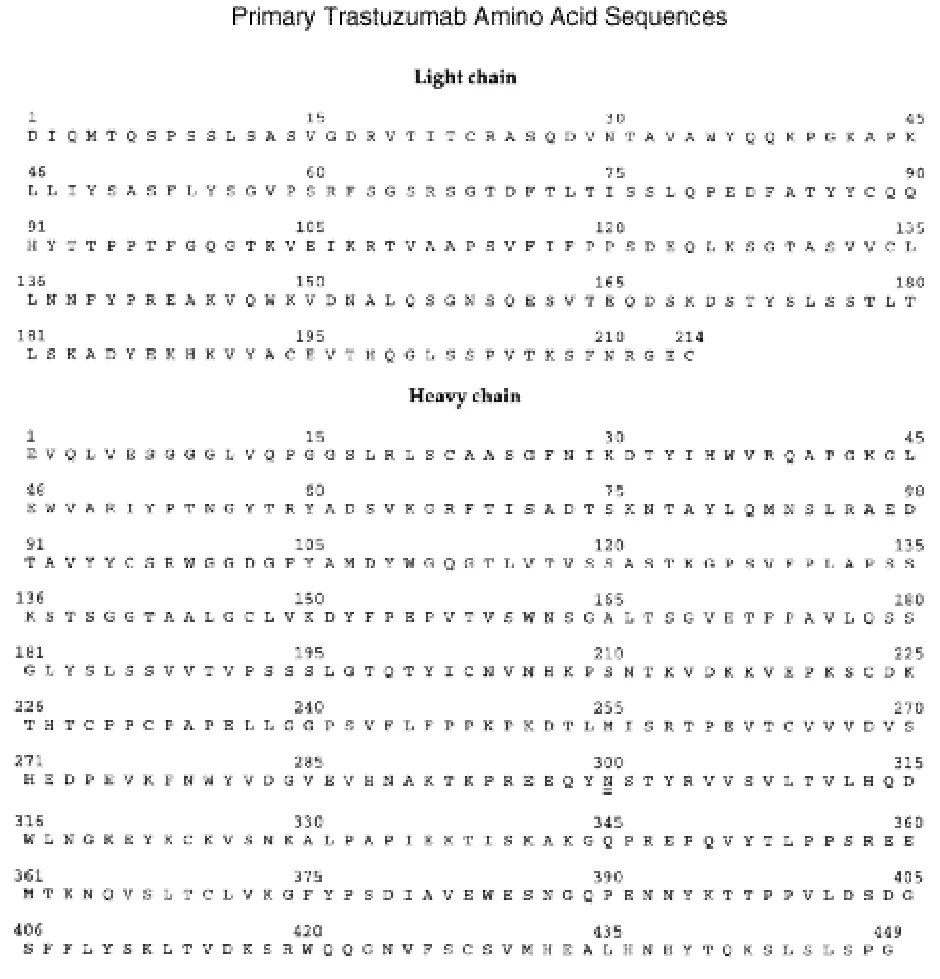
Pharmaceutical standard: Professed
Product Characteristics:
HERCEPTIN (trastuzumab) is a recombinant DNA-derived humanized monoclonal antibody that selectively binds with high affinity in a cell-based assay (Kd = 5 nM) to the extracellular domain of the human epidermal growth factor receptor 2 protein, HER2. The antibody is an IgG1 kappa that contains human framework regions with the complementarity-determining regions of a murine antibody (4D5) that binds to HER2.
The humanized antibody against HER2 is produced by a mammalian cell (Chinese Hamster Ovary) [CHO] suspension culture in a nutrient medium containing the antibiotic gentamicin. Gentamicin is not detectable in the final product.
14. Clinical Trials
14.1. Clinical Trials by Indication
Subcutaneous Formulation – BO22227 (HannaH)
Study BO22227 was designed to demonstrate non-inferiority of HERCEPTIN SC versus HERCEPTIN based on co-primary endpoints: trastuzumab Ctrough at pre-dose Cycle 8, and pathological complete response (pCR) rate at definitive surgery.
A total of 596 patients with HER2-positive, operable or locally advanced breast cancer (LABC) including inflammatory breast cancer were randomized to receive eight cycles of either HERCEPTIN (n=299 patients) or HERCEPTIN SC (n=297 patients) concurrently with chemotherapy [docetaxel followed by FEC (5-Fluorouracil, epirubicin, cyclophosphamide)], followed by surgery, and continued therapy with HERCEPTIN SC or HERCEPTIN as originally randomized for an additional 10 cycles, for a total of one year of treatment. The mean duration of all HERCEPTIN SC injections was 3.3 minutes.
The PK evaluable population for Ctrough at pre-dose cycle 8 included n=235 patients from the HERCEPTIN arm and n=234 patients from the HERCEPTIN SC arm. A total of 85 patients were excluded from the PK evaluable population (n=41 HERCEPTIN and n=44 HERCEPTIN SC) due to a) patients in HERCEPTIN group did not receive re-loading with 8 mg/kg due to dose delay in Cycle 7 (HERCEPTIN: n=4, HERCEPTIN SC: n=N/A), b) 2 days deviation from planned date for Ctrough collection (HERCEPTIN: n=39, HERCEPTIN SC: n=44), and c) abnormal Ctrough value (HERCEPTIN: n=1, HERCEPTIN SC: n=0).
The PK results demonstrated that HERCEPTIN SC yielded serum trastuzumab Ctrough levels at pre-dose Cycle 8 that were non-inferior compared with HERCEPTIN as the lower bound of the two-sided 90% Confidence Interval (90% CI) of the geometric mean ratio (GMR) for Ctrough (SC)/Ctrough (IV) was above the pre-specified inferiority boundary of 0.8 (GMR 1.33; 90% CI: 1.24 – 1.44).
Table 25 Summary of Statistics for the Observed Serum Ctrough (mcg/mL) at Pre-dose Cycle 8 (PKPP1)
HERCEPTIN N = 235 | HERCEPTIN SC N = 234 | |
|---|---|---|
| Mean | 57.8 | 78.7 |
| Geometric mean | 51.8 | 69.0 |
| Range | 14.2—222.0 | 6.0—400.0 |
| SD | 30.3 | 43.9 |
| %CV | 52.5% | 55.8% |
| GMRa | 1.33 | |
| 90% CI of the GMR | 1.24; 1.44 |
CI = confidence interval; CV = coefficient of variation; GMR = geometric mean ratio;
SD = standard deviation; a ratio of test treatment group (HERCEPTIN SC) to reference treatment group (HERCEPTIN).
The pCR co-primary endpoint, which was considered to be an exploratory endpoint, was defined as the absence of invasive neoplastic cells of the primary tumor in the breast after surgery. The analysis of the pCR endpoint was based on patients who had at least one efficacy assessment after administration of the first treatment cycle. Therefore, a total of 591/596 patients (297 patients in the HERCEPTIN arm and 294 in the HERCEPTIN SC arm) were included for the analysis.
The analysis of the co-primary study endpoint, pCR, established non-inferiority of HERCEPTIN SC as the lower boundary of the one-sided 97.5% confidence interval for the difference in pCR rates was above the pre-defined non-inferiority margin of -12.5%. Since the aim of the development program was to determine the HERCEPTIN SC regimen that would result in non-inferior Ctrough levels to the intravenous formulation of HERCEPTIN, the analysis of pCR should be interpreted only in relation to the objective of this study.
Table 26 Summary of pathological Complete Response (pCR)
HERCEPTIN (N = 297) | HERCEPTIN SC (N =294) | |||||
|---|---|---|---|---|---|---|
| pCR (absence of invasive neoplastic cells in breast) | 111 (37.4%) | 124 (42.2%) | ||||
| Non-responders | 186 (62.6%) | 170 (57.8%) | ||||
| Exact 95% CI for pCR Rate* | (31.9;43.1) | (36.5; 48.0) | ||||
| Difference in pCR (SC minus IV arm) | 4.80 | |||||
| Lower bound one-sided 97.5% CI for the difference in pCR** | -3.3 | |||||
* Confidence interval for one sample binomial using Pearson-Clopper method
** Continuity correction of Anderson and Hauck (1986) has been used in this calculation
Intravenous Formulation
Information in this section reports data from a separate Product Monograph for HERCEPTIN.
Early Breast Cancer (EBC)
In the adjuvant treatment setting, HERCEPTIN was investigated in 4 large multicentre, randomised, trials:
- The HERA study was designed to compare one year of three-weekly HERCEPTIN treatment versus observation in patients with HER2 positive EBC following surgery, established chemotherapy and radiotherapy (if applicable).
- The NSAPB B31 and NCCTG N9831 studies that comprise the Joint Analysis were designed to investigate the clinical utility of combining HERCEPTIN treatment with paclitaxel following AC chemotherapy in HER2 positive EBC following surgery. Additionally, the NCCTG N9831 study investigated adding HERCEPTIN sequentially after AC-paclitaxel chemotherapy in patients with HER2 positive EBC following surgery.
- The BCIRG-006 study was designed to investigate combining HERCEPTIN treatment with docetaxel either following AC chemotherapy, or in combination with docetaxel and carboplatin in patients with HER2 positive EBC following surgery.
The comparative efficacy and safety between different chemotherapy regimens (i.e. concurrent versus sequential, anthracycline containing versus non-anthracycline containing) was not studied.
Eligible patients in the four studies included women with operable, non-metastatic adenocarcinoma of the breast whose tumours overexpressed HER2 and who had either node-positive or high-risk node-negative disease. Definitions used in each protocol are shown in Table 27.
| Table 27 Eligible Populations in EBC Studies, by TNM Categoriesa | ||||||||||||||
|---|---|---|---|---|---|---|---|---|---|---|---|---|---|---|
| STUDY | AJCC TNM Version | T | N | M | Comment | |||||||||
| HERA | Staging Manual 5th edition (1997) | ≥T1c, T2, T3, pT4 | N0, N1, N2, N3 | M0 | Prior (neo)adjuvant chemotherapy required. Prior radiotherapy required for nodal (axillary, internal mammary) or pT4 disease. | |||||||||
| NSABP B-31 | Staging Manual 5th edition (1997) updated May 2003 to: Staging Manual 6th edition (2002) | clinical T1, T2, T3 updated May 2003 to: T1, T2, T3 (clinical and pathologic) | cN0, cN1 updated May 2003 to: cN0, cN1 and pN1, pN2a, pN3a | M0 | No prior chemotherapy or radiotherapy permitted. Whole breast irradiation required during study; partial breast or internal mammary radiation prohibited. | |||||||||
| NCCTG N9831 | Staging Manual 5th edition (1997) | T1, T2, T3 | pN1, pN2 (minimum 1/6 nodes) | M0 | No prior chemotherapy or radiotherapy permitted. Breast + regional lymphatic irradiation during study, per radiotherapist. | |||||||||
| T1c (ER-/PR- only), T2, T3 | pN0 (minimum sentinel node or 1/6 nodes) | |||||||||||||
| BCIRG-006 | Staging Manual 5th edition (1997) [not specified in protocol] | T1, T2, T3 | pN1, pN2 (minimum 1/6 nodes) | M0 | No prior chemotherapy or radiotherapy permitted. Breast + regional lymphatic irradiation during study, per radiotherapist. | |||||||||
| ≥T2, or ER-/PR-, or nuclear Grade | pN0 (minimum | |||||||||||||
| 2-3, or age <35 yrs | sentinel node or 1/6 nodes) | |||||||||||||
a Required for all studies: (1) invasive adenocarcinoma on histologic examination; (2) complete excision of primary tumour with tumour-free margins on histologic examination of specimens from definitive surgery; and (3) HER2 positive tumour
HERA
In the adjuvant setting, HERCEPTIN was investigated in HERA, a multicentre, randomised, trial designed to compare one and two years of three-weekly HERCEPTIN treatment versus observation in patients with HER2 positive EBC following surgery, established chemotherapy and radiotherapy (if applicable). In addition, a comparison of two years HERCEPTIN treatment versus one year HERCEPTIN treatment was performed, with the objective to assess the superiority of two years of HERCEPTIN treatment relative to one year of HERCEPTIN treatment. Breast tumour specimens were required to show HER2 overexpression (3+ by IHC) or gene amplification (by FISH) as determined at a central laboratory.
Patients assigned to receive HERCEPTIN were given an initial loading dose of 8 mg/kg, followed by 6 mg/kg every three weeks for either one or two years. One year of HERCEPTIN treatment was defined as 12 calendar months of treatment from day 1 of first administration and 18 infusions maximum. Two years of HERCEPTIN treatment were defined as 24 calendar months of treatment from day 1 of first administration and 35 infusions maximum.
The efficacy results from the HERA trial are summarized in Table 28. Please see 8 Adverse Reactions and 7 Warnings and Precautions, Cardiovascular, Cardiotoxicity, Early Breast Cancer for a summary of the HERA safety information.
| Table 28 Efficacy Results from the HERA Trial: Results at 12 months* and 8 years** of median follow-up | ||||||||||||
|---|---|---|---|---|---|---|---|---|---|---|---|---|
Median follow-up 12 months | Median follow-up 8 years | |||||||||||
| Parameter | Observation N=1693 | HERCEPTIN 1 Year N = 1693 | Observation N=1697*** | HERCEPTIN 1 Year N=1702*** | ||||||||
| Primary endpoint | ||||||||||||
| Disease-free survival (DFS) | ||||||||||||
| 219 (12.9%) 1474 (87.1%) | 127 (7.5%) 1566 (92.5%) | 570 (33.6%) 1127 (66.4%) | 471 (27.7%) 1231 (72.3%) | ||||||||
| P-value versus Observation | <0.0001 | |||||||||||
Hazard Ratio versus Observation Adjusted (99.9%) Confidence Interval**** | 0.54 (0.38, 0.78) | 0.76 | ||||||||||
| Key secondary endpoints | ||||||||||||
| Recurrence-free survival | ||||||||||||
| 208 (12.3%) | 113 (6.7%) | 506 (29.8%) | 399 (23.4%) | ||||||||
| 1485 (87.7%) | 1580 (93.3%) | 1191 (70.2%) | 1303 (76.6%) | ||||||||
| Hazard Ratio versus Observation | 0.51 | 0.73 | ||||||||||
| Distant disease-free survival | ||||||||||||
| 184 (10.9%) | 99 (5.8%) | 488 (28.8%) | 399 (23.4%) | ||||||||
| 1508 (89.1%) | 1594 (94.6%) | 1209 (71.2%) | 1303 (76.6%) | ||||||||
| Hazard Ratio versus Observation | 0.50 | 0.76 | ||||||||||
| Overall survival (death) | ||||||||||||
| 40 (2.4%) | 31 (1.8%) | 350 (20.6%) | 278 (16.3%) | ||||||||
| 1653 (97.6%) | 1662 (98.2%) | 1347 (79.4%) | 1424 (83.7%) | ||||||||
| Hazard Ratio versus Observation | 0.75 | 0.76 | ||||||||||
*Co-primary endpoint of DFS of 1 year vs observation met the pre-defined statistical boundary of 0.0010.
**Final analysis (including crossover of 52% of patients from the observation arm to HERCEPTIN).
***There is a discrepancy in the overall sample size due to a small number of patients who were randomized after the cut-off date for the 12-month median follow-up analysis.
**** Adjusted (both for the interim analysis and the 2 comparisons of each HERCEPTIN arm (1 year and 2 years) vs. observation) confidence interval presented, to reflect the stopping boundary of p≤ 0.0010 of the comparison HERCEPTIN 1 year vs. observation. The interval represents the 99.9% confidence interval.
The efficacy results from the interim efficacy analysis crossed the protocol pre-specified statistical boundary of 0.0010 for the comparison of 1-year of HERCEPTIN vs. observation. After a median follow-up of 12 months, the hazard ratio (HR) for disease free survival (DFS) was 0.54 (adjusted 99.9% CI: 0.38, 0.78) which translates into an absolute benefit, in terms of a 2-year disease-free survival rate, of 7.6 percentage points (85.8% vs. 78.2%) in favour of the HERCEPTIN arm. Please see Figure 1.
A final analysis was performed after a median follow-up of 8 years, which showed that 1 year HERCEPTIN treatment is associated with a 24% risk reduction compared to observation only (HR = 0.76, unadjusted 95% CI: 0.67, 0.86). This translates into an absolute benefit in terms of an 8 year disease free survival rate of 6.4% in favour of 1 year HERCEPTIN treatment.
In this final analysis, superiority of 2 years HERCEPTIN treatment over 1 year HERCEPTIN treatment could not be demonstrated (DFS HR in the intent to treat (ITT) population of 2 years vs 1 year = 0.99 (unadjusted 95% CI: 0.87, 1.13), p-value = 0.90 and OS HR = 0.98 (unadjusted 95% CI: 0.83, 1.15); p-value = 0.78). The rate of secondary cardiac endpoints was increased in the 2-year treatment arm (8.1% vs 4.6% in the 1-year treatment arm). More patients experienced at least one grade 3 or 4 adverse event in the 2-year treatment arm (20.4%) compared with the 1-year treatment arm (16.3%).
Figure 1 Kaplan-Meier curve of Disease Free survival (After a Median Follow-up of 12 Months)
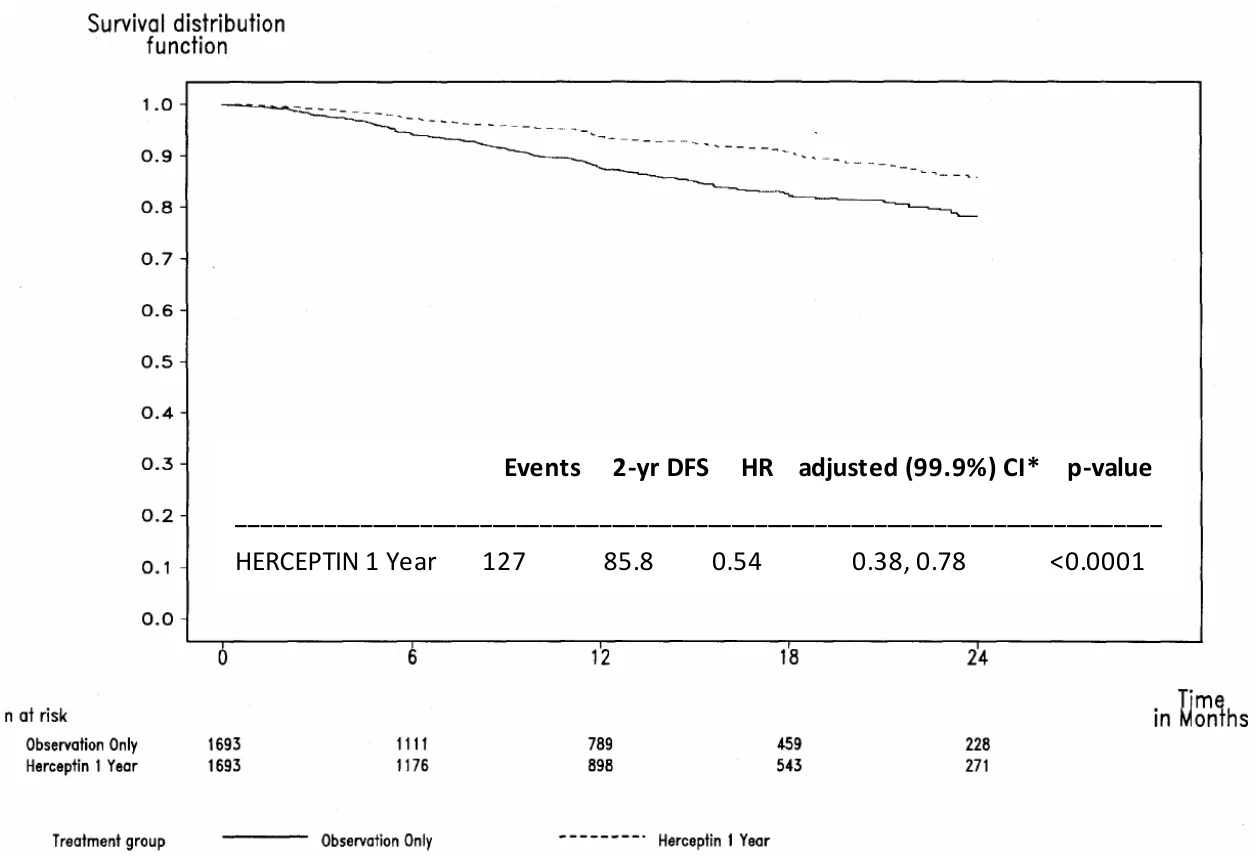
*Adjusted (both for the interim analysis and the 2 comparisons of each HERCEPTIN arm (1 year and 2 years) vs. observation) confidence interval presented, to reflect the stopping boundary of p≤ 0.0010 of the comparison HERCEPTIN 1 year vs. observation. The interval represents the 99.9% confidence interval.
The benefit in disease-free survival was seen in all subgroups analysed (Please see Figure 2).
Events 2-yr DFS HR adjusted (99.9%) CI* p-value
_____________________________________________________________________________
HERCEPTIN 1 Year 127 85.8 0.54 0.38, 0.78 <0.0001
Observation 219 78.2
Figure 2 Risk Ratios and 95% Confidence Intervals for Disease-Free Survival by Subgroup (After a Median Follow-up of 12 Months)
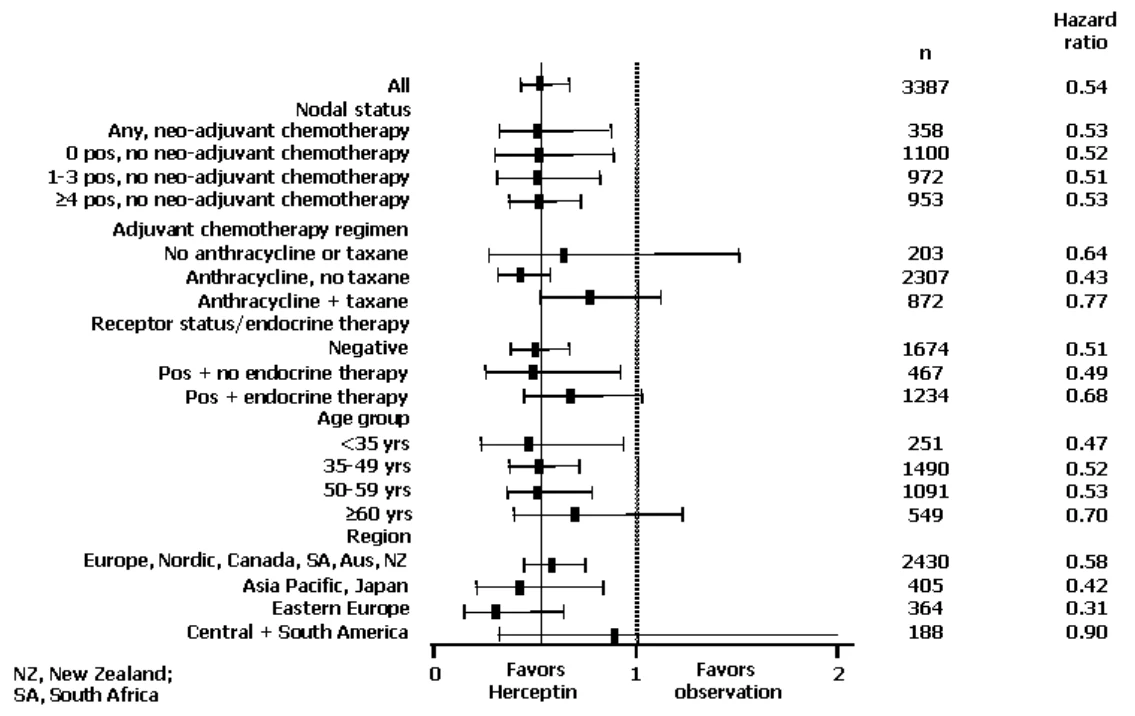
Note: 95%-CIs are not adjusted for multiple testing.
Twenty one (1.2%) patients in the HERCEPTIN arm and 16 (0.9) patients in the observation had CNS metastases as first site of relapse.
Figure 3 Kaplan-Meier Curve of Recurrence-Free Survival (After a Median Follow-up of 12 Months)
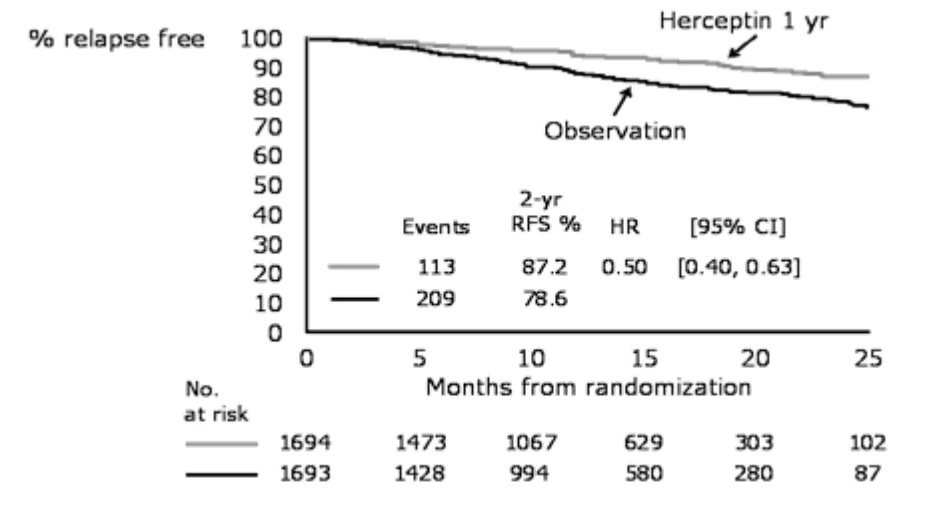
Note: 95%-CI is not adjusted for multiple testing.
Figure 4 Kaplan-Meier Curve of Distant-Disease-Free Survival (After a Median Follow-up of 12 Months)
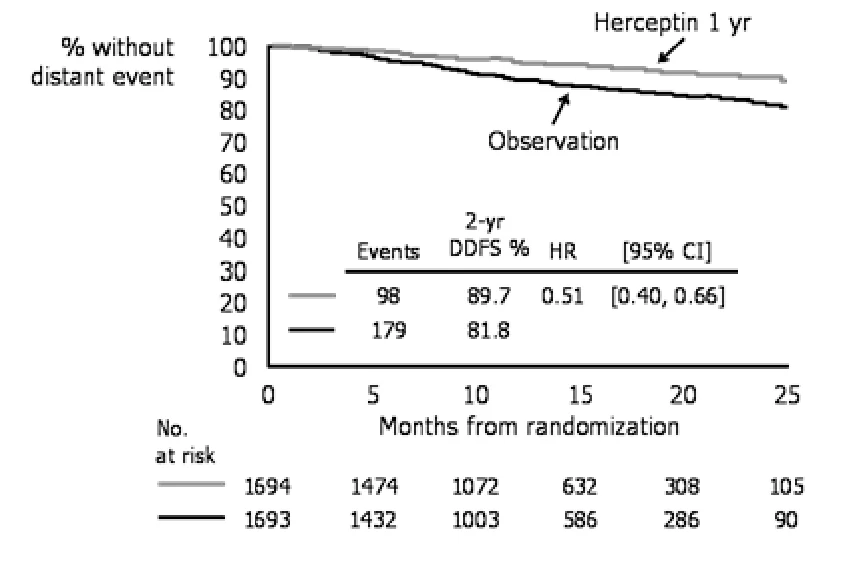
Note: 95%-CI is not adjusted for multiple testing.
Joint Analysis: NSABP B-31 and NCCTG N9831
Two cooperative group trials, NSABP B-31 and NCCTG N9831, evaluated the efficacy of incorporating HERCEPTIN into standard adjuvant systemic therapy in women with early stage, HER2 positive breast cancer. Breast tumour specimens were required to show HER2 overexpression (3+ by IHC) or gene amplification (by FISH). HER2 testing was verified by a central laboratory prior to randomization (N9831) or was required to be performed at a reference laboratory (B-31). Patients were randomized to receive doxorubicin and cyclophosphamide followed by paclitaxel (AC→T) or doxorubicin and cyclophosphamide followed by paclitaxel plus HERCEPTIN (AC→T + H). In both trials patients received four cycles (3 weeks per cycle) of doxorubicin, at 60 mg/m2 IV push, concurrently with IV cyclophosphamide at 600 mg/m2 over 20–30 minutes. Paclitaxel was administered weekly (80mg/m2) or every 3 weeks (175mg/m2) for a total of 12 weeks in NSABP B-31; paclitaxel was administered weekly (80mg/m2) for 12 weeks in NCCTG N9831. HERCEPTIN was administered at a loading dose of 4 mg/kg load followed by 2 mg/kg IV weekly. HERCEPTIN commenced with paclitaxel and continued for a total of 52 weeks in both trials. Disease-free survival was the pre-specified primary endpoint of the combined efficacy analysis of these studies.
A total of 3752 patients were evaluable for analysis of efficacy at the time of the definitive disease-free survival analysis. Median follow-up from the time of randomization was 1.8 years for the chemotherapy alone arm and 2.0 years for the HERCEPTIN + chemotherapy arm for both studies combined. Efficacy results are presented in Table 29 and Figure 5. For the primary endpoint, disease-free survival, addition of HERCEPTIN to chemotherapy reduced the risk of a first event by 52%. Please see 8 Adverse Reactions and 7 Warnings and Precautions, Cardiovascular, Cardiotoxicity, Early Breast Cancer for a summary of the Joint Analysis safety information.
Table 29 Joint Analysis: NSABP B-31 and NCCTG N9831 Efficacy Results at the Time of the Definitive Disease-Free Survival Analysis* (ITT population)
AC→Ta n=1880 | AC→T+HERCEPTINa n=1872 | |||
|---|---|---|---|---|
| No. with Event | No. with Event | Hazard Ratio b (95% CI) | p-value c | |
| Disease-free survival (DFS) | 261 | 133 | 0.48 (0.39–0.59) | < 0.0001 |
| Overall survival (OS) | 92 | 62 | 0.67 | NSd |
CI = confidence interval.
Disease-free survival was defined as the time from randomization to recurrence, contralateral breast cancer or other second primary cancer, or death, whichever occurred first. Overall survival was defined as the time from randomization to death.
* at median duration of follow up of 1.8 years for the patients in the AC→T arm and 2.0 years for patients in the AC→TH arm
a NSABP B-31 and NCCTG N9831 regimens: doxorubicin and cyclophosphamide followed by paclitaxel (AC→T) or paclitaxel plus HERCEPTIN (AC→TH).
b Hazard ratio estimated by Cox regression stratified by clinical trial, intended paclitaxel schedule, number of positive nodes, and hormone receptor status.
c stratified log-rank test.
d NS=non-significant.
Figure 5 Duration of Disease-Free Survival in Patients from the Joint Analysis:
NSABP B-31 and NCCTG N9831
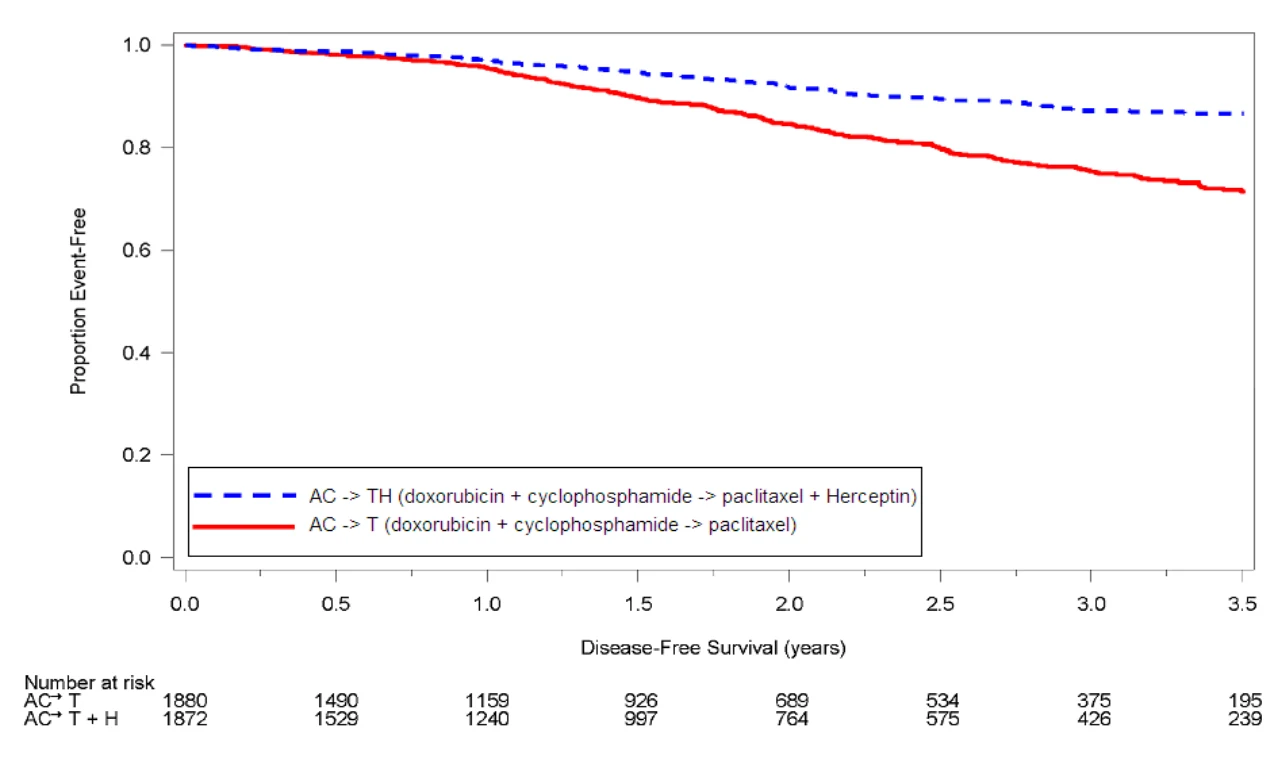
There were insufficient numbers of patients within each of the following subgroups to determine if the treatment effect was different from that of the overall patient population: Black, Hispanic, Asian/Pacific Islander patients, node-negative high-risk patients, and patients > 65 years of age.
The pre-planned final analysis of overall survival (OS) from the joint analysis of studies NSABP B-31 and NCCTG N9831 was performed when 707 deaths had occurred (median follow-up 8.3 years in the AC→T+H group). Treatment with AC→T+H resulted in a statistically significant improvement in OS compared with AC→T (stratified HR=0.64; 95.1% CI [0.55, 0.74]; log-rank p-value < 0.0001); formal boundary for statistical significance p-value=0.0245). At 8 years, the survival rate was estimated to be 86.9% in the AC→T+H arm and 79.4% in the AC→T arm, an absolute benefit of 7.4% (refer to Figure 6).
The final OS results from the joint analysis of studies NSABP B-31 and NCCTG N9831 are summarized in Table 30.
Table 30 Final Overall Survival Analysis from the Joint Analysis: NSABP B-31 and NCCTG N9831
AC→Ta n=2032 | AC→T+HERCEPTINa n=2031 | |||
|---|---|---|---|---|
| No. with Event | No. with Event | Hazard Ratio (95.1% CI) | p-value | |
| Overall Survival | 418 (20.6%) | 289 (14.2%) | 0.64 (0.55–0.74) | < 0.0001 |
a NSABP B-31 and NCCTG N9831 regimens: doxorubicin and cyclophosphamide followed by paclitaxel (AC→T) or paclitaxel plus HERCEPTIN (AC→TH).
Figure 6 Duration of Overall Survival in Patients from the Joint Analysis: NSABP B-31 and NCCTG N9831
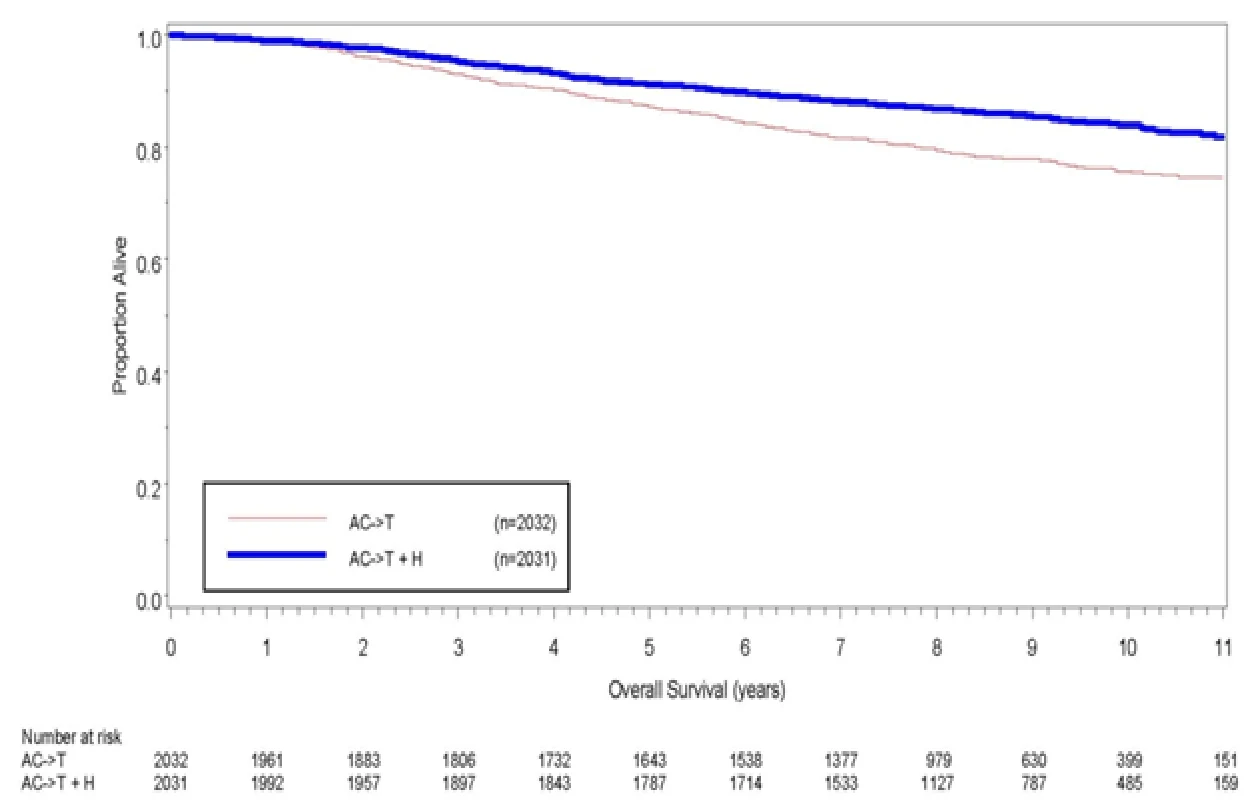
Disease-Free Survival (DFS) analysis was also performed at the final analysis of OS from the joint analysis of studies NSABP B-31 and NCCTG N9831. The updated DFS analysis results showed a similar DFS benefit compared to the definitive primary DFS analysis.
BCIRG-006
In the BCIRG006 study, patients were randomized (1:1:1) to receive doxorubicin and cyclophosphamide followed by docetaxel (AC→T), doxorubicin and cyclophosphamide followed by docetaxel plus HERCEPTIN (AC→TH), or docetaxel and carboplatin plus HERCEPTIN (TCH). HERCEPTIN was administered weekly (initial dose of 4 mg/kg followed by weekly dose of 2 mg/kg) concurrently with either T or TC, and then every 3 weeks (6 mg/kg) as monotherapy for a total of 52 weeks.
In the AC→T arm, doxorubicin 60 mg/m2 IV was administered in combination with cyclophosphamide 600 mg/m2 IV on an every 3 week basis for 4 cycles followed by docetaxel 100 mg/m2 as 1 hour IV infusion on an every 3 week basis for 4 cycles.
In the AC→TH arm, every 3 weeks for four cycles, patients in the AC→TH arm received 60 mg/m2 doxorubicin as a 5- to 15-minute intravenous (IV) bolus injection followed by 600 mg/m2 IV cyclophosphamide as a 5- to 60-minute IV bolus injection. Three weeks after the last treatment with AC (i.e., on Day 1 of Cycle 5), a 4-mg/kg HERCEPTIN loading dose was administered as a 90-minute IV infusion. Beginning on Day 8 of Cycle 5, 2 mg/kg HERCEPTIN was administered as a 30-minute IV infusion every week. Docetaxel 100 mg/m2 was administered as a 1-hour IV infusion every 3 weeks for four cycles, beginning on Day 2 of Cycle 5 and then on Day 1 of all subsequent cycles. Beginning 3 weeks after the last treatment with docetaxel, 6 mg/kg HERCEPTIN was administered as a 30-minute IV infusion every 3 weeks.
In the TCH arm, patients received a 4-mg/kg HERCEPTIN loading dose as a 90-minute IV infusion on Day 1 of Cycle 1. Beginning on Day 8 of Cycle 1, 2 mg/kg HERCEPTIN was administered as a 30-minute IV infusion every week. Every 3 weeks for six cycles, beginning on Day 2 of Cycle 1 and then on Day 1 of all subsequent cycles, 75 mg/m2 docetaxel was administered as a 1-hour IV infusion, followed by carboplatin at a target area under the concentration–time curve of 6 mg/mL/min as a 30- to 60-minute IV infusion (the dose of carboplatin was calculated using a modified Calvert formula). Beginning 3 weeks after the last treatment with chemotherapy, 6 mg/kg HERCEPTIN was administered as a 30-minute IV infusion every 3 weeks.
HERCEPTIN in combination with docetaxel and carboplatin (TCH) is a non-anthracycline containing regimen and therefore testing of this regimen in study BCIRG006 offered the possibility to evaluate formally a less cardiotoxic regimen for the adjuvant treatment of early stage HER2 positive breast cancer.
Breast tumour specimens were required to show HER2 gene amplification (FISH+ only) as determined at a central laboratory.
The efficacy results from the BCIRG006, the primary endpoint of disease-free survival and the secondary endpoint of overall survival, are summarized in the following tables:
| Table 31 Overview of Efficacy Analyses BCIRG006 AC→T versus AC→TH | |||||||||
|---|---|---|---|---|---|---|---|---|---|
| Parameter | AC→T (N=1073) | AC→TH (N=1074) | p-value vs AC→T (log-rank) | Hazard Ratio vs AC→T** (95% CI) | |||||
Disease-free survival No. patients with event | 195 | 134 | <0.0001 | 0.61 (0.44, 0.85)* | |||||
Overall survival (Death)*** No. patients with event | 80 | 49 | *** | 0.58 (0.40, 0.83) | |||||
AC→T = doxorubicin plus cyclophosphamide, followed by docetaxel; AC→TH = doxorubicin plus cyclophosphamide, followed by docetaxel plus trastuzumab; CI = confidence interval
*The 95% CI is the repeated confidence interval (RCI) adjusted by multiple interim looks.
**Hazard ratio was estimated by Cox regression stratified by number of positive nodes and hormonal receptor status.
***Secondary endpoint
| Table 32 Overview of Efficacy Analyses BCIRG006 AC→T versus TCH | ||||||||
|---|---|---|---|---|---|---|---|---|
| Parameter | AC→T (N=1073) | TCH (N=1074) | p-value vs AC→T (log-rank) | Hazard Ratio vs AC→T** (95% CI) | ||||
Disease-free survival No. patients with event | 195 | 145 | 0.0003 | 0.67 (0.49,0.92)* | ||||
Overall survival (Death)*** No. patients with event | 80 | 56 | *** | 0.66 (0.47, 0.93) | ||||
AC→T = doxorubicin plus cyclophosphamide, followed by docetaxel; TCH = docetaxel, carboplatin and trastuzumab; CI = confidence interval
*The 95% CI is the repeated confidence interval (RCI) adjusted by multiple interim looks.
**Hazard ratio was estimated by Cox regression stratified by number of positive nodes and hormonal receptor status.
***Secondary endpoint
Figure 7 Duration of Disease-Free Survival in Patients from BCIRG-006
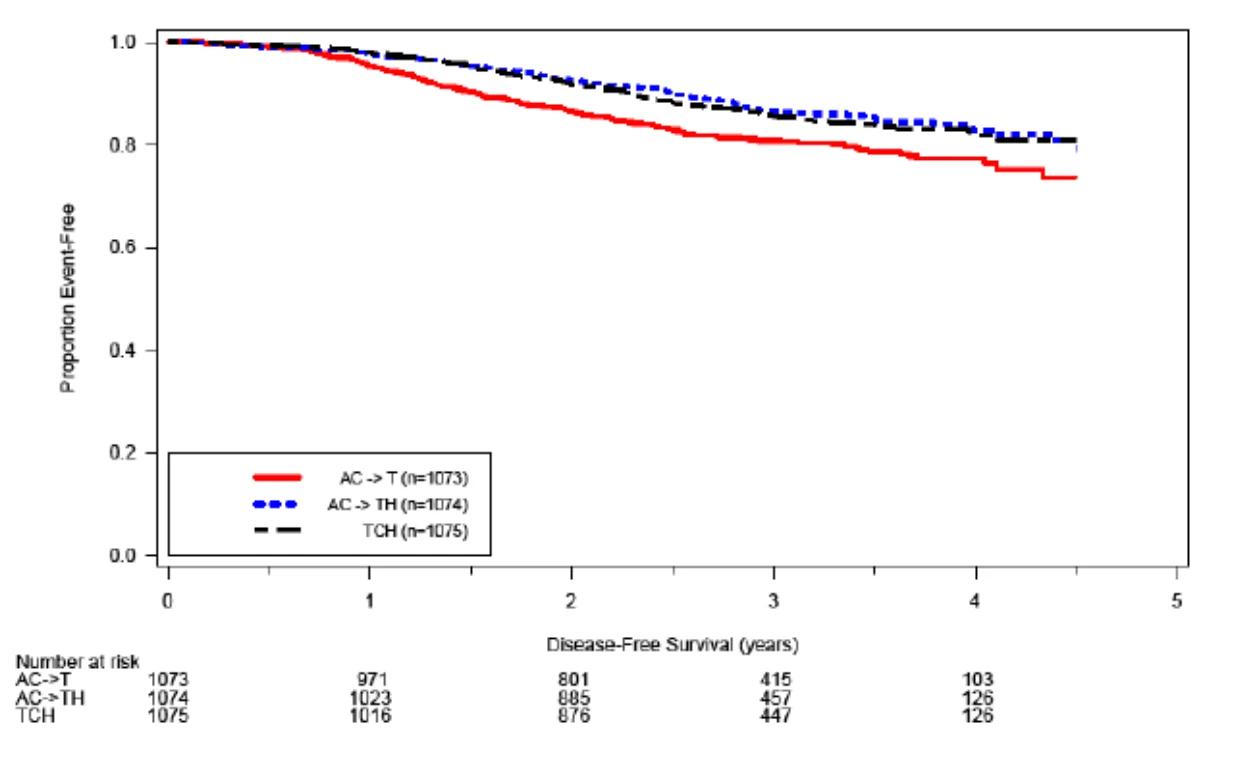
AC→T = doxorubicin plus cyclophosphamide, followed by docetaxel
AC→TH = doxorubicin plus cyclophosphamide, followed by docetaxel plus trastuzumab
TCH = docetaxel, carboplatin and trastuzumab
Metastatic Breast Cancer (MBC)
The safety and efficacy of HERCEPTIN were studied in a multicentre, randomized, controlled clinical trial conducted in 469 patients with HER2- overexpressing MBC who had not been previously treated with chemotherapy for metastatic disease. Patients were eligible if they had 2+ or 3+ levels of overexpression (based on a 0 to 3+ scale) by immunohistochemical assessment of tumour tissue performed by a central testing lab. Eligible patients were randomized to receive chemotherapy alone or in combination with HERCEPTIN given intravenously as a 4 mg/kg loading dose followed by weekly doses of HERCEPTIN at 2 mg/kg. For those who had received prior anthracycline therapy in the adjuvant setting, chemotherapy consisted of paclitaxel (175 mg/m2 over 3 hours every 21 days for at least six cycles); for all other patients, chemotherapy consisted of anthracycline plus cyclophosphamide (AC: doxorubicin 60 mg/m2 or epirubicin 75 mg/m2 plus 600 mg/m2 cyclophosphamide every 21 days for six cycles). Compared with patients in the AC subgroups (n=281), patients in the paclitaxel subgroups (n=188) were more likely to have had the following: poor prognostic factors (premenopausal status, estrogen or progesterone receptor negative tumours, positive lymph nodes), prior therapy (adjuvant chemotherapy, myeloablative chemotherapy, radiotherapy), and a shorter disease-free interval.
Compared with patients randomized to chemotherapy alone, the patients randomized to HERCEPTIN and chemotherapy experienced a significantly longer median time to disease progression, a higher overall response rate (ORR), a longer median duration of response, and a higher one-year survival rate. These treatment effects were observed both in patients who received HERCEPTIN plus paclitaxel and in those who received HERCEPTIN plus AC, however the magnitude of the effects was greater in the paclitaxel subgroup. The degree of HER2 overexpression was a predictor of treatment effect.
The results of the study are discussed in Table 33.
| Table 33 Phase III Clinical Efficacy in First-Line Treatment | |||||||||||||||||||||||||
| Combined Results | Paclitaxel Subgroup | AC Subgroup | |||||||||||||||||||||||
HERCEPTIN + Chemotherapy (n=235) | Chemotherapy (n=234) | HERCEPTIN + Paclitaxel (n=92) | Paclitaxel (n=96) | HERCEPTIN + ACa (n=143) | AC (n=138) | ||||||||||||||||||||
| Primary Endpoint | |||||||||||||||||||||||||
| Time to Progressionb,c | |||||||||||||||||||||||||
| Median (months) | 7.6 | 4.6 | 6.9 | 3.0 | 8.1 | 6.1 | |||||||||||||||||||
| 95% confidence interval | (7.0, 9.4) | (4.4, 5.4) | (5.3, 9.9) | (2.1, 4.3) | (7.3, 9.9) | (4.9, 7.1) | |||||||||||||||||||
| p-value | 0.0001 | 0.0001 | 0.0003 | ||||||||||||||||||||||
| Secondary Endpoints | |||||||||||||||||||||||||
| Overall Response Rateb | |||||||||||||||||||||||||
| Rate (percent) | 48 | 32 | 42 | 16 | 52 | 43 | |||||||||||||||||||
| 95% confidence interval | (42, 55) | (26, 38) | (32, 52) | (8, 23) | (44, 61) | (34, 51) | |||||||||||||||||||
| p-value | 0.0002 | < 0.0001 | 0.1038 | ||||||||||||||||||||||
| Duration of Responseb,c | |||||||||||||||||||||||||
| Median (months) | 9.3 | 5.9 | 11.0 | 4.4 | 9.1 | 6.5 | |||||||||||||||||||
| 95% confidence interval | (8.0, 11.0) | (5.5, 7.0) | (8.2, >19.8) | (3.9, 5.3) | (7.2, 11.0) | (5.8, 8.0) | |||||||||||||||||||
| p-value | 0.0001 | 0.0001 | 0.0025 | ||||||||||||||||||||||
| 1-Year Survivalc | |||||||||||||||||||||||||
| Percent alive | 78 | 67 | 72 | 60 | 83 | 72 | |||||||||||||||||||
| p-value | 0.0080 | 0.0975 | 0.0415 | ||||||||||||||||||||||
a AC = anthracycline (doxorubicin or epirubicin) and cyclophosphamide.
b Assessed by an independent Response Evaluation Committee.
c Kaplan-Meier Estimate
HERCEPTIN was also studied as a single agent in a multicentre, open-label, single-arm clinical trial in patients with HER2- overexpressing metastatic breast cancer who had relapsed following one or two prior chemotherapy regimens for metastatic disease. Of 222 patients enrolled, 68% had received prior adjuvant chemotherapy, 32% had one and 68% had received two prior chemotherapy regimens for metastatic disease, and 26% had received prior myeloablative treatment with hematopoietic rescue. Patients were treated with a loading dose of 4 mg/kg IV followed by weekly doses of HERCEPTIN at 2 mg/kg. The ORR (complete response + partial response), as determined by an independent Response Evaluation Committee, was 15% (with 8 patients having a complete response and 26 patients with a partial response) with a median survival of 13 months. Complete responses were observed only in patients with disease limited to skin and lymph nodes. The degree of HER2 overexpression was a predictor of treatment effect.
15. Microbiology
No microbiological information is required for this drug product.
16. Non-Clinical Toxicology
Subcutaneous Formulation
General toxicology A single dose study in rabbits and a 13-week repeat dose toxicity study in Cynomolgus monkeys were conducted via the subcutaneous route. The rabbit study was performed to specifically examine local tolerance aspects. The 13-week study was performed to confirm that the change in route of administration and the use of the novel excipient recombinant human hyaluronidase PH20 (rHuPH20) did not have an effect on the trastuzumab safety characteristics. Trastuzumab subcutaneous formulation was locally and systemically well-tolerated.
Acute Toxicity Studies /Local tolerance: In a single dose local tolerance study, single injections of 60 mg/injection site, were administered to New Zealand White rabbits subcutaneously in the right flank (0.5 mL/injection site containing 2,000 U/mL of rHuPH20). No clinical signs of systemic toxicity were observed in the animals during the study, following a one or four day observation period (3 males/group). No trastuzumab related local reactions were observed after subcutaneous injection and there were no macroscopic and microscopic findings that were attributable to treatment with trastuzumab SC.
Multidose Toxicity Studies: In a 13-week repeat dose toxicity study in male and female Cynomolgus monkeys (5/gender/group), subcutaneous administration of trastuzumab as multiple subcutaneous doses in monkeys at 0 mg/kg and 30 mg/kg (containing 12,000 U/mL of rHuPH20, the rHuPH20 dose was approx. 3000 U/kg corresponding to approximately 0.025 mg/kg per SC injection) given weekly for 13 weeks, did not result in any adverse test article-related effects and consequently the no observed adverse effect level was considered to be 30 mg/kg. The results of this study confirm the favourable safety profile of trastuzumab SC and are in line with the toxicity studies conducted with trastuzumab IV formulation.
Hyaluronidase is found in most tissues of the human body. Non-clinical data for recombinant human hyaluronidase PH20 reveal no special hazard for humans based on conventional studies of repeated dose toxicity including safety pharmacology endpoints. Reproductive toxicology studies with rHuPH20 revealed decreased fetal body weights and increased late resorptions in mice at >1200 times the human dose, and did not show teratogenic potential.
Reproductive and developmental toxicology Studies of rHuPH20: In an embryo-fetal study, mice have been dosed daily by subcutaneous injection during the period of organogenesis with recombinant human hyaluronidase PH20 (rHuPH20) at dose levels up to 2,200,000 U/kg, which is >7,200 times higher than the human dose. The study found no evidence of teratogenicity. Reduced fetal weight and increased numbers of fetal resorptions were observed, with no effects found at a daily dose of 360,000 U/kg, which is > 1,200 times higher than the human dose.
In a peri- and post-natal reproduction study, mice have been dosed daily by subcutaneous injection, with rHuPH20 from implantation through lactation and weaning at dose levels up to 1,100,000 U/kg, which is > 3,400 times higher than the human dose. The study found no adverse effects on sexual maturation, learning and memory, or fertility of the offspring.
Intravenous Formulation
General toxicology The trastuzumab toxicology program addressed issues of species specificity, chronic administration, coadministration with chemotherapeutic agents, manufacturing process optimization, and changes in formulation.
Trastuzumab is specific for the human p185HER2 receptor and does not bind the corresponding rodent receptor (p185neu). The in vitro tissue binding profile of trastuzumab to monkey tissues demonstrated that the monkey was an appropriate model for comprehensive toxicity testing.
Acute Toxicity Studies: In acute dose studies, trastuzumab was well tolerated and produced no evidence of systemic toxicity at any dose tested, including the highest dose that could be delivered of a 5 mg/mL formulation. Intravenous administration of trastuzumab as a single dose of 94 mg/kg (mice), or 47-50 mg/kg (monkeys), produced no findings of toxicologic significance in any parameter evaluated.
Bridging studies conducted in monkeys to evaluate the safety and pharmacokinetics of trastuzumab, produced by optimization of the manufacturing process including a cell line change (from H2 to H13), revealed no evidence of acute toxicity or changes in pharmacokinetic disposition in monkeys. Trastuzumab produced from a subsequent manufacturing scale up and formulation change (lyophilization) resulted in comparable pharmacokinetic profiles in monkeys and had no effect on safety endpoints.
The findings from the acute toxicity studies with trastuzumab are summarized in Table 34.
Table 34: Overall Summary of Nonclinical Acute Toxicity Studies with Trastuzumab
| Study No. | Study Type | Species/Strain | No./Sex/Group | Route of Admin. | Dose (mg/kg) | Lot No. | Estimated Safety Factor | Study Duration | |
| Body Weight Ratio | AUCA/AUCH | ||||||||
| 91-629-1450 | Acute Single Dose (GLP) | Mouse/Crl: CD-1® (ICR) BR/VAF/PlusTM | 5/M 5/F | IV | 0 9.4 47 94 | M3-RD175 | --- 4.7x NA 47x | --- 2.8x NA 19x | At least 2 weeks |
| Comments: Trastuzumab was well tolerated and the no observable effect level (NOEL) after a single intravenous bolus injection of trastuzumab was 94.0 mg/kg in mice. | |||||||||
| 91-640-1450 | Acute Single Dose (GLP) | Monkey/ Rhesus | 2/M 2/F | IV | 0 4.7 23.5 47 | M3-RD175 | --- 2.4x NA 24x | --- 1x NA 12x | At least 2 weeks |
| Comments: Trastuzumab was well tolerated and the no observable effect level (NOEL) after a single intravenous bolus injection of trastuzumab was 47.0 mg/kg in rhesus monkeys. | |||||||||
| 94-173-1450a | Acute Single Dose (GLP) | Monkey/ Rhesus | 2/M 2/F | IV | 0 5 50 50 | M3-RD319 A9806AX | --- 2.5x 2.5x 2.5x | --- NA NA NA | At least 2 weeks |
| Comments: A single intravenous dose of trastuzumab H13 or trastuzumab H2 up to 50 mg/kg was well tolerated and produced no adverse effects in rhesus monkeys. | |||||||||
| 94-436-1450b | Acute single Dose (GLP) | Monkey/ Rhesus | 4/F | IV | 1.5 1.5 | M3-RD319 C9802AX | 0.8x 0.8x | NA NA | 30 days |
| Comments: The single intravenous administration of trastuzumab (H13-1K) or trastuzumab (H13-12K) at a dose level of 1.5 mg/kg was well tolerated and produced no test material-related differential effects on toxicity parameters in female rhesus monkeys. | |||||||||
| 95-490-1450c | Acute Single Dose (GLP) | Monkey/ Rhesus | 6/F | IV | 1.5 1.5 | M4-RD494 C9807AX | 0.8x 0.8x | NA NA | 11 weeks |
| Comments: This crossover study was conducted to provide serum samples from rhesus monkeys following single intravenous bolus injections of trastuzumab (single dose liquid formulation) and trastuzumab (multi-dose lyophilized formulation) to compare their pharmacokinetic profiles. All animals survived the study, and no test material-related overt clinical signs of toxicity were observed. Furthermore, there were no statistically significant or otherwise notable differences between the two groups that might be attributed to the different formulations. | |||||||||
IV=Intravenous
a This study was conducted to support a liquid formulation process change from trastuzumab H2 to trastuzumab H13.
b This study was conducted to support the clinical use of trastuzumab produced by a scaled-up manufacturing process, trastuzumab (H13-12K)
c This study was conducted to support the clinical use of lyophilized trastuzumab.
Multidose Toxicity Studies: In multiple-dose studies, trastuzumab was well tolerated and produced no evidence of systemic toxicity at any dose tested, including the highest dose that could be delivered of 25 mg/kg. Intravenous administration of trastuzumab as multiple intravenous doses in monkeys of up to 25 mg/kg given weekly for 26 weeks, or twice-weekly for up to 12 weeks, produced no findings of toxicologic significance in any parameter evaluated.
Some isolated changes in ECG, which followed no apparent pattern, were observed in the multiple intravenous doses study in monkeys, dosed up to 25 mg/kg weekly for 26 weeks. The following is a summary of the electrocardiographic findings that were statistically significant in this study from control. In female monkeys, at weeks 5 and 21, the Q-T interval for the 5 mg/kg dose was 0.22 seconds (Vehicle 0.18 seconds) and for the 25 mg/kg dose was 0.23 seconds (Vehicle 0.18 seconds). In male monkeys, at weeks 9 and 17, the Q-T interval for the 1 mg/kg dose was 0.16 seconds (Vehicle 0.21 seconds) and for the 25 mg/kg dose was 0.04 seconds (Vehicle 0.03 seconds). The heart rate, at week 17, for the 5 and 25 mg/kg dose, was 145 and 160 beats/minute, respectively (Vehicle 183 beats/minute). There were no statistically significant electrocardiographic findings in female monkeys at weeks 9, 13, 17 and 26, and in male monkeys at weeks 5, 13, 21 and 26. In male monkeys during the recovery phase (weeks 30 and 34), the heart rate for the 25 mg/kg dose was 190 beats/minute (Vehicle 160 beats/minute) and 180 beats/minute (Vehicle 200 beats/minute), respectively; while the Q-T interval was 0.19 seconds (Vehicle 0.22 seconds) and 0.23 seconds (Vehicle 0.19 seconds), respectively. In female monkeys, at weeks 30 and 34, the heart rate was 190 beats/minute (Vehicle 210 beats/minute) and 140 beats/minute (Vehicle 180 beats/minute), respectively; while the Q-T interval was 0.22 seconds (Vehicle 0.17 seconds) and 0.26 seconds (Vehicle 0.21 seconds), respectively for the 25 mg/kg dose.
Although, administration of trastuzumab was associated with a mild reduction in heart rate in some male monkeys receiving 5 or 25 mg/kg, this was not considered toxicologically significant since bradycardia was not present in these monkeys. There was no toxicological significance of the aberrant ventricular complexes seen in monkeys treated with trastuzumab since these were not seen broadly in all treated monkeys. Occasional abnormal complexes may be observed in normal animals.
The findings from the multidose toxicity studies with trastuzumab are summarized in Table 35.
Table 35: Overall Summary of Nonclinical Multidose Toxicity Studies with Trastuzumab
| Study No. | Study Type | Species/Strain | No./Sex/Group | Route of Admin. | Dose (mg/kg) | Estimated Safety Factor | Study Duration | |
| Body Weight Ratio | AUCA/AUCH | |||||||
| 91-667-1450 | Multidose (GLP) | Monkey/ Rhesus | 4-6/M 4-6/F | IV | 0 2.35 11.75 23.5 | --- 2.4x 12x 24x | --- 2x 11x 21x | 8 weeks |
| Comments: Intravenous bolus injections of trastuzumab at doses of up to 23.5 mg/kg were well tolerated when administered twice weekly for approximately 4 weeks. | ||||||||
| 94-455-1450 | Multidose (GLP) | Monkey/ Cynomolgus | 4-6/M 4-6/F | IV | 0 1 5 25 | --- 0.5x 2.5x 13x | --- 0.3x 3x 14x | 8 months |
| Comments: Intravenous bolus injections of trastuzumab up to 25 mg/kg were well-tolerated and produce no evidence of toxicity when administered to cynomolgus monkeys once a week for approximately 6 months. However, some changes in ECG were noted at various times (Refer to 16 Non-Clinical Toxicology - Multidose Toxicity Studies discussion section). | ||||||||
| 97-333-1450 | Multidose (GLP) | Monkey/ Cynomolgus | 4-6/M 4-6/F | IV | 0 1 5 25 | --- 1x 5x 25x | --- NA NA NA | 5 months |
| Comments: Based on preliminary evaluation of the results of this study, administration of trastuzumab produced no apparent adverse effects on male or female cynomologus monkeys at doses up to 25 mg/kg. | ||||||||
IV=Intravenous, NA=not available.
Genotoxicity Trastuzumab has not been associated with any evidence of mutagenic potential in a mouse micronucleus test, a bacterial mutation test, or in a chromosomal aberration assay in human lymphocytes. These studies are summarized in Table 36.
Table 36: Overall Summary of Nonclinical Mutagenicity Studies with Trastuzumab
| Study No. | Study Type | Species/Strain | No./Sex/Group | Route of Admin. | Dose (mg/kg) | Estimated Safety Factor | Study Duration | |
| Body Weight Ratio | AUCA/AUCH | |||||||
| 98-024-1450 | In Vivo Micronucleus (GLP) | Mouse/ICR/ (CRj: CD-1,SPF) | 6/M | IV | 0 29.5 59 118 | --- 15x 30x 59X | --- NA NA NA | 24 hours |
| Comments: Trastuzumab was found to be negative for causing clastogenic damage as measured by micronucleus induction for the bone marrow cells of male ICR mice. | ||||||||
| 94-382-1450 | Mutagenicity (GLP) | Salmonella typhimurium E. coli | NA | NA | 0-5000 mcg/mL | --- 41xa | --- NA | NA |
| Comments: Trastuzumab was unable to induce mutation in 4 strains of Salmonella typhimurium and 2 strains of E. coli, when tested at concentrations up to 5000 mcg/mL in the absence of a rat liver metabolic activation system (S-9), and 3750 mcg/mL in its presence, with treatments performed using a “treat and plate” protocol. All trastuzumab treatments of the test strains, both in the absence and in the presence of S-9, failed to produce a statistically significant increase in revertant numbers when the data were analysed at the 1% level using Dunnett’s test. This study was therefore considered to have provided no evidence of trastuzumab mutagenic activity. | ||||||||
| 97-101-1450 | Cytogenicity (GLP) | Human Lymphocytes | NA | NA | 0-5000 mcg/mL | --- 41xa | --- NA | NA |
| Comments: Trastuzumab was considered negative for inducing chromosomal aberrations in human whole blood lymphocytes when treated with trastuzumab at doses up to and including 5000 mcg/mL with and without metabolic activation. These results were verified in independently conducted confirmatory trials. | ||||||||
IV=Intravenous, NA=not applicable.
a Animals were not dosed so AUC ratios cannot be calculated, however the ratio of concentration examined in vitro/maximum average concentration observed in human circulation (123 mcg/mL) is presented here.
Carcinogenicity Trastuzumab has not been tested for its carcinogenic potential.
Reproductive and developmental toxicology The results of reproductive toxicity studies conducted in female cynomolgus monkeys given trastuzumab as daily intravenous injections for 4 days followed by twice-weekly administration for the duration of the dosing period revealed no alterations in menstrual cyclicity or sex hormone profiles, and no trastuzumab-related embryotoxicity or effects on fetal development. Pregnancy did not appear to affect maternal exposure to trastuzumab.
When trastuzumab was administered during the period of organogenesis, fetal serum trastuzumab concentrations ranged from 10%-19% of maternal values. Administration during the last trimester was associated with trastuzumab fetal serum concentrations of approximately 33% of maternal concentrations. The difference in fetal serum trastuzumab concentrations obtained in the early and late gestational periods may be attributable to the time between trastuzumab administration and maternal/fetal blood sampling (e.g., samples were obtained 50 days, early gestational study, or 2 days, late gestational study, after the final trastuzumab administration). However, an increase in fetal/maternal serum concentration ratio is consistent with an increase in immunoglobulin transfer rate observed as gestation progresses in both humans and in nonhuman primates. Compared to serum concentrations, trastuzumab was detected at relatively low levels in the milk of lactating monkeys. Trastuzumab detected in the milk of lactating monkeys had no effect on neonatal growth and development from birth to one month of age when study was terminated. A summary of the reproduction studies conducted with trastuzumab is provided in Table 37.
Table 37: Overall Summary of Nonclinical Reproduction Studies with Trastuzumab
| Study No. | Study Type | Species/Strain | No./Sex/Group | Route of Admin. | Dose (mg/kg) | Estimated Safety Factor | Study Duration | |
| Body Weight Ratio | AUCA/AUCH | |||||||
| 95-038-1450 | Fertility valuation (GLP) | Monkey/Cynomolgus | 6/F | IV | 0 1 5 25 | --- 1x 5x 25x | --- 8.0xa 2.2xa 1.6xa | 7 Menstrual Cycles |
| Comments: Intravenous administration of trastuzumab at dose levels of 1, 5, and 25 mg/kg during three menstrual cycles was not associated with signs of toxicity, alterations in menstrual cyclicity, or in sex hormone profiles. | ||||||||
| 95-039-1450 | Embryo-Fetal Development (GLP) | Monkey/Cynomolgus | 12/F | IV | 0 1 5 25 | --- 1x 5x 25x | --- 7.2xa 2.2xa 1.8xa | 100 days |
| Comments: Intravenous administration of trastuzumab at doses of 1, 5, and 25 mg/kg on Days 20, 21, 22, 23, 27, 30, 34, 37, 41, 44, 47 , and 50 of gestation was well tolerated and did not elicit maternal toxicity, embryotoxicity, or teratogenicity. However, five maternal deaths occurred in this study. Two pregnant monkeys, one in the 1.0 mg/kg group and one in the vehicle control group, died without delivery or abortion and were therefore replaced. Three subsequent maternal deaths, two in the 1.0 mg/kg dose group and one in the 25 mg/kg dose group, occurred following abortion of the fetus. The deaths were attributed to the presence of a retroviral infection within the animal colony and not to administration of trastuzumab. | ||||||||
| 95-238-1450 | Late Gestation Placental Transfer (GLP) | Monkey/Cynomolgus | 8/F | IV | 25 | 25x | 1.7x | 7 months |
| Comments: Administration of trastuzumab at an intravenous bolus dose of 25 mg/kg during the period of late gestation and lactation did not elicit maternal, fetal, or neonatal toxicity. | ||||||||
IV=Intravenous
a Sparse pharmacokinetic sampling precludes direct calculation of AUC ratios, however, the ratio of dose -adjusted steady-state trough concentrations of animal/human are presented here.
Special toxicology Specific toxicity studies performed with trastuzumab included: issue cross-reactivity studies in human and monkey tissue, immunogenicity, drug interaction, and local tolerance studies, in vitro hemolytic potential/blood compatibility studies, and a systemic toxicity study in mice with the formulation component trehalose. Details from these studies are provided in Table 38.
No gross or histopathologic changes were observed in tissues which demonstrated trastuzumab binding in the tissue cross-reactivity studies.
In addition, trehalose, a component of the lyophilized formulation, produced no evidence of clinical or anatomical toxicity when given daily to mice at intravenous doses of up to 1 g/kg. Single dose drug interaction studies in which 1.5 mg/kg trastuzumab (lower than the recommended dose) was administered intravenously with single doses of doxorubicin, cyclophosphamide, paclitaxel, or the combination of doxorubicin and cyclophosphamide, did not show any significant alterations in disposition profiles of trastuzumab, or any of the chemotherapeutic agents, that might suggest possible safety or efficacy concerns. In local tolerance studies conducted in rabbits, no gross or histopathologic evidence of irritative potential was noted following intravenous administration of the liquid or lyophilized trastuzumab formulations at a concentration of 5 mg/mL. Both the liquid and lyophilized formulations are compatible with whole blood, serum, and plasma obtained from humans and monkeys.
| Table 38: Overall Summary of Nonclinical Special Toxicity Studies with Trastuzumab | |||||||||||||||||||
| Study No. | Study Type | Species/Strain | No./Sex/Group | Route of Admin. | Dose (mg/kg) | Estimated Safety Factor | Study Duration | ||||||||||||
| Body Weight Ratio | AUCA/AUCH | ||||||||||||||||||
| 91-663-1450 | Tissue Cross-Reactivity (GLP) | Human Tissue | NA | NA | 2.5 mcg/mL 50 mcg/mL | 0.02xa 0.04xa | NA NA | NA | |||||||||||
| Comments: Humanized antibody trastuzumab defects an antigen that has a restricted distribution in epithelial cells and carcinomas. Murine antibody muMab 4D5 reacts in normal tissues paralleling the patterns observed for trastuzumab. Differences in staining may reflect methodological conditions employed to detect these two antibodies. The patterns of immunoreactivities observed in human tumours are almost identical for these two antibodies. | |||||||||||||||||||
| 91-686-1450 | Tissue Cross-Reactivity (GLP) | Monkey/Rhesus Tissue | NA | NA | 2.5 mg/mL 0.79 mg/mL | 20xa 6xa | NA NA | NA | |||||||||||
| Comments: muMab 4D5 detected an antigen in nerve and epithelial cells of various normal tissues. The pattern of staining observed with humanized trastuzumab was similar in distribution, but inconsistent and less intense. The differences in staining observed between trastuzumab and muMab 4D5 may be attributed to methodological differences in detection of the two antibodies. The results indicated that rhesus monkey expresses an antigen which is recognized by monoclonal antibodies to p185HER2. | |||||||||||||||||||
| 92-458-1450b | Multidose Immunogenicity (GLP) | Monkey/ Cynomolgus | 3/F | IV | 5.0 5.0 5.0 5.0 | 2.5 x 2.5 x 2.5 x 2.5 x | 2.9 x 2.5 x 1.9 x 1.0 x | 6 months | |||||||||||
| Comments: Weekly administration of 5.0 mg/mL of the test material, trastuzumab (high glutamine variant), trastuzumab (low glutamine variant) and trastuzumab (arginine variant) or muMab 4D5 in cynomologus monkeys was well tolerated. Trastuzumab, trastuzumab (high glutamine variant), trastuzumab (low glutamine variant), and trastuzumab (arginine variant) were not immunogenic based on expected pharmacokinetics and a lack of antibody response, whereas muMab 4D5 was considered immunogenic in the cynomolgus monkey. | |||||||||||||||||||
| 93-446-1450c | Follow-Up Immunogenicity (GLP) | Monkey/Cyomolgus | 3/F | IV | 5.0 5.0 | 2.5x 2.5x | NA NA | 2 weeks | |||||||||||
| Comments: An intravenous challenge dose of 5.0 mg/kg of trastuzumab (high glutamine variant) or trastuzumab (low glutamine variant) was well tolerated and was not immunogenic as measured by antibody formation in female cynomolgus monkeys. | |||||||||||||||||||
| Table 38: Overall Summary of Nonclinical Special Toxicity Studies with Trastuzumab | |||||||||||||||||||||
| Study No. | Study Type | Species/Strain | No./Sex/Group | Route of Admin. | Dose (mg/kg) | Estimated Safety Factor | Study Duration | ||||||||||||||
| Body Weight Ratio | AUCA/AUCH | ||||||||||||||||||||
| 94-241-1450 | Single-Dose Drug Interaction (GLP) | Monkey/Rhesus | 3/F | IV | 1.5 | 0.8x | NA | 3 weeks | |||||||||||||
| Comments: A single intravenous injection of trastuzumab liquid formulation (at doses that approximate the human clinical dose on a body weight basis), when given alone or in combination with Adriamycin® or Taxol®, or when given in combination of Adriamycin® or Cytoxan®, was well tolerated and produced no evidence of systemic toxicity. | |||||||||||||||||||||
| 91-639-1450 | Acute Local Tolerance (GLP) | Rabbit/Hra: (NZW) SPF | 9/F | IV | 0 1.9 | --- 1x | --- NA | 7 days | |||||||||||||
| Comments: The test material and excipient formulations are not considered to be locally irritating following a single bolus intravenous administration in rabbits. | |||||||||||||||||||||
| 95-502-1450 | Acute Local Torerance (GLP) | Rabbit/Hra: (NZW) SPF | IV IV SC SC | 0 5 mg/mL 50 mg/mL 100 mg/mL | --- 1x 9.5x 19x | --- NA NA NA | 7 days | ||||||||||||||
| Comments: Administration of trastuzumab given as a single intravenous bolus injection following reconstitution with 1.1% benzyl alcohol and dilution with saline to a concentration of 5 mg/mL, or given as a single subcutaneous injection following reconstitution with 1.1% benzyl alcohol to a concentration of 100 mg/mL, or dilution with saline to 50 mg/mL is well-tolerated in rabbits and produces no evidence of local irritation attributable to the test material. | |||||||||||||||||||||
| 91-668-1450 | Hemolytic Potential Blood Compatibility (GLP) | Monkey/Rhesus and Human blood and plasma | NA | NA | 4.7 mg/mL | 38xa | NA | NA | |||||||||||||
| Comments: Trastuzumab (at a concentration of 4.7 mg/mL) and excipient trastuzumab did not cause hemolysis of human or rhesus monkey erythrocytes and were compatible with human and rhesus monkey serum and plasma. | |||||||||||||||||||||
Adriamycin is a registered Trademark of Pharmacia & Upjohn S.P.A.
Taxol is a registered Trademark of Bristol-Myers Squibb Company
Cytoxan is a registered Trademark of Mead Johnson & Company
| Table 38: Overall Summary of Nonclinical Special Toxicity Studies with Trastuzumab | ||||||||||||||||
| Study No. | Study Type | Species/Strain | No./Sex/Group | Route of Admin. | Dose (mg/kg) | Estimated Safety Factor | Study Duration | |||||||||
| Body Weight Ratio | AUCA/AUCH | |||||||||||||||
| 95-501-1450 | Hemolytic Potential Blood Compatibility (GLP) | Monkey/Rhesus and Human blood and plasma | NA | NA | 5 mg/mL | 41xa | NA | NA | ||||||||
| Comments: Trastuzumab (at a concentration of 5 mg/mL) and trastuzumab vehicle (diluted to a concentration equivalent to a 5 mg/mL trastuzumab concentration) did not cause hemolysis of rhesus monkey or human erythrocytes and are compatible with rhesus monkey and human serum and plasma. | ||||||||||||||||
| 96-014-1450 | Multidose (GLP) with Trehalose | Mouse/Crl: CD1® (ICR)BRVAF/Plus® | 10/M 10/F | IV | 0 10 100 1000 | --- 35xd 350xd 3500xd |
| 2 weeks | ||||||||
| Comments: Daily intravenous administration of trehalose for 2 weeks was well tolerated and produced no adverse effects at doses up to and including 1000 mg/kg in male and female mice. | ||||||||||||||||
IV=Intravenous, NA=not available, SC=Subcutaneous, IP=Intraperitoneal
a Animals were not dosed so AUC ratios cannot be calculated, however the ratio of concentration applied in vitro to tissues/maximum average concentration observed in human circulation (123 mcg/mL) is presented here.
b The immunogenic potential to two trastuzumab (H2) preparations, containing high or low levels of glutamine variant, and an arginine variant-containing trastuzumab preparation, was compared to the immunogenic potential of the murine counterpart antibody, muMAb 4D5.
c This study was conducted to further assess the immunogenic potential of the presence of glutamine variant in trastuzumab (H2). A single challenge dose was administered to those monkeys (in Study 92-458-1450) that had received 6 months of weekly injections of the high or low glutamine variant-containing trastuzumab (H2) preparations.
d The ratio of trehalose dose/projected final trastuzumab formulation trehalose dose (~2 mg/kg) is presented here.
® registered Trademarks of their respective owner