


Product Monograph - Hyperhep B S/D
SUMMARY PRODUCT INFORMATION
| Table 1 – Product Information Summary | |||||
| Route of Administration | Dosage Form, Strength | Clinically Relevant Nonmedicinal Ingredients | |||
| Intramuscular injection | Injectable solution, ≥220 IU/mL | For a complete listing see DOSAGE FORMS, COMPOSITION AND PACKAGING section. | |||
DESCRIPTION
HyperHEP B® S/D (Hepatitis B Immune Globulin [Human]) treated with solvent/detergent is a sterile solution of hepatitis B hyperimmune immune globulin for intramuscular administration; it contains no preservative. HyperHEP B® S/D is prepared by cold ethanol fractionation from the plasma of donors with high titers of antibody to the hepatitis B surface antigen (anti-HBs). The immune globulin is isolated from solubilized Cohn fraction II. The fraction II solution is adjusted to a final concentration of 0.3% tri-n-butyl phosphate (TNBP) and 0.2% sodium cholate. After the addition of solvent (TNBP) and detergent (sodium cholate), the solution is heated to 30°C and maintained at that temperature for not less than 6 hours. After the viral inactivation step, the reactants are removed by precipitation, filtration and finally ultrafiltration and diafiltration. HyperHEP B® S/D is formulated as a 15-18% protein solution at a pH of 6.4-7.2 in 0.21-0.32 M glycine. The pH is adjusted with sodium carbonate. HyperHEP B® S/D is then incubated in the final container for 21-28 days at 20-27°C.
INDICATIONS AND CLINICAL USE
The Canadian Immunization Guide recommends that hepatitis B prevention should include programs for active immunization of children, pre-exposure vaccination of high risk groups, and post-exposure passive immunization for those exposed to disease, particularly infants born to HBV-carrier mothers (1). Recommendations on post-exposure prophylaxis are based on available efficacy data and on the likelihood of future HBV exposure for the person requiring treatment. In all exposures, a regimen combining Hepatitis B Immune Globulin (Human) with hepatitis B vaccine will provide both short- and long-term protection, will be less costly than the two-dose Hepatitis B Immune Globulin (Human) treatment alone and is the treatment of choice (2).
Administration of Hepatitis B Immune Globulin (Human) either preceding or concomitant with the commencement of active immunization with Hepatitis B vaccine provides for more rapid achievement of protective levels of hepatitis B antibody, than when the vaccine alone is administered (3). Rapid achievement of protective levels of antibody to hepatitis B virus may be desirable in certain clinical situations, as in cases of accidental inoculations with contaminated medical instruments (3). Administration of Hepatitis B Immune Globulin (Human) either 1 month preceding or at the time of commencement of a program of active vaccination with hepatitis B vaccine has been shown not to interfere with the active immune response to the vaccine (3).
HyperHEP B® S/D is indicated for post-exposure prophylaxis in the following situations, unless it is known, by testing within the 24 previous months or can be established within 48 hours that the patient has levels of pre-existing antibodies to hepatitis B virus surface antigen at greater than or equal to 10 IU/L.
Acute Exposure to Blood Containing HBsAg
After either parenteral exposure, e.g., by accidental “needlestick” or direct mucous membrane contact (accidental splash), or oral ingestion (pipetting accident) involving HBsAg-positive materials such as blood, plasma or serum. For inadvertent percutaneous exposure in patients unwilling to take the hepatitis B vaccine regimen, a regimen of two doses of Hepatitis B Immune Globulin (Human), one given after exposure and one a month later, is about 75% effective in preventing hepatitis B in this setting.
Perinatal Exposure of Infants Born to HBsAg-positive Mothers
Infants born to HBsAg-positive mothers are at risk of being infected with hepatitis B virus and becoming chronic carriers (2,4-6). This risk is especially great if the mother is HBeAg-positive (7-9). For an infant with perinatal exposure to an HBsAg-positive and HBeAg-positive mother, a regimen combining one dose of Hepatitis B Immune Globulin (Human) at birth with the hepatitis B vaccine series started soon after birth is 85%-95% effective in preventing development of the HBV carrier state (2,10). Regimens involving either multiple doses of Hepatitis B Immune Globulin (Human) alone or the vaccine series alone have 70%-90% efficacy, while a single dose of Hepatitis B Immune Globulin (Human) alone has only 50% efficacy (2,9).
Sexual Exposure to an HBsAg-positive Person
Sex partners of HBsAg-positive persons are at increased risk of acquiring HBV infection. Sexual partners of an acute case of hepatitis B should begin a hepatitis B vaccine series. For sexual exposure to a person with acute hepatitis B, a single dose of Hepatitis B Immune Globulin (Human) is 75% effective if administered within 2 weeks of last sexual exposure (2). The Canadian Immunization Guide indicates that the administration of Hepatitis B Immune Globulin
(Human) to a sexual assault victim should prevent the development of hepatitis B virus infection if the alleged assailant is HBsAg positive (1).
Household Exposure to Persons with Acute HBV Infection
Since infants have close contact with primary care-givers and they have a higher risk of becoming HBV carriers after acute HBV infection, prophylaxis of an infant less than 12 months of age with Hepatitis B Immune Globulin (Human) and hepatitis B vaccine is indicated if the mother or primary care-giver has acute HBV infection (2).
CONTRAINDICATIONS
- HyperHEP B® S/D should not be given to patients who are hypersensitive to this drug or to any ingredient in the formulation or component of the container. For a complete listing, see the DOSAGE FORMS, COMPOSITION AND PACKAGING section.
- In patients who have severe thrombocytopenia or any coagulation disorder that would contraindicate intramuscular injections, HyperHEP B® S/D should be given only if the expected benefits outweigh the risks.
WARNINGS AND PRECAUTIONS
Serious Warnings and Precautions
|
General
HyperHEP B® S/D should not be administered intravenously because of the potential for serious reactions. Injections should be made intramuscularly, and care should be taken to draw back on the plunger of the syringe before injection in order to be certain that the needle is not in a blood vessel.
Intramuscular injections are preferably administered in the anterolateral aspects of the upper thigh and the deltoid muscle of the upper arm. The gluteal region should not be used routinely as an injection site because of the risk of injury to the sciatic nerve. An individual decision as to which muscle is injected must be made for each patient based on the volume of material to be administered. If the gluteal region is used when very large volumes are to be injected or multiple doses are necessary, the central region MUST be avoided; only the upper, outer quadrant should be used (11).
HyperHEP B® S/D is made from human plasma. Products made from human plasma may contain infectious agents, such as viruses, that can cause disease. The risk that such products will transmit an infectious agent has been reduced by screening plasma donors for prior exposure to certain viruses, by testing for the presence of certain current virus infections, and by inactivating and/or removing certain viruses. Despite these measures, such products can still potentially transmit disease. There is also the possibility that unknown infectious agents may be present in such products. Individuals who receive infusions of blood or plasma products may develop signs and/or symptoms of some viral infections, particularly hepatitis C. ALL infections thought by a physician possibly to have been transmitted by this product should be reported by the physician or other healthcare provider to Grifols Canada Ltd. [1-866-482-5226].
The physician should discuss the risks and benefits of this product with the patient, before prescribing or administering to the patient.
Hypersensitivity
HyperHEP B® S/D should be given with caution to patients with a history of prior systemic allergic reactions following the administration of human immune globulin preparations. Epinephrine should be available.
Special Populations
Pregnant Women
There is no experience of exposure in pregnancy during clinical trials. Animal reproduction studies have not been conducted with HyperHEP B® S/D. It is also not known whether HyperHEP B® S/D can cause fetal harm when administered to a pregnant woman or can affect reproduction capacity. HyperHEP B® S/D should be given to a pregnant woman only if clearly needed.
Pediatrics
With the exception of neonates and infants up to 12 months of age (2), safety and effectiveness in the pediatric population have not been established.
Monitoring and Laboratory Tests
None required.
ADVERSE REACTIONS
Adverse Drug Reaction Overview
Local pain and tenderness at the injection site, urticaria and angioedema may occur; anaphylactic reactions, although rare, have been reported following the injection of human immune globulin preparations (12).
DRUG INTERACTIONS
Drug-Drug Interactions
| Table 2 – Established or Potential Drug-drug Interactions | |||||||
|---|---|---|---|---|---|---|---|
| Proper Name | Ref | Effect | Clinical Comment | ||||
| Live viral vaccines | CT/T | Although administration of Hepatitis B Immune Globulin (Human) did not interfere with measles vaccination (13) it is not known whether Hepatitis B Immune Globulin (Human) may interfere with other live virus vaccines. | Immunization with live vaccines, other than measles vaccination, should not be given within 3 months after HyperHEP B® S/D administration. | ||||
| Legend: C=Case Study; CT=Clinical Trial; T=Theoretical | |||||||
Hepatitis B vaccine may be administered at the same time as HyperHEP B® S/D, but at a different injection site, without interfering with the immune response (3). No interactions with other products are known.
Drug-Food Interactions
No interactions are known
Drug-Herb Interactions
No interactions are known
Drug-Laboratory Interactions
No interactions are known
DOSAGE AND ADMINISTRATION
Dosing Considerations
The Canadian Immunization Guide recommends in general that Hepatitis B Immune Globulin (Human) be given along with a regimen of hepatitis B vaccine (1). Consult the hepatitis B vaccine package insert for dosage information concerning that product.
Recommended Dose and Dosage Adjustment
Acute Exposure to Blood Containing HBsAg
Table 3 summarizes prophylaxis for percutaneous (needlestick or bite), ocular, or mucous-membrane exposure to blood according to the source of exposure and vaccination status of the exposed person. For greatest effectiveness, passive prophylaxis with Hepatitis B Immune Globulin (Human) should be given as soon as possible after exposure (its value beyond 7 days of exposure is unclear). As soon as possible and within 48 hours of exposure, for adults, an injection of 0.06 mL/kg of body weight should be administered intramuscularly (see WARNINGS AND PRECAUTIONS: General). Treatment with Hepatitis B Immune Globulin (Human) is more effective if combined with a hepatitis B vaccine regimen given immediately but at a different site (1). Consult hepatitis B vaccine package insert for dosage information regarding that product. There is no established dosage for children.
| Table 3 – Course of Action Following Percutaneous (“Needlestick”) or Mucosal Exposure to Hepatitis B Virus (adapted from 1) | |||||||||||||||||
|---|---|---|---|---|---|---|---|---|---|---|---|---|---|---|---|---|---|
| Exposed Person | Sourcea | ||||||||||||||||
| Vaccination Status | Anti-HBs Level | HBsAg Positive | Unknown Status | ||||||||||||||
| High Risk | Low Risk | ||||||||||||||||
| Vaccinated | ≥10 IU/L documented within the previous 2 years | no action necessary | no action necessary | no action necessary | |||||||||||||
| ≥10 IU/L documented more than 2 years ago | assess anti-HBs level; if ≥10 IU/L, no action; if <10 IU/L, give single booster of vaccine | assess anti-HBs level; if ≥10 IU/L, no action; if <10 IU/L, give single booster of vaccine | no action necessary | ||||||||||||||
| known non-responder (anti-HBs level <10 IU/L after vaccination) | HBIGb,c,d | HBIGc,d | no action necessaryd | ||||||||||||||
| level unknown and unable to be determined within 48 hours | HBIGc + single booster of vaccine | single booster of vaccine ± HBIGc | no action necessary | ||||||||||||||
| Unvaccinated | ≥10 IU/L | no action necessary | no action necessary | no action necessary | |||||||||||||
| level unknown at 48 hours or <10 IU/L | HBIGc + full vaccine course | full vaccine course ± HBIGc | full vaccine course | ||||||||||||||
| |||||||||||||||||
Prophylaxis of Infants Born to HBsAg and HBeAg Positive Mothers
Efficacy of prophylactic Hepatitis B Immune Globulin (Human) in infants at risk depends on administering Hepatitis B Immune Globulin (Human) on the day of birth. It is therefore vital that HBsAg-positive mothers be identified before delivery.
Hepatitis B Immune Globulin (Human) (0.5 mL) should be administered intramuscularly (IM) to the newborn infant after physiologic stabilization of the infant and preferably within 12 hours of birth. Hepatitis B Immune Globulin (Human) efficacy decreases markedly if treatment is delayed beyond 48 hours. Hepatitis B vaccine should be administered as per the package insert of the manufacturer. Hepatitis B vaccine should be administered, starting the regimen within 7 days of birth, and may be given concurrently with Hepatitis B Immune Globulin (Human), but at a different site. If administration of the first dose of hepatitis B vaccine is delayed for as long as 3 months, then a 0.5 mL dose of Hepatitis B Immune Globulin (Human) should be repeated at 3 months. If hepatitis B vaccine is refused, the 0.5 mL dose of Hepatitis B Immune Globulin (Human) should be repeated at 3 and 6 months. Hepatitis B Immune Globulin (Human) administered at birth should not interfere with oral polio and diphtheria-tetanus-pertussis vaccines administered at 2 months of age (10).
Sexual Exposure to an HBsAg-positive Person
All susceptible persons whose sex partners have acute hepatitis B infection should receive a single dose of Hepatitis B Immune Globulin (Human) (0.06 mL/kg) and should begin the hepatitis B vaccine series if prophylaxis can be started within 14 days of the last sexual contact or if sexual contact with the infected person will continue (see Table 4 below). Administering the vaccine with Hepatitis B Immune Globulin (Human) may improve the efficacy of postexposure treatment. The vaccine has the added advantage of conferring long-lasting protection (2).
| Table 4 – Recommendations for Postexposure Prophylaxis for Sexual Exposure to Hepatitis B (adapted from 1) | |||||||||
|---|---|---|---|---|---|---|---|---|---|
| HBIGa | Vaccine | ||||||||
| Dose | Recommended timing | Dose | Recommended timing | ||||||
| 0.06 mL/kg IMb | Single dose within 14 days of last sexual contact | See package insert of that product for dosage and administration | First dose at time of HBIGa treatmentc | ||||||
| |||||||||
Household Exposure to Persons with Acute HBV Infection
Prophylactic treatment with a 0.5 mL dose of Hepatitis B Immune Globulin (Human) and hepatitis B vaccine is indicated for infants 12 months of age who have been exposed to a primary care-giver who has acute hepatitis B. Prophylaxis for other household contacts of persons with acute HBV infection is not indicated unless they have had identifiable blood exposure to the index patient, such as by sharing toothbrushes or razors. Such exposures should be treated like sexual exposures. If the index patient becomes an HBV carrier, all household contacts should receive hepatitis B vaccine (2).
Administration
Hepatitis B Immune Globulin (Human) may be administered at the same time (but at a different site), or up to 1 month preceding hepatitis B vaccination without impairing the active immune response from hepatitis B vaccination (9).
Parenteral drug products should be inspected visually for particulate matter and discoloration prior to administration, whenever solution and container permit.
HyperHEP B® S/D is to be administered intramuscularly. Do not inject intravenously. Discard any unused remaining material immediately into biohazardous waste. HyperHEP B® S/D is supplied as single use syringe and vials.
Directions for Syringe Usage
HyperHEP B® S/D is supplied with a syringe and an attached UltraSafe® Needle Guard for your protection and convenience. Please follow instructions below for proper use of syringe and UltraSafe® Needle Guard.
- 1. Remove the prefilled syringe from the package. Lift syringe by barrel, not by plunger.
- 2. Twist the plunger rod clockwise until the threads are seated.
- 3. With the rubber needle shield secured on the syringe tip, push the plunger rod forward a few millimeters to break any friction seal between the rubber stopper and the glass syringe barrel.
- 4. Remove the needle shield and expel air bubbles. (Do not remove the rubber needle shield to prepare the product for administration until immediately prior to the anticipated injection time.)
- 5. Proceed with hypodermic needle puncture.
- 6. Aspirate prior to injection to confirm that the needle is not in a vein or artery.
- 7. Inject the medication.
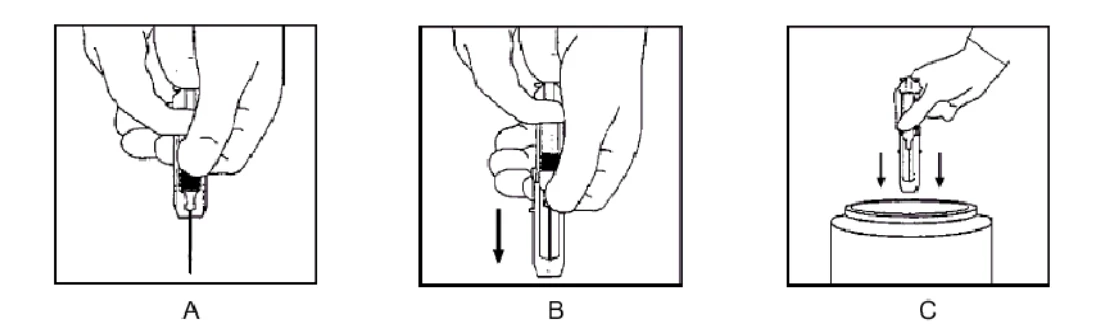
- 8. Keeping your hands behind the needle, grasp the guard with free hand and slide forward toward needle until it is completely covered and guard clicks into place. If audible click is not heard, guard may not be completely activated (see Figure 1: A and B).
- 9. Place entire prefilled glass syringe with guard activated into an approved sharps container for proper disposal (see Figure 1: C).
| Figure 1 – Proper Use of Syringe and UltraSafe® Needle Guard |
 |
OVERDOSAGE
Although no data are available, clinical experience with other immunoglobulin preparations suggests that the only manifestations would be pain and tenderness at the injection site.
ACTION AND CLINICAL PHARMACOLOGY
Mechanism of Action
HyperHEP B® provides passive immunization for individuals exposed to the hepatitis B virus (HBV) as evidenced by a reduction in the attack rate of hepatitis B following its use (4,14-18).
Cases of type B hepatitis are rarely seen following exposure to HBV in persons with preexisting anti-HBs. No confirmed instance of transmission of hepatitis B has been associated with this product.
Pharmacodynamics
See ACTION AND CLINICAL PHARMACOLOGY: Mechanism of Action.
Pharmacokinetics
In a clinical study in healthy human adults receiving another hyperimmune immune globulin product treated with solvent/detergent, Rabies Immune Globulin (Human), prepared by the same manufacturing process, detectable passive antibody titers were observed in the serum of all subjects by 24 hours post injection and persisted through the 21 day study period. These results suggest that passive immunization with immune globulin products is not affected by the solvent/detergent treatment.
Duration of Effect
The administration of the usual recommended dose of this immune globulin generally results in a detectable level of circulating anti-HBs which persists for approximately 2 months or longer. Table 5 presents the highest antibody (IgG) serum levels were seen in subjects studied (19).
| Table 5 – Antibody (IgG) Serum Levels | ||||
|---|---|---|---|---|
| Day | % of Subjects | |||
| 3 | 38.9% | |||
| 7 | 41.7% | |||
| 14 | 11.1% | |||
| 21 | 8.3% | |||
Mean values for half-life were between 17.5 and 25 days, with the shortest being 5.9 days and the longest 35 days (19).
STORAGE AND STABILITY
Store at 2-8°C (36-46°F). Do not freeze. Do not use after expiration date. The vials are single use. Once entered, discard any unused contents.
DOSAGE FORMS, COMPOSITION AND PACKAGING
Each vial contains HBs antibody equivalent to or exceeding the potency of anti-HBs (i.e. ≥220 IU/mL) in a U.S. reference hepatitis B immune globulin (Center for Biologics Evaluation and Research, FDA). The U.S. reference has been tested against the World Health Organization standard Hepatitis B Immune Globulin and found to be equal to 220 international units (IU) per mL.
HyperHEP B® S/D is supplied in a 0.5 mL neonatal single dose disposable syringe with attached needle, a 1 mL single dose disposable syringe with attached needle and a 5 mL single use vial.
PART II: SCIENTIFIC INFORMATION
PHARMACEUTICAL INFORMATION
Drug Substance
| Proper name: | HyperHEP B® S/D |
| Common name: | Hepatitis B Immune Globulin (Human) |
Product Characteristics
HyperHEP B® S/D treated with solvent/detergent is a sterile solution of hepatitis B hyperimmune immune globulin for intramuscular administration; it contains no preservative.
Viral Inactivation
The removal and inactivation of spiked model enveloped and non-enveloped viruses during the manufacturing process for HyperHEP B® S/D has been validated in laboratory studies. Human Immunodeficiency Virus, Type 1 (HIV-1), was chosen as the relevant virus for blood products; Bovine Viral Diarrhea Virus (BVDV) was chosen to model Hepatitis C Virus; Pseudorabies Virus (PRV) was chosen to model Hepatitis B Virus and the Herpes viruses; and Reo virus type 3 (Reo) was chosen to model non-enveloped viruses and for its resistance to physical and chemical inactivation.
Significant removal of model enveloped and non-enveloped viruses is seen in the Fraction II+IIIW to Effluent III step and significant removal of PRV and Reo virus is seen in the Effluent III to Filtrate III step. Significant inactivation of enveloped viruses is achieved at the time of treatment of solubilized Cohn Fraction II with solvent/detergent.
CLINICAL TRIALS
Though formal safety and efficacy trials have not been conducted with HyperHEP B® S/D, the clinical effectiveness of Hepatitis B Immune Globulin (Human) in a number of clinical situations is well established. Please refer to the most recent edition of the Canadian Immunization Guide for information regarding efficacy and safety in various indications.
DETAILED PHARMACOLOGY
Animal Pharmacology
The effect of solvent-detergent treatment on the pharmacokinetic properties of human immune globulin was studied in rabbits and rhesus monkeys. No significant differences were observed between products with or without solvent-detergent treatment with respect to time to maximal plasma concentration (tmax), maximum plasma concentration (Cmax), half-life (t½) and area under the plasma concentration curve (AUC).
Human Pharmacology
See Product Monograph PART I: ACTION AND CLINICAL PHARMACOLOGY.
TOXICOLOGY
Acute Toxicity
Acute and subacute toxicity of solvent/detergent-treated human immune globulin was assessed in rats and rabbits. The intramuscular LD50 of the solvent-detergent treated product for rats and rabbits was >2.4 mL (396 mg/kg). These values indicate a large margin of safety when compared to the clinical dose of 0.133 mL (21.9 mg)/kg.
Repeated Dose Toxicity
Repeated administration of solvent/detergent-treated human immune globulin to rats and rabbits at dosages approximately nine-fold greater than those administered in the clinic did not produce any clinically relevant toxicity.
Reproductive Toxicology
Animal reproduction studies have not been conducted with HyperHEP B® S/D.
REFERENCES
- 1. NACI. Canadian Immunization Guide. 6th ed. Ottawa: National Advisory Committee on Immunization; 2002.
- 2. Mast EE, Margolis HS, Fiore AE, Brink EW, Goldstein ST, Wang SA, et al. A comprehensive immunization strategy to eliminate transmission of hepatitis B virus infection in the United States: recommendations of the Advisory Committee on Immunization Practices (ACIP) part 1: immunization of infants, children, and adolescents. MMWR Recomm Rep 2005;54(RR-16):1-31.
- 3. Szmuness W, Stevens CE, Oleszko WR, Goodman A. Passive-active immunisation against hepatitis B: immunogenicity studies in adult Americans. Lancet 1981;1(8220 Pt 1):575-7.
- 4. Jhaveri R, Rosenfeld W, Salazar JD, Dosik H, Cheng CC, Evans HE. High titer multiple dose therapy with HBIG in newborn infants of HBsAg positive mothers. J Pediatr 1980;97(2):305-8.
- 5. Shiraki K, Yoshihara N, Kawana T, Yasui H, Sakurai M. Hepatitis B surface antigen and chronic hepatitis in infants born to asymptomatic carrier mothers. Am J Dis Child 1977;131(6):644-7.
- 6. Stevens CE, Beasley RP, Tsui J, Lee WC. Vertical transmission of hepatitis B antigen in Taiwan. N Engl J Med 1975;292(15):771-4.
- 7. Beasley RP, Trepo C, Stevens CE, Szmuness W. The e antigen and vertical transmission of hepatitis B surface antigen. Am J Epidemiol 1977;105(2):94-8.
- 8. Okada K, Kamiyama I, Inomata M, Imai M, Miyakawa Y. e antigen and anti-e in the serum of asymptomatic carrier mothers as indicators of positive and negative transmission of hepatitis B virus to their infants. N Engl J Med 1976;294(14):746-9.
- 9. Protection against viral hepatitis. Recommendations of the Immunization Practices Advisory Committee (ACIP). MMWR Recomm Rep 1990;39(RR-2):1-26.
- 10. Beasley RP, Hwang LY, Lee GC, Lan CC, Roan CH, Huang FY, et al. Prevention of perinatally transmitted hepatitis B virus infections with hepatitis B virus infections with hepatitis B immune globulin and hepatitis B vaccine. Lancet 1983;2(8359):1099-102.
- 11. Atkinson WL, Pickering LK, Schwartz B, Weniger BG, Iskander JK, Watson JC. General recommendations on immunization. Recommendations of the Advisory Committee on Immunization Practices (ACIP) and the American Academy of Family Physicians (AAFP). MMWR Recomm Rep 2002;51(RR-2):1-35.
- 12. Ellis EF, Henney CS. Adverse reactions following administration of human gamma globulin. J Allergy 1969;43(1):45-54.
- 13. Beasley RP, Hwang LY. Measles vaccination not interfered with by hepatitis B immune globulin. Lancet 1982;1(8264):161.
- 14. Current trends: Health status of Indochinese refugees: malaria and hepatitis B. MMWR Morb Mortal Wkly Rep 1979;28(39):463-4; 469-70.
- 15. Grady GF, Lee VA. Hepatitis B immune globulin--prevention of hepatitis from accidental exposure among medical personnel. N Engl J Med 1975;293(21):1067-70.
- 16. Hoofnagle JH, Seeff LB, Bales ZB, Wright EC, Zimmerman HJ. Passive-active immunity from hepatitis B immune globulin. Reanalysis of a Veterans Administration cooperative study of needle-stick hepatitis. The Veterans Administration Cooperative Study Group. Ann Intern Med 1979;91(6):813-8.
- 17. Krugman S, Giles JP. Viral hepatitis, type B (MS-2-strain). Further observations on natural history and prevention. N Engl J Med 1973;288(15):755-60.
- 18. Seeff LB, Wright EC, Finkelstein JD, Greenlee HB, Hamilton J, Leevy CM, et al. Efficacy of hepatitis B immune serum globulin after accidental exposure. Preliminary report of the Veterans Administration Cooperative Study. Lancet 1975;2(7942):939-41.
- 19. Scheiermann N, Kuwert EK. Uptake and elimination of hepatitis B immunoglobulins after intramuscular application in man. Dev Biol Stand 1983;54:347-55.