


Product Monograph - Lynparza
Recent Major Label Changes
| 1 Indication | 2025-04 |
|---|---|
| 4 Dosage and Administration, 4.1 Dosing Considerations | 2023-07 |
| 4 Dosage and Administration, 4.2 Recommended Dose and Dosage Adjustment | 2025-04 |
| 7 Warnings and Precautions, Carcinogenesis and Genotoxicity | 2025-04 |
| 7 Warnings and Precautions, Hepatic/Biliary/Pancreatic | 2024-05 |
| 7 Warnings and Precautions, Monitoring and Laboratory Test | 2025-04 |
| 7 Warnings and Precautions, Cardiovascular | 2023-07 |
| 7 Warnings and Precautions, Respiratory | 2025-06 |
Table Of Contents
Certain sections or subsections that are not applicable at the time of the preparation of the most recent authorized product monograph are not listed.
Recent Major Label Changes ................................................................................................... 2
Part 1: Health Professional Information .................................................................................. 4
1 Indications ..................................................................................................................... 4
1.1 Pediatrics ............................................................................................................. 5
1.2 Geriatrics ............................................................................................................. 5
2 Contraindications .......................................................................................................... 5
3 Serious Warnings and Precautions Box ...................................................................... 5
4 Dosage And Administration ......................................................................................... 6
4.1 Dosing Considerations ......................................................................................... 6
4.2 Recommended Dose and Dosage Adjustment ..................................................... 6
4.4 Administration ...................................................................................................... 8
4.5 Missed Dose ........................................................................................................ 8
5 Overdose ........................................................................................................................ 8
6 Dosage Forms, Strengths, Composition and Packaging ............................................ 9
7 Warnings and Precautions ........................................................................................... 9
7.1 Special Populations ........................................................................................... 12
7.1.1 Pregnant Women .............................................................................................12
7.1.2 Breast-feeding ..................................................................................................13
7.1.3 Pediatrics .........................................................................................................13
7.1.4 Geriatrics ..........................................................................................................13
7.1.5 Hepatic insufficiency .........................................................................................13
7.1.6 Renal insufficiency ...........................................................................................13
8 Adverse Reactions ...................................................................................................... 14
8.1 Adverse Reaction Overview ............................................................................... 14
8.2 Clinical Trial Adverse Reactions ......................................................................... 17
8.3 Less Common Clinical Trial Adverse Reactions ................................................. 35
8.4 Abnormal Laboratory Findings: Hematologic, Clinical Chemistry and Other Quantitative Data ........................................................................................................... 35
8.5 Post-Market Adverse Reactions ......................................................................... 39
9 Drug Interactions ......................................................................................................... 39
9.2 Drug Interactions Overview ................................................................................ 39
9.4 Drug-Drug Interactions ....................................................................................... 40
9.5 Drug-Food Interactions ...................................................................................... 42
9.6 Drug-Herb Interactions ....................................................................................... 42
9.7 Drug-Laboratory Test Interactions ...................................................................... 42
10 Clinical Pharmacology ................................................................................................ 42
10.1 Mechanism of Action .......................................................................................... 42
10.2 Pharmacodynamics ........................................................................................... 42
10.3 Pharmacokinetics ............................................................................................... 42
11 Storage, Stability and Disposal .................................................................................. 45
12 Special Handling Instructions .................................................................................... 45
Part 2: Scientific Information ................................................................................................. 46
13 Pharmaceutical Information ....................................................................................... 46
14 Clinical Trials ............................................................................................................... 47
14.1 Clinical Trials by Indication ................................................................................. 47
Adjuvant Treatment of gBRCAm HER2-negative High Risk Early Breast Cancer (OlympiA) ...................................................................................................................... 47
Treatment of gBRCAm HER2-Negative Metastatic Breast Cancer (OlympiAD) ............. 54
Maintenance Treatment of BRCA-mutated Advanced Ovarian Cancer (SOLO1) ........... 59
Maintenance Treatment of Platinum-Sensitive Relapsed Ovarian Cancer (SOLO2, Study 19, OPINION) ................................................................................................................ 63
Maintenance Treatment of Platinum-Sensitive Relapsed BRCA-mutated Ovarian Cancer (SOLO2) ........................................................................................................................ 63
Maintenance Treatment of Platinum-Sensitive Relapsed BRCA-wild type and Ovarian Cancer (Study 19, OPINION) ........................................................................................ 67
Maintenance Treatment of HRD-positive Advanced Ovarian Cancer (PAOLA-1) .......... 73
Maintenance Treatment of gBRCAm Metastatic Adenocarcinoma of the Pancreas (POLO) .......................................................................................................................... 80
Treatment of HRR Mutation Positive Metastatic Castration Resistant Prostate Cancer (mCRPC) (PROfound) ................................................................................................... 84
Treatment of BRCA-mutated Metastatic Castration Resistant Prostate Cancer (mCRPC) in combination with abiraterone (PROpel) ..................................................................... 93
14.2 Comparative Bioavailability Studies ....................................................................... 98
15 Microbiology ................................................................................................................ 98
16 Non-Clinical Toxicology .............................................................................................. 98
Patient Medication Information ............................................................................................ 101
Part 1: Health Professional Information
1 Indications
Breast Cancer
LYNPARZA (olaparib) is indicated for the adjuvant treatment of adult patients with deleterious or suspected deleterious germline BRCA-mutated (gBRCAm), human epidermal growth factor receptor 2 (HER2)-negative high risk early breast cancer who have been treated with neoadjuvant or adjuvant chemotherapy. Patients must have confirmation of a germline BRCA mutation before LYNPARZA treatment is initiated (see 14 Clinical Trials, OlympiA).
LYNPARZA is indicated as monotherapy for the treatment of adult patients with deleterious or suspected deleterious germline BRCA-mutated (gBRCAm), HER2- negative metastatic breast cancer who have previously been treated with chemotherapy in the neoadjuvant, adjuvant or metastatic setting. Patients with hormone receptor (HR)-positive breast cancer should have progressed on or be considered inappropriate for endocrine therapy. Germline BRCA mutation must be confirmed before LYNPARZA treatment is initiated (see 14 Clinical Trials, OlympiaD).
Ovarian Cancer
LYNPARZA is indicated as monotherapy for the maintenance treatment of adult patients with advanced BRCA-mutated high-grade epithelial ovarian, fallopian tube or primary peritoneal cancer who are in response (complete response or partial response) to first-line platinum-based chemotherapy. Patients must have confirmation of BRCA mutation (identified by either germline or tumour testing) before LYNPARZA treatment is initiated (see 14 Clinical Trials, SOLO1).
LYNPARZA is indicated as monotherapy for the maintenance treatment of adult patients with platinum-sensitive relapsed (PSR) high-grade epithelial ovarian, fallopian tube or primary peritoneal cancer who are in response (complete response or partial response) to platinum-based chemotherapy (see 14 Clinical Trials, SOLO2, Study 19, OPINION).
Platinum-sensitive relapse is defined as disease progression occurring at least 6 months following completion of platinum chemotherapy.
LYNPARZA is indicated as an add-on maintenance treatment to bevacizumab of adult patients with advanced high-grade epithelial ovarian, fallopian tube or primary peritoneal cancer:
- who are in response (complete or partial) to prior treatment with first-line platinum-based chemotherapy in combination with bevacizumab and
- whose cancer is associated with homologous recombination deficiency (HRD)-positive status defined by either a deleterious or suspected deleterious BRCA mutation and/or genomic instability. BRCA mutation status (germline or somatic) and/or genomic instability must be confirmed before LYNPARZA treatment is initiated (see 14 Clinical Trials, PAOLA-1).
Adenocarcinoma of the Pancreas
LYNPARZA is indicated as monotherapy for the maintenance treatment of adult patients with deleterious or suspected deleterious germline BRCA-mutated (gBRCAm) metastatic adenocarcinoma of the pancreas whose disease has not progressed on a minimum of 16 weeks of first-line platinum-based chemotherapy. Germline BRCA mutation must be confirmed before LYNPARZA treatment is initiated (see 14 Clinical Trials, POLO).
Prostate Cancer
LYNPARZA is indicated as monotherapy for the treatment of adult patients with deleterious or suspected deleterious germline and/or somatic BRCA or ATM mutated metastatic castration-resistant Prostate Cancer (mCRPC) who have progressed following prior treatment with a new hormonal agent. BRCA or ATM mutations must be confirmed before LYNPARZA treatment is initiated (see 14 Clinical Trials, PROfound).
LYNPARZA is indicated in combination with abiraterone and prednisone or prednisolone for the treatment of adult patients with deleterious or suspected deleterious germline and/or somatic BRCA mutated metastatic castration resistant prostate cancer (mCRPC) in whom chemotherapy is not clinically indicated. BRCA mutation must be confirmed before LYNPARZA treatment is initiated (see 14 Clinical Trials, PROpel).
1.1 Pediatrics
Pediatrics (<18 years of age): No data are available to Health Canada; therefore, Health Canada has not authorized an indication for pediatric use.
1.2 Geriatrics
Geriatrics (>65 years of age): There are limited clinical data in patients aged 75 years and older.
2 Contraindications
LYNPARZA (olaparib) is contraindicated in patients who are hypersensitive to this drug or to any ingredient in the formulation, including any non-medicinal ingredient, or component of the container. For a complete listing, see 6 Dosage Forms, Strengths, Composition, and Packaging.
3 Serious Warnings and Precautions Box
|
|---|
4 Dosage And Administration
4.1 Dosing Considerations
Patients should not start treatment with LYNPARZA until they have recovered from hematological toxicity caused by previous anti-cancer therapy (hemoglobin, platelet, and neutrophil levels should be ≤CTCAE grade 1, see 7 Hematologic).
Health Canada has not authorized an indication for pediatric use (see 1.1 Pediatrics).
Grapefruit, star fruit, pomegranate and Seville oranges or their juices which are known to inhibit CYP3A should not be consumed while taking LYNPARZA (see 9 Drug Interactions).
4.2 Recommended Dose and Dosage Adjustment
Recommended Total Daily Dose for Tablet
The recommended total daily dose of LYNPARZA tablets is 600 mg, taken as two 150 mg tablets twice daily. The 100 mg tablet is available for dose reduction.
For adjuvant treatment of gBRCAm HER2-negative high risk early breast cancer: It is recommended that patients are treated for a total of 1 year, or until disease recurrence or unacceptable toxicity, whichever occurs first. Patients with hormone receptor positive breast cancer should continue concurrent treatment with endocrine therapy as per current clinical practice guidelines.
For treatment of metastatic HER2-negative gBRCAm breast cancer: It is recommended that LYNPARZA treatment be continued until progression of the underlying disease or unacceptable toxicity.
For maintenance treatment of patients with BRCAm advanced ovarian cancer who are in response to first-line platinum-based chemotherapy:
Patients can continue treatment for 2 years or until disease progression.
Patients with a complete response (no radiological evidence of disease) at 2 years should stop treatment.
Patients with evidence of disease at 2 years, who in the opinion of the treating physician can derive further benefit from continuous treatment, can be treated beyond 2 years.
For maintenance treatment of PSR ovarian cancer: Patients should start treatment with LYNPARZA no later than 8 weeks after completion of their final dose of the platinum-containing regimen. Patients should have recovered from prior hematologic toxicities prior to starting LYNPARZA therapy (hemoglobin, platelet, and neutrophil levels should be ≤ CTCAE grade 1) (see 8 Adverse Reactions). It is recommended that LYNPARZA treatment be continued until progression of the underlying disease or unacceptable toxicity.
As an add-on maintenance treatment to bevacizumab for patients with HRD-positive advanced high-grade epithelial ovarian, fallopian tube or primary peritoneal cancer who are in response to prior treatment with first-line platinum-based chemotherapy in combination with bevacizumab:
Continue LYNPARZA until disease progression, unacceptable toxicity, or completion of 2 years of treatment. Patients with no radiological evidence of disease at 2 years should stop treatment. Patients with evidence of disease at 2 years, who in the opinion of the treating physician can derive further benefit from LYNPARZA treatment, can be treated beyond 2 years.
When used with LYNPARZA, the dose of bevacizumab is 15 mg/kg once every 3 weeks for up to a total of 15 months, including the period given with chemotherapy and given as maintenance. Refer to the GOG-0218 trial for information on bevacizumab in this disease setting.
If bevacizumab is permanently discontinued prior to disease progression, including toxicity, LYNPARZA can be continued as maintenance therapy as described above.
For maintenance treatment of patients with gBRCAm metastatic adenocarcinoma of the pancreas who are in response to first-line platinum-based chemotherapy: It is recommended that treatment be continued until progression of the underlying disease or unacceptable toxicity.
As monotherapy for the treatment of patients with metastatic castration-resistant prostate cancer (mCRPC) and mutations in the BRCA and ATM genes: It is recommended that LYNPARZA treatment be continued until progression of the underlying disease or unacceptable toxicity. Patients receiving LYNPARZA for mCRPC should also receive a gonadotropin-releasing hormone (GnRH) analog concurrently, or should have had bilateral orchiectomy.
In combination with abiraterone and prednisone or prednisolone for the treatment of BRCA mutated metastatic castration-resistant prostate cancer (mCRPC):
When LYNPARZA is used in combination with abiraterone for the treatment of BRCA mutated mCRPC, the dose of abiraterone is 1000 mg orally once daily. Abiraterone should be given with prednisone or prednisolone 5 mg orally twice daily. Please refer to the full product information for abiraterone
It is recommended that treatment be continued until progression of the underlying disease or unacceptable toxicity.
Dose Adjustments
For Adverse Events: Treatment may be interrupted to manage adverse events and dose reduction can be considered. The recommended reduced total daily dose of LYNPARZA (olaparib tablets) is 500 mg. If a further dose reduction is required, the recommended reduced total daily dose of LYNPARZA (olaparib tablets) is 400 mg (see 8 Adverse Reactions).
For Co-administration with CYP3A Inhibitors: Concomitant use of strong or moderate CYP3A inhibitors is not recommended and alternative agents should be considered. If a strong CYP3A inhibitor must be co-administered, the recommended reduced total daily dose of LYNPARZA (olaparib tablets) is 200 mg. If a moderate CYP3A inhibitor must be co-administered, the recommended reduced total daily dose of LYNPARZA (olaparib tablets) is 300 mg (see 7 Warnings and Precautions and 9 Drug Interactions).
For Patients with Renal Insufficiency: For patients with moderate renal impairment (creatinine clearance 31 - 50 ml/min) the recommended reduced total daily dose of LYNPARZA (olaparib tablets) is 400 mg. LYNPARZA is not recommended for patients with severe renal impairment or end-stage renal disease (creatinine clearance ≤30 ml/min), as safety and pharmacokinetics have not been studied in these patients. LYNPARZA can be administered to patients with mild renal impairment (creatinine clearance 51 - 80 ml/min) with no dose adjustment (see 10.3 Pharmacokinetics).
Reduced Total Daily Doses for Tablet:
Adult Dose 500 mg: take one 150 mg tablet and one 100 mg tablet twice a day.
Adult Dose 400 mg: take two 100 mg tablets twice a day.
Adult Dose 300 mg: take one 150 mg tablet twice a day.
Adult Dose 200 mg: take one 100 mg tablet twice a day.
Pediatrics (<18 years of age): LYNPARZA is not indicated for use in pediatric patients, as safety and efficacy of LYNPARZA in children and adolescents have not been established.
Geriatrics (>65 years): No adjustment in starting dose is required for elderly patients. There are limited clinical data in patients aged 75 years and older (see 10.3 Pharmacokinetics).
Hepatic Insufficiency: LYNPARZA (olaparib tablets) can be administered to patients with mild or moderate hepatic impairment (Child-Pugh classification A or B) with no dose adjustment (see 10.3 Pharmacokinetics). LYNPARZA is not recommended for use in patients with severe hepatic impairment (Child-Pugh classification C), as safety and pharmacokinetics have not been studied in these patients.
4.4 Administration
LYNPARZA is for oral use.
LYNPARZA tablets should be swallowed whole and not chewed, crushed, dissolved or divided. LYNPARZA tablets can be taken with or without food.
4.5 Missed Dose
If a patient misses a dose of LYNPARZA, they should take their next normal dose at its scheduled time. The patient should not take a double dose to make up for forgotten tablets.
5 Overdose
Symptoms of overdose are not established and there is no specific treatment in the event of LYNPARZA overdose. In the event of an overdose, physicians should follow general supportive measures and should treat the patient symptomatically.
| For the most recent information in the management of a suspected drug overdose, contact your regional poison control centre or Health Canada’s toll-free number, 1-844 POISON-X (1-844-764-7669). |
|---|
6 Dosage Forms, Strengths, Composition, and Packaging
Table 1 Dosage Forms, Strengths, and Composition
Dosage Form Description
LYNPARZA (olaparib) 150 mg tablet is a green to green/grey film-coated, oval, bi-convex tablet debossed with “OP 150” on one side and plain on the reverse.
LYNPARZA (olaparib) 100 mg tablet is a yellow to dark yellow film-coated, oval, bi-convex tablet debossed with “OP 100” on one side and plain on the reverse.
Packaging
LYNPARZA is available in 60 tablets or 120 tablets per bottle for each strength in high-density polyethylene (HDPE) plastic bottles, containing desiccant, with a child-resistant closure.
7 Warnings and Precautions
Please see 3 Serious Warnings and Precautions Box.
General
Interactions with other medicinal products
Co-administration of LYNPARZA (olaparib) with strong or moderate CYP3A inhibitors is not recommended (see 9 Drug Interactions). If a strong or moderate CYP3A inhibitor must be co-administered, the dose of LYNPARZA should be reduced (see 4.2 Recommended Dose and Dosage Adjustment).
Co-administration of LYNPARZA with strong or moderate CYP3A inducers is not recommended. In the event that a patient already receiving LYNPARZA requires treatment with a strong or moderate CYP3A inducer, the prescriber should be aware that the efficacy of LYNPARZA may be substantially reduced (see 9 Drug Interactions).
Carcinogenesis and Genotoxicity
Myelodysplastic Syndrome/Acute Myeloid Leukemia (MDS/AML)
In clinical studies, among 2540 patients who received LYNPARZA as a single agent or as part of combination regimen, consistent with approved indications, the incidence of MDS/AML was 1.1% (29/2540) based on long-term follow-up. The majority of events had a fatal outcome. The median duration of therapy with LYNPARZA in patients who developed MDS/AML was 20.24 months (range: 0.2 to 53.8 months). Most patients had potential contributing factors for the development of MDS/AML, having received previous chemotherapy with platinum agents. Many had also received other DNA damaging treatments. If MDS and/or AML or other clonal blood disorders are confirmed while on treatment with LYNPARZA, LYNPARZA should be discontinued and the patient be treated appropriately.
A substantially higher incidence of MDS/AML was reported in the Phase III clinical trial (SOLO2)
| Route of Administration | Dosage Form / Strength/Composition | Non-medicinal Ingredients |
| Oral Use | Tablet 100 mg, 150 mg | Colloidal silicon dioxide, copovidone, hypromellose, iron oxide black (150 mg tablet only), iron oxide yellow, macrogol 400, mannitol, sodium stearyl fumarate, titanium dioxide. |
compared to other approved indications, in patients with BRCAm platinum-sensitive relapsed ovarian cancer who had received at least two prior lines of platinum chemotherapy and were followed up for 5 years (see 8.1 Myelodysplastic syndrome/Acute myeloid leukemia).
Cardiovascular
Venous Thromboembolic Events
Venous thromboembolic events (VTE), including pulmonary embolism, have occurred in patients treated with LYNPARZA and had no consistent clinical pattern. A higher incidence was observed in patients with metastatic castration-resistant prostate cancer who, also received androgen deprivation therapy, compared with other approved indications. In the combined data of two randomized, placebo-controlled clinical studies in patients with metastatic castration-resistant prostate cancer (N=1180), VTE occurred in 8% of patients who received Lynparza, including pulmonary embolism in 6%. In the control arms, VTE occurred in 2.5% including pulmonary embolism in 1.5%. Monitor patients for clinical signs and symptoms of venous thrombosis and pulmonary embolism and treat as medically appropriate.
Driving and Operating Machinery
Asthenia, fatigue and dizziness have been reported in patients receiving LYNPARZA treatment. Patients experiencing these symptoms should use caution when driving or operating machines.
Hematologic
Hematological toxicity has been reported in patients treated with LYNPARZA, including clinical diagnoses and/or laboratory findings of generally mild or moderate (Common Terminology Criteria for Adverse Events [CTCAE] grade 1 or 2) anemia, neutropenia, thrombocytopenia and lymphopenia, however, there were reports of CTCAE grade 3 and higher events. Anemia was the most common CTCAE grade ≥3 adverse reaction reported in clinical studies. Patients should not start treatment with LYNPARZA until they have recovered from hematological toxicity caused by previous anti-cancer therapy (hemoglobin, platelet, and neutrophil levels should be ≤CTCAE grade 1). Baseline testing, followed by monthly monitoring of complete blood counts, is recommended for the first 12 months of treatment and periodically after this time to monitor for clinically significant changes in any parameter during treatment.
If a patient develops severe hematological toxicity or blood transfusion dependence, treatment with LYNPARZA should be interrupted and appropriate hematological testing should be initiated. If the blood parameters remain clinically abnormal after 4 weeks of LYNPARZA dose interruption, bone marrow analysis and/or blood cytogenetic analysis are recommended.
Hepatic/Biliary/Pancreatic
Hepatotoxicity
Cases of hepatotoxicity have been reported in patients treated with olaparib. If clinical symptoms or signs suggestive of hepatotoxicity develop, prompt clinical evaluation of the patient and measurement of liver function tests should be performed. In case of suspected drug- induced liver injury (DILI), treatment should be interrupted. In case of severe DILI treatment discontinuation should be considered as clinically appropriate.
Monitoring and Laboratory Tests
Genetic Testing
BRCA mutation, ATM mutation and homologous recombination deficiency (HRD) status should be determined by an experienced laboratory using a validated test method.
For adjuvant treatment of gBRCAm HER2-negative high risk early breast cancer: Patients must have confirmation of a deleterious or suspected deleterious germline BRCA mutation before LYNPARZA treatment is initiated.
For treatment of metastatic HER2-negative gBRCAm breast cancer: Patients must have confirmation of a deleterious or suspected deleterious BRCA mutation (identified by germline testing) before LYNPARZA treatment is initiated.
For maintenance treatment of patients with BRCAm advanced ovarian cancer who are in response to first-line platinum-based chemotherapy: Patients must have confirmation of BRCA mutation (identified by either germline or tumour testing) before LYNPARZA treatment is initiated.
As an add-on maintenance treatment to bevacizumab for patients with HRD-positive advanced high-grade epithelial ovarian, fallopian tube or primary peritoneal cancer who are in response to prior treatment with first-line platinum-based chemotherapy in combination with bevacizumab: Patients’ cancer must have confirmed association with HRD-positive status (defined by either a deleterious or suspected deleterious BRCA mutation and/or genomic instability) before LYNPARZA treatment is initiated. BRCAm includes germline and/or somatic mutations.
HRD associated genomic alterations investigated in PAOLA-1 include a composite measure of genome wide loss of heterozygosity, telomeric allelic imbalance and large-scale transitions accumulated in tumour cells. These factors are continuous measures with pre-defined criteria and score, called a genomic instability score or HRD score (see 14 CLINICAL TRIALS, PAOLA-1). Validated criteria and score cut-offs should be used to determine HRD positive status (see 14, CLINICAL TRIALS, PAOLA-1).
For maintenance treatment of patients with gBRCAm metastatic adenocarcinoma of the pancreas who are in response to first-line platinum-based chemotherapy: Patients must have confirmation of a deleterious or suspected deleterious BRCA mutation (identified by germline testing) before LYNPARZA treatment is initiated.
For treatment of BRCA or ATM-gene mutated metastatic castration-resistant prostate cancer (mCRPC): Patients must have confirmation of a deleterious or suspected deleterious germline and/or somatic BRCA or ATM gene mutation before LYNPARZA treatment is initiated.
In combination with abiraterone and prednisone or prednisolone for the treatment of BRCA mutated metastatic castration resistant prostate cancer (mCRPC): Patients must have confirmation of a deleterious or suspected deleterious germline and/or somatic BRCA gene mutation before LYNPARZA treatment is initiated.
Hematologic Testing
Baseline testing, followed by monthly monitoring, of complete blood counts is recommended for the first 12 months of treatment, and periodically after this time, to monitor for clinically significant changes in any parameter during treatment (see 8.4 Abnormal Laboratory Findings: Hematologic, Clinical Chemistry and Other Quantitative Data).
If a patient develops severe hematological toxicity or blood transfusion dependence, treatment with LYNPARZA should be interrupted and appropriate hematological testing should be initiated. If the blood parameters remain clinically abnormal after 4 weeks of LYNPARZA dose interruption, bone marrow analysis and/or blood cytogenetic analysis are recommended. If MDS/AML is confirmed, discontinue LYNPARZA and treat appropriately (See 7 Hematologic).
Pregnancy Testing
A pregnancy test should be performed on all women of childbearing potential prior to treatment, and pregnancy tests should be performed at regular intervals during treatment and for 6 months after receiving the last dose of LYNPARZA (see 7.1 Special Populations).
Reproductive Health
Reproduction
Based on its mechanism of action (PARP inhibition), LYNPARZA could cause fetal harm when administered to a pregnant woman. Studies in rats have shown that olaparib caused embryofetal toxicity that included increases in post implantation loss and teratogenic effects at exposures below those of patients receiving LYNPARZA at the recommended human dose of 300 mg twice daily (see 7.1 Special Populations and 16 Non-Clinical Toxicology).
Women of childbearing potential must use two forms of reliable contraception before starting LYNPARZA treatment, during therapy and for 6 months after receiving the last dose of LYNPARZA.
Since it cannot be excluded that LYNPARZA may reduce exposure to substrates of CYP2C9 through enzyme induction, the efficacy of some hormonal contraceptives may be reduced if co-administered with LYNPARZA. Therefore, an additional non-hormonal contraceptive method should be considered during treatment (see 9.4 Drug-Drug Interactions). For women with hormone dependent cancer, two non-hormonal contraceptive methods should be considered.
Male patients should be advised that they must use effective contraception during LYNPARZA treatment and for 3 months after receiving the last dose of LYNPARZA when having sexual intercourse with a pregnant woman or with a woman of childbearing potential. Male patients should not donate sperm during therapy and for 3 months after receiving the last dose of LYNPARZA (see 7.1.1 Pregnant Women).
Respiratory
Pneumonitis (grade 3 or higher) has been reported in patients treated with LYNPARZA monotherapy in clinical studies (see 8.1 Adverse Reaction Overview). When LYNPARZA was used in clinical studies in combination with other therapies, there have been events with a fatal outcome. If patients present with new or worsening respiratory symptoms such as dyspnea, cough and fever, or a radiological chest abnormality occurs, LYNPARZA treatment should be interrupted and prompt investigation initiated. If pneumonitis is confirmed, LYNPARZA treatment should be discontinued and the patient treated appropriately.
7.1 Special Populations
7.1.1 Pregnant Women
There are no clinical data regarding the use of LYNPARZA in pregnant women or the impact on fertility. LYNPARZA should not be used during pregnancy due to the potential teratogenic, genotoxic and embryofetal effects (see 16 Non-Clinical Toxicology). Female partners of male patients taking LYNPARZA should also avoid pregnancy.
If a female patient or a female partner of a male patient receiving LYNPARZA becomes pregnant, she should be apprised of the potential hazard to a fetus and the potential risk for loss of the pregnancy.
Contraception and pregnancy testing
Women of childbearing potential must use two forms of reliable contraception before starting LYNPARZA treatment, during therapy and for 6 months after receiving the last dose of LYNPARZA. Two highly effective and complementary forms of contraception are recommended. A pregnancy test should be performed on all women of childbearing potential prior to treatment, and pregnancy tests should be performed at regular intervals during treatment and for 6 months after receiving the last dose of LYNPARZA.
Since it cannot be excluded that LYNPARZA may reduce exposure to substrates of CYP2C9 through enzyme induction, the efficacy of some hormonal contraceptives may be reduced if co-administered with LYNPARZA. Therefore, an additional non-hormonal contraceptive method should be considered during treatment (see 9.4 Drug-Drug Interactions). For women with hormone dependent cancer, two non-hormonal contraceptive methods should be considered.
It is not known whether olaparib or its metabolites are found in seminal fluid. Male patients must use a condom during therapy and for 3 months after receiving the last dose of LYNPARZA when having sexual intercourse with a pregnant woman or with a woman of childbearing potential.
7.1.2 Breast-feeding
There are no data on the use of LYNPARZA in breast-feeding women. The excretion of olaparib in milk has not been studied in animals or in breast-feeding mothers. A risk to the newborn breast-feeding child cannot be excluded. Breast-feeding mothers are advised not to breast-feed during treatment with LYNPARZA and for one month after the last dose of LYNPARZA.
7.1.3 Pediatrics
Pediatrics (<18 years of age): No data are available to Health Canada; therefore, Health Canada has not authorized an indication for pediatric use.
7.1.4 Geriatrics
Geriatrics (>65 years of age): No adjustment in starting dose is required for elderly patients. There are limited clinical data in patients aged 75 years and older.
7.1.5 Hepatic insufficiency
LYNPARZA (olaparib tablets) can be administered to patients with mild or moderate hepatic impairment (Child-Pugh classification A or B) with no dose adjustment. LYNPARZA is not recommended for use in patients with severe hepatic impairment (Child-Pugh classification C), as safety and pharmacokinetics have not been studied in these patients (see 4 Dosage And Administration and 10.3 Pharmacokinetics).
7.1.6 Renal insufficiency
For patients with moderate renal impairment (creatinine clearance 31 - 50 ml/min) the recommended reduced total daily dose of LYNPARZA (olaparib tablets) is 400 mg (two 100 mg tablets twice daily). LYNPARZA is not recommended for patients with severe renal impairment or end-stage renal disease (creatinine clearance ≤30 ml/min), as safety and pharmacokinetics have not been studied in these patients. LYNPARZA can be administered to patients with mild renal impairment (creatinine clearance 51 - 80 ml/min) with no dose adjustment (see 4 Dosage And Administration and 10.3 Pharmacokinetics).
8 Adverse Reactions
8.1 Adverse Reaction Overview
The safety of LYNPARZA (olaparib) was evaluated in a pooled safety dataset of 4499 patients with solid tumours treated with LYNPARZA monotherapy (capsule and tablet formulation) in clinical trials at the recommended dose. The overall safety profile of the two formulations are similar (See Table 2).
The most commonly reported adverse reactions (in ≥20% of patients) from LYNPARZA monotherapy pooled studies (n=4499) were nausea, fatigue (including asthenia), anemia, vomiting and diarrhea. These reactions were generally CTCAE grade 1 or 2, intermittent in nature and managed by standard supportive treatments or LYNPARZA dose modification. The most commonly reported adverse reactions (in ≥1% of patients) with CTCAE grade ≥3 severity were anemia, neutropenia, fatigue (including asthenia), leukopenia, thrombocytopenia, venous thromboembolic events, lymphopenia, vomiting, nausea, diarrhea and dyspnea.
Nausea was generally reported very early, with first onset within the first month of LYNPARZA treatment in the majority of affected patients. Vomiting was reported early, with first onset within the first two months of LYNPARZA treatment in the majority of affected patients. Most of these events improved over time while continuing LYNPARZA without the need for medical intervention.
The most commonly reported serious adverse event (SAE) (in ≥1% of patients) was anemia (4.1%).
The overall frequency of adverse events leading to discontinuation of LYNPARZA was 5.7 %. The frequencies of adverse reactions (in >0.2% of patients) leading to discontinuation of LYNPARZA treatment were anemia (1.7%), nausea (0.9 %), fatigue (including asthenia) (0.8%), thrombocytopenia (0.7%), neutropenia (0.7%), vomiting (0.5%), leukopenia (0.3%) and MDS/AML (0.3%).
The following adverse reactions have been identified in completed clinical trials with patients receiving LYNPARZA monotherapy where patient exposure is known. Adverse Drug Reactions are organized by MedDRA System Organ Class (SOC) and then by MedDRA preferred term in Table 2. Within each SOC, preferred terms are arranged by decreasing frequency and then by decreasing seriousness. Frequencies of occurrence of adverse reactions are defined as: very common (≥1/10); common (≥1/100 to <1/10); uncommon (≥1/1,000 to <1/100); rare (≥1/10,000 to <1/1000); and very rare (<1/10,000) including isolated reports.
Table 2 Adverse Drug Reactions reported in Clinical Trials
| MedDRA SOC | MedDRA Term | CIOMS descriptor/ Overall Frequency (All CTCAE grades) | Frequency of CTCAE grade 3 and above |
| MedDRA SOC | MedDRA Term | CIOMS descriptor/ Overall Frequency (All CTCAE grades) | Frequency of CTCAE grade 3 and above |
| Blood and lymphatic system disorders | Anemiaa | Very common | Very common |
| Neutropeniaa | Very common | Common | |
| Leukopeniaa | Very common | Common | |
| Thrombocytopeniaa | Common | Common | |
| Lymphopeniaa | Common | Common | |
| Immune system disorders | Hypersensitivitya | Uncommon | Rare |
| Metabolism and nutrition disorders | Decreased appetite | Very common | Uncommon |
| Neoplasms benign, malignant and unspecified (including cysts and polyps) | Myelodysplastic syndrome/Acute myeloid leukemiaa | Uncommon | Uncommon |
| Nervous system disorders | Dizziness | Very common | Uncommon |
| Headache | Very common | Uncommon | |
| Dysgeusiaa | Very common | - | |
| Respiratory, thoracic and mediastinal disorders | Dyspneaa | Very common | Common |
| Cougha | Very common | Uncommon | |
| Pneumonitisa | uncommon | uncommon | |
| Gastrointestinal disorders | Vomiting | Very common | Common |
| Diarrhea | Very common | Uncommon | |
| Nausea | Very common | Common | |
| Dyspepsia | Very common | Rare | |
| Stomatitisa | Common | Uncommon | |
| Upper abdominal pain | Common | Rare | |
| Skin and subcutaneous tissue disorders | Rasha | Common | Uncommon |
| Dermatitisa | Uncommon | Rare | |
| Erythema nodosum | Rare | - | |
| General disorders | Fatigue (including asthenia) | Very common | Common |
| Investigations | Blood creatinine increased | Common | Rare |
| Mean cell volume increased | Uncommon | - | |
| Vascular disorders | Thromboembolism (venous)a | Common | Common |
a Anemia includes preferred terms (PTs) of anemia, anemia macrocytic, erythropenia, hematocrit decreased, hemoglobin decreased, normocytic anemia and red blood cell count decreased.
Cough includes PTs of cough and productive cough. Dermatitis includes PTs of dermatitis and dermatitis allergic.
Dysgeusia includes PTs of dysgeusia and taste disorder.
Dyspnea includes PTs of dyspnea and dyspnea exertional.
Hypersensitivity includes PTs of drug hypersensitivity and hypersensitivity.
Leukopenia includes PTs of leukopenia and white blood cell count decreased.
Lymphopenia includes PTs of lymphocyte count decreased and lymphopenia
MDS/AML includes PTs of acute myeloid leukemia, myelodysplastic syndrome and myeloid leukemia.
Neutropenia includes PTs of febrile neutropenia, neutropenia, neutropenic infection, neutropenic sepsis and neutrophil count decreased. Pneumonitis includes PTs of pneumonitis, interstitial lung disease, acute interstitial pneumonitis, eosinophilic pneumonia, eosinophilic pneumonia acute and hypersensitivity pneumonitis Stomatitis includes PTs of aphthous ulcer, mouth ulceration and stomatitis.
Thrombocytopenia includes PTs of platelet count decreased and thrombocytopenia.
Thromboembolism (venous) includes PTs of embolism, pulmonary embolism, thrombosis, deep vein thrombosis and venous thrombosis. Rash includes PTs of erythema, exfoliative rash, rash, rash erythematous, rash macular, rash maculo-papular, rash papular and rash pruritic.
MedDRA version 24; CTCAE Common Terminology Criteria for Adverse Events
Hematological toxicity
Anemia was the most common CTCAE grade ≥3 adverse reaction reported in clinical studies with first onset generally reported in the first 3 months of treatment. An exposure-response relationship between LYNPARZA (olaparib) and decreases in hemoglobin has been demonstrated (See 7 Hematologic). Other hematological toxicities were generally CTCAE grade 1 or 2, however, there were reports of CTCAE grade 3 and higher events.
The incidence of elevations in mean corpuscular volume from low or normal at baseline to above the upper limit of normal was approximately 51%. Levels appeared to return to normal after treatment discontinuation and did not appear to have any clinical consequences.
Myelodysplastic syndrome/Acute myeloid leukemia (MDS/AML)
In pooled monotherapy clinical studies, including the capsule and tablet formulations, (n = 4499), MDS/AML occurred uncommonly in patients on treatment and during the 30-day safety follow up, and <1.5% at any time after starting LYNPARZA, including cases actively solicited during the long term follow up for overall survival.
In patients with BRCAm platinum-sensitive relapsed ovarian cancer who had received at least two prior lines of platinum chemotherapy and received study treatment until disease progression (SOLO2 study, with LYNPARZA treatment ≥ 2 years in 45% of patients), the incidence of MDS/AML was 8.2% in patients receiving LYNPARZA and 4.0% in patients receiving placebo at a follow-up of 5 years. In the LYNPARZA arm, 9 out of 16 MDS/AML cases occurred after discontinuation of LYNPARZA during the survival follow-up. The incidence of MDS/AML was observed in the context of extended overall survival in the LYNPARZA arm and late onset of MDS/AML (See 8.2 Clinical Trial Adverse Reactions, SOLO2).
The risk of MDS/AML remains < 1.5% at 5 year follow up in the maintenance setting when LYNPARZA is given to patients who are in response to first-line platinum chemotherapy for a duration of 2 years (SOLO 1) (See 8.2 Clinical Trial Adverse Reactions, SOLO1 and 7 Carcinogenesis and Genotoxicity).
In PAOLA-1, the incidence of MDS/AML was 1.1% (6/535) in patients in the LYNPARZA/ bevacizumab arm and 2.2% (6/267) in patients in the placebo/bevacizumab arm at a follow-up of 5.2 years. In the LYNPARZA/bevacizumab arm, 4 of 6 MDS/AML cases occurred during treatment or within 30 days post-treatment discontinuation compared to no cases in the bevacizumab/placebo arm. Of the patients with MDS/AML in the placebo/bevacizumab arm, 5 of 6 patients received a subsequent treatment with a PARP inhibitor (see 8.2 Clinical trials Adverse Reactions, PAOLA-1).
In PROpel, the incidence of MDS/AML was 0.5% (2/398) in mCRPC patients in the LYNPARZA/abiraterone arm at a follow-up of approximately 3 years.
Other laboratory findings
Data from a double-blind placebo-controlled study showed median increase in blood creatinine up to 23% from baseline remaining consistent over time and returning to baseline after treatment discontinuation, with no apparent clinical sequelae. Ninety percent of patients had creatinine values of CTCAE grade 0 at baseline and 10% were CTCAE grade 1 at baseline.
8.2 Clinical Trial Adverse Reactions
Clinical trials are conducted under very specific conditions. Therefore, the frequencies of adverse reactions observed in the clinical trials may not reflect frequencies observed in clinical practice and should not be compared to frequencies reported in clinical trials of another drug.
Adjuvant Treatment of gBRCAm HER2-negative High Risk Early Breast Cancer (OlympiA)
The safety of LYNPARZA as monotherapy for the adjuvant treatment of patients with gBRCAm HER2-negative high risk early breast cancer was investigated in OlympiA. This study was a Phase III, randomized, double-blind, placebo-controlled, multicentre study in which a total of 1815 patients received either LYNPARZA tablets 300 mg orally twice daily (N=911) or placebo (N=904) for a total of 1 year or until disease recurrence or unacceptable toxicity, whichever occurred first (see 14 Clinical Trials). The median duration of study treatment was 341 days in patients who received LYNPARZA and 358 days in patients who received placebo.
Table 3 summarizes adverse drug reactions associated with LYNPARZA treatment in the OlympiA study.
| Table 3 Adverse Drug Reactions Reported in OlympiA (Safety Analysis Set) | ||||||||||||||
|---|---|---|---|---|---|---|---|---|---|---|---|---|---|---|
| Table 3 Adverse Drug Reactions Reported in OlympiA (Safety Analysis Set) | ||||||||||||||
| System organ class / preferred term | LYNPARZA 300 mg bid (N=911) | Placebo (N=904) | ||||||||||||
| System organ class / preferred term | LYNPARZA 300 mg bid (N=911) | Placebo (N=904) | ||||||||||||
All CTCAE Grades n (%) | CTCAE Grades ≥3 n (%) | All CTCAE Grades n (%) | CTCAE Grades ≥3 n (%) | |||||||||||
All CTCAE Grades n (%) | CTCAE Grades ≥3 n (%) | All CTCAE Grades n (%) | CTCAE Grades ≥3 n (%) | |||||||||||
| Blood and lymphatic system disorders | ||||||||||||||
| Anemia a | 217 (23.8) | 79 (8.7) | 35 (3.9) | 3 (0.3) | ||||||||||
| Neutropenia a | 150 (16.5) | 48 (5.3) | 60 (6.6) | 7 (0.8) | ||||||||||
| Thrombocytopenia | 38 (4.2) | 2 (0.2) | 12 (1.3) | 1 (0.1) | ||||||||||
| Lymphopenia a | 64 (7.0) | 12 (1.3) | 15 (1.7) | 0 | ||||||||||
| Leukopenia a | 154 (16.9) | 27 (3.0) | 54 (6.0) | 3 (0.3) | ||||||||||
| Gastrointestinal disorders | ||||||||||||||
| Nausea | 520 (57.1) | 7 (0.8) | 213 (23.6) | 0 | ||||||||||
| Vomiting | 206 (22.6) | 6 (0.7) | 74 (8.2) | 0 | ||||||||||
| Diarrhea | 160 (17.6) | 3 (0.3) | 124 (13.7) | 3 (0.3) | ||||||||||
| Dyspepsia | 55 (6.0) | 0 | 37 (4.1) | 0 | ||||||||||
| Abdominal pain upper | 45 (4.9) | 0 | 35 (3.9) | 1 (0.1) | ||||||||||
| Stomatitis a | 93 (10.2) | 1 (0.1) | 41 (4.5) | 0 | ||||||||||
| General disorders and administration site conditions | ||||||||||||||
| Fatigue (including asthenia) a | 387 (42.5) | 16 (1.8) | 257 (28.4) | 6 (0.7) | ||||||||||
| Immune system disorders | ||||||||||||||
| Hypersensitivity a | 10 (1.1) | 0 | 5 (0.6) | 1 (0.1) | ||||||||||
| Investigations | ||||||||||||||
| Increase in creatinine | 18 (2.0) | 0 | 3 (0.3) | 0 | ||||||||||
| Increase in mean corpuscular volume | 2 (0.2) | 0 | 0 | 0 | ||||||||||
| Metabolism and nutrition disorders | ||||||||||||||
| Decreased appetite | 119 (13.1) | 2 (0.2) | 53 (5.9) | 0 | ||||||||||
| Neoplasms benign, malignant and unspecified (including cysts and polyps) | ||||||||||||||
| MDS/AML a,b | 1 (0.1)c | 1 (0.1)c | 1 (0.1) | 1 (0.1) | ||||||||||
| Nervous system disorders | ||||||||||||||
| Headache | 180 (19.8) | 2 (0.2) | 152 (16.8) | 1 (0.1) | ||||||||||
| Dysgeusia a | 110 (12.1) | 0 | 43 (4.8) | 0 | ||||||||||
| Dizziness | 104 (11.4) | 1 (0.1) | 66 (7.3) | 1 (0.1) | ||||||||||
| Respiratory, thoracic and mediastinal disorders | ||||||||||||||
| Cough a | 84 (9.2) | 0 | 76 (8.4) | 0 | ||||||||||
| Dyspnoea | 38 (4.2) | 2 (0.2) | 32 (3.5) | 0 | ||||||||||
| Skin and subcutaneous tissue disorders | ||||||||||||||
| Rash a | 44 (4.8) | 1 (0.1) | 42 (4.6) | 0 | ||||||||||
| Dermatitis a | 5 (0.5) | 1 (0.1) | 5 (0.6) | 0 | ||||||||||
a Represents a group term
b MDS/AML events are reported for AEs with an onset date between the date of first dose of continuous treatment and 30 days following the date of last dose of continuous treatment.
C Outcome of event was fatal
CTCAE = Common Terminology Criteria for Adverse Events, version 4.03
Dose interruptions due to AEs of any grade occurred in 31.4% of patients receiving LYNPARZA and 11.0% of patients receiving placebo. Dose reduction due to AEs of any grade occurred in 23.4% of patients receiving LYNPARZA and 3.7% of patients receiving placebo.
The most frequent adverse reactions (≥1%) leading to dose interruption of LYNPARZA were anemia (11.4%), neutropenia (6.0 %), nausea (5.5%), leukopenia (3.7%), fatigue and asthenia (2.9%), vomiting (2.9%), diarrhea (1.0%) and lymphopenia (1.0%). The most frequent adverse reactions (≥1%) leading to dose reduction of LYNPARZA were anemia (8.5%), nausea (4.7%), neutropenia (4.8%), fatigue and asthenia (3.3%), leukopenia (1.9%), and vomiting (1.5%).
Discontinuation occurred in 10.8% of patients receiving LYNPARZA and 4.6% of patients receiving placebo due to adverse events. The adverse reactions (≥1%) that most frequently led to discontinuation of LYNPARZA were nausea (2.2%), anemia (1.8%), fatigue and asthenia (1.8%) and neutropenia (1.1%).
The most commonly reported SAE (≥1%) in the LYNPARZA group vs. placebo group was anemia (1.6% vs 0.1%).
A single report (0.1%) of MDS/AML in a patient who received Lynparza had a fatal outcome.
Treatment of gBRCAm HER2-Negative Metastatic Breast Cancer (OlympiAD)
The safety of LYNPARZA (olaparib) tablets as monotherapy was evaluated in gBRCAm patients with HER2-negative metastatic breast cancer in the OlympiAD study. This study was a Phase III, randomized, active-controlled, open-label, multicentre study in which 296 patients received either LYNPARZA 300 mg twice daily (N=205) or a chemotherapy (capecitabine, eribulin, or vinorelbine) of the physician’s choice (N=91) until disease progression or unacceptable toxicity (see 14 Clinical Trials). The median duration of study treatment was 8.2 months in patients who received LYNPARZA and 3.4 months in patients who received chemotherapy.
Table 4 summarizes adverse drug reactions associated with LYNPARZA treatment in the OlympiAD study with frequencies reported regardless of causality.
| Table 4 Adverse Drug Reactions Reported in OlympiAD (Safety Analysis Set) | |||||||||||||||||
| Table 4 Adverse Drug Reactions Reported in OlympiAD (Safety Analysis Set) | |||||||||||||||||
LYNPARZA Tablets 300 mg bid N=205 | Physician’s Choice of Chemotherapya N=91 | ||||||||||||||||
LYNPARZA Tablets 300 mg bid N=205 | Physician’s Choice of Chemotherapya N=91 | ||||||||||||||||
| System Organ Class/Preferred Term | All CTCAE Grades n (%) | CTCAE Grades ≥3 n (%) | All CTCAE Grades n (%) | CTCAE Grades ≥3 n (%) | |||||||||||||
| System Organ Class/Preferred Term | All CTCAE Grades n (%) | CTCAE Grades ≥3 n (%) | All CTCAE Grades n (%) | CTCAE Grades ≥3 n (%) | |||||||||||||
| Blood and Lymphatic System Disorders | |||||||||||||||||
| Anemiab | 82 (40.0) | 33 (16.1) | 24 (26.4) | 4 (4.4) | |||||||||||||
| Neutropeniab | 56 (27.3) | 19 (9.3) | 45 (49.5) | 24 (26.4) | |||||||||||||
| Leukopeniab | 52 (25.4) | 11 (5.4) | 28 (30.8) | 12 (13.2) | |||||||||||||
| Thrombocytopeniab | 23 (11.2) | 8 (3.9) | 11 (12.1) | 2 (2.2) | |||||||||||||
| Lymphopeniab | 17 (8.3) | 4 (2.0) | 2 (2.2) | 1 (1.1) | |||||||||||||
| Gastrointestinal Disorders | |||||||||||||||||
| Nausea | 119 (58.0) | 0 | 32 (35.2) | 1 (1.1) | |||||||||||||
| Vomiting | 61 (29.8) | 0 | 14 (15.4) | 1 (1.1) | |||||||||||||
| Diarrhea | 42 (20.5) | 1 (0.5) | 20 (22.0) | 0 | |||||||||||||
| Dyspepsia | 16 (7.8) | 0 | 4 (4.4) | 0 | |||||||||||||
| Upper abdominal pain | 15 (7.3) | 0 | 5 (5.5) | 1 (1.1) | |||||||||||||
| Stomatitis | 15 (7.3) | 0 | 10 (11.0) | 0 | |||||||||||||
| Gastroesophageal reflux disease | 6 (2.9) | 0 | 0 | 0 | |||||||||||||
| General Disorders and Administration Site Conditions | |||||||||||||||||
| Fatigue (including asthenia) | 75 (36.6) | 8 (3.9) | 33 (36.3) | 1 (1.1) | |||||||||||||
| Pyrexia | 29 (14.1) | 0 | 16 (17.6) | 0 | |||||||||||||
| Investigations | |||||||||||||||||
| Increase in blood creatinine | 6 (2.9) | 0 | 0 | 0 | |||||||||||||
| Infections and infestations | |||||||||||||||||
| Cystitis | 3 (1.5) | 0 | 2 (2.2) | 0 | |||||||||||||
| Metabolism and Nutrition Disorders | |||||||||||||||||
| Decreased appetite | 33 (16.1) | 0 | 11 (12.1) | 0 | |||||||||||||
| Nervous System Disorders | |||||||||||||||||
| Headache | 41 (20.0) | 2 (1.0) | 14 (15.4) | 2 (2.2) | |||||||||||||
| Dysgeusia | 19 (9.3) | 0 | 6 (6.6) | 0 | |||||||||||||
| Dizziness | 16 (7.8) | 0 | 7 (7.7) | 0 | |||||||||||||
| Respiratory, Thoracic and Mediastinal Disorders | |||||||||||||||||
| Coughb | 37 (18.0) | 0 | 6 (6.6) | 0 | |||||||||||||
| Pulmonary embolism | 2 (1.0) | 2 (1.0) | 1 (1.1) | 0 | |||||||||||||
| Skin and Subcutaneous Tissue Disorders | |||||||||||||||||
| Rashb | 10 (4.9) | 0 | 5 (5.5) | 0 | |||||||||||||
| Dermatitisb | 1 (0.5) | 0 | 0 | 0 | |||||||||||||
| Erythema nodosum | 1 (0.5) | 0 | 0 | 0 | |||||||||||||
| Vascular Disorders | |||||||||||||||||
| Embolism | 0 | 0 | 1 (1.1) | 1 (1.1) | |||||||||||||
| Venous thrombosis | 0 | 0 | 1 (1.1) | 1 (1.1) | |||||||||||||
a Physician’s choice of chemotherapy consists of either capecitabine (2500 mg/m2 oral daily, divided in 2 doses for 14 days, repeated every 21 days), eribulin (1.4 mg/m2 IV Day 1 and Day 8, repeated every 21 days) or vinorelbine (30 mg/m2 IV Day 1 and Day 8, repeated every 21 days).
b Represents a grouped term.
MedDRA version 19.1; CTCAE Common Terminology Criteria for Adverse Events
Dose modifications (dose reduced or dose interrupted) due to an AE of any grade occurred in 38.0% of patients receiving LYNPARZA and 41.8% of those receiving chemotherapy. The most common AEs (reported in ≥2% patients in the LYNPARZA arm) leading to dose modifications in the LYNPARZA arm vs chemotherapy arm respectively, were anemia (17.6% vs 3.3%), neutropenia (8.3% vs 16.5%), white blood count decreased (4.4% vs 4.4%), leukopenia (4.4% vs 3.3%), neutrophil count decreased (3.4% vs 7.7%), fatigue (2.9% vs 2.2%), nausea (2.9% vs 2.2%), vomiting (2.4% vs 2.2%), platelet count decreased (2.4% vs 1.1%), alanine aminotransferase increased (2.4% vs 2.2%), aspartate aminotransferase increased (2.0% vs 2.2%), pyrexia (2.0% vs 1.1%), and thrombocytopenia (2.0% vs 1.1%).
The most common serious adverse reaction reported was anemia (2.4% olaparib vs 2.2% chemotherapy). The following serious ADRs were reported in one patient each: dermatitis allergic, neutrophil count decreased and platelet count decreased.
The proportion of patients who permanently discontinued LYNPARZA due to adverse events was 4.9% in the LYNPARZA arm compared with 7.7% in the chemotherapy arm. Anemia and platelet count decrease were the only adverse reactions leading to discontinuation of LYNPARZA in more than one patient (LYNPARZA: 4/205 and 2/205, respectively vs chemotherapy: 2/91 and 0/91, respectively).
Maintenance Treatment of Advanced Ovarian Cancer (SOLO1)
The SOLO1 study is a randomized, phase III, double-blind, placebo-controlled trial of LYNPARZA 300 mg twice daily (2 x 150 mg tablets) maintenance monotherapy in patients with advanced BRCA-mutated ovarian, fallopian tube or primary peritoneal cancer who were in response to first-line platinum-based chemotherapy (n=390 [n=260 on LYNPARZA and n=130 on placebo]). The total median exposure to study treatment was 24.6 months in the LYNPARZA group and 13.9 months in the placebo group. Table 5 summarizes adverse drug reactions associated with LYNPARZA tablets with frequencies reported regardless of causality.
| Table 5 Adverse Drug Reactions Reported in SOLO1 (Safety Analysis Set) | ||||||||||||||||||||
| Table 5 Adverse Drug Reactions Reported in SOLO1 (Safety Analysis Set) | ||||||||||||||||||||
| LYNPARZA Tablets 300 mg bid N = 260 | Placebo N = 130 | |||||||||||||||||||
| LYNPARZA Tablets 300 mg bid N = 260 | Placebo N = 130 | |||||||||||||||||||
| System Organ Class/ Preferred Term | All Grades n (%) | CTCAE ≥Grade 3 n (%) | All Grades n (%) | CTCAE ≥Grade 3 n (%) | ||||||||||||||||
| System Organ Class/ Preferred Term | All Grades n (%) | CTCAE ≥Grade 3 n (%) | All Grades n (%) | CTCAE ≥Grade 3 n (%) | ||||||||||||||||
| Blood and Lymphatic System Disorders | ||||||||||||||||||||
| Anemiaa | 101 (38.8) | 56 (21.5) | 13 (10.0) | 2 (1.5) | ||||||||||||||||
| Neutropeniaa | 60 (23.1) | 22 (8.5) | 15 (11.5) | 6 (4.6) | ||||||||||||||||
| Thrombocytopeniaa | 29 (11.2) | 2 (0.8) | 5 (3.8) | 2 (1.5) | ||||||||||||||||
| Lymphopeniaa | 16 (6.2) | 4 (1.5) | 2 (1.5) | 1 (0.8) | ||||||||||||||||
| Leukopeniaa | 33 (12.7) | 8 (3.1) | 10 (7.7) | 0 | ||||||||||||||||
| Respiratory, Thoracic and Mediastinal Disorders | ||||||||||||||||||||
| Cougha | 46 (17.7) | 0 | 28 (21.5) | 0 | ||||||||||||||||
| Dyspneaa | 40 (15.4) | 0 | 8 (6.2) | 0 | ||||||||||||||||
| Pulmonary embolism | 4 (1.5) | 2 (0.8) | 1 (0.8) | 0 | ||||||||||||||||
| Gastrointestinal Disorders | ||||||||||||||||||||
| Nausea | 201 (77.3) | 2 (0.8) | 49 (37.7) | 0 | ||||||||||||||||
| Vomiting | 104 (40.0) | 1 (0.4) | 19 (14.6) | 1 (0.8) | ||||||||||||||||
| Diarrhea | 89 (34.2) | 8 (3.1) | 32 (24.6) | 0 | ||||||||||||||||
| Constipation | 72 (27.7) | 0 | 25 (19.2) | 0 | ||||||||||||||||
| Dyspepsia | 43 (16.5) | 0 | 16 (12.3) | 0 | ||||||||||||||||
| Upper Abdominal Pain | 46 (17.7) | 0 | 17 (13.1) | 0 | ||||||||||||||||
| Stomatitisa | 28 (10.8) | 0 | 3 (2.3) | 0 | ||||||||||||||||
| General Disorders and Administration Site Conditions | ||||||||||||||||||||
| Fatigue (including asthenia) | 165 (63.5) | 10 (3.8) | 54 (41.5) | 2 (1.5) | ||||||||||||||||
| Immune System Disorders | ||||||||||||||||||||
| Hypersensitivitya | 5 (1.9) | 0 | 1 (0.8) | 0 | ||||||||||||||||
| Infections and Infestations | ||||||||||||||||||||
| Urinary tract infection | 31 (11.9) | 2 (0.8) | 8 (6.2) | 0 | ||||||||||||||||
| Investigations | ||||||||||||||||||||
| Increase in blood creatinine | 21 (8.1) | 0 | 2 (1.5) | 0 | ||||||||||||||||
| Metabolism and Nutrition Disorders | ||||||||||||||||||||
| Decreased appetite | 51 (19.6) | 0 | 13 (10.0) | 0 | ||||||||||||||||
| Nervous System Disorders | ||||||||||||||||||||
| Headache | 59 (22.7) | 1 (0.4) | 31 (23.8) | 3 (2.3) | ||||||||||||||||
| Dysgeusia | 68 (26.2) | 0 | 5 (3.8) | 0 | ||||||||||||||||
| Dizziness | 51 (19.6) | 0 | 20 (15.4) | 1 (0.8) | ||||||||||||||||
| Skin and Subcutaneous Tissue Disorders | ||||||||||||||||||||
| Rasha | 27 (10.4) | 0 | 14 (10.8) | 0 | ||||||||||||||||
| Dermatitisa | 2 (0.8) | 0 | 0 | 0 | ||||||||||||||||
| Vascular Disorders | ||||||||||||||||||||
| Thrombosis | 2 (0.8) | 0 | 0 | 0 | ||||||||||||||||
| Deep vein thrombosis | 1 (0.4) | 0 | 0 | 0 | ||||||||||||||||
| Embolism | 1 (0.4) | 0 | 0 | 0 | ||||||||||||||||
| Venous thrombosis | 0 | 0 | 1 (0.8) | 0 | ||||||||||||||||
a Represents a grouped term.
CTCAE Common Terminology Criteria for Adverse Events
An analysis of time to onset for AEs has shown that first occurrence of most AEs/SAEs is within the first 3 months of exposure to LYNPARZA.
Dose interruptions due to adverse reactions of any grade occurred in 51.9% of patients receiving LYNPARZA and 16.9% of those receiving placebo; dose reductions due to an adverse reaction occurred in 28.5% of LYNPARZA patients and 3.1% of placebo patients. The most frequent adverse reactions leading to dose interruption and/or reduction of LYNPARZA were anemia (23.1%), nausea (14.2%), and vomiting (9.6%).
Discontinuation occurred in 11.5% of LYNPARZA patients and 2.3% in placebo patients due to adverse events. Anemia, fatigue and nausea were the only adverse reactions leading to discontinuation of LYNPARZA in more than two patients.
The most commonly reported SAE (≥1%) in the LYNPARZA arm vs. placebo arm was anemia (6.5% vs. 0%).
Overall, based on the long-term collection of data beyond treatment discontinuation and follow-up of 5 years in the SOLO1 study, there were 3 cases of MDS/AML (1.2%) in patients randomized to LYNPARZA and no cases were reported in patients randomized to placebo.
Maintenance Treatment of PSR Ovarian Cancer (SOLO2)
The SOLO2 study is a randomized, phase III, double-blind, placebo-controlled trial of LYNPARZA 300 mg twice daily (2 x 150 mg tablets) maintenance monotherapy in patients with platinum-sensitive relapsed (PSR) ovarian, fallopian tube or primary peritoneal cancer (n=295 [n=196 on LYNPARZA and n=99 on placebo]). The total median exposure to study treatment was 19.4 months in the LYNPARZA group and 5.6 months in the placebo group. Table 6 summarizes adverse drug reactions associated with LYNPARZA tablets with frequencies reported regardless of causality.
| Table 6 Adverse Drug Reactions Reported in SOLO2 (Safety Analysis Set) | |||||||||||||||||
| Table 6 Adverse Drug Reactions Reported in SOLO2 (Safety Analysis Set) | |||||||||||||||||
| LYNPARZA Tablets 300 mg bid N = 195 | Placebo N = 99 | ||||||||||||||||
| LYNPARZA Tablets 300 mg bid N = 195 | Placebo N = 99 | ||||||||||||||||
| System Organ Class/ Preferred Term | All Grades n (%) | CTCAE ≥Grade 3 n (%) | All Grades n (%) | CTCAE ≥Grade 3 n (%) | |||||||||||||
| System Organ Class/ Preferred Term | All Grades n (%) | CTCAE ≥Grade 3 n (%) | All Grades n (%) | CTCAE ≥Grade 3 n (%) | |||||||||||||
| Blood and Lymphatic System Disorders | |||||||||||||||||
| Anemiaa | 89 (45.6) | 41 (21.0) | 10 (10.1) | 2 (2.0) | |||||||||||||
| Neutropeniaa | 46 (23.6) | 14 (7.2) | 6 (6.1) | 4 (4.0) | |||||||||||||
| Leukopeniaa | 34 (17.4) | 7 (3.6) | 2 (2.0) | 0 | |||||||||||||
| Thrombocytopeniaa | 32 (16.4) | 4 (2.1) | 4 (4.0) | 1 (1.0) | |||||||||||||
| Lymphopeniaa | 12 (6.2) | 5 (2.6) | 0 | 0 | |||||||||||||
| Gastrointestinal Disorders | |||||||||||||||||
| Nausea | 148 (75.9) | 6 (3.1) | 35 (35.4) | 0 | |||||||||||||
| Vomiting | 78 (40.0) | 5 (2.6) | 20 (20.2) | 1 (1.0) | |||||||||||||
| Diarrhea | 67 (34.4) | 2 (1.0) | 20 (20.2) | 0 | |||||||||||||
| Dyspepsia | 29 (14.9) | 0 | 9 (9.1) | 0 | |||||||||||||
| Upper Abdominal Pain | 24 (12.3) | 1 (0.5) | 13 (13.1) | 0 | |||||||||||||
| Stomatitisa | 23 (11.8) | 3 (1.5) | 7 (7.1) | 0 | |||||||||||||
| General Disorders and Administration Site Conditions | |||||||||||||||||
| Fatigue (including asthenia)a | 130 (66.7) | 11 (5.6) | 39 (39.4) | 2 (2.0) | |||||||||||||
| Immune System Disorders | |||||||||||||||||
| Hypersensitivitya | 4 (2.1) | 0 | 0 | 0 | |||||||||||||
| Investigations | |||||||||||||||||
| Increase in blood creatinine | 21 (10.8) | 0 | 1 (1.0) | 0 | |||||||||||||
| Mean cell volume increased | 1 (0.5) | 0 | 0 | 0 | |||||||||||||
| Metabolism and Nutrition Disorders | |||||||||||||||||
| Decreased appetite | 44 (22.6) | 1 (0.5) | 11 (11.1) | 0 | |||||||||||||
| Neoplasms benign, malignant and unspecified (incl. cysts and polyps) | |||||||||||||||||
| MDS/AMLa | 7 (3.6) | 7 (3.6) | 0 | 0 | |||||||||||||
| Nervous System Disorders | |||||||||||||||||
| Dysgeusiaa | 52 (26.7) | 0 | 7 (7.1) | 0 | |||||||||||||
| Headache | 50 (25.6) | 1 (0.5) | 14 (14.1) | 0 | |||||||||||||
| Dizziness | 34 (17.4) | 1 (0.5) | 6 (6.1) | 0 | |||||||||||||
| Respiratory, Thoracic and Mediastinal Disorders | |||||||||||||||||
| Cougha | 40 (20.5) | 2 (1.0) | 6 (6.1) | 0 | |||||||||||||
| Dyspneaa | 29 (14.9) | 2 (1.0) | 1 (1.0) | 0 | |||||||||||||
| Pulmonary embolism | 4 (2.1) | 2 (1.0) | 0 | 0 | |||||||||||||
| Skin and Subcutaneous Tissue Disorders | |||||||||||||||||
| Rasha | 25 (12.8) | 0 | 10 (10.1) | 0 | |||||||||||||
| Dermatitisa | 2 (1.0) | 0 | 2 (2.0) | 0 | |||||||||||||
| Vascular Disorders | |||||||||||||||||
| Deep vein thrombosis | 4 (2.1) | 3 (1.5) | 1 (1.0) | 1 (1.0) | |||||||||||||
| Thrombosis | 1 (0.5) | 0 | 0 | 0 | |||||||||||||
- a. Represents a grouped term.
CTCAE = Common Terminology Criteria for Adverse Events
MDS /AML = Myelodysplastic syndrome/ Acute myeloid leukemia
The most commonly reported AEs (>2%) that led to dose modification in the LYNPARZA arm vs. placebo arm were anemia (23.6% vs. 0%), vomiting (9.2% vs.1.0%), nausea (6.7% vs. 4.0%) , neutropenia (6.2% vs. 3.0%), fatigue (5.6% vs. 0%), asthenia(5.1% vs. 1.0%), leukopenia (4.1% vs. 0%), abdominal pain (4.1% vs. 2.0%), diarrhea (4.1% vs. 0%), thrombocytopenia (3.6% vs. 1.0%), neutrophil count decreased (2.6% vs. 0%), pyrexia (2.6% vs. 0%), dyspnea (2.1% vs. 0%), intestinal obstruction (2.1% vs. 0%) and pneumonia (2.1% vs. 0%).
The most commonly reported SAEs (≥1%) in the LYNPARZA arm vs. placebo arm were anemia (4.1% vs. 0%), myelodysplastic syndrome (2.1% vs. 0%), acute myeloid leukemia (1.5% vs. 0%), abdominal pain (2.1% vs. 0%), intestinal obstruction (2.1% vs. 1.0%), deep vein thrombosis (1.5% vs.1.0%), cough (1.0% vs 0%) and urinary tract infection (1.0% vs. 1.0%).
Overall, based on the long-term collection of data beyond treatment discontinuation and follow-up of 5 years in the SOLO-2 study (up to the data cut-off for the final analysis), there were 16 cases of MDS/AML (8.2%) in patients randomized to LYNPARZA and 4 cases (4.0%) in patients randomized to placebo.
Maintenance Treatment of Advanced High-Grade Epithelial Ovarian, Fallopian Tube or Primary Peritoneal Cancer (PAOLA-1)
PAOLA-1 study was a placebo-controlled, double-blind study in which 802 patients, following completion of first-line platinum-based chemotherapy with bevacizumab (15 mg/kg once every 3 weeks), received either LYNPARZA 300 mg twice daily (2 x 150 mg tablets) added to bevacizumab (15 mg/kg once every 3 weeks) (n=535) or placebo added to bevacizumab (n=267) until treatment completion, disease progression or unacceptable toxicity. The median duration of exposure to LYNPARZA or placebo when added to bevacizumab was 10.6 months in both treatment arms. The median total duration of exposure to LYNPARZA (17.3 months) was longer than to placebo (15.6 months). Table 7 summarizes adverse drug reactions associated with LYNPARZA when added to bevacizumab. Frequencies are reported regardless of causality.
| Table 7 Adverse Drug Reactions Reported in PAOLA-1 (Safety Analysis Set) | |||||||||||||||||
| Table 7 Adverse Drug Reactions Reported in PAOLA-1 (Safety Analysis Set) | |||||||||||||||||
LYNPARZA/bevacizumab N = 535c | Placebo/bevacizumab N = 267c | ||||||||||||||||
LYNPARZA/bevacizumab N = 535c | Placebo/bevacizumab N = 267c | ||||||||||||||||
| System Organ Class/ Preferred Term | All Grades n (%) | CTCAE ≥ Grades 3 n (%) | All Grades n (%) | CTCAE ≥ Grades 3 n (%) | |||||||||||||
| System Organ Class/ Preferred Term | All Grades n (%) | CTCAE ≥ Grades 3 n (%) | All Grades n (%) | CTCAE ≥ Grades 3 n (%) | |||||||||||||
| Blood and lymphatic system disorders | |||||||||||||||||
| Anemiaa | 219 (41) | 94 (18) | 27 (10) | 1 (0) | |||||||||||||
| Lymphopeniaa | 128 (24) | 38 (7) | 25 (9) | 3 (1) | |||||||||||||
| Neutropeniaa | 100 (19) | 35 (7) | 42 (16) | 8 (3) | |||||||||||||
| Leukopeniaa | 95 (18) | 11 (2) | 26 (10) | 4 (1) | |||||||||||||
| Thrombocytopeniaa | 43 (8) | 10 (2) | 9 (3) | 1 (0) | |||||||||||||
| Gastrointestinal disorders | |||||||||||||||||
| Nausea | 285 (53) | 13 (2) | 59 (22) | 3 (1) | |||||||||||||
| Vomiting | 119 (22) | 9 (2) | 30 (11) | 6 (2) | |||||||||||||
| Diarrhoea | 98 (18) | 12 (2) | 46 (17) | 5 (2) | |||||||||||||
| Stomatitisa | 29 (5) | 4 (1) | 9 (3) | 0 | |||||||||||||
| Dyspepsia | 22 (4) | 0 | 7 (3) | 0 | |||||||||||||
| Abdominal pain upper | 19 (4) | 0 | 8 (3) | 0 | |||||||||||||
| General disorders and administration site conditions | |||||||||||||||||
| Fatigue (including asthenia) | 284 (53) | 28 (5) | 86 (32) | 4 (1) | |||||||||||||
| Immune Systems Disorders | |||||||||||||||||
| Hypersensitivitya | 9 (2) | 2 (0) | 2 (1) | 1 (0) | |||||||||||||
| Infections and Infestations | |||||||||||||||||
| Urinary tract infections | 79 (15) | 1 (0) | 27 (10) | 1 (0) | |||||||||||||
| Investigations | |||||||||||||||||
| Blood creatinine increased | 25 (5) | 0 | 3 | 0 | |||||||||||||
| Metabolism and nutrition disorders | |||||||||||||||||
| Decreased appetite | 42 (8) | 2 (0) | 10 (4) | 1 (0) | |||||||||||||
| Neoplasms benign, malignant and unspecified (including cysts and polyps) | |||||||||||||||||
| MDS/AMLb | 4 (1) | 4 (1) | 0 | 0 | |||||||||||||
| Nervous system disorders | |||||||||||||||||
| Headache | 73 (14) | 2 (0) | 36 (13) | 2 (1) | |||||||||||||
| Dysgeusiaa | 42 (8) | 1 (0) | 3 (1) | 0 | |||||||||||||
| Dizziness | 14 (3) | 2 (0) | 5 (2) | 1 (0) | |||||||||||||
| Respiratory, thoracic and mediastinal disorders | |||||||||||||||||
| Dyspnoeaa | 42 (8) | 5 (1) | 9 (3) | 0 | |||||||||||||
| Cougha | 25 (5) | 0 | 11 (4) | 0 | |||||||||||||
| Pneumonitis/Interstitial lung disease | 5 (1) | 0 | 0 | 0 | |||||||||||||
| Skin and subcutaneous tissue disorders | |||||||||||||||||
| Rasha | 35 (7) | 0 | 13 (5) | 1 (0) | |||||||||||||
| Vascular Disorders | |||||||||||||||||
| Venous thromboembolic eventsa | 26 (5) | 12 (2) | 5 (2) | 2 (0) | |||||||||||||
a Represents a grouped term.
b MDS/AML events are reported for AEs with an onset date between the date of first dose of continuous treatment and 30 days following the date of last dose of continuous treatment.
c Total 806 patients were randomised. Two patients randomised each to the LYNPARZA/bevacizumab arm and placebo/bevacizumab arm did not receive treatment
CTCAE – Common Terminology Criteria for Adverse Events (version 4.03)
MDS /AML = Myelodysplastic syndrome/ Acute myeloid leukemia
Data cut-off; 22 March 2020
Dose interruptions due to an adverse reaction of any grade occurred in 54.2% of patients receiving LYNPARZA/bevacizumab and 24.3% of those receiving placebo/bevacizumab; dose reductions due to an adverse reaction occurred in 41.7% of patients who received LYNPARZA/bevacizumab and 7.9% of those receiving placebo/bevacizumab. The most frequent adverse reactions (≥2%) leading to dose interruption in the LYNPARZA/bevacizumab arm were anemia (20.7%), nausea (7.3%), vomiting (3.6%), fatigue (3.4%), neutropenia (2.6%), diarrhea (2.2%), thrombocytopenia (2.2%) and abdominal pain (2.1%). The most frequent adverse reactions (≥2%) leading to dose reduction in the LYNPARZA/bevacizumab arm were anemia (19.3%), nausea (7.5%) and fatigue (3.9%).
Discontinuation due to adverse reactions occurred in 20.9% of patients receiving LYNPARZA/bevacizumab and 5.6% in placebo/bevacizumab patients. The most frequent adverse reactions leading to discontinuation in patients treated with LYNPARZA/bevacizumab were anemia (3.7%),nausea (3.6%) and fatigue (1.5%).
The most common SAEs (≥1%) for patients receiving LYNPARZA/bevacizumab compared with patients receiving placebo/bevacizumab were hypertension (9% vs 13.1%), anemia (6.4% vs 0.4%), intestinal obstruction (1.5% vs. 0.7%) subileus (1.5% vs. 1.1%) and venous thromboembolic events (1.5% vs 0.4%).
Fatal adverse reactions occurred in 1 patient due to aplastic anemia and concurrent pneumonia in the LYNPARZA/bevacizumab arm and 4 patients in the placebo/bevacizumab arm.
Maintenance Treatment of gBRCAm Adenocarcinoma of the Pancreas (POLO)
The POLO study is a randomized, phase III, double-blind, placebo-controlled trial of LYNPARZA 300 mg twice daily (2 x 150 mg tablets) maintenance therapy in patients with gBRCAm metastatic adenocarcinoma of the pancreas who were in response to first-line platinum-based chemotherapy (n=154 [n=92 on LYNPARZA and n=62 on placebo]) until disease progression or unacceptable toxicity. The median exposure to study treatment was 7.5 months in the LYNPARZA group and 3.7 months in the placebo group. Table 8 summarizes adverse drug reactions associated with LYNPARZA tablets with frequencies reported regardless of causality.
| Table 8 Adverse Drug Reactions Reported in POLO (Safety Analysis Set) | |||||||||||||||||
| Table 8 Adverse Drug Reactions Reported in POLO (Safety Analysis Set) | |||||||||||||||||
| LYNPARZA Tablets 300 mg bid N = 90 | Placebo N = 61 | ||||||||||||||||
| LYNPARZA Tablets 300 mg bid N = 90 | Placebo N = 61 | ||||||||||||||||
| System Organ Class/ Preferred Term | All Grades n (%) | CTCAE ≥Grade 3 n (%) | All Grades n (%) | CTCAE ≥Grade 3 n (%) | |||||||||||||
| System Organ Class/ Preferred Term | All Grades n (%) | CTCAE ≥Grade 3 n (%) | All Grades n (%) | CTCAE ≥Grade 3 n (%) | |||||||||||||
| Blood and Lymphatic System Disorders | |||||||||||||||||
| Anemiaa | 29 (32.2) | 11 (12.2) | 10 (16.4) | 2 (3.3) | |||||||||||||
| Neutropeniaa | 14 (15.6) | 6 (6.7) | 5 (8.2) | 2 (3.3) | |||||||||||||
| Thrombocytopeniaa | 14 (15.6) | 3 (3.3) | 4 (6.6) | 0 | |||||||||||||
| Lymphopeniaa | 5 (5.6) | 3 (3.3) | 1 (1.6) | 0 | |||||||||||||
| Leukopeniaa | 7 (7.8) | 1 (1.1) | 2 (3.3) | 0 | |||||||||||||
| Respiratory, Thoracic and Mediastinal Disorders | |||||||||||||||||
| Cougha | 10 (11.1) | 0 | 2 (3.3) | 0 | |||||||||||||
| Dyspneaa | 12 (13.2) | 0 | 3 (4.9) | 1 (1.6) | |||||||||||||
| Pulmonary embolism | 2 (2.2) | 1 (1.1) | 0 | 0 | |||||||||||||
| Gastrointestinal Disorders | |||||||||||||||||
| Nausea | 44 (48.9) | 1 (1.1) | 15 (24.6) | 1 (1.6) | |||||||||||||
| Vomiting | 23 (25.6) | 2 (2.2) | 10 (16.4) | 1 (1.6) | |||||||||||||
| Diarrhea | 34 (37.8) | 1 (1.1) | 10 (16.4) | 0 | |||||||||||||
| Dyspepsia | 9 (10.0) | 0 | 5 (8.2) | 0 | |||||||||||||
| Upper Abdominal Pain | 8 (8.9) | 0 | 9 (14.8) | 2 (3.3) | |||||||||||||
| Stomatitisa | 12 (13.3) | 0 | 3 (4.9) | 0 | |||||||||||||
| General Disorders and Administration Site Conditions | |||||||||||||||||
| Fatigue (including asthenia)a | 57 (63.3) | 6 (6.7) | 22 (36.1) | 1 (1.6) | |||||||||||||
| Immune System Disorders | |||||||||||||||||
| Hypersensitivitya | 1 (1.1) | 0 | 1 (1.6) | 0 | |||||||||||||
| Investigations | |||||||||||||||||
| Increase in blood creatinine | 7 (7.8) | 0 | 2 (3.3) | 0 | |||||||||||||
| Metabolism and Nutrition Disorders | |||||||||||||||||
| Decreased appetite | 25 (27.8) | 3 (3.3) | 4 (6.6) | 0 | |||||||||||||
| Nervous System Disorders | |||||||||||||||||
| Headache | 7 (7.8) | 0 | 8 (13.1) | 0 | |||||||||||||
| Dysgeusiaa | 10 (11.1) | 0 | 3 (4.9) | 0 | |||||||||||||
| Dizziness | 8 (8.9) | 0 | 3 (4.9) | 0 | |||||||||||||
| Skin and Subcutaneous Tissue Disorders | |||||||||||||||||
| Rasha | 16 (17.8) | 0 | 4 (6.6) | 0 | |||||||||||||
| Erythema nodosum | 0 | 0 | 1 (1.6) | 0 | |||||||||||||
| Vascular Disorders | |||||||||||||||||
| Deep vein thrombosis | 0 | 0 | 1 (1.6) | 1 (1.6) | |||||||||||||
| Thrombosis | 1 (1.1) | 0 | 0 | 0 | |||||||||||||
a Represents a grouped term.
Includes AEs with an onset date between the date of first dose of continuous treatment and 30 days following the date of last dose of continuous treatment.
MedDRA version 23.0. CTCAE Version 4.03.
CTCAE Common Terminology Criteria for Adverse Events
An analysis of time to onset for AEs has shown that first occurrence of most AEs/SAEs is within the first 3 months of exposure to LYNPARZA.
Dose interruptions due to adverse reactions of any grade occurred in 41.1% of patients receiving LYNPARZA and 6.6% of those receiving placebo; dose reductions due to an adverse reaction occurred in 17.8% of LYNPARZA patients and 4.9% of placebo patients. The most frequent adverse reactions leading to dose interruption and/or reduction of LYNPARZA were anemia (12.2%), vomiting (5.6%), abdominal pain (4.4%), asthenia (3.3%) and fatigue (3.3%).
Discontinuation occurred in 8.9% of LYNPARZA patients and 1.6% in placebo patients due to adverse events. The adverse reaction that most frequently lead to discontinuation was fatigue (2.2%).
The most commonly reported SAE (≥1%) in the LYNPARZA arm vs. placebo arm was anemia (7.8% vs. 0%).
Treatment of HRR Mutation Positive Metastatic Castration Resistant Prostate Cancer (PROfound)
The PROfound study is a randomized, open-label, multicentre, phase III trial comparing LYNPARZA 300 mg twice daily (2 x 150 mg tablets) monotherapy against Investigator’s Choice of new hormonal agents (NHAs) in patients with HRR mutation positive metastatic castration resistant prostate cancer (n=387 [n=256 on LYNPARZA and n=131 on NHAs]). The total median exposure to study treatment was 230.0 days in the LYNPARZA group and 120.0 days in the Investigator’s Choice NHA group. Table 9 summarizes adverse drug reactions associated with LYNPARZA tablets with frequencies reported regardless of causality.
| Table 9 Adverse Drug Reactions Reported in PROfound (Safety Analysis Set) | |||||||||||||||||||
| Table 9 Adverse Drug Reactions Reported in PROfound (Safety Analysis Set) | |||||||||||||||||||
| Table 9 Adverse Drug Reactions Reported in PROfound (Safety Analysis Set) | |||||||||||||||||||
| LYNPARZA Tablets 300 mg bid N = 256 | Investigator’s Choice of NHA’s N = 130a | ||||||||||||||||||
| LYNPARZA Tablets 300 mg bid N = 256 | Investigator’s Choice of NHA’s N = 130a | ||||||||||||||||||
| LYNPARZA Tablets 300 mg bid N = 256 | Investigator’s Choice of NHA’s N = 130a | ||||||||||||||||||
| System Organ Class/ Preferred Term | All Grades n (%) | CTCAE ≥Grade 3 n (%) | All Grades n (%) | CTCAE ≥Grade 3 n (%) | |||||||||||||||
| System Organ Class/ Preferred Term | All Grades n (%) | CTCAE ≥Grade 3 n (%) | All Grades n (%) | CTCAE ≥Grade 3 n (%) | |||||||||||||||
| System Organ Class/ Preferred Term | All Grades n (%) | CTCAE ≥Grade 3 n (%) | All Grades n (%) | CTCAE ≥Grade 3 n (%) | |||||||||||||||
| Blood and Lymphatic System Disorders | |||||||||||||||||||
| Anemiab | 127 (49.6) | 58 (22.7) | 20 (15.4) | 7 (5.4) | |||||||||||||||
| Neutropeniab | 24 (9.4) | 15 (5.9) | 4 (3.1) | 2 (1.5) | |||||||||||||||
| Thrombocytopeniab | 33 (12.9) | 14 (5.5) | 4 (3.1) | 0 (0) | |||||||||||||||
| Lymphopeniab | 19 (7.4) | 4 (1.6) | 1 (0.8) | 1 (0.8) | |||||||||||||||
| Leukopeniab | 19 (7.4) | 4 (1.6) | 0 (0) | 0 (0) | |||||||||||||||
| Gastrointestinal Disorders | |||||||||||||||||||
| Nausea | 110 (43.0) | 4 (1.6) | 27 (20.8) | 0(0) | |||||||||||||||
| Vomiting | 51 (19.9) | 6 (2.3) | 17 (13.1) | 1 (0.8) | |||||||||||||||
| Diarrhea | 55 (21.5) | 2 (0.8) | 9 (6.9) | 0 (0) | |||||||||||||||
| Dyspepsia | 20 (7.8) | 0 (0) | 3 (2.3) | 0 (0) | |||||||||||||||
| Upper Abdominal Pain | 4 (1.6) | 0 (0) | 2 (1.5) | 0 (0) | |||||||||||||||
| Stomatitisb | 15 (5.9) | 1 (0.4) | 2 (1.5) | 0 (0) | |||||||||||||||
| General Disorders and Administration Site Conditions | |||||||||||||||||||
| Fatigue (including asthenia) | 107 (41.8) | 8 (3.1) | 43 (33.1) | 7 (5.4) | |||||||||||||||
| Immune System Disorders | |||||||||||||||||||
| Hypersensitivityb | 2 (0.8) | 1 (0.4) | 1 (0.8) | 0 (0) | |||||||||||||||
| Investigations | |||||||||||||||||||
| Increase in blood creatinine | 10 (3.9) | 0 (0) | 1 (0.8) | 0 (0) | |||||||||||||||
| Metabolism and Nutrition Disorders | |||||||||||||||||||
| Decreased appetite | 80 (31.3) | 4 (1.6) | 24 (18.5) | 1 (0.8) | |||||||||||||||
| Nervous System Disorders | |||||||||||||||||||
| Headache | 16 (6.3) | 0 (0) | 3 (2.3) | 0 (0) | |||||||||||||||
| Dysgeusiab | 19 (7.4) | 0 (0) | 2 (1.5) | 0 (0) | |||||||||||||||
| Dizziness | 18 (7.0) | 0 (0) | 5 (3.8) | 0 (0) | |||||||||||||||
| Respiratory, Thoracic and Mediastinal Disorders | |||||||||||||||||||
| Dyspneab | 30 (11.7) | 6 (2.3) | 6 (4.6) | 0 (0) | |||||||||||||||
| Coughb | 29 (11.3) | 0 (0) | 5 (3.8) | 0 (0) | |||||||||||||||
| Pulmonary embolism | 12 (4.7) | 7 (2.7) | 1 (0.8) | 1 (0.8) | |||||||||||||||
| Skin and Subcutaneous Tissue Disorders | |||||||||||||||||||
| Rashb | 14 (5.5) | 1 (0.4) | 4 (3.1) | 0 (0) | |||||||||||||||
| Dermatitisb | 1 (0.4) | 0 (0) | 1 (0.8) | 0 (0) | |||||||||||||||
| Vascular Disorders | |||||||||||||||||||
| Deep vein thrombosis | 4 (1.6) | 0 | 2 (1.5) | 1 (0.8) | |||||||||||||||
| Embolism | 4 (1.6) | 2 (0.8) | 0 | 0 | |||||||||||||||
| Thrombosis | 0 | 0 | 1 (0.8) | 0 | |||||||||||||||
| Vena cava thrombosis | 1 (0.4) | 0 | 0 | 0 | |||||||||||||||
| Venous thrombosis | 1 (0.4) | 0 | 1 (0.8) | 0 | |||||||||||||||
a Of the 131 patients randomized to the NHA arm of the trial, one patient did not receive study treatment.
b Represents a grouped term.
CTCAE = common terminology criteria for adverse events
Discontinuation due to adverse events occurred in 19.9 % of patients in the LYNPARZA treatment arm and 8.5% of patients in the Investigator’s Choice of NHA arm. The most commonly reported adverse reactions leading to discontinuation (≥ 1%) in the LYNPARZA arm versus Investigator’s Choice NHA arm were: anemia (7.8% vs. 0.8%), thrombocytopenia (2.0% vs. 0%) neutropenia (1.6% vs. 0%) and fatigue (1.2% vs. 1.5%).
Dose interruptions due to adverse events of any grade occurred in 46.5% of patients receiving LYNPARZA and 19.2% of those receiving Investigator’s Choice of NHA; dose reductions due to an adverse event occurred in 23.4% of LYNPARZA patients and 5.4% of NHA patients. The most commonly reported adverse reactions leading to dose interruption (≥ 2%) in the LYNPARZA arm vs Investigator’s Choice of NHA arm were: anemia (26.2% vs. 1.5%), thrombocytopenia (5.5% vs. 0%), neutropenia (3.5% vs. 0%), vomiting (2.7% vs. 3.1%), nausea (2.0% vs. 3.1%), fatigue (2.0% vs. 1.5%), platelet count decreased (2.0% vs. 0.8%) and diarrhea (2.0% vs. 0%). The most commonly reported adverse reactions leading to dose reduction (≥ 2%) in the LYNPARZA arm versus Investigator’s Choice of NHA arm were: anemia (16.4% vs. 0%), nausea (2.3% vs. 1.5%) and vomiting (2.0% vs. 0%).
The most commonly reported SAEs (≥2%) in the LYNPARZA arm vs. Investigator’s Choice of NHA arm were anemia (9.0% vs. 0%), pneumonia (4.3% vs. 2.3%), urinary tract infection (2.0% vs. 3.1%), and pulmonary embolism (2.0% vs. 0.8%).
Treatment of Metastatic Castration Resistant Prostate Cancer (mCRPC) (PROpel)
PROpel was a Phase III randomized, double-blind, placebo-controlled, multicentre study that compared the efficacy of LYNPARZA (300 mg [2 x 150 mg tablets] twice daily) in combination with abiraterone (1000 mg [2 x 500 mg tablets] once daily) compared with placebo plus abiraterone for the treatment of patients with mCRPC. Patients in both arms also received either prednisone or prednisolone 5 mg twice daily. The median total duration of exposure to LYNPARZA (18.5 months) was longer than to placebo (15.7 months). The median total duration of exposure to abiraterone was longer when combined with LYNPARZA (20.1 months on the LYNPARZA+abiraterone arm and 15.7 months on the placebo+abiraterone arm). Table 10 summarizes adverse drug reactions associated with LYNPARZA in combination with abiraterone with frequencies reported regardless of causality.
| Table 10 Adverse Drug Reactions Reported in PROpel (Safety Analysis Set) | ||||||||||||||||
| Table 10 Adverse Drug Reactions Reported in PROpel (Safety Analysis Set) | ||||||||||||||||
LYNPARZA + abiraterone n=398 | Placebo + abiraterone n=396 | |||||||||||||||
LYNPARZA + abiraterone n=398 | Placebo + abiraterone n=396 | |||||||||||||||
| System Organ Class/ Preferred Term | All Grades n (%) | CTCAE ≥Grade 3 n (%) | All Grades n (%) | CTCAE ≥Grade 3 n (%) | ||||||||||||
| System Organ Class/ Preferred Term | All Grades n (%) | CTCAE ≥Grade 3 n (%) | All Grades n (%) | CTCAE ≥Grade 3 n (%) | ||||||||||||
| Blood and Lymphatic System Disorders | ||||||||||||||||
| Anemiaa | 196 (49.2) | 64 (16.1) | 70 (17.7) | 13 (3.3) | ||||||||||||
| Neutropeniaa | 39 (9.8) | 18 (4.6) | 12 (3.0) | 5 (1.3) | ||||||||||||
| Thrombocytopeniaa | 27 (6.8) | 3 (0.8) | 16 (4.0) | 1 (0.3) | ||||||||||||
| Lymphopeniaa | 55 (13.8) | 21 (5.3) | 26 (6.6) | 10 (2.5) | ||||||||||||
| Leukopeniaa | 34 (8.5) | 12 (3.1) | 10 (2.5) | 1 (0.3) | ||||||||||||
| Gastrointestinal Disorders | ||||||||||||||||
| Nausea | 121 (30.4) | 1 (0.3) | 57 (14.4) | 1 (0.3) | ||||||||||||
| Vomiting | 60 (15.1) | 5 (1.3) | 37 (9.3) | 1 (0.3) | ||||||||||||
| Diarrhea | 78 (19.6) | 5 (1.3) | 42 (10.6) | 1 (0.3) | ||||||||||||
| Dyspepsia | 29 (7.3) | 0 (0) | 17 (4.3) | 0 (0) | ||||||||||||
| Upper Abdominal Pain | 26 (6.5) | 0 (0) | 16 (4.0) | 0 (0) | ||||||||||||
| Stomatitisa | 10 (2.5) | 0 (0) | 3 (0.8) | 0 (0) | ||||||||||||
| General Disorders and Administration Site Conditions | ||||||||||||||||
| Fatigue (including asthenia) | 153 (38.4) | 10 (2.5) | 120 (30.3) | 6 (1.5) | ||||||||||||
| Immune System Disorders | ||||||||||||||||
| Hypersensitivitya | 1(0.3) | 0 (0) | 3 (0.8) | 0 (0) | ||||||||||||
| Investigations | ||||||||||||||||
| Increase in blood creatinine | 27 (6.8) | 2 (0.5) | 19 (4.8) | 1 (0.3) | ||||||||||||
| Increase in mean cell volume | 3 (0.8) | 0 (0) | 0 (0) | 0 (0) | ||||||||||||
| Metabolism and Nutrition Disorders | ||||||||||||||||
| Decreased appetite | 65 (16.3) | 4 (1.0) | 31 (7.8) | 0 (0) | ||||||||||||
| Neoplasms benign, malignant and unspecified (including cysts and polyps) | ||||||||||||||||
| MDS/AML | 2 (0.5) | 2 (0.5) | 0 (0) | 0 (0) | ||||||||||||
| Nervous System Disorders | ||||||||||||||||
| Headache | 37 (9.3) | 1 (0.3) | 26 (6.6) | 0 (0) | ||||||||||||
| Dysgeusiaa | 34 (8.5) | 0 (0) | 8 (2.0) | 0 (0) | ||||||||||||
| Dizziness | 49 (12.3) | 0 (0) | 27 (6.8) | 0 (0) | ||||||||||||
| Respiratory, Thoracic and Mediastinal Disorders | ||||||||||||||||
| Dyspneaa | 44 (11.1) | 2 (0.5) | 35 (8.8) | 0 (0) | ||||||||||||
| Cougha | 51 (12.8) | 0 (0) | 31 (7.8) | 0 (0) | ||||||||||||
| Skin and Subcutaneous Tissue Disorders | ||||||||||||||||
| Rasha | 26 (6.5) | 0 (0) | 26 (6.6) | 1 (0.3) | ||||||||||||
| Dermatitisa | 1 (0.3) | 0 (0) | 3 (0.8) | 1 (0.3) | ||||||||||||
| Vascular Disorders | ||||||||||||||||
| Venous thromboembolic eventsa,b | 34 (8.5) | 29 (7.3) | 14 (3.5) | 9 (2.3) | ||||||||||||
a Represents a grouped term.
b Includes cases of pulmonary embolism. Grade ≥ 3 cases of pulmonary embolism were observed in 29 (7.3%) patients in the olaparib + abiraterone arm and 9 (2.3%) patients in the placebo + abiraterone arm.
CTCAE = common terminology criteria for adverse events
Discontinuation (of LYNPARZA or placebo) due to adverse events occurred in 17.3 % of patients in the LYNPARZA + abiraterone treatment arm and 8.6% of patients in the placebo + abiraterone arm. The most commonly reported adverse reaction leading to discontinuation (≥ 1%) in the LYNPARZA +abiraterone treatment arm versus placebo + abiraterone arm was anemia (4.3% vs. 0.8%) and fatigue (1.3% vs 0.3%).
Dose interruptions due to adverse events of any grade occurred in 49.0% of patients receiving LYNPARZA + abiraterone and 28.3% of those receiving placebo + abiraterone; dose reductions due to an adverse event occurred in 22.6% of LYNPARZA + abiraterone patients and 6.1% of placebo + abiraterone patients.
The most commonly reported adverse reactions leading to dose interruption (of LYNPARZA or placebo) (≥ 2%) in the LYNPARZA +abiraterone arm vs placebo + abiraterone arm were: anemia (17.3% vs. 2.5% ), COVID-19 (4.8% vs. 2.5%), nausea (3.0% vs. 1.3% ), diarrhea (2.5% vs. 1.5%), fatigue (2.5% vs. 0.5%) and pulmonary embolism (2.3% vs. 0.3%). The most commonly reported adverse reactions leading to dose reduction (of LYNPARZA or placebo) (≥ 1%) in the LYNPARZA +abiraterone arm versus placebo + abiraterone arm were: anemia (10.8% vs. 0.8%), asthenia (1.5% vs. 0.8%), blood creatinine increased (1.8% vs. 0.8%) nausea (1.5% vs. 0.3%) and fatigue (1.0% vs 0.0%).
The most commonly reported SAEs (≥2%) in the LYNPARZA +abiraterone arm vs. placebo + abiraterone arm were: anemia (5.8% vs. 0.8%), pulmonary embolism (3.8% vs. 0.8%), COVID-19 (3.8% vs. 2.5%), pneumonia (2.8% vs. 1.3%) and urinary tract infection (2.3% vs. 0.8%).
8.3 Less Common Clinical Trial Adverse Reactions
See adverse drug reaction tables in 8.2 Clinical Trial Adverse Reactions
8.4 Abnormal Laboratory Findings: Hematologic, Clinical Chemistry and Other Quantitative Data
Table 11 summarizes the frequency of laboratory abnormalities associated with LYNPARZA treatment in the OlympiA study.
Table 11 Laboratory Abnormalities Reported in ≥15% of Patients in OlympiA
| Laboratory Parameter a | LYNPARZA Tablets 300mg bid N = 911 b | Placebo N = 904 b | |||||||||
|---|---|---|---|---|---|---|---|---|---|---|---|
CTCAE Grades 1-4 (%) | CTCAE Grades 3-4 (%) | CTCAE Grades 1-4 (%) | CTCAE Grades 3-4 (%) | ||||||||
| Increase in serum creatinine | 97 | 0.2 | 87 | 0.1 | |||||||
| Decrease in lymphocytes | 66 | 11 | 52 | 4 | |||||||
| Decrease in hemoglobin | 65 | 8 | 29 | 1 | |||||||
| Decrease in leukocytes | 64 | 5 | 41 | 1 | |||||||
| Increase in mean corpuscular volume c | 64 | 0 | 5 | 0 | |||||||
| Decrease in absolute neutrophil count | 27 | 5 | 18 | 1 | |||||||
| Decrease in platelets | 16 | 0.3 | 8 | 0.3 | |||||||
a Patients were allowed to enter clinical studies with laboratory values of CTCAE Grade 1.
b This number represents the safety population. The derived values in the table are based on the total number of evaluable patients for each laboratory parameter.
c Represents the proportion of subjects whose mean corpuscular volume was > upper limit of normal (ULN).
Table 12 summarizes the frequency of laboratory abnormalities associated with LYNPARZA treatment in the OlympiAD study.
| Table 12 Laboratory Abnormalities Reported in OlympiAD | ||||||||||
| LYNPARZA Tablets 300 mg bid N=205 | Physician’s Choice of Chemotherapya N=91 | |||||||||
| Laboratory Parameterb | CTCAE Grades 1-4 (%) | CTCAE Grades 3-4 (%) | CTCAE Grades 1-4 (%) | CTCAE Grades 3-4 (%) | ||||||
| Decrease in hemoglobin | 82 | 17 | 66 | 3 | ||||||
| Decrease in lymphocytes | 73 | 21 | 63 | 3 | ||||||
| Decrease in leukocytes | 71 | 8 | 70 | 23 | ||||||
| Increase in MCVc | 71 | - | 33 | - | ||||||
| Decrease in absolute neutrophil count | 46 | 11 | 65 | 38 | ||||||
| Decrease in platelets | 33 | 3 | 28 | 0 | ||||||
| Increase in serum creatinine | 18 | 0.5 | 9 | 0 | ||||||
a Physician’s choice of chemotherapy consisting of either capecitabine, eribulin or vinorelbine.
b Patients were allowed to enter study with laboratory values of CTCAE Grade 1.
c Represents the proportion of subjects whose MCV was > upper limit of normal (ULN).
CTCAE Common Terminology Criteria for Adverse Events; MCV Mean corpuscular volume
Table 13 summarizes the frequency of laboratory abnormalities associated with LYNPARZA treatment in the SOLO1 study.
| Table 13 Laboratory Abnormalities Reported in ≥25% of Patients in SOLO1 | |||||||||
| LYNPARZA Tablets 300 mg bid N=260 | Placebo N=130 | ||||||||
| Laboratory Parameter | CTCAE Grades 1-4 (%) | CTCAE Grades 3-4 (%) | CTCAE Grades 1-4 (%) | CTCAE Grades 3-4 (%) | |||||
| Decrease in hemoglobin | 87 | 19 | 63 | 2 | |||||
| Decrease in absolute neutrophil count | 51 | 9 | 38 | 6 | |||||
| Decrease in platelets | 35 | 1 | 20 | 2 | |||||
| Decrease in lymphocytes | 67 | 14 | 29 | 5 | |||||
| Decrease in leukocytes | 70 | 7 | 52 | 1 | |||||
| Increase in MCVa | 79 | - | 14 | - | |||||
| Increase in serum creatinine | 34 | 0 | 18 | 0 | |||||
a Represents the proportion of subjects whose MCV was low or normal at baseline and increased to above normal reference range.
CTCAE Common Terminology Criteria for Adverse Events; MCV Mean corpuscular volume
Table 14 summarizes the frequency of laboratory abnormalities associated with LYNPARZA treatment in the SOLO2 study.
Table 14 Laboratory Abnormalities Reported in ≥25% of Patients in SOLO2
| Laboratory parametera | LYNPARZA Tablets 300 mg bid N=195 | Placebo N=99 | |||||||
|---|---|---|---|---|---|---|---|---|---|
| CTCAE Grades 1-4 (%) | CTCAE Grades 3-4 (%) | CTCAE Grades 1-4 (%) | CTCAE Grades 3-4 (%) | ||||||
| Decrease in hemoglobin | 84 | 19 | 69 | 0 | |||||
| Decrease in lymphocytes | 70 | 15 | 39 | 1 | |||||
| Decrease in absolute neutrophil count | 53 | 8 | 34 | 3 | |||||
| Decrease in leukocytes | 70 | 8 | 48 | 1 | |||||
| Decrease in platelets | 43 | 4 | 22 | 1 | |||||
| Increase in serum creatinine | 49 | 0 | 30 | 0 | |||||
| Increase in MCVb | 80 | - | 22 | - | |||||
a Patients were allowed to enter clinical studies with laboratory values of CTCAE Grade 1.
b Represents the proportion of subjects whose mean corpuscular volume was low or normal at baseline and increased to above normal reference range.
CTCAE Common Terminology Criteria for Adverse Events; MCV Mean corpuscular volume.
Table 15 summarizes the frequency of laboratory abnormalities associated with LYNPARZA treatment in the PAOLA-1 study.
Table 15 Laboratory Abnormalities Reported in ≥25% of Patients in PAOLA-1
| Laboratory parametera | LYNPARZA/bevacizumab N=535b | Placebo/bevacizumab N=267b | |||||||||
|---|---|---|---|---|---|---|---|---|---|---|---|
| CTCAE Grades 1-4 (%) | CTCAE Grades 3-4 (%) | CTCAE Grades 1-4 (%) | CTCAE Grades 3-4 (%) | ||||||||
| Increase in serum creatinine | 61 | 0.4 | 37 | 1 | |||||||
| Decrease in hemoglobin | 79 | 13 | 51 | 0 | |||||||
| Increase in MCVc | 82 | - | 21 | - | |||||||
| Decrease in lymphocytes | 63 | 9 | 40 | 2 | |||||||
| Decrease in platelets | 34 | 2 | 26 | 0 | |||||||
| Decrease in leukocytes | 59 | 3 | 43 | 1 | |||||||
| Decrease in absolute neutrophil count | 35 | 6 | 29 | 3 | |||||||
a Patients were allowed to enter clinical studies with laboratory values of CTCAE Grade 1.
b This number represents the safety population. The derived values in the table are based on the total number of evaluable patients for each laboratory parameter.
c Represents the proportion of subjects whose MCV was low or normal at baseline and increased to above normal reference range.
CTCAE Common Terminology Criteria for Adverse Events; MCV Mean corpuscular volume.
Table 16 summarizes the frequency of laboratory abnormalities associated with LYNPARZA treatment in the POLO study.
Table 16 Laboratory Abnormalities Reported in ≥25% of Patients in POLO
| Laboratory parametera | LYNPARZA Tablets 300 mg bid N=90b | Placebo N=61b | |||||||
|---|---|---|---|---|---|---|---|---|---|
| CTCAE Grades 1-4 (%) | CTCAE Grades 3-4 (%) | CTCAE Grades 1-4 (%) | CTCAE Grades 3-4 (%) | ||||||
| Increase in serum creatine | 99 | 1 | 92 | 0 | |||||
| Decrease in hemoglobin | 89 | 12 | 61 | 0 | |||||
| Increase in MCVc | 65 | - | 3 | - | |||||
| Decrease in lymphocytes | 65 | 12 | 25 | 2 | |||||
| Decrease in platelets | 58 | 2 | 39 | 0 | |||||
| Decrease in leukocytes | 49 | 3 | 25 | 0 | |||||
| Decrease in absolute neutrophil count | 29 | 5 | 14 | 0 | |||||
a Patients were allowed to enter POLO with haemoglobin ≥9 g/dL (CTCAE Grade 2) and other laboratory values of CTCAE Grade 1.
b This number represents the safety population. The derived values in the table are based on the total number of evaluable patients for each laboratory parameter.
c Represents the proportion of subjects whose MCV was low or normal at baseline and increased to above normal reference range.
CTCAE Common Terminology Criteria for Adverse Events; MCV Mean corpuscular volume.
Table 17 summarizes the frequency of laboratory abnormalities associated with LYNPARZA treatment in the PROfound study.
Table 17 Laboratory Abnormalities Reported in ≥25% of Patients in PROfound
| Laboratory parametera | LYNPARZA Tablets 300 mg bid N=256b | Investigator’s Choice of NHA N=130b | ||||||
|---|---|---|---|---|---|---|---|---|
| CTCAE Grades 1-4 (%) | CTCAE Grades 3-4 (%) | CTCAE Grades 1-4 (%) | CTCAE Grades 3-4 (%) | |||||
| Decrease in hemoglobin | 98 | 13 | 73 | 4 | ||||
| Decrease in absolute neutrophil count | 34 | 3 | 9 | 0 | ||||
| Decrease in platelets | 24 | 2 | 12 | 0 | ||||
| Decrease in lymphocytes | 62 | 23 | 34 | 13 | ||||
| Decrease in leukocytes | 53 | 4 | 21 | 0 | ||||
| Increase in MCVc | 73 | - | 11 | - | ||||
| Increase in serum creatinine | 95 | 2 | 68 | 1 | ||||
a Patients were allowed to enter PROfound with laboratory values of CTCAE Grade 1. If liver metastases were present patients were allowed to enter with AST (SGOT) ≤5 × institutional ULN (CTCAE Grade 2).
b This number represents the safety population. The derived values in the table are based on the total number of evaluable patients for each laboratory parameter.
c Represents the proportion of subjects whose MCV was low or normal at baseline and increased to above normal reference range.
CTCAE Common Terminology Criteria for Adverse Events; MCV Mean corpuscular volume
Table 18 summarizes the frequency of laboratory abnormalities associated with LYNPARZA treatment in the PROpel study.
Table 18 Laboratory Abnormalities Reported in ≥25% of Patients in PROpel
| Laboratory parametera | LYNPARZA + abiraterone n=398b | Placebo + abiraterone n= 396b | ||||||||
|---|---|---|---|---|---|---|---|---|---|---|
| CTCAE Grades 1-4 (%) | CTCAE Grades 3-4 (%) | CTCAE Grades 1-4 (%) | CTCAE Grades 3-4 (%) | |||||||
| Decrease in hemoglobin | 98 | 12 | 82 | 2 | ||||||
| Decrease in lymphocytes | 72 | 25 | 49 | 12 | ||||||
| Decrease in leukocytes | 42 | 6 | 15 | 0 | ||||||
| Increase in MCVc | 82 | - | 26 | - | ||||||
| Increase in serum AST | 32 | 2 | 34 | 4 | ||||||
| Increase in serum ALP | 58 | 10 | 62 | 11 | ||||||
| Increase in serum bilirubin | 27 | 1 | 23 | 1 | ||||||
| Increase in serum creatinine | 99 | 2 | 92 | 1 | ||||||
a Patients were allowed to enter PROpel with laboratory values of CTCAE Grade 2. If liver metastases were present patients were allowed to enter with AST (SGOT) ≤5 × institutional ULN (CTCAE Grade 2).
b This number represents the safety population. The derived values in the table are based on the total number of evaluable patients for each laboratory parameter.
c Represents the proportion of subjects whose MCV was low or normal at baseline and increased to above normal reference range.
CTCAE Common Terminology Criteria for Adverse Events; MCV Mean corpuscular volume
8.5 Post-Market Adverse Reactions
The following adverse reactions have been identified during post-approval use of LYNPARZA:
Immune system disorders: Angioedema (0.1%)
Hepatobiliary disorders: Cases of hepatotoxicity
9 Drug Interactions
9.2 Drug Interactions Overview
Clinical studies of LYNPARZA (olaparib) in combination with other anti-cancer agents, including DNA damaging agents, indicate a potentiation and prolongation of myelosuppressive toxicity. The recommended LYNPARZA monotherapy dose is not suitable for combination with myelosuppressive anti-cancer agents.
Olaparib is predominantly metabolised by CYP3A (see 10 Clinical Pharmacology). Co-administered CYP3A inhibitors or inducers may respectively increase or decrease olaparib plasma concentration.
In vitro, olaparib is an inhibitor and inducer of CYP3A4 and an inducer of CYP2B6. Olaparib is a weak CYP3A inhibitor in vivo. It also inhibits drug transporter proteins OATP1B1, OCT1, OCT2, OAT3, MATE1 and MATE2K (see 10 Clinical Pharmacology).
9.4 Drug-Drug Interactions
The drugs listed in this table are based on either PBPK modeling reports, drug interaction case reports or studies, or potential interactions due to the expected magnitude and seriousness of the interaction (i.e., those identified as contraindicated).
| Table 19 Established or Potential Drug-Drug Interactions | |||
| Table 19 Established or Potential Drug-Drug Interactions | |||
| Non-proprietary name(s) of the drug product(s) | Source of Evidence | Effect | Clinical comment |
| Non-proprietary name(s) of the drug product(s) | Source of Evidence | Effect | Clinical comment |
| Pharmacokinetic Interactions (Drugs that may affect the exposure to olaparib) | |||
| Strong inhibitors of CYP3A (e.g., itraconazole, clarithromycin, telithromycin, protease inhibitors boosted with ritonavir or cobicistat, indinavir, saquinavir, nelfinavir, boceprevir, telaprevir) | CT/ T | In patients, a co-administered strong CYP3A inhibitor increased olaparib mean Cmax and mean AUC. | Co-administration is not recommended. If it must be co-administered, the dose of LYNPARZA should be reduced (see 4 Dosage And Administration). |
| Strong inducers of CYP3A (e.g., rifampicin, phenobarbital, phenytoin, rifabutin, rifapentine, carbamazepine, nevirapine) | CT/ T | In patients, a co-administered strong CYP3A inducer decreased olaparib mean Cmax and mean AUC. | Co-administration is not recommended. If a strong CYP3A inducer cannot be avoided, there is a potential for decreased efficacy of LYNPARZA (see 7 Warnings and Precautions). |
| Moderate inhibitors of CYP3A (e.g., ciprofloxacin, erythromycin, diltiazem, fluconazole, verapamil) | T | Olaparib is predominantly metabolised by CYP3A. Moderate CYP3A inhibitors may increase the exposure to olaparib when co-administered. | Co-administration is not recommended. If it must be co-administered, the dose of LYNPARZA should be reduced (see 4 Dosage And Administration). |
| Moderate inducers of CYP3A (e.g., bosentan, efavirenz, etravirine, modafinil) | T | Olaparib is predominantly metabolised by CYP3A. Moderate CYP3A inducers may decrease the exposure to olaparib when co-administered. | Co-administration is not recommended. If a moderate CYP3A inducer cannot be avoided, there is a potential for decreased efficacy of LYNPARZA. |
| Pharmacokinetic Interactions (Drugs for which the exposure may be affected by olaparib) | |||
| Substrates of CYP2B6 (e.g., bupropion and efavirenz) | T | Olaparib induces CYP2B6 in vitro; olaparib may decrease the exposure to co-administered substrates of CYP2B6. | Caution should be exercised when co-administered. Patients should be closely monitored. |
| Substrates of CYP3A (e.g., simvastatin, cyclosporine, cisapride, ergot alkaloids, fentanyl, midazolam, pimozide, sirolimus, tacrolimus, quetiapine) | T / CT | Olaparib is predicted to be a weak CYP3A inhibitor in vivo; olaparib may increase the exposure to substrates of CYP3A through enzyme inhibition when co-administered. | Caution should be exercised when co-administered as exposure to substrates may be increased. Patients should be closely monitored (see 7 Warnings and Precautions). |
| Substrates of hepatic uptake transporters OATP1B1, OCT1 (e.g., bosentan, glibenclamide, repaglinide, statins, valsartan, metformin) | T | Olaparib inhibits OATP1B1 and OCT1 in vitro; olaparib may increase the exposure of substrates of these transporters when co-administered. | Caution should be exercised when co-administered - especially in combination with any statin. Patients should be closely monitored. |
| Substrates of renal uptake transporters OCT2, OAT3, MATE1 and MATE2K (e.g., amantadine, cimetidine, furosemide, methotrexate, metformin, cisplatin) | T | Olaparib inhibits OCT2, OAT3, MATE1, and MATE2K in vitro; olaparib may increase the exposure of substrates of these transporters when co-administered. | Caution should be exercised when co-administered. Patients should be closely monitored. |
| Substrates of CYP2C9 (e.g., hormonal contraceptives) | T | The potential for Olaparib to reduce exposure to substrates of CYP2C9 through enzyme induction could not be excluded. | The efficacy of some hormonal contraceptives may be reduced if co-administered with Olaparib. Consider a non-hormonal contraceptive method during treatment. For women with hormone dependent cancer, two non-hormonal contraceptive methods should be considered (see 7.1.1 Pregnant Women) |
| Pharmacodynamic Interactions | |||
| Myelosuppressive anticancer agents, including DNA damaging agents | CT | Potentiation and prolongation of myelo-suppressive toxicity. | LYNPARZA monotherapy dose is not suitable for combination with myelosuppressive anticancer agents. |
Legend: C = Case Study; CT = Clinical Trial; T = Theoretical / PBPK modelling
Acronyms: MDR1 = Multi-Drug Resistance protein-1; OATP1B1 = Organic Anion Transporter polypeptide 1B1; OCT1 or OCT2 = Organic Cation Transporter-1 or -2; OAT 3 = Organic Anion Transporter 3, MATE1 or MATE2K = multidrug and toxin extrusion protein-1 or -2
See 10 Clinical Pharmacology
9.5 Drug-Food Interactions
Co-administration with food slowed the rate (median tmax delayed by 2.5 hours and mean Cmax reduced by approximately 21%) but did not significantly affect the extent of absorption of olaparib (AUC treatment ratio: 1.08; 90% CI: 1.01, 1.16). Consequently, patients should take LYNPARZA without regard to food. See 4.4 Administration.
Grapefruit, star fruit, pomegranate and Seville oranges or their juices are known to inhibit CYP3A and may increase olaparib plasma concentration. Patients should avoid these fruits during LYNPARZA treatment.
9.6 Drug-Herb Interactions
Co-administration of St. John’s Wort, a potent inducer of CYP3A, may decrease exposure to olaparib and should be avoided.
9.7 Drug-Laboratory Test Interactions
Interactions with laboratory tests have not been established.
10 Clinical Pharmacology
10.1 Mechanism of Action
LYNPARZA (olaparib) is a selective inhibitor of human poly (ADP-ribose) polymerase (PARP) enzymes, including PARP1, PARP2, and PARP3. PARP enzymes are involved in normal cellular functions, such as DNA transcription and DNA repair. Olaparib has been shown to inhibit growth of select tumour cell lines in vitro and decrease tumour growth in mouse xenograft models of human cancer both as monotherapy or following platinum-based chemotherapy. Increased cytotoxicity and anti-tumour activity following treatment with olaparib were noted in cell lines and mouse tumour models with deficiencies in BRCA and non-BRCA proteins involved in the homologous recombination repair (HRR) of DNA damage and correlated with platinum response. In vitro studies have shown that olaparib-induced cytotoxicity involves DNA damage resulting from the inhibition of PARP enzymatic activity and increased formation of trapped PARP-DNA complexes, resulting in cancer cell death.
10.2 Pharmacodynamics
Effect on the QT interval
There is no clinically relevant effect of olaparib on cardiac repolarisation (as evaluated by an effect on the QT interval) following 300 mg tablet twice daily multiple dosing of olaparib in 109 patients.
10.3 Pharmacokinetics
The pharmacokinetics (PK) of olaparib at a single 300 mg tablet dose (two 150 mg tablets) are characterised in Table 20 by an apparent plasma clearance of ~7 L/h, an apparent volume of distribution of ~158 L and a terminal half-life of 15 hours. On multiple dosing, an AUC accumulation ratio of 1.8 was observed and PK appeared to be time-dependent to a small extent.
Table 20 LYNPARZA (tablet formulation) Pharmacokinetic Parameters in Patients with Advanced Solid Tumours
| Cmax (µg/mL)a | tmax (h)c | t½ (h) | AUC0-∞ (µg.h/mL)a | CL/F (L/h)b | Vd/F (L)b | |
| Single 300 mg dose mean (SD or %GCV), n | 7.3 (34), 102 | 1.5 (0.5 – 6), 102 | 15 (8.2), 100 | 47 (59), 100 | ~7.4 (3.9), 100 | ~158 (136), 100 |
a For Cmax and AUC geometric mean (geometric percentage coefficient of variation) is shown.
b For t1/2, CL/F and Vd/F arithmetic mean (standard deviation) is presented.
c For tmax median (range) is shown.
Absorption:
The absolute bioavailability of olaparib is unknown. Following a single oral administration of olaparib tablet formulation (2 x 150 mg), absorption is rapid with median peak plasma concentrations typically achieved 1.5 hours after dosing.
Co-administration with food slowed the rate (median tmax delayed by 2.5 hours and mean Cmax reduced by approximately 21%) but did not significantly affect the extent of absorption of olaparib (AUC treatment ratio: 1.08; 90% CI: 1.01, 1.16). Consequently, patients should take LYNPARZA without regard to food (see 4.4 Administration).
Population pharmacokinetic analyses have shown that the steady state exposure (AUC) following 300 mg tablet twice daily was 77% higher compared to that following 400 mg capsule twice daily. The olaparib geometric mean AUC and Cmax following a single 300 mg tablet dose were 42.1 μg*h/mL (n=204) and 5.8 μg/mL (n=204), respectively, and the steady state geometric mean AUC and Cmax following 300 mg tablet twice daily were 49.0 μg*h/mL (n=227) and 7.7 μg/mL (n=227), respectively. Olaparib showed time-dependent PK such that the steady state clearance decreased by 15% after multiple dosing.
Distribution:
The in vitro plasma protein binding is approximately 82% at 10 µg/mL which is approximately Cmax.
In vitro, human plasma protein binding of olaparib was dose-dependent; the fraction bound was approximately 91% at 1 µg/mL, reducing to 82% at 10 µg/mL and to 70% at 40 µg/mL. In solutions of purified proteins, the olaparib fraction bound to albumin was approximately 56%, which was independent of olaparib concentrations. Using the same assay, the fraction bound to alpha-1 acid glycoprotein was 29% at 10 µg/mL with a trend of decreased binding at higher concentrations.
Metabolism:
In vitro, CYP3A4/5 were shown to be the enzymes primarily responsible for the metabolism of olaparib.
Following oral dosing of 14C-olaparib to female patients, unchanged olaparib accounted for the majority of the circulating radioactivity in plasma (70%) and was the major component found in both urine and faeces (15% and 6% of the dose respectively). The metabolism of olaparib is extensive with the main site of metabolism being the piperazine and fluorobenzyl ring structures. The majority of the metabolism was attributable to oxidation reactions with a number of the components produced undergoing subsequent glucuronide or sulphate conjugation. Up to 20, 37 and 20 metabolites were detected in plasma, urine and faeces respectively, the majority of them representing <1% of the dosed material. A ring-open piperazin-3-ol moiety, and two mono-oxygenated metabolites (each~10%) were the major circulating components, with one of the mono-oxygenated metabolites also being the major metabolite in the excreta (6% and 5% of the urinary and faecal radioactivity respectively).
In vitro, olaparib produced little/no inhibition of UGT1A4, UGT1A9, UGT2B7, or CYPs 1A2, 2A6, 2B6, 2C8, 2C9, 2C19, 2D6, 2E1 and is not expected to be a clinically significant time dependent inhibitor of any of these CYP enzymes. Olaparib inhibited UGT1A1 in vitro, however, PBPK simulations suggest this is not of clinical importance. In vitro, olaparib is a substrate of and inhibits the efflux transporter P-gp (IC50 = 76µM), however, this is unlikely to be of clinical significance. The potential for olaparib to induce CYP2C9 or CYP2C19 could not be excluded. Therefore, olaparib upon co-administration may reduce the exposure to substrates of these metabolic enzymes.
Olaparib caused a slight increase in CYP1A2 mRNA without apparent increase in enzyme activity which may suggest any clinical change will be small.
In vitro, data also show that olaparib is not a substrate for OATP1B1, OATP1B3, OCT1, BCRP or MRP2, is a weak inhibitor of BCRP and not an inhibitor of OATP1B3, OAT1 or MRP2.
Elimination:
Following a single dose of 14C-olaparib, ~86% of the dosed radioactivity was recovered within a 7-day collection period, ~44% via the urine and ~42% via the feces. The majority of the material was excreted as metabolites.
Special Populations and Conditions
- Pediatrics: No studies have been conducted to investigate the pharmacokinetics of olaparib in pediatric patients.
- Age, Bodyweight or Ethnic origin: In population based PK analyses, patient age, gender, body weight or race (including Caucasian and Asian patients) were not significant covariates.
Hepatic Insufficiency: In a pharmacokinetic study, following a single oral 300 mg dose of olaparib (tablet formulation) to patients with mild hepatic impairment (Child-Pugh classification A) mean AUC increased by 15% and mean Cmax by 13% and to patients with moderate hepatic impairment (Child-Pugh classification B) mean AUC increased by 8% and mean Cmax decreased by 13% compared with patients with normal hepatic function. No LYNPARZA dose adjustment is required in patients with mild or moderate hepatic impairment (see 4.2 Recommended Dose and Dosage Adjustment).
LYNPARZA has not been studied in patients with severe hepatic impairment (Child-Pugh classification C).
Renal Insufficiency: In a pharmacokinetic study, following a single oral 300 mg dose of olaparib (tablet formulation) to patients with mild renal impairment (creatinine clearance: 51 to 80 mL/min), mean AUC increased by 24% and mean Cmax by 15% compared with patients with normal renal function. No LYNPARZA dose adjustment is required for patients with mild renal impairment.
Following a single oral 300 mg dose of LYNPARZA to patients with moderate renal impairment (creatinine clearance: 31 to 50 mL/min), mean AUC increased by 44% and mean Cmax by 26% compared with patients with normal renal function. LYNPARZA dose reduction is recommended for patients with moderate renal impairment (see 4.2 Recommended Dose and Dosage Adjustment)
LYNPARZA has not been studied in patients with severe renal impairment or end-stage renal disease (creatinine clearance ≤30 ml/min).
11 Storage, Stability and Disposal
Store LYNPARZA (olaparib) between 2 - 30°C in the original package in order to protect from moisture.
12 Special Handling Instructions
Do not use this medicine after the expiry date which is stated on the bottle after EXP. The expiry date refers to the last day of that month.
Part 2: Scientific Information
13 Pharmaceutical Information
Drug Substance
Non-proprietary name of the drug substance: olaparib
Chemical name: 4-[(3-{[4-(cyclopropylcarbonyl)piperazin-1-yl]carbonyl}-4-fluorophenyl)methyl]phthalazin-1(2H)-one
Molecular formula and molecular mass: C24H23FN4O3 434.46
Structural formula:
Physicochemical properties: Olaparib is a crystalline powder and is classified as poorly soluble. The melting point (defined as the temperature onset) of olaparib is at 199-206°C as measured by differential scanning calorimetry. The octanol/water (pH =7.4) partition coefficient: Log D =1.49. Olaparib is achiral.
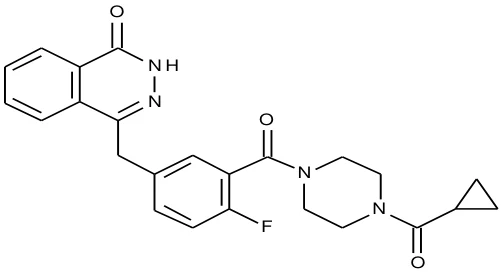
14 Clinical Trials
14.1 Clinical Trials by Indication
Adjuvant Treatment of gBRCAm HER2-negative High Risk Early Breast Cancer (OlympiA)
Table 21 Summary of Selected Demographic and Patient Characteristics at Baseline (Full Analysis Set) in the OlympiA Study
| Study # | Trial Design | Dosage, Route of Administration and Duration | Study Subjects (n) | Mean Age (Range) | Sex |
D081CC00006 (OlympiA) | Phase III randomized (1:1), double-blind, parallel group, placebo-controlled, multicentre study | 300 mg LYNPARZA (2 x 150 mg tablets) orally twice daily or placebo for 1 year Patients with hormone receptor positive tumours received concomitant endocrine therapy as per current clinical guidelines. | LYNPARZA n=921 Placebo n=915 | LYNPARZA 43.0 years (22 – 77 years) Placebo 43.6 years (24 – 78 years) | LYNPARZA Female: n=919 Male: n=2 Placebo Female: n=911 Male: n=4 |
The efficacy of LYNPARZA was investigated in OlympiA (D081CC0006) a randomized, double-blind, parallel group, placebo-controlled, multicentre study in patients with gBRCAm HER2-negative high risk early breast cancer who had completed definitive local treatment and neoadjuvant or adjuvant chemotherapy. Patients enrolled based on local gBRCA test results provided a sample for retrospective confirmatory central testing by Myriad BRACAnalysis® test. Patients were randomized in a 1:1 ratio to either LYNPARZA tablets 300mg twice daily (n=921) or placebo (n=915). Treatment was continued for a total of 1 year, or until disease recurrence or unacceptable toxicity, whichever occurred first. Patients with hormone receptor positive (estrogen (ER) and/or progesterone (PgR) positive) tumours were receiving concomitant endocrine therapy (87% in the LYNPARZA arm and 92% in the placebo arm). Patients were required to have completed at least 6 cycles of neoadjuvant or adjuvant chemotherapy containing anthracyclines, taxanes or both. Prior platinum for previous cancer (e.g. ovarian) or as adjuvant or neoadjuvant treatment for breast cancer was allowed. High risk early breast cancer patients were defined as follows:
patients who have received prior neoadjuvant chemotherapy (both TNBC and hormone receptor positive) must have had residual invasive cancer in the breast and/or the resected lymph nodes (non-pathological complete response) at the time of surgery. Additionally, patients with hormone receptor positive breast cancer must have had a score of ≥3 based on pre-treatment clinical and post-treatment pathologic stage (CPS), estrogen receptor (ER)
- status, and histologic grade as shown in Table 22.
Table 22 Early Breast Cancer Stage, Receptor Status and Grade Scoring Requirements for Study Enrollment*
| Stage/feature | Points | |
Clinical Stage (pre-treatment) | I/IIA | 0 |
| IIB/IIIA | 1 | |
| IIIB/IIIC | 2 | |
| Pathologic Stage (post-treatment) | 0/I | 0 |
| IIA/IIB/IIIA/IIIB | 1 | |
| IIIC | 2 | |
| Receptor status | ER positive | 0 |
| ER negative | 1 | |
| Nuclear grade | Nuclear grade 1-2 | 0 |
| Nuclear grade 3 | 1 | |
* Total score of ≥3 required for patients with hormone receptor positive breast cancer.
- patients who have received prior adjuvant chemotherapy: TNBC patients must have had node positive disease or node negative disease with a ≥ 2cm primary tumour; patients with hormone receptor positive, HER2-negative patients must have had ≥4 pathologically confirmed positive lymph nodes.
Randomization was stratified by local hormone receptor status (ER and/or PgR positive/ HER2 negative versus TNBC), by prior neoadjuvant versus adjuvant chemotherapy, and by prior platinum use for breast cancer (yes versus no).
Demographic and baseline patient characteristics in OlympiA are summarized below.
| Table 23 Summary of Selected Demographic and Patient Characteristics at Baseline (Full Analysis Set) in the OlympiA Study | ||||||||||||||
|---|---|---|---|---|---|---|---|---|---|---|---|---|---|---|
| Table 23 Summary of Selected Demographic and Patient Characteristics at Baseline (Full Analysis Set) in the OlympiA Study | ||||||||||||||
| Table 23 Summary of Selected Demographic and Patient Characteristics at Baseline (Full Analysis Set) in the OlympiA Study | ||||||||||||||
| Number (%) of patients | ||||||||||||||
| Number (%) of patients | ||||||||||||||
| Number (%) of patients | ||||||||||||||
| FAS | ||||||||||||||
| FAS | ||||||||||||||
| FAS | ||||||||||||||
LYNPARZA 300 mg bd (N=921) | Placebo (N=915) | Total (N=1836) | ||||||||||||
LYNPARZA 300 mg bd (N=921) | Placebo (N=915) | Total (N=1836) | ||||||||||||
LYNPARZA 300 mg bd (N=921) | Placebo (N=915) | Total (N=1836) | ||||||||||||
| Age (years) | ||||||||||||||
| Mean (SD) | 43.0 (9.82) | 43.6 (10.12) | 43.3 (9.97) | |||||||||||
| Median (range) | 42.0 (22-77) | 43.0 (24-78) | 42.0 (22-78) | |||||||||||
| Age groups | ||||||||||||||
| <30 years | 51 (5.5) | 59 (6.4) | 110 (6.0) | |||||||||||
| 30-39 years | 333 (36.2) | 306 (33.4) | 639 (34.8) | |||||||||||
| 40-49 years | 315 (34.2) | 308 (33.7) | 623 (33.9) | |||||||||||
| 50-59 years | 166 (18.0) | 172 (18.8) | 338 (18.4) | |||||||||||
| 60-69 years | 48 (5.2) | 66 (7.2) | 114 (6.2) | |||||||||||
| ≥70 years | 8 (0.9) | 4 (0.4) | 12 (0.7) | |||||||||||
| Sex | ||||||||||||||
| Female | 919 (99.8) | 911 (99.6) | 1830 (99.7) | |||||||||||
| Male | 2 (0.2) | 4 (0.4) | 6 (0.3) | |||||||||||
| Race | ||||||||||||||
| White | 626 (68.0) | 599 (65.5) | 1225 (66.7) | |||||||||||
| Asian | 259 (28.1) | 272 (29.7) | 531 (28.9) | |||||||||||
| Black or African American | 19 (2.1) | 29 (3.2) | 48 (2.6) | |||||||||||
| Other | 17 (1.8) | 15 (1.6) | 32 (1.7) | |||||||||||
| Hormone Receptor Status | ||||||||||||||
| TNBC a | 753 (81.8) | 758 (82.8) | 1511 (82.3) | |||||||||||
| ER and/or PgR positive, HER2-negative | 168 (18.2) | 157 (17.2) | 325 (17.7) | |||||||||||
| Prior Platinum | ||||||||||||||
| No | 674 (73.2) | 677 (74.0) | 1351 (73.6) | |||||||||||
| Yes | 247 (26.8) | 238 (26.0) | 485 (26.4) | |||||||||||
| Prior Chemotherapy | ||||||||||||||
| Adjuvant | 461 (50.1) | 455 (49.7) | 916 (49.9) | |||||||||||
| Neoadjuvant | 460 (49.9) | 460 (50.3) | 920 (50.1) | |||||||||||
| Prior Chemotherapy by Hormone Receptor Status | ||||||||||||||
| Adjuvant TNBC | 397 (43.1) | 390 (42.6) | 787 (42.9) | |||||||||||
| Adjuvant ER and/or PgR positive, HER2-negative | 64 (6.9) | 65 (7.1) | 129 (7.0) | |||||||||||
| Neoadjuvant TNBCa | 356 (38.7) | 368 (40.2) | 724 (39.4) | |||||||||||
| Neoadjuvant ER and/or PgR positive, HER2-negative | 104 (11.3) | 92 (10.1) | 196 (10.7) | |||||||||||
| Baseline BRCA Status | ||||||||||||||
| BRCA1 | 656 (71.2) | 669 (73.1) | 1325 (72.2) | |||||||||||
| BRCA2 | 260 (28.2) | 238 (26.0) | 498 (27.1) | |||||||||||
| BRCA1&2 | 2 (0.2) | 5 (0.5) | 7 (0.4) | |||||||||||
| No gBRCA mutation | 2 (0.2) | 3 (0.3) | 5 (0.3) | |||||||||||
| Missing | 1 (0.1) | 0 | 1 (0.1) | |||||||||||
| Prior Neoadjuvant/Adjuvant Chemotherapy for Primary Breast Cancer | ||||||||||||||
| Anthracycline and taxane regimen | 871 (94.6) | 849 (92.8) | 1720 (93.7) | |||||||||||
| Anthracycline regimen (without taxane) | 7 (0.8) | 13 (1.4) | 20 (1.1) | |||||||||||
| Taxane regimen (without anthracycline) | 43 (4.7) | 52 (5.7) | 95 (5.2) | |||||||||||
| Missing | 0 | 1 (0.1) | 1 (0.1) | |||||||||||
| Menopausal status | ||||||||||||||
| Premenopausal | 572 (62.1) | 553 (60.4) | 1125 (61.3) | |||||||||||
| Postmenopausal | 347 (37.7) | 358 (39.1) | 705 (38.4) | |||||||||||
| Male | 2 (0.2) | 4 (0.4) | 6 (0.3) | |||||||||||
| ECOG performance status | ||||||||||||||
| (0) Fully Active | 824 (89.5) | 804 (87.9) | 1628 (88.7) | |||||||||||
| (1) Restricted work | 97 (10.5) | 111 (12.1) | 208 (11.3) | |||||||||||
a Post randomization, 2 patients (included as TNBC) were found not to have confirmed negative HER2 status.
bd = twice daily; BRCA = breast cancer susceptibility gene; eCRF = electronic case report form; ER = estrogen receptor; gBRCA = germline BRCA; HER2 = human epidermal growth factor receptor 2; N = total number of patients; PgR = progesterone receptor; SD = standard deviation; TNBC = triple negative breast cancer.
The primary endpoint was invasive disease free survival (IDFS), defined as the time from randomization to date of first recurrence, where recurrence is defined as invasive loco-regional, distant recurrence, contralateral invasive breast cancer, secondary primary non-breast invasive malignancy or death from any cause. Secondary objectives included OS, distant disease free survival (DDFS, defined as the time from randomization until evidence of first distant recurrence of breast cancer). The endpoints IDFS and DDFS were defined as per the Standardised Definitions for Efficacy End Points (STEEP) criteria.
Study Results
The study demonstrated a statistically significant and clinically meaningful improvement in IDFS and DDFS in the LYNPARZA arm compared with the placebo arm. The IDFS and DDFS data was 15.5% and 13% mature in the Full Analysis Set (FAS) at the time of interim analysis (Data Cut Off (DCO) at 27 March 2020) with median duration of follow-up 2.3 years in the LYNPARZA arm and 2.5 years in the placebo arm. At the pre-specified second interim OS analysis, a statistically significant improvement in OS was observed in the LYNPARZA arm compared with the placebo arm (10% maturity, DCO 12 July 2021).
Efficacy results from the FAS are presented in Table 24, Figure 1, Figure 2 and Figure 3.
Table 24 Summary of Key Efficacy Findings in gBRCAm HER2-negative high risk early breast cancer patients in OlympiA
| LYNPARZA 300 mg bd tablets (N=921) | Placebo (N=915) | ||||||||
|---|---|---|---|---|---|---|---|---|---|
| IDFS (15.5% maturity)a | |||||||||
| Number of events/total number of patients (%) | 106/921 (12) | 178/915 (20) | |||||||
| HR (99.5% CI) b | 0.58 (0.41, 0.82) | ||||||||
| p-value (2-sided) c | 0.0000073 | ||||||||
| 3-year event rate (95%CI)d | 86 (83, 88) | 77 (74, 80) | |||||||
| DDFS (13% maturity)a | |||||||||
| Number of events/total number of patients (%) | 89/921 (10) | 152/915 (17) | |||||||
| HR (99.5% CI) b | 0.57 (0.39, 0.83) | ||||||||
| p-value (2-sided) c | 0.0000257 | ||||||||
| 3-year event rate (95%CI)d | 88 (85, 90) | 80 (77, 83) | |||||||
| OS (10 % maturity)a | |||||||||
| Number of events/total number of patients (%) | 75/921 (8) | 109/915 (12) | |||||||
| HR (98.5% CI) b | 0.68 (0.47, 0.97) | ||||||||
| p-value (2-sided) c | 0.0091 | ||||||||
| 3-year event rate (95%CI)d | 93 (91, 94) | 89 (87, 91) | |||||||
| 4-year event rate (95%CI)d | 90 (87, 92) | 86 (84, 89) | |||||||
a DCO 27 March 2020 (IDFS and DDFS); DCO 12 July 2021 (OS)
b Based on the stratified Cox's Proportional Hazards Model.
c p-value from a stratified log-rank test.
d Percentages are calculated using KM estimates and the 95% CIs were calculated using Greenwood’s formula.
bd = twice daily; CI = confidence interval; DDFS = distant disease free survival; IDFS = invasive disease free survival; KM = Kaplan-Meier; OS = overall survival.
Figure 1 Kaplan-Meier plot of IDFS in patients with gBRCAm HER2-negative high risk early breast cancer in the OlympiA study1
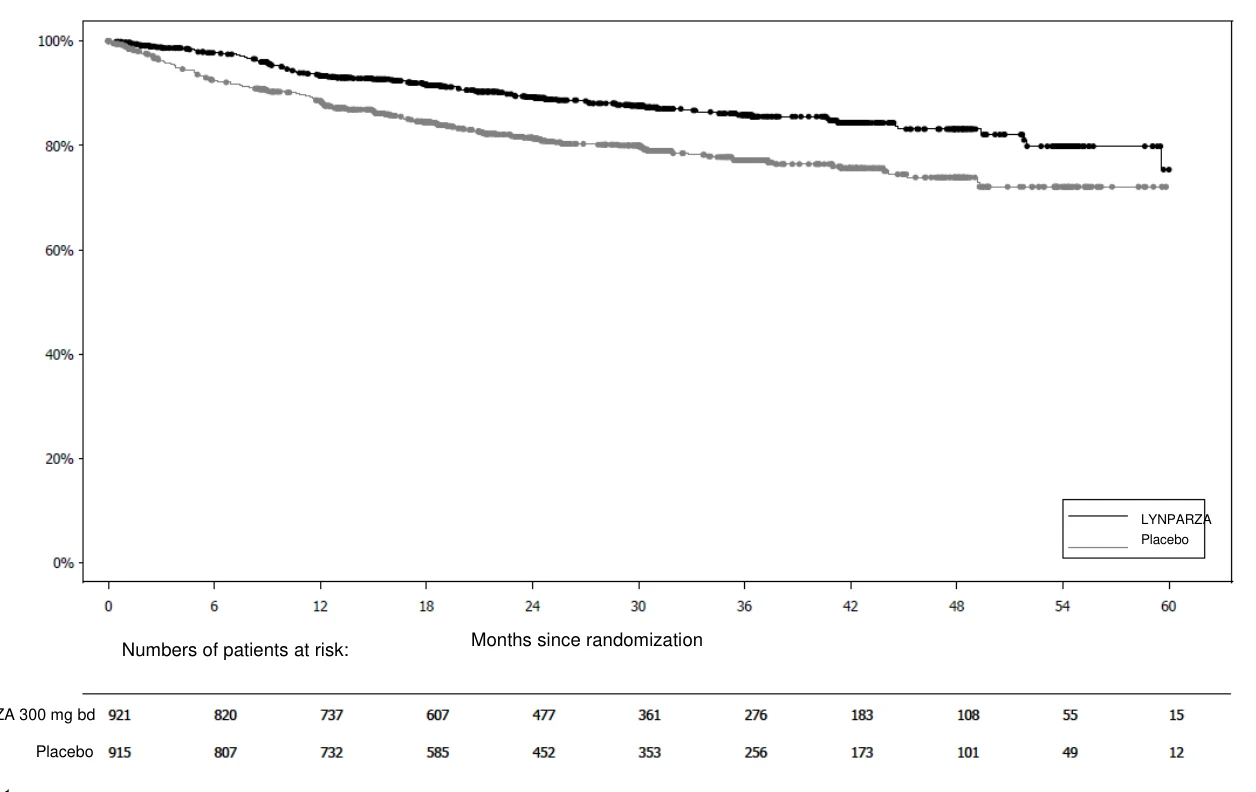
1DCO 27 March 2020
Numbers of patients at risk:
LYNPARZA
Placebo
Months since randomization
LYNPARZA 300 mg bd
Placebo
P erce nta ge of pa tien ts e ven t f ree
Figure 2 Kaplan-Meier plot of DDFS in patients with gBRCAm HER2-negative high risk early breast cancer in the OlympiA study1
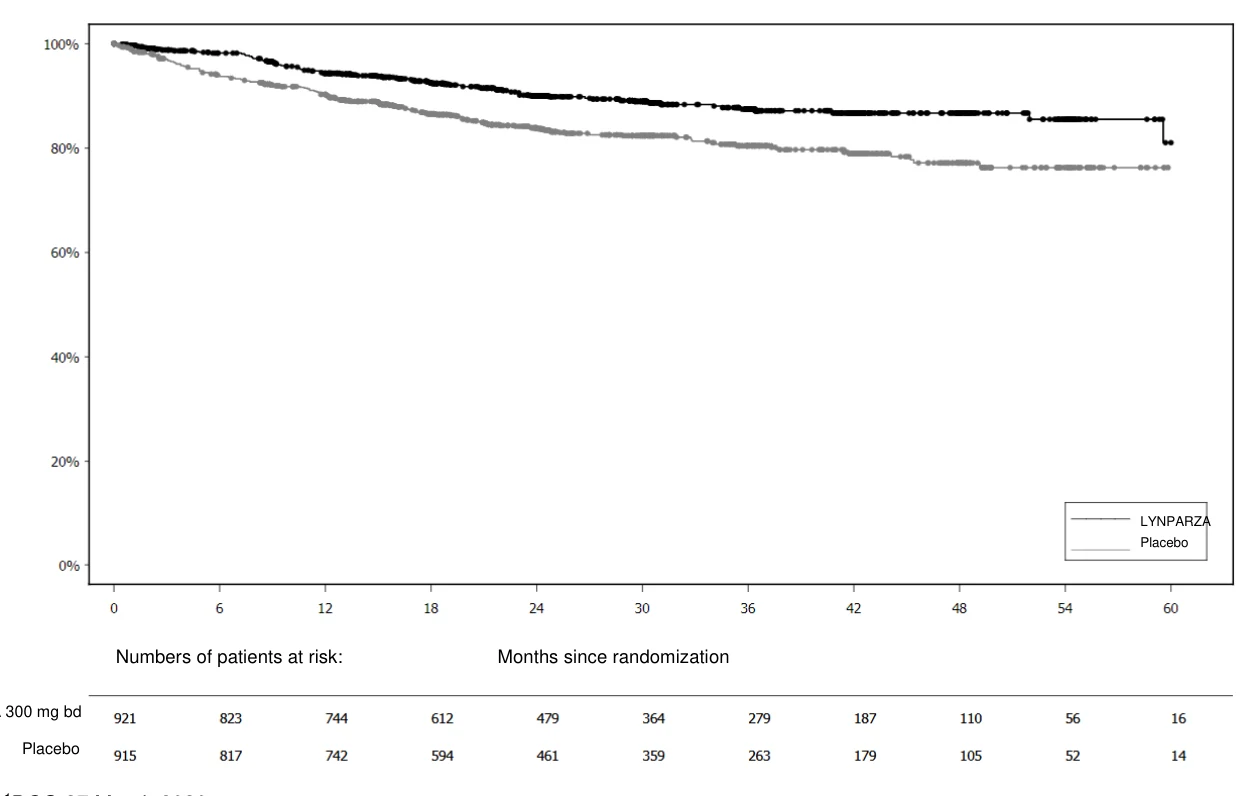
1DCO 27 March 2020
P erce nta ge of pa tien ts e ven t f ree
Numbers of patients at risk:
Months since randomization
LYNPARZA
Placebo
LYNPARZA 300 mg bd
Placebo
Figure 3 Kaplan-Meier plot of OS in patients with gBRCAm HER2-negative high risk early breast cancer in the OlympiA study1
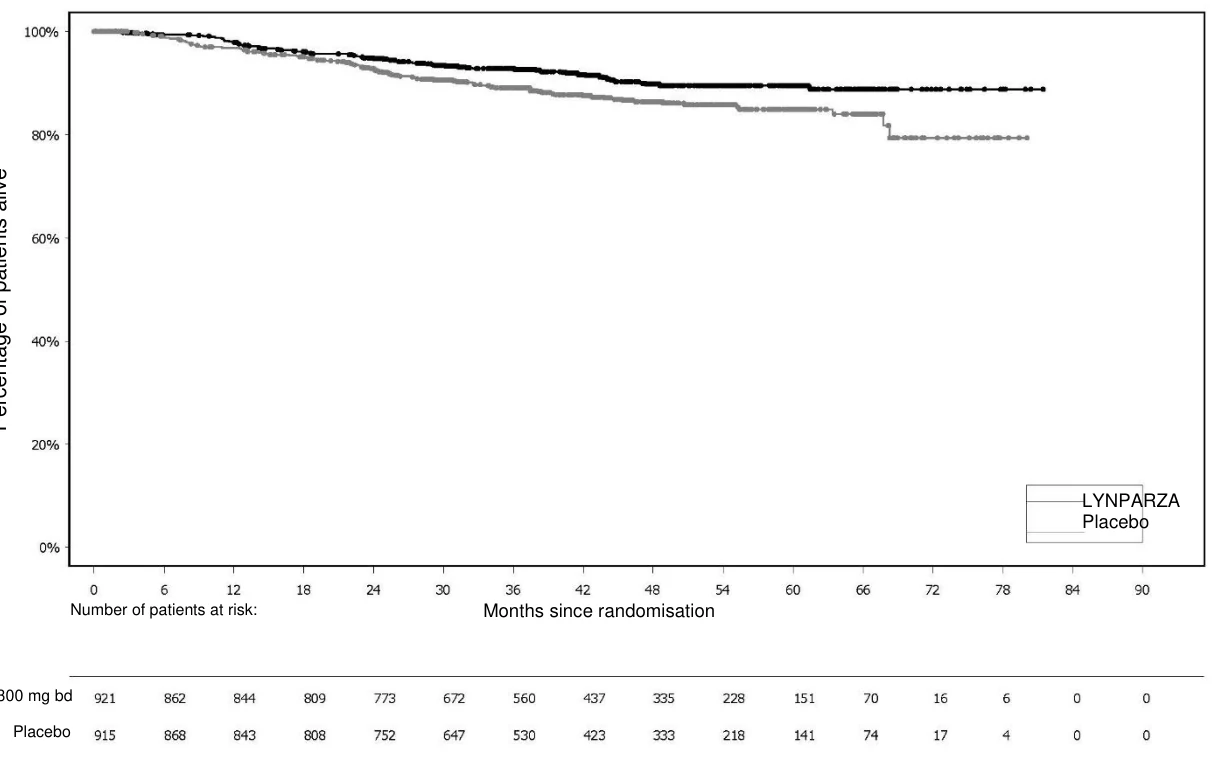
1DCO 12 July 2021
IDFS benefit was observed across all patient stratification subgroups of hormone receptor status (ER and/or PgR positive: HR 0.70, 95%CI 0.38, 1.27; TNBC: HR 0.56, 95% 0.43,0.73), prior chemotherapy status (Neoadjuvant: HR 0.56, 95% CI 0.41, 0.75; Adjuvant: HR 0.60, 95%CI 0.39, 0.90), and prior platinum status (Yes: HR 0.77, 95%CI 0.49, 1.21; No: HR 0.52, 95%CI 0.39, 0.69).
Treatment of gBRCAm HER2-Negative Metastatic Breast Cancer (OlympiAD)
The safety and efficacy of LYNPARZA (olaparib) in the treatment of gBRCAm HER2-negative metastatic breast cancer was studied in a Phase III, randomized, open-label, multicentre, active-controlled trial, OlympiAD (Study D0819C00003). A total of 302 patients were randomized 2:1 to receive LYNPARZA 300 mg (2 x 150 mg tablets) twice daily or the active comparator (physician’s choice of chemotherapy: capecitabine, eribulin, or vinorelbine, at standard doses [see Table 25]) until progression or unacceptable toxicity. Randomization was stratified by prior use of chemotherapy for metastatic disease (yes vs no), hormone receptor status (hormone receptor positive vs triple negative), and previous use of platinum-based chemotherapy (yes vs no). The gBRCAm was confirmed using Myriad gBRCA test.
All patients had received prior treatment with anthracycline (unless contraindicated) and a taxane in either the neoadjuvant or metastatic setting. Patients with hormone receptor-positive disease must have received and progressed on at least one endocrine therapy (adjuvant or metastatic) or had disease that the treating physician believed to be inappropriate for endocrine
P erc ent age of pat ients aliv e
LYNPARZA
Placebo
Number of patients at risk:
Months since randomisation randomisation (months)
LYNPARZA 300 mg bd
Placebo
therapy. Patients with prior platinum therapy were required to have no evidence of disease progression during platinum treatment. No prior treatment with a PARP inhibitor was permitted. Patients could not have received more than 2 prior lines of cytotoxic chemotherapy for metastatic disease.
Table 25 Summary of Trial Design for Clinical Trials in gBRCAm HER2-Negative Metastatic Breast Cancer Patients
| Study # | Trial Design | Dosage, Route of Administration and Duration | Study Subjects (n) | Mean Age (Range) | Sex |
D0819C00003 (OlympiAD) | Phase III randomized (2:1), open-label, active-controlled study, that investigated LYNPARZA 300 mg twice daily tablet formulation as treatment for patients with gBRCAm HER2-negative metastatic breast cancer | 300 mg (2 x 150 mg tablets) orally twice daily | LYNPARZA n=205 Physicians’ choice of chemotherapya n=97 | LYNPARZA 45.0 years (22 – 76 years) Physicians’ choice of chemotherapya 45.9 years (24 – 68 years) | LYNPARZA Female: n=200 Male: n=5 Physicians’ choice of chemotherapya Female: n=95 Male: n=2 |
a Physician’s choice of chemotherapy consisting of either capecitabine (2500 mg/m2 oral daily, divided in 2 doses for 14 days, repeated every 21 days), eribulin (1.4 mg/m2 IV Day 1 and Day 8, repeated every 21 days), or vinorelbine (30 mg/m2 IV Day 1 and Day 8, repeated every 21 days).
Demographic and baseline patient characteristics were generally balanced between treatment groups in OlympiAD and are summarized below.
| Table 26 Summary of Selected Demographic and Patient Characteristics at Baseline (Full Analysis Set) in the OlympiAD Study | ||||||||||||
| Table 26 Summary of Selected Demographic and Patient Characteristics at Baseline (Full Analysis Set) in the OlympiAD Study | ||||||||||||
| Table 26 Summary of Selected Demographic and Patient Characteristics at Baseline (Full Analysis Set) in the OlympiAD Study | ||||||||||||
LYNPARZA Tablets 300 mg bid (n=205) | Physician’s Choice of Chemotherapya (n=97) | |||||||||||
LYNPARZA Tablets 300 mg bid (n=205) | Physician’s Choice of Chemotherapya (n=97) | |||||||||||
LYNPARZA Tablets 300 mg bid (n=205) | Physician’s Choice of Chemotherapya (n=97) | |||||||||||
| Demographics | ||||||||||||
| Age (years) | ||||||||||||
| Mean (SD) | 45.0 (10.9) | 45.9 (10.3) | ||||||||||
| Median (range) | 44.0 (22 – 76) | 45.0 (24 – 68) | ||||||||||
| Age group (years), n (%) | ||||||||||||
| <50 | 138 (67.3) | 63 (64.9) | ||||||||||
| ≥50 to <65 | 56 (27.3) | 30 (30.9) | ||||||||||
| ≥65 | 11 (5.4) | 4 (4.1) | ||||||||||
| Sex, n (%) | ||||||||||||
| Female | 200 (97.6) | 95 (97.9) | ||||||||||
| Male | 5 (2.4) | 2 (2.1) | ||||||||||
| Race, n (%) | ||||||||||||
| Caucasian | 134 (65.4) | 63 (64.9) | ||||||||||
| Asian | 66 (32.2) | 28 (28.9) | ||||||||||
| Black/African American | 1 (0.5) | 4 (4.1) | ||||||||||
| Other | 4 (2.0) | 2 (2.1) | ||||||||||
| Disease Characteristics | ||||||||||||
| ECOG performance status, n (%) | ||||||||||||
| Grade 0 | 148 (72.2) | 62 (63.9) | ||||||||||
| Grade 1 | 57 (27.8) | 35 (36.1) | ||||||||||
| Germline BRCA status | ||||||||||||
| BRCA1 | 114 (55.6) | 50 (51.5) | ||||||||||
| BRCA2 | 84 (41.0) | 45 (46.4) | ||||||||||
| BRCA1 and BRCA2 | 4 (2.0) | 0 | ||||||||||
| Missingb | 3 (1.5) | 2 (2.1) | ||||||||||
| At the Time of Randomization, was the Patient’s Breast Cancer Progressing? | ||||||||||||
| Yes | 159 (77.6) | 73 (75.3) | ||||||||||
| De Novo Metastatic Diseasec | ||||||||||||
| Yes | 26 (12.7) | 12 (12.4) | ||||||||||
| Prior Endocrine Therapy | ||||||||||||
| For metastatic disease | 68 (33.2) | 30 (30.9) | ||||||||||
| For localised disease (adjuvant and/or neoadjuvant) | 80 (39.0) | 36 (37.1) | ||||||||||
| Stratification Factors (IVRS Data) | ||||||||||||
| Received prior chemotherapy regimens for metastatic breast cancerd, n (%) | ||||||||||||
| No | 59 (28.8) | 28 (28.9) | ||||||||||
| Yes | 146 (71.2) | 69 (71.1) | ||||||||||
| ER and PgR statuse, n (%) | ||||||||||||
| ER and/or PgR positive | 103 (50.2) | 49 (50.5) | ||||||||||
| ER and PgR negative | 102 (49.8) | 48 (49.5) | ||||||||||
| Prior use of platinum for breast cancer, n (%)f | ||||||||||||
| Yes | 60 (29.3) | 26 (26.8) | ||||||||||
a Physician’s choice of chemotherapy consisting of either capecitabine, eribulin or vinorelbine.
b Patients with Missing status were not confirmed as gBRCAm using the Myriad CDx gBRCA test. Within the LYNPARZA arm all 3 cases were determined as BRCA1 by local or CLIA testing and within the physician’s choice of chemotherapy arm 1 patient was BRCA1 and 1 patient was BRCA2.
c Metastatic disease at time of initial diagnosis of breast cancer.
d According to the electronic case report form data, 68 patients in the LYNPARZA arm and 31 patients in the physician’s choice of chemotherapy arm had not received prior chemotherapy regimens for metastatic breast cancer.
e According to the electronic case report form data, 102 patients in the LYNPARZA arm and 47 patients in the physician’s choice of chemotherapy arm were ER and/or PgR positive. Patient E2806008 did not have PgR status assessed but was stratified to the ER negative and PgR negative subgroup for randomization. The patient was excluded from summaries of eCRF data.
f According to the electronic case report form data, 55 patients in the LYNPARZA arm and 21 patients in the physician’s choice of chemotherapy arm had prior use of platinum for breast cancer.
bid Twice daily; BRCA Breast cancer susceptibility gene; CDx Companion diagnostic; CLIA Clinical laboratory improvement amendments; ECOG Eastern cooperative oncology arm; eCRF electronic case report form; ER Estrogen receptor; FAS Full analysis set; gBRCA Germline BRCA; IVRS Interactive Voice Response System; PgR Progesterone receptor; SD Standard deviation.
Study Results
The primary endpoint in the OlympiAD study was progression-free survival (PFS) assessed by blinded independent central review (BICR) using RECIST 1.1. Secondary endpoints included time to second progression or death (PFS2), overall survival (OS) and objective response rate (ORR). Response was assessed every 6 weeks for the first 24 weeks, and then every 12 weeks relative to date of randomization, until disease progression. A summary of key efficacy findings is presented in Table 27 and Figure 4.
The study met its primary objective demonstrating a statistically significant and clinically meaningful improvement in PFS for LYNPARZA compared with the comparator arm with a hazard ratio (HR) of 0.58 (95% CI 0.43-0.80; p=0.0009; median 7.0 months [95% CI 5.68-8.31] for LYNPARZA vs. 4.2 months [95% CI 2.79-4.27] for comparator). A sensitivity analysis using investigator-assessed PFS was consistent.
A statistically significant improvement in PFS2 was also observed with a HR of 0.57 (95% CI 0.40-0.83; p=0.0033; median 13.2 months for LYNPARZA vs 9.3 months for comparator). The median time to onset of response was 47 days for LYNPARZA vs 45 days for comparator. The median duration of response was 6.4 months (95% CI 5.0-7.2) for LYNPARZA vs 7.1 months (95% CI 3.2-12.2) for comparator. The OS data was 64% mature in the Full Analysis Set (FAS) at the time of the final OS analysis (DCO 25 September 2017), with a median follow-up for censored patients of 25.3 months for LYNPARZA vs. 26.3 months for comparator (HR 0.90; 95% CI 0.66-1.23; p=0.5131; median 19.3 months for LYNPARZA vs 17.1 months for control).
Consistent results were observed across patient subgroups.
Table 27 Summary of Key Efficacy Findings for Patients with gBRCAm HER2- Negative Metastatic Breast Cancer in the OlympiAD Study
LYNPARZA Tablets 300 mg bid | Physician’s Choice of Chemotherapya | |||||||||||
|---|---|---|---|---|---|---|---|---|---|---|---|---|
| PFS (77% Maturity) | ||||||||||||
| Number of events: Total number of patients (%) | 163:205 (80) | 71:97 (73) | ||||||||||
| Median time (months) | 7.0 | 4.2 | ||||||||||
| Median time (95% CI) | 5.7-8.3 | 2.8-4.3 | ||||||||||
| HR (95% CI) | 0.58 (0.43-0.80) | |||||||||||
| P value (2-sided) | P=0.0009 | |||||||||||
| Final OS (64% Maturity) | ||||||||||||
| Number of events: Total number of patients (%) | 130:205 (63) | 62:97 (64)b | ||||||||||
| Median time (months) | 19.3 | 17.1 | ||||||||||
| Median time (95% CI) | 17.2-21.6 | 13.9-21.9 | ||||||||||
| HR (95% CI) | 0.90 (0.66-1.23) | |||||||||||
| P value (2-sided) | P=0.5131 | |||||||||||
| ORR | ||||||||||||
| Number of objective responders: Total number of patients with measurable disease (%)c | 100:167 (60) | 19:66 (29) | ||||||||||
| 95% CI | 52.0 to 67.4 | 18.3 to 41.3 | ||||||||||
a Physician’s choice of chemotherapy consisting of either capecitabine, eribulin or vinorelbine.
b Approximately a tenth of patients in the physician’s choice group (8/97; 8.2%) received a subsequent PARP inhibitor.
c The complete response rate was 9% for LYNPARZA compared to 2% for chemotherapy arm.
bid Twice daily; CI Confidence interval; HR Hazard ratio; ORR Objective response rate; OS Overall survival; PFS Progression-free survival.
Figure 4 Progression Free Survival in Patients with gBRCAm HER2-Negative Metastatic Breast Cancer in the OlympiAD Study
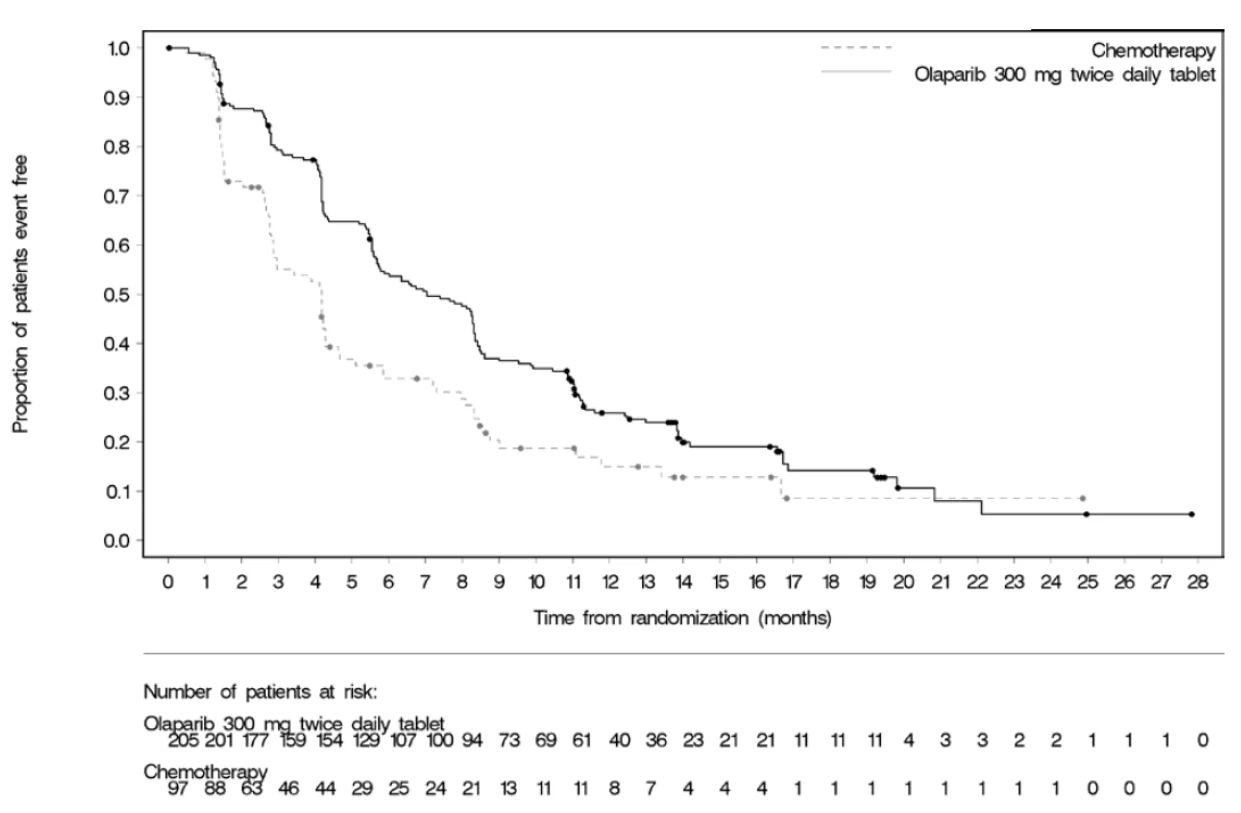
Maintenance Treatment of BRCA-mutated Advanced Ovarian Cancer (SOLO1)
The efficacy of LYNPARZA (olaparib tablets) in the maintenance treatment setting in advanced (FIGO Stage III-IV) high-grade serous or endometrioid BRCAm ovarian cancer patients who are in response following first-line platinum-based chemotherapy was investigated in a Phase III randomized, double-blind, placebo-controlled, multicentre trial (SOLO1). The study randomized 391 patients (2:1 randomization: 260 LYNPARZA and 131 placebo) who were in response (CR [complete response] or PR [partial response]) following completion of first-line platinum-containing chemotherapy. Patients were stratified by response to first-line platinum chemotherapy (CR or PR). Treatment was continued for 2 years or until progression of the underlying disease. For patients who remained in complete clinical response (i.e. no radiological evidence of disease), the maximum duration of treatment was 2 years; however, patients who had evidence of disease that remained stable (i.e. no evidence of disease progression) could continue to receive LYNPARZA beyond 2 years.
Patients with BRCA mutations were identified either from germline testing in blood via a local test or central test (i.e. Myriad Integrated BRACAnalysis® test, Myriad BRACAnalysis CDx®, China BGI test) or from testing a tumour sample using a local test. The BRCAm status of all patients was confirmed where possible using the Myriad Integrated BRACAnalysis® test, the Myriad BRACAnalysis CDx® or the Foundation Medicine FoundationOne CDxTM Clinical Trial Assay.
Table 28 Trial Design for SOLO1
| Study # | Trial design | Dosage, route of administration and duration | Study subjects (n) | Mean age (Range) | Sex |
D0818C00001 (SOLO1 Study) | Phase III randomized (2:1), double-blind, placebo-controlled study, that investigated olaparib 300 mg twice daily tablet formulation as a maintenance treatment for patients with newly diagnosed BRCA mutated advanced ovarian cancer | 300 mg (2 x 150 mg tablets) orally twice daily | LYNPARZA n=260 Placebo n=131 | LYNPARZA = 53.6 years Placebo = 53.4 years | Female |
Demographic and baseline patient characteristics in SOLO1 are summarized below.
| Table 29 Selected Demographic and Patient Characteristics at Baseline (Full Analysis Set) for SOLO1 | |||||||||||
| Table 29 Selected Demographic and Patient Characteristics at Baseline (Full Analysis Set) for SOLO1 | |||||||||||
LYNPARZA Tablets 300 mg bid (n=260) | Placebo (n=131) | ||||||||||
LYNPARZA Tablets 300 mg bid (n=260) | Placebo (n=131) | ||||||||||
| Demographics | |||||||||||
| Age (years) | |||||||||||
| Mean (SD) | 53.6 (9.4) | 53.4 (9.8) | |||||||||
| Median (range) | 53.0 (29-82) | 53.0 (31-84) | |||||||||
| Age group (years), n (%) | |||||||||||
| <50 | 94 (36.2) | 48 (36.6) | |||||||||
| ≥50 to <65 | 131 (50.4) | 64 (48.9) | |||||||||
| ≥65 | 35 (13.5) | 19 (14.5) | |||||||||
| Race, n (%) | |||||||||||
| White | 214 (82.3) | 106 (80.9) | |||||||||
| Asian | 39 (15.0) | 20 (15.3) | |||||||||
| Black/African American | 2 (0.8) | 2 (1.5) | |||||||||
| Other | 5 (1.9) | 3 (2.4) | |||||||||
| Ethnic group, n (%) | |||||||||||
| Hispanic or Latino | 11 (4.2) | 7 (5.3) | |||||||||
| Disease Characteristics | |||||||||||
| ECOG Performance status, n (%) | |||||||||||
| (0) Normal activity | 200 (76.9) | 105 (80.2) | |||||||||
| (1) Restricted activity | 60 (23.1) | 25 (19.1) | |||||||||
| Missing | 0 | 1 (0.8) | |||||||||
| Histology type, n (%) | |||||||||||
| Serous | 245 (94.2) | 130 (99.2) | |||||||||
| Endometrioid | 9 (3.5) | 0 | |||||||||
| Mixed, Epithelial | 5 (1.9) | 1 (0.8) | |||||||||
| Other | 1 (0.4) | 0 | |||||||||
| Serous, papillary | 1 (0.4) | 0 | |||||||||
| Tumour Characteristics | |||||||||||
| Primary tumour location, n (%) | |||||||||||
| Ovary | 220 (84.6) | 113 (86.3) | |||||||||
| Fallopian tube | 22 (8.5) | 11 (8.4) | |||||||||
| Primary peritoneal | 15 (5.8) | 7 (5.3) | |||||||||
| Other | 3 (1.2) | 0 | |||||||||
| BRCA mutation status | |||||||||||
| gBRCAm | 258 (99.2) | 131 (100.0) | |||||||||
| sBRCAm | 2 (0.8) | 0 | |||||||||
| Response to previous platinum chemotherapy | |||||||||||
| As randomized, n (%) | |||||||||||
| Complete Response | 213 (81.9) | 107 (81.7) | |||||||||
| Partial Response | 47 (18.1) | 24 (18.3) | |||||||||
| History of Debulking Surgery | |||||||||||
| Upfront surgery | 161 (61.9) | 85 (64.9) | |||||||||
| Interval debulking surgery | 94 (36.2) | 43 (32.8) | |||||||||
| Residual macroscopic disease | 55 (21.2) | 29 (22.1) | |||||||||
| No residual macroscopic disease | 199 (76.5) | 98 (74.8) | |||||||||
bid Twice daily; ECOG Eastern Cooperative Oncology Group; gBRCAm germline BRCA mutation; sBRCAm somatic BRCA mutation; SD Standard deviation
Study Results
The study compared the efficacy of LYNPARZA (olaparib) maintenance treatment (300 mg [2 x 150 mg tablets] twice daily) with placebo in 391 patients with advanced (FIGO Stage III-IV) high-grade serous or endometrioid BRCAm ovarian cancer.
The primary endpoint was progression-free survival (PFS), defined as time from randomization to progression determined by investigator assessment using modified Response Evaluation Criteria in Solid Tumors (RECIST) 1.1, or death. Key secondary efficacy endpoints included time from randomization to second progression or death (PFS2), overall survival (OS), time from randomization to first subsequent anti-cancer therapy or death (TFST) and health related quality of life (HRQoL). Patients had tumour assessments at baseline and every 12 weeks for 3 years, and then every 24 weeks relative to the date of randomization, until objective radiological disease progression. A summary of key efficacy findings is presented in Table 30 and Figure 5.
The study met its primary objective, demonstrating a clinically relevant and statistically significant improvement in investigator assessed PFS for LYNPARZA compared to placebo; these results were consistent with the sensitivity analysis of PFS using blinded independent central radiological (BICR) review. A clinically meaningful and statistically significant improvement in PFS2 was also observed indicating that the benefit observed with LYNPARZA continued to be evident even with the use of subsequent therapies (see Table 30). Time from randomization to start of first subsequent therapy or death (TFST) demonstrated a HR of 0.30 (95% CI 0.22-0.40, p<0.0001[not controlled for multiplicity], median 51.8 months LYNPARZA vs 15.1 months placebo). The PFS and PFS2 results are summarized in Table 30 and the PFS Kaplan-Meier plot is in Figure 5.
At 7 years of follow-up (DCO 07 March 2022), the OS results were 38.1% mature (149 events/291 patients). A positive OS trend in favour of LYNPARZA compared to placebo was observed (HR=0.55, 95% CIb: 0.40-0.76). The results did not meet the pre-specified boundary for statistical significance. The 7-year OS rate was 67% in the LYNPARZA arm compared to 46.5% in the placebo arm. The median OS was not reached in the LYNPARZA arm and 75.2 months in the placebo arm. The percentage of patients whose received a PARPi in any subsequent line of treatment was 14.6% (38/260) in the LYNPARZA arm and 44.3% (58/131) in the placebo arm.
Table 30 Key Efficacy Findings for Patients with BRCA-mutated Advanced Ovarian Cancer in SOLO1
| LYNPARZA Tablets 300 mg bid | Placebo | |||||||
|---|---|---|---|---|---|---|---|---|
| PFS (51% maturity) | ||||||||
| Number of events: Total number of patients (%) | 102:260 (39) | 96:131 (73)a | ||||||
| Median time (months) | NR | 13.8 | ||||||
| HR (95% CI)b | 0.30 (0.23-0.41) | |||||||
| P value (2-sided) | p<0.0001 | |||||||
| PFS2 (31% maturity) | ||||||||
| Number of events: Total number of patients (%) | 69:260 (27) | 52:131 (40) | ||||||
| Median time (months) | NR | 41.9 | ||||||
| HR (95% CI)b | 0.50 (0.35-0.72) | |||||||
| P value (2-sided) | p=0.0002 | |||||||
a Of the 94 patients on the placebo arm who received subsequent therapy, 49 (52%) received a PARP inhibitor.
b A value <1 favours LYNPARZA. The analysis was performed using a Cox proportional hazards model including response to previous platinum chemotherapy (CR or PR) as a covariate.
bid Twice daily; NR Not reached; CI Confidence interval
| Figure 5 Kaplan-Meier Plot of PFS in Patients with BRCA-mutated Advanced Ovarian Cancera, b for SOLO1 |
|---|
a 51% Maturity - Investigator Assessment b The proportion of patients that were progression free at 24 and 36 months were 74% and 60% for olaparib versus 35% and 27% for placebo; the median follow-up time was 41 months for both the olaparib and placebo arms. |
Treatment with LYNPARZA did not negatively impact patient reported outcomes or health related quality of life as assessed by the Trial Outcome Index (TOI) of the Functional Assessment of Cancer Therapy – Ovarian (FACT-O).
Maintenance Treatment of Platinum-Sensitive Relapsed Ovarian Cancer (SOLO2, Study 19, OPINION)
Maintenance Treatment of Platinum-Sensitive Relapsed BRCA-mutated Ovarian Cancer (SOLO2)
SOLO2
The efficacy of LYNPARZA (olaparib tablets) in the maintenance treatment setting in platinum-sensitive relapsed (PSR) ovarian, fallopian tube or primary peritoneal cancer was investigated in a randomized phase III double-blind, placebo-controlled trial in patients with PSR, BRCA-mutated (BRCAm) disease (SOLO2). SOLO2 enrolled PSR patients who were in response following completion of platinum-based chemotherapy and whose disease had recurred more
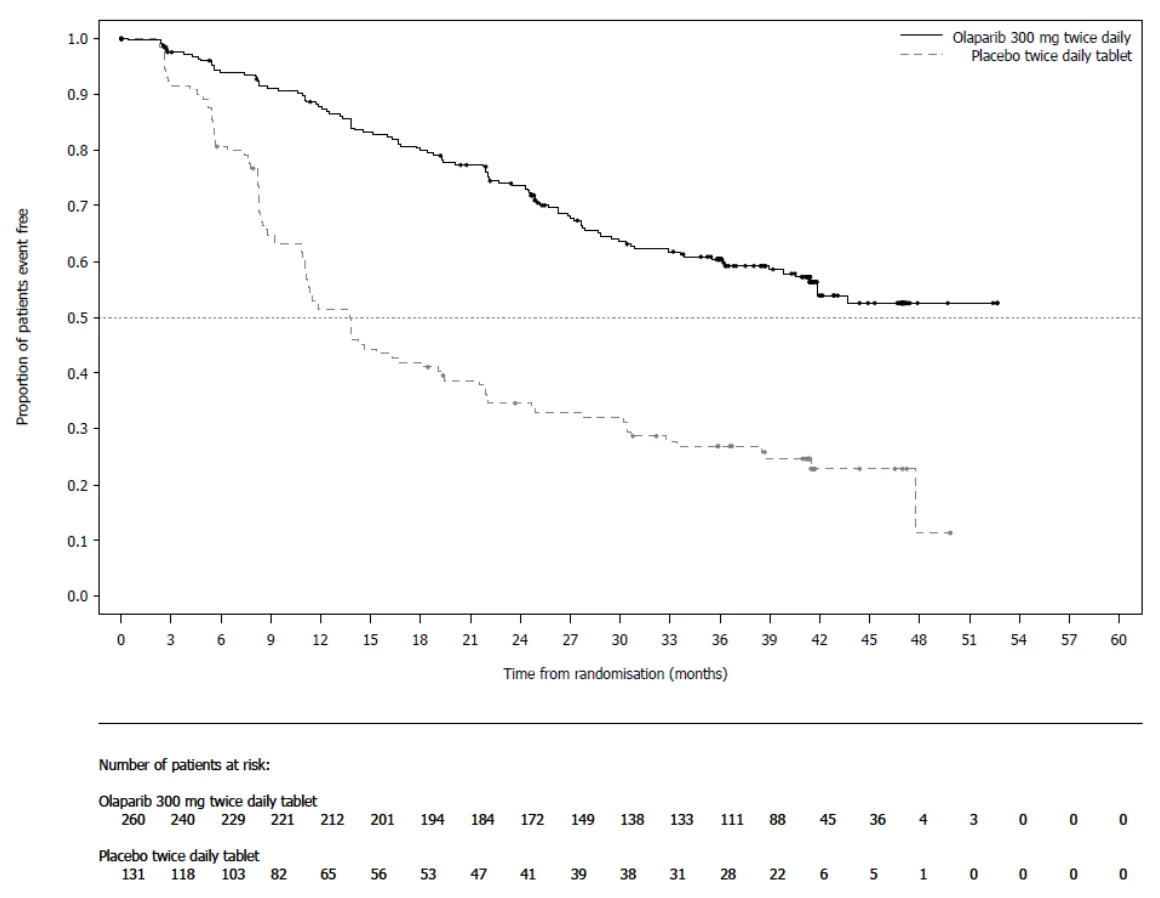 |
|---|
than 6 months after completion of penultimate platinum-based chemotherapy. Patients could not have received prior LYNPARZA or other PARP inhibitor treatment. Patients could have received prior bevacizumab, except in the regimen immediately prior to randomization. Patients with BRCA mutations were identified either from germline testing in blood via a local test or the Myriad Clinical Laboratory Improvement Amendments (CLIA) Integrated BRACAnalysis® test, or from testing a tumour sample using a local test or a test performed by Foundation Medicine.
Table 31 Trial Design for SOLO2
| Study # | Trial design | Dosage, route of administration and duration | Study subjects (n) | Mean age (Range) | Sex |
D0816C00002 (SOLO2 Study) | Phase III randomized (2:1), double-blind, placebo-controlled study, that investigated olaparib 300 mg twice daily tablet formulation as a maintenance treatment for patients with BRCA mutated PSR ovarian cancer | 300 mg (2 x 150 mg tablets) orally twice daily | LYNPARZA n=196 Placebo n=99 | LYNPARZA = 57.0 years Placebo = 56.6 years | Female |
Demographic and baseline patient characteristics in SOLO2 are summarized below.
| Table 32 Selected Demographic and Patient Characteristics at Baseline (Full Analysis Set) for SOLO2 | |||||||||||
| Table 32 Selected Demographic and Patient Characteristics at Baseline (Full Analysis Set) for SOLO2 | |||||||||||
LYNPARZA Tablets 300 mg bid (n=196) | Placebo (n=99) | ||||||||||
LYNPARZA Tablets 300 mg bid (n=196) | Placebo (n=99) | ||||||||||
| Demographics | |||||||||||
| Age (years) | |||||||||||
| Mean (SD) | 57.0 (9.2) | 56.6 (8.9) | |||||||||
| Median (range) | 56.0 (28-83) | 56.0 (39-78) | |||||||||
| Age group (years), n (%) | |||||||||||
| <50 | 38 (19.4) | 25 (25.3) | |||||||||
| ≥50 to <65 | 118 (60.2) | 52 (52.5) | |||||||||
| ≥65 | 40 (20.4) | 22 (22.2) | |||||||||
| Race, n (%) | |||||||||||
| White | 173 (88.3) | 91 (91.9) | |||||||||
| Black/African American | 1 (0.5) | 0 | |||||||||
| Asian | 22 (11.2) | 7 (7.1) | |||||||||
| Other | 0 | 1 (1.0) | |||||||||
| Ethnic group, n (%) | |||||||||||
| Hispanic or Latino | 10 (5.1) | 1 (1.0) | |||||||||
| Disease Characteristics | |||||||||||
| ECOG Performance status, n (%) | |||||||||||
| (0) Normal activity | 162 (82.7) | 77 (77.8) | |||||||||
| (1) Restricted activity | 32 (16.3) | 22 (22.2) | |||||||||
| (2) In bed <50% of the time | 0 | 0 | |||||||||
| Unknown | 2 (1.0) | 0 | |||||||||
| Histology type, n (%) | |||||||||||
| Serous | 183 (93.4) | 86 (86.9) | |||||||||
| Endometrioid | 9 (4.6) | 8 (8.1) | |||||||||
| Mixed, Epithelial | 3 (1.5) | 4 (4.0) | |||||||||
| Other | 0 | 1 (1.0) | |||||||||
| Serous, pappilliferum, endometrioid | 0 | 1 (1.0) | |||||||||
| Missing | 1 (0.5) | 0 | |||||||||
| Tumour Characteristics | |||||||||||
| Primary tumour location, n (%) | |||||||||||
| Ovary | 162 (82.7) | 86 (86.9) | |||||||||
| Fallopian tube | 13 (6.6) | 4 (4.0) | |||||||||
| Primary peritoneal | 18 (9.2) | 9 (9.1) | |||||||||
| Other | 2 (1.0) | 0 | |||||||||
| Missing | 1 (0.5) | 0 | |||||||||
| Previous Treatments | |||||||||||
| Response to previous platinum chemotherapy (recorded at randomization by IVRS), n (%)a | |||||||||||
| PR | 105 (53.6) | 52 (52.5) | |||||||||
| CR | 91 (46.4) | 47 (47.5) | |||||||||
| Time to disease progression in the penultimate platinum-based chemotherapy prior to enrolment (recorded at randomization by IVRS), n (%)b | |||||||||||
| >6 to ≤12 months | 79 (40.3) | 40 (40.4) | |||||||||
| >12 months | 117 (59.7) | 59 (59.6) | |||||||||
| Number of prior chemotherapies, n (%) | |||||||||||
| 2 | 108 (55.1) | 60 (60.6) | |||||||||
| 3 | 54 (27.6) | 21 (21.2) | |||||||||
| 4 or more | 33 (16.8) | 18 (18.2) | |||||||||
| Median (range) | 2.0 (2-7) | 2.0 (2-13) | |||||||||
| Number of prior platinum-containing chemotherapies, n (%) | |||||||||||
| 2 | 110 (56.1) | 62 (62.6) | |||||||||
| 3 | 60 (30.6) | 20 (20.2) | |||||||||
| 4 or more | 25 (12.8) | 17 (17.2) | |||||||||
| Median (range) | 2.0 (2-7) | 2.0 (2-7) | |||||||||
a Objective Response: CR = Patients with no target lesions and no non-target lesions are baseline; PR = Patients with target lesions and/or non-target lesions at baseline. Note: This is the response from the platinum regimen just prior to therapy.
b Platinum sensitivity = time to progression after the completion of platinum chemotherapy. Note: Platinum sensitivity refers to the penultimate platinum not the platinum regimen that was just completed by the patient.
bid Twice daily; CR Complete response; CSR Clinical study report; ECOG Eastern Cooperative Oncology Group; FAS Full analysis set; IVRS Interactive voice response system; PR Partial response; SD Standard deviation
Study Results
The study compared the efficacy of LYNPARZA (olaparib) maintenance treatment (300 mg [2 x 150 mg tablets] twice daily) taken to progression with placebo treatment in 295 patients with high-grade serous or endometrioid PSR ovarian cancer (2:1 randomization: 196 LYNPARZA and 99 placebo) who were in response (CR or PR) following completion of platinum-containing chemotherapy. All patients had evidence of germline BRCA mutation (gBRCAm) at baseline.
The primary endpoint was progression-free survival (PFS) determined by investigator assessment using RECIST 1.1. A secondary efficacy endpoint was overall survival (OS). A summary of key efficacy findings is presented in Table 33 and Figure 6.
The study met its primary objective demonstrating a clinically meaningful and statistically significant improvement in investigator assessed PFS for LYNPARZA compared with placebo with a HR of 0.30. The investigator assessment of PFS was supported with a blinded independent central radiological review of PFS (HR 0.25; 95% CI 0.18-0.35; p<0.0001; median 30.2 months for LYNPARZA vs. 5.5 months for placebo). At 2 years, 43% LYNPARZA-treated patients remained progression-free compared with only 15% placebo-treated patients. At the final analysis of OS (DCO 03 February 2020) the HR did not reach statistical significance.
Table 33 Key Efficacy Findings for Patients with gBRCAm PSR Ovarian Cancer in SOLO2
LYNPARZA Tablets 300 mg bid | Placebo | ||||||||
|---|---|---|---|---|---|---|---|---|---|
| PFS (63% maturity) | |||||||||
| Number of events: Total number of patients (%) | 107:196 (55) | 80:99 (81) | |||||||
| Median time (months) | 19.1 | 5.5 | |||||||
| HR (95% CI)a | 0.30 (0.22-0.41) p<0.0001 | ||||||||
| P value (2-sided) | |||||||||
| Final OS (61% maturity) | |||||||||
| Number of events: Total number of patients (%) | 116:196 (59) | 65:99 (66)b | |||||||
| Median time 95% CI, (months) | 51.7 (41.5, 59.1) | 38.8 (31.4, 48.6) | |||||||
| HR (95% CI)a | 0.74 (0.54-1.00) p=0.0537 | ||||||||
| P value (2-sided) | |||||||||
a HR= Hazard Ratio. A value <1 favours LYNPARZA. The analysis was performed using a Cox proportional hazard model including response to previous platinum chemotherapy (CR or PR), and time to disease progression (>6-12 months and >12 months) in the penultimate platinum-based chemotherapy as covariates.
b 38% (38/99) of placebo-treated patients received a subsequent PARP inhibitor.
bid Twice daily; OS Overall survival; PFS Progression free survival; CI Confidence interval
| Figure 6 Kaplan-Meier Plot of PFS in Patients with gBRCAm PSR Ovarian Cancera for SOLO2 |
|---|
| a 63% Maturity - Investigator Assessment |
The secondary endpoints included time from randomization to second progression or death ([PFS2], HR of 0.50, 95% CI 0.34-0.72, p=0.0002, median not reached for LYNPARZA vs 18.4 months placebo) and time from randomization to start of first subsequent therapy or death ([TFST], HR of 0.37, 95% CI 0.28-0.48, nominal p<0.0001, median 27.4 months LYNPARZA vs 7.2 months placebo).
Treatment with LYNPARZA did not negatively impact patient reported outcomes or health related quality of life as assessed by the Trial Outcome Index (TOI) of the Functional Assessment of Cancer Therapy – Ovarian (FACT-O).
The use of LYNPARZA in the maintenance treatment setting for BRCAm patient population is supported by data from a randomized, phase II, double-blind, placebo-controlled trial (Study 19).
Maintenance Treatment of Platinum-Sensitive Relapsed BRCA-wild type and Ovarian Cancer (Study 19, OPINION)
Study 19
The efficacy of LYNPARZA (olaparib capsules) in the maintenance treatment setting in PSR BRCA-mutated and BRCA wild type ovarian, fallopian tube or primary peritoneal cancer was investigated in a randomized phase II double-blind, placebo-controlled trial in patients with PSR disease (Study 19). Study 19 enrolled PSR patients who were in response following completion of platinum-based chemotherapy and whose disease had recurred more than 6 months after completion of penultimate platinum-based chemotherapy. Patients could not have received prior LYNPARZA or other PARP inhibitor treatment. Patients could have received prior bevacizumab, except in the regimen immediately prior to randomization. Patients with BRCA mutations were identified either from germline testing in blood via a local test or the Myriad Clinical Laboratory
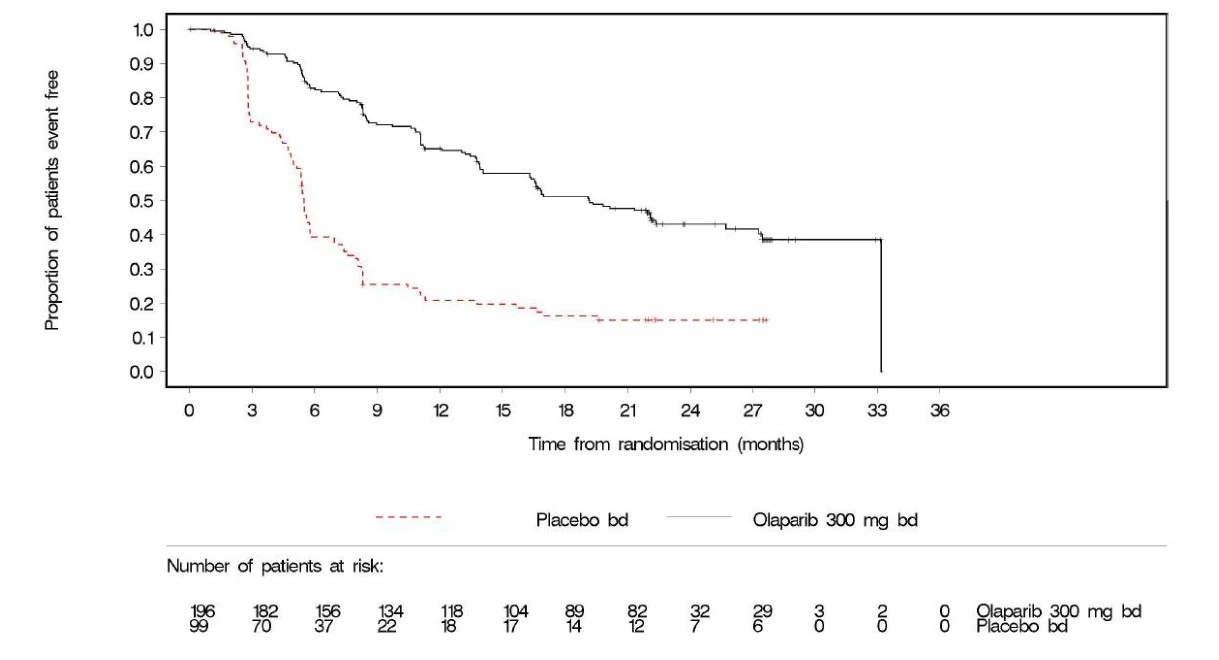 |
|---|
Improvement Amendments (CLIA) Integrated BRACAnalysis® test, or from testing a tumour sample using a local test or a test performed by Foundation Medicine.
Table 34 Trial Design for Study 19 (Capsule Formulation)
| Study # | Trial design | Dosage, route of administration and duration | Study subjects (n) | Mean age (Range) | Sex |
D0810C00019 (Study 19) | Phase II, randomized, double-blind, placebo-controlled maintenance study of olaparib compared to placebo in PSR high grade serous ovarian cancer patients | 400 mg (8 x 50 mg capsules formulation) orally twice daily | All patients: LYNPARZA n=136 Placebo n=129 BRCA-mutated patients: LYNPARZA n=74 Placebo n=62 BRCA wild type patients: LYNPARZA n=57 Placebo n=61 | LYNPARZA = 58.9 years Placebo = 58.5 years | Female |
Demographic and baseline patient characteristics were generally well balanced between treatment groups for all patients in Study 19 and are summarized below.
| Table 35 Selected Demographic and Patient Characteristics at Baseline for the Overall Population and Subgroups Based on BRCA Status (Full Analysis Set) for Study 19 (Capsule Formulation) | |||||||||||||||||||||||||||||
| Table 35 Selected Demographic and Patient Characteristics at Baseline for the Overall Population and Subgroups Based on BRCA Status (Full Analysis Set) for Study 19 (Capsule Formulation) | |||||||||||||||||||||||||||||
| Table 35 Selected Demographic and Patient Characteristics at Baseline for the Overall Population and Subgroups Based on BRCA Status (Full Analysis Set) for Study 19 (Capsule Formulation) | |||||||||||||||||||||||||||||
| All Patients | BRCA-mutated | BRCA wild type | |||||||||||||||||||||||||||
| All Patients | BRCA-mutated | BRCA wild type | |||||||||||||||||||||||||||
| All Patients | BRCA-mutated | BRCA wild type | |||||||||||||||||||||||||||
LYNPARZA Capsules 400 mg bid n=136 | Placebo n=129 | LYNPARZA Capsules 400 mg bid n=74 | Placebo n=62 | LYNPARZA Capsules 400 mg bid n=57 | Placebo n=61 | ||||||||||||||||||||||||
LYNPARZA Capsules 400 mg bid n=136 | Placebo n=129 | LYNPARZA Capsules 400 mg bid n=74 | Placebo n=62 | LYNPARZA Capsules 400 mg bid n=57 | Placebo n=61 | ||||||||||||||||||||||||
LYNPARZA Capsules 400 mg bid n=136 | Placebo n=129 | LYNPARZA Capsules 400 mg bid n=74 | Placebo n=62 | LYNPARZA Capsules 400 mg bid n=57 | Placebo n=61 | ||||||||||||||||||||||||
| Demographics | |||||||||||||||||||||||||||||
| Age (years) | |||||||||||||||||||||||||||||
| Mean (standard deviation) | 58.9 (10.95) | 58.5 (9.89) | 57.6 (10.37) | 55.5 (10.53) | 60.8 (11.69) | 62.1 (7.82) | |||||||||||||||||||||||
| Median (range) | 58.0 (21 to 89) | 59.0 (33 to 84) | 57.5 (38 to 89) | 55.0 (33 to 84) | 62.0 (21-80) | 63.0 (49-79) | |||||||||||||||||||||||
| Age group, n (%) | |||||||||||||||||||||||||||||
| <50 years | 30 (22.1) | 20 (15.5) | 19 (25.7) | 16 (25.8) | 10 (17.5) | 1 (1.6) | |||||||||||||||||||||||
| ≥50 to <65 years | 61 (44.9) | 74 (57.4) | 38 (51.4) | 35 (56.5) | 20 (35.1) | 37 (60.7) | |||||||||||||||||||||||
| ≥65 years | 45 (33.1) | 35 (27.1) | 17 (23.0) | 11 (17.7) | 27 (47.4) | 23 (37.7) | |||||||||||||||||||||||
| Race, n (%) | |||||||||||||||||||||||||||||
| White | 130 (95.6) | 126 (97.7) | 70 (94.6) | 61 (98.4) | 55 (96.5) | 59 (96.7) | |||||||||||||||||||||||
| Black or African American | 2 (1.5) | 1 (0.8) | 2 (2.7) | 0 | 0 | 1 (1.6) | |||||||||||||||||||||||
| Asian | 2 (1.5) | 2 (1.6) | 1 (1.4) | 1 (1.6) | 1 (1.8) | 1 (1.6) | |||||||||||||||||||||||
| Other | 2 (1.5) | 0 | 1 (1.4) | 0 | 1 (1.8) | 0 | |||||||||||||||||||||||
| Disease Characteristics | |||||||||||||||||||||||||||||
| ECOG PS, n (%) | |||||||||||||||||||||||||||||
| (0) Normal activity | 110 (80.9) | 95 (73.6) | 62 (83.8) | 45 (72.6) | 45 (78.9) | 45 (73.8) | |||||||||||||||||||||||
| (1) Restricted activity | 23 (16.9) | 30 (23.3) | 11 (14.9) | 15 (24.2) | 10 (17.5) | 14 (23.0) | |||||||||||||||||||||||
| (2) In bed ≤50% of the time | 1 (0.7) | 2 (1.6) | 0 | 1 (1.6) | 1 (1.8) | 1 (1.6) | |||||||||||||||||||||||
| Unknown | 2 (1.5) | 2 (1.6) | 1 (1.4) | 1 (1.6) | 1 (1.8) | 1 (1.6) | |||||||||||||||||||||||
| Tumour Characteristics | |||||||||||||||||||||||||||||
| Primary tumour location | |||||||||||||||||||||||||||||
| Ovary | 119 (87.5) | 109 (84.5) | 65 (87.8) | 54 (87.1) | 50 (87.7) | 49 (80.3) | |||||||||||||||||||||||
| Fallopian tube | 3 (2.2) | 3 (2.3) | 1 (1.4) | 2 (3.2) | 2 (3.5) | 1 (1.6) | |||||||||||||||||||||||
| Primary peritoneal | 14 (10.3) | 16 (12.4) | 8 (10.8) | 6 (9.7) | 5 (8.8) | 10 (16.4) | |||||||||||||||||||||||
| Other | 0 | 1 (0.8)a | 0 | 0 | 0 | 1 (1.6) | |||||||||||||||||||||||
| Tumour grade | |||||||||||||||||||||||||||||
| Well differentiated (G1) | 0 | 0 | 0 | 0 | 0 | 0 | |||||||||||||||||||||||
| Moderately differentiated (G2) | 36 (26.5) | 34 (26.4) | 17 (23.0) | 15 (24.2) | 15 (26.3) | 16 (26.2) | |||||||||||||||||||||||
| Poorly differentiated (G3) | 97 (71.3) | 89 (69.0) | 55 (74.3) | 46 (74.2) | 41 (71.9) | 41 (67.2) | |||||||||||||||||||||||
| Undifferentiated (G4) | 2 (1.5) | 4 (3.1) | 1 (1.4) | 0 | 1 (1.8) | 4 (6.6) | |||||||||||||||||||||||
| Unassessable (GX) | 1 (0.7) | 2 (1.6) | 1 (1.4) | 1 (1.6) | 0 | 0 | |||||||||||||||||||||||
| Number of previous chemotherapy regimens | |||||||||||||||||||||||||||||
| Mean | 3.1 | 2.9 | 3.3 | 3.0 | 2.8 | 2.7 | |||||||||||||||||||||||
| Median (range) | 3 (2-11) | 3 (2-8) | 3 (2-11) | 3 (2-8) | 2 (2-8) | 2 (2-8) | |||||||||||||||||||||||
| Number of previous platinum-containing chemotherapies | |||||||||||||||||||||||||||||
| Mean | 2.6 | 2.5 | 2.8 | 2.5 | 2.5 | 2.4 | |||||||||||||||||||||||
| Median (range) | 2 (2-7) | 2 (2-8) | 2 (2-7) | 2 (2-6) | 2 (2-5) | 2 (1-5) | |||||||||||||||||||||||
BRCAm = Breast cancer susceptibility gene-mutated; ECOG PS = Eastern Cooperative Oncology Group performance status; n = Total number of patients.
BRCAm subgroup included patients with germline and/or somatic BRCA mutation.
Study Results
The study compared the efficacy of LYNPARZA (olaparib capsule) maintenance treatment (400 mg [8 x 50 mg capsules] twice daily) taken to progression with placebo treatment in 265 (136 LYNPARZA and 129 placebo) PSR patients who were in response (CR [complete response] or PR [partial response]) following completion of platinum-containing chemotherapy. The primary endpoint was progression-free survival (PFS) based on investigator assessment using Response Evaluation Criteria in Solid Tumors (RECIST) 1.0. Secondary efficacy endpoints included overall survival (OS) and disease control rate (DCR).
A summary of key efficacy findings for all patients regardless of BRCA status and patients with BRCAm and BRCA wild type PSR ovarian cancer in Study 19 is presented in Table 36, Figure 7 and Figure 8. The study met its primary objective demonstrating a statistically significant and clinically relevant improvement in PFS for LYNPARZA compared with placebo with a HR of 0.35. At the final OS analysis at 79% maturity, the HR comparing LYNPARZA with placebo was 0.73.
In the LYNPARZA-treated group, 23.5% of patients remained on treatment for ≥2 years and 13.2% for ≥5 years. In the placebo-treated group, 3.9% of patients remained on treatment for ≥2 years and 0.8% for ≥5 years. TFST and TSST were also longer for LYNPARZA-treated patients.
Table 36 Key Efficacy Findings for the Overall Population and Subgroups Based on BRCA Status in Study 19 (Capsule Formulation)
| All Patients | BRCA-mutated | BRCA wild type | |||||||||||||||||||
|---|---|---|---|---|---|---|---|---|---|---|---|---|---|---|---|---|---|---|---|---|---|
LYNPARZA Capsules 400 mg bid | Placebo | LYNPARZA Capsules 400 mg bid | Placebo | LYNPARZA Capsules 400 mg bid | Placebo | ||||||||||||||||
| PFS | |||||||||||||||||||||
| Number of events: Total number of patients (%) | 60:136 (44) | 94:129 (73) | 26:74 (35) | 46:62 (74) | 32:57 (56) | 44:61 (72) | |||||||||||||||
| Median time (months) | 8.4 | 4.8 | 11.2 | 4.3 | 7.4 | 5.5 | |||||||||||||||
| HR (95% CI)a | 0.35 (0.25-0.49) | 0.18 (0.10–0.31) | 0.54 (0.34-0.85) | ||||||||||||||||||
| P value (2-sided) | p<0.00001 | p<0.00001 | p=0.00745 | ||||||||||||||||||
| OS | |||||||||||||||||||||
| Number of events: Total number of patients (%) | 98:136 (72) | 112:129 (87) | 49:74 (66) | 50:62 (81)b | 45:57 (79) | 57:61 (93) | |||||||||||||||
| Median time (months) | 29.8 | 27.8 | 34.9 | 30.2 | 24.5 | 26.6 | |||||||||||||||
| HR (95% CI)a | 0.73 (0.55–0.95) | 0.62 (0.42–0.93) | 0.84 (0.57-1.25) | ||||||||||||||||||
| P value* (2-sided) | p=0.02138 | p=0.02140 | p=0.39749 | ||||||||||||||||||
* There was no strategy for multiple testing in place for the sub-group analyses.
a HR= Hazard Ratio. A value <1 favours LYNPARZA. The analysis was performed using a Cox proportional hazards model with factors for treatment, ethnic descent, platinum sensitivity and response to final platinum therapy as covariates.
b Approximately a quarter of placebo-treated patients in the BRCA-mutated subgroup (14/62; 22.6%) received a subsequent PARP inhibitor.
bid Twice daily; OS Overall survival; PFS Progression-free survival; DCO Data cut off; CI Confidence interval.
DCO (PFS 30 June 2010; OS 09 May 2016)
Figure 7 Kaplan-Meier Plot of PFS in the Full Analysis Seta for Study 19 (Capsule Formulation)
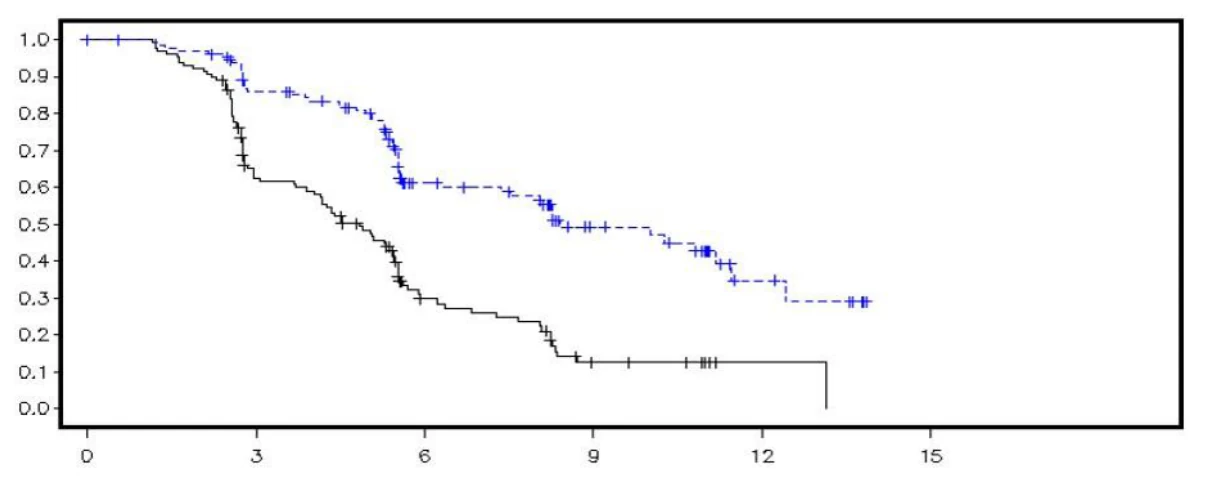 Pro p o rtio n of p a ti e nts ev en t fre e |
|---|
Time from randomization (months) --------------Placebo bid - - - - - - - - - LYNPARZA 400 mg bid Number of patients at risk: |
| 136 | 106 | 53 | 24 | 7 | 0 | LYNPARZA 400 mg bid |
|---|---|---|---|---|---|---|
| 129 | 72 | 24 | 7 | 1 | 0 | Placebo |
a (58% Maturity - Investigator Assessment) DCO 30 June 2010
| Figure 8 Kaplan-Meier Plot of PFS in the Full Analysis Set (BRCA-mutated and BRCA wild type)a for Study 19 (Capsule Formulation) | ||
|---|---|---|
| BRCA-mutated | BRCA wild type | |
| a (58% Maturity - Investigator Assessment) DCO 30 June 2010 | ||
Within the overall population, the DCR at 24 weeks was 53% and 25% for patients in the LYNPARZA and placebo groups, respectively.
OPINION
Table 37 Trial Design for OPINION
| Study # | Trial design | Dosage, route of administration and duration | Study subjects (n) | Mean age (Range) | Sex |
D0816C00020 (OPINION) | Phase IIIb, single-arm, open-label multicentre maintenance study of single-agent LYNPARZA in PSR high grade serous ovarian cancer patients | 300 mg (2 x 150 mg tablets formulation) orally twice daily | n=279 | Mean 64.0 Range 40-85 | Female |
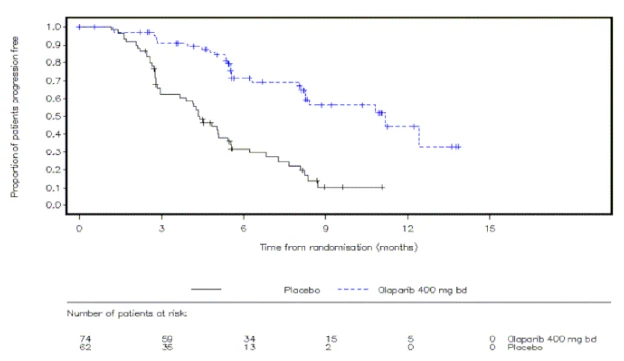 | 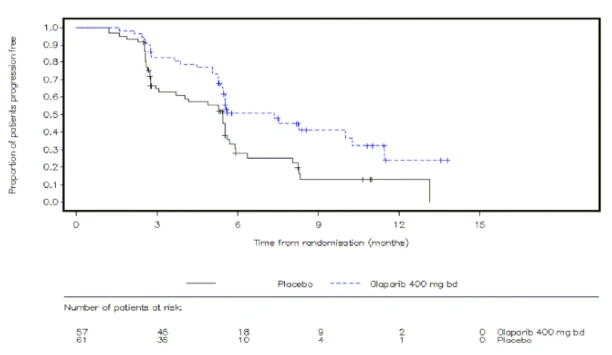 |
|---|
OPINION was a single arm, multicentre study that investigated olaparib (300 mg [2 x 150 mg tablets] twice daily) as a maintenance treatment in patients with PSR high grade serous or endometrioid ovarian cancer following 2 or more lines of platinum-based chemotherapy and who did not have a known deleterious or suspected deleterious gBRCA mutation. Patients whose disease was in response (CR or PR) following completion of platinum-based chemotherapy were enrolled. A total of 279 patients were enrolled and received olaparib treatment until disease progression or unacceptable toxicity. Based on central testing 90.7% of patients were confirmed with a non-gBRCAm status, 2.2% confirmed as gBRCAm and 7.2% had no confirmatory gBRCA result. In addition, 9.7% were identified as sBRCAm and 13.3% as unknown.
The primary endpoint was investigator-assessed PFS according to modified RECIST v1.1. Secondary endpoints included OS.
Olaparib when used as maintenance therapy, demonstrated clinical activity in patients with non-gBRCAm PSR ovarian cancer. At the final overall survival analysis, the OS data were 52.3% mature.
Study Results
A summary of the key efficacy findings in patients with non-gBRCAm PSR ovarian cancer in OPINION is presented in Table 38.
Table 38 Key Efficacy Findings for non-gBRCAm patients with PSR ovarian cancer in OPINION
LYNPARZA Tablets 300 mg bid | |||
|---|---|---|---|
| PFS (75% maturity) (DCO 2 October 2020) | |||
| Number of events / Total number of patients (%) | 210 / 279 (75.3) | ||
| Median PFS (95% CI)a (months) | 9.2 (7.6,10.9) | ||
| OS (52.3% maturity) (DCO 17 September 2021) | |||
| Number of events: total number of patients (%) | 146: 279 (52.3) | ||
| Median OS (95% CI)a (months) | 32.7 (29.5, 35.3) | ||
a Calculated using the Kaplan-Meier technique.
Confidence intervals for the median PFS and OS were derived based on Brookmeyer Crowley method bid Twice daily; PFS Progression-free survival; OS Overall survival; DCO Data cut off; CI Confidence interval.
Maintenance Treatment of HRD-positive Advanced Ovarian Cancer (PAOLA-1)
The efficacy of LYNPARZA when added to bevacizumab for the maintenance treatment of advanced epithelial ovarian, fallopian tube or primary peritoneal cancer was investigated in the PAOLA-1 study.
PAOLA-1 is a Phase III randomised, double-blind, placebo-controlled, multicentre trial that compared the efficacy of LYNPARZA (300 mg [2 x 150 mg tablets] twice daily) when added to bevacizumab (15 mg/kg of body weight given once every 3 weeks as an intravenous infusion) compared with placebo when added to bevacizumab for the maintenance treatment of newly-diagnosed advanced (FIGO Stage IIIB-IV) high-grade epithelial ovarian, fallopian tube or primary peritoneal cancer. Crossover to LYNPARZA was not permitted within the PAOLA-1 study design. However, patients could have received subsequent treatment with a PARP inhibitor outside of the study.
The study randomised 806 patients (2:1 randomisation: 537 LYNPARZA/bevacizumab: 269 placebo/bevacizumab) who had no evidence of disease (NED) due to complete surgical resection, or who were in complete response (CR), or partial response (PR) following completion of first-line platinum-containing chemotherapy and bevacizumab (15 mg/kg of body weight given once every 3 weeks). Patients had completed a minimum of 6 and a maximum of 9 platinum-taxane cycles, with the majority (63%) having received 6 cycles of first line platinum-taxane based chemotherapy. All patients received a minimum of 3 cycles of bevacizumab in combination with the 3 last cycles of chemotherapy (or a minimum of 2 cycles of bevacizumab in combination with the 3 last cycles of chemotherapy for cases of interval debulking surgery). The median number of bevacizumab cycles prior to randomisation was 5.
Patients were stratified by first-line treatment outcome (timing and outcome of cytoreductive surgery and response to platinum-based chemotherapy) and tumour BRCA mutation (germline and/or somatic) status, determined by prospective local testing.
Following completion of their last dose of chemotherapy, patients continued bevacizumab in the maintenance setting and initiated treatment with LYNPARZA within 3 to 9 weeks. Treatment with LYNPARZA was continued for up to 2 years or until progression of the underlying disease or until unacceptable toxicity.
Patients who in the opinion of the treating physician could derive further benefit from continuous treatment could be treated beyond 2 years. Treatment with bevacizumab was for a total of up to 15 months, including the period given with chemotherapy.
| Table 39 Trial Design for PAOLA-1 | |||||||||
| Study # | Trial design | Dosage, route of administrati on and duration | Study subjects (n) | Mean age (Range) | Sex | ||||
| D0817C00 003 (PAOLA-1) | Phase III randomised, double-blind, placebo-controlled, multicentre trial that compared the efficacy of LYNPARZA (300 mg twice daily) when added to bevacizumab (15 mg/kg of body weight given once every 3 weeks) compared with placebo/bevacizumab for maintenance treatment of newly-diagnosed advanced high-grade epithelial ovarian, fallopian tube or primary peritoneal cancer. | LYNPARZA 300 mg (2 x 150 mg tablets) orally twice daily bevacizumab 15 mg/kg of body weight given once every 3 weeks as an intravenous infusion | LYNPARZA/ bevacizumab n=537 Placebo/ bevacizumab n=269 | LYNPARZA/ bevacizumab 60.8 (32-87) Placebo/ bevacizumab 59.2 (26-85) | Female | ||||
HRD testing of tumour samples was conducted retrospectively using the Myriad myChoice™ HRD Plus test. HRD positive status was defined as the presence of a tBRCA1/2 mutation or by an HRD score at or above a pre-specified cut off of 42 in the absence of a tBRCA1/2 mutation. In the overall population, 48% (387/806) were classified as HRD positive, 34% (277/806) were HRD negative and 18% (142/806) had an unknown HRD status.
Demographic and baseline characteristics were balanced between the LYNPARZA/bevacizumab and placebo/bevacizumab arms in the overall population and also in the HRD-positive subgroup (n=387).
In the overall population, the median age of patients was 61 years overall. Most patients in both arms were ECOG performance status 0 (70%). Ovarian cancer was the primary tumour in 86% of the patients. The most common histological type was serous (96%) and endometrioid histology was reported in 3% of the patients. The majority of the patients were diagnosed in FIGO stage IIIC (63%). All patients had received first-line platinum-based therapy in combination with bevacizumab. Patients were not restricted by the surgical outcome with 65% having complete cytoreduction at initial or interval debulking surgery and 35% having residual macroscopic disease. The demographic and baseline characteristics in the HRD positive subgroup are described in Table 40.
Key exclusion criteria included clinically significant cardiovascular disease, history of haemorrhagic disorders, evidence of bleeding diasthesis or significant coagulopathy, history of VEGF therapy related abdominal fistula, gastrointestinal bleeding or perforation within prior 6 months, previous Cerebro-Vascular Accident (CVA), Transient Ischemic Attack (TIA) or Sub-Arachnoids Hemorrhage (SAH) within prior 6 months, major surgery within prior 4 weeks, non-healing wound, active ulcer or bone fracture, current clinically relevant bowel obstruction, significant traumatic injury within prior 4 weeks, chronic use of aspirin > 325 mg/day, prior history of hypertensive crisis or hypertensive encephalopathy and evidence of abdominal free air not explained by paracentesis or recent surgical procedure.
The median duration of treatment with LYNPARZA and placebo was 17.3 months and 15.6 months, respectively. The median duration of bevacizumab post-randomisation was 11.0 months in the LYNPARZA/bevacizumab arm and 10.4 months in the placebo/bevacizumab arm (based on data cut-off March 22, 2020).
| Table 40 Patient Demographic, Baseline and Biomarker Characteristics (Full Analysis Set): HRD-positive subgroup in PAOLA-1 | ||||||||||
|---|---|---|---|---|---|---|---|---|---|---|
| Table 40 Patient Demographic, Baseline and Biomarker Characteristics (Full Analysis Set): HRD-positive subgroup in PAOLA-1 | ||||||||||
LYNPARZA/bevacizumab (n=255) | Placebo/bevacizumab (n=132) | |||||||||
LYNPARZA/bevacizumab (n=255) | Placebo/bevacizumab (n=132) | |||||||||
| Demographics | ||||||||||
| Age (years) | ||||||||||
| Mean (SD) | 58.5 (9.2) | 57.3 (9.6) | ||||||||
| Median (range) | 58.0 (32-77) | 58.0 (35-82) | ||||||||
| Age group (years), n (%) | ||||||||||
| <50 | 44 (17.3) | 29 (22.0) | ||||||||
| ≥50 to <65 | 141 (55.3) | 69 (52.3) | ||||||||
| ≥65 | 70 (27.5) | 34 (25.8) | ||||||||
| Disease characteristics | ||||||||||
| ECOG performance status, n (%) | ||||||||||
| (0) Normal activity | 190 (74.5) | 100 (75.8) | ||||||||
| (1) Restricted activity | 61 (23.9) | 31 (23.5) | ||||||||
| Missing | 4 (1.6) | 1 (0.8) | ||||||||
| Tumour characteristics | ||||||||||
| Primary tumour location, n (%) | ||||||||||
| Ovary | 217 (85.1) | 118 (89.4) | ||||||||
| Fallopian tubes | 24 (9.4) | 5 (3.8) | ||||||||
| Primary peritoneal | 14 (5.5) | 9 (6.8) | ||||||||
| FIGO Staging, n (%) | ||||||||||
| IIIB | 25 (9.8) | 9 (6.8) | ||||||||
| IIIC | 157 (61.6) | 81 (61.4) | ||||||||
| IV | 73 (28.6) | 42 (31.8) | ||||||||
| Histology type, n (n%) | ||||||||||
| Serous | 242 (94.9) | 124 (93.9) | ||||||||
| Endometrioid | 9 (3.5) | 4 (3.0) | ||||||||
| Clear cell | 1 (0.4) | 0 | ||||||||
| Undifferentiated | 1 (0.4) | 3 (2.3) | ||||||||
| Other | 2 (0.8) | 1 (0.8) | ||||||||
| First line treatment outcome at screening (obtained from the randomisation schedule) | ||||||||||
| NED with complete macroscopic resection at initial debulking surgery | 92 (36.1) | 48 (36.4) | ||||||||
| NED/CR with complete macroscopic resection at interval debulking surgery | 74 (29.0) | 38 (28.8) | ||||||||
| NED/CR at screening, in patient who had either incomplete resection (at initial or interval debulking surgery) or no debulking surgery | 40 (15.7) | 20 (15.2) | ||||||||
| Partial response | 49 (19.2) | 26 (19.7) | ||||||||
| Mutation Status | ||||||||||
| Screening laboratory tBRCA status (obtained from the randomisation schedule), n (%) | ||||||||||
| Deleterious mutation | 150 (58.8) | 65 (49.2) | ||||||||
| Absence of deleterious mutation | 105 (41.2) | 67 (50.8) | ||||||||
| tBRCAm per local screening (eCRF), n (%) | 147 (57.6) | 67 (50.8) | ||||||||
| Myriad tBRCA status, n (%) | ||||||||||
| tBRCA | 158 (62.0) | 77 (58.3) | ||||||||
| non-tBRCAm | 97 (38.0) | 55 (41.7) | ||||||||
CR Complete response; NED No evidence of disease
Study Results
The primary endpoint was progression-free survival (PFS), defined as time from randomisation to progression determined by investigator assessment using modified Response Evaluation Criteria in Solid Tumors (RECIST) 1.1, or death. Secondary efficacy endpoints included time from randomisation to second progression or death (PFS2) and overall survival (OS). Patients had RECIST 1.1 tumour assessments at baseline and every 24 weeks (CT/MRI at 12 weeks if clinical or CA125 progression) for up to 42 months or until objective radiological disease progression.
The study demonstrated a statistically significant improvement in investigator assessed PFS for LYNPARZA/bevacizumab compared to placebo/bevacizumab in the overall population (HR 0.59; 95% CI 0.49-0.72, p<0.0001) with a median of 22.1 months for LYNPARZA/bevacizumab and 16.6 months for placebo/bevacizumab.
The investigator assessment of PFS (DCO 22 March 2019) was consistent with the blinded independent central review (BICR) of PFS. Final analysis of PFS2 (DCO 22 March 2020, 53% maturity) in the overall population was statistically significant (HR 0.78; 95% CI 0.64-0.95, p=0.0125 with a median of 36.5 months for LYNPARZA/bevacizumab and 32.6 months for placebo/bevacizumab).
Final analysis of OS (DCO 22 March 2022, 55.6% maturity) in the overall population demonstrated an HR of 0.92 (95% CI 0.76 to 1.12; p=0.3947; median 56.4 months for LYNPARZA/bevacizumab and 51.6 months for placebo/bevacizumab which numerically favoured the LYNPARZA/bevacizumab arm but did not meet the pre-specified boundary for statistical significance.
The efficacy results in the overall population were primarily attributed to the HRD positive subgroup (including and excluding tBRCAm) . The PFS hazard ratio (HR) for the HRD-negative subgroup was 1.00 (95% CI: 0.75, 1.34) and the OS HR was 1.18 (95% CI: 0.87, 1.60).
Exploratory Biomarker Subgroup Analyses by HRD status
Pre-specified exploratory subgroup analyses by HRD status (per the Myriad myChoice™ HRD Plus test) were conducted. The results for primary endpoint PFS and final OS are presented in Table 41. Kaplan-Meier plots for PFS and final OS are presented in Figure 9 and Figure 10 respectively. There was a clinically meaningful improvement in the Myriad HRD-positive status subgroup (including and excluding tBRCAm) with the addition of LYNPARZA to bevacizumab. The tBRCAm (per Myriad test) subgroup efficacy results were consistent with the tBRCAm (per local testing at screening) results.
The median duration of follow up at primary analysis (DCO 22 March 2019) and final analysis (DCO 22 March 2022) was 2.2 and 5.1 years in the LYNPARZA/bevacizumab arm and 2.2 and 5.2 years in the placebo/bevacizumab arm, respectively.
At the final analysis, in the HRD positive subgroup, the incidence of participants who received a PARPi in any subsequent line of treatment was 17.3% (44 of 255 participants) in the LYNPARZA/bevacizumab arm and 50.8% (67 of 132 participants) in the placebo/bevacizumab arm.
Table 41 Key Efficacy Findings by Biomarker subgroups – PAOLA-1,
| PFS – Investigator Assessment (DCO 22 March 2019) | Final OS (DCO 22 March 2022) | ||||||||||||||
|---|---|---|---|---|---|---|---|---|---|---|---|---|---|---|---|
LYNPARZA/ bevacizumab | Placebo/ bevacizumab | LYNPARZA/ bevacizumab | Placebo/ bevacizumab | ||||||||||||
| HRD Positive Status (including tBRCAm) (N = 387) | |||||||||||||||
| Number of events (%) | 87/255 (34.1) | 92/132 (69.7) | 93/255 (36.5) | 69/132 (52.3) | |||||||||||
| Median (months) | 37.2 | 17.7 | 75.2 | 57.3 | |||||||||||
| HR (95% CI)b | 0.33 (0.25, 0.45) | 0.62 (0.45, 0.85) | |||||||||||||
| HRD Positive Status (excluding tBRCAm) (N = 152)a | |||||||||||||||
| Number of events (%) | 43/97 (44.3) | 40/55 (72.7) | 44/97 (45.4) | 32/55 (58.2) | |||||||||||
| Median (months) | 28.1 | 16.6 | Not reached | 52.0 | |||||||||||
| HR (95% CI)b | 0.43 (0.28, 0.66) | 0.71 (0.45, 1.13) | |||||||||||||
| tBRCAm (N = 235)c | |||||||||||||||
| Number of events (%) | 44/158 (27.8) | 52/77 (67.5) | 49/158 (31.0) | 37/77 (48.1) | |||||||||||
| Median (months) | 37.2 | 18.8 | 75.2 | 66.9 | |||||||||||
| HR (95% CI)b | 0.28 (0.19, 0.42) | 0.57 (0.37, 0.88) | |||||||||||||
PFS - time from randomisation to first progression or death; HRD - homologous recombination deficiency; tBRCAm - tumour BRCA mutation; CI - confidence interval; DCO - data cut-off; HR - hazard ratio.
a HRD positive excluding tBRCAm was defined as Genomic instability score (GIS) by Myriad ≥42 (pre-specified cut-off) in the absence of a tBRCAm
b A value <1 favours olaparib. The analysis was performed using a Cox proportional hazards model stratified by first line treatment outcome at screening and screening laboratory tBRCA status.
c tBRCAm status by Myriad
Figure 9 PAOLA-1: Kaplan-Meier Plot of PFS in HRD-Positive (including tBRCAm) Subgroup (DCO 22 March 2019)
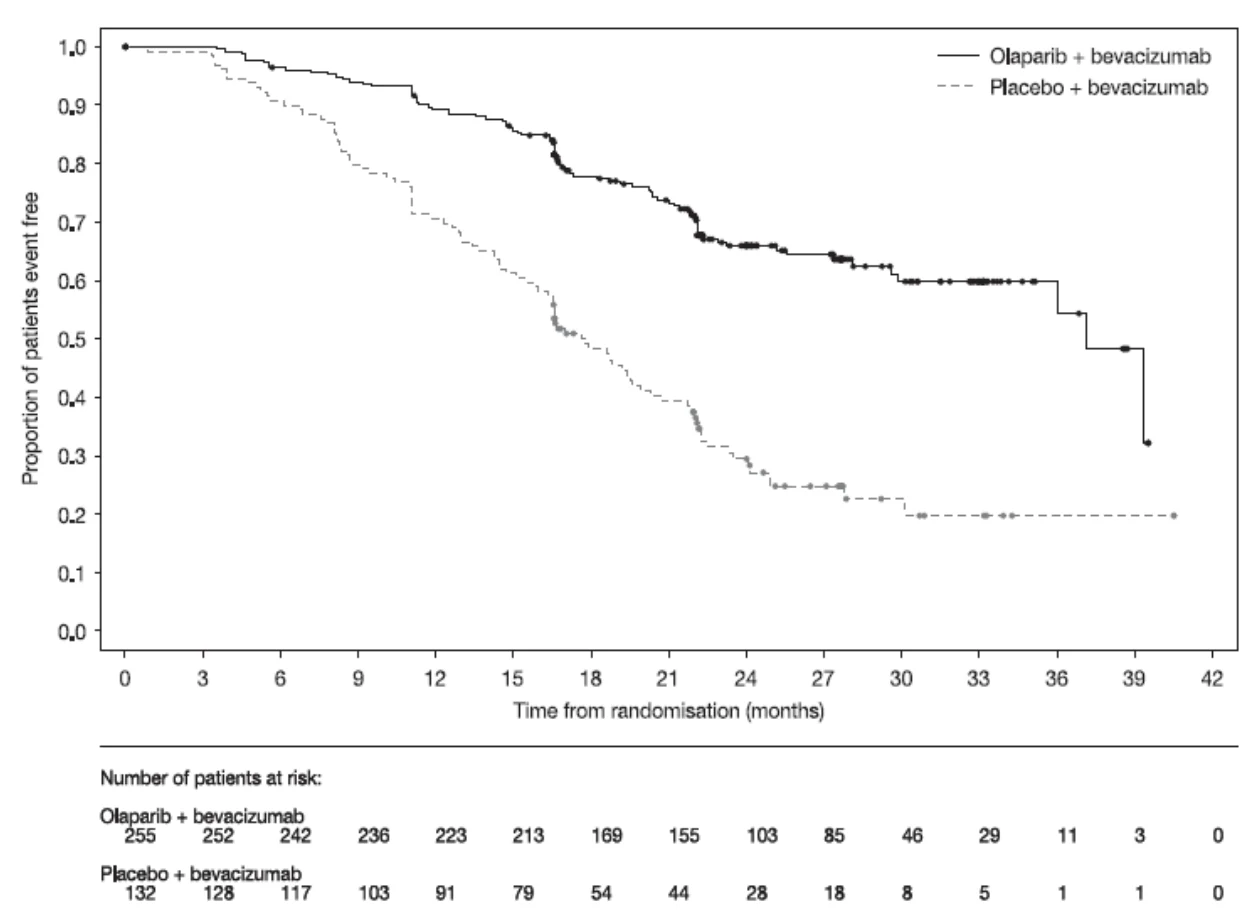
Figure 10 PAOLA-1: Kaplan-Meier Plot of Final OS in HRD-Positive (including tBRCAm) Subgroup (DCO 22 March 2022)
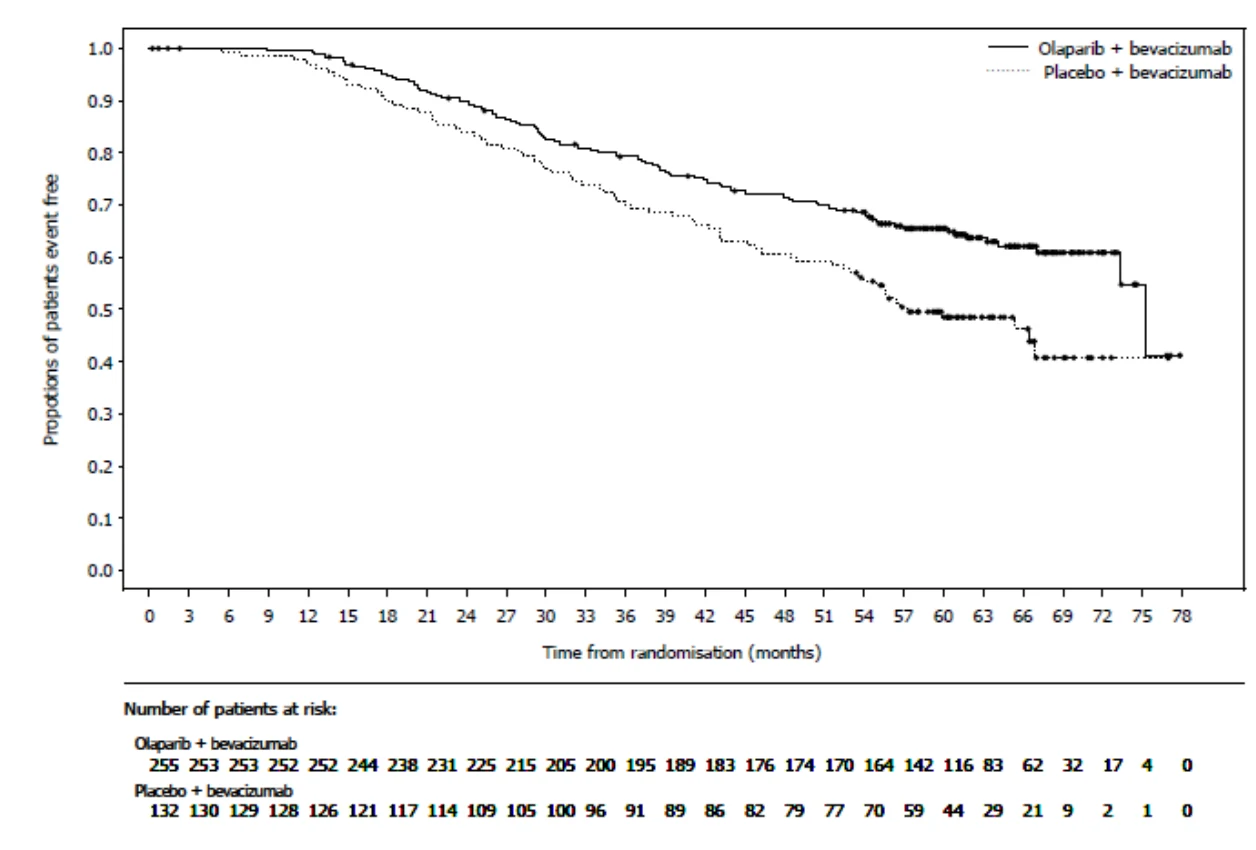
Maintenance Treatment of gBRCAm Metastatic Adenocarcinoma of the Pancreas (POLO)
The safety and efficacy of LYNPARZA in the maintenance treatment of patients with metastatic gBRCAm adenocarcinoma of the pancreas whose disease had not progressed following at least 16 weeks of first-line platinum-based chemotherapy was studied in a Phase III, randomized, double-blind, placebo-controlled, multicentre trial (D081FC00001, POLO). A total of 154 patients were randomized 3:2 to receive LYNPARZA 300 mg (2 x 150 mg tablets) twice daily (n=92) or placebo (n=62 placebo). There was no upper limit to the duration of chemotherapy received. After 16 weeks of continuous platinum-based chemotherapy, the platinum could be discontinued at any time for toxicity and the other agents continued; the patients were eligible for randomization as long as there was no evidence of progression at any time during chemotherapy treatment. All toxicities from previous anti-cancer therapy must have been resolved to CTCAE grade 1, except for alopecia, grade 3 peripheral neuropathy and Hgb ≥ 9 g/dL. LYNPARZA treatment was continued until progression of the underlying disease.
Patients with germline BRCA mutations were identified from prior local testing results or by central testing using the Myriad BRACAnalysis® or Myriad BRACAnalysis CDx® test. The BRCAm status of all patients identified using prior local testing results was confirmed, where sent, using the Myriad BRACAnalysis® or Myriad BRACAnalysis CDx® test.
Table 42 Trial Design for POLO
| Study # | Trial design | Dosage, route of administration and duration | Study subjects (n) | Mean age (Range) | Sex |
| D081FC00001 (POLO Study) | Phase III randomized (3:2), double-blind, placebo-controlled study, that investigated LYNPARZA 300 mg twice daily tablet formulation as a maintenance treatment for gBRCAm patients with metastatic pancreatic adenocarcinoma | 300 mg (2 x 150 mg tablets) orally twice daily | LYNPARZA n=92 Placebo n=62 | LYNPARZA = 58 years Placebo = 56 years | Female and Male |
Demographic and baseline patient characteristics in POLO are summarized below.
| Table 43 Selected Demographic and Patient Characteristics at Baseline (Full Analysis Set) for POLO | ||||||||||
| Table 43 Selected Demographic and Patient Characteristics at Baseline (Full Analysis Set) for POLO | ||||||||||
LYNPARZA Tablets 300 mg bid (n=92) | Placebo (n=62) | |||||||||
LYNPARZA Tablets 300 mg bid (n=92) | Placebo (n=62) | |||||||||
| Demographics | ||||||||||
| Age (years) | ||||||||||
| Mean (SD) | 58.2 (10.3) | 56.4 (9.1) | ||||||||
| Median (range) | 57.0 (37-84) | 57.0 (36-75) | ||||||||
| Sex, n (%) | ||||||||||
| Male | 53 (57.6) | 31 (50.0) | ||||||||
| Female | 39 (42.4) | 31 (50.0) | ||||||||
| Age group (years), n (%) | ||||||||||
| <55 | 35 (38.0) | 27 (43.5) | ||||||||
| ≥55 to <65 | 29 (31.5) | 22 (35.5) | ||||||||
| ≥65 | 28 (30.4) | 13 (21.0) | ||||||||
| Race, n (%) | ||||||||||
| White | 82 (89.1) | 59 (95.2) | ||||||||
| Asian | 4 (4.3) | 2 (3.2) | ||||||||
| Black/African American | 5 (5.4) | 0 | ||||||||
American Indian or Alaskan Native and Other | 1 (1.1) | 1 (1.6) | ||||||||
| Disease Characteristics | ||||||||||
| ECOG Performance status, n (%) | ||||||||||
| (0) Normal activity | 65 (70.7) | 38 (61.3) | ||||||||
| (1) Restricted activity | 25 (27.2) | 23 (37.1) | ||||||||
| Missing | 2 (2.2) | 1 (1.6) | ||||||||
| Histology type (at time of diagnosis), n (%) | ||||||||||
| Adenocarcinoma (not otherwise specified) | 53 (57.6) | 37 (59.7) | ||||||||
| Adenocarcinoma: acinar | 0 | 4 (6.5) | ||||||||
| Adenocarcinoma: papillary | 0 | 1 (1.6) | ||||||||
| Adenocarcinoma: solid with mucus formation | 0 | 1 (1.6) | ||||||||
| Pancreatic adenocarcinoma | 38 (41.3) | 17 (27.4) | ||||||||
| Not affected | 0 | 1 (1.6) | ||||||||
| Missing | 1 (1.1) | 1 (1.6) | ||||||||
| Extent of disease at baseline | ||||||||||
| Metastatica | 87 (94.6) | 55 (88.7) | ||||||||
| Previous disease-related chemotherapy | ||||||||||
| Previous chemotherapyb | ||||||||||
| FOLFIRINOX variants | 79 (85.9) | 50 (80.6) | ||||||||
| Gemcitabine/cisplatin | 2 (2.2) | 3 (4.8) | ||||||||
| Other | 10 (10.9) | 8 (12.9) | ||||||||
| Missing | 1 (1.1) | 1 (1.6) | ||||||||
| Type of previous chemotherapy | ||||||||||
| Doublets | 15 (16.3) | 10 (16.1) | ||||||||
| Triplets | 73 (79.3) | 46 (74.2) | ||||||||
| Other | 3 (3.3) | 5 (8.1) | ||||||||
| Missing | 1 (1.1) | 1 (1.6) | ||||||||
Time on first-line treatment until randomisation | ||||||||||
| ≤6 months | 61 (66.3) | 40 (64.5) | ||||||||
| >6 months | 30 (32.6) | 21 (33.9) | ||||||||
| Missing | 1 (1.1) | 1 (1.6) | ||||||||
| Best response on first-line treatment | ||||||||||
| Stable disease | 45 (48.9) | 31 (50.0) | ||||||||
| Partial response/complete response | 46 (50.0) | 30 (48.4) | ||||||||
| Missing | 1 (1.1) | 1 (1.6) | ||||||||
- a Sites of metastases at baseline assessed post patient response to first-line chemotherapy, prior to study treatment. Summary includes sites of disease where the extent is recorded as metastatic or both (ie, locally advanced and metastatic).
- b Ninety-six per-cent (96%) of patients were randomized within 8 weeks of their last dose of platinum-based chemotherapy. The median time from initiation of first-line platinum-based chemotherapy to randomisation was 5.8 months (range 3.4 to 33.4 months).
bid Twice daily; ECOG Eastern Cooperative Oncology Group; gBRCAm Germline BRCA mutation; SD Standard deviation
Study Results
The study compared the efficacy of LYNPARZA maintenance treatment (300 mg [2 x 150 mg tablets] twice daily) with placebo in 154 patients with gBRCAm patients with metastatic pancreatic adenocarcinoma.
The primary endpoint was progression-free survival (PFS), defined as time from randomization to progression determined by BICR using modified Response Evaluation Criteria in Solid Tumors (RECIST) 1.1, or death. Secondary efficacy endpoints included overall survival (OS), time from randomization to second progression or death (PFS2), time from randomization to first subsequent anti-cancer therapy or death (TFST), time from randomization to discontinuation of treatment or death (TDT), objective response rate (ORR), duration of response (DoR), response rate, time to response and health related quality of life (HRQoL). Patients had tumour assessments at baseline and every 8 weeks for 40 weeks, and then every 12 weeks relative to the date of randomization, until objective radiological disease progression. For PFS, the median follow-up time for censored patients was 9.1 months in the LYNPARZA arm and 3.8 months in the placebo arm. For OS, the median follow-up time for censored patients was 31.3 months in the LYNPARZA arm and 23.9 months in the placebo arm. A summary of key efficacy findings is presented in Table 44 and Figure 11.
The study demonstrated a clinically meaningful and statistically significant improvement in PFS for LYNPARZA compared to placebo, with a HR of 0.53 (95% CI 0.35 to 0.82; p=0.0038; the median was 7.4 months for LYNPARZA vs 3.8 months for placebo). The sensitivity analysis of PFS by investigator assessment (HR 0.51; 95% CI 0.34 to 0.78; p=0.0017; median 6.3 months vs 3.7 months for LYNPARZA vs placebo, respectively) was consistent with the PFS analysis by BICR.
At the time of the PFS analysis the median DoR was longer in the LYNPARZA arm (24.9 months) compared to the placebo arm (3.7 months), with a longer median time to onset of response (5.4 months for LYNPARZA vs 3.6 months for placebo). At the time of final OS analysis (DCO 21 July 2020), the HR for PFS2 (60% maturity, not controlled for multiplicity) was 0.66 (95% CI 0.43 – 1.02; nominal p=0.0613) with a difference in median of 7.6 months in favour of LYNPARZA (median 16.9 months for LYNPARZA vs 9.3 months for placebo). A clinically meaningful and statistically significant improvement in TFST and TDT was observed for LYNPARZA-treated patients. At the final analysis of OS (70% maturity) the HR for OS did not reach statistical significance. The percentage of patients that were alive and in follow-up was 28% in the LYNPARZA arm and 18% in the placebo arm. Six (6.5%) patients in the LYNPARZA arm received subsequent PARP inhibitor and 16 (26%) patients in the placebo arm received a PARP inhibitor in any subsequent line.
Table 44 Key Efficacy Findings for Patients with gBRCAm Metastatic Adenocarcinoma of the Pancreas in POLO
| LYNPARZA Tablets 300 mg bid | Placebo | ||||||||||
|---|---|---|---|---|---|---|---|---|---|---|---|
| PFS (68% maturity) | |||||||||||
| Number of events: Total number of patients (%) | 60:92 (65) | 44:62 (71) | |||||||||
| Median time (months) | 7.4 | 3.8 | |||||||||
| HR (95% CI)a,b | 0.53 (0.35-0.82) | ||||||||||
| P value (2-sided) | P=0.0038 | ||||||||||
| Final OS (70% maturity) | |||||||||||
| Number of events: Total number of patients (%) | 61:92 (66) | 47:62 (76) | |||||||||
| Median time (months) | 19.0 | 19.2 | |||||||||
| HR (95% CI)b | 0.83 (0.56-1.22) | ||||||||||
| P value (2-sided) | p=0.3487 | ||||||||||
| ORR | |||||||||||
| Number of objective responders: total number of patients with measurable disease at baseline (%) | 18:78 (23.1) | 6:52 (11.5) | |||||||||
| Complete response (%) | 2 (2.6) | 0 | |||||||||
| Partial response (%) | 16 (20.5) | 6 (11.5) | |||||||||
| Odds ratio (95% CI) | 2.30 (0.89, 6.76) | ||||||||||
| P value* (2-sided) | p=0.1028 | ||||||||||
a A value <1 favours LYNPARZA.
b The analysis was performed using a log-rank test.
* Not controlled for multiplicity.
bid Twice daily; CI Confidence interval; HR Hazard Ratio; ORR Objective Response Rate; OS Overall survival; PFS Progression-free survival;
| Figure 11 Kaplan-Meier Plot of PFS in Patients with gBRCAm metastatic adenocarcinoma of the pancreasa, b for POLO |
|---|
a 68% Maturity - BICR Assessment b The proportion of patients that were alive and progression-free at 12, 24 and 36 months were 34%, 28% and 22% for LYNPARZA vs 15%, 10% and 10% for placebo |
Patient-reported HRQoL data demonstrated no clinically meaningful differences in global HRQoL over the treatment period between arms, as treatment with LYNPARZA did not negatively impact HRQoL compared to placebo.
Treatment of HRR Mutation Positive Metastatic Castration Resistant Prostate Cancer (mCRPC) (PROfound)
The efficacy of LYNPARZA (olaparib tablets) in the treatment of patients with homologous recombination repair (HRR)-mutated (germline and/or somatic) metastatic castration-resistant prostate cancer (mCRPC) following prior treatment with a new hormonal agent (NHA, enzalutamide or abiraterone acetate) was investigated in PROfound, a randomized, open-label, multicentre phase III trial. The study randomized 387 patients (2:1 randomization: 256 LYNPARZA and 131 Investigator’s Choice of NHA) who had progressed on a prior NHA and had a tumour mutation in one of 15 genes involved in the HRR pathway.
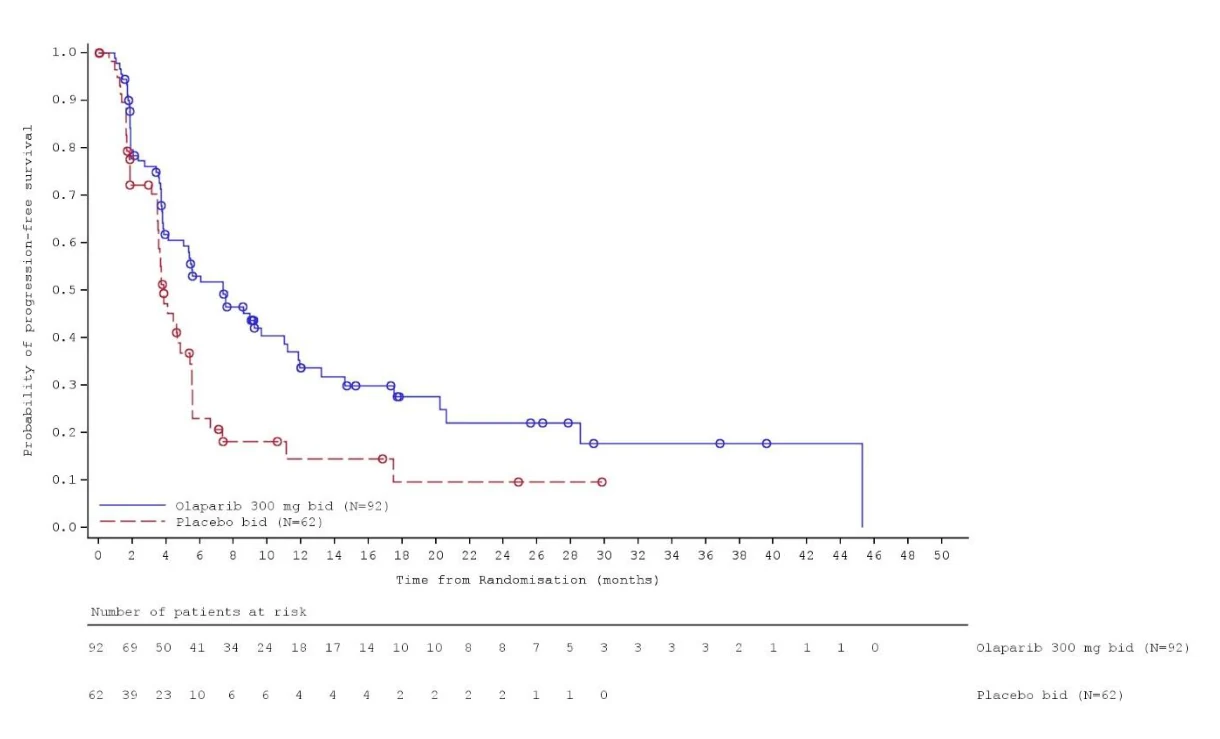 |
|---|
Patients were divided into two cohorts based on HRR gene mutation status. Patients with mutations in either BRCA1, BRCA2 or ATM were randomized in Cohort A (245 patients: 162 LYNPARZA and 83 Investigator’s Choice of NHA); patients with mutations among 12 other genes involved in the HRR pathway (BARD1, BRIP1, CDK12, CHEK1, CHEK2, FANCL, PALB2, PPP2R2A, RAD51B, RAD51C, RAD51D or RAD54L) were randomized in Cohort B (142 patients: 94 LYNPARZA and 48 Investigator’s Choice of NHA). Patients with co-mutations (BRCA1, BRCA2 or ATM plus a Cohort B gene) were randomized in Cohort A. Patients were stratified by prior taxane use and evidence of measurable disease. All patients received a GnRH analog or had prior bilateral orchiectomy. Treatment was continued until disease progression. Patients randomized to the comparator arm were given the option to switch to LYNPARZA upon confirmed radiological BICR progression.
Patients with HRR gene mutations were identified based on prostate cancer tissue specimens that were tested centrally. HRR clinical trial assay was performed in a CLIA certified laboratory (CLIA HRR Clinical Trial Assay) or from reanalysis of data from a prior prostate cancer tissue test.
Table 45 Trial Design for PROfound
| Study # | Trial design | Dosage, route of administration and duration | Study subjects (n) | Mean age (Range) | Sex |
D081DC00007 (PROfound Study) | Phase III randomized (2:1), open-label, multicentre study, that investigated olaparib 300 mg twice daily tablet formulation as a treatment for patients with HRR-mutated mCRPC | 300 mg (2 x 150 mg tablets) orally twice daily | LYNPARZA Cohort A: n=162 Cohort A+B: n=256 Investigator’s Choice of NHA (abiraterone or enzalutamide) Cohort A: n=83 Cohort A+B: n=131 | LYNPARZA Cohort A: 68.0 years (47-86) Cohort A+B: 68.5 years (47-91) Investigator’s Choice of NHA Cohort A: 68.1 years (49-86) Cohort A+B: 68.9 (49-87) | Male |
Demographic and baseline patient characteristics in PROfound are summarized in Table 46.
Table 46 Selected Demographic and Patient Characteristics at Baseline for the Overall Population (Full Analysis Set) for PROfound
| Cohort A | Cohort A+B | ||||||||||||||||||||||||
| Cohort A | Cohort A+B | ||||||||||||||||||||||||
LYNPARZA 300 mg bid n=162 | Investigator’s Choice of NHA n=83 | LYNPARZA 300 mg bid n=256 | Investigator’s Choice of NHA n=131 | ||||||||||||||||||||||
LYNPARZA 300 mg bid n=162 | Investigator’s Choice of NHA n=83 | LYNPARZA 300 mg bid n=256 | Investigator’s Choice of NHA n=131 | ||||||||||||||||||||||
| Demographics | |||||||||||||||||||||||||
| Age (years) | |||||||||||||||||||||||||
| Mean (SD) | 68.0 | 68.1 | 68.5 (8.44) | 68.9 (7.58) | |||||||||||||||||||||
| Median (range) | 68.0 | 67.0 | 69.0 (47-91) | 69.0 (49-87) | |||||||||||||||||||||
| Age group, n (%) | |||||||||||||||||||||||||
| <65 years | 54 (33.3) | 23 (27.7) | 82 (32.0) | 34 (26.0) | |||||||||||||||||||||
| ≥65 years | 108 (66.7) | 60 (72.3) | 174 (68.0) | 97 (74.0) | |||||||||||||||||||||
| Race, n (%) | |||||||||||||||||||||||||
| White | 109 (67.3) | 55 (66.3) | 163 (63.7) | 85 (64.9) | |||||||||||||||||||||
| Black or African American | 2 (1.2) | 1 (1.2) | 7 (2.7) | 1 (0.8) | |||||||||||||||||||||
| Asian | 43 (26.5) | 19 (22.9) | 69 (27.0) | 36 (27.5) | |||||||||||||||||||||
| Other | 1 (0.6) | 1 (1.2) | 2 (0.8) | 1 (0.8) | |||||||||||||||||||||
| Disease Characteristics | |||||||||||||||||||||||||
| ECOG PS, n (%) | |||||||||||||||||||||||||
| (0) Normal activity | 84 (51.9) | 34 (41.0) | 131 (51.2) | 55 (42.0) | |||||||||||||||||||||
| (1) Restricted activity | 67 (41.4) | 46 (55.4) | 112 (43.8) | 71 (54.2) | |||||||||||||||||||||
| (2) In bed ≤50% of the time | 11 (6.8) | 3 (3.6) | 13 (5.1) | 4 (3.1) | |||||||||||||||||||||
| Unknown | 0 | 0 | 0 | 1 (0.8) | |||||||||||||||||||||
| Baseline Paina (BPI-SF worst pain score) | |||||||||||||||||||||||||
| 0 to <2 | 83 (51.2) | 37 (44.6) | 125 (48.8) | 57 (43.5) | |||||||||||||||||||||
| 2 to 3 | 17 (10.5) | 9 (10.8) | 31 (12.1) | 13 (9.9) | |||||||||||||||||||||
| >3 | 56 (34.6) | 34 (41.0) | 93 (36.3) | 56 (42.7) | |||||||||||||||||||||
| Unknown | 6 (3.7) | 3 (3.6) | 7 (2.7) | 5 (3.8) | |||||||||||||||||||||
| Baseline PSA (µg/L) | |||||||||||||||||||||||||
| Median | 62.180 | 112.920 | 68.220 | 106.490 | |||||||||||||||||||||
| Range | 0.20-7240.74 | 1.85-7115.00 | 0.20- 7240.74 | 1.85- 7115.00 | |||||||||||||||||||||
| Tumour Characteristics | |||||||||||||||||||||||||
| Measurable disease at baseline | |||||||||||||||||||||||||
| Yes (%) | 95 (58.6) | 46 (55.4) | 149 (58.2) | 72 (55.0) | |||||||||||||||||||||
| No (%) | 67 (41.4) | 37 (44.6) | 107 (41.8) | 59 (45.0) | |||||||||||||||||||||
| Sites of disease at baseline | |||||||||||||||||||||||||
| Prostate | 27 (16.7) | 12 (14.5) | 41 (16.0) | 21 (16.0) | |||||||||||||||||||||
| Locoregional lymph nodes | 35 (21.6) | 17 (20.5) | 54 (21.1) | 31 (23.7) | |||||||||||||||||||||
| Distant lymph nodes | 59 (36.4) | 35 (42.2) | 99 (38.7) | 51 (38.9) | |||||||||||||||||||||
| Bone | 140 (86.4) | 73 (88.0) | 218 (85.2) | 113 (86.3) | |||||||||||||||||||||
| Respiratory | 30 (18.5) | 11 (13.3) | 43 (16.8) | 15 (11.5) | |||||||||||||||||||||
| Liver | 18 (11.1) | 13 (15.7) | 25 (9.8) | 18 (13.7) | |||||||||||||||||||||
| Other distant sites | 34 (21.0) | 15 (18.1) | 57 (22.2) | 31 (23.7) | |||||||||||||||||||||
| Prior Therapy | |||||||||||||||||||||||||
| Prior Local Therapy with curative intent | |||||||||||||||||||||||||
| Yes | 71 (43.8) | 31 (37.3) | 105 (41.0) | 57 (43.5) | |||||||||||||||||||||
| No | 91 (56.2) | 52 (62.7) | 151 (59.0) | 74 (56.5) | |||||||||||||||||||||
| Prior NHA | |||||||||||||||||||||||||
| Enzalutamide | 67 (41.4) | 40 (48.2) | 103 (40.2) | 54 (41.2) | |||||||||||||||||||||
| Abiraterone | 61 (37.7) | 29 (34.9) | 97 (37.9) | 54 (41.2) | |||||||||||||||||||||
| Enzalutamide and Abiraterone | 32 (19.8) | 14 (16.9) | 51 (19.9) | 23 (17.6) | |||||||||||||||||||||
| No Prior NHAb | 2 (1.2) | 0 (0) | 5 (2.0) | 0 (0) | |||||||||||||||||||||
| Prior Taxane | |||||||||||||||||||||||||
| Yes | 106 (65.4) | 52 (62.7) | 170 (66.4) | 84 (64.1) | |||||||||||||||||||||
| No | 56 (34.6) | 31 (37.3) | 86 (33.6) | 47 (35.9) | |||||||||||||||||||||
a Pain assessment based on the “worse pain item (item #3)” of the Brief Pain Inventory-Short Form (BPI-SF) questionnaire. Scores range from minimum of -10 (no pain) to a maximum of 10 (pain as bad as you can imagine). Baseline scores computed as an average of 7-day diary (minimum 4 days required): 0-1 considered no or little pain, 2-3 considered mild pain, >3 considered moderate to severe pain
b All patients received prior NHA, however data was not present in the electronic case report form (eCRF) at database lock.
Study Results
The study compared the efficacy of LYNPARZA (olaparib) treatment (300 mg [2x150 mg tablets] twice daily) with Investigator’s Choice of prior NHA (enzalutamide or abiraterone acetate) in patients with HRR-mutated mCRPC.
The primary endpoint of the study was radiological progression free survival (rPFS) in Cohort A determined by BICR using RECIST 1.1 (soft tissue) and Prostate Cancer Working Group (PCWG3) (bone). Key secondary endpoints included confirmed objective response rate (ORR) by BICR (Cohort A), rPFS by BICR (Cohort A+B), time to pain progression (TTPP) (Cohort A) and overall survival (OS) (Cohort A). TTPP is defined as at least a 2-point worsening from baseline of the pain score on Brief Pain Inventory-Short Form (BPI-SF) worst pain (Item 3) or an initiation of or an increase in opioid use.
An additional secondary endpoint included in Cohort B was rPFS by BICR and additional secondary end-points included in both Cohort B and Cohort A+B, were confirmed ORR by BICR, OS and time to pain progression.
The study demonstrated a clinically meaningful and statistically significant improvement in BICR assessed rPFS for LYNPARZA vs comparator in Cohort A and also in Cohort A+B.
In Cohort A there was a statistically significant and clinically meaningful improvement in confirmed radiological ORR by BICR for patients with measurable disease at baseline in the LYNPARZA arm vs comparator; and an improvement observed in confirmed radiological ORR in Cohort A+B. There was a statistically significant and clinical meaningful delay in TTPP in the LYNPARZA arm compared with the Investigator’s Choice of NHA arm in Cohort A and the results in Cohort A+B were consistent with Cohort A.
The final analysis of OS (60% Maturity) demonstrated a statistically significant improvement in OS in patients randomized to LYNPARZA compared to patients in the Investigators Choice of NHA arm in Cohort A. In Cohort A, 56 out of 83 patients (67.5%) in the investigators choice of NHA arm received subsequent treatment with LYNPARZA.
Table 47 Key Efficacy Findings in Cohort A and Cohort A + B in PROfound
| Cohort A | Cohort A + B | |||||||||||||||||||
|---|---|---|---|---|---|---|---|---|---|---|---|---|---|---|---|---|---|---|---|---|
| Cohort A | Cohort A + B | |||||||||||||||||||
| LYNPARZA Tablets 300 mg bid (N=162) | Investigator’s Choice of NHA (N=83) | LYNPARZA Tablets 300 mg bid (N=256) | Investigator’s Choice of NHA (N=131) | |||||||||||||||||
| LYNPARZA Tablets 300 mg bid (N=162) | Investigator’s Choice of NHA (N=83) | LYNPARZA Tablets 300 mg bid (N=256) | Investigator’s Choice of NHA (N=131) | |||||||||||||||||
| PFS by BICRa,b,h | ||||||||||||||||||||
| Number of events: Total number of patients (%) | 106:162 (65)c | 68:83 (82) c | 180:256 (70) c | 99:131 (76) c | ||||||||||||||||
| Median time (95% CI) (months) | 7.4 (6.2, 9.3) | 3.6 (1.9, 3.7) | 5.8 (5.5, 7.4) | 3.5 (2.2, 3.7) | ||||||||||||||||
| HR (95% CI)d | 0.34 (0.25-0.47) | 0.49 (0.38–0.63) | ||||||||||||||||||
| P value (2-sided)e | p<0.0001 | p<0.0001 | ||||||||||||||||||
| Confirmed ORR by BICRh | ||||||||||||||||||||
| Number of responders: Total number of patients with measurable disease at baseline (%) | 28:84 (33) | 1:43 (2) | 30:138 (22) | 3:67 (5) | ||||||||||||||||
| Odds ratio (95% CI) | 20.86 (4.18, 379.18) | 5.93 (2.01, 25.40) | ||||||||||||||||||
| P-value (2-sided) | <0.0001 | 0.0006f | ||||||||||||||||||
| Final OSi | ||||||||||||||||||||
| Number of events: Total number of patients (%) | 91:162 (56) | 57:83 (69) | 160:256 (63) | 88:131 (67) | ||||||||||||||||
| Median OS (95% CI) [months] | 19.1 (17.4, 23.4) | 14.7 (11.9, 18.8) | 17.3 (15.5, 18.6) | 14.0 (11.5, 17.1) | ||||||||||||||||
| HR (95% CI) | 0.69 (0.50, 0.97) | 0.79 (0.61, 1.03) | ||||||||||||||||||
| P-value (2-sided)a | 0.0175 | 0.0515f | ||||||||||||||||||
| Time to Pain Progression (TTPP)g,h | ||||||||||||||||||||
| Number of events: Total number of patients (%) | 21:162 (13) | 14:83 (17) | 32:256 (13) f | 16:131 (12) f | ||||||||||||||||
| Median (95% CI) [months] | NR (NR, NR) | 9.9 (5.4, NR) | NR (NR, NR) | NR (NR, NR) | ||||||||||||||||
| HR (95% CI) | 0.44 (0.22, 0.91) | 0.64 (0.35, 1.21) f | ||||||||||||||||||
| P-value (2-sided) | 0.0192 | 0.1490 f | ||||||||||||||||||
a rPFS (Cohort A), rPFS (Cohort A+B), ORR (Cohort A), TTPP (Cohort A) and OS (Cohort A) were tested and controlled for multiplicity. The multiplicity strategy for primary endpoint and key secondary endpoints was that upon achieving statistical significance on the primary endpoint rPFS in Cohort A, testing of each of the secondary endpoints, ORR (Cohort A), rPFS (Cohort A + B), TTPP (Cohort A) and OS (Cohort A) were performed sequentially.
b Cohort A - the sensitivity analysis of rPFS by investigator assessment (HR=0.24, 95% CI 0.17, 0.34, p<0.0001 [nominal]; median rPFS 9.8 months vs 3.6 months for olaparib vs Investigator’s Choice of NHA, respectively) was consistent with the rPFS analysis by BICR assessment. Cohort A+B - the sensitivity analysis of rPFS by investigator assessment (HR=0.36, 95% CI 0.27, 0.47, p<0.0001 [nominal]; median rPFS 7.5 months vs 3.5 months for olaparib vs Investigator’s Choice of NHA, respectively) was consistent with the rPFS analysis by BICR.
c rPFS 71% maturity (Cohort A), 72% maturity (Cohort A+B)
d The HR and CI were calculated using a Cox proportional hazards model adjusted for prior taxane use and measurable disease. The Efron approach was used for handling ties. HR <1 favours olaparib
e The analysis was performed using the log-rank test stratified by prior taxane use and measurable disease using the Breslow method for handling ties
f Not controlled for multiplicity
g Time to pain progression was defined as the time from randomisation to the first date of a clinically meaningful worsening (≥2 points increase from baseline on a scale of 0-10) in average BPI-SF worst pain [Item 3] score and/or an increase in or initiation of opioid analgesic use.
h DCO 04 June 2019
i DCO 20 March 2020
bd Twice daily; BICR Blinded independent central review; CI Confidence interval; HR Hazard ratio; NHA New hormonal agent; NR Not Reached; ORR Objective response rate; OS Overall survival; rPFS Radiological progression free survival; TTPP Time to pain progression.
Figure 12 Cohort A: Kaplan-Meier plot of rPFS (by BICR)
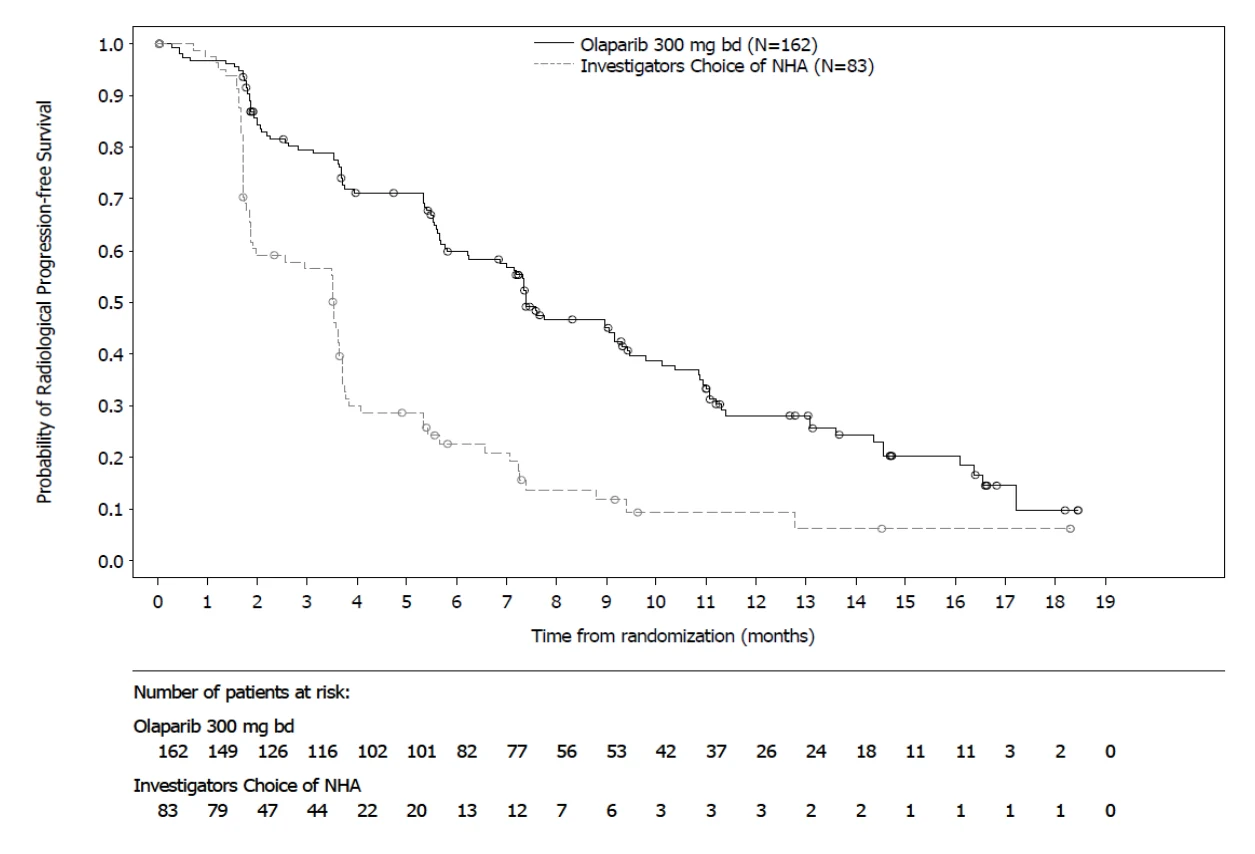
Figure 13 Cohort A+B: Kaplan-Meier plot of rPFS (by BICR)
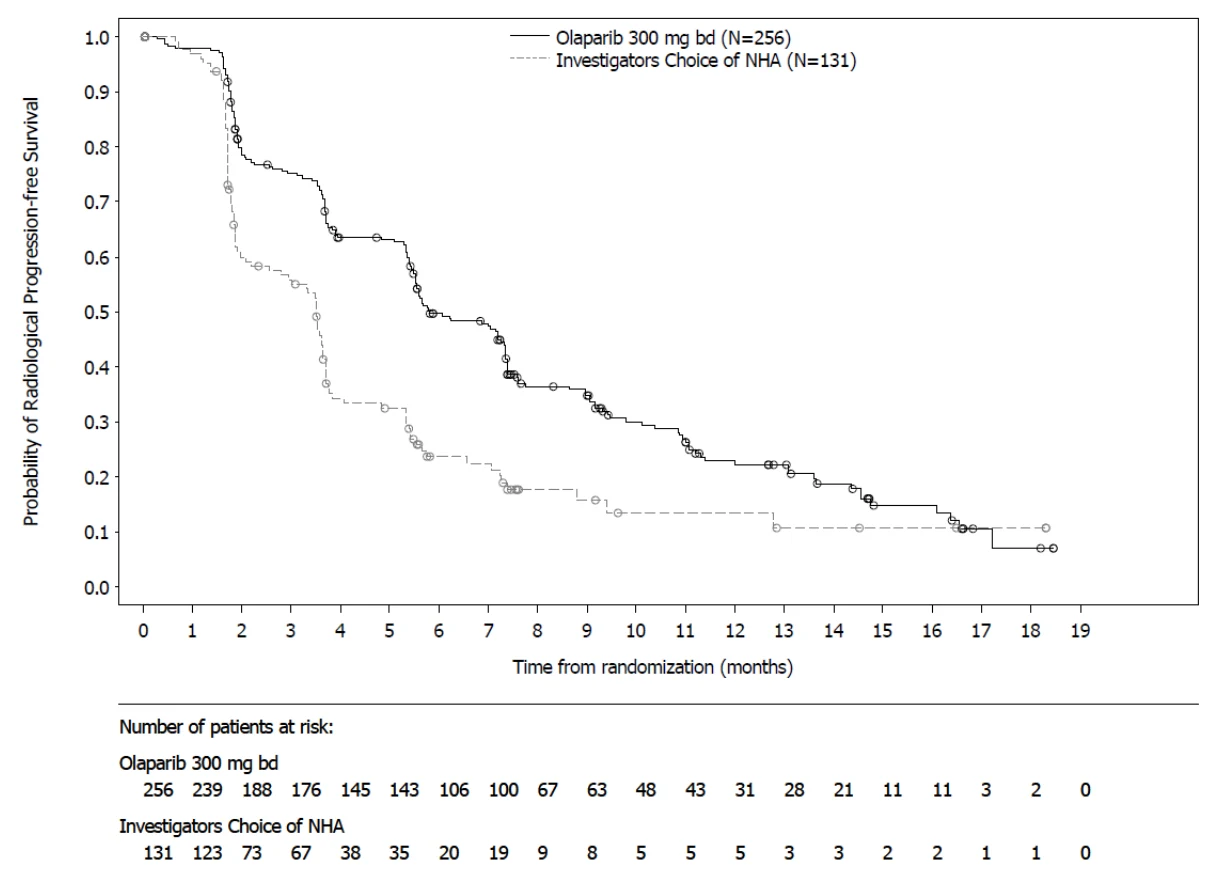
Figure 14 Cohort A: Kaplan-Meier plot of OS
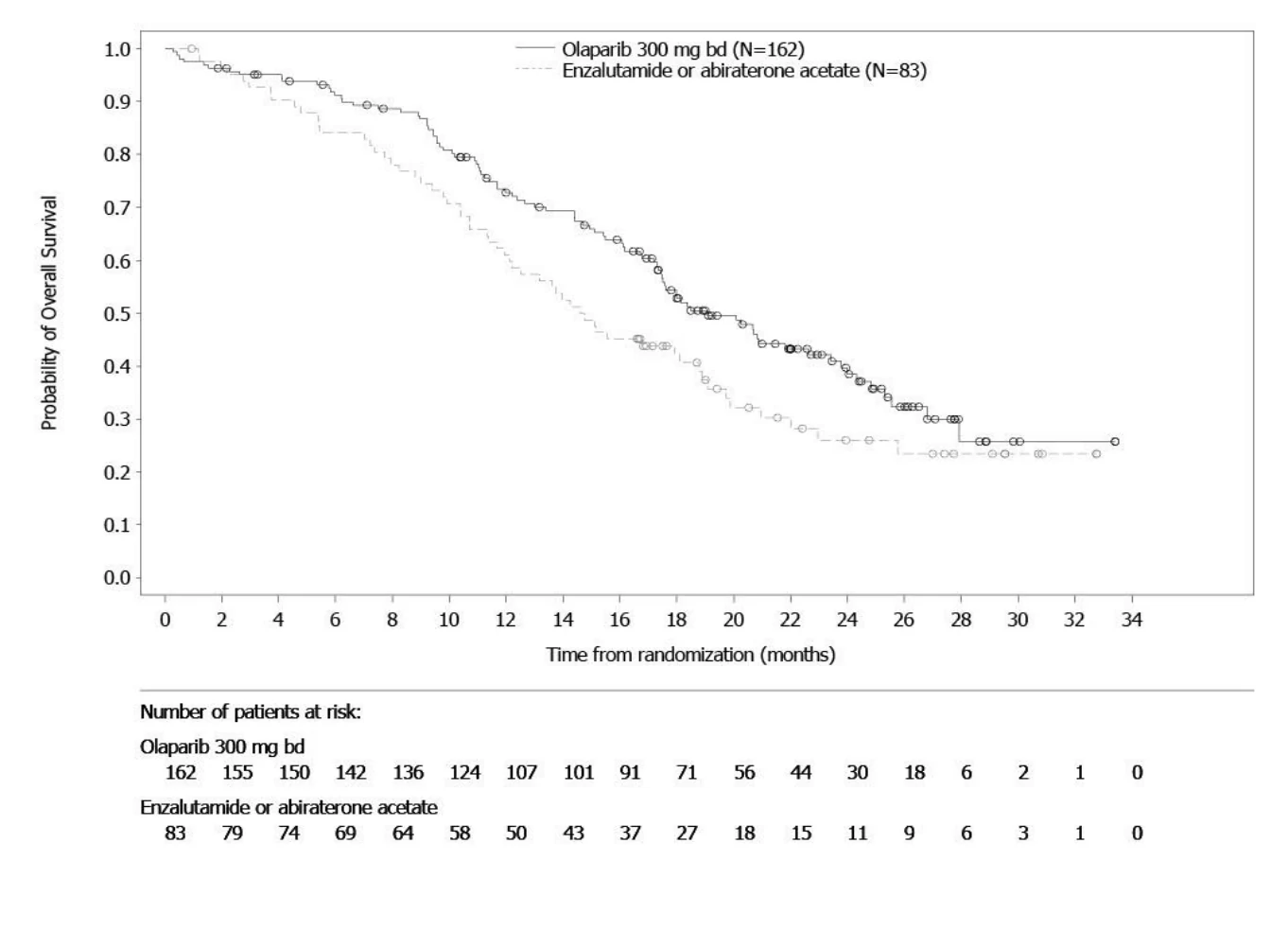
In the PROfound trial, a PSA50 response was reported in 42.6% of LYNPARZA treated patients in Cohort A and in 30.5% of LYNPARZA treated patients in Cohort A+B.
In Cohort A the benefit of LYNPARZA over Investigator’s Choice of NHA was maintained across all pre-defined subgroups. For Cohort A+B, the benefit of LYNPARZA over Investigator’s Choice of NHA was maintained across the majority of pre-defined subgroups. Clinically meaningful reductions in the risk of radiological disease progression or death in LYNPARZA-treated patients ranged from 39% to 75% in Cohort A and from 23% to 88% in Cohort A+B.
The prevalence of the mutations in Cohort B did not provide sufficient power to test independently. The Cohort B exploratory analysis demonstrated a trend toward rPFS improvement (median rPFS of 4.8 months for LYNPARZA vs. 3.3 months for Investigator’s Choice of NHA) and OS improvement (median OS of 14.1 months for LYNPARZA vs.11.5 months for Investigator’s Choice of NHA at final analysis). ORR was [2/54 (3.7%) vs 2/24 (8.3%) LYNPARZA 300 mg bd vs NHA, respectively].
Treatment of BRCA-mutated Metastatic Castration Resistant Prostate Cancer (mCRPC) in combination with abiraterone (PROpel)
The efficacy of LYNPARZA in combination with abiraterone and prednisone or prednisolone for the treatment of patients with BRCA-mutated metastatic castration resistant prostate cancer (mCRPC) was determined using the PROpel study.
PROpel was a Phase III randomized, double-blind, placebo-controlled, multicentre study that compared the efficacy of LYNPARZA (300 mg [2 x 150 mg tablets] twice daily) in combination with abiraterone (1000 mg [2 x 500 mg tablets] once daily) compared with placebo plus abiraterone for the treatment of patients with mCRPC. Patients in both arms also received either prednisone or prednisolone 5 mg twice daily. Prior to the mCRPC stage, treatment with NHAs (except abiraterone) without PSA, clinical or radiological progression during treatment, was allowed, provided the treatment was stopped at least 12 months before randomisation. Treatment with first-generation antiandrogen agents (e.g., bicalutamide, nilutamide, flutamide) was also allowed, provided there was a washout period of 4 weeks. Docetaxel treatment was allowed during neoadjuvant/adjuvant treatment for localized prostate cancer and at metastatic hormone-sensitive prostate cancer (mHSPC) stage, as long as no signs of disease progression occurred during or immediately after such treatment. All patients continued on a gonadotropin-releasing hormone (GnRH) analogue or had prior bilateral orchiectomy.
The study randomized 796 patients (1:1 randomisation; 399 olaparib/abiraterone : 397 placebo/abiraterone) who had evidence of histologically confirmed prostate adenocarcinoma and metastatic status defined as at least one documented metastatic lesion on either a bone or CT/MRI scan. Patients were stratified by metastases (bone only, visceral or other) and docetaxel treatment at mHSPC stage (yes or no). Treatment was continued until disease progression or unacceptable toxicity. The indication of the olaparib/abiraterone combination was restricted to the BRCA-mutated mCRPC patients.
Table 48 Trial Design for PROpel
| Study # | Trial design | Dosage, route of administration and duration | Study subjects (n) | Mean age (Range) | Sex |
D081SC00001 (PROpel Study) | Phase III randomized (1:1), double-blind, placebo- controlled, multicentre study, that investigated olaparib 300 mg twice daily tablet formulation in combination with abiraterone 1000 mg once daily with prednisone 5 mg twice daily as a treatment for patients with mCRPC | LYNPARZA 300 mg (2 x 150 mg tablets) orally twice daily abiraterone 1000 mg (2 x 500 mg tablets]) orally once daily prednisone 5 mg orally, twice daily | LYNPARZA+ abiraterone n=399 Placebo + abiraterone n=397 | LYNPARZA+ abiraterone 68.0 years (47-86) Placebo + abiraterone 68.1 years (49-86) | Male |
Table 49 Selected Demographic and Patient Characteristics at Baseline for the Overall Population (Full Analysis Set) for PROpel
LYNPARZA + abiraterone n=399 | Placebo + abiraterone n=397 | ||||||||||
LYNPARZA + abiraterone n=399 | Placebo + abiraterone n=397 | ||||||||||
| Demographics | |||||||||||
| Age (years) | |||||||||||
| Mean (SD) | 68.5 (8.50) | 69.8 (7.93) | |||||||||
| Median (range) | 69.0 (43-91) | 70.0 (46-88) | |||||||||
| Age group, n (%) | |||||||||||
| <65 years | 130 (32.6) | 97 (24.4) | |||||||||
| ≥65 years | 269 (67.4) | 300 (75.6) | |||||||||
| Race, n (%) | |||||||||||
| White | 282 (70.7) | 275 (69.3) | |||||||||
| Black or African American | 14 (3.5) | 11 (2.8) | |||||||||
| Asian | 66 (16.5) | 72 (18.1) | |||||||||
| Other/Missing | 37 (9.3) | 39 (9.8) | |||||||||
| Disease Characteristics | |||||||||||
| ECOG PS, n (%) | |||||||||||
| (0) Normal activity | 286 (71.7) | 272 (68.5) | |||||||||
| (1) Restricted activity | 112 (28.1) | 124 (31.2) | |||||||||
| Unknown | 1 (0.3) | 1 (0.3) | |||||||||
| Baseline Paina, n (%) (BPI-SF worst pain score) | |||||||||||
| 0 (no pain) | 133 (33.3) | 137 (34.5) | |||||||||
| 0 - <4 (mild pain) | 151 (37.8) | 173 (43.6) | |||||||||
| 4 - <6 (moderate pain) | 53 (13.3) | 36 (9.1) | |||||||||
| ≥6 (severe pain) | 32 (8.0) | 28 (7.1) | |||||||||
| Missing | 30 (7.5) | 23 (5.8) | |||||||||
| Tumour Characteristics | |||||||||||
| Histology type, n (%) | |||||||||||
| Adenocarcinoma | 398 (99.7) | 397 (100) | |||||||||
| Other | 1 (0.3) | 0 | |||||||||
| Total Gleason Score, n (%) | |||||||||||
| ≤7 | 121 (30.3) | 134 (33.8) | |||||||||
| 8-10 | 265 (66.4) | 258 (65.0) | |||||||||
| Missing | 13 (3.3) | 5 (1.3) | |||||||||
| Distant metastases at first diagnosis, n (%) | |||||||||||
| M0 | 115 (28.8) | 132 (33.2) | |||||||||
| MX | 26 (6.5) | 22 (5.5) | |||||||||
| M1 | 257 (64.4) | 242 (61.0) | |||||||||
| Missing | 1 (0.3) | 1 (0.3) | |||||||||
| Type of prostate cancer progression, n (%) | |||||||||||
| PSA progression | 172 (43.1) | 173 (43.6) | |||||||||
| Radiographic progression | 92 (23.1) | 73 (18.4) | |||||||||
| Both | 134 (33.6) | 150 (37.8) | |||||||||
| Missing | 1 (0.3) | 1 (0.3) | |||||||||
| Prior Therapy | |||||||||||
| Prior docetaxel treatment during neoadjuvant/adjuvant treatment for localised prostate cancer or at mHSPC stage, n (%) b | |||||||||||
| Yes | 97 (24.3) | 98 (24.7) | |||||||||
| No | 302 (75.7) | 299 (75.3) | |||||||||
| Prior treatment with second-generation antiandrogen agents prior to mCRPC stage, n (%) | |||||||||||
| Yes | 1 (0.3) | 0 | |||||||||
| Enzalutamide | 1 (0.3) | 0 | |||||||||
| No | 398 (99.7) | 397 (100) | |||||||||
| Prior local therapy with curative intent for prostate cancer, n (%) | |||||||||||
| Yes | 134 (33.6) | 144 (36.3) | |||||||||
| No | 265 (66.4) | 253 (63.7) | |||||||||
a BPI-SF Item 3 score: baseline pain score is based on a patient completing the BPI-SF questionnaire item number 3 (worst pain) at least once during the seven-day baseline period and is an average.
b As long as no signs of failure or disease progression occurred during or immediately after docetaxel treatment.
c Defined as any deleterious or suspected deleterious HRR gene mutation detected.
d Defined as no deleterious or suspected deleterious HRR gene mutation detected.
e Test failed/sample not analysed.
BPI-SF, brief pain inventory-short form; CDx, companion diagnostic; CSR, clinical study report; ctDNA, circulating tumour DNA; ECOG, Eastern cooperative oncology group; FAS, full analysis set; HRR homologous recombination repair; HRRm homologous recombination repair gene mutation; IWRS, interactive web response systems; mCRPC, metastatic castration resistant prostate cancer; mHSPC, metastatic hormone sensitive prostate cancer; N, total number of patients; PSA, prostate-specific antigen.
Study Results
The primary endpoint was rPFS, defined as time from randomisation to progression determined by investigator assessment based on RECIST 1.1 (soft tissue) and PCWG-3 criteria (bone). The key secondary efficacy endpoint was overall survival (OS). Additional secondary endpoints included PFS2, TFST and HRQoL.
PROpel met its pre-specified primary endpoint. However, uncertainties remain concerning clinical benefit in patients with mCRPC that do not harbor a BRCA mutation. Subgroup analysis showed rPFS improvement for LYNPARZA/abiraterone compared to placebo/abiraterone in mCRPC patients with a BRCA mutated mCRPC. There were improvements in PFS2 and TFST in the LYNPARZA/abiraterone arm vs. placebo/abiraterone arm. At the time of the final analysis OS was 48% (381/796) mature (Table 50) and showed an improvement for LYNPARZA/abiraterone compared to placebo/abiraterone in mCRPC patients with a BRCA mutation.
Table 50 Summary of key efficacy findings in mCRPC in PROpel
| All Patients | BRCA-mutated patients a | ||||||||||||||||
|---|---|---|---|---|---|---|---|---|---|---|---|---|---|---|---|---|---|
| LYNPARZA + abiraterone N= 399 | Placebo + abiraterone N=397 | LYNPARZA + abiraterone N= 47 | Placebo + abiraterone N=38 | ||||||||||||||
| rPFS (by investigator assessment; 49% maturity) b ,h | |||||||||||||||||
| Number of events/total number of patients (%) | 168/399 (42.1) | 226/397 (56.9) | 14/47 (29.8) | 28/38 (73.7) | |||||||||||||
| Median time (95% CI) (months) c | 24.8 (20.5, 27.6) | 16.6 (13.9, 19.2) | NR (NR, NR) | 8.4 (5.5, 14.8) | |||||||||||||
| HR (95% CI) | 0.66 (0.54, 0.81) d | 0.23 (0.12, 0.43) e | |||||||||||||||
| P value | <0.0001 f | N/A | |||||||||||||||
| Final OS (48% maturity) b ,h | |||||||||||||||||
| Number of events/total number of patients (%) | 176/399 (44.1) | 205/397 (51.6) | 13/47 (27.7) | 25/38 (65.8) | |||||||||||||
| Median time (95% CI) (months) c | 42.1 (38.4, NR) | 34.7 (31.0, 39.3) | NR (NR, NR) | 23.0 (17.8, 34.2) | |||||||||||||
| HR (95% CI) | 0.81 (0.67, 1.00) d | 0.29 (0.14, 0.56) e | |||||||||||||||
| P value | p=0.0544 f | N/A | |||||||||||||||
| PFS2 (21% maturity) b ,h | |||||||||||||||||
| Number of events: Total number of patients (%) | 70/399 (17.5) | 94/397 (23.7) | 8/47 (17.0) | 14/38 (36.8) | |||||||||||||
| Median time (95% CI) (months) c | NR (NR, NR) | NR (NR, NR) | NR (NR, NR) | 23.6 (17.8, NR) | |||||||||||||
| HR (95% CI) | 0.69 (0.51, 0.94) d | 0.34 (0.14, 0.79) e | |||||||||||||||
| P value | p=0.0184 f,g | N/A | |||||||||||||||
| TFST (51% maturity) b ,h | |||||||||||||||||
| Number of events: Total number of patients (%) | 183/399 (45.9) | 221/397 (55.7) | 18/47 (38.3) | 26/38 (68.4) | |||||||||||||
| Median time (95% CI) (months) c | 25.0 (22.2, NR) | 19.9 (17.1, 22.0) | NR (NR, NR) | 14.8 (10.2, 16.2) | |||||||||||||
| HR (95% CI) | 0.74 (0.61, 0.90) d | 0.36 (0.19, 0.65) e | |||||||||||||||
| P value | p=0.0040 f,g | N/A | |||||||||||||||
a BRCA mutation detected by ctDNA and/or tissue test.
b Data maturity reflects the maturity of the intent-to-treat (ITT) patient population
c Calculated using the Kaplan-Meier technique.
d The HR and CI were calculated using a Cox proportional hazards model adjusted for the variables selected in the primary pooling strategy: metastases, docetaxel treatment at mHSPC stage. The Efron approach was used for handling ties. A HR <1 favours LYNPARZA 300 mg bd.
e Subgroup analyses were performed using a Cox proportional hazards model that contained a term for treatment, factor (BRCA status), and treatment by factor interaction. A HR <1 favours LYNPARZA 300 mg bd.
f The 2-sided p-value was calculated using the log-rank test stratified by the same variables selected in the primary pooling strategy.
g The p-value presented is nominal as the endpoint is not alpha controlled.
h DCO 30 July 2021 (rPFS, PFS2 and TFST); DCO 12 October 2022 (OS)
CI Confidence interval; HR Hazard Ratio; NR Not reached; OS Overall survival; rPFS Radiological Progression-free survival; PFS2 2nd Progression-Free Survival; TFST Time to First Subsequent Therapy
Figure 15 PROpel: Kaplan-Meier plot of rPFS in BRCA-mutated mCRPC a
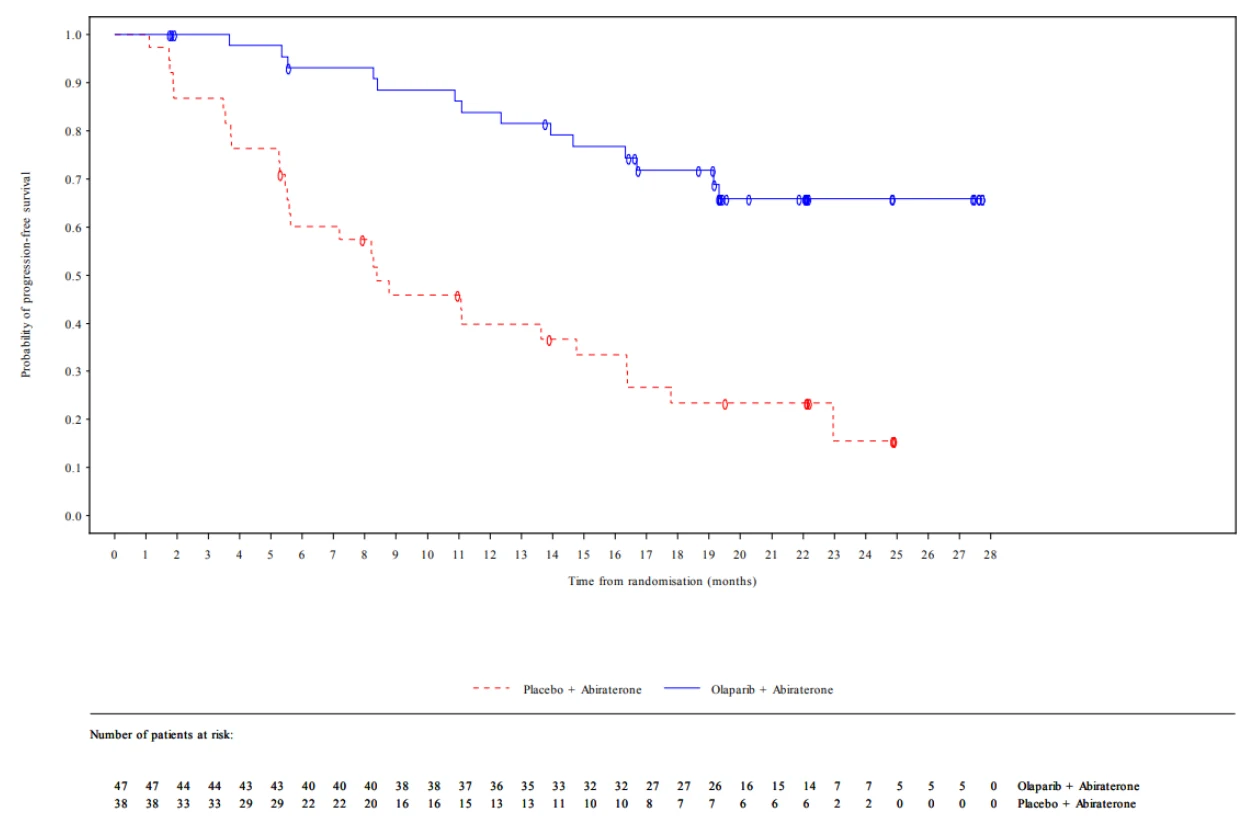
a DCO 30 July 2021
Figure 16 PROpel: Kaplan-Meier plot of OS in BRCA-mutated mCRPC a
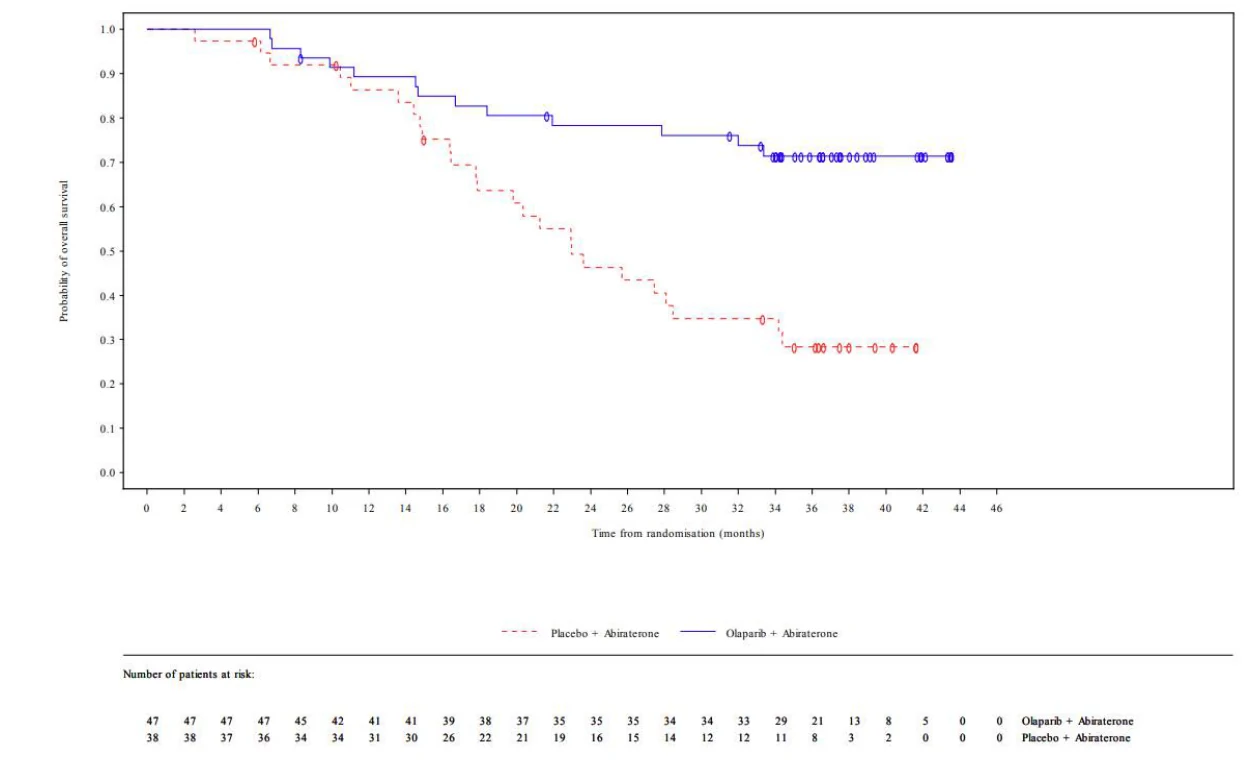
a DCO 12 October 2022
The results from the PRO endpoint analyses suggest that adding LYNPARZA to abiraterone had no clinically meaningful impact on either change from baseline in the FACT-P total score, the BPI-SF pain severity or the pain interference scores. Similar findings were generally observed with the FACT-P subscale scores.
14.2 Comparative Bioavailability Studies
Based on a within patient comparison of capsule and tablet formulation, exposure to olaparib (AUC) following 300 mg single dose was 31% higher than that observed following 400mg capsule single dose (n=6).
15 Microbiology
No microbiological information is required for this drug product.
16 Non-Clinical Toxicology
General Toxicology
In rats, repeated daily oral dosing of olaparib at dose levels up to 40 mg/kg/day for 1 month or 15 (in females) or 30 (in males) mg/kg/day for up to 6 months was associated with reductions in body weight, body weight gain and/or food consumption. These dose levels in the rat studies were associated with mean total exposures approximately 7- to 27-fold below those achieved clinically. Oral dosing of dogs with olaparib at 50 mg/kg/day for up to 7 days was associated with adverse clinical signs, body weight loss and inappetence, requiring 1 dog to be euthanized prematurely on Day 5. The mean total exposure to olaparib in these dogs was approximately 3- to 8-fold below that achieved in humans at the clinical dose of 300 mg twice a day. Based on these findings, lower dose levels of olaparib were selected for the 1-month (2.5, 5 and 15 mg/kg/day) and 6-month (1, 3, and 10 mg/kg/day) repeat dose dog studies. These dose levels of olaparib were well tolerated, with no adverse effects on food consumption or body weight, and associated with mean total exposures approximately 5- to 11-fold below those seen at the clinical dose (300 mg twice daily).
In both species, the principal target organ for toxicity following repeat dosing for up to 6 months was the bone marrow, with associated changes in peripheral hematology parameters, although steady state exposures at the highest dose levels of olaparib used in the pivotal 1 and 6 month repeat dose rat and dog toxicity studies were notably lower than those achieved in humans at the 300 mg twice daily clinical dose.
In rats, reductions in red blood cell parameters and white blood cell, neutrophil and/or lymphocyte counts, and increases or decreases in reticulocyte and platelet counts were seen. These changes were generally mild in severity, although more marked decreases in reticulocyte and platelet counts were seen at the high doses of 100 or 200 mg/kg/day used in the 7 day study. In rats, the hematology changes were associated with increases in the erythropoietic and/or myelopoietic cell populations within the bone marrow, and with increases in splenic hemopoiesis, hepatocyte pigmentation (hemosiderin) and/or thymic atrophy. The changes were more notable in female rats as a result of the higher systemic exposures in this sex. The mean total exposures to olaparib, following once daily dosing for 7 days at 100 or 200 mg/kg/day in rats, were approximately the same as the clinical exposure at 300 mg twice daily. Full reversal of compound-related changes in rats was evident following withdrawal of treatment.
In dogs, reductions in red blood cell parameters and white blood cell, neutrophil, lymphocyte, reticulocyte and/or and platelet counts were observed following dosing at 15 mg/kg/day for up to 1 month, and were associated with bone marrow atrophy and with an increase in the myeloid/erythroid (M:E) ratio in the bone marrow smear. Decreases in red and white blood cells and platelets were seen following dosing of dogs at 10 mg/kg/day for 6 months, but were not associated with any microscopic changes in the bone marrow. The mean total exposures in dogs at these dose levels were approximately 5- to 11-fold below those achieved in humans at the clinical dose of 300 mg twice daily. Full reversal of compound-related bone marrow changes, and partial reversal of the hematology changes was seen following a 1 month recovery period.
Studies using human donor and rat bone marrow cells also showed that direct exposure to olaparib can result in toxicity to bone marrow cells in ex vivo assays.
The effects of olaparib on bone marrow and peripheral blood may be related to the pharmacology and mechanism of action of olaparib as an inhibitor of PARP-1 and PARP-2. PARP-2 appears to play a key role in the survival of hematopoietic stem/progenitor cells under steady-state conditions and in response to stress.
Carcinogenicity
Carcinogenicity studies have not been performed with olaparib. However, the absence of PARP in genetically engineered mouse models leads to an increased risk of spontaneous and induced carcinogenesis as compared to PARP wild type counterparts. The significance of this finding in patients is not clear.
Genotoxicity
In genotoxicity studies, olaparib did not demonstrate mutagenic potential in the bacterial reverse mutation (Ames) test, but was clastogenic in vitro in a chromosome aberration test and induced micronuclei in the bone marrow of rats following oral dosing for 2 days. This clastogenicity was consistent with genomic instability resulting from the primary pharmacology of olaparib.
Reproductive and Developmental Toxicology
In fertility studies conducted in rats at 0.05, 0.5 or 15 mg/kg/day, olaparib produced no adverse effects on male and female fertility. However, olaparib treatment caused an increase in early embryofetal loss when dosed to adult female rats from 14 days prior to pairing (with undosed males) through to day 6 of pregnancy at 15 mg/kg/day, a dose level that was not associated with any significant maternal toxicity. The mean total exposure at the highest dose in this study was approximately 14-fold lower than that achieved in humans at the recommended therapeutic dose of 300 mg twice daily.
In an independent fertility study conducted in mice, daily olaparib treatment at 50 mg/kg subcutaneous dose (4 mg/kg human equivalent dose) led to a decrease in the number of primordial follicles.
In embryofetal development studies in rats, oral dosing of olaparib during organogenesis caused embryofetal lethality at doses of 5 mg/kg/day and above. The mean total exposure at this dose was about 63-fold lower than the mean clinical exposure at the recommended 300 mg twice daily dose. At a non-maternally toxic dose of 0.5 mg/kg/day, olaparib caused reductions in early embryofetal survival, decreases in fetal weights and increases in the incidence of major eye (anophthalmia, microphthalmia), fetal visceral (slightly non-uniform palate rugal pattern; additional liver lobe(s); left sided umbilical artery; slightly dilated ureter; kinked ureters and an increased incidence of severely dilated ureters), several transient skeletal minor abnormalities and/or variants (affecting cervical, thoracic and caudal vertebra, and sternebrae, hindlimb bones) and vertebrate/rib malformations (Caudal displacement of the thoracolumbar border). The mean total plasma concentration at the 0.5 mg/kg/day olaparib was approximately 360-fold lower than that achieved at the clinical dose of 300 mg twice daily in patients. At the lower dose of 0.05 mg/kg/day, there was still an increased incidence of fetal malformations including those of the eyes, skeleton and ureters such that a NOAEL for developmental toxicity was not determined. The mean plasma concentration at the 0.05 mg/kg/day was about 450-fold lower than those seen in humans at the clinical dose of 300 mg bid.
Overall, since exposures in rats were substantially lower than those achieved in humans at the 300 mg twice daily clinical dose, this indicates that olaparib has potential to cause adverse effects in the developing fetus at therapeutic exposures. The effects on embryofetal survival seen in rats are considered to be related to PARP inhibition by olaparib, as double knock-out mice lacking both PARP-1 and PARP-2 are not viable and die at the onset of gastrulation. This demonstrates that the expression of both PARP-1 and PARP-2 are essential during early embryogenesis.