


Product Monograph - Nat-Pomalidomide
Recent Major Label Changes
| None at the time of the most recent authorization |
|---|
Table of Contents
Certain sections or subsections that are not applicable at the time of the preparation of the most recent authorized product monograph are not listed.
Recent Major Label Changes ................................................................................................... 2
Table of Contents ................................................................................................................... 2
Part 1: Healthcare Professional Information ........................................................................... 5
1 Indications .................................................................................................................. 5
1.1 Pediatrics .............................................................................................................. 5
1.2 Geriatrics .............................................................................................................. 5
2 Contraindications ........................................................................................................ 5
3 Serious Warnings and Precautions Box ....................................................................... 6
4 Dosage and Administration ......................................................................................... 6
4.1 Dosing Considerations .......................................................................................... 6
4.2 Recommended Dose and Dosage Adjustment ..................................................... 7
4.5 Missed Dose .......................................................................................................... 9
5 Overdose..................................................................................................................... 9
6 Dosage Forms, Strengths, Composition and Packaging ................................................ 9
7 Warnings and Precautions ......................................................................................... 10
General ........................................................................................................................... 10
Carcinogenesis and Genotoxicity ................................................................................... 10
Cardiovascular ................................................................................................................ 11
Driving and Operating Machinery .................................................................................. 11
Hematologic ................................................................................................................... 11
Hepatic/biliary/pancreatic ............................................................................................. 12
Immune .......................................................................................................................... 12
Metabolism and Nutrition Disorders .............................................................................. 13
Monitoring and laboratory tests .................................................................................... 13
Neurologic ...................................................................................................................... 13
Reproductive Health: ..................................................................................................... 13
Respiratory ..................................................................................................................... 14
Skin ................................................................................................................................. 14
7.1 Special Populations ............................................................................................. 15
7.1.1 Pregnancy ....................................................................................................... 15
7.1.2 Breast-feeding ................................................................................................ 16
7.1.3 Pediatrics ........................................................................................................ 16
7.1.4 Geriatrics ........................................................................................................ 17
7.1.5 Patients with Hepatic Impairment .................................................................. 17
7.1.6 Patients with Renal Impairment ..................................................................... 17
8 Adverse Reactions ..................................................................................................... 17
8.1 Adverse Reaction Overview ................................................................................ 17
8.2 Clinical Trial Adverse Reactions .......................................................................... 19
8.3 Less Common Clinical Trial Adverse Reactions ................................................... 25
8.4 Abnormal Laboratory Findings: Hematologic, Clinical Chemistry, and Other Quantitative Data ........................................................................................................... 27
8.5 Post-Market Adverse Drug Reactions ................................................................... 28
9 Drug Interactions ...................................................................................................... 29
9.2 Drug Interactions Overview ................................................................................ 29
9.3 Drug-Behaviour Interactions .............................................................................. 29
9.4 Drug-Drug Interactions ....................................................................................... 29
9.5 Drug-Food Interactions ....................................................................................... 31
9.6 Drug-Herb Interactions ....................................................................................... 31
9.7 Drug-Laboratory Test Interactions ...................................................................... 31
10 Clinical Pharmacology ............................................................................................... 32
10.1 Mechanism of Action .......................................................................................... 32
10.2 Pharmacodynamics ............................................................................................ 32
10.3 Pharmacokinetics ............................................................................................... 32
11 Storage, Stability, and Disposal ................................................................................. 35
12 Special Handling Instructions .................................................................................... 35
Part 2: Scientific Information ................................................................................................ 36
13 Pharmaceutical Information ...................................................................................... 36
14 Clinical Trials ............................................................................................................. 36
14.1 Clinical Trials by Indication ................................................................................. 37
Pomalidomide in combination with Dexamethasone and Bortezomib in Patients with Previously Treated Multiple Myeloma ........................................................................... 37
Pomalidomide in combination with Dexamethasone Alone for the Treatment of Patients with Relapsed and Refractory Multiple Myeloma ............................................ 43
14.2 Comparative Bioavailability Studies.................................................................... 49
15 Microbiology ............................................................................................................. 50
16 Non-Clinical Toxicology ............................................................................................. 50
17 Supporting Product Monographs .............................................................................. 53
Patient Medication Information ........................................................................................... 54
Part 1: Healthcare Professional Information
1 Indications
NAT-POMALIDOMIDE (pomalidomide) is indicated:
- in combination with dexamethasone (dex) and bortezomib for the treatment of adult patients with multiple myeloma (MM) who have received at least one prior treatment regimen that included lenalidomide.
- in combination with dexamethasone for patients with multiple myeloma for whom both bortezomib and lenalidomide have failed and who have received at least two prior treatment regimens and have demonstrated disease progression on the last regimen.
Distribution restrictions
NAT-POMALIDOMIDE is only available through a controlled distribution program called RevAid®. Under this program, only prescribers and pharmacists registered with the program are able to prescribe and dispense the product. In addition, NAT-POMALIDOMIDE can only be dispensed to patients who are registered and meet all the conditions of the RevAid® program. Please call 1-888-RevAid1 (1-888-738-2431) or log onto www.RevAid.ca.
1.1 Pediatrics
No data are available to Health Canada; therefore, Health Canada has not authorized an indication for pediatric use.
1.2 Geriatrics
The concomitant administration of dexamethasone may increase the risk of infection, particularly pneumonia, in patients > 65 years of age treated with pomalidomide (see 4.1 Dosing Considerations).
There is limited information on the safety of pomalidomide in combination with dexamethasone in patients > 75 years of age (see 14 Clinical Trials and 4.1 Dosing Considerations).
2 Contraindications
- NAT-POMALIDOMIDE (pomalidomide) is contraindicated in patients who are hypersensitive to it or to thalidomide, lenalidomide or to any ingredient in the formulation or component of the container. For a complete listing, see 6 Dosage Forms, Strengths, Composition and Packaging.
NAT-POMALIDOMIDE is contraindicated in pregnant women and women at risk of becoming pregnant (see 7.1 Special Populations). Pomalidomide is structurally related to thalidomide, a known human teratogen that causes severe and life-threatening birth defects. Pomalidomide induced malformations in rats and rabbits similar to those described with thalidomide. If NAT-POMALIDOMIDE is taken during pregnancy, it may cause severe birth defects or death to the fetus (see 7.1 Special Populations). Females of Child-Bearing Potential may be treated with NAT-POMALIDOMIDE provided that adequate contraception, with two simultaneous effective methods of contraception, is used to prevent fetal exposure to the drug. The choice of the two simultaneously effective contraceptive methods will necessitate a risk/benefit discussion between the patient and a qualified physician experienced in the use of contraceptive methods.
- (See 3 Serious Warnings and Precautions Box).
- Breast feeding women.
- Male patients unable to follow or comply with the required contraceptive measures (see 7.1 Special Populations Male Patients).
3 Serious Warnings and Precautions Box
Serious Warnings and Precautions
NAT-POMALIDOMIDE (pomalidomide) should be administered under the supervision of a qualified physician experienced in the use of cancer chemotherapeutic agents.
- Potential for human birth defects, stillbirths, and spontaneous abortions (see 7.1 Special Populations, Females of Child-Bearing Potential and Male Patients).
- Neutropenia and Thrombocytopenia (see 7 Warnings and Precautions, Hematologic, 8 Adverse Reactions and 4.2 Recommended Dose and Dosage Adjustment).
- Infections, including fatal cases (see 7 Warnings and Precautions, Infection)
- Deep Vein Thrombosis (DVT) and Pulmonary Embolism (PE) (see 7 Warnings and Precautions, Cardiovascular).
- Hepatotoxicity, including fatal cases (see 7 Warnings and Precautions, Hepatic).
- Anaphylaxis (see 7 Warnings and Precautions, Immune).
- Reactivation of hepatitis B, including fatal cases, has been reported rarely in patients receiving pomalidomide in combination with dexamethasone who have previously been infected with the hepatitis B virus (HBV) (see 7 Warnings and Precautions, Infection).
- Severe dermatologic reactions including Stevens-Johnson syndrome (SJS), and toxic epidermal necrolysis (TEN), and drug reaction with eosinophilia and systemic symptoms (DRESS), including fatal cases (see 7 Warnings and Precautions, Skin).
- Tumor lysis syndrome (TLS), including fatal cases (see7 Warnings and Precautions, Metabolism and Nutrition Disorders).
- Available only under a controlled distribution program called RevAid®.
4 Dosage and Administration
4.1 Dosing Considerations
- No dosage adjustment is required for NAT-POMALIDOMIDE (pomalidomide) based on age.
- The recommended starting dose of dexamethasone in patients >75 years of age should be reduced by half.
- Dexamethasone dosing may need to be reduced or interrupted in patients >65 years of age in case of infections.
- Prophylactic antithrombotic medications should be recommended.
- Before initiating NAT-POMALIDOMIDE treatment, the neutrophil count must be ≥ 1000/mcL and the platelet count must be ≥ 50,000/mcL.
- Dosing is continued or modified based upon clinical and laboratory findings.
4.2 Recommended Dose and Dosage Adjustment
Recommended Dose:
The recommended starting dose of NAT-POMALIDOMIDE is 4 mg orally once daily. The starting dosage regimen for NAT-POMALIDOMIDE with dexamethasone and/or bortezomib is summarized in Table 1.
Table 1: Dosage Regimen for Patients Treated with NAT-POMALIDOMIDE for Multiple Myeloma
| Drug | Dose | Regimen | ||
|---|---|---|---|---|
| NAT-POMALIDOMIDE in combination with bortezomib and dexamethasone | ||||
| NAT-POMALIDOMIDE | 4 mg orally once daily | Days 1-14 for each 21-day cycle until disease progression | ||
| dexamethasone | 20 mg orally once daily (in patients > 75 years of age reduce dose to 10 mg) | Cycles 1-8: Days 1, 2, 4, 5, 8, 9, 11, and 12 of a 21-day cycle Cycle 9 onwards: Days 1, 2, 8, and 9 of a 21-day cycle until disease progression | ||
| bortezomib | 1.3 mg/m2 intravenous or subcutaneous (Consult the bortezomib product monograph prior to use) | Cycles 1-8: Days 1, 4, 8 and 11 of a 21-day cycle Cycle 9 onwards: Days 1 and 8 of 21-day cycle until disease progression | ||
| NAT-POMALIDOMIDE in combination dexamethasone alone | ||||
| NAT-POMALIDOMIDE | 4 mg orally once daily | Days 1-21 of repeated 28-day cycles until disease progression | ||
| dexamethasone | 40 mg orally once daily (in patients > 75 years of age reduce dose to 20 mg) | Days 1, 8, 15 and 22 of repeated 28-day cycles until disease progression | ||
Health Canada has not authorized an indication for pediatric use (see 7.1.3 Pediatrics).
Recommended Dosage Adjustment:
Recommended Starting Dose Adjustment for NAT-POMALIDOMIDE due to Drug Interactions:
The use of NAT-POMALIDOMIDE with concomitant strong CYP1A2 inhibitors should be avoided. If concomitant use of strong inhibitors of CYP1A2 (e.g. fluvoxamine, ciprofloxacin) with NAT-POMALIDOMIDE cannot be avoided due to medical necessity and are co-administered with NAT-POMALIDOMIDE, reduce the NAT-POMALIDOMIDE dose by 50% and monitor closely for the occurrence of side effects. See 9 Drug Interactions.
Recommended Starting Dose Adjustment for NAT-POMALIDOMIDE in Renal Impairment:
For patients with severe renal impairment (CrCl < 30 mL/min) requiring dialysis, the recommended starting dose of NAT-POMALIDOMIDE is 3 mg daily (25% dose reduction). On hemodialysis days, patients should take NAT-POMALIDOMIDE following hemodialysis. See 7.1 Special Populations, 5 Overdosage, and 10 Clinical Pharmacology.
Recommended Starting Dose Adjustment for NAT-POMALIDOMIDE in Hepatic Impairment:
For patients with mild or moderate hepatic impairment (Child-Pugh classes A or B), the recommended starting dose of NAT-POMALIDOMIDE is 3 mg daily (25% dose reduction). For patients with severe hepatic impairment (Child-Pugh class C), the recommended dose of NAT-POMALIDOMIDE is 2 mg (50% 10 Clinical Pharmacology dose reduction) (see 7.1 Special Populations and 10 Clinical Pharmacology).
Dose Modification or Interruption:
Instructions for dose interruptions and reductions for NAT-POMALIDOMIDE related to hematologic adverse reactions are outlined in the table below:
Table 2: Dose modification instructions for hematologic toxicities
| Toxicity | Dose Modifications |
|---|---|
Neutropenia
| Interrupt NAT-POMALIDOMIDE treatment, follow CBC** weekly. Consider treatment with G-CSF*** if clinically indicated. When ANC returns to ≥ 1000/mcL, resume NAT-POMALIDOMIDE treatment at 3 mg daily. |
| Interrupt NAT-POMALIDOMIDE treatment. When ANC returns to ≥ 1000/mcL, resume NAT-POMALIDOMIDE treatment at 1 mg less than the previous dose. |
Thrombocytopenia
| Interrupt NAT-POMALIDOMIDE treatment, follow CBC** weekly. When platelet count returns to ≥ 50,000/mcL, resume NAT-POMALIDOMIDE treatment at 3 mg daily. |
| Interrupt NAT-POMALIDOMIDE treatment. When platelet count returns to ≥ 50,000/mcL, resume NAT-POMALIDOMIDE treatment at 1 mg less than the previous dose. |
*ANC – Absolute Neutrophil Count; **CBC – Complete Blood Count; ***G-CSF – Granulocyte-Colony Stimulating Factor
To initiate a new cycle of NAT-POMALIDOMIDE, the neutrophil count must be ≥ 1000/mcL, the platelet count must be ≥ 50,000/mcL.
For other Grade 3 or 4 adverse reactions judged to be related to NAT-POMALIDOMIDE, stop treatment. The treatment can be restarted at 1 mg less than the previous dose when these adverse reactions have resolved to ≤ Grade 2, at the physician’s discretion. If Grade 3 or 4 adverse reactions occur after dose reductions to 1 mg, then the medicinal product should be discontinued.
Pomalidomide interruption or discontinuation should be considered for Grade 2-3 skin rash, only resumed when the perceived benefit outweighs the potential risk. Pomalidomide must be permanently discontinued for angioedema, anaphylaxis and Grade 4 rash. If skin rash is exfoliative, purpuric or bullous, or if Stevens-Johnson syndrome, toxic epidermal necrolysis or drug rash with eosinophilia and systemic symptoms is suspected, NAT-POMALIDOMIDE must be permanently discontinued (see 7 Warnings and Precautions, Immune).
NAT-POMALIDOMIDE should be interrupted pending investigation of signs and symptoms of interstitial lung disease (ILD). NAT-POMALIDOMIDE should only be resumed after a thorough evaluation of the benefits and risks (see7 Warnings and Precautions, Respiratory).
For dosage adjustments due to toxicity with bortezomib, refer to the bortezomib Product Monograph.
Administration
- NAT-POMALIDOMIDE capsules should be taken orally as a single dose, at about the same time each day.
- The capsules should not be opened, broken or chewed.
- NAT-POMALIDOMIDE capsules should be swallowed whole, preferably with water, either with or without food.
- Patients should be instructed to not extensively handle the capsules.
- Capsules should be kept in the blister package until it is time to take them unless it is determined by the pharmacist that it is not safe to do so.
4.5 Missed Dose
If less than 12 hours has elapsed since missing a dose, the patient can take the dose. If more than 12 hours has elapsed since missing a dose at the normal time, the patient should not take the dose, but take the next dose at the normal time on the following day. Patients should not take two doses at the same time.
5 Overdose
Information on overdosage of pomalidomide is limited. No cases of overdose have been reported during the clinical studies. Pomalidomide doses as high as 50 mg as a single dose in healthy volunteers and 10 mg as once daily multiple doses in multiple myeloma patients have been studied without reported serious adverse events related to overdose. No specific information is available on the treatment of overdose with pomalidomide. Pomalidomide was removed by hemodialysis.
For the most recent information in the management of a suspected drug overdose, contact your regional poison control centre or Health Canada’s toll-free number, 1-844 POISON-X (1-844-764-7669).
6 Dosage Forms, Strengths, Composition and Packaging
Table 3: Dosage Forms, Strengths, and Composition
| Route of Administration | Dosage Form / Strength / Composition | Non-medicinal Ingredients |
| Oral | Capsule, 1 mg pomalidomide | Croscarmellose sodium, FD&C blue #2, gelatin, iron oxide yellow, mannitol, pregelatinized |
NAT-POMALIDOMIDE capsules are packaged in 21 count blister packs with aluminum push through foil.
The 1 mg capsules are dark blue and yellow, imprinted “NAT 1 mg” in white and black ink.
The 2 mg capsules are dark blue and orange, imprinted “NAT 2 mg” in white ink.
The 3 mg capsules are dark blue and green, imprinted “NAT 3 mg” in white ink.
The 4 mg capsules are dark blue and blue, imprinted “NAT 4 mg” in white ink.
7 Warnings and Precautions
See 3 Serious Warnings and Precautions Box.
General
Patients should be informed to not give blood while taking NAT-POMALIDOMIDE (pomalidomide) and for at least 4 weeks after stopping NAT-POMALIDOMIDE. If a woman who is pregnant received their donated blood, her baby may be exposed to pomalidomide and may be born with birth defects.
Patients should be instructed never to give this medication to another person and to return any unused capsules to RevAid® at the end of treatment.
Consult the Product Monograph for bortezomib when given in combination with NAT-POMALIDOMIDE and dexamethasone, prior to initiating treatment.
Increased mortality was observed in clinical trials in patients with multiple myeloma when pembrolizumab was added to dexamethasone and a thalidomide analogue.
Carcinogenesis and Genotoxicity
Studies examining the carcinogenic potential of pomalidomide in mice and rats have not been conducted. One of twelve monkeys dosed with 1 mg/kg of pomalidomide (an exposure approximately 15-fold of the exposure in patients at the recommended dose of 4 mg/per day) developed acute myeloid leukemia in a 9-month repeat-dose toxicology study.
Pomalidomide was not mutagenic or clastogenic in a battery of tests, including a bacteria reverse
| Route of Administration | Dosage Form / Strength / Composition | Non-medicinal Ingredients |
| starch, sodium stearyl fumarate, titanium dioxide, white and black imprinting ink. | ||
| Oral | Capsule, 2 mg pomalidomide | Croscarmellose sodium, FD&C blue #2, FD&C red #3, gelatin, iron oxide yellow, mannitol, pregelatinized starch, sodium stearyl fumarate, titanium dioxide, white imprinting ink. |
| Oral | Capsule, 3 mg pomalidomide | Croscarmellose sodium, FD&C blue #2, gelatin, iron oxide yellow, mannitol, pregelatinized starch, sodium stearyl fumarate, titanium dioxide, white imprinting ink. |
| Oral | Capsule, 4 mg pomalidomide | Croscarmellose sodium, FD&C blue #2, gelatin, mannitol, pregelatinized starch, sodium stearyl fumarate, titanium dioxide, white imprinting ink. |
mutation assay (Ames test), an in vitro cytogenetic assay using human peripheral blood lymphocytes and a micronucleus test in rats orally treated with doses up to 2000 mg/kg/day (see 16 Non-Clinical Toxicology).
Second Primary Malignancies: Second primary malignancies (SPM), including non-melanoma skin cancer, have been reported in patients receiving pomalidomide. The clinical significance of these observations is unclear. Physicians should carefully evaluate patients before and during treatment using standard cancer screening for occurrence of SPM and institute treatment as indicated.
Cardiovascular
Patients with significant cardiac dysfunction (congestive heart failure [NY Heart Association Class III or IV]; myocardial infarction within 12 months of starting study; unstable or poorly controlled angina pectoris) were excluded from clinical studies with pomalidomide. Appropriate caution should be exercised when considering the treatment of such patients with NAT-POMALIDOMIDE.
Atrial fibrillation has been reported, mainly in patients with pre-existing cardiac disease or cardiac risk factors.
Thromboembolic Events: The use of NAT-POMALIDOMIDE in combination with dexamethasone ± bortezomib for the treatment of MM results in an increased risk of venous thromboembolic events (VTE), such as deep vein thrombosis (DVT) and pulmonary embolism (PE) (see 8 Adverse Reactions, Clinical Trial Adverse Reactions).
Previous history of thromboembolic events or concomitant administration of erythropoietic agents or other agents such as hormone replacement therapy, may also increase thrombotic risk. Therefore, these agents should be used with caution in MM patients receiving NAT-POMALIDOMIDE in combination with dexamethasone ± bortezomib. The use of hormonal contraceptives is associated with an increased risk of thromboembolic disorders. Hormonal contraceptives are not recommended (see 7.1 Special Populations, Females of Child-Bearing Potential).
Prophylactic antithrombotic medications, such as low dose aspirin, low molecular weight heparins or warfarin, should be recommended.
Driving and Operating Machinery
Confusion, fatigue, depressed level of consciousness and dizziness have been reported with the use of pomalidomide. Patients should be advised as to the possible impairment of mental and/or physical abilities required for the performance of hazardous tasks such as driving a car or operating other complex or dangerous machinery.
Hematologic
Decreased blood cell counts, including neutropenia, anemia, or thrombocytopenia, including Grade 3 or 4 occurrences, have been reported in association with the clinical use of pomalidomide in combination with dexamethasone ± bortezomib.
Monitor patients for hematologic toxicities, especially neutropenia and thrombocytopenia. Patients should be advised to report febrile episodes promptly. Monitor complete blood counts weekly for the first 8 weeks and monthly thereafter (see 7 Warnings and Precautions, Monitoring and Laboratory Tests). Patients may require dose interruption and/or modification. Patients may require use of blood product support and/or growth factors (see 4 Dosage and Administration). Patients and physicians are advised to be observant for signs and symptoms of bleeding including epistaxis, especially in case of concomitant medication susceptible to induce bleeding.
Hepatic/biliary/pancreatic
Hepatic failure, including serious and fatal cases, and markedly elevated levels of alanine aminotransferase and bilirubin (≥ Grade 3) have been observed in clinical trial patients treated with pomalidomide (see 8 Adverse Reactions, Post-Market Adverse Drug Reactions). Cases of hepatitis that resulted in discontinuation of pomalidomide have also been reported.
Regular monitoring of liver function in all patients is recommended (see 3 Serious Warnings and Precautions Box, 7 Warnings and Precautions, Monitoring and Laboratory Tests and 9 Drug Interactions).
Immune
The safety of pomalidomide in patients requiring other immunosuppressive treatments (such as for rheumatoid arthritis, multiple sclerosis and lupus) has not been established. The safety of initiating pomalidomide treatment in patients with active hepatitis A, B, or C infection has not been demonstrated. In order to reduce the risk of developing serious infections, treatment of such patients with NAT-POMALIDOMIDE should be avoided if possible.
Hypersensitivity reactions (e.g., angioedema, anaphylaxis, urticaria) have been reported (see 8 Adverse Reactions, Post-Market Adverse Drug Reactions). Some cases were severe and serious, requiring immediate medical intervention and resulting in permanent discontinuation of pomalidomide. Patients with prior history of allergic reactions associated with thalidomide or lenalidomide were excluded from pomalidomide clinical studies, may be at a higher risk of hypersensitivity and are contraindicated to receive NAT-POMALIDOMIDE (see 2 Contraindications). Pomalidomide interruption or discontinuation should be considered for Grade 2-3 skin rash, and only resumed when the perceived benefit outweighs the potential risk. Pomalidomide must be permanently discontinued for angioedema, anaphylaxis and Grade 4 rash (see 4 Dosage and Administration, Dose Modification or Interruption).
Infection
Infections were fatal (Grade 5) in 11 (4.0%) subjects in the pomalidomide, dexamethasone and bortezomib arm and 3 (1.1%) subjects in the dexamethasone and bortezomib arm (the median overall duration of treatment differed between treatment arms and should be taken into consideration).
Reactivation of hepatitis B, including fatal cases, has been reported rarely in patients receiving pomalidomide in combination with dexamethasone who have previously been infected with the hepatitis B virus (HBV). Some of these cases have progressed to acute hepatic failure, resulting in discontinuation of pomalidomide. Caution should be exercised when NAT-POMALIDOMIDE in combination with dexamethasone is used in patients previously infected with HBV. These patients should be closely monitored for signs and symptoms of active HBV infection throughout therapy. See 8 Adverse Reactions, Post-Market Adverse Drug Reactions.
Progressive Multifocal Leukoencephalopathy
Cases of progressive multifocal leukoencephalopathy (PML), including fatal cases, have been reported with pomalidomide. Physicians should consider PML in the differential diagnosis in patients with new or worsening neurological, cognitive or behavioural signs or symptoms and appropriate diagnostic measures for PML are recommended. If PML is suspected, further NAT-POMALIDOMIDE dosing must be suspended until PML has been excluded. If PML is confirmed, NAT-POMALIDOMIDE must be permanently discontinued.
Metabolism and Nutrition Disorders
Tumor Lysis Syndrome
Tumor lysis syndrome (TLS) may occur in patients treated with pomalidomide. Some cases of TLS were fatal. Patients at risk for TLS are those with high tumor burden prior to treatment. These patients should be monitored closely, and appropriate precautions taken.
Monitoring and laboratory tests
Monitor patients for hematologic toxicities, especially neutropenia and thrombocytopenia. Monitor complete blood counts weekly for the first 8 weeks and monthly thereafter. Patients with hematologic toxicities may require dose interruption and/or modification and/or the use of blood support and/or growth factors (see 4 Dosage and Administration).
Liver function including blood chemistries involving aspartate aminotransferase (AST), alanine aminotransferase (ALT), direct bilirubin and prothrombin time (INR), as well as renal function i.e., creatinine, and creatinine clearance, should be monitored at baseline and at the beginning of each treatment cycle.
Careful assessment of patients with an acute onset or unexplained worsening of pulmonary symptoms should be performed to exclude interstitial lung disease (ILD). See 7 Warnings and Precautions, Respiratory and 4 Dosage and Administration.
Neurologic
Patients with ongoing ≥ Grade 2 peripheral neuropathy were excluded from clinical studies with pomalidomide. Appropriate caution should be exercised when considering the treatment of such patients with NAT-POMALIDOMIDE.
Reproductive Health:
All Females of Child-Bearing Potential (including those who normally do not use contraception due to a history of infertility, and those who have amenorrhea) must use the two simultaneous, effective methods of contraception:
- For at least 4 weeks before starting NAT-POMALIDOMIDE treatment.
- During dose interruptions.
- During NAT-POMALIDOMIDE treatment.
- For at least 4 weeks following the discontinuation of NAT-POMALIDOMIDE treatment.
- The patient who chooses to abstain from heterosexual contact as a contraceptive measure, must commit to using two methods of contraception at the same time if abstinence is no longer practiced.
- The use of hormonal contraceptives is associated with an increased risk of thromboembolic disorders. Hormonal contraceptives are not recommended (see 7 Warnings and Precautions, Cardiovascular).
- Any method of contraception can fail. It is, therefore, critically important that Females of Child-Bearing Potential use two effective methods of contraception simultaneously.
- If pregnancy does occur during treatment, the drug should be immediately discontinued. Under these conditions, the patient should be referred to an obstetrician/gynecologist experienced in reproductive toxicity, for further evaluation and counseling.
- Any suspected embryo-fetal exposure to NAT-POMALIDOMIDE should be reported immediately by telephone to RevAid® at 1-888-RevAid1 (1-888-738-2431).
Female patients with a previous hysterectomy or bilateral oophorectomy are exempt from contraception use during NAT-POMALIDOMIDE therapy.
Males receiving NAT-POMALIDOMIDE must always use a condom during any sexual contact with Females of Child-Bearing Potential even if they have undergone a successful vasectomy. The condom should be used:
- While the male patient is taking NAT-POMALIDOMIDE.
- During interruption of treatment.
- For at least 4 weeks after stopping NAT-POMALIDOMIDE.
Patients should not donate semen while taking NAT-POMALIDOMIDE and for at least 4 weeks after stopping NAT-POMALIDOMIDE.
Male patients must inform their female sexual partners of child-bearing potential that:
- The male patient is taking NAT-POMALIDOMIDE.
- There is a potential risk of birth defects, stillbirths and spontaneous abortions if a developing fetus is exposed to the semen of the male patient.
- A condom must be used during any sexual contact.
If a pregnancy occurs in a partner of a male patient taking pomalidomide, it is recommended to refer the female partner to a physician specialized or experienced in teratology for evaluation and advice.
Respiratory
Interstitial lung disease (ILD)
Interstitial lung disease (ILD) and related events, including cases of pneumonitis, have been observed in clinical trial patients treated with pomalidomide. Careful assessment of patients with an acute onset or unexplained worsening of pulmonary symptoms should be performed to exclude ILD. Pomalidomide should be interrupted pending investigation of these symptoms and if ILD is confirmed, appropriate treatment should be initiated. Pomalidomide should only be resumed after a thorough evaluation of the benefits and the risks (see 7 Warnings and Precautions, Monitoring and Laboratory Tests, and 8 Adverse Reactions, Post-Market Adverse Drug Reactions, and 4 Dosage and Administration, Dose Modification or Interruption).
Skin
Severe dermatologic reactions including Stevens-Johnson syndrome (SJS), and toxic epidermal necrolysis (TEN), and drug reaction with eosinophilia and systemic symptoms (DRESS), including fatal cases, have been reported. DRESS may present with a cutaneous reaction (such as rash or exfoliative dermatitis), eosinophilia, fever, and/or lymphadenopathy with systemic complications such as hepatitis, nephritis, pneumonitis, myocarditis, and/or pericarditis.
If skin rash is exfoliative, purpuric, or bullous or if SJS, TEN or DRESS is suspected, NAT-POMALIDOMIDE must be permanently discontinued (see 4 Dosage and Administration, Dose Modification or Interruption).
7.1 Special Populations
7.1.1 Pregnancy
- NAT-POMALIDOMIDE is contraindicated in females who are, or may become, pregnant.
- NAT-POMALIDOMIDE is contraindicated in Females of Child-Bearing Potential who are not using the two mandatory, simultaneous and effective methods of contraception or who are not continually abstaining from heterosexual sexual contact.
- If pregnancy does occur during treatment, the drug should be immediately discontinued. Under these conditions, the patient should be referred to an obstetrician/gynecologist experienced in reproductive toxicity, for further evaluation and counseling.
- Any suspected embryo-fetal exposure to NAT-POMALIDOMIDE should be reported immediately to RevAid® at 1-888-RevAid1 (1-888-738-2431).
Females of Child-Bearing Potential
Females of Child-Bearing Potential are all females who are menstruating, amenorrheic from previous treatments, and/or perimenopausal.
Pomalidomide is an analogue of thalidomide, a known human teratogen that causes severe and life-threatening birth defects. Embryo-fetal development studies in rats and rabbits indicate that pomalidomide produced malformations in the offspring of female rats and rabbits given the drug during pregnancy, similar to birth defects observed in humans following exposure to thalidomide during pregnancy. The teratogenic effect of pomalidomide in humans cannot be ruled out.
NAT-POMALIDOMIDE may cause fetal harm when administered to a pregnant female.
For Females of Child-Bearing Potential, NAT-POMALIDOMIDE is contraindicated unless ALL of the following conditions are met:
- The patient is capable of understanding and carrying out instructions. (In some cases, the patient will need a competent support person to ensure RevAid® program compliance).
- The patient is willing and able to comply with the two mandatory, simultaneous and effective contraceptive measures or to commit to continually abstaining from heterosexual contact.
- The patient has a consultation with a health care professional, who has experience with the use of contraceptive methods, to discuss the best and most effective two simultaneous contraceptive methods to be used.
- The patient understands the cumulative risks of DVT, including, but not limited to, NAT-POMALIDOMIDE, dexamethasone, cancer and hormonal contraception.
- The patient knows the risk of possible contraceptive failure.
- The patient is willing and able to comply with the pregnancy testing requirements noted in detail below. This includes two negative pregnancy tests prior to the first dispense and on-going pregnancy tests throughout treatment.
- The patient is aware of the potential need for emergency contraception.
- The patient is informed of the risk of teratogenicity should a pregnancy occur.
- The patient knows and understands the need to consult her physician immediately if there is a risk of pregnancy.
- The patient acknowledges the importance of compliance with all the conditions of use.
Pregnancy Testing:
- Females of Child-Bearing Potential must not be given NAT-POMALIDOMIDE until pregnancy is excluded. The patient must have two negative pregnancy tests before starting NAT-POMALIDOMIDE therapy, as well as subsequent tests throughout the treatment.
- The first pregnancy test should be conducted seven to 14 days prior to the start of therapy.
- The second pregnancy test should be conducted 24 hours prior to dispensing and starting the drug.
- A pregnancy test should be conducted weekly during the first month of treatment, monthly thereafter during treatment (or every 2 weeks if menses are irregular) and 4 weeks after the discontinuation of treatment.
- The pregnancy test should be a blood test performed in a licensed laboratory. The dates and results of pregnancy tests should be documented.
- The pregnancy test should have a serum hCG sensitivity of at least 25 mIU/mL.
- Pregnancy testing and consultation with an obstetrician/gynecologist should also occur if a patient misses her period, or if there is any abnormal menstrual bleeding.
Male Patients
Pomalidomide is present in the semen of males who take pomalidomide. (See 10 Clinical Pharmacology). There is a potential risk of birth defects, stillbirths and spontaneous abortions if a developing fetus is exposed to pomalidomide through the semen of male patients (see 7 Warnings and Precautions, Females of Child-Bearing Potential).
7.1.2 Breast-feeding
NAT-POMALIDOMIDE is contraindicated in breast-feeding women. Therefore, NAT-POMALIDOMIDE must not be used when a patient is breast-feeding (see 2 Contraindications).
The safe use of pomalidomide during lactation has not been established. It is unknown if the drug is excreted in human milk. Because many drugs are excreted in human milk precaution should be exercised.
7.1.3 Pediatrics
Pediatrics (< 18 years of age): No data are available to Health Canada; therefore, Health Canada has not authorized an indication for pediatric use.
Safety and effectiveness in pediatric patients below the age of 18 have not been established (see 10 Clinical Pharmacology).
For ALL sexually active Females of Child-Bearing Potential the use of two simultaneous effective methods of contraception is mandatory.
7.1.4 Geriatrics
Geriatrics (> 65 years of age): No dosage adjustment is required for NAT-POMALIDOMIDE based on age.
For patients > 75 years of age the starting dose of dexamethasone should be reduced by half (see 4 Dosage and Administration).
The concomitant administration of dexamethasone may increase the risk of infection, particularly pneumonia, in patients > 65 years of age treated with NAT-POMALIDOMIDE. Dexamethasone dosing may need to be reduced or interrupted in these patients in case of infection.
In the Phase III study evaluating the combination of pomalidomide and dexamethasone (Pd) 45% were > 65 years of age and 8% were > 75 years of age in the Pd arm (n=302). In the Phase III study evaluating the combination of pomalidomide, dexamethasone and bortezomib, 56.2% were > 65 years of age and 16.4 % were > 75 years of age in the pomalidomide, dexamethasone and bortezomib combination arm (n = 281).
7.1.5 Patients with Hepatic Impairment
Pomalidomide is primarily metabolized in the liver. Administration of NAT-POMALIDOMIDE should be avoided in patients with serum bilirubin greater than 1.5 X the upper limit of normal (ULN) and AST/ALT greater than 3.0 X ULN. Following single dose administration, the AUC of pomalidomide increased 51%, 58%, and 72% in subjects with mild (Child-Pugh class A), moderate (Child-Pugh class B), and severe (Child-Pugh class C) hepatic impairment compared to subjects with normal liver function. Dose adjustment is recommended in patients with hepatic impairment (see 4 Dosage and Administration and 10 Clinical Pharmacology).
7.1.6 Patients with Renal Impairment
Pomalidomide is extensively metabolized prior to excretion. Pomalidomide and its metabolites are excreted by the kidneys. In patients with severe renal impairment requiring dialysis, the AUC of pomalidomide increased by 35.8% and the rate of SAEs increased relative to patients with normal renal function; therefore, starting dose adjustment is recommended in these patients. For patients with severe renal impairment requiring dialysis, NAT-POMALIDOMIDE should be administered after the completion of hemodialysis on dialysis days because exposure of pomalidomide could be significantly decreased during dialysis (see 4 Dosage and Administration, 5 Overdosage, and 10 Clinical Pharmacology).
8 Adverse Reactions
8.1 Adverse Reaction Overview
Pomalidomide in combination with dexamethasone and bortezomib
In the multicentre, randomized, open-label Phase III study, 548 patients with multiple myeloma who had received at least one prior regimen, including lenalidomide, were included in the Safety Population: 278 in the pomalidomide, dexamethasone and bortezomib arm and 270 in the dexamethasone and bortezomib arm. The median overall duration of treatment differed between treatment arms and should be taken into consideration when comparing frequencies of adverse events, as well as rates of deaths during the treatment period across treatment arms. The median duration of treatment was 38.3 weeks (1.1 – 187.3 weeks) in the pomalidomide, dexamethasone and bortezomib arm compared to 21.4 weeks (0.4 – 164.4 weeks) in the control arm.
In the pomalidomide, dexamethasone and bortezomib arm, the most common adverse events leading to dose interruption of pomalidomide were neutropenia (23%), thrombocytopenia (14%), and pneumonia (14%); overall the median time to the first dose interruption of pomalidomide was 32 days. The most common adverse events leading to dose reduction of pomalidomide were neutropenia (10%), followed by thrombocytopenia (9%); overall the median time to the first dose reduction of pomalidomide was 64.5 weeks. The most common adverse events leading to discontinuation of pomalidomide were fatigue (1%), peripheral sensory neuropathy and pulmonary embolism (1% each). Study treatment discontinuation due to an adverse event occurred in 10.7% of subjects in the pomalidomide, dexamethasone and bortezomib arm, and 17.6% in the dexamethasone and bortezomib arm.
The most commonly reported adverse events in the pomalidomide, dexamethasone and bortezomib arm (≥ 20%, with ≥ 2% [n=6] frequency versus the comparator) were peripheral sensory neuropathy, neutropenia, fatigue, constipation, peripheral edema, diarrhea, upper respiratory infection, cough and dyspnea. The most commonly reported Grade 3 or 4 adverse reactions in the pomalidomide, dexamethasone and bortezomib arm (≥ 5%, with ≥ 1% [n=3] frequency versus the comparator) were neutropenia, thrombocytopenia, pneumonia, hyperglycemia, fatigue, peripheral sensory neuropathy, diarrhea and hypokalemia. The most commonly reported serious adverse reactions in the pomalidomide, dexamethasone and bortezomib arm (≥ 1%, with ≥ 1% frequency versus the comparator) was pneumonia (9%), pyrexia (4%), influenza, lower respiratory tract infection, atrial fibrillation (3% each), septic shock, respiratory tract infection, sepsis (2% each), dyspnea and death (1% each).
Pomalidomide in combination with dexamethasone
In the multicentre, randomized, open-label Phase III study, 449 patients with relapsed and refractory multiple myeloma were included in the Safety Population: 300 in the pomalidomide plus low-dose dexamethasone arm and 149 in the high-dose dexamethasone arm.
Approximately 24% of subjects in the pomalidomide+dexamethasone arm had pomalidomide dose reductions, most of which were due to blood disorders, including neutropenia (7.7%), thrombocytopenia (6.3%), and febrile neutropenia (1.3%). Pomalidomide dose interruptions were more frequent (61.3%) and were due to neutropenia (21.0%); thrombocytopenia (8%); pneumonia (4%); febrile neutropenia, general physical health deterioration, and pyrexia (3.7% each); fatigue (2.3%); and anemia (2%).
The most commonly reported adverse reactions in patients receiving pomalidomide+dexamethasone were related to blood and lymphatic system disorders (anemia, neutropenia and thrombocytopenia); general disorders and administration site conditions (fatigue, pyrexia and edema peripheral); and infections and infestations (pneumonia). The most commonly reported Grade 3 or 4 adverse reactions were neutropenia, anemia, thrombocytopenia, pneumonia, fatigue, pyrexia, and edema peripheral. The most commonly reported serious adverse reactions were pneumonia and febrile neutropenia. Other serious adverse reactions of interest included neutropenia, thrombocytopenia, and venous thromboembolic events.
Adverse reactions tended to occur more frequently within the first two cycles of treatment with pomalidomide.
8.2 Clinical Trial Adverse Reactions
Clinical trials are conducted under very specific conditions. Therefore, the frequencies of adverse reactions observed in the clinical trials may not reflect frequencies observed in clinical practice and should not be compared to frequencies reported in clinical trials of another drug.
Pomalidomide in combination with dexamethasone and bortezomib
The treatment emergent adverse events observed in the pomalidomide, dexamethasone and bortezomib arm are listed in Table 4. All adverse events observed in ≥ 5% patients and Grade 3 or 4 adverse events observed in ≥ 1% patients are included (≥ 2% frequency for all grade adverse events and a ≥ 1% frequency for Grade 3-4 adverse reactions versus the comparator is applied).
Table 4: Adverse Events with pomalidomide, dexamethasone and bortezomib combination from the Phase III trial (safety population)
| System Organ Class/ Preferred term | Pomalidomide + dex + bortezomib (N=278) | dex + bortezomib (N=270) | ||
|---|---|---|---|---|
| System Organ Class/ Preferred term | Pomalidomide + dex + bortezomib (N=278) | dex + bortezomib (N=270) | ||
| System Organ Class/ Preferred term | Pomalidomide + dex + bortezomib (N=278) | dex + bortezomib (N=270) | ||
| System Organ Class/ Preferred term | Pomalidomide + dex + bortezomib (N=278) | dex + bortezomib (N=270) | ||
| All grade n (%) | Grade 3-4 n (%) | All grade n (%) | Grade 3−4 n (%) | |
| All grade n (%) | Grade 3-4 n (%) | All grade n (%) | Grade 3−4 n (%) | |
| All grade n (%) | Grade 3-4 n (%) | All grade n (%) | Grade 3−4 n (%) | |
| All grade n (%) | Grade 3-4 n (%) | All grade n (%) | Grade 3−4 n (%) | |
| Blood and lymphatic system disorders | 187 (67) | 154 (55) | 143 (53) | 112 (42) |
| Neutropenia | 130 (47) | 116 (42) | 29 (11) | 23(9) |
| Thrombocytopeniaa | 102 (37) | 76 (27) | 103 (38) | 79 (29) |
| Anemiaa | 79 (28) | 39 (14) | 73 (27) | 38 (14) |
| Leukopenia | 32 (12) | 15 (5) | 9 (3) | 5 (2) |
| Lymphopenia | 12 (4) | 12 (4) | 9 (3) | 8 (3) |
| Febrile Neutropenia | 9 (3) | 9 (3) | 0 | 0 |
| Cardiac Disorders | 63 (23) | 22 (8) | 37 (14) | 12 (4) |
| Atrial Fibrillation | 26 (9) | 9 (3) | 5 (2) | 2(0.7) |
| Eye Disorders | 59 (21) | 8 (3) | 46 (17) | 1 (0.4) |
| Cataract | 10 (4) | 3 (1) | 0 | 0 |
| Gastrointestinal disorders | 195 (70) | 36 (13) | 168 (62) | 19 (7) |
| Constipation | 102 (37) | 7 (3) | 65 (24) | 1 (0.4) |
| Diarrhea | 94 (34) | 20 (7) | 81 (30) | 9 (3) |
| Nauseaa | 49 (18) | 1 (0.4) | 54 (20) | 1 (0.4) |
| Vomitinga | 32 (12) | 3 (1) | 27 (10) | 1 (0.4) |
| Abdominal pain | 27 (10) | 4 (1) | 18 (7) | 4 (2) |
| Abdominal pain upper | 22 (8) | 1 (0.4) | 15 (6) | 0 |
| Stomatitis | 17 (6) | 1 (0.4) | 1 (0.4) | 0 |
| Dry mouth | 16 (6) | 0 | 10 (4) | 0 |
| Abdominal distension | 15 (5) | 1 (0.4) | 6 (2) | 0 |
| General disorders and administration site conditions | 213 (77) | 50 (18) | 172 (64) | 31 (12) |
| Fatigue | 103 (37) | 23 (8) | 71 (26) | 10 (4) |
| Edema peripheral | 94 (34) | 5 (2) | 54 (20) | 2 (0.7) |
| Pyrexia | 64 (23) | 6 (2.2) | 32 (12) | 2 (0.7) |
| Non-cardiac chest pain | 14 (5) | 4 (1) | 13 (5) | 1 (0.4) |
| Edema | 10 (4) | 4 (1) | 1 (0.4) | 0 |
| Injury, poisoning and procedural complications | 85 (31) | 8 (3) | 56 (21) | 5 (2) |
| Accidental Overdose | 23 (8) | 7 (3) | 5 (2) | 3 (1) |
| Fall | 17 (6) | 1 (0.4) | 10 (4) | 0 |
| Infections and infestations | 223 (80) | 86 (31) | 175 (65) | 48 (18) |
| Upper respiratory tract infection | 58 (21) | 3 (1) | 48 (18) | 3 (1) |
| Pneumonia | 53 (19) | 32 (12) | 37 (14) | 17 (6) |
| Bronchitis | 39 (14) | 4 (1) | 19 (7) | 3 (1) |
| Viral upper respiratory tract infection | 31 (11) | 0 | 14 (5) | 0 |
| Influenza | 27 (10) | 7 (3) | 15 (6) | 4 (2) |
| Urinary tract infection | 27 (10) | 4 (1) | 25 (10) | 1 (0.4) |
| Respiratory tract infection | 23 (8) | 4 (1) | 12 (4) | 0 |
| Lower respiratory tract infection | 22 (8) | 4 (1) | 7 (3) | 2 (0.7) |
| Sepsis | 6 (2) | 6 (2) | 1 (0.4) | 1 (0.4) |
| Septic shock | 6 (2) | 4 (1) | 0 | 0 |
| Clostridium difficile colitis | 4 (1) | 3 (1) | 1 (0.4) | 0 |
| Lung infection | 4 (1) | 3 (1) | 3 (1) | 0 |
| Bronchiolitis | 4 (1) | 3 (1) | 0 | 0 |
| Investigations | 70 (25) | 20 (7) | 67 (25) | 17 (6) |
| Weight decreased | 16 (6) | 3 (1) | 17 (6) | 0 |
| Metabolism and nutrition disorders | 144 (52) | 71 (26) | 113 (42) | 49 (18) |
| Hypokalemia | 43 (16) | 17 (6) | 30 (11) | 11 (4) |
| Hyperglycemia | 40 (14) | 25 (9) | 30 (11) | 14 (5) |
| Hypomagnesemia | 19 (7) | 5 (2) | 7 (3) | 2 (0.7) |
| Hypocalcemia | 18 (7) | 5 (2) | 9 (3) | 1 (0.4) |
| Hypophosphatemia | 16 (6) | 11 (4) | 8 (3) | 5 (2) |
| Hyperkalemia | 11 (4) | 7 (3) | 6 (2) | 2 (0.7) |
| Hypercalcemia | 11 (4) | 4 (1) | 4 (2) | 1 (0.4) |
| Musculoskeletal and connective tissue disorders | 171 (62) | 17 (6) | 119 (44) | 14 (5) |
| Back Pain | 52 (19) | 3 (1) | 36 (13) | 4 (2) |
| Muscular weakness | 38 (14) | 3 (1) | 13 (5) | 1 (0.4) |
| Muscle spasms | 26 (9) | 0 | 14 (5) | 0 |
| Bone pain | 22 (8) | 1 (0.4) | 15 (6) | 3 (1.1) |
| Nervous system disorders | 205 (74) | 57 (21) | 163 (60) | 32 (12) |
Peripheral sensory neuropathy | 133 (48) | 23 (8) | 100 (37) | 12 (4) |
| Dizziness | 48 (17) | 1 (0.4) | 28 (10) | 1 (0.4) |
| Tremor | 30 (11) | 1 (0.4) | 8 (3) | 0 |
| Dysgeusia | 18 (7) | 0 | 8 (3) | 0 |
| Syncope | 17 (6) | 14 (5) | 11 (4) | 6 (2) |
Peripheral sensorimotor neuropathy | 16 (6) | 5 (2) | 12 (4) | 1 (0.4) |
| Paresthesia | 16 (6) | 0 | 5 (2) | 0 |
| Psychiatric disorders | 95 (34) | 13 (5) | 86 (32) | 5 (2) |
| Insomnia | 45 (16) | 5 (2) | 53 (20) | 2 (0.7) |
| Depression | 15 (5) | 3 (1) | 7 (3) | 0 |
| Renal and urinary disorders | 52 (19) | 19 (7) | 28 (10) | 6 (2) |
| Acute kidney injury | 15 (5) | 9 (3) | 10 (4) | 4 (2) |
| Chronic kidney disease | 6 (2) | 3 (1) | 0 | 0 |
| Urinary retention | 4 (1) | 3 (1) | 0 | 0 |
| Respiratory, thoracic and mediastinal disorders | 141 (51) | 24 (9) | 107 (40) | 13 (5) |
| Cough | 57 (21) | 0 | 40 (15) | 0 |
| Dyspnea | 56 (20) | 8 (3) | 33 (12) | 3 (1) |
| Pulmonary embolism | 11 (4) | 11 (4) | 1 (0.4) | 1 (0.4) |
| Skin and subcutaneous tissue disorders | 91 (33) | 9 (4) | 59 (22) | 0 |
| Rash | 26 (9) | 6 (2) | 8 (3) | 0 |
| Vascular disorder | 79 (28) | 17 (6) | 52 (19) | 8 (3) |
| Hypotension | 24 (9) | 5 (2) | 14 (5) | 1 (0.4) |
| Hypertension | 18 (7) | 8 (3) | 17 (6) | 4 (2) |
| Deep vein thrombosis | 14 (5) | 2 (0.7) | 5 (2) | 1 (0.4) |
a Additional adverse events that did not meet the criteria for inclusion but were included based on their frequency, clinical relevance and seen as adverse reactions in other pomalidomide studies and /or post marketing surveillance. Data cut-off date: 26 Oct 2017
Pomalidomide in combination with dexamethasone
The treatment emergent adverse events observed in patients treated with pomalidomide+ dexamethasone are listed in Table 5 below by system organ class and frequency for all adverse events ≥ 5% and for Grade 3 or 4 adverse events ≥ 1%.
Table 5: Adverse Events with pomalidomide+dexamethasone (Safety Population) from the Phase III trial
| System Organ Class/ Preferred terma | Pomalidomide+dex (N=300) | HD-dex (N=149) | ||
|---|---|---|---|---|
| System Organ Class/ Preferred terma | Pomalidomide+dex (N=300) | HD-dex (N=149) | ||
| System Organ Class/ Preferred terma | Pomalidomide+dex (N=300) | HD-dex (N=149) | ||
| All grade n (%) | Grade 3-4 n (%) | All grade n (%) | Grade 3−4 n (%) | |
| All grade n (%) | Grade 3-4 n (%) | All grade n (%) | Grade 3−4 n (%) | |
| All grade n (%) | Grade 3-4 n (%) | All grade n (%) | Grade 3−4 n (%) | |
| Blood and lymphatic system disordersc | ||||
| Anemia | 137 (46) | 81 (27) | 63 (42) | 43 (29) |
| Neutropenia | 136 (45) | 125 (42) | 29 (20) | 22 (15) |
| Thrombocytopenia | 81 (27) | 62 (21) | 40 (27) | 36 (24) |
| Leukopenia | 37 (12) | 26 (9) | 8 (5) | 5 (3) |
| Febrile neutropenia | 20 (7) | 20 (7) | 0 (0) | 0 (0) |
| Lymphopenia | 13 (4) | 11 (4) | 8 (5) | 6 (4) |
| Cardiac disorders | ||||
| Atrial fibrillation | 10 (3) | 4 (1) | 2 (1) | 1 (<1) |
| Ear and labyrinth disorders | ||||
| Vertigo | 9 (3) | 3 (1) | 0 (0) | 0 (0) |
| Gastrointestinal disorders | ||||
| Constipation | 58 (19) | 5 (2) | 18 (12) | 0 (0) |
| Diarrhea | 55 (18) | 3 (1) | 24 (16) | 2 (1) |
| Nausea | 35 (12) | 2 (1) | 13 (9) | 2 (1) |
| Vomiting | 23 (8) | 4 (1) | 6 (4) | 0 (0) |
| General disorders and administration site conditions | ||||
| Fatigue | 85 (28) | 14 (5) | 36 (24) | 7 (5) |
| Pyrexia | 63 (21) | 9 (3) | 29 (20) | 4 (3) |
| Asthenia | 41 (14) | 10 (3) | 24 (16) | 9 (6) |
| Edema peripheral | 39 (13) | 4 (1) | 16 (11) | 3 (2) |
| General physical health deterioration | 27 (9) | 16 (5) | 14 (9) | 10 (7) |
| Pain | 7 (2) | 3 (1) | 4 (3) | 1 (<1) |
| Infections and infestationsd | ||||
| Pneumonia | 32 (11) | 27 (9) | 14 (9) | 11 (7) |
| Upper respiratory tract infection | 28 (9) | 3 (1) | 9 (6) | 2 (1) |
| Bronchitis | 24 (8) | 1 (<1) | 6 (4) | 0 (0) |
| Nasopharyngitis | 19 (6) | 0 (0) | 1 (<1) | 0 (0) |
| Respiratory tract infection | 17 (6) | 3 (1) | 5 (3) | 0 (0) |
| Urinary tract infection | 14 (5) | 2 (1) | 8 (5) | 3 (2) |
| Bronchopneumonia | 9 (3) | 5 (2) | 2 (1) | 1 (< 1) |
| Lower respiratory tract infection | 8 (3) | 5 (2) | 7 (5) | 3 (2) |
| Infection | 8 (3) | 3 (1) | 3 (2) | 1 (<1) |
| Sepsis | 7 (2) | 6 (2) | 4 (3) | 3 (2) |
| Lung infection | 7 (2) | 3 (1) | 3 (2) | 1 (<1) |
| Septic shock | 4 (1) | 4 (1) | 6 (4) | 1 (<1) |
| Cellulitis | 4 (1) | 3 (1) | 2 (1) | 1 (<1) |
| Neutropenic sepsis | 3 (1) | 3 (1) | 0 (0) | 0 (0) |
| Metabolism and nutrition disorderc | ||||
| Decreased appetite | 30 (10) | 2 (1) | 11 (7) | 2 (1) |
| Hypokalemia | 20 (7) | 9 (3) | 10 (7) | 4 (3) |
| Hypercalcemia | 19 (6) | 11 (4) | 16 (11) | 8 (5) |
| Hyperglycemia | 15 (5) | 9 (3) | 12 (8) | 10 (7) |
| Dehydration | 13 (4) | 3 (1) | 9 (6) | 2 (1) |
| Hyperkalemia | 8 (3) | 5 (2) | 0 (0) | 0 (0) |
| Hyperuricemia | 8 (3) | 3 (1) | 6 (4) | 3 (2) |
| Hyponatremia | 7 (2) | 6 (2) | 3 (2) | 3 (2) |
| Musculoskeletal and connective tissue disorders | ||||
| Back pain | 44 (15) | 11 (4) | 20 (13) | 5 (3) |
| Bone pain | 44 (15) | 19 (6) | 15 (10) | 4 (3) |
| Muscle spasms | 30 (10) | 1 (<1) | 9 (6) | 1 (1) |
| Arthralgia | 14 (5) | 1 (<1) | 6 (4) | 1 (1) |
| Pain in extremity | 12 (4) | 4 (1) | 8 (5) | 1 (<1) |
| Muscular weakness | 8 (3) | 3 (1) | 16 (11) | 4 (3) |
| Musculoskeletal chest pain | 9 (3) | 3 (1) | 2 (1) | 1 (<1) |
| Nervous system disorders | ||||
| Peripheral neuropathyb | 34 (11) | 3 (1) | 14 (9) | 2 (1) |
| Dizziness | 27 (9) | 2 (1) | 9 (6) | 1 (1) |
| Headache | 15 (5) | 0 | 7 (5) | 0 |
| Tremor | 15 (5) | 2 (1) | 2 (1) | 0 (0) |
| Syncope | 7 (2) | 3 (1) | 1 (<1) | 1 (<1) |
| Depressed level of consciousness | 4 (1) | 3 (1) | 0 (0) | 0 (0) |
| Psychiatric disorders | ||||
| Insomnia | 24 (8) | 1 (<1) | 31 (21) | 4 (3) |
| Confusional state | 11 (4) | 7 (2) | 8 (5) | 2 (1) |
| Renal and urinary disorders | ||||
| Renal failure | 12 (4) | 9 (3) | 3 (2) | 2 (1) |
| Renal failure acute | 11 (4) | 9 (3) | 7 (5) | 4 (3) |
| Reproductive system and breast disorders | ||||
| Pelvic pain | 5 (2) | 4 (1) | 3 (2) | 0 (0) |
| Respiratory, thoracic and mediastinal disorders | ||||
| Dyspnea | 50 (17) | 14 (5) | 17 (11) | 7 (5) |
| Cough | 45 (15) | 1 (<1) | 12 (8) | 0 (0) |
| Epistaxis | 27 (9) | 2 (<1) | 14 (9) | 3 (2) |
| Pulmonary embolism | 3 (1) | 2 (1) | 0 (0) | 0 (0) |
| Skin and subcutaneous tissue disorders | ||||
| Pruritus | 21 (7) | 0 (0) | 4 (3) | 0 (0) |
| Rash | 20 (7) | 3 (1) | 1 (1) | 0 (0) |
a System organ classes and preferred terms are coded using the MedDRA dictionary version 14.0. System organ classes are listed alphabetically and preferred terms are listed in descending order of frequency of pomalidomide+dex group. A patient with multiple occurrences of an ADR is counted only once in the AE category. The severity of the toxicities is graded according to the National Cancer Institute Common Toxicity Criteria for Adverse Events version 4.
b Peripheral neuropathy is a composite term including: paresthesia, neuropathy peripheral, gait disturbance, polyneuropathy, hypoesthesia, dysesthesia, burning sensation, neuralgia, peripheral motor neuropathy, sensory loss.
c Laboratory abnormalities within the Blood and Lymphatic and Metabolism and Nutrition system organ classes are considered to be adverse events only if the abnormality: resulted in discontinuation from the study; required treatment, dose modification/interruption, or any other therapeutic intervention; or was judged to be of significant clinical importance.
d All Preferred Terms under SOC of Infections and Infestations (including bacterial, viral and fungal infections) except for rare infections of Public Health interest will be considered listed.
Note: The adverse events reported in Table 5 are defined as any AE occurring or worsening on or after the first treatment of the study medication and within 30 days after the end date of study drug.
8.3 Less Common Clinical Trial Adverse Reactions
Pomalidomide in combination with dexamethasone and bortezomib
Treatment emergent adverse events reported in ≥ 1% to <5% of patients in the pomalidomide, dexamethasone and bortezomib with ≥ 1% frequency versus the comparator, not described elsewhere are:
Ear and labyrinth disorders: tinnitus, deafness
Eye disorders: ocular hyperemia
Cardiac disorders: cardiac failure, bradycardia
Gastrointestinal disorders: abdominal discomfort, flatulence, gastritis
General disorders and administration site conditions: influenza like illness, dysphagia, toothache, gastritis
Infections and infestations: oral candidiasis, pharyngitis, herpes zoster, sinusitis, rhinitis, eye infection, respiratory syncytial virus infection
Injury, poisoning and procedural complications: rib fracture, wound, infusion related reaction
Investigations: weight increased, alanine aminotransferase increased, aspartate aminotransferase increased, blood cholesterol increased, blood creatinine phosphokinase increased
Metabolism and nutrition disorders: decreased appetite, diabetes mellitus, hyperphosphatemia, hyponatremia, dehydration
Musculoskeletal and connective tissue disorders: myalgia, spinal pain, musculoskeletal chest pain, osteonecrosis of jaw, limb discomfort, pathological fracture
Neoplasms benign, malignant and unspecified (including cysts and polyps): Basal cell carcinoma (included as is likely related to pomalidomide)
Nervous system disorders: neuropathy peripheral, ageusia, balance disorder, head discomfort
Psychiatric disorders: mood altered, anxiety, agitation, delirium Renal and urinary disorders: hematuria, dysuria, pollakiuria, anuria
Reproductive system and breast disorders: pelvic pain
Respiratory, thoracic and mediastinal disorders: rhinorrhea, hiccups
Skin and subcutaneous tissue disorders: hyperhidrosis, swelling face, night sweats, blister, rash macular
Vascular disorders: embolism venous
Pomalidomide in combination with dexamethasone
Treatment emergent adverse events reported in ≥ 1% to <5% of patients in the pomalidomide and dexamethasone arm are:
Blood and lymphatic system disorders: lymphadenopathy
Cardiac disorders: palpitations, cardiac failure, tachycardia, extrasystoles
Eye disorders: vision blurred, cataract, conjunctivitis
Gastrointestinal disorders: abdominal pain, dyspepsia, dry mouth, abdominal distension, stomatitis, abdominal pain upper, flatulence, toothache
General disorders and administration site conditions: chills, malaise, chest pain, mucosal inflammation, non-cardiac chest pain, gait disturbance, edema
Hepatobiliary disorders: hepatotoxicity (<1%), hyperbilirubinemia (<1%)
Immune system disorders: drug hypersensitivity
Infections and infestations: sinusitis, oral candidiasis, rhinitis, cystitis, ear infection, gastroenteritis, herpes simplex, herpes zoster, neutropenic sepsis, oral herpes, pharyngitis
Investigations: blood creatinine increased, weight decreased, c-reactive protein increased, hematocrit decreased, aspartate aminotransferase increased, blood bicarbonate decreased, lymphocyte count decreased, red blood cell count decreased, weight increased
Metabolism and nutrition disorders: hypocalcemia, hypoalbuminemia, hyperphosphatemia, hypomagnesemia
Musculoskeletal and connective tissue disorders: musculoskeletal pain, myalgia, groin pain, neck pain, pain in jaw, pathological fracture
Nervous system disorders: paraesthesia, neuropathy peripheral, lethargy, dysgeusia, hypoesthesia, balance disorder, polyneuropathy, somnolence
Psychiatric disorders: depression, agitation, mood altered, anxiety, sleep disorder, disorientation, restlessness
Renal and urinary disorders: pollakiuria, dysuria, renal impairment, urinary retention, hematuria, urinary incontinence
Respiratory, thoracic and mediastinal disorders: dyspnea exertional, dysphonia, oropharyngeal pain, productive cough, hiccups, pleural effusion, nasal congestion, pulmonary embolism, wheezing, pneumonitis (<1%)
Skin and subcutaneous tissue disorders: night sweats, hyperhidrosis, erythema, rash generalized, alopecia, decubitus ulcer, dry skin
Vascular disorders: hypotension, hypertension, hematoma, flushing, deep vein thrombosis
8.4 Abnormal Laboratory Findings: Hematologic, Clinical Chemistry, and Other Quantitative Data
Pomalidomide in combination with dexamethasone and bortezomib
A summary of the proportion of patients who had shifts from baseline to a worse Grade 3 or 4 value on study based on CTCAE are summarized in Table 6 for both hematology and chemistry parameters. A > 1% (n=3) difference in frequency between the two arms is applied.
Table 6: Shifts from Baseline to Worst Grade 3 or 4 Value on Study by Common Terminology Criteria (CTC) Grade
| Laboratory Parameter | Pomalidomide+dex+bortezomib | dex+bortezomib |
|---|---|---|
| Grade 3 or 4 n (%) | Grade 3 or 4 n/ a(%) | |
| Abnormal Hematology | N = 267 | N = 267 |
| Lymphocytes | 142 (51.4) | 97 (36.5)a |
| Neutrophils | 120 (43.5) | 22 (8.3)a |
| Leukocytes | 91 (33) | 22 (8.2) |
| Platelets | 72 (26.1) | 80 (30) |
| Hemoglobin | 36 (13) | 29 (11) |
| Abnormal Clinical Chemistry | N = 267 | N = 266 |
| Phosphate | 60 (21.7) | 46 (17.3) |
| Glucose | 45 (16.2) | 38 (14.3) |
| Potassium | 32 (11.6) | 22 (8.3) |
| Calcium | 15 (5.4) | 4 (1.5) |
| Calcium, corrected | 14 (5.1) | 4 (1.5) |
| Creatinine | 10 (3.6) | 5 (1.9) |
a N = 266
Data cut-off date: 26 Oct 2017
Pomalidomide in combination with dexamethasone
Hematological abnormalities occur frequently in patients with advanced multiple myeloma. In study MM-003, substantially higher percentages of subjects in the pomalidomide+dexamethasone arm than in the HD-dex arm experienced Grade 3 or 4 leukocytes (44.6% vs. 12.4%) and neutrophils (55.1% vs. 16.3%). Neutropenia occurred most frequently during the first 3 cycles. The percentages of subjects who experienced Grade 3 or 4 hemoglobin, lymphocytes, and platelets were similar in the pomalidomide + dexamethasone and HD-dex treatment arms. For most clinical chemistry parameters, the percentages of subjects with Grade 3 or 4 values were relatively low and similar in the 2 treatment arms, and no substantial differences were noted between treatment arms. No substantial differences were noted regarding serum electrolyte parameters.
A summary of the proportion of patients who had shifts from baseline to a worse Grade 3 or 4 value on study based on CTCAE are summarized in Table 7 for both hematology and chemistry parameters.
Table 7: Shifts from Baseline to Worst Grade 3 or 4 Value on Study by Common Terminology Criteria (CTC) Grade
| Laboratory Parameter | Pomalidomide+dex | HD-dex |
|---|---|---|
| Grade 3 or 4 n/N a(%) | Grade 3 or 4n/N a(%) | |
| Abnormal Hematology | ||
| Hemoglobin | 67/293 (23%)* | 37/142 (26%)* |
| Leukocytes | 128/287 (45%) | 17/137 (12%) |
| Lymphocytes | 150/293 (51%) | 66/140 (47%) |
| Neutrophils | 158/287 (55%) | 22/135 (16%) |
| Platelets | 82/290 (28%) | 37/140 (26%) |
| Abnormal Clinical Chemistry | ||
| Alanine Aminotransferase | 3/258 (1.2%)* | 0 |
| Alkaline Phosphatase | 3/247 (1.2%)* | 0 |
| Bilirubin | 2/259 (0.8%)* | 0 |
| Calcium, corrected | 6/258 (2.3%) | 4/120 (3.3%) |
| Creatinine | 3/259 (1.1%) | 4/120 (3.3%) |
| Gamma Glutamyl Transferase | 8/249 (3.2%) | 9/120 (7.5%) |
| Glucose | 1/233 (0.4%) | 0 |
| Creatinine Clearance | 12/259 (4.6%) | 9/120 (7.5%) |
| Phosphate | 18/175 (10.3%)* | 6/72 (8.3%)* |
| Potassium | 16/259 (6.2%) | 3/119 (2.5%)* |
| Protein Albumin | 5/258 (1.9%)* | 6/120 (5%)* |
| Protein Urine | 36/268 (13.4%)* | 27/125 (21.6%)* |
| Sodium | 7/259 (2.7%)* | 7/120 (5.8%)* |
| Urate | 72/238 (30.2%) | 40/115 (34.8%) |
a N = Number of subjects with baseline and post-baseline measurements. This number is used as the denominator for calculation of percentage.
n = Number of subjects who had shifts from baseline to a worse Grade 3 or 4 value. This number is used as the numerator for calculation of percentage.
*No Grade 4 toxicity was observed
The worst (highest) CTC Grade is used if subject has more than one lab value from post-baseline.
8.5 Post-Market Adverse Drug Reactions
The following adverse drug reactions have been identified from the worldwide post-marketing experience with pomalidomide and are not listed under Clinical Trial Adverse Drug Reactions. Because these reactions are reported voluntarily from a population of uncertain size it is not always possible to reliably estimate their frequency or establish a causal relationship to drug exposure.
Blood and Lymphatic System Disorders: pancytopenia
Endocrine Disorders: Hypothyroidism
Gastrointestinal Disorders: gastrointestinal hemorrhage
Hepatobiliary Disorders: hepatic failure, hepatitis, cytolytic hepatitis, acute liver injury, hepatic steatosis
Immune System Disorders: hypersensitivity, e.g., angioedema, anaphylaxis, urticaria, solid organ transplant rejection
Infections and Infestations: hepatitis B virus reactivation, progressive multifocal leukoencephalopathy (PML)
Investigations: increased liver function tests, prothrombin time (PT) prolonged
Metabolism and Nutrition Disorders: tumor lysis syndrome
Neoplasms benign, malignant and unspecified (incl. cysts and polyps): basal cell carcinoma, squamous cell carcinoma of the skin
Respiratory, Thoracic and Mediastinal Disorders: pneumonitis, interstitial lung disease, pulmonary fibrosis
Skin and Subcutaneous Tissue Disorders: Stevens-Johnson Syndrome, toxic epidermal necrolysis, drug reaction with eosinophilia and systemic symptoms (DRESS)
9 Drug Interactions
9.2 Drug Interactions Overview
Pomalidomide is a substrate of P-glycoprotein (Pg-p) and is partly metabolised by CYP1A2 and CYP3A4. The use of NAT-POMALIDOMIDE with concomitant strong CYP1A2 inhibitors should be avoided. If concomitant use of strong inhibitors of CYP1A2 with NAT-POMALIDOMIDE cannot be avoided due to medical necessity and are co-administered with NAT-POMALIDOMIDE, reduce the NAT-POMALIDOMIDE dose by 50%. There is no clinical safety and efficacy data in multiple myeloma patients supporting the concomitant use of pomalidomide and strong CYP1A2 inhibitors. Co-administration of pomalidomide with a strong CYP3A4 inhibitor, ketoconazole, had no clinically relevant effect on exposure to pomalidomide. See 4 Dosage and Administration. The risk of thromboembolic events may be increased with the simultaneous use of NAT-POMALIDOMIDE with erythropoietic agents, hormone replacement therapy or hormonal contraceptives. Cigarette smoking may reduce the efficacy of pomalidomide. Interactions with other drugs have not been established. Pomalidomide may possibly impair mental and/or physical abilities required for the performance of hazardous tasks, such as driving a car or operating other complex or dangerous machinery.
9.3 Drug-Behaviour Interactions
Smoking: In 14 healthy male subjects who smoked 25 cigarettes per day for a total of 10 days, after single oral dose of 4 mg pomalidomide, Cmax of pomalidomide increased 14.4% while AUC of pomalidomide decreased 32.3%, compared to that in 13 healthy male volunteers who were non-smokers. Patients should be advised that smoking may reduce the efficacy of NAT-POMALIDOMIDE due to CYP1A2 induction.
9.4 Drug-Drug Interactions
Potential for Pomalidomide to Affect Other Drugs:
Pomalidomide does not inhibit CYP1A2, CYP2A6, CYP2B6, CYP2C8, CYP2C9, CYP2C19, CYP2D6, CYP2E1 or CYP3A4/5 in vitro. In addition, pomalidomide does not induce CYP1A2, CYP2B6, CYP2C9, CYP2C19 or CYP3A4/5 in vitro.
Pomalidomide is not an inhibitor of P-glycoprotein, and had little to no inhibitory effect on breast cancer resistant protein (BCRP), organic anion transporter protein (OATP)1B1, OATP1B3, organic anion transporters OAT1 and OAT3 and organic cation transporter OCT2 based on in vitro studies.
Pomalidomide is not anticipated to cause clinically relevant pharmacokinetic drug-drug interactions due to enzyme inhibition or induction or transporter inhibition when co-administered with substrates of these enzymes or transporters. The potential for such drug-drug interactions, including the potential impact of pomalidomide on exposure of oral contraceptives, has not been evaluated clinically.
Effect of Other Medicinal Products on Pomalidomide:
Pomalidomide is partly metabolised by CYP1A2 and CYP3A4 (see Table 8). It is also a substrate for P-glycoprotein. Co-administration of pomalidomide with the strong CYP3A4/5 and P-glycoprotein inhibitor ketoconazole, or the strong CYP3A4/5 inducer carbamazepine, had no clinically relevant effect on exposure to pomalidomide. Co-administration of pomalidomide with the strong CYP1A2 inhibitor fluvoxamine increased pomalidomide exposure. NAT-POMALIDOMIDE dose should be reduced by 50% if co-administered with a strong inhibitor of CYP1A2.
Co-administration of multiple doses of up to 4 mg pomalidomide with 20 mg to 40 mg dexamethasone (a weak to moderate inducer of several CYP enzymes including CYP3A) to patients with multiple myeloma had no effect on the pharmacokinetics of pomalidomide compared with pomalidomide administered alone.
Table 8: Established or Potential Drug-Drug Interactions
| Proper name | Ref | Effect | Clinical comment |
|---|---|---|---|
CYP1A2 Inhibitors | CT | Co-administration of the strong CYP1A2 inhibitor fluvoxamine with pomalidomide in the presence of ketoconazole, increased mean exposure (AUC inf) to pomalidomide by 107% with a 90 % confidence interval [91% to 124%] compared with pomalidomide plus ketoconazole. In a second study to evaluate the contribution of a CYP1A2 inhibitor alone to metabolism changes, co-administration of fluvoxamine alone with pomalidomide increased mean exposure (AUC inf) to pomalidomide by 125% with a 90% confidence interval [98% to 157%] compared to pomalidomide alone. | The use of NAT-POMALIDOMIDE with concomitant strong CYP1A2 inhibitors should be avoided. If concomitant use of strong inhibitors of CYP1A2 with NAT-POMALIDOMIDE cannot be avoided due to medical necessity and are co-administered with NAT-POMALIDOMIDE, reduce the NAT-POMALIDOMIDE dose by 50%. See 4 Dosage and Administration. |
CYP3A4 Inhibitors | CT | Co-administration of the CYP3A4 inhibitor ketoconazole with pomalidomide increased mean exposure (AUC inf) to pomalidomide by 19% with a 90% confidence interval [10% to 28%] | Co-administration of pomalidomide with a strong CYP3A4 inhibitor, ketoconazole, had no clinically relevant effect on exposure to pomalidomide. |
CT = Clinical Trial
The risk of DVT and PE may potentially be increased with the simultaneous use of erythropoietic agents or hormone replacement therapy in menopause.
Hormonal contraceptives are not recommended due to the increased risk of venous thromboembolic disease.
9.5 Drug-Food Interactions
NAT-POMALIDOMIDE can be administered without regard to food intake.
9.6 Drug-Herb Interactions
No formal drug-herb interaction studies have been conducted.
9.7 Drug-Laboratory Test Interactions
Interactions with laboratory tests have not been established.
10 Clinical Pharmacology
10.1 Mechanism of Action
Pomalidomide, an analogue of thalidomide, is an immunomodulatory agent with antineoplastic activity. In in vitro cellular assays, pomalidomide inhibited proliferation and induced apoptosis of hematopoietic tumor cells. Additionally, pomalidomide inhibited the proliferation of lenalidomide-resistant multiple myeloma cell lines and synergized with dexamethasone in both lenalidomide-sensitive and lenalidomide-resistant cell lines to induce tumor cell apoptosis. Pomalidomide enhanced T cell- and natural killer (NK) cell-mediated immunity and inhibited production of pro-inflammatory cytokines (e.g., tumor necrosis factor-alpha (TNF-α) and interleukin-6 (IL-6)) by monocytes. Pomalidomide demonstrated anti-angiogenic activity in a mouse tumor model and in the in vitro umbilical cord model.
Pomalidomide binds directly to the protein cereblon (CRBN), which is part of an E3 ligase complex that includes deoxyribonucleic acid (DNA) damage-binding protein 1(DDB1), cullin 4 (CUL4), and Roc1, and can inhibit the auto-ubiquitination of CRBN within the complex. E3 ubiquitin ligases are responsible for the poly-ubiquitination of a variety of substrate proteins, and may partially explain the pleiotropic cellular effects observed with pomalidomide treatment.
In the presence of pomalidomide in vitro, substrate proteins Aiolos and Ikaros are targeted for ubiquitination and subsequent degradation leading to direct cytotoxic and immunomodulatory effects. In vivo, pomalidomide therapy led to reduction in the levels of Ikaros in patients with relapsed lenalidomide-refractory multiple myeloma.
10.2 Pharmacodynamics
Cardiac Electrophysiology
A thorough QT/QTc study was conducted to evaluate the effects of pomalidomide on QT interval at single doses of 4 mg and 20 mg. A single dose of pomalidomide up to 20 mg was not associated with prolongation of the QT interval in healthy male subjects. Pomalidomide is not expected to result in clinically significant prolongation of the QT interval in patients at the approved therapeutic doses.
10.3 Pharmacokinetics
Table 9: Summary of Pomalidomide Pharmacokinetic Parameters in Multiple Myeloma Patients after 4 mg dose
| Cmax (ng/mL) | t½ (h) | AUC0-8 (ng∙h/mL) | Clearance (L/h) | Volume of Distribution (L) | |
Single dose mean | 78.8 | 7.5† | 411 | 8.31* | 73.78* |
†mean apparent terminal elimination half-life in MM patients was similar across dose levels and dosing days, 1 mg qd, 2 mg qd, 10 mg qd and 5 mg qod
*in healthy male subjects
AUC0-8 = area under the plasma concentration time curve from time zero to the last quantifiable concentration which was 8 hours post-dose; Cmax = maximum concentration for the first dose; t1/2 = elimination half-life
Absorption: Pomalidomide is absorbed with a Cmax occurring between 2 and 3 hours and is at least 73% absorbed following administration of a single oral dose. The systemic exposure (AUC) of pomalidomide increases in an approximately dose-proportional and linear manner. Accumulation is minimal or not observed. These preceding data are based on healthy subjects. Exposure in multiple myeloma patients is similar to that observed in healthy male subjects. There is minimal accumulation following multiple doses in MM patients (27-33%). There is moderate inter-subject variability (%CV) for the AUC and Cmax in MM patients varying between 11-55%.
Pomalidomide is a substrate of P-glycoprotein in vitro, but this did not appear to limit its absorption in humans, where at least 73% of the drug was absorbed. Co-administration of pomalidomide with the P-gp inhibitor ketoconazole had no clinically relevant effect on exposure to pomalidomide, therefore clinically relevant drug-drug interactions are not anticipated when pomalidomide is co-administered with inhibitors of P-glycoprotein.
Coadministration with a high-fat and high-calorie meal slows the rate of absorption, decreasing plasma Cmax by ~25%, but has minimal effect on the overall extent of absorption with an 8% decrease in AUC. Therefore, pomalidomide can be administered without regard to food intake.
Distribution: Pomalidomide has a mean apparent volume of distribution (Vd/F) between 62 and 138 L at steady state. Pomalidomide is distributed in semen of healthy subjects at a concentration of approximately 67% of plasma level at 4 hours post-dose (~Tmax) after 4 days of once daily dosing at 4 mg. In vitro binding of pomalidomide enantiomers to proteins in human plasma ranges from 12% to 44% and is not concentration dependent. It is not known if pomalidomide or its metabolites are present in human milk. Pomalidomide was detected in milk of lactating rats following administration to the mother. Because of the potential for adverse reactions in nursing infants from pomalidomide, a decision should be made whether to discontinue nursing or to discontinue the drug, taking into account the importance of the drug to the mother.
Metabolism: Pomalidomide is the major circulating component (approximately 70% of plasma radioactivity) in vivo in healthy subjects who received a single oral dose of [14C]-pomalidomide (2 mg). No metabolites were present at >10% relative to parent or total radioactivity in plasma.
Pomalidomide is extensively metabolized prior to excretion in humans via multiple pathways including CYP-mediated metabolism and non-CYP dependent hydrolysis. The predominant metabolic pathways of excreted radioactivity are hydroxylation with subsequent glucuronidation, or hydrolysis. In vitro, CYP1A2 and CYP3A4 were identified as the primary enzymes involved in the CYP-mediated hydroxylation of pomalidomide, with additional minor contributions from CYP2C19 and CYP2D6.
Administration of pomalidomide in smokers, with smoking tobacco known to induce the CYP1A2 isoform, increased exposure to pomalidomide compared to that exposure to pomalidomide observed in non-smokers. In 14 healthy male subjects who smoked 25 cigarettes per day for a total of 10 days, after single oral dose of 4 mg pomalidomide, Cmax of pomalidomide increased 14.4% while AUC of pomalidomide decreased 32.3%, compared to that in 13 healthy male volunteers who were non-smokers.
Co-administration of pomalidomide with the strong CYP3A4/5 inhibitor ketoconazole, or the strong CYP3A4/5 inducer carbamazepine, had no clinically relevant effect on exposure to pomalidomide. Co-administration of the strong CYP1A2 inhibitor fluvoxamine with pomalidomide in the presence of ketoconazole, increased mean exposure (AUC inf) to pomalidomide by 107% with a 90 % confidence interval [91% to 124%] compared to pomalidomide plus ketoconazole. In a second study to evaluate the contribution of a CYP1A2 inhibitor alone to metabolism changes of pomalidomide, a single dose of pomalidomide was given on day 5 of fluvoxamine dosing (steady state). Co-administration of fluvoxamine alone with pomalidomide increased mean exposure (AUC inf) to pomalidomide by 125% with a 90% confidence interval [98% to 157%] compared to pomalidomide alone and increased the half-life of pomalidomide from 5.97 hours (pomalidomide alone) to 13.09 hours (pomalidomide plus fluvoxamine). The use of NAT-POMALIDOMIDE with concomitant strong CYP1A2 inhibitors should be avoided. If concomitant use of strong inhibitors of CYP1A2 (e.g. fluvoxamine, ciprofloxacin with NAT-POMALIDOMIDE cannot be avoided due to medical necessity and are co-administered with NAT-POMALIDOMIDE, reduce the NAT-POMALIDOMIDE dose by 50%. See 9 Drug Interactions and 4 Dosage and Administration.
Elimination: Pomalidomide is eliminated with a median plasma half-life of approximately 9.5 hours in healthy subjects and approximately 7.5 hours in subjects with multiple myeloma. Pomalidomide has a mean total body clearance (CL/F) of 7-10 L/hr.
Following a single oral administration of [14C]-pomalidomide (2 mg) to healthy subjects, approximately 73% and 15% of the radioactive dose was eliminated in urine and feces, respectively, with approximately 2% and 8% of the dosed radiocarbon eliminated as pomalidomide in urine and feces. The three predominant metabolites in urine (formed via hydrolysis or hydroxylation with subsequent glucuronidation) accounted for approximately 23%, 17%, and 12%, respectively, of the dose in the urine.
CYP dependent metabolites account for approximately 43% of the total excreted radioactivity, while non-CYP dependent hydrolytic metabolites account for 25%, and excretion of unchanged pomalidomide accounted for 10%.
Special Populations and Conditions
Pediatrics: No pharmacokinetic data are available in patients under 18 years of age. Pomalidomide was evaluated in an open-label, Phase 1 dose-finding study conducted in 26 pediatric patients (range: 5 to 17 years of age) with recurrent, progressive, or refractory central nervous system (CNS) tumours. The majority of patients experienced disease progression within two months of the first dose. The safety and effectiveness of pomalidomide in this pediatric population has not been established.
Geriatrics: Pharmacokinetic studies have not been carried out in the geriatric population.
Sex: The effects of gender on the pharmacokinetics of pomalidomide have not been studied.
Ethnic origin: Pharmacokinetic differences due to race have not been studied.
Hepatic Insufficiency: Patients with serum total bilirubin > 2.0 mg/dL were excluded from clinical studies. Administration of NAT-POMALIDOMIDE should be avoided in patients with serum bilirubin greater than 1.5 X ULN and AST/ALT greater than 3.0 X ULN. In a dedicated study, the pharmacokinetic parameters were changed in hepatically impaired patients (defined by Child-Pugh criteria, n=8 per group) compared to healthy patients. Mean exposure to pomalidomide increased by 51% (90% CI 9%-110%) in mildly hepatically impaired patients (Child-Pugh A) compared to healthy patients. Mean exposure to pomalidomide increased by 58% (90% CI 13%-119%) in moderately hepatically impaired patients (Child-Pugh B) compared to healthy patients. Mean exposure to pomalidomide increased by 72% (90% CI 24%-138%) in severely hepatically impaired patients (Child-Pugh C) compared to healthy patients. Dose adjustment is recommended in patients with hepatic impairment (see 4 Dosage and Administration).
Renal Insufficiency: Population pharmacokinetic analyses showed that the pomalidomide pharmacokinetic parameters were not remarkably affected in patients with moderate or severe renal impairment (defined by creatinine clearance or estimated glomerular filtration rate [eGFR]) compared to patients with normal renal function (CrCl ≥60 mL/minute). Mean normalized AUC exposure to pomalidomide was 98.2% (90% CI 77.4%-120.6%) in moderate renal impairment patients (eGFR ≥30 to ≤45mL/minute/1.73 m2) compared to patients with normal renal function. Mean normalized AUC exposure to pomalidomide was 100.2% (90% CI 79.7%-127.0%) in severe renal impairment patients not requiring dialysis (CrCl <30 or eGFR <30 mL/minute/1.73 m2) compared to patients with normal renal function.
Mean normalized AUC exposure to pomalidomide increased by 35.8% (90% CI 7.5%-70.0%) in severe renal impairment patients requiring dialysis (CrCl <30mL/ minute requiring dialysis) compared to patients with normal renal function. In patients with severe renal impairment requiring dialysis, the estimated dialysis clearance is approximately 12 L/h which is higher than pomalidomide total body clearance, indicating hemodialysis will remove pomalidomide from the blood circulation.
Dosage adjustment is recommended for patients with severe renal impairment requiring dialysis (see 4 Dosage and Administration).
11 Storage, Stability, and Disposal
Store at 15°C to 30°C. Keep out of the reach of children.
12 Special Handling Instructions
Currently, no published data are available regarding the cutaneous absorption of pomalidomide. Most health care institutions recommend that latex gloves be worn while handling chemotherapeutic agents. Health care providers may consider wearing gloves when directly handling NAT-POMALIDOMIDE capsules, along with standard hand washing. Females who could become pregnant, or who plan to become pregnant can handle NAT-POMALIDOMIDE capsules if they are using latex gloves.
Patients should be instructed to not extensively handle or open the capsules and to maintain storage of capsules in blister packs until ingestion wherever possible. If there is contact with non-intact NAT-POMALIDOMIDE capsules or the powder contents, the exposed area should be washed with soap and water.
Repackaging of NAT-POMALIDOMIDE must only be done on exceptional circumstances. This should only be done by pharmacists.
Part 2: Scientific Information
13 Pharmaceutical Information
Drug Substance
Non-proprietary name of the drug substance: Pomalidomide
Chemical name: (RS)-4-Amino-2-(2,6-dioxo-piperidin-3-yl)-isoindoline-1,3-dione
IUPAC Name: 4-amino-2-(2,6-dioxo-3-piperidinyl)isoindoline-1,3-dione
Molecular formula and molecular mass: C13H11N3O4, 273.25 g/mol
Structural formula:
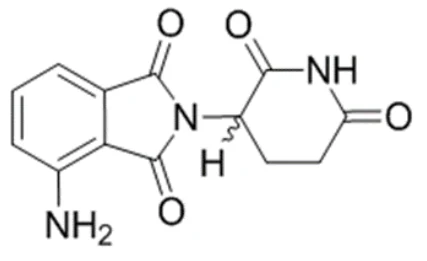
Physicochemical properties: Pomalidomide is a light yellow to yellow colored powder. It is very slightly soluble in organic solvents and practically insoluble in water. Pomalidomide is non-hygroscopic and has an onset of melting between 316.09°C and 317.28°C. The pH of pomalidomide at about 37±0.5° in aqueous solution is 6.0 at concentration 0.10 mg/mL. It has one chiral center and is produced as a racemic mixture of the R- and S-enantiomers.
14 Clinical Trials
The efficacy and safety of pomalidomide in the treatment of patients with multiple myeloma has been evaluated in open-label, active-controlled Phase 3 studies as described in Table 10.
Table 10: Summary of Pivotal Clinical Trials in Multiple Myeloma Patients
| Study and Trial Design | Dosage, route of administration and duration | Study patients |
|---|---|---|
| Study and Trial Design | Dosage, route of administration and duration | Study patients |
CC-4047-MM-007 (OPTIMISMM) Phase III, multi-centre, randomised, open-label study comparing treatment with pomalidomide in combination with dexamethasone and bortezomib to treatment with dexamethasone and bortezomib | Patients were randomized in a 1:1 ratio to 1 of 2 treatment arms and treated to progression or intolerable adverse events. Pomalidomide 4 mg on Days 1 to 14 of each 21-day cycle. Bortezomib 1.3 mg/m2/dose in both study arms on Days 1, 4, 8 and 11 of a 21-day cycle for | N = 559 Pomalidomide, dexamethasone and bortezomib = 281 dexamethasone and bortezomib = 278 |
| in previously treated adult patients with relapsed or refractory multiple myeloma, who had received at least one prior regimen, including lenalidomide. | Cycles 1 to 8; and on Days 1 and 8 of a 21-day cycle for Cycles 9 and onwards. Dexamethasone 20 mg/day (≤ 75 years old) or 10 mg/day (> 75 years old) in both study arms on Days 1, 2, 4, 5, 8, 9, 11 and 12 of a 14-day cycle for Cycles 1 to 8; and on Days 1, 2, 8 and 9 of each subsequent 21-day cycle from Cycles 9 onwards. | |
CC-4047-MM-003 Phase III multi-center, randomized, open-label study comparing pomalidomide in combination with dexamethasone with HD-dex in previously treated adult patients with relapsed and refractory multiple myeloma, who had received at least two prior treatment regimens, had failed both lenalidomide and bortezomib, and had demonstrated disease progression on the last therapy. | Patients were randomized in a 2:1 ratio to 1 of following 2 treatment arms: Pomalidomide+dexamethasone (Pomalidomide 4 mg/day on Days 1-21 and dexamethasone 40 mg on Days 1, 8, 15, and 22 of a 28-day cycle) (Patients > 75 years of age received dexamethasone 20 mg.) or; HD-dex (40 mg on Days 1 through 4, 9 through 12, and 17 through 20 of a 28-day cycle. (Patients > 75 years of age received dexamethasone 20 mg.) | N = 455 Pomalidomide, dexamethasone = 302 HD-dex = 155 |
14.1 Clinical Trials by Indication
Pomalidomide in combination with Dexamethasone and Bortezomib in Patients with Previously Treated Multiple Myeloma
Study CC-4047-MM-007
Trial Design and Study Demographics:
The efficacy and safety of pomalidomide in combination with bortezomib and dexamethasone was compared with bortezomib and dexamethasone in study CC-4047-MM-007. Key eligibility criteria included patients with multiple myeloma who had received 1-3 prior antimyeloma regimens and demonstrated disease progression on or after the last therapy. Patients were also required to receive prior treatment with a lenalidomide containing regimen. Patients that received bortezomib-containing prior antimyeloma therapy were eligible, provided they did not progress during therapy or within 60 days of the last dose of bortezomib containing therapy under the 1.3 mg/m2/dose twice weekly dosing schedule. Approximately 70% of patients were refractory to lenalidomide (71.2% in pomalidomide, dexamethasone and bortezomib arm and, 68.7 % in dexamethasone and bortezomib arm). Refractory is defined as nonresponsive (at least minimal response not achieved or progression within 60 days of last dose) to the medication the last time it was received by the patient. Approximately, 40% of patients were in 1st relapse and approximately 73% of patients received bortezomib as prior treatment.
Patients were stratified at randomization by age (≤ 75 versus > 75), number of prior anti myeloma regimens (1 versus >1), and β2M at screening (< 3.5 mg/L versus ≥ 3.5 mg/L - ≤ 5.5 mg/L versus > 5.5 mg/L).
The baseline patient and disease-related characteristics of the patients were generally consistent among the 2 arms (see Table 11).
The primary efficacy endpoint was progression-free survival (PFS), defined as the time between the randomisation and disease progression, or death, whichever is earlier. Response was assessed by an Independent Response Adjudication Committee (IRAC) according to the IMWG criteria using the intent to treat (ITT) population as the primary analysis. Other important efficacy endpoints were objective response rate (ORR), duration of response (DoR), and overall survival (OS).
Table 11: Summary of Patient Demographics and Baseline Disease Characteristics of Patients in Study CC-4047-MM-007
| Pomalidomide+ dex+ bortezomib (N=281) | dex+ bortezomib (N=278) | |||||||
|---|---|---|---|---|---|---|---|---|
| Pomalidomide+ dex+ bortezomib (N=281) | dex+ bortezomib (N=278) | |||||||
| Age (years) | ||||||||
| Median (min, max) | 67 (29, 87) | 68 (27, 89) | ||||||
| Age Distribution, n (%) | ||||||||
| ≤ 65 years | 123 (43.8) | 120 (43.2) | ||||||
| > 65 years | 158 (56.2) | 158 (56.8) | ||||||
| > 75 years | 46 (16.4) | 47 (16.9) | ||||||
| Sex, n (%) | ||||||||
| Male | 155 (55.2) | 147 (52.9) | ||||||
| Female | 126 (44.8) | 131 (47.1) | ||||||
| ISS Stage at Study Entry, n (%)a | ||||||||
| I | 149 (53.0) | 138 (49.6) | ||||||
| II | 85 (30.2) | 90 (32.4) | ||||||
| III | 47 (16.7) | 50 (18) | ||||||
| Cytogenetic Abnormality, n (%) | ||||||||
| High riskb | 61 (21.7) | 49 (17.6) | ||||||
| Not high risk | 137 (48.8) | 132 (47.5) | ||||||
| Distribution of Prior Anti-Myeloma Linesc, n (%) | ||||||||
| 1 | 111 (39.5) | 117 (41.4) | ||||||
| ≥ 2 | 170 (60.5) | 163 (58.6) | ||||||
| Exposure to Prior Anti-Myeloma Therapies, n (%) | ||||||||
| Immunomodulatory Agents | 281 (100) | 278 (100) | ||||||
| Lenalidomide | 281 (100) | 278 (100) | ||||||
| Proteasome Inhibitors | 212 (75.4) | 213 (76.6) | ||||||
| Bortezomib | 201 (71.5) | 203 (73) | ||||||
| Refractory to Common Prior Anti-Myeloma Drugs, n (%) | ||||||||
| Immunomodulatory agents | 202 (71.9) | 193 (69.4) | ||||||
| lenalidomide | 200 (71.2) | 191 (68.7) | ||||||
| Proteasome inhibitors | 37 (13.2) | 37 (13.3) | ||||||
| Bortezomibd | 24 (8.5) | 32 (11.5) | ||||||
| Refractory to Last Anti-Myeloma Therapy, n (%) | 196 (69.8) | 184 (66.2) | ||||||
| ECOG Performance Status, n (%) | ||||||||
| 0 | 149 (53.0) | 137 (49.3) | ||||||
| 1 | 121 (43.1) | 119 (42.8) | ||||||
| 2 | 11 (3.9) | 22 (7.9) | ||||||
| CrCl at Diagnosis, n (%) | ||||||||
| <30 mL/min | 11 (3.9) | 10 (3.6) | ||||||
| 30 - <45 mL/min | 26 (9.3) | 28 (10.1) | ||||||
| 45 - <60 mL/min | 54 (19.2) | 38 (13.7) | ||||||
| 60 - <80 mL/min | 71 (25.3) | 80 (28.8) | ||||||
| ≥80 mL/min | 119 (42.3) | 122 (43.9) | ||||||
a International Staging System is calculated using baseline values of Albumin and Beta-2-microglobulin.
b High-risk is defined as presence of cytogenetic abnormality in at least one or more of the following cytogenetic abnormalities: Del(17p), t(4;14), t(14;16).
c A therapeutic line is defined by subject’s progression status. Only a regimen after disease progression is counted as a new line.
d Bortezomib-refractory subjects were eligible provided they did not have PD during therapy or within 60 days of the last dose of bortezomib containing therapy under the 1.3 mg/m2/dose twice weekly dosing schedule.
Data cut-off date: 26 Oct 2017
Study Results:
The median duration of treatment was 8.8 months (12 treatment cycles) in the pomalidomide, dexamethasone and bortezomib arm and 4.9 months (7 treatment cycles) in the dexamethasone and bortezomib arm.
The efficacy results are summarized in Table 12 below. The final analysis of PFS, the primary endpoint with 26 Oct 2017 data cutoff, was conducted on 316 events (57% of the ITT population). The PFS was significantly longer in the pomalidomide, dexamethasone, bortezomib arm than in dexamethasone, bortezomib arm: HR 0.61 (95% CI: 0.49, 0.77), p-value <0.0001. Kaplan-Meier curve for PFS for the ITT population is provided in Figure 1.
As per the pre-defined interim analysis for OS (26 Oct 2017 data cutoff), after a median follow-up period of 15.9 months, the difference in OS between treatment arms (HR = 0.98, 95% CI: 0.73, 1.32; p = 0.894) did not cross the prespecified superiority boundary. With the overall event rate of 31.5%, the OS data are not considered mature.
Table 12: Summary of overall efficacy data (ITT population)
Pomalidomide+dex+ bortezomib (N = 281) | dex+ bortezomib (N = 278) | ||||||||||||
|---|---|---|---|---|---|---|---|---|---|---|---|---|---|
| PFS IRAC (months) | |||||||||||||
| Mediana time (95% CI) b | 11.20 (9.66, 13.73) | 7.10 (5.88, 8.48) | |||||||||||
| HR c (95% CI), p-valued | 0.61 (0.49, 0.77), <0.0001 | ||||||||||||
| Censored, n (%) | 127 (45.2) | 116 (41.7) | |||||||||||
| Progressed/Died, n (%) | 154 (54.8) | 162 (58.3) | |||||||||||
| ORR IRAC, n (%) | 82.2 % | 50.0% | |||||||||||
| sCR | 9 (3.2) | 2 (0.7) | |||||||||||
| CR | 35 (12.5) | 9 (3.2) | |||||||||||
| VGPR | 104 (37.0) | 40 (14.4) | |||||||||||
| PR | 83 (29.5) | 88 (31.7) | |||||||||||
| SD | 32 (11.4) | 106 (38.1) | |||||||||||
| PD | 11 (3.9) | 16 (5.8) | |||||||||||
| OR (95% CI) e, p-valuef | 5.02 (3.35, 7.52), <0.001 | ||||||||||||
| DoR IRAC (months) | |||||||||||||
| Mediana time (95% CI) b | 13.7 (10.94, 18.10) | 10.94 (8.11, 14.78) | |||||||||||
| HRc (95% CI) | 0.76 (0.56, 1.02) | ||||||||||||
| OS (months) | |||||||||||||
| Mediana time (95% CI) b | NE (28.48, NE) | 31.24 (27.01, NE) | |||||||||||
| HRc (95% CI) | 0.98 (0.73, 1.32) | ||||||||||||
| Died | 87 (31.0) | 89.(32.0) | |||||||||||
CI = Confidence interval; CR = Complete response; DoR = Duration of response; HR = Hazard Ratio; OR = Odds ratio; ORR = Overall response rate; OS = Overall Survival, PD = Progressive Disease, PFS = Progression free survival; PR = Partial Response; sCR = Stringent complete response, SD = Stable Disease, VGPR = Very good partial response
a The median is based on the Kaplan-Meier estimate.
b 95% CI about the median.
c Based on Cox proportional hazards model.
d The p-value is based on a stratified log-rank test.
e Odds ratio is for pomalidomide+dexamethasone+ bortezomib: dexamethasone+bortezomib
f The p-value is based on a CMH test, stratified by age (<=75 vs >75), Prior number of antimyeloma regimens (1 vs >1), and Beta-2 microglobulin at screening (< 3.5 mg/L versus ≥ 3.5 mg/l, ≤ 5.5 mg/l versus > 5.5 mg/l).
Data cut-off date: 26 Oct 2017
Figure 1: Progression Free Survival Based on IRAC Review of Response by IMWG Criteria (Stratified Log Rank Test) (ITT Population)
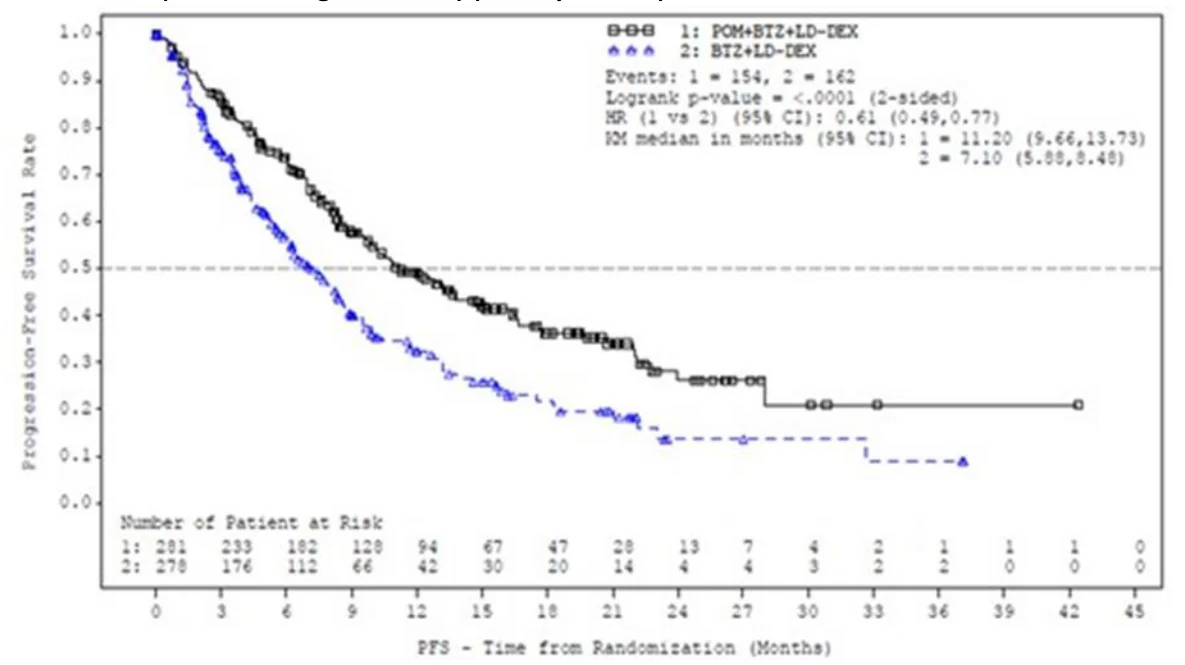
Data cut-off date: 26 Oct 2017
Subgroup analyses based on PFS hazard ratio were generally consistent across the pre-specified subgroups.
Figure 2: Forest Plot for PFS (Stratified Log Rank Test) (ITT Population)
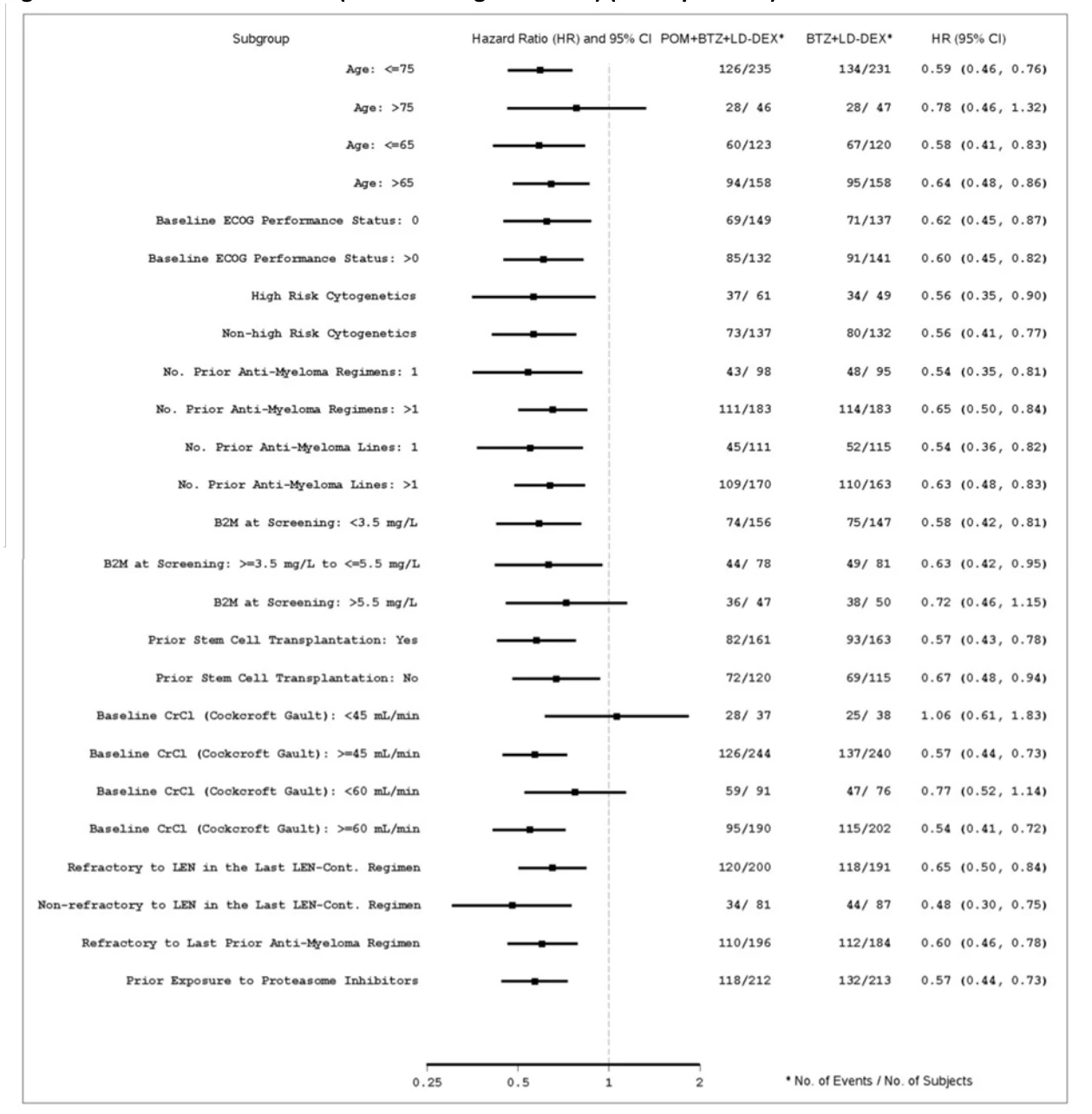
In subjects who received only one prior line of therapy, the median PFS time was 20.73 months (95% CI: 15.11, 27.99) in the pomalidomide, dexamethasone and bortezomib arm and 11.63 months (95% CI: 7.52, 15.74) in the dexamethasone and bortezomib arm.
Pomalidomide in combination with Dexamethasone Alone for the Treatment of Patients with Relapsed and Refractory Multiple Myeloma
Study CC-4047-MM-003
Trial Design and Study Demographics:
The efficacy and safety of pomalidomide in combination with dex was compared with HD-dex. Induction therapy followed by autologous stem cell transplant and consolidation/maintenance was considered as one line of therapy. Patients must have received adequate prior alkylator therapy in one of the following ways: as part of a stem cell transplant, or a minimum of 6 consecutive cycles of an alkylator-based therapy, or progression on treatment with an alkylator; provided that the patient received at least 2 cycles of an alkylator-containing therapy.
The majority of patients were male (59%) and white (79%); the median age for the overall population was 64 years (min, max: 35, 87 years). Patients with ongoing ≥ Grade 2 peripheral neuropathy or significant cardiac dysfunction (congestive heart failure [NY Heart Association Class III or IV]; myocardial infarction within 12 months of starting study; unstable or poorly controlled angina pectoris); serum total bilirubin > 2.0 mg/dL; moderate or severe renal impairment (creatinine clearance < 45 mL/min) were excluded from the study. The demographics of the study population and the baseline disease characteristics are summarized in Table 13.
Patients assigned to the pomalidomide+dexamethasone treatment arm received low-dose aspirin, low molecular weight heparin, or other equivalent antithrombotic or anti-coagulant, as did those who had a prior history of DVT or PE, regardless of treatment arm assignment.
The primary study endpoint was progression-free survival (PFS) by International Myeloma Working Group (IMWG) criteria. The study was also powered to show an advantage in overall survival (OS), one of the secondary study endpoints.
Treatment continued until patients had disease progression. Patients who did not progress, who were intolerant to treatment, or no longer wished to receive study treatment remained in the PFS follow-up period of the treatment phase. Patients on the HD-dex arm following disease progression had the option to receive pomalidomide alone or with dexamethasone in a companion study.
Table 13: Summary of Patient Demographics and Baseline Disease Characteristics of Patients in Study CC-4047-MM-003
| Pomalidomide+dex (N=302) | HD-dex (N=153) | Overall (N=455) | ||||||||||||||
|---|---|---|---|---|---|---|---|---|---|---|---|---|---|---|---|---|
| Pomalidomide+dex (N=302) | HD-dex (N=153) | Overall (N=455) | ||||||||||||||
| Age (years) | ||||||||||||||||
| Mean (SD) | 63.6 (9.33) | 63.7 (9.56) | 63.6 (9.40) | |||||||||||||
| Median (min, max) | 64.0 (35.0, 84.0) | 65.0 (35.0, 87.0) | 64.0 (35.0, 87.0) | |||||||||||||
| Age Distribution, n (%) | ||||||||||||||||
| ≤ 65 years | 167 (55.3) | 81 (52.9) | 248 (54.5) | |||||||||||||
| > 65 years | 135 (44.7) | 72 (47.1) | 207 (45.5) | |||||||||||||
| ≤ 75 years | 278 (92.1) | 141 (92.2) | 419 (92.1) | |||||||||||||
| > 75 years | 24 (7.9) | 12 (7.8) | 36 (7.9) | |||||||||||||
| Sex, n (%) | ||||||||||||||||
| Male | 181 (59.9) | 87 (56.9) | 268 (58.9) | |||||||||||||
| Female | 121 (40.1) | 66 (43.1) | 187 (41.1) | |||||||||||||
| Multiple Myeloma Stage before Study Entry, n (%) | ||||||||||||||||
| I | 21 (7.0) | 12 (7.8) | 33 (7.3) | |||||||||||||
| II | 95 (31.5) | 37 (24.2) | 132 (29.0) | |||||||||||||
| III | 177 (58.6) | 103 (67.3) | 280 (61.5) | |||||||||||||
| Missing | 9 (3.0) | 1 (0.7) | 10 (2.2) | |||||||||||||
| Time from First Pathologic Diagnosis (years) | ||||||||||||||||
| Mean (SD) | 6.2 (4.02) | 6.5 (3.63) | 6.3 (3.89) | |||||||||||||
| Median (min, max) | 5.3 (0.6, 30.0) | 6.1 (0.9, 21.1) | 5.6 (0.6, 30.0) | |||||||||||||
| Number of Prior Anti-Myeloma Therapies | ||||||||||||||||
| Mean (SD) | 5.1 (2.07) | 5.2 (2.25) | 5.1 (2.13) | |||||||||||||
| Median (min, max) | 5.0 (1.0, 14.0) | 5.0 (2.0, 17.0) | 5.0 (1.0, 17.0) | |||||||||||||
| Prior Anti-Myeloma Therapies, n (%) | ||||||||||||||||
| Stem Cell Transplant | 214 (70.9) | 106 (69.3) | 320 (70.3) | |||||||||||||
| Radiation Therapies | 108 ( 35.8) | 48 ( 31.4) | 156 ( 34.3) | |||||||||||||
| Cancer Surgeries | 25 (8.3) | 17 ( 11.1) | 42 (9.2) | |||||||||||||
| Refractory to Last Anti-Myeloma Therapy, n (%) | ||||||||||||||||
| 288 (95.4) | 147 (96.1) | 435 (95.6) | ||||||||||||||
| ECOG Performance Status, n (%) | ||||||||||||||||
| 0 | 110 (36.4) | 36 (23.5) | 146 (32.1) | |||||||||||||
| 1 | 138 (45.7) | 86 (56.2) | 224 (49.2) | |||||||||||||
| 2 | 52 (17.2) | 24 (16.3) | 77 (16.9) | |||||||||||||
| 3 | 0 (0) | 3 (2.0) | 3 (0.7) | |||||||||||||
| Missing | 2 (0.7) | 3 (2.0) | 5 (1.1) | |||||||||||||
SD=standard deviation
Table 14: Exposure to Prior Anti-Myeloma Therapy in > 1 Subject in Either Treatment Arm by Class and Preferred Term (ITT Population) in Study CC-4047-MM-003
| Class/Preferred Terma | Pomalidomide+dex (N=302) | HD-dex (N=153) | Overall (N=455) |
|---|---|---|---|
| Class/Preferred Terma | Pomalidomide+dex (N=302) | HD-dex (N=153) | Overall (N=455) |
| Subjects with at least one prior Anti-MM Drug | 302 (100.0) | 153 (100.0) | 455 (100.0) |
| Corticosteroids | 302 (100.0) | 153 (100.0) | 455 (100.0) |
| Dexamethasone | 294 ( 97.4) | 152 ( 99.3) | 446 ( 98.0) |
| Prednisolone | 150 ( 49.7) | 83 ( 54.2) | 233 ( 51.2) |
| Methylprednisolone | 12 ( 4.0) | 13 ( 8.5) | 25 ( 5.5) |
| Betamethasone | 3 ( 1.0) | 0 ( 0.0) | 3 ( 0.7) |
Immunomodulatory Agents | 301 ( 99.7) | 152 ( 99.3) | 453 ( 99.6) |
| Lenalidomide | 301 ( 99.7) | 152 ( 99.3) | 453 ( 99.6) |
| Thalidomide | 173 ( 57.3) | 93 ( 60.8) | 266 ( 58.5) |
| Proteasome Inhibitors | 301 ( 99.7) | 153 (100.0) | 454 ( 99.8) |
| Bortezomib | 301 ( 99.7) | 153 (100.0) | 454 ( 99.8) |
| Carfilzomib | 4 ( 1.3) | 3 ( 2.0) | 7 ( 1.5) |
| Alkylators | 299 ( 99.0) | 150 ( 98.0) | 449 ( 98.7) |
| ASCT | 214 (70.9) | 106 (69.3) | 320 (70.3) |
| Cyclophosphamide | 214 ( 70.9) | 110 ( 71.9) | 324 ( 71.2) |
| Melphalan | 146 ( 48.3) | 71 ( 46.4) | 217 ( 47.7) |
| Ifosfamide | 10 ( 3.3) | 7 ( 4.6) | 17 ( 3.7) |
| Anthracyclines | 172 ( 57.0) | 101 ( 66.0) | 273 ( 60.0) |
| Doxorubicin | 143 ( 47.4) | 83 ( 54.2) | 226 ( 49.7) |
| Pegylated Liposomal Doxorubicin Hydrochloride | 25 ( 8.3) | 6 ( 3.9) | 31 ( 6.8) |
| Idarubicin | 11 ( 3.6) | 14 ( 9.2) | 25 ( 5.5) |
| Epirubicin | 10 ( 3.3) | 7 ( 4.6) | 17 ( 3.7) |
| Liposomal Doxorubicin Hydrochloride | 7 ( 2.3) | 6 ( 3.9) | 13 ( 2.9) |
| Alkaloids | 139 ( 46.0) | 82 ( 53.6) | 221 ( 48.6) |
| Vincristine | 109 ( 36.1) | 70 ( 45.8) | 179 ( 39.3) |
| Etoposide | 51 ( 16.9) | 22 ( 14.4) | 73 ( 16.0) |
| Vindesine | 0 ( 0.0) | 3 ( 2.0) | 3 ( 0.7) |
| Nitrosureas | 86 ( 28.5) | 42 ( 27.5) | 128 ( 28.1) |
| Bendamustine | 71 ( 23.5) | 33 ( 21.6) | 104 ( 22.9) |
| Carmustine | 19 ( 6.3) | 11 ( 7.2) | 30 ( 6.6) |
| Lomustine | 2 ( 0.7) | 3 ( 2.0) | 5 ( 1.1) |
| Other Investigational Productsb | 59 ( 19.5) | 32 ( 20.9) | 91 ( 20.0) |
| Platinum | 35 ( 11.6) | 14 ( 9.2) | 49 ( 10.8) |
| Cisplatin | 33 ( 10.9) | 14 ( 9.2) | 47 ( 10.3) |
ASCT = Autologous stem cell transplant;
a Preferred terms are based on World Health Organization Drug Dictionary March 2011 and listed in descending order of frequency of Pomalidomide+dex Group.
Preferred terms with the same main component are combined. Only 9 classes are included in this table. ASCT is included in the alkylator class.
b This category includes products not approved for MM
Data cutoff: 07 Sep 2012
Study Results:
Progression Free Survival (PFS)
PFS by Independent Response Adjudication Committee (IRAC) review based on IMWG criteria in the intent-to-treat (ITT) population is presented in Table 15. Kaplan-Meier curve of PFS time for the ITT population based on IRAC review by IMWG criteria is provided in Figure 3.
Identical results were obtained by IRAC review based on European Group for Blood and Marrow Transplantation (EBMT) criteria in the ITT population.
PFS was evaluated in several relevant subgroups: gender, age. ECOG performance status, cytogenetic risk, creatinine clearance, baseline albumin levels, and microglobulin. Regardless of the subgroup evaluated, PFS was generally consistent with that observed in the ITT population for both treatment groups.
Table 15: PFS Time by IRAC Review Based on IMWG Criteria (ITT Population)
| Pomalidomide+dex (N=302) | HD-dex (N=153) | ||||||||
|---|---|---|---|---|---|---|---|---|---|
| PFS | |||||||||
| Censored, n (%) | 138 (45.7) | 50 (32.7) | |||||||
| Progressed/Died, n (%) | 164 (54.3) | 103 (67.3) | |||||||
| PFS Time (weeks) | |||||||||
| Mediana | 15.7 | 8.0 | |||||||
| Two sided 95% CIb | [13.0, 20.1] | [7.0, 9.0] | |||||||
| Hazard Ratio (Pomalidomide+dex:HD-dex) 2-Sided 95% CIc | 0.45 [0.35, 0.59] | ||||||||
| Log-Rank Test Two sided P-Valued | < 0.001 | ||||||||
a The median is based on Kaplan-Meier estimate.
b 95% confidence interval about the median PFS time.
c Based on Cox proportional hazards model comparing the hazard functions associated with treatment groups, stratified by age (≤75 vs >75), diseases population (refractory to both lenalidomide and bortezomib vs not refractory to both drugs), and prior number of anti myeloma therapy (=2 vs >2).
d The p-value is based on a stratified log-rank test with the same stratification factors as the above Cox model. Note: CI=Confidence interval
Data cutoff: 07 Sep 2012
Figure 3: PFS Based on IRAC Review of Response by IMWG Criteria (ITT Population)
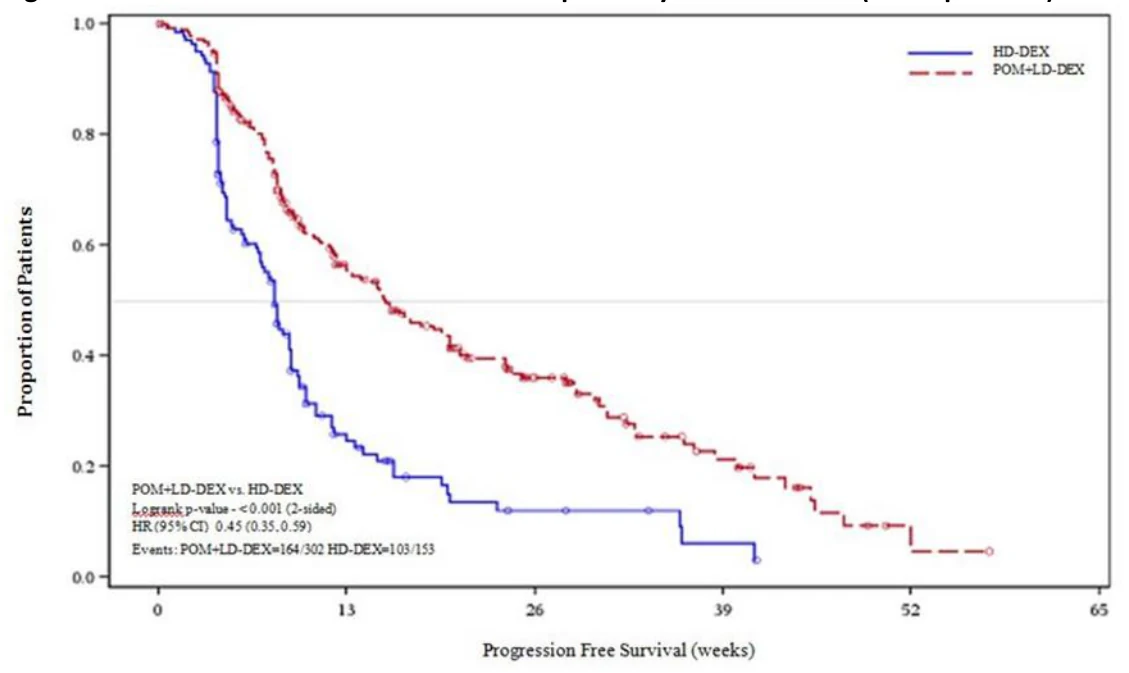
Data cutoff: 07 Sep 2012
Time to Progression (TTP)
TTP, defined as the time from randomization to disease progression, was performed as a sensitivity analysis for PFS. Median TTP by IRAC review based on IMWG criteria in the ITT population was 20.1 weeks (95% CI: 16.1, 28.1) in the pomalidomide+dexamethasone group compared with 8.3 weeks (95% CI: 7.7, 9.6) in the HD-dex group. The hazard ratio was 0.42 (95% CI: 0.31, 0.56, p < 0.001).
Overall Survival
Overall survival was a key secondary study endpoint, and is summarized in Table 16 for the ITT population. Median overall survival time from the interim analysis for the pomalidomide+ dexamethasone group was 55 weeks. Median OS time for the HD-dex arm was 35 weeks; however, approximately 29% of subjects in this treatment arm received pomalidomide after progression on HD-dex. The 1-year event free rate was 51% (± 3%) for the pomalidomide+dexamethasone group and 39% (± 4%) for the HD-dex group.
Kaplan-Meier curve for overall survival for the ITT population is provided in Figure 4. Overall survival was evaluated in several relevant subgroups: gender, age. ECOG performance status, cytogenetic risk, creatinine clearance, baseline albumin levels, and microglobulin. For most of the subgroups evaluated, overall survival was generally consistent with that observed in the ITT population for both treatment groups.
Table 16: Overall Survival (ITT Population)
Pomalidomide+dex (N=302) | HD-dex (N=153) | ||||||||
|---|---|---|---|---|---|---|---|---|---|
| Censored, n (%) | 157 (52.0) | 71 (46.4) | |||||||
| Died, n (%) | 145 (48.0) | 82 (53.6) | |||||||
| Mediana Survival Time (weeks) | 55.4 | 35.1 | |||||||
| Two sided 95% Clb | [45.3, 67.3] | [29.9, 47.1] | |||||||
| Hazard Ratio [Two sided 95% Clc] | 0.74 [0.56, 0.97] | ||||||||
| Log-Rank Test Two sided P-Valued | 0.028 | ||||||||
a The median is based on Kaplan-Meier estimate.
b 95% confidence interval about the median progression free survival time.
c Based on Cox proportional hazards model comparing the hazard functions associated with treatment groups.
d The p-value is based on an unstratified log-rank test. CI=Confidence interval.
Data cutoff: 01 March 2013
Figure 4: Kaplan-Meier Curve of Overall Survival (ITT Population)
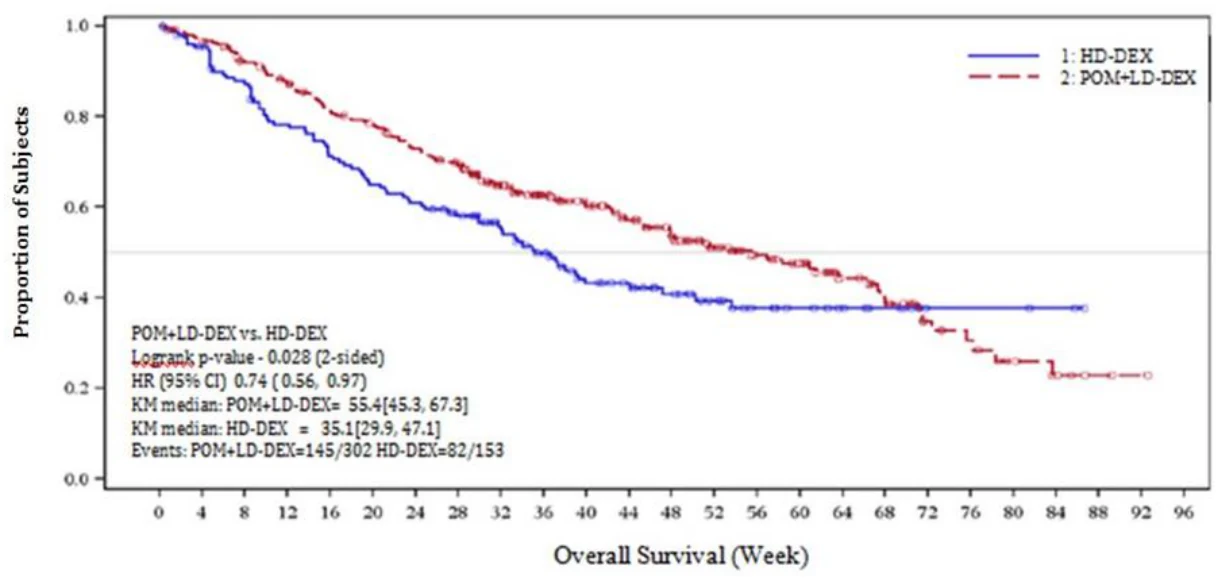
Data cutoff: 01 March 2013
Response Rate
Response rates by IRAC review based on IMWG criteria are summarized in Table 17 for the ITT population. Consistent results were observed in response rates by IRAC review based on EBMT criteria.
Table 17: Myeloma Response Rates by IRAC (Based on Best Response Assessment Using IMWG Criteria) (ITT Population)
| Statistics | Pomalidomide+dex (N=302) | HD-dex (N=153) | ||||
|---|---|---|---|---|---|---|
| CR or VGPR or PR | 50 (16.6) | 6 (3.9) | ||||
| Stable disease or PD or NEa | 252 (83.4) | 147 (96.1) | ||||
| p-valueb | < 0.001 | |||||
| Odds ratio (95% CI)c | 4.86 [2.03, 11.61] | |||||
| p-valued | < 0.001 | |||||
SCR = stringent complete response; CR = complete response; VGPR = very good partial response; PR = partial response; PD= progressive disease; NE = response not evaluable
a Including patients who did not have any response assessment data, or whose only assessment was response not evaluable.
b Probability from Fisher Exact test.
c Odds ratio is for Pomalidomide+dex:HD-dex. CI=Confidence Interval.
d p-value is based on a Cox proportional hazards model test stratified by age (≤75 vs >75), diseases population (refractory to both lenalidomide and bortezomib vs not refractory to both drugs), and prior number of anti-myeloma therapy (=2 vs >2).
Data cutoff: 07 Sep 2012
14.2 Comparative Bioavailability Studies
A double blinded, randomized, single-dose (1 x 4 mg), two-treatment, two-sequence, two-period, comparative bioavailability study comparing NAT-POMALIDOMIDE capsules 4 mg (Natco Pharma (Canada) Inc.) with POMALYST® capsules 4 mg (Celgene Inc.) was conducted in 24 healthy, adult, male subjects under fasting conditions. Comparative bioavailability data from 23 subjects that were included in the statistical analysis are presented in the following table.
Summary Table of the Comparative Bioavailability Data
Pomalidomide (1 x 4 mg) Geometric Mean Arithmetic Mean (CV %) | ||||
Pomalidomide (1 x 4 mg) Geometric Mean Arithmetic Mean (CV %) | ||||
| Parameter | Test1 | Reference2 | % Ratio of Geometric Means | 90% Confidence Interval |
| Parameter | Test1 | Reference2 | % Ratio of Geometric Means | 90% Confidence Interval |
AUCT (ng·h/mL) | 567.21 588.51 (28.1) | 583.37 603.84 (26.44) | 97.0 | 92.5 - 101.8 |
AUCI (ng·h/mL) | 575.82 596.62 (27.51) | 593.18 612.89 (25.81) | 96.9 | 92.4 - 101.6 |
CMAX (ng/mL) | 75.36 76.79 (19.92) | 67.92 69.22 (19.71) | 111.2 | 103.7 - 119.2 |
TMAX3 (h) | 1.75 (0.67 – 5.00) | 2.50 (1.00 - 6.00) | Not applicable | Not applicable |
T½4 (h) | 5.85 (20.34) | 5.99 (18.65) | Not applicable | Not applicable |
1 NAT-POMALIDOMIDE (pomalidomide) capsules 4 mg (Natco Pharma (Canada) Inc.)
2 PrPOMALYST® (pomalidomide) capsules 4 mg (Celgene Inc.), purchased in Canada.
3 Expressed as the median (range).
4 Expressed as the arithmetic mean (% CV) only.
15 Microbiology
No microbiological information is required for this drug product.
16 Non-Clinical Toxicology
| Study Title | Findings |
|---|---|
| Study Title | Findings |
| Study Title | Findings |
| Study Title | Findings |
General Toxicology A 6-Month Toxicity Study of Pomalidomide Administered by Oral Gavage to Rats with a 1-Month Recovery Period | In rats, chronic administration of pomalidomide at doses of 50, 250, and 1000 mg/kg/day for 6 months was well tolerated. No adverse findings were noted up to 1000 mg/kg/day (175-fold exposure ratio relative to a 4-mg clinical dose). |
General Toxicology A 9-month Oral Toxicity Study of Pomalidomide Administered by Nasogastric Gavage to Cynomolgus Monkeys, with an 8-Week Recovery Period | In monkeys, pomalidomide was evaluated in repeat-dose studies of up to 9 months in duration. In these studies, monkeys exhibited greater sensitivity to pomalidomide effects than rats. The primary toxicities observed in monkeys were associated with the hematopoietic/lymphoreticular systems. In the 9-month study in monkeys with doses of 0.05, 0.1, and 1 mg/kg/day, morbidity and early euthanasia of 6 animals were observed at the dose of 1 mg/kg/day and were attributed to immunosuppressive effects (staphylococcal infection, decreased peripheral blood lymphocytes, chronic inflammation of the large intestine, lymphoid depletion of lymphoid tissues, and lymphoid hypocellularity of bone marrow) at high exposures of pomalidomide (15-fold exposure ratio relative to a 4 mg clinical dose). These immunosuppressive effects resulted in |
early euthanasia of 4 monkeys due to poor health condition (watery stool, inappetence, reduced food intake, and weight loss); histopathologic evaluation of these animals showed chronic inflammation of the large intestine and villous atrophy of the small intestine. Staphylococcal infection was observed in 4 monkeys; 3 of these animals responded to antibiotic treatment and 1 died without treatment. In addition, findings consistent with acute myelogenous leukemia led to euthanasia of 1 monkey; clinical observations and clinical pathology and/or bone marrow alterations observed in this animal were consistent with immunosuppression. Minimal or mild bile duct proliferation with associated increases in ALP and GGT were also observed at 1 mg/kg/day. Evaluation of recovery animals indicated that all treatment-related findings were reversible after 8 weeks of dosing cessation, except for proliferation of intrahepatic bile ducts observed in 1 animal in the 1 mg/kg/day group. The NOAEL was 0.1 mg/kg/day (0.5-fold exposure ratio relative to a 4 mg clinical dose). Generally, similar findings were seen in shorter duration studies in monkeys that included higher dose level/exposures and also resulted in decreased peripheral blood neutrophil counts and sometimes lower red blood cell parameters. | |
Reproductive Toxicology A Fertility and Early Embryonic Development Study in Rats Administered Pomalidomide Orally | In a fertility and early embryonic development study in rats, pomalidomide was administered to males and female rats at doses of 25, 250, and 1000 mg/kg/day before, during, and after mating with animals at the same dose level. Uterine examination on Gestation Day 13 showed a decrease in mean number of viable embryos and an increase in postimplantation loss at all dose levels. Therefore, the No Observed Adverse Effect Level (NOAEL) for these effects was <25 mg/kg/day (AUC 24h was 39960 ng•h/mL) at this lowest dose tested, and the exposure ratio was 99-fold relative to a 4 mg clinical dose). When treated males on this study were mated with untreated females, all uterine parameters were comparable to the controls. Based on these results, the observed effects were attributed to the treatment of females. |
Developmental Toxicology An Embryo-Fetal Development Study in Rats Administered Pomalidomide Orally | Pomalidomide was teratogenic in rats when administered during the period of major organogenesis. In the rat embryofoetal developmental toxicity study, malformations of absence of urinary bladder, absence of thyroid gland, and fusion and misalignment of lumbar and thoracic vertebral elements (central and/or neural arches) sometimes associated with discontinuous and misshapen ribs were observed at all dosage levels (25, 250, and 1000 mg/kg/day). There was no maternal toxicity observed in this study. Therefore, the maternal NOAEL was 1000 mg/kg/day, and the NOAEL for developmental toxicity was <25 mg/kg/day (AUC24h was 34340 ng•h/mL on Gestation Day 17 at this lowest dose tested, and the exposure ratio was 85-fold relative to a 4 mg clinical dose). |
Developmental Toxicology Oral (Stomach Tube) Developmental Toxicity Study of Pomalidomide in Rabbits | Pomalidomide was teratogenic in rabbits when administered during the period of major organogenesis. In rabbits, pomalidomide at doses ranging from 10 to 250 mg/kg produced embryo-foetal developmental malformations and variations. Increased cardiac anomalies (such as interventricular septal defect) and skeletal malformations (caudal vertebral) were seen at all dose levels. At 100 and 250 mg/kg/day, there were slight increases in post-implantation loss and slight decreases in fetal body weights. At 100 and/or 250 mg/kg/day, fetal malformations also included limb anomalies (flexed and/or rotated fore- and/or hindlimbs, unattached or absent digit) and associated skeletal malformations (not ossified metacarpal, misaligned phalanx and metacarpal, not ossified phalanx, and short not ossified or bent tibia); moderate dilation of the lateral ventricle in the brain; abnormal placement of the right subclavian artery; absent intermediate lobe in the lungs; low-set kidney; altered liver morphology; incompletely or not ossified pelvis; an increased average for supernumerary thoracic ribs and a reduced average for ossified tarsals. Slight reduction in maternal body weight gain, significant reduction in triglycerides, and significant decrease in absolute and relative spleen weights were observed at 100 and 250 mg/kg/day. The maternal NOAEL was 10 mg/kg/day, and the developmental NOAEL was <10 mg/kg/day. AUC24h was 418 ng•h/mL on Gestation Day 19 at this lowest dose tested, which was similar to that obtained from a 4 mg clinical dose. Thalidomide was used as a positive control in the study and elicited many of the same findings as pomalidomide. |
| Carcinogenicity | One of twelve monkeys dosed with 1 mg/kg of pomalidomide (an exposure approximately 15-fold of the exposure in patients at the recommended dose of 4 mg/per day) developed acute myeloid leukemia in a 9-month repeat-dose toxicology study. |
Mutagenicity/Genotoxicity Evaluation of Pomalidomide in the Bacterial Reverse Mutation with a Confirmatory Assay Evaluation of Pomalidomide in the Chromosomal Aberrations Assay in Cultured Human Peripheral Blood Lymphocytes Evaluation of Pomalidomide in the In Vivo Rat Bone Marrow Micronucleus Assay | Pomalidomide was not mutagenic in bacterial and mammalian mutation Ames assays, and did not induce chromosomal aberrations in human peripheral blood lymphocytes in vitro or micronuclei formation in polychromatic erythrocytes in bone marrow of rats administered doses up to 2000 mg/kg/day. |
Immunotoxicity A 28-Day Immunotoxicity Study of Pomalidomide Administered by Nasogastric Gavage to Cynomolgus Monkeys Followed By a 30-Day Recovery Period | Oral administration of pomalidomide at 2 mg/kg/day for 28 days impaired primary and secondary humoral immune responses (attenuated anti-KLH IgM and IgG antibody production) and resulted in mild to moderate decreases in circulating peripheral lymphocytes (CD20+ B- lymphocytes, CD3+ T-lymphocytes, CD3+/CD4+ T-helper lymphocytes, and CD3+/CD8+ T-cytotoxic lymphocytes, CD3-/CD16+ NK cells, and CD3-/CD14+ monocytes), correlating with mild to moderate bone marrow lymphocyte hypocellularity as well as marked lymphoid depletion of the thymus, spleen (including lympholysis and/or increased red pulp cellularity), and the mandibular and mesenteric lymph nodes. There were no effects on granulocyte, monocyte, and NK cell function. One male was euthanized in poor clinical condition. Clinical and anatomic pathology findings were reversible. |
17 Supporting Product Monographs
- 1. POMALYST® (Pomalidomide Capsules 1 mg, 2 mg, 3 mg, and 4 mg), Control Number 294588, Product Monograph, Bristol-Myers Squibb Canada., (July 28, 2025)