


Product Monograph - Nidagel
1 INDICATIONS
NIDAGEL is indicated for the treatment of bacterial vaginosis (formerly called nonspecific vaginitis, Gardnerella vaginalis or Haemophilus vaginitis) in adult women.
A clinical diagnosis of bacterial vaginosis is usually defined by the presence of a homogenous vaginal discharge that:
- a. has a pH of greater than 4.5;
- b. emits a fishy amine odour when mixed with a 10% KOH solution;
- c. contains clue cells on microscopic examination.
Other pathogens commonly associated with vulvovaginitis, e.g., Trichomonas vaginalis, Chlamydia trachomatis, Neisseria gonorrhoeae, Candida albicans and herpes simplex virus should be ruled out.
To reduce the development of drug-resistant bacteria and maintain the effectiveness of NIDAGEL and other antibacterial drugs, NIDAGEL should be used only to treat infections that are proven or strongly suspected to be caused by susceptible bacteria. When culture and susceptibility information are available, they should be considered in selecting or modifying antibacterial therapy. In the absence of such data, local epidemiology and susceptibility patterns may contribute to the empiric selection of therapy.
1.1 Pediatrics (< 18 years of age)
No data are available to Health Canada; therefore, Health Canada has not authorized an indication for pediatric use.
1.2 Geriatrics
No data are available to Health Canada; therefore, Health Canada has not authorized an indication for geriatric use.
2 CONTRAINDICATIONS
NIDAGEL is contraindicated in patients with a prior history of hypersensitivity to metronidazole, parabens, other ingredients of the formulation or other nitroimidazole derivatives. NIDAGEL is contraindicated during the first trimester of pregnancy (see WARNINGS AND PRECAUTIONS).
3 SERIOUS WARNINGS AND PRECAUTIONS BOX
Serious Warnings and Precautions
| Cases of severe hepatotoxicity/acute hepatic failure, including cases with a fatal outcome, with very rapid onset after treatment initiation, in patients with Cockayne syndrome have been reported with products containing metronidazole. In this population, NIDAGEL should therefore only be used after careful benefit-risk assessment and only if no alternative treatment is available (see WARNINGS AND PRECAUTIONS). |
4 DOSAGE AND ADMINISTRATION
4.1 Dosing Considerations
Patients with severe hepatic disease metabolize metronidazole slowly, with resultant accumulation of metronidazole and its metabolites in the plasma. Accordingly, for such patients, NIDAGEL should be administered cautiously.
Pregnant patients should not be treated during the first trimester of pregnancy (see CONTRAINDICATIONS and WARNINGS AND PRECAUTIONS).
Use during menses is not recommended.
4.2 Recommended Dose and Dosage Adjustment
One applicator full (approximately 5 grams) of NIDAGEL 0.75% vaginal gel should be inserted into the vagina once daily at bedtime for 5 days, or twice daily at morning and bedtime for 5 days. Controlled studies with alternate dosage schedules have not been conducted. If patients do not respond to initial therapy, it is recommended that appropriate laboratory measures be used to rule out other conditions before retreating with NIDAGEL.
Health Canada has not authorized an indication for pediatric use.
4.5 Missed Dose
If you forget to take NIDAGEL, apply the product at your next scheduled time. Do not double dose.
5 OVERDOSAGE
There is no human experience with overdosage of NIDAGEL. Massive ingestion may produce vomiting and slight disorientation. There is no specific antidote. Early gastric lavage may remove a large amount of the drug; otherwise, treatment should be symptomatic.
| For management of a suspected drug overdose, contact your regional poison control centre. |
6 DOSAGE FORMS, STRENGTHS, COMPOSITION AND PACKAGING
Table 1 – Dosage Forms, Strengths, Composition and Packaging
Description
NIDAGEL is an essentially colourless to straw-coloured, slightly hazy gel. Each gram contains 7.5 mg of metronidazole.
NIDAGEL (0.75% metronidazole vaginal gel) is supplied in a 70-gram aluminum tube, packaged with five, 5-gram vaginal applicators.
7 WARNINGS AND PRECAUTIONS
General
Known or previously unrecognized candidiasis may present more prominent symptoms during therapy with NIDAGEL and requires treatment with a candicidal agent.
No reports of alcohol interaction were received during clinical studies with NIDAGEL. Despite the relatively low serum levels of metronidazole afforded by NIDAGEL, the possibility of a disulfiram-like reaction to alcohol while on NIDAGEL therapy cannot be excluded. Patients should be advised to abstain from alcohol during therapy and for one day following therapy.
Carcinogenesis and Mutagenesis
Metronidazole has shown evidence of carcinogenic activity following chronic oral administration in mice and rats. Pulmonary tumorigenesis has been reported in mice, and significant increases in the incidence of mammary and hepatic tumors have been found in female rats. Lifetime tumorigenicity studies in hamsters have given negative results.
These studies were conducted with orally administered metronidazole with results in significantly higher systemic blood levels than those obtained after use of 0.75% metronidazole vaginal gel (see NON-CLINICAL TOXICOLOGY).
Hematologic
Metronidazole is a nitroimidazole and should be used with care in patients with evidence of or history of blood dyscrasia. A mild transient leukopenia has been observed during oral metronidazole administration.
In clinical studies with 0.75% metronidazole vaginal gel a mild, clinically insignificant leukopenia was observed in some patients. Relationship to therapy could not be determined.
| Route of Administration | Dosage Form / Strength/Composition | Non-medicinal Ingredients |
| Topical | 0.75% p/p Vaginal Gel | Carbomer 934P, Edetate Disodium, Methylparaben, Propylparaben, Propylene Glycol, Purified Water and Sodium Hydroxide |
Hepatic/Biliary/Pancreatic
Patients with severe hepatic disease metabolize metronidazole slowly, with resultant accumulation of metronidazole and its metabolites in the plasma. Accordingly, for such patients, NIDAGEL should be administered cautiously.
Neurologic
Convulsive seizures and peripheral neuropathy, the latter characterized mainly by numbness or paresthesia of an extremity, have been reported in patients treated with oral metronidazole. The appearance of abnormal neurologic signs demands the prompt discontinuation of NIDAGEL therapy. NIDAGEL should be administered with caution to patients with central nervous system diseases (see SERIOUS WARNINGS AND PRECAUTIONS BOX).
Psychotic reactions to oral metronidazole have been reported in alcoholic patients who are using metronidazole and disulfiram concurrently.
Cases of severe hepatotoxicity/acute hepatic failure, including cases with a fatal outcome, with very rapid onset after treatment initiation, in patients with Cockayne syndrome have been reported with products containing metronidazole. In this population, NIDAGEL should therefore only be used after careful benefit-risk assessment and only if no alternative treatment is available. Liver function tests must be performed just prior to the start of therapy, throughout and after end of treatment until liver function is within normal ranges, or until the baseline values are reached. If the liver function tests become markedly elevated during treatment, the drug should be discontinued. Patients with Cockayne syndrome should be advised to immediately report any symptoms of potential liver injury to their physician and stop taking NIDAGEL.
Sensitivity/Resistance
Prescribing NIDAGEL in the absence of a proven or strongly suspected bacterial infection is unlikely to provide benefit to the patient and risks the development of drug-resistant bacteria.
NIDAGEL affords minimal serum levels of metronidazole compared to oral metronidazole therapy. Although these lower serum levels are less likely to produce the common reactions seen with oral metronidazole, the possibility of these are other reactions cannot be excluded.
7.1 Special Populations
7.1.1 Pregnant Women
There has been no experience to date with the use of NIDAGEL in pregnant patients. Metronidazole crosses the placental barrier and enters the fetal circulation rapidly. It should not be used during the first trimester of pregnancy. Use of NIDAGEL for bacterial vaginosis in the second and third trimesters should be restricted to those patients in whom local palliative treatment has been inadequate to control symptoms. No fetotoxicity was observed after oral metronidazole in pregnant rats or mice. Because animal reproduction studies are not always predictive of human response, this drug should be used during pregnancy only if clearly needed (see CONTRAINDICATIONS).
7.1.2 Breast-feeding
NIDAGEL blood levels are significantly lower than those achieved with oral metronidazole. After oral administration metronidazole has been shown to be secreted in breast milk in concentrations similar to those found in plasma. If the use of NIDAGEL is considered to be necessary in nursing mothers, the potential benefits must be weighed against the possible risks to the infant.
7.1.3 Pediatrics (< 18 years of age)
No data are available to Health Canada; therefore, Health Canada has not authorized an indication for pediatric use.
7.1.4 Geriatrics
No data are available to Health Canada; therefore, Health Canada has not authorized an indication for geriatric use.
8 ADVERSE REACTIONS
8.2 Clinical Trial Adverse Reactions
Based on a multi-center clinical trial involving 505 patients, comparing NIDAGEL twice-daily dosing to once-daily dosing, adverse event experiences are listed below, in descending order of frequency: vaginal discharge, descriptions of which varied in both color and consistency (12%), yeast infection (9%), vulval/vaginal irritative symptoms (9%), gastrointestinal discomfort which included patient descriptions of abdominal or stomach cramping, pain and discomfort (7%), headache (5%), nausea and vomiting (4%), pelvic discomfort (3%).
8.3 Less Common Clinical Trial Adverse Reactions
The following reactions were seen at a frequency of 2%:
- Gastrointestinal Disorders: cramping
- General Disorders: unusual taste
- Infections and Infestations: undocumented or self-diagnosed yeast infections
- Nervous System Disorders: dizziness
The following reactions were seen at a frequency of 1%:
- Gastrointestinal Disorders: diarrhea, loose stools
- General Disorders: decreased appetite
- Infections and Infestations: urinary tract infection symptoms.
- Nervous System Disorders: fatigue
- Renal and Urinary Disorders: medication leakage
The following reactions were seen at a frequency of <1%:
- Gastrointestinal Disorders: abdominal bloating/gas, constipation,
- General Disorders: thirst/dry mouth
- Nervous System Disorders: depression, irritability
- Renal and Urinary Disorders: darkened urine
- Reproductive System and Breast Disorders: menstrual discomfort, menstrual irregularities, vaginal numbness, vaginal spotting / bleeding, vulvovaginal burning sensation
- Skin and Subcutaneous Tissue Disorders: itching
Other reactions noted with oral or other systemic metronidazole therapy include:
- Ear and Labyrinth Disorders: hearing impaired/hearing loss (including hypoacusis, deafness, deafness neurosensory), tinnitus, vertigo, incoordination
- General Disorders: anorexia, insomnia, flushing, headache
- Gastrointestinal Disorders: epigastric distress, nausea, vomiting, furry tongue, dry mouth, metallic taste, modification of taste of alcoholic beverages
- Immune System Disorders: transient eosinophilia or neutropenia
- Musculoskeletal and Connective Tissue Disorders: palpitation and chest pain.
- Nervous System Disorders: ataxia, confusion, convulsive seizures, peripheral neuropathy
- Renal and Urinary Disorders: darkened urine
- Reproductive System and Breast Disorders: dryness of the vagina, dysuria,
- Skin and Subcutaneous Tissue Disorders: rash, pruritis, fixed drug eruption
8.5 Post-Market Findings
Cases of severe hepatotoxicity/acute hepatic failure, including cases with a fatal outcome, in patients with Cockayne syndrome have been reported with products containing metronidazole (see WARNINGS AND PRECAUTIONS).
9 DRUG INTERACTIONS
9.2 Drug Interactions Overview
Oral metronidazole has been reported to potentiate the anticoagulant effect of warfarin and other coumarin anticoagulants, resulting in a prolongation of prothrombin time. This possible drug interaction should be considered when NIDAGEL is prescribed for patients on this type of anticoagulant therapy.
9.4 Drug-Drug Interactions
Interactions with other drugs have not been established.
9.5 Drug-Food Interactions
Interactions with food have not been established.
9.6 Drug-Herb Interactions
Interactions with herbal products have not been established.
9.7 Drug-Laboratory Test Interactions
Metronidazole may interfere with certain types of determinations of serum chemistry values, such as aspartate aminotransferase (AST, SGOT), alanine aminotransferase (ALT, SGPT), lactate dehydrogenase (LDH), triglycerides, and hexokinase glucose. These determinations are based on the decrease in ultraviolet absorbance which occurs when NADH is oxidized to NAD. Metronidazole causes an increase in absorbance at the peak of NADH (340 nm) resulting in falsely decreased values.
10 CLINICAL PHARMACOLOGY
10.1 Mechanism of Action
Metronidazole demonstrates antibacterial activity against bacterial classified as obligate anaerobes including Bacteroides and to a lesser extent against anaerobic gram-positive rods. The nitro group of the drug is thought to be reduced in the target cell leading to the production of cytotoxic metabolites.
Bioavailability studies on the administration of a single 5-gram dose of NIDAGEL into the vagina of 12 normal subjects showed a mean maximum serum concentration of 237 nanograms/ml. This is approximately 2% of the mean maximum serum concentration afforded by a single 500 mg tablet of metronidazole taken orally (mean CMAX = 12,785 ng/ml). Therefore, under normal usage levels, the formulation affords minimal serum concentrations of metronidazole.
10.2 Pharmacokinetics
Two studies have been conducted with metronidazole 0.75% vaginal gel. In the first study, which utilized a randomized crossover design, the pharmacokinetics of single doses of intravaginal and oral metronidazole were compared in 12 healthy volunteers. The second study was conducted in 4 bacterial vaginosis patients. Pharmacokinetic parameters were determined after a single dose of metronidazole 0.75% vaginal gel and at steady state after 9 doses of drug. A summary of the pharmacokinetic parameters from both studies is presented in Table 2.
Table 2: Pharmacokinetic Parameters for Metronidazole Gel
| IN VIVO STUDY DATA SUMMARY PARAMETERS | |||||
| ROUTE OF ADMINISTRATION DOSAGE FORM | DOSE | CMAX (%CV) (NG/ML) | TMAX (%CV) (HR) | AUX (%CV) (NG-HR/ML) | COMMENTS |
Intravaginal Gel | Single | 237(29.1) | 8.37(25.9) | 4977.0(53.7) | CMAX and TMAX determined from pharmacokinetic model fitting |
| 5 grams Gel (37.5mg) | |||||
| Oral Tablet | 500mg | 898(13.5)* | 1.34(46.7) | 9361.6(30.7)* | CMAX and TMAX determined from pharmacokinetic model fitting |
Intravaginal Gel | Multiple | Dose 1: 214(13.1) Dose 9: 294(21.4) | Dose 1: 12** Dose 9: 1.53** | Dose 1: 1630.5(25.4) Dose 9: 3200.5(18.6) | CMAX and TMAX determined from visual observation. |
| 5 grams Gel B.I.D X 5 days (375mg) | |||||
| *Corrected for dose difference; ** TMAX reported as median value. | |||||
Vaginal absorption of the metronidazole gel formulation in patients with bacterial vaginosis is similar to that seen in normal, healthy volunteers. Cumulative metronidazole serum concentrations (steady state) in patients dosed according to the therapeutic regimen are similar to those after a single dose. The results from both studies show that minimal concentrations of metronidazole are found in the systemic circulation after single and multiple dose administration of the 0.75% intravaginal gel in normal volunteers or patients with bacterial vaginosis.
11 STORAGE, STABILITY AND DISPOSAL
Store between 15 and 25°C.
12 SPECIAL HANDLING INSTRUCTIONS
No special handling instructions are required for this product.
PART II: SCIENTIFIC INFORMATION
13 PHARMACEUTICAL INFORMATION
Drug Substance
Proper name: Metronidazole
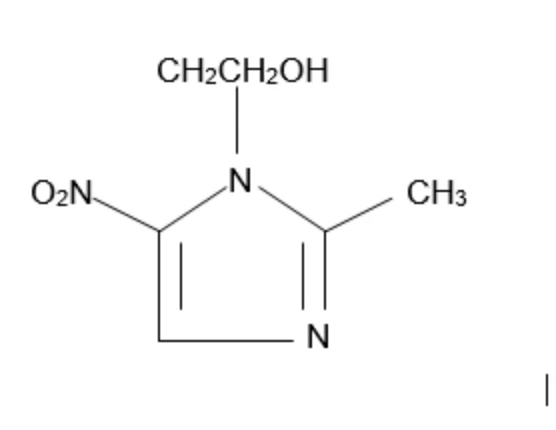
Chemical name: 1H-Imidazole-1-ethanol, 2-methyl-5-nitro
02-Methyl-5-nitroimidazole-1-ethanol
Molecular formula: C6H9N3O3
Molecular mass: 171.16 g/mol
Structural formula:
Physicochemical properties
Description: Metronidazole is a white to pale yellow, odorless crystal or crystalline powder and a bitter, metallic taste
Melting point: 159°C to 163°C
Solubility: It is sparingly soluble in water and alcohol. At 20°C (g/100 ml): 1.0 in water, 0.5 in ethanol. Slightly soluble in chloroform and ether (< 0.05). Soluble in dilute acids.
pH: The pH of a saturated aqueous solution is 5.8.
14 CLINICAL TRIALS
The clinical trial data based on which the original indication was initially authorized are not available.
15 MICROBIOLOGY
Prior names for bacterial vaginosis include non-specific vaginitis, Haemophilus vaginitis and Gardnerella vaginalis vaginitis.
Bacterial vaginosis is the clinical result of alterations in the vaginal microflora and is characterized by an abnormal quantity of both anaerobic and aerobic bacteria with anaerobes predominating. Asymptomatic infections are thought to be common. The condition generally does not cause inflammation of the vaginal epithelium. Microscopic examination of vaginal secretions normally reveals clue cells, which are epithelial cells whose borders are obscured by background bacteria and an absence of the normal flora which is predominantly composed by lactobacilli.
In women with bacterial vaginosis the concentrations of bacteria increase 100-1000-fold and are comprised mainly of Gardnerella vaginalis and anaerobes. Gardnerella vaginalis, Mobiluncus species and Mycoplasma hominis have been implicated in bacterial vaginosis although they are present in reduced numbers in normal women and are not always present in women with bacterial vaginosis. Large quantities of anaerobic Bacteroides and Peptostreptococcus species have been reported in bacterial vaginosis patients. It is believed that various amine by-products of anaerobic metabolism are responsible for the foul odor associated with the condition.
Lactobacilli, which always produce lactic acid, predominate in healthy women but are found in significantly lower concentrations in patients with bacterial vaginosis. It is believed that the increased alkalinity caused by the reduction of these lactobacilli somehow influences the progression of bacterial vaginosis. Bacterial vaginosis patients typically have vaginal pH elevated above 4.5 whereas normal vaginal pH is usually less than 4.5.
Metronidazole is active in vitro against most obligate anaerobes but does not appear to possess clinically relevant activity against facultative anaerobes or aerobes at concentrations achievable with systemic therapy. Against susceptible organisms, metronidazole is generally bactericidal at concentrations equal to or slightly higher than the minimal inhibitory concentrations.
Metronidazole has been shown to have in vitro activity against the following organisms:
- Anaerobic gram-negative bacilli, including: Bacteroides species including the Bacteroides fragilis group (B. fragilis, B. distasonis, B. ovatus, B. thetaiotaomicron, B. vulgatus) and Fusobacterium species
- Anaerobic gram-positive bacilli, including: Clostridium species and susceptible strains of Eubacterium
- Anaerobic gram-positive cocci, including: Peptostreptococcus species.
NIDAGEL has been shown in vivo to have clinical activity against the following vaginal pathogens:
- Gardnerella vaginalis
- Bacteroides species
- Mycoplasma hominis
Significant increases in vaginal lactobacilli are observed in bacterial vaginosis patients following therapy.
A summary of susceptibility data for anaerobic bacteria and Gardnerella is shown in Table 3.
Table 3: Susceptibility of Anaerobic Bacteria and Gardnerella to Metronidazole in Published Studies.
| Organism | No. Isolates Tested | MIC50 (mcg/mL) | MIC90 (mcg/mL) | % Resistant @ 16 mcg/mL |
| B. fragilis group | 2693 | 1.0 | 1.0 | 0 |
| Other Bacteroides spp. | 837 | 2.0 | 4.0 | 7 (0.8%) |
| Fusobacterium | 126 | 0.5 | 1.0 | 2 (0.8%) |
| Peptostreptococcus | 503 | 1.0 | >32 | 48 (9.5%) |
| Clostridium | 241 | 1.0 | 8 | 12 (5.0%) |
| Other gram-positive rods | 61 | 8 | >32 | 15 (41%) |
| Mobiluncus | 56 | 16 | 256 | 17 (48%) |
| Gardnerella | 19 | 8 | >128 | 6 (32%) |
16 NON-CLINICAL TOXICOLOGY
Acute Toxicity
The acute oral LD50 of metronidazole as a pure substance is in the range of 3 to 5 g/kg in mice and rats, respectively.
NIDAGEL 0.75% vaginal gel was administered in one dose at 5 g/kg by oral gavage to ten (5M, 5F) young adult Sprague Dawley rats.
No animal showed clinical signs of toxicity and no animal had visible lesions on gross necropsy. Therefore, it is concluded that the oral LD50 of 0.75% metronidazole gel, in male and female rats, is greater than 5 g/kg of body weight.
Subacute Toxicity
NIDAGEL 0.75% vaginal gel was administered intravaginally, 3 times per day for 21 consecutive days to female New Zealand White rabbits. Each dose was calculated to be equivalent to the human dose on a mg/kg basis.
A mild-to-moderate vaginal irritation suspected to be caused by metronidazole gel was seen in three of five animals during the study. The overall local response to metronidazole vaginal gel treatment should be classified as a mild irritation based on the fact that two of the animals in the group were almost entirely free of vaginal irritation, and that the responding animals seemed to be recovering at the time of necropsy. Correspondingly, no adverse responses in the vagina, cervix, uterus, urinary bladder, or ovaries were found upon macroscopic or microscopic examination in animals from any of the treatment groups.
Carcinogenicity
Metronidazole has shown evidence of carcinogenic activity following chronic, oral administration in mice and rats. Pulmonary tumorigenesis has been reported in six studies in mice. There were statistically significant increases in the incidence of hepatic tumors among female rats administered metronidazole over those noted in the concurrent female control groups. Two lifetime tumorigenicity studies in hamsters have been performed and reported to be negative.
These studies have not been conducted with 0.75% metronidazole vaginal gel, which would result in significantly lower systemic blood levels than those obtained with oral formulations.
Genotoxicity
Although metronidazole has shown mutagenic activity in a number of in vitro assay systems, studies in mammals (in vivo) have failed to demonstrate a potential for genetic damage.
Reproduction and Developmental Toxicology
Reproduction studies have been performed in rats at doses up to five times the human dose and have revealed no evidence of impaired fertility or harm to the fetus due to metronidazole. Metronidazole administered intra-peritoneally to pregnant mice at approximately the human dose caused fetotoxicity; administered orally to pregnant mice, no fetotoxicity was observed.
Primary Eye Irritation
NIDAGEL 0.75% vaginal gel was placed into the everted lower lid of one eye of each of three New Zealand White rabbits. The upper and lower lids were gently held together for one second to prevent loss of material and then released. The other eye served as the untreated control. The eyes were unflushed and examined for ocular irritation at 1, 24, 48 and 72 hours after treatment. At the 72-hour reading, sodium fluorescein was used to aid in revealing possible corneal injury. Irritation was graded and scored according to the Draize technique. No pain response (vocalization) was elicited from any animal following the instillation of the test material.
Metronidazole vaginal gel 0.75% produced only very slight conjunctival irritation in one animal at the 1-hour observation. All treated eyes had returned to normal appearance by 24 hours after treatment. At 72 hours the sodium fluorescein examination was negative in all animals.