Product Monograph - Micozole
CLINICAL PHARMACOLOGY
Depending upon concentration, miconazole nitrate exhibits broad-spectrum in vitro fungistatic or fungicidal activity against species of the genus Candida. Miconazole nitrate also inhibits several other genera of fungi, including dermatophytes and yeasts, as well as gram positive bacteria.
Miconazole nitrate inhibits the biosynthesis of ergosterol or other sterols, damaging the fungal cell wall membrane and altering its permeability. In fungi, it also inhibits biosynthesis of triglycerides and phospholipids as well as oxidative and peroxidative enzymes. The latter action results in intracellular buildup of toxic concentrations of hydrogen peroxide, which may contribute to deterioration of subcellular organelles and cellular necrosis.
Candida albicans cells have been observed to exhibit progressive cytoplasmic deterioration and prominent shape changes resulting in complete cell necrosis depending on the dose and duration of exposure to miconazole nitrate. The sequence of morphologic alterations induced by miconazole nitrate at fungistatic doses (10-6 M) are lysis of cytoplasmic organelles, focal to complete loss of cell plasmalemma and irregular thickening of the cell wall containing multiple inclusions.
Administration of fungicidal doses (10-4 M) induces a completely necrotic cell interior with an unaltered cell wall.
In Candida albicans, miconazole nitrate inhibits the transformation of blastospores into invasive mycelial form. Not all species or strains of a particular organism may be susceptible to miconazole nitrate.
To date, no wild strains or fungal mutants with substantial acquired resistance to miconazole have been reported; however, miconazole resistant Candida albicans has been isolated from an infant following bladder irrigation with miconazole for the treatment of urinary candidiasis.
INDICATIONS AND CLINICAL USE
MICOZOLE (miconazole nitrate) Vaginal Cream 2% is indicated for the local treatment of vulvovaginal candidiasis (moniliasis).
Although vulvovaginal candidiasis may be more difficult to cure during pregnancy, pregnant patients can be treated with the same regimen as non-pregnant patients.
Users and non-users of oral contraceptives who participated in clinical evaluations experienced therapeutic cure rates which did not differ significantly.
In addition, no statistically significant differences in therapeutic cure rates were noted between patients undergoing dosage regimens of varying duration (1, 3, 7, 10, and 14 day).
CONTRAINDICATIONS
MICOZOLE (miconazole nitrate) Vaginal Cream 2% is contraindicated in patients known to be hypersensitive to this drug or to any of its ingredients.
PRECAUTIONS
- 1. Patients should not use MICOZOLE Vaginal Cream preparations for self-medication if vaginal pruritus or discomfort is occurring for the first time. In this instance, a physician must be consulted to establish the diagnosis of vulvovaginal candidiasis.
- 2. Patients should not use MICOZOLE Vaginal Cream for self-medication if pains in the back or lower abdomen, fever or malodorous vaginal discharge are present, as a condition more serious than vulvovaginal candidiasis may exist.
- 3. Patients should be advised to discontinue medication if sensitization or other signs of irritation (rash or hives, burning, blistering, redness) not present before therapy occur.
- 4. Intractable candidiasis may be the presenting symptom of unrecognized diabetes; thus appropriate urine/blood studies may be indicated in patients not responding to treatment. In any case, if a patient is unresponsive to therapy appropriate microbiological studies should be repeated to confirm the diagnosis of vulvovaginal candidiasis and to rule out other pathogens.
- 5. Pregnant patients should be advised to exercise caution in the use of the vaginal applicator for the cream.
- 6. Follow-up reports on infants born to 167 of 263 pregnant patients (some follow-up reports are not yet available) who participated in North American clinical evaluations of Miconazole Nitrate 2% Cream administered in a 14-day regimen described no complications or adverse effects attributed to this therapeutic agent. Nevertheless, since miconazole nitrate is absorbed in small amounts from the human vagina, MICOZOLE Vaginal Cream should not be used by pregnant or nursing women unless the physician considers it essential to the welfare of the patient.
- 7. During therapy it may be advisable to instruct the patient to abstain from intercourse.
- 8. Miconazole nitrate preparations reduce the effectiveness of latex condoms and diaphragms. Therefore concurrent use of MICOZOLE Vaginal Cream with natural rubber products, such as vaginal diaphragms or condoms, is not recommended.
- 9. Miconazole administered systemically is known to inhibit CYP3A4/2C9. Due to the limited systemic availability after vaginal application, clinically relevant interactions occur very rarely. In patients on oral anticoagulants, such as warfarin, caution should be exercised and the anticoagulant effect should be monitored. (9, 10)
ADVERSE REACTIONS
The standard for defining frequency terms will be based on the Council for International
Organizations of Medical Science (CIOMS) convention. Specifically:
Very common =1/10
Common =1/100 and <1/10
Uncommon =1/1,000 and <1/100
Rare =1/10,000 and <1/1,000
Very rare <1/10,000, including isolated reports
In general, the complaints reported with miconazole nitrate therapy involved vulvovaginal burning, itching, irritation, pelvic cramping and edema as well as hives, rash and headache.
Clinical Trial Data
A total of 1,089 patients participated in international clinical evaluations of Miconazole Nitrate formulated as the 2% Cream and administered in dosage regimens of varying duration. Of these, fifty-nine patients reported reactions which were possibly drug related but not severe enough to cause discontinuation of therapy, four patients discontinued therapy due to vulvovaginal burning and itching, and one patient discontinued therapy due to hives.
Adverse events, regardless of causality, reported in 2 Phase 3 clinical trials are shown in the table below. A total of 537 women with microbiologically confirmed candidiasis and symptoms (e.g. vulvovaginal itching, burning/irritation), or signs of vulvar erythema, edema, excoriation, or vaginal erythema or edema were treated with miconazole intravaginally: randomly assigned to either a single 1,200 mg capsule, or a 7-day application of 2% vaginal cream. There was no placebo reference. Safety was self-assessed daily on a diary card. Included in the table are adverse events reported by >5% of subjects in either treatment group.
| System Organ Class | Miconazole 2% Cream, 7-day | Miconazole 1,200 mg Capsule |
| Adverse Event | (n=265), % | (n=272), % |
| Overall adverse events | 64 | 70 |
Nervous system disorders Headache | 18.9 | 17.6 |
Renal and urinary disorders Urinary tract infection NOS | _ | 5.1 |
Reproductive system and breast disorders Genital pruritus female Genital burning sensation Vaginal irritation Vaginal discharge | 26.8 23.8 15.5 4.5 | 19.1 26.1 20.2 10.3 |
Postmarketing data
Adverse events which may be causally related to the administration of MONISTAT* that have come to light as a result of reports received in relation to administration of the marketed product are provided in this section. Because these reactions are reported voluntarily from a population of uncertain size, it is not always possible to reliably estimate their frequency or establish a causal relationship to drug exposure.
Immune system disorders
Allergic conditions, including anaphylactic and anaphylactoid reactions, angioneurotic edema
Skin and subcutaneous tissue disorders
Urticaria, pruritus, rash
Reproductive system and breast disorders
Pelvic pain (cramping), genital burning sensation, genital pruritus female, vaginal irritation, vaginal discharge
General disorders and administration site conditions
Application site reactions
SYMPTOMS AND TREATMENT OF OVERDOSAGE
Overdose of miconazole nitrate in humans has not been reported to date. In mice, rats, guinea pigs and dogs, the LD50 values were found to be 578.1, >640, 275.9 and >160 mg/kg, respectively.
MICOZOLE (miconazole nitrate) Vaginal Cream 2% is intended for local application and not for oral use.
However, although highly unlikely to occur, in the event of a substantial overdose, and if taken concomitantly with other drugs (e.g. coumarin derivatives, oral hypoglycaemics or phenytoin), the effects and side effects of the other drugs can be increased.
DOSAGE AND ADMINISTRATION
Cream and Suppository: One 5-g applicatorful of MICOZOLE Vaginal Cream (equivalent to 100 mg miconazole nitrate) administered intravaginally once daily at bedtime for 7 consecutive days.
A course of therapy with the cream may be repeated if the patient remains symptomatic and if it has been determined by appropriate smears and cultures that the infecting organism is still miconazole susceptible Candida.
PHARMACEUTICAL INFORMATION
Trade Name: MICOZOLE
Proper Name: Miconazole Nitrate
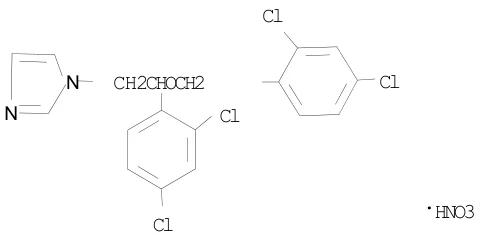
Chemical Name: 1- {2, 4-dichloro-β-[(2,4-dicholorobenzyl)oxy]phenethyl)- 1H-imidazole nitrate
Structural Formula:
Molecular Formula: C18H14Cl4N2O . HNO3
Molecular Weight: 479.16
Description:
Miconazole nitrate is a white, crystalline or microcrystalline powder, very slightly soluble in water (0.03%) and very slightly soluble to slightly soluble in most common organic solvents and dilute inorganic acids.
Melting Point: 178 ° - 184 °C
Optical Rotation: - 0.10 ° to + 0.10 °
Composition:
MICOZOLE (Miconazole Nitrate) Vaginal Cream 2% is a water miscible, white cream containing 2% miconazole nitrate as the active ingredient. Non-active ingredients consist of Apricot Kernel Oil/PEG-6, Benzoic Acid, Butylated Hydroxytoluene, Mineral Oil, PEG-6-32 Stearate/Glycol Stearate and Purified Water.
Stability and Storage Recommendations:
MICOZOLE (Miconazole Nitrate) Vaginal Cream 2% should be stored at 15 - 30°C and protected from freezing.