


Product Monograph - Nizoral
INDICATIONS
NIZORAL® (ketoconazole) 2% shampoo is indicated for the topical treatment and prophylaxis of conditions in which the yeast Pityrosporum is involved, such as pityriasis capitis (dandruff).
NIZORAL® shampoo is also indicated for seborrheic dermatitis.
CONTRAINDICATIONS
NIZORAL® (ketoconazole) 2% shampoo is contraindicated in persons who have shown hypersensitivity to the active or excipient ingredients of this formulation.
WARNINGS
Irritation may occur when NIZORAL® (ketoconazole) 2% shampoo is used immediately after prolonged treatment with topical corticosteroids. To prevent a rebound effect after stopping a prolonged treatment with topical corticosteroids, it is recommended to continue applying a mild topical corticosteroid at the onset of treatment with NIZORAL® shampoo, and to subsequently and gradually withdraw the steroid therapy over a period of 2 - 3 weeks.
PRECAUTIONS
If a reaction suggesting sensitivity or chemical irritation should occur, use of NIZORAL®
(ketoconazole) 2% shampoo should be discontinued.
There are no adequate and well-controlled studies in pregnant or lactating women. NIZORAL® shampoo does not produce detectable blood levels after topical application to the scalp. Plasma levels were detected after topical administration of NIZORAL® shampoo on the whole body.
There are no known risks associated with the use of NIZORAL® shampoo 2% in pregnancy or lactation. There were reports of spontaneous abortion and anencephaly after exposure to
NIZORAL® shampoo during pregnancy, although there is insufficient information to confirm any association between NIZORAL® shampoo and these abnormal pregnancy outcomes. However, due to the teratogenic nature of the active ingredient, ketoconazole, the use of NIZORAL® shampoo is not recommended in pregnant or nursing women except under the advice of a physician.
Clinical data on the use of NIZORAL® shampoo in children under 12 are not available; therefore, such use is not recommended except under the advice of a physician.
ADVERSE REACTIONS
Clinical Trial Data
The safety of NIZORAL® Shampoo 2% was evaluated in 2890 subjects in 22 clinical trials where
NIZORAL® Shampoo 2% was administered topically to the scalp and/or skin.
No adverse drug reactions (ADRs) were reported in ≥1% of NIZORAL® Shampoo 2% -treated subjects.
Adverse drug reactions that occurred in <1% of NIZORAL® Shampoo 2%-treated subjects in the clinical datasets are listed in Table 1.
Table 1. Adverse Drug Reactions Reported in <1% of 2890 NIZORAL®
Shampoo 2%-treated Subjects in 22 Clinical Trials System Organ Class
Preferred Term
Eye Disorders
Eye irritation
Increased lacrimation
General Disorders and Administration Site Conditions
Application site erythema Application site irritation
Application site hypersensitivity Application site pruritus
Application site pustules
Application site reaction
Immune System Disorders
Hypersensitivity
Infections and Infestations
Folliculitis
Nervous System Disorders
Dysgeusia
Skin and Subcutaneous Tissue Disorders
Acne
Alopecia
Dermatitis contact
Dry skin
Hair texture abnormal
Rash
Skin burning sensation
Skin disorder
Skin exfoliation
Post-marketing Experience
Adverse drug reactions first identified during post-marketing experience with NIZORAL®
Shampoo 2% are included in Table 2. In this table, the frequencies are provided according to the following convention:
Very common ≥1/10
Common ≥1/100 and < 1/10
Uncommon ≥1/1,000 and <1/100
Rare ≥1/10,000 and <1/1,000
Very rare <1/10,000, including isolated reports
In Table 2, ADRs are presented by frequency category based on spontaneous reporting rates.
Table 2. Adverse Drug Reactions Identified During Post-marketing Experience with NIZORAL® Shampoo 2% by Frequency Category Estimated from Spontaneous Reporting
Rates
Skin and Subcutaneous Tissue Disorders
Very Rare Angioedema, Urticaria, Hair colour changes
SYMPTOMS AND TREATMENT OF OVERDOSAGE
Oral ingestion is usually followed by nausea and vomiting due to the detergent. In the event of accidental ingestion, supportive and symptomatic measures should be carried out. In order to avoid aspiration, neither emesis nor gastric lavage should be performed. It has been reported that ketoconazole cannot be removed by hemodialysis.
DOSAGE AND ADMINISTRATION
Adults and children over 12 years of age: NIZORAL® (ketoconazole) 2% shampoo (5 to 10 mL)
should be applied to the wet scalp, worked into a lather and left on for 3-5 minutes before rinsing with water. As with other shampoos, care should be taken to keep the shampoo out of the eyes and off the eyelids.
Treatment:
Twice weekly for 2 to 4 weeks.
Prophylaxis:
Once every one or two weeks.
PHARMACEUTICAL INFORMATION
CHEMISTRY
Trade Name: NIZORAL®
Proper Name: Ketoconazole
Chemical Name: cis-1-acetyl-4-[4-[[2-(2,4-dichlorophenyl)-2-(1H-imida- zol-1-ylmethyl)-1,3-dioxolan-4-yl]methoxy]phenyl] piperazine
Structural Formula:
N N
O
CH3
O O
O
N
N
Cl
Cl
Molecular Formula: C26H28Cl2N4O4
Molecular Weight: 531.44
Description: Ketoconazole is an almost white to slightly beige coloured powder which is freely soluble in chloroform, methanol and diluted hydrochloric acid; sparingly soluble in 2-propanol and acetone and practically insoluble in water.
Composition: NIZORAL® (ketoconazole) 2% shampoo is a viscous pink - orange liquid with an herbal bouquet. NIZORAL® 2% shampoo contains the broad-spectrum synthetic antifungal agent, ketoconazole, formulated in a shampoo
vehicle consisting of sodium laureth sulphate, disodium monolaureth sulphosuccinate, coconut fatty acid diethanolamide, laurdimonium hydrolyzed animal collagen, macrogol 120 methyl glucose dioleate, perfume bouquet, imidurea, hydrochloric acid, sodium hydroxide, sodium choloride, erythrosin and water.
DOSAGE FORM
Availability:
NIZORAL® (ketoconazole) 2% shampoo contains 20 mg ketoconazole per gram. It is supplied in HDPE flasks containing 60 mL or 120 mL shampoo.
Storage:
NIZORAL® 2% shampoo should be stored at 15-30°C.
MYCOLOGY
In yeast and fungal cells, ergosterol is the main sterol regulating membrane permeability.
Ketoconazole inhibits the biosynthesis of ergosterol and affects the synthesis of triglycerides and phospholipids.
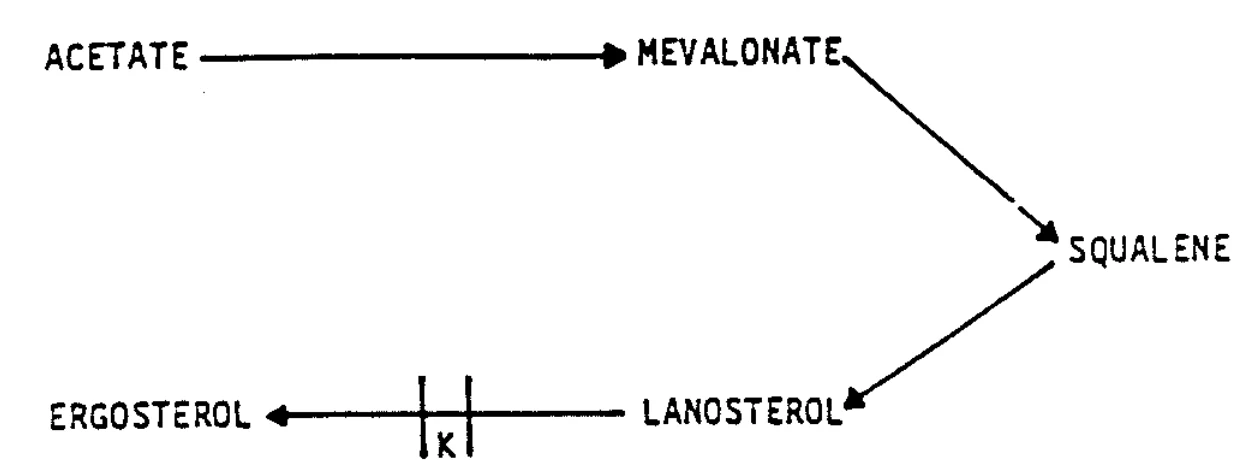
Diagram 1: Site of action of ketoconazole (K) on the steroid biosynthetic pathway in the fungal cell.
Morphologically, ketoconazole-induced alterations are characterized by the presence of abnormal membranous inclusions between the cell wall and plasma membrane. Changes in oxidative and peroxidative enzyme activities, leading to an intracellular build up of toxic concentrations of hydrogen peroxide, may contribute to the observed deterioration of subcellular organelles and to cell necrosis.
The minimum inhibitory concentration of ketoconazole against a variety of yeasts and fungi can be observed in the following table.
Table 3: MIC's of ketoconazole against dermatophytes and yeasts
______________________________________________________________________________
Organism No. of Range of minimal strains inhibitory concentrations tested (μg/mL)
______________________________________________________________________________
Dermatophytes
Microsporum canis 24 0.1 - 64 Microsporum audouini 4 2 - 64 Microsporum gypseum 9 0.1 - 64 Microsporum cookei 1 1
Trichophyton mentagrophytes 24 0.1 - 20 Trichophyton rubrum 75 10-5 - 128 Trichophyton ajelloi 1 1
Trichophyton schoenleini 1 1
Trichophyton tonsurans 35 0.25 - 16 Epidermophyton floccosum 23 0.1 - 8
Yeasts
Candida albicans 472 0.2 - 80 Candida tropicalis 45 0.1 - 64 Candida pseudotropicalis 2 25 - 50 Candida guilliermondii 4 0.4 - 50 Candida krusei 14 0.2 - 3.1 Candida parapsilosis 18 0.2 - 64 Candida stellatoidea 1 0.8
Cryptococcus neoformans 39 0.1 - 32 Torulopsis glabrata 124 0.8 - 64 Rhodotorula mucilanginosa 1 0.1
Trichosporon cutaneum 1 0.1
Pityrosporum ovale 1 0.1
From: "Ketoconazole in the Management of Fungal Disease", Edited by H.B. Levine, Ph.D., ADIS Press, Pages 57-67
Ketoconazole is a potent antifungal agent with a pronounced fungicidal activity against both the yeast and the mycelial form of Pityrosporum ovale. Pityrosporum ovale was inhibited at a ketoconazole concentration of 0.1 μg/mL.
The development of resistance to oral ketoconazole over a one year treatment period has been reported in 2 patients treated for mucocutaneous candidiasis, however, in vitro sensitivities pre and post treatment were determined by different techniques.
PHARMACOLOGY
Dermal absorption of ketoconazole was studied in a 28-day dermal irritation study in rabbits. After
28 days of daily application of the shampoo at dose levels of 0, 2, 20 or 50 mg ketoconazole/kg on intact and abraded skin, plasma concentrations of ketoconazole were below the detection limit (5 ng/mL) of the HPLC assay. This indicates a lack of any measurable percutaneous absorption of ketoconazole from the shampoo formulation, even after repeated daily application and after prolonged dermal contact.
In humans, plasma concentrations of ketconazole were not detectable after topical administration of
NIZORAL® Shampoo 2% on the scalp. Plasma levels were detected after topical administration of
NIZORAL® Shampoo 2% on the whole body.
TOXICOLOGY
Topical toxicity studies with ketoconazole 2% shampoo:
The topical toxicity of ketoconazole 2% shampoo was evaluated in rabbits in a primary dermal irritation study, in two primary eye irritation studies, in two subchronic dermal irritation studies and in a chronic dermal toxicity study.
The results are summarized in Table 4.
Table 4: Topical irritation studies with ketoconazole 2% shampoo in rabbits
TYPE OF IRRITATION STUDY | SITE OF APPLICATION | DURATION OF OBSERVATION (DAYS) | DOSAGE OF 2% SHAMPOO | DURATION OF TREATMENT |
Primary dermal Primary eye Primary eye Subchronic dermal Subchronic dermal (10% degraded shampoo) Chronic dermal | Dermal (occlusive) Ocular Ocular Dermal (semi-open) Dermal (semi-open) Dermal (semi-open) | 7 14 7 28 28 6 months | 0.3 mL 0.1 mL 0.1 mL of 15% dilution 0.1, 1, 2.5 mL/kg* 2.5 mL/kg** 0.1, 1,* 2.5 mL/kg | Single dose Single dose Single dose 28 days 28 days 6 months |
* Corresponding to 2, 20 and 50 mg ketoconazole per kg body weight.
** Corresponding to 50 mg ketoconazole/kg body weight (non-degraded shampoo) and to 45 mg ketoconazole/kg body weight with 5 mg degradation products/kg body weight (10% degraded shampoo).
Primary dermal irritation study:
The primary dermal irritation was evaluated in rabbits for 7 days by the standard patch technique.
Ketoconazole 2% shampoo, applied for 6 hours under an occlusive patch, elicited a primary dermal irritation index of 6.7 classifying it as a severe irritant. The occlusive dermal patch irritation test is an exaggerated test situation and the results with ketoconazole are similar to those for other undiluted shampoos.
Primary ocular irritation study:
The primary eye irritation was studied following the instillation of both undiluted and diluted ketoconazole 2% shampoo into the conjunctival sac of rabbits. The undiluted formulation was classified as positive for irritation. A 15% dilution of the ketoconazole 2% shampoo was classified as negative, as only slight erythema and chemosis were observed.
The data obtained with the diluted form is considered more relevant to the human situation because a small amount (5 to 10 mL) of ketoconazole 2% shampoo is normally spread over the wet scalp and is consequently diluted.
Subchronic dermal irritation study:
Ketoconazole 2% shampoo was applied to the clipped skin, (either abraded or intact), on the backs of rabbits. This was done daily for 28 days. The shampoo was held in place under a semi-open patch for a one hour exposure period. The residual shampoo was then washed from the skin with warm water and the area was dried with soft cloths. The volumes administered were 0.1, 1 and 2.5 mL of shampoo/kg body weight, corresponding to 2, 20 and 50 mg of ketoconazole/kg body weight.
The parameters studied were: mortality, clinical signs, body weight, food consumption, plasma ketoconazole levels, haematology, serum chemistry, organ weights, gross pathology and histopathology of the normal and treated skin.
No treatment-related adverse effects or lesions were observed. Ketoconazole was not detectable in the plasma.
Subchronic dermal irritation study (10% degraded shampoo):
Ketoconazole 2% shampoo (non-degraded or 10% degraded) was applied to the clipped skin
(either abraded or intact) on the backs of rabbits. Rabbits were exposed 5 days/week during 28 days. The shampoo was held in place under a semi-open patch for a one hour exposure period.
The residual shampoo was then washed from the skin with warm water and the area was dried with soft cloths. The volume administered was 2.5 mL of shampoo/kg body weight, corresponding to
50 mg of ketoconazole/kg body weight (non-degraded shampoo) or 45 mg of ketoconazole/kg body weight and 5 mg degradation products/kg body weight (degraded shampoo).
The parameters studied were: mortality, clinical observations, body weight, haematology, serum analysis, organ weights and gross pathology.
Both treatments were well tolerated and did not result in any dermal or systemic toxic effects.
Chronic dermal toxicity study:
Ketoconazole 2% shampoo was applied to the clipped (abraded or intact) skin on the backs of rabbits. This was done daily for 26 weeks. The shampoo was held in place under a semi-open patch for a one hour exposure period. The residual shampoo was then washed from the skin with warm water and the area was dried with soft cloths. The volumes administered were 0.1, 1 and 2.5 mL of shampoo/kg body weight, corresponding to 2, 20 and 50 mg of ketoconazole/kg body weight. The study also included a placebo group (vehicle not containing ketoconazole).
The parameters studied were: mortality, clinical observations, body weight, haematology, serum analysis, organ weight, gross pathology and histopathology.
The treatments were well tolerated and did not result in dermal or systemic toxic effects. The same lack of adverse effects was observed for the placebo formulation. In addition, the absence of a time-dependent increase of dermal irritation further indicates no sensitization potential.
Carcinogenicity:
Albino Swiss mice and Wistar rats both received doses of 0, 5, 20 and 80 mg/kg per day of ketoconazole administered via the diet for 18 months and 24 months respectively. There were no statistically significant differences between groups in the incidence or type of tumours.
Mutagenicity:
The dominant lethal mutation test in male and female mice revealed that single oral doses of ketoconazole as high as 80 mg/kg produced no mutation in any stage of germ cell development.
The Ames Salmonella microsomal activator assay was also negative.
Reproduction and Teratology:
Ketoconazole has been shown to be teratogenic (syndactyly, oligodactyly, abnormal head and leg formation) when given in the diet at 80 mg/kg per day. When ketoconazole was given to rats by gavage, evidence of maternal toxicity and embryotoxicity was seen with doses as low as 10 mg/kg.
REFERENCES
- 1.
Van Cutsem J. :
The antifungal activity of ketoconazole.
Am. J. Med. 74 (1B): 9-15, 1983.
- 2.
Borgers M and Van Cutsem J. :
Ketoconazole induced morphological changes in yeasts and dermatophytes. In: "Oral Therapy in Dermatomycoses: a Step Forward", The Medicine Publishing Foundation Symposium Series No. 16, P. 51-60, 1985.
- 3.
Janssen Pharmaceutica :
Subchronic dermal irritation study in New Zealand white rabbits (repeated dosage for 28 days). Experiment No.-1683.
Unpublished report, August 1986.
- 4.
Walczak V and Nebus J. :
A primary dermal irritation study of MEDIC, formula B(G14) in albino rabbits. Experiment No.-824 (Protocol No. 7345/13125.57).
Unpublished report, July 1986.
- 5.
Walczak V and Nebus J. :
A federal hazardous substances act ocular irritation study of MEDIC, formula B(G14) in albino rabbits. Experiment No.-825 (Protocol No. 7345/13125.56B).
Unpublished report, July 1986.
- 6.
Walczak V and Nebus J. :
A federal hazardous substances act ocular irritation study of a 15% v/v solution of MEDIC, formula B(G14) in albino rabbits. Experiment No.-822 (Protocol No. 7345/13125.56BR). Unpublished report, August 1986.
- 7.
Department of International Registration :
Ketoconazole 2% cream: systemic absorption, skin irritancy, and therapeutic effectiveness in animals and man. A review of the available data up to November 1985. Janssen Pharmaceutica Research Report R 41 400/135, November 1985.
- 8.
Cauwenbergh GFMJ, Degreef H and Verhoeve LSGC. :
Topical ketoconazole in dermatology: a pharmacological and clinical review. Mykosen 27 (8): 395-401, 1984.
- 9.
Ketoconazole Official Canadian Product Monograph :
Janssen Pharmaceutica Inc., January 1993.
- 10.
Marsboom R, and Teuns G.:
28 day dermal toxicity study in rabbits. Experiment No. 2052.
Unpublished report, July 1988.
- 11.
Marsboom R, Teuns G, Coussement W, and Van Cauteren H.:
Chronic dermal toxicity study in New Zealand white rabbits. Experiment No. 1703. Unpublished report, November 1987.
- 12.
Arlette J, Giroux J-M, Maddin S, Ross B, and Shear N.:
Ketoconazole shampoo in seborrheic dermatitis.
Canadian Journal of Dermatology 3(6): 175-180, 1991.
- 13.
Faergemann J.:
Treatment of seborrheic dermatitis of the scalp with ketoconazole shampoo: A double-blind study.
Acta Derm Venereol (Stockh) 70: 171-172, 1990.
Last revised March 5, 2019