


Product Monograph - Ecostatin Vaginal Ovule 150mg
ADVERSE REACTIONS
ECOSTATIN (econazole nitrate) is usually well tolerated. Adverse effects are limited to occasional local skin irritation manifested by erythema, pruritus, and burning or stinging sensation; cessation of therapy is rarely warranted.
SYMPTOMS AND TREATMENT OF OVERDOSAGE
None known.
DOSAGE AND ADMINISTRATION
ECOSTATIN (econazole nitrate) Topical Cream
Apply twice daily, in the morning and evening. The cream should be massaged gently into the affected and surrounding skin areas.
Clinical improvement usually occurs promptly; however, complete disappearance of the symptoms of the disease may require prolonged treatment. Candida infections should be treated for at least two weeks and dermatophyte infections for one month to reduce the risk of recurrence. If no improvement has occurred after one month of treatment with ECOSTATIN Topical Cream, the diagnosis should be reassessed.
ECOSTATIN (econazole nitrate) Vaginal Ovules
For candidal vulvovaginitis, the recommended dose is one ovule inserted at bedtime for 3 consecutive days. The ovule should be inserted high into the vagina, by means of the applicator. The patient should be in the supine position while inserting the ovule.
It is important that therapy be continued during menstruation. Administration should be continued for the complete 3-day period even if the signs and symptoms of the disease disappear.
Although a 3-day course of therapy usually suffices, occasionally it may be necessary to institute a second course of therapy.
AVAILABILITY
ECOSTATIN Topical Cream provides 1.0% econazole nitrate formulated in a water-soluble cream base containing pegoxol-7- stearate, peglicol-5-oleate, mineral oil, butylated hydroxyanisole, benzoic acid, perfume, and purified water. Available in 15 g and 30 g tubes.
ECOSTATIN Vaginal Ovules are creamy-white to yellowish egg-shaped ovules each containing 150 mg econazole nitrate, formulated in a base of synthetic coconut oil triglycerides. Available in packages containing a reusable applicator and 3 ovules.
ECOSTATIN Combi-pack contains 3 ECOSTATIN Vaginal Ovules with applicator and ECOSTATIN Topical Cream, 1% in a 15 g tube.
Store at room temperature. Protect from heat. Do not refrigerate.
MICROBIOLOGY
In Vitro:
Several studies, using both tube-dilution and plate diffusion methods to test for fungistatic activity, confirm the broad spectrum antimycotic activity of econazole nitrate. Fungicidal activity against Candida albicans has also been demonstrated.
Minimum inhibitory concentrations (MIC's) of econazole nitrate against relevant organisms after 14 days incubation are as follows:
| Organism | MIC (MCG/ML) |
| Aspergillus flavus | 1.0 |
| Aspergillus nidulans | 1.0 |
| Aspergillus fumigatus | 1.0 |
| Aspergillus niger | 10.0 |
| Candida albicans | 100.0 |
| Candida krusei | 100.0 |
| Candida parapsilosis | 10.0 |
| Candida pseudotropicalis | 10.0 |
| Candida stelloides | 10.0 |
| Candida tropicalis | 100.0 |
| Epidermophyton floccosum | 0.01 |
| Geotrichum candidum | 100.0 |
| Microsporum adouini | 1.0 |
| Microsporum canis | 0.1 - 1.0 |
| Microsporum gypseum | 1.0 |
| Mucor sp. | 100.0 |
| Rhodotorula sp. | 100.0 |
| Torulopsis glabrata | 100.0 |
| Trichophyton rubrum | 0.1 - 1.0 |
| Trichophyton mentagrophytes | 0.01 |
| Trichophyton interdigitale | 1.0 |
| Trichophyton verrucosum | 0.1 |
| Trichophyton violaceum | 1.0 |
| Trichophyton tonsurans | 1.0 |
| Trichophyton cutaneum | 10.0 |
The following organisms have also been shown to be sensitive to econazole nitrate: Fungi
(MIC's ranging from 0.01 to 100 mcg/mL)
Allescheria boydii Madurella mycetoma Alternaria sp. Nocardia asteroides Basidiobolus meristosporus Nocardia brasiliensis Blastomyces brasiliensis Penicillium notatum Blastomyces dermatitidis Rhizopus sp. Cladosporium trichoides Saccharomyces cerevisiae Cladosporium wernackii Saprolegnia sp. Cryptococcus neoformans Sporithrix schenkii Ctenomyces mentagrophytes Streptomyces madurae Histoplasma capsulatum Streptomyces pelletieri Madurella grisea Streptomyces somaliensis
Bacteria
(MIC's ranging from 0.78 to 25 mcg/mL)
Bacillus anthracis Staphylococcus epidermidis Bacillus mesentericus Staphylococcus hemolyticus Bacillus subtilis Streptococcus bovis Corynebacterium diphtheriae Streptococcus faecalis Erysipclothrix insidiosa Streptococcus faecium Listeria monocytogenes Streptococcus pyrogenes Staphylococcus aureus
Econazole nitrate was found to be inactive against gram-negative bacteria.
PHARMACEUTICAL INFORMATION
CHEMISTRY
Structural Formula: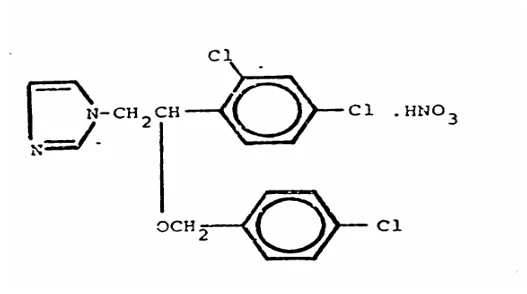
Molecular Formula: C18H15Cl3N2O.HNO3
Molecular Weight: 444.72
Chemical Name: 1-[2-[(4-chlorophenyl)-methoxy]-2-(2,4-dichlorophenyl)ethyl]-1H-imidazole, nitrate salt.
Description: Econazole nitrate is a fine, white to off-white powder which is soluble in methanol and slightly soluble in ethanol, isopropanol, acetone, benzene and cyclohexane.
PHARMACOLOGY ANIMAL PHARMACOLOLY
Pharmacokinetics
One gram of econazole-3H nitrate topical cream (10 mg of econazole-3H nitrate) was applied under occlusive dressing to the shaved backs of 2 groups of 6 female rabbits. The application site of one group was abraded.
An average of about 35% and 30% of the dose was absorbed through the abraded and unabraded skin, respectively. Percutaneous absorption was almost complete in 4 days with maximum levels of radioactivity present in plasma and tissues 24 hours after dosing in both groups. Absorption was found to occur mainly through the epidermis of hair follicles.
A cream formulation containing 5 mg of econazole nitrate (1.43-2.17 mg/kg) was administered intravaginally to rabbits. From 30 to 40% of the drug was found to be absorbed.
Miniaturized ovules delivering 0.96 or 2.48 mg/kg econazole nitrate were each administered intravaginally to one dog and vaginal absorption was estimated to be 0.87% and 1.10% respectively.
Dogs were intravaginally administered 1% or 2% cream formulations at doses of econazole nitrate of 10 mg/dog (1.01-1.28 mg/kg), 1 mg/kg and 2 mg/kg. Vaginal absorption was estimated at 27%, 12.4 - 15.2%, and 4.9% respectively.
HUMAN PHARMACOLOGY
Penetration of econazole-3H nitrate cream, 1%, was studied in 4 human volunteers. Following application of 70-100 mg of cream, approximately 90% was found to remain on the skin surface, after periods ranging from 0.5-18 hours. Occlusion only slightly enhanced overall penetration. In the one subject whose application site was occluded, concentrations of 9.1%, 1.2% and 0.6% of the applied dose were found in the stratum corneum, epidermis and dermis, respectively, after 90 minutes. In vitro studies conducted on surgical specimens yielded similar results.
The site of application was occluded in a fifth subject for 16.5 hours. A total of 0.6% of the applied dose was excreted in the urine over 30.5 hours .
Ovules containing 50 or 150 mg 14C-labelled econazole nitrate were administered intravaginally to female volunteers. Vaginal absorption was estimated at approximately 5%.
Serum concentrations obtained during the above study are given in the following table:
Mean Serum Econazole-14C (ng/mL ) After Administration of a Single 150 mg Ovule to 5 Normal Female Volunteers
| Time (hours) | 2 | 4 | 8 | 12 | 24 | 36 | 48 | 72 | 96 | 120 | 144 | 168 |
| 0 | 0.9 | 6.1 | 10.5 | 39.3 | 62.3 | 64.9 | 59.9 | 48.8 | 37.9 | 28.5 | 24.7 |
Two other studies, each performed on healthy females treated intravaginally with single doses of a 1% cream formulation delivering aproximately 50 mg of econazole nitrate, resulted in 8.6% and less than 3% of the total amount of econazole nitrate being absorbed.
Miscellaneous studies
Doses of 10 or 40 mg/kg of econazole-14C nitrate as a 0.2% suspension were orally administered to pregnant rats at various times during aestation. The drug was found to readily cross the placental barrier. The data suggest that in some instances, placental transfer was greater at the high dose than at the low dose. Placental transfer appeared to be greater during the later stages of pregnancy. Evidence of drug accumulation in the fetus was observed after multiple dosing.
Three groups of seven pregnant Charles River CD Sprague-Dawley rats were allowed to bear their young. Total doses of 10 or 40 mg/kg of radioactive econazole nitrate were administered orally in two equally divided doses to the dams on Days 2, 5 or 15 of lactation. Econazole nitrate and/or its metabolites were found to be readily excreted into the mothers' milk.
TOXICOLOGY
Acute Toxicity
| Species | Sex | Formulation | Route | LD50 (mg/kg) |
| Mice | M/F | alcoholic solution | I.P. | 50 (38 - 66) |
| Mice | M | 1% suspension | I.P. | 320 ± 20 |
| Mice | M/F | alcoholic solution | Oral | 205 (182 - 231) |
| Rats | M/F | alcoholic solution | Oral | 365 (338 - 394) |
| Guinea pigs | M | aqueous suspension | Oral | 272 (98 - 755) |
| Dogs | M/F | aqueous suspension | I.P. | 217 (69 - 680) |
| Dogs | M | aqueous suspension | Oral | 160 |
Signs of toxicity included dizziness, tonic and clonic spasms, slight cyanosis, ataxia, tremors, convulsions, sedation, diarrhea, loss of righting reflex and death.
A 54% concentration of econazole nitrate vaginal ovule, 50 mg or 150 mg in peanut oil was administered in single intraperitoneal doses of 2.7 to 21.6 g/kg of sample (doses of econazole nitrate ranging from 150-1200 mg/kg) to groups of 5, 9 or 10 female mice. There were no toxic signs on the day of dosing; however, some mice appeared to have diarrhea overnight. Transient weight losses were noted in some mice. Three of the 149 treated mice died.
Acute Interaction Studies
Acute toxicity interaction studies were conducted in mice given econazole nitrate intraperitoneally in combination with metronidazole, Ortho-Novum Tablet (norethindrone-mestranol, Ortho), tetracycline hydrochloride, and nitrofurantoin (administered orally), and nystatin, amphotericin B, nonoxynol-9, triamcinolone acetonide, Sultrin Cream (sulfathiazole, 3.42%, sulfacetamide, 2.86%, and sulfabenzamide, 3.7%, Ortho) (administered intraperitoneally). No evidence of toxicity potentiation was observed, except in the case of nonoxynol-9 where the combination resulted in LD50's eight times less than that observed for econazole nitrate alone.
Chronic Toxicity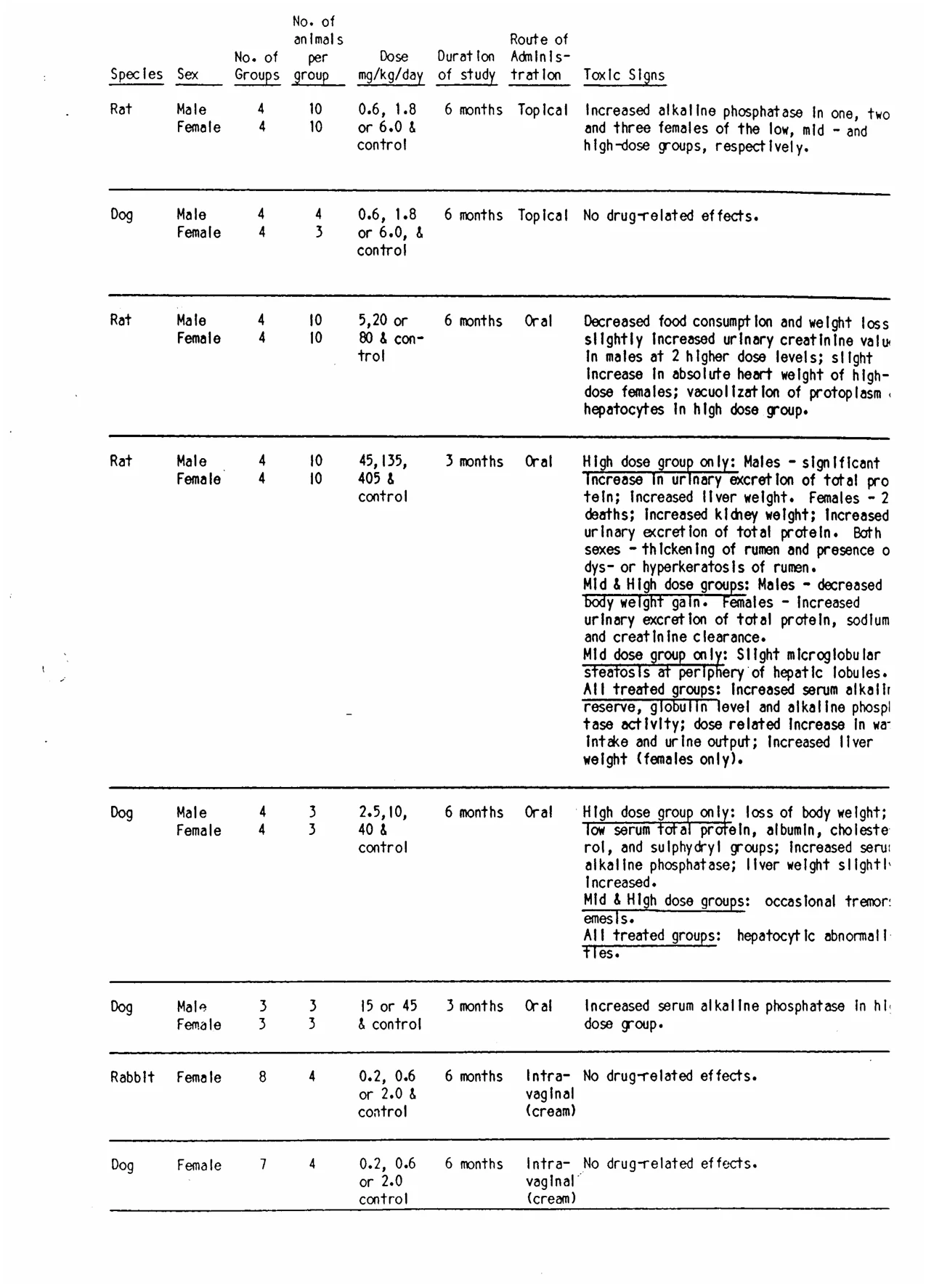 Dermal Irritation Studies
Rats
Application of about 250 mg of econazole nitrate cream, 1%, under occlusive dressing, to the shaved and abraded backs of 4 male and 8 female rat, once daily for 5 days, produced no signs of irritation.
Rabbits
No signs of irritation were evident 24 and 72 hours after a single application of 0.5 g econazole nitrate to the abraded and unabraded backs of 6 albino rabbits.
Guinea Pigs
Five mL of a 1% suspension of econazole nitrate was applied to the skin of 20 guinea pigs 3 times a week for 3 weeks and then challenged 2 weeks later. No evidence of sensitizing (erythema) activity was noted. However, in the preliminary test, erythema was produced by 2% and 5% concentrations in 1 of 2 and 2 of 2 animals, respectively.
Human
Econazole nitrate cream, 1%, was applied to the skin of 100 patients with contact dermatitis due to known or unknown allergens, and occluded for 48 hours. Transient slight erythema and/or pruritus was produced in 6 patients.
In 45 patients who had shown positive reactions to substances other than econazole, econazole nitrate cream 3%, applied under occlusive dressing, caused reddening and/or edema at the application site in 5 patients.
Four of 75 patients with florid dermatoses exhibited reddening and/or edema after application of econazole nitrate cream, 3%. However, retesting of these 4 patients using econazole nitrate solution, 1%, did not result in any evidence of irritation. The initial reaction was therefore attributed to the cream base and/or to the higher concentration of econazole nitrate.
Econazole nitrate solution, 2%, applied to the healthy skin on the dorsum, soles, toes, and interdigital spaces of the feet of 6 female patients for 16 days, did not produce any signs of intolerance.
Vaginal Irritation
Dogs
Ovules containing 125 mg of econazole nitrate were inserted intravaginally into 3 adult female beagles twice daily for 5 consecutive days, and the vaginas subsequently examined grossly and histologically for signs of irritation. There was no evidence of vaginal irritation in any of these animals.
In another study, ovules containing 38 mg of econazole nitrate were inserted intravaginally into 8 adult female beagles twice daily for a period of 4 weeks. Under the conditions of the study, econazole nitrate ovule did not cause any irritation of the genital tract of female dogs. Humans
ECOSTATIN Vaginal Ovules, 150 mg, were administered intravaginally to female volunteers once daily for 10 days. Vaginal cytology, clinical laboratory tests and daily vaginal examinations resulted in no significant findings. Subject diaries revealed that about two-thirds of the subjects receiving the drug (11 of 17) experienced mild irritation, usually transient in nature and more often associated with the vulva than with the vagina.
BIBLIOGRAPHY
- 1.
Ansehn, S. In vitro synergistic action of antimycotics and antibiotics on Candida albicans
Curr. Ther. Res. 22: 92, 1977
- 2. Balmer, J.A. Three-day therapy of vulvovaginal candidiasis with econazole: a multicentric study comprising 996 cases. Amer. J. Obstet. Gynec. 126: 436, 1976
- 3.
Dompmartin, D., Drouhet, E. Folluculites a pityrosporum ovale. Action de l'econazole.
Bul1. Soc. Mycol. Med. 6: 15-19, 1977.
- 4. Dorn, M., Scherwitz, C., Lentze, I., Plewig, G. Econazole nitrate in vitro tests and clinical trials. Munch. Med. Wochr. 117: 687-692, 1975.
- 5. Fredriksson, T. Treatment of dermatomycosis with topical econazole combined with a steroid as compared with a conventional oxichinoline-steroid combination. Curr. Ther. Res. 26: 958-961, 1979.
- 6. Gisslen, H., Hersle, K., Mobacken, H., Nordin, P. Topical treatment of dermatomycoses and tinea versicolor with econazole cream 1% (Pevaryl). Curr. Ther. Res. 21: 681-684, 1977.
- 7. Heel, R.C., Brogden, R.N., Speight, T.M., Avery G.S. Econazole: A review of its antifungal activity and therapeutic efficacy. Drugs 16: 177-201, 1978.
- 8. Holt, R.J. Topical pharmacology of imidazole antifungals. J. Cutan. Path. 3: 45-59, 1976.
- 9.
Kim, D.H.: Candidal vaginitis. Treatment with econazole nitrate vaginal suppository 50 mg.
J. Res. Inst. Med. Sci. Korea 9:71, 1977.
- 10.
Knusel, H.: Vulvovaginal mycoses - short-term (three day) therapy with econazole.
Geburstsh. und. Frauenheilk. 37:43, 1977.
- 11. Preusser, H.J. Effects of in vitro treatment with econazole on the ultrastructure of candida albicans. Mykosen 19: 304-316, 1976.
- 12. Raab, W., Gmeiner, B. Evaluation of econazole by Warburg assay: Comparison with other antimicrobials. Mykosen 19: 238-240, 1976.
- 13. Raab, W., Gmeiner, B. Interactions between econazole, a broad spectrum antimicrobic substance, and topically active glucocorticoids. Dermatologica 153: 14-22, 1976.
- 14.
Raab, W. Clinical pharmacology of modern topical broad-spectrum antimicrobials. Curr.
Ther. Res. 22: 65-82, 1977.
- 15. Schaefer, H., Stuttgen, G. Absolute concentrations of an antimycotic agent, econazole, in the human skin after local application. Arzneimittel-Forsch. 26: 432-435, 1976.
- 16. Schar, G., Kayser, F.H., Dupont, M.C. Antimicrobial activity of econazole and miconazole in vitro and in experimental candidiasis and aspergillosis. Chemotherapy 22: 211-220, 1976.
- 17.
Thienpont, G., Van Cutsem, J., Van Neuten, J.M., Niemegeers, C.J.E., Marsboom, R.
Biological and toxicological properties of econazole, a broad-spectrum antimycotic. Arzneimittel-Forsch. 25: 224-230, 1975.