


Product Monograph - Orencia (Bristol-Myers Squibb Canada, 125 mg)
RECENT MAJOR LABEL CHANGES
| 1 INDICATIONS | 07/2022 |
| 1 INDICATIONS, 1.1 Pediatrics | 07/2022 |
4 DOSAGE AND ADMINISTATION,
| 07/2022 |
7 WARNINGS AND PRECAUTIONS
| 07/2022 |
TABLE OF CONTENTS
Sections or subsections that are not applicable at the time of authorization are not listed.
RECENT MAJOR LABEL CHANGES............................................................................................ 2
TABLE OF CONTENTS .............................................................................................................. 2
PART I: HEALTH PROFESSIONAL INFORMATION ..................................................................... 5
1 INDICATIONS .............................................................................................................. 5
1.1 Pediatrics (6 years of age and older) ................................................................... 6
1.2 Geriatrics........................................................................................................... 6
2 CONTRAINDICATIONS ................................................................................................. 6
3 SERIOUS WARNINGS AND PRECAUTIONS BOX ............................................................ 6
4 DOSAGE AND ADMINISTRATION................................................................................. 7
4.1 Dosing Considerations ....................................................................................... 7
4.2 Recommended Dose and Dosage Adjustment..................................................... 7
4.3 Reconstitution ................................................................................................... 8
4.4 Administration................................................................................................... 9
4.5 Missed Dose .................................................................................................... 10
5 OVERDOSAGE ........................................................................................................... 10
6 DOSAGE FORMS, STRENGTHS, COMPOSITION AND PACKAGING ............................... 10
7 WARNINGS AND PRECAUTIONS ................................................................................ 12
7.1 Special Populations .......................................................................................... 15
7.1.1 Pregnant Women ....................................................................................... 15
7.1.2 Breast-feeding............................................................................................ 15
7.1.3 Pediatrics (6 years of age and older) ........................................................... 15
7.1.4 Geriatrics ................................................................................................... 16
8 ADVERSE REACTIONS ................................................................................................ 16
8.1 Adverse Reaction Overview.............................................................................. 16
8.2 Clinical Trial Adverse Reactions ........................................................................ 17
8.2.1 Clinical Trial Adverse Reactions – Pediatrics ................................................ 27
8.3 Less Common Clinical Trial Adverse Reactions .................................................. 32
8.3.1 Less Common Clinical Trial Adverse Reactions – Pediatrics .......................... 37
8.5 Post-Market Adverse Reactions........................................................................ 38
9 DRUG INTERACTIONS................................................................................................ 38
9.2 Drug Interactions Overview.............................................................................. 38
9.4 Drug-Drug Interactions .................................................................................... 38
9.5 Drug-Food Interactions .................................................................................... 39
9.6 Drug-Herb Interactions .................................................................................... 39
9.7 Drug-Laboratory Test Interactions .................................................................... 39
10 CLINICAL PHARMACOLOGY ....................................................................................... 39
10.1 Mechanism of Action.................................................................................. 39
10.2 Pharmacodynamics .................................................................................... 40
10.3 Pharmacokinetics ....................................................................................... 40
11 STORAGE, STABILITY AND DISPOSAL ......................................................................... 43
12 SPECIAL HANDLING INSTRUCTIONS........................................................................... 43
PART II: SCIENTIFIC INFORMATION ...................................................................................... 44
13 PHARMACEUTICAL INFORMATION............................................................................ 44
14 CLINICAL TRIALS........................................................................................................ 45
14.1 Clinical Trials by Indication.......................................................................... 45
Adult Rheumatoid Arthritis: ....................................................................................... 45
Juvenile Idiopathic Arthritis/Juvenile Rheumatoid Arthritis:........................................ 57
Adult Psoriatic Arthritis: ............................................................................................ 58
Prophylaxis of Acute Graft versus Host Disease after Unrelated-donor HSCT............... 61
14.3 Immunogenicity ......................................................................................... 64
15 MICROBIOLOGY ........................................................................................................ 65
16 NON-CLINICAL TOXICOLOGY ..................................................................................... 65
PATIENT MEDICATION INFORMATION ................................................................................. 68
PART I: HEALTH PROFESSIONAL INFORMATION
1 INDICATIONS
Adult Rheumatoid Arthritis (RA)
ORENCIA (abatacept) is indicated in the treatment of Rheumatoid Arthritis for:
- 1. reducing signs and symptoms
- 2. inducing clinical responses
ORENCIA may be also used long-term, to inhibit the progression of structural damage, and improve physical function in adult patients with moderately to severely active rheumatoid arthritis who have had an inadequate response to one or more DMARDs or to TNF antagonists or to both.
ORENCIA may be administered by Intravenous (IV) or Subcutaneous (SC) route (see 4 DOSAGE AND ADMINISTRATION). It is expected, based on Pharmacokinetic information, that the SC route of administration for ORENCIA will be beneficial in the long-term (See 10 CLINICAL PHARMACOLOGY).
ORENCIA may be used as monotherapy or in combination with DMARD therapy.
When used as first-line treatment in recently diagnosed patients who have not been previously treated with methotrexate (MTX), ORENCIA should be given in combination with MTX.
Juvenile Idiopathic Arthritis (JIA)/Juvenile Rheumatoid Arthritis (JRA)
ORENCIA administered by intravenous (IV) infusion is indicated for reducing signs and symptoms of moderately to severely active polyarticular juvenile idiopathic arthritis/juvenile rheumatoid arthritis in pediatric patients 6 years of age and older who have had an inadequate response to one or more DMARDs, such as MTX.
ORENCIA administered by intravenous (IV) infusion has not been studied in children less than 6 years of age.
No data for the SC injection in children are available to Health Canada; therefore, Health Canada has not authorized an indication for SC pediatric use.
Adult Psoriatic Arthritis (PsA)
ORENCIA is indicated for the treatment of adult patients with active psoriatic arthritis (PsA) when the response to previous disease-modifying anti-rheumatic drug (DMARD) therapy has been inadequate. ORENCIA can be used with or without non-biologic DMARDs.
Prophylaxis for Acute Graft versus Host Disease
ORENCIA is indicated for the prophylaxis of moderate to severe acute graft versus host disease (aGVHD), in combination with a calcineurin inhibitor and methotrexate, in adults and pediatric patients 6 years of age and older undergoing hematopoietic stem cell transplantation (HSCT) from a matched or 1 allele-mismatched unrelated donor.
1.1 Pediatrics (6 years of age and older)
Based on the data submitted and reviewed by Health Canada, the safety and efficacy of ORENCIA in pediatric patients has been established. Therefore, Health Canada has authorized an indication for pediatric use (see 1 INDICATIONS).
ORENCIA is indicated for the treatment of pediatric patients with:
- juvenile idiopathic arthritis/juvenile rheumatoid arthritis
- prophylaxis of moderate to severe acute graft versus host disease (aGVHD) in unrelated-donor hematopoietic stem cell transplantation (HSCT)
1.2 Geriatrics
Evidence from clinical studies and experience suggests that use in the geriatric population is associated with differences in safety.
2 CONTRAINDICATIONS
ORENCIA (abatacept) should not be administered to
- Patients with known hypersensitivity to ORENCIA or any of its components.
- Patients with, or at risk of, sepsis syndrome, such as immunocompromised and HIV+ patients (see 7 WARNINGS AND PRECAUTIONS).
3 SERIOUS WARNINGS AND PRECAUTIONS BOX
Serious Warnings and Precautions
Hypersensitivity
Infections
|
4 DOSAGE AND ADMINISTRATION
4.1 Dosing Considerations
General Considerations for Subcutaneous Administration
- ORENCIA Injection, 125 mg/syringe in both presentations (pre-filled syringe and autoinjector) are not intended for IV infusion.
- ORENCIA Injection is intended for use under the guidance of a healthcare professional. After proper training in subcutaneous injection technique, a patient may self inject with ORENCIA if a healthcare professional determines that it is appropriate. Patients should be instructed to follow the directions provided in the “Patient/Caregivers Instructions for Use” for additional details on medication administration.
- Parenteral drug products should be inspected visually for particulate matter and discoloration prior to administration, whenever solution and container permit. Do not use ORENCIA prefilled syringes or autoinjectors exhibiting particulate matter or discoloration. ORENCIA should be clear and colorless to pale yellow. Any leftover product remaining in the prefilled syringe or autoinjector should not be used.
- Patients using ORENCIA for subcutaneous administration should be instructed to inject the full amount in the syringe or autoinjector (1.0 mL), which provides 125 mg of ORENCIA, according to the directions provided in the Patient Information leaflet and the “Patient/Caregivers Instructions for Use”.
- Injection sites should be rotated and injections should never be given into areas where the skin is tender, bruised, red, or hard.
4.2 Recommended Dose and Dosage Adjustment
Adult Psoriatic Arthritis
Intravenous Dosing Regimen
ORENCIA IV should be administered as a 30-minute intravenous infusion utilizing the weight range-based dosing specified in
Table 2. Following the initial intravenous administration, an intravenous infusion should be given at 2 and 4 weeks after the first infusion and every 4 weeks thereafter.
Subcutaneous Dosing Regimen
ORENCIA SC 125 mg should be administered by subcutaneous injection once weekly without the need for an intravenous loading dose.
Patients switching from ORENCIA intravenous therapy to subcutaneous administration should administer the first subcutaneous dose instead of the next scheduled intravenous dose.
Available data suggest that the clinical response is usually achieved within 16 weeks of treatment. Discontinuation of treatment should be considered in a patient not responding within this time period.
Juvenile Idiopathic Arthritis/Juvenile Rheumatoid Arthritis
Intravenous Infusion
For pediatric and adolescent patients with juvenile idiopathic arthritis (JIA)/juvenile rheumatoid arthritis (JRA), a dose specifically calculated based on each patient’s body weight is used.
The recommended dose of ORENCIA for patients 6 to 17 years of age with juvenile idiopathic arthritis who weigh less than 75 kg is 10 mg/kg calculated based on the patient’s body weight at each administration. Pediatric patients weighing 75 kg or more should be administered ORENCIA following the adult dosing regimen, not to exceed a maximum dose of 1000 mg. ORENCIA should be administered as a 30-minute intravenous infusion. Following the initial administration, ORENCIA should be given at 2 and 4 weeks after the first infusion and every 4 weeks thereafter.
Prophylaxis for Acute Graft versus Host Disease
Antiviral Prophylactic treatment
Before administering ORENCIA, administer recommended antiviral prophylactic treatment for Epstein-Barr Virus (EBV) reactivation, and continue for six months following HSCT. In addition, consider prophylactic antivirals for Cytomegalovirus (CMV) infection/reactivation during treatment and for six months following HSCT (see 7 WARNINGS AND PRECAUTIONS).
Intravenous Dosing Regimen
Administer ORENCIA 10 mg/kg dose (maximum dose of 1,000 mg) as an intravenous infusion over 60-minutes on the day before transplantation (Day -1), followed by administration on Day 5, 14, and 28 after transplantation.
Any unused portions in the vials must be immediately discarded.
4.3 Reconstitution
Parenteral Products:
Preparation and Administration Instructions for Intravenous Infusion
Use aseptic technique.
ORENCIA is provided as a lyophilized powder in preservative-free, single-use vials. Each vial of ORENCIA must be reconstituted with 10 mL of Sterile Water for Injection, USP. After reconstitution, the concentration of abatacept in the vial will be 25 mg/mL. Immediately after reconstitution, the product must be further diluted to 100 mL with 0.9% Sodium Chloride Injection, USP. The infusion of the fully diluted ORENCIA solution must be completed within 24 hours of preparation. The fully diluted ORENCIA solution may be stored at room temperature or refrigerated at 2º -8º C before use.
Table 1: Reconstitution
| Vial Size | Volume of Diluent to be Added to Vial | Approximate Available Volume | Concentration per mL |
| 15 mL | 10 mL Sterile Water for Injection, USP | 10 mL | 25 mg/mL |
- 1) Each ORENCIA vial provides 250 mg of abatacept for administration.
- 2)
Reconstitute the ORENCIA powder in each vial with 10 mL of Sterile Water for Injection, USP, using a SILICONE-FREE DISPOSABLE SYRINGE PROVIDED WITH EACH VIAL and a 18-21-gauge needle. Remove the flip-top from the vial and wipe the top with an alcohol swab. Insert the syringe needle into the vial through the center of the rubber stopper and direct the stream of Sterile Water for Injection, USP, to the glass wall of the vial. Do not use the vial if the vacuum is not present. To minimize foam formation in solutions of ORENCIA, the vial should be rotated with gentle swirling until the contents are completely dissolved. As with any protein, prolonged or vigorous agitation should be avoided. DO NOT SHAKE. Upon complete dissolution of the lyophilized powder, the vial should be vented with a needle to dissipate any foam that may be present.
The solution should be clear, colorless to pale yellow. Do not use if opaque particles, discoloration, or other foreign particles are present.
- 3) The reconstituted ORENCIA solution must be further diluted to 100 mL as follows. From a 100 mL infusion bag or bottle, withdraw a volume of 0.9% Sodium Chloride Injection, USP equal to the volume of the reconstituted ORENCIA solution required for the patient’s dose. Slowly add the reconstituted ORENCIA solution to the infusion bag or bottle using a SILICONE-FREE DISPOSABLE SYRINGE PROVIDED WITH EACH VIAL. Gently mix. DO NOT SHAKE THE BAG OR BOTTLE. The final concentration of abatacept in the bag or bottle will depend upon the amount of drug added, but will be no more than 10 mg/mL.
- 4) Prior to administration, parenteral drug products should be inspected visually for particulate matter and discoloration whenever solution and container permit. The solution should be clear, colorless to pale yellow. Do not use if opaque particles, discoloration, or other foreign particles are present.
- 5) The entire, fully diluted ORENCIA solution should be administered over a period of 30 minutes and must be administered with an infusion set and a sterile, non-pyrogenic, LOW-PROTEIN-BINDING FILTER (pore size of 1.2 μm or less).
- 6) ORENCIA should not be infused concomitantly in the same intravenous line with other agents. No physical biochemical compatibility studies have been conducted to evaluate the co-administration of ORENCIA with other agents.
4.4 Administration
Adult Rheumatoid Arthritis
For adult patients with RA, ORENCIA (abatacept) may be administered as an intravenous infusion (IV) or a subcutaneous (SC) injection.
ORENCIA may be used as monotherapy or concomitantly with DMARDs.
Intravenous Infusion for Adult Rheumatoid Arthritis
ORENCIA IV should initially be administered as a 30-minute intravenous infusion utilizing the weight range-based dosing specified in
Table 2. Following the initial IV infusion, an intravenous infusion should be administered at 2 and 4 weeks after the first infusion and every 4 weeks thereafter.
Table 2: Dose of ORENCIA for Intravenous Infusion in Adult RA
| Body Weight of Patient | Dose | Number of Vialsa |
| < 60 kg | 500 mg | 2 |
| 60 to 100 kg | 750 mg | 3 |
| > 100 kg | 1 gram | 4 |
a Each vial provides 250 mg of abatacept for infusion.
Subcutaneous Administration for Adult Rheumatoid Arthritis
For ORENCIA-naïve patients, following a single IV loading dose as per
Table 2, the first 125 mg subcutaneous injection of ORENCIA (regardless of weight), should be given within a day followed by once-weekly subcutaneous injections at the fixed dose of 125 mg SC (see 10.3 Pharmacokinetics) in addition to their MTX regimen.
Patients who are unable to receive an infusion may initiate weekly injections of subcutaneous ORENCIA without an intravenous loading dose.
Patients switching from ORENCIA intravenous therapy to subcutaneous administration should administer the first subcutaneous dose instead of the next scheduled intravenous dose in addition to their MTX regimen.
4.5 Missed Dose
If you miss your appointment or if you forget to receive your ORENCIA injection, ask your doctor when to schedule your next dose.
5 OVERDOSAGE
Doses up to 50 mg/kg have been administered intravenously without apparent toxic effect. In case of overdosage, it is recommended that the patient be monitored for any signs or symptoms of adverse reactions and appropriate symptomatic treatment instituted.
| For management of a suspected drug overdose, contact your regional poison control centre. |
6 DOSAGE FORMS, STRENGTHS, COMPOSITION AND PACKAGING
Table 3: Dosage Forms, Strengths, Composition and Packaging
| Route of Administration | Dosage Form / Strength/Composition | Non-medicinal Ingredients |
| Intravenous Infusion (IV) | lyophilized powder for solution | maltose, sodium chloride, sodium phosphate monobasic |
Lyophilized Powder for Intravenous Infusion
ORENCIA (abatacept) lyophilized powder for intravenous infusion is supplied as an individually packaged, single-use vial with a silicone-free disposable syringe. Each 15-mL vial contains 250 mg of abatacept.
ORENCIA lyophilized powder for IV Infusion is supplied as a sterile, white, preservative-free, lyophilized powder for intravenous infusion. Following reconstitution of the lyophilized powder with 10 mL of Sterile Water for Injection, USP, the solution of ORENCIA is clear, colorless to pale yellow, with a pH range of 7.0 to 8.0.
Solution for Subcutaneous Administration
ORENCIA Injection, solution for subcutaneous administration, is supplied as a sterile, preservative-free, ready-to-use solution for subcutaneous injection. The drug product for subcutaneous injection is supplied in:
Single-dose, disposable Prefilled Syringes with BD UltraSafe PassiveTM Needle Guard with Flange Extenders for Subcutaneous Administration
Each single-dose disposable prefilled glass syringe with passive needle guard with flange extenders contains 125 mg of abatacept per 1.0 mL of solution. Cartons of 1 and 4.
The Type I glass syringe has a coated stopper and fixed stainless-steel needle (5 bevel, 29-gauge thin wall, ½-inch needle) covered with a rigid needle shield.
Single-dose disposable ClickJectTM Autoinjectors*
Each single-dose disposable autoinjector contains 125 mg of abatacept per 1.0 mL of solution. Cartons of 1 and 4.
The Type I glass syringe has a coated stopper and fixed stainless-steel needle (5 bevel, 27-gauge thin wall, ½-inch needle) covered with a rigid needle shield.
| 250 mg / 15 mL vial | Sterile Water for Injection |
| Subcutaneous Injection (SC) | |
Single-dose, disposable prefilled Syringes with BD UltraSafe PassiveTM Needle Guard with Flange Extenders 125 mg/mL | dibasic sodium phosphate anhydrous, monobasic sodium phosphate monohydrate, poloxamer 188, sucrose, and up to 1 mL water for injection. ORENCIA injection for subcutaneous administration contains no maltose. |
Single-dose disposable ClickJectTM Prefilled Autoinjectors 125 mg/mL | dibasic sodium phosphate anhydrous, monobasic sodium phosphate monohydrate, poloxamer 188, sucrose, and up to 1 mL water for injection. ORENCIA injection for subcutaneous administration contains no maltose. |
A sufficient excess of abatacept is incorporated into each pre-filled syringe or ClickJectTM Autoinjector to account for needle-syringe losses so that 1.0 mL of the solution containing 125 mg abatacept can be dispensed for subcutaneous injection. The subcutaneous solution is clear, colorless to pale yellow with a pH of 6.8 to 7.4. Each single dose of subcutaneous injection provides 125 mg abatacept, 170 mg sucrose, 8 mg poloxamer 188, 0.286 mg monobasic sodium phosphate monohydrate, 0.838 mg dibasic sodium phosphate anhydrous, and up to 1 mL water for injection. ORENCIA injection for subcutaneous administration contains no maltose.
*Not commercially available in Canada
7 WARNINGS AND PRECAUTIONS
Please see 3 SERIOUS WARNINGS AND PRECAUTIONS BOX.
General
Information for Patients
Patients should be provided with Part III Patient Medication Information of this Product Monograph. Caution should be exercised in administering ORENCIA to patients with clinically important active infections and patients should be assessed accordingly prior to the administration of ORENCIA.
Carcinogenesis and Mutagenesis
The potential role of ORENCIA in the development of malignancies and lymphomas in humans is unknown. The frequencies of malignancies in the placebo-controlled clinical trials in patients with adult RA were similar for ORENCIA and placebo treated patients (1.2% and 0.9% respectively). There were no studies conducted to date to evaluate the benefit and risk profile of ORENCIA in patients with existing malignancies or a history of lymphoma.
In clinical trials in adult RA patients, the incidence of malignant neoplasms did not appear to increase in the open-label period compared to the double-blind period (see 8 ADVERSE REACTIONS).
Non-melanoma skin cancers have been reported in patients receiving abatacept. Periodic skin examinations are recommended for all patients, particularly those with risk factors for skin cancer.
Hematologic
Blood Glucose Testing
The glucose dehydrogenase pyrroloquinolinequinone (GDH-PQQ) based glucose monitoring systems may react with the maltose present in ORENCIA for intravenous infusion, resulting in falsely elevated blood glucose readings on the day of infusion. When receiving ORENCIA through intravenous infusion, patients that require blood glucose monitoring should be advised to consider methods that do not react with maltose (see 9.7 Drug-Laboratory Test Interactions).
ORENCIA for subcutaneous administration does not contain maltose; therefore, patients do not need to alter their glucose monitoring.
Hepatic /Biliary/Pancreatic
ORENCIA has not been studied in these patient populations. No dose recommendations can be made (see 10.3 Pharmacokinetics).
Immune
Combination with Biologic Rheumatoid Arthritis Therapy
Concurrent therapy with ORENCIA (abatacept) and a biologic RA agent is not recommended. While transitioning from biologic RA therapy to ORENCIA therapy, patients should be monitored for signs of infection. There is limited experience with the use of ORENCIA in combination with biologic RA agents (i.e., adalimumab, anakinra, etanercept, infliximab). In controlled clinical trials, compared to patients treated with biologic RA agents and placebo, patients with adult RA receiving combination biologic RA therapy with ORENCIA experienced an increase in overall infections (63.7% vs 43.3%) and serious infections (4.4% vs 1.5%). These studies did not provide sufficient data to complete a benefit and risk assessment of combination of ORENCIA with biologic rheumatoid arthritis agents. There is insufficient experience to assess the safety and efficacy of ORENCIA administered concurrently with anakinra, and therefore such use is not recommended.
Hypersensitivity
As with any other biologic RA therapy, patients should be monitored for allergic reactions. Such reactions have been observed with ORENCIA. In clinical trials with ORENCIA, patients were not pretreated to prevent hypersensitivity reactions. In patients treated with ORENCIA in the controlled double blind and cumulative periods, the events of hypersensitivity, anaphylaxis, and drug hypersensitivity were rarely reported. Other events potentially associated with drug hypersensitivity, such as hypotension, urticaria, and dyspnea, that occurred within 24 hours of ORENCIA infusion, were uncommon. Medications for the treatment of hypersensitivity reactions (e.g., acetaminophen, antihistamines, corticosteroids, and/or epinephrine) should be available for immediate use in the event of a reaction (see 8 ADVERSE REACTIONS ). Anaphylaxis or anaphylactoid reactions can occur after the first infusion and can be life-threatening. In post-marketing experience, a case of fatal anaphylaxis following the first infusion of ORENCIA has been reported. If an anaphylactic or other serious allergic reaction occurs, administration of IV or SC ORENCIA should be stopped immediately with appropriate therapy instituted, and the use of ORENCIA should be permanently discontinued.
Infections
Serious infections, including sepsis and pneumonia, have been reported in patients receiving ORENCIA. Some of these infections have been fatal. Many of the serious infections have occurred in patients on concomitant immunosuppressive therapy which in addition to their underlying disease, could further predispose them to infections.
Treatment with ORENCIA should not be initiated in patients with active systemic or localized infections. Treatment with ORENCIA also should not be initiated in patients with chronic or latent infections. Patients who develop a new infection while undergoing treatment with ORENCIA should be monitored closely. Administration of ORENCIA should be discontinued if a patient develops a serious infection. Physicians should exercise caution when considering the use of ORENCIA in patients with a history of recurrent infection or underlying conditions which may predispose them to infections, such as immunodeficiency disorders, or who have resided in regions where tuberculosis and histoplasmosis are endemic (see 8 ADVERSE REACTIONS ).
Prior to treating patients with therapies that modulate the immune system, including ORENCIA, it is appropriate to screen patients for tuberculosis. Should a patient test positive for tuberculosis screening, the patient should be treated in accordance with standard medical practice prior to therapy with ORENCIA.
Anti-rheumatic therapies have been associated with hepatitis B reactivation. Therefore, screening for viral hepatitis should be performed in accordance with published guidelines before starting therapy with ORENCIA. In clinical studies with ORENCIA, patients who screened positive for hepatitis were excluded from study.
In clinical trials in adult RA patients, the incidence of infections did not appear to increase in the open-label period compared to the double-blind period (see 8 ADVERSE REACTIONS).
During the pediatric clinical trial, there were two cases of varicella and three cases of herpes simplex. All cases resolved appropriately without sequelae.
Cytomegalovirus (CMV) and Epstein-Barr Virus (EBV) Reactivation in aGVHD Prophylaxis after Hematopoietic Stem Cell Transplant (HSCT)
Post-Transplant Lymphoproliferative Disorder (PTLD) occurred in patients who received ORENCIA for aGVHD prophylaxis during unrelated HSCT. Of 116 patients who received ORENCIA, 4 patients (3.4%) experienced PTLD. All the PTLD events were associated with Epstein-Barr virus (EBV) infection. Three of the four patients were EBV serology positive at baseline; one patient had negative baseline EBV serology with donor EBV serology unknown. Three of the 4 patients discontinued acyclovir prophylaxis at day 30 post-transplant. The range of time to onset of the events was 49 to 89 days post-transplant.
Monitor patients for EBV reactivation in accordance with institutional practices. Provide prophylaxis for EBV infection for 6 months post-transplantation to prevent EBV-associated PTLD (see 4.2 Recommended Dose and Dosage Adjustment).
Cytomegalovirus (CMV) invasive disease occurred in patients who received ORENCIA for aGVHD prophylaxis during unrelated HSCT. Of 116 patients who received ORENCIA, 6.9% experienced CMV invasive diseases up to day 225 post-transplant. All the patients who experienced CMV invasive disease were CMV serology positive at baseline. The median time to onset of the event was 91 days post-transplant. CMV invasive diseases predominantly involved the gastrointestinal tract (see 8 ADVERSE REACTIONS).
Monitor patients for CMV infection/reactivation for 6 months post-transplant regardless of the results of donor and recipient pre-transplant CMV serology. Consider prophylaxis for CMV infection/reactivation (see 4.2 Recommended Dose and Dosage Adjustment).
Immunizations
Live vaccines should not be given concurrently with ORENCIA or within 3 months of discontinuation. It is possible that ORENCIA may blunt the effectiveness of some immunizations. No data are available on the secondary transmission of infections by live vaccines to patients receiving ORENCIA.
Patients treated with ORENCIA may receive concurrent non-live vaccines.
Responses to pneumococcal and inactivated influenza vaccines have been studied in subjects receiving ORENCIA. Pneumococcal vaccination with the standard 23-valent vaccine was studied in healthy subjects to assess the effect of ORENCIA on the antibody response to pneumococcal vaccine. This study suggested that ORENCIA may blunt the effectiveness of the immune response but did not significantly inhibit the ability of healthy subjects to develop a clinically significant or positive immune response (at least a 2-fold increase above baseline) to 23-valent pneumococcal vaccines. ORENCIA was evaluated in an open-label study in RA patients administered the 23-valent pneumococcal vaccine. After pneumococcal vaccination, 34 of 46 ORENCIA-treated patients without protective antibody levels at baseline were able to mount an adequate immune response of at least a 2-fold increase in antibody titers to pneumococcal polysaccharide vaccine.
ORENCIA was also evaluated in an open-label study in rheumatoid arthritis patients administered the seasonal inactivated influenza trivalent virus vaccine. After influenza vaccination, 73 of 119 ORENCIA-treated patients without protective antibody levels at baseline were able to mount an adequate immune response of at least a 4-fold increase in antibody titers to trivalent influenza vaccine.
It is recommended that JIA/JRA patients be brought up to date with all immunizations in agreement with current immunization guidelines prior to initiating ORENCIA therapy.
Renal
ORENCIA has not been studied in these patient populations. No dose recommendations can be made (see 10.3 Pharmacokinetics).
Respiratory
Use in Patients with Chronic Obstructive Pulmonary Disease (COPD)
Adult COPD patients treated with ORENCIA developed adverse events more frequently than those treated with placebo, including COPD exacerbations, cough, rhonchi, and dyspnea. Use of ORENCIA in patients with rheumatoid arthritis and COPD should be undertaken with caution and such patients should be monitored for worsening of their respiratory status (see 8 ADVERSE REACTIONS).
7.1 Special Populations
7.1.1 Pregnant Women
There are no adequate and well-controlled studies in pregnant women. ORENCIA should not be administered to pregnant women unless the benefits outweigh the potential risks. Reproductive studies have been conducted with abatacept in mice, rats, and rabbits. Abatacept was shown to cross the placenta. (see 16 NON-CLINICAL TOXICOLOGY).
Abatacept may cross the placenta into the serum of infants born to women treated with abatacept during pregnancy. Consequently, these infants may be at increased risk for infection. The safety of administering live vaccines to infants exposed to abatacept in utero is unknown. Administration of live vaccines to infants exposed to abatacept in utero is not recommended for 10 weeks following the mother’s last exposure to abatacept during pregnancy.
7.1.2 Breast-feeding
It is not known whether abatacept is excreted in human milk or absorbed systemically after ingestion. Because many drugs are excreted in human milk, and because of the potential for serious adverse reactions in nursing infants from ORENCIA, a decision has to be made on whether to discontinue nursing or to discontinue the medication, taking into account the importance of the medication to the mother.
7.1.3 Pediatrics (6 years of age and older)
Acute Graft Versus Host Disease Prophylaxis
The results of population PK analysis show that weight but not age impact apparent clearance of abatacept (see 4 DOSAGE AND ADMINISTRATION).
No data for children <6 years of age are available to Health Canada, therefore, Health Canada has not authorized an indication for pediatric use <6 years.
The long-term effects of ORENCIA therapy on skeletal, behavioral, cognitive, sexual and immune maturation and development in children are unknown.
No data for the SC injection in children are available to Health Canada; therefore, Health Canada has not authorized an indication for SC pediatric use.
7.1.4 Geriatrics
Rheumatoid Arthritis
A total of 404 patients 65 years of age or older, including 67 patients 75 years and older received ORENCIA in placebo-controlled clinical trials. Similar efficacy was observed in these patients and younger patients. The frequency of serious infection and malignancy among ORENCIA-treated patients over age 65 was higher than for those under age 65. As there is a higher incidence of infections and malignancies in the elderly population in general, caution should be used when treating the elderly.
Acute Graft Versus Host Disease Prophylaxis
Of the 116 patients in Study GVHD-1 who received ORENCIA at a dose of 10 mg/kg for the prophylaxis of aGVHD, 12 (10%) were 65 years of age and older, and 2 (2%) patients were 75 years of age and older. Clinical studies of ORENCIA for aGVHD did not include sufficient numbers of patients 65 years of age and older to determine whether they respond differently from younger adult patients.
8 ADVERSE REACTIONS
8.1 Adverse Reaction Overview
Adult RA Patients Treated with Intravenous ORENCIA:
In patients with adult RA, in double-blind and open-label clinical trials, the most serious adverse reactions were serious infections and malignancies (see 8 ADVERSE REACTIONS).
The most commonly reported adverse events (occurring in ≥10% of adult RA patients treated with ORENCIA (abatacept) during double-blind placebo-controlled trials were headache, upper respiratory tract infection, nasopharyngitis, and nausea.
JIA/JRA Patients Treated with Intravenous ORENCIA:
Overall frequency of adverse events in the 4-month, lead-in, open-label period was 70.0%; infections occurred at a frequency of 35.8% (see 14 CLINICAL TRIALS). The most common infections were upper respiratory tract infection and nasopharyngitis. The types of infections reported in JIA/JRA patients were generally mild or moderate, resolved without sequelae, and were consistent with those commonly seen in outpatient pediatric and adolescent populations. Other events that occurred at a prevalence of at least
5% were headache, nausea, diarrhea, cough, pyrexia, and abdominal pain.
A total of 6 serious adverse events (acute lymphocytic leukemia, ovarian cyst, varicella infection, disease flare [2], and joint wear) were reported in 190 JIA/JRA patients aged 6 to 17 years treated during the 4-month, lead-in, open-label period.
For the 122 patients who responded in the lead-in period and entered the placebo-controlled, 6-month, withdrawal phase, there were no serious adverse events in 60 ORENCIA-treated patients and 3 serious adverse events in 2 of the 62 placebo-treated patients (hematoma in one patient, varicella and encephalitis in the other).
Upon continued treatment in the open-label extension period, the types of adverse events were consistent with those observed in the double-blind phase, and were similar in frequency and type to those seen in adult patients except for a single patient diagnosed with multiple sclerosis while on open-label treatment. The majority of the adverse events were mild or moderate in intensity.
8.2 Clinical Trial Adverse Reactions
Clinical trials are conducted under very specific conditions. The adverse reaction rates observed in the clinical trials; therefore, may not reflect the rates observed in practice and should not be compared to the rates in the clinical trials of another drug. Adverse reaction information from clinical trials may be useful in identifying and approximating rates of adverse drug reactions in real-world use.
Adult RA Patients Treated with Intravenous Orencia:
In patients with adult RA treated with ORENCIA during double-blind, placebo-controlled trials of studies AIM, ATTAIN, ASSURE, IM101100, IM101101, the adverse events most frequently resulting in clinical intervention (interruption or discontinuation of ORENCIA) were due to infection. The most frequently reported infections resulting in dose interruption were upper respiratory tract infection (1.0%), bronchitis (0.7%), and herpes zoster (0.7%). The most frequent infections resulting in discontinuation were pneumonia (0.2%), localized infection (0.2%), and bronchitis (0.1%).
The AGREE (IM101023) study was an active-controlled clinical trial in MTX-naive adult RA patients treated with intravenous ORENCIA. Subjects were randomized to receive abatacept or placebo for the first 12 months of treatment. In addition, both groups received MTX (see 14 CLINICAL TRIALS). The adverse reaction profile observed in patients receiving ORENCIA plus MTX was generally comparable to that in patients receiving MTX alone except for the acute infusion-related events (See Infusion related reactions). Among MTX-naïve patients treated in AGREE, deaths occurred in 2 (0.8%) subjects in the Orencia plus MTX group and 4 (1.6%) subjects in the Placebo plus MTX group.
The data described herein reflect exposure to ORENCIA in patients with active RA in placebo-controlled studies (2653 patients with ORENCIA, 1485 with placebo). A subset of these patients received concomitant biologic RA therapy, such as a TNF blocking agent (185 patients with ORENCIA, 84 with placebo).
Table 4 below lists the adverse drug reactions (ADRs - adverse events at least possibly causally-related to treatment) occurring in ≥1% of patients treated with ORENCIA during placebo-controlled double-blind rheumatoid arthritis studies.
Table 4: Adverse Drug Reactions (ADRs) Occurring in ≥ 1% of Patients Treated with ORENCIA During Placebo-Controlled Double-Blind Rheumatoid Arthritis Studies*
ORENCIAc n = 2653a (%) | Placeboc n = 1485b (%) | |||
| Gastrointestinal Disorders | ||||
| Nausea | 6.0 | 5.3 | ||
| Diarrhea | 3.2 | 2.8 | ||
| Dyspepsia | 1.2 | 0.8 | ||
| Abdominal Pain | 1.0 | 0.7 | ||
| Vomiting | 1.3 | 1.2 | ||
| Mouth Ulceration | 1.1 | 0.5 | ||
| General Disorders and Administration Site Conditions | ||||
| Fatigue | 2.8 | 2.5 | ||
| Asthenia | 1.3 | 1.1 | ||
| Pyrexia | 1.2 | 1.3 | ||
| Local injection site reactions | 5.2d | 0.8d | ||
| Infections and Infestations | ||||
| Upper respiratory tract infection | 4.4 | 4.1 | ||
| Nasopharyngitis | 3.3 | 2.2 | ||
| Sinusitis | 2.4 | 2.2 | ||
| Bronchitis | 2.7 | 2.0 | ||
| Urinary tract infection | 2.3 | 2.0 | ||
| Influenza | 1.5 | 1.7 | ||
| Pharyngitis | 1.2 | 1.0 | ||
| Oral Herpes | 1.0 | 0.5 | ||
| Herpes Zoster | 0.9 | 0.9 | ||
| Investigations | ||||
| Blood Pressure Increased | 1.2 | 0.3 | ||
| Musculoskeletal, Connective Tissues and Bone Disorders | ||||
| Myalgia | 0.8 | 0.9 | ||
| Nervous System Disorders | ||||
| Headache | 8.3 | 5.8 | ||
| Dizziness | 3.8 | 3.2 |
| Somnolence | 1.6 | 1.5 |
| Respiratory, Thoracic and Mediastinal Disorders | ||
| Cough | 2.1 | 1.0 |
| Skin and Subcutaneous Tissue Disorders | ||
| Rash | 1.7 | 1.7 |
| Vascular Disorders | ||
| Hypertension | 1.9 | 1.2 |
a Includes 185 patients on concomitant biologic RA agents (adalimumab, anakinra, etanercept, or infliximab).
b Includes 84 patients on concomitant biologic RA agents (adalimumab, anakinra, etanercept, or infliximab).
c All patients were on concomitant DMARDs.
d SC administration only. Abatacept (n=286) and placebo (n=133)
* AIM, ATTAIN, ASSURE, IM101101, IM101100, AGREE, IM101043, IM101063, and IM101226
Table 5 below lists the adverse drug reactions (ADRs - adverse events at least possibly causally-related to treatment) occurring in ≥1% of patients treated with ORENCIA + MTX in AGREE (IM101023).
Table 5: Adverse Drug Reactions (ADRs) Occurring in ≥ 1% of Patients in the ORENCIA + MTX in AGREE (IM101023)
| Related Adverse Event (Preferred Term) | ORENCIA + MTX n = 256 % | Placebo + MTX n = 253 % | ||
| Infections and Infestations | ||||
| Bronchitis | 3.9 | 1.2 | ||
| Nasopharyngitis | 3.1 | 2.0 | ||
| Urinary tract infection | 2.3 | 2.8 | ||
| Upper respiratory tract infection | 2.3 | 2.4 | ||
| Oral herpes | 2.0 | 1.2 | ||
| Pharyngitis | 2.0 | 0.4 | ||
| Influenza | 1.6 | 2.8 | ||
| Herpes zoster | 1.2 | 1.2 | ||
| Gastrointestinal disorders | ||||
| Nausea | 4.3 | 4.3 | ||
| Mouth ulceration | 1.6 | 0.4 | ||
| Diarrhoea | 1.2 | 2.4 |
| Nervous system disorders | ||
| Headache | 3.5 | 3.6 |
| Dizziness | 3.5 | 2.4 |
| Investigations | ||
| Alanine aminotransferase increased | 3.1 | 2.4 |
| Aspartate aminotransferase increased | 2.0 | 1.6 |
| Weight increased | 1.2 | 0 |
| Respiratory, thoracic and mediastinal disorders | ||
| Cough | 2.7 | 1.6 |
| General disorders and administration site conditions | ||
| Fatigue | 1.2 | 1.2 |
| Vascular disorders | ||
| Hypertension | 1.2 | 1.6 |
Infections
In placebo-controlled trials, infections were reported in 22.7% of ORENCIA treated patients and 20.5% of placebo patients. Serious infections were reported in 1.5% of patients treated with ORENCIA and 1.1% of patients treated with placebo.
Serious infections reported (≥ 0.2%) with ORENCIA versus placebo were pneumonia (0.4% vs. 0.5%) (see 7 WARNINGS AND PRECAUTIONS).
Other infections reported with a higher frequency (>0.5%) with ORENCIA compared to placebo, were rhinitis (2.4% vs. 1.3%), herpes zoster (1.5% vs. 1.4%) bronchitis (6.5% vs. 5.8%), conjunctivitis (2.1% vs. 1.5%), ear infection (1.2% v. 0.6%), fungal skin infection (1.1% vs 0.9%), gastroenteritis viral (0.9% vs. 0.5%), laryngitis (0.9% vs. 0.8%) lower respiratory tract infection (0.8% vs. 0.7%), nasopharyngitis (11.8% vs. 10.0%), onychomycosis (1.0% vs. 0.5%), oral herpes (1.8% vs. 1.3%), pharyngitis (3.5% vs. 3.3%), sinusitis (6.0% vs. 5.9%) tooth abscess (1.5% vs. 1.3%), viral infection (0.8% vs. 0.7%) and pneumonia (1.8% vs. 1.1%).
In controlled clinical studies of 2653 ORENCIA patients and 1485 placebo patients there were two reported cases of tuberculosis, one each in the ORENCIA and placebo groups. These cases were not confirmed by smear, stain or culture.
During continued extensions of open-label clinical trials (AIM, ATTAIN, ASSURE, IM101100, IM101101) in adult RA patients (combined double-blind and open-label mean exposure 22.7-38.8 months), the incidence of infections did not appear to increase compared to the double-blind period (see 7 WARNINGS AND PRECAUTIONS).
In post-marketing experience, opportunistic infections (including herpes zoster and Pneumocystis jirovecii pneumonia), have been reported in patients receiving ORENCIA alone or in combination with immunosuppressive agents.
Malignancies
In placebo-controlled clinical trials (2357 patient-years), the frequency of malignancies was similar in ORENCIA and placebo treated patients (1.2% and 0.9%, respectively). In the cumulative period in 7044 patients treated with ORENCIA during 21,011 patient-years, the incidence rate of malignancy was 1.2 per 100 patient-years, and the annualized incidence rate remained stable.
The most frequently reported malignancy in the placebo-controlled clinical trials was non-melanoma skin cancer; 0.6 per 100 patient-years for abatacept-treated patients, 0.4 per 100 patient-years for placebo-treated patients, and 0.5 per 100 patient-years in the cumulative period.
The most frequently reported solid organ cancer in the placebo-controlled clinical trials was lung cancer 0.17 per 100 patient-years for abatacept-treated patients, 0 for placebo-treated patients, and 0.12 per 100 patient-years in the cumulative period. The most common hematologic malignancy was lymphoma 0.04 per 100 patient-years for abatacept-treated patients, 0 for placebo-treated patients, and 0.06 per 100 patient-years in the cumulative period.
Compared with the general population based on the U.S. Surveillance, Epidemiology, and End Results Database, patients with rheumatoid arthritis are at a higher risk for the development of lymphoma. The impact of ORENCIA on malignancies in humans is unknown.
During continued extensions of open-label clinical trials (AIM, ATTAIN, ASSURE, IM101100, IM101101) in adult RA patients (combined double-blind and open-label mean exposure 22.7-38.8 months), the incidence of malignant neoplasms did not appear to increase compared to the double-blind period (see 7 WARNINGS AND PRECAUTIONS).
Infusion-related Reactions
In the clinical studies with ORENCIA, pre-medication to prevent hypersensitivity was not required. Acute infusion-related events (reported within 1 hour of the start of the infusion) in the phase III studies (Studies AIM, ATTAIN, ASSURE, AGREE, IM101101, IM101100 and IM101043 were more common in the ORENCIA-treated patients than the placebo patients (5.2% vs. 3.7%, respectively). The most frequently reported event (>1.0%) with ORENCIA vs. placebo was dizziness (1.5% vs. 1.0%). In the AGREE trial, acute infusion-related events were also more common in the ORENCIA-treated patients than the placebo patients (6.3% in ABA+MTX vs 2% placebo+MTX).
Acute infusion-related events that were reported in >0.1% and ≤ 1% of patients treated with ORENCIA included cardiopulmonary symptoms such as hypotension, blood pressure decrease, tachycardia, bronchopasm, and dyspnea; other symptoms included myalgia, nausea, erythema, flushing, urticaria, hypersensitivity, pruritus, throat tightness, chest discomfort, chills, infusion site extravasation, infusion site pain, infusion site swelling, infusion related reaction, and rash. Most of these reactions were mild to moderate.
In patients treated with ORENCIA in controlled and open-label clinical trials, the events of hypersensitivity, anaphylaxis, and drug hypersensitivity were rarely reported. Other events potentially associated with drug hypersensitivity, such as hypotension, urticaria, and dyspnea, that occurred within 24 hours of ORENCIA infusion, were uncommon (See 7 WARNINGS AND PRECAUTIONS).
A small proportion of patients in both the ORENCIA and placebo groups discontinued due to an acute infusion-related event (0.3 for ORENCIA, 0.1% for placebo).
Autoantibodies
In controlled trials (AIM, ATTAIN, ASSURE, IM101100, IM101101), 9.7% of ORENCIA treated patients and 10.8% of placebo patients that had negative antinuclear antibody titers at baseline developed positive titers at 12 months. Newly detected anti-dsDNA antibodies were observed in 2.7% of ORENCIA treated patients and 4.7% of placebo patients.
Adverse Reactions in Adult Patients with COPD
In the ASSURE study, there were 37 patients with chronic obstructive pulmonary disease (COPD) who were treated with ORENCIA and 17 COPD patients who were treated with placebo. The COPD patients treated with ORENCIA developed adverse events more frequently than those treated with placebo (97% vs 88%, respectively). Respiratory disorders occurred more frequently in ORENCIA-treated patients compared to placebo-treated patients (43% vs 24%, respectively) including COPD exacerbation, cough, rhonchi, and dyspnea. A greater percentage of ORENCIA-treated patients developed a serious adverse event compared to placebo-treated patients (27% vs 6%), including COPD exacerbation (3 of 37 patients [8%]) and pneumonia (1 of 37 patients [3%]).
Adult RA Patients Treated with Subcutaneous ORENCIA:
Study IM101-174 was a large (n=1457) 6-month controlled, non-inferiority study that compared the efficacy and safety of abatacept administered subcutaneously (SC) and intravenously (IV) in patients with rheumatoid arthritis, receiving background methotrexate, and experiencing an inadequate response to MTX (MTXIR) (see 14 CLINICAL TRIALS). Patients were stratified by body weight (<60kg, 60 to 100 kg and >100kg) and randomized in a double-blind manner 1:1 to either SC abatacept 125 mg weekly with an IV abatacept loading dose at Day 1 or abatacept IV infusion on Days 1, 15, 29, and then every 28.
Table 6: Adverse Drug Reactions (ADRs) Occurring in ≥ 1% of Patients in subcutaneous ORENCIA (IM101174)*
| Related Adverse Event (Preferred Term) | SC ORENCIA n = 736 % | IV ORENCIA n = 721 % |
| Infections and Infestations | 11.3 | 12.3 |
| Upper respiratory tract infection | 2.0 | 1.8 |
| Bronchitis | 1.6 | 2.1 |
| Nasopharyngitis | 1.2 | 1.4 |
| Sinusitis | 1.2 | 0.3 |
| Gastrointestinal Disorders | 4.8 | 5.8 |
| Nausea | 1.6 | 1.5 |
| Diarrhoea | 1.1 | 2.2 |
| Nervous System Disorders | 4.6 | 5.3 |
| Headache | 2.2 | 4.0 |
| Somnolence | 1.8 | 0.4 |
*All patients received an IV loading dose (by weight) on Day 1.
Due to the SC route of administration, injection site reactions were evaluated and are discussed in the sections below.
Injection Site Reactions in Adult RA Patients Treated with SC ORENCIA
The overall frequency of injection site reactions was 2.6% (19/736) and 2.5% (18/721) for the subcutaneous abatacept group and intravenous abatacept group (SC placebo), respectively. All injection site reactions were described as mild to moderate (hematoma, pruritus, or erythema) and generally did not necessitate drug discontinuation. Moderate injection site reactions were reported in 1/736 patients in the SC group vs. 3/721 patients in the IV group.
Adult PsA Patients Treated with ORENCIA:
The safety of ORENCIA was evaluated in 594 patients with psoriatic arthritis (PsA) (341 patients on ORENCIA and 253 patients on placebo), in two randomized, double-blind, placebo-controlled trials. Of the 341 patients who received ORENCIA, 213 patients received subcutaneous ORENCIA (IM101332) and 128 patients received intravenous ORENCIA (IM101158). In PsA-I (IM101332), during the 24-week placebo-controlled period, the overall proportion of patients with adverse reactions (adverse events at least possibly causally-related to treatment) was similar in the ORENCIA and placebo treatment groups (15.5% and 11.4%, respectively). In PsA-I, there were no adverse reactions that occurred at ≥1% in the ORENCIA treatment group during the 24-week placebo-controlled period.
The safety profile was comparable between studies PsA-I and PsA-II and consistent with the safety profile in rheumatoid arthritis.
Adult and Pediatric Patients undergoing unrelated donor hematopoetic stem cell transplantation (HSCT) for Prophylaxys of Acute Graft versus Host Disease
The data described herein were from the GVHD-1 clinical study with ORENCIA at a dose of 10 mg/kg for aGVHD prophylaxis in patients 6 years and older with hematologic malignancies who were undergoing unrelated HSCT wherein all patients were receiving calcineurin inhibitor and methotrexate as the standard of care for aGVHD prophylaxis.
In GVHD-1, two cohorts were studied: 1) A single-arm cohort of ORENCIA-treated patients (n=43) who underwent 7 of 8 Human leukocyte antigen (HLA)-matched HSCT from unrelated donors (7 of 8 cohort) and 2) A randomized cohort comprised of ORENCIA-treated patients (n=73) and placebo-treated patients (n=69) who underwent 8 of 8 HLA-matched HSCT from unrelated donors (8 of 8 cohort). Of the 116 patients who received ORENCIA, 30 (26%) were 6 to 17 years of age (see 14 CLINICAL TRIALS).
The safety information from the date of first dose of ORENCIA up to Day 225 post-transplantation from the GVHD-1 study is presented below. The incidence of adverse reactions was determined based on pooled data of ORENCIA-treated patients from the 2 study cohorts (n=116).
Serious adverse reactions reported in > 5% of patients who received ORENCIA in combination with a calcineurin inhibitor and methotrexate included pyrexia (20%), pneumonia (8%), acute kidney injury (7%), diarrhea (6%), hypoxia (5%), and nausea (5%).
Permanent discontinuation of ORENCIA due to an adverse reaction occurred in two patients (1.7%) due to one case each of pneumonia and allergic reaction.
The most common (≥10%) adverse reactions in the ORENCIA treated patients were anemia, hypertension, CMV reactivation/CMV infection, pyrexia, pneumonia, epistaxis, CD4 lymphocytes decreased, hypermagnesemia, and acute kidney injury.
The common (≥1%) adverse reactions in ORENCIA-treated patients and at least 2% greater than placebo are summarized in Table 7.
| Table 7: Adverse Reactions (≥1%) in patients with aGVHD who received ORENCIA with >2% difference (ORENCIA vs. Placebo) in study GVHD-1 | ||||||||||||||||||||||
| Adverse Reaction | 7 of 8 Cohort | 8 of 8 Cohort | ||||||||||||||||||||
ORENCIA (+CNI and MTX) (N=43) | ORENCIA (+CNI and MTX) (N=73) | Placebo (+CNI and MTX) (N=69) | ||||||||||||||||||||
All Grades (%) | Grade 3 or 4 (%) | All Grades (%) | Grade 3 or 4 (%) | All Grades (%) | Grade 3 or 4 (%) | |||||||||||||||||
| TOTAL SUBJECTS WITH AN EVENT | 43 (100.0) | 43 (100.0) | 73 (100.0) | 73 (100.0) | 69 (100.0) | 69 (100.0) | ||||||||||||||||
| Blood and lymphatic system disorders | 38 (88.4) | 38 (88.4) | 61 (83.6) | 61 (83.6) | 63 (91.3) | 62 (89.9) | ||||||||||||||||
| Anaemia | 24 (55.8) | 24 (55.8) | 50 (68.5) | 50 (68.5) | 39 (56.5) | 39 (56.5) | ||||||||||||||||
| Gastrointestinal disorders | 31 (72.1) | 31 (72.1) | 62 (84.9) | 62 (84.9) | 61 (88.4) | 61 (88.4) | ||||||||||||||||
| Mouth haemorrhage | 4 (9.3) | 4 (9.3) | 2 (2.7) | 2 (2.7) | 3 (4.3) | 3 (4.3) | ||||||||||||||||
| General disorders and administration site conditions | 16 (37.2) | 8 (18.6) | 23 (31.5) | 15 (20.5) | 23 (33.3) | 13 (18.8) | ||||||||||||||||
| Pyrexia | 12 (27.9) | 4 (9.3) | 14 (19.2) | 6 (8.2) | 14 (20.3) | 3 (4.3) | ||||||||||||||||
| Immune system disorders | 19 (44.2) | 16 (37.2) | 25 (34.2) | 23 (31.5) | 24 (34.8) | 23 (33.3) | ||||||||||||||||
| Graft versus host disease in gastrointestinal tract | 9 (20.9) | 5 (11.6) | 19 (26.0) | 15 (20.5) | 13 (18.8) | 13 (18.8) | ||||||||||||||||
| Graft versus host disease in skin | 8 (18.6) | 8 (18.6) | 5 (6.8) | 5 (6.8) | 9 (13.0) | 8 (11.6) | ||||||||||||||||
| Acute graft versus host disease in skin | 4 (9.3) | 4 (9.3) | 5 (6.8) | 4 (5.5) | 3 (4.3) | 3 (4.3) |
| Chronic graft versus host disease in eye | 3 (7.0) | 1 (2.3) | 0 | 0 | 1 (1.4) | 1 (1.4) |
| Infections and infestations | 30 (69.8) | 30 (69.8) | 50 (68.5) | 50 (68.5) | 53 (76.8) | 52 (75.4) |
| Cytomegalovirus infection reactivation | 8 (18.6) | 8 (18.6) | 15 (20.5) | 15 (20.5) | 9 (13.0) | 9 (13.0) |
| Pneumonia | 8 (18.6) | 8 (18.6) | 9 (12.3) | 9 (12.3) | 7 (10.1) | 6 (8.7) |
| Cytomegalovirus infection | 3 (7.0) | 3 (7.0) | 8 (11.0) | 8 (11.0) | 6 (8.7) | 6 (8.7) |
| Urinary tract infection | 5 (11.6) | 5 (11.6) | 5 (6.8) | 4 (5.5) | 6 (8.7) | 6 (8.7) |
| Upper respiratory tract infection | 1 (2.3) | 0 | 8 (11.0) | 6 (8.2) | 4 (5.8) | 3 (4.3) |
| Epstein-Barr virus infection reactivation | 3 (7.0) | 3 (7.0) | 1 (1.4) | 1 (1.4) | 1 (1.4) | 1 (1.4) |
| Mucosal infection | 2 (4.7) | 2 (4.7) | 1 (1.4) | 1 (1.4) | 1 (1.4) | 1 (1.4) |
| Investigations | 43 (100.0) | 43 (100.0) | 68 (93.2) | 68 (93.2) | 69 (100.0) | 69 (100.0) |
| CD4 lymphocytes decreased | 6 (14.0) | 6 (14.0) | 10 (13.7) | 10 (13.7) | 6 (8.7) | 6 (8.7) |
| Aspartate aminotransferase increased | 8 (18.6) | 8 (18.6) | 7 (9.6) | 7 (9.6) | 11 (15.9) | 11 (15.9) |
| Urine output decreased | 1 (2.3) | 1 (2.3) | 4 (5.5) | 4 (5.5) | 1 (1.4) | 1 (1.4) |
| Activated partial thromboplastin time prolonged | 0 | 0 | 4 (5.5) | 4 (5.5) | 1 (1.4) | 1 (1.4) |
| Metabolism and nutrition disorders | 31 (72.1) | 31 (72.1) | 66 (90.4) | 66 (90.4) | 65 (94.2) | 65 (94.2) |
| Dehydration | 9 (20.9) | 9 (20.9) | 36 (49.3) | 36 (49.3) | 30 (43.5) | 30 (43.5) |
| Decreased appetite | 17 (39.5) | 17 (39.5) | 21 (28.8) | 21 (28.8) | 25 (36.2) | 25 (36.2) |
| Hyperglycaemia | 11 (25.6) | 11 (25.6) | 15 (20.5) | 15 (20.5) | 16 (23.2) | 16 (23.2) |
| Hyponatraemia | 6 (14.0) | 6 (14.0) | 11 (15.1) | 11 (15.1) | 9 (13.0) | 9 (13.0) |
| Hypermagnesaemia | 2 (4.7) | 2 (4.7) | 13 (17.8) | 13 (17.8) | 7 (10.1) | 7 (10.1) |
| Acidosis | 1 (2.3) | 1 (2.3) | 5 (6.8) | 5 (6.8) | 1 (1.4) | 1 (1.4) |
| Musculoskeletal and connective tissue disorders | 8 (18.6) | 7 (16.3) | 22 (30.1) | 22 (30.1) | 11 (15.9) | 11 (15.9) |
| Back pain | 3 (7.0) | 3 (7.0) | 7 (9.6) | 7 (9.6) | 2 (2.9) | 2 (2.9) |
| Muscular weakness | 0 | 0 | 6 (8.2) | 6 (8.2) | 2 (2.9) | 2 (2.9) |
| Pain in extremity | 3 (7.0) | 3 (7.0) | 3 (4.1) | 3 (4.1) | 2 (2.9) | 2 (2.9) |
| Myalgia | 0 | 0 | 3 (4.1) | 3 (4.1) | 1 (1.4) | 1 (1.4) |
| Nervous system disorders | 7 (16.3) | 7 (16.3) | 17 (23.3) | 15 (20.5) | 15 (21.7) | 13 (18.8) |
| Peripheral sensory neuropathy | 1 (2.3) | 1 (2.3) | 6 (8.2) | 6 (8.2) | 1 (1.4) | 1 (1.4) |
| Posterior reversible encephalopathy syndrome | 1 (2.3) | 1 (2.3) | 3 (4.1) | 3 (4.1) | 1 (1.4) | 1 (1.4) |
| Psychiatric disorders | 3 (7.0) | 3 (7.0) | 11 (15.1) | 11 (15.1) | 9 (13.0) | 9 (13.0) |
| Delirium | 2 (4.7) | 2 (4.7) | 5 (6.8) | 5 (6.8) | 3 (4.3) | 3 (4.3) |
| Anxiety | 1 (2.3) | 1 (2.3) | 4 (5.5) | 4 (5.5) | 2 (2.9) | 2 (2.9) |
| Renal and urinary disorders | 8 (18.6) | 8 (18.6) | 18 (24.7) | 18 (24.7) | 15 (21.7) | 15 (21.7) |
| Acute kidney injury | 4 (9.3) | 3 (7.0) | 11 (15.1) | 11 (15.1) | 7 (10.1) | 7 (10.1) |
| Chronic kidney disease | 3 (7.0) | 3 (7.0) | 8 (11.0) | 8 (11.0) | 4 (5.8) | 4 (5.8) |
| Haematuria | 3 (7.0) | 3 (7.0) | 2 (2.7) | 2 (2.7) | 2 (2.9) | 2 (2.9) |
| Respiratory, thoracic and mediastinal disorders | 17 (39.5) | 16 (37.2) | 23 (31.5) | 23 (31.5) | 30 (43.5) | 30 (43.5) |
| Epistaxis | 5 (11.6) | 5 (11.6) | 12 (16.4) | 12 (16.4) | 7 (10.1) | 7 (10.1) |
| Hypoxia | 8 (18.6) | 7 (16.3) | 7 (9.6) | 7 (9.6) | 9 (13.0) | 9 (13.0) |
| Pneumonitis | 2 (4.7) | 2 (4.7) | 1 (1.4) | 1 (1.4) | 1 (1.4) | 1 (1.4) |
| Vascular disorders | 27 (62.8) | 27 (62.8) | 38 (52.1) | 38 (52.1) | 36 (52.2) | 36 (52.2) |
| Hypertension | 21 (48.8) | 21 (48.8) | 31 (42.5) | 31 (42.5) | 26 (37.7) | 26 (37.7) |
Infections
The incidence of overall grade 3 or higher infections was 69% in ORENCIA-treated patients and 75% in placebo group. The most frequently reported viral infections were CMV viremia and EBV viremia. CMV viremia was reported in 47.4% of patients treated with ORENCIA and 43.5% of patients treated with placebo; CMV invasive disease was reported in 6.9% of patients treated with ORENCIA and 2.9% of patients treated with placebo. EBV viremia was reported in 39.7% of patients treated with ORENCIA and 30.4% of patients treated with placebo (see 7 WARNINGS AND PRECAUTIONS).
Infusion-related Reactions
Peri-infusional adverse events within 24 hours of infusion were reported in 12.1% of patients treated with ORENCIA, similar to the placebo rate. The most frequent reactions were nausea (6.9%) and infusion-related reaction (2.6%).
8.2.1 Clinical Trial Adverse Reactions – Pediatrics
JIA/JRA Patients Treated with Intravenous ORENCIA:
In general, the adverse events in pediatric and adolescent patients were similar in frequency and type to those seen in adult patients, and the majority of the adverse events were mild or moderate in intensity (see 7 WARNINGS AND PRECAUTIONS and 8.2 Clinical Trial Adverse Drug Reactions).
Table 8 below lists the adverse drug reactions (ADRs - adverse events at least possibly causally-related to treatment) occurring in ≥1% of pediatric patients receiving ORENCIA in period A (open label, abatacept lead-in portion) of the three part study conducted in children with polyarticular JIA.
Table 8: Adverse Drug Reactions (ADRs) Occurring in ≥ 1% of Patients Treated with ORENCIA During Period A (Open label, abatacept lead-in portion) of the Juvenile Idiopathic Arthritis Study
| Related Adverse Event (Preferred Term) | ORENCIA n = 190 % |
| Blood and Lymphatic System Disorders | |
| Leukopenia | 1.6 |
| Gastrointestinal Disorders | |
| Nausea | 2.1 |
| Abdominal Pain | 1.1 |
| Aphthous stomatitis | 1.1 |
| Diarrhea | 1.1 |
| Mouth ulceration | 1.1 |
| Vomiting | 1.1 |
| General Disorders and Administration Site Conditions | |
| Asthenia | 1.1 |
| Fatigue | 1.1 |
| Pyrexia | 1.1 |
| Infections and Infestations | |
| Sinusitis | 2.1 |
| Upper respiratory tract infection | 1.6 |
| Nasopharyngitis | 1.1 |
| Acute otitis media | 1.1 |
| Rhinitis | 1.1 |
| Nervous System Disorders | |
| Headache | 5.3 |
| Dizziness | 2.6 |
| Renal and Urinary Disorders | |
| Hematuria | 1.1 |
| Skin and Subcutaneous Tissue Disorders | |
| Pruritus | 1.1 |
| Rash | 1.1 |
| Vascular Disorders | |
| Flushing | 1.1 |
Table 9 below lists the adverse drug reactions (ADRs - adverse events at least possibly causally-related to treatment) occurring in ≥1% of pediatric patients receiving ORENCIA in period B (double-blind phase) of the three-part study conducted in children with polyarticular JIA.
Table 9: Adverse Drug Reactions (ADRs) Occurring in ≥ 1% of Patients Treated with ORENCIA During Period B (Double-blind, placebo-controlled portion) of the Juvenile Idiopathic Arthritis Study
| Related Adverse Event (Preferred Term) | ORENCIA n = 60 % | Placebo n = 62 % |
| Blood and Lymphatic System Disorders | ||
| Leukopenia | 0 | 3.2 |
| Eosinophillia | 0 | 1.6 |
| Neutropenia | 0 | 1.6 |
| Gastrointestinal Disorders | ||
| Abdominal Pain | 1.7 | 1.6 |
| Nausea | 1.7 | 1.6 |
| Aphthous stomatitis | 1.7 | 0 |
| Gingival hyperplasia | 0 | 1.6 |
| General Disorders and Administration Site Conditions | ||
| Pyrexia | 0 | 1.6 |
| Infections and Infestations | ||
| Sinusitis | 1.7 | 3.2 |
| Influenza | 1.7 | 1.6 |
| Rhinitis | 1.7 | 1.6 |
| Tinea versicolor | 1.7 | 1.6 |
| Upper respiratory tract infection | 1.7 | 1.6 |
| Bacteriuria | 1.7 | 0 |
| Otitis externa | 1.7 | 0 |
| Acute otitis media | 0 | 1.6 |
| Skin candida | 0 | 1.6 |
| Varicella | 0 | 1.6 |
| Neoplasms Benign, Malignant and Unspecified (Including Cysts and Polyps) | ||
| Skin papilloma | 0 | 1.6 |
| Reproductive System and Breast Disorders | ||
| Vaginal discharge | 0 | 1.6 |
| Nervous System Disorders | ||
| Headache | 1.7 | 1.6 |
| Encephalitis | 0 | 1.6 |
| Renal and Urinary Disorders | ||
| Leukocyturia | 1.7 | 0 |
| Skin and Subcutaneous Tissue Disorders | ||
| Pityriasis | 1.7 | 0 |
| Skin lesion | 1.7 | 0 |
| Atopic dermatitis | 0 | 1.6 |
| Eczema | 0 | 1.6 |
| Vascular Disorders | ||
| Hypotension | 1.7 | 0 |
Table 10 below lists the adverse drug reactions (ADRs - adverse events at least possibly causally-related to treatment) occurring in ≥1% of pediatric patients receiving ORENCIA in period C (open label extension phase) of the three part study conducted in children with polyarticular JIA.
Table 10: Adverse Drug Reactions (ADRs) Occurring in ≥ 1% of Patients Treated with ORENCIA During Open Label Period (Period C) of the Juvenile Idiopathic Arthritis Study
| Related Adverse Event (Preferred Term) | ORENCIA n = 153 % |
| Blood and Lymphatic System Disorders | |
| Eosinophilia | 3.9 |
| Leukopenia | 2.6 |
| Eye Disorders | |
| Conjunctivitis | 1.3 |
| Gastrointestinal Disorders | |
| Abdominal Pain | 2.0 |
| Nausea | 2.0 |
| Vomiting | 1.3 |
| General Disorders and Administration Site Conditions | |
| Infusion related reaction | 1.3 |
| Infections and Infestations | |
| Upper respiratory tract infection | 5.9 |
| Sinusitis | 3.3 |
| Rhinitis | 2.0 |
| Bacteriuria | 1.3 |
| Herpes simplex | 1.3 |
| Otitis media | 1.3 |
| Tonsillitis | 1.3 |
| Vulvovaginitis | 1.3 |
| Nervous System Disorders |
| Dizziness | 1.3 |
| Renal and Urinary Disorders | |
| Hematuria | 1.3 |
| Respiratory, Thoracic and Mediastinal Disorders | |
| Cough | 2.6 |
| Pharyngolaryngeal Pain | 1.3 |
| Skin and Subcutaneous Tissue Disorders | |
| Skin lesion | 1.3 |
| Urticaria | 1.3 |
Infections
Adverse events of infections were reported in 36% of patients in the 4-month, lead-in, open-label period. The most common infections were upper respiratory tract infections [14 (7.4%)] and nasopharyngitis [11 (5.8%)]. Other than upper respiratory tract infections and nasopharyngitis, few infectious adverse events were reported. No pneumonias or opportunistic infections were observed.
During the double-blind phase, adverse events of infections were reported in the abatacept and placebo groups [45% and 44%]; influenza 5 [8.3%] vs 4 [6.5%], bacteriuria 4 [6.7%] vs 0 [0%], nasopharyngitis 4 [6.7%] vs 3 [4.8%], and upper respiratory tract infections 4 [6.7%] vs 5 [8.1%], were the most frequently reported events.
Infusion-related Reactions
In the open-label lead-in phase of the study, eight (4.2%) patients experienced acute infusional adverse events; all but one was mild in intensity and none was serious. Most infusional adverse events were reported as single events in one patient each with no recurrences; headache and dizziness occurred in four and two patients, respectively. During the double-blind phase, acute infusional adverse events were reported in 1.7% and 3.2% of the abatacept and placebo groups, respectively; all were either mild or moderate in intensity and none were serious.
Autoantibodies
In Period A of the pediatric clinical trial, 10.6% of ORENCIA treated patients that had negative antinuclear antibody titers at baseline had positive titers at Day 113. In Period B, 5.9% of ORENCIA treated patients and 4.0% of placebo patients that had negative antinuclear antibody titers at baseline had positive titers at Day 169.
In Period A, newly detected anti-dsDNA antibodies were observed in 6.2% of ORENCIA treated patients at Day 113. In Period B, newly detected anti-dsDNA antibodies were observed in 2.3% of ORENCIA treated patients and 0% of placebo patients at Day 169.
Malignancies
A single case of acute lymphocytic leukemia was reported in the pediatric trial. No other malignancies were reported.
Acute Graft Versus Host Disease Prophylaxis
The safety of ORENCIA for the prophylaxis of acute graft versus host disease (aGVHD), in combination with calcineurin inhibitor and methotrexate, in pediatric patients undergoing hematopoietic stem cell transplantation (HSCT) from a matched or 1 allele-mismatched unrelated donor was evaluated in Study GVHD-1. The types of adverse events reported in the 6 to 17-year-old population were consistent with those expected in a pediatric patient population with hematologic malignancies undergoing HSCT. Review of those events did not identify any unexpected safety concerns among ORENCIA-treated pediatric patients (see 8.1 Clinical Trial Adverse Reactions).
8.3 Less Common Clinical Trial Adverse Reactions
Adult RA Patients Treated with Intravenous Orencia:
ADRs reported in less than 1% of patients receiving ORENCIA in the double-blind clinical trials (n=2653) and not listed in Table 4 are listed below by body system.
Blood and lymphatic system disorders: leukopenia, neutropenia, thrombocytopenia, thrombocythaemia, bone marrow failure, bone marrow depression, iron deficiency anaemia, lymph node pain, lymphocytosis, monocytopenia, increased tendency to bruise, pancytopenia.
Cardiac disorders: angina pectoris, angina unstable, coronary artery occlusion, palpitations, tachycardia, bradycardia, arrhythmia, atrioventricular block first degree, myocarditis post infection, supraventricular extrasystoles, ventricular extrasystoles.
Ear and labyrinth disorders: ear discomfort, vertigo, deafness bilateral, ear congestion, eustachian tube obstruction, sensation of pressure in ear.
Endocrine disorders: goitre.
Eye disorders: dacryostenosis acquired, diplopia, visual acuity reduced, eye irritation, vision blurred, visual disturbance, eye pruritus, blindness unilateral, conjunctival haemorrhage, conjunctival hyperaemia, corneal ulcer, eye haemorrhage, eye inflammation, eye pain, eye redness, eye swelling, keratitis, ulcerative keratitis, ocular hyperaemia, presbyopia, photophobia, retinal vein occlusion, retinopathy hypertensive, scotoma.
Gastrointestinal disorders: anal pruritus, aphthous stomatitis, aphthous ulcer, constipation, stomatitis, dental caries, gastritis, loose stools, gingivitis, gastrooesophageal reflux disease, aptyalism, abdominal distension, abnormal faeces, diverticulum, epigastric discomfort, oral discomfort, tongue blistering, stomach discomfort, duodenitis, enteritis, faeces discoloured, frequent bowel movements, gastrointestinal disorder, gastrooesophagitis, gingival bleeding, gingival discomfort, gingival ulceration, glossodynia, infrequent bowel movements, intestinal haemorrhage, lip dry, lip pain, oesophagitis, odynophagia, oral mucosal blistering, pancreatic mass, pancreatitis, paraesthesia oral, parotid gland enlargement, proctalgia, salivary gland enlargement, salivary hypersecretion, steatorrhoea, upper gastrointestinal haemorrhage, oral mucosal erythema.
General disorders and administration site conditions: axillary pain, influenza like illness, pain, injection site reaction, feeling cold, gait disturbance, injection site bruising, injection site pain, injection site swelling, injection site warmth, nodule, injection site erythema, mucosal inflammation, non-cardiac chest pain, feeling hot, infusion site burning, infusion site erythema, infusion site thrombosis, infusion site rash, infusion site reaction, local swelling, inflammation localised, infusion related reaction, injection site haemorrhage, application site pain, facial pain, generalised oedema, impaired healing, infusion site inflammation, infusion site pruritus, injection site hypersensitivity, injection site phlebitis, injection site thrombosis, mucosal ulceration, pitting oedema, sluggishness, ulcer, sudden death, vessel puncture site pain.
Hepatobiliary disorders: drug-induced liver injury, hepatic function abnormal, hypertransaminasaemia.
Immune system disorders: rheumatoid nodule, hypersensitivity, drug hypersensitivity, hypogammaglobulinaemia, seasonal allergy.
Infections and Infestations: acarodermatitis, pneumonia, fungal skin infection, bacterial vaginosis, bronchitis acute, ear infection, giardiasis, infected bite, respiratory tract infection, laryngitis, localised infection, lower respiratory tract infection, vaginal mycosis, tooth infection, herpes virus infection, infected skin ulcer, onychomycosis, tracheitis, gingival infection, body tinea, oral fungal infection, paronychia, tonsillitis bacterial, viral tonsillitis, thyphoid fever, postoperative infection, pyoderma, pyuria, soft tissue infection, bronchopneumonia, eye infection, eye infection fungal, eye infection viral, genital infection fungal, nail infection, pneumonia bacterial, pulpitis dental, pyelonephritis, pyelonephritis acute, urinary tract infection bacterial, vaginal candidiasis, candidiasis, pharyngotonsillitis, vaginitis, staphylococcal pharyngitis, abscess intestinal, abscess oral, acute sinusitis, arthritis bacterial, bacteraemia, blister infected, borrelia infection, bronchopulmonary aspergillosis, bursitis infective, cellulitis staphylococcal, cervicitis, conjunctivitis, conjunctivitis bacterial, ear lobe infection, empyema, enterobiasis, escherichia urinary tract infection, eyelid infection, gastrointestinal infection, gingival abscess, groin abscess, hepatitis E, herpes simplex, infected bunion, infection, labyrinthitis, laryngopharyngitis, laryngotracheo bronchitis, lobar pneumonia, mycetoma mycotic, oral pustule, papilloma viral infection, peridiverticular abscess, pharyngitis streptococcal, pneumonia haemophilus, pneumonia influenzal, rash pustular, respiratory tract infection bacterial, rhinitis, skin bacterial infection, streptococcal sepsis, superinfection, urosepsis, vaginitis bacterial, varicella, vulvovaginal mycotic infection, wound infection staphylococcal, pneumonia pseudomonal, lower respiratory tract infection bacterial, postoperative wound infection, respiratory tract infection.
Injury, poisoning and procedural complications: fall, excoriation, joint dislocation, compression fracture, injury asphyxiation, joint injury, limb traumatic amputation, neck injury, ligament sprain, overdose, procedural headache, scar, toxicity to various agents, wound secretion.
Investigations: antinuclear antibody increased, blood pressure decreased, weight increased, hepatic enzyme increased, white blood cell count decreased, liver function test abnormal, heart rate increased, mean cell volume increased, transaminases increased, bacterial culture positive, blood glucose increased, blood immunoglobulin G decreased, blood immunoglobulin M decreased, blood iron decreased, blood phosphorus increased, blood potassium increased, blood potassium decrease, blood sodium decreased, electrocardiogram repolarisation abnormality, haematocrit decreased, heart rate irregular, platelet count decreased, platelet count increased, red blood cell count decreased, respiratory rate increased, white blood cells urine positive, staphylococcus test positive.
Metabolism and nutrition disorders: anorexia, decreased appetite, glucose tolerance impaired, hyperlipidaemia, hyperuricaemia, hypoalbuminaemia, hypocalcaemia, type 2 diabetes mellitus.
Musculoskeletal and connective tissue disorders: pain in extremity, arthralgia, muscle cramp, nodule on extremity, myofascial pain syndrome, night cramps, chest wall pain, joint swelling, lupus-like syndrome, muscle contracture, muscle fatigue, myositis, neck mass, pain in jaw, sensation of heaviness, systemic lupus erythematosus, tendonitis, soft tissue swelling, ligament disorder, limb discomfort.
Neoplasms benign, malignant and unspecified (including cysts and polyps): Bowen’s disease, skin papilloma, basal cell carcinoma, fibroadenoma of breast, intraductal papilloma of breast, lung neoplasm malignant, lymphoma, renal cell carcinoma stage unspecified, seborrhoeic keratosis, squamous cell carcinoma of skin.
Nervous System Disorders: paraesthesia, tremor, hypoaesthesia, dyskinesia, restless legs syndrome, syncope vasovagal, facial palsy, reflex sympathetic dystrophy, complex partial seizures, disturbance in attention, formication, head discomfort, hyperaesthesia, loss of consciousness, migraine with aura, neuralgia, neuromyopathy, presyncope, sciatica, sedation, sensory disturbance, syncope, tension headache visual field defect.
Psychiatric disorders: insomnia, depression, anxiety, irritability, nervousness, fear of death, agitation, depressed mood, elevated mood, listless, nightmare, restlessness, screaming, sleep disorder.
Renal and urinary disorders: pollakiuria, proteinuria, urinary incontinence.
Reproductive system and breast disorders: amenorrhoea, menorrhagia, metrorrhagia, genital discharge, breast cyst, breast mass, genital pruritus female, vaginal discharge, breast hyperplasia, erectile dysfunction, menopausal symptoms, oligomenorrhoea, urine haemorrhage, vulvovaginal pruritus.
Respiratory, thoracic and mediastinal disorders: asphyxia, bronchial hyperreactivity, bronchiectasis, dyspnoea, dyspnoea exertional, nasal congestion, throat irritation, productive cough, chronic obstructive pulmonary disease exacerbation, crackles lung, hoarseness, lung crepitation, throat tightness, rales, nasal discomfort, bronchial polyp, chronic obstructive pulmonary disease, dry throat, dyspnoea exacerbated, haemoptysis, nasal disorder, nasal dryness, nasal obstruction, nasal pruritus, nasal ulcer, paranasal sinus discomfort, pharyngolaryngeal pain, pulmonary embolism, pulmonary mass, rhinitis seasonal, sinus pain, upper respiratory tract congestion.
Skin and Subcutaneous Tissue Disorders: alopecia, dyshidrotic eczema, exfoliative rash, guttate psoriasis, hyperhidrosis, erythema, dermatitis, dry skin, ecchymosis, dermatitis allergic, rash macular, acne, dermal cyst, psoriasis, rash maculo-papular, actinic keratosis, erythema multiforme, skin burning sensation, face oedema, leukocytoclastic vasculitis, rash scaly, dermatitis acneiform, dermatitis atopic, dermatitis bullous, dermatitis psoriasiform, dyshidrosis, ephelides, exanthem, localised exfoliation, nail disorder, onychorrhexis, onychoclasis, palmoplantar keratoderma, panniculitis, petechiae, pigmentation disorder, pityriasis, pyoderma, madarosis, nail dystrophy, scar, seborrhoea, skin desquamation, skin discolouration, skin induration, skin nodule, vasculitic rash, scab, skin mass.
Surgical and medical procedures: hormone replacement therapy.
Vascular disorders: flushing hypotension, hot flush, hyperaemia, hypertensive crisis, lymphoedema, blood pressure inadequately controlled, rheumatoid vasculitis, vein pain, capillary fragility, deep vein thrombosis, infarction, peripheral coldness, peripheral ischaemia, varicose ulceration, vascular rupture, vasculitis necrotising.
ADRs reported in less than 1% of patients receiving ORENCIA + MTX in the AGREE Trial and not listed in Table 5 are listed below by body system.
Blood and lymphatic system disorders: anaemia
Ear and labyrinth disorders: vertigo
Eye disorders: eye irritation, presbyopia
Gastrointestinal disorders: vomiting, abdominal pain upper, dry mouth, dyspepsia, abdominal pain, gastritis, gastrointestinal haemorrhage, gastrointestinal pain, gingival ulceration, lip dry
General disorders and administration site conditions: malaise, chest pain, asthenia, chest discomfort, axillary pain, chills, feeling hot, infusion related reaction, infusion site erythema, infusion site pain, sudden death
Hepatobiliary disorders: hepatic function abnormal
Immune system disorders: hypersensitivity
Infections and infestations: gastroenteritis, tooth abscess, pneumonia, respiratory tract infection, sinusitis, tonsillitis, viral upper respiratory tract infection, acariasis, furuncle, genital herpes, tinea pedis, acarodermatitis, bacterial infection, bronchopneumonia, cystitis, ear infection, fungal rash, laryngitis, lung infection pseudomonal, rhinitis, sepsis, soft tissue infection, tinea versicolour, vaginal infection
Injury, poisoning and procedural complications: contusion
Investigations: transaminases increased, gamma-glutamyltransferase increased, blood alkaline phosphatase increased, blood pressure increased
Metabolism and nutrition disorders: diabetes mellitus
Musculoskeletal and connective tissue disorders: back pain, joint swelling, ligament disorder, musculoskeletal stiffness, pain in extremity, systemic lupus erythematosus
Neoplasms benign, malignant and unspecified (including cysts and polyps): lung neoplasm, skin papilloma
Nervous system disorders: dysgeusia, paraesthesia
Psychiatric disorders: depression, insomnia, nervousness
Reproductive system and breast disorders: breast mass, breast pain
Respiratory, thoracic and mediastinal disorders: nasal congestion, pharyngolaryngeal pain, rhinorrhoea, sinus congestion, dyspnoea exertional, nasal discomfort, nasal dryness
Skin and subcutaneous tissue disorders: rash, alopecia, urticaria, acne, eczema, nail dystrophy, pruritus, psoriasis, skin lesion
Vascular disorders: flushing, hyperaemia, hypotension
Adult RA Patients Treated with Subcutaneous ORENCIA:
ADRs reported in less than 1% of patients receiving SC ORENCIA in the IM101-174 Trial and not listed in Table 6 are listed below by body system.
Infection and infestation: urinary tract infection, pharyngitis, gastroenteritis, influenza, herpes zoster, oral herpes, subcutaneous abscess, cystitis, fungal skin infection, lower respiratory tract infection, herpes simplex, tonsillitis, candidiasis, pharyngotonsillitis, viral upper respiratory tract infection, cellulitis, pneumonia, gastroenteritis viral, tooth abscess, varicella, acute tonsillitis, asymptomatic bacteriuria, bronchopneumonia, ear infection, furuncle, infection, laryngitis, pneumonia primary atypical, pyelonephritis, sepsis, staphylococcal sepsis, tinea versicolour, tracheitis, typhoid fever, infected skin ulcer, respiratory tract infection, arthritis infective, body tinea, cervicitis, eye infection, gastrointestinal viral infection, genital herpes, herpes virus infection, infective tenosynovitis, localized infection, oral candidiasis, oral fungal infection, pyelonephritis acute, rash pustular, rhinitis, skin candida, tonsillitis bacterial, vulvovaginal candidiasis
General disorders and administration site conditions: fatigue, oedema peripheral, injection site pruritus, injection site erythema, pyrexia, asthenia, malaise, injection site haematoma, chills, influenza like illness, injection site rash, injection site pain, injection site papule, injection site reaction, chest pain, oedema, chest discomfort, death, injection site haemorrhage, injection site irritation, injection site swelling, injection site vesicles, nodule, thirst, injection site urticaria, administration site reaction, infusion site thrombosis, injection site discolouration, injection site macule, mucosal inflammation, pain
Gastrointestinal disorders: abdominal pain, gastritis, vomiting, mouth ulceration, abdominal pain upper, constipation, aphthous stomatitis, dyspepsia, stomatitis, gingivitis, haematochezia, intra-abdominal haematoma, odynophagia, abdominal discomfort, abdominal pain lower, abnormal faeces, cheilitis, dysphagia, faeces discoloured, flatulence, lip oedema, lip ulceration, plicated tongue, salivary gland enlargement
Nervous system disorders: dizziness, paraesthesia, hypoaesthesia, dysgeusia, hemicephalalgia, migraine, muscle contractions involuntary, tremor
Skin and subcutaneous tissue disorders: urticaria, erythema, rash, alopecia, rash papular, skin exfoliation, psoriasis, pruritus, acne, purpura, skin lesion, dermatitis, rash pruritic, drug eruption, eczema, hair disorder, hair growth abnormal, hair texture abnormal, hyperhidrosis, onychoclasis, skin ulcer, vasculitic rash
Respiratory, thoracic and mediastinal disorders: cough, oropharyngeal pain, dyspnoea, sinus congestion, asthmatic crisis, dyspnoea exertional, hypoxia, interstitial lung disease, postnasal drip, rhinorrhoea, lung disorder, nasal congestion, paranasal sinus hypersecretion, pleural effusion
Investigations: alanine aminotransferase increased, blood pressure increased, aspartate aminotransferase increased, liver function test abnormal, blood pressure diastolic increased, DNA antibody positive, heart rate increased, white blood cell count decreased, blood creatinine increased, blood phosphorus decreased, body temperature increased, gamma-glutamyltransferase increased, weight increased
Musculoskeletal and connective tissue disorders: back pain, arthralgia, pain in extremity, myalgia, muscles spasms, bursitis, muscular weakness, osteopenia, muscle tightness, musculoskeletal pain, neck pain, nodule on extremity
Injury, poisoning and procedural complications: drug toxicity, contusion, procedural pain, subcutaneous haematoma, procedural nausea, excoriation, muscle injury, procedural dizziness, wound complication
Vascular disorders: hypertension, hypotension, haematoma, thrombophlebitis, flushing, hot flush
Blood and lymphatic system disorders: anaemia, lymphopenia, haemolysis, leukocytosis, leukopenia, iron deficiency anaemia, neutropenia
Renal and urinary disorders: dysuria, azotaemia, calculus urinary, chromaturia, haematuria, urinary tract disorder
Eye disorders: visual acuity reduced, conjunctivitis, lacrimation increased, ocular hyperaemia, conjunctival haemorrhage, conjunctivitis allergic, dry eye
Reproductive system and breast disorders: breast pain, amenorrhoea, metrorrhagia, breast oedema, genital ulceration
Immune system disorders: hypersensitivity, anaphylactic reaction, drug hypersensitivity
Metabolism and nutrition disorders: decreased appetite, hyperglycaemia, diabetes mellitus, hyperphosphataemia, fluid retention
Cardiac disorders: palpitations, sinus tachycardia
Psychiatric disorders: depression, restlessness, disorientation
Hepatobiliary disorders: hepatitis, hepatic function abnormal, hepatotoxicity
Ear and labyrinth disorders: ear pain, motion sickness, tinnitus, vertigo
Neoplasms benign, malignant and unspecified (including cysts and polyps): basal cell carcinoma, melanocytic naevus, parathyroid tumour benign
Adult PsA Patients Treated with ORENCIA:
ADRs reported in less than 1% of patients receiving ORENCIA in the PsA I Trial and not listed elsewhere in the 8 ADVERSE REACTIONS section are listed below by body system.
Metabolism and nutrition disorders: dyslipidemia, hypercholesterolemia
Respiratory, thoracic and mediastinal disorders: catarrh
8.3.1 Less Common Clinical Trial Adverse Reactions – Pediatrics
JIA/JRA Patients Treated with Intravenous ORENCIA:
In Periods A and C of the pediatric trial, the list of less common Adverse Drug Reactions (<1 %) are represented by no more than a single case (by Phase). In the double-blind Period B, where a single ADR case yields an incidence of 1.7%, no ADR with a frequency of less than 1% was reported.
ADRs reported in less than 1% of patients receiving ORENCIA in open-label Phases A and C of the pediatric clinical trial and not listed in Table 4 and Table 6 are listed below by body system.
Blood and lymphatic system disorders: Anaemia, lymphopenia, monocytosis
Gastrointestinal disorders: Abdominal discomfort, abdominal pain upper, gastritis, intestinal villi atrophy, stomach discomfort
General disorders and administration site conditions: Chest pain, chills, influenza like illness, infusion site pain, injection site duration, injection site pain, malaise, pain
Infections and infestations: Body tinea, bronchitis, bronchitis acute, fungal skin infection, furuncle, gastroenteritis, gastroenteritis viral, giardiasis, helicobacter infection, influenza, nail infection, otitis externa, parasitic infection intestinal, paronychia, pharyngitis, pharyngotonsillitis, staphylococcal infection, tinea cruris, tooth abscess, tracheobronchitis, urinary tract infection, varicella, viral infection
Immune system disorders: Hypersensitivity
Injury, poisoning and procedural complications: Seroma
Investigations: Alanine aminotransferase increased, antinuclear antibody positive, DNA antibody positive, white blood cell count decreased
Musculoskeletal and connective tissue disorders: Arthralgia, joint swelling, nodule on extremity
Neoplasms benign, malignant and unspecified (including cysts and polyps): Skin papilloma
Nervous system disorders: Tremor
Renal and urinary disorders: Leukocyturia, proteinuria
Reproductive system and breast disorders: Breast swelling, breast tenderness, genital discharge, vaginal discharge
Skin and subcutaneous tissue disorders: Ecchymosis, eczema, erythema elevatum diutinum, ingrowing nail, rash macular, rash papular, skin hypopigmentation, vitiligo, yellow skin
Vascular disorders: Orthostatic hypotension, pallor
8.5 Post-Market Adverse Reactions
Adverse reactions have been reported during the post-approval use of ORENCIA. Because these reactions are reported voluntarily from a population of uncertain size, it is not always possible to reliably estimate their frequency or establish a causal relationship to ORENCIA. During postmarketing experience, systemic infusion reactions were similar to that seen in the clinical trial experience with IV ORENCIA with the exception of one case of fatal anaphylaxis. Postmarketing reports of systemic injection reactions (eg, pruritus, throat tightness, dyspnea) have been received following the use of SC ORENCIA.
Cases of non-melanoma skin cancer (including basal cell carcinoma and squamous cell carcinoma) have been reported in patients treated with abatacept. A risk for the development of non-melanoma skin cancer in patients treated with abatacept cannot be excluded.
9 DRUG INTERACTIONS
9.2 Drug Interactions Overview
Formal drug interaction studies have not been conducted with ORENCIA (abatacept).
9.4 Drug-Drug Interactions
Formal drug interaction studies have not been conducted with ORENCIA (abatacept). However, population pharmacokinetic analyses revealed that MTX, non steroidal anti-inflammatory drugs (NSAIDs), corticosteroids, and TNF blocking agents did not influence abatacept clearance (see 10.3 Pharmacokinetics). The majority of patients received one or more of the following concomitant medications with ORENCIA: MTX, NSAIDs, corticosteroids, TNF blocking agents, azathioprine, chloroquine, gold, hydroxychloroquine, leflunomide, sulfasalazine, and anakinra.
9.5 Drug-Food Interactions
Interactions with food have not been established.
9.6 Drug-Herb Interactions
Interactions with herbal products have not been established.
9.7 Drug-Laboratory Test Interactions
Blood Glucose Testing
Parenteral drug products containing maltose can interfere with the readings of blood glucose monitors that use test strips with glucose dehydrogenase pyrroloquinolinequinone (GDH-PQQ). The GDH-PQQ based glucose monitoring systems may react with the maltose present in ORENCIA for intravenous infusion, resulting in falsely elevated blood glucose readings on the day of infusion. When receiving ORENCIA through intravenous infusion, patients that require blood glucose monitoring should be advised to consider methods that do not react with maltose, such as those based on glucose dehydrogenase nicotine adenine dinucleotide (GDH-NAD), glucose oxidase, or glucose hexokinase test methods (see 7 WARNINGS AND PRECAUTIONS).
ORENCIA for subcutaneous administration does not contain maltose; therefore, patients do not need to alter their glucose monitoring.
10 CLINICAL PHARMACOLOGY
10.1 Mechanism of Action
Abatacept, a selective co-stimulation modulator, selectively modulates a key co-stimulatory signal required for full activation of T lymphocytes expressing CD28.
Activated T lymphocytes are found in the synovium of patients with rheumatoid arthritis (RA). They contribute to the pathogenesis of rheumatoid arthritis and other autoimmune diseases. Full activation of T lymphocytes requires two signals provided by antigen presenting cells: recognition of a specific antigen by a T cell receptor (signal 1) and a second, co-stimulatory signal. A major co-stimulatory pathway involves the binding of CD80 and CD86 molecules on the surface of antigen presenting cells to the CD28 receptor on T lymphocytes (signal 2). Abatacept binds specifically to CD80 and CD86 selectively inhibiting this co-stimulatory pathway. Studies indicate that naive T lymphocyte responses are more affected by abatacept than memory T lymphocyte responses.
Studies in vitro and in animal models demonstrate that abatacept attenuates T lymphocyte dependent antibody responses and inflammation. In vitro, abatacept attenuates T lymphocyte activation as measured by decreased proliferation and cytokine production in human lymphocytes. Abatacept decreases antigen specific tumour necrosis factor alpha (TNFα), interferon-γ and interleukin-2 production by T lymphocytes. In a rat collagen induced arthritis model, abatacept suppresses inflammation, decreases anti-collagen antibody production and reduces antigen specific production of interferon-γ.
10.2 Pharmacodynamics
Dose finding studies were conducted with abatacept monotherapy (placebo, 0.5 mg/kg, 2 mg/kg, and 10 mg/kg) and in combination with methotrexate (MTX) (placebo, 2 mg/kg, and 10 mg/kg). In both studies, the ACR response rates increased with increasing doses at 2 mg/kg and 10 mg/kg. In clinical trials with ORENCIA (abatacept) using doses approximating 10 mg/kg, inhibition of T lymphocyte activation, decreases in products of macrophages, fibroblast-like synoviocytes, and B cells, and reductions in acute phase reactants of inflammation were observed.
Decreases were seen in: serum levels of soluble interleukin-2 receptor, a marker of T lymphocyte activation; serum interleukin-6, a product of activated macrophages and fibroblast-like synoviocytes; rheumatoid factor, an autoantibody produced by plasma cells; and C-reactive protein (CRP), an acute phase reactant of inflammation. In addition, serum levels of matrix metalloproteinase-3, which produces cartilage destruction and tissue remodeling, were decreased. Reductions in serum TNFα were also observed. These changes are consistent with the mechanism of action of ORENCIA which modulates upstream events in the inflammatory cascade, preventing downstream production of cytokines or other inflammatory mediators.
10.3 Pharmacokinetics
Healthy Adult Subjects – Intravenous Infusion
Following a single intravenous dose of 10 mg/kg of abatacept in healthy adult subjects, the mean terminal half-life was 16.7 days, ranging from 12 to 23 days. The systemic clearance of abatacept was approximately 0.23 mL/hr/kg. The distribution volume (Vss) ranged from 0.06 to 0.13 L/kg. The maximum serum concentration (Cmax) of abatacept following this dose was approximately 290 μg/mL.
Adult Rheumatoid Arthritis Patients – Intravenous Infusion
The pharmacokinetics of abatacept in rheumatoid arthritis patients and healthy subjects appeared to be comparable. After multiple intravenous infusions (days 1, 15, 30, and monthly thereafter), the pharmacokinetics of abatacept in rheumatoid arthritis patients showed proportional increases of Cmax and AUC over the dose range of 2 mg/kg to 10 mg/kg. At 10 mg/kg, the following pharmacokinetic parameters were observed:
Table 11: Pharmacokinetic Parameters
| Parameter | Value | Range |
|---|---|---|
| Mean terminal half-life (t½) | 13.1 days | 8 - 25 days |
| Mean distribution volume (Vss) | 0.07 L/kg | 0.02 - 0.13 L/kg |
| Systemic clearance | ~0.22 mL/h/kg | 0.13 - 0.47 mL/h/kg |
| Mean steady-state trough concentrations | ~25 μg/mL | 22 - 29 μg/mL |
| Mean Cmax concentrations | ~290 μg/mL | 171 - 398 μg/mL |
No systemic accumulation of abatacept occurred upon continued repeated treatment with 10 mg/kg at monthly intervals in rheumatoid arthritis patients.
Population pharmacokinetic analyses in RA patients revealed that there was a trend toward higher clearance of abatacept with increasing body weight. Age and gender (when corrected for body weight), did not affect clearance. Concomitant methotrexate (MTX), nonsteroidal anti-inflammatory drugs (NSAIDs), corticosteroids, and TNF blocking agents did not influence abatacept clearance.
No studies have been conducted to examine the effects of either renal or hepatic impairment on the pharmacokinetics of abatacept.
JIA/JRA – Intravenous Infusion
Serum concentrations of abatacept in children and adolescents (aged 6 to 17 years; n=186) with JIA/JRA were measured following intravenous infusion of 10 mg/kg abatacept on Days 1, 15, and 29, and every 28 days thereafter for up to 40 weeks. The mean (range) trough serum concentration of abatacept at steady-state was 11.9 (0.15 to 44.6) μg/mL. Population pharmacokinetic analyses of the serum concentration data showed that clearance of abatacept increased with baseline body weight. The estimated mean (range) clearance of abatacept in the JIA/JRA patients was 0.40 (0.20 to 1.12) mL/h/kg. After accounting for the effect of body weight, the clearance of abatacept was not related to age and gender. Concomitant methotrexate, corticosteroids, and NSAIDs were also shown not to influence abatacept clearance.
Adult RA - Subcutaneous Administration
Abatacept exhibited linear pharmacokinetics following subcutaneous administration. The bioavailability of abatacept following subcutaneous administration relative to IV infusion is 78.6% Mean estimates for systemic clearance (0.28 mL/h/kg), volume of distribution (0.11 L/kg), and terminal half-life (14.3 days) were comparable between SC and IV administration.
Systemic exposure as measured by steady-state Cmax and AUC was lower following 125 mg weekly SC administration compared to the monthly IV administration regimen in RA subjects (48.1 vs. 231.6 µg/mL for Cmax; 5875.5 vs. 41981.5µg*h/mL for AUC), but the mean Cmin at steady state was higher for SC vs. IV administration (32.5 vs. 22.3µg/mL, respectively). A single study was conducted to determine the effect of monotherapy use of ORENCIA on immunogenicity following subcutaneous administration without an IV load. When the IV loading dose was not administered, steady-state trough serum concentrations of 22.6 µg/mL were achieved after 6 to 8 weeks of weekly SC abatacept administration, and a mean trough concentration of 12.6 μg/mL was achieved after 2 weeks of dosing. The efficacy response over time in this study appeared consistent with studies that included an IV loading dose, however the effect of no IV load on the onset of efficacy has not been formally studied.
Consistent with the IV data, population pharmacokinetic analyses for SC abatacept in RA patients revealed that there was a trend toward higher clearance of abatacept with increasing body weight. Age and gender (when corrected for body weight) did not affect apparent clearance. Concomitant treatment with MTX, NSAIDs or corticosteroids did not affect abatacept apparent clearance.
Patients in the sub-study (n=117) of the open-label extension of study IM101174 received 125 mg of SC abatacept administered weekly via the prefilled syringe for at least 4 months, and were then switched to receive 125 mg SC abatacept administered weekly via the prefilled autoinjector for 12 weeks. The adjusted geometric mean of abatacept at steady state trough concentration (Cminss) was 25.3 µg/mL for the SC prefilled autoinjector and 27.8 µg/mL for the SC prefilled syringe with a ratio of 0.91 [90% CI: 0.83, 1.00]. During the 12-week prefilled autoinjector treatment period, 1.7% (2/117) of patients using the SC prefilled autoinjector had local injection site reactions.
Adult Psoriatric Arthritis - Intravenous and Subcutaneous Administration
In Study PsA-II (a dose ranging study), following monthly IV administration of abatacept, the steady-state of abatacept was dose-related. The geometric mean (CV%) Cmin at Day 169 were 7.8 mcg/mL (56.3%), 24.3 mcg/mL (40.8%), and 26.6 mcg/mL (39.0%), for the 3/3 mg/kg, 10/10 mg/kg, and 30/10 mg/kg monthly dose regimens, respectively. In Study PsA-I following weekly SC administration of abatacept at 125 mg, steady-state of abatacept was reached at Day 57 with the geometric mean (CV%) trough concentrations (Cmin) ranging from 22.3 (54.2%) to 25.6 mcg/mL (47.7%) on Days 57 to 169, respectively.
Consistent with the RA results, population pharmacokinetic analyses for abatacept in psoriatic arthritis patients revealed that there was a trend toward higher clearance (L/h) of abatacept with increasing body weight. In addition, relative to the RA patients with the same body weight, abatacept clearance in psoriatic arthritis patients was approximately 8% lower, resulting in higher abatacept exposures in patients with PsA. This slight difference in exposures, however, is not considered to be clinically meaningful.
Prophylaxis of Acute Graft versus Host Disease – Intravenous Administration
In a study of prophylaxis of acute Graft Versus Host Disease (aGVHD) patients aged 6 years and older, the geometric mean (%CV) trough concentrations of abatacept after 4 doses utilizing weight-based dosing of approximately 10 mg/kg administered on the day before transplantation (Day -1), followed by a dose on Day 5, 14, and 28 after transplant, were 22.5 ug/mL (243.9 %CV) and 31.1 ug/mL (114.4 %CV) for matched unrelated donors (URD) and mismatched unrelated donors (URD), respectively, on Day 63.
a Cmin observed on Day 5 of the treatment period; n = 18 for the 7/8 Cohort; n = 32 for the 8/8 Cohort.
Cmax, t1/2, CL, and Vss are model predicted after first 10 mg/kg ORENCIA intravenous infusion.
Population pharmacokinetic analyses in patients with aGVHD demonstrated that 7 of 8 HLA-matched HSCT recipients had 29% lower clearance compared to 8 of 8 HLA-matched HSCT recipients. Consistent
| Table 12: Pharmacokinetic Parameters (Mean, Range) in Subjects Undergoing HSCT from a Matched or 1 Allele-Mismatched Unrelated Donor in Study GVHD-1 | ||||||
|---|---|---|---|---|---|---|
| PK Parameter | 7 of 8 Cohort n=42 | 8 of 8 Cohort n=73 | ||||
| Minimum Concentration (Cmin) a [mcg/mL] | 59 (26-112) | 43 (25-73) | ||||
| Peak Concentration (Cmax) [mcg/mL] | 221 (163-292) | 172 (107-254) | ||||
| Terminal half-life (t1/2) [days] | 20.6 (6-43) | 20.8 (12-38) | ||||
| Systemic clearance (CL) [mL/h/kg] | 0.26 (0.15-0.65) | 0.32 (0.18-0.56) | ||||
| Volume of distribution (Vss) [L/kg] | 0.13 (0.08-0.27) | 0.17 (0.11-0.26) | ||||
with previous data, increasing body weight was associated with higher clearance of abatacept, while age (when corrected for body weight) did not affect apparent clearance. Concomitant medication, such as methotrexate and calcineurin inhibitors (e.g., cyclosporine and tacrolimus), did not influence abatacept clearance.
11 STORAGE, STABILITY AND DISPOSAL
Lyophilized Powder for solution (intravenous administration)
ORENCIA (abatacept) lyophilized powder must be refrigerated at 2°C to 8°C. Do not use beyond the expiration date on the vial Protect the vials from light by storing in the original package until time of use (see 4 DOSAGE AND ADMINISTRATION).
Solution (subcutaneous administration)
ORENCIA Injection Solution (prefilled syringe or ClickJectTM Autoinjector) must be refrigerated at 2°C to 8°C. Do not use beyond the expiration date on the syringe or autoinjector. Protect from light by storing in the original package until time of use. Do not freeze.
12 SPECIAL HANDLING INSTRUCTIONS
Not applicable.
PART II: SCIENTIFIC INFORMATION
13 PHARMACEUTICAL INFORMATION
Drug Substance
Proper name: abatacept
Molecular weight: Abatacept has an average mass of approximately 92,300 Daltons as determined by matrix-assisted laser desorption-ionization time of flight (MALDI-TOF) mass spectrometry. The measured molecular weight is greater than the theoretical value predicted by the cDNA-derived amino acid sequence owing to post-translational glycosylation.
Structural formula: Abatacept is a fusion protein comprised of the extracellular domain of human Cytotoxic T-Lymphocyte Antigen-4 (CTLA4) and part of a human immunoglobulin G constant region (C(1), containing the hinge, CH2 and CH3 domains. Abatacept is comprised of two homologous glycosylated polypeptide chains of 357 amino acids each. It exists as a covalent homodimer (referred to as abatacept “monomer”) linked through an inter-chain disulfide bond.
Physicochemical properties:
- Physical Form: A buffered aqueous solution of abatacept drug substance (50 mg/mL in 25 mM sodium phosphate, 50 mM sodium chloride, pH 7.5) is visually clear, colorless to pale yellow, and is essentially free from any visible particulate matter.
- Solubility: Abatacept solution up to 100 mg/mL concentration is visually clear but may appear hazy when observed under a light intensity of ≥ 5K lux. These solutions can be sterile-filtered through a 0.2 μm filter with no apparent loss in protein concentration.
- Solution pH: The pH of the abatacept drug substance solution is 7.5 ± 0.5 pI: Multiple charged isoforms in the native abatacept drug substance ranging from pI 4.5 - 5.5 are detected using isoelectric focusing (IEF).
- Extinction Coefficient: The extinction coefficient for abatacept was calculated to be 92886 M-1cm-1.
Product Characteristics:
Lyophilized Powder for Intravenous Infusion
Abatacept for Injection, 250 mg/vial, is a lyophilized formulation which is constituted with Sterile Water for Injection, USP and further diluted using 0.9% Sodium Chloride Injection, USP, for administration by intravenous infusion.
Solution for Subcutaneous Administration
The subcutaneous solution in prefilled syringes and in ClickJectTM Autoinjectors is clear, colorless to pale yellow with a pH of 6.8 to 7.4. Each single dose of subcutaneous injection provides 125 mg abatacept, 170 mg sucrose, 8 mg poloxamer 188, 0.286 mg monobasic sodium phosphate monohydrate, 0.838 mg dibasic sodium phosphate anhydrous, and up to 1 mL water for injection. ORENCIA injection for subcutaneous administration contains no maltose.
14 CLINICAL TRIALS
14.1 Clinical Trials by Indication
Adult Rheumatoid Arthritis:
The efficacy and safety of ORENCIA (abatacept) for intravenous infusion were assessed in six randomized, double-blind, controlled studies (five placebo-controlled and one active-controlled) in patients ≥ age 18 with active rheumatoid arthritis diagnosed according to American College of Rheumatology (ACR) criteria. ORENCIA was given as a 30-minute intravenous infusion at weeks 0, 2, and 4 and then every 4 weeks thereafter. Study IM101-174 was a large (n=1457) 6-month controlled randomized, double-blind, double-dummy non-inferiority study that compared the efficacy and safety of abatacept administered subcutaneously (SC) and intravenously (IV) in subjects with rheumatoid arthritis (RA), receiving methotrexate (MTX), and experiencing an inadequate response to MTX (MTX-IR). Patients were stratified by body weight (<60kg, 60 to 100 kg and >100kg), randomized in a double-blind manner 1:1 ratio to either SC abatacept 125 mg weekly (fixed-dose SC plus an IV abatacept loading dose by weight at Day 1) or abatacept IV infusion by weight on Days 1, 15, 29, and then every 28 days. Patients continued taking their current dose of MTX. In both groups at baseline, the mean age was 50 years, the mean disease duration was 8 years, the mean tender joint count was 30, the mean swollen joint count was 20, and the mean body weight was 72 kg (range 36.5 to 169.8 kg).
After the first 6 months of the Study, 659 (95.8%) patients from the original SC group and 642 (96%) patients from the original IV abatacept group entered the open-label long-term period of the study and continue to receive SC abatacept.
The primary objective of the study was to demonstrate in patients with active RA and inadequate response to MTX, that after 6 months of treatment with either SC injections or IV infusions of abatacept, treatment with SC abatacept +MTX was non-inferior to IV abatacept +MTX in ACR 20 responses. The non-inferiority margin of 7.5% was defined only for the primary endpoint (ACR 20 at 6 months.)
Table 13 summarizes the controlled clinical studies in patients with active rheumatoid arthritis.
Table 13: Summary of Controlled Clinical Trials Supporting Efficacy and Safety in Patients with Rheumatoid Arthritis
| Study no. | Trial design | Dosage Dosing Schedule Route of Administration | Study subjects (n)b | Mean age (SD) | Gender (% Female) |
| IM103002 | Randomized, double-blind, placebo-controlled study | Abatacept 0.5, 2, and 10 mg/kg Days 1, 15, 29, and 57 IV Abatacept Placebo | 90 32 | 48.3 (12.5) 48.3 (11.7) | 74 81 |
| IM101100 | Randomized, double-blind, placebo-controlled study | Abatacept 2 and 10 mg/kg IV Days 1, 15, 29, and every 4 weeks thereafter Abatacept Placebo | 220 119 | 55.2 (12.0) 54.7 (12.0) | 69 66 |
| Open-label extension | Abatacept 10 mg/kg IV every 4 weeks | 219 | 54.6 (12.0) | 68 | |
| AIMa | Randomized, double-blind, placebo-controlled study | Abatacept fixed dose IV Days 1, 15, 29, and every 4 weeks thereafter Abatacept Placebo | 433 219 | 51.5 (12.9) 50.4 (12.4) | 78 82 |
| Open-label extension | Abatacept 10 mg/kg IV every 4 weeks | 539 | 50.8 (12.4) | 79 | |
| ATTAINa | Randomized, double-blind, placebo-controlled study | Abatacept fixed dose IV Days 1, 15, 29, and every 4 weeks thereafter Abatacept Placebo | 258 133 | 53.4 (12.4) 52.7 (11.3) | 77 80 |
| Open-label extension | Abatacept 10 mg/kg IV every 4 weeks | 317 | 52.9 (11.7) | 78 | |
| ASSUREa | Randomized, double-blind, placebo-controlled study | Abatacept fixed dose IV Days 1, 15, 29, and every 4 weeks thereafter Abatacept Placebo | 959 482 | 52.4 (11.7) 52.1 (12.0) | 82 83 |
| AGREEa | Randomized, double-blind, active-controlled study | Abatacept fixed dose IV Days 1, 15, 29, and every 4 weeks thereafter Abatacept + MTX MTX+placebo | 256 253 | 50.1 (12.4) 49.7 (13.0) | 77 79 |
| IM101174a | SC abatacept, 125 mg, administered weekly (following IV abatacept loading dose on Day 1) plus IV placebo on Days 1, 15, 29 and every 28 days thereafter IV abatacept Days 1, 15, 29, and every 28 days thereafter plus SC placebo, given weekly | 736 721 | 49.9 (13.2) 50.1 (12.6) | 84.4 80.4 |
a For AIM, ATTAIN, ASSURE, AGREE and IM101-174, the dose was as follows: patients weighing < 60 kg received 500 mg, patients weighing 60 kg to 100 kg received 750 mg, and patients weighing > 100 kg received 1 gram.
b All randomized and treated subjects.
IM103002 evaluated ORENCIA as monotherapy in 122 patients with active RA who had failed at least one non-biologic, disease-modifying, anti-rheumatic drug (DMARD) or etanercept. Patients were required to have at least 12 tender and 10 swollen joints at randomization and were randomized to receive one of three doses of ORENCIA (0.5, 2, or 10 mg/kg) or placebo ending at week 8.
In IM101100 and in the AIM study, the efficacy and safety of ORENCIA were assessed in patients with an inadequate response to MTX who had at least 12 tender and 10 swollen joints. In the ATTAIN study, the efficacy and safety of ORENCIA were assessed in patients with an inadequate response to a Tumor Necrosis Factor (TNF) blocking agent who had at least 12 tender and 10 swollen joints. The ASSURE study assessed primarily safety in patients with active rheumatoid arthritis requiring additional intervention in spite of current therapy with disease-modifying anti-rheumatic drugs (DMARDs) or biologic RA agents. Patients in ASSURE could have had co-morbid medical conditions, such as diabetes mellitus, asthma, chronic obstructive pulmonary disease, or congestive heart failure. The AGREE study evaluated the efficacy and safety of ORENCIA in MTX-naive patients with early, erosive RA (≤2 years disease duration). Patients were required to have at least 12 tender and 10 swollen joints at randomization. In AGREE, patients previously naive to MTX were randomized to receive ORENCIA plus MTX or MTX plus placebo.
IM101100 evaluated 339 patients with active rheumatoid arthritis who were on a stable dose of MTX (median dose 15 mg/week). For all patients randomized and treated in the 10 mg/kg and placebo groups of this study, the median age was 55 years, the median disease duration was 6 years, and the median tender and swollen joint counts were 28 and 20, respectively. Patients were randomized to receive one of two doses of ORENCIA (2 or 10 mg/kg) or placebo for 12 months. The primary endpoint was reduction in signs and symptoms at 6 months as measured by the ACR 20 response. An additional endpoint was improvement in physical function at 12 months as measured by the disability index of the modified Health Assessment Questionnaire.
The AIM study (Abatacept in Inadequate Responders to Methotrexate) evaluated 638 patients with active rheumatoid arthritis who were on a stable dose of MTX (median dose 15 mg/week). For all patients randomized and treated, the median age was 52 years, the median disease duration was 7 years, and the median tender and swollen joint counts were 29 and 20, respectively. Patients were randomized to receive a fixed dose approximating 10 mg/kg of ORENCIA or placebo for 12 months. The dose of ORENCIA was 500 mg for patients weighing less than 60 kg, 750 mg for patients weighing 60 to 100 kg, and 1 gram for patients weighing greater than 100 kg (see 4 DOSAGE AND ADMINISTRATION). The primary endpoints were reduction in signs and symptoms at 6 months as measured by the ACR 20 response, inhibition of the progression of structural damage at 12 months as assessed by the Genant-modified Sharp scoring of radiographs, and improvement in physical function at 12 months as measured by the disability index of the Health Assessment Questionnaire.
The ATTAIN study (Abatacept Trial in Treatment of Anti-TNF Inadequate Responders) evaluated 389 patients with active rheumatoid arthritis who had an inadequate response to the TNF blocking agents, etanercept or infliximab. Patients discontinued these agents prior to randomization and were monitored for flare. Patients did not flare following discontinuation. All patients were required to take a DMARD. For all patients randomized and treated, the median age was 54 years, the median disease duration was 11 years, and the median tender and swollen joint counts were 30 and 20, respectively. Concurrent DMARDs included one or more of the following: MTX, azathioprine, chloroquine, gold, hydroxychloroquine, leflunomide and sulfasalazine. Concurrent use of the biologic agent anakinra was also permitted. Patients were randomized to receive a fixed dose of ORENCIA (as defined above) or placebo for 6 months. The primary endpoints at 6 months were reduction in signs and symptoms as measured by the ACR 20 response and improvement in physical function as measured by the disability index of the Health Assessment Questionnaire.
The ASSURE study (Abatacept Study of Safety in Use with Other RA Therapies) assessed the safety of ORENCIA in 1441 patients with active rheumatoid arthritis receiving concurrent DMARDs or biologic agents. For patients in this study, the median age was 52 years and the median disease duration was 7 years. This study included patients with co-morbid conditions such as diabetes mellitus, asthma, chronic obstructive pulmonary disease, or congestive heart failure. Concurrent DMARDs included one or more of the following: MTX, azathioprine, chloroquine, gold, hydroxychloroquine, leflunomide and sulfasalazine. Concurrent biologic agents included adalimumab, anakinra, etanercept, and infliximab. Patients were randomized to receive a fixed dose of ORENCIA (as defined above) or placebo for 12 months. In addition to safety, improvement in physical function at 12 months was assessed using the disability index of the Health Assessment Questionnaire.
The AGREE study evaluated 509 MTX-naïve subjects, serum rheumatoid factor and/ or anti-Cyclic Citrullinated Peptide 2 (Anti-CCP2)- positive subjects with early, erosive RA. For all patients randomized and treated, the median age was 51 years, the median disease duration was 3 months and the median tender and swollen joint counts were 28 and 20, respectively. Patients were randomized to receive abatacept (10 mg/kg, weight-tiered dose) plus MTX or MTX plus placebo for the first 12 months of treatment. In both groups, the MTX dose was titrated to at least 15 mg per week not to exceed 20 mg per week. To minimize potential MTX toxicity, all subjects also received either folic acid, folinic acid, or leucovorin according to the manufacturer recommendations. After the first 12 months of treatment, all subjects received the combination of abatacept+MTX. The co-primary endpoints of this study were the proportion of subjects in abatacept+MTX group versus placebo+MTX who achieved DAS-28-CRP remission and to compare inhibition of joint damage progression measured by the Genant-modified Sharp total score at 12 months of treatment.
In Study IM101-174, the goal was to demonstrate non-inferiority of the efficacy and safety of ORENCIA subcutaneous relative to intravenous infusion in subjects with moderate to severely active RA and experiencing inadequate response to MTX. For all patients randomized and treated, the mean age was
50 years, the mean disease duration was 8 years and the mean tender and swollen joint counts were 30 and 20, respectively, in both groups. ORENCIA was given subcutaneously to patients stratified by body weight (<60 kg, 60 to 100 kg, >100 kg) after a single loading dose of IV and then every week thereafter. Subjects continued taking their current dose of MTX from the day of randomization. The primary endpoint at 6 months was the reduction in signs and symptoms as measured by the ACR 20 response. The ACR 50, ACR 70 and HAQ were also assessed.
Clinical Response
In the IM103002 monotherapy study, the percent of ORENCIA treated patients (n=32) achieving ACR responses at month 3 at a dose of 10 mg/kg (ORENCIA vs placebo) was 53% vs 31% (ACR 20), 16% vs 6% (ACR 50) and 6% vs 0 (ACR 70). The results are summarized in Table 14.
Table 14: ACR Responses in Placebo-Controlled Trial with Intravenous ORENCIA (Study IM103002)
| Percent of Patients | ||||||||
| Inadequate Response to DMARDs | ||||||||
| Response Rate at Month 3 | ORENCIA (10 mg/kg) n=32 | Placebo n=32 | ||||||
| ACR 20 | 53% | 31% | ||||||
| ACR 50 | 16% | 6% | ||||||
| ACR 70 | 6% | 0 | ||||||
The percent of ORENCIA treated patients achieving ACR 20, 50, and 70 responses in IM101100, AIM and ATTAIN are shown in Table 15. In subjects with an inadequate response to MTX (IM101100 and AIM) and in those with an inadequate response to a TNF blocking agent (ATTAIN), ORENCIA treated patients had higher response rates in ACR 20, 50, and 70 at 6 months compared to placebo treated patients. In Studies IM101100 and AIM, ACR 20, 50, and 70 response rates at 12 months were greater in ORENCIA treated patients as compared to placebo patients.
Table 15: ACR Responses in Placebo-Controlled Trial with Intravenous ORENCIA (Study IM101100, AIM, ATTAIN)
| Percent of Patients | ||||||||||||||||||
| Inadequate Response to MTX | Inadequate Response to TNF Blocking Agents | |||||||||||||||||
| IM101100 | AIM | ATTAIN | ||||||||||||||||
| Response Rate | ORENCIAa + MTX n = 115 | Placebo + MTX n = 119 | ORENCIAb + MTX n = 424 | Placebo + MTX n = 214 | ORENCIAb + DMARDsc n = 256 | Placebo + DMARDsc n = 133 | ||||||||||||
ACR 20 Month 6 Month 12 | 61%d 63%d | 35% 36% | 68%d 73%d | 40% 40% | 50%d NAf | 20% NAf | ||||||||||||
ACR 50 Month 6 Month 12 | 37%d 42%d | 12% 20% | 40%d 48%d | 17% 18% | 20%d NAf | 4% NAf |
ACR 70 Month 6 Month 12 | 17%d 21%e | 2% 8% | 20%d 29%d | 7% 6% | 10%e NAf | 2% NAf |
a 10 mg/kg b Fixed dose (see 4 DOSAGE AND ADMINISTRATION) c Concurrent DMARDs included one or more of the following: MTX, azathioprine, chloroquine, gold, hydroxychloroquine, leflunomide and sulfasalazine. Concurrent use of the biologic agent anakinra was also permitted. d p < 0.001, ORENCIA vs. Placebo e p < 0.01, ORENCIA vs. Placebo f After 6 months, patients were given the opportunity to enter into an open-label study.
In Study IM101-174, ORENCIA administered subcutaneously (SC) was non-inferior relative to intravenous (IV) infusions of ORENCIA with respect to ACR20 responses at 6 months. The proportion of patients with an ACR 20 response at Day 169 was 76.1% in the SC abatacept group and 75.7% in the IV abatacept group (difference = 0.4%; 95% CI: −4.2, 4.8). Such results were consistent with those in the ITT population.
Table 16: ACR Responses in Controlled Trial with subcutaneous ORENCIA (IM101-174)
| Percent of Patients | |||||||
| Inadequate Response to MTX | |||||||
| Response Rate | Orenciaa SC + MTX n = 693 | Orenciaa IV + MTX n = 678 | |||||
ACR 20 Month 3 Month 6 | 68% 76% | 69% 76% | |||||
a Per protocol data is presented in table. For ITT; n=736, 721 for SC and IV Orencia, respectively
At 6 months ACR50 response was observed in 52% of patients in ORENCIA SC+MTX group and 50% of patients in ORENCIA IV+MTX group, respectively.
In the studies with intravenous ORENCIA, subjects had a high degree of activity at baseline and a mean duration of rheumatoid arthritis of approximately 10 years. The results of the components of the ACR response criteria for studies IM101100, AIM, ATTAIN are shown in Table 17. In patients treated with ORENCIA, improvement was seen in all components through 6 and 12 months.
Table 17: Components of ACR Response
| Inadequate Response to MTX | Inadequate Response to TNF Blocking Agents | |||||||||||||||||||
| IM101100 | AIM | ATTAIN | ||||||||||||||||||
| ORENCIAa + MTX n = 115 | Placebo + MTX n = 119 | ORENCIAb + MTX n = 424 | Placebo + MTX n = 214 | ORENCIAb + DMARDsc n = 256 | Placebo + DMARDsc n = 133 | |||||||||||||||
Number of tender joints (0-68) Baseline Month 6 Month 12 | 29 9d 5d | 28 16 16 | 28 7d 6d | 31 14 14 | 30 13d NAe | 31 24 NAe | ||||||||||||||
Number of swollen joints (0-66) Baseline Month 6 Month 12 | 20 8d 6d | 21 13 11 | 19 5d 4 | 20 14 10 | 21 13d NAe | 20 24 NAe | ||||||||||||||
Painf Baseline Month 6 Month 12 | 66 26d 24d | 72 48 46 | 67 27d 23d | 70 50 48 | 73 43g NAe | 74 64 NAe | ||||||||||||||
Patient global assessmentf Baseline Month 6 Month 12 | 60 29g 27h | 65 46 46 | 66 29d 23d | 64 48 45 | 71 44d NAe | 73 63 NAe | ||||||||||||||
Disability index Baseline Month 6 Month 12 | 1.00i 0.50d,i 0.50d,i | 1.00i 0.75i 0.88i | 1.75j 1.13d,j 1.00d,j | 1.75j 1.38j 1.38j | 1.88j 1.38j NAe | 2.00j 1.75j NAe | ||||||||||||||
Physician global assessmentf Baseline Month 6 Month 12 | 62 25d 22d | 65 45 47 | 69 21d 17d | 68 40 38 | 71 32d NAe | 69 54 NAe | ||||||||||||||
CRP (mg/dL) Baseline Month 6 Month 12 | 2.0 1.0d 0.9d | 2.1 1.9 2.1 | 2.2 0.9d 0.8d | 2.1 1.8 1.7 | 3.4 1.3d NAe | 2.8 2.3 NAe |
a 10 mg/kg b Fixed dose (see 4 DOSAGE AND ADMINISTRATION) c Concurrent DMARDs included one or more of the following: MTX, azathioprine, chloroquine, gold, hydroxychloroquine, leflunomide and sulfasalazine. Concurrent use of the biologic agent anakinra was also permitted. d p < 0.001, ORENCIA vs. placebo, based on mean percent change from baseline. e After 6 months, patients were given the opportunity to enter into an open-label study. f Visual analog scale; 0 - best, 100 - worst. g p < 0.01, ORENCIA vs. placebo, based on mean percent change from baseline. h p < 0.05, ORENCIA vs. placebo, based on mean percent change from baseline. i Modified Health Assessment Questionaire; 0 = best, 3 = worst; 8 questions; 8 categories: dressing and grooming, arising, eating, walking, hygiene, reach, grip, and activities. j Health Assessment Questionaire; 0 = best, 3 = worst; 20 questions; 8 categories: dressing and grooming, arising, eating, walking, hygiene, reach, grip, and activities.
Among patients receiving ORENCIA in Studies AIM and ATTAIN, statistically significant differences in the ACR 20 response versus placebo were observed after administration of the first dose, as measured at day 15. These differences remained significant for the duration of the studies.
The ACR 20, 50 and 70 responses for Studies AIM and ATTAIN are shown in Figure 1 and Figure 2, respectively. The ACR 50 response with ORENCIA was significantly greater than placebo at months 2 and 3, respectively, for Studies AIM and ATTAIN, with continued improvement in the ACR 50 response rate until double-blind study completion. The ACR 70 response with ORENCIA was significantly greater than placebo at months 3 and 2, respectively, for Studies AIM and ATTAIN, with progressive improvement in the ACR 70 response rate until study completion.
In the AGREE study, subjects treated with abatacept+MTX had improvements in ACR 20, ACR 50 and ACR 70 of 76%, 57%, and 43% respectively and subjects treated with MTX+placebo had improvements in ACR 20, ACR 50 and ACR 70 of 62%, 42%, and 27% respectively at Month12 and the differences in all cases were significant.
Figure 1 Figure 2
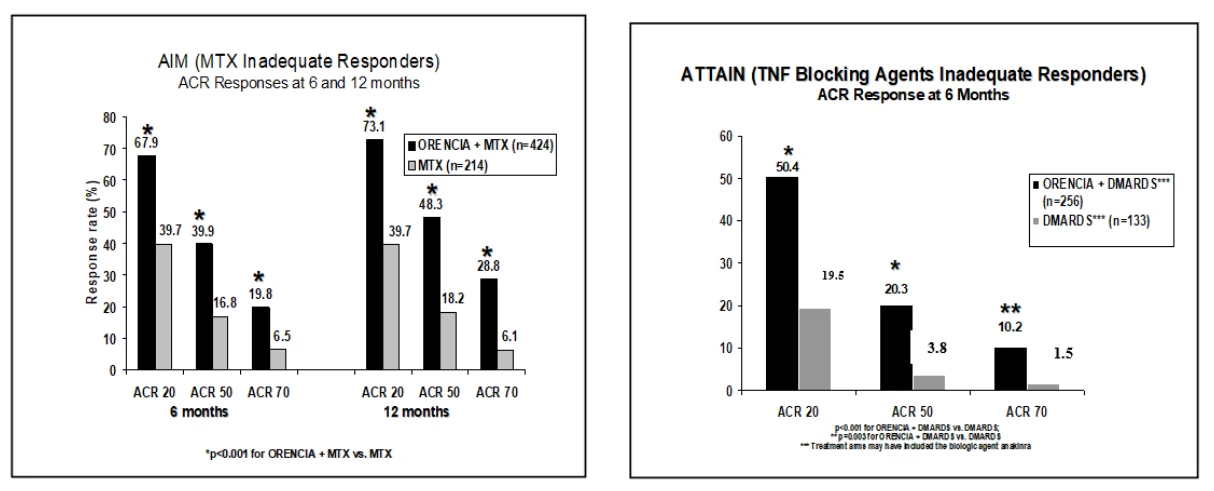
Major clinical response, defined as continuous ACR 70 response over a 6-month period, was measured in AIM and AGREE. In the AIM study, among ORENCIA treated patients, 14% achieved a major clinical response, as compared with 2% in placebo patients. In addition, 6% of ORENCIA treated patients in this 12-month study achieved an extended major clinical response (continuous ACR 70 response over 9 months), as compared with 0.5% in placebo patients. In the AGREE study, among ORENCIA+MTX treated patients, 27% achieved a major clinical response, as compared with 12% in MTX+placebo patients.
All subjects who completed the double-blind portion of studies IM101100 (Days 1 through Day 360), IM101102 (Days 1 through Day 365) and IM101029 (Day 1 through Day 169) were eligible to continue into the long-term open label portion of these studies. All subjects who were enrolled in the open-label periods received a fixed dose of abatacept (that approximated 10 mg/kg) in combination with MTX or other DMARD. As needed, the use of additional DMARDs or change in the corticosteroids, MTX, and NSAIDs dosages was permitted.
In study IM101100, ACR 20 responses were observed in 71% (42/59) of abatacept group patients, ACR 50 in 41% (24/59), and ACR 70 31% (18/58) at 48 months. In study IM101029 (ATTAIN), 217 patients entered the open label extension. ACR-20 responses were observed in 56% (122/217) patients, ACR-50 in 33% (72/217) and ACR 70 in 16% (35/217) at 24 months. In study IM101102 (AIM), 376 abatacept group patients entered the open label extension. ACR-20 responses were observed in 80% (302/376), ACR 50 in 56% (209/376) and ACR 70 in 34% (129/376) at 24 months.
Remission
ORENCIA was significantly better than placebo in other measures of rheumatoid arthritis disease activity not included in the ACR response criteria, such as morning stiffness. The level of disease activity was also assessed using the Disease Activity Score 28 (DAS28).
In the AIM study, a DAS28-defined remission (DAS28 <2.6) was achieved in 15% and 24% of ORENCIA treated patients compared with 3% and 2% of placebo patients at 6 months and 12 months, respectively (Figure 4). In the open label extension of the AIM study, DAS28-defined remission was observed in 31% (102/330) of patients at 24 months. In ATTAIN, DAS28-defined remission was observed in 10% of ORENCIA treated patients compared with 1% of placebo patients at 6 months (Figure 5). In the open label extension of the ATTAIN study, DAS28-defined remission was observed in 21% (31/151) patients at 24 months. In AGREE, DAS28-defined remission was achieved in 41% (106/256) of ORENCIA+MTX treated patients compared with 23% (59/253) of MTX+placebo patients at 12 months.
Figure 3 Figure 4
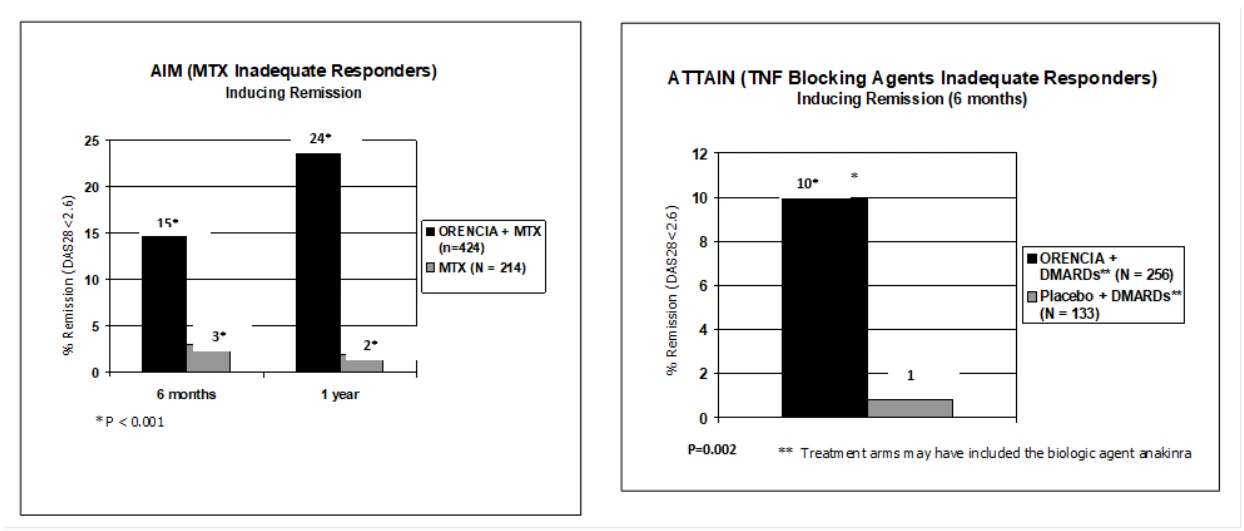
Radiographic Response
Structural joint damage was assessed radiographically and expressed as change in Genant-modified Sharp Total Score and its components, the erosion score and Joint Space Narrowing (JSN) score. In AIM at baseline, radiographic parameters were similar between treatment groups. ORENCIA/MTX significantly inhibited the progression of structural damage compared to MTX alone after 12 months of treatment as shown in Table 18. The benefits of ORENCIA/MTX compared to placebo/MTX were observed regardless of disease duration, including in patients with disease duration of less than 2 years through greater than 10 years.
Table 18: Mean Radiographic Changes Over 12 Months in AIM
| Parameter | ORENCIA/MTX n = 391 | Placebo/ MTX n = 195 | Placebo/MTX - ORENCIA/MTX (95% CI) | P-valuea |
| Total sharp score | 1.21 | 2.32 | 1.11 (0.35, 1.88) | 0.012 |
| Erosion score | 0.63 | 1.14 | 0.51 (0.08, 0.94) | 0.029 |
| JSN score | 0.58 | 1.18 | 0.60 (0.21, 0.99) | 0.009 |
a Based on non-parametric analysis
In the open-label extension of the AIM study, 75% (324/433) of patients initially randomized to ORENCIA/MTX were evaluated radiographically by the TSS. In fifty (50) percent (163/324) of these patients who entered the open-label extension, no progression of structural damage as defined by a change in the TSS of zero or less was observed at 24 months.
In the AGREE study, the mean change in TSS at 12 months was significantly lower in patients treated with ORENCIA+MTX compared to those treated with MTX+placebo.
Table 19: Mean Radiographic Changes Over 12 Months in AGREE
| Parameter | ORENCIA/MTX n = 242 | Placebo/ MTX n = 242 | Placebo/MTX - ORENCIA/MTX (95% CI) | P-valuea |
| Total sharp score | 0.63 | 1.06 | 0.44 (0.06, 0.82) | 0.040 |
| Erosion score | 0.50 | 0.89 | 0.40 (0.07, 0.74) | 0.033 |
| JSN score | 0.13 | 0.17 | 0.04 (-0.05, 0.14) | 0.353 |
a Based on non-parametric analysis
Although the treatment comparison for the Total sharp score is statistically significant (p-value = 0.04), the estimated treatment effect of 1.6 structural damage units was not demonstrated in the clinical trial.
Physical Function Response
Improvement in physical function was measured by the Health Assessment Questionnaire Disability Index (HAQ-DI). In studies IM101100, AIM, ATTAIN, ASSURE and AGREE, ORENCIA-treated patients demonstrated significantly greater improvement from baseline than placebo or MTX treated patients in the HAQ-DI. In Study IM101174 improvement from baseline as measured by HAQ-DI at 6 months was observed in 69.8% of patients in ORENCIA SC+MTX group and 65% of patients in ORENCIA IV+MTX group, respectively The results from IM101100, AIM and ATTAIN are shown in Table 20. Similar results were observed in ASSURE. During the open label period of study IM101100, the improvement in physical function has been maintained for up to 3 years (as-observed analysis).
In the open label extension of the study IM101100, the HAQ response was observed in 53% (31/59) ORENCIA-treated patients at 4 years. In the open-label extension studies of the AIM and ATTAIN, the HAQ response at 24 months was observed in 67% (251/376) patients and in 48% (104/217) respectively.
Table 20: Mean Improvement from Baseline in Physical Function
| Inadequate Response to Methotrexate | Inadequate Response to TNF Blocking Agents | |||||||||||||||||||||
| IM101100 | AIM | ATTAIN | ||||||||||||||||||||
| HAQ Disability Index | ORENCIAa + MTX | Placebo + MTX | ORENCIAb + MTX | Placebo + MTX | ORENCIAb + DMARDsc | Placebo + DMARDsc | ||||||||||||||||
| Mean baseline | ||||||||||||||||||||||
| 0.98d | n = 115 | 0.97d | n = 119 | 1.69e | n = 422 | 1.69e | n = 212 | 1.83e | n = 249 | 1.82e | n = 130 | |||||||||||
| Mean improvement from baseline | ||||||||||||||||
| Month 6 | 0.40d,f | n = 113 | 0.19d | n = 118 | 0.59e,f | n = 420 | 0.40e | n = 211 | 0.45e,f | n = 249 | 0.11e | n = 130 | ||||
| Year 1 | 0.40d,f | n = 115 | 0.15d | n = 119 | 0.66e,f | n = 422 | 0.37e | n = 212 | NA | NA | ||||||
a 10 mg/kg b Fixed dose (see 4 DOSAGE AND ADMINISTRATION) c Concurrent DMARDs included one or more of the following: MTX, azathioprine, chloroquine, gold, hydroxychloroquine, leflunomide and sulfasalazine. Concurrent use of the biologic agent anakinra was also permitted. d Modified Health Assessment Questionnaire; 0 = best, 3 = worst; 8 questions; 8 categories: dressing and grooming, arising, eating, walking, hygiene, reach, grip, and activities. e Health Assessment Questionnaire; 0 = best, 3 = worst; 20 questions; 8 categories: dressing and grooming, arising, eating, walking, hygiene, reach, grip, and activities. f p <0.001, ORENCIA vs. placebo.
Health-Related Outcomes and Quality of Life
Health-related quality of life was assessed by the SF-36 questionnaire at 6 months in IM101100, AIM and ATTAIN and at 12 months in IM101100 and AIM. In these studies, clinically and statistically significant improvement was observed in the ORENCIA group as compared with the placebo group in all 8 domains of the SF-36 as well as the Physical Component Summary (PCS) and the Mental Component Summary (MCS). In AGREE, improvement was observed at 12 months in the ORENCIA+MTX group as compared with the MTX+placebo group in both PCS and MCS.
The results from AIM are shown in Figure 5.
Figure 5
Significant Improvement in Health-Related Quality of Life (SF-36) at Month 12 in AIM
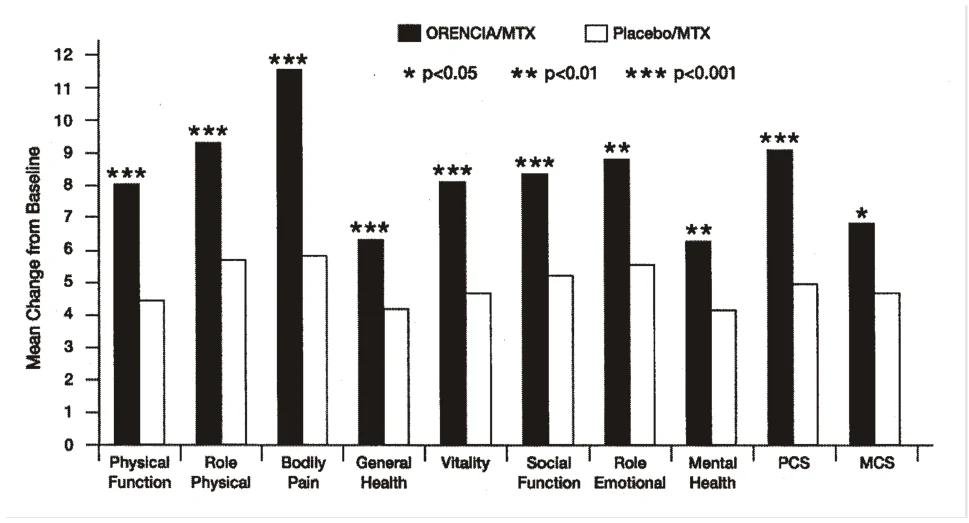
ORENCIA/MTX n = 424 Placebo/MTX n = 214
Juvenile Idiopathic Arthritis/Juvenile Rheumatoid Arthritis:
The safety and efficacy of ORENCIA were assessed in a three-part study including an open-label extension in children with polyarticular juvenile idiopathic arthritis (JIA). Patients 6 to 17 years of age (n=190) with moderately to severely active polyarticular JIA who had an inadequate response to one or more DMARDs, such as MTX or TNF antagonists, were treated. Patients had a disease duration of approximately 4 years with moderately to severely active disease at study entry, as determined by baseline counts of active joints (mean, 16) and joints with loss of motion (mean, 16); patients had elevated C-reactive protein (CRP) levels (mean, 3.2 mg/dL) and ESR (mean, 32 mm/h). The patients enrolled had subtypes of JIA that at disease onset included Oligoarticular (16%), Polyarticular (64%; 20% were rheumatoid factor positive), and Systemic (20%). At study entry, 74% of patients were receiving MTX (mean dose, 13.2 mg/m2 per week) and remained on a stable dose of MTX (those not receiving MTX did not initiate MTX treatment during the study).
In Period A (open-label, lead-in), patients received 10 mg/kg (maximum 1000 mg per dose) intravenously on days 1, 15, 29, and monthly thereafter. Response was assessed utilizing the ACR Pediatric 30 definition of improvement, defined as ≥30% improvement in at least 3 of the 6 JIA core set variables and ≥30% worsening in not more than 1 of the 6 JIA core set variables. Patients demonstrating an ACR Pedi 30 response at the end of Period A were randomized into the double-blind phase (Period B) and received either ORENCIA or placebo for 6 months or until disease flare. Disease flare was defined as a ≥30% worsening in at least 3 of the 6 JIA core set variables with ≥30% improvement in not more than 1 of the 6 JIA core set variables; ≥2 cm of worsening of the Physician or Parent Global Assessment was necessary if used as 1 of the 3 JIA core set variables used to define flare, and worsening in ≥2 joints was necessary if the number of active joints or joints with limitation of motion was used as 1 of the 3 JIA core set variables used to define flare.
Clinical Response
At the conclusion of Period A, pediatric ACR 30/50/70 responses were 65%, 50%, and 28%, respectively. Pediatric ACR 30 responses were similar in all subtypes of JIA studied.
During the double-blind randomized withdrawal phase (Period B), ORENCIA-treated patients experienced significantly fewer disease flares compared to placebo-treated patients (20% vs 53%); 95% CI of the difference (15%, 52%). The risk of disease flare among patients continuing on ORENCIA was less than one third than that for patients withdrawn from ORENCIA treatment (hazard ratio=0.31, 95% CI [0.16, 0.59]).
Among patients who had a clinical response at the end of Period A and entered into Period B, the majority of those patients remaining on ORENCIA continued to improve from month 4 to month 10. Most patients who experienced a disease flare in Period B, and re-introduced ORENCIA treatment up to six months after discontinuation re-responded to ORENCIA in Period C, the open-label extension.
In general, the patients who continuously received ORENCIA during both Period B and during the first three months of the open-label extension Period C maintained their responses, although no formal efficacy conclusions can be drawn from Period C.
Adult Psoriatic Arthritis:
The efficacy of ORENCIA was assessed in 594 patients with psoriatic arthritis, in two randomized, double-blind, placebo-controlled studies (Studies PsA-I and PsA-II) in adult patients, age 18 years and older. Patients had active psoriatic arthritis (≥3 swollen joints and ≥3 tender joints) despite prior treatment with DMARD therapy and had one qualifying psoriatic skin lesion of at least 2 cm in diameter. In PsA-I and PsA-II, 61% and 37% of patients, respectively, were treated with TNFi previously.
In PsA-I, 424 patients were randomized 1:1 to receive weekly doses of SC placebo or ORENCIA 125 mg without a loading dose for 24 weeks-in a double-blind manner, followed by open-label ORENCIA 125 mg SC weekly. Randomization was stratified by current MTX use, prior use of TNFi therapy, and the percentage of psoriasis-affected body surface area (≥ 3% vs < 3 %). Patients were allowed to receive stable doses of concomitant methotrexate, sulfasalazine, leflunomide, hydroxychloroquine, low dose corticosteroids (equivalent to ≤10 mg of prednisone) and/or NSAIDs during the trial. At randomization, 60.4% of patients were receiving methotrexate. At baseline, the mean weight for subjects randomized to abatacept was 84.9 kg and to placebo was 86.6 kg, with a limited number of subjects weighing < 60 kg (16 subjects and 15 subjects, respectively). The baseline disease characteristics included presence of joint erosion on X-rays in 84% (341/424) with a mean (SD) PsA-modified Sharp van der Heijde erosion score (SHS) of 10.8 (24.2), elevated serum C reactive protein (CRP) in 66% [277/424]) with a mean (SD) of 14.1 mg/L (25.9), and polyarticular disease in 98% (416/424) of patients with a mean number (SD) of tender joints and swollen joints of 20.2 (13.3) and 11.6 (7.5), respectively. Patients who had not achieved at least a 20% improvement from baseline in their swollen and tender joint counts by Week 16 escaped to open-label ORENCIA 125 mg SC weekly.
In PsA-II, an IV dose-ranging study, 170 patients received study drug at Day 1, 15, 29, and then every 28 days thereafter in a double blind manner for 24 weeks, followed by open-label ORENCIA 10 mg/kg IV every 28 days. Patients were randomized to receive placebo or ORENCIA 3 mg/kg (3/3), 10 mg/kg (10/10), or two doses of 30 mg/kg followed by 10 mg/kg (30/10) without escape for 24 weeks. The randomization was stratified by the percentage of psoriasis-affected body surface area (≥ 3% vs < 3 %). Patients were allowed to receive stable doses of concomitant methotrexate, low dose corticosteroids (equivalent to ≤10 mg of prednisone) and/or NSAIDs during the trial. At enrollment, approximately 60% of patients were receiving methotrexate. At baseline, the mean (SD) CRP for ORENCIA IV was 17 mg/L (33.0) and mean number (SD) of tender joints and swollen joints was 22.2 (14.3) or 10.9 (7.6), respectively.
In PsA-I, 69.0% (147/213) of subjects in the abatacept group and 69.2% (146 /211) of subjects in the placebo group received concomitant non-biologic DMARDs during the double-blind period. In PsA-II, 60.0% (24/37) of subjects in the abatacept group and 54.8% (23/35) of subjects in the placebo group received concomitant non-biologic DMARDs during the double-blind period.
The primary endpoint for both PsA-I and PsA-II was the proportion of patients achieving ACR 20 response at Week 24 (Day 169).
Clinical Response
A significantly higher proportion of patients achieved an ACR20 response after treatment with ORENCIA 10 mg/kg IV or 125 mg SC compared to placebo at Week 24. The percent of patients achieving ACR 20, 50, or 70 responses in Studies PsA-I and PsA-II (10 mg/kg) are presented in Table 21 below.
Table 21: Proportion of Patients With ACR Responses at Week 24 in Studies PsA-Ia and PsA-II
| PsA-Ib | PsA-IIc | ||||||||||||
| ORENCIA 125 mg SC N=213 | Placebo N=211 | ORENCIA 10mg/kg IVb N=40 | Placebo N=42 | ||||||||||
| ACR 20 | 39.4%* | 22.3% | 47.5% | 19.0% | |||||||||
| Estimate of Difference (95% CI) | 17.2% (8.7%, 25.6%) | 28.7% (9.4%, 48.0%) | |||||||||||
| p-value | < 0.001d | 0.006e | |||||||||||
| ACR 50 | 19.2% | 12.3% | 25.0% | 2.4% | |||||||||
| ACR 70 | 10.3% | 6.6% | 12.5% | 0% | |||||||||
a Patients who had less than 20% improvement in tender or swollen joint counts at Week 16 met escape criteria [76 (35.7%) in abatacept and 89 (42.2%) in placebo] and were considered non-responders.
b 61% of patients were previously treated with tumor necrosis factor inhibitor (TNFi).
c 37% of patients were previously treated with TNFi.
d p-value is based on the CMH Chi-square test stratified by MTX use, prior TNFi and BSA. Estimate and 95% CI for difference are based on stratum size weights method stratified by MTX use, prior TNFi and baseline BSA.
e p-value is based on the CMH Chi-square test stratified by BSA. Estimate and 95% CI for difference are based on stratum size weights method stratified by baseline BSA.
The percentage of patients in PsA-I achieving ACR20 response through Week 24 is shown below in Figure 6.
Figure 6: Percent of Patients Achieving ACR20 Responsea in PsA-I Study Through Week 24 (Day 169)
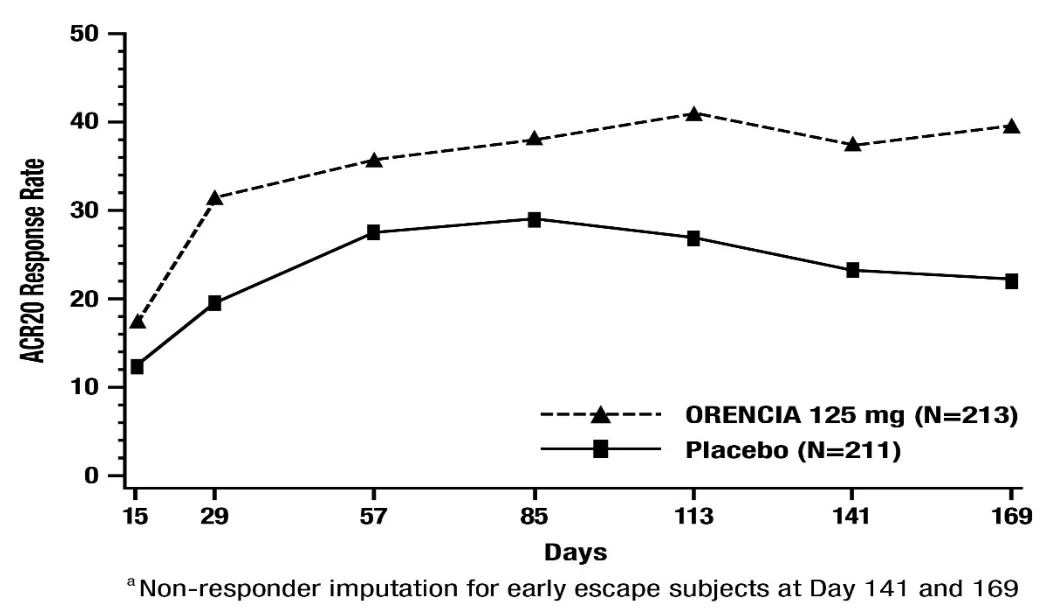
ACR 20 responses at Week 24 were higher in the abatacept group compared to the placebo group regardless of prior TNFi treatment and concomitant non-biologic DMARD use. The proportion of subjects who met the ACR 20 criteria for responders at Week 24 was 44.0% in the abatacept group and 22.2% in the placebo group in TNFi-naive subjects, and 36.4% in the abatacept group and 22.3% in the placebo group in TNFi-exposed subjects. The proportion of subjects who met the ACR 20 criteria for responders at Week 24 was 44.9% in the abatacept group and 26.9% in the placebo group for those using concomitant non-biologic DMARD, and 27.3% in the abatacept group and 12.1% in the placebo group for those not using concomitant non-biologic DMARDs.
Results were generally consistent across the ACR components in Study PsA-I and PsA-II.
In PsA-I, 65.7% (140/213) of subjects in the abatacept group and 62.6% (132/211) of subjects in the placebo group had enthesitis at baseline. Dactylitis occurred in 28.6% (61/213) of subjects in the abatacept group and in 23.7% (50/211) of subjects in the placebo group at baseline. In PsA-I, among subjects with dactylic digits at baseline, the proportion of subjects with no dactylic digits at Week 24 was 44.3% in the abatacept group and 34.0% in the placebo group. Among subjects with enthesitis at baseline, the proportion of subjects with no enthesitis at Week 24 was 32.9% in the abatacept group and 21.2% in the placebo group.
Radiographic Response
In study PsA-I, the proportion of radiographic non-progressors (≤0 change from baseline) in total PsA-Modified SHS at Week 24 was 42.7% in the ORENCIA 125 mg group compared to 32.7% in the placebo group.
Physical Function Response
In study PsA-I, at Week 24, the proportion of patients with at least ≥0.35 decrease from baseline in Health Assessment Questionnaire-Disability Index (HAQ-DI) was 31.0% on ORENCIA compared to 23.7% on placebo. The adjusted mean change from baseline in HAQ-DI was -0.33 on ORENCIA compared to -0.20 on placebo. In study PsA-II, at Week 24, the proportion of patients with at least ≥0.30 decrease from baseline in HAQ-DI score was 45.0% with ORENCIA 10 mg/kg compared to 19.0% on placebo.
Prophylaxis of Acute Graft versus Host Disease after Unrelated-donor HSCT
The efficacy of ORENCIA, when added to a standard of care regimen of a calcineurin inhibitor (CNI) (cyclosporine or tacrolimus) and methotrexate (MTX) for prophylaxis of acute graft versus host disease (aGVHD), was assessed in Study GVHD-1, a study of hematopoietic stem cell transplant (HSCT) recipients and Study GVHD-2, a clinical study that used data from the Center for International Blood and Marrow Transplant Research (CIBMTR).
In Study GVHD-1, ORENCIA was administered at a dose of 10 mg/kg IV (1000 mg maximum dose) as intravenous infusion over 60 minutes, beginning on the day prior to transplantation (Day -1), followed by administration on 5, 14, and 28 days after the transplantation. Two cohorts of patients were studied:
- A randomized (1:1), double-blind, placebo-controlled study of patients who underwent an 8 of 8 HLA-matched HSCT who received ORENCIA (73 patients) or placebo (69 patients) in combination with a CNI and MTX (8 of 8 cohort); and
- An open-label, single-arm study of 43 patients who underwent a 7 of 8 Human Leukocyte Antigen (HLA)-matched HSCT (7 of 8 cohort).
Baseline demographic and clinical characteristics of both the 7 of 8 and 8 of 8 cohorts are outlined below in Table 22.
Table 22: Baseline Demographic and Clinical Characteristics: 7 of 8 and 8 of 8 Cohort Treated Analysis Population in Study GVHD-1.
| 7 of 8 Cohort | 8 of 8 Cohort | ||||||||||||
| ORENCIA (+ CNI and MTX) N=43 | ORENCIA (+ CNI and MTX) N=73 | Placebo (+CNI and MTX) N=69 | |||||||||||
| Age - Median | 38 | 44 | 40 | ||||||||||
| Age - Range | 6-76 | 6-71 | 7-74 | ||||||||||
| Gender - Male | 27 (63) | 41 (56) | 37 (54) | ||||||||||
| White | 31 (72) | 63 (86) | 61 (88) | ||||||||||
| Black or African American | 7 (16) | 3 (4.1) | 2 (2.9) | ||||||||||
| Asian | 2 (4.7) | 4 (6) | 2 (2.9) | ||||||||||
| Hispanic | 7 (16) | 4 (6) | 2 (2.9) | ||||||||||
| Malignancy type | |||||||||||||
| Acute Myeloid Leukemia (AML) | 15 (35) | 30 (41) | 22 (32) | ||||||||||
| Myelodysplastic Syndrome (MDS) | 11 (26) | 15 (21) | 12 (17) | ||||||||||
| Acute Lymphoblastic Leukemia (ALL) | 8 (19) | 20 (27) | 22 (32) | ||||||||||
| Acute leukemia of ambiguous lineage | 1 (2.3) | 0 | 1 (1.4) | ||||||||||
| Hodgkin and Non-Hodgkin lymphoma | 1 (2.3) | 1 (1.4) | 1 (1.4) | ||||||||||
| Acute Lymphoblastic Lymphoma in 2nd or Greater Complete Remission | 1 (2.3) | 4 (6) | 1 (1.4) | ||||||||||
| Chronic Myelomonocytic leukemia | 1 (2.3) | 1 (1.4) | 4 (6) | ||||||||||
| Chronic Myelogenous leukemia | 4 (9) | 1 (1.4) | 5 (7) | ||||||||||
| Not reported | 1 (2.3) | 1 (1.4) | 1 (1.4) | ||||||||||
| GVHD Prophylaxis | |||||||||||||
| Cyclosporine | 16 (37) | 11 (15) | 11 (16) | ||||||||||
| Tacrolimus | 27 (63) | 62 (85) | 58 (84) | ||||||||||
| Type of Graft | |||||||||||||
| Bone Marrow | 21 (49) | 33 (45) | 26 (38) | ||||||||||
| Cytokine Mobilized Peripheral Blood (PBSC) | 22 (51) | 40 (55) | 43 (62) | ||||||||||
| Conditioning Regimen | |||||||||||||
| TBI and Chemotherapy | 11 (26) | 20 (27) | 26 (38) | ||||||||||
| Busulfan and Cyclophosphamide | 13 (30) | 28 (38) | 21 (30) | ||||||||||
| Busulfan and Fludarabine | 8 (19) | 7 (10) | 2 (2.9) | ||||||||||
| Melphalan and Fludarabine | 11 (26) | 18 (25) | 20 (29) | ||||||||||
Study GVHD-2 cohort study analyzed outcomes of ORENCIA in combination with a CNI and MTX, versus a CNI and MTX alone, for the prophylaxis of aGVHD, in patients 6 years of age or older who underwent HSCT from a 1 allele-mismatched URD between 2011 and 2018. The ORENCIA + CNI and MTX-treated group (n=54) included 42 patients from GVHD-1, in addition to 12 patients treated with ORENCIA outside of GVHD-1. The comparator group (n=162) was randomly selected in a 3:1 ratio to the ORENCIA-treated group from the CIBMTR registry from patients who had not received ORENCIA during the study period. Analyses used propensity score matching and inverse probability of treatment weighting to help address the impact of selection bias.
Clinical Response: 8/8 Cohorts
Efficacy in Study GVHD-1 was established based on overall survival (OS) and grade II-IV aGVHD free survival (GFS) results assessed at Day 180 post-transplantation. ORENCIA +CNI and MTX did not significantly improve grade III-IV GFS versus placebo + CNI and MTX at Day 180 post-transplantation. The efficacy results of the GVHD-1 8 of 8 cohort are shown in Table 23.
| Table 23: Efficacy Results in 8 of 8 Cohort in Study GVHD-1 at Day 180 Post-Transplantation | ||
|---|---|---|
| Endpoint | ORENCIA (+CNI and MTX) n=73 | Placebo (+CNI and MTX) n=69 |
| Gr III-IV aGVHD Free Survivala Rate (95% CI) | 87% (77%, 93%) | 75% (63%, 84%) |
| Hazard Ratio (95% CI) | 0.55 (0.26, 1.18) | |
| Gr II-IV aGVHD Free Survivalb Rate (95% CI) | 50% (38%, 61%) | 32% (21%, 43%) |
| Hazard Ratio (95% CI) | 0.54 (0.35, 0.83) | |
| Overall Survival Rate (95% CI) | 97% (89%, 99%) | 84% (73%, 91%) |
| Hazard Ratio (95% CI) | 0.33 (0.12, 0.93) | |
a Gr III-IV aGVHD Free Survival was measured from the date of transplantation until the onset of documented Grade III-IV aGVHD, or death by any cause up to Day 180 post-transplantation.
b Gr II-IV aGVHD Free Survival was measured from the date of transplantation until the onset of documented Grade II-IV aGVHD, or death by any cause up to Day 180 post-transplantation.
Clinical Response: 7/8 Cohorts
In Study GVHD-2, the OS rate at Day 180 in the ORENCIA in combination with CNI and MTX group was 98% (95% CI: 78, 100) and the OS rate at Day 180 in the CNI and MTX group was 75% (95%CI: 67, 82)for patients who underwent HSCT from a 1 allele-mismatched URD. In Study GVHD-1, exploratory analyses found a similar trend to those in GVHD-2.
14.3 Immunogenicity
Adult RA Patients Treated with Intravenous Orencia
In studies AIM, ATTAIN, ASSURE, IM101100, IM101101, patients with rheumatoid arthritis were tested for antibodies to ORENCIA at multiple time points. Antibodies to the entire abatacept molecule or to the CTLA-4 portion of abatacept were measured. Binding antibodies were detected in 2.8% of 2237 patients tested over a period of up to 3 years. No apparent correlation of antibody development to clinical response or adverse events was observed, but due to the small number of patients across studies who developed an immune response, conclusions concerning the impact of immunogenicity on safety and efficacy cannot be made.
Adult RA Patients Treated with SC ORENCIA
All patients received an IV abatacept loading dose by weight on Day 1. In the SC abatacept group, 0.4% and 0.7% of patients were positive for anti-abatacept and anti-CTLA4-T antibodies, respectively, vs. 0.7% and 1.5% respectively in the IV abatacept group; 714/736 and 725/736 patients treated with intravenous abatacept and 698/721 and 710/721 patients treated with SC abatacept were tested for anti-abatacept and anti-CTLA4-T antibodies respectively During 6 months of treatment, injection site reactions, hypersensitivity reactions or autoimmune disorders did not occur in any sero-positive patients.
SC ORENCIA Administration without an IV Loading Dose
A study in the subcutaneous program was conducted to determine the effect of monotherapy use of ORENCIA on immunogenicity following subcutaneous administration without an intravenous loading dose (IM101-173). The results indicated that there were no differences in the frequency of immunogenicity after 4 months of treatment when ORENCIA was administered as a monotherapy or in combination with methotrexate (immunogenicity was not detected in either group at Month 4: n=49, ORENCIA; n=51, ORENCIA plus MTX) (see 4 DOSAGE AND ADMINISTRATION and 10 CLINICAL PHARMACOLOGY).
SC ORENCIA upon Withdrawal (Three Months) and Restart of Treatment
A study (IM101-167) in the subcutaneous program was conducted to investigate the effect of withdrawal (three months) and restart of ORENCIA subcutaneous treatment on immunogenicity. Upon withdrawal of ORENCIA subcutaneous treatment, the increased rate of immunogenicity was consistent with that seen upon discontinuation of ORENCIA administered intravenously. Upon reinitiating therapy, there were no injection reactions and no differences in response to therapy in patients who were withdrawn from subcutaneous therapy for up to 3 months relative to those who remained on subcutaneous therapy, whether therapy was reintroduced with or without an intravenous loading dose (see 4 DOSAGE AND ADMINISTRATION and 10 CLINICAL PHARMACOLOGY).
JIA/JRA Patients Treated with Intravenous ORENCIA
Antibodies directed against the entire abatacept molecule or to the CTLA-4 portion of abatacept were assessed by ELISA assays in JIA/JRA patients following repeated treatment with ORENCIA throughout the open-label period. For patients who were withdrawn from therapy for up to 6 months during the double-blind period, the rate of antibody formation to the CTLA-4 portion of the molecule was 40.7% (22/54), while for those who remained on therapy the rate was 13.0% (7/54).
The long-term immunogenicity of ORENCIA is unknown.
Prophylaxis of Acute Graft versus Host Disease after Unrelated-donor HSCT
Immunogenicity was assessed in patients undergoing HSCT. Overall, immunogenicity incidence and associated antibody titers were low from the 4-dose intravenous ORENCIA regimen used in this study. Of the 114 immunogenicity evaluable subjects in the ORENCIA groups, none were positive during the ORENCIA treatment period (Day -1 to Day 28 following transplant). During the off-treatment period (Day 29 and up to Day 180 following transplant); 6 of 91 immunogenicity evaluable subjects (6.6%) were positive for CTLA4 and possibly Ig; 4 of the 6 positive subjects were found to have at least one positive sample with neutralization activity. In this study, immunogenicity positive subjects only had ADA positive samples on Day 180 (off-treatment period) and thus due to the timing of the response, the impact on PK, safety, or efficacy could not be determined.
15 MICROBIOLOGY
No microbiological information is required for this drug product.
16 NON-CLINICAL TOXICOLOGY
The nonclinical safety profile of abatacept was evaluated in mice, rats, and cynomolgus monkeys. Pharmacologic activity has been demonstrated in each of these species. Abatacept, a fully human protein, was immunogenic in each of these species; however, abatacept-specific antibodies were generally detected only during the recovery period, indicating that abatacept-specific antibodies were not formed until after abatacept serum levels had dropped below pharmacologically active levels.
General Toxicology:
Single and Repeat-Dose Toxicity
In non-human primate studies, significant drug-related toxicity did not occur following the intravenous infusion of abatacept 1) as a single dose of up to 100 mg/kg or 2) as repeat doses of up to 50 mg/kg every other day for 30 days or every week for 1 year. Reversible pharmacologic effects in the repeat-dose studies consisted of minimal decreases in serum immunoglobulin (Ig) G and mild to moderate decreases in the number and diameter of lymphoid germinal centers in the spleen and/or lymph nodes (1-year study), morphologic features reflective of decreased germinal center activity. In repeat-dose studies, no hyperplastic, preneoplastic, or neoplastic changes were observed in the peripheral blood cells or lymphoid tissues of any monkey. In the 1-year study, functional activity of the immune system was demonstrated at all doses by a robust antibody response to the T-cell-dependent antigen keyhole limpet hemocyanin following immunization after an 8-week dose-free period. Abatacept treatment for 1 year did not result in any clinical manifestations representative of a viral infection or sequellae, even though viral screening confirmed previous exposure in all monkeys to one or more of the following viruses:
lymphocryptovirus, herpes B, rhesus cytomegalovirus, or simian papovavirus. The no-observable-adverse-effect level (NOAEL) in the 1-year study was 50 mg/kg/weekly, which resulted in a systemic exposure, based on area under the concentration versus time curves (AUCs), that was 9-fold greater than human exposure at the clinical dose.
No significant toxicity was observed in rats at doses up to 200 mg/kg, administered either intravenously or subcutaneously every 2 days for a total of seven doses (q2dx7). A minimal decrease in serum IgG and IgA was noted at the completion of treatment. Bioavailability following subcutaneous administration was between 41% (200 mg/kg) and 63% (10 mg/kg).
In mice, subcutaneous administration of abatacept once weekly for 26 weeks at doses up to 200 mg/kg was clinically well tolerated. At doses of ≥65 mg/kg, reversible, pharmacologic effects consisted of transient decreases in mean serum IgG levels and, in male mice, decreases in the percentages of splenic B cells and inhibition of ex vivo B- and T-cell activation. Increases in the incidence and severity of karyomegaly in renal tubular epithelial cells that was accompanied by mild, multifocal, chronic inflammation, lymphocytic infiltration, and tubular cell degeneration were observed at ≥65 mg/kg. This renal finding did not have any untoward effects on renal function and was interpreted as an exacerbation of a spontaneous, age-related renal change that occur in mice but has no known relevance to humans. The NOAEL for this study was considered to be 200 mg/kg (human exposure multiple of 4.7).
Mutagenicity and Carcinogenicity: No mutagenic potential of abatacept was observed in the in vitro reverse Ames or Chinese hamster ovary/hypoxanthine guanine phosphoribosyl-transferase (CHO/HGPRT) forward point mutation (with or without metabolic activation) assays. No chromosomal aberrations were observed in human lymphocytes (with or without metabolic activation) treated with abatacept. In a mouse carcinogenicity study, weekly subcutaneous injections of 20, 65, or 200 mg/kg of abatacept administered each week for up to 84 weeks in males and 88 weeks in females were associated with increases in the incidence of malignant lymphomas (all doses) and mammary gland tumors (intermediate- and high-dose in females). The mice from this study were infected with murine leukemia virus and mouse mammary tumor virus. These viruses are associated with an increased incidence of lymphomas and mammary gland tumors, respectively, in immunosuppressed mice. The doses used in these studies were 0.8-, 2.0- and 3.0-fold, the human exposure at 10 mg/kg, respectively, based on AUC. No evidence of lymphomas or preneoplastic morphologic changes was observed in the 1-year monkey study, despite the presence of a virus (lymphocryptovirus) known to cause these lesions in immunosuppressed monkeys within the time frame of this study. The relevance of these findings to the clinical use of abatacept is unknown.
Reproductive and Developmental Toxicology: In a fertility and early embryonic development study in rats, there were no effects on mating, fertility, or early embryonic development at doses up to 200 mg/kg administered intravenously every 3 days (human exposure multiple of 11). In the intravenous embryo-fetal development studies, no adverse effects were detected in rodents at doses up to 200 mg/kg (rats) or 300 mg/kg (mice) administered daily or in rabbits at doses up to 200 mg/kg administered every 3 days (human exposure multiple of 30- and 29-fold for rats and rabbits). In the rat and rabbit studies, abatacept was shown to cross the placenta. In the pre- and post-natal development study in rats, there were no effects on the F0-generation dams at doses up to 200 mg/kg (human exposure multiple of 11) administered intravenously every 3 days and no effects on the F1-generation rats at ≤45 mg/kg (human exposure multiple of 3). At 200 mg/kg, drug-related changes in the F1-generation were limited to females and consisted of a 9-fold increase in the T-cell-dependent antibody response and inflammation of the thyroid of 1 rat. These findings, of unknown relevance to humans, occurred at 11-fold human exposures; no effects were noted at 3-fold the human exposure. No other immune parameters were affected (splenic-lymphocyte and natural-killer cell phenotypes, serum Ig levels, and presence of anti-nuclear antibodies).
Local Tolerance: Abatacept was not significantly irritating when administered to rabbits by intravenous, paravenous, or intra-arterial injection at concentrations expected to be the highest concentration intended for use in humans (10 mg/mL). In intravenous repeat-dose studies in monkeys, no significant injection site irritation occurred at concentrations (25-31 mg/mL) well above the concentrations recommended for human use. In the subcutaneous repeat-dose studies in mice and the single- and repeat-dose studies in rats, no significant injection site irritation occurred at concentrations up to 100 mg/mL.