


Product Monograph - Resonium Calcium
RECENT MAJOR LABEL CHANGES
| 7 WARNINGS AND PRECAUTIONS | 07/2022 |
TABLE OF CONTENTS
Sections or subsections that are not applicable at the time of authorization are not listed.
TABLE OF CONTENTS .............................................................................................................. 2
1 INDICATIONS .............................................................................................................. 3
1.1 Pediatrics .......................................................................................................... 3
1.2 Geriatrics........................................................................................................... 3
2 CONTRAINDICATIONS ................................................................................................. 4
4 DOSAGE AND ADMINISTRATION................................................................................. 4
4.1 Dosing Considerations ....................................................................................... 4
4.2 Recommended Dose and Dosage Adjustment..................................................... 4
4.3 Reconstitution ................................................................................................... 5
4.4 Administration................................................................................................... 6
5 OVERDOSAGE ............................................................................................................. 6
6 DOSAGE FORMS, STRENGTHS, COMPOSITION AND PACKAGING ................................. 7
7 WARNINGS AND PRECAUTIONS .................................................................................. 7
7.1 Special Populations ............................................................................................ 8
7.1.1 Pregnant Women ......................................................................................... 8
7.1.2 Breast-Feeding ............................................................................................. 8
7.1.3 Pediatrics ..................................................................................................... 8
8 ADVERSE REACTIONS .................................................................................................. 9
8.5 Post-Market Adverse Reactions.......................................................................... 9
9 DRUG INTERACTIONS.................................................................................................. 9
9.3 Drug-behavioural Interactions............................................................................ 9
9.4 Drug-Drug Interactions ...................................................................................... 9
9.5 Drug-Food Interactions .................................................................................... 10
9.6 Drug-Herb Interactions .................................................................................... 10
9.7 Drug-Laboratory Test Interactions .................................................................... 10
10 CLINICAL PHARMACOLOGY ....................................................................................... 10
10.1 Mechanism of Action.................................................................................. 10
10.3 Pharmacokinetics ....................................................................................... 11
11 STORAGE, STABILITY AND DISPOSAL ......................................................................... 11
12 SPECIAL HANDLING INSTRUCTIONS........................................................................... 11
PART II: SCIENTIFIC INFORMATION ...................................................................................... 12
13 PHARMACEUTICAL INFORMATION............................................................................ 12
14 CLINICAL TRIALS........................................................................................................ 12
15 MICROBIOLOGY ........................................................................................................ 12
16 NON-CLINICAL TOXICOLOGY ..................................................................................... 12
PATIENT MEDICATION INFORMATION ................................................................................. 14
PART I: HEALTH PROFESSIONAL INFORMATION
1 INDICATIONS
RESONIUM CALCIUM (calcium polystyrene sulfonate) is indicated in patients with hyperkalemia associated with anuria or severe oliguria. It reduces serum levels of potassium and removes excess potassium from the body. RESONIUM CALCIUM is indicated in all states of hyperkalemia due to acute and chronic renal failure; examples include use following abortion, complicated labor, incompatible blood transfusion, crush injury, prostatectomy, severe burns, surgical shock, and in cases of severe glomerulonephritis and pyelonephritis.
RESONIUM CALCIUM can also be useful in patients requiring dialysis. Serum potassium levels in acute renal failure often reach dangerous heights before a rise in blood urea indicates the need for hemodialysis. RESONIUM CALCIUM can be used to reduce these potassium levels and thereby postpone the need for the use of the artificial kidney machine until other causes make it necessary.
Patients on regular hemodialysis therapy may develop shunt difficulties and under dialysis occurs, resulting in serious hyperkalemia. In these circumstances it is advisable to give RESONIUM CALCIUM to control hyperkalemia during the period of under dialysis. When patients on routine hemodialysis present a dietary management problem and tend towards hyperkalemia, RESONIUM CALCIUM can be used to control blood potassium levels. Similarly, patients on prolonged peritoneal dialysis may develop intermittent hyperkalemia after a few weeks, possibly due to dietary problems. These patients also can be satisfactorily controlled with RESONIUM CALCIUM.
1.1 Pediatrics
Pediatrics (˂18 years of age): Health Canada has authorized pediatric use. Oral administration of RESONIUM CALCIUM is contraindicated in neonates (see 2 CONTRAINDICATIONS and 7 WARNINGS AND PRECAUTIONS).
1.2 Geriatrics
Geriatrics: Health Canada has authorized geriatric use.
2 CONTRAINDICATIONS
RESONIUM CALCIUM is contraindicated in patients with:
- Serum potassium < 5 mmol/L
- Conditions associated with hypercalcemia (e.g. hyperparathyroidism, multiple myeloma, sarcoidosis or metastatic carcinoma)
- A history of hypersensitivity to polystyrene sulfonate resins
- Obstructive bowel disease
- Oral administration of RESONIUM CALCIUM is contraindicated in neonates. Administration of RESONIUM CALCIUM in neonates with reduced gut motility (postoperatively or drug induced) is contraindicated.
4 DOSAGE AND ADMINISTRATION
4.1 Dosing Considerations
Treatment with RESONIUM CALCIUM should be given as soon as the serum potassium level rises above 6 mmol/L (23.5 mg per 100 mL). The action may be delayed for one or two days since maximal exchange probably takes place in the colon. Exchange will continue until all the resin has been voided (this may be one or two days after administration has been discontinued). For this reason, RESONIUM CALCIUM therapy should be stopped when the serum potassium level has fallen to 5 mmol/L, otherwise, the continued action may lead to potassium depletion.
RESONIUM CALCIUM is for oral or rectal administration only. The following doses are suggested only as a general guide. The precise daily dose should be decided on the basis of regular clinical and serum electrolyte determination.
The amount of potassium taken up by RESONIUM CALCIUM will be largely determined by the length of time it is exposed to the high potassium concentration in the fecal water in the colon. For this reason, a tendency towards constipation should be encouraged and purgative drugs should be avoided.
4.2 Recommended Dose and Dosage Adjustment
Adults, Including the Elderly:
Oral
For adults the usual dose is 15 g, 3 or 4 times a day.
Rectal
In cases where vomiting may make oral administration difficult or in patients who have upper gastrointestinal tract problems, including paralytic ileus, RESONIUM CALCIUM may be given rectally as a suspension of 30 g RESONIUM CALCIUM in 100 mL of 2% methylcellulose and 100 mL of water, as a daily retention enema. In the initial stages, administration by this route as well as orally may help to achieve a more rapid lowering of the serum potassium level.
Since the rectal route is less effective than the oral route, the longer RESONIUM CALCIUM is retained the greater is the amount of potassium removed.
Children:
Oral
In smaller children and infants correspondingly smaller doses should be employed by using as a guide a rate of 1mEq of potassium per gram of RESONIUM CALCIUM as the basis for calculation. Children should be given 1 g/kg body weight of RESONIUM CALCIUM daily in divided doses, in acute hyperkalemia. In maintenance therapy the dose may be reduced to 0.5 g/kg body weight daily in divided doses.
Rectal
When RESONIUM CALCIUM is refused by mouth it may be given rectally suspended in a proportional amount of 10% dextrose in water, using a dose at least as great as that which would have been given orally.
Neonates
Oral administration of RESONIUM CALCIUM is contraindicated in neonates. (see 2 CONTRAINDICATIONS).
With rectal administration, the minimum effective dosage within the range of 0.5 g/kg to 1 g/kg should be employed, diluted as for adults and with adequate irrigation to ensure recovery of the resin (see 7 WARNINGS AND PRECAUTIONS).
4.3 Reconstitution
Oral
Adults, Including the Elderly and Children
RESONIUM CALCIUM may be made into a paste with some sweetened vehicle, but not orange juice or other fruit juices that are known to contain potassium. The amount of fluid usually ranges from 3 to 4 mL per gram of RESONIUM CALCIUM.
Rectal
Adults, Including the Elderly
RESONIUM CALCIUM may be given as a suspension of 30 g RESONIUM CALCIUM in 100 mL of 2% methylcellulose and 100 mL of water, as a daily retention enema.
Children
It may be given rectally suspended in a proportional amount of 10% dextrose in water, using a dose at least as great as that which would have been given orally.
Neonates
With rectal administration, the minimum effective dosage within the range of 0.5 g/kg to 1 g/kg should be employed, diluted as for adults and with adequate irrigation to ensure recovery of the resin.
4.4 Administration
Adults, Including the Elderly
Oral
RESONIUM CALCIUM is given by mouth as a suspension in a little water, or for greater palatability, the resin may be made into a paste. If there is difficulty with swallowing, it may be given through a gastric tube, 2 to 3 mm in diameter.
Administer RESONIUM CALCIUM at least 3 hours before or 3 hours after other oral medications. For patients with gastroparesis, a 6-hour separation should be considered (see 7 WARNINGS AND PRECAUTIONS).
Rectal
RESONIUM CALCIUM may be given as a daily retention enema. Since the rectal route is less effective than the oral route, the longer RESONIUM CALCIUM is retained the greater is the amount of potassium removed. The enema should, if possible, be retained for at least nine hours and then the colon irrigated to remove the resin.
If both routes are used initially, it is probably unnecessary to continue rectal administration once the oral resin has reached the rectum.
Children
Oral
RESONIUM CALCIUM should be given orally, preferably with a drink or a little jam or honey. It should not be given in fruit drinks and some carbonated beverages, since these have high potassium content.
Rectal
It may be given rectally suspended in a proportional amount of dextrose in water. Following retention of the enema, the colon should be irrigated to ensure adequate removal of the resin (see 7 WARNINGS AND PRECAUTIONS).
Neonates
Only rectal administration should be considered. Administration of RESONIUM CALCIUM in neonates with reduced gut motility (postoperatively or drug-induced) is contraindicated (see 2 CONTRAINDICATIONS).
5 OVERDOSAGE
Biochemical disturbances resulting from overdosage may give rise to clinical signs and symptoms of hypokalemia, including irritability, confusion, delayed thought processes, muscle weakness, hyporeflexia, and eventually frank paralysis. Apnea may be a serious consequence of this progression. Electrocardiographic changes may be consistent with hypokalemia or hypercalcemia; cardiac arrhythmia may occur. Appropriate measures should be taken to correct serum electrolytes (potassium, calcium). RESONIUM CALCIUM should be removed from the alimentary tract by appropriate use of laxatives or enemas.
| For management of a suspected drug overdose, contact your regional poison control centre. |
6 DOSAGE FORMS, STRENGTHS, COMPOSITION AND PACKAGING
Table 1 – Dosage Forms, Strengths, Composition and Packaging
RESONIUM CALCIUM is supplied in a white opaque HDPE jar containing 300 g. A plastic measure is included which holds 15 g of resin.
7 WARNINGS AND PRECAUTIONS
General
In neonates, RESONIUM CALCIUM should not be given by the oral route (see 2CONTRAINDICATIONS).
Binding to other orally administered medications: When administered orally RESONIUM CALCIUM may bind to other orally administered medications, which could decrease their gastrointestinal absorption and efficacy. Avoid co-administration of RESONIUM CALCIUM with other orally administered medications. Administer RESONIUM CALCIUM at least 3 hours before or 3 hours after administration of other oral medications. For patients with gastroparesis, a 6-hour separation should be considered (see 9 DRUG INTERACTIONS and 4 DOSAGE AND ADMINISTRATION, Adults, including the Elderly).
Other risks
In the event of clinically significant constipation, treatment with the resin should be discontinued until normal bowel motions are resumed. Magnesium-containing laxatives should not be used (see 9 DRUG INTERACTIONS).
The patient should be positioned carefully when ingesting the resin, to avoid aspiration, which may lead to bronchopulmonary complications.
Due to the risk of severe gastrointestinal disorders the use of Polystyrene sulfonate is not recommended in patients with compromised gastrointestinal motility (including immediate post-surgery or drugs that decrease gastrointestinal motility, such as anticholinergics or narcotic analgesics).
Gastrointestinal
Gastrointestinal injuries: Cases of gastrointestinal stenosis, intestinal ischemia, ischemic colitis, peritonitis, gastro-intestinal tract ulceration, rectal haemorrhage, gastrointestinal necrosis and intestinal perforation with fatal outcomes have been reported in patients treated with RESONIUM CALCIUM alone or in combination with sorbitol. Although all patients are potentially susceptible, risk factors for gastrointestinal adverse events were present in many of the cases including prematurity, history of intestinal disease or surgery, hypovolemia, immunosuppressant therapy, severe burns, and renal insufficiency and failure. Patients should be advised to seek prompt medical attention in case of newly developed severe abdominal pain, nausea and vomiting, stomach distension and rectal bleeding. Concomitant administration of sorbitol with RESONIUM CALCIUM is not recommended (see 9 DRUG INTERACTIONS and 8 ADVERSE REACTIONS).
| Route of Administration | Dosage Form / Strength/Composition | Non-medicinal Ingredients |
| oral/rectal | Powder for solution, | Saccharin, vanillin |
Monitoring and Laboratory Tests
Monitoring serum potassium and calcium levels should be undertaken at regular intervals.
Serum potassium monitoring and hypokalemia
During treatment with RESONIUM CALCIUM the possibility of severe potassium depletion should be considered. Adequate clinical control, as well as biochemical control by daily estimation of serum electrolytes and blood urea levels, is essential during treatment especially in patients on digitalis. To prevent serious hypokalemia, administration of RESONIUM CALCIUM should be discontinued as soon as the serum potassium level falls to 5 mmol/L (see 9 DRUG INTERACTIONS).
Hypomagnesemia, hypercalcemia, and other electrolyte disturbances
Like all cation-exchange resins, RESONIUM CALCIUM is not totally selective for potassium. Hypomagnesemia and/or hypercalcemia may occur. Accordingly, patients should be monitored for all applicable electrolyte disturbances.
Hypercalcemia has been reported in well dialysed patients receiving calcium resin, and occasionally in patients with chronic renal failure. Many patients in chronic renal failure have low serum calcium and high serum phosphate, but some, who cannot be screened out beforehand, show a sudden rise in serum calcium to high levels after therapy with calcium resin. The risk emphasizes the need for adequate biochemical control. Serum calcium levels should be estimated at weekly intervals to detect the early development of hypercalcemia. The dose of administered RESONIUM CALCIUM should be reduced to levels at which hypercalcemia is prevented.
7.1 Special Populations
7.1.1 Pregnant Women
RESONIUM CALCIUM is not absorbed from the gastrointestinal tract. No data are available about the use of polystyrene sulfonate resins in human pregnancy.
7.1.2 Breast-Feeding
RESONIUM CALCIUM is not absorbed from the gastrointestinal tract. No data are available about the use of polystyrene sulfonate resins in human lactation.
7.1.3 Pediatrics
In neonates, RESONIUM CALCIUM should not be given by the oral route (see 2 CONTRAINDICATIONS).
In both children and neonates, particular care should be observed with rectal administration, as excessive dosage or inadequate dilution could result in impaction of the resin.
Due to the risk of gastrointestinal tract hemorrhage or colonic necrosis, particular care should be observed in premature infants or low birth weight infants.
8 ADVERSE REACTIONS
8.5 Post-Market Adverse Reactions
Gastrointestinal disorders:
Intestinal intolerance due to the gritty consistency and bulk of the resin may be manifested by the appearance of general adverse effects including nausea, vomiting, gastric irritation, anorexia, constipation and occasionally, diarrhea. These adverse effects may be relieved by intermittent therapy and the use of mild laxatives where constipation is a factor.
Fecal impaction, following rectal administration, particularly in children, and gastrointestinal concretions (bezoars) following oral administration, have been reported. Gastrointestinal stenosis and intestinal obstruction have also been reported. This could possibly due to co-existing pathology or inadequate dilution of the resin.
Gastrointestinal ischemia, ischemic colitis, peritonitis, gastrointestinal stenosis, rectal haemorrhage, gastrointestinal tract ulceration or necrosis which could lead to intestinal perforation have been reported which is sometimes fatal.
Metabolism and nutrition disorders:
In accordance with its pharmacological actions, RESONIUM CALCIUM may give rise to hypokalemia and hypercalcemia and their related clinical manifestations (see 7 WARNINGS AND PRECAUTIONS and 5 OVERDOSAGE). Cases of hypomagnesemia have been reported.
Hypercalcemia has been reported in well dialysed patients receiving calcium resin, and occasionally in patients with chronic renal failure (see 7 WARNINGS AND PRECAUTIONS).
Respiratory, thoracic and mediastinal disorders:
Some cases of acute bronchitis and/or bronchopneumonia associated with inhalation of particles of calcium polystyrene sulfonate have been described.
9 DRUG INTERACTIONS
9.3 Drug-behavioural Interactions
Interactions with behaviour have not been established.
9.4 Drug-Drug Interactions
The drugs listed below are based on either drug interaction case reports or studies, or potential interactions due to the expected magnitude and seriousness of the interaction (i.e., those identified as contraindicated).
Aluminum hydroxide: Intestinal obstruction due to concretions of aluminum hydroxide has been reported when aluminum hydroxide was combined with the resin (sodium form).
Cation donating agents: These may reduce effectiveness of the resin in binding potassium.
Digitalic drugs: The toxic effects of digitalis on the heart, especially various ventricular arrhythmias and atrioventricular (A-V) nodal dissociation, are likely to be exaggerated if hypokalemia and/or hypercalcemia develop, even in the face of serum digoxin concentrations in the ‘normal range’ (see 7 WARNINGS AND PRECAUTIONS).
Lithium: Possible decrease of lithium absorption.
Non-absorbable cation-donating antacids and laxatives: Systemic alkalosis has been reported after cation-exchange resins were administered orally in combination with non-absorbable cation-donating antacids and laxatives such as magnesium hydroxide and aluminum carbonate.
Orally administered medications: When administered orally RESONIUM CALCIUM has the potential to bind to other orally administered medications. Binding of RESONIUM CALCIUM to other oral medications could cause decrease in their gastrointestinal absorption and efficacy. Dosing separation of RESONIUM CALCIUM from other orally administered medications is recommended (see 4 DOSAGE AND ADMINISTRATION and 7 WARNINGS AND PRECAUTIONS).
Sorbitol (oral or rectal): Concomitant administration of sorbitol with RESONIUM CALCIUM is not recommended due to cases of intestinal necrosis, perforation and other serious gastrointestinal adverse reactions, which may be fatal (see 7 WARNINGS AND PRECAUTIONS and 8 ADVERSE REACTIONS).
Thyroxine: Possible decrease of thyroxine absorption.
9.5 Drug-Food Interactions
Interactions with food have not been established.
9.6 Drug-Herb Interactions
Interactions with herbal products have not been established.
9.7 Drug-Laboratory Test Interactions
Interactions with laboratory tests have not been established.
10 CLINICAL PHARMACOLOGY
10.1 Mechanism of Action
RESONIUM CALCIUM (calcium polystyrene sulfonate) is a cation exchange resin prepared in the calcium phase. Each gram of resin has a theoretical in vitro exchange capacity of about 1.3 to 2 millimoles (mmol) of potassium (K+). In vivo, the actual amount of potassium bound will be less than this. The sodium (Na+) content of the resin is less than 1 mg/g. The calcium content is 1.6 to 2.4 mmol/g. The resin is insoluble in water. Calcium polystyrene sulfonate is not absorbed from the gastrointestinal tract.
RESONIUM CALCIUM acts by a cumulative process throughout the gastrointestinal tract, removing potassium ions which are excreted in the feces.
As the resin passes through the colon, it comes into contact with fluids containing increasing amounts of potassium. In the cecum the concentration of Na+ and K+ are similar to those in the small intestine. In the stool water of the sigmoid colon there may be 6-38 mmol/L sodium and 14-44 mmol/L potassium. The result is that potassium is taken up in increasing amounts in exchange for calcium ions. The length of time the resin remains in the body is a decisive factor in its effectiveness. For this reason oral administration is more effective than the use of enemas which should, if possible, be retained for 9 hours. The efficiency of potassium exchange is unpredictably variable. The resin is not selective for potassium.
10.3 Pharmacokinetics
Absorption
RESONIUM CALCIUM is not absorbed from the gastrointestinal tract.
Special Populations and Conditions
Pregnancy and Breast-feeding
No data are available about the use of polystyrene sulfonate resins in human pregnancy and human lactation
11 STORAGE, STABILITY AND DISPOSAL
Store at room temperature (15 to 30 °C).
12 SPECIAL HANDLING INSTRUCTIONS
None.
PART II: SCIENTIFIC INFORMATION
13 PHARMACEUTICAL INFORMATION
Drug Substance
Proper name: Resonium calcium
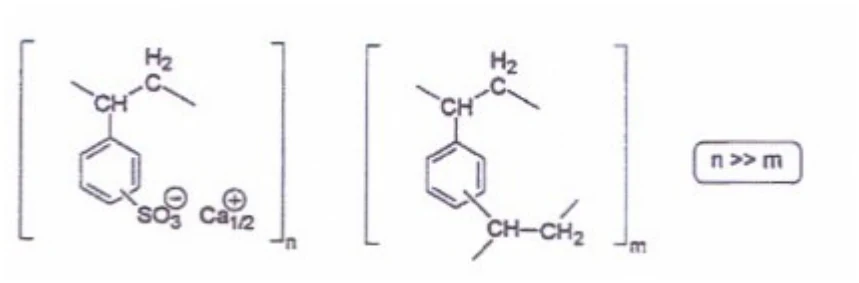
Chemical name: calcium polystyrene sulfonate
Molecular formula and molecular mass: [C8H7SO3Ca1/2]n [C10H10]m and 1017 - 1019 dalton
Structural formula:
Product Characteristics:
RESONIUM CALCIUM (calcium polystyrene sulfonate), is a solid substance, cream to light brown fine powder with vanilla odor.
RESONIUM CALCIUM bears the chemical name of cross-linked polystyrene calcium sulfonate.
RESONIUM CALCIUM is a sulfonic acid resin in the calcium phase containing about 8% calcium. Its average binding capacity is 1.6 mmol of potassium per gram of resin. This implies a binding of 96 mmol of potassium by a daily dose of 60 g RESONIUM CALCIUM. The sodium content of the anhydrous resin is not more than 1 mg per gram.
14 CLINICAL TRIALS
No data available.
15 MICROBIOLOGY
No microbiological information is required for this drug product.
16 NON-CLINICAL TOXICOLOGY
General Toxicology: Segal et al demonstrated that amberlite IR-4 (a general range of cation exchange resins), could be fed to rats for eight months without any adverse effects on their growth and well-being, except that on the 20% dietary resin regime the growth of male rats was slightly inhibited.
McChesney and McAuliff carried out a similar study with sulfonic acid resins at a 10% dietary level and found the growth of male rats, but not of females, was slightly inhibited. The male rats however, thrived on sodium resins which led McChesney and McAuliff to conclude that the inhibition was related to acidosis or sodium deprivation.
Symptoms indicative of sodium depletion (excessive weight loss and weakness) or of potassium depletion (muscle weakness, mental confusion and apathy) may occur without adequate biochemical control. No studies have been published carried out in healthy volunteers.