


Product Monograph - Tafinlar
Recent Major Label Changes
| 7 Warnings and Precautions, Endocrine and Metabolism | 05/2024 |
|---|
Table of Contents
Table of Contents ............................................................................................................... 2
Part 1: Healthcare Professional Information ................................................................. 4
1 Indications ................................................................................................................ 4
1.1 Pediatrics .............................................................................................................. 5
1.2 Geriatrics .............................................................................................................. 5
2 Contraindications ................................................................................................... 5
3 Serious Warnings and Precautions Box ............................................................. 6
4 Dosage and Administration .................................................................................. 6
4.1 Dosing Considerations .......................................................................................... 6
4.2 Recommended Dose and Dosage Adjustment ..................................................... 6
4.4 Administration .................................................................................................... 11
4.5 Missed Dose ....................................................................................................... 11
5 Overdose ................................................................................................................ 11
6 Dosage Forms, Strengths, Composition, and Packaging .............................. 12
7 Warning and Precautions .................................................................................... 12
7.1 Special Populations ............................................................................................. 21
7.1.1 Pregnancy ....................................................................................................... 21
7.1.2 Breastfeeding ................................................................................................. 22
7.1.3 Pediatrics ........................................................................................................ 22
7.1.4 Geriatrics ........................................................................................................ 22
8 Adverse Reactions ................................................................................................ 23
8.1 Adverse Reaction Overview ................................................................................ 23
8.2 Clinical Trial Adverse Reactions .......................................................................... 25
8.3 Less Common Clinical Trial Adverse Reactions ................................................... 37
8.4 Abnormal Laboratory Findings: Hematologic, Clinical Chemistry and Other Quantitative Data ........................................................................................................... 40
8.5 Post-Market Adverse Reactions ......................................................................... 44
9 Drug-Drug Interactions ........................................................................................ 45
9.1 Serious Drug Interactions ................................................................................... 45
9.2 Drug Interactions Overview ................................................................................ 45
9.4 Drug-Drug Interactions ....................................................................................... 45
9.5 Drug-Food Interactions ....................................................................................... 48
9.6 Drug-Herb Interactions ....................................................................................... 48
9.7 Drug-Laboratory Test Interactions ...................................................................... 48
10 Clinical Pharmacology ......................................................................................... 48
10.1 Mechanism of Action .......................................................................................... 48
10.2 Pharmacodynamics ............................................................................................ 49
10.3 Pharmacokinetics ............................................................................................... 50
11 Storage, Stability, and Disposal ......................................................................... 52
12 Special Handling Instructions ............................................................................ 52
Part 2: Scientific Information.......................................................................................... 53
13 Pharmaceutical Information ................................................................................ 53
14 Clinical Trials ......................................................................................................... 53
14.1 Clinical Trials by Indication ................................................................................. 53
Unresectable or Metastatic Melanoma - TAFINLAR Monotherapy ................................ 53
Unresectable or Metastatic Melanoma - TAFINLAR in Combination with Trametinib .... 59
Adjuvant Treatment of Melanoma – TAFINLAR in Combination with Trametinib .......... 64
Metastatic Non-Small Cell Lung Cancer (NSCLC) – TAFINLAR in Combination with Trametinib ...................................................................................................................... 68
Low-grade Glioma (LGG) and High-grade Glioma (HGG) – TAFINLAR in Combination with Trametinib ...................................................................................................................... 70
15 Microbiology .......................................................................................................... 75
16 Non-Clinical Toxicology ....................................................................................... 75
Patient Medication Information ..................................................................................... 77
Patient Medication Information ...................................................................................... 89
Part 1: Healthcare Professional Information
1 Indications
Unresectable or Metastatic Melanoma
TAFINLAR (dabrafenib mesylate) is indicated as a monotherapy, or in combination with trametinib, for:
- the treatment of patients with unresectable or metastatic melanoma with a BRAF V600 mutation.
TAFINLAR should not be used in patients with BRAF wild-type melanoma (see 7 General).
Effectiveness of TAFINLAR monotherapy is based on overall response rate (ORR) and progression-free survival (PFS) results. Prolongation of overall survival (OS) and improvement in quality-of-life has not been demonstrated (see 14 CLINICAL TRIALS).
Clinical data supporting the effectiveness of TAFINLAR monotherapy in patients with BRAF V600K mutations are limited, and clinical studies report fewer responses in BRAF V600K patients compared to BRAF V600E patients (see 14 CLINICAL TRIALS).
There are no clinical data for TAFINLAR in the treatment of patients with other less common BRAF V600 mutations.
TAFINLAR monotherapy has not been studied in patients previously treated with BRAF inhibitors.
TAFINLAR in combination with trametinib is not recommended in patients who have previously progressed on a BRAF inhibitor due to its limited efficacy in patients who progressed on TAFINLAR monotherapy (see 7 General).
Adjuvant Treatment of Melanoma
TAFINLAR (dabrafenib mesylate), in combination with trametinib, is indicated for:
- the adjuvant treatment of patients with melanoma with a BRAF V600 mutation and involvement of lymph node(s), following complete resection.
The indication is based on relapse-free survival (RFS) demonstrated in a randomized, placebo-controlled Phase III trial. Overall survival (OS) benefit has not been confirmed (see 14 CLINICAL TRIALS).
Clinical data supporting the effectiveness of TAFINLAR in combination with trametinib are limited to patients with BRAF V600E or BRAF V600K mutations. There are no clinical data for other less common BRAF V600 mutations.
Metastatic Non-Small Cell Lung Cancer (NSCLC)
TAFINLAR (dabrafenib mesylate) in combination with trametinib is indicated for:
- the treatment of patients with metastatic non-small cell lung cancer (NSCLC) with a BRAF V600 mutation.
TAFINLAR should not be used in patients with BRAF wild-type NSCLC (see 7 General).
Effectiveness is based on overall response rate (ORR). Prolongation of progression-free survival (PFS), overall survival (OS) and improvement in quality-of-life has not been demonstrated (see 14 CLINICAL TRIALS).
Clinical data supporting the effectiveness of TAFINLAR in combination with trametinib are limited to patients with a BRAF V600E mutation
Low-grade glioma (LGG) and High-grade glioma (HGG)
TAFINLAR (dabrafenib mesylate) in combination with trametinib is indicated for:
- the treatment of pediatric patients 1 year of age and older with low-grade glioma (LGG) with a BRAF V600E mutation who require systemic therapy (see 14 CLINICAL TRIALS).
- the treatment of pediatric patients 1 year of age and older with high-grade glioma (HGG) with a BRAF V600E mutation who have received at least one prior radiation and/or chemotherapy treatment (see 14 CLINICAL TRIALS).
TAFINLAR should not be used in patients with wild-type BRAF tumours or in patients where the BRAF mutational status is not known (see 7 General).
A validated test is required to identify the BRAF V600 mutation status to select patients appropriate for treatment with TAFINLAR as monotherapy and in combination with trametinib.
When TAFINLAR is used in combination with trametinib, see also the trametinib Product Monograph.
1.1 Pediatrics
Pediatrics (< 1 age): The safety and efficacy of TAFINLAR in combination with trametinib in pediatric patients with glioma <1 year of age and/or < 8 kg have not been established. TAFINLAR is not recommended in this age group (see 7.1.3 Pediatrics).
TAFINLAR is not indicated for pediatric patients (<18 years old) with melanoma or NSCLC.
1.2 Geriatrics
Geriatrics (≥ 65 years of age): In clinical studies in unresectable or metastatic melanoma, elderly patients (≥ 65 years) experienced more serious adverse events when taking TAFINLAR (see 7.1.4 Geriatrics).
2 Contraindications
TAFINLAR is contraindicated in patients who are hypersensitive to this drug or to any ingredient in the formulation, including any non-medicinal ingredient, or component of the container. For a complete listing, see 6 DOSAGE FORMS, STRENGTHS, COMPOSITION AND PACKAGING.
3 Serious Warnings and Precautions Box
TAFINLAR (dabrafenib mesylate) should be prescribed by a physician experienced in the administration of anti-cancer agents.
TAFINLAR is teratogenic and embryotoxic in animals (see 7.1.1 Pregnant Women).
TAFINLAR may decrease the efficacy of oral contraceptives (see 7.1.1 Pregnant Women).
TAFINLAR has not been studied in patients with moderate or severe hepatic impairment (see 7 Hepatotoxicity).
The following are significant adverse drug reactions identified in clinical trials conducted with TAFINLAR:
- Secondary malignancies (see 7 Carcinogenesis and Mutagenesis)
- Non-infectious febrile events (see 7 General)
In addition to the above events, the following are significant adverse drug reactions identified in clinical trials conducted with TAFINLAR in combination with Trametinib:
4 Dosage and Administration
4.1 Dosing Considerations
TAFINLAR is available in two dosage forms: capsules, and tablets for suspension. Capsules can be used for adult and pediatric patients who weigh at least 26 kg. Tablets for suspension can be used for patients who weigh at least 8 kg. The two dosage forms of TAFINLAR are not bioequivalent. Use caution if switching patients from one dosage form to the other.
Concomitant Use with CYP3A4 Inhibitors or Inducers: Avoid administering strong CYP3A4 inhibitors or inducers as they will alter (increase or decrease) the levels of dabrafenib and may lead to increased toxicities or reduced efficacy (see 7 General and 9.4 Drug-Drug Interactions).
Concomitant Use with CYP3A4 Substrates: Dabrafenib is a moderate to potent inducer of CYP3A4 and concomitant use of sensitive CYP3A4 substrates can result in loss of efficacy. Substitute for these medications or monitor patients for loss of efficacy if use of these medications in unavoidable (see 7 General and 9.4 Drug-Drug Interactions).
4.2 Recommended Dose and Dosage Adjustment
Recommended Dose
When using TAFINLAR in combination with trametinib, please refer to the trametinib Product Monograph for full dosing instructions.
Capsules
Adult patients
The recommended dose regimens of TAFINLAR capsules in adult patients are:
Monotherapy: 150 mg (two 75 mg capsules) given orally twice daily (corresponding to a total daily dose of 300 mg).
Combination with trametinib: 150 mg (two 75 mg capsules) given orally twice daily (corresponding to a total daily dose of 300 mg) with 2 mg of trametinib given orally once daily.
Pediatric patients
The recommended dosage for TAFINLAR capsules in pediatric patients who weigh at least 26 kg is based on body weight (Table 1). A recommended dose of TAFINLAR capsules for patients who weigh less than 26 kg has not been established.
Table 1 Recommended Dosage for TAFINLAR Capsules in Pediatric Patients
| Body weight (kg) | Recommended starting dosage |
|---|---|
| 26 to 37 kg | 75 mg orally twice daily |
| 38 to 50 kg | 100 mg orally twice daily |
| ≥51 kg | 150 mg orally twice daily |
Tablets for suspension
The recommended dosage for TAFINLAR tablets for suspension is based on body weight (Table 2).
Table 2 Recommended Dosage for TAFINLAR Tablets for Suspension
| Recommended Starting Dosage | ||||||
|---|---|---|---|---|---|---|
| Body weight (kg) | Daily Dose | Number of 10 mg tablets twice daily | ||||
| 8 to 9 kg | 20 mg twice daily | 2 | ||||
| 10 to 13 kg | 30 mg twice daily | 3 | ||||
| 14 to 17 kg | 40 mg twice daily | 4 | ||||
| 18 to 21 kg | 50 mg twice daily | 5 | ||||
| 22 to 25 kg | 60 mg twice daily | 6 | ||||
| 26 to 29 kg | 70 mg twice daily | 7 | ||||
| 30 to 33 kg | 80 mg twice daily | 8 | ||||
| 34 to 37 kg | 90 mg twice daily | 9 | ||||
| 38 to 41 kg | 100 mg twice daily | 10 | ||||
| 42 to 45 kg | 110 mg twice daily | 11 | ||||
| 46 to 50 kg | 130 mg twice daily | 13 | ||||
| ≥51 kg | 150 mg twice daily | 15 | ||||
Dose Modifications
The management of adverse reactions may require treatment interruption, dose reduction, or treatment discontinuation of TAFINLAR (see Table 3 to Table 6).
Dose modifications or interruptions are not recommended for adverse reactions of cutaneous squamous cell carcinoma (cuSCC) or new primary melanoma (see 7 Carcinogenesis and Mutagenesis).
Specific dose modifications and reductions for febrile related drug reactions and non-febrile related events as graded by the Common Terminology Criteria for Adverse Events (CTC-AE) are provided in Table 3. Dose reductions are listed in Tables 4 to 6. Dosing adjustments resulting in a TAFINLAR dose lower than 50 mg twice daily are not recommended and TAFINLAR should be permanently discontinued in these instances. When an individual’s adverse reactions are under effective management, dose re-escalation following the same dosing steps as de-escalation may be considered.
Table 3 Recommended Dose Modifications for TAFINLAR Monotherapy and for TAFINLAR and Trametinib Combination Therapy
| Adverse Reactiona | TAFINLAR |
|---|---|
| Adverse Reactiona | TAFINLAR |
| Cardiac | |
|
|
|
|
| Febrile Drug Reaction | |
|
|
|
|
| Cutaneous | |
|
|
|
|
| Ocular | |
|
|
|
|
| Abnormal weight gain (pediatric patients) | |
|
|
|
|
| Other | |
|
|
|
|
|
|
a The intensity of clinical adverse events (with the exception of febrile drug reactions) graded by the Common Terminology Criteria for Adverse Events (CTC-AE) v4.0
Recommended dose reductions for TAFINLAR capsules in adult patients are provided in Table 4.
Table 4 Recommended Dose Reductions for TAFINLAR Capsules in Adult Patients
| Dose Reductions for TAFINLAR | |
|---|---|
| First reduction | 100 mg twice daily (2 x 50 mg twice daily) |
| Second reduction | 75 mg twice daily (1 x 75 mg twice daily) |
| Third reduction | 50 mg twice daily (1 x 50 mg twice daily) |
| If unable to tolerate 50 mg twice daily | Discontinue TAFINLAR |
Recommended dose reductions for TAFINLAR capsules in pediatric patients are provided in Table 5.
Table 5 Recommended Dose Reductions for TAFINLAR Capsules in Pediatric Patients
| Dose Reduction | Recommended starting dosage | |||||
|---|---|---|---|---|---|---|
75 mg orally twice daily | 100 mg orally twice daily | 150 mg orally twice daily | ||||
| First dose reduction | 50 mg orally twice daily | 75 mg orally twice daily | 100 mg orally twice daily | |||
| Second dose reduction | - | 50 mg orally twice daily | 75 mg orally twice daily | |||
| Third dose reduction | - | - | 50 mg orally twice daily | |||
| Permanently discontinue if unable to tolerate maximum of three dose reductions or a TAFINLAR 50 mg capsule orally twice daily | ||||||
The recommended dose reductions for tablets for suspension are provided in Table 6.
Table 6 Recommended Dose Reductions for TAFINLAR Tablets for Suspension
| Recommended Starting Dosage | Dose Reductions | ||||||||||||
|---|---|---|---|---|---|---|---|---|---|---|---|---|---|
| Body weight (kg) | Daily Dose | Number of 10 mg tablets twice daily | First Reduction | Second Reduction | Third Reduction | ||||||||
| Number of 10 mg tablets twice daily | |||||||||||||
| 8 to 9 kg | 20 mg twice daily | 2 | 1 | - | - | ||||||||
| 10 to 13 kg | 30 mg twice daily | 3 | 2 | 1 | - | ||||||||
| 14 to 17 kg | 40 mg twice daily | 4 | 3 | 2 | 1 | ||||||||
| 18 to 21 kg | 50 mg twice daily | 5 | 3 | 2 | 1 | ||||||||
| 22 to 25 kg | 60 mg twice daily | 6 | 4 | 3 | 2 | ||||||||
| 26 to 29 kg | 70 mg twice daily | 7 | 5 | 4 | 2 | ||||||||
| 30 to 33 kg | 80 mg twice daily | 8 | 5 | 4 | 3 | ||||||||
| 34 to 37 kg | 90 mg twice daily | 9 | 6 | 5 | 3 | ||||||||
| 38 to 41 kg | 100 mg twice daily | 10 | 7 | 5 | 3 | ||||||||
| 42 to 45 kg | 110 mg twice daily | 11 | 7 | 6 | 4 | ||||||||
| 46 to 50 kg | 130 mg twice daily | 13 | 9 | 7 | 4 | ||||||||
| ≥51 kg | 150 mg twice daily | 15 | 10 | 8 | 5 | ||||||||
| Permanently discontinue if unable to tolerate a maximum of 3 dose reductions or TAFINLAR 10 mg tablet for suspension given orally twice daily. | |||||||||||||
Duration of treatment
Unresectable or metastatic melanoma and metastatic NSCLC
Treatment should continue until disease progression or the development of unacceptable toxicity (see Table 3).
Adjuvant treatment of melanoma
Treatment should continue for a period of 12 months. Discontinue treatment upon disease recurrence or unacceptable toxicity (see Table 3).
Low-grade glioma (LGG) and High-grade glioma (HGG)
Treatment should continue until disease progression or the development of unacceptable toxicity (see Table 3). There are limited data in patients older than 18 years of age with glioma, therefore continued treatment into adulthood should be based on benefits and risks to the individual patient as assessed by the health professional.
Special Populations:
Pediatrics (< 1 year of age): TAFINLAR is not indicated in the pediatric population less than 1 year of age (see 7.1.3 Pediatrics).
Geriatrics: No dose adjustment is required in patients over 65 years of age (see 10 Geriatrics).
Renal Impairment: No dose adjustment is required in patients with mild or moderate renal impairment. Based on the population pharmacokinetic analysis, mild and moderate renal impairment had no significant effect on the oral clearance of dabrafenib or on the concentrations of its metabolites (see 10 Renal Insufficiency). There are no clinical data in patients with severe renal impairment and the potential need for dose adjustment has not been determined. TAFINLAR should be used with caution in patients with severe renal impairment.
Hepatic Impairment: No dose adjustment is required in patients with mild hepatic impairment. Based on the population pharmacokinetic analysis, mild hepatic impairment had no significant effect on the oral clearance of dabrafenib or on the concentrations of its metabolites (see 10 Hepatic Insufficiency). There are no clinical data in patients with moderate to severe hepatic impairment and the potential need for dose adjustment has not been determined. Hepatic metabolism and biliary secretion are the primary routes of elimination of dabrafenib and its metabolites and patients with moderate to severe hepatic impairment may have increased exposure and increased toxicities.
4.4 Administration
TAFINLAR alone or in combination with trametinib should be taken without food at least one hour before, or at least two hours after a meal, leaving an interval of approximately 12 hours between doses (see 10.3 Pharmacokinetics). TAFINLAR should be taken at similar times every day.
If a patient vomits after taking TAFINLAR, the patient should not retake the dose and should take the next scheduled dose.
When TAFINLAR and trametinib are taken in combination, the once-daily dose of trametinib should be taken at the same time each day with either the morning dose or the evening dose of TAFINLAR.
Health professionals should regularly monitor the weight of pediatric patients to ensure that they are receiving the appropriate dose and confirm that patients or caregiver(s) understand how to administer the correct daily dose.
Capsules
TAFINLAR capsules should be swallowed whole with a full glass of water. The capsules must not be chewed or crushed.
Tablets for Suspension
TAFINLAR tablets for suspension are to be taken as a suspension only and should not be swallowed whole, chewed, or crushed.
The oral suspension should be prepared in the provided dosing cup. TAFINLAR tablets for suspension can be administered via drinking the suspension from the dosing cup, swallowing the suspension from an oral syringe, or receiving the suspension via feeding tube.
Care should be taken to ensure the entire dose is administered. It may take 3 minutes (or more) to fully suspend the tablets. Once they are dispersed, the suspension should be cloudy white.
Administer the suspension no later than 30 minutes after the tablets have been dispersed.
A complete illustrated set of instructions for the tablets for suspension is in the Patient Medication Information section.
4.5 Missed Dose
If a dose of TAFINLAR is missed, it should not be taken if it is less than 6 hours until the next dose.
5 Overdose
Symptoms and Signs
There is currently no experience with overdosage of TAFINLAR when used as either a monotherapy or in combination with trametinib.
Treatment
There is no specific antidote for overdosage of TAFINLAR. In case of suspected overdose, TAFINLAR should be withheld and supportive care instituted. Patients who develop adverse reactions should receive appropriate symptomatic treatment.
For the most recent information in the management of a suspected drug overdose, contact your regional poison control centre or Health Canada’s toll-free number, 1-844 POISON-X (1-844-764-7669).
6 Dosage Forms, Strengths, Composition, and Packaging
Table 7 Dosage Forms, Strengths, and Composition
Description
TAFINLAR 50 mg hard capsules are opaque, dark red capsules, monogrammed with ‘GS TEW’ and ’50 mg’. Bottles contain 120 capsules, and a silica gel desiccant.
TAFINLAR 75 mg hard capsules are opaque, dark pink capsules, monogrammed with ‘GS LHF’ and ’75 mg’. Bottles contain 120 capsules, and a silica gel desiccant.
TAFINLAR 10 mg tablets for suspension are white to slightly-yellow, round biconvex 6 mm tablets debossed with “D” on one side and “NVR” on the other. Bottles contain 210 tablets, and two silica gel desiccant canisters.
7 Warning and Precautions
Please see 3 Serious Warnings and Precautions Box.
When TAFINLAR is used in combination with trametinib, also consult the trametinib Product Monograph for important warnings and precautions for trametinib in regard to left ventricular dysfunction, retinal pigment epithelial detachment and retinal vein occlusion, interstitial lung disease, skin toxicity including serious cases, PR interval prolongation, hypertension, rhabdomyolysis and use in females, pediatrics and geriatrics.
General
| Route of Administration | Dosage Form / Strength / Composition | Non-medicinal Ingredients |
| Oral | Capsules 50 mg, 75 mg dabrafenib (as dabrafenib mesylate) | Colloidal silicon dioxide, magnesium stearate and microcrystalline cellulose. Capsule shells contain hypromellose, red iron oxide (E172) and titanium dioxide (E171). Monogramming ink contains black iron oxide, shellac and propylene glycol. |
| Oral | Tablets for suspension 10 mg dabrafenib (as dabrafenib mesylate) | Acesulfame potassium, artificial berry flavour, colloidal silicon dioxide (silica, colloidal anhydrous), crospovidone, hypromellose (hydroxypropyl methyl cellulose), magnesium stearate, mannitol, microcrystalline cellulose (cellulose, microcrystalline). |
BRAF V600 Testing: Confirmation of BRAF V600 mutation in a tumour biopsy using a validated test is required for selection of patients appropriate for treatment with TAFINLAR.
In vitro experiments have demonstrated paradoxical activation of MAP-kinase signalling in BRAF wild-type cells exposed to BRAF inhibitors. This may promote growth of wild-type BRAF melanomas or wild-type BRAF NSCLCs. New primary melanomas have been reported in patients taking TAFINLAR (see Carcinogenesis and Mutagenesis below). TAFINLAR should not be used in patients with wild-type BRAF tumours or in patients where the BRAF mutational status is not known.
Prior BRAF Inhibitory Therapy: TAFINLAR monotherapy has not been studied in patients previously treated with BRAF inhibitors.
The combination of TAFINLAR and trametinib demonstrated limited clinical activity in patients who had progressed on TAFINLAR monotherapy and is not recommended for patients who have progressed on a prior BRAF inhibitor. Of 43 patients in a phase I/II study who crossed over from TAFINLAR monotherapy to the combination of TAFINLAR plus trametinib following progression, only 9 % (95% CI: 2.6, 22.1) had an ORR and the median PFS was 3.6 months (95% CI: 1.8, 3.9).
Cytochrome P450 (CYP) Interactions: Dabrafenib is a moderate to strong in vivo inducer of CYP3A4, a weak in vivo inducer of CYP2C9 and may induce CYP2B6, CYP2C8, and CYP2C19. Medicinal products that are substrates for these CYPs, particularly those sensitive to induction, should be avoided, if possible. Dabrafenib is likely to increase their metabolism and in most cases decrease their clinical effectiveness. In cases where metabolites are the active agent, an increase in toxicities associated with these medicinal products may be observed.
Dabrafenib is primarily metabolized by CYP3A4 and CYP2C8. There is potential for a greater risk of drug-related reactions following co-administration of moderate to strong CYP3A4 and CYP2C8 inhibitors as they may increase the systemic exposure of dabrafenib and its active metabolites. There is potential for loss of efficacy following co-administration of strong CYP3A4 and CYP2C8 inducers as they may decrease the systemic exposure of dabrafenib and its active metabolites (see 9.4 Drug-Drug Interactions).
Pyrexia and Serious Non-Infectious Febrile Events: Pyrexia was reported in clinical trials with TAFINLAR, and typically first occurred within two months of initiating therapy. The incidence and severity of pyrexia are increased when TAFINLAR is used in combination with trametinib (see below and 8.2 Clinical Trial Adverse Reactions). Serious febrile drug reactions, which are defined as serious cases of fever including fever of any severity accompanied by severe rigors or chills, dehydration, hypotension or renal failure in the absence of another cause (e.g. infection), have occurred following treatment with TAFINLAR.
In the phase III study in unresectable or metastatic melanoma comparing TAFINLAR monotherapy to dacarbazine, serious febrile drug reactions occurred in 4.8% (9/187) of patients who received TAFINLAR monotherapy compared to no patients in the dacarbazine control arm. In this study, 12% (22/187) and 9% (17/187) of patients had their dose interrupted or reduced, respectively, due to febrile-related events. The median time to initial onset of febrile events was 3 weeks (range 0 to 54 weeks).
In the phase III study comparing TAFINLAR in combination with trametinib to TAFINLAR monotherapy in unresectable or metastatic melanoma, pyrexia occurred in 57% (119/209; 7% Grade 3) of patients who received combination therapy compared to 33% (69/211; 2% Grade 3) of patients treated with monotherapy. Serious febrile drug reactions occurred in 17% (35/209) of patients who received combination therapy compared to 7% (15/211) of patients treated with the monotherapy. The median time to initial onset of any (non-serious and serious) febrile event was 38 days (range: 1 to 716 days) and 20 days (range: 1 to 698 days) in patients receiving combination therapy and monotherapy, respectively. Thirty-one percent (64/209) of patients treated with the combination had 3 or more occurrences of pyrexia (any grade) compared to 7% (14/211) of patients treated with monotherapy. Permanent discontinuation of therapy due to pyrexia events was reported in 2% (4/209) of patients receiving combination therapy and in < 1% (2/211) of patients treated with monotherapy. Pyrexia events resulted in hospitalization in 14% of patients treated with the combination and in 5% of patients treated with monotherapy. In this study, the majority of patients in the combination therapy group with pyrexia required TAFINLAR dose modification to manage pyrexia events (dose interruption, dose reduction or permanent discontinuation). Compared to trametinib, approximately twice as many patients required TAFINLAR dose interruption, and approximately 5 times as many patients required TAFINLAR dose reduction, to manage events of pyrexia in the combination therapy group.
A higher percentage of patients treated with the combination (41%, 86/209) received medication for treatment of pyrexia than patients treated with the monotherapy (24%, 51/211). More patients receiving combination therapy (22%, 46/209) were also administered medications for secondary prophylactic treatment of pyrexia than patients receiving the monotherapy (9%, 19/211). Corticosteroids were used to manage pyrexia in 29% (61/209) of patients treated with the combination and 22% (47/211) of patients treated with monotherapy TAFINLAR. The median duration of corticosteroid use was approximately twice as long in patients treated with the combination (29 vs. 12 days).
In a phase III trial in the adjuvant treatment of melanoma, the incidence and severity of pyrexia (including influenza like illness, body temperature increased, hyperpyrexia and systemic inflammatory response syndrome) were higher in the TAFINLAR in combination with trametinib arm (67% (292/435); 6% Grade 3/4) compared to the placebo arm (15% (66/432); <1% Grade 3). The median time to onset was 23 days with the combination, with a median duration of 3 days.
In the NSCLC phase II study, pyrexia occurred in 57% (53/93; 5% Grade 3) of patients. The median time to onset of first occurrence of fever was 22 days (range: 3 days to 416 days) and the median duration of fever was 3.5 days (range: 1 to 33 days).
In a pooled safety population of pediatric patients receiving TAFINLAR in combination with trametinib (n=171), pyrexia was reported in 67% of patients.
Monitor serum creatinine and other evidence of renal function during and following severe events of pyrexia. Interrupt therapy (TAFINLAR when used in monotherapy, or both TAFINLAR and trametinib when used in combination) if the patient’s temperature is ≥ 38°C or for any serious febrile drug reaction. In case of recurrence, therapy can also be interrupted at the first symptom of pyrexia. Initiate treatment with anti-pyretics and evaluate patients for signs and symptoms of infection. The use of oral corticosteroids should be considered in those instances in which anti-pyretics are insufficient.
Resume therapy (TAFINLAR monotherapy, or both TAFINLAR and trametinib when used in combination) at the recommended daily dose if patient is symptom free of grade 1 and grade 2 fevers (38-40°C) for at least 24 hours. Reduce the dose if recurrent pyrexia cannot be managed with interruption or corticosteroids.
If patient is symptom free for at least 24 hours of fevers > 40.0°C or fevers associated with other severe signs or symptoms and a decision is made to restart therapy (TAFINLAR when used in monotherapy or both TAFINLAR and trametinib when used in combination), the dose should be reduced according to dose modification protocols (see 4.2 Recommended Dose and Dosage Adjustment).
Brain Metastases: The safety and efficacy of the combination of TAFINLAR and trametinib has not been evaluated in patients with a BRAF V600 mutation-positive melanoma or NSCLC which has metastasized to the brain. Three patients who developed brain metastases while on treatment with TAFINLAR in combination with trametinib in melanoma phase III trials experienced fatal cerebral hemorrhage (see 7 Hematologic).
Carcinogenesis and Mutagenesis
Cutaneous malignancies
Cutaneous Squamous Cell Carcinoma (CuSCC): Cases of cuSCC (which include those classified as keratoacanthoma or mixed keratoacanthoma subtype) have been reported in patients treated with TAFINLAR (see 8.2 Clinical Trial Adverse Reactions).
CuSCC occurred in 11% (86/797) of patients in the overall1 TAFINLAR adult monotherapy population. In a pivotal phase III monotherapy study in unresectable or metastatic melanoma, cuSCC occurred in 9% of patients treated with TAFINLAR, and in no patients treated with dacarbazine (see 8.2 Clinical Trial Adverse Reactions). In the phase III combination study in unresectable or metastatic melanoma, cuSCC occurred in 3% (6/209) of patients receiving combination treatment with trametinib, compared to 10% (22/211) of patients receiving TAFINLAR monotherapy. In the study, the median time to onset of the first occurrence of cuSCC was 223 days for patients receiving combination therapy, and 60 days for patients in the monotherapy arm. All patients treated with monotherapy or combination therapy with trametinib who developed cuSCC continued on treatment without dose modification. Amongst the patients with cuSCC, 67% (4/6) of patients receiving combination treatment with trametinib, and 32% (7/22) of patients receiving TAFINLAR monotherapy, developed subsequent lesions.
In a phase III trial in the adjuvant treatment of melanoma, 1% (6/435) of patients receiving TAFINLAR in combination with trametinib developed cuSCC compared to 1% (5/432) of patients receiving placebo. The median time to onset of the first occurrence of cuSCC in the combination arm was approximately 18 weeks.
In the NSCLC phase II study, 3% (3/93) of patients who received TAFINLAR in combination with trametinib developed cuSCC.
In clinical trials in adult patients receiving TAFINLAR in combination with trametinib, the incidence of cuSCC was 2% (15/737).
In a pooled safety population of pediatric patients receiving TAFINLAR in combination with trametinib, no cases of cuSCC were reported.
Skin examination should be performed prior to initiation of TAFINLAR and every 2 months during treatment with TAFINLAR. Monitoring should continue every 2 to 3 months for 6 months
1 The overall monotherapy population includes integrated safety population of 586 patients with unresectable or metastatic melanoma and the monotherapy arm patients (N=211) of the phase III combination treatment study in unresectable or metastatic melanoma.
following discontinuation of TAFINLAR.
Cases of cuSCC should be managed by dermatological excision and TAFINLAR treatment can be continued without any dose adjustment. Patients should be instructed to immediately inform their health professional if new lesions develop.
New Primary Melanoma: New primary melanomas were reported in 1% (11/797) of the overall TAFINLAR adult monotherapy population. In the phase III study comparing TAFINLAR to dacarbazine in unresectable or metastatic melanoma, new primary melanomas were reported in 2% (4/187) of patients treated with TAFINLAR monotherapy and in no patients treated with dacarbazine (see 8.2 Clinical Trial Adverse Reactions). In the phase III combination study in unresectable or metastatic melanoma, new primary melanomas were reported in < 1% (1/209) of patients treated with combination treatment with trametinib and in 2% (4/211) of patients receiving TAFINLAR monotherapy. In the phase III clinical trial in the adjuvant treatment of melanoma, new primary melanomas occurred in < 1% (1/435) of patients receiving the combination of TAFINLAR and trametinib as opposed to 1% (6/432) of patients receiving placebo.
Across clinical trials in adult patients, new primary melanomas were reported in 1% (11/797) of patients receiving TAFINLAR monotherapy and in <1% (2/644) of patients receiving combination therapy.
In a pooled safety population of pediatric patients receiving TAFINLAR in combination with trametinib, new primary melanoma occurred in < 1% (1/171) of patients.
Perform dermatologic monitoring as recommended for cuSCC above.
Non-cutaneous malignancies
The paradoxical activation of MAP-kinase signalling in BRAF wild-type cells exposed to BRAF inhibitors may lead to increased risk of non-cutaneous malignancies, including those with RAS mutations, in patients treated with TAFINLAR. In clinical trials, cases of RAS-associated malignancies have been reported including colorectal adenocarcinoma, bile duct adenocarcinoma and pancreatic adenocarcinoma, which have resulted in discontinuation of TAFINLAR.
Across clinical trials in adult patients, the incidence of non-cutaneous malignancies was lower in patients receiving combination therapy (1%, 9/737) or placebo (<1%, 3/432) than in patients receiving TAFINLAR monotherapy (3%, 10/398).
In a pooled safety population of pediatric patients receiving TAFINLAR in combination with trametinib (n=171), no cases of non-cutaneous malignancies were reported.
Evaluate patients for symptoms or clinical signs of non-cutaneous malignancies before initiation of treatment, periodically during treatment, or as clinically indicated. Consider the benefits and risks before continuing treatment with TAFINLAR in patients with a non-cutaneous malignancy that has a RAS mutation. No dose modification of trametinib is required when taken in combination with TAFINLAR.
Following discontinuation of TAFINLAR, monitoring for non-cutaneous malignancies should continue for up to 6 months. Abnormal findings should be managed according to clinical practices.
Cardiovascular
Valve Abnormalities: Patients were excluded from clinical studies of TAFINLAR if they had abnormal valve morphology of ≥ grade 2. Right sided heart valve defects were reported in one of 10 dogs treated with 50 mg/kg/day dabrafenib at > 5 times human clinical exposure (see 16
General Toxicology).
Worsening of baseline valve disease resulting in permanent discontinuation was reported in < 1% of patients (1/797) in the overall TAFINLAR monotherapy population.
QTc Prolongation: Patients were excluded from clinical studies of TAFINLAR if they had a baseline QTc of ≥ 480 msec. Particular care should be exercised when administering TAFINLAR to patients who are suspected to be at an increased risk of experiencing torsade de pointes (see 10.2 Pharmacodynamics).
Venous Thromboembolism: Fatal venous thromboembolism (VTE) events, including deep vein thrombosis (DVT) and pulmonary embolism (PE), have occurred when TAFINLAR was used in combination with trametinib.
Across clinical trials in adult patients, the incidence of DVT and/or PE was higher in patients receiving combination therapy (3%, 29/941) than in patients receiving TAFINLAR monotherapy (< 1%; 2/211).
In a pooled safety population of pediatric patients receiving TAFINLAR in combination with trametinib, one case of embolism was reported (1/171 patients; <1%).
If patients develop symptoms of PE or DVT such as shortness of breath, chest pain, or arm or leg swelling, they should immediately seek medical care.
Endocrine and Metabolism
Hyperglycaemia: Grade 3 elevations of hyperglycaemia based on laboratory values were reported in 5% (39/797) of adult patients treated with TAFINLAR monotherapy; in addition, 1 subject reported a Grade 4 elevation. In a phase III combination study in patients with unresectable or metastatic melanoma, a higher percentage of patients receiving TAFINLAR and trametinib combination therapy (7%, 15/209) had hyperglycaemia adverse events than patients receiving monotherapy (3%, 7/211). In this study, 2% (5/209) of patients in the combination arm reported Grade 3 events compared to < 1% (1/211) in the monotherapy arm. In addition, there was 1 subject with Grade 4 hyperglycaemia in the combination arm, compared to no Grade 4 cases in the monotherapy arm. All subjects with hyperglycaemia events in both treatment arms continued dosing. Four of 15 patients with a history of diabetes receiving TAFINLAR in combination with trametinib, and 2 of 16 patients with a history of diabetes receiving monotherapy, required more intensive hypoglycaemic therapy in this study.
In a pooled safety population of pediatric patients receiving TAFINLAR in combination with trametinib (n=171), Grade 3 and Grade 4 hyperglycemia events occurred in < 1% of patients.
Monitor glucose regularly in patients with diabetes or hyperglycaemia and adjust anti-diabetic treatments accordingly. Advise patients to report symptoms of severe hyperglycaemia such as excessive thirst or any increase in the volume or frequency of urination.
Tumour Lysis Syndrome (TLS): Post-marketing cases of TLS, including fatal cases, have been reported in patients treated with TAFINLAR (dabrafenib) in combination with trametinib. Risk factors for TLS include high tumour burden, pre‑existing chronic renal insufficiency, oliguria, dehydration, hypotension, and acidic urine. Patients with risk factors for TLS should be closely monitored and prophylactic hydration should be considered. TLS should be treated promptly, as clinically indicated.
Hematologic
Hemorrhage: An increase in bleeding events including major hemorrhagic events (defined as symptomatic bleeding in a critical site, and fatal intracranial hemorrhages), have been reported when TAFINLAR is used in combination with trametinib.
In a phase I/II study in unresectable or metastatic melanoma, bleeding events (any grade) were reported in 31% (17/55) of patients treated with combination therapy, compared to 6% (3/53) treated with single agent TAFINLAR. Intracranial hemorrhage occurred in 5% (3/55) of patients in the combination arm, and was fatal in two patients (4%). Gastrointestinal hemorrhage occurred in 7% (4/55) of patients in the combination arm; none of the events were fatal. No intracranial or gastrointestinal hemorrhage was reported in the monotherapy arm. In a phase III study in unresectable or metastatic melanoma, bleeding events (any grade) were reported in 19% (40/209) of patients treated with combination therapy compared to 15% (32/211) of patients receiving TAFINLAR monotherapy. Intracranial hemorrhage was fatal in 1% (3/209) of patients in the study treated with combination therapy. Gastrointestinal hemorrhage occurred in 6% (12/209) of patients in the combination arm; none of the events were fatal. Gastrointestinal hemorrhage occurred in 3% (6/211) of patients in the TAFINLAR monotherapy arm; none of the events were fatal. No intracranial hemorrhage was reported in the monotherapy arm.
In the melanoma phase III trial in unresectable or metastatic melanoma, 6 patients (1%) taking TAFINLAR in combination with trametinib experienced fatal cerebral hemorrhage, including 2 who were taking anticoagulants and 3 who had developed brain metastases. The risk for serious hemorrhagic events in patients with unstable and/or symptomatic brain metastases or low platelets (< 75,000) is not established, as patients with these conditions were excluded from clinical trials. The risk of hemorrhage may be increased with concomitant use of antiplatelet or anticoagulant therapy or in patients who develop brain metastases while on treatment.
No fatal hemorrhagic events occurred in the phase III study in the adjuvant treatment of melanoma.
In the NSCLC phase II study, the incidence of hemorrhagic events in patients receiving TAFINLAR in combination with trametinib was 26% (24/93). Fatal hemorrhagic events occurred in 2% (2/93) of patients receiving TAFINLAR in combination with trametinib, one with retroperitoneal hemorrhage and one with subarachnoid hemorrhage.
In a pooled safety population of pediatric patients receiving TAFINLAR in combination with trametinib (n=171), hemorrhagic events occurred in 25% of patients; the most common type of bleeding was epistaxis (16%). Serious events of bleeding occurred in 3.6% of patients and included gastrointestinal hemorrhage (1.2%), cerebral hemorrhage (0.6%) uterine hemorrhage (0.6%), post-procedural hemorrhage (0.6%) and epistaxis (0.6%).
If hemorrhage occurs, patients should be treated as clinically indicated. Patients should be advised to seek immediate medical care if they develop symptoms of hemorrhage.
Cerebral hemorrhage (including fatal cases) associated with TAFINLAR in combination with trametinib were reported in clinical trials and during post-marketing use.
Neutropenia: Neutropenia as an adverse event, including Grade 3 or 4 occurrences, has been reported in association with the combination of TAFINLAR and trametinib in both adult and pediatric patients. Patients receiving the combination therapy should have their complete blood counts determined at baseline and periodically on treatment (see Monitoring and Laboratory Tests).
Hepatic/Biliary/Pancreatic
Hepatotoxicity: Hepatic adverse events have been reported when TAFINLAR is used in combination with trametinib (see 8.2 Clinical Trial Adverse Reactions).
Across several large trials in patients treated with the combination of TAFINLAR and trametinib, hepatic adverse events were reported in 20% (150/737) of adult patients and in 20% (35/171) of pediatric patients.
Pancreatitis: Cases of pancreatitis have been reported in the overall TAFINLAR adult monotherapy melanoma population (< 1%, 3/797 patients) and in the post-marketing setting, generally occurring soon after initiation of TAFINLAR. One of the events occurred on the first day of dosing of a patient and recurred following re-treatment at a reduced dose.
Across several large trials in patients treated with the combination of TAFINLAR and trametinib, pancreatitis was reported in 1% (12/941) of adult patients and in 1% (2/171) of pediatric patients.
Unexplained abdominal pain should be promptly investigated to include measurement of serum amylase and lipase. Patients should interrupt dosing and should be closely monitored if re-starting TAFINLAR after an episode of pancreatitis.
Immune
Sarcoidosis: Cases of sarcoidosis have been reported in patients treated with TAFINLAR in combination with trametinib, mostly involving the skin, lung, eye and lymph nodes. In the majority of the cases, treatment with TAFINLAR and trametinib was maintained. In case of a diagnosis of sarcoidosis, relevant treatment should be considered. It is important not to misinterpret sarcoidosis as disease progression.
Haemophagocytic lymphohistiocytosis (HLH): In post-marketing experience, HLH has been observed with TAFINLAR in combination with trametinib. Patients should be closely monitored. If HLH is suspected, treatment should be interrupted. If HLH is confirmed, treatment should be discontinued and appropriate management of HLH should be initiated.
Monitoring and Laboratory Tests
Before taking TAFINLAR, confirmation of the existence of a BRAF V600 mutation in a tumour specimen is required, using a validated test.
Before taking TAFINLAR, at every 2 months during therapy and every 2 to 3 months for 6 months after discontinuation, patients should be monitored for cuSCC and new primary melanomas. Monitor for non-cutaneous malignancies as clinically appropriate.
A thorough ophthalmological evaluation should be performed at baseline, if clinically warranted.Patients should also be monitored for eye disorders including visual disturbances during therapy.
Electrolytes (including phosphate) and glucose determinations should be performed at baseline and periodically while on TAFINLAR therapy. Glucose should be monitored more often in patients with pre-existing diabetes or hyperglycaemia.
Blood pressure should be measured at baseline and periodically during treatment (see 10.2 Pharmacodynamics).
Monitor serum creatinine and other evidence of renal function routinely during treatment and in events of severe pyrexia.
Monitor uric acid levels and electrolytes in patients receiving treatment with TAFINLAR in combination with trametinib, especially in those patients at high risk of Tumour Lysis Syndrome.
Monitor patients receiving TAFINLAR in combination with trametinib carefully for bleeding events and neurologic symptoms.
Patients receiving the combination therapy should have their complete blood counts determined at baseline and periodically on treatment.
Monitor liver function in patients receiving treatment with TAFINLAR in combination with trametinib approximately every 4 weeks for 6 months after treatment initiation of this combination therapy. Liver monitoring may be continued thereafter as clinically indicated during therapy.
Monitor body weight and growth of pediatric patients receiving TAFINLAR in combination with trametinib.
Ophthalmologic
Uveitis: Ophthalmologic reactions, most notable uveitis (including iritis), have been reported in patients treated with TAFINLAR. The severity of uveitis is increased when TAFINLAR is used in combination with trametinib (see below and 8.2 Clinical Trial Adverse Reactions). Uveitis was observed in 1% (11/797) of patients in the overall TAFINLAR adult monotherapy population. All cases reported were Grade 1 or 2. Uveitis was reported in 2% (9/559) of patients treated with the combination of TAFINLAR and trametinib in a large phase III clinical trial population in unresectable or metastatic melanoma. The 9 patients experienced 10 events; four events were Grade 3.
In a pooled safety population of pediatric patients receiving TAFINLAR in combination with trametinib (n=171), uveitis occurred in 5 patients (3%).
Cases of biocular panuveitis or biocular iridocyclitis suggestive of Vogt-Koyanagi-Harada-like syndrome have been reported in patients treated with TAFINLAR in combination with trametinib. Systemic corticosteroid treatment can be considered in such cases.
Monitor patients for visual signs and symptoms (such as change in vision, photophobia, and eye pain) during therapy and withhold TAFINLAR (and trametinib when used in combination therapy) in patients with uveitis whose symptoms do not improve despite local ocular therapy (see 4.2 Recommended Dose and Dosage Adjustment).
Renal
Renal Failure: Renal failure was reported in 1.5% of patients in the overall TAFINLAR adult monotherapy population (12/797). Renal failure was associated with pyrexia and/or dehydration in 4 of 12 cases. In clinical trials in adult patients receiving TAFINLAR in combination with trametinib, renal failure was reported in 13/357 (3.6%) of patients.
Renal failure was associated with pyrexia and/or dehydration in 5 of the 8 cases in one study (n=209). In this study, 2 patients in the combination therapy arm and no patients in the TAFINLAR monotherapy arm reported Grade 3 events of increased blood creatinine and nephritis (including 1 case (0.5%, 1/209) of granulomatous/interstitial nephritis). In the phase II
NSCLC study, Grade 3 renal failure was reported in one patient, Grade 3 increased blood creatinine was reported in one patient, and Grade 3 tubulointerstitial nephritis was reported in 2% (2/93) of patients. Granulomatous/tubulointerstitial nephritis been reported in one (< 1%) patient in a clinical study with TAFINLAR monotherapy. Granulomatous/tubulointerstitial nephritis has also been reported in the post-marketing setting with TAFINLAR monotherapy and TAFINLAR in combination with trametinib (see 8 ADVERSE REACTIONS).
In a pooled safety population of pediatric patients receiving TAFINLAR in combination with trametinib (n=171), no cases of pre-renal or intrinsic renal failure were reported.
Monitor serum creatinine and other evidence of renal function routinely during treatment and in events of severe pyrexia.
Reproductive Health
Reproduction: Male patients (including those who have had a vasectomy) with sexual partners who are pregnant, or are of childbearing potential should use condoms during sexual intercourse while taking TAFINLAR and for at least 2 weeks following discontinuation of treatment and at least 16 weeks following the last dose of trametinib when taken in combination with TAFINLAR.
Women of childbearing potential should use effective methods of contraception during therapy (methods that result in less than 1% pregnancy rates) and for 2 weeks following discontinuation of TAFINLAR and at least 16 weeks following the last dose of trametinib when taken in combination with TAFINLAR. Dabrafenib is likely to decrease the efficacy of oral or any systemic hormonal contraceptives and effective alternative methods of contraception should be used (see 9 Effect of Dabrafenib on Other Drugs).
If TAFINLAR is used during pregnancy, or if the patient becomes pregnant while taking TAFINLAR, the patient should be advised of the potential risk to the foetus.
Fertility: There are no fertility data in humans. Adverse effects of dabrafenib on male reproductive organs have been seen in animals (see 16 Reproductive and Developmental Toxicity). Male patients should be informed of the potential risk for impaired spermatogenesis, which may be irreversible.
Skin
Severe cutaneous adverse reactions: Cases of severe cutaneous adverse reactions (SCARs), including Stevens-Johnson syndrome (SJS) and drug reaction with eosinophilia and systemic symptoms (DRESS), which can be life-threatening or fatal, have been reported during treatment with TAFINLAR in combination with trametinib. Before initiating treatment, patients should be advised of the signs and symptoms and monitored closely for skin reactions. If signs and symptoms suggestive of SCARs appear, TAFINLAR and trametinib should be withdrawn.
7.1 Special Populations
7.1.1 Pregnancy
TAFINLAR should not be administered to pregnant women. Dabrafenib may cause foetal harm by interfering with BRAF function, which is essential for the developing embryo. There are no adequate and well-controlled studies of TAFINLAR in pregnant women (see 7 Reproductive
Health: Female and Male Potential). Dabrafenib caused reproductive toxicity and teratogenicity in rats (see 16 Reproductive and Developmental Toxicity).
7.1.2 Breastfeeding
No studies have been conducted with TAFINLAR in nursing mothers. TAFINLAR should not be used by nursing women. It is not known whether dabrafenib is transferred into human milk. Because many drugs are transferred into human milk, and because of the potential for serious adverse reactions from dabrafenib in nursing infants, a decision should be made whether to discontinue nursing or discontinue the drug, taking into account the importance of the drug to the mother.
7.1.3 Pediatrics
Pediatrics (< 1 year of age): The safety and efficacy of TAFINLAR in pediatric patients <1 year of age have not been established. TAFINLAR is not recommended in this age group.
Pediatrics (≥ 1 year to <18 years of age):
The safety and efficacy of TAFINLAR in combination with trametinib in pediatric patients 1 year of age and older with low-grade glioma are supported by evidence from the randomized LGG cohort of the G2201 study (N=73).
The safety and efficacy of TAFINLAR in combination with trametinib in pediatric patients 1 year of age and older with high-grade glioma are supported by evidence from the single-arm HGG cohort of the G2201 study (N=41).
The warnings applicable to adults are also relevant to pediatric use.
Adverse drug reactions occurring at a higher frequency category in a pooled safety population of pediatric patients (N=171) compared to adult patients were neutropenia, dermatitis acneiform, paronychia, anaemia, leukopenia (very common); bradycardia, dermatitis exfoliative generalised, hypersensitivity and pancreatitis (common).
Weight increase has only been reported in the pediatric population. It was reported as an adverse reaction in 16.4% of pediatric patients, including Grade 3 cases in 5.3% of patients, with a discontinuation rate of 0.6% of patients. The median time to onset of the first occurrence of the reported weight increase in pediatric patients receiving dabrafenib in combination with trametinib was 3.5 months. Weight increase from baseline of ≥2 BMI (body mass index)-for-age percentile categories was observed in 35.7% of patients.
Please refer to pediatric Adverse Events Tables 12 and 13
Studies in juvenile animals have shown adverse effects, including effects on growth and renal toxicity, which had not been observed in adult animals (see 16 Juvenile Toxicity).
7.1.4 Geriatrics
Geriatrics (≥ 65 years of age): Of the total number of patients in clinical studies of TAFINLAR monotherapy (N = 797), 23% were 65 years of age and older, and 6% were 75 years of age and older. Compared with younger patients (< 65 years), more patients ≥ 65 years old had adverse events that led to dabrafenib dose reductions (23% versus 14%) or interruptions (46% versus 30%). In addition, older patients experienced more serious adverse events compared to younger patients (46% versus 27%).
Of the number of patients in a phase III clinical study in unresectable or metastatic melanoma receiving TAFINLAR in combination with trametinib (N = 209), 56 patients (27%) were 65 years of age and older, and 11 patients (5%) were 75 years of age and older. Compared with younger patients (< 65 years), more patients ≥ 65 years old had adverse events that led to dose reductions (43% versus 23%) or interruptions (66% versus 53%) of therapy with TAFINLAR or trametinib. In addition, older patients experienced more serious adverse events compared to younger patients (59% versus 36%). The incidences of peripheral oedema in the combination (34% vs. 16%) and monotherapy arms (18% vs. 5%) and of decreased appetite in the combination (21% vs. 9%) and monotherapy arms (15% vs. 13%) were more frequent in patients ≥ 65 years than in patients < 65 years, respectively.
Of the 435 patients who received TAFINLAR plus trametinib in the combination phase III study in the adjuvant treatment of melanoma, 85 patients (20%) were aged 65 years and older and 12 patients (3%) were aged 75 years and older. No overall differences in the effectiveness or safety of TAFINLAR plus trametinib were observed in elderly patients compared to younger patients.
8 Adverse Reactions
8.1 Adverse Reaction Overview
Unresectable or Metastatic Melanoma - TAFINLAR Monotherapy
The safety of TAFINLAR monotherapy was evaluated in an integrated safety population of 586 patients with BRAF V600-mutant unresectable or metastatic melanoma, with a median duration of treatment of 5.5 months (range 0 to 23 months). Approximately 46% of patients received treatment with TAFINLAR for more than 6 months.
The most common adverse drug reactions (≥ 15%) of any grade for TAFINLAR in either the overall monotherapy safety population or the phase III pivotal study comparing TAFINLAR to dacarbazine in unresectable or metastatic melanoma, include hyperkeratosis, headache, pyrexia, palmar-plantar erythrodysaesthesia (PPE), arthralgia, fatigue, nausea, skin papilloma, alopecia, and rash.
Unresectable or Metastatic Melanoma - TAFINLAR in Combination with Trametinib
The safety of TAFINLAR in combination with trametinib was evaluated in a multicentre, randomized phase III study (MEK115306) in a safety population of 209 patients with unresectable or metastatic melanoma. In this study, approximately 71% of patients received treatment with TAFINLAR and trametinib for more than 6 months. The median durations of treatment in the combination and monotherapy arms were 11 and 8 months, respectively.
A higher percentage of patients had AEs leading to permanent discontinuation of study treatment in the combination therapy arm of the MEK115306 study (11%) than in the monotherapy arm (7%). The percentage of patients with AEs leading to dose interruptions and dose reductions was also higher in the combination therapy arm than with TAFINLAR monotherapy. Fifty six percent (56%) and 28% of patients receiving the combination therapy had dose interruptions and reductions, respectively, compared to 37% and 14% of patients treated with the monotherapy.
Adjuvant Treatment of Melanoma - TAFINLAR in Combination with Trametinib
The safety of TAFINLAR in combination with trametinib has been evaluated in a phase III, randomized, double-blind study of TAFINLAR in combination with trametinib versus two placebos in the adjuvant treatment of Stage III BRAF V600 mutation-positive melanoma after surgical resection. The median duration of exposure was 11 months for dabrafenib and trametinib and 10 months for the placebo arm. The majority of patients had > 6 to 12 months of exposure to dabrafenib (71%) and trametinib (72%), respectively.
In the TAFINLAR 150 mg twice daily and trametinib 2 mg once daily arm, the most common adverse reactions (≥ 20%) were pyrexia, fatigue, nausea, headache, rash, chills, diarrhoea, vomiting, arthralgia and myalgia. The most common serious adverse reactions (≥ 1%) were pyrexia, chills, ejection fraction decreased, erysipelas, hypotension, cellulitis and chorioretinopathy.
Adverse reactions resulting in the permanent discontinuation of TAFINLAR in combination with trametinib occurred in 26% of patients. Adverse reactions leading to dose interruptions or reductions of TAFINLAR in combination with trametinib occurred in 66% and 38% of patients, respectively.
Female patients treated with combination therapy had higher incidences of treatment-related adverse events (95% vs. 88%) and treatment-related serious adverse events (31% vs. 24%), corresponding to more dose reductions (45% vs. 33%), dose interruptions (70% vs. 64%), and adverse events leading to discontinuation (32% vs. 22%) compared to male patients. No differences in the pattern of adverse events or the overall incidence of adverse events (females: 98% vs. males: 96%) were observed between genders.
Metastatic Non-Small Cell Lung Cancer - TAFINLAR in Combination with Trametinib
The safety of TAFINLAR in combination with trametinib was also evaluated in a phase II, multi-centre, multi-cohort, non-randomised, open-label study of patients with BRAF V600E mutation-positive metastatic NSCLC. Patients (N = 93) had a median exposure to TAFINLAR of 8.5 months (range: 0.3-31.6 months), with 62% of patients receiving treatment with TAFINLAR and trametinib for more than 6 months.
The most common adverse drug reactions (≥ 20%) reported in patients with NSCLC who received TAFINLAR in combination with trametinib were pyrexia, asthenia, nausea, vomiting, oedema peripheral, diarrhoea, dry skin, rash, decreased appetite, hemorrhage and chills.
The most common serious adverse drug reactions (≥2%) reported in patients with NSCLC who received TAFINLAR in combination with trametinib were pyrexia, ejection fraction decreased, alanine aminotransferase increased, aspartate aminotransferase increased, hypotension, vomiting, anaemia, nausea, abdominal pain, asthenia, back pain, blood alkaline phosphatase increased, chills, confusional state, decreased appetite, dehydration, diarrhoea, dyspnoea, haemoptysis, hypercalcaemia, lung infection, pulmonary embolism, renal failure, respiratory distress, squamous cell carcinoma of skin and tubulointerstitial nephritis.
Twenty percent (20%) of NSCLC patients treated with the TAFINLAR and trametinib combination had AEs leading to permanent discontinuation of study treatment. The percentage of patients with AEs leading to dose interruptions and dose reductions was 67% and 35%, respectively.
Low-grade Glioma and High-grade Glioma – TAFINLAR in combination with Trametinib
The safety of TAFINLAR in combination with trametinib was studied in 171 pediatric patients across two studies (G2201 and X2101) with BRAF V600E mutation-positive advanced solid tumours of which 118 patients had a BRAF mutation-positive low-grade glioma (WHO Grades 1 and 2), 41 patients had a BRAF mutation-positive high-grade glioma (WHO Grades 3 and 4) and 12 had Langerhans Cell Histiocytosis.
Of these 171 pediatric patients, 4 (2.3%) patients were 1 to <2 years of age, 39 (22.8%) patients were 2 to <6 years of age, 54 (31.6%) patients were 6 to <12 years of age, and 74 (43.3%) patients were 12 to <18 years of age.
The overall safety profile in the pediatric population was similar to the safety profile observed in adults. The most frequently reported adverse drug reactions (≥20%) were pyrexia, rash, headache, vomiting, musculoskeletal pain, dry skin, fatigue, diarrhoea, hemorrhage, neutropenia, nausea, dermatitis acneiform, abdominal pain, cough and transaminases increased.
An adverse drug reaction of weight increased was identified in the pediatric safety pool with a frequency of 16%. Sixty one out of 171 patients (36%) had an increase from baseline of ≥2 BMI-for-age percentile categories. In the pediatric G2201 study, 49.3% of patients in the LGG cohort and 40% of patients in the HGG cohort had a notably high weight gain velocity at Month 6.
Serious adverse reactions occurred in 29% of patients who received TAFINLAR in combination with trametinib. Serious adverse reactions occurring in > 3% of patients included pyrexia (15%), vomiting (4%) and hemorrhage (4%).
Permanent treatment discontinuation due to an adverse reaction occurred in 8% of patients. Adverse reactions which resulted in permanent discontinuation of TAFINLAR and trametinib in > 1% of patients included pyrexia (1%), rash (2%), ALT increased (1%), and AST increased (1%).
Dosage interruptions due to an adverse reaction occurred in 76% of patients. Adverse reactions which required dosage interruption in > 5% of patients included pyrexia (53%), vomiting (12%), neutropenia (8%) and rash (7%).
Dose reductions due to an adverse reaction occurred in 14% of patients. Adverse reactions which required dose reductions in > 2% of patients included pyrexia (5%) and rash (3%).
8.2 Clinical Trial Adverse Reactions
Clinical trials are conducted under very specific conditions. Therefore, the adverse reaction rates observed in the clinical trials may not reflect the rates observed in practice and should not be compared to the rates in the clinical trials of another drug. Adverse reaction information from clinical trials may be useful for identifying and approximating rates of adverse drug reactions in real-world use.
Unresectable or Metastatic Melanoma - TAFINLAR Monotherapy
Table 8 reports adverse drug reactions from the pivotal phase III study comparing TAFINLAR monotherapy to dacarbazine (DTIC) in previously untreated patients with unresectable or metastatic melanoma (BRF113683) and one phase II single-arm study in patients with melanoma metastatic to the brain (BRF113929) (see 14 CLINICAL TRIALS). The laboratory abnormalities presented in Table 14 were identified from the pivotal phase III study. In study BRF113683, patients were allocated to TAFINLAR 150 mg orally twice daily or to DTIC intravenously 1000 mg/m2 every 3 weeks. In study BRF113929, TAFINLAR was administered as 150 mg orally twice daily in an open label fashion.
In the phase III study, 28% of patients treated with TAFINLAR and 24% of patients treated with dacarbazine experienced serious adverse events (SAEs). The most common treatment-related SAEs in patients treated with TAFINLAR were cuSCC and pyrexia. Serious cases of pyrexia occurred in 10 of 187 patients (5%). Serious cases of cuSCC occurred in 12 of 187 patients
(6%).
The incidence of adverse events resulting in permanent discontinuation of study medication in study BRF113683 was 3% for patients treated with TAFINLAR and 2% for patients treated with DTIC. In study BRF113929, the incidence of adverse events resulting in permanent discontinuation of study medication for TAFINLAR was 2%. The median duration of study treatment was 7.5 months for TAFINLAR and 2.8 months for DTIC in study BRF113683, and 3.9 months for TAFINLAR in study BRF113929. The incidence of adverse events leading to dose reductions was 20% for TAFINLAR and 17% for DTIC in study BRF113683 and was 14% for TAFINLAR in study BRF113929. The incidence of adverse events leading to dose interruptions was 32% for TAFINLAR and 27% for DTIC in study BRF113683 and was 32% for TAFINLAR in study BRF113929.
Table 8 Adverse Reactions Occurring in ≥ 10% (All grades) or ≥ 2% (Grades 3 or 4) of Patients in 2 Clinical Trials of TAFINLAR Monotherapy – Unresectable or Metastatic Melanoma Studies
| BRF113683: Treatment-Naïve Patients | BRF113929: Patients With Brain Metastases | |||||||||||||||
|---|---|---|---|---|---|---|---|---|---|---|---|---|---|---|---|---|
| BRF113683: Treatment-Naïve Patients | BRF113929: Patients With Brain Metastases | |||||||||||||||
TAFINLAR N = 187 | DTIC N = 59 | TAFINLAR N = 172 | ||||||||||||||
TAFINLAR N = 187 | DTIC N = 59 | TAFINLAR N = 172 | ||||||||||||||
All Grades (%) | Grade 3 and Grade 4 (%) | All Grades (%) | Grade 3 and Grade 4 (%) | All Grades (%) | Grade 3 and Grade 4 (%) | |||||||||||
All Grades (%) | Grade 3 and Grade 4 (%) | All Grades (%) | Grade 3 and Grade 4 (%) | All Grades (%) | Grade 3 and Grade 4 (%) | |||||||||||
| Gastrointestinal disorders | ||||||||||||||||
| Nausea | 27 | <1 | 53 | 0 | 26 | 2 | ||||||||||
| Vomiting | 18 | 1 | 25 | 0 | 20 | 1 | ||||||||||
| Diarrhoea | 14 | <1 | 12 | 0 | 13 | <1 | ||||||||||
| Constipation | 13 | 2 | 15 | 0 | 8 | 0 | ||||||||||
| General disorders and administration site conditions | ||||||||||||||||
| Pyrexia | 31 | 3 | 14 | 0 | 26 | <1 | ||||||||||
| Fatigue | 22 | 1 | 24 | 0 | 25 | 1 | ||||||||||
| Asthenia | 19 | <1 | 15 | 2 | 5 | 0 | ||||||||||
| Chills | 12 | 0 | 2 | 0 | 11 | <1 | ||||||||||
| Infections and infestations | ||||||||||||||||
| Nasopharyngitis | 16 | 0 | 7 | 0 | 6 | 0 | ||||||||||
| Metabolism and nutritional disorders | ||||||||||||||||
| Decreased appetite | 12 | 0 | 8 | 3 | 12 | 2 | ||||||||||
| Hyperglycaemia | 7 | 3 | 7 | 0 | 5 | 1 | ||||||||||
| Hypophosphatemia | 5 | 2 | 0 | 0 | 5 | 2 | ||||||||||
| Musculoskeletal, connective tissue and bone disorders | ||||||||||||||||
| Arthralgia | 32 | 2 | 2 | 0 | 17 | 0 | ||||||||||
| Myalgia | 13 | 0 | 0 | 0 | 15 | 0 | ||||||||||
| Pain in extremity | 13 | <1 | 10 | 0 | 12 | 0 | ||||||||||
| Neoplasms benign and malignant (including cysts and polyps) | ||||||||||||||||
| Skin papilloma | 25 | 0 | 2 | 0 | 15 | 0 | ||||||||||
| cuSCCa, b | 9 | 7 | 0 | 0 | 6 | 4 | ||||||||||
| Nervous system disorders | ||||||||||||||||
| Headache | 34 | 0 | 8 | 0 | 28 | 2 | ||||||||||
| Respiratory, thoracic and mediastinal disorders | ||||||||||||||||
| Cough | 14 | 0 | 7 | 0 | 10 | 0 | ||||||||||
| Skin and subcutaneous disorders | ||||||||||||||||
| Hyperkeratosis | 39 | 2 | 2 | 0 | 26 | <1 | ||||||||||
| Alopecia | 29 | <1 | 3 | 0 | 15 | 0 | ||||||||||
| PPEc | 20 | 2 | 2 | 0 | 15 | 2 | ||||||||||
| Rash | 18 | 0 | 0 | 0 | 17 | 0 | ||||||||||
| Dry Skin | 10 | 0 | 0 | 0 | 8 | 0 | ||||||||||
a Includes squamous cell carcinoma of the skin, squamous cell carcinoma in situ (Bowen’s disease) and keratoacanthoma
b Cases of cutaneous squamous cell carcinoma were required to be reported as Grade 3 per protocol c PPE = Palmar-plantar erthyrodysesthesia syndrome (hand-foot syndrome)
Unresectable or Metastatic Melanoma - TAFINLAR in Combination with Trametinib
Table 9 and Table 15 present adverse drug reactions and laboratory abnormalities, respectively, from the phase III study of TAFINLAR 150 mg given twice daily in combination with trametinib 2 mg given once daily compared to TAFINLAR monotherapy (see 14 CLINICAL TRIALS). The common adverse reactions in Table 9 were reported in ≥ 10% of patients treated with the combination of TAFINLAR with trametinib, or were Grade 3 and 4 events reported in ≥ 2% of patients treated with the combination treatment.
Table 9 Adverse Reactions (%) Occurring in ≥ 10% (All Grades) or ≥ 2% (Grades 3 or 4) of Patients Treated with TAFINLAR in Combination with Trametinib in the Unresectable or Metastatic Melanoma Study MEK115306
| MEK115306 | |||||||||
|---|---|---|---|---|---|---|---|---|---|
| MEK115306 | |||||||||
| MEK115306 | |||||||||
TAFINLAR 150 mg BID + Trametinib 2 mg QD (N = 209) | TAFINLAR 150 mg BID + Placebo (N = 211) | ||||||||
TAFINLAR 150 mg BID + Trametinib 2 mg QD (N = 209) | TAFINLAR 150 mg BID + Placebo (N = 211) | ||||||||
TAFINLAR 150 mg BID + Trametinib 2 mg QD (N = 209) | TAFINLAR 150 mg BID + Placebo (N = 211) | ||||||||
All Grades (%) | Grade 3 and Grade 4 (%) | All Grades (%) | Grade 3 and Grade 4 (%) | ||||||
All Grades (%) | Grade 3 and Grade 4 (%) | All Grades (%) | Grade 3 and Grade 4 (%) | ||||||
All Grades (%) | Grade 3 and Grade 4 (%) | All Grades (%) | Grade 3 and Grade 4 (%) | ||||||
| Blood and lymphatic system disorders | |||||||||
| Neutropenia | 10 | 3 | 2 | <1 | |||||
| Anaemia | 6 | 3 | 9 | 4 | |||||
| Cardiac disorders | |||||||||
| Ejection fraction decreased | 6 | 1 | 3 | 2 | |||||
| Gastrointestinal disorders | |||||||||
| Nausea | 34 | <1 | 27 | 1 | |||||
| Diarrhoea | 30 | 1 | 16 | <1 | |||||
| Vomiting | 25 | <1 | 14 | <1 | |||||
| Constipation | 13 | <1 | 10 | 0 | |||||
| Abdominal pain | 13 | <1 | 9 | 2 | |||||
| General disorders and administrative site conditions | |||||||||
| Pyrexia | 57 | 7 | 33 | 2 | |||||
| Fatigue | 39 | 2 | 37 | 1 | |||||
| Chills | 31 | 0 | 17 | <1 | |||||
| Oedema peripheral | 21 | <1 | 9 | <1 | |||||
| Asthenia | 12 | 1 | 14 | <1 | |||||
| Hepatobiliary disorders | |||||||||
| ALT increased | 13 | 2 | 6 | <1 | |||||
| AST increased | 13 | 3 | 4 | <1 | |||||
| Infections and infestations | |||||||||
| Nasopharyngitis | 12 | 0 | 10 | 0 | |||||
| Urinary tract infection | 11 | 2 | 3 | <1 | |||||
| Metabolism and nutritional disorders | |||||||||
| Decreased appetite | 12 | <1 | 13 | <1 | |||||
| Hyperglycaemiaa | 7 | 3 | 3 | <1 | |||||
| Musculoskeletal, connective tissue and bone disorders | |||||||||
| Arthralgia | 26 | <1 | 31 | 0 | |||||
| Pain in extremity | 15 | 1 | 17 | <1 | |||||
| Myalgia | 13 | <1 | 13 | 0 | |||||
| Neoplasms benign and malignant (including cysts and polyps) | |||||||||
| cuSCCb,c | 3 | 3 | 10 | 10 | |||||
| Nervous system disorders | |||||||||
| Headache | 33 | <1 | 30 | 1 | |||||
| Dizziness | 14 | 0 | 7 | 0 | |||||
| Respiratory, thoracic, and mediastinal disorders | |||||||||
| Cough | 21 | 0 | 21 | 0 | |||||
| Skin and subcutaneous tissue disorders | |||||||||
| Rash | 27 | 0 | 22 | <1 | |||||
| Dry skin | 12 | 0 | 16 | 0 | |||||
| Pruritus | 12 | 0 | 14 | 0 | |||||
| Dermatitis acneiform | 10 | 0 | 4 | 0 | |||||
| Vascular disorders | |||||||||
| Hypertension | 25 | 6 | 16 | 6 | |||||
| Hemorrhaged | 19 | 2 | 15 | 2 | |||||
| Hypotension | 6 | 2 | 3 | <1 | |||||
a Includes hyperglycaemia, type 2 diabetes, diabetes mellitus, and blood glucose increase
b Includes squamous cell carcinoma of skin, squamous cell carcinoma in situ (Bowen’s disease) and keratoacanthoma
c Cases of cutaneous squamous cell carcinoma were required to be reported as Grade 3 per protocol d Includes intracranial and gastric hemorrhage
Adjuvant Treatment of Melanoma - TAFINLAR in Combination with Trametinib
Table 10 and Table 16 present adverse drug reactions and laboratory abnormalities, respectively, from the adjuvant treatment of melanoma phase III study (BRF115532) of TAFINLAR 150 mg given twice daily in combination with trametinib 2 mg given once daily (see 14 CLINICAL TRIALS). The adverse drug reactions in Table 10 were reported in ≥ 10% of patients treated with the combination of TAFINLAR with trametinib, or were Grade 3 and 4 events reported in ≥ 2% of patients treated with the combination.
Table 10 Adverse Reactions (%) Occurring in ≥ 10% (All Grades) or ≥ 2% (Grades 3 and 4) of Patients Treated with TAFINLAR in Combination with Trametinib in the Adjuvant Treatment of Melanoma Study BRF115532
| Study BRF115532 | ||||||||||||
|---|---|---|---|---|---|---|---|---|---|---|---|---|
| Study BRF115532 | ||||||||||||
TAFINLAR 150 mg BID + Trametinib 2 mg QD (N = 435) | Placebo (N = 432) | |||||||||||
TAFINLAR 150 mg BID + Trametinib 2 mg QD (N = 435) | Placebo (N = 432) | |||||||||||
All Grades (%) | Grades 3 and 4 (%) | All Grades (%) | Grades 3 and 4 (%) | |||||||||
All Grades (%) | Grades 3 and 4 (%) | All Grades (%) | Grades 3 and 4 (%) | |||||||||
| Blood and lymphatic system disorders | ||||||||||||
| Neutropenia1 | 10 | 5 | ˂1 | NR | ||||||||
| Gastrointestinal disorders | ||||||||||||
| Nausea | 40 | ˂1 | 20 | NR | ||||||||
| Diarrhoea | 33 | ˂1 | 15 | ˂1 | ||||||||
| Vomiting | 28 | ˂1 | 10 | NR | ||||||||
| Abdominal pain2 | 16 | ˂1 | 11 | ˂1 | ||||||||
| Constipation | 12 | NR | 6 | NR | ||||||||
| General disorders and administration site conditions | ||||||||||||
| Pyrexia3 | 63 | 5 | 11 | ˂1 | ||||||||
| Fatigue4 | 59 | 5 | 37 | ˂1 | ||||||||
| Chills | 37 | 1 | 4 | NR | ||||||||
| Oedema peripheral5 | 16 | ˂1 | 6 | NR | ||||||||
| Influenza-like illness | 15 | ˂1 | 7 | NR | ||||||||
| Infections and infestations | ||||||||||||
| Nasopharyngitis6 | 12 | ˂1 | 12 | NR | ||||||||
| Investigations | ||||||||||||
| Alanine aminotransferase increased7 | 17 | 4 | 2 | ˂1 | ||||||||
| Aspartate aminotransferase increased8 | 16 | 4 | 2 | ˂1 | ||||||||
| Metabolism and nutrition disorders | ||||||||||||
| Decreased appetite | 11 | ˂1 | 6 | NR | ||||||||
| Musculoskeletal and connective tissue disorders | ||||||||||||
| Arthralgia | 28 | ˂1 | 14 | NR | ||||||||
| Myalgia9 | 20 | ˂1 | 14 | NR | ||||||||
| Pain in extremity | 14 | ˂1 | 9 | NR | ||||||||
| Muscle spasms10 | 11 | NR | 4 | NR | ||||||||
| Nervous system disorders | ||||||||||||
| Headache11 | 39 | 1 | 24 | NR | ||||||||
| Dizziness12 | 11 | ˂1 | 10 | NR | ||||||||
| Respiratory, thoracic and mediastinal disorders | ||||||||||||
| Cough13 | 17 | NR | 8 | NR | ||||||||
| Skin and subcutaneous tissue disorders | ||||||||||||
| Rash14 | 37 | ˂1 | 16 | ˂1 | ||||||||
| Dry skin15 | 14 | NR | 9 | NR | ||||||||
| Dermatitis acneiform | 12 | ˂1 | 2 | NR | ||||||||
| Erythema16 | 12 | NR | 3 | NR | ||||||||
| Pruritus17 | 11 | ˂1 | 10 | NR | ||||||||
| Vascular disorders | ||||||||||||
| Hemorrhage18 | 15 | ˂1 | 4 | ˂1 | ||||||||
| Hypertension19 | 11 | 6 | 8 | 2 | ||||||||
1 Neutropenia also includes febrile neutropenia and cases of neutrophil count decreased that met the criteria for neutropenia 2 Abdominal pain also includes abdominal pain upper and abdominal pain lower 3 Pyrexia also includes hyperpyrexia 4 Fatigue also includes asthenia and malaise 5 Oedema peripheral also includes peripheral swelling 6 Nasopharyngitis also includes pharyngitis 7 Alanine aminotransferase increased also includes hepatic enzyme increased, liver function test increased, liver function test abnormal, and hypertransaminasaemia 8 Aspartate aminotransferase increased also includes hepatic enzyme increased, liver function test increased, liver function test abnormal, and hypertransaminasaemia 9 Myalgia also includes musculoskeletal pain and musculoskeletal chest pain 10 Muscle spasms also includes musculoskeletal stiffness 11 Headache also includes tension headache 12 Dizziness also includes vertigo 13 Cough also includes productive cough 14 Rash also includes rash maculo-papular, rash macular, rash generalized, rash erythematous, rash papular, rash pruritic, nodular rash, rash vesicular, and rash pustular 15 Dry skin also includes xerosis and xeroderma 16 Erythema also includes generalized erythema 17 Pruritus also includes pruritus generalized and pruritus genital 18 Hemorrhage includes a comprehensive list of hundreds of event terms that capture bleeding events. 19 Hypertension also includes hypertensive crisis NR: not reported | ||||||||||||
COMBI-APlus (Pyrexia Management Study)
Study COMBI-APlus evaluated the impact of pyrexia-related outcomes of a revised pyrexia management algorithm in patients who received TAFINLAR in combination with trametinib in the adjuvant treatment of BRAF V600 mutation-positive melanoma after complete resection. The pyrexia management guidance recommended to interrupt both TAFINLAR and trametinib when a patient’s temperature was ≥ 38.0°C.
Grade 3-4 pyrexia occurred in 4.3% of patients, hospitalizations due to pyrexia occurred in 5.1% of patients, pyrexia with complications (dehydration, hypotension, renal dysfunction, syncope) occurred in 2.2% of patients, and treatment discontinuation due to pyrexia occurred in 2.5% of patients.
Metastatic Non-Small Cell Lung Cancer - TAFINLAR in Combination with Trametinib
Table 11 and Table 17 present adverse drug reactions and laboratory abnormalities, respectively, from the NSCLC phase II study of TAFINLAR 150 mg given twice daily in combination with trametinib 2 mg given once daily (see 14 CLINICAL TRIALS). The common adverse drug reactions in Table 11 were reported in ≥ 10% of patients treated with the combination of TAFINLAR with trametinib, or were Grade 3 and 4 events reported in ≥ 2% of patients treated with the combination.
Table 11 Adverse Reactions (%) Occurring in ≥ 10% (All Grades) or ≥ 2% (Grades 3 or 4) of Patients Treated with TAFINLAR in Combination with Trametinib in the NSCLC Study BRF113928
| Study BRF113928 | ||||||
|---|---|---|---|---|---|---|
| Study BRF113928 | ||||||
TAFINLAR 150 mg BID + Trametinib 2 mg QD (N = 93) | ||||||
TAFINLAR 150 mg BID + Trametinib 2 mg QD (N = 93) | ||||||
All Grades (%) | Grades 3 and 4 (%) | |||||
All Grades (%) | Grades 3 and 4 (%) | |||||
| Blood and lymphatic system disorders | ||||||
| Anaemia | 16 | 4 | ||||
| Neutropenia1 | 15 | 8 | ||||
| Leukopenia | 6 | 2 | ||||
| Cardiac disorders | ||||||
| Ejection fraction decreased | 9 | 4 | ||||
| Gastrointestinal disorders | ||||||
| Nausea | 46 | 0 | ||||
| Vomiting | 37 | 3 | ||||
| Diarrhoea | 33 | 2 | ||||
| Decreased appetite | 28 | 0 | ||||
| Constipation | 16 | 0 | ||||
| General disorders and administration site disorders | ||||||
| Pyrexia | 55 | 5 | ||||
| Asthenia 2 | 47 | 6 | ||||
| Oedema peripheral | 34 | 0 | ||||
| Chills | 24 | 1 | ||||
| Investigations | ||||||
| Weight decreased | 13 | 1 | ||||
| Blood alkaline phosphatase increased | 12 | 0 | ||||
| Aspartate aminotransferase increased | 11 | 2 | ||||
| Alanine aminotransferase increased | 10 | 4 | ||||
| Weight increased | 10 | 3 | ||||
| Gamma-glutamyltransferase increased | 2 | 2 | ||||
| Metabolism and nutrition disorders | ||||||
| Hyponatraemia | 14 | 9 | ||||
| Dehydration | 8 | 3 | ||||
| Hypercalcaemia | 3 | 2 | ||||
| Musculoskeletal and connective tissue disorders | ||||||
| Arthralgia | 16 | 0 | ||||
| Myalgia | 13 | 0 | ||||
| Muscle spasms | 10 | 0 | ||||
| Neoplasms benign, malignant and unspecified (including cysts and polyps) | ||||||
| Squamous cell carcinoma of skin | 3 | 2 | ||||
| Nervous system disorders | ||||||
| Headache | 16 | 0 | ||||
| Dizziness | 14 | 0 | ||||
| Renal and urinary disorders | ||||||
| Tubulointerstitial nephritis | 2 | 2 | ||||
| Respiratory, thoracic and mediastinal disorders | ||||||
| Cough | 23 | 0 | ||||
| Dyspnoea | 15 | 2 | ||||
| Skin and subcutaneous tissue disorders | ||||||
| Dry skin | 32 | 1 | ||||
| Rash3 | 31 | 3 | ||||
| Pruritus4 | 15 | 2 | ||||
| Hyperkeratosis5 | 13 | 1 | ||||
| Erythema | 10 | 0 | ||||
| Vascular disorders | ||||||
| Hemorrhage6 | 26 | 3 | ||||
| Hypotension | 15 | 2 | ||||
| Hypertension | 8 | 6 | ||||
| Pulmonary embolism | 4 | 2 | ||||
1 Neutropenia includes neutropenia and neutrophil count decreased. Neutrophil count decreased qualified as a neutropenia event. 2 Asthenia also includes fatigue and malaise 3 Rash includes rash, rash generalized, rash papular, rash macular, rash maculo-papular and rash pustular 4 Pruritus includes pruritus, pruritus generalized and eye pruritus 5 Hyperkeratosis includes hyperkeratosis, actinic keratosis, seborrhoeic keratosis and keratosis pilaris 6 Hemorrhage includes cases of haemoptysis, haematoma, epistaxis, purpura, haematuria, subarachnoid hemorrhage, gastric hemorrhage, urinary bladder hemorrhage, contusion, haematochezia, injection site hemorrhage, melaena, pulmonary and retroperitoneal hemorrhage | ||||||
Low-grade Glioma and High-grade Glioma - TAFINLAR in Combination with Trametinib
A total of 151 patients were enrolled in the G2201 study; 110 in the LGG cohort and 41 in the HGG cohort.
The LGG cohort, consisting of pediatric patients with chemotherapy-naïve BRAF V600E mutation-positive LGG who required systemic therapy, was randomized 2:1 to receive TAFINLAR in combination with trametinib (n=73) or carboplatin in combination with vincristine
(n=37). The median age was 9.5 years (range 1-17) with approximately one third of patients in each of the three age ranges (12 months to < 6 years; ≥ 6 years to < 12 years; and 12 years to <18 years). The median follow-up was 39 months (range: 28-55.5), with a minimum study follow-up of approximately 28 months.
The HGG cohort, consisting of pediatric patients with BRAF V600E mutation-positive relapsed or refractory HGG tumours, was a single-arm clinical trial to evaluate the effect of TAFINLAR in combination with trametinib. The median age was 13.0 years (range: 2 to 17) with the majority of patients (63.4%) aged between 12 and < 18 years. The median follow-up was 45.2 months (range: 31.9-61.2), with a minimum study follow-up of approximately 31.9 months.
Dabrafenib and trametinib dosing was age- and weight-dependent, and carboplatin and vincristine were dosed based on age and body surface area (see 14.1 Clinical Trials by Indication).
LGG Cohort
Table 12 presents the adverse events that were reported in the LGG cohort of Study G2201.
The number of patients with serious adverse events (SAEs) was similar in both treatment arms. The most frequently reported SAEs (> 2% in either arm) by Preferred Term (PT) were: pyrexia (16.4% vs. 18.2%), tonsilitis and vomiting (4.1% vs. 0), apnea, hydrocephalus, procedural complication, seizure, urinary tract infection (2.7% vs. 0, each). All other SAEs were reported in 1 patient each in either of the treatment arms.
Notable serious adverse events in single patients were detachment of retinal pigment, embolism, hypernatremia, and toxic shock syndrome in the TAFINLAR in combination with trametinib arm and hemorrhage intracranial in the carboplatin in combination with vincristine arm.
Serious adverse events suspected to be study treatment-related were lower in the targeted therapy (TAFINLAR in combination with trametinib) arm compared to the chemotherapy (carboplatin in combination with vincristine) arm (15.1% vs. 27.3%). The most frequently reported SAEs suspected to be study treatment-related (difference of at least 2 patients) by Preferred Terms was pyrexia.
Serious adverse events were reported more frequently in patients aged 12 months to < 6 years of age (13/20; 65%) compared to patients aged 6 to < 12 years (10/25; 40%) and 12 to <18 years of age (11/28; 39%).
Table 12 Adverse Events (%) Occurring in ≥ 10% (All Grades) or ≥ 2% (Grades 3/4) of Pediatric LGG Patients Treated with TAFINLAR in Combination with Trametinib Study G2201
| Study G2201 | ||||||||||
|---|---|---|---|---|---|---|---|---|---|---|
| Adverse Eventsa | TAFINLAR+ trametinib (N = 73) | Carboplatin + Vincristine (N = 33) | ||||||||
All Grades (%) | Grades 3 and 4 (%) | All Grades (%) | Grades 3 and 4 (%) | |||||||
| Blood and lymphatic system disorders | ||||||||||
| Anaemia | 19 | 0 | 61 | 24 | ||||||
| Neutropenia | 14 | 10 | 30 | 30 | ||||||
| Gastrointestinal disorders | ||||||||||
| Vomiting | 37 | 1 | 52 | 3 | ||||||
| Diarrhoea | 37 | 0 | 18 | 6 | ||||||
| Nausea | 29 | 0 | 52 | 0 | ||||||
| Abdominal painb | 34 | 0 | 24 | 0 | ||||||
| Constipation | 14 | 0 | 36 | 0 | ||||||
| General disorders and administration site disorders | ||||||||||
| Pyrexia | 75 | 14 | 18 | 3 | ||||||
| Fatiguec | 36 | 0 | 39 | 0 | ||||||
| Investigations | ||||||||||
| Transaminase increasedd | 20 | 7 | 30 | 9 | ||||||
| Weight increased | 16 | 8 | 0 | 0 | ||||||
| Neutrophil count decreased | 15 | 5 | 48 | 48 | ||||||
| White blood cell count decreased | 12 | 0 | 36 | 15 | ||||||
| Musculoskeletal and connective tissue disorders | ||||||||||
| Musculoskeletal pain e | 36 | 0 | 27 | 0 | ||||||
| Nervous system disorders | ||||||||||
| Headache | 55 | 1 | 27 | 3 | ||||||
| Dizziness | 11 | 0 | 3 | 3 | ||||||
| Respiratory, thoracic and mediastinal disorders | ||||||||||
| Oropharyngeal pain | 14 | 0 | 21 | 0 | ||||||
| Cough | 15 | 0 | 12 | 0 | ||||||
| Vascular disorders | ||||||||||
| Hemorrhagef | 30 | 0 | 12 | 0 | ||||||
| Infections and infestations | ||||||||||
| Upper respiratory tract infection | 22 | 0 | 6 | 0 | ||||||
| Paronychial | 23 | 0 | 0 | 0 | ||||||
| Nasopharyngitis | 12 | 0 | 6 | 0 | ||||||
| Skin and subcutaneous tissue disorders | ||||||||||
| Rashg | 45 | 3 | 12 | 3 | ||||||
| Dry skin | 27 | 0 | 3 | 0 | ||||||
| Eczema | 18 | 0 | 0 | 0 | ||||||
| Erythema | 16 | 0 | 0 | 0 | ||||||
| Acne | 14 | 0 | 0 | 0 | ||||||
| Dermatitis acneiform | 14 | 0 | 0 | 0 | ||||||
| Pruritus | 12 | 0 | 6 | 0 | ||||||
| Neoplasms, benign, malignant and unspecified (incl cysts and polyps) | ||||||||||
| Skin papilloma | 14 | 0 | 0 | 0 | ||||||
a NCI CTCAE version 4.03 b Includes abdominal pain and upper abdominal pain c Includes fatigue and asthenia d Transaminase increased Includes alanine aminotransferase increased, aspartate aminotransferase increased, hypertransaminasaemia, transaminases increased e Includes pain in extremity, back pain, bone pain, musculoskeletal pain, neck pain, noncardiac chest pain, myalgia and arthralgia f Includes epistaxis, post-procedural hemorrhage, hematuria, upper gastrointestinal hemorrhage and hemorrhage intracranial. gIncludes rash, rash macular, rash maculo-papular, rash pustular, rash papular, rash erythematous | ||||||||||
HGG Cohort
Serious adverse events (SAEs) were reported in 28 patients (68.3%) of which 24 patients (58.5%) had grade ≥ 3 SAEs. The most frequently reported SAEs (occurring in ≥ 5% of patients) were headache and pyrexia (7.3% each). Except for the SAEs of hydrocephalus, intracranial pressure increased, and seizure that were reported in 2 patients, all other SAEs were reported in 1 patient each.
Serious AEs suspected to be related to study treatment were reported in 7 patients (17.1%); 6 patients (14.6%) had grade ≥ 3 SAEs. The SAEs suspected to be study treatment related were: pyrexia (2 patients), gastro-intestinal hemorrhage, pancreatitis, influenza-like illness, dysarthria, agitation, confusional state, uterine hemorrhage, erythema nodosum, rash, and hypotension (1 patient each).
Serious AEs with a fatal outcome were reported in 3 patients (7.3%); encephalomyelitis and increased intracranial pressure were each reported in 1 patient among patients who died due to ‘other’ reasons and apnea was reported in the patient who died due to disease progression.
Table 13 Adverse Events (%) Occurring in ≥ 10% (All Grades) or ≥ 2% (Grades 3/4) of Pediatric HGG Patients Treated with TAFINLAR in Combination with Trametinib Study G2201
| Study G2201 | ||||||
|---|---|---|---|---|---|---|
| Adverse Eventsa | TAFINLAR + trametinib (N = 41) | |||||
All Grades (%) | Grades 3 and 4 (%) | |||||
| Blood and lymphatic system disorders | ||||||
| Neutropenia | 17 | 2 | ||||
| Gastrointestinal disorders | ||||||
| Vomiting | 29 | 5 | ||||
| Diarrhoea | 24 | 2 | ||||
| Nausea | 27 | 0 | ||||
| Abdominal painb | 17 | 0 | ||||
| Constipation | 15 | 0 | ||||
| General disorders and administration site disorders | ||||||
| Pyrexia | 54 | 2 | ||||
| Fatiguec | 17 | 0 | ||||
| Investigations | ||||||
| White blood cell count decreased | 12 | 2 | ||||
| Weight increased | 15 | 2 | ||||
| Nervous system disorders | ||||||
| Headache | 46 | 10 | ||||
| Seizure | 12 | 10 | ||||
| Musculoskeletal and connective tissue disorders | ||||||
| Musculoskeletal paind | 27 | 2 | ||||
| Respiratory, thoracic and mediastinal disorders | ||||||
| Hemorrhagee | 29 | 5 | ||||
| Cough | 17 | 0 | ||||
| Oropharyngeal pain | 15 | 0 | ||||
| Infections and infestations | ||||||
| Upper respiratory tract infection | 24 | 0 | ||||
| Skin and subcutaneous tissue disorders | ||||||
| Rashf | 37 | 2 | ||||
| Dry skin | 34 | 0 | ||||
| Acne | 15 | 0 | ||||
| Erythema | 12 | 0 | ||||
| Eczema | 12 | 0 | ||||
| Urticaria | 12 | 2 | ||||
a NCI CTCAE version 4.03 b Includes abdominal pain and upper abdominal pain | ||||||
c Includes fatigue and asthenia
d includes pain in extremity, back pain, bone pain, musculoskeletal pain, neck pain, non-cardiac chest pain, myalgia and arthralgia
e Includes epistaxis, hematuria, gastrointestinal hemorrhage, uterine hemorrhage, cerebral hemorrhage, anal hemorrhage, hematochezia and catheter site hemorrhage
f Includes rash, rash maculo-papular, rash pustular, rash erythematous
8.3 Less Common Clinical Trial Adverse Reactions
Unresectable or Metastatic Melanoma - TAFINLAR Monotherapy
Other clinically relevant adverse reactions reported in < 10% of patients or < 2% of patients with Grade 3 or 4 events treated with TAFINLAR monotherapy in the integrated safety population are presented below.
Cardiac disorders: Atrial fibrillation (2%), Hypotension (<1%)
Eye disorders: Uveitis (1%)
Gastrointestinal disorders: Pancreatitis (<1%)
Immune system disorders: Influenza-like illness (4%), Hypersensitivity (1%)
Metabolism and nutrition disorders: Hyponatremia (3%)
Renal and urinary disorders: Acute renal failure (1%), Renal failure (1%), Granulomatous/tubulointerstitial nephritis (<1%)
Skin and subcutaneous disorders: Actinic keratosis (9%), Seborrhoeic keratosis (8%), Erythema (6%), Acrochordon (5%), Skin lesion (5%), Pruritus (7%), Photosensitivity (3%), Panniculitis, including erythema nodosum (1%), New primary melanoma (1%)
Unresectable or Metastatic Melanoma - TAFINLAR in Combination with Trametinib
In addition to adverse reactions observed in the monotherapy studies, other clinically important adverse reactions reported in < 10% of patients or < 2% of patients with Grade 3 or 4 events treated with TAFINLAR 150 mg twice daily in combination with trametinib 2 mg once daily in the safety population from the phase III clinical trial include:
Blood and lymphatic system disorders: Thrombocytopenia (4%), Leukopenia (4%)
Cardiac disorders: Bradycardia (<1%)
Eye disorders: Vision blurred (3%), Visual impairment (2%), Periorbital oedema (<1%), Chorioretinopathy (<1%), Uveitis (<1%), Retinal detachment (<1%)
Gastrointestinal disorders: Dry mouth (8%), Stomatitis (1%), Pancreatitis (<1%), Colitis (<1%)
General disorders and administration site conditions: Mucosal inflammation (2%), Influenza-like illness (8%), Face oedema (2%)
Hepatobiliary disorders: Gamma-glutamyltransferase increased (2%), Blood alkaline phosphatase increased (8%)
Immune system disorders: Hypersensitivity (<1%)
Infections and infestations: Cellulitis (3%), Folliculitis (6%), Paronychia (2%), Rash pustular (3%)
Metabolism and nutrition disorders: Hyponatremia (2%), Dehydration (1%), Hypophosphatemia (4%)
Musculoskeletal and connective tissue disorders: Muscle spasm (9%), Blood creatine phosphokinase increased (3%)
Neoplasms benign, malignant and unspecified (including cysts and polyps): Seborrheic keratosis (4%), Skin papilloma (2%), Acrochordon (skin tags) (1%), New primary melanoma (<1%)
Renal and urinary disorders: Renal failure (<1%), Granulomatous/tubulointerstitial nephritis (<1%)
Respiratory, thoracic and mediastinal disorders: Dyspnoea (6%), Pneumonitis (<1%)
Skin and subcutaneous tissue disorders: Erythema (9%), Alopecia (9%), Night sweats (6%), Hyperhidrosis (7%), Hyperkeratosis (7%), Skin lesion (3%), Palmar-plantar erythrodysaesthesia syndrome (hand-foot syndrome) (5%), Actinic keratosis (5%), Urticaria (3%), Panniculitis, including erythema nodosum (3%), Skin fissures (2%), Photosensitivity (2%)
Vascular disorders: Deep vein thrombosis and pulmonary embolism (3%), Lymphedema (<1%)
Adjuvant Treatment of Melanoma - TAFINLAR in Combination with Trametinib
Other clinically important adverse reactions reported in < 10% of patients or < 2% of patients with Grade 3 or 4 events treated with TAFINLAR in combination with trametinib in the safety population from the adjuvant treatment of melanoma phase III clinical trial include:
Eye disorders: Blurred vision (6%), Uveitis (1%), Chorioretinopathy* (1%), Retinal detachment** (1%)
Investigations: Alkaline phosphatase increased (7%), Ejection fraction decreased (5%)
Musculoskeletal and connective tissue disorders: Rhabdomyolysis (˂1%)
Renal and urinary disorders: Renal failure (˂1%)
Skin and subcutaneous tissue disorders: Palmar-plantar erythrodysaesthesia syndrome (6%)
* Chorioretinopathy also includes chorioretinal disorder.
** Retinal detachment also includes detachment of macular retinal pigment epithelium and detachment of retinal pigment epithelium
Metastatic Non-Small Cell Lung Cancer (NSCLC) - TAFINLAR in Combination with Trametinib
Other clinically important adverse reactions reported in < 10% of patients or < 2% of patients with Grade 3 or 4 events treated with TAFINLAR in combination with trametinib in the safety population from the NSCLC phase II clinical trial include:
Eye disorders: Detachment of retina/retinal pigment epithelium (2%)
Gastrointestinal disorders: Pancreatitis acute (1%)
Renal and urinary disorders: Renal failure (3%)
Low-grade Glioma (LGG) - TAFINLAR in Combination with Trametinib
Other clinically important adverse reactions reported in < 10% of patients treated with TAFINLAR in combination with trametinib in the safety population from the study G2201 (LGG Cohort)
Blood and lymphatic system disorders: Leukopenia (4%), Thrombocytopenia (1%)
Cardiac disorders: Ejection fraction decreased (3%)
Eye disorders: Vision blurred (8%), Uveitis (5%), Detachment of retinal pigment epithelium (1%), Visual impairment (1%)
Gastrointestinal disorders: Stomatitis (8%), Colitis (1%), Pancreatitis (1%)
General disorders and administration site conditions: Chills (6%), Malaise (3%), Influenza like illness (1%), Oedema peripheral (3%), Face oedema (3%)
Infections and infestations: Skin infection (6%), Urinary tract infection (7%), Tonsilitis (4%)
Injury, poisoning and procedural complications: Contusion (4%), Procedural complications (3%)
Investigations: Blood alkaline phosphatase increased (10%), Blood creatine phosphokinase increased (4%), International normalised ratio increased (1%)
Metabolism and nutrition disorders: Decreased appetite (6%), Hyperglycaemia (3%), Hyponatraemia (3%), Dehydration (1%), Hypophosphataemia (1%)
Musculoskeletal and connective tissue disorders: Musculoskeletal stiffness (3%)
Nervous system disorders: Syncope (4%), Hydrocephalus (3%)
Respiratory, thoracic and mediastinal disorders: Apnoea (3%)
Skin and subcutaneous disorders: Panniculitis (8%), Dermatitis (6%), Skin lesion (6%), Skin exfoliation (3%), Alopecia (3%), Folliculitis (4%), Dermatitis exfoliative (1%), Night sweats (1%), Palmar-plantar erythrodysaesthesia syndrome (1%), Ecchymosis (1%)
Vascular disorders: Haematoma (3%)
High-grade Glioma (HGG) - TAFINLAR in Combination with Trametinib
Other clinically important adverse reactions reported in < 10% of patients treated with TAFINLAR in combination with trametinib in the safety population from the study G2201 (HGG Cohort)
Blood and lymphatic system disorders: Anaemia (10%), Leukopenia (7%), Thrombocytopenia (2%), Febrile neutropenia (2%)
Cardiac disorders: Ejection fraction decreased (10%), Bradycardia (2%)
Eye disorders: Vision blurred (2%), Blindness (5%), Papilloedema (5%), Exophthalmos (2%)
Gastrointestinal disorders: Stomatitis (7%), Pancreatitis (2%), Toothache (5%), Dysphagia (2%), Gastrointestinal haemorrhage (2%)
General disorders and administration site conditions: Oedema peripheral (10%), Influenza like illness (5%), Chills (2%), Face oedema (2%), Pain (2%)
Immune system disorders: Hypersensitivity (2%)
Infections and infestations: Paronychia (7%), Folliculitis (2%), Nasopharyngitis (5%), Urinary tract infection (7%), Brain abscess (2%), Encephalomyelitis (2%), Haematological infection (2%),Tooth abscess (2%), Viral infection (2%).
Injury, poisoning and procedural complications: Extradural hematoma (2%), Contusion (5%), Fracture (2%), Tooth avulsion (2%)
Investigations: Blood alkaline phosphatase increased (7%), Gamma-glutamyltransferase increased (5%), Transaminases increased (Includes alanine aminotransferase increased, aspartate aminotransferase increased, hypertransaminasaemia and transaminases increased) (10%), INR increased (2%), Ejection fraction decreased (10%), Neutrophil count decreased (5%), Amylase increased (2%), Body mass index increased (2%), C-reactive protein increased (2%), Lipase increased (2%), Platelet count decreased (2%), Protein urine present (2%).
Metabolism and nutrition disorders: Decreased appetite (7%), Dehydration (2%), Hyperglycaemia (2%), Hypernatraemia (7%), Hyponatraemia (2%), Hypophosphataemia (5%), Hypokalaemia (2%), Type 2 diabetes mellitus (2%)
Musculoskeletal and connective tissue disorders: Pain in extremity (10%), Muscle spasms (5%)
Nervous system disorders: Dizziness (10%), Ataxia (7%), Hydrocephalus (5%), Intracranial pressure increased (5%), Brain oedema (2%),Facial paralysis (2%), Hemiparesis (2%), Paresis (2%),Partial seizures (2%), Sciatica (2%), Syncope (2%)
Neoplasms benign, malignant and unspecified (incl cysts and polyps): Skin papilloma (10%)
Renal and urinary disorders: Proteinuria (2%)
Reproductive system and breast disorders: Uterine haemorrhage (2%)
Psychiatric disorders: Anxiety (7%), Agitation (2%), Confusional state (2%), Mental status changes (2%)
Respiratory, thoracic and mediastinal disorders: Dyspnoea (5%), Atelectasis (2%)
Skin and subcutaneous disorders: Pruritus (10%), Dermatitis acneiform (10%), Skin lesion (5%), Alopecia (2%), Skin exfoliation (2%), Xeroderma (2%), Skin fissures (2%)
Vascular disorders: Hypertension (5%), Hypotension (5%)
8.4 Abnormal Laboratory Findings: Hematologic, Clinical Chemistry and Other Quantitative Data
Clinical Trial Findings
Unresectable or Metastatic Melanoma - TAFINLAR Monotherapy
Table 14 Laboratory Abnormalities Increased from Baseline in the Unresectable or Metastatic Melanoma Phase III Study BRF113683*
| Preferred Term | TAFINLAR | DTIC | ||
|---|---|---|---|---|
| N = 187 | N = 59 | |||
All Grades (%) | Grades 3 and 4 (%) | All Grades (%) | Grades 3 and 4 (%) | |
| Hyperglycaemia | 56 | 8 | 45 | 0 |
| Hypophosphatemia | 41 | 6 | 18 | 2 |
| Hyponatremia | 8 | 2 | 3 | 0 |
| Increased Alkaline Phosphatase | 23 | 0 | 16 | 2 |
*No grade 4 laboratory abnormalities in dabrafenib-treated or DTIC-treated patients were reported
Unresectable or Metastatic Melanoma - TAFINLAR in Combination with Trametinib
Table 15 Laboratory Abnormalities Changed from Baseline in the Phase III Unresectable or Metastatic Melanoma Study MEK115306
| MEK115306 | ||||||||||
|---|---|---|---|---|---|---|---|---|---|---|
| Preferred Term | TAFINLAR 150 mg BID + Trametinib 2 mg QD (N = 209) | TAFINLAR 150 mg BID + Placebo (N = 211 ) | ||||||||
All Grades (%) | Grades 3 and 4 (%) | All Grades (%) | Grades 3 and 4 (%) | |||||||
| Hyperglycaemia | 65 | 6 | 57 | 4 | ||||||
| Hypophosphatemia | 38 | 4 | 35 | 7 | ||||||
| Hyponatremia | 24 | 6 | 14 | 3 | ||||||
| Hypoalbuminemia | 53 | 1 | 27 | 0 | ||||||
| Creatinine | 10 | <1 | 7 | <1 | ||||||
| Increased Alkaline Phosphatase | 50 | <1 | 25 | <1 | ||||||
Adjuvant Treatment of Melanoma - TAFINLAR in Combination with Trametinib
Table 16 Laboratory Abnormalities Changed from Baseline in the Phase III Adjuvant Treatment of Melanoma Study BRF115532
| Test | TAFINLAR plus Trametinib N = 435 | Placebo N = 432 | |||||||||
|---|---|---|---|---|---|---|---|---|---|---|---|
All Grades (%) | Grades 3 and 4 (%) | All Grades (%) | Grades 3 and 4 (%) | ||||||||
| Haematologya | |||||||||||
| Neutropenia | 47 | 6 | 12 | <1 | |||||||
| Leukopenia | 43 | 3 | 10 | <1 | |||||||
| Lymphopenia | 26 | 5 | 6 | <1 | |||||||
| Anaemia | 25 | <1 | 6 | <1 | |||||||
| Liver Function Tests | |||||||||||
| Increased ASTa | 57 | 6 | 11 | <1 | |||||||
| Increased ALTa | 48 | 5 | 18 | <1 | |||||||
| Increased blood alkaline phosphatasea | 38 | 1 | 6 | <1 | |||||||
| Chemistry | |||||||||||
| Hyperglycaemiaa | 63 | 3 | 47 | <1 | |||||||
| Hypophosphatemiaa | 42 | 7 | 10 | <1 | |||||||
| Hypoalbuminemiaa | 25 | <1 | <1 | 0 | |||||||
| Hyponatraemia a | 16 | 3 | 3 | <1 | |||||||
a For these laboratory tests the denominator varied from 429 to 431 for TAFINLAR plus trametinib and 426 to 428 for placebo
Metastatic Non-Small Cell Lung Cancer (NSCLC) - TAFINLAR in Combination with Trametinib
Table 17 Laboratory Abnormalities Changed from Baseline in the Phase II Study BRF113928
| Study BRF113928 | ||||||
|---|---|---|---|---|---|---|
| Preferred Term | TAFINLAR 150 mg BID + Trametinib 2 mg QD (N = 93)1 | |||||
| All Grades (%) | Grades 3 and 42 (%) | |||||
| Hyperglycaemia | 71 | 9 | ||||
| Hyponatraemia | 57 | 17 | ||||
| Hypophosphataemia | 36 | 7 | ||||
| Creatinine | 21 | 1 | ||||
| Increased alkaline phosphatase | 64 | 0 | ||||
| Increased AST | 61 | 4 | ||||
| Anaemia | 46 | 10 | ||||
| Leukocytopenia | 48 | 8 | ||||
| Neutropenia | 44 | 8 | ||||
| Lymphocytopenia | 42 | 14 | ||||
| Thrombocytopenia | 16 | 1 | ||||
1 For these laboratory tests the denominator is n = 90, except for leukocytopenia, neutropenia, lymphocytopenia and thrombocytopenia (n = 91)
2 Grade 4 adverse reactions limited to AST increased (n =1), lymphocytopenia (n = 1), neutropenia (n = 1), hypophosphataemia (n = 1) and hyponatraemia (n = 1)
Low-grade Glioma and High-grade Glioma - TAFINLAR in Combination with Trametinib
Table 18 Laboratory Abnormalities (>20%) that Worsened from Baseline in Pediatric LGG Patients Treated with TAFINLAR in Combination with Trametinib in Study G2201
| Laboratory Abnormalityb | TAFINLAR plus Trametiniba | Carboplatin plus Vincristine | ||||||||
|---|---|---|---|---|---|---|---|---|---|---|
| All Grades | Grade 3 or 4 | All Grades | Grade 3 or 4 | |||||||
| (%) | (%) | (%) | (%) | |||||||
| Hepatic | ||||||||||
| Alkaline phosphatase increased | 55 | 0 | 13 | 0 | ||||||
ALT increased AST increased | 29 37 | 3 1 | 61 55 | 9 0 | ||||||
| Biochemistry | ||||||||||
Magnesium decreased Magnesium increased | 34 32 | 4 0 | 76 24 | 6 3 | ||||||
| Hematology | ||||||||||
Hemoglobin decreased Leukocytes decreased Lymphocytes decreased Lymphocytes increased | 46 59 16 24 | 0 0 1 0 | 94 91 56 13 | 36 18 6 3 | ||||||
| Neutrophils decreased | 44 | 17 | 84 | 75 | ||||||
| Platelets decreased | 30 | 0 | 73 | 18 | ||||||
aThe denominator used to calculate the rate varied from 70 to 73 in the D+T arm and 9 to 33 in the C+V arm based on the number of patients with a baseline value and at least one post-treatment value.
bHyperglycemia has been previously reported during treatment with TAFINLAR in combination with trametinib. Accurate estimation of the frequency of hyperglycemia in pediatric LGG patients in Study G2201 could not be established due to limited data collection.
Table 19 Laboratory Abnormalities (>20%) that Worsened from Baseline in Pediatric HGG Patients Treated with TAFINLAR in Combination with Trametinib in Study G2201
| Laboratory Abnormalityb | TAFINLAR plus Trametiniba | |||||
|---|---|---|---|---|---|---|
| All Grades | Grade 3 or 4 | |||||
| (%) | (%) | |||||
| Hepatic | ||||||
| Alkaline phosphatase increased | 46 | 0 | ||||
| ALT increased | 25 | 0 | ||||
| AST increased | 30 | 3 | ||||
| Biochemistry | ||||||
Calcium decreased Magnesium decreased | 22 34 | 2 0 | ||||
| Magnesium increased | 27 | 0 | ||||
| Hematology | ||||||
Hemoglobin decreased Leukocytes decreased | 35 50 | 3 3 | ||||
| Lymphocytes decreased | 28 | 5 | ||||
| Neutrophils decreased | 46 | 15 | ||||
| Platelets decreased | 23 | 3 | ||||
aThe denominator used to calculate the rate varied from 39 to 41 based on the number of patients with a baseline value and at least one post-treatment value.
bHyperglycemia has been previously reported during treatment with TAFINLAR in combination with trametinib. Accurate estimation of the frequency of hyperglycemia in pediatric HGG patients in Study G2201 could not be established due to limited data collection.
8.5 Post-Market Adverse Reactions
- -approval use of TAFINLAR. These include spontaneous case reports as well as serious adverse events from registries, investigator sponsored studies, clinical pharmacology studies and exploratory studies in unapproved indications.
Cardiac disorders: There are post-marketing cases of Atrioventricular block (including atrioventricular block first degree, atrioventricular block second degree and atrioventricular block complete), Bundle branch block (including bundle branch block right and bundle branch block left) associated with the use of TAFINLAR when given in combination with trametinib.
- : Gastrointestinal perforation
- Sarcoidosis, Haemophagocytic lymphohistiocytosis
- : Tumour lysis syndrome
- : Rhabdomyolysis
Nervous system disorders: There are post-marketing cases of Peripheral neuropathy (including sensory and motor neuropathy) associated with the use of TAFINLAR when given as monotherapy or in combination with trametinib.
There are post-marketing cases of Guillain-Barré syndrome associated with the use of TAFINLAR when given in combination with trametinib.
Skin and subcutaneous tissue disorders:
Neutrophilic dermatoses (including acute febrile neutrophilic dermatosis [Sweet’s syndrome], hidradenitis, dermatosis, pyoderma gangrenosum, and neutrophilic panniculitis), tattoo associated skin reaction.
- : Venous thromboembolism (VTE) (including pulmonary embolism, deep vein thrombosis, embolism and venous thrombosis)
9 Drug-Drug Interactions
9.1 Serious Drug Interactions
Dabrafenib is teratogenic and embryofoetal toxic in animals and is likely to reduce the effectiveness of oral contraceptives. Alternative means of contraception should be considered in women of childbearing potential taking TAFINLAR (see 9.4 Drug-Drug Interactions).
9.2 Drug Interactions Overview
Dabrafenib is a moderate to strong in vivo inducer of CYP3A4, a weak in vivo inducer of CYP2C9 and may induce other enyzmes or transporters including additional CYPs (CYP2B6, CYP2C8, CYP2C19), UDP glucuronosyltransferases (UGTs) and P-glycoprotein (P-gp). Dabrafenib is primarily metabolized by CYP2C8 and CYP3A4. Because dabrafenib induces CYPs involved in its own metabolism steady-state exposure to dabrafenib is lower than exposure following a single daily dose (see 10 CLINICAL PHARMACOLOGY).
Drug interactions have the potential to affect circulating concentrations of dabrafenib and its 3 predominant metabolites (hydroxy-, desmethyl- and carboxy-dabrafenib). The hydroxy and desmethyl metabolites have similar exposure and BRAF inhibitory activity compared to dabrafenib. The carboxy metabolite is less active but has >10-fold higher exposure compared to the parent drug and the other two metabolites (see 10.3 Pharmacokinetics).
The concomitant use of TAFINLAR with medicinal products known to prolong QTc interval or medicinal products able to induce torsades de pointes should be avoided if possible. Medicinal products that are generally accepted to carry the risk of QT prolongation and torsades de pointes include: Class IA (e.g. quinidine, disopyramide, procainamide), Class III (e.g. amiodarone, sotalol, ibutilide), or Class IC (e.g. flecainide), antiarrhythmic medicinal products, antipsychotics (e.g. chlorpromazine, haloperidol, pimozide), opioids (e.g. methadone), macrolide antibiotics (e.g. erythromycin), clarithromycin, quinolone antibiotics (e.g. moxifloxacin), antimalarials (e.g. chloroquine), GI stimulants or others (e.g. domperidone, droperidol).
9.4 Drug-Drug Interactions
The drugs listed in this table are based on either drug interaction case reports or studies, or potential interactions due to the expected magnitude and seriousness of the interaction (i.e., those identified as contraindicated).
Table 20 Established or Potential Drug-Drug Interactions
| [Proper/Common name] | Source of Evidence | Effect | Clinical comment |
|---|---|---|---|
| [Proper/Common name] | Source of Evidence | Effect | Clinical comment |
| Midazolam | CT | Midazolam AUC ↓74%, Cmax ↓61% | Dabrafenib is considered a moderate to strong inducer of CYP3A4. |
| Warfarin | CT | S-warfarin and of R-warfarin AUC ↓37% and ↓33%, Cmax ↑18% and ↑19% | Dabrafenib is considered a weak inducer of CYP2C9. Potential loss of efficacy. Consider substitution. If co-administration of these medications is necessary, monitor patients for loss of efficacy. |
| Substrates of CYP2B6, CYP2C8, CYP2C19, and UGTs and P-gp | T | Decreased substrate concentration | Dabrafenib may induce other enzymes or transporters including CYP2B6, CYP2C8, CYP2C19, and UGTs and P-gp. |
| Hormonal contraceptives | T | Decreased substrate concentration | Potential loss of efficacy. Consider substitution. If co-administration of these medications is necessary, monitor patients for loss of efficacy (see 7.1 Special Populations). |
| Dexamethasone | T | Decreased substrate concentration | Potential loss of efficacy. Consider substitution. If co-administration of these medications is necessary, monitor patients for loss of efficacy. |
| OATP1B1 or OATP1B3 substrates such as statins | T | Transport inhibition | Caution is recommended. |
| Ketoconazole | CT | Dabrafenib AUC ↑71%, Cmax ↑33% | Strong CYP3A4 inhibitors (e.g., ketoconazole, nefazodone, clarithromycin, ritonavir) should be avoided if possible and alternative agents should be considered during administration with TAFINLAR. |
| Gemfibrozil | CT | Dabrafenib AUC ↑47% | Strong CYP2C8 inhibitors (e.g. gemfibrozil) should be avoided if possible and alternative agents should be considered during administration with TAFINLAR. |
| Rifampin | CT | Dabrafenib AUC ↓34%, Cmax ↓27% | Co-administration with strong inducers of CYP3A4 and CYP2C8 (e.g., rifampin, phenytoin, carbamazepine, phenobarbital, St John’s wort) should be avoided due to the possibility of sub-therapeutic exposure to dabrafenib. Monitor patients for loss of efficacy or consider substitutions of these medicinal products. |
Legend: C = Case Study; CT = Clinical Trial; T = Theoretical
Effects of Dabrafenib on Other Drugs: In human hepatocytes, dabrafenib produced dose-dependent increases in CYP2B6 and CYP3A4 mRNA levels up to 32 times the control levels. In a clinical study of 12 patients, repeat-dose of dabrafenib lowered the Cmax and AUC of a single-dose of midazolam, a CYP3A4 substrate, by 61 % and 74 %, respectively. In a separate trial in 14 subjects, repeat-dose dabrafenib decreased the single-dose AUC of S-warfarin (a substrate of CYP2C9) and of R-warfarin (a substrate of CYP3A4/CYP1A2) by 37 % and 33 %, respectively, with small increases in Cmax (18 and 19 % respectively). Thus, dabrafenib is considered a moderate to strong inducer of CYP3A4 and a weak inducer of CYP2C9 at the recommended therapeutic dose and may induce other enzymes or transporters including CYP2B6, CYP2C8, CYP2C19, and UGTs and P-gp.
Co-administration of TAFINLAR with medications such as hormonal contraceptives (see 7 Reproductive Health: Female and Male Potential), warfarin, or dexamethasone may result in decreased concentrations and loss of their efficacy. Consider substitution of these medicinal products. If co-administration of these medications is necessary, monitor patients for loss of efficacy.
Dabrafenib is an in vitro inhibitor of human organic anion transporting polypeptide (OATP) 1B1 (OATP1B1) and OATP1B3 and the clinical relevance of this inhibition can not be excluded. Therefore, caution is recommended at co-administration of dabrafenib and OATP1B1 or OATP1B3 substrates such as statins.
Although dabrafenib and its metabolites, hydroxy-dabrafenib, carboxy-dabrafenib and desmethyl-dabrafenib, were inhibitors of human organic anion transporter (OAT) 1 and OAT3 in vitro, the risk of a drug-drug interaction is minimal based on clinical exposure. Dabrafenib and desmethyl-dabrafenib were also shown to be moderate inhibitors of human breast cancer resistance protein (BCRP); however, based on clinical exposure, the risk of a drug-drug interaction is minimal.
Effect of Other Drugs on Dabrafenib: Results of in vitro studies indicate that CYP2C8 and CYP3A4 are the primary CYP enzymes involved in the oxidative metabolism of dabrafenib while hydroxy-dabrafenib and desmethyl-dabrafenib are metabolized primarily by CYP3A4. Therefore, inhibitors or inducers of these enzymes have the potential to affect the PK of dabrafenib or its metabolites.
Patients experienced an increase in steady-state dabrafenib Cmax (33%) and AUC (71%) with co-administration of the CYP3A4 inhibitor ketoconazole, and increases in the active metabolites hydroxy- and desmethyl-dabrafenib (AUC increases of 82 and 68%, respectively). A decrease in exposure was noted for the less active carboxy-metabolite (AUC decrease of 16%). Co-administration of dabrafenib and gemfibrozil (a CYP2C8 inhibitor) resulted in an increase in steady-state dabrafenib AUC (47%) and no meaningful change in the concentrations of the metabolites. Strong CYP3A4 inhibitors (e.g., ketoconazole, nefazodone, clarithromycin, ritonavir) or CYP2C8 inhibitors (e.g. gemfibrozil) should be avoided if possible and alternative agents should be considered during administration with TAFINLAR.
Pharmacokinetic data showed a decrease in repeat-dose dabrafenib Cmax (27%) and AUC (34%) upon co-administration with rifampin (CYP3A4/CYP2C8 inducer). There was an increase in Cmax (85%) and AUC (73%) for carboxy-dabrafenib and a decrease in Cmax (39%) and AUC (30%) for desmethyl-dabrafenib; no relevant change in AUC was noted for hydroxy-dabrafenib. Co-administration with strong inducers of CYP3A4 and CYP2C8 (e.g., rifampin, phenytoin, carbamazepine, phenobarbital, St John’s wort) should be avoided due to the possibility of sub-therapeutic exposure to dabrafenib. Monitor patients for loss of efficacy or consider substitutions of these medicinal products.
Co-administration of repeat dosing of dabrafenib 150 mg twice daily and a pH elevating agent, rabeprazole 40 mg once daily, resulted in a 3% increase in dabrafenib AUC and a 12% decrease in dabrafenib Cmax. These changes in dabrafenib AUC and Cmax are considered not clinically meaningful. Medicinal products that alter the pH of the upper gastrointestinal (GI) tract (e.g., proton pump inhibitors, H2-receptor antagonists, antacids) are not expected to reduce the bioavailability of dabrafenib.
Dabrafenib is a substrate of human P-glycoprotein (P-gp) and BCRP1 in vitro. However, these transporters have minimal impact on dabrafenib oral bioavailability and elimination, and the risk of a drug-drug interaction is minimal.
9.5 Drug-Food Interactions
High fat foods reduce the exposure to dabrafenib (see 4 DOSAGE AND ADMINISTRATION and 10.3 Pharmacokinetics).
9.6 Drug-Herb Interactions
Interactions with herbal products have not been established.
9.7 Drug-Laboratory Test Interactions
Interactions with laboratory tests have not been established.
10 Clinical Pharmacology
10.1 Mechanism of Action
TAFINLAR monotherapy: Dabrafenib is a selective, ATP-competitive small molecule inhibitor of RAF kinases, including BRAF.
Oncogenic amino acid variants in BRAF lead to constitutive activation of the mitogen-activated protein kinase (MAPK) pathway (including RAS/RAF/MEK/ERK) and may promote tumour cell growth. BRAF mutations have been identified in specific cancers, including approximately 50% of melanoma. The most commonly observed BRAF mutation, V600E, and the next most common, V600K, account for approximately 95% of BRAF mutations found in patients with melanoma. A number of less common substitutions include V600D, V600G and V600R.
Dabrafenib selectively inhibits BRAF V600E and other V600 mutations and with greater potency compared to wild-type BRAF in in vitro kinase inhibition assays. The concentration of dabrafenib required to inhibit 50% of enzyme activity (IC50) of each of the different BRAF proteins is shown in Table 21. The inhibitory activity of dabrafenib has not been determined for BRAF variants V600R, V600G and V600M.
Table 21 Inhibition of Different BRAF Variants by Dabrafenib
| Kinase | IC50 (nM) |
|---|---|
| BRAF_wild-type | 3.2 |
| BRAF V600E | 0.65 |
| BRAF_V600D | 1.84 |
| BRAF_V600K | 0.5 |
The results from the in vitro kinase assays were consistent with the inhibition of proliferation of melanoma cell lines. In addition, dabrafenib inhibited growth in a BRAF V600E positive NSCLC cell line with an IC50 value similar to those observed in BRAF mutation melanoma cell lines.
TAFINLAR in combination with trametinib: Trametinib is a small molecule inhibitor of mitogen-activated extracellular signal-regulated kinase 1 and 2 (MEK1 and MEK2). MEK1 and MEK2 are components of the MAPK pathway (including RAS/RAF/MEK/ERK). Dabrafenib and trametinib provide concomitant inhibition of the pathway at the level of the RAF and MEK kinases, respectively. The combination of dabrafenib with trametinib was synergistic in BRAF V600 mutation-positive melanoma and V600E mutated non-small cell lung carcinoma (NSCLC) cell lines and delayed the emergence of resistance in BRAF V600 mutation-positive melanoma xenografts.
10.2 Pharmacodynamics
Cardiac Electrophysiology: In a phase I, open-label, multiple-dose, dose escalation, first time-in-human study of dabrafenib in patients with solid tumours, serial ECG data were collected pre-dose and at 1, 2, 4, 6, and 8 h post-dosing on days 1, 8, and 15 of cycle 1 in temporal association with pharmacokinetic sampling. A statistically significant positive relationship was demonstrated between concentrations of the three major metabolites of dabrafenib and the QTc interval. At the 4 h time point, the mean increase in the QTc interval from baseline was 4.8 ms on day 1, 10.5 ms on day 8, and 6.6 ms on day 15 for all patients (N = 110). The mean increase in the QTc interval from baseline was 5.2 ms on day 1, 7.3 ms on day 8 and, 12.2 ms on day 15, in patients receiving a 150 mg twice daily dose (N = 20).
In a single-blind ECG assessment study in subjects with BRAF V600 mutation-positive tumours (N = 30), placebo was administered on Day -1 followed by a single dose of dabrafenib 300 mg on Day 1, dabrafenib 300 mg BID (twice the recommended dose) on Days 2 to 7, and a single dose of dabrafenib 300 mg on Day 8. ECG assessments performed on Days 1 and 8 showed an increase in heart rate, with statistically significant placebo-adjusted mean changes from baseline ranging from 3 to 12 bpm. No large changes in the mean QTc interval (i.e., > 20 ms) were detected.
Blood Pressure: TAFINLAR 150 mg BID was associated with decreases in systolic and diastolic blood pressure in the pivotal phase III study of patients with BRAF mutation-positive melanoma. During the first 18 weeks of treatment, the magnitude of the systolic blood pressure decrease averaged -4.0 to -7.5 mm Hg, while for diastolic blood pressure the decrease averaged -2.0 to -3.6 mm Hg.
10.3 Pharmacokinetics
The pharmacokinetics (PK) of dabrafenib were determined in adult patients with BRAF mutation-positive metastatic melanoma after single dose and after repeat dosing with TAFINLAR capsules at 150 mg twice daily with dosing approximately 12 hours apart.
Table 22 Pharmacokinetic Parameters of Dabrafenib Following a Single Dose and at Steady-State
Tmax (h) Median (Min, Max) | Cmax (ng/mL) Geometric Mean (95% CI) | AUCa (ng*hr/mL) Geometric Mean (95% CI) | t1/2 (hr) Geometric Mean (95% CI) | |
|---|---|---|---|---|
Single dose b (150 mg) N = 13 or 14 | 2.0 d (1.0, 4.0) | 2160d (1601, 2914) | 12120 e (9138, 16075) | 8.4e (4.8, 14.5) |
Repeat dose c (150 mg BID) Week 6, N = 17 | 1.9 (0.9, 6.0) | 1478 (1229, 1777) | 4341 (3599, 5235) | NA |
CI = confidence interval; NA = not applicable
a AUC refers to AUC(0-∞) for single dose and AUC(0-τ) for repeat-dose
b. Data from phase I food effect study (fasting conditions)
c Data from steady-state phase III study (PK subset); d. N = 14; e. N = 13
Absorption: Dabrafenib is absorbed orally with a mean absolute bioavailability of 95% (with a lower 90% CI of 81%) and with a median time to achieve peak plasma concentration of 2 hours post-dose in the fasted state. Across a range of doses there was less than a dose-proportional increase after repeat twice daily dosing. There is a decrease in exposure observed with repeat dosing, due to induction of its own metabolism. The steady-state AUC(0-τ) and Cmax to single dose values were 0.73 and 1.0, respectively. Interpatient variability (CV%) in steady-state Cmax and AUC for 14 patients in the phase III study was determined to be 37.1% and 37.7%, respectively. Single dose and steady-state PK parameters are shown in Table 22.
In a single dose study in healthy volunteers, the administration of dabrafenib as an oral suspension (10 x 10 mg tablets for suspension) resulted in a significantly lower exposure to dabrafenib than that observed following administration of dabrafenib capsules (2 x 50 mg). There was a decrease in the geometric means of AUCinf, AUCτ, and Cmax by 20%, 21%, and 48.5%, respectively, with dabrafenib tablets for suspension relative to the dabrafenib capsules. A similar Tmax was observed for dabrafenib following administration of both products. The difference in exposure is predicted to be smaller at steady state.
Administration of dabrafenib capsules with food reduced the bioavailability (Cmax and AUC decreased by 51% and 31%, respectively) and delayed absorption of dabrafenib when compared to the fasted state (see 4 DOSAGE AND ADMINISTRATION).
Distribution: Dabrafenib and its metabolites hydroxy-, carboxy-, and desmethyl-dabrafenib, are highly bound to plasma proteins with percent bound of 99.7, 96.3, 99.5, and 99.9%, respectively. The apparent volume of distribution of dabrafenib (Vc/F) is 70.3 L.
Metabolism: The metabolism of dabrafenib is primarily mediated by CYP2C8 and CYP3A4 to form hydroxy-dabrafenib, which is further oxidized via CYP3A4 to form carboxy-dabrafenib. Carboxy-dabrafenib can be decarboxylated via a non-enzymatic process to form desmethyl-dabrafenib. Carboxy-dabrafenib is excreted in bile and urine. Desmethyl-dabrafenib may also be formed in the gut and reabsorbed. Desmethyl-dabrafenib is metabolized by CYP3A4 to oxidative metabolites. Hydroxy-dabrafenib terminal half-life parallels that of parent with a half-life of 10 hours while the carboxy- and desmethyl-metabolites exhibited longer half-lives (21 to
22 hours). Mean metabolite to parent AUC ratios following repeat-dose administration were 0.9, 11 and 0.7 for hydroxy-, carboxy-, and desmethyl-dabrafenib, respectively. Based on exposure, relative potency, and pharmacokinetic properties, both hydroxy- and desmethyl-dabrafenib are likely to contribute to the clinical activity of dabrafenib.
Elimination: Dabrafenib terminal half-life is 8 hours after oral administration. Apparent clearance was estimated to be 34.6 L/h using the recommended 150 mg BID dosing regimen. Faecal excretion is the major route of elimination after oral dosing, accounting for 71% of a radioactive dose while urinary excretion accounted for 23% of radioactivity.
Combination with Trametinib: Co-administration of TAFINLAR 150 mg twice daily and trametinib 2 mg once daily resulted in a 16% increase in dabrafenib Cmax and 25% increase in AUC at steady-state. A small decrease in trametinib bioavailability was also observed with the combination therapy, corresponding to a decrease in the trametinib AUC of 12% (estimated by Population PK analysis).
Special Populations and Conditions
- Pediatrics: The pharmacokinetics of dabrafenib in glioma and other solid tumours were evaluated in 243 pediatric patients (1 to <18 years old) following single or repeat age- and weight-adjusted dosing. The pharmacokinetic exposures of dabrafenib in pediatric patients were within range of those previously observed in adults given the same dose based on weight. Weight was found to influence dabrafenib oral clearance.
- Geriatrics: Based on a population pharmacokinetic analysis, age had no relevant clinical effect on dabrafenib pharmacokinetics. Age greater than 75 years was a significant predictor of carboxy- and desmethyl-dabrafenib plasma concentrations with a 40% greater exposure in patients ≥ 75 years of age, relative to patients < 75 years’ old.
- Sex/Weight: Based on the adult population pharmacokinetic analysis, gender and weight were found to influence dabrafenib oral clearance (<20%); weight also impacted oral volume of distribution and distributional clearance.
- Ethnic Origin: Based on the population pharmacokinetic analysis, oral dabrafenib clearance (CL/F) is similar in Asian and Caucasian cancer patients with similar liver function. There are insufficient data to evaluate the potential effect of other races/ethnicities on dabrafenib pharmacokinetics.
- Hepatic Insufficiency: The pharmacokinetics of dabrafenib were characterized in 65 patients with mild hepatic impairment (based on National Cancer Institute [NCI] classification) enrolled in clinical trials using a population analysis. Dabrafenib oral clearance was not significantly different between these patients and patients with normal hepatic function (4% difference). In addition, mild hepatic impairment did not have a significant effect on dabrafenib metabolite plasma concentrations. Administration of TAFINLAR in patients with moderate to severe hepatic impairment has not been studied and may lead to increased exposure to dabrafenib and its metabolites and the possibility of increased toxicities (see 4 DOSAGE AND ADMINISTRATION).
Renal Insufficiency: The pharmacokinetics of dabrafenib were characterized in 233 patients with mild renal impairment (GFR 60 to 89 mL/min/1.73 m2) and 30 patients with moderate renal impairment (GFR 30 to 59 mL/min/1.73 m2) enrolled in clinical trials using a population analysis. The effect of mild or moderate renal impairment on
- dabrafenib oral clearance was small (<6% for both categories) and not clinically relevant. In addition, mild and moderate renal impairment did not have a significant effect on hydroxy-, carboxy-, and desmethyl-dabrafenib plasma concentrations. No data are available in patients with severe renal impairment (see 4 DOSAGE AND ADMINISTRATION).
11 Storage, Stability, and Disposal
Capsules
Store between 15 - 30°C.
Tablets for Suspension
Store between 15 - 25°C.
Protect from moisture. Do not remove the desiccant.
After suspension (tablets dispersed in water) in the provided dosing cup, keep the suspension at 15-25°C. Discard suspension if not administered within 30 minutes after preparation.
12 Special Handling Instructions
Not applicable
Part 2: Scientific Information
13 Pharmaceutical Information
Drug Substance
Non-proprietary name of the drug substance(s): Dabrafenib mesylate
Chemical name: N-{3-[5-(2-Amino-4-pyrimidinyl)-2-(1,1-dimethylethyl)-1,3-thiazol-4-yl]-2-fluorophenyl}-2,6-difluorobenzene sulfonamide, methanesulfonate salt
Molecular formula and molecular mass: C23H20F3N5O2S2. CH4O3S
519.57 g/mol (dabrafenib free base)
615.6 g/mol (dabrafenib mesylate)
Structural formula:
NH F SO O N N N S F F NH2 S OH O O
Physicochemical properties: Dabrafenib mesylate is a white to slightly coloured solid. It is very slightly soluble at pH 1 and practically insoluble above pH 4 in aqueous media.
14 Clinical Trials
14.1 Clinical Trials by Indication
Unresectable or Metastatic Melanoma - TAFINLAR Monotherapy
Table 23 Summary of Patient Demographics for Clinical Trials in Unresectable or
Metastatic Melanoma - TAFINLAR Monotherapy
| Study # | Study design | Dosage, route of administration and duration | Study subjects (n) | Mean age (Range) | Sex n (%) |
|---|---|---|---|---|---|
BRF113683 Treatment-Naïve Patients | Phase III randomized (3:1, stratified by disease stage), open-label, efficacy and safety study comparing TAFINLAR to dacarbazine (DTIC) in previously untreated patients with BRAF V600E mutation-positive advanced (Stage III unresectable) or metastatic (Stage IV) cutaneous melanoma. | TAFINLAR 150 mg orally twice daily or intravenous DTIC 1000 mg/m2 every 3 weeks | TAFINLAR (N = 187) | Age (years) Median (Min-Max) 53.0 (22-93) Age Group, n (%) < 65: 146 (78) > 65: 41 (22) | Female 75 (40) Male 112 (60) |
DTIC (N = 63) | Age (years) Median (Min-Max) 50.0 (21-82) Age Group, n (%) < 65: 51 (81) > 65: 12 (19) | Female 26 (41) Male 37 (59) | |||
BRF113929 Patients with Brain Metastases with or without Prior Local Treatment | Phase II open-label, efficacy and safety study of TAFINLAR in patients with histologically confirmed (Stage IV) BRAF V600E or BRAF V600K mutation, and melanoma metastatic to the brain. Cohort A: No prior local therapy for brain metastases. Cohort B: Prior local therapy for brain metastases.* | TAFINLAR 150 mg orally twice daily | TAFINLAR (N =172) | Median age 52.5 years | Male 70% |
BRF113710 Patients Who Were Previously Untreated or Failed at Least One Prior Systemic Therapy | Phase II open-label, single-arm, efficacy and safety study of TAFINLAR in patients with BRAF V600E or BRAF V600K mutation-positive metastatic melanoma (Stage IV) who were previously-untreated or who had failed at least one prior systemic therapy. | TAFINLAR (N = 92) | Median age 55.5 years | Male 53% |
* Prior treatment for patients in Cohort B included brain surgery, whole-brain radiation therapy and stereotactic radiosurgery.
Study BRF113683
The efficacy and safety of TAFINLAR in previously untreated patients with BRAF V600E mutation-positive advanced (Stage III unresectable) or metastatic (Stage IV) cutaneous melanoma were evaluated in study BRF113683 comparing TAFINLAR to dacarbazine (DTIC) (Table 23).
Patients were permitted to have prior IL-2 treatment, surgery and radiotherapy. The primary objective was to evaluate the efficacy of TAFINLAR compared to DTIC with respect to progression-free survival (PFS) per investigator assessment. Secondary efficacy endpoints included comparison of overall survival (OS), overall response rate (ORR), duration of response and health-related quality of life (HRQoL) status.
Patients were randomized (3:1) to receive either TAFINLAR 150 mg twice daily or intravenous DTIC 1000 mg/m2 every 3 weeks. Randomization was stratified according to disease stage. Patients on the DTIC arm were permitted to cross over to TAFINLAR after initial progression
Study demographics and baseline characteristics were balanced between treatment groups (Table 24).
Table 24 Baseline Characteristics - Study BRF113683
| TAFINLAR (N = 187) | DTIC (N = 63) | |
|---|---|---|
| ECOG PS at Baseline, n (%) | ||
| ECOG PS = 0 | 124 (66) | 44 (70) |
| ECOG PS > 1 | 62 (33) | 16 (25) |
| Unknown | 1 (< 1) | 3 (5) |
| Baseline LDH, n (%) | ||
| ≤ ULN | 119 (64) | 43 (68) |
| > ULN | 67 (36) | 19 (30) |
| Unknown | 1 (< 1) | 1 (2) |
| TNM staging at Screening: distant metastasis, n (%) | ||
| M0 | 6 (3) | 1 (2) |
| M1a | 23 (12) | 10 (16) |
| M1b | 34 (18) | 12 (19) |
| M1c | 124 (66) | 40 (63) |
ECOG = Eastern Cooperative Oncology Group; PS = performance status
Efficacy results are presented in Table 25 and Figure 1.
Table 25 Results of Study BRF113683 in Unresectable or Metastatic Melanoma - TAFINLAR Monotherapy
| Primary Endpoints | Associated value and statistical significance for TAFINLAR (N = 187) | Associated value and statistical significance for DTIC (N = 63) | ||
|---|---|---|---|---|
| PFS | Median, months (95% CI) 5.1 (4.9, 6.9) | Median, months (95% CI) 2.7 (1.5, 3.2) | ||
HR (95% CI) 0.30 (0.18, 0.51) p <0.0001 | ||||
| OSa | % at 6 months (95% CI) 87 (79.2, 91.9) | % at 6 months (95% CI) 79 (59.7, 89.5) | ||
HR (95% CI) 0.61 (0.25, 1.48) | ||||
| ORR | CR, n (%) PR, n (%) ORR (CR+PR), n (%) (95% CI) | 6 (3) 93 (50) 99 (53) (45.5, 60.3) | CR, n (%) PR, n (%) ORR (CR+PR), n (%) (95% CI) | 0 12 (19) 12 (19) (10.2, 30.9) |
| Duration of Response | N = 99 Median, months (95% CI) 5.6 (4.8, NR) | N = 12 Median, months (95% CI) NR (5.0, NR) | ||
DTIC = dacarbazine, PFS = Progression-free Survival; CI: confidence interval; HR = Hazard Ratio; ORR = Overall Response Rate; CR = Complete Response; PR = Partial Response, NR = not reached
a Includes patients from DTIC arm (44%) who crossed over to TAFINLAR post-progression
Treatment with TAFINLAR monotherapy was associated with a statistically significant improvement on the primary endpoint, investigator-assessed PFS, compared to treatment with DTIC (HR 0.30, 95% CI: 0.18, 0.51; p <0.0001). This represents a relative reduction of 70% in the risk of disease progression or death compared with DTIC. Across subgroups, a consistent PFS benefit of the same magnitude as the overall study population was seen. Independent reviewer-assessed PFS results were consistent with investigator-assessed results.
The secondary endpoint of investigator assessed best confirmed ORR favoured dabrafenib over DTIC (see Table 25). Overall survival data were not mature at the time of the study’s primary analysis.
There was no statistically significant difference in health-related quality of life (HRQOL), as measured by the EORTC QLQ C-30 questionnaire, between patients treated with TAFINLAR vs. DTIC.
Figure 1 Kaplan-Meier Curves for PFS - Study BRF113683
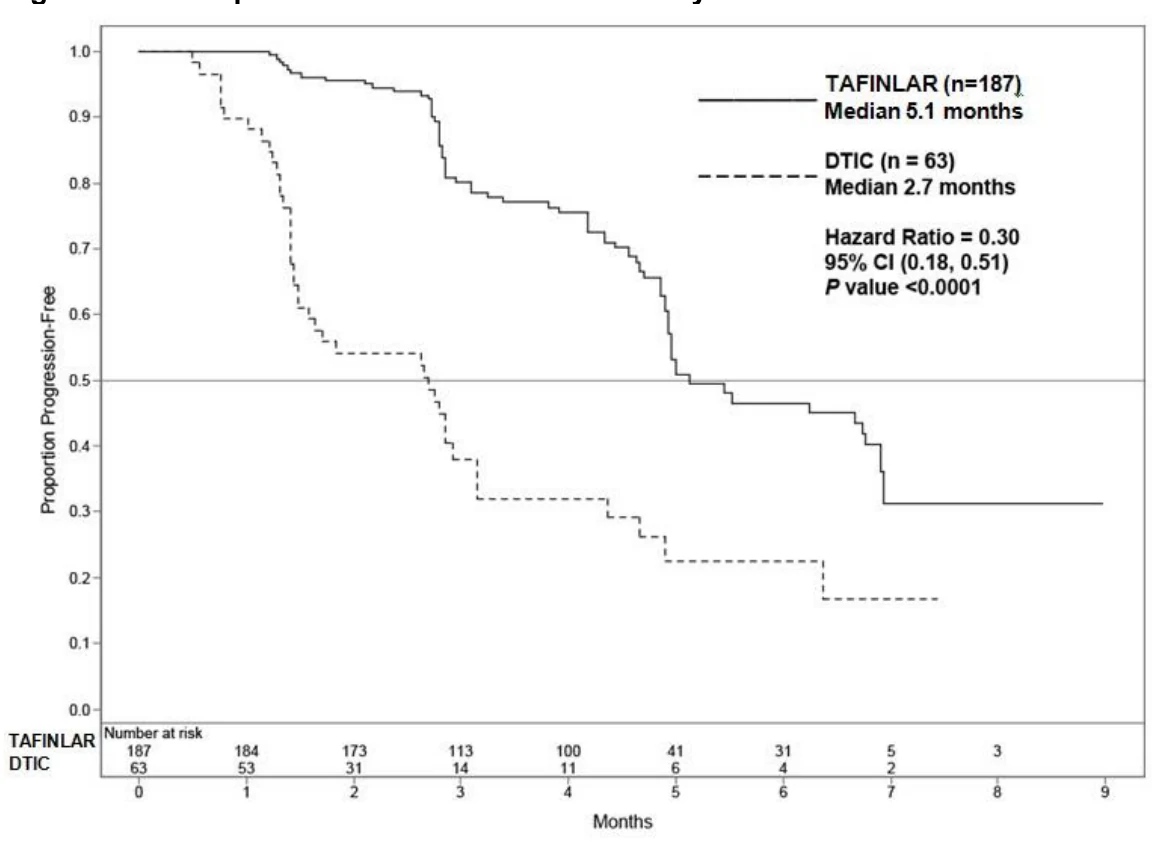
Study BRF113929
The efficacy and safety of TAFINLAR 150 mg twice daily were evaluated in a two-cohort phase II study (BRF113929) in patients with histologically confirmed (Stage IV) BRAF mutation-positive (V600E or V600K) melanoma metastatic to the brain (Table 23). Patients enrolled had no prior local therapy for brain metastases (Cohort A) or had received prior local therapy for brain metastases (Cohort B). Prior treatment for patients in Cohort B included brain surgery, whole-brain radiation therapy and stereotactic radiosurgery. The study employed modified RECIST criteria. Smaller lesions were allowed (≥ 5 mm) and up to 5 target lesions in the brain could be used.
In both cohorts, the majority of patients were male (70%), all were Caucasian, and the median age was 52.5 years. All patients had ECOG status of 0 or 1, all patients had measurable intracranial disease at baseline (100% M1c), and 89% also had measurable extracranial disease.
Investigator and independent-radiologist assessed overall intracranial response rates (OIRR) for Cohorts A and B are presented by BRAF mutation status (V600E and V600K) in Table 26.
Table 26 Results of Study BRF113929 in Unresectable or Metastatic Melanoma –
TAFINLAR Monotherapy
Cohort A: patients with no prior local therapy for brain metastasis
Cohort B: patients who received prior local therapy for brain metastasis
CR = Complete Response; PR = Partial Response
a p <0.001. This study was designed to support or reject the null hypothesis of OIRR ≤10% (based on historical results) in favour of the alternative hypothesis of OIRR ≥30% in BRAF V600E positive subjects
In both cohorts, patients with BRAF V600E mutation-positive melanoma had better overall intracranial responses than patients with BRAF V600K mutation-positive melanoma. Overall intracranial response rates were higher by investigator-assessments compared to independent-radiologist assessments.
Study BRF113710
The efficacy and safety of TAFINLAR were evaluated in a phase II study (BRF113710) of patients with BRAF (V600E or V600K) mutation-positive metastatic melanoma (Stage IV) (Table 23). The majority (80%) had received prior chemotherapy (cytotoxic/non cytotoxic) in the unresectable or metastatic setting, while the remainder were considered treatment naïve for systemic therapy (20%).
In this study, 53% of patients were male and 99% were Caucasian; the median age was 55.5 years. Patients were either ECOG status 0 (55%) or ECOG status 1 (45%); 63% had M1c disease stage; and 62% had baseline LDH equal to or below ULN.
| Primary Endpoints | Associated value and statistical significance of TAFINLAR | Associated value and statistical significance for Placebo or active control | ||||||||
|---|---|---|---|---|---|---|---|---|---|---|
| Investigator-assessed OIRR | All Treated Patients | Not Applicable | ||||||||
| BRAF V600E | BRAF V600K | |||||||||
Cohort A N = 74 | Cohort B N = 65 | Cohort A N = 15 | Cohort B N = 18 | |||||||
% (95% CI) CR PR | 39 (28.0, 51.2)a 3 36 | 31 (19.9, 43.4) a 0 31 | 7 (0.2, 31.9) 0 7 | 22 (6.4, 47.6) 0 22 | ||||||
| Independent radiologist-assessed OIRR | All Treated Patients | |||||||||
| BRAF V600E | BRAF V600K | |||||||||
Cohort A N = 74 | Cohort B N = 65 | Cohort A N = 15 | Cohort B N = 18 | |||||||
% (95% CI) CR PR | 20 (11.8, 31.2) 1 19 | 18 (9.9, 30.0) 0 18 | 0 (0.0, 21.8) 0 0 | 11 (1.4, 34.7) 0 11 | ||||||
Results of Study BRF113710 in Unresectable or Metastatic Melanoma - TAFINLAR Monotherapy
Confirmed ORR for patients with BRAF V600E metastatic melanoma (n = 76) and V600K (n = 16) metastatic melanoma were reported by both investigator and independent radiologist assessments. There were greater numbers of overall responses for V600E patients of 59% and 41% by investigator and independent-radiologist reviews, respectively compared to V600K patients (ORR of 13% and 25% by investigator and independent radiologist reviews, respectively). Complete responses (CR) were only reported for the V600E patient population (7% and 3% by investigator and independent radiologist assessments, respectively).
Unresectable or Metastatic Melanoma - TAFINLAR in Combination with Trametinib
Table 27 Summary of Patient Demographics for Clinical Trials in Unresectable or Metastatic Melanoma - TAFINLAR in Combination with Trametinib
| Study # | Study design | Dosage, route of administration and duration | Study subjects (n) | Mean age (Range) | Sex n (%) |
|---|---|---|---|---|---|
| MEK115306 | Phase III, randomized, double-blind study comparing the combination of TAFINLAR and trametinib to TAFINLAR and placebo as first-line therapy for subjects with unresectable (Stage IIIC) or metastatic (Stage IV) BRAF V600E/K mutation-positive cutaneous melanoma. | TAFINLAR 150 mg orally twice daily and trametinib 2 mg orally once daily | TAFINLAR + Trametinib (N = 211) | Age (years) Median (Min-Max) 55.1 (22, 89) Age Group, n (%) < 65: 154 (73) > 65: 57 (27) | Female 100 (47) Male 111 (53) |
TAFINLAR + Placebo (N = 212) | Age (years) Median (Min-Max) 56.5 (22, 86) Age Group, n (%) < 65: 151 (71) > 65: 61 (29) | Female 98 (46) Male 114 (54) |
MEK115306 was a phase III, randomized, double-blind study comparing the combination of TAFINLAR and trametinib to TAFINLAR and placebo as first-line therapy for subjects with unresectable (Stage IIIC) or metastatic (Stage IV) BRAF V600E/K mutation-positive cutaneous melanoma (Table 27).
Screening for eligibility included central laboratory testing for BRAF V600 mutation using a BRAF mutation assay conducted on the most recent tumour sample available from either a primary tumour or a tumour from a metastatic site.
Patients were not allowed to have prior systemic anti-cancer treatment in the unresectable or metastatic setting, although prior systemic treatment in the adjuvant setting was allowed. The primary endpoint was investigator-assessed PFS, which was to be assessed after 193 events (progression or death) were observed (Primary PFS Analysis); upon formal declaration of a data cut based on the 193 known events, an additional 18 progressions were discovered during the data retrieval and cleaning process. Secondary endpoints ORR and duration of response were reported at the time of this primary PFS analysis.
The secondary endpoint OS analysis was to be performed when 220 events (death) had occurred (Final OS Analysis).
Patients were stratified by lactate dehydrogenase (LDH) level (above the upper limit of normal [ULN] versus ≤ ULN) and BRAF mutation (V600E versus V600K). Crossover was not allowed.
TAFINLAR and trametinib were administered at their recommended monotherapy doses of 150 mg twice daily and 2 mg once daily, respectively.
Study demographics were balanced between treatment arms. Baseline disease characteristics and prognostic factors were well balanced between the treatment arms, with the exception of the occurrence of visceral disease, which was higher in the combination therapy arm compared with the TAFINLAR monotherapy arm (Table 28).
Table 28 Baseline Characteristics - Study MEK115306
| TAFINLAR + Trametinib (N = 211) | TAFINLAR + Placebo (N = 212) | |
|---|---|---|
| ECOG PS at Baseline, n (%) | ||
| 0 | 155 (73) | 150 (71) |
| 1 | 55 (26) | 61 (29) |
| Baseline LDH, n (%) | ||
| ≤ ULN | 133 (63) | 140 (66) |
| > ULN | 77 (36) | 71 (33) |
| Visceral Disease at Baseline, n (%) | ||
| Yes | 165 (78) | 145 (68) |
| No | 46 (22) | 66 (31) |
| BRAF Mutation Status, n (%) | ||
| V600E | 179 (85) | 181 (85) |
| V600Ka | 32 (15) | 30 (14) |
| (M stage) at Screening, n (%) | ||
| M0 | 5 (2) | 10 (5) |
| M1a | 19 (9) | 31 (15) |
| M1b | 45 (21) | 32 (15) |
| M1c | 142 (67) | 138 (65) |
a One subject was both BRAF V600E and BRAF V600K mutation-positive and is included in the V600K subset in this display.
ECOG = Eastern Cooperative Oncology Group; PS = performance status
Efficacy results are presented in Table 29 and in Figure 2 and Figure 3.
Table 29 Results of Study MEK115306 in Unresectable or Metastatic Melanoma – TAFINLAR in Combination with Trametinib
| Associated value and statistical significance for TAFINLAR + | Associated value and statistical significance for TAFINLAR + | |||||||||
|---|---|---|---|---|---|---|---|---|---|---|
| Trametinib | Placebo | |||||||||
| Primary Endpoints | ||||||||||
| PFS | (N = 211) | (N = 212) | ||||||||
| Primary Analysis* | ||||||||||
Median, months (95% CI) 9.3 (7.7, 11.1) | Median, months (95% CI) 8.8 (5.9, 10.9) | |||||||||
HR (95% CI) and log-rank p-valuea 0.75 (0.57, 0.99) p = 0.035 | ||||||||||
| Updated Analysis* | ||||||||||
Median, months (95% CI) 11.0 (8.0, 13.9) | Median, months (95% CI) 8.8 (5.9, 9.3) | |||||||||
HR (95% CI) and log-rank p-valuea 0.67 (0.53, 0.84) p < 0.001 | ||||||||||
| Secondary endpoints | ||||||||||
| ORRd | N = 210 | N = 210 | ||||||||
| Primary Analysis* | ||||||||||
CR, n (%) PR, n (%) ORR (CR+PR), n (%) (95% CI) | 22 (10) 118 (56) 140 (67) (59.9, 73.0) | CR, n (%) PR, n (%) ORR (CR+PR), n (%) (95% CI) | 18 (9) 90 (43) 108 (51) (44.5, 58.4) | |||||||
| Updated Analysis* | ||||||||||
CR, n (%) PR, n (%) ORR (CR+PR), n (%) (95% CI) | 33 (16) 111 (53) 144 (69) (61.8, 74.8) | CR, n (%) PR, n (%) ORR (CR+PR), n (%) (95% CI) | 28 (13) 84 (40) 112 (53) (46.3, 60.2) | |||||||
| Duration of Response | Primary Analysis* | |||||||||
Median, months (95% CI) N = 140 9.2 (7.4, NR) | Median, months (95% CI) N = 109 10.2 (7.5, NR) | |||||||||
| Updated Analysis* | ||||||||||
Median, months (95% CI) N = 144 12.9 (9.4, 19.5) | Median, months (95% CI) N = 113 10.6 (9.1, 13.8) | |||||||||
| OS | (N = 211) | (N = 212) | ||||||||
| Interim Analysis | ||||||||||
Died (%) 40 (19) | Died (%) 55 (26) | |||||||||
HR (CI) and log-rank p-valuea 0.63 (0.30, 1.32)b | ||||||||||
| Median, months (95% CI) | ||||||||||
| NR | ||||||||||
| Final Analysis | ||||||||||
Died (%) 99 (47) | Died (%) 123 (58) | |||||||||
HR (CI) and log-rank p-valuea 0.71 (0.55, 0.92)c p = 0.011 | ||||||||||
Median, months (95% CI) 25.1 (19.2, NR) | Median, months (95% CI) 18.7 (15.2, 23.7) | |||||||||
*Primary analysis data cut: 26 August 2013, Final OS data cut: 12 January 2015
PFS = Progression-Free Survival; CI = Confidence Interval; HR = Hazard Ratio; CR = Complete Response; ORR = Overall response rate; PR = Partial Response; NR = Not Reached
a Hazard ratio and log-rank p-value are adjusted for randomized strata: baseline LDH and BRAF mutation status b The stopping boundary for overall survival (one-sided alpha) for this interim analysis is based on the available information (95 events), and is 0.00014. Confidence interval is based on the allocated alpha. The results were not statistically significant.
c 95% CI
d Includes only patients with measurable disease at baseline
Treatment with the combination therapy resulted in a statistically significant improvement in investigator-assessed PFS compared with TAFINLAR monotherapy treatment (HR 0.75; 95% CI: 0.57, 0.99; p = 0.035). This represents a 25% reduction in risk of tumour progression or death in the combination therapy arm compared with TAFINLAR monotherapy. Median PFS for the combination therapy arm was 9.3 months compared with 8.8 months for the TAFINLAR monotherapy arm. Independent reviewer assessed PFS results were not statistically significant (HR 0.78; 95% CI: 0.59, 1.04).
The secondary endpoint of investigator assessed best-confirmed ORR favoured the combination therapy over dabrafenib monotherapy.
Figure 2 Kaplan-Meier Curves for PFS Primary Analysis (ITT Population) – Study MEK115306
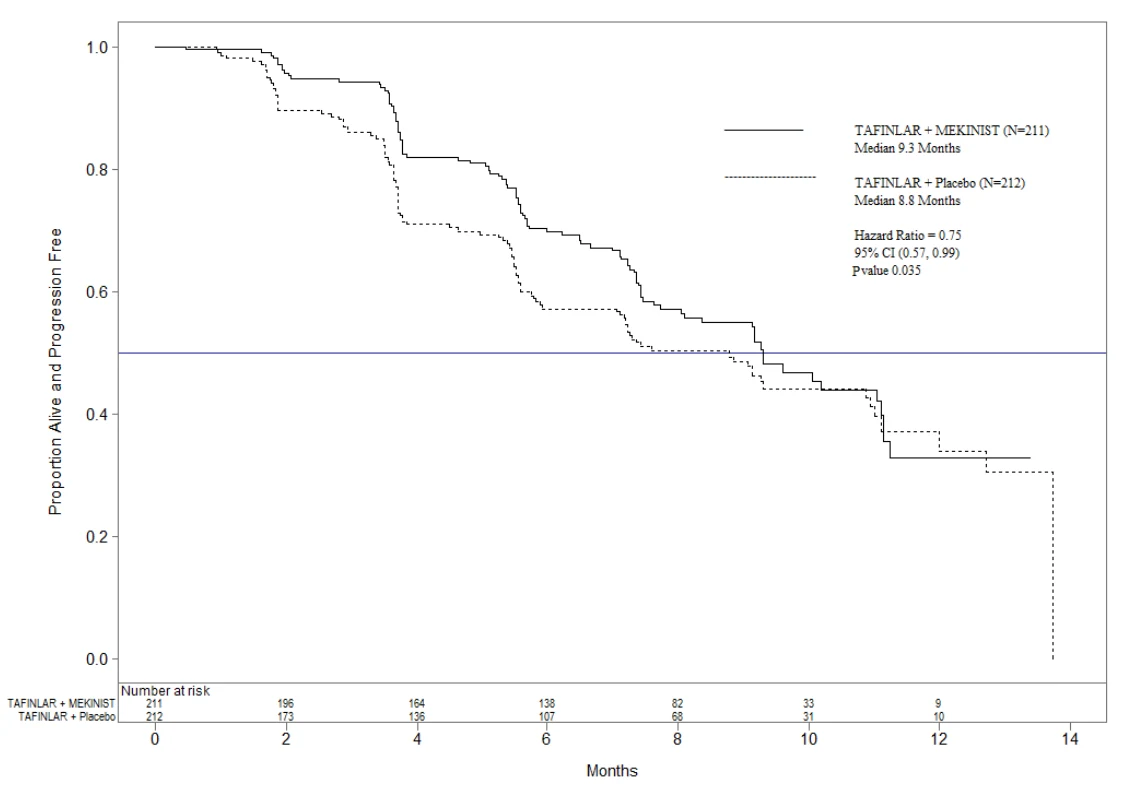
Figure 3 Kaplan-Meier Curves for Final OS (ITT population) – Study MEK115306
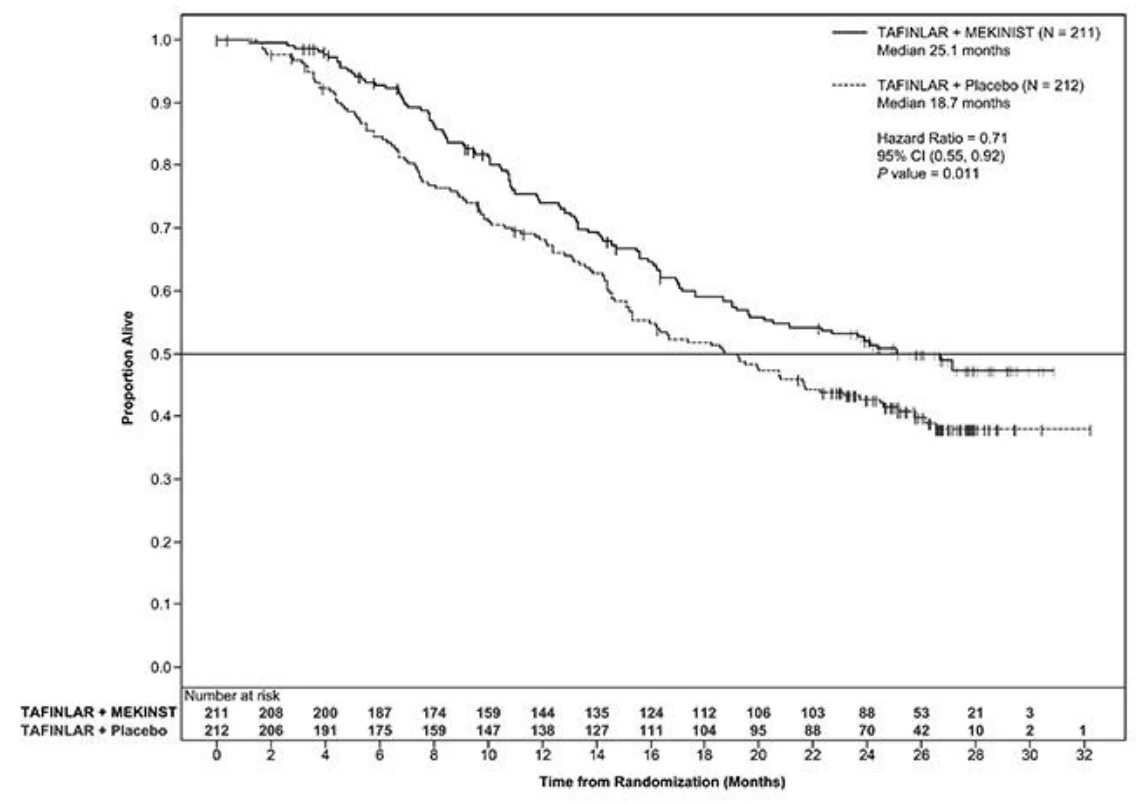
The OS analysis at 5 years shows an estimated survival rates of 32% for the combination of TAFINLAR and trametinib versus 27% for TAFINLAR monotherapy (HR 0.80, 95 % CI 0.63-1.01); the median OS for the combination arm was 25.8 months compared to 18.7 months for TAFINLAR monotherapy.
Adjuvant Treatment of Melanoma – TAFINLAR in Combination with Trametinib
Table 30 Summary of Patient Demographics for Clinical Trials in Adjuvant Treatment of Melanoma – TAFINLAR in Combination with Trametinib
| Study # | Study design | Dosage, route of administration and duration | Study subjects (n) | Mean age (Range) | Sex n (%) |
|---|---|---|---|---|---|
BRF115532 Phase III Pivotal Study | Phase III, multi-centre, randomized (1:1), double-blind, placebo-controlled study of TAFINLAR in combination with trametinib in the adjuvant treatment of patients with Stage III melanoma with a BRAF V600 mutation, following resection. | TAFINLAR 150 mg orally twice daily and trametinib 2 mg orally once daily or two placebos for 12 months. | TAFINLAR + Trametinib (N = 438) | Age (years) Median (Min-Max) 50.0 (18,89) Age Group, n (%) < 65: 353 (81%) > 65: 85 (19%) | Female 195 (45%) Male 243 (55%) |
Age Group, n (%) < 65: 359 (83%) > 65: 73 (17%) | 239 (55%) | ||||
Placebo (N = 432) | Age (years) Median (Min-Max) 51.0 (20,85) | Female 193 (45%) Male | |||
The efficacy and safety of TAFINLAR in combination with trametinib in the adjuvant treatment of patients with Stage III melanoma with a BRAF V600 mutation, following resection was evaluated in a phase III, multi-centre, randomized, double-blind, placebo-controlled study (BRF115532) (Table 30). Screening for the study included central laboratory testing of BRAF mutation (V600E or V600K) using a BRAF mutation assay conducted at baseline.
Patients were randomized 1:1 to receive either dabrafenib and trametinib combination therapy (TAFINLAR 150 mg twice daily and trametinib 2 mg once daily) or two placebos for a period of 12 months. Enrolment required complete resection of melanoma with complete lymphadenectomy within 12 weeks prior to randomization. Any prior systemic anticancer treatment, including radiotherapy, was not allowed. Patients with a history of prior malignancy, if disease-free for at least 5 years, were eligible. Patients presenting with malignancies with confirmed activating RAS mutations were not eligible. Patients were stratified by BRAF mutation status (V600E or V600K) and stage of disease prior to surgery (by Stage III sub-stage, indicating different levels of lymph node involvement and primary tumour size and ulceration). The primary endpoint was investigator-assessed relapse-free survival (RFS), defined as the time from randomization to disease recurrence or death from any cause. Radiological tumour assessment was conducted every 3 months for the first two years and every 6 months thereafter, until first relapse was observed. The key secondary endpoint was overall survival (OS). The median duration of follow-up (time from randomization to last contact or death) was 2.83 years in the dabrafenib and trametinib combination arm and 2.75 years in the placebo arm.
The baseline characteristics of the patients were well balanced in the two groups. In both groups, 91% had a BRAF V600E mutation and 9% had a BRAF V600K mutation (Table 31).
Table 31 Baseline Characteristics – Study BRF115532
| TAFINLAR + Trametinib (N = 438) | Placebo (N = 432) | |||||
|---|---|---|---|---|---|---|
Race, n (%) White Asian | 432 (99%) 6 (1%) | 427 (99%) 5 (1%) | ||||
Primary Tumour Type Melanoma | 438 (100%) | 432 (100%) | ||||
Time Since Initial Diagnosis (months) 1st Quartile Median 3rd Quartile Min. – Max. | 4 5.0 19 1 – 306 | 4 6.0 20 0 – 351 | ||||
Stage at Screening* IIIA IIIB IIIC Unknown | 83 (19%) 169 (39%) 181 (41%) 5 (1%) | 71 (16%) 187 (43%) 166 (38%) 8 (2%) | ||||
Primary Tumour Ulceration Yes No Missing | 179 (41%) 253 (58%) 6 (1%) | 177 (41%) 249 (58%) 6 (1%) | ||||
In-transit Disease Yes No Missing | 51 (12%) 387 (88%) 0 | 36 (8%) 395 (91%) 1 (˂1%) | ||||
| BRAF Mutation Status, n (%) | ||||||
| V600E | 400 (91%) | 395 (91%) | ||||
| V600K | 38 (9%) | 37 (9%) | ||||
| * Per the American Joint Committee on Cancer (AJCC) – Melanoma of the Skin Staging – 7th Edition | ||||||
Results for the primary analysis of RFS are presented in Figure 4 and in Table 32.
Table 32 Results of Study BRF115532 in Adjuvant Treatment of Melanoma – TAFINLAR in Combination with Trametinib
| Primary Endpoints | Associated value and statistical significance for TAFINLAR + Trametinib (N = 438) | Associated value and statistical significance for Placebo (N = 432) | |||||
|---|---|---|---|---|---|---|---|
| PFS | Number of events, n (%) Recurrence Relapsed with distant metastasis Death | 166 (38%) 163 (37%) 103 (24%) 3 (<1%) | Number of events, n (%) Recurrence Relapsed with distant metastasis Death | 248 (57%) 247 (57%) 133 (31%) 1 (<1%) | |||
Median (months) (95% CI) | NE (44.5, NE) | Median (months) (95% CI) | 16.6 (12.7, 22.1) | ||||
Hazard ratio[1] (95% CI) p-value[2] | 0.47 (0.39, 0.58) 1.53×10⁻¹⁴ | ||||||
1-year rate (95% CI) | 0.88 (0.85, 0.91) | 1-year rate (95% CI) | 0.56 (0.51, 0.61) | ||||
2-year rate (95% CI) | 0.67 (0.63, 0.72) | 2-year rate (95% CI) | 0.44 (0.40, 0.49) | ||||
| 3-year rate (95% CI) | 0.58 (0.54, 0.64) | 3-year rate (95% CI) | 0.39 (0.35, 0.44) | ||||
| OS | Hazard ratio[1] 0.57 | ||||||
| (95% CI) (0.42, 0.79) | |||||||
[1] Hazard ratio is obtained from the stratified Pike model.
[2] P-value is obtained from the two-sided stratified log-rank test (stratification factors were disease stage – IIIA vs. IIIB vs. IIIC – and BRAF V600 mutation type – V600E vs. V600K)
NE = not estimable
The study showed a statistically significant difference for the primary outcome of RFS between treatment arms, with an estimated 53% risk reduction in the dabrafenib and trametinib combination arm compared to the placebo arm (HR=0.47; 95% CI: 0.39, 0.58; p=1.53×10⁻¹⁴). Results were consistent across subgroups, including stratification factors for disease stage and BRAF V600 mutation type. Median RFS was 16.6 months for the placebo arm, and has not yet been reached for the combination arm.
Figure 4 Relapse-free survival Kaplan-Meier curves (ITT population) – Study BRF115532
Based on 153 events (60 (14%) in the combination arm and 93 (22%) in the placebo arm) corresponding to a 26% information fraction of the total target of 597 OS events, the estimated hazard ratio for OS was 0.57 (95% CI: 0.42, 0.79), which was not statistically significant. The overall survival data were not mature at the time of the study’s primary efficacy analysis.
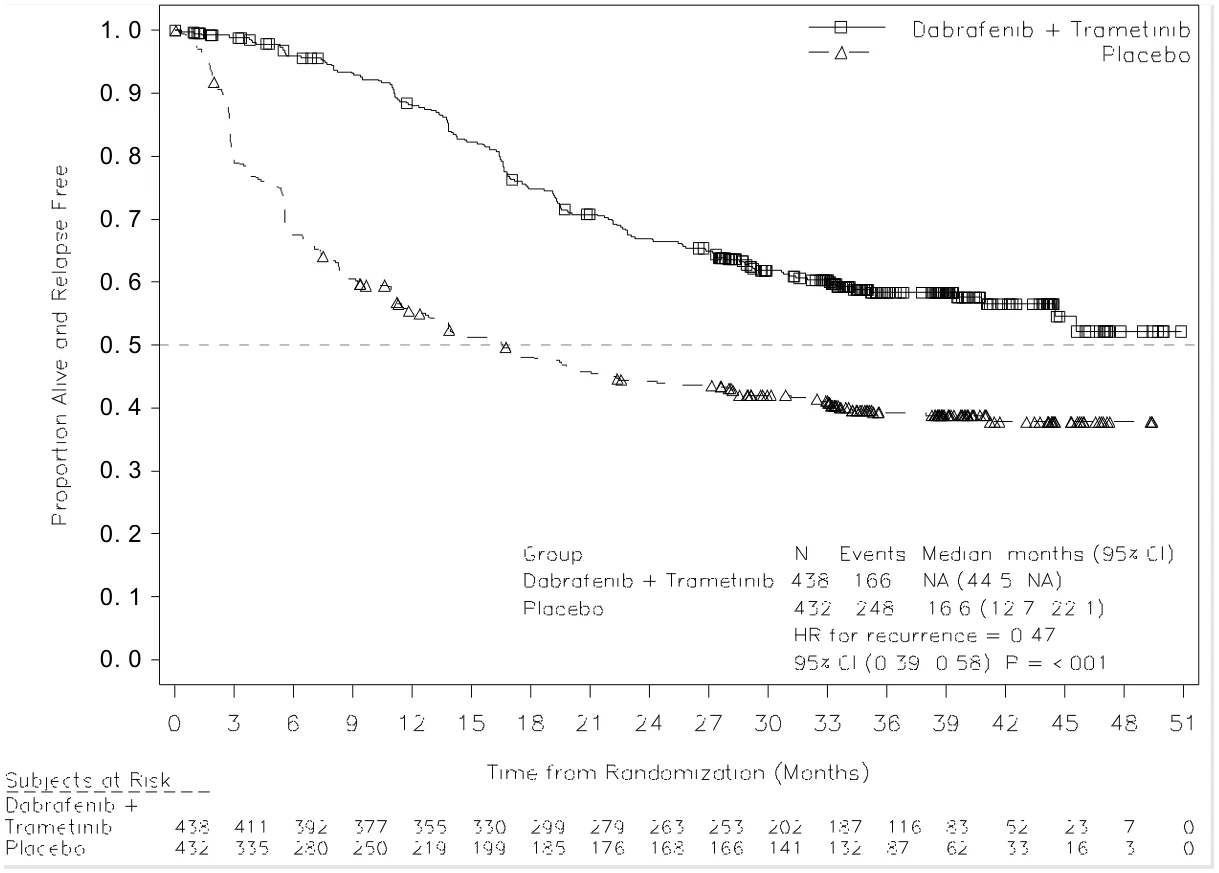
Metastatic Non-Small Cell Lung Cancer (NSCLC) – TAFINLAR in Combination with Trametinib
Table 33 Summary of Patient Demographics for Clinical Trials in Metastatic Non-Small Cell Lung Cancer (NSCLC) – TAFINLAR in Combination with Trametinib
| Study # | Study design | Dosage, route of administration and duration | Study subjects (n) | Mean age (Range) | Sex n (%) |
|---|---|---|---|---|---|
| BRF113928 | Phase II, multi-centre, non-randomized, open-label study of TAFINLAR in combination with trametinib in patients with metastatic non-small cell lung cancer (NSCLC) with a BRAF V600E mutation. | TAFINLAR 150 mg orally twice daily and trametinib 2 mg orally once daily. | Previously treated TAFINLAR + Trametinib (N = 57) | Age (years) Median (Min-Max) 64 (41, 88) Age Group, n (%) < 65: 29 (51) > 65: 28 (49) | Female 28 (49) Male 29 (51) |
Treatment-naïve TAFINLAR + Trametinib (N = 36) | Age (years) Median (Min-Max) 67 (44, 91) Age Group, n (%) < 65: 14 (39) > 65: 22 (61) | Female 22 (61) Male 14 (39) |
The efficacy and safety of TAFINLAR in combination with trametinib in the treatment of patients with metastatic non-small cell lung cancer (NSCLC) with a BRAF V600E mutation has been evaluated in the phase II multi-centre, international clinical study BRF113928. Screening for eligibility included local laboratory testing of BRAF V600E mutation conducted on tumour samples available mostly from the primary tumour.
The study enrolled 93 patients; 57 patients whose disease progressed following 1 to 3 previous systemic treatments and 36 patients who received the study medication as first-line treatment for metastatic disease. All patients received TAFINLAR 150 mg twice daily and trametinib 2 mg once daily.
The primary endpoint was the investigator-assessed ORR using the ‘Response Evaluation Criteria In Solid Tumours’ (RECIST), v1.1, and the secondary endpoint was Duration of Response (DoR); both were also assessed by an Independent Review Committee (IRC) as a sensitivity analysis. For those whose disease progressed following 1 to 3 previous systemic treatments, the null hypothesis was that the ORR is less than or equal to 30%. The alternative hypothesis was that the ORR is higher than or equal to 55%. For those who received the study medication as first line treatment for metastatic disease, the null hypothesis was that the ORR is less than or equal to 30%. The alternative hypothesis was that the ORR is higher than or equal to 60%.
Baseline characteristics are listed in Table 34.
Table 34 Demographic and Baseline Characteristics – Study BRF113928
Previously treated TAFINLAR + Trametinib (N = 57) | Treatment-naïve TAFINLAR + Trametinib (N = 36) | |
|---|---|---|
Race, n (%) White Asian Black or African American Other | 49 (86) 4 (7) 2 (4) 2 (4) | 30 (83) 3 (8) 1 (3) 2 (6) |
| ECOG PS at Baseline, n (%) | ||
0 1 2 | 17 (30) 35 (61) 5 (9) | 13 (36) 22 (61) 1 (3) |
Histology, n (%) Squamous Non-squamous | 0 57 (100) | 1 (3)* 35 (37) |
| Smoking History, n (%) | ||
Never smoked Current smoker Former smoker | 16 (28) 6 (11) 35 (61) | 10 (28) 5 (14) 21 (58) |
Prior anti-cancer therapy for metastatic disease, n (%) 1 2 3 | 38 (67) 12 (21) 7 (12) | 0 (0) 0 (0) 0 (0) |
ECOG = Eastern Cooperative Oncology Group; PS = performance status
* 1 patient with adenosquamous carcinoma – predominately squamous histology. All histology was determined by local pathological report.
Efficacy results are presented in Table 35.
Table 35 Results of Study BRF113928 in Metastatic Non-Small Cell Lung Cancer (NSCLC) – TAFINLAR in Combination with Trametinib
Associated value and statistical significance for Previously treated* TAFINLAR + Trametinib (N = 57) | Associated value and statistical significance for Treatment-naïve* TAFINLAR + Trametinib (N = 36) | ||||||||
|---|---|---|---|---|---|---|---|---|---|
| Primary Endpoints† | |||||||||
| Overall Response Rate (ORR) | Investigator- Assessed | IRC-Assessed | Investigator-Assessed | IRC-Assessed | |||||
ORR, % (95% CI) CR, n (%) PR, n (%) | 63.2 (49.3, 75.6) 2 (4) 34 (60) | 63.2 (49.3, 75.6) 0 36 (63) | 61.1 (43.5, 76.9) 2 (6) 20 (56) | 61.1 (43.5, 76.9) 1 (3) 21 (58) | |||||
| Secondary endpoints† | |||||||||
| Duration of response | Median, months (95% CI) | 9.0 (6.9, 18.3) | 9.0 (5.8, 17.6) | NE (8.3, NE) | NE (6.9, NE) | ||||
* Primary analysis data cut-off dates: 07 October 2015 (previously treated), 08 August 2016 (treatment-naïve)
† CI = Confidence interval; CR = Complete response; IRC = Independent review committee; NE = Not evaluable; PR = Partial response
The ORR in the previously treated combination therapy population was 63.2% (95% CI, 49.3, 75.6) by investigator assessment and median DoR was 9.0 months (95% CI: 6.9, 18.3). The median duration of treatment was 10.6 months. The ORR in the treatment-naïve population was 61.1% (95% CI, 43.5, 76.9) and median DoR was not reached. The median duration of treatment was 8.21 months. The IRC-assessed efficacy results were consistent with the investigator assessments (Table 35).
Low-grade Glioma (LGG) and High-grade Glioma (HGG) – TAFINLAR in Combination with Trametinib
The clinical efficacy and safety of TAFINLAR plus trametinib combination therapy in pediatric patients aged 1 to <18 years of age with BRAF V600E mutation-positive glioma was evaluated in the multi-centre, open-label, Phase II clinical trial CDRB436G2201 (Study G2201). Study G2201 included a cohort of patients with low-grade glioma and a cohort of patients with high-grade glioma.
The study enrolled male and female patients with a Karnofsky/Lansky performance score of at least 50; adequate bone marrow, renal, liver and cardiac function; and without history or evidence of cardiovascular risk including LVEF below the institutional LLN. Patients with a history of retinal vein occlusion were excluded.
In both cohorts, TAFINLAR and trametinib dosing was age- and weight-dependent, with TAFINLAR (either as capsules or tablets for suspension) dosed orally at 2.625 mg/kg twice daily for ages <12 years and 2.25 mg/kg twice daily for ages 12 years and older. Trametinib (tablets or powder for oral solution) was dosed orally at 0.032 mg/kg once daily for ages <6 years and 0.025 mg/kg once daily for ages 6 years and older. TAFINLAR doses were capped at 150 mg twice daily and trametinib doses at 2 mg once daily until disease progression or intolerable toxicity. In the control arm of the LGG cohort, carboplatin and vincristine were dosed based on age and body surface area at doses 175 mg/m2 and 1.5 mg/m2, respectively, as one 10-week induction course followed by eight 6-week cycles of maintenance therapy. The HGG cohort used a single-arm design.
BRAF mutation status was identified prospectively via a local test, or a central laboratory real-time polymerase chain reaction (PCR) test when a local test was not available. In addition, retrospective testing of available tumour samples by the central laboratory was performed to evaluate BRAF V600E mutation status.
LGG Cohort
In Study G2201, patients with BRAF V600E mutation-positive low-grade glioma (WHO grades 1 and 2) who required first systemic therapy following prior surgery or who were not surgical candidates were randomized in a 2:1 ratio to TAFINLAR plus trametinib or carboplatin plus vincristine (Table 36). Participants in the carboplatin + vincristine arm could cross-over to receive the targeted TAFINLAR plus trametinib combination treatment upon centrally-confirmed disease progression.
Table 36 Summary of Patient Demographics for Clinical Trials in Pediatric Patients with LGG
| Study # | Study design | Dosage, route of administration and duration | Study subjects (n) | Median age (Range) | Sex n (%) |
|---|---|---|---|---|---|
DRB436G2201 (Study G2201) Phase II Pivotal Study, Low-grade Glioma (LGG) cohort | Phase II multi-centre, randomized, open-label study of TAFINLAR in combination with trametinib versus carboplatin in combination with vincristine in children and adolescent patients with BRAF V600E mutation- positive LGG following surgical excision or non-surgical candidates with necessity to begin first systemic therapy | TAFINLAR and trametinib dosing was age- and weight- dependent. Oral | TAFINLAR + Trametinib (N = 73) | Median | |
Age (years) (Min-Max) 10.0 (1,17) Age Group, n (%) 12 months - < 6 years: 20 (27.4) 6 - <12 years: 25 (34.2) 12 - <18 years: 28 (38.4) | Female 44 (60.3) Male 29 (39.7) | ||||
Carboplatin and vincristine dosing was based on age and body surface area Intravenous | Carboplatin + Vincristine (N=37) | Median Age (years) (Min-Max) 8.0 (1,17) Age Group, n (%) 12 months - < 6 years: 14 (37.8) 6 - <12 years: 11 (29.7) 12 - <18 years: 12 (32.4) | Female 22 (59.5) Male 15 (40.5) |
Demographic and Baseline Characteristics - Study DRB436G2201 - LGG Cohort:
For patients enrolled in the LGG cohort of Study G2201, 73% were White, 9% were race unknown, 7% were Asian, 5% were Black or African American, and 3% were race not reported. The median time since initial diagnosis of primary site to study entry was 3.5 months. The predominant tumour histologies were pilocytic astrocytoma (31%), ganglioma (27%), and LGG not otherwise specified (NOS) (18%). The majority of patients (85% in D+T arm vs. 78% in C+V arm) had prior surgery, and only 2 patients (2%) did not have residual disease. None of the patients underwent prior radiotherapy.
The primary efficacy endpoint was Overall Response Rate (ORR, sum of confirmed complete/CR and partial responses/PR) by Independent review based on RANO 2017 criteria. The primary analysis was performed when all patients had completed at least 32 weeks of therapy. Progression-free survival (PFS) was evaluated as a key secondary endpoint. The final analysis was performed 2 years after completion of enrollment in both cohorts.
Efficacy results of the LGG cohort are presented in Table 37 and Figure 5. The ORR in the targeted therapy (TAFINLAR plus trametinib) arm (47%) showed a statistically significant improvement over the chemotherapy (carboplatin plus vincristine) arm (11%), with an odds ratio of 7.19 and 1-sided p-value <0.001 (Table 37).
Table 37 Results of Study G2201 in Pediatric Patients with LGG
Dabrafenib + Trametinib N=73 | Carboplatin + Vincristine N=37 | ||||||||||||||||
|---|---|---|---|---|---|---|---|---|---|---|---|---|---|---|---|---|---|
| Primary Analysis | |||||||||||||||||
| Overall Response Rate | |||||||||||||||||
| ORRa (95% CI), p-value | 47% (34.8, 58.6), p<0.001 | 11% (3.0, 25.4) | |||||||||||||||
| Odds ratio (95% CI) | 7.19 (2.3, 22.4) | ||||||||||||||||
| Best overall response | |||||||||||||||||
| Complete response (CR), n (%) | 2 (2.7) | 1 (2.7) | |||||||||||||||
| Partial response (PR), n (%) | 32 (43.8) | 3 (8.1) | |||||||||||||||
| Progression-Free Survival | |||||||||||||||||
| Median (months) | 20.1 (12.8, NE) | 7.4 (3.6, 11.8) | |||||||||||||||
| Hazard ratiob (95% CI), p-value | 0.31 (0.17, 0.55), p<0.001 | ||||||||||||||||
| Final Analysis | |||||||||||||||||
| Overall Response Rate | |||||||||||||||||
| ORRa (95% CI) | 55% (42.7, 66.5) | 16% (6.2, 32.0) | |||||||||||||||
| Odds ratio (95% CI) | 6.26 (2.3, 16.8) | ||||||||||||||||
| Best overall response | |||||||||||||||||
| Complete response (CR), n (%) | 2 (2.7) | 1 (2.7) | |||||||||||||||
| Partial response (PR), n (%) | 38 (52.1) | 5 (13.5) | |||||||||||||||
| Progression-Free Survival | |||||||||||||||||
| Median (months) | 24.9 (12.9, 31.6) | 7.2 (2.8, 11.2) | |||||||||||||||
| Hazard ratiob (95% CI) | 0.36 (0.22, 0.59) | ||||||||||||||||
a Consisting of complete and partial responses; b Estimated using a Cox proportional hazards model
Figure 5 Kaplan-Meier PFS curves for Study G2201 (LGG cohort, final analysis)
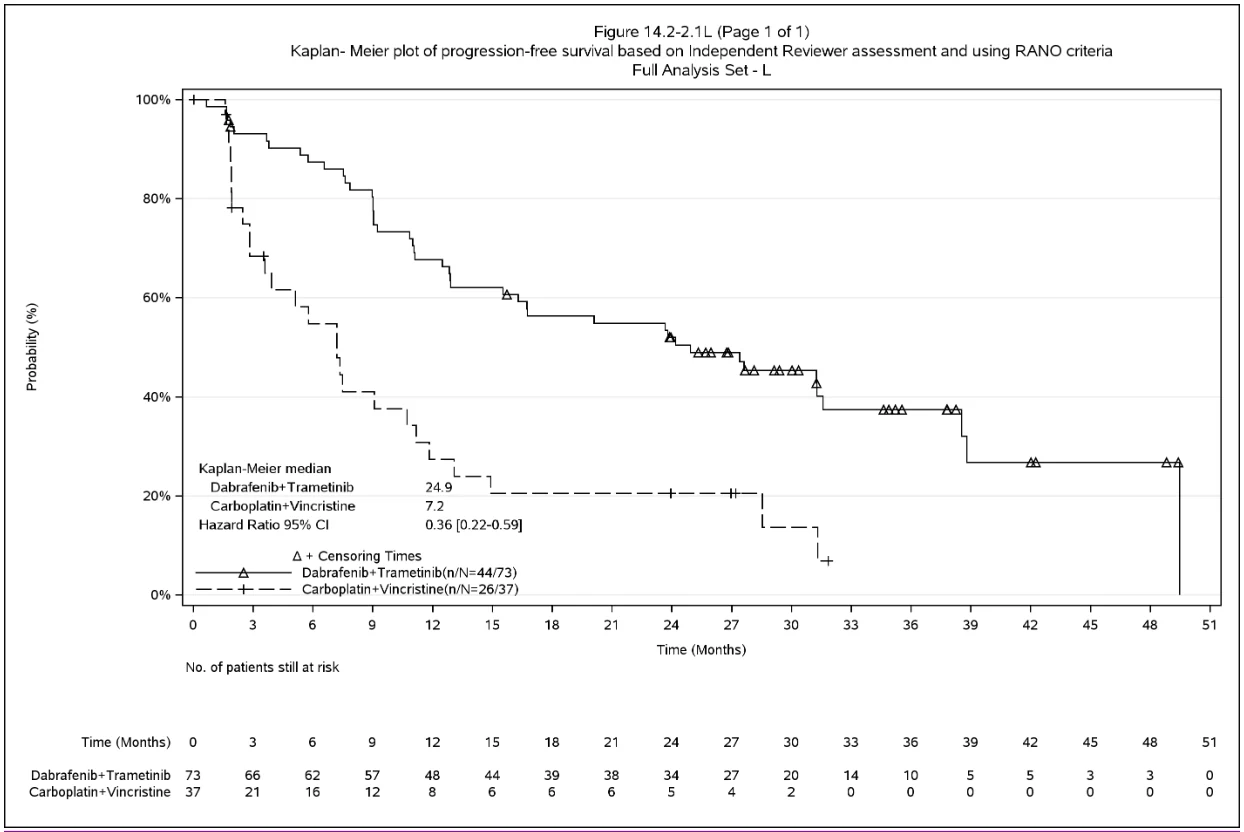
At the time of the interim analysis of overall survival (OS), conducted when all patients had completed at least 32 weeks of treatment or had discontinued earlier, there was one death in the C+V arm. The OS results at primary analysis did not reach statistical significance (p=0.065).
For the nine patients who crossed over to targeted TAFINLAR plus trametinib therapy following centrally-confirmed disease progression on chemotherapy (carboplatin plus vincristine), the ORR was 33.3% (95% CI: 7.5, 70.1) as assessed by Independent review.
HGG Cohort
The single-arm high-grade glioma cohort of study G2201 included 41 patients who relapsed, progressed, or failed to respond to front-line therapy (optimal surgical approach with radiation or chemotherapy) (Table 38).
Table 38 Summary of Patient Demographics for Clinical Trials in Pediatric Patients with HGG
| Study # | Study design | Dosage, route of administration and duration | Study subjects (n) | Median age (Range) | Sex n (%) |
|---|---|---|---|---|---|
DRB436G2201 (Study G2201) Phase II Pivotal Study, High-grade Glioma (HGG) cohort | Phase II multi-centre, open-label, single-arm study of TAFINLAR in combination with trametinib in children and adolescent patients with BRAF V600E mutation-positive HGG who had relapsed, progressed, or failed to respond to front-line therapy | TAFINLAR and trametinib dosing was age- and weight- dependent. Oral | TAFINLAR + Trametinib (N = 41) | Median Age (years) (Min-Max) 13.0 (2,17) Age Group, n (%) 12 months - < 6 years: 5 (12.2) 6 - <12 years: 10 (24.4) 12 - <18 years: 26 (63.4) | Female 23 (56.1) Male 18 (43.9) |
Demographic and Baseline Characteristics - StudyG2201 - HGG Cohort:
For patients enrolled in the HGG cohort of Study G2201, 61% were White, 27% were Asian, 7% were race unknown, 2% were Black or African American, and 2% were race not reported. The median time since initial diagnosis of primary site to study entry was 17.4 months. The predominant tumour histologies were pleomorphic xanthoastrocytoma with anaplasia (29%) and diffuse midline glioma (10%). All patients had received at least one form of prior antineoplastic therapy. All patients except one (98%) had prior surgery, with the majority of patients (61%) having residual disease. In total, 90% of patients underwent prior radiotherapy, mostly in the adjuvant setting (49%), and 81% of patients had received chemotherapy, mostly in the adjuvant setting (51%).
The primary efficacy endpoint was ORR (sum of confirmed CR and PR) by Independent review based on RANO 2010 criteria. The primary analysis was performed when all patients had completed at least 32 weeks of therapy.
Efficacy results for the HGG cohort are presented in Table 39:
Table 39 Results of Study G2201 in Pediatric Patients with HGG
Dabrafenib + Trametinib N=41 | |||||||
|---|---|---|---|---|---|---|---|
| Primary Analysis | |||||||
| Best overall response | |||||||
| Complete Response (CR), n (%) | 12 (29.3) | ||||||
| Partial Response (PR), n (%) | 11 (26.8) | ||||||
| ORRa % (95% CI) | 56.1 (39.7, 71.5) | ||||||
| Duration of response (DoR) | |||||||
| Kaplan-Meier median (95% CI) | 22.2 (7.6, NE) | ||||||
| DoR ≥6 months (%) | 78 | ||||||
| DoR ≥12 months (%) | 48 | ||||||
| DoR ≥24 months (%) | 22 | ||||||
| Final Analysis | |||||||
| Best overall response | |||||||
| Complete Response (CR), n (%) | 14 (34.1) | ||||||
| Partial Response (PR), n (%) | 9 (22.0) | ||||||
| ORRa % (95% CI) | 56.1 (39.7, 71.5) | ||||||
| Duration of response (DoR) | |||||||
| Kaplan-Meier median (95% CI) | 27.4 (9.2, NE) | ||||||
| DoR ≥6 months (%) | 83 | ||||||
| DoR ≥12 months (%) | 57 | ||||||
| DoR ≥24 months (%) | 39 | ||||||
a Consisting of complete and partial responses
15 Microbiology
No microbiological information is required for this drug product.
16 Non-Clinical Toxicology
General Toxicology
Adverse cardiovascular effects, including coronary arterial degeneration/necrosis and/or hemorrhage, cardiac atrioventricular valve hypertrophy/hemorrhage and atrial fibrovascular proliferation were seen in dogs (≥2 times human clinical exposure based on AUC). Focal arterial/perivascular inflammation in various tissues was observed in mice and an increased incidence of hepatic arterial degeneration and spontaneous cardiomyocyte degeneration with inflammation (spontaneous cardiomyopathy) was observed in rats (≥ 0.5 and 0.6 times human clinical exposure for rats and mice respectively). Hepatic effects, including hepatocellular necrosis and inflammation were observed in mice (≥ 0.6 times clinical exposure). Bronchoalveolar inflammation of the lungs was observed in several dogs at ≥ 20 mg/kg/day (≥ 9 times human clinical exposure based on AUC) and was associated with shallow and/or laboured breathing.
Reversible haematological effects have been observed in dogs and rats given dabrafenib. In studies of up to 13 weeks, decreases in reticulocyte counts and/or red cell mass were observed in dogs and rats (≥ 10 and 1.4 times clinical exposure, respectively).
Dogs given dabrafenib and trametinib in combination for 4 weeks demonstrated decreased serum albumin concentrations consistent with an acute phase response secondary to mild granulomatous changes in the stomach and mesenteric lymph node. Decreases in serum albumin have also been reported in patients receiving combination therapy as compared to those receiving dabrafenib monotherapy in the phase III combination study (see Table 15).
Dogs given dabrafenib and trametinib in combination for 4 weeks also demonstrated decreased lymphoid cellularity of the thymus at a lower dose than in a 3-week dog study in which single agent trametinib was administered.
Carcinogenicity
Carcinogenicity studies with dabrafenib have not been conducted. Dabrafenib was not mutagenic or clastogenic using in vitro tests in bacteria and cultured mammalian cells, and an in vivo rodent micronucleus assay.
Reproductive and Developmental Toxicity
Dabrafenib is embryo-foetal toxic and teratogenic in animals at doses similar to human clinical exposures. In combined female fertility, early embryonic and embryo-foetal development studies in rats, a reduction in fertility was observed at 300 mg/kg/day (approximately 3 times human clinical exposure based on AUC). There was also delayed skeletal development and reduced foetal body weight at doses ≥ 20 mg/kg/day (≥ 0.5 times human clinical exposure based on AUC). The numbers of ovarian corpora lutea were reduced in pregnant females at 300 mg/kg/day. Developmental toxicity including embryo-lethality and ventricular septal defects were also seen at 300 mg/kg/day.
Male fertility studies with dabrafenib have not been conducted. However, in repeat-dose studies, testicular degeneration/depletion was seen in rats and dogs (≥ 0.2 times the human clinical exposure based on AUC). Testicular changes in rat and dog were still present following a 4-week recovery period (see 7 Reproductive Health: Female and Male Potential, Reproduction).
Special Toxicology
Phototoxicity: Dabrafenib was phototoxic in an in vitro mouse fibroblast 3T3 Neutral Red Uptake (NRU) assay and in vivo at single doses ≥ 100 mg/kg (> 44 times clinical exposure based on Cmax) in an oral phototoxicity study in hairless mice.
Juvenile Toxicity
In juvenile toxicity studies in rats, effects on growth (shorter long bone length), renal toxicity (tubular deposits, increased incidence of cortical cysts and tubular basophilia and reversible increases in urea and/or creatinine concentrations) and testicular toxicity (degeneration and tubular dilation) were observed (≥ 0.2 times adult human clinical exposure based on AUC). Renal toxicity, which had not been observed in adult animals, was primarily observed in rats given dabrafenib pre-weaning (< 22 days old). Dabrafenib inhibits LIM kinase 1 (LIMK1) with an IC50 value of 11 nM. Literature studies have also demonstrated that LIMK1 knockout (-/-) mice have reduced bone mass and that LIMK1 is required for normal osteoblast differentiation.