


Product Monograph - Venlafaxine XR (Ranbaxy Pharmaceuticals Canada)
SUMMARY PRODUCT INFORMATION
Route of Administration | Dosage Form / Strength | Nonmedicinal Ingredients |
| Oral | Venlafaxine XR (venlafaxine hydrochloride) extended release capsules: hard gelatin capsule (37.5, 75 and 150 mg) | Black iron oxide, D&C Yellow 10 (37.5 mg strength), ethylcellulose, FD&C Blue 1 (in 37.5 mg), FD&C Red 40 (in 37.5 mg strength), gelatin, hypromellose, iron oxide red, iron oxide yellow (in 150 mg), microcrystalline cellulose, povidone, potassium hydroxide, propylene glycol, purified talc, shellac, sodium lauryl sulfate, triacetin, titanium dioxide. |
INDICATIONS AND CLINICAL USE
Adults
VENLAFAXINE XR (venlafaxine hydrochloride) Extended Release Capsules is indicated for:
Depression:
VENLAFAXINE XR capsules (extended release) are indicated for the symptomatic relief of major depressive disorder.
The short-term efficacy of venlafaxine hydrochloride extended release capsules has been demonstrated in placebo-controlled trials of up to 12 weeks.
The efficacy of venlafaxine hydrochloride extended release capsules in maintaining an antidepressant response for up to 26 weeks following response to 8 weeks of acute treatment was demonstrated in a placebo-controlled trial (see CLINICAL TRIALS, Depression).
Social Anxiety Disorder (Social Phobia):
VENLAFAXINE XR Capsules are indicated for the symptomatic relief of Social Anxiety Disorder, also known as Social Phobia.
Social Anxiety Disorder is characterized by a marked and persistent fear of one or more social or performance situations, in which the person is exposed to unfamiliar people or to possible scrutiny by others. Exposure to the feared situation almost invariably provokes anxiety, which may approach the intensity of a panic attack. The feared situations are avoided or endured
with intense anxiety or distress. Fear, anxious anticipation, distress in the feared situation(s) or avoidance of social and/or performance situations that does not interfere significantly with the person's normal routine, occupational or academic functioning, or social life usually does not require treatment with an anxiolytic.
The efficacy of venlafaxine hydrochloride extended release capsules as a treatment for Social Anxiety Disorder (also known as Social Phobia) was demonstrated in four 12-week, multi-center, placebo-controlled, flexible-dose studies and one 6-month, fixed/flexible-dose study in adult outpatients meeting DSM-IV criteria for Social Anxiety Disorder. These studies evaluating venlafaxine hydrochloride extended release capsules doses in a range of 75-225 mg/day demonstrated that venlafaxine hydrochloride extended release capsules were significantly more effective than placebo for the Liebowitz Social Anxiety Scale Total score, Clinical Global Impressions of Severity of Illness rating, and Social Phobia Inventory (see CLINICAL TRIALS, Social Anxiety Disorder).
Long-term use of VENLAFAXINE XR: The physician who elects to use VENLAFAXINE XR for extended periods in the treatment of depression or Social Anxiety Disorder should periodically re-evaluate the long-term usefulness of the drug for the individual patient (See DOSAGE AND ADMINISTRATION).
Geriatrics (> 65 years of age): Caution should be exercised in treating the elderly. In Phase II and III clinical trials, no overall differences in effectiveness and safety were observed between these geriatric patients and younger patients, and other reported clinical experience has not identified differences in response between the elderly and younger patients. However, greater sensitivity of some older individuals cannot be ruled out.
Pediatrics (< 18 years of age): VENLAFAXINE XR (venlafaxine hydrochloride) is not indicated for use in children under 18 years of age (see WARNINGS AND PRECAUTIONS, General, Potential Association With Behavioural and Emotional Changes, Including Self-Harm).
CONTRAINDICATIONS
- Hypersensitivity: Patients who are hypersensitive to this drug or to any ingredient in the formulation or component of the container.
- Monoamine Oxidase Inhibitors (MAOIs):
VENLAFAXINE XR should not be used in combination with MAOIs or within two weeks of terminating treatment with MAOIs. Treatment with MAOIs should not be started until 2 weeks after discontinuation of VENLAFAXINE XR therapy.
Adverse reactions, some serious, have been reported when venlafaxine hydrochloride extended release capsules therapy is initiated soon after discontinuing an MAOI and when an MAOI is initiated soon after discontinuation of venlafaxine hydrochloride extended release capsules. These reactions have included tremor, myoclonus, diaphoresis, nausea, vomiting, flushing, dizziness, hyperthermia with features resembling neuroleptic malignant syndrome, seizures and death. In patients receiving antidepressants with pharmacological properties similar to
venlafaxine in combination with an MAOI, there have also been reports of serious, sometimes fatal, reactions. For a selective serotonin reuptake inhibitor, these reactions have included hyperthermia, rigidity, myoclonus, autonomic instability with possible rapid fluctuations of vital signs, and mental status changes that include extreme agitation progressing to delirium and coma. Some cases presented with features resembling neuroleptic malignant syndrome. Severe hypothermia and seizures, sometimes fatal, have been reported in association with the combined use of tricyclic antidepressants and MAOIs. These reactions have also been reported in patients who have recently discontinued these drugs and have been started on an MAOI.
WARNINGS AND PRECAUTIONS
POTENTIAL ASSOCIATION WITH BEHAVIOURAL AND EMOTIONAL CHANGES, INCLUDING SELF-HARM.
Pediatrics: Placebo-Controlled Clinical Trial Data
- Recent analyses of placebo-controlled clinical trial safety databases from SSRIs and other newer anti-depressants suggest that use of these drugs in patients under the age of 18 may be associated with behavioural and emotional changes, including an increased risk of suicidal ideation and behaviour over that of placebo.
- The small denominators in the clinical trial database, as well as the variability in placebo rates, preclude reliable conclusions on the relative safety profiles among the drugs in the class.
Adults and Pediatrics: Additional data
- There are clinical trial and post-marketing reports with SSRIs and other newer anti-depressants, in both pediatrics and adults, of severe agitation-type adverse events coupled with self-harm or harm to others. The agitation-type events include: akathisia/psychomotor restlessness, agitation, disinhibition, emotional lability, hostility, aggression, depersonalization. In some cases, the events occurred within several weeks of starting treatment.
Rigorous clinical monitoring for suicidal ideation or other indicators of potential for suicidal behaviour is advised in patients of all ages. This includes monitoring for agitation-type emotional and behavioural changes.
Patients, their families, and their caregivers should be encouraged to be alert to the emergence of anxiety, agitation, panic attacks, insomnia, irritability, hostility, aggressiveness, impulsivity, akathisia (psychomotor restlessness), hypomania, mania, other unusual changes in behaviour, worsening of depression, and suicidal ideation, especially when initiating therapy or during any change in dose or dosage regimen. The risk of suicide attempt must be considered, especially in depressed patients (see OVERDOSAGE).
Discontinuation Symptoms
Patients currently taking VENLAFAXINE XR should NOT be discontinued abruptly, due to risk of discontinuation symptoms (See WARNINGS and PRECAUTIONS, Discontinuation Symptoms). At the time that a medical decision is made to discontinue an
SSRI or other newer antidepressant drug, a gradual reduction in the dose wherever possible, rather than an abrupt cessation, is recommended.
General
Allergic Reactions
Patients should be advised to notify their physician if they develop a rash, hives or a related allergic phenomenon.
Hypertension
General
Dose-related increases in blood pressure have been reported in some patients treated with venlafaxine. Also, rare cases of hypertensive crisis and malignant hypertension have been reported in normotensive and treated-hypertensive patients in post-marketing experience (see Acute Severe Hypertension below).
Caution should be exercised in patients whose underlying conditions might be compromised by increases in blood pressure.
Acute Severe Hypertension: Cases of severe elevated blood pressure requiring immediate treatment have been reported in postmarketing experience, including reports of hypertensive crisis and malignant hypertension. The reports included normotensives and treated-hypertensive patients as well. Pre-existing hypertension should be controlled before treatment with venlafaxine. All patients should have their blood pressure evaluated before starting venlafaxine and monitored regularly during treatment. Patients should be told to consult their doctors if they have symptoms associated with acute severe hypertension, such as headache (particularly in the back of head/neck when waking up), stronger heart beat and possibly more rapid, palpitations, dizziness, easy fatigability, blurred vision, chest pain.
Sustained Hypertension: Venlafaxine treatment has been associated with sustained hypertension (see Table 1). Sustained increases in blood pressure could have adverse consequences. Therefore, it is recommended that patients have their blood pressure monitored before starting venlafaxine and then regularly during treatment. For patients who experience a sustained increase in blood pressure while receiving venlafaxine, either dose reduction or discontinuation should be considered after a benefit-risk assessment is made.
Treatment with *immediate release venlafaxine HCl tablets was associated with modest but sustained increases in blood pressure during pre-marketing studies. Sustained hypertension, defined as treatment-emergent supine diastolic blood pressure (SDBP) ≥90 mm Hg and ≥10 mm Hg above baseline for 3 consecutive visits, showed the following incidence and doserelationship:
*venlafaxine immediate release tablets are not marketed by Ranbaxy Pharmaceuticals Canada Inc. - information appearing in this Product Monograph concerning immediate release tablets is provided for comparison purposes only.
TABLE 1: PROBABILITY OF SUSTAINED ELEVATION IN SDBP
Probability of Sustained Elevation in SDBP (Pool of Premarketing Depression Studies with Venlafaxine HCl) | |
| Treatment Group | (%) Incidence of Sustained Elevation in SDBP |
| Venlafaxine | Extended Release Venlafaxine Hydrochloride |
| < 100 mg/day | 3 |
| 101 - 200 mg/day | 2 |
| 201 - 300 mg/day | 4 |
| > 300 mg/day | NE* |
| Placebo | 0 |
* Not evaluable
An analysis of the blood pressure increases in patients with sustained hypertension and in the 19 patients who were discontinued from treatment because of hypertension (< 1% of total venlafaxine-treated group) showed that most of the blood pressure increases were in the range of 10 to 15 mm Hg, SDBP.
VENLAFAXINE EXTENDED-RELEASE CAPSULES
Depression: In placebo-controlled premarketing depression studies with venlafaxine hydrochloride extended release capsules, a final on-therapy mean increase in supine diastolic pressure (SDBP) of < 1.2 mm Hg was observed for venlafaxine hydrochloride extended release capsules-treated patients compared with a mean decrease of 0.2 mm Hg for placebo-treated patients. Less than 3% of venlafaxine hydrochloride extended release capsules patients treated with doses of 75 to 300 mg/day had sustained elevations in blood pressure (defined as treatment-emergent SDBP ≥ 90 mm Hg and ≥ 10 mm Hg above baseline for 3 consecutive on-therapy visits). An insufficient number of patients received doses of venlafaxine hydrochloride extended release capsules > 300 mg/day to evaluate systematically sustained blood pressure increases. Less than 1% of venlafaxine-treated patients in double-blind, placebo-controlled premarketing depression studies discontinued treatment because of elevated blood pressure compared with 0.4% of placebo-treated patients.
Social Anxiety Disorder (Social Phobia): In 4 placebo-controlled premarketing Social Anxiety Disorder studies with venlafaxine hydrochloride extended release capsules, 75-225 mg/day up to 12 weeks, a final on-drug mean increase in SDBP of 0.9 mm Hg was observed for venlafaxine hydrochloride extended release capsules-treated patients compared with a mean decrease of 1.6 mm Hg for placebo-treated patients. In one placebo-controlled premarketing Social Anxiety Disorder study with venlafaxine hydrochloride extended release capsules, up to 6 months, a final on-drug mean decrease in SDBP of 0.2 mm Hg was observed for venlafaxine hydrochloride extended release capsules-treated patients who received fixed doses of 75 mg/day and a mean increase of 1.5 mm Hg was observed for venlafaxine hydrochloride extended release capsules-treated patients who received flexible doses of 150 to 225 mg/day, compared with a mean decrease of 0.6 mm Hg for placebo-treated patients.
Among patients treated with 75-225 mg per day of venlafaxine hydrochloride extended release capsules, in all premarketing Social Anxiety Disorder studies, 0.6% (5/771) experienced sustained hypertension.
In all premarketing Social Anxiety Disorder studies with patients treated with 75-225 mg per day, 0.6% (5/771) of the venlafaxine hydrochloride extended release capsules-treated patients discontinued treatment because of elevated blood pressure.
Serotonin Syndrome
As with other serotonergic agents, serotonin syndrome, a potentially life threatening condition, may occur with venlafaxine treatment, particularly with concomitant use of other agents that may affect the serotonergic neurotransmitter systems (please see Serotonin Syndrome/Neuroleptic Malignant Syndrome, and DRUG INTERACTIONS, Serotonergic Drugs).
Discontinuation Symptoms
Discontinuation symptoms have been assessed both in patients with depression and those with anxiety. Abrupt discontinuation, dose reduction, or tapering of venlafaxine at various doses has been found to be associated with the appearance of new symptoms, the frequency of which increased with increased dose level and with longer duration of treatment. If venlafaxine is used until or shortly before birth, discontinuation effects in the newborn should be considered.
Reported symptoms include aggression, agitation, anorexia, anxiety, asthenia, confusion, convulsions, coordination impaired, diarrhoea, dizziness, dry mouth, dysphoric mood, fasciculation, fatigue, flu-like symptoms, headache, hypomania, impaired coordination and balance, insomnia, nausea, nightmares, nervousness, paresthesia, electric shock sensations, sensory disturbances (including shock like electrical sensations), sleep disturbances, somnolence, sweating, tinnitus, tremor, vertigo, and vomiting. Where such symptoms occurred they were usually self-limiting but in a few patients continued for several weeks. In premarketing studies, the majority of discontinuation reactions were mild and resolved without treatment.
Discontinuation effects are well known to occur with antidepressants, and, therefore, it is recommended that the dosage be tapered gradually whenever possible and the patient monitored. Time to event onset after dose reduction or discontinuation can vary in individual patients and range from the same day to several weeks. (See also ADVERSE EVENTS, Discontinuation Symptoms; DOSAGE AND ADMINISTRATION, Discontinuing Venlafaxine.)
Venlafaxine Treatment during Pregnancy-Effects on Newborns
Post-marketing reports indicate that some neonates exposed to venlafaxine, SSRIs (Selective Serotonin Reuptake Inhibitors), or other newer anti-depressants late in the third trimester have developed complications requiring prolonged hospitalization, respiratory support, and tube feeding. Such complications can arise immediately upon delivery. When treating a pregnant woman with venlafaxine hydrochloride extended release capsules during the third trimester, the physician should carefully consider the potential risks and benefits of treatment (see WARNINGS AND PRECAUTIONS, Special Populations, Pregnant Woman; DOSAGE AND ADMINISTRATION, Special Patient Populations-Treatment of Pregnant Women During the Third Trimester).
Psychomotor Impairment
In healthy volunteers receiving an immediate release venlafaxine formulation at a stable regimen of 150 mg/day, some impairment of psychomotor performance was observed. Patients should be cautioned about operating hazardous machinery, including automobiles, or engaging in tasks requiring alertness until they have been able to assess the drug’s effect on their own psychomotor performance.
The following additional precautions are listed alphabetically.
Carcinogenesis and Mutagenesis
For animal data see TOXICOLOGY.
Cardiovascular
Hypertension
See WARNINGS AND PRECAUTIONS, General, Hypertension
Cardiac Disease
Venlafaxine has not been evaluated or used to any appreciable extent in patients with a recent history of myocardial infarction or unstable heart disease. Patients with these diagnoses were systematically excluded from many clinical studies during the product's clinical trials. Therefore it should be used with caution in these patients.
Evaluation of the electrocardiograms for 769 patients who received venlafaxine immediate release tablets in 4- to 6-week double-blind trials showed that the incidence of trial-emergent conduction abnormalities did not differ from that with placebo.
The electrocardiograms for 357 patients who received venlafaxine hydrochloride extended release capsules and 285 patients who received placebo in 8 to 12 week double-blind, placebo-controlled trials in depression were analyzed. The mean change from baseline in corrected QT interval (QTc) for venlafaxine hydrochloride extended release capsules-treated patients in depression studies was increased relative to that for placebo-treated patients (increase of 4.7 msec for venlafaxine hydrochloride extended release capsules and decrease of 1.9 msec for placebo). The clinical significance of this change is unknown. Three of 705 venlafaxine hydrochloride extended release capsules-treated patients in phase III studies experienced QTc prolongation to 500 msec during treatment. Baseline QTc was > 450 msec for all 3 patients.
Electrocardiograms were evaluated for 401 patients who received venlafaxine hydrochloride extended release capsules and 444 patients who received placebo in four 12-week double-blind, placebo-controlled trials in Social Anxiety Disorder. The mean change from baseline in QTc for venlafaxine hydrochloride extended release capsules-treated patients in the 12-week Social Anxiety Disorder studies was increased relative to that for placebo-treated patients (increase of 4.1 msec for venlafaxine hydrochloride extended release capsules and decrease of 1.4 msec for placebo). Electrocardiograms were evaluated for 101 patients who received venlafaxine hydrochloride extended release capsules 75 mg/day, 96 patients who received 150-225 mg/day, and 90 patients who received placebo in one 6-month double-blind, placebo-controlled trial in Social Anxiety Disorder. A mean decrease from baseline in QTc of 0.05 ms was observed for
patients treated with venlafaxine hydrochloride extended release capsules 75 mg/day, a mean increase from baseline in QTc of 3.4 ms was observed for patients treated with venlafaxine hydrochloride extended release capsules 150-225 mg/day, and a mean increase from baseline in QTc of 0.5 ms was observed for patients treated with placebo in the 6-month Social Anxiety Disorder study.
No case of sudden unexplained death or serious ventricular arrhythmia, which are possible clinical sequelae of QTc prolongation, was reported in venlafaxine hydrochloride extended release capsules pre-marketing studies.
The mean heart rate was increased by about 3-4 beats per minute during treatment with venlafaxine in clinical trials of depression. The mean change from baseline in heart rate for venlafaxine hydrochloride extended release capsules-treated patients in the Social Anxiety Disorder studies was significantly higher than that for placebo (a mean increase of 5 beats per minute for venlafaxine hydrochloride extended release capsules and no change for placebo).
Increases in heart rate can occur, particularly with higher doses. Caution should be exercised in patients whose underlying conditions might be compromised by increases in heart rate.
Concomitant Illness
Clinical experience with venlafaxine in patients with concomitant systemic illness is limited. Caution is advised in administering venlafaxine to patients with diseases or conditions that could affect hemodynamic responses or metabolism (see also WARNINGS AND PRECAUTIONS, General, Hypertension. Patients should be questioned about any prescription or "over the counter drugs, herbal or natural products or dietary supplements" that they are taking, or planning to take, since there is a potential for interactions.
Dependence/Tolerance
In vitro studies revealed that venlafaxine has virtually no affinity for opiate, benzodiazepine, phencyclidine (PCP), or N-methyl-D-aspartic acid (NMDA) receptors. It has no significant CNS stimulant activity in rodents. In primate drug discrimination studies, venlafaxine showed no significant stimulant or depressant abuse liability.
While venlafaxine has not been systematically studied in clinical trials for its potential for abuse, there was no indication of drug-seeking behaviour in the clinical trials. However, it is not possible to predict on the basis of premarketing experience the extent to which a CNS active drug will be misused, diverted, and/or abused once marketed. Consequently, physicians should carefully evaluate patients for history of drug abuse and follow such patients closely, observing them for signs of misuse or abuse of venlafaxine (e.g., development of tolerance, incrementation of dose, drug-seeking behaviour).
Endocrine and Metabolism
Serum Cholesterol Elevation
Clinically relevant increases in total serum cholesterol were recorded in 5.3% of venlafaxine-treated patients and 0.0% of placebo-treated patients treated for at least 3 months in placebo-controlled trials in Major Depressive Disorders. (See Monitoring Laboratory Changes, Serum Cholesterol Elevation).
Consistent with the above findings, elevations of High Density Lipoprotein Cholesterol (HDL), Low Density Lipoprotein Cholesterol (LDL) and the overall ratio of Total Cholesterol/HDL have been observed in placebo controlled clinical trials for Social Anxiety Disorder (SAD).
Measurement of serum cholesterol levels (including a complete lipid profile/fractionation and an assessment of the patient’s individual risk factors) should be considered especially during long- term treatment.
Changes in Appetite and Weight
Treatment-emergent anorexia and weight loss were more commonly reported for venlafaxine-treated patients than for placebo-treated patients in depression and Social Anxiety Disorder trials. Significant weight loss, especially in underweight depressed patients, may be an undesirable result of treatment. Venlafaxine is not recommended for weight loss alone or in combination with other products such as phentermine or sibutramine. Based on the known mechanisms of action, the potential harm of co-administration includes the possibility of serotonin syndrome. (See DRUG INTERACTIONS, Serotonergic Drugs.)
Gastrointestinal
Results of testing in healthy volunteers demonstrated differences in the gastrointestinal tolerability of different formulations of venlafaxine. Data from healthy volunteers showed reduced incidence and severity of nausea with venlafaxine hydrochloride extended release capsules, compared with immediate release tablets.
In a 12-week study comparing immediate release tablets with venlafaxine hydrochloride extended release capsules, once daily, venlafaxine hydrochloride extended release capsules were significantly more effective at weeks 8 and 12, compared with immediate release tablets given twice daily for treating major depression. Analysis of safety data from this trial showed that the incidence of treatment-emergent nausea and nausea severity over time were lower with venlafaxine hydrochloride extended release capsules than with immediate release tablets. Additionally, the incidence of vomiting was lower with venlafaxine hydrochloride extended release capsules than with immediate release tablets.
Genitourinary
Hyponatremia
Cases of hyponatremia may occur with venlafaxine, usually in volume-depleted or dehydrated patients. Elderly patients, patients taking diuretics, and patients who are otherwise volume depleted, may be at greater risk for this event.
The hyponatremia appeared to be reversible when venlafaxine was discontinued.
Inappropriate Antidiuretic Hormone Secretion
Cases of Syndrome of Inappropriate Antidiuretic Hormone (SIADH) secretion may occur with venlafaxine, usually in volume-depleted or dehydrated patients. Elderly patients, and patients taking diuretics, and patients who are otherwise volume depleted, may be at greater risk for this event.
Hematologic
Abnormal Bleeding
There have been reports of abnormal bleeding (most commonly ecchymosis) associated with venlafaxine treatment. While a causal relationship to venlafaxine is unclear, impaired platelet aggregation may result from platelet serotonin depletion and contribute to such occurrences.
Skin and other mucous membrane bleedings have been reported following treatment with venlafaxine. Venlafaxine should therefore be used with caution in patients concomitantly treated with drugs that give an increased risk for bleeding (e.g. anticoagulants, nonsteroidal anti-inflammatories and ASA) and in patients with a known tendency for bleeding or those with predisposing conditions. The risk of skin and mucous membrane bleeding, including gastrointestinal hemorrhage, may be increased in patients taking venlafaxine.
Hepatic/Biliary/Pancreatic
In patients with hepatic impairment, the pharmacokinetic disposition of both venlafaxine and ODV are significantly altered. Dosage adjustment is necessary in these patients (See Recommended Dose, Patients with Hepatic Impairment, Patients with Renal Impairment).
Immune
Venlafaxine and O-desmethylvenlafaxine produced only limited effects in immunological studies which were generally at doses greater than those required to produce antidepressant effects in animals.
Neurologic
Seizures
VENLAFAXINE XR should be used cautiously in patients with a history of seizures, and should be promptly discontinued in any patient who develops seizures. Seizures have also been reported as a discontinuation symptom (see also WARNINGS AND PRECAUTIONS, Discontinuation Symptoms; ADVERSE REACTIONS, Discontinuation Symptoms; DOSAGE AND ADMINISTRATION, Discontinuing Venlafaxine).
During pre-marketing testing, seizures were reported in 8 out of 3082 immediate release tablet-treated patients (0.3%). In 5 of the 8 cases with immediate release tablets, patients were receiving doses of 150 mg/day or less. During premarketing depression studies no seizures were seen in 705 venlafaxine hydrochloride extended release capsules-treated patients. Premarketing, no seizures occurred among 277 venlafaxine hydrochloride extended release capsules-treated patients in Social Anxiety Disorder Studies. However, patients with a history of convulsive disorders were excluded from most of these studies. Venlafaxine hydrochloride extended release capsules should be used cautiously in patients with a history of seizures, and should be promptly discontinued in any patient who develops seizures.
Serotonin Syndrome/Neuroleptic Malignant Syndrome
On rare occasions serotonin syndrome or neuroleptic malignant syndrome-like events have occurred in association with treatment with SSRIs, including venlafaxine, particularly when given in combination with other serotonergic drugs (including SSRIs, SNRIs and triptans), with
drugs that may impair metabolism of serotonin (including MAOIs (including linezolid, an antibiotic, and methylene blue)), neuroleptics/antipsychotics or other dopamine antagonist drugs. As these syndromes may result in potentially life-threatening conditions, treatment with venlafaxine should be discontinued if patients develop a combination of symptoms possibly including hyperthermia, rigidity, myoclonus, autonomic instability (e.g., tachycardia, labile blood pressure) with possible rapid fluctuations of vital signs, neuromuscular aberrations (e.g., hyperreflexia, incoordination), and/or gastrointestinal symptoms (e.g., nausea, vomiting, and diarrhea),mental status changes including confusion, irritability, extreme agitation progressing to delirium and coma and supportive symptomatic treatment should be initiated. Serotonin syndrome, in its most severe form, can resemble NMS. Due to the risk of serotonergic syndrome or neuroleptic malignant syndrome venlafaxine should not be used in combination with MAO inhibitors or serotonin-precursors (such as L-tryptophan, oxitriptan) and should be used with caution in patients receiving other serotonergic drugs (triptans, lithium, tramadol, St. John’s Wort, most tricyclic antidepressants) or neuroleptics/antipsychotics (see
CONTRAINDICATIONS and DRUG INTERACTIONS, Serotonergic Drugs).
If concomitant treatment with venlafaxine and other agents that may affect the serotonergic and/or dopaminergic neurotransmitter systems is clinically warranted, careful observation of the patient is advised, particularly during treatment initiation and dose increases.
The concomitant use of venlafaxine with serotonin precursors (such as tryptophan supplements) is not recommended.
Ophthalmologic
Mydriasis
Mydriasis may occur in association with venlafaxine. It is recommended that patients with raised intra-ocular pressure or patients at risk for acute narrow-angle glaucoma (angle closure glaucoma) be closely monitored.
Psychiatric
Suicide
The possibility of a suicide attempt in seriously depressed patients is inherent to the illness and may persist until significant remission occurs. Close supervision of patients should accompany initial drug therapy, and consideration should be given to the need for hospitalization of high risk patients.
Patients, their families, and their caregivers should be encouraged to be alert to the emergence of anxiety, agitation, panic attacks, insomnia, irritability, hostility, aggressiveness, impulsivity, akathisia (psychomotor restlessness), hypomania, mania, other unusual changes in behaviour, worsening of depression, and suicidal ideation, especially when initiating therapy or during any change in dose or dosage regimen.
The risk of suicide attempt must be considered, especially in depressed patients; the smallest quantity of drug, consistent with good patient management, should be provided to reduce the risk of overdose with this drug.
The same precautions observed when treating patients with depression should be observed when treating patients with Social Anxiety Disorder. (See WARNINGS AND PRECAUTIONS: POTENTIAL ASSOCIATION WITH BEHAVIOURAL AND EMOTIONAL CHANGES, INCLUDING SELF-HARM.)
Insomnia and Nervousness
Treatment-emergent insomnia and nervousness were more commonly reported for patients treated with venlafaxine than with placebo (see ADVERSE REACTIONS) in depression and Social Anxiety Disorder studies as shown in Table 2.
Table 2: Incidence of Insomnia and Nervousness in Placebo-Controlled Depression, and Social Anxiety Disorder Trials
Insomnia and nervousness each led to drug discontinuation in 0.9% of the patients treated with venlafaxine hydrochloride extended release capsules in depression studies.
In Social Anxiety Disorder trials, insomnia and nervousness led to drug discontinuation in 2% and 1%, respectively, of the patients treated with venlafaxine hydrochloride extended release capsules up to 12 weeks and 2% and 3%, respectively, of the patients treated with venlafaxine hydrochloride extended release capsules up to 6 months.
Activation of Mania/Hypomania
During Phase II and III trials, mania or hypomania occurred in 0.5% of venlafaxine immediate release tablet-treated patients and in 0.3% of venlafaxine hydrochloride extended release capsules-treated patients in depression studies. In premarketing Social Anxiety Disorder studies, 0.2% of venlafaxine hydrochloride extended release capsules-treated patients and no placebo-treated patients experienced mania or hypomania. Mania or hypomania occurred in 0.4% of all venlafaxine-treated patients. Mania/hypomania has also been reported in a small proportion of patients with major affective disorder who were treated with other marketed antidepressants. As with all antidepressants, venlafaxine hydrochloride extended release capsules should be used cautiously in patients with a history or family history of bipolar disorder.
A major depressive episode may be the initial presentation of bipolar disorder. Patients with bipolar disorder may be at an increased risk of experiencing manic episodes when treated with antidepressants alone. Therefore, the decision to initiate symptomatic treatment of depression should only be made after patients have been adequately assessed to determine if they are at risk for bipolar disorder.
Depression Social Anxiety Disorder Venlafaxine HCl
(extended release capsules)
n = 357
Placebo n = 285
Venlafaxine HCl (extended release capsules)
n = 819
Placebo n = 695
Symptom
Insomnia
Nervousness
17% 11% 24% 8% 10% 5% 10% 5%
Renal
In patients with renal impairment (GFR=10-70 mL/min), the pharmacokinetic disposition of both venlafaxine and ODV are significantly altered. Dosage adjustment is necessary in these patients (See DOSAGE AND ADMINISTRATION, Patients with Renal Impairment and Recommended Dose, Patients with Renal Impairment).
Sexual Function/Reproduction
See ADVERSE REACTIONS and PART II: SCIENTIFIC INFORMATION, TOXICOLOGY, Reproductive Toxicity.
Special Populations
Pregnant Women:
There are no adequate and well controlled studies with venlafaxine in pregnant women. Therefore, venlafaxine should only be used during pregnancy if clearly needed. Patients should be advised to notify their physician if they become pregnant or intend to become pregnant during therapy.
Post-marketing reports indicate that some neonates exposed to venlafaxine, SSRIs (Selective Serotonin Reuptake Inhibitors), or other newer antidepressants late in the third trimester have developed complications requiring prolonged hospitalization, respiratory support, and tube feeding. Such complications can arise immediately upon delivery. Reported clinical findings have included respiratory distress, cyanosis, apnea, seizures, temperature instability, feeding difficulty, vomiting, hypoglycemia, hypotonia, hypertonia, hyperreflexia, tremor, jitteriness, irritability, and constant crying. These features are consistent with either a direct toxic effect of SSRIs and other newer antidepressants, or, possibly a drug discontinuation syndrome. It should be noted that, in some cases, the clinical picture is consistent with serotonin syndrome (see WARNINGS and PRECAUTIONS, Serotonin Syndrome/Neuroleptic Malignant Syndrome). When treating a pregnant woman with venlafaxine hydrochloride extended release capsules during the third trimester, the physician should carefully consider the potential risks and benefits of treatment. (See DOSAGE AND ADMINISTRATION, Treatment of Pregnant Women During the Third Trimester).
Nursing Women: Because venlafaxine and its active metabolite, O-desmethylvenlafaxine, have been reported to be excreted in human milk, lactating women should not nurse their infants while receiving venlafaxine. If the mother is taking venlafaxine hydrochloride extended release capsules while nursing, the potential for discontinuation effects in the infant upon cessation of nursing should be considered.
Pediatrics (< 18 years of age): Venlafaxine hydrochloride extended release capsules are not indicated for use in children under 18 years of age (see WARNINGS AND PRECAUTIONS, Potential Association With Behavioural and Emotional Changes, Including Self-Harm).
Geriatrics (> 65 years of age): Of the 2897 patients in Phase II and III trials with venlafaxine
immediate release tablets, 357 (12%) were 65 years of age or older. Forty three (4%) of the patients in premarketing depression with venlafaxine hydrochloride extended release capsules were 65 years of age or older. Ten (1%) patients in placebo-controlled Social Anxiety Disorder studies were 65 years or older. No overall differences in effectiveness and safety were observed between these geriatric patients and younger patients, and other reported clinical experience has not identified differences in response between the elderly and younger patients. However, greater sensitivity of some older individuals cannot be ruled out.
Monitoring and Laboratory Tests
Self-Harm
Rigorous clinical monitoring for suicidal ideation or other indicators of potential for suicidal behaviour is advised in patients of all ages. This includes monitoring for agitation-type emotional and behavioural changes (See WARNINGS AND PRECAUTIONS, POTENTIAL ASSOCIATION WITH BEHAVIOURAL AND EMOTIONAL CHANGES, INCLUDING SELF-HARM).
Sustained Hypertension and Acute Severe Hypertension
Venlafaxine treatment has been associated with sustained hypertension. Also, cases of severe elevated blood pressure requiring immediate treatment have been reported in postmarketing experience, including hypertensive crisis and malignant hypertension. The reports included normotensives and treated-hypertensive patients as well. It is recommended that patients receiving venlafaxine have their blood pressure evaluated before starting venlafaxine and monitored regularly during treatment.
For patients who experience a sustained increase in blood pressure while receiving venlafaxine, either dose reduction or discontinuation should be considered after a benefit-risk assessment is made. Patients should be told to consult their doctors if they have symptoms associated with acute severe hypertension such as headache (particularly in the back of head/neck when waking up), stronger heart beat and possibly more rapid, palpitations, dizziness, easy fatigability, blurred vision, chest pain. (See also WARNINGS and PRECAUTIONS, General, Hypertension.)
Serum Cholesterol Elevation
Clinically relevant increases in total serum cholesterol were recorded in 5.3% of venlafaxine-treated patients and 0.0% of placebo-treated patients treated for at least 3 months in placebo-controlled trials in Major Depressive Disorder. (See ADVERSE REACTIONS, Laboratory Changes-Cholesterol).
Consistent with the above findings, elevations of High Density Lipoprotein Cholesterol (HDL), Low Density Lipoprotein Cholesterol (LDL) and the overall ratio of Total Cholesterol/HDL have been observed in placebo controlled clinical trials for Social Anxiety Disorder (SAD).
Measurement of serum cholesterol levels (including a complete lipid profile/fractionation and an assessment of the patient’s individual risk factors) should be considered especially during long-term treatment.
ADVERSE REACTIONS
Adverse Drug Reaction Overview
Clinical Trial Adverse Drug Reactions
Because clinical trials are conducted under very specific conditions the adverse reaction rates observed in the clinical trials may not reflect the rates observed in practice and should not be compared to the rates in the clinical trials of another drug. Adverse drug reaction information from clinical trials is useful for identifying drug-related adverse events and for approximating rates.
Commonly Observed Adverse Reactions
During depression trials, the most commonly observed adverse events associated with the use of venlafaxine hydrochloride extended release capsules (incidence of 5% or greater) and not seen at an equivalent incidence among placebo-treated patients (i.e., incidence for venlafaxine at least twice that for placebo), derived from the 2% incidence Table 4, were: abnormal dreams, anorexia, dizziness, dry mouth, nausea, nervousness, somnolence, sweating, and tremor as well as abnormal ejaculation/orgasm in men.
Venlafaxine Immediate Release: asthenia, sweating, nausea, constipation, anorexia, vomiting, somnolence, dry mouth, dizziness, nervousness, anxiety, tremor, blurred vision, and abnormal ejaculation/orgasm and impotence in men.
Venlafaxine Extended Release Capsules: abnormal dreams, anorexia, dizziness, dry mouth, nausea, nervousness, somnolence, sweating, and tremor as well as abnormal ejaculation/orgasm in men.
During Social Anxiety Disorder trials, the following adverse events occurred in at least 5% of the venlafaxine hydrochloride extended release capsules patients and at a rate at least twice that of the placebo group for the four 12-week placebo-controlled trials for the Social Anxiety Disorder indication (Table 5A): asthenia, nausea, anorexia, constipation, insomnia, dry mouth, somnolence, nervousness, libido decreased, tremor, yawn, sweating, abnormal vision, as well as abnormal ejaculation, impotence, and anorgasmia in men. In a 6-month Social Anxiety Disorder trial, the following adverse events occurred in at least 5% of the patients who received either dose of venlafaxine hydrochloride extended release capsules and at a rate at least twice that of the placebo group (Table 5B): asthenia, vasodilatation, anorexia, constipation, nausea, dizziness, dry mouth, libido decreased, nervousness, paresthesia, somnolence, tremor, twitching, pharyngitis, yawn, sweating, abnormal vision, as well as abnormal ejaculation and impotence in men, and dysmenorrhea in women.
Adverse Events that Led to Discontinuation of Treatment in Clinical Trials
Nineteen percent (537/2897) of venlafaxine immediate release and 12% (88/705) of venlafaxine hydrochloride extended release-treated patients in Phase II and III depression studies discontinued treatment due to an adverse reaction. Approximately 14% of the 562 patients who received venlafaxine hydrochloride extended release capsules for up to 12 weeks in 4 placebo-controlled clinical trials for social anxiety disorder discontinued treatment due to an adverse
experience, compared with 5% of the 566 placebo-treated patients in those studies. Approximately 20% of the 257 patients who received venlafaxine hydrochloride extended release capsules in a 6-month placebo-controlled clinical trial for social anxiety disorder discontinued treatment due to an adverse experience, compared with 7% of the 129 placebo-treated patients in that study. The more common events (>1%) associated with discontinuation of treatment in all 5 trials and considered to be drug-related (i.e., those events associated with dropout at a rate approximately twice or greater for venlafaxine compared to placebo) are shown in Table 3.
TABLE 3: ADVERSE REACTIONS (PERCENTAGE) LEADING TO DISCONTINUATION OF TREATMENT
Venlafaxine Hydrochloride Extended Release Capsules Depression Indication (n=705) | PLACEBO Depression Indication (n=285) | Venlafaxine Hydrochloride Extended Release Capsules Social Anxiety Indication (n=819) | PLACEBO Social Anxiety Indication (n=695) | |
CNS Somnolence Insomnia Dizziness Nervousness Anxiety Tremor | 2 < 1 2 < 1 < 1 < 1 | < 1 < 1 1 1 < 1 < 1 | 2 2 2 <1 <1 <1 | <1 <1 <1 0 <1 <1 |
Gastrointestinal Dry Mouth Anorexia Nausea Vomiting | < 1 < 1 4 1 | 0 < 1 < 1 0 | <1 <1 3 <1 | <1 <1 <1 0 |
Urogenital Abnormal Ejaculation* Impotence* | < 1 0 | < 1 0 | <1 2 | 0 0 |
Other Headache Asthenia Sweating | 2 # < 1 < 1 | 1 1 0 | 1 2 <1 | <1 <1 <1 |
* : percentages based on the number of males
# : greater than 1% but active drug rate not twice rate for placebo.
Incidence in Controlled Trials
The table that follows (Table 4) enumerates adverse events that occurred at an incidence of 2% or more, and were more frequent than in the placebo group, among venlafaxine-treated depressed patients.
Venlafaxine hydrochloride extended release capsules: patients participated in 8- to 12-week placebo-controlled trials in which doses in the range of 75 to 225 mg/day were administered.
Reported adverse events were classified using a standard COSTART-based Dictionary terminology.
The prescriber should be aware that the cited frequencies for venlafaxine hydrochloride extended release capsules cannot be compared with figures obtained from other clinical investigations of venlafaxine tablets which involved different treatments, uses and investigators. The cited figures for venlafaxine hydrochloride extended release capsules, however, do provide the prescribing physician with some basis for estimating the relative contribution of drug and non-drug factors to the side effect incidence rate in the population studied.
TABLE 4: TREATMENT-EMERGENT ADVERSE EXPERIENCE INCIDENCE IN PLACEBO-
CONTROLLED CLINICAL TRIALS (PERCENTAGE)1 IN DEPRESSED PATIENTS
| Body System | Preferred Term | Venlafaxine HCl Extended Release (n = 357) | Placebo (n = 285) |
| Body as a whole | Headache Asthenia Infection Chills | 26 # 8 6 # < 1 | 33 7 9 1 |
| Cardiovascular | Vasodilatation Increased blood pressure/hypertension Tachycardia | 4 4 < 1 | 2 1 < 1 |
| Dermatological | Sweating Rash | 14 1 | 3 1 |
| Gastrointestinal | Nausea Constipation Anorexia Diarrhoea Vomiting Dyspepsia Flatulence | 31 8 8 8 # 4 7 # 4 | 12 5 4 9 2 9 3 |
| Metabolic | Weight loss | 3 | 0 |
| Nervous | Somnolence Dry mouth Dizziness Insomnia Nervousness Anxiety Tremor Abnormal Dreams Hypertonia Paraesthesia Libido decreased Agitation Depression Thinking abnormal | 17 12 20 17 10 2 # 5 7 1 3 3 3 3 < 1 | 8 6 9 11 5 5 2 2 0 1 < 1 1 < 1 1 |
| Respiration | Pharyngitis Yawn | 7 3 | 6 0 |
| Special Senses | Abnormal vision Taste perversion | 4 1 | < 1 < 1 |
| Urogenital system | Abnormal ejaculation/orgasm Impotence Anorgasmia Urinary frequency Urination impaired | 162 42 33 1 < 1 | < 12 < 1 2 < 1 3 1 0 |
1 Events reported by at least 2% of patients treated with venlafaxine hydrochloride extended release capsules are included, and are rounded to the nearest %. Events for which the venlafaxine hydrochloride extended release capsules incidence was equal to or less than placebo included the following: abdominal pain, accidental injury, anxiety, back pain, bronchitis, diarrhea, dysmenorrhoea, dyspepsia, flu syndrome, headache, infection, pain, palpitation, rhinitis and sinusitis.
# Incidence greater than 2%, but active drug incidence less than incidence for placebo.
2 Incidence based on number of male patients (For venlafaxine hydrochloride extended release capsules: n = 126, Placebo: n = 108) 3 Incidence based on number of female patients (For venlafaxine hydrochloride extended release capsules: n = 231, Placebo: n = 177)
Dose Dependency of Adverse Events
A comparison of adverse event rates in a fixed-dose study comparing venlafaxine immediate release tablets 75, 225, and 375 mg/day with placebo in depressed patients revealed a dose dependency for some of the more common adverse events associated with venlafaxine use, as shown in the table that follows (Table 4B). The rule for including events was to enumerate those that occurred at an incidence of 5% or more for at least one of the venlafaxine groups and for which the incidence was at least twice the placebo incidence for at least one venlafaxine group. Tests for potential dose relationships for these events (Cochran-Armitage Test, with a criterion of exact 2-sided p-value < 0.05) suggested a dose-dependency for several adverse events in this list, including chills, hypertension, anorexia, nausea, agitation, dizziness, somnolence, tremor, yawning, sweating, and abnormal ejaculation.
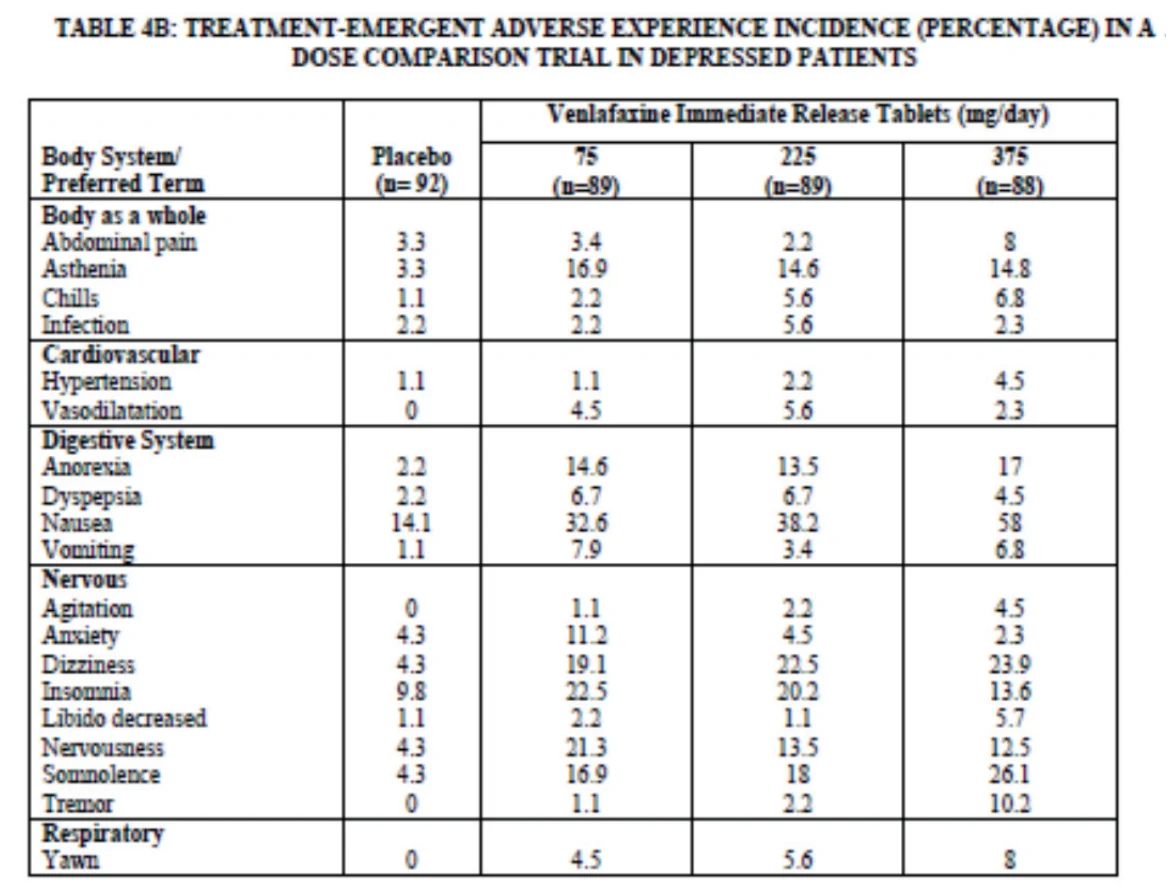
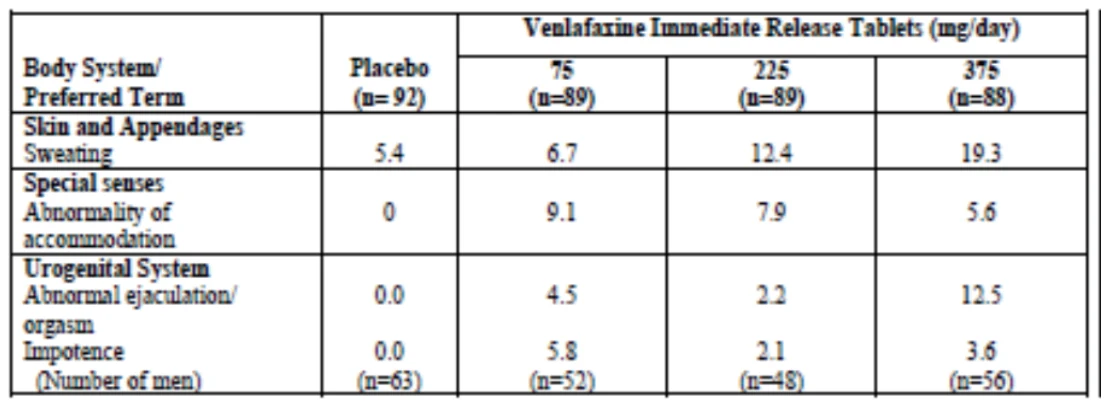
The tables that follow (Tables 5A and 5B) enumerate adverse events that occurred at an incidence of 2% or more, and were more frequent than in the placebo group, among venlafaxine treated patients with Social Anxiety Disorder in 12-week and 6-month studies, respectively.
TABLE 5A: TREATMENT-EMERGENT ADVERSE EVENT INCIDENCE (%) IN SHORT-TERM, PLACEBO-CONTROLLED VENLAFAXINE HYDROCHLORIDE EXTENDED RELEASE CAPSULES CLINICAL TRIALS (387 EU/CA, 388 EU, 392-US, and 393 US) IN SOCIAL ANXIETY DISORDER PATIENTS1,2 (12 WEEKS, DOSAGE RANGE 75-225 MG) ]
Body System Preferred term | Venlafaxine Hydrochloride Extended Release Capsules (n = 562) | Placebo (n = 566) |
Body as a Whole Asthenia Abdominal pain Accidental injury | 19 6 4 | 8 4 3 |
Cardiovascular System Hypertension Palpitation Vasodilatation | 5 3 2 | 3 2# 1 |
Digestive System Nausea Anorexia Constipation Diarrhea Dyspepsia Vomiting | 30 15 9 7 6 4 | 9 2 3 5 5 2 |
| Metabolic and Nutritional Weight loss | 3 | <1 |
Nervous System Insomnia Somnolence Dry mouth Dizziness Libido decreased Nervousness Tremor Anxiety Agitation Abnormal dreams Thinking abnormal Twitching Sleep disorder Trismus | 23 18 15 15 9 9 6 6 3 3 2 2 2# 2# | 8 7 4 8 2 4 2# 4 1 1 <1 0 <1 0 |
Respiratory System
Body System Preferred term Yawn Sinusitis | Venlafaxine Hydrochloride Extended Release Capsules (n = 562) 7 2# | Placebo (n = 566) <1 1 |
Skin Sweating | 15 | 4 |
| Special Senses Abnormal vision Tinnitus | 5 2# | 1 <1 |
Urogenital System Abnormal ejaculation/orgasm (men)3 (women)4 Impotence3 Anorgasmia (men)3 (women)4 Menstrual disorder4 Urinary frequency | 12 2# 7 7 4 2# 2# | <1 <1 2# <1 0 1 <1 |
1 Incidence rounded to the nearest %, for events reported by at least 2% of patients in any venlafaxine hydrochloride extended release capsules treatment group, and at an incidence greater than the respective placebo incidence. # indicates that the incidence is less than 2% but rounds to 2%. 2 <1% means greater than zero but less than 1%. 3 Percentage based on the number of males (venlafaxine hydrochloride extended release capsules = 308, placebo = 284). 4 Percentage based on the number of females (venlafaxine hydrochloride extended release capsules = 254, placebo = 282). | ||
TABLE 5B: TREATMENT-EMERGENT ADVERSE EVENT INCIDENCE (%) IN A LONG-TERM,
PLACEBO-CONTROLLED VENLAFAXINE HYDROCHLORIDE EXTENDED RELEASE CAPSULES CLINICAL TRIAL (390 US) IN SOCIAL ANXIETY DISORDER PATIENTS1,2 (6 MONTHS, DOSAGE RANGE 75-225 MG)
| Body System | Venlafaxine Hydrochloride Extended Release Capsules 75 mg 150-225 mg | Placebo | |
| Preferred term | (n = 128) | (n = 129) | (n = 129) |
| Body as a Whole | |||
| Allergic reaction | <1 | 2# | <1 |
| Asthenia | 25 | 19 | 11 |
| Back pain | 9 | 5 | 8 |
| Chest pain | 3 | 2 | 0 |
| Fever | 3 | 0 | 2 |
| Flu syndrome | 9 | 4 | 6 |
| Headache | 57 | 45 | 43 |
| Pain | 9 | 5 | 7 |
| Cardiovascular system | |||
| Hypertension | 3 | 7 | 4 |
| Palpitation | 3 | 4 | <1 |
| Postural hypotension | 2# | <1 | 0 |
| Vasodilatation | 2 | 5 | 2 |
| Digestive system | |||
| Anorexia | 19 | 22 | 3 |
| Constipation | 8 | 9 | 2 |
| Diarrhea | 13 | 9 | 10 |
| Dyspepsia | 11 | 12 | 11 |
| Dysphagia | 0 | 2 | 0 |
| Flatulence | 3 | 4 | 2# |
| Nausea | 37 | 34 | 10 |
| Vomiting | 5 | 4 | 3 |
| Hemic and lymphatic | |||
Venlafaxine Hydrochloride Extended Release Capsules | |||
| Body System | 75 mg | 150-225 mg | Placebo |
| Preferred term | (n = 128) | (n = 129) | (n = 129) |
| Ecchymosis | <1 | 2 | 0 |
| Metabolic and nutritional | |||
| Hyperlipemia | 2# | 0 | 0 |
| Weight gain | 2 | <1 | <1 |
| Musculoskeletal system | |||
| Leg cramps | 2# | <1 | 0 |
| Nervous system | |||
| Abnormal dreams | 3 | 4 | <1 |
| Agitation | 3 | 2# | 2# |
| Amnesia | 2# | <1 | 0 |
| Apathy | <1 | 2# | 0 |
| Depersonalization | 2 | <1 | 0 |
| Dizziness | 24 | 19 | 12 |
| Dry mouth | 23 | 19 | 6 |
| Insomnia | 26 | 30 | 16 |
| Libido decreased | 5 | 10 | 2 |
| Libido increased | 2# | 0 | <1 |
| Nervousness | 10 | 14 | 6 |
| Paresthesia | 4 | 6 | 2# |
| Sleep disorder | 0 | 2# | <1 |
| Somnolence | 24 | 29 | 14 |
| Tremor | 2 | 7 | 2# |
| Twitching | 2 | 5 | <1 |
| Vertigo | <1 | 2# | 0 |
| Respiratory system | |||
| Asthma | 2# | 2 | 0 |
| Dyspnea | 2# | <1 | 0 |
| Pharyngitis | 11 | 9 | 5 |
| Rhinitis | 13 | 6 | 7 |
| Upper respiratory infection | 8 | 5 | 7 |
| Yawn | 5 | 12 | 0 |
| Skin | |||
| Contact dermatitis | 0 | 2 | 0 |
| Rash | 5 | <1 | 3 |
| Sweating | 10 | 12 | 2 |
| Urticaria | <1 | 2 | 0 |
| Special senses | |||
| Abnormal vision | 3 | 7 | 3 |
| Conjunctivitis | <1 | 2 | 0 |
| Mydriasis | 2# | 4 | 0 |
| Taste perversion | 0 | 2# | <1 |
| Tinnitus | 0 | 2 | <1 |
| Urogenital system | |||
| Urinary frequency | 0 | 2# | <1 |
| Urination impaired | 2# | 2# | 0 |
| Urine abnormality | 0 | 2# | 0 |
| Abnormal ejaculation/orgasm | |||
| (men)3 | 12 | 18 | 1 |
| (women)4 | 0 | 2 | 0 |
| Amenorrhea 4 | 0 | 4 | 0 |
| Anorgasmia | |||
| (men)3 | 0 | 3 | 0 |
| (women) | 0 | 4 | 0 |
| Dysmenorrhea 4 | 13 | 12 | 5 |
| Impotence 3 | 3 | 8 | 0 |
| Menstrual disorder 4 | 0 | 2 | 0 |
| Metrorrhagia 4 | 3 | 0 | 0 |
| Unintended pregnancy 4 | 2# | 0 | 0 |
| Uterine spasm 4 | 2# | 0 | 0 |
1 Incidence rounded to the nearest %, for events reported by at least 2% of patients in any venlafaxine hydrochloride extended release capsules treatment group, and at an incidence greater than the respective placebo incidence. # indicates that incidence is less than 2% but rounds to 2% 2 <1% means greater than zero but less than 1%. 3 Percentage based on the number of males (venlafaxine hydrochloride extended release capsules 75 mg = 67, venlafaxine hydrochloride extended release capsules 150-225 mg = 79, placebo = 73). 4 Percentage based on the number of females (venlafaxine hydrochloride extended release capsules 75 mg = 61, venlafaxine hydrochloride extended release capsules 150-225 mg 50, placebo = 56). | |||
Adaptation to Certain Adverse Events
In premarketing experience with venlafaxine immediate release tablets over a 6-week period, and venlafaxine hydrochloride extended release capsules over a 12 week period, there was evidence of adaptation to some adverse events with continued therapy (e.g., dizziness and nausea), but less to other effects (e.g., abnormal ejaculation and dry mouth).
Discontinuation Symptoms
Abrupt discontinuation, dose reduction, or tapering of venlafaxine at various doses has been found to be associated with the appearance of new symptoms, the frequency of which increased with increased dose level and with longer duration of treatment. Symptoms associated with discontinuation include but are not limited to: aggression, agitation, anorexia, anxiety, asthenia, confusion, convulsions, coordination impaired, diarrhoea, dizziness, dry mouth, dysphoric mood, fasciculation, fatigue, flu-like symptoms, headache, hypomania, impaired coordination and balance, insomnia, nausea, nightmares, nervousness, paresthesia, electric shock sensations, sensory disturbances (including shock like electrical sensations), sleep disturbances, somnolence, sweating, tinnitus, tremor, vertigo, and vomiting. Where such symptoms occurred they were usually self-limiting but in a few patients continued for several weeks. In premarketing studies, the majority of discontinuation reactions were mild and resolved without treatment.
Patients should be monitored for these or any other symptoms when discontinuing treatment, regardless of the indication for which venlafaxine hydrochloride is being prescribed. If intolerable symptoms occur following a decrease in the dose or upon discontinuation of treatment, dose titration should be managed on the basis of the patient’s clinical response (See WARNINGS AND PRECAUTIONS, Discontinuation Symptoms, and DOSAGE AND ADMINISTRATION, Discontinuing Venlafaxine for details).
Vital Sign Changes
Treatment with venlafaxine immediate release tablets (averaged over all dose groups) in clinical trials was associated with a mean increase in pulse rate of approximately 3 beats per minute, compared to no change for placebo. It was associated with mean increases in diastolic blood pressure ranging from 0.7 to 2.5 mm Hg averaged over all dose groups, compared to mean decreases ranging from 0.9 to 3.8 mm Hg for placebo. However, there is a dose dependency for blood pressure increase (see WARNINGS AND PRECAUTIONS, Sustained Hypertension for effects on blood pressure).
Treatment with venlafaxine hydrochloride extended release capsules for up to 12 weeks in premarketing depression trials was associated with a mean increase in pulse rate of approximately 2 beats per minute, compared with 1 beat per minute for placebo. It was associated with mean increases in diastolic blood pressure ranging from 0.7 to 0.9 mm Hg, compared with mean decreases ranging from 0.5 to 1.4 mm Hg for placebo.
Venlafaxine hydrochloride extended release capsules treatment for up to 12 weeks in 4 premarketing placebo-controlled Social Anxiety Disorder trials was associated with mean final on-therapy increase in pulse rate of approximately 3 beats per minute, compared with an increase of approximately 1 beat per minute for placebo. Venlafaxine hydrochloride extended release capsules treatment for up to 6 months in a premarketing placebo-controlled Social Anxiety Disorder trial was associated with mean final on-therapy increase of approximately 2 beats per minute in the 75 mg/day group and an increase of approximately 4 beats per minute in the 150 to 225 mg/day group, compared with an increase of approximately 2 beats per minute for placebo.
Mean changes in supine diastolic blood pressure were also associated with venlafaxine treatment in the Social Anxiety Disorder trials (see WARNINGS AND PRECAUTIONS, Sustained Hypertension).
Laboratory Changes-Cholesterol
Clinically and statistically relevant increases in cholesterol levels have been noted in studies using venlafaxine hydrochloride extended release capsules (see WARNINGS AND PRECAUTIONS, Serum Cholesterol Elevation).
Venlafaxine Immediate Release Tablets:
Patients treated with venlafaxine immediate release tablets for at least 3 months in placebo-controlled 12-month extension trials for Major Depressive Disorders had a mean final on-therapy increase in total cholesterol of 9.1 mg/dL (0.2364 mmol/L) compared with a decrease of 7.1 mg/dL (0.1835 mmol/L) among placebo-treated patients. This increase was duration dependent over the study period and tended to be greater with higher doses. Clinically relevant increases in serum cholesterol, defined as 1) a final on-therapy increase in serum cholesterol >50 mg/dL (1.2930 mmol/L) from baseline and to a value >261 mg/dL (6.7495 mmol/L) or 2) an average on therapy increase in serum cholesterol >50 mg/dL (1.2930 mmol/L) from baseline and to a value >261 mg/dL (6.7495 mmol/L), were recorded in 5.3% of venlafaxine-treated patients and 0.0% of placebo-treated patients.
Venlafaxine Extended Release Capsules:
Venlafaxine extended release capsules treatment
Venlafaxine hydrochloride extended release capsules treatment for up to 12 weeks in premarketing placebo-controlled trials for major depressive disorder was associated with a mean final on-therapy increase in serum cholesterol concentration of approximately 1.5 mg/dL (0.0381 mmol/L) compared with a mean final decrease of 7.4 mg/dL (0.1919 mmol/L) for placebo.
Elevations of total serum cholesterol, High Density Lipoprotein Cholesterol (HDL), Low
Density Lipoprotein Cholesterol (LDL) and the overall ratio of Total Cholesterol/HDL have been observed in placebo controlled clinical trials for Social Anxiety Disorder.
Measurement of serum cholesterol levels (including a complete lipid profile/fractionation and an assessment of the patient’s individual risk factors) should be considered especially during long-term treatment.
Patients treated with venlafaxine hydrochloride extended release capsules for up to 12 weeks in 4 premarketing placebo-controlled Social Anxiety Disorder trials had a mean final on-therapy increases in total serum cholesterol concentration of approximately 8.8 mg/dL (0.227 mmol/L), increases in HDL cholesterol of 2.3 mg/dL (0.059 mmol/L), and increases in LDL cholesterol of 5.4 mg/dL (0.139 mmol/L). Patients treated with venlafaxine hydrochloride extended release capsules 75 mg/day for up to 6 months in a premarketing placebo-controlled Social Anxiety Disorder trial had a mean final on-therapy decrease in total serum cholesterol concentration of approximately 0.5 mg/dL (0.013 mmol/L), decrease in HDL cholesterol of 1.0 mg/dL (0.025 mmol/L), and increase in LDL cholesterol of 0.2 mg/dL (0.006 mmol/L). Patients treated with venlafaxine hydrochloride extended release capsules 150-225 mg/day for up to 6 months in the same premarketing placebo-controlled Social Anxiety Disorder trial had a mean final on-therapy increase in total serum cholesterol concentration of approximately 12.5 mg/dL (0.322 mmol/L), increase in HDL cholesterol of 1.0 mg/dL (0.026 mmol/L), and increase in LDL cholesterol of 8.2 mg/dL (0.213 mmol/L).
ECG Changes
In an analysis of ECGs obtained in 769 patients treated with venlafaxine immediate release tablets and 450 patients treated with placebo in controlled clinical trials in depression, the only statistically significant difference observed was for heart rate, i.e., a mean increase from baseline of 4 beats per minute for venlafaxine immediate release tablets.
An analysis of ECGs was obtained in 357 patients treated with venlafaxine extended release capsules and 285 patients treated with placebo in controlled clinical trials in depression and 593 patients who received venlafaxine hydrochloride extended release capsules and 534 patients who received placebo for up to 12 weeks in double-blind, placebo-controlled trials in Social Anxiety Disorder. The mean change from baseline in corrected QT interval (QTc) for venlafaxine hydrochloride extended release capsules-treated patients was increased relative to that for placebo-treated patients in the clinical trials for depression and Social Anxiety Disorder. (see WARNINGS AND PRECAUTIONS, Cardiac Disease).
Other Events Observed During the Premarketing Evaluation of Venlafaxine
During the pre-marketing assessment of venlafaxine immediate release tablets, multiple doses of venlafaxine hydrochloride extended release capsules were administered to 705 patients in phase III depression studies and 819 patients in phase III Social Anxiety Disorder studies. The conditions and duration of exposure to venlafaxine in both development programs varied greatly, and included (in overlapping categories) open and double-blind studies, uncontrolled and controlled studies, outpatient studies, fixed-dose and titration studies. Untoward events associated with this exposure were recorded by clinical investigators using terminology of their
own choosing. Consequently, it is not possible to provide a meaningful estimate of the proportion of individuals experiencing adverse events without first grouping similar types of untoward events into a smaller number of standardized event categories.
In the tabulations that follow, reported adverse events were classified using a standard COSTART-based Dictionary terminology. The frequencies presented, therefore, represent the proportion of the 7212 patients exposed to multiple doses of venlafaxine who experienced an event of the type cited on at least one occasion while receiving venlafaxine. All reported events are included except those already listed in 4A (MDD), 5A (SAD ST), 5B (SAD LT), and those events for which a drug cause was remote. If the COSTART term for an event was so general as to be uninformative, it was replaced with a more informative term. It is important to emphasize that, although the events reported occurred during treatment with venlafaxine, they were not necessarily caused by it.
Events are further categorized by body system and listed in order of decreasing frequency according to the following definitions: frequent adverse events are those occurring on one or more occasions in at least 1/100 patients; infrequent adverse events are those occurring in 1/100 to 1/1000 patients; rare adverse events are those occurring in fewer than 1/1000 patients
Body as a whole:
Frequent: chest pain substernal. .
Infrequent: angioedema, face edema, intentional injury, malaise, moniliasis, neck rigidity, overdose, pelvic pain, photosensitivity reaction, suicide attempt. .
Rare: anaphylaxis, appendicitis, bacteremia, body odour, carcinoma, cellulitis, granuloma, halitosis. .
Cardiovascular system:
Common: palpitations .
Infrequent: angina pectoris, arrhythmia, bradycardia, extrasystoles, hypotension, peripheral vascular disorder (mainly cold feet and/or cold hands), syncope. .
Rare: aortic aneurysm, arteritis, first degree atrioventricular block, bigeminy, bundle branch block, capillary fragility, cardiovascular disorder (includes mitral valve and circulatory disturbances), cerebral ischemia, coronary artery disease, heart arrest, congestive heart failure, hematoma, mucocutaneous hemorrhage, myocardial infarct, pallor, QT and QTc interval prolonged, sinus arrhythmia, thrombophlebitis, varicose vein, venous insufficiency.
Digestive system:
Frequent: increased appetite.
Infrequent: bruxism, colitis, dysphagia, tongue edema, eructation, esophagitis, gastritis, gastroenteritis, gastrointestinal ulcer, gingivitis, glossitis, rectal hemorrhage, hemorrhoids, melena, oral moniliasis, stomatitis, mouth ulceration.
Rare: abdominal distension, biliary pain, cheilitis, cholecystitis, cholelithiasis, duodenitis, esophageal spasms, hematemesis, gastroesophageal reflux disease, gum hemorrhage, hepatitis, ileitis, jaundice, intestinal obstruction, liver tenderness, parotitis, periodontitis, proctitis, rectal disorder, increased salivation, salivary gland enlargement, soft stools, tongue discoloration.
Endocrine system:
Rare: galactorrhea, goiter, hyperthyroidism, hypothyroidism, thyroid nodule, thyroiditis.
Hemic and lymphatic system:
Infrequent: anemia, gastrointestinal hemorrhage, leukocytosis, leukopenia, lymphadenopathy, thrombocythemia, mucous membrane bleeding.
Rare: basophilia, bleeding time increased, cyanosis, eosinophilia, lymphocytosis, multiple myeloma, purpura, thrombocytopenia.
Metabolic and nutritional:
Frequent: edema, serum cholesterol increase.
Infrequent: alkaline phosphatase increased, dehydration, hypercholesterolemia, hyperglycemia, hypokalemia, SGOT (AST) increased, SGPT (ALT) increased, thirst, SIADH. Rare: alcohol intolerance, bilirubinemia, BUN increased, creatinine increased, diabetes mellitis, glycosuria, gout, healing abnormal, hemochromatosis, hypercalcinuria, hyperkalemia, hyperphosphatemia, hyperuricemia, hypocholesterolemia, hypoglycemia , hyponatremia, hypophosphatemia, hypoproteinemia, uremia.
Musculoskeletal system:
Infrequent: arthritis, arthrosis, bone spurs, bursitis, myasthenia.
Rare: bone pain, muscle cramp, muscle spasm, musculoskeletal stiffness, pathological fracture, myopathy, osteoporosis, osteosclerosis, plantar fasciitis, rheumatoid arthritis, tendon rupture.
Nervous system:
Frequent: hypesthesia.
Infrequent: akathisia/psychomotor restlessness, ataxia, circumoral paresthesia, CNS stimulation, emotional lability, euphoria, hallucinations, hostility, hyperesthesia, hyperkinesias, hypotonia, impaired coordination and balance, manic reaction, myoclonus, neuralgia, neuropathy, psychosis, serotonergic syndrome, seizure, abnormal speech, stupor, suicidal ideation.
Rare: abnormal/changed behaviour, adjustment disorder, akinesia, alcohol abuse, aphasia, bradykinesia, buccoglossal syndrome, cerebrovascular accident, convulsion, feeling drunk, loss of consciousness, delusions, dementia, dystonia, energy increased, facial paralysis, abnormal gait, Guillain-Barré Syndrome, homicidal ideation, hyperchlorhydria, hysteria, impulse control difficulties, hypokinesia, motion sickness, neuritis, nystagmus, paranoid reaction, paresis, psychotic depression, reflexes decreased, reflexes increased, torticollis.
Respiratory system:
Infrequent: chest congestion, epistaxis, hyperventilation, laryngismus, laryngitis, pneumonia, voice alteration.
Rare: atelectasis, hemoptysis, hiccup, hypoventilation, hypoxia, larynx edema, pleurisy, pulmonary embolus, sleep apnea, sputum increased.
Skin and appendages:
Frequent: pruritis.
Infrequent: acne, alopecia, dry skin, maculopapular rash, psoriasis.
Rare: brittle nails, erythema nodosum, exfoliative dermatitis, lichenoid dermatitis, hair discoloration, skin discoloration, furunculosis, hirsutism, leukoderma, miliaria, petechial rash, pruritic rash, pustular rash, vesiculobullous rash, seborrhea, skin atrophy, skin hypertrophy, skin striae, sweating decreased.
Special senses:
Infrequent: diplopia, dry eyes, eye pain, otitis media, parosmia, photophobia, taste loss. Rare: blepharitis, cataract, chromatopsia, conjunctival edema, corneal lesion, deafness, exophthalmos, eye hemorrhage, glaucoma, hyperacusis, retinal hemorrhage, subconjunctival hemorrhage, keratitis, labyrinthitis, miosis, papilledema, decreased pupillary reflex, otitis externa, scleritis, uveitis, visual field defect, vitreous disorder.
Urogenital system:
Frequent: erectile dysfunction.
Infrequent: albuminuria, cystitis, hematuria, leukorrhea*, kidney calculus, kidney pain, kidney function abnormal, nocturia, breast pain, prostatic disorder (includes prostatitis, enlarged prostate, and prostate irritability)*, polyuria, pyuria, urinary incontinence, urinary retention, urinary urgency, vaginal hemorrhage*, vaginitis*.
Rare: abortion*, anuria, balanitis*, bladder pain, breast discharge, breast engorgement, breast enlargement, endometriosis*, fibrocystic breast, calcium crystalluria, cervicitis*, ovarian cyst*, prolonged erection*, female lactation*, gynecomastia*, hypomenorrhea*, mastitis*, menopause*, oliguria, orchitis, pyelonephritis, salpingitis*, urolithiasis, uterine hemorrhage*, vaginal dryness*.
* Based on the number of men and women, as appropriate.
Post-Market Adverse Drug Reactions Not Listed as Clinical Trial Adverse Event
Voluntary reports of adverse events other than those above, temporally associated with the use of venlafaxine, that have been received since market introduction and that may have no causal relationship with the use of venlafaxine include the following:
Body as a whole anaphylaxis, congenital anomalies, neuroleptic malignant syndrome-like events (including the case of a 10-year old boy who may have been taking methylphenidate, was treated and recovered), serotonin syndrome
Cardiovascular system congestive heart failure, deep vein thrombosis, heart arrest, hemorrhage, myocardial infarction, ECG abnormalities (such as atrial fibrillation, bigeminy, supraventricular tachycardia, ventricular extrasystole, ventricular fibrillation and ventricular tachycardia, including torsades de pointes)
Digestive system bruxism, diarrhoea, gastrointestinal bleeding, hepatic events (including GGT elevation; abnormalities of unspecified liver function tests; fatty liver, liver damage, necrosis or failure, fulminant hepatitis, including rare fatalities), pancreatitis, diarrhea Endocrine system: prolactin increased
Hemic and lymphatic system: agranulocytosis, aplastic anemia, neutropenia, pancytopenia Metabolic and Nutritional: CPK increased, dehydration, hepatitis, LDH increased, syndrome of inappropriate antidiuretic hormone secretion, weight loss
Musculoskeletal: rhabdomyolysis
Nervous system: abnormal gait, agitation, catatonia, delirium, extrapyramidal symptoms (including dyskinesia, dystonia, tardive dyskinesia), grand mal seizures, increased muscle tonus,
involuntary movements, panic, paresthesia, neuroleptic malignant syndrome, sedation, shock-like electrical sensations (in some cases, subsequent to the discontinuation of venlafaxine or tapering of dose), aggressive ideation and acts, including harm to others. Respiratory system: interstitial lung disease (including pulmonary eosinophilia). Skin and appendages: toxic epidermal necrolysis/Stevens-Johnson syndrome, erythema multiform, sweating including night sweats
Special senses: angle closure glaucoma, eye hemorrhage, tinnitus
Urogenital system: renal failure.
DRUG INTERACTIONS
Serious Drug Interactions
- Monoamine Oxidase Inhibitors: See CONTRAINDICATIONS
Overview
Venlafaxine is not highly bound to plasma proteins; therefore, administration of venlafaxine to a patient taking another drug that is highly protein bound should not cause increased free concentrations of the other drug.
The risk of using venlafaxine in combination with other CNS-active drugs has not been systematically evaluated. Consequently, caution is advised if the concomitant administration of venlafaxine and such drugs is required.
As with all drugs, the potential for interaction by a variety of mechanisms is a possibility.
Drug-Drug Interactions
- Monoamine Oxidase Inhibitors: See CONTRAINDICATIONS and DOSAGE AND ADMINISTRATION, Switching Patients to or from a Monoamine Oxidase Inhibitor.
Other CNS-Active Drugs
The risk of using venlafaxine in combination with other CNS-active drugs has not been systematically evaluated. Consequently, caution is advised if the concomitant administration of venlafaxine and such drugs is required.
Serotonergic Drugs
Based on the known mechanism of action of venlafaxine and the potential for serotonin syndrome, a potentially life threatening condition, caution is advised when venlafaxine is co-administered with other drugs that may affect the serotonergic neurotransmitter systems (such as triptans, selective serotonin reuptake inhibitors, other SNRIs, linezolid (an antibiotic which is a reversible non-selective MAOI; see CONTRAINDICATIONS), lithium, sibutramine or tramadol, or with serotonin precursors, such as tryptophan supplements). Rare postmarketing reports describe patients with symptoms suggestive of, or diagnostic of, serotonin syndrome, following the combined use of a selective serotonin reuptake inhibitor (SSRI) with 5HT1-
agonists (triptans) or lithium. If concomitant treatment with venlafaxine hydrochloride extended release capsules and a triptan (e.g., almotriptan, sumatriptan, rizatriptan, naratriptan, zolmitriptan), tricyclic antidepressants, or other drugs or agents with serotonergic activity (including but not limited to fenfluramine, tryptophan and silbutramine; the antibiotic linezolid; St. John’s Wort) is clinically warranted, appropriate observation of the patient for acute and long-term adverse events is advised. (See also WARNINGS AND PRECAUTIONS, Endocrine and Metabolism, Changes in Appetite and Weight; and WARNINGS AND PRECAUTIONS, Neurologic, Serotonin Syndrome/Neuroleptic Malignant Syndrome.)
Serotonin syndrome symptoms may include mental status changes, autonomic instability, neuromuscular aberrations and/or gastrointestinal symptoms.
Alcohol
The possibility of additive psychomotor impairment should be considered if venlafaxine is used in combination with alcohol. Patients should be advised to avoid alcohol while taking venlafaxine.
Lithium
The steady-state pharmacokinetics of venlafaxine 150 mg administered as 50 mg every 8 hours was not affected when a single 600 mg oral dose of lithium was administered to 12 healthy male subjects. ODV was also unaffected. Venlafaxine had no effect on the pharmacokinetics of lithium. (Also see Other CNS-Active Drugs.)
Diazepam
The steady-state pharmacokinetics of venlafaxine 150 mg administered as 50 mg every 8 hours was not affected when a single 10 mg oral dose of diazepam was administered to 18 healthy male subjects. ODV was also unaffected. Venlafaxine had no effect on the pharmacokinetics of diazepam or its active metabolite, desmethyldiazepam. Additionally, venlafaxine administration did not affect the psychomotor and psychometric effects induced by diazepam.
Cimetidine
Concomitant administration of cimetidine and venlafaxine in a steady-state study for both drugs in 18 healthy male subjects resulted in inhibition of first-pass metabolism of venlafaxine. The oral clearance of venlafaxine was reduced by about 43%, and the exposure (AUC) and maximum concentration (Cmax) of the drug were increased by about 60%. However, there was no effect on the pharmacokinetics of ODV. The overall pharmacological activity of venlafaxine plus ODV is expected to increase only slightly, and no dosage adjustment should be necessary for most normal adults. However, for patients with pre-existing hypertension, for elderly patients and for patients with hepatic or renal dysfunction, the interaction associated with the concomitant use of cimetidine and venlafaxine is not known and potentially could be more pronounced. Therefore, caution is advised with such patients.
Haloperidol
Venlafaxine administered under steady-state conditions at 150 mg/day in 24 healthy subjects decreased total oral-dose clearance (Cl/F) of a single 2 mg dose of haloperidol by 42%, which resulted in a 70% increase in haloperidol AUC. In addition, the haloperidol Cmax increased 88% when coadministered with venlafaxine, but the haloperidol elimination half-life (t½) was unchanged. The mechanism explaining this finding is unknown.
Imipramine
Venlafaxine did not affect the pharmacokinetics of imipramine and 2-OH-imipramine. However, AUC, Cmax and Cmin of desipramine (the active metabolite of imipramine) increased by approximately 35% in the presence of venlafaxine. The 2-OH-desipramine AUCs increased by at least 2.5 fold (with venlafaxine 37.5 mg q12h) and by 4.5 fold (with venlafaxine 75 mg q12h). The clinical significance of elevated 2-OH-desipramine levels is unknown.
Imipramine partially inhibited the CYP2D6-mediated formation of ODV. However, the total concentration of active compounds (venlafaxine plus ODV) was not affected by coadministration with imipramine, and no dosage adjustment is required.
Metoprolol
Concomitant administration of venlafaxine (50 mg every 8 hours for 5 days) and metoprolol (100 mg every 24 hours for 5 days) to healthy volunteers in a pharmacokinetic interaction study for both drugs resulted in an increase of plasma concentrations of metoprolol by approximately 30-40% without altering the plasma concentrations of its active metabolite, α-hydroxymetoprolol. The clinical relevance of this finding is unknown. Metoprolol did not alter the pharmacokinetic profile of venlafaxine or its active metabolite, O-desmethyl venlafaxine. (See also WARNINGS AND PRECAUTIONS, General, Hypertension).
Risperidone
Venlafaxine administered under steady-state conditions at 150 mg/day slightly inhibited the CYP2D6-mediated metabolism of risperidone (administered as a single 1 mg oral dose) to its active metabolite, 9-hydroxyrisperidone, resulting in an approximate 32% increase in risperidone AUC. However, venlafaxine coadministration did not significantly alter the pharmacokinetic profile of the total active moiety (risperidone plus 9-hydroxyrisperidone).
Indinavir
In a study of 9 healthy volunteers, venlafaxine administered under steady-state conditions at 150 mg/day resulted in a 28% decrease in the AUC of a single 800 mg oral dose of indinavir and a 36% decrease in indinavir Cmax. Indinavir did not affect the pharmacokinetics of venlafaxine and ODV. The clinical significance of this finding is unknown.
Ketoconazole
A pharmacokinetic study with ketoconazole in extensive (EM) and poor metabolizers
(PM) of CYP2D6 resulted in higher plasma concentrations of both venlafaxine and ODV in subjects following administration of ketoconazole. Venlafaxine Cmax increased by 26% in EM subjects and 48% in PM subjects. Cmax values for ODV increased by 14% and 29% in EM and PM subjects, respectively. Venlafaxine AUC increased by 21% in EM subjects and 70% in PM subjects. AUC values for ODV increased by 23% and 33% in EM and PM subjects, respectively.
Drugs Highly Bound to Plasma Proteins
Venlafaxine is not highly bound to plasma proteins; therefore, administration of venlafaxine to a patient taking another drug that is highly protein bound should not cause increased free concentrations of the other drug.
Drugs Metabolized by Cytochrome P450 Isoenzymes
The metabolic pathways for venlafaxine include CYP2D6 and CYP3A4. Venlafaxine is primarily metabolized to its active metabolite, ODV, by the cytochrome P450 enzyme CYP2D6. CYP3A4 is a minor pathway relative to CYP2D6 in the metabolism of venlafaxine.
In vitro studies indicate that venlafaxine is a relatively weak inhibitor of CYP2D6. These findings have been confirmed in vivo by a clinical drug interaction study comparing the effect of venlafaxine with that of fluoxetine on the CYP2D6-mediated metabolism of dextromethorphan to dextrorphan.
Drugs that Inhibit Cytochrome P450 Isoenzymes
CYP2D6-Inhibitors:
In vitro and in vivo studies indicate that venlafaxine is metabolized to its active metabolite, ODV, by CYP2D6, the isoenzyme that is responsible for the genetic polymorphism seen in the metabolism of many antidepressants. Therefore, the potential exists for a drug interaction between drugs that inhibit CYP2D6 mediated metabolism and venlafaxine.
Drug interactions that reduce the metabolism of venlafaxine to ODV (see Imipramine above) potentially increase the plasma concentrations of venlafaxine and lower the concentrations of the active metabolite. Concomitant use of CYP2D6 inhibitors and venlafaxine may reduce the metabolism of venlafaxine to ODV, resulting in increased plasma concentrations of venlafaxine and decreased concentrations of ODV. As venlafaxine and ODV are both pharmacologically active, no dosage adjustment is required when venlafaxine is coadministered with a CYP2D6 inhibitor.
CYP3A3/4 Inhibitors:
In vitro studies indicate that venlafaxine is likely metabolized to a minor, less active metabolite, N-desmethylvenlafaxine, by CYP3A3/4. Concomitant use of CYP3A4
inhibitors and venlafaxine may increase levels of venlafaxine and ODV (see Ketoconazole, above). Therefore, caution is advised when combining venlafaxine with a CYP3A4 inhibitor.
CYP2D6 and 3A4 Inhibitors:
Interactions between concomitant intake of inhibitors of both CYP2D6 and CYP3A3/4 with venlafaxine have not been studied. However, this concomitant use would be expected to increase venlafaxine plasma concentrations. Because the two primary metabolic pathways for venlafaxine are through CYP2D6 and, to a lesser extent, CYP3A3/4, concomitant intake of inhibitors of both of these isoenzymes is not recommended during treatment with venlafaxine.
CYP3A4
Venlafaxine did not inhibit CYP3A4 in vitro. This finding was confirmed in vivo by clinical drug interaction studies in which venlafaxine did not inhibit the metabolism of several CYP3A4 substrates, including alprazolam, diazepam, and terfenadine.
CYP1A2
Venlafaxine did not inhibit CYP1A2 in vitro. This finding was confirmed in vivo by a clinical drug interaction study in which venlafaxine did not inhibit the metabolism of caffeine, a CYP1A2 substrate.
CYP2C9
Venlafaxine did not inhibit CYP2C9 in vitro. This finding was confirmed in vivo by a clinical drug interaction study in which venlafaxine did not inhibit the metabolism of tolbutamide, a CYP2C9 substrate.
CYP2C19
Venlafaxine did not inhibit the metabolism of diazepam, which is partially metabolized by CYP2C19 (see Diazepam above).
Postmarketing Reports of Drug-Drug Interactions
There have been reports of elevated clozapine levels that were temporally associated with adverse events including seizures, following the addition of venlafaxine. There have been reports of increases in prothrombin time, partial thromboplastin time, or INR when venlafaxine was given to patients receiving warfarin therapy.
Electroconvulsive Therapy
There are no clinical data on the use of electroconvulsive therapy combined with venlafaxine hydrochloride extended release capsules treatment.
Drug-Food Interactions
Food has no significant effect on the absorption of venlafaxine or on the subsequent formation of ODV.
Drug-Herb Interactions
St. John’s Wort
In common with SSRI’s, pharmacodynamic interactions between venlafaxine hydrochloride extended release capsules and the herbal remedy St. John’s Wort may occur and may result in an increase in undesirable effects.
Drug-Lifestyle Interactions
Interference with Cognitive and Motor Performance
In healthy volunteers receiving an immediate release venlafaxine formulation at a stable regimen of 150 mg/day, some impairment of psychomotor performance was observed. Patients should be cautioned about operating hazardous machinery, including automobiles, or engaging in tasks requiring alertness until they have been able to assess the drug’s effect on their own psychomotor performance.
Drug Abuse and Dependence
Physical and Psychological Dependence
In vitro studies revealed that venlafaxine has virtually no affinity for opiate, benzodiazepine, phencyclidine (PCP), or N-methyl-D-aspartic acid (NMDA) receptors. It has no significant CNS stimulant activity in rodents. In primate drug discrimination studies, venlafaxine showed no significant stimulant or depressant abuse liability.
While venlafaxine has not been systematically studied in clinical trials for their potential for abuse, there was no indication of drug-seeking behaviour in the clinical trials. However, it is not possible to predict on the basis of premarketing experience the extent to which a CNS active drug will be misused, diverted, and/or abused once marketed. Consequently, physicians should carefully evaluate patients for history of drug abuse and follow such patients closely, observing them for signs of misuse or abuse of venlafaxine (e.g., development of tolerance, incrementation of dose, drug-seeking behaviour)]
DOSAGE AND ADMINISTRATION
Dosing Considerations
General
VENLAFAXINE XR is not indicated for use in children under 18 years of age (see
WARNINGS AND PRECAUTIONS, Potential Association with Behavioural and Emotional Changes, Including Self-Harm).
Discontinuing Venlafaxine
When discontinuing venlafaxine after more than 1 week of therapy, it is generally recommended that the dose be tapered gradually to minimize the risk of discontinuation symptoms. Discontinuation symptoms have been assessed in patients with depression. Abrupt discontinuation, dose reduction, or tapering of venlafaxine at various doses has been found to be associated with the appearance of new symptoms, the frequency of which increased with higher dose levels and with longer duration of treatment. Reported symptoms include but are not limited to the following: aggression, agitation, anorexia, anxiety, asthenia, confusion, convulsions, impaired coordination and balance, diarrhoea, dizziness, dry mouth, dysphoric mood, fasciculation, fatigue, flu-like symptoms, headache, hypomania, insomnia, nausea, nightmares, nervousness, paresthesia, electric shock sensations, sensory disturbances (including shock like electrical sensations), sleep disturbances, somnolence, sweating, tinnitus, vertigo, and vomiting. Where such symptoms occurred they were usually self-limiting but in a few patients continued for several weeks. It is therefore recommended that the dosage of venlafaxine hydrochloride extended release capsules be tapered gradually whenever possible and the patient monitored. The period required for tapering may depend on the dose, duration of therapy and the individual patient. If venlafaxine has been used for more than 6 weeks, tapering over at least a two week period is recommended (see WARNINGS AND PRECAUTIONS, POTENTIAL ASSOCIATION WITH BEHAVIOURAL AND EMOTIONAL CHANGES, INCLUDING SELF-HARM, and also Discontinuation Symptoms; ADVERSE REACTIONS, Discontinuation Symptoms).
Patients With Hepatic or Renal Impairment:
Dosage adjustments are required (see DOSAGE AND ADMINISTRATION, Special Patient Populations below).
Switching Patients to or from a Monoamine Oxidase Inhibitor:
At least 14 days should elapse between discontinuation of an MAOI and initiation of therapy with venlafaxine hydrochloride extended release capsules. In addition, at least 14 days should be allowed after stopping venlafaxine hydrochloride extended release capsules before starting an MAOI (see CONTRAINDICATIONS).
Switching Patients from Immediate Release Tablets:
Depressed patients who are currently being treated at a therapeutic dose with immediate release tablets may be switched to venlafaxine hydrochloride extended release capsules at the nearest equivalent dose (mg/day), e.g., 37.5 mg immediate release two-times-a-day to 75 mg venlafaxine hydrochloride extended release capsules once daily. However, individual dosage adjustments may be necessary.
Recommended Dose and Dosage Adjustment
ADULTS:
Patients with Major Depressive Disorder
The recommended dose for VENLAFAXINE XR is 75 mg/day, administered once daily with food, either in the morning or in the evening. For some patients, it may be desirable to start at 37.5 mg/day for 4 - 7 days to allow new patients to adjust to the medication before increasing to
75 mg/day. Each capsule should be swallowed whole with water. It should not be divided, crushed, chewed, or placed in water. While the relationship between dose and antidepressant response for venlafaxine hydrochloride extended release capsules has not been adequately explored patients not responding to the initial 75 mg may benefit from dose increases. Depending on tolerability and the need for further clinical effect, the dose should be increased by up to 75 mg/day up to a maximum of 225 mg/day as a single dose for moderately depressed outpatients. Dose increments should be made at intervals of approximately 2 weeks or more, but not less than 4 days. There is very limited experience with venlafaxine hydrochloride extended release capsules at doses higher than 225 mg/day, or in severely depressed inpatients.
Patients with Social Anxiety Disorder (Social Phobia)
For most patients, the recommended dose for VENLAFAXINE XR is 75 mg/day, administered in a single dose. For some patients, it may be desirable to start at 37.5 mg/day for 4 to 7 days, to allow new patients to adjust to the medication before increasing to 75 mg/day. Depending on tolerability and if clinically warranted, dose increases should be in increments of up to 75 mg/day, as needed, up to a maximum of 225 mg/day. Dose increments should be made at intervals of not less than 4 days.]
Maintenance/Continuation/Extended Treatment
There is no body of evidence available to answer the question of how long a patient should continue to be treated with VENLAFAXINE XR for depression or Social Anxiety Disorder.
During long-term therapy for any indication, the VENLAFAXINE XR dosage should be maintained at the lowest effective dose and the need for continuing treatment should be periodically reassessed.
Depression:
It is generally agreed that acute episodes of major depression require several months or longer of sustained pharmacotherapy beyond response to the acute episode. Whether the dose needed to induce remission is identical to the dose needed for maintenance is unknown.
Maintenance of efficacy of venlafaxine hydrochloride extended release capsules have been shown in a placebo controlled study in which patients responding during 8 weeks of acute treatment with venlafaxine hydrochloride extended release capsules were assigned randomly to placebo or to the same dose of venlafaxine hydrochloride extended release capsules (75, 150, or 225 mg/day, in the morning (i.e. qAM) during 26 weeks of maintenance treatment (see CLINICAL TRIALS, Depression).
It is not known whether or not the dose of venlafaxine hydrochloride extended release capsules needed for maintenance treatment is identical to the dose needed to achieve an initial response. Patients should be periodically reassessed to determine the need for maintenance treatment and the appropriate dose for such treatment.
Social Anxiety Disorder
In patients with Social Anxiety Disorder, there are no efficacy data beyond 6 months of treatment with venlafaxine hydrochloride extended release capsules. The need for continuing
medication in patients with Social Anxiety Disorder who improve with venlafaxine hydrochloride extended release capsules treatment should be periodically reassessed.
Special Patient Populations:
Treatment of Pregnant Women During the Third Trimester
Post-marketing reports indicate that some neonates exposed to venlafaxine hydrochloride extended release capsules, SSRIs (Selective Serotonin Reuptake Inhibitors), or other newer antidepressants late in the third trimester have developed complications requiring prolonged hospitalization, respiratory support, and tube feeding. (See WARNINGS AND PRECAUTIONS, Special Populations, Pregnant Women). When treating a pregnant woman with VENLAFAXINE XR during the third trimester, the physician should carefully consider the potential risks and benefits of treatment.
Due to the potential for discontinuation symptoms, if a decision is taken to discontinue venlafaxine hydrochloride extended release capsules treatment, a gradual reduction in the dose rather than an abrupt cessation is recommended (See WARNINGS AND PRECAUTIONS, Discontinuation Symptoms).
Elderly Patients
No dose adjustment is recommended for elderly patients solely on the basis of their age. As with any antidepressant, drug for treatment of Social Anxiety Disorder, however, caution should be exercised in treating the elderly. When individualizing the dosage, extra care should be taken when increasing the dose.
Pediatrics
VENLAFAXINE XR is not indicated for use in children under 18 years of age (see WARNINGS AND PRECAUTIONS, Potential Association with Behavioural and Emotional Changes, Including Self-Harm).
Patients With Hepatic Impairment:
Given the decrease in clearance and increase in elimination half-life for both venlafaxine and ODV that is observed in patients with hepatic cirrhosis compared with normal subjects (see ACTION AND CLINICAL PHARMACOLOGY, Hepatic Insufficiency), the total daily dose should be reduced by about 50% in patients with mild to moderate hepatic impairment. For such patients, it may be desirable to start at 37.5 mg/day. Because of individual variability in clearance in these patients, individualization of dosage may be desirable. Since there was much individual variability in clearance between patients with cirrhosis, it may be necessary to reduce the dose by even more than 50%, and individualization of dosing may be desirable in some patients.
Patients with Renal Impairment
Given the decrease in clearance for venlafaxine and increase in elimination half-life for both venlafaxine and ODV that is observed in patients with renal impairment (GFR = 10 - 70 mL/min) compared to normal subjects (see ACTION AND CLINICAL PHARMACOLOGY, Renal Insufficiency) the total daily dose should be decreased by 25% - 50%. In patients
undergoing hemodialysis, the total daily dose must be reduced by 50% and the dose be withheld until the dialysis treatment is completed (4 hrs). For such patients, it may be desirable to start at 37.5 mg/day. Since there is so much individual variability in clearance among patients with renal impairment, individualization of dosing may be desirable.
Missed Dose
If a dose is missed, it should not be made up for it by doubling up on the dose next time. The next dose should be taken as scheduled.
Administration
Administer once daily with food, either in the morning or in the evening.
OVERDOSAGE
Venlafaxine Immediate Release Tablets
There were 14 reports of acute overdose with immediate release tablets (venlafaxine HCl), either alone or in combination with other drugs and/or alcohol, among the patients included in the premarketing evaluation. The majority of the reports involved ingestions in which the total dose of venlafaxine taken was estimated to be no more than several-fold higher than the usual therapeutic dose. The 3 patients who took the highest doses were estimated to have ingested approximately 6.75 g, 2.75 g and 2.5 g. The resultant peak plasma levels of venlafaxine for the latter 2 patients were 6.24 and 2.35 mcg/mL, respectively, and the peak plasma levels of O-desmethylvenlafaxine were 3.37 and 1.30 mcg/mL, respectively. Plasma venlafaxine levels were not obtained for the patient who ingested 6.75 g of venlafaxine. All 14 patients recovered without sequelae. Most patients reported no symptoms. Among the remaining patients, somnolence was the most commonly reported symptom. The patient who ingested 2.75 g of venlafaxine was observed to have 2 generalized convulsions and a prolongation of QTc to 500 msec, compared with 405 msec at baseline. Mild sinus tachycardia was reported in 2 of the other patients.
For management of a suspected drug overdose, contact your regional Poison Control Centre.
Venlafaxine Extended Release Capsules
Among the patients included in the premarketing evaluation of venlafaxine extended release capsules, there were 2 reports of acute overdosage with venlafaxine hydrochloride extended release capsules in depression trials, either alone or in combination with other drugs. One patient took a combination of 6 g of venlafaxine hydrochloride extended release capsules and 2.5 mg of lorazepam. This patient was hospitalized, treated symptomatically, and recovered without any untoward effects. The other patient took 2.85 g of venlafaxine hydrochloride extended release capsules. This patient reported paresthesia of all four limbs but recovered without sequelae. There were 2 reports of acute overdose with venlafaxine hydrochloride extended release capsules in anxiety trials. One patient took a combination of 0.75 g venlafaxine hydrochloride extended release capsules and 200 mg of paroxetine and 50 mg of zolpidem. This patient was described as being alert, able to communicate, and a little sleepy. This patient was hospitalized, treated with activated charcoal, and recovered without any untoward effects. The other patient took 1.2 g of venlafaxine hydrochloride extended release capsules. This patient recovered and no other
specific problems were found. The patient had moderate dizziness, nausea, numb hands and feet, and hot-cold spells 5 days after the overdose. There were no reports of acute overdose with venlafaxine hydrochloride extended release capsules in Social Anxiety Disorder trials.
Postmarketing Experience with Venlafaxine (Dosage Form Unknown) In postmarketing experience, overdose with venlafaxine was reported predominantly in combination with alcohol and/or other drugs. The most commonly reported events in overdose include tachycardia, changes in level of consciousness (ranging from somnolence to coma), mydriasis, convulsion, and vomiting. Other events reported include electrocardiographic changes (e.g., prolongation of QT interval, bundle branch block, QRS prolongation), ventricular tachycardia, bradycardia, hypotension, delayed rise in plasma creatine kinase levels, rhabdomyolysis, liver necrosis, serotonin syndrome, vertigo, and death. Muscle enzymes should be monitored in patients with venlafaxine overdose to detect development of rhabdomyolysis at an early stage and to initiate appropriate treatment. According to post-marketing overdose reports with venlafaxine (where overdose amounts were provided) fatal acute overdoses have been reported with venlafaxine alone at doses as low as approximately 1 gram.
Published retrospective studies report that venlafaxine overdosage may be associated with an increased risk of fatal outcomes compared to that observed with SSRI antidepressant products, but lower than that for tricyclic antidepressants. Epidemiological studies have shown that venlafaxine-treated patients have a higher burden of suicide risk factors than SSRI patients. The extent to which the finding of an increased risk of fatal outcomes can be attributed to the toxicity of venlafaxine in overdosage as opposed to some characteristics of venlafaxine-treated patients is not clear. Prescriptions for venlafaxine should be written for the smallest quantity of drug consistent with good patient management, in order to reduce the risk of overdose.
Overdosage Management
Treatment should consist of those general measures employed in the management of overdosage with any antidepressant. Ensure an adequate airway, oxygenation, and ventilation. Monitor cardiac rhythm and vital signs. General supportive and symptomatic measures are also recommended. Induction of emesis is not recommended. Gastric lavage with a large bore orogastric tube with appropriate airway protection, if needed, may be indicated if performed soon after ingestion or in symptomatic patients. Activated charcoal should be administered. Due to the large volume of distribution of this drug, forced diuresis, dialysis, hemoperfusion and exchange transfusion are unlikely to be of benefit. No specific antidotes for venlafaxine are known.
In managing overdosage, consider the possibility of multiple drug involvement. The physician should consider contacting a poison control centre for current information on the treatment of any overdose.
ACTION AND CLINICAL PHARMACOLOGY
Mechanism of Action
Venlafaxine is a phenethylamine bicyclic derivative, chemically unrelated to tricyclic, tetracyclic or other available antidepressants.
The mechanism of venlafaxine's antidepressant action in humans is believed to be associated with its potentiation of neurotransmitter activity in the CNS. Preclinical studies have shown that venlafaxine and its active metabolite, O-desmethylvenlafaxine (ODV), are potent inhibitors of neuronal serotonin and norepinephrine reuptake and weak inhibitors of dopamine reuptake.
Pharmacodynamics
Venlafaxine and ODV have no significant affinity for muscarinic, histaminergic, or α1- adrenergic receptors in vitro. Pharmacologic activity at these receptors is hypothesized to be associated with the various anticholinergic, sedative, and cardiovascular effects seen with other psychotropic drugs. Venlafaxine and ODV do not possess monoamine oxidase (MAO) inhibitory activity.
Pharmacokinetics
Venlafaxine Immediate Release Formulation
Venlafaxine is well absorbed, with peak plasma concentrations occurring approximately 2 hours after dosing. Venlafaxine is extensively metabolized, with O-desmethylvenlafaxine, (ODV, the only major active metabolite) peak plasma levels occurring approximately 4 hours after dosing. Following single doses of 25 to 75 mg, mean (± SD) peak plasma concentrations of venlafaxine range from 37 ± 14 to 102 ± 41 ng/mL, respectively, and are reached in 2 ± 1 hours, and mean peak ODV plasma concentrations range from 61 ± 13 to 168 ± 37 ng/mL and are reached in 4 ± 2 hours. Approximately 87% of a single dose of venlafaxine is recovered in the urine within 48 hours as either unchanged venlafaxine (5%), unconjugated ODV (29%), conjugated ODV (26%), or other minor inactive metabolites (27%), and 92% of the radioactive dose is recovered within 72 hours. Therefore, renal elimination of venlafaxine and its metabolites is the primary route of excretion.
Venlafaxine Extended Release Capsules
After administration of venlafaxine hydrochloride extended release capsules, the peak plasma concentrations of venlafaxine and ODV are attained within 6.0±1.5 and 8.8±2.2 hours, respectively. The rate of absorption of venlafaxine from the venlafaxine hydrochloride extended release capsules are slower than its rate of elimination. Therefore, the apparent elimination half-life of venlafaxine following administration of venlafaxine hydrochloride extended release capsules (15±6 hours) is actually the absorption half-life instead of the true disposition half-life (5±2) hours observed following administration of a venlafaxine hydrochloride immediate release tablet.
Multiple-Dose Pharmacokinetic Profile (Immediate Release Tablets and Extended Release Capsules)
Steady-state concentrations of both venlafaxine and ODV in plasma are attained within 3 days of oral multiple dose therapy. The clearance of venlafaxine is slightly (15%) lower following multiple doses than following a single dose.
Venlafaxine and ODV exhibited approximately linear kinetics over the dose range of 75 to 450 mg/day.
The mean ±SD steady-state plasma clearances of venlafaxine and ODV are 1.3 ±0.6 and 0.4 ±0.2 L/h/kg, respectively; apparent elimination half-life is 5 ±2 and 11 ±2 hours, respectively; and apparent (steady-state) volume of distribution is 7.5 ±3.7 and 5.7 ±1.8 L/kg, respectively.
Venlafaxine and ODV renal clearances are 49 ± 27 and 94 ± 56 mL/h/kg, respectively, which correspond to 5 ± 3.0% and 25 ± 13% of an administered venlafaxine dose recovered in urine as venlafaxine and ODV, respectively.
When equal daily doses of venlafaxine were administered as either an immediate release tablet or the extended release capsule, the exposure (AUC, area under the concentration curve) to both venlafaxine and ODV was similar for the two treatments, and the fluctuation in plasma concentrations was slightly lower following treatment with the extended release capsule. Therefore, the venlafaxine extended release capsules provide a slower rate of absorption, but the same extent of absorption (i.e., AUC), as the venlafaxine immediate release tablet.
Results of testing in healthy volunteers demonstrated differences in the gastrointestinal tolerability of different formulations of venlafaxine. Data from healthy volunteers showed reduced incidence and severity of nausea with venlafaxine hydrochloride extended release capsules.
Venlafaxine and ODV are 27 and 30% bound to human plasma proteins, respectively. Therefore, administration of venlafaxine to a patient taking another drug that is highly protein-bound should not cause increased free concentrations of the other drug. Following intravenous administration, the steady-state volume of distribution of venlafaxine is 4.4 ± 1.9L/kg, indicating that venlafaxine distributes well beyond the total body water.]
Absorption: Venlafaxine is well absorbed; after administration of venlafaxine hydrochloride extended release capsules, the peak plasma concentrations of venlafaxine and ODV are attained within 6.0 ±1.5 and 8.8 ±2.2 hours, respectively. The rate of absorption of venlafaxine from the venlafaxine hydrochloride extended release capsules is slower than its rate of elimination. Therefore, the apparent elimination half-life of venlafaxine following administration of venlafaxine hydrochloride extended release capsules (15 ± 6 hours) is actually the absorption half-life instead of the true disposition half-life (5 ±2) hours. On the basis of mass balance studies, at least 92% of a single dose of venlafaxine is absorbed.
Food has no significant effect on the absorption of venlafaxine or on the subsequent formation of ODV.
Distribution: Following intravenous administration, the steady-state volume of distribution of venlafaxine is 4.4 ±1.9L/kg, indicating that venlafaxine distributes well beyond the total body water. Venlafaxine and ODV are 27 and 30% bound to human plasma proteins, respectively. Therefore, administration of venlafaxine to a patient taking another drug that is highly protein-bound should not cause increased free concentrations of the other drug.
Metabolism: Following absorption, venlafaxine undergoes extensive presystemic metabolism in the liver. The absolute bioavailability of venlafaxine is approximately 45%. The primary
metabolite of venlafaxine is ODV, which is an active metabolite. Venlafaxine is also metabolized to N-desmethylvenlafaxine, N,O-didesmethylvenlafaxine, and other minor metabolites. In vitro studies indicate that the formation of ODV is catalysed by CYP2D6 and that the formation of N-desmethylvenlafaxine is catalysed by CYP3A3/4. The results of the in vitro studies have been confirmed in a clinical study with subjects who are CYP2D6 poor and extensive metabolizers. However, despite the metabolic differences between the CYP2D6 poor and extensive metabolizers, the total exposure to the sum of the two active species (venlafaxine and ODV, which have comparable activity) was similar in the two metabolizer groups.
Excretion: Approximately 87% of a single dose of venlafaxine is recovered in the urine within 48 hours as either unchanged venlafaxine (5%), unconjugated ODV (29%), conjugated ODV (26%), or other minor inactive metabolites (27%), and 92% of the radioactive dose is recovered within 72 hours. Therefore, renal elimination of venlafaxine and its metabolites is the primary route of excretion.
Special Populations and Conditions
Pediatrics: Safety and efficacy in children below the age of 18 have not been established. VENLAFAXINE XR is not indicated for use in children under 18 years of age.
Geriatrics: Population pharmacokinetic analyses of 547 venlafaxine-treated patients from three studies involving both venlafaxine immediate release tablets and venlafaxine extended release capsules showed that age does not significantly affect the pharmacokinetics of venlafaxine. A 20% reduction in clearance was noted for ODV in subjects over 60 years old; this was possibly caused by the decrease in renal function that typically occurs with aging. Dosage adjustment based upon age is generally not necessary.
Gender: Population pharmacokinetic analyses of 547 venlafaxine-treated patients from three studies involving both venlafaxine immediate release tablets and venlafaxine extended release capsules showed that sex does not significantly affect the pharmacokinetics of venlafaxine. Dosage adjustment based upon gender is generally not necessary.
Hepatic Impairment: In 9 patients with hepatic cirrhosis, the pharmacokinetic disposition of both venlafaxine and ODV was significantly altered. Venlafaxine elimination half-life was prolonged by about 30%, and clearance was decreased by about 50% in cirrhotic patients compared to normal subjects. ODV elimination half-life was prolonged by about 60% and clearance decreased by about 30% in cirrhotic patients compared to normal subjects.
A large degree of inter-subject variability was noted. Three patients with more severe cirrhosis had a more substantial decrease in venlafaxine clearance (about 90%) compared to normal subjects. Dosage adjustment is necessary in patients with hepatic impairment (see DOSAGE AND ADMINISTRATION, Special Patient Populations).
Renal Impairment: In patients with moderate to severe impairment of renal function (GFR = 10 to 70 mL/min), venlafaxine elimination half-life was prolonged by 50%, and clearance was decreased by about 24% compared to normal subjects. ODV elimination half-life was prolonged by about 40%, but clearance was unchanged.
In dialysis patients, venlafaxine elimination half-life was prolonged by about 180% and clearance was decreased by about 57%. In dialysis patients, ODV elimination half-life was prolonged by about 142%, and clearance was reduced by about 56% compared to normal subjects.
A large degree of inter-subject variability was noted.
Dosage adjustment is necessary in patients with renal impairment (see DOSAGE AND ADMINISTRATION, Special Patient Populations).
Genetic Polymorphism: Plasma concentrations of venlafaxine were higher in CYP2D6 poor metabolizers than extensive metabolizers. Because the total exposure (AUC) of venlafaxine and ODV was similar in poor and extensive metabolizer groups, there is no need for different venlafaxine dosing regimens for these two groups.
STORAGE AND STABILITY
Store at room temperature (15-30°C), in a dry place.
SPECIAL HANDLING INSTRUCTIONS
None.
DOSAGE FORMS, COMPOSITION AND PACKAGING
VENLAFAXINE XR 37.5 mg, 75 mg and 150 mg Capsules (venlafaxine as venlafaxine hydrochloride)
37.5 mg Size ‘2’ hard gelatin capsule with grey opaque cap and pink body imprinted with
RVn on cap and 37.5 on body containing white to off-white spheroids. Available in bottles of 30’s and blister cartons of 30 capsules (3 strips of 10 capsules each).
75 mg Size ‘1’ hard gelatin capsule with pink opaque cap and body imprinted with RVn on cap and 75 on body containing white to off-white spheroids. Available in bottles of 30’s and 500’s and blister cartons of 30 capsules (3 strips of 10 capsules each).
150 mg Size ‘0’ hard gelatin capsule with caramel opaque cap and body imprinted with RVn on cap and 150 on body containing white to off-white spheroids. Available in bottles of 30’s and 500’s and blister cartons of 30 capsules (3 strips of 10 capsules each). Composition:
Medicinal Ingredient Non-medicinal Ingredients Venlafaxine hydrochloride Black iron oxide D&C yellow 10 (in 37.5 mg), Ethylcellulose
FD&C blue 1 (in 37.5 mg) FD&C red 40 (in 37.5 mg) Gelatin
Hypromellose Iron oxide red Iron oxide yellow (in 150 mg), Microcrystalline cellulose Povidone Potassium hydroxide Propylene glycol Purified talc Shellac Sodium lauryl sulfate Triacetin Titanium dioxide
PART II: SCIENTIFIC INFORMATION
PHARMACEUTICAL INFORMATION
Drug Substance
Proper name: Venlafaxine Hydrochloride
Chemical name: (R/S)-1-[2-(dimethylamino)-1-(4-methoxyphenyl) ethyl]
cyclohexanol hydrochloride;
or
(±)-1-[α[(dimethylamino)methyl]-p-methoxy-benzyl] cyclohexanol hydrochloride.
Molecular formula and molecular mass: C17H27NO2·HCl; 313.87
Structural formula:
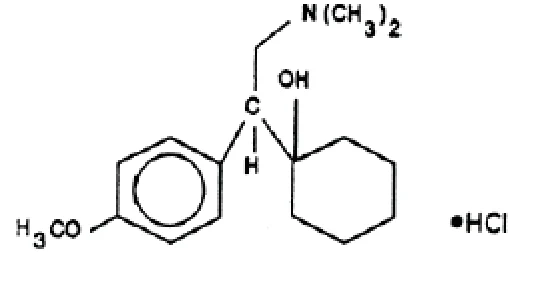
Physicochemical properties:
Physical Form: White to almost white powder
Solubility: Freely soluble in water and in methanol, soluble in anhydrous ethanol, slightly soluble or practically insoluble in acetone.
pKa value: 9.4
CLINICAL TRIALS
Comparative Bioavailability Studies
Three comparative bioavailability studies were performed under fasting, fed and steady-state conditions using healthy adult male volunteers.
A balanced, randomized, blinded, two-treatment, two-period two-sequence, single-dose, crossover bioequivalence study comparing Venlafaxine XR 150 mg extended release capsules of Ranbaxy Laboratories Limited, India with EFFEXOR® XR l50 mg extended release capsules (containing venlafaxine hydrochloride 150 mg) of Wyeth Canada was conducted in healthy, adult, male human subjects under fasting conditions
The data from 20 subjects who completed both periods of the study is presented below.
SUMMARY TABLE OF THE COMPARATIVE BIOAVAILABILITY DATA
Venlafaxine Hydrochloride (1x150 mg Extended Release Capsules) From measured data Geometric Mean/Arithmetic Mean (CV %) | ||||
| Parameter | Test* | Reference† | % Ratio of Geometric Means | 90% Confidence Interval |
AUC0-t (ng-hr/mL) | 2195.01/ 2731.88 (85.4) | 1977.15/ 2474.14 (88.6) | 110.53 | 106.17 - 115.06 |
AUC0-∞ (ng-hr/mL) | 2252.51/ 2865.22 (94.3) | 2027.87/ 2564.78 (93.4) | 110.64 | 106.37 - 115.09 |
Cmax (ng/mL) | 132.02 / 139.39 (35.4) | 125.46/ 135.00 (39.2) | 104.94 | 98.31- 112.00 |
| Tmax^ (h) | 6.00 (5.00 - 12.00) | 6.00 (5.00 - 12.00) | - | - |
T½ ~ (h) | 8.52 (46.4) | 8.43 (34.0) | - | - |
* Venlafaxine hydrochloride extended release capsule 150 mg (Ranbaxy Laboratories Limited, India) † EFFEXOR® XR (venlafaxine hydrochloride capsules) l50 mg (Wyeth Canada) was purchased in Canada. ^ Expressed as Median (Range) only
~ Expressed as Arithmetic Mean (CV%) only
A balanced, randomized, blinded, two-treatment, two-period, two-sequence, single-dose, crossover bioequivalence study comparing Venlafaxine XR 150 mg extended release capsules of Ranbaxy Laboratories Limited, India with EFFEXOR® XR l50 mg extended release capsules (containing venlafaxine hydrochloride 150 mg) of Wyeth Canada was conducted in healthy, adult, male human subjects under fed conditions
The data from 20 subjects who completed both periods of the study is presented below.
SUMMARY TABLE OF THE COMPARATIVE BIOAVAILABILITY DATA
Venlafaxine Hydrochloride (1x150 mg Extended Release Capsules) From measured data Geometric Mean/Arithmetic Mean (CV %) | ||||
| Parameter | Test* | Reference† | % Ratio of Geometric Means | 90% Confidence Interval |
AUC0-t (ng-hr/mL) | 2399.39/ 3293.86 (105.8) | 2312.58/ 3214.19 (103.8) | 103.75 | 97.87 – 110.00 |
AUC0-∞ (ng-hr/mL) | 2482.58/ 3595.80 (119.9) | 2150.77/ 2737.24 (87.7) | 103.74 | 97.57 – 110.31 |
Cmax (ng/mL) | 142.03 / 153.23 (40.8) | 140.05/ 152.82 (41.9) | 101.41 | 96.60 – 106.46 |
| Tmax^ (h) | 6.00 (5.00 - 14.00) | 6.00 (4.00 - 13.00) | - | - |
T½ ~ (h) | 9.86 (55.7) | 8.61 (46.2) | - | - |
* Venlafaxine hydrochloride extended release capsule 150 mg (Ranbaxy Laboratories Limited, India) † EFFEXOR® XR (venlafaxine hydrochloride capsules) l50 mg (Wyeth Canada) was purchased in Canada. ^ Expressed as Median (Range) only
~ Expressed as Arithmetic Mean (CV%) only
A blinded, balanced, randomized, two-treatment, two-period, two-sequence, multiple-dose, crossover bioequivalence study comparing Venlafaxine XR 150 mg extended release capsules of Ranbaxy Laboratories Limited, India with EFFEXOR® XR l50 mg extended release capsules (containing venlafaxine hydrochloride 150 mg) of Wyeth Canada was conducted in healthy, adult, male human subjects under fasting conditions.
The data from 36 subjects who completed both periods of the study is presented below.
SUMMARY TABLE OF THE COMPARATIVE BIOAVAILABILITY DATA
Venlafaxine Hydrochloride (1x150 mg Extended Release Capsules each day from Day 1 to Day 5) From measured data Geometric Mean/Arithmetic Mean (CV %) | ||||
| Parameter | Test* | Reference† | % Ratio of Geometric Means | 90% Confidence Interval |
AUC0-tau (ng-hr/mL) | 2716.04/ 2988.38 (43.8) | 2556.79/ 2825.98 (44.6) | 105.77 | 101.91- 109.77 |
| [Cmax]ss (ng/mL) | 185.43/ 196.39 (33.1) | 170.96/ 181.83 (34.1) | 108.22 | 104.44- 112.60 |
Cmin (ng/mL) | 54.93/ 65.47 (61.1) | 53.36/ 63.71 (58.3) | 101.79 | 96.28- 107.60 |
| Tmax^ (h) | 5.00 (5.00 - 9.00) | 6.00 (5.00 - 10.00) | - | - |
| Fluctuation %~ (%) | 115.94 (26.7) | 110.61 (25.6) | - | - |
* Venlafaxine hydrochloride extended release capsule 150 mg (Ranbaxy Laboratories Limited, India) † EFFEXOR® XR (venlafaxine hydrochloride capsules) l50 mg (Wyeth Canada) was purchased in Canada. ^ Expressed as Median (Range) only
~ Expressed as Arithmetic Mean (CV%) only
DEPRESSION
Venlafaxine Immediate Release Tablet Formulation
The efficacy of immediate release tablets in the treatment of depression was established in 6- week controlled trials of outpatients whose diagnoses corresponded most closely to the DSM-II or DSM-III-R category of major depressive disorder and in a 4-week controlled trial of inpatients meeting diagnostic criteria for major depressive disorder with melancholia.
In one longer term study, outpatients meeting DSM-III-R criteria for major depressive disorder, recurrent type, who had “responded”* during an initial 26 weeks of treatment on a venlafaxine
immediate release tablet (100 to 200 mg/day, on a b.i.d. schedule) and continued to be “improved”*, were randomized to continuation of their same venlafaxine immediate release tablet dose or to placebo. The follow-up period to observe patients for “relapse”* was for up to 52 weeks. Patients receiving continued venlafaxine immediate release tablet treatment experienced significantly lower relapse rates over the subsequent 52 weeks compared with those receiving placebo.
*For the purposes of this study:
“Responded” was defined as HAM-D-21 total score ≤12 at the day 56 evaluation
“Improved” was defined as the following criteria being met for days 56 through 180: (1) no HAM-D-21 total score >20; (2) no more than 2 HAM-D-21 total scores >10, and (3) no single CGI Severity of Illness item score >4 (moderately ill).
“Relapse” was defined as a CGI Severity of Illness item score>4 during the double-blind phase.
Venlafaxine Extended Release Capsules
The efficacy of venlafaxine hydrochloride extended release capsules as a treatment for depression was established in two placebo-controlled, short-term, flexible-dose studies in adult outpatients meeting DSM-III-R or DSM-IV criteria for major depression. An 8- week study utilizing venlafaxine hydrochloride extended release capsules doses in a range 75 to 225 mg/day (mean dose for completers was 177 mg/day) and a 12-week study utilizing venlafaxine hydrochloride extended release capsules doses in a range 75 to 150 mg/day (mean dose for completers was 136 mg/day) both demonstrated superiority of venlafaxine hydrochloride extended release capsules over placebo on the HAM-D total score, the HAM-D Depressed Mood Item, the MADRS total score, the CGI Severity of illness scale, and the CGI Global Improvement scale. In both studies, venlafaxine hydrochloride extended release capsules were also significantly better than placebo for certain factors of the HAM-D, including the anxiety/somatization factor, the cognitive disturbance factor, and the retardation factor, as well as for the psychic anxiety score.
In the 12-week study comparing immediate release tablets with venlafaxine hydrochloride extended release capsules, once daily, venlafaxine hydrochloride extended release capsules were significantly more effective at weeks 8 and 12, compared with immediate release tablets given twice daily for treating major depression. Analysis of safety data from this trial showed that the incidence of treatment-emergent nausea and nausea severity over time were lower with venlafaxine hydrochloride extended release capsules than with immediate release tablets. Additionally, the incidence of vomiting was lower with venlafaxine hydrochloride extended release capsules than with immediate release tablets.
In one longer term study, outpatients meeting DSM-IV criteria for major depressive disorder who had “responded”* during an 8-week open trial on venlafaxine hydrochloride extended release capsules (75, 150, or 225 mg, in the morning (qAM) were randomized to continuation of their same venlafaxine hydrochloride dose or to placebo, for up to 26 weeks of observation for “relapse”*. Patients receiving continued venlafaxine hydrochloride extended release treatment experienced significantly lower “relapse”* rates compared with those on placebo.
*For the purposes of this study:
“Responded” during the open phase was defined as a CGI Severity of Illness item score <3 and
a HAM-D-21 total score of < 10 at the day 56 evaluation.
“Relapse” during the double-blind phase was defined as follows:
(1) a reappearance of major depressive disorder as defined by DSM-IV criteria and a CGI Severity of Illness item score of > 4 (moderately ill),
(2) 2 consecutive CGI Severity of Illness item scores of > 4, or
(3) a final CGI Severity of Illness item score of >4 for any patient who withdrew from the study for any reason.
Social Anxiety Disorder (Social Phobia)
The efficacy of venlafaxine hydrochloride extended release capsules as a treatment for Social Anxiety Disorder (also known as Social Phobia) was demonstrated in four 12-week, multi-center, placebo-controlled, flexibledose studies and one 6-month, fixed/flexible-dose study in adult outpatients meeting DSM-IV criteria for Social Anxiety Disorder. These studies evaluating venlafaxine hydrochloride extended release capsules doses in a range of 75-225 mg/day demonstrated that venlafaxine hydrochloride extended release capsules were significantly more effective than placebo for the Liebowitz Social Anxiety Scale Total score, Clinical Global Impressions of Severity of Illness rating, and Social Phobia Inventory.
Examination of subsets of the population studied did not reveal any differential responsiveness on the basis of age or gender.
DETAILED PHARMACOLOGY
Venlafaxine (Wy-45,030) is a novel bicyclic 2-phenyl-2-(1-hydroxy-cycloalkyl) ethylamine racemate whose enantiomers are configured as R (-) venlafaxine and S (+) venlafaxine. The major human metabolite of venlafaxine is the racemate Wy-45,233 (O-desmethyl-venlafaxine) whose enantiomers are configured as R (-) Wy-45,233 and S (+) Wy-45,233.
Venlafaxine is a potent inhibitor of both norepinephrine and serotonin uptake that has demonstrated antidepressant activity in a number of preclinical models. Wy-45,233, the major human metabolite of venlafaxine, has a pharmacological profile quite similar to that of venlafaxine since it also inhibits norepinephrine and serotonin uptake and produces rapid noradrenergic desensitization. This indicates that Wy-45,233 is a biologically active metabolite of venlafaxine. While the enantiomers of Wy-45,233 effectively inhibit monoamine uptake, they were less effective in in vivo models of antidepressant activity.
Ancillary pharmacological effects of venlafaxine and Wy-45,233 were quite similar. In neuropharmacological studies, both compounds lacked activity at a wide range of CNS receptors and had a low abuse liability potential. The effects of venlafaxine and Wy-45,233 on arterial pressure and heart rate in animals are most likely related to the inhibition of monoamine uptake and are similar to those produced by tricyclic antidepressants. Lastly, venlafaxine and Wy-45,233 produced only limited effects in immunological, gastrointestinal and endocrine studies which were generally at doses greater than those required to produce antidepressant effects in animals.
Venlafaxine is rapidly absorbed and excreted from laboratory animals and man. Differences in biotransformation pathways among species result in different pharmacokinetic profiles. Tissue uptake occurs, but without notable accumulation. Elimination of venlafaxine and its metabolites occurs via renal pathway in all species. O-Demethylation to a bioactive metabolite is the major transformation in man, dog and mouse, but further transformations occur in the animals. Other transformation pathways predominate in rat and rhesus monkey. While venlafaxine HCl is a racemic mixture, the animals in drug safety evaluation studies were exposed to similar or greater amounts of each venlafaxine enantiomer, as well as each Wy-45,233 enantiomer, than when humans received venlafaxine HCl at the highest recommended therapeutic dose. Stereoselective transformations, which were recognized in rats and rhesus monkeys, were not significant in humans.
TOXICOLOGY
The toxicologic profile of venlafaxine was evaluated for up to 18 months in mice, up to 2 years in rats, and up to 1 year in dogs. A single dose range finding study was done in monkeys. As part of its evaluation, the reproductive toxicologic potential of venlafaxine was evaluated in segment I, II, and III studies in rats and a segment II study in rabbits. The major findings in the acute, long term, and reproductive toxicity studies are discussed below.
Acute Toxicity
Venlafaxine showed low acute toxicity with LD50s ≥ 405 mg/kg in mice and 336 mg/kg in rats; i.v. LD50s in mice were ≥ 48 mg/kg. No drug-related macroscopic lesions were observed; microscopic examinations were not performed.
Long Term Toxicity/Carcinogenicity
Subchronic toxicity of venlafaxine was evaluated in mice, rats, dogs and monkeys (1-month range finding study only); chronic toxicity was evaluated in dogs; and chronic toxicity/carcinogenicity was evaluated in mice and rats.
Mice
Venlafaxine was administered to mice for 3 months at 0, 24, 96, 138, 180 and 240 mg/kg to establish doses for a subsequent 18 month carcinogenicity study. Drug-related tonic/clonic convulsions occurring in both 180 and 240 mg/kg groups were regarded as limiting for subsequent studies of longer duration due to anticipated mortality associated with convulsions of this magnitude. Based on these results, a maximum dose of 120 mg/kg was selected for chronic carcinogenicity studies which was regarded to provide a minimal margin below the convulsive threshold which would limit survival in a chronic study. In the 18 month study, mice were thus dosed at 10, 35, and 120 mg/kg. No carcinogenic effect was noted in males or females. A slight decrease in survival occurred in the 120 mg/kg males, but was not associated with specific microscopic lesions. The cause of death in the 120 mg/kg mice could not be clearly established. Male and female mice receiving 120 mg/kg were noted to have increased motor activity.
Rats
Rats were dosed with venlafaxine at 0, 4.5, 40, 170, and 340 mg/kg in the 6 month toxicity study and at 0, 10, 35, and 120 mg/kg in the 2 year study. No drug-related histologic lesions occurred in either study. In the six month study, an increased mortality was seen at 170 and 340 mg/kg.
Deaths were generally associated with convulsions. Effects noted included decreased body weight and food consumption at 170 and 340 mg/kg and increased incidence of physical examination findings at 40 mg/kg and above. Due to mortality, body weight, and food consumption effects, the maximum tolerated dose for the chronic study was considered to be below 170 mg/kg. The rat carcinogenicity study was conducted at dosages of 0, 10, 35, and 120 mg/kg for 2 years. As with the mouse, no carcinogenic effect was observed. An increased mortality was seen at 120 mg/kg; however, no clear drug-related lesion was associated with mortality. Mortality at lower dosages was comparable to historical limits (50 - 65%).
Dogs
In dogs, venlafaxine was administered for 6 months at 0, 2, 7, and 22 mg/kg and for 12 months at 0, 4, 10, and 24 mg/kg. As with the other species tested, no drug-related histologic lesions occurred. In the 6 month dog study, slightly decreased heart rate occurred in two dogs (during weeks 6, 12, 18, and 25 in one dog and week 25 in the other dog) receiving 22 mg/kg. Although effects on cardiovascular parameters have been seen with other antidepressants, including ECG alterations consisting of T wave changes (inversions, bifid T wave), prolongation of conduction and sinus tachycardia seen with tricyclic antidepressants, these effects were not seen after administration of venlafaxine. Blood pressure and ECGs were measured periodically throughout treatment at multiple intervals after ECG abnormalities in these or any other dogs in the 6 month or 1 year studies. A slight decrease in body weight gain was seen at the high dose in both studies. Mydriasis, a pharmacologic effect, occurred at all dosages. Other minor drug-related effects were generally limited to the high dose.
Monkeys
In monkeys, a range finding assay was conducted using one monkey/sex at dosages of 0, 25, 80, 125, 170, and 260 mg/kg for up to 27 days. Deaths occurred in the first 5 days in one of two monkeys at 125 mg/kg and all monkeys at higher dosages. No drug-related histologic changes were found in these animals, and deaths were considered secondary to drug-induced convulsions. Electrocardiograms were only measured on the 80 mg/kg monkeys and showed no drug-related effects. Due to pharmacokinetic considerations, additional monkey studies were not conducted.
Mutagenicity
Venlafaxine and the major human metabolite, O-desmethylvenlafaxine (ODV), were not mutagenic in the Ames reverse mutation assay in Salmonella bacteria or the Chinese hamster ovary/HGPRT mammalian cell forward gene mutation assay. Venlafaxine was also not mutagenic or clastogenic in the in vitro BALB/c-3T3 mouse cell transformation assay, the sister chromatid exchange assay in cultured Chinese hamster ovary cells, or in the in vivo chromosomal aberration assay in rat bone marrow. ODV was not clastogenic in the in vitro Chinese hamster ovary cell chromosomal aberration assay, but elicited a clastogenic response in the in vivo chromosomal aberration assay in rat bone marrow.
Reproductive Toxicity
The reproductive toxicology of venlafaxine was studied in rats and rabbits. No teratogenic effect was observed and no deaths occurred.
Pharmacotoxic signs were seen in paternal and maternal rats given venlafaxine doses of 30 and 60 mg/kg/day (4 and 8 times the maximum recommended human dose, respectively), but no adverse effect was noted in fertility or general reproductive performance. Decreased fetal size and pup weight at birth with 60 mg/kg/day may be correlated with maternal toxicity. In a perinatal toxicity study, decreased fetal survival following birth was observed at 40 and 80 mg/kg/day (approximately 5 to 11 times the maximum recommended human dose, respectively) and was considered secondary to drug-related decreased maternal care. No teratogenic effect was seen. Evidence of carcinogenesis, mutagenesis, and impairment of fertility was not noted in preclinical toxicology studies.
Reproductive Toxicity with the Major Metabolite of Venlafaxine
Reduced fertility was observed in a study in which both male and female rats were exposed to the major metabolite of venlafaxine (ODV). This ODV exposure was approximately 2 to 3 times that which would result from a human dose of 225 mg/day of venlafaxine. The human relevance of this finding is unknown.
In this study, administration of ODV as the succinate salt in male and female rats resulted in disrupted estrous cycles and increased time-to-mating at ≥ 30 mg/kg/day; decreased fertility rates at ≥ 100 mg/kg/day; and increased preimplantation loss and decreased fetal weight at 300 mg/kg/day. There was decreased prostate weight at ≥ 30 mg/kg/day associated with prostate atrophy at ≥ 100 mg/kg/day; however, there were no compound-related macroscopic or microscopic findings in the epididymides, seminal vesicles, or testes. The no-observed adverse- effect level (NOAEL) for effects on fertility was 30 mg/kg/day and the developmental NOAEL was 100 mg/kg/day.
REFERENCES:
- 1.
Ballenger JC. Clinical Evaluation of Venlafaxine. J Clin Psychopharmacol 1996; 16 (3,
Suppl 2):29S-35S.
- 2.
Ballenger JC. Clinical Evaluation of Venlafaxine: Commentary. J Clin Psychopharmacol
1996; 16(3, Suppl 2):35S-36S.
- 3. Ballus C, Quiros G, De Flores T, dPalao D, Rojo L, et al. The efficacy and tolerability of venlafaxine and paroxetine in outpatients with depressive disorder or dysthymia. International Clinical Psychopharmacology 2000; 15(1):43-48.
- 4.
Benkert O, Grunder G, Wetzel H, Hackett D, et al. A Randomized, Double-Blind
Comparison of a Rapidly Escalating Dose of Venlafaxine and Imipramine in Patients with Major Depression and Melancholia. J Psychiat Res 1996; 30(6):441-451.
- 5.
Clerc GE, Ruimy P, Verdeau-Palles J. A Double-Blind Comparison of Venlafaxine and
Fluoxetine in Patients Hospitalized for Major Depression and Melancholia. International Clinical Psychopharmacology 1994; 9:139-143.
- 6. Costa e Silva J. Randomized, double-blind comparison of venlafaxine and fluoxetine in outpatients with major depression. J Clin Psychiatry 1998; 59:352-357.
- 7.
Cunningham LA, Borison RL, Carman JS, Chouniard G, Crowder JE, Diamond BI et al.
A Comparison of Venlafaxine, Trazodone, and Placebo in Major Depression. J Clin Psychopharmacol 1994; 14(2):99-106.
- 8.
Dierick M. An Open Label Evaluation of the Long-Term Safety of Oral Venlafaxine in
Depressed Elderly Patients. Annals of Clin Psychiatry 1996; 8(3):169-178.
- 9.
Entsuah R, Upton GV, Rudolph R. Efficacy of Venlafaxine Treatment in Depressed
Patients with Psychomotor Retardation or Agitation: A Meta-Analysis. Human Psychopharmacol 1995; 10:195-200.
- 10.
Entsuah R, Rudolph R, Chitra R. Effectiveness of Venlafaxine Treatment in a Broad
Spectrum of Depressed Patients: A Meta-Analysis. Psychopharmacol Bull 1995; 31(4):759-766.
- 11.
Ereshefsky L. Drug-Drug Interactions Involving Antidepressants: Focus on Venlafaxine.
J Clin Psychopharmacol 1996; 16(3) Suppl 2: 37S-49S.
- 12.
Feighner JP. The Role of Venlafaxine in Rational Antidepressant Therapy. J Clin
Psychiatry 1994; 55 (9, Suppl A):62-68.
- 13.
Guelfi JD, White C, Hackett D, Guichoux JY, Magni G. Effectiveness of Venlafaxine in
Patients Hospitalized for Major Depression and Melancholia. J Clin Psych 1995; 56(10): 450-458.
- 14.
Khan A, Fabre LF, Rudolph R. Venlafaxine in Depressed Outpatients. Psychopharmacol
Bull 1991; 27(2):141-144.
- 15.
Kuzel RJ. Treating Comorbid Depression and Anxiety. J Family Practice 1996; 43(6,
Suppl):S45-S53.
- 16. Lecrubier Y, Bourin M, Moon CA, Schifano F, Blanchard C, Danjou P. et al. Efficacy of venlafaxine in depressive illness in general practice. Acta Psychiatr Scand 1997; 95:485-493.
- 17. Mehtonen O-P, Sogaard J, Roponen P, Behnke K. Randomized, double-blind comparison of venlafaxine and sertraline in outpatients with major depressive disorder. J Clin Psychiatry 2000; 61(2):95-100.
- 18.
Mendels J, Johnston R, Mattes J, Riesenberg R. Efficacy and Safety of BID Doses Of
Venlafaxine In A Dose-Response Study. Psychopharmacol Bull 1993; 29(2):169-174.
- 19.
Montgomery SA. Venlafaxine: A New Dimension in Antidepressant Pharmacotherapy. J
Clin Psychiatry 1993; 54(3):119-126.
- 20.
Muth EA, Moyer JA, Haskins JT, Andree TH, Husbands GEM. Biochemical,
Neurophysiological, and Behavioral Effects of Wy-45,233 and Other Identified Metabolites of the Antidepressant Venlafaxine. Drug Development Research 1991; 23:191-199.
- 21.
Nierenberg A, Feighner J, Rudolph R, Cole J, Sullivan J. Venlafaxine For Treatment-
Resistant Unipolar Depression. J Clin Psychopharmacol 1994; 14:419-423.
- 22.
Rudolph RL, Entsuah R, Chitra R. A Meta-Analysis of Effects of Venlafaxine on Anxiety
Associated with Depression. J Clin Psychopharmacol 1998; 18:136-144.
- 23. Rudolph RI, Feiger AD. A double-blind, randomized, placebo-controlled trial of oncedaily venlafaxine extended release (XR) and fluoxetine for the treatment of depression. J Affective Disorders 1999; 56:171-181.
- 24.
Schweizer E, Weise C, Clary C, Fox I, Rickels K. Placebo-Controlled Trial of
Venlafaxine for the Treatment of Major Depression. J Clin Psychopharmacol 1991; 11(4):233-236.
- 25.
Schweizer E, Feighner J, Mandos LA, Rickels K. Comparison of Venlafaxine and
Imipramine in the Acute Treatment of Major Depression in Outpatients. J Clin Psychiatry 1994; 55(3):104-108.
- 26.
Shrivastava RK, Cohn C, Crowder J, Davidson J, Dunner D, Feighner J. et al. Long-
Term Safety and Clinical Acceptability of Venlafaxine and Imipramine in Outpatients with Major Depression. J Clin Psychopharmacol 1994; 14(5):322-329.
- 27.
Zajecka JM, Fawcett J, Guy C. Co-existing Major Depression and Obsessive-compulsive
Disorder treated with Venlafaxine. J Clin Psychopharmacol 1990; 10(2): 152-153.
- 29.
Product Monograph of EFFEXOR® XR Capsules (Venlafaxine Hydrochloride); Date of
Revision: April 19, 2011; Manufacturer: Pfizer Canada Inc.; Control No. 141267.