


Product Monograph - Vitamin D3 Oral Solution
1 INDICATIONS
Vitamin D3 Oral Solution (cholecalciferol) is indicated for initial treatment of vitamin D deficiency in adults when 25-hydroxyvitamin D levels are ≥5 ng/mL and ≤20 ng/mL.
1.1 Pediatrics (<18 years of age):
No data are available to Health Canada; therefore, Health Canada has not authorized an indication for pediatric use.
1.2 Geriatrics (> 65 years of age):
There is limited experience in the elderly, but no significant difference in safety or effectiveness is expected. There is limited data in presence of concomitant disease. See CONTRAINDICATIONS, WARNINGS AND PRECAUTIONS and DRUG INTERACTIONS.
2 CONTRAINDICATIONS
- Patients who are hypersensitive to this drug or to any ingredient in the formulation, including any non-medicinal ingredient, or component of the container. (For a complete listing, see Dosage Forms, Strengths, Composition and Packaging).
- Hypercalcaemia and/or hypercalciuria
- Nephrolithiasis and/or nephrocalcinosis
- Severe renal impairment
- Hypervitaminosis D
- Malabsorption syndrome
- Pseudo hypoparathyroidism, as the vitamin D requirement may be reduced due to phases of normal vitamin D sensitivity, involving the risk of prolonged overdose.
- Sarcoidosis
- Pediatric population (< 18 years)
- Additional intake of other medicines and food supplements containing vitamin D
4 DOSAGE AND ADMINISTRATION
4.1 Dosing Considerations
4.2 Recommended Dose and Dosage Adjustment
Loading dose of 8 ampoules, 5,000 mcg (200,000 IU) followed by 4 ampoules, 2500 mcg (100,000) monthly for two months (total treatment course, 16 ampoules, 10,000 mcg (400,000 IU)
Serum levels of 25-hydroxycalciferol and calcium should be monitored after initiation of treatment.
Patients being treated specifically for serum 25(OH)D <20 ng/mL (50 nmol/L) require a repeat 25(OH)D measurement and should be monitored approximately every month after initiating therapy.
4.3 Administration
Vitamin D3 Oral Solution should not be taken without medical supervision. Treatment may be taken with water or orange juice. It is not required to be administered under fasted conditions (see Pharmacokinetic properties - “Absorption”).
The full contents of the ampoule should be either emptied into the mouth and swallowed orally, or emptied onto a spoon and taken orally.
4.5 Missed Dose
The forgotten dose should be taken as soon as possible. However, if it is almost time for the next dose, the missed dose should not be taken but the next dose should be taken as scheduled. A double dose should not be taken to make up for a forgotten dose.
5 OVERDOSAGE
Symptoms of overdose
The threshold for vitamin D intoxication is between 40,000 IU and 100,000 IU daily for 1 to 2 months in adults with normal parathyroid function.
The symptoms of intoxication are mildly characteristic and manifest as nausea, vomiting, initially also diarrhea, later constipation, anorexia, weariness, headache, muscle pain, joint pain, muscle weakness, persistent sleepiness, azotaemia, polydipsia and polyuria and, in the final stage, dehydration. Typical biochemical findings include hypercalcaemia, hypercalciuria, as well as increased serum 25 hydroxycholecalciferol concentrations.
It is recommended to point out, to patients under therapy with high doses of vitamin D3, the symptoms of potential overdose.
Overdose leads to increased serum and urinary phosphorus levels, as well as hypercalcaemic syndrome and consequently calcium deposits in the tissues and above all in the kidneys (nephrolithiasis, nephrocalcinosis) and the vessels.
Discontinue Vitamin D3 Oral Solution when calcaemia exceeds 10.6 mg/dL (2.65 mmol/L) or if the calciuria exceeds 300 mg/24 hours in adults.
Chronic overdosage may lead to vascular and organ calcification, as a result of hypercalcaemia.
Treatment of overdose
Overdosage requires measures for treating, the often persisting and, under certain circumstances life-threatening hypercalcaemia.
The first measure is to discontinue Vitamin D3 Oral Solution; it takes several weeks to normalise hypercalcaemia caused by vitamin D3 intoxication.
Depending on the degree of hypercalcaemia, measures include a diet that is low in calcium or free of calcium, abundant liquid intake, increase of urinary excretion by means of the drug furosemide, as well as the administration of glucocorticoids and calcitonin.
If kidney function is adequate, calcium levels can be reliably lowered by infusions of isotonic sodium chloride solution (3–6 L in 24 hours) with addition of furosemide and, in some circumstances, also 15 mg/kg body weight/hour sodium edetate accompanied by continuous calcium and ECG monitoring. In oligoanuria, in contrast, hemodialysis (calcium-free dialysate) is necessary.
No special antidote exists.
| For management of a suspected drug overdose, contact your regional poison control centre. |
6 DOSAGE FORMS, STRENGTHS, COMPOSITION AND PACKAGING
Table – Dosage Forms, Strengths, Composition and Packaging.
Vitamin D3 Oral Solution is a clear, slightly yellow, oily liquid with an orange odour. Vitamin D3 Oral Solution is supplied in packages containing 4 or 12 ampoules.
7 WARNINGS AND PRECAUTIONS
General
The additional administration of calcium should only be carried out under medical supervision.
Vitamin D should be administered with caution in immobilized patients due to increased risk of hypercalcaemia and hypercalciuria. Serum and urinary calcium levels should be monitored.
Cardiovascular
Caution is required for patients receiving treatment for cardiovascular disease. (See DRUG INTERACTIONS)
Immune
Vitamin D3 Oral Solution should not be prescribed in patients with sarcoidosis, as there is increased conversion of vitamin D to its active metabolite. (See CONTRAINDICATIONS). High doses of Vitamin D can induce hypercalcemia and hypercalcuria. Serum and urinary calcium levels should be monitored.
Renal
Vitamin D3 Oral Solution should not be used in patients with severe renal impairment and should be used with caution in patients with mild and moderate impairment of renal function. (See
| Route of Administration | Dosage Form / Strength/Composition | Non-medicinal Ingredients |
| Oral | Solution 1 mL, 625 mcg (25,000 IU) | olive oil, polyglyceryl dioleate, orange oil, tocopherol acetate |
CONTRAINDICATIONS). The effect on calcium and phosphate levels should be monitored. The risk of soft tissue calcification should be taken into account.
There is no clear evidence for causation between vitamin D supplementation and renal stones, but the risk is plausible, especially in the context of concomitant calcium supplementation. The need for additional calcium supplementation should be considered for individual patients. Calcium supplements should be given under close medical supervision.
During treatment, the serum and urinary calcium levels should be monitored and the kidney function checked by measurement of serum creatinine. These checks are particularly important in concomitant treatment with diuretics. In the case of hypercalcaemia or signs of impaired kidney function, the dose must be reduced or treatment interrupted. It is recommended to reduce the dose or to interrupt treatment if the urinary calcium level exceeds 7.5 mmol/24 hours (300 mg/24 hours).
Vitamin D must be used with particular caution in patients with disturbed urinary excretion of calcium and phosphate, in treatment with benzothiadiazine derivatives. (see ACTION AND CLINICAL PHARMACOLOGY, Special Populations and Conditions) Plasma and urinary calcium levels should be monitored in these patients.
Sexual Health
Fertility
Normal endogenous levels of vitamin D are not expected to have any adverse effects on fertility.
7.1 Special Populations
7.1.1 Pregnant Women
There are limited data from the use of cholecalciferol in pregnant women. Studies in animals have shown reproductive toxicity. Overdose of vitamin D must be avoided during pregnancy, as prolonged hypercalcemia can lead to physical and mental retardation, supravalvular aortic stenosis and retinopathy of the child.
Treatment of pregnant women with high-dose vitamin D is not recommended.
7.1.2 Breast-feeding
Vitamin D and its metabolites are excreted in breast milk. Use of excessive amounts of vitamin D3 in nursing mothers may result in hypercalcemia in the infant. Treatment with high-dose vitamin D in breast-feeding women is not recommended.
7.1.3 Pediatrics (< 18 years):
- No data are available to Health Canada; therefore, Health Canada has not authorized an indication for pediatric use.
7.1.4 Geriatrics (> 65 years of age)
There is limited data in presence of concomitant disease. See CONTRAINDICATIONS, WARNINGS AND PRECAUTIONS, General and Renal and DRUG INTERACTIONS.
Oral administration of high-dose vitamin D (500,000 IU by single annual bolus) was reported to result in an increased risk of fractures in elderly subjects, with the greatest increase occurring during the first 3 months after dosing.
8 ADVERSE REACTIONS
8.1 Adverse Reaction Overview
Chronic excessive dosing can lead to toxicity (see WARNINGS AND PRECAUTIONS).
Cholecalciferol can cause the following undesirable effects, especially in overdose:
Adverse reactions are ranked by frequency and system organ classes. Frequency categories are defined using the following convention: very common (≥ 1/10); common (≥ 1/100 to < 1/10); uncommon (≥ 1/1,000 to < 1/100); rare (≥ 1/10,000 to < 1/1,000); very rare (< 1/10,000); not known (cannot be estimated from the available data).
Frequencies of adverse reactions are not known, as no larger clinical trials have been conducted, which would allow estimation of frequencies. The following reactions have been reported:
Gastrointestinal disorders
Constipation, flatulence, nausea, abdominal pain, diarrhea.
Immune system disorders
Hypersensitivity reactions such as angio- oedema or laryngeal oedema.
Metabolism and nutrition disorders
Hypercalcemia, hypercalciuria
Skin and subcutaneous tissue disorders:
Hypersensitivity reactions such as pruritus, rash, urticaria.
9 DRUG INTERACTIONS
9.3 Drug-Drug Interactions
Concomitant use of anticonvulsants (such as phenytoin) or barbiturates (and possibly other drugs that induce hepatic enzymes) may reduce the effect of Vitamin D3 by metabolic inactivation.
Treatment with thiazide diuretics decreases urinary elimination of calcium, monitoring of serum calcium concentration is recommended.
Simultaneous treatment with an ion exchange resin such as cholestyramine, colestipol hydrochloride, orlistat or a laxative such as paraffin oil may reduce the gastrointestinal absorption of vitamin D3.
Imidazole antifungal agents interfere with vitamin D activity by inhibiting the conversion of 25-hydroxycholecalciferol [25(OH)D, 25-hydroxyvitamin D] to 1,25-dihydroxyvitamin D [1,25(OH)2D] by the kidney enzyme, 25-hydroxyvitamin D-1-hydroxylase..
In cases of treatment with drugs containing digitalis and other cardiac glycosides, the administration of vitamin D3 may increases the risk of digitalis toxicity (arrhythmia). Strict medical supervision is needed, together with serum calcium concentration and electrocardiographic monitoring if necessary.
Concomitant use of glucocorticoids can decrease the effect of Vitamin D3.
Concomitant use of AIDS medications (e.g.actinomycin) can decrease the effect of Vitamin D.
Different Vitamin D analogues should not be administered concurrently.
9.4 Drug-Food Interactions
Patients should be advised to take Vitamin D3 Oral Solution preferably with meal. (See ACTION AND CLINICAL PHARMACOLOGY, Pharmacokinetics, Absorption)
10 ACTION AND CLINICAL PHARMACOLOGY
10.1 Mechanism of Action
The term Vitamin D collectively refers to a group of structurally similar chemicals and their metabolites, which includes alfacalcidol (1α-hydroxycholecalciferol); calcitriol (1,25- dihydroxycholecalciferol, 1,25(OH)2 D); cholecalciferol (Vitamin D3); ergocalciferol (Vitamin D2) and dihydrotachysterol (DHT).
Vitamin D3 is metabolized first in the liver to 25-hydroxyvitamin D3 (calcidiol) and subsequently in the kidneys to 1,25-(OH)2D3 (calcitriol), this biologically active hormone in turn stimulates transport of calcium in the enterocytes of the small intestine by an active process involving the cytosolic calcium binding protein and the calcium pump.
At the level of the skeleton, the osteoblasts activated by calcitriol provide a signal to osteoclasts to begin resorption. Calcitriol stimulates the renal tubular reabsorption of calcium and also facilitates the effect of parathyroid hormone on renal tubular reabsorption of calcium.
10.2 Pharmacodynamics
In its biologically active form Vitamin D stimulates intestinal calcium absorption, incorporation of calcium into the osteoid, and release of calcium from bone tissue. In the small intestine it promotes rapid and delayed calcium uptake. The passive and active transport of phosphate is also stimulated. In the kidney, it inhibits the excretion of calcium and phosphate by promoting tubular resorption. The production of parathyroid hormone in the parathyroid is inhibited directly by the biologically active form of vitamin D3. Parathyroid hormone secretion is inhibited additionally by the increased calcium uptake in the small intestine under the influence of biologically active vitamin D.
10.3 Pharmacokinetics
Absorption: Vitamin D3 is well absorbed from the gastrointestinal tract in the presence of bile.
Distribution: On absorption, Vitamin D3 enters the blood as part of chylomicrons and is rapidly distributed mostly to the liver where it undergoes metabolism to 25- hydroxycholecalciferol, the major storage form. Lesser amounts are distributed to adipose and muscle tissue and stored as vitamin D3 at these sites for later release into the circulation. Circulating vitamin D3 is bound to vitamin D-binding protein.
Metabolism: Vitamin D3 is hydroxylated in the liver to 25-hydroxycholecalciferol, and then undergoes further hydroxylation in the kidney to form the active metabolite 1,25-dihydroxycholecalciferol (calcitriol). Further hydroxylation occurs prior to elimination. A small percentage of vitamin D3 undergoes glucuronidation prior to elimination.
Elimination: The metabolites circulate in the blood bound to a specific α–globin, vitamin D and its metabolites are excreted mainly in the bile and feces.
Special Populations and Conditions:
A 57% lower metabolic clearance rate is reported in subjects with renal impairment as compared with healthy volunteers. In the event of hypercalcaemia or signs of reduced renal function, the dose must be reduced or the treatment discontinued. If hypercalciuria occurs, the dose is to be reduced or treatment discontinued. Severe renal impairment is a risk factor for overdose and Vitamin D3 Oral Solution is contraindicated in this condition (see CONTRAINDICATIONS and WARNINGS AND PRECAUTIONS).
11 STORAGE, STABILITY AND DISPOSAL
Store at room temperature (between 150 C and 250 C). Store in the original package in order to protect from light.
Keep out of reach and sight of children.
PART II: SCIENTIFIC INFORMATION
13 PHARMACEUTICAL INFORMATION
Drug Substance
Proper name: Cholecalciferol
Chemical name: (5Z,7E),-9,10-Sécocholesta-5,7,10(19)-trièn-3β-ol-9,10-Secocholesta-5,7,10(19)-trien-3-ol,(3β,5Z,7E)
Molecular formula and molecular mass: C27 H44O, and molecular mass is 384.6
Structural formula:
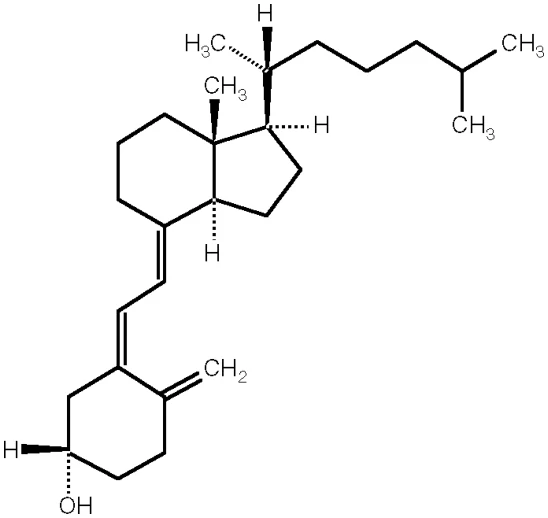
Physicochemical properties: Cholecalciferol is white or almost white crystals, insoluble in water, freely soluble in ethanol (96%) and trimethylpentane and in fatty oils.
14 CLINICAL TRIALS
14.1 Trial Design and Study Demographics
A randomized, controlled, double-blind, parallel Phase IV study was conducted in 150 subjects with vitamin D deficiency (baseline 25-hydroxycholecalciferol concentration ≥5 ng/mL and ≤20 ng/mL). The objective of the study was to estimate the dose-response effect and to determine an adapted supplementation of vitamin D in patients with deficiency in vitamin D concentration. Subjects were randomized to 3 dose groups, with the highest dose group of 49 subjects receiving 200,000 IU Vitamin D Oral Solution taken at week 0 followed by 100,000 IU at week 4 and 8.
Randomized patients had a mean age of 29.2± 9.7 years (range 18 - 57 years) with a sex ratio slightly in favor of women (56.7% versus of 43.3% men). All patients were Caucasian.
14.2 Study Results
25-hydroxycholecalciferol serum concentration significantly rose over time and reached a plateau between week 8 and week 12, with 98% of the patients in the high dose group achieving a level of 25-hydroxycholecalciferol above 20 ng/mL as soon as week 8. The target of 30 ng/mL was achieved in 64% of subjects in the high dose group.
Table 1: All Subjects: 25-hydroxycholecalciferol concentration ≥5 ng/mL and ≤20 ng/mL
| Serum 25-hydroxy-cholecalciferol | 200,000 IU Vitamin D Oral Solution taken at week 0 followed by 100,000 IU at week 4 and 8 (ng/mL) |
| Baseline | 13.66±3.57 |
| Week 4 | 29.30±8.26 |
| Week 8 | 33.46±7.78 |
| Week 12 | 33.78±7.51 |
Table 2: Subjects with Baseline 25 (OH)D<12 ng/mL
| Serum 25-hydroxy-cholecalciferol | 200,000 IU Vitamin D Oral Solution taken at week 0 followed by 100,000 IU at week 4 and 8 (ng/mL) |
| Baseline | 9.0±1.23 |
| Week 4 | 29.0±6.38 |
| Week 8 | 31.0±6.22 |
| Week 12 | 32.0±5.55 |
16 NON-CLINICAL TOXICOLOGY
Pre-clinical studies conducted in various animal species have demonstrated that toxic effects occur in animals at doses much higher than those required for therapeutic use in humans.
In toxicity studies at repeated doses, the effects most commonly reported were increased calciuria and decreased phosphaturia and proteinuria.
Hypercalcaemia has been reported at high doses. In a state of prolonged hypercalcaemia, histological alterations (calcification) were more frequently borne by the kidneys, heart, aorta, testes, thymus and intestinal mucosa.
Cholecalciferol has been shown to be teratogenic at high doses in animals.
Cholecalciferol has no potential mutagenic or carcinogenic activity.