


Product Monograph - Vitamin D3 (Oxlee Pharmaceuticals)
RECENT MAJOR LABEL CHANGES
Not applicable
TABLE OF CONTENTS
PART I: HEALTH PROFESSIONAL INFORMATION ............................................................3
1 INDICATIONS .............................................................................................................3
2 CONTRAINDICATIONS .............................................................................................3
3 DOSAGE AND ADMINISTRATION ..........................................................................3
3.1 Dosing Considerations .................................................................................................. 3
3.2 Recommended Dose and Dosage Adjustment.............................................................. 3
3.3 Missed Dose ................................................................................................................. 4
4 OVERDOSAGE ............................................................................................................4
5 DOSAGE FORMS, STRENGTHS, COMPOSITION AND PACKAGING ................4
6 WARNINGS AND PRECAUTIONS ...........................................................................4
6.1 Special Populations....................................................................................................... 5
6.1.1 Pregnant Women ................................................................................................... 5
6.1.2 Breast-feeding ....................................................................................................... 5
7 ADVERSE REACTIONS .............................................................................................5
7.1 Adverse Reaction Overview ......................................................................................... 5
8 DRUG INTERACTIONS ..............................................................................................6
8.1 Overview ...................................................................................................................... 6
8.2 Drug-Drug Interactions ................................................................................................. 6
9 ACTION AND CLINICAL PHARMACOLOGY ........................................................7
9.1 Mechanism of Action ................................................................................................... 7
9.2 Pharmacodynamics ....................................................................................................... 7
9.3 Pharmacokinetics .......................................................................................................... 8
10 STORAGE, STABILITY AND DISPOSAL .............................................................8
11 SPECIAL HANDLING INSTRUCTIONS ...............................................................8
PART II: SCIENTIFIC INFORMATION ..................................................................................9
12 PHARMACEUTICAL INFORMATION ..................................................................9
13 SUPPORTING PRODUCT MONOGRAPHS ..........................................................9
PATIENT MEDICATION INFORMATION ...........................................................................10
PART I: HEALTH PROFESSIONAL INFORMATION
1 INDICATIONS
VITAMIN D3 capsules 20 000 IU and VITAMIN D3 capsules 40 000 IU are indicated for:
- the treatment of hypophosphatemic rickets (vitamin D – resistant rickets)
- the treatment of hypoparathyroidism
2 CONTRAINDICATIONS
VITAMIN D3 is contraindicated in patients with:
- Known hypersensitivity to Vitamin D or any of its analogues and derivatives or to any of the excipients or component of the container;
- Hypercalcemia and/or hypercalciuria;
- Nephrolithiasis (Renal calculi);
- Hypervitaminosis D;
- Severe renal impairment;
- Malabsorption syndrome;
- Abnormal sensitivity to the toxic effects of Vitamin D
3 DOSAGE AND ADMINISTRATION
3.1 Dosing Considerations
At the higher doses of Vitamin D used for active treatment, the range between therapeutic and toxic doses is narrow.
The dosage of VITAMIN D3 must be individualized under close medical supervision. Therapeutic dosage should be readjusted as soon as there is clinical improvement. Careful titration is necessary to avoid overdose. Dietary and other sources of vitamin D must be considered. Calcium intake should be adequate.
Blood calcium, phosphorus and urea determinations must be made every two weeks or more frequently if necessary.
The bones should be x-rayed every month until the condition is corrected and stabilized.
3.2 Recommended Dose and Dosage Adjustment
For treatment of Vitamin D resistant rickets: 20 000 to 500 000 IU (0.5 mg to 12.5 mg) daily.
For treatment of hypoparathyroidism: 60 000 to 200 000 IU (1.5 mg to 5.0 mg) daily.
Calcium supplementation is also required.
3.3 Missed Dose
If a dose of this medication has been missed, it should be taken as soon as possible. However, if it is almost time for the next dose, skip the missed dose and go back to the regular dosing schedule. Do not take a double dose to make up for the missed dose.
4 OVERDOSAGE
Symptoms: Acute intoxication with Vitamin D3 (cholecalciferol) may cause hypervitaminosis D, manifested by hypercalcemia and its sequelae. Hypercalcemia is usually reversible, however, if metastatic calcification has occurred, severe renal or cardiac failure or even death may result (See section 6 WARNINGS AND PRECAUTIONS).
Treatment: Treatment of acute or chronic intoxication includes withdrawal of the Vitamin D3 and any calcium supplements, maintenance of low-calcium diet, administration of oral / IV fluids and, if needed, corticosteroids or calciuric diuretics, such as furosemide and ethacrynic acid, to decrease serum calcium concentrations. Peritoneal or hemodialysis with calcium free dialysate will help remove calcium.
If acute ingestion is recent, gastric lavage or emesis may minimize further absorption. If the drug has already passed through the stomach, administration of mineral oil may promote faecal elimination.
Hypercalcemia is usually reversible, however, if metastatic calcification has occurred, severe renal or cardiac failure or even death may result.
5 DOSAGE FORMS, STRENGTHS, COMPOSITION AND PACKAGING
Table – Dosage Forms, Strengths, Composition and Packaging
6 WARNINGS AND PRECAUTIONS
General
Chronic or acute administration of excessive doses of Vitamin D3 may lead to hypervitaminosis D, manifested by hypercalcemia and its sequelae.
The therapeutic index of Vitamin D products and analogues is narrow and there is great interindividual variation in the dose that will lead to chronic toxicity. Daily doses of cholecalciferol ranging from 50 000 to 100 000 IU (1.25 to 2.5 mg) in adults may result in hypervitaminosis. Other Vitamin D products or analogues with shorter duration of action may have a lower propensity to accumulate and to cause hypercalcemia.
| For management of a suspected drug overdose, contact your regional poison control centre. |
| Route of Administration | Dosage Form / Strength/Composition | Non-medicinal Ingredients | |||
| Oral | 4 or 10 Capsules / carton 20 000 IU | Butylhydroyxanisole; Gellan Gum; Hypromellose; Colloidal Anhydrous Silica; Sodium Citrate; Titanium Dioxide; Medium-chain Triglycerides. | |||
4 or 10 Capsules / carton 40 000 IU | |||||
Driving and Operating Machinery
Due caution should be exercised when driving or operating a vehicle or potentially dangerous machinery.
Endocrine and Metabolism
Hypercalcemia
Early symptoms of hypercalcemia may include weakness, fatigue, somnolence, headache, anorexia, dry mouth, metallic taste, nausea, vomiting, vertigo, tinnitus, ataxia and hypotonia. Later and possibly more serious manifestation include nephrocalcinosis, renal dysfunction, osteoporosis in adults, impaired growth in children, anemia, metastatic calcification, pancreatitis, generalized vascular calcification and seizures. Extreme hypercalcaemia may result in coma and death.
Monitoring and Laboratory Tests
Periodic monitoring of serum calcium, phosphate, magnesium, and alkaline phosphatase is recommended for patients taking VITAMIN D3. Serum calcium should be maintained in the range of 2.25 - 2.5 mmol / L and not allowed to exceed 2.75 mmol / L.
6.1 Special Populations
6.1.1 Pregnant Women
Studies have shown safe use of Vitamin D at doses up to 4 000 IU (100 mcg) daily during pregnancy although studies in animals have shown reproductive toxicity. The recommended daily dose of Vitamin D in pregnant women in Canada is 600 IU (15 mcg) daily. Avoid the use of vitamin D in excess of the recommended dietary allowance during pregnancy unless potential benefits outweigh the possible adverse effects.
Hypercalcemia during pregnancy may also lead to suppression of parathyroid hormone release in the neonate, resulting in hypocalcemia, tetany and seizures. Severe deficiency of vitamin D during pregnancy can result in maternal osteomalacia and lead to significant morbidity in both mother and fetus.
6.1.2 Breast-feeding
The recommended daily dose of Vitamin D in nursing women is 600 IU (15 mcg). Vitamin D and its metabolites are excreted in breast milk. However, Vitamin D may be deficient in maternal milk; therefore, breastfed infants may require supplementation. Use of excessive amounts of Vitamin D in nursing mothers may result in hypercalcemia in infants. A daily dose of 4 000 IU (100 mcg) should not be exceeded. When prescribing additional vitamin D to a breast-fed child the practitioner should consider the dose of any additional vitamin D given to the mother.
7 ADVERSE REACTIONS
7.1 Adverse Reaction Overview
Vitamin D3 (cholecalciferol) is generally well tolerated in doses that do not exceed the recommended daily intake. Possible side effects include symptoms of hypercalcaemia and hypercalciuria (see 6 WARNINGS AND PRECAUTIONS). Rare cases of pruritus, rash and urticarial have been reported.
8 DRUG INTERACTIONS
8.1 Overview
Different Vitamin D products and analogues should not be administered concurrently.
8.2 Drug-Drug Interactions
- Table 1: Drug-Drug Interactions
| Interacting Drug | Effect | Clinical Comment |
|---|---|---|
Antacids (aluminum-containing) | Increased intestinal absorption of aluminum may lead to increased aluminum levels. | Avoid this combination if possible. |
Antacids (magnesium-containing) | Hypermagnesemia may develop when these agents are used concurrently with vitamin D. | Monitor magnesium levels particularly in patients with chronic renal failure. |
| Anticonvulsants (e.g., phenytoin, phenobarbital, carbamazepine) | Strong CYP3A4 inducers can reduce vitamin D levels, potentially causing vitamin D deficiency. | Consider prophylactic vitamin D supplementation. Monitor serum 25(OH)D every 2 years; supplement with vitamin D if necessary |
| Cholestyramine, colestipol | Intestinal absorption of vitamin D may be impaired. | Patients should be advised to allow as much time as possible between the ingestion of these drugs and vitamin D. |
| Danazol | Danazol may increase the hypercalcemic response to vitamin D or its analogues. | Monitor serum calcium levels. |
| Digoxin | Vitamin D or any analogues should be used with caution in patients taking digoxin. Hypercalcemia (which may result from concomitant use) may enhance the arrhythmogenic effects of digoxin. | Strict medical supervision is required. Monitor serum calcium levels. |
| Efavirenz | Increased metabolism of vitamin D via CYP24A induction leads to a deficiency state. | Consider prophylactic vitamin D supplementation. |
| Mineral oil | Intestinal absorption of vitamin D or its analogues may be impaired. | Patients should be advised to allow as much time as possible between the ingestion of these drugs. |
| Interacting Drug | Effect | Clinical Comment |
|---|---|---|
| Orlistat | Intestinal absorption of vitamin D or its analogues may be impaired. | Patients should be advised to allow as much time as possible between the ingestion of these drugs. |
| Sevelamer | Sevelamer may decrease the serum concentration of orally administered vitamin D or analogues. | Monitor serum 25(OH)D levels and adjust vitamin D or analogue dose if necessary. |
| Sucralfate | Increased intestinal absorption of aluminum from sucralfate may lead to increased aluminum levels. | Avoid this combination if possible. |
| Thiazide diuretics | Increased risk of hypercalcemia and associated calcium toxicity. Thiazides decrease renal excretion of calcium and increase calcium release from bone. Thiazides may also enhance the effect of parathyroid hormone and vitamin D on release of calcium from bone. | Monitor serum calcium levels with concomitant therapy. |
9 ACTION AND CLINICAL PHARMACOLOGY
9.1 Mechanism of Action
Vitamin D is a fat-soluble vitamin that helps regulate serum calcium and phosphorous concentrations by enhancing the efficiency of the small intestine to absorb these minerals from the diet. Vitamin D has two main forms: cholecalciferol (Vitamin D3), and ergocalciferol (Vitamin D2).
In humans, there is no practical difference between the biologic activity of cholecalciferol (vitamin D3) and ergocalciferol (vitamin D2). One microgram (mcg) of either compound is equivalent to 40 IU of vitamin D activity. Vitamin D is essential for the absorption and utilization of (calcium and phosphate and aids in the mobilization of bone calcium and maintenance of serum calcium concentrations.
9.2 Pharmacodynamics
In humans, cholecalciferol (vitamin D3) is synthesized in the skin, from 7-dehydrocholesterol, on exposure to ultraviolet radiation. Cholecalciferol is also present in fish and liver oils.
Cholecalciferol is hydroxylated in the liver by the enzyme vitamin D-25-hydroxylase to form 25-hydroxycholecalciferol (calcifediol), which is then converted in the kidneys to the active Vitamin D hormone, 1,25-dihydroxyvitamin D3 (calcitriol).
In its biologically active form vitamin D3 stimulates intestinal calcium absorption, incorporation of calcium into the osteoid, and release of calcium from bone tissue. In the small intestine it promotes rapid and delayed calcium uptake. The passive and active transport of phosphate is also stimulated. In the kidney, it inhibits the excretion of calcium and phosphate by promoting tubular resorption. The production of parathyroid hormone (PTH) in the parathyroids is inhibited directly by the biologically active form of vitamin D3. PTH secretion is inhibited further by the increased calcium uptake in the small intestine under the influence of biologically active vitamin D3.
9.3 Pharmacokinetics
- Vitamin D and its analogues are readily absorbed from the small intestine in the presence of dietary lipids and bile acids. Cholecalciferol is metabolised by microsomal enzyme vitamin D-25-hydroxylase to form 25-hydroxycolecalciferol (25(OH)D3, calcidiol), the primary storage form of vitamin D3. 25(OH)D3 undergoes a secondary hydroxylation within the kidney to form the predominant active metabolite 1,25-hydroxycolecalciferol (1,25(OH)2D3, calcitriol). The conversion to calcitriol is regulated by its own concentration, PTH, and serum concentrations of calcium and phosphate. The metabolites circulate in the blood bound to a specific α-globin. Vitamin D and its metabolites are excreted mainly in the bile and faeces.
10 STORAGE, STABILITY AND DISPOSAL
Store between 15°C and 30°C. Protect from light.
11 SPECIAL HANDLING INSTRUCTIONS
Keep out of the reach and sight of children.
PART II: SCIENTIFIC INFORMATION
12 PHARMACEUTICAL INFORMATION
Drug Substance
Proper name: Vitamin D3, Cholecalciferol
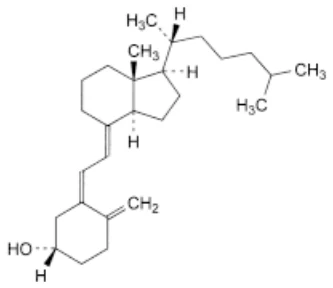
Chemical name: (3β,5Z,7E)-9,10-secocholesta- 5,7,10(19)-trien-3-ol
Molecular formula and molecular mass: C27H44O; 384.3
Structural formula:
Physicochemical properties: White to almost white crystalline powder.
Insoluble in water.
Freely soluble in ethanol (36 %), acetone, chloroform.
13 SUPPORTING PRODUCT MONOGRAPHS
- 1. PrLUXA-D Cholecalciferol Capsules, Mfr. Std. (2 000 IU, 5 000 IU, 25 000 UI, 50 000 IU), Vitamin D product, submission control 222717, Prescribing Information, Orimed Pharma Inc., Date of Revision: May 30, 2019