


Product Monograph - Zepatier
SUMMARY PRODUCT INFORMATION
| Route of Administration | Dosage Form / Strength | Clinically Relevant Nonmedicinal Ingredients |
| oral | Tablet 50 mg elbasvir and 100 mg grazoprevir | Lactose monohydrate For a complete listing see Dosage Forms, Composition and Packaging section. |
INDICATIONS AND CLINICAL USE
ZEPATIER® (elbasvir/grazoprevir) is indicated for the treatment of chronic hepatitis C (CHC) genotypes 1, 3, or 4 infection in adults as follows:
Without ribavirin:
- in genotype (GT) 1 or 4 treatment-naïve (TN) and peginterferon alfa + ribavirin (PR) treatment-experienced (TE) relapsers (12 weeks)
- in GT1 protease inhibitor (PI)/PR-TE relapsers (12 weeks)
- in GT1b TN, non-cirrhotic patients (8 weeks)
- in GT1b PR- or PI/PR-TE on-treatment virologic failures (12 weeks)
With ribavirin:
- in GT1a PR- or PI/PR-TE on-treatment virologic failures (16 weeks)
- in GT4 PR-TE on-treatment virologic failures (16 weeks)
With sofosbuvir:
- in GT3 TN patients (12 weeks)
(see DOSAGE AND ADMINISTRATION)
Geriatrics (> 65 years of age):
There were a limited number of geriatrics patients (N=187) included in the clinical trials. There was no overall difference in safety or efficacy observed in these patients (see WARNINGS AND PRECAUTIONS, Special Populations).
Pediatrics (< 18 years of age):
Safety and efficacy of ZEPATIER® have not been established in pediatric patients less than 18 years of age.
CONTRAINDICATIONS
- Patients who are hypersensitive to this drug or to any ingredient in the formulation or component of the container. For a complete listing, see the Dosage Forms, Composition and Packaging section of the product monograph.
- If ZEPATIER® is administered with ribavirin or sofosbuvir, the contraindications to ribavirin or sofosbuvir also apply to this combination regimen. Refer to the ribavirin or sofosbuvir product monograph for a list of contraindications for ribavirin or sofosbuvir.
- ZEPATIER® is contraindicated in patients with moderate or severe hepatic impairment (see WARNINGS AND PRECAUTIONS, Hepatic, ADVERSE REACTIONS and ACTION AND CLINICAL PHARMACOLOGY).
- ZEPATIER® is contraindicated with inhibitors of organic anion transporting polypeptide 1B (OATP1B) that are known or expected to significantly increase grazoprevir plasma concentrations, strong inducers of cytochrome P450 3A (CYP3A), or efavirenz.
Table 1 - Drugs that are Contraindicated with ZEPATIER®
| Mechanism of Interaction | Clinical Comment | Drugs that are Contraindicated with ZEPATIER®* |
Inhibition of OATP1B by co-administered drug (see WARNINGS AND PRECAUTIONS, Drug Interactions) | May increase the risk of ALT elevations due to a significant increase in grazoprevir plasma concentrations followed by decreases in elbasvir and grazoprevir plasma concentrations during continued coadministration (due to strong CYP3A induction). | Antimycobacterials rifampin |
| May increase the risk of ALT elevations with OATP1B inhibitors that are known or expected to significantly increase grazoprevir plasma concentrations | HIV medications atazanavir darunavir lopinavir saquinavir tipranavir Immunosuppressants Cyclosporine | |
Strong induction of CYP3A by co-administered drugs (see WARNINGS AND PRECAUTIONS, Drug Interactions) | May lead to loss of virologic response to ZEPATIER® due to significant decreases in elbasvir and grazoprevir plasma concentrations | Anticonvulsants phenytoin, carbamazepine Herbal products St. John’s wort (Hypericum perforatum) HIV medications efavirenz† |
* This table is not a comprehensive list of all drugs that strongly induce CYP3A. This table may not include all OATP1B inhibitors that significantly increase grazoprevir plasma concentrations. † Efavirenz is included as a strong CYP3A inducer in this table, since co-administration reduced grazoprevir exposure by ≥ 80% (see Table 10) | ||
WARNINGS AND PRECAUTIONS
Potential for Hepatitis B Virus (HBV) Reactivation: Screen all patients for evidence of current or prior HBV infection before initiating ZEPATIER® treatment. Cases of HBV reactivation, including those resulting in fulminant hepatitis, hepatic failure, and death, have been reported during hepatitis C virus (HCV) treatment and/or post-treatment with regimens containing HCV direct-acting antivirals (DAAs) in patients co-infected with HBV (see WARNINGS AND PRECAUTIONS, Potential for Hepatitis B Virus Reactivation).
General
Since ZEPATIER® is a fixed dose combination product, an adjustment of its recommended dose is not possible.
Potential for Hepatitis B Virus Reactivation:
Cases of HBV reactivation, including those resulting in fulminant hepatitis, hepatic failure, and death have been reported in HCV/HBV co-infected patients who were undergoing, or completed treatment with DAAs. To decrease the risk of HBV reactivation in patients co-infected with HBV, HBV screening should be performed in all patients prior to initiation of HCV treatment. Patients with positive HBV serology (HBsAg positive) and patients with serologic evidence of resolved HBV infection (i.e. HBsAg negative and anti-HBc positive) should be monitored and treated according to current clinical practice guidelines to manage potential for HBV reactivation (see WARNINGS AND PRECAUTIONS, Monitoring and Laboratory Tests).
Risks Associated with Ribavirin Combination
If ZEPATIER® is administered with ribavirin, the warnings and precautions for ribavirin, including the pregnancy avoidance warning, also apply to this combination regimen. Refer to the ribavirin product monograph for a list of warnings and precautions for ribavirin.
Risks Associated with Sofosbuvir Combination
If ZEPATIER® is administered with sofosbuvir, the warnings and precautions for sofosbuvir, also apply to this combination regimen. Refer to the sofosbuvir prescribing information for a list of warnings and precautions for sofosbuvir.
Drug Interactions
Co-administration of ZEPATIER® and OATP1B inhibitors that are known or expected to significantly increase grazoprevir plasma concentrations is contraindicated (see CONTRAINDICATIONS and DRUG INTERACTIONS, Effects of Other Drugs on ZEPATIER®).
The concomitant use of ZEPATIER® and strong CYP3A inducers or efavirenz may significantly decrease elbasvir and grazoprevir plasma concentrations and may lead to a reduced therapeutic effect of ZEPATIER®. Therefore, the use of ZEPATIER® with strong CYP3A inducers or efavirenz is contraindicated (see CONTRAINDICATIONS and DRUG INTERACTIONS, Effects of Other Drugs on ZEPATIER®).
The concomitant use of ZEPATIER® and moderate CYP3A inducers may decrease elbasvir and grazoprevir plasma concentrations and may lead to a reduced therapeutic effect of ZEPATIER®. Therefore, the use of ZEPATIER® with moderate CYP3A inducers is not recommended. (see DRUG INTERACTIONS, Effects of Other Drugs on ZEPATIER® and Table 8).
The concomitant use of ZEPATIER® and strong CYP3A inhibitors increases elbasvir and grazoprevir concentrations. Co-administration of ZEPATIER with certain strong CYP3A inhibitors is not recommended. (see DRUG INTERACTIONS, Effects of Other Drugs on ZEPATIER® and Table 8).
The plasma concentration of grazoprevir is increased if ZEPATIER® is co-administered with cyclosporine. Co-administration with cyclosporine is contraindicated (see CONTRAINDICATIONS).
See Table 8 for steps to prevent or manage these possible and known significant drug interactions, including dosing recommendations. Consider the potential for drug interactions prior to and during ZEPATIER® therapy; review concomitant medications during ZEPATIER® therapy; and monitor for the adverse reactions associated with the concomitant drugs (see CONTRAINDICATIONS and DRUG INTERACTIONS).
Hepatic
Increased Risk of ALT Elevations
During clinical trials with ZEPATIER® with or without ribavirin, < 1% of subjects experienced elevations of ALT from normal levels to greater than 5 times the upper limit of normal (ULN), generally at or after treatment week 8. ALT elevations were typically asymptomatic and most resolved with ongoing or completion of therapy. Higher rates of late ALT elevations occurred in females (2% [11/652]), Asians (2% [4/165]), and subjects aged ≥65 years (2% [3/187]). (see ADVERSE REACTIONS).
Hepatic laboratory testing should be performed prior to therapy, at treatment week 8, and as clinically indicated. For patients receiving 16 weeks of therapy, additional hepatic laboratory testing should be performed at treatment week 12.
- Patients should be instructed to consult their healthcare professional without delay if they have onset of fatigue, weakness, lack of appetite, nausea and vomiting, jaundice or discolored feces.
- ZEPATIER® should be discontinued if ALT levels remain persistently greater than 10 times the ULN or accompanied by signs or symptoms of liver inflammation or increasing conjugated bilirubin, alkaline phosphatase, or International Normalized Ratio (INR).
Hepatic Decompensation and Hepatic Failure
ZEPATIER® is contraindicated in patients with moderate or severe hepatic impairment. There have been post-marketing case reports of hepatic decompensation and hepatic failure, including fatal outcomes, mostly in cirrhotic patients treated with HCV NS3/4A protease inhibitor-containing regimens, including ZEPATIER®. Because these events are reported voluntarily from a population of uncertain size, it is not always possible to reliably estimate their frequency or establish a causal relationship to drug exposure. Hepatic laboratory testing should be performed in all patients. In patients with cirrhosis, more frequent hepatic laboratory testing may be warranted; and patients should be monitored for signs and symptoms of hepatic decompensation such as the presence of jaundice, ascites, hepatic encephalopathy, and variceal hemorrhage. Discontinue ZEPATIER® in patients who develop evidence of hepatic decompensation/failure.
Hepatic Impairment
ZEPATIER® may be used as recommended in patients with mild hepatic impairment (Child-Pugh A). ZEPATIER® is contraindicated in patients with moderate or severe hepatic impairment
(Child-Pugh B and Child-Pugh C, respectively) due to a lack of clinical safety and efficacy experience in these patient populations, the expected increase in grazoprevir exposure (approximately 5-or 12-fold, respectively), and the increased risk of late ALT elevations. (see CONTRAINDICATIONS and ACTION AND CLINICAL PHARMACOLOGY).
Liver Transplant Patients
The safety and efficacy of ZEPATIER® have not been established in patients awaiting liver transplant or in liver transplant recipients.
Special Populations
Pregnant Women
Pregnancy should be avoided while taking ZEPATIER® as there are no data on the use of ZEPATIER® in pregnant women. Patients should be advised to notify their health care provider immediately in the event of a pregnancy. ZEPATIER® should not be used during pregnancy unless the potential benefit justifies the potential risk to the fetus.
Elbasvir: No effects on embryo-fetal development or maternal toxicity have been observed in rats or rabbits when dams were administered elbasvir up to the highest dose tested (approximately 9 and 17 times the clinical dose based on AUC, respectively). In both species, elbasvir was shown to cross the placenta. In the pre- and postnatal study, no effects have been observed in rat offspring when exposed in utero (via maternal dosing) and during lactation (via maternal milk) up to the highest maternal exposure tested (approximately 9 times the clinical dose based on AUC).
Grazoprevir: No effects on embryo-fetal development or maternal toxicity have been observed in rats or rabbits when dams were administered grazoprevir up to the highest dose tested (approximately 110 and 39 times the clinical dose based on AUC, respectively). In both species, grazoprevir was shown to cross the placenta. In the pre- and postnatal study, no effects have been observed in rat offspring when exposed in utero (via maternal dosing) and during lactation (via maternal milk) up to the highest maternal exposure tested (approximately 79 times the clinical dose based on AUC).
Nursing Women
There are no human data to assess whether ZEPATIER® is excreted in human breast milk. A risk to the newborn/infant cannot be excluded, therefore mothers should be instructed not to breastfeed if they are taking ZEPATIER®. Elbasvir and grazoprevir are excreted in the milk of lactating rats. Concentrations of elbasvir were higher and concentrations of grazoprevir were lower in breast milk than maternal plasma in rats.
Females and Males of Reproductive Potential
No human data on the effect of elbasvir and grazoprevir on fertility are available. In rats, elbasvir and grazoprevir had no effect on fertility when tested at approximately 9 and 117 times the clinical dose based on AUC, respectively.
Pediatrics (< 18 years of age)
Safety and efficacy of ZEPATIER® have not been established in pediatric patients less than 18 years of age.
Geriatrics (> 65 years of age)
Clinical trials of ZEPATIER® with or without ribavirin included 187 subjects aged 65 and over. Although higher elbasvir and grazoprevir plasma concentrations were observed in subjects aged 65 and over, no overall differences in safety or efficacy were observed between subjects aged 65 and over and younger (see ACTION AND CLINICAL PHARMACOLOGY).
Renal Impairment
In patients with severe renal impairment (eGFR <30 mL/min/1.73 m2) or with end stage renal disease (ESRD), including patients on hemodialysis, it is recommended to administer ZEPATIER® without ribavirin (see DOSAGE AND ADMINISTRATION and ACTION AND CLINICAL PHARMACOLOGY).
Other HCV Genotypes
Safety and efficacy of ZEPATIER® have not been established in patients infected with HCV genotypes 2, 5, and 6. (see INDICATIONS AND CLINICAL USE)
HCV/HIV-1 co-infection
Co-administration of ZEPATIER® and OATP1B inhibitors that are known or expected to significantly increase grazoprevir plasma concentrations (including HIV protease inhibitors), is contraindicated. The use of ZEPATIER® with strong CYP3A inducers or efavirenz is contraindicated. The use of ZEPATIER® with moderate CYP3A inducers and the fixed-dose combination of elvitegravir/cobicistat/emtricitabine/tenofovir disoproxil fumarate is not recommended (see DRUG INTERACTIONS).
HCV/HBV Co-Infection
The safety and efficacy of ZEPATIER® have not been studied in HCV patients co-infected with HBV. HBV reactivation has been reported during treatment and post-treatment with DAAs in patients co-infected with HBV who were not undergoing treatment for HBV infection (see WARNINGS AND PRECAUTIONS, Potential for Hepatitis B Virus Reactivation).
Monitoring and Laboratory Tests
Clearance of HCV may lead to increased replication of HBV in patients who are co-infected with HCV and HBV;· co-infected patients should be monitored for clinical and laboratory signs (e.g. HBsAg, anti-HBc, HBV DNA, serum aminotransferase levels, bilirubin) for HBV reactivation or hepatitis flare during and at post-treatment follow-up as clinically appropriate (see WARNINGS AND PRECAUTIONS, Potential for Hepatitis B Virus Reactivation).
As liver function may improve during treatment with ZEPATIER®, monitoring of certain laboratory parameters and/or concomitant medications may be required. For guidance see DRUG INTERACTIONS, Effects of ZEPATIER® on Other Drugs.
ADVERSE REACTIONS
Adverse Drug Reaction Overview
If ZEPATIER® is administered with ribavirin or sofosbuvir, refer to the product monographs for ribavirin or sofosbuvir for a list of ribavirin or sofosbuvir-associated adverse reactions.
The safety summary of ZEPATIER® was based on data from two placebo-controlled trials and eight uncontrolled Phase 2 and 3 clinical trials in approximately 2,000 subjects with chronic hepatitis C infection with compensated liver disease (with or without cirrhosis) who received ZEPATIER® with or without ribavirin (see CLINICAL TRIALS).
Adverse Reactions in Subjects Receiving ZEPATIER® Alone
C-EDGE TN was a Phase 3 placebo-controlled trial in treatment-naïve (TN) subjects. The most commonly reported adverse reactions (adverse events assessed as causally related by the investigator, all grades) occurring in C-EDGE TN at ≥ 10% frequency in subjects treated with ZEPATIER® for 12 weeks were fatigue and headache. No subjects had serious adverse reactions. The proportion of subjects who permanently discontinued treatment due to adverse reactions was < 1%.
In a pooled analysis of Phase 2 and 3 clinical trials in subjects treated with ZEPATIER® for 12 weeks, the most commonly reported adverse reactions (greater than 10% of subjects) were fatigue and headache. The majority of the adverse reactions were mild in severity. No subjects treated with ZEPATIER® had serious adverse reactions. The proportion of subjects who permanently discontinued treatment due to adverse reactions was < 1%. The type and severity of adverse reactions in subjects with cirrhosis were comparable to those seen in subjects without cirrhosis.
Adverse Reactions in Subjects Receiving ZEPATIER® with Ribavirin
C-EDGE TE was a Phase 3 open-label trial in treatment-experienced (TE) subjects. The most commonly reported adverse reactions occurring in C-EDGE TE at ≥ 10% frequency in subjects treated with ZEPATIER® with ribavirin for 16 weeks were fatigue, headache, anemia and nausea. The majority of the adverse reactions were mild in severity. The proportion of subjects treated with ZEPATIER® with ribavirin with serious adverse reactions was < 1%. The portion of subjects who permanently discontinued treatment due to adverse reactions was 2%. The type and severity of adverse reactions in subjects with cirrhosis were comparable to those seen in subjects without cirrhosis.
ZEPATIER® in Subjects with Advanced Chronic Kidney Disease
The safety of elbasvir and grazoprevir in comparison to placebo in subjects with advanced chronic kidney disease (severe renal impairment or ESRD, including patients on hemodialysis) and genotype 1 CHC infection with compensated liver disease (with or without cirrhosis) was assessed in 235 subjects (C-SURFER) (see CLINICAL TRIALS). The most commonly reported adverse reactions occurring at ≥ 10% frequency in subjects treated with ZEPATIER® were nausea and headache. The majority of the adverse reactions were mild in severity. No subjects experienced a serious adverse reaction or discontinued treatment due to adverse reactions.
Clinical Trial Adverse Drug Reactions
Because clinical trials are conducted under very specific conditions the adverse reaction rates observed in the clinical trials may not reflect the rates observed in practice and should not be compared to the rates in the clinical trials of another drug. Adverse drug reaction information from clinical trials is useful for identifying drug-related adverse events and for approximating rates.
Adverse Reactions in Subjects Receiving ZEPATIER® Alone
Adverse reactions (adverse events assessed as causally related by the investigator, all grades) occurring at ≥ 5% frequency in subjects treated with ZEPATIER® for 12 weeks in C-EDGE TN or with ZEPATIER® for 12 weeks in the pooled analysis of Phase 2 and 3 clinical trials are presented in Table 2.
Table 2 - Adverse Reactions Occurring at ≥ 5% Frequency in Subjects with Chronic Hepatitis C Infection Treated with ZEPATIER® for 12 Weeks in C-EDGE TN or with ZEPATIER® for 12 weeks in the Pooled Phase 2 and 3 Clinical Trials
| C-EDGE TN | Pooled† | ||||||
ZEPATIER® N=316 % (n) 12 weeks | Placebo N=105 % (n) 12 weeks | ZEPATIER® N=834 % (n) 12 weeks | |||||
| Fatigue | 11% (35) | 10% (10) | 11% (94) | ||||
| Headache | 10% (31) | 9% (9) | 10% (86) | ||||
| Nausea | 4% (14) | 5% (5) | 5% (43) | ||||
| †Includes C-WORTHY, C-SCAPE, C-SALT, C-EDGE TN, C-EDGE CO-INFECTION, C-EDGE TE and P058 | |||||||
The type and severity of adverse reactions were comparable among subjects treated with 8, 12 or 16 weeks of ZEPATIER®.
Common Clinical Trial Adverse Drug Reactions (≥ 1% to < 5%)
Adverse reactions occurring in a pooled analysis of Phase 2 and 3 clinical trials at ≥1% to < 5% frequency in subjects treated with ZEPATIER® for 12 weeks are listed below by body system (Table 3).
Table 3 - Adverse Reactions Occurring at ≥ 1% to <5% Frequency in Subjects with Chronic Hepatitis C Infection Treated with ZEPATIER® for 12 weeks in the Pooled Phase 2 and 3 Clinical Trials
| Body System | Adverse Drug Reactions (%) |
| Gastrointestinal disorders: | Abdominal pain (2%), abdominal pain upper (2%), constipation (2%), diarrhea (3%), dry mouth (1%), vomiting (1%) |
| General disorders and administration site conditions: | Asthenia (4%) |
| Metabolism and nutrition disorders: | Decreased appetite (2%) |
| Musculoskeletal and connective tissue disorders: | Arthralgia (2%), myalgia (2%) |
| Nervous system disorders: | Dizziness (2%) |
| Psychiatric disorders: | Anxiety (1%), depression (1%), insomnia (3%), irritability (2%) |
| Skin and subcutaneous tissue disorders: | Alopecia (1%), pruritus (1%) |
Adverse Reactions in Subjects Receiving ZEPATIER® with Ribavirin
Adverse reactions occurring in C-EDGE TE at ≥ 5% frequency in subjects treated with ZEPATIER® with ribavirin for 16 weeks are presented in Table 4.
Table 4 - Adverse Reactions Occurring at ≥ 5% Frequency in Subjects with Chronic Hepatitis C Infection Treated with ZEPATIER® + Ribavirin for 16 Weeks in C-EDGE TE
| C-EDGE TE | |
ZEPATIER® + Ribavirin N=106 % (n) 16 weeks | |
| Fatigue | 25% (27) |
| Headache | 17% (18) |
| Anemia | 16% (17) |
| Nausea | 12% (13) |
| Pruritus | 9% (10) |
| Asthenia | 8% (9) |
| Dyspepsia | 6% (6) |
| Dyspnea | 8% (9) |
| Hemoglobin decreased | 7% (7) |
| Dyspnea exertional | 6% (6) |
| Insomnia | 6% (6) |
| Myalgia | 6% (6) |
| Vomiting | 6% (6) |
| Decreased appetite | 5% (5) |
| Cough | 5% (5) |
| Irritability | 5% (5) |
| Rash | 5% (5) |
Common Clinical Trial Adverse Drug Reactions (≥ 1% to < 5%)
Adverse reactions occurring in C-EDGE TE at ≥1% to < 5% frequency in subjects treated with ZEPATIER® with ribavirin for 16 weeks are listed below by body system (Table 5).
Table 5 - Adverse Reactions Occurring at ≥1 to < 5% Frequency in Subjects with Chronic Hepatitis C Infection Treated with ZEPATIER® + Ribavirin for 16 Weeks in C-EDGE TE
| Body System | Adverse Drug Reactions (%) |
| Blood and lymphatic system disorders: | Haemolytic anemia (2%) |
| Cardiac disorders: | Palpitations (2%) |
| Eye disorders: | Ocular icterus (2%) |
| Gastrointestinal disorders: | Abdominal pain (2%), constipation (3%), diarrhea (4%), flatulence (2%) |
| Hepatobiliary disorders: | Hyperbilirubinaemia (2%) |
| Investigations: | Haematocrit decreased (2%) |
| Musculoskeletal and connective tissue disorders: | Arthralgia (2%) |
| Nervous system disorders: | Dizziness (3%), dysgeusia (3%), lethargy (2%), memory impairment (2%), presyncope (2%) |
| Psychiatric disorders: | Anxiety (2%), depression (3%), sleep disorder (3%) |
| Skin and subcutaneous tissue disorders: | Alopecia (3%), dry skin (4%), pruritus generalized (2%), rash maculo-papular (2%) |
Abnormal Hematologic and Clinical Chemistry Findings in Subjects Receiving
ZEPATIER® with or without Ribavirin
Serum Late ALT Elevations
During clinical trials with ZEPATIER® with or without ribavirin, regardless of treatment duration, < 1% (13/1690) of subjects experienced elevations of ALT from normal levels to greater than 5 times the ULN, generally at or after treatment week 8 (mean onset time 10 weeks, range 6-12 weeks). Most late ALT elevations resolved with ongoing therapy with ZEPATIER® or after completion of therapy. The frequency of late ALT elevations was higher in subjects with higher grazoprevir plasma concentration. The incidence of late ALT elevations was not affected by treatment duration. Cirrhosis was not a risk factor for late ALT elevations. (see WARNINGS AND PRECAUTIONS, Hepatic, DRUG INTERACTIONS and ACTION AND CLINICAL PHARMACOLOGY)
Serum Bilirubin Elevations
During clinical trials with ZEPATIER® with or without ribavirin, regardless of treatment duration, elevations in bilirubin at greater than 2.5 times ULN were observed in 6% of subjects receiving ZEPATIER® with ribavirin compared to < 1% in those receiving ZEPATIER® alone. These bilirubin increases were predominantly indirect bilirubin and were generally observed in association with ribavirin co-administration. Bilirubin elevations were typically not associated with serum ALT elevations.
Decreased Hemoglobin
During clinical trials with ZEPATIER® with or without ribavirin, the mean change from baseline in hemoglobin levels in subjects treated with ZEPATIER® for 12 weeks was -0.19 mmol/L (-0.3g/dL) and with ZEPATIER® with ribavirin for 16 weeks was approximately -1.37 mmol/L (–2.2 g/dL). Hemoglobin declined during the first 8 weeks of treatment, remained low during the remainder of treatment, and normalized to baseline levels during follow-up. Less than 1% of subjects treated with ZEPATIER® with ribavirin had hemoglobin levels decrease to less than 5.28 mmol/L (8.5 g/dL) during treatment. No subjects treated with ZEPATIER® alone had a hemoglobin level less than 5.28 mmol/L (8.5 g/dL).
ZEPATIER® in Subjects with HCV/HIV-1 Co-Infection
The type and severity of adverse reactions in subjects with HCV/HIV-1 co-infection (n=298) were comparable to subjects without HCV/HIV-1 co-infection.
ZEPATIER® in Subjects with Advanced Chronic Kidney Disease
The adverse reactions occurring in C-SURFER at ≥ 5% frequency in subjects treated with ZEPATIER® for 12 weeks are presented in Table 6.
Table 6 - Adverse Reactions Occurring at ≥ 5% Frequency in Subjects with Advanced Chronic Kidney Disease and Chronic Hepatitis C Infection Treated with ZEPATIER® in C-SURFER
ZEPATIER® N=122 % (n) 12 weeks | Placebo N=113 % (n) 12 weeks | |
| Nausea | 11% (14) | 8% (9) |
| Headache | 11% (14) | 5% (6) |
| Fatigue | 5% (6) | 8% (9) |
Common Clinical Trial Adverse Drug Reactions (≥ 1% to < 5%)
Adverse reactions occurring in C-SURFER at ≥1% to < 5% frequency in subjects during treatment with ZEPATIER® for 12 weeks are listed below by body system (Table 7).
Table 7 - Adverse Reactions Occurring at ≥ 1% to <5% Frequency in Subjects with Advanced Chronic Kidney Disease and Chronic Hepatitis C Infection Treated with ZEPATIER® in C-SURFER
| Body System | Adverse Drug Reactions (%) |
| Ear and labyrinth disorders | Tinnitus (2%) |
| Gastrointestinal disorders: | Diarrhoea (2%), dry mouth (2%), dyspepsia (2%), flatulence (2%), vomiting (2%) |
| General disorders and administration site conditions: | Asthenia (4%) |
| Investigations: | Blood creatine phosphokinase increased (2%) |
| Metabolism and nutrition disorders: | Decreased appetite (2%) |
| Nervous system disorders: | Dizziness (3%) |
| Psychiatric disorders: | Insomnia (4%) |
| Skin and subcutaneous tissue disorders | Night sweats (2%), pruritus (2%) |
Adverse Reactions in Subjects Receiving ZEPATIER® with Sofosbuvir
The safety of ZEPATIER® with sofosbuvir in treatment-naïve subjects with chronic hepatitis C genotype 3 infection was assessed in 143 subjects (C-SWIFT safety population). No adverse reactions were reported at ≥ 5% frequency. The adverse reactions occurring at ≥1% to <5% frequency were diarrhea (1%), fatigue (1%), nausea (2%) and headache (3%). No subjects treated with ZEPATIER® had serious adverse reactions and no subjects permanently discontinued treatment due to adverse reactions) (see CLINICAL TRIALS).
Post-Market Adverse Drug Reactions
Hepatobiliary Disorders: Hepatic decompensation, hepatic failure
DRUG INTERACTIONS
Overview
(See also CONTRAINDICATIONS, WARNINGS AND PRECAUTIONS, Drug Interactions)
As ZEPATIER® contains elbasvir and grazoprevir, interactions that have been identified with these agents individually may occur with ZEPATIER®.
Effects of Other Drugs on ZEPATIER®
Grazoprevir is a substrate of OATP1B drug transporters. Co- administration of ZEPATIER® with OATP1B inhibitors that are known or expected to significantly increase grazoprevir plasma concentrations is contraindicated (see CONTRAINDICATIONS).
Elbasvir and grazoprevir are substrates of CYP3A and P-gp. Co-administration of strong inducers of CYP3A or efavirenz with ZEPATIER® may significantly decrease elbasvir and grazoprevir plasma concentrations, leading to reduced therapeutic effect of ZEPATIER®. Co-administration of ZEPATIER® with strong CYP3A inducers or efavirenz is contraindicated (see CONTRAINDICATIONS).
Co-administration of moderate inducers of CYP3A with ZEPATIER® may decrease elbasvir and grazoprevir plasma concentrations, leading to reduced therapeutic effect of ZEPATIER®. Co-administration of ZEPATIER® with moderate CYP3A inducers is not recommended (see WARNINGS AND PRECAUTIONS, Drug Interactions and Table 8).
Co-administration of ZEPATIER® with strong CYP3A inhibitors increases elbasvir and grazoprevir plasma concentrations. Co-administration of ZEPATIER® with certain strong CYP3A inhibitors is not recommended (see WARNINGS AND PRECAUTIONS, Drug Interactions and Table 8). Co-administration of ZEPATIER® with P-gp inhibitors is expected to have a minimal effect on the plasma concentrations of ZEPATIER®.
Effects of ZEPATIER® on Other Drugs
Elbasvir and grazoprevir are inhibitors of the drug transporter breast cancer resistance protein (BCRP) at the intestinal level in humans and may increase plasma concentrations of co-administered BCRP substrates. Elbasvir is not a CYP3A inhibitor in vitro and grazoprevir is a weak, but not clinically relevant, CYP3A inhibitor in humans. Therefore, no dose adjustment is required for CYP3A substrates when co-administered with ZEPATIER®.
Elbasvir has minimal intestinal P-gp inhibition in humans and grazoprevir is not a P-gp inhibitor in vitro. Therefore, P-gp substrates may be administered without dose adjustment when co-administered with ZEPATIER®. Elbasvir and grazoprevir are not OATP1B inhibitors in humans. Clinically significant drug interactions with ZEPATIER® as an inhibitor of other CYP enzymes, UGT1A1, esterases (CES1, CES2, and CatA), organic anion transporters (OAT)1 and OAT3, and organic cation transporter (OCT)2 are not expected. In vitro, elbasvir and grazoprevir did not induce CYP1A2, CYP2B6, or CYP3A.
As liver function may improve due to treatment of HCV with DAAs, it is recommended to closely monitor:
- the International Normalized Ratio [INR] in patients taking vitamin K antagonists,
- blood glucose levels in diabetic patients,
- immunosuppressive drug levels (e.g., calcineurin inhibitors, tacrolimus) in patients receiving immunosuppressive therapy,
- other relevant laboratory parameters in susceptible patients and/or other concomitant medications significantly affected by changes in hepatic function.
The dose of vitamin K antagonists, anti-diabetic agents, immunosuppressive agents, or other concomitant medications significantly affected by changes in hepatic function should be modified when necessary.
Altered blood glucose control resulting in serious symptomatic hypoglycemia has been reported in diabetic patients in postmarketing case reports and published epidemiological studies. Management of hypoglycemia in these cases required either discontinuation or dose modification of concomitant medications used for diabetes treatment.
Drug-Drug Interactions
Established and other Potential Drug Interactions
If dose adjustments of concomitant medications are made due to treatment with ZEPATIER®, doses should be readjusted after administration of ZEPATIER® is completed.
Table 8 provides a listing of established or potentially clinically significant drug interactions. The drug interactions described are based on studies conducted with either ZEPATIER®, the components of ZEPATIER® (elbasvir [EBR] and grazoprevir [GZR]) as individual agents, or are predicted drug interactions that may occur with ZEPATIER® (see WARNINGS AND PRECAUTIONS and DRUG INTERACTIONS, Drug Interactions Studies).
Table 8 - Potentially Significant Drug Interactions: Alteration in Dose May Be Recommended Based on Results from Drug Interaction Studies or Predicted InteractionsÞ
| Concomitant Drug Class: Drug Name | Effect on Concentration† | Clinical Comment |
Antifungals ketoconazole ‡ | ↑ EBR ↑ GZR | Concomitant use of systemic ketoconazole and ZEPATIER® increases grazoprevir exposure and may increase the overall risk of hepatotoxicity; co-administration of ketoconazole is not recommended. |
Endothelin Antagonist: bosentan | ↓ EBR ↓ GZR | Co-administration of ZEPATIER® with bosentan, a moderate CYP3A inducer, may decrease EBR and GZR concentrations, leading to reduced therapeutic effect of ZEPATIER®. Co-administration is not recommended. |
Immunosuppressants: tacrolimus‡ | ↑ tacrolimus | Co-administration of ZEPATIER® with systemic tacrolimus increases the concentrations of tacrolimus. Frequent monitoring of tacrolimus whole blood concentrations, changes in renal function, and tacrolimus-associated adverse events upon the initiation of co-administration is recommended. |
| HIV Medications: | ||
| elvitegravir/cobicistat/em tricitabine/tenofovir disoproxil fumarate‡ or alafenamide (fixed-dose combination) | ↑ EBR ↑ GZR | Co-administration of ZEPATIER® with the fixed-dose combination of elvitegravir/cobicistat/emtricitabine/tenofovir disoproxil fumarate or alafenamide resulted in or may result in increases in EBR and GZR concentrations. Co-administration is not recommended. |
| etravirine | ↓ EBR ↓ GZR | Co-administration of ZEPATIER® with etravirine, a moderate CYP3A inducer, may decrease EBR and GZR concentrations, leading to reduced therapeutic effect of ZEPATIER®. Co-administration is not recommended. |
| HMG-CoA Reductase Inhibitors#: | ||
| atorvastatin‡ | ↑ atorvastatin | Co-administration of EBR and GZR with atorvastatin increases the concentrations of atorvastatin. The dose of atorvastatin should not exceed a daily dose of 20 mg when co-administered with ZEPATIER®.# |
| rosuvastatin‡ | ↑ rosuvastatin | Co-administration of EBR and GZR and with rosuvastatin increases the concentrations of rosuvastatin. The dose of rosuvastatin should not exceed a daily dose of 10 mg when co-administered with ZEPATIER®.# |
fluvastatin lovastatin simvastatin | ↑ fluvastatin ↑ lovastatin ↑ simvastatin | Co-administration of ZEPATIER® with these statins has not been studied but may increase the concentrations of these statins. The dose of fluvastatin, lovastatin, or simvastatin should not exceed a daily dose of 20 mg when co-administered with ZEPATIER®.# |
Kinase Inhibitor Sunitinib | ↑ sunitinib | Co-administration of ZEPATIER® with sunitinib may increase sunitinib concentrations leading to an increased risk of sunitinib-associated adverse events. Use with caution. |
Wakefulness-Promoting Agents: modafinil | ↓ EBR ↓ GZR | Co-administration of ZEPATIER® with modafinil, a moderate CYP3A inducer, may decrease EBR and GZR concentrations, leading to reduced therapeutic effect of ZEPATIER®. Co-administration is not recommended. |
ÞThis table is not all inclusive. †↓ = decrease, ↑ = increase. ‡ These interactions have been studied in healthy adults. #See DRUG INTERACTIONS, section below: Drugs without Clinically Significant Interactions with ZEPATIER® for a list of HMG Co-A reductase inhibitors without clinically relevant interactions with ZEPATIER®. | ||
Drugs without Clinically Significant Interactions with ZEPATIER®
The interaction between the components of ZEPATIER® (elbasvir or grazoprevir) or ZEPATIER® and the following drugs were evaluated in clinical studies, and no dose adjustments are needed when ZEPATIER® is used with the following drugs individually: acid reducing agents (proton pump inhibitors, H2 blockers, antacids), buprenorphine/naloxone, digoxin, dolutegravir, methadone, mycophenolate mofetil, oral contraceptive pills, phosphate binders, pravastatin, prednisone, raltegravir, ribavirin, rilpivirine, tenofovir disoproxil fumarate, and sofosbuvir (see DRUG INTERACTIONS, Drug Interactions Studies).
No clinically relevant drug-drug interaction is expected when ZEPATIER® is co-administered with abacavir, emtricitabine, entecavir, and lamivudine.
Drug Interaction Studies
Drug interaction studies were performed in healthy adults with elbasvir, grazoprevir, or co-administered elbasvir and grazoprevir and drugs likely to be co-administered or drugs commonly used as probes for pharmacokinetic interactions. Table 9 summarizes the effects of co-administered drugs on the exposures of the individual components of ZEPATIER® (elbasvir and grazoprevir). Table 10 summarizes the effects of the individual components of ZEPATIER® on the exposures of the co-administered drugs. For information regarding clinical recommendations, see WARNINGS AND PRECAUTIONS and DRUG INTERACTIONS, Drug-Drug Interactions.
Grazoprevir is a substrate of OATP1B. Co-administration of ZEPATIER® with drugs that inhibit OATP1B transporters may result in a clinically relevant increase in grazoprevir plasma concentrations.
Clinically significant drug interactions with ZEPATIER® as an inhibitor of other CYP enzymes, UGT1A1, esterases (CES1, CES2, and CatA), organic anion transporters (OAT)1 and OAT3, and organic cation transporter (OCT)2 are not expected. In vitro, elbasvir and grazoprevir did not induce CYP1A2, CYP2B6, or CYP3A. A clinical interaction study with montelukast confirmed that grazoprevir is not a CYP2C8 inhibitor (CYP isoform with lowest in vitro IC50).
Elbasvir has minimal intestinal P-gp inhibition in humans, and does not result in clinically relevant increases in concentrations of digoxin (a P-gp substrate), with an 11% increase in plasma AUC (see Table 10). Grazoprevir is not a P-gp inhibitor in vitro. Therefore, P-gp substrates may be administered without dose adjustment when co-administered with ZEPATIER®.
Elbasvir and grazoprevir are inhibitors of the drug transporter breast cancer resistance protein (BCRP) at the intestinal level in humans and may increase plasma concentrations of co-administered BCRP substrates. Neither elbasvir nor grazoprevir are inhibitors of OATP1B in humans.
Table 9 - Drug Interactions: Changes in Pharmacokinetics of Elbasvir or Grazoprevir in the Presence of Co-Administered Drug
| Co-Administered Drug | Regimen of Co-Administere d Drug | Regimen of EBR or/and GZR | N | Geometric Mean Ratio [90% CI] of EBR and GZR PK with/without Co-Administered Drug (No Effect=1.00) | |||||||||||
| AUC§ | Cmax | C24 | |||||||||||||
| Antifungal | |||||||||||||||
| Ketoconazole | 400 mg once daily | EBR 50 mg single-dose | 7 | EBR | 1.80 (1.41, 2.29) | 1.29 (1.00, 1.66) | 1.89 (1.37, 2.60) | ||||||||
| 400 mg once daily | GZR 100 mg single-dose | 8 | GZR | 3.02 (2.42, 3.76) | 1.13 (0.77, 1.67) | -- | |||||||||
| Antimycobacterial | |||||||||||||||
| Rifampin | 600 mg single-dose IV | EBR 50 mg single-dose | 14 | EBR | 1.22 (1.06, 1.40) | 1.41 (1.18, 1.68) | 1.31 (1.12, 1.53) | ||||||||
| 600 mg single-dose PO | EBR 50 mg single-dose | 14 | EBR | 1.17 (0.98, 1.39) | 1.29 (1.06, 1.58) | 1.21 (1.03, 1.43) | |||||||||
| 600 mg PO once daily | GZR 200 mg once daily | 12 | GZR | 0.93 (0.75, 1.17) | 1.16 (0.82, 1.65) | 0.10 (0.07, 0.13) | |||||||||
| 600 mg IV single-dose | GZR 200 mg single-dose | 12 | GZR | 10.21 (8.68, 12.00) | 10.94 (8.92, 13.43) | 1.77 (1.40, 2.24) | |||||||||
| 600 mg PO single-dose | GZR 200 mg once daily | 12 | GZR | 8.35 (7.38, 9.45)† | 6.52 (5.16, 8.24) | 1.62 (1.32, 1.98) | |||||||||
| HCV Antiviral | |||||||||||||||
| EBR | 20 mg once daily | GZR 200 mg once daily | 10 | GZR | 0.90 (0.63, 1.28) | 0.87 (0.50, 1.52) | 0.94 (0.77, 1.15) | ||||||||
| GZR | 200 mg once daily | EBR 20 mg once daily | 10 | EBR | 1.01 (0.83, 1.24) | 0.93 (0.76, 1.13) | 1.02 (0.83, 1.24) | ||||||||
| HIV Protease Inhibitor | |||||||||||||||
| Atazanavir/ ritonavir | 300 mg/ 100 mg once daily | EBR 50 mg once daily | 10 | EBR | 4.76 (4.07, 5.56) | 4.15 (3.46, 4.97) | 6.45 (5.51, 7.54) | ||||||||
| 300 mg/ 100 mg once daily | GZR 200 mg once daily | 12 | GZR | 10.58 (7.78, 14.39) | 6.24 (4.42, 8.81) | 11.64 (7.96, 17.02) | |||||||||
| Darunavir/ ritonavir | 600 mg/ 100 mg twice daily | EBR 50 mg once daily | 10 | EBR | 1.66 (1.35, 2.05) | 1.67 (1.36, 2.05) | 1.82 (1.39, 2.39) | ||||||||
| 600 mg/ 100 mg twice daily | GZR 200 mg once daily | 13 | GZR | 7.50 (5.92, 9.51) | 5.27 (4.04, 6.86) | 8.05 (6.33, 10.24) | |||||||||
| Lopinavir/ ritonavir | 400 mg/ 100 mg twice daily | EBR 50 mg once daily | 10 | EBR | 3.71 (3.05, 4.53) | 2.87 (2.29, 3.58) | 4.58 (3.72, 5.64) | ||||||||
| 400 mg/ 100 mg twice daily | GZR 200 mg once daily | 13 | GZR | 12.86 (10.25, 16.13) | 7.31 (5.65, 9.45) | 21.70 (12.99, 36.25) | |
| Ritonavir‡ | 100 mg twice daily | GZR 200 mg single-dose | 10 | GZR | 2.03 (1.60, 2.56) | 1.15 (0.60, 2.18) | 1.88 (1.65, 2.14) |
| HIV Integrase Strand Transfer Inhibitor | |||||||
| Dolutegravir | 50 mg single-dose | EBR 50 mg + GZR 200 mg once daily | 12 | EBR | 0.98 (0.93, 1.04) | 0.97 (0.89, 1.05) | 0.98 (0.93, 1.03) |
| 50 mg single-dose | EBR 50 mg once + GZR 200 mg once daily | 12 | GZR | 0.81 (0.67, 0.97) | 0.64 (0.44, 0.93) | 0.86 (0.79, 0.93) | |
| Raltegravir | 400 mg single-dose | EBR 50 mg single-dose | 10 | EBR | 0.81 (0.57, 1.17) | 0.89 (0.61, 1.29) | 0.80 (0.55, 1.16) |
| 400 mg twice daily | GZR 200 mg once daily | 11 | GZR | 0.89 (0.72, 1.09) | 0.85 (0.62, 1.16) | 0.90 (0.82, 0.99) | |
| HIV Non-Nucleoside Reverse Transcriptase Inhibitor | |||||||
| Efavirenz | 600 mg once daily | EBR 50 mg once daily | 10 | EBR | 0.46 (0.36, 0.59) | 0.55 (0.41, 0.73) | 0.41 (0.28, 0.59) |
| 600 mg once daily | GZR 200 mg once daily | 12 | GZR | 0.17 (0.13, 0.24) | 0.13 (0.09, 0.19) | 0.31 (0.25, 0.38) | |
| Rilpivirine | 25 mg once daily | EBR 50 mg + GZR 200 mg once daily | 19 | EBR | 1.07 (1.00, 1.15) | 1.07 (0.99, 1.16) | 1.04 (0.98, 1.11) |
| 25 mg once daily | EBR 50 mg + GZR 200 mg once daily | 19 | GZR | 0.98 (0.89, 1.07) | 0.97 (0.83, 1.14) | 1.00 (0.93, 1.07) | |
| HIV Nucleotide Reverse Transcriptase Inhibitor | |||||||
| Tenofovir disoproxil fumarate | 300 mg once daily | EBR 50 mg once daily | 10 | EBR | 0.93 (0.82, 1.05) | 0.88 (0.77, 1.00) | 0.92 (0.81, 1.05) |
| 300 mg once daily | GZR 200 mg once daily | 12 | GZR | 0.86 (0.65, 1.12) | 0.78 (0.51, 1.18) | 0.89 (0.78, 1.01) | |
| HIV Fixed Dose Combination Regimen | |||||||
Elvitegravir/ cobicistat/ emtricitabine/ tenofovir disproxil fumarate | 150 mg/ 150 mg/ 200 mg/ 300 mg once daily | EBR 50 mg / GZR 100 mg once daily | 21 | EBR | 2.18 (2.02, 2.35) | 1.91 (1.77, 2.05) | 2.38 (2.19, 2.60) |
| EBR 50 mg / GZR 100 mg once daily | 21 | GZR | 5.36 (4.48, 6.43) | 4.59 (3.70, 5.69) | 2.78 (2.48, 3.11) | ||
| Immunosuppressant | |||||||
| Cyclosporine | 400 mg single-dose | EBR 50 mg + GZR 200 mg once daily | 14 | EBR | 1.98 (1.84, 2.13) | 1.95 (1.84, 2.07) | 2.21 (1.98, 2.47) |
| 400 mg single-dose | EBR 50 mg + GZR 200 mg + once daily | 14 | GZR | 15.21 (12.83, 18.04) | 17.00 (12.94, 22.34) | 3.39 (2.82, 4.09) |
| Mycophenolate mofetil | ||||||
| 1000 mg single-dose | EBR 50 mg + GZR 200 mg once daily | 14 | EBR | 1.07 (1.00, 1.14) | 1.07 (0.98, 1.16) | 1.05 (0.97, 1.14) |
| 1000 mg single-dose | EBR 50 mg + GZR 200 mg + once daily | 14 | GZR | 0.74 (0.60, 0.92) | 0.58 (0.42, 0.82) | 0.97 (0.89, 1.06) |
| Prednisone | ||||||
| 40 mg single-dose | EBR 50 mg + GZR 200 mg once daily | 14 | EBR | 1.17 (1.11, 1.24) | 1.25 (1.16, 1.35) | 1.04 (0.97, 1.12) |
| 40 mg single-dose | EBR 50 mg + GZR 200 mg once daily | 14 | GZR | 1.09 (0.95, 1.25) | 1.34 (1.10, 1.62) | 0.93 (0.87, 1.00) |
| Tacrolimus | ||||||
| 2 mg single-dose | EBR 50 mg + GZR 200 mg once daily | 16 | EBR | 0.97 (0.90, 1.06) | 0.99 (0.88, 1.10) | 0.92 (0.83, 1.02) |
| 2 mg single-dose | EBR 50 mg + GZR 200 mg once daily | 16 | GZR | 1.12 (0.97, 1.30) | 1.07 (0.83, 1.37) | 0.94 (0.87, 1.02) |
| Opioid-Substitution Therapy | ||||||
| Buprenorphine/ naloxone | ||||||
| 8 mg/2 mg single-dose | EBR 50 mg single-dose | 15 | EBR | 1.22 (0.98, 1.52) | 1.13 (0.87, 1.46) | 1.22 (0.99, 1.51) |
| 8-24 mg/ 2-6 mg once daily | GZR 200 mg once daily | 12 | GZR | 0.80 (0.53, 1.22) | 0.76 (0.40, 1.44) | 0.69 (0.54, 0.88) |
| Methadone | ||||||
| 20-120 mg once daily | EBR 50 mg once daily | 10 | EBR | 1.71 (1.16, 2.51) | 1.93 (1.30, 2.86) | 1.86 (1.22, 2.83) |
| 20-150 mg once daily | GZR 200 mg once daily | 12 | GZR | 1.03 (0.53, 1.97) | 0.88 (0.36, 2.14) | 0.77 (0.56, 1.04) |
| Acid-Reducing Agent | ||||||
| Famotidine | ||||||
| 20 mg single-dose | EBR 50 mg / GZR 100 mg single-dose | 16 | EBR | 1.05 (0.92, 1.18) | 1.11 (0.98, 1.26) | 1.03 (0.91, 1.17) |
| 20 mg single-dose | EBR 50 mg/ GZR 100 mg single-dose | 16 | GZR | 1.10 (0.95, 1.28) | 0.89 (0.71, 1.11) | 1.12 (0.97, 1.30) |
| Pantoprazole | ||||||
| 40 mg once daily | EBR 50 mg / GZR 100 mg single-dose | 16 | EBR | 1.05 (0.93, 1.18) | 1.02 (0.92, 1.14) | 1.03 (0.92, 1.17) |
| 40 mg once daily | EBR 50 mg/ GZR 100 mg single-dose | 16 | GZR | 1.12 (0.96, 1.30) | 1.10 (0.89, 1.37) | 1.17 (1.02, 1.34) |
| Phosphate Binder | ||||||
| Calcium acetate | ||||||
| 2668 mg single-dose | EBR 50 mg + GZR 100 mg single-dose | 12 | EBR | 0.92 (0.75, 1.14) | 0.86 (0.71, 1.04) | 0.87 (0.70, 1.09) |
| 2668 mg single-dose | EBR 50 mg + GZR 100 mg single-dose | 12 | GZR | 0.79 (0.68, 0.91) | 0.57 (0.40, 0.83) | 0.77 (0.61, 0.99) |
| Sevelamer carbonate | ||||||
| 2400 mg single-dose | EBR 50 mg + GZR 100 mg single-dose | 12 | EBR | 1.13 (0.94, 1.37) | 1.07 (0.88, 1.29) | 1.22 (1.02, 1.45) |
| 2400 mg single-dose | EBR 50 mg + GZR 100 mg single-dose | 12 | GZR | 0.82 (0.68, 0.99) | 0.53 (0.37, 0.76) | 0.84 (0.71, 0.99) |
| Statin | ||||||
| Atorvastatin | ||||||
| 20 mg single-dose | GZR 200 mg once daily | 9 | GZR | 1.26 (0.97, 1.64) | 1.26 (0.83, 1.90) | 1.11 (1.00, 1.23) |
| Pravastatin | ||||||
| 40 mg single-dose | EBR 50 mg + GZR 200 mg once daily | 12 | EBR | 0.98 (0.93, 1.02) | 0.97 (0.89, 1.05) | 0.97 (0.92, 1.02) |
| 40 mg single-dose | EBR 50 mg + GZR 200 mg once daily | 12 | GZR | 1.24 (1.00, 1.53) | 1.42 (1.00, 2.03) | 1.07 (0.99, 1.16) |
| Rosuvastatin | ||||||
| 10 mg single-dose | EBR 50 mg + GZR 200 mg single-dose | 11 | EBR | 1.09 (0.98, 1.21) | 1.11 (0.99, 1.26) | 0.96 (0.86, 1.08) |
| 10 mg single-dose | GZR 200 mg once daily | 11 | GZR | 1.16 (0.94, 1.44) | 1.13 (0.77, 1.65) | 0.93 (0.84, 1.03) |
| 10 mg single-dose | EBR 50 mg + GZR 200 mg once daily | 11 | GZR | 1.01 (0.79, 1.28) | 0.97 (0.63, 1.50) | 0.95 (0.87, 1.04) |
Abbreviations: EBR, elbasvir; GZR, grazoprevir; IV, intravenous; PO, oral; EBR+GZR, administration of EBR and GZR as separate pills; EBR/GZR, administration of EBR and GZR as a single fixed-dose combination tablet §AUC0-inf for single-dose, AUC0-24 for once daily †AUC0-24 ‡Higher doses of ritonavir have not been tested in a drug interaction study with GZR | ||||||
Table 10 - Drug Interactions: Changes in Pharmacokinetics for Co-Administered Drug in the Presence of Elbasvir, Grazoprevir, or Co-Administered Elbasvir and Grazoprevir
| Co-Administered Drug | Regimen of Co-Administered Drug | EBR or/and GZR Administration | EBR or/and GZR Regimen | N | Geometric Mean Ratio [90% CI] of Co-Administered Drug PK with/without EBR or/and GZR (No Effect=1.00) | |||||||||||
| AUC§ | Cmax | Ctrough† | ||||||||||||||
| P-gp Substrate | ||||||||||||||||
| Digoxin | Digoxin 0.25 mg single-dose | EBR | 50 mg once daily | 18 | 1.11 (1.02, 1.22) | 1.47 (1.25, 1.73) | -- | |||||||||
| CYP3A Substrate | ||||||||||||||||
| Midazolam | Midazolam 2 mg single-dose | GZR | 200 mg once daily | 11 | 1.34 (1.29, 1.39) | 1.15 (1.01, 1.31) | -- | |||||||||
| CYP2C8 Substrate | |||||||
| Montelukast | Montelukast 10 mg single-dose | GZR | 200 mg once daily | 23 | 1.11 (1.01, 1.20) | 0.92 (0.81, 1.06) | 1.39 (1.25, 1.56) |
| HCV Antiviral | |||||||
| GS-331007 | Sofosbuvir 400 mg single-dose | EBR + GZR | 50 mg + 200 mg once daily | 16 | 1.13 (1.05, 1.21) | 0.87 (0.78, 0.96) | 1.53 (1.43, 1.63) |
| Sofosbuvir | Sofosbuvir 400 mg single-dose | EBR + GZR | 50 mg + 200 mg once daily | 16 | 2.43 (2.12, 2.79)‡ | 2.27 (1.72, 2.99) | -- |
| HIV Protease Inhibitor | |||||||
| Atazanavir/ ritonavir | Atazanavir 300 mg/ ritonavir 100 mg once daily | EBR | 50 mg once daily | 8 | 1.07 (0.98, 1.17) | 1.02 (0.96, 1.08) | 1.15 (1.02, 1.29) |
| Atazanavir 300 mg/ ritonavir 100 mg once daily | GZR | 200 mg once daily | 11 | 1.43 (1.30, 1.57) | 1.12 (1.01, 1.24) | 1.23 (1.13, 1.34) | |
| Darunavir/ ritonavir | Darunavir 600 mg/ ritonavir 100 mg twice daily | EBR | 50 mg once daily | 8 | 0.95 (0.86, 1.06) | 0.95 (0.85, 1.05) | 0.94 (0.85, 1.05) |
| Darunavir 600 mg/ ritonavir 100 mg twice daily | GZR | 200 mg once daily | 13 | 1.11 (0.99, 1.24) | 1.10 (0.96, 1.25) | 1.00 (0.85, 1.18) | |
| Lopinavir/ ritonavir | Lopinavir 400 mg/ ritonavir 100 mg twice daily | EBR | 50 mg once daily | 9 | 1.02 (0.93, 1.13) | 1.02 (0.92, 1.13) | 1.07 (0.97, 1.18) |
| Lopinavir 400 mg/ ritonavir 100 mg twice daily | GZR | 200 mg once daily | 13 | 1.03 (0.96, 1.16) | 0.97 (0.88, 1.08) | 0.97 (0.81, 1.15) | |
| HIV Integrase Strand Transfer Inhibitor | |||||||
| Dolutegravir | Dolutegravir 50 mg single-dose | EBR + GZR | 50 mg + 200 mg once daily | 12 | 1.16 (1.00, 1.34) | 1.22 (1.05, 1.40) | 1.14 (0.95, 1.36) |
| Raltegravir | Raltegravir 400 mg single-dose | EBR | 50 mg single-dose | 10 | 1.02 (0.81, 1.27) | 1.09 (0.83, 1.44) | 0.99 (0.80, 1.22)§ |
| Raltegravir 400 mg twice daily | GZR | 200 mg once daily | 11 | 1.43 (0.89, 2.30) | 1.46 (0.78, 2.73) | 1.47 (1.08, 2.00) | |
| HIV Non-Nucleoside Reverse Transcriptase Inhibitor | |||||||
| Efavirenz | Efavirenz 600 mg once daily | EBR | 50 mg once daily | 7 | 0.82 (0.78, 0.86) | 0.74 (0.67, 0.82) | 0.91 (0.87, 0.96) |
| Efavirenz 600 mg once daily | GZR | 200 mg once daily | 11 | 1.00 (0.96, 1.05) | 1.03 (0.99, 1.08) | 0.93 (0.88, 0.98) | |
| Rilpivirine | Rilpivirine 25 mg once daily | EBR + GZR | 50 mg + 200 mg once daily | 19 | 1.13 (1.07, 1.20) | 1.07 (0.97, 1.17) | 1.16 (1.09, 1.23) |
| HIV Nucleotide Reverse Transcriptase Inhibitor | |||||||
| Tenofovir disoproxil fumarate | Tenofovir disoproxil fumarate 300 mg once daily | EBR | 50 mg once daily | 10 | 1.34 (1.23, 1.47) | 1.47 (1.32, 1.63) | 1.29 (1.18, 1.41) |
| Tenofovir disoproxil fumarate 300 mg once daily | GZR | 200 mg once daily | 12 | 1.18 (1.09, 1.28) | 1.14 (1.04, 1.25) | 1.24 (1.10, 1.39) | |
| Tenofovir disoproxil fumarate 300 mg once daily | EBR + GZR | 50 mg + 100 mg once daily | 13 | 1.27 (1.20, 1.35) | 1.14 (0.95, 1.36) | 1.23 (1.09, 1.40) | |
| HIV Fixed Dose Combination Regimen | |||||||
Elvitegravir/ cobicistat/ emtricitabine/ tenofovir disoproxil fumarate | Elvitegravir 150 mg once daily | EBR / GZR | 50 mg / 100 mg once daily | 22 | 1.10 (1.00, 1.21) | 1.02 (0.93, 1.11) | 1.31 (1.11, 1.55) |
Cobicistat 150 mg once daily | EBR / GZR | 50 mg / 100 mg once daily | 22 | 1.49 (1.42, 1.57) | 1.39 (1.29, 1.50) | -- | |
| Emtricitabine 200 mg once daily | EBR / GZR | 50 mg / 100 mg once daily | 22 | 1.07 (1.03, 1.10) | 0.96 (0.90, 1.02) | 1.19 (1.13, 1.25) | |
Tenofovir disoproxil fumarate 300 mg once daily | EBR / GZR | 50 mg / 100 mg once daily | 22 | 1.18 (1.13, 1.24) | 1.25 (1.14, 1.37) | 1.20 (1.15, 1.26) | |
| Immunosuppressant | |||||||
| Cyclosporine | Cyclosporine 400 mg single-dose | EBR + GZR | 50 mg + 200 mg once daily | 14 | 0.96 (0.90, 1.02) | 0.90 (0.85, 0.97) | 1.00 (0.92, 1.08)§ |
| Mycophenolic acid | Mycophenolate mofetil 1000 mg single-dose | EBR + GZR | 50 mg + 200 mg once daily | 14 | 0.95 (0.87, 1.03) | 0.85 (0.67, 1.07) | -- |
| Prednisolone | Prednisone 40 mg single-dose | EBR + GZR | 50 mg + 200 mg once daily | 14 | 1.08 (1.01, 1.16) | 1.04 (0.99, 1.09) | -- |
| Prednisone | Prednisone 40 mg single-dose | EBR + GZR | 50 mg + 200 mg once daily | 14 | 1.08 (1.00, 1.17) | 1.05 (1.00, 1.10) | -- |
| Tacrolimus | Tacrolimus 2 mg single-dose | EBR + GZR | 50 mg + 200 mg once daily | 16 | 1.43 (1.24, 1.64) | 0.60 (0.52, 0.69) | 1.70 (1.49, 1.94)§ |
| Oral Contraceptive | |||||||
| Ethinyl estradiol (EE) | 0.03 mg EE/ 0.15 mg LNG single-dose | EBR | 50 mg once daily | 20 | 1.01 (0.97, 1.05) | 1.10 (1.05, 1.16) | -- |
| GZR | 200 mg once daily | 20 | 1.10 (1.05, 1.14) | 1.05 (0.98, 1.12) | -- | ||
| Levonorgestrel (LNG) | EBR | 50 mg once daily | 20 | 1.14 (1.04, 1.24) | 1.02 (0.95, 1.08) | -- | |
| GZR | 200 mg once daily | 20 | 1.23 (1.15, 1.32) | 0.93 (0.84, 1.03) | -- | ||
| Opioid Substitution Therapy | |||||||
| Buprenorphine | Buprenorphine 8 mg/Naloxone 2 mg single-dose | EBR | 50 mg once daily | 15 | 0.98 (0.89, 1.08) | 0.94 (0.82, 1.08) | 0.98 (0.88, 1.09) |
| Buprenorphine 8-24 mg/ Naloxone 2-6 mg once daily | GZR | 200 mg once daily | 12 | 0.98 (0.81, 1.19) | 0.90 (0.76, 1.07) | -- | |
| R-Methadone | Methadone 20-120 mg once daily | EBR | 50 mg once daily | 10 | 1.03 (0.92, 1.15) | 1.07 (0.95, 1.20) | 1.10 (0.96, 1.26) |
| Methadone 20-150 mg once daily | GZR | 200 mg once daily | 12 | 1.09 (1.02, 1.17) | 1.03 (0.96, 1.11) | ||
| S-Methadone | Methadone 20-120 mg once daily | EBR | 50 mg once daily | 10 | 1.09 (0.94, 1.26) | 1.09 (0.95, 1.25) | 1.20 (0.98, 1.47) |
| Methadone 20-150 mg once daily | GZR | 200 mg once daily | 12 | 1.23 (1.12, 1.35) | 1.15 (1.07, 1.25) | -- | |
| Statin | |||||||
| Atorvastatin | Atorvastatin 10 mg single-dose | EBR + GZR | 50 mg once + 200 mg daily | 16 | 1.94 (1.63, 2.33) | 4.34 (3.10, 6.07) | 0.21 (0.17, 0.26) |
| Atorvastatin 20 mg single-dose | GZR | 200 mg once daily | 9 | 3.00 (2.42, 3.72) | 5.66 (3.39, 9.45) | -- | |
| Pravastatin | Pravastatin 40 mg single-dose | EBR + GZR | 50 mg + 200 mg once daily | 12 | 1.33 (1.09, 1.64)¶ | 1.28 (1.05, 1.55) | -- |
| Rosuvastatin | Rosuvastatin 10 mg single-dose | EBR + GZR | 50 mg + 200 mg once daily | 12 | 2.26 (1.89, 2.69)# | 5.49 (4.29, 7.04) | 0.98 (0.84, 1.13) |
| GZR | 200 mg once daily | 12 | 1.59 | 4.25 | 0.80 | ||
| (1.33, 1.89)# | (3.25, 5.56) | (0.70, 0.91) |
Abbreviations: EBR, elbasvir; GZR, grazoprevir; EBR+GZR, administration of EBR and GZR as separate tablets; EBR/GZR, administration of EBR and GZR as a single fixed-dose combination tablet §AUC0-inf for single-dose administration; AUC0-24 for once daily administration; AUC0-12 for twice daily administration †C24 for once daily administration; C12 for twice daily administration ‡N=14 §C12 ¶N=10 #N=8 | ||
Drug-Food Interactions
ZEPATIER® can be taken with or without food.
Drug-Herb Interactions
Co-administration of ZEPATIER® with St. John’s wort (Hypericum perforatum) is contraindicated.
Drug-Laboratory Interactions
Interactions with clinical laboratory tests have not been established.
DOSAGE AND ADMINISTRATION
Dosing Considerations
Since ZEPATIER® is a fixed dose combination product, an adjustment of its recommended dose is not possible.
Recommended Dose Regimens in Adults
ZEPATIER® is a two-drug, fixed-dose combination product containing 50 mg of elbasvir and 100 mg of grazoprevir in a single tablet. The recommended dosage of ZEPATIER® is one tablet taken orally once daily with or without food (see Table 11 and ACTION AND CLINICAL PHARMACOLOGY). Dose adjustment cannot be made for this fixed dose combination.
Treatment Regimen and Duration of Therapy
Table 11 below provides the recommended ZEPATIER® treatment regimen and duration based on the patient population and genotype in HCV mono-infected and HCV/HIV-1 co-infected patients with or without cirrhosis.
Table 11 - Recommended Dosage Regimens and Durations for ZEPATIER® for Treatment of Chronic Hepatitis C Infection in Patients with or without Cirrhosis
| TreatmentÞ | Duration |
| Genotype 1 or 4 TN& or PR-TEẞ Relapsers; Genotype 1 PI/PR-TE* Relapsers | |
| ZEPATIER® | 12 weeks (8 weeks may be considered in treatment-naïve genotype 1b† patients without significant fibrosis or cirrhosis‡) |
Genotype 1 PR-TE or PI/PR-TE On-Treatment Virologic Failures§ Genotype 4 PR-TE On-Treatment Virologic Failures | |
Genotype 1b† (PR-TE or PI/PR-TE) ZEPATIER® | 12 weeks |
Genotype 1a (PR-TE or PI/PR-TE), or Genotype 4 (PR-TE) ZEPATIER® with ribavirin ¶,# | 16 weeks |
| Genotype 3 TN | |
| ZEPATIER® with sofosbuvir$ | 12 weeks |
ÞRefer to the product monograph of the medicinal products that are used in combination with ZEPATIER® for specific dosing instructions. &TN:Treatment-naïve. ẞPR-TE: Patients who failed treatment with peginterferon alfa + ribavirin. *PI/PR-TE: Patients who failed peginterferon alfa + ribavirin + boceprevir, simeprevir, or telaprevir. †Includes patients with known genotype 1 subtypes other than 1a or 1b. ‡Patients without clinically significant fibrosis or cirrhosis as determined by liver biopsy (i.e., METAVIR F0-F2) or by non-invasive tests. §On-treatment virologic failures are patients who have had a null response, partial response, virologic breakthrough or rebound, or intolerance to prior treatment. ¶In clinical trials, the dose of ribavirin was weight-based (<66 kg = 800 mg/day, 66 to 80 kg = 1000 mg/day, 81 to 105 kg = 1200 mg/day, >105 kg = 1400 mg/day) administered in two divided doses with food. For further information on ribavirin dosing and dose modifications, refer to the ribavirin prescribing information. #Patients with severe renal impairment (estimated Glomerular Filtration Rate [eGFR] <30 mL/min/1.73 m2) or with end stage renal disease (ESRD) should receive ZEPATIER® 12 weeks without ribavirin (See DOSAGE AND ADMINISTRATION, Severe Renal Impairment and ESRD). $See Severe Renal impairment and end stage renal disease (ESRD). | |
HCV/HIV 1 Co infection
Safety and efficacy of ZEPATIER® have been established in HIV-1 co-infected treatment-naïve HCV genotype 1 and 4 patients as well as treatment-experienced HCV genotype 1 patients. Dosing recommendation for these patients is same as in Table 11.
Severe Renal Impairment and ESRD
In genotype 1 patients with severe renal impairment (eGFR) < 30 mL/min/1.73m2) or with ESRD, including patients on hemodialysis, administer ZEPATIER® without ribavirin according to the treatment durations in Table 11 (see WARNINGS AND PRECAUTIONS, Special Populations). For treatment-experienced genotype 1a patients with prior on-treatment virologic failure and severe renal impairment or with ESRD, 12 weeks without ribavirin treatment duration of ZEPATIER® may be considered (see CLINICAL TRIALS).
The safety and efficacy of ZEPATIER® in genotype 4 patients as well as ZEPATIER® with sofosbuvir in genotype 3 patients with severe renal impairment (eGFR) <30 mL/min/1.73m2) or with ESRD, including patients on hemodialysis have not been established.
Hepatic Impairment
ZEPATIER® may be used as recommended in patients with mild hepatic impairment (Child-Pugh A). ZEPATIER® is contraindicated in patients with moderate or severe hepatic impairment (Child-Pugh B and C) due to the expected significant increase in grazoprevir plasma concentration (see CONTRAINDICATIONS, WARNING AND PRECAUTIONS, Hepatic, and ACTION AND CLINICAL PHARMACOLOGY).
The safety and efficacy of ZEPATIER® have not been established in patients awaiting liver transplant or in liver transplant recipients. The plasma concentration of grazoprevir is increased if ZEPATIER® is co-administered with cyclosporine. Co-administration with cyclosporine is contraindicated (see CONTRAINDICATIONS).
HCV/HBV (Hepatitis B Virus) co-infection
The safety and efficacy of ZEPATIER® have not been studied in HCV/HBV co-infected patients.
Missed Dose
In case a dose of ZEPATIER® is missed and it is within 16 hours of the time ZEPATIER® is usually taken, the patient should be instructed to take ZEPATIER® as soon as possible and then take the next dose of ZEPATIER® at the usual time. If more than 16 hours have passed since ZEPATIER® is usually taken, then the patient should be instructed that the missed dose should NOT be taken and to take the next dose per the usual dosing schedule. Patients should be instructed not to take a double dose.
OVERDOSAGE
| For management of a suspected drug overdose, contact your regional Poison Control Centre. |
Human experience of overdose with ZEPATIER® is limited. No specific antidote is available for overdose with ZEPATIER®. In case of overdose, it is recommended that the patient be monitored for any signs or symptoms of adverse reactions and appropriate symptomatic treatment instituted.
Hemodialysis does not remove elbasvir or grazoprevir since elbasvir and grazoprevir are highly bound to plasma protein (see ACTION AND CLINICAL PHARMACOLOGY).
ACTION AND CLINICAL PHARMACOLOGY
Mechanism of Action
Elbasvir is an HCV NS5A inhibitor and grazoprevir is an HCV NS3/4A protease inhibitor
ZEPATIER® is a fixed-dose combination of elbasvir and grazoprevir which are direct-acting antiviral agents against the hepatitis C virus (see MICROBIOLOGY).
Pharmacodynamics
Cardiac Electrophysiology
Thorough QT studies have been conducted for elbasvir and grazoprevir.
The effect of elbasvir 700 mg on the QTc interval was evaluated in a randomized, single-dose, placebo- and active-controlled (moxifloxacin 400 mg) 3-period crossover thorough QT trial in 42 healthy subjects. At a plasma concentration 3 to 4 times the plasma therapeutic concentration, elbasvir does not prolong QTc to any clinically relevant extent.
The effect of grazoprevir 1600 mg on QTc interval was evaluated in a randomized, single-dose, placebo- and active-controlled (moxifloxacin 400 mg) 3-period crossover thorough QT trial in 41 healthy subjects. At a plasma concentration 40 times the therapeutic plasma concentration, grazoprevir does not prolong QTc to any clinically relevant extent.
Pharmacokinetics
Table 12 - Summary of ZEPATIER®’s Pharmacokinetic Parameters in Non-Cirrhotic, HCV-Infected Subjects
| Cmax | AUC0-24h | ||||
|---|---|---|---|---|---|
| Elbasvir | |||||
| Steady-state geometric mean | 137 nM | 2180 nM•hr | |||
| Grazoprevir | |||||
| Steady-state geometric mean | 220 nM | 1860 nM•hr | |||
The pharmacokinetic properties of elbasvir and grazoprevir have been evaluated in non-HCV-infected adult subjects and in HCV-infected adult subjects. Elbasvir pharmacokinetics were similar in healthy subjects and HCV-infected subjects and were approximately dose-proportional over the range of 5-100 mg once daily. Grazoprevir oral exposures are approximately 2-fold greater in HCV-infected subjects as compared to healthy subjects. Grazoprevir pharmacokinetics increased in a greater than dose-proportional manner over the range of 10-800 mg once daily in HCV-infected subjects. Ribavirin or sofosbuvir co-administration with ZEPATIER® had no clinically relevant impact on plasma AUC and Cmax of elbasvir and grazoprevir compared to administration of ZEPATIER® alone. Following once daily administration of ZEPATIER® to HCV-infected subjects, elbasvir and grazoprevir reached steady-state within approximately 6 days.
Absorption:
Following administration of ZEPATIER® to HCV-infected subjects, elbasvir peak plasma concentrations occur at a median Tmax of 3 hours (range of 3 to 6 hours); grazoprevir peak plasma concentrations occur at a median Tmax of 2 hours (range of 30 minutes to 3 hours). The absolute bioavailability of elbasvir is estimated to be 32%, and grazoprevir is estimated to be 10 to 40%.
Effect of Food
Relative to fasting conditions, the administration of a single-dose of ZEPATIER® with a high-fat (900 kcal, 500 kcal from fat) meal to healthy subjects resulted in decreases in elbasvir AUC0-inf and Cmax of approximately 11% and 15%, respectively, and increases in grazoprevir AUC0-inf and Cmax of approximately 1.5-fold and 2.8-fold, respectively. These differences in elbasvir and grazoprevir exposure are not clinically relevant; therefore, ZEPATIER® may be taken without regard to food.
Distribution:
Elbasvir and grazoprevir are extensively bound (>99.9% and 98.8%, respectively) to human plasma proteins. Both elbasvir and grazoprevir bind to human serum albumin and α1-acid glycoprotein. Plasma protein binding is not meaningfully altered in patients with renal or hepatic impairment.
In preclinical distribution studies, elbasvir distributed into most tissues including the liver and grazoprevir distributed predominantly to the liver.
Metabolism:
Elbasvir and grazoprevir are partially eliminated by oxidative metabolism, primarily by CYP3A. No circulating metabolites of either elbasvir or grazoprevir were detected in human plasma.
Elimination:
The geometric mean apparent terminal half-life (% geometric mean coefficient of variation) is approximately 24 (24%) hours at 50 mg elbasvir and approximately 31 (34%) hours at 100 mg grazoprevir and in HCV-infected subjects.
The primary route of elimination of elbasvir and grazoprevir is through feces with almost all (>90%) of radiolabeled dose recovered in feces compared to <1% in urine.
Special Populations and Conditions
Pediatrics:
The pharmacokinetics of ZEPATIER® in pediatric patients less than 18 years of age have not been established.
Geriatrics:
In population pharmacokinetic analyses, elbasvir and grazoprevir AUCs are estimated to be 16% and 45% higher, respectively, in ≥65-years of age compared to subjects less than 65 years of age. No dose adjustment of ZEPATIER® is recommended based on age (see WARNINGS AND PRECAUTIONS, Special Populations).
Gender:
In population pharmacokinetic analyses, elbasvir and grazoprevir AUCs are estimated to be 50% and 30% higher, respectively, in females compared to males. No dose adjustment of ZEPATIER® is recommended based on sex.
Weight/BMI:
In population pharmacokinetic analyses, there was no effect of weight on elbasvir pharmacokinetics. Grazoprevir AUC is estimated to be 15% higher in a 53 kg subject compared to a 77 kg subject. This change is not clinically relevant for grazoprevir. Therefore, no dose adjustment of ZEPATIER® is recommended based on weight/BMI.
Race/Ethnicity:
In population pharmacokinetic analyses, elbasvir and grazoprevir AUCs are estimated to be 15% and 50% higher, respectively, for Asians compared to Whites. Population pharmacokinetics estimates of exposure of elbasvir and grazoprevir were comparable between Whites and Black/African Americans. No dose adjustment of ZEPATIER® is recommended based on race/ethnicity.
Hepatic Insufficiency:
The pharmacokinetics of elbasvir and grazoprevir were evaluated in non-HCV-infected subjects with mild hepatic impairment (Child-Pugh Category A [CP-A], score of 5-6), moderate hepatic impairment (Child-Pugh Category B [CP-B], score of 7-9) and severe hepatic impairment (Child-Pugh Category C [CP-C], score of 10-15). In addition, the pharmacokinetics of elbasvir and grazoprevir were also evaluated in HCV-infected subjects with mild hepatic impairment (CP-A) or moderate hepatic impairment (CP-B).
Elbasvir AUC0-inf was decreased by 40% in non-HCV-infected subjects with mild hepatic impairment (CP-A) compared to matching healthy subjects. In non-HCV-infected subjects with mild hepatic impairment, grazoprevir steady-state AUC0-24 was increased 70% compared to matching healthy subjects. Population PK analyses of HCV-infected subjects in Phase 2 and 3 studies demonstrated that elbasvir steady-state AUC was similar in HCV-infected subjects with mild hepatic impairment compared to subjects without hepatic impairment. Grazoprevir steady-state AUC0-24 increased by approximately 65% in HCV-infected subjects with compensated cirrhosis compared to HCV-infected, non-cirrhotic subjects.
Elbasvir AUC decreased by 28% in non-HCV-infected subjects with moderate hepatic impairment (CP-B) compared to matched healthy subjects. Elbasvir steady-state AUC was similar in HCV-infected subjects with moderate hepatic impairment compared to subjects without hepatic impairment. Compared to healthy matched subjects, grazoprevir steady-state AUC0-24 was increased 5-fold in non-HCV-infected subjects with moderate hepatic impairment. ZEPATIER® is contraindicated in HCV-infected subjects with moderate hepatic impairment (CP-B) due to lack of clinical safety and efficacy experience in this population and the expected increase in grazoprevir exposure.
Elbasvir AUC0-inf is decreased by 12% in non-HCV-infected subjects with severe hepatic impairment (CP-C) compared to matching healthy subjects. Grazoprevir steady-state AUC0-24 was increased 12-fold in non-HCV-infected subjects with severe hepatic impairment compared to healthy matched subjects. ZEPATIER® is contraindicated in HCV-infected subjects with severe hepatic impairment (CP-C) based on the significant increase in grazoprevir exposure observed in non-HCV-infected subjects with severe hepatic impairment (see CONTRAINDICATIONS and WARNINGS AND PRECAUTIONS, Special Populations).
Renal Insufficiency:
The pharmacokinetics of elbasvir and grazoprevir were evaluated in non-HCV-infected subjects with severe renal impairment (eGFR < 30 mL/min/1.73 m2) with or without hemodialysis and also in HCV-infected subjects with severe renal impairment with or without hemodialysis. Elbasvir and grazoprevir are not expected to be removed by peritoneal dialysis as both are highly protein bound.
Relative to non-HCV-infected subjects with normal renal function (eGFR >80 mL/min/1.73 m2), elbasvir and grazoprevir AUC values were increased by 86% and 65%, respectively, in non-HCV-infected subjects with severe renal impairment who were not on hemodialysis. Relative to subjects with normal renal function, elbasvir and grazoprevir AUC values were unchanged in non-HCV-infected subjects with hemodialysis-dependent, severe renal impairment. Elbasvir and grazoprevir are highly bound to plasma protein. Elbasvir and grazoprevir are not removed by hemodialysis. Concentrations of elbasvir were not quantifiable in the dialysate samples. Less than 0.5% of grazoprevir was recovered in dialysate over a 4-hour hemodialysis session. Elbasvir and grazoprevir are not expected to be removed by peritoneal dialysis.
In population pharmacokinetic analysis, elbasvir AUC was 25% higher in hemodialysis-dependent subjects and 46% higher in non-hemodialysis-dependent subjects with severe renal impairment compared to elbasvir AUC in subjects without severe renal impairment. In population pharmacokinetic analysis in HCV-infected subjects, grazoprevir AUC was 10% higher in hemodialysis-dependent subjects and 40% higher in non-hemodialysis-dependent subjects with severe renal impairment compared to grazoprevir AUC in subjects without severe renal impairment.
Overall, changes in exposure of elbasvir and grazoprevir in HCV-infected subjects with renal impairment with or without hemodialysis are not clinically relevant. (see WARNINGS AND PRECAUTIONS, Special Populations).
STORAGE AND STABILITY
Store at room temperature (15°C - 30°C) in the original package.
Store ZEPATIER® in the original blister package until use to protect from moisture.
SPECIAL HANDLING INSTRUCTIONS
No special requirements.
Any unused product or waste material should be disposed of in accordance with local requirements.
DOSAGE FORMS, COMPOSITION AND PACKAGING
Dosage Forms
ZEPATIER® (elbasvir and grazoprevir) is a fixed-dose combination tablet containing 50 mg of elbasvir and100 mg of grazoprevir and for oral administration. The film-coated tablets are beige-colored, oval-shaped, debossed with “770” on one side and plain on the other. They are available in two blister packages totaling 28 tablets.
Composition
ZEPATIER® film-coated tablets contain 50 mg of elbasvir and 100 mg of grazoprevir.
Non-medicinal ingredients: colloidal silicon dioxide, copovidone, croscarmellose sodium, hypromellose, lactose monohydrate, magnesium stearate, mannitol, microcrystalline cellulose, sodium chloride, sodium lauryl sulfate, and vitamin E polyethylene glycol succinate.
The tablets are film-coated with a coating material containing the following inactive ingredients: carnauba wax, ferrosoferric oxide, hypromellose, iron oxide red, iron oxide yellow, lactose monohydrate, titanium dioxide and triacetin.
PART II: SCIENTIFIC INFORMATION
PHARMACEUTICAL INFORMATION
ZEPATIER® (elbasvir and grazoprevir) tablets
Drug Substance
Elbasvir:
Proper name: elbasvir
Chemical name: Dimethyl N,N′-([(6S)-6-phenylindolo[1,2-c][1,3]benzoxazine-3,10-diyl]bis{1H-imidazole-5,2-diyl-(2S)-pyrrolidine-2,1-diyl[(2S)-3-methyl-1-oxobutane-1,2-diyl]})dicarbamate.
Molecular formula and molecular mass: C49H55N9O7; 882.02
Structural formula:
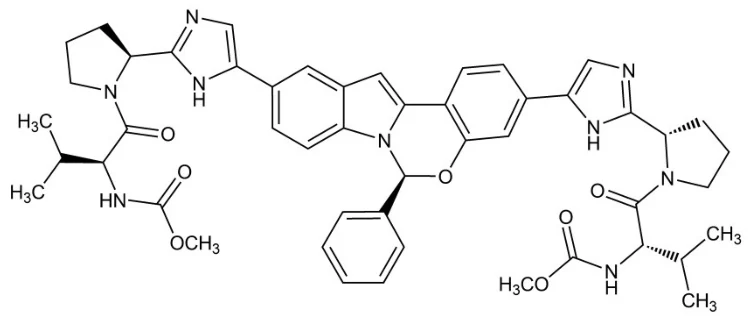
Physicochemical properties: Elbasvir is practically insoluble in water (<0.1 mg/mL) and very slightly soluble in ethanol (0.2 mg/mL), but is very soluble in ethyl acetate and acetone.
Grazoprevir:
Proper name: grazoprevir
Chemical name: 1aR,5S,8S,10R,22aR)-N-[(1R,2S)-1-[(Cyclopropylsulfonamido)carbonyl]-2-ethenylcyclopropyl]-14-methoxy-5-(2-methylpropan-2-yl)-3,6-dioxo-1,1a,3,4,5,6,9,10,18,19,20,21,22,22a-tetradecahydro-8H-7,10-methanocyclopropa[18,19][1,10,3,6]dioxadiazacyclo nonadecino[11,12-b]quinoxaline-8-carboxamide.
Molecular formula and molecular mass: C38H50N6O9S; 766.90
Structural formula:
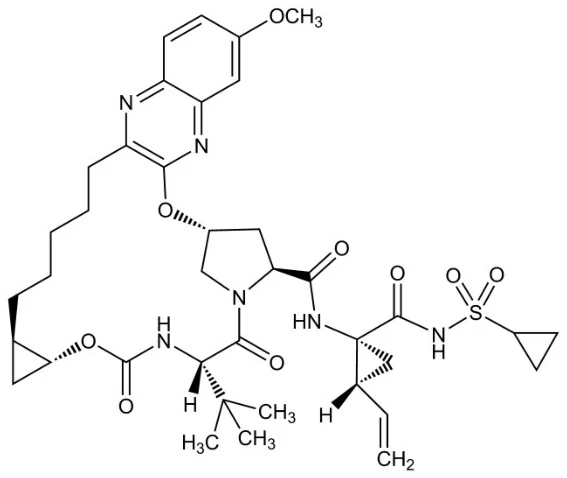
Physicochemical properties: Grazoprevir is practically insoluble in water (< 0.1 mg/mL) but is freely soluble in ethanol and some organic solvents (e.g., acetone, tetrahydrofuran and N,N-dimethylformamide).
CLINICAL TRIALS
Overview of Clinical Trials
The safety and efficacy of ZEPATIER® (elbasvir + grazoprevir FDC) were evaluated in 8 clinical trials in approximately1800 subjects with genotype (GT) 1, 3, or 4 chronic hepatitis C (CHC) infection with compensated liver disease (with and without cirrhosis).
An overview of the trials is provided in Table 13.
Table 13 - Summary of Clinical Trial Designs in Treatment of Chronic Hepatitis C Infection
| Trial | Population | Study Arms and Duration (Number of Subjects Treated) | Trial Design |
C-EDGE TN (P060) | GT 1, 4 TN with or without cirrhosis |
| Randomized, double-blind, Pbo-controlled trial in TN subjects with GT 1, or 4 infection with or without cirrhosis. Subjects were randomized in a 3:1 ratio to: ZEPATIER® for 12 weeks (ITG) or Pbo for 12 weeks followed by open-label treatment with ZEPATIER® for 12 weeks (DTG). |
C-EDGE CO-INFECTIO N (P061) | GT 1, 4 TN with or without cirrhosis HCV/HIV-1 co-infection |
| Open-label trial in TN HCV/HIV-1 co-infected subjects with GT 1, or 4 infection with or without cirrhosis. Subjects received ZEPATIER® for 12 weeks. |
C-SURFER (P052) | GT 1 TN or TE with or without cirrhosis Chronic Kidney Disease |
| Randomized, double-blind, Pbo-controlled trial in subjects with GT 1 infection, with or without cirrhosis, with CKD Stage 4 (eGFR 15-29 mL/min/1.73 m2) or Stage 5 (eGFR < 15 mL/min/1.73 m2), including subjects on hemodialysis, who were TN or who had failed prior therapy with IFN or peg-IFN ± RBV therapy. Subjects were randomized in a 1:1 ratio to one of the following treatment groups: EBR + GZR for 12 weeks (ITG) or Pbo for 12 weeks followed by open-label treatment with ZEPATIER® for 12 weeks (DTG). In addition, 11 subjects received open-label EBR + GZR for 12 weeks (intensive PK arm). |
C-WORTHY (P035) | GT 1, 3 TN with or without cirrhosis TE Null Responder with or without cirrhosis TN HCV/HIV-1 co-infection without cirrhosis |
| Multi-arm, multi-stage, randomized, open-label trial which included subjects with GT 1 or 3 infection who were TN or who had failed prior therapy with peg-IFN ± RBV therapy. In the stage evaluating shorter duration of therapy in subjects with GT 1b infection without cirrhosis, subjects were randomized in a 1:1 ratio to EBR + GZR with or without RBV for 8 weeks. In the stage evaluating subjects with GT 3 infection without cirrhosis who were TN, subjects were randomized to EBR + GZR with RBV for 12 or 18 weeks. In the other stages, subjects with GT 1 infection with or without cirrhosis who were TN (with or without HCV/HIV-1 co-infection) or who were |
| peg-IFN + RBV null responders, were randomized to EBR + GZR with or without RBV for 8, 12 or 18 weeks. | |||
C-SCAPE (P047) | GT 4 TN without cirrhosis |
| Randomized, open-label trial which included TN subjects with genotype 4 infection without cirrhosis. Subjects were randomized in a 1:1 ratio to EBR + GZR for 12 weeks or EBR + GZR + RBV for 12 weeks |
C-EDGE TE (P068) | GT 1, 4 TE with or without cirrhosis with or without HCV/HIV-1 co-infection |
| Randomized, open-label trial in subjects with GT 1, or 4 infection, with or without cirrhosis, with or without HCV/HIV-1 co-infection, who had failed prior therapy with peg-IFN + RBV therapy. Subjects were randomized in a 1:1:1:1 ratio to one of the following treatment groups: ZEPATIER® for 12 weeks, ZEPATIER® + RBV for 12 weeks, ZEPATIER® for 16 weeks, or ZEPATIER® + RBV for 16 weeks. |
C-SALVAGE (P048) | GT 1 TE with HCV protease inhibitor regimen‡ with or without cirrhosis |
| Open-label trial in subjects with GT 1 infection, with or without cirrhosis, who had failed prior treatment with boceprevir, simeprevir, or telaprevir in combination with peg-IFN + RBV. Subjects received EBR + GZR + RBV for 12 weeks. |
C-SWIFT (P074) | GT 1, 3 TN with or without cirrhosis |
| Open-label trial of ZEPATIER® + sofosbuvir in subjects with GT 1 or 3 infection. Non-cirrhotic GT 3 infected subjects, were randomized (1:1) to 8 or 12 weeks of treatment, and cirrhotic GT 3 infected subjects received 12 weeks of treatment. Non-cirrhotic GT 1 infected subjects, were randomized (1:1) to 4 or 6 weeks of treatment, and cirrhotic GT 1 infected subjects were randomized (1:1) to 6 or 8 weeks of treatment. |
GT = Genotype TN = Treatment-Naïve TE = Treatment-Experienced (failed prior treatment with interferon [IFN] or peginterferon alfa [peg-IFN] with or without ribavirin (RBV) or were intolerant to prior therapy) ITG = Immediate Treatment Group DTG = Delayed Treatment Group CKD = Chronic Kidney Disease Pbo = Placebo ¶ EBR = elbasvir 50 mg; GZR = grazoprevir 100 mg; EBR+GZR = co-administered as single agents †RBV was administered at a total daily dose of 800 mg to 1400 mg based on weight (see DOSAGE AND ADMINISTRATION) ‡ Failed prior treatment with boceprevir, telaprevir, or simeprevir in combination with peg-IFN + RBV § Sofosbuvir dose was 400 mg once a day | |||
Sustained virologic response was the primary endpoint in all trials and was defined as HCV RNA less than lower limit of quantification (LLOQ) at 12 weeks after the cessation of treatment (SVR). Serum HCV RNA values were measured during these clinical trials using the COBAS AmpliPrep/COBAS Taqman HCV test (version 2.0) with an LLOQ of 15 HCV RNA IU/mL, with the exception of C-WORTHY and C-SCAPE where the assay had an LLOQ of 25 HCV RNA IU/mL.
Clinical Trials in Treatment-Naïve Subjects with Genotype 1, or 4 Chronic Hepatitis C Infection
Demographic and baseline characteristics for treatment-naïve subjects with genotype 1, or 4 CHC infection treated with ZEPATIER® for 12 weeks in C-EDGE TN, C-EDGE CO-INFECTION, C-SURFER, C-WORTHY, and C-SCAPE are provided in Table 14.
Table 14 -Demographic and Baseline Characteristics of Treatment-Naïve Subjects with or without Cirrhosis Treated with ZEPATIER® for 12 Weeks, with Genotype 1 or 4 Chronic Hepatitis C Infection
| Trial | C-EDGE TN (P060) | C-EDGE CO-INFECTION (HCV/HIV-1 Co-Infection) (P061) | C-SURFER (CKD Stages 4-5, including hemodialysis) (P052) | C-WORTHY (P035) | C-SCAPE (P047) | All Studies |
| Regimen | ZEPATIER® 12 Weeks N=306 n (%) | ZEPATIER® 12 Weeks N=217 n (%) | EBR + GZR 12 Weeks N=101 n (%) | EBR + GZR 12 Weeks N=103 n (%) | EBR + GZR 12 Weeks N=10 n (%) | N=737 n (%) |
| Characteristics | ||||||
| Age (Years) | ||||||
| Mean (SD) | 52 (11) | 49 (9) | 57 (9) | 51 (12) | 45 (7) | 52 (11) |
| Gender | ||||||
| Male | 168 (55) | 182 (84) | 74 (73) | 66 (64) | 6 (60) | 496 (67) |
| Race | ||||||
| White | 190 (62) | 166 (76) | 51 (50) | 88 (85) | 8 (80) | 503 (68) |
| Black or African American | 59 (19) | 38 (18) | 46 (46) | 10 (10) | 1 (10) | 154 (21) |
| Asian | 45 (15) | 6 (3) | 3 (3) | 2 (2) | 1 (10) | 57 (8) |
| Other | 12 (4) | 7 (3) | 1 (<1) | 3 (3) | 0 (0) | 23 (3) |
| IL28B Genotype | ||||||
| CC | 98 (32) | 77 (35) | 26 (26) | 26 (25) | 3 (30) | 230 (31) |
| Non-CC | 206 (67) | 140 (65) | 73 (72) | 77 (75) | 7 (70) | 503 (68) |
| Unknown | 2 (<1) | 0 (0) | 2 (2) | 0 (0) | 0 (0) | 4 (<1) |
| HCV Genotype | ||||||
| 1a | 157 (51) | 144 (66) | 53 (52) | 72 (70) | 0 (0) | 426 (58) |
| 1b | 131 (43) | 44 (20) | 48 (48) | 29 (28) | 0 (0) | 252 (34) |
| 1-Other | 0 (0) | 1 (<1) | 0 (0) | 2 (2) | 0 (0) | 3 (<1) |
| 4 | 18 (6) | 28 (13) | 0 (0) | 0 (0) | 10 (100) | 56 (8) |
| Baseline HCV RNA | ||||||
| >800,000 IU/mL | 215 (70) | 127 (59) | 56 (55) | 85 (83) | 7 (70) | 490 (66) |
| Cirrhosis Status* | ||||||
| Non-Cirrhotic | 236 (77) | 182 (84) | 97 (96) | 74 (72) | 10 (100) | 599 (81) |
| Cirrhotic | 70 (23) | 35 (16) | 4 (4) | 29 (28) | 0 (0) | 138 (19) |
| Hepatic Fibrosis Stage (METAVIR Score)†* | ||||||||||
| F0 to F2 | 201(66) | 159 (73) | 74 (73) | 66 (64) | 10 (100) | 510 (69) | ||||
| F3 | 35 (11) | 23 (11) | 11 (11) | 8 (8) | 0 (0) | 77 (10) | ||||
| F4 | 70 (23) | 35 (16) | 4 (4) | 29 (28) | 0 (0) | 138 (19) | ||||
| HCV/HIV Co-Infected | 0 (0) | 217(100) | 0 (0) | 30 (29) | 0 (0) | 247 (34) | ||||
†By liver biopsy or by non-invasive tests. *12 subjects in C-SURFER with incomplete fibrosis data are counted as non cirrhotic and are not included in hepatic fibrosis stage. | ||||||||||
Study results
Table 15 presents treatment outcomes for ZEPATIER® in treatment-naïve subjects from C-EDGE TN, C-EDGE CO-INFECTION, C-SURFER, C-WORTHY, and C-SCAPE trials and from the pooled data from these trials. In trials C-EDGE TN and C-SURFER, the treatment outcomes for subjects treated with ZEPATIER® in the immediate treatment groups and intensive PK arm are presented. In the C-WORTHY and C-SCAPE trials, the addition of RBV to the regimens was not shown to improve the treatment outcomes. Therefore, only the 12 weeks treatment arms without RBV are presented in Table 15.
Table 15 - Treatment Outcomes after 12 Weeks of Treatment in Treatment-Naïve Subjects with or without Cirrhosis, with Genotype 1 or 4 Chronic Hepatitis C Infection
| Trial | C-EDGE TN (P060) | C-EDGE CO-INFECTION (HCV/HIV-1 Co-Infection) (P061) | C-SURFER (CKD Stages 4-5, including hemodialysis) (P052) | C-WORTHY (P035) | C-SCAPE (P047) | All Studies |
| Regimen | ZEPATIER® 12 Weeks N=306 | ZEPATIER® 12 Weeks N=217 | EBR + GZR 12 Weeks N=101 | EBR + GZR 12 Weeks N=103 | EBR + GZR 12 Weeks N=(10) | N=737 |
| Overall SVR | 95% (291/306) | 95% (206/217) | 95% (96/101) | 94% (97/103) | 90% (9/10) | 95% (699/737) |
| 95% CI¶ | (92.0, 97.2) | (91.1, 97.4) | (88.8, 98.4) | (87.7, 97.8) | (55.5, 99.8) | (93.0, 96.3) |
| Outcome for Subjects without SVR | ||||||
| On-treatment Virologic Failure# | <1% (1/306) | 0% (0/217) | 0% (0/101) | 2% (2/103) | 0% (0/10) | <1% (3/737) |
| Relapse | 3% (10/306) | 3% (7/217) | 0% (0/101) | 2% (2/103) | 0% (0/10) | 3% (19/737) |
| Other† | 1% (4/306) | 2% (4/217) | 5% (5/101) | 2% (2/103) | 10% (1/10) | 2% (16/737) |
| SVR by Genotype | ||||||
| GT 1a | 92% (144/157) | 94% (136/144) | 98% (52/53) | 93% (67/72) | ------ | 94% (399/426) |
| GT 1b‡ | 98% (129/131) | 96% (43/45) | 92% (44/48) | 97% (30/31) | ------ | 96% (246/255) |
| GT 4 | 100% (18/18) | 96% (27/28) | ------ | ------ | 90% (9/10) | 96% (54/56) |
| SVR by Cirrhosis Status | ||||||
| Non-Cirrhotics§ | 94% (223/236) | 94% (171/182) | 95% (92/97) | 93% (69/74) | 90% (9/10) | 94% (564/599) |
| Cirrhotics | 97% (68/70) | 100% (35/35) | 100% (4/4) | 97% (28/29) | ------ | 98% (135/138) |
| SVR by HIV Status | ||||||
| HCV mono-infected | 95% (291/306) | ------ | 95% (96/101) | 97% (71/73) | 90% (9/10) | 95% (467/490) 94% (232/247) |
| HCV/HIV-1 co-infected | ------ | 95% (206/217) | ------ | 87% (26/30) | ------ | |
¶Confidence Interval based on Clopper-Pearson method. #Includes subjects with virologic breakthrough. †Other includes subjects who discontinued due to adverse event, lost to follow-up, or subject withdrawal. ‡Includes genotype 1 subtypes other than 1a or 1b. §Includes 1 subject with cirrhosis status of “unknown” in C-SCAPE. | ||||||
No HIV-1 infected subjects switched their antiretroviral therapy regimen due to loss of plasma HIV-1 RNA suppression. In treatment-naïve subjects, treatment outcomes were consistent in subjects with or without compensated cirrhosis and in subjects with or without HCV/HIV-1 co-infection. Treatment outcomes were consistent in subjects with or without advanced CKD, including subjects on hemodialysis.
Clinical Trial with 8-Week Treatment in Treatment-Naïve Subjects Without Cirrhosis with Genotype 1b Chronic Hepatitis C Infection
In the C-WORTHY trial, treatment-naïve subjects with genotype 1b CHC without cirrhosis were treated with EBR + GZR with or without RBV for 8 weeks.
Demographic and baseline characteristics for treatment-naïve subjects without cirrhosis and without HIV-1 co-infection, with genotype 1b chronic hepatitis C infection treated with ZEPATIER® for 8 weeks are provided below.
In the C-WORTHY trial, treatment-naïve subjects with genotype 1b CHC without cirrhosis were treated with EBR + GZR with or without RBV for 8 weeks. In subjects treated with EBR + GZR without RBV, the subjects had a median age of 56 years (range: 28 to 71); 42% of the subjects were male; 81% were White; 19% were Black or African American; 3% were Hispanic or Latino; mean body mass index was 28 kg/m2; 87% had baseline HCV RNA levels greater than 800,000 IU/mL; 90% had non-C/C IL28B alleles (CT or TT); and 100% had baseline platelets ≥100 10[3]/microL and albumin ≥3.5 gm/dL by liver biopsy or non-invasive tests, all were non-cirrhotic and 94% (29/31) had METAVIR scores of F0-F2 and the other 2 subjects had a METAVIR score of F3.
Study Results
Treatment outcomes in treatment-naïve subjects with genotype 1b without cirrhosis who received EBR + GZR for 8 weeks in C-WORTHY are presented in Table 16. The addition of RBV was not shown to improve the treatment outcomes observed with EBR + GZR.
Table 16 – C-WORTHY: Treatment Outcomes after 8 Weeks of Treatment in Treatment–Naïve Subjects without Cirrhosis with Genotype 1b Chronic Hepatitis C Infection
| Trial | C-WORTHY (P035) | |||
| Regimen | EBR + GZR 8 Weeks N=31 | |||
| Overall SVR | 94% (29/31) | |||
| 95% CI† | (78.6, 99.2) | |||
| Outcome for Subjects without SVR | ||||
| On-treatment Virologic Failure | 0 (0/31) | |||
| Relapse | 6% (2/31) | |||
| SVR by Hepatic Fibrosis Stage | ||||
| Metavir F0 to F2 | 97% (28/29) | |||
| Metavir F3 | 50% (1/2) | |||
| †Based on Clopper-Pearson method. | ||||
Clinical Trials in Treatment-Experienced Subjects with Genotype 1, or 4 Chronic Hepatitis C Infection
C-EDGE TE Trial – Treatment-Experienced Subjects who Failed Prior PEG-IFN with RBV Therapy
Demographic and baseline characteristics for treatment-experienced subjects who failed prior PEG-IFN with RBV therapy with genotype 1, or 4 CHC infection are provided in Table 17.
Table 17 - C-EDGE TE: Demographic and Baseline Characteristics for Treatment-Experienced Subjects who Failed Prior Peg-IFN with RBV with or without Cirrhosis, for 12-16 weeks, with Genotype 1 or 4 Chronic Hepatitis C Infection
| Trial | C-EDGE TE (P068) | ||||||||||||
| Regimen | ZEPATIER® 12 weeks N=105 n (%) | ZEPATIER® + RBV 12 weeks N=104 n (%) | ZEPATIER® 16 weeks N=101 n (%) | ZEPATIER® + RBV 16 weeks N=104 n (%) | |||||||||
| Characteristics | |||||||||||||
| Age (Years) | |||||||||||||
| Mean (SD) | 56 (10) | 55 (8) | 55 (10) | 55 (10) | |||||||||
| Gender | |||||||||||||
| Male | 66 (63) | 72 (69) | 67 (66) | 63 (61) | |||||||||
| Race | |||||||||||||
| White | 66 (63) | 70 (67) | 72 (71) | 78 (75) | |||||||||
| Black or African American | 23 (22) | 24 (23) | 9 (9) | 15 (14) | |||||||||
| Asian | 15 (14) | 9 (9) | 18 (18) | 8 (8) | |||||||||
| Other | 1 (<1) | 1 (<1) | 2 (2) | 3 (3) | |||||||||
| IL28B Genotype | |||||||||||||
| CC | 20 (19) | 16 (15) | 25 (25) | 20 (19) | |||||||||
| Non-CC | 84 (80) | 86 (83) | 76 (75) | 84 (81) | |||||||||
| Missing | 1 (<1) | 2 (2) | 0 (0) | 0 (0) | |||||||||
| HCV Genotype | |||||||||||||
| 1a | 61 (58) | 60 (58) | 48 (48) | 58 (56) | |||||||||
| 1b | 34 (32) | 29 (28) | 48 (48) | 36 (35) | |||||||||
| 1-Other | 1 (<1) | 0 (0) | 0 (0) | 2 (2) | |||||||||
| 4 | 9 (9) | 15 (14) | 5 (5) | 8 (8) | |||||||||
| Baseline HCV RNA (IU/mL) | |||||||||||||
| > 800,000 IU/mL | 84 (80) | 75 (72) | 83 (82) | 76 (73) | |||||||||
| Cirrhosis Status | |||||||||||||
| Non-Cirrhotic | 68 (65) | 69 (66) | 65 (64) | 68 (65) | |||||||||
| Cirrhotic | 37 (35) | 35 (34) | 36 (36) | 36 (35) | |||||||||
| Hepatic Fibrosis Stage(METAVIR Score)† | |||||||||||||
| F0 to F2 | 49 (47) | 55 (53) | 53 (52) | 55 (53) | |||||||||
| F3 | 19 (18) | 14 (13) | 12 (12) | 13 (12) | |||||||||
| F4 | 37 (35) | 35 (34) | 36 (36) | 36 (35) | |||||||||
| HCV/HIV Co-Infected | 6 (6) | 5 (5) | 6 (6) | 4 (4) | |||||||||
| †By liver biopsy or by non-invasive tests. | |||||||||||||
Study results
Treatment outcomes in subjects treated with ZEPATIER® with or without RBV for 12 or 16 weeks are presented in Table 18.
Table 18 - C-EDGE TE Trial: Treatment Outcomes after 12 or 16 weeks of Treatment in Treatment-Experienced Subjects who Failed Prior peg-IFN with RBV with or without Cirrhosis, with Genotype 1 or 4 Chronic Hepatitis C Infection
| Trial | C-EDGE TE (P068) | |||
| Regimen | ZEPATIER® 12 weeks N=105 | ZEPATIER® + RBV 12 weeks N=104 | ZEPATIER® 16 weeks N=101 | ZEPATIER® + RBV 16 weeks N=104 |
| Overall SVR | 92% (97/105) | 94% (98/104) | 93% (94/101) | 97% (101/104) |
| 95% CIÞ | (85.5, 96.7) | (87.9, 97.9) | (86.2, 97.2) | (91.8, 99.4) |
| Outcome for Subjects without SVR | ||||
| On-treatment Virologic Failure# | 0% (0/105) | 0% (0/104) | 2% (2/101) | 0% (0/104) |
| Relapse | 6% (6/105) | 6% (6/104) | 4% (4/101) | 0% (0/104) |
| Other† | 2% (2/105) | 0% (0/104) | 1% (1/101) | 3% (3/104) |
| SVR by Genotype | ||||
| GT 1a | 90% (55/61) | 93% (56/60) | 94% (45/48) | 95% (55/58) |
| GT 1b‡ | 100% (35/35) | 97% (28/29) | 96% (46/48) | 100% (38/38) |
| GT 4 | 78% (7/9) | 93% (14/15) | 60% (3/5) | 100% (8/8) |
| SVR by Cirrhosis Status | ||||
| Non-Cirrhotics | 94% (64/68) | 97% (67/69) | 92% (60/65) | 96% (65/68) |
| Cirrhotics | 89% (33/37) | 89% (31/35) | 94% (34/36) | 100% (36/36) |
| SVR by Response to Prior HCV Therapy | ||||
| On-treatment Virologic Failure¶ | 89% (62/70) | 91% (60/66) | 92% (60/65) | 95% (63/66) |
| Relapser | 100% (35/35) | 100% (38/38) | 94% (34/36) | 100% (38/38) |
| SVR by HIV Status | ||||
| HCV mono-infected | 92% (91/99) | 94% (93/99) | 94% (89/95) | 97% (97/100) |
| HCV/HIV co-infected | 100% (6/6) | 100% (5/5) | 83% (5/6) | 100% (4/4) |
ÞBased on Clopper-Pearson method. #Includes subjects with virologic breakthrough or rebound. †Other includes subjects who discontinued due to adverse event, lost to follow-up, or subject withdrawal. ‡Includes genotype 1 subtypes other than 1a or 1b. ¶Includes null responders and partial responders | ||||
Overall SVR was achieved in 92% and 97% of subjects receiving ZEPATIER® for 12 weeks and ZEPATIER® + RBV for 16 weeks, respectively. SVR was 100% in prior relapsers who received ZEPATIER® for 12 weeks, regardless of genotype or presence of cirrhosis. SVR was 100% in genotype 1b subjects who received ZEPATIER® for 12 weeks, regardless of the presence of cirrhosis or response to prior HCV therapy.
Among genotype 1a or 4 null or partial responders, the highest response was achieved with the administration of ZEPATIER® + RBV for 16 weeks. In subjects receiving ZEPATIER® + RBV for 16 weeks, treatment outcomes were consistent in subjects with or without cirrhosis, and no subject failed due to virologic failure. Among genotype 1a or 4, null or partial responders, SVR was achieved in 93% of subjects receiving ZEPATIER® + RBV for 16 weeks; 90% in subjects receiving ZEPATIER® alone for 16 weeks; 90% in subjects receiving ZEPATIER® + RBV for 12 weeks; and 84% in subjects receiving ZEPATIER® alone for 12 weeks.
No HIV-1 virological failures were observed in subjects who failed prior peg-IFN + RBV with HCV/HIV-1 co-infection. In treatment-experienced subjects, treatment outcomes were consistent in subjects with or without compensated cirrhosis and in subjects with or without HCV/HIV-1 co-infection.
C-SALVAGE Trial – Treatment-Experienced Subjects who Failed Prior PEG-IFN + RBV + HCV Protease Inhibitor Therapy (Boceprevir, Simeprevir, or Telaprevir)
Demographic and baseline characteristics for the C-SALVAGE trial, for subjects who failed prior peg-IFN + RBV with an HCV protease inhibitor with genotype 1 infection with or without cirrhosis treated with EBR + GZR + RBV for 12 weeks are provided in Table 19.
Table 19 – C-SALVAGE: Demographic and Baseline Characteristics for Treatment-Experienced Subjects who Failed Prior Peg-IFN + RBV + HCV Protease Inhibitor Therapy (Boceprevir, Simeprevir, or Telaprevir)
| Trial | C-SALVAGE (P048) | |||
| Regimen | EBR 50 mg + GZR 100 mg + RBV 12 Weeks N=79 n (%) | |||
| Characteristics | ||||
| Age (Years) | ||||
| Mean (SD) | 54 (10) | |||
| Gender | ||||
| Male | 46 (58) | |||
| Race | ||||
| White | 77 (97) | |||
| Black Or African American | 2 (3) | |||
| IL28B Genotype | ||||
| CC | 2 (3) | |||
| Non-CC | 77 (97) | |||
| HCV Genotype | ||||
| 1a | 30 (38) | |||
| 1b | 49 (62) | |||
| Baseline HCV RNA (IU/mL) | ||||
| > 800,000 IU/mL | 50 (63) | |||
| Cirrhosis Status | ||||
| Non-Cirrhotic | 45 (57) | |||
| Cirrhotic | 34 (43) | |||
| Hepatic Fibrosis Stage (METAVIR Score)† | ||||
| F0 to F2 | 37 (47) | |||
| F3 | 8 (10) | |||
| F4 | 34 (43) | |||
| Baseline NS3 resistance-associated substitutions | ||||
| Absence | 43 (54) | |||
| Presence | 36 (46) | |||
| †By liver biopsy or by non-invasive tests. | ||||
Study results
Treatment outcome in subjects treated with ZEPATIER® with ribavirin for 12 weeks are presented in Table 20.
Table 20 – C-SALVAGE: Treatment Outcome in Treatment-Experienced Subjects who Failed Prior Peg-IFN + RBV + HCV Protease Inhibitor Therapy (Boceprevir, Simeprevir, or Telaprevir)
| Trial | C-SALVAGE (P048) | |||||
| Regimen | EBR 50 mg + GZR 100 mg + RBV 12 Weeks N=79 | |||||
| Overall SVR | 96% (76/79) | |||||
| 95% CI† | (89.3, 99.2) | |||||
| Outcome for Subjects without SVR | ||||||
| On-treatment Virologic Failure | 0% (0) | |||||
| Relapse | 4% (3/79) | |||||
| Other‡ | 0% (0) | |||||
| SVR by Genotype | ||||||
| 1a | 93% (28/30) | |||||
| 1b | 98% (48/49) | |||||
| SVR by Cirrhosis Status | ||||||
| Non-Cirrhotics | 98% (44/45) | |||||
| Cirrhotics | 94% (32/34) | |||||
| SVR by baseline NS3 resistance-associated substitutions | ||||||
| Absence | 100% (43/43) | |||||
| Presence | 92% (33/36) | |||||
†Based on Clopper-Pearson method. ‡Other includes subjects who discontinued due to adverse event, lost to follow-up, or subject withdrawal. | ||||||
Overall SVR was achieved in 96% (76/79) of subjects receiving EBR + GZR + RBV for 12 weeks. Four percent (3/79) of subjects did not achieve SVR due to relapse. Treatment outcomes were consistent in genotype 1a and genotype 1b subjects, in subjects with different response to previous HCV therapy, and in subjects with or without cirrhosis. Treatment outcomes were consistent in subjects with or without NS3 resistance-associated substitutions at baseline (see MICROBIOLOGY).
Based on the lack of impact of baseline NS3 resistance-associated substitutions on treatment outcomes, and efficacy analyses among treatment-experienced subjects in the C-SALVAGE and C-EDGE TE trials, the recommended treatment regimen for treatment-experienced patients who have failed peg-IFN + RBV with boceprevir, simeprevir or telaprevir is as follows: for genotype 1 relapsers, administer ZEPATIER® for 12 weeks; for genotype 1b prior on-treatment virologic failures, administer ZEPATIER® for 12 weeks; and for genotype 1a prior on-treatment virologic failures, administer ZEPATIER® + RBV for 16 weeks (see DOSAGE AND ADMINISTRATION).
Clinical Trial in Subjects with Advanced Chronic Kidney Disease with Genotype 1 Chronic Hepatitis C Infection
Demographic and baseline characteristics for the C-SURFER trial, for subjects with genotype 1 infection, with or without cirrhosis, with advanced chronic kidney disease (CKD) Stage 4 (eGFR 15-29 mL/min/1.73 m2) or Stage 5 (eGFR < 15 mL/min/1.73 m2), including subjects on hemodialysis, who were treatment-naïve or who had failed prior therapy with IFN or peg-IFN ± RBV therapy, are provided in Table 21.
Table 21 – C-SURFER: Demographic and Baseline Characteristics in Subjects with Advanced Chronic Kidney Disease who were Treatment-Naïve or had Failed Prior IFN or Peg-IFN ± RBV, with or without Cirrhosis, with Genotype 1 Chronic Hepatitis C Infection
| Trial | C-SURFER (P052) | ||
| Regimen | EBR + GZR 12 weeks N=122 n (%) | ||
| Characteristics | |||
| Age (Years) | |||
| Mean (SD) | 57 (9) | ||
| Gender | |||
| Male | 92 (75) | ||
| Race | |||
| White | 61 (50) | ||
| Black or African American | 55 (45) | ||
| Asian | 5 (4) | ||
| Other | 1 (<1) | ||
| IL28B Genotype | |||
| CC | 32 (26) | ||
| Non-CC | 88 (72) | ||
| Missing | 2 (2) | ||
| HCV Genotype | |||
| 1a | 63 (52) | ||
| 1b | 59 (48) | ||
| 1-Other | 0 (0) | ||
| Baseline HCV RNA (IU/mL) | |||
| > 800,000 IU/mL | 69 (57) | ||
| Cirrhosis Status | |||
| Non-Cirrhotic | 115 (94) | ||
| Cirrhotic | 7 (6) | ||
| Hepatic Fibrosis Stage (METAVIR Score)† | |||
| F0 to F2 | 87 (71) | ||
| F3 | 13 (11) | ||
| F4 | 7 (6) | ||
| No evidence of cirrhosis by biomarker | 15 (12) | ||
| CKD stages | |||
| Stage 4 | 22 (18) | ||
| Stage 5 | 100 (82) | ||
| Hemodialysis | 92 (75) | ||
| Prior HCV Treatment Status | |||
| Treatment-naïve | 101 (83) | ||
| Treatment-experienced | 21 (17) | ||
| †By liver biopsy or by non-invasive tests. | |||
Study results
Treatment outcomes in subjects treated with ZEPATIER® for 12 weeks in the immediate treatment group and intensive PK arm are presented in Table 22.
Table 22 - C-SURFER Trial: Treatment Outcomes in Subjects with Advanced Chronic Kidney Disease who were Treatment-Naïve or had Failed Prior IFN or Peg-IFN ± RBV, with or without Cirrhosis, with Genotype 1 Chronic Hepatitis C Infection
| Trial | C-SURFER (P052) |
| Regimen | EBR + GZR 12 weeks N=122¶ |
| Overall SVR | 94% (115/122)† |
| 95% CI# | (88.5, 97.7) |
| Outcome for Subjects without SVR | |
| On-treatment Virologic Failure | 0% (0/122) |
| Relapse | <1% (1/122) |
| Other‡ | 5% (6/122) |
| SVR by Genotype | |
| GT 1a | 97% (61/63) |
| GT 1b§ | 92% (54/59) |
| SVR by Cirrhosis Status | |
| Non-Cirrhotics | 95% (109/115) |
| Cirrhotics | 86% (6/7) |
| SVR by Prior HCV Treatment Status | |
| Treatment-naïve | 95% (96/101) |
| Treatment-experienced | 90% (19/21) |
| SVR by Hemodialysis Status | |
| No | 97% (29/30) |
| Yes | 93% (86/92) |
| SVR by Chronic Kidney Disease Stage | |
| Stage 4 | 100% (22/22) |
| Stage 5 | 93% (93/100) |
¶Includes subjects in the intensive PK arm. #Based on Clopper-Pearson method. †SVR was achieved in 99% (115/116) of subjects in the pre-specified primary analysis population, which excluded subjects not receiving at least one dose of study treatment and those with missing data due to death or early study discontinuation for reasons unrelated to treatment response. ‡Other includes subjects who discontinued due to adverse event, lost to follow-up, or subject withdrawal. §Includes genotype 1 subtypes other than 1a or 1b. | |
Clinical Trial in Treatment-Naïve Subjects with Genotype 3 Chronic Hepatitis C Infection
Demographic and baseline characteristics in the C-SWIFT study, in treatment-naïve subjects with genotype 3 CHC with or without cirrhosis, without HIV-1 co-infection, treated with ZEPATIER® + sofosbuvir for 8 or 12 weeks are provided in Table 23.
Table 23 - C-SWIFT Study: Demographic and Baseline Characteristics in Treatment-Naïve Subjects, with or without Cirrhosis, with Genotype 3 Chronic Hepatitis C Infection
| Trial | C-SWIFT (P074) | |
| Regimen | ZEPATIER® + Sofosbuvir 8 weeks N=15 n (%) | ZEPATIER® + Sofosbuvir 12 weeks N=26 n (%) |
| Characteristics | ||
| Age (Years) | ||
| Mean (SD) | 51 (10) | 48 (11) |
| Gender | ||
| Male | 11 (73) | 18 (69) |
| Race | ||
| White | 15 (100) | 26 (100) |
| IL28B Genotype | ||
| CC | 6 (40) | 9 (35) |
| Non-CC | 9 (60) | 17 (65) |
| Baseline HCV RNA | ||
| >800,000 IU/mL | 7 (47) | 14 (54) |
| Cirrhosis Status | ||
| Non-Cirrhotic | 15 (100) | 14 (54) |
| Cirrhotic | 0 (0) | 12 (46) |
| Hepatic Fibrosis Stage (METAVIR Score)† | ||
| F0 to F2 | 14 (93) | 11 (42) |
| F3 | 1 (7) | 3 (12) |
| F4 | 0 (0) | 12 (46) |
| †By liver biopsy or by non-invasive tests. | ||
Study results
Treatment outcomes in subjects treated with ZEPATIER® + sofosbuvir for 8 or 12 weeks are presented in Table 24.
Table 24 - C-SWIFT Study: Treatment Outcomes in Treatment-Naïve Subjects, with or without Cirrhosis, with Genotype 3 Chronic Hepatitis C Infection
| Trial | C-SWIFT (P074) | |
| Regimen | ZEPATIER® + Sofosbuvir 8 Weeks N=15 | ZEPATIER® + Sofosbuvir 12 Weeks N=26 |
| Overall SVR | 93% (14/15) | 92% (24/26) |
| 95% CI‡ | (68.1, 99.8) | (74.9, 99.1) |
| Outcome for subjects without SVR | ||
| On-treatment Virologic Failure | 0% (0/15) | 0% (0/26) |
| Relapse | 7% (1/15) | 4% (1/26) |
| Other† | 0% (0/15) | 4% (1/26) |
| SVR by Cirrhosis Status | ||
| Non-Cirrhotics | 93% (14/15) | 100% (14/14) |
| Cirrhotics | ----- | 83% (10/12) |
‡Based on Clopper-Pearson method. †Other includes subjects who discontinued due to adverse event, lost to follow-up, or subject withdrawal. | ||
Overall SVR was achieved in 92% (24/26) in treatment-naïve subjects with genotype 3 with or without cirrhosis who received ZEPATIER® with sofosbuvir for 12 weeks and in 93% (14/15) treatment-naïve subjects without cirrhosis who received ZEPATIER® with sofosbuvir for 8 weeks. Based on the overall results, including SVR in patients with cirrhosis, a 12 week regimen of EBR + GZR with sofosbuvir is recommended for treatment-naïve subjects with genotype 3 with or without cirrhosis.
MICROBIOLOGY
Mechanism of Action
ZEPATIER® combines two direct-acting antiviral agents with distinct mechanisms of action and non-overlapping resistance profiles to target HCV at multiple steps in the viral lifecycle.
Elbasvir is an inhibitor of HCV NS5A, which is essential for viral RNA replication and virion assembly. The mechanism of action of elbasvir has been characterized based on cell culture antiviral activity and drug resistance mapping studies.
Grazoprevir is an inhibitor of the HCV NS3/4A protease which is necessary for the proteolytic cleavage of the HCV encoded polyprotein (into mature forms of the NS3, NS4A, NS4B, NS5A, and NS5B proteins) and is essential for viral replication. In a biochemical assay, grazoprevir inhibited the proteolytic activity of the recombinant NS3/4A protease enzymes from HCV genotypes 1a, 1b, 3, and 4 with IC50 values ranging from 4 to 690 pM.
Antiviral Activity
In HCV replicon assays, the EC50 values of elbasvir against full-length replicons from genotypes 1a, 1b, 3a, and 4, were 0.004 nM, 0.003 nM, 0.14 nM, and 0.0003 nM, respectively. The median EC50 values of elbasvir against chimeric replicons encoding NS5A sequences from clinical isolates were 0.005 nM for genotype 1a (range 0.003-0.009 nM; N=5), 0.009 nM for genotype 1b (range 0.005-0.010 nM; N=5), 0.02 nM for genotype 3a (range 0.01-0.33 nM; N=9), and 0.0007 nM for genotype 4 (range 0.0002-34 nM; N=14).
In HCV replicon assays, the EC50 values of grazoprevir against full-length replicons from genotypes 1a, 1b, 3, and 4, were 0.4 nM, 0.5 nM, 35 nM, and 0.3 nM, respectively.
The median EC50 values of grazoprevir against chimeric replicons encoding NS3/4A sequences from clinical isolates were 0.8 nM for genotype 1a (range 0.4-5.1 nM; N=10), 0.3 nM for genotype 1b (range 0.2-5.9 nM; N=9), 5.85 nM for genotype 3 (range 2.1-7.6 nM; N=6), and 0.2 nM for genotype 4 (range 0.11-0.33 nM; N=5).
Evaluation of elbasvir in combination with grazoprevir, ribavirin, or sofosbuvir showed no antagonistic effect in reducing HCV RNA levels in replicon cells. Evaluation of elbasvir in combination with ribavirin or sofosbuvir showed no antagonistic effect in reducing HCV RNA levels in replicon cells.
Resistance
In Cell Culture
HCV replicons with reduced susceptibility to elbasvir and grazoprevir have been selected in cell culture for genotypes 1a, 1b, 3, and 4 which resulted in the emergence of resistance-associated amino acid substitutions in NS5A or NS3, respectively. The majority of amino acid substitutions in NS5A or NS3 selected in cell culture or identified in Phase 2b and 3 clinical trials were phenotypically characterized in genotype 1a, 1b, or 4 replicons. NS5A and NS3 amino acid substitutions were tested in either stable or transient replicon system and in some cases both systems. Maximal reduced antiviral activity is reported.
For elbasvir, in HCV genotype 1a replicons, single NS5A substitutions reduced antiviral activity: Q30D (925-fold), Q30E (56-fold), Q30H (8-fold), Q30R (125-fold), L31I (134-fold), L31M (10-fold), L31V (125-fold), H58D (6-fold), Y93C (50- fold), Y93H (600-fold), Y93N (2000-fold) by 6- to 2000-fold. In genotype 1b replicons, single NS5A substitutions reduced elbasvir antiviral activity: L31F (17-fold), L31M (7-fold), L31V (3-fold) and Y93H (17-fold) by 3- to 17-fold. In genotype 3 replicons, single NS5A substitutions reduced elbasvir antiviral activity: A30D (1280-fold), A30K (50-fold), L31F (143-fold), L31M (330-fold) and Y93H (485-fold) by 50- to 1280-fold. In genotype 4 replicons, single NS5A substitutions reduced antiviral activity: L30H (240-fold), L30F (15-fold), L30S (4-fold), P32L (5-fold), P58D (1828-fold) and Y93H (23-fold) by 4- to 1828-fold. In general, in HCV genotype 1a, 1b, or 4 replicons, combinations of elbasvir resistance-associated substitutions further reduced elbasvir antiviral activity.
For grazoprevir, in HCV genotype 1a replicons, single NS3 substitutions reduced antiviral activity: Y56H (16-fold), A156G (5-fold), D168A (95-fold), D168E (16-fold), D168 F (21-fold) D168G (32-fold), D168H (12-fold), D168I (40-fold), D168K (212-fold), D168L (11-fold),
D168N (8-fold), D168T (98-fold) D168V (56-fold) and D168Y (104-fold) by 5- to 212-fold. V36M, V55A, Q80K/L, and V107I did not impact grazoprevir antiviral activity. In genotype 1b replicons, single NS3 substitutions reduced antiviral activity: Y56H (13-fold), A156T (280-fold), A156V (375-fold), D168A (14-fold), D168F (76-fold), D168G (11-fold), D168H (51-fold), D168I (13-fold), D168K (121-fold), D168L (15-fold), D168T (26-fold), D168V (14-fold), D168Y (8-fold), R155G (28-fold), R155T (13-fold), R155W (27-fold) by 8- to 375-fold. V107I did not impact grazoprevir activity. In genotype 3 replicons, single NS3 substitutions reduced antiviral activity: N77S (7-fold), Q168R (4-fold) and Q178R (5-fold) by 4- to 7-fold. In genotype 4 replicons, single NS3 substitutions reduced antiviral activity: D168A (320-fold) and D168V (110-fold) by 110- to 320-fold. In general, in HCV genotype 1a, 1b, or 4 replicons, combinations of grazoprevir resistance-associated substitutions further reduced grazoprevir antiviral activity.
In Clinical Studies
In a pooled analysis of genotype 1, or 4 subjects treated with regimens containing ZEPATIER® or elbasvir + grazoprevir with or without ribavirin in Phase 2 and 3 clinical trials, resistance analyses were conducted for 50 subjects who experienced virologic failure and had sequence data available (6 with on-treatment virologic failure, 44 with post-treatment relapse).
Treatment-emergent substitutions observed in the viral populations of these subjects based on genotypes are shown in Table 25. Treatment-emergent substitutions were detected in both HCV drug targets in 23/37 (62%) genotype 1a, 1/8 (13%) genotype 1b, and 2/5 (40%) genotype 4.
Table 25 - Treatment-Emergent Amino Acid Substitutions in the Pooled Analysis of ZEPATIER® with and without Ribavirin Regimens in Phase 2 and Phase 3 Clinical Trials
| Target | Emergent Amino Acid Substitutions | Genotype 1a N = 37 % (n) | Genotype 1b N = 8 % (n) | Genotype 4 N = 5 % (n) | |||||||
| NS5A | Any of the following NS5A substitutions: M/L28A/G/T/S§ Q30H/K/R/Y, L/M31F/M/I/V, H/P58D, Y93H/N/S | 81% (30) | 88% (7) | 100% (5) | |||||||
| M/L28A/G/T/S | 19% (7) | 13% (1) | 60% (3) | ||||||||
| Q30H/K/Y | 14% (5) | -- | -- | ||||||||
| Q30R | 46% (17) | -- | -- | ||||||||
| L/M31M/F/I/V† | 11% (4) | 25% (2) | 40% (2) | ||||||||
| H/P58D‡ | 5% (3) | -- | 20% (1) | ||||||||
| Y93H/N/S | 14% (5) | 63% (5) | 20% (1) | ||||||||
| NS3 | Any of the following NS3 substitutions: V36L/M, Y56F/H, V107I, R155I/K, A156G/M/T/V, V158A, D168A/C/E/G/N/V/Y, V170I | 78% (29) | 25% (2) | 40% (2) | |||||||
| V36L/M | 11% (4) | -- | -- | ||||||||
| Y56F/H | 14% (5) | 13% (1) | -- | ||||||||
| V107I | 3% (1) | 13% (1) | -- | ||||||||
| R155I/K | 5% (2) | -- | -- | ||||||||
| A156T | 27% (10) | 13% (1) | 20% (1) | ||||||||
| A156G/V/M | 8% (3) | -- | 60% (3) | ||||||||
| V158A | 5% (2) | -- | -- | ||||||||
| D168A | 35% (13) | -- | 20% (1) | ||||||||
| D168C/E/G/N/V/Y | 14% (5) | -- | 20% (1) | ||||||||
| V170I | -- | -- | 20% (1) | ||||||||
§Reference sequences for NS5A at amino acid 28 are M (genotype 1a) and L (genotype 1b and genotype 4a and 4d). †Reference sequences for NS5A at amino acid 31 are L (genotype 1a and genotype 1b) and M (genotype 4a and 4d). ‡Reference sequences for NS5A at amino acid 58 are H (genotype 1a) and P (genotype 1b and genotype 4a and 4d). | |||||||||||
In an analysis of genotype 3 subjects treated with ZEPATIER® and sofosbuvir for 12 weeks in a Phase 2 clinical study, one subject experienced relapse. This subject had a treatment-emergent NS5A Y93H substitution.
In Vitro Cross Resistance
Elbasvir is active in vitro against genotype 1a NS5A substitutions, M28V and Q30L, genotype 1b substitutions, L28M/V, R30Q, L31V, Y93C, and genotype 4 substitution, M31V which confer resistance to other NS5A inhibitors. In general, other NS5A substitutions conferring resistance to NS5A inhibitors may also confer resistance to elbasvir. NS5A substitutions conferring resistance to elbasvir may reduce the antiviral activity of other NS5A inhibitors. Elbasvir is fully active against substitutions conferring resistance to NS3/4A protease inhibitors: T54S, Q80K, R155K, A156T/V, D168V and D168Y.
Grazoprevir is active in vitro against the following genotype 1a NS3 substitutions which confer resistance to other NS3/4A protease inhibitors: V36A/L/M, Q41R, F43L, T54A/S, V55A/I, Y56F, Q80R, V107I, S122A/G/R/T, I132V, A156S, D168S, I170T/V. Grazoprevir is active in vitro against the following genotype 1b NS3 substitutions conferring resistance to other NS3/4A protease inhibitors: V36A/I/L/M, Q41L/R, F43S, T54A/C/G/S, V55A/I, Y56F, Q80L/R, V107I, S122A/G/R, R155E/K/N/Q/S, A156G/S, D168E/N/S, V170A/I/T. Some NS3 substitutions at A156 and at D168 confer reduced antiviral activity to grazoprevir as well as to other NS3/4A protease inhibitors. Grazoprevir is fully active against resistance-associated variants selected by NS5A inhibitors: L31I/M/V and Y93H.
The substitutions associated with resistance to NS5B inhibitors are susceptible to elbasvir or grazoprevir.
Persistence of Resistance-Associated Substitutions
The persistence of elbasvir and grazoprevir treatment-emergent amino acid substitutions in NS5A, and NS3, respectively, was assessed in genotype 1-infected subjects in Phase 2 and 3 trials whose virus had treatment-emergent resistance-associated substitution in the drug target, and with available data through at least 24 weeks post-treatment.
Treatment-emergent NS5A resistance-associated substitutions were generally more persistent than NS3 resistance-associated substitutions. Among genotype 1-infected subjects who had one or more treatment-emergent NS5A resistance-associated substitutions, these substitutions became undetectable at follow-up week 12 in only 5% (2/44) of subjects and 0% (0/12) of subjects with follow-up week 24 data.
Among genotype 1-infected subjects with treatment-emergent NS3 resistance-associated substitutions, these substitutions became undetectable at follow-up week 24 in 67% (10/15) of subjects based on population sequencing.
Due to the limited number of genotype 3- and 4-infected subjects with treatment-emergent NS5A and NS3 resistance-associated substitutions, trends in persistence of treatment-emergent substitutions in these genotypes could not be established.
Effect of Baseline HCV Polymorphisms on Treatment Response
Analyses in Phase 2 and 3 clinical studies of ZEPATIER®, or elbasvir + grazoprevir, with or without ribavirin were conducted to explore the association between baseline NS5A and/or NS3polymorphisms and treatment response among subjects who achieved SVR or experienced virologic failure (see CLINICAL TRIALS) and for whom baseline sequences were available. Baseline NS5A polymorphism at position 28, 30, 31, 58, and 93 were evaluated. Compared to a reference HCV genotype 1a replicon, the following NS5A substitutions reduced elbasvir antiviral activity by greater than 5-fold: M28T/A, Q30E/H/R/G/K/D, L31M/V/F, H58D, and Y93C/H/N. Baseline NS3 polymorphisms at position 36, 54, 55, 56, 80, 107, 122, 132, 155, 156, 158, 168, 170, and 175 were evaluated.
Genotype 1a
In pooled analyses of genotype 1a-infected subjects, baseline NS5A polymorphisms that confer greater than 5-fold reduction of elbasvir antiviral activity in vitro were identified in 6% (29/491) of treatment-naïve subjects and 8% (26/334) of treatment-experienced subjects. Among treatment-naïve subjects, SVR was achieved in 98% (432/439) of subjects without baseline
NS5A polymorphisms and 55% (16/29) of subjects with baseline NS5A polymorphisms that confer greater than 5-fold reduction of elbasvir antiviral activity in vitro. Among treatment-experienced subjects, SVR was achieved in 99% (291/295) of subjects without baseline NS5A polymorphisms and 50% (13/26) of subjects with baseline NS5A polymorphisms that confer greater than 5-fold reduction of elbasvir antiviral activity in vitro.
In pooled analyses, presence of NS3 polymorphisms, including Q80K, prior to the start of therapy did not impact treatment response among genotype 1a-infected subjects.
Genotype 1b
In pooled analyses, presence of NS5A polymorphisms prior to the start of therapy did not impact treatment response among treatment-naïve genotype 1b-infected subjects. NS5A polymorphisms that confer greater than 5-fold reduction of elbasvir antiviral activity in vitro were detected in 14% (36/259) of treatment-experienced subjects. SVR was achieved in 100% (223/223) of subjects without baseline NS5A polymorphisms and 86% (31/36) of subjects with baseline NS5A polymorphisms that confer greater than 5-fold reduction of elbasvir antiviral activity in vitro.
In pooled analyses, presence of NS3 polymorphisms prior to the start of therapy did not impact treatment response among genotype 1b-infected subjects.
Genotype 4
In pooled analyses, presence of NS5A polymorphisms prior to the start of therapy did not impact treatment response among genotype 4-infected subjects.
In pooled analyses, presence of NS3 polymorphisms prior to the start of therapy did not impact treatment response among treatment-naïve, genotype 4-infected subjects. Baseline NS3 polymorphisms were identified by population sequencing in 19% (7/36) of treatment-experienced genotype 4-infected subjects. In these subjects, SVR was achieved in 100% (7/7) of subjects with baseline NS3 polymorphisms compared with 86% (25/29) in those without baseline NS3 polymorphism.
Genotype 3
In a Phase 2 study (C-SWIFT) of ZEPATIER® with sofosbuvir, presence of NS5A polymorphisms prior to the start of therapy did not impact treatment response among genotype 3-infected subjects. Baseline NS5A polymorphisms were identified by population sequencing in 12% (3/25) of treatment-naive genotype 3-infected subjects. In these subjects, SVR was achieved in 100% (3/3) of subjects with baseline NS5A polymorphisms compared with 95% (21/22) in those without baseline NS5A polymorphism.
In this analysis, presence of NS3 polymorphisms prior to the start of therapy did not impact treatment response among treatment-naïve, genotype 3-infected subjects.
No subject had NS5B polymorphisms detected at baseline.
TOXICOLOGY
General Toxicology
Elbasvir
Phospholipidosis in lymphoid organs associated with gastrointestinal tract occurred in dogs and was reversible upon treatment cessation. The No-Observed Adverse Effect Level (NOAEL) was 25 mg/kg/day (approximately 1.6 times the clinical dose based on AUC). The clinical relevance of phospholipidosis is unknown.
No target organ toxicity was identified. The NOAEL in rats, dogs, and mice was the highest dose tested, 1000 mg/kg/day (approximately 9, 7, and 63 times the clinical dose based on AUC, respectively).
Grazoprevir
The target organs identified in the repeat-dose toxicity studies were the hepatobiliary system, the male reproductive organs and the gastrointestinal tract. The safety margin for these changes was >80 times the clinical dose based on AUC.
Mutagenesis and Carcinogenesis
Elbasvir and grazoprevir were not genotoxic in a battery of in vitro or in vivo assays, including microbial mutagenesis, chromosomal aberration in Chinese Hamster Ovary cells, and in in vivo rat micronucleus assays.
Carcinogenicity studies with elbasvir or grazoprevir have not been conducted.
If ZEPATIER® is administered in a regimen containing ribavirin or sofosbuvir, the information for ribavirin or sofosbuvir on carcinogenesis and mutagenesis also applies to this combination regimen (see product monographs for ribavirin or sofosbuvir).
REFERENCES
- 1- Forns X, Gordon SC, Zuckerman E, Lawitz E, Calleja JL. Hofer H, Gilbert C et al. Grazoprevir/Elbasvir plus ribavirin for chronic HCV genotype-1 infection after failure of combination therapy containing a direct-acting antiviral agent. Journal of Hepatology (2015), doi: http://dx.doi.org/10.1016/j.jhep.2015.04.009.
- 2- Lawitz E, Gane E, Pearlman B, Tam E, Ghesquiere W, Guyader D, et al. Efficacy and safety of 12 weeks versus 18 weeks of treatment with grazoprevir (MK-5172) and elbasvir (MK-8742) with or without ribavirin for hepatitis C virus genotype 1 infection in previously untreated patients with cirrhosis and patients with previous null response with or without cirrhosis (C-WORTHY): a randomised, open-label phase 2 trial. Lancet. 2014 Nov 11. (Epub ahead of print).
3- Marshall WL, Yeh WW, Bethel-Brown C, Stypinski D, Auger P, Brandquist C, Gill DM et al. No evidence of pharmacokinetic drug-drug interaction in healthy subjects between
- coadministered Grazoprevir (MK-5172)/Elbasvir (MK-8742) and Sofosbuvir. EASL 2015. Poster.
- 4- Rockstroh JK, Nelson M, Katlama C, Lalezari J, Mallolas J, Bloch M, Matthews G, et al. C-EDGE co-infection: Phase 3 study of Grazoprevir/Elbasvir in patients with HCV/HIV. Poster EASL 2015.
- 5- Roth D, Nelson D, Bruchfeld A, Liapakis AM, Silva M, Monsour H Jr, Martin P et al. C-Surfer: Grazoprevir plus Elbasvir in treatment-naïve and treatment-experienced patients with hepatitis C virus genotype 1 infection and chronic kidney disease. EASL 2015. Poster.
- 6- Sulkowski M, Hezode C, Gerstoft J, Vierling JM, Mallolas J, Pol S, et al. Efficacy and safety of 8 weeks versus 12 weeks of treatment with grazoprevir (MK-5172) and elbasvir (MK-8742) with or without ribavirin in patients with hepatitis C virus genotype 1 mono-infection and HIV/hepatitis C virus co-infection (C-WORTHY): a randomised, open-label phase 2 trial. Lancet. 2014 Nov 11. (Epub ahead of print)
- 7- Zeuzem S, Ghali R, Reddy R, Pockros PJ, Ari ZB, Zhao Y, Brown DB, et al. Grazoprevir–Elbasvir combination therapy for treatment-naïve cirrhotic and noncirrhotic patients with Chronic HCV genotype 1, 4, or 6 infection. Ann Intern Med. doi:10.7326/M15-0785. Published online on 24 April 2015.