


Product Monograph - Galexos
SUMMARY PRODUCT INFORMATION
| Route of Administration | Dosage Form / Strength | Clinically Relevant Nonmedicinal Ingredientsa |
| Oral | capsule 150 mg | Lactose monohydrate |
a For a complete listing see DOSAGE FORMS, COMPOSITION AND PACKAGING.
INDICATIONS AND CLINICAL USE
GALEXOS® (simeprevir) is indicated in combination with peginterferon alfa (PegIFN-alfa) and ribavirin (RBV) or with sofosbuvir for the treatment of genotype 1 and 4 chronic hepatitis C (CHC) in adults with compensated liver disease.
(See WARNINGS AND PRECAUTIONS, DOSAGE AND ADMINISTRATION and CLINICAL TRIALS).
Geriatrics (≥ 65 years of age)
Clinical studies of GALEXOS® did not include sufficient numbers of subjects aged 65 and over to determine whether they respond differently from younger subjects. In general, caution should be exercised when administering GALEXOS® in elderly patients, reflecting the greater frequency of decreased hepatic, renal or cardiac function, and of concomitant disease or other drug therapy (see WARNINGS AND PRECAUTIONS, DOSAGE AND ADMINISTRATION and ACTION AND CLINICAL PHARMACOLOGY).
Pediatrics (< 18 years of age)
The use of GALEXOS® in pediatric patients is not recommended. No clinical data are available regarding the use of GALEXOS® in children and adolescents younger than 18 years of age (see WARNINGS AND PRECAUTIONS).
CONTRAINDICATIONS
GALEXOS® is contraindicated in patients who are hypersensitive to simeprevir or to any ingredient in the formulation or component of the container. For a complete listing, see DOSAGE FORMS, COMPOSITION AND PACKAGING.
GALEXOS® must be prescribed in combination with other medicinal products for the treatment of CHC infection. Contraindications related to the other medicinal products used with GALEXOS® for the treatment of CHC infection therefore also apply to their use in GALEXOS® combination treatment. The Product Monograph(s) for these medicinal products should be consulted before starting therapy with GALEXOS®.
GALEXOS® in combination with RBV is contraindicated in pregnant women and also in men whose female partners are pregnant, may be pregnant, or plan to become pregnant because of the risks for birth defects and fetal death associated with RBV (see WARNINGS AND PRECAUTIONS, Special Populations).
WARNINGS AND PRECAUTIONS
General
Treatment with GALEXOS® should be initiated and monitored by a physician experienced in the management of chronic hepatitis C.
GALEXOS® must not be used as monotherapy.
GALEXOS® must be prescribed in combination with other medicinal products for the treatment of CHC infection. The prescribing information for these medicinal products must therefore be consulted before starting therapy with GALEXOS®. Warnings and Precautions related to the other medicinal products used with GALEXOS® for the treatment of CHC infection also apply to their use in GALEXOS® combination treatment.
A high proportion of previous null responders (particularly those with cirrhosis) did not achieve a sustained virologic response (SVR) and had simeprevir resistance-associated substitutions emerge on treatment with GALEXOS® in combination with PegIFN-alfa and RBV.
Serious Warnings and Precautions
Potential for Hepatitis B Virus (HBV) Reactivation: Screen all patients for evidence of current or prior HBV infection before initiating GALEXOS® treatment. Cases of HBV reactivation, including those resulting in fulminant hepatitis, hepatic failure, and death, have been reported during HCV treatment and/or post-treatment with regimens containing direct-acting antivirals (DAAs) in patients co-infected with HBV. (See WARNINGS AND PRECAUTIONS, Potential for Hepatitis B reactivation, HCV/HBV co-infection.)
Use of GALEXOS® in Patients Infected with HCV Genotype 1a
GALEXOS® in combination with PegIFN-alfa and RBV
SVR rates of GALEXOS® in combination with PegIFN-alfa and RBV were reduced in hepatitis C genotype 1a patients with an NS3 Q80K polymorphism compared to those without Q80K polymorphism. When accessible, testing for Q80K polymorphism in patients with HCV genotype 1a is recommended and this information should be taken into account when considering therapy with GALEXOS® in combination with PegIFN-alfa and RBV. In the absence of Q80K information, patients can be managed by utilizing the treatment stopping rules (see Table 8, DOSAGE AND ADMINISTRATION). SVR rates by Week 4 HCV RNA levels are presented in the MICROBIOLOGY, Effect of Baseline HCV Polymorphisms on Treatment Response section.
GALEXOS® in combination with sofosbuvir
In HCV genotype 1a-infected patients with cirrhosis, testing for Q80K polymorphism may be considered prior to initiation of therapy with GALEXOS® in combination with sofosbuvir.
In HCV genotype 1a-infected patients without cirrhosis, efficacy of GALEXOS® in combination with sofosbuvir at the recommended 12-week treatment duration was not impacted by the presence of NS3 Q80K polymorphism (see CLINICAL TRIALS).
Use in Patients Who Have Failed Previous Therapy with Direct-Acting Antivirals Against HCV
The safety and efficacy of GALEXOS® have not been studied in patients who have failed previous therapy with GALEXOS® or other direct-acting antivirals against HCV.
Use in Patients with Other HCV Genotypes
Clinical data are insufficient to support the use of GALEXOS® in patients with HCV genotypes 2, 3, 5 or 6.
Carcinogenesis and Mutagenesis
Carcinogenicity studies with simeprevir have not been conducted. Simeprevir was not genotoxic in a series of in vitro and in vivo tests (see TOXICOLOGY).
Use with RBV: RBV was not oncogenic in a 6-month p53+/- transgenic mouse study or a 2-year carcinogenicity study in rats. RBV is genotoxic in in vitro and in vivo assays. See the prescribing information for RBV.
Drug Interactions
Co-administration of GALEXOS® with substances that moderately or strongly induce or inhibit cytochrome P450 3A (CYP3A) is not recommended as this may lead to significantly lower or higher exposure of simeprevir, respectively (see DRUG INTERACTIONS).
Co-administration of amiodarone with GALEXOS® in combination with sofosbuvir is not recommended. Post-marketing cases of symptomatic bradycardia and cases requiring pacemaker intervention have been reported when amiodarone is co-administered with sofosbuvir in combination with another HCV direct acting antiviral, including GALEXOS®. Bradycardia generally occurred within hours to days, but cases have been observed up to 2 weeks after initiating HCV treatment. Bradycardia generally resolved after discontinuation of HCV treatment. Patients also taking beta-blockers, or those with underlying cardiac comorbidities and/or advanced liver disease may be at increased risk for symptomatic bradycardia with co-administration of amiodarone. The mechanism for the bradycardia effect is unknown. Patients taking amiodarone who have no other alternative treatment options, and who will be co-administered GALEXOS® and sofosbuvir, should be counselled about the risk of symptomatic bradycardia; cardiac monitoring in an in-patient setting for the first 48 hours of co-administration is recommended, after which outpatient or self-monitoring of the heart rate should occur on a daily basis through at least the first two weeks of treatment.
Hepatic
Refer to the prescribing information for the medicinal products used in combination with GALEXOS® regarding their use in patients with hepatic impairment. PegIFN-alfa is contraindicated in patients with decompensated cirrhosis (e.g., Child-Pugh Class B or C).
Hepatic Decompensation and Hepatic Failure
GALEXOS® is not recommended for use in patients with moderate or severe hepatic impairment (Child-Pugh Class B or C) (see DOSAGE AND ADMINISTRATION and ACTION AND CLINICAL PHARMACOLOGY, Special Populations and Conditions).
The safety and efficacy of GALEXOS® have not been established in HCV-infected patients with moderate or severe hepatic impairment (Child-Pugh Class B or C, score greater or equal to 7) or in patients with decompensated liver disease. Hepatic decompensation and hepatic failure (including fatal cases), have been reported post-marketing in patients treated with GALEXOS® in combination with PegIFN-alfa and RBV or in combination with sofosbuvir. Most cases were reported in patients with advanced and/or decompensated cirrhosis who are at increased risk for hepatic decompensation or hepatic failure. Because these events have been reported voluntarily during clinical practice, estimates of frequency cannot be made and a causal relationship between treatment with GALEXOS® and these events has not been established.
In clinical studies of GALEXOS®, increases in bilirubin levels were observed
without impacting hepatic function and were generally not associated with elevations in liver transaminases (see ADVERSE REACTIONS, Clinical Trial Adverse Drug Reactions). Post-marketing cases of hepatic decompensation with markedly elevated bilirubin levels (≥10xULN in rare cases) have been reported.
Monitor liver chemistry tests before and as clinically indicated during GALEXOS® combination therapy. Patients who experience an increase in total bilirubin to greater than 2.5 times the upper limit of normal should be closely monitored. Discontinue GALEXOS® if elevation in bilirubin is accompanied by clinically relevant liver transaminase increases or clinical signs and symptoms of hepatic decompensation. Patients should be instructed to contact their healthcare provider if they have onset of fatigue, weakness, lack of appetite, nausea and vomiting, jaundice or discolored feces.
Infections
Potential for Hepatitis B Virus Reactivation
Cases of HBV reactivation, including those resulting in fulminant hepatitis, hepatic failure, and death, have been reported in HCV/HBV co-infected patients who were undergoing, or completed treatment with DAAs. To decrease the risk of HBV reactivation in patients co-infected with HVB, HBV screening should be performed in all patients prior to initiation of HCV treatment. Patients with positive HBV serology (HBsAg positive) and patients with serologic evidence of resolved HBV infection (i.e. HBsAg negative and anti-HBc positive) should be monitored and treated according to current clinical practice guidelines to manage potential for HBV reactivation (see WARNINGS AND PRECAUTIONS, Monitoring and Laboratory Tests)
HCV/HBV Co-Infection
The safety and efficacy of GALEXOS® have not been studied in HCV patients co-infected with HBV.
HBV reactivation has been reported during treatment and post-treatment with DAAs in patients co-infected with HBV who were not undergoing treatment for HBV infection.
Gastrointestinal
GALEXOS® contains lactose. This medicine is not recommended for patients with rare hereditary problems of galactose intolerance (severe lactase deficiency or glucose-galactose malabsorption).
Photosensitivity
Photosensitivity reactions (which were mostly mild or moderate) have been observed with GALEXOS® in combination treatment (see ADVERSE REACTIONS, Clinical Trial Adverse Drug Reactions).
Avoid excess exposure to sun and use of tanning devices during treatment with GALEXOS®. Use of appropriate sun protective measures during treatment with GALEXOS® is recommended.
Rash
Rash has been observed with GALEXOS® combination treatment (see ADVERSE REACTIONS, Clinical Trial Adverse Drug Reactions). Rash occurred with greatest frequency during the first 4 weeks of treatment, but can occur at any time during treatment. Severe rash including cases requiring discontinuation of GALEXOS® have been reported in subjects receiving GALEXOS® in combination with PegIFN-alfa and RBV. Most of the rash events in GALEXOS®-treated patients were of mild or moderate severity (see ADVERSE REACTIONS, Clinical Trial Adverse Drug Reactions). Patients with mild to moderate rashes should be followed for progression of rash, including the development of mucosal lesions (e.g., oral lesions, conjunctivitis) or systemic symptoms. If rash becomes severe, GALEXOS® should be discontinued. Patients should be monitored until the rash has resolved.
Renal
Renal Impairment
No dose adjustment of GALEXOS® is required in patients with mild, moderate or severe renal impairment. The safety and efficacy of GALEXOS® have not been studied in HCV-infected patients with severe renal impairment (creatinine clearance below 30 mL/min) or end-stage renal disease, including patients requiring dialysis. Simeprevir is highly protein-bound, therefore dialysis is unlikely to result in significant removal of simeprevir (see ACTION AND CLINICAL PHARMACOLOGY, Pharmacokinetics).
Refer to the prescribing information for the medicinal products used in combination with GALEXOS® regarding their use in patients with renal impairment.
Sexual Function/Reproduction
There are no data on the effect of simeprevir on human fertility. No effects on fertility were observed in animal studies (see TOXICOLOGY).
Simeprevir had no effect on fertility, embryo-fetal, or pre- and postnatal development in rats at a systemic exposure similar to that observed in humans at the recommended dose of 150 mg once daily. In mice, supernumerary ribs and delayed ossification were seen from 500 mg/kg/day corresponding to 4-fold the human exposure at the recommended dose of 150 mg once daily. In pregnant rats, simeprevir concentrations in placenta, fetal liver and fetus were lower compared to those observed in blood. Animal studies with simeprevir do not indicate direct or indirect harmful effects on reproduction.
Use with RBV: Animal studies have shown that RBV induced reversible toxicity in males. See the prescribing information for RBV.
Use with PegIFN-alfa: Animal studies have shown that PegIFN-alfa may impair female fertility See the prescribing information for PegIFN-alfa.
Special Populations
Pregnant Women
There are no adequate and well-controlled studies with GALEXOS® in pregnant women.
GALEXOS® should not be used during pregnancy unless the potential benefit justifies the potential risk. Female patients of childbearing potential should use an effective contraceptive method.
Because GALEXOS® must be co-administered with other medicinal products for the treatment of CHC infection, the contraindications and warnings applicable to those medicinal product(s) also apply to combination treatment with GALEXOS®.
Use with RBV:
Animal studies have shown that RBV causes birth defects and/or fetal deaths (see CONTRAINDICATIONS and RBV prescribing information). Significant teratogenic and/or embryocidal effects have been demonstrated in all animal species exposed to RBV; therefore, RBV is contraindicated in women who are pregnant and in the male partners of women who are pregnant (see CONTRAINDICATIONS and RBV prescribing information).
When GALEXOS® is used in combination with RBV extreme care must be taken to avoid pregnancy in female patients and female partners of male patients, both during treatment and for 6 months after the completion of all treatment with RBV. Women of childbearing potential and their male partners should not receive RBV unless they are using two reliable forms of effective contraception during treatment with RBV and for 6 months after treatment with RBV.
GALEXOS® combination treatment with RBV should not be started unless a female patient has a negative pregnancy test immediately prior to initiation of treatment. Pregnancy testing should occur monthly during treatment with RBV and for 6 months after all treatment with RBV has ended. Pregnancy testing in non-pregnant female partners is recommended before GALEXOS® combination treatment with RBV, every month during treatment with RBV and for 6 months after treatment with RBV has ended. Patients (both male and female) should be advised to notify their health care provider immediately in the event of a pregnancy.
Use with PegIFN-alfa: Interferons have abortifacient effects in animals and should be assumed to have abortifacient potential in humans (see PegIFN-alfa prescribing information).
Nursing Women
When administered to lactating rats, simeprevir represented approximately 5 to 10% of the maternal exposure (based on AUC) in plasma of suckling rats likely due to excretion of simeprevir via milk. It is not known whether simeprevir or its metabolites are excreted in human breast milk. A risk to the newborn/infant cannot be excluded, therefore nursing must be discontinued prior to initiation of treatment with GALEXOS®.
Refer to the prescribing information for the medicinal products used in combination with GALEXOS® for the treatment of CHC infection regarding their use with breast-feeding.
Pediatrics (<18 years of age)
The safety and efficacy of GALEXOS® in children and adolescents less than 18 years of age have not been established.
Geriatrics (>65 years of age)
Clinical studies of GALEXOS® did not include sufficient numbers of patients older than 65 years to determine whether they respond differently from younger patients. No dose adjustment of GALEXOS® is required in elderly patients (see ACTION AND CLINICAL PHARMACOLOGY, Pharmacokinetics).
Organ Transplantation
The safety and efficacy of GALEXOS® have not been established in organ transplant recipients.
Co-administration of GALEXOS® with cyclosporine is not recommended as this leads to significantly higher exposure of simeprevir (see DRUG INTERACTIONS).
Effects on Ability to Drive and Use Machines
No specific studies on the effects of GALEXOS® on the ability to drive and use machines have been performed.
GALEXOS® combination treatment may affect a patient’s ability to drive and use machines. Refer to the prescribing information for the medicinal products used with GALEXOS® for the treatment of CHC infection regarding their potential effect on the ability to drive and use machines.
Monitoring and Laboratory Tests
Use with PegIFN-alfa and RBV
HCV RNA levels should be monitored at Weeks 4 and 12 and as clinically indicated when GALEXOS® is used in combination with PegIFN-alfa and RBV (see DOSAGE AND ADMINISTRATION).
The use of a sensitive real-time reverse transcription polymerase chain reaction (RT-PCR) assay for monitoring HCV RNA levels during treatment is recommended. The assay should have a lower limit of HCV RNA quantification equal to or less than 25 IU/mL, and a limit of HCV RNA detection of approximately 10-15 IU/mL.
Refer to the prescribing information of PegIFN-alfa and RBV for pre-treatment, on-treatment and post-treatment laboratory testing requirements including hematology, biochemistry (including hepatic enzymes and bilirubin), and pregnancy testing requirements.
HCV/HBV Co-infection
Clearance of HCV may lead to increased replication of HBV in patients who are co-infected with HCV and HBV; co-infected patients should be monitored for clinical and laboratory signs (e.g. HBsAg, anti-HBc, HBV DNA, serum aminotransferase levels, bilirubin) for hepatitis flare or HBV reactivation during and at post-treatment follow-up as clinically appropriate (see WARNINGS AND PRECAUTIONS, Potential for HBV Reactivation).
ADVERSE REACTIONS
Overview
The overall safety profile of simeprevir is based on data from 1486 HCV genotype 1-infected patients who received GALEXOS® (or placebo) in combination with PegIFN-alfa and RBV (pooled data from the clinical Phase 2 studies C205 and C206 and the clinical Phase 3 studies C208, C216 and HPC3007) and 580 HCV genotype 1-infected patients who received
GALEXOS® in combination with sofosbuvir with or without RBV (pooled data from the clinical Phase 2 study HPC2002 and the clinical Phase 3 studies HPC3017 and HPC3018).
The safety profile of GALEXOS® is comparable in patients with HCV genotype 4 infection and HCV genotype 1 infection, when given either in combination with PegIFN-alfa and RBV or in combination with sofosbuvir.
Clinical Trial Adverse Drug Reactions
Because clinical trials are conducted under very specific conditions the adverse reaction rates observed in the clinical trials may not reflect the rates observed in practice and should not be compared to the rates in the clinical trials of another drug. Adverse drug reaction information from clinical trials is useful for identifying drug-related adverse events and for approximating rates.
GALEXOS® in combination with PegIFN-alfa and RBV
The safety profile of GALEXOS® in combination with PegIFN-alfa and RBV in patients with HCV genotype 1 infection is based on pooled data from the Phase 2 and Phase 3 studies C205, C206, C208, C216 and HPC3007 which included 924 patients who received GALEXOS® 150 mg once daily with PegIFN-alfa and RBV for 12 weeks and 540 patients who received placebo with PegIFN-alfa and RBV.
In the pooled Phase 3 safety data, the majority of the adverse reactions reported during the 12 weeks of treatment with GALEXOS® were Grade 1 to 2 in severity. Grade 3 or 4 adverse reactions were reported in 2.8% of patients receiving GALEXOS® with PegIFN-alfa and RBV versus 0.5% of patients receiving placebo with PegIFN-alfa and RBV. Serious adverse reactions were reported in 0.3% of GALEXOS®-treated patients (photosensitivity conditions requiring hospitalization; n=2) and in none of the patients receiving placebo with PegIFN-alfa and RBV. Discontinuation of GALEXOS® or placebo due to adverse reactions occurred in 0.9% and 0.3% of patients receiving GALEXOS® with PegIFN-alfa and RBV and patients receiving placebo with PegIFN-alfa and RBV, respectively. Adverse reactions leading to discontinuation of GALEXOS® included rash (n=6; 0.8%), pruritus (n=1; 0.1%) and increased blood bilirubin (n=1; 0.1%). Adverse reactions leading to discontinuation of placebo included rash (n=1; 0.3%).
The safety profile of GALEXOS® is comparable in patients with HCV genotype 4 infection (N=107) and genotype 1 infection.
The following table lists adverse reactions of at least moderate severity (Grade ≥2) that occurred in patients during the 12 weeks of treatment with GALEXOS® 150 mg once daily or placebo in combination with PegIFN-alfa and RBV in the pooled Phase 3 studies (studies C208, C216 and HPC3007) (Table 1). No additional adverse reactions were identified in the other clinical studies.
| Table 1: Treatment-Emergent Adverse Reactions of at Least Moderate Severity (Grades 2-4a) Reported in Treatment-Naïve and Treatment-Experienced Adult Patients with HCV Genotype 1 Infection (Pooled Phase 3 Studies C208, C216 and HPC3007; First 12 Weeks of Treatments; Intent-to-Treat Analysis) | ||||
System Organ Class, Grouped Term | GALEXOS® + PR N=781 | Placebo + PR N=397 | ||
| Gastrointestinal disorders | ||||
| Constipationb | 0.3% | 0.5% | ||
| Hepatobiliary disorders | ||||
| Blood bilirubin increasedc | 5.4% | 2.3% | ||
| Skin and subcutaneous tissue disorders | ||||
| Rashd | 7.6% | 3.8% | ||
| Prurituse | 3.1% | 0.8% | ||
| Photosensitivity reactionf | 0.8% | 0.0% | ||
a According to the WHO toxicity grading scale. b Grouped term ‘constipation’ included the preferred term constipation. c Grouped term ‘blood bilirubin increased’ included the preferred terms bilirubin conjugated increased, blood bilirubin increased, blood bilirubin unconjugated increased and hyperbilirubinemia. d Grouped term ‘rash’ included the preferred terms blister, drug eruption, erythema, erythema of eyelid, exfoliative rash, generalized erythema, macule, palmar erythema, papule, pityriasis rosea, polymorphic light eruption, rash, rash erythematous, rash follicular, rash generalized, rash macular, rash maculo-papular, rash morbilliform, rash papular, rash pruritic, rash pustular, scrotal erythema, skin exfoliation, skin irritation, skin reaction, toxic skin eruption, umbilical erythema and vasculitic rash. e Grouped term ‘pruritus’ included the preferred terms eyelids pruritus, prurigo, pruritus and pruritus generalized. f Grouped term ‘photosensitivity reaction’ included the preferred terms photodermatosis, photosensitivity reaction, solar dermatitis and sunburn. | ||||
GALEXOS® in combination with sofosbuvir
The safety profile of GALEXOS® in combination with sofosbuvir in patients with HCV genotype 1 infection with or without cirrhosis is based on pooled data from the Phase 2 study HPC2002 and the Phase 3 studies HPC3017 and HPC3018 which included 472 patients who received GALEXOS® with sofosbuvir without ribavirin (155, 286 and 31 patients received 8, 12 or 24 weeks of treatment, respectively) and 108 patients who received GALEXOS® with sofosbuvir and ribavirin (54 patients each received 12 or 24 weeks of treatment).
The safety profile of GALEXOS® is comparable in patients with HCV genotype 4 infection (N=103) and genotype 1 infection.
Table 2 lists adverse reactions (all grades) reported in patients during 12 or 24 weeks of treatment with GALEXOS® 150 mg once daily in combination with sofosbuvir 400 mg once daily without ribavirin (12-week data: pooled data from Studies HPC2002, HPC3017 and HPC3018; 24-week data: Study HPC2002). The adverse reactions are listed by system organ class (SOC) and frequency.
The majority of the adverse reactions reported were Grade 1 in severity. Grade 2 and 3 adverse reactions were reported in 3.5% (n=10) and 0.3% (n=1) of patients, respectively, receiving 12 weeks GALEXOS® with sofosbuvir; no Grade 4 adverse reactions were reported. In patients receiving 24 weeks GALEXOS® with sofosbuvir, no Grade 2 or 3 adverse reactions were reported; one patient (3.2%) experienced a Grade 4 adverse reaction (‘blood bilirubin increased’). No serious adverse reactions were reported. One patient in the 12-week treatment group (0.3%) and none of the patients in the 24-week treatment group discontinued treatment due to adverse reactions.
| Table 2: Adverse Reactions (All Grades) in Adult Patients with HCV Genotype 1 Infection Receiving 12 or 24 Weeks of Treatment with GALEXOS® in Combination with Sofosbuvir (12 weeks: Pooled Studies HPC2002, HPC3017 and HPC3018; 24 weeks: Study HPC2002; Intent-to-Treat Analysis) | |||||
System Organ Class, Grouped Terma | 12 Weeks GALEXOS® + Sofosbuvir N=286 | 24 Weeks GALEXOS® + Sofosbuvir N=31 | |||
| Gastrointestinal disorders | |||||
| Constipation | 6.3% | 3.2% | |||
| Hepatobiliary disorders | |||||
| Blood bilirubin increased | 1.0% | 3.2% | |||
| Skin and subcutaneous tissue disorders | |||||
| Rash | 8.0% | 12.9% | |||
| Pruritus | 8.4% | 3.2% | |||
| Photosensitivity reaction | 3.1% | 6.5% | |||
| aGrouped terms: see Table 1; the grouped term 'pruritus' in addition includes the preferred term 'pruritus allergic'. | |||||
Description of Selected Adverse Reactions
Rash and pruritus
GALEXOS® in combination with PegIFN-alfa and RBV: During the 12 weeks of treatment with GALEXOS®, rash and pruritus were observed in 21.8% and 21.9% of GALEXOS®-treated patients, respectively, compared to 16.6% and 14.6% in placebo-treated patients, respectively (all grades; pooled Phase 3). Most of the rash and pruritus events in GALEXOS®-treated patients were of mild or moderate severity (Grade 1 or Grade 2). Grade 3 rash or pruritus occurred in 0.5% and 0.1% of GALEXOS®-treated patients, respectively. There were no reports of Grade 4 rash or pruritus. Discontinuation of GALEXOS® due to rash or pruritus occurred in 0.8% and 0.1% of GALEXOS®-treated patients, compared to 0.3% and 0% of placebo-treated patients, respectively.
GALEXOS® in combination with sofosbuvir: Most of the rash and pruritus events in GALEXOS®-treated patients were of mild or moderate severity (Grade 1 or Grade 2). Grade 3 rash was reported in one patient (0.3%; 12-week treatment group) which led to treatment discontinuation; none of the patients experienced Grade 4 rash. There were no reports of Grade 3 or 4 pruritus; none of the patients discontinued treatment due to pruritus.
Blood bilirubin increased
GALEXOS® in combination with PegIFN-alfa and RBV: During the 12 weeks of treatment with GALEXOS®, ‘blood bilirubin increased’ was reported in 7.4% of GALEXOS®-treated patients, compared to 2.8% in placebo-treated patients, (all grades; pooled Phase 3). Grade 3 or 4 ‘blood bilirubin increased’ was reported in 2% and 0.3% of the GALEXOS®-treated patients, respectively (pooled Phase 3 studies). Discontinuation of GALEXOS® due to ‘blood bilirubin increased’ was rare (0.1%; n=1).
The safety profile of GALEXOS® 150 mg in combination with PegIFN-alfa and RBV in a Phase 3 study conducted in Asian patients in China and South Korea is comparable to non-Asian patients from a pooled Phase 3 population from global studies, except for higher frequencies for ‘blood bilirubin increased’ events. In the Phase 3 study conducted in China and South-Korea, during 12 weeks treatment with GALEXOS® 150 mg once daily, ‘blood bilirubin increased’ events (all grades) were reported in 44.1% (n=67/152) of GALEXOS®-treated Asian patients, compared to 18.4% (n=28/152) in Asian patients treated with placebo, PegIFN-alfa and RBV. Grade 3 ‘blood bilirubin increased’ events were reported in 6.6% GALEXOS®-treated Asian patients, compared to 1.3% in Asian patients treated with placebo, PegIFN-alfa and RBV. There were no Grade 4 ‘blood bilirubin increased’ events reported. The bilirubin elevations were not associated with increases in liver transaminases and were reversible on completion of treatment with GALEXOS®. These changes are not considered to be clinically relevant.
GALEXOS® in combination with sofosbuvir: Grade 2 ‘blood bilirubin increased’ was reported in one patient (0.3%) receiving 12 weeks of treatment. There were no Grade 3 events reported. One patient (3.2%) receiving 24 weeks of treatment experienced a Grade 4 ‘blood bilirubin increased’ event. None of the patients discontinued treatment due to ‘blood bilirubin increased’.
The elevations in direct and indirect bilirubin when GALEXOS® was used in combination with PegIFN-alpha and RBV or in combination with sofosbuvir, were mostly of mild or moderate severity and were reversible. Bilirubin elevations were generally not associated with elevations in liver transaminases and are attributed to a decrease in bilirubin elimination related to inhibition by simeprevir of the hepatocyte transporters OATP1B1 and MRP2. These changes are not considered clinically relevant.
Photosensitivity reaction
GALEXOS® in combination with PegIFN-alfa and RBV: During the 12 weeks of treatment with GALEXOS®, photosensitivity reactions were reported in 4.7% of GALEXOS®-treated patients compared to 0.8% in placebo-treated patients (all grades; pooled Phase 3). Most photosensitivity reactions in GALEXOS®-treated patients were of mild or moderate severity (Grade 1 or 2); 0.1% of the GALEXOS®-treated patients experienced Grade 3 photosensitivity reactions. There were no Grade 4 photosensitivity reactions reported. None of the patients discontinued treatment due to photosensitivity reactions.
GALEXOS® in combination with sofosbuvir: Most of the photosensitivity reactions were of mild severity (Grade 1); Grade 2 photosensitivity reactions were reported in two patients (0.7%) receiving 12 weeks of treatment. There were no Grade 3 or 4 photosensitivity reactions reported and none of the patients discontinued treatment due to photosensitivity reactions.
Abnormal Hematologic and Clinical Chemistry Findings
GALEXOS® in combination with PegIFN-alfa and RBV
During the first 12 weeks of treatment there were no differences in laboratory abnormalities (any grade) between treatment groups for hemoglobin (22% in GALEXOS® and 22% in the placebo group), neutrophils (76% in GALEXOS® and 77% in the placebo group) and platelets (20% in GALEXOS® and 24% in the placebo group) but there was a difference in hyperbilirubinemia (50% in the GALEXOS® group and 26% in the placebo).
Treatment-emergent laboratory abnormalities that were observed at a higher incidence in GALEXOS®-treated patients than in patients treated with placebo, PegIFN-alfa and RBV are given in Table 3.
| Table 3: Treatment-Emergent Laboratory Abnormalities (WHO Worst Toxicity Grades 1 to 4) Observed at a Higher Incidence in GALEXOS®-Treated Patients (Pooled Phase 3 Studies C208, C216 and HPC3007; First 12 Weeks of Treatments; Intent-to-Treat Analysis) | ||||||||||
| Laboratory Parameter | WHO Toxicity Range | GALEXOS® + PR N=781 | Placebo + PR N=397 | |||||||
| Chemistry | ||||||||||
| Alkaline phosphatase | ||||||||||
| Grade 1 | > 1.25 to ≤ 2.50 x ULN | 3.3% | 1.3% | |||||||
| Grade 2 | > 2.50 to ≤ 5.00 x ULN | 0.1% | 0% | |||||||
| Hyperbilirubinemia | ||||||||||
| Grade 1 | > 1.1 to ≤ 1.5 x ULN | 26.7% | 15.4% | |||||||
| Grade 2 | > 1.5 to ≤ 2.5 x ULN | 18.3% | 9.1% | |||||||
| Grade 3 | > 2.5 to ≤ 5.0 x ULN | 4.1% | 1.5% | |||||||
| Grade 4 | > 5.0 x ULN | 0.4% | 0% | |||||||
ULN = Upper Limit of Normal No Grade 3 or 4 changes in alkaline phosphatase were observed. | ||||||||||
Alkaline phosphatase elevations were rare and mild (Grade 1) in almost all cases, in general not associated with increases in liver transaminases and quickly reversible after end of GALEXOS® application. Elevations in bilirubin were predominately mild to moderate (Grade 1 or 2) and included elevations of both direct and indirect bilirubin. Elevations in bilirubin occurred early after treatment initiation, peaking by study Week 2, and were reversible after end of GALEXOS® application. Bilirubin elevations were generally not associated with elevations in liver transaminases or signs of hepatic decompensation.
GALEXOS® in combination with sofosbuvir
The most common treatment-emergent Grade 3 and 4 laboratory abnormalities observed in patients treated with GALEXOS® in combination with sofosbuvir were amylase and lipase elevations (Table 4). Elevations in amylase and lipase were transient and mostly of mild or moderate severity. Amylase and lipase elevations were not associated with pancreatitis.
| Table 4: Treatment-Emergent Laboratory Abnormalities (WHO Worst Toxicity Grades 1 to 4) in Amylase and Lipase in Patients Receiving 12 or 24 Weeks of Treatment with GALEXOS® in Combination with Sofosbuvir (12 weeks: Pooled Studies HPC2002, HPC3017 and HPC3018; 24 weeks: Study HPC2002; Intent-to-Treat Analysis) | |||||||||
| Laboratory Parameter | WHO Toxicity Range | 12 Weeks GALEXOS® + Sofosbuvir N=286 | 24 Weeks GALEXOS® + Sofosbuvir N=31 | ||||||
| Chemistry | |||||||||
| Amylase | |||||||||
| Grade 1 | ≥ 1.1 to ≤ 1.5 x ULN | 11.9% | 25.8% | ||||||
| Grade 2 | > 1.5 to ≤ 2.0 x ULN | 5.2% | 6.5% | ||||||
| Grade 3 | > 2.0 to ≤ 5.0 x ULN | 4.5% | 9.7% | ||||||
| Lipase | |||||||||
| Grade 1 | ≥ 1.1 to ≤ 1.5 x ULN | 4.5% | 3.2% | ||||||
| Grade 2 | > 1.5 to ≤ 3.0 x ULN | 7.7% | 9.7% | ||||||
| Grade 3 | > 3.0 to ≤ 5.0 x ULN | 0.3% | 3.2% | ||||||
| Grade 4 | > 5.0 x ULN | 0.3% | 3.2% | ||||||
ULN = Upper Limit of Normal No Grade 4 changes in amylase were observed. | |||||||||
Additional Information
The safety profile of GALEXOS® in combination with PegIFN-alfa and RBV is comparable in patient with HCV genotype 1 infection with (N=106) and without HIV-1 co-infection.
There were no clinically relevant differences in incidences of PegIFN- or RBV-related AEs in subjects receiving PegIFN-alfa-2a and RBV compared to subjects receiving PegIFN-alfa-2b and RBV with the addition of GALEXOS®.
Post-Market Adverse Events
The following adverse events have been reported during post approval use of GALEXOS®. Because post-marketing events are reported voluntarily from a population of uncertain size, it is not possible to reliably estimate their frequency or establish a causal relationship between drug exposure and these adverse events.
Cardiac Disorders: Serious symptomatic bradycardia has been reported in patients taking amiodarone who initiate treatment with sofosbuvir in combination with another HCV direct acting antiviral, including GALEXOS®
Hepatobiliary Disorders: hepatic decompensation, hepatic failure
DRUG INTERACTIONS
Overview
The plasma exposure of simeprevir in HCV-infected patients was 2- to 3-fold higher than those observed in healthy subjects. Interaction studies have been performed only in healthy adult subjects.
Effect of GALEXOS® on the Pharmacokinetics of Other Drugs
Simeprevir does not induce CYP1A2 or CYP3A4 in vitro. Simeprevir is not a clinically relevant inhibitor of cathepsin A enzyme activity.
Simeprevir mildly inhibits the CYP1A2 activity and intestinal CYP3A4 activity, while it does not affect hepatic CYP3A4 activity. Co-administration of GALEXOS® with drugs that are primarily metabolized by CYP3A4 may result in increased plasma concentrations of such drugs (see Table 5). Simeprevir does not affect CYP2C9, CYP2C19 or CYP2D6 in vivo.
Simeprevir inhibits the uptake transporters Organic Anion Transporting Polypeptide 1B1/3 (OATP1B1/3); and the efflux transportersP-glycoprotein (P-gp) and BCRP and does not inhibit OCT2. Co-administration of GALEXOS® with drugs that are substrates for OATP1B1/3 and BCRP (e.g., rosuvastatin) and P-gp (e.g., digoxin, sofosbuvir) transport may result in increased plasma concentrations of such drugs (see Table 5).
Effect of Other Drugs on the Pharmacokinetics of GALEXOS®
The primary enzyme involved in the biotransformation of simeprevir is CYP3A (see ACTION AND CLINICAL PHARMACOLOGY) and clinically relevant effects of other drugs on simeprevir pharmacokinetics via CYP3A may occur. Co-administration of GALEXOS® with moderate or strong inhibitors of CYP3A may significantly increase the plasma exposure of simeprevir. Co-administration with moderate or strong inducers of CYP3A (e.g., efavirenz, rifampin) may significantly reduce the plasma exposure of simeprevir and lead to loss of efficacy (see Table 5). Therefore, co-administration of GALEXOS® with substances that moderately or strongly inhibit or induce CYP3A is not recommended (see WARNINGS AND PRECAUTIONS).
Inducers of P-gp may also decrease the exposure of simeprevir and reduce its therapeutic effects.
Drug-Drug Interactions
Table 5 shows the established and potentially significant drug interactions based on which alterations in dose or regimen of GALEXOS® and/or co-administered drug may be recommended. Drugs that are not recommended for co-administration with GALEXOS® are also included in Table 5.
| Table 5: Established and Other Potentially Significant Drug Interactions: Alterations in Dose or Regimen May Be Recommended Based on Drug Interaction Studies or Predicted Interaction (see Table 39 and Table 35 for Magnitude of Interaction) | ||
Concomitant Drug Class: Drug Name | Effect on Concentration of Simeprevir or Concomitant Drug | Clinical Comment |
| Antiarrhythmics | ||
| Amiodarone | ↑ amiodarone | Concomitant use of GALEXOS® with amiodarone may result in mild increases in amiodarone concentrations when amiodarone is administered orally due to intestinal CYP3A4 inhibition by simeprevir. Treatment regimen not containing sofosbuvir: Caution is warranted and therapeutic drug monitoring of amiodarone, if available, is recommended when amiodarone is co-administered via the oral route with GALEXOS®. Treatment regimen with sofosbuvir: Co-administration of amiodarone with GALEXOS® in combination with sofosbuvir may result in serious symptomatic bradycardia. The mechanism of this effect is unknown. Co-administration of amiodarone with GALEXOS® in combination with sofosbuvir is not recommended. If co-administration is required, cardiac monitoring is recommended. |
| Digoxina | ↑ digoxin | Concomitant use of GALEXOS® with digoxin resulted in increased concentrations of digoxin (AUC ↑39%, Cmax ↑31%) due to inhibition of P-gp by simeprevir. Concentrations of digoxin should be monitored and used for titration of digoxin dose to obtain the desired clinical effect when co-administered with GALEXOS®. |
Disopyramide Flecainide Mexiletine Propafenone Quinidine | ↑ antiarrhythmics | Concomitant use of GALEXOS® with these antiarrhythmics may result in increases in concentrations of these antiarrhythmics only when orally administered due to intestinal CYP3A4 inhibition by simeprevir. Caution is warranted and therapeutic drug monitoring for these antiarrhythmics, if available, is recommended when co-administered via the oral route with GALEXOS®. |
| Anticoagulants | ||
| Warfarina | ↔ warfarin | No dose adjustment is required when GALEXOS® is co-administered with warfarin. However, it is recommended that the international normalized ratio (INR) be monitored. |
| Anticonvulsants | ||
Carbamazepine Oxcarbazepine Phenobarbital Phenytoin | ↓ simeprevir | Concomitant use of GALEXOS® with carbamazepine, oxcarbazepine, phenobarbital or phenytoin may result in significantly decreased plasma concentrations of simeprevir due to strong CYP3A4 induction by these anticonvulsants. This may result in loss of therapeutic effect of GALEXOS®. It is not recommended to co-administer GALEXOS® with these anticonvulsants. Alternatives should be considered. |
| Antihistamines | ||
Astemizole* Terfenadine* (*not marketed in Canada) | ↑ astemizole ↑ terfenadine | Astemizole and terfenadine have the potential for cardiac arrhythmias. Concomitant use of GALEXOS® with astemizole and terfenadine may result in mild increases in concentrations of these antihistamines due to intestinal CYP3A4 inhibition by simeprevir. It is not recommended to co-administer GALEXOS® with astemizole or terfenadine. |
| Anti-infectives | ||
Antibiotics - macrolides (systemic administration): azithromycin | ↔ simeprevir | No dose adjustment is required when GALEXOS® is co-administered with azithromycin. |
Antibiotics - macrolides (systemic administration): Erythromycina | ↑ simeprevir ↑ erythromycin | Concomitant use of GALEXOS® with erythromycin resulted in significantly increased plasma concentrations of both erythromycin (AUC ↑ 90%, Cmax ↑ 59%) and simeprevir (AUC ↑7.5-fold, Cmax ↑4.5-fold) due to inhibition of CYP3A and P-gp by both erythromycin and simeprevir. It is not recommended to co-administer GALEXOS® with erythromycin. However, extreme caution should be used if the decision is made to administer GALEXOS® with erythromycin. |
Antibiotics - macrolides (systemic administration): Clarithromycin Telithromycin | ↑ simeprevir | Concomitant use of GALEXOS® with clarithromycin or telithromycin may result in increased plasma concentrations of simeprevir due to CYP3A inhibition by these antibiotics. It is not recommended to co-administer GALEXOS® with clarithromycin or telithromycin. Alternatives, such as azithromycin, should be considered. |
Antifungals (systemic administration): Itraconazole Ketoconazole Posaconazole | ↑ simeprevir | Concomitant use of GALEXOS® with systemic itraconazole, ketoconazole or posaconazole may result in significantly increased plasma concentrations of simeprevir due to strong CYP3A inhibition by these antifungals. It is not recommended to co-administer GALEXOS® with systemic itraconazole, ketoconazole or posaconazole. |
Antifungals (systemic administration): Fluconazole Voriconazole | ↑ simeprevir | Concomitant use of GALEXOS® with systemic fluconazole or voriconazole may result in increased plasma concentrations of simeprevir due to mild to moderate CYP3A inhibition by these antifungals. It is not recommended to co-administer GALEXOS® with systemic fluconazole or voriconazole. |
Antimycobacterials: Rifampina,b Rifabutin Rifapentine | ↓ simeprevir ↔ rifampin, rifabutin, rifapentine | Concomitant use of GALEXOS® with rifampin, rifabutin or rifapentine may result in significantly decreased plasma concentrations of simeprevir (AUC ↓ 48%, Cmax ↑31% with rifampin) due to CYP3A4 induction by these antimycobacterials. This may result in loss of therapeutic effect of GALEXOS®. It is not recommended to co-administer GALEXOS® with rifampin, rifabutin or rifapentine. Alternatives should be considered. |
| Calcium Channel Blockers (oral administration) | ||
Amlodipine Bepridil Diltiazem Felodipine Nicardipine Nifedipine Nisoldipine Verapamil | ↑ calcium channel blockers | Concomitant use of GALEXOS® with orally administered calcium channel blockers may result in increased plasma concentrations of calcium channel blockers due to intestinal CYP3A4 and/or P-gp inhibition by simeprevir. Caution is warranted and clinical monitoring of patients is recommended when GALEXOS® is co-administered with orally administered calcium channel blockers. |
| Corticosteroids | ||
Systemic Dexamethasone | ↓ simeprevir | Concomitant use of GALEXOS® with systemic dexamethasone may result in decreased plasma concentrations of simeprevir due to moderate induction of CYP3A4 by dexamethasone. This may result in loss of therapeutic effect of GALEXOS®. It is not recommended to co-administer GALEXOS® with systemic dexamethasone. Alternatives should be considered. |
| Gastrointestinal Products | ||
Propulsive: Cisapride (not marketed in Canada) | ↑ cisapride | Cisapride has the potential to cause cardiac arrhythmias. Concomitant use of GALEXOS® with cisapride may result in increased plasma concentrations of cisapride due to intestinal CYP3A4 inhibition by simeprevir. It is not recommended to co-administer GALEXOS® with cisapride. |
| HCV Products | ||
Antiviral sofosbuvirc | ↑ sofosbuvir | Concomitant use of simeprevir with sofosbuvir resulted in increased plasma concentrations of sofosbuvir, with no change in exposure of the nucleotide metabolite GS-331007 or simeprevir. The increase in sofosbuvir exposure is not clinically relevant. |
Antiviral daclatasvira | ↑ daclatasvir ↑ simeprevir | Concomitant use of GALEXOS® with daclatasvir resulted in increased plasma concentrations of daclatasvir and simeprevir. No dose adjustment is required for either drug when GALEXOS® is co administered with daclatasvir. |
Antiviral Ledipasvir-containing medicinal productsa | ↑ ledipasvir ↑ simeprevir | Concomitant use of GALEXOS® with ledipasvir resulted in increased plasma concentrations of ledipasvir and simeprevir. Co-administration of simeprevir with a ledipasvir-containing medicinal product is not recommended. |
| HIV Products | ||
Non-Nucleoside Reverse Transcriptase Inhibitors (NNRTIs): Efavirenza | ↓ simeprevir ↔ efavirenz | Concomitant use of GALEXOS® with efavirenz resulted in significantly decreased plasma concentrations of simeprevir (AUC ↓71%, Cmax ↓51%) due to CYP3A induction by efavirenz. This may result in loss of therapeutic effect of GALEXOS®. It is not recommended to co-administer GALEXOS® with efavirenz. Alternatives should be considered. |
Other NNRTIs (Delavirdine, Etravirine, Nevirapine) | ↑ or ↓ simeprevir | Concomitant use of GALEXOS® with delavirdine, etravirine or nevirapine may result in altered plasma concentrations of simeprevir due to CYP3A inhibition (delavirdine) or induction (etravirine and nevirapine) by these drugs. It is not recommended to co-administer GALEXOS® with delavirdine, etravirine or nevirapine. |
| Protease Inhibitors (PIs): Darunavir/ritonavira,d | ↑ simeprevir ↑ darunavir ↑ ritonavir | Concomitant use of GALEXOS® with darunavir/ritonavir resulted in significantly increased plasma concentrations of simeprevir due to strong CYP3A inhibition by ritonavir. Concomitant use of GALEXOS® with darunavir resulted in increased plasma concentrations of darunavir. Concomitant use of GALEXOS® with ritonavir resulted in increased plasma concentrations of ritonavir. It is not recommended to co-administer darunavir/ritonavir and GALEXOS®. |
Protease Inhibitors (PIs): Ritonavira,e | ↑ simeprevir | Concomitant use of GALEXOS® with ritonavir resulted in significantly increased plasma concentrations of simeprevir (AUC ↑7.2-fold, Cmax ↑4.7-fold and Cmin ↑14.4-fold) due to strong CYP3A inhibition by ritonavir. It is not recommended to co-administer GALEXOS® with ritonavir. |
| Cobicistat-containing medicinal product | ↑ simeprevir | Concomitant use of GALEXOS® and a cobicistat-containing medicinal product may result in significantly increased plasma concentrations of simeprevir due to strong CYP3A inhibition by cobicistat. It is not recommended to co-administer GALEXOS® with a cobicistat-containing medicinal product. |
Other ritonavir-boosted or unboosted HIV PIs, (Atazanavir (Fos)amprenavir Lopinavir Indinavir Nelfinavir Saquinavir Tipranavir) | ↑ or ↓ simeprevir | Concomitant use of GALEXOS® with ritonavir-boosted or unboosted HIV PIs may result in altered plasma concentrations of simeprevir due to CYP3A inhibition or induction by these HIV PIs. It is not recommended to co-administer GALEXOS® with any HIV PI, with or without ritonavir. |
Antiretroviral – integrase inhibitor Dolutegravir | ↔dolutegravir | Concomitant use of GALEXOS® with dolutegravir is not expected to result in a clinically relevant interaction. No dose adjustment is required when GALEXOS® is co administered with dolutegravir. |
| HMG CO-A Reductase Inhibitors | ||
| Rosuvastatina | ↑ rosuvastatin | Concomitant use of GALEXOS® with rosuvastatin resulted in significantly increased plasma concentrations of rosuvastatin (AUC ↑2.8-fold, Cmax ↑3.2-fold) due to inhibition of OATP1B1/3 and BCRP by simeprevir. Titrate the rosuvastatin dose carefully and use the lowest necessary dose while monitoring for safety when co-administered with GALEXOS®. |
Atorvastatina Simvastatina | ↑atorvastatin, ↑simvastatin | Concomitant use of GALEXOS® with atorvastatin or simvastatin resulted in increased plasma concentrations of atorvastatin (AUC ↑2.1-fold, Cmax ↑1.7-fold), or simvastatin (AUC ↑1.5-fold, Cmax ↑1.5-fold) due to inhibition of OATP1B1/3 (atorvastatin), OATP1B1 (simvastatin) and/or CYP3A4 by simeprevir. Titrate the atorvastatin and simvastatin dose carefully and use the lowest necessary dose while monitoring for safety when co-administered with GALEXOS®. |
Pitavastatin (not marketed in Canada) Pravastatin | ↑ pitavastatin, pravastatin | Concomitant use of GALEXOS® with pitavastatin or pravastatin may result in increased plasma concentrations of pitavastatin, pravastatin due to inhibition of OATP1B1/3 by simeprevir. Titrate the pitavastatin, and pravastatin dose carefully and use the lowest necessary dose while monitoring for safety when co-administered with GALEXOS®. |
| Lovastatin | ↑ lovastatin | Concomitant use of GALEXOS® with lovastatin may result in increased plasma concentrations of lovastatin due to inhibition of OATP1B1 and/or CYP3A4 by simeprevir. Titrate the lovastatin dose carefully and use the lowest necessary dose while monitoring for safety when co-administered with GALEXOS®. |
| Immunosuppressants | ||
| Cyclosporine | ↑ cyclosporine ↑ simeprevirf | Concomitant use of GALEXOS® with cyclosporine resulted in significantly increased plasma concentrations of simeprevir due to inhibition of OATP1B1/3, P-gp and CYP3A by cyclosporine. It is not recommended to co-administer GALEXOS® with cyclosporine. |
| Tacrolimus | ↓ tacrolimusa ↑ simeprevirf | Concomitant use of GALEXOS® with tacrolimus resulted in decreased plasma concentrations of tacrolimus (AUC ↓17%, Cmax ↓24%). Routine monitoring of blood tacrolimus concentrations is recommended and appropriate dose modifications of tacrolimus may be required when co-administered with GALEXOS®. Concomitant use of GALEXOS® with tacrolimus resulted in increased plasma concentrations of simeprevir due to inhibition of OATP1B1. This increase is not considered to be clinically relevant. No dose adjustment is required for GALEXOS®. |
| Sirolimus | ↑ or ↓ sirolimus | Concomitant use of GALEXOS® and sirolimus may result in changes in plasma concentrations of sirolimus due to mild inhibition of intestinal CYP3A4 by simeprevir or transporter (Pgp or OATP) interactions. Monitoring of blood concentrations of sirolimus is recommended when co-administered with GALEXOS®. |
| Phosphodiesterase Type 5 (PDE-5) Inhibitors | ||
Sildenafil Tadalafil Vardenafil | ↑ PDE-5 inhibitors | Concomitant use of GALEXOS® with PDE-5 inhibitors may result in increases in concentrations of PDE-5 inhibitors due to inhibition of intestinal CYP3A4 by simeprevir. Use of PDE-5 Inhibitors for Erectile Dysfunction No dose adjustment is required when GALEXOS® is co-administered with doses of sildenafil, vardenafil, or tadalafil indicated for the treatment of erectile dysfunction. Use of PDE-5 Inhibitors in Pulmonary Arterial Hypertension (PAH) Dose adjustment of the PDE-5 inhibitor may be required when GALEXOS® is co-administered with sildenafil or tadalafil administered chronically at doses used for the treatment of pulmonary arterial hypertension. Consider starting with the lowest dose of the PDE-5 inhibitor and increase as needed, with clinical monitoring as appropriate. |
| Sedatives/Anxiolytics | ||
| Triazolam (oral administration) | ↑ triazolam | Concomitant use of GALEXOS® with orally administered triazolam may result in increases in concentrations of triazolam due to mild CYP3A4 inhibition by simeprevir. Caution is warranted when this drug with narrow therapeutic index is co-administered with GALEXOS® via the oral route. |
The direction of the arrow (↑ = increase, ↓ = decrease, ↔ = no change) indicates the direction of the change in PK. a These interactions have been studied in healthy adults with the recommended dose of 150 mg simeprevir once daily unless otherwise noted (see DETAILED PHARMACOLOGY Table 39 and Table 40). b This interaction study was performed with a dose higher than the recommended dose for GALEXOS® assessing the maximal effect on the co-administered drug. The dosing recommendation is applicable to the recommended dose of GALEXOS® 150 mg once daily. c Comparison based on historic controls. The interaction between simeprevir and the drug was evaluated in a pharmacokinetic substudy within a Phase 2 study in 22 HCV-infected patients. d The dose of GALEXOS® in this interaction study was 50 mg when co-administered in combination with darunavir/ritonavir, compared to 150 mg in the GALEXOS® alone treatment group. e The dose of GALEXOS® in this interaction study was 200 mg once daily when co-administered in combination with ritonavir 100 mg given twice daily. f Studied in a Phase 2 study in HCV-infected post-liver transplant patients. | ||
Drugs without Clinically Significant Interactions with GALEXOS®
In addition to the drugs included in Table 5, the interaction between GALEXOS® and the following drugs were evaluated in clinical studies and no dose adjustments are needed for either drug: caffeine, dextromethorphan, escitalopram, ethinylestradiol/norethindrone, methadone, midazolam (intravenous administration), omeprazole, raltegravir, rilpivirine, and tenofovir disoproxil fumarate (see DETAILED PHARMACOLOGY).
Although not studied, no clinically relevant drug-drug interaction is predicted when GALEXOS® is co-administered with antacids, the corticosteroids budesonide, fluticasone, methylprednisolone, and prednisone, fluvastatin, H2-receptor antagonists, the narcotic analgesics buprenorphine and naloxone, NRTIs (such as abacavir, didanosine, emtricitabine, lamivudine, stavudine, zidovudine), maraviroc, methylphenidate, or proton pump inhibitors (see DETAILED PHARMACOLOGY).
Drug-Food Interactions
Increased exposure to GALEXOS® was observed following administration with food compared to fasting conditions. GALEXOS® should be taken with food. The type of food does not affect exposure to simeprevir (see ACTION AND CLINICAL PHARMACOLOGY, Pharmacokinetics).
Drug-Herb Interactions
Concomitant use of GALEXOS® with milk thistle may result in increased plasma concentrations of simeprevir due to CYP3A inhibition by milk thistle (Silybum marianum). It is not recommended to co-administer GALEXOS® with milk thistle.
Concomitant use of GALEXOS® with products containing St. John’s wort (Hypericum perforatum) may result in significantly decreased plasma concentrations of simeprevir due to CYP3A induction by St. John’s wort. This may result in loss of therapeutic effect of GALEXOS®. It is not recommended to co-administer GALEXOS® with products containing St. John’s wort.
DOSAGE AND ADMINISTRATION
Dosing Considerations
GALEXOS® must not be administered as a monotherapy. GALEXOS® must be administered in combination with other medicinal products for the treatment of CHC infection.
Refer to the prescribing information of the medicinal products that are used in combination with GALEXOS® for specific dosing instructions.
Refer to WARNINGS AND PRECAUTIONS for information regarding testing for the NS3
Q80K polymorphism in patients with HCV genotype 1a prior to the initiation of therapy with GALEXOS in combination with PegIFN-alfa and RBV or sofosbuvir.
The capsules are for oral administration only.
Recommended Dose
The recommended dose of GALEXOS® is 150 mg once daily.
GALEXOS® is to be taken with food. The type of food does not affect exposure to simeprevir (see ACTION AND CLINICAL PHARMACOLOGY, Pharmacokinetics). The capsule should be swallowed whole.
Duration of Treatment
GALEXOS® in Combination with Sofosbuvir
The recommended treatment duration for GALEXOS® combination therapy with sofosbuvir is provided in Table 6 below.
| Table 6 Recommended Treatment Duration for GALEXOS® Combination Therapy with Sofosbuvir in HCV Genotype 1 or 4, Treatment-Naïve or Treatment-Experienceda Patients | |
| Patient Group | Regimen and Treatment Duration |
| Patients without cirrhosis | 12 weeks of GALEXOS® with sofosbuvir |
| Patients with cirrhosis | 24 weeks of GALEXOS® with sofosbuvir 12 weeks of GALEXOS®+ sofosbuvir can be considered in HCV genotype 4-infected patients |
| a Treatment-experienced includes prior relapser, prior responders and prior non-responder following prior treatment with interferon (pegylated or non-pegylated), with or without RBV (see CLINICAL TRIALS). | |
GALEXOS® in Combination with PegIFN-alfa and RBV
In patients treated with GALEXOS® in combination with PegIFN-alfa and RBV the recommended duration of treatment with GALEXOS®, PegIFN-alfa and RBV is presented in Table 7. Refer to Table 8 for treatment stopping rules for patients receiving GALEXOS® combination treatment with PegIFN-alfa and RBV. Patients with decompensated cirrhosis have not been studied.
| Table 7: Recommended Treatmenta Duration for GALEXOS® Combination Therapy with PegIFN-alfa and RBV in HCV Genotype 1 or 4, Treatment-Naïve or Treatment-Experiencedb Patients who are Mono-infected or HCV/HIV-1 Co-infected | ||||
| Patient group | Patient Population | Triple Therapy GALEXOS®, Peginterferon alfa and Ribavirin | Dual Therapy Peginterferon alfa and Ribavirin | Total Treatment Duration |
| Treatment-Naive and Prior Relapsers with HCV genotype 1 or 4b | with or without cirrhosis, who are not co-infected with HIV | First 12 weeks | Additional 12 weeks | 24 weeks |
| without cirrhosis, who are co-infected with HIV | ||||
| with cirrhosis, who are co-infected with HIV | First 12 weeks | Additional 36 weeks | 48 weeks | |
Prior Non-Respondersb (Including Partial and NullResponders) with HCV genotype 1 or 4 | with or without cirrhosis, with or without HIV co-infection | First 12 weeks | Additional 36 weeks | 48 weeks |
a Duration of treatment provided that a patient does not meet a treatment stopping rule (see Table 8). b Treatment-experienced includes prior relapser, priot partial responders and non-responder following prior treatment with interferon (pegylated or non-pegylated) and RBV (see CLINICAL TRIALS). | ||||
Discontinuation of Dosing
GALEXOS® in Combination with sofosbuvir
No treatment stopping rules apply to the combination of GALEXOS® with sofosbuvir.
GALEXOS® in Combination with PegIFN-alfa and RBV
Discontinuation of treatment is recommended in patients with inadequate on-treatment virologic response since it is unlikely that they will achieve a sustained virologic response (SVR) and may develop treatment-emergent resistance. The HCV RNA thresholds that trigger discontinuation of treatment (i.e., treatment stopping rules) in patients receiving GALEXOS® combination therapy with PegIFN-alfa and RBV are presented in Table 8.
| Table 8: Treatment Stopping Rules in Patients Receiving GALEXOS® Combination Therapy with Peginterferon alfa and Ribavirin with Inadequate On-Treatment Virologic Response | |
| HCV RNA | Action |
| Treatment Week 4: ≥25 IU/mL | Discontinue GALEXOS®, peginterferon alfa and ribavirin |
| Treatment Week 12: ≥ 25 IU/mL a | Discontinue peginterferon alfa and ribavirin (treatment with GALEXOS® is complete at Week 12) |
| Treatment Week 24: ≥ 25 IU/mL a | Discontinue peginterferon alfa and ribavirin |
| a Re-evaluation of HCV RNA is recommended in case of HCV RNA ≥ 25 IU/mL after previous undetectable HCV RNA to confirm HCV RNA levels prior to discontinuing HCV treatment. | |
Dose Adjustment or Interruption
To prevent treatment failure, the dose of GALEXOS® must not be reduced or interrupted. If treatment with GALEXOS® is discontinued because of adverse reactions or inadequate on-treatment virologic response, GALEXOS® treatment must not be reinitiated.
If adverse reactions, potentially related to the medicinal products that are used in combination with GALEXOS® for the treatment of CHC infection, require dosage adjustment or interruption of the medicinal product(s), refer to the instructions outlined in the respective prescribing information.
If any of the other medical product(s) used in combination with GALEXOS® for the treatment of CHC infection are permanently discontinued for any reason, consideration must be given to discontinue GALEXOS®. GALEXOS® must not be used as monotherapy.
Special Populations
Geriatric Patients (>65 years of age)
There are limited data on the safety and efficacy of GALEXOS® in patients older than 65 years. No dose adjustment of GALEXOS® is required in elderly patients (see ACTION AND CLINICAL PHARMACOLOGY, Pharmacokinetics).
Pediatrics (< 18 years of age)
No dose recommendations can be given for patients < 18 years of age. GALEXOS® is not indicated for use in pediatric patients (see ACTION AND CLINICAL PHARMACOLOGY, Pharmacokinetics).
HCV/Human immunodeficiency virus type 1 (HIV-1) co-infection
No dose adjustment of GALEXOS® is required in HCV/HIV-1 co-infected patients (see ADVERSE REACTIONS, CLINICAL TRIALS, ACTION AND CLINICAL PHARMACOLOGY, Pharmacokinetics). For information on interactions with HIV antiretroviral agents, see DRUG INTERACTIONS.
GALEXOS® in combination with PegIFN-alfa and RBV: HCV/HIV-1 co-infected patients should be treated for the same duration as HCV mono-infected patients, except for co-infected patients with cirrhosis who should receive 36 weeks of treatment with PegIFN-alfa and RBV after completing 12 weeks of treatment with GALEXOS®, PegIFN-alfa and RBV (total treatment duration of 48 weeks).
Hepatic Impairment
No dose adjustment of GALEXOS® is required in patients with mild hepatic impairment (Child-Pugh Class A). GALEXOS® is not recommended for use in patients with moderate or severe hepatic impairment (Child-Pugh Class B or C). There have been post-marketing reports of hepatic decompensation, hepatic failure, and death in patients with advanced or decompensated cirrhosis receiving GALEXOS® combination therapy. Simeprevir exposures are increased in patients with moderate or severe hepatic impairment (Child-Pugh Class B or C). In clinical trials, higher simeprevir exposures have been associated with increased frequency of adverse reactions.
Refer to the prescribing information for the medicinal products used in combination with GALEXOS® regarding their use in patients with hepatic impairment. PegIFN-alfa is contraindicated in patients with decompensated cirrhosis (Child-Pugh Class B or C).
Race
No dose adjustment of GALEXOS® is necessary based on race (see ACTION AND CLINICAL PHARMACOLOGY, Special Populations and Conditions, Race).
Renal Impairment
No dose adjustment of GALEXOS® is required in patients with mild, moderate or severe renal impairment (see WARNINGS AND PRECAUTIONS and ACTION AND DETAILED PHARMACOLOGY, Pharmacokinetics).
Refer to the prescribing information for the medicinal product(s) used in combination with GALEXOS® regarding their use in patients with renal impairment (creatine clearance < 50 mL/ min).
Missed Dose
If the patient misses a dose of GALEXOS® by less than 12 hours of the usual dosing time, the patient should take the missed dose of GALEXOS® with food as soon as possible and then take the next dose of GALEXOS® with food at the regularly scheduled time.
If a patient misses a dose of GALEXOS® by more than 12 hours after the usual dosing time, the patient should not take the missed dose of GALEXOS®, but resume the usual dosing of GALEXOS® with food at the regularly scheduled time.
OVERDOSAGE
| For management of a suspected drug overdose, contact your regional Poison Control Centre immediately. |
Human experience of overdose with GALEXOS® is limited. GALEXOS® was generally well tolerated when given as single doses up to 600 mg or once daily doses up to 400 mg for 5 days in healthy adult subjects, and as 200 mg once daily for 4 weeks in adult patients with HCV.
There is no specific antidote for overdose with GALEXOS®. In the event of an overdose, it is recommended to employ the usual supportive measures, including monitoring of vital signs and observation of the patient’s clinical status.
Simeprevir is highly protein-bound, therefore dialysis is unlikely to result in significant removal of simeprevir (see ACTION AND CLINICAL PHARMACOLOGY, Pharmacokinetics).
ACTION AND CLINICAL PHARMACOLOGY
Description
Simeprevir is a single enantiomer (Polymorph I, the most thermodynamically stable polymorph consistently delivered by the commercial synthetic process) containing 5 chiral centres of fixed configurations, a double bond and a 14-membered macrocyclic ring. Inversion at the asymmetric carbons is not likely to occur in solution.
Mechanism of Action
Simeprevir is a direct-acting antiviral agent (DAA) against the hepatitis C virus. Simeprevir inhibits the HCV NS3/4A protease through a non-covalent, induced-fit binding into the active site of the NS3 protease (see MICROBIOLOGY).
Pharmacodynamics
Effects on Electrocardiogram
The effect of GALEXOS® 150 mg once daily and 350 mg once daily for 7 days on the QT interval was evaluated in a randomized, double-blind, placebo- and positive-controlled (moxifloxacin 400 mg once daily), 4-way cross-over study in 60 healthy subjects (72% males and 28% females).
The simeprevir dosing regimens (150 mg therapeutic dose and 350 mg supratherapeutic dose) evaluated were not associated with a clinically relevant effect on QTcF over 1- to 3- hour post-dose intervals. No QTcF values > 450 ms or changes in QTcF from baseline > 60 ms were observed in any group.
Pharmacokinetics
The pharmacokinetic properties of simeprevir have been evaluated in healthy adult subjects and in adult HCV-infected patients. Plasma Cmax and the area under the plasma concentration time curve (AUC) increased more than dose proportionally after multiple doses between 75 mg and 200 mg once daily, with accumulation occurring following repeated dosing. Steady-state was reached after 7 days of once daily dosing. The plasma exposure of simeprevir (AUC24h, CSSave and Cmin) in HCV-infected patients was about 2- to 3-fold higher than that observed in healthy subjects. There were no clinically relevant exposure differences between naïve patients relative to relapsers and non-responders (Table 9). Plasma Cmax and AUC of simeprevir were similar during co-administration of simeprevir with PegIFN-alfa and RBV compared with administration of 7 days of simeprevir 150 mg once daily alone.
| Table 9: Summary of GALEXOS® Steady-State Population Pharmacokinetic Parameters in Patients Infected with HCV Genotype 1 Infection and Pharmacokinetics in Adult Healthy Subjects after 150 mg Daily-Dosing | ||||||||||
| PK Parameters | Treatment-Naive Patients (Pooled C208 and C216)c N=514 Mean (%CV) | Treatment-Experienced Patients | Healthy Subjectsa,c N=66 Mean (%CV) | |||||||
Relapsers HPC3007c N=259 Mean (%CV) | Relapsers, Non-responders C206b,c N=66 Mean (%CV) | |||||||||
| CSS,ave (ng/mL) | 2541 (111) | 2541 (111) | 2717 (95.5) | 1226 (87.1) | ||||||
| C0 (ng/mL) | 2081 (135) | 2081 (135) | 2104 (123) | 602 (139) | ||||||
| AUC24h (ng.h/mL) | 60987 (111) | 60987 (111) | 65199 (95.5) | 28860 (87.2) | ||||||
a Pharmacokinetic parameters in healthy subjects were obtained using non-compartmental analysis. b Data corresponds to GALEXOS® 12 Weeks + PR treatment group. Refer to Table 10 for treatment durations. c Simeprevir PK parameter data in HCV patients were determined in the presence of PegIFN-alfa/RBV. | ||||||||||
There were no clinically relevant differences in the pharmacokinetic parameters of simeprevir in genotype 4 infected subjects (CSS,ave: 3192 ng/mL; C0: 2515 ng/mL; AUC24h: 76611 ng.h/mL) compared to genotype 1 infected patients (see Table 9).
There were no clinically relevant differences in the pharmacokinetic parameters of simeprevir data in HCV-HIV co-infection (CSS,ave: 1664 ng/mL; C0: 1203 ng/mL; AUC24h: 39928 ng.h/mL) compared to non-HIV infected patients (see Table 9).
While the number of patients in each sub-category was low, there were no clinically relevant pharmacokinetic differences based on genotype subtype (1a versus 1b), METAVIR score, race, gender or presence of Q80K polymorphism at baseline.
Absorption
The mean absolute bioavailability of simeprevir following a single oral 150 mg dose of GALEXOS® in fed conditions is 62%. Maximum plasma concentrations (Cmax) are typically achieved between 4 to 6 hours post-dose. There are no differences in Tmax between patients and healthy volunteers. Steady-state was reached after 7 days of once-daily dosing.
Plasma Cmax and the area under the plasma concentration time curve (AUC) increased more than dose proportionally after multiple doses between 75 mg and 200 mg once daily. The absolute bioavailability of simeprevir has not been determined.
In vitro studies with human Caco-2 cells indicated that simeprevir is a substrate of P-gp. For information on the inhibition potential of simeprevir on transporters, see DRUG INTERACTIONS.
Effects of Food on Oral Absorption
Compared to intake without food, administration of simeprevir with food to healthy subjects increased the relative bioavailability (AUC0-∞) by 61% after a high-fat, high-caloric breakfast (56 g fat, 928 kcal) and by 69% after a normal-caloric (21 g fat, 533 kcal) breakfast, and delayed the absorption by 1 hour and 1.5 hours, respectively. Cmax values were 1162 ng/mL and 1286 ng/mL after a high-fat breakfast and normal-caloric breakfast, respectively, compared to 818 ng/mL when simeprevir was administered in fasting conditions.
Distribution
Simeprevir is extensively bound to plasma proteins (>99.9%), primarily to albumin and, to a lesser extent, alfa 1-acid glycoprotein. Plasma protein binding is not meaningfully altered in patients with renal or hepatic impairment. The free fraction of plasma simeprevir is estimated at 0.01% in healthy subjects, 0.01% in patients with severe renal impairment, 0.01% and 0.05% in non-HCV infected patients with moderate or severe hepatic impairment respectively.
In animals, simeprevir is extensively distributed to gut and liver tissues (liver:blood ratio of 29:1 in rat).
Metabolism
Simeprevir is metabolized in the liver. In vitro experiments with human liver microsomes indicated that simeprevir primarily undergoes oxidative metabolism by the hepatic CYP3A system. Involvement of CYP2C8 and CYP2C19 cannot be excluded (see DRUG INTERACTIONS).
Following a single oral administration of 200 mg 14C-simeprevir to healthy subjects, the majority of the radioactivity in plasma (up to 98%) was accounted for by unchanged drug and a small part of the radioactivity in plasma was related to metabolites (none being major metabolites). Metabolites identified in feces were formed via oxidation at the macrocyclic moiety or aromatic moiety or both and by O-demethylation followed by oxidation.
Excretion
Elimination of simeprevir occurs via biliary excretion. Renal clearance plays an insignificant role in elimination. Following a single oral administration of 200 mg 14C-simeprevir to healthy subjects, on average 91% of the total radioactivity was recovered in feces. Less than 1% of the administered dose was recovered in urine. Unchanged simeprevir in feces accounted for on average 31% of the administered dose. Total clearance was similar in treatment-naïve and treatment-experienced patients (CL/F 5.07 L/h).
The terminal elimination half-life of simeprevir was 10 to 13 hours in healthy subjects and 41 hours in HCV-infected patients receiving 200 mg simeprevir.
Special Populations and Conditions
Pediatrics
The pharmacokinetics of simeprevir in pediatric patients have not been evaluated (see WARNINGS AND PRECAUTIONS).
Geriatrics
There is limited data on the use of GALEXOS® in patients aged 65 years and older. Age (18-73 years) had no clinically meaningful effect on the pharmacokinetics of simeprevir based on a population pharmacokinetic analysis of HCV-infected patients treated with GALEXOS®. No dose adjustment of GALEXOS® is required in elderly patients (see DOSAGE AND ADMINISTRATION).
Hepatic Impairment
Simeprevir is primarily metabolized by the liver. Plasma exposure of simeprevir in HCV infected patients was about 2- to 3-fold higher compared to that observed in healthy subjects.
In a trial comparing the steady-state pharmacokinetics after administration of simeprevir at 150 mg once daily for 7 days, the mean Cmax and AUC24h values of simeprevir increased by 1.7- and 2.4-fold, respectively, in non-HCV infected subjects with moderate hepatic impairment (Child-Pugh Class B) and 3.1- and 5.2-fold higher in non-HCV infected subjects with severe hepatic impairment (Child-Pugh Class C) compared to non-HCV infected subjects with normal hepatic function.
Based on a population pharmacokinetic analysis of HCV-infected patients with mild hepatic impairment (Child-Pugh Class A) treated with GALEXOS®, liver fibrosis stage did not have a clinically relevant effect on the pharmacokinetics of simeprevir. No dose adjustment of GALEXOS® is necessary in patients with mild hepatic impairment (Child-Pugh Class A).
The safety and efficacy of GALEXOS® have not been established in HCV-infected patients with moderate or severe hepatic impairment (Child-Pugh Class B or C) (see WARNINGS AND PRECAUTIONS and DOSAGE AND ADMINISTRATION). GALEXOS® is not recommended for use in patients with moderate or severe hepatic impairment (Child-Pugh Class B or C). Simeprevir exposures are increased in patients with moderate or severe hepatic impairment (Child-Pugh Class B or C).
Refer to the prescribing information for the medicinal products used in combination with GALEXOS® regarding their use in patients with hepatic impairment.
Renal Impairment
Renal elimination of simeprevir is negligible. In a trial comparing the steady-state pharmacokinetics of 8 subjects with severe renal impairment (eGFR ≤ 29 mL/min/1.7 m2), determined using the Modification of Diet in Renal Disease (MDRD) estimated glomerular filtration rate (eGFR) equation, to 8 healthy subjects with normal renal function (eGFR ≥ 80 mL/min/1.7 m2) after administration of simeprevir at 150 mg once daily for 7 days, the mean steady-state Cmax and AUC24h exposures of simeprevir were increased by 1.3- and 1.6-fold, respectively.
In a population pharmacokinetic analysis of mild or moderate renally impaired HCV-infected patients treated with GALEXOS® 150 mg once daily, creatinine clearance was not found to influence the pharmacokinetic parameters of simeprevir. It is therefore not expected that renal impairment will have a clinically relevant effect on the exposure to simeprevir, and no dose adjustment of GALEXOS® is needed in patients with mild, moderate or severe renal impairment.
The safety and efficacy of GALEXOS® have not been studied in HCV-infected patients with severe renal impairment or end-stage renal disease, including patients requiring dialysis (see WARNINGS AND PRECAUTIONS and DOSAGE AND ADMINISTRATION).
As simeprevir is highly bound to plasma proteins, it is unlikely that it will be significantly removed by dialysis.
Refer to the prescribing information for the medicinal products used in combination with GALEXOS® regarding their use in patients with renal impairment (creatinine clearance < 50 mL/min).
Patients with HIV Co-Infection
Pharmacokinetic parameters of simeprevir were comparable between patients with HCV genotype 1 infection with or without HIV-1 co-infection.
Gender and Body Mass Index
No dose adjustment is necessary based on gender, body weight or body mass index. These characteristics have no clinically relevant effect on the pharmacokinetics of simeprevir based on a population pharmacokinetic analysis of HCV-infected patients treated with GALEXOS®.
Race
No dose adjustment is necessary based on race.
Population pharmacokinetic estimates of exposure of simeprevir were comparable between Caucasian (median AUC 33296 ng.h/mL) and Black/African American (median AUC 32896 ng.h/mL) HCV-infected patients.
In a Phase 3 study conducted in China and South Korea, the mean plasma exposure (AUC24h) of simeprevir in Asian HCV infected patients was 2.1 fold higher compared to non-Asian HCV infected patients in a pooled Phase 3 population from global studies.
STORAGE AND STABILITY
Keep out of the sight and reach of children. Store at room temperature between 15°C-30°C. Store in original package in order to protect from light.
DOSAGE FORMS, COMPOSITION AND PACKAGING
Dosage form
GALEXOS® (simeprevir) 150 mg capsules are white, marked with “TMC435 150” in black ink.
Composition
GALEXOS® (simeprevir) for oral administration is available as 150 mg strength hard gelatin capsules. Each capsule contains 154.4 mg of simeprevir sodium salt, which is equivalent to 150 mg of simeprevir, and the following inactive ingredients: colloidal anhydrous silica, croscarmellose sodium, lactose monohydrate, magnesium stearate and sodium lauryl sulphate. The white capsule contains gelatin and titanium dioxide (E171). Capsules are printed with ink containing iron oxide black (E172) and shellac (E904).
Packaging
The capsules are packaged into a bottle containing 28 capsules. The capsules are also packaged into push-through blister strips of 7 capsules (4 blister strips per box) (not marketed).
PART II: SCIENTIFIC INFORMATION
PHARMACEUTICAL INFORMATION
Drug Substance
Common name: simeprevir
Chemical name: (2R,3aR,10Z,11aS,12aR,14aR)-N-(cyclopropylsulfonyl)-2-[[2-(4-isopropyl-1,3-thiazol-2-yl)-7-methoxy-8-methyl-4-quinolinyl]oxy]-5-methyl-4,14-dioxo-2,3,3a,4,5,6,7,8,9,11a,12,13,14,14a-tetradeca-hydro-cyclopenta[c]cyclopropa[g][1,6]diazacyclotetradecine-12a(1H)-carboxamide
Molecular formula and molecular mass: (simeprevir) C38H47N5O7S2
MW 749.94
(simeprevir sodium) C38H46N5O7S2⋅Na
MW 771.92
Structural formula:
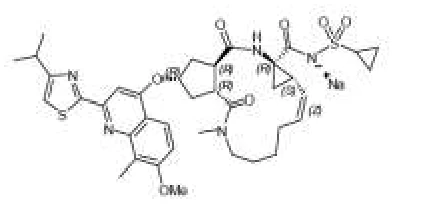
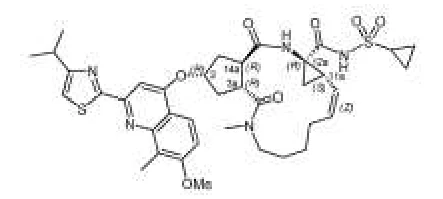
simeprevir simeprevir sodium
Note: Simeprevir is converted to simeprevir sodium during the manufacture of the drug product.
Physicochemical properties:
Appearance: Simeprevir drug substance is a crystalline white to almost white powder.
Solubility: Simeprevir is practically insoluble in water over a wide pH range (pH 1 to 13).
Dissociation Constant: The drug substance is amphiprotic with a basic thiazole moiety (pKa = 2.85) and acidic sulfonyl carboxamide group (pKa = 5.24)
CLINICAL TRIALS
Overview
The efficacy of GALEXOS® in combination with peginterferon-alfa (PegIFN-alfa) and ribavirin (RBV) as treatment for chronic hepatitis C in patients with HCV genotype 1 infection was evaluated in three Phase 3 studies in treatment-naïve patients (studies C208, C216 and HPC3005), one Phase 3 study in patients who relapsed after prior interferon-based therapy (study
HPC3007), one Phase 2 study in patients who failed prior therapy with PegIFN-alfa and RBV (including prior relapsers, partial and null responders) (Study C206), and one Phase 3 study in patients with HCV genotype 1 and HIV-1 co-infection who were HCV treatment-naïve or failed previous HCV therapy with peginterferon and ribavirin (Study C212). The efficacy of GALEXOS® in combination with PegIFN-alfa and RBV in patients with HCV genotype 4 infection was evaluated in one Phase 3 study in treatment-naïve patients or patients who failed previous therapy with PegIFN-alfa and RBV (Study HPC3011) (Table 10). Patients in these studies had compensated liver disease (including cirrhosis), HCV RNA of at least 10000 IU/mL, and liver histopathology consistent with CHC infection.
In treatment-naïve and prior relapser patients, the overall duration of treatment with PegIFN-alfa and RBV in the Phase 3 studies was response-guided. In these patients, the planned total duration of HCV treatment was 24 weeks if the following on-treatment protocol-defined response-guided therapy (RGT) criteria were met: HCV RNA <25 IU/mL detectable or undetectable at Week 4 AND undetectable HCV RNA at Week 12. Treatment stopping rules for HCV therapy were used to ensure that patients with inadequate on-treatment virologic response discontinued treatment in a timely manner. In the Phase 3 study C212 in HCV/HIV-1 co-infected patients, the total duration of treatment with PegIFN-alfa and RBV in treatment-naïve and prior relapser patients with cirrhosis was not response-guided; these patients received a fixed total duration of HCV treatment of 48 weeks. The total duration of treatment with PegIFN-alfa and RBV in non-cirrhotic HCV/HIV-1 co-infected treatment-naïve or prior relapser patients was response-guided using the same criteria.
The efficacy of GALEXOS® as part of an interferon-free regimen in patients with HCV genotype 4 infection and compensated liver disease was evaluated in two studies (Studies HPC2014 [Phase 2 study] and HPC3021 [Phase 3 study]) in patients with or without cirrhosis who were treatment-naïve or treatment-experienced (following prior treatment with interferon [pegylated or non-pegylated], with or without RBV).
The efficacy of GALEXOS® as part of an interferon-free regimen in patients with HCV genotype 1 infection and compensated liver disease was evaluated in one Phase 2 study in prior null responders with METAVIR fibrosis score F0-F4 or treatment-naïve patients with METAVIR fibrosis score F3-F4 (COSMOS Study) and two Phase 3 studies in patients with or without cirrhosis (Study HPC3018 and Study HPC3017, respectively) who were HCV treatment-naïve or treatment-experienced (following prior treatment with interferon [pegylated or non-pegylated], with or without RBV) (see Table 10).
SVR (sustained virologic response) was defined as HCV RNA <lower limit of quantification (LLOQ) detectable or undetectable 12 weeks (SVR12) or 24 weeks (SVR24) after the planned end of treatment (Studies C206, C208, C212, C216, HPC2002, HPC3007 and HPC3011) or after the actual end of treatment (Studies HPC2014 and HPC3021). Plasma HCV RNA levels were measured using the Roche COBAS® TaqMan® HCV test (version 2.0) for use with the High Pure System (LLOQ of 25 IU/mL and limit of detection of 15 IU/mL) (Studies C206, C208, C212, C216, HPC2002, HPC3007 and HPC3011) or the Roche COBAS® AmpliPrep/COBAS® TaqMan® HCV Quantitative test (version 2.0; LLOQ and limit of detection of 15 IU/mL) (Studies HPC2014 and HPC3021).
| Table 10: Summary of Study Design for Trials | ||||||||||||||
Study ID | Study Phase Type of Control Blind Population | Drug Regimens | Assigned Regimen | No. of Patients (Dosed/ Completed Treatment) | Total Treatment Duration | |||||||||
| Treatment with GALEXOS® in combination with PegIFN-alfa and RBV – Genotypes 1 and 4: | ||||||||||||||
| Treatment-naïve genotype 1 patients | ||||||||||||||
C208 (QUEST-1) | Phase 3 Randomized Double-Blind Placebo-controlled HCV genotype 1 treatment-naïve | Simeprevir (150 mg q.d.) PegIFN-alfa-2a (180 μg/wk) and RBV (1000 or 1200 mg/day depending on body weight) | GALEXOS® + PR GALEXOS® with PR for 12 weeks followed by PR for 12 or 36 weeks | 264/223 | 24 or 48 weeks RGTc | |||||||||
Placebo + PR Pbo with PR for 12 weeks followed by PR for 36 weeks | 130/38 | 48 weeks | ||||||||||||
C216 (QUEST-2) | Phase 3 Randomized Double-Blind Placebo-controlled HCV genotype 1 treatment-naïve | Simeprevir (150 mg q.d.) PegIFN-alfa-2a or 2ba (180 μg/wk) and RBV (1000 or 1200 mg/day depending on body weight) | GALEXOS® + PR GALEXOS® with PR for 12 weeks followed by PR for 12 or 36 weeks | 257/235 | 24 or 48 weeks RGTc | |||||||||
Placebo + PR Pbo with PR for 12 weeks followed by PR for 36 weeks | 134/47 | 48 weeks | ||||||||||||
| HPC3005 (TIGER) | Phase 3 Randomized Double-Blind Placebo controlled HCV genotype 1 treatment-naive Asian patients | Simeprevir (100 mg or 150 mg q.d.) PegIFN-alfa-2a (180 μg/wk) and RBV (1000 or 1200 mg/day depending on body weight) | GALEXOS® + PR GALEXOS™ with PR for 12 weeks followed by PR for 12 or 36 weeks | 305/135 | 24 or 48 weeks RGTc | |||||||||
Placebo + PR Pbo with PR for 12 weeks followed by PR for 36 week | 152/69 | 48 weeks | ||||||||||||
| Treatment-experienced genotype 1 patients | ||||||||||||||
C206 (ASPIRE) | Phase 2 Randomized Double-Blind Placebo-controlled HCV genotype 1 treatment-experienced (prior relapse, partial response, null response) | Simeprevir (100 or 150 mg q.d.) PegIFN-alfa-2a (180 μg/wk) and RBV (1000 or 1200 mg/day depending on body weight) | GALEXOS® 12 Weeks + PRb GALEXOS® with PR for 12 weeks followed by PR for 36 weeks | 66/61 | 48 weeks | |||||||||
Placebo + PR Pbo with PR for 48 weeks | 66/59 | 48 weeks | ||||||||||||
HPC3007 (PROMISE) | Phase 3 Randomized Double-Blind Placebo-controlled | Simeprevir (150 mg q.d.) PegIFN-alfa-2a (180 μg/wk) and | GALEXOS® + PR GALEXOS® with PR for 12 weeks followed by PR for 12 or 36 weeks | 260/242 | 24 or 48 weeks RGTc | |||||||||
| treatment-experienced (prior relapse) | RBV (1000 or 1200 mg/day depending on body weight) | Placebo + PR Pbo with PR for 12 weeks followed by PR for 36 weeks | 133/34 | 48 weeks | |
| HCV/HIV-co-infected patients (Treatment-naive and treatment-experienced) genotype 1 patients | |||||
| C212 | Phase 3 Open-label Single-arm Treatment-naïve and treatment-experienced (prior relapse, partial response, null response) | Simeprevir (150 mg q.d.) PegIFN-alfa-2a (180 μg/wk) and RBV (1000 or 1200 mg/day depending on body weight) | Non-cirrhotic treatment-naïve and relapser patients GALEXOS® + PR GALEXOS® with PR for 12 weeks followed by PR for 12 or 36 weeks | 61/52 | 24 or 48 weeks RGTc |
Non-responder and cirrhotic patients GALEXOS® + PR GALEXOS® with PR for 12 weeks followed by PR 36 weeks | 45/30 | 48 weeks | |||
| Treatment-naive and Treatment-experienced genotype 4 patients | |||||
HPC3011 (RESTORE) | Phase 3 | Simeprevir (150 mg q.d.) PegIFN-alfa-2a (180 μg/wk) and RBV (1000 or 1200 mg/day depending on body weight) | Treatment-naïve or prior relapse patients GALEXOS® + PR GALEXOS® with PR for 12 weeks followed by PR for 12 or 36 weeks | 57/51 | 24 or 48 weeks RGTc |
Prior non-responders GALEXOS® + PR GALEXOS® with PR for 12 weeks followed by PR for 36 weeks | 50/30 | 48 weeks | |||
| Treatment with an Interferon-Free Regimen – Genotype 1 and 4: | |||||
HPC2002 (COSMOS) | Phase 2 Randomized Open-label Cohort 1: prior null response with METAVIR score F0-F2 Cohort 2: treatment-naïve and prior null response with METAVIR score F3-F4 | Simeprevir (150 mg q.d.) and Sofosbuvir (400 mg q.d) with or without RBV (1000 or 1200 mg/day depending on body weight) | GALEXOS® + Sofosbuvird for 12 weeks | 28/28 | 12 weeks |
| GALEXOS® + Sofosbuvird + RBV for 12 weeks | 54/54 | 12 weeks |
| HPC3017 (OPTIMIST -1) | Phase 3 Randomized Open-label Treatment-naïve and treatment-experienced (prior relapse, partial response, null response) without cirrhosis | Simeprevir (150 mg q.d.) and Sofosbuvir (400 mg q.d) without RBV | GALEXOS® + Sofosbuvir for 8 or 12 weeks | 310/308 | 8 or 12 weeks | |||
HPC3018 (OPTIMIST -2) | Phase 3 Open-label Treatment-naïve and treatment-experienced (prior relapse, partial response, null response) with cirrhosis | Simeprevir (150 mg q.d.) and Sofosbuvir (400 mg q.d) without RBV | GALEXOS® + Sofosbuvir for 12 weeks | 103/99 | 12 weeks | |||
HPC2014 (OSIRIS) | Phase 2 Partly Randomized, Open-label Treatment-naïve and -experienced With or without cirrhosis | Simeprevir (150 mg q.d.) and Sofosbuvir (400 mg q.d) | Without cirrhosis GALEXOS® + Sofosbuvire for 8 or 12 weeks | 40/40 | 8 or 12 weeks | |||
With cirrhosis GALEXOS® + Sofosbuvire for 12 weeks | 23/23 | 12 weeks | ||||||
HPC3021 (PLUTO) | Phase 3 Multicentre Open-Label Treatment-naïve and -experienced With or without cirrhosis | Simeprevir (150 mg q.d.) and Sofosbuvir (400 mg q.d) | GALEXOS® + Sofosbuvire for 12 weeks | 40/40 | 12 weeks | |||
a In the simeprevir group, 177/257 and 80/257 patients received PegIFN-alfa-2a and 2b, respectively. In the Pbo group, 43/134 and 91/134 patients received PegIFN-alfa-2a and 2b, respectively. b Patients were also randomized to treatment with 24-week and 48-week treatment of GALEXOS® with PegIFN-alfa and RBV. Data presented for Pooled GALEXOS® + PR corresponds to 150 mg GALEXOS® for 12, 24, or 48 weeks with PegIFN-alfa-2a and RBV followed by PegIFN-alfa-2a and RBV alone up to a total treatment duration of 48 weeks. c The planned total duration of treatment was 24 weeks if the following on-treatment protocol-defined response-guided therapy (RGT) criteria were met: HCV RNA <25 IU/mL detectable or undetectable at Week 4 AND undetectable HCV RNA at Week 12. d Patients were also randomized to treatment with GALEXOS® + Sofosbuvir ± RBV for 24 weeks. | ||||||||
Treatment with GALEXOS® in combination with PegIFN-alfa and RBV
Treatment-Naïve Adult Patients
Pooled Studies C208 and C216 (QUEST-1 and QUEST-2 studies)
Baseline Characteristics and Trial Design
The efficacy of GALEXOS® in treatment-naïve patients with HCV genotype 1 infection was demonstrated in two randomized, double-blind, placebo-controlled, 2-arm, multicenter, Phase 3 studies (study C208 and study C216). The design of both studies was similar. In study C208, all patients received PegIFN-alfa-2a; in study C216, 69% of the patients received PegIFN-alfa-2a and 31% received PegIFN-alfa-2b.
The demographic and baseline characteristics of patients in pooled studies C208 and C216 are shown in Table 11.
| Table 11: Demographic and Baseline Characteristics of Treatment-Naïve Patients: Studies C208 and C216 (Pooled) | ||||||||
| Variable | GALEXOS® + PR N=521 | Placebo + PR N=264 | ||||||
| Age, median (range) | 47 years (18 to 73 years) | 47 years (18 to 73 years) | ||||||
| >65 years | 2% | 2% | ||||||
| Gender | ||||||||
| Male | 55% | 57% | ||||||
| Ethnicity | ||||||||
| White | 89% | 93% | ||||||
| 8% | 5% | |||||||
| Asian | 1% | 2% | ||||||
| Hispanic | 18% | 15% | ||||||
| BMI, kg/m2 | ||||||||
| ≥30 | 22% | 27% | ||||||
| Baseline HCV RNA | ||||||||
| mean log10 IU/mL (range) | 6.41 (4.0, 7.6) | 6.33 (1.4, 7.5) | ||||||
| >800000 IU/mL | 80% | 74% | ||||||
| METAVIR fibrosis score | ||||||||
| F0-F2 | 74% | 73% | ||||||
| F3 | 16% | 15% | ||||||
| F4 (cirrhosis) | 9% | 12% | ||||||
| HCV genotype | ||||||||
| 1a | 48% | 48% | ||||||
| 1b | 51% | 50% | ||||||
| IL28B genotype | ||||||||
| CC | 29% | 30% | ||||||
| CT | 56% | 56% | ||||||
| TT | 15% | 14% | ||||||
Study results
In both studies of treatment-naïve adult patients and the pooled analysis, SVR12 rates were consistently and statistically significantly superior in patients treated with GALEXOS® 150 mg in combination with PegIFN-alfa and RBV compared to placebo in combination with PegIFN-alfa and RBV. The observed difference between the 2 treatment groups was 30.5%. In the pooled analysis, SVR12 was achieved in 80.4% of patients in the GALEXOS® in combination with PegIFN-alfa and RBV group compared with 49.9% of patients in the placebo in combination with PegIFN-alfa and RBV group (Table 12).
| Table 12: Treatment Outcome in Treatment-Naïve Adult Patients with HCV Genotype 1 Infection (Pooled Data Studies C208 and C216; Week 60 Analysis; Intent-to-Treat Analysis Set) | ||||||||
| Treatment Outcome | GALEXOS® + PRa N=521 | Placebo + PRa N=264 | ||||||
Overall SVR12b ∆SVR p-value 95% CI for ∆SVR | 80.4% 30.5% p <0.001 (24.1,36.9) | 49.9% | ||||||
| Outcome for patients without SVR12 | ||||||||
| Total Failures | 20% | 50% | ||||||
| On-treatment failurec | 8% | 33% | ||||||
| Met stopping rulesd | 4% | 28% | ||||||
| Othere | 4% | 5% | ||||||
| Post-treatment failures | 12% | 17% | ||||||
| Viral relapsef | 11% | 23% | ||||||
| Missing SVR12g | 3% | 2% | ||||||
| Viral breakthroughh | 5% | 9% | ||||||
a Refer to Table 10 for description of treatment arms. b SVR12: sustained virologic response 12 weeks after planned end of treatment (EOT). SVR12 rate was adjusted for stratification factors, with corresponding 95% CI based on the normal approximation. Stratification factors were HCV geno/subtype, IL28B genotype and study ID. P-value based on Cochran-Mantel-Haenszel test controlling for stratification factors c On-treatment failure was defined as the proportion of patients with confirmed detectable HCV RNA at EOT (including but not limited to patients who met the protocol-specified treatment stopping rules and/or experienced viral breakthrough). d Stopping rules for both studies requiring all treatments to be stopped were <2 log10 IU/mL reduction in HCV RNA from baseline at Week 12, or HCV RNA confirmed detectable and ≥25 IU/mL at Week 24 or 36. e Other: included patients who experienced on-treatment failure (i.e. detectable HCV RNA at EOT) for reasons other than meeting virologic stopping rules. f Viral relapse (i.e., undetectable HCV RNA at EOT followed by detectable HCV RNA during follow-up) rates are calculated with a denominator of patients with undetectable HCV RNA at actual EOT. Includes 4 GALEXOS®-treated patients who experienced relapse after SVR12. g Patients with undetectable HCV RNA at EOT and with missing data at the SVR assessment time point. h Viral breakthrough was defined as an on-treatment confirmed increase in HCV RNA of >1log10 IU/mL from nadir or confirmed HCV RNA >100 IU/mL in subjects with HCV RNA prior <25 IU/mL. Viral breakthrough was not a stopping rule in the studies. Subjects with viral breakthrough might or might not have met a virologic stopping rule | ||||||||
Eighty-eight percent (n=459/521) of the GALEXOS®-treated patients were eligible for a total treatment duration of 24 weeks by meeting the protocol- defined RGT criteria (HCV RNA <25 IU/mL detectable or undetectable at Week 4 and undetectable HCV RNA at Week 12) In these patients the SVR12 rate was 88%.
Seventy-nine percent (n=404/509) of GALEXOS®-treated patients had undetectable HCV RNA at Week 4 (RVR); in these patients the SVR12 rate was 90%. The proportion of GALEXOS®-treated patients with HCV RNA <25 IU/mL detectable at Week 4 was 14% (n=70/509); 67% achieved SVR12. Seven percent (n=35/509) of GALEXOS®-treated patients had HCV RNA ≥25 IU/mL at Week 4; in these patients the SVR12 rate was 20%.
Sustained Virologic Response Based on Baseline Factors
SVR12 rates were statistically significantly higher for the GALEXOS® treatment group compared to the placebo treatment group by sex, age, race, BMI, HCV genotype subtype, baseline HCV RNA (≤ 800000 IU/mL, > 800000 IU/mL), METAVIR fibrosis score, and IL28B genotype. Table 13 shows the SVR rates by METAVIR fibrosis score, baseline HCV RNA and genotype.
| Table 13: SVR12 Rates by Selected Baseline Characteristics in Treatment-Naïve Adult Patients with HCV Genotype 1 Infection (Pooled Data Studies C208 and C216; Week 60 Analysis; Intent-To-Treat Analysis Set) | |||||
| Subgroup | GALEXOS® + PR N=521 | Placebo + PR N=264 | |||
| HCV RNA | |||||
| ≤ 800000 IU/mL | 92% | 77% | |||
| > 800000 IU/mL | 78% | 40% | |||
| METAVIR fibrosis score | |||||
| F0-2 | 84% | 55% | |||
| F3-4 | 68% | 36% | |||
| F4 | 60% | 34% | |||
| HCV genotype | |||||
| 1a | 75% | 47% | |||
| 1b | 85% | 53% | |||
For treatment response based on IL28B genotype and baseline polymorphism see MICROBIOLOGY, Pharmacogenomics and Effect of Baseline HCV Polymorphisms on Treatment Response.
SVR12 rates were statistically significantly higher for patients receiving GALEXOS® with PegIFN-alfa-2a or PegIFN-alfa-2b and RBV (88% and 78%, respectively) compared to patients receiving placebo with PegIFN-alfa-2a or PegIFN-alfa-2b and RBV (62% and 42%, respectively) (Study C216).
Treatment-Experienced Adult Patients
Prior Relapsers to PegIFN-alfa and RBV (PROMISE study)
Baseline Characteristics and Trial Design
Study HPC3007 (PROMISE) was a randomized, double-blind, placebo-controlled, 2-arm, multicenter, Phase 3 study in patients with HCV genotype 1 infection who relapsed after prior IFN-based therapy.
The demographic and baseline characteristics of patients in Study HPC3007 are shown in Table 14.
| Table 14: Demographic and Baseline Characteristics of Prior Relapsers to PegIFN-alfa and RBV: Study HPC3007 | |||||||
| Variable | GALEXOS® + PR N=260 | Placebo + PR N=133 | |||||
| Age, median (range) | 52 years (20 to 71 years) | 52 years (20 to 71 years) | |||||
| >65 years | 4% | 2% | |||||
| Gender | |||||||
| Male | 69% | 59% | |||||
| Ethnicity | |||||||
| White | 94% | 96% | |||||
| 3% | 3% | ||||||
| Asian | 3% | 1% |
| Hispanic | 8% | 5% |
| BMI, kg/m2 | ||
| ≥30 | 25% | 27% |
| Baseline HCV RNA | ||
| mean log10 IU/mL (range) | 6.42 (4.6, 7.7) | 6.47 (3.1, 7.5) |
| >800000 IU/mL | 84% | 83% |
| METAVIR fibrosis score | ||
| F0-F2 | 67% | 74% |
| F3 | 18% | 11% |
| F4 (cirrhosis) | 16% | 14% |
| HCV genotype | ||
| 1a | 42% | 41% |
| 1b | 57% | 59% |
| IL28B genotype | ||
| CC | 24% | 26% |
| CT | 64% | 62% |
| TT | 12% | 12% |
| Prior IFN-based therapy | ||
| PegIFN-alfa-2a /RBV | 68% | 66% |
| PegIFN-alfa-2b/RBV | 27% | 27% |
Study Results
In treatment-experienced adult patients who relapsed after prior interferon-based therapy, SVR12 rates were statistically significantly superior in patients treated with GALEXOS® 150 mg in combination with PegIFN-alfa and RBV compared to placebo in combination with PegIFN-alfa and RBV (79.6% and 36.6% respectively) (see Table 15).
| Table 15: Treatment Outcome in Adult Patients with HCV Genotype 1 Infection Who Relapsed After Prior IFN-Based Therapy (Study HPC3007; Week 60 Analysis; Intent-to-Treat Analysis Set) | |||||||||
| Treatment Outcome | GALEXOS® + PRa N=260 | Placebo + PRa N=133 | |||||||
Overall SVR12b ∆SVR p-value 95% CI for ∆SVR | 79.6% 43.0% p<0.001 (33.8, 52.3) | 36.6% | |||||||
| Outcome for patients without SVR12 | |||||||||
| Total Failures | 23% | 65% | |||||||
| On-treatment failure | 3% | 27% | |||||||
| Met stopping rulesc | 2% | 11% | |||||||
| Other | 1% | 17% | |||||||
| Post-treatment failures | 20% | 38% | |||||||
| Viral relapsed | 19% | 48% | |||||||
| Missing SVR12 | 2% | 4% | |||||||
| Viral breakthroughe | 2% | 0 | |||||||
a Refer to Table 10 for treatment durations. b SVR12: Sustained virologic response 12 weeks after planned end of treatment (EOT). SVR12 rate was adjusted for stratification factors, with corresponding 95% CI based on the normal approximation. Stratification factors were HCV geno/subtype, and IL28 genotype. P-value based on Cochran-Mantel-Haenszel test controlling for stratification factors. c Stopping rules requiring all treatments to be stopped were <2 log10 IU/mL reduction in HCV RNA from baseline at Week 12, or HCV RNA Confirmed detectable and ≥25 IU/mL at Week 24 or 36. d Viral relapse (i.e., undetectable HCV RNA at EOT followed by detectable HCV RNA during follow up) rates are calculated with a denominator of patients with undetectable HCV RNA at actual EOT and with at least one follow-up HCV RNA assessment. Includes 5 GALEXOS®-treated patients who experienced relapse after SVR12. e For additional definitions see footnotes to Table 12. | |||||||||
Ninety-three percent (n=241/260) of the GALEXOS®-treated patients were eligible for a total treatment duration of 24 weeks by meeting the protocol- defined RGT criteria (HCV RNA <25 IU/mL detectable or undetectable at Week 4 and undetectable HCV RNA at Week 12); in these patients the SVR12 rate was 83%.
Seventy-seven percent (n=200/259) of GALEXOS®-treated patients had undetectable HCV RNA at Week 4 (RVR); in these patients the SVR12 rate was 87%. The proportion of GALEXOS®-treated patients with HCV RNA <25 IU/mL detectable at Week 4 was 18% (n=47/259); 60% achieved SVR12. Five percent (n=12/259) of GALEXOS®-treated patients had HCV RNA ≥25 IU/mL at Week 4; in these patients the SVR12 rate was 42%.
Sustained Virologic Response Based on Baseline Factors
SVR12 rates were statistically significantly higher for the GALEXOS® treatment group compared to the placebo treatment group by sex, age, race, BMI, HCV genotype subtype, baseline HCV RNA (≤ 800000 IU/mL, > 800000 IU/mL), prior HCV therapy, METAVIR fibrosis score, and IL28B genotype. Table 16 shows the SVR rates by METAVIR fibrosis score, baseline HCV RNA and genotype.
| Table 16: SVR12 Rates by Selected Baseline Characteristics in Adult Patients with HCV Genotype 1 Infection Who Relapsed After Prior Interferon-Based Therapy (Study HPC3007;Week 60 Analysis; Intent-To-Treat Analysis Set) | |||||
| Subgroup | GALEXOS® + PR N=260 | Placebo + PR N=133 | |||
| HCV RNA | |||||
| ≤ 800000 IU/mL | 83% | 57% | |||
| > 800000 IU/mL | 79% | 33% | |||
| METAVIR fibrosis score | |||||
| F0-2 | 82% | 41% | |||
| F3-4 | 73% | 24% | |||
| F4 | 74% | 26% | |||
| HCV genotype | |||||
| 1a | 70% | 28% | |||
| 1b | 86% | 43% | |||
For treatment response based on IL28B genotype and baseline polymorphism see MICROBIOLOGY, Pharmacogenomics and Effect of Baseline HCV Polymorphisms on Treatment Response.
Prior Non-Responders (Including Partial Responders and Null Responders), ASPIRE Study
Baseline Characteristics and Trial Design
Study C206 (ASPIRE) was a randomized, double-blind, placebo-controlled, 7-arm, Phase 2b study in patients with HCV genotype 1 infection, who failed prior therapy with PegIFN-alfa and RBV (including prior relapsers, partial responders or null responders).
The demographic and baseline characteristics of patients in Study C206 are shown in Table 17.
| Table 17: Pooled Demographic and Baseline Characteristics of Treatment-Experienced Patients (Relapsers, Partial and Null-Responders): Study C206 | ||||||||
| Variable | Pooled 150 mg GALEXOS® + PR N=199 | Placebo + PR N=66 | ||||||
| Age, median (range) | 50 years (20 to 69 years) | 51 (22 to 66 years) | ||||||
| >65 years | 3% | 2% | ||||||
| Gender | ||||||||
| Male | 68% | 64% | ||||||
| Ethnicity | ||||||||
| White | 93% | 94% | ||||||
| 5% | 2% | |||||||
| Asian | 1% | 3% | ||||||
| BMI, kg/m2 | ||||||||
| ≥30 | 27% | 30% | ||||||
| Baseline HCV RNA | ||||||||
| mean log10 IU/mL (range) | 6.52 (3.5, 7.7) | 6.54 (5.2, 7.6) | ||||||
| >800000 IU/mL | 85% | 83% | ||||||
| METAVIR fibrosis score | ||||||||
| F0-F2 | 66% | 64% | ||||||
| F3 | 15% | 20% | ||||||
| F4 (cirrhosis) | 20% | 16% | ||||||
| HCV genotype | ||||||||
| 1a | 42% | 41% |
| 1b | 57% | 59% |
| IL28B genotype | ||
| CC | 17% | 22% |
| CT | 63% | 64% |
| TT | 20% | 14% |
| Classification of Patients by Prior Response to PegIFN-alfa and RBV | ||
| Relapser | 40% | 41% |
| Partial responder | 35% | 35% |
| Null responder | 25% | 24% |
Study Results
Based on a limited number of patients, the SVR24 rate in the pooled GALEXOS® 150 mg dose in combination with PegIFN-alfa and RBV group was 53% in prior null responders, and 75% in prior partial responders, versus 15% and 6%, in the respective placebo in combination with PegIFN-alfa and RBV groups (Table 18 and
| Table 19: Treatment Outcome in Adult Patients with HCV Genotype 1 Infection Who Failed Prior PegIFN-Alfa and RBV Therapy (Study C206; Prior Null Responders; Intent-To-Treat Analysis Set) |
).
| Table 18: Treatment Outcome in Adult Patients with HCV Genotype 1 Infection Who Failed Prior PegIFN-Alfa and RBV Therapy (Study C206; Prior Partial Responders; Intent-To-Treat Analysis Set) | |||||||||||||||
| Treatment Outcome | 150 mg GALEXOS® 12 Weeks + PRa N=23 | Pooled 150 mg GALEXOS® + PRa N=69 | Placebo + PRa N=23 | ||||||||||||
Overall SVR24b ∆SVRc | 62% 56% | 75% 69% | 6% | ||||||||||||
| Outcome for patients without SVR24 | |||||||||||||||
| Total Failures | 26% (6/23) | 19% (13/69) | 87% (20/23) | ||||||||||||
| On-treatment failure | 22% (5/23) | 16% (11/69) | 78% (18/23) | ||||||||||||
| Met stopping rulesd | 0 (0/23) | 4% (3/69) | 70% (16/23) | ||||||||||||
| Viral breakthroughe | 17% (4/23) | 10% (7/69) | 4% (1/23) | ||||||||||||
| Otherf | 4% (1/23) | 1% (1/69) | 5% (1/23) | ||||||||||||
| Post-treatment failures | 4% (1/23) | 3% (2/69) | 9% (2/23) | ||||||||||||
| Viral relapseg | 6% (1/17) | 5% (3/56) | 50% (2/4) | ||||||||||||
| Missing SVR12 | 9% (2/23) | 3% (2/69) | 0 (0/23) | ||||||||||||
| Table 19: Treatment Outcome in Adult Patients with HCV Genotype 1 Infection Who Failed Prior PegIFN-Alfa and RBV Therapy (Study C206; Prior Null Responders; Intent-To-Treat Analysis Set) | |||||||||||||
| Treatment Outcome | 150 mg GALEXOS® 12 Weeks + PRa N=17 | Pooled 150 mg GALEXOS® + PRa N=51 | Placebo + PRc N=16 | ||||||||||
Overall SVR24b ∆SVRc | 58% 43% | 53% 38% | 15% | ||||||||||
| Outcome for patients without SVR24 | |||||||||||||
| Total Failures | 47 % (8/17) | 49% (25/51) | 81% (13/16) | ||||||||||
| On-treatment failure | 35% (6/17) | 29% (15/51) | 75% (12/16) | ||||||||||
| Met stopping rulesd | 18% (3/17) | 8% (4/51) | 75% (12/16) | ||||||||||
| Viral breakthroughe | 12% (2/17) | 20% (10/51) | 0 (0/16) | ||||||||||
| Otherf | 6% (1/17) | 2% (1/51) | 0 (0/16) |
| Post-treatment failures | 12% (2/17) | 20% (10/51) | 6% (1/16) |
| Viral relapseg | 18% (2/11) | 28% (10/36) | 25% (1/4) |
| Missing SVR12 | 0 (0/17) | 0 (0/51) | 0 (0/16) |
a Refer to Table 10 for treatment durations. b SVR24: Sustained virologic response defined as undetectable HCV RNA 24 weeks after planned end of treatment (EOT). SVR24 rate was adjusted for stratification factors (HCV geno/subtype and previous response). c Based on logistic regression model with covariates treatment and stratification factors. d Stopping rules requiring all treatments to be stopped included <1log10 IU/mL reduction in HCV RNA from baseline at Week 4, <2log10 IU/mL reduction in HCV RNA from baseline at Week 12, HCV RNA confirmed detectable and ≥25 IU/mL at Week 24 or 36. e Viral breakthrough was defined as an on-treatment confirmed increase in HCV RNA of >1log10 IU/mL from nadir or confirmed HCV RNA >100 IU/mL in subjects with HCV RNA prior <25 IU/mL. Viral breakthrough was also a stopping rule in the study. f Other: Included patients who experienced on-treatment failure (i.e., detectable HCV RNA at EOT) for reasons other than meeting virologic stopping rules or with viral breakthrough. g For additional definitions see footnotes to Table 12. | |||
Sustained Virologic Response Based on Baseline Factors
Based on a limited number of patients, SVR24 rates were higher in the GALEXOS®-treated patients compared to patients receiving placebo in combination with PegIFN-alfa and RBV, regardless of HCV geno/subtype, METAVIR fibrosis score, and IL28B genotype (see Table 20).
| Table 20: SVR24 Rates by Selected Baseline Characteristics in Adult Patients with HCV Genotype 1 Infection Who Failed Prior PegIFN-Alfa and RBV Therapy (Study C206; Prior Partial and Null Responders; Intent-To-Treat Analysis Set) | ||||||||||||||||
| Subgroup | Prior Partial Responders | Prior Null Reponders | ||||||||||||||
Pooled 150 mg GALEXOS® + PR % (n/N) | Placebo + PR % (n/N) | Pooled 150 mg GALEXOS® + PR % (n/N) | Placebo + PR % (n/N) | |||||||||||||
| HCV RNA | ||||||||||||||||
| ≤ 800000 IU/mL | 80% (8/10) | 33% (1/3) | 33% (1/3) | 75% (3/4) | ||||||||||||
| > 800000 IU/mL | 75% (44/59) | 5% (1/20) | 52% (25/48) | 0 | ||||||||||||
| METAVIR Fibrosis Score | ||||||||||||||||
| F0-2 | 79% (38/48) | 8% (1/12) | 66% (19/29) | 23% (3/13) | ||||||||||||
| F3-4 | 67% (14/21) | 10% (1/10) | 33% (7/21) | 0% (0/3) | ||||||||||||
| F4 | 82% (9/11) | 0% (0/2) | 31% (4/13) | 0% (0/2) | ||||||||||||
| HCV genotype | ||||||||||||||||
| 1a | 56% (14/25) | 13% (1/8) | 42% (11/26) | 0 (0/7) | ||||||||||||
| 1b | 88% (38/43) | 7% (1/15) | 58% (14/24) | 33% (3/9) | ||||||||||||
Long-Term Efficacy in Adult Patients
Interim data from an ongoing 3-year follow-up study (study HPC3002) in treatment-naïve and treatment-experienced patients who achieved SVR with a GALEXOS®-based regimen in previous Phase 2b studies showed that all patients (N=166) maintained undetectable HCV RNA during a median follow-up time of 16 months.
Patient Reported Outcomes
Based on studies in treatment-naïve and treatment-experienced patients, addition of GALEXOS® to PegIFN-alfa and RBV did not increase severity of patient-reported fatigue, depressive symptoms or impairments in work and daily activities or health-related quality of life beyond what was observed in patients treated with placebo, PegIFN-alfa and RBV. Additionally,
GALEXOS®-treated patients had significantly reduced time (weeks) with fatigue, depressive symptoms and impairments in work and daily activity as compared to PegIFN-alfa and RBV alone.
HCV genotype 1 infection and HIV-1 co-infection, C212
Baseline Characteristics and Trial Design
Study C212 was an open-label, single-arm Phase 3 study in HIV-1 patients co-infected with HCV genotype 1 who were treatment-naïve or failed prior HCV therapy with PegIFN-alfa and RBV (including prior relapsers, partial responders or null responders).
The demographic and baseline characteristics of patients in Study C212 are shown in Table 21.
| Table 21: Demographic and Baseline Characteristics of Patients with HCV Genotype 1 Infection and HIV-1 Co-Infection): Study C212; Final Analysis | ||||||
| Variable | GALEXOS® + PR N=106 | |||||
| Age, median (range) | 48 years (27 to 67 years) | |||||
| >65 years | 2% | |||||
| Gender | ||||||
| Male | 85% | |||||
| Ethnicity | ||||||
| White | 82% | |||||
| 14% | ||||||
| Asian | 1% | |||||
| Hispanic | 6% | |||||
| BMI, kg/m2 | ||||||
| ≥30 | 12% | |||||
| Baseline HCV RNA | ||||||
| mean log10 IU/mL (range) | 6.45 (4.9, 7.5) | |||||
| >800000 IU/mL | 86% | |||||
| METAVIR fibrosis score | ||||||
| F0-F2 | 67% | |||||
| F3 | 19% | |||||
| F4 (cirrhosis) | 13% | |||||
| HCV genotype | ||||||
| 1a | 82% | |||||
| 1b | 17% | |||||
| IL28B genotype | ||||||
| CC | 27% | |||||
| CT | 56% | |||||
| TT | 17% | |||||
| Patients on HAARTa | 88% | |||||
| Mean Baseline HIV-1 RNA log10 IU/mL | 1.37 | |||||
| Median baseline CD4+ Cell Count (cells/mm3) | 561.00 | |||||
| Patient not on HAART | 12% | |||||
| Mean Baseline HIV-1 RNA log10 IU/mL (range) | 3.41 | |||||
| Median baseline CD4+ Cell Count (cells/mm3) | 677.00 | |||||
| Classification of Patients by Prior Response to PegIFN-alfa and RBV | ||||||
| Naïve | 50% | |||||
| Relapser | 14% | |||||
| Partial responder | 9% | |||||
| Null responder | 26% | |||||
a HAART: Highly active anti-retroviral therapy, with nucleoside reverse transcriptase inhibitors (92 patients) and the integrase inhibitor raltegravir (81 patients) being the most commonly used HIV antiretrovirals.
Study Results
Table 22 shows the response rates in treatment-naïve, prior relapsers, prior partial responders and null responders.
| Table 22: Treatment Outcome in Adult Patients with HCV Genotype 1 Infection and HIV-1 Co-Infection (Study C212; Final Analysis; Intent-To-Treat Analysis Set) | ||||||||||||
| Treatment Outcome1 | Treatment-Naïve Patientsa N=53 % (n/N) | Prior Relapsers N=15a % (n/N) | Prior Partial Respondersa N=10 % (n/N) | Prior Null Respondersa N=28 % (n/N) | ||||||||
| SVR12 | 79% (42/53)b | 87% (13/15) | 70% (7/10) | 57% (16/28)b | ||||||||
| Outcome for patients without SVR12 | ||||||||||||
| On-treatment failurec | 9% (5/53) | 0% (0/15) | 20% (2/10) | 39% (11/28) | ||||||||
| Viral relapsed | 10% (5/48) | 13% (2/15) | 0% (0/7) | 12% (2/17) | ||||||||
| Missing SVR12 | 2% (1/53) | 0% (0/15) | 10% (1/10) | 0% (0/28) | ||||||||
SVR12: sustained virologic response 12 weeks after planned EOT. a Refer to Table 10 for description of treatment arms. b p < 0.001 compared to historical control of PegIFN-alfa and RBV. c On-treatment failure was defined as the proportion of patients with confirmed detectable HCV RNA at EOT (including but not limited to patients who met the protocol-specified treatment stopping rules and/or experienced viral breakthrough). d Viral relapse rates are calculated with a denominator of patients with undetectable HCV RNA at actual EOT and with at least one follow-up HCV RNA assessment. Includes one prior null responder who experienced relapse after SVR12. For additional definitions see footnotes to Table 12. | ||||||||||||
Eighty-nine percent (n=54/61) of the GALEXOS®-treated treatment-naïve patients and prior relapsers without cirrhosis were eligible for 24 weeks of treatment by meeting the protocol-defined RGT criteria (HCV RNA < 25 IU/mL detectable or undetectable at Week 4 and undetectable HCV RNA at Week 12); in these patients the SVR12 rate was 87%.
Seventy-one percent (n=37/52), 93% (n=14/15), 80% (n=8/10) and 36% (n=10/28) of GALEXOS®-treated treatment-naïve patients, prior relapsers, prior partial responders and prior null responders had undetectable HCV RNA at Week 4 (RVR). In these patients the SVR12 rates were 89%, 93%, 75% and 90%, respectively
Six percent (n=3/52), 0% (n=0/15), 20% (n=2/10) and 25% (n=7/28) of GALEXOS®-treated treatment-naïve patients, prior relapsers, prior partial responders and prior null responders, respectively, had HCV RNA ≥ 25 IU/mL at Week 4. The SVR12 rates were 0% in treatment-naïve patients, prior relapsers and prior null responders and 50% (1/2) in prior partial responders
Sustained Virologic Response Based on Baseline Factors
Table 23 shows the SVR rates by METAVIR fibrosis score, baseline HCV RNA and genotype.
| Table 23: SVR12 Rates by Selected Baseline Characteristics in Adult Patients with HCV Genotype 1 Infection and HIV-1 Co-Infection (Study C212; Final Analysis;; Intent-To-Treat Analysis Set) | ||||||||||||
| Treatment Outcome | Treatment-Naïve Patients % (n/N) | Prior Relapsers % (n/N) | Prior Partial Responders % (n/N) | Prior Null Responders % (n/N) | ||||||||
| HCV RNA | ||||||||||||
| ≤ 800000 IU/mL | 100% (10/10) | 100% (1/1) | 50% (1/2) | 100% (2/2) | ||||||||
| > 800000 IU/mL | 74% (32/43) | 86% (12/14) | 75% (6/8) | 54% (14/26) | ||||||||
| METAVIR fibrosis score | ||||||||||||
| F0-2 | 89% (24/27) | 78% (7/9) | 50% (1/2) | 57% (4/7) | ||||||||
| F3-4 | 57% (4/7) | 100% (2/2) | 67% (2/3) | 60% (6/10) | ||||||||
| F4 | 100% (2/2) | 100% (1/1) | 100% (1/1) | 60% (3/5) | ||||||||
| HCV genotype | ||||||||||||
| 1a | 76% (32/42) | 83% (10/12) | 67% (6/9) | 54% (13/24) | ||||||||
| 1b | 90% (9/10) | 100% (3/3) | 100% (1/1) | 75% (3/4) | ||||||||
For treatment response based on IL28B genotype and baseline polymorphism see MICROBIOLOGY, Pharmacogenomics and Effect of Baseline HCV Polymorphisms on Treatment Response.
Two patients had HIV virologic failure defined as confirmed HIV-1 RNA ≥ 200 copies/mL after previous < 50 copies/mL; these failures occurred 36 and 48 weeks after end of GALEXOS® treatment.
HCV genotype 4 infection, HPC3011 (RESTORE)
Baseline Characteristics and Trial Design
Study HPC3011 (RESTORE) was an open-label, single-arm Phase 3 study in patients with HCV genotype 4 who were treatment-naïve or failed prior HCV therapy with PegIFN-alfa and RBV (including prior relapsers, partial responders or null responders).
The demographic and baseline characteristics of patients in Study HPC3011 are shown in
| Table 24: Pooled Demographic and Baseline Characteristics of Patients with HCV Genotype 4 Infection: Study HPC3011 |
.
| Table 24: Pooled Demographic and Baseline Characteristics of Patients with HCV Genotype 4 Infection: Study HPC3011 | ||||
| Variable | GALEXOS® + PR N=107 | |||
| Age, median (range) | 49 years (27 to 69 years) | |||
| >65 years | 5% | |||
| Gender | ||||
| Male | 79% | |||
| Ethnicity | ||||
| White | 72% | |||
| 28% | ||||
| Hispanic | 7% | |||
| BMI, kg/m2 | ||||
| ≥30 | 14% | |||
| Baseline HCV RNA | ||||
| mean log10 IU/mL (range) | 6.05 (4.5, 7.3) |
| >800000 IU/mL | 60% |
| METAVIR fibrosis score | |
| F0-F2 | 57% |
| F3 | 14% |
| F4 (cirrhosis) | 29% |
| HCV genotype | |
| 4a | 42% |
| 4d | 24% |
| IL28B genotype | |
| CC | 8% |
| CT | 58% |
| TT | 35% |
| Classification of Patients by Prior Response to PegIFN-alfa and RBV | |
| Naïve | 33% |
| Relapser | 21% |
| Partial responder | 9% |
| Null responder | 37% |
Study Results
Table 25 shows the response rates in treatment-naïve, prior relapsers, prior partial responders and null responders.
| Table 25: Treatment Outcome in Adult Patients with HCV Genotype 4 Infection: (StudyHPC3011; Final Analysis; Intent-To-Treat Analysis Set) | |||||||||||
| Treatment Outcome | Treatment-Naïve Patientsa N=53 % (n/N) | Prior Relapsersa N=15 % (n/N) | Prior Partial Respondersa N=10 % (n/N) | Prior Null Respondersa N=28 % (n/N) | |||||||
| SVR12 | 83% (29/35) | 86% (19/22) | 60% (6/10) | 40% (16/40) | |||||||
| Outcome for patients without SVR12 | |||||||||||
| On-treatment failureb | 9% (3/35) | 9% (2/22) | 20% (2/10) | 45% (18/40) | |||||||
| Viral relapse | 9% (3/35) | 5% (1/22) | 20% (2/10) | 15% (6/40) | |||||||
| Missing SVR12 | 0% (0/35) | 0% (0/22) | 0% (0/10) | 0% (0/40) | |||||||
SVR12: sustained virologic response 12 weeks after planned EOT. a Refer to Table 10 for description of treatment arms. b On-treatment failure was defined as the proportion of patients with confirmed detectable HCV RNA at EOT (including but not limited to patients who met the protocol-specified treatment stopping rules and/or experienced viral breakthrough). For additional definitions see footnotes to Table 12. | |||||||||||
Sustained Virologic Response Based on Baseline Factors
Table 26 shows the SVR rates by METAVIR fibrosis score, baseline HCV RNA and genotype.
| Table 26: SVR12 Rates by Selected Baseline Characteristics in Adult Patients with HCV Genotype 4 Infection (Study HPC3011; Final Analysis; Intent-To-Treat Analysis Set) | |||||||||
| Treatment Outcome | Treatment-Naïve Patients % (n/N) | Prior Relapsers % (n/N) | Prior Partial Responders % (n/N) | Prior Null Responders % (n/N) | |||||
| HCV RNA | |||||||||
| ≤ 800000 IU/mL | 93% (14/15) | 91 % (10/11) | 100% (5/5) | 50 % (6/12) | |||||
| > 800000 IU/mL | 75% (15/20) | 82 % (9/11) | 20 % (1/5 ) | 36 % (10/28) | |||||
| METAVIR fibrosis score | |||||||||
| F0-2 | 85% (22/26) | 91% (10/11) | 100% (5/5) | 47% (8/17) | |||||
| F3-4 | 78% (7/9) | 82% (9/11) | 20% (1/5) | 35% (7/20) |
| F4 | 50% (1/2) | 78% (7/9) | 20% (1/5) | 36% (5/14) |
| HCV genotype | ||||
| 4a | 83% (10/12) | 91% (10/11) | 67% (2/3) | 47% (9/19) |
| 4d | 88% (7/8) | 75% (3/4) | 33% (1/3) | 20% (2/10) |
For treatment response based on IL28B genotype see MICROBIOLOGY, Pharmacogenomics.
Efficacy in Asian adults with HCV genotype 1 infection, HPC3005 (TIGER)
Baseline Characteristics and Trial Design
Study HPC3005 (TIGER) was a randomized, double-blind, placebo-controlled Phase 3 study conducted in China and South-Korea in Asian patients with HCV genotype 1 infection who were treatment-naïve. Patients received 12 weeks of once-daily treatment with 100 mg or 150 mg GALEXOS® or placebo, plus PegIFN-alfa-2a and RBV, followed by 12 or 36 weeks of therapy with PegIFN-alfa and RBV in accordance with protocol-defined RGT criteria. Patients in the control group received 48 weeks of PegIFN-alfa-2a and RBV.
The demographic and baseline characteristics of patients in HPC3005 are shown in Table 27.
| Table 27: Demographic and Baseline Characteristics of Treatment-Naïve Patients: Study HPC3005 | ||||||||||
| Variable | GALEXOS® + PR N=305 | Placebo + PR N=152 | ||||||||
| Age, median (range) | 45 years (18 to 68 years) | 45 years (18 to 68 years) | ||||||||
| Gender | ||||||||||
| Male | 53% | 48% | ||||||||
| Race | ||||||||||
| Asian | 100% | 100% | ||||||||
| BMI, kg/m2 | ||||||||||
| ≥30 | 4% | 3% | ||||||||
| Baseline HCV RNA | ||||||||||
| mean log10 IU/mL (range) | 6.54 (1.4, 7.9) | 6.51 (3.8, 7.6) | ||||||||
| >800000 IU/mL | 84% | 83% | ||||||||
| METAVIR fibrosis score | ||||||||||
| F0-F2 | 28% | 27% | ||||||||
| F3 | 12% | 12% | ||||||||
| F4 (cirrhosis) | 5% | 8% | ||||||||
| HCV genotype | ||||||||||
| 1a | 1% | 1% | ||||||||
| 1b | 99% | 99% | ||||||||
| IL28B genotype | ||||||||||
| CC | 79% | 80% | ||||||||
| CT | 20% | 19% | ||||||||
| TT | 1% | 1% | ||||||||
Study results
The response rates in treatment-naïve adult Asian patients with HCV genotype 1 infection are shown in Table 28.
| Table 28: Treatment Outcome in Treatment-Naïve Adult Asian Patients with HCV Genotype 1 Infection (HPC3005; Week 60 Analysis; Intent-To-Treat Analysis Set) | |||||||
| Treatment Outcome | GALEXOS® 150 mg N=152 % (n/N) | Placebo N=152 % (n/N) | |||||
| Overall SVR12 | 91% (138/152)a | 76% (115/152) | |||||
| Outcome for patients without SVR12 | |||||||
| On-treatment failureb | 3% (5/152) | 13% (19/152) | |||||
| Viral relapsec | 3% (4/141) | 11% (14/131) | |||||
| Missing SVR12d | 4% (6/152) | 3% (4/152) | |||||
GALEXOS®: 150 GALEXOS® for 12 weeks with PegIFN-alfa-2a and RBV for 24 or 48 weeks; Placebo: placebo for 12 weeks with PegIFN-alfa-2a and RBV for 48 weeks. SVR12: sustained virologic response 12 weeks after planned EOT. a p < 0.001. b On-treatment failure was defined as the proportion of patients with confirmed detectable HCV RNA at EOT (including but not limited to patients who met the protocol-specified treatment stopping rules and/or experienced viral breakthrough). c Viral relapse rates are calculated with a denominator of patients with undetectable HCV RNA at actual EOT. Includes one GALEXOS®-treated patient who experienced relapse after SVR12. d Patients with missing data at the SVR assessment time point. | |||||||
The SVR rates by METAVIR fibrosis scores and IL28B genotype are shown in Table 29
| Table 29: SVR12 Rates by METAVIR Fibrosis Score and IL28B genotype in Asian Adult Patients with HCV Genotype 1 Infection (Study HPC3005; Week 60 Analysis; Intent-To-Treat Analysis Set) | |||||||
| Treatment Outcome | GALEXOS® 150 mg N=152 % (n/N) | Placebo N=152 % (n/N) | |||||
| METAVIR fibrosis score | |||||||
| F0-2 | 91% (115/127) | 81% (98/121) | |||||
| F3-4 | 96% (22/23) | 57% (17/30) | |||||
| F4 | 100% (5/5) | 50% (6/12) | |||||
| GALEXOS®: 150 mg GALEXOS® for 12 weeks with PegIFN-alfa-2a and RBV for 24 or 48 weeks; Placebo: placebo for 12 weeks with PegIFN-alfa-2a and RBV for 48 weeks. SVR12: sustained virologic response 12 weeks after planned EOT. | |||||||
Treatment with an Interferon-Free Regimen
The efficacy of GALEXOS® (150 mg once daily) in combination with sofosbuvir (400 mg once daily) in HCV genotype 1-infected treatment-naïve or treatment-experienced patients with or without cirrhosis was demonstrated in one Phase 2 study (Study HPC2002) and two Phase 3 studies (Studies HPC3017 and HPC3018).
Phase 2
Adult Subjects with HCV Genotype 1 Infection (COSMOS study)
Baseline Characteristics and Trial Design
The COSMOS study was an open-label, randomized Phase 2 study in HCV genotype 1 infected prior null responders with METAVIR fibrosis score F0-F2 (N=80; Cohort 1), or treatment-naïve subjects and prior null responders with METAVIR fibrosis score F3-F4 and compensated liver disease (N=87; Cohort 2). Patients received 12 or 24 weeks of GALEXOS® with sofosbuvir with or without RBV.
The demographic and baseline characteristics of patients in the COSMOS study are shown in Table 30.
| Table 30: Demographic and Baseline Characteristics: COSMOS Study | ||||||||||||
| Variable | Cohort 1 GALEXOS® + Sofosbuvir ± RBV N=80 | Cohort 2 GALEXOS® + Sofosbuvir ± RBV N=87 | ||||||||||
| Age, median (range) | 56 years (27 to 70 years) | 58 years (28 to 70 years) | ||||||||||
| Gender | ||||||||||||
| Male | 61% | 67% | ||||||||||
| Ethnicity | ||||||||||||
| White | 71% | 91% | ||||||||||
| 29% | 9% | |||||||||||
| Hispanic | 25% | 17% | ||||||||||
| BMI, kg/m2 | ||||||||||||
| ≥30 | 30% | 44% | ||||||||||
| Baseline HCV RNA | ||||||||||||
| mean log10 IU/mL (range) | 6.70 (5.0, 7.4) | 6.45 (3.9, 7.4) | ||||||||||
| >800000 IU/mL | 98% | 84% | ||||||||||
| METAVIR fibrosis score | ||||||||||||
| F0 or F1 | 41% | - | ||||||||||
| F2 | 59% | - | ||||||||||
| F3 | - | 53% | ||||||||||
| F4 (cirrhosis) | - | 47% | ||||||||||
| HCV genotype | ||||||||||||
| 1a | 78% | 78% | ||||||||||
| 1b | 22% | 22% | ||||||||||
| IL28B genotype | ||||||||||||
| CC | 6% | 21% | ||||||||||
| CT | 70% | 56% | ||||||||||
| TT | 24% | 23% | ||||||||||
| Treatment history | ||||||||||||
| Naïve | - | 46% | ||||||||||
| Prior null responder | 100% | 54% | ||||||||||
Study Results
RBV use and prior treatment history (treatment naïve or prior null responders) did not impact treatment outcome. The overall SVR12 rate was 91% (98/108) and 95% (56/59) in patients receiving GALEXOS® in combination with sofosbuvir with or without RBV, respectively, when pooling both cohorts and treatment durations. Table 28 shows the response rates for patients without cirrhosis (METAVIR scores F0-3) receiving 12 weeks of GALEXOS® in combination with sofosbuvir; extending treatment to 24 weeks did not increase response rates in comparison with 12 weeks treatment. The response rates for patients with cirrhosis (METAVIR score F4) receiving 12 or 24 weeks of GALEXOS® in combination with sofosbuvir are shown in Table 31.
| Table 32: Treatment Outcome in HCV Genotype 1-Infected Adults with Cirrhosis (METAVIR Score F4) Receiving 12 or 24 Weeks of GALEXOS® Combination Treatment with Sofosbuvir with or without RBV (Study HPC2002; Cohort 2; Final Analysis; Intent-to-Treat Analysis Set) | |||||||||||||
| Treatment Outcome | 12 Weeks | 24 Weeks | |||||||||||
GALEXOS® + Sofosbuvir N=7 % (n/N) | GALEXOS® + Sofosbuvir + RBV N=11 % (n/N) | GALEXOS® + Sofosbuvir N=10 % (n/N) | GALEXOS® + Sofosbuvir + RBV N=13 % (n/N) | ||||||||||
| SVR12 | 86% (6/7) | 91% (10/11) | 100% (10/10) | 92% (12/13) | |||||||||
| Outcome for patients without SVR12 | |||||||||||||
| On-treatment failurea | 0% (0/7) | 0% (0/11) | 0% (0/10) | 8% (1/13) | |||||||||
| Viral relapseb | 14% (1/7) | 9% (1/11) | 0% (0/10) | 0% (0/12) | |||||||||
150 mg once daily GALEXOS® for 12 or 24 weeks with 400 mg once daily sofosbuvir with or without ribavirin. SVR12: sustained virologic response 12 weeks after planned EOT. a On-treatment failure was defined as the proportion of patients with confirmed detectable HCV RNA at EOT (including but not limited to patients who met the protocol-specified treatment stopping rules). The one patient with on-treatment failure discontinued treatment early due to an adverse event. b Viral relapse rates are calculated with a denominator of patients with undetectable HCV RNA at EOT and with at least one follow-up HCV RNA assessment. | |||||||||||||
Phase 3
Adult Subjects with HCV Genotype 1 Infection (HPC3017 and HPC3018 studies)
Baseline Characteristics and Trial Design
Study HPC3017 (OPTIMIST-1) was an open-label, randomized Phase 3 study in HCV genotype 1-infected patients without cirrhosis who are treatment-naïve or treatment-experienced
| Table 31: Treatment Outcome in HCV Genotype 1-Infected Adults without Cirrhosis (METAVIR Scores F0-3) Receiving 12 Weeks of GALEXOS® Combination Treatment with Sofosbuvir with or without RBV (Study HPC2002; F0-2 Patients from Cohort 1 and F3 Patients from Cohort 2; Final Analysis; Intent-to-Treat Analysis Set) | ||||||||
| Treatment Outcome | 12 Weeks | |||||||
GALEXOS® + Sofosbuvir N=21 % (n/N) | GALEXOS® + Sofosbuvir + RBV N=43 % (n/N) | |||||||
| SVR12 | 95% (20/21) | 95% (41/43) | ||||||
| Outcome for patients without SVR12 | ||||||||
| On-treatment failurea | 0% (0/21) | 0% (0/43) | ||||||
| Viral relapseb | 5% (1/21) | 5% (2/43) | ||||||
150 mg once daily GALEXOS® for 12 weeks with 400 mg once daily sofosbuvir with or without RBV. SVR12: sustained virologic response 12 weeks after planned EOT. a On-treatment failure was defined as the proportion of patients with confirmed detectable HCV RNA at EOT (including but not limited to patients who met the protocol-specified treatment stopping rules). b Viral relapse rates are calculated with a denominator of patients with undetectable HCV RNA at EOT and with at least one follow-up HCV RNA assessment. | ||||||||
(including prior relapsers, non-responders and interferon-intolerant patients). Patients received 8 or 12 weeks of GALEXOS® with sofosbuvir without RBV (N=155 per treatment arm).
The demographic and baseline characteristics of patients in Study HPC3017 are shown in Table 33.
| Table 33: Demographic and Baseline Characteristics; Intent-To-Treat (Study HPC3017) | |||||
| Variable | GALEXOS® + PR N=310 | ||||
| Age, median (range) | 56 years (19 to 70 years) | ||||
| >65 years | 6% | ||||
| Gender | |||||
| Male | 54% | ||||
| Ethnicity | |||||
| White | 79% | ||||
| 18% | |||||
| Hispanic | 16% | ||||
| BMI, kg/m2 | |||||
| ≥30 | 34% | ||||
| Baseline HCV RNA | |||||
| mean log10 IU/mL (range) | 6.7 (3.9, 7.9) | ||||
| ≥600000 IU/mL | 55% | ||||
| METAVIR fibrosis score | |||||
| F0-F2 | 40% | ||||
| F3 | 9% | ||||
| F4 (cirrhosis) | 0% | ||||
| Unknown | 51% | ||||
| HCV genotype | |||||
| 1a | 75% | ||||
| 1b | 25% | ||||
| IL28B genotype | |||||
| CC | 27% | ||||
| CT | 56% | ||||
| TT | 17% | ||||
| Treatment history | |||||
| Naïve | 70% | ||||
| Relapsera | 7% | ||||
| Partial responderb | 2% | ||||
| Null responderc | 4% | ||||
Study HPC3018 (OPTIMIST-2) was an open-label, single-arm Phase 3 study in HCV genotype 1-infected patients with cirrhosis who are treatment-naïve or treatment-experienced (including prior relapsers, non-responders and interferon-intolerant patients). All patients received 12 weeks of GALEXOS® with sofosbuvir without RBV.
The demographic and baseline characteristics of patients in Study HPC3018 are shown in Table 34.
| Table 34: Demographic and Baseline Characteristics; Intent-To-Treat (Study HPC3018) | ||||
| Variable | GALEXOS® + PR N=103 | |||
| Age, median (range) | 58 years (29 to 69 years) | |||
| >65 years | 6% | |||
| Gender | ||||
| Male | 81% |
| Ethnicity | |
| White | 80% |
| 19% | |
| Hispanic | 16% |
| BMI, kg/m2 | |
| ≥30 | 40% |
| Baseline HCV RNA | |
| mean log10 IU/mL (range) | 6.7 (5.0, 7.7) |
| ≥600000 IU/mL | 51% |
| METAVIR fibrosis score | |
| F0-F2 | 1% |
| F3 | 2% |
| F4 (cirrhosis) | 49% |
| Unkown | 48% |
| HCV genotype | |
| 1a | 70% |
| 1b | 30% |
| IL28B genotype | |
| CC | 28% |
| CT | 53% |
| TT | 19% |
| Treatment history | |
| Naïve | 49% |
| Relapsera | 2% |
| Partial responderb | 5% |
| Null responderc | 5% |
Study Results
The response rates for patients with or without cirrhosis receiving 12 weeks of GALEXOS® with sofosbuvir are shown in Table 35. The overall SVR12 rate for patients without cirrhosis receiving 8 weeks of GALEXOS® with sofosbuvir was 83% (128/155).
| Table 35: Treatment Outcome in HCV Genotype 1-Infected Adults with or Without Cirrhosis Receiving 12 Weeks of GALEXOS® with Sofosbuvir (Studies HPC3017 and HPC3018; Primary Analysis; Intent-to-Treat Analysis Set) | |||||||
| Treatment Outcome | Patients Without Cirrhosis, Receiving 12 Weeks Treatment (Study HPC3017) N=155 % (n/N) | Patients with Cirrhosis, Receiving 12 Weeks Treatment (Study HPC3018) N=103 % (n/N) | |||||
| SVR12 | 97% (150/155)a | 83% (86/103)a | |||||
| Outcome for patients without SVR12 | |||||||
| On-treatment failureb | 0% (0/155) | 3% (3/103) | |||||
| Viral relapsec | 3% (4/154) | 13% (13/99) | |||||
| Missing SVR12d | 1% (1/155) | 1% (1/103) | |||||
150 mg once daily GALEXOS® for 12 weeks with 400 mg once daily sofosbuvir without ribavirin. SVR12: sustained virologic response 12 weeks after EOT. a Superior versus historical control rate (historical SVR rates of approved combination treatments of direct acting antivirals with peginterferon alfa and ribavirin). b On-treatment failure was defined as the proportion of patients with confirmed detectable HCV RNA at EOT. Out of the 3 patients with on-treatment failure, 2 patients experienced viral breakthrough and one patient discontinued treatment early due to an adverse event. c Viral relapse rates are calculated with a denominator of patients with undetectable (or unconfirmed detectable) HCV RNA at EOT. d Subjects who discontinued study before reaching SVR timepoint. |
Table 36 displays SVR12 rates for selected subgroups for patients with or without cirrhosis receiving 12 weeks of GALEXOS® with sofosbuvir.
| Table 36: SVR12 Rates by Selected Subgroups in HCV Genotype 1-Infected Adults with or without Cirrhosis Receiving 12 Weeks of GALEXOS® with Sofosbuvir (Studies HPC3017 and HPC3018; Primary Analysis; Intent-to-Treat Analysis Set) | ||||||
| Treatment Outcome | Patients Without Cirrhosis, Receiving 12 Weeks Treatment (Study HPC3017) N=155 % (n/N) | Patients with Cirrhosis, Receiving 12 Weeks Treatment (Study HPC3018) N=103 % (n/N) | ||||
| Prior treatment history | ||||||
| Treatment-naïve | 97% (112/115) | 88% (44/50) | ||||
| Treatment-experienced | 95% (38/40) | 79% (42/53) | ||||
| IL28B genotype | ||||||
| CC | 100% (43/43) | 86% (25/29) | ||||
| CT | 97% (83/86) | 85% (46/54) | ||||
| TT | 92% (24/26) | 79% (15/19) | ||||
| HCV geno/subtype | ||||||
Genotype 1a NS3 Q80K polymorphism at baseline No NS3 Q80K polymorphism at baseline | 97% (112/116) 96% (44/46) 97% (68/70) | 83% (60/72) 74% (25/34) 92% (35/38) | ||||
| Genotype 1b | 97% (38/39) | 84% (26/31) | ||||
| NS5A polymorphismsa at baseline | ||||||
| Any NS5A polymorphism | 96% (24/25) | 100% (13/13) | ||||
| No NS5A polymorphism | 97% (124/128) | 82% (73/89) | ||||
150 mg once daily GALEXOS® for 12 weeks with 400 mg once daily sofosbuvir without ribavirin. SVR12: sustained virologic response 12 weeks after EOT. a NS5A polymorphisms at positions 28, 30, 31, 32, and/or 93. | ||||||
Efficacy in Adults with HCV Genotype 4 Infection (OSIRIS and PLUTO studies)
Study HPC2014
Study HPC2014 (OSIRIS) was an open label, partly randomized Phase 2 study in patients with HCV genotype 4 infection with or without cirrhosis who were treatment naïve or treatment experienced following prior treatment with PegIFN-alfa and RBV (including prior relapsers, partial responders, and null responders). Patients without cirrhosis received 8 or 12 weeks of GALEXOS® with sofosbuvir (N=20 per treatment arm); patients with cirrhosis received 12 weeks of GALEXOS® with sofosbuvir (N=23).
The demographic and baseline characteristics of patients in HPC2014 are shown in Table 37.
| Table 37: Pooled Demographic and Baseline Characteristics of Patients with HCV Genotype 4 Infection: OSIRIS | ||||
| Variable | GALEXOS® + Sofosbuvir N=63 | |||
| Age, median (range) | 51 years (24 to 68 years) | |||
| >65 years | 2% | |||
| Gender | ||||
| Male | 54% | |||
| Race | ||||
| White | 95% | |||
| 5% | ||||
| BMI, kg/m2 | ||||
| ≥30 | 43% | |||
| Baseline HCV RNA | ||||
| median log10 IU/mL | 6.01 | |||
| METAVIR fibrosis score | ||||
| F0-F2 | 55% | |||
| F3 | 8% | |||
| F4 (cirrhosis) | 37% | |||
| HCV genotype | ||||
| 4a | 30% | |||
| 4c or 4d | 56% | |||
| IL28B genotype | ||||
| CC | 21% | |||
| CT | 56% | |||
| TT | 24% | |||
| Prior HCV treatment | ||||
| Naïve | 52% | |||
| Treatment Experienced | 48% | |||
None of the patients discontinued treatment due to an adverse event. All patients with cirrhosis (23/23) or without cirrhosis (20/20) receiving 12 weeks of GALEXOS® with sofosbuvir achieved SVR12 (100%; 43/43).
Study HPC3021
Study HPC3021 (PLUTO) was an open label, single arm Phase 3 study in patients with HCV genotype 4 infection with or without cirrhosis who were treatment naïve or treatment experienced following prior treatment with interferon (pegylated or non-pegylated), with or without RBV (including prior relapsers, non-responders and interferon intolerant patients). All patients received 12 weeks of GALEXOS® with sofosbuvir.
The demographic and baseline characteristics of patients in HPC3021 are shown in
| Table 38: Pooled Demographic and Baseline Characteristics of Patients with HCV Genotype 4 Infection: PLUTO |
.
| Table 38: Pooled Demographic and Baseline Characteristics of Patients with HCV Genotype 4 Infection: PLUTO | ||||
| Variable | GALEXOS® + Sofosbuvir N=40 | |||
| Age, median (range) | 51 years (29 to 69 years) | |||
| >65 years | 5% | |||
| Gender | ||||
| Male | 73% | |||
| Race | ||||
| White | 95% | |||
| 5% | ||||
| BMI, kg/m2 | ||||
| ≥30 | 18% | |||
| Baseline HCV RNA | ||||
| mean log10 IU/mL | 6.35 | |||
| METAVIR fibrosis score | ||||
| F4 (cirrhosis) | 18% | |||
| HCV genotype | ||||
| 4a | 25% | |||
| 4d | 73% | |||
| IL28B genotype | ||||
| CC | 15% | |||
| CT | 48% | |||
| TT | 38% | |||
| Prior HCV treatment | ||||
| Naïve | 33% | |||
| Treatment Experienced | 68% | |||
None of the patients discontinued treatment due to an adverse event. All patients with cirrhosis (7/7) or without cirrhosis (33/33) achieved SVR12 (100%; 40/40).
Patient Reported Outcomes
In two Phase 3 studies (HPC3017 and HPC3018) in patients who received GALEXOS® in combination with sofosbuvir, gradual improvements from baseline through the Week 12 follow up visit were observed for patient reported outcomes including fatigue and depressive symptom severity, severity of HCV related symptoms, and health related quality of life. In Study HPC3018, clinically important improvements in fatigue severity and health related quality of life were observed.
DETAILED PHARMACOLOGY
Pharmacodynamics
Electrocardiogram (ECG) Evaluation
The simeprevir dosing regimens (150 mg therapeutic dose and 350 mg supratherapeutic dose) evaluated were not associated with a clinically relevant effect on QTcF over 1- to-3- hour post-dose intervals (see ACTION AND CLINICAL PHARMACOLOGY, Pharmacodynamics).
Pharmacokinetics
Absorption
The mean absolute bioavailability of simeprevir following a single oral 150 mg dose of GALEXOS® in fed conditions is 62%. Maximum plasma concentrations (Cmax) are typically achieved between 4 to 6 hours post-dose. There were no differences in Tmax between HCV-infected patients and healthy subjects.
In vitro studies with human Caco-2 cells indicated that simeprevir is a substrate of P-gp. For information on the inhibition potential of simeprevir on transporters, see DRUG INTERACTIONS.
Effects of Food on Oral Absorption
Compared to intake without food, administration of simeprevir with food to healthy subjects increased the relative bioavailability (AUC) by 61% after a high-fat, high-caloric breakfast (928 kcal) and by 69% after a normal-caloric (533 kcal) breakfast, and delayed the absorption by 1 hour and 1.5 hours, respectively. Relative to fasting conditions, the mean Cmax, and AUC∞ of simeprevir were increased following a normal-fat breakfast with ratio of 1.60 and 90% confidence interval of 1.30-1.96 for Cmax, and a ratio of 1.69, with 90% CI of 1.36-2.08 for AUC∞. Following a high-fat breakfast the mean Cmax, and AUC∞ of simeprevir were increased with ratio of 1.49 and 90% confidence interval of 1.22-1.82 for Cmax, and a ratio of 1.61, with 90% CI of 1.33-1.93 for AUC∞.. The median Tmax was 4 hours (range 3-8 hours) under fasting condition and 6 hours (range 3-24 hours) after normal-fat breakfast and 6 hours (range 2-24 hours) after a high-fat breakfast.
Distribution
Simeprevir is extensively bound to plasma proteins (>99.9%), primarily to albumin and, to a lesser extent, alfa 1-acid glycoprotein. Plasma protein binding is not meaningfully altered in patients with renal or hepatic impairment.
In animals, simeprevir is extensively distributed to gut and liver tissues (liver:blood ratio of 29:1 in rat).
Metabolism
Simeprevir is metabolized in the liver. In vitro experiments with human liver microsomes indicated that simeprevir primarily undergoes oxidative metabolism by the hepatic CYP3A system. Involvement of CYP2C8 and CYP2C19 cannot be excluded (see DRUG INTERACTIONS).
Following a single oral administration of 200 mg 14C-simeprevir to healthy subjects, the majority of the radioactivity in plasma (up to 98%) was accounted for by unchanged drug and a small part of the radioactivity in plasma was related to metabolites (none being major metabolites). Metabolites identified in feces were formed via oxidation at the macrocyclic moiety or aromatic moiety or both and by O-demethylation followed by oxidation.
Excretion
Elimination of simeprevir occurs via biliary excretion. Renal clearance plays an insignificant role in elimination. Following a single oral administration of 200 mg 14C-simeprevir to healthy subjects, on average 91% of the total radioactivity was recovered in feces. Less than 1% of the administered dose was recovered in urine. Unchanged simeprevir in feces accounted for on average 31% of the administered dose. The apparent clearance (Cl/F) of the 150 mg dose of simeprevir from the pooled Phase 3 studies (C208, C216 and HPC3007) population pharmacokinetic analysis was 5.07 L/h.
The terminal elimination half-life of simeprevir was 10 to 13 hours in healthy subjects and 41 hours in HCV-infected patients receiving 200 mg simeprevir.
Drug-Drug Interactions
In vitro studies indicated that simeprevir is a substrate and mild inhibitor of CYP3A and a substrate and inhibitor of P-gp, BCRP and OATP1B1/3, and does not inhibit OCT2. Simeprevir does not affect CYP2C9, CYP2C19 or CYP2D6 in vivo. Simeprevir does not induce CYP1A2 or CYP3A4 in vitro.
In vivo, simeprevir mildly inhibits the CYP1A2 activity and intestinal CYP3A4 activity, while it does not affect hepatic CYP3A4 activity (see also WARNINGS AND PRECAUTIONS, Drug Interactions and DRUG INTERACTIONS).
Drug interaction studies were performed in healthy adults with simeprevir (at the recommended dose of 150 mg once daily unless otherwise noted) and drugs likely to be co-administered or drugs commonly used as probes for pharmacokinetic interactions. The effects of co-administration of other drugs on the Cmax, AUC, and Cmin values of simeprevir are summarized in Table 39 (effect of other drugs on GALEXOS®). The effects of co-administration of GALEXOS® on the Cmax, AUC, and Cmin values of other drugs are summarized in Table 40 (effect of GALEXOS® on other drugs). For information regarding clinical recommendations, see DRUG INTERACTIONS.
| Table 39: Drug Interactions: Pharmacokinetic Parameters for Simeprevir in the Presence of Co-administered Drugs | |||||||||||||
| Drug | Dose and Schedule | N | LS Mean Ratio (90% CI) of Simeprevir PK Parameters With/Without Drug No Effect=1.00 | ||||||||||
| Drug | Simeprevir | Cmax | AUC | Cmin | |||||||||
| Anti-HCV Drug | |||||||||||||
| Sofosbuvira | 400 mg q.d. for 14 days | 150 mg q.d. for 14 days | 21 | 0.96 (0.71-1.30) | 0.94 (0.67-1.33) | NA | |||||||
| Daclatasvir | 60 mg q.d for 7 days | 150 mg q.d. for 7 days | 24 | ↑ 1.39 (1.27-1.52) | ↑ 1.44 (1.32-1.56) | ↑ 1.49 (1.33-1.67) | |||||||
| Ledipasvir-containing medicinal productsb | 90mg q.d. for 14 days | 150 mg q.d. for 14 days | 20 | ↑ 2.34 (1.95-2.81) | ↑ 3.05 (2.43-3.84) | ↑ 4.69 (3.40-6.47) | |||||||
| Anti-HIV Drugs | |||||||||||||
| Darunavir/Ritonavirc | 800/100 mg q.d. for 7 days | 50 and150 mg q.d. for 7 days | 25 | 1.79 (1.55-2.06) | 2.59 (2.15-3.11) | 4.58 (3.54-5.92) | |||||||
| Efavirenz | 600 mg q.d. for 14 days | 150 mg q.d. for 14 days | 23 | 0.49 (0.44-0.54) | 0.29 (0.26-0.33) | 0.09 (0.08-0.12) | |||||||
| Raltegravir | 400 mg b.i.d. for 7 days | 150 mg q.d. for 7 days | 24 | 0.93 (0.85-1.02) | 0.89 (0.81-0.98) | 0.86 (0.75-0.98) | |||||||
| Rilpivirine | 25 mg q.d. for 11 days | 150 mg q.d. for 11 days | 21 | 1.10 (0.97-1.26) | 1.06 (0.94-1.19) | 0.96 (0.83-1.11) | |||
| Ritonavir | 100 mg b.i.d. for 15 days | 200 mg q.d. for 12 days | 12 | 4.70 (3.84-5.76) | 7.18 (5.63-9.15) | 14.35 (10.29-20.01) | |||
| Tenofovir disoproxil fumarate | 300 mg q.d. for 7 days | 150 mg q.d. for 7 days | 24 | 0.85 (0.73-0.99) | 0.86 (0.76-0.98) | 0.93 (0.78-1.11) | |||
| Anti-infectives | |||||||||
| Erythromycin | 500 mg t.i.d. for 7 days | 150 mg q.d. for 7 days | 24 | 4.53 (3.91-5.25) | 7.47 (6.41-8.70) | 12.74 (10.19-15.93) | |||
| Rifampin | 600 mg q.d. for 7 days | 200 mg q.d. for 7 days | 18 | 1.31 (1.03-1.66) | 0.52 (0.41-0.67) | 0.08 (0.06-0.11) | |||
| Immunosuppressants | |||||||||
| Cyclosporined | Patient individualized dosee | 150 mg q.d. for 14 days | 9 | ↑ 4.53 (3.05-6.74) | ↑ 5.68 (3.58-9.00) | NA | |||
| Tacrolimusd | Patient individualized dosee | 150 mg q.d. for 14 days | 11 | ↑ 1.85 (1.40-2.46) | ↑ 1.90 (1.37-2.63) | NA | |||
| Selective Serotonin Reuptake Inhibitor (SSRI) | |||||||||
| Escitalopram | 10 mg q.d. for 7 days | 150 mg q.d. for 7 days | 18 | 0.80 (0.74-0.89) | 0.75 (0.68-0.83) | 0.69 (0.59-0.79) | |||
CI = confidence interval; N = number of subjects with data; NA = not available; PK = pharmacokinetics; LS = least square; q.d. = once daily; b.i.d. = twice daily; t.i.d. = three times a day a Comparison based on historic controls. The interaction between GALEXOS® and the drug was evaluated in a pharmacokinetic substudy within a Phase 2 study in HCV-infected patients. b The interaction between GALEXOS® and the drug was evaluated in a pharmacokinetic study in 20 HCV-infected patients, by comparing simeprevir exposure following GALEXOS + 90/400 mg ledipasvir/sofosbuvir dosing versus GALEXOS® + 400 mg sofosbuvir dosing and by comparing ledipasvir exposure following GALEXOS® + 90/400 mg ledipasvir/sofosbuvir dosing versus 90/400 mg ledipasvir/sofosbuvir dosing. c The dose of GALEXOS® in this interaction study was 50 mg when co-administered in combination with darunavir/ritonavir, compared to 150 mg in the GALEXOS® alone treatment group. d Comparison based on historic controls. Data from a Phase 2 study in HCV-infected post-liver transplant patients. e Patient individualized dose at the discretion of the physician, according to local clinical practice. | |||||||||
| Table 40: Drug Interactions: Pharmacokinetic Parameters for Co-administered Drugs in the Presence of GALEXOS® | |||||||||||||
| Drug | Dose and Schedule | N | LS Mean Ratio (90% CI) of Co-administered Drug PK Parameters With/Without GALEXOS® No Effect=1.00 | ||||||||||
| Drug | Simeprevir | Cmax | AUC | Cmin | |||||||||
| Antiarrhythmics | |||||||||||||
| Digoxin | 0.25 mg single dose | 150 mg q.d. for 7 days | 16 | 1.31 (1.14-1.51) | 1.39 (1.16-1.67) | NA | |||||||
| Anticoagulant | |||||||||||||
| S-Warfarin | 10 mg single dose | 150 mg q.d. for 11 days | 16 | 1.00 (0.94-1.06) | 1.04 (1.00-1.07) | NA | |||||||
| Anti-HCV Drug | |||||||||||||
Sofosbuvira GS-331007 (metabolite) | 400 mg q.d. for 14 days | 150 mg q.d. for 14 days | 21 | 1.91 (1.26-2.90) 0.69 (0.52-0.93) | 3.16 (2.25-4.44) 1.09 (0.87-1.37) | NA NA | |||||||
| Daclatasvir | 60 mg q.d. for 7 days | 150 mg q.d. for 7 days | 17 | ↑ 1.50 (1.39-1.62) | ↑ 1.96 (1.84-2.10) | ↑ 2.68 (2.42-2.98) | |||||||
| Ledipasvir-containing medicinal productsb | 90 mg q.d. for 14 days | 150 mg q.d. for 14 days | 20 | ↑ 1.64 (1.45-1.86) | ↑ 1.75 (1.56-1.96) | ↑ 1.74 (1.55-1.97) | |||||
| Anti-HIV Drugs | |||||||||||
| Darunavirc | 800 mg q.d. for 7 days | 50 mg q.d. for 7 days | 25 | 1.04 (0.99-1.10) | 1.18 (1.11-1.25) | 1.31 (1.13-1.52) | |||||
| Ritonavirc | 100 mg q.d. for 7 days | 50 mg q.d. for 7 days | 25 | 1.23 (1.14-1.32) | 1.32 (1.25-1.40) | 1.44 (1.30-1.61) | |||||
| Efavirenz | 600 mg q.d. for 14 days | 150 mg q.d. for 14 days | 23 | 0.97 (0.89-1.06) | 0.90 (0.85-0.95) | 0.87 (0.81-0.93) | |||||
| Raltegravir | 400 mg b.i.d. for 7 days | 150 mg q.d. for 7 days | 24 | 1.03 (0.78-1.36) | 1.08 (0.85-1.38) | 1.14 (0.97-1.36) | |||||
| Rilpivirine | 25 mg q.d. for 11 days | 150 mg q.d. for 11 days | 23 | 1.04 (0.95-1.13) | 1.12 (1.05-1.19) | 1.25 (1.16-1.35) | |||||
| Tenofovir disoproxil fumarate | 300 mg q.d. for 7 days | 150 mg q.d. for 7 days | 24 | 1.19 (1.10-1.30) | 1.18 (1.13-1.24) | 1.24 (1.15-1.33) | |||||
| Anti-infectives | |||||||||||
| Erythromycin | 500 mg t.i.d. for 7 days | 150 mg q.d. for 7 days | 24 | 1.59 (1.23-2.05) | 1.90 (1.53-2.36) | 3.08 (2.54-3.73) | |||||
Rifampin 25-desacetyl-rifampin | 600 mg q.d. for 7 days | 200 mg q.d. for 7 days | 18 17 | 0.92 (0.80-1.07) 1.08 (0.98-1.19) | 1.00 (0.93-1.08) 1.24 (1.13-1.36) | NA NA | |||||
| Antitussive | |||||||||||
Dextromethorphan Dextrorphan | 30 mg | 150 mg q.d. for 11 days | 16 | 1.21 (0.93-1.57) 1.03 (0.93-1.15) | 1.08 (0.87-1.35) 1.09 (1.03-1.15) | NA NA | |||||
| Estrogen-Based Contraceptives | |||||||||||
| Ethinylestradiol (EE), co-administered with norethindrone (NE) | 0.035 mg q.d. EE + 1 mg q.d. NE for 21 days | 150 mg q.d. for 10 days | 18 | 1.18 (1.09-1.27) | 1.12 (1.05-1.20) | 1.00 (0.89-1.13) | |||||
| Norethindrone (NE), co-administered with EE | 0.035 mg q.d. EE + 1 mg q.d. NE for 21 days | 150 mg q.d. for 10 days | 18 | 1.06 (0.99-1.14) | 1.15 (1.08-1.22) | 1.24 (1.13-1.35) | |||||
| H2-Receptor Antagonist and Proton Pump Inhibitors | |||||||||||
| Omeprazole | 40 mg single dose | 150 mg q.d. for 11 days | 16 | 1.14 (0.93-1.39) | 1.21 (1.00-1.46) | NA | |||||
| HMG CO-A Reductase Inhibitors | |||||||||||
Atorvastatin 2-hydroxy-atorvastatin | 40 mg single dose | 150 mg q.d. for 10 days | 18 | 1.70 (1.42-2.04) 1.98 (1.70-2.31) | 2.12 (1.72-2.62) 2.29 (2.08-2.52) | NA NA | |||||
| Rosuvastatin | 10 mg single dose | 150 mg q.d. for 7 days | 16 | 3.17 (2.57-3.91) | 2.81 (2.34-3.37) | NA | |||||
Simvastatin Simvastatin acid | 40 mg single dose | 150 mg q.d. for 10 days | 18 | 1.46 (1.17-1.82) 3.03 (2.49-3.69) | 1.51 (1.32-1.73) 1.88 (1.63-2.17) | NA NA | |||||
| Immunosuppressants | |||||||||||
| Cyclosporined | 100 mg single dose | 150 mg q.d. for 7 days | 14 | 1.16 (1.07-1.26) | 1.19 (1.13-1.26) | NA | |||||
| Tacrolimusd | 2 mg single dose | 150 mg q.d. for 7 days | 14 | 0.76 (0.65-0.90) | 0.83 (0.59-1.16) | NA | |||||
| Opiate Agonists | |||||||||||
| R(-) methadonee | 30-150 mg q.d., individualized dose | 150 mg q.d. for 7 days | 12 | 1.03 (0.97-1.09) | 0.99 (0.91-1.09) | 1.02 (0.93-1.12) | |||
| Sedatives/Hypnotics | |||||||||
Midazolam (oral) (Not marketed in Canada) | 0.075 mg/kg | 150 mg q.d. for 10 days | 16 | 1.31 (1.19-1.45) | 1.45 (1.35-1.57) | NA | |||
| Midazolam (i.v.) | 0.025 mg/kg | 150 mg q.d. for 10 days | 16 | 0.78 (0.52-1.17) | 1.10 (0.95-1.26) | NA | |||
| Selective Seratonin Re-uptake Inhibitor (SSRI) | |||||||||
| Escitalopram | 10 mg q.d. for 7 days | 150 mg q.d. for 7 days | 17 | 1.03 (0.99-1.07) | 1.00 (0.97-1.03) | 1.00 (0.95-1.05) | |||
| Stimulant | |||||||||
| Caffeine | 150 mg | 150 mg q.d. for 11 days | 16 | 1.12 (1.06-1.19) | 1.26 (1.21-1.32) | NA | |||
CI = confidence interval; i.v.= intravenous; N = number of subjects with data; NA = not available; PK = pharmacokinetics; LS = least square; q.d. = once daily; b.i.d. = twice daily; t.i.d. = three times a day a Comparison based on historic controls.The interaction between GALEXOS® and the drug was evaluated in a pharmacokinetic substudy within a Phase 2 study in 22 HCV-infected patients. b The interaction between GALEXOS® and the drug was evaluated in a pharmacokinetic study in 20 HCV-infected patients, by comparing simeprevir exposure following GALEXOS® + 90/400 mg ledipasvir/sofosbuvir dosing versus GALEXOS® + 400 mg sofosbuvir dosing and by comparing ledipasvir exposure following GALEXOS® + 90/400 mg ledipasvir/sofosbuvir dosing versus 90/400 mg ledipasvir/sofosbuvir dosing. c The dose of GALEXOS®in this interaction study was 50 mg when co-administered in combination with darunavir/ritonavir which is lower than the recommended 150 mg dose. d Comparison based on historic controls. Data from a Phase 2 study in HCV-infected post-liver transplant patients. e The interaction between GALEXOS® and the drug was evaluated in a pharmacokinetic study in opioid-dependent adults on stable methadone maintenance therapy. | |||||||||
Animal Pharmacology
Simeprevir safety pharmacology studies did not detect any significant signals for any body system. Therefore, simeprevir is considered to have very limited potential for cardiovascular, pulmonary or nervous system effects at therapeutic doses.
MICROBIOLOGY
Mechanism of Action
Simeprevir is an inhibitor of the HCV NS3/4A protease which is essential for viral replication. In a biochemical assay, simeprevir inhibited the proteolytic activity of recombinant genotype 1a and 1b HCV NS3/4A proteases, with median Ki values of 0.5 nM and 1.4 nM, respectively.
Antiviral Activity in Cell Culture
The median simeprevir EC50 and EC90 values against an HCV genotype 1b replicon were 9.4 nM (7.05 ng/mL) and 19 nM (14.25 ng/mL), respectively. Chimeric replicons carrying NS3 sequences derived from HCV PI treatment-naïve genotype 1a and genotype 1b patients displayed median fold-change (FC) in EC50 values of 1.4 (N=78) and 0.4 (N=59) compared to reference genotype 1b replicon, respectively.
Genotype 1a and 1b isolates with a baseline Q80K polymorphism resulted in median FC in simeprevir EC50 of 11 (N=33) and 8.4 (N=2), respectively. Median simeprevir FC values against genotype 2, and genotype 3 baseline isolates tested were 25 (N=4), and 1014 (N=2) respectively. Median simeprevir FC values against baseline isolates of genotype 4a, genotype 4d and genotype 4other were 0.5 (N=38), 0.4 (N=24), and 0.8 (N=29), respectively. The presence of 50% human serum reduced simeprevir replicon activity by 2.4-fold. In vitro combination of simeprevir with interferon, ribavirin, NS5A or NS5B inhibitors resulted in additive or synergistic effects.
Antiviral Activity in vivo
Antiviral activity was assessed in 6 patients infected with HCV genotype 1 who received simeprevir alone at 200 mg once daily for 5 days. A rapid and pronounced decline in HCV RNA was observed in all subjects during the dosing period with a median reduction in HCV RNA from baseline of 3.86 log10 IU/mL at Day 6.
Resistance
Resistance in Cell Culture
Resistance to simeprevir was characterized in HCV genotype 1a and 1b replicon-containing cells. Ninety-six percent of simeprevir-selected genotype 1 replicons carried one or multiple amino acid substitutions at NS3 protease positions 43, 80, 155, 156, and/or 168, with substitutions at NS3 position D168 being most frequently observed (78%). D168V and D168A were the most frequent amino acid substitutions (40 and 29%, respectively) and had large impacts on simeprevir activity. Mutations at NS3 positions 43, 80, 155 and 156 were observed at lower frequencies.
Additionally, resistance to simeprevir was evaluated in HCV genotype 1a and 1b replicon assays using site-directed mutants and chimeric replicons carrying NS3 sequences derived from clinical isolates. Amino acid substitutions at NS3 positions 43, 80, 122, 155, 156, and 168 reduced simeprevir activity. Substitutions such as D168V or A, and R155K, were usually associated with simeprevir treatment failure, and displayed high-level resistance to simeprevir (FC in EC50 >50), whereas other substitutions such as Q80K or R, S122R, and D168E displayed low-level resistance (FC in EC50 between 2 and 50). Other substitutions such as Q80G or L, S122G, N or T did not reduce simeprevir activity (FC in EC50 ≤2). Amino acid substitutions at NS3 positions 80, 122, 155, and/or 168, associated with low-level resistance to simeprevir when occurring alone, reduced simeprevir activity by more than 50-fold when present in combination.
Resistance in Clinical Studies
In a pooled analysis of patients treated with 150 mg GALEXOS® in combination with PegIFN-alfa and RBV who did not achieve SVR in the controlled Phase 2b and Phase 3 clinical studies (studies C205, C206, C208, C216, HCP3007), emerging amino acid substitutions at NS3 positions 80, 122, 155 and/or 168 were observed in 180 out of 197 (91%) patients. Substitutions D168V and R155K alone or in combination with other mutations at these positions emerged most frequently (Table 41). Most of these emerging substitutions have been shown to reduce simeprevir anti-HCV activity in cell culture replicon assays.
HCV genotype 1 subtype-specific patterns of simeprevir treatment-emergent amino acid substitutions were observed in patients not achieving SVR. Patients with HCV genotype 1a predominantly had emerging R155K alone or in combination with amino acid substitutions at
NS3 positions 80, 122 and/or 168, while patients with HCV genotype 1b had most often an emerging D168V substitution (Table 41). In patients with HCV genotype 1a with a baseline Q80K amino acid substitution, an emerging R155K substitution was observed most frequently at failure.
| Table 41: Treatment-Emergent Amino Acid Substitutions in Pooled Phase 2b and Phase 3 Studies: Patients Who Did Not Achieve SVR with 150 mg GALEXOS® in Combination with PegIFN-alfa and RBV | |||||||
| Emerging Amino Acid Substitutions in NS3 | All HCV Genotypes N=197 | Genotype 1aa N=116 | Genotype 1b N=81 | ||||
| Any substitution at NS3 position 43, 80, 122, 155, 156, or 168b | 91.4% | 94.8% | 86.4% | ||||
| D168E | 15.7% | 14.7% | 17.3% | ||||
| D168V | 31.0% | 10.3% | 60.5% | ||||
| Q80Rc | 7.6% | 4.3% | 12.3% | ||||
| R155K | 45.2% | 76.7% | 0% | ||||
| Q80X+D168Xd | 8.1% | 4.3% | 13.6% | ||||
| R155X+D168Xd | 9.1% | 12.9% | 3.7% | ||||
| Q80Kb, S122A/G/I/Tb, S122R, R155Qc, D168A, D168Fc, D168H, D168T, I170Te | < 10% | <10% | <10% | ||||
a May include few patients with HCV non-genotype 1a/1b. b Alone or in combination with other substitutions (includes mixtures). c Substitutions only observed in combinations with other emerging substitutions at one or more of the NS3 positions 80, 122, 155 and/or 168. d Patients with these combinations are also included in other rows describing the individual substitutions. X represents multiple amino acids. Other double or triple mutations were observed with lower frequencies. e Two patients had emerging single substitution I170T at time of failure. Note: substitutions at NS3 position 43 and 156 associated with reduced simeprevir activity in vitro were not observed at time of failure. | |||||||
In Study HPC3011 (RESTORE) in HCV genotype 4 infected patients, 28 out of 32 (88%) patients who did not achieve SVR had emerging amino acid substitutions at NS3 positions 80, 122, 155, 156 and/or 168 (mainly substitutions at position 168; 24 out of 32 (75%) patients), similar to the emerging amino acid substitutions observed in genotype 1 infected patients.
In the COSMOS study in genotype 1 infected patients treated with GALEXOS® in combination with sofosbuvir (with or without RBV), 5 out of 6 (83%) patients with relapse had emerging NS3 amino acid substitutions R155K or D168E. No emerging NS5B amino acid substitutions associated with sofosbuvir resistance were observed.
Persistence of Resistance-Associated Substitutions
The persistence of simeprevir-resistant NS3 amino acid substitutions was assessed following treatment failure. In the pooled analysis of patients receiving 150 mg GALEXOS® in combination with PegIFN-alfa and RBV in the controlled Phase 2 and Phase 3 studies, treatment-emergent simeprevir-resistance variants were no longer detectable in 90 out of 180 patients (50%) at the end of the studies after a median follow-up of 28 weeks (range 0-70 weeks). In 32 out of 48 patients (67%) with emerging single D168V and in 34 out of 66 (52%) patients with emerging single R155K, the respective emerging variants were no longer detected at the end of the studies. The median time until mutations were no longer detectable was shorter in patients infected with HCV genotype 1b (24 weeks) than genotype 1a (36 weeks).
Data from an ongoing, long-term, follow-up study (study HPC3002) in patients who did not achieve SVR with a GALEXOS®-based regimen in a previous Phase 2 study showed that in 70% (16/23) of these patients emerging mutations were no longer detected after a median follow-up of 88 weeks (range 47-147 weeks).
The long-term clinical impact of the emergence or persistence of simeprevir-resistance- associated substitutions is unknown.
Effect of Baseline HCV Polymorphisms on Treatment Response
Use with PegIFN-alfa and RBV
Analyses were conducted to explore the association between naturally-occurring baseline NS3/4A amino acid substitutions (polymorphisms) and treatment outcome. Baseline polymorphisms at NS3 positions 43, 80, 122, 155, 156, and/or 168 were associated with reduced simeprevir activity in a transient replicon assay (in vitro). Any polymorphisms at these six positions were generally uncommon (1.3%, 27/2007; Phase 2 and Phase 3 studies C205, C206, C208, C216, HPC3007) with the exception of the low-level resistance substitution Q80K. The observed prevalence of Q80K polymorphism at baseline in the overall HCV genotype 1 population of the Phase 2 and Phase 3 studies was 14% (274/2007) in HCV genotype 1 patients, 30% in patients with HCV genotype 1a and 0.5% in patients with HCV genotype 1b. In these studies, the prevalence of Q80K polymorphism overall in HCV genotype 1 patients in North America was 34% (n=185/538). The prevalence of Q80K polymorphism in patients with HCV genotype 1a in North America was 48% (n=185/385).
The Q80K polymorphism was not observed in patients with HCV genotype 4 infection.
In all populations, SVR rates in patients treated with GALEXOS® in combination with PegIFN-alfa and RBV were generally higher in HCV genotype 1b patients compared to HCV genotype 1a infected patients and in both cases statistically higher than in patients treated with placebo.
In the pooled analysis of the Phase 3 studies C208 and C216, and in study HPC3007, the presence of Q80K at baseline was associated with reduced SVR rates in HCV genotype 1a patients treated with GALEXOS® in combination with PegIFN-alfa and RBV compared to HCV genotype 1a patients without Q80K treated with GALEXOS® in combination with PegIFN-alfa and RBV. Similar results were seen in the treatment-naïve and relapse populations (Table 42).
| Table 42: SVR12a Rates by HCV Geno/Subtype and Presence or Absence of Baseline Q80K Polymorphism in HCV Genotype 1 Patients Treated with GALEXOS®/Placebo in Combination with PegIFN-alfa and RBV (Intent-to-Treat Analysis Set) | ||||||||||
GALEXOS® + PR and PBO + PR | All Patients with HCV Genotype 1a b | Patients with HCV Genotype 1ab -Presence/Absence of Q80K Polymorphism at Baselinec | All Patients with HCV Genotype 1 b | |||||||
| Presence | Absence | |||||||||
| HCV mono-infected patients (Studies C208, C216, HPC3007 and C206) | ||||||||||
| Treatment-naïve patients (pooled Studies C208 and C216) | ||||||||||
| GALEXOS® + PR N=521e | 75% (191/254) | 58% (49/84) | 84% (138/165) | 85% (228/267) | ||||||
| Placebo + PR N=264 | 47% (62/131) | 52% (23/44) | 43% (36/83) | 53% (70/133) |
| Prior relapsers (Study HPC3007) | ||||
| GALEXOS® + PR N=260e | 70% (78/111) | 47% (14/30) | 78% (62/79) | 86% (128/149) |
| Placebo + PR N=133 | 28% (15/54) | 30% (6/20) | 26% (9/34) | 43% (34/79) |
| Prior partial responders (Study C206) | ||||
| GALEXOS®c + PR N=69d,e | 56% (14/25) | 38% (3/8) | 65% (11/17) | 88% (38/43) |
| Placebo + PR N=23 | 13% (1/8) | 0% (0/2) | 17% (1/6) | 7% (1/15) |
| Prior null responders (Study C206) | ||||
| GALEXOS®c + PR N=51d,e | 42% (11/26) | 75% (3/4) | 38% (8/21) | 58% (14/24) |
| Placebo + PR N=16 | 0% (0/7) | 0% (0/0) | 0% (0/7) | 33% (3/9) |
| HCV/HIV-1 co-infected patients (study C212) | ||||
| Treatment-naïve patients | ||||
| GALEXOS® + PR (n=96)d | 77% (33/43) | 86% (12/14) | 72% (21/29) | 90% (9/10) |
| Prior relapsers | ||||
| GALEXOS® + PR (n=27)d | 83% (10/12) | 33% (1/3) | 100% (9/9) | 100% (3/3) |
| Prior partial responders | ||||
| GALEXOS® + PR (n=19)d | 67% (6/9) | 100% (1/1) | 63% (5/8) | 100% (1/1) |
| Prior null responders | ||||
| GALEXOS® + PR (n=52)d | 54% (13/24) | 50% (6/12) | 58% (7/12) | 75% (3/4) |
a SVR24 for Study C206. b May include few patients with HCV non genotype 1a/1b. c Number of patients in the GALEXOS® treatment group: Only patients with sequence data available. d See corresponding studies in CLINICAL TRIALS section for treatment regimen of GALEXOS® + PR and Placebo + PR. e Pooled 150 mg GALEXOS® treatment group Note: In studies C208, C216, HPC3007 and C206, three HCV genotype 1b infected patients had baseline Q80K polymorphism. All three patients had SVR12. SVR12/24: sustained virologic response 12/24 weeks after planned end of treatment (EOT). | ||||
In the pooled analysis of Studies C208 and C216, 69% (n=58/84) of HCV genotype 1a infected patients with Q80K polymorphism at baseline treated with GALEXOS® in combination with PegIFN-alfa and RBV were eligible for a total treatment duration of 24 weeks by meeting the protocol-defined RGT criteria (HCV RNA < 25 IU/mL detectable or undetectable at Week 4 and undetectable HCV RNA at Week 12); in these patients the SVR12 rate was 78%. Sixty-five percent of HCV genotype 1a infected patients (n=53/81) with Q80K polymorphism at baseline treated with GALEXOS® in combination with PegIFN-alfa and RBV had undetectable HCV RNA at Week 4 (Rapid Virologic Response; RVR), and 79% of these patients (n=42/53) achieved SVR12. Among the HCV genotype 1a patients with Q80K treated with GALEXOS® in combination with PegIFN-alfa and RBV and with HCV RNA <25 IU/mL detectable at Week 4 (14%; n=11/81), 45% (n=5/11) achieved SVR12. Twenty percent (n=17/81) of HCV genotype 1a infected patients with Q80K treated with GALEXOS® in combination with PegIFN-alfa and RBV had HCV RNA ≥ 25 IU/mL at Week 4; in these patients the SVR12 rate was 12%.
In Study HPC3007, 80% (24/30) of HCV genotype 1a infected patients with Q80K polymorphism at baseline treated with GALEXOS® in combination with PegIFN-alfa and RBV were eligible for a total treatment duration of 24 weeks by meeting the protocol-defined RGT criteria (HCV RNA < 25 IU/mL detectable or undetectable at Week 4 and undetectable HCV RNA at Week 12); in these patients the SVR12 rate was 58%. Forty-five percent (n=13/29) of HCV genotype 1a infected patients with Q80K polymorphism at baseline treated with GALEXOS® in combination with PegIFN-alfa and RBV had undetectable HCV RNA at Week 4 (RVR), and 77% of these patients (n=10/13) achieved SVR12. Among the HCV genotype 1a patients with Q80K treated with GALEXOS® in combination with PegIFN-alfa and RBV and with HCV RNA <25 IU/mL detectable at Week 4 (41%; n=12/29), 33% (n=4/12) achieved SVR12. Fourteen percent (n=4/29) of HCV genotype 1a infected patients with Q80K treated with GALEXOS® in combination with PegIFN-alfa and RBV had HCV RNA ≥ 25 IU/mL at Week 4; none of these patients achieved a SVR12.
Cross-Resistance
Some of the treatment-emergent NS3 amino acid substitutions detected in GALEXOS®-treated patients who did not achieve SVR in clinical studies (such as R155K) have been shown to reduce anti-HCV activity of telaprevir, boceprevir, and other NS3/4A PIs. The impact of prior exposure to simeprevir in patients not achieving SVR on the efficacy of subsequent HCV NS3/4A PI-based treatment regimens has not been established. There are no clinical data on the efficacy of GALEXOS® in patients with a history of exposure to the NS3/4A PIs telaprevir or boceprevir.
Cross-resistance is not expected between direct-acting antiviral agents with different mechanisms of action. Simeprevir-resistant variants studied remained susceptible to representative HCV nucleoside and non-nucleoside polymerase inhibitors, and NS5A inhibitors. Variants carrying amino acid substitutions conferring reduced susceptibility to NS5A inhibitors (L31F/V, Y93C/H), nucleoside polymerase inhibitors (S282T) and non-nucleoside polymerase inhibitors (C316N, M414I/L, P495A) remained susceptible to simeprevir in vitro.
Pharmacogenomics
A genetic variant near the gene encoding interferon-lambda-3 (IL28B rs12979860, a C to T change) is a strong predictor of response to PegIFN-alfa and RBV.
Use with PegIFN-alfa and RBV
In the Phase 3 studies, IL28B genotype was a stratification factor; hence IL28B genotype was determined in all patients.
Overall, SVR rates were lower in subjects with the CT and TT genotypes compared to those with the CC genotype (Table 43 and Table 44). In studies C208, C216 and HPC3007, among both treatment-naïve and previous treatment failures, subjects of all IL28B genotypes had higher SVR rates with GALEXOS®-containing regimens (Table 43).
| Table 43: SVR12 Rates by IL28B rs12979860 Genotype in Studies C208, C216, HPC3005 and HPC3007 | |||||||||
| Study | IL28B rs12979860 Genotype | SVR12, % (n/N) | |||||||
GALEXOS® + PR N=781 | Placebo + PR N=397 | ||||||||
| C208 and C216 (treatment-naïve genotype 1) | C/C | 94% (143/152) | 80% (63/79) | ||||||
| C/T | 78% (228/292) | 41% (61/147) | |||||||
| T/T | 61% (47/77) | 21% (8/38) | |||||||
| HPC3007 (prior relapse genotype 1) | C/C | 89% (55/62) | 53% (18/34) | ||||||
| C/T | 78% (131/167) | 34% (28/83) | |||||||
| T/T | 65% (20/31) | 19% (3/16) | |||||||
| HPC3005 (Asian adults genotype 1) | C/C | 94% (112/119) | 79% (96/122) | ||||||
| Non-C/C1 | 79% (26/33) | 63% (19/30) | |||||||
1 IL28B non-CC includes IL28B CT and TT; only one patient in each treatment group had IL28B TT
| Table 44: SVR12 Rates by IL28B rs12979860 Genotype in Studies C212 and HPC3011 | ||||||||||||
| Study | IL28B rs12979860 Genotype | Treatment-Naïve Patients % (n/N) | Prior Relapsers % (n/N) | Prior Partial Responders % (n/N) | Prior Null Responders % (n/N) | |||||||
| C212 (HIV-1 co-infection) | CC | 100% (15/15) | 100% (7/7) | 100% (1/1) | 80% (4/5) | |||||||
| CT | 70% (19/27) | 100% (6/6) | 71% (5/7) | 53% (10/19) | ||||||||
| TT | 80% (8/10) | 0% (0/2) | 50% (1/2) | 50% (2/4) | ||||||||
| HPC3011 (genotype 4) | CC | 100% (7/7) | 100% (1/1) | - | - | |||||||
| CT | 82% (14/17) | 82% (14/17) | 60% (3/5) | 41% (9/22) | ||||||||
| TT | 80% (8/10) | 100% (4/4) | 60% (3/5) | 39% (7/18) | ||||||||
TOXICOLOGY
Acute Toxicity
Simeprevir was well tolerated after single doses up to 500 mg/kg in mice, 1000 mg/kg in rats, 160 mg/kg in dogs and 300 mg/kg in monkeys. Only limited changes occurred at these dose levels (soft feces in rats, mice and dogs, decreases in cholesterol and triglycerides in dogs, increases in bilirubin and AST in monkeys).
There were no adverse effects of simeprevir on vital functions (cardiac, respiratory and central nervous system) in animal studies.
Chronic Toxicity
Repeat dose oral toxicity studies with simeprevir were conducted in mice (up to 3 months), rats (up to 6 months), dogs (up to 9 months), and monkeys (up to 28 days). Gastrointestinal effects were observed in all species. A higher incidence of soft, mucoid or pale feces was seen in mice, rats and/or dogs. The presence of swelling/vacuolization of apical enterocytes in the duodenum and jejunum was noted in mice, rats and dogs. The compound formulation caused abnormal stomach contents and/or abdominal distention, in mice and rats, as a result of delayed gastric emptying. Liver effects were observed in mice, rats and dogs. These findings were often accompanied by increases in bilirubin, ALT, AST and ALP.
In dogs, simeprevir was associated with a reversible multifocal hepatocellular necrosis with associated increases in ALT, AST, alkaline phosphatase and/or bilirubin. This effect was observed after 6 months of dosing at higher systemic exposures (11-fold) than those in humans at the recommended dose of 150 mg once daily. This finding was not observed after 9 months of dosing at dose levels corresponding to 4-fold the clinical exposure. Liver necrosis recovered completely after a treatment-free period of 1 month following month-long daily treatment in dogs. In monkeys, increases in AST, total bilirubin and direct bilirubin were observed.
Genotoxicity and Carcinogenicity
Evidence of genotoxicity was not observed with simprevir in a bacterial mutagenicity assay and in vitro mammalian chromosomal aberration assay nor in the micronucleus study in the mouse. Simeprevir has not been tested for its carcinogenic potential.
RBV was shown to be genotoxic in several in vitro and in vivo tests. RBV was not oncogenic in a 6-month p53+/- transgenic mouse study or a 2-year carcinogenicity study in rats. See the prescribing information for RBV.
Reproductive and Developmental Toxicity
Simeprevir had no effect on fertility, embryo-fetal, and pre- and postnatal development in rats up to 500 mg/kg corresponding to an exposure similar to that in humans. In mice supernumerary ribs and delayed ossification were seen from 500 mg/kg/day corresponding to an exposure 4-fold higher than those observed in humans at the recommended dose of 150 mg once daily. No adverse effects were observed in a pre- and postnatal development study in the rat at dose levels up to 500 mg/kg/day (Cmax 6.4 μg/mL, AUC0-24h 43 μg.h/mL) corresponding to an exposure similar to that in humans.
Local Tolerance
Simeprevir was mildly irritating to the eyes in the in vitro bovine corneal opacity-permeability eye irritation test. Simeprevir induced a strong phototoxic response in BALB/c 3T3 cells in vitro following exposure to UVA. Simeprevir was not irritating to rabbit skin, and is not likely to cause skin sensitization.
REFERENCES
- 1. Lin TI, Lenz O, Fanning G, Verbinnen T, Delouvroy F, Scholliers A, Vermeiren K, Rosenquist A, Edlund M, Samuelsson B, Vrang L, de Kock H, Wigerinck P, Raboisson P, Simmen K. In vitro activity and preclinical profile of TMC435350, a potent hepatitis C virus protease inhibitor. Antimicrob Agents Chemother. 2009 Apr;53(4):1377-85.
- 2. Cummings MD, Lindberg J, Lin TI, de Kock H, Lenz O, Lilja E, Felländer S, Baraznenok V, Nyström S, Nilsson M, Vrang L, Edlund M, Rosenquist A, Samuelsson B, Raboisson P, Simmen K. Induced-fit binding of the macrocyclic noncovalent inhibitor TMC435 to its HCV NS3/NS4A protease target. Angew Chem Int Ed Engl. 2010 Feb 22;49(9):1652-5.
- 3. Fried MW, Buti M, Dore GJ, Flisiak R, Ferenci P, Jacobson I, Marcellin P, Manns M, Nikitin I, Poordad F, Sherman M, Zeuzem S, Scott J, Gilles L, Lenz O, Peeters M, Sekar V, De Smedt G, Beumont-Mauviel M. Once-daily simeprevir (TMC435) with pegylated interferon and ribavirin in treatment-naïve genotype 1 hepatitis C: The randomized PILLAR study. Hepatology. 2013 Dec;58(6):1918-29.
- 4. Reesink HW, Fanning GC, Farha KA, Weegink C, Van Vliet A, Van 't Klooster G, Lenz O, Aharchi F, Mariën K, Van Remoortere P, de Kock H, Broeckaert F, Meyvisch P, Van Beirendonck E, Simmen K, Verloes R. Rapid HCV-RNA decline with once daily TMC435: a phase I study in healthy volunteers and hepatitis C patients. Gastroenterology. 2010 Mar;138(3):913-21.
- 5. Tanwar S, Trembling PM, Dusheiko GM. TMC435 for the treatment of chronic hepatitis C. Expert Opin Investig Drugs. 2012 Aug;21(8):1193-209.
- 6. Zeuzem S, Berg T, Gane E, Ferenci P, Foster GR, Fried MW, Hezode C, Hirschfield GM, Jacobson I, Nikitin I, Pockros PJ, Poordad F, Scott J, Lenz O, Peeters M, Sekar V, De Smedt G, Sinha R, Beumont-Mauviel M, Simeprevir increases rate of sustained virologic response among treatment-experienced patients with HCV genotype-1 infection: a phase IIb trial, Gastroenterology. 2014 Feb;146(2):430-41.
- 7. Lawitz E, Sulkowski MS, Ghalib R, Rodriguez-Torres M, Younossi ZM, Corregidor A, DeJesus E, Pearlman B, Rabinovitz M, Gitlin N, Lim JK, Pockros PJ, Scott JD, Fevery B, Lambrecht T, Ouwerkerk-Mahadevan S, Callewaert K, Symonds WT, Picchio G, Lindsay KL, Beumont M, Jacobson IM. Simeprevir plus sofosbuvir, with or without ribavirin, to treat chronic infection with hepatitis C virus genotype 1 in non-responders to pegylated interferon and ribavirin and treatment-naïve patients: the COSMOS randomised study. Lancet. 2014 Nov; 384(9956): 1756-65.