


Product Monograph - Antithrombin III NF
1 INDICATIONS
ANTITHROMBIN III NF is indicated for:
Prophylaxis and treatment of thrombotic and thromboembolic disorders in patients with hereditary antithrombin III deficiency (antithrombin III activity below 70% of normal).
Infusions of antithrombin III may be particularly valuable in surgical procedures or pregnancy and delivery in patients with congenital antithrombin III deficiency.
1.1 Pediatrics
Safety and effectiveness in children have not yet been established in clinical trials.
2 CONTRAINDICATIONS
Antithrombin III NF is contraindicated in patients who are hypersensitive to this drug or to any ingredient in the formulation, including any non-medicinal ingredient, or component of the container. For a complete listing, see 6 DOSAGE FORMS, STRENGTHS, COMPOSITION AND PACKAGING.
- Known history of heparin-induced thrombocytopenia.
4 DOSAGE AND ADMINISTRATION
4.1 Dosing Considerations
The dosage of ANTITHROMBIN III NF, Antithrombin III (human) depends on the cause and severity of AT III deficiency. Antithrombin III activity must be determined for accurate dosage calculation. The normal range of antithrombin III activity in human plasma is between 80% and 120%. A decrease in activity to below 70% of normal is associated with an increased risk of thrombosis. Individual doses should therefore be large enough to assure that an antithrombin III plasma level of at least 70% of normal is maintained between infusions.
The amount to be administered and the frequency of administration should always be based on the clinical efficacy and laboratory assessment in the individual case. The initial target antithrombin activity depends on the clinical situation. When the indication for antithrombin substitution is established, the dosage should be sufficient to reach the target antithrombin activity, and to maintain an effective level. Further monitoring of the antithrombin III plasma level at regular intervals may, however, be necessary for a prolonged period of time.
As a rule, in patients with congenital antithrombin III deficiency, the biological half life is approximately 2.5 days. In congenital Antithrombin III deficiency, dosage should be individualized for each patient taking into account the family history with regard to the thromboembolic events, the actual clinical risk factors, and Antithrombin III plasma levels.
In cases of acute consumption of antithrombin III (DIC), the half life may be reduced to only a few hours.
4.2 Recommended Dose and Dosage Adjustment
Dosage Guidelines
For Disseminated Intravascular Coagulation
Dosage of ANTITHROMBIN III NF should be based on a determination of the patient's antithrombin III activity prior to therapy and thereafter at intervals of approximately 4-6 hours. The initial dose should be large enough to raise the plasma level to normal (80-120%). Additional doses are required whenever the antithrombin III activity has dropped to less than 70%.
In patients with an acute consumption of antithrombin III, the dosage calculations can be based on the formula:
Dose (in IU1) = [desired ATIII activity (%) - baseline ATIII activity (%)] x body weight (in kg) divided by 1 %
Maintenance dosage is also calculated using the formula stated above, except that the 1% is substituted instead, with the actual increase in ATIII activity (in %) produced by 1 IU per kg of body weight, as determined by the measurement of ATIII activity following the administration of the initial dose.
When using ANTITHROMBIN III NF in combination with heparin, it must be taken into account that the anticoagulant effect of heparin is accelerated by antithrombin III (see also 9 DRUG INTERACTIONS).
For Other Antithrombin III Defects
As a guideline, an initial dose of 1500 IU and a maintenance dose of one half the initial dose given at 8 to 24 hour intervals is suggested for an average sized adult. However, the dosage should be adjusted to individual needs, which can only be estimated by determination of the patient's antithrombin III activity at regular intervals. In the absence of acute consumption of AT III, dosage calculations can be based on the formula:
Dose (in IU) = [desired ATIII activity (%) - baseline ATIII activity (%)] x body weight (in kg) divided by 2%
Maintenance dosage is also calculated using the formula stated above, except that the 2% is substituted instead, with the actual increase in ATIII activity (in %) produced by 1 IU per kg of body weight, as determined by the measurement of ATIII activity following the administration of the initial dose.
4.3 Reconstitution:
ANTITHROMBIN III NF is to be stored in its lyophilized condition and reconstituted immediately before application. Entered vials must not be reused. The product does not contain a preservative and must be handled with aseptic technique to prevent contamination.
| ANTITHROMBIN III NF (IU/vial) | Sterile Water for Injection, E.P. (mL) |
| 450 – 550 at release | 10 |
| 900 – 1100 at release | 20 |
The number of I.U. antithrombin III is stated on the label of each vial.
1 IU antithrombin III (as determined with a standard calibrated against the 3rd International Standard for ATIII (Human) in Concentrates, Code 06/166) corresponds to the antithrombin III activity present in 1 mL of normal human plasma.
For reconstitution, proceed as follows:
- 1. Remove the unopened bottle containing Sterile Water for Injection (diluent) from the refrigerator and allow it warm up to room temperature (not above 37°C, 98°F).
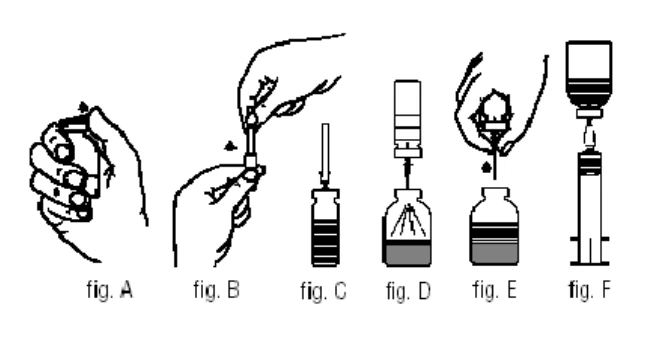
- 2. Remove caps from the concentrate and diluent bottles to expose central portions of the rubber stoppers (fig. A).
- 3. Cleanse exposed surface of the rubber stopper with germicidal solution and allow to dry.
- 4. Using aseptic technique, remove protective covering from one end of the double-ended needle and insert the exposed end through the diluent bottle stopper (fig. B and C).
- 5. Remove protective covering from the other end of the double-ended needle, taking care not to touch the exposed end. Invert diluent bottle over the concentrate bottle, then rapidly insert free end of the needle through the concentrate bottle stopper (fig. D). Diluent will be drawn into the concentrate bottle by vacuum.
- 6. Disconnect the two bottles by removing the needle from the concentrate bottle stopper (fig. E). Gently agitate or rotate the concentrate bottle until all material is dissolved.
- 7. Visually inspect the reconstituted product for particulate matter and discolouration prior to administration, whenever solution and container permit. Discard if particulate matter or discolouration exists.
- 8. Do not use solutions that are cloudy or have deposits.
Do not refrigerate after reconstitution.
4.4 Administration
Administer ANTITHROMBIN III NF only by intravenous injection or infusion.
The reconstituted solution must be given by intravenous injection or infusion immediately after preparation. The injection or infusion rate must not exceed 5 mL/minute.
For intravenous injection:
- 1. After reconstituting the concentrate as described above (see 4.3 Reconstitution), attach the enclosed filter needle to a sterile disposable syringe and insert needle through the bottle stopper (fig. F).
- 2. Inject air and withdraw solution into syringe.
- 3. Remove and discard filter needle. Attach a suitable intravenous needle or infusion set with winged adapter to the syringe and inject solution intravenously.
For intravenous infusion:
Prepare a solution of ANTITHROMBIN III NF as described above (see 4.3 Reconstitution). If not filtered during dissolution, a disposable infusion set with a filter (range between 149 micrometer and 5 micrometer) is to be used.
4.5 Missed Dose
The duration of treatment varies from case to case. In general, the administration of ANTITHROMBIN III NF may be discontinued after normalization of laboratory parameters and/or remission of clinical symptoms.
5 OVERDOSAGE
No symptoms of overdosage with ANTITHROMBIN III NF, Antithrombin III (human) are known.
| For management of a suspected drug overdose, contact your regional poison control centre. |
6 DOSAGE FORMS, STRENGTHS, COMPOSITION AND PACKAGING
To help ensure the traceability of biologic products, including biosimilars, health professionals should recognise the importance of recording both the brand name and the non-proprietary (active ingredient) name as well as other product-specific identifiers such as the Drug Identification Number (DIN) and the batch/lot number of the product supplied.
Table 1. Dosage Forms, Strengths, Composition and Packaging
ANTITHROMBIN III NF, Antithrombin III (human) is supplied in a single dose vial accompanied by a vial of Sterile Water for Injection, E.P. for diluent, a sterile double-ended needle and a sterile filter needle.
ANTITHROMBIN III NF, Antithrombin III (human) contains antithrombin III in a sterile, purified, concentrated and stabilized form. When reconstituted, ANTITHROMBIN III NF has a pH of 6.0 – 7.5, a heparin content not exceeding 0.1 IU/IU antithrombin III, a sodium chloride content of 8 to 10 mg/mL, a glucose content of 9 to 11 mg/mL, a sodium citrate dihydrate content of 0.8 to 1.5 mg/mL, and a tris (hydroxymethyl) aminomethane content of 0.8 to 1.2 mg/mL. Each vial of ANTITHROMBIN III NF contains the functional activity, in international units (IU ), stated on the bottle. The Antithrombin III content is not less than 3.0 IU per mg plasma protein excluding albumin. ANTITHROMBIN III NF contains no preservatives.
| Route of Administration | Dosage Form / Strength/Composition | Non-medicinal Ingredients |
| Intravenous | Freeze-dried powder with diluent for intravenous injection 450 - 550 IU/vial at release with 10 mL Sterile Water for Injection 900 - 1100 IU/vial at release with 20 mL Sterile Water for Injection | Protein, Glucose, Sodium Chloride, Sodium Citrate 2H2O, Tris(hydroxymethyl) aminomethane, Sterile water for injection |
7 WARNINGS AND PRECAUTIONS
General
ANTITHROMBIN III NF, Antithrombin III (human) is prepared from pooled human plasma which may contain the causative agents of hepatitis and other viral diseases. Because this product is made from human plasma, a risk of transmitting infectious agents (e.g., viruses and, theoretically, the agent that causes Creutzfeldt-Jakob disease in human) cannot be totally excluded. This also applies to unknown or emerging viruses and other pathogens. Prescribed manufacturing procedures utilized at the plasma collection centres, plasma testing laboratories, and the fractionation facilities are designed to reduce the risk of transmitting viral infection by inactivating and/or removing viruses.
However, the risk of viral infectivity from this product cannot be totally eliminated.
Individuals who receive infusions of blood or plasma products may develop signs and/or symptoms of some viral infections, particularly non-A, non-B hepatitis. Appropriate vaccination (hepatitis A and B) should be considered for patients in regular/repeated receipt of human plasma-derived antithrombin products.
Patients with ATIII deficiency, who are undergoing treatment using a plasma-derived product, should be appropriately vaccinated.
Hypersensitivity
Hypersensitivity reactions are possible. Hypersensitivity and anaphylactic reactions have been reported with the use of Antithrombin III, and in some cases may progress to severe anaphylaxis (including shock). Patients must be closely monitored and carefully observed for any symptoms throughout the infusion period. In case of shock, standard medical treatment should be administered.
Monitoring and Laboratory Tests
Clinical and laboratory monitoring when antithrombin is used together with heparin:
- In order to adjust heparin dosage and to avoid excessive anticoagulation, controls of the extent of anticoagulation (APPT, and where appropriate anti-FXa activity) should be performed regularly, at close intervals and in particular in the first minutes/hours following the start of antithrombin use.
- It is recommended that ATIII plasma levels be monitored daily during the treatment period in order to adjust the individual dose, due to the consumption of antithrombin by prolonged treatment with non-fractionated heparin.
- The measurement of antithrombin III biological activity, e.g., using chromogenic substrates (amidolytic method), is recommended for the determination of the patient's plasma level of antithrombin III before and during treatment with ANTITHROMBIN III NF.
7.1 Special Populations
7.1.1 Pregnant Women
The safety of Antithrombin III NF for use in pregnant has not been established in controlled clinical trials. However, the use of Antithrombin III solutions in pregnant women is referenced in the medical literature. ANTITHROMBIN III NF should be given to a pregnant woman only if clearly needed, taking into consideration that pregnancy confers an increased risk of thromboembolic events.
7.1.2 Breast-feeding
The safety of Antithrombin III NF for use in lactating women has not been established in controlled clinical trials. ANTITHROMBIN III NF should be given to a lactating woman only if clearly needed.
7.1.3 Pediatrics
Safety and effectiveness in children have not yet been established in clinical trials. The use of Antithrombin III solutions in the pediatric population for the unapproved indication of Infant Respiratory Distress Syndrome (IRDS), as referenced in the medical literature, suggests an increased risk of intracranial bleeding and mortality in the absence of a demonstrated beneficial effect.
8 ADVERSE REACTIONS
8.1 Adverse Reaction Overview
As with any other infused plasma derivative, anaphylactoid or anaphylactic reactions may occur, although rarely. The occurrence of these reactions (e.g., fever, urticarial rashes, nausea, retching, dyspnoea, anaphylactic shock) necessitates the interruption of replacement therapy. Mild reactions can be managed with antihistamine; severe hypotonic reactions require immediate intervention using current principles of shock therapy.
8.2 Clinical Trial Adverse Reactions
Clinical trials are conducted under very specific conditions. The adverse reaction rates observed in the clinical trials; therefore, may not reflect the rates observed in practice and should not be compared to the rates in the clinical trials of another drug. Adverse reaction information from clinical trials may be useful for identifying and approximating rates of adverse drug reactions in real-world use.
In the total of 365 patients in whom efficacy was evaluated either in clinical studies or case reports no product-related adverse drug events were reported.
Viral safety was evaluated in a prospective, clinical study in which AT III recipients previously untreated with blood or blood products (PUP's) were followed up for transfusion-transmitted viral hepatitis using the criteria established by the International Society for Thrombosis and Haemostasis. 26 patients were evaluated for hepatitis non-A, non-B transmission and 27 for hepatitis B transmission. In addition, 20 patients were evaluated for HCV seroconversion and 78 for HIV seroconversion. No case of product-related transmission of viral hepatitis or HIV was observed.
8.5 Post-Market Adverse Reactions
The following adverse reactions have been reported in the post-marketing experience, listed by MedDRA System Organ Class (SOC), then by Preferred Term in order of severity, where feasible.
Nervous system disorders: Tremor
Vascular disorders: Hot flush
Immune System disorders: Hypersensitivity, Anaphylactic reaction
Class Reactions
Heparin-induced antibody-mediated thrombocytopenia (type II)
9 DRUG INTERACTIONS
9.2 Drug Interactions Overview
Antithrombin replacement during administration of heparin in therapeutic dosage increases the risk of bleeding. The anticoagulant effect of heparin is enhanced by concurrent treatment with ANTITHROMBIN III NF, Antithrombin III (human). Thus, in order to avoid bleeding, reduced dosage of heparin is recommended during the treatment with ANTITHROMBIN III NF.
The half-life of antithrombin may be considerably decreased with concomitant heparin treatment due to accelerated antithrombin turnover.
9.3 Drug-Behavioural Interactions
There is no information of the effects of Antithrombin III NF on the ability to operate an automobile or other heavy machinery.
9.4 Drug-Drug Interactions
This medicinal product must not be mixed with other medicinal products.
In patients with hemorrhagic diathesis the combined use of antithrombin III and heparin will increase the risk of bleeding.
When using antithrombin III in combination with heparin treatment, the enhancement of the anticoagulant effect must be taken into consideration when calculating the dose of heparin. In addition, attention is drawn to the fact that patients with thrombocytopenia may be deficient in platelet factor 4, which entails diminished neutralization of heparin and consequently may lead to an increased bleeding tendency.
As a rule, regular monitoring of APTT (activated partial thromboplastin time) and corresponding adjustment of the heparin dose is recommended for any combination therapy with heparin.
10 CLINICAL PHARMACOLOGY
10.1 Mechanism of Action
Antithrombin III acts as a physiological inhibitor of blood coagulation, particularly by inhibition of thrombin and activated factor X, but also of factors lXa, XIa, XIIa, and plasmin. This inhibitory effect of antithrombin III (AT III) can occur in the absence of heparin, but is accelerated within the presence of heparin. Plasma concentrations from 140 μg to 300 μg /mL have been reported in healthy adults. In adults, the normal range of activity is between 80 and 120%, where 100% is equivalent to the antithrombin III activity as found in 1 mL of a human reference plasma pool. Normal levels in newborns are approximately 50%. Adult levels are usually reached by six months of life.
The fact that antithrombin III has a considerably reduced tolerance range compared to the coagulation factors is of clinical importance. Whereas the coagulation enzymes may drop to 40% and below without the occurrence of bleeding, even moderate decreases of antithrombin III activity to 70% are associated with an increased risk of thrombosis. ANTITHROMBIN III NF,
Antithrombin III (human), provides a temporary increase in plasma levels of AT III and thus allows for treatment and/or prophylaxis of thrombotic or thromboembolic events in AT III deficient patients.
10.2 Pharmacodynamics
In a controlled double blind randomized multicenter study by Baudo et al. in 1995, the effect of AT III therapy on survival and multiple organ failure (MOF score) was evaluated in 119 patients with sepsis and/or post-surgical complications (59 ATIll; 60 placebo). The mean MOF score showed significant improvements for all AT III-treated patients. AT III therapy also led to a reduction of fibrin (fibrinogen) degradation products and to a marked increase of the plasminogen level. At both day 7 and day 30, mortality was significantly reduced in patients with septic shock who received AT III replacement therapy as compared to placebo.
In a controlled, randomized open-label efficacy study by Blauhut et al in 1985, 3 groups of shock patients with DIC (n=51) were treated either with AT III or heparin or with ATIII+heparin. In the two heparin groups a drop in platelet count was observed. Blood loss in traumatic shock was considerably higher in the AT III+heparin group. Duration of symptoms of DIC was considerably shortened in both AT III groups (DIC symptoms disappeared after 42±28.2 h in the AT III group, after 57.1±31.9 h in the AT llI/heparin group and after 110.6±48.4 h in patients with heparin alone.) These data suggest that AT III replacement in patients with shock and DIC is superior to the commonly used treatment with heparin. In addition, it was concluded that additional heparin does not improve the effect of AT III and is likely to be associated with thrombocytopenia and increased blood loss. Vinazzer et al. in 1986 later presented data on 52 further patients with shock and DIC who were treated with various AT III concentrates, 15 of whom had received ANTITHROMBIN III. When the results of all patients admitted in shock phase IV were compared, there were 8 deaths out of 9 under heparin therapy, but only 7 out of 18 under AT III substitution. The authors conclude that this difference is of considerable clinical interest, although it does not permit statistical evaluation, since the two therapeutic regimens were given at different times.
In an open-label, prospective, controlled clinical study by Fagiano et al (1989) the effect of AT III to reverse partial or complete failure to respond to heparin was investigated in three groups of patients (n=20 each) undergoing CABG surgery (group 1 - normal response – positive control, group 2 - reduced response -negative control, group 3 –reduced response and treatment with AT III IMMUNO). In the treatment group AT III replacement resulted in normalization of the response to heparin as well as of blood loss and the amount of blood transfused. The authors concluded from the results that treatment with AT III can achieve sufficient anticoagulation in patients with a decreased response to heparin to avoid the necessity of administering high doses of heparin and the resulting risk of bleeding complications.
10.3 Pharmacokinetics
Elimination:
As shown by clinical studies, in vivo recovery and half-life of ANTITHROMBIN III NF depend on the patient's clinical condition and coagulation status at the time of infusion. In normal individuals and in patients with inherited AT III deficiency half-life is > 2 days. During acute consumption coagulopathy (DIC) it may be reduced to a few hours. For example, in two investigations of ANTITHROMBIN III NF, mean in vivo recovery was found to be respectively
38% and 47% in patients with acute DIC vs. 78% and 83% in patients without acute DIC; half life was 4.25 and 4.4 hours with acute DIC vs. 20 and 25 hours without.
Thus, the average rise in percent AT III activity after infusion of 1 unit of ANTITHROMBIN III NF per kg body weight was found to be approximately 1% in patients with acute DIC and 2% in patients in a steady state.
11 STORAGE, STABILITY AND DISPOSAL
When stored between +2°C and +8°C, ANTITHROMBIN III NF, Antithrombin III (human) is stable until the date indicated on the label.
ANTITHROMBIN III NF should not be frozen.
Administer ANTITHROMBIN III NF immediately after reconstitution. Do not refrigerate after reconstitution.
Administration equipment and any unused reconstituted ANTITHROMBIN III NF product should be appropriately discarded.
12 SPECIAL HANDLING INSTRUCTIONS
ANTITHROMBIN III NF, Antithrombin III (human) contains no preservatives. Therefore, it should be reconstituted just prior to administration. Aseptic technique should be used throughout the entire reconstitution process and the solution should then be used immediately.
Do not use solutions that are cloudy or have deposits.
Do not refrigerate after reconstitution.
If devices other than those supplied with ANTITHROMBIN III NF are used, ensure use of an adequate filter. A disposable infusion set with a filter (range between 149 micrometer and 5 micrometer) is to be used.
PART II: SCIENTIFIC INFORMATION
13 PHARMACEUTICAL INFORMATION
Drug Substance
Proper name: Antithrombin III (Human), E.P.
Chemical name: Not Applicable
Molecular formula and
molecular mass: Human Antithrombin III is a plasma alpha2 glycoprotein and belongs to the serpin (serin protease- inhibitor) superfamily. The relative molecular mass of human Antithrombin III is 58200.
Antithrombin III is an alpha-2 globulin with a molecular weight ranging between 58,000 and 65,000 Dalton.
Structural formula: Human Antithrombin III is a single polypeptide chain of 432 amino acids with three disulfide bridges and four glycosylation sites. It contains two functionally important domains. The first contains the reactive center and provides a cleavage site for proteinases such as thrombin, a prerequisite for forming a stable proteinase - inhibitor complex. The second is a glycosaminoglycan binding domain responsible for the interaction with heparin and related substances, which accelerates the inhibition of thrombin.
Physicochemical properties: Antithrombin III is a plasma glycoprotein synthesized in the liver. It is one of the most important natural inhibitors of blood coagulation. The factors most strongly inhibited are thrombin and factor Xa, but also factors of contact activation, intrinsic system and the factor VIIa/tissue factor complex. Antithrombin III activity is greatly enhanced by heparin and the anticoagulant effects of heparin depend on the presence of Antithrombin III.
| Pharmaceutical standard: | International Units antithrombin III (as determined with a standard calibrated against the 3rd International Standard for ATIII (Human) in Concentrates, Code 06/166) corresponds to the antithrombin III activity present in 1 mL of normal human plasma. |
Product Characteristics
ANTITHOMBIN III NF, Antithrombin III (human) is manufactured from pooled human plasma for fractionation, collected by plasmapheresis or obtained from whole blood donations.
Viral Inactivation
To prevent the transmission of infective agents by the administration of ANTITHROMBIN III NF, measures are taken for donor and plasma selection, as well as virus removal and inactivation steps during manufacture. In addition to the required plasma screening tests, all individual plasma donations are subjected to an inventory hold for a possible look-back of plasma donations suspected of infection. Moreover, a plasma pool sample is tested for antibodies to
HIV-1/HIV-2 and HBsAg; in addition to that, a test for viral genomic sequences of HIV-l/HIV-2, HBV, HAV, HCV and Parvo B19 is performed using the polymerase chain reaction (HIQ-PCR).
The standard measures taken (including heat treatment, nanofiltration, purification from cryosupernatant, and ammonium sulfate precipitation) are considered effective for inactivation/removal of enveloped viruses such as HIV, HBV, and HCV, and for the nonenveloped viruses HAV and Parvovirus B19.
The effectiveness of the steps as employed during the manufacture of ANTITHROMBIN III NF to remove and/or inactivate potential viral contamination ( adsorption on DEAE-Sephadex, heat treatment for 10 hrs. at 60°C; ammonium sulfate precipitation and nanofiltration) has been demonstrated in validation studies using human immuno deficiency virus type 1 (HIV-1), hepatitis A virus (HAV) and human parvovirus B19 (B19V) as target viruses, and bovine viral diarrhea virus (BVDV) as a model for hepatitis C virus (HCV), pseudorabies virus (PRV) as a general model for hepatitis B virus (HBV), and mice minute virus (MMV) as a model for B19V. It was demonstrated that the different steps investigated resulted in overall virus titer reductions by factors of >14.8 logs for HIV-1, >16.3 logs for HAV, > 13.9 logs for HBV, >13.9 logs for HCV, >14.1 logs for MMV and 7.2 logs for B19V.
The risk of transfusion-transmitted viral infection in AT III recipients previously untreated with blood or blood products (PUP's) was followed in a prospective clinical study using the criteria established by the International Society for Thrombosis and Haemostasis. Data from 26 patients were evaluated for non-A, non-B hepatitis and 27 for hepatitis B transmission. In addition, 20 patients were evaluated for HCV seroconversion and 78 for HIV seroconversion. No case of product-related transmission of viral hepatitis or HIV was observed.
16 NON-CLINICAL TOXICOLOGY
Animals
Single dose toxicity was evaluated on 3 lots of ANTITHROMBIN III IMMUNO in NMRI mice using between 1250 and 5000 IU AT III per kg body weight. No animal died or showed toxic effects, even at the highest dose administered.
Abnormal toxicity is routinely tested on each batch of product in mice and guinea pigs within the framework of quality control.
Studies on subacute and chronic toxicity as well as studies on reproduction toxicity and mutagenic or tumorigenic potential were not performed since repeated administration of human antithrombin III would be likely to cause the formation of antibodies in the animals. Results obtained in the animal model would thus not allow extrapolation to humans.
ANTITHROMBIN III IMMUNO has not been reported to be associated with embryo-fetal toxicity, oncogenic or mutagenic potential.