


Product Monograph - Inclunox
2 CONTRAINDICATIONS
- Hypersensitivity to Inclunox (enoxaparin); or any of its constituents or to other low molecular weight heparins and/or heparin. For composition, see the Dosage Forms, Composition and Packaging section of the Product Monograph.
- History of confirmed or suspected immunologically-mediated heparin-induced thrombocytopenia (delayed-onset severe thrombocytopenia), within the past 100 days, or in patients in whom an in vitro platelet-aggregation test in the presence of enoxaparin is positive (circulating antibodies) (see WARNINGS AND PRECAUTIONS, Heparin-induced thrombocytopenia).
- Acute or subacute bacterial endocarditis.
- Active bleeding.
- Major blood clotting disorders.
- Active gastric or duodenal ulcer.
- Hemorrhagic cerebrovascular accident (except if there are systemic emboli).
- Severe uncontrolled hypertension.
- Diabetic or hemorrhagic retinopathy.
- Other conditions or diseases involving an increased risk of hemorrhage.
- Injuries to and operations on the brain, spinal cord, eyes and ears.
- Spinal/epidural anesthesia is contraindicated where repeated treatment doses of Inclunox (1 mg/kg every 12 hours or 1.5 mg/kg once daily) are required, due to an increased risk of bleeding.
3 DOSAGE AND ADMINISTRATION
3.1 Dosing Considerations
Inclunox must not be administered by the intramuscular route.
Subcutaneous injection
Inclunox is administered by subcutaneous injection for the prevention of venous thromboembolic disease, treatment of deep vein thrombosis, treatment of unstable angina and non-Q-wave myocardial infarction and treatment of acute ST-segment Elevation Myocardial Infarction.
For subcutaneous use, Inclunox should not be mixed with other injections or infusions.
IV bolus injection
For acute ST-segment Elevation Myocardial Infarction, treatment is to be initiated with a single
IV bolus injection immediately followed by a subcutaneous injection.
3.2 Recommended Dose and Dosage Adjustment
Prophylaxis in patients at risk of venous thromboembolism following hip or knee surgery (e.g. orthopedic surgery)
The recommended dose of Inclunox is 30 mg (3000 IU) every 12 hours administered by subcutaneous injection. Provided that hemostasis has been established, the initial dose should be given 12 to 24 hours after surgery. The usual duration of treatment is from 7 to 14 days.
Treatment should be continued for as long as the risk of DVT persists. Continued therapy with Inclunox 40 mg once daily for 3 weeks following the initial phase of thromboprophylaxis in hip replacement surgery patients has been proven to be beneficial.
Prophylaxis in patients at risk of thromboembolism following abdominal or colorectal surgery
In patients undergoing abdominal surgery who are at risk for thromboembolic complications, the recommended dose of Inclunox is 40 mg (4000 IU) once daily administered by subcutaneous injection, with the initial dose given 2 hours prior to surgery (see WARNINGS AND PRECAUTIONS, General, Selection of General Surgery Patients). The usual duration of treatment is from 7 to 10 days for a maximum of 12 days.
Patients at high risk for thromboembolic complications following high risk abdominal, gynecological or urological and colorectal surgery, for cancer, who are not at risk of bleeding may benefit from an extended prophylaxis up to 4 weeks.
Prophylaxis in Medical Patients
In medical patients at risk for deep vein thrombosis due to severely restricted mobility during acute illness (see WARNINGS AND PRECAUTIONS, General, Selection of Medical Patients), the recommended dose of Inclunox is 40 mg (4000 IU) once daily by subcutaneous injection. The usual duration of administration is 6 to 11 days.
Treatment of Deep Vein Thrombosis, with or without Pulmonary Embolism
Inclunox can be administered subcutaneously either as 1.5 mg/kg once daily or as twice daily injections of 1 mg/kg.
The 1.5 mg/kg once daily dose is the equivalent of 150 IU/kg and should be given at the same time every day. The single daily dose should not exceed 18,000 IU. The expected plasma anti-Xa levels during subcutaneous treatment, when enoxaparin is used as the reference standard, would be <0.3 IU anti-Xa/mL before injection and <1.7 IU anti-Xa/mL 3 - 4 hours post injection. The measurement of plasma anti-Xa circulating activities depends on the experimental conditions of the assay, particularly on the reference standard used.
In patients with complicated thromboembolic disorders (i.e. with increased risk of recurrent VTE such as obese patients, cancer patients or patients with symptomatic PE), a dose of 1 mg/kg administered twice daily is recommended. This is the equivalent of 100 IU/kg. The expected plasma anti-Xa levels during subcutaneous treatment, when enoxaparin is used as the reference standard, would be <0.3 IU anti-Xa/mL before injection and <1.15 IU anti-Xa/mL 3 - 4 hours post injection.
Oral anticoagulant therapy should be initiated as soon as possible, and Inclunox should be continued until a therapeutic anticoagulant effect has been achieved (INR: 2 to 3), in general forapproximately 7 days.
Treatment of Unstable Angina or non-Q-wave Myocardial Infarction
The recommended dose of Inclunox is 1 mg/kg every 12 hours by subcutaneous injection. This is the equivalent of 100 IU/kg. The maximum dose should not exceed 10,000 IU / 12 hours. The expected plasma anti-Xa levels during subcutaneous treatment would be <0.3 IU anti-Xa/mL before injection and <1.15 IU anti-Xa/mL 3 - 4 hours after injection. Treatment should continue for a minimum of 2 days until clinical stabilization has been achieved, in general, for up to 8 days. The effect of the short-term treatment was sustained over a one-year period.
Concomitant therapy with ASA (100 to 325 mg once daily) is recommended (see WARNINGS
AND PRECAUTIONS, Peri-Operative considerations-Percutaneous coronary revascularisation procedures).
Treatment of acute ST-segment Elevation Myocardial Infarction
In patients with acute-ST-segment elevation myocardial infarction, the recommended dose of Inclunox is a single IV bolus of 30 mg plus a 1 mg/kg SC dose followed by 1 mg/kg administered SC every 12 hours (maximum 100 mg for each of the first two SC doses only, followed by 1 mg/kg SC dosing for the remaining doses). For dosage in patients ≥75 years of age, see section below entitled Geriatrics. When administered in conjunction with a thombolytic (fibrin specific or non-fibrin specific), Inclunox should be given between 15 minutes before and 30 minutes after the start of fibrinolytic therapy. All patients should receive acetylsalicylic acid (ASA) as soon as they are identified as having STEMI and maintained with 75 to 325 mg once daily unless contraindicated. The recommended duration of Inclunox treatment is 8 days or until hospital discharge, whichever comes first.
For patients managed with Percutaneous Coronary Intervention (PCI):
If the last Inclunox SC administration was given less than 8 hours before balloon inflation, no additional dosing is needed. If the last Inclunox SC administration was given more than 8 hours before balloon inflation, an IV bolus of 0.3 mg/kg of Inclunox should be administered (see WARNINGS AND PRECAUTIONS, Peri-Operative considerations - Percutaneous coronary revascularisation procedures).
Prevention of thrombus formation in the extra corporeal circulation during hemodialysis
In patients with chronic renal failure, undergoing hemodialysis and that are not at high risk of hemorrhage, the following dosage is recommended:
- ‒ Optimization of dosage is required for each individual patient (different clotting stimuli are produced by different dialysis circuits and membranes, and there is inter-patient variability).
- ‒ A starting dose of enoxaparin, ranging from 0.5-1.0 mg/kg, can be administered into the arterial line of the circuit at the beginning of the dialysis session. The effect of this dose range is usually sufficient for a 4-hour session. This dose range recommendation stem from results in published clinical studies (see CLINICAL TRIALS).
- ‒ Doses in subsequent dialysis session can be adjusted, based on the outcome of the previous dialysis.
Geriatrics (≥75 years of age):
For treatment of acute ST-segment Elevation Myocardial Infarction in geriatric patients ≥75 years of age, do not use an initial IV bolus. Initiate dosing with 0.75 mg/kg SC every 12 hours (maximum 75 mg for each of the first two SC doses only, followed by 0.75 mg/kg SC dosing for the remaining doses). No dose adjustment is necessary for other indications in geriatric patients unless kidney function is impaired.
Use in Patients with Renal Impairment
All patients with renal impairment treated with low molecular weight heparins should be monitored carefully.
Exposure to enoxaparin increases with degree of renal impairment. In patients with renal impairment, the increased exposure to enoxaparin has been shown to increase risk of bleeding (see ACTION AND CLINICAL PHARMACOLOGY, Special Populations and Conditions, Renal Insufficiency).
For the prevention of thrombus formation in the extra corporeal circulation during hemodialysis, see DOSAGE AND ADMINISTRATION, Prevention of thrombus formation in the extra corporeal circulation during hemodialysis.
A dosage adjustment is required for patients with severe renal impairment (creatinine clearance <30 mL/min) since enoxaparin exposure is significantly increased in this patient population. The following dosage adjustments are recommended for prophylaxis and treatment in patients with severe renal impairment:
- ‒ For prophylaxis in conjunction with hip or knee orthopedic surgery, the recommended dosage is 30 mg (3,000 IU) once daily
- ‒ For prophylaxis in conjunction with abdominal or colorectal surgery, or for prophylaxis in medical patients at risk of DVT, the recommended dosage is 20 mg (2,000 IU) or 30 mg (3,000 IU) once daily based on individual risk/benefit assessment
- ‒ For treatment of deep vein thrombosis, with or without pulmonary embolism, the recommended dosage is 1 mg/kg once daily
- ‒ For treatment of unstable angina or non-Q-wave myocardial infarction, the recommended dosage is 1 mg/kg once daily.
- ‒ For treatment of acute ST-segment Elevation Myocardial Infarction, the recommended dosage is 30 mg-single IV bolus plus a 1 mg/kg SC dose followed by 1 mg/kg administered SC once daily. (Maximum 100 mg for first SC dose only)
- ‒ For treatment of acute ST-segment Elevation Myocardial Infarction in geriatric patients ≥75 years of age, the recommended dosage is 1 mg/kg administered SC once daily (no initial bolus). (Maximum 100 mg for first SC dose only)
Dosage adjustment may also need to be considered in patients who have renal characteristics close to those of patients with severe renal impairment.
Spinal/epidural anesthesia
For patients receiving spinal/epidural anesthesia see WARNINGS AND PRECAUTIONS- Peri-Operative considerations section.
3.3 Administration
Subcutaneous Injection Technique
The subcutaneous injection of Inclunox should be carried out with the patient sitting or lying down in a comfortable position. Inject in the subcutaneous tissue of the anterolateral and posterolateral abdominal girdle, alternatively on the left and right sides. With the thickness of skin held between the operator's thumb and finger, introduce the entire length of the needle vertically into the skin.
Arterial line injection:
Inclunox is administered through the arterial line of a dialysis circuit for the prevention of thrombus formation in the extra-corporeal circulation during hemodialysis.
It must not be administered by the intramuscular route.
The Inclunox pre-filled disposable syringe is ready for immediate use.
Intravenous (Bolus) Injection Technique
Inclunox should be administered through an intravenous line. Inclunox should not be mixed or co-administered with other medications. To avoid the possible mixture of Inclunox with other drugs, the intravenous access chosen should be flushed with a sufficient amount of saline or dextrose solution prior to and following the intravenous bolus administration of Inclunox to clear the port of drug. Inclunox may be safely administered with normal saline solution (0.9%) or 5% dextrose in water.
Initial 30-mg bolus
The initial 30-mg bolus can be administered, using enoxaparin sodium pre-filled syringes. When graduated pre-filled syringes are used, expel the excessive volume if needed, to retain only 30 mg (0.3 ml) in the syringe. The 30-mg dose can then be directly injected into the intravenous line.
Additional bolus for PCI when last SC administration was given more than 8 hours before balloon inflation
For patients being managed with Percutaneous Coronary Intervention (PCI), an additional IV bolus of 0.3 mg/kg is to be administered if last SC administration was given more than 8 hours before balloon inflation (see DOSAGE AND ADMINISTRATION: Recommended Dose and Dosage Adjustment- For patients managed with Percutaneous Coronary Intervention (PCI)).
In order to assure the accuracy of the small volume to be injected, it is recommended to dilute the drug.
For example, to obtain a 3-mg/ml solution, using a 60-mg enoxaparin sodium pre-filled syringe, it is recommended to use a 50-ml infusion bag (i.e. using either normal saline solution (0.9%) or 5% dextrose in water) as follows:
Withdraw 30 ml from the infusion bag with a syringe and discard the liquid. Inject the complete contents of the 60-mg enoxaparin sodium pre-filled syringe into the 20 ml remaining in the bag. Gently mix the contents of the bag. Withdraw the required volume of diluted solution with a syringe for administration into the intravenous line.
After dilution is completed, the volume to be injected can be calculated using the following formula [Volume of diluted solution (ml) = Patient weight (kg) x 0.1] or using the table below. The dilution should be prepared immediately before use.
| Table 1 - Volume to be injected through intravenous line after dilution is completed | ||||||||
|---|---|---|---|---|---|---|---|---|
Weight [kg] | Required dose (0.3 mg/kg) [mg] | Volume to inject when diluted to a final concentration of 3 mg/ml [ml] | ||||||
| 45 | 13.5 | 4.5 | ||||||
| 50 | 15 | 5 | ||||||
| 55 | 16.5 | 5.5 | ||||||
| 60 | 18 | 6 | ||||||
| 65 | 19.5 | 6.5 | ||||||
| 70 | 21 | 7 | ||||||
| 75 | 22.5 | 7.5 | ||||||
| 80 | 24 | 8 | ||||||
| 85 | 25.5 | 8.5 | ||||||
| 90 | 27 | 9 | ||||||
| 95 | 28.5 | 9.5 | ||||||
| 100 | 30 | 10 | ||||||
Care should be taken to ensure use of the correct formulation, either Inclunox (100 mg/mL concentration) or Inclunox HP (150 mg/mL concentration), when using these products.
Important: When the Inclunox dose to be given is equivalent to the full amount of the prefilled syringe, no attempt should be made to expel air prior to giving the injection. If the graduated syringes (60 mg/0.6 mL, 80 mg/0.8 mL, 100 mg/mL, 120 mg/0.8 mL, 150 mg/mL) are used and the dose of Inclunox has to be adjusted, it is necessary to expel the air bubble and any excess drug solution.
Under normal conditions of use, Inclunox does not modify global clotting tests of activated partial thromboplastin time (aPTT), prothrombin time (PT) and thrombin clotting time (TT). Therefore treatment cannot be monitored with these tests. The plasma levels of the drug can be verified by measuring anti-Xa and anti-IIa activities.
3.4 Missed Dose
If you miss a dose of this medication by a few hours, take it as soon as you remember. However if you are close to the time of the next dose, skip the missed dose and proceed with the regular dosing schedule. Do not double doses. If you are unsure about how to proceed contact your doctor or your pharmacist.
4 OVERDOSAGE
Accidental overdosage following administration of Inclunox (enoxaparin) may lead to hemorrhagic complications. Inclunox should be immediately discontinued, at least temporarily, in cases of significant excess dosage. In more serious cases, protamine should be administered.
The anticoagulant effect of Inclunox is inhibited by protamine. This effect may be largely neutralized by slow intravenous injection of protamine sulfate. However, even with higher doses of protamine, the aPTT may remain prolonged to a greater extent than usually seen with unfractionated heparin. Anti-factor Xa activity is never completely neutralized (maximum about
60%).
In the event that prompt reversal of the anticoagulant effects of enoxaparin is required at any time after Inclunox dosing, the following table is provided as a guide for initial use of protamine. Attending physicians confronted with a potential overdosage of enoxaparin should always use their best clinical judgment in determining the appropriate dosing regimen of protamine to be administered.
| Table 2 - Neutralization of enoxaparin by protamine | |||||
| Protamine dose | Time Since Inclunox Dose | ||||
| < 8 hours | > 8 hours and ≤ 12 hours | >12 hours | |||
| 1 mg protamine per 1 mg enoxaparin | 0.5 mg protamine per 1 mg enoxaparin | may not be required | |||
A second infusion of 0.5 mg protamine per 1 mg Inclunox may be administered if the aPTT measured 2 to 4 hours after the first infusion remains prolonged.
Particular care should be taken to avoid overdosage with protamine sulfate. Administration of protamine sulfate can cause severe hypotensive and anaphylactoid reactions. Because fatal reactions, often resembling anaphylaxis, have been reported with protamine sulfate, it should be given only when resuscitation equipment and treatment of anaphylactic shock are readily available.
| For management of a suspected drug overdose, contact your regional poison control centre. |
5 DOSAGE FORMS, STRENGTHS, COMPOSITION AND PACKAGING
To help ensure the traceability of biologic products, including biosimilars, health professionals should recognise the importance of recording both the brand name and the non-proprietary (active ingredient) name as well as other product-specific identifiers such as the Drug Identification Number (DIN) and the batch/lot number of the product supplied.
Dosage Forms, Strengths, Composition and Packaging
Inclunox (enoxaparin sodium solution for injection) 100 mg/mL is available in pre-filled syringes
| Route of Administration | Dosage Form / Strength/Composition | Non-medicinal Ingredients | |
|---|---|---|---|
| Subcutaneous injection & Intravenous injection | Inclunox – 100 mg/mL Pre-filled syringes with protective shield: 30 mg/0.3 mL 40 mg/0.4 mL 60 mg/0.6 mL 80 mg/0.8 mL 100 mg/mL | The pre-filled syringes contain water for injection. For composition, see the Dosage Forms, Composition and Packaging section of the Product Monograph. | |
Inclunox HP – 150 mg/mL Pre-filled syringes with protective shield: 120 mg/0.8 mL 150 mg/ mL | |||
offered with a system that shields the needle after injection:
- Single dose 30 mg/0.3 mL in 0.5 mL pre-filled syringes in packs of 10 syringes per carton, 2 prefilled syringes with protective shield per blister, each in individual blister pack.
- Single dose 40 mg/0.4 mL in 0.5 mL pre-filled syringes in packs of 10 syringes per carton, 2 prefilled syringes with protective shield per blister, each in individual blister pack.
- Single dose 60 mg/0.6 mL in 1 mL graduated pre-filled syringes in packs of 10 syringes per carton, 2 prefilled syringes with protective shield per blister, each in individual blister pack.
- Single dose 80 mg/0.8 mL in 1 mL graduated pre-filled syringes in packs of 10 syringes per carton, 2 prefilled syringes with protective shield per blister, each in individual blister pack.
- Single dose 100 mg/mL in 1 mL graduated pre-filled syringes in packs of 10 syringes per carton, 2 prefilled syringes with protective shield per blister, each in individual blister pack.
Inclunox HP (enoxaparin sodium solution for injection) 150 mg/mL (High Potency) is available in pre-filled syringes offered with a system that shields the needle after injection:
- Single dose 120 mg/0.8 mL in 1 mL graduated pre-filled syringes in packs of two syringes per carton, 2 prefilled syringes with protective shield per blister, each in individual blister pack.
- Single dose 150 mg/mL in 1 mL graduated pre-filled syringes in packs of two syringes per carton, 2 prefilled syringes with protective shield per blister, each in individual blister pack.
Each Inclunox presentation has a solution pH of 5.5 - 7.5 with an approximate anti-Factor Xa activity of 100 IU per 1 mg of drug (with reference to the W.H.O. First International Low Molecular Weight Heparin Reference Standard).
Composition
Inclunox (enoxaparin sodium solution for injection) pre-filled syringe: each syringe contains 100 mg/mL of enoxaparin sodium in water for injection. The solution in the pre-filled syringe is preservative-free and intended for use as a single-dose injection.
Inclunox HP (enoxaparin sodium solution for injection) pre-filled syringe: each syringe contains 150 mg/mL of enoxaparin sodium in water for injection. The solution in the pre-filled syringe is preservative-free and intended for use as a single-dose injection.
The pH of the syringe is 5.5 - 7.5 with an approximate anti-Factor Xa activity of 100 IU per 1 mg of drug (with reference to the W.H.O. First International Low Molecular Weight Heparin Reference Standard).
6 DESCRIPTION
Enoxaparin Sodium is the sodium salt of a low molecular weight heparin, obtained by alkaline depolymerisation of the benzyl ester of heparin sodium from porcine intestinal mucosa.
7 WARNINGS AND PRECAUTIONS
General
Inclunox (enoxaparin) must NOT be administered by the intramuscular route.
Inclunox cannot be used interchangeably (unit for unit) with unfractionated heparin (UFH) or other low molecular weight heparins (LMWHs) as they differ in their manufacturing process, molecular weight distribution, anti-Xa and anti-IIa activities, units and dosages. Special attention and compliance with instructions for use of each specific product is required during any change in treatment.
Determination of anti-Xa levels in plasma is the only method available for monitoring Inclunox activity. The effect of Inclunox on global clotting tests such as aPTT, PT and TT is dose-dependent. At lower doses, used in prophylaxis, enoxaparin does not prolong these tests. At higher doses, aPTT prolongation is observed but treatment cannot be monitored with these tests.
Measurement of peak anti-Xa levels at about 4 hours post-dose should be considered in patients at higher risk of bleeding and receiving Inclunox, such as the elderly, patients with renal impairment or the extremes of body weight, during pregnancy, or for children. At treatment doses, peak anti-Xa levels should generally be maintained at no more than 1.5 IU/mL in these patients (see ACTION AND CLINICAL PHARMACOLOGY, and WARNINGS AND PRECAUTIONS, Monitoring and Laboratory Tests).
Selection of General Surgery Patients
Risk factors associated with postoperative venous thromboembolism following general surgery include history of venous thromboembolism, varicose veins, obesity, heart failure, malignancy, previous long bone fracture of a lower limb, bed rest for more than 5 days prior to surgery, predicted duration of surgery of more than 30 minutes, age 60 years or above.
Selection of Orthopedic Surgery Patients
Major orthopedic surgery carried out on the lower extremities is associated with a higher risk of VTE, and a notable percentage of patients will develop a thrombosis if they are not given prophylaxis. Factors shown to predispose patient to VTE following major orthopedic surgery include a history of VTE, current obesity, delayed mobilization advanced age or cancer. Other risk factors that might be clinically important include congestive heart failure, chronic obstructive pulmonary disease (COPD) as well as female gender.
High risk period for VTE lasts up to 3 months after hip surgery, therefore thromboprophylaxis should start as soon as possible and continue for up to 28 to 35 days after surgery. (ACCP guidelines 2004)
Selection of Medical Patients
The risk factors for the development of thrombosis in the individual medical patient are important in determining whether thromboprophylaxis is appropriate. In one clinical trial, enoxaparin sodium 40 mg once daily reduced the risk of the development of deep vein thrombosis (DVT) from 14.9% to 5.5% during the short term risk period in bedridden patients. Careful consideration should be given to the selection of patients. Patients at high risk of developing DVT or other thrombosis (such as patients with a malignant disease, a history of thrombophilia and known deficiency in antithrombin III, protein C or protein S, or APC resistance) are not candidates for therapy with Inclunox 40 mg once daily because this dose may be inadequate for those patients. Furthermore, Inclunox should not be given for thromboprophylaxis in medical patients who are bedridden due to infections with septic shock. Medical patients who require short term thromboprophylaxis for the risk of DVT due to severely restricted mobility during acute illness including moderate to severe heart failure, acute respiratory failure revealing or complicating chronic respiratory insufficiency not requiring ventilatory support, and acute respiratory infections may be selected for thromboprophylaxis with Inclunox 40 mg once daily.
The safety and efficacy of enoxaparin 40 mg once daily following hospital discharge has not been established in the medical patient population. In the clinical trial mentioned above, thromboembolic events were not common following discontinuation of enoxaparin 40 mg at discharge. However, a significant number of patients did require antithrombotic therapy following discharge; specifically 13.63%. During the 3-month period following discharge, less than 1% of events were serious and included deep vein thrombosis, pulmonary embolism and death which is considered to be thromboembolic in origin. Therefore, the physician should consider whether thromboprophylaxis post-discharge would be necessary for the individual patient.
Gastrointestinal
Inclunox should be used with caution in patients with gastrointestinal ulceration.
Hematologic
Hemorrhage
Bleeding may occur in conjunction with unfractionated heparin or low molecular weight heparin use. As with other anticoagulants, Inclunox should be used with extreme caution in patients at increased risk of hemorrhage. Bleeding can occur at any site during therapy with Inclunox. An unexpected drop in hematocrit or blood pressure should lead to a search for a bleeding site (see ADVERSE REACTIONS, Bleeding).
Thrombocytopenia
Thrombocytopenia of any degree should be monitored closely.
Heparin-induced thrombocytopenia (HIT)
Heparin-induced thrombocytopenia can occur with the administration of Inclunox. Its incidence is unknown at present.
Use of enoxaparin sodium in patients with a history of immune mediated HIT within the past 100 days or in the presence of circulating antibodies is contraindicated (see CONTRAINDICATIONS). Circulating antibodies may persist several years.
Enoxaparin sodium is to be used with extreme caution in patients with a history (more than 100 days) of heparin-induced thrombocytopenia without circulating antibodies. The decision to use enoxaparin sodium in such a case must be made only after a careful benefit risk assessment and after non-heparin alternative treatments are considered.
Platelets
Platelet counts should be determined prior to the commencement of treatment with Inclunox and, subsequently, twice weekly for the duration of therapy.
Caution is recommended when administering enoxaparin to patients with congenital or drug induced thrombocytopenia, or platelet defects.
Hepatic/Biliary/Pancreatic
Inclunox should be used with caution in patients with hepatic insufficiency.
Immune
During Inclunox administration, special caution is necessary in rapidly developing thrombocytopenia and severe thrombocytopenia (<100,000/mcL). A positive or indeterminate result obtained from in vitro tests for antiplatelet antibody in the presence of enoxaparin or other low molecular weight heparins and/or heparin would contraindicate Inclunox.
Monitoring and Laboratory Tests
Enoxaparin has only a moderate prolonging effect on clotting time assays such as aPTT or thrombin time. For lab monitoring of effect, anti-Xa methods are recommended. Prolongation of aPTT during therapy with enoxaparin to the same extent as with unfractionated heparin should only be used as a criteria of overdose. Dose increases aimed at prolonging aPTT to the same extent as with unfractionated heparin could cause overdose and bleeding.
Enoxaparin is administered subcutaneously, and therefore, the individual patient’s antifactor Xa activity level will not remain within the range that would be expected with unfractionated heparin by continuous i.v. infusion throughout the entire dosing interval. In patients treated with enoxaparin 1 mg/kg twice daily for proximal deep vein thrombosis, mean peak plasma anti-Xa levels were 0.91 IU/mL. In patients given enoxaparin 1 mg/kg twice daily for acute treatment of unstable angina, peak anti-Xa activity levels were 1 - 1.1 IU/mL. At steady-state in patients given a 1.5 mg/kg qd regimen for treatment of DVT, mean peak activity was 1.7 IU anti-Xa/mL. The steady-state is practically achieved at the second or the third dose depending on the dosage regimen, once or twice daily, respectively. Enoxaparin should be administered as directed (see DOSAGE AND ADMINISTRATION).
As with all anti-thrombotic agents, there is a risk of systemic bleeding with enoxaparin administration. Consequently, therapy should not be started before primary hemostasis has been established and preferably no sooner than 12 hours after surgery (see DOSAGE AND ADMINISTRATION). Care should be taken with enoxaparin use in high dose treatment of newly operated patients.
After treatment is initiated, patients should be carefully monitored for bleeding complications. This may be done by regular physical examination of the patients, close observation of the surgical drain and periodic measurements of hemoglobin, and anti-factor Xa determinations. With normal prophylactic doses, enoxaparin does not modify global clotting tests of activated partial thromboplastin time (aPTT), prothrombin time (PT) and thrombin clotting time (TT). Therefore, treatment cannot be monitored with these tests.
At higher doses, increases in aPTT (activated partial thromboplastin time) and ACT (activated clotting time) may occur. Increases in aPTT and ACT are not linearly correlated with increasing enoxaparin antithrombotic activity and therefore are unsuitable and unreliable for monitoring enoxaparin activity.
Patients with Extreme Body Weight
Safety and efficacy of low molecular weight heparins in high weight (eg.> 120 kg) and low weight (eg. < 45kg) patients have not been fully determined. Individualised clinical and laboratory monitoring is recommended in these patients (see also ACTION AND CLINICAL PHARMACOLOGY, Special Population and Conditions, Low-Weight Patients).
Low-weight patients – prophylactic treatment
An increase in exposure of enoxaparin sodium with prophylactic dosages (non-weight adjusted) has been observed in low-weight women (<45 kg) and low-weight men (<57 kg), which may lead to a higher risk of bleeding. Therefore, careful clinical monitoring is advised in these patients (see ACTION AND CLINICAL PHARMACOLOGY, Special Population and Conditions, Low-Weight Patients).
Obese patients – prophylactic treatment
Obese patients are at higher risk for thromboembolism. The safety and efficacy of prophylactic doses in obese patients (BMI >30 kg/m2) has not been fully determined and there is no consensus for dose adjustment. These patients should be observed carefully for signs and symptoms of thromboembolism.
Peri-Operative Considerations
Spinal/Epidural Hematomas
There have been cases of epidural hematomas reported with the use of low molecular weight heparins (LMWH) and spinal/epidural anesthesia or spinal puncture procedures, resulting in long term or permanent paralysis. The risk of these events is greater with higher enoxaparin dosage regimens, use of post-operative indwelling catheters or the concomitant use of additional drugs affecting hemostasis such as nonsteroidal anti-inflammatory drugs (NSAIDs), platelet inhibitors, or other drugs affecting coagulation including glycoprotein IIb/IIIa antagonists. The risk of spinal hematoma appears to be increased by traumatic or repeated epidural or spinal puncture, history of spinal surgery or spinal deformity. Inclunox should be given after spinal/epidural anesthesia only if the anesthesiologist considers the spinal/epidural puncture as uncomplicated. Consideration should be given to delaying the next dose for 24 hours if the puncture induced trauma.
The concomitant use of a neuraxial blockade and of an anticoagulant therapy is a clinical decision that should be made after careful assessment of the benefits and risks to the individual patient, in the following situations:
- In patients already treated with anticoagulants, the benefits of a neuraxial blockade must be carefully balanced against the risks.
- In patients planned to undergo elective surgery with neuraxial blockade, the benefits of anticoagulant therapy must be carefully balanced against the risks.
To reduce the potential risk of bleeding associated with the concurrent use of enoxaparin and epidural or spinal anesthesia/analgesia, or spinal puncture procedures, the pharmacokinetic profile of the drug should be considered (see ACTION AND CLINICAL PHARMACOLOGY section). Placement and removal of the catheter is best performed when the anticoagulant effect of enoxaparin is low; however, the exact timing to reach a sufficiently low anticoagulant effect in each patient is not known. In the case of patients with spinal lumbar puncture, spinal anesthesia or epidural anesthesia, a minimum of 12 hours should elapse between the enoxaparin injection at prophylactic doses or for 24 hours at treatment doses, and the insertion or removal of the spinal/epidural catheter or needle. A specific recommendation for timing of a subsequent LMWH dose after catheter removal cannot be made. The timing of the next dose must be based on a benefit-risk assessment considering both the risk for thrombosis and the risk for bleeding in the context of the procedure and patient risk factors.
If anticoagulation is administered in the setting of epidural/spinal anesthesia or spinal puncture procedures, continuous monitoring must be exercised to detect any signs and symptoms of neurological impairment such as midline back pain, sensory and motor deficits (numbness or weakness in lower limbs), bowel and/or bladder dysfunction ( see ADVERSE REACTIONS section). Patients should be instructed to inform their physician immediately if they experience any of the above signs or symptoms. If signs or symptoms of spinal hematoma are suspected, urgent diagnosis and treatment including spinal cord decompression should be initiated immediately.
For patients with creatinine clearance <30 mL/minute, additional clinical considerations are necessary, given that elimination of enoxaparin is more prolonged; consideration should be given to doubling the timing of removal of a catheter.
Percutaneous coronary revascularisation procedures
To minimize the risk of bleeding following the vascular instrumentation during the treatment of unstable angina, non-Q-wave myocardial infarction, and acute ST-segment elevation myocardial infarction, adhere precisely to the intervals recommended between enoxaparin injection doses. It is important to achieve hemostasis at the puncture site after PCI. In case a closure device is used, the sheath can be removed immediately. If a manual compression method is used, it is recommended to remove the sheath 6 hours after the last IV/SC injection. If the treatment with enoxaparin sodium is to be continued, the next scheduled dose should be given no sooner than 6 to 8 hours after sheath removal. The site of the procedure should be observed for signs of bleeding or hematoma formation (see DOSAGE AND ADMINISTRATION, Recommended Dose and Dosage Adjustment- Treatment of Unstable Angina or non-Q-wave Myocardial Infarction and Treatment of acute ST-segment Elevation Myocardial Infarction).
Renal
Inclunox should be used with caution in patients with renal insufficiency.
Inclunox dosage should be reduced in patients with severely impaired renal function (see ACTION AND CLINICAL PHARMACOLOGY, Special Populations and Conditions, Renal Insufficiency, and DOSAGE AND ADMINISTRATION, Use in Patients with Renal Impairment).
Patients with impaired renal function should be carefully monitored because half-life for anti-Xa activity after administration of low molecular weight heparin may be prolonged in this patient population (see DOSAGE AND ADMINISTRATION, Use in Patients with Renal Impairment).
In patients with renal impairment, there is an increase in exposure to enoxaparin which increases the risk of bleeding. Since exposure to enoxaparin is significantly increased in patients with severe renal impairment (creatinine clearance <30 mL/min), a dosage adjustment is recommended for both therapeutic and prophylactic dosage ranges (see ACTION AND CLINICAL PHARMACOLOGY, Special Populations and conditions, Renal Insufficiency, and DOSAGE AND ADMINISTRATION, Use in Patients with Renal Impairment).
7.1 Special Populations
7.1.1 Pregnant Women
Teratogenic effects: As with other low molecular weight heparins, enoxaparin should not be used in pregnant women unless the therapeutic benefits to the patients outweigh the possible risks. There have been reports of congenital anomalies in infants born to women who received low molecular weight heparin during pregnancy including cerebral anomalies, limb anomalies, hypospadias, peripheral vascular malformation, fibrotic dysplasia and cardiac defects. A causal relationship has not been established nor has the incidence been shown to be higher than in the general population.
Non-teratogenic effects: There have been post-marketing reports of fetal death when pregnant women received low molecular weight heparins. Causality for these cases has not been established. Pregnant women receiving anticoagulants, including enoxaparin, are at increased risk for bleeding. Hemorrhage can occur at any site and may lead to death of mother and/or fetus. Pregnant women receiving Inclunox should be carefully monitored. Pregnant women and women of child-bearing potential should be informed of the potential hazard to the fetus and the mother if Inclunox is administered during pregnancy.
There are also postmarketing reports of prosthetic valve thrombosis in pregnant women with prosthetic heart valves while receiving low molecular weight heparins for thromboprophylaxis. These events led to maternal death or surgical interventions.
Pregnant women with prosthetic heart valves appear to be at exceedingly high risk of thromboembolism. An incidence of thromboembolism approaching 30% has been reported in these patients, in some cases even with apparent adequate anticoagulation at treatment doses of low molecular weight heparins or unfractionated heparin. Any attempt to anticoagulate such patients should normally only be undertaken by medical practitioners with documented expertise and experience in this clinical area.
7.1.2 Breast-feeding
It is not known whether enoxaparin is excreted in human milk. Because many drugs are excreted in human milk, caution should be exercised when Inclunox is administered to nursing women.
7.1.3 Pediatrics
The safety and effectiveness of Inclunox in children has not been established.
7.1.4 Geriatrics
Elderly patients (especially patients eighty years of age and older) receiving low molecular weight heparins are at increased risk of bleeding. Careful attention to dosing and concomitant medications, especially anti-platelet preparations, is advised. Close monitoring of elderly patients with low body weight (eg. <45 kg) and those predisposed to decreased renal function is recommended.
For treatment of acute ST-segment Elevation Myocardial Infarction in geriatric patients, the incidence of bleeding complications was higher in patients ≥65 years of age as compared to younger patients (<65 years). Patients ≥75 years of age did not receive a 30-mg IV bolus prior to the normal dosage regimen and had their SC dose adjusted to 0.75 mg/kg every 12 hours (see DOSAGE AND ADMINISTRATION - Recommended Dose and Dosage Adjustment, Treatment of acute ST-segment Elevation Myocardial Infarction, Geriatrics (≥75 years of age)).
7.1.5 Others
Patients with Prosthetic Heart Valves
Cases of prosthetic valve thrombosis have been reported in patients who have received low molecular weight heparins for thromboprophylaxis. Some of these patients were pregnant women in whom thrombosis led to maternal and/or fetal deaths. Pregnant women are at higher risk of thromboembolism (see WARNINGS AND PRECAUTIONS, Use in Pregnant Women).
Acute Coronary Disease
When thrombolytic treatment is considered appropriate in patients with unstable angina, non-Q-wave myocardial infarction and acute ST-segment Elevation Myocardial Infarction, the concomitant use of an anticoagulant such as enoxaparin may increase the risk of bleeding.
Medical Patients
Enoxaparin at a dose of 40 mg once daily should not be given for thromboprophylaxis other than deep vein thrombosis (DVT) prevention or in medical patients who, in the opinion of the attending physician, would be at a higher risk of thromboembolism (such as patients with a malignant disease, a history of thrombophilia and known deficiency in antithrombin III, protein C or protein S, or APC resistance). Furthermore, enoxaparin should not be given for thromboprophylaxis in medical patients who are bedridden due to infections with septic shock. Patients with severe COPD complicated by right heart failure are candidates for another form of thromboprophylaxis. Enoxaparin at a dose of 40 mg once daily has been studied in medical patients who require short term thromboprophylaxis to prevent the development of DVT while they are bedridden (6 to 11 days). If, in the opinion of the attending physician, longer thromboprophylaxis is necessary, then consideration should be given to a thromboprophylactic agent, which has been proven effective.
8 ADVERSE REACTIONS
The adverse drug reaction profiles reported in the clinical study that compared Inclunox to the reference biologic drug were comparable. The description of adverse reactions in this section is based on clinical experience with the reference biologic drug.
8.1 Adverse Reaction Overview
Bleeding
As with any antithrombotic treatment, hemorrhagic manifestations can occur (also see ADVERSE REACTIONS, Local Reactions).
The incidence of major hemorrhagic complications during enoxaparin treatment has been low and generally did not differ from that observed with unfractionated heparin. Patients taking enoxaparin are at risk for major bleeding complications when the plasma anti-factor Xa levels approach 2.0 IU/mL. Other risk factors associated with bleeding on therapy with heparins include a serious concurrent illness, chronic heavy alcohol consumption, use of platelet inhibiting drugs, renal failure, age and possibly, the female gender. Petechiae or easy bruising may precede frank hemorrhage. Bleeding may range from minor local hematoma to major hemorrhage. The early signs of bleeding may include epistaxis, hematuria, or melena. Bleeding may occur at any site and may be difficult to detect; such as retroperitoneal bleeding. Bleeding may also occur from surgical sites.
Major hemorrhage, including retroperitoneal and intracranial bleeding, has been reported in association with enoxaparin use, in some cases leading to fatality.
Local Reactions
Pain and mild local irritation may follow the subcutaneous injection of enoxaparin sodium. Rarely, hard inflammatory nodules have been observed at the injection site. Injection site hematomas are a common side effect with enoxaparin occurring at a frequency of 5% or less with lower (prophylaxis) doses to 10% or more with higher (treatment) doses.
8.2 Clinical Trial Adverse Reactions
Because clinical trials are conducted under very specific conditions, the adverse reaction rates observed in the clinical trials may not reflect the rates observed in practice and should not be compared to the rates in the clinical trials of another drug. Adverse reaction information from clinical trials is useful for identifying drug-related adverse events and for approximating rates.
The following rates of major bleeding events have been reported during clinical trials with enoxaparin.
| Table 3 - Major Bleeding Episodes Following Abdominal and Colorectal Surgery1 | |||||
|---|---|---|---|---|---|
| Indications | Dosing Regimen | ||||
Enoxaparin 40 mg qd SC | Heparin 5000 U q8h SC | ||||
| Abdominal Surgery2 | n = 555 23 (4%) | n = 560 16 (3%) | |||
| Colorectal Surgery2 | n = 673 28 (4%) | n = 674 21 (3%) | |||
1Bleeding complications were considered major: (1) if the hemorrhage caused a significant clinical event, or (2) if accompanied by a hemoglobin decrease ≥ 2 g/dL or transfusion of 2 or more units of blood products. Retroperitoneal, intraocular, and intracranial hemorrhages were always considered major.
2 Enoxaparin 40 mg qd SC initiated two hours prior to surgery and continued for up to 12 days after surgery.
| Table 4 - Major Bleeding Episodes Following Hip or Knee ReplacementSurgery1 | |||||
| Indications | Dosing Regimen | ||||
Enoxaparin 30 mg q12h SC | Heparin 15,000 U/24h SC | ||||
| Hip Replacement Surgery2 | n = 786 31 (4%) | n = 541 32 (6%) | |||
| Knee Replacement Surgery2 | n = 294 3 (1%) | n = 225 3 (1%) | |||
1Bleeding complications were considered major: (1) if the hemorrhage caused a significant clinical event, or (2) if accompanied by a hemoglobin decrease ≥ 2 g/dL or transfusion of 2 or more units of blood products. Retroperitoneal and intracranial hemorrhages were always considered major. In the knee replacement surgery trials, intraocular hemorrhages were also considered major hemorrhages.
2 Enoxaparin 30 mg every 12 hours SC initiated 12 to 24 hours after surgery and continued for up to 14 days after surgery.
NOTE: At no time point were the 40 mg once a day pre-operative and the 30 mg every 12 hours post-operative hip replacement surgery prophylactic regimens compared in clinical trials.
| Table 5 - Major Bleeding Episodes Following Hip or Knee Replacement Surgery With Extended Prophylaxis 1 | |||||||||||
|---|---|---|---|---|---|---|---|---|---|---|---|
| Dosing Regimen | |||||||||||
| Initial Prophylaxis2 | Extended Prophylaxis3 | ||||||||||
| Indications | Enoxaparin 30 mg q12h SC | Enoxaparin 40 mg qd SC | Enoxaparin 40 mg qd SC | Placebo qd SC | |||||||
| Hip Replacement Surgery | n = 475 8 (1.7%) | N = 288 3 (1.0%) | n = 445 0 (0%) | N = 431 0 (0%) | |||||||
| Knee Replacement Surgery4 | n = 493 8 (1.6%) | —- | n = 217 0 (0%) | N = 221 1 (0%) | |||||||
1 Bleeding complications were considered major: (1) if the hemorrhage caused a significant clinical event, or (2) if accompanied by a hemoglobin decrease ≥ 2 g/dL or transfusion of 2 or more units of blood products. Retroperitoneal and intracranial hemorrhages were always considered major.
2 Initial Prophylaxis hospital phase: In the multicentre study 307, enoxaparin 30 mg q12h SC for 7-10 days, initiated within 12- 24 hours postoperatively; in the single-centre study PK537, enoxaparin 40 mg qd SC initiated 12 ± 2 hours before surgery, repeated on the day of the surgery and continued for 9 ± 2 days.
3 Extended Prophylaxis outpatient phase: In the multicentre study 307, enoxaparin 40 mg qd SC for 18-21 days; in the single-centre studies PK537 and ENX491001, enoxaparin 40 mg qd SC 21 ± 2 days.
4 Initial Prophylaxis hospital phase: In the multicentre study 307, enoxaparin 30 mg q12h SC for 7-10 days, initiated within 12- 24 hours postoperatively; Extended Prophylaxis outpatient phase: In the multicentre study 307.
Table 6 - Major Bleeding Episodes in Medical Patients With Severely Restricted Mobility During Acute Illness1 | ||||
|---|---|---|---|---|
| Indications | Dosing Regimen | |||
Enoxaparin 2 40 mg qd SC | Placebo2 | |||
| Medical Patients During Acute Illness3 | n = 360 3 (<1%) | n = 362 2 (<1%) | ||
1Bleeding complications were considered major: (1) if the hemorrhage caused a significant clinical event, (2) if the hemorrhage caused a decrease in hemoglobin of ≥ 2 g/dL or transfusion of 2 or more units of blood products. Retroperitoneal and intracranial hemorrhages were always considered major although none were reported during the trial.
2The rates represent major bleeding on study medication up to 24 hours after last dose.
3Usual duration of treatment 6 to 11 days.
| Table 7 - Major Bleeding Episodes in Unstable Angina and Non-Q-Wave Myocardial Infarction | |||||
|---|---|---|---|---|---|
| Indications | Dosing Regimen | ||||
Enoxaparin 1 1 mg/kg q12h SC | Heparin1 aPTT Adjusted i.v. Therapy | ||||
| Unstable Angina and Non-Q-Wave MI 2, 3 | n = 1578 17 (1%) | n = 1529 18 (1%) | |||
1 The rates represent major bleeding on study medication up to 12 hours after last dose with treatment for up to 8 days.
2 Aspirin therapy was administered concurrently (100 to 325 mg per day).
3 Bleeding complications were considered major: (1) if the hemorrhage caused a significant clinical event, or (2) if accompanied by a hemoglobin decrease by ≥3 g/dL or transfusion of 2 or more units of blood products. Intraocular, retroperitoneal, and intracranial hemorrhages were always considered major.
| Table 8 - Major Bleeding Episodes in Treatment of Deep Vein Thrombosis With or Without Pulmonary Embolism Treatment 1 | |||||||
|---|---|---|---|---|---|---|---|
| Dosing Regimen2 | |||||||
| Indication | Enoxaparin 1.5 mg/kg qd SC | Enoxaparin 1 mg/kg q12h SC | Heparin aPTT Adjusted i.v. Therapy | ||||
| Treatment of DVT, with or without PE | n = 298 5 (2%) | n = 559 9 (2%) | n = 554 9 (2%) | ||||
1 Bleeding complications were considered major: (1) if the hemorrhage caused a significant clinical event, or (2) if accompanied by a hemoglobin decrease ≥ 2 g/dL or transfusion of 2 or more units of blood products. Retroperitoneal, intraocular, and intracranial hemorrhages were always considered major.
2 All patients also received warfarin (dose-adjusted according to PT to achieve an INR of 2.0 to 3.0) commencing within 72 hours of enoxaparin or standard heparin therapy and continuing for up to 90 days. Enoxaparin or standard heparin therapy was discontinued after a therapeutic oral anticoagulant effect was achieved in general about 7 days after treatment initiation.
| Table 9 - Major Bleeding Episodes in acute ST-segment Elevation Myocardial Infarction |
|---|
Indications
| Dosing Regimen | |||||
|---|---|---|---|---|---|
Enoxaparin Initial 30-mg IV bolus followed by 1 mg/kg q12h SC* | Heparin aPTT Adjusted IV Therapy | ||||
Acute ST-segment Elevation Myocardial Infarction Major bleeding (including ICH) Intracranial hemorrhages (ICH) | n = 10176 211 (2.1%) 84 (0.8%) | n = 10151 138 (1.4%) 66 (0.7%) | |||
The rates represent major bleeding (including ICH) up to 30 days.
Bleedings were considered major if the hemorrhage caused a significant clinical event associated with a hemoglobin decrease by ≥ 5 g/dL. ICH were always considered major.
*Patients ≥75 years of age did not receive a 30-mg IV bolus prior to the normal dosage regimen and had their SC dose adjusted to 0.75 mg/kg every 12 hours.
8.3 Other clinically relevant adverse reactions
Other adverse reactions commonly reported in clinical trials with enoxaparin were thrombocytosis, allergic reactions, hepatic enzymes increase, urticaria, pruritus, erythema, and injection site reactions.
Adverse Reactions in Enoxaparin Injection Treated Patients With acute ST-segment Elevation Myocardial Infarction
In a clinical trial in patients with acute ST-segment elevation myocardial infarction, the only additional possibly related adverse reaction that occurred at a rate of at least 0.5% in the enoxaparin group was thrombocytopenia (1.5%).
8.4 Post Market Adverse Drug Reactions
Blood and Lymphatic System Disorders
Heparin-induced Thrombocytopenia
Severe immunologically-mediated thrombocytopenia has been observed rarely with enoxaparin use, resulting in arterial and/or venous thrombosis or thromboembolism (see WARNINGS AND PRECAUTIONS, Hematologic, Thrombocytopenia, Platelets and WARNINGS AND PRECAUTIONS, Immune). In some cases thrombosis was complicated by organ infarction or limb ischemia.
- Thrombocytopenia
- Hemorrhagic anemia
- Eosinophilia
Hepatobiliary disorders
Liver
Transient, asymptomatic elevations of liver transaminases (AST and ALT) to greater than three times the upper limit of normal has been observed in up to 6% of patients taking enoxaparin. This is a consistent finding with all members of the LMWH class, as well as with unfractionated heparin. The mechanism associated with the increased levels of liver transaminases has not been elucidated. No consistent irreversible liver damage has been observed. Transaminase levels returned to normal within 3 to 7 days after discontinuation of enoxaparin.
- Hepatocellular injury
- Cholestatic liver injury
Immune System Disorders
Hypersensitivity
Hypersensitivity reactions, including angioedema and anaphylactic/anaphylactoid reaction including shock have been observed rarely with unfractionated heparin and low molecular weight heparins including enoxaparin.
Metabolism and nutrition disorders
Hyperkalemia
Cases of hyperkalemia have been reported with heparins and Low Molecular Weight Heparins.
Musculoskeletal and connective tissue disorders
Skeletal Effects
Use of low molecular weight heparins over extended periods has been reported to be associated with development of osteopenia.
- Osteoporosis following long-term therapy (greater than 3 months)
Nervous System Disorders
- Headache
Skin and subcutaneous tissue disorders
- Skin rash (including bullous eruptions), purpura, and allergic reactions occur with all low molecular weight heparins. Skin necrosis is rare, usually occurring at the injection site and preceded by purpura or erythematous plaques, infiltrated and painful. In case such reaction is observed, treatment with enoxaparin sodium must be discontinued. Very rare cases of hypersensitivity cutaneous vasculitis have been reported. These cases may include leukocytoclastic vasculitis. Enoxaparin should be discontinued in patients showing local or systemic allergic responses.
- Alopecia
Vascular Disorders
Cases of spinal hematoma (or neuraxial hematoma) have been reported with the concurrent use of enoxaparin sodium as well as spinal/epidural anesthesia or spinal puncture. These reactions have resulted in varying degrees of neurologic injuries
- including long-term or permanent paralysis (see WARNINGS AND PRECAUTIONS, Peri-Operative considerations, Spinal/Epidural Hematomas).
9 DRUG INTERACTIONS
9.1 Drug-Drug Interactions
It is recommended that agents which affect hemostasis should be discontinued prior to enoxaparin therapy unless strictly indicated. If the combination is indicated, enoxaparin should be used with careful clinical and laboratory monitoring when appropriate.
Inclunox should be used with caution in patients receiving oral anticoagulants, platelet inhibitors, non-steroidal anti-inflammatories and thrombolytic agents because of increased risk of bleeding. Aspirin, unless contraindicated, is recommended in patients treated for unstable angina or non-Q-wave myocardial infarction and acute ST-segment Elevation Myocardial Infarction (see DOSAGE AND ADMINISTRATION).
9.2 Drug-Laboratory Test Interactions
Since enoxaparin use may be associated with a rise in hepatic transaminases, this observation should be considered when liver function tests are assessed (see ADVERSE REACTIONS, Post Market Adverse Drug Reactions, Liver).
10 ACTION AND CLINICAL PHARMACOLOGY
10.1 Mechanism of Action
Enoxaparin is a low molecular weight heparin fragment, which is obtained by controlled depolymerization of natural heparin from porcine intestinal mucosa. It possesses antithrombotic action. Enoxaparin is composed of molecules with and without a specially characterized pentasaccharide, the antithrombin binding site, that is essential for high affinity binding to the plasma protein antithrombin (formerly referred to as antithrombin III). With a molecular weight range of 3,800 - 5,000 daltons (versus 15,000 daltons for heparin), the enoxaparin molecule is too small to bind simultaneously to thrombin and antithrombin, the primary anticoagulant factor in blood.
The mechanism of action of enoxaparin is antithrombin-dependent. It acts mainly by accelerating the rate of the neutralization of certain activated coagulation factors by antithrombin, but other mechanisms may also be involved. Enoxaparin potentiates preferentially the inhibition of coagulation factors Xa and IIa and only slightly affects other hemostatic mechanisms such as clotting time. The antithrombotic effect of enoxaparin is well correlated to the inhibition of factor Xa.
The ratio of anti-Xa/anti-IIa activity is greater than 4 with enoxaparin (whereas this ratio is equal to 1 with heparin). This dissociation between anti-Xa and anti-IIa activities has been shown in experimental models with an antithrombotic activity comparable to that of heparin while the bleeding effect is reduced. In man, clinical trials have not shown a causal relationship between the ratio of anti-Xa/anti-IIa activity and clinical/pharmacological effect.
Enoxaparin cannot be measured directly in the bloodstream. Rather the effect on clotting mechanisms is measured. Heparin dosage is monitored by both prolongation of aPTT and by anti-Xa activity. For enoxaparin, the aPTT may not be significantly prolonged relative to unfractionated heparin at prophylactic doses, and at therapeutic doses aPTT prolongation is not used to measure the therapeutic effect of enoxaparin. Enoxaparin potency is described in international anti-Xa units (e.g., 1 mg of enoxaparin is equivalent to 100 IU of anti-Xa).
In the in vitro purified system, enoxaparin sodium has a high anti-Xa activity (approximately
100 IU/mg) and low anti-IIa or anti thrombin activity (approximately 28 IU/mg).These anticoagulant activities are mediated through anti-thrombin III (ATIII) resulting in antithrombotic activities in humans.
Beyond its anti-Xa/IIa activity, further anti-thrombotic and anti-inflammatory properties of enoxaparin have been identified in healthy subjects and patients as well as in non-clinical models. These include ATIII-dependent inhibition of other coagulation factors like factor VIIa, induction of endogenous Tissue Factor Pathway Inhibitor (TFPI) release as well as a reduced release of von Willebrand factor (vWF) from the vascular endothelium into the blood circulation. These factors are known to contribute to the overall anti-thrombotic effect of enoxaparin.
10.2 Pharmacokinetics
Absorption: The pharmacokinetics of enoxaparin have been studied on the basis of plasma levels of anti-Xa activity. The mean absolute bioavailability of enoxaparin, when given subcutaneously, is about 92% in healthy volunteers.
The mean peak plasma anti-Xa activity is observed 3 to 5 hours after subcutaneous injection. Levels of approximately 0.2, 0.4, 1.0 and 1.3 anti-Xa IU/mL were seen in healthy volunteers, following a single subcutaneous administration of 20 mg, 40 mg, 1 mg/kg and 1.5 mg/kg, respectively.
Enoxaparin pharmacokinetics appear to be linear over the recommended dosage ranges. After repeated subcutaneous administration of the 1 mg/kg twice daily regimen, the steady-state is reached from Day 3 to 4 with mean exposure about 65% higher than after a single dose. Mean peak and trough levels of about 1.2 and 0.52 IU/mL respectively were seen with this regimen.
A 30 mg IV bolus immediately followed by a 1 mg/kg SC every 12 hours provided initial peak anti-Factor Xa levels of 1.16 IU/mL (n=16) and average exposure corresponding to 88% of steady-state levels. Steady state is achieved on the second day of treatment.
Distribution: The volume of distribution of enoxaparin is about 5 liters. Following subcutaneous dosing, the apparent clearance of enoxaparin is approximately 15 mL/min.
Information from a clinical trial with a very small number of volunteers indicates that enoxaparin, as detected by anti-factor Xa activity, does not appear to cross the placental barrier, at least during the second trimester of pregnancy.
Metabolism: Enoxaparin is metabolized in the liver by desulfation and depolymerization.
Elimination: Elimination appears monophasic with a half-life of about 4 hours after a single subcutaneous dose and about 7 hours after repeated dosing, in healthy volunteers.
The main route of elimination is via the kidney. Renal clearance of active fragments represents about 10% of the administered dose and total renal excretion of active and non-active fragments 40% of the dose.
Pharmacokinetic interaction: No pharmacokinetic interaction was observed between enoxaparin and thrombolytics when administered concomitantly.
Special Populations and Conditions
Pediatrics: The safety and effectiveness of Inclunox in children has not been established.
Geriatrics: Based on the results of a population pharmacokinetic analysis, the enoxaparin kinetic profile is not different in elderly subjects compared to younger subjects when renal function is normal. However, since renal function is known to decline with age, elderly patients may show reduced elimination of enoxaparin (see WARNINGS AND PRECAUTIONS, Renal and Special Populations, Geriatrics).
Low-Weight Patients: When non-weight-adjusted dosing was administered, after a single-subcutaneous 40 mg dose, anti-Xa exposure was observed to be 52% higher in low-weight women (<45 kg) and 27% higher in low-weight men (<57 kg) when compared to normal weight control subjects, which may lead to a higher risk of bleeding (see WARNINGS AND PRECAUTIONS, Special Populations, Patients with Extreme Body Weight).
Renal Insufficiency: A linear relationship between anti-Xa plasma clearance and creatinine clearance at steady-state has been observed, indicating decreased clearance of enoxaparin in patients with reduced renal function.
Anti-Xa exposure at steady-state, represented by AUC, is increased about 34% in mild renal impairment (creatinine clearance 50-80 mL/min), about 72% in moderate renal impairment (creatinine clearance 30-50 mL/min), and about 95% in severe renal impairment (creatinine clearance <30 mL/min) upon administration of enoxaparin 1.5 mg/kg once daily sc for 4 days. Anti-Xa exposure at steady-state is increased about 33% in mild renal impairment, about 46% in moderate and about 97% in severe renal impairment upon administration of enoxaparin 1 mg/kg bid sc for 4 days. When enoxaparin was administered at a fixed, prophylaxis dose of 40 mg once daily sc for 4 days, the anti-Xa exposure increased by about 20% in mild renal impairment, about 21% in moderate renal impairment, and about 65% in severe renal impairment (see WARNINGS AND PRECAUTIONS, Renal, and DOSAGE AND ADMINISTRATION, Use in Patients with Renal Impairment).
The half-life for anti-Xa activity in patients with impaired renal function is much longer than for people with normal renal function (t½ = 5.12 h in patients with chronic renal failure vs 2.94 h in young healthy volunteers) when enoxaparin was administered intravenously.
11 STORAGE, STABILITY AND DISPOSAL
Store at room temperature (15-25ºC).
Do not freeze.
PART II: SCIENTIFIC INFORMATION
12 PHARMACEUTICAL INFORMATION
Drug Substance
Proper name: Enoxaparin sodium
Chemical name:
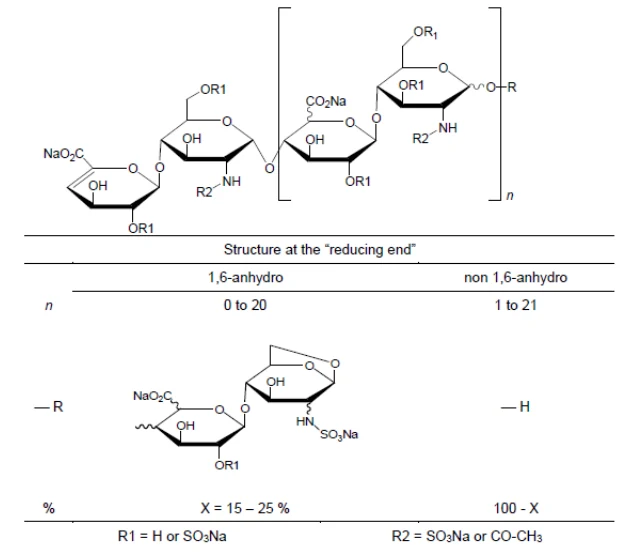
Enoxaparin Sodium is the sodium salt of a low molecular weight heparin, obtained by alkaline depolymerisation of the benzyl ester of heparin sodium from porcine intestinal mucosa. The average molecular weight of enoxaparin sodium is one third of unfractionated heparin.
Enoxaparin sodium is a mixture of sulfated polysaccharide chains which vary in length and are made of repeating disaccharide units; the complex set of oligosaccharides have not yet been completely characterised. The disaccharide monomer consists of one molecule of uronic acid and one molecule of D-glucosamine, linked in the 1-4 position. Uronic acid can be either D-glucuronic acid or L-iduronic acid, and in addition, L-iduronic acid can be sulfated on position 2.
Glucosamine can be N-sulfated, N-acetylated, 6-0-sulfated, or 3-0-sulfated.
Based on current knowledge, the majority of the components have a 4-enopyranose uronate structure at the non-reducing end of their chain. About 20% of the components contain a
1,6 anhydro derivative on the reducing end of the chain, the range being between 15 and 25%.
The mass-average molecular mass ranges between 3,800 and 5,000 daltons with a characteristic value of about 4,500 daltons. The mass percentage of chains between 2,000 and 8,000 daltons ranges between 68.0 and 82.0 percent.
Molecular formula and molecular mass:
Molecular Mass: The mass-average relative molecular mass of Enoxaparin Sodium ranges between 3,800-4,650 Da.
Structural formula:
Physicochemical properties:
Enoxaparin sodium is a fine white to almost white powder.
Enoxaparin sodium is soluble in water, but practically insoluble in ethanol and chloroform.
Aqueous solutions of enoxaparin sodium (10% aqueous solution) have a pH between 6.2 to 7.7.
13 COMPARATIVE CLINICAL TRIALS
13.1 Comparative Trial Design and Study Demographics
Clinical studies conducted to support similarity between Inclunox and the reference biologic drug included:
- A Single-Dose, Randomized, Double-Blind, Two-Way Crossover Comparative Pharmacodynamic (PD) Study in Healthy Volunteers (Study ROV-RO20-2015-01).
An overview of the study designs and demographic characteristics of patients enrolled in each clinical study is presented in Table 10.
Table 10 - Summary of patient demographics for clinical trial
| Study Number | Trial design | Dosage, route of administration and duration | Study subjects (n) | Mean age (Range) | Sex |
| ROV-RO20-2015-01 | Single-dose, randomized, double-blind, two-way cross-over study in healthy volunteers assessing comparative PD and safety | Single SC dose (100 mg/mL) of either Inclunox or Clexane (EU) in each of the 2 treatment periods, separated by at least a 7 day washout period between periods | Randomized: 46 healthy volunteer subjects Completed: 43 healthy volunteer subjects | 26 years (range: 18 to 44 years) | Randomized: 33 (71.7%) Males 13 (28.3%) Females |
Study ROV-RO20-2015-01 was a randomized, double-blind, two way crossover study in healthy adult volunteers assessing comparative PD and safety of Inclunox and Clexane (EU) following a single dose of 100 mg/mL subcutaneous (SC) injection. The study evaluated 46 healthy subjects (N=23 in each treatment sequence Inclunox/EU-Clexane or EU-Clexane/Inclunox). Two subjects from the Inclunox/EU-Clexane and one from the EU-Clexane/Inclunox) treatment sequence did not complete the study, which resulted in 43 subjects being included in the statistical comparisons.
The main objective of the study was to assess the pharmacodynamic (PD) comparability of Inclunox to the reference biologic drug. The primary PD parameters evaluated were maximum activity (Amax) and area under the effect curve from time 0 to the last measured activity (T) (AUEC0–T) and AUEC from time 0 to infinity (AUEC0–inf) of anti-FXa activity, and Amax and AUEC0–T of anti-FIIa activity.
.
13.2 Comparative Study Results
13.2.1 Comparative Bioavailability Studies
13.2.1.1 Pharmacokinetics
Not Applicable.
13.2.1.2 Pharmacodynamics
When comparing PD parameters of Inclunox versus Clexane®, comparability criteria were met for all primary PD parameters as 95% CI of the ratio of geometric least squares means for those PD parameters were within the acceptance margins of 80.0%–125.0%.
The results of the primary PD comparisons are shown in Tables 11 and 12.
Table 11. Study ROVRO20201501-Statistical Analysis of Primary PD Parameters
Anti-FXa activity (1 x 100 mg/mL SC) From measured data Geometric Mean Arithmetic Mean (CV %) | ||||
| Parameter | Test§ | Reference† | % Ratio of Geometric Means | 95% Confidence Interval |
AUEC0-T (h*IU/mL) | 8.05 8.38 (29.2) | 7.75 8.00 (25.6) | 103.8 | 99.8-108.0¶ |
AUC0-inf* (h*IU/mL) | 8.91 9.21 (26.3) | 8.55 8.98 (23.0) | 104.2 | 100.0-108.6 |
AMAX (IU/mL) | 0.97 0.99 (19.0) | 0.97 0.99 (19.7) | 100.1 | 94.6-105.9¶ |
| TMAX (h) | 4.00 (2.05, 6.02) | 4.00 (2.00, 5.00) | ||
| T½ (h) # | 5.43 (32.1) | 5.33 (44.0) | ||
§ Inclunox (enoxaparin sodium injection) by Sandoz Canada Inc.
† Clexane (EU) (enoxaparin sodium injection) by sanofi-aventis France (as a suitable proxy for the reference biologic drug, Lovenox from sanofi-aventis Canada Inc.)
AUEC0-T = area under the effect curve from time 0 to the last measured activity (T)
AUEC0-inf = area under the effect curve from time 0 to infinity
Amax = maximum activity
*n=40
#n=42
¶ Acceptance Interval was 80.0% to 125.0%
Table 12. Study ROVRO20201501- Statistical Analysis of Primary PD Parameters
Anti-FIIa activity (1 x 100 mg/mL SC) From measured data Geometric Mean Arithmetic Mean (CV %) | ||||
| Parameter | Test§ | Reference† | % Ratio of Geometric Means | 95% Confidence Interval |
AUEC0-T (h*IU/mL) | 1.08 1.21 (55.3) | 1.04 1.14 (47.8) | 103.5 | 90.9-117.9¶ |
AMAX (IU/mL) | 0.18 0.19 (29.4) | 0.18 0.18 (32.0) | 103.3 | 94.7-112.6¶ |
| TMAX (h) | 4.50 (2.00, 6.02) | 4.50 (2.50, 6.00) | ||
| T½ (h) # | 4.88 (143.5) | 4.77 (90.4) | ||
§ Inclunox (enoxaparin sodium injection) by Sandoz Canada Inc.
† Clexane (EU) (enoxaparin sodium injection) by sanofi-aventis France (as a suitable proxy for the reference biologic drug, Lovenox from sanofi-aventis Canada Inc.)
AUEC0-T = area under the effect curve from time 0 to the last measured activity (T)
AUEC0-inf = area under the effect curve from time 0 to infinity
Amax = maximum activity
*n=10 Test; n=7 Reference
#n=26
¶ Acceptance Interval was 80.0% to 125.0%
13.2.2 Comparative Safety and Efficacy
13.2.2.1 Efficacy
See section 13.2.1.1 Pharmacodynamics
13.2.2.2 Safety
In the single dose two way cross over comparative PD and safety study of Inclunox and Clexane (EU) in healthy adult volunteers (Study ROV-RO20-2015-01) the types, frequency and severity of adverse events were comparable between the biosimilar and the reference biologic drug.
14 CLINICAL TRIALS- REFERENCE BIOLOGIC DRUG
Prophylaxis of venous thromboembolic disease following hip or knee surgery
Study demographics and trials design [CPK 0884 P20, CPK 0387/PK523, CPK 0688/ PK527]
The safety and efficacy of enoxaparin sodium in preventing deep vein thrombosis (DVT) following hip or knee surgery has been evaluated in three large pivotal trials involving 896 patients over 40 years of age. The mean age was 67 years, with 40.2% men and 56.5% women. All studies were conducted as multi-centre, controlled, double-blind comparison of enoxaparin with placebo or with calcium heparin in patients undergoing orthopedic surgery of the hip or knee. Treatment with enoxaparin or the selected drug standard was initiated the day after or second day after surgery, provided hemostasis was established, and continued for 14 days or until discharge if sooner. All three studies shared the same objectives, criteria of evaluation and procedures.
| Table 13 - Summary of Patient Demographics in Clinical Trials for Prophylaxis Of Venous Thromboembolic Disease following Hip or Knee Surgery | |||||||||
|---|---|---|---|---|---|---|---|---|---|
| Study # | Trial design | Dosage, route of administration and duration | Study subjects (n=number) | Mean age (Range) | Gender (M/F) | ||||
CPK 0884 P20 (Hip) | Randomized, double-blind, parallel group, To compare enoxaparin with placebo in prevention of DVT in patients undergoing total hip replacement | Enoxaparin 30 mg sc injection twice daily or Placebo sc injection twice daily Duration: up to 14 days | Total = 100 50 50 | 67.1 years (41-84) | 45%/ 55% | ||||
CPK0387/PK523 (Hip) | Randomized, double-blind, parallel group, To compare enoxaparin with calcium heparin in prevention of DVT in patients undergoing elective hip surgery | Enoxaparin 30 mg sc injection twice daily or Calcium heparin 7500 units sc injection twice daily Duration: up to 14 days | Total: 665 333 332 | 67 years (66.2 ± 10.39) 67 years (66.8 ± 9.09) | 45.8%/ 54.2% | ||||
CPK 0688/PK527 (Knee) | Randomized, double-blind, parallel group, To compare enoxaparin with placebo in prevention of DVT in patients undergoing major knee surgery | Enoxaparin 30 mg sc injection twice daily or Placebo sc injection twice daily Duration: up to 14 days | Total: 131 66 65 | 68.1 (42-85) | 29.7%/6 0.3% | ||||
Study results
The primary aim of each study was to determine the efficacy and safety of enoxaparin in the prevention of thromboembolism. Efficacy assessments were based on venography, 125I-fibrinogen scanning of the lower limbs and impedance plethysmography (IPG). The efficacy data are provided below.
| Table 14 -Incidence of DVT in Patients Treated with Enoxaparin or Placebo, following Hip or Knee Surgery | ||||||||||||
| Study | Incidence of DVT | P value # | ||||||||||
| Enoxaparin group (%) | Placebo group (%) | heparin group (%) | ||||||||||
| CPK 0884 P20 (Hip) | 10 | 46 | ─ | 0.0002 | ||||||||
| CPK 0387 (Hip) | 17 | ─ | 19 | 0.5317 | ||||||||
| CPK 0688 (Knee) | 19.7 | 60.0 | ─ | < 0.0001 | ||||||||
In patients undergoing total hip replacement (study CPK 0884), postoperative treatment with enoxaparin 30 mg s.c. twice daily statistically significantly reduced the incidence of DVT compared to placebo group (10% vs 46% respectively, p = 0.0002). The odds ratio was 8.34 (95% CI = [2.72, 25.56], p = 0.0002).
In patients undergoing elective hip surgery (study CPK0387), the incidence rate of DVT in the enoxaparin group was lower than in the calcium heparin group (17% vs 19% respectively), although the comparison between these groups was not statistically significant. Enoxaparin
30 mg s.c. twice daily was shown to be at least as efficacious as calcium heparin 7500 units twice daily.
In patients undergoing major knee surgery (study CPK 0688) enoxaparin 30 mg twice daily significantly reduced the incidence rate of VTE disease relative to placebo (60% vs 19.7% respectively, p< 0.0001). The estimated odds for development of VTE disease in the placebo group was 7.5 times higher than for the enoxaparin group (95% CI = [3.13 – 17.74]).
Extended Prophylaxis of DVT Following Hip Replacement Surgery
Study demographics and trial design [Study 307]
In the open label phase of the multicentre study 307, patients undergoing elective primary hip replacement surgery received enoxaparin 30 mg SC twice daily for 7 to 10 days, initiated within 12 to 24 hours post surgery. Patients who did not require re-operation, had received appropriate enoxaparin dosing during the open-label phase, did not receive prohibited concomitant medications and had not developed DVT or PE, or experienced a major hemorrhage during the hospitalization were entered into the double-blind treatment phase. In the double-blind phase, 435 patients with unilateral primary hip replacements, revision, or previous joint replacements were randomized to a post discharge long-term regimen of enoxaparin 40 mg (n=224) qd SC or matching placebo (n=211) until a total of 28 days of therapy was administered (mean treatment duration 19 days). Patients ranged in age from 26 to 88 years (mean age 63.4 years) in the placebo group and from 28 to 90 years (mean age 64.4 years) in the enoxaparin group. The majority of patients were Caucasians with 49.9% men and 50.1% women. The primary endpoint of this study was the incidence of venous thromboembolism (VTE) during the double-blind treatment period. VTE constituted a treatment failure.
| Table 15 - Summary of Patient Demographics in Clinical Trials for Extended Prophylaxis of Venous Thromboembolic Disease following Hip Surgery | |||||||||
|---|---|---|---|---|---|---|---|---|---|
| Study # | Trial design | Dosage, route of administration and duration | Study subjects (n=number) | Mean age (Range) | Gender (M/F) | ||||
| 307 (Hip) | Randomised, double-blind, parallel group, placebo-controlled, multicentre study To evaluate the efficacy and safety of a prolonged post-hospital regimen of enoxaparin compared to placebo for the prevention of venous thromboembolic disease in patients undergoing elective, primary total hip replacement. | Open label phase Enoxaparin 30 mg SC b.i.d. initiated within 12 to 24 hours post surgery Duration: for 7 to 10 days. Double-blind phase Enoxaparin 40 mg qd SC or Placebo qd SC enoxaparin: until a total of 28 days of therapy was administered (mean: 19 days). | Total = 475 Total = 435 (randomized) 224 211 | 64.4 years (28-90) 63.4 years (26-88) | 49.9%/ 50.1% | ||||
Study Results
Extended prophylaxis with enoxaparin 40 mg qd SC resulted in statistically and clinically significant reductions in the incidence rates of VTE as compared to placebo treatment. PE was not observed in the enoxaparin treatment group but 1 patient in the placebo treatment group experienced both DVT and PE. An evaluation of the anatomic site of DVTs indicated a clinically and statistically significant reduction of patients who experienced proximal or proximal and distal DVTs. The effect was slightly less pronounced in patients with only distal DVT but remained clinically apparent.
Table 16 - Efficacy of Enoxaparin 40 mg qd SC in Extended Prophylaxis of DVT Following Hip Replacement Surgery* | |||||||
|---|---|---|---|---|---|---|---|
| Endpoints | Dosing Regimen | p value | |||||
Enoxaparin 40 mg q.d. SC n (%) | Placebo qd SC n (%) | ||||||
| All Treated Hip Replacement Patients | 224 | 211 | |||||
All Failures DVT location at least proximal† proximal distal proximal + distal DVT & PE | 18 (8.0) 6 (2.7) 4 (1.8) 12 (5.4) 2 (0.9) 0 (0.0%) | 49 (23.2) 27 (12.8) 14 (6.6) 22 (10.4) 13 (6.2) 1 (0.5%) | <0.001 <0.001 | ||||
* Multicentre study
† Includes patients with proximal DVT and those with both proximal and distal DVT
Intraabdominal surgery
Two multicenter Phase III clinical trials (PK567 and PK568) were conducted in order to evaluate the efficacy and safety of enoxaparin in the prevention of deep vein thrombosis (DVT) and pulmonary embolism (PE) in a total of 2462 patients undergoing colorectal and elective curative cancer surgery. Both studies were double blind and used standard heparin 5000 units subcutaneously every 8 hours as control; the study medication was initiated 2 hours preoperatively and continued for 6 to 12 days.
Study demographics and trial design [PK567]
Abdominal surgery patients at risk include those who are over 40 years of age, obese, undergoing surgery under general anesthesia lasting longer than 30 minutes or who have additional risk factors such as malignancy or a history of deep vein thrombosis or pulmonary embolism.
In a double-blind, parallel group study of patients undergoing elective cancer surgery of the gastrointestinal, urological, or gynecological tract, a total of 1116 patients were enrolled in the study, and 1115 patients were treated. Patients ranged in age from 32 to 97 years (mean age 67.1 years) with 52.7% men and 47.3% women. Patients were 98% Caucasian, 1.1% Black, 0.4% Oriental, and 0.4% others.
| Table 17 - Summary of Patient Demographics in Clinical Trial PK567 for The Prophylaxis of Deep Vein Thrombosis following Abdominal Surgery | |||||||||
|---|---|---|---|---|---|---|---|---|---|
| Study # | Trial design | Dosage, route of administration and duration | Study subjects (n=number) | Mean age (Range) | Gender (M/F) | ||||
| PK567 | Multicentre, randomized, double-blind, heparin-controlled To compare the safety and efficacy of enoxaparin with unfractionated heparin for prevention of DVT in patients after planned elective cancer surgery | Enoxaparin 40 mg sc injection once daily* HEPARIN 5000 units sc injection three times daily Duration: 6 to 12 days median duration: enoxaparin 9 days, heparin 8 days | Total: 1115 555 560 | 67.1 (32-97) | 52.7%/ 47.3% | ||||
* In addition, the patients from enoxaparin group received 2 placebo injections
Study results
The primary efficacy variable was the incidence rate of VTE in all treated population. The aim of the study was to demonstrate that enoxaparin was at least as effective as heparin in prevention of DVT in abdominal surgery patients. The efficacy data are provided below.
| Table 18 - Efficacy of Enoxaparin Injection in the Prophylaxis of Deep Vein Thrombosis following Abdominal Surgery | ||||
|---|---|---|---|---|
| Endpoints | Dosing Regimen | |||
Enoxaparin 40 mg q.d. SC n (%) | Heparin 5000 U q8h SC n (%) | |||
All Treated Abdominal Surgery Patients Treatment Failures Total VTE1 (%) DVT Only (%) | 555 (100) 56 (10.1) (95% CI2: 8 to 13) 54 (9.7) (95% CI: 7 to 12) | 560 (100) 63 (11.3) (95% CI: 9 to 14) 61 (10.9) (95% CI: 8 to 13) | ||
1 VTE = Venous thromboembolic events which included DVT, PE, and death considered to be thromboembolic in origin. The observed difference between the heparin and the enoxaparin group was -1.16% [90% CI = -4.20%; 1.88%]
2 CI = Confidence Interval
Enoxaparin injection 40 mg s.c., administered once a day, beginning 2 hours prior to surgery and continuing for a maximum of 12 days after elective cancer surgery, was found to be as effective as heparin 5000 units every 8 hours s.c. in reducing the risk of deep vein thrombosis (DVT).
Study demographics and trial design [PK568]
In a second double-blind, parallel group study, enoxaparin injection 40 mg s.c. once a day was compared to heparin 5000 units every 8 hours s.c. in patients undergoing colorectal surgery (one-third with cancer). A total of 1347 patients were randomized in the study and all patients were treated. Patients ranged in age from 18 to 92 years (mean age 50.1 years) with 54.2% men and 45.8% women.
| Table 19 - Summary of Patient Demographics in Clinical Trial PK568 for The Prophylaxis of Deep Vein Thrombosis following Colorectal Surgery | ||||||||
|---|---|---|---|---|---|---|---|---|
| Study # | Trial design | Dosage, route of administration and duration | Study subjects (n=number) | Mean age (Range) | Gender (M/F) | |||
| PK568 | Multicentre, randomized, double-blind To compare the efficacy and safety enoxaparin with calcium heparin for prevention of DVT in patients undergoing colorectal surgery | Enoxaparin 40 mg sc injection once daily* Heparin 5000 units sc injection, three times daily Duration: 7-10 days Follow-up: 6 weeks | Total: 1347 673 674 | 50.1 (18 - 92) | 54.2%/ 45.8% | |||
* In addition, the patients from enoxaparin group received 2 placebo injections
Study results
Treatment was initiated approximately 2 hours prior to surgery and continued for approximately 7 to 10 days after surgery. The primary efficacy variable was the incidence rate of VTE in the all-treated population. The primary objective of the study was to demonstrate that enoxaparin was at least as effective as heparin in preventing of DVT. The efficacy data are provided below.
| Table 20 - Efficacy of Enoxaparin Injection in the Prophylaxis of Deep Vein Thrombosis following Colorectal Surgery | ||||
|---|---|---|---|---|
| Endpoints | Dosing Regimen | |||
Enoxaparin 40 mg q.d. SC n (%) | Heparin 5000 U q8h SC n (%) | |||
All Treated Abdominal Surgery Patients Treatment Failures Total VTE1 (%) DVT Only (%) | 673 (100) 48 (7.1) (95% CI2: 5 to 9) 47 (7.0) (95% CI: 5 to 9) | 674 (100) 45 (6.7) (95% CI: 5 to 9) 44 (6.5) (95% CI: 5 to 8) | ||
1 VTE = Venous thromboembolic events which included DVT, PE, and death considered to be thromboembolic in origin. The observed difference between the two treatments was 0.46% [95% CI =-2.25%; 3.16%]
2 CI = Confidence Interval
In patients undergoing colorectal surgery treated for a maximum of 10 days, enoxaparin 40 mg once daily was found to be as effective as heparin 5000 units three times daily in the prevention of VTE disease.
Prophylaxis of Venous Thromboembolism (VTE) In Medical Patients with Severely Restricted Mobility during Acute Illness
Study demographics and trial design [MEDENOX (ENX395006)]
In a double blind multicenter, parallel group study, enoxaparin injection 20 mg or 40 mg once a day s.c. was compared to placebo in the prophylaxis of VTE in medical patients with severely restricted mobility during acute illness. This study included patients with heart failure (NYHA Class III or IV); acute respiratory failure or complicated chronic respiratory insufficiency (not requiring ventilatory support); acute infection (excluding septic shock); or acute rheumatic disorder [acute lumbar or sciatic pain, vertebral compression (due to osteoporosis or tumor), acute arthritic episodes of the lower extremities]. A total of 1102 patients were enrolled in the study, and 1073 patients were treated. A number of 866 patients were assessed for the incidence of venous thromboembolism. Patients ranged in age from 41 to 97 years (mean age 73.55 years) with 50.35% men and 49.65% women. Treatment continued for a maximum of 14 days (median duration 7 days), and patients were followed-up at day 90.
| Table 21 - Summary of Patient Demographics in Clinical Trial for the Prophylaxis of Deep Vein Thrombosis in Medical Patients with Severely Restricted Mobility During Acute Illness | ||||||||
|---|---|---|---|---|---|---|---|---|
| Study # | Trial design | Dosage, route of administration and duration | Study subjects (n=number) | Mean age (Range) | Gender (M/F) | |||
MEDENOX (ENX395006) | Multicenter, randomized, double-blind, parallel group To evaluate the safety and efficacy of two doses of enoxaparin for prevention of VTE in hospitalized patient with acute medical disorders. | 40 mg or 20 mg* enoxaparin or placebo, SC, once daily Duration: 6-14 days Follow-up: 3 months | Total: 866 Enoxaparin 20 mg: 287 40 mg: 291 Placebo: 288 | 73.55 (41 - 97) | 49.65%/ 50.35% | |||
* There were no differences between enoxaparin 20 mg and the placebo groups. Enoxaparin 20 mg is not an approved dose in Canada.
Study results
The primary outcome was venous thromboembolism between days 1 and 14, defined as deep vein thrombosis detected by bilateral venography (or duplex ultrasonography) between days 6 and 14 (or earlier if clinically indicated) or documented pulmonary embolism. The duration of follow-up was 3 months. The efficacy data are provided below.
| Table 22 - Efficacy of Enoxaparin Injection in the Prophylaxis of Deep Vein Thrombosis in Medical Patients with Severely Restricted Mobility During Acute Illness. | ||||
|---|---|---|---|---|
| Endpoints | Dosing Regimen | |||
Enoxaparin 40 mg q.d. SC n (%) | Placebo n (%) | |||
Patients randomized and assessed for primary efficacy Treatment Failure1 Total VTE2 (%) Total DVT (%) Proximal DVT (%) | 291 (100) 16 (5.5) 16 (5.5) 5 (1.7) | 288 (100) 43 (14.9) 40 (13.9) 14 (4.9) | ||
1 Treatment failures during therapy, between Days 1 and 14.
2 VTE = Venous thromboembolic events which included DVT, PE, and death considered to be thromboembolic in origin.
When given at a dose of 40 mg once a day s.c., enoxaparin injection significantly reduced the incidence of DVT as compared to placebo. The relative risk reduction for total VTE events was 63% (95% CI = [37%; 78%], p= 0.0002). At approximately 3 months following enrollment, the incidence of venous thromboembolism remained significantly lower in the enoxaparin injection 40 mg treatment group (19/272, 6.98%) versus the placebo treatment group (45/263, 17.11%), with a relative risk of 0.41 (95% CI between 0.25 and 0.68, p=0.0003).
Treatment of Deep Vein Thrombosis (DVT) with or without Pulmonary Embolism (PE)
The safety and efficacy of enoxaparin in the treatment of DVT with or without PE has been evaluated in 2 clinical trials (PK529 and CPK2091) involving 1401 patients.
Study demographics and trial design [PK529]
In a multicenter, parallel group study, 900 patients with acute lower extremity DVT with or without PE were randomized to an inpatient (hospital) treatment of either (i) enoxaparin injection 1.5 mg/kg once a day SC, (ii) enoxaparin injection 1 mg/kg every 12 hours SC, or (iii) heparin IV bolus (5000 units) followed by a continuous infusion (administered to achieve an aPTT of 55 to 85 seconds). A total of 900 patients were randomized in the study and all patients were treated. Patients ranged in age from 18 to 92 years (mean age 60.7 years) with 54.7% men and 45.3% women. All patients also received warfarin sodium (dose adjusted according to PT to achieve an International Normalization Ratio [INR] of 2.0 to 3.0), commencing within 72 hours of initiation of enoxaparin injection or standard heparin therapy, and continuing for 90 days. Enoxaparin injection or standard heparin therapy was administered for a minimum of 5 days and until the targeted warfarin sodium INR was achieved.
| Table 23 - Summary of Patient Demographics in Clinical Trial Comparing the Efficacy of Enoxaparin with Heparin for Treatment of Venous Thromboembolic Disease. | ||||||||||
|---|---|---|---|---|---|---|---|---|---|---|
| Study # | Trial design | Dosage *, route of administration and duration | Study subjects (n=number) | Mean age (Range) | Gender (M/F) | |||||
| PK529 | Multicenter, randomized, controlled, partially blind, parallel group To compare the efficacy and safety of enoxaparin with heparin in the treatment of DVT with or without pulmonary embolism | Enoxaparin 1 mg/kg s.c. twice daily or 1.5 mg/kg once daily Heparin IV bolus (5000 U) followed by a continuous infusion Duration: minimum of 5 days and until the targeted warfarin sodium INR was achieved median duration: 7 days | Total: 900 312 298 290 | 60.7 (18 - 92) | 54.7%/ 45.3% | |||||
* All patients also received warfarin sodium
Study results
The primary objective of this study was to demonstrate that enoxaparin was as effective as heparin in the heparin group and both the once and twice-daily enoxaparin treatment groups for the incidence of recurrent deep venous thrombosis or pulmonary embolism within 3 month of randomization in all treated patients. The efficacy data are provided below.
| Table 24 - Efficacy of Enoxaparin Injection in Treatment of Deep Vein Thrombosis with or without Pulmonary Embolism. | ||||||||
|---|---|---|---|---|---|---|---|---|
| Endpoints | Dosing Regimen1 | |||||||
Enoxaparin 1.5 mg/kg q.d. SC n (%) | Enoxaparin 1 mg/kg q12h SC n (%) | Heparin aPTT Adjusted IV Therapy n (%) | ||||||
| All Treated DVT Patients with or without PE | 298 (100) | 312 (100) | 290 (100) | |||||
| Patient Outcome | ||||||||
Total VTE2 (%) DVT Only (%) Proximal DVT (%) PE (%) | 13 (4.4)3 11 (3.7) 9 (3.0) 2 (0.7) | 9 (2.9) 3 7 (2.2) 6 (1.9) 2 (0.6) | 12 (4.1) 8 (2.8) 7 (2.4) 4 (1.4) | |||||
1 All patients were also treated with warfarin sodium commencing within 72 hours of Enoxaparin Injection or standard heparin therapy.
2 VTE = venous thromboembolic event (DVT and/or PE).
3 The 95% Confidence Intervals for the treatment differences for total VTE were:
Enoxaparin Injection once a day versus heparin (-3.0 to 3.5)
Enoxaparin Injection every 12 hours versus heparin (-4.2 to 1.7).
Enoxaparin administered as a 1 mg/kg twice-daily regimen or a 1.5 mg/kg once-daily regimen was found to be as effective as the regimen of adjusted-dose, continuous infusion heparin therapy for the prevention of recurrent VTE disease in patients with acute deep vein thrombosis with or without pulmonary embolism.
Study demographics and trial design [CPK2091]
Similarly, in a multicenter, open-label, parallel group study, patients with acute proximal DVT were randomized to enoxaparin injection or heparin. Patients who could not receive outpatient therapy were excluded from entering the study. Outpatient exclusion criteria included the following: inability to receive outpatient heparin therapy because of associated co-morbid conditions or potential for non-compliance and inability to attend follow-up visits as an outpatient because of geographic inaccessibility. Eligible patients could be treated in the hospital, but ONLY ENOXAPARIN injection patients were permitted to go home on therapy (72%). A total of 501 patients were randomized in the study and all patients were treated. Patients ranged in age from 19 to 96 years (mean age 57.8 years) with 60.5% men and 39.5% women. Patients were randomized to either enoxaparin injection 1 mg/kg every 12 hours SC or heparin IV bolus (5000 units) followed by a continuous infusion administered to achieve an aPTT of 60 to 85 seconds (in-patient treatment). All patients also received warfarin sodium as described in the previous study. Enoxaparin injection or standard heparin therapy was administered for a minimum of 5 days.
| Table 25 - Summary of Patient Demographics in CPK2091 Clinical Trial Comparing the Efficacy of Enoxaparin with for Treatment of Deep Vein Thrombosis. | |||||||||
|---|---|---|---|---|---|---|---|---|---|
| Study # | Trial design | Dosage *, route of administration and duration | Study subjects (n=number) | Mean age (Range) | Gender (M/F) | ||||
| CPK2091 | Multicenter, randomized, open label, parallel group To compare the efficacy and safety of outpatient enoxaparin regimen with standard inpatient heparin regimen in reducing the risk of recurrent venous thromboembolism | Enoxaparin 1mg/kg twice daily Heparin IV - bolus (5000 U) followed by a continuous infusion of 20000 U Duration: 5 days median duration for all groups: 6 days Follow-up: 3 months | Total: 501 247 254 | 61 (19 - 96) | 60.5%/ 39.5% | ||||
* All patients also received warfarin sodium
Study results
The primary efficacy endpoint was the incidence of VTE disease in all-treated patients. The primary objective in patients with acute proximal DVT was to compare the efficacy and safety of outpatient anticoagulant regimen consisting of fixed-dose subcutaneous enoxaparin injection with a standard inpatient anticoagulant regimen consisting of unfractionated heparin administered by continuous intravenous infusion. The efficacy data are provided below.
| Table 26 - Efficacy of Enoxaparin in Treatment of Deep Vein Thrombosis | ||||||
|---|---|---|---|---|---|---|
| Endpoints | Dosing Regimen 1 | |||||
Enoxaparin 1 mg/kg q12h SC n (%) | Heparin aPTT Adjusted IV Therapy n (%) | |||||
| All Treated DVT Patients | 247 (100) | 254 (100) | ||||
| Patient Outcome | ||||||
Total VTE2 (%) DVT Only (%) Proximal DVT (%) PE (%) | 13 (5.3)3 11 (4.5) 10 (4.0) 2 (0.8) | 17 (6.7) 14 (5.5) 12 (4.7) 3 (1.2) | ||||
1 All patients were also treated with warfarin sodium commencing on the evening of the second day of Enoxaparin Injection or standard heparin therapy.
2 VTE = venous thromboembolic event (deep vein thrombosis [DVT] and/or pulmonary embolism [PE]).
3 The 95% Confidence Intervals for the treatment difference for total VTE was: heparin vs enoxaparin injection (- 2.72, 5.58)
In patients with proximal DVT, enoxaparin injection given as a fixed dose of 1 mg/kg s.c. twice daily was found to be as effective as standard heparin therapy administered as a continuous i.v. infusion in reducing the risk of recurrent VTE.
Prophylaxis of Ischemic Complications in Unstable Angina and Non-Q-Wave Myocardial
Infarction
Study demographics and trial design [ESSENCE - RP54563q-303]
In a multicenter, double-blind, parallel group study, patients who recently experienced unstable angina or non-Q-wave myocardial infarction were randomized to either enoxaparin injection 1 mg/kg every 12 hours SC or heparin IV bolus (5000 units) followed by a continuous infusion (adjusted to achieve an aPTT of 55 to 85 seconds). A total of 3171 patients were enrolled in the study, and 3107 patients were treated. Patients ranged in age from 25-94 years (median age 63.7 years), with 33.6% of patients female and 66.4% male. Race was distributed as follows: 89.8% Caucasian, 4.8% Black, 2.0% Oriental, and 3.5% other. All patients were also treated with aspirin 100 to 325 mg per day. Treatment was initiated within 24 hours of the event and continued until clinical stabilization, revascularization procedures, or hospital discharge, with a maximal duration of 8 days of therapy.
| Table 27- Summary of Patient Demographics for Clinical Trial of Enoxaparin Injection in the Prophylaxis of Ischemic Complications in Unstable Angina and Non-Q- Wave Myocardial Infarction | |||||||||
|---|---|---|---|---|---|---|---|---|---|
| Study # | Trial design | Dosage, route of administration and duration | Study subjects (n=number) | Mean age (Range) | Gender (M/F) | ||||
| ESSENCE (Efficacy and Safety of Subcutaneous Enoxaparin in Non-Q wave Coronary Events) RP54563q-303 | Multicenter, randomized, double-blind, placebo-controlled To compare efficacy and safety of enoxaparin with heparin in preventing ischemic complications in patients with UA/NQMI | Enoxaparin 1 mg/kg subcutaneously, twice daily Heparin IV- bolus (5000 U) followed by a continuous infusion Duration: 48 h-8 days median duration: 2.6 days | Total = 3107 1578 1529 | 63.7 (25-94) | 66.4%/ 33.6% | ||||
* All patients were also treated with aspirin 100 to 325 mg per day
Study results
The primary efficacy parameter was the incidence of the composite triple endpoint of death, myocardial infarction (MI), and recurrent angina at day 14. The efficacy data are provided below.
| Table 28 - Efficacy of Enoxaparin Injection in The Prophylaxis of Ischemic Complications in Unstable Angina and Non-Q-Wave Myocardial Infarction (Combined Endpoint of Death, Myocardial Infarction, or Recurrent Angina) | |||||||||||
|---|---|---|---|---|---|---|---|---|---|---|---|
| Endpoints | Dosing Regimen1 | ||||||||||
Enoxaparin3 1 mg/kg q12h SC n (%) | Heparin aPTT Adjusted IV Therapy n (%) | Reduction (%) | p Value | ||||||||
| All Treated Unstable Angina and Non-Q-Wave MI Patients | 1578 (100) | 1529 (100) | |||||||||
| Timepoint2 | |||||||||||
48 Hours 14 Days | 96 (6.1) 261 (16.5) | 112 (7.3) 303 (19.8) | 1.2 3.3 | 0.120 0.017 | |||||||
1 All patients were also treated with aspirin 100 to 325 mg per day.
2 Evaluation timepoints are after initiation of treatment. Therapy continued for up to 8 days (median duration of 2.6 days).
3 No capping of dose based on patient weight
The combined incidence of the triple endpoint (death, MI, recurrent angina) was significantly lower for enoxaparin injection compared with heparin therapy at 14 days after initiation of treatment in all-treated patients (16.5% vs 19.8%, p = 0.017). The lower incidence of the triple endpoint was sustained up to 30 days after initiation of treatment (19.8% in enoxaparin group vs 23.3% in heparin group, p=0.016). These results were observed in an analysis of both all randomized and all-treated patients.
Benefit of enoxaparin beyond 30 days post-treatment period, up to 1 year
The ESSENCE – 1 year follow-up study and TIMI 11B clinical trial evaluated the benefits of enoxaparin beyond 30 days post-treatment period up to 1 year.
Study demographics and trial design [ESSENCE – 1-year follow-up]
In order to determine whether or not the observed superiority of enoxaparin over heparin shown in the early phase of ESSENCE trial persisted during long-term follow-up, a one-year follow-up survey was undertaken in all patients enrolled in the ESSENCE study. The one-year follow-up period was defined as time of randomization through one-year assessment or last contact. A retrospective collection of data was organized 1 year after the end of the study, whereby each site was requested to contact by telephone all randomized patients, and to provide the appropriate documentation concerning the efficacy endpoints. Complete information from 2915 patients was finally available, and 2992 patients had information available on their vital status at one year. Patients not reported as dead after the research were still considered lost to follow-up for the purpose of the analysis.
| Table 29 - Summary of Patient Demographics for ESSENCE – 1-Year Follow-Up Clinical Trial | |||||||||
|---|---|---|---|---|---|---|---|---|---|
| Study # | Trial design | Dosage, route of administration and duration | Study subjects (n=number) | Mean age (Range) | Gender (M/F) | ||||
| ESSENCE – 1- year follow-up | Retrospective collection of data | See ESSENCE clinical trial | Total = 2915 enoxaparin : 1469 heparin: 1446 | 64 (25-94) | 66.1/ 33.9% | ||||
Study results
For this study, the same composite triple end-point of death, MI or recurrent angina was used, and the time to first composite triple end-point was the primary outcome. The efficacy data are provided below.
| Table 30 - Summary of Major Event Incidence from Randomization to 1 Year Follow-Up in the ESSENCE – 1-Year Follow-Up Study | ||||||||||||
|---|---|---|---|---|---|---|---|---|---|---|---|---|
| Endpoints | Enoxaparin1 n (est.%)* | Heparin n (est%)* | Hazard ratio | Log Rank P value | ||||||||
| Number of patients | 1607 | 1564 | ||||||||||
| Triple endpoint | 498 (32.0) | 543 (35.7) | 0.87 | 0.0217 | ||||||||
| Death (including resuscitated) | 94 (6.0) | 114 (7.5) | 0.80 | 0.0995 | ||||||||
| Myocardial infarction | 106 (7.0) | 123 (8.2) | 0.83 | 0.1613 | ||||||||
| Recurrent angina | 394 (25.7) | 417 (28.0) | 0.90 | 0.1207 | ||||||||
* est.% = percentages obtained from Kaplan-Meyer curves (estimated probabilities taking into account the patients lost to follow-up)
Incidences of the components of triple endpoints are not mutually exclusive.
Deaths include 31 (19 heparin, 12 enoxaparin) resuscitations through 12 months.
1 No capping of dose based on patient weight
The primary efficacy parameter was significantly lower in patients assigned to enoxaparin compared to heparin (32% vs 35.7% respectively, p = 0.0217). The rates of cardiac catheterizations (55.8% vs 59.4%, p=0.036) as well as the rates of revascularizations (35.9% vs 41.2%, p=0.002) were significantly lower in the enoxaparin group than in the heparin group.
Study demographics and trial design [TIMI 11B]
Study TIMI 11B was a multicenter, randomized, double-blind, double-dummy, parallel group clinical trial designed to evaluate the efficacy and safety of uninterrupted subcutaneous treatment with enoxaparin vs heparin in patients with unstable angina/non-Q-wave myocardial infarction (UA/NQMI). The study consisted of two phases of treatment: (1) an acute phase – in-hospital treatment of weight-based medication, and (2) a chronic phase, consisted of out-patient treatment with study medication, for 35 days, starting from hospital discharge or days 8, whichever came first. The medication consisted of heparin for ≥ 3 days followed by s.c placebo injections or continuous antithrombin therapy with enoxaparin during both the acute phase (30 mg iv bolus, followed by 1 mg/kg every 12 hours) and outpatient phase (40 – 60 mg every 12 hours). A total number of 3910 were randomized; 3874 patients were treated during the acute phase and 2364 during the chronic phase. Median age was 64.3 years (range 29-93 years) with 64.8% males and 35.2 % females.
| Table 31 - Summary of Patient Demographics for TIMI 11B Clinical Trial | ||||||
|---|---|---|---|---|---|---|
| Study # | Trial design | Dosage, route of administration and duration | Study subjects (n= number) | Mean age (Range)** | Gender** (M/F) | |
| TIMI 11B (Thrombolysis In Myocardial Infarction) | To asses the effect of enoxaparin compared to HEPARIN in the management of patients with UA/NQMI | |||||
Acute Phase (Weight Adjusted treatment) | ||||||
| IV boluses | Sc injection | IV infusion | ||||
| Enoxaparin | Enoxap-arin 30 mg Placebo 70 U/kg | Enoxap-arin 1.0 mg/kg q 12 h | Matching placebo | |||
| HEPARIN* | HEPAR-IN 70 U/kg Placebo 30 mg | Matching placebo | HEPARIN 15 U/kg/h | |||
| *Adjusted to an aPTT of 1.5-2.5 x control | ||||||
Duration: until hospital discharge or day 8 Median duration: enoxaparin: 4.63 days, heparin 3.02 days | Total = 3874 1938 1936 | 64.3 (29-93) | 64.8%/ 35.2% |
Chronic Phase (Fixed-dose treatment) | ||
| Sc injection | ||
| Enoxaparin | Enoxaparin ≥ 65 kg – 60 mg q 12 h < 65 kg – 40 mg q 12 h | |
| HEPARIN* | Matching placebo | |
| *Adjusted to an aPTT of 1.5-2.5 x control | ||
Duration: 35 days Median duration: enoxaparin 34.4 days, heparin 34.5 days Follow-up: 3 months, 1 year | Total = 2364 1179 1185 |
*Both treatment groups received 100-325 mg aspirin daily
** All-randomized patients
Study results
The primary study objective was to demonstrate that a strategy of uninterrupted aspirin and s.c. administration of weight-adjusted enoxaparin, followed by fixed-dose enoxaparin for up to 43 days was superior to a strategy of short-term heparin and aspirin for the prevention of death, nonfatal (re)infarction, and severe recurrent ischemia requiring urgent revascularization in patients with unstable angina and non-Q-wave myocardial infarction. The efficacy data are provided below.
| Table 32 - Summary of Efficacy Data of Enoxaparin Injection in Patients with Unstable Angina and Non-Q-Wave Myocardial Infarction (TIMI 11B Clinical Trial)1 | ||||||||
|---|---|---|---|---|---|---|---|---|
| Endpoints | Enoxaparin4 N=1953 n (%) | Heparin N=1957 n (%) | Odds Ratio (95% CI) | |||||
| Triple endpoint2 | 337 (17.3) | 385 (19.7) | 0.85 (0.72; 1.00)3 | |||||
| Death | 75 (3.8) | 78 (4.0) | 0.96 (0.69; 1.33) | |||||
| MI | 107 (5.5) | 129 (6.6) | 0.82 (0.63; 1.07) | |||||
| Recurrent angina leading to urgent revascularization | 208 (10.7) | 247 (12.6) | 0.82 (0.67; 1.00) | |||||
1 All-randomized population
2 Through day 43
3 p = 0.048
4 No capping of dose based on patient weight
| Table 33 - Incidence of Triple Endpoint at Different Timepoints in Patients with Unstable Angina and Non-Q-Wave Myocardial Infarction (TIMI 11B Clinical Trial). | ||||||||||||
|---|---|---|---|---|---|---|---|---|---|---|---|---|
| Timepoint | Enoxaparin N=1953 n (%) | Heparin N=1957 n (%) | Odds ratio | 95% CI for odds ratio | P value | |||||||
| 48 hours | 108 (5.5) | 142 (7.3) | 0.75 | (0.58, 0.97) | 0.026 | |||||||
| Day 8 | 242 (12.4) | 284 (14.5) | 0.83 | (0.69, 1.00) | 0.048 | |||||||
| Day 14 | 277 (14.2) | 326 (16.7) | 0.82 | (0.69, 0.98) | 0.029 | |||||||
| Day 43 | 337 (17.3) | 385 (19.7) | 0.85 | (0.72, 1.00) | 0.048 | |||||||
At 43 days, the incidence of the triple endpoint (death, MI or severe recurrent ischemia requiring urgent revascularization) was lower with enoxaparin than with heparin (17.3% vs 19.7% respectively), representing a 12.3% relative risk reduction (p=0.048). A significant reduction in the incidence of triple endpoint was also consistently observed at 48 hours, 8 days and 14 days. The double endpoint (death or MI) was also consistently reduced at all timepoints, although the reduction did not achieve statistical significance.
Treatment of acute ST-segment Elevation Myocardial Infarction (STEMI)
Study demographics and trial design [XRP4563B/3001 ExTRACT-TIMI 25]
In a multicenter, double-blind, double-dummy, parallel group study (XRP4563B/3001 ExTRACT-TIMI 25), patients with STEMI who were eligible to receive fibrinolytic therapy were randomized in a 1:1 ratio to receive either enoxaparin or unfractionated heparin. All patients were also treated with aspirin for a minimum of 30 days. Study medication was administered between 15 minutes before and 30 minutes after the initiation of fibrinolytic therapy. Unfractionated heparin was administered beginning with an IV bolus of 60 U/kg (maximum 4000 U) and followed with an infusion of 12 U/kg per hour (initial maximum 1000 U per hour) that was adjusted to maintain an aPTT of 1.5 to 2.0 times the control value. The IV infusion was to be given for at least 48 hours. The enoxaparin dosing strategy was adjusted according to the patient’s age and renal function. For patients younger than 75 years of age, enoxaparin was given as a single 30-mg intravenous bolus plus a 1 mg/kg SC dose followed by an SC injection of 1.0 mg/kg every 12 hours. For patients at least 75 years of age, the IV bolus was not given and the SC dose was reduced to 0.75 mg/kg every 12 hours. For patients with severe renal insufficiency (estimated creatinine clearance of less than 30 ml per minute), the dose was to be modified to 1.0 mg per kilogram every 24 hours. The SC injections of enoxaparin were given until hospital discharge or for a maximum of eight days (whichever came first).
When percutaneous coronary intervention was performed during study medication period, patients were to receive antithrombotic support with blinded study drug. Therefore, for patients on enoxaparin, the PCI was to be performed on enoxaparin (no switch) using the regimen established in previous studies, i.e. no additional dosing, if the last SC administration given less than 8 hours before balloon inflation, IV bolus of 0.3 mg/kg enoxaparin-if the last SC administration given more than 8 hours before balloon inflation.
A total of 20,506 patients were enrolled in the study, and 20,479 patients were included in the ITT population. Patients ranged in age from 20-99 years (mean age 59.8 years), with 23.5 % of patients female and 76.5 % male. Race was distributed as follows: 87.2% Caucasian, 0.2% Black, 9.8% Asian, and 2.8 % other. A fibrinolytic agent was administered to all but 4 patients, with 79.8% receiving a fibrin-specific agent and 20.2% receiving streptokinase. 4,716 patients underwent percutaneous coronary interventions.
| Table 34 - Summary of Patient Demographics for the Treatment of Acute ST-Segment Elevation Myocardial Infarction (STEMI) | ||||||||
|---|---|---|---|---|---|---|---|---|
| Study # | Trial design | Dosage, route of administration and duration | Study subjects (n=number) | Mean age (Range) | Gender (M/F) | |||
XRP4563B/3001 ExTRACT-TIMI 25 | To evaluate the efficacy and safety of enoxaparin versus HEPARIN in patients with acute STEMI receiving fibrinolytic therapy | Enoxaparin Patients <75 Years of Age Initial 30 mg iv bolus, followed by 1.0 mg/kg sc injection (maximum 100 mg/injection for first 2 injections) Q12h (first sc dose to be given within 15 min of iv bolus) Patients ≥75 Years of Age (No bolus) 0.75 mg/kg sc injection (maximum 75 mg/injection for first 2 injections) Q12h Patients with CrCl <30 mL/minab Initial 30 mg iv bolus, followed by1.0 mg/kg sc injection Q24h (first sc dose to be given within 15 min of iv bolus) Duration of treatment: 8 days | Total = 20479 10 256 | 59.8 (20- 99) | 7841/2415 | |||
| Table 34 - Summary of Patient Demographics for the Treatment of Acute ST-Segment Elevation Myocardial Infarction (STEMI) |
|---|
| Study # | Trial design | Dosage, route of administration and duration | Study subjects (n=number) | Mean age (Range) | Gender (M/F) | ||
|---|---|---|---|---|---|---|---|
HEPARIN All patients: Initial 60 U/kg iv bolus (maximum 4000 U), followed by continuous infusion (initially at 12 U/kg per h) maximum 1000 U/h with adjustment as per aPTT (start of infusion within 15 min of iv bolus) Duration of treatment: 48 hours | 10 223 | 59.9 (20- 98) | 7855/2368 | ||||
a Subjects with known severe renal impairment at baseline were excluded from the study.
b In subjects ≥75 years of age, no iv bolus was to be administered.
STEMI = ST-segment elevation myocardial infarction; iv = intravenous; sc = subcutaneous; PCI = percutaneous intervention; CrCl = creatinine clearance; NA = not applicable
Study Results
The primary efficacy end point was the composite of death from any cause or myocardial reinfarction in the first 30 days after randomization.
The efficacy data provided below, show that the rate of the primary efficacy end point (death or myocardial re-infarction) was 9.9% in the enoxaparin group, as compared with 12.0% in the unfractionated heparin group, that is a 2.1% reduction in the absolute risk, representing a 17% reduction in the relative risk, (P<0.001).
| Table 35- Efficacy of Enoxaparin Injection in the treatment of acute ST-Segment Elevation Myocardial Infarction | ||||||||||||
|---|---|---|---|---|---|---|---|---|---|---|---|---|
| Primary Endpoints | Enoxaparin (N=10,256) n (%) | HEPARIN (N=10,223) n (%) | Reduction in Absolute Risk (%) | Relative Risk (95% CI) | P Value | |||||||
| Outcome at 48 hours | ||||||||||||
| Death or Myocardial Reinfarction | 478 (4.7) | 531 (5.2) | 0.5 | 0.90 (0.80 to 1.01) | 0.08 | |||||||
| Death | 383 (3.7) | 390 (3.8) | 0.1 | 0.98 (0.85 to 1.12) | 0.76 | |||||||
| Myocardial Re-infarction | 102 (1.0) | 156 (1.5) | 0.5 | 0.65 (0.51 to 0.84) | <0.001 | |||||||
| Urgent Revascularization | 74 (0.7) | 96 (0.9) | 0.2 | 0.77 (0.57 to 1.04) | 0.09 | |||||||
| Death or Myocardial Reinfarction or Urgent Revascularization | 548 (5.3) | 622 (6.1) | 0.8 | 0.88 (0.79 to 0.98) | 0.02 | |||||||
| Outcome at 8 Days | ||||||||||||
| Death or Myocardial Reinfarction | 740 (7.2) | 954 (9.3) | 2.1 | 0.77 (0.71 to 0.85) | <0.001 | |||||||
| Death | 559 (5.5) | 605 (5.9) | 0.4 | 0.92 (0.82 to 1.03) | 0.15 | |||||||
| Myocardial Re-infarction | 204 (2.0) | 379 (3.7) | 1.7 | 0.54 (0.45 to 0.63) | <0.001 | |||||||
| Urgent Revascularization | 145 (1.4) | 247 (2.4) | 1.0 | 0.59 (0.48 to 0.72) | <0.001 | |||||||
| Death or Myocardial Reinfarction or Urgent Revascularization | 874 (8.5) | 1181 (11.6) | 3.1 | 0.74 (0.68 to 0.80) | <0.001 | |||||||
| Outcome at 30 Days | ||||||||||||
| Primary efficacy endpoint (Death or Myocardial Reinfarction) | 1017 (9.9) | 1223 (12.0) | 2.1 | 0.83 (0.77 to 0.90) | <0.001 | |||||||
| Death | 708 (6.9) | 765 (7.5) | 0.6 | 0.92 (0.84 to 1.02) | 0.11 | |||||||
| Table 35- Efficacy of Enoxaparin Injection in the treatment of acute ST-Segment Elevation Myocardial Infarction |
|---|
| Primary Endpoints | Enoxaparin (N=10,256) n (%) | HEPARIN (N=10,223) n (%) | Reduction in Absolute Risk (%) | Relative Risk (95% CI) | P Value |
|---|---|---|---|---|---|
| Myocardial Re-infarction | 352 (3.4) | 508 (5.0) | 1.6 | 0.69 (0.60 to 0.79) | <0.001 |
| Urgent Revascularization | 213 (2.1) | 286 (2.8) | 0.7 | 0.74 (0.62 to 0.88) | <0.001 |
| Death or Myocardial Reinfarction or Urgent Revascularization | 1199 (11.7) | 1479 (14.5) | 2.8 | 0.81 (0.75 to 0.87) | <0.001 |
Note: Urgent revascularization denotes episodes of recurrent myocardial ischemia (without infarction) leading to the clinical decision to perform coronary revascularization during the same hospitalization. CI denotes confidence intervals.
The treatment benefits of enoxaparin, evident for a number of efficacy outcomes, emerged at 48 hours, at which time there was a 35% reduction in the relative risk of myocardial reinfarction, representing an absolute risk reduction of 0.5%, as compared with treatment with unfractionated heparin (p < 0.0001). The beneficial effect of enoxaparin on the primary end point was consistent across key subgroups including age, gender, infarct location, history of diabetes, history of prior myocardial infarction, fibrinolytic administered, and time to treatment with study drug (see figure 1).
Figure 1. Relative Risks of and Absolute Event Rates for the Primary End Point at 30 Days in Various Subgroups.
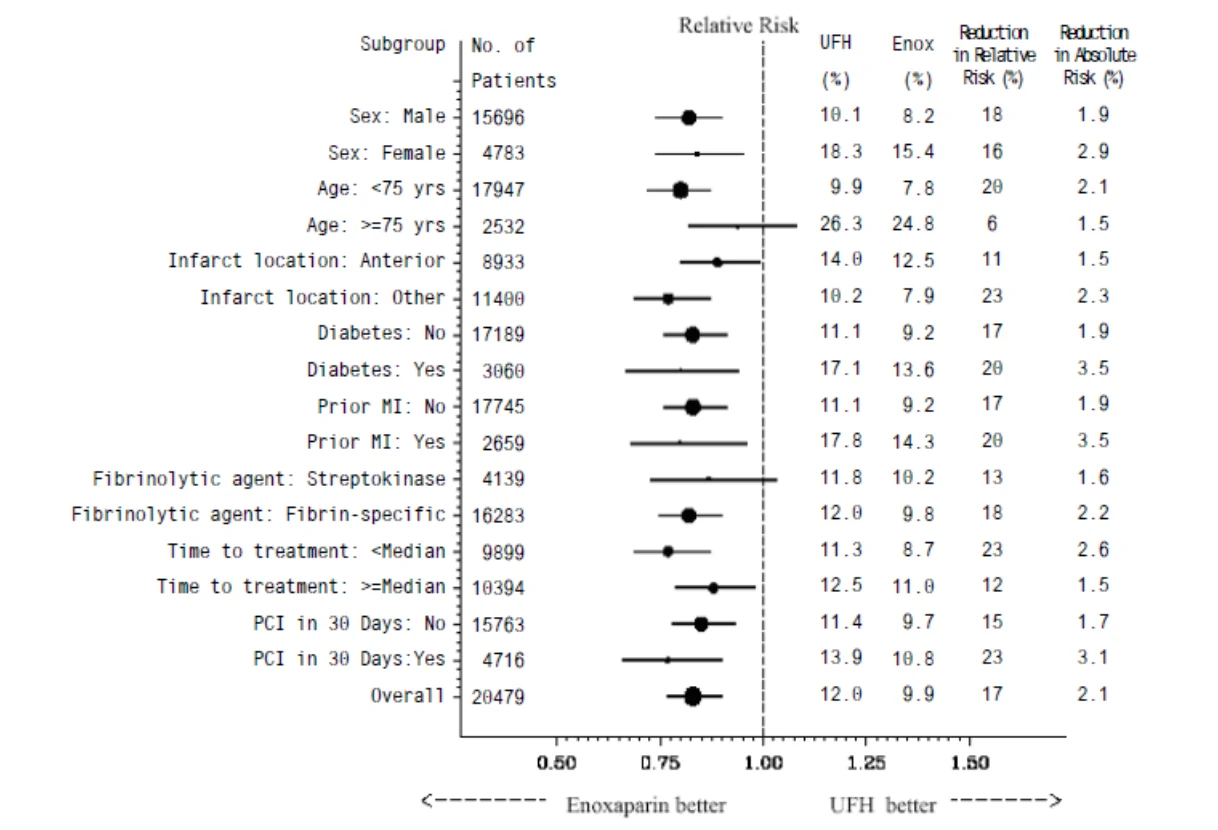
The primary efficacy end point was the composite of death from any cause or myocardial reinfarction in the first 30 days. The overall treatment effect of enoxaparin as compared to the unfractionated heparin is shown at the bottom of the figure. For each subgroup, the circle is proportional to the number and represents the point estimate of the treatment effect and the horizontal lines represent the 95 percent confidence intervals. Fibrin-specific fibrinolytic agents included alteplase, tenecteplase and reteplase. Time to treatment indicates the time from the onset of symptoms to the administration of study drug (median, 3.2 hours). Although there was some variation in the estimate of the treatment effect of enoxaparin on the primary endpoint across the subgroups shown, all P values in tests for interaction were non significant.
There was a significant treatment benefit of enoxaparin, as compared with unfractionated heparin, in patients who underwent percutaneous coronary intervention within 30 days after randomization (23% relative risk reduction, representing an absolute risk reduction of 3.1%) or who were treated medically (15 % relative risk reduction, representing an absolute risk reduction of 1.7%, P = 0.27 for interaction).
The rate of the 30-day composite endpoint of death, myocardial re-infarction or ICH (a measure of net clinical benefit) was significantly lower (p<0.0001) in the enoxaparin group (10.1%) as compared to the heparin group (12.2%), representing a 2.1% absolute risk reduction and a 17% relative risk reduction in favor of treatment with enoxaparin.
Benefit of enoxaparin beyond 30 days post-treatment period, up to 1 year for the treatment of acute STEMI
The ExTRACT – 1 year follow-up study evaluated the benefits of enoxaparin beyond 30 days post-treatment period up to 1 year.
Study demographics and trial design [ExTRACT – 1-year follow-up]
In order to determine whether or not the clinical benefits of enoxaparin shown in the early phase of ExTRACT trial persisted over-time, a one-year follow-up survey was undertaken in all patients enrolled in the ExTRACT study. The main objective of the follow-up period was to assess the subject status at 6-months and 12-months (mortality, myocardial re-infarction, disabling stroke, or re- hospitalization). The one-year follow-up period was defined as time of randomization through one-year assessment or last contact (documented by phone contact or patient record). Complete 1 year information from 18 160 (88.7%) patients was available. Two thousand three hundred and twelve (11.3%) patients discontinued from the study. The primary reasons for discontinuation are: death 2115 (10.3%), discontinuation for other reasons 90 (0.4%), lost to follow-up 107 (0.5 %).
| Table 36 - Summary of Patient Demographics for ExTRACT – 1-Year Follow-Up | |||||||||
|---|---|---|---|---|---|---|---|---|---|
| Study # | Trial design | Dosage, route of administration and duration | Study subjects (n=number) | Mean age (Range) | Gender (M/F) | ||||
ExTRACT – 1- year follow-up | 1 year collection of data | See table 31 above for ExTRACT- Dosage, route of administration and duration During the additional follow-up period subjects were off study medication. | Total: 20 479 18 160 (with long term follow-up) | ||||||
enoxaparin : 9098 heparin : 9062 | 58.8 (20-99) 58.9 (20-92) | 7102/1996 7160/1902 | |||||||
Study results
There was a statistically significant difference (p = 0.0111, log-rank test, hazard ratio [HR] = 0.92) in favor of the enoxaparin group compared with the UFH group with respect to time to death or myocardial re-infarction at 12 months as assessed by survival analysis (log-rank test). The beneficial effect of enoxaparin on the composite primary end point (death or myocardial reinfarction) observed during the first 30 days was maintained over a 12 month follow-up period (see Figure 2). The relative risk reduction in the composite endpoint of death from any cause or myocardial re-infarction observed in the first 30 days after randomization and at 12 months was 17% and 8% respectively.
| Table 37 – Results from Cox Regression and Kaplan Meir over 12 months – ITT population | ||||||||||||||||
|---|---|---|---|---|---|---|---|---|---|---|---|---|---|---|---|---|
| Parameter | Enoxaparin | UFH | Enox vs UFH hazard ratiob | 95% CI of HR | p-value a | |||||||||||
| N | n | N | n | |||||||||||||
| Main Clinical endpoint | 10256 | 10223 | ||||||||||||||
| Death or myocardial re-infarction | 1614 | 1732 | 0.92 | [0.86-0.98] | 0.0111 | |||||||||||
| Additional component endpoints | 10256 | 10223 | ||||||||||||||
| Death or myocardial re-infarction, or disabling stroke | 1638 | 1765 | 0.91 | [0.85-0.98] | 0.0069 | |||||||||||
| Individual component endpoints | 10 256 | 10223 | ||||||||||||||
| Death | 1075 | 1085 | 0.98 | [0.90 – 1.07] | 0.7145 | |||||||||||
| Myocardial re-infarction | 666 | 775 | 0.84 | [0.76 - 0.94] | 0.0013 | |||||||||||
| Disabling stroke | 112 | 115 | 0.97 | [0.75 – 1.26] | 0.8121 | |||||||||||
| Re-hospitalization | 2873 | 2742 | 1.05 | [0.99 – 1.10] | 0.0849 | |||||||||||
Note: Re-hospitalization was for a cardiac/vascular reason.
a log-rank test
b unadjusted Cox Regression
ITT = intent to treat population; UFH = unfractionated heparin; Enox = enoxaparin, vs = versus, N = population size; n = number of subjects with events
CI = confidence interval; HR = hazard ratio
Figure 2. Kaplan-Meier plot - death or myocardial re-infarction at 30 days and at 1 year - ITT population
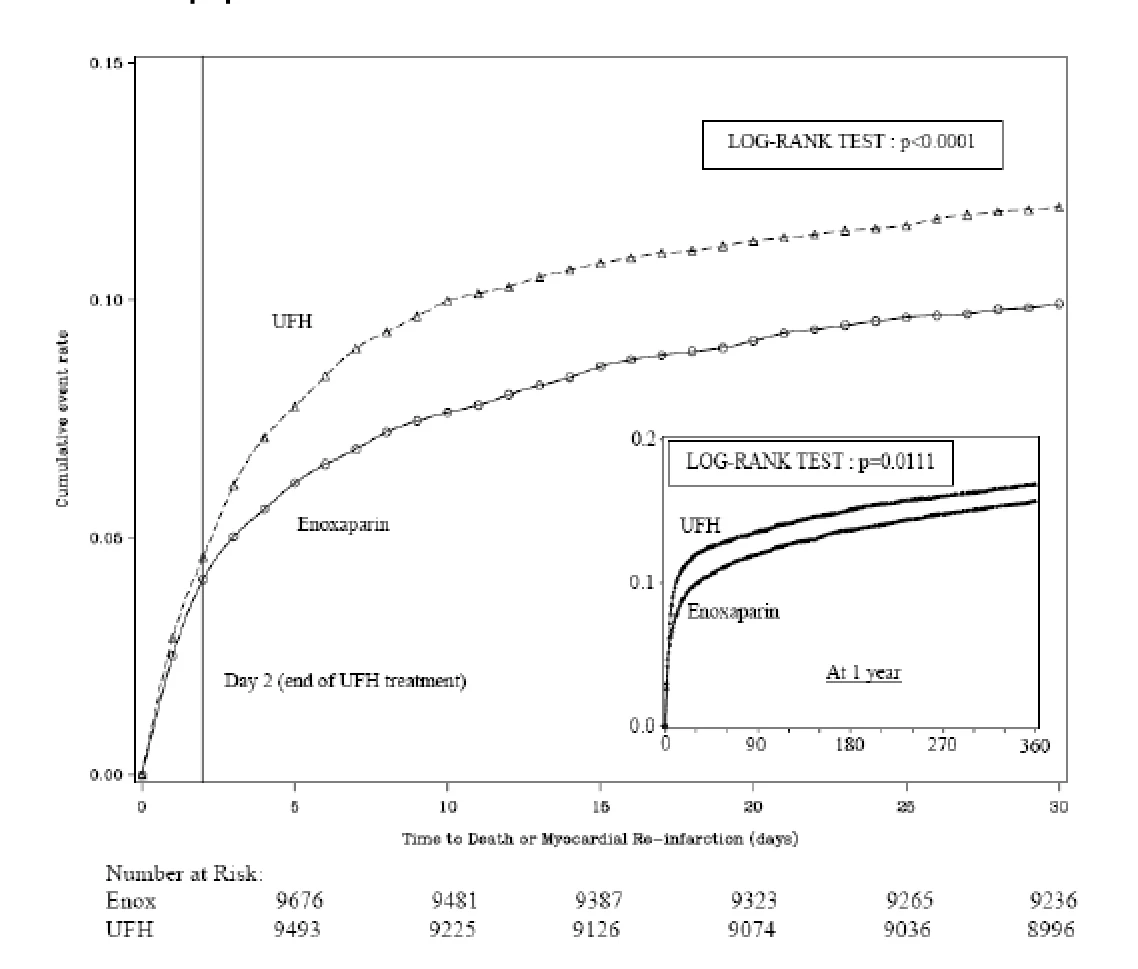
Prevention of thrombus formation in the extracorporeal circulation during hemodialysis
Information to support the safety and efficacy of enoxaparin in the prevention of thrombus formation in the extracorporeal circulation during hemodialysis comes from three published studies.
15 NON-CLINICAL TOXICOLOGY- REFERENCE BIOLOGIC DRUG
Acute Toxicity
Acute toxicity studies in enoxaparin were carried out with both sexes of several animal species. The results are tabulated below:
| Species | Route | LD50 (mg/kg) |
|---|---|---|
| Mouse (NMRI strain) | ||
M (N=40) F (N= 40) M (N=35) F (N= 30) | s.c. s.c. i.v. i.v. | 6700 (5027-8930) 8100 (6326-10371) 2340 (2066-2650) 2340 (2122-2580) |
| Rat (Sprague-Dawley strain) | ||
| Species | Route | LD50 (mg/kg) |
|---|---|---|
M (N=40) F (N= 40) M (N=35) F (N= 40) | s.c. s.c. i.v. i.v. | >46.4* >46.4* 1660 (1518-1816) 1810 (1625-2017) |
| Dog (Beagle) | ||
| (N=3) | i.v. | >2150 |
*Mortality not linearly related.
Acute signs of toxicity in mice and rats following i.v. dosing of enoxaparin included ataxia, dyspnea with slight mydriasis, short tonic convulsions and death. Following s.c. dosing, acute signs of toxicity included ataxia, dyspnea, cyanosis and, occasionally, ventral decubitus, coma and death. In dogs, signs of toxicity included polypnea, tachycardia, mild agitation, sedation, lateral decubitus, ptyalism, mydriasis and loss of oculopalpebral reflex; all dogs recovered completely.
Local Tolerance and Sensitization
Single high dose subcutaneous injections of 0.6 mL enoxaparin injection solution (equivalent to an anti-Xa activity of approximately 100 mg) were well tolerated by 6 Beagle dogs, with no signs of local irritation or allergic potential. Likewise, single intradermal injections of up to 50% enoxaparin for 1 to 3 weeks, followed by epicutaneous application of the drug, revealed no allergenic potential or local intolerance in 40 male Pirbright white guinea pigs.
Long Term Toxicity
Subacute and chronic toxicity studies were conducted in rats, dogs and monkeys. There were no species differences in the toxicity of enoxaparin; in all animals there were changes in hematology values and organ weights, reflecting the physiological adaptation of animals to long term anticoagulant treatment and resulting hemorrhage.
In subacute studies, the highest non-toxic s.c. doses over 13 weeks were 3 mg/kg/day in rats and 6.5 mg/kg/day in dogs. In 26-week studies, the highest non-toxic dose was 3 mg/kg/day in both rats and monkeys.
In the Rat
13-Week, Subcutaneous Administration
Wistar rats received enoxaparin in doses of 3, 6.5 or 15 mg/kg/day for 13 weeks (30 rats per dose). Hematology values remained within the normal limits during the first 6 weeks, but after 13 weeks of treatment, animals in the highest dose group showed moderate decreases in hemoglobin, red cell count, packed cell volume and small increases in WBC and platelets. With the highest dose, there were slight increases in LDH, alpha hydroxy butyric dehydrogenase (HBDH) and slight decreases in alkaline phosphatase, sodium ion and chloride ion. Histopathological examination revealed dose-related hemorrhage and hematomas at the injection site.
26-Week, Subcutaneous Administration
Groups of Sprague-Dawley rats (30 animals per group) received 0, 3, 10 and 30 mg/kg/day s.c. for 26 weeks.
Mortality rates of about 30% occurred among animals taking the two highest doses (versus 2% of control animals and 3% of animals on the lowest dose).
Animals receiving the highest dose exhibited decreased concentrations of hemoglobin, hematocrit and RBC and a higher incidence of prothrombin consumption times of less than 100 seconds. Platelet counts were elevated in all treated animals, but normalized during a post-treatment recovery period. These hematology responses were considered normal sequelae of anticoagulant activity, rather than toxic manifestations.
Cholesterol levels in all males and in high dose females were elevated above control values in both treatment and recovery phases.
Terminal absolute and relative organ weights for the spleen and liver were elevated in doserelated manner. Histomorphological examinations revealed bleeding at the injection site, but no toxicopathological effects.
26-Week, Intravenous Administration
Sprague-Dawley rats (25-30 animals per dose) initially received 0, 1, 10, 30 and 90 mg/kg/day, but after 4 weeks, the two highest doses were reduced to 20 and 40 mg/kg/day because of excessive anticoagulation and toxicity.
In all animals, inflammation, hemorrhage and necrosis were observed at the injection site. Mortality was dose related, death being due to internal hemorrhaging, particularly into the abdominal cavity.
Chronic enoxaparin administration induced decreases in hemoglobin, hematocrit and RBC and increases in platelet and reticulocyte counts, the latter in the highest dose group only. All values normalized during the post-treatment recovery period. With the highest doses, serum urea was elevated, which was likely a result of tubular nephrosis of the kidney and renal capsular hemorrhage seen at autopsy. In addition, organ weights of the spleen, adrenal gland, kidney, heart and liver were increased. Autopsy revealed tubular nephrosis of the kidney and renal capsular hemorrhage.
In the Dog
13-Week, Subcutaneous Administration
Beagle dogs (6 animals per dose) received enoxaparin for 13 weeks in doses of 0, 3, 6.5 and
15 mg/kg/day s.c.
There were no deaths and no drug related effects on body weight, food consumption, ocular examination, plasma parathormone (PTH) levels or terminal organ weights.
Mild dose-related local hemorrhaging occurred at the injection site, but almost no subcutaneous hemorrhaging.
Hematology and biochemistry values remained normal throughout the study and histopathological findings at necropsy revealed only mild parathyroid hyperplasia in dogs given the highest dose.
In the Monkey
26-Week, Subcutaneous Administration
Cynomolgus monkeys (7 animals/sex/group) were given enoxaparin in doses of 0, 3, 10 and 20 mg/kg/day s.c. for 26 weeks. After 6 months, 2 animals/sex/group were selected for 6 weeks of observation of recovery.
Two high dose males died spontaneously after 10 and 172 days. Another high dose male and
3 high dose females were killed in extremis. All deaths were the result of hemorrhaging.
Dose-related inflammation of the injection site was observed, but symptoms generally disappeared by the end of the recovery period.
Among surviving animals, body weight and food consumption remained normal. Hematology values of RBC, hemoglobin and hematocrit, prothrombin time decreased, while thrombin time and eosinophilic sedimentation rates were elevated in mid- and high dose animals. Urinalysis and biochemistry values remained within normal limits.
Organ weights for the kidney, liver and spleen were elevated in the mid- and high dose animals and remained elevated in the male animals of the high dose group after the recovery period.
26-Week, Intravenous Administration
Cynomolgus monkeys (4-5 animals per dose) were given 0, 5, 10 or 20 mg/kg enoxaparin i.v. for 26 weeks. One animal in each group was retained for 4 weeks for observation of recovery.
One monkey in the high dose group died, although it had had no excessive bleeding or abnormal histopathological signs at autopsy.
No signs of toxicity were observed with the 5 mg/kg dose. Other doses produced dose-related inflammation and hemorrhaging at the injection site. Swelling of the arms or legs gradually disappeared by the end of the dosing period.
During treatment, hematology, biochemistry and urinalysis values in all treated animals corresponded to those of control animals. Histopathological examination revealed no drug-related changes in individual organs.
Mutagenicity
Enoxaparin exhibited no mutagenic activity when tested in vitro by the Ames test in 5 strains of S. typhimurium. Likewise, no mutagenic activity could be demonstrated in vitro in a mammalian cell system, mouse lymphoma cells, with and without metabolic activation. The clastogenic potential of enoxaparin was tested in vitro in human peripheral lymphocytes and in vivo in the bone marrow cells of rats. No clastogenic activity could be demonstrated by either method.
Reproduction and Teratology
Fertility and Reproduction - In the Rat
Reproductive performance was evaluated in 26 male and in 26 female sexually mature Sprague- Dawley rats (identified as the Fo generation of animals). Starting 15 days before mating, all animals received 0, 3, 10 or 20 mg/kg/day enoxaparin subcutaneously. Treatment continued through mating, gestation and lactation to 4 days post partum. One portion of the females was sacrificed 21 days after mating and another portion following the weaning of offspring.
Enoxaparin produced no adverse effects on the general condition of Fo animals or on reproductive performance, gestation and parturition. Necropsy of dams revealed normal numbers of corpora lutea, uterine contents and fetuses. The neonates (F1 generation) exhibited no signs of toxicity and followed normal weight gain patterns. Fertility and reproductive performance of the untreated F1 generation were normal and the fetal parameters of their offspring (F2 generation) were normal.
In conclusion, enoxaparin, when given in doses of up to 20 mg/kg/day s.c. throughout a complete gametogenic cycle, pregnancy and lactation exerted no significant adverse effects on reproductive performance of treated Fo animals or on the growth and reproduction of their untreated F1 offspring.
Teratology - In the Rat
Female Sprague-Dawley rats (20 animals per dose) received enoxaparin by subcutaneous injection in doses of 3, 10 or 30 mg/kg/day from Days 6 to 15 of gestation. Control animals received the physiological saline vehicle. All dams were killed on Day 21 of gestation.
Maternal necropsy showed no evidence of adverse effects on corpora lutea or uterine contents. Fetuses from the 3 and 10 mg/kg dose groups showed no treatment-related abnormalities. In the high dose group, there was a slightly higher incidence of large fetuses as compared to historical control values and a slightly increased incidence of hydronephrosis and unilateral hydroureter. Also in the high dose group, there was a slightly higher incidence of fetuses with dilated brain ventricles, thought to be associated with low fetal body weight.
In another study, female Sprague-Dawley rats (24 animals per dose) received enoxaparin by the intravenous route in doses of 0, 10, 40 and 160 mg/kg/day from Days 6 to 15 of gestation. Fetal necropsy was performed on the 20th day of gestation. Doses of 10 and 40 mg/kg/day exerted no adverse systemic effects on dams and did not adversely influence prenatal development.
The 160 mg/kg/day dose was within the low lethal range for the dams and 2 animals died from loss of blood. Fertility results from the surviving dams did not differ significantly from the controls or lower dose groups.
There were no indications of teratogenic effects in rats with enoxaparin by either the s.c. or i.v. routes, even with the highest doses.
Teratology - In the Rabbit
Female New Zealand rabbits (14 animals per dose) received enoxaparin by subcutaneous injection in doses of 0, 3, 10 and 30 mg/kg/day from Days 6 to 18 of gestation. Dams were sacrificed on Day 29 of gestation.
Two dams (given 10 mg/kg/day) aborted all fetuses during treatment. One female each in the 10 and 30 mg/kg/day groups totally resorbed their litters.
Necropsy examination of the other animals revealed no significant differences between enoxaparin- and vehicle-treated dams with respect to corpora lutea, uterine contents and number of fetuses. There was one abnormal fetus from the 3 mg/kg group, but this was considered unrelated to drug treatment.
In a second study, female New Zealand rabbits (12 animals per dose) received enoxaparin by the intravenous route in doses of 0, 10, 40 or 160 mg/kg/day from Days 6 to 18 of gestation. Dams were killed on Day 29 of gestation.
One rabbit in the highest dose group died from multiple systemic hemorrhages and another animal aborted.
On gestation Day 19, there were no adverse maternal or fetal effects for the groups given 10 and 40 mg/kg/day. In the group given 160 mg/kg/day, there were no significant differences in the number of corpora lutea or uterine implantations compared to vehicle control values. Four dams from this group resorbed all fetuses. The group mean resorption rate in the high dose group was 56.8% (versus 9.8% for the control group).
There were no teratogenic effects in rabbits by either route of administration. In the high-dose intravenous group, the frequency of vertebral malformations was slightly increased, but still within the normal range for this species.
Perinatal and Postnatal Development - In the Rat
Enoxaparin was administered to Sprague-Dawley rats (20 animals per dose) in doses of 0, 3, 10 or 20 mg/kg/day s.c. from the 15th day of gestation to the 21st day of lactation. Offspring were observed from birth to weaning.
Litter size, viability and general condition of the offspring were unaffected by treatment. Postnatal body weights and body weight gain to weaning were marginally reduced in the low-and mid-dose groups, but were significantly reduced in the high-dose group. Terminal examination of offspring revealed no macroscopic changes in any of the groups.
16 SUPPORTING PRODUCT MONOGRAPHS
PrLOVENOX® (solution for injection, 100 mg/mL), PrLOVENOX® HP (solution for injection, 150 mg/mL), submission control 216420, Product Monograph, sanofi-aventis Canada Inc. December 19, 2019.