


Product Monograph - Apo-Dasatinib Tablets
RECENT MAJOR LABEL CHANGES
None at time of the most recent authorization
TABLE OF CONTENTS
Certain sections or subsections that are not applicable at the time of the preparation of the most recent authorized product monograph are not listed.
RECENT MAJOR LABEL CHANGES ........................................................................................... 2
TABLE OF CONTENTS ............................................................................................................. 2
PART I: HEALTH PROFESSIONAL INFORMATION ..................................................................... 4
1 INDICATIONS ................................................................................................................ 4
1.1 Pediatrics ................................................................................................................... 4
1.2 Geriatrics .................................................................................................................... 4
2 CONTRAINDICATIONS ................................................................................................... 5
3 SERIOUS WARNINGS AND PRECAUTIONS BOX ............................................................... 5
4 DOSAGE AND ADMINISTRATION ................................................................................... 5
4.1 Dosing Considerations ............................................................................................... 5
4.2 Recommended Dose and Dosage Adjustment .......................................................... 6
4.4 Administration ........................................................................................................... 8
4.5 Missed Dose ............................................................................................................... 9
5 OVERDOSAGE ............................................................................................................... 9
6 DOSAGE FORMS, STRENGTHS, COMPOSITION AND PACKAGING .................................... 9
7 WARNINGS AND PRECAUTIONS .................................................................................. 10
7.1 Special Populations .................................................................................................. 16
7.1.1 Pregnant Women ..................................................................................................... 16
7.1.2 Breast-feeding ......................................................................................................... 17
7.1.3 Pediatrics ................................................................................................................. 17
7.1.4 Geriatrics .................................................................................................................. 17
8 ADVERSE REACTIONS .................................................................................................. 18
8.1 Adverse Reaction Overview ..................................................................................... 18
8.2 Clinical Trial Adverse Reactions ............................................................................... 19
8.3 Less Common Clinical Trial Adverse Reactions........................................................ 28
8.4 Abnormal Laboratory Findings: Hematologic, Clinical Chemistry and Other Quantitative Data ................................................................................................................ 30
8.5 Post-Market Adverse Reactions .............................................................................. 33
9 DRUG INTERACTIONS .................................................................................................. 33
9.2 Drug Interactions Overview ..................................................................................... 33
9.4 Drug-Drug Interactions ............................................................................................ 33
9.5 Drug-Food Interactions ............................................................................................ 37
9.6 Drug-Herb Interactions ............................................................................................ 37
9.7 Drug-Laboratory Test Interactions .......................................................................... 38
10 CLINICAL PHARMACOLOGY ......................................................................................... 38
10.1 Mechanism of Action ............................................................................................... 38
10.2 Pharmacodynamics .................................................................................................. 38
10.3 Pharmacokinetics..................................................................................................... 39
11 STORAGE, STABILITY AND DISPOSAL ........................................................................... 41
12 SPECIAL HANDLING INSTRUCTIONS ............................................................................. 41
PART II: SCIENTIFIC INFORMATION ...................................................................................... 42
13 PHARMACEUTICAL INFORMATION .............................................................................. 42
14 CLINICAL TRIALS .......................................................................................................... 43
14.1 Trial Design and Study Demographics ..................................................................... 43
14.2 Study Results ........................................................................................................... 45
14.3 Comparative Bioavailability Studies ........................................................................ 51
15 MICROBIOLOGY .......................................................................................................... 52
16 NON-CLINICAL TOXICOLOGY ....................................................................................... 52
17 SUPPORTING PRODUCT MONOGRAPHS ...................................................................... 67
PATIENT MEDICATION INFORMATION ................................................................................. 68
PART I: HEALTH PROFESSIONAL INFORMATION
1 INDICATIONS
APO-DASATINIB TABLETS (dasatinib tablets) is indicated for the treatment of adults with:
Newly diagnosed Philadelphia chromosome positive (Ph+) chronic myeloid leukemia (CML) in chronic phase.
Clinical effectiveness of dasatinib tablets treatment in patients with newly diagnosed Ph+ CML in chronic phase is based on confirmed complete cytogenetic response rate (cCCyR) within 12 months. As of the 60 month cut-off date, overall survival, prevention of progression to advanced stage CML, or time-in cCCyR benefits have not been demonstrated (see 14 CLINICAL TRIALS).
Ph+ chronic, accelerated, or blast phase chronic myeloid leukemia (CML) with resistance or intolerance to prior therapy including imatinib mesylate.
Clinical effectiveness of dasatinib tablets in CML is based on the rates of hematologic and cytogenetic responses in clinical trials with a minimum of 24 months of follow-up (see 14 CLINICAL TRIALS).
Ph+ acute lymphoblastic leukemia (ALL) with resistance or intolerance to prior therapy.
Clinical effectiveness in Ph+ ALL is based on the rates of hematologic and cytogenetic responses in clinical trials with a minimum of 24 months of follow-up (see 14 CLINICAL TRIALS).
APO-DASATINIB TABLETS should only be prescribed by a qualified physician who is experienced in the use of antineoplastic therapy.
1.1 Pediatrics
The safety and efficacy of dasatinib tablets in patients < 18 years of age have not been established. Therefore Health Canada has not authorized an indication for pediatric use. Nonclinical studies demonstrated greater toxicity in rat pups (see 7.1 Special populations).
1.2 Geriatrics
The safety profile of dasatinib tablets in the geriatric population was similar to that in the younger population (see 7.1.4 Geriatrics).
2 CONTRAINDICATIONS
- Breastfeeding is contraindicated in women taking dasatinib (see 7.1.2 Breast-feeding).
- Use of APO-DASATINIB TABLETS is contraindicated in patients with hypersensitivity to dasatinib or to any other component of APO-DASATINIB TABLETS.
3 SERIOUS WARNINGS AND PRECAUTIONS BOX
Serious Warnings and Precautions
- APO-DASATINIB TABLETS (dasatinib tablets) should only be prescribed by a qualified physician who is experienced in the use of antineoplastic therapy.
- Myelosuppression: thrombocytopenia, neutropenia, and anemia (see 7 WARNINGS AND PRECAUTIONS, Hematologic).
- Hemorrhage, including fatal outcomes (see 7 WARNINGS AND PRECAUTIONS, Hemorrhage).
- Fluid retention, pleural effusion, pulmonary edema and pericardial effusion (see 7 WARNINGS AND PRECAUTIONS, Respiratory).
- Congestive heart failure (see 7 WARNINGS AND PRECAUTIONS, Cardiovascular ).
- Pulmonary arterial hypertension (see 7 WARNINGS AND PRECAUTIONS, Respiratory below)
4 DOSAGE AND ADMINISTRATION
Note: APO-DASATINIB TABLETS manufactured by Apotex Inc. is NOT available in the 140 mg strength.
4.1 Dosing Considerations
Dose reduction for concomitant use of strong CYP3A4 inhibitors
The concomitant use of strong CYP3A4 inhibitors and grapefruit juice with APO-DASATINIB TABLETS should be avoided (see 9.4 Drug-Drug Interactions, Table 8). CYP3A4 inhibitors such as ketoconazole may increase dasatinib tablets plasma concentrations. If possible, an alternative concomitant medication with no or minimal enzyme inhibition potential should be selected. If APO-DASATINIB TABLETS must be administered with a strong CYP3A4 inhibitor, consider a dose decrease to:
40 mg daily for patients taking APO-DASATINIB TABLETS 140 mg daily.
20 mg daily for patients taking APO-DASATINIB TABLETS 100 mg daily.
20 mg daily for patients taking APO-DASATINIB TABLETS 70 mg daily.
For patients taking APO-DASATINIB TABLETS 60 mg or 40 mg daily, consider interrupting APO-DASATINIB TABLETS until the inhibitor is discontinued. Allow a washout period of approximately 1 week after the inhibitor is stopped before reinitiating APO-DASATINIB TABLETS.
The reduced doses of dasatinib tablets are predicted to adjust the area under the curve (AUC) to the range observed without CYP3A4 inhibitors; however, clinical data are not available with these dose adjustments in patients receiving strong CYP3A4 inhibitors. If APO-DASATINIB TABLETS is not tolerated after dose reduction, either discontinue the strong CYP3A4 inhibitor or stop APO-DASATINIB TABLETS until the inhibitor is discontinued. Allow a washout period of approximately 1 week after the inhibitor is stopped before the APO-DASATINIB TABLETS dose is increased.
4.2 Recommended Dose and Dosage Adjustment
- The recommended starting dosage of APO-DASATINIB TABLETS for chronic phase CML is 100 mg administered orally once daily (OD), either in the morning or in the evening.
- The recommended starting dosage of APO-DASATINIB TABLETS for accelerated phase CML, or myeloid or lymphoid blast CML, is 140 mg/day administered orally once daily (140 mg QD) either in the morning or in the evening.
- The recommended starting dosage of APO-DASATINIB TABLETS for Ph+ ALL is 140 mg administered orally once daily (140 mg QD) either in the morning or in the evening.
Dosing recommendations in patients with imatinib resistant or intolerant CML and Ph+ ALL are based on the results of two randomized Phase III dose-optimization studies (see 14 CLINICAL TRIALS).
In clinical studies, treatment with dasatinib tablets was continued until disease progression or until no longer tolerated by the patient. The effect of stopping treatment on long-term disease outcome after the achievement of a complete cytogenetic response ([CCyR]) or major molecular response (MMR) has not been investigated.
Dose Escalation
In clinical studies of adult CML and Ph+ ALL patients, dose escalation to 140 mg once daily
(chronic phase CML) or 180 mg once daily (advanced phase CML and Ph+ ALL) was allowed in patients who did not achieve a hematologic or cytogenetic response at the recommended dosage.
Dose Adjustment for Adverse Reactions
Myelosuppression
In clinical studies, myelosuppression was managed by dose interruption, dose reduction, or discontinuation of study therapy. Hematopoietic growth factor has been used in patients with resistant myelosuppression. Guidelines for dose modifications are summarized in Table 1.
Table 1 - Dose Adjustments for Neutropenia and Thrombocytopenia
Chronic Phase CML (starting dose 100 mg once daily) | ANC* <0.5 × 10⁹/L and/or Platelets <50 × 109/L |
|
Accelerated Phase CML, Blast Phase CML and Ph+ ALL (starting dose 140 mg once daily) | ANC* <0.5 × 10⁹/L and/or Platelets <10 × 109/L |
|
*ANC: absolute neutrophil count
Non-hematological adverse reactions
If a moderate (Grade 2) non-hematological adverse reaction develops with APO-DASATINIB TABLETS, treatment should be interrupted until the adverse reaction has resolved or returned to baseline. The same dose should be resumed if this is the first occurrence and the dose should be reduced if this is a recurrent adverse reaction.
If a severe (Grade 3 or 4) non-hematological adverse reaction develops with APO-DASATINIB TABLETS use, treatment must be withheld until the event has resolved or improved. Thereafter, treatment can be resumed as appropriate at a reduced dose depending on the initial severity of the event. However, in patients diagnosed with pulmonary arterial hypertension (PAH), APO-DASATINIB TABLETS should be permanently discontinued.
Patients with chronic CML who received 100 mg once daily, dose reduction to 80 mg once daily with further reduction from 80 mg once daily to 50 mg once daily, if needed, is recommended. For adult patients with advanced phase CML or Ph+ ALL who received 140 mg once daily, dose reduction to 100 mg once daily with further reduction from 100 mg once daily to 80 mg once daily, if needed, is recommended.
Hepatic impairment:
No clinical pharmacokinetic trials were conducted with a 70 to 100 mg dose of dasatinib tablets in patients with decreased liver function. APO-DASATINIB TABLETS should be used with caution in patients with moderate to severe hepatic impairment (see 7 WARNINGS AND PRECAUTIONS, Hepatic/Biliary/Pancreatic).
Renal impairment:
No clinical trials were conducted with dasatinib tablets in patients with decreased renal function (trials excluded patients with serum creatinine concentration >1.5 times the upper limit of the normal range). Since the renal clearance of dasatinib and its metabolites is <4%, a decrease in total body clearance is not expected in patients with renal insufficiency.
Pediatrics (< 18 years of age):
The safety and efficacy of dasatinib tablets in patients <18 years of age have not been established. Therefore Health Canada has not authorized an indication for pediatric use.
4.4 Administration
APO-DASATINIB TABLETS can be taken with or without food. Tablets should not be crushed or cut; they should be swallowed whole.
4.5 Missed Dose
If a dose is missed, the next dose should be taken at the usual time. Do not double dose.
5 OVERDOSAGE
Experience with overdose of dasatinib tablets in clinical studies is limited to isolated cases. The highest reported dosage ingested was 280 mg per day for 1 week in two patients and both developed a significant decrease in platelet counts. Since dasatinib tablets is associated with severe myelosuppression (see 7 WARNINGS AND PRECAUTIONS and 8 ADVERSE REACTIONS), patients who ingested more than the recommended dosage should be closely monitored for myelosuppression and appropriate supportive treatment given.
6 DOSAGE FORMS, STRENGTHS, COMPOSITION AND PACKAGING
Table 2 - Dosage Forms, Strengths, Composition and Packaging
| Route of Administration | Dosage Form / Strength/Composition | Non-medicinal Ingredients |
| Oral | Tablet / 20 mg, 50 mg, 70 mg, 80 mg and 100 mg | Colloidal silicon dioxide, croscarmellose sodium, hydroxypropyl cellulose, hydroxypropyl methylcellulose, lactose monohydrate, magnesium stearate, microcrystalline cellulose, titanium dioxide and triethyl citrate. |
APO-DASATINIB TABLETS 20 mg is white to off-white, round shape, biconvex coated tablet. Engraved "APO" on one side, "DA" over "20" on the other side.
APO-DASATINIB TABLETS 50 mg is white to off-white, oval shape, biconvex beveled-edge coated tablet. Engraved "APO" on one side, "DAS5O" on the other side.
APO-DASATINIB TABLETS 70 mg is white to off-white, round shape, biconvex coated tablet. Engraved "APO" on one side, "DA" over "70" on the other side.
APO-DASATINIB TABLETS 80 mg is white to off-white, round shape, biconvex coated tablet.
For the most recent information in the management of a suspected drug overdose, contact your regional poison control centre or Health Canada’s toll-free number, 1-844 POISON-X (1-844-764-7669).
Engraved "APO" on one side, "DAS" over "80" on the other side.
APO-DASATINIB TABLETS 100 mg is white to off-white, oval shape, biconvex beveled-edge coated tablet. Engraved "APO" on one side, "DAS100" on the other side.
APO-DASATINIB TABLETS film coated tablets, 20 mg, 50 mg, 70 mg, 80 mg and 100 mg are supplied in blisters of 30 tablets.
7 WARNINGS AND PRECAUTIONS
Please see 3 SERIOUS WARNINGS AND PRECAUTIONS BOX.
Carcinogenesis and Mutagenesis
Please see 16 NON-CLINICAL TOXICOLOGY
Cardiovascular
The Phase III clinical study in patients with newly diagnosed CML in chronic phase excluded patients with uncontrolled or significant cardiovascular disease. The dasatinib tablets arm (n=258) included 1.6 % of patients with prior cardiac disease and 24% with baseline cardiovascular risk factors. Cardiac adverse reactions of congestive heart failure/cardiac dysfunction, pericardial effusion, arrhythmias, palpitations, QT prolongation, and myocardial infarction (including fatal) were reported in patients taking dasatinib tablets (see 8 ADVERSE REACTIONS). Severe pericardial effusion (1.2%) and arrhythmia (0.4%) were also reported in patients. Adverse cardiac events were more frequent in patients with cardiovascular risk factors or a previous medical history of cardiac disease (see 8 ADVERSE REACTIONS). Patients with risk factors or a history of cardiac disease should be evaluated at baseline and monitored carefully for clinical signs or symptoms consistent with cardiac dysfunction (such as chest pain, shortness of breath, and diaphoresis) during routine follow up.
In the Phase III clinical trials in patients with resistance or intolerance to prior imatinib therapy, patients were excluded from enrolment for a broad range of cardiac events or conditions. A significantly abnormal ECG at screening was also an exclusion criterion. No prospective evaluation of cardiac function was carried out.
In all clinical trials with patients resistant or intolerant to prior imatinib therapy, congestive heart failure/cardiac dysfunction was reported in 96 (4%) of subjects, of which 49 (2%) were considered to be severe. In some cases, the event was triggered by an acute volume load, including transfusion of blood products.
QT Prolongation
In vitro data suggest that dasatinib and its N-dealkylated metabolite, BMS- 582691 have the potential to prolong cardiac ventricular repolarization (QT interval, see Safety Pharmacology).
In 865 patients with leukemia treated with dasatinib tablets in Phase II clinical studies, the mean changes from baseline in QTcF interval were 4 to 6 msec; the upper 95% confidence intervals for all mean changes from baseline were <7 msec. Of the 2182 patients with resistance or intolerance to prior imatinib therapy who received dasatinib tablets in clinical studies, 21 patients (<1%) experienced a QTcF >500 msec.
In the Phase III clinical study in patients with newly diagnosed CML in chronic phase, patients with baseline QTcF interval > 450 msec were excluded. After 5 years of follow-up, QTc prolongation was reported in one patient (<1%) who experienced a QTcF >500 msec and discontinued dasatinib tablets treatment. APO-DASATINIB TABLETS should be administered with caution in patients who have or may develop prolongation of QTc. These include patients with hypokalemia or hypomagnesemia, patients with congenital long QT syndrome, patients taking anti arrhythmic medicines or other medicinal products that lead to QT prolongation, and cumulative high-dose anthracycline therapy.
Hypokalemia or hypomagnesemia should be corrected prior to administration of APO-DASATINIB TABLETS. (See 9 DRUG INTERACTIONS, Drugs that prolong QTc interval or induce torsade de pointes, 10.2 Pharmacodynamics, Electrocardiogram.)
Also refer to Respiratory below for information concerning fluid retention.
Endocrine and Metabolism
Lactose
APO-DASATINIB TABLETS 20 mg, 50 mg, 70 mg, 80 mg and 100 mg contain lactose in proportional amounts of 44.6 mg, 111.5 mg, 156.1 mg, 178.4 mg and 223.1 mg, respectively. APO-DASATINIB TABLETS therefore contains 223.1 mg of lactose in the 100 mg daily dose of dasatinib. Patients with rare hereditary problems of galactose intolerance, the Lapp lactase deficiency or glucose-galactose malabsorption should not take dasatinib.
Hematologic
Hemorrhage
Nonclinical studies have shown that dasatinib inhibits platelet aggregation in vitro and in vivo and increases bleeding time in vivo (see 16 NON-CLINICAL TOXICOLOGY, Special Toxicity). Patients with a history of significant bleeding disorder unrelated to CML were excluded in dasatinib tablets clinical studies. Patients taking concomitant medications that inhibit platelet function or anticoagulants were excluded in initial imatinib-resistant dasatinib tablets clinical studies. In subsequent trials, the use of anticoagulants, aspirin, and non-steroidal anti-inflammatory drugs (NSAIDs) was allowed concurrently with dasatinib tablets if the platelet count was >50,000 per microliter. Caution should be exercised when dasatinib tablets is to be concurrently administered with anticoagulants (see 9 DRUG INTERACTIONS).
In clinical studies in 2,712 CML or Ph+ ALL patients with a median duration of therapy of 19.2 months (range 0 to 93.2 months), 272 (10%) patients experienced Grade 3 to 4 bleeding. Fifty-six (2%) patients experienced fatal bleeding. In 23 (1%) of these patients, fatal bleeding occurred more than 30 days after dasatinib discontinuation.
Intracranial hemorrhage occurred in 66 (2.4%) of 2,712 CML or Ph+ ALL patients, of which 27 (1%) cases were considered related to dasatinib tablets. Intracranial hemorrhage was fatal in 25 (0.9%) of these patients, of which ten (0.4%) cases were considered related to dasatinib tablets.
Gastrointestinal hemorrhage regardless of relationship to dasatinib tablets occurred in 15 % of 2,712 CML or Ph+ ALL patients. The bleeding was severe in 6 % of these patients and generally required treatment interruptions and packed cell transfusions. Other episodes of severe bleeding occurred in 3% of patients.
Grade 3 to 4 hemorrhages were reported in 2.3% of 258 patients with newly diagnosed chronic phase CML (see 8 ADVERSE REACTIONS).
Myelosuppression
Treatment with dasatinib tablets is associated with thrombocytopenia, neutropenia, and anemia which occur earlier and more frequently in patients with advanced phase CML or Ph+ ALL than in patients with chronic phase CML. In a Phase III dose-optimization study in patients with chronic phase CML with resistance or intolerance to prior imatinib therapy with a minimum follow-up of 24 months, Grade 3 or 4 myelosuppression was reported less frequently in patients treated with 100 mg once daily (neutropenia 35%, thrombocytopenia 23% and anemia 13%) than in patients treated with 70 mg twice daily (neutropenia 45%, thrombocytopenia 38% and anemia 18%). Severe febrile neutropenia (including fatal outcomes) was reported in 2% of chronic phase patients and 14% of advanced phase CML patients.
In patients with advanced phase CML or Ph+ ALL treated with dasatinib complete blood counts (CBCs) should be performed weekly for the first 2 months and then monthly thereafter, or as clinically indicated.
In patients with chronic phase CML, CBCs should be performed every 2 weeks for 12 weeks, then every 3 months thereafter or as clinically indicated.
Myelosuppression was generally reversible and usually managed by withholding dasatinib tablets temporarily or dose reduction (see 4.2 Recommended Dose and Dosage Adjustment and 8.4 Abnormal Laboratory Findings: Hematologic, Clinical Chemistry and Other Quantitative Data). In clinical studies in patients with resistance or intolerance to prior imatinib therapy, severe (CTC Grade 3 or 4) cases of anemia were managed with blood transfusions. Packed red blood cells were transfused in 30% of chronic phase CML patients and 79% of myeloid blast phase CML patients. Platelet transfusions were required in 17% of chronic phase CML patients and 66% of myeloid blast phase CML patients.
Hepatic/Biliary/Pancreatic
The effect of hepatic impairment on the single-dose pharmacokinetics of dasatinib was assessed in 8 moderately hepatic impaired subjects who received a 50-mg dose and 5 severely hepatic- impaired subjects who received a 20-mg dose compared to matched healthy subjects who received a 70-mg dose of dasatinib tablets. Hepatic impairment did not result in clinically meaningful change in dasatinib exposure at the doses studied. However no pharmacokinetic information is available from patients with hepatic impairment treated with a 70 to 100 mg dose of dasatinib tablets (see 10.3 Pharmacokinetics, Special Populations and Conditions). Due to the limitations of this clinical study, caution is recommended in patients with hepatic impairment.
In nonclinical studies, increased liver weight and foci of hepatocellular alteration were observed in rats, and hepatocellular vacuolation was observed in monkeys following repeat dose administration of dasatinib (6 to 9 months). Increased ALT was observed in monkeys, and increased AST and/or decreased albumin were observed in rats and monkeys.
In clinical studies with 2,712 patients, 4 cases of hepatotoxicity, 4 cases of hepatocellular injury, 4 cases of hepatic steatosis, 2 cases of jaundice, 2 cases of liver disorder, 1 case of toxic hepatitis, 1 case of hepatic failure, 2 cases of abnormal hepatic function and 1 case of hepatitis were observed.
Immune
Hepatitis B virus reactivation
Reactivation of hepatitis B virus (HBV) has occurred in patients who are chronic carriers of this virus after receiving a BCR-ABL tyrosine kinase inhibitor (TKI), including dasatinib tablets. Some cases resulted in acute hepatic failure or fulminant hepatitis leading to liver transplantation or death.
Patients should be tested for HBV infection before initiating treatment with APO-DASATINIB TABLETS. Experts in liver disease and in the treatment of HBV should be consulted before treatment is initiated in patients with positive HBV serology (including those with active disease) and for patients who test positive for HBV infection during treatment. Carriers of HBV who require treatment with APO-DASATINIB TABLETS should be closely monitored for signs and symptoms of active HBV infection throughout therapy and for several months following termination of therapy.
Monitoring and Laboratory Tests
In patients with chronic phase CML, complete blood counts (CBCs) should be performed every two weeks for 12 weeks, then every 3 months thereafter, or as clinically indicated. In patients with advanced phase CML or Ph+ ALL, CBC should be performed weekly for the first 2 months and then monthly thereafter, or as clinically indicated (see 7 WARNINGS AND PRECAUTIONS, Immune).
Hepatic function tests (AST, ALT and bilirubin), CK and renal function tests should be performed every two weeks for the first 2 months and then monthly thereafter or as clinically indicated (see 7 WARNINGS AND PRECAUTIONS: Hepatic Impairment and Musculoskeletal).
Musculoskeletal
Cases of rhabdomyolysis with acute renal failure have been reported. Patients with muscle symptoms (muscle aches/pains) should be investigated to rule out rhabdomyolysis (elevated creatine kinase, elevated serum creatinine, hyperkalemia, hyperphosphatemia, brown urine, elevated ALT and AST).
Renal
There are currently no clinical studies with dasatinib tablets in patients with impaired renal function. The study in patients with newly diagnosed chronic phase CML excluded patients with serum creatinine concentration > 3 times the upper limit of the normal range, and studies in patients with chronic phase CML with resistance or intolerance to prior imatinib therapy excluded patients with serum creatinine concentration >1.5 times the upper limit of the normal range. Dasatinib and its metabolites are minimally excreted via the kidney. Since the renal excretion of unchanged dasatinib and its metabolites is <4%, a decrease in total body clearance is not expected in patients with renal insufficiency. The effect of dialysis on dasatinib pharmacokinetics has not been studied.
Reproductive Health: Female and Male Potential
Fertility
The effects of dasatinib tablets on male and female fertility in humans are not known. Based on animal studies, dasatinib tablets may impair fertility in females of reproductive potential (See 16 NON-CLINICAL TOXICOLOGY, Reproductive and Developmental Toxicology).
Teratogenic Risk
Dasatinib can cause fetal harm when administered to pregnant women. Knowledge of the potential effects of dasatinib tablets on the sperm of male patients, and the level of maternal or fetal exposure from the semen of male dasatinib tablets patients, is limited. Sexually active male patients or female patients of child bearing potential taking APO-DASATINIB TABLETS should use highly effective contraception.
Respiratory
Pulmonary Arterial Hypertension
Serious cases of pulmonary arterial hypertension (PAH), confirmed by right heart catheterization, have been associated with dasatinib tablets treatment in clinical trials and post-marketing reports. In these cases, PAH was reported after initiation of dasatinib tablets therapy, including after more than one year of treatment. In the Phase III clinical study in patients with newly diagnosed CML in chronic phase, drug-related pulmonary hypertension was reported in 4.7% of dasatinib-treated patients (N= 12) compared to 0.4% of imatinib-treated patients. Additional evaluation by right heart catheterization to determine if PAH was present was only performed in one case where PAH was not identified and pulmonary hypertension was not confirmed.
Patients should be evaluated for signs and symptoms of underlying cardiopulmonary disease prior to initiating APO-DASATINIB TABLETS therapy. Patients who develop symptoms suggestive of PAH such as dyspnea and fatigue after initiation of therapy should be evaluated for more common etiologies including pleural effusion, pulmonary edema, anemia, or lung infiltration. If no alternative diagnosis is found, the diagnosis of PAH should be considered. If the symptoms are severe, APO-DASATINIB TABLETS should be withheld during this evaluation. APO-DASATINIB TABLETS should be permanently discontinued if PAH is confirmed (see 4.2 Recommended Dose and Dosage Adjustment, Dose Adjustment for Adverse Reactions). Follow up on patients with PAH should be performed according to standard practice guidelines. Improvements in hemodynamic and clinical parameters have been observed in patients with PAH following cessation of dasatinib tablets therapy.
Fluid Retention
Dasatinib tablets is associated with fluid retention. Patients with pre-existing pleural effusion were excluded from Phase III studies.
In the Phase III dose-optimization studies in patients with resistance or intolerance to prior imatinib therapy, severe fluid retention was reported in 11% of patients, including severe pleural and pericardial effusion reported in 7% and 2% of patients, respectively. Severe ascites and generalized edema were each reported in <1% of patients. Other manifestations of fluid retention in these studies included pulmonary edema (3%), congestive heart failure/cardiac dysfunction (4%), and pericardial effusion (5%). Nineteen patients had severe pulmonary edema. In patients with chronic phase CML with resistance or intolerance to prior imatinib therapy, Grade 3 or 4 fluid retention events were reported less frequently in patients treated with 100 mg once daily (5%) than in patients treated with 140 mg once daily (9%) (see 8.2 Clinical Trial Adverse Reactions). In these studies, fluid retention events were typically managed by supportive care measures that include diuretics or short courses of steroids. Pleural effusion required oxygen in some cases and at least one thoracentesis in 64 (3%) patients.
In the Phase III study conducted with newly diagnosed chronic phase CML patients, grades 1 to 4 fluid retention and pleural effusion were reported in 22% and 10%, respectively, by 12 months of treatment (see 8.2 Clinical Trial Adverse Reactions). The median time to onset of pleural effusion was 28 weeks (range 4 to 88 weeks). With appropriate medical care, 23 patients (88% of those with pleural effusion) were able to continue on dasatinib tablets. After 5 years follow-up, fluid retention and pleural effusion were reported in 43% and 29% of patients, respectively. The median time to first grade 1 to 2 pleural effusion was 114 weeks and to first grade 3 to 4 pleural effusions was 175 weeks. Dasatinib treatment was discontinued due to pleural effusion in 5.8% of all dasatinib-treated patients. Out of patients with a pleural effusion, dasatinib treatment was interrupted in 62% and dose reduced in 41%, and was also managed through the use of diuretics or other appropriate supportive care measures.
In all patients with newly diagnosed or imatinib resistant or intolerant patients with chronic phase CML (n=548), severe fluid retention occurred in 36 (7%) patients receiving dasatinib tablets at the recommended dose. In patients with advanced phase CML or Ph+ ALL treated with dasatinib tablets at the recommended dose (n=304), severe fluid retention was reported in 11% of patients, including severe pleural effusion reported in 8% of patients.
Patients who develop symptoms suggestive of pleural effusion or other fluid retention such as new or worsened dyspnea on exertion or at rest, pleuritic chest pain, or dry cough should be evaluated promptly with chest X-ray or additional diagnostic imaging as appropriate (see 4 DOSAGE AND ADMINISTRATION and 8 ADVERSE REACTIONS). Consider treatment interruption, dose reduction, or treatment discontinuation.
Skin
Individual cases of severe mucocutaneous dermatologic reactions, including Stevens-Johnson syndrome and erythema multiforme, have been reported with the use of dasatinib tablets. APO-DASATINIB TABLETS should be permanently discontinued in patients who experience a severe mucocutaneous reaction during treatment if no other etiology can be identified.
7.1 Special Populations
7.1.1 Pregnant Women
Dasatinib can cause fetal harm when administered to pregnant women. There have been postmarketing reports of spontaneous abortion and fetal and infant anomalies from women who have taken dasatinib tablets during pregnancy (see 8.5 Post-Market Adverse Reactions). Studies in animals have shown that at concentrations which are readily achievable in humans receiving therapeutic doses of dasatinib tablets, fetal toxicity (embryofetal lethality, skeletal abnormalities including malformations) was observed in both pregnant rats and rabbits. Fetal death was observed in rats (see 16 NON-CLINICAL TOXICOLOGY, Reproductive and Developmental Toxicology).
APO-DASATINIB TABLETS therefore should not be used in women who are pregnant or contemplating pregnancy. Women of child bearing potential must be advised to use highly effective contraception (i.e. a method of birth control that results in a failure rate less than 1% per year when used consistently and correctly) during APO-DASATINIB TABLETS treatment. If APO-DASATINIB TABLETS is used during pregnancy, or if the patient becomes pregnant while taking APO-DASATINIB TABLETS, the patient should be apprised of the potential hazard to the fetus.
7.1.2 Breast-feeding
It is unknown whether dasatinib is excreted in human milk. In an exploratory pre- and post-natal development study in rats, postnatal exposure to dasatinib through lactation resulted in pleural effusion and mortality in pups before postnatal age of 20 days at an exposure of 0.27 times the adult clinical dose (see 16 NON-CLINICAL TOXICOLOGY, Reproductive and Developmental Toxicology). Women who are taking APO-DASATINIB TABLETS must not breastfeed (see 2 CONTRAINDICATIONS).
7.1.3 Pediatrics
The safety and efficacy of dasatinib tablets in patients <18 years of age have not been established. Therefore Health Canada has not authorized an indication for pediatric use.
7.1.4 Geriatrics
In the newly diagnosed chronic phase CML study, 25 patients (10%) were 65 years of age and older and 7 patients (3%) were 75 years of age and older. Patients of 65 years and over had more serious adverse events reported (any or drug-related) compared to those under 65 years (40.7% vs. 29.7%, 16.7% vs. 12.1%, respectively). Of the 2,712 patients in clinical studies of dasatinib tablets, 617 (23%) were 65 years of age and older and 123 (5%) were 75 years of age and older. While the safety profile of dasatinib tablets in the geriatric population was similar to that in the younger population, patients aged 65 years and older are more likely to experience the commonly reported adverse reactions diarrhea, fatigue, cough, pleural effusion, dyspnea, dizziness, peripheral edema, pneumonia, hypertension, arrhythmia, congestive heart failure, pericardial effusion, lower gastrointestinal hemorrhage, abdominal distension and more likely to experience the less frequently reported events pulmonary edema, lung infiltration, arthritis, and urinary frequency and should be monitored closely. No differences in cCCyR and MMR were observed between older and younger patients. However, in the two randomized studies in patients with imatinib resistant or intolerant chronic phase CML, the rates of major cytogenetic response (MCyR) at 2 years were lower among patients aged 65 years and older (42% MCyR in patients ≥ 65 years versus 56% MCyR in the rest of the study population and 47% MCyR in patients ≥ 65 years versus 68% MCyR in the rest of the study population in studies CA180017 and CA180034, respectively).
8 ADVERSE REACTIONS
8.1 Adverse Reaction Overview
The data described below reflect exposure to dasatinib tablets at all doses studied from clinical studies in 2,712 patients, including 324 patients with newly diagnosed chronic phase CML and 2388 patients with imatinib intolerant or resistant chronic or advanced phase CML or Ph+ ALL. The median duration of therapy in 2,712 dasatinib tablets treated patients was 19.2 months (range 0 to 93.2 months).
The majority of dasatinib tablets-treated patients experienced adverse events at some time. Most events were mild to moderate. In the overall population of 2,712 dasatinib tablets-treated subjects, 798 (29.4%) experienced adverse events leading to treatment discontinuation. Among the 258 patients in the Phase III newly diagnosed chronic phase CML study with follow up over a minimum of 60 months, serious adverse events, regardless of relationship to dasatinib tablets, were reported in 35% of patients treated with dasatinib tablets. A total of 69% of patients had dose interruption and 37% had dose reduction.
Dasatinib tablets was discontinued due to study drug toxicity in 14% of dasatinib tablets-treated patients with a minimum of 60 months follow-up. The reasons for discontinuation were thrombocytopenia, leukopenia, pleural effusion, colitis, creatinine kinase increased, pericardial effusion, prolonged QTc interval, chest pain, optic neuritis, pulmonary hypertension, dyspnea, pleurisy, pneumothorax, acute myocardial infarction, abdominal discomfort, abdominal pain, colitis, diarrhea, peripheral edema, and acute renal failure.
Among the 1,618 dasatinib tablets-treated subjects with chronic phase CML, adverse reactions leading to discontinuation were reported in 329 (20.3%) subjects, and among the 1,094 dasatinib tablets-treated subjects with advanced phase disease (including Ph+ ALL), adverse reactions leading to discontinuation were reported in 191 (17.5%) subjects.
In a Phase III dose-optimization study in chronic phase CML patients resistant or intolerant to prior imatinib therapy with a minimum of 84 months follow-up, the rate of discontinuation for adverse reactions was 21% in patients treated with 100 mg once daily.
The median time to onset for Grade 1 or 2 pleural effusion events was 114 weeks (range 4-299 weeks). Fewer than 3% of pleural effusion events were Grade 3 or 4. With appropriate medical care, 58 patients (80% of those with pleural effusion) were able to continue on dasatinib tablets (see 7 WARNINGS AND PRECAUTIONS, Respiratory).
With a minimum of 60 months of follow up, the most frequently adverse events reported in dasatinib tablets-treated patients with newly diagnosed chronic phase CML were fluid retention (including pleural effusion, superficial edema, pulmonary hypertension, generalized edema, pericardial effusion, congestive heart failure/cardiac dysfunction, pulmonary edema), diarrhea, infection (including bacterial, viral, fungal and non-specified), upper respiratory tract infection/inflammation, musculoskeletal pain, headache, cough, rash, pyrexia, and abdominal pain.
With a minimum of 84 months of follow up, in 165 patients with chronic phase CML resistant or intolerant to prior imatinib therapy treated with the recommended dose of 100 mg once daily, the most frequently reported adverse events, regardless of causality or severity, were diarrhea, fluid retention, headache, musculoskeletal pain, hemorrhage, pyrexia, fatigue, infection, skin rash, nausea, dyspnea, cough, upper respiratory tract infection/inflammation, vomiting, pain, abdominal pain, arthralgia, myalgia, pruritis and constipation.
8.2 Clinical Trial Adverse Reactions
Clinical trials are conducted under very specific conditions. The adverse reaction rates observed in the clinical trials, therefore, may not reflect the rates observed in practice and should not be compared to the rates in the clinical trials of another drug. Adverse reaction information from clinical trials may be useful in identifying and approximating rates of adverse drug reactions in real-world use.
Newly diagnosed patients with chronic phase CML
In the Phase III study in patients with newly diagnosed chronic phase CML the median duration of therapy was 60 months for both groups (range: < 1 to 73 months for the dasatinib tablets group and <1 month to 75 months in the imatinib group); the median average daily dose was 99 mg and 400 mg, respectively.
All treatment-emergent adverse events (excluding laboratory abnormalities), regardless of relationship to study drug, that were reported in at least 5% of the patients are shown in Table 3.
A total of 26 (10%) dasatinib tablets-treated patients died (11 of infections and 2 of myocardial infarction) and a total of 26 patients (10%) in the imatinib arm died (including 1 of myocardial infarction, 1 of pneumonia, 1 of fatal bleeding at time of disease progression and 2 of unknown cause/clinical deterioration and decrease in performance status).
Table 3: Adverse Events Reported in ≥5% of Patients with Newly Diagnosed Chronic Phase CML - 60 Month Follow up
Dasatinib tablets 100 mg QD n = 258 | Imatinib 400 mg QD n = 258 | ||||||||||
|---|---|---|---|---|---|---|---|---|---|---|---|
Dasatinib tablets 100 mg QD n = 258 | Imatinib 400 mg QD n = 258 | ||||||||||
Dasatinib tablets 100 mg QD n = 258 | Imatinib 400 mg QD n = 258 | ||||||||||
| All Grades | Grade 3/4 | All Grades | Grade 3/4 | ||||||||
| All Grades | Grade 3/4 | All Grades | Grade 3/4 | ||||||||
| All Grades | Grade 3/4 | All Grades | Grade 3/4 | ||||||||
| SYSTEM ORGAN CLASS/ Preferred Term | Percent (%) of patients | ||||||||||
| SYSTEM ORGAN CLASS/ Preferred Term | Percent (%) of patients | ||||||||||
| SYSTEM ORGAN CLASS/ Preferred Term | Percent (%) of patients | ||||||||||
| Any Adverse Event | 95 | 27 | 95 | 24 | |||||||
| Cardiovascular | |||||||||||
| Pericardial effusion | 5 | 1 | 2 | 0 | |||||||
| Congestive heart failure/ cardiac dysfunctiona, * | 4 | 1 | 2 | 1 | |||||||
| Gastrointestinal | |||||||||||
| Diarrhea | 40 | 2 | 35 | 2 | |||||||
| Abdominal pain | 22 | 1 | 17 | <1 | |||||||
| Vomiting | 17 | <1 | 21 | <1 | |||||||
| Nausea | 15 | 0 | 29 | 0 | |||||||
| Dyspepsia | 11 | 0 | 12 | 0 | |||||||
| Gastritis | 10 | <1 | 7 | 0 | |||||||
| Mucosal inflammation (including mucositis/stomatitis) | 9 | <1 | 5 | 0 | |||||||
| Constipation | 8 | 0 | 3 | 0 | |||||||
| Abdominal Distension | 6 | 0 | 4 | 0 | |||||||
| Ascites* | 0 | 0 | <1 | 0 | |||||||
| General Disorders and Administration Site Conditions | |||||||||||
| Pyrexia | 23 | 1 | 20 | <1 | |||||||
| Fatigue | 16 | <1 | 16 | 0 | |||||||
| Pain | 16 | 1 | 15 | <1 | |||||||
| Asthenia | 16 | 0 | 14 | 1 | |||||||
| Face edema | 12 | 0 | 38 | 0 | |||||||
| Chest pain | 11 | 0 | 5 | 0 | |||||||
| Peripheral edema | 9 | 0 | 13 | <1 | |||||||
| Generalized edema | 5 | 0 | 9 | 0 | |||||||
| Infections and Infestations | |||||||||||
| Infection (including bacterial, viral, fungal, | 40 | 4 | 30 | 3 | |||||||
| non-specified) | |||||||||||
| Upper respiratory tract infection/inflammation | 38 | 1 | 38 | 1 | |||||||
| Enterocolitis infection | 11 | 0 | 6 | <1 | |||||||
| Investigations | |||||||||||
| Weight increased | 10 | 2 | 13 | 3 | |||||||
| Metabolism and Nutrition Disorders | |||||||||||
| Appetite disturbances | 9 | 0 | 5 | 0 | |||||||
| Musculoskeletal and Connective Tissue Disorders | |||||||||||
| Musculoskeletal pain | 31 | <1 | 34 | <1 | |||||||
| Myalgia | 14 | <1 | 16 | 0 | |||||||
| Arthralgia | 14 | 0 | 16 | <1 | |||||||
| Muscle spasms | 5 | 0 | 24 | <1 | |||||||
| Nervous System Disorders | |||||||||||
| Headache | 23 | 0 | 18 | <1 | |||||||
| Dizziness | 11 | <1 | 7 | <1 | |||||||
| Neuropathy (including peripheral) | 10 | <1 | 8 | <1 | |||||||
| Ophthalmologic | |||||||||||
| Conjunctivitis | 4 | 0 | 7 | 0 | |||||||
| Psychiatric disorder | |||||||||||
| Insomnia | 8 | 0 | 6 | 0 | |||||||
| Depression | 2 | 0 | 5 | <1 | |||||||
| Respiratory, Thoracic and Mediastinal Disorders | |||||||||||
| Pleural effusion | 29 | 3 | 1 | 0 | |||||||
| Cough | 27 | <1 | 11 | 0 | |||||||
| Dyspnea | 16 | 2 | 6 | 0 | |||||||
| Pulmonary hypertension | 5 | 1 | <1 | 0 | |||||||
| Pulmonary edema* | 1 | 0 | 0 | 0 | |||||||
| Skin and Subcutaneous Tissue Disorders | |||||||||||
| Rashb | 20 | 0 | 23 | 2 | |||||||
| Pruritus | 7 | 0 | 9 | <1 | |||||||
| Acne | 6 | 0 | 2 | 0 | |||||||
| Dermatitis including eczema | 4 | 0 | 7 | 0 | |||||||
| Pigmentation disorder | 2 | 0 | 7 | 0 | |||||||
| Hyperhidrosis | 2 | 0 | 5 | 0 | |||||||
| Vascular Disorders | |||||||||||
| Hemorrhage | 19 | 2 | 18 | 2 | |||||||
| Other bleedingc | 14 | <1 | 15 | 2 | |||||||
| Gastrointestinal bleeding | 5 | 1 | 4 | <1 | |||||||
| CNS bleeding* | 1 | <1 | <1 | <1 | |||||||
| Hypertension | 11 | <1 | 8 | <1 | |||||||
- a. Includes cardiac failure, cardiac failure acute, cardiac failure congestive, cardiomyopathy, diastolic dysfunction, ejection fraction decreased, and left ventricular dysfunction.
- b. Includes erythema, erythema multiforme, heat rash, rash, rash erythematous, rash generalized, rash macular, rash papular, rash pustular, skin exfoliation, and rash vesicular.
- c. Includes conjunctival hemorrhage, ear hemorrhage, ecchymosis, epistaxis, eye hemorrhage, gingival bleeding, hematoma, hematuria, hemoptysis, hemorrhage, hemorrhage subcutaneous, intra-abdominal hematoma, menorrhagia, metrorrhagia, petechiae, scleral hemorrhage, uterine hemorrhage, and vaginal hemorrhage.
* Adverse events of special interest with <5% frequency.
Patients with imatinib intolerant or resistant CML or Ph+ ALL
All treatment-emergent adverse events (excluding laboratory abnormalities), regardless of relationship to study drug, that were reported in at least 5% of the patients treated with dasatinib tablets at the recommended dose of 100 mg once daily in a Phase III clinical study of imatinib intolerant or resistant chronic phase CML are shown in Table 4.
In the Phase III dose-optimization study in patients with imatinib intolerant or resistant chronic phase CML, the median overall duration of therapy with 100 mg once daily was 30 months (range 1 to 93 months).
Table 4: Adverse Events Reported in ≥5% of Patients treated with 100 mg Once Daily dose in Clinical Studies of Imatinib Intolerant or Resistant Chronic Phase CML - 84 month follow up
SYSTEM ORGAN CLASS/ Preferred Term | Phase III | |
|---|---|---|
SYSTEM ORGAN CLASS/ Preferred Term | Phase III | |
SYSTEM ORGAN CLASS/ Preferred Term | Phase III | |
100 mg QD N=165 | ||
100 mg QD N=165 | ||
100 mg QD N=165 | ||
| Percent (%) of patients | ||
| Percent (%) of patients | ||
| Percent (%) of patients | ||
| All Grades | Grade 3/4 | |
| All Grades | Grade 3/4 | |
| All Grades | Grade 3/4 | |
| Cardiology | ||
| Arrhythmia (including tachycardia) | 8 | 0 |
| Palpitations | 8 | 0 |
| Pericardial effusiona | 3 | 1 |
| Congestive heart failure/cardiac dysfunctiona, b | 2 | 1 |
| Gastrointestinal | ||
| Diarrhea | 42 | 4 |
| Abdominal pain | 24 | 2 |
| Nausea | 22 | 1 |
| Constipation | 18 | 2 |
| Vomiting | 14 | 1 |
| Abdominal distension | 12 | 0 |
| Mucosal inflammation (including mucositis/stomatitis) | 10 | 0 |
| Dyspepsia | 8 | 0 |
| Ascitesb | 1 | 0 |
| General Disorders and Administration Site Conditions | ||
| Fatigue | 37 | 4 |
| Pain | 27 | 1 |
| Superficial edemac | 26 | 1 |
| Pyrexia | 21 | 1 |
| Chest pain | 17 | 2 |
| Asthenia | 9 | 1 |
| Chills | 7 | 0 |
| Generalized edema | 5 | 1 |
| Immune System Disorders | ||
| Hypersensitivity (including erythema nodosum) | 5 | 1 |
| Infections and Infestations | ||
| Infection (including bacterial, | 48 | 6 |
| viral, fungal, non-specified) | ||
| Upper respiratory tract infection/inflammation | 43 | 1 |
| Pneumonia (including bacterial, viral, and fungal) | 13 | 5 |
| Enterocolitis infection | 7 | 2 |
| Herpes virus infection | 5 | 1 |
| Investigations | ||
| Weight increased | 11 | 1 |
| Weight decreased | 8 | 0 |
| Metabolism and Nutrition Disorders | ||
| Appetite Disturbances | 10 | 0 |
| Hyperuricemia | 5 | 1 |
| Musculoskeletal and Connective Tissue Disorders | ||
| Musculoskeletal pain | 48 | 3 |
| Arthralgia | 30 | 2 |
| Myalgia | 17 | 0 |
| Muscle spasms | 6 | 0 |
| Arthritis | 5 | 0 |
| Nervous System Disorders | ||
| Headache | 48 | 1 |
| Dizziness | 16 | 2 |
| Neuropathy (including peripheral neuropathy) | 14 | 1 |
| Ophthalmologic | ||
| Visual disorder | 7 | 0 |
| Psychiatric disorder | ||
| Insomnia | 12 | 0 |
| Depression | 11 | 1 |
| Anxiety | 5 | 0 |
| Respiratory, Thoracic and Mediastinal Disorders | ||
| Dyspnea | 34 | 2 |
| Cough | 34 | 1 |
| Pleural effusion | 28 | 5 |
| Pulmonary hypertensiona | 2 | 1 |
| Pulmonary edemaa | 1 | 0 |
| Skin and Subcutaneous Tissue Disorders | ||
| Skin rash | 33 | 2 |
| Pruritus | 17 | 1 |
| Hyperhidrosis | 10 | 0 |
| Alopecia | 8 | 0 |
| Dry skin | 6 | 0 |
| Acne | 5 | 0 |
| Vascular Disorders | ||
| Hemorrhage | 27 | 3 |
| Gastrointestinal bleeding | 6 | 1 |
| CNS bleeding | 0 | 0 |
| Hypertension | 9 | 0 |
| Flushing | 6 | 0 |
- a. Adverse events of special interest with <5% frequency.
- b. Includes ventricular dysfunction, cardiac failure, cardiac failure congestive, cardiomyopathy, congestive cardiomyopathy, diastolic dysfunction, ejection fraction decreased and ventricular failure
- c. Superficial edema is a grouped term composed of face edema, other superficial edema, and peripheral edema
With a minimum follow-up of 84 months, long-term cumulative safety data are available for the 100 mg once daily dose. Due to the allowance of switching to the 100 mg once daily dosing in the other three arms of the trial, safety results of these treatment groups are similar to the 100 mg once daily dose. Adverse events (all grades) that continued to occur in patients treated on the 100 mg once daily schedule at 2 and 7 years included: overall fluid retention (34% vs. 48%), pleural effusion (18% vs. 28%), and superficial edema (18% vs. 22%). Grade 3 or 4 pleural effusion among patients treated with 100 mg once daily at 2 and 7 years was 2% vs. 5%, respectively.
In the Phase III dose-optimization study exploring the once daily schedule of dasatinib tablets (140 mg once daily) in patients with imatinib intolerant or resistant advanced diseases, the median duration of therapy was 13.62 months (range .03 to 31.15 months) for accelerated phase CML, 3.19 months (range .03 to 27.73 months) for myeloid blast CML, 3.55 months (range .10 to 22.08 months) for lymphoid blast CML, and 2.99 months (range .16 to 23.46 months) for Ph+ ALL.
Table 5: Adverse Events Reported in ≥5% of Patients treated with 140 mg daily dose in Clinical Studies of Imatinib Intolerant or Resistant Advanced Phase CML and Ph+ ALL
SYSTEM ORGAN CLASS/ Preferred Term | Phase III | |
|---|---|---|
SYSTEM ORGAN CLASS/ Preferred Term | Phase III | |
SYSTEM ORGAN CLASS/ Preferred Term | Phase III | |
140 mg QD n = 304 | ||
140 mg QD n = 304 | ||
140 mg QD n = 304 | ||
| Percent (%) of patients | ||
| Percent (%) of patients | ||
| Percent (%) of patients | ||
| All Grades | Grade 3/4 | |
| All Grades | Grade 3/4 | |
| All Grades | Grade 3/4 | |
| Blood and Lymphatic Systems Disorders | ||
| Febrile neutropenia | 12 | 12 |
| Cardiology | ||
| Arrhythmia (including tachycardia) | 13 | 1 |
| Congestive heart failure/ cardiac dysfunctiona, b | 3 | 1 |
| Pericardial effusiona | 2 | 1 |
| Gastrointestinal Disorders | ||
| Diarrhea | 44 | 6 |
| Nausea | 34 | 2 |
| Vomiting | 28 | 1 |
| Abdominal pain | 20 | 4 |
| Mucosal inflammation (including mucositis/stomatitis) | 17 | 1 |
| Constipation | 15 | 1 |
| Dyspepsia | 9 | 0 |
| Ascitesa | <1 | <1 |
| General Disorders and Administration Site Conditions | ||
| Pyrexia | 39 | 3 |
| Fatigue | 29 | 5 |
| Superficial edemac | 25 | <1 |
| Pain | 24 | 2 |
| Asthenia | 13 | 3 |
| Chest pain | 13 | 1 |
| Generalised oedemaa | 3 | <1 |
| Infections and Infestations | ||
| Infection | 46 | 14 |
| Upper respiratory tract infection/inflammation | 26 | 1 |
| Pneumonia (including bacterial, viral, and fungal) | 17 | 9 |
| Sepsis (including fatal outcomes) | 6 | 4 |
| Enterocolitis infection | 5 | 1 |
| Injury, Poisoning and Procedural | ||
| Contusion | 6 | <1 |
| Investigations | ||
| Weight decreased | 17 | 1 |
| Weight increased | 11 | 1 |
| Metabolism and Nutrition Disorders | ||
| Appetite Disturbances | 17 | 1 |
| Musculoskeletal and Connective Tissue Disorders | ||
| Musculoskeletal pain | 38 | 7 |
| Arthralgia | 20 | 2 |
| Myalgia | 11 | 1 |
| Nervous System Disorders | ||
| Headache | 37 | 4 |
| Neuropathy (including peripheral neuropathy) | 14 | 1 |
| Dizziness | 9 | 1 |
| Psychiatric disorder | ||
| Depression | 8 | 0 |
| Insomnia | 6 | 0 |
| Anxiety | 6 | 1 |
| Renal and urinary disorders | ||
| Renal failure | 6 | 5 |
| Respiratory, Thoracic and Mediastinal Disorders | ||
| Cough | 29 | 0 |
| Pleural Effusion | 28 | 8 |
| Dyspnea | 28 | 6 |
| Lung infiltration | 5 | 2 |
| Pulmonary oedemaa | 2 | 1 |
| Pulmonary hypertensiona | 1 | 1 |
| Skin and Subcutaneous Tissue Disorders | ||
| Skin Rash | 27 | 1 |
| Pruritus | 10 | 0 |
| Hyperhidrosis | 9 | 0 |
| Dry skin | 6 | 0 |
| Vascular Disorders | ||
| Hemorrhage | 44 | 13 |
| Gastrointestinal bleeding | 17 | 9 |
| CNS bleedinga | 5 | 1 |
| Hypertension | 8 | 1 |
| Hypotension | 6 | 2 |
a Adverse events of special interest with <5% frequency.
b Includes ventricular dysfunction, cardiac failure, cardiac failure congestive, cardiomyopathy, congestive cardiomyopathy, diastolic dysfunction, ejection fraction decreased, and ventricular failure.
c Superficial edema is a grouped term composed of face edema, other superficial edema, and peripheral edema
8.3 Less Common Clinical Trial Adverse Reactions
The following additional adverse reactions, regardless of relationship to therapy or dosing regimen, were reported in patients in the dasatinib tablets clinical studies (n = 2,712) at a frequency of <5%, unless otherwise noted. These reactions are presented by frequency category. Frequent reactions are those occurring in ≥1% of patients, infrequent reactions are those occurring in 0.1% to <1% of patients and rare reactions are those occurring in <0.1% of patients. These events are included based on clinical relevance.
Blood and Lymphatic System Disorders: Frequent: myelosuppression (including anemia, neutropenia, thrombocytopenia); Infrequent: coagulopathy, lymphadenopathy, lymphopenia; Rare: aplasia pure red cell, splenic calcification.
Cardiac Disorders: Frequent: angina pectoris, cardiomegaly, myocardial infarction (including fatal outcomes) Infrequent: electrocardiogram QT prolonged, pericarditis, ventricular arrhythmia (including ventricular tachycardia), acute coronary syndrome, cor pulmonale myocarditis, electrocardiogram T wave abnormal, troponin increased, cardiac arrest, coronary artery disease; Rare: arteriosclerosis coronary artery, restrictive cardiomyopathy, electrocardiogram PR prolongation, pleuropericarditis.
Congenital, Familial and Genetic Disorders: Rare: porokeratosis.
Ear and Labyrinth Disorders: Frequent: tinnitus, vertigo, hearing loss.
Endocrine Disorders: Frequent: hypothyroidism; Infrequent: hyperthyroidism, thyroiditis.
Eye Disorders: Frequent: conjunctivitis, dry eye, visual disorder; Infrequent: visual impairment, lacrimation increased; Rare: pterygium, retinal vascular disorder, photophobia.
Gastrointestinal Disorders: Frequent: dysphagia, gastroesophageal reflux disease, colitis (including neutropenic colitis), oral soft tissue disorder; Infrequent: anal fissure, esophagitis, anal fistula, upper gastrointestinal ulcer, pancreatitis, ileus; Rare: protein-losing gastroenteropathy, volvulus, pancreatitis acute.
General Disorders and Administration Site Conditions: Frequent: malaise, face edema (>5%), other superficial edema; Rare: gait disturbance.
Hepatobiliary Disorders: Infrequent: cholecystitis, cholestasis, hepatitis; Rare: acquired dilatation intrahepatic duct.
Immune System Disorders: Rare: anaphylactic reaction.
Infections and Infestations: Rare: sialoadenitis
Injury, Poisoning and Procedural Complications: Rare: epicondylitis
Investigations: Infrequent: blood creatine phosphokinase increased, gamma-glutamyltransferase increased; Rare: clostridum test positive, coxsackle virus test positive, hepatitis C RNA increased, platelet aggregation abnormal, blood chloride increased.
Metabolism and Nutrition Disorders: Frequent: dehydration; Infrequent: hypoalbuminemia, diabetes mellitus, tumour lysis syndrome, hypercholesterolemia.
Musculoskeletal and Connective Tissue Disorders: Frequent: muscular weakness, musculoskeletal stiffness; Infrequent: tendonitis, rhabdomyolysis, muscle inflammation, osteonecrosis; Rare: chondrocalcinosis, osteochondrosis, gouty tophus.
Neoplasms Benign, Malignant and Unspecified: Rare: oral papilloma.
Nervous System Disorders: Frequent: dysgeusia, syncope, amnesia, tremor, convulsion, somnolence; Infrequent: cerebrovascular accident, transient ischemic attack, balance disorder, ataxia; Rare: VIIth nerve paralysis, cerebellar infarction, dementia, reversible posterior encephalopathy syndrome, optic neuritis, carotid artery stenosis.
Pregnancy, Puerperium and Perinatal Conditions: Rare: abortion
Psychiatric Disorders: Frequent: confusional state, affect lability; Infrequent: libido decreased;
Rare: hypomania, seasonal affective disorder.
Renal and Urinary Disorders: Infrequent: proteinuria, renal impairment; Rare: nephrocalcinosis, bladder diverticulum, glomerulonephritis.
Reproductive System and Breast Disorders: Frequent: gynecomastia; Infrequent: menstrual disorder; Rare: orchitis non-infective, vaginal prolapse.
Respiratory, Thoracic, and Mediastinal Disorders: Frequent: asthma, lung infiltration, dysphonia, pneumonitis; Infrequent: bronchospasm, acute respiratory distress syndrome (including fatal outcomes), pulmonary embolism, oropharyngeal discomfort; Rare: pulmonary arterial hypertension, nasal septum deviation, rhinitis hypertrophic, reflux laryngitis, nasal septum performation.
Skin and Subcutaneous Tissue Disorders: Frequent: urticaria, skin ulcer, photosensitivity; Infrequent: bullous conditions, nail disorder, neutrophilic dermatosis, palmar-plantar erythrodysaesthesia syndrome, panniculitis, hair disorder; Rare: asteatosis, leukocytoclastic vasculitis, skin fibrosis.
Vascular Disorders: Frequent: thrombophlebitis; Infrequent: deep vein thrombosis, thrombosis, atherosclerosis; Rare: livedo reticularis, peripheral arterial occlusive disease, arterial occlusive disease, embolism, cerebral arteriosclerosis.
8.4 Abnormal Laboratory Findings: Hematologic, Clinical Chemistry and Other Quantitative Data
Clinical Trial Findings
Myelosuppression was commonly reported in all studies. However, the frequency of Grade 3 or 4 neutropenia, thrombocytopenia, and anemia was higher in patients with advanced phase CML or Ph+ ALL than in chronic phase CML. Most patients continued treatment without further progressive myelosuppression.
Newly diagnosed patients with chronic phase CML
Laboratory abnormalities reported in patients treated with dasatinib tablets in the Phase III clinical study in patients with newly diagnosed CML are shown in Table 6. Myelosuppression was less frequently reported in newly diagnosed chronic phase CML, than in chronic phase CML patients with resistance or intolerance to prior imatinib therapy. In dasatinib tablets-treated patients who experienced grade 3 or 4 myelosuppression, recovery generally occurred following brief dose interruptions and/or reductions and permanent discontinuation of treatment occurred in 2.3% of patients due to drug-related hematologic toxicities.
Table 6: CTC Grade 3/4 Laboratory Abnormalities in Patients with Newly Diagnosed Chronic Phase CML 60-Month Follow up
| Laboratory Parameters | Dasatinib tablets (n=258) | Imatinib (n=258) |
| Laboratory Parameters | Dasatinib tablets (n=258) | Imatinib (n=258) |
| Percent (%) of Patients | ||
| Percent (%) of Patients | ||
| Biochemistry Parameters | ||
| Elevated Alkaline | 1 | 0 |
| phosphatase | ||
| Hyperuricemia | 4 | 1 |
| Hypophosphatemia | 7 | 31 |
| Hypokalemia | 0 | 3 |
| Hypocalcemia | 4 | 3 |
| Hypomagnesemia | <1 | 2 |
| Hyponatremia | 3 | 2 |
| Elevated SGPT (ALT) | <1 | 2 |
| Elevated SGOT (AST) | <1 | 1 |
| Elevated Bilirubin | 1 | 0 |
| Elevated Creatinine | 1 | 1 |
| Hematology Parameters | ||
| Neutropenia | 29 | 24 |
| Thrombocytopenia | 22 | 14 |
| Anemia | 13 | 9 |
| CTC grades: neutropenia (Grade 3 ≥0.5–<1.0 × 10⁹/L, Grade 4 <0.5 × 10⁹/L); thrombocytopenia (Grade 3 ≥25–<50 × 109/L, Grade 4 <25 × 109/L); anemia (hemoglobin Grade 3 ≥65–<80 g/L, Grade 4 <65 g/L); elevated creatinine (Grade 3 >3–6 × upper limit of normal range (ULN), Grade 4 >6 × ULN); elevated bilirubin (Grade 3 >3–10 × ULN, Grade 4 >10 × ULN); elevated SGOT or SGPT (Grade 3 >5–20 × ULN, Grade 4 >20 × ULN); hypocalcemia (Grade 3 <7.0–6.0 mg/dL, Grade 4 <6.0 mg/dL); hypophosphatemia (Grade 3 <2.0–1.0 mg/dL, Grade 4 <1.0 mg/dL); hypokalemia (Grade 3 <3.0–2.5 mmol/L, Grade 4 <2.5 mmol/L). | ||
Patients with imatinib intolerant or resistant CML or Ph+ ALL
Laboratory abnormalities that were reported in patients treated with dasatinib tablets in clinical studies are shown in Table 7 for imatinib intolerant or resistant chronic or advanced phase CML and Ph+ ALL.
In patients who experienced severe myelosuppression, recovery generally occurred following brief dose interruptions and/or reductions. Occasionally permanent discontinuation of treatment was required.
Elevations of transaminases or bilirubin were reported in all disease phases, but were more common in patients with advanced disease. The numbers of patients who developed three or more simultaneous significant elevations of transaminases or bilirubin suggestive of hepatic toxicity were as follows: Chronic phase, 4; accelerated, 13; myeloid blast, 13; lymphoid blast, 7. Most events were managed with dose reduction or interruption. One patient required discontinuation of treatment due to abnormalities of liver function tests. Although causality has not been established, the occurrence of abnormal liver function tests on treatment should be followed closely and consideration given to discontinuing APO-DASATINIB TABLETS.
Hypocalcemia:
Between 48% and 76% of patients experienced hypocalcemia at least once during this period. Grade 3 or 4 abnormalities were reported in 2, 7, 16, 13 and 9% of the patients in the chronic phase CML (n=1150), accelerated phase CML (n=502), myeloid blast phase CML (n=280), lymphoid blast phase CML (n=115) and Ph+ ALL (n=135), respectively. The percentage of patients with hypocalcemia who were treated with calcium supplements is 7% for chronic phase CML, 16% for accelerated phase CML, 28% for myeloid blast CML, 20% for lymphoid blast CML and 20% for Ph+ ALL.
Hypophosphatemia:
Between 41% and 50% of patients experienced hypophosphatemia at least once during this period. Grade 3 or 4 abnormalities were reported in 10, 13, 20, 19 and 21% of the patients in the chronic phase CML (n=1150), accelerated phase CML (n=502), myeloid blast phase CML (n=280), lymphoid blast phase CML (n=115) and Ph+ ALL (n=135), respectively.
In the Phase II randomized study, the frequency of Grade 3 or 4 neutropenia, thrombocytopenia, and anemia was 63%, 57%, and 20%, respectively, in the dasatinib tablets group and 39%, 14%, and 8%, respectively, in the imatinib group. The frequency of Grade 3 or 4 hypocalcemia was 5% in the dasatinib tablets group and 0% in the imatinib group.
Table 7: CTC Grades 3/4 Laboratory Abnormalities in Clinical Studies of CML: Patients with imatinib Resistant or Intolerant chronic phase CML, advanced phase CML or Ph+ ALLa
| Laboratory Parameters | Chronic Phaseb n=165 | Accelerated Phasec n=157 | Myeloid Blast Phasec n=74 | Lymphoid Blast Phasec n=33 | Ph+ ALL c n=40 | ||||||
| Biochemistry Parameters | |||||||||||
| Hypophosphatemia | 10 | 13 | 12 | 18 | 16 | ||||||
| Hypokalemia | 2 | 7 | 11 | 15 | 8 | ||||||
| Hypocalcemia | <1 | 4 | 9 | 12 | 5 | ||||||
| Elevated SGPT (ALT) | 0 | 2 | 5 | 3 | 8 | ||||||
| Elevated SGOT (AST) | <1 | 0 | 4 | 3 | 3 | ||||||
| Elevated Bilirubin | <1 | 1 | 3 | 6 | 3 | ||||||
| Elevated Creatinine | 0 | 2 | 8 | 0 | 0 | ||||||
| Hematology Parameters* | |||||||||||
| Neutropenia | 35 | 58 | 77 | 79 | 67 | ||||||
| Thrombocytopenia | 23 | 63 | 78 | 85 | 72 | ||||||
| Anemia | 13 | 47 | 74 | 52 | 36 | ||||||
a Phase III dose optimization study results reported at 2-year study follow up
b CA180-034 study results at recommended starting dose of 100 mg once daily
c CA180-035 study results at recommended starting dose of 140 mg once daily
8.5 Post-Market Adverse Reactions
The following additional adverse reactions have been identified during post approval use of dasatinib tablets. Because these reactions are reported voluntarily from a population of uncertain size, it is not always possible to reliably estimate their frequency or establish a causal relationship to drug exposure.
| Cardiac disorders | Atrial fibrillation/atrial fluttera |
| Infections and infestations | hepatitis B reactivation |
| Musculoskeletal and connective tissue disorders | Cases of growth retardation in children treated with dasatinib have been reported in post-market surveillance and in clinical trials. Health Canada has not authorized an indication for pediatric use. |
| Pregnancy disorders | Fetal complications (including hydrops fetalis and fetal malformations) |
| Renal and urinary disorders | Nephrotic syndrome |
| Respiratory, thoracic and mediastinal disorders | Interstitial lung disease, pulmonary arterial hypertensionb |
| Skin and subcutaneous tissue disorders | Stevens-Johnson syndromec |
| Vascular disorders | Thrombotic microangiopathy (TMA) |
- a. Typically reported in elderly patients or in patients with confounding factors including significant underlying or concurrent cardiac or cardiovascular disorders, or other significant comorbidities (eg, severe infection/sepsis, electrolyte abnormalities).
- b. Some patients with PAH reported during dasatinib tablets treatment were taking concomitant medications or had co-morbidities in addition to the underlying malignancy.
- c. In the post-marketing setting, individual cases of Stevens-Johnson syndrome have been reported. It could not be determined whether these mucocutaneous adverse reactions were directly related to dasatinib tablets or to concomitant medications.
9 DRUG INTERACTIONS
9.2 Drug Interactions Overview
Dasatinib is an inhibitor of CYP3A4 and may decrease the metabolic clearance of drugs that are primarily metabolized by CYP3A4. At clinically relevant concentrations, dasatinib does not inhibit CYP 1A2, 2A6, 2B6, 2C8, 2C9, 2C19, 2D6, or 2E1. Dasatinib is not an inducer of CYP enzymes.
9.4 Drug-Drug Interactions
The drugs listed in this table are based on clinical trials, due to the expected magnitude and seriousness of the interaction.
Table 8 - Established or Potential Drug-Drug Interactions
| [Proper/Common name] | Source of Evidence | Effect | Clinical comment | ||
|---|---|---|---|---|---|
| [Proper/Common name] | Source of Evidence | Effect | Clinical comment | ||
| [Proper/Common name] | Source of Evidence | Effect | Clinical comment | ||
| [Proper/Common name] | Source of Evidence | Effect | Clinical comment | ||
| Drugs that may increase dasatinib plasma concentrations | |||||
| CYP3A4 inhibitors (e.g., ketoconazole) | CT | In a study with solid tumors, 20-mg dasatinib tablets once daily coadministered with 200 mg of ketoconazole BID (n=18) increased the dasatinib Cmax and AUC by four- and five-fold, respectively. | Substances that inhibit CYP3A4 activity (eg, ketoconazole, itraconazole, erythromycin, clarithromycin, ritonavir, atazanavir, lopinavir, grapefruit juice) may decrease metabolism and increase concentrations of dasatinib and should be avoided. In patients receiving APO-DASATINIB TABLETS, coadministration of a potent CYP3A4 inhibitor is not recommended. Selection of an alternate concomitant medication with no or minimal CYP3A4 inhibition potential is recommended. If systemic administration of a potent CYP3A4 inhibitor cannot be avoided, a dose reduction to 20 or 40 mg daily should be considered and the patient should be closely monitored for toxicity(see 9.5 Drug-Food Interactions and 4.1 Dosing Considerations, Dose reduction for concomitant use of strong CYP3A4 inhibitors) | ||
| Drugs that may decrease dasatinib plasma concentrations | |||||
| CYP3A4 inducers (e.g. rifampicin) | CT | In healthy subjects (n=20), a single morning dose of dasatinib tablets was administered following 8 days of continuous evening administration of 600 mg of rifampicin, a | Concomitant use of dasatinib and medicinal products that induce CYP3A4 (e.g. dexamethasone, phenytoin, carbamazepine, rifampicin, phenobarbital or Hypericum perforatum, also known as St. John's Wort) may substantially | ||
potent CYP3A4 inducer, the mean Cmax and AUC of dasatinib were decreased by 81% and 82%, respectively. In addition, more healthy male subjects experienced increases in QTcF of > 30msec from the baseline recordings when a single dose of dasatinib was administered 12 hours following rifampicin compared to when dasatinib was given alone (25% vs. 10%, n = 20). No subject experienced QTcF > 450 msec or a change from baseline > 60 msec. (see 7 WARNINGS AND PRECAUTIONS, Cardiovascular, and 16 NON-CLINICAL TOXICOLOGY, Safety Pharmacology) | reduce exposure to dasatinib, potentially increasing the risk of therapeutic failure. Concomitant use of potent CYP3A4 inducers with dasatinib is not recommended. In patients in whom rifampicin or other CYP3A4 inducers are indicated, alternative agents with less enzyme induction potential should be used. | ||||
| Antacids | CT | In healthy subjects (n=24), 30 mL of aluminum hydroxide/magnesium hydroxide was administered concomitantly with a 50 mg dose of dasatinib tablets, a 55% reduction in dasatinib AUC and a 58% reduction in Cmax were observed However, no relevant change in dasatinib AUC | Concomitant use of dasatinib and aluminum hydroxide/magnesium hydroxide may reduce exposure to dasatinib. However, aluminum hydroxide/magnesium hydroxide products may be administered up to 2 hours prior to, or 2 hours following the administration of dasatinib | ||
| or Cmax was observed following administration of 30 mL of aluminum hydroxide/magnesium hydroxide 2 hours prior to a single 50 mg dose of dasatinib tablets | |||||
| H2 antagonists or proton pump inhibitors | |||||
| famotidine | CT | In healthy subjects (n=24), administration of a single 50 mg dose of dasatinib tablets 10 hours following famotidine reduced the AUC and Cmax of dasatinib tablets by 61% and 63%, respectively | Long-term suppression of gastric acid secretion by H2 antagonists or proton pump inhibitors (e.g. cimetidine, ranitidine, famotidine and omeprazole) is likely to reduce dasatinib exposure (see 9 DRUG INTERACTIONS). The use of antacids should be considered in place of H2 antagonists or proton pump inhibitors in patients receiving APO-DASATINIB TABLETS therapy. | ||
| Drugs that may have their plasma concentration altered by dasatinib | |||||
| CYP3A4 Substrates (e.g. simvastatin) | CT | Single dose data from a study of 54 healthy subjects indicate that the mean Cmax and AUC of simvastatin, a prototypical CYP3A4 substrate, were increased by 37% and 20%, respectively, when simvastatin (80 mg) was administered in combination with a single 100 mg dose of dasatinib tablets. In addition, three healthy subjects (n = 48) experienced QTcF of > 30 msec from the baseline ECG recordings | Caution is warranted when dasatinib tablets is co-administered with a drug that potentially alters CYP3A4 activity, a QTc prolonger, or CYP3A4 substrates of narrow therapeutic index such as cyclosporine, macrolide antibiotics, benzodiazepine, pimozide, or ergot alkaloids (ergotamine, dihydroergotamine). The effect of a CYP3A4 substrate on the pharmacokinetic parameters of dasatinib has not been studied. | ||
| following the concomitant use of a single dose of simvastatin and dasatinib. No subject experienced QTcF > 450 msec or a change from baseline > 60 msec. (See 7 WARNINGS AND PRECAUTIONS, Cardiovascular). | |||||
Legend: C = Case Study; CT = Clinical Trial; T = Theoretical
Drugs that prolong QTc interval or induce torsades de pointes
The concomitant use of APO-DASATINIB TABLETS with medicinal products known to prolong QTc interval or medicinal products able to induce torsades de pointes should be avoided if possible. Medicinal products that are generally accepted to carry the risk of QT prolongation and torsades de pointes include but are not limited to the examples that follow: Class IA (e.g. disopyramide, procainamide), Class III (e.g. amiodarone, sotalol, ibutilide), or Class IC (e.g. flecainide), antiarrhythmic medicinal products, antipsychotics (e.g. chlorpromazine, haloperidol, pimozide), opioids (e.g. methadone), macrolide antibiotics (e.g. erythromycin, clarithromycin, quinolone antibiotics (e.g. moxifloxacin), antimalarials (e.g. chloroquine), GI stimulants or others (e.g. domperidone).
Antiemetics
No information is available on the safety of concomitant use of dasatinib with antiemetics (prochlorperazine, metochlopramide, 5-HT3 inhibitors).
9.5 Drug-Food Interactions
APO-DASATINIB TABLETS should not be taken with grapefruit or grapefruit juice.
Data from a study of 54 healthy subjects administered a single, 100-mg dose of dasatinib 30 minutes following consumption of a high-fat meal indicated a 14% increase in the mean AUC of dasatinib. Consumption of a low-fat meal 30 minutes prior to dasatinib resulted in a 21% increase in the mean AUC of dasatinib. The observed food effects do not represent clinically relevant changes in exposure.
9.6 Drug-Herb Interactions
Concomitant use of dasatinib and St John’s Wort (Hypericum perforatum) may substantially reduce exposure to dasatinib.
9.7 Drug-Laboratory Test Interactions
Interactions with laboratory tests have not been established.
10 CLINICAL PHARMACOLOGY
10.1 Mechanism of Action
Dasatinib inhibits the activity of the BCR-ABL kinase and SRC family kinases (LYN, HCK), along with a number of other kinases including c-KIT, ephrin (EPH) receptor kinases, and PDGFβ receptor. Dasatinib is a potent inhibitor of the BCR-ABL and SRC family kinases with potency at sub-nanomolar concentrations. It binds not only to the inactive but also to the active conformation of the enzyme.
10.2 Pharmacodynamics
Nonclinical pharmacodynamics
Extensive in vitro and in vivo studies demonstrated that dasatinib is a potent inhibitor of BCR-ABL and SRC family kinases along with a number of other kinases including c-KIT, ephrin (EPH) receptor kinases, and PDGFβ receptor. Dasatinib is active in vitro and in vivo in numerous nonclinical models of CML representing variants of both imatinib-sensitive and -resistant diseases. Nonclinical studies show that dasatinib can overcome the imatinib resistance that results from divergent mechanisms including BCR-ABL kinase domain mutations, BCR-ABL overexpression, activation of alternate signaling pathways involving the SRC family kinases, and multidrug resistance gene overexpression.
Nonclinical studies demonstrate that dasatinib is capable of binding to the active conformation of BCR-ABL kinase domains, and is predicted to bind to the inactive form. Dasatinib is 300- to 1000-fold more potent than imatinib in killing human CML cells that harbor wild-type or mutant BCR-ABL in vitro. In a murine model of CML, dasatinib prevents the progression of chronic CML to blast phase. In vivo, dasatinib inhibits the growth and prolonged the survival of mice bearing xenografts of imatinib-sensitive (including an intracranial model) and one imatinib-resistant CML cell line.
In vitro, dasatinib is active in leukemic cell lines representing variants of imatinib sensitive and resistant disease. These nonclinical studies show that dasatinib can overcome imatinib resistance resulting from BCR-ABL overexpression, BCR-ABL kinase domain mutations (14/15 mutations with exception of T315I), activation of alternate signaling pathways involving the SRC family kinases (LYN, HCK), and multidrug resistance gene, MDR1, overexpression.
In vivo, in separate experiments using murine models of CML, dasatinib prevented the progression of chronic CML to blast phase and prolonged the survival of mice bearing patient- derived CML cell lines.
Electrocardiogram
In five Phase II clinical studies in patients with leukemia, repeated baseline and on-treatment ECGs were obtained at pre-specified time points and read centrally for 865 patients receiving dasatinib tablets 70 mg BID. QT interval was corrected for heart rate by Fridericia's method. At all post-dose time points on day 8, the mean changes from baseline in QTcF interval were 4 to 6 msec, with associated upper 95% confidence intervals <7 msec. Of the 2182 patients who received dasatinib tablets in clinical trials, 21 patients (<1%) experienced a QTcF >500 msec. (see 7 WARNINGS AND PRECAUTIONS, Cardiovascular).
10.3 Pharmacokinetics
Nonclinical pharmacokinetics
The absorption, distribution, metabolism and excretion properties of dasatinib were evaluated in a series of in vitro and in vivo studies in mice, rats, rabbits, dogs and monkeys. Dasatinib had a good intrinsic membrane permeability in vitro and was rapidly absorbed following oral administration in all species and humans.
In rats and monkeys, systemic exposure was dose related with no apparent gender differences. No notable accumulation was observed after once-daily repeated dosing. After oral administration of [14C] dasatinib to rats, monkeys, and humans, drug-derived radioactivity was recovered primarily in the feces (>76%), with only a small portion of the dose (<7%) excreted in the urine. In all species tested, dasatinib was shown to undergo extensive metabolism, including hydroxylation, N-oxidation, N-dealkylation, oxidation to form a carboxylic acid, glucuronidation and sulfation. Dasatinib was the most abundant drug-related component in the plasma from these species, with multiple oxidative and conjugated metabolites also present. All metabolites identified in human plasma were also found in monkey plasma. The ADME profiles of dasatinib in mice, rats, rabbits, dogs and monkeys as compared to humans suggest that these species were appropriate for safety assessment of dasatinib and its metabolites.
Multiple enzymes were involved in the metabolism of dasatinib with CYP3A4 playing a major role. The involvement of CYP3A4 was confirmed in clinical studies where the exposure of dasatinib was substantially decreased (> 80%) when it was administered 12 hours following 7-day treatment with rifampin, a potent inducer of CYP3A4. In vitro studies indicated that dasatinib was not an inducer of CYP enzymes. It inhibited CYP2C8 in a competitive manner and CYP3A4 in a time dependent manner. Based on the Cmax of dasatinib at the therapeutic dose, the probability of drug-drug interactions is low with co-administered drugs that are CYP2C8 substrates. However, there is a possibility of interaction with drugs that are CYP3A4 substrates given that clinical study with co-administration of dasatinib with simvastatin resulted in a moderate increase in the exposure of simvastatin and its acid.
Clinical pharmacokinetics
The pharmacokinetics of dasatinib tablets were also evaluated in 229 healthy subjects and in 84 patients with leukemia.
Absorption
Dasatinib is rapidly absorbed in patients following oral administration. Peak concentrations were observed between 0.25 to 6 hours. The overall mean terminal half-life of dasatinib is approximately 3 to 5 hours
Distribution
In patients, dasatinib tablets has a large apparent volume of distribution (2505 L) suggesting that the drug is extensively distributed in the extravascular space.
Metabolism
Dasatinib is extensively metabolized in humans. In a study of 8 healthy subjects administered 100 mg of [14C]-labeled dasatinib, unchanged dasatinib represented 29% of circulating radioactivity in plasma. Plasma concentration and measured in vitro activity indicate that metabolites of dasatinib are unlikely to play a major role in the observed pharmacology of the drug. CYP3A4 is a major enzyme responsible for the metabolism of dasatinib.
Elimination
Elimination is predominantly in the feces, mostly as metabolites. Following a single oral dose of [14C]-labeled dasatinib, approximately 89% of the dose was eliminated within 10 days, with 4% and 85% of the administered radioactivity recovered in the urine and feces, respectively. Unchanged dasatinib accounted for 0.1% and 19% of the administered dose in urine and feces, respectively, with the remainder of the dose being metabolites.
Special Populations and Conditions
- Pediatrics: No clinical studies were conducted with dasatinib tablets in pediatric populations. Health Canada has not authorized an indication for pediatric use.
Hepatic Insufficiency: The effect of hepatic impairment on the single-dose pharmacokinetics of dasatinib was assessed in 8 moderately hepatic impaired subjects who received a 50-mg dose and 5 severely hepatic-impaired subjects who received a 20-mg dose compared to matched healthy subjects who received a 70-mg dose of dasatinib
- tablets. The mean Cmax and AUC of dasatinib adjusted for the 70-mg dose was decreased by 47% and 8%, respectively, in moderate hepatic impairment compared to subjects with normal hepatic function. In severe hepatic impaired subjects, the mean Cmax and AUC adjusted for the 70-mg dose was decreased by 43% and 28%, respectively, compared to subjects with normal hepatic function. Hepatic impairment did not result in clinically meaningful change in dasatinib exposure at the doses studied. However no pharmacokinetic information is available from patients with hepatic impairment treated with a 70 to 100 mg dose of dasatinib tablets. Due to limitations of this clinical study, caution is recommended in patients with hepatic impairment (See 7 WARNINGS AND PRECAUTIONS, Hepatic/Biliary/Pancreatic and 4.2 Recommended Dose and Dosage Adjustment, Hepatic Impairment).
- Renal Insufficiency: No clinical studies were conducted with dasatinib tablets in patients with decreased renal function. Less than 4% of dasatinib tablets and its metabolites are excreted via the kidney. (See 7 WARNINGS AND PRECAUTIONS, Renal).
11 STORAGE, STABILITY AND DISPOSAL
APO-DASATINIB TABLETS should be stored at room temperature between 15°C to 30°C. Keep out of reach and sight of children.
12 SPECIAL HANDLING INSTRUCTIONS
Procedures for proper handling and disposal of anticancer drugs should be considered. Several guidelines on this subject have been published. There is no general agreement that all of the procedures recommended in the guidelines are necessary or appropriate.
APO-DASATINIB TABLETS consist of a core tablet (containing the active drug substance), surrounded by a film coating to prevent exposure of pharmacy and clinical personnel to the active drug substance. However, if tablets are crushed or broken, pharmacy and clinical personnel should wear disposable chemotherapy gloves. Personnel who are pregnant should avoid exposure to crushed and/or broken tablets.
PART II: SCIENTIFIC INFORMATION
13 PHARMACEUTICAL INFORMATION
Drug Substance
Proper name: Dasatinib (as dasatinib monohydrate)
Chemical name: N-(2-Chloro-6-methylphenyl)-2-[[6-[4-(2-hydroxyethyl)piperazin-1-yl]-2-methylpyrimidin-4-yl]amino]thiazole-5-carboxamide hydrate
Molecular formula and molecular mass: C22H26ClN7O2S·H2O ; 506.02 g/mol (monohydrate); 488.01 g/mol (anhydrous)
Structural formula:
Physicochemical properties: Dasatinib is a white to off-white powder and has a melting range of 285°C to 288°C. Dasatinib is slightly soluble in methanol and ethanol, insoluble in water. The pH of dasatinib is 6.91 (1% w/v in water).The pKa were determined to be 3.1, 6.8 and 10.8.
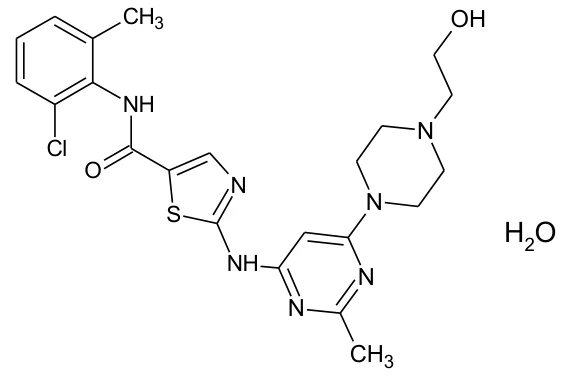
14 CLINICAL TRIALS
14.1 Trial Design and Study Demographics
Newly Diagnosed Chronic Phase CML
Table 9 - Summary of patient demographics for clinical trials in Newly Diagnosed Chronic Phase CML
| Study # | Study design | Dosage, route of administration and duration | Study subjects (n) | Mean age (Range) | Sex | |||
|---|---|---|---|---|---|---|---|---|
| CA180-056 | Open-label, multicenter | Dasatinib tablets 100 mg oral QD | 259 | 46 (18-64) | 44% women | |||
| Imatinib oral 400 mg QD | 260 | 47 (18-78) | 37% women | |||||
An open-label, multicenter, international (Europe, South America and Asia-Pacific regions), randomized, Phase III study was conducted in adult patients with newly diagnosed chronic phase CML. Patients were randomized to receive either dasatinib tablets 100 mg once daily or imatinib 400 mg once daily. The primary endpoint was the rate of confirmed complete cytogenetic response (cCCyR) within 12 months. Secondary endpoints included time-in cCCyR (measure of durability of response), time-to cCCyR, major molecular response (MMR) rate, time-to MMR, progression free survival (PFS), and overall survival (OS). The secondary endpoints were evaluated on a yearly basis. A pre-specified statistical comparison of these endpoints was conducted with data from up to 60 months of follow-up.
A total of 519 patients were randomized to a treatment group: 259 to dasatinib tablets and 260 to imatinib. Baseline characteristics were well balanced between the two treatment groups with respect to age (mean age was 46 years for the dasatinib tablets group and 47 years for the imatinib group with 10% and 11% of patients 65 years of age or older, respectively), gender (women 44% and 37%, respectively), and race (Caucasian 51% and 55%; Asian 42% and 37%, respectively). At baseline, the distribution of Hasford Scores was similar in the dasatinib tablets and imatinib treatment groups (low risk: 33% and 34%; intermediate risk: 48% and 47%; high risk: 19% and 19%, respectively). The ECOG Performance Score was also similar in the dasatinib tablets and imatinib treatment groups (ECOG 0 = 82% and 79%; ECOG 1 = 18% and 20%; and ECOG 2 = 0 and 1%, respectively).
With a minimum of 12 months follow-up, 84% of patients randomized to the dasatinib tablets group and 81% of patients randomized to the imatinib group were still receiving first-line treatment. Discontinuation due to disease progression occurred in 3% of dasatinib tablets-treated patients and 5% of imatinib-treated patients. With a minimum of 36 months follow-up, 71% of patients randomized to the dasatinib tablets group and 69% of patients randomized to the imatinib group were still receiving first-line treatment. With a minimum of 60 months follow-up, 61% of patients randomized to the dasatinib tablets group and 63% of patients randomized to the imatinib group were still receiving first-line treatment. Discontinuation due to disease progression occurred in 7% of dasatinib tablets-treated patients and 8.5% of imatinib-treated patients.
Imatinib Resistant or Intolerant CML or Ph+ ALL
Table 10 - Summary of patient demographics for clinical trials in CML, resistant or intolerant to imatinib
| Study # | Study design | Dosage, route of administration and duration | Study subjects (n) | Mean age (Range) | Sex |
|---|---|---|---|---|---|
| CA180-034 | Randomized open-label, dose-optimisation (chronic phase CML patients) | dasatinib tablets: 100 mg QD 140 mg QD 50 mg BID or 70 mg BID; oral | QD administration: 334 | 54 (20 - 84) | 54% women |
| BID administration 336 | 54 (18 - 84) | 52% women | |||
| CA180-035 | Randomized open-label, dose-optimisation (advanced CML and Ph+ ALL patients) | dasatinib tablets: 70 mg BID or 140 mg QD; oral | 70 mg: 305 | 53 (15 - 84) | 44% women |
| 140 mg 306 | 52 (16 - 81) | 44% women |
Phase III dose-optimization study in chronic phase CML (Study CA180-034): A randomized, open-label study was conducted in patients with chronic phase CML to evaluate the efficacy of dasatinib tablets administered once daily compared with dasatinib tablets administered twice daily. The primary endpoint was MCyR in imatinib-resistant patients. The main secondary endpoint was MCyR by total daily dose level in the imatinib-resistant patients at 24-months follow-up. Other secondary endpoints included duration of MCyR and overall survival. A total of 670 patients, of whom 497 were imatinib resistant, were randomized to the dasatinib tablets 100 mg once daily, 140 mg once daily, 50 mg twice daily, or 70 mg twice daily group. Median duration of treatment was 22 months.
Resistance to imatinib was defined as failure to achieve a CHR (after 3 months), MCyR (after 6 months), or CCyR (after 12 months); or loss of a previous molecular response (with concurrent ≥10% increase in Ph+ metaphases), cytogenetic response, or hematologic response.
Progression in the chronic phase CML was defined as any of the following events: loss of a CHR or MCyR; no CHR with an increase in white blood cell count; development of accelerated or blast phase CML; a ≥30% increase in the number of Ph+ metaphases; or death.
Phase III dose-optimization study in advanced phase CML and Ph+ ALL (Study CA180-035): A randomized, open- label study was conducted in patients with accelerated phase CML, myeloid blast phase CML, lymphoid blast phase CML, or Ph+ ALL to evaluate the efficacy of dasatinib tablets administered once daily compared with dasatinib tablets administered twice daily. The primary endpoint was the rate of MaHR. Secondary endpoints included the rate of MCyR, duration of MaHR, PFS, and overall survival. A total of 611 patients were randomized to the dasatinib tablets 140 mg once daily or 70 mg twice daily group. Median duration of treatment was 14 months for accelerated phase CML, 3 months for myeloid blast CML, 4 months for lymphoid blast CML, and 3 months for Ph+ ALL.
Resistance to imatinib was defined as no hematologic response or a ≥50% increase in blasts in peripheral blood; loss of a hematologic response; progression to blast or accelerated phase CML with blasts in peripheral blood while on treatment with imatinib.
Progression was defined as follows:
- Accelerated phase CML: Loss of a CHR, NEL, or MiHR; development of blast phase CML; no decrease from baseline percent blasts in peripheral blood or bone marrow; development of extramedullary sites (other than spleen or liver); a ≥50% increase in blasts in peripheral blood; or death.
- Blast phase CML or Ph+ ALL: Loss of a CHR, NEL, or MiHR; no decrease from baseline percent blasts in peripheral blood or bone marrow; a ≥50% increase in blasts in peripheral blood; or death.
14.2 Study Results
Newly Diagnosed Chronic Phase CML
Efficacy results are presented in Table 11. A statistically significantly greater proportion of patients in the dasatinib tablets group achieved a cCCyR compared with patients in the imatinib group within the first 12 months of treatment. This result was generally consistent across different subgroups, including age, gender, and baseline Hasford score. No statistically significant difference in the secondary endpoint, time-in cCCyR, was demonstrated between dasatinib tablets and imatinib at the 60 month analysis. In accord with the pre-specified sequential testing strategy, formal statistical testing stopped after the treatment comparison for Time-in cCCyR was found to be not statistically significant. Therefore statistical comparisons with remaining secondary endpoints were not conducted.
Table 11: Efficacy Results in Newly Diagnosed Patients with Chronic Phase CML (Study CA180-056)
| Endpoints | Dasatinib tablets (n=259) | Imatinib (n=260) | p-value |
|---|---|---|---|
| Response rate (95% CI) | |||
| Cytogenetic Response within 12 months | |||
| cCCyRa | 76.8% (71.2–81.8) | 66.2% (60.1–71.9) | p = 0.007* |
| within 24 months | |||
| cCCyRa | 80.3% (74.9-85.0) | 74.2% (68.5-79.4) | ----** |
| within 36 months | |||
| cCCyRa | 82.6% (77.5-87.0) | 77.3% (71.7-82.3) | ----** |
| within 60 months | |||
| cCCyRa | 83.0% (77.9-87.4) | 78.5% (73.0-83.3) | ----** |
| Major Molecular Responseb | |||
| 12 months | 52.1% (45.9–58.3) | 33.8% (28.1–39.9) | p<0.00003* |
| 24 months | 64.5% (58.3-70.3) | 50% (43.8-56.2) | ----** |
| 36 months | 69.1% (63.1-74.7) | 56.2% (49.9-62.3) | ----** |
| 60 months | 76.4% (70.8-81.5) | 64.2% (58.1-70.1) | ----*** |
| Hazard Ratio (99.99% CI) | |||
| within 60 months (95% CI) | |||
| Time-in cCCyR | 0.79 [0.55, 1.13] | NS | |
| within 12 months (99.9% CI) | |||
| Time-to cCCyR | 1.55 (1.0–2.3) | p<0.0001* | |
| Time-to MMR | 2.01 (1.2–3.4) | p<0.0001* | |
| within 24 months (95% CI) | |||
| Time-to cCCyR | 1.49 (1.22–1.82) | ___ | |
| Time-to MMR | 1.69 (1.34–2.12) | ___ | |
| within 36 months (95% CI) | |||
| Time-to cCCyR | 1.48 (1.22–1.80) | ___ | |
| Time-to MMR | 1.59 (1.28–1.99) | ___ | |
| within 60 months (95% CI) | |||
| Time-to cCCyR | 1.46 (1.20–1.77) | ----*** | |
| Time-to MMR | 1.54 (1.25–1.89) | ----*** | |
a Confirmed complete cytogenetic response (cCCyR) is defined as a response noted on two consecutive occasions (at least 28 days apart).
b Major molecular response (at any time) was defined as BCR-ABL ratios ≤ 0.1% by RQ-PCR in peripheral blood samples standardized on the International Scale. Some subjects at the time of minimum follow up corresponding to a specific yearly database cutoff had been on treatment longer, and may have achieved an MMR beyond the corresponding 12, 24 or 36 months of treatment.
*Adjusted for Hasford Score and indicated statistical significance at a pre-defined nominal level of significance.
**Per protocol, formal statistical comparison of cCCyR and MMR rates was only performed at the time of the primary endpoint (cCCyR within 12 months).
***Based on hierarchical statistical testing procedure, formal testing was not done on this secondary endpoint since Time-in cCCyR was not significant.
CI = confidence interval.
NS= not statistically significant
Median time to cCCyR was 3.1 (3.0 to 3.1) months in 215 dasatinib tablets responders and 5.8 (5.6 to 6.0) months in 204 imatinib responders based on 60-month data update. Median time to MMR (based on 60-month data update) was 9.3 months in 198 dasatinib tablets responders and 15.0 months in 167 imatinib responders. The rates of cCCyR in the dasatinib tablets and imatinib treatment groups, respectively, within 3 months (54% and 30%), 6 months (70% and 56%), 9 months (75% and 63%), 24 months (80% and 74%) and 36 months (83% and 77%), and 60 months (83 % and 79%) were consistent with the primary endpoint.
At 60 months follow-up in the dasatinib tablets arm, the rate of MMR at any time in each risk group determined by Hasford score was 90% (low risk), 71% (intermediate risk) and 67% (high risk).
The rate of cCCyR at any time in each risk group determined by Hasford score was 94% (low risk), 77% (intermediate risk) and 78% (high risk).
The estimated progression-free survival rate at 60 months for dasatinib-treated subjects was 88.9% (95% CI = [84.0%, 92.4%]). The estimated overall survival rate at 60 months for dasatinib-treated subjects was 90.9% (95% CI = [86.6%, 93.8%]).
Disease progression (defined as ‘loss of complete hematologic response’, ‘loss of major cytogenetic response’, ‘rising WBC on two occassions at least one month apart’, ‘transformation to accelerated, blast phase of CML’ or ‘death’) was reported in 34 (13.0%) patients treated with dasatinib tablets and 39 (15%) patients with imatinib. Treatment failure (defined according to the 2006 European LeukemiaNet Guidelines, included disease progression, a lack of a hematologic response at 3 months, a lack of a complete hematologic response or CyR at 6 months, a lack of partial CyR at 12 months, or a lack of CCyR at 18 months) occurred in 10 (3.9%) of dasatinib tablets-treated patients and 14 (5.4%) of imatinib-treated patients at 60 months. Transformation to accelerated or blast phase was reported in 8 (3.1%) dasatinib tablets-treated patients and 15 (5.8%) imatinib treated patients. Deaths were reported in 26 (10.1%) patients treated with dasatinib tablets and 26 (10.1%) patients treated with imatinib.
BCR-ABL kinase domain sequencing was performed on blood samples from patients at the time of discontinuation or study closure. At 60 months follow-up, T315I, F317I/L, F3171/V299L and V299L mutations were detected in 15 patients who discontinued dasatinib tablets treatment including 8 with T315I. Mutations including M244V, L387M, D276G/F359C, H396P/R, G250E,
F359C/I/V, E255K, E355G, E255K/V, E355G/L248V, E255V/Y253H, F317L, and E450G were detected in 19 patients who discontinued imatinib. The T315I mutation confers resistance to treatment with dasatinib and other ABL tyrosine kinase inhibitors based on in vitro and clinical data.
Imatinib Resistant or Intolerant CML or Ph+ ALL
Phase III dose-optimization study in chronic phase CML (Study CA180-034): Efficacy was achieved across all dasatinib tablets treatment groups with the once daily schedule demonstrating comparable efficacy (non-inferiority) to the twice daily schedule on the primary efficacy endpoint in imatinib resistant patients (difference in MCyR 1.9%; 95% confidence interval [-6.8% to 10.6%]); however, the 100 mg once daily regimen demonstrated improved efficacy and tolerability. The main secondary endpoint of the study also showed comparable efficacy (non-inferiority) among imatinib-resistant patients between the 100 mg total daily dose and the 140 mg total daily dose (difference in MCyR -0.2%; 95% CI [-8.9% to 8.5%]). Two year efficacy results are presented in Table 12.
Table 12: Results of Efficacy of Dasatinib Tablets in Phase III Dose-Optimization Study: Imatinib-Resistant or Intolerant Chronic Phase CML Patients (2-year results)a (Study CA180-034)
| All Patients | n = 167 | ||
| Imatinib-Resistant Patients | n = 124 | ||
| Haematologic Response Rateb (%) (95% CI) | |||
| CHR | 92% (86-95) | ||
| Cytogenetic Responsec (%) (95% CI) | |||
| MCyR | |||
| All Patients | 63% (56-71) | ||
| Imatinib-Resistant Patients | 59% (50-68) | ||
| CCyR | |||
| All Patients | 50% (42-58) | ||
| Imatinib-Resistant Patients | 44% (35-53) | ||
a Results reported in recommended starting dose of 100 mg once daily b Haematologic response criteria (all responses confirmed after 4 weeks): CHR (chronic CML): WBC ≤ institutional ULN, platelets < 450,000/mm3, no blasts or promyelocytes in peripheral blood, < 5% myelocytes plus metamyelocytes in peripheral blood, basophils in peripheral blood < 20%, and no extramedullary involvement. c Cytogenetic response criteria: complete (0% Ph+ metaphases) or partial (> 0% to 35%). MCyR (0% to 35%) combines both complete and partial responses. | |||
A total of 378 out of 670 patients (56%) with chronic phase CML had abnormal blood count at entry; 317 out of the 378 (84%) patients achieved a CHR from an abnormal baseline (high WBC counts becoming normal and maintained for at least 4 weeks without any other concomitant therapy). A total of 554 out of 670 patients (83%) had abnormal cytogenetics at study entry.
Major molecular response (defined as BCR-ABL/control transcripts ≤0.1% by RQ-PCR in peripheral blood samples) was evaluated in a subset of assessed patients who had a CCyR.
Major molecular response was achieved in 72% (95% CI [58 to 83%] of imatinib-resistant patients in the dasatinib tablets 100 mg once daily group.
Subjects on a BID dosing schedule were permitted to switch to a QD dosing schedule after 24 months of treatment. After 24 months of treatment cytogenetic response was not assessed; blood count with differential and molecular response were assessed once a year.
Based on the Kaplan-Meier estimates, the proportion of patients among those who achieved MCyR on 100 mg of dasatinib tablets once daily and maintained MCyR for 18 months was 93% (95% CI: [88%-98%].
Based on the Kaplan-Meier estimates, the proportions of patients with PFS at 1 year were 88% (95% CI [82 to 94%]) of imatinib-resistant patients in the 100 mg once daily group. At 2 years, the estimated rates of PFS were 77% (95% CI [68 to 85%]) of imatinib-resistant patients in the 100 mg once daily group. At 5 years, the estimated rates of PFS were 49% (95% CI [39 to 59%]) of imatinib-resistant patients in the 100 mg once daily group. At 7 years, the estimated rates of PFS were 39% (95% CI [29 to 49%]) of imatinib-resistant patients in the 100 mg once daily group.
The estimated rates of overall survival at 1 year were 94% (95% CI [90 to 98%]) of imatinib-resistant patients in the 100 mg once daily group. At 2 years, the estimated rates of overall survival were 89% (95% CI [84 to 95%]) of imatinib-resistant patients in the 100 mg once daily group. At 5 years, the estimated rates of overall survival were 77% (95% CI [69 to 85%]) of imatinib- resistant patients in the 100 mg once daily group. At 7 years, the estimated rates of overall survival were 63% (95% CI [53 to 71%]) of imatinib-resistant patients in the 100 mg once daily group.
Efficacy was also assessed in patients who were intolerant to imatinib. In this population of patients who received 100 mg once daily, MCyR was achieved in 77%, CCyR in 67%, and major molecular response in 64%. Based on the Kaplan-Meier estimates, all imatinib-intolerant patients who achieved MCyR (100%) maintained MCyR for 1 year and 92% (95% CI: [80% to 100%]) among those who achieved MCyR maintained MCyR for 18 months. The estimated rate of PFS in this population was 97% (95% CI: [92% to 100%]) at 1 year, 87% (95% CI: [76% to 99%]) at 2 years, 56% (95% CI [37% to 76%]) at 5 years, and 50.9% (95% CI: [32.1% to 67.0%]) at 7 years. The estimated rate of overall survival was 100% at 1 year, 95% (95% CI: [88% to 100%]) at 2 years, 82% (95% CI: [70% to 94%]) at 5 years, and 70.0% (95% CI: [52.2% to
82.2%]) at 7 years.
Phase III dose-optimization study in advanced phase CML and Ph+ ALL (Study CA180-035):
Results described below are based on a minimum of 24 months follow-up.
The once daily schedule demonstrated comparable efficacy (non-inferiority) to the twice daily schedule on the primary efficacy endpoint (difference in MaHR 0.8%; 95% confidence interval [-7.1% to 8.7%]); however, the 140 mg once daily regimen demonstrated improved safety and tolerability. Response rates for patients in the 140 mg once daily group are presented in Table 13.
Table 13: Efficacy of Dasatinib Tablets in Phase III Dose-Optimization Study: Advanced Phase CML and Ph+ ALL (2 Year Results)a (Study CA180-035)
| Endpoint | 140 mg Once Daily | ||||||||
|---|---|---|---|---|---|---|---|---|---|
Accelerated (n=158) | Myeloid Blast (n=75) | Lymphoid Blast (n=33) | Ph+ ALL (n=40) | ||||||
MaHRb (95% CI) | 66% (59-74) | 28% (18-40) | 42% (26-61) | 38% (23-54) | |||||
CHRb (95% CI) | 47% (40-56) | 17% (10-28) | 21% (9-39) | 33% (19-49) | |||||
NELb (95% CI) | 19% (13-26) | 11% (5-20) | 21% (9-39) | 5% (1-17) | |||||
MCyRc (95% CI) | 39% (31-47) | 28% (18-40) | 52% (34-69) | 70% (54-83) | |||||
CCyR (95% CI) | 32% (25-40) | 17% (10-28) | 39% (23-58) | 50% (34-66) | |||||
a Results reported in recommended starting dose of 140 mg once daily.
b Hematologic response criteria (all responses confirmed after 4 weeks): Major hematologic response (MaHR) = complete hematologic response (CHR) + no evidence of leukemia (NEL).
CHR: WBC ≤ institutional ULN, ANC ≥ 1000/mm3, platelets ≥100,000/mm3, no blasts or promyelocytes in peripheral blood, bone marrow blasts ≤ 5%, <5% myelocytes plus metamyelocytes in peripheral blood, basophils in peripheral blood <20%, and no extramedullary involvement.
NEL: same criteria as for CHR but ANC ≥ 500/mm3 and <1000/mm3, or platelets ≥ 20,000/mm3 and ≤ 100,000/mm3.
c MCyR combines both complete (0% Ph+ metaphases) and partial (>0%-35%) responses.
CI = confidence interval
ULN = upper limit of normal range.
A total of 529 out of 611 patients (87%) with advanced phase CML or Ph+ ALL had abnormal blood count at entry; 238 out of the 529 (45%) patients achieved a MaHR from an abnormal baseline (high WBC counts becoming normal and maintained for at least 4 weeks without any other concomitant therapy)
A total of 526 out of 611 patients (86%) had abnormal cytogenetics at study entry. In patients with accelerated phase CML treated with the 140 mg once daily regimen, the median duration of MaHR and the median overall survival was not reached; the median PFS was 25 months. In patients with myeloid blast phase CML, treated with the 140 mg once daily regimen, the median duration of MaHR was 8 months, the median PFS was 4 months and the median overall survival was 8 months. In patients with lymphoid blast phase CML, the median duration of MaHR was 5 months, the median PFS was 5 months, and the median overall survival was 11 months.
14.3 Comparative Bioavailability Studies
A randomized, four-way, single-dose, replicate crossover comparative bioavailability study of APO-DASATINIB tablets 100 mg (Apotex Inc.) and PrSPRYCEL® tablets 100 mg (Bristol‐Myers Squibb Canada) was conducted in healthy, adult, Asian Indian male subjects under fasting conditions. Comparative bioavailability data from the 41 subjects that were included in the statistical analysis are presented in the following table.
Dasatinib (1 x 100 mg) Geometric Mean Arithmetic Mean (CV%) | ||||
| Parameter | Test1 | Reference2 | % Ratio of Geometric Means | 90% Confidence Interval |
AUCT (ng·h/mL) | 619.64 717.34 (40.80) | 585.94 697.29 (42.44) | 105.8 | 91.8- 121.8 |
AUCI5 (ng·h/mL) | 664.27 749.81 (38.99) | 688.23 761.93 (34.54) | 96.5 | 86.4- 107.9 |
Cmax (ng/mL) | 141.63 180.06 (50.63) | 138.08 180.46 (50.62) | 102.6 | 84.1- 125.1 |
Tmax3 (h) | 1.75 (0.50- 12.00) | 1.50 (0.75- 4.00) | ||
T1/24, 5 (h) | 6.45 (32.01) | 6.37 (26.66) | ||
1 APO- DASATINIB (Dasatinib) tablets, 100 mg (Apotex Inc.) 2 SPRYCEL® (Dasatinib) tablets, 100 mg (Bristol‐Myers Squibb Canada) 3 Expressed as the median (range) only 4 Expressed as the arithmetic mean (CV%) only 5 81 subject profiles for Test and 77 subject profiles for Reference product were included in AUCI and Thalf parameter calculations, respectively. | ||||
15 MICROBIOLOGY
No microbiological information is required for this drug product.
16 NON-CLINICAL TOXICOLOGY
General Toxicology:
Acute Toxicity
The single-dose oral toxicity of dasatinib was evaluated in rats at doses of 30, 100, and 300 mg/kg, and in monkeys at doses of 15, 25, and 45 mg/kg. In rats, dasatinib at 30 mg/kg was tolerated, and doses ≥ 100 mg/kg caused severe toxicity and death. Morbidity and mortality were attributed to gastrointestinal lesions resulting in fluid and electrolyte loss and impairment of mucosal integrity, bone-marrow and lymphoid depletion, and multifocal myocardial necrosis and hemorrhage. In monkeys, dasatinib was tolerated at doses up to 25 mg/kg, whereas a dose of 45 mg/kg resulted in severe toxicity and mortality at Days 1 and 2. Principal drug-related toxicities occurred in the skin (hemorrhage) at doses ≥ 15 mg/kg, GI and lymphoid-organ systems at doses ≥25 mg/kg, and kidney at 45 mg/kg.
| Species/ Strain | Route of Administra tion | Duration of Dosing | Dose (mg/kg) | N/Dose/ Sex | Findings |
| Species/ Strain | Route of Administra tion | Duration of Dosing | Dose (mg/kg) | N/Dose/ Sex | Findings |
| Species/ Strain | Route of Administra tion | Duration of Dosing | Dose (mg/kg) | N/Dose/ Sex | Findings |
| Rat / SD | Oral gavage | Single dose | 30, 100, 300 | 10 M 10 F | ≥ 30 mg/kg: Dose-related decreased food intake, mucous feces, soiled/rough haircoat, dehydration, chromodacryorrhea, and chromorhinorrhea. Decreased size and weight of the thymus, decreased spleen weights (M), increased liver weights (F), red discoloration, ulceration, hemorrhage, and/or edema in the stomach, bone marrow depletion, and lymphoid depletion in the thymus, spleen, and/or lymph nodes. Decreases in total leukocyte, lymphocyte, monocyte, and platelet counts; increases in fibrinogen, ALT and AST, and decreases in albumin, total protein, albumin/globulin ratio, ALP, potassium, calcium and phosphorus. ≥ 100 mg/kg: Mortality (55% at 100 mg/kg by Day 4, 100% at 300 mg/kg |
| by Day 3). Prior to death, decreased activity, hunched posture, pallor, surface hypothermia, ptosis, tremors (F), and absence of feces (F). Hemorrhage and/or coagulative necrosis, macrophage infiltration, hemosiderosis, and fibrosis in the heart, Red/black discoloration of the intestines and lymph nodes, red discoloration of the ovaries, tan discoloration of the liver, and decreased size of the spleen. Enteropathy in the small intestine, hemorrhage or ulceration in the small intestine (F at 300 mg/kg), renal tubular dilatation and epithelial vacuolation, increases in urinary blood and bilirubin (M), lymphoid depletion in intestinal lymphoid nodules, single-cell necrosis in the liver (F), hemorrhage in the epididymides, and testicular degeneration. | |||||
| Monkey / Cynomolgus | Oral gavage | Single dose | 15, 25, 45 | 2 M 2 F | ≥ 15 mg/kg: Decreased activity, surface hypothermia with decreased body temperature, dehydration, and hemorrhages at multiple sites (thorax, limbs, gingiva, head, neck and, in 1 monkey, retina). Increases in AST, decreases in total protein, globulins, and albumin, and increases or decreases in phosphorus. ≥ 25 mg/kg: Fecal changes (soft, liquid, bloody), pallor of mucous membranes, and decreased body weights and food intake. Lymphoid depletion in the spleen, lymph nodes, and lymphoid nodules of the stomach and intestines, and, in 1 monkey, edema in the stomach. |
Increases in ALT and urea nitrogen, and decreases in calcium, cholesterol, triglycerides, and γ-GT. 45 mg/kg: Mortality (100% by Days 1 or 2). Prior to death, emesis and increased muscle tone and tremors. Red or abnormal contents of the intestines (F), hemorrhage in the tongue, red discoloration and hemorrhage in the stomach and intestines, dilatation of cortical tubules of the kidney (F), increases in creatinine and potassium (F). | |||||
Short- and Long-Term Toxicity
Repeat-dose oral toxicity studies were conducted in rats for 2 weeks to 6 months, and in monkeys for 10 days to 9 months. Repeat-dose oral toxicity studies were conducted using a daily dosing regimen (2-week and 6-month studies in rats) or a 5-days on, 2-days off dosing schedule (1-month study in rats, and 10-day, 1-month, and 9-month studies in monkeys) to support a flexible clinical development plan. In both rats and monkeys, the principal drug-related toxicities were manifested in the GI and lymphoid-organ systems. Hematopoietic (bone marrow) toxicity was also a consistent finding in rats following single or repeated oral doses of dasatinib, and was accompanied by decreases in erythrocyte, lymphocyte, and platelet counts. In monkeys, minimal bone marrow toxicity occurred only in a small number of animals following repeat dosing, and was generally accompanied by decreases in erythrocyte and lymphocyte counts. In a 9-month monkey study, toxicity related to gastroenteropathy, lymphocytic depletion and others necessitated euthanasia of 50% of the animals at exposures that were only half of the systemic exposure in humans at a dose of 70 mg BID.
| Species/ Strain | Route of Administration | Duration of Dosing | Dose (mg/kg) | N/Dose/ Sex | Findings |
| Species/ Strain | Route of Administration | Duration of Dosing | Dose (mg/kg) | N/Dose/ Sex | Findings |
| Species/ Strain | Route of Administration | Duration of Dosing | Dose (mg/kg) | N/Dose/ Sex | Findings |
| Species/ Strain | Route of Administration | Duration of Dosing | Dose (mg/kg) | N/Dose/ Sex | Findings |
| Species/ Strain | Route of Administration | Duration of Dosing | Dose (mg/kg) | N/Dose/ Sex | Findings |
| Species/ Strain | Route of Administration | Duration of Dosing | Dose (mg/kg) | N/Dose/ Sex | Findings |
| Rat / SD | Oral gavage | 2 weeks (daily dosing) | 1, 15, 30 | 6 M 6 F | 1 mg/kg: No drug-related changes. ≥ 15 mg/kg: Chromorhinorrhea, soiled/rough haircoat, dehydration, soft feces, and bloated/swollen abdomen (F at 15 mg/kg). Distention of the GI tract with gas, fluid, and/or ingesta or digesta. Enteropathy of the small and large |
intestines, edema of the large intestine, red discoloration of the mesenteric lymph nodes, decreased size of the thymus, and lymphoid depletion of the spleen, thymus, and lymph nodes. At 15 mg/kg, changes in erythrocyte parameters (decreases in erythrocyte counts, hemoglobin, and hematocrit, and increases in reticulocyte counts, MCV, and MCH), increased liver (F) and adrenal weights, and decreased kidney (M), thymus, and spleen weights. 30 mg/kg: Mortality (100%). Prior to death, decreased activity, surface hypothermia, pallor, diarrhea, hunched posture, ptosis, thin appearance, decreased body weight gain (F), body weight loss (M), and decreased food intake. Red discoloration of the small intestine (M), lymphoid depletion in the spleen and thymus, and bone-marrow haematopoietic depletion. | |||||
| Rat / SD | Oral gavage | 1 month (5-days on, 2-days off) | 0.9, 15, 25 | 15 M 15 F | ≥ 0.9 mg/kg: Decreased food consumption (M). ≥ 15 mg/kg: Changes in erythrocyte parameters (decreases in erythrocyte counts, hemoglobin, and hematocrit, and increases in MCV and MCH). Decreased body-weight gain (M) and spleen weights, and increases in liver weights (F). Enteropathy in the gastrointestinal track. Lymphoid depletion, edema, and/or hemorrhage in the thymus. 25 mg/kg: Mortality (43%) due to enteropathy/lymphoid depletion. Distention and red discoloration of the gastrointestinal tract, hemorrhage in the stomach, edema in the cecum, red discoloration of the mesenteric lymph node, lymphoid depletion in the spleen, and hypocellularity in the bone marrow accompanied with hematological changes. |
| Rat / SD | Oral gavage | 6 months (daily dosing) | 1.5, 4, 15/10/8 | 25 M 25 F | The high dose of 15 mg/kg was reduced to 10 mg/kg in Week 8 and then to 8 mg/kg in Week 17 due to gastrointestinal toxicity. ≥ 1.5 mg/kg/day: Increased heart weights. Gastrointestinal changes of villous blunting/fusion/branching and/or epithelial hyperplasia, increased vacuolation in the adrenal cortex, increased corpora lutea in the ovary and decreased incidence of acyclic ovaries, fluid-filled uteri and decreased squamous metaplasia of endometrial glands in the uterus. ≥ 4 mg/kg/day: The systemic exposure of dasatinib at 4 mg/kg was similar to that of humans at the |
therapeutic dose. Increased weights of ovaries, liver, adrenal glands, and thyroid/ parathyroid glands, and decreased weights of the pituitary gland. Fibrosis and crypt ectasia/abscesses in the cecum, and increased colloid in the thyroid. 15/10/8 mg/kg: Mortality (30%) at systemic exposure of dasatinib 2-4x that of humans at the therapeutic dose. In surviving animals, swollen abdomen, few or liquid feces, and fecal stained haircoat. Reversible bone marrow hypocellularity (minimal or moderate, 2 rats) or individual cell necrosis (minimal, 1 rat), changes in erythrocyte parameters (decreased erythrocyte counts, hemoglobin, and hematocrit, and increased MCV, MCH, and reticulocyte counts), and platelet parameters (increased platelet counts and decreases in platelet aggregation), increased neutrophil counts and fibrinogen, and decreased serum proteins (total protein, albumin, and globulins). | |||||
| Dog / Beagle | Oral gavage | 2 days | 5 | 1 M 1 F | Dosing was discontinued after 2 days as a result of severe GI toxicity. |
| Monkey / Cynomolgus | Oral gavage | 10 days | 1, 10, 15 (5-days on, 2- days off), 25 (2-3 days), 62.5 (single dose) | 1 M 1 F | ≥ 1 mg/kg/day: Vomitus and fecal changes (soft, liquid, bloody, mucous). ≥ 15 mg/kg/day: Decreased food consumption, lymphoid depletion in the spleen and/or thymus, decreased spleen weights (15 mg/kg), and minimal enteropathy in the small intestine (10 and 15 mg/kg). Excretion of dasatinib in the urine increased from < 1% to up to 220-fold over the 10 day period in female |
monkeys. ≥ 25 mg/kg/day: Mortality (75%, both monkeys at 25 mg/kg and the female at 62.5 mg/kg; a male monkey was given a single dose of 62.5 mg/kg and discontinued). Prior to death, decreased activity, pale mucous membranes, hunched posture, and/or hypothermia. Red discoloration of the stomach (25 mg/kg) and small intestine (25 and 62.5 mg/kg), and red contents in the stomach and intestines (62.5 mg/kg). At 25 mg/kg, lymphoid depletion of intestinal lymphoid nodules and mesenteric lymph nodes and, at 62.5 mg/kg, edema, hemorrhage, and ulceration in the small intestine and tubular dilatation and degeneration in the kidney | |||||
| Monkey / Cynomolgus | Oral gavage | 1 month (5-days on, 2-days off) | 1, 5, 15 | 4 M 4 F | 1 mg/kg/day: No drug-related effects. ≥ 5 mg/kg/day: Fecal changes (liquid, nonformed, or no feces). 15 mg/kg/day: Vomitus, decreased body weight gain (F), and, in 1 M, hunched posture and thin, dehydrated appearance. Abnormal contents (gas and fluid) in the cecum and colon (F). Increases in ALT and decreases in albumin (M). Increases in liver weights and decreases in thymus weights (M). Splenic lymphoid depletion (M) and thymic lymphoid depletion. |
| Monkey / Cynomolgus | Oral gavage | 9 months (5-days on, 2-days off) | 1, 3/2, 10/6/ 4.5 | 6 M 6F | As a result of GI toxicity, the high dose of 10 mg/kg was reduced to 6 mg/kg in Week 3 and then again to 4.5 mg/kg in Week 12; the intermediate dose of 3 mg/kg was reduced to 2 mg/kg in Week 28. |
≥ 1 mg/kg/day: Fecal changes (discolored, liquid, mucoid, nonformed and/or decreased), and low or no food consumption. Erosion/ulceration, acute to subacute inflammation, and epithelial flattening in the large intestine, and increased mineralization in the kidney. ≥ 3/2 mg/kg/day: Mortality (50%) primarily due to GI toxicity. Mean systemic exposure of dasatinib in the animals at 3/2 mg/kg/day reached only half the AUC of humans at the therapeutic dose (70 mg, BID). Prior to death, vomitus, hunched posture, hypoactivity, and decreased individual body weights. Decreased erythrocyte and lymphocyte counts, hemoglobin, hematocrit, albumin, sodium, potassium, and chloride, and increased total leukocyte and neutrophil counts, fibrinogen, urea nitrogen, and creatinine. Red foci in the large intestine and/or stomach. Lymphoid depletion in the thymus and spleen, and decreases in erythroid cells of the bone marrow. 10/6/4.5 mg/kg/day: Mortality (100%). None of the monkeys in this dosing group completed the nine month study due to unscheduled euthanasia that resulted from toxicity. Erosion/ulceration in the stomach (1 F), enlarged, gas-distended GI tract (1 M), and red, fluid contents in the stomach and small intestine (1 M). | |||||
Carcinogenicity:
In a 2-year carcinogenicity study, rats were administered oral doses of dasatinib at 0.3, 1, and 3 mg/kg/day. The highest dose resulted in a plasma drug exposure (AUC) levels generally equivalent to the human exposure at the recommended starting dose of 100 mg daily. A statistically significant increase in the combined incidence of squamous cell carcinomas and papillomas in the uterus and cervix of high-dose females (P = 0.0031) and of prostate adenoma in low-dose males (P = 0.0088; when the intermediate- and high-doses were excluded from the analysis due to increased incidence of mortality at these dose levels) was noted.
Genotoxicity:
Dasatinib was clastogenic in vitro to dividing Chinese hamster ovary cells with and without metabolic activation at concentrations ≥ 5 mcg/mL. Dasatinib was not mutagenic when tested in in vitro bacterial cell assays (Ames test) and was not genotoxic in an in vivo rat micronucleus study.
| Test / Test System | Route of Administration | Duration of Dosing | Concentration/ Dose | N/Dose/ Sex | Findings | ||||||
| Test / Test System | Route of Administration | Duration of Dosing | Concentration/ Dose | N/Dose/ Sex | Findings | ||||||
Bacterial Mutagenicity Screening (Spiral Ames reverse mutation) S. typhimurium | In vitro | 48 hr | 21 – 5000 mcg/plate, with and without rat S9 activation | NA | Not mutagenic. | ||||||
Bacterial Mutagenicity Screening (Exploratory Ames reverse mutation) S. typhimurium | In vitro | 48 hr | 5 – 5000 mcg/plate, with and without rat S9 activation | NA | Not mutagenic. | ||||||
Bacterial Mutagenicity (Reverse mutation, definitive study) S. typhimurium and E. coli | In vitro | 46-50 hr | 12.5 - 400 mcg/plate (S. typhimurium); 50-1600 mcg/plate (E. coli), with and without rat S9 activation | NA | Not mutagenic. | ||||||
| Cytogenetics Study Chinese hamster ovary cells | In vitro | 4-20 hr | 2.5 - 60 mcg/mL, with and without activation | NA | Genotoxic effects: Chromatid and chromosome structural | ||||||
| aberrations at ≥ 20 mcg/mL (4 hr -S9), 5 mcg/mL (4 hr +S9), and ≥ 5 mcg/mL (20 hr -S9). | |||||||||||
| Oral Micronucleus Rat / SD | Oral gavage | 3 days | 10, 20, 40 mg/kg | 5 M 5 F | Genotoxic effects: None. | ||||||
Reproductive and Developmental Toxicology:
Dasatinib, when administered to pregnant rats during organogenesis at doses of 2.5, 5, 10, or 20 mg/kg, induced fetal toxicity (embryolethality with associated decreases in litter size, and fetal skeletal abnormalities, including malformations) at all doses, and maternal toxicity at doses ≥ 10 mg/kg. Maternal death occurred at 20 mg/kg. In a range-finding study in pregnant rabbits, dasatinib administered during organogenesis caused embryolethality of 13% at 6 mg/kg and 69% at 10 mg/kg. In the definitive embryo-fetal development study in rabbits, dasatinib did not cause maternal toxicity at 0.5, 2, or 6 mg/kg, whereas drug-related fetal skeletal alterations, including malformations, occurred at all doses.
In the oral study of fertility and early embryonic development in rats, dasatinib was not a reproductive toxicant in male rats at doses (≤ 10 mg/kg/day) that approximated human clinical exposures. In female rats, dasatinib did not affect mating or fertility at doses up to10 mg/kg/day, but induced embryo lethality at doses of ≥ 5 mg/kg/day (post-implantation losses of 14 to 48%, relative to 4% in controls) with associated decreases in litter size. Dasatinib is a selective reproductive toxicant in female rats at clinically relevant systemic exposures.
Dasatinib at doses of 5 and 10 mg/kg/day was given orally to female rats in 3 cohorts for which dosing was initiated on Gestation Day (GD) 16 (the end of organogenesis), GD 21 (the approximate onset of parturition), or Lactation Day (LD) 4 and continued up to LD 20. In all cohorts, in utero or lactational exposure to dasatinib in pups was associated with pleural effusion. For cohorts starting dasatinib on GD 16 or 21 at either dose, all groups were discontinued following 6 to 9 doses when more than 50% of pups had been euthanatized, found dead, or missing/presumed cannibalized. Among dams for which dosing initiated on LD 4, 34% of pups were lost due to mortality or moribundity at 10 mg/kg/day.
| Study Type Species/Strain | Route of Administration | Duration of Dosing | Dose (mg/kg) | N/Dose/ Sex | Findings | |
| Study Type Species/Strain | Route of Administration | Duration of Dosing | Dose (mg/kg) | N/Dose/ Sex | Findings | |
| Study Type Species/Strain | Route of Administration | Duration of Dosing | Dose (mg/kg) | N/Dose/ Sex | Findings | |
| Embryofetal Development | Oral gavage | 10 days (GD 6 to | 2.5, 5, | 22 F | ≥ 2.5 mg/kg: Embryolethality (17%) and associated decreases in litter | |
| in Rats / SD | 15) | 10, 20 | size. Fetal skeletal abnormalities. ≥ 5 mg/kg: Embryolethality (77%). Fluid-filled thoracic and abdominal cavities, edema, microhepatia in fetus. ≥ 10 mg/kg: Embryolethality (100%). Decreased maternal food consumption. 20 mg/kg: Maternal mortality (22% during Days 12 - 15 of gestation). Decreased maternal body weight gain. | |||
| Range Finding Study in Rabbits / NZW | Oral gavage | 13 days (GD 7 to 19) | 1, 3, 6, 10 | 7 F | 1 and 3 mg/kg: No drug-related effects. ≥ 6 mg/kg: Embryolethality (13%). Decreased maternal body weight gain and/or weight loss, and decreased food consumption. 10 mg/kg: Embryolethality (69%) and reduced number of litters with live fetuses at gestation day 29 (5/7). | |
| Embryo-fetal Development in Rabbits / NZW | Oral gavage | 13 days (GD 7 to 19) | 0.5, 2, 6 | 22 F | No maternal toxicity. Delays in ossification of the fetal lumbar vertebrae (bifid arches) and pelvis (incompletely or unossified pubes), reduced ossification of hyoid (incompletely or unossified). 6 mg/kg: 21% of fetus resorption among rabbits with post-implantation loss. | |
| Fertility and early embryonic development study in rats (Segment I) | Oral gavage | 32 - 45 days 43 days | 2.5, 5, 10 | 25 F 25 M | ≤ 10 mg/kg: Dasatinib was not a reproductive toxicant in M and did not affect mating or fertility in F ≥ 5 mg/kg: Dasatinib induced embryo lethality (post implantation loss of 14 - 48%) in F and associated decreases in litter size. | |
| Range finding pre- and post- natal development | Oral gavage | GD16, to LD 20 | 0, 5, 10 | 8F | 5 mg/kg cohorts starting on GD 16 and 21: Profound pup mortality with associated decreases in litter sizes. Pleural effusion in 20 of 47 and 16 of | |
| study in rats | GD21 to LD 20 LD4 to LD 20 | 8F 8F | 42 pups in cohorts starting on GD 16 and GD 21, respectively. 10 mg/kg all cohorts: Profound pup mortality with associated decreases in litter sizes. Pleural effusion in 30 of 30 and 25 of 57 pups in cohorts starting on GD 21 and LD4, respectively. | |||
Special Toxicology:
Safety Pharmacology
Dasatinib had no significant effects in an in vitro ligand binding study. In the hERG/IKr assay, dasatinib inhibited hERG currents by 6, 37, and 77% at 3, 10, and 30 mcm, respectively. The IC50 was 14.3 mcM. In the Purkinje fiber assay, dasatinib prolonged APD50 by 26% and APD90 by 11% at 30 mcM. Dasatinib at a single oral dose of 10 mg/kg in conscious, unrestrained monkeys (n = 6) elicited increases in blood pressure (6 to 15% in systolic and 8 to 21% in diastolic) for approximately 2 hours. In addition, mean QTc interval increases of 16 to 19 msec were observed between 1.5 to 2.5 hours post dose in the dasatinib-treated cohort compared to the vehicle control. Although these QTc changes were not statistically significant from control, an association of these changes with dasatinib treatment can not be excluded.
The N-dealkylated metabolite of dasatinib, BMS-582691 at 10 mcM inhibited receptor-ligand binding to the adrenergic β2, non-selective adrenergic α2, non-selective serotonin 5-HT1, serotonin 5-HT1A, norepinephrine transporter, and dopamine transporter receptors, and to the sodium channel. In the hERG/IKr assay, BMS-582691 inhibited hERG currents with a calculated IC50 of 5.8 mcM compared to 14.3 mcM for dasatinib. In the Purkinje fiber assay, BMS-582691 at 30 mcM. prolonged APD50 and APD90 by 10% and 9%, respectively, and reduced Vmax by 11%.
| Study Type / Organ Systems Evaluated | Test System / Species/ Strain | Route | Concentration/ Dose | N/Dose / Sex | Findings | ||||
| Study Type / Organ Systems Evaluated | Test System / Species/ Strain | Route | Concentration/ Dose | N/Dose / Sex | Findings | ||||
| Receptor and Ion Channel Ligand Binding Study | Receptors, ion channels, and enzyme systems | in vitro | 10 mcM | -- | No biologically significant effect on binding of ligands to receptors or ion-channels, or on acetylcholinesterase activity. BMS-582691 at 10 mcM inhibited | ||||
| receptor-ligand binding to the adrenergic β2 (50%), non-selective adrenergic α2 (51%), non-selective serotonin 5-HT1 (50%), serotonin 5-HT1A (54%), norepinephrine transporter (54%), and dopamine transporter (87%) receptors, and to the sodium channel (84%) | |||||||||
| hERG/IKr Channel Assay / Cardiovascular | HEK293 cells transfected with human hERG cDNA | in vitro | 3, 10, 30 mcM | -- | Dasatinib: IKr currents were inhibited by 6, 37, and 77% at 3, 10 and 30 mcM, respectively. The calculated IC50 was 14.3 mcM. BMS-582691 inhibited IKr currents by 24, 72, and 95% at 3, 10 and 30 mM, respectively. The calculated IC50 was 5.8 mcM | ||||
Rabbit Purkinje Fiber Action Potential Assay/ Cardiovascular | Rabbit Purkinje fibers | in vitro | 3, 10, 30 mcM | -- | Dasatinib: APD50 and APD90 were prolonged by 26% and 11%, respectively, at 30 mcM. BMS-582691: APD50 and APD90 were prolonged by 10% and 9%, respectively, and Vmax was reduced by 11%. | ||||
| Single-Dose Safety Pharmacology / Cardiovascular | Monkey / Cynomol gus | Oral, single dose | 10 mg/kg | 3 M 3 F | Drug-related increases in systolic (6-15%) and diastolic (8-21%) blood pressure for approximately 2 hours and mean QTc increases of 16-19 msec between 1.5 – 2.5 hours following a single oral dose. | ||||
Other Toxicity Studies
The immunosuppressive potential of dasatinib was assessed in mouse models of T-cell proliferation (mixed lymphocyte response) and nonvascularized heart transplant rejection. The effects of dasatinib on in vitro platelet function were assessed in human, monkey, and rat plasma, and the effects on in vivo bleeding time were assessed in rats. The in vitro phototoxicity potential of dasatinib was assessed in mouse fibroblasts.
The effect of dasatinib on the cardiac sarcoplasmic reticulum and mitochondrial function is unknown. The potential for apoptosis in cardiomyocytes with dasatinib treatment has not been investigated, and no studies have been conducted with dasatinib to evaluate the potential signaling mechanism regulating cardiotoxicity.
| Study Type / Test System | Route of Administration | Duration of Dosing | Dose (mg/kg) | N/Dose/ Sex | Findings | ||||||||||
| Study Type / Test System | Route of Administration | Duration of Dosing | Dose (mg/kg) | N/Dose/ Sex | Findings | ||||||||||
| Study Type / Test System | Route of Administration | Duration of Dosing | Dose (mg/kg) | N/Dose/ Sex | Findings | ||||||||||
| Mixed Lymphocyte Response Assay/Mouse | Oral gavage | 3 days | 5, 20, 50 | 3 M | 5 mg/kg: No effect on T-cell proliferation. ≥ 20 mg/kg: Dose-dependent inhibition of splenic T-cell proliferation. | ||||||||||
| Cardiac Transplant Study/Mouse | Oral gavage | 30 days | 15, 25, 50 | 4-5 M | 15 mg/kg, twice daily (continuous daily dosing): Graft rejection not inhibited. 25 mg/kg, twice daily (5-days on, 2-days off schedule): Graft rejection not inhibited. 25 mg/kg, twice daily, (continuous daily dosing): Inhibition of graft rejection. | ||||||||||
| Platelet Function / Platelets from humans, cynomolgus monkeys, and rats | In vitro | -- | 0.05, 0.5, 5 mcg/ mL | -- | 0.05 mcg/mL: No effect. 0.5 and 5 mcg/mL: Inhibition of the platelet aggregation response to ADP and collagen in human platelet-rich plasma, and inhibition of shear-induced aggregation of human platelets. 5 mcg/mL: Decreased strength of human whole blood clots (29%); no effect on time to clot formation or rate of clot formation. In each species complete | ||||||||||
| inhibition of the collagen response was observed with comparable IC50 values (mcg/mL) for human (0.24±0.06) and cynomolgus monkey (0.23 ± 0.06), and slightly but not significantly greater potency for rat (0.13±0.01). | |||||||||||||||
| Bleeding Time and Platelet Function/Rat | Oral gavage or IV | Single oral dose or IV infusion | 4, 8, 20 (mg/kg, oral) or 630, 1260,- 2520 (mcg/kg, IV) | 5-9 M | Oral gavage: 4 mg/kg: No effect on mesenteric bleeding time, cuticle bleeding time, or ADP- induced platelet aggregation. 8 mg/kg: No effect on mesenteric bleeding time. The anticipated plasma concentration was not reached for evaluating the cuticle bleeding time and platelet aggregation. 20 mg/kg: 3-fold increase in cuticle bleeding time and inhibition of the platelet aggregation response (21 and 99%) induced by 10 mcM ADP and 20 mcg/mL collagen, respectively. IV infusion: Dasatinib produced dose-dependent increases in cuticle bleeding time at all doses (mean plasma concentrations as 61, 144, 273 ng/mL respectively) and proportion of vessels with re-bleeds and off scale bleeding at the high dose. A dose- dependent reduction in platelet aggregation (37%, 99% and 100%) was also observed at all doses. | ||||||||||
| Phototoxicity Assay/Mouse fibroblasts | In vitro | -- | 0.353- 120 mcg/mL | -- | Results indicated that dasatinib is phototoxic in vitro to mouse fibroblasts | ||||||||||
17 SUPPORTING PRODUCT MONOGRAPHS
PrSPRYCEL® (Dasatinib Tablets, 20 mg, 50 mg, 70 mg, 80 mg, 100 mg and 140 mg), submission control 292496, Product Monograph, Bristol-Myers Squibb Canada. (JUN 11, 2025)