


Product Monograph - Tasigna (Novartis Pharmaceuticals Canada, 200 mg, 150 mg)
Recent Major Label Changes
| 1 Indications | 2024-07 |
|---|---|
| 4 Dosage and Administration, 4.2 Recommended Dose and Dosage Adjustment | 2024-07 |
| 4 Dosage and Administration, 4.1 Dosing Considerations | 2026-06 |
Table of Contents
Certain sections or subsections that are not applicable at the time of the preparation of the most recent authorized product monograph are not listed.
Recent Major Label Changes .................................................................................................. 2
Table of Contents .................................................................................................................. 2
Part 1: Healthcare Professional Information .......................................................................... 4
- 1.
Indications ...................................................................................................................... 4
1.1. Pediatrics ....................................................................................................................... 4
1.2. Geriatrics ....................................................................................................................... 4
- 2. Contraindications ............................................................................................................ 4
- 3. Serious Warnings and Precautions Box ........................................................................... 5
- 4.
Dosage and Administration ............................................................................................. 5
4.1. Dosing Considerations ................................................................................................... 5
4.2. Recommended Dose and Dosage Adjustment .............................................................. 6
4.4. Administration ............................................................................................................ 12
4.5. Missed Dose ................................................................................................................ 12
- 5. Overdose ...................................................................................................................... 12
- 6. Dosage Forms, Strengths, Composition, and Packaging ................................................. 12
- 7.
Warnings and Precautions ............................................................................................ 13
General .............................................................................................................................. 13
Carcinogenesis and Genotoxicity ....................................................................................... 13
Cardiovascular .................................................................................................................... 13
Driving and Operating Machinery……………………………………………………………………………………16
Endocrine and Metabolism ................................................................................................ 16
Hematologic ....................................................................................................................... 16
Hepatic/Biliary/Pancreatic ................................................................................................. 17
Hepatic impairment ........................................................................................................... 17
Immune .............................................................................................................................. 18
Monitoring and Laboratory Tests ....................................................................................... 18
Musculoskeletal ................................................................................................................. 19
Perioperative Considerations ............................................................................................. 19
Renal .................................................................................................................................. 20
Reproductive Health .......................................................................................................... 20
Respiratory ......................................................................................................................... 20
Sensitivity/Resistance ........................................................................................................ 20
7.1. Special Populations ..................................................................................................... 21
7.1.1. Pregnancy ............................................................................................................ 21
7.1.2. Breast-feeding ..................................................................................................... 21
7.1.3. Pediatrics ............................................................................................................. 21
7.1.4. Geriatrics ............................................................................................................. 22
7.1.5. Renal impairment ................................................................................................ 22
7.1.6. Hepatic impairment ............................................................................................. 22
7.1.7. Cardiac disorders ................................................................................................. 22
- 8.
Adverse Reactions ........................................................................................................ 22
8.1. Adverse Reaction Overview ........................................................................................ 22
8.2. Clinical Trial Adverse Reactions ................................................................................... 23
8.2.1. Clinical Trial Adverse Reactions – Pediatrics ........................................................ 29
8.3. Less Common Clinical Trial Adverse Reactions ............................................................ 29
8.4. Abnormal Laboratory Findings: Hematologic, Clinical Chemistry, and Other Quantitative Data……………………………………………………………………………………………………………32
8.5. Post-Market Adverse Reactions .................................................................................. 35
- 9.
Drug Interactions .......................................................................................................... 36
9.1. Serious Drug Interactions ............................................................................................ 36
9.2. Drug Interactions Overview ......................................................................................... 37
9.3. Drug-Behaviour Interactions ....................................................................................... 37
9.4. Drug-Drug Interactions ................................................................................................ 37
9.5. Drug-Food Interactions ............................................................................................... 42
9.6. Drug-Herb Interactions ................................................................................................ 42
9.7. Drug-Laboratory Test Interactions .............................................................................. 42
- 10.
Clinical Pharmacology .................................................................................................... 42
10.1. Mechanism of Action ............................................................................................ 42
10.2. Pharmacodynamics .............................................................................................. 43
10.3. Pharmacokinetics ................................................................................................. 43
- 11. Storage, Stability, and Disposal ..................................................................................... 48
- 12. Special Handling Instructions ........................................................................................ 48
Part 2: Scientific Information ............................................................................................... 49
- 13. Pharmaceutical Information ......................................................................................... 49
- 14.
Clinical Trials ................................................................................................................. 51
14.1. Clinical Trials by Indication ........................................................................................ 51
- 15. Microbiology ................................................................................................................. 70
- 16. Non-Clinical Toxicology ................................................................................................. 70
Patient Medication Information .......................................................................................... 74
Part 1: Healthcare Professional Information
1. Indications
Tasigna® (nilotinib) 150 mg and 200 mg capsules are indicated for:
The treatment of adult patients with newly diagnosed Philadelphia chromosome positive chronic myeloid leukemia (Ph+ CML) in chronic phase (CP).
Clinical effectiveness of Tasigna in adults with newly diagnosed Ph+ CML-CP is based on major molecular response rate at 12 months and complete cytogenetic response rate by 12 months.
The treatment of pediatric patients 2 years of age and older with newly diagnosed Ph+ CML-CP.
Clinical effectiveness of Tasigna in pediatric patients with newly diagnosed Ph+ CML-CP is based on major molecular response by 12 cycles and complete cytogenetic response at 12 cycles.
The treatment of chronic phase (CP) and accelerated phase (AP) Philadelphia chromosome positive chronic myeloid leukemia (Ph+CML) in adult patients resistant to or intolerant of at least one prior therapy including imatinib.
Clinical effectiveness of Tasigna in adults with imatinib-resistant or -intolerant Ph+ CML-CP was based on the unconfirmed major cytogenetic and complete hematologic response rates.
Clinical effectiveness of Tasigna in imatinib-resistant or -intolerant Ph+ CML-AP for adult patients was based on the confirmed hematologic response rates and the unconfirmed major cytogenetic response rates.
The treatment of pediatric patients 2 years of age and older with Ph+ CML-CP with resistance or intolerance to prior therapy including imatinib.
Clinical effectiveness of Tasigna in pediatric patients with imatinib-resistant or -intolerant Ph+ CML-CP was based on the MMR rate at 6 cycles.
No overall survival benefit has been demonstrated.
1.1. Pediatrics
2 to < 18 years: The safety and efficacy of Tasigna in pediatric patients with Ph+ CML-CP from 2 to less than 18 years of age have been established (see 8 Adverse Reactions, 10 Clinical Pharmacology, and 14 Clinical Trials). There is no experience in pediatric patients below 2 years of age or in pediatric patients with Ph+ CML-AP or blast crisis (BC). The long-term effects of prolonged treatment with Tasigna in pediatric patients are unknown (see 7 Warnings and Precautions).
1.2. Geriatrics
≥ 65 years of age: Approximately 12% and 30% of subjects in the clinical studies (Phase III study (A2303) in newly diagnosed Ph+ CML-CP; and Phase II study (A2101) in resistant or -intolerant Ph+ CML-CP and CML-AP) were 65 years of age or older respectively. No major differences were observed for safety and efficacy in patients ≥ 65 years of age as compared to adults 18 to 65 years of age.
2. Contraindications
Tasigna (nilotinib) is contraindicated in patients with:
- a known long QTc prolongation or with a persistent QTc of > 480 msec (See 7 Warnings and Precautions);
- uncorrectable hypokalemia or hypomagnesemia; known hypersensitivity to nilotinib or to any of the excipients. For a complete listing of excipients (see 6 Dosage Forms, Strengths, Composition, and Packaging).
3. Serious Warnings and Precautions Box
- Sudden Cardiac Deaths (see 7 Warnings and Precautions and 8 Adverse Reactions, 8.1 Adverse Reaction Overview)
- QT interval prolongation (see 7 Warnings and Precautions, 9 Drug Interactions, 9.4 Drug-Drug Interactions)
- Do not use in patients with uncorrectable hypokalemia or hypomagnesemia (see 7 Warnings and Precautions)
- Ischemic heart disease, ischemic cerebrovascular events and peripheral arterial occlusive disease (PAOD), (in some rare cases, fatal) (see 7 Warnings and Precautions)
- Hepatotoxicity/ Hepatic failure (in some cases, fatal) (see 7 Warnings and Precautions)
- Pancreatitis (see 7 Warnings and Precautions)
- Myelosuppression (thrombocytopenia, neutropenia and anemia) (see 7 Warnings and Precautions)
Tasigna should only be prescribed by a qualified healthcare professional who is experienced in the use of antineoplastic therapy and in the treatment of chronic myeloid leukemia.
Treatment discontinuation in Ph+ CML-CP patients who have achieved a sustained molecular response (MR4.5) should be attempted only if the monitoring requirements using a quantitative diagnostic test validated with a sensitivity of at least MR4.5 (BCR-ABL/ABL ≤0.0032% IS) can be performed at the specified frequency (see 7 Warnings and Precautions; Monitoring and Laboratory Tests). Discontinuation of Tasigna therapy should be initiated by a physician experienced in the treatment of patients with CML.
Discontinuation of Tasigna treatment to attempt treatment-free remission (TFR) phase in pediatric patients has not been assessed.
4. Dosage and Administration
4.1. Dosing Considerations
Tasigna is not available in the 50 mg dosage strength. This should be considered while using Tasigna for pediatric population and for dose adjustments.
Pediatrics
2 to < 18 years: The safety and efficacy of Tasigna in pediatric patients with Ph+ CML-CP from 2 to less than 18 years of age has been established (see 7 Warnings and Precautions, 7.1.3 Pediatrics, 8 Adverse Reactions, 8.2.1 Clinical Trial Adverse Drug Reactions – Pediatrics, 10 Clinical Pharmacology, Special Populations and Conditions, and 14 Clinical Trials). There is no experience in pediatric patients below 2 years of age or in pediatric patients with Ph+ CML-AP or blast crisis (BC).
Renal impairment
Clinical studies have not been performed in patients with impaired renal function. Clinical studies have excluded patients with serum creatinine concentration >1.5 times the upper limit of the normal range.
Tasigna and its metabolites are not renally excreted (See 7 Warnings and Precautions, 7.1.5 Renal impairment and 10 Clinical Pharmacology, 10.3 Pharmacokinetics).
Hepatic impairment
Hepatic impairment has an effect on the pharmacokinetics of nilotinib in adults. Dose adjustment is not considered necessary in hepatically impaired patients. Patients with hepatic impairment should be treated with caution and careful clinical monitoring, including close monitoring of the QTc interval (see 7 Warnings and Precautions, 7.1.6 Hepatic impairment).
Cardiac disorders
In clinical studies, newly diagnosed Ph+ CML-CP and imatinib-resistant or -intolerant Ph+ CML-CP and CML-AP patients with any of the following uncontrolled or significant cardiac disease were excluded: recent myocardial infarction, CHF, unstable angina, or clinically significant bradycardia. Imatinib-resistant or -intolerant Ph+ CML-CP and CML-AP patients with complete left bundle branch block and/or right bundle branch block, with left anterior hemiblock, or with bifascicular block were excluded from the study. Newly diagnosed Ph+ CML-CP patients with complete left bundle branch block were also excluded. ECG and cardiac enzyme monitoring were conducted in patients throughout the studies. Caution should be exercised in patients with relevant cardiac disorders (see 7 Warnings and Precautions, 7.1.7 Cardiac disorders).
Tumour Lysis Syndrome
Due to possible occurrence of Tumour Lysis Syndrome (TLS) it is recommended to measure serum levels of creatinine, uric acid, phosphate, potassium, corrected calcium and LDH prior to the initiation of treatment with Tasigna in order to assess the risk or presence of TLS and to monitor these parameters during the initial period of treatment with Tasigna until a significant reduction of tumour cell burden has been achieved. Prophylaxis of TLS such as hydration and treatment of high uric acid levels in patients at risk and treatment of abnormalities subsequent to established TLS is required (see 7 Warnings and Precautions, Endocrine and Metabolism).
4.2. Recommended Dose and Dosage Adjustment
Tasigna is available in two dosage strengths (150 mg and 200 mg).
Treatment with Tasigna (nilotinib capsules) should be initiated by a physician experienced in the treatment of patients with CML.
In the adult clinical studies, Tasigna was allowed to be given in combination with hematopoietic growth factors such as erythropoietin or granulocyte colony-stimulating factor (G-CSF) if clinically indicated. In the adult studies, Tasigna was also allowed to be given with hydroxyurea (permitted during the first 28 days of treatment, up to 5 g/day for a maximum of 7 days) or anagrelide (permitted during the first 28 days of treatment) if clinically indicated.
Recommended Dose:
Adult patients with newly diagnosed Ph+ CML-CP
The recommended dose of Tasigna is 300 mg (2x 150 mg capsules) orally twice daily (see 14 Clinical Trials). Treatment should continue as long as the patient continues to benefit.
Ph+ CML-CP and CML-AP adult patients who are resistant to or intolerant to at least one prior therapy including imatinib:
The recommended dose of Tasigna is 400 mg (2x 200 mg capsules) orally twice daily (see 14 Clinical Trials). Treatment should continue as long as the patient does not show evidence of progression or unacceptable toxicity.
A baseline ECG is recommended prior to initiating therapy with Tasigna and should be repeated after 7 days and as clinically indicated. Hypokalemia or hypomagnesemia must be corrected prior to Tasigna administration and potassium and magnesium blood levels should be monitored periodically during therapy, particularly in patients at risk for these electrolyte abnormalities (see 7 Warnings and Precautions).
Pediatric patients with newly diagnosed Ph+ CML-CP or resistant or intolerant Ph+ CML-CP
Dosing in pediatric patients is individualized and is based on body surface area (mg/m2). The recommended dose of Tasigna is 230 mg/m2 twice daily, rounded to the nearest available dose (to a maximum single dose of 400 mg, see Table 4-1). This dose in pediatric patients had comparable pharmacokinetic exposure as the 400 mg twice daily dose in adults. Different strengths of Tasigna hard capsules can be combined to attain the desired dose. Treatment should be continued as long as clinical benefit is observed or until unacceptable toxicity occurs. There is no experience with treatment of pediatric patients below 2 years of age.
Table 4-1 - Pediatric dosing of Tasigna (230 mg/m2 twice daily, maximum single dose of 400 mg)
| Body Surface Area (BSA) | Total Daily Dose | Taken as |
|---|---|---|
| 0.55 – 0.76 m2 | 300 mg | one 150 mg capsule twice a day |
| 0.77 – 0.97 m2 | 400 mg | one 200 mg capsule twice a day |
| 1.20 – 1.41 m2 | 600 mg | two 150 mg capsules twice a day |
| 1.42 – 1.63 m2 | 700 mg | one 200 mg and one 150 mg capsule twice a day |
| ≥1.64 m2 | 800 mg | two 200 mg capsules twice a day |
Dose Adjustments or Modifications:
Delay of treatment with Tasigna in case of established TLS must be weighed in the individual patient against the risk of delayed control of tumour cell proliferation.
Tasigna may need to be temporarily withheld and/or dose reduced for hematological toxicities (neutropenia, thrombocytopenia) that are not related to underlying leukemia (see Table 4-2 below).
Table 4-2 - Dose Adjustments for Adult and Pediatric Patients with Neutropenia and Thrombocytopenia
| Adult patients with: | ANC # < 1.0 x 10⁹/L |
|
|---|---|---|
| and/or platelet counts <50 x 109/L |
|
Pediatric patients with:
| ANC# <1 × 10⁹/L and/or platelet counts <50 × 109/L |
|
ANC # = absolute neutrophil count.
Tasigna may need to be temporarily withheld and/or dose reduced for patients who experience QTc interval prolongation (see Table 4-3 below).
Table 4-3 - Dose Adjustments for Adult and Pediatric Patients with QT prolongation
| ECGs with a QTc > 480 msec |
|
|---|
See Table 4-4 below for dose adjustments for elevations of lipase, amylase, bilirubin, and/or hepatic transaminases (see 8 Adverse Reactions).
Table 4-4 - Dose Adjustments for Adult and Pediatric Patients with Selected Non-hematologic Laboratory Abnormalities
| Elevated serum lipase or amylase ≥ Grade 3 | Adult Patients:
|
|---|---|
Pediatric Patients:
| |
| Elevated Total bilirubin ≥ Grade 3 in adult patients and greater than or equal to Grade 2 in pediatric patients | Adult Patients
|
Pediatric Patients:
| |
| Elevated hepatic transaminases ≥ Grade 3 | Adult Patients:
|
Pediatric Patients:
|
1 Serum lipase levels should be tested frequently or as clinically indicated
Serum lipase elevations were observed in adult patients. Few of these elevations were associated with clinical symptoms such as abdominal pain or a diagnosis of pancreatitis. There were 5 cases (1.1%) of pancreatitis reported in imatinib-resistant or-intolerant Ph+ CML-CP and CML-AP patients (N= 458). In adult newly diagnosed Ph+ CML-CP 5 (1.8%) and 8 (2.9%) cases of pancreatitis were reported in patients receiving Tasigna 300 mg twice daily (N=279) and 400 mg twice daily (N=277), respectively. In case lipase elevations are accompanied by abdominal symptoms, doses should be interrupted and appropriate diagnostics should be considered in order to exclude pancreatitis (see 7 Warnings and Precautions).
If clinically significant moderate or severe non-hematologic toxicity develops (including medically severe fluid retention), see Table 4-5 for dose adjustments (See 8 Adverse Reactions)
Table 4-5 - Dose Adjustments for Adult and Pediatric Patients with Other Non-hematologic Toxicities
| Other clinically moderate or severe non-hematologic toxicity (including fluid retention) | Adult patients:
|
|---|---|
Pediatric patients:
|
Discontinuation of treatment after a sustained molecular response (MR4.5) on Tasigna:
Eligibility for Discontinuation of Treatment
Adult Ph+ CML-CP patients with typical BCR-ABL transcripts who have been taking Tasigna for a minimum of 3 years and have achieved a sustained molecular response (MR4.5, corresponding to BCR-ABL/ABL ≤ 0.0032% IS) may be eligible for treatment discontinuation (see 14 Clinical Trials). Discontinuation of Tasigna treatment in pediatric patients to attempt treatment free remission has not been assessed.
Adult patients with typical BCR-ABL transcripts (i.e., 13a2/b2a2 or e14a2/b3a2) who achieve the sustained MR4.5 criteria are eligible for discontinuation of Tasigna treatment. Patients must continue to be monitored for possible loss of molecular remission after treatment discontinuation using a quantitative diagnostic test validated with a sensitivity of at least MR4.5 (BCR-ABL/ABL ≤0.0032% IS).
Discontinuation of treatment may be considered in adult patients with newly diagnosed Ph+ CML-CP who have:
|
Discontinuation of treatment may be considered in patients with Ph+ CML-CP that are resistant or intolerant to prior treatment that included imatinib who have achieved a sustained molecular response (MR4.5) on Tasigna who have:
|
- sustained MR4.5 for a minimum of one year immediately prior to discontinuation of therapy
|
Monitor BCR-ABL transcript levels and complete blood count with differential in patients who have discontinued Tasigna therapy monthly for one year, then every 6 weeks for the second year, and every 12 weeks thereafter.
Upon loss of MR4.0 (corresponding to BCR-ABL/ABL ≤ 0.01% IS) during the treatment-free phase, monitor BCR-ABL transcript levels every 2 weeks until BCR-ABL levels remain lower than major molecular response (MMR, corresponding to MR3.0 or BCR-ABL/ABL ≤ 0.1% IS) for 4 consecutive measurements. The patient can then proceed to the original monitoring schedule.
Re-initiation of treatment in patients who lose molecular response after discontinuation of therapy with Tasigna:
|
4.4. Administration
Tasigna should be taken twice daily, at approximately 12-hour intervals and must not be taken with food. The capsules should be swallowed whole with water. No food should be consumed for at least 2 hours before the dose is taken and no additional food should be consumed for at least one hour after the dose is taken (see 7 Warnings and Precautions, and 9 Drug Interactions).
For patients who are unable to swallow capsules, the content of each capsule may be dispersed in one teaspoon of applesauce and should be taken immediately. Not more than one teaspoon of applesauce should be used. Yogurt was shown to result in a significant increase in bioavailability and therefore must be avoided and no food other than applesauce must be used (see 10 Clinical Pharmacology).
4.5. Missed Dose
If a dose is missed, the patient should not take an additional dose, but take the next scheduled usual prescribed dose.
5. Overdose
Isolated reports of intentional overdose with nilotinib were reported, where an unspecified number of Tasigna capsules were ingested in combination with alcohol and other drugs. Events included neutropenia, vomiting and drowsiness. No ECG changes or hepatotoxicity were reported. Outcomes were reported as recovered. One case of accidental overdose in a patient who took a second dose of Tasigna 400mg shortly after having ingested a first dose of 400 mg. Approximately 8 hours after ingestion, the patient reported feeling weak, abdominal pain, tachycardia and epistaxis.
In the event of overdose, the patient should be observed and appropriate supportive treatment given.
- 6. Dosage Forms, Strengths, Composition, and Packaging
Table 6-1 - Dosage Forms, Strengths, and Composition
Description
Tasigna 150 mg (nilotinib) hard gelatin capsules: white to yellowish powder in red opaque, debossed with ‘NVR/BCR’.
| Route of Administration | Dosage Form / Strength/Composition | Non-medicinal Ingredients |
| Oral | Each hard capsules contains 150 mg and 200 mg of nilotinib base (as hydrochloride monohydrate). | Colloidal silicon, anhydrous; crospovidone; gelatin; iron oxide, black (150 mg); iron oxide, red; iron oxide, yellow; lactose monohydrate; magnesium stearate; poloxamer 188; and titanium dioxide. |
For the most recent information in the management of a suspected drug overdose, contact your regional poison control centre or Health Canada’s toll-free number, 1-844 POISON-X (1-844-764-7669).
Tasigna 200 mg (nilotinib) hard gelatin capsules: white to yellowish powder in light yellow opaque, debossed with ‘NVR/ABL’.
Packaging
Tasigna are available in blister packs (7 strips of 4 blisters/card, 4 cards/carton for Tasigna 150 mg and 200 mg).
7. Warnings and Precautions
See 3 Serious Warnings and Precautions Box.
General
BCR-ABL Mutations: The T315I mutation confers a high level of resistance to nilotinib and most tyrosine kinase inhibitors based on in vitro and clinical data.
Carcinogenesis and Genotoxicity
In the 2-year rat carcinogenicity study conducted orally at Tasigna at 5, 15, and 40 mg/kg/day, there was a non-statistically significant increased incidence of uterine hemangiosarcoma, adenocarcinoma and squamous cell carcinoma and an increase in follicular cell adenoma in the thyroid gland (barely reaching statistical significance). Given that the incidence of thyroid follicular cell adenoma and uterine adenocarcinoma were within the historical control range, the data do not clearly indicate that Tasigna is carcinogenic in rats. Exposures (in terms of AUC) at the highest dose level represented approximately 2x to 3x human daily steady state exposure at the dose of 800 mg/day. Tasigna is not mutagenic (see 16 Non-Clinical Toxicology).
In the 26-week Tg.rasH2 mouse carcinogenicity study, in which nilotinib was administered at 30, 100 and 300 mg/kg/day, skin papillomas/carcinomas were detected at 300 mg/kg, representing approximately 30 to 40 times (based on AUC) the human exposure at the maximum approved dose of 800 mg/day (administered as 400 mg twice daily). The No-Observed-Effect-Level for the skin neoplastic lesions was 100 mg/kg/day, representing approximately 10 to 20 times the human exposure at the maximum approved dose of 800 mg/day (administered as 400 mg twice daily).
The relevance of the findings from the rat and mouse carcinogenicity studies for humans is not known at this time.
Cardiovascular
Sudden Cardiac Deaths: In clinical trials, 19 cases of sudden cardiac death have been reported out of 11,351 patients receiving Tasigna (uncommon frequency of 0.17%). Of the 19 cases, 13 documented cases had a past medical history of cardiac disease or significant cardiac risk factors for sudden cardiac death. In 4 of the 19 cases of sudden cardiac death, patients had no prior medical history of cardiac disease. Comorbidities in addition to the underlying malignancy were also frequently present as were concomitant medications. Ventricular repolarization abnormalities may have been contributory factors. No cases of sudden cardiac deaths have been reported in any treatment group in the newly diagnosed Ph+ CML-CP Phase III study (A2303). Based on post-marketing exposure in patient-years, the estimated reporting rate for spontaneous reports of sudden death is 0.02% per patient-year.
QT Prolongation: In vitro data indicate that nilotinib has the potential to prolong cardiac ventricular repolarization (QT interval).
In the Phase III study (A2303) in newly diagnosed Ph+ CML-CP patients, the maximum QTcF mean increase from baseline was 12.3 msec in the nilotinib 300 mg twice daily arm (two-sided 90% Upper CI: 14.4) and 12.9 msec in the nilotinib 400 mg twice daily arm (two-sided 90% Upper CI:15.1). At the recommended dose of 300 mg twice daily no patient had an absolute QTcF of >480 msec and no events of Torsades de Pointes were observed in this trial. One patient in the 400 mg twice daily arm had an absolute QTcF of >480 msec. Thirty-two (32) patients (11.5%) in nilotinib 300 mg twice daily treatment group and 40 patients (14.4%) in nilotinib 400 mg twice daily treatment group had absolute QTcF >450 msec. QTcF increase from baseline that exceeded 60 msec was observed in 5 patients while on treatment drug (one in the Tasigna 300 mg twice daily treatment group and four in the Tasigna 400 mg twice daily treatment group).
In the Phase II study (A2101) in imatinib-resistant or -intolerant CML patients in CP and AP, treated with nilotinib 400 mg twice daily, the change from baseline in mean time-averaged QTcF interval at steady-state was 5 msec and 8 msec, respectively. The maximum QTcF mean increase from baseline was 6.8 msec (two-sided 90% Upper CI: 8.4) and 13.4 msec (two-sided 90% Upper CI: 17.2) respectively. QTcF of >500 msec was observed in 4 (1.2%) of CML-CP patients. QTcF > 60 msec increase from baseline was observed in the combined CML-CP and –AP patient populations (CML-CP 8 (2.5%) and CML-AP 11 (8%).
In a healthy volunteer study (A2119), peak plasma concentrations were 26% lower than in the clinical study in CML patients. The maximum mean placebo-adjusted QTcF increase from baseline was 18 msec (1 –sided 95% Upper CI: 26 msec). In addition, no clinically relevant arrhythmias were observed during the conduct of the trial. In particular, no episodes of Torsades de Pointes (either transient or sustained) were observed.
Clinically meaningful prolongation of the QT interval may occur when Tasigna is inappropriately taken with food, and/or strong CYP3A4 inhibitors and/or medicinal products with a known potential to prolong QT; therefore, concomitant administration should be avoided (see 7 Warnings and Precautions, 9 Drug Interactions, 9.4 Drug-Drug Interactions).
The presence of hypokalemia and hypomagnesemia may place patients at risk of developing QT prolongation (see 2 Contraindications).
Tasigna should be avoided in patients who are at significant risk of developing prolongation of QTc interval, such as: patients taking anti-arrhythmic medicines or other drugs that may lead to QT prolongation, and cumulative high-dose anthracycline therapy. Hypokalemia or hypomagnesemia must be corrected prior to Tasigna administration (See 7 Warnings and Precautions, 9 Drug Interactions, 9.4 Drug-Drug Interactions and 4 Dosage and Administration).
Tasigna should be used with caution in patients with uncontrolled or significant cardiac disease including recent myocardial infarction, congestive heart failure (CHF), unstable angina or clinically significant bradycardia.
Other Cardiovascular Disorders: In clinical studies, newly diagnosed Ph+ CML-CP and imatinib-resistant or -intolerant Ph+ CML-CP and CML-AP patients with any of the following uncontrolled or significant cardiac disease were excluded: recent myocardial infarction, CHF, unstable angina, or clinically significant bradycardia. Imatinib-resistant or -intolerant Ph+ CML-CP and CML-AP patients with complete left bundle branch block and/or right bundle branch block, with left anterior hemiblock, or with bifascicular block were excluded from the study. Newly diagnosed Ph+ CML-CP patients with complete left bundle branch block were also excluded. ECG and cardiac enzyme monitoring were conducted in patients throughout the studies.
In newly diagnosed Ph+ CML-CP, left ventricular ejection fraction (LVEF) was assessed by echocardiography at baseline (within 14 days prior to the initial dose of nilotinib) in all patients.
LVEF assessment was repeated in these patients on a regular basis and as clinically indicated thereafter. No patients in any treatment groups had a LVEF <45% during treatment. Also, there were no patients with 15% or greater decrease from baseline in LVEF.
In imatinib-resistant or -intolerant Ph+ CML-CP and CML-AP patients, LVEF was assessed by echocardiography or MUGA scan at baseline (within 14 days prior to the initial dose of nilotinib) in 49/438 patients. LVEF assessment was repeated in these patients as clinically indicated thereafter, and at the time of study completion. There was no clinically significant change in LVEF from baseline in the assessed patients.
Cardiovascular adverse reactions have been observed in patients in the Tasigna clinical studies at the recommended doses including cardiac failure observed in <1% of patients with imatinib-resistant or -intolerant Ph+ CML-CP and CML-AP, and with newly diagnosed Ph+ CML-CP. In a Phase III study (A2303) in newly diagnosed Ph+ CML patients, with a median time on therapy of 60.5 months in the clinical trial, cases of cardiovascular events included ischemic heart disease-related events (5.0% and 9.4% in the nilotinib 300 mg and 400 mg twice daily groups respectively, and 2.5% in the imatinib arm), peripheral arterial occlusive disease (3.6% and 2.9% in the nilotinib 300 mg and 400 mg twice daily groups respectively, and 0% in the imatinib arm), and ischemic cerebrovascular events (1.4% and 3.2% in the nilotinib 300 mg and 400 mg twice daily groups respectively, and 0.7% in the imatinib arm).
Peripheral arterial occlusive disease, ischemic heart disease and ischemic cerebrovascular events include events such as femoral artery stenosis, coronary artery stenosis, cerebrovascular accident, vascular graft occlusion, arterial stenosis limb and carotid artery stenosis. Peripheral arterial occlusive disease can be severe, rapidly evolving and may affect more than one site. Peripheral arterial occlusive disease might require repeated revascularization procedures and can result in complications that may be serious such as limb necrosis and amputations. Most of the patients who developed cardiovascular adverse reactions had pre-existing documented cardiovascular disease or risk factors for atherosclerotic-related disease.
Of the 365 patients treated with Tasigna, who had no documented pre-existing risk factors for cardiovascular disease, 19 patients (5%) experienced atherosclerotic-related events. Since it is not known whether Tasigna caused or exacerbated these conditions, patients should be monitored during treatment with Tasigna for signs of atherosclerotic-related conditions and actively managed during Tasigna therapy according to standard guidelines. If acute signs or symptoms of cardiovascular events occur, advise patients to seek immediate medical attention. Administer with caution in patients with pre-existing risk factors for atherosclerosis (See 4 Dosage and Administration, 7 Warnings and Precautions, Monitoring and Laboratory Tests, 8 Adverse Reactions, 8.5 Post-Market Adverse Reactions).
Driving and Operating Machinery
No studies on the effects of nilotinib on the ability to drive and operate machines have been performed. Patients experiencing dizziness, visual impairment or other undesirable effects with a potential impact on the ability to safely drive or use machines should refrain from these activities as long as these undesirable effects persist (see 9 Drug Interactions, 9.3 Drug-Behaviour Interactions).
Endocrine and Metabolism
Diabetes/hyperglycemia: New-onset diabetes/hyperglycemia were reported with a common frequency (4.8%) in CML patients in completed clinical trials. In addition, cases of exacerbated diabetes have been reported from post-marketing experience (see 8 ADVERSE REACTIONS).
Fluid retention: Medically severe forms of drug-related fluid retention such as Grade 3 or 4 pleural effusion, pulmonary edema, and pericardial effusion were reported with an uncommon frequency (0.1 to 1%) observed in a Phase III study of newly diagnosed Ph+ CML-CP patients. Similar events were observed in post-marketing reports. Unexpected, rapid weight gain should be carefully investigated. If signs or symptoms of severe fluid retention appear during treatment with Tasigna, the etiology should be evaluated and patients treated accordingly (see 4 Dosage and Administration and 7 Warnings and Precautions, Monitoring and Laboratory Tests).
Gilbert’s syndrome
Due to a polymorphism in the enzyme UGT1A1 in patients who may be predisposed to Gilbert's syndrome, or in patients with Gilbert's syndrome, a higher risk unconjugated hyperbilirubinemia with nilotinib can occur, but is clinically benign and potentially persistent. No specific medical intervention is warranted (see 4 Dosage and Administration, 4.1 Dosing Considerations and 9 Drug Interactions, 9.4 Drug-Drug Interactions).
Tumour Lysis Syndrome
Cases of tumour lysis syndrome have been reported in patients treated with Tasigna in pooled clinical trials. For monitoring recommendations (see 4 Dosage and Administration).
Hematologic
Myelosuppression: Treatment with Tasigna is often associated with thrombocytopenia, neutropenia and anemia (NCI CTC Grade 3/4). The occurrence is more frequent in patients with imatinib-resistant or -intolerant CML and in particular in patients with CML-AP. Complete blood counts should be performed every two weeks for the first 2 months and then monthly thereafter, or as clinically indicated. Myelosuppression was generally reversible and usually managed by withholding Tasigna temporarily or reducing the dose (see 4 Dosage and Administration).
Hemorrhage: Gastrointestinal and Central Nervous System (CNS) hemorrhage were reported in 1% and <1% of imatinib-resistant or -intolerant Ph+ CML-CP and CML-AP patients, respectively. In newly diagnosed Ph+ CML-CP, gastrointestinal hemorrhage, regardless of causality, was reported in 3% in the patients receiving Tasigna 300 mg twice daily and in 5% in the patients receiving Tasigna 400 mg twice daily. CNS hemorrhage, regardless of causality, was reported in <1% of the newly diagnosed Ph+ CML-CP patients receiving Tasigna 300 mg and in patients receiving Tasigna 400 mg twice daily (See 8 Adverse Reactions).
Hepatic/Biliary/Pancreatic
Hepatotoxicity/Hyperbilirubinemia: Tasigna may result in elevation of bilirubin due to competitive inhibition of Uridine-Diphosphate-Glucuronyl Transferase (UGT1A1) and in elevation of alanine transaminase (AST), aspartate aminotransferase (ALT) and alkaline phosphatase (see 9 Drug Interactions, 9.4 Drug-Drug Interactions and 8 Adverse Reactions). Patients taking Tasigna who may be predisposed to or who may have Gilbert’s syndrome may have a higher risk of unconjugated hyperbilirubinemia. This may also occur in patients who are taking drugs known to inhibit UGT1A1.
Pediatric population: Laboratory abnormalities of mild to moderate transient elevations of aminotransferases and total bilirubin have been observed in children at a higher frequency than in adults, indicating a higher risk of hepatotoxicity in the pediatric population (see 4 Dosage and Administration, 4.2 Recommended Dose and Dosage Adjustment and 8 Adverse Reactions). If clinically significant hepatotoxicity develops, consider dose modifications (see 4 Dosage and Administration).
Hepatic Failure: Twenty-five cases of hepatic failure were reported in CML patients. Five of these were fatal including one case with no previous hepatic impairment. There were 29 cases of ascites reported in pooled clinical trials data which included all adverse events regardless of causality and the patient population. Three cases of hepatic steatosis and 2 cases of hepatic necrosis were reported in all clinical trial patients. One of those fatal cases which satisfied Hy’s Law was hepato-renal syndrome and fulminant hepatitis reported in a 23 year old male CML patient who had received 4 months of treatment with Tasigna. Two cases of cytolytic hepatitis were reported in newly diagnosed Ph+ CML-CP patients. If clinically significant hepatotoxicity develops, consider dose modifications (see 4 Dosage and Administration).
Hepatic impairment
Hepatic impairment has an effect on the pharmacokinetics of Tasigna. Single dose administration of Tasigna 200 mg in adults resulted in increases in AUC of 35%, 35% and 56% in subjects with mild, moderate and severe hepatic impairment, respectively compared to a control group of subjects with normal hepatic function. The steady-state Cmax of Tasigna will likely to be increased by up to approximately 29% in subjects with hepatic impairment. Clinical studies have excluded patients with ALT and/ or AST >2.5 (or >5, if related to disease) times the upper limit of the normal range and/ or total bilirubin >1.5 times the upper limit of the normal range. Metabolism of nilotinib is mainly hepatic. Tasigna should be used with caution and careful clinical monitoring (including close monitoring of the QTc interval) in patients with hepatic impairment (see 4 Dosage and Administration, 4.1 Dosing Considerations).
Elevated Serum Lipase/Amylase: Grade 3/4 elevation in serum lipase and amylase have been observed. Few of these elevations were associated with abdominal pain or pancreatitis. There were 5 cases (1.1%) of pancreatitis reported in imatinib-resistant or -intolerant Ph+ CML-CP and CML-AP patients (N= 458). In newly diagnosed Ph+ CML-CP, 5 (1.8%) and 8 (2.9%) cases of pancreatitis were reported in patients receiving Tasigna 300 mg twice daily (N=279), and 400 mg twice daily (N=277) respectively. Caution is recommended in patients with previous history of pancreatitis. In case lipase elevations are accompanied by abdominal symptoms, doses should be interrupted and appropriate diagnostics should be considered in order to rule out pancreatitis (see 4 Dosage and Administration).
Immune
Six cases of vasculitis (including 1 cerebral) have been reported in pooled clinical trials data which included all adverse events regardless of causality and the patient population (see 8 Adverse Reactions).
Hepatitis B virus reactivation: Reactivation of hepatitis B virus (HBV) has occurred in patients who are chronic carriers of this virus after receiving a BCR-ABL tyrosine kinase inhibitor (TKI), including Tasigna. Some cases resulted in acute hepatic failure or fulminant hepatitis leading to liver transplantation or death.
Patients should be tested for HBV infection before initiating treatment with Tasigna. Patients currently on Tasigna should have baseline testing for HBV infection in order to identify chronic carriers of the virus. Experts in liver disease and in the treatment of hepatitis B should be consulted before treatment is initiated in patients with positive HBV serology (including those with active disease) and for patients who test positive for HBV infection during treatment. Carriers of HBV who require treatment with Tasigna should be closely monitored for signs and symptoms of active HBV infection throughout therapy and for several months following termination of therapy.
Monitoring and Laboratory Tests
Complete blood counts should be performed every two weeks for the first 2 months and then monthly thereafter or as clinically indicated (See 7 Warnings and Precautions).
Electrocardiograms (ECGs) should be obtained before treatment, seven days after initiation and periodically thereafter, as well as following dose adjustments (See 4 Dosage and Administration, 4.1 Dosing Consideration and 7 Warnings and Precautions).
Liver function, (transaminases, total bilirubin and alkaline phosphatase) needs to be monitored before treatment, frequently during treatment, following dose adjustments or as clinically indicated (see 4 Dosage and Administration, 4.1 Dosing Consideration, 7 Warnings and Precautions and 16 Non-Clinical Toxicology).
Serum electrolytes (including phosphorus, potassium and magnesium) as well as serum lipase/amylase, fasting glucose, HbA1C, creatine kinase (CPK), uric acid, creatinine, and lactate dehydrogenase (LDH) levels need to be monitored before treatment and frequently during treatment with Tasigna and as clinically indicated (See 4 Dosage and Administration and 7 Warnings and Precautions).
Patients with symptomatic PAOD should be monitored and actively managed during Tasigna therapy according to standard guidelines.
Adequate hydration should be maintained if tumor lysis syndrome is considered a substantial risk.
In a Phase III study in newly diagnosed CML patients, 1.1% of the patients treated with 400 mg Tasigna twice a day, had a Grade 3/4 elevation in total serum cholesterol; however, there were no Grade 3/4 elevations in the group receiving the recommended dose of 300 mg twice a day (See 8 Adverse Reactions, 8.2 Clinical Trial Adverse Drug Reactions). It is recommended that the lipid profiles be determined before initiating treatment with Tasigna, assessed at month 3 and 6 after initiating therapy, and at least yearly during therapy (See 4 Dosage and Administration, 4.2 Recommended Dose and Dose Adjustment and 8 Adverse Reactions). If test results warrant therapy, physicians should follow their local standards of practice and treatment guidelines. If lipid lowering agents are needed, please refer to 9 Drug Interactions, 9.4 Drug-Drug Interactions before starting treatment.
Patients should be weighed and monitored regularly for signs and symptoms of fluid retention (see 7 Warnings and Precautions). If therapeutic measures include the use of medications, please refer to 9 Drug Interactions, 9.4 Drug-Drug Interactions section before starting treatment.
Growth and physical development should be monitored using standard parameters in pediatric patients receiving Tasigna.
Monitoring of BCR-ABL transcript levels in patients who discontinued Tasigna:
Monitoring of BCR-ABL transcript levels in patients eligible for treatment discontinuation, during TFR and re-treatment, must be performed with a quantitative diagnostic test validated to measure molecular response levels with a sensitivity of at least MR4.5 (BCR-ABL/ABL ≤ 0.0032% IS).
In patients who discontinue Tasigna therapy, monitor complete blood count (CBC) and BCR-ABL transcript levels monthly for one year, then every 6 weeks for the second year, and every 12 weeks thereafter during treatment discontinuation.
Newly diagnosed patients must reinitiate Tasigna therapy within 4 weeks of a loss of Major Molecular Response (MMR, corresponding to MR3.0 or BCR-ABL/ABL ≤ 0.1% IS).
Patients resistant or intolerant to prior treatment which included imatinib must reinitiate Tasigna therapy within 4 weeks of a loss of MMR or confirmed loss of MR4.0 (two consecutive measures separated by at least 4 weeks showing loss of MR4.0, corresponding to BCR-ABL/ABL ≤ 0.01% IS).
For patients who fail to achieve MMR after three months of treatment re-initiation, BCR-ABL kinase domain mutation testing should be performed.
Monitoring of BCR-ABL Transcript Levels in Patients who have Reinitiated Therapy after Loss of Molecular Response: Monitor CBC and BCR-ABL transcript levels in patients who reinitiate therapy due to loss of molecular response quantitation monthly until MMR is re-established and every 12 weeks thereafter.
Musculoskeletal
Several cases of possible rhabdomyolysis, and some with concomitant elevations in serum creatinine, creatine kinase, creatine phosphokinase and hepatic transaminases, have been reported (unknown). Several of these cases had pre-existing risk factors and/or were receiving concomitant medications known to be associated with this adverse event (see 8 Adverse Reactions).
Perioperative Considerations
Total gastrectomy: The bioavailability of nilotinib was shown to be reduced in patients administered 400 mg bid Tasigna with total gastrectomy versus non-gastrectomized patients (see 10 Clinical Pharmacology, 10.3 Pharmacokinetics). More frequent follow-up of adult and pediatric patients should be considered.
Renal
Acute renal failure (including a fatality) has been reported in 4 CML patients (uncommon).
Reproductive Health
- Fertility
The effect of Tasigna on male and female fertility in humans is not known. Increased post-implantation loss was observed in both the fertility study, with the treatment of both female and male rats, and in the embryotoxicity study with the treatment of female rabbits (see 7 Warnings and Precautions, 7.1.1 Pregnancy and 16 Non-Clinical Toxicology, Reproductive and developmental toxicology). Sexually active male or female patients taking Tasigna should use highly effective contraception. Prior to initiating Tasigna therapy, physicians should advise and counsel their patients as appropriate (see 7 Warnings and Precautions, Male Patients and Females of childbearing potential).
- Females of Childbearing Potential
Females of child-bearing potential are all females who are menstruating, or who are physiologically capable of becoming pregnant.
Tasigna can cause fetal harm should pregnancy occur (See 7 Warnings and Precautions, 7.1.1 Pregnancy). Female of childbearing potential must be advised to use highly effective method of contraception while receiving Tasigna and at least 4 weeks after ending treatment. Highly effective contraception is a method of birth control which results in a low failure rate (i.e. less than 1% per year) when used consistently and correctly. If a patient becomes pregnant while taking Tasigna, the benefits of therapy versus the potential risks of the fetus should be evaluated by the physician and the treatment options should be discussed with the patients.
- Male Patients
It is not known if nilotinib is present in semen. Sexually active male patients must always use highly effective contraception during the treatment and for at least 4 weeks after ending Tasigna therapy. There are post-market reports for pregnancies occurring in the female partners of male patients who were receiving Tasigna. Outcomes include spontaneous abortions, premature delivery and fetal abnormalities (see 8 Adverse Reactions, 8.5 Post-Market Adverse Reactions).
Therefore, male patients must be advised to inform their female sexual partners that they are taking Tasigna. Male patients should also advise their female partners of the potential serious risks to a developing fetus should pregnancy occur during her partner’s treatment with Tasigna.
Respiratory
Four cases of interstitial lung disease (Grade 3/4) have been reported (uncommon) in CML patients.
Sensitivity/Resistance
Since the capsules contain lactose, Tasigna is not recommended for patients with rare hereditary problems of galactose intolerance, severe lactase deficiency or of glucose-galactose malabsorption.
7.1. Special Populations
7.1.1. Pregnancy
There are limited data on the use of Tasigna in pregnant women. Tasigna should not be used during pregnancy. There have been post-market reports of serious adverse events (spontaneous abortions, premature delivery, fetal abnormalities and/or deaths) from women who have taken Tasigna during pregnancy (see 8 Adverse Reactions, 8.5 Post-Market Adverse Reactions, Pregnancy, puerperium and perinatal conditions, and Congenital, familial and genetic).
Studies in pregnant rats and rabbits showed maternal and embryo-fetal toxicity and lethality at exposures to nilotinib comparable to the human exposure (see 16 Non-Clinical Toxicology, Reproductive and developmental toxicology). Nilotinib and/or its metabolites showed placenta transfer to the fetus which may account for the incidence of embryolethal and embryotoxicity (see 10.3 Pharmacokinetics, Detailed Pharmacology, Animal pharmacokinetics).
Therefore, pregnant women must be informed of the potential harm to the fetus prior to initiation of Tasigna therapy. If a patient becomes pregnant while taking Tasigna, the benefits of therapy versus the potential risks of the fetus should be evaluated by the physician and the treatment options should be discussed with the patients.
If a woman who is being treated with Tasigna is considering pregnancy, treatment discontinuation may be envisaged based on the eligibility criteria for discontinuing treatment as described in sections on DOSAGE AND ADMINISTRATION There is limited data on pregnancies in patients while attempting TFR. If a pregnancy is planned during the TFR phase, the patient must be informed of a potential need to re initiate treatment with Tasigna during the pregnancy (see 4 Dosage and Administration and 7 Warnings and Precautions, 7.1.1 Pregnancy).
7.1.2. Breast-feeding
Animal studies demonstrate that nilotinib is excreted into breast milk of rats (see 10.3 Pharmacokinetics, Detailed Pharmacology, Animal pharmacokinetics and 16 Non-Clinical Toxicology). Women taking Tasigna should not breast-feed while taking Tasigna and for 2 weeks after the last dose, as a risk to the infant cannot be excluded.
7.1.3. Pediatrics
2 to < 18 years: There is no experience with Tasigna in pediatric patients below 2 years of age.
The long-term effects of prolonged treatment with Tasigna in pediatric patients are unknown. There have been case reports of growth retardation in pediatric patients treated with Tasigna. Inform pediatric patients and their caregivers of the possibility of developing growth abnormalities (see 8 Adverse Reactions, 8.2.1 Clinical Trial Adverse Reactions-Pediatrics, Growth Retardation in Pediatric Patients). Growth and development in pediatric patients receiving Tasigna should be closely monitored (see 7 Warnings and Precautions, Monitoring and Laboratory Tests).
Discontinuation of Tasigna treatment to attempt the treatment-free remission phase in pediatric patients has not been assessed.
7.1.4. Geriatrics
≥ 65 years of age: Approximately 12% and 30% of subjects in the clinical studies (Phase III study (A2303) in newly diagnosed Ph+ CML-CP; and Phase II study (A2101) in resistant or -intolerant Ph+ CML-CP and CML-AP) were 65 years of age or older respectively. No major differences were observed for safety and efficacy in patients ≥65 years of age as compared to adults 18 to 65 years of age.
7.1.5. Renal impairment
Clinical studies have not been performed in patients with impaired renal function. Clinical studies have excluded patients with serum creatinine concentration >1.5 times the upper limit of the normal range.
Tasigna and its metabolites are not renally excreted (See 10 Clinical Pharmacology, 10.3 Pharmacokinetics).
Due to the potential for tumour lysis syndrome in patients treated with Tasigna, patients with decreased renal function may be at increased risk (See 4 Dosage and Administration, 4.1 Dosing Considerations).
7.1.6. Hepatic impairment
Hepatic impairment has an effect on the pharmacokinetics of Tasigna. Single dose administration of Tasigna 200 mg in adults resulted in increases in AUC of 35%, 35% and 56% in subjects with mild, moderate and severe hepatic impairment, respectively compared to a control group of subjects with normal hepatic function. The steady-state Cmax of Tasigna will likely to be increased by up to approximately 29% in subjects with hepatic impairment. Clinical studies have excluded patients with ALT and/ or AST >2.5 (or >5, if related to disease) times the upper limit of the normal range and/ or total bilirubin >1.5 times the upper limit of the normal range. Metabolism of nilotinib is mainly hepatic. Tasigna should be used with caution and careful clinical monitoring (including close monitoring of the QTc interval) in patients with hepatic impairment (see 4 Dosage and Administration, 4.1 Dosing Considerations).
7.1.7. Cardiac disorders
In clinical studies, newly diagnosed Ph+ CML-CP and imatinib-resistant or -intolerant Ph+ CML-CP and CML-AP patients with any of the following uncontrolled or significant cardiac disease were excluded: recent myocardial infarction, CHF, unstable angina, or clinically significant bradycardia. Imatinib-resistant or -intolerant Ph+ CML-CP and CML-AP patients with complete left bundle branch block and/or right bundle branch block, with left anterior hemiblock, or with bifascicular block were excluded from the study. Newly diagnosed Ph+ CML-CP patients with complete left bundle branch block were also excluded. ECG and cardiac enzyme monitoring were conducted in patients throughout the studies. Caution should be exercised in patients with relevant cardiac disorders (see 7 Warnings and Precautions).
8. Adverse Reactions
8.1. Adverse Reaction Overview
Summary of the safety profile
The Tasigna safety profile described below is based on data from adult patients with newly diagnosed Ph+ CML-CP in a randomized, open label, active comparator-controlled Phase-III trial and adult patients with resistant or intolerant Ph+ CML-CP and CML-AP which served as a basis for the market authorized indications (see Table 8-1 and 1 Indications). Safety information from two Tasigna treatment discontinuation studies (I2201 and A2408) is also provided.
Sudden Cardiac Deaths
From clinical trials including the Phase II study (A2101), the Expanded Access Program, and the Compassionate Use Program, 19 cases of sudden cardiac deaths have been reported out of 11,351 patients receiving Tasigna (uncommon frequency of 0.17%). Of the 19 cases, 13 documented cases had a past medical history of cardiac disease or significant cardiac risk factors for sudden cardiac death. In 4 of the 19 cases of sudden cardiac death, patients had no prior medical history of cardiac disease. Comorbidities in addition to the underlying malignancy were also frequently present as were concomitant medications. Ventricular repolarization abnormalities may have been contributory factors. No cases of sudden cardiac deaths have been reported in any treatment group in the newly diagnosed Ph+ CML-CP Phase III study.
8.2. Clinical Trial Adverse Reactions
Clinical trials are conducted under very specific conditions. The adverse reaction rates observed in the clinical trials; therefore, may not reflect the rates observed in practice and should not be compared to the rates in the clinical trials of another drug. Adverse reaction information from clinical trials may be useful in identifying and approximating rates of adverse drug reactions in real-world use.
In adult patients with newly diagnosed Ph+ CML-CP
The data reported below reflect exposure to Tasigna from a randomized Phase III study (A2303) in adult patients with newly diagnosed Ph+ CML in chronic phase (CP) treated at the recommended dose of Tasigna 300 mg twice daily (N=279), with a median time on treatment of 60.5 months (range 0.1 – 70.8 months). Among the patients with newly diagnosed Ph+ CML-CP treated with Tasigna at 400 mg twice daily (N=277), the median time on treatment was 60.7 months (range 0.2 –71.8 months).
The very common (≥10%) non-hematologic adverse drug reactions (ADRs) were rash, pruritus, headache, nausea, alopecia, myalgia, and fatigue in the Tasigna 300 mg twice daily group and 400 mg twice daily group. Most of these ADRs were mild to moderate in severity (Grade 1 or 2). Upper abdominal pain was very frequent in the 300 mg twice daily group and less frequent in the 400 mg twice daily group, whereas arthralgia and dry skin were very frequent in the 400 mg twice daily group and less frequent in the 300 mg twice daily group.
Diarrhea, constipation, muscle spasms, vomiting, abdominal pain, peripheral oedema, dyspepsia, and asthenia were less frequent (< 10% and ≥ 5%) in the Tasigna 300 mg twice daily group and 400 mg twice daily group. They were mild to moderate severity, manageable and generally did not require dose reduction. In addition, erythema, and bone pain were less frequent (< 10% and ≥ 5%) in the 300 mg twice daily group whereas pain in the extremity was observed less frequently (< 10% and ≥ 5%) in the 400 mg twice daily group.
Pleural and pericardial effusions occurred in <1% of patients, receiving Tasigna 300 mg twice daily and Tasigna 400 mg twice daily. Grade 3 or 4 pleural effusion occurred in a patient receiving Tasigna 300 mg twice daily.
Gastrointestinal hemorrhage, regardless of causality, was reported in 3% in patients receiving Tasigna 300 mg twice daily and in 5% patients receiving Tasigna 400 mg twice daily.
The maximum QTcF mean increase from baseline in the Tasigna 300 mg twice daily group was 12.3 msec (two-sided 90% Upper CI: 14.4) and the maximum QTcF mean increase from baseline in the Tasigna 400 mg twice daily group was 12.9 msec (two-sided 90% Upper CI:15.1).
No patient had an absolute QTcF of >500 msec while on treatment drug in any of the TASIGNA treatment groups and no events of Torsades de Pointes were observed. One patient in the 400 mg twice daily arm had an absolute QTcF of >480 msec. QTcF increase from baseline that exceeds 60 msec was observed in 5 patients while on Tasigna (one in the Tasigna 300 mg twice daily treatment group and four in the Tasigna 400 mg twice daily treatment group). No patients in any treatment group had a LVEF <45% during treatment. Also, there were no patients with 15% or greater decrease from baseline in LVEF.
No sudden cardiac deaths have been reported in any treatment group.
Hematologic ADRs include myelosuppression in patients receiving Tasigna 300 mg twice daily and 400 mg twice daily respectively: thrombocytopenia (18%; 20%), neutropenia (15%; 11%), and anemia (8%; 9%). Biochemistry ADRs in patients receiving Tasigna 300 mg twice daily and 400 mg twice daily, respectively include: alanine aminotransferase increased (24%; 29%), hyperbilirubinemia (17%; 17%), aspartate aminotransferase increased (12%; 15%), lipase increased (11%; 10%), blood bilirubin increased (10%; 14%), hyperglycemia (4%; 5%), hypercholesterolemia (3%; 6%), and hypertriglyceridemia (<1%; 1%). See Table 8-2 for Grade 3/4 laboratory abnormalities.
Discontinuation due to adverse drug reactions was observed in 10% of patients receiving Tasigna 300 mg twice daily and in 17% of patients receiving Tasigna 400 mg twice daily.
In adult patients with resistant or intolerant Ph+ CML-CP and CML-AP
The data reported below reflect exposure to Tasigna in 458 adult patients with Ph+ CML-CP and CML-AP resistant to or intolerant to at least one prior therapy including imatinib (321 CML-CP patients and 137 CML-AP patients, respectively) in an open-label multicenter study. Patients were treated at the recommended dose of 400 mg twice daily.
Non-hematologic adverse drug reactions (ADRs) reported with very common frequency (≥10% in the combined CML-CP and CML-AP patient populations) were rash, pruritus, nausea, fatigue, headache, constipation and diarrhea, vomiting and myalgia. Most of these ADRs were mild to moderate in severity. Alopecia, muscle spasms, decreased appetite, arthralgia, bone pain, abdominal pain, peripheral oedema and asthenia were observed less frequently (<10% and ≥5%) and have been of mild to moderate severity (Grade 1 or 2).
Pleural and pericardial effusions as well as complications of fluid retention occurred in <1% of patients receiving Tasigna.
Cardiac failure was observed in <1% of patients. QTcF exceeding 500 msec was observed in this study in 4 patients (< 1%). No episodes of Torsades de Pointes (transient or sustained) were observed.
Gastrointestinal and CNS hemorrhage was reported in 1% and <1% of patients, respectively.
Hematologic ADRs include myelosuppression: thrombocytopenia (31%), neutropenia (17%), and anemia (14%). See Table 8-2 for Grade 3/4 laboratory abnormalities.
Discontinuation due to adverse drug reactions was observed in 16% of CP and 10% of AP patients.
Most Frequently Reported Adverse Drug Reactions
Non-hematologic ADRs (excluding laboratory abnormalities) that were reported in at least 5% of the adult patients in any of the Tasigna clinical studies that serve as a basis for the listed indications are shown in Table 8-1. These are ranked under heading of frequency, the most frequent first. Within each frequency grouping adverse drug reactions are presented in order of decreasing seriousness. In addition the corresponding frequency category for each adverse drug reaction is based on the following convention: very common (≥ 10%) or common (≥ 1% to < 10%). The frequency is based on the highest for any Tasigna group in the two studies, using one decimal precision for percentages.
Table 8-1 - Most Frequently Reported Non-hematologic Adverse Drug Reactions (≥ 5% in any adult Tasigna Group)
Newly Diagnosed Ph+ CML-CP 60-month analysis | Resistant or Intolerant Ph+ CML-CP and CML-AP 24-month analysis | ||||||||||||||||||||||||||||||||
Newly Diagnosed Ph+ CML-CP 60-month analysis | Resistant or Intolerant Ph+ CML-CP and CML-AP 24-month analysis | ||||||||||||||||||||||||||||||||
| Tasigna 300 mg twice daily | Tasigna 400 mg twice daily | GLEEVEC® 400 mg once daily | Tasigna 300 mg twice daily | Tasigna 400 mg twice daily | GLEEVEC® 400 mg once daily | Tasigna 400 mg twice daily | |||||||||||||||||||||||||||
| Tasigna 300 mg twice daily | Tasigna 400 mg twice daily | GLEEVEC® 400 mg once daily | Tasigna 300 mg twice daily | Tasigna 400 mg twice daily | GLEEVEC® 400 mg once daily | Tasigna 400 mg twice daily | |||||||||||||||||||||||||||
| ALL Grades (%) | Grade 3/4 (%) | ALL Grades (%) | Grade 3/4 (%) | CML-CP Grade 3/4 (%) | CML -AP Grade 3/4 (%) | ||||||||||||||||||||||||||||
| ALL Grades (%) | Grade 3/4 (%) | ALL Grades (%) | Grade 3/4 (%) | CML-CP Grade 3/4 (%) | CML -AP Grade 3/4 (%) | ||||||||||||||||||||||||||||
System Organ Class | Adverse Reaction | N=279 % | N=277 % | N=280 % | N=279 % | N=277 % | N=280 % | N=458 % | N=458 % | N=321 % | N=137 % | ||||||||||||||||||||||
System Organ Class | Adverse Reaction | N=279 % | N=277 % | N=280 % | N=279 % | N=277 % | N=280 % | N=458 % | N=458 % | N=321 % | N=137 % | ||||||||||||||||||||||
Metabolism and nutrition disorders | Decreased appetite1 | 4 | 4 | 3 | 0 | 0 | 0 | 8 | <1 | <1 | 0 | ||||||||||||||||||||||
Nervous system disorders | Headache | 16 | 22 | 10 | 2 | 1 | <1 | 15 | 1 | 2 | <1 | ||||||||||||||||||||||
Gastro intestinal disorders | Nausea | 14 | 21 | 35 | <1 | 1 | <1 | 20 | <1 | <1 | <1 | ||||||||||||||||||||||
| Constipation | 10 | 7 | 3 | 0 | <1 | 0 | 12 | <1 | <1 | 0 | |||||||||||||||||||||||
| Diarrhea | 9 | 7 | 31 | <1 | 0 | 3 | 11 | 2 | 2 | <1 | |||||||||||||||||||||||
| Vomiting | 6 | 9 | 19 | 0 | 1 | 0 | 10 | <1 | <1 | 0 | |||||||||||||||||||||||
| Abdominal pain upper | 10 | 9 | 8 | 1 | 0 | <1 | 5 | <1 | <1 | 0 | |||||||||||||||||||||||
| Abdominal pain | 6 | 6 | 4 | 0 | <1 | 0 | 6 | <1 | <1 | <1 | |||||||||||||||||||||||
| Dyspepsia | 5 | 5 | 6 | 0 | <1 | 0 | 3 | 0 | 0 | 0 | |||||||||||||||||||||||
| Skin and subcutaneous tissue | Rash | 33 | 39 | 14 | <1 | 3 | 2 | 28 | 1 | 2 | 0 | ||||||||||||||||||||||
| disorders | |||||||||||||||||||||||||||||||||
| Pruritus | 18 | 16 | 5 | <1 | <1 | 0 | 24 | <1 | <1 | 0 | |||||||||||||||||||||||
| Alopecia | 10 | 14 | 6 | 0 | 0 | 0 | 9 | 0 | 0 | 0 | |||||||||||||||||||||||
| Dry Skin | 10 | 12 | 5 | 0 | 0 | 0 | 5 | 0 | 0 | 0 | |
| Erythema | 3 | 6 | 3 | 0 | 0 | 0 | 5 | <1 | <1 | 0 | |
Musculo skeletal and connective tissue disorders | Myalgia | 10 | 12 | 13 | <1 | <1 | <1 | 10 | <1 | <1 | <1 |
| Arthralgia | 8 | 10 | 8 | <1 | 0 | <1 | 7 | <1 | 1 | 0 | |
| Muscle spasms | 9 | 9 | 30 | 0 | <1 | 1 | 8 | <1 | <1 | 0 | |
| Bone pain | 4 | 5 | 4 | 0 | <1 | <1 | 6 | <1 | <1 | 0 | |
| Pain in extremity | 5 | 3 | 8 | <1 | <1 | <1 | 5 | <1 | <1 | <1 | |
General disorders and administrat ion site conditions | Fatigue | 12 | 11 | 13 | 0 | <1 | 1 | 17 | 1 | 1 | <1 |
| Asthenia | 9 | 5 | 9 | <1 | <1 | 0 | 6 | 0 | 0 | 0 | |
| Peripheral | 5 | 7 | 18 | <1 | 0 | 0 | 6 | 0 | 0 | 0 |
1 Also includes preferred term anorexia
Percentages are rounded to integer for presentation in this table. However, percentages with one decimal precision are used to identify terms with a frequency of at least 5% and to classify terms according to frequency categories
8.2.1. Clinical Trial Adverse Reactions – Pediatrics
Safety of Tasigna in Pediatric Patients with Newly Diagnosed or Resistant/Intolerant Ph+ CML-CP
The safety of Tasigna in pediatric patients (from 2 to <18 years of age) with Ph+ CML-CP (N=69) has been investigated in two open-label single arm studies, (Phase II, CAMN107A2203 and Phase I, CAMN107A2120) (see 14 Clinical Trials). The frequency, type and severity of observed adverse reactions have been generally consistent with those observed in adults. The most common newly occurring or worsening hematological laboratory abnormalities (≥ 30% of patients, all grades) were decreases in total white blood cells (54%), platelet count (44%), absolute neutrophils (41%), absolute lymphocytes (32%), and hemoglobin (30%). The most common (>20%) non-hematologic adverse drug reactions were headache, rash, blood bilirubin increased, alanine aminotransferase increased, pyrexia, nausea, upper respiratory tract infection, aspartate aminotransferase increased and vomiting. Liver-related laboratory abnormalities of hyperbilirubinaemia (Grade 3/4: 13.0%) and transaminase elevation (AST Grade 3/4: 1.4%, ALT Grade 3/4: 8.7%) were reported at a higher frequency than in adult patients. Bilirubin and hepatic transaminase levels should be monitored during treatment (see 4 Dosage and Administration and 7 Warnings and Precautions, Monitoring and Laboratory Tests). Increase in QTcF >30 msec from baseline was observed in 17 pediatric patients (25%). Increase in QTcF >450 msec was observed in 4 pediatric patients (6.0%), increase in QTcF > 480 msec was observed in 3 pediatric patients (4.4 %). No patient had an absolute QTcF > 500msec or QTcF increase of > 60 msec from baseline.
Growth Retardation in Pediatric Patients:
In the Phase II pediatric study CAMN107A2203 (n=58), with a median exposure of 33 months to Tasigna, adverse drug reactions of mild and moderate severity associated with growth and deceleration of growth in regard to the height were reported in 3 patients (5.2%) including growth retardation in 2 adolescent patients and growth hormone deficiency with body height below normal in the remaining patient (10 to 13 years old). Twelve percent (n = 7) of patients had growth deceleration as demonstrated by a decrease of two main height percentile lines (percentile lines: 5th, 10th, 25th, 50th, 75th, 90th, and 95th) on their growth chart during their treatment with Tasigna.
No negative effects were observed in relation to the bone age or bone biomarkers and no delayed puberty was observed.
8.3. Less Common Clinical Trial Adverse Reactions
Additional Data from Clinical Trials (Studies A2101 and A2303)
The following adverse drug reactions (ADRs) were reported in adult patients in the Tasigna clinical studies which serve as a basis for the listed indications at the recommended doses at a frequency of less than 5% (common is ≥ 1% to < 10%; uncommon is >0.1% to <1%); (single events are captured as Unknown in frequency Unknown). For laboratory abnormalities, very common events (≥10%) not included in Table 8-1 are also reported. These adverse reactions are included based on clinical relevance and ranked in order of decreasing seriousness within each category, obtained from two clinical studies: 1. Newly diagnosed Ph+ CML-CP 60 months’ analysis and 2. Resistant or intolerant Ph+ CML-CP and CML-AP 24 months’ analysis.
Blood and Lymphatic System Disorders:
Common: leukopenia, eosinophilia, febrile neutropenia, pancytopenia, lymphopenia.
Unknown: thrombocythemia, leukocytosis.
Cardiac Disorders:
Common: angina pectoris, arrhythmia (including atrioventricular block, cardiac flutter, extrasystoles, atrial fibrillation, tachycardia, bradycardia), cardiac failure, palpitations, electrocardiogram QT prolonged.
Uncommon: myocardial infarction, coronary artery disease, cardiac murmur pericardial effusion, deep vein thrombosis, cyanosis
Unknown: myocarditis, ventricular dysfunction, pericarditis, ejection fraction decrease, congenital transposition of great vessels in neonate (fatal), ventricular arrhythmia, cardiac valve disorders
Ear and Labyrinth Disorders:
Common: vertigo.
Unknown: hearing impaired, ear pain, tinnitus.
Endocrine Disorders:
Uncommon: hyperthyroidism, hypothyroidism.
Unknown: hyperparathyroidism secondary, thyroiditis.
Eye Disorders:
Common: eye hemorrhage, periorbital oedema, eye pruritus, conjunctivitis, dry eye (including xerophthalmia).
Uncommon: vision impairment, vision blurred, visual acuity reduced, eyelid oedema, photopsia, hyperaemia (scleral, conjunctival, ocular), eye irritation, conjunctival hemorrhage.
Unknown: papilloedema, diplopia, photophobia, eye swelling,
blepharitis, eye pain, chorioretinopathy, conjunctivitis allergic, ocular surface disease.
Gastrointestinal Disorders:
Common: acute pancreatitis, abdominal discomfort, abdominal distension, dyspepsia, dysgeusia, flatulence.
Uncommon: gastrointestinal hemorrhage, melaena, mouth ulceration, gastroesophageal reflux, stomatitis, oesophageal pain, dry mouth, gastritis, sensitivity of teeth.
Unknown: gastrointestinal ulcer perforation, retroperitoneal hemorrhage, hematemesis, gastric ulcer, esophagitis ulcerative, subileus, enterocolitis, hemorrhoids, hiatus hernia, rectal hemorrhage, gingivitis.
General Disorders and Administration Site Conditions:
Common: pyrexia, chest pain (including non-cardiac chest pain), pain chest discomfort, malaise.
Uncommon: face edema, gravitational edema, influenza-like illness, chills, feeling body temperature change (including feeling hot, feeling cold).
Unknown: localised oedema.
Hepatobiliary Disorders:
Very common: hyperbilirubinemia (including blood bilirubin increased).
Common: hepatic function abnormal.
Uncommon: hepatic failure, hepatotoxicity, toxic hepatitis, ascites, jaundice.
Unknown: cholestasis, hepatic necrosis, hepatic steatosis, hepatomegaly.
Immune System Disorders:
Unknown: vasculitis (cerebral, leukocytoclastic), hypersensitivity.
Infections and Infestations:
Common: folliculitis, upper respiratory tract infection (including pharyngitis, nasopharyngitis, rhinitis).
Uncommon: pneumonia, bronchitis, urinary tract infection, herpes virus infection, candidiasis (including oral candidiasis), gastroenteritis
Unknown: sepsis, subcutaneous abscess, anal abscess, furuncle, tinea pedis, hepatitis B virus reactivation.
Investigations:
Very common: alanine aminotransferase increased, aspartate aminotransferase increased, lipase increased, lipoprotein cholesterol (including low density and high density) increased, total cholesterol increased, blood triglycerides increased.
Common: prothrombin time (INR) increased1, hemoglobin decreased, blood amylase increased, gamma-glutamyltransferase increased, blood creatine phosphokinase increased, blood alkaline phosphatase increased, weight decreased, blood insulin increased, weight increased, globulins decreased.
Uncommon: blood lactate dehydrogenase increased, blood urea increased.
Unknown: troponin increased, blood potassium decreased, blood bilirubin unconjugated increased, blood insulin decreased, insulin C-peptide decreased, blood parathyroid hormone increased.
1 Prolongation of prothrombin time (INR) was reported with common frequency in patients receiving Tasigna, however causal relationship with Tasigna has not been confirmed.
Metabolism and Nutrition Disorders:
Very common: hypophosphatemia (including blood phosphorus decreased).
Common: electrolyte imbalance (including hypomagnesemia, hyperkalemia, hypokalemia, hyponatremia, hypocalcemia, hypercalcemia, hyperphosphatemia), diabetes mellitus (uncommonly specified as Types 1 or 2 diabetes mellitus), hyperglycemia, hypercholesterolemia, hypertriglyceridemia, hyperlipidemia.
Uncommon: gout, dehydration, increased appetite, new-onset diabetes, dyslipidemia
Unknown: hyperuricemia, hypoglycemia.
Musculoskeletal and Connective Tissue Disorders:
Common: musculoskeletal chest pain, musculoskeletal pain, back pain, neck pain, flank pain, muscular weakness.
Uncommon: musculoskeletal stiffness, joint swelling.
Unknown: rhabdomyolysis, arthritis.
Neoplasms Benign, Malignant and Unspecified:
Common: skin papilloma.
Unknown: oral papilloma, paraproteinemia.
Nervous System Disorders:
Common: dizziness, peripheral neuropathy, hypoaesthesia, paresthesia.
Uncommon: intracranial hemorrhage, ischemic stroke, transient ischemic attack, cerebral infarction, migraine, loss of consciousness (including syncope), tremor, disturbance in attention, hyperesthesia.
Unknown: cerebrovascular accident, basilar artery stenosis, brain oedema, optic neuritis, lethargy, dysaesthesia, restless legs syndrome.
Psychiatric Disorders:
Common: depression, insomnia, anxiety.
Unknown: disorientation, confusional state, amnesia, dysphoria
Renal and Urinary Disorders:
Common: pollakiuria.
Uncommon: dysuria, micturition urgency, nocturia, acute renal failure.
Unknown: renal failure, hematuria, urinary incontinence, chromaturia.
Reproductive System and Breast Disorders:
Uncommon: breast pain, gynecomastia, erectile dysfunction.
Unknown: breast induration, menorrhagia, nipple swelling.
Respiratory, Thoracic and Mediastinal Disorders:
Common: dyspnea, dyspnea exertional, epistaxis, cough, dysphonia.
Uncommon: pulmonary oedema, pleural effusion, interstitial lung disease, pleuritic pain, pleurisy, pharyngolaryngeal pain, throat irritation.
Unknown: pulmonary hypertension, wheezing, oropharyngeal pain.
Second malignancies in Tasigna-treated patients:
There are reports of second cancers (gastric cancer, gastrointestinal stromal tumour, pancreatic carcinoma, pancreatic neuroendocrine tumour, colon cancer, malignant melanoma in situ, ovarian epithelial cancer, skin cancer, and squamous cell carcinoma) in pooled clinical trials of patients treated with Tasigna.
Skin and Subcutaneous Tissue Disorders:
Common: night sweats, eczema, urticaria, hyperhidrosis, contusion, acne, dermatitis, (including allergic, exfoliative and acneiform).
Uncommon: exfoliative rash, drug eruption, pain of skin, ecchymosis, swelling face.
Unknown: psoriasis, erythema multiforme, skin fissures, erythema nodosum, skin ulcer, palmar-plantar erythrodysaesthesia syndrome, petechiae, photosensitivity, blister, dermal cyst, sebaceous hyperplasia, skin atrophy, skin discolouration, skin exfoliation, skin hyperpigmentation, skin hypertrophy, hyperkeratosis.
Vascular Disorders:
Common: hypertension, flushing.
Uncommon: hypertensive crisis, peripheral arterial occlusive disease (including femoral artery stenosis), coronary artery stenosis, carotid artery stenosis, arterial stenosis limb, cerebrovascular accident, hematoma, arteriosclerosis.
Unknown: shock hemorrhagic, arteriosclerosis obliterans, hypotension, thrombosis, cerebral infarction, cerebral hemorrhage, amnestic disorder, peripheral vascular disorder, intermittent claudication, vasculitis, circulatory collapse, venous stenosis, arterial disorder, femoral artery occlusion, aortic arteriosclerosis, peripheral ischaemia, arterial occlusive disease, arteritis obliterans, extravasation blood, vascular graft occlusion, peripheral artery stenosis
8.4. Abnormal Laboratory Findings: Hematologic, Clinical Chemistry, and Other Quantitative Data
Clinically relevant or severe abnormalities of routine hematologic or biochemistry laboratory values in adult patients are presented in Table 8-2.
Table 8-2 - Grade 3/4 Laboratory Abnormalities
| Newly diagnosed Adult Ph+ CML-CP | Resistant or intolerant Adult Ph+ | ||||||||||||||||
|---|---|---|---|---|---|---|---|---|---|---|---|---|---|---|---|---|---|
| CML-CP | CML-AP | ||||||||||||||||
Tasigna 300 mg twice daily N = 279 | Tasigna 400 mg twice daily N = 277 | GLEEVEC 400 mg once daily N = 280 | Tasigna 400 mg twice daily N=321 | Tasigna 400 mg twice daily N=137 | |||||||||||||
| Hematologic parameters | |||||||||||||||||
| Myelosuppression | |||||||||||||||||
| Neutropenia | 12% | 11% | 22% | 31% | 42% | ||||||||||||
| Thrombocytopenia | 10% | 12% | 9% | 30% | 42% | ||||||||||||
| Anemia | 4% | 5% | 6% | 11% | 27% | ||||||||||||
| Biochemistry parameters | |||||||||||||||||
| Elevated creatinine | 0% | 0% | <1% | 1% | <1% | ||||||||||||
| Elevated lipase | 9% | 10% | 4% | 18% | 18% | ||||||||||||
| Elevated SGOT (AST) | 1% | 3% | 1% | 3% | 2% | ||||||||||||
| Elevated SGPT (ALT) | 4% | 9% | 3% | 4% | 4% | ||||||||||||
| Hypophosphatemia | 8% | 10% | 10% | 17% | 15% | ||||||||||||
| Elevated Bilirubin (total) | 4% | 9% | <1% | 7% | 9% | ||||||||||||
| Hyperglycemia | 7% | 7% | <1% | 12% | 6% | ||||||||||||
| Hyperkalemia | 2% | 1% | 1% | 6% | 4% | ||||||||||||
| Hyponatremia | 1% | 1% | <1% | 7% | 7% | ||||||||||||
| Hypokalemia | <1% | 1% | 2% | 2% | 9% | ||||||||||||
| Hypocalcemia | <1% | <1% | <1% | 2% | 5% | ||||||||||||
| Decreased albumin | 0% | 0% | <1% | 4% | 3% | ||||||||||||
Elevated alkaline phosphatase | 0% | 0% | <1% | <1% | 1% | ||||||||||||
| Elevated cholesterol (total) | 0 | 1% | 0% | ** | ** | ||||||||||||
| Elevated triglycerides | 0% | <1% | 0% | ** | ** | ||||||||||||
Percentages with one decimal precision are used and rounded to integer for presentation in this table.
* parameter not collected
Abnormal Electrocardiographic (ECG) Findings - Adults
In the Phase III study (A2303) in adults newly diagnosed with Ph+ CML-CP, no patient had an absolute QTcF exceeding 500 msec while on treatment in any of the treatment groups. QTcF increase from baseline that exceeds 60 msec was observed in 1 patient (0.4%) in the Tasigna 300 mg twice daily treatment group and 4 (1.4%) in the Tasigna 400 mg twice daily treatment group (See Table 8-3). No episodes of Torsades de Pointes were observed.
In the Phase II study (A2101) in adults with imatinib-resistant or -intolerant CML in CP and AP, QTcF exceeding 500 msec was observed in 4 patients (1.2%) of CML-CP patients. QTcF > 60 msec increase from baseline was observed in the combined CML-CP and –AP patient populations (CML-CP 8 (2.5%) and CML-AP 11 (8%) (See Table 8-4). No episodes of Torsades de Pointes (transient or sustained) were observed (see 7 Warnings and Precautions, QT Prolongation and 8 Adverse Reactions, 8.5 Post-Market Adverse Reactions, Cardiovascular).
Table 8-3 - Number (%) of newly diagnosed Ph+ CML-CP adult patients with notable values in QTcF intervals-Study A2303
| ECG Parameter | Tasigna 300 mg twice daily N = 279 n (%) | Tasigna 400 mg twice daily N = 277 n (%) | GLEEVEC 400 mg once daily N= 280 n (%) |
|---|---|---|---|
| Increase from baseline > 30 msec | 94 (33.7) | 91 (32.9) | 82 (29.3) |
| Increase from baseline > 60 msec | 1 (0.4) | 4 (1.4) | 4 (1.4) |
| Absolute value > 450 msec | 32 (11.5) | 40 (14.4) | 41 (14.6) |
| Absolute value > 480 msec | 0 | 1 (0.4) | 2 (0.7) |
| Absolute value > 500 msec | 0 | 0 | 1 (0.4) |
Table 8-4 - Number (%) of imatinib- resistant or -intolerant Ph+ CML-CP and CML-AP adult patients with notable values in QTcF intervals-Studies 2101E2 and 2101E1
| ECG Parameter | CML-CP (2101E2) N= 321 n (%) | CML-AP (2101E1) N= 137 n (%) | Total N= 458 n (%) |
|---|---|---|---|
| Increase from baseline > 30 msec | 144 (44.9) | 65 (47.4) | 209 (45.6) |
| Increase from baseline > 60 msec | 8 (2.5) | 11 (8.0) | 19 (4.1) |
| Absolute value > 450 msec | 51(15.9) | 24 | 75(16.4) |
| Absolute value > 480 msec | 7 (2.2) | 4 (2.9) | 11(2.4) |
| Absolute value > 500 msec | 4 (1.2) | 0 (0.0) | 4 (0.9) |
n= number of patients who meet the criterion for at least one post-baseline value.
Treatment discontinuation in Ph+ CML-CP patients who have achieved a sustained molecular response (MR4.5)
In eligible patients who discontinued Tasigna therapy after attaining a sustained MR4.5, musculoskeletal symptoms (e.g. myalgia, pain in extremity, arthralgia, bone pain, spinal pain, or musculoskeletal pain), were reported more frequently than before treatment discontinuation in the first year, as noted in Table 8-5. The frequency of new musculoskeletal symptoms generally decreased in the second year after treatment discontinuation.
In the newly diagnosed population in whom musculoskeletal symptoms occurred at any time during the TFR phase, for 23/53 patients (43.4%) the event had not resolved by the TFR end date or as of the 96-weeks TFR analysis data cut-off date. In the population previously treated with imatinib in whom musculoskeletal events occurred at any time during the TFR phase, for 32/57 patients (56.1%) the event had not resolved by the TFR end date or by the data cut-off date.
The frequency of musculoskeletal symptoms decreased in patients who entered the Tasigna treatment re-initiation (NTRI) phase, to 11/88 patients (12.5%) in the newly diagnosed population and to 14/56 patients (25%) in the population previously treated with imatinib. Other adverse reactions observed in the Tasigna re-treatment phase were similar to those observed during Tasigna use in patients with newly diagnosed Ph+ CML-CP and resistant or intolerant Ph+ CML-CP and CML-AP.
Table 8-5 - Musculoskeletal symptoms occurring upon treatment discontinuation in the context of treatment-free remission (TFR)
| Entire TFR period in all TFR patients | By time interval, in subset of patients in TFR greater than 48 weeks | ||||||||||||||||
|---|---|---|---|---|---|---|---|---|---|---|---|---|---|---|---|---|---|
| Ph+ CML-CP patients | N | Median follow-up in TFR | Patients with musculoskeletal symptoms | N | Year prior to Tasigna discontinuation | 1st year after Tasigna discontinuation | 2nd year after Tasigna discontinuation | ||||||||||
| All grades | Grade 3/4 | All grades | Grade 3/4 | All grades | Grade 3/4 | All grades | Grade 3/4 | ||||||||||
| Newly Diagnosed | 190 | 76 weeks | 27.9% | 1.1% | 100 | 17.0% | 0% | 34.0% | 2.0% | 9.0% | 0% | ||||||
| Previously treated with imatinib | 126 | 99 weeks | 45.2% | 2.4% | 73 | 13.7% | 0% | 47.9% | 2.7% | 15.1% | 1.4% | ||||||
8.5. Post-Market Adverse Reactions
The following adverse reactions have been derived from post marketing experience with Tasigna via spontaneous case reports, literature cases, expanded access programs, and clinical studies other than the global registration trials. The criteria for including these adverse reactions is based on the seriousness. Because these reactions are reported voluntarily from a population of uncertain size, it is not always possible to reliably estimate their frequency or establish a causal relationship to drug exposure.
Blood and lymphatic: splenic infarction
Cardiovascular: anaphylaxis, cardiac tamponade (fatal), Torsades de Pointes, tricuspid valve incompetence, aortic valve sclerosis, coeliac artery stenosis, disseminated intravascular coagulation,
Congenital, familial and genetic: Encephalocele, omphalocele, transposition of great vessels, venous angioma of brain, cerebellar hypoplasia
Ear and labyrinth: deafness
Endocrine and Metabolism: fluid overload, tumor lysis syndrome
Eye: cataract, blindness, conjunctivitis, ocular hyperaemia, visual impairment, eye haemorrhage, periorbital oedema, retinal haemorrhage, optic nerve infarction, optic ischaemic neuropathy, arteriosclerotic retinopathy, optic neuropathy, retinal artery occlusion, optic neuritis
General: gait disturbance
Hepatobiliary: hepatorenal syndrome, diverticular perforation, intestinal perforation, gastric ulcer haemorrhage
Immune: aphthous stomatitis
Infections and infestations: Clostridium difficile colitis, lower respiratory tract infection, pelvic abscess, pneumonia primary atypical, septic shock, swine influenza
Injury, poisoning and procedural complications: In-stent arterial restenosis
Investigations: blood phosphorus increased, positive Rombergism, urine output decreased
Neoplasms benign, malignant and unspecified (incl cysts and polyps): biliary adenoma, biliary neoplasm, lung neoplasm malignant, renal cancer, transitional cell carcinoma, lymphoma, leukemia, myelodysplastic syndrome, skin papilloma, thyroid neoplasm, oesophageal adenocarcinoma, throat cancer, rhabdomyosarcoma, metastases to central nervous system, malignant lung neoplasm, bronchial carcinoma, acute lymphocytic leukemia, acute leukemia, squamous cell carcinoma of skin, malignant melanoma, penis carcinoma, carcinoid tumour of small bowel, ovarian cancer, basal cell carcinoma, myelofibrosis, colon cancer, gastrointestinal stromal tumour
Nervous system: convulsion, hepatic encephalopathy, intracranial pressure increased, spinal cord infarction, paralysis, IIIrd nerve paralysis, VIth nerve paralysis, cerebellar infarction, brain herniation, facial paralysis
Pregnancy, puerperium and perinatal conditions: Spontaneous abortions, stillbirth, and foetal death
Psychiatric: bipolar disorder, hallucination
Renal and urinary: calculus ureteric, tubulointerstitial nephritis, urine flow decreased
Respiratory: acute respiratory distress syndrome, acute respiratory failure, bronchospasm, hypoxia, pulmonary embolism, respiratory failure, tachypnoea
Skin and subcutaneous: Stevens-Johnson syndrome, skin necrosis, palmar-plantar erythrodysaesthesia syndrome, exfoliative dermatitis, toxic epidermal necrolysis
Vascular: venous insufficiency, vertebral artery occlusion, cerebral artery stenosis, carotid artery thrombosis, carotid artery occlusion, cerebral artery occlusion, arterial occlusive disease, necrotising vasculitis, aortic stenosis, peripheral embolism, arterial haemorrhage, embolism venous, venous thrombosis, vascular occlusion, veno-occlusive disease
9. Drug Interactions
9.1. Serious Drug Interactions
- CYP3A4 inhibitors should be avoided as they can increase nilotinib serum concentrations (see 9 Drug Interactions, 9.4 Drug-Drug Interactions, Drugs That May Increase Nilotinib Serum Concentrations).
- Concomitant use of drugs that prolong QT interval should be avoided (see 9 Drug Interactions, 9.4 Drug-Drug Interactions, Drugs That May Increase Nilotinib Serum Concentrations).
- Co-administration with drugs with a narrow therapeutic index and that are eliminated by certain enzymes (see 9 Drug Interactions, 9.4 Drug-Drug Interactions, Drugs That May Have Their Systemic Concentration Altered By Nilotinib).
- Tasigna absorption is increased if taken with food. Tasigna must not be taken with food and should be taken 2 hours after a meal. No food should be consumed at least 1 hour after the drug is taken (see 9 Drug Interactions, 9.5 Drug-Food Interactions, Food-effect).
9.2. Drug Interactions Overview
Nilotinib is mainly metabolized in the liver, and is also a substrate for the multi-drug efflux pump, P-glycoprotein (P-gp). Therefore, absorption and subsequent elimination of systemically absorbed nilotinib may be influenced by drugs that affect CYP3A4 and/or P-gp. Interaction studies have not been performed in the pediatric population.
9.3. Drug-Behaviour Interactions
Please refer to sections on 4 Dosage and Administration and 9 Drug Interactions.
Effects on ability to drive and use machines
No studies on the effects of nilotinib on the ability to drive and operate machines have been performed. Patients experiencing dizziness, visual impairment or other undesirable effects with a potential impact on the ability to safely drive or use machines should refrain from these activities as long as these undesirable effects persist (see 8 Adverse Reactions).
Alcohol
No studies have been performed on the potential interaction between nilotinib and alcohol consumption. There is a single report of reduced efficacy of nilotinib in a patient concomitantly consuming alcohol.
Food
The bioavailability of nilotinib is increased by food. Tasigna must not be taken in conjunction with food and should be taken 2 hours after a meal. No food should be consumed for at least one hour after the dose is taken. Grapefruit juice and other foods that are known to inhibit CYP3A4 should be avoided at any time.
9.4. Drug-Drug Interactions
The drugs listed in Table 9-1 are based on either drug interaction case reports or studies, or potential interactions due to the expected magnitude and seriousness of the interaction.
Table 9-1 - Established or Potential Drug-Drug Interactions
| Non-proprietary name(s) of the drug product(s) | Source of Evidence | Effect | Clinical comment |
CYP3A4 inhibitors (e.g. imatinib, ketoconazole, itraconazole, voriconazole, ritonavir, clarithromycin, and telithromycin) | CT | Increasement of Nilotinib Serum Concentrations (AUC) | The concomitant administration with agents that are strong CYP3A4 inhibitors should be avoided. Should treatment with any of these agents be required, interruption of the therapy with Tasigna is recommended, if possible. If interruption is not possible, close monitoring of the individual for prolongation of the QT interval is indicated is recommended (see 4 Dosage and Administration and 10 Clinical Pharmacology). |
CYP3A4 inducer (e.g. phenytoin, rifampicin carbamazepine, phenobarbital, and St. John’s Wort) | CT | Decreasement of Nilotinib Serum Concentrations (AUC) | The concomitant administration of medications that induce CYP3A4 (e.g. phenytoin, rifampicin, carbamazepine, phenobarbital, and St. John’s Wort) may reduce exposure to nilotinib. In patients for whom CYP3A4 inducers are indicated, alternative agents with less enzyme induction potential should be considered. |
CYP3A4, CYP2C8, CYP2C9, and CYP2D6 and UGT1A1 substrates (e.g. including but not limited to verapamil, digoxin, morphine, phenytoin, cefazolin, cyclosporine A, ondansetron) | CT | Systemic Concentration Altered By Nilotinib | Appropriate monitoring and dose adjustment may be necessary for drugs that are CYP3A4 substrates and have a narrow therapeutic index (including but not limited to opioids (alfentanil, fentanyl), immunosuppressants (cyclosporine, sirolimus and tacrolimus), vasoconstrictors (dihydroergotamine and ergotamine), and levothyroxine) when co-administered with nilotinib. Alternative concomitant medications which are not P-gp substrates should be considered. |
Anti-arrhythmic medicines (e.g. amiodarone, disopyramide, procainamide, quinidine and sotalol) Other drugs that may prolong the QT interval (e.g. chloroquine, halofantrine, clarithromycin, and other macrolides, haloperidol, methadone, moxifloxacin, bepridil and pimozide) | CT | Anti-arrhythmic Medicines and Other Drugs That May Prolong the QT Interval | The concomitant use of Tasigna with anti-arrhythmics and other drugs that may prolong the QT interval should be avoided. |
Anti-emetic medicines (e.g. metoclopramide, prochlorperazine, ondansetron and dolasetron) | CT | Anti-arrhythmic Medicines that should be avoided | Concomitant use of anti-emetic medicines (including but not limited to metoclopramide, prochlorperazine, ondansetron and dolasetron) should be avoided. |
CT = Clinical Trial
Drugs That May Increase Nilotinib Serum Concentrations
The administration of Tasigna with agents that are strong CYP3A4 inhibitors should be avoided. Should treatment with any of these agents be required, it is recommended that therapy with Tasigna be interrupted if possible. If transient interruption of treatment with Tasigna is not possible, close monitoring of the individual for prolongation of the QT interval is indicated (see 4 Dosage and Administration and 10 Clinical Pharmacology).
In a Phase I study of nilotinib given in combination with imatinib (a substrate of P-gp and CYP3A4), both drugs had individually an inhibitory effect on CYP3A4 and/or P-gp. When the two drugs were administered concomitantly, the AUC of imatinib was increased by 18% to 39%, and the AUC of nilotinib was increased by 18% to 40%.
The bioavailability of nilotinib in healthy subjects was increased by 3-fold when co-administered with the strong CYP3A4 inhibitor ketoconazole. Concurrent treatment with strong CYP3A4 inhibitors should therefore be avoided (including but not limited to ketoconazole, itraconazole, voriconazole, ritonavir, clarithromycin, and telithromycin). For additional drugs, also refer to http://www.intermed-rx.ca (see 4 Dosage and Administration and 7 Warnings and Precautions, QT prolongation). Alternative concomitant medications with no or minimal CYP3A4 inhibition should be considered.
Drugs That May Decrease Nilotinib Serum Concentrations
In healthy subjects receiving the CYP3A4 inducer, rifampicin, at 600 mg daily for 12 days, systemic exposure (AUC) to Tasigna was decreased approximately 80%.
Inducers of CYP3A4 activity could increase the metabolism of nilotinib and thereby decrease plasma concentrations of nilotinib. The concomitant administration of medications that induce CYP3A4 (e.g. phenytoin, rifampicin carbamazepine, phenobarbital, and St. John’s Wort) may reduce exposure to nilotinib to a clinically relevant extent. In patients for whom CYP3A4 inducers are indicated, concomitant use of alternative therapeutic agents with less potential for CYP3A4 enzyme induction potential should be considered. For additional drugs, also refer to http://www.intermed-rx.ca.
Nilotinib has pH-dependent solubility, with lower solubility at higher pH. In 22 healthy subjects receiving multiple doses of esomeprazole at 40 mg once daily for 5 days, gastric pH was markedly increased. Co-administration of a single 400 mg dose of nilotinib and 40 mg esomeprazole was associated with a modest decrease in nilotinib absorption (27% decrease in nilotinib Cmax and 34% decrease in nilotinib AUC0-∞). Tasigna may be used concurrently with esomeprazole or other proton pump inhibitors as needed.
In a study with 52 healthy subjects, no significant change in nilotinib pharmacokinetics was observed when a single 400 mg dose of Tasigna was administered 10 hours after and 2 hours before famotidine. Therefore, when the concurrent use of an H2 blocker is necessary, it may be administered approximately 10 hours before and approximately 2 hours after the dose of Tasigna.
In the same study as above, administration of a “non-absorbable” antacid (aluminum hydroxide/magnesium hydroxide/simethicone) 2 hours before or after a single 400 mg dose of Tasigna also did not alter nilotinib pharmacokinetics. Therefore, if necessary, a “non-absorbable” antacid may be administered approximately 2 hours before or approximately 2 hours after the dose of Tasigna.
Drugs That May Have Their Systemic Concentration Altered By Nilotinib
In vitro nilotinib is identified as a competitive inhibitor of CYP3A4, CYP2C8, CYP2C9, and CYP2D6 and UGT1A1, with Ki value being lowest for CYP2C9 (Ki=0.13 μM) (Substrates of UGT1A1: including but not limited to buprenorphine, phenytoin). A single-dose drug-drug interaction study with 25 mg warfarin, a sensitive CYP2C9 substrate, and 800 mg nilotinib was conducted in 24 healthy subjects. Nilotinib at clinically relevant concentrations was not found to alter the pharmacokinetics or pharmacodynamics of warfarin, a sensitive CYP2C9 substrate. Tasigna can be used concurrently with warfarin without increasing the anticoagulant effect. Due to lack of steady-state data, control of warfarin pharmacodynamic markers (INR or PT) following initiation of nilotinib therapy (at least during the first 2 weeks) is recommended.
In 19 CML patients, nilotinib administered at 400 mg twice daily for 12 days increased the systemic exposure (AUC) of a single 2 mg oral dose of midazolam (a substrate of CYP3A4) 2.6-fold. Nilotinib is a moderate CYP3A4 inhibitor. As a result, the systemic exposure of other drugs primarily metabolized by CYP3A4 (e.g. certain hydroxymethylglutaryl-CoA (HMG-CoA) reductase inhibitors or statins) may be increased when co-administered with nilotinib. Appropriate monitoring and dose adjustment may be necessary for drugs that are CYP3A4 substrates and have a narrow therapeutic index (including but not limited to opioids (alfentanil, fentanyl), immunosuppressants (cyclosporine, sirolimus and tacrolimus), vasoconstrictors (dihydroergotamine and ergotamine), and levothyroxine) when co-administered with nilotinib (see 7 Warnings and Precautions, Monitoring and Laboratory Tests). For additional drugs, also refer to http://www.intermed-rx.ca).
Nilotinib is a P-gp inhibitor in vitro. Therefore, concentration of drugs which are substrates of P-gp (including but not limited to verapamil, digoxin, morphine, phenytoin, cefazolin, cyclosporine A, ondansetron) may be increased. Alternative concomitant medications which are not P-gp substrates should be considered.
Anti-arrhythmic Medicines and Other Drugs That May Prolong the QT Interval
Concomitant use of Tasigna with anti-arrhythmic medicines (including, but not limited to amiodarone, disopyramide, procainamide, quinidine and sotalol) and other drugs that may prolong the QT interval (including, but not limited to chloroquine, halofantrine, clarithromycin, and other macrolides, haloperidol, methadone, moxifloxacin, bepridil and pimozide) should be avoided. (see 7 Warnings and Precautions).
Concomitant use of anti-emetic medicines (including but not limited to metoclopramide, prochlorperazine, ondansetron and dolasetron) should be avoided.
The concomitant use of Tasigna with another QT/QTc-prolonging drug is discouraged. Drugs that have been associated with QT/QTc interval prolongation and/or Torsades de pointes include, but are not limited to, the examples in the following list. Chemical/pharmacological classes are listed if some, although not necessarily all, class members have been implicated in QT/QTc prolongation and/or Torsades de pointes:
- Class IA antiarrhythmics (e.g., quinidine, procainamide, disopyramide);
- Class III antiarrhythmics (e.g., amiodarone, sotalol, ibutilide);
- Class 1C antiarrhythmics (e.g., flecainide, propafenone);
- antipsychotics (e.g., chlorpromazine, pimozide, haloperidol, droperidol, ziprasidone);
- antidepressants (e.g., fluoxetine, citalopram, venlafaxine, tricyclic/tetracyclic antidepressants e.g., amitriptyline, imipramine, maprotiline);
- opioids (e.g., methadone);
- macrolide antibiotics and analogues (e.g., erythromycin, clarithromycin, telithromycin,
- tacrolimus);
- quinolone antibiotics (e.g., moxifloxacin, levofloxacin, ciprofloxacin);
- pentamidine;
- antimalarials (e.g., quinine, chloroquine);
- azole antifungals (e.g., ketoconazole, fluconazole, voriconazole);
- domperidone;
- 5-hydroxytryptamine (5-HT)3 receptor antagonists (e.g., dolasetron, ondansetron);
- tyrosine kinase inhibitors (e.g., sunitinib, lapatinib);
- histone deacetylase inhibitors (e.g., vorinostat);
- beta-2 adrenoceptor agonists (e.g., salmeterol, formoterol).
The use of Tasigna is discouraged with drugs that can disrupt electrolyte levels, including, but not limited to, the following:
- loop, thiazide, and related diuretics;
- laxatives and enemas;
- amphotericin B;
- high dose corticosteroids.
The above lists of potentially interacting drugs are not comprehensive. Current information sources should be consulted for newly approved drugs that prolong the QT/QTc interval, inhibit metabolizing enzymes and/or transports, or cause electrolyte disturbances, as well as for older drugs for which these effects have recently been established.
9.5. Drug-Food Interactions
Food-effect
The bioavailability of nilotinib is increased by food. Tasigna must not be taken in conjunction with food (see 4 Dosage and Administration, 4.4 Administration, 7 Warnings and Precautions and 10 Clinical Pharmacology, 10.3 Pharmacokinetics) and should be taken 2 hours after a meal. No food should be consumed for at least one hour after the dose is taken.
For patients who are unable to swallow capsules, the content of each capsule may be dispersed in one teaspoon of applesauce and should be taken immediately. Not more than one teaspoon of applesauce should be used. Yogurt was shown to result in a significant increase in bioavailability and therefore must be avoided and no food other than applesauce must be used (see 4 Dosage and Administration, 4.4 Administration).
Products and juices containing grapefruit, star fruit, pomegranate, Seville oranges and other similar fruits that are known to inhibit CYP3A4 should be avoided at any time.
The absorption of Tasigna is increased if it is taken with food, resulting in higher serum concentration (see 4 Dosage and Administration, 4.4 Administration, 7 Warnings and Precautions and 10 Clinical Pharmacology, 10.3 Pharmacokinectics).
9.6. Drug-Herb Interactions
St. John’s Wort is a potent CYP3A4 inducer. Co-administration with Tasigna may lead to increased Tasigna metabolism, therefore decreased Tasigna serum concentrations (see 9 Drug Interactions, 9.4 Drug-Drug Interactions).
9.7. Drug-Laboratory Test Interactions
Interactions with laboratory tests have not been established.
10. Clinical Pharmacology
10.1. Mechanism of Action
Pharmacotherapeutic group: Antineoplastic agents - Protein-tyrosine kinase inhibitor ATC code: L01XE08.
Tasigna is a potent and selective inhibitor of the ABL tyrosine kinase activity of the BCR-ABL oncoprotein both in cell lines and in primary Philadelphia-chromosome positive leukemia cells. The drug binds strongly within the ATP-binding site in such a manner that it is a potent inhibitor of wild-type BCR-ABL and maintains activity against 32/33 imatinib-resistant mutant forms of BCR-ABL with the T315I mutant being the exception. As a consequence of this biochemical activity, nilotinib selectively inhibits the proliferation and induces apoptosis in cell lines and in primary Philadelphia-chromosome positive leukemia cells from CML patients. In murine models of CML, as a single agent nilotinib reduces tumour burden and prolongs survival following oral administration.
Tasigna has also little or no effect against the majority of other protein kinases examined, except for PDGFRα, PDGFRβ, Kit CSF-1R, DDR-1 and DDR-2 and Ephrin receptor kinases which it inhibits at concentrations within the range achieved following oral administration at therapeutic doses recommended for the treatment of CML (see Table 10-1).
Table 10-1 - Kinase Profile of nilotinib (Phosphorylation IC50 nM)
| BCR-ABL | PDGFR | KIT |
|---|---|---|
| 20 | 69 | 210 |
10.2. Pharmacodynamics
A dose response in the Phase IA component of Study 2101 was explored using the following initial dose cohorts based on daily exposure to nilotinib. The twice daily doses were associated with higher exposures as compared to the once daily doses (See Table 10-2 below).
Table 10-2 - Dose and corresponding exposure in all adult patients or CML-AP patients
| Nilotinib | Steady-state (day 15) AUC0-24h (ng·h/mL) | ||||
|---|---|---|---|---|---|
| Group | Initial dose (mg) | Regimen | Exposure | All patients a) | CML-AP patients b) |
| 1 | 50-200 | once daily | Low | 6880 (4750) | 6610 (2350-14600) |
| 2 | 400-1200 | once daily | Middle | 26000 (13800) | 24900 (5770-65900) |
| 3 | 400 | twice daily | High | 36000 (11800) | 35200 (14600-61000) |
| 4 | 600 | twice daily | High | 32800 (13800) | 28900 (16000-61500) |
- a) Mean (SD) of dose group
- b) Median (range) of dose group
10.3. Pharmacokinetics
Adults
Table 10-3 - Summary of nilotinib’s pharmacokinetic parameters in serum plasma
after a single 400 mg oral dose in healthy adult male volunteers (n=4)1
| Cmax | Tmax | t½ (h) | AUC0-∞ | CL (CL/F) | Vd (Vz/F) | |
| Single dose Mean | 599 ng/mL | 3.5 hours | 17 hours | 20700 ng.h/mL | 29.1 L/hour | 579 L |
1 values are median for tmax and mean for all others
Absorption
Peak concentrations of nilotinib are reached 3 hours after oral administration. Nilotinib absorption following oral administration was approximately 30%. The absolute bioavailability of nilotinib has not been determined.
In healthy volunteers, Cmax and area under the serum concentration-time curve (AUC) of nilotinib are increased by 112% and 82%, respectively compared to fasting conditions when Tasigna is given with food. Administration of Tasigna 30 minutes or 2 hours after food increased bioavailability of nilotinib by 29% or 15%, respectively (see 4 Dosage and Administration, 4.4 Administration, and 9 Drug Interactions). Nilotinib absorption (relative bioavailability) was reduced by approximately 48% and 22% in patients with total gastrectomy and partial gastrectomy, respectively. Mean steady state trough concentration of nilotinib in patients with total gastrectomy was 599 ng/mL vs. 1035 ng/mL in patients without prior GI resection.
In healthy subjects, single dose administration of 400 mg of nilotinib, using 2 capsules of 200 mg whereby the content of each capsule was dispersed in one teaspoon of applesauce, was shown to be bioequivalent with a single dose administration of 2 intact capsules of 200 mg.
Distribution
Blood-to-plasma ratio of nilotinib is 0.68. Plasma protein binding is approximately 98% on the basis of in vitro experiments.
Metabolism
Main metabolic pathways identified in healthy subjects are oxidation and hydroxylation. Nilotinib is the main circulating component in the serum. None of the metabolites contribute significantly to the pharmacological activity of nilotinib.
Elimination
After a single dose of radiolabelled nilotinib in healthy subjects, greater than 90% of the dose was eliminated within 7 days mainly in feces. Parent drug accounted for 69% of the dose.
The apparent elimination half-life estimated from the multiple dose PK with daily dosing was approximately 17 hours. Inter-patient variability in nilotinib PK was moderate to high.
Linearity / non-linearity
Steady-state nilotinib exposure was dose-dependent with less than dose-proportional increases in systemic exposure at dose levels higher than 400 mg given as once daily dosing. Daily systemic exposure to nilotinib of 400 mg twice-daily dosing at steady state was 35% higher than with 800 mg once-daily dosing. Systemic exposure (AUC) of nilotinib at steady state at a dose level of 400 mg twice daily was approximately 13.4% higher than with 300 mg twice daily, based on a full pharmacokinetic profile comparison. The average nilotinib trough and peak concentrations over 12 months, obtained from 275 patients in the nilotinib 300 mg twice daily and 267 patients in the nilotinib 400 mg twice daily, were approximately 15.7% and 14.8% higher following 400 mg twice daily dosing compared to 300 mg twice daily. There was no relevant increase in exposure to nilotinib when the dose was increased from 400 mg twice-daily to 600 mg twice-daily.
Steady-state conditions were essentially achieved by day 8. An increase in serum exposure to nilotinib between the first dose and steady state was approximately 2-fold for daily dosing and
3.8-fold for twice-daily dosing.
Special populations and conditions:
Pediatrics: Following administration of nilotinib in pediatric patients at 230 mg/m2 twice daily, rounded to the nearest 50 mg dose (to a maximum single dose of 400 mg), steady-state exposure and clearance of nilotinib were found to be similar (within 2-fold) to adult patients treated with 400 mg twice daily. Overall steady-state exposure of nilotinib as measured by Ctrough are similar between the two age groups 2 to < 12 years and 12 to 18 years (mean Ctrough ranged from 1540 ng/mL to 1910 ng/mL for the younger group (2 to <12 years) compared to a range of 1200 ng/mL to 1640 ng/mL for the older group (12 to 18 years).
Furthermore, individual predictions from the PopPK study were consistent with observed data, showing similarity across age groups. Medians of individual predictions of BSA-normalized clearances (L/h/m2) in the 2 to < 12 y, 12 to < 18 y, and ≥18 y age groups were 13.8, 13.1, and 13.0 L/h/m2, respectively. Medians of individual predictions of AUCss in the 2 to < 12 y, 12 to < 18 y, and ≥18 y age groups were 16600, 17300, 15300 h∙ng/mL, respectively.
- Age or sex: Age, body weight, or ethnic origin do not significantly affect the pharmacokinetics of nilotinib in adult patients, whereas there is an effect of gender, with exposure to nilotinib in female patients being approximately 20% greater than in male patients. The PK exposure in pediatric trials was based prospectively on dosing by body surface area (BSA) with a dose of 230 mg/m2 twice daily rounded to the nearest multiple of 50 mg not to exceed 400 mg. The effects of body surface area played the major role for accounting for differences in pharmacokinetics between pediatrics (ages 2 to <18 y) and adults, and thus justifying a mg/m2 dosing in pediatrics. This dose in children had comparable PK exposure as the 400 mg twice daily dose in adults.
- Pharmacogenomics: Tasigna can lead to elevated bilirubin levels. A pharmacogenetic analysis of 101 imatinib-resistant or -intolerant Ph+ CML-CP and CML-AP patients was conducted to evaluate the polymorphisms of UGT1A1 and its potential association with hyperbilirubinemia during Tasigna treatment. In this study, the (TA)7/(TA)7 genotype was associated with a statistically significant increase in the risk of hyperbilirubinemia relative to the (TA)6/(TA)6 and (TA)6/(TA)7 genotypes. The largest increases in bilirubin were observed in patients with the (TA)7/(TA)7 genotype. Caution is recommended in patients with (TA)7/(TA)7 genotype. (see 4 Dosage and Administration, 4.2 Recommended Dose and Dosage Adjustment and 7 Warnings and Precautions, 7.1.5 Hepactic Impairment, and 7. Warnings and Preautions, Gilbert’s syndrome).
Renal Impairment: Clinical studies have not been performed in patients with impaired renal function. Clinical studies have excluded patients with serum creatinine concentration >1.5 times the upper limit of the normal range.
TASIGNA and its metabolites are not renally excreted (See Pharmacokinetics).
Hepatic Impairment: Hepatic impairment has an effect on the pharmacokinetics of Tasigna. Single dose administration of Tasigna 200 mg resulted in increases in AUC of 35%, 35% and 56% in
- subjects with mild, moderate and severe hepatic impairment, respectively, compared to a control group of subjects with normal hepatic function. The steady-state Cmax of Tasigna will likely to be increased by up to approximately 29% in subjects with hepatic impairment (see 4 Dosage and Administration, 4.1 Dosing Considerations).
DETAILED PHARMACOLOGY
Animal Pharmacodynamics
Nilotinib has been evaluated in preclinical studies as either the free-base (AMN107-NX) or as a mono-hydrochloride salt (AMN107-AA), and has been developed as an oral formulation of the mono-hydrochloride salt. Both AMN107-NX and AMN107-AA are absorbed following oral administration to animals, and the compound is tolerated at doses showing efficacy in murine myeloproliferative disease models.
In vitro and in vivo pharmacology studies have been carried out to characterize and define the activity and selectivity of nilotinib (AMN107-NX). For in vitro studies both human CML cell lines and murine hematopoietic cells lines have been employed to characterize the antileukemic properties of the compound, and the latter cells have been employed for in vivo efficacy studies with nilotinib (both AMN107-NX and AMN107-AA) in mice. To assess selectivity, nilotinib (AMN107-NX) was evaluated for effects on kinase autophosphorylation and cell viability, using either engineered murine Ba/F3 cells, whose survival is dependent on the expression of constitutively activated (oncogenic) kinases, or cancer cell lines expressing the appropriate kinase.
Animal Safety pharmacology
Safety pharmacology studies were conducted to assess the safety of nilotinib in particular organ systems.
CNS safety pharmacology
The interactions of nilotinib has been evaluated in a panel of 79 in vitro binding assays for potential effects on G-protein coupled receptors, cell transporters, ion channels, nuclear receptors and enzymes. No significant effects on ligand-binding were seen at concentrations < 4.0 µM, other than for the human adenosine 3 receptor (IC50 values 2.4 and 4.2 µM) and the human adenosine transporter (IC50 values 0.9 and 3.5 µM).
Oral administration of nilotinib at doses up to 300 mg/kg to rats demonstrated no effects on CNS.
Respiratory effects
Oral administration of nilotinib at doses up to 300 mg/kg to rats demonstrated no effect on respiratory rate, tidal volume or minute volume.
Cardiovascular effects
A variety of in vitro and in vivo studies were conducted to explore possible cardiovascular effects of nilotinib. In vitro studies with BJA873 (the nilotinib metabolite, P36.5) were also performed.
In vitro cardiac safety studies demonstrated a preclinical signal for QT prolongation. No effects were seen in ECG measurements in dogs or monkeys treated up to 39 weeks or in a special telemetry study in dogs. In neonatal rat ventricular myocytes (NRVM) nilotinib (≥ 3.7 µM) increased the ratio of XBP1 mRNA spliced/un-spliced, an endoplasmic reticulum stress marker, but a reduction in cellular ATP content in NRVM was observed at a concentration of ≥11 µM. Nilotinib produced increases in heart weights and/or left ventricular mass in rats at 40 mg/kg and 80 mg/kg for 4 weeks treatment without histopathological or structural changes.
Animal pharmacokinetics
The program of nonclinical pharmacokinetics for nilotinib consisted of radiolabeled ADME studies in the species used for chronic toxicity testing (rat and monkey) as well as in mouse, rabbit, and human. Both oral and intravenous dosing routes were evaluated in all species except human (oral dosing only) to allow estimates of absorption and bioavailability to be made. Additional information obtained from the ADME studies included pharmacokinetic parameters of parent drug and total radioactivity, routes and rates of excretion, metabolic pathways, and mass balance. Nilotinib tissue distribution studies were performed in pigmented and non-pigmented rats. The placenta transfer of nilotinib was also investigated in pregnant rats and rabbits. The evaluation of milk excretion of nilotinib was performed in rats. In vitro studies with nilotinib were performed to assess blood-plasma distribution, protein binding, phenotyping of enzymes responsible for metabolism, enzyme inhibition and induction, and interactions with drug transporters.
Nilotinib is moderately absorbed in all species tested including human, with relatively high protein binding that is comparable across species. A decrease in the α1-acid glycoprotein concentration may, in theory, decrease nilotinib plasma protein binding. However, this effect would be limited due to the significant binding to serum albumin. Nilotinib and/or its metabolites was mainly distributed to adrenal cortex, liver, uveal tract, and small intestine while it showed minimal brain and testis penetration which was consistent with the lack of any toxic effects being observed in these organs. Nilotinib and/or its metabolites showed some passage to the fetus which may account for the incidence of embryolethal and embryotoxicity.
In general, all of the major metabolic pathways observed in humans were also observed in the toxicological test species (mouse, rat, rabbit, and monkey).
Excretion occurred almost exclusively through the fecal route with a minor renal elimination in all species, especially in human. Liver function and drug-drug interactions (enzymes or Pgp) in the liver may affect the elimination of nilotinib.
In vitro cytochrome P450 phenotyping experiments indicated that CYP3A4 should be the main enzyme contributing to the oxidative metabolism of nilotinib in vivo. Accordingly, a clinical drug-drug interaction study showed that the metabolism of nilotinib could be reduced by co-administration of the CYP3A4 inhibitor, ketoconazole.
In vitro enzyme inhibition studies performed in human liver microsomes revealed that nilotinib could act as an inhibitor of CYP2C8, CYP2C9, CYP2D6, and CYP3A4/5 activity in the clinic and possibly, but less likely, CYP2C19. Nilotinib displayed no potential for time-dependent inhibition (i.e., no mechanism-based inactivation) of any of these enzymes.
Experiments examining the effect of increasing concentrations of nilotinib on bilirubin and estradiol glucuronidation activity suggest that nilotinib could inhibit the activity of UGT1A1 in the clinic. Enzyme induction studies indicate that nilotinib can be considered to be an in vitro inducer of CYP2B6, CYP2C8, and CYP2C9 activities (and possibly, CYP3A4 as well). Nilotinib was also found to be a substrate (efflux ratios ≈ 4 at a nilotinib concentration of 6 µM) for the P-gp transporter as well as a possible inhibitor of P-gp in the clinic.
Exposures were generally proportional to the dose in mice, rats, and rabbits but underproportional in dogs, monkeys, and human. There was no clear evidence of gender differences in the exposure for mice, monkeys and dogs, while for the rat, females showed somewhat higher exposure than males. No clear evidence of accumulation for rats and dogs was observed, while the monkey showed moderate accumulation.
- 11. Storage, Stability, and Disposal
Store at room temperature (15-30oC).
Store in the original package.
Tasigna must be kept out of reach and sight of children.
12. Special Handling Instructions
No special requirements.
Part 2: Scientific Information
13. Pharmaceutical Information
Drug Substance
Non-proprietary name of the drug substance(s):
Nilotinib hydrochloride monohydrate
Chemical name:
4-Methyl-N-[3-(4-methyl-1H-imidazol-1-yl)-5-(trifluoromethyl)phenyl]-3-[[4-(3-pyridinyl)-2-pyrimidinyl]amino]-benzamide, monohydrochloride, monohydrate
4-Methyl-N-[3-(4-methyl-1H-imidazol-1-yl)-5-(trifluoromethyl)phenyl]-3-[(4-pyridin-3-ylpyrimidin-2-yl)amino]benzamide hydrochloride hydrate
Molecular formula and molecular mass:
Salt form as monohydrate: C28H22F3N7O.HCl.H2O
Salt form on anhydrous basis: C28H22F3N7O.HCl
Nilotinib base: C28H22F3N7O
Salt form as monohydrate: 583.99
Salt form on anhydrous basis: 565.98
Nilotinib base: 529.52
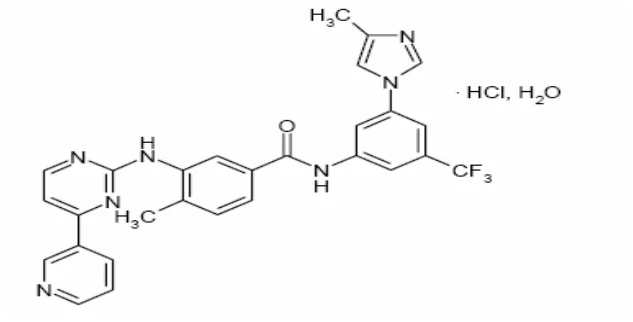
Structural formula:
Physicochemical properties:
Physical Description:
White to slightly yellowish or slightly greenish yellowish powder.
Solubility:
Solubility of nilotinib hydrochloride monohydrate in aqueous solutions strongly decreases with increasing pH, and that nilotinib hydrochloride monohydrate is practically insoluble in buffer solutions of pH 4.5 and higher pH values. Nilotinib hydrochloride monohydrate is very soluble in dimethyl sulfoxide, sparingly soluble in ethanol and methanol, very slightly soluble in acetonitrile and n-octanol.
pH:
The pH value of a 0.02% solution of nilotinib hydrochloride monohydrate in water/ethanol 50:50 (V/V) was found to be 4.3.
The pH value of a 0.1% suspension of nilotinib hydrochloride monohydrate in water was determined to be 5.3.
pKa:
pKa1 = 2.1, and
pKa2 = 5.4.
Partition Coefficient:
The distribution coefficient for nilotinib hydrochloride monohydrate in n-octanol/0.1N HCl buffer at 37.0 ± 0.5°C was determined to be 0.08.
Melting point:
Nilotinib hydrochloride monohydrate may undergo dehydration prior to melting, therefore no range can be defined.
14. Clinical Trials
14.1. Clinical Trials by Indication
Newly diagnosed Ph+ CML-CP (adults)
The clinical efficacy of nilotinib in newly diagnosed Ph+ CML-CP adult patients, has been demonstrated based on the Phase III Study (A2303). The design of the study is illustrated in Figure 1.
Figure 1.
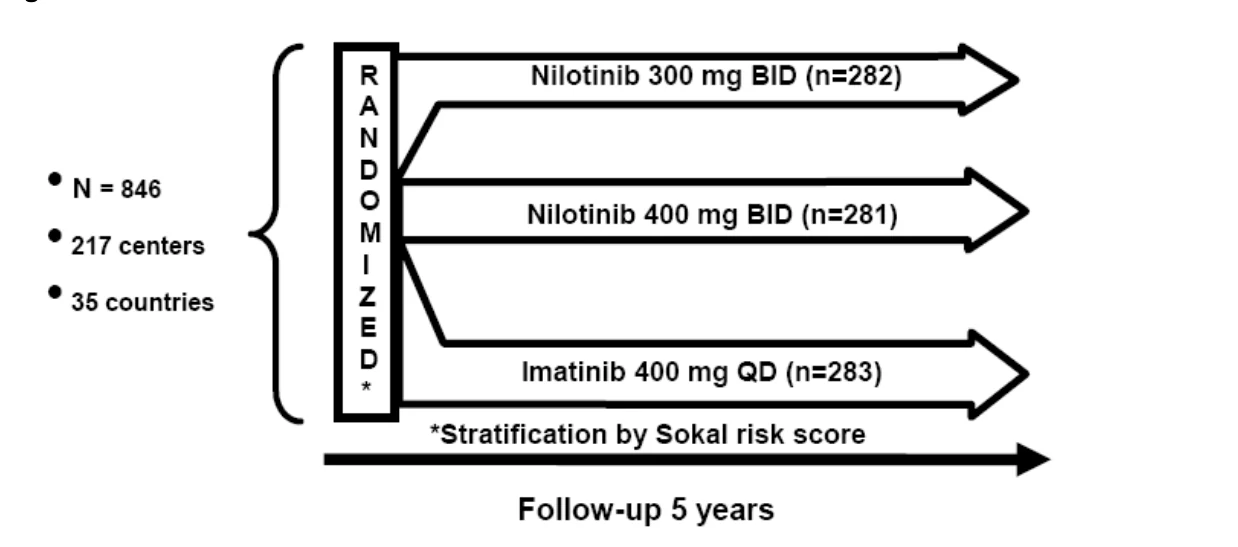
Table 14-1 - Summary of adult patient demographics for clinical trials (Newly diagnosed Ph+
CML-CP patients exposed to study drug)
| Study # | Study design | Dosage, route of administration and duration | Study subjects (n) | Age (range) | Sex |
| A2303 | Open label, multicenter, randomized Phase III study was conducted to determine the efficacy of Tasigna versus GLEEVEC in adult patients with cytogenetically confirmed newly diagnosed Ph+ CML-CP. | nilotinib and imatinib were administered orally: imatinib 400 mg once daily nilotinib 300 mg twice daily nilotinib 400 mg twice daily Median time on treatment was approximately 60 months in all three treatment groups. | Total number of patients randomized = 846 imatinib 400 mg once daily (n=283) nilotinib 300 mg twice daily (n= 282) nilotinib 400 mg twice daily (n=281) | imatinib 400 mg once daily 12.4% ≥ 65 years of age Mean: 47(18-80) nilotinib 300 mg twice daily 12.8% ≥ 65 years of age Mean: 47 (18-85) nilotinib 400 mg twice daily 10.0% ≥ 65 years of age in Mean: 47 (18-81) | imatinib 400 mg once daily M=55.8% F=44.2% nilotinib 300 mg twice daily M=56.0% F=44.0% nilotinib 400 mg twice daily M=62.3% F=37.7% |
An open label, multicenter, randomized Phase III study (A2303) was conducted to determine the efficacy of Tasigna versus imatinib in adult patients with cytogenetically confirmed newly diagnosed Ph+CML-CP. Patients were within six months of diagnosis and were previously untreated for CML-CP, except for hydroxyurea and/or anagrelide (See Table 14-2). In addition, patients were stratified according to Sokal risk score at time of diagnosis.
Baseline characteristics were well balanced between the groups (Table 14-1). There were slightly more male than female patients in all groups. More than 60% of all patients were Caucasian, and 25% were Asian. Table 14-2 displays the disease history characteristics.
The primary data analysis time point was when all 846 patients completed 12 months of treatment (or discontinued earlier). Subsequent analyses reflect when patients completed 24, 36, 48 and 60 months of treatment (or discontinued earlier). The median time on treatment is approximately 60 months in all three treatment groups.
The median actual dose intensity was 400 mg/day in the imatinib group, 593 mg/day in the nilotinib 300 mg twice daily group. This study is on-going. Table 14-3 displays the duration of exposure with Tasigna.
Table 14-2 - CML Disease History Characteristics
Tasigna 300 mg twice daily N=282 | Imatinib 400 mg once daily N=283 | |
|---|---|---|
| Median time since diagnosis of CML in days (range) | 31.0 (0-182) | 28.0 (1-183) |
| Hydroxyurea | 216 (76.6%) | 201 (71.0%) |
| Anagrelide | 6 (2.1%) | 4 (1.4%) |
Table 14-3 - Duration of Exposure with Tasigna
Tasigna 300 mg twice daily N=279 | Imatinib 400 mg once daily N=277 | |
|---|---|---|
Median duration of therapy in months (95%CI) | 60.02 (59.20-60.42) | 58.69 (52.21-59.99) |
Study Results:
Primary Efficacy Endpoint: Major Molecular Response (MMR)
The primary efficacy variable was MMR at 12 months after the start of study medication. MMR was defined as ≤ 0.1% BCR-ABL/ABL % by international scale measured by Real-Time Quantitative PCR (RQ-PCR), which corresponds to a ≥ 3 log reduction of BCR-ABL transcript from standardized baseline.
The primary efficacy endpoint, MMR rate at 12 months was statistically significantly superior in the nilotinib 300 mg twice daily group compared to the imatinib 400 mg once daily group (44.3% vs. 22.3%, p<0.0001) (Table 14-9).
At the nilotinib recommended dose of 300 mg twice daily, the rates of MMR at 3, 6, 9 and 12 months was 8.9%, 33.0%, 43.3% and 44.3%, respectively. In the imatinib 400 mg once daily group, the rates of MMR at 3, 6, 9 and 12 months was 0.7%, 12.0%, 18.0% and 22.3%.
The MMR rates at 12, 24, 36, 48, and 60 months is presented in Table 14-9.
Table 14-4 - MMR rate
Tasigna 300 mg twice daily N=282* n (%) | Imatinib 400 mg once daily N=283* n (%) | |
|---|---|---|
MMR at 12 months2 95% CI for response | 125(44.3)1 [38.4, 50.3] | 63(22.3) [17.6, 27.6] |
MMR at 24 months2 95% CI for response | 174 (61.7)1 [55.8, 67.4] | 106 (37.5) [31.8, 43.4] |
MMR at 36 months2 95% CI for response | 165 (58.5)1 [52.5, 64.3] | 109 (38.5) [32.8, 44.5] |
MMR at 48 months2 95% CI for response | 169 (59.9)1 [54.0,65.7] | 124 (43.8) [38.0,49.8] |
| MMR at 60 months2 | 177 (62.8) | 139 (49.1) |
| 95% CI for response | [56.8,68.4] | [43.2,55.1] |
* Denominator for this analysis (N) includes all randomized patients, whether evaluable or not evaluable for MMR
1 CMH test p-value for response rate (vs. Imatinib 400 mg) <0.0001
2 Only patients who were in MMR at a specific time point are included as responders for that time point. Other randomized patients, whether evaluable or not at that time point, are conservatively considered as not MMR:
- A total of 129 (15.2%) of all patients were not evaluable for MMR at 12 months (40 in the nilotinib 300 mg BID group, 41 in the nilotinib 400 mg BID group and 48 in the imatinib group) due to missing/not evaluable PCR assessments (n=3), atypical transcripts at baseline (n=8), or discontinuation prior to the 12-month time point (n=118).
- A total of 211 (24.9%) of all patients were not evaluable for MMR at 24 months (68 in the nilotinib 300 mg BID group, 61 in the nilotinib 400 mg BID group and 82 in the imatinib group) due to missing/ not evaluable PCR assessments (n=13), atypical transcripts at baseline (n=8), or discontinuation prior to the 24-month time point (n=190).
A total of 199 (35.2%) of all patients were not evaluable for MMR at 36 months (87 in the nilotinib 300 mg BID group and 112 in the
imatinib group) due to missing/ not evaluable PCR assessments (n=17), atypical transcripts at baseline (n=7), or discontinuation prior to the 36-month time point (n=175).
- A total of 305 (36.1%) of all patients were not evaluable for MMR at 48 months (98 in the nilotinib 300 mg BID group, 88 in the nilotinib 400 mg BID group and 119 in the imatinib group) due to missing/ not evaluable PCR assessments (n=18), atypical transcripts at baseline (n=8), or discontinuation prior to the 48-month time point (n=279).
A total of 322 (38.1%) of all patients were not evaluable for MMR at 60 months (99 in the nilotinib 300mg BID group, 93 in the nilotinib
400 mg BID group and 130 in the imatinib group) due to missing/ not evaluable PCR assessments (n=9), atypical transcripts at baseline
(n=8), or discontinuation prior to the 60-month time point (n=305).
MMR rates by different time points (including patients who achieved MMR at or before those time points as responders) are presented in the cumulative incidence of MMR (Figure 2).
Figure 2 Cumulative Incidence of MMR
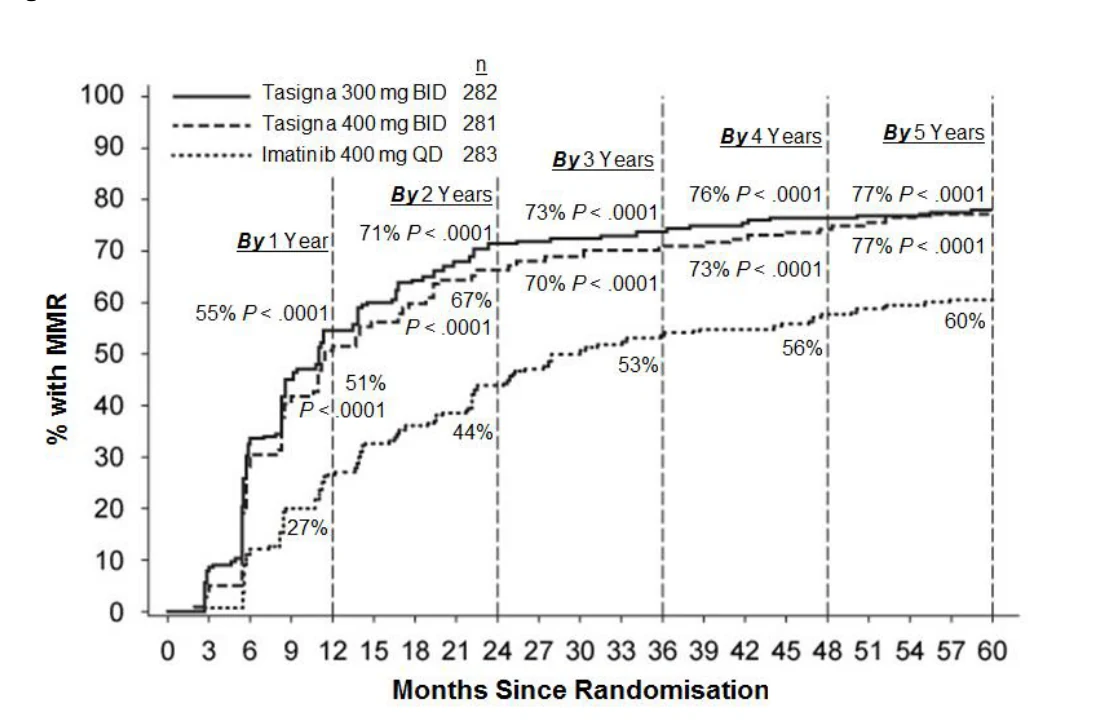
For all Sokal risk groups, the MMR rates at all timepoints remained consistently higher in the 300 mg twice daily nilotinib group than in the imatinib group.
In an exploratory analysis, 91% (234/258) of patients on nilotinib 300 mg twice daily achieved BCR-ABL levels ≤10% at 3 months of treatment compared to 67% (176/264) of patients on imatinib 400 mg once daily.
Based on the Kaplan-Meier analyses of time to first MMR among all patients, the probability of achieving MMR at different time points was higher in the nilotinib group compared to the imatinib group (hazard ratio/HR=2.20 and stratified log-rank p<0.0001 between nilotinib 300 mg twice daily and imatinib).
Table 14-5 - Best overall BCR-ABL ratio rates (by 60 months cut-off) – Study CAMN107A2303 (FAS)
Tasigna 300 mg twice daily N=282 | Imatinib 400 mg once daily N=283 | |
|---|---|---|
| BCR-ABL ratio categories1 | ||
| ≤0.0032% | 156 (55.3%) | 92 (32.5%) |
| >0.0032% - ≤0.01% | 31 (11%) | 28 (9.9%) |
| >0.01 - ≤0.1 % | 31 (11%) | 53 (18.7%) |
| >0.1 - ≤1 % | 28 (9.9%) | 43 (15.2%) |
| >1 - ≤10 % | 15 (5.3%) | 26 (9.2%) |
| >10 % | 12 (4.3%) | 32 (11.3%) |
1Molecular response of >0.01 - ≤0.1 %, >0.0032-≤ 0.01% and ≤ 0.0032% by International Scale (IS) corresponds to a ≥3 log to <4 log reduction; a ≥ 4 log to <4.5 log reduction and ≥ 4.5 log reduction, respectively, of BCR-ABL transcripts from a standardized baseline.
Patients categorized according to their best overall BCR-ABL ratio achieved are summarized in Table 14-5 above.
The proportions of patients who had a molecular response of ≤ 0.01% and ≤ 0.0032% by International Scale (IS) at different time-points is presented in Table 14-6.
Table 14-6 - Proportions of patients who had molecular response of ≤ 0.01% (4 log reduction and ≤ 0.0032% (4.5 log reduction)
Tasigna 300 mg twice daily N=282 (%) | Imatinib 400 mg once daily N=283 (%) | |||||||||
|---|---|---|---|---|---|---|---|---|---|---|
| ≤ 0.01% | ≤ 0.0032% | ≤ 0.01% | ≤ 0.0032% | |||||||
| At 12 months | 11.7 | 4.6 | 3.9 | 0.4 | ||||||
| At 24 months | 24.5 | 12.4 | 10.2 | 2.8 | ||||||
| At 36 months | 29.4 | 13.8 | 14.1 | 8.1 | ||||||
| At 48 months | 33.0 | 16.3 | 19.8 | 10.2 | ||||||
| At 60 months | 47.9 | 32.3 | 31.1 | 19.8 | ||||||
Duration of MMR
Based on Kaplan-Meier estimates of the duration of first MMR, the proportions of patients who achieved MMR and were maintaining response for 60 months among patients who achieved MMR were 93.4% (95% CI: 89.9% to 96.9%) in the nilotinib 300 mg twice daily group, and 89.1% (95% CI: 84.2% to 94.0%) in the imatinib 400 mg once daily group.
Secondary Efficacy Endpoint: Complete Cytogenetic Response (CCyR)
CCyR was defined as 0% Ph+ metaphases in the bone marrow based on a minimum of 20 metaphases evaluated. CCyR rate by 12 months (includes patients who achieved CCyR at or before the 12 month time point as responders) was statistically higher for the nilotinib 300 mg twice daily group compared to imatinib 400 mg once daily group, Table 14-7.
CCyR rate by 24 months (includes patients who achieved CCyR at or before the 24-month time point as responders) was statistically higher for the nilotinib 300 mg twice daily group compared to imatinib 400 mg once daily group (Table 14-7).
Table 14-7 - Rate of Complete Cytogenetic Response (CCyR)
Tasigna 300 mg twice daily N=282 n (%) | Imatinib 400 mg once daily N=283 n (%) | |
|---|---|---|
| By 12 months | ||
Complete Cytogenetic Response 95% CI for response | 226 (80.1) [75.0,84.6] | 184 (65.0) [59.2,70.6] |
| CMH test p-value for response rate (vs. imatinib 400 mg) | <0.0001 | |
| By 24 months | ||
Complete Cytogenetic Response 95% CI for response | 245 (86.9) [82.4, 90.6] | 218 (77.0) [71.7, 81.8] |
| CMH test p-value for response rate (vs. Imatinib 400 mg) | 0.0018 |
CMH: Cochran-Mantel-Haenszel
Cytogenetic assessments after 24 months follow-up were not required.
Duration of CCyR
Based on Kaplan-Meier estimates, the proportions of patients were maintaining response for 60 months among patients who achieved CCyR were 99.1% (95% CI: 97.9% to 100%) in the nilotinib 300 mg twice daily group, and 97.0% (95% CI: 94.7% to 99.4%) in the imatinib 400 mg once daily group.
Secondary Efficacy Endpoint: Progression to accelerated phase and blast crisis (AP/BC) on study
Progression “on study” refers to the first documented disease progression to AP/BC or CML-related death that occurred at any time after randomization, up to a 60-month post-treatment follow-up cut-off. Patients receiving nilotinib 300 mg twice daily who had responded insufficiently to study treatment were allowed to increase the dose. Patients receiving imatinib who had responded insufficiently to study treatment were allowed to cross over to nilotinib. By 60 months, in the intention-to-treat (ITT) population, 31 patients progressed to AP/BC (21 in the imatinib group and 10 in the nilotinib 300 mg twice daily group). The estimated rates of patients free from progression to AP/BC at 60 months were 92.1% in the imatinib group and 96.3% in the nilotinib 300 mg twice daily group (HR=0.4636 between nilotinib 300 mg twice daily group and imatinib).
BCR-ABL Mutations
Study A2303 excluded patients with the BCR-ABL T315I mutation at baseline. In this study, BCR-ABL mutation analysis was performed at baseline and post-treatment. Post-treatment mutation analysis was performed only in a subset of patients when warranted by their clinical course. At baseline, no BCR-ABL mutations were detected for any of the 846 patients enrolled in Study A2303. However, Abl polymorphisms were identified at baseline in some patients with equal distribution among the three treatment arms (23 for nilotinib 300 mg twice daily, 20 for nilotinib 400 mg twice daily, and 17 for imatinib). ABL polymorphism were confirmed by amplifying and sequencing the kinase domain region of both non-translocated ABL alleles in the same samples. Polymorphisms have been reported to have no clinical relevance.
At the 60-month follow-up, 12 patients in the nilotinib 300 mg twice daily arm developed mutations, and 10 of the 12 had at least one of the following mutations: T315I, Y253H, E255K, or F359V mutations. One of the 12 patients in the nilotinib 300 mg twice daily arm with E459K mutation progressed. Eleven patients in the nilotinib 400 mg twice daily arm developed mutations, and 2 patients progressed. All 11 patients had one of the following mutations: T315I, Y253H, E255K/V, F359V or Q252H mutations. Twenty-two patients in the imatinib arm developed mutations, and 8 of 22 had one of the following mutations: T315I, Y253H or F359V/C/I or M244V mutations.
The T315I mutation confers a high level of resistance to nilotinib and most tyrosine kinase inhibitors and is associated with rapid disease progression. The Y253H, E255K/V and F359V/C/I mutations are known to be less sensitive to nilotinib.
Secondary Efficacy Endpoint: Overall survival (OS)
A total of 50 patients died on study, during core treatment, extension treatment or during the follow-up after discontinuation of treatment (18 in the nilotinib 300 mg twice daily group, 10 in the nilotinib 400 mg twice daily group, and 22 in the imatinib 400 mg once daily group). The estimated rates of patients alive at 60 months were 93.7%, versus 91.7%, (p = 0.4881 between nilotinib 300 mg twice daily and imatinib) and 96.2% versus 91.7% (p= 0.0266 between nilotinib 400 mg twice daily and imatinib). As of the 60-month cutoff date, no overall survival benefit has been demonstrated.
Resistant or intolerant Ph+ CML in chronic phase and accelerated phase (adults)
The clinical efficacy of nilotinib in imatinib-resistant or -intolerant Ph+ CML in chronic phase (CP) or in accelerated phase (AP) adult patients, has been demonstrated based on the Phase II component of Study (A2101).
The design of Study A2101 is illustrated in Figure 3 below.
Figure 3:
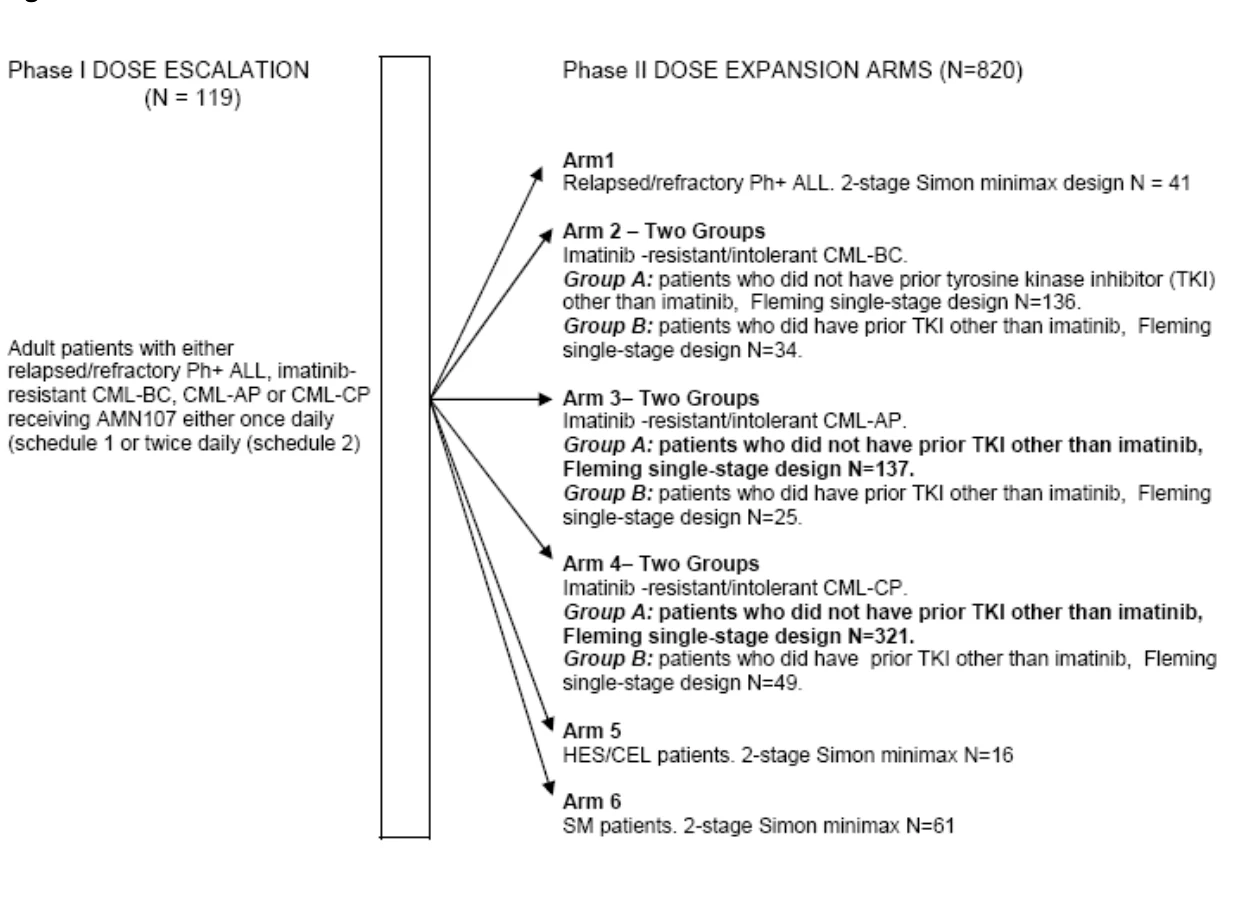
Table 14.8 - Summary of adult patient demographics for clinical trials (imatinib resistant or –intolerant Ph+ CML-AP and CP patients exposed to study drug)
| Study # | Study design | Dosage, route of administration and duration | Study subjects (n) | Age (range) | Sex |
| A2101 | Open label, multicenter, Phase II study to determine the efficacy of Tasigna in patients with imatinib-resistant or -intolerant CML with separate treatment arms for chronic and accelerated phase CML. | Tasigna administered orally: 400 mg twice daily (may be dose-escalated to 600 mg twice daily). Treatment duration: 561 days for CP and 264 days for AP | CML-CP (Group A)1 = 321 CML-AP (Group A)1 = 137 | CML-CP (Group A): 31% over the age 65 Mean = 57 Range = 21-85 CML-AP (Group A): 30% over the age 65 Mean = 56 Range=22-82 | CML-CP (Group A): M = 50% F = 50% CML-AP (Group A): M=55% F= 45% |
1Group A: patients who did not have prior TKI other than imatinib.
An open label, multicenter, Phase II study (A2101) was conducted to determine the efficacy of Tasigna in patients with imatinib-resistant or -intolerant CML with separate treatment arms for chronic and accelerated phase CML. The study is ongoing. Efficacy was based on 321 CML-CP patients and 137 CML-AP patients enrolled. Median duration of treatment was 561 days and 264 days, respectively (see Table 14-9). Tasigna was administered on a continuous basis (twice daily 2 hours after a meal and no additional food for at least one hour), unless there was evidence of inadequate response or disease progression (see Table 14-8). Dose escalation to 600 mg twice daily was allowed (see Table 14-8). A total of 57 CML-CP and 33 CML-AP patients were escalated to the 600 mg twice daily dose.
Table 14-9 - Duration of Exposure with Tasigna
Chronic Phase CML N = 321 | Accelerated Phase CML N = 137 | |
|---|---|---|
| Median duration of therapy in days (95% CI) | 561 (459-680) | 264 (190-357) |
Resistance to imatinib included failure to achieve a complete hematologic response (by 3 months), cytogenetic response (by 6 months) or major cytogenetic response (by 12 months) or progression of disease after a previous cytogenetic or hematologic response. Imatinib intolerance included patients who discontinued imatinib because of toxicity and were not in major cytogenetic response at time of study entry.
Overall, 70% of CML-CP patients were imatinib-resistant while 30% were imatinib-intolerant. Overall, 80% of CML-AP patients were imatinib-resistant while 20% were imatinib-intolerant. Prior treatment included imatinib, hydroxyurea, interferon, and stem cell transplant (Table 14-10). The median highest prior imatinib dose had been 600 mg/day for CP and AP patients. The highest prior imatinib dose was ≥ 600 mg/day in 72% of all CML-CP patients and 79% of all CML-AP patients. Thirty-eight (38%) of all CML-CP patients and 45% of all CML-AP patients received imatinib doses ≥800 mg/day.
Table 14-10 - CML Disease History Characteristics
Chronic Phase (n = 321) | Accelerated Phase (n = 137)& | |
|---|---|---|
| Median time since diagnosis in months (range) | 58 (5-275) | 71 (2-298) |
Imatinib Resistant Resistant without MCyR Intolerant without MCyR | 226 (70%) - 95 (30%) | - 109 (80%) 27 (20%) |
| Median time of imatinib treatment in days 95%CI | 975 (892-1068) | 857 (702-1059) |
| Prior hydroxyurea | 83% | 91% |
| Prior interferon | 58% | 50% |
| Prior organ transplant | 7% | 8% |
& One patient had missing information for imatinib-resistant/intolerant status
The primary endpoint in the CP patients was major cytogenetic response (MCyR), defined as elimination (complete cytogenetic response, CCyR) or significant reduction to <35% Ph+ metaphases (partial cytogenetic response, PCyR) of Ph+ hematopoietic cells. The secondary endpoint was complete hematologic response (CHR) in CP patients.
The primary endpoint in the AP patients was overall confirmed hematologic response (HR), defined as either a complete hematologic response (CHR), or no evidence of leukemia (NEL).
Chronic Phase: The MCyR rate in 321 CP patients was 59%. Most responders achieved their MCyR rapidly within 3 months (median 2.8 months) of starting Tasigna treatment and these responses were sustained. The CCyR rate was 44%. The median time to achieve CCyR was just past 3 months (median 3.3 months). Of the patients who achieved MCyR, 77% (95% CI: 71% to 84%) were maintaining response at 24 months. Median duration of MCyR has not been reached. Of the patients who achieved CCyR, 84% (95% CI: 77% to 91%) were maintaining response at 24 months. Median duration of CCyR has not been reached. Patients with a CHR at baseline achieved a MCyR faster (1.4 vs. 2.8 months). Of CP patients without a baseline CHR, 76% achieved a CHR, median time to CHR was 1 month. Median duration of CHR has not been reached. The response rates for the CP treatment arm are reported in Table 14-11 and Figure 4.
The estimated 24-month overall survival rate in CML -CP patients was 87%.
Accelerated Phase: The overall confirmed HR rate in 137 AP patients, was 44%.
Median duration of confirmed HR was 21.5 months. Of the patients who achieved HR, 50% (95% CI: 35% to 65%) were maintaining response at 24 months. The rate of confirmed CHR was 31%. Median duration of confirmed CHR was 26.3 months. Of the patients who achieved CHR, 51% (95% CI: 34% to 69%) were maintaining response at 24 months. The unconfirmed MCyR rate was 32% with a median time to response of 2. 8 months. Of the patients who achieved MCyR, 66% (95% CI: 50% to 82%) were maintaining response at 24 months. Median duration of MCyR has not been reached. The response rates for the AP treatment arm are reported in Table 14-11.
The estimated 24-month overall survival rate in CML -AP patients was 70%.
Table 14-11 - Responses in CML – adults
| (Best Response Rate) | Chronic Phase | Accelerated Phase | ||||
|---|---|---|---|---|---|---|
Intolerant (n = 95) | Resistant (n = 226) | Total (n = 321) | Intolerant (n = 27) | Resistant (n = 109) | Total (n = 137) | |
| Hematologic Response (%) | ||||||
| Overall (95%CI) | - | - | - | 52 (32-71) | 41 (32-51) | 44 (35-53) |
| CHR (95%CI) | 90%1 (79-97) | 72%1 (64-79) | 76%1,3 (70-82) | 372 | 302 | 312 |
| NEL | - | - | - | 152 | 112 | 122 |
| Unconfirmed1 Cytogenetic Response (%) | ||||||
Major (95%CI) Complete Partial | 66% (56-76) 51 16 | 56% (49-63) 41 15 | 59% (54-65) 44 15 | 41 (22-61) 30 11 | 30 (22-40) 19 11 | 32 (24-41) 21 11 |
CHR = Complete hematologic response CCyR = Complete cytogenetic response
NEL = No evidence of leukemia
Hematologic response: CHR+NEL
CHR (CML-CP): WBC <10 x 109 /L, platelets <450,000/mm3, no blasts or promyelocytes in peripheral blood, myelocytes + metamyelocytes <5% in peripheral blood, basophils <5% in peripheral blood, and no extramedullary involvement.
CHR (CML-AP): neutrophils ≥ 1.5 x 10⁹/L, platelets ≥ 100 x 109/L, no myeloblasts in peripheral blood, myeloblast < 5% in bone marrow, basophils <5% in peripheral blood, and no extramedullary involvement.
NEL: same criteria as for CHR but neutrophils ≥ 1.0 x 10⁹/L, platelets ≥ 20 x 109/L without platelet transfusion or bleeding and no requirement for basophils.
Cytogenetic response: Complete (0% Ph+ metaphases) or partial (1-35%). Cytogenetic responses were based on the percentage of Ph-positive metaphases among ≥ 20 metaphase cells in each bone marrow sample.
1Unconfirmed: Response based on one assessment
2 Confirmed: Response assessments confirmed by another assessment at least after 4 weeks).
3 207 CP patients did not have a CHR at baseline and were therefore assessable for complete hematologic response of which 158 patients (76%) achieved a CHR
Figure 4 Kaplan-Meier estimates of duration of MCyR (months)1 among CML-CP patients who achieved MCyR - Study CAMN107A2101E2 (Conventional
ITT population)
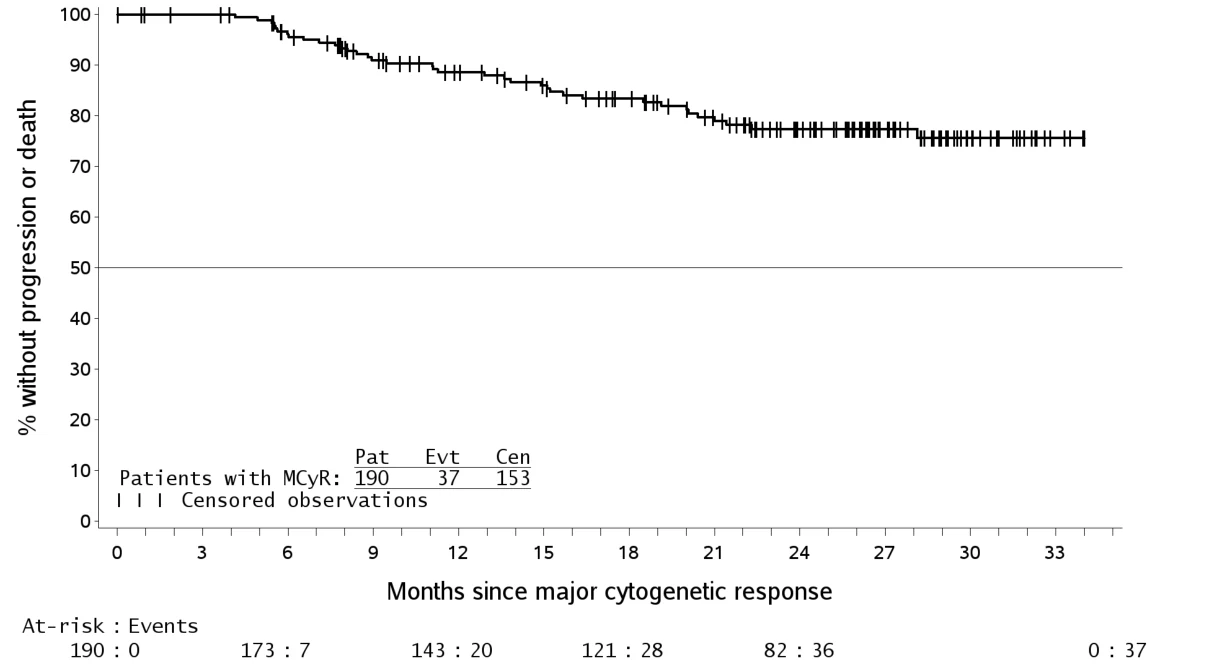
1Duration defined as time between first documented response to the date of discontinuation due to progression of disease or death.
Separate treatment arms were also included in the Phase II study (A2101) to study Tasigna in a group of CP and AP patients who had been extensively pre-treated with multiple therapies, including a tyrosine kinase inhibitor agent in addition to imatinib. Of these patients, 30/36 (83%) were treatment-resistant. In 22 CP patients evaluated for efficacy, Tasigna induced a 32% MCyR rate and a 50% CHR rate.
After imatinib failure, 24 different BCR-ABL mutations at baseline were noted in 42% of chronic phase and 54% of accelerated phase CML patients who were evaluated for mutations. Tasigna demonstrated efficacy in patients harboring a variety of BCR-ABL mutations associated with imatinib resistance, except T315I.
Treatment discontinuation in newly diagnosed Ph+ CML-CP patients who have achieved a sustained molecular response (MR4.5)
Table 14-12 - Overview of Treatment Free Remission (TFR) clinical study I2201
| Study # | Study design | Dosage, route of administration and duration | Study subjects (n=number) | Mean age (Range) | Sex |
| I2201 | Phase II, single-arm, multicenter, study of TFR in patients with Ph+ CML-CP who have achieved sustained MRD* status on first-line nilotinib treatment. | Dose: 300 mg nilotinib twice daily. Dose regimen was decreased to 400 mg once daily if patients did not tolerate the planned dose. Duration of treatment consolidation phase: 52 weeks. Duration of TFR phase: median=76 weeks as of 96-week data cut-off. | Total: 215 patients started the consolidation phase of the study 190 patients entered the TFR phase. | Total: 215 Age: 54 (21-86) years 20.5% over age 65 TFR Phase: 190 Age: 54 (21-86) years 21.1% over age 65 | Total: 215 M: 113 (52.6%) F: 102 (47.4%) TFR Phase: 190 M: 96 (50.5%) F: 94 (49.5%) |
*Sustained minimal residual disease (MRD) is defined as the following results from the last 4 quarterly PCR assessments: MR4.5 at last assessment, no assessment worse than MR4.0 and less than 2 assessments between MR4 and MR4.5.
In an open-label, multicenter, single-arm study, 215 adult patients with Ph+ CML-CP treated with Tasigna in first-line for ≥ 2 years who achieved MR4.5 as measured with a quantitative diagnostic test validated with a sensitivity of at least MR4.5 (BCR-ABL/ABL ≤0.0032% IS) were enrolled to continue Tasigna treatment for an additional 52 weeks (Tasigna consolidation phase). Of the 215 patients, 190 patients (88.4%) entered the TFR phase after achieving a sustained molecular response (MR4.5) during the consolidation phase, defined by the following criteria:
- The last four quarterly assessments (taken every 12 weeks) were at least MR4.0 (BCR ABL/ABL≤ 0.01% IS), and maintained for 1 year
- The last assessment being MR4.5 (BCR-ABL/ABL ≤ 0.0032% IS)
- No more than two assessments falling between MR4.0 and MR4.5 (0.0032% IS < BCR-ABL/ABL ≤ 0.01% IS).
The median age of patients who entered the TFR phase was 55 years, 49.5% were females, and 21.1% of the patients were ≥ 65 years of age. The median actual dose intensity during the 52-week Tasigna consolidation phase was 600.0 mg/day.
BCR-ABL levels were monitored every 4 weeks during the first 48 weeks of the TFR phase. Monitoring frequency was intensified to every 2 weeks upon the loss of MR4.0. Biweekly monitoring ended at one of the following time points:
- Loss of MMR requiring patient to re-initiate Tasigna treatment
- When the BCR-ABL levels returned to a range between MR4.0 and MR4.5
- When the BCR-ABL levels remained lower than MMR for 4 consecutive measurements (8 weeks from initial loss of MR4.0).
Any patient with loss of MMR during the TFR phase re-initiated Tasigna treatment at 300 mg twice daily or at a reduced dose level of 400 mg once daily if required from the perspective of tolerance, within 5 weeks after the collection date of the blood sample demonstrating loss of MMR. Patients who required re-initiation of Tasigna treatment were monitored for BCR-ABL levels every 4 weeks for the first 24 weeks and then every 12 weeks thereafter in patients who regained MMR.
The primary endpoint was the percentage of patients who were in MMR at 48 weeks after starting the TFR phase (considering any patient who required re-initiation of treatment before 48 weeks as non-responder). Of the 190 patients who entered the TFR phase, 98 patients (51.6% [95% CI: 44.2, 58.9]) were in MMR in the TFR phase at 48 weeks and 93 patients (48.9%, [95% CI: 41.6, 56.3]) were in MMR in the TFR phase at 96 weeks.
By the 96-week analysis data cut-off date, 91 patients (47.9%) discontinued from the TFR phase due to loss of MMR, and 1 (0.5%), 1 (0.5%), 1 (0.5%) and 3 patients (1.6%) due to death from unknown cause, physician decision, lost to follow-up, and subject decision, respectively. Among the 91 patients who discontinued the TFR phase due to loss of MMR, 88 patients restarted Tasigna treatment and 3 patients permanently discontinued from the study.
Of the 88 patients who restarted treatment due to loss of MMR in the TFR phase, 87 patients (98.9%) patients regained MMR (one patient discontinued study permanently due to subject decision after 7.1 weeks of retreatment without regaining MMR) and 81 patients (92.0%) regained MR4.5 by the time of the 96-week cut-off date.
The time by which 50% of all retreated patients regained MMR and MR4.5 in the retreatment phase was 7.0 and 13.1 weeks, respectively. The cumulative rate of MMR and MR4.5 regained at 24 weeks since treatment re initiation was 97.7% (86/88 patients) and 86.4% (76/88 patients), respectively.
Among the 190 patients in the TFR phase, 98 patients had a treatment-free survival (TFS) event (defined as discontinuation from TFR phase due to any reason, loss of MMR, death due to any cause, progression to AP/BC up to the end of TFR phase, or re-initiation of treatment due to any cause in the study) by the 96-week cut-off date. At 96 weeks, the KM estimated median TFS was 74.6 weeks (95% CI: 36.0, NE) where NE is not estimable, and the KM-estimated 96 weeks TFS rate was 48.9% (95% CI: 41.7, 55.8) (Figure 5).
Figure 5 Kaplan-Meier estimate of treatment-free survival after start of TFR (Full Analysis Set)*
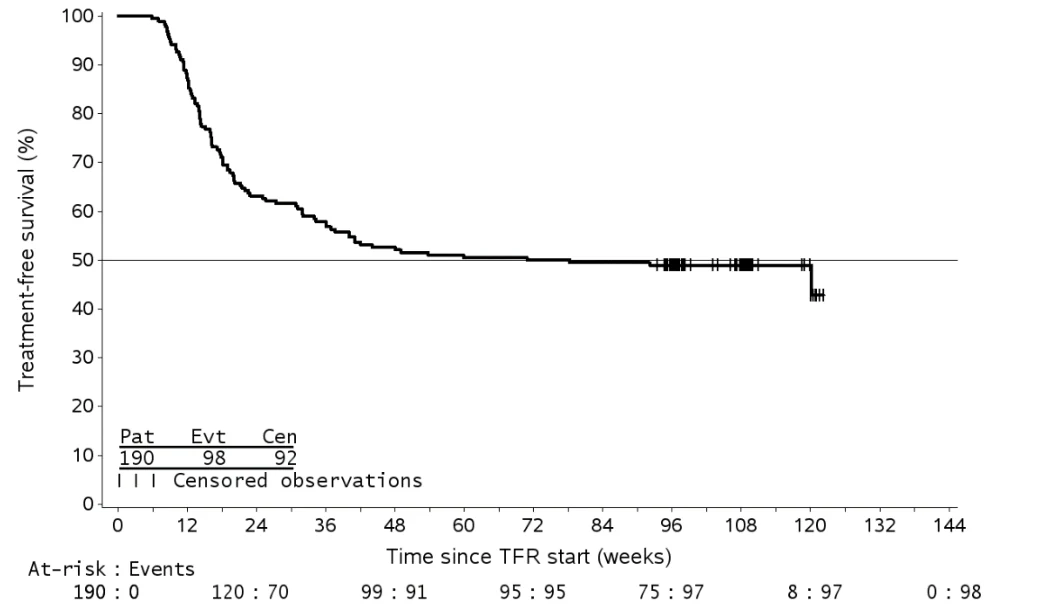
*By the time of the 96-week data cut-off date, one single patient lost MMR at week 120, at the time when only 8 patients were considered at risk. This explains the artificial drop at the end of the curve.
Treatment discontinuation in Ph+ CML-CP patients who have achieved a sustained molecular response (MR4.5) on Tasigna following prior imatinib therapy
Table 14-13 - Overview of Treatment Free Remission (TFR) clinical study A2408
| Study # | Study design | Dosage, route of administration and duration | Study subjects (n) | Age (range) | Sex |
| A2408 | Phase II, single arm, multicenter study of TFR in Ph+ CML-CP patients after achieving sustained MR4.5 on nilotinib | Dose: Nilotinib: 300 mg or 400 mg twice daily, 400 mg once daily or any other dose received prior to study entry Duration of treatment consolidation phase: 52 weeks Duration of treatment-free remission phase: median=99 weeks as of 96-week data cut-off. | Total: 163 patients started the consolidation phase of the study 126 patients entered the TFR phase | Total: 163 Age 564.3 (21-86) years 24.5% over age 65. TFR Phase:126 Age 55 (21-86 years) 27.8% over age 65. | Total: 163 M: 77 (47.2%) F: 86 (52.8%) TFR Phase: 126 M: 56 (44.4%) F: 70 (55.6%) |
In an open-label, multicenter, single-arm study, 163 adult patients with Ph+ CML-CP taking tyrosine kinase inhibitors (TKIs) for ≥ 3 years (imatinib as initial TKI therapy for more than 4 weeks without documented MR4.5 on imatinib at the time of switch to Tasigna, then switched to Tasigna for at least 2 years), and who achieved MR4.5 on Tasigna treatment as measured with a quantitative diagnostic test validated with a sensitivity of at least MR4.5 (BCR-ABL/ABL ≤0.0032% IS) were enrolled to continue Tasigna treatment for an additional 52 weeks (Tasigna consolidation phase). Of the 163 patients, 126 patients (77.3%) entered the TFR phase after achieving a sustained molecular response (MR4.5) during the consolidation phase, defined by the following criterion:
- The last four quarterly assessments (taken every 12 weeks) showed no confirmed loss of MR4.5 (BCR-ABL/ABL ≤ 0.0032% IS) during 1 year.
The median age of patients who entered the TFR phase was 56 years, 55.6% were females, and 27.8% of the patients were ≥ 65 years of age. The median actual dose intensity during the 52-week Tasigna consolidation phase was 771.8 mg/day with 52.4%, 29.4%, 0.8%, 16.7% and 0.8% of patients receiving a daily Tasigna dose of 800 mg, 600 mg, 450mg, 400mg and 300mg just before entry into the TFR phase, respectively.
Patients who entered the TFR phase but experienced two consecutive measurements of BCR-ABL/ABL > 0.01% IS were considered having a confirmed loss of MR4.0, triggering re-initiation of Tasigna treatment. Patients with loss of MMR in the TFR phase immediately restarted Tasigna treatment without confirmation. All patients who restarted Tasigna therapy had BCR-ABL transcript levels monitored every 4 weeks for the first 24 weeks, then once every 12-weeks .
The primary endpoint was defined as the proportion of patients without confirmed loss of MR4.0 or loss of MMR within 48 weeks following discontinuation of Tasigna therapy. Of the 126 patients who entered the TFR phase, 73 patients (57.9%, [95% CI: 48.8, 66.7]) did not have loss of MMR, or confirmed loss of MR4.0, or re-initiation of Tasigna therapy within 48 weeks, and in 67 patients (53.2% [95% CI: 44.1, 62.1]) within 96 weeks after the start of the TFR phase.
By the 96-weeks analysis data cut-off date, 61 patients (48.4%) discontinued from the TFR phase: 58 patients (46.0%) due to loss of MMR or confirmed loss of MR4.0, 2 patients (1.6%) due to subject/guardian decision and one patient (0.8%) due to pregnancy. Among the 58 patients who discontinued from the TFR phase due to confirmed loss of MR4.0 or loss of MMR, 56 patients restarted Tasigna therapy and 2 patients permanently discontinued from the study. Of the 56 patients who restarted Tasigna treatment due to confirmed loss of MR4.0 or loss of MMR in the TFR phase, 52 patients (92.9%) regained MR4.0 and MR4.5; 4 patients (7.1%) did not regain MR4.0 by the time of the cut-off date.
The time by which 50% of all retreated patients regained MR4.0 and MR4.5 in the retreatment phase was 12 weeks and 13.1 weeks respectively. The cumulative rate of MR4.0 and MR4.5 regained by 48-weeks since treatment re-initiation, was 92.9% (52/56 patients) and 91.1% (51/56 patients), respectively.
Among the 126 patients in the TFR phase, 61 patients (48.4%) had a treatment-free survival (TFS) event (defined as discontinuation from TFR phase due to any reason, loss of MMR, confirmed loss of MR4.0, death due to any cause, progression to AP/BC up to the end of TFR phase, or re-initiation of treatment due to any cause in the study) on or before the 96-month cut-off date. At 96 weeks, the KM estimated median TFS was 111.0 weeks (95% CI: 27.9, NE) where NE is not estimable, and the KM-estimated TFS rate was 54.0% (95% CI: 44.9, 62.2) (Figure 6).
Figure 6 Kaplan-Meier estimate of treatment-free survival after start of TFR (Full Analysis Set)
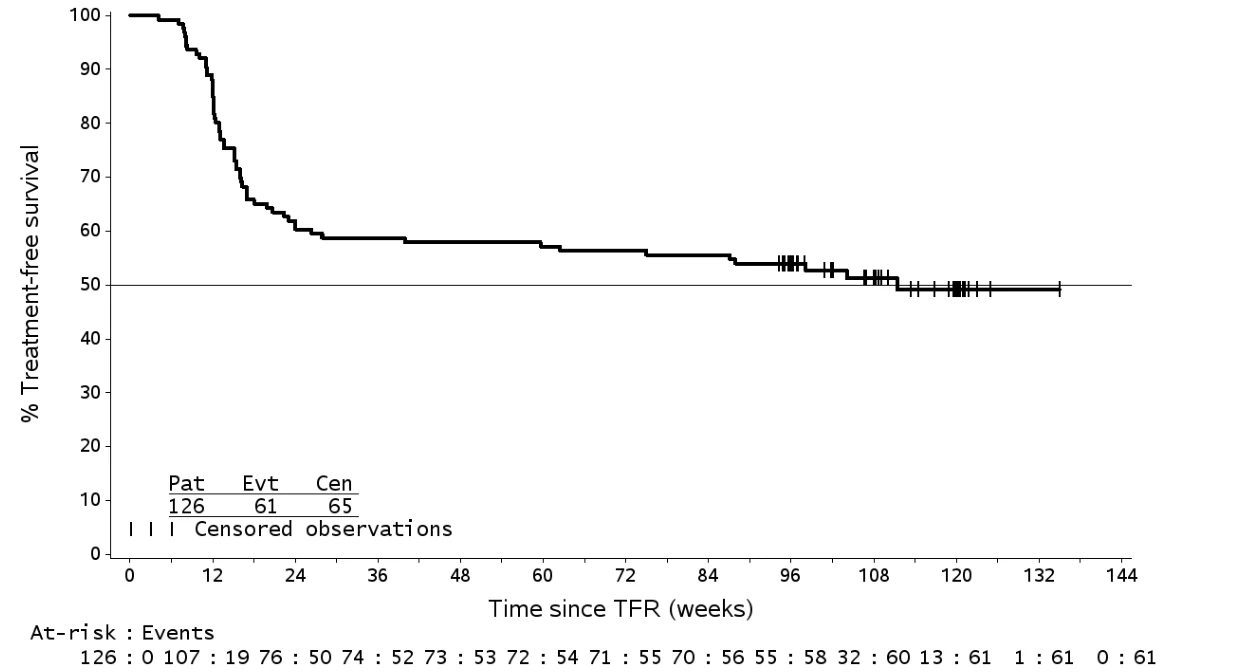
Table 14-14 - Summary of pediatric patient demographics for clinical trials
(Newly diagnosed and resistant / intolerant Ph+ CML-CP patients exposed to Tasigna)
| Study # | Study design | Dosage, route of administration and duration | Study subjects (n) | Age (range) | Sex |
| CAMN107A2 203 | A multi-centre, open label, non-controlled Phase II study to evaluate the efficacy and safety of oral nilotinib in pediatric patients (1 to <18 years old) with newly diagnosed Ph+ chronic myeloid leukemia (CML) in chronic phase (CP) or with Ph+ CML in CP or accelerated phase (AP) resistant or intolerant to either imatinib or dasatinib | 50mg, 150mg and 200 mg capsules 230 mg/m 2 twice daily. Median time on treatment: Resistant/intolerant CML-CP:15. 6-months Newly diagnosed CML-CP: 14.6 months | Total: 58 Patients Resistant/ intolerant CML-CP: 33 patients Newly diagnosed CML-CP: 25 Patients | Imatinib/dasatinib resistant/intolerant CML-CP patients. Mean 12.4 (2-17) 2 to <12 years: 12(36.4%) 12to<18 years: 21 (63.6%) Newly diagnosedCML-CP patients Mean 13.2 (10-16) 2 to 12 years: 6 (24.0%) 12 to <18 years: 19 (76.0%) | Imatinib/dasatinib resistant/intolerant CML-CP patients. M: 21(63.6%) F: 12 (36.4%) Newly diagnosed CML-CP patients M: 13 (52.0%) F: 12 (48.0%) |
Pediatric patients with newly diagnosed Ph+ CML-CP or resistant/ intolerant Ph+ CML-CP
The safety and efficacy of nilotinib in pediatric patients with Ph+ CML-CP have been investigated in two open-label single arm studies (Phase 1, CAMN107A2120 and Phase 2 CAMN107A2203). The data presented here are from a pooled analysis of final data from CAMN107A2120 and data with cut-off date of 01-Jun-2016 (all patients had completed 12 x 28-day cycles or discontinued) from CAMN107A2203. A total of 69 pediatric patients (from 2 to <18 years of age) with either newly diagnosed Ph+ CML-CP (n=25) or imatinib/dasatinib resistant or intolerant Ph+ CML-CP (n=44) received nilotinib at a dose of 230 mg/m2 twice daily, rounded to the nearest 50 mg dose (to a maximum single dose of 400 mg), approximately 12 hours apart.
In the pooled CML patient population (N=69), the median actual dose intensity was 435.5 mg/m2/day (range: 149 to 517 mg/m2/day), and the median relative dose intensity was 94.7% (range: 32 to 112%). Forty patients (58.0%) had relative dose intensity above 90%. The median time on treatment with nilotinib was 13.80 months (range: 0.7 to 30.9 months).
Study Results
In the resistant or intolerant CML patients (N=44), the primary efficacy endpoint, major molecular response (MMR; BCR-ABL/ABL ≤0.1% IS) rate at 6 cycles, was 34.1% (95% CI: 20.5, 49.9) with 15 patients being in MMR.
In the newly diagnosed CML patients (N=25), the two primary efficacy endpoints were MMR rate by 12 cycles and CCyR rate at 12 cycles. The MMR rate by 12 cycles was 64.0% (95% CI: 42.5, 82.0), with 16 patients achieving MMR and the CCyR rate at 12 cycles was 64.0% (95% CI: 42.5, 82.0) with 16 patients achieving CCyR.
| Study # | Study design | Dosage, route of administration and duration | Study subjects (n) | Age (range) | Sex |
| CAMN107A2 120 | A Phase I, multi-center, open-label study to characterize the PK of nilotinib in the study population administered as 230 mg/m2 bid to pediatric patients with newly diagnosed chronic phase (CP) Ph+ CML, with CP or accelerated phase (AP) Ph+ CML resistant/intolerant to imatinib and /or dasatinib, or with refractory/relapsed Ph+ ALL. | Forms: capsules Doses: administered nilotinib 230 mg/m2 twice daily Median time on treatment: Group 1:11.0 months Group 2; 10.8 months | Total: 15 patients Group 1: Ph+CML: 5 patients Ph+ALL: 3 patients. Group 2: Ph+ CML: 6 patients Ph+ALL: 1 patients. | Group1: Mean 6.8 (10-16) Group 2: Mean 13.7 (10-17) | Group1: M: 5 (62.5%) F: 3 (37.5%) Group 2: M: 3 (42.9%) F: 4 (57.1%) |
Table 14-15 - Rate of Major Molecular Response*
Resistant or intolerant CML patients N=44 | Newly diagnosed CML patients N=25 | |
|---|---|---|
| At 6 cycles | ||
n (%) 95% CI for response | 15 (34.1) [20.5,49.9] | 13 (52.0) [31.3,72.2] |
| At 12 cycles | ||
n (%) 95% CI for response | 18 (40.9) [26.3,56.8] | 15 (60.0) [38.7,78.9] |
| By 12 cycles | ||
n (%) 95% CI for response | 21 (47.7) [32.5, 63.3] | 16 (64.0) [42.5, 82.0] |
* MMR, BCR-ABL/ABL ≤0.1% IS
Among the 21 resistant or intolerant CML patients who were in MMR at any time on treatment, the median time to first MMR was 2.76 months (95% CI: 0.03, 5.55). For the 17 newly diagnosed CML patients who achieved MMR, the median time to first MMR was 5.55 months (95% CI: 5.52, 5.75).
The magnitude of molecular response achieved is presented in Table 14-15.
Table 14-16 - Proportions of patients who had best BCR-ABL ratio category of MR4.0 and MR4.5*
Resistant or intolerant CML patients N=44 n (%) | Newly diagnosed CML patients N=25 n (%) | |
|---|---|---|
| MR4.0 (BCR-ABL/ABL ≤0.01% IS) | 5 (11.4) | 8 (32.0) |
| MR4.5 (BCR-ABL/ABL ≤0.0032% IS) | 2 (4.5) | 7 (28.0) |
*by the cut-off date
None of the 21 resistant or intolerant CML patients who were in MMR on treatment, had confirmed loss of MMR. Among the 17 newly diagnosed CML patients who achieved MMR, one patient had confirmed loss of MMR (the patient lost CHR due to an increase in basophil count, however, did not progress to AP/BC).
One resistant or intolerant CML patient progressed to AP/BC after about 10 months on treatment.
15. Microbiology
Tasigna is not an antimicrobial drug.
16. Non-Clinical Toxicology
General toxicology
Nilotinib has been evaluated in single dose toxicity, repeated dose toxicity, genotoxicity, reproductive toxicity, phototoxicity, carcinogenicity (rat and mice) studies.
Repeat-dose toxicity studies were conducted in rodents and non-rodents up to nine months in duration. Nilotinib was generally well tolerated and no toxicities prohibitive for use in humans were identified. The rat and cynomolgus monkey were selected as the rodent and non-rodent species for chronic toxicity testing as both species are used routinely as animal models in toxicity evaluations. All of the major metabolic pathways observed in humans were also observed in the toxicological test species (mouse, rat, rabbit, and monkey). Accordingly, all of the metabolites identified in humans were also detected in one or more of the animal species tested, with the exception of two minor fecal metabolites that accounted for 0.62% and 1.2% of the dose, respectively. There were no glutathione or cysteine-related adducts indicative of reactive metabolite formation detected in any of the species.
Single oral dose toxicity study
No single dose oral toxicity studies were performed.
Single-dose intravenous toxicity study
Nilotinib administered to rats at a single intravenous dose of 9 mg/kg did not induce any toxicologically relevant changes attributable to nilotinib and therefore this dose was considered to be the No-Observed-Adverse-Effect-Level (NOAEL).
Potentially vehicle related lesions were observed after the 14-day recovery period. Several animals which received vehicle alone or together with test item showed minimal acute or subacute focal necrosis in the brain. The distribution was considered consistent with ischemic/hypoxic changes, probably as a result of the volume of drug solution applied. No lesions were observed in animals sacrificed one day after the administration.
Repeated dose toxicity
Repeated dose toxicity studies in mice, rats, dogs and cynomolgus monkeys were conducted as indicated in Table 15-1 below. The doses presented in this section are expressed in terms of the free base.
Table 15-1 - Repeated dose toxicity studies
Species
(strain)
Study duration
Route of administration
Dose (mg/kg/day)
Gender and no of animals per group
Study Number
Mouse
(OF1)
non GLP
2-week
tolerability
oral (gavage)
0, 50, 150, 450
5 m in control
6 m at 50, 150
and 450 mg/kg
[02R143]
Mouse
[Crl:CD-1
(ICR)]
non GLP
4-week
range
finding
oral (in feed)
0, 20, 60, 180
10 m + 10 f
[0580231]
Rat
(Crl:Wist Han)
non GLP
Rising
dose, day
1, 3 & 5
4 days
oral (gavage)
50→250→500
750
2 m + 2 f
2 m + 2 f
[0370053]
Rat
(Crl:Wist Han)
non GLP
2-week
range
finding
oral (gavage)
0, 30, 100, 300
5 m + 5 f
[0370138]
Rat
(Crl:Wist Han)
GLP
4-week +
4-week
recovery
oral (gavage)
0, 6, 20, 60
10 m + 10 f
6 m + 6 f for recovery in control and high dose groups
[0370146]
Rat
(Crl:Wist Han)
GLP
4-week
oral (gavage)
0, 20, 80
10 m + 10 f
[0510076]
Rat
(Crl:Wist
Han)IGS
non GLP
4-week
range
finding
oral (in feed)
0, 20, 60, 180
6 m + 6 f
[0580230]
Rat
(Crl:Wist Han)
GLP
26-week +
4-week
recovery
oral (gavage)
0, 6, 20, 60
20 m + 20 f
10 m + 10 f for recovery in control and high dose groups
[0580158]
Dog
(Beagle)
non GLP
Rising
dose, day
1, 3 & 5
4 days
oral (gavage)
100→300→600
600
1 m + 1 f
1 m + 1 f
[0370052]
Dog
(Beagle)
non GLP
2-week
range
finding
oral (gavage)
0, 6, 20, 60
1 m + 1 f
2 m + 2 f in high dose only
[0370139]
Dog
(Beagle)
GLP
4-week +
4-week
recovery
oral (gavage)
0, 5, 15, 45
3 m + 3 f
2 m + 2 f for recovery in control and high dose group
[0370147]
Monkey
(cynomolgus)
Rising
dose, day
oral (gavage)
100→200→400
600
1 m + 1 f
[0470193]
non GLP
1, 3 & 6
8 days
1 m + 1 f
Monkey
(cynomolgus)
non GLP
4-week
oral (gavage)
0, 100, 200, 400, 600
1 m + 1 f
2 m + 2 f in high dose group
[0570038]
Monkey
(cynomolgus)
GLP
39-week +
4-week
recovery
oral (gavage)
0, 30, 200, 600
4 m + 4 f
2 m + 2 f for
recovery in
control and high dose groups
[0580157]
f = female animals; m = male animals
Repeated dose toxicity studies in dogs up to 4 weeks duration and in cynomolgus monkeys up to 9 months duration, revealed the liver as the primary target organ of toxicity of nilotinib. Alterations included increased alanine aminotransferase and alkaline phosphatase activity, and histopathology findings (mainly sinusoidal cell or Kupffer cell hyperplasia/hypertrophy, bile duct hyperplasia and periportal fibrosis). In general, the changes in clinical chemistry were fully reversible after a four week recovery period, the histological alterations only showed partial reversibility. Exposures at the lowest dose levels where the liver effects were seen were lower than the exposure in humans at a dose of 800 mg/day. Only minor liver alterations were seen in mice or rats treated up to 26 weeks. Although mainly reversible increases in cholesterol levels were seen in rats, dogs and monkeys, a lack of recovery in serum total cholesterol was observed in one female monkey (no evidence of recovery was apparent during the recovery duration) with a lack of reversibility of morphological liver changes in one male monkey. In the 2-year rat carcinogenicity study, the major target organ for non-neoplastic lesions was the uterus (dilatation, vascular ectasia, hyperplasia endothelial cell, inflammation and/or epithelial hyperplasia).
Genotoxicity
Genotoxicity studies in bacterial in vitro systems and in mammalian in vitro and in vivo systems with and without metabolic activation did not reveal any evidence for a mutagenic potential of nilotinib.
Carcinogenicity
In the 2-year rat carcinogenicity study conducted orally at Tasigna at 5, 15, and 40 mg/kg/day, there was a non-statistically significant increased incidence of uterine hemangiosarcoma, adenocarcinoma and squamous cell carcinoma and an increase in follicular cell adenoma in the thyroid gland (barely reaching statistical significance). Given that the incidence of thyroid follicular cell adenoma and uterine adenocarcinoma were within the historical control range, the data do not clearly indicate that Tasigna is carcinogenic in rats.
An increased mortality in female rats given nilotinib at ≥ 15 mg/kg/day for up to 104 weeks was observed, which was often associated with gross or microscopic uterine changes. Exposures (in terms of AUC) at the highest dose level were represented approximately 2x to 3x human daily steady state exposure at the nilotinib dose of 800 mg/day.
In the 26-week Tg.rasH2 mouse carcinogenicity study, in which nilotinib was administered at 30, 100 and 300 mg/kg/day, skin papillomas/carcinomas were detected at 300 mg/kg, representing approximately 30 to 40 times (based on AUC) the human exposure at the maximum approved dose of
800 mg/day (administered as 400 mg twice daily). The No-Observed-Effect-Level for the skin neoplastic lesions was 100 mg/kg/day, representing approximately 10 to 20 times the human exposure at the maximum approved dose of 800 mg/day (administered as 400 mg twice daily). The major target organs for non-neoplastic lesions were the skin (epidermal hyperplasia), the growing teeth (degeneration/atrophy of the enamel organ of upper incisors and inflammation of the gingiva/odontogenic epithelium of incisors) and the thymus (increased incidence and/or severity of decreased lymphocytes).
Reproductive and developmental toxicology
Nilotinib did not induce teratogenicity, but did show embryo- and fetotoxicity at doses which also showed maternal toxicity. Increased post implantation loss was observed in both the fertility study, with treatment of both males and female rats, and in the embryotoxicity study with the treatment of female rabbits. Embryo-lethality and fetal effects (mainly decreased fetal weights, visceral and skeletal variations) in rats and increased resorption of fetuses and skeletal variations in rabbits were present in the embryotoxicity studies. Exposure to nilotinib in females at No-Observed-Adverse-Effect-Levels was generally less or equal to that in humans at 800 mg/day.
In a pre- and postnatal study, the oral administration of nilotinib to female rats from day 6 of gestation to day 21 or 22 post-partum resulted in maternal effects (reduced food consumption and lower body weight gains) and longer gestation period at 60 mg/kg. The maternal dose of 60 mg/kg was associated with decreased pup body weight and changes in some physical development parameters (the mean day for pinna unfolding, tooth eruption and eye opening was earlier). The No-Observed-Adverse-Effect-Level in maternal animals and offspring was a maternal dose of 20 mg/kg.
Special toxicology
Phototoxicity
Nilotinib was shown to absorb light in the UV-B and UV-A range, and to be distributed into the skin showing a phototoxic potential in vitro. However, no phototoxicity has been observed in vivo. Therefore the risk that nilotinib causes photosensitization in patients is considered very low.