


Product Monograph - Avelox I.V.
SUMMARY PRODUCT INFORMATION
| Table 1 – Product Information Summary | |||||
| Route of Administration | Dosage Form, Strength | Clinically Relevant Nonmedicinal Ingredients | |||
| Oral | tablet, 400 mg (as moxifloxacin hydrochloride) | lactose monohydrate For a complete listing see DOSAGE FORMS, COMPOSITION AND PACKAGING section. | |||
| Intravenous | intravenous solution, 400 mg/250 mL (as moxifloxacin hydrochloride) | For a complete listing see DOSAGE FORMS, COMPOSITION AND PACKAGING section. | |||
INDICATIONS AND CLINICAL USE
AVELOX (moxifloxacin hydrochloride) is indicated for the treatment of adults (≥18 years of age) with the following bacterial infections caused by susceptible strains of the designated microorganisms for which treatment is appropriate.
Oral Administration
Respiratory Tract Infections
Acute bacterial sinusitis caused by: Haemophilus influenzae Moraxella catarrhalis Streptococcus pneumoniae
Restrict the use of AVELOX to settings where no other treatment options exist, and the clinical presentation meets the diagnostic criteria for acute bacterial sinusitis.1
1 Canadian clinical practice guidelines for acute and chronic rhinosinusitis. Desrosiers et al. Allergy, Asthma & Clinical Immunology 2011, 7:2.
Acute bacterial exacerbation of chronic bronchitis caused by: Haemophilus influenzae Haemophilus parainfluenzae Klebsiella pneumoniae Moraxella catarrhalis Staphylococcus aureus Streptococcus pneumoniae
AVELOX should not be prescribed to patients with acute bacterial exacerbations of simple/uncomplicated chronic obstructive pulmonary disease (ie. patients who have chronic obstructive pulmonary disease without underlying risk factors).2
AVELOX is not indicated for acute bronchitis.
Community acquired pneumonia of mild to moderate severity caused by: Chlamydia pneumoniae Haemophilus influenzae Moraxella catarrhalis Mycoplasma pneumoniae Streptococcus pneumoniae (including Multi-drug resistant strains)
Multi-Drug Resistant Streptococcus pneumoniae (MDRSP) are strains resistant to two or more of the following antibiotics: penicillin (MIC ≥2 µg/mL), 2nd generation cephalosporins (e.g., cefuroxime axetil), macrolides, tetracyclines, and trimethoprim/sulfamethoxazole.
Intravenous Administration
Sequential Intravenous/Oral Administration
Intravenous administration is recommended when it offers a route of administration advantageous to the patient (e.g., severe infection or the patient cannot tolerate the oral dosage form, at the discretion of the physician).
Community acquired pneumonia in hospitalized patients caused by: Chlamydia pneumoniae Haemophilus influenzae Moraxella catarrhalis Mycoplasma pneumoniae Staphylococcus aureus Streptococcus pneumoniae (including Multi-drug resistant strains)
Multi-Drug Resistant Streptococcus pneumoniae (MDRSP) are strains resistant to two or more of the following antibiotics: penicillin (MIC ≥2 µg/mL), 2nd generation cephalosporins (e.g., cefuroxime axetil), macrolides, tetracyclines, and trimethoprim/sulfamethoxazole.
Complicated intra-abdominal infections due to polymicrobial and monomicrobial infections caused by:
2 Canadian Thoracic Society recommendations for management of chronic obstructive pulmonary disease - 2008 update - highlights for primary care. O'Donnell et al. Can Respir J 2008; lS(Suppl A):1A-8A.
Bacteroides fragilis* Bacteroides thetaiotaomicron Clostridium perfringens Enterococcus faecalis (Vancomycin sensitive strains only; many strains are only moderately susceptible) Escherichia coli Proteus mirabilis Streptococcus anginosus * Increasing resistance of B. fragilis to fluoroquinolones including moxifloxacin has been reported.
Complicated skin and skin structure infections in hospitalized patients caused by:
Enterobacter cloacae Escherichia coli Klebsiella pneumoniae Staphylococcus aureus (methicillin-susceptible strains)
Appropriate culture and susceptibility tests should be performed before treatment with AVELOX in order to isolate and identify organisms causing the infection and to determine their susceptibility to moxifloxacin. Therapy with AVELOX may be initiated while awaiting the results of these tests; once results become available, appropriate therapy should be continued. Culture and susceptibility testing performed periodically during therapy will provide information not only on the therapeutic effect of the antimicrobial agent, but also on the possible emergence of bacterial resistance. The frequency of acquired resistance may vary geographically and with time for certain species. Local area information on resistance patterns is desirable, particularly when treating severe infections.
To reduce the development of drug-resistant bacteria and maintain the effectiveness of AVELOX and other antibacterial drugs, AVELOX should be used only to treat infections that are proven or strongly suspected to be caused by susceptible bacteria. When culture and susceptibility information are available, they should be considered in selecting or modifying antibacterial therapy. In the absence of such data, local epidemiology and susceptibility patterns may contribute to the empiric selection of therapy.
Pediatrics (<18 years of age)
AVELOX is not recommended for children under the age of 18 years (see WARNINGS AND PRECAUTIONS, TOXICOLOGY).
Geriatrics (≥65 years of age)
Clinical trial data demonstrate that there is no significant difference in the safety of AVELOX in patients aged 65 or older. Dosage adjustments based on age are not necessary (see ACTION AND CLINICAL PHARMACOLOGY).
CONTRAINDICATIONS
- Patients who are hypersensitive to AVELOX (moxifloxacin hydrochloride) or other fluoroquinolone antibacterial agents (see WARNINGS AND PRECAUTIONS, ADVERSE REACTIONS).
- Patients who are hypersensitive to any ingredient in the formulation or component of the container (see DOSAGE FORMS, COMPOSITION AND PACKAGING).
WARNINGS AND PRECAUTIONS
Serious Warnings and Precautions
|
Carcinogenesis and Mutagenesis
From the results of animal studies, there is no evidence to suggest that AVELOX is carcinogenic or mutagenic (see TOXICOLOGY).
Cardiovascular
QT Interval Prolongation
AVELOX has been shown to prolong the QT interval of the electrocardiogram in some patients. The drug should be avoided in patients with known prolongation of the QT interval, patients with hypokalemia and patients receiving Class IA (e.g., quinidine, procainamide) or Class III (e.g., amiodarone, sotalol) antiarrhythmic agents, due to the lack of clinical experience with the drug in these patient populations and the potential risk.
Sotalol, a Class III antiarrhythmic, has been shown to increase the QTc interval when combined with high doses of intravenous AVELOX in dogs (see DETAILED PHARMACOLOGY).
Pharmacokinetic studies between moxifloxacin hydrochloride and other drugs that prolong the QT interval such as cisapride, erythromycin, antipsychotics and tricyclic antidepressants have not been performed. An additive effect of AVELOX and these drugs cannot be excluded, therefore AVELOX should be used with caution when given concurrently with these drugs.
The effect of AVELOX on patients with congenital prolongation of the QT interval has not been studied, but it is expected that these individuals may be more susceptible to drug-induced QT prolongation. AVELOX should be used with caution in patients with ongoing proarrhythmic conditions such as clinically significant bradycardia, acute myocardial ischemia, clinically relevant heart failure with reduced left-ventricular ejection fraction or previous history of symptomatic arrhythmias.
The magnitude of QT prolongation may increase with the infusion rate and with increasing plasma concentrations of the drug. Therefore, the recommended duration of infusion (60 minutes) should not be shortened and the recommended dose should not be exceeded (see DOSAGE AND ADMINISTRATION).
QT prolongation may lead to an increased risk for ventricular arrhythmias including Torsades de Pointes. It has been observed with drugs that prolong the QT interval (including moxifloxacin) that females may be at greater risk compared to males for developing Torsades de Pointes because women tend to have a longer baseline QT interval compared to men. Elderly patients may also be more susceptible to drug-associated effects on the QT interval.
In 787 patients with paired valid ECGs in Phase III clinical trials, the mean±SD prolongation of the QTc interval after oral dosing with AVELOX 400 mg was 6±26 msec. In patients with paired valid ECGs in Phase III clinical trials, the mean±SD prolongation of the QTc interval within 0-4 hours after a one hour infusion of intravenous moxifloxacin hydrochloride 400 mg was 9±24 msec (Day 1; n=176) and 3±29 msec (Day 3; n=290) (see ACTION AND CLINICAL PHARMACOLOGY, DETAILED PHARMACOLOGY).
No cardiovascular morbidity or mortality attributable to QTc prolongation occurred with AVELOX treatment in clinical trials involving over 4000 patients. However, certain predisposing conditions may increase the risk for ventricular arrhythmias.
When intravenous therapy is initiated, patients should be appropriately monitored. If signs of cardiac arrhythmia occur during treatment with AVELOX, treatment should be stopped and an ECG should be performed.
AVELOX should be used with caution in patients with liver cirrhosis as pre-existing QT prolongation in these patients cannot be excluded.
To assure safe and effective use of AVELOX, patients should be advised of the following information and instructions when appropriate:
- that AVELOX may produce changes in the electrocardiogram (QTc interval prolongation)
- that AVELOX should be avoided if they are currently receiving Class IA (e.g., quinidine, procainamide) or Class III (e.g., amiodarone, sotalol) antiarrhythmic agents
- that AVELOX may add to the QTc prolonging effects of other drugs such as cisapride, erythromycin, antipsychotics and tricyclic antidepressants
- to inform their physician of any personal or family history of QTc prolongation or proarrhythmic conditions such as recent hypokalemia, significant bradycardia, acute myocardial ischemia, clinically relevant heart failure with reduced left-ventricular ejection fraction or previous history of symptomatic arrhythmias
- to contact their physician if they experience palpitations or fainting spells while taking AVELOX
- to inform their physician of any other medications being taken concurrently with AVELOX, including over-the-counter medications.
Atrial Fibrillation
Twenty-five patients from the moxifloxacin hydrochloride clinical datapool (7284 patients) had an episode of atrial fibrillation. In 4 of these patients the relationship between the event and moxifloxacin hydrochloride therapy was assessed as possible, though in each case it could also be explained by pre-existing cardiac disease. There was one episode of atrial fibrillation observed in patients who received a comparator agent (3994 patients).
Aortic Aneurysm and Aortic Dissection
Epidemiologic studies report an increased risk of aortic aneurysm and aortic dissection after intake of fluoroquinolones, particularly in the older population.
Therefore, fluoroquinolones should only be used after careful benefit-risk assessment and after consideration of other therapeutic options in patients with positive family history of aneurysm disease, or in patients diagnosed with pre-existing aortic aneurysm and/or aortic dissection, or in presence of other risk factors for aortic aneurysm and aortic dissection (e.g., Marfan syndrome, vascular Ehlers-Danlos syndrome, Takayasu arteritis, giant cell arteritis, Behcet’s disease, hypertension, atherosclerosis).
In case of sudden severe abdominal, chest or back pain, patients should be advised to immediately consult a physician in an emergency department.
Chondrotoxic Effects
As with other members of the fluoroquinolone class, moxifloxacin has caused arthropathy and/or chondrodysplasia in immature dogs. The significance of these findings to humans is unknown (see ACTION AND CLINICAL PHARMACOLOGY, DETAILED PHARMACOLOGY).
Endocrine and Metabolism
Blood Glucose Disturbances
Fluoroquinolones, including AVELOX, have been associated with disturbances of blood glucose, including symptomatic hyperglycemia and hypoglycemia, usually in diabetic patients receiving concomitant treatment with an oral hypoglycemic agent (e.g., glyburide) or with insulin. In these patients, careful monitoring of blood glucose is recommended. SEVERE CASES OF HYPOGLYCEMIA RESULTING IN COMA OR DEATH HAVE BEEN REPORTED. If a hypoglycemic reaction occurs, discontinue AVELOX immediately and initiate appropriate therapy (see ADVERSE REACTIONS and DRUG INTERACTIONS, Drug-Drug Interactions).
Gastrointestinal
Clostridium difficile-Associated Disease
Clostridium difficile-associated disease (CDAD) has been reported with use of many antibacterial agents, including AVELOX (see ADVERSE REACTIONS). CDAD may range in severity from mild diarrhea to fatal colitis. It is important to consider this diagnosis in patients who present with diarrhea or symptoms of colitis, pseudomembranous colitis, toxic megacolon, or perforation of the colon subsequent to the administration of any antibacterial agent. CDAD has been reported to occur over 2 months after the administration of antibacterial agents.
Treatment with antibacterial agents may alter the normal flora of the colon and may permit overgrowth of Clostridium difficile. C. difficile produces toxins A and B, which contribute to the development of CDAD. CDAD may cause significant morbidity and mortality. CDAD can be refractory to antimicrobial therapy.
If the diagnosis of CDAD is suspected or confirmed, appropriate therapeutic measures should be initiated. Mild cases of CDAD usually respond to discontinuation of antibacterial agents not directed against C. difficile. In moderate to severe cases, consideration should be given to management with fluids and electrolytes, protein supplementation, and treatment with an antibacterial agent clinically effective against C. difficile. Surgical evaluation should be instituted as clinically indicated since surgical intervention may be required in certain severe cases.
Hepatic/Biliary
In 400 mg single dose studies in 6 patients with mild (Child Pugh Class A) and 10 patients with moderate (Child Pugh Class B) hepatic insufficiency, oral moxifloxacin mean systemic exposure (AUC) was 78% and 102%, respectively, of that in 18 healthy controls and mean peak concentration (Cmax) was 79% and 84% of that in controls. The clinical significance of increased exposure to the sulfate and glucuronide conjugates has not been studied. No dosage adjustment is recommended for patients with mild or moderate hepatic insufficiency (Child Pugh Classes A and B). Due to limited clinical data, the use of moxifloxacin is not recommended for patients with severe hepatic insufficiency (Child Pugh Class C) (see ACTION AND CLINICAL PHARMACOLOGY, DOSAGE AND ADMINISTRATION).
Cases of fulminant hepatitis potentially leading to liver failure (including fatal cases) have been reported with moxifloxacin. Patients should be advised to discontinue treatment and contact their doctor immediately if they develop signs and symptoms of hepatitis (including abdominal pain, anorexia, jaundice, dark urine, pale stools, pruritus).
Hypersensitivity
Serious hypersensitivity and/or anaphylactic reactions have been reported in patients receiving fluoroquinolone therapy, including AVELOX.
There have been occasional reports of fatal hypersensitivity and/or anaphylactic reactions observed with fluoroquinolone therapy. These reactions may occur following the first dose. Some reactions have been accompanied by cardiovascular collapse, hypotension/shock, seizure, loss of consciousness, tingling, angioedema (including tongue, laryngeal, throat or facial edema/swelling), airway obstruction (including bronchospasm, shortness of breath and acute respiratory distress), dyspnea, urticaria, itching and other serious skin reactions.
AVELOX should be discontinued at the first appearance of a skin rash or any other sign of hypersensitivity. Serious acute hypersensitivity reactions may require treatment with epinephrine and other resuscitative measures, including oxygen, intravenous fluids, antihistamines, corticosteroids, pressor amines and airway management, as clinically indicated.
Serious and sometimes fatal events, some due to hypersensitivity and some due to uncertain etiology, have been reported in patients receiving therapy with all antibiotics, including moxifloxacin. These events may be severe and generally occur following the administration of multiple doses. Clinical manifestations may include one or more of the following: fever, rash or severe dermatologic reactions (e.g., toxic epidermal necrolysis, Stevens-Johnson Syndrome), vasculitis, arthralgia, myalgia, serum sickness, allergic pneumonitis, interstitial nephritis, acute renal insufficiency or failure, hepatitis, jaundice, acute hepatic necrosis or failure, anemia including hemolytic and aplastic, thrombocytopenia including thrombotic thrombocytopenic purpura, leukopenia, agranulocytosis, pancytopenia, and/or other hematologic abnormalities (see CONTRAINDICATIONS, ADVERSE REACTIONS).
Musculoskeletal
Myasthenia gravis
Fluoroquinolones, including AVELOX, have neuromuscular blocking activity and may exacerbate muscle weakness in persons with myasthenia gravis. Postmarketing serious adverse events, including deaths and requirement for ventilatory support, have been associated with fluoroquinolone use in persons with myasthenia gravis. Avoid AVELOX in patients with a known history of myasthenia gravis (see ADVERSE REACTIONS).
Tendinitis and Tendon Rupture
Tendinitis and tendon rupture (predominantly Achilles tendon), sometimes bilateral, may occur with fluoroquinolone therapy, including AVELOX, even within the first 48 hours of treatment. Rupture of the shoulder, hand, and Achilles tendons that required surgical repair or resulted in prolonged disability have been reported in patients receiving fluoroquinolones, including AVELOX (see ADVERSE REACTIONS). AVELOX should be discontinued if the patient experiences pain, inflammation or rupture of a tendon. Patients should rest and refrain from exercise until the diagnosis of tendinitis or tendon rupture has been confidently excluded. The risk of developing fluoroquinolone-associated tendinitis and tendon rupture is further increased in older patients usually over 60 years of age, in patients taking corticosteroid drugs, and in patients with kidney, heart, or lung transplants. Factors, in addition to age and corticosteroid use, that may independently increase the risk of tendon rupture include strenuous physical activity, renal failure, and previous tendon disorders such as rheumatoid arthritis. Tendinitis and tendon rupture have also occurred in patients taking fluoroquinolones who do not have the above risk factors. Tendon rupture can occur during or after completion of therapy; cases occurring up to several months after completion of therapy have been reported. AVELOX should be discontinued if the patient experiences pain, swelling, inflammation, or rupture of a tendon. Patients should be advised to rest at the first sign of tendinitis or tendon rupture, and to contact their healthcare provider regarding changing to a non-fluoroquinolone antimicrobial drug.
AVELOX should not be used in patients with a history of tendon disease/disorder related to previous fluoroquinolone treatment.
Central Nervous System Effects
Psychiatric Adverse Reactions
Fluoroquinolones, including AVELOX, have been associated with an increased risk of psychiatric adverse reactions, including: toxic psychoses, hallucinations, or paranoia; depression, or suicidal thoughts; anxiety, agitation, restlessness, or nervousness; confusion, delirium, disorientation, or disturbances in attention; insomnia or nightmares; and memory impairment. Cases of attempted or completed suicide have been reported, especially in patients with a medical history of depression, or an underlying risk factor for depression. These reactions may occur following the first dose. If these reactions occur in patients receiving AVELOX, discontinue AVELOX and institute appropriate measures (see ADVERSE REACTIONS).
Central Nervous System Adverse Reactions
Fluoroquinolones, including AVELOX, have been associated with an increased risk of seizures (convulsions), increased intracranial pressure (including pseudotumor cerebri), tremors, and light-headedness. As with other fluoroquinolones, AVELOX should be used with caution in patients with a known or suspected central nervous system (CNS) disorder that may predispose them to seizures or lower the seizure threshold (e.g., severe cerebral arteriosclerosis, epilepsy) or in the presence of other risk factors that may predispose them to seizures or lower the seizure threshold (e.g., certain drug therapy, renal dysfunction). If these reactions occur in patients receiving AVELOX, discontinue AVELOX immediately and institute appropriate measures (see ADVERSE REACTIONS).
Peripheral Neuropathy
Rare cases of sensory or sensorimotor axonal polyneuropathy affecting small and/or large axons resulting in paresthesias, hypoesthesias, dysesthesias and weakness have been reported in patients receiving fluoroquinolones including AVELOX.
Patients under treatment with AVELOX should be advised to inform their doctor prior to continuing treatment if symptoms of neuropathy such as pain, burning, tingling, numbness, or weakness develop (see ADVERSE REACTIONS - Post-Market Adverse Drug Reactions).
Renal
The pharmacokinetic parameters of AVELOX are not significantly altered by mild, moderate, or severe renal impairment. No dosage adjustment is necessary in patients with renal impairment, including patients on chronic dialysis, i.e., hemodialysis or continuous ambulatory peritoneal dialysis. In clinical studies, as renal function decreased, mean exposure (AUC) to the glucuronide conjugate (M2) increased by a factor of 2.8 (Clcr<30 mL/min), 7.5 (hemodialysis) and 13.3 (continuous ambulatory peritoneal dialysis).
The sulfate and glucuronide conjugates are not microbiologically active, and the clinical implication of increased exposure to these metabolites in patients with renal impairment has not been studied (see ACTION AND CLINICAL PHARMACOLOGY, DOSAGE AND ADMINISTRATION).
Susceptibility/Resistance
Development of Drug-Resistant bacteria
AVELOX is not recommended for the treatment of methicillin-resistant Staphylococcus aureus (MRSA) infections. In case of a suspected or confirmed infection due to MRSA, treatment with an appropriate antibacterial agent should be started (see ACTION AND CLINICAL PHARMACOLOGY - Pharmacodynamics).
Because of the widespread and rising prevalence of fluoroquinolone-resistant Neisseria gonorrhoeae infections, monotherapy with AVELOX should be avoided in patients with pelvic inflammatory disease, unless fluoroquinolone-resistant N. gonorrhoeae can be excluded. If fluoroquinolone-resistant N. gonorrhoeae cannot be excluded, the addition of an appropriate antibiotic which is regularly active against N. gonorrhoeae (eg, a cephalosporin) to empirical AVELOX therapy should be considered.
Prescribing AVELOX in the absence of a proven or strongly suspected bacterial infection is unlikely to provide benefit to the patient and risks the development of drug-resistant bacteria.
Skin
Phototoxicity
Phototoxicity has been reported in patients receiving certain fluoroquinolones. In keeping with good medical practice, the patient should be advised to avoid excessive sunlight or artificial ultraviolet light (e.g., sunlamps) during treatment with AVELOX and for one day following completion of treatment. If a sunburn-like reaction or skin eruptions occur, the physician should be contacted. A study in human volunteers concluded that AVELOX has no measurable phototoxic potential.
Photocarcinogenicity
Some members of the fluoroquinolone class of drugs (of which AVELOX is a member) have been shown to produce skin tumours in the Hairless (Skh-1) mouse when concomitantly exposed to daily irradiations of UV-A light for 16 weeks. In this model, in the absence of exposure to UV-A light, mice treated with the fluoroquinolone did not develop skin tumours. The clinical significance of these findings, particularly for short term use, is not known. Photocarcinogenicity studies with AVELOX have not yet been carried out. During treatment with AVELOX and for one day following completion of treatment, exposure to excessive sunlight or artificial ultraviolet light (e.g., sunlamps) should be avoided.
Vision Disorders
If vision disorder occurs in association with the use of AVELOX, consult an eye specialist immediately.
Special Populations
The safety and efficacy of AVELOX (moxifloxacin hydrochloride) in pregnant women and nursing women have not been established. AVELOX is not recommended for children under the age of 18 years.
Pregnant Women
Adequate and well-controlled studies have not been performed in pregnant women. The extent of exposure in pregnancy is very limited. AVELOX should not be used in pregnant women unless the potential benefits outweigh the potential risk to the fetus (see TOXICOLOGY).
Moxifloxacin was not teratogenic when administered to pregnant rats during organogenesis at oral doses as high as 500 mg/kg/day or 0.24 times the maximum recommended human dose based on systemic exposure (AUC), but decreased fetal body weights and slightly delayed fetal skeletal development (indicative of fetotoxicity) were observed. Intravenous administration of 80 mg/kg to pregnant rats resulted in maternal toxicity and a marginal effect on fetal and placental weights and the appearance of the placenta. There was no evidence of teratogenicity at intravenous doses as high as 80 mg/kg/day. Intravenous administration of 20 mg/kg/day (approximately equal to the maximum recommended human oral dose based upon systemic exposure) to pregnant rabbits resulted in maternal toxicity, decreased fetal body weights and delayed fetal skeletal ossification. There was no evidence of teratogenicity when pregnant Cynomolgus monkeys were given oral doses as high as 100 mg/kg/day (12.5 times the maximum recommended human dose based upon systemic exposure). An increased incidence of smaller fetuses was observed at 100 mg/kg/day. In an oral pre- and postnatal development study conducted in rats, effects observed at 500 mg/kg/day included slight increases in duration of pregnancy and prenatal loss, reduced pup birth weight and decreased neonatal survival. Treatment-related maternal mortality occurred during gestation at 500 mg/kg/day in this study.
Nursing Women
The safety and efficacy of AVELOX (moxifloxacin hydrochloride) in nursing women have not been established.
AVELOX is excreted in the breast milk of rats and may also be excreted in human milk. Because of the potential for unknown effects from moxifloxacin in infants being nursed by mothers taking moxifloxacin, a decision should be made to either discontinue nursing or discontinue the administration of moxifloxacin, taking into account the importance of moxifloxacin therapy to the mother and the possible risk to the infant (see TOXICOLOGY).
Pediatrics (<18 years of age)
AVELOX is not recommended for children under the age of 18 years. Fluoroquinolones, including AVELOX, cause arthropathy and osteochondrosis in juvenile animals of several species. The significance of these findings to humans is unknown (see TOXICOLOGY).
Geriatrics (≥65 years of age)
In controlled multiple-dose clinical trials with oral moxifloxacin, 23% of patients who received moxifloxacin were ≥65 years of age and 9% were ≥75 years of age. In intravenous multiple-dose trials, 45% of the patients who received intravenous moxifloxacin were ≥65 years of age, and 24% were ≥75 years of age. The clinical trial data demonstrate that there is no significant difference in the safety of moxifloxacin in patients aged 65 or older compared to younger adults (see ACTION AND CLINICAL PHARMACOLOGY, DOSAGE AND ADMINISTRATION).
In the pool of 248 moxifloxacin-treated and 243 comparator-treated elderly (≥65 years) patients enrolled in the two pivotal intravenous trials of community acquired pneumonia, the following ECG abnormalities were reported in moxifloxacin vs. comparator patients: QT prolongation (4 vs. 1), ventricular tachycardia (3 vs. 0), tachycardia (2 vs. 1), atrial fibrillation (1 vs. 0), supraventricular tachycardia (1 vs. 0), ventricular extrasystoles (1 vs. 0), and arrhythmia (0 vs. 1). A majority of these patients completed a full-course of therapy.
Monitoring and Laboratory Tests
When intravenous therapy is initiated, patients should be appropriately monitored. If signs of cardiac arrhythmia occur during treatment with AVELOX, treatment should be stopped and an ECG should be performed (see WARNINGS AND PRECAUTIONS: Cardiovascular: QT Interval Prolongation).
Moxifloxacin in vitro activity may interfere with the Mycobacterium spp. culture test by suppression of mycobacterial growth, causing false negative results in specimens from patients currently taking AVELOX.
ADVERSE REACTIONS
Adverse Drug Reaction Overview
Over 8600 courses of AVELOX (moxifloxacin hydrochloride tablets) and AVELOX I.V. (moxifloxacin hydrochloride injection) treatment have been evaluated for drug safety during clinical development. Of these, 8050 patients received the 400 mg dose. Most adverse events reported in trials were described as transient in nature, mild to moderate intensity, and required no additional treatment. AVELOX was discontinued due to adverse drug reactions (those judged by the investigators to be possibly or probably related to AVELOX) in 3.1% of patients (206 out of 6734) treated with moxifloxacin hydrochloride tablets and 7.0% of patients (131 out of 1872) treated with intravenous moxifloxacin hydrochloride.
Clinical Trial Adverse Drug Reactions
Because clinical trials are conducted under very specific conditions the adverse reaction rates observed in the clinical trials may not reflect the rates observed in practice and should not be compared to the rates in the clinical trials of another drug. Adverse drug reaction information from clinical trials is useful for identifying drug-related adverse events and for approximating rates.
The overall rate of adverse drug reactions during clinical trials was 26% (1734/6734) with AVELOX and 26% (483/1872) with AVELOX I.V. The major difference between the oral and intravenous treatment groups relates to local injection site reactions known to be associated with intravenous administration. The common adverse drug reactions seen in clinical trials (those judged by the investigators to be possibly or probably related to moxifloxacin) are summarized in Table 2.
| Table 2 – Common Clinical Trial Adverse Drug Reactions (≥1% to <10%) | ||
|---|---|---|
| moxifloxacin hydrochloride n=8606 | ||
| Body as a Whole | ||
| abdominal pain | 2% | |
| headache | 2% | |
| injection site reaction | 1% | |
| Cardiovascular | ||
| in patients with concomitant hypokalemia: QT interval prolongation | 1% | |
| Digestive | ||
| nausea | 7% | |
| diarrhea | 5% | |
| dyspepsia | 1% | |
| vomiting | 2% | |
| Metabolic | ||
| liver function test abnormal | 1% | |
| Nervous | ||
| dizziness | 3% | |
Uncommon Clinical Trial Adverse Drug Reactions
Uncommon adverse drug reactions seen in clinical trials (those judged by the investigators to be possibly or probably related to moxifloxacin) are listed in Table 3 and Table 4.
| Table 3 – Uncommon Clinical Trial Adverse Drug Reactions (≥0.1% to <1%) | ||
|---|---|---|
| moxifloxacin hydrochloride n=8606 | ||
| Body as a Whole | asthenia, chest pain, fever, infection, malaise, moniliasis, pain | |
| Cardiovascular | hypertension, palpitation, phlebitis, QT interval prolongation, tachycardia, vasodilatation | |
| Table 3 – Uncommon Clinical Trial Adverse Drug Reactions (≥0.1% to <1%) |
|---|
| moxifloxacin hydrochloride n=8606 | |
|---|---|
| Digestive | decreased appetite and food intake, constipation, dry mouth, flatulence, gastrointestinal disorder, GGTP increased, glossitis, nausea and vomiting, oral moniliasis, stomatitis |
| Hemic and Lymphatic | anemia, eosinophilia, leukopenia, prothrombin/INR decreased, thrombocythemia |
| Metabolic and Nutritional | amylase increased, lactic dehydrogenase increased (in connection with abnormal liver function tests) |
| Musculo-Skeletal | arthralgia, myalgia |
| Nervous | anxiety, insomnia, nervousness, paresthesia, somnolence, tremor, vertigo |
| Respiratory | dyspnea, pharyngitis, pneumonia, rhinitis |
| Skin and Appendages | pruritus, rash, sweating, urticaria |
| Special Senses | taste perversion |
| Urogenital | kidney function abnormal, vaginal moniliasis, vaginitis |
| Table 4 – Rare Clinical Trial Adverse Drug Reactions (<0.1%) | ||
|---|---|---|
| moxifloxacin hydrochloride n=8606 | ||
| Body as a Whole | abdomen enlarged, accidental overdose, aggravation reaction, allergic reaction, back pain, cachexia, cellulitis, chest pain substernal, chills, drug level increased, edema, face edema, hand pain, hernia, infection fungal, inflammation, injection site edema, injection site hypersensitivity, injection site inflammation, injection site pain, lab test abnormal, lack of drug effect, leg pain, multisystem organ failure, neoplasm, overdose, pelvic pain, peritonitis, photosensitivity reaction, reaction unevaluable, sepsis | |
| Cardiovascular | AV block first degree, angina pectoris, atrial fibrillation, cardiovascular disorder, cerebrovascular accident, congestive heart failure, deep thrombophlebitis, electrocardiogram abnormal, heart failure, hemorrhage, hypotension, migraine, myocardial infarct, peripheral edema, peripheral vascular disorder, postural hypotension, shock, supraventricular tachycardia, syncope, thrombophlebitis, vascular headache, ventricular tachycardia, ventricular extrasystoles | |
| Digestive | aphthous stomatitis, cheilitis, cholestatic jaundice, colitis, cholangitis, diarrhea (Clostridium difficile), dysphagia, eructation, esophagitis, gastritis, gastroenteritis, gastrointestinal hemorrhage, gastrointestinal moniliasis, gingivitis, hepatic failure, hyperchlorhydria, increased appetite, jaundice (predominantly cholestatic), liver damage, melena, mouth ulceration, pancreatitis, pseudomembraneous colitis, salivary gland enlargement, thirst, tongue discoloration, tongue disorder, tongue edema | |
| Endocrine | diabetes mellitus, female lactation | |
| Table 4 – Rare Clinical Trial Adverse Drug Reactions (<0.1%) |
|---|
| moxifloxacin hydrochloride n=8606 | |
|---|---|
| Hemic and Lymphatic | abnormal platelets, coagulation disorder, hypochromic anemia, lymphocytosis, lymphangitis, monocytosis, pancytopenia, prothrombin/INR increased, sedimentation rate increased, thrombocytopenia, thromboplastin decreased |
| Hypersensitivity | allergic reaction, face edema, urticaria |
| Metabolic and Nutritional | bilirubinemia, dehydration, enzymatic abnormality, gamma globulins increased, gout, hypercholesteremia, hyperglycemia, hyperlipemia, hyperuricemia, hypoproteinemia, hypophosphatemia, lipase increased, NPN increased, weight gain |
| Musculo-Skeletal | arthritis, arthrosis, leg cramps, myasthenia, tendon disorder |
| Nervous | abnormal dreams, agitation, amnesia, aphasia, cerebral infarct, circumoral paresthesia, coma, confusion, convulsion, depersonalization, depression (in very rare cases potentially culminating in self-injurious behavior, such as suicidal ideation/thoughts or suicide attempts), emotional lability, euphoria, grand mal convulsion, hallucinations, hyperkinesia, hypertonia, hypesthesia, hypotonia, incoordination, paresthesia, personality disorder, sleep disorder, speech disorder, thinking abnormal, twitching, vestibular disorder |
| Respiratory | apnea, asthma, atrophic rhinitis, cough increased, dyspnea, epistaxis, hemoptysis, hiccup, hyperventilation, lung disorder, pleural effusion, respiratory disorder, sinusitis, surgery |
| Skin and Appendages | acne, dry skin, eczema, fungal dermatitis, herpes simplex, maculopapular rash, psoriasis, purpuric rash, pustular rash, skin disorder, skin ulcer, vesiculobullous rash, Stevens-Johnson syndrome |
| Special Senses | abnormal vision, amblyopia, blindness, deafness, diplopia, ear pain, eye disorder, hyperacusis, parosmia (including smell perversion, decreased smell and loss of smell), hearing impairment including partial permanent deafness, photophobia, taste loss, tinnitus |
| Urogenital | acute kidney failure, albuminuria, balanitis, cystitis, dysuria, hematuria, hypomenorrhea, kidney function abnormal, kidney pain, leukorrhea, menstrual disorder, polyuria, pyuria, salpingitis, urinary frequency, urinary retention, urinary tract infection, urine abnormality, vulvovaginitis |
Abnormal Hematologic and Clinical Chemistry Findings
Changes in laboratory parameters without regard to drug relationship that are not listed above as adverse drug reactions and which occurred in ≥2% of oral moxifloxacin-treated patients in controlled clinical trials (n=4301) are summarized in Table 5.
| Table 5 – Changes in Laboratory Parameters seen in Clinical Trials | ||
|---|---|---|
| moxifloxacin hydrochloride n=4301 | ||
| increases in: | albumin, alkaline phosphatase, amylase, basophils, bicarbonate, calcium, chloride, cholesterol, creatinine, eosinophils, globulin, glucose, hematocrit, hemoglobin, LDH, lymphocytes, monocytes, neutrophils, PCO2, phosphorus, | |
| Table 5 – Changes in Laboratory Parameters seen in Clinical Trials |
|---|
| moxifloxacin hydrochloride n=4301 | ||
|---|---|---|
| platelets, potassium, prothrombin time/INR , RBCs, serum transaminases, sodium, theophylline, total bilirubin, triglycerides, urea, uric acid, WBCs | ||
| decreases in: | albumin, amylase, basophils, bicarbonate, calcium, chloride, creatinine, eosinophils, globulin, glucose, hematocrit, hemoglobin, LDH, lymphocytes, monocytes, neutrophils, phosphorus, platelets, PO2, potassium, prothrombin time/INR, RBCs, serum transaminases, sodium, theophylline, total bilirubin, urea, uric acid, WBCs | |
Post-Market Adverse Drug Reactions
The safety of moxifloxacin has been studied in two prospective post-marketing surveillance studies involving nearly 33,000 patients.
Adverse reactions with moxifloxacin based on post-marketing reports (from more than eight million patient treatments) are summarized in Table 6.
| Table 6 – Adverse Reactions Identified in Post-Marketing Surveillance | |
| Cardiovascular | ventricular tachyarrythmias including Torsades de Pointes and cardiac arrest have been reported especially in patients with severe underlying proarrhythmic conditions in very rare cases (see WARNINGS AND PRECAUTIONS) |
| Endocrine and Metabolism | hypoglycemia |
| Hepatic | hepatitis, fulminant hepatitis |
| Hypersensitivity | anaphylactic reaction, shock (anaphylactic), angioedema (including laryngeal edema; potentially life-threatening) |
| Musculo-Skeletal | Exacerbation of symptoms of myasthenia gravis, tendon rupture |
| Nervous | psychotic reaction (potentially culminating in self-injurious behavior, such as suicidal ideation/thoughts or suicide attempts), peripheral neuropathy and polyneuropathy |
| Special Senses | transient loss of vision |
In isolated instances, some serious adverse drug reactions may be long-lasting (> 30 days) and disabling; such as tendinitis, tendon rupture, musculoskeletal disorders, and other reactions affecting the nervous system including psychiatric disorders and disturbance of senses.
Additional serious adverse events reported with moxifloxacin regardless of drug relationship are listed in Table 7.
| Table 7 – Serious Adverse Events Reported Regardless of Drug Relationship | |
|---|---|
| Cardiac | atrial arrhythmia, atrial flutter, bradycardia, myocardial infarct (death), tachyarrhythmia, ventricular fibrillation, ventricular tachycardia |
| Hepatic | cholestatic hepatitis, fulminant hepatitis potentially leading to life-threatening liver failure (including fatal cases), hepatic failure, hepatitis |
| Hypersensitivity | allergic vasculitis, anaphylactoid reaction, anaphylaxis, tongue edema |
| Renal | acute kidney failure |
| Skin and Appendages | Toxic Epidermal Necrolysis (potentially life threatening) |
DRUG INTERACTIONS
Overview
AVELOX (moxifloxacin hydrochloride) is metabolized via glucuronide and sulfate conjugation. The cytochrome P450 system is not involved in moxifloxacin metabolism, and is not affected by moxifloxacin. Moxifloxacin is unlikely to alter the pharmacokinetics of drugs metabolized by these enzymes. As with all other fluoroquinolones, iron and antacids significantly reduced bioavailability of moxifloxacin.
Drug-Drug Interactions
| Table 8 – Established or Potential Drug-drug Interactions | |||
|---|---|---|---|
| Proper Name | Ref | Effect | Clinical Comment |
| Antacids, Sucralfate, Metal Cations, Multivitamins | CT/T | Fluoroquinolones form chelates with alkaline earth and transition metal cations. Administration of fluoroquinolones with antacids containing aluminum or magnesium, as well as sucralfate, metal cations such as iron, and multivitamins containing iron or zinc, and formulations containing divalent and trivalent cations such as didanosine chewable/buffered tablets or the pediatric powder for oral solution, may substantially interfere with the absorption of fluoroquinolones, resulting in systemic concentrations considerably lower than desired. | AVELOX should be taken at least 4 hours before or 8 hours after these agents (see DOSAGE AND ADMINISTRATION). |
| Ranitidine | CT | Concomitant administration with ranitidine does not change the absorption characteristics of moxifloxacin. Absorption parameters (Cmax, tmax, AUC) are comparable indicating absence of an influence of gastric pH on moxifloxacin uptake from the GI-tract. | No clinically relevant interactions. |
| Nonsteroidal anti-inflammatory drugs (NSAIDs) | T | Although not observed with moxifloxacin in preclinical and clinical trials, some fluoroquinolones have been reported to have proconvulsant activity that is exacerbated with concomitant use of non-steroidal anti-inflammatory drugs (NSAIDs). | Concomitant administration of a nonsteroidal anti-inflammatory drug with a fluoroquinolone may increase the risks of CNS stimulation and convulsions. |
| Table 8 – Established or Potential Drug-drug Interactions |
|---|
| Proper Name | Ref | Effect | Clinical Comment |
|---|---|---|---|
| Calcium supplements | CT | When moxifloxacin is given with high dose calcium supplements, only a slightly reduced rate of absorption is observed while the extent of absorption remains unaffected. | No clinically relevant interactions. |
| Warfarin | CT | Changes in INR: Cases of increased anticoagulant activity have been reported in patients receiving oral anticoagulants concurrently with antibiotics, including moxifloxacin. The infectious disease (and its accompanying inflammatory process), age and general status of the patient are risk factors. | Although an interaction between moxifloxacin and warfarin was not demonstrated in clinical trials, INR monitoring should be performed, and if necessary, the oral anticoagulant dosage should be adjusted as appropriate. |
| Drugs metabolized by Cytochrome P450 enzymes (e.g., midazolam, cyclosporine, warfarin, theophylline) | CT/T | In vitro studies with cytochrome P450 isoenzymes (CYP) indicate that moxifloxacin does not inhibit CYP3A4, CYP2D6, CYP2C9, CYP2C19, or CYP1A2, suggesting that moxifloxacin is unlikely to alter the pharmacokinetics of drugs metabolized by these enzymes. | No clinically relevant interactions. |
| Antidiabetic agents | CT/T | Disturbances of blood glucose, including symptomatic hyper- and hypoglycemia, have been reported with fluoroquinolones, including moxifloxacin, usually in diabetic patients receiving concomitant treatment with an oral hypoglycemic agent (e.g., glyburide/glibenclamide, etc) or with insulin. | In diabetic patients, careful monitoring of blood glucose is recommended. If a hypoglycemic reaction occurs in a patient receiving moxifloxacin, discontinue the drug immediately and an appropriate therapy should be instituted (see ADVERSE REACTIONS). |
| Oral contraceptives | CT | No interaction has occurred following concomitant oral administration of moxifloxacin with oral contraceptives. | No clinically relevant interactions. |
| Itraconazole | CT | Exposure (AUC) to itraconazole is only marginally altered under concomitant moxifloxacin treatment. Pharmacokinetics of moxifloxacin are not significantly altered by itraconazole. | No clinically relevant interactions. |
| Digoxin | CT | The pharmacokinetics of digoxin are not significantly influenced by moxifloxacin and vice versa. After repeated dosing in healthy volunteers, moxifloxacin increased Cmax of digoxin by approximately 30% at steady state without affecting AUC or trough levels. | No clinically relevant interactions. |
| Morphine | CT | Parenteral administration of morphine does not reduce the oral availability of moxifloxacin and only slightly decreases Cmax (17%). | No clinically relevant interactions. |
| Atenolol | CT | The pharmacokinetics of atenolol are not significantly altered by moxifloxacin. Following single dose administration in healthy subjects, AUC was marginally increased (by approximately 4%) and peak concentrations were decreased by 10%. | No clinically relevant interactions. |
| Table 8 – Established or Potential Drug-drug Interactions |
|---|
| Proper Name | Ref | Effect | Clinical Comment |
|---|---|---|---|
| Probenecid | CT | No significant effect on apparent total body clearance and renal clearance of moxifloxacin was found in a clinical study investigating the impact of probenecid on renal excretion. | No clinically relevant interactions. |
| Legend: C=Case Study; CT=Clinical Trial; T=Theoretical | |||
Drug-Food Interactions
AVELOX may be taken with or without food.
Drug-Herb Interactions
Interactions with herbal products have not been established.
Drug-Laboratory Interactions
There are no reported laboratory test interactions.
Drug-Lifestyle Interactions
Fluoroquinolones including AVELOX may result in an impairment of the patient’s ability to drive or operate machinery due to central nervous system (CNS) reactions and vision disorders (see ADVERSE REACTIONS).
DOSAGE AND ADMINISTRATION
Recommended Dose and Dosage Adjustment
The recommended dose for AVELOX (moxifloxacin hydrochloride tablets) and AVELOX I.V. (moxifloxacin hydrochloride injection) is 400 mg once daily for all indications. The duration of therapy and route of administration is dependent upon the type and severity of infection as described in Table 9.
| Table 9 – Dosage and Administration Information for Approved Indications | ||||||||
| Infectiona | Daily Dose | Route of Administration | Usual Duration | |||||
| Acute Bacterial Sinusitis | 400 mg | PO | 7-10 days | |||||
| Acute Bacterial Exacerbation of Chronic Bronchitis | 400 mg | PO | 5 days | |||||
| Community Acquired Pneumonia (Mild/Moderate) | 400 mg | PO | 10 days | |||||
| Community Acquired Pneumonia in Hospitalized Patients (Mild/Moderate/Severe) | 400 mg | I.V./PO | 7-14 days | |||||
| Complicated Intra-abdominal Infections | 400 mg | I.V./PO | 5-14 days | |||||
| Complicated Skin and Skin Structure Infections in Hospitalized Patients | 400 mg | I.V./PO | 7 –21 days | |||||
| ||||||||
Special Populations
Gender
Clinical trial data indicate that there are no significant differences in moxifloxacin pharmacokinetics between male and female subjects when differences in body weight are taken into consideration. Dosage adjustments based on gender are not necessary (see ACTION AND CLINICAL PHARMACOLOGY).
Pediatrics (<18 years of age)
AVELOX is not recommended for children under the age of 18 years (see WARNINGS AND PRECAUTIONS, TOXICOLOGY).
Geriatrics (≥65 years of age)
Clinical trial data demonstrate that there is no significant difference in the safety of moxifloxacin in patients aged 65 or older. Dosage adjustments based on age are not necessary (see ACTION AND CLINICAL PHARMACOLOGY, WARNINGS AND PRECAUTIONS).
Hepatic Impairment
Based on the pharmacokinetic data, no dosage adjustment is required for patients with mild or moderate hepatic insufficiency (Child Pugh Classes A and B). Due to limited clinical data, the use of moxifloxacin is not recommended in patients with severe hepatic insufficiency (Child Pugh Class C) (see ACTION AND CLINICAL PHARMACOLOGY, WARNINGS AND PRECAUTIONS).
Renal Impairment
Based on pharmacokinetic data, no dosage adjustment is necessary in renally impaired patients, including patients on chronic dialysis (i.e., hemodialysis or continuous ambulatory peritoneal dialysis). A study in 24 patients with renal impairment found no significant changes in the pharmacokinetic properties of oral moxifloxacin As renal function decreases, concentrations of the glucuronide conjugate (M2) increased by a factor of 2.8 (Clcr<30 mL/min), 7.5
(hemodialysis) and 13.3 (continuous ambulatory peritoneal dialysis) (see ACTION AND CLINICAL PHARMACOLOGY, WARNINGS AND PRECAUTIONS).
The clinical implication of increased exposure to the sulfate (M1) and the glucuronide (M2) conjugates of moxifloxacin in renally impaired patients, including those undergoing hemodialysis and continuous ambulatory peritoneal dialysis (HD and CAPD), has not been studied. Clinical efficacy of moxifloxacin treatment in dialysis patients (HD and CAPD) has not been studied.
Administration
Oral Administration
AVELOX (moxifloxacin hydrochloride) is administered orally, independent of meals. The tablets are swallowed whole. Patients should be advised to drink fluids liberally and take moxifloxacin at least 4 hours before or 8 hours after antacids containing magnesium or aluminium, or multivitamins containing iron or zinc. Do not crush or chew the tablets. Swallow each tablet whole with a drink of water.
Intravenous Administration
AVELOX I.V. (moxifloxacin hydrochloride injection) should be administered over a period of 60 minutes by direct infusion or through a Y-type intravenous infusion set which may already be in place. Slow infusion into a large vein will minimize patient discomfort and reduce the risk of venous irritation. Rapid or bolus intravenous infusion must be avoided. It is not intended for intramuscular, intrathecal, intraperitoneal or subcutaneous administration. The recommended dose is 400 mg once daily for Community Acquired Pneumonia and Complicated Intra-abdominal Infections. The recommended duration of infusion should not be shortened and the recommended dose should not be exceeded (see WARNINGS AND PRECAUTIONS).
Sequential I.V./PO Therapy
When switching from intravenous to oral dosage administration, no dosage adjustment is necessary. Patients whose therapy is initiated with AVELOX I.V. may be switched to AVELOX tablets when clinically indicated at the discretion of the physician.
As with all parenteral products, the intravenous mixture should be inspected visually for clarity, discolouration, particulate matter, precipitate and leakage prior to administration. Solutions showing haziness, particulate matter, precipitate, discolouration or leakage should not be used.
Since the premixed minibags are for single-use only, any unused portion should be discarded.
Since only limited data are available on the compatibility of moxifloxacin intravenous injection with other intravenous substances, additives or other medications should not be added to AVELOX I.V. or infused simultaneously through the same intravenous line. If the same intravenous line is used for sequential infusion of other drugs, the line should be flushed before and after infusion of AVELOX I.V. with an infusion solution compatible with AVELOX I.V. as well as with other drug(s) administered via this common line.
AVELOX I.V. is compatible with the following intravenous solutions at ratios from 1:10 to 10:1:
- 0.9% Sodium Chloride Injection, USP
- 1M Sodium Chloride Injection
- 5% Dextrose Injection, USP
- Sterile Water for Injection, USP
- 10% Dextrose for Injection, USP
- Lactated Ringer’s for Injection
If the Y-type or “piggyback” method of administration is used, it is advisable to discontinue temporarily the administration of any other solutions during the infusion of AVELOX I.V.
Missed Dose
If a dose is missed, it should be taken as soon as the patient remembers on the same day. Double doses should not be taken to compensate for a missed dose.
Reconstitution
Not applicable.
OVERDOSAGE
In the event of acute overdosage of AVELOX (moxifloxacin hydrochloride), the stomach should be emptied. ECG monitoring is recommended due to the possible prolongation of the QT interval. The patient should be carefully observed and given supportive treatment. Adequate hydration must be maintained. Moxifloxacin and the glucuronide conjugate (M2) are removed from the body by hemodialysis (approximately 9% and 4%, respectively, 5 hour dialysis sessions) and by continuous ambulatory peritoneal dialysis (approximately 3% and 2%, respectively).
The administration of activated charcoal as soon as possible after oral overdose may prevent excessive increase of systemic moxifloxacin exposure.
Toxic signs after administration of a single high dose of moxifloxacin in animals included CNS and gastrointestinal effects (see WARNINGS AND PRECAUTIONS, TOXICOLOGY).
| For management of a suspected drug overdose, contact your regional Poison Control Centre. |
ACTION AND CLINICAL PHARMACOLOGY
Mechanism of Action
AVELOX (moxifloxacin hydrochloride) is a synthetic fluoroquinolone with a broad spectrum of activity and a bactericidal mode of action. The bactericidal action results from the interference of moxifloxacin with bacterial topoisomerases II (DNA gyrase) and IV. Topoisomerases are essential enzymes which control DNA topology and assist in DNA replication, repair and transcription.
Killing curves demonstrated that moxifloxacin exhibits a concentration dependent bactericidal effect. Minimum bactericidal concentrations are in the range of minimum inhibitory concentrations.
Fluoroquinolones, including moxifloxacin, differ in chemical structure and mechanism of action from macrolides, beta-lactams, aminoglycosides, or tetracyclines; therefore, microorganisms resistant to these classes of drugs may be susceptible to moxifloxacin. Conversely, microorganisms resistant to fluoroquinolones may be susceptible to other classes of antimicrobial agents. Although cross-resistance has been observed between moxifloxacin and other fluoroquinolones against Gram negative bacteria, Gram positive bacteria resistant to other fluoroquinolones may be susceptible to moxifloxacin. Conversely, Gram positive bacteria that are resistant to moxifloxacin may be susceptible to other fluoroquinolones (see MICROBIOLOGY).
Pharmacodynamics
Resistance
Resistance mechanisms which inactivate penicillins, cephalosporins, aminoglycosides, macrolides and tetracyclines do not interfere with the antibacterial activity of moxifloxacin. There is no cross-resistance between moxifloxacin and these agents. Plasmid-mediated resistance has not been observed to date.
It appears that the C8-methoxy moiety contributes to enhanced activity and lower selection of resistant mutants of Gram-positive bacteria compared to the C8-H moiety. The presence of the bulky bicycloamine substituent at the C-7 position prevents active efflux, a proposed mechanism of fluoroquinolone resistance.
In vitro resistance to moxifloxacin develops slowly via multiple-step mutations. Resistance to moxifloxacin occurs in vitro at a general frequency of between 1.8 x 10⁻⁹ to <1 x 10-11 in one strain of Staphylococcus aureus and one strain of Streptococcus pneumoniae.
Effect on the Intestinal Flora
Treatment with antibacterial agents alters the normal flora of the colon and may permit overgrowth of clostridia.
Pharmacokinetics
Pharmacokinetics are linear in the range of 50 to 800 mg (single dose) and up to 600 mg (once daily oral dosing over 10 days).
The mean (±SD) Cmax and AUC values at steady-state with a 400 mg oral once daily dosage regimen are 4.5±0.53 g/L and 48±2.7 mg*h/L, respectively. Cmax is attained 1 to 3 hours after oral dosing. The mean (±SD) trough concentration is 0.95±0.10 mg/L. The mean (±SD) Cmax and AUC values at steady-state with a once daily dosage regimen of 400 mg intravenous moxifloxacin hydrochloride infused over 60 minutes in healthy young males are 4.2±0.8 g/L and
38±4.7 mg*h/L, respectively. Cmax is achieved at the end of a 60 minute infusion (see DOSAGE AND ADMINISTRATION).
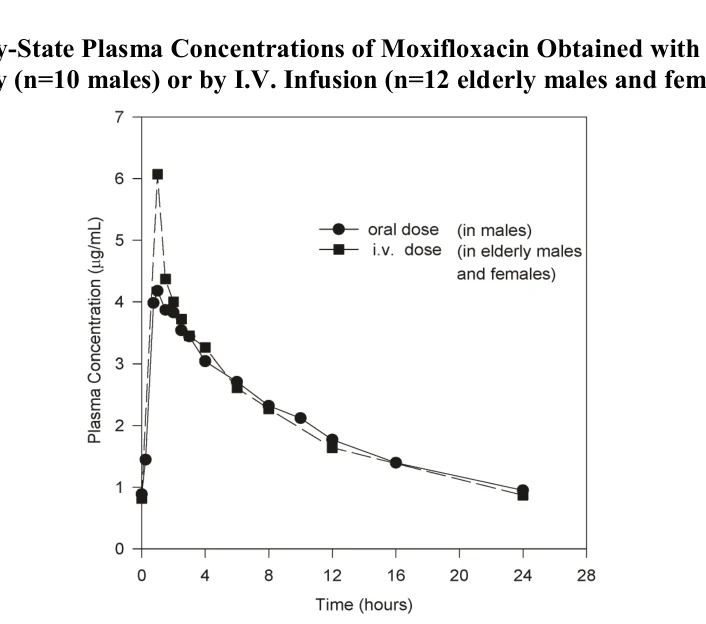
Plasma concentrations increase proportionately with dose up to the highest dose tested (1200 mg single oral dose). Moxifloxacin hydrochloride is eliminated from plasma by first-order process. The mean (±SD) elimination half-life from plasma is 12±1.3 hours; steady-state is achieved after at least three days with a 400 mg once daily regimen. The time course of plasma concentrations of moxifloxacin hydrochloride following steady-state oral and intravenous administration is illustrated in Figure 1, and pharmacokinetic parameters of moxifloxacin hydrochloride are presented in Table 10.
| Figure 1 – Mean Steady-State Plasma Concentrations of Moxifloxacin Obtained with Once Daily Dosing of 400 mg Either Orally (n=10 males) or by I.V. Infusion (n=12 elderly males and females) |
| Table 10 – Pharmacokinetic Parameters of Moxifloxacin After Oral and Intravenous Administration of 400 mg Single or Multiple Doses | ||||||||||||
|---|---|---|---|---|---|---|---|---|---|---|---|---|
| Population years (range) | Dose | Cmax (CV)a mg/L | AUC (CV)a mg*h/L | tmaxb (range) hr | t1/2 (CV)a hr | Comment | ||||||
| Single Dose Studies – Oral Administration | ||||||||||||
| 38 males (23-45) | 400 mg | 2.50 (27%) | 26.9 (17%) | 1.5 (0.5-2.6) | 13.1 (6%) | |||||||
| 18 males (20-25) | 400 mg | 4.13 (27%) | 51.5 (10%) | 1.75 (0.5-2.5) | 13.9 (10%) | |||||||
| Single Dose Studies – Intravenous Administration | ||||||||||||
| 6 males (19-43) | 400 mg | 4.6 (33%) | 36.9 (19%) | N/A | 13.4 (17%) | 30 min. infusion | ||||||
| 6 males (24-44) | 400 mg | 4.5 (25%) | 34.0 (22%) | 0.5 | 11.9 (10%) | 30 min. infusion | ||||||
| 12 males (20-44) | 400 mg | 4.3 (21%) | 42.9 (11%) | 0.5 | 13.5 (20%) | 33 min. infusion | ||||||
| 12 males (23-41) | 400 mg | 3.6 (28%) | 34.6 (19%) | 1.0 (1.0-1.25) | 15.4 (16%) | 60 min. infusion | ||||||
 |
| Table 10 – Pharmacokinetic Parameters of Moxifloxacin After Oral and Intravenous Administration of 400 mg Single or Multiple Doses |
|---|
| Population years (range) | Dose | Cmax (CV)a mg/L | AUC (CV)a mg*h/L | tmaxb (range) hr | t1/2 (CV)a hr | Comment |
|---|---|---|---|---|---|---|
| 9 males, 11 females (19-32) | 400 mg | 4.6 (18%) | 46.3 (18%) | 1.0 (0.5-1.3) | 12.4 (10%) | 60 min. infusion |
| 13 males (24-36) | 400 mg | 3.6 (20%) | 39.8 (14%) | 1.0 (0.55-1.5) | 14.1 (17%) | 60 min. infusion |
| 7 males (25-41) | 400 mg | 5.0 (22%) | 44.7 (19%) | 1.0 (0.5-1.0) | 8.0 (18%) | 60 min. infusion |
| Multiple Dose Studies | ||||||
| 8 males (22-43) | 400 mg OD/PO x 5 days | 3.10 (29%) | 30.9 (11%) | 0.5 (0.5-4.0) | 9.6 (11%) | Day 1 |
| 3.24 (17%) | 33.9 (20%) | 1.5 (0.5-3.0) | 15.1 (5%) | Day 5 | ||
| 10 males, 5 females (19-41) | 400 mg OD/PO x 10 days | 3.4 (22%) | 36.7 (13%) | 1.8 (0.75-3.0) | 9.3 (12%) | Day 1 |
| 4.5 (12%) | 48.0 (6%) | 1.0 (0.75-2.5) | 12.7 (15%) | Day 10 | ||
| 9 males (20-40) | 400 mg OD | 4.1 (39%) | 40.9 (10%) | 1.0 (0.5-2.5) | 10.7 (16%) | Day 1 |
| 4.1 (28%) | 46.7 (15%) | 1.8 (0.5-3.0) | 14.0 (15%) | Day 7 | ||
| 9 males (23-38) | 400 mg I.V. | 6.6 (30%) | 36.3 (11%) | 0.25 | 9.3 (17%) | Day 1; 15 min. infusion |
| 11 males, 7 females (65-75) | 400 mg I.V. | 6.6 (27%) | 38.6 (21%) | 0.26 | 8.6 (15%) | Day 1; 15 min. infusion |
| 5.9 (21%) | 47.4 (20%) | 1.0 | 10.1 (16%) | Day 5; 60 min. infusion | ||
| 12 males (25-42); 8 active, 4 placebo | 400 mg I.V. | 3.6 (20%) | 34.8 (11%) | 1.0 | 9.9 (15%) | Day 1; 60 min. infusion |
| 4.1 (20%) | 37.8 (11%) | 1.0 | 14.7 (16%) | Day 10; 60 min. infusion | ||
| 20 males, 12 females (23-74); varying degrees of renal function | 400 mg, PO | 4.4 (34%) | 43.4 (31%) | 0.8 (0.5-1.5) | 14.9 (38%) | C1cr>90 mL/min |
| 4.9 (30%) | 40.1 (22%) | 0.3 (0.3-2.5) | 15.2 (15%) | C1cr>60-90 mL/min | ||
| 3.5 (41%) | 35.8 (30%) | 0.8 (0.5-2.5) | 16.2 (15%) | C1cr>30-60 mL/min | ||
| 3.2 (14%) | 43.9 (29%) | 1.5 (0.5-2.5) | 14.5 (19%) | C1cr<30 mL/min | ||
| 12 males, 4 females (22-62) 8 HD; 8 CAPD | 400 mg PO | 3.2 (23%)c | 40.4 (29%)c, d | 3.0 (1.0-4.0)c | 18.7 (25%)c | C1cr<20 mL/min and on HD |
| 4.0 (18%)c | 49.6 (25%)c, d | 2.5 (0.9-4.2)c | 11.4 (23%)c | C1cr<20 mL/min and on CAPD | ||
| Table 10 – Pharmacokinetic Parameters of Moxifloxacin After Oral and Intravenous Administration of 400 mg Single or Multiple Doses |
|---|
| Population years (range) | Dose | Cmax (CV)a mg/L | AUC (CV)a mg*h/L | tmaxb (range) hr | t1/2 (CV)a hr | Comment |
|---|---|---|---|---|---|---|
| 18 males (30-64); 10 healthy; 8 with hepatic disease | 400 mg PO | 3.0 (26%) | 32.8 (26%) | 0.8 (0.5-3.0) | 13.4 (18%) | healthy volunteers |
| 2.5 (34%) | 25.1 (26%) | 0.5 (0.5-2.5) | 11.7 (26%) | patients with hepatic disease, Child Pugh Class A and B | ||
| 16 males (42-64); 8 healthy; 8 with hepatic disease | 400 mg PO | 3.3 (1.4)e | 30.8 (1.3)e | 1.5 (0.5-3.0) | 11.6 (1.1)e | healthy volunteers |
| 2.6 (1.2)e | 34.6 (1.2)e | 1.25 (0.5-2.5) | 13.6 (1.2)e | patients with hepatic disease, Child Pugh Class B | ||
| 9 healthy males (23-45) | 400 mg I.V./PO | 3.4 (20%) | 35.5 (14%) | 1.0 (0.75-1.5) | 11.6 (10%) | I.V. alone; 60 min. infusion |
| 3.0 (12%) | 28.5 (12%) | 1.0 (0.5-1.5) | 11.8 (6%) | I.V. plus 5 g charcoal 5 minutes prior to infusion; immediately after infusion and 2, 4, 8 hours post-infusion; 60 min. infusion | ||
| 0.6 (73%) | 5.4 (65%) | 0.75 (0.5-1.25) | 10.8 (11%) | PO plus 10 g charcoal 15 minutes before, 2, 4, 8 hours after dosing | ||
Legend: OD=once daily; Cmax= maximum serum concentration; tmax=time to Cmax; AUC=area under concentration vs. time curve; t1/2=serum half-life, Clcr=creatinine clearance, HD=hemodialysis, CAPD=continuous ambulatory peritoneal dialysis | ||||||
Absorption
Moxifloxacin hydrochloride, given as an oral tablet, is well absorbed from the gastrointestinal tract. The absolute bioavailability of moxifloxacin hydrochloride is approximately 90 percent. Co-administration with a high fat meal (i.e., 500 calories from fat) does not affect absorption of moxifloxacin hydrochloride.
Consumption of one cup of yogurt with moxifloxacin does not significantly affect the extent or rate of systemic absorption (AUC).
Distribution
Moxifloxacin hydrochloride is approximately 50% bound to serum proteins, independent of drug concentration. As shown in Table 11, the volume of distribution of moxifloxacin hydrochloride ranges from 1.7 to 2.7 L/kg. Moxifloxacin hydrochloride is widely distributed throughout the body, with tissue concentrations often exceeding plasma concentrations. Moxifloxacin has been detected in the saliva, nasal and bronchial secretions, mucosa of the sinuses, and abdominal tissues and fluids following oral or intravenous administration of 400 mg. Moxifloxacin concentrations measured post dose in various tissues and fluids following a 400 mg oral or I.V. dose are summarized in the following table. The rates of elimination of moxifloxacin from tissues generally parallel the elimination from plasma.
In animal experiments, radiolabelled moxifloxacin hydrochloride was shown to cross the blood-brain barrier only to a small extent.
| Table 11 – Moxifloxacin Concentrations (mean±SD) in Plasma and Tissues After Oral or Intravenous Dosing with 400 mga | |||||||||
|---|---|---|---|---|---|---|---|---|---|
| Tissue or Fluid | N | Tissue or Fluid Concentration (mg/L or μg/g) | Tissue or Fluid: Plasma Ratiob | ||||||
| Respiratory | |||||||||
| Alveolar Macrophages | 5 | 61.8±27.3 | 21.2±10.0 | ||||||
| Bronchial Mucosa | 8 | 5.5±1.3 | 1.7±0.3 | ||||||
| Epithelial Lining Fluid | 5 | 24.4±14.7 | 8.7±6.1 | ||||||
| Sinusc | |||||||||
| Maxillary Sinus Mucosa | 4 | 7.6±1.7 | 2.0±0.3 | ||||||
| Anterior Ethmoid Mucosa | 3 | 8.8±4.3 | 2.2±0.6 | ||||||
| Nasal Polyps | 4 | 9.8±4.5 | 2.6±0.6 | ||||||
| Intra-Abdominal | |||||||||
| Abdominal tissued | 8 | 7.6±2.0 | 2.7±0.8 | ||||||
| Abdominal exudated | 10 | 3.5±1.25 | 1.6±0.7 | ||||||
| Abscess fluid | 6 | 2.3±1.5 | 0.8±0.4 | ||||||
| Skin, Musculoskeletal | |||||||||
| Blister Fluid | 5 | 2.6±0.9 | 0.9±0.2 | ||||||
| Subcutaneous Tissue | 6 | 0.9±0.3e | 0.4±0.6 | ||||||
| Skeletal Muscle | 6 | 0.9±0.3e | 0.4±0.1 | ||||||
| |||||||||
Metabolism
Moxifloxacin is metabolized via glucuronide and sulfate conjugation. The cytochrome P450 system is not involved in moxifloxacin metabolism, and is not affected by moxifloxacin. The sulfate conjugate (M1) accounts for approximately 38% of the dose, and is eliminated primarily in the feces. Approximately 14% of an oral dose is converted to a glucuronide conjugate (M2), which is found exclusively in the urine. Peak plasma concentrations of M2 are approximately 40% of the parent drug, while plasma concentrations of M1 are generally less than 10% those of moxifloxacin. The sulfate (M1) and glucuronide (M2) conjugates are not microbiologically active.
Excretion
Approximately 45% of an oral dose of moxifloxacin is excreted as unchanged drug (~20% in urine and ~25% in feces). A total of 96%±4% of an oral dose is excreted as either unchanged drug or known metabolites. The mean (±SD) apparent total body clearance and renal clearance are 12±2.0 L/hr and 2.6±0.5 L/hr, respectively.
Special Populations and Conditions
Pediatrics (<18 years of age)
The pharmacokinetics of moxifloxacin in pediatric subjects have not been established.
Geriatrics (≥65 years of age)
Following oral administration of 400 mg moxifloxacin for 10 days in 16 elderly (8 male; 8 female) and 16 young (8 male; 8 female) healthy volunteers, there were no age-related changes in moxifloxacin pharmacokinetics. In 16 healthy male volunteers (8 young; 8 elderly) given a single 200 mg oral dose of moxifloxacin, the extent of systemic exposure (AUC and Cmax) was not statistically different between young and elderly males and elimination half-life was unchanged. No dosage adjustment is necessary based on age.
In Phase I studies, the pharmacokinetics in elderly patients following infusion of 400 mg were similar to those observed in young patients (see DETAILED PHARMACOLOGY).
Gender
Following oral administration of 400 mg moxifloxacin daily for 10 days to 23 healthy males (19-75 years) and 24 healthy females (19-70 years), the mean AUC and Cmax were 8% and 16% higher, respectively, in females compared to males. There are no significant differences in moxifloxacin pharmacokinetics between male and female subjects when differences in body weight are taken into consideration.
A 400 mg single dose study was conducted in 18 young males and females. The comparison of moxifloxacin pharmacokinetics in this study (9 young females and 9 young males) showed no differences in AUC or Cmax due to gender. Dosage adjustments based on gender are not necessary.
Race
Steady state moxifloxacin pharmacokinetics in male Japanese subjects were similar to those determined in Caucasians, with a mean Cmax of 4.1 mg/L, an AUC24 of 47 mg*h/mL, and an elimination half-life of 14 hours following 400 mg daily PO.
Hepatic Insufficiency
In 400 mg single oral dose studies in 6 patients with mild, (Child Pugh Class A) and 10 patients with moderate (Child Pugh Class B) hepatic insufficiency, moxifloxacin mean systemic exposure
(AUC) was 78% and 102%, respectively, of that in 18 healthy controls. The mean peak concentration (Cmax) was 79% and 84%, respectively, of control values.
The mean AUC of the sulfate conjugate of moxifloxacin (M1) increased by 3.9-fold (ranging up to 5.9-fold) and 5.7-fold (ranging up to 8.0-fold) in the mild and moderate groups, respectively. The mean Cmax of M1 increased by approximately 3-fold in both groups (ranging up to 4.7- and 3.9-fold), respectively. The mean AUC of the glucuronide conjugate of moxifloxacin (M2) increased by 1.5-fold (ranging up to 2.5-fold) in both groups. The mean Cmax of M2 increased by 1.6- and 1.3-fold (ranging up to 2.7- and 2.1-fold), respectively. The clinical significance of increased exposure to the sulfate and glucuronide conjugates has not been studied. No dosage adjustment is recommended for mild or moderate hepatic insufficiency (Child Pugh Classes A and B). Due to limited clinical data, the use of moxifloxacin is not recommended with severe hepatic insufficiency (Child Pugh Class C) (see WARNINGS AND PRECAUTIONS, DOSAGE AND ADMINISTRATION).
Renal Insufficiency
The pharmacokinetic parameters of moxifloxacin are not significantly altered by mild, moderate, or severe renal impairment. No dosage adjustment is necessary in patients with renal impairment, including those patients on hemodialysis (HD) or continuous ambulatory peritoneal dialysis (CAPD).
In a single oral dose study of 24 patients with varying degrees of renal function from normal to severely impaired, the mean peak concentrations (Cmax) of moxifloxacin were reduced by 22% and 21% in the patients with moderate (Clcr≥30 and ≤60 mL/min) and severe (Clcr<30 mL/min) renal impairment, respectively. The mean systemic exposure (AUC) in these patients was increased by 13%. In the moderate and severe renally impaired patients, the mean AUC for the sulfate conjugate (M1) increased by 1.7-fold (ranging up to 2.8-fold) and mean AUC and Cmax for the glucuronide conjugate (M2) increased by 2.8-fold (ranging up to 4.8-fold) and 1.4-fold (ranging up to 2.5-fold), respectively. The sulfate and glucuronide conjugates are not microbiologically active, and the clinical implication of increased exposure to these metabolites in patients with renal impairment has not been studied.
The pharmacokinetics of single- and multiple-dose moxifloxacin were studied in patients with Clcr<20 mL/min on either hemodialysis or continuous ambulatory peritoneal dialysis (8 HD, 8 CAPD). Pharmacokinetic comparisons are to historical pharmacokinetic values from healthy volunteers (Clcr>90 mL/min; administered a single 400 mg oral dose of moxifloxacin). Following a single 400 mg oral dose, the AUC of moxifloxacin in these HD and CAPD patients did not vary significantly from the AUC generally found in healthy volunteers. Cmax values of moxifloxacin were reduced by about 45% and 33% in HD and CAPD patients, respectively, compared to healthy subjects. The exposure (AUC) to the sulfate conjugate (M1) increased by 1.4- to 1.5-fold in these patients. The mean AUC of the glucuronide conjugate (M2) increased by a factor of 7.3 to 13.2, whereas the mean Cmax values of the glucuronide conjugate (M2) increased by a factor of 2.5 to 3, compared to healthy subjects. The sulfate and the glucuronide conjugates of moxifloxacin are not microbiologically active, and the clinical implication of increased exposure to these metabolites in patients with renal disease including those undergoing HD and CAPD has not been studied.
Oral administration of 400 mg moxifloxacin once daily for 7 days to patients on HD or CAPD produced mean systemic exposure (AUCss) to moxifloxacin similar to that generally seen in healthy volunteers. Steady-state Cmax values were about 28% lower in HD patients but were comparable between CAPD patients and healthy volunteers. Moxifloxacin and the glucuronide conjugate (M2) were removed from the body by HD (approximately 9% and 4%, respectively) and by CAPD (approximately 3% and 2%, respectively). Systemic exposure (AUC) to M2 was equal to or greater than moxifloxacin exposure in HD and CAPD subjects following single dosing and at steady state (see WARNINGS AND PRECAUTIONS, DOSAGE AND ADMINISTRATION).
QT Prolongation
One pharmacokinetic study in 9 male and 9 female healthy volunteers showed that at the expected time of peak plasma concentrations and at a heart rate of 75 beats/minute, a 400 mg oral dose of moxifloxacin was associated with a mean QT prolongation (uncorrected for heart-rate) of 14±13 msec (3.8%±3.5%) compared to baseline. Exercise data indicated the absence of a reverse-rate dependence.
In clinical pharmacology studies (n=112 subjects), the aggregate mean prolongation of the QTc interval at the expected time of peak plasma concentrations after a single oral dose of 400 mg moxifloxacin was 7±23 msec (1.8%±5.6%). One patient had an increase in QTc greater than 60 msec.
In clinical pharmacology studies (n=29) with 400 mg intravenous moxifloxacin, the aggregate mean prolongation of the QTc interval at the end of a one hour infusion was 20.6±23 msec (5.5%±5.9%). Two patients had an increase in QTc greater than 60 msec (see WARNINGS AND PRECAUTIONS).
STORAGE AND STABILITY
AVELOX tablets: Store at room temperature (15°C -30°C). Avoid freezing.
AVELOX I.V. minibags: Store at room temperature (15°C -30°C). DO NOT REFRIGERATE. Protect from light.
AVELOX I.V. glass bottles: Store at room temperature (15°C -30°C). DO NOT REFRIGERATE.
At cool storage temperatures, precipitation may occur, which will re-dissolve at room temperature. It is therefore recommended not to store the infusion solution in a refrigerator.
Since the premixed minibags and glass bottles are for single-use only, any unused portion should be discarded.
SPECIAL HANDLING INSTRUCTIONS
Not applicable.
DOSAGE FORMS, COMPOSITION AND PACKAGING
AVELOX (moxifloxacin hydrochloride) 400 mg Tablets
Each oblong, convex-shaped, dull red film-coated AVELOX tablet is engraved “BAYER” on one side and “M400”on the other. Each tablet contains 400 mg moxifloxacin (as hydrochloride). The tablets are packaged in bottles of 30.
AVELOX tablets are also composed of the following non-medicinal ingredients: cellulose microcrystalline, croscarmellose sodium, lactose monohydrate, magnesium stearate, red ferric oxide, hydroxypropyl methyl cellulose, polyethylene glycol 4000, and titanium dioxide.
AVELOX I.V. (moxifloxacin hydrochloride injection) 400 mg Minibags and Glass Bottles
Each AVELOX I.V. 250 mL ready-to-use minibag or glass bottle contains 400 mg moxifloxacin (as hydrochloride) in 0.8% saline with a pH ranging from 4.1 to 4.6. The appearance of the intravenous solution is yellow and is not affected by, or indicative of, product stability. NO FURTHER DILUTION OF THIS PRODUCT IS NECESSARY.
The non-medicinal ingredients are sodium chloride, USP, and Water for Injection, USP. It may also contain hydrochloric acid and/or sodium hydroxide for pH adjustment.
As with all parenteral products, the intravenous mixture should be inspected visually for clarity, discoloration, particulate matter, precipitate and leakage prior to administration. Solutions showing haziness, particulate matter, precipitate, discolouration or leakage should not be used.
PART II : SCIENTIFIC INFORMATION
PHARMACEUTICAL INFORMATION
Drug Substance
| Proper name: | moxifloxacin hydrochloride |
| Chemical name: | 1-cyclopropyl-7-[(S,S)-2,8-diaza-bicyclo[4.3.0]non-8-yl]-6-fluoro-8-methoxy-1,4-dihydro-4-oxo-3-quinolinecarboxylic acid hydrochloride |
| Molecular formula: | C21H24FN3O4•HCl |
| Molecular weight: | 437.9 g/mol |
| Structural formula: | 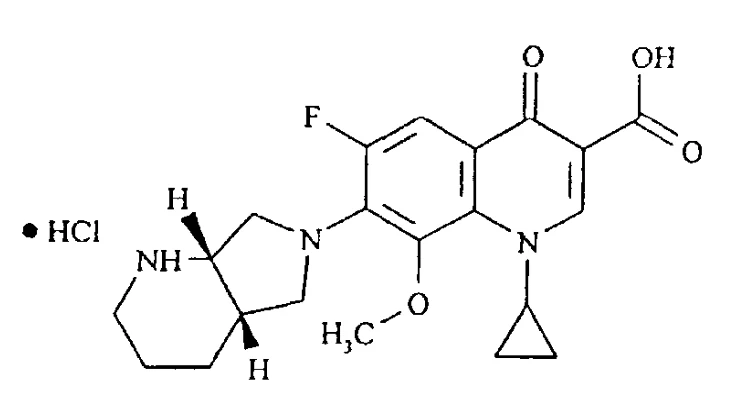 |
| Physicochemical properties: | Moxifloxacin hydrochloride is a pale yellow solid substance. It shows no melting point and decomposes above 250°C. It has a pH in the range of 3.9-4.6. Moxifloxacin is sparingly soluble in water and methanol, slightly soluble in HCl and ethanol, and virtually insoluble in acetone and toluene. Moxifloxacin differs from other fluoroquinolones in that it has a methoxy function at the 8-position, and an S,S configurated diazabicyclononyl ring moiety at the 7-position. |
CLINICAL TRIALS
Acute Bacterial Sinusitis
Trial Design
| Table 12 – Design of Acute Bacterial Sinusitis Pivotal Trials | ||||||||
|---|---|---|---|---|---|---|---|---|
| Study No. / Country | Study Design | Primary Efficacy Parameter | Treatment Regimen | # of Pts. | Gendera | Mean Age ± SD (Years)a | ||
| 0116 Europe and Israel | Randomized, Double-blind, Active Controlled | Clinical Response at Day 3 post-treatment | Moxifloxacin 400 mg OD x 7 days | 211 | F: 114 (54%) M: 97 (46%) | 39.6±14.5 | ||
| Cefuroxime Axetil 250 mg BID x 10 days | 225 | F: 126 (56%) M: 99 (44%) | 39.9±13.9 | |||||
| 0125b USA | Open-label, Uncontrolled | Overall Clinical Response at Day 27-31 post-treatmentc | Moxifloxacin 400 mg OD x 7 days | 336 | F: 208 (62%) M: 128 (38%) | 41.0±13.4 | ||
| 0126 Canada, USA | Randomized, Double-blind, Active Controlled | Overall Clinical Response at Day 27-31 post-treatmentc | Moxifloxacin 400 mg OD x 7 days | 191 | F: 126 (66%) M: 65 (34%) | 42.5±13.8 | ||
| Cefuroxime Axetil 250 mg BID x 10 days | 193 | F: 134 (69%) M: 59 (31%) | 42.4±14.8 | |||||
| 0161 Europe and Israel (1) | Randomized, Double-blind, Active Controlled | Clinical Response at Day 4-7 post-treatment | Moxifloxacin 400 mg OD x 10 days | 217 | F: 110 (51%) M: 107 (49%) | 38.6±14.7 | ||
| Cefuroxime Axetil 250 mg BID x 10 days | 222 | F: 124 (56%) M: 98 (44%) | 39.3±14.5 | |||||
| 100107 USA (2) | Randomized, Double-blind, Active Controlled | Clinical Response at Day 7-14 post-treatment | Moxifloxacin 400 mg OD x 10 days | 223 | F: 139 (62%) M: 84 (38%) | 40.1±13.9 | ||
| Cefuroxime Axetil 250 mg BID x 10 days | 234 | F: 140 (60%) M: 94 (40%) | 39.0±12.7 | |||||
Legend: OD=once daily; BID=twice daily | ||||||||
Efficacy – Clinical Response
| Table 13 – Clinical Response Rates – Clinically Evaluable Patients in Pivotal Acute Bacterial Sinusitis Trials | ||||||||||||
| Study Number | Moxifloxacin 400 mg OD x 7 days n/N (%) | Moxifloxacin 400 mg OD x 10 days n/N (%) | Comparator n/N (%) | 95% Confidence Intervals | ||||||||
| 0116 | 204/211 (97%) | N/A | 204/225 (91%) | 1.5%, 10.6% | ||||||||
| 0125 | 270/336 (80%) | N/A | N/A | 76%, 84%a | ||||||||
| 0126 | 154/191 (81%) | N/A | 176/193 (91%) | -17.1%, -3.8% | ||||||||
| 0161 | N/A | 203/217 (94%) | 210/222 (95%) | -5.5%, 3.4% | ||||||||
| 100107 | N/A | 200/223 (90%) | 209/234 (89%) | -5.1%, 6.2% | ||||||||
| ||||||||||||
Efficacy – Microbiological Outcome
| Table 14 – Bacteriological Response Rates – Clinically and Microbiologically Evaluable Patients in Pivotal Acute Bacterial Sinusitis Trials | ||||||||||||
| Study Number | Moxifloxacin 400 mg OD x 7 days n/N (%)a | Moxifloxacin 400 mg OD x 10 days n/N (%)a | Comparator n/N (%)a | 95% Confidence Intervals | ||||||||
| 0116 | 103/109 (95%) | N/A | 96/115 (84%) | 3.6%, 19.7% | ||||||||
| 0125 | 72/74 (97%)b | N/A | N/A | N/Ac | ||||||||
| 0161 | N/A | 84/86 (98%) | 68/72 (94%) | -3.2%, 8.7% | ||||||||
| ||||||||||||
| Table 15 – Pathogen Eradication Rates – Clinically and Microbiologically Evaluable Patients in Acute Bacterial Sinusitis Trials | ||||||||||||
| Study Number | Moxifloxacin 400 mg OD x 7 days n/N (%) | Moxifloxacin 400 mg OD x 10 days n/N (%) | Comparator n/n (%) | |||||||||
| Streptococcus pneumoniae | ||||||||||||
| 0116 | 38/39 (97%) | N/A | 45/48 (94%) | |||||||||
| 0125 | 29/30 (97%) | N/A | N/A | |||||||||
| 0161 | N/A | 36/38 (95%) | 32/32 (100%) | |||||||||
| Combined | 67/69 (97%) | 36/38 (95%) | 77/80 (96%) | |||||||||
| Haemophilus influenzae | ||||||||||||
| 0116 | 28/29 (97%) | N/A | 30/35 (86%) | |||||||||
| 0125 | 24/30 (80%) | N/A | N/A | |||||||||
| 0161 | N/A | 17/17 (100%) | 15/16 (94%) | |||||||||
| Combined | 52/59 (88%) | 17/17 (100%) | 45/51 (88%) | |||||||||
| Moraxella catarrhalis | ||||||||||||
| 0116 | 14/14 (100%) | N/A | 8/9 (89%) | |||||||||
| 0125 | 15/18 (83%) | N/A | N/A | |||||||||
| 0161 | N/A | 10/10 (100%) | 5/5(100%) | |||||||||
| Combined | 29/32 (91%) | 10/10 (100%) | 13/14 (93%) | |||||||||
Acute Bacterial Exacerbations of Chronic Bronchitis
Trial Design
| Table 16 – Design of Acute Exacerbations of Chronic Bronchitis Pivotal Trials | |||||||||
|---|---|---|---|---|---|---|---|---|---|
| Study No. / Country | Study Design | Primary Efficacy Parameter | Treatment Regimen | # of Pts. | Gendera | Mean Age ± SD (Years)a | |||
| 0124 Europeb (3) | Randomized, Double-blind, Active Controlled | Clinical Response at Day 7 post-treatment | Moxifloxacin 400 mg OD x 5 days | 322 | F: 131 (41%) M: 191 (59%) | 60.0±14.0 | |||
| Clarithromycin 500 mg BID x 7 days | 327 | F: 136 (42%) M: 191 (58%) | 60.2±13.5 | ||||||
| 0127 Canada, USA (4) | Randomized, Double-blind, Active Controlled | Overall Clinical Response at Day 7-17 post-treatmentc | Moxifloxacin 400 mg OD x 5 days | 250 | F: 115 (46%) M: 135 (56%) | 56.8±15.2 | |||
| Moxifloxacin 400 mg OD x 10 days | 256 | F: 116 (45%) M: 140 (55%) | 56.1±15.6 | ||||||
| Clarithromycin 500 mg BID x 10 days | 251 | F: 124 (49%) M: 127 (51%) | 55.4±15.9 | ||||||
Legend: OD=once daily; BID=twice daily | |||||||||
Efficacy – Clinical Response
| Table 17 –Clinical Response Rates – Clinically Evaluable Patients in Pivotal AECB Trials | ||||||
|---|---|---|---|---|---|---|
| Study Number | Moxifloxacin 400 mg OD x 5 days n/N (%) | Comparatora n/N (%) | 95% Confidence Intervals | |||
| 0124 | 287/322 (89%) | 289/327 (88%) | -3.9%, 5.8% | |||
| 0127 | 222/250 (89%) | 224/251 (89%) | -6.1%, 4.2% | |||
| ||||||
Efficacy – Microbiological Outcome
| Table 18 – Bacteriological Response Rates – Clinically and Microbiologically Evaluable Patients in Pivotal AECB Trials | ||||||
| Study Number | Moxifloxacin 400 mg OD x 5 days n/N (%) | Comparatora n/N (%) | 95% Confidence Intervals | |||
| 0124 | 89/115 (77%) | 71/114 (62%) | 3.6%, 26.9% | |||
| 0127 | 127/143 (89%) | 110/129 (85%) | -3.7%, 10.5% | |||
| ||||||
| Table 19 – Pathogen Eradication Rates – Clinically and Microbiologically Evaluable Patients in Pivotal AECB Trials | ||||||||||
|---|---|---|---|---|---|---|---|---|---|---|
| Study Number | Moxifloxacin 400 mg OD x 5 days n/N (%) | Comparatora n/N (%) | ||||||||
| Haemophilus influenzae | ||||||||||
| 0124 | 40/44 (91%) | 23/43 (53%) | ||||||||
| 0127 | 33/37 (89%) | 31/41 (76%) | ||||||||
| Combined | 73/81 (90%) | 54/84 (64%) | ||||||||
| Haemophilus parainfluenzae | ||||||||||
| 0124 | 5/9 (56%) | 4/4 (100%) | ||||||||
| 0127 | 16/16 (100%) | 14/14 (100%) | ||||||||
| Combined | 21/25 (84%) | 18/18 (100%) | ||||||||
| Streptococcus pneumoniae | ||||||||||
| 0124 | 32/38 (84%) | 35/36 (97%) | ||||||||
| 0127 | 16/16 (100%) | 21/23 (91%) | ||||||||
| Combined | 48/54 (89%) | 56/59 (95%) | ||||||||
| Staphylococcus aureus | ||||||||||
| 0124 | 1/1 (100%) | 9/11 (82%) | ||||||||
| 0127 | 15/16 (94%) | 7/8 (88%) | ||||||||
| Combined | 16/17 (94%) | 16/19 (84%) | ||||||||
| Moraxella catarrhalis | ||||||||||
| 0124 | 14/16 (87%) | 23/24 (96%) | ||||||||
| 0127 | 29/34 (85%) | 24/24 (100%) | ||||||||
| Combined | 43/50 (86%) | 47/48 (98%) | ||||||||
| Klebsiella pneumoniae | ||||||||||
| 0124 | N/A | N/A | ||||||||
| 0127 | 17/20 (85%) | 10/11 (91%) | ||||||||
| Combined | 17/20 (85%) | 10/11 (91%) | ||||||||
| ||||||||||
Community Acquired Pneumonia – Oral Administration
Trial Design
| Table 20 – Design of Community Acquired Pneumonia Pivotal Trials for Oral Administration | |||||||||
|---|---|---|---|---|---|---|---|---|---|
| Study No. / Country | Study Design | Primary Efficacy Parameter | Treatment Regimen | # of Pts. | Gendera | Mean Age ± SD (Years)a | |||
| 0119 Europeb, ROWc (5) | Randomized, Double-blind, Active Controlled | Clinical Response at Day 3-5 post-treatment | Moxifloxacin 200 mg OD x 10 days | 180 | F: 65 (36%) M: 115 (64%) | 47.8±20.5 | |||
| Moxifloxacin 400 mg OD x 10 days | 177 | F: 71 (40%) M: 106 (60%) | 48.1±20.8 | ||||||
| Clarithromycin 500 mg BID x 10 days | 174 | F: 63 (36%) M: 111 (64%) | 46.3±18.7 | ||||||
| 0129 USA (6) | Open-label, Uncontrolled | Overall Clinical Response at Day 14-35 post-treatmentd | Moxifloxacin 400 mg OD x 10 days | 196 | F: 83 (42%) M: 113 (58%) | 48.9±18.5 | |||
| 0130 USA (7) | Randomized, Double-blind, Active Controlled | Overall Clinical Response at Day 14-35 post-treatmentd | Moxifloxacin 400 mg OD x 10 days | 194 | F: 104 (54%) M: 90 (46%) | 48.4±17.3 | |||
| Clarithromycin 500 mg BID x 10 days | 188 | F: 95 (51%) M: 93 (49%) | 48.5±17.5 | ||||||
Legend: OD=once daily; BID=twice daily | |||||||||
Efficacy – Clinical Response
| Table 21 – Clinical Response Rates – Clinically Evaluable Patients in Pivotal CAP Trials | |||||||||
|---|---|---|---|---|---|---|---|---|---|
| Study Number | Moxifloxacin 400 mg OD x 10 days n/N (%) | Comparator n/N (%) | 95% Confidence Intervals | ||||||
| 0119 | 167/177 (94%) | 164/174 (94%) | -6.7%, 4.1% | ||||||
| 0129 | 182/196 (93%) | N/A | 88.1%, 95.9%a | ||||||
| 0130 | 184/194 (95%) | 178/188 (95%) | -3.7%, 5.3% | ||||||
| |||||||||
Efficacy – Microbiological Outcome
| Table 22 – Bacteriological Response Rates – Clinically and Microbiologically Evaluable Patients in Pivotal CAP Trials | |||||||||||
| Study Number | Moxifloxacin 400 mg OD x 10 days n/N (%) | Comparator n/N (%) | 95% Confidence Intervals | ||||||||
| 0119 | 37/47 (79%) | 29/41 (71%) | -10.2%, 26.2% | ||||||||
| 0129 | 106/116 (91%) | N/A | 84.3%, 95.6%a | ||||||||
| 0130b | 107/110 (97%) | 105/109 (96%) | -4.6%, 6.5% | ||||||||
| |||||||||||
| Table 23 – Pathogen Eradication Rates – Clinically and Microbiologically Evaluable Patients in Pivotal CAP Trials | ||||||||||
|---|---|---|---|---|---|---|---|---|---|---|
| Study Number | Moxifloxacin 400 mg OD x 10 days n/N (%) | Comparator n/N (%) | ||||||||
| Streptococcus pneumoniae | ||||||||||
| 0119a | 14/16 (88%) | 12/13 (92%) | ||||||||
| 0129 | 13/14 (93%) | N/A | ||||||||
| 0130 | 17/17 (100%) | 18/19 (95%) | ||||||||
| Combined | 44/47 (74%) | 30/32 (94%) | ||||||||
| Haemophilus influenzae | ||||||||||
| 0119a | 6/8 (75%) | 5/10 (50%) | ||||||||
| 0129 | 11/13 (85%) | N/A | ||||||||
| 0130 | 22/23 (96%) | 14/16 (88%) | ||||||||
| Combined | 39/44 (87%) | 19/26 (73%) | ||||||||
| Mycoplasma pneumoniae | ||||||||||
| 0119a | 22/24 (92%) | 30/32 (94%) | ||||||||
| 0129 | 27/29 (93%) | N/A | ||||||||
| 0130 | 23/24 (96%) | 20/20 (100%) | ||||||||
| Combined | 72/77 (94%) | 50/52 (96%) | ||||||||
| Chlamydia pneumoniae | ||||||||||
| 0119a | 19/19 (100%) | 21/23 (91%) | ||||||||
| 0129 | 56/63 (89%) | N/A | ||||||||
| 0130 | 42/45 (93%) | 43/44 (98%) | ||||||||
| Combined | 117/127 (92%) | 64/67 (96%) | ||||||||
| Moraxella catarrhalis | ||||||||||
| 0119a | 1/2 (50%) | 3/3 (100%) | ||||||||
| 0129 | 4/4 (100%) | N/A | ||||||||
| 0130 | 6/7 (86%) | 2/2 (100%) | ||||||||
| Combined | 11/13 (85%) | 5/5 (100%) | ||||||||
| ||||||||||
Community Acquired Pneumonia – Intravenous Administration
Trial Design
| Table 24 – Design of Community Acquired Pneumonia Pivotal Trials for Sequential I.V./Oral Administration | |||||||||
|---|---|---|---|---|---|---|---|---|---|
| Study No. / Country | Study Design | Primary Efficacy Parameter | Treatment Regimen | # of Pts. | Gendera | Mean Age ± SD (Years)a | |||
100039 Canada, USA (8, 9) | Randomized, Double-blind, Active Controlled | Clinical Response at Day 7-30 post-treatment | Sequential (OD x 7-14 days) I.V. Moxifloxacin 400 mg followed by PO Moxifloxacin 400 mg | 182 | F: 82 (45%) M: 100 (55%) | 62.9±16.1 | |||
| Sequential (OD x 7-14 days) I.V. Alatrofloxacin 200 mg followed by PO Trovafloxacin 200 mg | 53 | F: 84 (47%) M: 96 (53%) | 60.7±16.8 | ||||||
| Sequential (OD x 7-14 days) I.V. Levofloxacin 500 mg followed by PO Levofloxacin 500 mg | 127 | ||||||||
200036 Europeb, Israel, South Africa (9, 10) | Randomized, Open-label, Active Controlled | Clinical Response at Day 5-7 post-treatment | Sequential (OD x 7-14 days) I.V. Moxifloxacin 400 mg followed by PO Moxifloxacin 400 mg | 258 | F: 92 (36%) M: 166 (64%) | 54.8±20.6 | |||
Sequential (7-14 days) I.V. Amoxicillin 1000 mg / Clavulanate 200 mg TID followed by PO Amoxicillin 500 mg / Clavulanate 125 mg TID ± PO Clarithromycin 500 mg BID | 280 | F: 100 (36%) M: 180 (64%) | 55.4±19.6 | ||||||
Legend: OD=once daily; BID=twice daily; TID=three times daily; I.V. =intravenous; PO=oral | |||||||||
Efficacy – Clinical Response
| Table 25 – Clinical Response Rates – Clinically Evaluable Patients in Pivotal I.V./PO CAP Trials | ||||||
|---|---|---|---|---|---|---|
| Study Number | Moxifloxacin 400/400 mg IV/PO OD for 7-14 days n/N (%) | Comparator n/N (%) | 95% Confidence Intervals | |||
| 100039 | 157/182 (86%)a | 161/180 (89%) | -8.9%, 4.2% | |||
| 200036 | 241/258 (93%)b | 239/280 (85%) | 2.9%, 13.2% | |||
| ||||||
Efficacy – Microbiological Outcome
| Table 26 – Bacteriological Response Rates – Clinically and Microbiologically Evaluable Patients in Pivotal I.V./PO CAP Trials | ||||||
| Study Number | Moxifloxacin 400/400 mg I.V./PO OD for 7-14 days n/N (%) | Comparator n/N (%) | 95% Confidence Intervals | |||
| 100039a | 59/75 (79%) | 61/69 (88%) | -21.4%, 3.0% | |||
| 200036 | 60/64 (94%) | 58/71 (82%) | 1.21%, 22.91% | |||
| ||||||
| Table 27 – Pathogen Eradication Rates – Clinically and Microbiologically Evaluable Patients in Pivotal I.V./PO CAP Trials | ||||||||
|---|---|---|---|---|---|---|---|---|
| Study Number | Moxifloxacin 400/400 mg I.V./PO OD for 7-14 days n/N (%) | Comparator n/N (%) | ||||||
| Streptococcus pneumoniae | ||||||||
| 100039 | 34/39 (87%) | 36/40 (90%) | ||||||
| 200036 | 29/29 (100%) | 26/32 (82%) | ||||||
| Combined | 63/68 (93%) | 62/72 (86%) | ||||||
| Haemophilus influenzae | ||||||||
| 100039 | 11/13 (85%) | 15/17 (88%) | ||||||
| 200036 | 12/12 (100%) | 9/10 (90%) | ||||||
| Combined | 23/25 (92%) | 24/27 (89%) | ||||||
| Mycoplasma pneumoniae | ||||||||
| 100039 | 9/10 (90%) | 13/13 (100%) | ||||||
| 200036 | 13/13 (100%) | 16/17 (94%) | ||||||
| Combined | 22/23 (96%) | 29/30 (97%) | ||||||
| Chlamydia pneumoniae | ||||||||
| 100039 | 10/11 (91%) | 8/8 (100%) | ||||||
| 200036 | 3/3 (100%) | 4/5 (80%) | ||||||
| Table 27 – Pathogen Eradication Rates – Clinically and Microbiologically Evaluable Patients in Pivotal I.V./PO CAP Trials |
|---|
| Study Number | Moxifloxacin 400/400 mg I.V./PO OD for 7-14 days n/N (%) | Comparator n/N (%) |
|---|---|---|
| Combined | 13/14 (93%) | 12/13 (92%) |
| Staphylococcus aureus | ||
| 100039 | 3/4 (75%) | 5/7 (71%) |
| 200036 | 2/3 (67%) | 2/5 (40%) |
| Combined | 5/7 (71%) | 7/12 (58%) |
Community Acquired Pneumonia Caused by Multi-drug Resistant Streptococcus pneumoniae (MDRSP)
Multi-Drug Resistant Streptococcus pneumoniae (MDRSP) are strains resistant to two or more of the following antibiotics: penicillin (MIC ≥2 µg/mL), 2nd generation cephalosporins (eg, cefuroxime axetil), macrolides, tetracyclines, and trimethoprim/sulfamethoxazole.
| Table 28 – Clinical Cure and Bacteriological Eradication Rates for All Moxifloxacin-treated MDRSP CAP Patients According to the Number of Antimicrobials the Isolate was Resistant to – Valid-per-protocol Population (n=37) | |||||||||
| S. pneumoniae with MDRSP | Clinical Cure Rate | Bacteriological Eradication Rate | |||||||
| Resistant to 2 antimicrobials | 12/13 | (92.3%) | 12/13 | (92.3%) | |||||
| Resistant to 3 antimicrobials | 10/11 | (90.9%) | 10/11 | (90.9%) | |||||
| Resistant to 4 antimicrobials | 6/6 | (100%) | 6/6 | (100%) | |||||
| Resistant to 5 antimicrobials | 7/7 | (100%) | 7/7 | (100%) | |||||
| Table 29 – Clinical Cure and Bacteriological Eradication Rates for All Moxifloxacin-treated MDRSP CAP Patients According to Multi-drug Resistant Phenotype – Valid-per-protocol Population (n=37) | |||||||
| Screening Susceptibility | Clinical Cure Rate | Bacteriological Eradication Rate | |||||
| Penicillin-resistant | 21/21 | (100%) | 21/21 | (100%) | |||
| Second Generation Cephalosporin-resistant | 25/26 | (96%) | 25/26 | (96%) | |||
| Macrolide-resistanta | 22/23 | (96%) | 22/23 | (96%) | |||
| Trimethoprim/sulfamethoxazole-resistant | 28/30 | (93%) | 28/30 | (93%) | |||
| Tetracycline-resistant | 17/18 | (94%) | 17/18 | (94%) | |||
| |||||||
Complicated Intra-abdominal Infection – Intravenous Administration
Trial Design
Sequential intravenous/oral administration of moxifloxacin hydrochloride has been studied in two pivotal Phase III trials for the indication of complicated intra-abdominal infections (cIAI). The primary diagnosis of each patient was an intra-abdominal infection in which an operative procedure or percutaneous drainage was required for diagnosis and management. An overview of the design of the trials is provided in Table 30.
| Table 30 – Design of Complicated Intra-abdominal Infections Pivotal Trials for Sequential I.V./Oral Administration | |||||||||||
|---|---|---|---|---|---|---|---|---|---|---|---|
| Study No. / Country | Study Design | Primary Efficacy Parameter | Treatment Regimen | # of Pts. | Gendera | Mean Age ± SD (Years)a | APACHE II Scorea | ||||
| 100272 Canada, USA, Israel | Randomized, Double-blind, Active Controlled | Clinical Response at Day 25-50 after start of treatment | Sequential (OD x 5-14 days) I.V. Moxifloxacin 400 mg followed by PO Moxifloxacin 400 mg | 183 | F: 69 (38%) M: 114 (62%) | 47.4± 16.7 | 6.9±4.2 | ||||
| Sequential (OD x 5-14 days) I.V. Piperacillin/Tazobactam 3.375 g QID followed by Amoxicillin/Clavulanate 800 mg BID | 196 | F: 65 (33%) M: 131 (67%) | 45.1±16.5 | 5.9±4.2 | |||||||
| 10209 Europeb, Argentina, Brazil, Israel, Mexico, South Africa | Randomized, Open-label, Active Controlled | Clinical Response at Day 28-42 after start of treatment | Sequential (OD x 5-14 days) I.V. Moxifloxacin 400 mg followed by PO Moxifloxacin 400 mg | 246 | F: 98 (40%) M: 148 (60%) | 48.7±20.4 | 6.8±6.0 | ||||
| Sequential (5-14 days) I.V. Ceftriaxone 2 g OD + Metronidazole 500 mg TID followed by PO Amoxicillin 500 mg / Clavulanate 125 mg TID | 265 | F: 108 (41%) M: 157 (59%) | 47.8± 20.5 | 6.6±6.4 | |||||||
a demographic data refers to patients valid for clinical efficacy [183/339 (54%), 196/342 (57%) in Study 100272; 246/293 (84%), 265/302 (88%) in Study 10209] b Europe: Austria, Belgium, Finland, France, Germany, Greece, Italy, Netherlands, Spain, Sweden, Switzerland Legend: OD=once daily; BID=twice daily; TID=three times daily; QID=four times daily; I.V.=intravenous; PO=oral | |||||||||||
Efficacy – Clinical Response
| Table 31 – Clinical Response Rates – Clinically Evaluable Patients in Pivotal I.V./PO cIAI Trials | ||||||||
|---|---|---|---|---|---|---|---|---|
| Study Number | Moxifloxacin 400/400 mg I.V./PO OD for 5-14 days n/N (%) | Active Control Regimen n/N (%) | 95% Confidence Intervals for Difference (Mantel-Haenszel)a | |||||
| 100272 | 146/183 (80%) | 153/196 (78%) | -7.4, 9.3 | |||||
| 10209 | 199/246 (81%) | 218/265 (82%) | -8.9, 4.2 | |||||
| a protocol defined delta of 10% | ||||||||
Efficacy – Microbiological Outcome
| Table 32 – Bacteriological Response Rates – Clinically and Microbiologically Evaluable Patients in Pivotal I.V./PO cIAI Trials | |||||||
| Study Number | Moxifloxacin 400/400 mg I.V./PO OD for 5-14 days n/N (%) | Active Control Regimen n/N (%) | 95% Confidence Intervals for Difference (Mantel-Haenszel)a | ||||
| 100272 | 117/150 (78%) | 126/163 (77%) | -9.9, 8.7 | ||||
| 10209 | 131/166 (79%) | 144/177 (81%) | -10.6, 6.3 | ||||
| a protocol defined delta of 10% | |||||||
| Table 33 – Pathogen Eradication Ratesa – Clinically and Microbiologically Evaluable Patients in Pivotal I.V./PO cIAI Trials | |||||||||||
|---|---|---|---|---|---|---|---|---|---|---|---|
| Study Number | Moxifloxacin 400/400 mg I.V./PO OD for 5-14 days n/N (%) | Active Control Regimen n/N (%) | |||||||||
| Gram-Positive Aerobes | |||||||||||
| Enterococcus faecalis | |||||||||||
| 100272 | 8/11 (72.7%) | 8/15 (53.3%) | |||||||||
| 10209 | 8/9 (88.9%) | 9/14 (64.3 %) | |||||||||
| Combined | 16/20 (80.0%) | 17/29 (58.69%) | |||||||||
| Streptococcus anginosus | |||||||||||
| 100272 | 25/34 (73.5%) | 39/48 (81.3%) | |||||||||
| 10209 | 5/7 (71.4%) | 8/8 (100.0%) | |||||||||
| Combined | 30/41 (73.2%) | 47/56 (83.9%) | |||||||||
| Gram-Negative Aerobes | |||||||||||
| Escherichia coli | |||||||||||
| 100272 | 67/87 (77.0%) | 69/90 (76.7%) | |||||||||
| 10209 | 92/117 (78.6%) | 102/120 (85.0%) | |||||||||
| Combined | 159/204 (77.9%) | 171/210 (81.4%) | |||||||||
| Proteus mirabilis | |||||||||||
| 100272 | 3/4 (75.0%) | 5/5 (100.0%) | |||||||||
| 10209 | 6/7 (85.7%) | 6/9 (66.7%) | |||||||||
| Combined | 9/11 (81.8%) | 11/14 (78.6%) | |||||||||
| Anaerobes | |||||||||||
| Bacteroides fragilis | |||||||||||
| 100272 | 35/41 (85.4%) | 36/50 (72.0%) | |||||||||
| 10209 | 30/36 (83.3%) | 28/31 (90.3%) | |||||||||
| Combined | 65/77 (84.4%) | 64/81 (79.0%) | |||||||||
| Bacteroides thetaiotaomicron | |||||||||||
| 100272 | 29/36 (80.6%) | 27/38 (71.1%) | |||||||||
| 10209 | 1/2 (50.0%) | 3/3 (100.0%) | |||||||||
| Combined | 30/38 (78.9%) | 30/41 (73.2%) | |||||||||
| Clostridium perfringens | |||||||||||
| 100272 | 6/7 (85.7%) | 3/5 (60.0%) | |||||||||
| 10209 | 2/3 (66.7%) | 6/8 (75.0%) | |||||||||
| Combined | 8/10 (80.0%) | 9/13 (69.2%) | |||||||||
| a includes eradication and presumed eradication | |||||||||||
Complicated Skin and Skin Structure Infections – Intravenous Administration
Trial Design
| Table 34 – Design of Complicated Skin and Skin Structure Infection Pivotal Trials for Sequential I.V./Oral Administration | |||||||||||
|---|---|---|---|---|---|---|---|---|---|---|---|
| Study No. / Country | Study Design | Primary Efficacy Parameter | Treatment Regimen | # of Pts. | Genderc | Mean Age ± SD (Years)c | |||||
100273 NAa/SA/ Israel (11) | Randomized, Double-blind, Active Controlled | Clinical Response at Day 10-42 post-treatment (for assessment of cure) | Sequential (OD x 7-14 days) I.V. Moxifloxacin 400 mg followed by PO Moxifloxacin 400 mg | 306 | F: | 62 | (34%) | 52.4±15.9 | |||
| M: | 118 | (66%) | |||||||||
| Sequential (7-14 days) I.V. Pipercillin/tazobactam 3.0/0.375 g q6h followed by PO Amoxicillin/clavulanic acid suspension 800/114 mg BID | 311 | F: | 65 | (35%) | 52.8±15.4 | ||||||
| M: | 122 | (65%) | |||||||||
| 10279 Europeb, ROW | Randomized, Open-label, Active Controlled | Clinical Response at Day 14-28 post-treatment | Sequential (OD x 7-21 days) I.V. Moxifloxacin 400 mg followed by PO Moxifloxacin 400 mg | 406 | F: | 142 | (45%) | 51.8±1.08 | |||
| M: | 173 | (55%) | |||||||||
| Sequential (7-21 days) I.V. Amoxicillin 1000 mg / Clavulanate 200 mg TID followed by PO Amoxicillin 500 mg / Clavulanate 125 mg TID | 398 | F: | 119 | (38%) | 51.1±18.3 | ||||||
| M: | 198 | (62%) | |||||||||
a NA (North America): Canada, United States, Mexico; SA (South America): Argentina, Chile, Peru b Europe: Germany, Hungary, Spain; ROW (Rest of World): Colombia, Mexico, Republic of South Africa, Philippines, Taiwan, Israel c Demographic data refers to patients valid for efficacy Legend: OD=once daily; BID=twice daily; TID=three times daily; I.V.=intravenous; PO=oral | |||||||||||
Efficacy – Clinical Response
| Table 35 – Clinical Response Rates - Clinically Evaluable Patients in Pivotal IV/PO cSSSI Studiesa | ||||||||||||
| Study Number | Moxifloxacin 400/400 mg I.V./PO OD | Comparator | 95% Confidence Intervals | |||||||||
| n/Nb | (%) | n/N | (%) | |||||||||
| 100273 | 143/180 | (79.4) | 153/187 | (81.8) | -12.04, 3.29c | |||||||
| 10279 | 254/315 | (80.6) | 268/317 | (84.5) | -9.41, 2.18d | |||||||
a Surgical incision and drainage or debridement was performed on 55% of the moxifloxacin-treated and 53% of the comparator-treated patients in these studies and formed an integral part of therapy for this indication. b n=number of patients with a clinical cure; N=total number of patients c Protocol defined delta of 15% - using the Mantel-Haenszel formula d Protocol defined delta of 10% - using the Mantel-Haenszel formula | ||||||||||||
Efficacy – Microbiological Outcome
| Table 36 – Bacteriological Response Rates – Clinically and Microbiologically Evaluable Patients in Pivotal IV/PO cSSSI Trials | ||||||
| Study Number | Moxifloxacin 400/400 mg I.V./PO OD n/Na (%) | Comparator n/N (%) | 95% Confidence Intervals | |||
| 100273 | 92/119 (77.3) | 96/118 (81.4) | -14.8, 5.2 | |||
| 10279 | 127/167 (76.0) | 140/172 (81.4) | -13.0, 4.4 | |||
| a n=number of patients with a bacteriological response, N=total number of patients | ||||||
| Table 37 – Pathogen Eradication Rates – Clinically and Microbiologically Evaluable Patients in Pivotal I.V./PO cSSSI Trials | |||||||||
|---|---|---|---|---|---|---|---|---|---|
| Study Number | Moxifloxacin 400/400 mg I.V./PO OD n/N (%) | Comparator n/N (%) | |||||||
| Enterobacter cloacae | |||||||||
| 100273 | 4/5 (80.0) | 1/2 (50.0) | |||||||
| 10279 | 5/6 (83.3) | 2/4 (50.0) | |||||||
| Combined | 9/11 (81.8) | 3/6 (50.0) | |||||||
| Escherichia coli | |||||||||
| 100273 | 7/8 (87.5) | 11/12 (91.7) | |||||||
| 10279 | 24/30 (80.0) | 16/20 (80.0) | |||||||
| Combined | 31/38 (81.6) | 27/32 (84.4) | |||||||
| Klebsiella pneumoniae | |||||||||
| 100273 | 5/6 (83.3) | 4/7 (57.1) | |||||||
| 10279 | 5/5 (100.0) | 2/2 (100.0) | |||||||
| Combined | 10/11 (90.9) | 6/9 (66.7) | |||||||
| Staphylococcus aureus (methicillin-susceptible strains)a | |||||||||
| 100273 | 50/64 (78.1) | 47/59 (79.7) | |||||||
| 10279 | 48/59 (81.4) | 71/78 (91.0) | |||||||
| Combined | 98/123 (79.7) | 118/137 (86.1) | |||||||
| a Methicillin susceptibility was only determined in the North American study | |||||||||
DETAILED PHARMACOLOGY
Animal Pharmacology
Fluoroquinolones have been shown to cause arthropathy in immature animals. In studies in juvenile dogs oral doses of moxifloxacin, the active ingredient in AVELOX, >30 mg/kg/day (approximately 1.5 times the maximum recommended human dose based upon systemic exposure) for 28 days resulted in arthropathy. There was no evidence of arthropathy in mature monkeys and rats at oral doses up to 135 and 500 mg/kg, respectively.
Unlike some other members of the fluoroquinolone class, crystalluria was not observed in 6-month repeat dose studies in rats and monkeys with moxifloxacin.
Ocular toxicity was not observed in 6-month oral repeat dose studies in rats and monkeys. In Beagle dogs, electroretinographic (ERG) changes were observed in a 2-week study at oral doses of 60 and 90 mg/kg. Histopathological changes were observed in the retina from one of four dogs at 90 mg/kg, a dose associated with mortality in this study.
Some fluoroquinolones have been reported to have proconvulsant activity that is exacerbated with concomitant use of non-steroidal anti-inflammatory drugs (NSAIDs). Moxifloxacin at an oral dose of 300 mg/kg did not show an increase in acute toxicity or potential for CNS toxicity (e.g. seizures) in mice when used in combination with NSAIDs such as diclofenac, ibuprofen, or fenbufen.
In dog studies, at plasma concentrations about five times the human therapeutic level, a QT-prolonging effect of moxifloxacin was found. Electrophysiological in vitro studies suggested an inhibition of the rapid activating component of the delayed rectifier potassium current (IKr) as an underlying mechanism. In dogs, the combined infusion of sotalol, a Class III antiarrhythmic agent, with moxifloxacin induced a higher degree of QTc prolongation than that induced by the same dose (30 mg/kg) of moxifloxacin alone.
Elevated liver transaminase levels occurred in rats, monkeys and dogs. Single cell necrosis in the liver was observed in rats at 500 mg/kg/day and in monkeys at 250 mg/kg/day.
Human Pharmacology
Pharmacokinetics
Pharmacokinetics are linear in the range of 50-800 mg (single dose) and up to 600 mg (once daily oral dosing over 10 days).
The mean (±SD) Cmax and AUC values at steady-state with a 400 mg oral once daily dosage regimen are 4.5±0.53 g/L and 48±2.7 mg*h/L, respectively. Cmax is attained 1 to 3 hours after oral dosing. The mean (±SD) trough concentration is 0.95±0.10 mg/L. The mean (±SD) Cmax and AUC values at steady-state with a once daily dosage regimen of 400 mg intravenous moxifloxacin infused over 60 minutes in healthy young males are 4.2±0.8 g/L and 38±4.7 mg*h/L, respectively. Cmax is achieved at the end of a 60 minute infusion (see DOSAGE AND ADMINISTRATION).
Plasma concentrations increase proportionately with dose up to the highest dose tested (1200 mg single oral dose). Moxifloxacin is eliminated from plasma by first-order process. The mean (±SD) elimination half-life from plasma is 12±1.3 hours; steady-state is achieved after at least three days with a 400 mg once daily regimen. The time course of plasma concentrations of moxifloxacin following steady-state oral and intravenous administration is illustrated in Figure 1, and pharmacokinetic parameters of moxifloxacin are presented in Table 10 (see ACTION AND CLINICAL PHARMACOLOGY).
Absorption and Bioavailability
Moxifloxacin hydrochloride, given as an oral tablet, is well absorbed from the gastrointestinal tract. The absolute bioavailability of moxifloxacin is approximately 90 percent. Co-administration with a high fat meal (i.e., 500 calories from fat) does not affect absorption of moxifloxacin.
Consumption of one cup of yogurt with moxifloxacin does not significantly affect the extent or rate of systemic absorption (AUC).
Distribution
Moxifloxacin is approximately 50% bound to serum proteins, independent of drug concentration. The volume of distribution of moxifloxacin ranges from 1.7 to 2.7 L/kg. Moxifloxacin is widely distributed throughout the body, with tissue concentrations often exceeding plasma concentrations. Moxifloxacin has been detected in the saliva, nasal and bronchial secretions, mucosa of the sinuses, and abdominal tissues and fluids following oral or intravenous administration of 400 mg. Moxifloxacin concentrations measured post dose in various tissues and fluids following a 400 mg oral or I.V. dose are summarized in Table 11 (see ACTION AND CLINICAL PHARMACOLOGY). The rates of elimination of moxifloxacin from tissues generally parallel the elimination from plasma.
Metabolism
Moxifloxacin is metabolized via glucuronide and sulfate conjugation. The cytochrome P450 system is not involved in moxifloxacin metabolism, and is not affected by moxifloxacin. The sulfate conjugate (M1) accounts for approximately 38% of the dose, and is eliminated primarily in the feces. Approximately 14% of an oral dose is converted to a glucuronide conjugate (M2), which is excreted exclusively in the urine. Peak plasma concentrations of M2 are approximately 40% those of the parent drug, while plasma concentrations of M1 are generally less than 10% those of moxifloxacin. The sulfate (M1) and glucuronide (M2) conjugates are not microbiologically active.
Excretion
Approximately 45% of an oral dose of moxifloxacin is excreted as unchanged drug (~20% in urine and ~25% in feces). A total of 96%±4% of an oral dose is excreted as either unchanged drug or known metabolites. The mean (±SD) apparent total body clearance and renal clearance are 12±2.0 L/hr and 2.6±0.5 L/hr, respectively.
Special Populations
Pediatrics (<18 years of age)
The pharmacokinetics of moxifloxacin in pediatric subjects have not been established.
Geriatrics (≥65 years of age)
Following oral administration of 400 mg moxifloxacin for 10 days in 16 elderly (8 male; 8 female) and 16 young (8 male; 8 female) healthy volunteers, there were no age-related changes in moxifloxacin pharmacokinetics. In 16 healthy male volunteers (8 young; 8 elderly) given a single 200 mg oral dose of moxifloxacin, the extent of systemic exposure (AUC and Cmax) was not statistically different between young and elderly males and elimination half-life was unchanged. No dosage adjustment is necessary based on age.
In Phase I studies, the pharmacokinetics in elderly patients following infusion of 400 mg were similar to those observed in young patients.
Gender
Following oral administration of 400 mg moxifloxacin daily for 10 days to 23 healthy males (19-75 years) and 24 healthy females (19-70 years), the mean AUC and Cmax were 8% and 16% higher, respectively, in females compared to males. There are no significant differences in moxifloxacin pharmacokinetics between male and female subjects when differences in body weight are taken into consideration.
A 400 mg single dose study was conducted in 18 young males and females. The comparison of moxifloxacin pharmacokinetics in this study (9 young females and 9 young males) showed no differences in AUC or Cmax due to gender. Dosage adjustments based on gender are not necessary.
Race
Steady state moxifloxacin pharmacokinetics in male Japanese subjects were similar to those determined in Caucasians, with a mean Cmax of 4.1 g/L, an AUC24 of 47 g*h/mL, and an elimination half-life of 14 hours following 400 mg daily PO.
Renal Insufficiency
The pharmacokinetic parameters of moxifloxacin are not significantly altered by mild, moderate, or severe renal impairment. Based on pharmacokinetic data, no dosage adjustment is necessary in patients with renal impairment, including those patients on hemodialysis (HD) or continuous ambulatory peritoneal dialysis (CAPD).
In a single oral dose study of 24 patients with varying degrees of renal function from normal to severely impaired, the mean peak concentrations (Cmax) of moxifloxacin were reduced by 22% and 21% in the patients with moderate (Clcr≥30 and ≤60 mL/min) and severe (Clcr<30 mL/min) renal impairment, respectively. The mean systemic exposure (AUC) in these patients was increased by 13%. In the moderate and severe renally impaired patients, the mean AUC for the sulfate conjugate (M1) increased by 1.7-fold (ranging up to 2.8-fold) and mean AUC and Cmax for the glucuronide conjugate (M2) increased by 2.8-fold (ranging up to 4.8-fold) and 1.4-fold (ranging up to 2.5-fold), respectively. The sulfate and glucuronide conjugates are not microbiologically active, and the clinical implication of increased exposure to these metabolites in patients with renal impairment has not been studied.
The pharmacokinetics of single and multiple dose moxifloxacin were studied in patients with Clcr<20 mL/min on either hemodialysis or continuous ambulatory peritoneal dialysis (8 HD, 8 CAPD). Pharmacokinetic comparisons are to historical pharmacokinetic values from health volunteers (Clcr>90 mL/min; administered a single 400 mg oral dose of moxifloxacin). Following a single 400 mg oral dose, the AUC of moxifloxacin in these HD and CAPD patients did not vary significantly from the AUC generally found in healthy volunteers. Cmax values of moxifloxacin were reduced by about 45% and 33% in HD and CAPD patients, respectively, compared to healthy subjects. The exposure (AUC) to the sulfate conjugate (M1) increased by 1.4- to 1.5-fold in these patients. The mean AUC of the glucuronide conjugate (M2) increased by a factor of 7.3 to 13.2, whereas the mean Cmax values of the glucuronide conjugate (M2) increased by a factor of 2.5 to 3, compared to healthy subjects. The sulfate and the glucuronide conjugates of moxifloxacin are not microbiologically active, and the clinical implication of increased exposure to these metabolites in patients with renal disease including those undergoing HD and CAPD has not been studied.
Oral administration of 400 mg moxifloxacin once daily for 7 days to patients on HD or CAPD produced mean systemic exposure (AUCss) to moxifloxacin similar to that generally seen in healthy volunteers. Steady-state Cmax values were about 28% lower in HD patients but were comparable between CAPD patients and healthy volunteers. Moxifloxacin and the glucuronide conjugate (M2) were removed from the body by HD (approximately 9% and 4%, respectively) and by CAPD (approximately 3% and 2%, respectively). Systemic exposure (AUC) to M2 was equal to or greater than moxifloxacin exposure in HD and CAPD subjects following single dosing and at steady state. (see WARNINGS AND PRECAUTIONS, DOSAGE AND ADMINISTRATION).
Hepatic Insufficiency
In 400 mg single oral dose studies in 6 patients with mild (Child Pugh Class A) and 10 patients with moderate (Child Pugh Class B) hepatic insufficiency, moxifloxacin mean systemic exposure (AUC) was 78% and 102%, respectively, of that in 18 healthy controls. The mean peak concentration (Cmax) was 79% and 84%, respectively, of control values.
The mean AUC of the sulfate conjugate of moxifloxacin (M1) increased by 3.9-fold (ranging up to 5.9-fold) and 5.7-fold (ranging up to 8.0-fold) in the mild and moderate groups, respectively. The mean Cmax of M1 increased by approximately 3-fold in both groups (ranging up to 4.7- and 3.9-fold), respectively. The mean AUC of the glucuronide conjugate of moxifloxacin (M2) increased by 1.5-fold (ranging up to 2.5-fold) in both groups. The mean Cmax of M2 increased by 1.6- and 1.3-fold (ranging up to 2.7- and 2.1-fold), respectively. The clinical significance of increased exposure to the sulfate and glucuronide conjugates has not been studied. No dosage adjustment is recommended for mild or moderate hepatic insufficiency (Child Pugh Classes A and B). Due to limited clinical data, the use of moxifloxacin is not recommended with severe hepatic insufficiency (see WARNINGS AND PRECAUTIONS, DOSAGE AND ADMINISTRATION).
QT Prolongation
The effect of moxifloxacin on the QT interval has been extensively studied in pre-clinical models, healthy volunteers and patients. These data are briefly described below. The clinical pharmacology program included single-dose, multiple-dose and cross-over studies of healthy male and female volunteers aged 18 to 75 years treated with oral and intravenous moxifloxacin 400 mg. The patient data are derived from the Phase III clinical studies with oral and intravenous moxifloxacin 400 mg. In all cases, the QT data presented are corrected for heart rate (QTc) using Bazett’s correction. The baseline pre-treatment QTc interval measured on Day 1 of treatment prior to drug administration was used in all cases for calculations of the relative QTc interval change. QTc at Cmax was defined to be end of infusion for the intravenous data, and 2 hours after drug administration for the oral data.
In clinical pharmacology single-dose studies (n=112 subjects) with 400 mg oral moxifloxacin, the aggregate mean prolongation of the QTc interval at the expected time of peak plasma concentration after a single oral dose of 400 mg moxifloxacin was 7±23 msec (1.8%±5.6%). In a multi-dose clinical pharmacology study (n=47) with 400 mg oral moxifloxacin, the mean prolongation at steady-state of the QTc interval (measured on Day 10) was 12.3 msec. There were four male patients with a QTc greater than 450 msec and one male patient with a QTc increase of greater than 60 msec.
In clinical pharmacology single-dose studies (n=29) with 400 mg intravenous moxifloxacin, the aggregate mean prolongation of the QTc interval at the end of a one hour infusion was 20.6±23 msec (5.5%±5.9%). In a multi-dose clinical pharmacology study (n=7) with 400 mg intravenous moxifloxacin, the mean prolongation of the QTc interval at steady-state (Day 10) was 12.6 msec. There were four male patients with a QTc interval greater than 450 msec. Two patients had a QTc increase of greater than 60 msec.
In 787 patients with paired valid ECGs in Phase III clinical trials, the mean±SD prolongation of the QTc interval was 6±26 msec at the estimated time of Cmax after oral dosing with moxifloxacin 400 mg. In 176 patients with paired valid ECGs in Phase III clinical trials, the mean±SD prolongation of the QTc interval after a one hour infusion of intravenous moxifloxacin 400 mg was 9±24 msec (Day 1; n=176) and 3±29 msec (Day 3; n=290). An analysis of data from the two Phase III studies at various time intervals after moxifloxacin infusion revealed the following increases in QTc. Within 0-3 hours after a 60 minute 400 mg moxifloxacin infusion (n=86) on the first day of exposure, the mean±SD increase in QTc was 14±26 msec. However, on the first day of exposure, if a time window of 0-4 hours after a 60 minute 400 mg moxifloxacin infusion (n=176) is utilized, the mean±SD increase in QTc was 9±24 msec. If the time window of 1-3 hours after a 60 minute 400 mg moxifloxacin infusion (n=90) is examined, the mean±SD increase in QTc was 5±20 msec. The corresponding values on Day 3 of a daily 60 minute infusion of 400 mg moxifloxacin were 7±30 msec (0-3 hours; n=71), 3±29 msec (0-4 hours; n=290) and 0±26 msec (1-4 hours; n=83) (see WARNINGS AND PRECAUTIONS).
MICROBIOLOGY
AVELOX (moxifloxacin hydrochloride) has in vitro activity against a wide range of Gram-positive and Gram-negative aerobic, anaerobic, as well as intracellular organisms. The bactericidal action of moxifloxacin results from inhibition of both topoisomerase II (DNA gyrase) and topoisomerase IV. Both are required for bacterial DNA replication, transcription, repair, and recombination. The presence of the bulky bicycloamine substituent at the C-7 position prevents active efflux, a proposed mechanism of fluoroquinolone resistance.
The mechanism of action for fluoroquinolones, including moxifloxacin, is different from that of macrolides, beta-lactams, aminoglycosides, or tetracyclines; therefore, microorganisms resistant to these classes of drugs may be susceptible to moxifloxacin. There is no known cross-resistance between moxifloxacin and other classes of antibiotics. Conversely, microorganisms resistant to fluoroquinolones may be susceptible to other classes of antimicrobial agents.
In vitro resistance to moxifloxacin develops slowly via multiple-step mutations. Resistance to moxifloxacin occurs in vitro at a general frequency of between 1.8 x 10⁻⁹ to <1 x 10-11 in one strain of Staphylococcus aureus and one strain of Streptococcus pneumoniae.
Although cross-resistance has been observed between moxifloxacin and other fluoroquinolones against Gram-negative bacteria, Gram-positive bacteria resistant to other fluoroquinolones may be susceptible to moxifloxacin. Conversely, Gram-positive bacteria that are resistant to moxifloxacin may be susceptible to other fluoroquinolones.
Moxifloxacin has been shown to be active against most strains of the following microorganisms, both in vitro and in clinical infections as described in the INDICATIONS AND CLINICAL USE section. In vitro activity of moxifloxacin against clinical isolates is presented in Table 38.
| Table 38 – Moxifloxacin In Vitro Activity Against Clinical Isolates | ||||||||||||||
|---|---|---|---|---|---|---|---|---|---|---|---|---|---|---|
| Species | No. of Isolates | MIC (mg/L) | ||||||||||||
| MIC50 | MIC90 | Range | ||||||||||||
| GRAM-POSITIVE | ||||||||||||||
| Enterococcus faecalisa,b | 16 | 0.25 | 2 | 0.25-16 | ||||||||||
| Streptococcus anginosusa | 40 | 0.125 | 0.25 | 0.06-0.25 | ||||||||||
| Staphylococcus aureus | 115 | 0.06 | 0.125 | 0.03-4 | ||||||||||
| Streptococcus pneumoniae | 77 | 0.125 | 0.25 | 0.06-0.5 | ||||||||||
| Penicillin-susceptible | 5324 | 0.25 | 0.06-1 | |||||||||||
| Penicillin-intermediate | 964 | 0.25 | 0.06-1 | |||||||||||
| Penicillin-resistant | 348 | 0.25 | 0.06-0.25 | |||||||||||
| (penicillin MIC≥2 μg/mL) | ||||||||||||||
| GRAM-NEGATIVE | ||||||||||||||
| Bacteroides fragilisa | 71 | 0.5 | 1 | 0.03-8 | ||||||||||
| Bacteroides thetaiotaomicrona | 52 | 1 | 2 | 0.125-16 | ||||||||||
| Clostridium perfringensa | 10 | 0.5 | 0.5 | 0.25-0.5 | ||||||||||
| Escherichia colia | 182 | 0.125 | 0.25 | 0.008-16 | ||||||||||
| Haemophilus influenzae | 120 | 0.03 | 0.06 | 0.008-0.25 | ||||||||||
| Haemophilus parainfluenzae | 39 | 0.06 | 0.5 | 0.015-8 | ||||||||||
| Klebsiella pneumoniae | 48 | 0.125 | 0.5 | 0.06-4 | ||||||||||
| Moraxella catarrhalis | 86 | 0.06 | 0.125 | 0.03-0.25 | ||||||||||
| Proteus mirabilisa | 10 | 0.25 | 0.5 | 0.25-0.5 | ||||||||||
| OTHER MICROORGANISMS | ||||||||||||||
| Chlamydia pneumoniae | 19 | 1 | 0.06-1 | |||||||||||
| Mycoplasma pneumoniae | 131 | 0.06 | 0.06-0.12 | |||||||||||
| ||||||||||||||
Moxifloxacin exhibits in vitro minimum inhibitory concentrations (MICs) of 2 mg/L or less against most (≥90%) strains of the microorganisms listed in Table 39; however the safety and effectiveness of moxifloxacin in treating clinical infections due to these microorganisms have not been established in adequate and well-controlled clinical trials.
The following in vitro data are available and presented in Table 39, but their clinical significance is unknown.
| Table 39 – Moxifloxacin In Vitro Activity with Unknown Clinical Significance | ||||||||||||||||||
|---|---|---|---|---|---|---|---|---|---|---|---|---|---|---|---|---|---|---|
| Species | No. of Isolates | MIC (mg/L) | ||||||||||||||||
| MIC50 | MIC90 | Range | ||||||||||||||||
| Bacteroides fragilisa | 310 | 2 | 0.25-4 | |||||||||||||||
| Clostridium perfringensa | 88 | 0.5 | 0.5 | |||||||||||||||
| Enterobacter cloacae | 92 | 0.5 | 0.06-0.5 | |||||||||||||||
| Enterococcus faecalisa | 1019 | 16 | 0.5-16 | |||||||||||||||
| Enterococcus faecium | 925 | 16 | 0.12- >32 | |||||||||||||||
| Enterococcus species | 2562 | 16 | 0.25- >32 | |||||||||||||||
| Escherichia colia | 276 | 0.06 | 0.008-4 | |||||||||||||||
| Fusobacterium species | 160 | 1 | 0.25-8 | |||||||||||||||
| Haemophilus influenzae | ||||||||||||||||||
| Beta-lactamase positive | 477 | 0.06 | 0.016-0.06 | |||||||||||||||
| Beta-lactamase negative | 999 | 0.06 | 0.016-0.06 | |||||||||||||||
| Legionella pneumophila | 67 | 0.015-0.03 | 0.015-0.125 | 0.03-0.125 | ||||||||||||||
| Legionella species | 149 | 0.125 | 0.015-0.25 | |||||||||||||||
| Listeria monocytogenes | 80 | 0.25 | 0.5 | 0.06-0.5 | ||||||||||||||
| Morganella morganii | 92 | 0.06-0.25 | 0.13-16 | 0.03-8 | ||||||||||||||
| Moraxella catarrhalis | 1203 | 0.06 | 0.03-0.125 | |||||||||||||||
| Beta-lactamase positive | 712 | 0.06 | 0.03-0.125 | |||||||||||||||
| Beta-lactamase negative | 83 | 0.06 | 0.03-0.12 | |||||||||||||||
| Mycobacterium tuberculosis | 276 | 0.5 | 0.25-0.5 | |||||||||||||||
| Neisseria gonorrhoeae | 68 | 0.008-0.016 | 0.015-0.03 | 0.004-0.12 | ||||||||||||||
| Peptostreptococcus species | 125 | 0.25 | 0.25-1 | |||||||||||||||
| Prevotella species | 176 | 0.5 | 0.125-4 | |||||||||||||||
| Proteus mirabilisa | 236 | 0.25 | 0.25-4 | |||||||||||||||
| Pseudomonas aeruginosa | 371 | 8 | 8- >32 | |||||||||||||||
| Staphylococcus aureus | ||||||||||||||||||
| Methicillin-susceptible | 526 | 0.12 | 0.06-2 | |||||||||||||||
| Methicillin-resistant | 309 | 4 | 2-8 | |||||||||||||||
| Staphylococcus epidermidis | 233 | 0.12 | 0.1-2 | |||||||||||||||
| Streptococcus viridans group | 334 | 0.25 | 0.25-0.5 | |||||||||||||||
| Streptococcus agalactiae | 191 | 0.5 | 0.25-0.5 | |||||||||||||||
| Streptococcus pyogenes | 1607 | 0.25 | 0.1-0.25 | |||||||||||||||
| a not from clinical trials | ||||||||||||||||||
Susceptibility Tests
Dilution Techniques
Quantitative methods are used to determine antimicrobial minimum inhibitory concentrations (MICs). These MICs provide estimates of the susceptibility of bacteria to antimicrobial compounds. The MICs should be determined using a standardized procedure. Standardized procedures are based on a broth or agar dilution method such as CLSI Performance Standards for Antimicrobial Susceptibility Testing or equivalent with standardized inoculum concentrations and standardized concentrations of moxifloxacin powder. The MIC values should be interpreted according criteria listed in Table 40.
| Table 40 – Interpretation of MIC Values | ||||
|---|---|---|---|---|
| MIC (mg/L) | Interpretation | |||
| For testing Enterobacteriaceae and Staphylococcus spp. | ||||
| ≤2.0 | Susceptible (S) | |||
| 4.0 | Intermediate (I) | |||
| ≥8.0 | Resistant (R) | |||
| For testing Haemophilus influenzae and Haemophilus parainfluenzaea | ||||
| ≤1.0 | Susceptible (S) | |||
| For testing Streptococcus species (including Streptococcus pneumoniae) b and Enterococcus species | ||||
| ≤1.0 | Susceptible (S) | |||
| 2.0 | Intermediate (I) | |||
| ≥4.0 | Resistant (R) | |||
| ||||
The current absence of data on resistant strains of Enterobacteriaceae, Staphylococcus spp, Haemophilus influenzae and Haemophilus parainfluenzae precludes defining any results other than “Susceptible”. Strains yielding MIC results suggestive of a “nonsusceptible” category should be submitted to a reference laboratory for further testing.
For Streptococcus species (including Streptococcus pneumoniae) and Enterococcus species, a report of “Susceptible” indicates that the pathogen is likely to be inhibited if the antimicrobial compound in the blood reaches the concentrations usually achievable. A report of “Intermediate” indicates that the result should be considered equivocal, and, if the microorganism is not fully susceptible to alternative, clinically feasible drugs, the test should be repeated. This category implies possible clinical applicability in body sites where the drug is physiologically concentrated or in situations where high dosage of drug can be used. This category also provides a buffer zone which prevents small uncontrolled technical factors from causing major discrepancies in interpretation. A report of “Resistant” indicates that the pathogen is not likely to be inhibited if the antimicrobial compound in the blood reaches the concentrations usually achievable; other therapy should be selected.
Standardized susceptibility test procedures require the use of laboratory control microorganisms to control the technical aspects of the laboratory procedures. Standard moxifloxacin powder should provide the MIC values listed in Table 41.
| Table 41 – Acceptable Limits for Quality Control Strains to Monitor the Accuracy of MICs (mg/L) for Moxifloxacin Susceptibility Testing | ||||
|---|---|---|---|---|
| Organism | MIC (mg/L) | |||
| Escherichia coli ATCCa 25922 | 0.008-0.06 | |||
| Enterococcus faecalis ATCC 29212 | 0.06-0.5 | |||
| Staphylococcus aureus ATCC 29213 | 0.015-0.06 | |||
| Haemophilus influenzae ATCC 49247b | 0.008-0.03 | |||
| Streptococcus pneunoniae ATCC 49619c | 0.06-0.5 | |||
| ||||
Diffusion Techniques
Quantitative methods that require measurement of zone diameters also provide reproducible estimates of the susceptibility of bacteria to antimicrobial compounds. One such standardized procedure (CLSI Performance Standards for Antimicrobial Susceptibility Testing) requires the use of standardized inoculum concentrations. This procedure uses paper disks impregnated with 5 μg of moxifloxacin to test the susceptibility of microorganisms to moxifloxacin.
Reports from the laboratory providing results of the standard single-disk susceptibility test with a 5 μg moxifloxacin disk should be interpreted according to the criteria listed in Table 42.
| Table 42 – Interpretation of Zone Diameters | ||||
|---|---|---|---|---|
| Zone Diameter (mm) | Interpretation | |||
| For testing Enterobacteriaceae and Staphylococcus spp. | ||||
| ≥19 | Susceptible (S) | |||
| 16-18 | Intermediate (I) | |||
| ≤15 | Resistant (R) | |||
| For testing Haemophilus influenzae and Haemophilus parainfluenzaea | ||||
| ≥18 | Susceptible (S) | |||
| For testing Streptococcus species (including Streptococcus pneumoniae) b and Enterococcus species | ||||
| ≥18 | Susceptible (S) | |||
| 15-17 | Intermediate (I) | |||
| ≤14 | Resistant (R) | |||
| ||||
The current absence of data on resistant strains of Enterobacteriaceae, Staphylococcus spp, Haemophilus influenzae and Haemophilus parainfluenzae precludes defining any results other than “Susceptible”. Strains yielding zone diameter results suggestive of a “nonsusceptible” category should be submitted to a reference laboratory for further testing.
For Streptococcus pneumoniae, interpretation should be as stated above for results using dilution techniques. Interpretation involves correlation of the diameter obtained in the disk test with the MIC for moxifloxacin.
As with standardized dilution techniques, diffusion methods require the use of laboratory control microorganisms that are used to control the technical aspects of the laboratory procedures. For the diffusion technique, the 5 μg moxifloxacin disk should provide the zone diameters listed in Table 43.
| Table 43 – Acceptable Limits for Quality Control Strains used to Monitor Accuracy of Disk Diffusion Tests with 5 μg Moxifloxacin Disk | |||
| Organism | Zone Diameter (mm) | ||
| Escherichia coli ATCCa 25922 | 28-35 | ||
| Staphylococcus aureus ATCC 25923 | 28-35 | ||
| Haemophilus influenzae ATCC 49247b | 31-39 | ||
| Streptococcus pneumoniae ATCC 49619c | 25-31 | ||
| |||
Anaerobic Techniques
For anaerobic bacteria, the susceptibility to moxifloxacin as MICs can be determined by standardized procedures (13) such as reference agar dilution methodsa. The MICs obtained should be interpreted according to the criteria listed in Table 44.
| Table 44 – Interpretation of MIC Values for Anaerobic Bacteriaa | ||||
|---|---|---|---|---|
| MIC (mg/L) | Interpretation | |||
| ≤2.0 | Susceptible (S) | |||
| 4.0 | Intermediate (I) | |||
| ≥8.0 | Resistant (R) | |||
| a This interpretive standard is applicable to reference agar dilution susceptibility tests using Brucella agar supplemented with 5 μg hemin, 1 μg vitamin K1 per mL and 5% (v/v) laked sheep blood (13) | ||||
Acceptable ranges of MICs (mg/L) for control strains for reference broth microdilution testing and reference agar dilution testing are listed in Table 45.
| Table 45 – Acceptable Limits for Quality Control Strains to Monitor the Accuracy of MICs (mg/L) for Moxifloxacin Susceptibility Testing for Anaerobic Bacteria | ||||
| Organism | MIC (mg/L) | |||
| Reference Agar Dilution Susceptibility Testinga | ||||
| Bacteroides fragilis ATCCb 25285 | 0.125-0.5 | |||
| Bacteroides thetaiotaomicron ATCC 29741 | 1.0-4.0 | |||
| Eubacterium lentum ATCC 43055 | 0.125-0.5 | |||
| ||||
TOXICOLOGY
The major toxicological target organs for moxifloxacin, the active ingredient in AVELOX, are the same as have been seen with other fluoroquinolones. These include the hemopoietic system (hypocellularity of the bone marrow in dogs and monkeys), the central nervous system (convulsions in monkeys) and the liver (raised liver enzymes, single cell necrosis in rats, dogs and monkeys). These changes were commonly seen only after prolonged treatment or treatment with high doses of moxifloxacin.
Acute Toxicity
The acute toxicity was investigated in mice and rats following oral and intravenous administration and in monkeys following oral administration (see Table 46).
| Table 46 – Results of Acute Toxicity Animal Studies | |||||||||||
| Species | Strain (Sex) | #/Group | Route of Administration | LD50 mg/kg B.W. (Confidence Interval for 95%) | |||||||
| Mouse | NMRI (♂) NMRI (♀) NMRI (♂) NMRI (♀) WU (♂) WU (♀) WU (♂) WU (♀) | 5 | PO PO I.V. I.V. PO PO I.V. I.V. | approx. 435 approx. 758 (440-1305) approx. 105 (84-132) approx. 130 (116-145) approx. 1320 approx. 1320 approx. 112 approx. 146 | |||||||
| Monkey | Cynomolgus (♂) | 2 | single dose/PO | approx. 1500 mg/kg | |||||||
Repeated Dose Toxicity
As shown in Table 47, moxifloxacin was examined in repeated dose toxicity studies in rats (oral and intravenous), Beagle dogs (oral) and Rhesus monkeys (oral and intravenous).
| Table 47 – Results of Repeated Dose Toxicity Animal Studies | ||||||
|---|---|---|---|---|---|---|
| Species (# per Group) | Dose / Route | Treatment Duration | Findings | |||
| Wistar rats (10 ♂, 10 ♀) | 0, 20, 100 mg/kg orally (young animals), 100 mg/kg orally (old animals) | 4 weeks | Treatment was tolerated without symptoms. The clear NOAEL is 100 mg/kg for both old and young rats. | |||
| Wistar rats (10 ♂, 10 ♀) | 0, 20, 100, 500 mg/kg orally by gavage | 4 weeks | ↓ body weight gain at 100 and 500 mg/kg in males. NOAEL for males=20 mg/kg (Cmax=0.712 mg/L). NOAEL for females=500 mg/kg (Cmax=5.22 mg/L). | |||
| Wistar rats (10 ♂, 10 ♀) | 0, 5, 15, 45 mg/kg I.V. | 4 weeks | With the exception of local effects at the injection site, no other effects were observed. The NOAEL for local irritation=5 mg/kg. The systemic NOAEL is 45 mg/kg (Cmax=8.57 mg/L). | |||
| Table 47 – Results of Repeated Dose Toxicity Animal Studies |
|---|
| Species (# per Group) | Dose / Route | Treatment Duration | Findings |
|---|---|---|---|
| Wistar rats (15 ♂, 15 ♀) | 0, 20, 100, 500, 750 mg/kg orally by gavage (2 groups per dose) | 13 weeks for all groups 1 group was examined after a 4 week recovery period | ↓ body weight gain at 100, 500 and 750 mg/kg males. ↑ ASAT, ALAT, LDH in 500 and 750 mg/kg males; 750 mg/kg females. No histopathology results. NOAEL for females=100 mg/kg (Cmax=0.756 mg/L) NOAEL for males=20 mg/kg (Cmax=1.22 mg/L). |
| Wistar rats (20 ♂, 20 ♀) | 0, 20, 100, 500 mg/kg orally by gavage | 28 weeks | ↑ water consumption in 100 mg/kg males; 500 mg/kg males and females. ↓ body weight gain at 500 mg/kg in both sexes. ↑ ASAT, ALAT in all 500 mg/kg males; ↑ LDH and bilirubin in 500 mg/kg males; ↑ APH at 500 mg/kg in both sexes. ↓ N-DEM, O-DEM in 100 and 500 mg/kg males. ↓ P450 in 500 mg/kg males; ↑ P450 in 20, 100, 500 mg/kg females. Histopath: liver 500 mg/kg in both sexes; thyroid 500 mg/kg in males. NOAEL for females=100 mg/kg (Cmax=0.822 mg/L) NOAEL for males=20 mg/kg (Cmax=1.48 mg/L). |
| Beagle dogs (4 ♂, 4 ♀) | 0, 10, 30, 90 mg/kg PO (capsule) | 4 weeks | Female terminated (2 weeks) in poor condition. Forepaws flexed at 10, 30, 90 mg/kg. ↑ vacuolization subcapsular cortex of the lens at 90 mg/kg. Prolongation of QT interval at 90 mg/kg. Histopath: chondropathy at 90 and 30 mg/kg. NOAEL= >10 mg/kg (Cmax=2.19 mg/L) |
| Beagle pups (2 ♂, 2 ♀) | 0, 10, 30, 90 mg/kg PO (capsule) | 4 weeks | 90 mg/kg female terminated in poor condition. Vomiting, salivation and ↓ body weight gain at 90 mg/kg. Histopath: blistering of articular cartilage at 30 and 90 mg/kg NOAEL=10 mg/kg (Cmax=2.97 mg/L) |
| Rhesus monkeys (3 ♂, 3 ♀) | 0, 10, 50, 250* mg/kg orally by gavage *reduced to 150 mg/kg from Day 23 | 4 weeks | ↓ body weight gain, ↑ ASAT, ALAT, GLDH. Convulsions at 250 mg/kg. Histopath: liver, bone marrow, testes and prostate at 250 mg/kg NOAEL=50 mg/kg (Cmax=5.32 mg/L) |
| Rhesus monkeys (3 ♂, 3 ♀) | 0, 100, 150 mg/kg orally by gavage | 4 weeks | ↓ body weight gain at 150 mg/kg; histopath: liver and bone marrow at 100 and 150 mg/kg NOAEL= <100 mg/kg (Cmax=9.63 mg/L) |
| Rhesus monkeys (4 ♂, 4 ♀) | 0, 15, 45, 135 mg/kg orally by gavage | 13 weeks | Salivation at 45 mg/kg. Salivation, vomiting, reduced activity and ↓ body weight gain in males at 135 mg/kg. NOAEL=15 mg/kg (Cmax=2.35 mg/L for males, 1.95 mg/L for females) |
| Rhesus monkeys (4 ♂, 4 ♀) | 0, 15, 45, 135 mg/kg orally by gavage | 26 weeks | Mortality at 135 mg/kg. ↑ ALAT and GLDH at 45 mg/kg. Histopath: liver and bone marrow at 135 mg/kg. NOAEL=15 mg/kg (Cmax=2.42 mg/L) |
| Rhesus monkeys (3 ♂, 3 ♀) | 0, 5, 15, 45 mg/kg I.V. | 4 weeks | Vomiting, salivation, drooping eyelid at 45 mg/kg NOAEL for local irritation=15 mg/kg NOAEL for systemic toxicity=15 mg/kg (Cmax=5.07 mg/L) |
| Table 47 – Results of Repeated Dose Toxicity Animal Studies |
|---|
| Species (# per Group) | Dose / Route | Treatment Duration | Findings | |||
|---|---|---|---|---|---|---|
| Rhesus monkeys (3 ♂, 3 ♀) | 0, 200, 400 mg/animal I.V. infusion | 4 weeks | Hypoactivity, vomiting, salivation and spastic movements at 400 mg/animal; vascular and perivascular inflammation at 200 and 400 mg/animal NOAEL for local irritation= >200 mg/kg NOAEL for systemic toxicity=200 mg/kg (Cmax=9.90 mg/L) | |||
| Legend: ALAT=Serum alanine aminotransferase; ASAT=Aspartate aminotransferase; N-DEM=aminopyrin-N-demethylase; O-DEM=p-nitroanisol-N-demethylase; GLDH=glutamate dehydrogenase; LDH=Lactate dehydrogenase; NOAEL=No Observable Adverse Effect Level | ||||||
Carcinogenicity
Conventional long term studies in animals to determine the carcinogenic potential of moxifloxacin have not been performed. However, a 38-week rat initiation-promotion bioassay showed moxifloxacin to have no carcinogenic potential.
Reproductive Toxicology
Moxifloxacin was not teratogenic in rats at oral doses as high as 500 mg/kg/day (63 times the recommended human dose on a mg/kg basis or 13 times on a mg/m2 basis). Decreased fetal body weights and slightly delayed fetal skeletal development occurred in rats at a maternally toxic dose of 500 mg/kg. Maternal toxicity was observed at 100 and 500 mg/kg/day. There was no evidence of teratogenicity when Cynomolgus monkeys were dosed as high as 100 mg/kg/day (12.5 times the recommended human dose on a mg/kg basis or 4.5 times on a mg/m2 basis). An increased incidence of smaller fetuses was observed at 100 mg/kg/day. There was an increase in abortions observed in Cynomolgus monkeys at doses of 30 mg/kg and higher. In an oral pre-postnatal development study conducted in rats, marginal effects observed at 500 mg/kg/day included extended duration of pregnancy, increased prenatal loss, reduced birth weight and decreased survival index. Treatment-related maternal mortality occurred at 500 mg/kg/day.
Moxifloxacin had no effect on fertility in male and female rats at oral doses as high as 500 mg/kg/day (3500 mg/m2) which corresponds to 63 times the recommended human dose on a mg/kg basis or 13 times on a mg/m2 basis. At the systemically toxic dose of 500 mg/kg there were slight effects on sperm morphology (head-tail separation) in male rats and on the estrous cycle in female rats.
In an intravenous rabbit study, moxifloxacin at 20 mg/kg was found to decrease the gestation rate, decrease fetal weights and delay ossification.
Since there are no adequate or well-controlled studies in pregnant women, moxifloxacin should be used during pregnancy only if the potential benefit to the mother justifies any potential risk to the fetus.
Mutagenesis
Moxifloxacin was not mutagenic in 4 strains (TA 98, TA 100, TA 1535, TA 1537) of the Ames Salmonella reversion assay. As with other fluoroquinolones, the Ames test with strain TA102 was positive and may be due to the inhibition of DNA gyrase. Moxifloxacin was not mutagenic in the HGPRT mutation assay in Chinese Hamster Ovary cells. An equivocal result was obtained in the HGPRT mutation assay with v79 cells. Under in vitro conditions, moxifloxacin was clastogenic in the v79 chromosome aberration assay at a concentration of 300 μg/mL. No evidence of genotoxicity was observed in the Unscheduled DNA Synthesis assay in rat primary hepatocytes. There was no evidence of genotoxicity in vivo in a mouse micronucleus test and in a mouse dominant lethal test.
Cardiac Effects
As has been observed with other fluoroquinolones, a prolongation of the QT-interval was observed in dogs treated with an oral dose of 90 mg/kg or with an intravenous bolus dose of 30 mg/kg. The effect was only slight when the drug was given as a slow infusion or orally. No arrhythmias were observed in dogs following treatment with oral doses of moxifloxacin. At intravenous doses of more than 300 mg/kg resulting in a plasma concentration greater than 200 mg/L, moxifloxacin caused reversible ventricular arrythmias in dogs.
In beagle dogs, moxifloxacin at a dose of 30 mg/kg I.V. in combination with sotalol lowered mainly the systolic blood pressure and increased the heart rate back to starting values (before sotalol). In combination with sotalol, the QTc was markedly elevated by moxifloxacin (+113 msec); this effect seems to be additive to the sotalol-effect.
Arthrotoxicity
Fluoroquinolones are known to cause lesions in the cartilage of the major diarthodial joints in immature animals. The lowest oral dose of moxifloxacin causing joint toxicity in juvenile dogs was four times the maximum recommended therapeutic dose (400 mg/50 kg person) on a mg/kg basis, with plasma concentrations two to three times higher than those at the recommended therapeutic dose.
Phototoxicity
Double-blind placebo controlled clinical studies with moxifloxacin have shown it to be without measurable phototoxicity (see WARNINGS AND PRECAUTIONS).
Moxifloxacin has been evaluated in several in vitro and in vivo photostability and phototoxicity studies under conditions of UV-A/B light to simulate natural sunlight exposure. Moxifloxacin has been shown to be photostable, and to lack photogenotoxicity or photomutagenicity in mouse 3T3 fibroblasts. It was also negative in phototoxicity studies in guinea pigs, pigmented and non-pigmented rats and hairless mice.
REFERENCES
- 1. Siegert R, Gehanno P, Nikolaidis P, Bagger-Sjoback D, Ibanez JM, Hampel B, et al. A comparison of the safety and efficacy of moxifloxacin (BAY 12-8039) and cefuroxime axetil in the treatment of acute bacterial sinusitis in adults. The Sinusitis Study Group. Respir Med. 2000 Apr;94:337-44.
- 2. Burke T, Villanueva C, Mariano H, Jr., Huck W, Orchard D, Haverstock D, et al. Comparison of moxifloxacin and cefuroxime axetil in the treatment of acute maxillary sinusitis. Sinusitis Infection Study Group. Clin Ther. 1999 Oct;21(10):1664-77.
- 3. Wilson R, Kubin R, Ballin I, Deppermann KM, Bassaris HP, Leophonte P, et al. Five day moxifloxacin therapy compared with 7 day clarithromycin therapy for the treatment of acute exacerbations of chronic bronchitis. J Antimicrob Chemother. 1999 Oct;44(4):501-13.
- 4. Chodosh S, DeAbate CA, Haverstock D, Aneiro L, Church D. Short-course moxifloxacin therapy for treatment of acute bacterial exacerbations of chronic bronchitis. The Bronchitis Study Group. Respir Med. 2000 Jan;94(1):18-27.
- 5. Hoeffken G, Meyer HP, Winter J, Verhoef L. The efficacy and safety of two oral moxifloxacin regimens compared to oral clarithromycin in the treatment of community-acquired pneumonia. Respir Med. 2001 Jul;95(7):553-64.
- 6. Patel T, Pearl J, Williams J, Haverstock D, Church D. Efficacy and safety of ten day moxifloxacin 400 mg once daily in the treatment of patients with community-acquired pneumonia. Community Acquired Pneumonia Study Group. Respir Med. 2000 Feb;94(2):97-105.
- 7. Fogarty C, Grossman C, Williams J, Haverstock D, Church D. Efficacy and safety of moxifloxacin vs. clarithromycin for community-acquired pneumonia. Infect Med. 1999 November 1999;16:748-63.
- 8. File TM, Larsen SL, Fogarty CM, Schechter RB, Peloquin S, Choudhri SH, et al. Safety and efficacy of sequential (IV to PO) moxifloxacin for the treatment of community-acquired pneumonia in hospitalized patients. Today's Therapeutic Trends. 2001;19:251-70.
- 9. Lode H, Grossman C, Choudhri S, Haverstock D, McGivern J, Herman-Gnjidic Z, et al. Sequential IV/PO moxifloxacin treatment of patients with severe community-acquired pneumonia. Respir Med. 2003 Oct;97(10):1134-42.
- 10. Finch R, Schurmann D, Collins O, Kubin R, McGivern J, Bobbaers H, et al. Randomized controlled trial of sequential intravenous (i.v.) and oral moxifloxacin compared with sequential i.v. and oral co-amoxiclav with or without clarithromycin in patients with community-acquired pneumonia requiring initial parenteral treatment. Antimicrob Agents Chemother. 2002 Jun;46:1746-54.
- 11. Giordano P, Song J, Pertal P, Herrington J, Kowalsky S. Sequential intravenous/oral moxifloxacin versus intravenous piperacillin-tazobactam followed by oral amoxicillin-clavulanate for the treatment of complicated skin and skin structure infection. Int J Antimicrob Agents. 2005 November;26(5):357-64.
- 12. CLSI. Performance standards for antimicrobial susceptibility testing. CLSI Document M100-S15. 15th Informational Supplement ed. Wayne, PA2005.
- 13. NCCLS. Methods for antimicrobial susceptibility testing of anaerobic bacteria. Approved Standard NCCLS Document M11-A6. 6th ed ed. Wayne, PA2004.