


Product Monograph - Corgard Tab 80mg
INDICATIONS AND CLINICAL USE
Angina
CORGARD (nadolol) is indicated for prophylaxis of angina pectoris.
Hypertension
CORGARD is indicated in patients with mild or moderate hypertension. CORGARD is usually used in combination with other drugs, particularly a thiazide diuretic. However, it may be tried alone as an initial agent in those patients in whom, in the judgement of the physician, treatment should be started with a beta-blocker rather than a diuretic.
The combination of CORGARD with a diuretic has been found to be compatible and generally more effective than CORGARD alone. In a few cases where peripheral vasodilators were used with
CORGARD, no evidence of incompatability was seen.
CORGARD is not recommended for the emergency treatment of hypertensive crises.
CONTRAINDICATIONS
Allergic rhinitis, bronchospasm (including bronchial asthma), or severe chronic obstructive pulmonary disease (see PRECAUTIONS).
Sinus bradycardia.
Second and third degree A-V block.
Right ventricular failure secondary to pulmonary hypertension.
Congestive heart failure (see WARNINGS).
Cardiogenic shock.
Anesthesia with agents that produce myocardial depression, e.g. ether.
WARNINGS
Cardiac Failure
Special caution should be exercised when administering CORGARD (nadolol) to patients with a history of heart failure. Sympathetic stimulation is a vital component supporting circulatory function in congestive heart failure, and inhibition with beta blockade always carries a potential hazard of further depressing myocardial contractility and precipitating cardiac failure. In patients without a history of cardiac failure, continued depression of the myocardium over a period of time can, in some cases, lead to cardiac failure. Therefore, at the first sign or symptom of impending cardiac failure during CORGARD therapy, patients should be fully digitalized, and/or given a diuretic, and the response observed closely.
CORGARD acts selectively without blocking the inotropic action of digitalis on the heart muscle.
However, the positive inotropic action of digitalis may be reduced by the negative inotropic effect of
CORGARD when the two drugs are used concomitantly. The effects of beta-blockers and digitalis are additive in depressing A-V conduction. If cardiac failure continues despite adequate digitalization and diuretic therapy CORGARD therapy should be discontinued (see WARNING below).
Abrupt Cessation of Therapy with CORGARD: Patients with angina should be warned against abrupt discontinuation of CORGARD. There have been reports of severe exacerbation of angina, and of myocardial infarction or ventricular arrhythmias occurring in patients with angina pectoris, following abrupt discontinuation of beta-blocker therapy. The last two complications may occur with or without preceding exacerbation of angina pectoris. Therefore, when discontinuation of CORGARD is planned in patients with angina pectoris, the dosage should be gradually reduced over a period of about 2 weeks and the patient should be carefully observed. The same frequency of administration should be maintained. In situations of greater urgency, CORGARD therapy should be discontinued stepwise and under conditions of closer observation. If angina markedly worsens or acute coronary insufficiency develops, it is recommended that treatment with CORGARD be reinstituted promptly, at least temporarily.
Oculomucocutaneous syndrome
Various skin rashes and conjunctival xerosis have been reported with betablockers including CORGARD.
A severe syndrome (oculomucocutaneous syndrome) whose signs include conjunctivitis sicca and psoriasiform rashes, otitis and sclerosing serositis has occurred with the chronic use of one beta-adrenergic-blocking agent (practolol). This syndrome has not been observed with CORGARD or any other such agent. However, physicians should be alert to the possibility of such reactions and should discontinue treatment in the event that they occur.
Sinus bradycardia
Severe sinus bradycardia due to unopposed vagal activity occurs in approximately 3% of patients following administration of CORGARD. In such cases, dosage should be reduced or the use of intravenous atropine could be considered; if no improvement is seen, intravenous isoproterenol should be considered.
Thyrotoxicosis
In patients with thyrotoxicosis, CORGARD may give a false impression of improvement by diminishing peripheral manifestations of hyperthyroidism without improving thyroid function; therefore abrupt withdrawal of nadolol may be followed by an exacerbation of the symptoms of hyperthyroidism, including thyroid storm.
PRECAUTIONS
CORGARD (nadolol) should be administered with caution to patients prone to non-allergic bronchospasm (eg. chronic bronchitis, emphysema) since it may block bronchodilation produced by endogenous and exogenous catecholamine stimulation of beta receptors.
Epinephrine and beta-blockers: There may be increased difficulty in treating an allergic type reaction in patients on beta-blockers. In these patients, the reaction may be more severe due to pharmacologic effects of the beta-blockers and problems with fluid changes. Epinephrine should be administered with caution since it may not have its usual effects in the treatment of anaphylaxis. On the one hand, larger doses of epinephrine may be needed to overcome the bronchospasm, while on the other hand, these doses can be associated with excessive alpha adrenergic stimulation with consequent hypertension, reflex bradycardia and heart block and possible potentiation of bronchospasm. Alternatives to the use of large doses of epinephrine include vigorous supportive care such as fluids and the use of beta agonists including parenteral salbutamol or isoproterenol to overcome bronchospasm and norepinephrine to overcome hypotension.
CORGARD should be administered with caution to patients subject to spontaneous hypoglycemia, or to diabetic patients (especially those with labile diabetes) who are receiving insulin or oral hypoglycemic agents. Betaadrenergic blockers may mask the premonitory signs and symptoms of acute hypoglycemia.
As beta-blockade also reduces the release of insulin in response to hyperglycemia, it may be necessary to adjust the dosage of antidiabetic drugs.
CORGARD dosage should be individually adjusted when used concomitantly with other antihypertensive agents (see DOSAGE AND ADMINISTRATION).
Patients receiving catecholamine-depleting drugs, such as reserpine and guanethidine, should be closely monitored if CORGARD is administered concomitantly. The added catecholamine blocking action of
CORGARD may produce an excessive reduction of the resting sympathetic nervous activity.
Suitable laboratory tests should be carried out at appropriate intervals and caution should be observed in patients with impaired renal or hepatic function. Since CORGARD is excreted mainly by the kidneys, dosage reduction may be necessary when renal insufficiency is present.
In Patients Undergoing Elective or Emergency Surgery
The management of patients being treated with beta-blockers and undergoing elective or emergency surgery is controversial. Although beta-adrenergic-receptor blockade impairs the ability of the heart to respond to beta-adrenergically-mediated reflex stimuli, abrupt discontinuation of therapy with
CORGARD may be followed by severe complications (see WARNINGS). Some patients receiving beta-adrenergic-blocking agents have been subject to protracted severe hypotension during anesthesia.
Difficulty in restarting and maintaining the heart beat has also been reported.
For these reasons, in patients with angina undergoing elective surgery, CORGARD should be withdrawn gradually following the recommendation given under Abrupt Cessation of Therapy (see WARNINGS).
The available evidence suggests that the clinical and physiologic effects of beta-blockade induced by
CORGARD are essentially absent 5 days after cessation of therapy.
In emergency surgery, since CORGARD is a competitive inhibitor of beta-adrenergic-receptor agonists, its effects may be reversed, if necessary, by sufficient doses of such agonists as isoproterenol or levarterenol.
Usage in Pregnancy
CORGARD has been shown to produce embryo/fetal toxicity in rabbits, but not in rats or hamsters, at doses of 100 to 300 mg/kg. No teratogenic potential was observed in any of these species. Nadolol, when given to pregnant rats, readily crossed the placental barrier.
There is no adequate information on the use of CORGARD in pregnant women. CORGARD should be used during pregnancy only if the potential benefit justifies the potential risk to the fetus. Neonates whose mothers were receiving nadolol at parturition have exhibited bradycardia, hypoglycemia and associated symptoms.
Usage in nursing mothers
Nadolol is excreted in human milk. Therefore, use of this drug in lactating women is not recommended. Usage in Children
There is no experience with CORGARD in the treatment of pediatric age groups.
ADVERSE REACTIONS
The most serious adverse reactions encountered are congestive heart failure, A-V block and bronchospasm.
The most common adverse reactions reported in clinical trials with CORGARD are severe bradycardia
(3%), dizziness (3%), fatigue (2%), hypotension (1%), congestive heart failure (1%), and cold sensations
(1%).
Adverse reactions, grouped by system, are as follows:
Cardiovascular
S Congestive heart failure, pulmonary edema, cardiac enlargement
S Rhythm or conduction disturbances including A-V block, bigeminy and Adams-Stokes syndrome
S Chest pain
S Severe bradycardia
S Hypotension, orthostatic hypotension, syncope
S Peripheral vascular insufficiency including intermittent claudication and cold extremities
S Edema
Respiratory
S Bronchospasm
S Dyspnea
S Cough
Central Nervous System
S Dizziness
S Depression, anxiety, nervousness, irritability, hallucinations
S Lethargy, fatigue
S Sleep disturbances including insomnia and nightmares
S Paresthesia
S Headache
S Tinnitus
S Slurred speech
Gastrointestinal
S Abdominal pain or pressure
S Nausea, vomiting, diarrhea, constipation, flatulence
S Gastritis
S Anorexia
Dermatological (see WARNINGS)
S Rash
S Pruritus
S Dry skin
Ophthalmologic
S Conjunctivitis
S Blurred vision
S Dry eyes
Miscellaneous
S Impotence, decreased libido
S Enlarged thyroid
S Nasal stuffiness, dry mouth, sweating
S Weight gain
Clinical Laboratory
The following parameters have most frequently been found to be outside the normal range: serum triglycerides, blood glucose, serum potassium, SGOT, SGPT, LDH, BUN.
SYMPTOMS AND TREATMENT OF OVERDOSAGE
The most common signs to be expected with overdosage of a beta-adrenergic-blocking agent are bradycardia, congestive heart failure, hypotension, bronchospasm, and hypoglycemia.
If overdosage occurs, in all cases therapy with CORGARD (nadolol) should be discontinued and the patient observed closely. In addition, if required, the following therapeutic measures are suggested:
l. Bradycardia:
Atropine or another anticholinergic drug.
- 2.
Heartblock (second or third degree):
Isoproterenol or transvenous cardiac pacemaker.
- 3.
Congestive Heart Failure:
Conventional therapy.
- 4.
Hypotension (depending on associated factors):
Epinephrine rather than isoproterenol or norepinephrine may be useful in addition to atropine and digitalis (see PRECAUTIONS).
- 5.
Bronchospasm:
Aminophylline or isoproterenol.
- 6.
Hypoglycemia:
Intravenous glucose.
It should be remembered that CORGARD is a competitive antagonist of isoproterenol and hence large doses of isoproterenol can be expected to reverse many of the effects of excessive doses of CORGARD.
However, the complications of excess isoproterenol should not be overlooked.
DOSAGE AND ADMINISTRATION
It is recommended that CORGARD (nadolol) be administered as a single daily dose. CORGARD may be administered without regard to meals since the presence of food in the gastrointestinal tract does not affect the rate or extent of nadolol absorption.
CORGARD dosage must always be adjusted to the individual needs of the patient, in accordance with the following guidelines:
Angina Pectoris
CORGARD treatment should be initiated with doses of 80 mg daily. If an adequate response is not observed after one week, dosage may be increased by 80 mg increments at weekly intervals, until a satisfactory response is achieved. The maximum recommended daily dose is 240 mg. Patients stabilized on 80 mg daily might be tried on 40 mg daily as this dose has been found to be effective in some cases.
The value and safety of doses above 240 mg daily in angina pectoris have not been established.
Hypertension
CORGARD treatment should be initiated with doses of 80 mg daily. If an adequate response is not observed after one week, dosage may be increased by 80 mg increments at weekly intervals, until a satisfactory response is achieved. The maximum recommended daily dose is 320 mg, although most patients respond to 240 mg or less.
The value and safety of doses above 320 mg daily have not been established.
AVAILABILITY
Each white, round, biconvex tablet, scored on one side and engraved with the word "CORGARD 40" on the other contains 40 mg nadolol.
Each white, round, biconvex tablet, engraved with the word "SQUIBB" and a partial bisect bar on one side and "CORGARD 80" on the other contains 80 mg of nadolol.
CORGARD is available in blister packages of 28 tablets and in bottles of 100 tablets. CORGARD 80 mg is also available in bottles of 1000 and CORGARD 40 mg is also available in bottles of 500 tablets.
PHARMACEUTICAL INFORMATION
I. DRUG SUBSTANCE
Proper Name: Nadolol
Chemical Name: 2,3-cis-1,2,3,4-tetrahydro-5-[2-hydroxy-3-(tert-butylamino) propoxy]-
2,3-naphthalenediol
Empirical Formula: C17H27NO4
Structural Formula: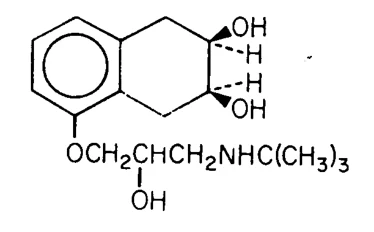
Molecular Weight: 309.41
Description: Nadolol is a white to off white crystalline powder, freely soluble in 95% ethanol and dilute acids (pH 2.0); slightly soluble in chloroform and insoluble in acetone, benzene, ethyl ether, hexane, propylene glycol and aqueous buffers (pH 7.0 - 9.0).
II. COMPOSITION
In addition to the active ingredient, nadolol, each tablet contains citric acid, corn starch, magnesium stearate, microcrystalline cellulose, and povidone.
III. STORAGE
Store tightly closed, at room temperature (15-30°C). Protect from heat, light and moisture.
PHARMACOLOGY
Pharmacokinetics
The principle details of the human pharmacokinetics of nadolol may be found under ACTIONS.
Geometric mean minimum serum concentrations at steady state were approximately 34, 87 and 154 ng/mL at doses of 80, 160 and 240 mg daily respectively.
After intravenous administration 73% of the dose was excreted via the kidneys and about 20% via the gastrointestinal tract, the latter of biliary origin.
In dog studies, the highest concentrations of nadolol were present in the kidneys, lungs and heart.
Effects on the Cardiovascular System
Animal studies in vitro and in vivo showed nadolol to be an antagonist of the beta-stimulatory effects of catecholamines and to consistently block isoproterenol-induced tachycardia and vasodepression in anesthetized dogs and cats, as well as in unanesthetized monkeys and spontaneously hypertensive rats.
Nadolol possesses no significant intrinsic sympathomimetic or membrane-stabilizing (quinidine-like)
activities.
In human studies, nadolol has been shown to inhibit the effects of both isoproterenol- and exercise-induced tachycardia at doses as low as l0 mg. Maximum inhibition was seen at 60-90 minutes and 3-8 hours respectively. Significant inhibition of exercise-induced increases in double product (heart rate x blood pressure) persisted for at least 26 hours following single oral doses of 40-l60 mg.
The oral administration of l0-l20 mg of nadolol to normotensive male volunteers produced reductions in peripheral plasma renin activity ranging from 25-40%. A similar effect was also seen in mildly hypertensive patients.
A study of the effects of nadolol on human cardiac electrophysiology and hemodynamics showed that nadolol reduces cardiac output without affecting stroke volume.
Studies involving guinea pig atria, papillary muscle of cats, anesthetized dogs, and unanesthetized atherosclerotic rabbits indicated that nadolol produces little direct myocardial depression in doses much greater than those required to produce complete beta-blockade. However, in other studies involving anesthetized dogs and cats, intravenous infusions of 0.05-1 mg/kg (dogs) and 0.1 to 10 mg/kg (cats)
produced decreases in heart rate from 15 to 30% and 23 to 45% respectively.
In studies to determine the effect of intravenous nadolol on excitability, refractoriness, and conduction velocity of both atrial and ventricular tissue in anesthetized dogs, nadolol produced prolongation of ventricular refractoriness and depression of conduction through the A-V node.
In anesthetized dogs, intravenous doses of 0.03-l.0 mg/kg nadolol prevented ECG changes caused by coronary artery occlusion. Exacerbation of these changes by isoproterenol were similarly prevented.
Results from human studies have shown that nadolol possesses some antiarrhythmic activity.
In a limited trial involving 11 hypertensive patients uncontrolled by diuretic alone, addition of nadolol to the regimen caused a significant increase (9.5%) in mean PAH clearance (effective renal plasma flow)
and a 21% decrease in mean renovascular resistance after 16 weeks of combination therapy. Significant reduction in blood pressure and heart rate occurred. No significant changes were observed in plasma volume, serum creatinine or creatinine clearance.
Similar findings were reported following intravenous doses of nadolol to both hypertensive and normal subjects fed a low sodium diet.
Effects on Respiratory Function
Studies of the effects of intravenous doses of nadolol on bronchial-airway resistance and on histamine-induced bronchial constriction in anesthetized cats indicated that nadolol increased bronchial-airway resistance. Histamine-induced increases of bronchial-airway resistance were dose dependent and potentiated slightly by nadolol.
In normal male volunteers, both forced vital capacity (FVC) and forced expiratory volume in one second
(FEVl.0) decreased after ingestion of 80 mg of nadolol and to a lesser extent after a l20 mg dose. Other Effects
A 60 mg daily dose of nadolol for 7 days produced a slightly faster initial rate of disappearance of glucose from the serum following glucose loading in six patients with moderate hypertension or cardiac arrhythmia. Mean insulin responses at l and 2 hours after ingestion of the glucose load were decreased approximately 30-35% by nadolol. Nadolol had no significant effect on fasting serum glucose or insulin levels.
TOXICOLOGY
Acute Toxicity
| Species | Sex | Route of Administration | LD50 (mg/kg) |
| Mice | M F | Oral Oral | 4700 - 5700 |
| Mice | M F | i.p. i.p. | 245 - 320 235 |
| Mice | M F | i.v. i.v. | 60 - 67 70 |
| Rats | M/F M/F | Oral i.p. | 5300 330 |
Signs of toxicity in mice included: ataxia, tremors, loss of grip strength, convulsions, collapse and transient weight losses. In rats, signs of toxicity were: cyanosis, half-closed eyes, staggering gait, writhing syndrome, atactic forward movement, hyperexcitability, side position, piloerection, ataxia and death 2 hours after dosing.
The toxicity of nadolol was increased in mice with experimentally-induced hepatic or renal lesions.
Acute Oral Interaction Study
Nadolol was administered orally to mice in combination with: hydralazine hydrochloride, hydrochlorothiazide, digoxin, furosemide, norethindrone/mestranol, quinidine sulfate, nitroglycerin, lithium carbonate or methyldopa. Under the conditions of the study, there was no evidence of toxicity potentiation of nadolol with any of the nine marketed compounds. Signs of toxicity observed with nadolol alone or in combination with quinidine sulfate, hydralazine hydrochloride, furosemide, methyldopa, or lithium carbonate were ataxia and convulsion.
Subacute Toxicity
| Species / Strain | Sexe | No. of Animals per Group | No. of Groups | Dose (mg/kg/day) | Route | Duration of Study | Toxic Effects |
| Rats / Charles-River COBS | M F | 15 15 | 4 4 | 0, 100, 300 or 1000-6 days a week | p.o. | 12 wks | None |
Rats / Sprague- Dawley | M F | 5 5 | 4 4 | 0, 2.5, 7.5 or 25 (in saline) | i.p. | 4 wks. | None |
| Dogs / Beagle | M F | 1 1 | 4 4 | 0, 25, 75 or 250 | p.o. | 3.5 wks | Slight loss of body weight; emesis |
| Dogs / Beagle | M F | 2 2 | 4 4 | 0, 1.25, 3.75 or 12.5 | i.v. | 4 wks | Bradycardia |
| Monkeys / Rhesus | M F | 2 1 | 4 4 | 0, 25, 75, 250 | p.o. | 12 wks | Bradycardia |
Chronic Toxicity
| Species / Strain | Sex | No. of Animals per Group | No. of Groups | Dose (mg/kg/day) | Route | Duration of Study | Toxic Effects |
Mice / Charles-River CD-1 | M F | 60 60 | 4 4 | 0, 80, 200 or 500 | p.o. | 18 mos. | Slightly lower mean body weight in all test animals; higher (statistically non-significant) incidence of eye lesions such as synechia, retinal detachment / degeneration, chronic iritis at 500 mg/kg |
Rats / Sprague- Dawley | M F | 60 60 | 4 4 | 0, 160, 400 or 1000 | p.o. | 18 mos. | Slightly lower mean body weight; higher (statistically non-significant) incidence of cataracts at 400 and 1000 mg/kg. |
| Dogs / Beagle | M F | 4 4 | 4 4 | 0, 24, 60, 150 | p.o. | 1 yr. | Moderate weight loss; decreased mean heart rate; decrease in glucose tolerance; decreased food consumption; dose-related increases in blood triglyceride levels (33 -61%) within the normal range. |
Carcinogenicity Studies
Nadolol was administered to 3 groups of 60 male and 60 female Charles River CD Sprague Dawley rats at dietary levels of l60, 400 and l000 mg/kg/day, for l8 months. A similar study was conducted in 3 groups of 60 male and 60 female Charles River CD-l mice. Doses of 80, 200 or 500 mg/kg/day were given in the diet for l8 months.
Under the conditions of testing, nadolol did not influence the development of tumours.
Teratology Studies
Rats: Doses of l00 or 300 mg/kg/day were administered orally to male rats for l0 weeks, and to female rats for 2 weeks before mating. Half of the females were dosed until Day l3 or l4 of gestation; the remaining females were dosed through gestation and 2l days of lactation. Nadolol had no effect on gestation or on viability of the newborn at birth and at 4 days.
Rats, hamsters: When administered orally to pregnant rats and hamsters, doses of l00 or 300 mg/kg did not affect fetal development or induce teratogenic changes in the offspring.
Rabbits: When daily doses of l00 or 300 mg/kg were administered orally to Small Russian rabbits from day 6 through day l8 of gestation, nadolol was found to be embryo-and fetotoxic, although no teratogenic changes were seen in any of the viable offspring. Similar effects were noted when pregnant New Zealand
White rabbits were administered daily doses of l00 mg/kg on days 7 through day l8 of gestation. These effects were not, however, seen in Small Russian rabbits at dose levels of 25 or 50 mg/kg.
Rats: Total daily doses of 300, 900 or 1800 mg/kg of nadolol were given to rats from Day 15 of gestation through to Day 21 of lactation. At these dose levels, nadolol did not have any significant adverse effects on pregnant rats or their offspring.
BIBLIOGRAPHY
- 1.
Dreyfuss, J., Brannick, L.J., Vukovich, R.A., Shaw, J.M., Willard, D.A.
Metabolic studies in patients with nadolol: oral and intravenous administration. J. Clin. Pharmacol. 17: 300-307, 1977
- 2.
Griffith, D.L.
Effects of diuretics on nadolol bioavailability.
Clin. Res. 25: 3, 1977
- 3.
Lee, G., DeMaria, A.N., Miller, R.R., Joye, J.A., Baker, L., Jameson, L., Low, R., Mason, D.T.
Comparative effects of nadolol and propranolol on cardiac and peripheral circulatory function in patients with coronary artery disease.
Clin. Res. 26 (2): 100A, 1978
- 4.
LeWinter, M.M., Curtis, G., Shabetai, R., Verba, J., Bloomquist, J., Engler, R.
Comparison of the effects of a new beta-adrenergic blocking agent (nadolol) and propranolol on left ventricular performance in patients with prior myocardial infarction. Clin. Res. 26 (2): 101A, 1978
- 5.
McKinstry, D.N., Vukovich, R.A., Willard, D.A.
Effects of beta-adrenergic blockade with nadolol and propranolol on glucose and lipid metabolism in man.
Clin. Res. 25 (3): 548A, 1977
- 6.
Vukovich, R.A.
Beta-blocker suppresses VPCs by two-thirds.
Internist Reporter 2: 12-13, June, 1976
- 7.
Vukovich, R.A., Dreyfuss, L.J., Brannick, L.J., Herrera, J., Willard, D.A.
Pharmacologic and metabolic studies with a new beta-adrenergic blocking agent, nadolol. Clin. Res. 24: 52, 1976
- 8.
Vukovich, R.A., Sasahara, A., Sanchez-Zambrano, S., Belko, J.
Beta-blockade with nadolol in patients with congestive heart failure.
Lancet 1: 162-163, 1978
- 9.
Vukovich, R.A., Sasahara, A., Zombrano, P., Belko, B.S., Godin, P., Brannick, L.J.
Antiarrhythmic effects of a new beta-adrenergic blocking agent, nadolol. Clin. Pharmacol. Ther. 19: 118, 1976
- 10.
Evans, D.B., Peschka, M.T., Lee, R.J., Laffan, R.J.
Anti-arrhythmic action of nadolol, a beta-adrenergic receptor blocking compound. Eur. J. Pharmacol. 35: 17-27, 1976
- 11.
Gibson, J.K., Gelband, H., Bassett, A.L.
Possible basis of antiarrhythmic action of a new beta-adrenergic blocking compound. Amer. J. Cardiol. 37: 138, 1976 (Abstract)
- 12.
Gibson, J.K., Gelband, H., Bassett, A.L.
Effects of SQ 11,725 on the electrophysiology of isolated mitral cardiac tissue. Pharmacologist 16: 201, 1974 (Abstract)
- 13.
Lee, R.J., Evans, D.B., Baky, S.H., Laffan, R.J.
The cardiovascular pharmacology of SQ 11,725, a potent betaadrenergic antagonist lacking significant myocardial depressant activity.
Fed. Proc. 32: 780, 1973 (Abstract)
- 14.
Lee, R.J., Evans, D.B., Baky, S.H., Laffan, R.J.
Pharmacology of nadolol (SQ 11,725), a beta-adrenergic antagonist lacking direct myocardial depression.
Eur. J. Pharmacol. 33: 371-382, 1975
- 15.
Morales-Aquilera, A.
Molecular features of beta-adrenergic blocking agents and their relations to specificity of action. In: First Chemical Congress of the North American Continent, Mexico City, Nov-Dec 1975. Port City Press Inc., Baltimore, Md. Abstract No. 141.
- 16.
Morales-Aquilera, A., Valle, J.R.
Neuromuscular transmission blockade produced by propranolol and 2,3-cis-1,2,3,4-tetrahydro-5-[2-hydroxy-3-(tert-butylamino)propoxy]-2-3- naphthalenediol (SQ 11,725). Fed. Proc. 33: 579, 1974 (Abstract)
- 17.
Peschka, M., Evans, D.B., Laffan, R.J.
Anti-arrhythmic activity of SQ 11,725, a potent nondepressant beta-adrenergic blocking agent. Fed. Proc. 32: 780, 1973 (Abstract)
- 18.
Shaw, J.M., Dreyfuss, J.
Placental transfer in rats of the beta-adrenergic-blocking agent, nadolol, and its excretion in milk. Fed. Proc. 35: 365, 1976 (Abstract)
- 19.
Wong, K.K., Dreyfuss, J., Shaw, J.M., Ross, J.J., Jr., Schreiber, E.C.
A beta-blocking agent (SQ 11,725) that is not metabolized extensively by dogs and monkeys. Pharmacologist 15: 245, 1973 (Abstract)