


Product Monograph - Denticare Chlorhexidine Gluconate Oral Rinse 0.12%
INDICATIONS AND CLINICAL USE
DentiCare Chlorhexidine Gluconate Oral Rinse 0.12% is indicated for use as part of a professional program for the treatment of moderate to severe gingivitis, and for management of associated gingival bleeding and inflammation according to the recommended dosage and frequency under supervision of a dentist. For patients having coexisting gingivitis and periodontitis, see PRECAUTIONS.
CONTRAINDICATIONS
DentiCare Chlorhexidine Gluconate Oral Rinse 0.12% should not be used by the persons who are known to be hypersensitive to chlorhexidine gluconate, chlorhexidine compounds or other ingredients.
WARNINGS
Use in Pregnancy
Reproduction and fertility studies with chlorhexidine gluconate have been conducted. No evidence of impaired fertility was observed in male and female rats at doses up to 100 mg/kg/day. No evidence of harm to the fetus was observed in rats and rabbits at doses up to 300 mg/kg/day and
40 mg/kg/day, respectively. These doses are approximately 100, 300 and 40 times that which would result from a person ingesting 30 mL (2 capfuls) of 0.12% chlorhexidine gluconate per day.
Reproduction and fertility studies with chlorhexidine gluconate in pregnant women have not been conducted, so the benefits of using DentiCare Chlorhexidine Gluconate Oral Rinse 0.12% should be weighed against the possible risk to the fetus.
Use in Nursing Mothers
It is not known whether chlorhexidine gluconate is excreted in human milk. In parturition and lactation studies in white rats, no evidence of impaired parturition or of toxic effects to suckling pups was observed when chlorhexidine gluconate was administered at doses over 100 times greater than ingesting the recommended daily dose for rinsing. As many other drugs are excreted in human milk, caution should be exercised, and the benefits of use weighed against possible risk to the infant being nursed.
Use in Children
Clinical effectiveness and safety of DentiCare Chlorhexidine Gluconate Oral Rinse 0.12% have not been determined in children. The benefits of its use should be weighed against the possible risks.
PRECAUTIONS
- 1. 0.12% Chlorhexidine Gluconate Oral Rinse can cause staining to tooth surfaces, restorations, and the dorsum of the tongue in some patients especially with prolonged use and in patients who have heavier accumulations of plaque. Staining does not affect the health or oral tissues and can be removed from most tooth surfaces by professional dental prophylaxis. Discretion should be used in prescribing 0.12% Chlorhexidine Gluconate Oral Rinse for patients who have exposed root surfaces or anterior facial restorations with rough surfaces or margins, as stains on this area may be difficult to remove and may require restoration replacement in rare instances. If natural stains cannot be removed from these surfaces by a dental prophylaxis, patients should be excluded from treatment if the risk of permanent discolouration is unacceptable.
- 2. Use of a 0.12% Chlorhexidine Gluconate Oral Rinse may cause an alteration in taste perception in some patients.
- 3. For patients having coexisting gingivitis and periodontitis, the absence of gingival inflammation following treatment with 0.12% Chlorhexidine Gluconate Oral Rinse may not be indicative of the absence of underlying periodontitis. Appropriate treatment of periodontitis is therefore indicated.
- 4. For maximum effectiveness, the patient should avoid rinsing their mouth, eating or drinking for about thirty minutes after using 0.12% chlorhexidine gluconate.
ADVERSE REACTIONS
Common side effects occurring from the use of 0.12% Chlorhexidine Gluconate Oral Rinse are staining of teeth and other oral surfaces, a slight and temporary alteration in taste perception and an increase in supra gingival calculus formation (see PRECAUTIONS). Epithelial irritation and superficial desquamation of the oral mucosa have been noted in studies of children using 0.12% chlorhexidine gluconate which were reversible upon discontinuation. Parotitis and inflammation of the salivary glands have been reported in some patients using chlorhexidine gluconate oral rinses.
SYMPTOMS AND TREATMENT OF OVERDOSE
Ingestion of 30 to 60 mL of DentiCare Chlorhexidine Gluconate Oral Rinse 0.12% by a small child may result in gastric distress, including nausea, and/or signs of alcohol intoxication. Medical attention should be sought if more than 100 mL is ingested or if signs of alcohol intoxication develop.
DOSAGE AND ADMINISTRATION
Use of DentiCare Chlorhexidine Gluconate Oral Rinse 0.12% should begin immediately following professional dental prophylaxis. Patients should be re-examined at intervals of not more than six months and given a thorough prophylaxis. Patient referral for periodontal consultation should be done as necessary.
Rinse with 15 mL of solution for 30 (thirty) seconds, then expectorate. Use twice daily, after breakfast and before bedtime, or as prescribed. DentiCare Chlorhexidine Gluconate Oral Rinse 0.12% is not intended for ingestion and should be expectorated after rinsing.
DO NOT SWALLOW.
Note: Wait 30 minutes after brushing with conventional toothpastes before using DentiCare Chlorhexidine Gluconate Oral Rinse 0.12%. Do not rinse the mouth, eat or drink for 30 minutes after using DentiCare Chlorhexidine Gluconate Oral Rinse 0.12%.
The suggested initial therapy is 3 months, at which time patients should be recalled for evaluation. At the time of the recall visit, the dental professional should:
- Evaluate progress, remove any stain, and reinforce proper home care techniques.
- Discontinue use of DentiCare Chlorhexidine Gluconate Oral Rinse 0.12% if gingival inflammation and bleeding is controlled. Recall the patient in three months to assess gingival health.
- Continue use of DentiCare Chlorhexidine Gluconate Oral Rinse 0.12% for an additional 3 months if gingival inflammation and bleeding persists. Schedule a three-month recall for evaluation.
- Evaluate for evidence of epithelial irritation, desquamation and parotitis.
The following generally accepted grading scheme may be of use in evaluation the severity of gingivitis.
Loe and Silness
GINGIVAL INDEX (GI)
| Grade | Description |
| 1 | Normal gingiva, no inflammation, no colouration, no bleeding. |
| 2 | Mild inflammation, slight colour change, mild alteration of gingival surface, no bleeding. |
| 3 | Moderate inflammation, erythema, swelling, bleeding on probing or when pressure applied. |
| 4 | Severe inflammation, severe erythema and swelling tendency toward spontaneous hemorrhage, some ulceration. |
PHARMACEUTICAL INFORMATION
DRUG SUBSTANCE
Proper Name: Chlorhexidine Gluconate
Chemical Name: 1,1-hexamethylene bis [5-4-chlorphenyle biguanide] digluconate
Structure:
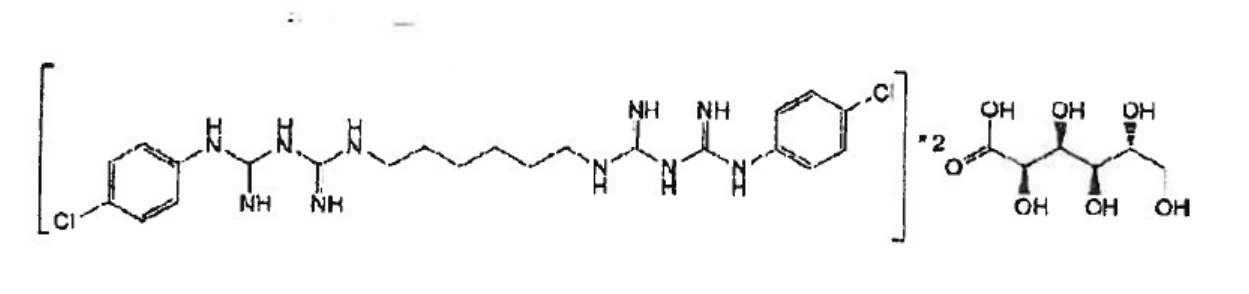
Molecular Weight: MW = 897.8
Description:
Chlorhexidine Gluconate is available as Chlorhexidine Gluconate Solution, BP. It is an almost colourless to pale straw-coloured, clear or slightly opalescent liquid, that is odourless or almost odourless. It is miscible with water, with not more than five parts of ethanol (96%) and with not more than three parts of acetone. The pH of a 5% v/v solution is 5.0 to 7.0.
COMPOSITION
DentiCare Chlorhexidine Gluconate Oral Rinse 0.12% is a near neutral (pH range: 5 to 7), green coloured, spearmint flavoured liquid. It contains 0.12% Chlorhexidine Gluconate in a base consisting of Purified Water, 10% Ethanol, Sorbitol Solution, Glycerin, Flavour, Polysorbate 60, methyl and propyl parabens, Sodium Cyclamate, FD&C Blue 1, FD&C Yellow 5, and Xylitol.
STABILITY AND STORAGE
DentiCare Chlorhexidine Gluconate Oral Rinse 0.12% must be stored between 15° and 25°C.
INCOMPATABILITIES
None known.
AVAILABILITY OF DOSAGE FORM
DentiCare Chlorhexidine Gluconate Oral Rinse 0.12% is available in 500 mL and 4 L white containers.
INFORMATION FOR THE CONSUMER
(Bottle label)
PHARMACOLOGY
HUMAN CLINICAL TRIALS
A number of clinical studies have provided support for the effectiveness of 0.12% chlorhexidine gluconate mouthrinses in reducing plaque build-up and rate of occurrence and harshness of gingivitis, as well as reducing the number of bleeding sites.
| Study Location | Study Duration | Number Patients | Age | Sex | Usage Regimen | Plaque Index Scores Reduction* | Gingival Inflammation Index Scores Reduction* | Bleeding Sites Reduction* |
| San Antonio TX | 3 months | 597 | 18-60 | M&F | According to pkg. instruction 15 mL bid | 36.1% | 27.8%-45.8% | 48.4% |
| Northfield NJ | 6 months | 430 | 18-60 | M&F | 60.9% | 33.5%-45.4% | 41.6%-52.2% | |
| London ON | 2 years | 456 | 18-72 | M&F | 34.6%-56.4% | 39.65% | 50.3% |
* Results shown are those obtained for the final examination at completion of test product use. The data are expressed as covariance adjusted % reduction vs. placebo; a range is reported when there were duplicate examiners. All reductions were significantly different from placebo (p<0.05; nonparametric Wilcoxon pair test).
MICROBIOLOGY
In Vitro
A nonspecific mechanism of action of chlorhexidine gluconate gives it a wide range of antimicrobial activity against Gram-positive and Gram-negative bacteria. An in-Vitro study of the microbiocidal effect of 0.12% chlorhexidine gluconate oral rinse following a thirty-second exposure resulted in a 99.9% reduction in the following micro-organisms: Acitinomyces viscosus,
Candida albicans, Staphylococcus aureus, Streptococcus mutans, Streptococcus sanguis, Fusobacterium nucleatum, Neisseria sicca, Pseudomonas aeruginosa, Veillonella parvula.
In Vivo
To determine the efficacy of 0.12% chlorhexidine gluconate oral rinse in vivo, various bacteria in the microbial flora of plaque were assayed in subjects who had used either 0.12% chlorhexidine gluconate oral rinse or a placebo. During six months’ 0.12% chlorhexidine gluconate oral rinse use, subjects showed reductions in total load/tooth, streptococci and actinomyces ranging from 54% to 97%. Neisseria and fusobacterial were not detected in over half of the subjects assayed. No changes in numbers of yeast-like organisms and Gram-negative enterics were observed. There were no adverse changes in the oral microbial flora. Three months following cessation of treatment, the reductions observed during mouth rinsing were no longer evident, indicating no “carryover” effect.
The results were interpreted as indication that the use of 0.12% chlorhexidine gluconate oral rinse was associated only with a decrease in the number of microbes in plaque and no change in bacterial sensitivity. Another study was conducted to investigate whether changes occurred in resistance to chlorhexidine which might limit efficacy of the mouthrinse, and if such changes occurred, whether they dissipated or disappeared after cessation of use of the mouthrinse. Minimum Inhibitory Concentrations (MIC’s) for chlorhexidine were determined on isolates of streptococci and actinomyces obtained from patients during six months use of the mouthrinse and three months after cessation of use of the mouthrinse. Changes in bacterial sensitivity due to exposure to chlorhexidine were slight, sporadic and had returned to pretreatment values three months after product usage was discontinued. These results support that 0.12% chlorhexidine gluconate oral rinse usage does not result in significant changes in plaque bacterial resistance and does not cause significant changes in the plaque flora.
Pharmacodynamics
One short term study and a three month clinical study examining concentration response relationships showed equal efficacy, as measured by plaque reduction, for 0.10 and 0.20% chlorhexidine gluconate solutions while a 0.05% solution was less effective. Studies also demonstrated that tooth and tongue discoloration increased with Chlorhexidine gluconate concentration. Also, shorter more frequent rinsing provided higher efficacy as compared to longer less frequent rinsing. A 0.12% chlorhexidine gluconate solution was chosen to optimize efficacy while minimizing side effects.
Pharmacokinetics
Oral Retention/Desorption
Approximately 30% of the chlorhexidine present in the mouthrinse is retained in the oral cavity after rinsing. The amount retained is directly related to drug concentration (with 6.3 mg of chlorhexidine being retained orally after a single use of a mouthrinse containing 0.12% Chlorhexidine Gluconate). The rate of release of chlorhexidine from oral surfaces is similar for 0.12% and 0.06% chlorhexidine gluconate rinses. Based on morning/evening rinses, previous exposure to a chlorhexidine-containing mouthrinse was observed to have little effect on subsequent retention of chlorhexidine.
Ingestion/Absorption/Excretion
0.12% Chlorhexidine Gluconate Oral Rinse is a topical, oral rinse and should not be ingested. In the event of ingestion, human studies have shown that chlorhexidine gluconate is poorly absorbed by the gastrointestinal tract and the primary route of excretion is through the feces (approximately 90%) in 31 to 53 hours. Urine samples contained up to 1% of the chlorhexidine gluconate administered.
TOXICOLOGY
Acute Toxicity Studies
The oral LD50 of chlorhexidine gluconate was estimated at 1.48 g/kg in rats and 0.11 g/kg in rabbits. The oral LD50 of the mouthrinse formulation was estimated at greater than 20 g/kg in rats.
Chronic and Subchronic Toxicity Studies
The only consistently observed finding in subchronic and chronic toxicity studies was the accumulation of foamy macrophages in the mesenteric lymph nodes of rats. Base on the following facts:
- 1. the macrophages did not contain bacteria, indicating that a significant change in the intestinal flora has not occurred;
- 2. the reaction is not associated with increased morbidity or mortality;
- 3. the reaction does not become progressively more severe with continued exposure to Chlorhexidine and;
- 4. the reaction is reversible after administration of Chlorhexidine is discontinued, it was concluded that the lesions did not represent a significant toxic effect.
Reproduction and Teratology
No adverse reproductive or tetratologic effects on rats or rabbits were observed in studies with 0.12% chlorhexidine gluconate mouthrinse.
The effect of chlorhexidine gluconate on various aspects of reproductive processes has been evaluated using both the rat and rabbit as a model. An apparent embryotoxic effect was observed in rabbits that received a daily 40 mg/kg dose of chlorhexidine by gavage and in rats that ingested a 300 mg/kg dose of chlorhexidine from their diet each day. These doses are about 140 and 1,040 times, respectively, the estimated daily ingestion from 0.12% chlorhexidine gluconate oral rinse with their recommended dose.
Carcinogenicity
No evidence of carcinogenicity was observed in studies in rats in which chlorhexidine was administered at levels up to 200 mg/kg/day for two years.
Mutagenicity
No evidence of mutagenicity was observed when chlorhexidine gluconate was evaluated by the dominant lethal assay in mice and micronucleus assay in hamsters.
Immediate Hypersensitivity
A variety or regimens were used in an attempt to induct and elicit immediate hypersensitivity to chlorhexidine gluconate in guineas pigs, rabbits, rats and man. No evidence of immediate hypersensitivity was observed in any of the tests.
Other Studies
The emetic dose, irritation potential and sensitization potential have also been determined for 0.12% chlorhexidine gluconate oral rinse. The rinse has an emetic ED50 of approximately 13.4 mL/kg (tested in dogs using the oral route of administration), is only slightly irritating to the eye (tested in rabbits and was not irritating to oral mucosa (tested in dogs). In addition, the mouthrinse does not induce delayed contact sensitization.
REFERENCES
- 1. Grossman, E.; Reiter, G.; Sturzenberger, O.P.; De la Rosa, M.; Dickinson, T.D.; Ferretti, G.A.; Ludlam, G.E.; Meckel, A.H.: Six-month study of the effects of a chlorhexidine mouthrinse on gingivitis in adults. J Periodont Res 1986; 21 (Suppl.16): 33-43.
- 2. Briner W.W.; Grossman, E.; Buckner, R.Y.; Rebitski, G.F.; Sox, T.E.; Setser, R.E.; Ebert, M.L.: Effect of chlorhexidine gluconate mouthrinse on plaque bacteria. J Periodont Res 1986; 21 (Suppl.16); 44-52.
- 3. Briner W.W.; Grossman, E.; Buckner, R.Y.; Rebitski, G.F.; Sox, T.E.; Setser, R.E.; Ebert, M.L.: Assessment of susceptibility of plaque bacteria to chlorhexidine after six months’ oral use. J Periodont Res 1986; 21 (Suppl.16): 53-59.
- 4. Loe, H.; Rindom-Schiott, C.; Glavind, L.; Karring, T.: Two years’ oral use of chlorhexidine in man: I. General design and clinical effects. J Periodont Res 1976; 11:135-144.
- 5. Rindom-Schiott, C.; Briner, E.W.; Loe, H.: “Two Years of Oral Use of Chlorhexidine in Mann”. II The effect of the Salivary Bacterial Flora.” J Periodont Res II: 1976, 145-152.
- 6. Warner, V.D.; Lynch, D.M.; Kim, K.H.; Grunewald, G.L.: “Quantitative Structure-Activity Relationships for Biguanides, Carbamimidates and Bisbiguanides as Inhibitors in Streptococcus Mutans,” J Med Chem 22: Issue 4, 1979, 359-366.
- 7. Suessmuth, R.; Lingens, F.; Ackermann, B.: “Mutagenic effect of 1,1’-Hexamethylene-Bis ((5-p- Chorophenyl)-Biguanide).” Chem-Biol Interact; 28 (2-3) 1979, 249-258.
- 8. Ackermann-Schmidt, B.; Suessmuth, R.; Lingens, F.: “Effects of 1,1’-Hexamethylene-Bis ((5-p-Chorophenyl)-Biguanide) on the genome and on the synthesis of nucleic acid and proteins in the bacterial cells. Chem-Biol Interact; Vol. 40, Iss 1, 1982. 85-96.
- 9. Evans, R.T.; Baker, P.J.; Coburn R.A.; Genco, R.J.; “Evaluation of chlorhexidine, Tribromsalan and a limited series of alkyl bis biguanides in an in-vitro mutagenicity assay. J Dent Res 1978 57:290.