


Product Monograph - PMS-Doxycycline (Pharmascience, PM 00078718)
INDICATIONS AND CLINICAL USE
pms-DOXYCYCLINE is indicated for use as an adjunct to scaling and root planing to promote attachment level gain and to reduce pocket depth in patients with adult periodontitis.
pms-DOXYCYCLINE contains an antibacterial ingredient, doxycycline. To reduce the development of drug-resistant bacteria and maintain the effectiveness of doxycycline, pms-DOXYCYCLINE should only be used for the authorized indication and clinical use.
CONTRAINDICATIONS
This drug is contraindicated in persons who have shown hypersensitivity to any of the tetracyclines, and in patients with myasthenia gravis. pms-DOXYCYCLINE should not be used during tooth development (second half of pregnancy, infancy and in childhood).
WARNINGS
THE USE OF DRUGS OF THE TETRACYCLINE CLASS DURING TOOTH DEVELOPMENT (LAST HALF OF PREGNANCY, INFANCY AND CHILDHOOD TO THE AGE OF 8 YEARS) MAY CAUSE PERMANENT DISCOLORATION OF THE TEETH (YELLOW-GRAY-BROWN). This adverse reaction is more common during long-term use of the drugs but has been observed following repeated short-term courses. Enamel hypoplasia has also been reported. TETRACYCLINE DRUGS, THEREFORE, SHOULD NOT BE USED IN THIS AGE GROUP AND IN PREGNANT OR NURSING MOTHERS UNLESS THE POTENTIAL BENEFITS MAY BE ACCEPTABLE DESPITE THE POTENTIAL RISKS.
Doxycycline can cause fetal harm when administered to a pregnant woman. Results of animal studies indicate that tetracyclines cross the placenta, are found in fetal tissues, and can have toxic effects on the developing fetus (often related to retardation of skeletal development). Evidence of embryotoxicity has also been noted in animals treated early in pregnancy. If any tetracyclines are used during pregnancy, or if the patient becomes pregnant while taking this drug, the patient should be apprised of the potential hazard to the fetus.
Photosensitivity manifested by an exaggerated sunburn reaction has been observed in some individuals taking tetracyclines. Patients apt to be exposed to direct sunlight or ultraviolet light should be advised that this reaction can occur with tetracycline drugs, and treatment should be discontinued at the first evidence of skin erythema.
Carcinogenesis, Mutagenesis, Impairment of Fertility
Doxycycline hyclate was evaluated in a long-term animal study, no evidence of carcinogenic potential was obtained. Evidence of oncogenic activity was obtained in studies with related compounds, i.e., oxytetracycline (adrenal and pituitary tumors), and minocycline (thyroid tumors).
Doxycycline hyclate demonstrated no potential to cause genetic toxicity in an in vitro point mutation study with mammalian cells (CHO/HGPRT forward mutation assay) or in an in vivo micronucleus assay conducted in CD-1 mice. However, data from an in vitro assay with CHO cells for potential to cause chromosomal aberrations suggests that doxycycline hyclate is a weak clastogen.
Oral administration of doxycycline hyclate to male and female Sprague-Dawley rats adversely affected fertility and reproductive performance, as evidenced by increased time for mating to occur, reduced sperm motility, velocity, and concentration, abnormal sperm morphology, and increased pre-and post-implantation losses. Doxycycline hyclate induced reproductive toxicity at all dosages that were examined in this study, as even the lowest dosage tested (50 mg/kg/day) induced a statistically significant reduction in sperm velocity. Note that 50 mg/kg/day is approximately 10 times the amount of doxycycline hyclate contained in the recommended daily dose of pms-DOXYCYCLINE for a 60 kg human when compared on the basis of body surface area estimates (mg/m2). Although doxycycline impairs the fertility of rats when administered at sufficient dosage, the effect of pms-DOXYCYCLINE on human fertility is unknown.
Pregnancy
Teratogenic Effects
Pregnancy Category D. Results from animal studies indicate that doxycycline crosses the placenta and is found in fetal tissues.
Susceptibility/Resistance
Development of Drug Resistant Bacteria
Prescribing pms-DOXYCYCLINE in the absence of the authorized indications is unlikely to provide benefit to the patient and risks the development of drug-resistant bacteria.
Potential for Microbial Overgrowth
If superinfection is suspected, pms-DOXYCYCLINE treatment should be discontinued and appropriate measures should be taken.
PRECAUTIONS
Although not seen in clinical trials, overgrowth by opportunistic microorganisms, as with other antimicrobials, may occur. Exceeding the recommended dose of pms-DOXYCYCLINE may result in the following:
The use may increase the incidence of vaginal candidiasis.
pms-DOXYCYCLINE should be used with caution in patients with a history or predisposition to oral candidiasis. The safety and effectiveness of pms-DOXYCYCLINE has not been established for the treatment of periodontitis in patients with coexistent oral candidiasis.
Laboratory Tests
In long term therapy, periodic laboratory evaluations of organ systems, including hematopoietic, renal, and hepatic studies should be performed.
Drug Interactions
Because tetracyclines have been shown to depress plasma prothrombin activity, patients who are on anticoagulant therapy may require downward adjustment of their anticoagulant dosage.
Since bacterial antibiotics, such as the tetracycline class of antibiotics, may interfere with the bactericidal action of members of the β-lactam (e.g. penicillin) class of antibiotics, it is not advisable to administer these antibiotics concomitantly.
Absorption of doxycycline is impaired by antacids containing aluminum, calcium, or magnesium, and iron-containing preparations. Absorption is also impaired by bismuth subsalicylate.
Barbiturates, carbamazepine, and phenytoin decrease the half-life of doxycycline.
The concurrent use of tetracycline and Penthrane (methoxy-fluorane) has been reported to result in fatal renal toxicity.
Concurrent use of doxycycline may render oral contraceptives less effective.
Drug/Laboratory Test Interactions
False elevations of urinary catecholamine levels may occur due to interference with the fluorescence test.
ADVERSE REACTIONS
Adverse Reactions in Clinical Trials of pms-DOXYCYCLINE
In clinical trials of adult patients with periodontal disease 213 patients received pms-DOXYCYCLINE 20 mg BID over a 9 - 12-month period. The most frequent adverse reactions occurring in studies involving treatment with pms-DOXYCYCLINE or placebo are listed below:
| Incidence (%) of Adverse Reactions in pms-DOXYCYCLINE Clinical Trials | ||
| Adverse Reaction pms-DOXYCYCLINE 20 mg BID (n=213) Placebo (n=215) | ||
| Headache | 55 (26%) | 56 (26%) |
| Common Cold | 47 (22%) | 46 (21%) |
| Flu Symptoms | 24 (11%) | 40 (19%) |
| Tooth Ache | 14 (7%) | 28 (13%) |
| Periodontal Abscess | 8 (4%) | 21 (10%) |
| Tooth Disorder | 13 (6%) | 19 (9%) |
| Nausea | 17 (8%) | 12 (6%) |
| Sinusitis | 7 (3%) | 18 (8%) |
| Injury | 11 (5%) | 18 (8%) |
| Dyspepsia | 13 (6%) | 5 (2%) |
| Sore Throat | 11 (5%) | 13 (6%) |
| Joint Pain | 12 (6%) | 8 (4%) |
| Diarrhea | 12 (6%) | 8 (4%) |
| Sinus Congestion | 11 (5%) | 11 (5%) |
| Coughing | 9 (4%) | 11 (5%) |
| Sinus Headache | 8 (4%) | 8 (4%) |
| Rash | 8 (4%) | 6 (3%) |
| Back Pain | 7 (3%) | 8 (4%) |
| Back Ache | 4 (2%) | 9 (4%) |
| Menstrual Cramp | 9 (4%) | 5 (2%) |
| Acid Indigestion | 8 (4%) | 7 (3%) |
| Pain | 8 (4%) | 5 (2%) |
| Infection | 4 (2%) | 6 (3%) |
| Gum Pain | 1 (0.5%) | 6 (3%) |
| Bronchitis | 7 (3%) | 5 (2%) |
| Muscle Pain | 2 (1%) | 6 (3%) |
Note: Percentages are based on total number of study participants in each treatment group.
SYMPTOMS AND TREATMENT OF OVERDOSAGE
In case of overdosage, discontinue medication, treat symptomatically and institute supportive measures. Dialysis does not alter serum half-life and thus would not be of benefit in treating cases of overdose.
DOSAGE AND ADMINISTRATION
THE DOSAGE OF pms-DOXYCYCLINE DIFFERS FROM THAT OF DOXYCYCLINE USED TO TREAT INFECTIONS. EXCEEDING THE RECOMMENDED DOSAGE MAY RESULT IN AN INCREASED INCIDENCE OF SIDE EFFECTS INCLUDING THE DEVELOPMENT OF RESISTANT MICROORGANISMS.
pms-DOXYCYCLINE 20 mg twice daily as an adjunct following scaling and root planing may be administered for up to 9 months. Safety beyond 12 months and efficacy beyond 9 months have not been established.
pms-DOXYCYCLINE should be administered at least one hour prior to morning and evening meals.
Administration of adequate amounts of fluid along with the capsules is recommended to wash down the drug and reduce the risk of esophageal irritation and ulceration (see ADVERSE REACTIONS).
PHARMACEUTICAL INFORMATION
Drug Substance
Proper Name: Doxycycline hyclate
Chemical Name: 4-(dimethylamino)-1,4,4a,5,5a,6,11,12a-octahydro-3,5,10,12,12a-pentahydroxy-6-methyl-1,11-dioxo-2-naphthacenecarboxamide monohydrochloride, compound with ethyl alcohol (2:1), monohydrate.
Structural Formula:
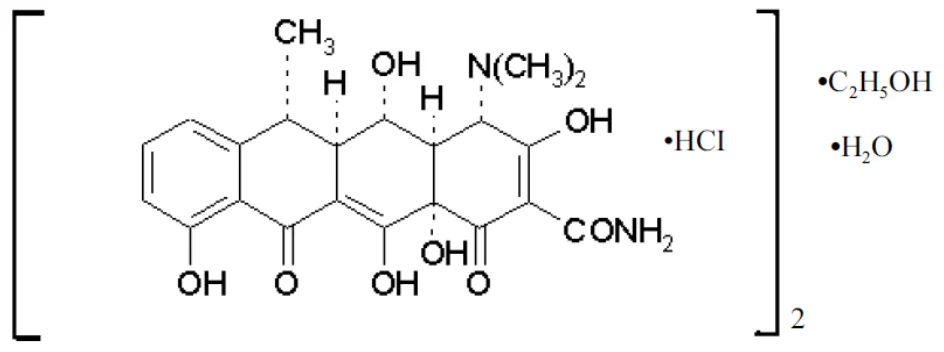
Molecular Formula: (C22H24N2O8HCl)2·C2H5OH·H2O)
Molecular Weight: 1025.89 g/mol
Description: Doxycycline hyclate is a light-yellow crystalline powder. It is soluble in water: pH (1%, H2O) is between 2.0 and 3.0. It decomposes without melting at 201°C.
Composition: pms-DOXYCYCLINE contains doxycycline hyclate equivalent to 20 mg of doxycycline. Doxycycline is synthetically derived from oxytetracycline.
Non-medicinal ingredients: Hard Gelatin Capsules, Magnesium Stearate, Microcrystalline Cellulose and Titanium Dioxide.
AVAILABILITY AND DOSAGE FORM
pms-DOXYCYCLINE are white to off-white capsules, ink-printed in black with “PMS” on the cap and “DC 20 mg” on the body. Capsules filled with yellow crystalline powder and contains doxycycline hyclate equivalent to 20 mg doxycycline. Bottle of 60 capsules.
Storage
All products are to be stored at controlled room temperatures of 15°C - 30°C and dispensed in tight, light-resistant containers (U.S.P.), protected from excessive humidity.
MICROBIOLOGY
Doxycycline is a member of the tetracycline class of antibiotics. The dosage of doxycycline achieved with this product during administration is well below the concentration required to inhibit microorganisms commonly associated with adult periodontitis. Clinical studies with this product demonstrated no effect on total anaerobic and facultative bacteria in plaque samples from patients administered this dose regimen for 9 to 18 months. This product should not be used for reducing the numbers of or eliminating those microorganisms associated with periodontitis.
While short term therapy may not lead to alteration of microflora, the long-term exposure effects have not been studied and cannot be predicted.
CLINICAL PHARMACOLOGY
| Pharmacokinetic Parameters for pms-DOXYCYCLINE | |||||
| n | Cmax (ng/mL) | Tmax (hr) | Cl/F (L/hr) | t1/2 (hr) | |
| Single dose 20 mg | 42 | 400 ± 142 | 1.5 (0.5 - 4.0) | 3.80 ± 0.85 | 18.4 ± 5.38 |
| Steady-State 20 mg BID | 30 | 790 ± 285 | 2 (0.98 - 12.0) | 3.76 ± 1.06 | Not Determined |
Absorption
Doxycycline is virtually completely absorbed after oral administration. Following 20 mg doxycycline, twice a day, in healthy volunteers, the mean peak concentration in plasma was 790 ng/mL and the average steady-state concentration was 482 ng/mL. The effect of food on the absorption of doxycycline from pms-DOXYCYCLINE has not been studied.
Distribution
Doxycycline is greater than 90% bound to plasma proteins. Its apparent volume of distribution is variously reported as between 52.6 and 134 L.4,6
Metabolism
Major metabolites of doxycycline have not been identified. However, enzyme inducers such as barbiturates, carbamazepine, and phenytoin decrease the half-life of doxycycline.
Excretion
Doxycycline is excreted in the urine and feces as unchanged drug. It is variously reported that between 29% and 55.4% of an administered dose can be accounted for in the urine by 72 hours.5, 6 Half-life averaged 18 hours in subjects receiving a single 20 mg doxycycline dose.
Special Populations
Geriatric
Doxycycline pharmacokinetics have not been evaluated in geriatric patients.
Pediatric
Doxycycline pharmacokinetics have not been evaluated in pediatric patients (see WARNINGS).
Gender
A study was conducted in 42 subjects where doxycycline pharmacokinetics were compared in men and women. It was observed that Cmax was approximately 1.7-fold higher in women than in men. There were no apparent differences in other pharmacokinetic parameters.
Race
Differences in doxycycline pharmacokinetics among racial groups have not been evaluated.
Renal Insufficiency
Studies have shown no significant difference in serum half-life of doxycycline in patients with normal and severely impaired renal function. Hemodialysis does not alter the half-life of doxycycline.
Hepatic Insufficiency
Doxycycline pharmacokinetics have not been evaluated in patients with hepatic insufficiency.
Drug Interactions
See PRECAUTIONS.
Clinical Study
In a randomized, multi-centered, double-blind, 9-month Phase 3 study involving 190 adult patients with periodontal disease [at least two probing sites per quadrant of between 5 and 9 mm pocket depth (PD) and attachment level (ALv)], the effects of oral administration of 20 mg twice a day of doxycycline hyclate plus scaling and root planing (SRP) were compared to placebo control plus SRP. Both treatment groups were administered a course of scaling and root planing in 2 quadrants at Baseline. Measurements of ALv, PD and bleeding-on-probing (BOP) were obtained at Baseline, 3, 6, and 9 months from each site about each tooth in the two quadrants that received SRP using the UNC-15 manual probe. Each tooth site was categorized into one of three strata based on Baseline PD: 0-3 mm (no disease), 4-6 mm (mild/moderate disease), > 7 mm (severe disease). For each stratum and treatment group, the following were calculated at month 3, 6, and 9: mean change in
ALv from baseline, mean change in PD from baseline, mean percentage of tooth sites per patient exhibiting attachment loss of > 2 mm from baseline, and percentage of tooth sites with bleeding on probing.
The results are summarized in the following table:
Clinical Results at Nine Months of Doxycycline Hyclate Capsules, 20 mg as an adjunct to SRP | |||
| Parameter | Baseline Pocket Depth | ||
| 0-3 mm | 4-6 mm | ≥ 7 mm | |
| Number of Patients pms-DOXYCYCLINE 20 mg BID | 90 | 90 | 79 |
| Number of Patients (Placebo) | 93 | 93 | 78 |
Mean Gain (SDff) in ALvΤ pms-DOXYCYCLINE 20 mg BID Placebo | 0.25 (0.29) mm 0.20 (0.29) mm | 1.03 (0.47) mm* 0.86 (0.48) mm | 1.55 (1.16) mm* 1.17 (1.15) mm |
Mean Decrease (SDff) in PDΤ pms-DOXYCYCLINE 20 mg BID Placebo | 0.16 (0.19) mm** 0.05 (0.19) mm | 0.95 (0.47) mm ** 0.69 (0.48) mm | 1.68 (1.07) mm** 1.20 (1.06) mm |
% of Sites (SDff) with loss of ALvΤ > 2 mm pms-DOXYCYCLINE 20 mg BID Placebo | 1.9 (4.2) % 2.2 (4.1) % | 1.3 (4.5) % 2.4 (4.4) % | 0.3 (9.4) % 3.6 (9.4) % |
% of Sites (SDff) with BOPf pms-DOXYCYCLINE 20 mg BID Placebo | 39 (19) %** 46 (19) % | 64 (18) %* 70 (18) % | 75 (29) % 80 (29) % |
* p<0.050 vs. the placebo control group. ** p<0.010 vs. the placebo control group.
ALvΤ=Clinical Attachment Level PDΤ=Pocket Depth BOPf=Bleeding on Probing
SDff=Standard Deviation
TOXICOLOGY
Acute Toxicity
The acute oral and parenteral toxicity of doxycycline in mice, rats and dogs are as follows:
| LD50 (95% confidence limits) mg/kg oral | |||||
| Oral | I.V. | ||||
| Mice | 1,900 (1696-2128) | 241 (230-253) | |||
| Rats | > 2,000 | 228 (202-258) | |||
| Dogs | > 500 | > 100 | |||
The intraperitoneal LD50's of doxycycline in weanling and newborn rats are 262 (222-309) and 300 (275-327) mg/kg, respectively.
Reproductive Toxicity and Teratology
Doxycycline has no teratologic effects in rats, rabbits or monkeys.
Breeding rats received doxycycline by gavage in doses of 50 and 250 mg/kg/day prior to and throughout two consecutive litters. There was no evidence that doxycycline interfered with the reproductive process in rats.
Pregnant female white New Zealand rabbits received doxycycline orally in doses of 8 and 40 mg/kg/day, respectively, from day 8 to day 16 of pregnancy. Spina bifida and partial anencephaly in one pup each in the control and the 8 mg/kg group, respectively, are believed to be spontaneous and drug-induced.
In teratogenic studies using a limited number of monkeys, doxycycline, in doses ranging from 1 to 50 mg/kg/day, did not product any teratologic effects.
Carcinogenesis and Mutagenesis
Doxycycline hyclate was evaluated in a long-term animal study, no evidence of carcinogenic potential was obtained.
Doxycycline hyclate demonstrated no potential to cause genetic toxicity in an in vitro point mutation study with mammalian cells (CHO/HGPRT forward mutation assay) or in an in vivo micronucleus assay conducted in CD-1 mice. However, data from an in vitro assay with CHO cells for potential to cause chromosomal aberrations suggests that doxycycline hyclate is a weak clastogen.
Oral administration of doxycycline hyclate to male and female Sprague-Dawley rats adversely affected fertility and reproductive performance, as evidenced by increased time for mating to occur, reduced sperm motility, velocity, and concentration, abnormal sperm morphology, and increased pre-and post-implantation losses. Doxycycline hyclate induced reproductive toxicity at all dosages that were examined in this study, as even the lowest dosage tested (50 mg/kg/day) induced a statistically significant reduction in sperm velocity. Note that 50 mg/kg/day is approximately 10 times the amount of doxycycline hyclate contained in the recommended daily dose of pms-DOXYCYCLINE for a 60 kg human when compared on the basis of body surface area estimates (mg/m2). Although doxycycline impairs the fertility of rats when administered at sufficient dosage, the effect of pms-DOXYCYCLINE on human fertility is unknown.
REFERENCES
- 1. Comprehensive Summary (Part III - Vol 4, pg. 7 / Part IV - Vol 11, pg. 1-2).
- 2. Comprehensive Summary (Part III - Vol 4, pg. 92 / Part IV - Vol 11-17).
- 3. Golub L.M., Sorsa T., Lee H-M, Ciancio S., Sorbi D., Ramamurthy N.S., Gruber B., Salo T., Konttinen Y.T.: Doxycycline Inhibits Neutrophil (PMN)-type Matrix Metalloproteinases in Human Adult Periodontitis Gingiva. J. Clin. Periodontol. 1995; 22: 100-109.
- 4. Minocycline reduces gingival collagenolytic activity during diabetis: Preliminary observations and a proposed new mechanism of action. (Part III - Vol 4, pg. 21 / Part IV - Vol 5, pg. 10).
- 5. Inhibition of purified collagenase from alkali-burned rabbit corneas. (Part III - Vol 4, pg. 27 / Part IV - Vol 5, pg. 13).
- 6. Regulation of cytoplasmic calcium concentration in tetracycline-treated osteoclasts. (Part III - Vol 4, pg. 33 / Part IV - Vol 5, pg. 17).
- 7. Golub L.M., Ciancio S., Ramamurthy N.S., Leung M., McNamara T.F.: Low-dose Doxycycline Therapy: Effect on Gingival and Crevicular Fluid Collagenase Activity in Humans. J. Periodont. Res. 1990; 25: 321-330. (Part III - Vol 4, pg. 130 / Part IV - Vol 21, pg. 203).
- 8. Golub L.M., Lee H.M., Greenwald R.A., Ryan M.E., Salo T., Giannobile W.V.: A Matrix Metalloproteinase Inhibitor Reduces Bone-type Collagen Degradation Fragments and Specific Collegenases in Gingival Crevicular Fluid During Adult Periodontitis. Inflammation Research 1997; 46: 310-319.
- 9. The clinical dose response of doxycycline in reducing excessive collagenase levels associated with periodontal disease. (Part III- Vol 4, pg. 113 / Part IV - Vol 108, pg. 1).
- 10. Single dose of placebo or doxycycline 10, 20 or 100 mg. (Part III - Vol 4, pg. 116 / Part IV - Vol 109, pg. 91).
- 11. Twice daily (BID) doses of doxycycline 20 mg or tetracycline 100 mg or no treatment for 4 weeks. (Part III - Vol 4, pg. 124 / Part IV - Vol 108, pg. 53).
- 12. A bioavailability and dose proportionality study of three dosing levels of doxycycline capsules in normal healthy male volunteers. (Part III - Vol 4, pg. 93 / Part IV - Vol 11, pg. 18 & Vol 13, pg. 1).
- 13. A double blind, single dose , 2-period crossover pharmacokinetic study in healthy volunteers. (Part III - Vol 4, pg. 94 / Part IV - Vol 11, pg. 26 & Vol 14-16).
- 14.
An open-label, multiple dose, three period crossover study in healthy volunteers. (Part III - Vol
- 4, pg. 95 / Part IV - Vol 11, pg. 14 & Vol 12, pg. 1).
- 15. Comprehensive Summary (Part III - Vol 4, pg. 43-44 / Part IV - Vol 7, pg. 1 & Vol 8, pg. 1, 197, 21).
- 16. Saivain S., Houin G.: Clinical Pharmacokinetics of Doxycycline and Minocycline. Clin. Pharmacokinetics. 1988; 15; 355-366. (Part III - Vol 4, pg. 19 / Part IV - Vol 11, pg. 87-98).
- 17. Campistron G., Coulais Y., Caillard C., Mosser J., Pontagnier H., Houin G.: Pharmacokinetics and Bioavailability of Doxycycline in Humans. Arzneimittel Forschung. 1986; 36: 1705-1707. (Part III - Vol 4, pg. 19 / Part IV - Vol 11, pg. 60-62).
- 18. Schach von Wittenau M., Twomey T.: The Disposition of Doxycycline by Man and Dog. Chemotherapy. 1971; 16: 217-228. (Part III - Vol 4, pg. 88 / Part IV - Vol 5, pg. 205-221).
- 19. A 9-Month, Multicentre, Double-Blind, Placebo-Controlled Trial Evaluating the Effect of Periostat (20 mg doxycycline hyclate capsules) BID in Conjunction with Scaling and Root Planing Versus Placebo BID in Conjunction with Scaling and Root Planing on Attachment Level, and Pocket Depth in Patients with Adult Periodontitis. (Part III - Vol 4, pg. 100-106 / Part IV - Vol 111-124).
- 20. Comprehensive Summary (Part III - Vol 4, pg. 7-8 / Part IV - Vol 11, pg. 1-2).
- 21. Comprehensive Summary (Part III - Vol 4, pg. 77-80 / Part IV - Vol 5, pg. 192).
- 22. Comprehensive Summary (Part III - Vol 4, pg. 136 / Part IV - Vol 20, pg. 488).
- 23. Mouse Micronucleous test (Part III - Vol 4, pg. 74 / Part IV - Vol 10, pg. 276).
- 24. In vitro mammalian cell cytogenetic test - CHO cells (Part III - Vol 4, pg. 72 / Part IV - Vol 10, pg. 251).
- 25. Comprehensive Summary (Part III - Vol 4, pg. 79 / Part IV - Vol 5, pg. 192).